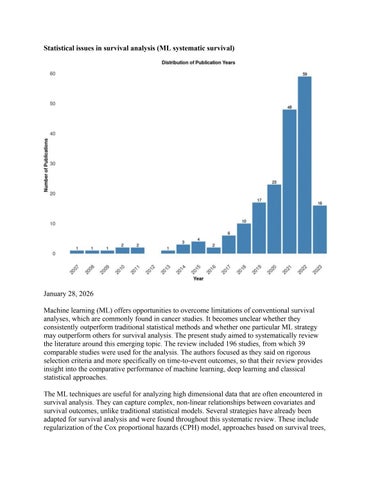
Statistical issues in survival analysis (ML systematic survival)
January 28, 2026 Machine learning (ML) offers opportunities to overcome limitations of conventional survival analyses, which are commonly found in cancer studies. It becomes unclear whether they consistently outperform traditional statistical methods and whether one particular ML strategy may outperform others for survival analysis. The present study aimed to systematically review the literature around this emerging topic. The review included 196 studies, from which 39 comparable studies were used for the analysis. The authors focused as they said on rigorous selection criteria and more specifically on time‐to‐event outcomes, so that their review provides insight into the comparative performance of machine learning, deep learning and classical statistical approaches. The ML techniques are useful for analyzing high dimensional data that are often encountered in survival analysis. They can capture complex, non‐linear relationships between covariates and survival outcomes, unlike traditional statistical models. Several strategies have already been adapted for survival analysis and were found throughout this systematic review. These include regularization of the Cox proportional hazards (CPH) model, approaches based on survival trees,