Statistical issues in survival analysis (ML and model comparison)
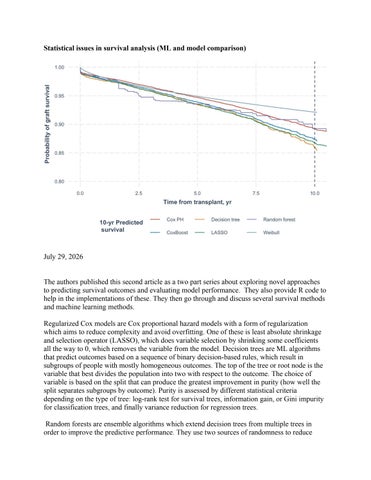
July 29, 2026 The authors published this second article as a two part series about exploring novel approaches to predicting survival outcomes and evaluating model performance. They also provide R code to help in the implementations of these. They then go through and discuss several survival methods and machine learning methods. Regularized Cox models are Cox proportional hazard models with a form of regularization which aims to reduce complexity and avoid overfitting. One of these is least absolute shrinkage and selection operator (LASSO), which does variable selection by shrinking some coefficients all the way to 0, which removes the variable from the model. Decision trees are ML algorithms that predict outcomes based on a sequence of binary decision-based rules, which result in subgroups of people with mostly homogeneous outcomes. The top of the tree or root node is the variable that best divides the population into two with respect to the outcome. The choice of variable is based on the split that can produce the greatest improvement in purity (how well the split separates subgroups by outcome). Purity is assessed by different statistical criteria depending on the type of tree: log-rank test for survival trees, information gain, or Gini impurity for classification trees, and finally variance reduction for regression trees. Random forests are ensemble algorithms which extend decision trees from multiple trees in order to improve the predictive performance. They use two sources of randomness to reduce