Statistical issues in survival analysis (Causal effects on nonterminal event time)
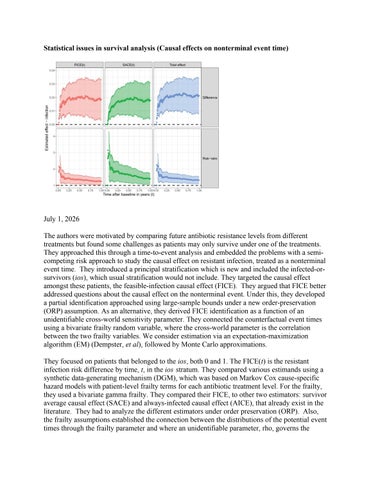
July 1, 2026 The authors were motivated by comparing future antibiotic resistance levels from different treatments but found some challenges as patients may only survive under one of the treatments. They approached this through a time-to-event analysis and embedded the problems with a semicompeting risk approach to study the causal effect on resistant infection, treated as a nonterminal event time. They introduced a principal stratification which is new and included the infected-orsurvivors (ios), which usual stratification would not include. They targeted the causal effect amongst these patients, the feasible-infection causal effect (FICE). They argued that FICE better addressed questions about the causal effect on the nonterminal event. Under this, they developed a partial identification approached using large-sample bounds under a new order-preservation (ORP) assumption. As an alternative, they derived FICE identification as a function of an unidentifiable cross-world sensitivity parameter. They connected the counterfactual event times using a bivariate frailty random variable, where the cross-world parameter is the correlation between the two frailty variables. We consider estimation via an expectation-maximization algorithm (EM) (Dempster, et al), followed by Monte Carlo approximations. They focused on patients that belonged to the ios, both 0 and 1. The FICE(t) is the resistant infection risk difference by time, t, in the ios stratum. They compared various estimands using a synthetic data-generating mechanism (DGM), which was based on Markov Cox cause-specific hazard models with patient-level frailty terms for each antibiotic treatment level. For the frailty, they used a bivariate gamma frailty. They compared their FICE, to other two estimators: survivor average causal effect (SACE) and always-infected causal effect (AICE), that already exist in the literature. They had to analyze the different estimators under order preservation (ORP). Also, the frailty assumptions established the connection between the distributions of the potential event times through the frailty parameter and where an unidentifiable parameter, rho, governs the