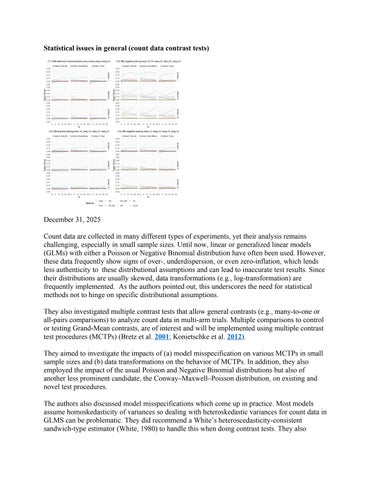
Statistical issues in general (count data contrast tests)
December 31, 2025 Count data are collected in many different types of experiments, yet their analysis remains challenging, especially in small sample sizes. Until now, linear or generalized linear models (GLMs) with either a Poisson or Negative Binomial distribution have often been used. However, these data frequently show signs of over-, underdispersion, or even zero-inflation, which lends less authenticity to these distributional assumptions and can lead to inaccurate test results. Since their distributions are usually skewed, data transformations (e.g., log-transformation) are frequently implemented. As the authors pointed out, this underscores the need for statistical methods not to hinge on specific distributional assumptions. They also investigated multiple contrast tests that allow general contrasts (e.g., many-to-one or all-pairs comparisons) to analyze count data in multi-arm trials. Multiple comparisons to control or testing Grand-Mean contrasts, are of interest and will be implemented using multiple contrast test procedures (MCTPs) (Bretz et al. 2001; Konietschke et al. 2012). They aimed to investigate the impacts of (a) model misspecification on various MCTPs in small sample sizes and (b) data transformations on the behavior of MCTPs. In addition, they also employed the impact of the usual Poisson and Negative Binomial distributions but also of another less prominent candidate, the Conway–Maxwell–Poisson distribution, on existing and novel test procedures. The authors also discussed model misspecifications which come up in practice. Most models assume homoskedasticity of variances so dealing with heteroskedastic variances for count data in GLMS can be problematic. They did recommend a White’s heteroscedasticity-consistent sandwich-type estimator (White, 1980) to handle this when doing contrast tests. They also