Statistical issues in general (Primary causal effects with unmeasured confounders)
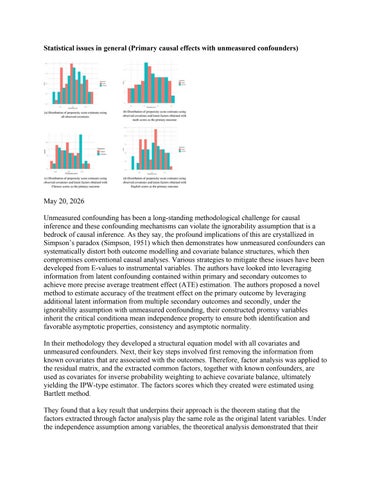
May 20, 2026 Unmeasured confounding has been a long-standing methodological challenge for causal inference and these confounding mechanisms can violate the ignorability assumption that is a bedrock of causal inference. As they say, the profound implications of this are crystallized in Simpson’s paradox (Simpson, 1951) which then demonstrates how unmeasured confounders can systematically distort both outcome modelling and covariate balance structures, which then compromises conventional causal analyses. Various strategies to mitigate these issues have been developed from E-values to instrumental variables. The authors have looked into leveraging information from latent confounding contained within primary and secondary outcomes to achieve more precise average treatment effect (ATE) estimation. The authors proposed a novel method to estimate accuracy of the treatment effect on the primary outcome by leveraging additional latent information from multiple secondary outcomes and secondly, under the ignorability assumption with unmeasured confounding, their constructed promxy variables inherit the critical conditiona mean independence property to ensure both identification and favorable asymptotic properties, consistency and asymptotic normality. In their methodology they developed a structural equation model with all covariates and unmeasured confounders. Next, their key steps involved first removing the information from known covariates that are associated with the outcomes. Therefore, factor analysis was applied to the residual matrix, and the extracted common factors, together with known confounders, are used as covariates for inverse probability weighting to achieve covariate balance, ultimately yielding the IPW-type estimator. The factors scores which they created were estimated using Bartlett method. They found that a key result that underpins their approach is the theorem stating that the factors extracted through factor analysis play the same role as the original latent variables. Under the independence assumption among variables, the theoretical analysis demonstrated that their