Innovations Magazine is written and produced by the USF St. Petersburg Communications & Marketing department.
Editor
Matthew Cimitile
Assistant Editor Amy Harcar
Art Direction, Design
Lily Hoddinott
Alex Jonas
Content Contributors
Lorie Briggs
Matthew Cimitile
Gillian Finklea
Dyllan Furness
Joey Johnson
Heather Judkins
Carlyn Scott
Sarah Sell
Photography:
Kelli Carmack
Cliff McBride
Sarah Sell
Student Photography
Contributors: Nicole Bosch
McKenzie Maryann Demian
Anastasia Fox
Melanie Martinez
Taylor McLeod
Alejandro Peluffo
Paola Navarro Saenz
A MESSAGE FROM THE REGIONAL CHANCELLOR
During my 25 years at USF St. Petersburg, I have experienced so much that makes a college campus a vibrant place of inquiry and exploration. As a professor, a researcher and a dean, I have taught countless classes, presided over faculty meetings, participated in campus traditions and collaborated with an array of community partners.
I have witnessed the campus transform from a commuter school with a handful of buildings to a residential campus with many state-of-the-art facilities. We have stellar faculty who are top-notch instructors and conduct vital research locally and globally. It’s been gratifying to see the upward trajectory of our campus, mirroring and supporting the growth of Tampa Bay.
It is an immensely exciting time to be at USF St. Petersburg, and you will read stories highlighting our momentum from the perspectives of those who make up our campus community in this issue of Innovations Magazine.
A year on from the worst hurricane season for Tampa Bay in memory, learn how USF researchers are unlocking the secrets behind why extreme storms rapidly intensify and spearheading technology and community collaborations to better document impacts on land. Read about how we are addressing the coming nursing shortage in the state and providing executive education and training so today’s professionals can become the business leaders of tomorrow.
Within these pages you will also find the many remarkable achievements of our students and alumni, from those using AI tools to better decipher how the mind works to siblings launching respective startups to a graduate who is at the forefront of the local documentary filmmaking scene.
As we look forward, we will work together, across USF campuses and Tampa Bay, to continue to address challenges and solve problems while helping our students achieve their educational dreams and prepare for the future.
Thank you for your ongoing support, which makes all this possible.
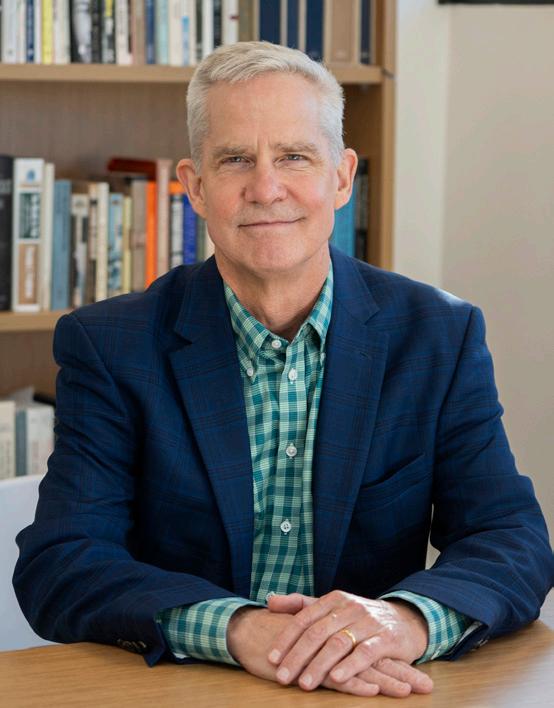
Thomas W. Smith
Interim Regional Chancellor
University of South Florida St. Petersburg
USF PRESIDENT
Rhea Law
USF ST. PETERSBURG CAMPUS ADVISORY BOARD
Melissa Seixas, USF Trustee and Campus Board Chair
Barclay Harless
Isaac McKinney
Debbie Nye Sembler
Debbie White
USF ST. PETERSBURG CAMPUS LEADERSHIP
Thomas Smith, Interim Regional Chancellor and Vice Provost for Academic Affairs
Frank Biafora, Interim Associate Dean of the College of Arts & Sciences
Matthew Cimitile, Director of Communications & Marketing
Jacob Diaz, Regional Associate Vice Chancellor of Student Success and Dean of Students
Lauren Hartmann, Assistant Vice President of Government Relations
Mai Jenney, Regional Assistant Vice Chancellor of Administration & Finance
Kristina Keogh, Campus Dean of the Nelson Poynter Memorial Library and Assistant Dean of the College of Design, Art & Performance
Cayla Lanier, Assistant Dean of the Judy Genshaft Honors College
Gary Patterson, Dean of the Kate Tiedemann School of Business and Finance and Campus Dean of the Muma College of Business
David Rosengrant, Associate Dean of the College of Education
E. Howard Rutherford, Associate Vice President of Development
Julie Serovich, Dean of the College of Behavioral and Community Sciences
Kevin Sheehy, Regional Vice Chancellor of Administration and Finance
Anna Thrombley, Director of Human Resources
REAL REAL Stories, Impact
BULLS MAKING A DIFFERENCE ON CAMPUS AND BEYOND
By Sarah Sell
As student Teresa Booker walked to class one Tuesday morning in February of 2025, she heard a call for help.
A 67-year-old man was having a cardiac emergency outside The Campus Grind. When she arrived on the scene, the man was slumped over and turning blue.
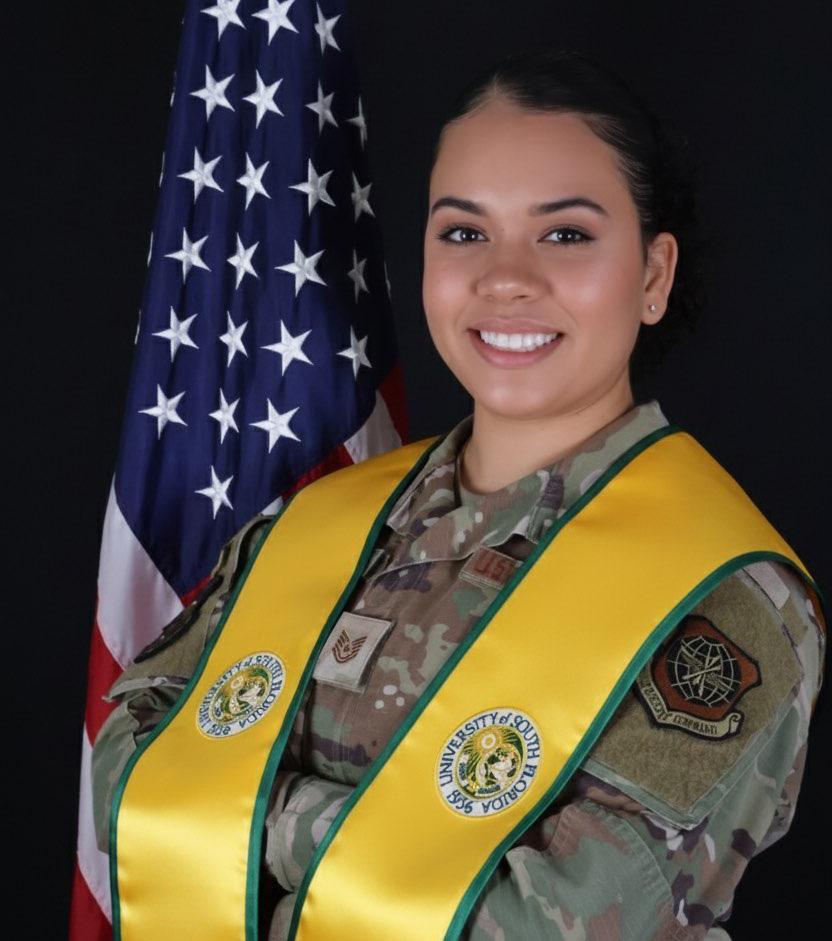
Booker, who has served 13 years in the Air Force and is a trained CPR instructor, quickly stepped in to help.
“I’ve always wondered how I would respond if I ever needed to use my training in a real-life scenario,” she said. “This calmness came over me, and I didn’t feel scared or nervous. The training just kicked in.” Booker
immediately began CPR, keeping the man stable until emergency responders arrived.
USF St. Petersburg Emergency Manager Kevin Sullivan also heard the calls for help and quickly called the University Police Department (UPD) and ran to get an automated external defibrillator, or AED. Sergeant Jeffrey Banks, a former EMT, and Officer Joseph Gonska arrived shortly after with another AED. Banks checked for a pulse, applied the AED pads and delivered a shock.
“Within four minutes of falling, campus first responders had an AED on him and delivered a lifesaving shock. Before the ambulance arrived, the man was already awake,” said David Hendry, regional chief of police at USF St. Petersburg. “That kind of quick response is truly incredible.”
St. Petersburg Fire Rescue and paramedics arrived shortly after to take the man to a nearby hospital.
For Booker, a health sciences major, the moment was surreal. At the time, she was on a break from the military to earn her degree and spend more time with her dad, a heart attack survivor.
“That could have been my dad,” she said. “I’m just very grateful I was able to help.”
The man survived and still visits The Campus Grind.
GRAD STUDENT OVERCOMES CANCER TO EARN
DEGREE
When Kylie Culver began her master’s degree in 2022, she didn’t expect the life-changing journey that would follow. Shortly after returning from a study abroad trip to Spain, she began experiencing unexplained bruising and fatigue.
“When I got back home, I was completely exhausted. I could barely walk and was out of breath,” Culver said. “I went to my doctor and had some blood work done but then forgot about it for three weeks.”
At the time, Culver was focused on her thesis and ready to return to classes in fall 2023. With a bachelor’s degree in history and Spanish, Culver had chosen USF’s Florida Studies program for its focus on the state’s past and culture. She was specifically drawn to its paleography courses. She had just taken her first trip to the Archive of the Indies in Seville, Spain, where she conducted research.
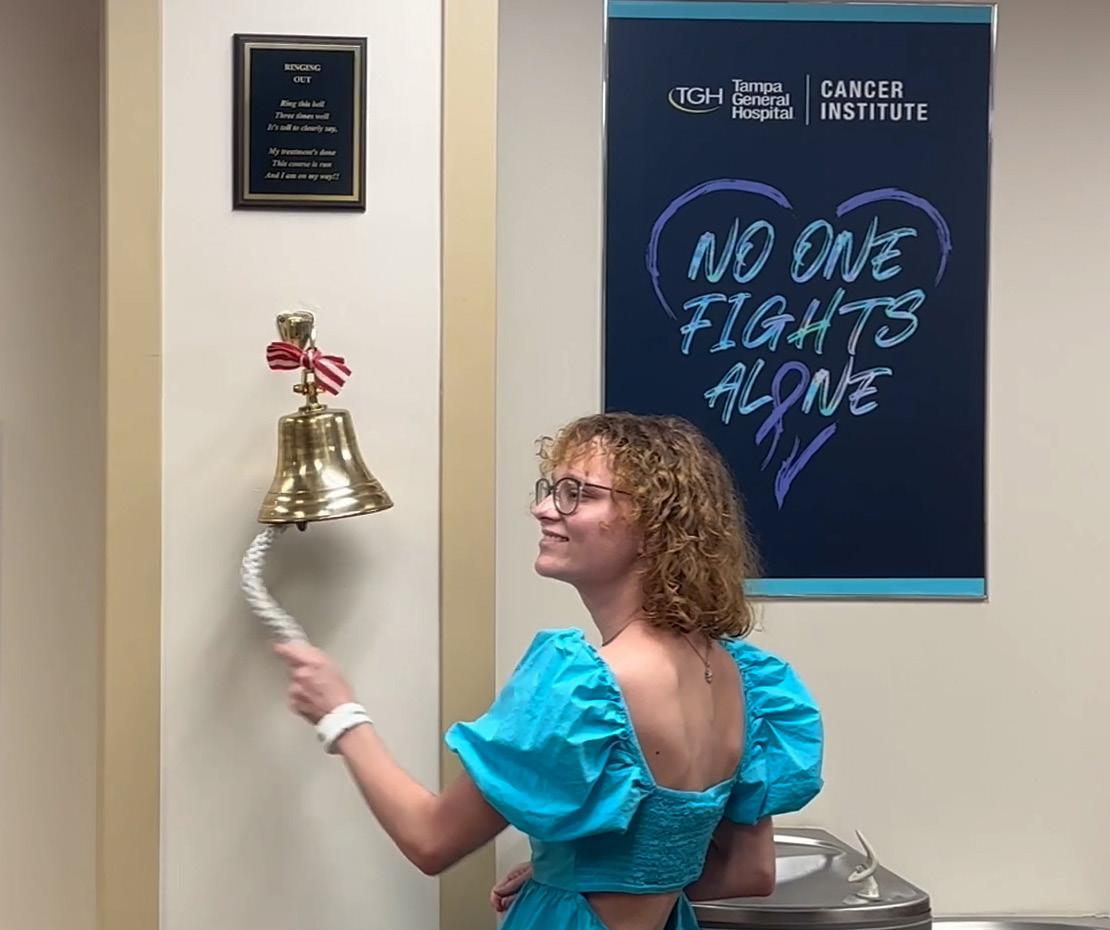
But just as she returned to campus, Culver received alarming test results. Her doctor urged her to see a hematologistoncologist immediately. She went straight to the emergency room, where she received a transfusion and was diagnosed with acute promyelocytic leukemia (APML), a rare form of blood cancer.
While her long-term prognosis was positive, the treatment required intensive chemotherapy that kept her either in the hospital or at home.
“I tried going to school online, but I couldn’t see or move without getting sick,” Culver said. “I ended up withdrawing from my classes.”
Throughout this time, her professors checked in regularly and made sure she still felt part of the USF community.
“Kylie is full of life, energy, curiosity, intelligence and drive,” said Chris Meindl, director of the Florida Studies program. “Being told at such a young age that she had this terrible disease would shake most people to their core. But not Kylie. I was in awe of her determination.”
In July of 2024, Culver was officially cured of APML. After a year away, she returned to USF focused and determined, completing her thesis and earning her master’s degree.
REAL STORIES, REAL IMPACT
SIBLING STARTUPS
Early on, the sisters earned the prestigious CREST (Cybersecurity Research and Education for Service in Government) scholarship, which allowed them to focus on their studies and their startups.
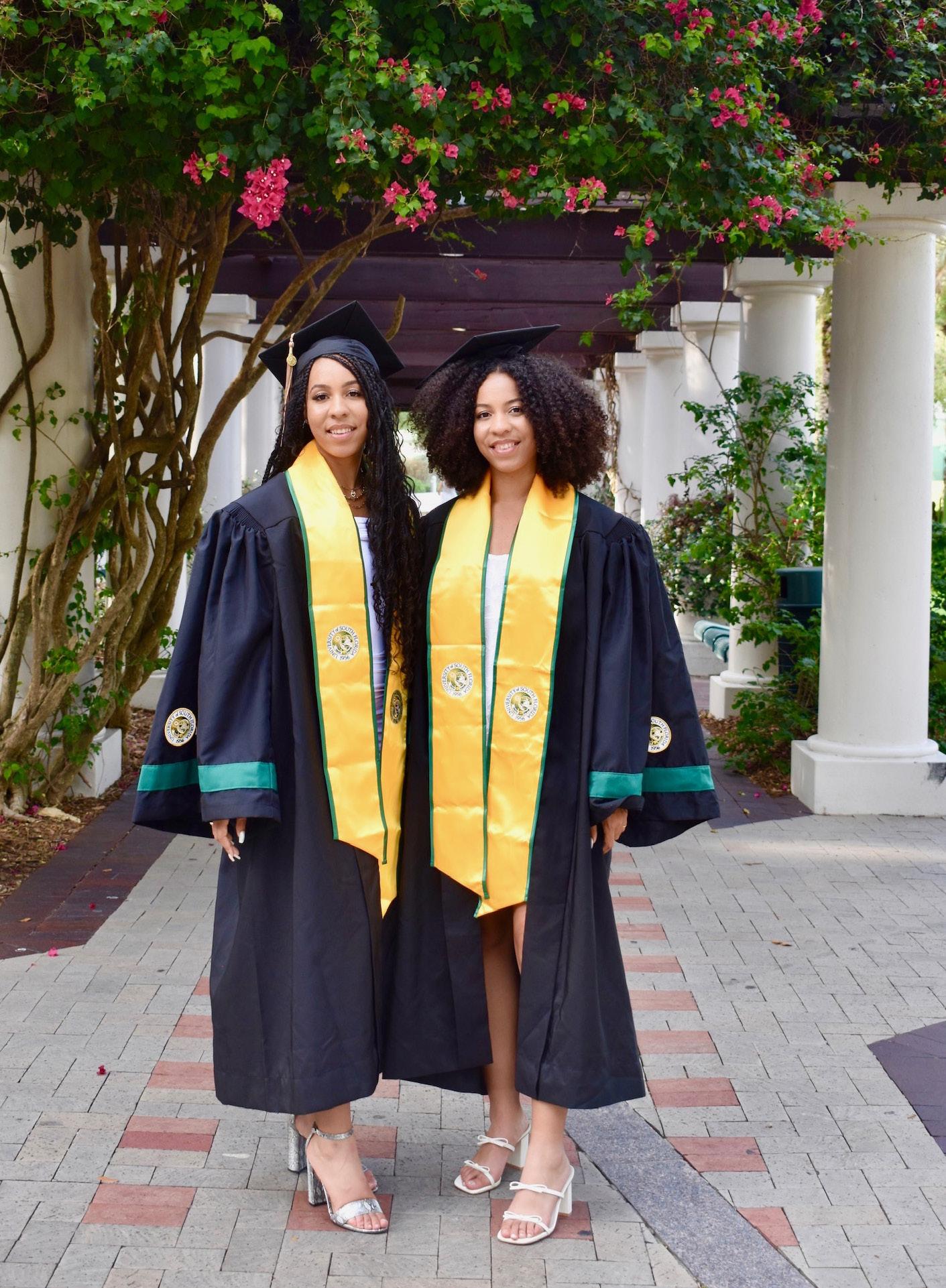
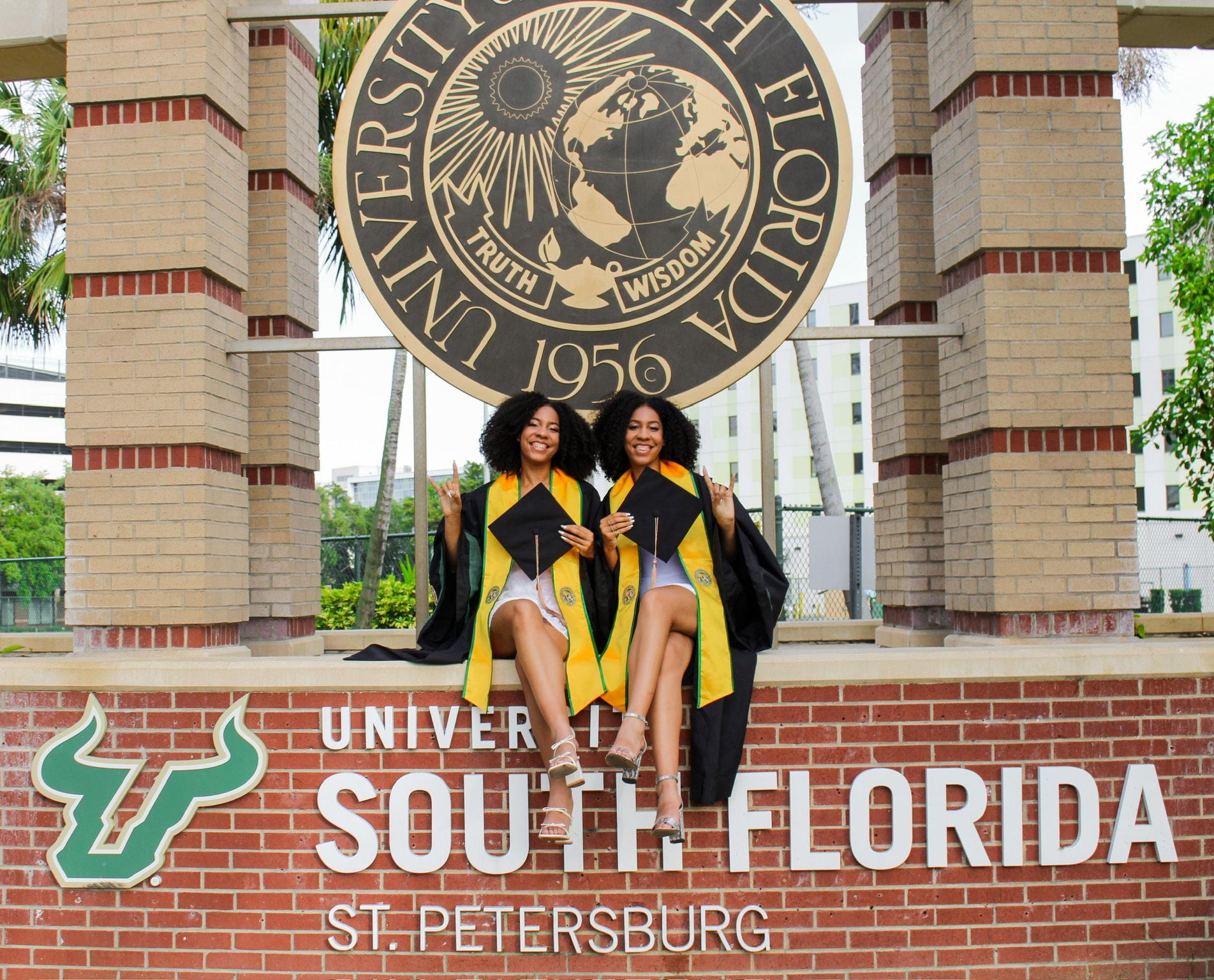
Some students leave college with strong friendships, while others have standout resumes full of research and internship experience. Cherish and Unique Alston walked away with both – and more.
The twin sisters from Northern Virginia launched two startups while pursuing their undergraduate degrees: one focused on premium sneaker accessories, the other on improving student transportation through a carpooling app.
They chose USF St. Petersburg for its affordability and its prime location in an emerging business and tech hub.
“Tampa Bay is really up and coming, and sort of a hotbed for cybersecurity, entrepreneurship and the fintech space,” Cherish said. “The location was a major factor in why we wanted to be here.”
The sisters took full advantage of the university’s resources, including student groups, mentors, networking events and pitch competitions.
“When we visited the Nault Center for Entrepreneurship, we were blown away that students were already running their own businesses while in college,” Cherish said.
“Getting the email saying I won a full-ride scholarship, after working so hard at multiple jobs during that first year, my sister and I were in disbelief,” Unique said.
“It allowed me the time to pursue my passion for entrepreneurship and cybersecurity.”
Unique co-founded Ridely, a student carpooling app now available in app stores. She placed second at the Governor’s Cup Pitch Competition and will continue growing Ridely while pursuing a graduate degree in AI and business analytics at USF.
Cherish co-founded SoleLuxe, a startup that sells premium sneaker accessories. Her success has earned her $55,000 in funding, national recognition at the CEO Global Conference, and admission to NYU, where she is currently pursuing a graduate degree in cybersecurity.
Graduating from USF St. Petersburg in spring 2025, the Alston sisters left with more than undergraduate degrees. They are moving forward with the confidence, skills and experience to build successful ventures beyond the classroom.
FROM CAMPUS ROOTS TO COMMUNITY VOICE
When Andrew Lee stepped onto the USF St. Petersburg campus in 2002, there was no student housing, few buildings and just nine students in the Graphic Arts program. But for Lee, it marked the beginning of a journey that would lead him to the forefront of local documentary filmmaking.
“It felt like we were all in this together,” Lee said. “Some of those people became my best friends, and one of them is my wife.”
While pursuing his degree, Lee took art and design classes and was introduced to video production.
“It was the first time I held a camera and tried to tell a story,” he said. “I knew immediately this was the medium I was meant to be in.”
Lee interned at a local video company and later collaborated with its owner on a feature-length documentary, “Easy Street,” which follows five homeless individuals in St. Petersburg. The film gained national attention, was picked up by Netflix and is now used in college sociology courses.
Inspired by that success, Lee launched Roundhouse Creative in 2007. The boutique video production company is known for its commercial work and community storytelling.
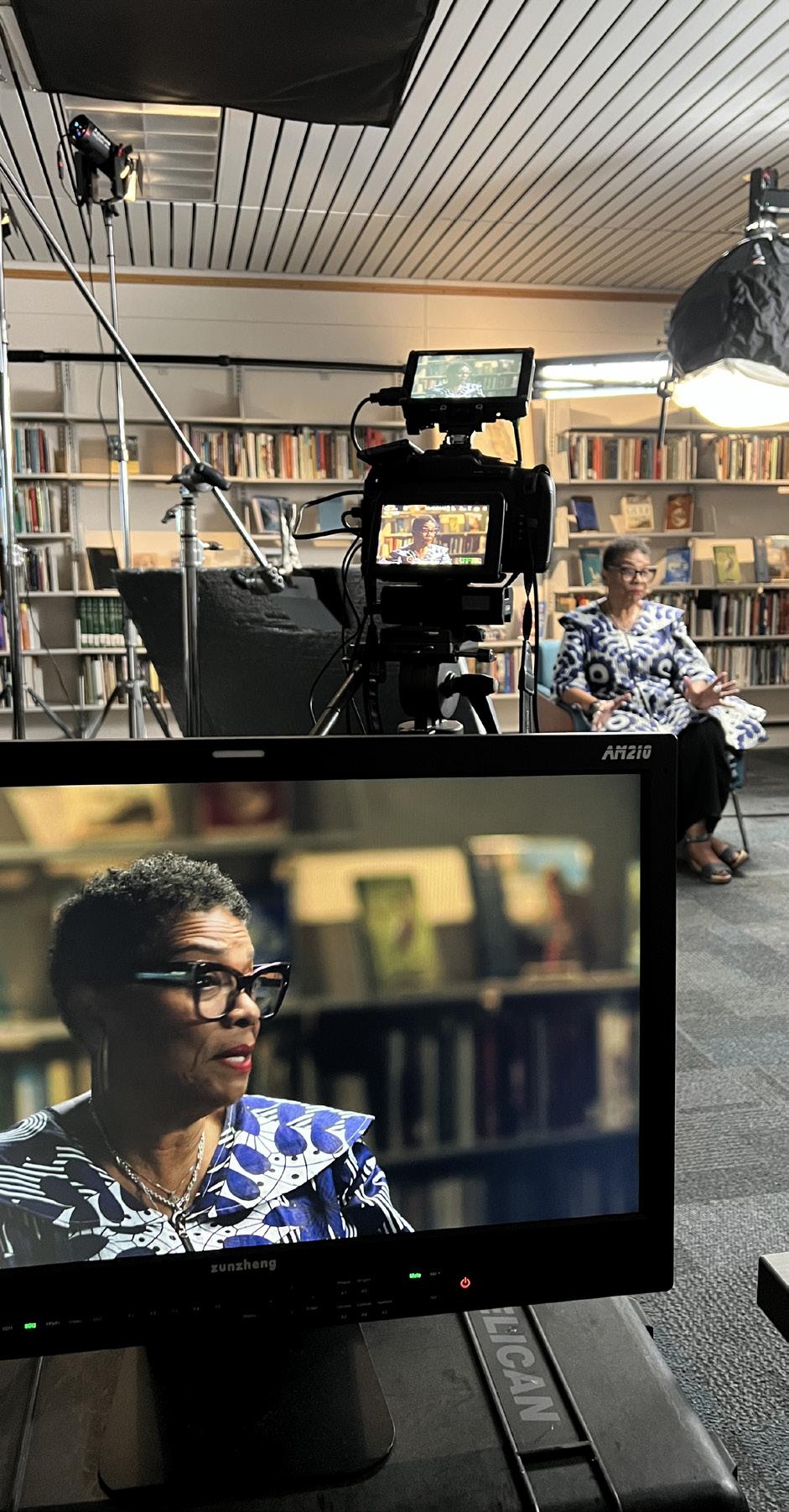
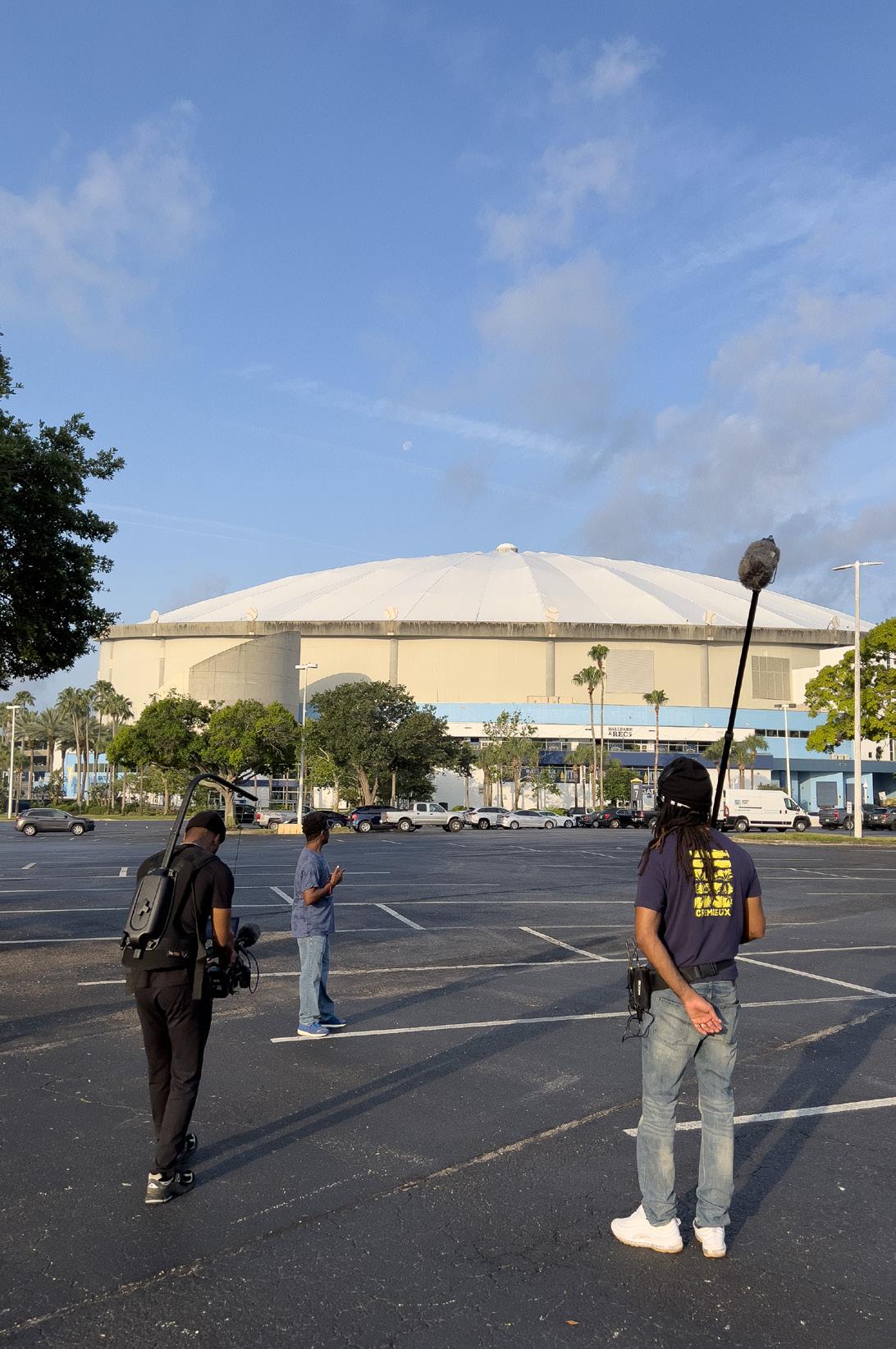
On Sept. 2, more than 100 people gathered at USF St. Petersburg to watch Lee’s latest documentary, “Razed,” which explores the history of the Gas Plant District, a once-thriving Black neighborhood displaced by the construction of Tropicana Field. The project began in 2020 through interviews with former residents.
“When people trust you with their story, you don’t take it lightly,” Lee said. “You show up. You listen. And you do the work to get it right.”
Today, Lee runs Roundhouse Creative with his wife, Brooke, and longtime collaborator Joseph Nunez, all USF St. Petersburg graduates.
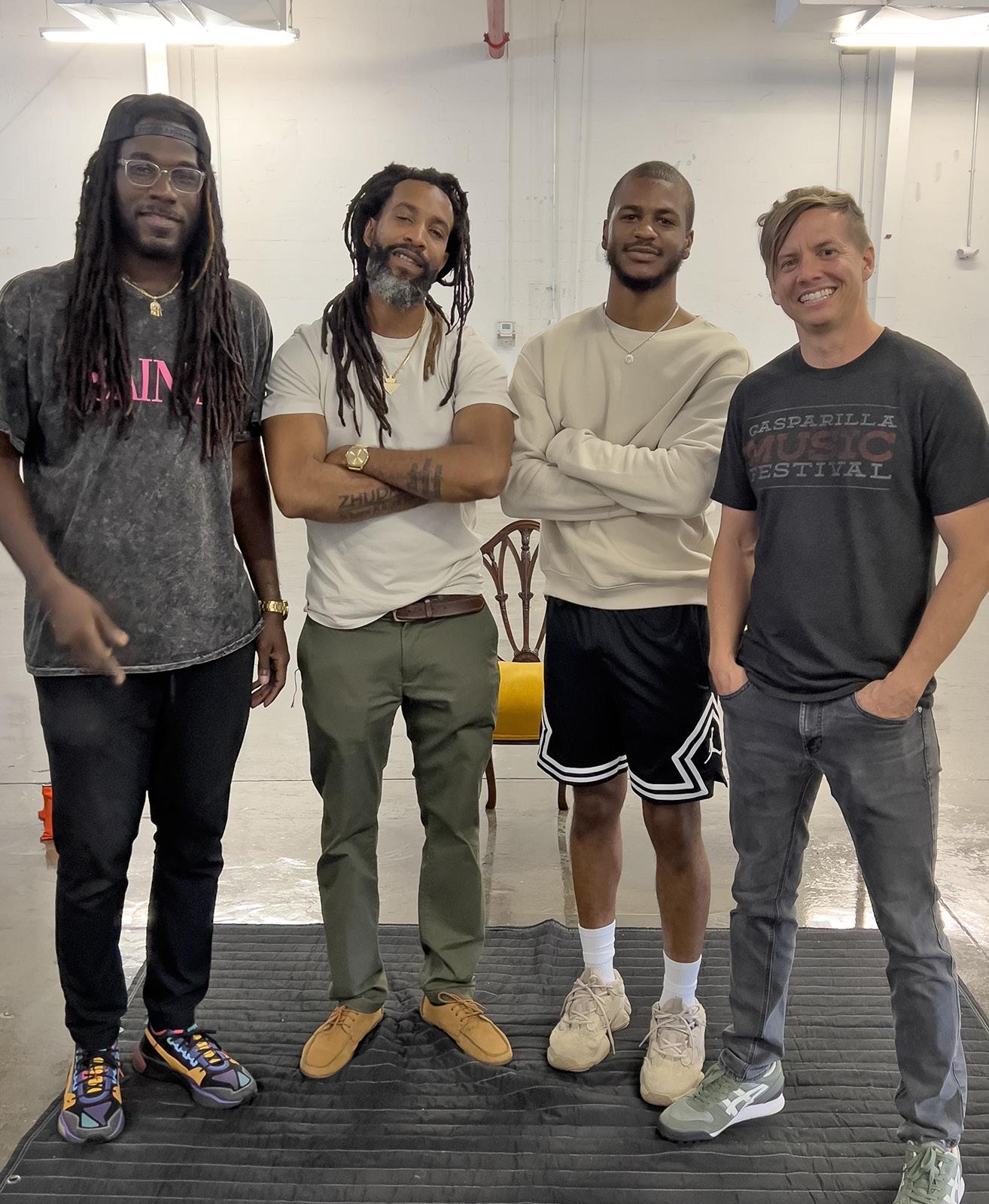
Andrew Lee (far right) on the set of his latest documentary “Razed.”
ENHANCING COASTAL RESILIENCE, ACCESSIBILITY AND CLASSROOM INNOVATION
By Sarah Sell
A wave of new investment is setting the stage for a transformative year at the University of South Florida. The 2025-26 state budget, combined with earlier federal funding, is fueling major initiatives across the university. On the St. Petersburg campus, this is leading to cuttingedge coastal research, expanded student accessibility and state-of-the-art classroom technology.
The most recent state budget includes a onetime $12.5 million boost to USF’s operating budget and $2.5 million in recurring funds, demonstrating a continued commitment to growth across all three campuses. That growth is delivering transformative programs and facilities throughout the university.
ADVANCING COASTAL AND MARINE SCIENCES
The largest project funded on the St. Petersburg campus during the state’s legislative session was the Environmental & Oceanographic Sciences Research and Teaching Facility (EOS). A new $10 million investment adds to the $24.3 million that the state funded back in 2023-24 for the first phase of the facility.
The facility will serve as the heart of an interdisciplinary center of excellence, bringing together expertise from across the university to study and address coastal and environmental challenges, including sea-level rise, flooding and other impacts on coastal communities.
“EOS represents a transformational investment, not just in infrastructure, but in opportunity, discovery and global impact,” said Thomas Smith, USF St. Petersburg interim regional chancellor. “This will be more than a building. It’s a launchpad for solutions that will help us better prepare for extreme weather and strengthen our response to environmental challenges, which will create more resilient coastal communities and economies.”
Building on the international reputation of the College of Marine Science, the new center will serve as a national destination for research in oceanography, sustainability and the environment.
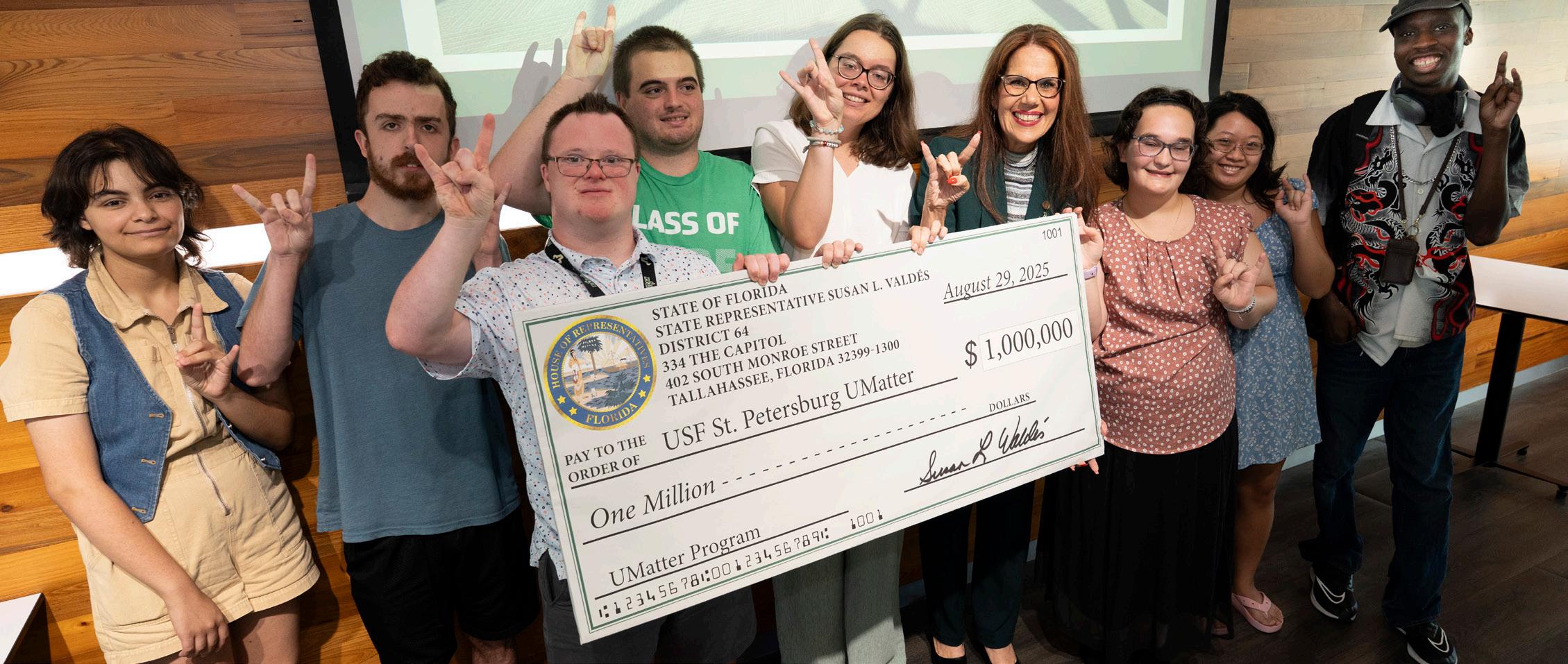
State Representative Susan Valdés presents a $1 million check to honor this year’s state funding for the Eileen Hoffman Hafer UMatter program.
“USF is uniquely positioned to house the EOS Research and Teaching Facility,” said Tom Frazer, dean of the College of Marine Science. “The facility will be situated among world-class agencies and research institutions dedicated to marine science and environmental stewardship. Our partnerships with these groups will help strengthen research collaboration, attract top talent and enhance community engagement throughout the Tampa Bay region.”
PATHWAYS TO INDEPENDENT LIVING
Building on USF’s commitment to innovation and accessibility, the state also invested in a program that expands opportunities for students with unique abilities. USF received $1 million to support the Eileen Hoffman Hafer UMatter Program, which provides students with intellectual disabilities the opportunity to experience higher education and campus life.
The new funding will allow UMatter to expand enrollment and upgrade facilities, ensuring even more students benefit from its transformative opportunities. UMatter students live in residence
halls, attend sporting events and participate in student clubs while pursuing their academic passions. Along the way, they learn social skills such as how to do laundry, grocery shop, budget and make healthy lifestyle choices and participate in internships for career training. Overall, the program offers an accessible university experience that leads to competitive, integrated employment and independent living.
Launched in 2020 through a $900,000 grant from the Florida Center for Students with Unique Abilities, the program welcomed its first class of students in August 2021. A $1.2 million gift from Andrew and Eileen Hafer followed in September 2021, enabling the program, through the College of Education, to expand across all three USF campuses.
CLASSROOM OF THE FUTURE
Back in 2022, U.S. Rep. Kathy Castor secured a $1 million appropriation that was invested at all three USF campuses to strategically advance STEM education and teacher preparation across districts in and around Tampa Bay.
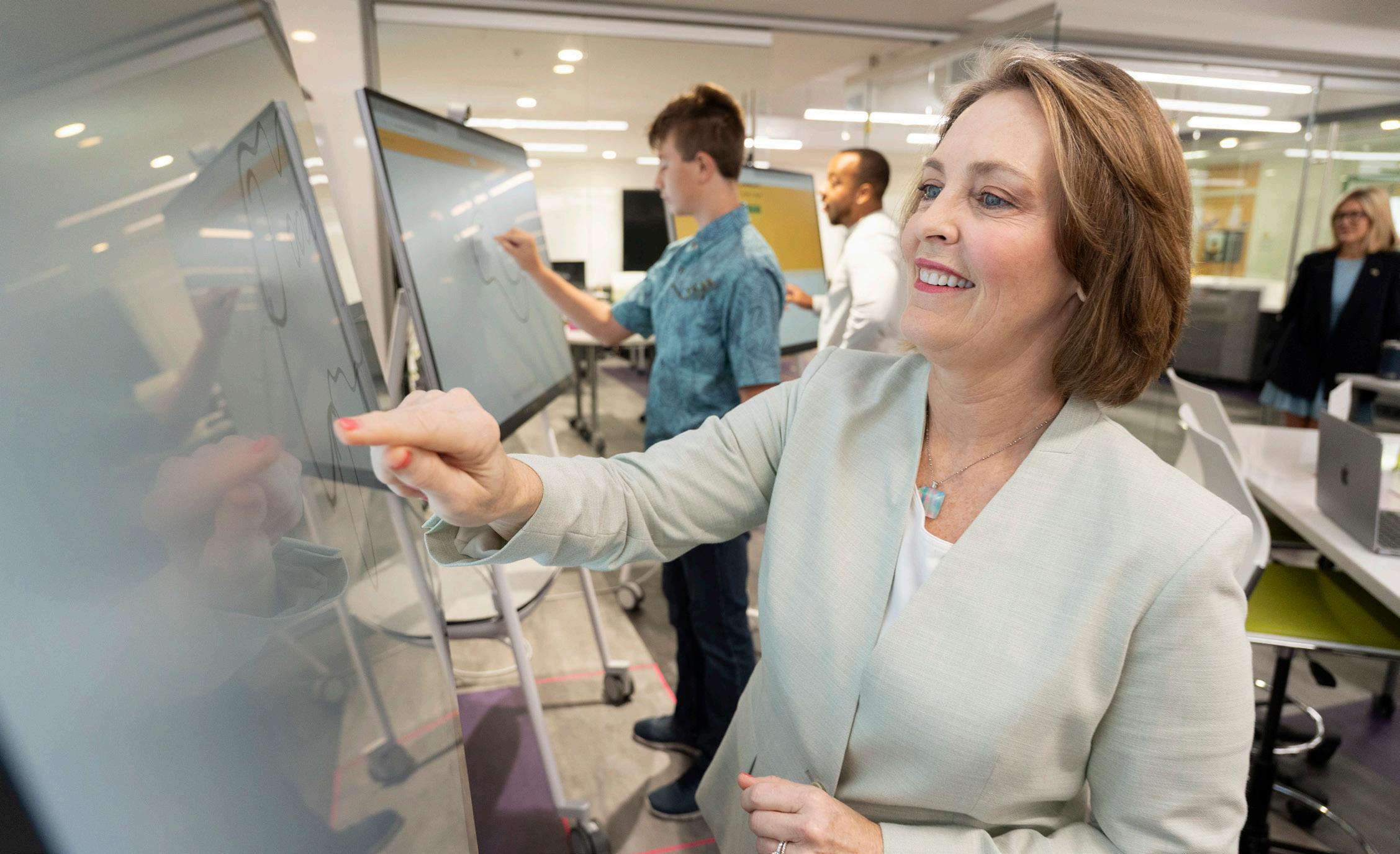
In July of 2025, Rep. Castor paid a visit to the campus to see that investment come to fruition. A part of the federal funding went to equipping the College of Education’s Emerging Technology Lab at USF St. Petersburg. The lab is designed to provide students from all majors with realworld experiences in visual and simulated content and to train teachers on how to incorporate cutting-edge tools into the classroom.
Equipped with new technology, the lab is now providing hands-on training in artificial intelligence, augmented reality and virtual reality.
Located in Heller Hall next to the STEM inquiry Lab, the Emerging Tech Lab is part of “Innovation Lane,” a hub for exploration in robotics, coding, 3D printing and drone piloting. Together, these spaces prepare educators and students for the classrooms and workplaces of the future.
U.S. Representative Kathy Castor visits the Emerging Technology Lab.
PROPELLING DISCOVERY & OPPORTUNITY
By Matthew Cimitile and Dyllan Furness
In many ways, the laboratory is as essential as the classroom in the world of higher education. Research funding propels one of the key missions of a university: addressing societal challenges by generating breakthrough discoveries, creating new technologies, providing a deeper understanding of society and the environment, and more. It also helps open the door of possibility for students, supporting for many their first research experiences in their fields, and in the process develops the next generation of scientists, doctors and visionaries.
This past fiscal year, USF achieved a new milestone in research funding, reaching $750 million. That number not only breaks a record, but it is also a 37 percent jump since 2022. The greatest year-over-year growth occurred in the College of Marine Science on the USF St Petersburg campus, which increased its funding 27% to $23 million.
“The University of South Florida is committed to solving real-world challenges, and our record research funding – bringing us closer to our goal of $1 billion in funding by 2030 – provides more opportunities for our faculty, staff and students to turn bold ideas into innovation and impact,” USF President Rhea Law said.
Read more on recent research funding on the St. Petersburg campus that seeks to shape a better future for our region, state and nation.
Strengthening families and supporting parents
The Family Study Center, in collaboration with several community organizations, secured a $3.7 million grant from the U.S. Department of Health and Human Services (HHS) for an initiative to strengthen families and support parents facing adversity.
The five-year project is designed to reduce family stress and instability by identifying and testing the most effective strategies to strengthen parental relationships and create supportive home environments. Led by USF
psychology professor James McHale, director of the Family Study Center, the coalition includes several community organizations specializing in assisting families with justice system involvement and families involved in child welfare investigations.
A central component of the initiative is the Within My Reach program, an evidence-based curriculum that teaches essential adult relationship and decision-making skills. Research from the Family Study Center highlights the importance of positive family relationships as the most important factor in raising healthy children.
The effort builds on the Family Study Center’s previous HHS-funded project, where those who participated reported better communication, lower stress and stronger parenting skills.
“Our mission has always been to improve the lives of children and families. The first grant allowed us to reach over 400 families, and now we can help hundreds more,” McHale said. “It’s thrilling to know that this federal investment will let us continue making a difference for families right here in our community.”
The initiative is a collaboration among Family Enrichment Services, Lutheran Services Florida, People Empowering and Restoring Communities, Gulf Coast JFCS, Safe-At-Home, Family Support Services, Ready for Life, Hispanic Outreach Center, Operation New Hope, the Florida Department of Corrections, Florida HIRES and other community partners. Its success will depend on this strong network of local agencies that work directly with families every day, and together, ensuring education and resources are accessible to the families who need them the most.
Tracking a troublesome seaweed
Since 2011, large mats of a seaweed called sargassum have become an annual problem for communities across Florida, the Caribbean and Gulf
Coast. Where they decay, they emit a foul rotting odor, harm marine life and disrupt local communities. Annual economic impacts to businesses and governments in the United States are reaching millions of dollars due to costly removal and cleanup efforts, as well as disruptions to fisheries and tourism.
Resource managers in South Florida have a new tool in their fight against sargassum thanks to a five-year, $3.2-million grant from the National Oceanic and Atmospheric Administration (NOAA) Monitoring and Event Response for Harmful Algal Blooms program.
Led by the USF College of Marine Science, the project is allowing researchers to develop a high-resolution detection and forecasting system for areas of South Florida, which will soon expand to include coastlines across Florida and the Caribbean. The new tool builds on the Sargassum Watch System from the college’s Optical Oceanography Lab.
“Our updated system has vastly improved capabilities compared to prior systems for tracking sargassum,” said Brian Barnes, assistant research professor and the project’s principal investigator. “The new system relies on satellites that provide data at a scale of about 50 meters (about half the area of a football field), as compared to several kilometers in our current system. Thus, instead of looking at sargassum inundation risk at the scale of the Florida Keys region, we are now able to see potential impacts at an individual beach scale.”
The forecasting component of the project capitalizes on a long-standing partnership between Yonggang Liu, associate professor and director of the college’s Ocean Circulation Lab, and researchers at the Caribbean Coastal Ocean Observing System. For this project, they will combine the higherresolution satellite images with coastal ocean circulation models.
“These models, which have been refined in our lab, will allow us to determine where the algae will end up over the next few days,” Liu said. “We hope this will give tremendous value to people on the ground managing sargassum inundations.”
Additional partners in the project include the Florida Atlantic University, U.S. Virgin Islands Department of Planning and Natural Resources, and NOAA Atlantic Oceanographic and Meteorological Laboratory.
Enhancing student exploration of Florida’s coastal issues
From booming cities to natural disasters, Florida’s Gulf Coast has experienced seismic activity in recent years. A new program will provide students paid learning opportunities to further explore the complex challenges facing the region, while introducing them to research early in their academic journey.
The University of South Florida was one of six higher education institutions this year to be awarded $600,000 from the National Academies of Sciences, Engineering, and Medicine to launch a Gulf Scholars program.
Starting in fall 2026, approximately 20 undergraduate students from all majors will be selected to engage in a two-year academic experience that includes Gulf-themed coursework, experiential learning and the creation of a public-facing Gulf Impact Project. Each student receives up to $3,500 in scholarships as well as guidance from faculty and community experts from a multitude of fields.
“The Gulf Scholars program is going to provide a remarkable opportunity for students to conduct meaningful work through several disciplinary lenses, influencing their own career path while they make an impact in their community,” said Catherine Wilkins, professor of instruction in the Judy Genshaft Honors College who will direct the program.
Each year, a new crop of students will be selected, giving them early opportunities to engage with the community and prepare them with the skills, knowledge and vision to foster a resilient Gulf region. Classes will incorporate humanities alongside scientific research and data literacy. Students can earn internships with local agencies, conduct research projects and participate in study abroad or away programs.
“This particular program is meant to pair students early on with faculty and community organizations that are actively conducting research related to the Gulf,” said Theresa Burress, university librarian for USF Libraries and co-director of the program. “From there, students can really immerse themselves in a research community earlier than they would normally.”
At the conclusion, all students will complete a capstone Gulf Impact Project that addresses a pressing problem and shares that work publicly via a city council presentation or a research poster talk.
FROM TAMPA BAY TO
‘CYBER BAY’ ‘CYBER BAY’ ‘CYBER BAY’ ‘CYBER BAY’
Historic $40 million gift establishes Bellini College of Artificial Intelligence, Cybersecurity and Computing
Positioned at the intersection of technology, military defense and global commerce, Tampa Bay is uniquely poised to become the nation’s cybersecurity capital, “Cyber Bay.”
U.S. Central Command at MacDill Air Force Base makes Tampa a hub for military cyber operations. The Florida Center for Cybersecurity at USF is already a leader in state and federal cyber initiatives. More than 25% of Florida’s tech jobs are based in Tampa, including the headquarters or major offices of cybersecurity giants such as KnowBe4, ReliaQuest, Rapid7 and ConnectSecure.
In a bold move to further position Tampa as a global leader in artificial intelligence and cybersecurity, the University of South Florida announced a record-setting $40 million gift in March 2025 to establish the Bellini College of Artificial Intelligence, Cybersecurity and Computing. This transformational
philanthropic gift in USF’s70-year history –creates the first named college in the U.S. dedicated exclusively to the convergence of AI and cybersecurity.
The gift from USF alumni Arnie and Lauren Bellini came at a critical juncture, as the United States faces an unprecedented wave of cyberattacks, AI-driven threats and global competition in digital security. The new Bellini College, which celebrated its first graduates in December, is directly addressing the nation’s urgent cybersecurity workforce shortage while equipping America’s digital defenses against the rapidly evolving threats of the AI era.
“This investment cements Tampa as a global powerhouse for AI and cybersecurity innovation,” said USF Board of Trustees Chair Will Weatherford. “USF is leading the way in training the next generation of cyber warriors and AI pioneers. The Bellini College of Artificial Intelligence, Cybersecurity and Computing will drive the talent pipeline that fuels our national
ADDRESSING AMERICA’S CYBERSECURITY WORKFORCE GAP
Cybercrimes cost the U.S. over $12 billion in 2023 alone, according to the FBI, yet the country faces a massive shortage of
cybersecurity professionals, with over 700,000 unfilled jobs today.
The opening of the Bellini College last fall dramatically expands access to state-of-theart AI and cybersecurity training, producing thousands of highly skilled professionals prepared to defend businesses, institutions and government agencies from cyber threats.
“We are at a pivotal moment in history where AI and cybersecurity must evolve together,” said USF President Rhea Law. “This college will produce the talent and innovation needed to meet the escalating challenges of the digital era. We are proud to stand alongside the Bellinis in shaping the future of AI and cybersecurity.”
A FIRST-OF-ITS-KIND APPROACH: AI AND CYBERSECURITY TOGETHER
Unlike traditional cybersecurity programs, the Bellini College pairs AI and cybersecurity in an integrated approach, recognizing that AI is both the greatest enabler and greatest threat in the cyber landscape.
“America cannot afford to be reactive—we must be proactive,” said Arnie Bellini, a tech entrepreneur who co-founded ConnectWise and is now CEO of Bellini Capital. “Cybercriminals and rogue nation-states are already deploying AI-driven cyberattacks at an alarming scale. The Bellini College will train the cyber warriors of tomorrow to outthink, outmaneuver, and outinnovate these threats.”
The college offers:
• Undergraduate and graduate degree programs that fuse AI and cybersecurity into real-world applications
• AI-driven research to develop nextgeneration cybersecurity solutions
• Strategic partnerships with government agencies, defense contractors and Fortune 500 companies
• A focus on ethical AI implementation and responsible digital governance
“This initiative is a game-changer for industry,
government and academia,” said USF Provost Prasant Mohapatra. “By integrating AI and cybersecurity in one college, USF is creating a national model for preparing leaders in this rapidly evolving field.”
Since the Bellinis’ initial historic gift, the state and donors have made additional investments in USF’s newest college. Florida approved $10 million in its 2026 budget to help fund construction of a college building. And at the inaugural CyberBay conference in October, the university announced $2.3 million in new private philanthropic gifts to support the college. They included a $1 million gift from USF President Rhea Law and $1 million from philanthropists
BLENDING MIND AND MACHINE:
By Lorie Briggs
As one of USF’s first master’s students studying AI, Charitie Martino wants to fuse computer modeling with how the mind works. She wants to take those hard-to-pin-down concepts in psychology – things like memory, attention and learning – throw them into models that AI computers can test, and measure to see what happens.
The end result? Hopefully, some definitive answers on how humans take in information. And by translating ideas like memory and perception into testable models, she hopes to reveal new insights into how humans process information.
People might assume that a graduate program in AI requires deep computer science background. That’s not the case at USF and that is part of what drew Martino to the new program. She liked that it is designed for students without a deep computing background but a strong curiosity about how AI connects across disciplines. She now takes a mix of in-person and online courses while working part-time on USF’s St. Petersburg campus, balancing graduate study with raising her two
As a graduate student in the new program, she will draw heavily on her psychology and clinical science background. Her path began in psychology research at USF, where she studied mindset theory and earned her bachelor’s degree in 2014. She later joined
Kate Tiedemann and Ellen Cotton. Both qualify for a $5 million matching gift program instituted by the Bellinis.
At CyberBay – co-hosted by the Bellini College, Bellini Capital and USF, among others –Arnie Bellini also announced an additional $300,000 gift to allow Tampa, St. Petersburg and Clearwater to tap into faculty and student research related to protecting governmental computer systems.
The Bellini College’s first class of students numbered 3,000, enrolled in bachelor’s, master’s and doctoral programs. It aims to double that number within the next two years.
CHARITIE MARTINO’S AI JOURNEY
a bioinformatics lab at Indiana University’s Luddy School of Informatics, working on virtual reality therapy for traumatic brain injury patients. That project — placing subjects in virtual kitchens of varying complexity — sparked her fascination with the mathematical side of cognition.
“What I was finding was that I kept returning to more theoretical mathematical questions,” she said. “I’m drawn to computational and quantitative approaches, which led me to artificial intelligence.”
After taking time off to start a family, Martino returned to USF, joining the memory modeling lab of psychology associate professor Chad Dubé. His work uses mathematical equations to model memory and decision-making, and the experience showed Martino how computation and psychology could intersect.
“It was the first time I’d seen a psychology lab use math so deeply,” she said.
Martino plans to pursue a doctorate and continue researching how cognitive science and neuroscience can inform AI models — and vice versa. She hopes to present at conferences and inspire her daughters along the way.
“They’ve come with me to some conferences where I’ve presented,” she said. “How cool is it that they get to interact with researchers and philosophers?”
Her advice to others mirrors the spirit of USF’s newest college: “Be willing to be a beginner at something and ask questions. You’ll benefit so much more by doing than just thinking about these things.”
IN PRACTICE: TAKING ON FLORIDA’S NURSING SHORTAGE Passion
By Gillian Finklea
In 10 years, Florida is expected to face an alarming shortage of nearly 60,000 nurses, according to the Florida Hospital Association. The reasons behind this approaching cliff are many and varied — burnout, lack of career advancement and housing availability to name a few. But experts say at the heart of this health care crisis is a disconnect from the community in which nurses serve.
To play its part in averting this problem, the USF College of Nursing is expanding its footprint and impact across Tampa Bay. Starting in fall 2026, a new four-year bachelor’s degree program will be offered on the St. Petersburg campus. The program will encourage students to study, grow, contribute and perhaps even practice nursing in the place where they learned to do so.
The Freshman Nursing Pathway (FNR) program will allow as many as 85 students per year to start preparations for a nursing career immediately upon entering college. The program prepares students to become nurse generalists and to take the National Council Licensure Examination to become registered nurses.
“This new pathway at USF St. Petersburg expands opportunities for students who want to pursue nursing from the very beginning of their college journey,” said Usha Menon, dean of the USF College of Nursing and senior associate vice president at USF Health. “It reflects our commitment to preparing the next generation of nurses to join the health care workforce of Florida.”
Menon has been dean of the College of Nursing for more than five years. As a former cardiovascular nurse herself, she acutely understands the need for an immediate expansion of nursing education. Under her
leadership, the college has strategically streamlined the undergraduate program to have a greater impact on reversing local and national nursing shortage trends.
She is happy to see the state of Florida responding with the same urgency.
“That initial $40 million infusion into nursing workforce education, I don’t know that there was another state that jumped in to do that as quickly,” she said, referring to the $40 million granted to the USF College of Nursing in 2022 from the Florida Legislature.
By allowing the college to hire more faculty and additional resources, this investment is now leading to greater nursing education in St. Petersburg. During their first two years of the FNR program, students will complete nursing education prerequisite coursework along with general education requirements. Students who meet certain requirements can then apply to continue in the upper-division program within the College of Nursing.
Once students make it to the upper division, USF starts to prepare them for the real world — a necessary step for nursing. Kelliann Giufurta is the head of the RN residency program at Orlando Health Bayfront Hospital and works closely with student nurses and recent graduates. From previous interactions with young nurses, she’s noticed another potential reason for the coming shortage.
“Sometimes they are not prepared for the real world,” she said. “Due to lack of clinical instructors, they are not getting their hands dirty and realizing what it takes mentally and physically to be a nurse.”
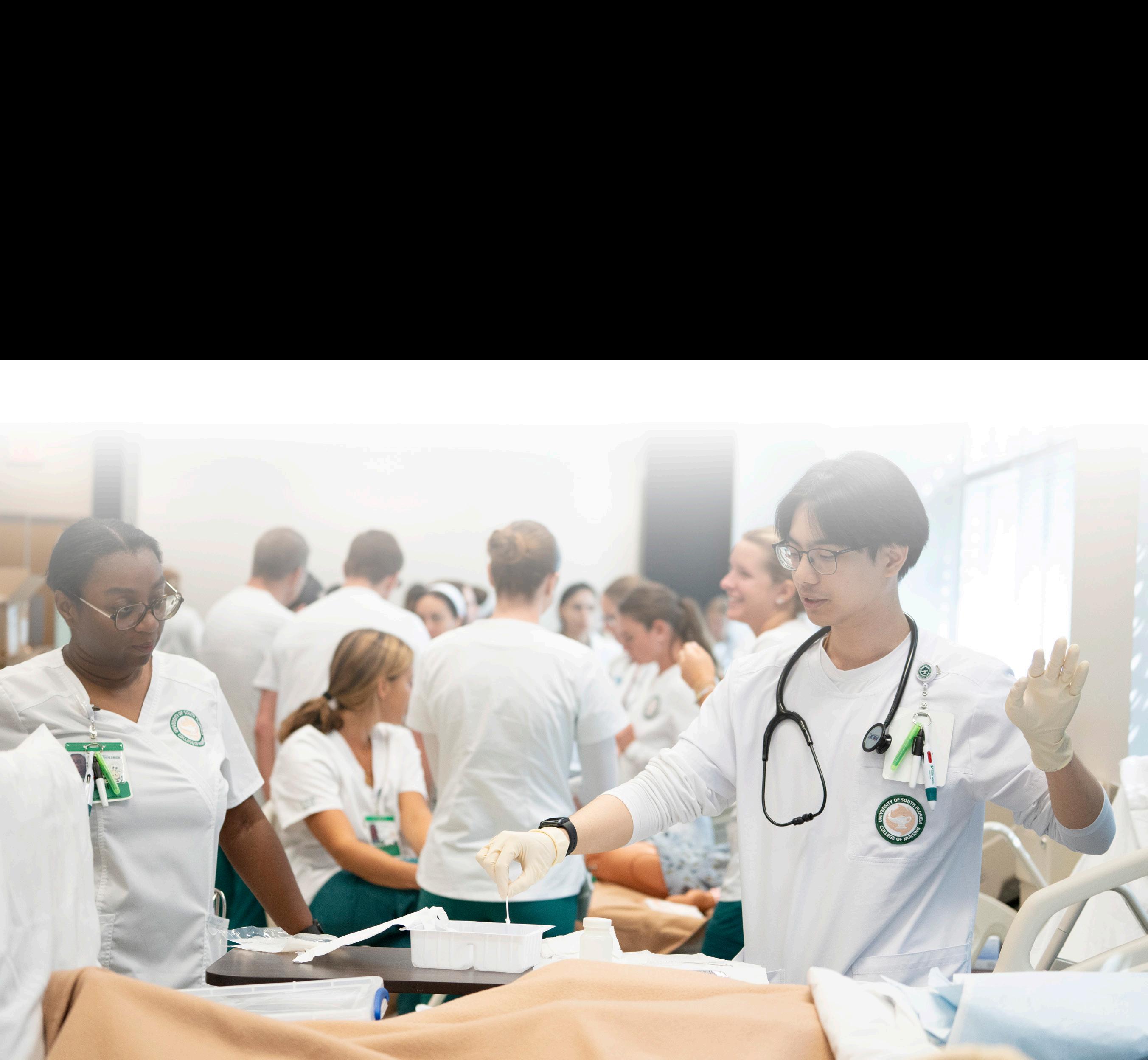
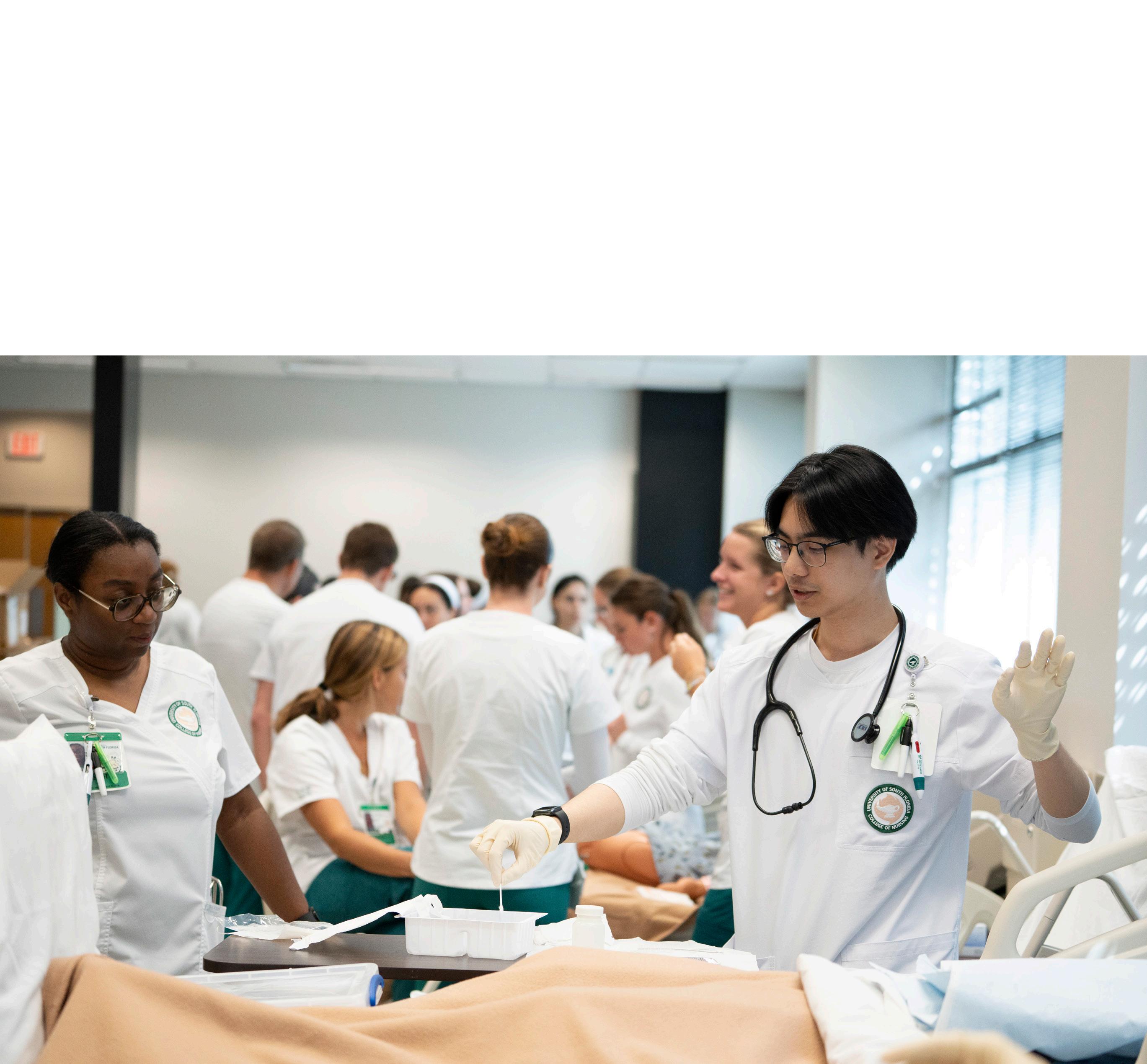
The FNR program meets this challenge head on. Students will have access to two state-of-the-art nursing simulation laboratories in the
Children’s Research Institute on campus as well as the TGH-USF College of Nursing Simulation Center in Tampa. These modern spaces are designed to immerse nursing students in realistic health care environments, encouraging hands-on skill development for future nurses to practice care and assessments while refining their clinical judgment.
The labs feature 10 fully equipped hospital beds where students can practice bedside care, manikins that provide flexible, repeatable training opportunities and a variety of anatomical models for learners to focus on targeted procedures such as IV insertion, airway management and wound care.
“We’re really making sure students are proficient with their clinical skills — how do you find a pulse? How do you start an IV? Students can practice what they’re doing before they go into a clinical setting. It allows them to have more confidence,” Menon said.
St. Petersburg students entering the nursing bachelor’s program will also have the option to be part of a Living Learning Community in Osprey Suites, with access to a dedicated tutor, additional advising and faculty resources, as well as career engagement events while forming bonds with fellow nursing students.
Maybe the strongest aspect of the new program is its proximity to premier health care institutions. Johns Hopkins All Children’s Hospital and Orlando Health Bayfront Hospital are within walking distance of campus and can provide ample internships and other learning opportunities for nursing students.
The location will allow students the chance to work with diverse patients and populations of the Tampa Bay region. Hospitals in the community serve both an aging and sometimes underserved population — two factors that can make nursing more challenging.
“It’s not always going to be the typical patient coming in with diabetes. These patients sometimes have a lot of comorbidities. Some are in and out of hospitals frequently. Sometimes you’re dealing with a lot of socioeconomic problems,” Giufurta said.
It’s a challenge USF has shown it can take on in novel ways. On the Tampa campus, where the FNR program has been in effect for several years, a recent collaboration with the Salvation Army earned the nursing college an award for innovative professional education from the American Association of Colleges of Nursing. The project involved having nursing students conduct clinical rotations at the Salvation Army, where they not only learned the basics of treating patients but case management as well. The students’ involvement helped reduce 911 calls from the respite beds by 85 percent.
“These are innovative ways to get students prepared,” Menon said. “Treating these people in our community now helps students understand some of the patients they might one day treat in the ER. They’re not just treating the noncompliant patient that wasn’t taking their medication. Now students understand where they’re coming from.”
Since 2019, USF St. Petersburg has offered an accelerated second-degree program in nursing. Intended for those who already have a bachelor’s degree and are looking to change careers, students can earn a second degree in just 16 months. Nearly 230 students have graduated from the program.
USF St. Petersburg hopes to add to those graduation numbers when the FNR program officially starts on campus in fall 2026. Dean Menon is certainly ready for more students who are prepared to make a difference.
“I always say nursing is not a job — it’s a passion. It’s a vocation. It’s something that you do because you really do care.”
A groundbreaking study conducted by the University of South Florida is tracking young people through 2050 to learn about the impacts of smartphones, social media and other digital media on wellbeing. Initial results reveal surprising findings, including evidence that smartphone ownership may actually benefit children. Though the research will be conducted over the next 25 years, data collected every six months by the Harris Poll will give ongoing insight on the impact of digital media use.
78% of 11-13 year-olds in study own a smartphone
More likely to feel good about themselves
Frequently Used Social Media Apps
Less likely to get angry or lose their temper
Less likely to report mild-moderate depression symptoms
Less likely to report mild-moderate anxiety symptoms
Less trouble falling asleep
More likely to report that technology is impairing their productivity
= Owns a
PARENTAL DIGITAL CONTROLS ON DEVICES
Participants who have digital controls on their devices are more likely to report moderate or severe anxiety than kids without such digital controls in place.
More likely to report mild-moderate anxiety symptoms
Rob Higgins Takes the Reins as CEO of Athletics
By Joey Johnston
Rob Higgins’ relationship with USF began as an 8-year-old when he attended his first Bulls’ basketball game with his father, Jack. The next day, at Sunday mass with his family, Higgins noticed Tommy Tonelli, a USF assistant basketball coach, in the next pew. Instead of offering the customary “Peace be with you,’’ Higgins said, “Good game last night, coach.’’
After mass, Tonelli asked Higgins if he wanted to work as a USF basketball ball-kid. He would clean the basketball court and pass out water to players. Higgens has admittedly bled green-and-gold ever since.
From cleaning the courts, Higgens ascended to team manager - traveling to road games as a teenager - then a full-time job overseeing facilities and managing USF athletic events. He received a degree in mass communications in 2001.
Higgins would go on from there to build a sterling reputation during his two-decade tenure as executive director of the Tampa Bay Sports Commission, successfully positioning the region as one of the nation’s premier destinations in sports and entertainment. He helped to attract Super Bowls, the College Football Playoff Championship Game, the NCAA Women’s Final Four, the NCAA Frozen Four, the NHL All-Star Weekend, the NCAA Volleyball Championships, the NCAA Men’s Basketball Tournament, the ACC and SEC Men’s Basketball Tournaments, the ACC Football Championship, the U.S. Gymnastics Championship, the Savannah Bananas and WrestleMania to the Tampa Bay area.
It was Higgins’ experience and relationships built over decades in Tampa Bay sports along with his many accomplishments that made him stand out in a crowded field for USF’s first-ever CEO of Athletics. In September, USF announced that Higgins would return to the university in that role following a comprehensive national search.
“As we embarked on this search, it became clear that this moment was different for the University of South Florida. Our next leader couldn’t
just be an athletics director – we needed a CEO of USF Athletics. In this new era of college athletics, not only is the role about providing a top-tier experience for our student-athletes across all sports, it now requires a business approach to build a competitive enterprise, grow revenue, embrace innovation, lead through change and position our university — and the Tampa Bay region — on the national stage,” said USF Board of Trustees Chair Will Weatherford. “Rob Higgins has proven during his time with the Tampa Bay Sports Commission that he isn’t afraid to dream big. He’ll bring that same ambition to USF and we’re excited to welcome him back home to lead our next chapter.”
Among his accolades, Higgins was named to the Tampa Bay Business Journal’s Power 100 each of the last five years, selected for Street &
“
“We will draw on the distinct strengths of each USF community in Tampa, St. Petersburg and Sarasota to channel energy and enthusiasm for our student-athletes and teams. It’s that Bulls connection — across campuses, sports and people — that creates a unified vision for excellence and will help propel USF Athletics to new heights.”
-Rob Higgins
Smith’s Sports Business Journal’s “Forty Under 40,” the Tampa Bay Business Journal’s “30 Under 30” list, the Tampa Bay Times named him one of the top 10 difference makers in Tampa Bay and Huffington Post listed him as one of the top 30 sports marketers in the world.
He also served as the president and CEO of the Tampa Bay Super Bowl LV Host Committee in 2021 and was on the bid and operations committee that hosted Super Bowl XLIII in 2009. Higgins was inducted into USF’s Zimmerman School of Advertising Hall of Fame in 2015 and in May 2025 he received the Distinguished Citizen Award at USF Commencement.
“I’ve been fortunate to know Rob Higgins for many years, and I’ve seen the passion he has for the University of South Florida and the Tampa Bay region,” said USF Board of Trustees Vice Chair Mike Griffin. “As a university, and as a community, we have great momentum. USF is rising in research, rankings and reputation. Especially as we prepare to open our transformational on-campus stadium in the coming years, Bulls Nation is more engaged and energized than ever. At this pivotal time in USF
Athletics history, Rob is the right person to lead us into a new era.”
Since starting, Higgins has hit the ground running. He has championed an ambitious vision of “winning the building, then winning campus, then winning the community, then winning the country,” putting a premium on process and performance to continue the upward mobility of USF Athletics. In October, he named Hall of Fame linebacker and prominent Bay area sports executive Derrick Brooks as Chief Operating Officer for USF Athletics. Higgins also announced that his family will make a $25,000 annual contribution to USF Athletics.
“I never imagined that an opportunity to volunteer as a young boy at USF basketball games would take me down a path to a career of over 20 years serving at the Tampa Bay Sports Commission and now the opportunity to return to my alma mater as the first CEO of Athletics. Cliches are often rooted in some truth, but this truly is a dream come true. I could not be more honored to take on this responsibility and could not be more excited to get started,” Higgins said. “Go Bulls!”
MARINE SCIENTISTS
REVEAL FORCES BEHIND
THE RAPID INTENSIFICATION OF HURRICANES
By Dyllan Furness and Carlyn Scott
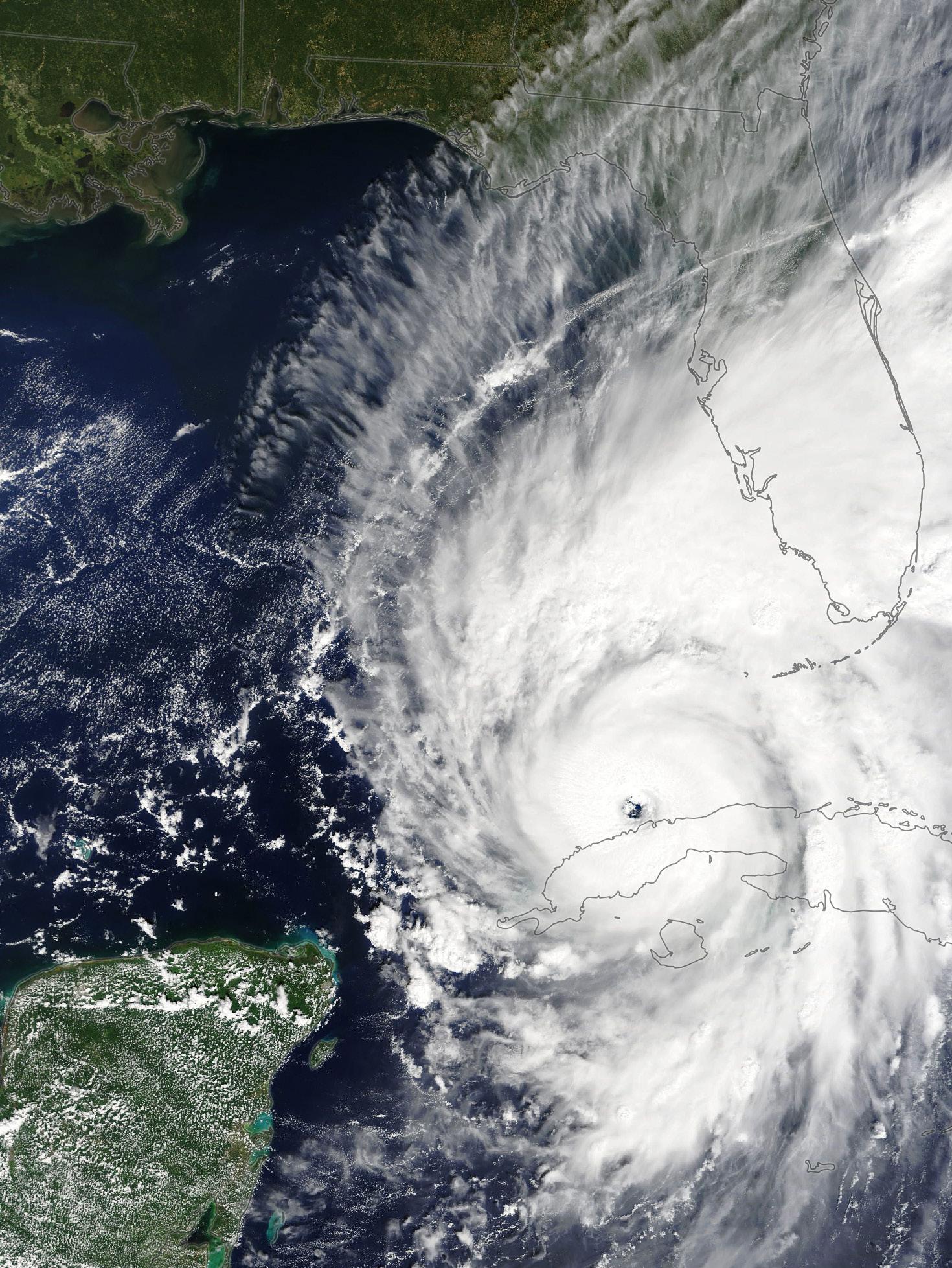
In late September 2022, as Hurricane Ian passed over a region of warm water in the Gulf, it quickly grew from Category 3 to Category 5 before it made landfall in Southwest Florida. This process, known as rapid intensification, caught many by surprise. Ian became a deadly storm and one of the costliest in state history.
Ian is not alone in the annals of supercharged storms. Recent hurricanes such as Milton (2024), Helene (2024) and Idalia (2023) rapidly intensified in the Gulf. In each instance, the sudden increase in strength made the ultimate impact difficult to predict.
Despite continued improvements in hurricane modeling, rapid intensification remains a challenge for forecasters. At the USF College of Marine Science, researchers are hard at work to reveal the forces behind this phenomenon and help experts better forecast tropical storms.
A ‘PRESSURE POINT’ IN THE GULF
One of those revelations came as scientists at the college examined data gathered by buoys off Florida’s Gulf Coast. They discovered that during Ian, a strong ocean current called the Loop Current failed to circulate in a shallow region off the West Coast of Florida, resulting in unusually warm waters during the peak of hurricane season.
In the Gulf, rapid intensification typically occurs over deep waters that can store abundant heat energy. But Hurricane Ian was different. As the storm neared landfall, it intensified over the shallow West Florida Shelf, which is normally kept cooler thanks to ocean circulation. This anomaly intrigued scientists in the college’s Ocean Circulation Lab.
“We wanted to understand how the warm subsurface waters of the West Florida Shelf were able to persist all summer,” said Yonggang Liu, associate professor and lead author of a recent study published in Geophysical Research Letters. “What were the conditions in the Gulf that allowed these temperatures to develop in the first place?”
Liu and his team turned to data they’ve gathered over several decades through the Coastal Ocean Monitoring and Prediction System (COMPS), an array of surface buoys and bottom-mounted moorings across the shelf. COMPS, which receives funding from the National Oceanic and Atmospheric Administration (NOAA), provides real-time measurements of ocean currents, salinity and water temperature to the scientific community.
The researchers found that if the Loop Current reaches an area near the Dry Tortugas, which they call the “pressure point,” it can flush warm waters from the West Florida Shelf and replace it
with cold water from deeper regions of the Gulf. This pressure point is where the shallow contours of the seafloor converge, forcing cold water to the surface in a process known as upwelling. In the months leading up to Hurricane Ian, the Loop Current did not reach the pressure point, leaving the waters on the shelf unmixed, which caused both the surface and subsurface waters on the West Florida Shelf to remain warm throughout summer.
The temperature of the subsurface layer of water is important for forecasters to monitor, according to Liu, as sea surface temperatures only give a glimpse into the heat available for hurricanes. Prior to Hurricane Ian, surface waters were only 1 – 2°C warmer than average, while the subsurface waters were 2 – 3°C warmer.
“By not including the subsurface water temperature in models and forecasting, we are not getting the entire picture of the water column and the potential energy for hurricanes,” Liu said.
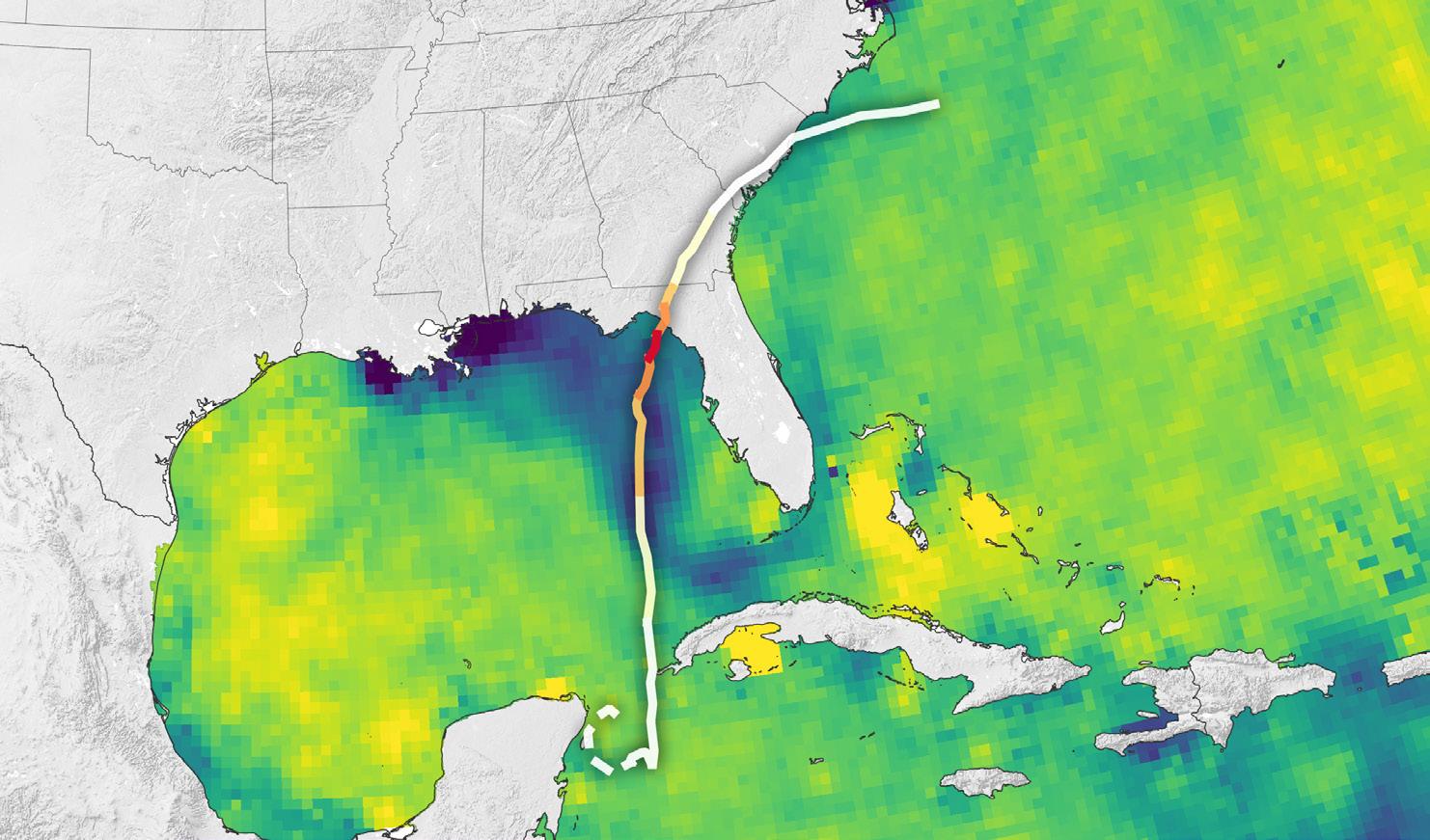
In late August 2023, a low-salinity plume of freshwater stretched from Mississippi to the Florida Keys. Hurricane Idalia’s path and classification is also shown. In a recent analysis of Idalia, researchers demonstrate how this river plume may have influenced the storm’s rapid intensification.
Credit: NASA Earth Observatory
Measurements made by COMPS allowed Liu and his colleagues to examine the long-term trend of ocean temperature and currents on the West Florida Shelf, including the influence of the Loop Current on the region. The findings could now be used to make more accurate predictions about hurricane intensity.
This study also highlights the importance of monitoring subsurface temperatures for heat content along the coast, and points to the value of coastal observation programs for the resilience of the state and nation. COMPS partners with NOAA’s Integrated Ocean Observing System (IOOS) through the Southeast Coastal Ocean Observing Regional Association (SECOORA) to improve such oceanic observations in the Gulf.
HOW RIVERS FUEL HURRICANES
Just like Ian a year earlier, Hurricane Idalia rapidly intensified from a Category 1 to a Category 4 as it approached Florida’s Big Bend in August 2023. This time around, warm water discharged from rivers played a key role in the storm’s growth, suggesting yet another variable to consider when forecasting hurricanes.
Sea surface temperature, ocean heat content and wind shear tend to influence a storm’s sudden gain in strength. But these factors alone failed to explain Idalia’s intensification.
Wind conditions during Idalia’s period of rapid intensification were not as favorable as they were earlier in the storm’s development, according to the authors of a paper published in Environmental Research Letters. The authors went on to state that this, “raises the question of what external factors contributed to its extreme intensification during this phase.”
To answer the question, the authors analyzed a plume of freshwater that stretched from Mississippi to Florida’s Panhandle and south to the Florida Keys, which created conditions that were ripe for intensification. Discharged from
rivers along the Gulf Coast, this plume formed a thick surface layer of low-density, low-salinity water that resisted mixing with the rest of the water column.
The result: warm surface water stayed warm and fueled the storm.
The findings were somewhat serendipitous, according to Chuanmin Hu, Distinguished University Professor at the College of Marine Science and an author of the study. Originally, Hu and his colleagues, including researchers from the college’s Optical Oceanography Lab, Ocean Technology Group and the University of Miami, intended to study phytoplankton and dissolved matter in river plumes using data from satellites and underwater gliders. However, the data they gathered on the thick layer of freshwater proved valuable in understanding Idalia’s intensification.
Prior studies have pointed to the influence of river plumes on the intensity of tropical storms in other areas of the globe. A paper from 2007 found that more than two-thirds of Category 5 storms between 1960 and 2000 traversed the vast plumes of the Amazon and Orinoco Rivers in South America.
For Hu and his co-authors, a key takeaway from their recent study is the importance of integrating river plumes into hurricane forecasting.
“Accurate forecasting is critical for people to plan as a storm approaches,” Hu said. “Our study demonstrates the value of considering the influence of river plumes on storm intensification. If there’s a persistent river plume in the right location at the right time, you might have the perfect conditions for a powerful storm.”
RESILIENT TAMPA BAY HOW TRACKING FLOODS AND PRESERVING STORIES ARE CREATING A MORE
By Sarah Sell
In Tampa Bay, residents are turning personal experiences with hurricanes into action.
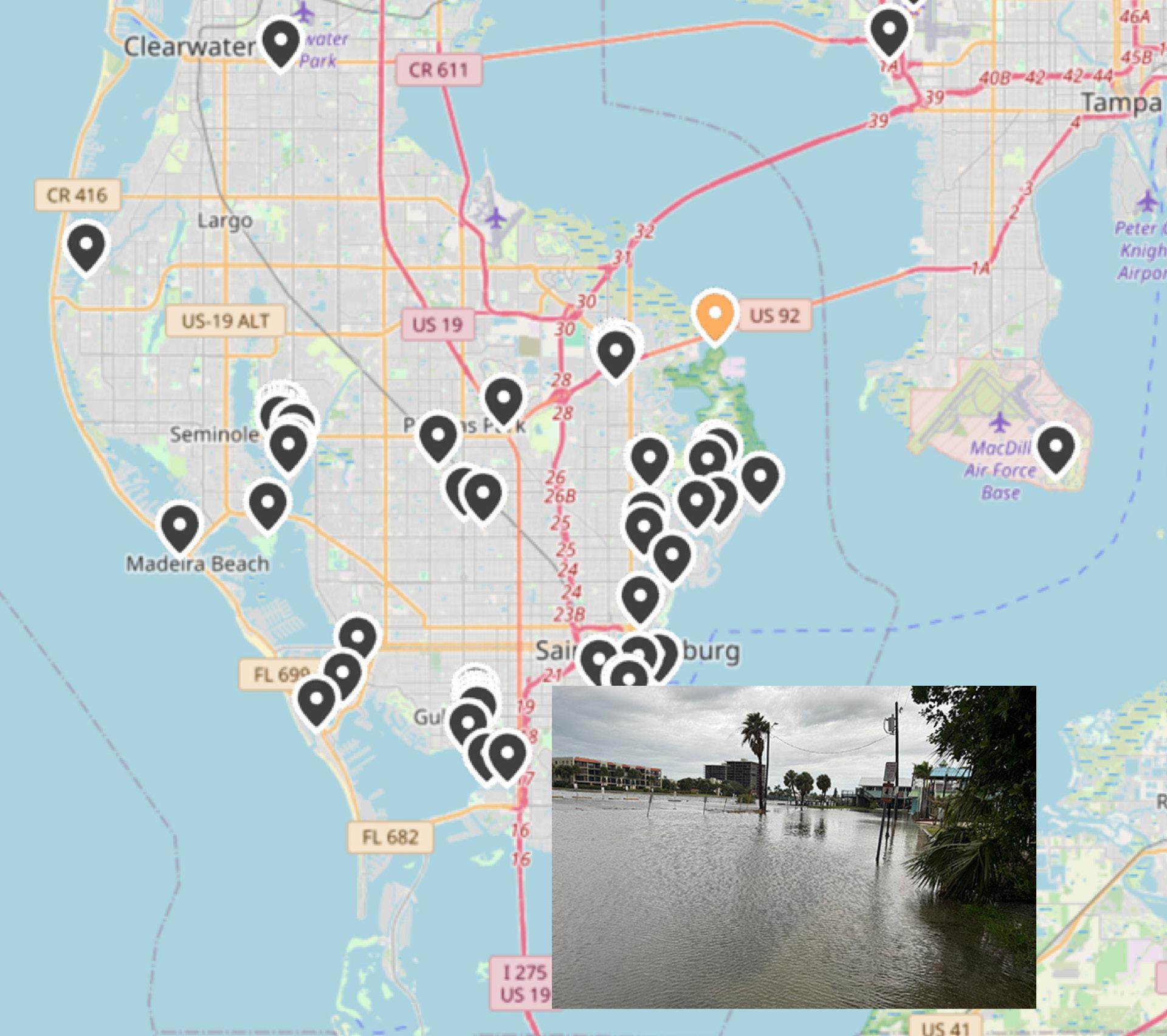
Through the CRIS-HAZARD app, co-created by GIS and Remote Sensing Professor Barnali Dixon, neighbors upload photos of flooding and track conditions in real time to help protect their communities. Think of it as the Waze app for flooding. While Catherine Wilkins, professor of instruction in the Judy Genshaft Honors College, is capturing the human side of storms. Through her Hurricane Histories project, she, along with her students, are preserving stories of loss, recovery and hope from the historic 2024 hurricane season. Together, these efforts show how local knowledge and technology combine to strengthen neighborhoods.
To learn more about how these projects are shaping individual and community resilience across Tampa Bay, we spoke with both Dixon and Wilkins about their community-centered work. The interviews have been edited for length and clarity.
WHAT ROLE DOES LOCAL KNOWLEDGE, ESPECIALLY THROUGH CROWDSOURCED FLOOD PHOTOS, PLAY IN IMPROVING ACCURACY AND RESPONSIVENESS?
Community involvement is crucial. We rely on people to upload the flood photos, which provide the data the system needs to analyze. Then, we go back to the community and use polling software to see how they would classify the same images. Comparing human responses with the machine’s classifications helps improve accuracy and shows the community how their contributions shape the platform.
HOW HAS CRIS-HAZARD EVOLVED SINCE HURRICANES HELENE AND MILTON, AND WHAT MAKES IT SUCH A VALUABLE TOOL FOR REAL-TIME FLOOD TRACKING ACROSS TAMPA BAY?
Since Hurricanes Helene and Milton, AI tools have been integrated directly into the app’s data stream. When users upload a photo, the system now
runs it through AI to predict whether flooding is major or minor, and those results will appear on a new dashboard. That dashboard will show not only where flooding is occurring, but also its extent and depth.
THERE ARE MORE THAN 30 CAMERAS POSITIONED ACROSS PINELLAS COUNTY. HOW DO THEY ENHANCE THE APP’S ABILITY TO MEASURE WATER DEPTH AND IDENTIFY RISK IN FLOOD-PRONE NEIGHBORHOODS?
Extracting flood depth from photos is difficult because images arrive at different angles, with varying lighting, and occasionally contain human errors, such as incorrect timestamps. The cameras help us cross-validate those community photos by showing the actual flooding conditions at the same place and time. So, if an image is uploaded with the wrong date or during a period without rainfall, the cameras verify it.
IN WHAT WAYS IS THE CRIS-HAZARD SYSTEM HELPING LOCAL GOVERNMENTS, EMERGENCY MANAGERS AND RESIDENTS STRENGTHEN LONG-TERM RESILIENCE IN COMMUNITIES THAT HAVE HISTORICALLY BEEN MORE VULNERABLE TO CLIMATE IMPACTS?
Barnali Dixon
The CRIS-HAZARD system improves preparedness by engaging both coastal and inland communities, including underserved areas, to systematically collect flood data during everyday events like thunderstorms and king tides. That information shows which neighborhoods flood even under normal conditions, and those same areas will face worse impacts during hurricanes and storm surge. By identifying these chronic problems early, local governments and emergency managers can plan and address vulnerabilities before a major storm occurs.
Dixon’s work highlights how technology and community knowledge come together to track and respond to flooding in real time. But understanding a storm’s full impact requires more than data. It requires hearing the stories of those who live through it. That is where Catherine Wilkins’ Hurricane Histories project comes in, capturing the personal experiences, memories and resilience of Tampa Bay residents.
WHY DID YOU WANT TO DO THIS PROJECT?
I grew up in Pinellas County, so seeing my community so deeply affected by the 2024 hurricanes was devastating. As a historian, I know natural disasters can change not just buildings but the people as well. My goal with this oral history project is to capture the stories of those most impacted by the storms, learn about the communities they built and give them a voice in what those communities could or should become moving forward.
HOW DID YOU INVOLVE COMMUNITY MEMBERS, ESPECIALLY THOSE WHO WERE AFFECTED BY THE HURRICANES?
I began with my neighbors and the community organizations I already work with, including nonprofits along the Gulf Coast that focus on protecting cultural resources. From that network, I’ve worked to bring in a diverse range of voices.
While some are optimistic, more than a year later, many residents still aren’t back in their homes or are only now returning and facing new, unexpected problems from long-term saltwater damage.
IN WHAT WAYS DO YOU HOPE THE COLLECTED STORIES WILL EMPOWER THE COMMUNITY OR CONTRIBUTE TO HEALING AFTER?
I think we often take our communities for granted and assume the people and institutions we rely on will always be there. The hurricanes revealed how quickly environmental and economic forces can change that. I hope this oral history project helps people develop a deeper appreciation for the fabric of the community and work harder to ensure that the very people, industries and architecture that are responsible for shaping the soul of the places we love are not displaced or erased in the aftermath of disaster. At the very least, my job is to document what has been, and what is changing.
WHAT ROLE DO YOU ENVISION STUDENTS PLAYING IN BUILDING TRUST WITH COMMUNITY STORYTELLERS, AND HOW DO YOU PREPARE THEM TO DOCUMENT SENSITIVE EXPERIENCES SUCH AS LOSS, DISPLACEMENT OR TRAUMA?
Many of our USF St. Pete students and their families were themselves impacted by the storms, so they can really relate to the emotions and experiences of our community members. I’m teaching a class called How to Make History, Hurricane Edition, where honors students will collect oral histories and help digitize cultural resources along the Gulf Coast. Working with USF Libraries, they’ll create virtual tours of historic buildings to preserve them even if they end up being demolished. This project is part of a larger effort to teach practical skills for careers that protect and share Florida’s history, but hopefully it also helps foster relationships between the community and our students, and it may be that the experience also helps students work through their own sense of loss post-storm.
CATHERINE WILKINS
One of the photos and data points uploaded to the CRIS-HAZARD app during Hurricane Helene.
SUPPORTING STUDENTS THROUGH MILLIONS IN SAVINGS AND SCHOLARSHIPS
By Sarah Sell
In the most recent U.S. News & World Report’s annual rankings of the best colleges, the University of South Florida was rated as the No.12 “best value” among all public universities in the nation. The cost of attending for in-state students is nearly half the national average for public universities. It’s no wonder the university hit an all-time record for first-time-in-college student applications in 2025; they are recognizing this value.
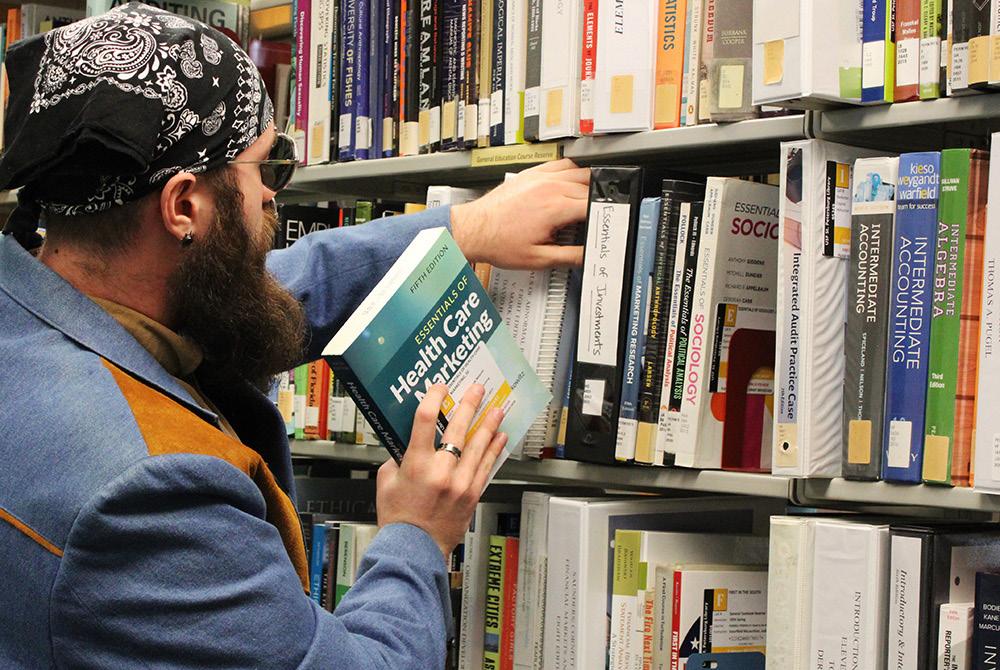
One way to create greater value is by reducing costs. Over the past eight years, the Textbook Affordability Project (TAP), spearheaded by the Nelson Poynter Memorial Library (NPML), has saved USF St. Petersburg students more than $2.4 million in course material costs.
The library has achieved such savings by expanding their reserve textbook collection, promoting the use of e-books and other open educational resources, and collaborating with faculty to find and incorporate affordable course materials that maintain academic quality.
“TAP is just one of many ways the USF Libraries seek to support student success and retention efforts,” said Kristina Keogh, dean of NPML. “With rising costs, it is important for academic libraries to continue to work to alleviate our students’ financial burdens wherever possible. I am proud of the legacy of this work at NPML and that our staff continues to prioritize and grow these efforts.”
The mission to provide more affordable course materials aligns with a broader campus goal: removing financial barriers that can hinder academic progress. A 2022 survey of 13,000 college students conducted by Florida Virtual Campus found that more than half of students struggle with the high price of textbooks, with some even dropping courses because of it. TAP directly addresses these challenges, reducing the average cost of course materials per credit hour from $44 in 2016 to just $21 in 2024.
Beyond cost savings, TAP has expanded access to a variety of educational materials. What began as a modest collection of 20 reserve textbooks has grown to more than 200, supported by grants, library funds and even donations from students and faculty. Workshops and one-on-one collaborations between librarians and professors have further integrated affordable, high-quality materials into coursework, creating a sustainable model for student success.
Another way to enhance the value of a degree is by providing greater financial resources. And for the first time in its history, USF St. Petersburg awarded over $1 million in student scholarships during the 2024-25 fiscal year. This achievement marked a more than 20 percent increase from the previous year.
Before receiving this scholarship, continuing my education had become an uncertain prospect. Thanks to donor generosity, I now feel more secure in my path toward becoming a USF St. Petersburg alumnus.
- Estefania Rodriguez, Marine Biology major
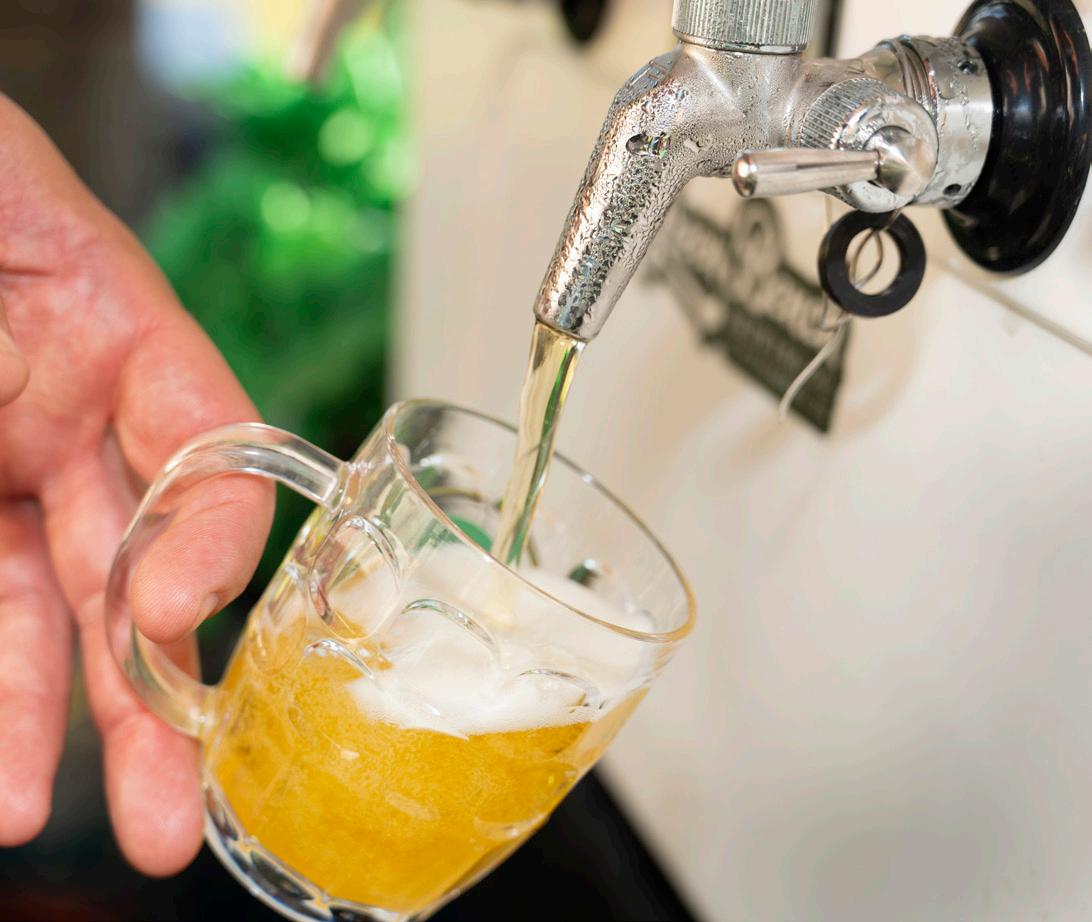
The Bulls and Brews by the Bay annual fundraiser raises money for student scholarships and promotes USF’s Brewing Arts Program.
“This milestone reflects our campus’ deep commitment to addressing financial barriers to higher education,” said Howard Rutherford, associate vice president of development and university advancement at USF St. Petersburg.
The significant jump was achieved through a combination of increased outreach efforts, expanded donor engagement and a commitment to raising awareness among students about the scholarships available to them. Many of the contributions came through university-wide giving initiatives such as USF Giving Week, which brings together alumni, friends, faculty and staff to raise funds for meaningful USF projects on all campuses related to research, health, study abroad and more. And at USF St. Petersburg, the signature fundraising event Bulls and Brews by the Bay provides a fun atmosphere for supporters of the campus to come together to impact the lives of students.
The annual fundraiser, held along the campus’s scenic waterfront, raises money for the USFSP Scholarship Fund, providing financial
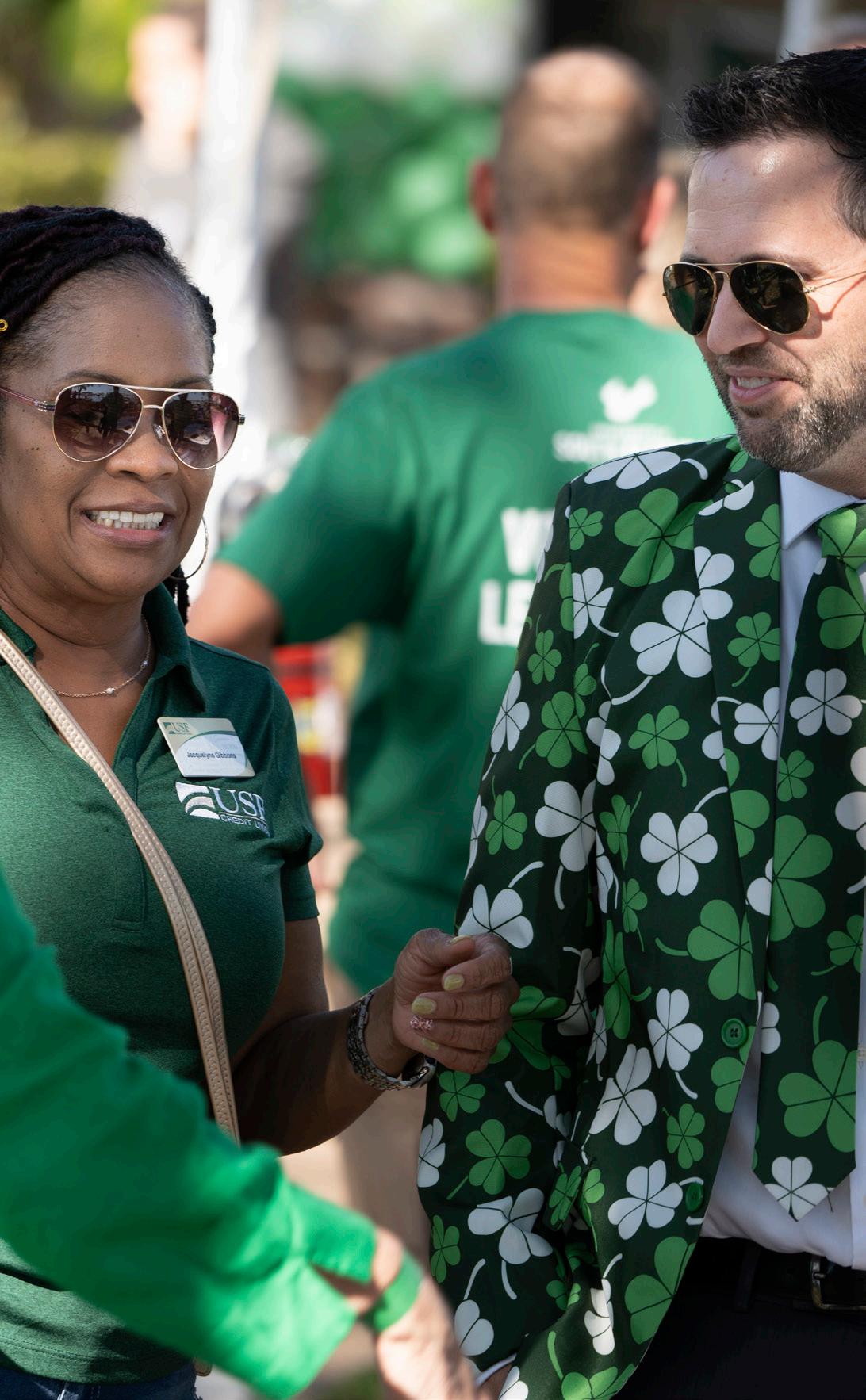
support to students throughout the academic year. The second annual event, held in March 2025, featured Irish-inspired music, cuisine and local craft beers from alumni of the university’s Brewing Arts Program. With the support of sponsors and donors, including the main sponsor, the USF Credit Union, the celebration raised tens of thousands of dollars for scholarships.
“This event is a way for us to create something that can help a student and be part of something bigger than ourselves,” Rutherford said. “It’s a fun-filled environment with great food and drink that people will want to return to every year.”
The successes and growth of these efforts demonstrate the university’s commitment to reducing student debt while supporting educational goals. Or put another way, USF’s focus on value is relieving financial pressures on students (and soon to be alumni) in order to enhance opportunity and their overall college experience.
The 2025 fundraiser had a St. Patrick’s Day theme and brought supporters of the campus together.
A NEW USF CENTER Works to Shape Tomorrow’s Business Leaders
By Gillian Finklea
It’s no secret that the Tampa Bay region is on the rise. In recent years, the area has become a magnet for innovation and investment. Emerging tech firms, Fortune 500 companies and ambitious entrepreneurs are all finding opportunity here — and with that surge comes a growing demand for high-caliber executive education to prepare today’s professionals as the business leaders for tomorrow.
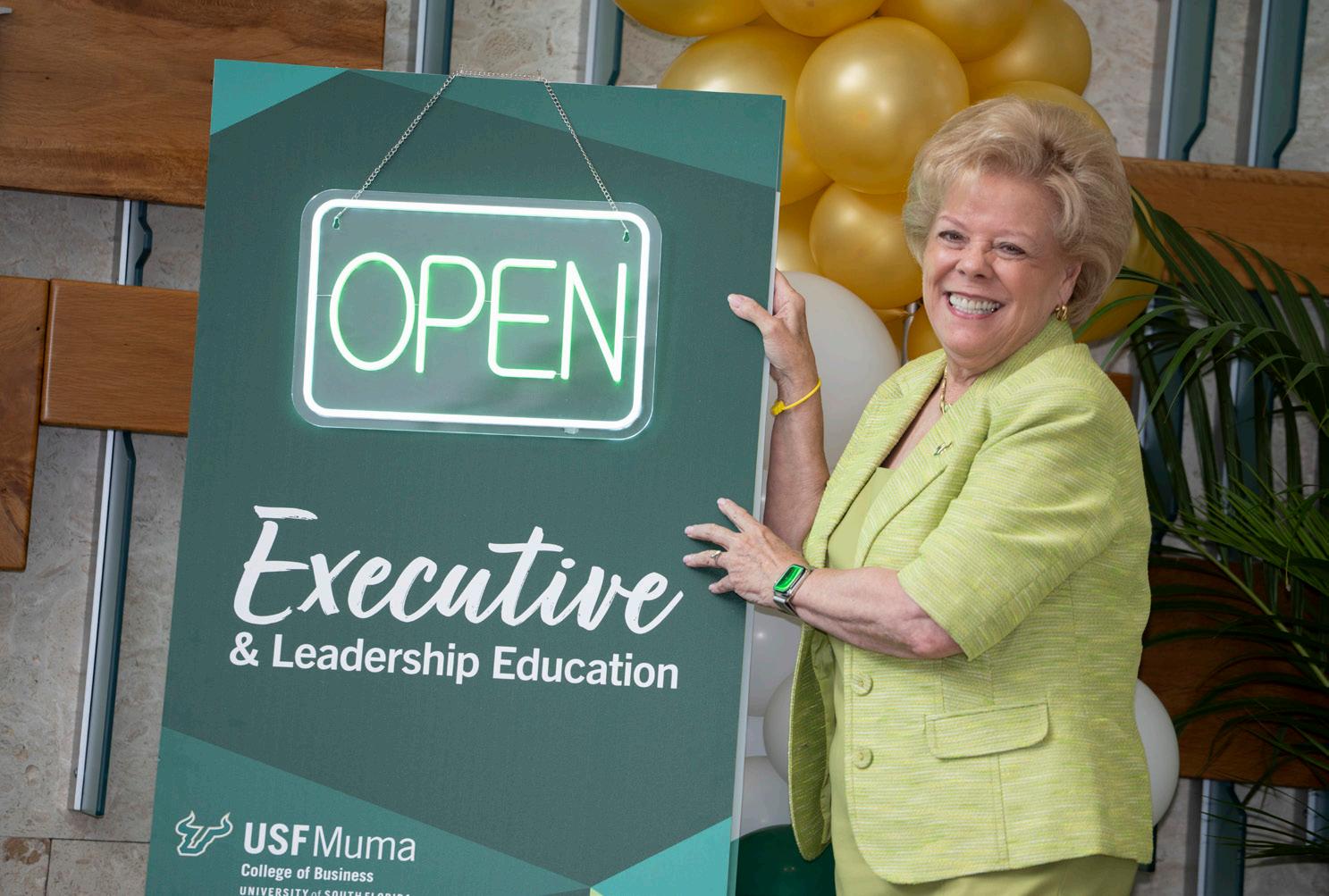
Enter the new Center for Executive and Leadership Education. Located within the Kate Tiedemann School of Business and Finance at USF St. Petersburg, the center will fill a regional need for leadership education and custom corporate training programs.
Executive and managerial training is a booming industry. With global corporate training spending surpassing $360 billion annually and leadership development ranked as a top organizational priority, the center will act as a critical bridge between academic knowledge and business practice. It is envisioned as a place where USF
professors and leaders can bring their years of experience and institutional knowledge to local businesses.
Jon Kaupla is the associate dean and executive director of executive and leadership education at USF’s Muma College of Business. He said the center is focused on the future, providing leadership training to those preparing to step into the spotlight at their company.
“One of the greatest needs is there are many executives retiring in the next 10 years,” Kaupla said. “We’re playing an important role upskilling leaders to make sure those junior leaders are ready to assume more senior executive roles.”
It’s a trend C.J. Mintrone has also noticed. Mintrone is executive vice president at PNC Bank and a member of Muma’s Executive Advisory Council. As leader of PNC corporate banking for West and Central Florida, Mintrone works with many family-run local businesses. He explained how the center will help train younger generations preparing to take over.
“Succession planning at the executive level is huge. You see it time and time again — usually in the third generation of company ownership — that they either are not quite ready to pass it to the fourth generation because the next generation may not want to or be fully equipped yet to run the business,” Mintrone said.
The training offered at the center will focus on helping these up-and-coming managers deal with areas of the business they might not have experience with — everything from political skills to dealing with macro-finances to corporate entrepreneurship.
The Center for Executive and Leadership Education was launched in September 2025 during an event that welcomed 100 business and community leaders to the St. Petersburg campus. Leading up to the event, USF also announced it was invited to join the University Consortium
for Executive Education (UNICON), a global consortium of executive education centers based at top business schools. Member schools include Stanford, Harvard, MIT Sloan and Wharton.
Previously, Tampa Bay businesses in need of high-level training would send mid-level managers and C-suite executives to schools that were UNICON members. Now, a curriculum to help executives better respond to challenges and opportunities is available closer to home.
In 2026, the center will unveil a suite of openenrollment programs for mid-level, senior and executive leaders seeking to enhance their skills and advance their careers. The center will offer 10 open-enrollment programs in the spring of 2026.
From these unique challenges, the center is developing specialized training and education. The center is starting to partner with organizations to design custom programs tailored to that specific corporation or industry. It will also offer companies something large, out-of-state academic institutions can’t deliver — a deep understanding of the industries, culture and overall business landscape of Tampa Bay.
expect the number to grow quickly in the coming months as word of the center spreads.
At the September launch event, President Law announced a $3 million gift from philanthropists Kate Tiedemann and Ellen Cotton to further support the mission, activities and impact of the center.
“We want to provide current and emerging executives with the tools and insights that will enable them to successfully navigate constantly evolving challenges,” USF President Rhea Law said during the launch event.
Programming will focus on best practices in the leadership space while addressing some of the region’s challenges that present unique opportunities for executive education. Kaupla highlighted several examples, including the influence of Latin American countries on local business, the expanding talent pool as the area’s population grows and the region’s significant military presence.
“How do we help all of these military members who are transitioning into the civilian workforce?” Kaupla said. “What opportunities are there for their unique skills, and how can we help them become future leaders?”
“Our clients have sent people out of state for this sort of training, and it’s cookie-cutter,” Mintrone said. “What USF is trying to do is create a customized learning program on a localized basis — whether companies come to our campus in St. Petersburg or we go directly to theirs.”
Some of the learning opportunities include one-on-one coaching, 360-degree leadership assessments and coaching circles where center faculty work directly with company leaders to extend the learning process and ensure longterm impact.
“It’s really about creating a learning culture in the organization and keeping the learning alive,” Kaupla said. “We have a vested interest in these companies — we don’t want to be transactional. We don’t want to just come in, do a training and then leave.”
Center leadership is already working on 15 custom programming opportunities with corporations in Tampa and St. Petersburg. They
Along with Kaupla, the team leading the center also includes retired Bank of America executive Bill Goede, and academic director David Howard. In the next few months, the center plans on recruiting and onboarding more than 25 USF faculty and executive instructors from the local business community to teach programs.
Now, local organizational leaders like Mintrone can start sending clients to the center, knowing it’s taught by some of the top business talent in the area.
“It’s a curriculum customized by people who have taught before, whether in other executive education programs or in the industry in general — all within a 45-minute drive from many headquarters,” Mintrone said.
For more information about leadership training or to explore partnership opportunities with the USF Center for Executive and Leadership Education, contact Jon Kaupla via usf.edu/ business/executive-leadership-education/ or at 727.873.4070.
By Heather Judkins, Professor of Integrative Biology
“Is it time to pack my gear yet?”
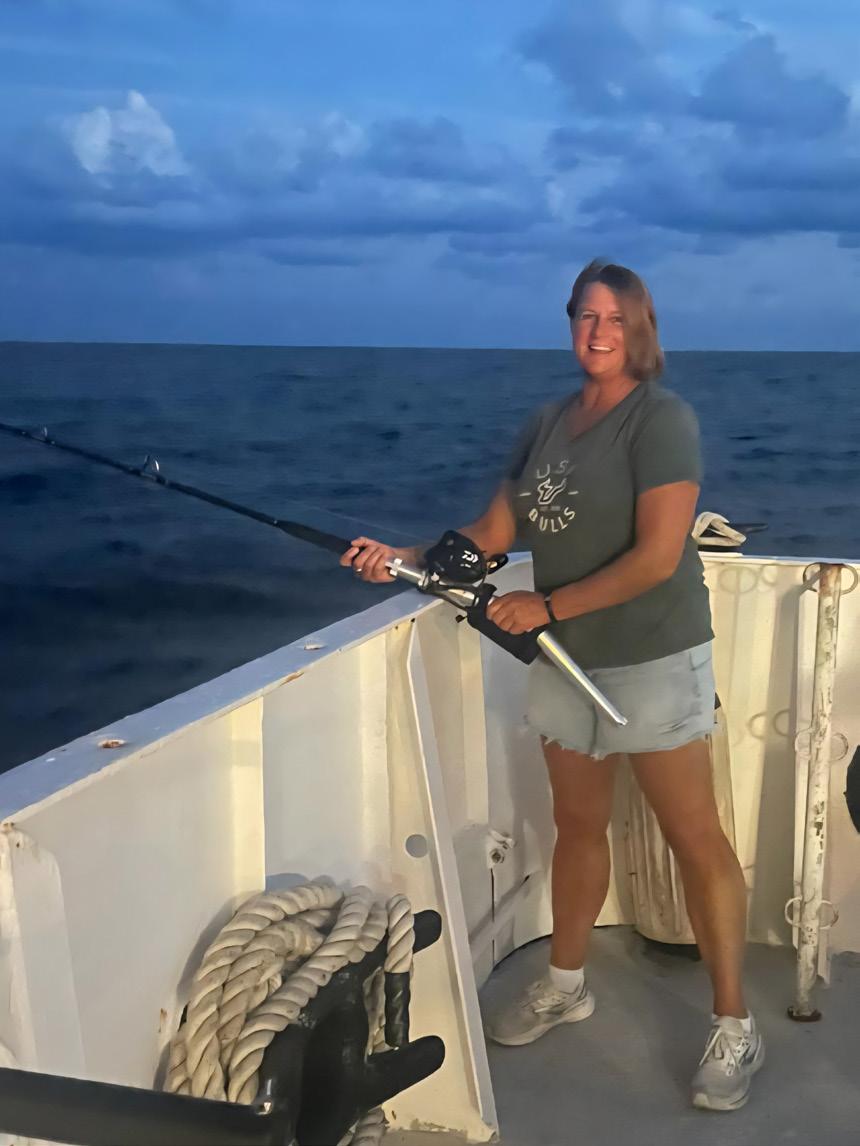
This is the excited question I ask myself when I know another research cruise is close at hand. Once packed, I load everything up in a vehicle, travel out to Gulfport, MS and board the R/V Point Sur, the research vessel I have spent months at sea on since 2015 as part of the DEEPEND Consortium.
The consortium consists of 47 marine scientists from 11 universities and research organizations across the country. We work to identify and quantify long-term trends in fishes, crustaceans and cephalopods in the midwaters of the Gulf in response to the Deepwater Horizon oil spill from 2010. My job, as a cephalopod expert, is to oversee the collection and analysis of species such as octopods, squids and pelagic snails.
It’s a privilege to spend at least two weeks every year exploring the midwater column (0-1500 meters deep), the largest ecosystem in our oceans. To do so, we use a MOCNESS system, a series of nets towed behind the vessel that can be opened and closed independently, so that each net samples a specific depth zone, as well as other equipment to better understand the deep sea. There is so much to explore and discover down there, and the team is grateful for the funding received that allows us to continue such vital research.
I have been fortunate enough to fall into a career I love that includes time out at sea. I have been on numerous research cruises in the Pacific Ocean, Atlantic Ocean and the Gulf of Mexico, about 250 days at sea so far. I get restless now if a year goes by when I am not on at least one cruise!
My first experience was a three-week adventure in the Eastern Tropical Pacific. It was a marine mammal monitoring cruise, and I was so excited to learn about every project that was being conducted as well as how to live
on a ship. I am sure I annoyed many of the veteran scientists on board with my questions, but they were patient as I learned the ropes. I witnessed some of the most memorable animal sightings and learned so much from the scientists aboard, which formed the basis of how I conduct research out on the Big Blue today.
One thing I quickly learned was that sleep schedules on a research vessel are not easy. For some trips, I experience a 12 hours on/12 hours off schedule (including shifts that go from 7 p.m. to 7 a.m.) Since 2015, our DEEPEND sleep schedule has been six hours on/six hours off. Thankfully, I can fall asleep anywhere at any time, so while I am exhausted, I can still get the sleep I need to conduct good science. Another thing I learned was that teamwork is essential. Research gets difficult when equipment breaks, weather doesn’t cooperate or the plan of action goes awry. It’s important to be willing to jump into any situation where assistance is needed – whether it’s something I am familiar with or not.
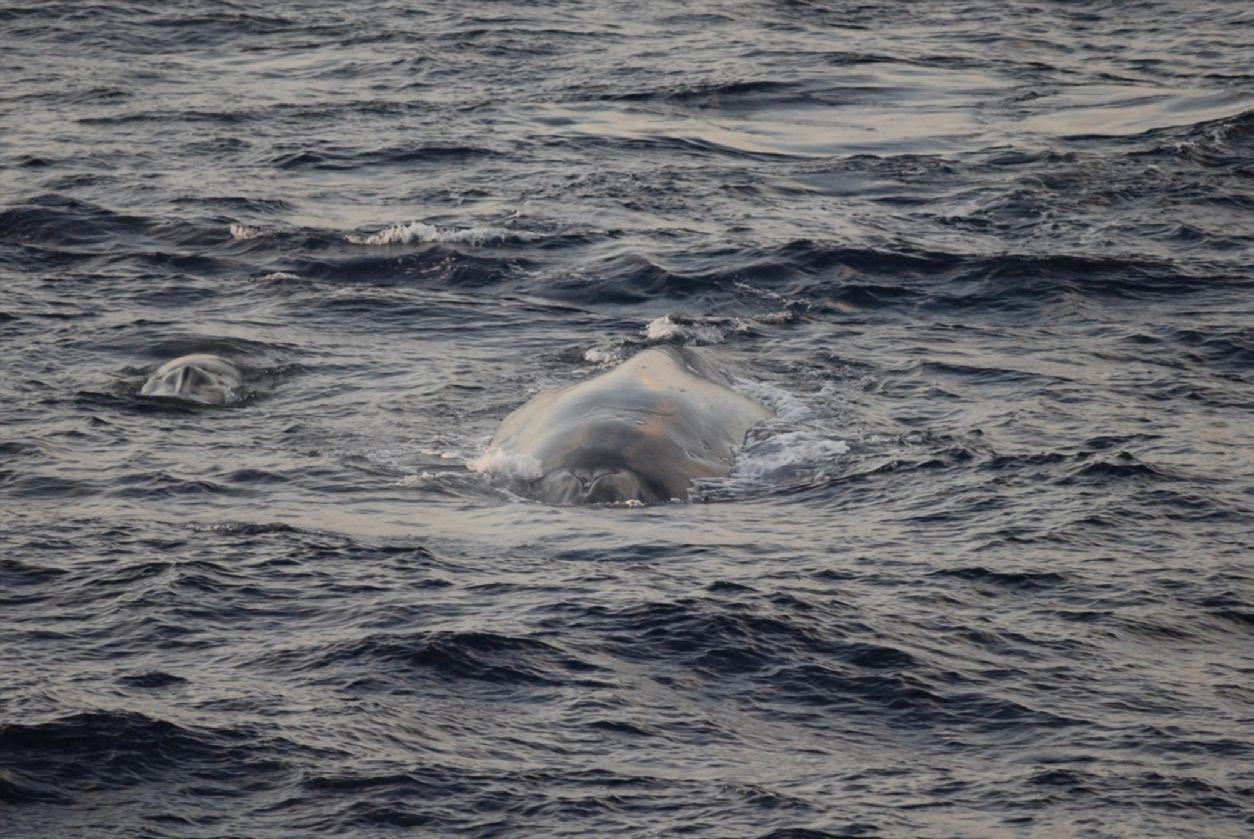
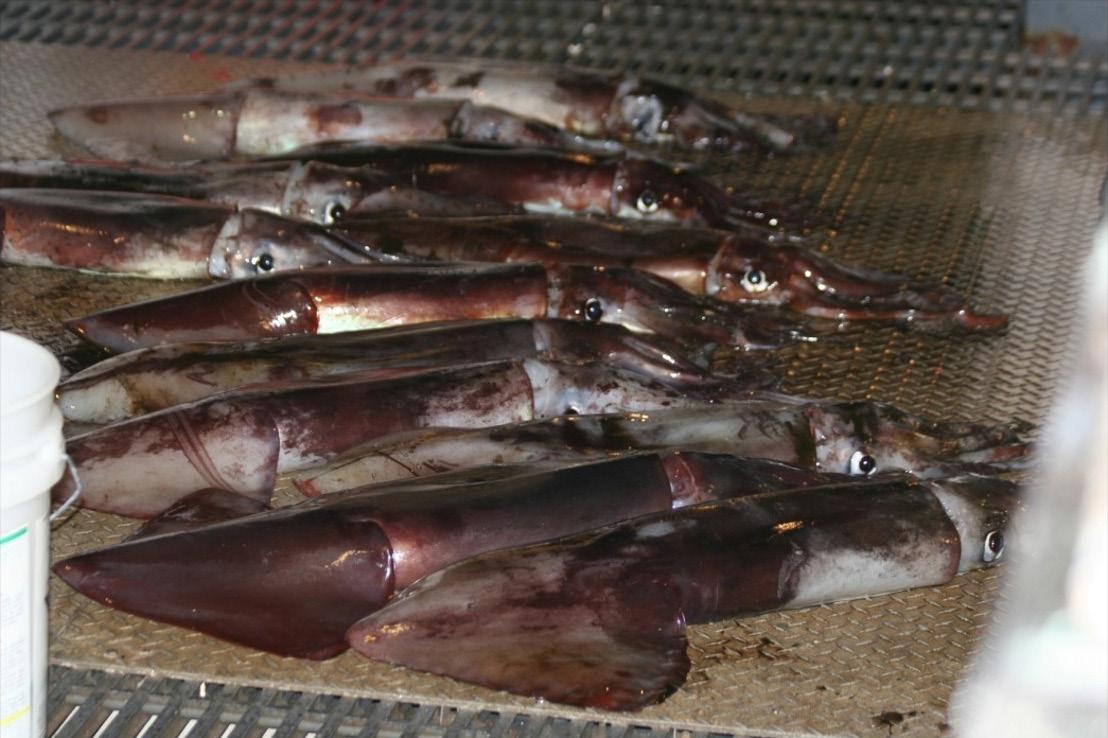
The memories gained through these experiences will stay with me for life. I have seen my first Blue Whales and assisted in getting biopsy samples from Fin Whales. I have learned how to catch flying fish using a 30-foot dip net at night for trophic ecology studies. I learned patience. During one cruise, I was responsible for catching Humbolt squids for an hour a night for 20 nights in the northern Pacific. For the first 19 nights, zero Humboldts. Thankfully on the 20th, success was mine as we caught 12 squid in 15 minutes!
There are many instances of long periods of nothing incredibly special happening out there punctuated by pulses of intense science that are so rewarding, it makes the whole thing worth it. It’s during those periods of non-science, the quiet times out at sea, where I am humbled by Mother Nature and the vastness of the ocean. I have a habit of going up to the bow to reflect on things during lulls in the action, which just seems to put everything into perspective; I find a sense of peace. I have seen countless sunrises and sunsets, all different and beautiful in their own way. The full moons, stargazing and shooting stars are spectacular as there is no light pollution to interfere and the Milky Way has never looked so distinct.
While many cephalopod-focused projects have been completed through these deep-sea adventures, there are plenty more to work on. What time out at sea allows me to do is provide unique research and learning opportunities for my graduate students back on land, so they too can fall in love with just a little piece of the deep sea as I have and gain valuable skills to propel them in their own careers. These experiences let me add a personal touch to the classes I teach, relating personal lessons learned with students as we move through various marine biology topics. It keeps both the classroom energized and myself focused on continuing to do great work in all areas of my job.
I think the most valuable things I have gained over the years (apart from my cephalopods and research career of course) are the friendships and collaborations made at sea. Our core DEEPEND team has been working together for 15 years, and we’ve grown as people, scientists and a collective, which is rare. We have shared laughs, tears and successes over the years and I cherish it deeply.
While things are constantly changing in nature, our core mission and goals have not, which have allowed for valuable research findings that we continue to share with the world today.
How OLLI is Expanding Curiosity and Community in St. Petersburg
LEARNINGFORLife
By Gillian Finklea
After retiring as a professor of Child and Family Studies from the University of South Florida, Krista Kutash sought out opportunities to learn like she did in the classroom. In 2016, she joined the Osher Lifelong Learning Institute (OLLI). This popular adult learning program offers classes, workshops and lectures for individuals aged 50 and older, all while bringing together a community of individuals seeking similar interests. Kutash, who lives in St. Peterburg, would drive across the Howard Frankland bridge to attend OLLI classes offered on the Tampa campus. But after three years, the travel became cumbersome, and she stopped attending.
Now, classes for the perpetually curious like Kutash have found a home at USF St. Petersburg, tapping into a new population. OLLI launched on campus in the spring of 2025, and in the year since its arrival, has offered a growing and diverse number of thought-provoking classes to St. Petersburg and Pinellas County residents.
This past year, more than 130 older adults took courses on storytelling, history, brewing arts, international politics, love, competition, happiness and more from faculty and community experts. Kutash was one of the first students to sign up.
“It’s a wonderful way to integrate older people into the St. Pete campus, to make a more dynamic environment,” Kutash said. “It’s fabulous.”
OLLI provides high-quality, low-cost learning opportunities for older adults. An annual membership costs $50, and the average cost of an individual
class is around $25. Classes are open to all adult learners, regardless of previous college experience. And while the classes are taught by professors and experts in the field, there are no tests.
Kutash’s favorite class from the past year was The History of Foods in Florida taught by USF professor emeritus Gary Mormino. She said all her OLLI teachers have been passionate and generous with their time, and it’s not uncommon for them to stay a little after class just to keep the discussion going. She encourages anyone who is even a little curious to check out OLLI and hopes that people living in the downtown area will take advantage of the convenient location.
“OLLI classes don’t have grades, and they’re discussion groups. You’ll always learn something new. Take a couple and get a feel,” Kutash said.
USF has successfully offered adult learning programs for more than 30 years, reaching thousands of curious learners. The program was officially named the Osher Lifelong Learning Institute in February 2005, following a generous donation from the Bernard Osher Foundation.
The foundation currently supports a network of 125 lifelong learning programs at colleges and universities nationwide, with eight located in Florida, including another Pinellas location at Eckerd College. Each program offers intellectually stimulating, non-credit learning opportunities specifically designed for older adults.
Membership benefits go well beyond the classroom. Jay Johnson, a selfdescribed lifelong learner, is no stranger to taking educational courses that pique his interests.
“I’ve always been a learner,” he explained. “When I was employed by Honeywell, I would sign up for every course in the book, every semester. My supervisors always called me the student.”
From computer software engineer to St. Petersburg retiree, Johnson has continued his student-life approach. He especially enjoys courses on history and current events. He said these classes are entertainment with a purpose and loves the camaraderie that comes with them.
“They started these circles where you get together with people from your circle, and that’s really great,” he said, referring to the outside class discussion groups that form organically from many OLLI classrooms.
“That’s the best thing about OLLI — getting to know people.”
USF Anthropology Professor Heather O’Leary couldn’t agree more. She’s a USF associate professor of anthropology on the St. Petersburg campus and spoke at the inaugural OLLI open house.
“What struck me at the open house was that when you join OLLI, you are joining an instant community of friends. Everybody is there because they have some type of thirst for knowledge that leads them to be curious about the world, but also curious about their community and people around them.”
In fall 2025, O’Leary taught a unique OLLI class titled Happiness: Finding Meaning and Wellbeing that involved partnering OLLI students with USF undergraduates. The class allowed students to interact with an older generation and get a different perspective on what it means to pursue happiness, learning as much from their fellow classmates as from the professor. That input and agency from students is a common theme of OLLI classes.
“As a member, your input is truly valued,” Kutash said, “If you’re
interested in a specific topic, there are ways to propose or even help create a class around it.”
She added about her experience so far: “I don’t feel like I’m getting older – I feel like I’m getting bolder.”
USF St. Petersburg will continue to offer an array of thought-provoking OLLI courses in 2026, including some of these options beginning in January:
• Drugs and Crime in the Modern Age: Separating Fact from Fiction by USF Visiting Assistant Instructor Cary Hopkins Hall
• Hidden, Historic Campbell Park, A Walking Tour by St. Petersburg Black History Tours founder Josette Green
• Savor and Remember: Writing Memoir Through Food by former First Lady of St. Petersburg Kerry Kriseman
“
I don’t feel like I’m getting older - I feel like I’m getting bolder.
-Krista Kutash
at Keys Marine Laboratory as Resilient Corals Take Root
By Gillian Finklea
Warm-water coral reefs are under immense threat. In 2023, an unprecedented global heat wave contributed to escalating water temperatures in South Florida, with reef temperatures reaching 92° F or more. This led to the worst coral bleaching event in memory. At the time, some scientists worried that the Florida Reef tract, the only coral ecosystem in the continental U.S. and just a couple miles off the Florida Keys, would be damaged beyond recovery.
A report published in October 2025 by European researchers and conservationists showed that the global coral bleaching event pushed warm-water reefs into uncharted territory. Those conditions may persist and become the new normal.
A USF field station in the Florida Keys is working with research partners, conservation organizations and local volunteers to protect corals that persisted through the bleaching event — and support projects to make them more resilient for the future. Operated by the Florida Institute of Oceanography at USF, the
Keys Marine Laboratory, or KML, has become a hub for scientists to temporarily care for recovered coral while nursing baby coral before planting them back onto reefs in the everwarming waters. The KML location on Long Key provides easy access for partners such as the Florida Aquarium, Mote Marine Laboratory, Coral Restoration Foundation, Reef Renewal USA, SOAR (Sustainable Ocean and Reef), and I.CARE (Islamorada Conservation and Restoration Education) to conduct such undertakings.
This past May, nearly 1,050 elkhorn coral babies spawned and raised at the Florida Aquarium since 2022, were delivered to KML. Elkhorn coral play an important role in the ocean’s ecosystem by providing complex structure and shelter for marine life, protecting the coastline from hurricanes and supporting the state’s recreation, tourism and fishing industries.
“Elkhorn coral are among the most critically endangered on Florida’s reefs,” said Cynthia Lewis, director of KML. “It was one of the species of coral that fared the worst during the 2023 bleaching event. There was a frantic effort to get
as many adult corals as possible into land-based nurseries where we could protect them.”
The elkhorn coral delivered to KML were the offspring of coral affected by the 2023 mass bleaching event. Researchers hope these corals will help create a new generation of reefs ready to meet the challenges of warmer waters.
“The coral juveniles we transferred to KML are made up of many new mother and father combinations that we hope will be more resilient to future stressors,” said Keri O’Neil, director of the Florida Aquarium’s Coral Conservation Program. “Without human intervention, these parent corals would not have been able to breed due to the loss in 2023.”
When waters become too warm, a bleaching event occurs. Corals can become stressed, expelling algae living in their tissues and turning white. Corals depend on their symbiotic algae to feed them. During such bleaching events, corals are more likely to experience die-offs from starvation and disease.
When such events do occur, KML, home to one of the largest temperature-controlled seawater systems in the Florida Keys, becomes that much more vital. With 60 tanks ranging from 40 to 1,000 gallons, the unique saltwater system allows for the study of corals and other marine organisms, as well as a refuge for them to live, rehabilitate and grow. During the 2023 mass bleaching event, more than 5,000 rescued corals found a home at KML for four months — until waters returned to an acceptable temperature for their return.
But KML is more than a place for corals to wait out warm waters. It’s also a hub of scientific collaboration and research breakthroughs.
“Back in 2023, a lot of organizations used KML as a rescue facility when the water temperature was too hot,” said I.CARE co-founder Kylie Smith. “People had no choice but to evacuate their in-water nurseries to try and save as much genetic diversity as they could. And every single tank at KML was full. There were three or four different organizations there, all trying to help each other out. It was really encouraging when you could watch things come back from that stress and survive.”
Research groups like I.CARE are working to restore all parts of the reef. They use the climate-controlled tanks at KML to help restore boulder corals and sponges. To do this, they find “corals of opportunity” — usually boulder corals that have become detached from the main reef structure and are rolling around on the sea floor. They take the coral to KML, break it into about 20 fragments, and let the pieces grow in KML’s tanks for three to seven months. When the fragments reach an acceptable size, they plant them back on the reef.
With so many coral fragments to place in their inwater nursery located on Alligator Reef, I.CARE relies on local dive shops. They recruit volunteers who help transport the coral pieces growing and recovering at KML and plant them back in their nurseries, which are protected areas of built structures that allow corals to grow before being
replanted on natural reefs. I.CARE provides diver training before sending them out into the field.
“We work with a lot of divers who have been diving 30 or 40 years,” Smith said. “They’re retired, they’re living down here, and they say, ‘I had almost given up diving. This gives me a reason to get in the water and give back to this ecosystem.’”
As the Florida Reef tract continues its recovery from an unprecedented bleaching event, and scientists and conservationists work to create more resilient corals, the Keys Marine Laboratory is preparing for major renovations to expand and modernize its campus to support both. Many of KML’s buildings were constructed in the 1950s and have withstood decades of hurricanes and saltwater damage.
A $60 million phased building campaign will fund the development of a resilient, storm-hardened marine field station. The station will include expanded capacity for research, restoration and education as well as incorporate sustainable features such as rooftop solar panels and graywater recycling.
By helping restore reefs and developing more resilient corals, KML and its partners are working toward revitalizing a whole ecosystem.
“Generally, if you restore the reef ecosystem, then these more mobile creatures — like fish, urchins, and crabs — will come to the reef,” Lewis said. “They can smell, taste, hear what a healthy reef looks like, and that’s where they want to be. They’re going to recruit naturally once you restore the basic habitat. You know, you have to build your house before you can live in it, right?”
MERCHANT MARINES TRAINED FOR WORLD WAR II ON CAMPUS GROUNDS BEFORE USF ST. PETERSBURG BEFORE USF ST. PETERSBURG BEFORE USF ST. PETERSBURG
By Matthew Cimitile
Perched near the bay on the southeastern end of the USF St. Petersburg campus sits a monument dedicated to the U.S. Maritime Service Training Station. The memorial pays homage to the facility that once stood on these grounds and the 25,000 merchant marines who trained here, many of them serving during World War II.
Eighty years after the war ended in 1945, and 75 years after the station was decommissioned, aspects of the training station still exist on campus today.
St. Petersburg was chosen as one of the sites to host a U.S. Maritime Service Training Station because of its location on the water, comfortable year-round weather and proximity to a U.S. Coast Guard base, the entity responsible for overseeing the training of merchant marines, according to a history of the facility by author Michelle Hoffman.
Opened in 1939, the training station educated recruits who came from across the nation. They would go on to provide critical logistical and transportation support for military operations during World War II.
The defining feature of the station’s grounds was the barracks, a two-story, T-shaped compound. This concrete building, which could house 800 men, included dormitories and staff quarters, mess halls, a library and administrative offices, Hoffman wrote.
Still existing today, the barracks are now laboratories for the USF College of Marine Science, the site of research into seafloor mapping, fisheries, red tide, storm surge modeling and more.
One group in particular, the Center for Maritime and Port Studies, maintains deep ties to the regional maritime community and carries on
The barracks for the Maritime Service Training Station.
the tradition of the merchant marines that once resided in the building. The center provides workforce development, research and testing of new technologies to assure safety in the maritime industry and has recently led efforts to refurbish the monument dedicated to the U.S. Maritime Service Training Station.
The training grounds also included a boxing ring, an auditorium to watch films, a machine shop, an infirmary and a swimming pool.
The Olympic-size pool was installed to ensure that trainees knew how to swim and were able to perform a variety of procedures, including entering a boat from the water and hauling a man into the boat without tipping over. Trainees spent considerable time treading water for long durations.
The pool, still in operation, is now used for campus pool parties, summer camp activities and remotely operated vehicle competitions.
Instruction at the facility included seamanship, sailing, knot making, commanding a lifeboat, first aid and firefighting. Recruits would also learn how to repair ripped canvas on ships and clean decks.
After two months of mostly training on land, recruits would then transfer to ships. Aboard vessels such as the 410-foot-long American Seaman, they would learn how to navigate at sea,
identify ships and planes from afar, and use a gunnery to maintain weapon systems that included missiles and ammunition, Hoffman wrote.
The merchant marines were a vital component of the war effort. They provided critical logistical support, transporting troops, fuel and ammunition to combat operations in Europe, North Africa and Southeast Asia, according to the National WWII Museum.
This involved sailing large and often slow-moving ships across both the Atlantic and Pacific Oceans, waters that teemed with German submarines and Japanese ships. It was no surprise that the merchant marines would end up having one of the highest casualty rates among any branch of the military during the war.
Their contributions to the war effort were highly valued.
“When final victory is ours, there is no organization that will share its credit more deservedly than the Merchant Marine,” said General Dwight D. Eisenhower, Supreme Allied Commander in Europe during World War II.
That final victory came on September 2, 1945.
The St. Petersburg training facility stayed in operation for another five years. Its last official act was the lowering of the American flag on April 1, 1950.
Fifteen years later, the station’s barracks, the site of intensive training for those who would serve admirably in World War II, would go on to serve as the first classrooms for USF St. Petersburg.
Recruits who were training to become merchant marines.
Instruction at the facility included learning how to sail.
Approximately 25,000 recruits became merchant marines at the St. Petersburg station.
Recruits learned knot making and other vital skills for being at sea.