Conference Streamlines for Fleet Focused Event IN
By Jeffrey Bellant
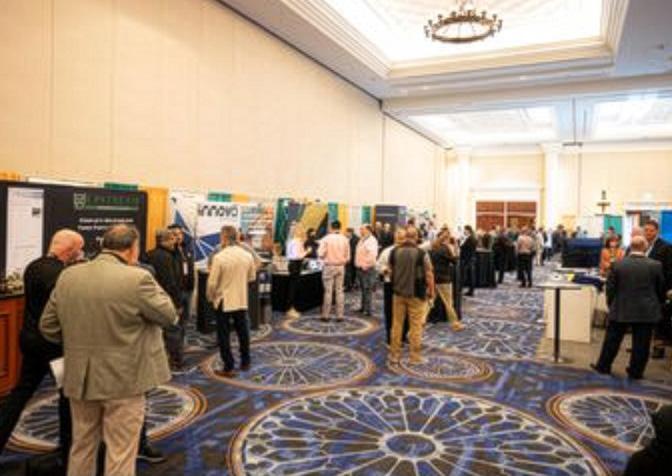
In announcing this year’s Conference for Automotive Remarketing, organizers said the event will return to its roots, focusing on business owners, fleet managers and the fleet vehicle ecosystem.
The CAR 2026 will be held April 15-16, following the NAFA Institute & Expo (I&E) April 13-15 – both in Cleveland, Ohio. Registration for CAR 2026 includes access to NAFA’s I&E Exhibit Hall.
“We are excited to share that CAR 2026 will be held in partnership with the NAFA Fleet Management Association and will coincide with NAFA’s Institute & Expo (I&E) event in 2026,” said Colin Sutherland, CEO of Bobit Business Media, which puts on the event. “I have been a member of NAFA for 20 years and respect the role the association plays and aligns with our core audience and core values for collaboration and forward evolution of industry topics.”
Pierre Pons, president of TPC management and a longtime fixture in the remarketing world, will moderate a panel on what drives remarketing value today, beyond standard tools and measurements of the past.
Pons will join Lawrence Knapp, director of remarketing for Wheels, Jimmy Douglas, chief executive officer of Plug, to focus on EV remarketing, and Nathan Cummings, director of strategic alliances for Anew Solutions, in the transport space.
“There’s a lot of talent in this group, so we’re going to get different perspectives, from a premier fleet management company perspective like Larry’s,” Pons said. “We’re going to get Jimmy’s perspective
on electric vehicles and Nathan on transportation and other services.”
Pons wants to look at what are
some of the presale actions that remarketers have to consider, from reconditioning or lane placement to
certification.
“What work and effort needs to be done beforehand that you think is going to bring you the best ROI in the end?” he said. “Also, are there some things that just aren’t relevant anymore, things that are just outdated habits that aren’t necessary in today’s multichannel environment.”
From that, Pons wants to look at the different channels, speed to market and the importance of logistics. For example, the old model was getting vehicles to physical auctions, bringing the dealers to the sale day and making the transaction. That’s still a successful model in many cases depending on the auction, the consignor and buyers.
“But today, you don’t necessarily need to have the buyer sitting in front of where the vehicle is,” Pons said.
He also wants to get Douglas’s perspective on the EV market and find out whether used EVs are getting ready to flood the market or if that is just a mirage.
Pons said as CAR streamlines and piggybacks on NAFA’s event, it offers a more fleet-focused event.
“Sometimes, in all honesty, I like the smaller venue and conference because we get better time with the remarketers and attendees,” Pons said.

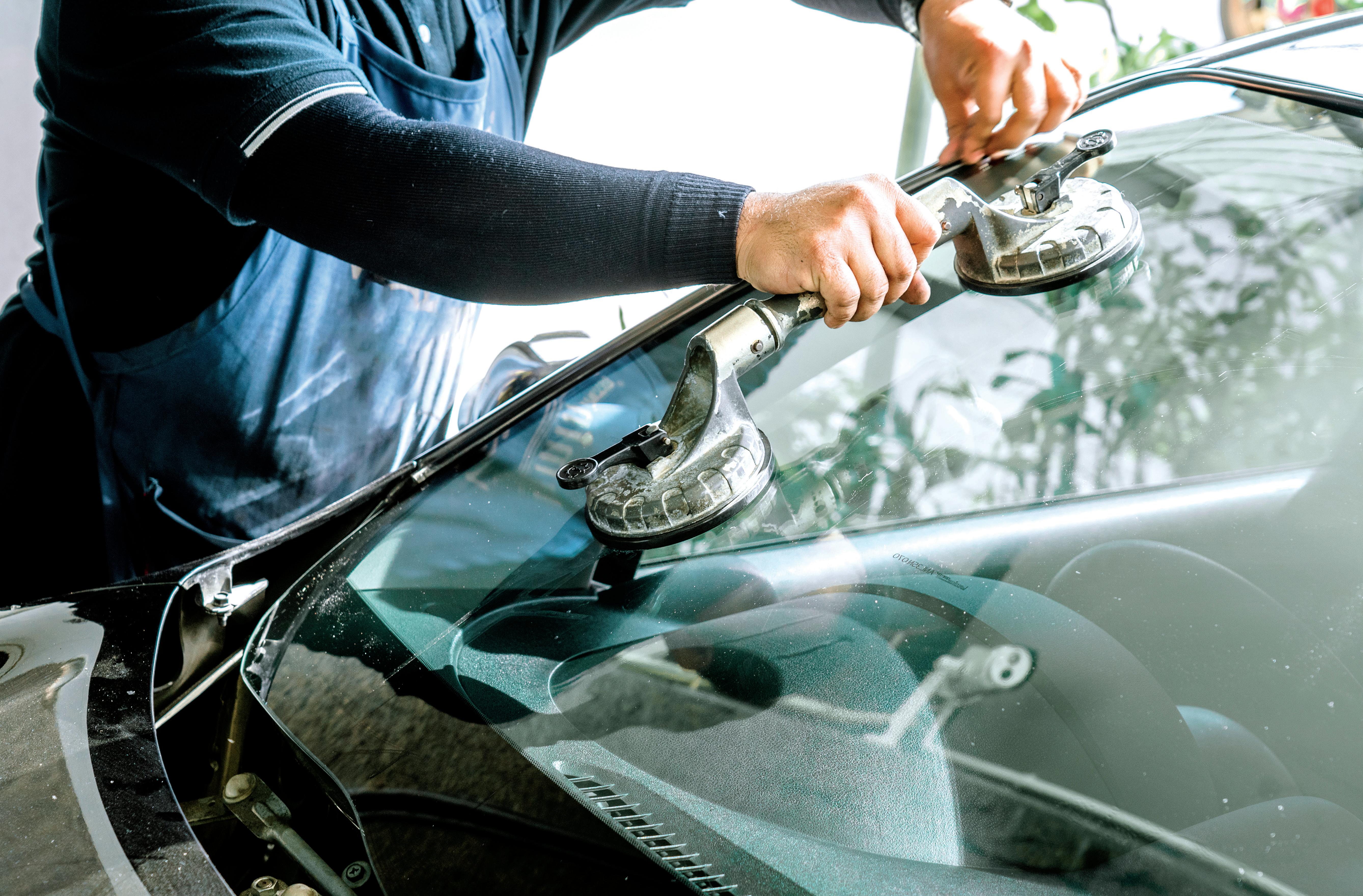
Vehicles must meet quality standards to pass our 7-point inspection.
Actual miles | Glass | Engine | Tires | Transmission | Di erentials | Non-branded title
Santander Consumer USA’s 7-point custom certification program places recovery value in plain sight by providing a consistent reconditioning strategy that ensures buyer confidence for each purchase. With our comprehensive inspection, the road ahead for increased sales is clear of congestion and obstacles.
Refresh your inventory and jumpstart your sales with the preowned vehicles your customers want to drive.

Regulatory News
04/13/2026
Lawmakers Continue Investigation into Soaring Repo Rates
By Taylor A. Krowitz*
At a recent lunch with a friend, he mentioned that he and his partner had just dealt with a difficult situation and were still trying to recover from the impact.
His partner had gone for a walk with their dog and returned to the house distressed because her car was gone from their apartment complex’s parking lot.
At first, they thought it was theft, but they eventually figured out that she had received multiple late notices for nonpayment.
Despite both having long-term, stable employment, they, like many Americans, are struggling to get by due to the worsening affordability crisis.
As he put it, “she missed the first payment because we had just been forced to downsize to a different apartment and had to pay the upfront costs, and then it started to snowball, and before she knew it, she was three payments behind.
“She has never missed a payment on anything before, and she is very embarrassed by the whole thing.”
Unfortunately, in 2024 and 2025, this story was all too common, and it looks like there will be no reprieve in 2026. Vehicle repossessions in the United States climbed sharply in 2024 and 2025, driven by rising delinquencies, broader financial strain on consumers, and evolving regulatory dynamics.
The rate of vehicle repossessions is at the highest level since 2009, up 43% from 2022 to 2024. Ninety-day delinquencies account for 5% of outstanding vehicle finance accounts, up more than 25% from just under 4% of the outstanding pool just a few years ago.
New and used car prices are higher than ever, with median monthly payments on financed vehicle purchases sitting at over $500 (and the average monthly payment is even higher, at over $700).
Higher prices and corresponding higher payments, even for consumers whose credit is good and who qualify for financing, can put more strain on consumer budgets, leading to situations like the one my friend described.
Against that backdrop, the federal government (the Consumer Financial Protection Bureau, in particular) has taken a step back from regulatory oversight and enforcement of the auto finance industry over the
past year or so.
In an apparent effort to fill that oversight gap, on February 5, Massachusetts Senator Elizabeth Warren announced a probe into the auto finance and repossession industries to “seek information on harmful anti-consumer practices,” primarily focused on erroneous repossessions. Warren sent letters to large auto finance companies and industry associations, including the American Recovery Association and the American Financial Services Association, asking for information on four topics:
• what steps the company takes to ensure that its agents only tow the correct vehicles;
• what steps the company takes to identify and address wrongful repossessions;
• what practices and policies are in place for when a consumer and a company disagree about the legality of a repossession; and
• data and trends on the prevalence of repossessions—including wrongful repossessions—in the company or industry.
If those points of inquiry sound familiar, they should. The CFPB, when more active, reacted to all kinds of market data to make headlines about the possibility of wrongful repossession behavior.
The approach tends to ignore the fact that finance companies, banks, credit unions, and their vendors risk far more than they gain if they engage in wrongful repossessions— and that wrongful repossessions are most often the result of a mistake, not willful behavior.
The reports from the CFPB in the past have suggested, but not established, a connection between higher vehicle prices and finance payment levels and wrongful repossession conduct on the part of creditors and their vendors.
In response to Warren’s letter, AFSA offered some perspective. AFSA clarified that the consumer credit base is 35 percent larger today than it was during the 2009 peak of the financial crisis, and the repossession rate in 2025 was 27 percent lower than the 2009 repos-session rate.
AFSA also noted that although the CFPB has taken a regulatory backseat, the “rigorous framework of state and federal laws” still exists, and legal remedies are available for consumers if repossession errors occur, even if the CFPB is not the agency focused on enforcement.


AFSA notes, for example, that in November 2025, the Department of Justice announced a settlement with a New York auto finance company to resolve claims that the finance company illegally repossessed servicemembers’ vehicles without first obtaining court orders.
The finance company agreed to pay at least $120,000 in restitution and penalties and to change its repossession practices. The states have also staffed up and undertaken increased enforcement activity in the void left by the CFPB’s pullback.
We are where we are. It remains the case that consumer debt is growing and consumer credit defaults are happening with greater frequency, leading to more personal property repossessions.
The writing is on the wall; many consumers are locked into vehicle finance credit they simply can no longer afford, and repossessions will likely continue in 2026 at the rates we have seen over the past few years. But higher default and repossession volume does not have to cor-
relate with higher frequency of actual wrongful repossessions.
Repossession companies, forwarders, and the creditors they work for have been careful to develop policies and procedures designed to ensure compliance with federal and state laws.
Compliance is in their collective interest, for the reasons AFSA identified in its response to Warren—the CFPB is not the only sheriff responsible for enforcing consumer credit laws.
With private rights of action available to affected consumers and increasingly active state attorneys general, someone is always watching. Creditors and their vendors must remain vigilant with their compliance obligations.
*Taylor A. Krowitz is an associate in the Maine office of Hudson Cook, LLP.
© CounselorLibrary. Based on an article from Spot Delivery. Single print publication rights only to ”Used Car News.”
News Briefs
CarMax Settles Lawsuit
A network of car dealerships owned and operated as subsidiaries of CarMax Auto Superstores, one of the nation’s largest used car retailers, has been ordered to pay $1,100,000 to resolve a consumer protection lawsuit involving the sale of used vehicles in California, according to a press release by the Riverside County District Attorney.
The lawsuit alleged CarMax dealerships violated California law by failing to timely submit required documentation to transfer registration and ownership of used vehicles to purchasers. Under California law, dealers must submit an application to the Department of Motor Vehicles (DMV) to transfer registration within 30 days of the date of sale. The same deadline applies to the transfer of the certificate of ownership, commonly known as the “pink slip,” unless the application is returned by the DMV for missing information.
As part of the settlement, CarMax agreed to implement and maintain
enhanced business practices to ensure compliance with state consumer protection laws.
The total payment of $1,100,000 includes $900,000 in civil penalties, $150,000 for investigative costs, and $50,000 to support statewide consumer protection efforts.
CarMax cooperated with the investigation and has taken steps to address the issues identified without admitting the allegations in the complaint.
FTC, State Offer Fraud Refunds
The Federal Trade Commission and Maryland Attorney General Anthony G. Brown announced that Lindsay Automotive Group and its executives will return money to resolve allegations that they deceived consumers for years with falsely advertised low prices and unwanted add-ons that led to buyers paying thousands of dollars more for their vehicles.
Consumers who were charged a total of more than $75 million between April 1, 2020, and Dec. 31, 2025, may be eligible for redress. In addition,
Lindsay will pay a $3.1 million civil penalty to the Maryland Attorney General’s office. The proposed order settling the agencies’ complaint also requires Lindsay to provide the total price of the car, including all mandatory fees, to consumers looking to buy or lease a vehicle.
“Lindsay Auto misled consumers by advertising false low car prices and then adding mandatory fees and other charges during the car buying process,” said Christopher Mufarrige, director of the FTC’s Bureau of Consumer Protection.
The agencies’ joint complaint, filed in December 2024, charged Lindsay with systematically deceiving and overcharging car-buying consumers for years, costing them millions of dollars. The complaint named three Lindsay dealerships and their management company, along with the company’s part-owner and president Michael Lindsay, COO John Smallwood and the dealership’s former general manager, Paul Smyth, as defendants.
According to the complaint, Lindsay touted deceptively low prices and then charged the vast majority of consumers hundreds or thousands of dollars more once they arrived at the dealership. Lindsay often claimed consumers could not get the advertised prices because they did not qualify for a litany of rebates included in the advertised price.
The complaint also alleged Lindsay deceptively told consumers they had to finance through the dealership to get the advertised price instead of the financing the consumers already had, including military consumers who had financing from their military branch’s credit union.
Further, the agencies alleged Lindsay charged consumers for add-ons like extra service plans, tire and rim protection, and “guaranteed asset protection” that consumers did not want or agree to buy.
The proposed order prohibits specific misrepresentations in connection with advertising, marketing, promoting, offering for sale, financing, leasing, or selling motor vehicles.
The order requires Lindsay to clearly and conspicuously disclose the total amount a consumer must pay for the car, excluding only required government charges.
Lindsay must also obtain consumers’ express, informed consent before charging them, including for any vehicle-related fees. Under the order, the Maryland Attorney General’s Office will be sending notices to consumers eligible for redress.
Finance News
Used Vehicle Financing Hits Record Low in 2025 Q4
By Jeffrey Bellant
According to Experian’s State of the Automotive Finance Market Report: Q4 2025, subprime borrowers made up 15.31% of total vehicle financing, up from 14.54% in Q4 2024. This represents subprime consumers’ largest share of the total vehicle finance market in the fourth quarter since 2021.
In terms of originations, Melinda Zabritski, Experian’s head of automotive financial insights, continues to see slightly elevated levels of cash in auto purchases, although 82% of new vehicle purchases had financing, which is a little higher than in previous quarters.
On the used vehicle side, it’s something different.
“We have hit a record low for financing on used vehicles,” Zabritski said. “Under 37% of used cars had financing in the fourth quarter, compared to just over 39% last year and just over 40% in 2023.”
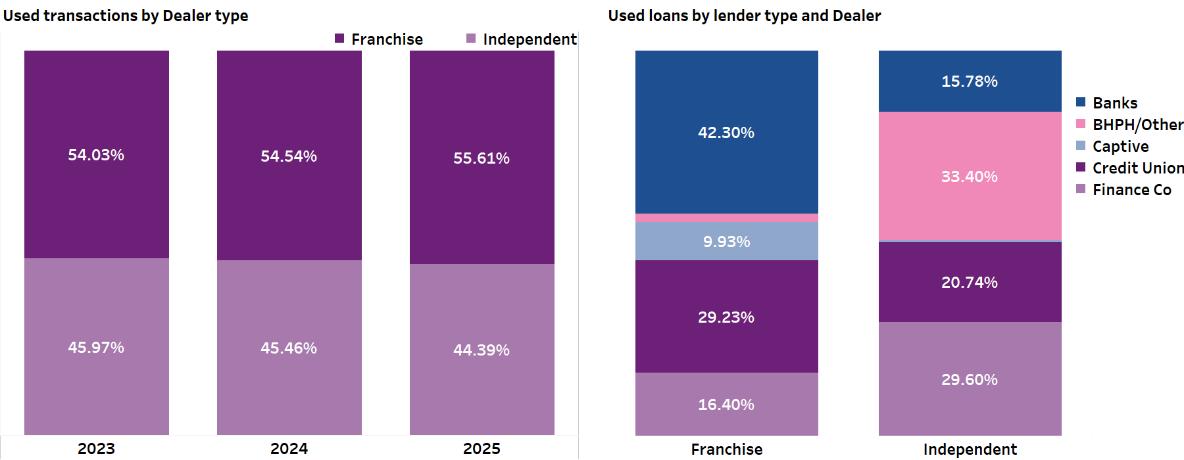
In used car transactions specifically, franchise stores started representing a larger portion of used car transactions in Q4 at 55.6%, with independents at 44.39, Zabritski said.
On financing used car sales, banks dominate on the franchise side at 42.3%, followed by credit unions at less than 30% and financing companies at 16%.
“Within the independent stores, it’s the BHPH/other (category) that does the majority of those loans at over 33%, followed by the finance companies at almost 30%, the credit unions at 20% and the banks, a little under 16%,” Zabritski said.
However, looking at market share for auto financing in the entire used space – franchise and independent –banks end up representing a larger
portion of used loans.
“They do 30.72%,” Zabritski said. “They’ve widened the gap with credit unions at 26.6% which is down year over year. So, over a third of used loans are with banks.”
Finance companies increased to over 21%.
“Recent growth in the subprime segment reflects sustained consumer demand for vehicle financing, even as market conditions continue to shift,” Zabritski said. “As affordability remains top of mind, both lenders and consumers are adapting, reflecting broader trends in credit
patterns and vehicle financing behavior.”
Zabritski said the majority of growth in used vehicle financing is outside of the prime category.
“Deep subprime, subprime and near prime market share all increased,” she said. “The totality of subprime is the most we’ve seen since 2020.”
In terms of average credit scores, used vehicle customers saw a 2-point dip to 689, which is the first time that number it has decreased since 2017-2018, Zabritski said.
Experian reported that the aver-
age used loan amount financed rose to $27,528, with the average monthly payment hitting $537, while rates did fall.
“This is the highest used loan amount since 2022, when the values hit that peak,” Zabritski said, “So it’s not the highest, but it is the second highest in used loan amount.”
“Terms also increased (nearing 68 months).”
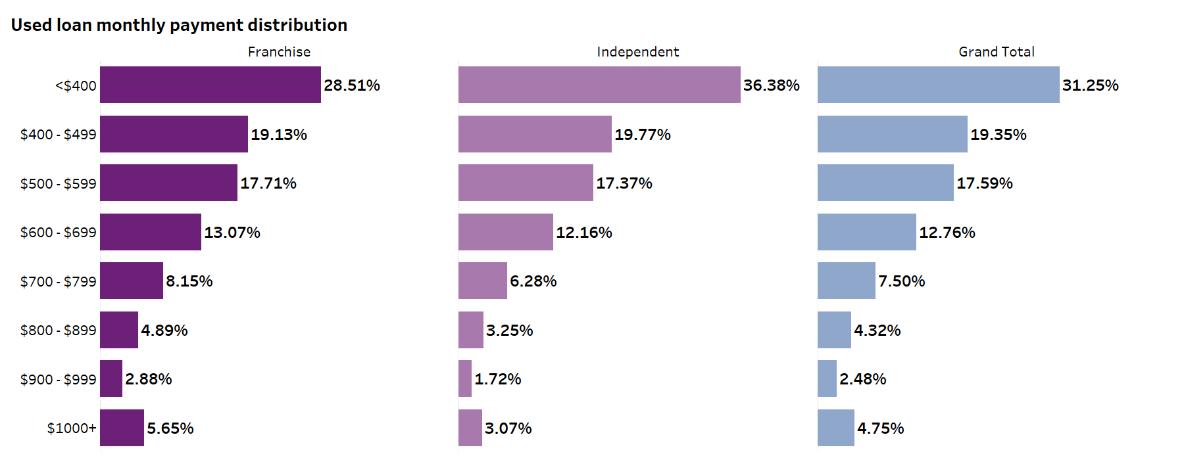
Across all used loan payments, Experian saw that over 31% are under $400, although independents are Continued on page 6
Used Car News
Finance
– Continued from page 5
seeing 36% of loans under $400 a payment. Nearly 5% of all used vehicle loans are above $1,000.
On the used side, loan amounts and payments rose among all risk segments, with deep subprime hitting $558 per month.
“Average (used) clean retail vehicle increased to $27,000,” Zabritski said. “It did surpass the 2022 peaks that we had. The positive here is the LTVs (loan to value) and we’ve seen LTVs were down throughout 2025.”
monthly payment for a new vehicle increased $21 to $767 during the same period, while the average interest rate was at 6.37% this quarter, from 6.34% last year.
Used vehicle financing saw a slight uptick in the average loan amount, increasing $872 from a year ago to $27,528 in Q4 2025. The average monthly payment increased to $537, from $528 and the average interest rate declined from 11.63% to 11.26% year-over-year.
As the average loan amount for
Similarly, the percentage of used vehicles with 73- to 84-month loan terms went from 26.11% to 28.68% year-over-year, and the percentage of new vehicles with loan terms of more than 85 months increased from 0.95% to 1.03%.
“Despite shifts in average loan amounts and monthly payments, we’re seeing the market adapt,” Zabritski continued.
“Consumers and lenders are finding ways, such as extending loan terms, to make the financing fall
in Q4 2025, up from $73 last year.
• New vehicle leasing remained steady, going from 24.87% in Q4 2024 to 24.37% in Q4 2025.
Leasing decreased year over year, hovering at 24% in 2025.
Captives dropped nearly 3%, while credit unions sit at 19.5% and finance companies have risen to almost 15% of the auto financing space. BHPH was under 9% in Q4.
Experian saw credit scores show a year-over-year decrease for the first time based on VantageScore 4.0,




Let Auto Assign do the heavy lifting, automatically routing vehicles to the best-fit auctions based on your custom rules. Faster decisions. Better results.
Retail Markets
MASSACHUSETTS
Lou Tedeschi, owner, A.S.P.I. Motors, Dedham, Mass.
“I’ve been in the business for 41 years.”
“Here in Massachusetts, they’re trying to pass a lemon law that would increase the mileage up to 200,000, with direct access to the dealers’ bond. That would do away with due process.
“The bill is in the House Ways and Means and we’re negotiating with them. It’s expen-sive to fight these things. We stopped it last year but it came back this year. Even California, which is way over-regulated, doesn’t have a lemon law like that.
“We’re trying to educate the dealers here. A lot of them don’t know what the federal laws are, they don’t know what the state laws are. A lot of complaints
made statewide were about dealers using burner phones to sell cars. That’s not a legitimate deal.
“Yes, COVID absolutely changed the way we do business. We do more online.
The lack of vehicles is still hurting us.
“We’re a small dealership, we sell about 15 a month.
“Our sales break down to about 60 percent SUVs and trucks, 40 percent cars.
“We spend between $500 and $1,000 on reconditioning. We have our own shop.
“Most of our advertising is online. But we’ve been here over 30 years so we have a lot of word-of-mouth.
“We’re right outside of Boston, so we have a lot of drive-by business. I walk across the street to my shop and we’re in Boston.
“We just delivered a 2019 Jeep Grand Cherokee with 65,000 miles. We got $21,000
for it.”
TENNESSEE
Steve Sartin, owner, Sartin’s Auto Sales, Dyersburg, Tenn.
“I’ve been in the car business 37 years, 10 years in a new-car store and then 27 years with my own store. My son, Autry, is working for me and he went to auctioneer’s school. The guys at Manheim influenced him to do that.
“We sold 48 cars in February. We’re at 22 (halfway through March). We’ve got a good mix of vehicles on the lot right now. I’d say we sell 40 percent trucks, 40 percent SUVs, and 20 percent cars. We do better with the Chevys than the Fords. We drive Rams and we sell those all the time.
“I go to auctions in person, it has cost me too much money to buy online. If I




can’t see them, I’m not going to buy them.
“We’re pretty low on reconditioning, probably $300 on average. We have our own shop.
“We will buy and sell anything. If it’s got four wheels and a title we’ll buy it -- could be $500 to over $100,000. I’ve seen dealers try to limit themselves and make a niche, but a lot of people go out of business trying to do that.
“I was into buy-here payhere strong for about 22 years. I got so tired of chasing my money. I’ve still got two cases of Advantage GPS systems sitting in a box. There was a guy around here who advertised that he would find your GPS and take it off for $40.
“It takes a lot of money to start a dealership now. When I started, I rented a small lot for $600 a month

Compiled by Ed Fitzgerald
and swapped a truck I was driving for 22 old cars. I was in a portable building and the bathroom wasn’t hooked up to the sewer system. It’d probably take half a million dollars to start a store nowadays. This county once had 20-25 used car lots. Now there are only four.
“During COVID, we set up a table and chairs outside our building and we would hand the keys out the window. I had 200 cars in stock and I really don’t know why I had so many. But I sold them all during COVID. The other day someone came in and wanted to buy a car for $1,500. I had to tell him I couldn’t sell him one that was running for that price.
“We sold a 2018 Chevy Crew Cab yesterday, with 157,000 miles. We sold it for 10 grand, we bought it from a local guy.”


Wholesale Markets
04/13/2026
INDIANA
Paul Fetter, general manager, America’s Auto Auction – Clark County, Jeffersonville, Ind.
“I’ve been the working general manager since 1984 and America’s bought us in 2021. America’s also picked up the auction in Bowling Green, Ky. It’s a small auction.
“It’s been busy. The auction has been doing well, running about 1,000 cars a week. We’re trying to get it back up on its feet.
“(Sales) percentages are up over last year. We’re a little over 70% year-to-date. We finished last year at 69%.
“Our volumes are off a little bit. Commercial has picked up, while dealers (volume) is down a little bit. Dealers are keeping a few more cars.
“I’d say average volumes are right at 700. The (mix) is pretty close to 50/50 be-
tween dealer cars and (fleet/ lease/repo).
“Prices are still pretty solid for sellers. It’s a high market, spring always is. I think it’s really close to cooling off as the season progresses, which is about the same time every year. Through the high heat of the market, we were running at 78%.
“Our average price in the lanes is usually around $10,000 to $11,000.
“Some dealers have said they’ve slowed down a bit but other dealers save said they are absolutely killing it.
“I think it’s generally the way it’s been since COVID. I mean, there was a period in 2022 and 2023 where you could be a grocer and sell cars. But after that it’s about how well you do with your marketing, your inventory and your sales management.
The dealers who really work hard at it do a good job, I
believe. They report they’re making a lot of sales.
“Recently, we’ve started selling recreational vehicles, motorcycles and boats right at the beginning of the sale.
“We’ve got a new person at America’s corporate, Pamela Exline, who is working to help us improve our sales in that (segment). We’re also trying to make those easier to identify in the pre-sales (info) and find in the lanes. Those will lead off the sale before the in-ops.
“Our next promotion is our Derby Day sale on April 29, right before the Kentucky Derby. We have a lot of people that come in for that sale.
“We also do a special thing on that Monday and Tuesday for our commercial consignors that come from out of town for that.”
NEBRASKA
Ryan Durst, vice president, Lincoln Auto Auction, Lincoln, Neb.
“We have four lanes. We’re running about 250-300, which is about the same as this time last year.
“Conversion rates have been insane. We’re normally a high percentage sale. I don’t think we’ve been below 80% all year. I think in March we averaged 84.7% for the month. On April 2, we sold 87%. We’re very fortunate.
“It’s just a shame because we can’t get enough cars. I know if we did, we’d still have the same percentage.
“Bidders and sellers in the lane are saying the same thing, everyone’s short on cars. Inventory is down across the board for some reason – at dealerships and at auctions.
“For volumes, we’re 90% dealer cars and 10% fleet/

Compiled by Jeffrey Bellant
lease.
“(In terms of retail) I talk to a lot of our main dealers and they all are steady. Nobody’s lighting the world on fire, but they’re not doing bad.
“Our average price across the block is $7,200. That’s higher than we typically are. With high percentages, that translates into higher prices.
“Before COVID, we were always $4,000 to $4,500. Then during COVID everything was high and it went to $7,000.
“We dropped back to $5,500 or $5,600 for a few years now, we’re back up to $7,000. No complaints.
“I’m pretty optimistic. There’s a lot of outside noise in the world, but we just keep our heads down, keep doing what we’ve been doing for 35 years.
“I think we’ll be fine.”








ADESA Boston MAY 8, 22
508-626-7000
ADESA Charlotte MAY 14, 28
704-587-7653
ADESA Chicago MAY 22
847-551-2151
ADESA Cincinnati/Dayton MAY 26
937-746-4000
ADESA Golden Gate MAY 12, 26
209-839-8000
ADESA Indianapolis MAY 12, 26
317-838-8000
ADESA Kansas City MAY 12, 26
816-525-1100
ADESA Lexington MAY 7
859-263-5163
ADESA New Jersey MAY 14, 28
908-725-2200
ADESA Salt Lake
MAY 19
801-322-1234
ADESA Tulsa MAY 8
918-437-9044
Columbus Fair
MAY 6, 27
614-497-2000

Manheim Atlanta MAY 14
404-762-9211
Manheim Dallas MAY 19
877-860-1651
Manheim Milwaukee MAY 20 262-835-4436
Manheim Atlanta MAY 14 20, 28
404-762-9211
Manheim Baltimore Washington MAY 19
410-796-8899
Manheim Dallas
MAY 6, 19, 20
877-860-1651
Manheim Denver
MAY 20
800-822-1177
Manheim Detroit
MAY 14
734-654-7100
Manheim Fredericksburg
MAY 21
540-368-3400
Manheim Milwaukee
MAY 6, 20
262-835-411436
Manheim Minneapolis
MAY 13
763-425-7653
Manheim Nashville
MAY 5, 6
615-773-3800
Manheim Nevada
MAY 1, 29
702-730-1400
Manheim New England
MAY 26
508-823-6600
Manheim New Jersey
MAY 6, 20
609-298-3400
Manheim Nashville MAY 6
615-773-3800
Manheim Nevada MAY 1, 29
702-730-1400
Manheim Palm Beach MAY 6 561-790-1200
Manheim New Orleans
MAY 6, 20
985-643-2061
Manheim Orlando MAY 5, 12, 19, 26
800-822-2886
Manheim Palm Beach
MAY 6, 7
561-790-1200
Manheim Pennsylvania MAY 1, 8, 14, 15, 22, 28, 29
800-822-2886
Manheim Phoenix MAY 7, 21
623-907-7000
Manheim Pittsburgh MAY 20
724-452-5555
Manheim Riverside MAY 5, 7, 19,21
951-689-6000
Manheim Seattle MAY 27
206-762-1600
Manheim Southern California MAY 14, 28
909-822-2261
Manheim Tampa MAY 14, 28
800-622-7292
Manheim Texas Hobby MAY 14, 28
713-649-8233
Manheim Atlanta MAY 14
404-762-9211
Columbus Fair MAY 6
614-497-2000
Manheim Dallas MAY 19
877-860-1651
Manheim Milwaukee MAY 20 262-835-4436
Manheim Nashville MAY 6 615-773-3800
Manheim Nevada MAY 1, 29 702-730-1400
Manheim Orlando MAY 12, 26
800-822-2886
Manheim Palm Beach MAY 6 561-790-1200
Manheim Pennsylvania MAY 14, 28
800-822-2886
Manheim Phoenix MAY 7, 21
623-907-7000
Manheim Riverside MAY 7, 21
951-689-6000
Manheim Seattle MAY 27 206-762-1600
Manheim Pennsylvania MAY 14, 28
800-822-2886
Manheim Riverside MAY 7, 21
951-689-6000
Manheim Seattle MAY 27 206-762-1600
ADESA Boston MAY 8, 22
508-626-7000
ADESA Charlotte MAY 14, 28
704-587-7653
ADESA Golden Gate
MAY 26
209-839-8000
ADESA Salt Lake MAY 19
801-322-1234
Columbus Fair MAY 27
614-497-2000
Manheim Dallas MAY 20 877-860-1651
Manheim Fredericksburg MAY 21 540-368-3400
Manheim Milwaukee MAY 6 262-835-4436
Manheim New England MAY 26
508-823-6600
Manheim New Jersey MAY 6, 20 609-298-3400

Financial Services*
Manheim Atlanta MAY 20
404-762-9211
Manheim Dallas MAY 19
877-860-1651
Manheim Milwaukee MAY 20
262-835-4436
Manheim Orlando MAY 12, 26
800-822-2886
Manheim Pennsylvania MAY 1, 15, 29
800-822-2886
Manheim Pittsburgh MAY 20
724-452-5555
Manheim Seattle MAY 27
206-762-1600
Manheim Southern California MAY 14, 28 909-822-2261
Manheim Palm Beach MAY 6
561-790-1200
Manheim Pennsylvania MAY 14, 28
800-822-2886
Manheim Riverside MAY 7, 21 951-689-6000
Tony Moorby Disconnected Jottings From
I see from this publication’s updates that the franchised dealer distribution system is, once again, under fire.
Whilst the system is inherently over a century old, its tenets still hold well under most scrutiny. By its competitive nature, improvements find their way to the benefit of both the dealer and the consumer
The rates of change or improvement have been dictated by all kinds of forces over the years; economic, structural, legal and legislative, competition, customer demands and technology to name a few. Those mentioned, reflect national impacts, while “local” changes, typically at the State level are dealt with by dealers who are aware of their regional affectations.
There seems to be an overarching opinion that New Car Dealers make their own rules up as they go along,
unfettered by oversight of any description. We, in the trade know a different story.
The qualifications to sign a dealer agreement with any manufacturer are rigorous, time consuming and require exquisite working knowledge of departmental functions, including accounting and reporting. Other expertise like marketing, public relations, advertising, market awareness, human relations and so on, should also be in evidence. I know.
It took me 4 years under a tightly controlled management training program, ending up at GM’s training school in the UK for three months to earn the privilege.
Never mind all the above; the cost alone to build a dealership or buy one from another dealer would deter any dilettante or dabbler.
The upkeep and updating of facilities to maintain the manufacturers’ presence (as

dictated by them) is a constant cost to stay in the ‘high street’.
A dealer’s performance is measured every month from trading statements, inventory levels and model splits, staffing and payroll – the oversight is constant and comparative.
Then there’s competition. I know of no other customer-facing business that’s so vigorously competitive – especially today with access to pricing at the end of one’s hand!
A dealer-operator today is probably one of the largest local employers, not just at the store but all the other ‘downstream’ businesses that are influenced by new car dealers. They are also some of the most charitable people supporting local and national entities.
Sure, Tesla and Rivian sell directly to consumers but they still need brick and mortar for consumer sup -

port in whatever guise.
My experience with Wall Street number crunchers like Goldman Sachs confirms no such knowledge or awareness of what it takes. They make these assertions by assumption.
The International Center for Law and Economics (ICLE) curries very little in terms of influence and could be operating out of someone’s back yard! To include the U.S. Department of Justice in the ‘analysis’ invites all kinds of quizzical commentary when they currently have difficulties with rear ends and road maps!
They say that “multiple models can compete to serve consumers”. Can you imagine re-engineering a superstructure to oversee a myriad of outlets of questionable quality or control?
I say that more models invite thieves, vagabonds, ne’er-do-wells and twist-
ers to feast on uncontrolled outlets. Their ‘Key Findings’ are specious, at best and simply self-serving. They say that ‘protecting an incumbent distribution channel is not the same as protecting consumers.’ That’s precisely what it is and efforts to protect and improve the status quo should continue unabated.