Used Car News 2/2/15

Page 1


Dealers Put High Value On Theft Recovery

A study released by Inilex found that dealers consider GPS-based theft-recovery devices one of the highest-value aftermarket products.

CarMax Inc. Readies For Expansion

CarMax Inc. is hiring for more than 75 positions for the company’s new store in Turnersville, N.J. This is the company’s first store in the state.

Auto Finance Reaches

All Time High

Equifax announced that the total balance of auto loans in December was $975 billion, representing 33.2 percent of total outstanding non-mortgage consumer debt. The total is an all-time high.

Study Ranks States by Financial Risk

A study ranked Maine as the least risky state financially for drivers, while Florida ranked as the riskiest due to differences in insurance requirements.

Remarketing Responds to Higher Volumes

Dealers Association

SAN

– The used-car industry is preparing for a spike in of-lease returns last seen around the turn of the century.

But that doesn’t mean the market will follow the same downward path.

“If the industry had the same remarketing practices as it did in 2002, I’d be worried,” said Manheim chief economist Tom Webb. “They do not, so I am not.” Webb said the main diference this time is manufacturers, who have an interest in maintaining residual val-

ues, are leasing the cars.

Jonathan Banks, executive automotive analyst for the NADA Used Car Guide, said this is the first time since the recession that the volume of 0-8-year-old cars will rise.

Of course, one person’s deluge is another’s end of a drought.

Steve Jordan, executive vice president of the National Independent Automobile Dealers Association, said his members need more vehicles at lower prices.

“A lot of our members are excited about the increase in of-lease returns,” he said.

Supreme Court Considers Case with Finance Implications

A Supreme Court decision on fair housing could have a big efect on auto finance regulation.

The court heard the case, Texas Department of Housing and Community Afairs v. The Inclusive Communities Project Inc., on Jan. 21.

If the court decides in favor of Texas, it would limit claims of disparate impact, at least in regard to housing.

Disparate impact, which claims racial bias without direct intent, has been the basis for the Consumer Financial Pro -

tection Bureau’s argument against dealer participation in auto finance.

CFPB Director Richard Cordray has said the court’s decision on this case won’t afect his agency’s push for finance companies to switch to flat fees.

Bill Hempler, executive vice president of the American Financial Services Association, said the case is at least likely to slow the CFPB until the decision is announced. That could come as soon as June.

A panel of lawyers at AFSA said press reports guessing at how the Justices will decide on the case were premature.

Photo by Ted Craig
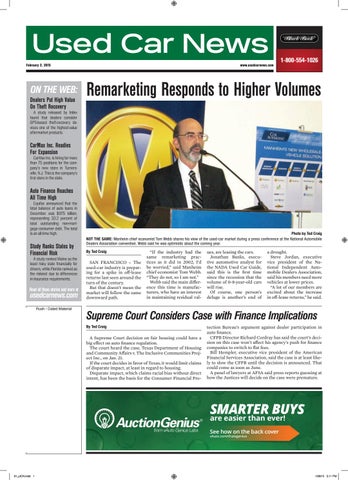
NOT THE SAME: Manheim chief economist Tom Webb shares his view of the used-car market during a press conference at the National Automobile

Subaru, Lexus Earn Most Resale Value Honors

Resale value once seemed like an after thought for many manufacturers.

Today, resale value is a major concern.

“Resale values are the cornerstone of our business,” said Steven Hill, General Motors’ vice president of U.S. sales and service.

Hill made this statement during a ceremony announcing the winners of Kelley Blue Book’s 2015 Best Resale Value Awards.

The level of executives on hand to accept the awards reflects the current thinking on residuals.

The model-year brand and category winners of the annual contest earned their spots as a result of projected retained value through the initial fiveyear ownership period.

Subaru and Lexus earned top honors for best brand and best luxury brand (respectively), with Subaru claiming three model winners and Lexus producing six model winners from a total of 22 diferent segments.

In addition, Chevrolet and Toyota each have five mod-

els winning 2015 Best Resale Value Awards, with the majority being trucks or SUVs.

The entire list of Top 10 Best Resale Value vehicles is dominated this year by trucks, SUVs and crossovers.

Kelley Blue Book’s Best Resale Value Awards are in its 13th year and are based on projections from the Kelley Blue Book Ofcial Residual Value Guide.

Eric Ibara, director of residual value consulting at Kelly Blue Book, said this year’s rankings were the closest ever.

Kelley Blue Book residual values are established by automotive analysts that review the output from the statistical models built upon millions of transactions.

Vehicles that earn the highest five-year residual values, expressed as a percentage of their original MSRP, are then selected.

Low-volume vehicles and vehicles with an MSRP of more than $60,000 are excluded from consideration, except in the plug-in vehicle, luxury and high-performance categories.

FULL-SIZE SUV/CROSSOVER Chevrolet Suburban

FULL-SIZE CAR Dodge Charger

SUBCOMPACT

PLUG-IN VEHICLE Porsche Cayenne S E-Hybrid

COMPACT CAR Subaru Impreza

COMPACT SUV/CROSSOVER Jeep Wrangler

SPORTY COMPACT CAR Subaru WRX

MID-SIZE SUV/CROSSOVER

Jeep Wrangler Unlimited

MID-SIZE CAR Subaru Legacy

LUXURY COMPACT SUV/CROSSOVER Mercedes-Benz GLK-Class

ENTRY-LEVEL LUXURY CAR Lexus RC 350

LUXURY MID-SIZE SUV/CROSSOVER Lexus GX 460

LUXURY CAR Lexus GS 350

MID-SIZE PICKUP TRUCK

Toyota Tacoma

HIGH PERFORMANCE CAR

Chevrolet Corvette

FULL-SIZE PICKUP TRUCK

Toyota Tundra

HYBRID/ALTERNATIVE ENERGY CAR

Toyota Camry Hybrid

MINIVAN/VAN

Toyota Sienna

2015 BEST RESALE VALUE Top 10 Cars

LUXURY FULL-SIZE SUV/CROSSOVER Lexus LX 570

HIGH-END LUXURY CAR Lexus LS 460

HYBRID SUV/CROSSOVER Lexus RX 450h

SPORTS CAR Chevrolet Camaro V6

Chevrolet Colorado Honda CR-V

Chevrolet Silverado

Jeep Wrangler Ford F-150

Toyota Tacoma GMC Canyon

Toyota Tundra

GMC Sierra

Toyota 4Runner

NEWS BRIEFS

ServNet Adds Brasher’s Sale

The ServNet Auction Group has announced the addition of its 32nd auction location: Brasher’s Fresno Auto Auction in California.

The Fresno facility was recently purchased by the Brasher family, and held its first sale under the Brasher banner on Jan. 16.

The new auction facility is the eighth auction owned by the Brasher family, all of which are also ServNet auctions.

DealShield Announces Training

DealShield announced the launch of its Certified Buyer Program, a series of training modules designed to educate and inform buyers of the risks across the vehicle sourcing timeline and ways to mitigate those uncertainties.

DealShield’s Certified Buyer Program is comprised of five modules designed around the phases of the vehicle sourcing risk landscape.

The first four modules will take buyers through the various phases of sourcing, from research to retailing, and review the different risk mitigation opportunities. They will also look at the pros and cons of each method so buyers get a full, unbiased understanding of risk mitigation.

The fifth and final module will provide advanced training on how DealShield products can be used to

not only mitigate risk on individual vehicles, but also to manage inventory levels and positively impact the bottom line. Buyers who complete all five modules will receive a certificate of completion.

Buyers who also become DealShield 360 customers will earn Certified Buyer status, which offers benefits such as discounted rates, access to special products and services, a personal DealShield relationship manager and custom marketing materials. DealShield’s Purchase Protect and other guarantee products enable buyers to eliminate costly mistakes, protect against unknowns and gain greater peace of mind.

NADA Publishes Ad Guide

The National Automobile Dealers Association issued a new publication that will assist new-car dealers in complying with federal advertising requirements on the sale, financing and leasing of automotive products and services.

A Dealer Guide to Federal Advertising Requirements provides ex-

amples of “bad” ads and “good” ads and chapters on 41 diferent federal advertising topics, such as the use of discount claims, e-mail advertising, green marketing claims, Internet advertising, satisfaction guarantees and trigger terms.

Readers can access the content quickly by the hyperlinked topics in the table of contents page in the PDF document.

Since 2012, the FTC has initiated five separate rounds of advertising enforcement actions against 18 dealers in 12 states for multiple types of advertising violations, including actions against three dealers that the FTC announced last December.

Exeter Reduces Decision Time

Exeter Finance Corp. announced the completion of the rollout of its new originations platform, which reduces the typical decision time to less than 15 seconds.

Additionally, Exeter Finance Corp. is now able to restructure the loans in real time.

As a result of the full roll out of the new system, all Exeter loan applications will be processed through two operations centers: one in Irving, Exeter’s new program typically provides decisions in 15 seconds or less, while still ofering dealers the ability for rehashes and personalized service.

Published By General Media LLC

USED CAR NEWS (ISSN 1555-7413) is published at 24114 Harper, St. Clair Shores, MI 48080

Phone: 586-772-5200 or 800-794-0760 Fax: 586-772-9400

www.usedcarnews.com

Charles M. Thomas

Founder (1947-2002)

Lynda R. Thomas, Publisher Colleen Fitzgerald, General Manager

Editorial:

Ted Craig, Managing Editor

Jefrey Bellant, Staf Writer

Contributing Writers:

Ed Fitzgerald, Jenny King, Sheila McGrath

Columnist: Tony Moorby

Advertising:

Shannon Colby, Account Manager

Megan Frump, Account Manager

Marie Hingst, Account Manager

Circulation: Helen Thomas

Production:

Josie Godlewski, Media Manager

Tim Montie, Graphic Designer

Used Car News is published the first and third Monday of each month. Subscribers: We print advertisements as sent to us by auctions and other advertisers. It is not possible to verify the correctness of listed vehicles in auction ads. Most lists are partial and all lists are subject to last minute changes by auto auctions, so before travelling a long distance for a particular auto auction event, contact the auction by telephone for a fax of vehicles in the sale. Used Car News assumes no guarantees or liabilities concerning the accuracy of any advertisements. All Rights Reserved. Reproduction in any form is prohibited without the written consent of the publisher.

Please submit clear, legible copy. Payments from first time advertisers must accompany the insertion order. Distribution is guaranteed by U.S. Postal Carriers. The advertising reservation deadline is 5:00 p.m. Friday, 10 days prior to the issue date. Camera ready ads must be received by noon on Monday prior to the issue date.

Shoppers Find Cars Online

Car buyers are coming into dealerships already having decided what they want to buy, often having found that car using a mobile device.

That’s the main finding of AutoTrader.com’s 2015 Automotive Buyer Influence Study.

In 2015, 72 percent of recent car buyers reported that they purchased the vehicle they had in mind when they first visited a dealership. This is a statistically significant increase from the 66 percent who reported doing so in 2014.

This increase is being driven by used-car buyers, who exhibited the largest change year-over-year.

In 2015, 71 percent of used-car buyers said they purchased the vehicle they intended, versus 63 percent in 2014. New-car buyers who reported this behavior stayed relatively flat year-over-year, with 77 percent in 2015, compared to 76 percent in 2014.

“Over the past several years of conducting this study, we’ve seen significant changes in car buyers’ behaviors, particularly in how they are arriving at their purchase decisions,” said Jared Rowe, president of AutoTrader.com. “The Internet is providing an unprecedented level of transparency for car shoppers, enabling them to make informed car buying decisions that they can be confident about.”

Used-car buyers are less likely to know what vehicle they are interested in purchasing when they begin the car shopping process, with just 29 percent reporting that they knew the exact model. This is significantly lower than 38 percent of new car buyers who have a vehicle in mind when they begin shopping.

But by the time used-car buyers first visit the dealership, 71 percent purchase the make/model they have in mind.

To arrive at their purchase decisions, used car buyers spent 16.6 hours shopping for a vehicle, up from 15.2 hours during the prior year. They are spending 77 percent

of their shopping time online - at 12.7 hours.

The top three reasons used car buyers use the Internet to shop are: research pricing, find cars for sale and compare vehicles.

“Buyers, and in particular, usedcar buyers, rely on the Internet to inform their car buying processes,” Rowe said. “The more information and transparency we, as an industry, can provide online, the easier it will be to help car shoppers turn into car buyers.”

More of that time spent online shopping for a car is spent with a mobile device.

The 2015 study shows that 42 percent of recent car buyers used multiple devices to shop for cars, compared to the 24 percent who used multiple devices in 2013. The increase in mobile device usage is being led by used car buyers, who showed the most significant increases in using smartphones and tablets for car shopping.

“The power and proliferation of mobile devices in the US is undeniable, and consumers are rapidly turning to these devices as they shop for cars,” Rowe said. “The importance for all automotive advertisers to have a robust crossplatform presence cannot be underscored enough if they want to reach and influence consumers as they shop for cars.”

The use of smartphones and tablets for car shopping both saw significant increases among recent buyers who used the Internet to shop for cars.

In the 2015 study, 39 percent reported using a smartphone, compared to just 19 percent in 2013. Among those who use smartphones for car shopping, 65 percent use the device while visiting a dealership.

For tablets, 35 percent reported using a tablet in the 2015 study, compared to 19 percent in 2013. Additionally, 25 percent of tablet users reported using that device while visiting a dealership.

Photo by Josie Godlewski

Tesla Founder Wants Competition

DETROIT – Projecting production of 100,000 units a year within a few years and a stated sales goal of 500,000 by 2020, Tesla CEO and co-founder Elon Musk said some degree of success for his company is assured.

Musk, whose Tesla S fivepassenger longrange electric luxury sedan has been well reviewed, chided the auto industry for its hesitation to commit resources to electric cars in the face of wavering demand and perceived economic issues.

“Our mission is to transition the world to electric cars,” Musk said.

Musk did acknowledge that Tesla, which sells direct and without a traditional franchise dealer network, has no procedure for handling trade-ins.

But he dismissed the idea of joining other established auto retailers, saying, “We need our own stores before considering partnering with other dealers. We can live with

store limits.”

Tesla sales and production numbers are not publicly announced.

Musk said the company had hoped to deliver 33,000 cars in 2014, adding, “We sold in terms of orders more than that.”

Musk said the company produces cars in batches for geographic areas.

Sales last year in China were negatively afected by misunderstandings about charging vehicles.

He said there are “communication issues that still need attention.”

The second member to the Tesla line, the Model X sports car, will launch this summer “for sure,” he said.

“This car is really good – something special,” Musk said.

Plans for an electric car smaller than the Model S and likely priced in the mid-$30,000 range (even without tax credits) are well under way.

The Model 3 is expected to be the company’s mainstream volume seller and should be in production by 2020, he said.

“I’d be quite pleased to see other manufacturers increase production of electric cars,” Musk said.

“In spite of lower gas prices, it’s still cheaper to operate an electric car.”

Starter-interrupt devices remain a critical tool for many buy-here, payhere stores, though each dealership may use them differently.

Chris Leedom, president and CEO of the Leedom Group, said the collection devices offer more options today.

Dealers who use the devices will use diferent types, according to dealers in Leedom twenty groups

“About a third use strictly a starter-interrupt device, another third use strictly a GPS device and the final third use a combined GPS/ starter-interrupt device,” Leedom said.

Leedom said it’s a big change from the early years when 100 percent of dealers were using exclusively starter-interrupt, before GPS became a part of the mix.

“Most of the growth we’ve seen is in dealers using a combined device that has GPS capability as well as a starter-interrupt feature,” he said.

While using a collection tool that has both features seems like a natural choice, some dealers chose to use GPS without starter-interrupt.

“Some dealers choose only to use a GPS device because they are playing it conservatively,” he said.

Their concern is – even though the tools are legal and widely used – they don’t want to “even have a hint” that the vehicle could be turned of, Leedom said.

Starter-interrupts have always faced controversy, most recently in a New York Times article that told stories of customers have had vehicles shut of while driving or that dealers force the devices on customers.

That was met with a big pushback from payment device companies like Passtime, which quickly put out a press release and responded on television news programs to challenge several of the article’s assertions.

“I thought the New York Times did a poor job from a journalism perspective,” Leedom said. “It didn’t accurate-

STARTER INTERRUPT DEVICES OFFER DEALERS MORE CHOICES

ly (portray the industry).”

Leedom said the paper seemed more interested in “a message” than fairly covering the issue.

The industry has seen improvements in the devices over the years, such as the development of GPS functions and making the technology more userfriendly for dealers and their customers.

“They’ve done a good job of integrating with Dealer Management Systems providers,” Leedom said.

Today, the technology works more seamlessly with many DMS platforms. Plus, the technology can also be customized to a dealer’s preferences.

Typically a driver might hear a tone from the device 48 hours before a payment is due. Then it may deliver a diferent tone on the due date and a “more obnoxious” tone once the payment is past due a certain number of days, Leedom said.

Once a customer makes a payment, the dealer will issue a code on the receipt to keep the car starting.

Depending on the dealer, customer and market, a starter-interrupt device can be an attraction or a barrier.

“Some consumers like the device as a reminder,” Leedom said. “In some competitive markets, however, other dealers will actually (advertise) that ‘we don’t use devices on our cars.’”

Jamie Davis, president of Davis Auto Center, New Church, Va., doesn’t use the devices because of his market and business model.

He said the dealership considered using the devices, but decided against it.

“We’re in a rural area,” Davis said. “Plus, we’ve had our clientele for years, so we just don’t lose that many cars.”

He doesn’t feel it’s worth the cost.

Davis’s customers are “cousins, brothers, aunts, uncles and daughters,” so he’s known his customers over many years.

“They trust us enough to sell them a good car so we trust them enough not to have to install a device,” Davis said.

He added that how the

dealership structures deals allows it to bypass collection devices.

“We get a fairly substantial down payment,” Davis said, “so they have some money invested in the car.”

The customer doesn’t need as much incentive to stay current with payments.

“Plus, we probably underwrite a little tougher than most people do,” Davis said. “If it was just a case where ‘if you have $500 down, we’ll let you roll today,’ then maybe it would be different.”

The Leedom Group has recently analyzed the usage of these tools among its dealers and learned that while the majority of dealers – 70 percent – don’t use them, the number of users has increased, especially with the combined GPS/ starter-interrupt devices.

Leedom said the choice for a combined device makes a lot of sense and ofers dealers some good options.

Dealers use the GPS to find the car and may only use the starter-interrupt device when they need to reach the customer.

So in those cases, the dealer will use an on-demand feature that allows them to forgo the beeping tones a week or two before a payment is due and only use it to reach out when the customer is being nonresponsive.

Leedom said he’s seeing potential changes in how devices are used.

Gone may be the regular use of the constant beeping reminder. Leedom said in today’s regulatory environment, “somebody may win an argument that it’s some form of electronic repossession.”

Leedom disagrees with the argument, but it is being made in several states.

He expects growth to continue in the usage of payment devices, specifically in the ones that use both GPS and starter-interrupt technology.

One main reason is the bottom line.

“The investment dealers are making in inventory – on a per transaction basis – is as high as it’s ever been and dealers want to

protect that investment,” Leedom said.

So the $100 to $150 for a device can be good protection for that investment.

Keith Hagler, owner of Taylor Auto Credit, Taylor, Texas, just began using a combined GPS/starter-interrupt device.

“I went 23 years without them,” he said. “I’ve used them the last two years.”

For Hagler, the jury is still out. The cost is high and they’re not a “fix all” for collections.

He was persuaded to use them by fellow dealers who insisted they are a great investment.

“If you use them as a tool and use them right, they’re good,” Hagler said. “But

it’s easier to just shut them of

“You have to use it right. You have to have a good policy,” Hagler said.

He said he’s used it diferent ways, but now he won’t turn of car until it’s in repossession status.

The dealership checks the GPS to make sure the car’s not at a Walmart so they don’t leave a customer stranded. Hagler won’t cut off a car quickly because he ultimately wants to keep the customer.

Since Hagler’s using it more as a repossession tool than as a typical payment collection device, he has considered switching to a cheaper GPS-only device.

Hagler said some dealers finance deeper because they

sometimes your collectors get too dependent on them and get lazy.”

Collectors may not make their collection calls or do their due diligence because

have the device, but that isn’t a good reason.

“It doesn’t make a better customer just because you know where they are and can turn them of.”

Dealer consultant Chris Leedom said payment assurance technology has improved, giving dealers more control over how to use them.

ADESA Realigns Dealer Services

ADESA has realigned its dealer services division.

Keith Crerar will lead this division as vice president of dealer services. Crerar will report directly to Jason Ferreri, ADESA senior vice president of commercial sales.

Crerar will direct the company’s dealer sales and services division, totaling more than 300 employees. Key areas of focus include supporting dealers’ wholesale auction needs, providing business support, analytics and training, which includes ADESA’s entire suite of online products: at-auction, online sales as well as mobile applications.

Crerar joined ADESA’s newly formed dealer sales and services corporate sales team in 2009 as the central region dealer sales manager.

When ADESA acquired Openlane in 2011, he assumed responsibility for the online field sales team and was then promoted to regional dealer sales director for both ADESA and Openlane.

Crerar was named executive director of dealer sales and auction ebusiness before being promoted to his current role.

Prior to joining ADESA, Crerar spent nine years with high volume dealership groups in Canada. He was recognized through Nissan’s Club Excellence as one of

the top three sales managers in the country for five straight years.

Steve Dudash will continue to serve as executive director of major dealer accounts, and Wendy Kirkwood will continue as director of dealer sales operations.

Doug Hadden will continue as director of training.

All will report directly to Crerar.

New members of the dealer services team include regional dealer sales managers and regional online sales managers.

They include: Kathy Hopkins, Eastern regional dealer sales manager. Hopkins is a 17-year ADESA employee.

online sales manager. Caruso joins the dealer sales team from ADESA Concord, where he has served for more than five years as commercial account representative, operations, dealer sales and, currently, online sales.

been with ADESA and Openlane for nearly 10 years, both at the auctions and at the headquarters ofce

(For more personnel moves, turn to page 16.)

When you’re searching for a wide variety of the right vehicles for your customers, look to a nationwide industry leader. Look to Chase.

Chase is your source for:

A broad range of vehicle makes and models — from economy to luxury — upstream and through preferred auctions nationwide.

Convenient online and in-lane vehicle availability with on-site Chase remarketers.

Put Chase to work for you. Visit ADESA.com and Manheim.com.

Your Source. Chase.

1Subaru, the Subaru logo, and Subaru Motors Finance are trademarks of Subaru of America, Inc. (“Subaru”) and any use by Chase Bank USA, N.A. (“Chase USA”) and JPMorgan Chase Bank, N.A. (“Chase”) is under license. Retail / Loan accounts are owned by either Chase or Chase USA and lease accounts are owned by Chase.

2Jaguar and Land Rover, their respective logos, and the financial group names (Jaguar Financial Group and Land Rover Financial Group) are trademarks of Jaguar and/or Land Rover and any use by Chase is under license. Retail/Loan and lease accounts are owned by Chase.

3The tradename “Mazda Capital Services” as well as the Mazda and Mazda Capital Services logos are owned by Mazda Motor Corporation or its affiliates and are licensed to Chase. Retail/Loan and lease accounts are owned by Chase.

© 2014 JPMorgan Chase Bank, N.A. Member FDIC. All rights reserved. (14-221) 06/14

Experts Warn of Cyber Attacks

SAN FRANCISCO – For any company that handles consumer information, it’s not a question of if there will be a cyber security breach, but when.

That was the message of a panel speaking at the American Financial Services Association vehicle conference.

Attackers today are more sophisticated than the hackers of the past who attacked systems for kicks, said Tony Bufamonte of KPMG LLP. The attacks now come from organized crime groups in Eastern Europe, anarchists like the Anonymous group and even nation states, such as the North Korean hack of Sony.

The opportunities for attacks are greater today, as well, due to increases in connectivity and decreases in privacy.

The theft of consumer data from Target Corp. came through a company that provided heating and air conditioning services.

Another attack could come from hackers taking over the Facebook account of an executive’s son and using that to send malware.

their service providers,” Miller said.

While these attacks can afect thousands of consumers, the numbers actually harmed are usually much smaller, said Kristin Mathews, an attorney with Proskauer Rose LLP.

The problem for the companies who sufer a breach comes from the scrutiny brought by the press, regulators and trial lawyers.

So what can companies do to protect themselves from both the attacks and the fall out?

People are still the key component, said Boulton Fernando, chief security ofcer for Toyota Financial Services.

It’s critical to raise the level of awareness about methods of cyber attacks, he said.

While it is nearly impossible to create a fool-proof system to keep out hackers, Fernando said a strong system will cause hackers to move onto other targets.

Mathews said dealers and finance companies must have a plan if there is a breach, just as they do for other disasters.

This plan must include all the services that will be used after a breach, from a forensic computer firm to a PR agency to a direct mail service to contact customers, she said.

Dealers are especially vulnerable, said Brad Miller, associate director of legal and regulatory afairs for the National Automobile Dealers Association. They gather as much information as finance companies, but lack the resources to secure it against sophisticated attacks.

“Dealers do a pretty good job overall, but they’re at the mercy of

Mathews said that once a company has assessed the extent of a breach, they should contact regulators and law enforcement. The earlier they are brought into the process, the better they will view the company.

Cadillac Wants Boutique Stores

DETROIT (AP) _ In an efort to better compete with BMW and Mercedes, Cadillac wants about 700 smaller U.S. dealers to create “boutique’’ stores that focus on the General Motors luxury brand.

has its disadvantages, he said, because some dealerships sell Cadillacs “out the back door’’ of Chevrolet stores.

“We both know that this is not the right thing for Cadillac,’’ he said.

The move is designed to improve a customer’s buying experience so it matches or exceeds other luxury brands.

“But I also do not want to force upon you to build a large Taj Mahal mausoleum for the brand because it is not an investment that’s appropriate to the market size that you’re in.’’

Cadillac now has 929 dealerships nationwide. About 200 have exclusive space for Cadillac, while 700 more sell the luxury brand along with Chevrolet or other GM brands. Those would become boutique locations with specially trained salespeople and service and luxury features. No dealerships would be closed.

In an interview, de Nysschen said the strategy is part of his mission to “take this brand right back to the pinnacle of premium.’’

Cadillac’s dealer network is far larger than those of competing brands, serving more small markets than other car companies. But that

Instead, de Nysschen said he wants to work with dealers to set aside space for Cadillac with boutique showrooms that might hold only two cars.

The new stores would feature electronic systems that would let shoppers quickly configure several models as well as exterior colors and other options. The systems could even show holograms of the cars.

GM says it won’t close dealerships and there will be financial incentives to reward dealers for investments.

Manheim, Hendrick Debut New Sale at Closed Store

Manheim has established Manheim Charlotte, an onsite auction operation at a Hendrick Automotive Group dealership in Concord, N.C.

The four-lane, retrofitted operation that opened in early January takes advantage of Manheim technology and stafng such as Simulcast, auctioneers, auction block support, and full-time employees.

This is the second auction operation that Manheim has created for Hendrick Automotive Group.

The first one opened last year in Charleston, S.C.

“When we look for better ways to source more used cars and create more efcient remarketing strategies, we look to Manheim,” said Chris Little, Hendrick Automotive Group’s vice president of variable operations.

“Our deep collaboration and partnership is generating the type of solutions we need to grow and better compete.”

Manheim Charlotte, formerly Hendrick Chrysler Dodge Jeep Ram of Concord, which is now located at Hendrick Auto Mall Concord, hosts weekly Wednesday sales that are open to registered dealers.

The four sale lanes in Concord are numbered in honor of Hendrick Motorsports’ NASCAR drivers: Dale Earnhardt Jr. (88), Jef Gordon (24), Jimmie Johnson (48) and Kasey Kahne (5).

Manheim Charlotte held its first sale on Jan. 7, attended by nearly 600 dealers who bought 86 percent of the 508 vehicles ofered for sale.

“When a key customer such as Hendrick Automotive shares its future vision and business goals with us, it allows us to explore a variety

of new and diferent possibilities,” said Susie Heins, Manheim’s vice president of dealer sales.

“Manheim Charlotte is the direct result of how deep collaboration between our companies can deliver win-win results.”

In March 2014, Manheim opened a one-lane retrofitted location at a Hendrick Automotive Group dealership facility in Charleston, S.C. Manheim Charlotte difers from the Charleston location in that it has a full-time, onsite staf, ofers services such as vehicle inspections and takes vehicles from all Hendrick Automotive Dealerships in North Carolina.

The 49,000-square-foot facility will include a covered area for auction staf to write condition reports on vehicles.

Manheim and Hendrick Automotive have been working together for more than 10 years.

During this time, Manheim has delivered a variety of business solutions, including the sales locations in Concord and Charleston, Dealer Trade Networks, remarketing training for the company’s used-car directors, and consulting services that have led to more efcient and profitable solutions.

Hendrick Automotive Group, which operates more than 90 dealerships in the U.S., selected Manheim as its exclusive remarketing partner efective January 2014.

This partnership selects Manheim as Hendrick’s primary source for remarketing wholesale inventory through its physical locations, mobile auctions and online.

Manheim also has exclusive agreemnents with Sonic Automotive and Go Financial.

START YOUR ENGINES: Dealers attend the frst sale at Manheim Charlotte, a cooperative operation between Manheim and Hendrick Automotive Group. Janet Barnard, Manheim’s president of North America, said this takes mobile sales to a whole new level.

Academy Readies for New Class

The auto auction industry’s training and development program, Auction Academy, achieved significant milestones in 2014.

The Academy graduated its inaugural class group – Next Generation Leaders, which had been dubbed the Sons & Daughters class – in the first quarter of the year. The Academy commemorated the event with a series of ceremonies and events at the CAR/IARA/NAAA Conference.

The following quarter, the Academy graduated its second class, the Managers/Directors, during the IARA Summer Roundtable in Chicago. Both graduation sessions also included visits to area auctions, ADESA-Las Vegas and America’s Auto Auction-Chicago, as well as the study of a number of academic topics.

Later in 2014 the Academy fielded its third class, which held three sessions, in Nashville, Tenn., Spokane, Wash., and Dallas.

Participants in this group include Ryan Bateman (Sanford Auto Dealers Exchange), Julie Daniel (NextGear Capital), Brandon Derrick (Memphis Auto Auction), Matthew Groller (Bel Air Auto Auction); Heath Hale (Alliance Auto Auction); Wanda Jowers (Carolina Auto Auction); Ashley Magee (Alliance Auto Auction), Bill McCready (Southeastern Auto Auction of Savannah), Ryan Milletics (Harrisburg Auto Auction), Jodie Plaunt (Grand Rapids Auto Auction), Angelica Rotsart (Lynnway Auto Auction), Shelly Walker (Pitts-

burgh Auto Auction) and Andrew Whisenhunt (ABC Birmingham).

The third class begins its second year in 2015 with a session focused on risk management. Hosted by Auction Insurance Agency and related companies in Birmingham, Ala., the session will include visits to two NAAA auctions in the area: ADESA Birmingham and ABC Birmingham.

Auction Academy will begin the curriculum for the fourth class in March.

Now open for registration for individuals from independent auto auctions and related vendor companies, the program for this class group is slated to kick of in Nashville, Tenn., on March 5, 6 and 7.

“We are extremely thankful for the support Auction Academy continues to receive, and gratefully acknowledge the many sponsors throughout the industry, although the list is too long to include here,” said Academy CEO, Pierre Pons.

“In particular, I am very pleased to announce that Black Book, Designworks, Henry and Patty Stanley and OVE will continue as major sponsors, and that NextGear Capital has recommitted to a multi-year sponsorship.

“Equally important to Auction Academy are the many auction locations – independents, Auction Broadcasting Co., ADESA and Manheim facilities – that open their doors to the Academy students, allowing them access to their operations and best practices.”

Recall Board Names Members

Former Secretary of Transportation and White House Chief of Staf Samuel Skinner announced that six leading experts in transportation safety, manufacturing, quality assurance and engineering will join him on the Independent Takata Corporation Quality Assurance Panel.

Skinner was appointed by Takata Corp. last month to lead the panel. In addition to Skinner, members include Marion C. Blakey, Nelda J. Connors, John C. Landgraf, Dr. Julio M. Ottino, Dr. Jefrey Runge and John W. Snow.

“I look forward to leading this important efort to ensure that Takata is responsive whenever questions are raised about the quality or safety of its air bags,” Skinner said. “Each member of our panel is a highly respected and accomplished professional in areas directly relevant to our review.”

The panel will review and assess Takata’s current policies, practices, procedures, structure and personnel to ensure that Takata is fully and promptly responsive to the travel-

ing public, the U.S. Department of Transportation, the National Highway Trafc Safety Administration (NHTSA), other regulators and original equipment manufacturers.

In other recall news, Southeast Toyota Distributors is recalling 1,140 model year 2013-15 Toyota Rav4 vehicles manufactured June 1, 2013 to Dec. 29, 2014, and equipped with an accessory trailer light module.

The software within the module may incorrectly detect an electrical short and preventively turn off the electrical current and the trailer lights.

If the system incorrectly detects an electrical short and turns of the trailer lights while the trailer is being towed at night, there is an increased risk of a crash.

SET will notify owners, and dealers will replace the trailer light module with a new unit with corrected software, free of charge. The recall is expected to begin Feb. 23.

SET’s number for this recall is SET-15A.

NADA MarketValues puts the essentials at your fngertips NADA values, AuctionNet® data (over 80% of all auction transactions) and vehicle history reports from Experian AutoCheck® and CARFAX®, so you can make the right move at auction every time. This auction-ready mobile app features a customizable dashboard and reporting capabilities. Subscriptions still start at just $50 / month. Integrates your vehicle history report subscriptions* from:

KAR Auction Services Inc. recently announced several personnel moves.

Keadle joined AFC in 2010 as regional manager and in 2011 was promoted to vice president of operations for the west division.

served as the national director of remarketing for World Omni Financial Corp.

KAR has appointed Chief Executive Ofcer Jim Hallett as chairman of the board of directors. Hallett joined the KAR group of companies in 1993, when he joined ADESA Canada as president. He has been with that company since that time, except for a few years at Columbus Fair Auto Auction.

Automotive Finance Corp., the company’s floor plan subsidiary announced that Joe Keadle has been promoted to senior vice president of operations.

Keadle will report directly to John Hammer, CEO and president.

In his new role, Keadle will oversee all field operation functions including branch operations, sales and training. He will focus on developing, leading and coordinating AFC field operations while assuring the standardization of all operating practices and procedures and will be instrumental in leading AFC’s growth initiatives.

Keadle has more than 20 years of experience and has held a wide variety of positions in the financial services and automotive industries.

Prior to joining AFC, he served in a variety of roles for a multi-franchise dealership group including business manager, new-car sales manager and used-car sales manager.

While at Wachovia Bank in Charleston, S.C., he developed and managed dealer relationships. Keadle was the national floor plan development manager at New South Federal Savings Bank.

He holds a bachelor’s of science degree from the College of Charleston.

The company’s ADESA subsidiary announced that John Hoctor has been named senior vice president of strategic initiatives.

In this role, Hoctor will oversee ADESA’s online dealer-to-dealer efforts, including both Dealer Connect and TradeRev in the United States, with a key focus on strategic growth initiatives in the dealer-to-dealer space.

Hoctor will also maintain his current responsibilities with AutoVIN, an ADESA subsidiary.

Prior to joining AutoVIN, Hoctor

Hoctor also spent several years in the retail automotive world at the Maroone Automotive Group and the Esserman Automotive Group, working in all areas of dealership operations.

Hoctor holds an MBA from the University of Miami and a bachelor’s degree from Duke University..

NextGear Capital has appointed Adam Galema to the role of vice president of finance.

In this role, Galema will lead the company’s treasury, accounting, and financial planning and analysis (FP&A) teams while helping ensure NextGear Capital is positioned properly for future growth.

Galema has been with NextGear Capital since 2005, starting as accounting manager before being promoted to controller in 2009, where he was instrumental in the development of the company’s treasury and accounting systems.

Prior to joining NextGear Capital, Galema spent four years with Enterprise Rent-a-Car as an accounting supervisor.

An Indiana native, Galema holds a bachelor’s in account-

ing from Anderson University and an MBA from Liberty University.

Equifax Inc. announced the expansion of its automotive services team.

Angelica Jefreys joins as vice president and automotive dealer leader.

John Giamalvo joins as vice president of dealer services.

Jefreys’ responsibilities include developing a tactical plan to inform and support the auto strategy for dealers, as well as identifying and implementing key growth drivers.

Prior to Equifax, Jefreys was vice president of strategic partnerships for DealerRater. Before that, she held several sales leadership roles at Cox Automotive’s AutoTrader.

Giamalvo will oversee the collaboration among top national dealer groups and enterprise alliances to provide auto insights and solutions. Prior to joining Equifax, Giamalvo served as director of dealer initiatives for Edmunds.com.

RETAIL MARKETS

OHIO

Jay North, president, Jay North LLC, Springfield, Ohio:

“We’ve had diferent locations under diferent names, but I’m basically a secondgeneration dealer. My father started a form of the business in the 1960s. I have one location.

“We like to stock around 45 to 50 vehicles, but I only have about 40 right now. We also have a sideline selling trailers. They are racecar trailers, utility trailers, etc.

“I sell straight retail.

“We’re low volume. A good month for us would be 20 cars.

“The town we’re in is a smaller, blue-collar town. So a lot of people are relying on their tax money and credit is not the best. It’s just a diferent market than Columbus, just 30 miles east of us. We’ve had some traffic (in mid-January), but it’s been kind of slow.

“Our average price is under $10,000. We’re probably $8,000 to $10,000 on average. We also carry a few

trucks and SUVs that would be in the low teens.

“I would say we’re 60 percent cars and 40 percent trucks and SUVs.

“Predominately we get our vehicles from auctions.

Columbus Fair Auto Auction, Manheim Ohio and Manheim Cincinnati are the three main ones we use.

“Our average car is probably six- to eight-years old and average mileage is anywhere between 80,000 and 120,000. It’s harder to find the lower mileage at auctions.

“We have a service and detail department. Normally, what I try to do is pay a little more for the nicer, cleaner cars and avoid the rusty cars. Relatively speaking, I’m trying to find the cream of the crop by paying a little bit more for them. So we have to ask a little bit more to sell them.

“Average reconditioning is probably about $500. In years past, we had sent them out to have them serviced and we’d have to wait to get them serviced if they had a ‘check engine’ light.

Now we have someone here who does that work so that helps us turn them around quickly. We started doing that in 2008.

“We have a website and pretty much the rest of our advertising is through Cars. com and AutoTrader.com.

“One recent car we sold was a 2008 Hyundai Sonata Limited with 98,000 miles. The sale price was $8,400 plus tax and title.

“I believe we’re in a business climate where there will still be a weeding out of the smaller, less aggressive dealer who’s not willing to take a chance.

“But there’s always going to be a place for an independent who keeps his finger on the pulse of the market.”

VIRGINIA

Jamie Davis, general manager, Davis Auto Center, New Church, Va.:

“We’ve been in business since 1949. My grandfather, Carter Davis Sr., started the dealership. We’re in our 66th year.

“On average we keep 20 cars on the lot, but this time

of the year (tax season) we keep about 35. That’s still lower than this time last year. It’s just the way it’s worked out. I haven’t had time to go to many sales.

So I’ve been buying (via) simulcast. It’s tough to get the decent buys when you’re simulcasting.

“We’ll get vehicles online (via OVE.com) and through simulcast – where I’m actually bidding on a car – and we’ll take trades, of course. I’m doing things a little different this year. I’m looking at more condition reports, trying to get cars that aren’t so expensive (running through the service) shop.

I’m looking at tires and other things that I wouldn’t normally have looked at before.

“We’re a buy-here, payhere dealership.

“We’re trying to figure out what sells. What’s supposed to be selling in our area isn’t selling.

“Sales are way down from where they were. We’ve had a couple of big players that have come in and taken a big bite out of our sales. So now

we’re averaging about 12 a month.

“The average retail price is $10,900.

“The average down payment in 2014 was $1,850. You just have to ask for it. We found the lower down payments just don’t perform as well.

“Our average term is 30 to 32 months.

“The average model year is a 2007 with 85,000 to 90,000 miles.

“We carry 60 percent domestics and 40 percent imports.

“We sell 75 percent cars and the rest are SUVs and trucks. I could sell any decent truck I get my hands on. I just can’t find a decent truck. The SUVs are kind of dwindling for us and vans are dead.

“We’re trying to get a handle on our reconditioning costs, we’ve got it down to $600. We do that in-house.

“We have our website and do some local newspaper advertising.

“We sold a 2004 Colorado this week. It had 94,000 miles and we got $10,500.”

We can ease your pain.

• 23 year of collection experience

• FDCPA compliant / Quality assurance department

• Less overhead and time spent chasing customers

• More time dedicated to selling cars

• 9 convenient payment options for customers

WHOLESALE MARKETS

CALIFORNIA

Frank Verducci, general manager, Brasher’s San Jose Auto Auction, San Jose, Calif.

“We just celebrated our fourth year in business, so this will be our fifth year.

“Volume has been picking up actually. We’ve been getting a lot more trades. We started of this year pretty strong, with the first sale of the year being a recordbreaker. We ran 350 and sold 200.

“We’ve followed that up with some pretty strong numbers. We started strong last year pretty good, too. Then (in January) we had a good mix of cars and good buyers in the lanes. It’s carried over the last couple of weeks.

“Sales percentages are running at 56 to 57 percent.

“We’re currently set up to run four lanes and draw between 150 to 170 (bidders) in the lanes. It sounds like many of our dealers are doing well. I was at the National Automobile Dealers Association convention recently and saw a couple of

dealers. They said they hope their year stays as strong as it’s started out.

“We have some bank repossessions and some fleet, but we’re probably, conservatively, 85 percent (dealer consignment).

“Repos for us were light going into the latter part of 2014, but it seems like they’ve picked up. I’m not sure it’s indicative of the market, or just us. I’ve talked to a lot of lenders and they’ve said their repos are down actually. But we’ve been out knocking on more doors trying to get those cars in here.

“We also have a book sheet sale. We go to mostly newcar dealers and take their aged inventory, get copies of their book sheets and then do an online sale. We have some dealers in the room bidding live and a majority of dealers bidding online during that sale.

“That’s part of United Vehicle Auctions, which Brasher’s bought. So it’s a work in process.

“We now have an onsite detail company. We try to get dealers to use it. A lot of

dealers don’t want to spend the money.

“I come from a retail background, so my feeling is if your cars look good they will sell. Everybody’s watching their nickels and dimes, but it’s like anything else. What draws your eyes to the car before you start it up is how it looks.

“The average price in the lanes is probably in the $7,00 to $8,000 range.

“Looking at all the activity out there, I’m expecting an up year.”

IOWA

Todd Givant, general manager, Des Moines Auto Auction, Des Moines, Iowa:

“We opened our doors in January 2008. It’s probably one of the toughest times to start, but I guess it makes (other difcult times) not as tough.

“This building has been around for a while. ADESA bought the previous auction and moved it to a diferent location. We bought this auction in 2006.

“The auction originally

had three lanes. We’re in the middle of adding two more lanes. We should have (the additional lanes) open this spring.

“We averaged just shy of 400 cars per week in volume last year. It was about the same at our most recent sale (in January).

“We’re anticipating a little bit of growth this year. We’ve been pretty fortunate to have steady growth on both the buyer side and the seller side over the years.

“We’ve never been in a place where we had a lot of cars and no buyers or a lot of buyers and no cars. It’s been steady.

“We’re no big dog or anything. We just feel that you bend over backwards for your customer everyday and hopefully it works out.

“Our sales percentage was about 70 percent when we first started out, running 75 cars a week. In 2014, we were at 68 percent.

“Our average vehicle sale price is probably close to $4,500. We’re probably 95 percent dealer consignment and we’ve mainly been that way.

“We’re getting more later model stuf, where we didn’t at the beginning. I don’t know if we could have supported a later model vehicle when we first started.

“Year over year, it gets pretty strong here around tax time.

“What I hear from a lot of dealers is that they are (doing OK), but not blowing the doors of in their businesses.

“We’re fortunate to get support from buyers, with somewhere around 240 to 250 people in the lanes.

“Buyers are coming from Des Moines and surrounding Iowa. We’ve also been getting support from dealers in the contiguous states, with people coming from Missouri, Nebraska and Minnesota.

“Since we try to keep our fees down – they’re probably some of the lowest around – that gives buyers the ability to buy more or aford that transportation.

“We take care of everybody the same way, whether it’s the guy who buys one or the guy who sells 100. Everybody’s important to us.”

JANUARY

2013 MODELS

2012 MODELS

2011 MODELS

2010 MODELS

Disconnected Jottings From Tony Moorby...

In the old days, one of the ways to improve the value of a used car was to “clock” it; you know, turn the miles back. It was easily achieved, in most cases with access to the back of the instrument

panel being as simple as using a bent coat hanger or something similar.

Believe it or not, there was a time that this was not illegal and describing goods didn’t come under the purview of any government or supervising agency.

At times, it was expected and the whole used car industry turned its head, silently acknowledging that selling a four-year-old, 27,000-mile car was the ubiquitous service provided

by an upright dealer network.

I refer specifically to the used car industry because the typical new car dealer wouldn’t go anywhere near the retailing of used cars

virile used car industry doing ‘very nicely, thank you’ by providing low-mileage cars to an unsuspecting public. The history of a used car was shrouded in as much mystery as Stonehenge.

A great reliance was place on “Caveat emptor” putting the buyer in complete responsibility for his own actions, with little or no comeback for defective goods.

I bought a Mini Cooper in about 1965 from a villainous dealer who, it turned out, was connected to the Cray Twins, London’s equivalent of a mob family.

for a later model.

It was the selling dealer’s suggestion so he could give me an inflated price for my trade. The mechanic who was my abettor called me and said to look at what he’d found – someone had scratched the back of the odometer housing.

“Oh no, not again.”

In this life, you get what you’re given – lesson learned!

ruin the used car business and hence the new car industry too.

What actually happened was that high mileage cars had a realistic low price but then genuine low-mileage cars gained premium prices. Even the fleets started turning their cars more quickly, some after just a year, so the new car industry benefited from greater volumes too.

Braking and transmission, e.g.

Truck weight measurement 11. FR-S, for one

FX and QX

Car with Romeo

Mid-size Buick

17. Having lots of space 18. Direction opposite SSW 19. Ford van

light colors

Kind of league

with a 10-foot, disinfected barge pole.

They sold new cars (when profit margins were sufcient for them to do so), serviced them and did warranty work on them, as they were not particularly well made or put together and provided parts for that servicing.

They didn’t always participate in the financing of their deals, leaving those negotiations to the local banks.

In the ‘50s and ‘60s, it was similar in England, with a

S W D

Its sub frame was as rotten as a pear and complaining was a futile endeavor. I spent the next three weeks on my back in a damp garage looking at the underneath of my Mini doing it myself. The 38,000 miles it was purported to have covered was probably understated by at least 100 percent.

I could write a column on the individual experiences of every car I had. I admit that I even had a car clocked myself in order to trade it in

By 1971, the authorities – in England it was the Ofce of Fair Trading Standards, the Weights and Measures people –came down hard on the practice with stif fines and jail time for the first ofense.

A second ofense quintupled the sentence.

Everyone said it would

It happened here, a little later in the ‘80s, but the same pattern followed when The Truth-in-Mileage Act was finally passed in the early ‘90s.

Now we can check a car’s pedigree from the day it rolled of the line to yesterday’s service – or not – and price it accordingly.

Driving offense

Consume too much

In the direction of

Full-size SUV from Toyota

Salary increases

After expenses

JD Power announces them

With a ding

Scion subcompact hatchback

Prosecutor, for short

Classic 50s roadster from the UK (2 words)

Type of warranty

If it’s not good, you may get a bumpy ride

No further action, for short

Word from a haggler

Campers, for short

Tony Moorby

Auction Re-Opens, Breaks Records

Southeastern Auto Auction of Savannah, Ga., held its grand re-opening & $10,000 cash giveaway sale on Jan. 21.

The sale featured more than 900 vehicles consigned, with more than 500 dealers in attendance, both new records for the auction.

The day kicked of with free breakfast and live music. Special guests in attendance for the ribbon cutting ceremony included Chatham County Commissioner Dean Kicklighter, Georgia Independent Automobile Dealers Association director Paul John and Carolina Independent Automobile Dealers Association director John Brown.

At the end of the day every previous record had been broken and three dealers each walked away with a piece of the $10,000 giveaway. (Vaden Chevrolet, $5,000; JAK Auto Sales, $3,000; and Redding’s Auto Mart, $2,000).

“I want to thank every dealer who helped make this the most successful sale in Southeastern Auto Auction’s history. I also want to thank the SEAA team of which I am very proud,” said Bill McCready, the company’s vice president.

Manheim Sale Supports Environment

Manheim Detroit announced a $12,500 donation to Lake Erie Waterkeeper, an organization that serves Lake Erie’s waters and its tributaries through education, advocacy, outreach and collaboration. As a part of Cox Enterprises, Manheim Detroit participates in the Cox Conserves Chairman’s Cup, an internal program that recognizes Cox field locations for implementing sustainable business practices.

Manheim Detroit was recognized for their proactive and innovative green eforts and awarded $12,500 Cox to donate to a local environmental nonprofit and selected Lake Erie Waterkeeper.

“We’re excited to receive this contribution from Manheim Detroit and Cox Enterprises,” said Sandy Bihn, executive director of Lake Erie Waterkeeper.

“This donation will be instrumental in our eforts to keep Lake Erie clean and protect this Great Lake’s waterways.”

RIBBON CUTTERS: Southeastern Auto Auction of Savannah owners (from left) Wayne DeLoach, Tommy Childs and Danny Williams, join local County Commissioner Dean Kicklighter at the sale’s grand re-opening.
Compiled By Jeffrey Bellant

Find the right cars, out of thousands — in a single glance. Pull the trigger before the competition. Never do homework, guesswork or extra legwork again.

When you’re purchasing wholesale used cars, you need fast, easy access to the condition reports and values you trust. The dealers who get to the best deals frst use AuctionGenius — in the lanes, on the lot and on the go. Now you can rely on AuctionGenius for support at auction and in your dealer networks. It puts the industry’s most trusted values at your fngertips, so you can work faster and more efciently in every setting.

Wholesale partners:

Download the mobile app and take AuctionGenius on the go!

Turn static files into dynamic content formats.

Create a flipbook