Used Car News 10/6/14

Page 1


University, EFG Partner

On Think Tank Project

Northwood University and EFG Companies announced a national partnership to host thought leadership forums, develop specialized continuing education programs, conduct joint industry research, and cross-publish content Northwood has also granted EFG Companies a seat on its National Automotive Marketing Advisory Board to represent the Finance & Insurance sector of the automotive industry.

Updated Commercial Vans Offer More

By focusing on design and economy in the latest development cycle, manufacturers are delivering full-size commercial vans with significantly higher residual values and lower ownership costs.

Dealers Use Apps to Conduct Business

Nearly 50 percent of wholesale dealers rely on mobile applications to track and monitor the entire post-purchase process, according to Manheim.

Pedal Car Auction Tops Expectations

National Auto Auction As-

sociation members received a lesson in the power of

the auction process during the group’s annual convention.

The NAAA auctioned of 14 pedal cars with the goal

of raising $50,000 for the Warren Young Sr. Scholastic Foundation program.

The final tally far surpassed that amount.

“I want to say this out loud – $556,800,” said Bob McConkey, an NAAA past president who acted as one Continued on page 20

Used Car Chain Reports Record Results for Latest Quarter

CarMax Inc. reported record results for the quarter ended Aug. 31.

Net sales and operating revenues increased to $3.6 billion.

Used unit sales in comparable stores increased 0.2 percent. Total used unit sales rose 6.3 percent and total wholesale unit sales increased 7.4 percent.

CarMax Auto Finance income increased to $92.6 million.

Net earnings grew to $154.5 million.

The used-car superstore chain continues to grow.

CarMax is currently hiring for more than 50 positions for the company’s new store in Raleigh., N.C. This is the ninth CarMax location in North Carolina.

The new Raleigh store, which is more than 50,000 square feet, is located at 8007 Wild Wood Forest Drive. It is scheduled to open in November.

CarMax also named Shamim Mohammad to senior vice president and chief information ofcer.

Mohammad will be responsible for the strategic use of technology throughout the company. This includes the development and support of all information systems, establishment of application architectures, efcient infrastructure usage, and information security. Mohammad has been vice president of application development and IT planning since he joined CarMax in 2012.

Photo by Ted Craig
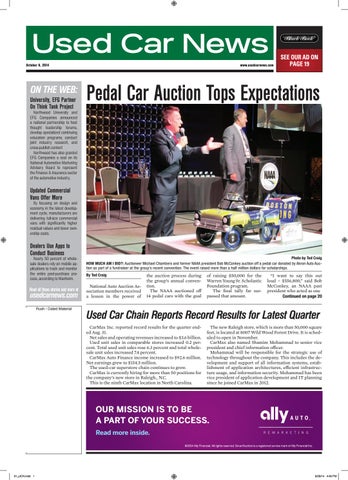
HOW MUCH AM I BID?: Auctioneer Michael Chambers and former NAAA president Bob McConkey auction off a pedal car donated by Akron Auto Auction as part of a fundraiser at the group’s recent convention. The event raised more than a half million dollars for scholarships.

Auctions Receive Recognition for Contributions

A highlight for many auction managers attending the National Auto Auction convention is receiving awards from consignors.

“Everybody loves the hardware,” said NextGear Capital president Brian Geitner.

Geitner said dealers understand the amount of effort required to earn the various trophies and plaques on display at auctions because they themselves strive for this kind of recognition.

One special award presented at the NAAA convention is the National Independent Automobile Dealers Association’s Auto Auction of the Year.

The award is based on contributions to the auction’s community rather than performance metrics.

NIADA executive vice president Steve Jordan presented this year’s award to Dealers Auto Auction of Huntsville, Ala., general manager Roger Fields and David Andrews, CEO of the parent group.

So far in 2014, the Huntsville auction has given more than $60,000 to 24 diferent

charities, including St. Jude Children’s Hospital, the ALS Foundation, Johns Hopkins, the Huntsville Symphony Orchestra and the Liz Hurley Breast Cancer Fund.

Chase Auto Finance also handed out its 2014 Chase Cup for Auction Excellence awards, an annual highlight of the convention

The 16th annual Chase Cup award recognizes auto auctions across the country for their exceptional performance in retention, operational efciency, expense control, accuracy, sales and service delivery.

Chase reviewed the performance of 31 of the nation’s best auto auctions with which Chase does business from August 2013 through July 2014.

The review examined data measuring how well the auctions handled preparation, sales, invoice processing, transport requests, title processing and other capabilities.

ADESA Lexington was named the winner of the Best National Auction

Continued on page 18

EVERYONE IS BUSY, WRAPPED UP IN day-to-day business, so much so that we sometimes forget about those people we can afect with an act of kindness or charity. Besides helping you with your business, Santander Consumer USA can give you a chance to show heart – especially during the holiday season – and to make a diference.

SCUSA will donate $3 for every SCUSA vehicle purchased,* matched by a minimum $3 from the auction company. Three charitable organizations each will receive a cumulative donation:

Photo by Ted Craig
EXCELLENCE : Dealers Auto Auction of Huntsville general manager Roger Fields, left, receives a plaque from Steve Jordan, executive vice president of the National Independent Automobile Dealers Association.

Exeter Increases Warehouse Facility

Exeter Finance Corp. announced that Exeter Funding II, a specialpurpose Delaware limited liability company and wholly owned subsidiary of the company, completed the renewal and extension of its warehouse funding facility.

In conjunction with the re-

NEWS BRIEFS

newal, Exeter increased available capacity to $1.65 billion, a $575 million increase, from its previous facility. The new facility has a three-year term, with a final maturity date of September 2017.

Citi acted as structuring agent and administrative agent on the transaction. In addition to Citi, Wells Fargo,

MILESTONES

Ohio Independent Automobile Dealers Association executive director James R. Mitchell, 65, died on Sept. 14 after a long battle with brain cancer. Mitchell served as the IADA’s executive director until 2013, when he retired due to health problems.

In 2011, the National Independent Automobile Dealers Association named Mitchell its Association Executive of the Year after bringing the group’s membership to the highest level in its history.

Mike Linn, NIADA’s CEO Emeritus, recruited Mitchell to take over the struggling group in 2004.

“Jim, in a short time, was able to

turn the association around and he built the Ohio IADA into one of NIADA’s strongest afliated state associations,” Linn said.

Tim Swift, an NIADA past president, said he felt “sincere sadness” over Mitchell’s death, adding Mitchell’s passion is what distinguished him as a top association executive.

“When he took over that association, they had nothing,” Swift said. “They had no money. Membership was down. He worked the first couple or three years out of his briefcase in a car.”

Goldman Sachs, Deutsche Bank and Barclays are lenders in the facility

BSCAmerica Introduces App

BSCAmerica, the parent company of Bel Air Auto Auction and Tallahassee Auto Auction has announced the development of a mobile app that allows dealers to access auction information, perform search functions and purchase vehicles online from their mobile devices.

The new app is a companion to BSCAmerica’s website.

The app will be available in early October for IOS in the iTunes app store. The app will be available shortly afterward for Android plat-

forms as well.

Customers can view run lists, search vehicles by year/make and model, and bid on vehicles via simulcast sale.

The mobile app also has a VIN scanning capability, and allows a dealer to order and send condition reports to the dealership.

Another Auction Joins ServNet

ServNet has announced the addition of Winchester Auto Auction to the ServNet Auction group.

The auction is located in Bunker Hill, W.Va. It is owned by the Angelicchio family, also owners of Pittsburgh Auto Auction.

Published By General Media LLC

USED CAR NEWS (ISSN 1555-7413) is published at 24114 Harper, St. Clair Shores, MI 48080

Phone: 586-772-5200 or 800-794-0760 Fax: 586-772-9400

www.usedcarnews.com

Charles M. Thomas

Founder (1947-2002)

Lynda R. Thomas, Publisher Colleen Fitzgerald, General Manager

Editorial:

Ted Craig, Managing Editor

Jefrey Bellant, Staf Writer

Contributing Writers: Ed Fitzgerald, Jenny King, Sheila McGrath

Columnist: Tony Moorby

Advertising:

Shannon Colby, Account Manager

Megan Frump, Account Manager

Marie Hingst, Account Manager

Circulation: Helen Thomas

Production:

Josie Godlewski, Media Manager

Tim Montie, Graphic Designer

Used Car News is published the first and third Monday of each month. Subscribers: We print advertisements as sent to us by auctions and other advertisers. It is not possible to verify the correctness of listed vehicles in auction ads. Most lists are partial and all lists are subject to last minute changes by auto auctions, so before travelling a long distance for a particular auto auction event, contact the auction by telephone for a fax of vehicles in the sale. Used Car News assumes no guarantees or liabilities concerning the accuracy of any advertisements. All Rights Reserved. Reproduction in any form is prohibited without the written consent of the publisher.

Please submit clear, legible copy. Payments from first time advertisers must accompany the insertion order. Distribution is guaranteed by U.S. Postal Carriers. The advertising reservation deadline is 5:00 p.m. Friday, 10 days prior to the issue date. Camera ready ads must be received by noon on Monday prior to the issue date.

Dealer Challenges Election Results in Failed Mayoral Bid

Alabama dealer Anthony Underwood is challenging the results of his Aug. 26 loss in the mayoral election of Bessemer, Ala.

The certified results had incumbent Mayor Kenneth Gulley winning by a wide margin, with 3,432 votes, or about 60 percent. Underwood was second with 2,290 votes, and a third candidate, received 63 votes.

Despite the margin of victory, Underwood, who once served as president of the National Independent Automobile Dealers Association, was challenging the results at press time.

Underwood – who did not return a call for comment – had originally sought a recount, but missed the deadline. He failed to file the recount in time and pay the $10,000 deposit required.

City Attorney Shan Paden said there was a change in the type of voting machine used in the election, but they caused only short delays in one or two polling stations.

“I don’t think there were

any major issues with the election,” Paden said.

He said as far as the challenges go, the city is required to certify the vote on Sept. 2. At that point, there is a five-day period – not counting weekends – in which someone can file to contest the election. In this case, it had to be filed with the city clerk’s ofce by 5 p.m. Sept. 9.

But as they were canvassing the vote, Paden said, Underwood brought in a petition for a recount – diferent from a contest. Alabama law requires that when a petition for recount is filed, the city council has to post the cost of a recount and the person contesting has to post that security prior to the recount.

“If the vote recount were to change by such a degree that would change the result of an election,” Paden said, “that is grounds for contesting an election.”

The problem for Underwood is that the recount had to be conducted before the 5 p.m. deadline on Sept. 9, Paden said. He filed the petition for a recount on Sept. 2. So the City Council set the

estimate cost of the recount at $10,000 that same evening, Paden said.

He informed Underwood that the security would have to be posted by that Thursday, Sept. 4, at noon, to give the city sufcient time to organize and set up a recount.

“We did not hear from him by noon on Thursday,” Paden said.

The city extended that time to noon on Friday, but Underwood missed that deadline, too, Paden said.

So even though Underwood came in only a few minutes late on Sept. 5, his request was rejected, Paden said. Paden said since the deadline had already been extended 24 hours, the city held firm on the second deadline.

Paden said at press time Underwood was going ahead with his contest of the election to get the results thrown out. Despite the contested election results, Paden said he has no ill feelings toward Underwood.

“He ran a hard-fought race,” Paden said. “I’ll give him that.”

“I opened my business in 1998 with about 15 diferent lenders and selling around 30 cars a month. In 2004 most of the lenders dried up and so did my volume and cash fow. My frst Portfolio Proft Express check was $47,000. Credit Acceptance not only saved my dealership, it’s allowed me to increase my sales. The program has been life-changing for me and my customers.” § Longer

File photo
ELECTION CHALLENGE : Alabama dealer Anthony Underwood ran for mayor in Bessemer, Ala., but came up short on election day. The city attorney said Underwood is moving forward with plans to challenge the results.
Joe Kaisk Magic City Motorcars (OH)

FIX NASTY SCRAPES FOR LITTLE SCRATCH

New Leader Looks to Build up Group

A longtime dealer has taken the reins of the Louisiana Independent Automobile Dealers Association.

Dwight Tambling, executive director of the Louisiana IADA, took over the group this year and hopes to restore some luster to the group. The Louisiana association had been without an administrative leader for about a year before Tambling took over.

Tambling had been serving on the association’s board of directors over the years.

“I’ve been in the used-car business for more than 30 years,” said Tambling.

He was a used-car manager at a Toyota dealership in Baton Rouge, La., for 28 years. Tambling now owns Dwight Tambling Auto Brokers LLC.

Since he knows what dealers go through, Tambling feels he can help address their needs as the association leader.

“I had been on the board for the

year, but we didn’t have a director,” he said. “We needed one in the worst kind of way.

“The association was idle and I didn’t like where it was headed.”

Andrew Caldecott, executive director of the Mississippi IADA, recruited and encouraged Tambling to apply for the leadership opening.

Tambling observed what Caldecott has done for that state’s usedcar dealers.

“He’s a great guy and does a great job,” Tambling said.

The Mississippi and Louisiana associations hold a joint convention each year and Tambling worked with Caldecott on this year’s event.

“But Andrew did about 99.9 percent of the work,” Tambling said. “I was in his shadow trying to learn the ropes. I really liked what he did.”

Tambling said what he saw in Caldecott was diferent from the past leadership of the Louisiana group, where some folks had focused more on promoting themselves than the dealers.

Tambling said all of his friends are dealers and he felt they deserved better than what they were getting.

The membership had dwindled to 125 dealers, but after Tambling’s first month on board, more than two dozen dealers signed up.

PAGE 8 - COMPLIANCE FOCUS

Products, Vendors, Complaints Draw Compliance Scrutiny

The Consumer Financial Protection Bureau is proposing to oversee larger nonbank auto finance companies for the first time at the federal level.

Currently, the bureau supervises large banks making auto loans, but not nonbank auto finance companies. Under the Dodd-Frank Act, the CFPB has the authority to supervise certain nonbanks it defines through rulemaking as “larger participants” in a market.

The proposed rule would generally allow the bureau to supervise nonbank auto finance companies that make, acquire, or refinance 10,000 or more loans or leases in a year.

The CFPB estimates that about 38 auto finance companies would be subject to this new oversight. These companies originate around 90 percent of nonbank auto loans and leases, and in 2013 provided financing to approximately 6.8 million consumers.

CFPB Director Richard Cordray ofered remarks at an auto finance field hearing in Indianapolis on Sept. 18 and addressed some of the pressing issues. He said extending coverage to nonbanks was done in part to create fairness between various finance sources.

“The proposal is needed to level the playing field for banks and nonbanks in the auto lending market,” Cordray said. “We already supervise the auto lending practices of banks with more than $10 billion in assets, and this step would extend our supervision to larger nonbank companies as well. It should not matter whether you get a loan or lease from a company that has a banking charter versus one that does not – every auto lender should be following the law and be subject to the same level of oversight.”

Questioning Methodology

Cordray said the bureau released a white paper on its methodology for determining whether a lender is following fair lending laws.

Shaun Petersen, general counsel to the National Independent Automobile

Dealers Association, attended the event. He said more clarity is still needed.

“I think there are a lot of unanswered questions with respect to the CFPB’s methodology,” he said. “The biggest problem I had with the event was that they released the paper the night before the hearing, which didn’t give people enough time to go through it before the hearing. I’m still analyzing it.”

Petersen said someone raised what he felt was the biggest philosophical issue – how can the bureau find disparate impact at the portfolio level when none exists at the retail level?

Working with Vendors

For dealers, compliance touches on every aspect of their business, even beyond the cars they sell.

David Bafumo, who works in financial products and services, said some people feel the CFPB has not been transparent about what they are looking for in terms of compliance.

But during a conference earlier this year, Bafumo said that’s not the case with financial products.

“My experience from the financial products side is that they’ve been very clear about their intentions,” he said, “and it goes back to 2012.”

At that time, they provided guidance on addressing third-party vendors: pick a good one. The reason is the dealer will be held responsible for their customers’ experience with that product.

“You’re not of the hook,” Bafumo said.

Still, dealers cannot spend 100 percent of their time fretting over every vendor with the same amount of attention. It’s the products that customers interact with most that have the highest risk of causing a customer complaint, Bafumo said.

At a bare minimum, dealers must conduct due diligence on their vendors. Bafumo said you must document that the vendors can do what they say they’re going to do, that they actually do what they say and they have their own internal compliance system.

Regulators also expect

dealers’ agreements/contracts with vendors to have a clause or language that addresses compliance obligations, Bafumo said. If those are not met, the language must show that dealers have the ability to terminate the deal and take action.

“You need a lawyer for that, to make sure your agreements are (vetted),” he said.

Bafumo said a system to monitor and fix a problem involving that service or product is also needed.

Selling Add-on Products

The bureau also put out an add-on products bulletin requiring those who sell them to have: accurate marketing materials; documentation requirements regarding how people are paid for selling products; evidence of training for those who sell the product; and how dealers and vendors handle product cancellations.

“That’s your responsibility,” Bafumo told dealers. “They need to be reviewed by you. You also need to document that you reviewed them.”

Dealers also have to be careful how their employees present a product like a service contract, Bafumo

said. For example, if a seller claims that a service contract – at $14.95 a month – costs only pennies a day, does that mean they included the interest over the length of the contract? If they didn’t, the figure will be much diferent.

Regulators are also going to look at who is sold products, Bafumo said. He told dealers that every customer should get the same opportunity to buy the same products at the same prices.

Ofering only certain customers certain products, or charging one group of customers a diferent price than another, will land a dealer in hot water.

Handling Complaints

The CFPB has also warned dealers in another way about who it will target.

Compliance consultant Dave Sierk, president of CarComply, said handling customer complaints are a huge focus of the CFPB.

In the past several years, the attention was on the deal jacket, Sierk said. Over the years, however, several companies have addressed these problems with programs that tighten up the deal.

Now the target is a com-

plete compliance system, which vendors are also addressing.

Sierk added that many times it’s not even the product that’s necessarily been the problem.

“What the bureau is attacking is the marketing material and how the product is being described to the customer,” Sierk said.

Dealers should have training programs in place that give dealers safe harbor if a rogue employee doesn’t follow protocol.

“The bureau has said ‘complaints are our compass,’” Sierk said. “So they use complaints as a way to instruct their enforcement action and find who they are going to target.

“Right now, the key is for dealers to find a way to have a compliance management system,” Sierk said.

He has had discussions with many industry leaders about creating full compliance management systems that dealers can operate without a lot of difculty.

Sierk said one goal is developing separate products for small, medium or large dealerships.

“Everybody’s cost conscious, so everybody doesn’t

Continued on page 10

Photo by Jeffrey Bellant
COMPLIANCE: Shaun Petersen (left) and Dave Sierk serve on a panel earlier this year discussing compliance issues. Sierk is optimistic about the industry’s ability to respond to the new compliance challenges.

Compliance

– Continued from page 8

Sierk said.

want to buy the same (level of product),” he said. “Momentum is building and solutions are emerging.”

Evolving Requirements

One reason compliance is scary is that the requirements are evolving, so they haven’t always been clear. Sierk said the same type of fears existed when the Internet was new and dealers adjusted.

“But the people who embraced the Internet and technology – guess what? – they’re doing the best,” Sierk said. “They’ve improved, grown and gotten bigger.”

Tracking complaints is difcult because dealers have diferent systems. A lot of times, those are based on trusting employees to log complaints and hoping those complaints move up the chain.

“But the CFPB wants to hear the voice of the consumer (in those complaints),” Sierk said. “Not the sales manager filtering or deciding whether it’s a complaint or not.”

He urges dealers to embrace a broad definition of “complaint” that would include simple inquiries and questions.

“Because the bureau has said that a pattern of inquiries and questions can show complaints that are being bred for the future,” Sierk said.

One example would be a customer asking when her first payment is due. It may not seem like a problem, but if 15 or 20 of these questions arise in a given month, then there is a problem to address.

“Do I have an F&I manager who’s not disclosing a contract term,” Sierk said. “Do I need training or do I have a person who’s not suitable to be working with these customers?

Dealers who do this followthrough are learning a lot about their business.

“For a long time, we’ve had a lot of lawyers scaring people to death,” Sierk said. In response, the industry developed systems to address the challenges of red flags and safeguards, so it can do the same again.

Having tools that log a complaint and a system to respond to it is important. But Sierk said that’s only half the issue.

“Now you have to resolve the complaint and then you have to show how you’re going to remediate the complaint in a manner that the bureau will find acceptable,”

“People are going to get through these compliance issues and it’s going to make the strong dealers stronger and it’s going to help the emerging dealer put himself on the stage by being transparent with customers,” Sierk said.

October 15 at 2 p.m. CT

ADESA Dallas sale

October 16 at 9:30 a.m. CT

16

a.m.

Creditors Face Domino Threat

Rising U.S. subprime auto lender competition and an increase in start-ups means problems at one lender could quickly spread to others, reported ratings agency Fitch.

The risks to the sector mean that most subprime auto transactions would not earn higher investmentgrade ratings and should be capped. Fitch rates transactions from just three of the nearly 20 active subprime auto lenders: GM Financial, Santander Consumer USA and Ally Financial.

The intensification of lender competition is particularly important now, as many auto finance companies depend on securitizations for their funding needs.

Those lenders that have become overly reliant on securitization face excessive exposure to market volatility, which could ultimately afect investors and customers.

Media reports compared this expansion with the subprime mortgage market in 2006 and 2007.

In Fitch’s view, this comparison is a difcult one to make as the subprime auto market is much smaller than the subprime mortgage market; automobiles depreciate and their prices have a much smaller impact on the overall economy.

However, headline risk or increased regulatory pressure could result in the withdrawal of cred-

it lines and, in some cases, private equity support from one or several lenders subprime auto lenders simultaneously.

Fitch points out that a similar event occurred in the late 1990s in the subprime auto, equipment leasing and franchise lending markets.

Fitch is not confident that, in this scenario, larger lenders would step in. The agency believes some smaller lenders could be left stranded and their borrowers could be under serviced.

There is some reason for concern about the near future of auto finance, according to Transunion.

Auto loan delinquency rates increased more than 9 percent in the second quarter versus the same period last year while auto loan debt rose for the 13th straight quarter at the midpoint of 2014.

TransUnion also found that both delinquency rates and debt levels rose for all age groups during the second quarter.

The auto loan delinquency rate (the ratio of borrowers 60 days or more delinquent on their auto loans) increased to 0.95 percent in the second quarter, up from 0.87 percent in the second quarter of 2013.

However, auto loan delinquencies dropped on a quarterly basis from 1 percent in the first quarter.

Dealer’s Loans Bring Down Bank

NORFOLK, Va. (AP) – A lawyer, his Norfolk law firm and their insurance company have settled allegations of gross negligence and conflicts of interest stemming from the collapse of the Bank of

Under the settlement, attorney Richard Tavss of Virginia Beach, the law firm Tavss Fletcher, and Minnesota Lawyers Mutual Insurance Co agreed to pay a $1 million penalty to

The Federal Deposit Insurance Corp. released a copy of the settlement agreement after the penalty was paid, The Virginian-

Tavss denied the allegations in court filings. He and his lawyers

The FDIC had alleged that Tavss and the law firm closed on loans to used-car magnate Charlie Falk while knowing that the bank’s board of directors hadn’t approved them.

The FDIC also had alleged grossly negligent acts on other bank loans that Tavss and one of his law part-

The FDIC said that Tavss and his law firm collected nearly $2 million in legal fees from the bank in the two years prior to its collapse

Can someone, for the love of profitability, tell me how to turn more of my subprime apps into cash?

Tavss was a longtime board director at the bank’s parent company, Commonwealth Bankshares, and served as its chairman after Edward J. Woodard Jr. was forced to step down as president, CEO and board chairman.

Woodard, his son T. Brandon Woodard and Stephen Fields are serving prison sentences following their convictions in May 2013 on charges of conspiring to defraud the bank out of $71 million before it collapsed.

The FDIC filed a lawsuit against Woodard, Tavss, and eight other members of the bank’s board seeking at least $11 million in damages, the newspaper reported.

So far, the bank’s failure has cost the FDIC $302 million, according to the most recent balance sheet summary posted on the FDIC’s website. Richmond accountant James Poti accepted a two-year prohibition from practicing before the Securities and Exchange Commission as a result of inadequate audit work he performed for the bank in 2008, according to SEC filings.

The FDIC also has recovered $540,000 from Virginia Beach real estate appraiser Bruce Hatfield and his insurance company. Hatfield was accused of questionable appraisals.

NAAA Economist Expects Strong Sales in 2015

BOSTON – Bottom line for the economy: better times are ahead.

That was the message economist Ira Silver delivered to attendees at the National Auto Auction Association convention.

“The potential for growth is there,” Silver said. “We just haven’t seen it.”

Silver said most of the economy has been slow to recover following the recession, except the auto industry.

“The auto industry has had a normal recovery,” he said.

This year he expects the overall economy to grow less than 3 percent, due to the exceptionally cold winter in the first quarter.

The slow growth has been a challenge, but the upside, Silver said, is there is less of a chance of a major setback than if the economy heated up quickly.

A lack of jobs has been the main damper on the economy.

Silver said recent job growth has picked up to the point that it should create a virtuous circle of hiring and growth.

Companies have the funds to pay for this growth.

Corporate America is sitting on

a stockpile of cash and can borrow even more at low rates.

“Easy money is everywhere and it’s here to stay,” Silver said.

Consumers are in good shape as well.

Household balance sheets are better than they have been in decades as consumers have reduced debt in the past five years.

Meanwhile, household wealth has grown as stock and home prices are back at pre-recession levels.

“Once households decide to spend, they have the ability to spend,” Silver said.

Another factor in favor of economic growth is the domestic energy boom.

“I’ve always worried about gasoline prices killing an economic recovery,” Silver said. “That’s been taken out of the mix.”

Oil prices remain low even though the largest oil producing areas have seen incredible turmoil in the past year.

Some experts even expect gas prices to drop below $3 a gallon.

Auto sales still have room to grow in this positive economic outlook.

While sales are back to 16 million a year, Silver points out the population has expanded during that time.

Sales per 100 drivers over the age

of 16 remains below the historical average, he said, so the market could handle 18 million new-car sales.

There is also potential for growth on the used side, Silver said. But this requires lower prices.

Prices are expected to decline as more inventory comes to the market in the next year.

One area Silver is unconcerned about is the efect of this year’s elections. The largest potential change is the Senate majority shifiting to the Republicans.

“If the Republicans take the Senate, they will do even less than they do now,” Silver said. “That’s usually good for the economy.”

Photo by Ted Craig
POSITIVE OUTLOOK: Economist Ira Silver delivers good news to members of the National Auto Auction Association as he foresees stronger growth in the next year.

We Buy Open Bankruptcies (7&13!)

We Buy the First Time Buyer

100% Non-Recourse We Buy Deeper Than Our Competition!

Contact Joe for more information: jruhland@securityal.com

NAAA Honors Late Pioneer

Don Meadows was posthumously presented the National Auto Auction Association Industry Pioneer Award during the group’s recent convention.

presented to individuals who have brought innovation and enhanced methods of improving services to remarketers through NAAA member auctions.

PH: 888.874.7579 FAX: 763.559.7549

WEB: www.securityal.com

Accepting the award was Don’s wife, Shannon and his daughter Lucy Meadows.

CURRENTLY LICENSED IN: IA, IL, IN, KS, MI, MN, MO, NE, OH, PA, and WI CHECK OUT OURNEWALL WEBSITE!

Meadows, was the CEO of Auto Auction Services Corp. He died Dec. 10, 2012.

The Industry Pioneer Award is given to persons who have worked in the wholesale motor vehicle industry and/or NAAA. The award is

Awards - from page 3

Performance, in addition to being recognized for delivering the best regional performance in the Southeast.

Manheim Orlando was awarded the Douglas F. Wininger Memorial Award for Best National Performance Service Delivery, an award that recognizes outstanding service in measurable areas such as transportation management, sales, invoicing and other operational measures.

Manheim Seattle received a number of national and regional honors, including best performance in the West and best national performance in Mazda and Subaru sales.

A pair of auctions received special praise for their highline sales. Manheim Dallas won best national Jaguar sales, while Manheim Riverside won best sational Land Rover sales.

Winners for best regional performance were: Manheim Pittsburgh (Northeastern); Columbus Fair Auto Auction (Midwestern); and Manheim Denver (Central).

NextGear Capital took its award winners out on a cruise of Boston harbor and handed out the “hardware.”

The auction winners included:

Raymond C. Nichols, CEO of BSC America Companies, presented the award. Nichols helped recruit Meadows for AASC.

“Those were interesting and sometimes challenging times, and it took a very diplomatic and knowledgeable person to lead, develop and build that industry-owned entity,” Nichols said.

Southern Auto Auction, East Windsor, Conn., in the Large Market category; Harrisburg Auto Auction, Mechanicsburg, Penn., in the Medium Market; and ABC Bowling Green (Kentucky) in the Small Market category.

The award for Remarketer of the Year went to Akron Auto Auction in Ohio.

This was the second year of the NextGear Capital Auction Partners Awards, with the inaugural event held at last year’s NAAA event in Indianapolis.

The Operational Excellence Awards are presented to the auctions that demonstrate excellent efciency, top sales retention and overall operational performance, and most efective response to the needs of NextGear Capital.

The Remarketing Excellence Award recognizes the auction that demonstrates the highest percentage of sales recovered based on percentage of valuation of each vehicle, the best throughput performance (number of days from when a vehicle is at the auction to days sold), and the best sales follow-up (efcient timing on getting proceeds of sales to NextGear Capital).

TRIBUTE: Raymond C. Nichols, right, presents the National Auto Auction Association’s Pioneer Award to Shannon and Lucy Meadows. The award was given posthumously to Don Meadows, the first CEO of Auto Auction Services Corp.

Pedal Cars – from

page 1

of the auctioneers.

McConkey was helped by one of the best in the business, Michael Chambers, this year’s winner of the Bernie Hart Memorial Auctioneer Award.

About 10 percent of the final total came from direct donations from NAAA members. The rest was pure bidding.

The 14 pedal cars were customized by staf from the companies represented, which were made up of a mix of auctions and vendors.

The highest bid was $102,000 for a yellow jump truck with a silhouette of Warren Young in the driver’s seat. State Line Auto Auction of Waverly, N.Y., entered the car and owner Jef Barber entered the winning bid.

“I’ve got a lot of cars and I never paid that much,” Barber said after the bidding.

Barber also spoke of the importance of supporting education.

The Young Foundation assists full-time auction employees; their children, stepchildren and grand-

children who plan to continue education in college or vocational school programs. Scholarships are ofered each year for full-time study at an accredited institution of the student’s choice.

The auction was the highlight of a special night for the NAAA that included a ring ceremony for all members of the association’s Hall of Fame.

Alexis Jacobs became the newest inductee of this prestigious group. The owner of Columbus Fair Auto Auction and former NAAA president was introduced by KAR Auction Services Inc. CEO Jim Hallett.

The night ended with outgoing NAAA president Jack Neshe handing of the gavel to Ellie Johnson, general manager of Manheim North Carolina in Kenly, N.C.

Johnson’s father, Kenny Aycock, founded the sale in 1984. Johnson took over in 1997.

“As a little girl, I never imagined running the auction, much less leading the National Auto Auction Association,” Johnson said.

Creditors Must Track

All vehicles lose value over time. That’s the first rule of the used-car business.

Not all cars lose value at the same pace; however, and now the depreciation rate is crucial in today’s environment of longer term auto financing.

Black Book recently did a study using its Collateral Insight Engine technology. The study compared two diferent vehicles based on the exact terms of 72 months, 5 percent interest and a 12 percent loan-tovalue ratio.

Based on the data from the example, one achieved a positive equity position in just 37 months, 15

Depreciation

months earlier than the other vehicle (at 52 months). What’s more, the first vehicle had approximately $3,000 more equity by month 24 versus that of the second.

Anil Goyal, Black Book’s vice president of analytics and strategic partnerships, said depreciation has been lower in the past few years due to a shortage of used cars. That is changing as more vehicles come to market.

“We’re seeing the trend getting to more normal levels,” he said.

Projecting depreciation trends is an old idea in auto finance.

Lessors have been doing it for years.

WINNER: State Line Auto Auction owner Jeff Barber, center, poses with his children, Emily and Paul, and his $102,000 pedal car.

Tyson Felder, owner of Elite 1 Auto Inc. in Country Club Hills, Illinois, says NextGear Capital’s expert knowledge of the automotive marketplace and remarketing industry has helped direct and increase his business.

“NextGear Capital guides our business to the type of inventory doing best in the market, trying to maximize every dollar while helping grow our inventory. We’ve tripled our capacity since we opened, and that’s due to NextGear Capital. It has been phenomenal working with them.”

Listen to more of what Tyson and other dealers have to say at nextgearcapital.com/why/knowledge.

Recalls Hurt Brands with Better Reputations

NADA Used Car Guide recently released a study of the efect of recalls on auto sales.

The main finding was that brand perception prior to a recall determines the severity of the damage.

To illustrate this, NADA’s analysts examined the market impact of the high-profile 2000–01 Ford/ Firestone tire and 2009–10 Toyota acceleration recalls, as well as the General Motors ignition switch recalls that have dominated industry headlines in 2014.

In 2000 and 2001 Bridgestone/ Firestone and Ford recalled millions of Firestone tires to address tires that were failing prematurely on Ford sport utilities. The defect caused multiple deaths and captured media headlines for an extended period of time. Even so, the impact to used Ford truck prices was minimal.

By contrast, Toyota fared much worse when it recalled nearly 8 million vehicles for issues related to unintended acceleration in late 2009 and early 2010. Unlike perceptions of Ford earlier in the decade, the universal perception of Toyota as a builder of high-quality, reliable vehicles led to a dramatic contrast between pre- and post-recall perceptions of the brand.

Before the recalls, used Toyota

cars and trucks carried prices nearly 40 percent higher than those of direct competitors. Afterward, Toyota’s advantage over the competition was reduced to 30 percent.

General Motors’ ignition switch issue is the first recall event since Toyota’s with conditions grave enough to threaten brand value.

Despite being associated with multiple deaths and intense media coverage, GM’s new vehicle sales and used vehicle prices have been relatively unscathed.

Meanwhile in related news, a number of alternative fuel vehicles have been recalled recently.

GM is recalling 3,196 model year 2011-14 Chevrolet Express compressed natural gas vehicles manufactured Sept. 10, 2010 to April 28, 2014, and GMC Savana CNG vehicles manufactured May 23, 2011 to April 21, 2014.

The afected vehicles may leak natural gas from the CNG high pressure regulator.

A natural gas leak in the presence of an ignition source increases the risk of a fire or explosion.

GM will notify owners, and dealers will replace the high pressure regulator. GM’s number for this recall is 14321.

Ford Motor Co. is recalling 70,209 model year 2005-08 Ford Escape

hybrid electric vehicles manufactured Oct. 13, 2003 to June 20, 2008, and 2006-08 Mercury Mariner hybrid electric vehicles manufactured June 10, 2005 to June 20, 2008.

The coolant pump for the hybrid system may fail resulting in the hy-

brid electronics overheating. If the hybrid electronics system overheats, it may shut down the powertrain, resulting in a stall-like condition, increasing the risk of a crash.

The recall is expected to begin on Oct. 27.

FIRE RISK: Workers install compressed natural gas units in Chevrolet Express cargo vans. The vehicles have been recalled due to a potential fre risk. GM has yet to set a date for the recall to begin.

Law Firm Hires CFPB Staffer

Hudson Cook LLP has announced the addition of Lucy Morris as a partner in its Washington, D.C., ofce. Morris brings 25 years experience in all aspects of consumer finance law and public policy. She will support the firm’s enforcement and compliance practices, and her experience will further enhance the firm’s ability to provide meaningful and practical advice to its clients.

From 2011 to 2014, Morris served as deputy enforcement director in the Division of Supervision, Enforcement, and Fair Lending at the Consumer Financial Protection Bureau. Her responsibilities at the CFPB included overseeing investigations and litigation relating to consumer financial products and services, including credit cards, mortgage origination, mortgage servicing, payday lending, debt collection, credit reporting and debt settlement.

From 2010 to 2011, Morris served as a founding member of the implementation team that organized the

PEOPLE IN THE NEWS

CFPB after passage of the DoddFrank Act, helping to start up the bureau’s enforcement, supervision and other functions.

Before joining the CFPB, Morris worked at the Federal Trade Commission from 1989 to 2010. She served in a variety of positions in the FTC’s Bureau of Consumer Protection, including assistant director of financial practices and assistant to the director.

Morris worked in the Division of Financial Practices for 18 years, where she was responsible for protecting consumers of financial products and services through law enforcement, rulemaking, policy development and public outreach.

During her tenure at the FTC, Morris supervised, litigated and investigated complex law enforcement actions involving a variety of consumer financial products and services, including mortgage origination, mortgage servicing, credit reporting, debt collection and debt settlement.

Morris was awarded the Chairman’s Award in 2008, the FTC’s highest award, in recognition of her accomplishments.

She received her bachelor of arts degree, cum laude, from the University of Santa Clara and a juris doctor degree from Hastings College of Law.

Wells Fargo Names Auto Execs

Wells Fargo & Company announced its Consumer Lending Group has appointed new leaders for its Consumer Credit Solutions and Dealer Services groups.

Tom Wolfe, who most recently served as head of CCS, which included all consumer credit and automotive lending businesses, in July announced his plans to retire Oct. 31. With his retirement, the company separated the Consumer Credit Solutions organization into two businesses.

Dawn Martin Harp was appointed to lead an expanded Dealer Services organization, which now includes Commercial Auto and Strategic Auto Investments as well as the Indirect Auto business she has led since 2011.

Shelley Freeman, an 18-year veteran of Wells Fargo, has been named to serve as head of CCS.

Both Martin Harp and Freeman report to Avid Modjtabai, senior executive vice president and head of the Consumer Lending Group.

Martin Harp has more than 30

years of experience in automotive finance and technology and has been with Wells Fargo and its predecessor auto lending organizations for 16 years.

Prior to leading Dealer Services, she served as the group’s chief operating ofcer and was previously the chief information ofcer and the director of network computing with WFS Financial. Wachovia acquired WFS Financial in 2006 and then merged with Wells Fargo in 2008.

She currently serves as a board member of the Consumer Banking Association’s auto finance committee and the American Financial Services Association’s auto finance committee.

In her new role, Freeman will oversee a CCS portfolio that includes consumer financial services (including credit card, direct auto and personal lines and loans), education financial services, retail services, as well as its collections and servicing, marketing and strategy functions.

Freeman joined Wells Fargo in 1996, most recently leading customer and store experience and afuent customer strategies for the company’s community bank operations, where she led an efort to enhance partnerships with Wells Fargo’s Wealth, Brokerage and Retirement group.

Lucy Morris
Dawn
Martin Harp

CALIFORNIA

Beto Beas, general manager, Beas Auto Sales, Stockton, Calif.:

“We have one location and Oct. 16 will be our 23rd year in business. My father and I are partners in the business.

“We carry about 50 (units). It’s a little better than last year. We’re just getting better cars in general.

“We found that when we were purchasing the $4,000-to-$6,000 cars, we ran into more problems. We were reconditioning them a lot more. We value our reputation so we fix everything. It was costing us so much money.

“So we sat down – my father and I – and decided it was time to move to a newer vehicle. So now we’re purchasing vehicles that are anywhere between $8,000 and $15,000.

“Before we made the transition, we were spending anywhere from $700 and $1,000 per unit. Now we’re spending between $200 and $500.

“Now we’re getting better customers and better credit.

We’re selling more.

“So we’ve got fewer problems and fewer issues.

“We’re selling 23 to 25 units a month, roughly.

“About 95 percent of our cars come from auctions.

“We stay away from buyhere, pay-here. We do subprime and prime. We deal with most of our local credit unions.

“I would say we do about 60 percent subprime and 40 percent prime.

“We use Westlake Financial and they are huge for us. They have every program that you can think of and they ofer really low rates for a subprime lender. I’ve had Westlake Financial give me 3.9 percent for a customer.

“(In terms of marketing) we’re shooting a lot more videos of the cars. After a sale, we interview the customer, asking them about their experience. So we’re getting a lot more reviews online. We’re doing things that other dealerships don’t want to do.

“You know, Stockton went bankrupt, so this is just a re-

ally tough market. But we’ve been here 23 years.

“Our average model year is between 2007 and 2013. Average mileage is between 50,000 and 90,000.

“(Our inventory) is 50 percent cars and 50 percent SUVs. Trucks are so hard to get. I’ve got about seven trucks on my lot. If you want to pay retail for a (wholesale) truck, you can get one.

“A recent car we sold was a 2011 Hyundai Sonata. It had 40,000 miles on it. I got $14,400 for it.”

NORTH CAROLINA

Michael Darrow, owner, Auto Finders, Durham, N.C.:

“I’ve been in business 19 years. I have one location.

“I’m carrying 40 to 45 units currently. That’s definitely an increase from this time last year.

“During the last couple of months, we’ve sold 37 and 35 units (respectively). That’s up 10 to 12 units from this time last year. It keeps me at the auction, I’ll tell you that.

“I think the economy is grudgingly coming back. I think it’s fighting its way, but it’s coming.

“Primarily, we get our vehicles through auctions –trade-ins and auctions.

“With the increase in sales, we’ve seen an increase in quality trade-ins, too. So we’re getting more opportunities to trade for cars and we’re getting some decent ones.

“Subprime is a heavy portion of our (sales). It’s about 60 percent of our business. It’s up appreciably. We do a lot less buy-here, pay-here than we used to do. That’s just because the lenders are very aggressive.

“Some of our lenders are Federal Financial Services, Regional Finance and CPS. We’re seeing some credit lending and retail as well.

“The rates are still high, but the lenders still want to do business.

“One recent week was slow, but we probably had five to six lenders walk in the door and ask what kind of apps they could sell us and what they could look at

for us. Two years ago, they wouldn’t call you.

“Our average sale price is $10,630. That’s up a little bit. We’re trying to keep everything under $10,000, but we found that with lenders being more aggressive, we could step up a bit in model year, less mileage and a higher price.

“The average mileage is 89,835.

“Our average model year is a 2007.

“The largest percentage of our sales is sport utility vehicles. We’re probably about 60 percent domestic and 40 percent import.

“Our average reconditioning is about $512. We outsource that work.

“We’ve got two (service) shops that we work with, one of which we’ve used for about six years.

“Our marketing is primarily done on the Internet, almost all of it. The remainder is direct mail.

“We recently sold a 2005 Chevrolet Colorado, extended cab, for $11,785. The mileage was 99,401.”

WHOLESALE MARKETS

PENNSYLVANIA

James Gaughan, president, North East Pennsylvania Auto Auction, Scranton, Pa.:

“Our sales percentages are higher this year than any other year in our history.

“There have been a lot of moves in the market that have led to a reduction in inventory this year. In the first three months of the year in the Northeast, we had horrible weather.

“We went into the spring market with fewer cars.

“The sales percentage was so high that we sold the same amount of cars even though we ran fewer. We’ve managed to catch up through the year. We had more GSA units.

“It’s been challenging because more franchise dealers have decided to keep more used cars.

“For example, a Chevy dealer will keep a Ford that before he would send to auction.

“We are still getting the trade-ins because of turn schedules.

“We aren’t losing the cars,

but they are delayed.

“Some of the nicer stuf does get retailed and that takes those units out of our lanes.

“The scarcest version of a car is the perfect car - a one model year old with 15,000 miles. The new-car dealer and the strong independents love to find vehicles with low miles that are clean.

“That’s the car that’s hardest to find right now. When dealerships send one through the lanes, it does 128 percent of Black Book.

“Our GSA cars have gone through the roof. They have low miles and the government keeps them in the right condition.

“We do pick up some cars from upstate New York that are exposed to the elements.

“Trucks were in a little slump during the summer. When it’s sunny and 85 degrees outside, that causes us to lose sight that the fall is coming.

“But as soon as you get those two days when it’s 42 degrees in the morning, people remember.

“The truck market has

just taken of like a rocket for the good inventory. The trucks with more than 100,000 miles on them are at a low, the same as the older, rougher cars.

“The market is adjusting, though, now that kids are going back to school and people are realizing they need another car.

“Franchise dealers in our area felt like they saw less business in late August and early September than they should have.

“Right before the kids go back to school, we have a lull because people are buying clothes or they’re trying to sneak their last vacation in.

“In our area, we had a late start to the school year.

“Business has been better since the middle of the month.

“We’re relocating to a new site within the next year. We’re on the fringe of the Poconos, at the bottom of a mountain.

“We’ve been challenged by the topography.

“We’re going to move about four miles away.”

LOUISIANA

John Poteet, managing partner, Louisiana’s 1st Choice Auto Auction, Hammond, La.:

“Sales are going really well. Our consignment increased as we came into the summer.

“I’m not sure if that’s due to more cars being in the marketplace or our more aggressive approach.

“The mood of the dealers is up and down. Some weeks they’re pumped up, some weeks they’re a little down. There’s a lot of pressure to get the right car at the right price.

“That’s always true, but it seems a little more prevalent these days.

“No particular brand or make is selling especially well, but cars in the midprice range – $5,000 or $6,000 – that are in good shape are doing great.

“The lower end stuf is not doing as well as it has in the past.

“There has been a lot of pent-up demand in the past five years and everything flows down. People buy

more new cars and more nice used cars are becoming available as you move down the chain.

“Prices hinge more on the quality of the vehicles in the lane at any given sale rather than the overall market. The market is coming down, like it always does at this time of year, but prices are tending to fluctuate because nice cars are bringing more money.

“Attendance has been good. It’s of a little from last year, but I attribute that to consolidation. There are fewer dealers in the market.

“Also, there are two new auctions in our market area – CarMax and ABC Baton Rouge.

“There are more options for buyers, so they aren’t coming to our sale every week. We’re still getting new dealers every week.

“Our online attendance continues to grow. For example, during a recent week we sold 37 of the 300 cars ofered to online buyers. That was a record for us.

“We use all of the Auction Edge products.”

We can ease your pain.

• 23 year of collection experience

• FDCPA compliant / Quality assurance department

• Less overhead and time spent chasing customers

• More time dedicated to selling cars

• 9 convenient payment options for customers

MONTHLY DEALER CONSIGNMENT AVERAGES

COMPACT CAR

JAN 2014 $5,755 98,746

FEB 2014 $5,962 98,022

MAR 2014 $6,262 97,844

A PR 2014 $6,278 98,421

MAY 2014 $6,067 100,233

JUN 2014 $5,883 100,752

JUL 2014 $5,711 100,786

AU G 2014 $5,566 101,230

Y TD A VG: $5,945 99,476

FULLSIZE CAR

JAN 2014 $4,621 108,480

FEB 2014 $4,600 109,110

MAR 2014 $4,699 110,445

A PR 2014 $4,713 110,363

MAY 2014 $4,612 110,137

JUN 2014 $4,552 113,245

JUL 2014 $4,364 110,767

AU G 2014 $4,123 111,043

Y TD A VG: $4,545 110,395

L UXURY CAR

JAN 2014 $11,919 95,360

FEB 2014 $11,527 98,439

MAR 2014 $12,532 97,044

A PR 2014 $13,006 97,095

MAY 2014 $12,850 96,643

JUN 2014 $12,207 98,178

JUL 2014 $11,542 100,430

AU G 2014 $11,633 99,358

Y TD A VG: $12175 97,759

MIDSIZE CAR

JAN 2014 $6,031 108,140

FEB 2014 $6,200 109,359

MAR 2014 $6,742 106,756

A PR 2014 $6,651 108,045

MAY 2014 $6,593 108,354 JUN 2014 $6,360 108,718 JUL 2014 $6,142 109,258

G 2014 $6,059 109,666

TD A VG: $6,359 108,504 PICKUP

SPORTS CAR

VAN

CURRENT YTD, THROUGH AUGUST 2014 SOURCE: MANHEIM CONSULTING

TRUE COS T OF IN C EN TI VES (TCI)

11.05%

1.63%

-1.73%

$8,558 $9,421 10.08% 5 $7,303 $7,488 2.53% S ubcompact Car

15.19%

5.37%

$2,393 6.12% 1 $14,292 $16,325 14.22% 2 $13,651 $13,640 -0.08% 3 $12,714 $12,790 0.60%

$8,464 $9,410 11.18%

$4,047 17.99%

$18,181 $19,108 5.10%

$15,179 $16,947 11.65% 3 $12,684 $15,114 19.16% 4 $10,425 $11,588 11.16% 5 $8,542 $9,877 15.63%

Compact Crossover S uv

$1,684 19.86% 1 $17,641 $18,254 3.47% 2 $15,273 $16,031 4.96% 3 $13,765 $14,617 6.19%

9.05%

$9,602 $10,415 8.47%

$2,446 -5.27%

Edmunds.com’s monthly True Cost of Incentives (TCI) report takes into account all of the manufacturers’ various United States incentives programs, including subvented interest rates and lease programs as well as cash rebates to consumers and dealers. To ensure the greatest possible accuracy, Edmunds.com bases its calculations on sales volume, including the mix of vehicle makes and models for each month, as well as on the proportion of vehicles for which each type of incentive was used. TCI data (and other Edmunds.com data products) can be viewed industrywide, import vs. domestic, by country of origin, by make, by model and by segment. True Market Value (TMV) is the transaction price for vehicles.

Guitars and Stars Sale Goes Country

Cars, trucks, thousands of dollars in prizes and country music from Lee Brice drew customers from all over the Midwest and beyond to Kansas City on Aug. 27 and 28 for KCI Kansas City’s 5th Annual Guitars and Cars Sale.

Auction co-owner Doug Doll reported this year’s Guitars and Cars Sale was a record-breaking sale. More than 1,000 buyers attended the two-day sale, which saw more than 2,000 vehicles cross the auction block. The auction sold 58 percent of consignment.

KCI Kansas City began the event on Wednesday ofering customers a $1,000 pre-sale drawing and more than 500 fleet, lease and repo vehicles. That evening, KCI Kansas City welcomed over 2,000 customers and their guests to the 5th annual concert. The music began with Justin Temme, one of KCI’s own, followed by The Cronkites. Later, four-time Academy of Country Music nominee Lee Brice took the stage and performed nearly two hours.

Thursday featured the Guitars and Cars Main Event Sale ofering more than 1,500 vehicles and $20,000 in prizes and giveaways.

Manheim Expands Product into 20 Sales

Manheim’s Enhanced Vehicle Imaging Suite, introduced to customers in May, is now at 20 of Manheim’s North American locations as part of Manheim’s InSight Electronic Condition Report.

“We are pleased that the feedback has been very positive,” said Bonnie Hensler, vice president of product development for Manheim. “Coming up with a solution to help our customers has been gratifying.”

Locations that have the new imaging product include: Manheim Atlanta, Manheim Baltimore-Washington, Manheim Denver, Manheim Fredericksburg, Manheim Houston, Manheim Kansas City, Manheim

Milwaukee, Manheim Minneapolis, Manheim Nashville, Manheim Nevada, Manheim New Jersey, Manheim Ohio, Manheim Orlando, Manheim Pennsylvania, Manheim Phoenix, Manheim Riverside, Manheim San Diego, Manheim San Francisco Bay, Manheim Seattle and Manheim Statesville.

STAR WITH GUITAR: KCI Kansas City drew more than 1,000 buyers to its Guitars and Stars sale, which featured a concert by award-winning country performer Lee Brice.

Disconnected Jottings From Tony Moorby...

I’m an unashamed foodie (and have the waistline to prove it) and I used to collect wine, but don’t any more – I drink it.

When I came here in the early ‘80s, I made as many assumptions about American

food as an American would make about British food. Hamburgers and fries or pizza were the universal assumption of culinary expedition, much like fish and chips or steak and kidney pie.

My theory was dispelled early on with the benefit of travel around the states looking for auctions and customers.

I realized that there were many regional diferences in the cooking practices and processes. Traditional Amish food in Ohio has its Euro-

pean roots. Seafood from the Chesapeake Bay around Baltimore celebrates the creativity of the Eastern Shore fishermen. Midwestern beef was the like I’ve never had before, ofset by the Californian vibe of fresh and new

Scotia, of course.

He always pulled my leg for being an Englishman. The Brits chased them from Nova Scotia for not paying taxes and true Coonasses today share that same spirit of individuality and freedom after migrating to Louisiana. Creole influences from Africa melded into the cuisine and I still use Gilman’s recipes today for real Cajun food.

Victorian houses, destroyed by a Spitfire losing a dogfight in the skies above Hammersmith in West London.

approaches including the growing Asian influences. Perhaps one that had the profoundest efect on me was the discovery of Cajun food. I’d never known of it until I met a used-car dealer from New Iberia (home of Tabasco Sauce), La. Gilman Richard, who unfortunately has since passed away, belonged to a large family. His brother was a past NIADA president. He and his wife, Nancy, took life by the horns and lived it large, RVing all over the U.S. and Canada including Nova

CR R O O S S W D

30. “I did it __ way” Frank Sinatra

31. Semiannual, for short

32. Business degree

34. Nod at auction

35. Capital city

37. Basic version, abbr.

Mercedes van

Old General Motors division

Steal

VW SUV 13. “Back to the Future”

40. ___god! internet celeb gossip word

43. Vehicle upkeep

44. Day before

46. Location indicator

47. “Trojans”in the PAC 12

48. Musical scale note

49. Aston Martin model

51. Type of vehicle for forest tracks

54. Sorento and Sedona

55. Highway patrol operation (2 words)

Down

1. Outlook makers

2. Strongly made and capable of withstanding rough handling

We had some neighbors from Lafayette. He was a surgeon at Vanderbilt and hosted a crawfish boil every year. I ofered to make a chicken and seafood gumbo and his reaction was, “Seriously? A Brit wants to make gumbo? Oh well, at least we’ll provide some comedy.” People were scraping the huge pot with crusty bread to lift every last drop. They voted me an honorary Cajun!

The start of my admiration for food and its preparation was as inauspicious as the food available at the time. Rationing of a great many staple foods started during the war and continued well into 1953. We lived in a tiny three bedroomed apartment in a block of six, built on the site of two tall

Sponsored by

3. Put in order

4. Hospital show

5. Engine part

6. ____-box

7. Freeway crossing

8. Seething, just short of road rage

10. Luxury car brand

12. Brand ____

14. Logo on a Dodge truck

16. Fisherman’s equipment

19. Bismarck locale

21. Tire wear measure

23. Original manufacturer’s item

26. Light brown color

28. Its logo is four interlocking rings

29. Radio wave

30. Papas’partners

33. Sales rep rewards 36. Pool tool

37. _____ fortwo

38. Indian auto giant

39. In disagreement (2 words)

We had no television, only a valve radio housed on a high shelf in the kitchen. As a result, it became the hub of the flat. The living room was reserved for guests and visitors until we acquired a 14-inch TV with a big square magnifying glass in front. The size of the screen was in inverse proportion to the size of the piece of furniture that housed it. It lurked, hunchshouldered and brooding in the corner of the living room, waiting to pounce on the world, which it eventually did. It supported everything from art pots to flower vases for ornamentation.

Back in the kitchen, Mum would make the most of available foods having traded

goods from her ration coupons – if we had enough eggs she’d trade the egg coupons for butter or a piece of beef or mutton. So little butter was around that she’d mix a half a pound of it with a pound and a half of margarine and store the bowl in the tiny pantry with a damp dish towel over it to keep. We didn’t get a fridge till the ‘60s but since we only bought food for use in the next day or two, spoilage wasn’t a big issue. We didn’t have supermarkets and ‘went to the shops’ every day; Mum armed with our coupons for bartering deals and at the weekend, us kids would help with carrying the groceries back home from the market which was a mile away. The string handles of the bags would cut of the circulation to your fingers.

Continued next month

INSURANCE AUTO AUCTION S

41.

Tony Moorby

“I’ll buy a car with an accident, but I need to know how severe it was. CARFAX Reports help me separate cars with minor damage from the wrecks.”

Tony

Turn static files into dynamic content formats.

Create a flipbook