LEADER’S GUIDE for
Seasons of Caring Meditations for Alzheimer’s and Dementia Caregivers
Dr. Richard L. Morgan
ClergyAgainstAlzheimer’s | A Network of UsAgainstAlzheimer’s
ClergyAgainstAlzheimer’s Network, Publisher Leader’s Guide for Seasons of Caring: Meditations for Alzheimer’s and Dementia Caregivers Copyright © ClergyAgainstAlzheimer’s Network, 2015 ISBN 978-1519456045 Publication Date 12/2015
ABOUT THE AUTHOR Dr. Richard L. Morgan holds degrees from Davidson College, three degrees from Union Presbyterian Seminary (including a PhD in Early Christian History), and a MA in Counseling from Wake Forest University. After his “retirement,” Dr. Morgan has written 19 books, including best sellers No Act of Love Is Ever Wasted: The Spirituality of Caring for Persons with Dementia and Pilgrimage into the Last Third of Life, both co-authored with Dr. Jane Marie Thibault and At the Edge of Life: Conversations When Death is Near. He has also written Leader’s Guides for the three aforementioned books. His most recent book, coauthored with Daniel C. Potts, MD, FANN, is Treasure for Alzheimer’s: Reflecting on the Artwork of Lester E. Potts. Dr. Morgan is currently a resident at Redstone Highlands, a continuing care community near Pittsburgh, PA. He continues his writing, and he and his wife, Alice Ann, are highly involved in offering care for persons with Alzheimer’s; both are hospice volunteers. For the past seven years he has served as facilitator for an Alzheimer’s Support Group at Redstone, under the auspices of the Alzheimer’s Association of Pittsburgh PA. In his long and distinguished career of serving others, Dr. Morgan has received many awards, including the 2013 Legacy Award presented by the Older Adult Ministry Network of the Presbyterian Church, USA. This prestigious award is given in recognition for a lifetime of service to older adults.
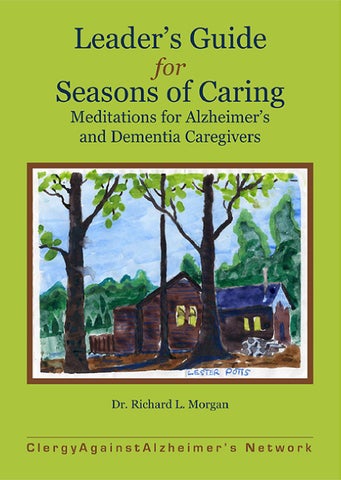
ABOUT THE COVER ARTWORK Reflecting on my father’s dark wood cabin in the trees, painted in the middle stages of Alzheimer’s, I am reminded of many essential elements of his life story and personhood. The dwelling is imbued with the same inviting warmth of Dad’s personality, drawing others to experience the joy of relationship at hearth and home. The image of neatly stacked firewood takes me back to the fall woods with him, where the crack of a cold steel wedge splitting Red Oak logs signaled to November winds that we were prepared. Shadows cast by the big tree remind me both of dark times together on life’s walk, and of the shelter and shade of a righteous life, the strong and steady man of oak who taught me to trust and grow and love, and to never lose faith in how good it is to be alive. - Daniel C. Potts, MD, FAAN
WITH THANKS We are grateful to Mindy Kim for her inspired cover and interior design.
DEDICATION To the caregivers who provide unimaginable acts of love and quality care for their loved ones and to the facilitators whose compassion and patience provide sanctuary where feelings can be freely expressed and help received. Thank you.
INTRODUCTION The ClergyAgainstAlzheimer’s Network of UsAgainstAlzheimer’s was launched in 2014 as a diverse, multifaith national network of clergy, laity and other faith leaders working to focus our nation’s attention on Alzheimer’s disease and related dementias. The mission of the Clergy Network is to promote the dignity of persons with dementia and offer support to their caregivers as we work together to achieve a cure. Our membership is comprised of clergy, laity, and faith based organizations who represent a wide spectrum of faith traditions and include experts in pastoral care for those with Alzheimer’s, elder care issues, hospice care, dementia friendly programs and communities, and Alzheimer’s education. Many of our members are caregivers themselves. While a diverse group, we share a common mission that we believe can best be achieved by working together. Toward these ends, the Clergy Network created and published Seasons of Caring: Meditations for Alzheimer’s and Dementia Caregivers, a first-of-its-kind interfaith volume to offer encouragement, understanding, inspiration and comfort to caregivers. Originally intended to be read by individual caregivers, the book was immediately adopted for use in larger caregiver support groups and educational programs. We are now pleased to release this Leader’s Guide written in the same spirit of interfaith respect and cooperation. Dr. Morgan, a retired pastor and founding member of ClergyAgainstAlzheimer’s and the author of the Leader’s Guide, is a hospice chaplain and has been a longtime facilitator for Alzheimer’s support groups. He has been using Seasons of Caring in his groups as well as in educational presentations about the challenges of dementia and caregiving. He has graciously written this Leader’s Guide to help other facilitators in their groups, tapping into his own experiences from a lifetime of pastoral care, counseling, and deep compassion for others. And, while the Leader’s Guide has been formatted for use in support groups, for those caregivers whose circumstances may not allow them to attend a support group, it can be used privately to help frame the complex and demanding issues of caregiving and help caregivers process their feelings. We have been honored to assist with the editing of this guide. We hope that it will prove useful in providing support and healing to many more caregivers, as well as opening up the discussion for increased awareness of dementias and the challenges of caring for those affected by them. Lynda Everman and Don Wendorf, Psy.D.
Leader’s Guide for Seasons of Caring | ClergyAgainstAlzheimer’s Network | 4
PHILOSOPHY AND GUIDELINES First, the focus of the group is to reflect on and discuss the book, Seasons of Caring: Meditations for Alzheimer’s and Dementia Caregivers. Groups may include Alzheimer’s support groups or other groups of caregivers in local congregations or other communities. Of primary importance is the group process: providing a safe place for caregivers to share their concerns and listen to the concerns of others. Sharing can be thought of as a gift members of the group give to each other. Caring for a loved one with Alzheimer’s disease or other dementias can be a lonely and difficult experience. Caregivers often wonder if anyone else can understand their journey. This group offers mutual give and take from members, providing support often found nowhere else. Second, all group members, including the facilitator(s), are encouraged to share their experiences and engage in active listening to deeply hear one another’s experiences and feelings. Ideally the group should consist of 10-12 members sitting in a close circle so that everyone can easily hear what is being shared. A word about dyads or pairing: some of the exercises suggest that the group pair off in dyads. Dyads allow every member of the group to share. No one is left out. Third, group participation is voluntary and confidentiality is highly encouraged. What is expressed in the group stays in the group, unless otherwise agreed upon. Fourth, each group member will need a copy of Seasons of Caring and commit as far as possible to attend all sessions. Members are asked to read the assigned meditations of Seasons of Caring prior to the meeting to allow time for reflection before the group convenes. Fifth, the group process involves an initial group-building session and ten sessions of ninety minutes each. In most situations support groups elect to continue to meet on a monthly basis. The group experience includes ten meetings, after group building, with meditations from Seasons of Caring as the focus. Some groups may prefer to meet once a week for ten weeks. Others may choose to meet once a month for ten months. Session 1 Session 2 Session 3 Session 4 Session 5 Session 6 Session 7 Session 8 Session 9 Session 10 Session 11
Group Building and Guidelines The World of Alzheimer’s Alzheimer’s Stories Concerns of Caregivers Dealing with Guilt and Forgiving Oneself How to Communicate with a Loved One Value of Art and Music Special Issues Faith Matters Dying and Grief Self Care
Sixth, to prepare for Session 1, group leaders need to have copies of Seasons of Caring to give or sell to the participants and copies of the Philosophy and Guidelines to give to each member. To download the Guidelines and to find additional resources please visit www. SeasonsofCaring.org. Additional resources are provided at the end of the Leader’s Guide, as well as on the ClergyAgainstAlzheimer’s website: www.clergyagainstalzheimers.org. Leader’s Guide for Seasons of Caring | ClergyAgainstAlzheimer’s Network | 5
SESSION 1
GROUP BUILDING AND GUIDELINES Introduction Group Building Exercise Invite members to find a person they do not know and sit beside him or her. Hand each participant a 5x7 index card and a pen or pencil. Give these instructions: 1. Write your first name in large letters in the center of the card. 2. In the top left corner of the card, write a word or phrase that comes to your mind when the word Alzheimer’s or dementia is mentioned. 3. In the top right corner of the card, in a few words answer this question, “If I had Alzheimer’s or dementia I would _________________?” 4. In the bottom left corner of the card, write the name of your loved one for whom you are caring, and their diagnosis. 5. In the bottom right corner of the card, as a caregiver for someone with Alzheimer’s or dementia, what are your biggest concerns? Then ask each participant to share some of the information on the card with their partner; one is the speaker, the other the listener. After fifteen minutes change roles. Allow each speaker fifteen minutes. Reconvene the group. Have each member introduce their partner based on what they heard from her or his sharing. Looking Ahead and Preparing for Session 2 Read Seasons of Caring meditations on pages 1, 2, 17, 31,105, and 117. See how they relate to your own caregiving responsibilities. Closing The facilitator will read the following meditation:
Leader’s Guide for Seasons of Caring | ClergyAgainstAlzheimer’s Network | 1
AN UNTOLD STORY: GROUP PROCESS AS A PILGRIMAGE In the midst of struggles, uncertainty and stress, We gather as pilgrims on a new journey to explore our role as caregivers. The air is tense with anxiety as we embark on this new experience. We all have caregiving stories to tell And a myriad of concerns and needs. We wonder, Will all who sit with us understand and accept Our thoughts and feelings? Or will what we say and what we feel Not be heard…or understood? I realize the group in which I move Has power to listen, affirm and heal All in a one-time unique way I am afraid and yet hopeful Alive in the presence of others who have walked a similar road.
Leader’s Guide for Seasons of Caring | ClergyAgainstAlzheimer’s Network | 2
SESSION 2
THE WORLD OF ALZHEIMER’S Overview Alzheimer’s is the most common form of dementia. Think of a filing cabinet and Alzheimer’s is the largest file. Alzheimer’s is caused by amyloid plaques and tau tangles in the brain. This causes nerve cells to stop working, lose connection with one another and ultimately die. Alzheimer’s is the most dreaded disease of our time, yet we don’t want to talk about it, or even think what it might be like to live with Alzheimer’s. But it is a daily reality for more than 15 million Americans who are caring for persons with Alzheimer’s or related dementias. The meditations you read from Seasons of Caring tell how caregivers dealt with Alzheimer’s and reveal real insights about this disease. Discussion Prompts What does the author in her meditation, “Through My Eyes” (page 1), mean about seeing past the loss of cognition, memory and motor skills with a person with Alzheimer’s? In her meditation, “The Butterfly” (page 2), how does the author use an analogy of a cocoon and butterfly to describe a person with Alzheimer’s? Does that offer some hope for caregivers? The author claims a person with Alzheimer’s becomes “another person.” Have you observed this with your loved one? In his poem, “Downeaster” (page 105), the author likens Alzheimer’s to a violent storm. Is that a good analogy for Alzheimer’s? Has your loved one experienced confusion about time, when “tomorrow is today”? In “On Trying to Understand” (page 117), the author suggests that the lifetime of a person with Alzheimer’s is the pieces of a jigsaw puzzle. What does that mean? How does his statement that the broken fragments of the tablets of the Law are preserved, give hope for persons with Alzheimer’s? Reflective Exercise Simulating Alzheimer’s Disease The facilitator reads the following statement to the group: 1. You are constantly forgetting dates and the location of your possessions. Names of familiar friends escape you. 2. While driving though the neighborhood, you forget how to get home. Since this happens more than once, your family takes away your car keys and deprives you of driving. 3. Confined to your home, you often wander at sundown in the neighborhood and someone has to bring you home. Leader’s Guide for Seasons of Caring | ClergyAgainstAlzheimer’s Network | 3
4. You become frustrated and angry when you can’t manage a checkbook or pay bills. 5. You misplace things and accuse family members of stealing from you. 6. You become confused, depressed and suspicious. You keep talking about people who have died, as if they are still living. 7. Your family grows concerned and takes you to a neurologist. After a battery of tests and consultation, you are diagnosed with Alzheimer’s and prescribed Aricept and Namenda. If these things happened to you, how would you feel? How would you want your family to respond? Looking Ahead and Preparing for Session 3 Read Seasons of Caring meditations on pages 8, 22, 25, and 27. Think about stories from your own experience as a caregiver. Closing As facilitator, read Dr. Don Wendorf ’s meditation, “Painted Bits of Bark and Stone and Tin” on page 95, or play the recorded performance, which can be found at www.clergyagainstalzheimers.org.
Leader’s Guide for Seasons of Caring | ClergyAgainstAlzheimer’s Network | 4
SESSION 3
ALZHEIMER’S STORIES Overview In a real sense we are our stories. Henri Nouwen has expressed it in The Life of the Beloved, “Your life, and my life are, each of them, one-of-a-kind. No one has ever lived your life or my life before. Our lives are unique stones in the mosaic of human existence – priceless and irreplaceable.” Alzheimer’s may rob a loved one of short-term memories. But long-term memories, called “crystal memories” may still be accessible from long ago. They may still be intact and able to be retrieved. One of the greatest gifts we can offer to loved ones with dementia is to prompt those memories and listen. The following meditations from Seasons of Caring show how those memories are still there and can be retrieved. Discussion Prompts In the meditation, “Sara’s Story” (page 8), we read of a woman who had lost her memory, but it was still in place, and returned for a moment. Have you had experiences with loved ones whose memory seemed lost and they had a lucid moment? In “Hope for Mrs. Paper Face” (page 22), Mary recognized herself in an old picture and smiled. Are there non-verbal hints from people with Alzheimer’s that they are still “in there?” The author in the meditation “Where Are You?” (page 25) counsels readers to “go with the flow,” and try and understand what is going on, never contradicting the loved one with Alzheimer’s, but being there for them. Is that hard for you to do? The Vietnam veteran, in the story “With Faith, We Can Make It” (page 27) makes an incredible profession of faith, “It is hard with Alzheimer’s, but with faith, we can make it.” Despite Jerry’s cognitive impairment, his faith was evident. Do you find that amazing? Reflective Exercise Deborah Danner describes a Memory Cafe (Seasons of Caring, page 100), where those with memory loss and those who love them can meet and share “carefree moments from the past.” Go back to your dyads. One member role plays a person with early stages of dementia, while the other role plays a family member who is their caregiver. The family caregiver will share an early childhood memory. The person with dementia will respond in kind. Switch roles. The family caregiver will describe a happy moment in their life story. The person with early dementia will also share a happy moment from their past. Reconvene the group and discuss what happened.
Leader’s Guide for Seasons of Caring | ClergyAgainstAlzheimer’s Network | 5
Looking Ahead and Preparing for Group 4 Read Seasons of Caring meditations on page 7, 9, 36, 42, and 84. Facilitator: Please bring a “talking stick” (It can be anything resembling a stick, unlighted candle, etc.) to the next session. Closing Choose a participant to read the meditation from Seasons of Caring by Rabbi Cary Kozberg, “Radiant Joy,” on page 15.
Leader’s Guide for Seasons of Caring | ClergyAgainstAlzheimer’s Network | 6