H A N G G L I D I N G + PA R A G L I D I N G + S P E E D F LY I N G
VOL 56 NO.2 SPRING 2026 $6.95
“
Cre at in g t h e A l t a G T w a s a s im p l e y e t exc i t in g m i s s i o n : to d e s i g n a n EN - A w in g s t a r t in g f ro m a b l a n k s h e e t – a n ‘o p e n b a r ’ a p p ro a c h – in o rd e r to m a x im ize p e r f o rm a n c e a n d fl y in g e nj o y m e nt . T h e c h o i c e o f a s e m i - l i g ht c o n s t r u c t i o n w a s o b v i o u s , a s w i t h t h e e nt ire G T r a n g e . L i g hte r m ate ri a l s im p ro v e h a n d l in g at e v e r y l e v e l – t h a n k s to re d u c e d in e r t i a – w hi l e re m ainin g ro b u s t e n o u g h to b e a t r u e a ll - ro u n d c o m p a ni o n . T h e A l t a G T d e l i v e r s w h at p i l o t s o f a ll s k i ll l e v e l s w a nt : p e r f o rm a n c e , e nj o y m e nt , a n d t h e hi g h e s t d e g re e o f p a s s i v e s af e t y g u a r a nte e d b y t h e EN - A c ate g o r y.” — D av i d D a g au l t , D e s i g n e r
22 US USHPA HPA PIPILOT LOT
flyozone.com U S H P A PILOT 3
Pilot: Marco Subileau Photo: Antoine Boisselier
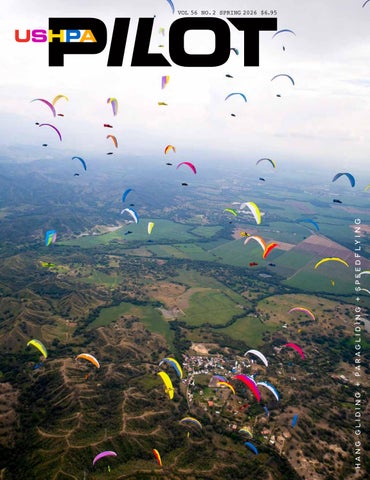
ON THE COVER Nothing cures the winter blues like a quick trip to Colombia’s Cauca Valley. Photo by Dan Zaslavsky
SPRING 2026 Association 6
Launching 8
Editor 13
Ratings 64
14 USHPA Awards by Liz Dengler
Honoring exemplary pilots and community members
20 The Dream that was Wallaby Ranch by Eric Engerbretson 28 The Dos and Don'ts of Speedriding by Jeff Katz A progression-based guide
34 The Four Skills of a Graceful Landing by John Matylonek 38 Armchair SIV by Calef Letorney Active Piloting
42 The History of Weather Forecasting by Honza Rejmanek How it relates to soaring flight
48 A Spanish Racing Spectacular by Lisa Verzella Competing in the Sport Racing Series in Ager
52 Understanding Risk by Riley Ferré
How free flight influences our management and tolerance
56 Apps Versus Instruments by David Jones Pilots weigh in
60 Northern California Cross Country League by Jugdeep Aggarwal HANG GLIDING, PARAGLIDING, AND SPEEDFLYING ARE DANGEROUS ACTIVITES
USHPA recommends new or advancing pilots complete a pilot training program under the direct supervision of a USHPA-certified instructor, using equipment suitable for their level of experience. Many of the articles and photographs in the magazine depict advanced maneuvers being performed by expert pilots. No maneuver should be attempted without appropriate and progressive instruction and experience.
4 USHPA PILOT
U S H P A PILOT 5
TAKE OFF INTO ADVENTURE Designed for pilots who seek genuine cross-country adventures and the freedom of flying from mountain to mountain with only their paraglider and bivouac gear, the Bandit 2 combines a true ultra-lightweight concept with the performance cues of a higher-aspect wing. Whether you’re stepping into long-distance flying, chasing hike-and-fly adventures, or next mountain flying trip adventure, this is the wing for you. 5 Sizes | 55-120 kg | Ultralight - EN B 3.24kg (S size)
Photo: Jerome Maupoint
SUPER FLY www.superflyinc.com 801.255.9595 info@superflyinc.com
Bandit2 www.gingliders.com
ASSOCIATION James Bradley, Executive Director :
I work out of a six-by-six-foot office Galen Anderson, our Operations in a co-working space near ColumManager, has been with USHPA the bus Circle, in New York City. For my longest. He brings an invaluable historicommute, I get to walk a mile down cal perspective to every conversation, Columbus Avenue, past restaurants, and he deals with an endless stream of cafes, shops, and Lincoln Center. I like small and large things that are essential cities, and I like walking, whatever the to keeping the wheels on. weather, so for me this is the perfect Anna Mack’s title is Program Manway to ramp into a work frame of mind ager, which doesn’t begin to describe in the morning, and decompress on the everything she does. She’s constantly Do you have questions about innovating process improvements, USHPA policies or programs? way home. Are there topics you’d like to The rest of USHPA’s staff also works questioning how things could work hear more about? remotely, mostly in Colorado. We better, and she's invaluable in strategy EMAI L US AT: connect every day on Teams and Zoom, conversations. She leads our courseinfo@ushpa.org which works great for us. Sending a ware development, working with six of Interested in taking a more “got a minute?” message is just like stopour best instructors—Gordon Cayce II active role supporting our and Takeo Eda in hang gliding, Chris national organization? USHPA ping by in a physical office. needs your skills and interest. Besides me, USHPA has four full-time Grantham and Greg Kelly in paraglidVOLUN TEER AT: staff and I’m lucky to work with all of ing, and Todd Higley and Carl Weiseth ushpa.org/volunteer them. Maddie Campbell, our Member- in speedflying—who are making time ship & Communications Coordinator, to help us produce excellent ground For other USHPA business is the person you’re most likely to speak school and theory courses for every +1 719-632-8300 rating. info@ushpa.org with if you call. Maddie makes sure every call gets answered or returned, I also want to highlight the new guy, and every email gets to the right person. Ben Wedlock, who's making a big difShe also leads our external communiference part-time as our Chapter Liaications, including comms strategy and son, and all the volunteers who work on The United States Hang Gliding our chapters, events, and committees. & Paragliding Association, social media presence, and she’s the Inc. (USHPA) is an air sports inventor of USHPA’s Safety Week. You're too numerous to name here but organization affiliated with Every company is a tech company we know who you are. Thank you! the National Aeronautic Association (NAA). The NAA is now. Chris Webster, our Information A high point of my week is talking to the official representative of Services Manager, brings a steady the members who book Zoom meetthe Fédération Aeronautique Internationale (FAI), which is the “whatever it takes” attitude. He’s leading ings with me. Whatever you bring up world governing body for sport the build-out of our new association gives me a window into your experiaviation. The NAA represents the ence as a USHPA member and a free United States at FAI meetings. management software and the data The NAA has delegated to migration that will happen when we flight pilot in the United States. Please USHPA the supervision of FAImove. Beyond that, Chris is constantkeep those conversations coming. related hang gliding ly working to make things better, and ushpa.org/meetwithjames and paragliding activities, such as when the website goes down on a Satrecord attempts urday, unless he’s out flying, he’s fixing and competition sanctions. it within an hour. 6 USHPA PILOT
U S H P A PILOT 7
REGION 1 NORTHWEST Alaska Hawaii Iowa Idaho Minnesota Montana North Dakota Nebraska Oregon South Dakota Washington Wyoming REGION 2 CENTRAL WEST Northern California Nevada Utah REGION 3 SOUTHWEST Southern California Arizona Colorado New Mexico REGION 4 SOUTHEAST Alabama Arkansas District of Columbia Florida Georgia Kansas Kentucky Louisiana Missouri Mississippi North Carolina Oklahoma South Carolina Tennessee Texas West Virginia Virginia REGION 5 NORTHEAST and INTERNATIONAL Connecticut Delaware Illinois Indiana Massachusetts Maryland Maine Michigan New Hampshire New York New Jersey Ohio Pennsylvania Rhode Island Vermont Wisconsin
James Bradley Executive Director james@ushpa.org Charles Allen President president@ushpa.org
Mission To deliver programs and services that support all our members, foster a community of skilled and knowledgeable pilots, and promote and protect the freedom to fly. Vision A vibrant free flight community across the United States. Core values & guiding principles Adventure Celebrate the spirit of discovery and the joy of being in the outdoors. Learning Support ongoing education, development of skills, and acquiring of the judgment that comes from experience and attention. Preservation Be stewards of our natural places, our flying sites, and the future of our sport. Integrity Act ethically, take 100% ownership, communicate clearly, respond effectively. Respect Foster a considerate community free from harassment and abuse.
Kirby Ryan Vice President vicepresident@ushpa.org Van Spurgeon Secretary secretary@ushpa.org Joshua Wiseman Treasurer treasurer@ushpa.org Galen Anderson Operations Manager office@ushpa.org Chris Webster Information Services Manager tech@ushpa.org Anna Mack Program Manager programs@ushpa.org Maddie Campbell Membership & Communications Coordinator membership@ushpa.org B OA R D M E M B E R S (Terms through 2026) Van Spurgeon (region 3 - West) Charles Allen (region 5 - East) Nick Greece (region 2 - West) Stephan Mentler (region 4 - East) Dennis Shen (region 3 - West) Joshua Wiseman (region 1 - West)
EVENT CALENDAR
B OA R D M E M B E R S (Terms through 2027) Kirby Ryan (region 3 - West) Pamela Kinnaird (region 2 - West) Olga Grunskaya (region 1 - West) Bob Ferris (region 3 - West)
OZONE VIBE GT
FLYMASTER NAV C AND LIVE C Has your trusted Flymaster NAV SD or NAV been by your side for years, but is now starting to show its age? It might be time for an upgrade. Meet the new Flymaster NAV C and LIVE C. Featuring everything you loved about your NAV or NAV SD, including the iconic “magic dot,” plus powerful new upgrades like a vibrant color display, voice assistant, high-resolution color maps, Bluetooth connectivity, and more. All of this comes in the same rugged, reliable Flymaster package you’ve come to trust. For a limited time, you can trade in your NAV, NAV SD, LIVE, or LIVE SD toward a brand-new NAV C or LIVE C. Even better, Flymaster is offering a 20% price reduction on NAV C and LIVE C instruments for 2026. To learn more, visit www.flymasterusa.com or email jugdeep@flymasterusa.com.
8 USHPA PILOT
OZONE SUBLITE Derived from the Submarine and proven in the Red Bull X-Alps, the new Sublite delivers exceptional aerodynamic efficiency, minimal drag, and outstanding ease of use at just 1.5 kg! Hike-and-fly competitors and ambitious XC pilots alike will experience an overall performance upgrade in their flying, at a level of comfort and stability that is suitable for those with a solid XC background. Compact, refined, and uncompromisingly efficient, the Sublite delivers a race-level of True Performance in the lightest possible harness format. www.flyozone.com
The Vibe returns! The original Vibe was launched in 2003 and was a huge success, setting benchmarks in performance, safety, and fun. The new Vibe GT brings together everything we have learned over the past 23 years and showcases significant advances in wing design, with major improvements in ease of use, handling, safety, and performance. The Vibe GT is a mid-level EN-B wing, perfect for developing pilots. It is the ideal second wing for those stepping up from an EN-A or low EN-B, offering superb XC potential in a safe, reassuring, and fun package. The handling is exquisite—a lot of time was spent tuning the turn response and precision—and the performance is better than any wing we have made with this level of passive safety. Suitable for a wide range of pilots, the Vibe GT is a great wing for discovering XC, SIV, Acro, or whatever adventure you can dream of. Part of the GT range, it offers the perfect balance of low weight and durability. www.flyozone.com
U S H P A PILOT 9
ADVANCE PI 4 ULS The Advance Pi 4 ULS is a thermal wing, hike-and-fly glider, and miniwing all in one (depending on how you weigh it). This fourth-generation Pi builds on 14 years of lightweight, max performance, and fun. It’s now lighter than ever and available in more sizes than ever. Seven sizes vary from 14m to 26m and from 50 kg to 119 kg. As always, the certification level depends on the pilot’s weight. Each size is EN certified. The 14m weighs in at only 1.65 kg. Pi 4 ULS is available in two colors and is available for demo or sale through Super Fly, Inc. at www.superflyinc.com, +1 (801) 255-9595, or your local dealer.
FLYTEC BLUETOOTH CONNECT GIN GLIDERS BOLERO 8 The Gin Gliders Bolero 8 (EN-A) is designed as a school glider at a great price and offers the performance and handling to serve as a first glider for any student. It comes in five sizes from 21-31 meters, and the weight range goes from 50-130 kg. It comes in four colors and can be made in custom colors as well. The Gin Bolero 8 is available through Super Fly, Inc. at www.superflyinc.com, +1 (801) 255-9595, or your local dealer.
Give your phone the aviation-grade sensors of the Oudie N or Omni with the new Transmit via Bluetooth feature. Smartphones can be a great secondary instrument when flying, and now, with the Bluetooth sensor connection, your phone will have the same precision as the Oudie N/ Omni. When paired, your phone app will have: extremely sensitive and Instant vario, high-precision aviation-grade GNSS GPS positioning, and optional Fanet+/ Flarm Traffic data. To learn more contact info@flytec.com, +1 (800) 662-2449
SYRIDE SOLAR
SYRIDE ALTI V4
Syride introduces the Solar, an The Alti V4 is part of Syride’s fully ultralightweight, solar-powered redesigned V4 Series, bringing audio vario featuring integrated updated features and modern conBluetooth. Built for pilots who nectivity to its altivario. Created prioritize simplicity, the Solar for pilots who value clear visual delivers precise, responsive audio information without the need for feedback with enhanced sound built-in GPS, the Alti V4 pairs clarity in a compact, solar-charged precise vario performance with a design. This new connectivity customizable, easy-to-read display allows for seamless wireless setup for quick and reliable flight data via the Syride mobile app. When checks in the air. Bluetooth now paired with the app, pilots can comes standard, ensuring seamenable live tracking and record less integration with the Syride flights directly to Syride’s 3-milmobile app and third-party flight lion-flight logbook. The Solar also apps, including XCTrack and Flyserves as a high-precision sensor SkyHy. Pilots can adjust settings for third-party apps such as XCwirelessly and, when connected to Track and FlySkyHy. Competitive- the Syride app, record and upload ly priced and always ready to fly, flights on the go to the Syride the Solar is the ultimate connectlogbook—now featuring over 3 ed, grab-and-go solution. Learn million flights from 30,000 pilots. more at www.syride.com Learn more at www.syride.com
10 US HPA PILOT
SYRIDE GPS V4 Syride completes its redesigned V4 Series with the GPS V4, a lightweight (3.3 oz) vario GPS designed for pilots who value precision without complexity. This standalone instrument features a customizable LCD display for instant data clarity and integrated GPS for reliable track recording. Equipped with Bluetooth, the GPS V4 ensures seamless wireless configuration via the Syride app and effortless connectivity with third-party tools like XCTrack. The Syride app allows live tracking and uploading to Syride’s massive 3-million-flight logbook, delivering a streamlined on-the-go experience in a compact format. Learn more at www.syride.com
U S H P A PILOT 11
FLARE MOUSTACHE 2
VECTOR VARIO
Vector Vario is excited to anThe new Flare Moustache 2 nounce a new partnership with delivers a wide speed range, pre- Paragliding Varios to bring this cise handling, and stable reflex groundbreaking instrument to characteristics—making it ideal pilots across the United States. for coastal soaring, foot-launch The Vector Vario sets a new proximity flying, and windier standard in flight instrumentaconditions. It features a shark tion, offering true total energy nose for internal pressure, mini compensation unlike anything ribs for reduced drag, and 2D else on the market. Pilots benesteering for enhanced turning fit from true airspeed measurecontrol. Pilots agree that it is ment, precise high-resolution a marked improvement over 3D wind data, vario netto, and the original Moustache. It’s seamless Bluetooth Low Energy available in sizes ranging from connectivity to XCTrack, Sports 13-26 meters with color options TrackLive, LK8000, FlySkyHy, in burgundy and dove. The See You Navigator, XCSoar—the Flare Moustache 2 is available list keeps growing—all working through Super Fly, Inc. Contact together in one powerful system. us for a demo flight at To learn more or purchase your www.superflyinc.com or Vector Vario, visit +1 (801) 255-9595 paraglidingvarios.com
12 US HPA PILOT
U S H P A PILOT 13
EDITOR Liz Dengler : Not long ago, I asked you to share
Even if you don’t fly a certain wing type, your stories with us, and wow, did you there is something to learn in each of deliver! I am loving the massive influx these stories. These pieces will surely of submissions. It makes every issue a help our community continue to learn blast to edit. and grow. With spring here, we start with our In the vein of competition and comUSHPA Awards, recognizing exemmunity, we have two articles showcasplary pilots in our community. As ing the amazing experiences pilots can always, reading the nominations was have in lighthearted competitions. Both an absolute pleasure. If you meet any of the SRS competition in Ager and the the 2025 recipients during your flying Northern California Leagues welcome Liz Dengler Managing Editor adventures, please congratulate them pilots of all skill levels who are looking and thank them for all they have done to expand their horizons, grow as pilots, editor@ushpa.org for our community. and have new experiences. I am always Bethanie Hestermann Copy Editor Wallaby Ranch, probably one of the stoked to see events geared toward Greg Gillam most well-known hang gliding desadvancing pilots' skills beyond racing. Art Director tinations in the world, is beautifully Whether you are looking to scratch WRITERS featured in this issue. Malcolm Jones a curiosity, simplify your kit, or do a Lisa Verzella shared his passion with the hang glidlittle honest self-reflection, this issue Riley Ferré ing community and created a wonderful has something for you. One article Calef Letorney and supportive environment for pilots explores the complex history of weather David Jones to begin and continue their flying jour- forecasting, another helps pilots decide Do you have a story idea you neys. This piece reflects that passion. whether to ditch their flight instrument, would like to pitch? We are always looking for stories. It is bittersweet, then, that Wallaby and a third demystifies how we assess E M A I L LI Z AT: Ranch has recently closed its doors. and manage risk in our sport. editor@ushpa.org But the spirit Malcolm cultivated lives This issue may feel like an information Are you ready to contribute on in every pilot and instructor who overload—you may have to tackle it in a complete story? We are flew there, and we hope it continues to sections. That is, if you can even put it always looking for articles, photography and news. spread throughout our community for down. years to come. Thank you again to everyone submitG E T STA RT E D AT: This issue also features a range of ting pitches, stories, and photos. I love ushpa.org/contributors skills articles—one from each wing connecting with you, and our commuAll articles, artwork, photographs as well as ideas type! Hang gliding landing skills advice, nity loves reading about your advenfor articles, artwork and active piloting tips for paraglider pilots, tures. photographs are submitted pursuant to and are subject and the dos and don’ts of speedriding. ©2024 US HANG GLIDING & PARAGLIDING ASSOC., INC. All rights reserved. No part of this publication may be reproduced, stored in a retrieval system, or transmitted in any form or by any means, electronic, mechanical, photocopying, recording, or otherwise without prior written permission of USHPA.
to the USHPA Contributor's Agreement, which can be reviewed on the USHPA website or obtained by emailing Liz.
Would you like to run an POSTMASTER USHPA Pilot ISSN 2689-6052 (USPS 17970) is published quarterly by the United States Hang Gliding and Paragliding advertisement? Great! Association, Inc., USHPA, 201 E Pikes Peak Ave, Suite 1330, Colorado Springs, CO 80903, Phone: 719-632-8300 Fax: 719-6326417 Periodicals Postage Paid in Colorado Springs and additional mailing offices. Send change of address to: USHPA, PO Box 1330, CO N TACT U S AT: Colorado Springs, CO, 80901-1330. Canadian Return Address: DP Global Mail, 4960-2 Walker Road, Windsor, ON N9A 6J3. advertising@ushpa.org
| | | | | | | | | | | | | | | | | | | | | | | | | | | | | | | | RECOGNITION
USHPA Awards by Liz Dengler
:
Each year, USHPA honors exemplary pilots and community members with the USHPA awards. These themed awards and commendations recognize those who have made significant contributions to the free flight community.
MALCOLM JONES USHPA PRESIDENTIAL CITATION From 2025 USHPA President Charles Allen: I am honored to award the 2025 USHPA Presidential Citation to Malcolm Jones in recognition of his lifetime of extraordinary contributions to hang gliding, pilot training, safety, and community building in the United States. For decades, Malcolm has been synonymous with Wallaby Ranch in central Florida, an institution that redefined training, safety, and community in free flight. To describe him only as the owner and operator of a flight park understates his contributions to hang gliding. He transformed how pilots are introduced to the sky, how instructors teach, and how newcomers become lifelong members of our community. Malcolm began flying in 1974 in the Tampa Bay area, in the early days when water-skiers and early delta-wing experiments were part of the sport’s frontier. From the beginning, Malcolm didn’t focus on personal accolades but instead placed greater value on sharing the experience of flight with others. That philosophy became the foundation of Wallaby Ranch after he purchased it in 1991. Wallaby Ranch is widely regarded as the first—and one of the largest—aerotow hang gliding flight parks in the world and, more importantly, as the birthplace of a training model that transformed the sport. Under Malcolm’s leadership, tandem hang gliders were equipped with wheels, allowing for safer takeoffs and landings during aerotow operations. This approach fundamentally changed hang gliding instruction. It lowered barriers to entry, accelerated learning, and dramatically improved safety, turning 14 US HPA PILOT
what was once an intimidating leap into a structured, confidence-building progression. Over the years, Wallaby Ranch logged more than 30,000 incident-free tandem flights, a record built on conservative judgment, disciplined procedures, and a deeply ingrained safety culture. This culture was practiced daily, modeled by leadership, and reinforced through constant attention and accountability. My connection to Wallaby Ranch is personal. I had my first high-altitude flight at Wallaby, earned most of my ratings there in the late 1990s, and spent enough time on that field to experience firsthand the culture Malcolm built. Wallaby was more than just a training site; it was a community. New pilots were welcomed, experienced pilots mentored without ego, and everyone—students, instructors, and visiting pilots alike—was held to a shared standard of professionalism and responsibility. The culture at Wallaby emphasized constant vigi-
Malcolm Jones with his son, John-Arthur.
U S H P A PILOT 15
lance for one another’s safety. On one occasion, on a windy day in the early 2000s, I secured my glider in the cart by looping the cart rope over the nut on the right corner bracket of the control frame. However, I failed to remove the rope before launch and began my takeoff roll, unaware that my right corner bracket was still secured to the cart. Malcolm noticed the oversight and stopped the launch during the takeoff roll. If the launch had continued, it could have resulted in a serious accident. That moment captures something essential about Malcolm Jones and the environment he created at Wallaby Ranch—safety was active and non-negotiable. Wallaby Ranch became a destination not only because of aerotow and favorable Florida weather, but also because it functioned as a hub. Pilots stayed on site, shared meals, exchanged stories, and formed lifelong friendships. Many of today’s instructors, competition pilots, and leaders in the sport passed through that field at some point in their development. It is difficult to overstate how influential Wallaby Ranch has been to hang gliding in the United States. A presidential citation is reserved for individuals whose influence on the sport extends beyond personal achievement and into lasting institutional impact. Malcolm’s life’s work aligns directly with USHPA’s core priorities. He helped grow and retain pilots through accessible, high-quality training, maintained strict safety standards, and strengthened the social fabric that keeps pilots engaged for decades. He understands that the future of free flight depends not just on equipment or sites, but also on people and on creating environments where they can thrive. This Presidential Citation is being awarded at an important moment. Malcolm Jones is retiring, and Wallaby Ranch, the place most closely associated with his life’s work, is closing. For more than three decades, Malcolm did not simply operate a flight park; he built an institution that reshaped hang gliding training, safety culture, and community in the United States. Generations of pilots learned to fly, to teach, and to look out for one another on that field. Although Wallaby Ranch will no longer operate, its influence endures through the pilots and instructors it produced and the standards it set. That legacy is
David Goto sporting his standard flying equipment. Photo by Dave Chapman
firmly established and will continue to shape the sport for years to come. On behalf of USHPA, it is my honor to present this Presidential Citation to Malcolm Jones in recognition of his lifetime of service to free flight.
DAVID GOTO ROB KELLS MEMORIAL AWARD Recognizes a pilot, group, chapter, or other entity that has provided continuous service over a period of 15 years or more. One of USHPA’s most prestigious awards, the Rob Kells Memorial Award, may be awarded to an individual or group only once. This year, the award is presented to David Goto. Numerous nominations cited his foundational site support, leadership within the local club, and long-standing role as a mentor and local guide to nearly every plot who has visited Oahu. “The Rob Kells Memorial Award honors those who reflect the attributes that endeared Rob Kells to pilots worldwide: a driving concern for the safety and well-being of other pilots, a demonstrated pattern of self-sacrifice, the ability and means to help others
achieve flight, and the drive to make it all happen,” said one nominator. “David Goto has consistently exemplified these qualities through his unwavering dedication to our community, particularly at the iconic Makapu’u flying site in Hawaii.” Another nominator added, “I have witnessed firsthand the profound impact David has had on our sport over his remarkable 50-year career. For well over three decades, he has worked tirelessly to preserve and enhance this premier flying site, advocating with local authorities to maintain access and coordinating with the community to ensure its upkeep. His vision and efforts have transformed Makapu’u into a bucket-list destination for pilots worldwide, fostering a welcoming environment that has grown the sport and strengthened the global hang gliding community.” In support of site access, others added, “Always the most active member of the Hawaiian Hang Gliding Association, David has led the way for more than 50 years. Over the years, the site has faced numerous threats, some from within the hang gliding community and many from outside. Through it all, David has spent countless hours and a great deal of personal resources to fend off legal and political threats, while also creating a safer launch and landing environment for all to use and enjoy.” Regarding visiting pilots, nominators could not express their gratitude enough. “David Goto’s contributions extend from local pilots in Hawaii to international visitors at Makapu’u, making a profound and positive impact on the perception and participation in hang gliding,” said one. “By virtue of his position as the primary flight and safety director of the Hawaiian Hang Gliding Association for much of his 50-plus years of flying, virtually every visiting pilot to Oahu has been hosted by David. He generously supplies safety briefings, site inspections, high-wind cliff launch coaching, and even gliders to visiting pilots.” When asked to respond to receiving the Rob Kells Memorial Award, David replied, as expected, humbly and with an invitation to fly: “In my early years of flying, I experienced the warmth and generosity of countless pilots around the world, who offered lodging and wings to fly. In turn, I try to offer my aloha to visitors to the islands. Just bring the after-flight refreshments. Mahalo.” 16 US HPA PILOT
Congratulations, David, and thank you for all you do!
L.J. O'MARA HG INSTRUCTOR OF THE YEAR With numerous nominations in support, in 2025, the Hang Gliding Instructor of the Year award goes to L.J. O’Mara. “L.J. has been a cornerstone of the hang gliding community for many decades, dedicating this time to training, mentoring, and inspiring countless pilots,” said one nominator. “His depth of knowledge is matched only by his commitment to safety and his passion for flight.” L.J. has earned a reputation as a patient, professional instructor who ensures his students become safe, autonomous pilots and each student receives the same steady attention and thoughtful instruction. “L.J. has the unique ability to adjust his teaching style to his students' learning style and personality.” His patience ensures his students are safe, and he goes above and beyond when they encounter challenges. L.J.’s mentorship extends beyond the initial rating. A
L.J. O'Mara
U S H P A PILOT 17
former student returned to L.J. when they moved up to a higher-performance glider. “L.J. took a remarkable approach: have me do as much as I could on my own and for him to step in only where needed,” they commented. “It was nice getting so much personalized attention. And then I started to notice he does this with everyone he teaches,” they continued. As one nominator commented, “The impact of his work extends far beyond the individuals he has trained. By sharing his knowledge and passion so generously, L.J. has strengthened the entire hang gliding community.” Well deserved, L.J. Congratulations!
WAYNE BERGMAN BETTINA GRAY AWARD For the photographer whose work is judged best by the committee in aesthetics, originality, and a positive portrayal. I personally worked with Wayne Bergman in two capacities in 2025. Not only did Wayne supply exceptional photographs to accompany an article written by Dave Embertson, “Partners with the Bear” (see pages 42-45 of the Summer 2025 issue), but we also used one of his shots for the cover of the Autumn 2025 issue of USHPA Pilot. When called upon by his community, Wayne graciously offered a range of images to
Wayne Bergman
18 US HPA PILOT
accompany an article promoting their local sites. A nominator added, “Wayne’s years of contribution to the Green Point Flyers Association (GPFA) and the pilot community at large include beautiful and inspiring photography and videography. Wayne has unofficially been the photographic and video historian for hang gliding and paragliding at the GPFA and a contributing historian for the U.S. pilot population that enjoys his work. Wayne has shared his enduring love and passion for hang gliding and paragliding throughout his colorful and extensive personal flying career.” I am pleased to see the Bettina Gray awarded to Wayne Bergman, who uses his craft to share the joy of free flight. Congratulations, Wayne.
NATHAN LONGHURST USHPA COMMENDATION Readers of this magazine will recognize Nathan Longhurst from a story published in the Autumn 2025 issue titled “The Quiet Summiteer.” Jack Sheard chronicled Longhurst’s achievement as the first person to use a paraglider to summit all 100 of New Zealand’s highest peaks over the course of a season. By using miniwings to access and navigate remote and challenging terrain, Longhurst demonstrated how this sport can open up new adventures. As one
Nathan Longhurst
U S H P A PILOT 19
nominator said, “Nathan’s [achievement] serves as an advancement of our sport and an inspiration to those within adjacent disciplines such as mountaineering and trail running.” He continued, “It will likely serve as a placeholder for what is possible in Speedmo (speed mountaineering) style with a smaller, more launchable wing for years to come.” Congratulations, Nathan.
ARIEL ZLATKOVSKI USHPA COMMENDATION In 2025, paraglider pilot Ariel Zlatkovski set an ambitious goal to complete 100 flights of 100 km or more over the course of a single season. He dubbed the endeavor Project 100. Ariel flew in India, Colombia, and the Alps to accumulate the airtime required to complete the project. On September 17, he completed his final 100 km flight in Bassano, Italy. To accomplish this goal, he flew roughly 19,000 km over approximately 890 hours, meaning he spent nearly 10 percent of his time airborne. As one nominator said, “Ariel’s achievement is a display of what is possible with a humble paraglider and an inspiration to those seeking adventure flying.” Ariel’s accomplishment is remarkable and serves as an inspiring example of what pilots can achieve with dedication, grit, and passion. Congratulations, Ariel.
2026 USHPA Awards MAKE YOUR NOMINATION AT: ushpa.org/awards
NOMINATIONS ARE DUE OCTOBER 1 PRESIDENTIAL CITATION - USHPA's highest award. ROB KELLS MEMORIAL AWARD - Recognizes a pilot, group, chapter or other entity that has provided continuous service, over a period of 15 years or more. USHPA EXCEPTIONAL SERVICE AWARD - Outstanding service to the association by any member or non-member. NAA SAFETY AWARD - The NAA presents this award to an individual, recommended by USHPA, who has promoted safety. FAI HANG GLIDING DIPLOMA - For outstanding contribution by initiative, work, or leadership in flight achievement. FAI PEPE LOPES MEDAL - For outstanding contributions to sportsmanship or international understanding. CHAPTER OF THE YEAR - For conducting successful programs that reflect positively upon the chapter and the sport. NEWSLETTER/WEBSITE OF THE YEAR (print or webbased). INSTRUCTOR OF THE YEAR AWARD - Nominations should include letters of support from three students and the local Regional Director. One award per sport per year may be given. RECOGNITION FOR SPECIAL CONTRIBUTION - For volunteer work by non-members and organizations. COMMENDATIONS - For USHPA members who have contributed to hang gliding and/or paragliding on a volunteer basis. BETTINA GRAY AWARD - For the photographer whose work (three examples needed for review) is judged best by the committee in aesthetics, originality, and a positive portrayal. BEST PROMOTIONAL FILM - For the videographer whose work is judged best by the committee in consideration of
Ariel Zlatkovski. Photo by Sergey Lazarev
aesthetics, originality, and a positive portrayal.
| | | | | | | | | | | | | | | | | | | | | | | | | | | | | | | | LEGENDS
20 US HPA PILOT
U S H P A PILOT 21
Artwork by long-time Wallaby instructor, Lori Sanchez.
The Dream that was Wallaby Ranch by Eric Engerbretson
: Every day was the same. I awoke with an intox-
icating mix of anticipation, adrenaline, joy, peace, and a slight seasoning of fear. In the early mornings, a haze of fog spread thin and low over vast, perfectly flat grassy fields, with the occasional group of sandhill cranes picturesquely feeding nearby. The sun burned through the mist, promising a fantastic day. As I walked under the immense live oak tree dripping with Spanish moss, other spectral figures appeared, all of us heading to the cozy, screened porch and central cookhouse, mumbling greetings. We ambled up to the long kitchen bar, helped ourselves to a gourmet breakfast, then casually gathered outside, sipping coffee and waiting. It seemed improper to break the almost zen-like peaceful atmosphere with anything but muted small talk. Invariably, just a few feet away, former Olympic-level luge racer Walt Harrison, one of the hang gliding instructors, would be doing yoga-like stretches to prepare for the day. I learned to trust his example and imitate him.
Before long, we’d hear a golf cart motor in the distance, and everyone perked up a bit. Suddenly in view, the golf cart screeched to a stop, and Malcolm Jones urgently and somewhat impatiently exclaimed, “Let’s go!” followed by something to the effect of “Daylight’s burnin’!” We all piled into golf carts, most with someone on the back facing backward, holding the two nose wires of a tandem glider on wheels, and sped along in the cool air toward one edge of the massive takeoff and landing area. This was my routine almost every day for two weeks at Wallaby Ranch, the world’s first aerotow hang gliding flight park, just southwest of Orlando, Florida. When someone asked a Wallaby Ranch staffer when they were open, they would grin and repeat the mantra, “Only every day.” Unfortunately, “only every day” extended from 1991 until October 2025, when Wallaby Ranch flew its last flights and Malcolm retired. I spent two of the best weeks of my life there, flew
Wallaby founder Malcolm Jones with David Ledford (L), and Gary Boat-towed delta flown by Jim Henderson at Cypress Davis (R) at the Americas Cup. Photo by the legendary Ralph Jenna Gardens. Photo by Bettina Gray
Malcolm Jones in the saddle. Student unknown. Photo by Ralph Jenna
two weeks there were two of the best weeks I have lived. Malcolm Jones, who turns 70 next year, the constant proprietor (emphasis on constant) and head instructor of Wallaby Ranch, is quite a guy. He is quite possibly the most experienced tandem hang gliding instructor in the world, with more than 30,000 incident-free tandem flights to his credit and at least 100,000 launches and landings. He pioneered the concept of teaching tandem with aerotow and envisioned and created the first aerotow flight park numerous tandem flights daily with an instructor and school. It is quite possible he has trained more (either Wallaby founder Malcolm Jones or the afore- people to fly hang gliders than any single person ever, mentioned Walt Harrison), and then completed a and he has known and collaborated with practically half dozen solo flights from 2,500 feet over the ranch. every legend in the sport—from test-flying to teachThere is a small part of me that hates to even write ing to competing—making him one of hang gliding’s about my love for that place and its wonders, bebiggest influencers. Malcolm exudes peace and quiet cause I know there will be so many hang glider pilots friendliness, a perfect demeanor for radiating safety deeply feeling, “I always wanted to go there … why the heck did I wait until it’s too late?”
:
Wallaby Ranch was truly marvelous. It had six towplanes, or “tugs,” ready to go and about 300 gliders stored in hangars, with about 20 permanently set up and flight-ready. The LZ was something out of a dream. At 150 acres and perfectly round, you could take off and land in any direction. The ground was billiard-table flat, with short-mowed grass over a couple of inches of fine sand, which acted like a shock absorber. The ranch sat at the convergence of the Atlantic sea breeze on the east and the Gulf on the west, creating a splendid concentration of thermal activity directly above. The most experienced tow pilots in the world, seated in planes designed specifically to tow hang gliders, took you up a few thousand feet to release into a thermal. After a day of flying, you would enjoy fellowshipping and sharing chef-prepared meals with pilots from around the world, lounge by the pool, and chat with fascinating people from all walks of life. You can see why my Malcolm Jones
22 US HPA PILOT
U S H P A PILOT 23
“MALCOLM is quite possibly the most experienced tandem hang gliding instructor in the world, with more than 30,000 incident-free tandem flights to his credit and at least 100,000 launches and landings.” and confidence to a first-time hang glider pilot. Malcolm Jones was born and raised in Tampa, Florida, where he avidly water-skied, and after seeing the Cypress Gardens Ski Show, he became obsessed with “delta-wing ski kites” towed behind boats. His first glider was a 14’6” glider with wood battens parallel to the keel. He had his mom drive the family station wagon with a 500-foot rope attached to the trailer hitch, while he flew behind on his glider. Malcolm says, “I had a very unusual mom.” Malcolm’s first foot launch was at Crystal Caverns in Chattanooga, Tennessee, with Kirk Hall. Malcolm soon quit school to hang glide and moved to Chattanooga. In 1975, he joined the Tennessee Tree Toppers at Lookout Mountain, flying with Dick Stern and Don Guess (the first Wills Wing dealers east of the Mississippi River). Soon, he was involved in national competition flying.
He moved to California to pursue flying opportunities, flew in the Dead Horse Point competition in Moab, Utah, and even won a competition hosted by the president of Guatemala. He traveled to Australia and New Zealand and became fast friends with Bill Moyes. When asked who his heroes were in building the sport, Malcolm named Bill Bennett, Gerard Thevenot, Tom Price, and Francis “Rog” Rogallo. Malcolm also personally knew the man most under-noted and most responsible for the sport’s early development, Australian John Dickinson. Dickinson obtained newly declassified NASA documents showing Rogallo’s designs for a large wing to land a space capsule. He developed a man-sized version, adding a triangular control-bar frame with a single center-of-gravity hang point for weight-shift control, an innovation that kicked off the sport. Malcolm’s entire life has revolved around hang
54TH ANNUAL
HANG GLIDING SPECTACULAR
JOCKEY’S RIDGE STATE PARK OUTER BANKS, NC MAY 14-17, 2026
HANGGLIDINGSPECTACULAR.COM • 252.441.2426
One of the Dragonfly tow planes with tug pilot Griffin The author, Eric Engerbretson, getting ready for his first Hochstetter. Photo by the author solo after training at Wallaby Ranch. Photo by Walt Harrison
gliding, and he came to realize that his greatest joy was watching someone experience their first time in the sky on a tandem flight. He reasoned that if this was his greatest joy, perhaps he could make a living doing it. In the early 1990s, Malcolm contracted with Disney and Epcot Center to perform in the Surprise in the Skies show, seen by millions. Income from the Disney show allowed him to make his dream a reality.
towing up hang gliders.” And, the Bailey-Moyes Dragonfly was born. Malcolm also added a permanent pneumatic wheel system to large tandem gliders, allowing them to take off and land with remarkable smoothness and safety. Today, many Americans live in fear of legal liability. You can imagine it would seem nearly impossible to insure the first flight park of its kind, and even if insurance were available, it would be prohibitively expensive. So, Malcolm said, “That is not going to Malcolm found an opportunity to buy a 500-acre stop my dream. I’ll just make it so safe that I don’t tract of land in what was then wilderness, far outside need insurance.” And he proceeded to do so. Over Orlando. When he told people about his plan to 33 years of daily flights, there was never even a slight develop a hang gliding flight park and school, many injury to a tandem client. Malcolm took to heart thought he was crazy, foolish, or both. But he had a advice once given to him by a 747 pilot: “If there’s dream, and it was a dream that worked. any doubt, there’s no doubt [that one should not As he began developing the park, Malcolm had take the chance]”. This principle became foundationan epiphany about hang gliding instruction. When al to Wallaby’s safety. Malcolm wryly quips that with teaching most activities, especially dangerous his method of instruction, if you forget to clip into sports, the instructor is beside the student. Hang your hang strap, “You’re just lying on the grass.” His gliding was an exception. At some point, early in aerotowing methods revolutionized hang gliding their instruction, students were just sent off on their instruction. own, careening down a hillside. Malcolm became Another remarkable aspect of the system pioneered convinced that students should start up in the sky, at Wallaby Ranch was accessibility. Even a senior so that by the time they learned to foot-launch, they citizen could start from scratch and become a soarwere already competent and safe in the air. He told ing master without ever foot-launching, landing on his friend, Bill Moyes, “You need to help this kid their feet, or hefting the weight of a glider. One day, from Orlando, Bobby Bailey, build us a plane for I watched a glider roll to a perfect wheeled landing.
:
24 US HPA PILOT
U S H P A PILOT 25
Malcolm with Neal Goss, WWII pilot.
oldest hang glider pilot at age 89. It was none other than Neal Goss, a decorated World War II pilot who flew 50 combat missions in a B-25 and took up hang gliding at age 54. Even as Wallaby Ranch developed numerous facets, its core mission remained unchanged: giving people their first introduction to hang gliding. Whether someone was a tourist seeking a one-time adventure or someone aiming to go from first flight to a USHPA rating, Wallaby would have them flying “handson” within minutes at 2,500 feet. Countless times, tourists who never imagined taking up the sport decided to do so after a discovery flight. Malcolm beamed every time he came in for a landing with a To me, the pilot was the coolest-looking dude, clad tourist wearing a perma-grin. Very often, upon landin advanced racing gear. I assumed he was some ing, he would hear, inches from his ear, “That was young buck at the height of his competitive career. the most fun I’ve ever had in my life.” Malcolm will When he unharnessed and removed his helmet, I tell you that was the entire point of Wallaby Ranch: was shocked and impressed to see that he was in his to provide that magical feeling to as many people as mid-80s. I later learned of a longtime Wallaby Ranch possible. customer who set a Guinness World Record as the The flight park Malcolm Jones created became far
Wallaby founder Malcolm Jones with instructors Walt Harrison (L) and Jim Nordle (R).
:
more than a flight park. It evolved into a sort of hang Because Malcolm was so deeply involved in gliding commune, club, school, and tourist destinathe ranch’s daily operations, it was difficult to take a tion rolled into one. The ranchers called it “ranch day off, have a vacation, or even briefly give his mind suck”—the phenomenon where people would come and soul a break. He loved it that way, but as his 70s for one discovery flight, then a two-week learning approached, he knew he would eventually have to experience, and would end up literally living there. slow down. Ten seconds of imagining will make clear Malcolm built tiny homes for everyone who worked how many constant challenges, headaches, responon the ranch, but it didn’t stop there. Soon, he was sibilities, and sacrifices such an operation must have welcoming friends in need and others, into various required. Safety was such a monolithic necessity that micro-dwellings. delegation was nearly impossible. Soon, a “ranch vibe” microculture “family” develAs Malcolm contemplated, it became clear that oped. In one small Airstream lived Mike and Fay Wallaby Ranch was entirely “his baby” and no one Barber. Mike’s record-setting 438-mile XC flight else could take it over and preserve it as it was. stood for 10 years. Fay, a 747 pilot in England for 20 “Who would be nutty enough to take this over?” he years, enjoyed flying the little open-air Dragonfly says. After working seven days a week for more than so much that she left the 747s behind to tow pilots 30 years, an opportunity arose that was too perfect up at Wallaby Ranch. Mike became the advanced to pass up. In October 2025, the last flight was flown and cross-country instructor for the World Team at Wallaby Ranch. The property was sold to a sucAcademy at Wallaby. Experienced pilots traveled to cessful fellow who plans to build his forever mansion Wallaby for specialized training and airtime with there, and keep the land wild and wonderful, ensursome of the best XC pilots in the world. ing the beloved ranch will be in good hands. The ranch vibe provided the perfect setting for RV Malcolm grows teary-eyed as he humbly shares his and tent camping, concerts, festivals, parties, and gratitude and love for all the people who make up even Boy Scout jamborees. There were the Wills the tight-knit hang gliding community worldwide. Wing Demo Days, spring fly-ins, the Wallaby Open He says they all came together graciously to build competitions, and the legendary Wallaby Ranch this dream. Friends built nearly everything at WalChristmas and New Year’s parties. laby Ranch. Though the ranch often operated at the 26 US HPA PILOT
U S H P A PILOT 27
financial edge, it always nosed through the bumpy air and kept flying. Malcolm says he will still continue flying solo, just for his own pleasure. He likes to go “dune-gooning” on a windy day, in a Moyes Malibu. Asked about his ideal setup, he says, “An Atos VQ, a Moyes Malibu, a Wills Wing Falcon 225 tandem, a Nene Rotor harness, a simple skid lid, and a simple Flytec vario.” Asked to name the two people who had the greatest impact on the sport—one for technology and one for promotion—Malcolm says Tom Price, who started the Hang Gliding Manufacturers Association, invented test vehicle pitch and load testing, and made the sport much safer, and Bill Moyes, who traveled the world promoting and hosting countless hang gliding devotees in his home for decades. Malcolm says the magical but declining sport of hang gliding is an ultra-delicate ecosystem that must stay in an ideal balance between pilots and manufacturers. He urges pilots to: support the manufacturers in every way possible; take extremely good care of flying sites and landing zones, and woo the non-flyers and bureaucrats that control those spaces; provide hang gliding content to magazines (hint, hint) and media of all sorts; and frequent and hype up the other flight parks around the world. These actions are vital to keeping the sport alive. I often encourage people looking for a special, once-in-a-lifetime adventure to take a discovery flight. In the coming years, Malcolm and his wife, Linda, will remain in the Orlando area, plying their expertise with their favorite element, the wind, but now in a sailboat. Malcolm will continue doing what he has always loved: sharing wondrous outdoor experiences with newbies—perhaps chartered sailing trips aboard a boat with a few cabins and a chef, exploring the Florida Keys and the Bahamas. If you wish you had experienced Wallaby Ranch, then give him a ring and let him take you sailing. Malcolm is one of the few people left who still answers his phone: +1 (863) 557-4600, fly@wallaby.com
and Bluetooth for all
SOLAR
Pure sound. Zero hassle. Ultra-compact, solar powered Essential audio feedback, always ready
ALTI V4 Altitude. Variometer. Instant readability. The right information, at the right time.
GPS V4 Built-in GPS. Everything you need. Nothing you dont.
Syride Mobile App (easy setup • flights uploads • live tracking)
also compatible with XCTrack and Flyskyhy
Wallaby Ranch is brilliantly portrayed in the YouTube video “Dreaming Awake at the Wallaby Ranch.” youtu.be/cY-bdK-zgd0
Light. Precise. Simple.
| | | | | | | | | | | | | | | | | | | | | | | | | | | | | | | | SKILLS
28 US HPA PILOT
U S H P A PILOT 29
Author Jeff Katz having fun on skis. Photo by Ian Rhinefort
The Dos and Don'ts of Speedriding A Progression-based Guide by Jeff Katz : Speedriding is the synthesis of freeride skiing
and speedflying. With sufficient experience and skill, the rider gains the freedom to ski, then leave the snow and fly at will. Speedriding can be incredibly rewarding—allowing riders to access terrain that would otherwise be unskiable or unreachable. But doing it safely and sustainably demands discipline, thoughtful progression, and a deep respect for the mountains and conditions. This guide is not a replacement for instruction or mentorship; in-person learning and communication are essential in a sport where a single mistake can have severe or fatal consequences.
Beginners Foundations Matter More Than Anything For many pilots new to speedriding, setup and general wing management are far more difficult than actually flying. Correct setup and ground handling are critical due to the entanglement and cut hazards posed by skis, boots, and bindings. One of the most important setup techniques is placing the wing below you on the slope. If the wing is uphill or level with your feet, gravity and the slippery nature of snow can cause it to slide directly into your skis, creating an immediate entanglement
risk. Positioning the wing downhill allows it to slide away from you, providing the ability to spread out the wing and check your lines—an essential step in every preflight check. When clipped in, be very intentional about how you move around the wing. Ski around it, never over it, and maintain constant awareness of your lines. A useful technique is to ski in an arc around the wing to maintain line tension throughout the inflation phase. If you are circling left around the wing, the right side of the wing will begin to rise first, because those lines come under tension first. Turning right reverses this effect. Understanding this relationship early can prevent the wing from inflating asymmetrically, potentially causing it to spin or pull the pilot off balance. Speed control during inflation is another key beginner skill. Do not point your skis straight down the fall line at the start. Doing so injects too much energy into the wing too quickly, making it harder, or sometimes impossible, to brake-check or abort safely. Speed can be controlled by scrubbing or using a pizza (ski wedge), and traversing can reduce the apparent slope angle, allowing you to inflate without committing to flight. Launching or inflating without an option to abort is extremely high risk and not
Author Jeff Katz enjoying his many years of progression in speedriding. Photo by Ian Rhinefort
recommended under any circumstances. Terrain and wing choice are especially important at this stage. Adding skis and ski boots significantly increases inertia below the normal center of mass and can reduce control, increase the risk of disorientation, and even lead to riser twists. Beginners should be extremely conservative when transitioning to skis by choosing easy sites with safe launches and generous landings, being gentle with brake inputs in flight,
difficult, or even impossible, when performing rapid changes of direction. A compact posture simplifies feedback, improves responsiveness, and significantly reduces the risk of riser twists or disorientation during maneuvers. Intermediate pilots should also learn and practice the scrub, a technique for managing speed while staying on the ground through steep sections. Scrubbing allows you to slow down or maintain a specific
“Just because a pilot can ski fast and well, making launch and landing easy, does not mean it is safe for them to speedride or fly a small wing.” and selecting a wing well within their skill range. Just because a pilot can ski fast and well, making launch and landing easy, does not mean it is safe for them to speedride or fly a small wing. It is also important to understand the distinction between ski launching and speedriding. Ski launching implies using skis to take off as soon as possible. Speedriding, by contrast, is about skiing with an inflated wing, remaining on the slope, and choosing when, or if, to fly. Beginner Do: Take the time to learn the skills that allow you to practice more safely and efficiently in a wider variety of sites and conditions. Beginner Don’t: Think of speedriding as a safer version of speedflying, where you can push progression on smaller wings with fewer consequences.
speed without the mandatory change in direction that occurs during a normal ski turn. By keeping ski edges in constant contact with the snow, the pilot can maintain speed control and avoid taking flight before the desired moment. Additionally, descending straight through the fall line makes it much easier to understand and manage wing power, ensuring the ability to take flight at a precisely chosen moment. Erratic or sharp control inputs are never advised, but they can be particularly dangerous at the intermediate stage. Intermediate pilots have typically recently downsized and are also experimenting with new maneuvers—a potentially dangerous combination on its own—which, when paired with aggressive piloting or erratic inputs, significantly increases the risk of an incident. Though sudden movements are rarely beneficial in any form of speedflying, they are Intermediate especially problematic in speedriding. Smooth, proRefining Control and Efficiency gressive inputs help keep the wing coordinated with As pilots gain experience, the focus shifts from setup the pilot and skis, which is essential to achieving and launching skills to performance, balance, and high levels of control and precision. smoothness. One of the most impactful habits at At the intermediate level, equipment choices also this level is body position—specifically, how you begin to matter more. Skis with good vibration manage your legs beneath the wing. damping help maintain edge contact and can preBringing your legs up high and tight reduces the vent skis from ejecting when encountering skiedpendulum effect between you and the wing. When out, icy, or wind-affected snow. As lift increases your legs and skis swing independently below you, with speed and the pilot becomes lighter on the they create a complex pendulum that amplifies oscil- snow, ultralight skis without the dampening of a lations and can make precision control much more solid wood core can become extremely reactive and 30 US HPA PILOT
U S H P A PILOT 31
“Athletic stance is especially important when skiing slowly, when there is insufficient airspeed to lift you away from terrain and hazards. Strong skiing fundamentals remain essential, even with a wing overhead.” difficult to control. Pilots should also be aware that ments. Knowing exactly how much lift is available wider skis can make scrubbing and control through (and when) allows pilots to make confident, delibersoft or variable snow easier, but they can generate ate decisions rather than reactive ones. significant drag. If body position is poor, wind acting To simplify this understanding, speedriding can be on wide skis can reduce speed and even compromise thought of as operating within three distinct speed precision. This effect becomes more pronounced as regimes: wing loading increases. 1. Low speed: You can stop at any point, and the Intermediate Do: Prioritize smoothness, compact wing cannot effectively fly you away from terrain posture, and speed management. without you needing to touch back down. Intermediate Don’t: Rely on aggressive inputs or 2. Middle speed: The ideal zone for most speedridequipment to compensate for poor technique. ing. Skis remain effective for speed control, and directional control is achieved using both edges and Advanced the wing. If you briefly point your skis straight down Precision, Awareness, and Discipline the fall line, you can leave the terrain and stay off it At the advanced level, speedriders often operate in by choice. complex terrain with high consequences. This is 3. High speed: You cannot meaningfully slow down where discipline becomes just as important as skill. using ski edges alone, but skis remain in contact When practicing tricks such as grabs or riding with the snow, and turns are still possible with wing switch, location and conditions matter immensely. assistance. As long as the pilot is comfortable at Speedriding frequently takes place above cliffs or in these speeds in that terrain, this regime can still be avalanche terrain; these are not appropriate places safe. to experiment. Tricks should only be practiced in Understanding which regime you are in and safe zones with ample margin and predictable snow. whether it is appropriate for the slope, conditions, Only once a pilot is completely dialed should these and consequences is one of the defining traits of an skills be taken onto bigger, more committing lines. expert speedrider. A common tendency among experienced speedridAdvanced Do: Practice deliberately, maintain form, ers is to sit back on their skis. A “back-seat” skiing and respect terrain. posture can make the pilot feel more connected to Advanced Don’t: Expect to be safe in high-consethe harness and provide more feedback from the quence terrain just because you have a wing overwing. However, this compromises skiing form and head. the pilot’s ability to make rapid directional changes or come to a stop while on the snow. Maintaining Final Thoughts a centered, athletic stance is especially important Speedriding rewards patience and punishes shortwhen skiing slowly, when there is insufficient aircuts. Whether learning to manage a wing on skis speed to lift you away from terrain and hazards. or refining advanced techniques in big terrain, the Strong skiing fundamentals remain essential, even fundamentals remain the same: controlled energy, with a wing overhead. thoughtful progression, and respect for the environAdvanced pilots must also develop a precise unment. By approaching speedriding with discipline derstanding of their wing’s power across different at every stage, pilots can enjoy its unique blend of speeds and slope angles. This knowledge can only be freedom and precision—safely, sustainably, and with gained through intentional practice in safe environconfidence. 32 US HPA PILOT
U S H P A PILOT 33
SCHOOL
FIRST XC
THERMAL TRAINNING
XC
COMPETITION LIVETRACKING
ADVANCED XC COMPETITION
TOP COMPETITION LIVETRACKING
www.flymasterusa.com
|
jugdeep@flymasterusa.com
| | | | | | | | | | | | | | | | | | | | | | | | | | | | | | SKILLS
The Four Skills of a Graceful Landing by John Matylonek
John Matylonek is an advanced hang gliding instructor who has been running the Oregon Hang Gliding School since 1997.
a solid trim position and strong pitch stability. That’s why training gliders exist. The best results come from regular feedback—either from an experienced instructor or, if you’re practicing There’s a common misconception among some pisolo, by reviewing video footage of your landings. Just lots that hang gliders are difficult to land. That couldn’t be careful not to burn an image of your worst landing be further from the truth. In fact, hang gliders have into your mind by replaying it over and over. Ask your never been easier to land. All you need to do is let the camera person to edit out the bad ones if necessary. control frame go to trim, avoid the ground, and keep Some pilots make landing look effortless every time, your feet running as you come to a gentle, rolling stop. no matter what they’re flying. They’re not lucky— Name another aircraft that demands so little of the they’ve learned the sequence of skills that make it pilot to land gracefully. repeatable. Assuming your approach is solid and you So, if the belief that hang gliders are hard to land per- can already fly the glider wings-level to just above the sists, we have to ask: is the problem with the pilot—or ground, what separates the “good” from the “great” with the equipment? The answer is usually a bit of both. comes down to four refined skills. Some models of hang gliders are less forgiving because they have a lighter pitch feel or require more Setting Up Your Harness accurate flare timing. These gliders demand that the Before you can perfect your flare, you need to make pilot be more sensitive to feedback from the control sure your body position and harness setup allow you frame just before the flare—something typical of older, to move through the control frame correctly. When higher-performance models. you’re upright for landing, your shoulders should be Developing that sensitivity begins with a light touch. through the control frame, with your elbows bent at Relax your grip and let the glider talk to you. But an acute angle (well under 90 degrees) as you let out staying relaxed on the controls takes confidence—con- to trim in a smooth round-out. Your feet should trail fidence that comes only through correct setup, pracslightly behind your torso, but be ready to step forward tice, and consistent success. The way to get there isn’t when you touch down. This position is often restricted mysterious. You start with the right glider, one that has by an untuned or ill-fitting harness.
:
Crossing legs helps to focus on hip roll control. Hands are low, thumbs are out, head and shoulders are through the frame, eyes are ahead.
34 US HPA PILOT
Elbow angle is at less than 30 degrees. Feet trail behind to allow a low round-out. Head and shoulders are through the control frame.
U S H P A PILOT 35
If you find it hard to get the nose up, that’s usually a setup issue, not a strength issue. The problem may be that you’re hanging too low or standing too upright in the frame. Many pilots misinterpret this as “having arms that are too short.” In reality, the forward rake of the control frame places your shoulders farther back relative to your hands, which can make you feel shortarmed. To achieve the proper body position, start by adjusting your hang loops so that you hang at the correct height. Then, fine-tune your angle-of-dangle rope so that when you transition upright for landing, your feet are slightly high compared to the horizon when flying at trim. This slight tilt allows your torso to angle naturally forward through the control frame while your legs trail behind—ideal for transferring your weight rearward at flare time. If your harness doesn’t have a head-up/head-down or “angle-of-dangle” adjustment, you can raise your effective center of gravity by tightening the leg loops slightly. The goal is to hang high enough in the upright position to push up effectively during flare without making prone flight uncomfortable. If you can’t achieve that balance with your current harness, don’t fight it—replace it. A harness that hangs too low or too far back robs you of flare authority, no matter how skilled you are. When in doubt, consult your instructor, dealer, or the manufacturer.
Your hang glider’s trim speed is the speed at which it naturally flies when you apply no input—when your
body simply hangs in the harness, and you’re not pressing or pulling on the control bar. This speed depends on where your hang point is set along the keel. The factory position is usually correct for a pilot in the middle of the glider’s hook-in weight range. But if you’re near either end of that range, you’ll need to make minor adjustments. Light pilots: move the hang point forward to increase trim speed. Gliders tend to fly more slowly with lighter pilots; without adjustment, trim may be so slow that you’re near stall on final, leaving almost no time to react before flaring. Heavy pilots: move the hang point back to decrease trim speed. Gliders tend to fly faster with heavier pilots; without adjustment, the flare cue arrives late and can be too brief because the pilot must slow the glider much more before stalling. These changes are delicate—usually about 1cm (⅜ inch) at a time. Even small shifts make a big difference. Once you’ve adjusted your hang point, test in smooth air at altitude. Let go of the bar and note your natural trim speed. If the glider is gently mushing, or stalling occurs when you slowly push out 50–100mm from that hands-off position, you’re trimmed right. Proper trim lets you fly hands-off in ground effect and feel the glider talk through the frame instead of having to fight it. The more your body hangs freely, the more easily you’ll sense that subtle pressure change that tells you when to flare. Now that we have your equipment tuned to your body weight, let’s review the techniques of a perfect flare.
Trim is let out low enough that knees must be bent to
Moments later, hands move up to shoulder level with no
Setting Your Trim
prevent dragging. Head is still positioned through the control frame. No back or forward pressure in the hands.
gripping and either: waiting for the glider to push back on hands or pilot pushing foward to test for a rise.
Skill One: Correct Body Position
Fly into ground effect with purpose. At roughly The first skill of a graceful landing is learning how to base-bar-height above the ground, let the glider level fit your body through the control frame during the out smoothly. This is your round-out. As you let the landing transition. bar out toward trim, look well ahead—50 feet or When upright, your shoulders should be comfortmore—rather than down. This forward focus gives ably forward of the downtubes, with elbows bent and you the right pitch angle and helps prevent a premayour chest ahead of the hang point. Think of your ture flare. upper body as “through the window” of the frame, not Remember, trim speed is the point where the glider behind it. flies itself—hands light, no input. If you’re hauling Your head and torso angle matter as much as your yourself upright and gripping, you’re flying faster than hand position. If you stand too upright or hang too trim, and when the glider’s nose drops ahead of you, low, your arms will straighten early, leaving you with it’s not because your arms are too short—it’s because no more travel to push up when it’s time to flare. Lean you’re still holding on. forward slightly, keeping elbows tucked, and be ready Let your weight hang. When you do, the glider can to drive the bar upward in a strong, smooth motion. settle into a higher nose-up attitude, allowing for a Your feet should trail just behind your body, ready full stall that includes the tips—a true flare. to step forward naturally as the glider slows. Avoid swinging your legs forward during flare—that canSkill Three: Feel the Flare Cue cels the rearward weight transfer you’ve just built. A Once you’re flying level in ground effect with enough slightly arched back helps keep your legs in line with speed, the glider will start to “speak” through the your body. control frame. If the glider’s wings are level, you can safely raise the At first, there’s little or no pressure in your hands— nose through the full flare range. If one wing is low the bar feels neutral. As the glider slows, you’ll feel a and the surface is runnable, it’s better to let the glider gentle push into your open palms as the nose begins go to trim and run it out, correcting actively with side to pitch down and the control frame swings back inputs to keep your heading straight. toward you. That’s your flare cue. When you feel that A well-set harness and relaxed, forward-leaning pos- push, respond immediately with a smooth, strong ture give you the freedom to raise the nose smoothly push-up to stop your forward motion and touch and with authority. When everything is balanced— down on your feet. You must do it because, in a sense, harness height, hang-point trim, and body position— the glider asked you to. the flare will feel like one natural motion rather than Some pilots use a slightly different method, especialan effort. ly in smooth air or higher-wind conditions. If there’s no push-back felt in the hands, they’ll test for it by Skill Two: Fly Fast All the Way to Round-Out gently pushing the control frame forward, slightly A graceful landing starts with proper speed manslower than trim, to see whether the glider starts to agement. You must approach and fly all the way into rise (the ground appears to fall away). ground effect faster than trim speed—about 10–15% If it doesn’t rise, finish the flare strongly and immedifaster than stall, or even a little more in stronger ately. conditions. If it rises slightly, perform a slower, steadier flare, Keep your grip light. Use a hook grip—fingers curled timed so the glider never balloons. but no thumb wrapped—firm enough for pitch and In both techniques, the rule is simple: Whether the roll control, but relaxed enough that your weight glider pushes into your hands or whether you’re genhangs freely from the harness. Gripping too tightly tly pushing on the frame, the moment the pressure transfers weight to the control frame, shifting your builds, finish the flare—quickly if the glider pushes center of gravity forward and killing your ability to you, or smoothly but decisively if you’re the one raise the nose during flare. pushing. 36 US HPA PILOT
U S H P A PILOT 37
Legs and body are drawn into the glider as the nose is directed up and over the pilot's head. Note the high nose angle which creates the stoppping motion.
As the full flare continues, the pilot takes a step forward, lifting one foot, wings level.
Skill Four: Landing Gear Engaged Even with perfect technique, it’s smart to plan for a few running steps after touchdown. Be ready to let the glider settle behind you as your feet meet the ground. This simple habit gives you insurance against slightly late flares and keeps landings soft, especially in variable wind. When you do flare correctly, your legs should simply coast to a gentle stop, much like an airplane’s wheels rolling out after touchdown. Think of your legs as your landing gear—meant to roll, not brake. Locked knees or feet thrust forward act like “landing with the brakes on,” and you’ve probably seen what that looks like. When you finish the flare, keep your torso through the control frame and your hands up near shoulder height. Whether you feel the glider’s push in your palms or you’ve just tested for rise, once that cue appears, flare up and forward, not just out. This motion rotates the glider nose-up around its own center of gravity while your body swings gently under the keel to a natural stop.
Trailing foot comes down for a one-step, full flare landing.
Fully stopped, ready to
pull down the nose immediately. The wing is still under pressure from any wind, putting the pilot at risk of turtling backwards.
Graceful landings aren’t about strength—they’re about timing, flow, and allowing the glider to finish the flight.
Practice at Home The hardest part of landing is staying tuned into that push in your palms while distractions—ground rush, obstacles, or unlevel wings—compete for your attention. You can build the right feel safely on the ground with a simple partner drill: Stand facing each other and hook your fingers together. 1. Pull back slightly (faster-than-trim). 2. Ease forward (to trim). 3. Raise your hands to shoulder height as your partner follows. 4. Push gently outward as your partner resists—feel that rising pressure? 5. With open palms, push up and overhead. That sequence mimics the real flare timing and teaches your hands what to expect before you ever leave the ground.
Nose is down and into the wind. The pilot is ready to unhook, using shoulders to keep the nose down while steadying the wing with a hand on the keel. After unhooking, the pilot rotates thier body (not the glider) and carries the glider back to the hill.
| | | | | | | | | | | | | | | | | | | | | | | | | | | | | | | | SKILLS
Armchair SIV Active Piloting by Calef Letorney : “You need to work on active piloting.” I vividly
remember receiving this feedback after one of my first thermal flights. I had just landed and was thoroughly chuffed with my innate soaring ability—for a few minutes anyway. Then my mentor, Rosco, called it like he saw it. His criticism was neither ambiguous nor subtle. “I WAS active piloting,” I argued. Of course, I now understand that I was wrong and was merely reflexively rebuking the inherent sting of criticism. No matter how well-intended or accurate, critical feedback always hurts a little. But at that early point in my career, I had not yet come to appreciate that critical feedback from expert pilots is the gift of knowledge. Direct criticism was the medicine I needed, even if it didn’t taste good. Like almost every new pilot, I was just along for the ride, blissfully unaware of the wing movements I should have been counteracting. Master paragliders can spot inefficient piloting from a half mile away as the paraglider pitches and rolls through the air with all the grace of a drunken porpoise. Thankfully, Master Rosco had no patience for my novice arguments; he set the record straight on that topic. Twenty years later, I remain grateful for Rosco’s direct, unsolicited criticism. Active piloting, the art of constantly managing how the glider moves through the air, enables us to fly more safely and efficiently. In all but the most turbulent air, the expert pilot’s wing should move smoothly, like a blade slicing through the air. We achieve this 38 US HPA PILOT
via timely inputs to counteract the effects of turbulent air. Easier said than done; active piloting is a complex task that ought to be practiced throughout every flight. In this edition of Armchair SIV, we demystify active piloting. Our goal is to transform this phrase into an organized activity and ongoing practice, so you too can be a blade master, slicing through the air with ease. There are two systems of active piloting: pressure management and pitch control.
Pressure Management Pressure management is the more natural and automatic of the two active piloting systems, requiring little conscious effort. We simply hang the weight of our hands to feel the tension on the brake lines (or rear risers), and when that tension goes away (in one or both hands), we quickly stab down to find the line tension and almost as quickly return to our starting position. Mirror the air: Small changes require small corrections, whereas big and fast changes require big and fast corrections (which may include momentary full extension of the brakes). Most pilots find this quite intuitive. Pressure management is easier and more effective with good posture: elbows bent and hands high. This position enables us to tension the brake lines by hanging the weight of our hands and arms. To achieve this, it’s best to temporarily shorten the brakes using a “Half Wrap” or “Dragon Grip." Simply grasping the
U S H P A PILOT 39
The author enjoying some in-flight active piloting.
bottom of the brake handles places our hands too low, such that we must apply force to the brakes to achieve the desired line tension. When our muscles are tense (as opposed to relaxed with arms hanging), we tire more quickly and can’t feel the subtle changes in line tension. We can’t simply move the knot holding our toggle higher, as this would reduce the speed range of the glider. We require additional brake length to allow the glider to reach full speed without engaging the brakes; therefore, we instead choose to temporarily shorten the brake lines using one of these grips. Once using an appropriate grip, by simply hanging the weight of our arms we feel every slight change in line tension and enjoy some autopilot. (With arms hanging, as line tension decreases, the hand naturally falls, and as line tension increases, the hand rises, providing a form of auto-correction.) Another benefit of hanging the weight of our hands on the brakes is that it establishes a home, or base position. Between pitch corrections, we let our hands return to the home position.
Pitch Control When flying in a straight line, we want to keep our glider directly overhead. While turning, we want to keep our glider directly overhead, or perhaps slightly in front of us. Since we don’t fly in perfectly smooth air, we must manage the pitch of the glider. Unlike pressure management, pitch control is not particularly intuitive and requires constant, top-of-mind attention. I conceptualize pitch control as a four-step process: What’s my glider doing? You can observe this in the swing-set motion you feel in the harness and in the movement of your risers across your peripheral vision. What do I need to do? If the swing is moving backward while the risers are moving forward, apply brakes. If the swing is moving forward with the risers moving back, go hands up. Do it! Did it work? Adjust as necessary. This four-step process should always be running,
HALF WRAP Hold the handle in the palm and wrap the line around the back of the hand and through the palm. Pinching the line between the thumb and index finger, we enjoy excellent sensitivity and control over the brake.
DRAGON GRIP Put your hand through the handle to grab the brake toggle’s swivel or the knot. This is typically a slightly lower hand position than the Half Wrap, but it is still an excellent choice. Be careful when wearing bulky winter gloves, as the Dragon Grip may trap the hand, potentially impeding reserve deployment. BOTH OF THESE TECHNIQUES are great, and it’s often beneficial to cycle between hand positions to relieve tired hands. Be aware that both grips temporarily shorten the brake lines, making it easier to overcontrol the glider (spin or stall); this is especially common after a collapse or other abnormal situations. Remember: With great power comes great responsibility; use the Half Wrap or Dragon Grip carefully, and be prepared to unwrap if there is a collapse or other incident. When flying at trim or on the speedbar, you’ll want to undo any wrap and feel the sail tension in your rear risers. If your wing is equipped with a B-C bridge, use that padded handle instead of the rear risers.
“GLIDER LOCATION ISN'T NEARLY AS IMPORTANT AS WHERE THE GLIDER IS GOING” like a background task on a computer, constantly consuming some of your cognitive resources. The more you practice this, the less of your piloting bandwidth is consumed by this process. Counteract pitch movements as fast as possible to limit the size of the movement. Early, timely corrections can arrest the glider movement with smaller brake inputs. As with pressure management, we want to mirror the air: gentle, soft air movements require small and gentle corrections. Violent, turbulent air creates big and fast glider pitch movements that necessitate big and fast corrections. In really turbulent air, these corrections can feel like boxing. So, if the air punches you in the nose, punch back! Glider location isn’t nearly as important as where the glider is going. As the glider dives forward, you can pull as much brake as needed, including full arm extension. But the moment the glider stops moving toward the horizon and starts returning overhead, put your hands up. Not only is this essential to minimize subsequent pendular motions, but it’s shockingly easy to stall your glider when it’s out in front of you. On the opposite side of the pendulum, as the glider shoots forward, be careful not to brake too early as we’re trying to stop the glider at the top or a little in front of us. Higher-performance wings will shoot harder and require earlier intervention with the brakes. This is especially true in collapse recovery. Mind the pendulum! We swing below the paraglider like a pendulum or a swing set. The larger the swing in one direction, the more energy it has loaded up when the pendular motion reverses. The goal should be to counteract each swing of the pendulum, and you should anticipate that the upcoming reversal will require the opposite input. For this reason, you will often hear coaches say, “Hands up, BRAKES, hands up,” or something to that effect. It isn’t contradictory advice, but a timely directive on how to counteract the pendular movements. Timing is everything. If you’re late or early, you’re likely to build the pendular motions rather than counteract them, so pay special attention to your timing. 40 US HPA PILOT
Now in a circle: Pay attention to the outside hand! You should be practicing active piloting from the moment you launch until landing. This is especially true for pitch control while thermaling. Learning to counteract pitch movements while maintaining a constant circle can be overwhelming at first. Thankfully, there’s a predictable pattern. When we turn into the wind and/or hit the core of the thermal, the paraglider wants to pitch back, so we go hands up. However, we don’t want to stop turning, so the “hands up” input is primarily with the outside hand. When we turn downwind and/or fall out of the thermal, the wing wants to dive forward, so we catch it with brakes. But we’re not trying to make the glider spiral, so again this brake correction is primarily with the outside hand. The moment the glider stops diving toward the horizon and starts returning overhead, we put the outside hand up to avoid interrupting the turn. When actively piloting in a circle, the outside hand does most of the work, moving perhaps 2-3 times as far as the inside hand. Your inside hand should set the ideal turn diameter, and your outside hand moves up or down to counteract air movements and maintain your desired turn. Just as with active flying in a straight line, we mirror the air to match its intensity, but this time using asymmetric brake inputs. Wing choice matters. Beginner, EN-A paragliders generally fly with little penalty for inattention or clumsy inputs, freeing the pilot to focus on “where to fly” or simply enjoy the view. Characterized by muted glider feedback and less responsive handling, beginner paragliders can be excellent for pilot progression. Conversely, this forgiving nature eventually impedes active piloting progression by isolating the pilot from the glider. This is analogous to operating a vehicle with sophisticated driver-assistance systems: Self-driving cars are unlikely to produce excellent drivers. When the glider just does its thing, pilots don’t learn to understand or manage the process. Consult your instructor before making any changes, but in general, I find it’s much easier for novices to develop active piloting skills while flying a “low-B” paraglider, where the wing feedback is more obvious
U S H P A PILOT 41
and the glider is more responsive to brake inputs. There’s a substantial difference between “low-B” and “high-B” wings, which are much more demanding of timely pilot intervention with more substantial consequences for mistakes. Regardless of how many hours you put on a beginner glider, it’s best to practice active piloting on a “low-B” glider for many hours before progressing to a more demanding paraglider.
:
Philosophically, we want to trust the glider. But in practice, we want to be micromanagers, counteracting the glider’s every movement. The above discussion is merely how I’ve been thinking about and teaching active piloting, but I don’t imagine it’s comprehensive or the only effective approach to active piloting. We can all share our experiences and knowledge to broaden our community’s collective understanding of active piloting. If you find this discussion more stressful and confusing than helpful, don’t worry! You’ve got your
entire piloting career to practice, and the practice is fun. Active piloting is an ongoing effort. If you ever find yourself not paying attention to the movements of your wing and not working to improve your active piloting, refocus a portion of your attention to this pursuit. Ultimately, it’s your launch skills and active piloting abilities that determine what glider and conditions are appropriate for you to fly in, so while it’s not easy, you can expect real benefits from this practice. But like many aspects of paragliding, pilots are famously bad at self-assessment. So if a mentor tells you that you need to work on your active piloting (or other elements of your piloting), listen to them and try to remind yourself that we typically cannot see our own areas for improvement. I don’t imagine perfection has ever been achieved, so we could all benefit from a Rosco in our lives, directly pointing out areas for improvement.
| | | | | | | | | | | | | | | | | | | | | | | | | | | | | | | | W E AT H E R
The History of Weather Forecasting by Honza Rejmanek
How It Relates to Soaring Flight Previously published in Cross Country Magazine
: It is all too easy to get upset with a seemingly
inaccurate weather forecast. This is especially true for soaring pilots who do not have, or have not afforded themselves, the luxury of going flying every day. To appreciate the relevance and limits of modern weather forecasting, it is worth examining how it emerged and how it continues to evolve. A forecast that shows skill means that it is better than either a persistence forecast or a climatological forecast. Put simply, by saying that tomorrow’s weather will be like today’s, you would be accurate much more than half the time, almost anywhere in
A large weather and radio tower in Norway. Photo by Fredrik Solli Wandem via Unsplash
42 US HPA PILOT
the world. This is a persistence forecast. This makes sense because most weather systems take some time to pass over an area. It is not a coincidence that one epic flying day is often followed by another. If you said the weather on any particular date will be the same as it was at that place a year ago, you would be making a climatological forecast. This would likely not be as accurate as a persistence forecast, but it would surprisingly still be accurate more than half the time. If it is common for May to be particularly rainy in your area, then it is likely that next May
U S H P A PILOT 43
Weather map of Europe for December 9 and 10, 1887. Wikipedia commons
will be rainy as well. Climatological forecasts are useful to keep in mind when planning a flying vacation. Most of us plan our vacations months in advance, which is far beyond the reach of extended range forecasts. In fact, once a modern forecast extends beyond two weeks, its accuracy quickly begins to match a climatological forecast. So our best bet is to look up the climate record for where we plan our flying vacation and make sure there is not a high chance of rain. To get a sense of how windy it is or how high cloudbase tends to be, several options come to mind. The easiest option is to contact a local flying club or a pilot and ask them directly how the flying is during the time of year you plan to be there. If there are no pilots who fly there, you might want to reach out to someone in the local weather service. At the very least, they can help you get a sense of how windy it gets. Often, they will have many other interesting insights into their local weather at a particular time of year. Lastly, if you know how to read a sounding and one is launched near your vacation destination, it makes sense to pull up a month’s worth of soundings for that particular time of year and see how many good flying days one might expect. To improve on persistence or climatological forecasts, people have long looked for signs in nature that indicate changing weather. In 300 B.C., Theophrastus, a pupil of Aristotle, wrote the Book of Signs, which compiled many indicators of changing weather. Almost all cultures around the world have local weather folklore to aid short-term prediction. This weather lore was based on pattern recognition. In the period spanning 1400 to 1800, instruments were invented to measure wind speed, temperature, humidity, and pressure. These allowed for the quantification of important weather-related variables. Analyzing trends in these variables enabled crude predictions of shortterm weather changes. If you are out on a vol-biv adventure with minimalist gear, but you have a watch that can monitor barometric pressure trends, then you can make a simple prediction about what the next day’s weather will be like. If the pressure is falling, then it might become more overcast or even rainy. If pressure is rising, then
A modern weather map by comparison.
it should get sunnier, but maybe more stable. If pressure is not changing, it is likely that tomorrow will be much the same as today. Even a simple barometer can add skill to a simple short-term forecast!
CIRES scientist Patrick Cullis releases a weather balloon A basic weather station. carrying an ozonesonde. Image credit: Theo Stein/NOAA Photo courtsey of Ehaan Deva via Pexels
It was not until 1835, with the invention of the with tethered balloons. Both scenarios were limited to telegraph, that weather forecasting began to gain a the lower levels of the atmosphere. Profiling of wind certain level of legitimacy. The telegraph allowed for speed and direction changes with height dates back near-instant transmission of weather data. Up to this to the late 1700s, when the first manned hydrogen point, it was virtually impossible for information to balloon flights were made. A smaller unmanned baltravel faster than the weather itself. The rail network loon, called a pilot balloon—or pibal—was released was only just being built. A network of weather stato get a sense of the wind overhead. This method tions connected by telegraph enabled weather station of wind profiling did not become rigorous until the data to be sent by Morse code and allowed for nearearly 1900s, with the invention of the rubber balloon, real-time plotting of crude surface pressure maps which ensured more constant ascent rates than paper over land areas. Humans knew for the first time what balloons. Tracking these pibals with a spotting scope, weather existed upwind of them. Depending on how called a theodolite, allowed for vertical profiling of fast the weather was moving, it became possible to wind speed and direction. extrapolate when a system might arrive at a particular At the turn of the 20th century, the wireless telelocation. graph, or two-way radio, had just been invented and In addition to barometric pressure, each connected was beginning to be deployed on ships. This allowed weather station, if properly equipped, could record for real-time weather observations offshore. In 1909, and report wind speed, wind direction, temperature, a ship in a hurricane was able to report the storm to relative humidity, cloud cover, and precipitation rate. the coastal community before it made landfall. The However, short of looking up at the sky, very little was early 1900s also saw rapid development in aviation. known about the dynamics of the atmosphere overThis increased the need for upper-air observations. head. In the late 1920s, the radiosonde, commonly known In the late 1800s, attempts were made to fly instruas the weather balloon, was invented. Over the next mentation with drum chart recorders on kites. This decade, weather bureaus in most industrialized nawas limited to days when the wind was just right. tions began sending up weather balloons on a regular Similar efforts were made to profile the atmosphere basis. These soundings provided a vertical profile of 44 US HPA PILOT
U S H P A PILOT 45
temperature, humidity, and wind. The data are plotted on a diagram called a Skew-T. The 1930s also saw great advances in sailplane design, enabling the first cross-country soaring flights. Weather balloon data were extremely valuable to soaring pilots then and continue to be today. For soaring pilots who live near a sounding balloon launch site, learning to read a Skew-T sounding is highly encouraged. As more weather information became available, meteorology began to gain acceptance as a science. Analysis of this incoming data also allowed sharp minds to begin deciphering the complex dynamics of the atmosphere. An example is the Norwegian cyclone model developed by Jacob Bjerknes. This model describes the evolution of mid-latitude cyclones and introduces the idea of air masses and frontal boundaries. When we see cold fronts and warm fronts on a weather map, we can thank Jacob Bjerknes. As conceptual models were being developed, there was also an effort to work out the equations governing the atmosphere’s constant motion. Once these
BGD
SUPA IR
AIR DESIGN
XD R E A M FLY
GARMIN
CALL
S P R IN G C
LEARANCE
FOR PRI
fluid-dynamic equations were understood, attempts were made to see how these computations might aid weather forecasting. However, a six-hour forecast for two points in Europe took more than two weeks to compute by hand. It was not until the advent of the computer in the late 1940s that it became feasible to begin producing numerical weather forecasts using crude general circulation models. These early numerical models were in their infancy, and almost two decades of improvement were required before operational meteorologists were convinced of their usefulness. The 1960s provided meteorologists with an extremely useful tool: the weather satellite. For the first time, it was possible to view weather over much of the Earth in real time. This provided significant improvements in forecasting, especially for coastal communities where upwind observations had been notoriously sparse. During the 1960s, operational weather forecasts based on numerical models began to be adopted by weather bureaus. Up to this point, weather forecasting was based largely on human pattern recog-
NE R VUR E S
A IR VUIS A
GARMI N
FULL SERVICE SHOP
CING
GEAR GOODS FULL SERVICE SHOP
GEAR + 1
( 8 0 1 )
GOODS 6 9 9 - 1 4 6 2
W W W . F L Y B I G S K Y P G . C O M
An artist's rendering of NOAA's GOES-19 satellite. Photo courtesy of NOAA
scale. Statistical methods help forecasters in these situations. If you know your valley is in a rain shadow, you might decrease the model’s precipitation forecast. This is because the model does not even “see” your small valley. As more weather data, especially satellite data, are assimilated into models and grid sizes continue to shrink, we will see continued improvement in forecasts. We now have the luxury of comparing two global models: the ECMWF and the GFS. Smaller-grid regional models nested within either of these can run several scenarios with slightly altered initial conditions. These are known as ensemble runs. When you read a weather discussion that mentions good model and ensemble agreement, forecast confidence nition, understanding of atmospheric dynamics, and is higher. The opposite is also true. A good weather knowledge of the weather found upwind. discussion will mention how far into the future the Due to limited computing power, early numerical forecaster has confidence. This can vary greatly deforecasts were limited to large grid sizes. The easiest pending on the weather pattern. way to think about model grid size is to imagine camCurrently, in the Northern Hemisphere, a five-day era pixels. Early low-pixel digital cameras were unable forecast is as good as a three-day forecast was in the to resolve much detail. A higher-pixel sensor can cre- 1980s. Even more impressive, in the Southern Hemiate a much sharper image. With numerical weather sphere, a current seven-day forecast is as good as a prediction, it generally takes 16 times the computing three-day forecast was in the 1980s. power to resolve a grid that is half the size. By incorporating artificial intelligence—and evenTo begin resolving a weather feature, it must span at tually quantum computing—into forecasting, we are least four grid boxes. Therefore, as numerical models likely to see continued improvement. The weather began to forecast large weather systems, there was— forecast might still be wrong, but not as often as it and still is—much left to be desired on the subgrid used to be. Lynsey Haynes heads toward towers on Sutter Buttes hoping for a thermal trigger. Photo by Dan Zaslavsky
46 US HPA PILOT
U S H P A PILOT 47
Launch into gear savings Up to 60% off top outdoor brands for USHPA members
+ many more!
Membership is free—always. Your USHPA membership qualifies you automatically. Scan the code to get started.
| | | | | | | | | | | | | | | |
| | | | | | | | COMPETITION
A Spanish Racing Spectacular by Lisa Verzella
Competing in the Sport Racing Series in Ager :
Imagine traveling to a bucket-list country to fly over castles, ancient ruins, intricate topography, stunning countryside, and jagged mountain peaks. Tack on a casual yet competitive atmosphere replete with skilled, friendly pilots from across the globe, all on well-behaved wings, and you’ve got a new format for racing paragliders: the Sports-Class Racing Series (SRS). As I had the opportunity to fly in the most recent SRS event in Ager, Spain, in September 2025, I’m dubbing that one the “Spanish Racing Spectacular.” Evolving from founder Brett Janaway’s idea of linking local European paragliding meets, the Series is designed to offer a racing platform for competent cross-country pilots on EN-C wings or lower, balanc-
48 US HPA PILOT
U S H P A PILOT 49
ing competitiveness and enjoyment. Since 2023, the Series has comprised multiple weeklong events each year in countries including Colombia, France, Italy, Macedonia, Portugal, and Spain. To further fuel its exploding popularity, the 2026 SRS will add Mexico and Slovenia to this growing list. In a recent interview with Janaway on the Paragliding Atlas podcast, host Aninder Singh queried the founder about the purpose, details, and direction of this relatively new racing series. Janaway has been organizing paragliding meets since 2001, competing as well, and has flown multiple soaring wings for three decades. He began the Gin Wide Open and Naviter competitions as accessible events with an emphasis on fun. His objective with the SRS was to expand and connect the audience for this style of racing. Janaway designed the SRS to attract the best Sport pilots in the world, while also leveling the playing field so that all pilots can be competitive. The “complicated formula” he describes to achieve this involves balancing an intense sporting competition with accessibility, inclusivity, and excitement. Each meet aims for that balance by constructing tasks that manage safety and are geared toward EN-B and EN-C glider and pilot performance. The result is an event that tests pilot skills in a way that offers less stress for participants and organizers alike. Besides limiting glider class, another way the SRS format keeps pilots in the game is through its expanded trophy categories. Although there are no cash prizes, artistic trophies and valuable gear from race sponsors—including several top-of-the-line
paragliders—are awarded to top finishers within each of the EN-C and EN-B/A classes. Subcategories within these classes include Overall, Female, Lightweight, Midweight, Heavyweight, and Team for each meet and for the whole year’s series. Pilots don’t have to attend every meet to earn a trophy, as only their top 10 scoring tasks count toward overall series rank. Having these multiple categories goes a long way toward allowing pilots to be competitive, and it certainly takes the pressure off feeling forced to fly a bigger wing just to keep up. I enjoy flying my XS glider with just enough ballast to ensure the wing’s optimal performance, and thus, I’m happy to be in the Lightweight (65-85kg) category. Enabling pilots to fly within their natural weight range without over-ballasting significantly reduces risk during launching and landing. The Ager, Spain, meet was one of four events comprising the 2025 series. Though windy conditions allowed only three tasks, the field of 130 pilots still posted great flights and many personal bests. The task crew created safe aerial courses over terrain with (mostly) ample LZs, taking us across castle-topped towns and millennium-old ruins on the doorstep of the stunning Pyrenees mountains. Weather briefings were thorough and mostly accurate, and the organization was smooth and competent. Each SRS meet begins with a practice day. Though no formal task or organized retrieve was planned in Ager, most pilots were able to fly and acclimate to the terrain, new time zone, and their gear during the prime afternoon conditions the day before the meet officially began.
A gaggle awaits the start time of the first task. Photo by author Flying toward the Pyrenees during the first task. Photo by author
Flying over the 11th century castle and church of Ager. Headed to the river gorge turnpoint during the third task. Photo by Mike Vergalla Photo by Mike Vergalla
For the handful of pilots arriving from the Americas, arriving well ahead of time was very helpful for adjusting to the time change and flushing out jet lag. I flew to Barcelona a few days before, exploring the fantastic Gaudí works throughout the city and spending time on the beaches to unwind. In true SRS form, the thorough organizers had arranged shuttles to bring pilots from Barcelona to Ager, a nearly three-hour drive. I hopped in a shuttle with nearly a dozen other competitors from around the globe, including a few from the U.S. and Canada, with whom I quickly bonded. The stage was set for a fun aerial and social adventure. The safe, small setting of Ager made it easy to jettison the money belts and body armor I wore in Barcelona. The transition from big city to serene countryside was smooth, with lodging and restaurant options available at and near headquarters. Rides to launch, tracking, and retrieval were all included and ran (mostly) without a hitch each day. Though the first two comp days were called off due to windy conditions at launch and forecasts showing an increase, there was no shortage of alternate adventures to be had. Both on our own and with 50 US HPA PILOT
the help of meet organizers, pilots opted for lengthy hikes and kayak excursions along the rivers that bookended nearly 20 kilometers of ridgeline running on either side of launch. Other outings were planned to the numerous castles and ruins in the area. The winds calmed on the third day, enabling the task committee to call a 117 km course, the longest thus far in SRS history. The route initially took us directly toward the dramatic spires of the Pyrenees,
A whole cadre of international pilots returning from a day-long hiking and kayaking adventure on the Noguera Ribagorçana. Photo by author
U S H P A PILOT 51
then back along castle-strewn hillsides, out over flat farmlands, and finally to the stunning ridges leading to Organya. Eurasian griffon vultures with nine-foot wingspans were our constant companions, inviting us into the strong thermal cores. About a third of the field made it to goal at this world-famous aerobatic mecca. I gleefully landed 20 minutes before goal closed—the last one in and about three hours behind the speedy leaders! The second task began with low clouds, which rose just before start time. The course was a 75 km dash along cliffs, over flats, and along multicolored ridge bands. Racing conditions included more shear turbulence and pockets of stronger winds than the first task, which had been primarily convergence-driven thermals. More than half of the field made it to the goal line before the task was stopped due to a pilot injury in the goal area (the pilot was okay). U.S. pilot Riley Ferré continued her dominance of the Female class, blazing into goal once again at just over two hours. After another day of strong winds and thermal-killing stability, the final task was called. This 58 km
journey began with foreboding grey skies, suppressing lift and forcing many to grovel well below launch before the start. As the sun found its way through the clouds, conditions improved, enabling the field to cruise westward along the launch ridge to the scenic river gorge, slog eastward into a headwind, and then eke out scraps of lift as the clouds returned, weakening thermal strength over the flats en route to goal. The awards ceremony was held that evening outside the restaurant at headquarters, as nearly 150 pilots and organizers shared stories over ample supplies of beer and sangria. Hungarian pilot Pal Takats took the Overall title and Ferré the Female title for both the Spain meet and the entire season. Though only half the potential competition days allowed for valid tasks, the air was joyous with successful flights and the scores of new friendships forged. The following day’s steady rain made it clear we had optimized the given conditions—both in air and surface adventures—for this final meet of the 2025 SRS. For more on the SRS, including complete scoring details and next year’s schedule, visit sportsracingseries.org
| | | | | | | | | | | | | | | | | | | | | | | | | | | | | | | | SAFETY
Understanding Risk by Riley Ferré
How free flight influences our management and tolerance : Free flight is an extreme sport with a significant
experiencing emotions, a condition called alexithymia. level of risk, yet most of us cannot seem to get enough. They seek out extreme sports as a way to actually feel.” Why? According to Woodman, this “feeling” we get from Is it because with risk comes reward? Or maybe the long XC flights, seamless acro runs, and big hike-andunavoidable level of intense focus required is a pilot’s fly missions keeps us coming back for more. way of immersing themselves in the present moment. That said, no pilot is the same, and no flying expeMaybe it’s because testing the line between safety and rience is identical—even if it took place in the same risk gives us a sense of truly living. After all, the rush place at the same time as another flight. We are all of emotions, dopamine, and adrenaline that overcomes unique and motivated for different reasons. Consider, us after a successful flight can be addictive. for instance, what initially attracted you to pursuing In response to the claim that extreme-sport athletes free flight. What is it that makes flying so important to are simply thrill-seekers, Tim Woodman, a sports you that the risk involved is tolerable and manageable? psychology professor at Bangor University in Wales, It’s no secret that free flight is a risky sport. However, proposes that it’s actually emotional regulation. the perceived risk depends somewhat on our underAccording to Kelley McMillan Manley in an article standing of risk management and risk tolerance; there written for National Geographic (“What Makes Risk is a difference. Risk tolerance is the extent of uncerTakers Tempt Fate?”), Woodman believes “people tainty or potential loss a person is willing to accept, who partake in high-risk sports often have difficulty whereas risk management is the deliberate process of 52 US HPA PILOT
U S H P A PILOT 53
Riley Ferré on launch at the SRS Gin Edition in Roldanillo, Colombia. Photo by Marcus King
identifying, evaluating, and mitigating risks to remain within an acceptable level. It can be argued that one affects the other, and participation in free flight affects both.
slight increase in risk, contrary to the [common] belief that more flying reduces risk,” with pilot errors in glider control and decision-making cited as key factors. It shows that even when we think we have a handle on how to mitigate our risk, accidents can still occur. One of the fundamental aspects of becoming a bet- Rather than eliminating risk, experience changes our ter pilot is learning how to manage the risks we conrelationship to it—shaping how comfortable we bestantly take. Greg Hamerton outlines clear steps and come operating in uncertainty and how we carry that practices in a short piece for Cross Country Magazine comfort beyond flying. (“How To: Avoid Accidents”). Learning how to read The skill of understanding risk management can the weather, routinely checking our gear, listening to be generalized to other aspects of life, as the sense our intuition, and assessing how our current mindset of control in risky situations becomes increasingly could influence our physical experience are all imperfamiliar. Whether it’s navigating a new place and ative aspects of surviving in this sport. With practice, culture, making a major professional change, or finally we become better at walking the fine line between “just asking someone on a date, the fear we attach to “risky” enough” risk and “too much.” risk. situations begins to shrink. The practice and repeated However, increased experience does not automatexposure to risk that free flight provides reshapes how ically translate to increased safety. According to an we respond to similar emotional and mental triggers article, "Quantifying Risk in Air Sports: Flying Activity beyond the context of extreme sports. When you’ve and Incident Rates in Paragliding," by Matt Wilkes in learned to manage fear as a free-flying human, the Wilderness & Environmental Medicine, a 2019 survey other big moments in life no longer feel quite so overfound that “increased flying hours exposed pilots to a whelming.
:
“Free flight becomes significantly riskier when pilots fly from a place of ego rather than enjoyment.”
: When referring to risk tolerance, we examine
how resistant an individual is to risk. How much risk can a pilot endure before reaching their threshold? This limit varies across pilots and is typically shaped by personal factors, including background in sports, life goals, family status, and other considerations. All aspects of our lives influence how we define our individual risk tolerance. It’s important to be aware of our tolerance limit and continually check in with ourselves throughout a flying day. Experienced pilot and whitewater kayaker, Evan Garcia, shared his thoughts with me, stating, “I think the majority of pilots in the world don’t come from a risk-vs.-reward background similar to free flight. As they progress and keep risking a little more every flight, they get positive reinforcement from making riskier decisions: ‘I flew 20 km farther,’ ‘I didn’t bomb out,’ ‘I launched in super strong wind while others walked down,’ etc.,” he says. It’s challenging to face this positive feedback loop with an objective mind. “It’s showing them that by making riskier decisions, they are able to perform and even be rewarded. It’s a slippery slope, because, at some point, it will backfire.” Often, it backfires when pilots misjudge their skill, the risks they take, or mistake luck for talent. He continues, “I came from kayaking, where I already made so many of these mistakes in my teens and twenties. By the time I started flying, I had a sense of when I was in a dangerous place. I could feel it, and I would get the [urge to get out of there ASAP].” Our baseline understanding of risk associated with free flight is also significantly influenced by the learning environment in which we began. From what I’ve witnessed over my years of flying, schools with a greater focus on smooth launches and landings, nice short flights, and cold beers afterward produce pilots with a different risk threshold than schools that prioritize distance, speed, and competition. Regardless of where we learned to fly, we evolve as pilots (and as people) over time. It is essential to be familiar with your personal risk threshold 54 US HPA PILOT
throughout your flying career. More often than not, we are immersed in a group setting, observing and absorbing all the information available to us while on launch. This is both a blessing and a curse. We can learn a lot while chatting with fellow pilots, but ultimately, it is your decision whether to fly and in what conditions you choose to do so. Free flight becomes significantly riskier when pilots fly from a place of ego rather than enjoyment. We sometimes see this in competition flying. The “halo of competition” can be blinding, leading pilots to take bigger risks. While competing in cross-country races is an amazing way to compare your skills with other pilots, quickly improve your efficiency in thermals and on glide, and make new friends, it is also a setting in which it is often easier to follow than to lead. Whether consciously or not, pilots may feel pressured to follow the gaggle into technical, dangerous flying conditions and disengage from their own decision-making. When making goal the fastest gets prioritized over safety, flying gets dangerous. For some competitive pilots, they may no longer associate risk with the sport because they have become so accustomed to it. I like to think that, when the noise is silenced and chaos is calmed, we all fly because of a common passion, not for nice Instagram posts or to strike it rich. Today’s technology enables us to explore perspectives and undertake expeditions that were once thought impossible. Equipped with the latest equipment on the market, free flight has become more accessible than it has ever been. The fragility of it all can readily be overlooked, yet it is so important not to. Humans have a lot more experience walking than flying, and access to the skies has unlocked a whole new, breathtaking realm of exploration. As much as we would love to launch, land, and fly just about anywhere, we are not birds, and even the most experienced pilots still have much to learn. Let us do our best to preserve the magic of free flight without becoming complacent about risk.
U S H P A PILOT 55
THE SHARED COMMITMENTS Welcome to Recreation Risk Retention Group. Recreation isn’t just an insurance company, it’s YOUR insurance company. You and your fellow insureds own the company. We succeed when Recreation and its policyholders commit to do the hard work of risk management. This commitment includes:
THE COMPANY’S LONG-TERM COMMITMENT TO ALL POLICYHOLDERS • To work to provide a long-term market with stable pricing • To provide coverages that support policyholders’ operations and risks • To insist each policyholder implements required risk management, making every policyholder an even better insurance risk • To reward those who do the work to be better risks by providing a long-term insurance program not available to those unwilling to so
THE POLICYHOLDER’S LONG-TERM COMMITMENT • To do ongoing risk management, actively improving their risk profile • To embrace a long term relationship as a shareholder, a policyholder, and a trusted risk manager through hard and soft insurance markets • To demonstrate a commitment to risk management success
POLICYHOLDERS’ LONG-TERM COMMITMENT TO EACH OTHER • To do the hard work of risk management to lower the risk faced by our group • Maintain a long term perspective, knowing that Recreation supports your industry for the long term and will not capitalize on your industry for short term profits • To demonstrate a commitment to shared success
To find out more about Recreation RRG, contact info@recreationrrg.com
Apps Versus Instruments Pilots Weigh In by David Jones
:
Maybe you’re a newer pilot who’s just spent big bucks on school, a new wing and harness, and a new helmet, and now your debit card is screaming for mercy. Or you’re a hike-and-flyer who’s back-weary and gram-conscious, and you don’t want to hike up a mountain with any more weight than you need. Or maybe you just want to show up to fly and keep your equipment setup as simple as possible. In any of these cases and many more in between, the solution to your instrumentation needs may be as close as the phone in your back pocket. Since navigation apps such as XCSoar and LK8000 were first introduced for personal data assistants in the early 2000s, newer entrants, including FlySkyHy, XC Track, and SeeYou Navigator, have helped define and refine the category. Installed on a smartphone or tablet and paired with an external Bluetooth-capable vario, these and other navigation apps are seemingly capable of doing almost everything a larger, heavier, and more complex flight instrument can do, potentially at a lower cost. Yet, today’s navigation apps didn’t appear on the scene as polished, full-featured tools. In the case of one app, those features were the result of years of work by a pilot determined to solve his own problems—one who understood what matters most in the air.
The birth of the apps René Dekker is the developer of FlySkyHy, one of the most popular navigation apps in the world of free
flight. His decades of experience as a software solutions architect, combined with his love of paragliding, made the birth of FlySkyHy almost inevitable. “I originally made the app just for myself back in 2010,” Dekker says. “At that time, I had a simple vario instrument, but I was at a stage in my paragliding when I felt the need for a full vario instrument with GPS. But I was taken aback by the price of dedicated devices.” What began as one pilot’s answer to the high cost of flight instruments quickly evolved into a far more ambitious effort. As Dekker continued to refine the design, the foundation was laid for the app that many pilots depend on today. “The first version had the standard instruments like altimeter, ground speed, lift, wind calculation, and a map, but not much else,” Dekker says. “It worked fine for me, so I thought I’d put it on the Apple App Store and see if anyone else found it useful.” Fifteen years, 80,000 downloads, and countless updates and improvements later, FlySkyHy has become a fixture on airborne iPhones worldwide. Later arrivals, such as XC Track and SeeYou Navigator, have brought Android users into the fold, while also expanding the range of available features and options. But can an app and an external vario do the job of a purpose-built instrument? Are you giving up performance for the sake of a few grams or a few dollars? In short, is an app right for you? To learn more, we asked a few pilots to weigh in.
The guru English pilot Tim Pentreath’s vol-biv expeditions across some of Europe’s most scenic flying sites have made him a free-flight YouTube star, and his tutorials covering various aspects of FlySkyHy have amassed more than 60,000 views. When asked who he believes the app-vario combinations are best suited for, Pentreath is unequivocal. “I think the apps are for anyone and everyone,” he says. A phone using FlySkyHy and an XC Tracer. Photo by Derek Schuhahn
56 US HPA PILOT
U S H P A PILOT 57
“I’ve only ever used FlySkyHy, so I can’t comment on the others, but FlySkyHy is super easy to use and allows you to customize any number of screens to suit your requirements.” Though Pentreath isn’t as active on the competition scene these days, he still appreciates the app’s customizability and sees no reason to switch to a dedicated instrument. “I’ve used the same combo, FlySkyHy and an XCTracer, for years, and they’ve never let me down,” he says. “With FlySkyHy, it’s very easy to import waypoints and tasks, and you’ve got all the necessary options. The only tweaks I made between my XC screens and my comp screens were adding Time to Start and Speed to Start instruments to one of my screens.” And while poring over specifications goes hand in hand with paragliding, Pentreath doesn’t get overly concerned with feature-by-feature comparisons. “Of course, they’re not all perfect; there are features available in some that aren’t available in others,” he says. “But as an iPhone user, I’m very happy with FlySkyHy.”
The competition pilot For competition pilots, the choice between an app and a standalone instrument will likely come down to features, weight, and usability. But that raises a larger question: What does a comp pilot actually need from an instrument? Considering the capabilities of the current generation of flight apps, along with the travel, sleep disruption, exhaustion, and stress of competition itself, would comp pilots be better served by keeping their setups simple? John Lindsay believes so. Lindsay has competed at Chelan, XRedRocks, the Monarca Open, the Lonestar Paragliding Championship (which he won in 2023), UltraBip varios. Photo by Stodeus
As with any other piece of kit, the choice of dedicated instrument or Bluetooth vario paired with a smartphone ultimately comes down to pilot needs. Photo by author
the North American Nationals, and the PWC Superfinal in Colombia. While he admits pilots can become gear-obsessed, he’s chosen a different solution for his instrumentation needs. “Comp pilots are gearheads by nature,” Lindsay says, “so they tend to go for the best equipment available. I’m a big fan of keeping it simple.” Lindsay’s current setup consists of an XCTracer Maxx paired with his phone and the XC Track flight app. He says that while his first instrument helped him improve as a pilot, it had one unfortunate characteristic. “My first instrument had thermal assist, which helped me start mentally mapping thermals and improved my flying significantly,” he says. “When I upgraded to a pod harness, I began linking it to my phone and utilizing the flight deck. I raced several comps with that setup. But it had the worst audio I’ve ever heard—just super annoying.” As his thermaling and overall competition skills improved, Lindsay began considering replacing the annoying instrument with a pro-quality vario paired with his phone. “I borrowed a friend’s XCTracer Mini and was blown away by the response speed,” he says. “The feedback was almost instantaneous, and it felt like a much better piece of equipment.” As for his choice of app, Lindsay says XC Track easily meets his recreational and competition needs. Its broad selection of widgets provides him with basics such as altitude, heading, and glide ratio, along with comp-specific data such as speed to start, distance to the next turnpoint,
BlueBip vario. Photo by Stodeus
and more. “XC Track was a short but steep learning curve,” he says. “Once you get comfortable with it, it’s pretty intuitive. It’s a very common app at comps, so other pilots have been super helpful teaching me how to use it on launch.”
crickets chirping in the forest below… some of my favorite moments during a flight. As for customizing the XC Tracer Mini, I’ve left it on the factory default settings, because I prefer to fly rather than tinker with the equipment. I think that informs my style of flying.”
The recreational pilot
Tennessee-based pilot Lindsey Burns has a competition resume that includes Chelan, Lonestar, the Spring Fling, and XRedRocks. Still, she considers herself The ambitious pilot primarily a recreational flyer. As such, she says her Though he’s only 200 hours into his paragliding career, instrumentation needs are fairly simple and are easily Derek Schujahn has notched some impressive accom- accommodated by an UltraBip vario paired with FlySplishments. He earned his P2 in 2020 and has since kyHy, a combination that provides the information she flown in Nepal and Colombia, participated in SIV needs while allowing her to focus on flying rather than training, and, in 2025, competed in the Challenge Diher instrument. vision at XRedRocks. Throughout, Schujahn has relied “I like to keep things compact and simple,” Burns on an XC Tracer Mini IV paired with FlySkyHy—a says. “In the air, I honestly don’t look at my instrument combination he says fits his ambitions and flying style unless I’m verifying wind speed or my altitude. I know perfectly. competition pilots really use the thermal tracker and “I didn’t want a heavy flight deck with various screens the glide optimization tools, but I mainly fly recreand complex equipment,” Schujahn says. “I wanted ationally, so just focusing on the ‘beeps’ and the visual something very minimalist: Simple, small, and lightindicators is enough for me.” weight.” Though she admits a dedicated instrument or Schujahn was introduced to FlySkyHy when he began comp-oriented app extensions might offer incremental shopping for instruments after earning his P2. Alimprovements to her flying, she’s willing to make that though he initially found the app and its many extensmall sacrifice if it helps preserve the purity of the freesions intimidating, a fellow pilot helped him navigate flight experience. the functions and narrow them down to the ones he “A high-end instrument would help optimize climbs now considers vital: XC Package, Airspaces, Wayand glides,” Lindsey says, “but I would be more focused points, Map Preload, and Social. on the numbers while flying. I don’t mind this in small “All of these extensions have proved important to my doses, but it mainly stresses me out; I’d rather fly by flying,” he says, “not only by giving me the tools I need feel and sight, even at the cost of efficiency.” to navigate, but also connecting me to Live Tracking and easily uploading flight tracks to XContest.” The bifocal pilot As for varios, Schujahn’s choice was the result of P4 pilot Alfred Crabtree has been flying for more than a few weeks of intensive research, during which he a decade and occasionally participates in local comps, compared reviews and technical specs on the range of but his flying is primarily recreational; he’s happy to available instruments. Today, he still flies with the XC float around his home ridge and make the occasionTracer in its original factory setup and has no need to al XC when conditions allow. For him, the choice of customize it further. app-plus-vario versus a standalone instrument comes “This combo is my primary and only flight instrument,” down to frugality, convenience, and the ability to projhe says. “However, I often turn my vario on ‘silent’ ect vario data onto a larger screen. His current setup when I’d rather just listen to the wind or the frogs and pairs a seven-inch tablet with XC Track and a SkyBean 58 US HPA PILOT
U S H P A PILOT 59
SkyDrop vario. “My husband and I decided to start small and build “My decisions on setup are primarily based upon our collections over time, if we needed,” she says. “The my limited vision, but also frugality and convenience,” FlySkyHy app offers multiple upgrades that have given Crabtree says. “I need bifocals to see the cockpit it similar capabilities to more advanced instruments.” dash in front of my face and the surroundings in the Still, cost was only part of the equation. Petersen distance. With a tablet, I like that I can set widgets to relied on the experience of a more tech-savvy friend any size I want and place them on pages I can switch to help her separate the must-have features from the between easily. I’m primarily interested in my ground want-to-haves. speed and air speed, altitude, climb or sink rate, and “One of our pilot friends is a big tech guru,” she says. wind direction and speed.” “He shared his experience trying most instruments Crabtree says that on rare occasions, he’s lost the on the market, and he said that while the technology GPS signal or his tablet has shut down. However, if/ was impressive, we really don’t ever need more than when this happens, SkyDrop records a backup track what FlySkyHy and a good external vario can provide. log, ensuring he can report task results when the day’s We’ve followed his suggestions and haven’t ever felt flying is done. like we needed more. I’ve participated in multiple “I’m not really recording my infamy in flying,” he says. beginner-level competitions, and my track log and “So if it reboots in the sky, it’s a minor nuisance. Plus, performance show that the expensive equipment isn’t all the dedicated instruments that look good cost many necessary, at least at my level.” times more than my setup, and I just don’t feel I need to spend that kind of money to get what I need.” The verdict Taken together, these pilots’ experiences point to a verMaking the decision dict that’s tough to argue with: Modern app-plus-vario Emily Petersen, a P4 and soon-to-be T3 tandem pilot, combinations require little compromise in usability or also considers herself primarily a recreational pilot. accuracy, and offer more than enough performance She pairs a BlueFly vario with FlySkyHy, a combination for many pilots. Especially, says John Lindsay, when she chose after considering the cost of dedicated inyou consider that no instrument can replace the most struments. She encourages other pilots to assess their critical piece of kit: The pilot. own instrument needs the same way they would a new “People tend to forget that the pilot is the brains of wing or harness. the operation,” Lindsay says. “You are by far the most “When I was looking at the cost of more traditional important piece of gear.” flight instruments,” Petersen says, “I was overwhelmed. So I considered the cost savings, along with other Tennessee pilot John Lindsay has used a smartphone pilots’ experiences, and the fact that these instruments paired with an external vario to compete at events ranging from XRedRocks and Chelan to the PWC Superfinal and the perform well enough for my needs.” North American Nationals; his setup helped him win the For Petersen, practicality and pragmatism won the Lonestar Paragliding Championship in 2023. day. Photo by John Lindsay
Northern California Cross Country League 2025 by Jugdeep Aggarwal
:
Another year of memorable events in the Northwith 18 of 27 making goal. What a fantastic weekend. ern California Cross Country (XC) and Sprint The following month at Tollhouse, conditions were Leagues. bleak, and no one made goal on either day. For those not familiar with the league, these are Over the long Fourth of July weekend, we flew in race-to-goal-style events on one weekend a month spectacular conditions at Whaleback. Of 19 pilots, from March to October, flying at sites local to the 11 made goal in Perez after flying the 79 km task. Bay Area, with an emphasis on a “fly-in with a For many of those pilots in goal, it was their first mission” rather than a competition vibe. This style is time flying this site. Conditions were excellent, with designed to encourage non-racing pilots to attend, as climbs to 13,000 feet and exquisite views of the Lava well as those who want to fly with friends and know Beds National Monument. It had been more than a there is a retrieve at the end of the day. decade since the league was at Whaleback, and it was In 2025, we significantly increased task distances a perfect weekend to return there. The Korean BBQ to attract more senior pilots to the league, and we that evening at the campsite was spectacular. visited several classic big-air sites during the Fourth Early September saw the league visit the Owens of July and Labor Day long weekends. Valley. Despite absolutely spectacular conditions on the first day, logistics and vehicle issues hampered XC League the event, so we enjoyed a day of free flying instead The XC League’s season kicked off with an 86 km of running a task. Sunday saw a 95 km task out of task from Dunlap out to Avocado Lake, including 40 Flynns, with only two pilots making it. The Monday km of cruising the flats before coming back to the task was a 45 km downwinder with all pilots making LZ. Seven pilots made it to goal out of the 28 who goal and enjoying the stunning scenery of the White launched. Conditions were those that you dream Mountains. about, with wispy clouds and fast conditions. With continued favorable conditions the following day, we pushed a 49 km task out into the flats from Dunlap, Pre-start at Dunlap. Photo by Rob Barlow
60 US HPA PILOT
U S H P A PILOT 61
Pilots setting up a booming day at Whaleback. Photo by Nicole Williams
For the finale of the XC League, we had several Enzos join the fun at Dunlap. An ambitious 93 km task was set, with no one making goal. The final event was again ambitious, especially so late in the season, at 57 km, but one pilot made goal. Overall, it was a great season, and I am looking forward to sending it again in 2026.
Korean BBQ feast at Whaleback Snowmobile Park. Photo by Jessica Suen
ing the new, enthusiastic pilots for the Sprint League at the first event in April. I enjoy seeing the mix of nervousness, excitement, and joy during that first event. There was bold task setting and occasionally nearly impossible goals; however, even on those long tasks, such as at Dunlap and Whaleback, a ton of pilots made it. Another memorable task was flying the Whites in perfect conditions, with climbs over 16,000 Sprint League feet and light puffy clouds along the way. The Sprint It is always great to see so many new pilots trying League winner was decided on the last task of the their hand at cross-country through flying more last event in a nail-biting, leapfrogging race. Aside modest tasks in the Sprint League. These tasks tend from the flying, the camaraderie and time spent with to be more fishbowl-style to keep logistics simple, other pilots were outstanding. with no dedicated retrieval system, and use classic Congrats to the winners. Congrats to those who Bay Area sites such as Tollhouse, Dunlap, and Potato made it for the first time. And even more congrats Hill. Over the course of the season, we had 162 track- to those who stepped out of their comfort zone and logs from 33 participants flying 10 tasks. went a little further, higher, and longer than before. Although the Sprint League tasks are more modest, Well done, all. I look forward to seeing you all next the flying is just as thrilling, and the competition season. can be just as fierce. There were many tasks in which the leaders were separated by seconds, and others Testimonial: Jessica Suen in which the leaders kept changing positions. My When I decided to sign up for my first XC League greatest joy is seeing those pilots make goal for the event this year, I felt like a complete impostor and first time, and their huge beaming smiles. that I was way out of my comfort zone. Due to a My personal highlights of the year included greetpotent combination of lingering fear trauma, motion
In-flight photos out of Dunlap on the perfect day. Photo by Zane O’Conner
Enzos warming up the day before the task at Dunlap. Photo by Jack Diaz
sickness after just two hours of flight, and subpar Sprint League. The events are fun, social, and a thermaling skills, I had never completed more than great way to get to know our local community half of a Sprint League task in the past. Imagine better. The organizers provide intros to sites around my complete shock as I managed to cross off waythe state, and there’s no better way for new pilots point after waypoint, circling in thermals sweetly to improve multiple facets of their flying skills. My perfumed with orange blossom from the Dunlap thermaling skills improved, and my confidence as a groves, until only goal remained. Unfortunately, my pilot increased. I learned about tasks, how to read flight instrument died before I could make goal, but and understand tasks on my flight instrument, and I landed buzzing with newfound confidence that, for how to navigate during a task and in general. I had the first time, I had a solid chance of finishing a task. a blast discovering Tollhouse, Dunlap, and Potato That confidence was exactly what I needed heading and achieving some of my best flights. It’s a friendinto the second XC League event. During the second ly competition, perfect for multiple levels. More flight, after kilometers of team flying, friendly gaggle experienced and skilled pilots can compete for time, flying, and a serious low save, I was stunned to hear and newer pilots like me can challenge ourselves to the cheerful ding on my phone when I made goal. It complete the tasks in a supportive environment of was deeply surreal to land, hug Jug and fellow pilots, informal mentorship. My final flight at Potato, in the and get congratulations from friends. Choosing to fly natural beauty of the Mendocino National Forest, in the XC League despite my initial deep apprehenstands out to me—I literally achieved new heights to sion turned out to be one of the best things I could accomplish a tricky crossing and complete the task. I have done to grow as a pilot. Jug had thoughtfully can’t wait for next season! designed the tasks to be challenging yet achievable. I built my XC-flying confidence and achieved a new Testimonial: Jake Rendina PR of 100 km the following month. Anxiously, I arrived at the map pin copied from a large group chat that, I am told, consists of what are Testimonial: Nicole Williams “avid XC paragliders.” I nervously sipped my coffee as I had a great time this season participating in the I approached a huddle of faces surrounding some62 US HPA PILOT
U S H P A PILOT 63
Those that started the task at Whaleback. Photo by Nicole Williams
one I assumed was the leader of this circus. Jugdeep began the morning briefing as my brain raced: “What the hell is a task? What if I don’t make an LZ? There’s no way I can fly with these sky gods!” This was my first meeting of the XC League. Fast forward two years, topping out a climb at 15,000 feet, I finally break out of the flow state and realize: I’m not only on glide to make goal for the first time at an XC League event, but also finishing my first 100 km flight. I’m team flying with those same foreign faces who are now close friends and mentors. As I survey the alien landscape where the barren Nevada desert meets the dramatic peaks of the Sierra Nevada range, I feel an overwhelming wave of gratitude for all my peers who helped me get here. I pick a line, dodging some ominous, quickly developing cumulus clouds, and stomp the speedbar to race my friends to goal.
Testimonial: Casey Gerstle The Sprint and XC League is a community of experienced, supportive, friendly, and fun pilots. It has done more for my flying skills, safety, and knowledge than anything in my pilot career. But the best part is definitely all the new friends and flying adventures we go on. Thanks, Jug, for bringing us together.
XC LEAGUE RESULTS CAT-1 (EN-D and below) First : Lynsey Haynes Second : Tristan Horn Third : Jacint Peter Jozsa (flying an EN-B glider) CAT-2 (EN-C and below) First : Jacint Peter Jozsa (flying an EN-B glider) Second : Jugdeep Aggarwal Third : George Du CAT-3 SPRINT LEAGUE (EN-B and below) First : Travis Williams Second : Rob Barlow Third : Casey Gerstle
Ratings Issued OCT, NOV, DEC 2025 RTG RGN NAME
H1 H1 H1 H1 H1 H1 H2 H2 H2 H2 H2 H2 H2 H2 H2 H2 H2 H2 H2 H2 H2 H2 H2 H2 H2 H2 H2 H3 H3 H3 H3 H4 H4 P1 P1 P1 P1 P1 P1 P1 P1 P1 P1 P1 P1 P1 P2 P2 P2 P2 P2 P2 P2 P2 P2 P2 P2 P2 P2 P2 P2 P2 P2 P2 P2 P2 P2 P2 P2 P2 P2 P2 P2 P2
2 Kiran Foster Veit 3 Samuel Bowman 3 Jack Brown 3 Nicolas Bylsma 5 Marie Bui 5 Nicholas Mcgowan 2 Ken Harris 2 Sergey Ivankov 2 Kyle Lawson 2 Mike Olson 2 Jake Palmer 2 Jason Wassom 3 Hayden Williams 4 Lee Atkins 4 Alexandra Azpurua 4 Christopher Michael Champagne 4 Asef Dyer 4 Kelly Fitzpatrick 4 Rhodey Hall 4 David Hamman 4 Jay Oliver 4 Lacey Snyder 4 Ramunas Suziedelis 4 Georgia Vondra 5 Craig Markyvech 5 Philip Oliver 5 Sam Shroyer 1 Rob Gilkey 2 Jeffrey Leonard 3 Jez Colin 4 Christopher Mattheu Guider 3 Matthew Wier 4 Matthew Rego 2 Fangyu Ke 2 Jia Lim 2 Elmer Martinez 3 Thomas Atchison 3 Scott Connor 3 Sam Sherif 3 Robert Smith 3 Daniel Yong 4 Samuel Noe 5 Alexander Atwell 5 Frank Lavigne 5 Nathaniel Oleary 5 Adam Phaneuf 1 Jeff Armitage 1 Brad Benner 1 Andrew Bennett 1 Mike Detello 1 Tristan Eizinger 1 Taylor Guetschow 1 Treehorn Hanner 1 Emery Hart 1 Robert Hudson 1 Cooper Johnson 1 Josh Kinsley 1 Nathan Lynch 1 Jessica Meloy 1 Will Miner 1 Rowen Nitz Caldwell 1 Bryan Putnam 1 Riley Robinson 1 David Spiegel 1 Erik Steinke 1 Asher Trunkey 1 Allison Turner 1 Jordan Wagner 1 Rylee Whitters 1 Camille Wood-Foucar 1 Anlan Xu 2 Sindhura Alluri 2 Luis Barroso-Luque 2 Jasmine Belza
64 US HPA PILOT
STATE RATING OFFICIAL
CA Takeo Eda CA John Heiney CA Bob Steven Bendetson CA Bob Steven Bendetson DC Drake Renner PA Drake Renner CA Scott Schneider CA Michael Briganti CA Michael Briganti UT Theodore Hurley UT Kevin Koonce UT Theodore Hurley CA William C. Dydo GA Matthew Rego FL Charles Schwab LA Scott Schneider FL Derreck Turner FL Derreck Turner VA Charles Schwab OK Scott Schneider GA Michael D. Barbee GA Scott Schneider VA Scott Schneider TX Tiki Mashy MI John W. Alden PA Gordon Cayce IN Scott Schneider MT Chris W. Santacroce CA Takeo Eda CA Andrew T. Beem TN Gordon Cayce CA William C. Dydo GA Scott Schneider CA Jeffrey J. Greenbaum CA Jeffrey J. Greenbaum CA Jeffrey J. Greenbaum CO Gregory Kelley CA Jordan Neidinger CA Paul Markham CA Jay Whiteaker CA Paul Markham VA Jose Luis Ribeiro IL Arias Anderson WI Mariyan Radev Ivanov CT William H. Gottling PA Jose Luis Ribeiro OR Brian Kerr OR Kimberly Phinney WA Chad Uchino OR Jonathan Jefferies SD Patrick Kelly AK Nathan Alex Taylor OR Brian Kerr HI Cynthia Currie WA Matt Senior WA Austin Cox OR Brian Kerr OR Denise Reed ID Samuel Crocker OR Kimberly Phinney AK Charles Chuck E. Gordon OR Kelly A. Kellar MT Andy Macrae WA Andrew Karnowski ID Randall Shane WA Chad Uchino WA Denise Reed WA Harry Sandoval WA Chad Uchino MT Joshua Phillips WA Denise Reed CA Jesse L. Meyer CA Robert Black NV Andrew Karnowski
RTG RGN NAME
P2 P2 P2 P2 P2 P2 P2 P2 P2 P2 P2 P2 P2 P2 P2 P2 P2 P2 P2 P2 P2 P2 P2 P2 P2 P2 P2 P2 P2 P2 P2 P2 P2 P2 P2 P2 P2 P2 P2 P2 P2 P2 P2 P2 P2 P2 P2 P2 P2 P2 P2 P2 P2 P2 P2 P2 P2 P2 P2 P2 P2 P2 P2 P2 P2 P2 P2 P2 P2 P2 P2 P2 P2 P2
2 Andrea Brousseau 2 David Cain 2 Erick Carlson 2 Yishi Chen 2 Spencer Clegg 2 Jake Dalton 2 Harikumar Devandla 2 Ethan Elks 2 Scott Freeman 2 Chris Jewell 2 Benjamin Kaufmann 2 Samantha Kurkowski 2 Sergei Kuznetcov 2 Russell Landfield 2 David Lea 2 Kai-Rey Lee 2 Alex Li 2 David Liu 2 Ian Lovejoy 2 Patrick Mcknight 2 Matthew Meltzer 2 Machar Mickelsen 2 Morgan Mitchell 2 Christopher Norwood 2 Kunal Patil 2 Evan Rand 2 Brooke Scott 2 Jigme Sherpa 2 Jacksen Skinlo 2 Bo Song 2 Trancy Summers 2 Chase Thomas 2 Tyler Thomas 2 Celine Valentin 2 Benjamin Wiegand 2 Jared Wright 2 Thomas Wrona 2 Kevin Young 2 Zhe Zhang 2 Stephan Zimmermann 3 Elior Bilow Makler 3 Harmony Bjorklund 3 Blake Boyer 3 Tucker Brown 3 David Carner 3 Robert Cronin 3 Kip Dooley 3 Zakaria El Anabi 3 Bryce Feigum 3 Craig Fenstermaker 3 Declan Fielding 3 Chad Fischer 3 Brian Golbere 3 Leah Jackson 3 Tyler Kilambi 3 Zachary Lane 3 Matthew Lansberry 3 William Lewis 3 John Maier 3 Brenyn Marshall 3 Daniel Maynard 3 Rylee Mcmillin 3 Timothy Mills 3 Dominick Mobley 3 Sharon Moxon 3 Michael Muir 3 Liza Negriff 3 Nick Ostosh 3 Christopher Reavis 3 Steve Smith 3 Frank Sparks 3 Christy Willis 3 Sagie Yahav 4 Omar Al Nuaimi
STATE RATING OFFICIAL
UT Chris W. Santacroce UT Jonathan Jefferies CA Robert Black NV Robert Black UT Chris W. Santacroce CA Robert Black CA Robert Black UT Andrew Karnowski UT Stacy Whitmore CA Chris Kennedy UT Chris W. Santacroce UT Nathan Alex Taylor CA Robert Black NV Christopher Grantham CA Jesse L. Meyer CA Michael Mccook NV Robert Black CA Robert Black CA Robert Black UT Jonathan Jefferies UT Nathan Alex Taylor CA Chris Kennedy UT Nathan Alex Taylor UT Jonathan Jefferies CA Robert Black UT Jonathan Jefferies UT Patrick Kelly CA Jesse L. Meyer UT Nathan Alex Taylor CA Jesse L. Meyer UT Andrew Karnowski UT Jonathan Jefferies UT Jonathan Jefferies UT Patrick Kelly UT Nathan Alex Taylor UT Nathan Alex Taylor NV Mitchell B. Neary UT Chris W. Santacroce CA Jesse L. Meyer CA Jesse L. Meyer CO Johannes Rath CA Rob Sporrer AZ Andrew Karnowski CO Misha Banks CO Gregory Kelley CO Johannes Rath CA Stephen Nowak CO Misha Banks CA Max Leonard Marien CA Andrew Karnowski CO Andrew Karnowski CA Marcello M. Debarros CA Andrew Karnowski CO Austin Fisher CO Austin Fisher CO Austin Fisher CO Johannes Rath CO Gregory Kelley AZ Jesse L. Meyer CA Rob Sporrer CO Nathan Alex Taylor CO Austin Fisher CA Paul Markham CO Misha Banks CA Paul Markham CO Misha Banks CA Chris W. Santacroce CO Austin Fisher AZ Chris W. Santacroce CO Misha Banks CO Chris W. Santacroce AZ Chandler Papas CA Jay Whiteaker VA Felix Figueroa
RTG RGN NAME
P2 P2 P2 P2 P2 P2 P2 P2 P2 P2 P2 P2 P2 P2 P2 P2 P2 P2 P2 P2 P3 P3 P3 P3 P3 P3 P3 P3 P3 P3 P3 P3 P3 P3 P3 P3 P3 P3 P3 P3 P3 P3 P3 P3 P3 P3 P3 P3 P3 P3 P3 P3 P3 P3 P3 P3 P3 P3 P3 P3 P3 P3 P3 P3 P3 P3 P3 P3 P3 P3 P3 P3 P3 P3
4 William Green 4 Joey Hakanson 4 Rustam Junusov 4 Mark Mohon 4 Tyler Unger 5 Jonathan Archer 5 Benoit Cerrina 5 Catarina Coimbra 5 Elizabeth Dickie 5 Kai Dickie 5 Luke Hottenstein 5 David Mazur 5 Arjun Patel 5 Will Rice 5 Luciano Rodriguez 5 Melissa Roy 5 Greggory Smushkin 5 Alexander Tyoschin 5 Erik Weiszmann 5 Jingyi Zhou 1 Adam Fredette 1 Jeff Hashimoto 1 Cody Heaps 1 Whitney Horky 1 James Jensen 1 Brent Murphy 1 Angelyn Pardis 1 Patrick Penoyar 1 Eric Prewitt 1 Brian Telfer 1 Geoffrey Telford 2 David Bottomley 2 Richard Burton 2 Hunter Demint 2 Shane Hancock 2 Logan Hulstine 2 Xue Jiang 2 Spencer Johnson 2 Charlie Martz 2 Jonathan Murrell 2 Rajneesh Raina 2 Devin Rogers 2 Liam Talbot 2 Garrett Wardell 2 Nico Wildeboer 2 Yueming Zhang 3 M. Cheyenne Abolt 3 Aviral Ajit 3 Nolan Anderson 3 Emily Burley 3 Geovanny Cardenas 3 Jeremy Delia 3 Michael Edwards 3 Darryl File 3 Austin Jackson 3 Evsei Kovalev 3 Jonah Larson 3 Jianqi Liu 3 Erik Mahal 3 Alexander Martino 3 Klaus Obermeyer 3 Sean Jeremy Palmer 3 Alejandro Perez 3 Mark Sauder 3 Christopher Schwartz 3 Paul Senebandith 3 Joe Shoffner 3 Albert Souvorov 3 Dirk Van Rees 3 Vicente Viramontes 3 Kimanh Vuong 3 Kalei White 3 Peter Yeo 4 Kelly Jones
STATE RATING OFFICIAL
TN Nathan Alex Taylor AL Austin Kasserman FL Juan Fernando Molano Madrid AL Austin Kasserman TN Alejandro Albornoz AE Rob Sporrer MA Andrey Kuznetsov NJ Hayden Dudley AB Ryan Patrick Kerschen AE Ryan Patrick Kerschen PA Patrick Kelly NH Nathan Alex Taylor NJ Chris W. Santacroce CT William H. Gottling NY Jonathan Jefferies MI Austin Kasserman NH William H. Gottling Joshua Ogborn NH Andrey Kuznetsov CT Jesse L. Meyer HI Paul Gurrieri WA Matt Senior HI Paul Gurrieri WY Austin Kasserman MN Austin Kasserman WA Paul Gurrieri WA William Pardis WA Denise Reed WA Matt Senior WA Denise Reed OR Samuel Crocker UT Patrick Kelly CA Jeffrey J. Greenbaum NV Kelly A. Kellar UT Chris W. Santacroce UT Arias Anderson CA Jesse L. Meyer CA Jeffrey J. Greenbaum UT Chris W. Santacroce UT Pete Michelmore CA Jeffrey J. Greenbaum UT Jonathan Jefferies CA Brian Doub UT Chris W. Santacroce UT Chris W. Santacroce CA Robert Black CA Max Leonard Marien CA Jay Whiteaker CO Joe Louis Cary CO Brian Doub CO Mauricio Fleitas CA Jay Whiteaker CO Brian Doub CA William Purden-Jr CO Kevin Mcginley CA Chris W. Santacroce CA Jay Whiteaker CA Jay Whiteaker CO Mauricio Fleitas CO Rob Sporrer CO Alejandro Palmaz CO Brian Doub CO Mauricio Fleitas CO Patrick Kelly CA David Hanning CA Marcello M. Debarros CA Jay Whiteaker CA Stephen Nowak CO Kevin Mcginley CA Rob Sporrer CA Michael D. Masterson CA Jay Whiteaker NM T Lee Kortsch TX David Oddy
RTG RGN NAME
P3 P3 P3 P3 P3 P3 P3 P3 P3 P3 P3 P3 P3 P4 P4 P4 P4 P4 P4 P4 P4 P4 P4 P4 P4 P4 P4 P4 P4 P4 P4 P4 P4 P4 P4 P4 P4 P4 P4 P4 P4 P4 P5 P5 S1 S1 S1 S2 S2 S2 S2 S2 S2 S2 S2 S2 S2 S2 S2 S3
4 Trent Okeson 4 Bobby Sutherland 5 Ryan Brooks 5 Jan Drgona 5 Maya France 5 Mark Frasier 5 Nicolas Hanna 5 Jonathan Medwig 5 Shawneen Michaud 5 Nate Osikowicz 5 Anagha Prasan-Hanna 5 Frank Tropea 5 Albert Zickmann 1 Maddy Huggins 1 Leanne Kinney 1 Olivier Le Saux 2 Laura Anderson 2 Yong Ma 2 Robert Parker 2 Patrick Tice 2 David J. Zbin 3 Colby Barrett 3 Scott Braddock 3 Carl Cadenasso 3 Patricia Connor 3 Eric Eisen 3 Jason Gollan 3 Juan Carlos Guadarrama Castillo 3 Bruno Marioni Guadarrama Castillo 3 Eduardo Mercado Rebollar 3 Kraig Necker 3 Matthew Reilly 3 Jenna Schaal-O'connor 3 Eric Wustrow 4 Ashi Morris 4 Aaron Stocum 5 Pablo Arias 5 Tony Diehl 5 Paul Gibson 5 Rafaelle Lancelotta 5 Slawomir Pasieczny 5 Jose Luis Ribeiro 1 Matt Senior 2 Nicholas Greece 2 Sean Brinegar 3 Robert Hutchison 5 Alexander Atwell 1 Michael Bertelsen 1 Paul Floyd 1 Michael Stief 1 Johnthomas Williamson 2 Samuel Claassen 2 Logan Hulstine 2 Patrick Tice 2 Ethan Vowell 3 Nick Gengozian 3 Gareth Hardwick 3 Brent Mccall 4 James Sluder 3 Alex Haberich
STATE RATING OFFICIAL
TX David W. Prentice MO Austin Kasserman VT Salvatore Scaringe MD Marcello M. Debarros PA Max Leonard Marien ME Chris W. Santacroce MA Jeffrey J. Greenbaum ON David W. Prentice NH William H. Gottling PA Christopher Grantham MA Jeffrey J. Greenbaum PA Esau Diaz Guerrero IL Jaro Krupa WA Matt Senior ID Austin Kasserman HI Pete Michelmore UT Jonathan Jefferies CA Marcello M. Debarros CA Mitchell B. Neary UT Arias Anderson CA Pete Michelmore CO Ryan J. Taylor AZ Charles (Chuck) Woods CA Christopher Grantham CA Christopher Garcia CO Mauricio Fleitas CO Misha Banks CA Hadi Golian CA Hadi Golian CA Hadi Golian CO Jc Perren CO Arias Anderson CA Rob Sporrer CO Brian Doub GA David W. Prentice FL Stacy Whitmore PA Philippe Renaudin NH Andrey Kuznetsov MI Christopher Grantham OH Galen Kirkpatrick NY Ryan J. Taylor PA Thomas Mccormick WA Chair Safety And Training Committee CA Chair Safety And Training Committee UT Arias Anderson AZ Duane Hall IL Arias Anderson AK Ian Cherteiny AK Todd Higley AK Todd Higley AK Jeff Katz CA Jeff Katz UT Arias Anderson UT Arias Anderson UT Arias Anderson CO Arias Anderson CO Jeff Katz AZ Duane Hall TX Duane Hall CO Arias Anderson
Take your ratings and expiration date everywhere you fly. View from the Members Area section of the USHPA website. Print, trim, and store in your wallet. Great for areas without cell coverage. Save the PDF on your mobile device for easy reference. Available at www.USHPA.org
NAA Encourages pilots of all levels of experience to set records. Dozens of records are established each year. Know the rules before you fly. Your FAI Sporting license must be valid. Your Official Observer must not only be a member of USHPA, they must be independent and not be perceived to have a conflict of interest. Initial notification of a record claim must be filed via the NAA web site within 72 hours of the attempt. Learn more at naa.aero/records
Certifications Issued OCT, NOV, DEC 2025 CERTIFICATION
BAS INST BAS INST BAS INST BAS INST BAS INST BAS INST BAS INST BAS INST BAS INST BAS INST BAS INST BAS INST BAS INST BAS INST BAS INST BAS INST ADV INST ADV INST ADV INST ADV INST ADV INST ADV INST ADV INST ADV INST ADV INST ADV INST ADV INST ADV INST ADV INST ADV INST ADV INST ADV INST ADV INST ADV INST ADV INST ADV INST ADV INST ADV INST ADV INST ADV INST ADV INST ST TECH1 TECH1 TECH1 TECH2 TECH2 TECH2 TECH2 TECH2
HG HG HG PG PG PG PG HG HG HG PG HG PG PG PG PG PG PG PG PG HG PG PG PG PG SF PG PG PG PG HG PG SF PG PG PG PG PG PG PG PG HG PG PG PG PG PG PG PG
RGN NAME
2 Ryan Matthews 2 Winter Saeedi 1 James W. Tibbs 2 Josh Alger 5 Richard McDermott 1 Patrick Hooper 5 Dan Deleo 5 Ryan Salvo 3 Cyndia Zumpft Klein 3 Elle Opitz 3 Henry Palmaz 3 Grace Hahn 1 Patrick McFarland 5 Jose Luis Ribeiro 2 Chris Kennedy 4 Ian McManus 3 Rio Mackey 3 Etienne Pienaar 5 Brent McCoy 1 Luc Lachapelle 2 Takeo Eda 3 Jc Perren 1 Scott Alan Amy 5 Alek Jadkowski 3 Xing Lin 2 Arias Anderson 3 Kevin McGinley 1 Charles (Chuck) Smith 4 David Hanning 3 Christopher Grantham 3 Kari L. Castle 1 Scott C. Harris 1 Scott C. Harris 2 Harry Sandoval 2 Robert Posey 1 Austin Cox 5 Andrey Kuznetsov 1 Pete Michelmore 1 Kelly A. Kellar 5 Philippe Renaudin 2 David Blacklock 5 Aron J. Lantz 4 Jared Yates 3 Corsair Hancock 5 Andrey Kuznetsov 5 Mariyan Radev Ivanov 5 Dan Deleo 4 Mark Wagner 5 William H. Gottling
66 US HPA PILOT
STATE CERTIFYING OFFICIAL
CA CA OR UT IL MT VT NJ CA CA CO CA ID PA CA MO CO CO MA WA CA CA AK VT CA UT CO ID TN CA CA WY WY UT CA WA MA HI OR NY CA PA NC AZ MA WI VT FL NH
Kurtis Carter Bob Steven Bendetson Tiki Mashy Rob Sporrer Rob Sporrer Kari L. Castle Scott C. Harris Paul Voight Bob Steven Bendetson Bob Steven Bendetson Gregory Kelley Bob Steven Bendetson Dale Covington Chris W. Santacroce Kari L. Castle Rob Sporrer Gregory Kelley Rob Sporrer Scott C. Harris Matt Senior Tiki Mashy Dale Covington Dale Covington Gregory Kelley Max Leonard Marien Chris W. Santacroce Gregory Kelley Dale Covington Chris W. Santacroce Gregory Kelley Chair Safety and Training Committee Chris W. Santacroce Chris W. Santacroce Chris W. Santacroce Jeffrey J. Greenbaum Matt Senior Scott C. Harris Christopher Grantham Chris W. Santacroce Dale Covington Rob Sporrer Paul Voight Jaro Krupa Chandler Papas Scott C. Harris Jaro Krupa Scott C. Harris Jaro Krupa Scott C. Harris
U S H P A PILOT 67
Elevate your adventure
Smaller and lighter with the brains of the big ones. The new OMNI by Naviter. More at www.naviter.com
68 68 US USHHPA PA P IPILOT LOT
flytec.com | 800.662.2449 | info@flytec.com