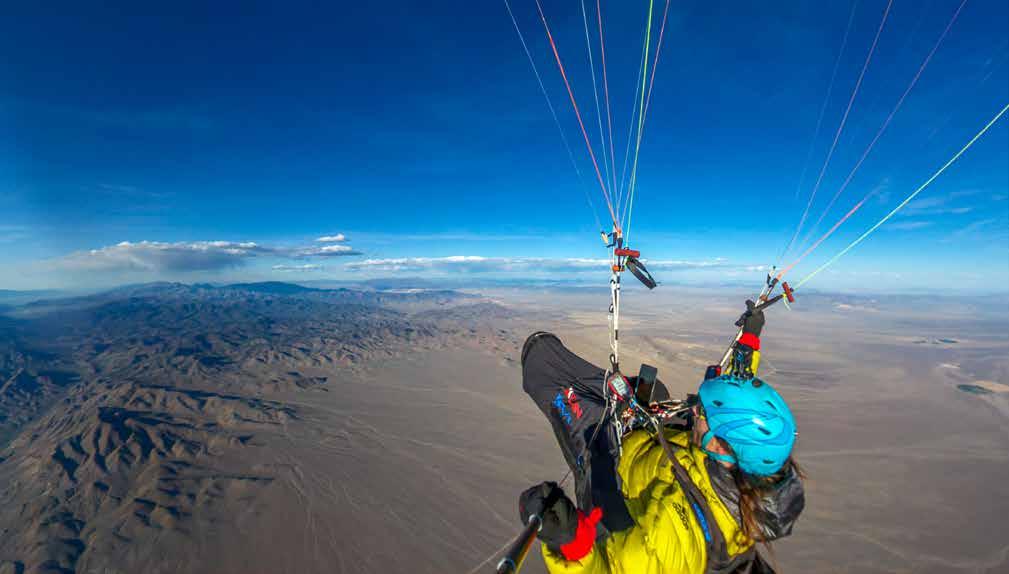
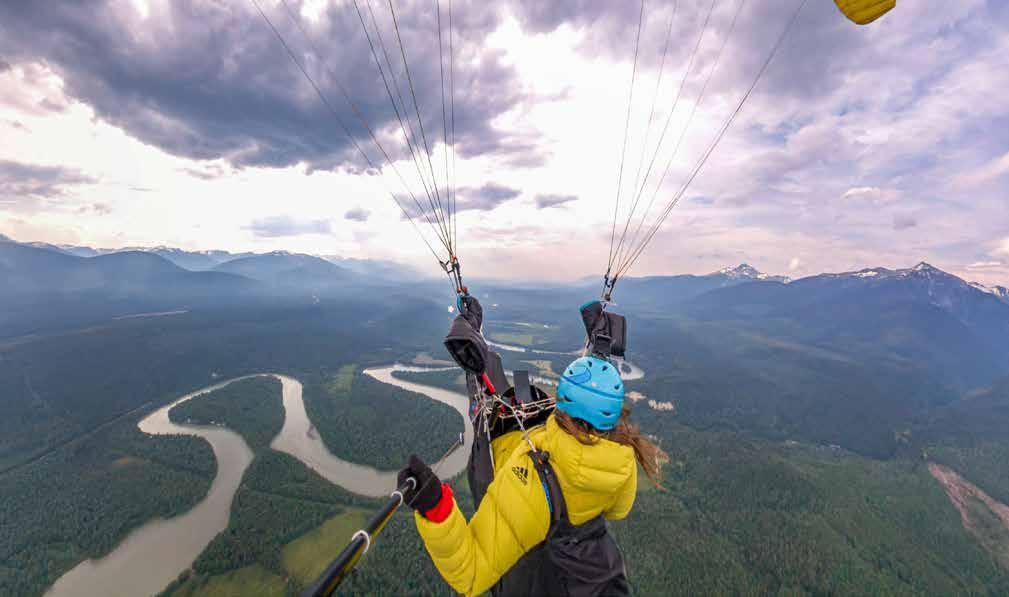
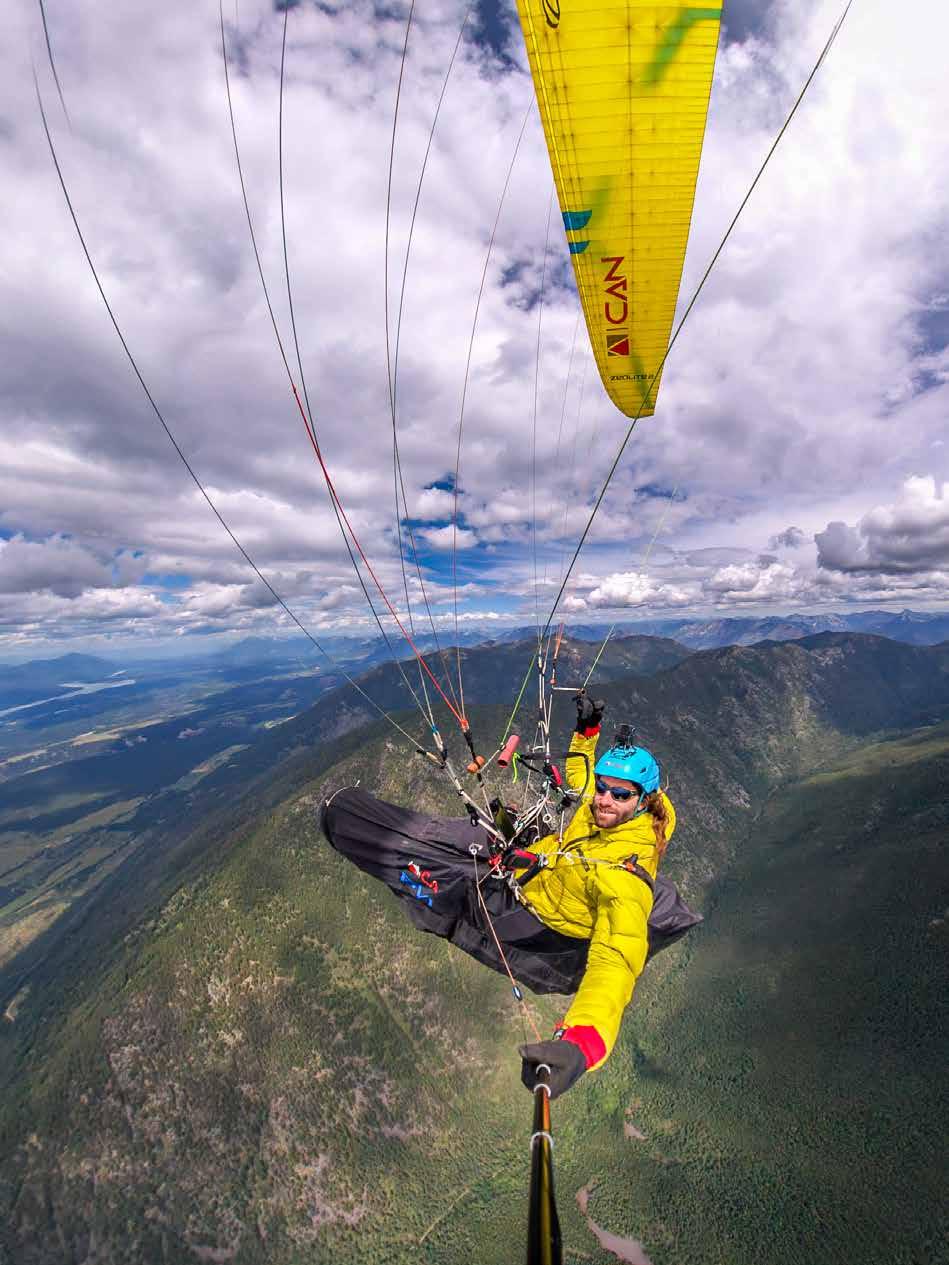
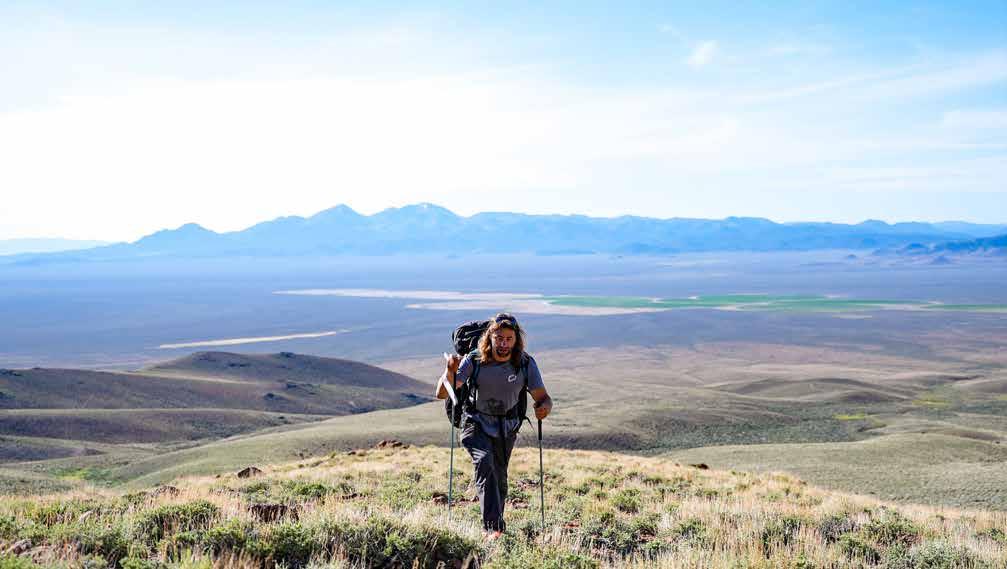
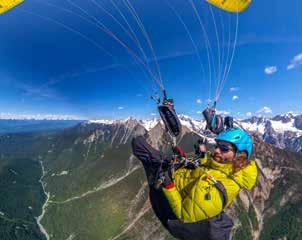
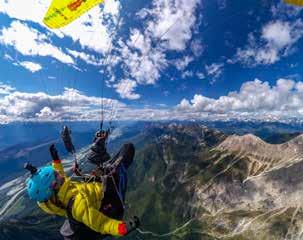
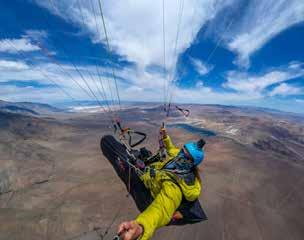
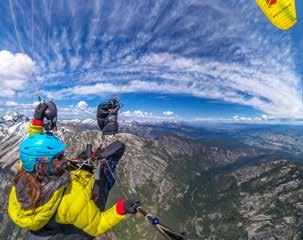
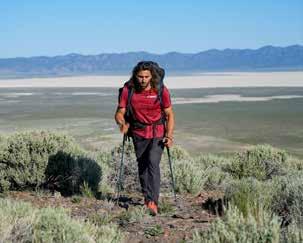
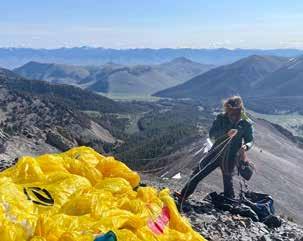
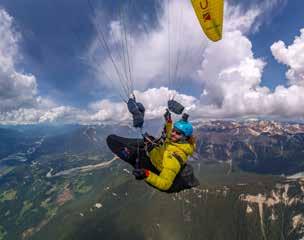
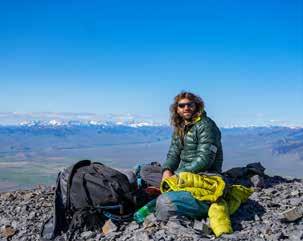
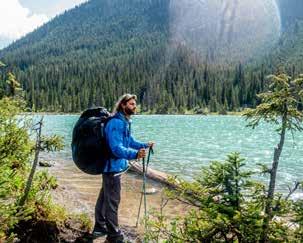
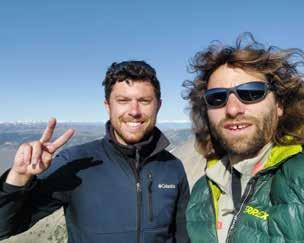
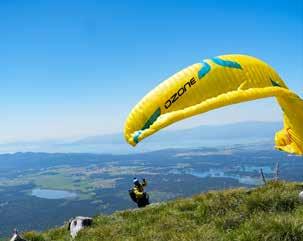
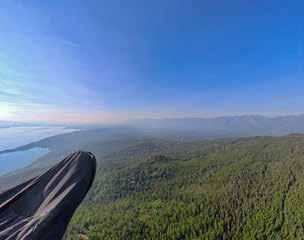
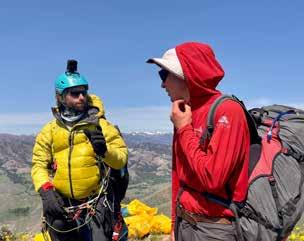
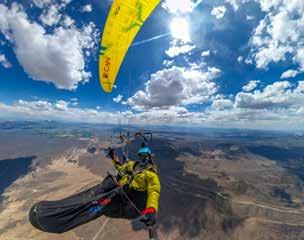
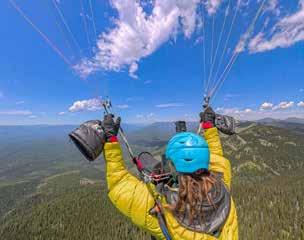
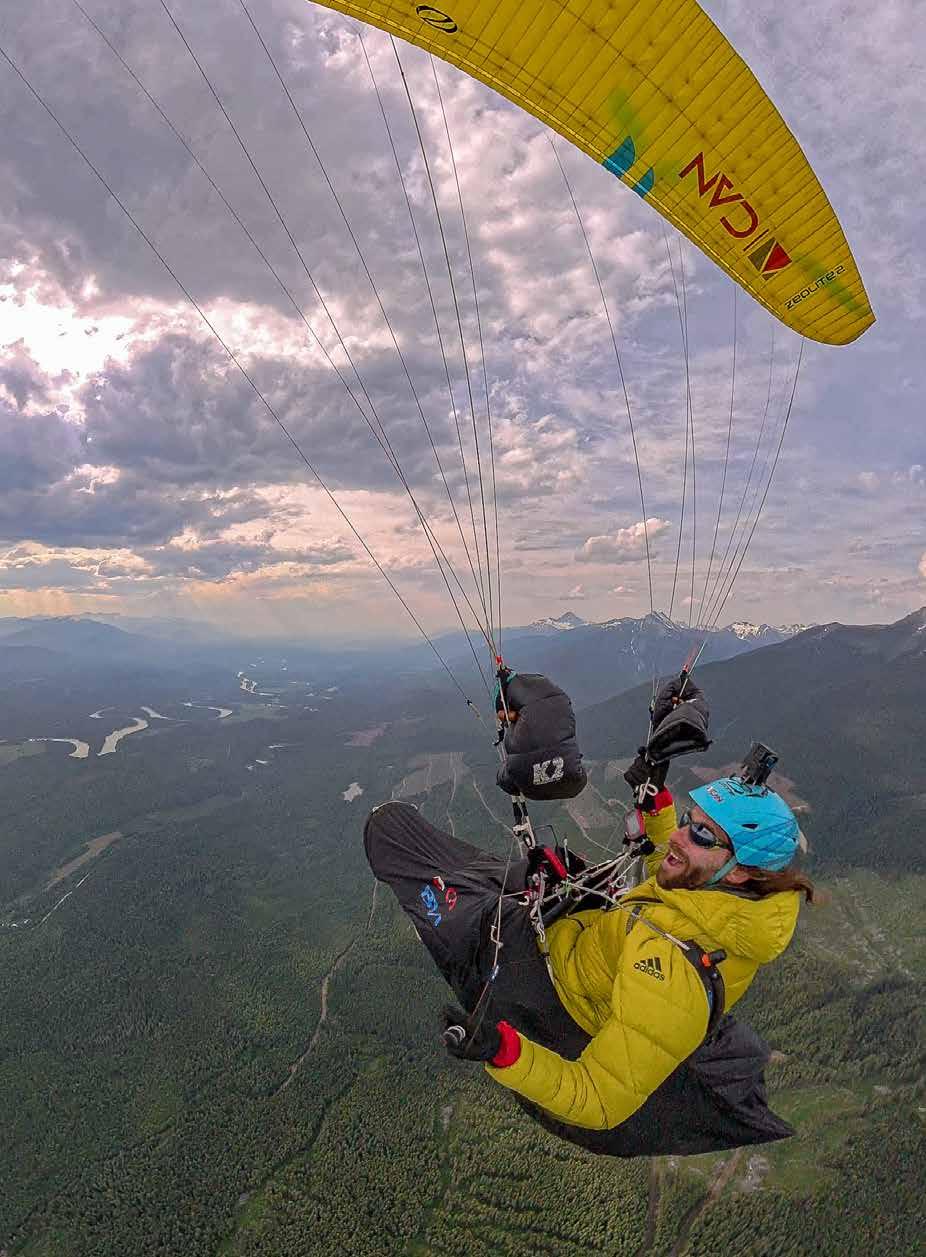
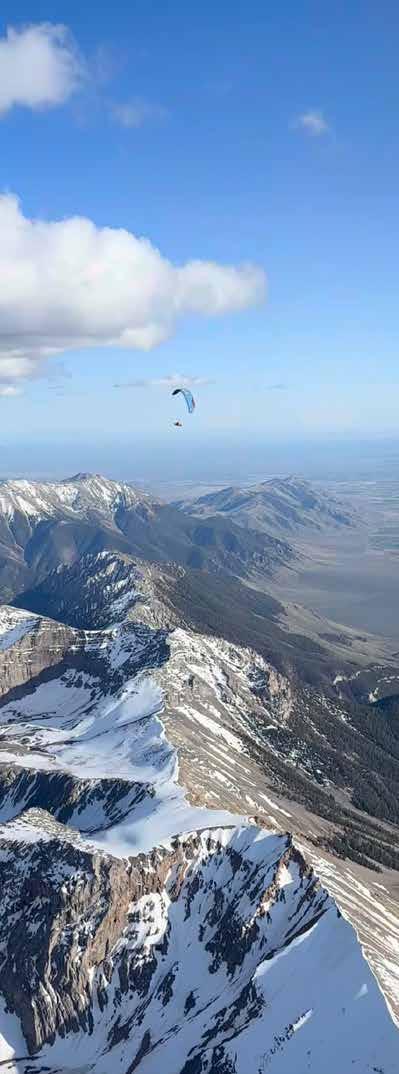
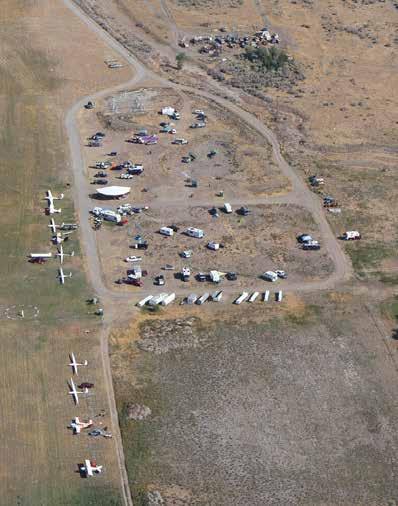
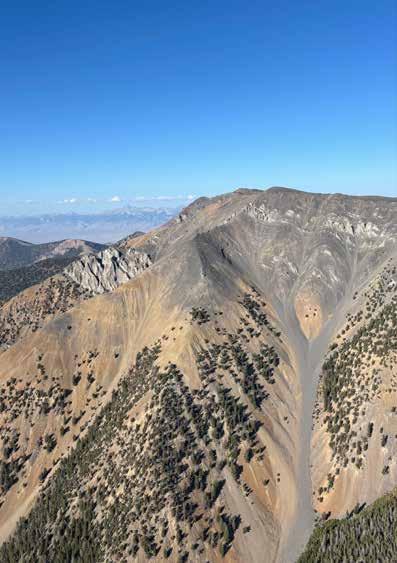
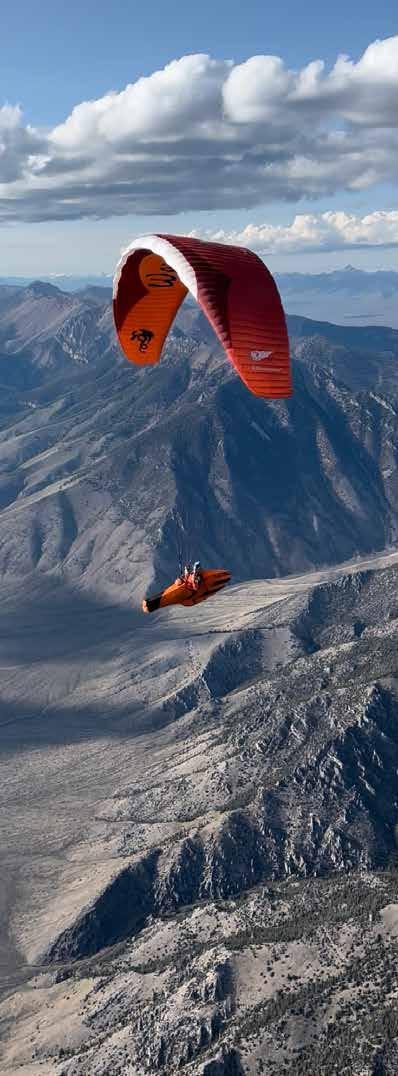
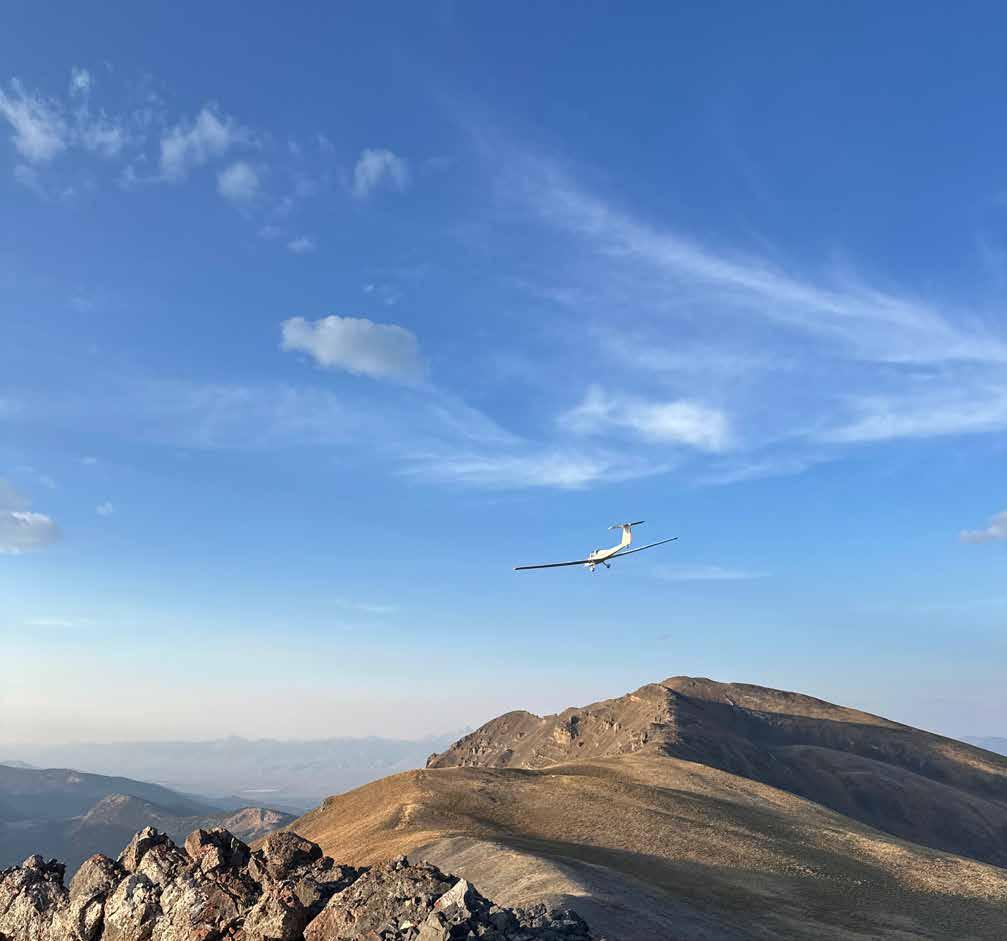
28 days from Dealth Valley to the Canadian Rockies
Behind the Scenes by Carl Weiseth
Fliming L'Experience Magnifique
Peter Song by Erika Klein
An American Sport World Champion
Finding the Wind by Tom Webster Turning cross-country guesswork into a safe landing strategy
Armchair SIV by Calef Letorney Cravats and Twists
Flying Together by Maddy Huggins
Hosting the first women's+ fly-in at Tiger Mountain
Minutes by Richard Dery
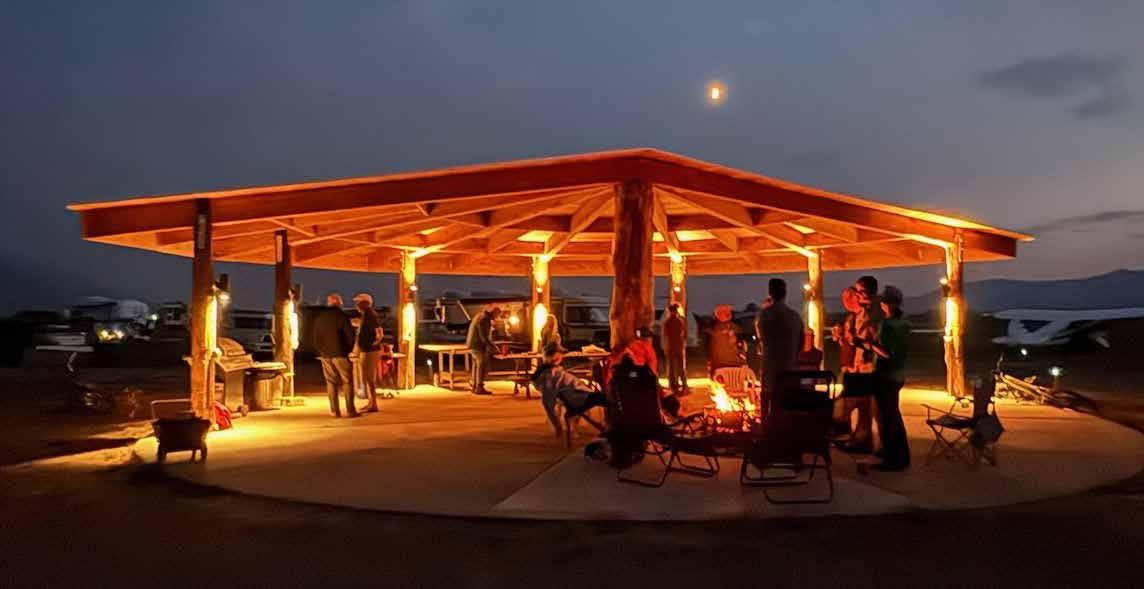
Insurance Failure by Kevin Brenden A pilot faces down trip insurance Calm Before the Storm by Honza Rejmanek A Safari in the Sky by Kubi & Luki Jacisin A fly-in at King Mountain Glider Park
HANG GLIDING, PARAGLIDING, AND SPEEDFLYING ARE DANGEROUS ACTIVITES
USHPA recommends new or advancing pilots complete a pilot training program under the direct supervision of a USHPA-certified instructor, using equipment suitable for their level of experience. Many of the articles and photographs in the magazine depict advanced maneuvers being performed by expert pilots. No maneuver should be attempted without appropriate and progressive instruction and experience.
TAKE OFF INTO ADVENTURE
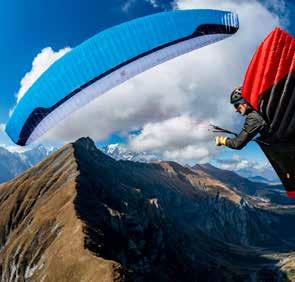
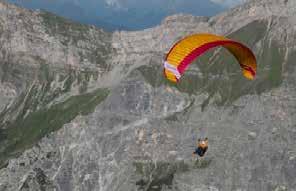
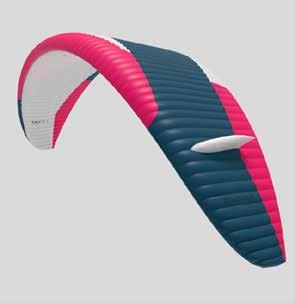
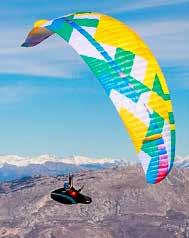
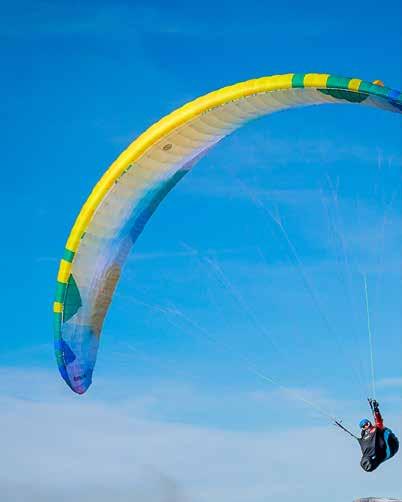
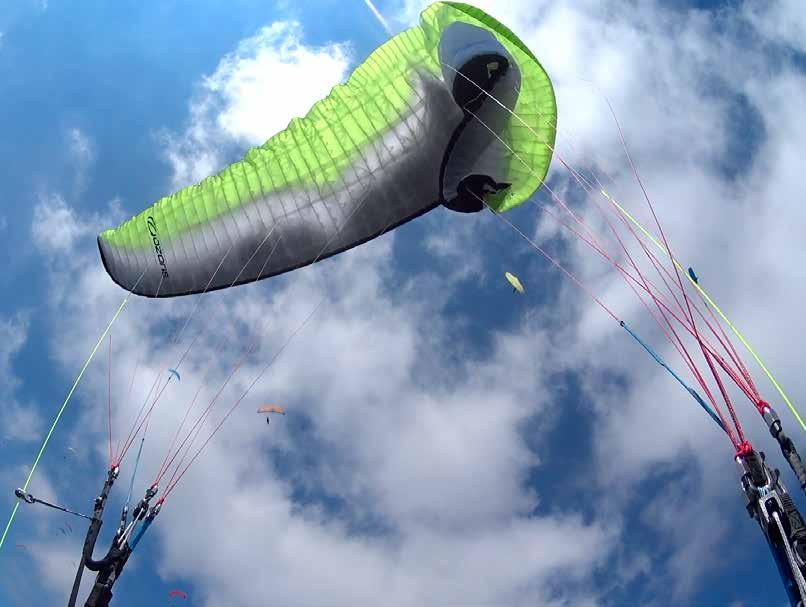
Designed for pilots who seek genuine cross-country adventures and the freedom of flying from mountain to mountain with only their paraglider and bivouac gear, the Bandit 2 combines a true ultra-lightweight concept with the performance cues of a higher-aspect wing. Whether you’re stepping into long-distance flying, chasing hike-and-fly adventures, or next mountain flying trip adventure, this is the wing for you.
5 Sizes | 55-120 kg | Ultralight - EN B 3.24kg (S size)
Photo: Jerome Maupoint
Do you have questions about USHPA policies or programs? Are there topics you’d like to hear more about?
EMAIL US AT: info@ushpa.org
Interested in taking a more active role supporting our national organization? USHPA needs your skills and interest.
VOLUNTEER AT: ushpa.org/volunteer
For other USHPA business +1 719-632-8300 info@ushpa.org
ASSOCIATION
James Bradley, Executive Director
: In April of 2009, I was was on launch at a storied coastal site near Plymouth, Massachusetts, looking down a steep dune. The wind was 25 mph and cross from the left, but coming off the chilly ocean, the air was surprisingly smooth.
My wing was a Gin Bobcat, a super-forgiving early speedwing, which came up like a rocket in the stiff breeze. Once it was overhead, I struggled to move forward. A friend pushed me, my feet left the ground, and he kept pushing until I was off the edge. I went left, into the wind, and slowly climbed to ridge height. When I turned downwind, the groundspeed took my breath away and I blew by launch with the world smeared sideways.
The Lesson
The United States Hang Gliding & Paragliding Association, Inc. (USHPA) is an air sports organization affiliated with the National Aeronautic Association (NAA). The NAA is the official representative of the Fédération Aeronautique Internationale (FAI), which is the world governing body for sport aviation. The NAA represents the United States at FAI meetings.
The NAA has delegated to USHPA the supervision of FAIrelated hang gliding and paragliding activities, such as record attempts and competition sanctions.
Happily, the situation was forgiving enough for my moderate skill level. I could always turn out to get clearance and the beach was wide enough to land on. When I’d lost half my altitude, I turned back into the wind, climbed slowly all the way back, and did it again. And again. So. Much. Fun. A thousand flights later, this is still an all-time memorable day.
So, I’m particularly sad to report that we lost access to this site, following a multi-year lawsuit by a neighboring homeowner. While many factors contributed, one was posts made on social media that damaged the club’s defense. I’m sure many of these weren’t meant literally, and they certainly weren’t intended to be seen outside the club, but they all came out in the discovery process.
This could happen to any of our sites. I sometimes see disparaging posts on social platforms, and I’m always scared by them. I know we, as a community, understand that each site is a privilege, where good relationships and high-quality communication are vital. But when there’s controversy, it's easy to lose sight of this and post in passion. When you’re around a conflict, please be mindful of the potential impact of heated social media posts. This includes group chats on Telegram and WhatsApp, person-to-person texts, online forums, and, of course, Facebook and Instagram. Forget endto-end encryption; expect that everything you write will be read in open court. Instead of posting, vent to a friend over the phone, punch a wall, or call me up. Just don’t type. Not about the chapter leaders, your fellow pilots, the landowner, or anyone else. It’s much easier to keep a site alive than to open a new one.
Got a gripe? I want to hear it. Book a Zoom with me at USHPA.org/ meetwithjames.
REGION 1 NORTHWEST
REGION 2 CENTRAL WEST Northern
REGION 3 SOUTHWEST
REGION 4 SOUTHEAST
REGION 5 NORTHEAST and INTERNATIONAL
Mission
To deliver programs and services that support all our members, foster a community of skilled and knowledgeable pilots, and promote and protect the freedom to fly.
Vision
A vibrant free flight community across the United States.
Core values & guiding principles
Adventure
Celebrate the spirit of discovery and the joy of being in the outdoors.
Learning
Support ongoing education, development of skills, and acquiring of the judgment that comes from experience and attention.
Preservation
Be stewards of our natural places, our flying sites, and the future of our sport.
Integrity
Act ethically, take 100% ownership, communicate clearly, respond effectively.
Respect
Foster a considerate community free from harassment and abuse.
James Bradley Executive Director james@ushpa.org
Charles Allen President president@ushpa.org
Kirby Ryan Vice President vicepresident@ushpa.org
Olga Grunskaya Secretary secretary@ushpa.org
Pam Kinnaird Treasurer treasurer@ushpa.org
Galen Anderson Operations Manager office@ushpa.org
Chris Webster Information Services Manager tech@ushpa.org
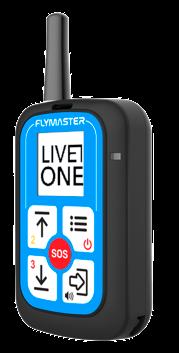
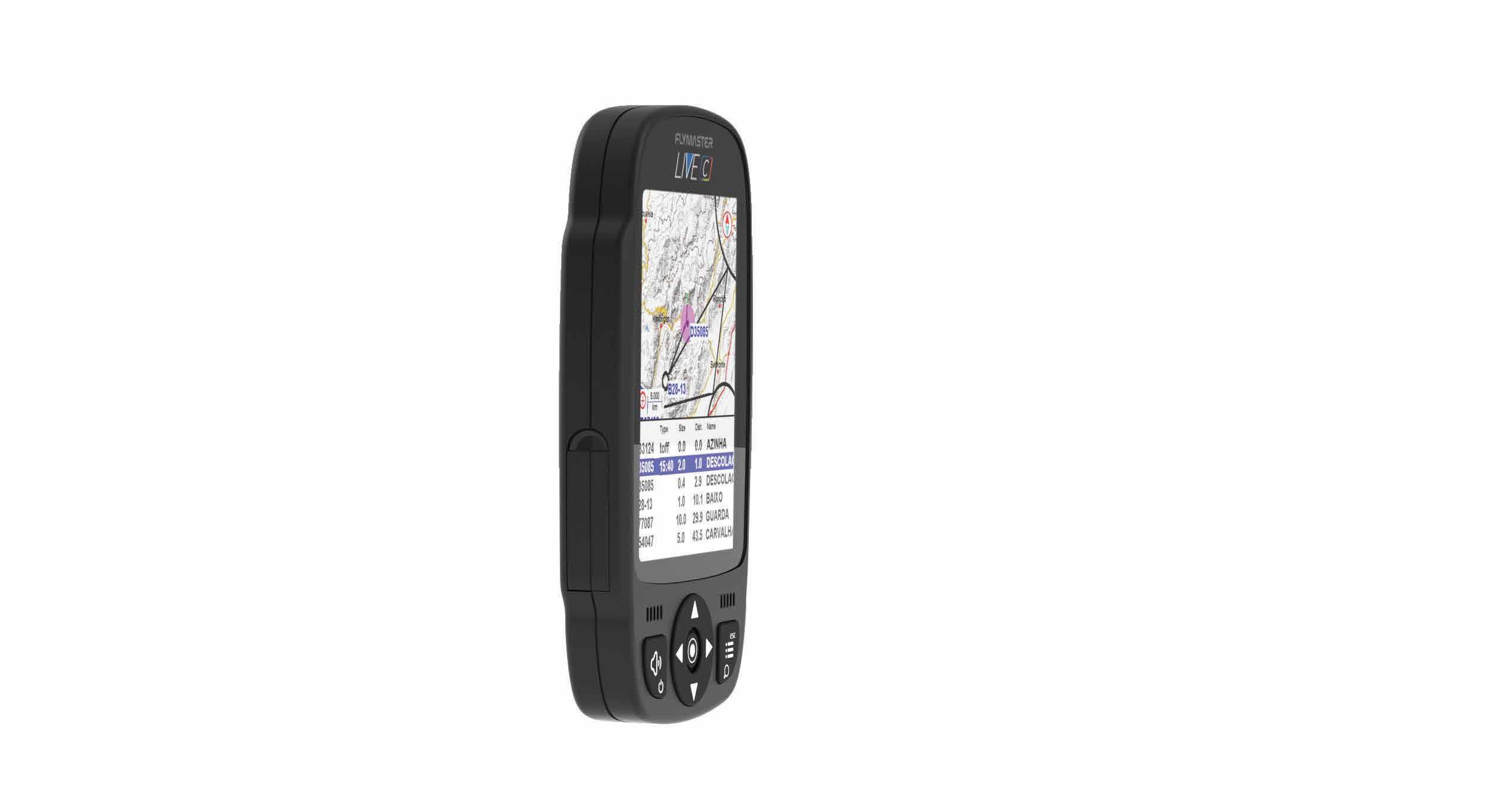
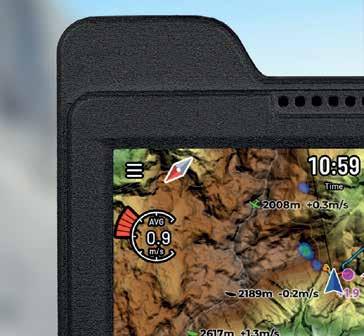
The Flymaster is proud to announce the availability of the Flymaster LIVE One, which offers an LCD screen, barometric sensor, GPS, speaker, GSM tracker, optional FLARM, and optional Bluetooth, all packaged into a 3oz device. Bluetooth connectivity allows this to couple to your smartphone in order to use your favorite phone app. Enhanced live tracking will connect with other Flymaster live tracking devices to create a mesh network. This is the ideal instrument for the minimalist pilot wanting advanced features without the real estate of a dedicated instrument. Prices start at $260. More details at www.flymasterusa.com
FLARE BANDIT
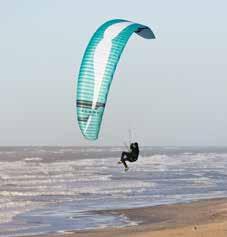
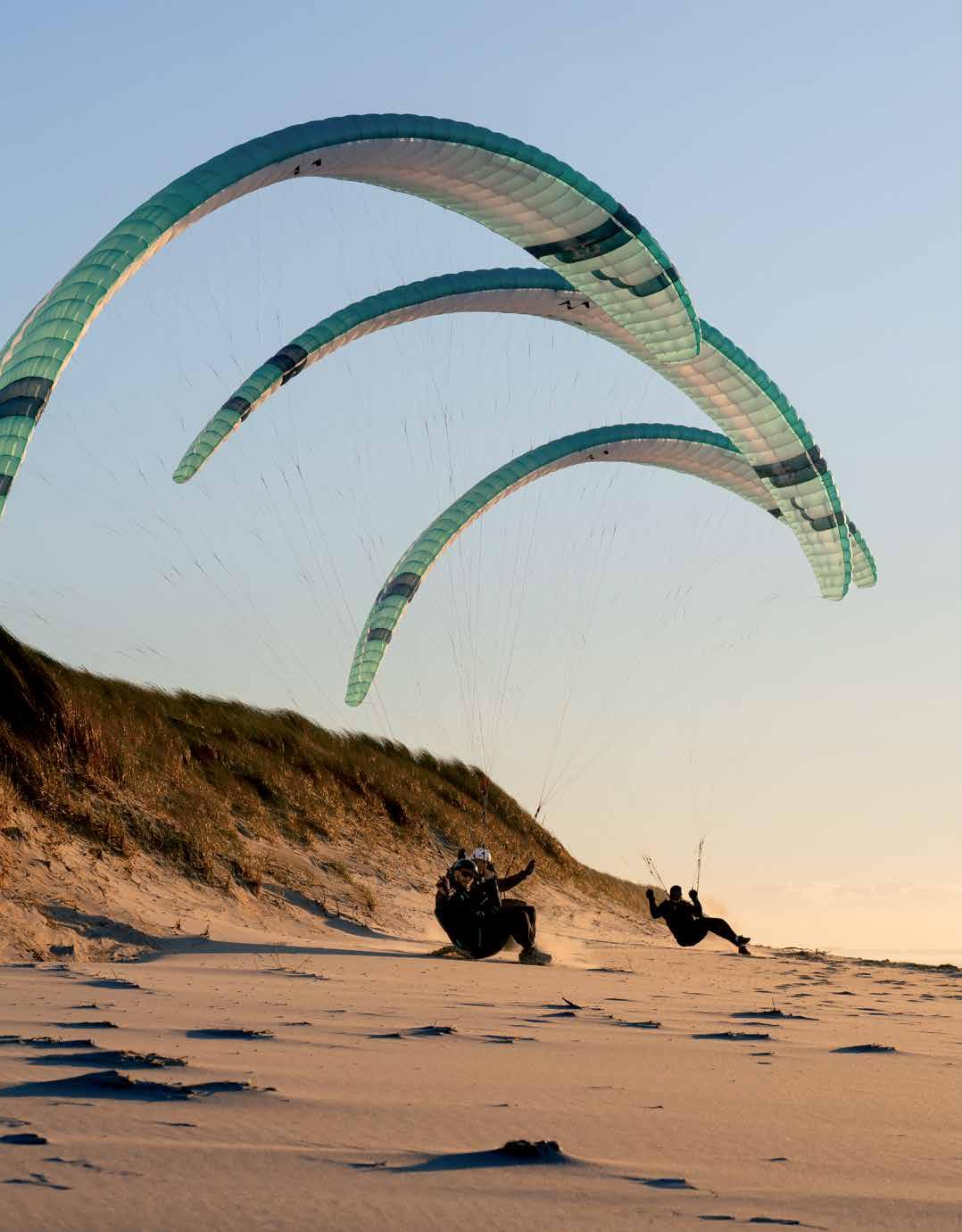
The BANDIT is a brand new high aspect ratio parakite with the DNA of the MOUSTACHE. It is super fast, rock solid, and extremely precise with an unmatched climb rate and dive. The performance of this wing overwhelmed even us! It is now possible to soar at the dune, fly to the water, and simply fly back to the dune. To learn more, order, or find a local dealer at www.go-flare.com
OZONE ALPINA 5
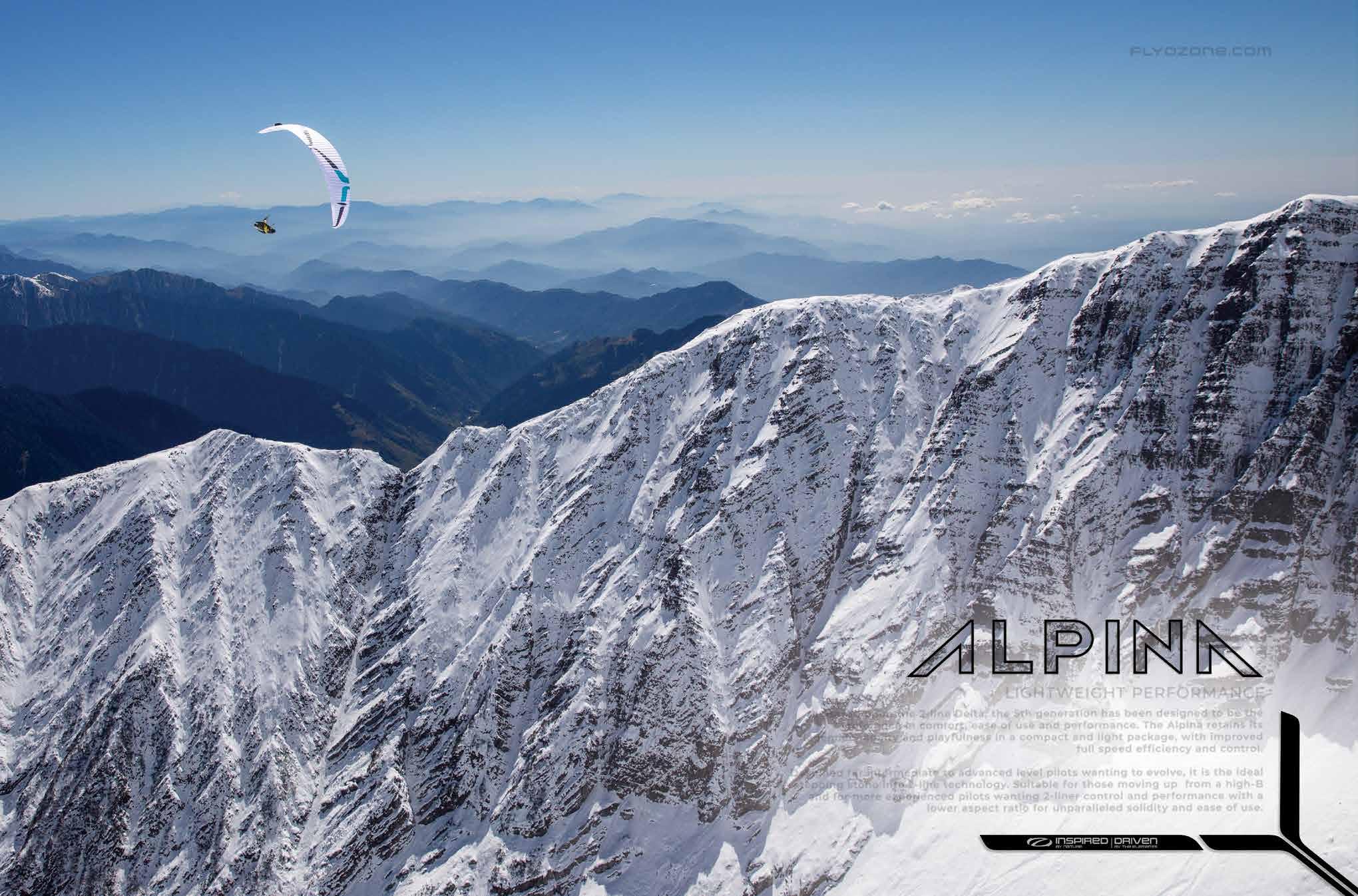
The long-awaited Alpina 5 was announced at the 2025 Coupe Icare. It is a light version of the 2-liner Delta 5. The Alpina 5 is an ideal first 2-liner wing for pilots ready to step up to the EN-C class. Intermediate to advanced pilots wanting to evolve their flying and enjoy the benefits and comfort of flying a 2-liner will find the Alpina 5 to be an excellent step given that it is Ozone’s lowest aspect ratio 2-liner. With True Performance, it delivers general ease of use and great comfort for the category in all conditions. The Alpina 4 GT remains available for pilots who prefer not to fly a two-line design, but want to remain in the EN-C class. www.flyozone.com
FLARE PROXY
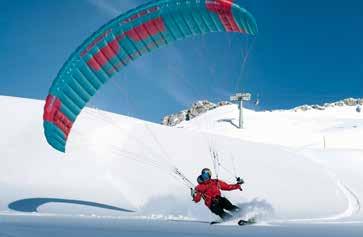
The PROXY harness is a specially designed loop strap harness for playful flying with parakites in the areas of soaring, speedflying, and snowkiting. It is comfortable and robust. Additionally, it is equipped with a sandwich foam protector. To learn more, order, or find a local dealer at www.go-flare.com
FLARE LINE
In the world of speedflying, the LINE redefines contour flying, making it effortlessly intuitive to navigate close to the ground and adapt to diverse terrain transitions. With its expanded speed and wind range, the LINE merges the agility of a speedwing with the glide efficiency of a paraglider, allowing for unprecedented control and versatility in various wind conditions. Precision is at the heart of the LINE experience, enhancing both flight and landing accuracy. This precise control is especially crucial in speedflying, where navigating close to the terrain demands exceptional responsiveness and safety. To learn more, order, or find a local dealer at www.go-flare.com
OZONE WISP 2 Ozone has launched it's new ultra-lightweight tandem. The Wisp 2 is the second generation in the series, delivering the lightest double-surface tandem in existence. Designed for alpine adventures and travel, this all-new wing is incredibly easy to use, which suits it perfectly to unimproved launches and tricky conditions—think hike-and-fly in remote locations, top-landing difficult terrain, or just checking out a new launch site in the hills behind your home. With True Performance in line with our intermediate category wings, the Wisp 2’s XC potential is more than enough to get the pilot and passenger to distances never before seen by ultralight tandems. www.flyozone.com
GIN BANDIT 2
Gin has launched the new EN-B Bandit 2, aimed at pilots seeking genuine cross-country adventures and vol-biv flying from mountain to mountain. With an aspect ratio of 5.5, it sits within the mid EN-B range and features a traditional 3-liner layout with rear-riser control when flying on speedbar. Its take-off behaviour resembles that of a mountain wing, with strong pitch stability and a tendency to seek lifting air masses. Refined and balanced in the air, the Bandit 2 offers stability, thermal sensitivity, and precise brake authority, making it a versatile all-rounder for a wide range of flying conditions. The Bandit 2 is available through Super Fly, Inc., www.superflyinc.com, +1 (801) 255-9595, or your local dealer.
NOVA AONIC 2
The new AONIC 2 is the most technically advanced high-A glider in its class—setting new standards. With 51 cells, a refined line setup, optimized curvature, and high-end materials, it unites what was previously seen as opposites: Maximum safety, genuine thermal performance, and a flying experience that is both precise and relaxed. The AONIC 2 paraglider is available through Super Fly, Inc. with your choice of bags www.superflyinc.com, +1 (801) 255-9595, or your local dealer.
ADVANCE TAU The TAU is a new EN-C 2-liner, which is a completely new glider in the range of Advance products. It’s positioned perfectly between the SIGMA and the OMEGA. With an aspect ratio of 6.5, 73 cells, and the latest DLS (Durable Lightweight) technology, the TAU delivers top-level XC performance, paired with exceptionally pleasant and sporty handling. The TAU will be available in the 2026 XC season through Super Fly, Inc., www.superflyinc.com, +1 (801) 255-9595, or your local dealer.
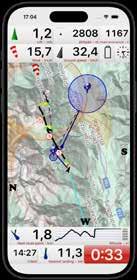
FLYSKYHY Turn your iPhone or iPad into a fully featured quality variometer for a fraction of the cost of a comparable hardware vario device. The base version is easy to use, and already presents all the data you need on the dashboard, including a map, altitude, lift, groundspeed, wind strength and direction, and more. Progressive vario tones indicating lift and sink let you exploit thermals intuitively. The detailed zoomable map shows everything you need to know around you, from nearby known landing spots to airspaces to avoid, and the location and info of nearby pilots. The app is highly configurable, allowing you to arrange the various instruments across multiple pages of your dashboard with complete freedom. It keeps an easy-to-organize logbook of all your flights, with overall statistics, and extensive details per flight. Join the 80,000 pilots already using Flyskyhy and find out more about the app and the available extensions on www.flyskyhy.com
BGD BREEZE Lightweight sports-intermediate high-B paraglider, the BREEZE is the light version of the BASE 3, offering fun, dynamic handling with great feedback and super climb ability in thermals. The BREEZE will make you feel good in the air, ready to tackle your most ambitious objectives. It’s a natural step up from a low-B like the ECHO 2-you’ll notice the performance gains, but won’t be overwhelmed with extra workload. The BREEZE is the perfect partner for vol-biv: light to carry with the performance to fly far, yet safe and easy to fly. The light sail rises easily to launch, and its super-safe stall behavior makes it perfect for top-landing in the mountains. Contact Dale at BGD-USA: +1 (801) 699-1462, bigskypara@gmail.com
BGD WRAP The WRAP all-in-one reversible harness features lightweight thread-through camp leg-strap buckles, a polypro seat plate that is weight-shift friendly without being ‘wobbly’, a certified airbag protector with Nitinol edging that pre-inflates, providing 60% of full protection prior to launch, plenty of accessible pockets, and a drinks-pouch system with tube routings. The Rucksack features a sleek shape that keeps the load close to your body, padded, breathable back, shoulder, and hip straps, and a removable hip belt. You can easily fit a lightweight wing such as the ECHO 2, BREEZE, or LYNX 2 inside, along with your helmet, instruments, and spare clothing. New this year, the harness has a foldaway external helmet holder and an elastic cord to carry additional clothing or gear. The WRAP is available in four sizes, with a volume of 80-102 liters. Contact Dale at BGD-USA: +1 (801) 699-1462, bigskypara@gmail.com
BGD SCOUT The SCOUT is a new lightweight rucksack that makes hike-and-fly missions a breeze. With features like long zips to fully open the front for easy loading of your kit, padded back and hip belt, large stretchy side pockets, stretchy drinks-flask holders on the shoulder straps, pole attachment system, compression straps, and secure top pocket for valuables, this 700g, 42L pack will be your favorite rucksack for everyday and hike-and-fly. Contact Dale at BGD-USA: +1 (801) 699-1462, bigskypara@gmail.com
: As sometimes happens, the particulars of this issue have rekindled behind-the-scenes discussions about how we can better reflect the voices and experiences of our members, readers, and contributors on the pages of the magazine. How can we better represent the community? What do you want to see in this publication?
I've said it before, but it remains true: USHPA Pilot is your magazine. We are the (mostly) humble creatives who work to compile your perspectives into a cohesive publication. As we work towards this goal, we'd love to hear from you: Story ideas, layout and design suggestions, letters to the editor, or questions for our wonderful contributors are all welcome. Please email me at editor@ushpa.org to connect about the future of this magazine.
The trends I've noticed as of late have been refreshing, and I'm excited about the content we have to look forward to in 2026. In this issue, we have a beautiful mix of stories featuring all three disciplines of free flight: paragliding, hang gliding, and speedflying. I love to see all three wing types represented in the publication, and I hope we can continue on this path. In the last year or two,
EDITOR Liz Dengler
we've had an influx of writing interest from hang glider pilots, and I'm so glad to see these wings gracing our pages more frequently. Please keep it up! Now, we need that same interest from the speedflying community. Please share your stories!
We have also been receiving more technical content, something many of you have asked for. In this issue, we have a piece on finding the wind direction when there are no indicators, and another on how to handle cravats and twists in a paraglider. These are just the latest in a string of great technical articles.
Competition and fly-in reports remain at the heart of our publication. These events bring our community together, and we should celebrate everyone who endeavors to put them on by sharing their stories. And, of course, trip reports, personal anecdotes, and travel experiences are always welcome and add tremendous depth to the publication. We love hearing about your adventures in free flight.
As always, if you have any questions about how to submit or want to pitch a story, please reach out. We're always excited to work with new contributors!
POSTMASTER USHPA Pilot ISSN 2689-6052 (USPS 17970) is published quarterly by the United States Hang Gliding and Paragliding Association, Inc., USHPA, 201 E Pikes Peak Ave, Suite 1330, Colorado Springs, CO 80903, Phone: 719-632-8300 Fax: 719-6326417 Periodicals Postage Paid in Colorado Springs and additional mailing offices. Send change of address to: USHPA, PO Box 1330, Colorado Springs, CO, 80901-1330. Canadian Return Address: DP Global Mail, 4960-2 Walker Road, Windsor, ON N9A 6J3.
Liz Dengler Managing Editor editor@ushpa.org
Julia Knowles
Copy Editor
Greg Gillam
Art Director
WRITERS
Carl Weiseth
Lisa Verzella
Erika Klein
Calef Letorney
Do you have a story idea you would like to pitch? We are always looking for stories.
EMAIL LIZ AT: editor@ushpa.org
Are you ready to contribute a complete story? We are always looking for articles, photography and news.
GET STARTED AT: ushpa.org/contributors
All articles, artwork, photographs as well as ideas for articles, artwork and photographs are submitted pursuant to and are subject to the USHPA Contributor's Agreement , which can be reviewed on the USHPA website or obtained by emailing Liz.
Would you like to run an advertisement ? Great!
CONTACT US AT: advertising@ushpa.org
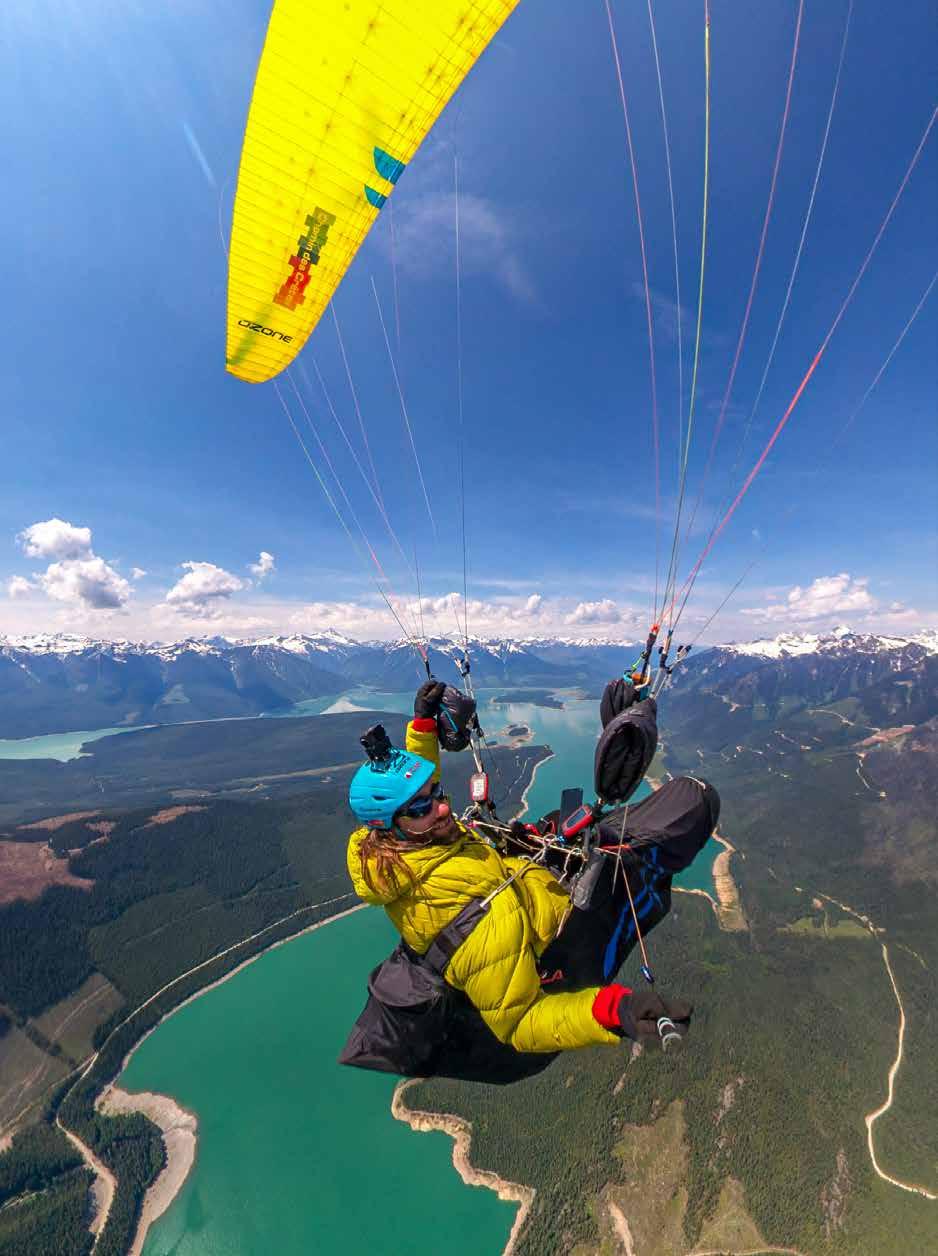
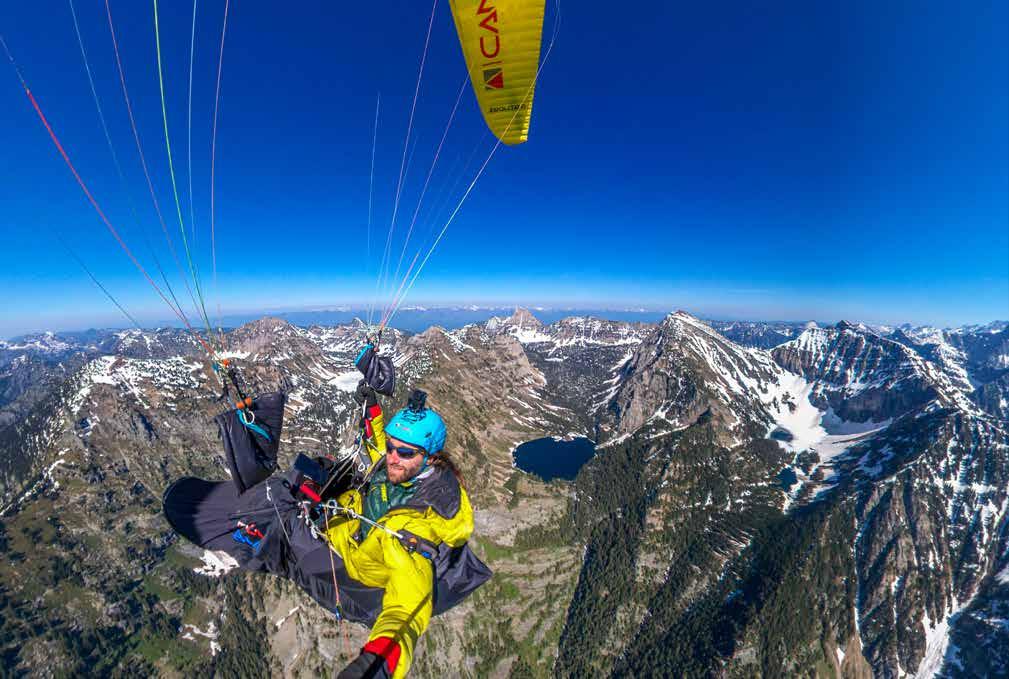
Enjoying a glide over Kinbasket Lake, Canada.
Crossing the U.S. and Canada
by Antoine Girard | Photos by Antoine Girard & Rodolphe Fablet
From the desert of Death Valley to the snowy peaks and cool air of Canada—an epic 3,000 km vol-bivouac journey through breathtaking landscapes over 28 days.
: It's difficult to find a new, large-scale, untouched line that excites me as much as this project. For the spring of 2025, I decided to pursue a long, original route. The landscapes of the U.S. and Canada had long been on my mind; it was time to explore these postcard sceneries. The line I planned to take would be less wild and remote than my past expeditions, but no less inspiring.
I faced two major challenges in mapping a nearly 3,000 km continuous line from south to north through the U.S. and Canada: the mountains needed
to connect and the weather needed to be acceptable both at the beginning and end of the journey. In the U.S., another constraint arose: the prevailing west winds. Any line trending east-to-west was best avoided.
Two possible routes presented themselves, both sharing a northern section in the Rockies from Idaho to mid-Canada. From southern Idaho, one option tracked southwest toward Los Angeles while the other turned southeast toward Albuquerque. The Albuquerque line had already been flown bivouac-style (Nelson
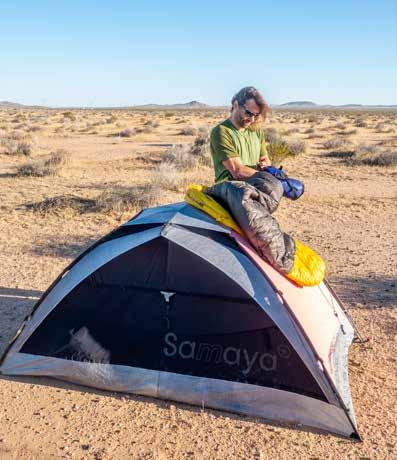
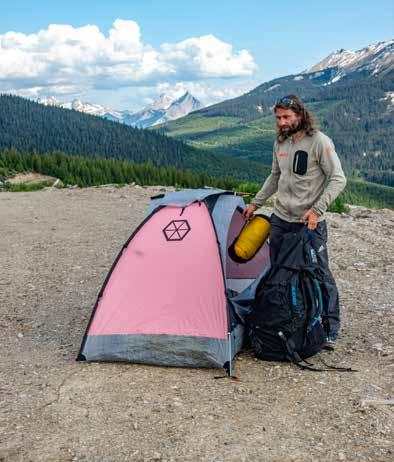
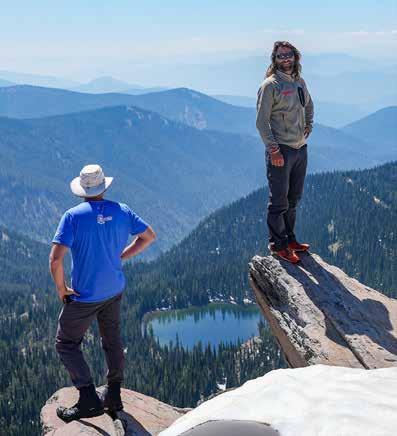
Setting camp from the desert near Owen's Valley to just north of Golden, Canada. Photos by Rodolphe Fablet
Defreyman & Thomas Punty, 2014; Benjamin Jordan, 2020). I opted for Los Angeles, which would require crossing the Nevada desert—a feat never before done via vol-bivouac, which added motivation.
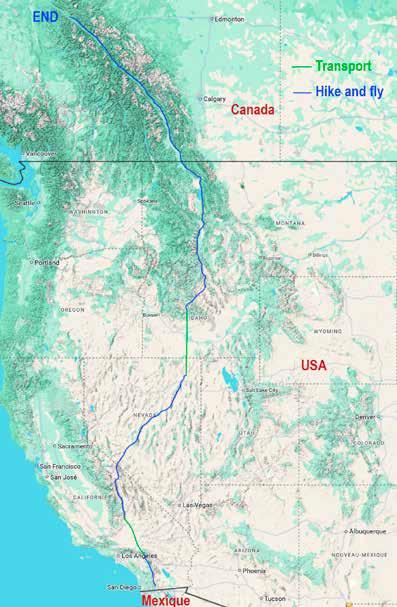
Because the Rockies lie east of Los Angeles, I had no choice but to fly south-to-north to avoid the strong west winds I would face if I flew south. I would start from the Mexican border and finish near Prince George, Canada—a 2,940 km line. I planned to travel with ground support from Rodol-
phe Fablet, who came with me from France. Though he drove me through a few sections that had to be bypassed, his main goal for the trip was to film the adventure from start to finish.
The South
I knew the first 300 km in the south would be tough. Potential for strong winds in desert conditions had me concerned it wouldn’t be gratifying, either. I would only attempt to fly if the weather allowed.
Above the Nevada desert on the first day of the Owens leg.
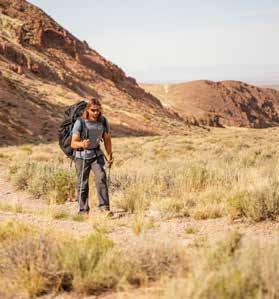
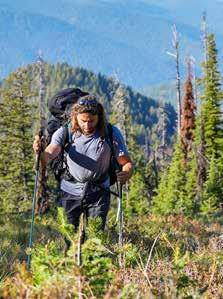
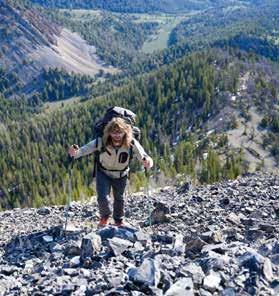
Hiking through Nevada and Canada trying to find decent launches. Photos by Rodolphe Fablet
Upon arrival in California, strong winds made the Owens Valley to the north unflyable, but conditions in the south were flyable, if mediocre. I decided to give it a try while waiting for the Owens to improve.
On May 21, I launched near the Mexican border. Over the first two days, I managed to traverse 150 km of the terrain in strong winds. There was no relief from the wind, and I often ended up landing backwards while watching out for cactus. Snakes were everywhere, launch sites and LZs were rare, and my stress was constant. After some unrewarding sections, I skipped the final 80 km of unwalkable desert asphalt and advanced by car for about 150 km to the Owens Valley.
From there, a mix of headwinds, high cloudbases, turbulent air, and stunning desert-to-snow scenery carried me north. On one exceptional day, I flew 298 km across Nevada, reaching nearly 18,000 feet (over 5,000 meters) in 8 m/s thermals, climbing into air with temperatures below freezing. Rattlesnakes, scarce takeoffs, and constant wind defined this desert stage. After 800 km beyond the Owens, the northern section of Nevada proved too difficult to navigate with low cloudbases and strong winds: it was 130 km of unsoarable desert. I skipped ahead by car to Idaho, certain that the line would continue entirely by air from there.
Northern U.S.
After 12 days in the desert, I was happy to see greenery again in Idaho. Flying here was easier, though still plagued by northwest winds. The terrain and civilization resembled the Alps, but of course, with the ever-present rattlesnakes. Surprisingly to me, thermals were often better in the flatlands than in the mountains.
Rodolphe followed in a car, filming and resupplying me along the way. Ethical questions arose for me as I traversed this segment, and I found I needed to set rules for myself. I would walk between flights but I decided that I could accept short car skips under 8 to 10 km, but only if time pressure made walking unsafe. It preserved my motivation and my knees. Montana brought endless forests and bears. Launch sites and LZs became scarce due to the dense trees, requiring careful scouting. My first bear encounter
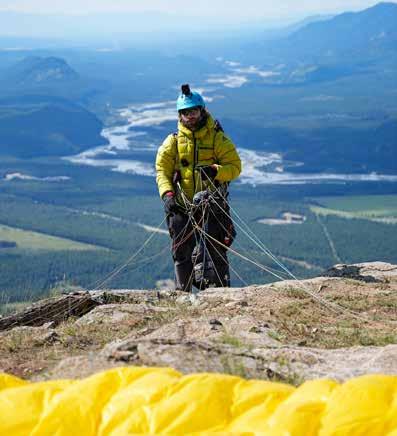
TOP The full route broken into hike-and-fly segments (blue) and sections where Antonie accepted a ride from Rodolphe (green). BOTTOM Antoine on launch in Sun Valley. Photos by Rodolphe Fablet
went well as it fled when I inflated my wing. I still bought bear spray the next day, just in case.
Beyond Missoula, the weather slowed me down. Clouds killed thermals, forcing me to take my first rest day after 18 straight days of travel. It was a much-needed break after being worn down by my heavy gear and steep climbs. After the rest day, I man-
aged 100+ km flights with local pilot Joshua Phillips despite weak conditions. Further north, rare landings and dense forest forced me to land in risky clearings. Property restrictions made bivouac difficult and sometimes impossible. Nights high in the mountains became the only peaceful solution.
Near Whitefish, private landowners expelled me
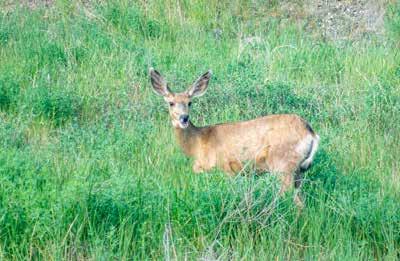
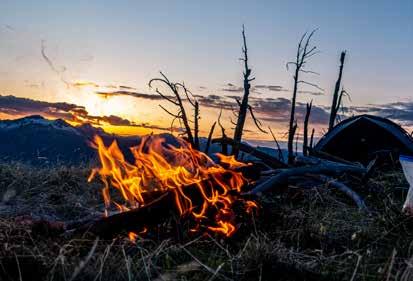
LEFT There was so much wildlife on this adventure. RIGHT A fire to warm up during a bivouac on Rocky Knob.
Photos by Antoine Girard
Flying over Flathead Lake in Montana and feeling grateful for some gorgeous flying.
from their land, and security blocked ski-area launches. When initially planning this section, I had received mixed information regarding launching from the ski area. One pilot told me you could take off, but to be very discreet; it was just landing that was prohibited.
A second pilot told me that takeoff is normally prohibited, but that you have to ask because they might allow it. I decided to ask security at the summit. They initially said yes because they didn’t see the problem, but then changed their minds after asking their boss. Apparently, they were afraid I’d end up in a cable car.
After 22 days traversing the U.S. by flight and foot (and the occasional car ride), I reached the Canadian border.
Canada
On the other side of the border, the atmosphere was instantly more welcoming. Forests were denser and valleys clearer, but bears were more numerous and the thermals were weaker. Long summer daylight (5 a.m. to 11 p.m.) contrasted starkly with my previous equatorial expeditions. After a much-needed rest day, I resumed my trek. Now with tailwinds, I flew 130 km, and then 150 km to Golden, where I restocked and met local pilots.
Beyond Golden lay the expedition’s wildest section: the 180-km Kinbasket Lake, flanked by dense forests, no roads, abundant grizzlies, and no launches below 7,200 feet (2,200 meters). A single climb on
A prime view during the final glide of the whole trip, in Canada.
LEFT Antoine with Joshua at the Point Six launch, Montana. RIGHT Ready to launch from Canal Flats, Canada. Photos by Rodolphe Fablet
Enjoying the last day flying in Canada.
foot could entail 4,260 feet (1,300 meters) of elevation gain through deadfall and swarms of mosquitoes.
Only two paragliding teams had crossed this section bivouac-style before. My own flight—170 km in 6.5 hours—took me nearly to the end of this remote section, where I bivouacked safely high above the bears.
The next day, strong but manageable winds carried me another 150 km to my final destination sooner than expected. Based on advice from Gavin Mclurg, I stopped before Prince George, avoiding inaccessible stretches heavily populated by bears.
Recap
In total, my trip involved 28 days, only two rest days, 2,400 km flown, and about 500 km skipped by car. Generous thermals, persistent northwest winds, rare birds, and spectacular scenery defined the journey. The highlight of the trip was the raw beauty of the Canadian Rockies—it was truly inspiring.
A huge thanks to my partners—Rodolphe Fablet, Bill Belcourt, Gavin McClurg, Joshua Phillips, and other local pilots—for making this adventure possible.
Hiking to a hopeful launch near Wells, Nevada.
Photo by Rodolphe Fablet
Behind the Scenes
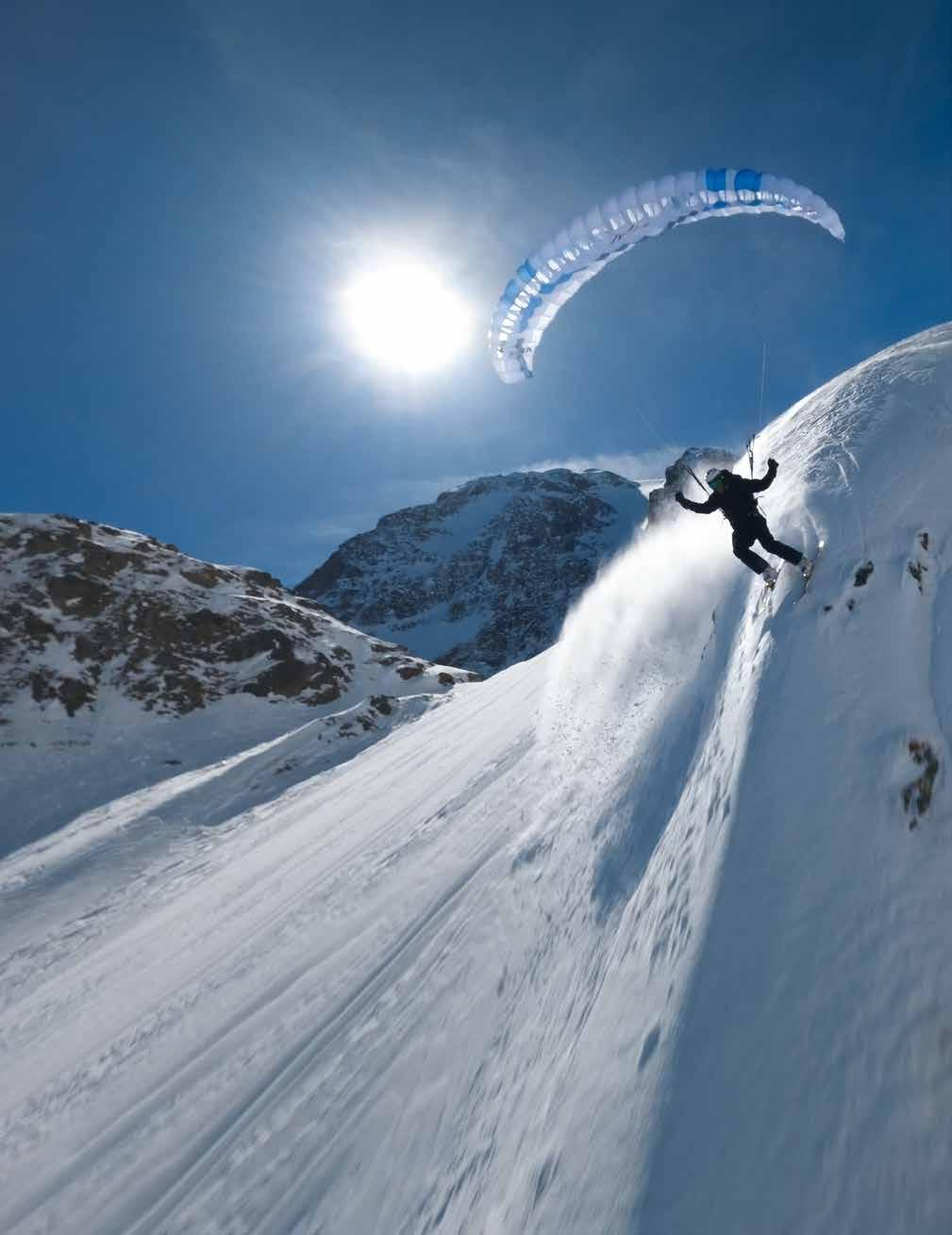
: Speedriding has been my greatest passion for the past 10+ years. I can remember the exact moment— on an airplane to New Zealand—when I first saw video clips of this unique flying discipline and felt my internal compass reorient. I couldn’t imagine a greater form of adventure. To explore untouched mountainsides with a tiny glider and a pair of skis: This was true freedom.
Since then, I’ve devoted myself to big mountain flying, spending each winter in France alongside my business and adventure partner Jeff Katz and, more
by Carl Weiseth / photos by Ian Rinefort
recently, with top drone pilot Ian Rinefort and fellow speedride enthusiast Chris Moody. We’ve pushed our limits together, launched Speedfly.com to share the sport with others, and have recently begun documenting our otherworldly experiences in the southeastern French Alps.
“After several seasons of creating short-form promotional content with Jeff and Carl, it felt like it was time to expand our vision,” said Rinefort. “The experiences these guys were having were incredibly unique, but also incredibly difficult to capture on anything other
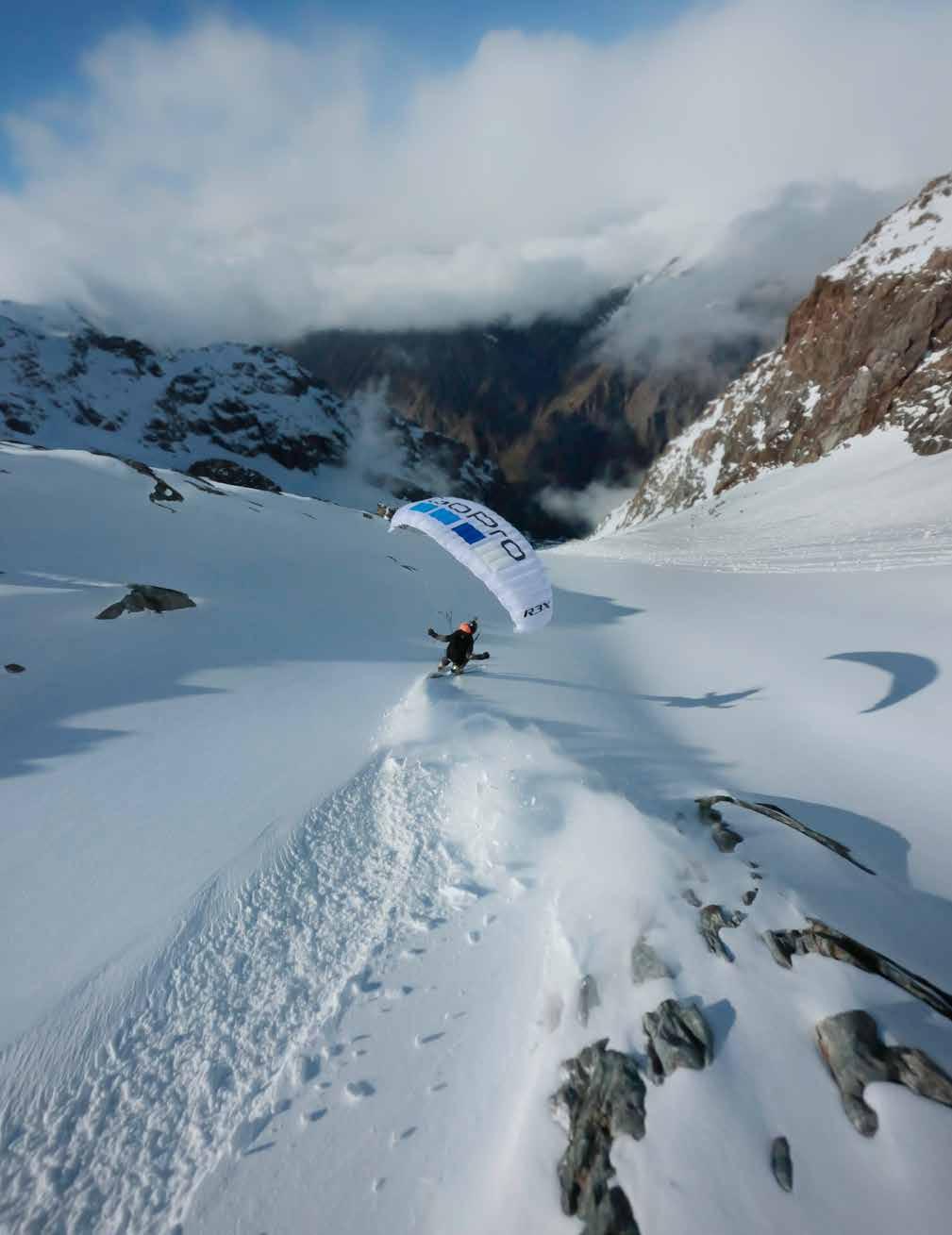
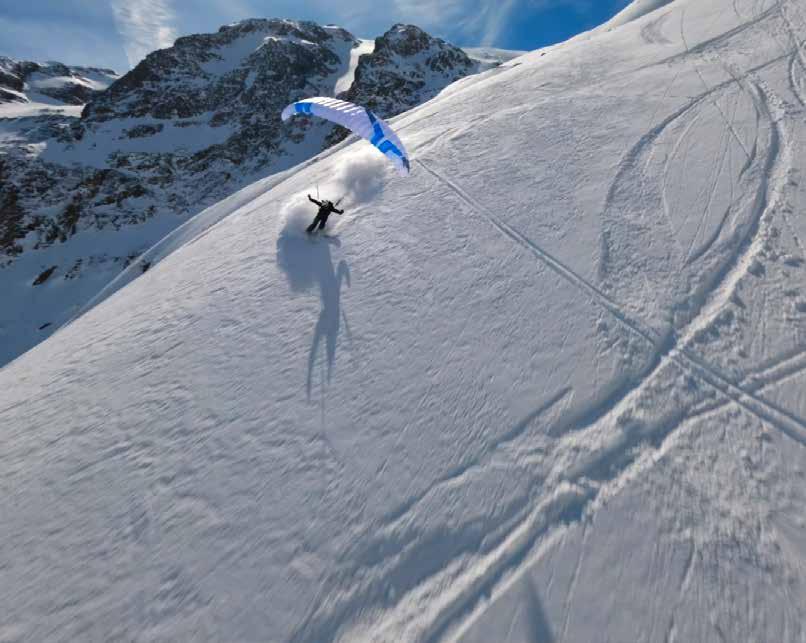
Speedrider Chris Moody drops over the point-of-no-return into the backcountry on a beautiful bluebird powder day.
Drone pilot Ian Rinefort engages in incredibly technical backwards, descending drone-flying in order to capture this unique footage of Chris Moody scrubbing the snow sideways to check his speed.
than body-mount cameras. I wanted to tell a broader story.”
Over the winter of 2024, in collaboration with GoPro and Ozone Speed, we devoted our season to preparing for and filming a short feature documenta ry, highlighting the experiences and perspectives we had collected during our winters in the Alps: “L’Expérience Magnifique.” In the process, we pioneered new skill sets for accessing the mountains, pushed the limits of modern drone technology, and deepened our reliance on one another to keep the squad safe in treacherous terrain.
“The first man down the mountain each day immediately messaged back to the group with condition reports, comments on snow coverage, and details about our ever-evolving landing areas,” said Moody. “When you’re descending 7,500 vertical feet, you are transitioning between a variety of microclimates, avalanche risks, and skiing conditions. A blind corner in a deep
couloir may be closed out from a new slide, the wind may flip violently katabatic halfway down the line, or clouds may be encroaching on a landing area out of sight from launch.”
Ian Rinefort learned to speedfly alongside his passion for filming the sport, developing both skill sets as he spent increasing amounts of time in Europe. To maintain a necessary line-of-sight connection with
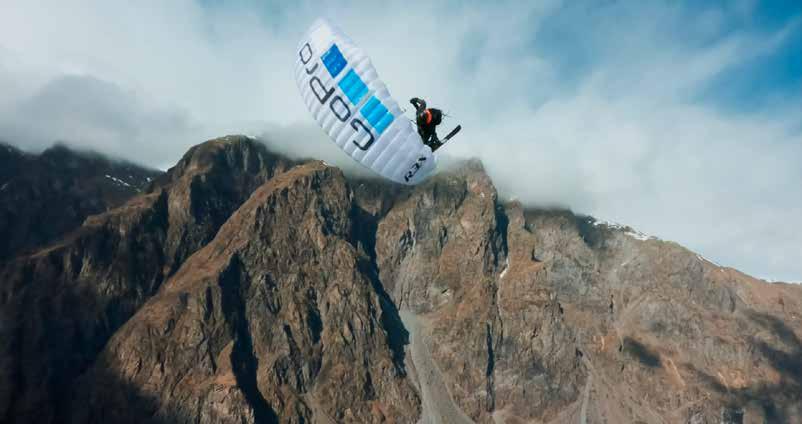
Pilot Carl Weiseth winds up his GoPro-branded Ozone R3X for a barrel roll into the final technical flying section near the bottom of the valley.
the drone, Rinefort often needed to glide into remote areas of the mountain, perform side-hill landings, hike or climb to rocky outlooks where he could film, and then re-launch mid-mountain—all with an incredibly heavy backpack full of batteries and gear.
“Lighting conditions were always top of mind, both for getting the shots we wanted and also for depth perception when attempting to land a speedwing in steep backcountry,” said Rinefort. “With only 1-2 hours of sun each day on many north-facing lines, it was a race to get set up, snag the shots, and then relaunch before the weather shifted and I risked being trapped mid-mountain.”
Because of the long distances between take-off and landing, Rinefort had incredibly limited flight windows to capture content before having to recall the drone or risk losing it in the mountains. Often, he was forced to connect mid-air with the speedriders halfway down technically demanding lines while keeping constant communication with the pilots to carefully orchestrate collaboration and avoid collisions.
“My number one priority always needs to be the safety of the pilots,” said Rinefort. “There is a delicate balance between flying close enough to capture the best shots and maintaining enough space to adjust to their movements in real-time. Speedriding is one of the most difficult aerial sports to film due to the enormous changes in speed. I’m trying to anticipate the pilot’s actions a half-second in advance, and am always maintaining an ‘out’ so even if they do something unpredictable, I can avoid their glider with the drone.”
Each speedriding lap typically requires one drone
battery per pilot, often with several minutes of flight time on either side to position the drone. Once a drone returns, he needs to swap out the battery, make any camera adjustments, and replace the SD card so that if a drone is lost, he doesn’t lose preceding footage. In practice, this often results in 15-20 minutes of wait time between each pilot’s takeoff. When you are standing on launch in perfect conditions, watching a cloud bank slowly begin to obscure your landing area, this can feel like an eternity.
“Unfortunately, it’s not uncommon that we need to simply prioritize safely getting down the mountain over getting the shot,” said Katz. “In a big-mountain environment, the wind speed and direction, and visibility are perpetually shifting, often leaving us with short windows for optimal descent. Some of our best lines never make it on camera, but they’re forever in our memories, and make us better pilots and decision-makers for the next round.”
In addition to coordinating on the mountain, simply orchestrating ground transportation was a constant juggling act for all of us. Because virtually all of the flights we filmed ended in landing areas far from the ski lift, each “lap” was often accompanied by multiple hitchhiking rides to return to a gondola that could get us back up the mountain. By dropping off shuttle cars at sunrise and relying on the kindness of strangers for rides out of the canyon, we were able to piece together a fluid plan each day to maximize our laps down the mountain.
“You’ve got to keep in mind, we are often landing in remote little gravel-patches by the side of quiet mountain roads,” said Moody. “There may only be one car passing every 15 minutes, but it’s often incredible
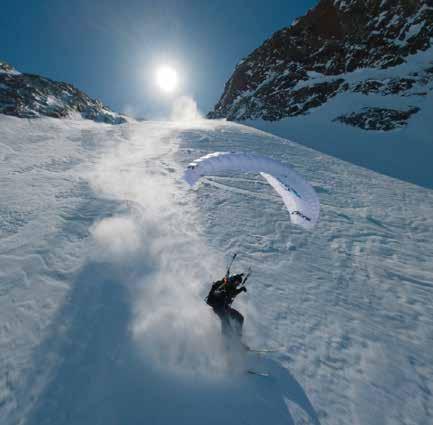
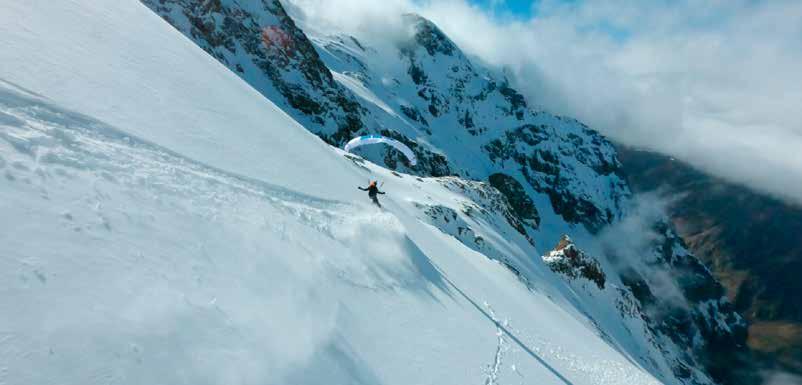
Virgin powder runs like this, and a deep sense of exploration compel Carl Weiseth to continue returning to France each winter to discover new areas of the French Alps, only accessible via speedwing.
“Some
of our best lines never make it on camera, but they’re forever in our memories, and make us better pilots and decision-makers for the next round.” -Jeff Katz
outdoorspeople who are curious how you came to be standing with a glider bag, skis, and backpack while dancing and smiling on the roadside with your thumb out.”
“We’ve met a pretty wild compendium of amazing locals over the years via hitchhiking,” said Katz. “You’ll see five empty cars pass you by without even slowing down, and then the sixth car will be a single mother with two kids and a trunk-full of groceries, assuring you ‘we can make it fit’. After a cold hour of roadside pessimism, all it takes is one act of kindness to restore your faith in humanity.”
Despite the additional obstacles presented by filming this technically demanding sport in such harsh terrain, creating “L’Expérience Magnifique” was an incredible bonding experience for all of us involved. By nature, most top-level speedriders tend to be pretty independent personalities, often skiing or flying
alone in the mountains for days with only a Garmin InReach to allow friends to keep an eye on them and to provide an emergency rescue if something goes wrong. Participating in this documentary required our crew to ascend to a new level of teamwork, collaboration, and communication, which resulted in some amazing moments of shared celebration after a successful day of filming.
In addition, as the film has begun to circulate online and initially debuted at the French Coupe Icare film festival, our team has shared in the camaraderie of its incredibly positive reception. The documentary has now been submitted to over 15 film festivals and has been nominated for several awards. The film’s success feels both personally rewarding and exciting as it spreads awareness about this new way to access uncharted backcountry.
Our hope is that “L’Expérience Magnifique” encour-
ages a new wave of young, gifted athletes to pursue flight training, either through our clinics at Speedfly. com or with other qualified instructors who can help introduce people to this amazing sport under USHPA’s new “S-program” instructional framework and ratings guidelines.
To watch “L’Expérience Magnifique,” just visit Speedfly.com for the one-click link on the homepage!
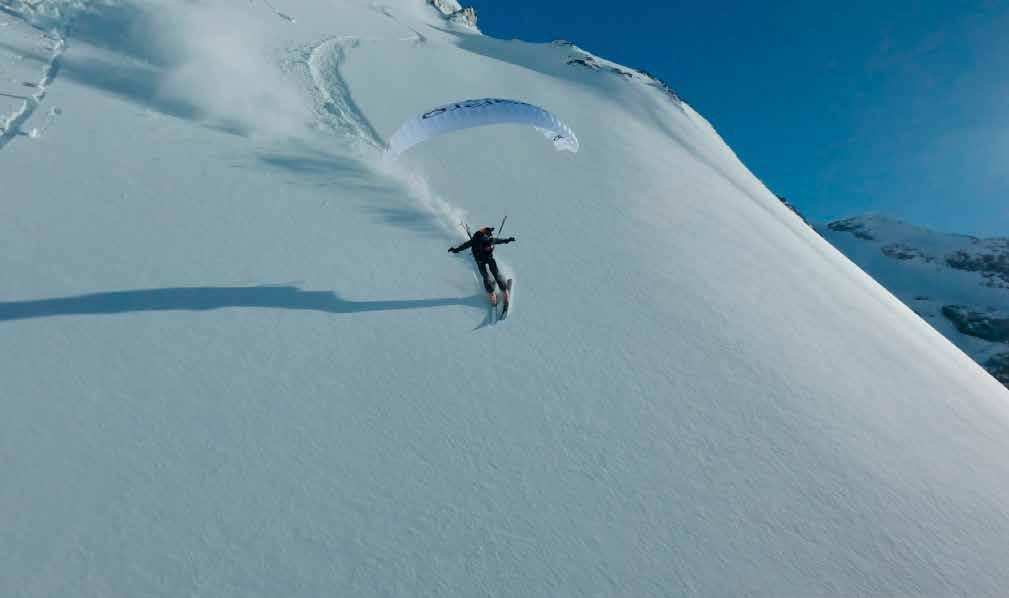
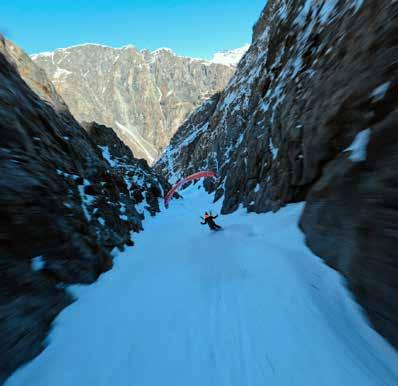
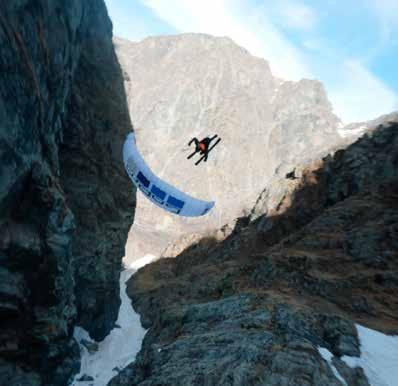
TOP LEFT Expert pilot and instructor Jeff Katz navigates one of the most technical speedriding sections on the mountain, carefully controlling his speed to stay on the snow while maintaining enough momentum to take off into flight as the canyon closes out. RIGHT Carl Weiseth dives down towards the bottom of the gully, using carefully timed barrel rolls in constricted spaces to maintain close proximity to the landscape. BOTTOM A big banking turn initiates the final run of the day for Carl Weiseth as the sun begins to the sink behind the horizon, and he prepares to drop the initial cliff-band.
Not every wing hits like this. The BANDIT is a high aspect ratio wing that sets new standards in performance. Flaring at the dune, wingtouching the sea, and back to the dune without walking. This wing has unmatched climb rates and dive, is super precise, and rock solid while doing it. Make speed your friend and fly it like you stole it.
“This
film's success feels both personally rewarding and exciting, as we spread awareness about this new way to access uncharted backcountry.”
-Carl Weiseth
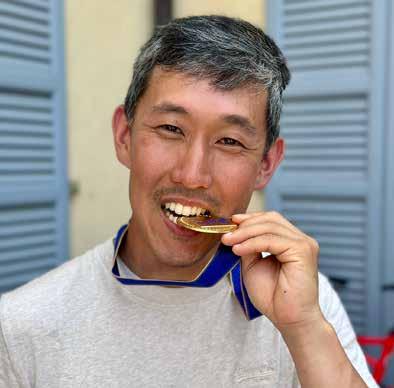
Peter Song An American Sport World Champion
by Erika Klein
: “It was so much pressure—a ridiculous amount of pressure,” recalls Peter Song of his experience in the 2025 Hang Gliding Sport Worlds held in Laveno Mombello, Italy, in June. Finding himself unexpectedly in the lead from the beginning of the competition, the California pilot focused on trying to enjoy the event without thinking of the implications of winning. “Then a friend texts me in the middle of the comp saying, ‘Hey, I don’t want to put any pressure on you, but we’re all rooting for you,’” he continues with a laugh. “Like—thanks.”
Song didn’t go to the Sport Worlds expecting to win. In fact, he wasn’t even supposed to be on the U.S. Sport class team until pilot John Maloney took up the captain position, opening a team spot for Song as the nextranked pilot alongside L.J. Omara and Doug Hale.
Song went on to become the first American ever to win an overall worlds-level hang gliding event, making goal in three of six tasks and flying alongside top Open class pilots including Manfred Ruhmer and Christian Ciech. (Open class pilots participated as team captains, who were not counted in the Sport class scoring but contributed to their respective country’s team scoring.)
A too-quick progression
Song began hang gliding in 2019 in Santa Barbara with a coworker. Almost immediately, following his first mountain solo flight, he started tagging along with more experienced pilots.
His fourth mountain flight found him in the Owens Valley on a borrowed glider. With snow blocking the road up to launch, the group chose a takeoff spot on the side of the switchbacks. The first pilot launched on his Sport 2 to ensure they could make the glide out. The second-most-experienced pilot (himself still new to the sport) was supposed to help Song launch, but soon took off in his eagerness to be in the air. Struggling by himself with his own glider, Song managed to clear the mountain safely after being lifted into the air by a gust. “I remember flying past a knob and hitting a thermal. It was my first turn in a thermal, but I didn’t even know what a coordinated turn was at the time,” he says. Pausing in his story, Song adds: “There’s going to be a lot of this.”
Song landed last, and on his feet. “It felt pretty amazing,” he says. “I didn’t know any better; I thought that was what hang gliding was for beginners.”
Song’s win was even more impressive as the event was only his sixth competition, following a rapid learning progression more closely resembling that of a pilot in the 1980s than today’s safer, more conservative practices.
It was a flight only a few months later that caused him to reevaluate safety and, ultimately, take a break from the sport. Despite this time flying an established site and receiving a thorough site intro, Song hit heavy sink soon after launching. Seeing trees ahead and realizing he wouldn’t reach the LZ, he performed a
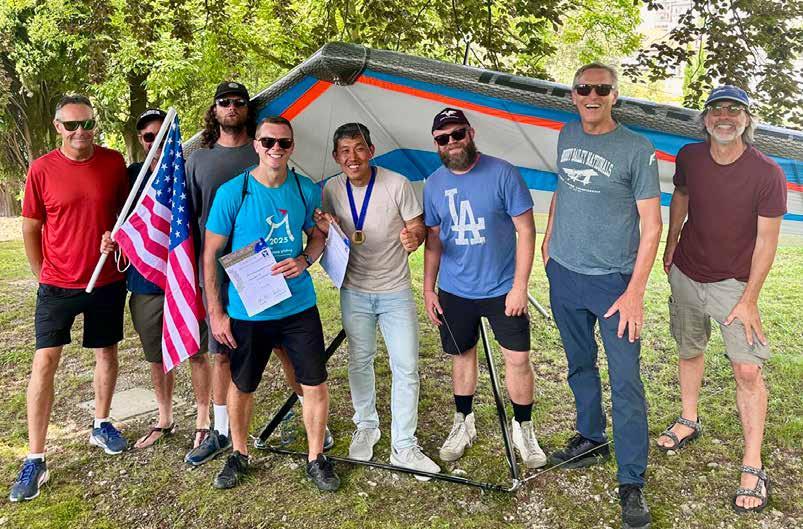
Song with medal. Photo by Jamie Sheldon
downwind, uphill landing on a slope behind him. “I definitely went too far, too fast, and the risk versus reward was out of balance,” he says. “I decided not to fly after that.”
Song moved to San Diego and focused on work. But while walking his dog in 2021, he passed a garage full of hang gliders owned by longtime pilot Butch Peachy. “I started talking to Butch, and then I just decided that I had to do it again,” he says. Song returned to the Santa Barbara training hill, bought a new glider, and the rest is now history.
Learning to compete on the fly
Like much of Song’s flying, his first competition was unplanned. Visiting Valle de Bravo, Mexico, with his instructor Willy Dydo and a few friends in 2022, he decided he’d enter the annual hang gliding competition if he could complete the nine-mile cross-country flight to the lake on the practice day before the event. He did.
For Song, joining the comp was all about getting retrieves for his first XC flights. “You just have the complete freedom to land wherever you want,” he says, calling the event “so fun.” “I was trying to do the tasks, but it was not doable at my skill level on a Falcon,” a beginner single-surface glider, he adds. “I kept landing out in random fields and people would be jokingly complaining about how long my retrieves were, but I didn’t really care.”
The event, which also taught him to use his vario, was a turning point in Song’s flying. Soon after, he bought an intermediate double-surface glider and started completing long flights in the Owens.
Song returned to Valle each year in part to compete with friends. It all came together during the 2025 event, in which he won third place for his first podium finish. “The last Valle comp, I had so many instances of just seeing Jeff [St. Aubin] to the side of me, racing each other; Antony [Davirro] and Doug [Hale] were there too. That was super fun,” he says.
Competition #6: Sport World Championships
Song went into the Sport Worlds a few months later, expecting to have fun but with little thought of placing
Song in flight in Italy. Photo by Peter Song
highly. “It was the Italians’ home site, [hang gliding manufacturer] Icaro is there, the sky gods [Ruhmer and Ciech] live there,” he says. “We thought we’d get destroyed.”
He found an edge early on by doing his own forecasting for the team, gaining a more realistic view of the day compared to the (often optimistic) weather predictions that the tasks were based on. “That was important to go into the day knowing what to expect, rather than just finding out in the air,” he says.
His decision to fly a slightly larger glider than his usual one also paid off, helping him stay up more easily in the light conditions. Noting that aggressive flying often grounded pilots, Song focused on flying conservatively, yet still quickly, as the lift would shut down early in the day. “You wanted to eke out little bits of the thermal to get the extra 100 feet,” he explains.
As Song maintained a mostly consistent lead during the competition, he tried to ignore the pressure and embrace the experience as he normally would. “I don’t think you should be focusing on winning because it
leads you into making stupid decisions,” he says. “It pushes you, especially in a comp where you have to survive.”
At the same time, he enjoyed flying with some of the top pilots in the world, including Ruhmer and Ciech. “Christian and Manfred are in a different world,” he says, adding that they were always at the top of a gaggle. Ciech even saved Song a couple of times, leading him to climbs that Song wasn’t aware of and helping to keep him in the race.
A record win
In the end, Song’s record-setting win came as a surprise to him, and it still hadn’t sunk in a few months after the event. His family isn’t even aware that he hang glides—“Why worry them?” And though his non-flying friends (or “ground friends,” in Song’s words) are excited, he doesn’t know how to explain that he’s not the assumed overall world champion, but the Sport class champion. “My flying friends just give me crap about it,” he adds. “Everyone on flying weekends is like,
U.S. team with Song in center. Photo by Jamie Sheldon
Finding the Wind by Tom
Webster
Turning cross-country guesswork into a safe landing strategy
Originally published in Hang Gliding & Paragliding Volume 41 Issue 3, March 2011
: Two hundred feet above a cow pasture in Delta, Utah, my arms were weak after three hours of wrestling a hang glider through midday desert air. I knew the wind aloft was from the southwest, but couldn’t tell exactly which way it was blowing on the surface. I had to make a good guess, and fast. The ground was getting close, and my ability to control the glider was compromised, so landing into the wind was essential. No smoke, no flags, and no clear guidance from my instruments. The usual indicators were failing me. Luckily, I recalled a trick—the crossroads method— that gave me a clue about wind direction while losing only sixty feet of altitude, leaving enough height to set up a proper approach and land smoothly despite a bare-minimum flare. Cross-country flying is like that: once you leave your home site with its prominent windsock, you must rely on your eagle-like powers of observation to figure out the surface wind and ensure a happy landing.
But what’s the best way to pin down the wind direction at the end of a cross-country flight? Spotting flags or smoke plumes, circling to identify drift, and using the wind speed function on your flight instrument are all helpful tactics. But flags might not be where you need them; circles might burn too much altitude; and your instrument might be inaccurate, misleading, or dead.
If none of your favorite tactics seem right for the situation, here’s another one to try: the crossroads method. All you need is the ability to follow a straight line on the ground and a bit of spare altitude.
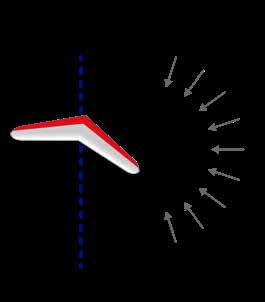
Step 1: Half of the sky
As you approach your chosen landing area, look for
a straight line to follow. This could be a road, train tracks, fence line, or an imaginary line that connects two landmarks. Get above it and follow it as exactly as possible.
Once you’ve established your ground track, look up at the wing. Is it angled to the right or left of the line? Suppose it’s angled to the right. That means the wind is coming from a direction somewhere to the right of the track. This is because any aircraft has to angle windward, or “crab,” to maintain a straight ground track in a crosswind. If your wing is pointing straight down the track, that means there’s no crosswind— you’re either going directly upwind or downwind, and will find out which in a few seconds.
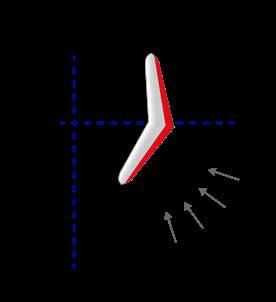
Step 2: Quarter of the sky
Now, visualize another straight track that crosses the first one at a right angle. Turn toward the half of the sky containing your possible wind direction to follow it. Hold the new ground track steady and look up at the wing again. Suppose it is once again angled to the right. That means the wind is coming from a direction somewhere to the right of this new track.
At this point, you’ve run the test twice on perpendicular tracks. By combining both results, you can narrow the wind’s possible source to a single quadrant: compass headings that were on your right while flying both tracks. If your wing isn’t angled on this new track, you know it points directly into the wind. If neither track showed an angle, the wind is calm.
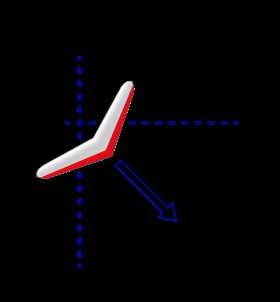
Step 3: Final glide
Finally, visualize a diagonal line splitting the middle of this quadrant. Find a safe part of your landing area and set up your landing approach so that your final glide is aligned with that diagonal line. This will put you on track to land with a headwind somewhere be-
tween straight-on and 45 degrees cross, which is very manageable—beach pilots land in bigger crosswinds all the time. It’s certainly better than coming in with any kind of a tailwind.
: No method is foolproof. Surface wind can switch at the last second, and other factors like thermal
activity or wind shadow can foil your careful analysis. Landing options can constrain you to a narrow runway, forcing you to deal with a potential crosswind greater than 45 degrees. But in the absence of clear indicators like windsocks, the crossroads method is a simple and altitude-efficient way to improve your chance of a safe landing.
Armchair SIV Cravats and Twists by Calef Letorney
: At SIV clinics, I teach the “yeeeeehaw method” of deflation recovery: When your wing explodes, yell “YEEEEEHAW!” to set the mood. There’s going to be a rodeo and a tale to tell. You decide whether it’s a tale of adventure or tragedy. Like most aspects of paragliding, the outcome is largely dependent on your ability to process information and react appropriately. Hollering “YEEEEEHAW!” reminds you that deflations are part of the adventure. In the last Armchair SIV, we discussed deflation recovery with no cravats or twists, where our primary focus was to let the glider fly. If it’s not tied in a knot, the risers aren’t twisted, and it’s not a comp wing, you can trust your glider to sort itself out. Your primary focus in these scenarios is to avoid pulling too much brake in your response.
This edition of Armchair SIV is more complex because cravats and twists do happen. These situations require timely intervention, as they are more likely to devolve into a worst-case scenario. These dreaded scenarios make any situation more dangerous and require more altitude to recover. We’ll discuss hazards and mitigating strategies to get you visualizing, but there’s no substitute for regular in-person SIV training. Your instructor will have their own theories and techniques, which is great because there isn’t just one answer. For every incident, there’s an unknown multitude of correct solutions, and you only need to find one.
Cravats
Just because your wing has suffered a big deflation
and it’s not opening right away, it doesn’t necessarily mean you’ve got a cravat. Big deflations often need a few seconds to think about reinflating while the wingtip flaps loosely—no big deal.
In contrast, a cravat will have visible tension and pressure with something sticking that prevents reinflation. Causes include a wingtip stuck in or through the lines, a lineover, tension knots in the lines, or a stick picked up on launch. It will most often have a taut and angry appearance. Bigger is not necessarily worse; even a small wingtip cravat can catch the air and turn the glider hard.
Step 1: Make it fly straight
Flying straight is the first priority because cravats are energy monsters. Any amount of turn towards the cravat feeds energy to the monster, making it stronger and more violent. In the blink of an eye, cravats can pull the pilot into a high-G-force spiral that makes loss of consciousness a real risk as the monster consumes altitude at an unimaginable rate. Worse, the turning force towards a cravat increases the tension on the cravat, making it harder to clear.
Fixing cravats can take time and determination. Troubleshooting is infinitely easier from straight and level flight as opposed to racing to the ground in a facemelting spiral. Here are some strategies on how to get control of a cravated glider:
1) Forget fixing the cravat until you’ve established directional control. If you try to fix the cravat before gaining directional control, you’re likely to accomplish neither.
2) Weight-shift away from the cravat. This is incredibly important. Cravats drop the seatboard towards the energy monster, sucking you into the turn. Fight to get your shoulder and head outside the riser on the high side.
3) Look past the good wingtip so you have that wing in your vision to watch for signs of impending spin while looking where you want to go. Staring at a cravat can be a form of object fixation, feeding into the turn towards the cravat, so look where you want to go.
4) Pull brake or rear riser away from the cravat to
maintain your heading. Using the rear riser can be advantageous, as it acts like a combination of brakes and weight shift. In extreme situations with high G-forces, you might temporarily let go of the brake on the problematic side and reach across to use both hands on the desired brake and/or rear riser. This will eliminate all brake input on the problematic side and give you the strength of both arms on the correcting input.
5) Don’t brake on the side of the cravat as it makes the correcting effort harder. This sounds obvious, yet in normal piloting, we continuously feel some amount of pressure in both hands, and it’s hard to turn that off in the midst of an overwhelming situation. Consciously eliminate all brake pressure on the side of the cravat.
6) Apply big ears to minimize the drag on the cravated side (perhaps transforming a cupped, extremely draggy wingtip into a benign big ear). The opposite big ear balances the drag to neutralize the turning force.
7) Remember: Consistency is crucial! Pilots often make the correct response–but when it doesn’t work right away, they then try the opposite, making the situation much worse. Don’t do that! Trust your first response, stick with it, and be patient.
8) Turn towards the cravat for navigation. If you need to turn, rather than risk spinning by forcing a turn away from the cravat, it may be best to temporarily let the glider turn towards the cravat. This is especially true if you choose to land with a cravat.
9) Your safest heading may be downwind. Even if you fix the cravat, you still need to make it to a safe landing zone. Look around and reevaluate your best landing options, which may be over the back on an unplanned XC adventure.
Step 2: Clear the cravat
Once flying straight, clearing the cravat is often more of a process than a single step. With many possible variations, the best solution is equally variable. Be prepared for an extended fight, cycling between the following techniques as needed.
1) Induced deflation. While maintaining direc-
A cravat in the wild. Photo by Mitja Jug
AUTO-ROTATION RISK
Auto-rotation occurs when a cravated wing is allowed to turn into the rotation. The glider turns progressively tighter until the circle becomes a helix as the center of rotation moves from outside the glider to between the glider and the pilot. It’s an extremely disorienting configuration as the pilot’s body starts moving backwards, which creates confusion regarding which direction to turn to exit the configuration. Remember, “the exit” remains the same after a spiral morphs into an auto-rotation. We need to turn away from the cravat.
Prevention is the best medicine, so above all else, don’t let the glider build energy in a turn towards a cravat. Don’t let it go into auto-rotation. If you are unable to control the turn, throw your reserve parachute well before your glider goes into auto-rotation. Once in the helix pattern, reserve entanglement and failure become likely as the glider and body move through the same airspace. Auto-rotation may also make it impossible to deploy the reserve, as the G-force may pin the pilot to the side, preventing them from reaching the handle or extracting the parachute.
Once in an auto-rotation, due to the increased risk of reserve failure, you may try to fight your way out if you have sufficient altitude and can handle the G-forces. Perhaps the best strategy for fighting auto-rotation is to use both hands to pull with all your might on the rear risers and/or brake opposite the cravat. Fortunately, once you learn how to make a cravated glider fly straight, you should be able to avoid auto-rotation altogether.
tional control, induce a deflation on the cravated side by pulling hard on the A-riser. The sudden detensioning and retensioning of the lines often pops cravats out. A friend once demonstrated this after launching with a line-over that resulted in a 40% cravat. He remained calm and maintained a heading away from the hill. With sufficient altitude, he induced a deflation, and the line-over moved a bit. He repeated the process three more times until the line-over slipped off. Then he caught a thermal and went cross-country as if it had never happened. Since then, I’ve been using and teaching this technique, and it’s proven quite effective. Of course, this technique is not possible with 2-liner wings, as we can’t readily induce deflations.
2) A deep brake pump on the cravated side can clear minor cravats. This is a go-to technique for many pilots because the brake is already in hand, and it’s very intuitive. We’re going for a deep, purposeful brake pump or two. Unfortunately, this easy technique isn’t always the most successful.
3) Spin appreciation is a drill I teach at SIV, where we sit flat, look up at the wingtip, bury the brake, and hold until that wingtip starts to peel back in a spin. Then, go hands-up to recover and brake the surge as needed. This same maneuver, spinning on the cravated side, proves quite useful for clearing a cravat. We’re not looking to hold a prolonged spin; we just need to get the problematic wingtip traveling backwards momentarily to release the tension. That’s often enough to clear the problem.
4) Fishing the stabilo is perhaps the most commonly taught cravat-clearing technique, but it can be difficult and dangerous. Finding the stabilo line is the first challenge. It’s typically a different color, so familiarize yourself in advance. In the moment, look for the most slack line as that’s likely your stabilo.
Reaching to grab the stabilo line, pilots often lean towards the cravated side, which can cause the glider to spiral out of control while the pilot unsuccessfully pulls on the stabilo. G-forces going into a turn can make the cravat stick harder, so if it starts to turn, you need to refocus on flying straight. Getting the stabilo in your hand is like getting a fish to bite— it is just the first step, and we should be prepared for a protracted struggle of considerable force. If you
“We have one chance to interrupt a riser twist, and there are few things more important.”
run out of reach, you may need to momentarily grab the stabilo line in your opposite hand while you choke up on it with your original hand. Note that your “opposite hand” is almost certainly busy maintaining your heading; don’t interrupt that effort. The act of pulling on the stabilo line also encourages a turn towards the cravat, which exacerbates the challenge of maintaining directional control. Don’t assume your stabilo fishing expedition will be successful. We must never let the glider dive into a spiral while tugging on the stabilo line.
5) Full stall is often described as a “glider reset,” and this is true for those who have mastered stalls. However, the vast majority of pilots are not experts at stalls, and attempting a stall with a cravat is likely to result in a worse cravat, riser twists, and perhaps becoming entangled in the glider. I don’t recommend using a full stall to clear a cravat until you’re an expert at stalls (you know who you are).
6) If all else fails, you may have to land with the cravat or deploy your reserve.
Riser twists
Adding a riser twist makes every situation much worse. “Twists” happen when your body and wing rotate at different rates on the yaw axis, so try to move your body with the glider. Twists can happen when the glider does a dramatic yaw turn and the body doesn’t keep up. Riser twists appear equally likely at the end of a yaw turn, when the glider abruptly flies straight again and the body carries on; so, be on the lookout for riser twists at the start and end of yaw movements.
If you see the risers starting to twist, thrust your open arms between the risers and push apart to block the twist. Don’t be late! We have one chance to interrupt a riser twist, and there are few things more important.
If you do get a twist, you should consider immediately throwing your reserve.
If you have ample altitude, you may be able to get untwisted. Try reaching above the twist to pull apart
and unwind the risers. Try to pilot your glider above the riser twist, using the brakes or rear risers to maintain directional control. This can be difficult as you may not be able to reach above the twist.
Be aware that if you have weight-shift or brakes applied before the twist, this may get locked into the twist. You may be able to free a trapped brake by grabbing above the riser twist and pulling up. If the glider starts to spiral with a riser twist, you likely want to deploy your reserve parachute.
Note that harness configuration impacts the likelihood of riser twists. Tightening the waist strap reduces the distance between the main carabiners. This can feel less bouncy in turbulence, but allows the risers to twist more easily. Twists are a bigger hazard than the perception of bumpiness, so resist the temptation to make the harness too narrow.
Riser twists and cravats inspire fear because they can quickly spiral out of control (both metaphorically and literally), especially when combined. Soaring experience offers little preparation for extreme incidents, and P2 and P4 pilots alike often freeze, overwhelmed by the experience. Through study and SIV training, we’re much more likely to remain clear-headed and respond appropriately. When all else fails, I invite you to join me in the club of paraglider pilots who’ve “tossed the laundry.” Your initiation might not exactly be fun, but there is an undeniable rush of joy and relief when your reserve opens. And, like me, you’ll probably escape without injury and fly again the next day.
Remember that reserves take time to open, and happy endings are much less probable if you throw your reserve too late. So fight the good fight while the fighting is good, but never miss the opportunity for a successful reserve deployment. As the saying goes: “When in doubt, there is no doubt, get your reserve out!” Nowhere is that more relevant than when dealing with cravats and risers twists.
Happy flights!
Flying Together
by Maddy Huggins
Hosting the first women's+ fly-in at Tiger Mountain
photos by Thor and Carrie Radford at Radford Creative
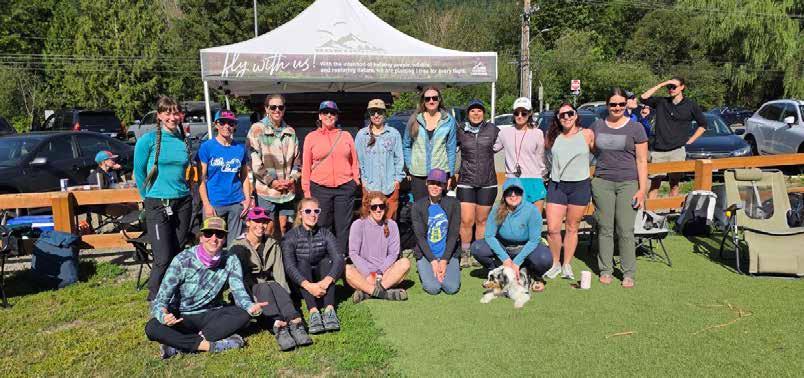
: This summer, Kaylyn Messer, Heather StClair, and I hosted a Women’s+ fly-in at Tiger Mountain in Issaquah, Washington. Honestly, it felt long overdue.
The goal of this event, and this article, is simple: to share what happened, why it mattered, and why events like this are critical for the future of our
sport. I hope it keeps the conversation going about inclusion in free flight and helps raise awareness for future gatherings. If we want our community to grow, we need to make space for everyone and be mindful of how we show up to fly each day. While this is a solo sport, it is community-based, and everyone should feel safe and wanted within this
Maddy Huggins rosetting her wing in the LZ after a flight at Tiger Mountain.
L TO R Megan Lewis trying a pod harness in a simulator in the LZ. Jess Brown rosetting up after a flight. Alexia Fischer torpedoing off of North Launch at Tiger Mountain.
adrenaline-seeking community. Also, let’s be real: the photos from this day were too good to stay in the group chat.
Why We Needed a Fly-In Like This
To my knowledge, there has never been a women’s fly-in at Tiger Mountain, which is wild considering how many female pilots we have here in Washington. Almost the entire U.S. Women’s Paragliding Team lives in, or comes from, this state. Both Alexia Fischer and Violeta Jimenez joined us that day. We even had CJ Sturtevant come visit after her film For-
ever Busy Living, sponsored by KAVU, was shown at the Issaquah Film Festival.
So many women fly here, or want to, and yet we hadn’t had a women’s fly-in. I have attended women’s fly-ins in Santa Barbara, where there were always five to ten pilots who had traveled from Washington; so, clearly, there’s a need. We have an incredible local site just 30 minutes from Seattle, so why not create that same opportunity closer to home?
What blew my mind was how many women pilots who live near Tiger had never flown the site before. After the fly-in, many of them came back—some
L TO R Kaylnn Messer all smiles in the LZ. Brianna Landis laughing it up in the simulator. Mel Rossman pointing out a pilot coming in to land.
Maddy Huggins above North Launch at Tiger Mountain.
alone, some with friends. Attendees also made friends from other places, increasing the likelihood that many of us will feel comfortable visiting new sites. Seeing that kind of engagement and confidence growth was the most validating part of the whole experience for me. The event also fostered connections across genders, with many men bringing the right balance of friendliness and assistance as they volunteered their time to support and be present.
Why These Spaces Matter
People often ask why we need identity-based events like women’s+ or queer fly-ins. The answer is simple: when you’re in the minority, it’s hard not to feel like an outsider. Even though you’ve made a conscious decision to join the community, it takes time
and support to learn the language, dynamics, and unspoken rules. That initial discomfort—something many new pilots experience—is often compounded for women, people of color, and members of the queer community because the sport is predominantly male and typically white. It’s that same awkward feeling you get on your first day at a new job, or when you walk into a room where everyone already knows each other. It’s not always about how people treat you, but rather how unfamiliar everything feels.
For me, fly-ins like this have helped bridge that gap. I’ve now been to three, and I’ve met so many incredible women and queer pilots from different regions and clubs. These events have given me the confidence to fly at new sites and the courage to speak up when I or someone else experiences
Jess Brown with a text book launch off of Tiger Mountain.
something inappropriate. When I visit new sites, attend competitions, and even travel to Colombia, I see familiar faces, which makes me feel a sense of belonging.
At this year’s Tiger event, I saw firsthand how powerful these spaces can be. Pilots who were new to Tiger have been coming back regularly. Some have even reached out to coordinate flights, plan trips, or attend SIV courses together. That kind of community building leads to better pilots, safer launches, and more inclusive skies.
The Challenges Are Real
I wish I could say that flying with more women
around changes everything, but the truth is, it doesn’t. I think it can have an impact on how people show up to a site, but that doesn’t always happen.
At the Tiger Fly-In, one participant declined a drink at the end of the night and said, “No thanks, I’m sober.” A male pilot responded, “We can change that!” and a group of men laughed. It was an inappropriate joke, regardless of gender, but especially at an event created to be a safe space. To their credit, the two had a conversation later, and the man apologized.
Last fall, I watched Sarah Lockwood, who organizes multiple women’s fly-ins, absolutely nail a safety protocol when we had an unresponsive pilot on
Emily Mistick high fiving local legend CJ Sturtevant. Heather StClair sitting with CJ discussing CJ's film that premiered at the Issaquah Film Festival that weekend.
the ground. A helicopter was potentially inbound, and she radioed to clear the airspace. A male pilot intruded into a safety discussion among a flock of women on launch to say that he felt this pilot was fine because he knew her. Sarah served up a masterclass on explaining that safety isn’t based on feelings. He apologized later that day.
These moments aren’t unique to paragliding; they happen frequently to many of us women. While strength in numbers does help, real change comes from connection, conversation, confidence, and community. Fly-ins help foster all of these.
What Does Change
Showing up in a big group doesn’t magically make the sport more inclusive, nor does it stop sexism from happening, not even on a day dedicated to creating a safe space. It does change us—how we show up, how we support each other, and how we build empowerment to handle adverse situations. These
events allow the free flight community to grow, and we need to grow to keep paragliding alive in the U.S. What I’ve learned is that every fly-in brings new faces, new friends, and new perspectives. Everyone comes for the flying, but leaves with something more: a sense of belonging. That’s how we grow the sport and improve retention—especially for women and other underrepresented pilots.
Thank You, Community
This event wouldn’t have happened without the support of our incredible flying community. Huge thanks to the Northwest Paragliding Club, who reached out to me, Kaylyn Messer, and Heather St. Clair to help host the event. Special shoutout to James Willis for working with us every step of the way, and to USHPA for sponsoring the event. Thanks to Northwest Paragliding School for running an extra shuttle that day and making me love this insane sport.
Bonita Hobson (Little Cloud rep) pointing out all the features of a pod harness to Deanna Molenda in the LZ.
Launch into gear savings
Get the gear that fuels your passion at discounted prices.
Your Pilot or Instructor USHPA membership automatically qualifies you to join. Simply scan the code to get started.
Unlock up to 60% o on top outdoor brands
Thor and Carrie of Radford Creative volunteered their time and talents to capture the day through photography. Even Little Cloud and Skywalk, who had reps on-site purely by chance, showed their support.
And, of course, thank you to everyone who came, flew, grilled, helped, laughed, and made this event such a beautiful success.
Looking Ahead
I hope that this is just the beginning. I’d love to see The Tiger Women’s+ Fly-In grow next summer, with even more participation, more returning pilots, and more visibility for what’s possible when we create space for one another.
We all come to free flight for different reasons— but we stay because of community. Let’s keep building one that welcomes everyone.
Maddy Huggins avoiding kicking the cameraman (Thor Radford) during a launch.
Bottom: Left to right, back to front: Deanna, Bonita, Megan, Mel, Jess, Brittany, Regina, Jamie, Violeta, Alexia Kaylynn, Paige, Brianna, Maddy, Robin, Nina. Photo by Jarred Bonaparte
Jess Brown with a big smile after a great flight.
Jess Brown going to join other members of the fly-in!
15 Minutes
by Richard Dery
As a boy, I would often look up at cotton-candy clouds shape-shifting across a summer sky and dream of being a bird flying among them.
: It’s two and a half hours in the car to Hang Glider Road in Ellenville, NY. Three, if we stop for lunch, and longer if there’s road work or an accident. It’s another 10 minutes to the launch site up top. When we arrive, “The wind’s from the west,” a fellow pilot informs us. The wind sock confirms his report. We allow 10 minutes for watching the wind and checking the forecast before deciding to set up at the northwest side. The wind is supposed to swing north later on, I explain. In half an hour, a 20-foot bag of aluminum and fabric
transforms into my Falcon hang glider. Now the waiting begins.
We hear him before we see him. Wind whistling through the flying wires, he comes screaming in 100 feet overhead with the bar to his knees. At 200 feet, a few seconds later, he pulls up into a loop. I won’t launch for another hour and a half, but Ryan Voight will land 20 minutes after me. Later, in the LZ, he will help me adjust my harness—the one he designed for Wills Wing.
Rick Fitzpatrick appears shortly thereafter, his wing strapped down to his white pick-up truck. He’s already flown for the day. Now, when the wind is right for me, he’ll be ready to help me launch. Rick is my instructor and observer. He advises me, a novice H2 pilot, to wait for lighter wind. A few minutes later, he’s playing his violin. Classical music fills the air as a handful of paragliders dot the blue sky with their rainbow hues.
My wife, Cindy, is chatting happily with a handful of onlookers. She is my champion and proudly calls herself my ground crew. Some pilots frown upon the intrusion of the spectators, but my wife welcomes them and introduces them to me. With the number of hang gliding pilots dwindling, I figure her natural PR skills couldn’t hurt the future of our sport. Another H2 pilot arrives, and we chat about our common experience at Morningside Flight Park in New Hampshire, where we took lessons together.
It’s six o’clock when Rick finishes his briefing, detailing a flight plan for me. He points out that the ripples over the lake beyond the LZ are calm, and that the leaves on the slope below are no longer rustling. It’s time to fly. The butterflies in my gut depart as I begin to run into the wind. After a brief struggle to get my feet into the harness, I lay prone and settle in for flight. I make a few turns in remnants of thermals past, and ten minutes later, I arrive 800 feet above Tony Covelli’s house. Lingering lift over the LZ stretches my
Author wishing for wonder wind on a short flight over Ellenville, New York. Photo by Richard Dery
“for 15 minutes, I am that 8-year-old boy, full of dreams...”
Tony
Covelli owns the property for Ellenville Flight Park. His house borders the
LZ.
figure eight approach out for another five minutes, then I’m on the ground. Three hours in the car, two and a half hours in the burning sun, and in 15 minutes I’m on the ground. Some will ask, as I sometimes do, is it worth it?
A fair question. How can I explain to earthbound souls that spending 15 minutes 1,000 feet above the trees is better than a week on a soft sandy beach in the Caribbean or an all-expenses-paid vacation in Disneyland? In those 15 minutes, I flew over a hawk working the same column of air that I was. Over the pond by
Tony’s house, I saw three deer getting a drink. For a full 15 minutes, I was that hawk, seeing the world through his eyes, but it’s more than that. More than the freedom of watching the world tilt and twirl to my every whim of movement. More than the sensation of feeling the air rushing over my wings, lifting my 195-pound frame into the wild blue. Is it worth it? From a purely practical point of view, no, not in the least. So why do I pore over the weather forecast during my lunch break at work, anxiously looking for the next day of good flying weather? Because, for 15 minutes, I am that 8-year-old boy, full of dreams, lying on a grassy hill, watching cotton-candy clouds shape-shift across the summer sky, and I become the bird I dreamed of all those years ago.
Insurance Failure
by Kevin Brenden
A pilot faces down trip insurance
: The day started pretty good, even though it was Friday the 13th. I was in the middle of a two-week paragliding trip to Valle de Bravo, Mexico, and didn’t think much about the inauspicious date. There was a competition that day, and the launch was decidedly busier than on previous days. I was set up to launch with a wall built, reading the cycles, when I noticed the pilot next to me was having trouble with his lines. Suddenly, another pilot walked up and started shouting at him for taking too long to launch. This was too much for the flustered pilot, and he bunched up and left. The distraction was also enough to affect my focus, and I remember thinking it would be good to hurry off the mountain and away from the uptight
pilot who was now next to me.
In hindsight, I should have also bunched up and let the crowd dissipate. Instead, I felt rushed to get off launch and picked a bad cycle. My wing wasn’t ready to fly, and I tumbled forward just below launch. When I stood up, my left arm was bent at an unnatural angle.
This is when all of my trip preparation came into focus. I knew this was bad, but I had purchased Global Rescue extraction insurance and an additional policy from their website, which was supposed to cover the medical costs of accidents while abroad. I even called Global Rescue beforehand to ensure that this ancillary policy would cover medical expenses
“I REMEMBER THINKING IT WOULD BE GOOD TO HURRY OFF THE MOUNTAIN AND AWAY FROM THE UPTIGHT PILOT WHO WAS NOW NEXT TO ME.”
if I were injured while on vacation. The company providing the ancillary policy was IMG (International Medical Group).
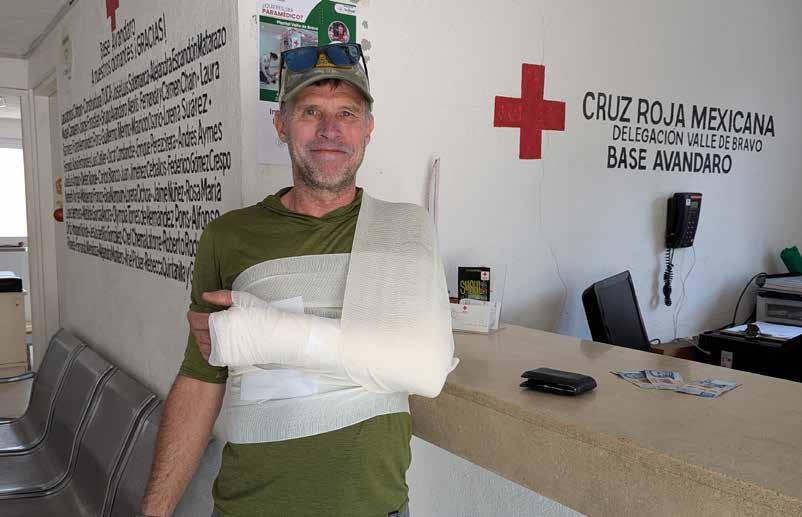
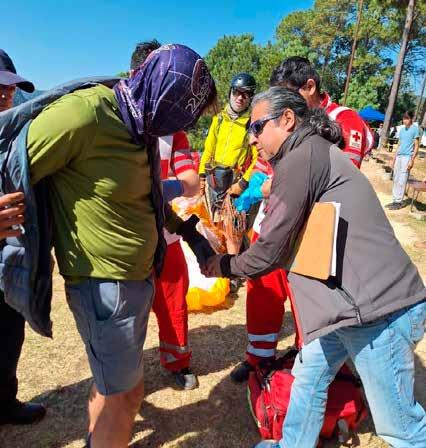
The rest of the day was awful. One of the race coordinators on launch went above and beyond to help, and rushed me to a local clinic where doctors set the bone and cast it with traditional plaster. My friend stayed on launch to pack my wing and caught up with me at the clinic. Out of an abundance of
caution, we then went to the local hospital just to make sure the bone was set properly. The hospital receptionist sent me to a busy doctor’s office where I was told the bone had to be reset and cast again.
This new cast was large and didn’t look quite right, and I started noticing swelling right away. The next day, I decided to cut the trip short and made plans to fly back home to have my arm examined by an orthopedic physician. During the preparation for my trip, I made a call to the insurance company, and I understood that changing flight or trip plans due to
Getting "dressed down", and an initial assessment by
The author just after the first casting. Photo by someone at the clinic
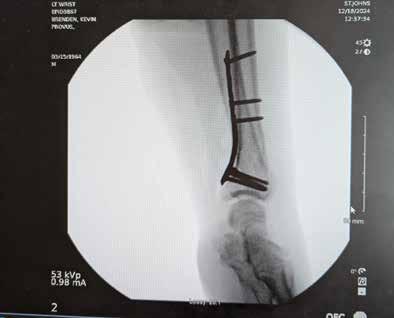
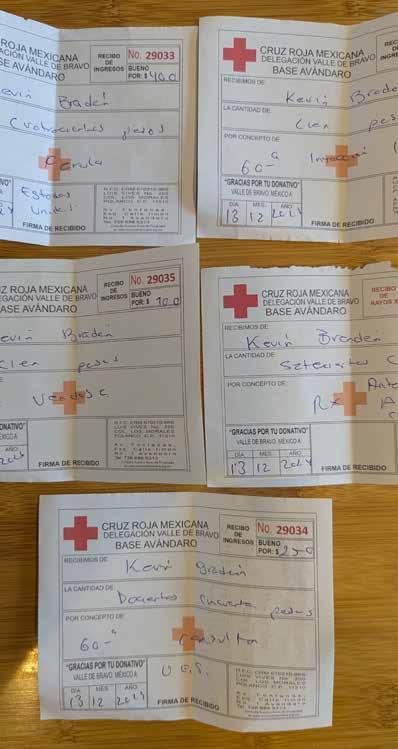
Copy of receipts gathered at the first clinic. X-ray, post-surgery in the US.
an accident was covered under the policy. Therefore, I paid for the flight change out of pocket and expected it would be covered later.
My return home was easy, and I was able to book an appointment with an orthopedic surgeon at Teton Orthopedics in Jackson, WY, within a couple of days. There, I learned that the reset and recasting with the busy doctor in Mexico would leave me with deformity and a loss of use if it weren’t corrected immediately. I had surgery (open reduction with plate and screws) the next day, five days after the accident.
: Once back home, with my bones properly reset, I started a claim with IMG to recover the expenses I incurred while in Mexico, including medical bills and the cost of changing my return flight. This is where I’d like to warn fellow pilots of the frustrating world of trip insurance.
I had purchased IMG SignatureTravel Insurance in addition to my annual membership with Global Rescue. I was only interested in the fact that this policy had $100K accident coverage, and this was the point I double-checked before leaving. The policy did indeed cover paragliding and medical expenses associated with an accident. I knew that if I got hurt while in another country, the medical costs would be my biggest concern.
Unfortunately, I did not research all possible scenarios of an accident, such as how to file a claim, what the company would require, what things would not be covered, or whether I could change my flight to seek appropriate help. In the pre-trip planning mode, one doesn’t really consider an accident as a likelihood. I felt secure in the fact that this was a company that supplied coverage for exactly what I was doing, and I didn’t worry about the details. On the surface, the claims process was fairly straightforward: compile a list of expenses related to my accident and then provide the requested receipts. But the receipts are where things got muddled. Most transactions in rural Mexico are in cash, rather than
Lots of peace, and a couple of birds. Landing out in Valle de Bravo. Photo by the author
Local church and festival day. Photo by the author
credit cards. The expense still exists, but you don’t have a hard copy receipt to prove your loss.
That said, even when I did have receipts (hand-written or printed out) to submit, the insurance company still wouldn’t accept them. They offered no clarifying information as to why they weren’t accepted, and I ended up stuck in a loop with bot-generated emails. I would provide what they requested, and they would reply with an email asking for what I had just provided. This went on for several months, and I grew increasingly frustrated with the delay and obfuscation. Each email was a recycled copy/paste version of the last reply. Now is probably a good time to mention that you aren’t actually able to speak to a person on the phone, only by email.
Six months after the accident, and I had given up trying to get reimbursed by IMG. The company succeeded in tiring me out with their time-consuming process of questioning the validity of receipts and whether returning to the states early was medically necessary.
The problem with this kind of claim is that they are really good at claiming the receipts you provide aren’t good enough (hand-written receipts might not cut it). Keep in mind that it’s exceptionally difficult to collect receipts while passing through some foreign healthcare systems. I was probably in shock and was dealing with pain, and the resulting documentation that I was able to provide was never going to cut it for an American insurance company. The last thing on my mind that day was wondering what an insurance company would require for reimbursement.
: Although my experience is one example of how things can go wrong when traveling to fly abroad, it is by no means representative of everyone else’s experiences and is not meant to deter anyone from using a particular insurance company. Instead, I hope my experience might help my fellow pilots in the planning stages of their next trip. Recognizing your vulnerability is an essential part of the preparation process. Consider a few scenarios and what you would want to have available in case something happens. Factors such as language barriers, the remoteness of your destination, and assumptions
about American privilege are just some of the things to consider when determining your level of preparedness.
After this experience, I recommend shopping around before purchasing a policy and ensuring that the insurance will actually benefit you in the event of an incident. Will you be able to comply with the company’s standards of proof? Also, ensure that you and your traveling companions have a conversation about each person’s level of coverage and identify any potential liabilities. If you are travelling alone, realize the risks are increased: would you be able to get yourself back home, and at what cost?
Hopefully, this article will help you in your next adventure and ensure safe travels. There is nothing better than traveling the world with your paraglider and meeting other pilots who share the passion.
Calm Before the Storm by
Previously published in Cross Country Magazine
: The old saying “calm before the storm” is often used in non-meteorological settings to refer to the relatively tranquil time just prior to a busy or chaotic event. As pilots of relatively slow aircraft, we want to know how to avoid the dangers posed by storms. So, is there really a calm before a storm? If so, why?
By nature, no two meteorological events are the same. Therefore, it is hard to create an absolute rule. Additionally, with the saying “calm before a storm,” it is important to realize that in colloquial English, a “storm” is a somewhat all-encompassing term that can span several scales. A storm can be an isolated thunderstorm. It can be a complex of thunderstorms. At larger scales, at the edge of the tropics, a tropical storm can mature into a tropical cyclone, also known as a hurricane or typhoon. In mid-latitudes, an approaching low-pressure system, along with its associated cold front and warm front, is often referred to as a storm. During the winter and spring months, mid-latitude cyclones are often referred to as winter storms.
Mid-latitude cyclones are the largest of meteorological phenomena that can fall under the umbrella term “storm.” As a surface low approaches your flying site, the weather deteriorates and the wind increases progressively. As the cold front passes, the weather can get quite nasty. Postfrontal conditions can be great for flying, provided that it’s not too windy. Unless you are completely cut off from weather forecasts, it is difficult to have a mid-latitude cyclone sneak up on you. These are multi-day phenomena, and they are usually well-forecasted several days out.
A smaller, but usually more violent, cousin of the mid-latitude cyclone is a tropical cyclone. On the outer edges of a hurricane, there is a lot of sinking air to compensate for all of the air rising within the storm. The sinking air stabilizes its surroundings. It
Honza Rejmanek
is not uncommon for TV weather reporters to be sweating under a hot sun with clear skies and light winds while positioned in a location where a hurricane is forecasted to make landfall. It is possible that this is the original “calm before the storm.” If a location has predictable trade winds, and these subside unexpectedly, it might be a sign that something significant is brewing upwind beyond the horizon. As with the mid-latitude cyclone, a tropical cyclone will not sneak up on you if you are at all connected to the outside world.
For us pilots of slow, lightly-loaded aircraft, the type of storm we are most concerned about is the thunderstorm. The exact timing and location of a thunderstorm still evades the best of modern forecasts. To keep things simple, we will discuss the isolated thunderstorm, which is a single cumulonimbus cloud. We want to know where and why it might present a calm region before unleashing its fury. To a fast-growing thunderstorm, we are like confetti to a vacuum cleaner. A mature thunderstorm can threaten us with gust fronts that can be likened to either an avalanche or a burst dam. Neither is a pleasant scenario to be caught up in.
Some days, it can be fairly warm and humid with light or calm winds. This is often due to a capping inversion that acts as a lid to any storm development. Additionally, this cap allows for the accumulation of a large amount of very warm and humid air in the boundary layer. This layer usually extends one or two thousand meters above the surface in humid regions. If it gets warm enough and the capping inversion erodes, as might be the case in the late afternoon or evening over higher terrain, then it can have a similar effect to popping a balloon. A storm can quickly build as it can now draw in a large volume of warm, humid boundary layer air from its surroundings. A rather benign day can locally turn ballistic at a time when you might be expecting any remaining thermals to taper off.
If you see the towering cumulus congestus in the
late afternoon on what was either a blue thermal or a fair weather cumulus day, then this signals the end of the relative calm. Whether or not it is time to get out of the sky depends on your proximity to the first towering cumulus congestus and on your experience level. If the storm starts growing very quickly near your location, it might be worth considering a sidehill landing higher up rather than trying to make it down to the valley floor. In rising air, it might take an extra five or ten minutes to descend to the valley. A cumulonimbus can grow in 20 minutes. A quick sidehill landing up high might be the most prudent escape plan.
There are several other reasons why a thunderstorm might be preceded by a short period of calm wind. If wind is light at the surface and through the levels above, then air will be drawn towards the base of the storm as it grows. Just before the storm starts to rain, there can be a lull before the wind reverses. In some cases, the wind that precedes the rain is quite strong, and we call it a gust front. It is important not to be lulled into flying during this brief calm spell. Keep in mind that in mountainous terrain, your view of the storm might be blocked.
In a scenario where a storm pushes up into stronger winds aloft, it is possible that its top, which often looks like an anvil, will cast shade over your area before the storm reaches you. This shading can reduce or stop thermals. Wind on launch can lighten up or become calm. Unless you know with absolute certainty that the storm is still far away, it would not be wise to use this calm spell to fly.
The final reason that comes to mind for why an approaching storm might be preceded by calm is that as the storm moves towards your location, it draws in wind from all sides. If you are at one end of a valley and a growing storm is moving up the valley, then you might feel the valley wind diminish and possibly reverse as the storm approaches. If you are still on launch, it is best to stay put and let the storm pass.
A Safari in the Sky
by Kubi & Luki Jacisin
A
fly-in at King Mountain Glider Park
: In the shadow of Idaho’s highest peaks, King Mountain Glider Park sits as a sanctuary for those drawn to the freedom of flight. Renowned for its challenging terrain, powerful thermals, and breathtaking views, King Mountain is home to one of the most exciting flying festivals in the United States: The King Mountain Glider Park Safari. This annual event draws pilots of all disciplines, from paragliders, speedflyers, and hang gliders to pilots of sailplanes, ultralights, and small aircraft who converge for nine days of unforgettable cross-country flying and camaraderie.
The Lost River Range, home to King Mountain, contains nine of Idaho’s 10 tallest peaks, including Mt. Borah, the highest point in the state at 12,662 feet. This dramatic and rugged landscape offers not only awe-inspiring scenery but also exceptional big air, contributing to its legendary flying conditions.
King Mountain Glider Park has long been a mecca for free-flight enthusiasts. During summer, powerful thermals generated from the desert valley meet the cool air currents from the mountain peaks,
creating ideal conditions for long-distance flights. Pilots often achieve personal bests with distances well over 100 miles, with record-breaking triangles and out-and-backs pushing deep over the rugged Idaho backcountry.
Pilots come from all over the country to experience the phenomenon known as mountain waves: giant lift-generating waves of rising air that set up on the lee sides of these extraordinary ranges. At King, pilots have the rare opportunity to tap into these powerful mountain wave systems. By contacting the FAA, pilots can open a designated “wave window,” temporarily opening up a block of Class A airspace above the regular 18,000-foot ceiling, allowing ultralight pilots to legally climb to extreme altitudes like 24,000 feet. This special high-altitude access makes King Mountain one of the premier sites in the country for high-altitude soaring.
During the Safari Fly-In, pilots from all walks of life come together to celebrate King Mountain by getting
Pilots gearing up on launch during the 2025 Safari. Rides up, big clear takeoff, and blue skies. Photo by Matthew Glass
skyed out and turning circles. From morning to midday and into the afternoon, paragliders soar effortlessly along the ridgelines, hang gliders dance with the thermals, and sailplanes carve elegant trajectories high above the peaks. In the distance, small planes navigate the rugged terrain while speedflyers get pitted, zipping along the steep canyons with precision. This multidisciplinary mix of aviation fosters an atmosphere of excitement, learning, and collaboration where pilots share knowledge, stories, and techniques across disciplines.
In 2025, in addition to the Safari, the King Mountain Glider Park hosted the inaugural X-Lost Idaho Hike-and-Fly Race, organized by Gavin McClurg. Thirty competitors descended upon the Lost River Valley for three incredible days of adventure and exploration. Blending the raw endurance of mountain travel with unpowered flight, racers navigated Idaho’s wildest terrain by foot and air, hiking and flying
Kubi Jacisin skyed out over the Big Lost River Range Moore, Idaho. Photo by Luki "Jetstream" Jacisin
King Mountain Glider Park from above in the Big Lost River Valley Moore, Idaho. ALL BIRDS WELCOME!
Photo by Matthew Glass
from remote alpine peaks with the ability to tag any checkpoint they wished before returning by 10 p.m. The inaugural X-Lost was a great success, and you can look forward to its return in early spring 2026.
The Big Gazebo, completed this year, stands as a beautiful new addition to the park. It offers shade and power for visitors during the day, and serves as a lively hub for evening campfires and live performances. Thank you to the many volunteers who devoted their time and hard work to the project, to the Foundation of Free Flight for its generous support, and to Athletic Brewing for their Two for the Trails grant, which helped fund the final stage of the gazebo.
: Whether you’re looking to break personal records, explore new terrain, or experience glass-offs, King Mountain offers something for everyone, and
Luki Jacisin soaring past King Mountain on a Gin Bonanza 3.
Photo by Kubi "Cloudhopper" Jacisin
The rugged summit of King Mountain in all its glory 10,760 feet. Photo by Kubi "Cloudhopper" Jacisin
the Safari is a must-attend event. The fly-in is free, offering complimentary camping on the airfield as well as hot showers, clean toilets, and a shaded gathering area with power for pilots to relax after a long day of flying. Mark your calendars, pack your gear, and prepare for a nine-day flying adventure
that will leave you inspired and hungry for more at the 13th Annual 2026 King Mountain Glider Park Safari, scheduled for August 30-September 6 in Moore, Idaho.
Follow King Mountain Glider Park on Instagram @KingMountainGliderPark
John “The Hammer” Kangas buzzes the summit of King Mountian in his tandem sailplane.
Photo by Ty "Big Gun" Gunnlaugsson
The Big Gazebo offers shade, power, and entertainment for all, seen here hosting afternoon festivities. Photo by Lisa Kieth
THE SHARED COMMITMENTS
Welcome to Recreation Risk Retention Group. Recreation isn’t just an insurance company, it’s YOUR insurance company. You and your fellow insuredsownthecompany.WesucceedwhenRecreationanditspolicyholders committodothehardworkofriskmanagement.Thiscommitmentincludes:
T THE COMPANY’S LONG-TERM COMMITMENT TO ALL POLICYHOLDERS
• To work to provide a long- term market with stable pricing
• To provide coverages that support policyholders’ operations and risks
• To insist each policyholder implements required risk management, making every policyholder an even better insurance risk
• To reward those who do the work to be better risks by providing a long-term insurance program not available to those unwilling to so
T THE POLICYHOLDER’S LONG-TERM COMMITMENT
• To do ongoing risk management, actively improving their risk profile
• To embrace a long term relationship as a shareholder, a policyholder, and a trusted risk manager through hard and soft insurance markets
• To demonstrate a commitment to risk management success
P POLICYHOLDERS’ LONG-TERM COMMITMENT TO EACH OTHER
• To do the hard work of risk management to lower the risk faced by our group
• Maintain a long term perspective, knowing that Recreation supports your industry for the long term and will not capitalize on your industry for short term profits
• To demonstrate a commitment to shared success
To find out more about Recreation RRG, contact info@recreationrrg.com
P2 1 Anton Rozvodovskiy AK Andrew Karnowski P2 1 Daniel Schlitt OR Austin Cox
1 Mya Schmitz WA Denise Reed P2 1 Allison Selmar-Stich OR Kelly A. Kellar P2 1 Oscar Serrano OR Kelly A. Kellar P2 1 Candice Smith OR Kelly A. Kellar
RATINGS Issued JUL, AUG, SEP 2025 (CONT'D)
RTG
P2 1 Jacob Tveite WA Chad Uchino
P2 1 Robert Ulrich WA Matt Senior
P2 1 Andrew Wells ID Chris W. Santacroce
P2 1 Eli Wenger WA Kelly A. Kellar
P2 1 Rand Wilcox Vanden Berg WA Juan Fernando Molano Madrid
P2 1 Jakob Woodland MN Max Leonard Marien
P2 1 Ash Woods OR Kelly A. Kellar
P2 1 Cameron Wright AK Cynthia Currie
P2 1 Bradley Wyss MT Joshua Phillips
P2 1 Yaohai Xu WA Matt Senior
P2 1 Nicole Yarid WA Matt Senior
P2 2 Luka Anders CA Nate Scott
P2 2 Bryan Anderson CA Robert Black
P2 2 Sierra Anderson CA Robert Black
P2 2 John Angus UT Chris W. Santacroce
P2 2 Vasily Aushev CA Mitchell B. Neary
P2 2 David Bain UT Brian Petersen
P2 2 Richard Batelaan CA Robert Black
P2 2 Jared Bigcraft CA Jesse L. Meyer
P2 2 Aaron Bloom CA Andrew Karnowski
P2 2 Sebastien Bock CA Jesse L. Meyer
P2 2 Jason Borro UT Jonathan Jefferies
P2 2 Don Bradford NV Mitchell B. Neary
P2 2 Caleb Brousseau UT Chris W. Santacroce
P2 2 Qinglin Chen CA Jesse L. Meyer
P2 2 Jace Claytor CA Nate Scott
P2 2 Aaron Comeau UT Jonathan Jefferies
P2 2 Sujan Dabholkar CA Jesse L. Meyer
P2 2 Wesley Daniels CA Nate Scott
P2 2 Chris Feroli NV Mitchell B. Neary
P2 2 Jacob Fuller UT Brian Lloyd
P2 2 Lee Gilford CA Jesse L. Meyer
P2 2 Braelyn Godfrey UT Nathan Alex Taylor
P2 2 Benjamin Godfrey UT Nathan Alex Taylor
P2 2 Colin Hansel UT Brian Petersen
P2 2 Victoria Herlitz CA Robert Black
P2 2 Moshe Heyn CA Pamela Kinnaird
P2 2 Kaining Huang CA Jeffrey J. Greenbaum
P2 2 Logan Hulstine UT Nathan Alex Taylor
P2 2 Conner Hutchins UT Chris W. Santacroce
P2 2 Roger M. Jackson CA Wallace K. Anderson
P2 2 Joseph Keeler UT Nathan Alex Taylor
P2 2 Eric Kennedy CA Robert Black
P2 2 Brent Kious UT Nathan Alex Taylor
P2 2 Lu L CA Jesse L. Meyer
P2 2 Jeremy Leonhardt UT Patrick Kelly
P2 2 Derrick Lin CA Jesse L. Meyer
P2 2 Dorian Maillard UT Brian Petersen
P2 2 Grant Marriott UT Patrick Kelly
P2 2 Nolan Marshall CA Pamela Kinnaird
P2 2 Ian Masoner CA Robert Black
P2 2 Thibaut Mauron CA Jesse L. Meyer
P2 2 Seth Mendenhall CA Michael Mccook
P2 2 Jonah Meyer UT Patrick Kelly
P2 2 Bob Newcomb NV Robert Black
P2 2 David Parker NV Patrick Kelly
P2 2 Canyon Perry CA Robert Black
P2 2 Alex Petkovic CA Jesse L. Meyer
P2 2 Brogen Reed UT Patrick Johnson
P2 2 Austin Reich UT Nathan Alex Taylor
P2 2 Kelly Richardson CA Robert Black
P2 2 Henri Roussez CA Robert Black
P2 2 Ian Schoch CA Robert Black
P2 2 Artem Sementsov CA Jeffrey J. Greenbaum
P2 2 Sudip Shah CA Jesse L. Meyer
P2 2 Utkarsh Sharma CA Robert Black
Jay Whiteaker P2 3 Tyler Mauer
Johannes Rath P2 3 Seth Austin Mcconnell
William Purden-Jr P2 3 William Milner
Austin Fisher
P2 3 Ryan Molinari CO Kevin Mcginley
P2 3 Adrianna Mondragon CO Austin Fisher
P2 3 Sarah Montanaro CO Misha Banks
P2 3 Clint Morgan CA Paul Markham
P2 3 Xyla Neidinger CA Jordan Neidinger
P2 3 Brentt Newman CA Stephen Nowak
P2 3 Keith Nichols CO Austin Fisher
P2 3 Seven Atlas Petersen NM Juan Fernando Molano Madrid
P2 3 Daniel Piedrahita CO Nathan Alex Taylor
P2 3 Noah Pittard CO Alejandro Palmaz
P2 3 Matt Robinson CO Austin Fisher
P2 3 John Schlesinger CO Misha Banks
P2 3 Michael Sherrard CA Jay Whiteaker
P2 3 Caedmon Slinkard CO Misha Banks
P2 3 Katarina Sobolewski CO Johannes Rath
P2 3 Lingye Sun CA Brian Lloyd
P2 3 Alec Thompson CO Austin Fisher
P2 3 Peter Thompson CA Paul Markham
P2 3 Vicente Viramontes CA Andrew Karnowski
P2 3 Eric Webert CO Misha Banks
P2 3 Matthew Weitzel CO Austin Fisher
P2 3 Steve Whitehead CO Austin Fisher
P2 3 Adam Wibby CO Alejandro Palmaz
P2 3 Michael Zakariaie CA Paul Markham
P2 4 Guillermo Argentieri KY Alejandro Albornoz
P2 4 Ghada Baz FL Chris W. Santacroce
P2 4 Mike Bellows AL Alejandro Albornoz
P2 4 Claire Drury GA Joe D. Hutton
P2 4 Joseph Eaton NC Andy Macrae
P2 4 Stephanie Gainsborg TX Kelly A. Kellar
P2 4 Efren Garzon GA Joe D. Hutton
P2 4 Bethany Greene FL Cynthia Currie
P2 4 Joshua Greene FL Nathan Alex Taylor
P2 4 Kane Helgren TX Christopher Grantham
P2 4 Aaron Jackson FL Michael Mccook
P2 4 Matt Lee TN Austin Kasserman
P2 4 April Mackin FL Alejandro Albornoz
P2 4 Michael Mangum TX Nathan Alex Taylor
P2 4 Francisco Mendoza TX Nathan Alex Taylor
P2 4 Caleb Parisher FL David W. Prentice
P2 4 Miguel Pedraza GA Joe D. Hutton
P2 4 Edward Pettus GA David Hanning
P2 4 Sepehr Rezvani GA Austin Kasserman
P2 4 Sebastian Robinson NC Austin Kasserman
P2 4 Sushant Shah TN Alejandro Albornoz
P2 4 James Shelley FL Johannes Rath
P2 4 Kyle Silber NC Austin Kasserman
P2 4 Christian Stegall TN Alejandro Albornoz
P2 4 Eric Stringer FL Austin Kasserman
P2 4 Jesse Taylor NC Andrew Karnowski
P2 4 Paul Zeunges AR Hadley Robinson
P2 4 Joseph Zeunges AR Hadley Robinson
P2 5 Brian Carlozzi VT Andrey Kuznetsov
P2 5 James L Clark WI Jonathan Jefferies
P2 5 Joseph Dorow NH William H. Gottling
P2 5 Matthew Folan OH Andrew Karnowski
P2 5 Brooke Gerlach MA William H. Gottling
P2 5 Todd Gilliland NY Salvatore Scaringe
P2 5 Ryan Goodnough NY Misha Banks
P2 5 Ryan Gressler NY Salvatore Scaringe
P2 5 James Guida CT Esau Diaz Guerrero
P2 5 Benjamin Hastings IL Andrew Karnowski
P2 5 Matthew Healy NH Andrey Kuznetsov
P2 5 Nicholas Hirs MI Mariyan Radev Ivanov
P2 5 Jen Jie Li NY Philippe Renaudin
P2 5 Shuxia Liang VT Salvatore Scaringe
P2 5 Luciano Maia MA Esau Diaz Guerrero
P2 5 Xephyr Neidinger CA Jordan Neidinger
P2 5 Bradley Rizzo MI Austin Kasserman
P2 5 Elijah Shulman VT Salvatore Scaringe
P2 5 Sean Teall NY Jonathan Jefferies
P2 5 Manfred Tennstedt OR Cynthia Currie
P2 5 Shruti Wigh NJ William H. Gottling
P2 5 Joseph Williams CT William H. Gottling
P2 5 Steven Windas CT Salvatore Scaringe
P2 5 Chenjing Yang NJ Thomas Mccormick
P2 5 Valentin Zavada OH Austin Kasserman
P3 1 Hakan Akkan WA Matt Senior
P3 1 Atlas Albertson AK Christopher Garcia
P3 1 Neil Anderson
P3 1 Robin Chapman
P3 1 Fannyu Chien
P3 1 Gary Cohen
P3 1 Scott Cohen
P3 1 Paul Floyd
WA Austin Cox
WA Austin Cox
WA Matt Senior
WA Denise Reed
WA Matt Senior
AK Scott Alan Amy
P3 1 Devin Freitas OR Maren Ludwig
P3 1 Wesley Havens
P3 1 Jeff Kilpatrick
P3 1 Kyle King
P3 1 Lydia Lasalle
P3 1 Bailey Layzer
P3 1 Kaylyn Messer
P3 1 Alexander Orlov
P3 1 Scott Raznoff
WA Austin Cox
WA Austin Cox
OR Maren Ludwig
WA Denise Reed
WA Denise Reed
WA Austin Cox
WA Austin Cox
MT Andy Macrae
P3 1 Hamid Shukur OR Kelly A. Kellar
P3 1 Roberto Villanueva WA Christopher Garcia
P3 1 Milos Vukic WA Austin Cox P3 2 John Abercrombie CA Chandler Papas
2 Dmytro Borodin CA Robert Black
2 Brad Crooks CA Robert Black
2 Carlos Enciso Lopez CA Denise Reed
2 Mau Guerrero Gaona CA Jeffrey J. Greenbaum P3 2 Gregory Hallihan CA Rob Sporrer P3 2 Kimberly Holzknecht UT Cynthia Currie P3 2 Nick Jacques NV Nathan Alex Taylor P3 2 Yin Long CA Jesse L. Meyer P3 2 Kevin Martin CA Robert Black P3 2 Guillaume Plassan CA Jesse L. Meyer
2 Bihan Wang UT Nathan Alex Taylor P3 3 Misha Bender CA Jay Whiteaker P3 3 Noriko Coburn CA Jay Whiteaker P3 3 Damien Courtois CA Rob Sporrer P3 3 Daniel Denney CA Jay Whiteaker
P3 3 Gregory Enzweiler CA Max Leonard Marien P3 3 Amadeo Fleischmann CA Christopher Grantham P3 3 Joshua Grafton CO Brian Doub
P3 3 Mario Hermoso CA Max Leonard Marien P3 3 Keith Jahnke CO Brian Doub