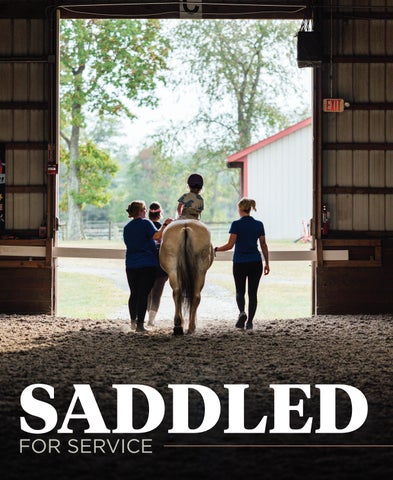
SADDLED FOR SERVICE
URSINUS MAGAZINE | 1
Witt ’16 spends time with one of the horses at Special Equestrians.
Janice Witt ’16 puts empathy into action at a Bucks County equestrian therapy center, changing lives one ride at a time.
J
anice Witt ’16 steps outside through open barn doors onto a mulched path leading toward a field of colorful signs and yard games. She’s smiling and laughing as she guides a 5-year-old boy mounted on a horse, with two of her colleagues on the animal’s other side. It’s an early fall afternoon, and the group is weaving through the sensory garden, throwing balls and opening mailboxes. It’s one of several private lessons on the docket for the evening at Special Equestrians Therapeutic Riding Center in Warrington, Pa. This
particular client was referred to the center’s hippotherapy program because of a developmental delay. Special Equestrians, which has approximately 125 weekly clients, specializes in equine-assisted
therapies. They work with both children and adults with physical and intellectual disabilities, as well as veterans, at-risk youth, and cancer support groups, among others. There are 24 staff members and 200 volunteers who keep the nonprofit going. Witt is at the center of it all, serving as the center’s executive director. She says it all starts with their horses. “Because horses are prey animals in the wild, they’re really sensitive to body language and nonverbal communication,” Witt explained. “They can sense rises in heart rate, increases in respiratory rate, and they react. They’re really good mirrors, especially when you’re dealing with something mental-health related.” The animals help clients to recognize emotions, she says, and guide them in other ways, depending on their needs. “The movement of a horse mimics the muscles we need to learn to walk and ambulate. If you’ve got
By Alyssa Kratz
young kids who are behind in their gross motor milestones, just sitting on the horse [while it's] walking
Photography by Jack Hopey
really increases their postural stability, their core strength,” Witt said. “Adding in a couple volunteers helps with social-emotional communication. There’s a big sensory aspect of it, too.”
2 | URSINUS MAGAZINE
For the Delaware County native, it’s a labor of love that started at a young age. “I’ve always been drawn to horses,” Witt said.
and getting involved more in therapeutic riding made me realize that was the way I wanted to
“[My family] had a competitive show jumping horse.
go. Being a therapeutic riding instructor is really
I think we got him when I was in fourth grade.
hard to make a full-time gig out of, and if you do,
When I was in high school, he had a career-ending
it’s low pay. So, I got interested in hippotherapy,
injury, and he ended up at a farm that specializes in
which is the use of physical, occupational, and
rehabbing of injuries.”
speech therapies with horses.”
That farm was across the street from Thorncroft Equestrian Center in Chester County.
After graduating from Ursinus in 2016, Witt took a gap year before continuing her education at Temple
“They’re one of the biggest therapeutic riding
University in Philadelphia, where she received a
centers in the area, and I started meeting people who
master’s degree in occupational therapy (OT). Her
were associated with the farm. I wasn’t riding; I had
career at Special Equestrians began in 2019.
spare time, so I started volunteering,” Witt explained. “I think I was 12 or 13 at the time.” Horses are part of the reason Witt ended up attending Ursinus, too.
Witt's love for horses began in childhood, she says. Now, as executive director of Special Equestrians Therapeutic Riding Center, she is pairing that love with a desire to help people through therapeutic riding.
my major to psychology halfway through school,
“I came pretty much straight here,” she explained. “It was one of the only centers that has a big OT program. Lots of centers have therapeutic riding for recreational purposes, and some have physical
“We had horses at home, so I wanted to be close to
therapy, but not a lot have OT. I was family friends
them,” she said. “I wanted to stay close to home, and
with the director at the time, so I reached out, and
I also wanted a smaller school feel.”
that’s how I ended up here.”
Witt’s Ursinus journey started on a pre-vet track.
In 2022, after battling closures during the
She thought she wanted to go to veterinary school,
COVID-19 pandemic, the center’s executive director
but a flyer in the library changed her trajectory. It
retired. Witt worked her way up and was a natural
was for a job opening at a local animal hospital. Witt
choice to lead the center.
applied and was hired as a veterinary assistant, a role
“I never thought therapeutic riding would be a
she stayed in for nine years. While the experience was
full-time job,” she said. “I always thought it would be
invaluable, Witt says it showed her that veterinary
something I just did on the side, but I love it.”
medicine wasn’t where her heart was. While at Ursinus, she began teaching at another local therapeutic riding farm near Collegeville. “It was a slow process,” Witt said. “I switched
When asked what draws her to therapeutic riding, Witt says it goes beyond just a love for horses. It’s the diversity of the job that fuels her passion. “I had a hard time picking something I was
URSINUS MAGAZINE | 3
I never thought therapeutic riding would be a full-time job. I always thought it would be something I just did on the side, but I love it.” — Janice Witt ’16 going to have to stick to for the rest of my life,” she
understanding body language,” Witt explained.
explained. “When you’re in therapeutic riding, you
While building this new focus on mental health,
work with a variety of clients. You’re not just in a
Witt has found herself drawing on what she learned
school system as a school-based therapist. You’re
in her Ursinus psychology classes.
not in a rehab just working with [individuals]
“I’ve been recalling a lot of things I learned
with physical disabilities. Every single client is a
in abnormal psychology and my anatomy and
completely different ball game. We have kids as
physiology class. I took behavioral neuroscience
young as two up to people in their eighties. There
at Ursinus,” she said. “[Anatomy and physiology]
are physical disabilities, emotional disabilities,
was like going to OT school, so [when I got to
cognitive, genetic, you name it, we work with them.
Temple], I felt far more prepped than [others]
You get to touch a lot of different areas rather than
having that background.”
having to specialize and stick to one thing.” Special Equestrians also recently launched a fullfledged mental health program. “We have a staff social worker, and we work with
From group programming to individual lessons, Special Equestrians’ services are a true need across the greater Philadelphia region. The center currently has a 400-person wait list.
licensed professional counselors to offer ground-
“It’s in higher demand than we can provide access
based therapy, using the horse as a conduit to get
to,” she said. “It takes three to four years to access our
them to open up about things they might not talk about, using it as a medium for relaxation and
4 | URSINUS MAGAZINE
CONTINUED ON PAGE 46
P
A I N A V L Y S N N E
ORDER YOURS TODAY!
E G E L L O C URSINUS
ATTENTION PA-BASED
URSINUS ALUMNI! Ride with Ursinus with an official PENNDOT-approved Ursinus College license SADDLED FOR SERVICE | CONT. FROM PAGE 21
programming. It’s hard to turn people down. But people are catching on that horses are as impactful as they are.” Witt says seeing clients find success is what makes the work so fulfilling. “We hear countless stories from families about how kids have been in OT, PT, speech therapy, this, that and [the] other school-based [programs], and they haven’t worked, and then they come to riding, and this is the motivating, interesting thing that gets them to start reaching their goals,” she said. “Like, ‘My child struggled with walking, and six weeks into riding is walking around independently without falls now,’ so hearing those stories makes it all worth it.” While Witt now spends less time directly working with clients, she says the management side has its own rewards. “My program director, who I actually met while at Ursinus, volunteered for me at another center. She came here and joined the barn staff, so she went from volunteer to barn staff to instructor, and now she's our program director,” Witt explained. “It’s really cool from the management perspective seeing people grow in their positions and then be effective as a therapist or a therapeutic riding instructor.”
URSINUS MAGAZINE | 5