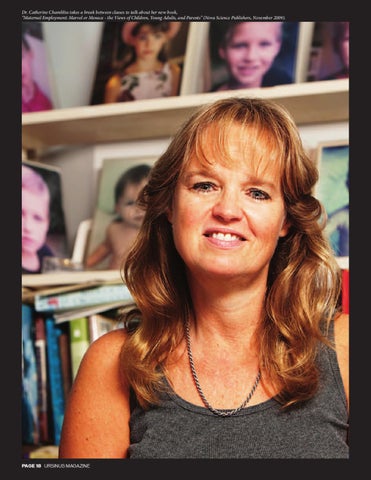
Dr. Catherine Chambliss takes a break between classes to talk about her new book, “Maternal Employment: Marvel or Menace - the Views of Children, Young Adults, and Parents” (Nova Science Publishers, November 2009).
PAGE 18 URSINUS MAGAZINE
Summing it Up Professor Catherine Chambliss on Mothers, Careers, and the Balancing Act. After reading the book, will readers be more optimistic that there can be a work/life balance for mothers?
Absolutely! The only consistent difference we found when we compared young adults whose mothers had combined employment and family life to those whose mothers had been nonemployed was that those with employed mothers were stronger advocates of maternal employment. Apparently it worked out pretty well for them. Not surprisingly, these children were more likely to be planning to have a dual paycheck family themselves. Our findings indicate that when young adults with employed mothers look back on their childhoods, they typically don’t fault their mothers for having chosen the juggling act.
Do women tend to be tougher on each other in the workplace or more supportive? And is there support for both decisions that women make – whether it’s to stay at home or return to work?
I think that usually employed mothers have a keen understanding of the value of workplace flexibility, and generally support other parents by trying to maximize this. Of course, some mothers who combine work and family successfully may be insensitive to the special circumstances of other families (such as a child’s disability), and therefore have unreasonable expectations of coworkers. Some non-employed mothers are still made to feel defensive about their choice, just as some employed mothers still feel apologetic. Spousal support seems to be especially crucial to maintaining a mother’s commitment to her employment choice. Tensions seem to run a bit higher in families where the father was raised by a mother whose employment choice was different from that of his wife. Given that we’ve found that young adults are very loyal to whatever type of family they experienced growing up, it’s likely that future couples will have more challenges when partners come from different maternal employment backgrounds.
In what way have things improved and how have they become more challenging? What factors make it difficult for mothers to succeed at work?
Day care center options have multiplied dramatically and working remotely is more often possible. On the other hand, quality day care is quite expensive and many workplaces now expect 24/7 employee availability. Extended families are less critical of maternal employment than they were when it was
rarer, but the fact that there are also now more employed grandmothers has reduced their ability to serve as a valuable childcare resource. More fathers now embrace having a large role in the lives of their children, but in most cases mothers remain the family “managers” (with all the demands attendant to that role). Many employers have reduced their travel expectations, but children’s school-free summers remain a challenge for many employed mothers. Workplace flexibility makes all the difference for many employed mothers, because young children often get sick and mothers of older children don’t want their jobs to compromise their children’s opportunities for involvement in sports and other extracurricular activities. Mothers are grateful when given the freedom to work around their family needs and often make heroic sacrifices to fit everything in.
Did your research reveal any “optimum” time for mothers to return to their careers?
No one size fits all. Children tend to be pretty resilient, but some have trouble adjusting to day care as infants, and some mothers don’t have the energy to return to work while their nights are still regularly disrupted by feeding and then teething. However, while a few careers may tolerate a long absence, many impose a huge penalty. If a mother’s skills quickly will become obsolete, a shorter delay before returning to work can ultimately make life easier on the family (especially if it means that she will have more control over her schedule in the future).
How much of a factor does guilt play in a mother’s decision to work or stay home?
I think fear, anxiety, and guilt still figure prominently in these decisions. Since virtually all mothers feel their child’s wellbeing is their highest priority, so long as any voices in the media continue to argue that maternal employment endangers children, many mothers will continue to worry about whether it’s safe for them to resume work outside the home. On the other hand, especially when so many fathers have been laid off due to the recession, anxiety about financial security and maintenance of health insurance drive other women to go to superhuman lengths to keep their jobs to protect their families. Our research should reassure these women that their children are likely later on to admire them for taking on the challenges associated with maternal employment. WINTER 2011 PAGE 19