Spider Insider
BOATWRIGHT MEMORIAL LIBRARY TRANSFORMED
For faculty & staff at the UNIVERSITY OF RICHMOND Autumn 2026
LIVING LABORATORY Biology professor Jonathan Richardson (front) and natural areas steward Joseph Day collect water samples from an outflow channel below Westhampton Lake to test nutrient, pH, and sediment levels; bacterial and algal concentrations; and more. The samplings are used to monitor lake health and the runoff entering Little Westham Creek, which carries runoff downstream to the James River and ultimately the Chesapeake Bay. Research conducted by Richardson and his Aquatic Ecology class helps guide campus management and understanding of local impact on broader watershed health. “The lake and stream are the visual and geographic heart of the University but also living ecosystems that support a remarkable community of plants and animals,” Richardson said. “By monitoring these waters over time, we can understand the factors shaping their health and know when management actions are needed to steward these resources.” Scan the QR code to read the University of Richmond Magazine story.
ii
Autumn 2026
Vice president for communications and chief marketing officer Tom Addonizio Senior director for media relations and strategic communications Sunni Brown Editor Cheryl Spain Associate vice president for creative and design services Samantha Tannich
Spider Insider
Director of design services Katie McBride Senior graphic designer Ashley Gladner Photographer Jamie Betts Staff contributors: Lauren Anesta, Sandi Cauley, Megan Condict, Catherine Cribbs, Nia Darrisaw, Rachel Dawson, Matthew Dewald, Lucy Gilbert, Phillip Gravely, Terrance Henderson, Kevin Heraldo, Alicia Hubbard, Pamela Lee, Rachel Long, Rayne Miller, Kyra Molinaro, Sandra Shelley, Cindy Smith, Greg Thompson, and Michael Warchol Spider Insider is printed on paper that is FSC® Certified, with 10% post-consumer recycled content and certified fiber.
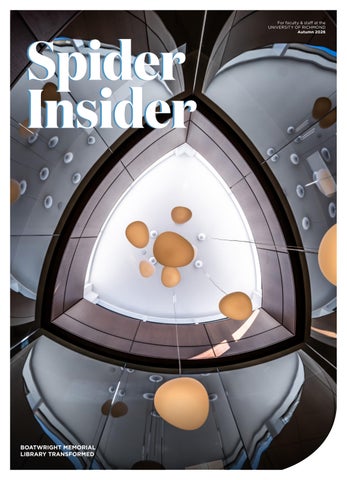
ON THE COVER The Oculus is a Reuleaux triangle glass clerestory that channels natural light to Boatwright Memorial Library’s second-floor quiet study area and Weinstein Learning Center. The curved glass panels limit sound transmission, and the element’s design prevents leaks common to skylights.
We welcome your input.
Send your story ideas or comments to spiderinsider @richmond.edu.
On Air
WDCE student DJs bring music and conversation to campus airwaves.
AROUND THE LAKE 2
8
‘This Is Our Time’
Building What’s Next
Message from President Kevin F. Hallock
3 Investing in Student Success
Spider faculty and staff support meaningful causes during annual fundraising events
Accolades
4 Behind the Curtain
Modlin staff work behind the scenes to support campus partners, students, and distinguished guests
6 Social Buzz A New Chapter for Boatwright
Photograph by Jamie Betts
Multiyear transformation creates spaces for learning, collaboration, and community — and a home for the Weinstein Learning Center
7 Accelerating Richmond
Fundraising campaign builds upon the University’s distinctive strengths
New leadership gifts will strengthen the places and programs that define the Richmond experience
9 Better Every Year
UR welcomes the Class of 2030
10 The Conversation
Fiber’s structural integrity keeps plants strong — and its indigestibility keeps your digestive system healthy
11 Media Mentions
12 A Summer of Discovery
Faculty and undergraduate students partner across disciplines to advance scholarship through hands-on research experiences
PEOPLE 14 Unlocking Support for UR 16 Endowed Position Holders Recent Appointments 17 Accomplishments 19 Sustainability Leadership Awards 20 Employee Graduates 21 Distinguished Educator, Scholarship, and Faculty Service Awards 22 Omicron Delta Kappa Spring Epsilon Circle Inductees 24 New Hires and Retirements
‘This Is Our Time’ Dear Spiders, STAY CONNECTED Read more of President Hallock’s messages to the University community — or share your thoughts with him at any time — at president.richmond. edu.
2
It takes all of us to make this place great, and together we change lives. Each year, we welcome remarkable students from throughout the Commonwealth, across the country, and around the world into our tight-knit community to pursue a rigorous, academically challenging education and prepare to flourish. Across our breathtaking grounds and exceptional facilities, our students learn, create, collaborate, present, perform, and compete. Alongside world-class scholars, dedicated mentors, classmates, teammates, and friends, they enjoy nourishing meals, navigate challenging conversations, foster their well-being, and cultivate a sense of belonging. Approximately 40% of our operating budget is funded by an annual draw from our endowment, approved by the Board of Trustees. In addition, people who love this place and want others to have experiences like the ones we make possible donate to support our educational and cocurricular programs and open doors for the Spiders of today and tomorrow. Now, together, we are poised to accelerate the University’s incredible momentum. When I interviewed here, I was already thinking about how a philanthropic campaign could build upon the University’s achievements. As soon as I started, we embarked quietly on the silent phase of a campaign. Thanks to the efforts of many Spiders and the generosity of donors who want to see the University succeed, we’ve already raised significant new gifts and commitments. This fall, we are launching Accelerate Richmond, the public phase of the campaign to engage Spiders everywhere. Over the coming years, we will strengthen connections throughout our web, pursue ambitious fundraising goals, and ultimately, take the University to even greater heights.
Making a Richmond education more affordable will be a key pillar of our campaign. It takes significant financial resources to do what we do. We offer need-blind admissions, meet the full demonstrated need for traditional, domestic undergraduate students, and provide funding so students can explore career pathways, conduct faculty-mentored research, and study abroad. Still, we aspire to do even better. We will be calling on Spiders who are able to invest further in financial aid so Richmond can become known everywhere as a relentlessly welcoming university where every talented student can imagine themselves thriving. In addition to scholarship support, our campaign has three additional main pillars. We will raise funds to hire and hold on to leading scholars who love teaching; strategically expand faculty expertise; and bolster academic coaching, mentoring, and support. We will secure the resources to provide an unparalleled college athletic experience, compete, and win. And we will invest further in the overall student experience so that when students graduate from Richmond, they are ready for whatever comes next: ready to have productive conversations in the office, in their communities, and at the dinner table; ready to leverage emerging technologies to navigate a rapidly evolving world; ready to succeed in their careers; ready to contribute to society; and ready to lead flourishing lives. Our campaign will be fun and joyous as Spiders everywhere connect with one another and help realize the University’s greatest ambitions. I’m excited. I hope you are too. This is our time.
Kevin F. Hallock President and Distinguished University Professor of Economics
The Peace Corps ranked UR No. 10 among small schools on its 2026 TOP VOLUNTEER-PRODUCING COLLEGES AND UNIVERSITIES list. It’s the second year in a row UR has ranked in the top 10. During the past fiscal year, eight alumni served in seven countries, and 174 alumni have served abroad as volunteers since the Corps’ founding in 1961.
Investing in Student Success Spider faculty and staff support meaningful causes during annual fundraising events In April, the University’s eighth annual UR Here Giving Day made history as Spiders around the world showed their support for students. An unprecedented 5,200-plus donors from 50 states and 19 countries came together to raise a record $3.4 million in 36 hours. Jennifer Lo Prete, director of communications at the School of Arts & Sciences, played a significant role in UR Here’s success. Over the years, Lo Prete has helped steadily increase support for A&S by spreading awareness about UR Here among faculty and coordinating marketing and social media efforts across 23 departments and 15 interdisciplinary programs. This year, A&S raised $84,827 from 397 donors, a strong increase from $59,527 and 282 donors in 2025. The Department of Philosophy topped the A&S dollar leaderboard with $10,975 raised, while the Department of Theatre and Dance received support from 58 donors, more than triple its number last year. “We try to make it as easy as possible for faculty and staff to participate, and each year we’ve seen that engagement grow,” Lo Prete said. “We also try to emphasize that it’s not about the amount you give — it’s about showing up. It’s exciting to see where people choose to donate each year.” Lo Prete was one of 393 UR faculty and staff members who supported UR Here. In total, they contributed more than $75,000. A double Spider parent, Lo Prete gives back to honor the academic interests of her children: 2026 graduate Malena, who studied art history and political science, and sophomore Lautaro, who is interested in geography. “I have gained so much professionally and personally at Richmond,” she said. “I’ve grown in my career while getting to see each of my children have an outstanding educational experience.” This fall, Spiders can once again support students through Spiders Helping Spiders. This annual initiative encourages gifts that help students overcome financial barriers, remain on track toward graduation, and access opportunities that prepare them for success beyond Richmond. In 2025, a record 1,525 donors — including 156 faculty and staff — contributed more than $470,000 through Spiders Helping Spiders. “Our faculty and staff are essential partners in the success of our fundraising initiatives,” said Gabrielle Strickland, director of annual giving. “Through their advocacy, collaboration, and generosity, they help inspire others to invest in Richmond. Their participation demonstrates the deep commitment we have to students and reinforces the value of a Richmond education.”
A&S raised $84,827 from 397 donors, a strong increase from $59,527 and 282 donors in 2025.
The Fiske Guide to Colleges featured UR in its 2027 edition, highlighting Richmond’s COMMITMENT TO ACCESS AND AFFORDABILITY and praising the distinctive blend of RIGOROUS ACADEMICS, EXPERIENTIAL LEARNING, and STRONG SENSE OF COMMUNITY. UR has appeared in every edition of the guide since its debut in the 1980s.
AROUND THE LAKE
ACCOLADES
The Princeton Review recognized UR in its 2027 The Best 392 Colleges guide. UR ranked in the top 25 in several categories, including No. 8 for BEST HEALTH SERVICES, No. 12 for BEST QUALITY OF LIFE, No. 14 for BEST CLASSROOM EXPERIENCE, and No. 16 for MOST ACCESSIBLE PROFESSORS. Exercise is Medicine on Campus, a national health initiative by the American College of Sports Medicine dedicated to improving the health and well-being of the campus community through physical movement, awarded UR a GOLD-LEVEL AWARD, the highest recognition for efforts to make movement a part of campus culture. UR received three awards at the 47TH ANNUAL TELLY AWARDS. UR was awarded silver in the branded content – educational institution category for materials related to SP4, UR’s professional development and performance program for student-athletes; a silver People’s Telly in collaboration with Athletics in the social video category for “Spider soccer player Marisa Snee tries new sports;” and bronze in the promotional video – educational institution category for “What Happens at the University of Richmond.” The awards honor excellence in video and television across all screens. The National Association of College and University Food Services awarded UR’s Dining Services three LOYAL E. HORTON DINING AWARDS. Catering Services received a silver Catering Special Event of the Year award for the Robins School of Business 75th anniversary celebration; Retail Operations received a bronze award in the retail sales: single concept category for 8:15 at Boatwright; and Residential Dining received a bronze award in the residential special event category for its International Education Week Ghana dinner. The Council for Advancement and Support of Education awarded UR’s Office of Donor Relations a silver CIRCLE OF EXCELLENCE AWARD in the publications – fundraising annual reports and fund reports category for “A Token of Gratitude: The Gottwald Impact Book.” 3
Assistant production managers Bri Conley and Kevin Willoughby are part of the Modlin crew providing audiovisual support for the many events and performances held at the center.
TIME TO CELEBRATE Modlin Arts Presents is celebrating 30 years of showcasing captivating artists and groundbreaking works. Highlights for the remainder of the 2026–27 season include: • The Christian McBride Jazz Weekend • The Crossing performing David Lang’s poor hymnal • Jazz at Lincoln Center Orchestra with Wynton Marsalis • Remembering Empathy world premiere with Marc Bamuthi Joseph and the Richmond Symphony For information on additional performances and discounted staff and faculty tickets, visit modlin.richmond.edu.
4
Behind the Curtain
Modlin staff work behind the scenes to support campus partners, students, and distinguished guests As Modlin Arts Presents celebrates its 30th anniversary, the staff behind University of Richmond’s annual performing arts series is also marking three decades of helping shape many of the University’s most memorable moments. Best known for presenting world-class performances, the team also supports distinguished guests, celebrates employees, and contributes to the student experience. Behind the Scenes Each spring, more than 500 employees gather in Camp Concert Hall for the Outstanding Service Awards. While the audience sees polished presentations and seamless transitions, the production crew works behind the scenes so Human Resources can focus on celebrating colleagues. “Our Modlin partners make it feel like a highscale production,” said Angeline Gardner, events coordinator in Human Resources. “I simply give them a slide deck, and they make their magic happen.” That kind of seamless support is the result of years of building relationships across campus. Human Resources, the Chaplaincy, and dozens of offices across the five schools rely on the Modlin team to tailor each event to its unique needs and
manage the technical details that audiences rarely notice. “Over the years, we’ve met regularly and stewarded campus relationships,” said Cal Meadows, patron services manager. “Every campus partner has different needs — ticketing, will-call, special guests — and we’re always delighted to shape that experience.” When the law school hosted the 2025 Virginia attorney general debate, those relationships and that experience were put to the test. The team delivered — under national attention. In addition to campus community, local, and state interest, this debate drew 40 journalists from news outlets across the country to campus. “From stage design to security and crowd management, they ensured that every detail was handled with expert precision,” noted Renee Russell, director of communications for the law school. “The debate demanded flawless execution, and the Modlin team delivered at every turn, allowing us to showcase the very best of UR.” Supporting the Student Experience The student experience is another cornerstone of the Modlin team’s work. Each August, hundreds of new students and their families gather in Camp
AROUND THE LAKE
Concert Hall for one of their first official experiences as Spiders. “When orientation arrives, there are countless moving pieces and very little room for error,” said Sage Ober, director of New Spider Orientation. “The Modlin staff consistently delivers exceptional support, allowing us to trust that every event held in the center will be executed flawlessly.” That trust empowers the Modlin team to anticipate challenges and respond quickly. “Our staff is accustomed to making in-the-moment decisions,” noted Chris O’Neil, Modlin operations manager. “Many of the solutions we implement are invisible to audiences, and we’re always thinking of ways to improve the next event.” The team’s impact on the student experience continues long after orientation. Throughout the year, student organizations dedicated to the performing arts take the stage in Modlin’s professional venues. While many students arrive with artistic talent and performance experience, most have never worked with a production crew. That’s where the Modlin staff becomes mentors. Working with the Modlin production staff, groups such as the Bollywood Jhatkas, Block Crew, and the Octaves gain firsthand experience in a professional performing arts setting. “Students often come in with a vision of what
they want for their show,” said Bri Conley, assistant production manager. “Then we work with them to bring it all to life.” The Personal Touch Campus partners consistently point to something beyond technical expertise: the care the Modlin team brings to every event. “For major events, guests often arrive then transition quickly to sound check and backto-back engagement opportunities,” said Nicki Pugh, administrative specialist for the Office of the President. “It is so helpful to have a private green room and a professional team ready to make last-minute adjustments based on our guests’ needs.” Sometimes, that care is expressed in other meaningful, more personal ways. During this year’s Outstanding Service Awards, the production crew surprised colleague and Department of Theatre and Dance lighting technician Robby Williams with a special lighting cue as he accepted his award — a small gesture that reflected the thoughtfulness they bring to campus events every day. Executive director Paul Brohan believes that spirit defines the team. “There is a great deal of personal care and attention coupled with extensive experience that the Modlin staff dedicate to their work and the University,” he said.
“Many of the solutions we implement are invisible to audiences, and we’re always thinking of ways to improve the next event.”
AT A GLANCE Last academic year, the Modlin Center team supported close to 100 unique events in its venues. These included: • Nearly 50 Department of Music and Department of Theatre and Dance events • Approximately 20 Modlin Arts Presents performances • More than 25 University events and programs, including: ◦ A&S Symposium Colloquy ◦ Sharp Viewpoint Series ◦ Spiders in the Know ◦ Weinstein Rosenthal Forum
5
SOCIAL BUZZ This campus gem was my final stamp as a mother on our initial tour that my son belonged here. Mental health is so important. — Ashley Mashaw Lemke via Facebook, referring to the Meditation Garden in UR’s WellBeing Center Wow something to hear professor Hoyle still there making it difficult but worth it for accounting majors. RSB 1987 —Adam Robinson via Facebook Dr. Walt Stevenson. Still my favorite of all time. —James Rice via Facebook
The first time I visited UR was in the spring when all the trees and spring bulbs were blooming, and I instantly fell in love. Honestly that’s what clinched my decision to go there —Emily Dodd via Facebook LOVE Coach Chemotti – he created a first class program at Richmond! Not a better coach out there – such GREAT news for Richmond players, parents, alumni and fans!!!! —cates.kim via Instagram, referring to lacrosse coach Dan Chemotti signing a long-term contract extension at UR Richmond is in for a treat! Kres is the BEST! —stephanierichason via Instagram, referring to new Spider women’s basketball coach Alisa Kresge This is incredibly sad news. She and I have been friends for over 20 years, and she always gave me a gentle honk and tail shake when I visited her, almost daily, for all those years. … I’m so sorry, sweet girl. I will miss you every day and think of you on my circuits around the lake. Soar free, beautiful girl. —Susan Greenbaum via Facebook, referring to the death of Triceragoose
6
A New Chapter for Boatwright Multiyear transformation creates spaces for learning, collaboration, and community — and a home for the Weinstein Learning Center When faculty, staff, and students returned to Boatwright Memorial Library this fall, they found a familiar campus landmark transformed for the way the University of Richmond community learns and works today. The completion of a multiyear renovation reimagines Boatwright as a modern destination for learning, research, collaboration, and community. The project includes new collaborative and flexible study spaces, improved outdoor terraces overlooking Westhampton Lake, and updated spaces for Rare Books and Special Collections, the Book Arts Studio, and the Lora Robins Gallery. “Boatwright Memorial Library’s renovations reflect our commitment to creating spaces where our entire community can learn, collaborate, and thrive,” said Joan Saab, executive vice president and provost. A major component of the transformation is the new home of the Carole and Marcus Weinstein Learning Center (WLC), which brings the University’s specialized academic support resources together under one roof for the first time. Located on the first floor, the center provides academic coaching, content-specific tutoring, dedicated studios, expert support, and professionally certified peer mentors. Students can strengthen skills in writing, quantitative work, technology, languages, and speech — making Boatwright Library an even more integral part of their academic experience. “The WLC is now located in a purpose-built environment designed to foster collaborative learning and student success,” said Marco Ortiz, WLC executive director. “By bringing personalized academic support into one welcoming location, we are making it easier for students to access the resources they need. This new space not only creates opportunities for interdisciplinary collaboration, but it also empowers our students to elevate their critical thinking skills and ignites a passion for lifelong learning.” The renovation also expanded 24/7 study options for students and relocated and enlarged 8:15 at Boatwright. Behind the scenes, extensive improvements included new heating, ventilation, lighting, and fire protection systems; accessibility enhancements; and restoration of the building’s exterior. A new north-side student entrance also improved access. “This significant renovation, including our new home for the Weinstein Learning Center, demonstrates the University’s profound commitment to our students,” said President Kevin F. Hallock. “I am thrilled that they will have enhanced access to our collections, technology-rich environments, inviting study areas, and unparalleled resources for collaboration and academic support, and I am profoundly grateful to everyone who has made this all possible.”
“ We are making it easier for students to access the resources they need.”
AROUND THE LAKE
Accelerating Richmond Fundraising campaign builds upon the University’s distinctive strengths On Sept. 24, the University of Richmond launched the public phase of its multiyear fundraising campaign, Accelerate Richmond. It’s the most ambitious campaign in UR’s history, both for the dollars the campaign seeks to raise and the way in which it seeks to engage the entire Spider community. The campaign aims to both engage Spiders and raise funds to support the people and experiences that make Richmond distinctive, positioning UR for an even more impactful future. “Thanks to the support of generations of donors; the deep engagement of alumni, parents, and our campus community; and our careful stewardship of the University’s resources, Richmond is in a strong position,” said Martha Callaghan, vice president of advancement. “This campaign is our opportunity to press on our advantages and accelerate our incredible momentum, supporting the people, programs, and places that make a Richmond education so exceptional.” Accelerate Richmond builds on UR’s existing strengths by deepening alumni engagement and fundraising for four pillars: access and affordability, academic excellence, lives of purpose, and athletics. Through the campaign, UR will open the doors of opportunity wider by expanding affordability to undergraduate families across the income spectrum through new scholarship gifts. The University also seeks to make the law school and other graduate programs more affordable for talented students.
The campaign will strengthen the teacherscholar model that makes a Richmond education exceptional. UR will create a series of endowments that will help recruit, recognize, and retain outstanding teacher-scholars while advancing teaching and scholarship in emerging fields. Accelerate Richmond will also help prepare graduates across the University so they are ready to lead successful, purposeful lives. It will help ensure that the University can provide every undergraduate with access to personalized advising, career readiness, and on-the-ground experiences — internships, research, and international travel — that extend learning beyond the classroom, and skill-building opportunities that help them navigate emerging technologies with confidence and engage in thoughtful dialogue across differing perspectives. Philanthropic support will also enhance athletic facilities, attract and retain outstanding coaches and student-athletes, expand scholarship and endowment support across Richmond’s Division I programs, and strengthen the wellness, academic, and career development resources that help student-athletes thrive. “Our community gives back to Richmond in so many ways every year, including through philanthropy,” Callaghan said. “We know that every Spider engaged and every gift made during this campaign will help us achieve great things for our students, and for UR.”
LEARN MORE For more information on Accelerate Richmond and how staff and faculty can support the campaign, check out the pocket guide insert between the pages of this issue.
“We know that every Spider engaged and every gift made during this campaign will help us achieve great things for our students, and for UR.”
7
Building What’s Next New leadership gifts will strengthen the places and programs that define the Richmond experience The generosity of University of Richmond alumni continues to transform campus in lasting ways. Two recent gifts will support major investments in athletics and student life, helping create new opportunities for students to compete, connect, and grow while building on the University’s strengths. Weinsteins Support Expansion of Wilton Center with $6 Million Gift University of Richmond alumni and longtime benefactors Carole and Marcus Weinstein have committed $6 million to support the expansion of the E. Carlton Wilton Center for Interfaith Campus Ministries. Located adjacent to Cannon Memorial Chapel, the Wilton Center serves as a welcoming gathering place for students of all backgrounds and faith traditions. Home to the Office of the Chaplaincy and partner campus ministries, the center provides space for worship, prayer, fellowship, dialogue, discussion, and community-building. The project will create additional space to support the continued growth of the University’s religious and spiritual communities. “Our Chaplaincy communities are growing and thriving, and this success has surpassed the capacity of our building,” said Craig Kocher, dean of religious and spiritual life, University Chaplain, and Jessie Ball duPont Chair of the Chaplaincy. “This generous gift from the Weinsteins will expand the Wilton Center and further allow the religious and spiritual communities at the University to continue to flourish and learn from each other.” The Weinsteins have played a transformative role in the University’s history through decades of philanthropy. Their landmark $25 million gift established the Weinstein Learning Center, and they have also supported global engagement, scholarships, faculty chairs, student well-being, and the Chaplaincy, including Jewish Life and its pilgrimage programs. 8
Queallys Make $10 Million Gift to Advance Spider Lacrosse University of Richmond alumni Paul and Anne-Marie Queally, both Class of 1986, have made a $10 million gift to support Spider Athletics and the construction of a new facility dedicated to the University’s nationally recognized men’s and women’s lacrosse programs. The donor-funded facility is expected to open in summer 2029 at the north end of Robins Stadium. The building will feature locker rooms, strength and conditioning space, meeting rooms, and offices designed to support the continued growth and success of both programs. The Queallys previously helped the Spider men’s lacrosse program through an endowed fund and provided the lead gift for the Queally Athletics Center, the practice home for Spider basketball. They have also provided transformational support for the Queally Center for Admission and Career Services and Queally Hall in the Robins School of Business. “This latest gift builds on the Queallys’ unwavering commitment to advance competitive excellence in Spider Athletics,” said John P. Hardt, vice president and director of athletics. “The tremendous momentum of our lacrosse programs has captured the attention of the entire country, and this new facility, made possible thanks to Paul and Anne-Marie’s generosity, will serve to further strengthen both our nationally recognized men’s and women’s lacrosse programs.” The announcement followed a historic year for Richmond lacrosse. The men’s team won both the Atlantic 10 regularseason and tournament championships, reached No. 1 in the national rankings, and hosted the first NCAA Tournament home game in program history before a record crowd of 6,805 fans. The women’s team also captured its first outright Atlantic 10 regular-season championship, finishing conference play with a perfect 9–0 record.
AROUND THE LAKE
Better Every Year
UR welcomes the Class of 2030 The University of Richmond had another record-breaking year for undergraduate applications, with 18,420 students hoping to join the Class of 2030. The 876 who enrolled come to UR from 40 states and U.S. territories and 28 countries, including Vietnam, Argentina, Canada, Cyprus, Greece, Spain, and Ukraine. Firstgeneration students make up 10% of the incoming class. “Our newest Spiders are smart, engaged, creative, and deeply invested in their communities,” said Stephanie Dupaul, vice president for enrollment management. “They bring remarkable accomplishments and experiences that captured the attention of our admission committee during one of the most selective admission cycles in the University’s history.” The class includes an impressive range of accomplishments and interests. The youngest board-certified pharmacy technician in Colorado, a signed author, and a nationally ranked archer are all now part of the Spider family. There’s also a bagpiper, a farm sitter, a fish counter, a circus artist, a zoo curator, and an auto museum docent. UR also remains committed to meeting 100% of students’ demonstrated need. Fifty-six percent of first-year students will receive university-funded grant or scholarship aid, while 61 traditional undergraduate students will benefit from Richmond’s Promise to Virginia. Together, these diverse experiences and the University’s commitment to financial access are helping create a campus where students from all backgrounds enrich classroom discussion, campus life, and the broader Richmond community. “Richmond students are simply extraordinary,” Dupaul said. “Their curiosity, talent, and willingness to pursue their passions in unexpected ways are what make the University of Richmond such a vibrant and inspiring community. Every year, I think the entering class is the best the University of Richmond has ever seen, yet every year it just gets better.”
THE CLASS OF 2030 AT A GLANCE
876
traditional undergrad firstyear students
32
transfer students
354
199
club, nonprofit, or business founders
3.8
average GPA
659
National Honor Society members
high schools represented
32
184
class or student government presidents
2026 Enrollment Update The Office of Enrollment Management provides preliminary information — as of Aug. 1 — on the incoming first-year class and transfer students, as well as information on the incoming classes in Richmond Law and the Robins School of Business graduate programs and enrollment in the School of Professional and Continuing Studies. This data is not final or official. Official census reports will be posted on the institutional effectiveness website in October. To view the 2026 enrollment update, visit enrollment.richmond.edu/ reports.
completed one or more internships
9
JOIN THE CONVERSATION This article has been adapted for length with permission from the author. A complete list of The Conversation articles, including this one in its entirety, is available at news.richmond. edu/placements/ conversation.html. Faculty interested in writing for The Conversation can contact Sunni Brown, senior director for media relations and strategic communications, at sbrown5@richmond. edu, or Lauren Anesta, media relations manager, at lauren.anesta@ richmond.edu. Reprints of The Conversation articles appear frequently in Spider Insider, University of Richmond Magazine, and UR Now (urnow.richmond.edu).
10
THE CONVERSATION
Fiber’s structural integrity keeps plants strong – and its indigestibility keeps your digestive system healthy If you’re over the age of 10, the World Health Organization recommends that you consume at least 25 grams of fiber every day. The best fiber-containing foods come from plants: fruits, vegetables, nuts, seeds, whole grains, and legumes. While it’s sometimes overshadowed by other nutrients such as protein, fiber plays a significant role in gastrointestinal health, digestion, and nutrient absorption. In the biochemistry classes I teach, I emphasize that structure dictates function. If you’re about to cross a bridge but notice the braces are falling off or the wood is rotting, you’ll probably avoid stepping on it because the structure looks fragile. This concept is true in the food you eat as well. The structures of the molecules that make up your food require them to be broken down in different ways to produce the energy that fuels your body. Some foods contain vitamins and minerals that your body absorbs and uses for multiple functions. Other foods can keep your digestive system healthy and help your body absorb nutrients. Food molecules consist of proteins, fats, and carbohydrates. Each of these classes of food molecules has unique structures that allow your body to process them differently. For example, fats are long chains of carbon atoms that do
not dissolve in water, while proteins have large amounts of nitrogen due to their amino acids. Carbohydrates, or sugars, are biomolecules made up of carbon, oxygen, and hydrogen atoms. Simple carbohydrates include single sugars, such as glucose or fructose, and two sugars linked together, such as sucrose (table sugar) or lactose (milk sugar). These simple carbohydrates exist mostly in rings, although they sometimes open up into a linear form. Complex carbohydrates, on the other hand, have hundreds to thousands of sugar molecules linked in large sheets called polysaccharides. These carbohydrates are linked only in their ring forms. Plants connect sugar molecules in two types of polysaccharides — starch and fiber. These molecules have similar structures because they contain only one type of sugar — typically glucose — linked together many times. However, one tiny difference in the chemical bonds within starch and fiber translates to very different functions for the molecules. Starch is a polysaccharide with glucose molecules that are linked using alpha bonds. Fiber, which consists primarily of cellulose, is a polysaccharide with glucose molecules that are linked using a beta bond. The types of bonds refer to how certain parts of the molecules are oriented. These slight
The best fiber-containing foods come from plants: fruits, vegetables, nuts, seeds, whole grains, and legumes.
Gardener LARRY RICHMOND, an expert on wildlife in gardens, is quoted throughout the article “What To Do if You Find a Baby Turtle Alone in Your Yard.” He shares why baby turtles end up in yards, why the safest thing to do is let them be, and how to tell if a baby turtle needs help from a professional wildlife rehabilitator. DAVE MCCOY, associate vice president for public safety and chief of police, explains campus safety apps such as URSpiderSafe in the article “How To Stay Safe on a College Campus.” “These apps generally include mobile blue light, university resources, direct calling to campus police or security, a way to report anonymously, and other safety features,” McCoy said.
differences mean the two polysaccharides’ overall three-dimensional structures differ at the locations of these bonds. The starch molecule is branched and doesn’t pack together very tightly. Plants use starch as a long-term store of glucose that they can break down to use for energy. The fiber molecules, due to their beta bonds, pack together very tightly. The glucose molecules in fiber form the support structures of a plant’s leaves, seeds, and stems. The bonds of the starch enable the plants to easily break down the sugar so they can access quick energy, while the bonds of the fiber are designed to last and add strength to the plant’s architecture. The structural differences between starch and fiber mean these molecules have different dietary functions when you consume them. Human bodies easily digest starch. Your body uses an enzyme called amylase that breaks the alpha bonds to release glucose molecules, which cells break down further to use for energy. Starch’s structure is perfect for fueling your cells. High-starch foods include potatoes, pasta, rice, corn, and bread. Human bodies, on the other hand, cannot digest the beta bonds in the fiber we consume. They do not make enzymes that can release glucose molecules from the fiber, so most fibers pass through your digestive tract without being digested and absorbed. They contribute no energy to your diet. Foods with large amounts of fiber include peas, broccoli, oatmeal, and pears. The fiber does offer other health benefits. Fiber promotes bowel health, which reduces the risk of constipation, hemorrhoids, and diverticulosis. Since the fiber stays intact in your gut, it gives your muscles something to push on to make it easier to eliminate stools, reducing pressure and inflammation in your intestines. Learning about the structures of the carbohydrates you consume can help you understand their function in the body. By Julie Pollock, associate professor of chemistry
AROUND THE LAKE
MEDIA MENTIONS
The story “In Tyringham woods, archaeology brings a vanished Shaker community back into view” highlights a research project by religious studies professor DOUG WINIARSKI; classics and archaeology professor ELIZABETH BAUGHAN; geography, environment, and sustainability professor STEPHANIE SPERA, and Spatial Analysis Lab director BETH ZIZZAMIA. The research team partnered with undergraduate students to survey and map a Shaker cemetery. Biology professor NATHAN DERSTINE is quoted in the article “‘They don’t belong in our environment’: US vineyards battle spotted lanternflies as invasive insects spread.” An expert on invasive insects, Derstine notes that the lanternfly invasion is relatively recent. “It’s been about 12 years,” he said. “That is not very long in the grand scheme of things, and so there has probably not been much adaptation or chance for any response by the natural enemies or parasitoids.” Research by CHRISTOPHER VON RUEDEN, an anthropologist and leadership studies professor, is featured in “The egalitarianism of hunter-gatherer societies has often been exaggerated.” Von Rueden’s study examines the role of individual motivations in traditional societies, noting that in traditional societies that may seem egalitarian, individual motivations are always behind human actions. Law professor ALLISON TAIT, an expert on estates, trusts, and family law, is quoted in “How Dallas’ ultrawealthy manage their money: What to know about family offices.” “It’s important for us to think about what type of legal exemptions we give to high-wealth families because at a certain point they should be treated more like a corporation,” Tait said. LAUREN TILTON, rhetoric and communications studies professor and director of the Center for Liberal Arts and AI, is quoted in “Students and AI: Attitudes, Concerns, and What Colleges Need To Know.” Tilton discusses how faculty can better assist students in their coursework and research methods as they navigate using AI. Visit news.richmond.edu to view additional media mentions or connect with University Communications’ media and public relations team, Sunni Brown and Lauren Anesta. 11
Classics and archaeology professor Elizabeth Baughan (right) on an October 2025 trip to New England led by religion and American studies professor Doug Winiarski to uncover a long-lost, sacred Shaker religious artifact.
AROUND THE GLOBE Faculty members pursued research and professional development opportunities around the world this summer through competitive fellowships. Daria Bozzato, visiting assistant professor in Italian studies, received a fellowship to conduct archival research in Portugal on the history of psychiatry and gender; Caitlin Giustiniano, visiting assistant professor of Russian studies, participated in an intensive Russian-language teaching institute in Kazakhstan; and Pippa Holloway, Cornerstones Chair in History, was named a Filson Institute Research Fellow in Kentucky, where she continued research for a biography exploring the life of early women’s labor advocate Virginia Penny.
12
A Summer of Discovery Faculty and undergraduate students partner across disciplines to advance scholarship through hands-on research experiences Faculty-mentored undergraduate research experiences are a hallmark of a Richmond educational experience. These opportunities happen both inside and outside the classroom each semester — and continue into the summer. In fact, summer provides a great opportunity for faculty and students to pursue projects in an immersive and focused way. This sampling highlights five faculty who advanced their scholarship and included undergraduate students in their research this past summer. SANDRA JOIREMAN, Weinstein Chair of Global Studies and professor of political science Joireman, an expert in international politics, spent the summer studying how the Syrian government is addressing property rights after the country’s civil war and how those decisions may influence whether displaced people choose to return home. Her work compares Syria’s approach with post-conflict recovery efforts in other countries.
Working alongside Joireman was Natalia Jung, ’28, who helped examine government documents, nongovernmental organization reports, social media, and other sources to track policies related to property restitution and compensation. The hands-on research allowed Jung to contribute to an international project while exploring her interest in international law. “I love doing research on post-conflict reconstruction, property rights, and political change, and I especially enjoy bringing students into that work,” Joireman said. “With appropriate guidance, undergraduate students can make real contributions to scholarship and to what we know about the world.” MICHAEL NORRIS, associate professor of chemistry Norris and undergraduate researchers are designing new molecules that use energy to solve two major challenges: reducing carbon emissions and improving cancer treatments.
One area of the lab’s work explores ways to recycle carbon dioxide into usable fuels, while another investigates molecules that can be activated only at the site of a tumor, with the goal of reducing harm to healthy cells. Throughout the year, undergraduate students lead every stage of the research, from creating and testing new molecules to analyzing results and presenting their findings. Their discoveries form the foundation of the lab’s scholarly publications, allowing students to make meaningful contributions to scientific research. “Scientific research is messy, confusing, and uncertain,” Norris said. “Watching students in this space is highly rewarding because it is so different than the classroom, and I enjoy seeing how students grow and adapt when presented with the unknown.”
Photo by Ava Jenks, ’27
M CHARITY, assistant professor of computer science Charity, a games and AI researcher, is working with undergraduate students on several projects. One student, Andy Quach, ’28, is developing ways to move within virtual reality without inducing motion sickness — and it’s by traveling on skateboard. Charity is also continuing work on projects connected to AI search functionality. Brooke Szajda, ’27, is developing a video game search engine where users can ask questions such as, “Is there pizza in a Teenage Mutant Ninja Turtles
BRUNO ALCALDE, assistant professor of music Alcalde and his team of undergraduate researchers are exploring musical genre. Participants in the study are asked questions about how they perceive genres in musical excerpts and if they notice combinations. The goal is to explore how the idea of musical genre is shifting in today’s popular music. “Students in the summer fellowship are engaged with the research from the ground up — they helped design the study, recruit participants, organize and run data collection, and participate in data analysis,” notes Alcalde. The results will be key to a book that Alcalde is writing about musical genre. “Mentorship is one of my favorite aspects of the academic career,” Alcalde said. “I find that the most important part is for undergraduate students to become accustomed to and at ease with moments of confusion and uncertainty and use them to move forward.” ELIZABETH BAUGHAN, professor of classics and archaeology Baughan, an archaeologist, served as an undergraduate mentor on a number of research projects related to her expertise this summer. In partnership with Doug Winiarski, professor of religious studies, and Beth Zizzamia, director of the Spatial Analysis lab, she and students worked on a study of a Shaker cemetery in the Berkshires. Baughan also mentored students working with the Virginia Museum of Fine Arts collection in preparation for an exhibit on Pompeii and worked with a student through the Richmond Cemetery Collaboratory, which documents and supports African American history and culture via the region’s cemeteries. “It is always rewarding to witness the students’ excitement when discovering new sources and evidence, and they often take their projects in creative new directions I had not anticipated,” Baughan said.
RESEARCH BEYOND CAMPUS
More than 300 students participated in faculty-mentored research through the Richmond Guarantee, with projects spanning multiple states and countries. Three students, working remotely from Virginia, New Jersey, and Texas, partnered with health studies professor Nigel James to use supervised machine learning to study food insecurity risk among U.S. high school students. Under the mentorship of history professor Christopher Bischoff, a history major traveled to Dublin to examine how news coverage influenced the conflict in Northern Ireland during the early 1970s.
AROUND THE LAKE
game?” and quickly find the answer. She is also making AI-assisted art reference tools for artists, including modelers where users can submit pictures of hands and figure poses and have them translated into virtual 3D models. All of these projects were developed and led by students who Charity notes excel at interdisciplinary research, and results will be submitted to peer-reviewed publications or conferences. “I want to show students that research isn’t just for graduate students and scientists,” Charity said. “It’s for everyone.”
13
UNLOCKING SUPPORT FOR UR In April, the Spider community gathered on the University Forum to celebrate the eighth annual UR Here Giving Day. The event featured carnival-style games and activities that encouraged participants to “unlock” fundraising challenges. Catering cook Bobby Lotempio (pictured) visited the punch board booth and withdrew “dollars” to be donated to the UR Annual Fund. “We were thrilled to host many faculty and staff members and involve them in philanthropy through fun activities and giveaways,” said Morgan Harrell, senior associate director of annual giving, operations. “It’s inspiring to see our campus community come together to support a place that we all know and love.”
14
AROUND THE LAKE
15
NEW
Endowed Position Holders These academic honors recognize an individual’s attainment of the highest levels of teaching, scholarship, research, and service in their discipline or field. DAVID BRANDENBERGER Samuel Chiles Mitchell-Jacob Billikopf Professor of History and Global Studies
LAURA KNOUSE MacEldin Trawick Professor in Psychology
RECENT APPOINTMENTS
Stacie Petter
Dean of the Robins School of Business Stacie Petter joined UR Aug. 1 as dean of the Robins School of Business. Petter previously served as acting dean of the Wake Forest University School of Business and Peter C. Brockway Chair of Strategic Management and Professor of Management Information Systems. Before that, she was Wake Forest’s inaugural associate provost for faculty affairs. Petter joined Wake Forest after holding the Ben H. Williams Professorship in Information Systems and Business Analytics at Baylor University and serving on the faculty at the University of Nebraska at Omaha. Petter holds a bachelor’s degree in computer science from Berry College and an MBA and a doctorate in computer information systems from Georgia State University. At Richmond, she will hold a faculty appointment as professor of analytics and operations. “I’m a major advocate of the power of bridging disciplines, and I immediately saw that reflected at the University of Richmond through the intimacy and intellectual depth of a liberal arts environment paired with outstanding business education,” said Petter. “I was especially drawn to the teacher-scholar model, the strength and momentum of the business school, and the genuine sense of community across campus. I’m thrilled to serve as a collaborator and thought partner of this tremendous energy.”
Jacob Rooksby
Dean of the University of Richmond School of Law
We welcome your input. Send your story ideas or comments to spiderinsider@richmond.edu
16
Jacob Rooksby joined UR July 1 as dean of the University of Richmond School of Law. Before UR, Rooksby served as dean of Gonzaga University School of Law and a professor of law and leadership studies. He’s an accomplished attorney who specializes in intellectual property and higher education law and, prior to academia, worked at leading law firms including McGuireWoods in Richmond. Rooksby holds a bachelor’s degree from the College of William & Mary and J.D., M.Ed., and Ph.D. degrees from the University of Virginia. He completed postgraduate training in higher education leadership at Harvard University. He is an elected member of the American Law Institute, a fellow of the American Bar Foundation, and a member of the Virginia State Bar and the bar of the Supreme Court of the United States. “I’ve long admired Richmond Law for its distinctive combination of academic excellence, collegial culture, and strong sense of place, and I’m grateful for the opportunity to build on what is already a thriving school,” Rooksby said. “The law school’s position within the liberal arts tradition of the University of Richmond and the faculty’s high scholarly standing are impressive, and I’m excited to be part of this community.”
See more accomplishments and submit your own grant, publication, or honor at spiderinsider. richmond.edu.
NANCY BAGRANOFF, professor of accounting, co-published Cybersecurity for Accounting and Business (Prospect Press) and was named to Sentara Health’s board of directors.
KURT BEALS, visiting associate professor of German studies, received an honorable mention for the Stephen Mitchell Prize for Excellence in Translation for So the Day Begins: Grief Refrain, a translation of Anja Utler’s book of poetry. Beals was short-listed for the Helen and Kurt Wolff Translator’s Prize for his translation of Erich Maria Remarque’s classic novel All Quiet on the Western Front (Liveright) and for the James Tait Black Prize for his translation of Jenny Erpenbeck’s essay collection Things That Disappear: Reflections and Memories (New Directions). COURTNEY BLONDINO, assistant professor of health studies; Joanna Wares, associate professor of mathematics; and a student published “Beyond MAT Expansion: A Mathematical Modeling Analysis of Opioid Use Disorder Intervention Efficacy” in Mathematical Biosciences. DARIA BOZZATO, visiting assistant professor in Italian studies, received a research fellowship from the Luso-American Development Foundation (FLAD) in partnership with the Biblioteca Nacional de Portugal (BNP) for her research project “Domesticating the Deviant: Photography, Honor, and the Surgical Policing of Women in the LusoItalian-American Asylum.” ORIANNA CACCHIONE, deputy director and curator of exhibitions for University Museums, published Tiffany Chung: Indelible Traces (Hirmer Publishers). The book accompanied an exhibition that Cacchione curated for the Art, Design & Architecture Museum at the University of California, Santa Barbara, Jan. 17–April 26. COLLEEN CARPENTERSWANSON, assistant professor of biology, and students published “Employing zebrafish to understand genetic drivers of epilepsy-related comorbid behaviors” in Frontiers in Pharmacology. JENNIFER JONES CAVENAUGH, professor of theatre and dean of the School of Arts & Sciences, published “Reclaiming Narrative Authority: Gendered Violence and Feminist Reauthorship in Sharon Pollock’s Saucy Jack” in Frame, Journal of Literary Studies. JIMMY DAVIS JR., lead cook at the Heilman Dining Center, won a bronze medal from the American Culinary Federation at the National Association of College and University Food Services 2026
Mid-Atlantic Culinary Challenge in Washington, D.C., for his Coco Rico-glazed catfish with tempura fried okra dish. MARIAMA REBELLO DE SOUSA DIAS, associate professor of physics, received the 2026 School of Arts & Sciences Outstanding Faculty Mentor Award.
PEOPLE
OUR ACCOMPLISHMENTS
WADE DOWNEY, Clarence E. Denoon Jr. Chair in Natural Sciences, and students published “Friedel– Crafts Addition of 3-Alkylated Indoles to Aldehydes: 2-Hydroxyalkylation Promoted by Trimethylsilyl Trifluoromethanesulfonate” in the Journal of Organic Chemistry. JEREMY DRUMMOND, associate professor of art, was a panelist for “Is Avant-Garde Our Last Defense?” — a panel focused on the political efficacy of experimental filmmaking and its connection to makers’ and audiences’ lived experiences — at the 2026 Wide Open Experimental Film Festival at the Oklahoma City Museum of Art, hosted by the Oklahoma City University film program. Drummond presented his latest film, Monument, at the Pambujan International Film Festival and the ImoIFF International Film Festival. The film was named an official selection at the Wide Open Experimental Film Festival; Fisura, the International Festival of Experimental Film & Video; and the Cauldron International Film & Video Festival. ALEXANDER ENGLERT, assistant professor of philosophy, published “Why Gödel believed in the afterlife” in Synthese. PRISCILLA ERICKSON, assistant professor of biology, and students published “Invasive African fig flies (Zaprionus indianus) have reduced cold acclimation ability compared to cosmopolitan drosophilid species” in microPublication Biology. LINDA FAIRTILE, head of Parsons Music Library, published Giacomo Puccini: Edgar (Ricordi). The critical edition reconstructs the orchestral score from historical sources since the original complete score did not survive. DAVID GIANCASPRO, associate professor of Spanish, received the El Corazón Award from the Latinx Student Programming Board in recognition of outstanding dedication and commitment to uplifting the Latinx community at UR and passion, advocacy, and meaningful contributions that have impacted the lives of Latinx students, staff, and faculty. CAITLIN GIUSTINIANO, visiting assistant professor of Russian studies, was awarded a fellowship by the American Councils for International Education for a four-week immersive program that combines language and cultural study in Kazakhstan.
17
OLIVIA HARDING, psychology manager of labs; Kitty Hartvigsen, Trawick Postdoctoral Fellow in Psychology; Jacy Jacob, adjunct lecturer of psychology; Kelly Lambert, MacEldin Trawick Professor in Psychology; Jonathan Richardson, associate professor of biology; and students published “Comparative neurobiology of vigilance and stress adaptation systems in wild and laboratory rodents (Rattus norvegicus)” in Frontiers in Ethology. Harding, Hartvigsen, Lambert, and students published “A rodent model of enhanced anticipation of positive events: sex-specific modifications in cognitive bias and emotional resilience” in Frontiers in Behavioral Neuroscience. KITTY HARTVIGSEN, Trawick Postdoctoral Fellow in Psychology; Olivia Harding, psychology manager of labs; Jacy Jacob, adjunct lecturer of psychology; Kelly Lambert, MacEldin Trawick Professor in Psychology; Jonathan Richardson, associate professor of biology; and students published “Comparative neurobiology of vigilance and stress adaptation systems in wild and laboratory rodents (Rattus norvegicus)” in Frontiers in Ethology. Hartvigsen, Harding, Lambert, and students published “A rodent model of enhanced anticipation of positive events: sex-specific modifications in cognitive bias and emotional resilience” in Frontiers in Behavioral Neuroscience. JULIAN HAYTER, professor of leadership studies, wrote the epilogue for The Buried Cause: Unearthing Hidden History in the Lee Monument Cornerstone (University of Virginia Press). He wrote the chapter “Unveiled History: Confederate Memorialization and the Politics of Race and Place After Emancipation” in U.S. History in 15 Photographs: 1865 to the 21st Century (Bloomsbury Press). LAUREN HENLEY, assistant professor of leadership studies, published Inquisition for Blood: The Making of a Black Female Serial Killer in the Jim Crow South (LSU Press). DANIEL HOCUTT, SPCS web manager and adjunct professor of liberal arts, co-authored a paper that received the Institute of Electrical and Electronics Engineers Professional Communication Society’s James M. Lufkin Award recognizing the best conference paper submitted to the 2026 proceedings of the IEEE ProComm Conference. PIPPA HOLLOWAY, Cornerstones Chair in History, testified as an expert witness in a special threejudge panel trial court in the Shelby County (Tennessee) Circuit Court. The case, Moses v. Goins, Hargett, and Skrmetti, challenges a lawthat permanently disfranchises Tennessee citizens following felony conviction. CRYSTAL HOYT, professor of leadership studies and psychology, co-published “Challenging the Gender Status Quo: How Low Gender System Justification Predicts Pro-Women Leadership Bias” in the Journal of Organizational Behavior. JACY JACOB, adjunct lecturer of psychology; Kitty Hartvigsen, Trawick Postdoctoral Fellow in Psychology; Olivia Harding, psychology manager of labs; Kelly Lambert, MacEldin Trawick Professor in Psychology; Jonathan Richardson, associate professor of biology; and students published
18
“Comparative neurobiology of vigilance and stress adaptation systems in wild and laboratory rodents (Rattus norvegicus)” in Frontiers in Ethology. KATHRYN JACOBSEN, William E. Cooper Distinguished University Chair and professor of health studies, co-led the Global Health Educators Community workshop at the Consortium of Universities for Global Health 2026 Annual Conference. NIGEL JAMES, assistant professor of health studies, was appointed to the YIELD Hub advisory board, a group of global leaders committed to advancing sexual and reproductive health and rights, youth leadership, gender justice, and systems change across the world. He co-published “Conflict, Climate, and Child Health: Evidence From Sub-Saharan Africa” in Population and Development Review and “Quality of care and health insurance uptake in Namibia” in Journal of Public Health in Africa. James also served as a facilitator for the Global Health Educators Community workshop at the Consortium of Universities for Global Health 2026 Annual Conference. MICHELLE KAHN, associate professor of history, won the Waterloo Centre for German Studies Book Prize for Foreign in Two Homelands: Racism, Return Migration, and Turkish-German History (Cambridge University Press). LAURA KNOUSE, professor of psychology, co-published “A narrative review of stigma and masking in ADHD: insights from English-language research and the Japanese cultural context” in Frontiers in Psychology and “Efficacy of a cognitive-behavioral group intervention for ADHD in college students via telehealth” in the Journal of American College Health. JOANNE KONG, senior teaching faculty of music, co-published Vegan Made Easy: A Practical Guide to Plant-Based Living (Lantern Publishing & Media).
KELLY LAMBERT, MacEldin Trawick Professor in Psychology; Kitty Hartvigsen, Trawick Postdoctoral Fellow in Psychology; Olivia Harding, psychology manager of labs; Jacy Jacob, adjunct lecturer of psychology; Jonathan Richardson, associate professor of biology; and students published “Comparative neurobiology of vigilance and stress adaptation systems in wild and laboratory rodents (Rattus norvegicus)” in Frontiers in Ethology. Lambert, Harding, Hartvigsen, and students published “A rodent model of enhanced anticipation of positive events: sexspecific modifications in cognitive bias and emotional resilience” in Frontiers in Behavioral Neuroscience.
MATTHEW LOWDER, associate professor of psychology, co-published “Dominance Norms for 274 Korean Homonyms” in the Journal of Psycholinguistic Research and “Retrieval Interference in the Processing of Relative Clauses: Evidence from the Visual-World Paradigm” in Language, Cognition and Neuroscience. RICK MAYES, professor of health policy, published the chapter “Policy Process: Problem Identification and Agenda Setting” in Milstead’s Health Policy and Politics: A Nurse’s Guide (Jones and Bartlett Learning). JILLEAN MCCOMMONS, assistant professor of history and Africana studies, published “‘From Their Double Minority Position’: Black Women’s Leadership, Black Feminist Thought, and the Black Appalachian Commission, 1969–1975” in the Register of the Kentucky Historical Society. LIONEL MEW, assistant professor of information systems, published “Enhancing Programming Productivity for Individuals With ADHD Through Generative Artificial Intelligence: An Inductive Analysis” in the Journal of Information Systems Applied Research and Analytics. HARRISON MOENICH, manager of photography arts and media equipment, presented their work and spoke on the panel “Reflecting the Times: Image-Making and Education in the Shadow of Genocide” at the 2026 Society for Photographic Education annual conference in Atlanta. Moenich presented their piece Z at the “Queer Conscience 2026” exhibition at The Image Flow Photography Center. This was the first exhibition of Moenich’s newest body of work, “Q.M.C.,” which documents the rise of the Queer Moto Club in Richmond. Z was also selected for inclusion in Virginia Museum of Contemporary Art’s “Made in VA Biennial 2026.” BRITTANY NELSON, associate professor of photography and extended media, received a Stepping Stone grant from the Trellis Art Fund. Nelson’s exhibition “List Projects 34: Brittany Nelson,” which highlights photographs and a moving-image work filmed at the Green Bank Observatory, showed at The List Visual Arts Center, the Massachusetts Institute of Technology’s contemporary art museum, from Jan. 15 through March 29; the exhibition was highlighted in Bomb.
Sustainability Leadership Awards
PEOPLE
TODD LOOKINGBILL, professor of geography, environment, and sustainability and biology; Hemali Oza, assistant professor of health studies; and Stephanie Spera, associate professor of geography, environment, and sustainability, in partnership with local environmental justice nonprofit Southside ReLeaf, received a $150,000 grant from the Jeffress Trust for a community-led study of flooding in Richmond’s Southside.
These annual awards recognize University of Richmond community members for their outstanding contributions to sustainability. Sustainability leaders are nominated by their colleagues. MARINA ASTAKHOVA
Associate Professor of Management and Director of Robins Sustainability Initiative Robins School of Business Led numerous impactful sustainable initiatives in the business school, including the Sustainable Solutions Challenge, the Sustainability Teaching Workshop, and the launch of Net Impact
BRANDY EWELL
Assistant Director of Career Services Career Services Leads the charge in recruitment for social impact and environmental organizations, actively connecting students with career opportunities
SHANNON MILLISOR
Event Manager Events, Conferences, and Support Services Sees the integration of sustainability into events across campus not as a limitation, but an opportunity to innovate
STEPHANIE SPERA
Associate Professor of Geography, Environment, and Sustainability School of Arts & Sciences Is a consistent champion of sustainability on campus in her teaching, research, programming, and collaborations
For a complete list of award recipients, visit sustainability.richmond.edu/ involved/events/banquet.html.
19
Congratulations, Graduates! Caps off to UR’s most recent employee graduates! You did it!
SARAH ADAMS Master of Business Administration Assistant Director of Community-Engaged Learning, Bonner Center for Civic Engagement ASHLEY BUFFEY Master of Business Administration Associate Director of Operations, Bonner Center for Civic Engagement MICHAEL DICKERSON Master of Liberal Arts Law School IT Systems and Applications Lead, School of Law NYRENG DUT Bachelor of Science in Professional Studies — Human Resource Management Custodial Manager, University Facilities KATHERINE MANSFIELD Master of Nonprofit Studies Administrative Assistant, Alumni Engagement AALIYAH MCLEAN Master of Business Administration Associate Director of Operations, Inclusion and Belonging CHASE MONROE Master of Human Resource Management Access Services Specialist, Boatwright Memorial Library NICOLE PUGH Master of Liberal Arts Administrative Specialist, Office of the President JOHN REEVES Certificate of Applied Studies in Information Security Multimedia Specialist, Telecomm and Media Support Services KYAH STEWART Master of Business Administration Assistant Director of Admissions Communications and Marketing, Undergraduate Admission CHRISTOPHER WOODS Certificate of Applied Studies in Information Security Technical Support Consultant, User Services Employees listed above graduated in December 2025, May 2026, or August 2026. Many, if not all, received their degrees using the University’s tuition remission program. Visit hr.richmond.edu/benefits for more details.
Nelson’s work was also part of the exhibition “Contains Multitudes” at the Minneapolis Institute of Art from Dec. 20, 2025, through Aug. 2. KATHRYN OWENS, director of financial aid, was elected to serve as president-elect of the Virginia Association of Student Financial Aid Administrators (VASFAA). HEMALI OZA, assistant professor of health studies; Todd Lookingbill, professor of geography, environment, and sustainability and biology; and Stephanie Spera, associate professor of geography, environment, and sustainability, in partnership with local environmental justice nonprofit Southside ReLeaf, received a $150,000 grant from the Jeffress Trust for a community-led study of flooding in Richmond’s Southside. CAROL PARISH, Floyd D. and Elisabeth S. Gottwald Chair in Chemistry, co-published “Instability of Octahedral Symmetry in Si8O12H8 and Ge8O12H8: Consequence of the Pseudo-Jahn-Teller Effect” in the Journal of Inorganic and Organometallic Polymers and Materials. Parish and students published “The Effect of Chalcogen-Phosphorous Substituents on Enediynes Undergoing the Bergman Cyclization” in Inorganic Chemistry. SANDRA PEART, dean of the Jepson School of Leadership Studies and E. Claiborne Robins Distinguished Professor in Leadership Studies, co-published “The Importance of Approbation in The Wealth of Nations” in The Independent Review. JOHN PETERS, assistant professor of biology, published “Getting students excited about introductory biology” in ASBMB Today and co-published “Designing life science assessments in the era of generative artificial intelligence” in PLOS One. BEN PETTIS, assistant professor of rhetoric and communication studies, published “Subscribe, Follow, Save: Podcast Preservation in the Platform Era” in the Journal of Radio and Audio Media. Pettis presented “Rumors of Twitter’s Death Have Been Greatly Exaggerated: Examining the Persistence and Perseverance of Academic Twitter” at the Cinema and Media Studies in Solidarity with Palestine conference. JONATHAN RICHARDSON, associate professor of biology; Kitty Hartvigsen, Trawick Postdoctoral Fellow in Psychology; Olivia Harding, psychology manager of labs; Jacy Jacob, adjunct lecturer of psychology; Kelly Lambert, MacEldin Trawick Professor in Psychology; and students published “Comparative neurobiology of vigilance and stress adaptation systems in wild and laboratory rodents (Rattus norvegicus)” in Frontiers in Ethology. GRANT RISSLER, assistant professor of organizational studies, published “Reimaging Information Architecture: Community-Centered and Collaborative Digital Infrastructure in Refugee Service Ecosystems” in Computers and Composition and the chapter “The Commonwealth Enriched: Immigrant Paths to Progress” in We the People: The World in Virginia (Giles). Rissler co-presented
20
PEOPLE
Distinguished Educator, Scholarship, and Faculty Service Awards Congratulations to the award recipients, who were honored at Colloquy in August.
Distinguished Educator Awards
In recognition of outstanding contributions to excellence in education
SARA HANSON
Associate Professor of Marketing
KRISTJEN LUNDBERG
Associate Professor of Psychology
KEVIN PELLETIER
Distinguished Scholarship Awards In recognition of a consistent record of outstanding contributions in scholarship as documented through published research, scholarship, or creative expression
KRISTIN BEZIO
Professor of Leadership Studies
KELLING DONALD
Associate Professor of English
Clarence E. Denoon Jr. Chair in the Natural Sciences
HEATHER RUSSELL
JENNIFER ERKULWATER
Associate Professor of Mathematics
MARY KELLY TATE Professor of Law
KARINA VÁZQUEZ
Senior Teaching Faculty of Latin American, Latino, and Iberian Studies
DOUG WINIARSKI
Professor of Religion and American Studies
Distinguished Faculty Service Awards
Professor of Political Science
LAURA KNOUSE
MacEldin Trawick Professor in Psychology
CORINNA BARRETT LAIN George E. Allen Chair in Law
KURT LASH
E. Claiborne Robins Distinguished Chair in Law
KIMMARIE MCGOLDRICK
E. Claiborne Robins Distinguished Professor in Business
In recognition of outstanding contributions in service to the University
TIMOTHY BARNEY
Professor of Rhetoric and Communication Studies
JANE BERRY
Professor of Psychology
THAD WILLIAMSON
Professor of Leadership Studies; Professor of Philosophy, Politics, Economics, and Law
21
OMICRON DELTA KAPPA SPRING 2026 Epsilon Circle Inductees
ALICIA DÍAZ
Associate Professor of Dance School of Arts & Sciences
This national leadership honor society recognizes individuals who have demonstrated exemplary character and leadership achievements in one of the five phases of campus life: scholarship, athletics, service, communications, and arts.
MIA REINOSO GENONI
Dean Westhampton College
BRADEN BEAN
Assistant Director of Catering Dining Services
SHANNON JONES Senior Teaching Faculty of Biology School of Arts & Sciences
“Immigrant Success Stories: The Positive Deviance Project” at the 2026 Migration Studies Research Symposium, held at the Virginia Museum of History and Culture. ARRYN ROBBINS, assistant professor of psychology, and a student published “Face2Cam: A user-to-webcam distance estimation image dataset” in the Proceedings of the 21st International Conference on Computer Vision Theory and Applications (Volume 3). WENDELL ROBERTS, adjunct associate professor of education, served as a panelist on “The Continuing Evolution of DEI in Legal Education” at the Virginia State Bar Diversity Section 2026 Annual Forum. BILL ROSS, Roger Francis and Mary Saunders Richardson Chair in Mathematics, copublished The Wonders of the Cesàro Operator (Birkhäuser). Ross received a National Science Foundation grant to host the SEAM 42 Conference: Southeastern Analysis Meeting at UR. The annual meeting focuses on recent work and advances in operator theory, classical complex analysis and harmonic analysis, function theoretic operator theory, and related areas. HEATHER RUSSELL, associate professor of mathematics, received the 2026 School of Arts & Sciences Outstanding Faculty Mentor Award. DAVID SALISBURY, associate professor of geography, environment, and sustainability, received the Conference of Latin American Geography Enlaces Award in recognition of his commitment to improve relationships between geographers and geography departments throughout Latin America. JONATHAN SHANK, associate university librarian for budget, operations, and technical services, was selected for the 2026 UCLA Library Senior Fellows cohort. The three-week program brings together emerging leaders for an immersive experience focused on the evolving role of academic libraries. CHRISTOPHER SHUGRUE, assistant professor of chemistry, received a summer research grant from Organic Syntheses for “Development of Oxidative-Ring Openings of Benzoxazoles for the Construction of Amido-Substituted Quinone Derivatives.”
TOM MULLEN
Senior Teaching Faculty of Journalism School of Arts & Sciences
22
OMAR QUINTEROCARMONA Associate Professor of Biology School of Arts & Sciences
LAREE SUGG
Deputy Director of Athletics for Policy and Sports Management Athletics
DEAN SIMPSON, professor of classical studies, received the 2026 Lurlene W. Todd Teacher of the Year Award from the Classical Association of Virginia. The award recognizes an outstanding Latin teacher or professor of Latin, Greek, classics, or archaeology on any instructional level in Virginia. JACK SINGAL, professor of physics, and students published “Leveraging Redshift Probabilities and Machine Learning Classification To Identify Catastrophic Outlier Photometric Redshift
SOLIS WINTERS, assistant professor of health studies, co-published “How do repeated financial incentives affect HIV care-seeking behaviours over time? Evidence from a cluster-randomised controlled trial” in BMJ Global Health.
STEPHANIE SPERA, associate professor of geography, environment, and sustainability; Melinda Yang, associate professor of biology; Beth Zizzamia, Spatial Analysis Lab geographic information systems operations manager; and students published “The AADR Visualizer: an ArcGIS online visualizer for ancient human DNA from the Allen Ancient DNA Resource” in Bioinformatic Advances. Spera; Todd Lookingbill, professor of geography, environment, and sustainability and biology; and Hemali Oza, assistant professor of health studies, in partnership with local environmental justice nonprofit Southside ReLeaf received a $150,000 grant from the Jeffress Trust for a community-led study of flooding in Richmond’s Southside.
CARRIE WU, professor of biology, co-published “Wavyleaf basketgrass (Oplismenus undulatifolius) invasion is associated with changes in soil microbial communities” in mSphere.
ADAM STANALAND, assistant professor of psychology, co-published “Falling in line: Children’s gender conformity after feedback signaling gender atypicality” in Developmental Psychology.
TIANYUAN XU, assistant professor of mathematics and statistics, co-published “Branching rules of minuscule representations via a new partial order” in Combinatorial Theory.
RANIA SWEIS, associate professor of anthropology, presented “The Politics of Medicine in the Middle East” at the Pritzker School of Medicine at the University of Chicago in honor of National Arab American Heritage Month.
MELINDA YANG, associate professor of biology, received a National Science Foundation CAREER award of more than $990,000 to support her research on genetic adaptations in modern humans. Yang; Stephanie Spera, associate professor of geography, environment, and sustainability; Beth Zizzamia, Spatial Analysis Lab geographic information systems operations manager; and students published “The AADR Visualizer: an ArcGIS online visualizer for ancient human DNA from the Allen Ancient DNA Resource” in Bioinformatic Advances.
MARGARET TAIT, assistant professor of health studies, presented “Platformed Persuasion: TikTok and the Marketing of Wellness Through MLMs” at the annual meeting of the Midwest Political Science Association. AMY TREONIS, associate professor of biology, co-published “Briny Biology: Nematodes From the Hypersaline Springs of the Central Namib Desert” in Ecology & Evolution.
JOANNA WARES, associate professor of mathematics; Courtney Blondino, assistant professor of health studies; and a student published “Beyond MAT Expansion: A Mathematical Modeling Analysis of Opioid Use Disorder Intervention Efficacy” in Mathematical Biosciences. SANDY WILLIAMS IV, assistant professor of art, is exhibiting 00:10:00 (The Declaration of Independence) as part of “Time and Place 2026,” a project of the city of Alexandria, Virginia, that commemorates the 250th anniversary of the signing of the Declaration of Independence.
2017 to 2021.
JORGE WONG MEDINA, assistant professor of classical studies, published “Sappho’s flowers: Lyric ’' νθεσιν and the Aeolic dative” in Glotta.
PEOPLE
Estimates” in The Astrophysical Journal and “Observing Strategies for Making a 310 MHz Absolute Map with the Green Bank Telescope” in Research Notes of the AAS.
ERIC YELLIN, professor of history, published “Broken Covenants: Jewish Memory and Racial Restrictive Covenants in Greater Washington” in Modern American History.
BETH ZIZZAMIA, Spatial Analysis Lab geographic information systems operations manager; Stephanie Spera, associate professor of geography, environment, and sustainability; Melinda Yang, associate professor of biology; and students published “The AADR Visualizer: an ArcGIS online visualizer for ancient human DNA from the Allen Ancient DNA Resource” in Bioinformatic Advances.
JAMELLE WILSON, dean of the School of Professional and Continuing Studies, was appointed by Gov. Abigail Spanberger to serve on Virginia’s Board of Education. It’s Wilson’s second appointment to the Board; she previously served from
23
The following includes employment status changes for full- and part-time faculty and staff from Feb, 1 to June 30, 2026.
NEW HIRES FACULTY SCHOOL OF ARTS & SCIENCES PSYCHOLOGY Emmett Kyler Trawick Postdoctoral Fellow in Psychology
STAFF ACADEMIC AFFAIRS SCHOOL OF ARTS & SCIENCES Chandlyr Denaro Postbaccalaureate Research Assistant, Psychology Jacob Gottschalk Computational Support Coordinator ROBINS SCHOOL OF BUSINESS Kristy Morrill Director of Admission, Graduate School of Business SCHOOL OF LAW Aggie Augustine Digital Resources Specialist, Law Library Zoe Davis Assistant Director, Law Admissions Alice Outland Associate Director of Career and Professional Development Programs PROVOST Zoe Frank Employer Relations Coordinator, Career Services Jeff Schroeder Senior Associate Director, Career Services ADVANCEMENT Jennifer Chase Gift Process and Records Coordinator Dan Clark Associate Director of Leadership Giving Ellie Voorhis Annual Giving Operations Specialist ATHLETICS Samantha Brenner Assistant Coach/Chief of Staff, Women’s Basketball Alexis Curtis Assistant Athletic Trainer, Spider Performance and Development, Sports Medicine
24
Maurice Joseph Assistant Coach, Men’s Basketball
Shawn Johnson Utility Associate, Heilman Dining Center
Alisa Kresge Head Coach, Women’s Basketball
Tameka Lynch Café Associate, Passport Café
Shenita Landry Assistant Coach, Women’s Basketball
Robert Mozell Utility Associate, Heilman Dining Center
Will Lanier Associate Head Coach, Women’s Basketball
Eden Rooney Café Associate, Tyler’s Grill
Nevena Markovic Assistant Coach, Women’s Basketball
FACILITIES Isaiah Campbell Custodial Support Associate
Justin Moser Head Coach, Women’s Diving Jesse Newton Associate Head Coach, Women’s Soccer Sacha Santimano Assistant Coach, Women’s Basketball JaMarcus Walker Assistant Director of Business Operations BUSINESS AFFAIRS CAMPUS SERVICES Mary-Catherine Berry Administrative and Events Scheduler, Events, Conferences, and Support Services Stephen Vaughan Events and Projects Technician, Events, Conferences, and Support Services DINING SERVICES Travis Brandon Utility Associate, Heilman Dining Center Jennifer Burton Utility Associate, Heilman Dining Center Mars Effiong Floater Café Lead, ETC Court Farrar Line Service Associate, Heilman Dining Center Bryce Hager Line Service Associate, Heilman Dining Center Nitra Hairston Cook II, Heilman Dining Center Ben Humphrey Cook II, Heilman Dining Center Ren Hyde Line Service Associate, Heilman Dining Center
William Dickerson Groundskeeper I David Goodman Groundskeeper I Samuel Allen Hall Plumber Tyler Klix Custodial Floor Technician Hermas Mayengo Custodian Christopher Powell HVAC Mechanic I Dylan Taylor Groundskeeper I FINANCE Jean Himelspach Associate Bursar, Controller Kim Winslow Director of Financial Accounting and Reporting, Controller SPIDER MANAGEMENT Jack Kornfeind Investor Relations Analyst Reid Rouse Investment Analyst ENROLLMENT MANAGEMENT Natalie Byrnes Administrative Specialist, Admissions Anna Christian Recruitment Administrative Coordinator, Admissions Anna Delacruz Administrative Coordinator, Office of Scholars and Fellowships Alexa Sandy-Mendieta System Administrator and User Support Specialist, Office of Slate Solutions
INFORMATION SERVICES Kate Mew Web Developer, Web Services PLANNING AND POLICY Elisa Oliver Senior Associate Registrar, Technology and Operations STUDENT DEVELOPMENT Jacob Ballard Manager of Intramurals and Facilities, University Recreation Sarah Turse Medical Director, Well-Being Operations
11 YEARS
43 YEARS
Custodial Services
IRENE TERRY
10 YEARS
KELLI BRADFORD
School of Professional and Continuing Studies DEAN SIMPSON
9 YEARS
Arts & Sciences faculty (Classical Studies)
KENNEY JACKSON
37 YEARS
JEFF HIRES
Custodial Services
7 YEARS
Spider Management Co.
3 YEARS
IAN BECKSTEAD
Gift Planning JONATHAN STUBBS
STAY IN THE KNOW EVERY DAY WITH
Spider Insider
PEOPLE
RETIREMENTS
CAMPUS NEWS • UPDATES EVENTS • ACCOMPLISHMENTS KUDOS AND MORE!
School of Law faculty
34 YEARS
CAROL SUMMERS
Arts & Sciences faculty (History)
32 YEARS
JENNIFER CABLE
Arts & Sciences faculty (Music)
31 YEARS
LARRY LANGLEY
Custodial Services
29 YEARS RON KOSER
Carpentry
28 YEARS
PETER SMALLWOOD
Arts & Sciences faculty (Biology)
27 YEARS
PAMELA HARPER
Academic Computing Services
20 YEARS
MIKE KOONTZ
Institutional Effectiveness
17 YEARS
DAVID KELLY
ETC
12 YEARS
GEORGE FLANAGIN
Data Analytics and Data Science
spiderinsider.richmond.edu Make it your homepage today! 25
410 Westhampton Way University of Richmond, VA 23173
Welcome, Spiders!
Members of the incoming class receive a warm welcome during New Spider Orientation. OCTOBER Oct. 17 Preview Richmond Open house for prospective students and their families Oct. 23–25 Homecoming NOVEMBER Nov. 25–27 Thanksgiving Break
DECEMBER Dec. 8 Last Day of Undergraduate Fall Classes Dec. 10, 1:30–3:30 p.m. WintUR Chill Queally Center, Breed Pavilion Dec. 24–31 Winter Break
USAC The University Staff Advisory Council represents the needs of staff to senior administration and works to make the University of Richmond an employer of choice.
FACULTY SENATE The University of Richmond Faculty Senate represents faculty in the University’s governance process on matters that impact the University or affect more than one school.
Meetings* Oct. 13 Nov. 10 Dec. 8 Jan. 12 1–3 p.m.
Meetings* Oct. 16 Nov. 20 Dec. 18 Jan. 22 3–4:30 p.m.
Visit usac.richmond.edu for meeting locations.
Visit facultysenate. richmond.edu for meeting locations.
JANUARY Jan. 1 New Year’s Day Jan. 11 First Day of Undergraduate Spring Classes
OPEN ENROLLMENT!
Nov. 2–13
This is the one time during the year to make changes to your benefit elections without a qualifying event.
Jan. 18 Martin Luther King Jr. Day
*Unless otherwise noted, meetings are open to all faculty and staff.
BENEFIT FAIRS Open Enrollment assistance from Human Resources and insurance representatives, vaccine clinics, and more. Nov. 5, 9 a.m.–4 p.m. Tyler Haynes Commons, Alice Haynes Room Nov. 10, 9 a.m.–4 p.m. Heilman Dining Center, Richmond Room Nov. 13, 9 a.m.–4 p.m. Well-Being Center, Lobby