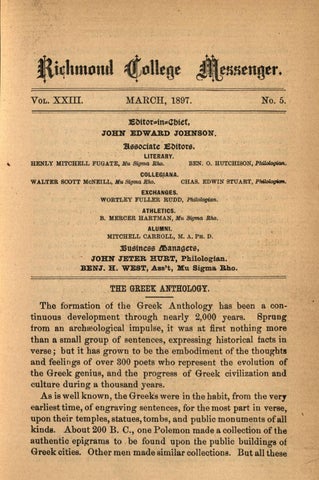
~mtenger. VOL.
XXIII.
MARCH, 1897.
No. 5.
JEl>ttor::sin::::ctbtet, JOHN EDWARD
JOHNSON.
:associate J5l>ttors. LITERARY. HENLY :MITCHELL FUGATE, Mu Sigma Rho.
BEN . 0 . H UTCHI SON, PlrilolDglan.
COLLEGIANA. WALTER SCOTT McNEILL, Mu Sigma Rho. . CHAS. EDWIN STUART , PhUologiaft. EXCHANGES. WORTLEY FULLER RUDD, Phi lologia n. ATHLETICS. B. MERCER HARTMAN , H u Sigma Rho. ALUMNI. MITCHELL CARROLL, M . A.' PH. D.
:mustness1t,anagers, ' JOHN JETER HURT, Philologian. BENJ. H. WEST, Ass't, Mu Sigma. Rho.
THE GREEKANTHOLOGY.
The formation of the Greek Anthology has been a continuous · development through nearly 2,000 years. Sprung from an archreological impulse, it was at first nothing more than a small group of sentences, expressing historical facts in verse; but it has grown to be the embodiment of the thoughts and feelings of over 300 poets who represent the evolution of the Greek genius, and the progre ss of Greek civilization and culture during a thousand years. As is well known, the Greeks were in the habit, from the very earliest time, of engraving sentences, for the most part in verse, upon their temples, statues, tombs, and public monuments of all kinds. About 200 B. C., one Polemon made a collection of the authentic epigrams to be found upon the public buildings of Greek cities. Other men made similar collections. But all these
RICHMOND COLLEGE MESSENGER.
collections included only inscriptions upon historical monuments. About 60 B. C. Meleager, a Syrian of Gadara, is said to have made a collection of lyric and erotic poetry by collecting fragments of Greek poetry and genius, which had before his time been engraven on marbles or other solid structures, dispersed in miscellaneous works as fugitive pieces, or entrusted to the memories of men. Meleager arranged his collection of fragments, which represented forty-six of his predecessors, in alphabetical order according to the initial letter of each epigram. He called- it Id<pm;o, [a garland], ~nd composed in verse a preface of nearly sixty lines in which he characterized each, or nearly every one, of the authors represented in his collection by a flower or plant emblematical of his or her peculiar genius. Meleager,'then, was the first anthologist. About 100 A. D. Philippus of Thessalonica incorporated into the garland of Meleager those epigrams which had acquired celebrity since Meleager's time, and thus added thirteen authors. Philippus called this collection an Anthology; so to him we owe the popular name. In the sixth century Agathias, a Byzantine poet and historian, made a more comprehensive collection than any one before him had done. He selected pieces from all previous collections, and added pieces from some of his contemporaries. Moreover, he, like all previous garland-makers, inserted pieces by himself, which, though perhaps not tedious and tasteless, were not equal to those of Meleager. He called his collection xuxJ.o,~nqpa¾¾d-r(J)JJ [circle of epigrams]. His anthology was the first in which the epigrams were arranged according to subjects. He divided it in~o seven books-the first contained dedicatory epigrams; the second, descriptive poems; the third, epitaphs; the fourth ; reflections on the various events of life ; the fifth, satires; the sixth, erotic verses, and the seventh, exhortations to enjoyment. This may be said to have fm1nished the model for all later anthologies. About 920 A. D., Constantin us Cephalas undertook a complete revision and recombination of all previous anthologies. He gave to the Greek anthology the form¡ it now bears. But
THE GREEK ANTHOLOGY.
201
his work was destined to be obscured for hundreds of years by a reflected light. Maximus Planudes, a monk of Constan-
tinople, thought that Cephalas had admitted too much impurity. Early in the fourteenth century be produced, mainly by expurgation, a revised collection which, before the beginning of the seventeenth century, was the only Greek anthology extant. That of Cephalas was forgotten, and it was thought that Planudes had made his from that of Agathias. But about 1606 A. D., Claudius Salmasius, an eighteen-year old student, discovered in the Palatine library at Heidelberg a Greek anthology by one Constantinus Cephalas, a hitherto unheardof man, the discovery of whose name was as new, if not as important, as that of the manuscript. This MS. of the anthology by Cephalas is a quarto parchment of 710 pages. It is now known as the Palatine MS., and is the basis of the best modern editions of the anthology. In 1623 it was taken to the Vatican at Rome, in 1797 to Paris, and in 1815 was restored to Heidelberg. Since the discovery of the Palatine MS. several editions of the anthology have been published. Salmasius declared his intention of publishing it immediately after his discovery; and be spent years in preparing a critical edition of the text, but the Leyden publishers, to whom he applied, refused to publish the Greek without a Latin version. Before he could complete this death overtook him. But ere long the Palatine MS. was published, and called forth the attention and careful study of German scholars. To this fact is due the excellent editions of the anthology. ¡ Among the earliest editions was that included by Brunck in his Analecta Veterum Poetarum Gr<Ecorum.It was made from copies of the Palatine MS. This was superseded by an edition of the whole collection in thirteen volumes, published by Jacobs, 1794-1803. In his Bibliotheca,published at Paris 1864-1872, Didot published 'what may well be called the complete anthology. It was edited by M. Diibner, upon the basis of the editions by Brunck and by Jacobs and the MSS. of Chardon de la Ro-
202
RICHMOND COLLEGE MESSENGER.
chette, and includes all the pieces in both the Palatine and Planudean MSS. There have been some good translations made of the anthology. Hugo Grotius made excellent renderings, in Latin, of select epigrams. They are included in Didot's edition. The Anthologia _Polyglotta, published in 1849 by Dr. Wellesley, of Oxford, is worthy to be noticed here. It comprises collections of the best translations and imitations in all languages, together with the original text according to Planudes. The anthology as we now 'have it comprises about 4,500 pieces, by over 300 authors. Many of these 4,500 pieces are of uncertain authorship. The collections of Cephalas and Planudes include the majority of them. Others are short poems, "deserving the name of epigrams or epigraphs, found scattered about among the old Greek historians, biographers, and miscellaneous writers, and which it is likely that Meleager, Philippus, or Agathias, if we had them entire, would be found to have inserted in their collections, or might reasonably have done so." The individual poems of the anthology have been called epigrams, but they are not all epigrams according to the modern English meaning of the word. Perhaps this is the key to the low estimate that some cultured people have put upon the Greek anthology. They did not find what they expected, and failing to look fairly, found nothing remarkably good and were dissatisfied. Surely any one approaching these poems with the simplicity and truthfulness of the poems themselves would be delighted. The term "epigram" originally had its etymological meaning of an inscription; but not even through the wide portals of this meaning can every epigram be admitted into the anthology. "It must be an anthos, or flower, possessing an attraction from some beauty, from some ingenuity or elevation of sentiment." A critical discussion of the anthology would be difficult. Regarded as an organic growth, it has been divided into four successive s_tages-1, Hellenic; 2, Alexandrian; 3, Roman, or
THE GREEK ANTHOLOGY.
20S.
Oriental; 4, Byzantine. By this division it is perhaps possible to show the evolution of the Greek genius and the changes in culture and ideals, not only of the poets, but of the people they represent. But, unfortunately, the authorship of a great number of the epigra·ms is uncertain. Regarding, as Mr. Symonds does, the Greek ·anthology as a tree bearing at once the buds and leaves and blossoms and fruitage of the Greek genius, it may not be certainly clear, strange as it may seem, whether certain ones are buds, leaves, or blossoms. The anthology has been divided into parts and discussed according to subjects. As compiled by Agathias it was divided into seven parts; as published by Didot it was divided into · sixteen parts. Such division is more or less arbitrary, and, froni the nature of the collection, either inexact or very extended. To select, from over three hundred, a few poets, and deal solely and exhaustively with them , would be difficult, unsatisfactory, and dangerous. However, attention to a few specimens culled-one here, one there-may result in an idea of the character of these ilowers , if not in a full conception of their beauty and worth. Their beauty is, of course, somewhat spoiled by translation. The best places from which to pick them are perhaps amo~g (1) dedicatory epigrams, (2) epitaphs , (3) hortatory epigrams, (4) amatory epigrams, and (5) emrpdµµa-raemae,xnxd,which display, more than anything else, rhetoric. The dedicatory epigrams record not only world-famous facts. of history-noble deeds-but the votive offerings to some deity by individualR. Every class of persons made such offerings of their weapons, tools, or treasures to their patron deities, and the record of these dedications introduces us to the minutest facts in the Greek private life. Among .the authors of this kind of epigrams perhaps the greatest was Simonides, authorof the well-known lines rendered thus: "To those of Lacedremon, stranger, tell, That, as their laws commanded, here we fell."
RICHMOND COLLEGE MESSENGER.
Of writers of epi!aphs, Callimachus was certainly among the best. His lines on Reracleitus, a poet of Halicarnassus, preserve, even in translation, their grace of movement and tenderness of pathos : "They told me, Heracleitus, they told me you were dead; They brought me bitter news to hear and bitter tears to shed; I wept as I remembered how often you and I Had tired the sun with talking and sent him down the sky. And, now that thou art lying, my dear old Carlan guest, A handful of gray ashes, long, long ago at rest, Still are thy pleasant voices, thy nightingales, awake, For Death, he taketh all away, but them he cannot take."
We have another, which was written by Erinna, a maiden whose elegiacs were rated by the ancients above Sappho's. It is on a maid named Baucis, and is thus translated: •' Pillars of death, carved sirens, tearful urns, In whose sad keeping my poor dust is laid, To him who near my tomb his footsteps turns, Stranger or Greek, bid hail; and say a maid Rests in her bloom below; her sire the name Of Baucis gave-her birth and lineage high; And say her bosom friend, Erinna, came And on this tomb engraved her elegy."
There is an epitaph on Pindar the poet, written by Antipater of Sidon, which is valuable as a poem and interesting in its style and legends told: '' As the war trumpet drowns the rustic flute, So when your lyre is heard all strings are mute; Not vain the labor of those clustering bees Who on your infant lips spread honey dew; Witness great Pan who hymned your melodies, Pindar, forgetful of hi;, pipes for you,"
¡ Some one wrote on Plato: "Earth in her breast hides Plato's dust; his soul The gods forever 'mid their ranks enroll."
THE GREEK ANTHOLOGY.
Among the hortatory epigrams, some of the best are anonymous. One would like to know who it was, and where and when he lived, who wrote: " Straight is the way to Acheron, Whether the spirit's race is run From Athens or from Meroe; Weep not, far off from home to die; The wind doth blow in every sky That wafts -us to that doleful sea."
But let us approach the amatory poets. By far the noblest of these is Meleager, who wrote of himself in an epitaph: '' The country that gave me birth is Gadara, an Attic city on Assyrian shores. 11
His style is clear as crystal. "All is simple, lively, fresh with joyous experience in his verse." Just listen: "I'll twine white violets and the myrtle green; Narcissus will I twin~, and lilies sheen; I'll twine sweet crocus, and the hyacinth blue; And last I twine the rose, love's token true, That all may form a wreath of beauty meet To deck my Heliodora's tresses sweet."
"What does he think of love?" one may ask. " The boy is honey-teared, tireless of speech, swift, without sense of fear, with laughter on his roguish lips, winged, bearing arrows in a quiver on his shoulders," he says. Among the numerous i1rqpdµµara tmaebmxa-poems upon various subjects chosen for their propriety for rhetorical exposition-is the plea, " Woodman, spare the tree," from an oak. "Spare the parent of acorns, good wood-cutter, spare Let the time-honored fir feel the weight of your stroke, The many-stalked thorn, or acanthus worn bare, Pine, arbutus, ilex, but touch not the oak. For hence be your axe, for our grandams have ·sung How the oaks are the mothers from whom we all sprung."
And there is another beautiful piece descriptive of the oak.
RICHMOND COLLEGE MESSENGER.
'' Aerial branches of tall oak, retreat Of loftiest shade for those who shun the heat, With foliage full, more close than tiling, where Dove and cicada dwell aloft in air, Me, too, that thus my head beneath you lay, Protect, a fugitive from noon's fierce ray."
When we read the anthology we hear the inmost thoughts and feelings of poets who represent the genius and culture ot Greek life during a thousand years, "from the splendid period of the Persian war to the decadence of Christianized Byzantium." Mr. Symonds well said, "The ¡ anthology brings us closer to the Greeks than any other portion of their literature. The lyrists express an intense and exalted mood of the race in its divine adolescence. The tragedians exhibit the genius of Athens in its maturity. The idyllists utter a rich nightingale note from the fields and woods of Sicily." But the anthology sings to us in elegiac melody of Hellenic civilization in all its phases-in ¡ the fresh morning dawn, in the splendor of noonday, in the mellow sunset, and the sad gray evening. Here are the buds and leaves and flowers and fruitage. It has been said that the very riches of this flower-garden of little poems are an obstacle to its due appreciation." But "to the poet it presents graceful images and exquisite conceptions; to the philosopher maxims of wisdom; to the historian monumental inscriptions; to the philologist the most varied forms of an J. E. J. imperishable language." PHILIP or MAOEDON AND THE RISE
or HELLENIOIMPERIALISM.
The life of Philip the Second, by whose genius and valor the little State of Macedonia was raised to the supremacy of all Greece is of great interest to one who would understand fully the tendencies in the world's history which culminated in the Empire of Alexander, his son. With him began a series of military and constitutional revolutions which ultimately united both the crumbling empire of the ..l!}astand the city States of Greece under one imperial sway.
PHILIP OF MACEDON.
207
Philip was born in 382-3 B. C., the third son of the reigning King of Macedonia, then a small ,State lying along the northern border of Hellas. The mantle of dominion had fallen from the bowed shoulders of graceful Athens; had :fluttered for a short period about the exhausted form of her more stalwart Lacedremonian rival, and then was wafted by the currents of destiny to clothe in power for a time the rising city of Thebes. In his early manhood Philip was one of thirty chosen from the flower of Macedonian youth al:!pledges to the Theban court for the good faith of their country. This circumstance in his youth had a great influence upon his after-life, for it was at Thebes and at Athens that he came in contact with the men and under the influence of the ideas which were to mould his whole career. Among the stalwart and virtuous sons of his own rugged land, he had begun to develop those characteristics of manly strength and prowess which were to make him a brave and energetic warrior; and at the most formative period of his life he was by this happy circumstance thrown amid the stirring scenes of the Hellenic world and into the companionship of one of the most noble characters of all antiquity. While at Thebes he was closely associated with Epaminondas, under whose skillful generalship the Theban armies were rapidly gaining for their city the highest place in the management of Greek affairs. This venerable aud distinguished Theban became Philip's ideal, and under his direction he became versed in the deepest secrets of military science. Philip was also a keen student of human nature, and made most efficient use of his opportunities to study the character of the Greeks and their institutions. While at Athens Philip was initiated into the mysteries of the worship accorded to the Goddess Dameter, and while celebrating one of the festivals held in her honor, surrounded by all that made those occasions fascinating to the resthetic Greek, he had the fortune to meet the beautiful and brilliant daughter of the Epirean .King who was destined to be the mother of Alexander the Great.
208
RICHMOND COLLEGE MESSENGER.
.
At about the age of twenty-three, some ten years after the battle of Leuctra had made Thebes the most powerful city in Hellas, Philip was called to enter under trying circumstances upon the duties of his kingdom. He spent -the first years of his reign in unifying his distracted empire, and training his hardy mountaineers, after the most approved principles, of the science of war. But not content with this, bis inventive mind conceived a new method of massing bis troops on the fields of battle which swept everything before it, and in the bands of Alexander became the instrument for the conquest of the world. With this invincible phalanx be soon consolidated bis kingdom, subdued the surrounding tribes, and began to encroach upon the allies of Athens. About this time be added to the dignity of bis court by ma1¡rying the princess whom he bad met some years before within the sculptured walls of the far-distant Athenian temple; and upon the birth of Alexander be wrote the following letter to Aristotle, the great philosopher: "King Philip to Aristotle, health ! You are to know that a son hath been born unto us. We thank the gods, not so much for having bestowed him on us as for bestowing him at a time when Aristotle lives. We assure ourselves that you will form him a prince worthy to be our successor, and a king worthy of Macedon. Farewell." Thus he shows his deep appreciation of Hellenic culture, and by thus giving Alexander the best moral and scientific teaching of the time prepared for and entered into the more gigantic labors of bis more illustrious son. In many ways he bears a striking resemblance to a prince of more modern the Great, of Russia; but especially in this aptimes-Peter preciation of the culture of nations more advanced in civilization than their own, and in their endeavors to bring the blessings of enlightenment to their native land. However, Philip's ambition was not confined to the enlightenment and development of his own little kingdom. Even as a youth, while overawed by the seeming majesty of Hellenic
PHILIP OF MACEDON.
209
greatness, his keen mind had discerned many elements of weakness amid all its splendor, and now, at the bead of his well-trained troops, be conceived the vast project of conquering, not only Greece, but even the mighty Persian empirethe synonym of solidity and strength. It is with an eager interest that amounts almost to suspense that we watch the series of strategic movements by which the great cities, which had for so many centuries made the Grecian peninsular the scene of their mighty con:fl.i.:;ts, were brought to the feet of this wily northern prince. While apparently busy with the affairs of his own kingdom, he watched with an eagle's eye every sign of the times, and saw with secret satisfaction the spirit of independence which had developed in Greece a civilization more perfect than had yet blessed the human race, becoming at last the curse which should blight in its bud the fair flower into which it had breathed the .breath of life. And even as, in after years, Cresar saw in imperialism the only hope of the Roman Republic, so Philip believed that in himself was the only power which could bring the blessings of peace and harmony to the distracted cities of Greece. Moved by this and partly by less worthy motives, he encouraged in every way this fatal disintegrating tendency, knowing that it would be only a question of time before, worn out by their endless quarrels, these mighty cities would fall an easy prey to his victorious troops. Gradually, by his political intrigues, he became more and more necessary as an arbiter in their tangled affairs, and became the champion of the amphictyonic council. But there was one at least among the Greeks in whose heart the fires of patriotism had not been drowned by the influx of corruption-one whose love still watched with jealous care all encroachments upon the ancient liberties ¡ of Greece. Even as Cicero, in the last days of the Roman Republic, clung tenaciously to her idol, seeming not to realize that its spirit had fled, and steadily refused to be reconciled to the new order of things that came in with Cresar, so Demosthenes spent the
210
RICHMOND COLLEGE MESSENGER.
latter part of his life in the vain attempt to arouse in his enervated countrymen a patriotism that was extinct-a spirit of resistance that had vanished under the influence of Macedonian gold. At last, by a series 'of oratorical feats never surpassed in any age, he succeeded in awakening some to a realization of their danger, but only too late to avert the impending doom. At Cbreronea the combined forces of Athens and Thebes were defeated, and soon after Philip was elected commanderin-chief of the forces of confederated Hellas, whose allied armies he had so long dreamed of leading against the empires of the East. But Philip was not destined to fulfill this great ambition of bis life. He is one of the many on the pages of history who were'' greater in genius than in character "-one of the many whose lack of integrity in private life has precluded the fulfillment of a promising public career. We are dazzled by the fl.ashes of bis intellect; we stand in awe as we behold all obstacles surmounted by bis indomitable will; we admire in him a generosity and humanity far beyond the spirit of his age, and a feeling of sadness comes over us as we¡ think of what might have been had he followed Epaminondas as faithfully in high moral virtue as he did in diplomatic and military skill. The bright promise of happiness which had shed its radiance around the early years of his married life had been obscured by the gloom of family quarrels and court intrigue; indeed for several years there had been little sympathy between the members of the royal family. Whom we should blame for the bitterness of this broken home it is impossible to say. It is certain, however, that the haughty and inperious temper of Olympius was not one to brood much ill-usage from her equally haughty but more politic husband. Being repudiated for another, after a bitter contention, her brilliant intellect became the scheming instrument of a disposition made hateful by the disappointment of her most cherished hopes, She
CONFESSION.
211
became impatient to see her son mount the throne of her unfaithful husband, and .Alexander often expressed his anxiety lest his father should leave to him no worlds to conquer. In spite of these gathering shadows, Philip was filled with pride at his past successes and with hope for the future. All Greece was in a ferment of excitement, straining every nerve to fit out an expedition which should carry consternation into the camp of their ancient enemy, the Great King. But during one of the magnificent celebrations held in honor of his intended departure, while in the midst of a grand parade, sur- . rounded by his devoted soldiers and looked upon by all eyes as the champion of Hellas, the dark hand of an assassin suddenly arrested his bright career. Over this tragic event will ever hang a cloud of mystery, for the perpetrator was cut down by the infuriated soldiers before he could reveal the motives which had prompted it. Some believe that he was incited to the deed by Olympius, whose hatred was now fanned into a fierce flame by being a witness of a happiness in which she had no part. But whatever may have been the immediate -cause of the dark deed-the hatred of an outraged wife or a nobleman's private revenge-we trace in his violent death but another of those many tragedies which stand recorded on the pages of history in everlasting testimony to that profound truth: "Whatsoever a man soweth that shall he also reap." Even as in later years the rise of the imperial principle in Cresar alone enabled the great Roman genius to do its work for future ages, so we see only in the empire of Philip and AlElxander the fulfillment of the mission of Greece toward the universal progress of the race. WILMOT C. STONE. -- - -- -- --OONFESSION. When first I saw your smiling face, So frank, so sweet, so fair ; A fire was kindled in my breast Which fain would linger there.
212
RICHMOND COLLEGE MESSENGER.
That little spark, for such it was, _ Is now a flame so great ; It might have been extinguished then,, But now it is too late. For every time I think of you It tends to fan the flame, And if I turn my thoughts away It's burn ing just the same. I've truly tried and done my best To smother all the fire, But all my efforts are in vain ; So now, you see, I tire. I leave it now with you, to do Just what you think is best; It's in your pow'r as you well know, To give my poor heart rest. What will you do? Oh ! dare I ask, When you don't care to tell? Oh ! could I hear you gently say, "Take heart, for all is well."
My life, my every interest too Down at your feet I lay ; If you will only take them now, Despair will fly a'.way. Oh, will you not accept my heart ! So tender, kind, and true, Enclosed within this breast of mine, And beating now for you?
..
I know you will, Oh, let me hope. I'll wait and hear my fate. Oh, may it not be these sad words : "Too late, my friend, too late!"
213
WHEN THE CRUEL WAR IS OVER.
It's true you have not known me long, My record though is free From all that stains a young man's life, As you can clearly see. I try to act the noble part, And for the right to stand ; That's why I am so anxious to Win both your heart and hand. You are to me, my own sweet friend, The fairest of the fair ; Of all the gems in this wide world, You are the gem most rare.
G. C.S.
WHENTHE ORUELWARIS OVER. " For there, where justice holds uncumbered sway, There each enjoys his heritage secure, And over every house and every throne Law, truth, and order keep their angel watch. It is the keystone of the world's wide arch, The one sustaining and sustained by all, Which, if it fail, brings all in ruin down.'' -Schiller.
One of the worst, and, indeed, most evil, of savageries, which we have inherited from the centuries of barbarous times, is inuisputably war. This " angel of destruction," the great nation annihilator, rules to-day the whole wor\A with bis terrible and fearful power. Many are the frightful periods humanity bas experienced, and varied were the causes. Human blood has fl.ownin streams on account of religious hatredfrom which the Jews, teachers of morality and humanity, the world's greatest benefactors, have suffered and are suffering to-day. Paganism consumes the lives _of vast millions. Fanaticism converted the whole of Europe into a bloody battlefield during the '' Thirty Years' War." Inquisitions! Oh, need Spain wonder why all these calamities have befallen her? Let her turn back the pages of her history; let her read the treatment of Israel and see wjth how much innocent hlooil
214
RICHMOND COLLEGE MESSENGER.
every inch of her soil was saturated, and then she will perceive that the voices of innocent blood can never be silenced; that they cry unto the omnipotent God and are answered. The same queen that ordered the Jews to be expelled equipped a fleet for Columbus, procuring a shelter for Israel and at the same time laying the foundation to Spain's destruction. Party strifes have left indelible footprints in Europe and brought poverty and misery into many Southern homes. How true are the words of the poet: "When civil war hangs out her bloody flag Each private end is drowned in party zeal. The husbandman forsakes his plow, the wife Neglects her distaff; children and old men Don the rude garb of war; the citizen Consigns his town to the devouring flames, The peasant burns the produce of his fields.''
The very best men and women in New England were roasted alive accused of witchcraft, and other such detestable follies caused much bloodshed. Though such things have been abolished in our somewhat more civilized times, man himself bas not yet ceased to be a real demon. While it is true that Nature plants into every human ¡heart the noble feelings of justice and pity, love and friendship, nevertheless these two-legged creatures are in a state suddenly to be transformed into bloodthirsty, ravenous beasts, and, as hired or forced mass-murdererfl, to fall upon each other with death, annihilation, and destruction. The question of just and unjust can never be decided by ~ar. Surely justice and righteousness can never be shown by might deeds and fist right. What would we think of two men, disputing about some personal interest, who would not seek to come to friendly terms, or, at least, to end their dispute in a lawful manner, but, like wildcats, fall upon each other and tear each other until the victim is convinced tliat he was in the wrong? Would we not look upon such a pair as frantic bandits? Yet we see entire nations, among whom there are such learned men, employ in their disputes bodily strength, dynamite, bayonets, cannon, and other such "angel-of-death" im-
WHEN THE CRUEL WAR IS OVER.
215
plements. And that they call the "right of nations" ! History shows that a great per cent. of the wars have been brought about only through the insatiate desires of ambitious monarchs or other rulers. Feelings of false patriotism were awakened in the great irrational folk, entire nations were kept in a continuous agitation, and eternal enmity towards each other, and the ruler that committed the most brutal and murderous deeds towards the " strangers" was lauded, and is lauded to-day, as the greatest hero, the greatest of warriors, and the sole protector of the fatherland. The minds of the chifdren at school are daily envenomed with such narrations, in which death-blows, conflagration, and destruction are praised and extolled as the most beautiful and noble of deeds. Says a learned man : " With half the sum that the cost of war amounts to we could entirely drive the wolves from our doors, ,so that poverty would be unknown to civilized nations." While the costs of wars and preparations for wars consume in ,every land enormous millions, this material loss is not to be compared to the moral destruction which every war brings after it. Darkness and slavery on one side, absolutism and .tyranny on the other-these are the phenomena in the national life after a war. The nations that were victorious were afterwards more oppressed and enslaved by their haughty rulers. Thus it was that men sacrifi.ed themselves only to make their moral, political, and social conditions far worse than before the war. At present much cannot be expected from the peace societies in the different lands, whose design it is to abolish war, for it is too good a morsel for proud masters, and a thing from which they will never willingly depart. Therefore let every freedom-loving man greet with joy the proposed treaty between our land and England-a treaty whose very name shows <thatalready, in this beautiful land of ours, the savage motto, "Let war decide," has been changed to the far nobler motto, "' Let law decide," and we may hope that soon " Uncle Sam," late Professor of Liberty and Morality in the world's university, will have drilled it into the heads of his pupils-the the head and not the fist is the seat of proud monarchs-that
216
RICHMOND COLLEGE MESSENGER.
knowledge; and as now the rainbow appears after the clouds have been dispersed and the rain has ceased, to assure us that there will be no more .flood, so will then the beautiful words Peace, Prosperity, Happiness appear in fiery letters to assure us that there will be no more bloodshed. JOSIAH MOSES.
SHOULDTHE GOVERNMENT OWNAND OONTROL THE 'RAILWAY LINES?
A railway represents not only its own interests but also the interests of the public, and it was upon this fundamental idea that the first charter was granted, allowing private companies to own and operate the railroads. Railroads are, by the very nature of their business, quasi public corporations, and their employees are, to a degree, quasi public servants. Stability of transportation, facilities for a constant delivery of supplies, and security in pre serving life through such supplies, all demand that the railroad and its employees shall recognize their allegiance to the public. The charters and the various powers · and privileges were grAuted upon the distinct idea that they were to undertake the discharge of public duties in a mannerbeneficial to the public. There has never been in the history of our country a more · awful betrayal of a trust than the failure on the part of private railroad companie s to conduct public business in a way satisfactory to the public. In the first place, no thought is. taken of the public welfare; railroads are run entirely in the interest of individuals, and the shipper has to bear whatever · rates the greedy corporation sees fit to impose. The merchant, the farmer and the manufacturer, all have to do business cramped by the knowledge that the railroad company has the power to ruin them by a change in fre~ght rates. Un- • der private ownership the irresistible tendency is to make the · railroads pay as much as possible. The present system, designed to serve the public good, serves the private greed. We can hardly conceive of the immensity of harm done to
SHOULD THE GOVERNMENT OWN THE RAILROADS. 217
the public by allowing railroads to be managed for private benefit. Think of the mill~onaires whose fortunes have been made out of the public through railroad spoliation. Think of the fact that a dozen nabobs in Wall street have in their hands a power, in comparison with which, that of the President sinks into insignificance. It can be truly said that the American railroad system is the very Sodom and Gomorrah of finance. Under the present system the railway becomes, by discrimination in rates, a means of destroying one industry at the bidding of another, and it hedges in one city in order that another may capture its trade. How is it that the Stand~rd Oil Company has become such a monopoly? It won its way to colossal wealth and unlimited power by using the railroad as a club to beat down opposition. At the Oil Company's request the freight rates were so adjusted that it was useless, yea, impossible, for any rival company to compete. This is only an instance where a larger interest has crushed a smaller through the agency of the railroad. Not only have these discriminations in rates established monopolies, but they have caused small towns to suffer and individuals to be ruined. Competition in freight or passenger rates can exist only in the larger cities where there are different transportation lines to bid for the trade. When the city limit is passed, comp,etition ceases to exist, and every town along the railroad in question is absolutely at the mercy of the railway corporation. Whenever the road offers low rates in the city so as to get freight, it makes up the loss by extorting higher rates from the towns along the line. The monopoly rules supreme at every station, and there is another chapter of lamentations added to the volume of comp!aints by merchants and farmers, passengers and shippers. Perhaps there is nothing that has, in recent years, so tarnished the glorious name of our republic as the frequent strikes and labor wars, which involve the whole nation and paralyze all business. As each road is a public highway and a channel of trade, the impeding of one road checks the course
218
RICHMOND COLLEGE MESSENGER.
of traffic in all. The trouble in such a case is not confined to any one locality, -but extends far out in every direction. Innocent persons suffer, mails are obstructed, food supplies are cut off, industry makes no headway, and the clash between labor and capital threatens the nation with civil war. So long as private citizens own the railway lines, and so long as there is centered in a few irresponsible men such a tremendous power for evil, just so long will these dangers menace society. "If the present railroad system is," as we claim, "so abusive to the rights of the people, how ~s it," you ask, "that it can exist under a democratic rule like ours?" The reaso'n is this, the preRent railroad system has to sustain, by unlawful methods, its unlawful combinations and its oppressive sway. Who is it that is so often associated with the President in the Cabinet, or sits on the Supreme bench of the United States? It is the railroad financier. Who compose the -Senate of the United States? It is composed almost exclusively of millionaires, railroad kings, and corporation lawyers. Not only is the statement true of the national Senate, but it is true of the senates of various States and also of the Federal courts. Not only is Congress corruptly controlled, legislature and courts controlled, but every city government falls under the same baleful shadow of railroad domination. And the result is, monopolies are fostered in violation of law, illegal rates are extorted and no redress given, special privileges granted at the expense of the public, and the iron heel of the railroai_d king is rapidly grinding out the very existence of the people. The existing condition of affairs is unworthy of us as a nation, and must be corrected. It may be claimed by some that by proper legislation the evils of the present system may be abolished and the matter suitably adjusted to the rights and demands of the people. This leads me to remark that for us to expect relief from proper legislation is worse than for a drowning man to clutch at a straw, thus hoping to be carried in safety to the shore. During the last quarter of a century much time bas been spent in the councils of the nation in discussion of and legislation about
SHOULD THE GOVERNMENT OWN THE RAILROADS.
219
railroad affairs; and about one-half of all the litigation that has occupied our courts bas been in connection with the railroad. "Much litigation is, indeed, a boon to the lawyers, but it involves a corresponding expense to the people." Besides, so far from being 'improved, the present system is becoming more and more a menace to the rights and liberties of our people, and when we can realize the stupendous fact that threefourths of all the legislative corruption from which we have suffered during the last :fifty years is directly chargeable to therailways, then we must admit that legislation cannot be relied upon to correct the evils of the system. The existing state of confusion is manifestly due to lack of proper regulation of railroads and their affairs. Experience has been a dear teacher, and we have learned that the present system of railroad management does not work to the satisfaction of the people. We must have a system of management that is more in keeping with the exalted ideas of a patriotic and liberty-loving people. The proposed change in the system will make the Government sole owner and controller of the railroads. Is it right; is it expedient for this. change to be made? Some claim that the change from the private to the governmental system would involve complications such that the change would not be advisable. An eminent jurist has well said, that "it is the rightful authority, which exists in every sovereignty, to control and regulate those rights of a public nature which pertain to its citizens in common, and to appropriate and control individual property for the public benefit. as ¡the public safety, convenience, necessity, or welfare may demand." Since the railroad is to-day the most important and dominant interest of our country, and since the propermanagement of it is a necessity upon which business stability so largely depends, it would be well indeed for the Government to take this step in support of the people's rights. Again, when the railroad passes under governmental ownership and control, a death blow is given to the "Reign of ¡ the Corporations." The funeral knell is rung to those wb0,
a
220
RICHMOND COLLEGE MESSENGER.
have been perpetrating frauds, practicing countless dishonesties, and trampling under foot the rights of the people. We stand in the eyes of the outside world as a free people, but yet we are in bonds of slavery to the millionaire and the railroad magnate. Under governmental control our people would be free from oppression. "Liberty" is, indeed, " one of the choicest gifts that Heaven has bestowed upon man, -and exceeds in value all the treasures which the earth contains within its bosom, or the sea covers. Liberty, as well as honor, man ought to preserve at the hazard of his life, for without it life is insupportable." Such a change would end the corrupt legislation that is the direct result of the present system. The symptoms of a disease may be submitted to diagnosis and a treatment of the malady may be prescribed, but if the cause is allowed to remain in full force what good can result from the treatment? In the case of the railroad the symptoms have been submitted to diagnosis, and the treatment prescribed is one which will eradicate the cause of corrupt railroad legislation. If we would stop the unjust discrimination against certain persons and certain places we must let the Government own and control the railroads. By so doing we remove the motive that leads to discrimination, and every person would be treated alike, and every town would enjoy the same advantages of low tariff and facilities of transportation. Furthermore, governmental control would, to a large extent, destroy the tyranny of capital over labor, and the country would cease to be agitated from centre to circumference by railroad strikes. It is the right and duty of the Government to prevent interruption of inter-State commerce a_nd the obstruction of the mail. Under our form of government the value of labor as an element of national prosperity should be distinctly recognized, and the welfare of the laboring man should be regarded as especially entitled to legislative care. Under Government co_ntrol strikes could not occur, for there would be no conflict of interest between the railroad and the employee.
SHOULD THE GOVERNMENT OWN THE RAILROADS.
221
Some of the objections to the proposed system of Government control are plausible, and well worthy our consideration. Some say that it is impracticable for the Government to own and control the railroads. We must admit, after what has already been said in regard to railroad matters, that a real equilibrum cannot be ¡kept up between the State and private railway corporations. It is the Government, and the Government only, that can, with perfect safety to all concerned, operate the railroads of the country. Will any person, after having examined carefully the postal system, claim that it is impracticable? No; the excellencies of the system forbid such a statement. It is just as practicable, and even more so for the Government to own and operate the railroads; by so doing enrichment would be added to our people, and our natural -resources would receive the highest development. A frequent objection to the proposed change is that it will bankrupt the Government to buy the railroads. An examination of the Government reports shows that over one-half of the railroad values are represented by bonds. The holders of these bonds would jump at the chance of having the Government assume the payment of them with 3 per cent. interest and twenty years' time. The remainder of the debt might be settled by the sale of long term bonds, or by the issuance partly of bonds and partly of full legal tender treasury note; . By the time these bonds fell due the railroad earnings would be sufficient to pay them in full, and not a single extra dollar would have to be levied upon the people. Another objection is, that for the Government to own the railroads would be a step in the centralization of national power. Which is better, for the enormous power attendant upon railroad ownership to be centralized in the Government where the rights of the people would be respected, or for the private ownership of railroads to centralize this enormous power in the hands of a few individuals, whom the public cannot reach, and who commit every sort of depredation upon the people, escaping personal responsibility because of the shield thrown about them by their corporation? As some
222
RICHMOND COLLEGE MESSENGER.
one has said, the question which confronts us is, whether it is better to permit these mighty railroad powers to rest in the hands of a committee of managers in Wall street, or whether we will vest it in the general Government to be exercised for the good of us all ? It is said that despotism sits nowhere so secure as under the effigy and ensign of freedom. This is certainly true of the pre~ent system of railroad management in America. The freedom which, to the outside world, we eeem to enjoy is but base servitude to the millionaire and railroad magnate. Are we to allow the stars and stripes of American independence to trail in the dust, and the dignity and honor of our country to be corrupted by such remorseless tyrants? Shall the Goddess of Liberty give place to the money god? No ! The OscARL. OWENS. people shall be free. RYLAND, OF PRESIDENT ANEODOTE
On an important anniversary a former pupil of the President was put up to preach. He was naturally nervous, but his agitation was greatly increased when "the old Doctor" walked upon the platform. Seeing the confusion of his young friend, Dr. Ryland banded him a glass of water, saying, "I do this in the name of a disciple." The good effect was instantaneous, and, recovering his self-possession, the preacher spoke with fine effect. He afterward declared " that thoughtful, sympathetic act saved me, for I knew there was prayer behind it.Âť
-~--
,.6,,,~ -~~
ilf~~ ~
The Al umni D epartment presents in this issue a paper on theorigin and early history of Richmond College written by Dr. Robert Ryland, its first president, and a sketch of the author from the pen of an alumnus who, from his intimate acquaintance with the history of the College, is well qualified to give a just estimate of Dr. Ryland's long and valued services. We call attention to the cut which adorns our fron-tispiece. This number appears about the time of Dr. Ry land's ninet y-second anniversary, the 14th of March, and we esteem it a privilege to observe in this way the birthday of one so in timately associated with the early history of Richmond College, and so much beloved by all Virginia Baptists. Richmond College delights to honor the men who shared in her early struggles, and to whom she is so largely indebted fo rher present usefulness. The article by Dr. Ryland will be followed in succeedin g numbers by a series of reminiscent and anecdotal sketche s from prominent alumni, treating of the College in its antebellum days. REV.ROBERT RYLAND,D. D.
The name of this . venerable servant of God and emine nt educator must always remain intimately associated with Richmond College. In his arms it was cradled sixty-five years ago ~ and it was he who guided its youth and manhood into the strength and grace of maturer life. _ A sketch of the personal history of one so long and closely identified with the religious and educational work of Virginia may well be preserved in the columns of our College magazine. While we chronicle the deeds and raise monuments to those who have made our history immortal by statesmanship
I
ri ""l
224
THE RICHMOND COLLEGE MESSENGER.
and prowess on land and sea, those who have trained minds and moulded character should not be esteemed less worthy of record. The Ryland name (Anglo-Saxon; Rye lands-R;i; e or Rhee, a water-course or stream, and Lands, the land adjoining or above the stream) is rooted in the chronicles of W estboughton, Lancaster, and ¡wilmslow, Chester, England, as far back as 1216, and seems identified with stern virtue and unflagging industry. The subject of our sketch comes legitimately by bis name, for the first of the family whose record is preserved was Robert de R ilandes, of the time of King Henry III. 'fhe ' American ancestors of Dr. Ryland settled upon the shores of Virginia and spread into the counties around. His father was Josiah Ryland, of Farmington, King and Queen county , and his mother Catharine Peachey. He was born March 14, 1805. The godly parents gave their son from the age of six years ~very advantage of the private school, the academy, and the college. By the time be bad attained bis majority be was an alumnus of Columbian College, D. C. With mind athirst for knowledge, and heart aglow with love for God and humanity, he was led to the high calling of a minister of Jesus Christ, and to this he consecrated his life, settling in Lynchburg as pastor of the Baptist church. But it was not long before the wise leaders of his denomination saw in this well trained and earnest young man the future leader of their educational enterprise. He tells on another page the story of his regretful parting with a growing church, and the perplexities upon which he entered in becoming the president of the Virginia Baptist Seminary. His pen has partially drawn the picture of the demands upon him, and the difficulties which gathered about the work. Not ¡the least of these was the elow awakening of his brethren to the claims of the Seminary, and to the constantly recurring demand for increased pecuniary assistance. Many a weary mile on foot and many a far journey in private con-
ALUMNI NOTF.S.
veyance did he take, year after year, to entreat parents for their sons and the well-to-do for their dole to save the school and make it grow. Fortunately, Mr. Ryland had the qualities ' necessary for success. To industry, perseverance, and economy he added faith, love, and deep conviction. His call was from God, and it mastered his every energy. While outside work was thus _unceasingly demanded, the real work of the school was not neglected. He was its most painstaking and laborious teacher, and unwearyingly labored with the untrained pupils that he might stir their sluggish minds and quicken their ambition for life work. Ah ! those years. We of to-day cannot understand what it cost of prayers and tears and labor to lay the foundation and build the structure which at last rewarded, under the leadership of Ryland, the tenacious persistency of our fathers. Before the disastrous war of 1861-'65, in which every social and educational interest suffered crucifixion in the political upheaval, the efforts of the president and his colaborers had so far succeeded as to place Richmond College upon a most excellent foundation. The school of 1830 had developed into the seminary of 1832, and then into the chartered college of 1840. Twenty years' more and there were upon the campus buildings worth $40,000, an endowment fund of $80,000, and the one hundred and sixty-one students were taught by a Faculty of six abie professors. The impression should not be made that Dr. Ryland was the sole factor in the success of this good work. He does not claim it; nor his• friends for him. But it cannot be doubted that the college as it stood in shapely proportions in 1860 was largely the monument of his tempered conservatism, wise energy, Into it had .passed his very lifeand vigilant oversight. blood, and he stood before his people honored, trusted, and beloved for his great work. The College was dismantled by the cruel hand of war; many of its-students killed in battle, its professors scattered its library and apparatus gone, its grounds and building;
226
RICHMOND COLLEGE MESSENGER.
wrecked. Dr. Ryland wisely said, " Younger hands must undertake the work of rehabilitation," and he retired after thirty-four years of service. 路Not even a rapid and imperfect sketch of the life of Dr. Ryland, such as this must necessarily be, would be complete without paying a tribute to his usefulness as a minister of the gospel. He was pastor during almost the 'entire time of his presidency, and on his journeys for the ~College, and before the gatherings of his denomination, he was always the forcefult instructive preacher. 路路This month of March brings to the honored 路ex-president his ninety-second birthday. With active, vigorous mind he has continued bis close student habits, and is never so happy as when imparting to others the rich stores of his gathered learning. The evening of his life is being delightfully spent in congenial work in the chaplaincy of the Southwest Virginia Institute at Bristol. With body and mind well preserved, and a useful, honorable life behind him, he lives at an advanced age the Nestor of Virginia Baptists.
'
OOLLEGE. THE ORIGINAND EARLYHISTORYOPRIOHMOND BY
DR.
ROBERT
RYLAND.
In June, 1832, while devoted to my pastoral duties in Lynchburg, Va., I received a letter from Henry Keeling, the Corresponding Secretary of the Baptist Education Society, stating that I bad been chosen principal of the Virginia Baptist Seminary. He did not inform me where the school was located, what duties were implied in the word "principal," what I was expected to teach, or what salary I was expected to receive. Everything of this sort was omitted, except that I should be cordially received, heartily co~operated with, and adequately ca-red for. I was fervently attached to my church, and they had given me unmistakable signs of love. How could I dissolve a connection that five years of mutual sympathy and selfdenying love and encouraging success had cemented? But the little band of nineteen persons, now increased to one hundred
ALUMNI NOTES.
227
and twenty, had moved from the Masonic hall to a commo!lious house, built by the munificence of John Hollins, and they could do without me. I determined to leave them. This pqrpose was confirmed by the fact that I had long ago preache,d away my small stock of theology, and was di.e;ging up the material for three sermons a week, and, with delicate health, was oppressed with increasing pastoral duties. My wife's family was living in Richmond, and my aged parents in the neighboring county of King and Queen, and could be more frequently visited. Above all, I had long felt that the improvement of the rising ministry . was the special need of our people. On the 4th of July, 1832, I sat down to teach the first class .of fou:vpupils, in a farm-houae near Young's mill, on the Brook turnpike, five miles from Richmond. I know not whether I was most amused by the crudeness of the students, the inexperience of the teacher, or the ¡incongruity of the ~ork with the day. The teacher had not studied nouns and verbs, plus and minus, or any of the isms for five years. He was literal1y a novice in farming and gardening, and that business was before him. It had been arranged that manual 'labor of sundry kinds should be prosecuted by the students, and though they cheerfully complied with the rule under a suitable guide for two qr three years, it was finally abandoned as incompatible and useless. But furniture, bed-clothing, tools, text-books, servants, &c., had to be provided; food was to be farnished 1 classes to be organized, lessons to be heard, &c. I went quietly to work to bring chaos into order. The very low sum allowed for boarding the boys necessitated so plain a bill of fare as to cause discontent among the guests, and this produced trouble with the st~ward, who had now beeu employed. The bread and butter question has always been a problem hard to solve in the schools. The students had increased~ and about this time the cholera broke out in the city, and a stampede for home wS:S so insisted on that I had to call for a visit from some of the trustees to produce quiet and content. At an early date pupils having no regard to the ministry were admitted, and this produced an addition to the number, while their tuition fees
228
I
RICHMOND COLLEGE MESSENGER.
paid all the salaries of the increasing Faculty. About this time the trustees applied to the legislature for a ¡charter, but it was denied on the ground that the school was a religious body and expected in its advanced stage to teach theology. I had from the start held out to the students that the ideal course was to seek culture and discipline by literary studies, before entering on any systematic study of theology. This action of the legislature engendered the :first disposition of the trustees to have a college, and this purpose was ever afterwards cherished, until it was carried into effect in 1840. The property was too valuable to be held in trust by any private, unincorporated persons. The school had now been transferred to the suburbs of Richmond, by the purchase of the Haxall home, and the inconvenience of living far from the _ markets, the post-office, and the physicians was happily obviated. It was a delightful change from the barn-chapel, the log-house dormitories, and the inaccessible location. It was also the dawn of signal progress in our history. The corps of teachers was enlarged, the number of pupils increased, and the whole concern was brought into closer sympathy and alliance with the churches and the citizens at large. An Act of incorporation was finally obtained, and the name " Virginia Baptist Seminary" was changed into that of "Richmond College." The Education Society transferred its property formally to the incorporated body, and sunk into the Education Board of the General Association. Still the College never gave diplomas till its curriculum embraced the usual course of respectable colleges. The :first diploma was given in 1849. Let us review some of the difficulties that now confronted us. It was bard to keep the boys from preaching so much as to sacrifice their studies, and still harder to prevent the more promising of them from breaking off in the middle of a very limited course and assuming the care of churches. At this point we had to contend not only with them, but with some of the most prominent of the ministers. The destitution of the churches was their apology, but in the long run it was an unwise policy. Jesus did not send out his disciples to their work till they were fully equipped.
ALUMNI NOTES.
229
When the Principal was changed into President, the trustees did not define carefully his duties and privileges. He had the same number of recitations as the professors, encountered all the odium of maintaining discipline, had a host of outside matters to attend to, was held accountable by the public for the proper management of the College, and yet in the Faculty meeting his vote was worth no more than that of the last elected and youngest professor. Hence he was censured sometimes for measures which he had tried his best to prevent. Now, as I am out of the office, I will say boldly that if one is held responsible for the doing of anything, he should be invested with the power of doing that thing. Hence the president of a college, if the people look to him for its success, should be made a thorough autocratin college affairs. If he is a sensible man he will respectfully consult all the teachers on every important subject that comes up for decision. If they are sensible men they will probably give their views on that subject, and then leave him to do just what he pleases, helping him to bring it to pass. He should make every teacher an autocrat in his class, selecting the text-books, adopting the mode of teaching, deciding the standard of scholarship, etc. Notwithstanding these obstacles and many more which could be cited, the institution, by the gradual extension of its curriculum, by the slow and cautious accessions to its corps of teachers, by the correct bearing of its pupils, by the faithfulness and skill of its preceptors, and, above all, by the blessing of God, advanced from its humble start in 1832 to its high position in 1861. At this date its Jraculty consisted of Lewis Turner, A. M., of the University of Virginia, professor ,of mathematics; of Edward Dabney, porfessor of Latin, which he taught with great accuracy and enthusiasm; of C. H. Toy, professor of Greek, in which he was even then confessedly an adept; of B. Puryear, professor of ehemistry; of Wm. G. Strange, professor of natural philosophy; of Tutor Yarborough, who labored earnestly for his Alma Mater; and lastly of a president of whom it may justly be said that having many things to do which no president had done since the beginning of the Christian Era, he did them all very imperfectly. Of the entire Faculty it may be said that the mag-
230
RICHMOND COLLEGE MESSENGER.
nitude of their work was nicely proportioned to the smallness¡ of their pay. Among the alumni of this period I remember P. S. Henson, J. Ryland, W. S. Bland, M. P. Howell, G. W. Keesee, G. B. Taylor, W. D. Thomas, A. R. Courtney, E. E. Dunaway, A. E. Dickinson, A. Eubank, L. J. George, A. J. Burruss, J. 0. Ferrell, L. J. Haley, W. R. McDonald, F. M. McMullan, R. Williamson, W. G. Wood:fin,P. W. Ferrell, T. Hume, Jr., W. S. Ryland, Fayette Fox, H. H. Harris, J. C. Long, G. W. Morris, W. B. Meredith, W. F. G. Garnett, J. M. Gregory, J. W. McCown, I. T. Wallace, H. Hatcher, W. E. Hatcher, W. S. Penick, F. H. Pulliam, J. W. Ryland, J. A. Turner, D. W. Gwin, J. J. Harvey, H. E. Hatcher, J.E. Mundy, C. T. Allen, J. R. Bagby, D. A. Blair, L. C. Bristow, W. S. Kent, C. B. Yarbrough, R.R. Bailey, C. W. Farrish, G. W. Leftwich, R. F. Lindsay, J. M. Pilcher, W. H. Williams, G. W. Prince, A. B. Woodfin, and A. P. Woodfin. These all got the A. B. diploma. Some of them went afterwards to higher schools, but they spent their formative period with us. Some pupils not in the above list left us before they :finished their course, and eought, as we advised, their diplomas from other schools, as we were not at that time prepared to bestow that honor. Charles L. Cocke, 'f. G. Jones, R.H. Bagby, G. F. Bagby,-E. Dodson, and some others were of that class. Some good men whorn age and drcumstances forbade their continua.nee with us to the end of our course, went forth to labor usefully in different spheres-J. L. Shuck, -- Davenport, and W. McGee became foreign missionaries. S. G. Mason, S. Harris, J. W. D. Creath, T. N. Johnson, J. 0. Turpin, E. S. Dulin, W. Slate, J. Walker, W. Algood, J. W. Brown, J. G. Barker, J. Clopton, S. Clopton, R. Ford, I. N. Fox, J. Fox, W. Gaskins, J. A. Haynes, R. N. Herdon, J. Huy, A. E. Owen, C. C. Chapl~n, C. H. Ryland, W. C. Crane, J. Humphreys, and others belong to this class. J.B. Taylor, C. E. Taylor, of Wake Forest, and others were with us when the civil war began, and were scattered, many of whom never returned. Of this galaxy some stars differed from other stars in glory; some are glittering yet in our firmament, others, in a higher sphere, artl emitting their effulgence.
The former editor, who announced our coming, OUR DEBUT. imm~diately retired and left us to the mercy of his friends. We are emboldened, even while we think of the high place in their esteem and the warm affection which he deservedly won, to ask that an equal place be granted to us, and we could hardly ask for more. WLile we stand in trembling embarrassment and blushing confusion upon this new and uncertain footing, we cannot forget to give a gracious ¡smile of thanks to our predecessor for his kind flattery, of which even a man of wit would deign to take a bit. As in the night the spider weaves his web from twig to twig, only to have it brushed aside in the morning sun, so our hope, deluded by ignorance and relying on the belief that our fabric is firm, may cause our inglorious fall; but we console ourselves with the expectation of an easy escape to the protection afforded by the editorial " we," the perpetually in.vincible. It is our hearty purpose to fulfill, so far as we can, the de-sign of our predecessor, of making this magazine attractive and helpful to the alumni and friends of our CoJlege. To this -end we shal1, of course, publish College news and specimem~ of the various kinds of literary work done by our constituents, the members of the Mu Sigma Rho and Philologian Societies, and we shall support an extended alumni department, in whic4 will appear sketches of the lives of some of our alumni ?-nd .sketches of our College in the good old times, which have been written by some alumni; and we shall not publish a su~ perabundance of stale jokes, meaningless puns, and foolish ¡ _ ______ .sayings.
THE To the student of classic history the present OF state of Greek affairs is intensely interesting; LOYALTY GRE.EOE. The mere chance that in case of open war, which may soon occur, between Greece and Turkey, the Moslem
232
RICHMOND COLLEGE MESSENGER.
Turk might again enter Athens, suggests to the mind a repetition of the time when the Turks encroached with their hovels upon Athena's most sacred gr(?und and occasioned the demolition of her proud temple. The idea that the descendants of the heroes of Marathon and of Salamis might be again subject to barbarian Turks is sufficient to elicit his sympathy for the modern Greeks, and the hope that they may be conquerors, as their fathers. The island of Crete, the occasion of the bitter feeling between Greece and Turkey, is not devoid of interest to the student of classic and mythical lore. The land of valiant Idomeneus, the home of Minos, the great law-giver, must ever be green i11his memory. Crete was not always dependent upon the - help of Greece. Before the days of Theseus, who is said to have built Athene and to have won the immortal love and reverence of his peo,ple by slaying the ,minotaur, Minos, king of Crete, was able to exact from Athens a yearly tribute of youths and maidens to feed his pet minotaur. The Cretans sent to the siege of Ilion a :fleet of ships under Idomeneus but little less than that under Agamemnon himself," king of men." In later days the several independent little republics in Crete were able to withstand the Macedonian monarchs by whom they were surrounded. But there were in the olden time, even as now, fraternal ties between Cretans and the rest of the Greeks; for the Cretans were Greeks in blood, in religion, and in forms of government. Indeed, the Cretan code was studied, and in large part adopted, by Lycurgus, king of Sparta and founder of its distinctive laws and discipline. The rude Dorians, when they emigrated to Crete, found it occupied by enterprising, cultured people. Amid the resulting population which lived under the same laws which in the pure Dorian blood of Sparta developed aristocratic society, thrived a democracy like that in .Athens. Just as in the olden time both the Cretans and the rest of the Hellenes worshipped the same Greek Zeus and the illustrious .Apollo, so to-day Christian Greeks are joined with Christian Cretans. The inherited intensity of religious feeling
EDITORIAL.
233
of the Greeks, their fraternal devotion to those of the same faith and blood, can hardly be appreciated by an American. But to this character is largely due the peculiar boldness they have shown in attacking the awful Turk when all the allied Powers stood back; and however vehemently carping critics may accuse the Greeks of covetousness, and though it be true that they are influenced by desire of power, their loyal devotion to fraternal ties is highly commendable and worthy of emulation by individuals and by nations. OOLLEGE A college is known by the men in it. A man is SPIRIT. known by the college he attends-of which he is an alumnus. The former can be considered almost axiomatic, for although it may be said that the reputation which a man attains after leaving college reflects credit upon his Alma Mater, still his reputation is almost entirely personal, and the reflected glory which illuminates the institution which gave him the new birth as a thinking individual is necessarily but faint. A qualification may also be inserted by the consideration of the ability of the Faculty; but this is a factor which, while it is the most important one in ranking an institution of learning, is but one of the several which enter into the proposition of what is the character of a college in the society of educational institutions. The second proposition may seem to contradict the first, but in stating it I mean that it shall apply to those men who achieve only mediocracy, and whose chief source of satisfaction is the degree which they have attained. ¡A consideration of these two proposition will necessarily bring to the mind of a student the duty which devolves upon him both to his college and to himself, that of doing his part towards the maintenance of that subtle, .imponderable, nervous force known as college spirit. It manifests itself in the good, wholesome, ringing college yell, in the decoration of the person with college colors and college and society pins, in the . attendance at meetings of societies, fraternities, and the student body, in the contributions and subscriptions to college
234
RICHMOND COLLEGE MESSENGER.
publications, and in the interest manifested in athletics and musical organizations. It is a duty incumbent upon each student to further the interests of these different evidences of college spirit for the reason that the student who does not care for the reputation of his Alma Mater is unworthy o( the name, and for the further and more selfish reason of his personal interest in the benefits which a degree from a widely-known institution confer. A splendid opportunity is afforded to test the spirit of Richmond College by the publication of the proposed Annual, and each man should do his part by subscribing for one or more numbers, and by contributing to its columns. That the college spirit is very much alive in our institution there can be no doubt; evidences of its existence are numerous and unques ·tionable, but there is a class of men whose noses are buried in ) their books always, and who do not seem to be aware that they owe other duties to their college than the preparation of lectures. Let that class come out of their dens and add their influence and abilities to the furtherance of college life, and, with the splendid corps of instructors which constitute our Faculty, old Richmond College will soon become as famous as Yale or Harvard. GEORGE N. SKIPWITH. We heartily endorse the spirit so pointedly expressed in th~ communication. This is an opportune time for each student and alumnus of Richmond College to show his loyalty to his Alma .Mater.-EDITOR-IN-CHIEF.
••••••
EDITORS, W. S. McNEILLAND C. E. STUART.
--
PERSONAL AND IMPERSONAL.
Miss Maude Pollard, who bas been visiting in Baltimore, is back on. the campus, we are glad to say. John A. Coke, B. A. ('96), was on the campus a few days ago. D. H. Scott, B. A. ('93), came out to see us one day last week, and brought the price of his subscription to the MESSENGER. He represents the Owens & Minor Drug Company in several Southern States, but always takes time to read the MESSENGER , he says. Prof. (in Logic): "Convert the sentence 'He is a hard sinner.'" Mr. R.: "Not easily converted, Professor." Mr. W--s (morning after toe-pulling): "Who was after you last night? " Mr. W--n: "Rats!" "Boozy Ben" says he'll never attempt to maintain any position against serious opposition, for he might have to "take to water." The Professor of History experienced a peculiar sensation several days ago when, talking about ¡a Roman "sham campaign," be saw "Sleepy Sam" rouse and blink ominously. "Sleepy Sam" bad been banqueting the night before, and doubtless was dreaming of something which sounds strikingly like sham campaign.
236
RICHMOND COLLEGE MESSENGER,
Since our last issue one of the editors of this department took a flying visit through South Carolina, taking in several of its colleges. A critical study was made of their appearance, etc., as compared with Richmond College. Our impressions were most favorable, and we feel satisfied in the comparison. Now is a good time to settle down for some good hard work, boys; so let's get at it. Let every one take a plenty of time for class work and reading, then give some attention to the various organizations in College. Work up interest in the literary societies, the G. and H., the Athletic Association, do something for the Annual, encourage the Glee Club, especially the mandolin department, and help in every way possible to arouse that healthy, wholesome, and generous College spirit, which is of such paramount importance to good citizenship in after life. Richmond College is not dead, but remember that we occupy such unusual advantage in the way of location, etc., that we must of necessity put forth a greater effort to keep abreast with our privileges. Hurrah for the Spider! To the deep sorrow of all the friends of the College, and the bitter disappointment of the more hopeful ones, the bill appropriating Richmond College $25,000 for damages sustained by Federal soldiers in '65 failed to pass the House, even after it had been attached in the Senate to the general deficiency bill. But the end is not yet. President Boatwright expects to have it brought up again, and says that he will fight for it as long as he remains President, or until the appropriation is allowed.
-
The Messengerthankfully acknow1edges the kindness of the Richmond Times in furnishing the cut for the picture of Prof. Harris in the February issue.
COLLEGIANA.
231
· With this issue, the present Associate Editor's services are dispensed with. No more funny jokes. No more criticisms for that illustrious magazine published by Trinity College somewhere in~ orth Carolina. is What will become of this department of the MESSENGER · hard to imagine, especially since Jeb will quit his jokes. To the incoming editors the two " blondes" stand side by side 'and extend welcome hands in the most approved manner. ANNOUNOEMENTS.
The Jollifaction did not occur on the 12th inst. as was expected, but has been postponed to March 25th. 'Tis with pleasure that we see several new students in for the second term. (This announcement is not intended for the toe-pullers.) The G. and H. Society has decided to run its annual excursion to Washington this year, and expect to go about April 25th. The Mu Sigma Rho Literary Society held its annual public debate on the evening of Friday, March 5th in the Thomas' Memorial Hall. B. M. Hartman, president, made very appropriate opening and closing remarks. The following program was well rendered : Reading . . . . . . . . . . . . . . . '' The Prisoner of Chfllon.' By
Declamation . . . . •
w.
s. MCNEILL.
. . . . . . . , . . "Carl tlze Martyr." By E.
O'BANNON.
Q~estion for debateResolved, '' That the Government should own and control all Railroad Systems within its limits. Affirmative-0. L. Owens and G. N. Skipwith. Negative-H. L. Norfleet and J. A. Garrett.
The ninth annual course of James Thomas, Jr., lectures will be delivered this year by G. Stanley Hall, Ph. D., of Clark University, Mass. These lectures are perhaps the most pleasant
RICHMOND COLLEGE MESSENGER.
and profitable of the attractions offered by Richmond College
to the public. They are always attended by large crowds of Richmond's best people. They afford invaluable opportunities, too, to the students of the College, not only of hearing some of the world's greatest men concerning problems in the educational world, bu tare often direct assistance to them in their work. Last year A. W. Small, of Chicago University, delivered four addresses upon Sociology, which were delightful presentations of bard problems elucidated. In previous years these lectures have been given by such men as Dr. H. H. Furness, of Philadelphia, and C. T. Winchester. Dr. Hall comes this year to speak on "Modern Psychology," and no one would be able to do it better than one who is at the same time the head of that department in the university where the most advanced research in the country is carried on, and a most magnetic platform speaker. The dates and partioular subjects are : 1. Monday, March 29.-The N cw Psychology: Its Relations to Ethics, Philosophy, etc.; Its Department, Field, and Methods; The Study of Instinct in Animals; The Soul of Savages; Organization of Psychological Studies in High Schools and Universities. 2. Tuesday, March 30.-Mind and Body: The Brain-Its Cells and Its Nutrition; Will, Attention, and Habit; Feeling and Emotion, and Their Expression ; Rhythm. 3. Thursday,April 1.-The Border Land: Hypnotism, Telepathy ; Sleight-of-band ; Relation of Normal to Insane Psychoses; Signs of Decadence and Degeneration. 4. Friday, April 2.-Genetic Psychology and Child Study: History of the New Movement; Methods of Study; Results thus far Obtained; Their Practical Applications. The second course of public lectures given by the Richmond College Professors this session will be opened Thursday evening, March 18th, in the Thomas Memorial Hall. The first lecture will be by Professor Pollard. Subject, Thomas Carlyle ~
The Twenty-First Annual State Convention was held in Peiersburg February 24-28th . .Among the delegates from Richmond Uollege were: H. M. Fugate, president; W. W. Edwards, vice-president; J. T. Bowden, Jr., treasurer; A. R. Wil1ingham, R. E. Loving, John J. Hurt, J. R. Taylor, R. S. Garn~tt, W. B. Daughtry, G. T. Lumpkin, E. C. Peecl, John E. Johnson, A. J. Hall, and J. W. Camack. Several of them attended only a few of the sessions; but only those who attended all, or nearly all, of the sessions understand how much the rest of the boys missed. The programme was a full one, and although Providence. prevented it from being fulfilled to the letter, men were provided, divinely as it seemed, in their places, and it was felt that it was good that God's ways were not men's ways. Mr. F. S. Brockman was kept away, but Dr. McBryde, of Lexington, Va., took his place on Friday night, and delivered a thrilling account of the Y. M. C. A. movement among students from the first intercollegiate association, formed in Louisville, Ky, twenty-one years a,2;0, to the present time, when in the hands of John R. Mott and others it has belted the globe. Rev. C. I. Scofield, after staying two d~ys, and giving Bibfo studies upon the Holy Spirit and on Christ in the Old T-estament, which cleared away much mistiness of conception, and awakened Christian love, was compelled to return to the bedside of his sick wife. But Mr. Coulter, State Secretary of Virginia, took his place, and gave an earnest, practical talk on personal work, which was of the ltjnd to help many weak Christians. Rev. Dr: George Cooper's address on "The Watchword of the:Year" was powerful, and it keeps ringing, "Watch and pray, that ye enter not into temptation."
240
-RICHMOND COLLEGE MESSENGER.
The discussions were practical, and ·a -pleasing ,feliflurewru the prominence given to the college wo,k. It was suggested, and privately discussed, 'thin we should have another State Secretary, whose business should be to work only in college associations. ·God grant thaMbis thought may arouse our careless students, and fhat we may .soon ,have this State Secretary for colleges. Mr. J. W. Matthews, Intercollegiate Secretary, was ,here Wednesday and Thursday, March 3d and 4th. His talks, both public and private, were practical and encouraging. His presentation of the Southern Students' Conference to be held at Knoxville June 18-28tb, was remarkably good. There is good reason to hope that we may send several delegates to this summer school next June. In 1895 we sent 1:five, but last year we failed to send any, for the reason that the men whom it was desired to send could not go at that time ; btit this year, by beginning early, we ought to secure the men and the money to help pay their expenses. Saturday night, April 3d, is the time for election of officers for the next year. The president was elected at a special meeting February 18th, in order that he might attend the presidents' conference, which was to have been held in connection with the State Convention Monday March 1st, but was not, on account of Mr. Brockman's absence. John E. Johnson, B. ~('96), was elected. While the chapel is being recalsimined we hold our jfileetings in Lecture-Room B .
••
At the February meeting of the Greek Clu'b Professor Carroll inaugurated the study of the Greek Drama by a paper on the theatre at Athens, limiting his treatment to the origin of drama and the structure of the Dionysus theatre. He was followed by Mr. Daughtry in a paper on the dramatic art of .iEscbylus. Papers will be read at succeeding meetings on the other leading dramatists, on the structure of ancient tragedy and comedy, and on specific plays. We give below a ¡brief abstract of Professor Carroll's paper, which has been furnished us by special request of the MESSENGER: THE.DIONYSUS THEATREOF ATHENS.
I. Function.-Artistic drama was the creation of Athens. In its function it was largely an equivalent of the sermon, newspaper, and current literature of modern civilization. II. Characteristics.-Certain broad characteristics of the ancient drama show its salient differences from the modern drama; (1) it was under the management of the State; (2) it was a part of the recognized worship; (3) it was exhibited only at special religious festivals, in which all the citizens took part; (4) every dramatic performance took the form of a contest between rival poets and actors. III. Origin.-Drama found its origin in that form of primitive ballad-dance, known as the Dithyramb, used in the festival worship of Dionysus, the god of wine. These festivals were orgies o~ wild excitement in which a chorus of singers, disguised as satyrs, the attendants of the deity, would narrate the adventures of the god, as symbolizing the changes of the year-expressing sympathy with " the sufferings of Dionysus!' -sufferings that were always a prelude to triumph. So we see in this worship the germs of Passion, of Plot, and of Character, the three main elements of dramatic effect. ¡
RICHMOND COLLEGE MESSENGER.
Soon the leader of the chorus would enact the character of Dionysus himself; then later an actor was introduced to carry on a dialogue with the chorus, and with the entrance of dialogue we have drama.-i. e., poetry in action. From the Dithyramb sprang both Tragedy and Comedy. IV. The Theatre.-The development of the architectural form of the theatre corresponded with the development of the drama. It found its prototype in the circular dancing -place, the orchestra,used by the chorus in their religious celebrations. In the centre was placed an altar of the god; the spectators gathered around the ring. The introduction of actors limited the arrangement of spectators to a form somewhat more t)lan a semi-circle. Beyond the orchestra, opposite the spectatprs, was a scene, tent, or booth, in which the actors dressed, and before this was a screen or p?'oscenionwhich masked the scenethe background visible to the audience, whether it was a temporary screen or a permanent wall. In the place for the spectators, the dancing-place and the proscenionwe have the ground plan of the auditorium, the orchestra or pit, and 'the stage decorations of the famous theatre of Dionysus at Athens, built probably in the fifth century B. 0., on the southeast side of the Acropolia, on a piece of ground sacred to Dionysus. The extant remains of this theatre are tiers of seats, the upper hewn out of the natural rock of the Acropolis and the lower made of stone, the orchestra forming a complete circle, defined by a ring of flat stones, and beyond, facing what was the auditorium, a wall twelve feet high, adorned with Ionic half-columns. An outer wall enclosed the auditorium, which was at all times open to the sky. Flights of steps divided it into wedge-like segments. It was capable of seating 30,000 people. In the centre of the orchestra, which was reserved for the chorus, was placed the altar of Dionysus, which formed the central point of the choral dances. There is still some dispute as to whether the wall extant was the back-ground of a scene, or the front of a raised stage. The latter is the traditional view; the former is the view of Dr. Dorpfeld, director of
GREEK CLUB OF RICHMOND COLLEGE.
243
the German School of Arcbreology at Athens, who maintains that originally actors and chorus shared the ordinary level of the circular orchestra, and that the Roman theatre-also the modern theatre-was developed out of the Greek by a division of the orchestra into two portions-a lowered pit and an elevated stage. Common sense and the allusions of literature ..confirm the view of Dr. Dorpfeld.
EvITOR,
B.
MERCER
HARTMAN.
The task assigned the Athletic editor for the winter months (if he does not possess a very vivid imagination) is a hard one. It is difficult to imagine an exciting base-ball contest when the mercury is hugging the bottom of the thermometer, and when the very sight of the campus diamond makes one shiver. It is easy, however, to write when one has facts to deal with, and it is with this comfortab1e fee1ing that the Athletic quill-driver attempts to report the encouraging facts that have come underhis observation. · The prospects for a successfu1 season are excellent. Manager McN eill is actually happy. That sweet smile that we despaired of seeing again has returned in all of its pristine beauty to gladden our hearts and to hoo-doo the enemy. The following old men have applied for positions on the team, Ellyson, Flemming, L., Kaufman, Leonard, McNeill, Rae, and Wills. Applications have been received from the following new men: Boschen, Davis, J. P., DeCamps, Flemming, S., Frazer, Lumpkin, Mabery, G. E., Mabery, J. H., Meyers, J., Nicholas, Robinson, Whitehead, Wilson, and Winn. The flight of time has not impaired the ball-playing ability of the Spiders of '95-'96; on the contrary, those who have returned are much improved in every respect. It is useless to attempt a criticism on Ellyson. To say that he is in his usual form is to say that our team will have a pitcher · of whom we may be justly pr6ud, and the foe an enemy worthy of their steel. · Robinson and Boschen, applicants for position of catcher, are both new men. Robinson's catching is steady and his throw- •
ATHLE'f.ICS.
245
Boschen's catching is also good, and his throwing excellent. His chief fault lies in his desire to do too much. If he would confine his attention to his own position, and allow the others the same prerogative, the result would be more satisfactory .
ing accurate.
.11.Flemming and Leonard, applicants for short-stop, are both. in excellent trim. Flemming is full of ginger and shows a decided improvement. Wills is batting much stronger and fielding well. :Kaufman is batting excellently, and shows an all-round improvement. All you need is just a little more nerve, Ike, and you:U be all right. Rae's fielding is up-to-date, and his batting wonderful. Push it along. A criticism upon McNeill is unnecessary. He not only knows how to play ball, but what is far more important, he knows how to make others follow his example. The struggle for the outfield promises to be unusua11yexciting, and from present appearances it will require much time to decide between the contestants. The manner in which the boys have gotten down to business is very encouraging. They are working hard, and deserve credit and encouragement . The team will be equipped in first.class style, as no expense "lill be spared to add to the comfort and appearance of the boys who bear our colors to the :field. Captain McN eill wishes, on behalf of the team, to thank • Professor Boatwright and, through him, the Faculty, for their hearty co-operation in all matters pertaining to the welfare of the team. He also wishes to thank the boys for the respect a.nd confidence shown him. These qualities are essential, and . appreciating, as we must, the necessity of discipline, their presence at such an early date is very encouraging. The schedule of games to be played is now in process of completion. Captain McN eill is waiting to bear from the bis dates , management of the park before he can complete .
246
RICHMOND COLLEGE MESSENGER.
which will be regulated in accordance with the schedule of the Richmond league team, whose grounds will be used for our home games. ¡ An incomplete list of games scheduled to May 1st embraces the following teams: McCabe's, Randolph-Macon, Wake Forest, Roanoke College, University of Maryland, HamptonSydney, Richmond (league team), Johns Hopkins, Medical College of Virginia, Norfolk (league team) Catholic University of America, and University of Virginia. Among the most pleasant, and we trust the most successful, trips scheduled for the season, will be those to Washington, Norfolk, and Baltimore. There will be added many other attractive trips as soon as our manager can complete his schedule. The members of the Athletic Assofiation are looking forward with much pleasure to the jollification to be held on 25th inst. Those friends of our Institution who deplored our lack of College spirit, as shown by our failure to celebrate this occasion last year, will have no grounds for complaints of the jollification of '97. The young men who will participate have the talent and ability necessary, and we have 'no reason to doubt that this will be the best celebration in the history of the Association. The work in the gymnasium is taking on new life. The boys are training for the track team and contests of field-day. The enthusiasm manifested in this department of our work is unprecedented. Each man is doing his best to outstrip all competitors for the highest honors. The contests promise to be the most exciting in the history of athletics at Richmond College. Surely if enthusia sm and hard work be indicative ¡ . of good results, the most sanguine expectations will be realized .
.
Surrounded by these encouraging conditions, the editor of this department is called upon to surrender his pen into other hands, who will chronicle the successive victories of our ball team and tell of the glorious exploits of our athletes. He
ATHLETICS.
24T
-does not, however, surrender his lungs nor his interest in this important branch of our College work. He is anticipating with great pleasure our victory over McCabe's boys in the latter part of this month, when he expects to see every loyal rooter of the College, bedecked in crimson and navy-blue, in prime condition to join in the shout of triumph. And now one parting word to the boys upon whose shoulders rests the responsibility of consummating this happy result: Continue the good work you are doing at present. You will need all the ginger and nerve at your command. Your foes are strong, and are taking advantage of every opportunity, but you have the ability to play ball, and you have 200 hearts beating in sympathy with yours. Prepare for the battle, remembering that " In the field of destiny We reap as we have sown."
-~-
EDITOR, WORTLEY
F.
RUDD.
Tile Bachelor of Arts probably takes first rank among student publications as a real contribution to literature. It is designed more particularly for College graduates, but should serve as somewhat of a model for College publications in general. We see in it an ideal to which all our efforts and improvements should tend. In the Literary Department for February we find a variety of good reading-poems, criticisms, etc., which equal in, merit the matter found in our more widely read monthlies. A Word About Novels is very fine. The writer brings out just what the function of the novel is, the gist of which we may get from a few of his sentences: "It is noticeable that the novel with an "object," written to prove a theory, is seldom as great or as perfect a work of art as one which merely reflects life, seen through the wondrous prism of the mind of the genius." "It is only when the three attributes of the novel-the story, the picture of life, and the power to entertain-are suffused with the "light that never was on sea or land" that it fulfills its mission-that of a key to a truer understanding of life and humanity." The future of the novel-who can say what it will be ? The thorough scholarship of Vassar enters its coJlege paper, the Vassar Miscellanyand the Exchange Editor finds it both pleasant and profitable to go carefully through its several departments. In the February number. we find a little poem, the N?!Jht Wind, which will be remembered as a real gem by those into whose hands the Miscellanyhas come. In the Editorials is an attack on the prevailing custom of "Commencement Speaking" by students. The writer holds
EXCHANGE DEPARTMENT.
249
that the custom is " antiquated and threadbare," and that " the w'nole affair savors strongly of the district school exhibition, wliere "speaking a piece" before proud relatives and friends is :regarded as the crowning glory of the year." " The college commencement, says be, "like all else, must have its evolution, and after the first step is taken, the way win become a rapid and unbroken ascent." This idea is not new, but our colleges are slow to take the necessary first step. We believe that we but play the role of spokesman for all Exchange Editors into whose hands the Hollins' Semi-Annual comes, when we say that we frequently find ourselves wishing that at some ea11ljdate this publication will wake up and find itself transformed into a Month~y. Truly, with such talent among its contributors, this transformation, we predict, will be but the necessary result of a constant literary growth that is apparent among the students of the school. Among the contributions which deserve special mention are, A Song of l!ebruary, Legends and the Storiettes-A Game at Hearts being, perhaps, the best of these. We beg pardon for going so much into detail, but will the Editor of the Reading-Room Notes be kind enough to give us the age of the young(?) author of A Daughter of Folly.
It is pleasure that we add to our exchange list the University oj Texas Magazi,ne. Nidia to Glaucus,in the February issue, comes from the pen of a master, for truly, only the most sensitive nature could vibrate in such perfect unison with a love so pure as that of the blind flower-girl. We take the liberty of quoting the last stanza¡ "You call me blind; I crave no mortal's place. A rose, your voice, your heart-flush, and your face, And last, your lips-were these but given to me, I'd ask not God to let blind Nidia see. E'en as it is, I crave no mortal' s place.
250
RICHMOND COLLEGE MESSENGER.
In appearance the Vanderbilt Observeris, perhaps, the most · attractive of our exchanges, but we are just a little disappointed . when we go through the Literary Department, and find no :fiction and but two short poems. We find, however, marked ability along another line- viz., in criticism. Sentimental Tommy and Realism in Fiction are well written, Perhaps the contribu~ors to this paper, :finding that some College publications have fallen into the error of :filling their space almost entirely with fiction, are desirous of steering clear of this fault, and, therefore, neglect this line of work. Such a <:oursealso has its evil consequences. Variety in matter is what :attracts. The Harrissonian and Eoline comes to us for the first time. It contains a variety of short, spicy articles. The Ne:w Woman · is decidedly unique, and the writer has a broad idea of the meaning of the term. We quote a few sentences: "Yes, the new woman will come, and with her the new man and the new civilization. * * * Queen of that beautiful realm called home, she will mou]d the brains that mould the world for ·· human kind." Wordsworthiana is a concise estimate of W ordsworth'e poetic ability. The writer says, "He cannot sing, but he attunes the listening ear to the harmonies of the universe. The . music of the spheres, the voice of the speechless mountains, the song of the silent moors, he hears and interprets." The Current Topic Departmen .t of the Chiselis ably edited. The matter is well selected, and a clear outline 'of what is of · general interest is given in such a few words that this department adds greatly to the value of the publication. ·· Much Ado About Nothing is a decidedly appropriate name for its department. Why not save this part of the printer's bill? With this issue of the MESSENGER the term of the Exchange Editor expires. He lays down his pen with the sincere desire that the future of college journalism may be brighter and brighter, and that his successor may find the work as pleasant and profitable as he has done.
JOSIA:E--1:
RV
.'
L ANr>
('49)
•