![]()


The Quality Institute developed the Project Tracker to provide a platform to capture, update, and report all quality improvement work across UR Medicine. This platform allows teams to submit new projects, update ongoing and completed projects, explore a wide database of active and past projects, learn from best practices and what has worked previously in the organization, as well as track the impact and outcomes of quality and process improvement work.
The Project Tracker relies on new projects coming into the system as well as keeping ongoing projects up to date. Projects can be submitted through the tracker or our request portal. Updates can be added through the portal or through upcoming email options.
Explore projects from across UR Medicine. Projects from various groups are compiled into a single location to easily discover what is ongoing and what has been done. The goal of this database is to provide individuals with a resource to learn from best practices and explore projects.
Review overall impact of our projects’ (when reported), take a deeper dive into the outcomes and impacts of various initiatives through exploring dashboards and examining project successes.
Activities determined to be QI projects (not research according to the respective regulatory definitions) are not under the oversight of the IRB. Therefore, such activities, and personnel conducting those activities, are under the oversight and responsibility of the respective department.
Determination Form Checklist
Is the human subject research under DHHS regulations?
Is the activity systemic?
Is the activity investigation?
Is it designed to generate or contribute to generalizable knowledge? Does the project involve quality improvement?
“This project was undertaken as a QI initiative, and as per the University of Rochester’s Guideline for Determining Human Subject Research it did not meet the definition of research according to 45CFR46.”

Substantial contributions to the conception or design of the work; or the acquisition, analysis, or interpretation of data for the work AND
Drafting the work or revising it critically for important intellectual content AND
Final approval of the version to be published AND
Agreement to be accountable for all aspects of the work in ensuring that questions related to the accuracy or integrity of any part of the work are appropriately investigated and resolved.
Many papers will ask you to describe the role of each author and their contributions
Examples:
Adam E. Bracken: Dr Bracken participated in concept design for the Quality Improvement (QI) project, the development of educational materials, and data collection and evaluation; drafted the initial manuscript; and approved the final manuscript as submitted.
Jan Schriefer: Dr. Schriefer participated in concept design; oversaw the QI team, data collection, and analysis; and approved the final manuscript as submitted.
1.Objectives 2.Methods
3.Results
4.Conclusions
OBJECTIVES
For hospitalized children and their families, laboratory study collection at night and in the early morning interrupts sleep and increases the stress of a hospitalization. To change this practice, our quality improvement (QI) study developed a rounding checklist aimed at increasing the percentage of routine laboratory studies ordered for and collected after 7 am.
METHODS
Our QI study was conducted on the pediatric hospital medicine service at a single-site urban children’s hospital over 28 months. Medical records from 420 randomly selected pediatric inpatients were abstracted, and 5 plan-do-study-act cycles were implemented during the intervention Outcome measures included the percentage of routine laboratory studies ordered for and collected after 7 am. The process measure was use of the rounding checklist Run charts were used for analysis
RESULTS
The percentage of laboratory studies ordered for after 7 am increased from a baseline median of 25 8% to a postintervention median of 75.0%, exceeding our goal of 50% and revealing special cause variation. In addition, the percentage of laboratory studies collected after 7 am increased from a baseline median of 37.1% to 76.4% post intervention, with special cause variation observed.
CONCLUSIONS
By implementing a rounding checklist, our QI study successfully increased the percentage of laboratory studies ordered for and collected after 7 am and could serve as a model for other health care systems to impact provider ordering practices and behavior. In future initiatives, investigators should evaluate the effects of similar interventions on caregiver and provider perceptions of patient- and familycenteredness, satisfaction, and the quality of patient care.
Cover Letter to Editor
Title page
Corresponding author
Author list
Author contributions
Abstract ~250 words
Body of text ~3,000 words
References ~10-50
Tables and Figures ~4-5
Acknowledgments
Key search terms
*Each journal requires specific elements and order, remember to check the author guidelines ahead of time
1 Identify an interested author team from your PEI Cohort V team members
2.Pick a 1st author who will do most of the writing
3.Inquire with the PRM 606 QI Elective course leaders if a medical student can assist the team
4.Reference the Squire 2.0 guidelines to be sure format is correct for a QI manuscript
5.Place each of your tables and figures from your poster on to single pages
6.Have Miner Librarian run a literature review related to your project
7.Pick 8-10 articles from the literature review to place in the background section of the paper
8.Write one paragraph on each of the existing papers pulled from the literature review and how they relate to your QI work
9.Use SQUIRE to frame Methods section.
10.Consider using End Notes or a similar program to organize your reference page(s)
11 Decide which journal you want to target and remember you can only submit to one journal at a time
12 Create a Title Page as outlined in the author guidelines for the journal you have targeted
13.Create a Box Account for all of the documents you have: the title page, abstract, body of text, reference page, and separate page for each Figure
14.Begin your 250-word abstract using Background, Methods, Results, Discussion and Conclusion
15.In the Results section, outline what the run and control charts are saying with your special cause variation and annotate chart with PDSAs
16.In the Discussion section outline 3-4 limitations of your paper - things like single site QI project, limited sample sizes, etc.
17.The Conclusion section should only one paragraph (3-4 lines)
18.Keep the entire manuscript in one Word Document as the team is reviewing it.
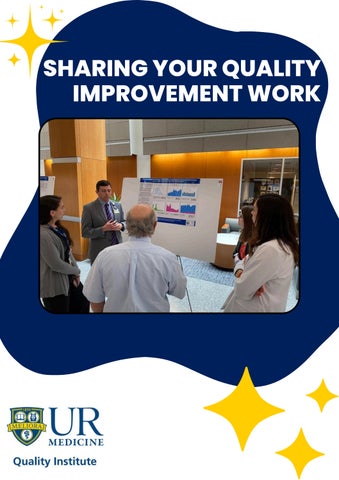
We encourage all Unit Based Performance Program (UPP) teams and Pursuing Excellence Initiative (PEI) Teams to present their Quality Improvement (QI) work as a poster. There are numerous places to consider submitting a poster abstract to for presentation:
The URMC Quality Institute Better Teams. Better Care. Symposium scheduled for June 11, 2025– call for abstracts are ~April every year
The URMC Faculty Development Colloquium scheduled for June 4, 2025 –call for poster abstracts are ~March every year Magnet Poster Session
National meetings in your specialty area – PEI teams have presented posters at the Pediatric Academic Societies, the American Medical Informatics Association, and American College of Surgeons National Surgical Quality Improvement Program meetings to name a few.

URMC Faculty Development Colloquium
Poster Session

34th Annual SCRC Summer Program
Poster Session


URMC Nursing Magnet
Poster Session

We encourage all Unit Based Performance Program (UPP) teams and Pursuing Excellence Initiative (PEI) teams to present their Quality Improvement (QI) work as a workshop or platform presentation. There are numerous places to consider submitting a workshop proposal for your UPP/PEI QI team presentation.
The URMC Faculty Development Colloquium is scheduled for June 4, 2025
The call for workshop abstracts is in March every year.
National meetings in your specialty area
Pediatric Academic Society (8 North PEI Cohort II)
American College of Surgeons National Surgical Quality Improvement Program meetings (Pediatric Surgery PEI Cohort 1)
American Society for Quality (ASQ) Rochester Chapter meeting (GCH Respiratory PEI Cohort V)
The local American Societies for Quality (ASQ) Rochester Chapter meeting at RIT Conference Center in October 2025
The call for presentation abstracts are in September every year. https://asqrochester.org/
URMC Quality Institute’s Quality Circle is a rolling application opportunity to present your UPP/PEI Team QI work (any stage of your project). Reach out to schedule your presentation: UR Medicine Quality Institute@URMC.Rochester.edu and Kelly Maas @URMC.Rochester.edu

The 61400 PEI Cohort V team presented at the Quality Circle


5-3400 presented their work at Orthopedic Grand Rounds
We encourage all Unit Based Performance Program (UPP) teams and Pursuing Excellence Initiative (PEI) Teams to publish their Quality Improvement (QI) work as an original manuscript. There are numerous journals to consider submitting a publication on your UPP/PEI QI work
Many journals are accepting Quality Improvement manuscripts and we recommend using the Squire 2.0 guidelines to format your paper: SQUIRE | SQUIRE 2.0 Guidelines
Most QI papers have Figures from your PEI posters such as Process Maps, Cause and Effect Diagrams, Key Driver Diagrams and Run/Control Charts
Most QI papers are about 3,000 words to outlines your Background (Literature Review), Methods, Results, Discussion and Conclusion
Miner Librarians are able to assist PEI teams with the Literature Review for your QI work.


We encourage all Unit Based Performance Program (UPP) teams and Pursuing Excellence Initiative (PEI) Teams to nominate their Quality Improvement (QI) work for a local award. There are numerous places to consider submitting an UPP/PEI team QI award nomination:
UR Star Team Awards – this is an open opportunity to nominate an UPP or PEI team for their QI work. UR Stars Program | Office of Human Resources
GRQC award applicants complete a marketing video about the team’s work and the videos/team award photos are featured on the GRQC social media pages.
Greater Rochester Quality Council (GRQC) Performance Excellence Awards Applications Due ~May every year, Site Visits ~July and Award Ceremony October 31, 2024. There is an application for the GRQC Performance Excellence Awards and 3 categories: Customer Excellence, Team Excellence and Organization Excellence. Performance Excellence Awards | GRQC: Talk to your coach about other award opportunities