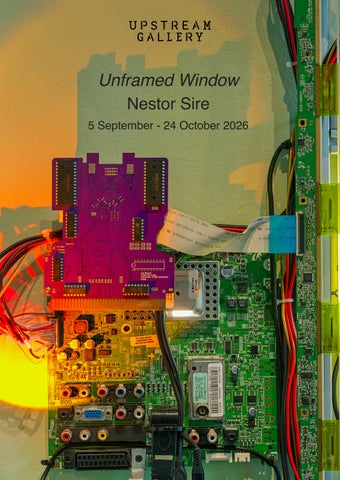
Unframed Window Nestor Sire
5 September - 24 October 2026
Upstream Gallery is pleased to announce its first exhibition with Cuban multimedia artist Nestor Siré, currently an artist in residence at the Rijksakademie. His transdisciplinary research examines how technology both shapes and is shaped by social practices, exploring the tension between technological devices and the human uses that appropriate, modify, and reinvent them. This gives rise to informal infrastructures and vernacular forms of innovation. Unframed Window Unframed Window begins with a hardware modification developed within PC gaming communities that transforms discarded LCD monitors into transparent displays. Siré approaches this DIY technique as a form of vernacular innovation shaped by shared knowledge and informal technological networks, translating it into a sculptural moving-image installation.
collective gaming culture of the 1990s. Despite their different origins, both became formative ways of understanding how images construct landscapes, bodies, narratives, and cultural identities. Within gaming culture, animated wallpapers often function as a final layer of aesthetic customization—a way of giving a computer setup a distinct visual identity. Siré approaches the animations in Unframed Window as his own animated wallpapers, reflecting these two sides of his identity as both artist and gamer. Each animation uses original textures and graphic elements extracted from video games, reorganizing their pixelbased language to reconstruct the forms and compositions of paintings.
Each work establishes a specific visual, autobiographical, or political connection between a painting and a video game. Together, however, the series becomes The series brings together two visual a personal exploration of how identities languages that shaped the artist’s and aesthetics are constructed through formation in Cuba: painting, through images, bringing art history, gaming formal art education, and video games, culture, memory, and vernacular encountered through the informal and technology into the same visual space.
“This work connects Wifredo Lam’s La Silla with Contra (Konami, 1987/88), the first shooting game I remember playing as a child in Cuba. Framed by the imagery of the Cold War, the game follows two American heroes who arrive on a tropical island to liberate it from an alien force called Red Falcon. That jungle landscape always reminded me of Cuba. In the end, the heroes escape by helicopter as the island explodes behind them— an image of liberation that culminates in the destruction of the territory being liberated. In La Silla, Lam merges Caribbean flora with an object that appears simultaneously integrated into and foreign to the landscape. My version fragments these elements across two screens: the jungle is reconstructed from the first level of Contra, while the chair incorporates industrial and alien elements from the game. The work revisits a childhood memory from an adult perspective, connecting two representations of the Caribbean landscape with geopolitical narratives of invasion, the enemy, liberation, and territorial destruction.”
Caribbean Enemy, 2026 Two second-hand LCD screens with transparentdisplay mod, custom functional NES cartridge PCB, Raspberry Pi 5, RGB lighting, aluminum frame, two 10-second animated loops, original game sound 74 x 84 x 39,5 cm
“This work connects Amelia Peláez’s Interior con columnas with Super Mario Bros. (Nintendo, 1985). Rather than a narrative relationship, the connection emerges through their visual languages. Working within the strict graphic limitations of the NES, Super Mario Bros. constructs its recognizable world through limited color palettes, geometric forms, and the repetition of modular graphic tiles. Peláez similarly transforms space through color and geometry. Her interiors combine architectural elements, stained-glass motifs, tropical fruits, and references to Cuban visual culture, organized through strong outlines and intense areas of color. In Interior con columnas, architecture and ornament cease to function simply as background and become part of the visual structure itself. The work brings these two systems of image-making together: the modular geometry and color limitations of the video game with Peláez’s distinctive way of constructing space, architecture, and Caribbean imagery through color.”
Interior Level, 2026 Second-hand LCD screen with transparent-display mod, Raspberry Pi 4, RGB lighting, aluminium frame, 9-second animated loop, original game sound 35 × 20 × 30 cm
“his work connects a painting from Servando Cabrera Moreno’s Los Milicianos series with Guerrilla War (SNK, 1987). Originally released in Japan as Guevara, the game transforms Che Guevara and Fidel Castro into action heroes fighting to overthrow Batista’s dictatorship in Cuba. For its Western release, these explicit references were removed, turning the Cuban Revolution into a generic narrative of combat and liberation. In his representations of militiamen, Cabrera Moreno participates in the visual construction of the revolutionary hero, but through stylized and sensual bodies that depart from the rigid image of the combatant. Servando was gay and, only a few years after producing these works, was removed from teaching and institutionally marginalized in a Cuba where homosexuality was heavily persecuted. This contradiction offers another way of reading his militiamen: as the work of an artist who represented the heroic body of the Revolution while he himself did not conform to the sexual and social norms it imposed. The work thus confronts two constructions of the same revolutionary iconography: the video game, which transforms its leaders into masculine action heroes, and Cabrera Moreno’s painting, which opens up a more sensual and ambiguous representation of the revolutionary body.”
Revolutionary Body, 2026 Second-hand LCD screen with transparent-display mod, Raspberry Pi 4, RGB lighting, aluminum frame, 9-second animated loop, original game sound 40 × 27 × 35 cm
PC Gamer CubaCreativa interrogates the production of technological knowledge under conditions of material restriction, foregrounding community capacities to repurpose existing technologies for local needs. PC Gamer features gaming practices that, through hardware modding, dissolve the border between innovation and adaptation. These interventions contest global regimes that legislate which technologies count and who may develop them, exposing tensions between dominant models and collective solutions forged at the margins of hegemonic infrastructures. Deploying collaborative methodologies, this project probes the interdependence of social dynamics and technical development. Each
of its projects documents, systematises, and circulates these processes through open-design networks, social platforms, and free-software communities; each work simultaneously questions the place of art and the artist inside such sociotechnical assemblages. The pieces assert that technology is never neutral: it is both a product of social relations and an agent that reshapes them. By challenging notions such as planned obsolescence and unequal access, CubaCreativa advances a critical reading of technical autonomy. Innovation emerges here as dialogue, where marginal practices rewrite canonical parameters and sketch technological futures through collective creativity, revealing technology itself as a negotiated terrain between the individual, the communal, and the global.
“This work examines how technological creativity emerges in a country without an electronics industry and with highly restricted access to devices and components. Siré, himself a gamer, works from within this shared experience: a community that sustains its relationship with play through a form of cultural engineering that combines technical knowledge, material intuition, and a precise understanding of local conditions. The tire introduces a solution shaped by this ecosystem. It is not a symbolic gesture but part of a technical repertoire that enables adaptation, stabilization, and extended use of equipment that arrives through informal channels and undergoes multiple life cycles. Modding becomes a practice that ensures continuity while asserting these players’ presence in a digital world that rarely accounts for their realities. The piece engages with the colonial hierarchy of technical knowledge, which tends to recognize as innovation only the solutions produced in hegemonic centers. This structure sidelines creativity emerging in contexts of unequal access and reinforces the idea that economic, political, and territorial privilege determines who designs the digital future.”
PC Gamer [GOMA] Amsterdam, 2025 Reclaimed car tyre, steel tube framework with Kee Klamp fittings, custom 3D-printed mounts, modified gaming PC, RGB cooling system, autonomous battery-powered electrical system 145 x 60 x 35 cm
“But Can It Run Crysis? emerges from a context in which technological scarcity fuels forms of critical imagination. Its central gesture activates an image immediately recognizable within gamer culture: the instant when a computer collapses under extreme performance demands and releases a plume of smoke that seals its end. Widely circulated through memes, benchmark videos, and online narratives, this scene became inseparable from the phrase “But Can It Run Crysis?”, a meme born in 2007 alongside the videogame Crysis, whose unprecedented graphical requirements transformed hardware performance into both fetish and technological rite of passage. The work transfers this fleeting digital image into the sculptural realm through an exposed chassis that powers up, reveals its minimal architecture, and appears trapped in a perpetual state of near combustion. Red-amber flashes, electrical crackling, and bursts of gray smoke simulate imminent failure, yet the machine never fully self-destructs. The sculpture transforms collapse into an aesthetic event and deterioration into performance. Within this ecosystem, smoke becomes both material and metaphor: an expression of the tension between technological aspiration and material fragility. The piece proposes an archaeology of gamer imaginaries, where memes, glitches, and improvised modifications operate as vernacular archives of digital identity, persistence, and desire.”
But Can It Run Crysis?, 2025 Modified computer chassis, hacked power supply, Arduino-controlled electronics, LED lighting, smoke machine, audio system, programmed kinetic installation 50 x 20 x 40 cm
Kloveniersburgwal 95 1011 KB Amsterdam t. +31 (0)20 4284284 e. info@upstreamgallery.nl