Boezem
Mail art (1964 - 1996)

Upstream Gallery is proud to present Marinus BoezemMail Art (1964–1996), on view in the gallery’s private viewing space opening on Friday March 20 2026, simultaneously with the group exhibition in the main space: Content Machines.
Brought together for the first time, this presentation surveys a body of historical works by Boezem that can be classified as mail art, an artistic movement that emerged in the 1960s centered on the exchange of small-scale works through the postal service. Boezem, celebrated for his radical immaterial, conceptual and Arte Povera works, regularly used the postal service to distribute his art and ideas. Sending art directly into the world, to institutions, artists or art professionals, was itself a conceptual gesture entirely in keeping with his practice. The works gathered here span more than three decades and include an exhibition invitation, proposals for artworks and weather reports, among others. All works bear the playful sensibility so characteristic of Boezem’s work.


Show II - XV, 1964 - 1968
Marinus Boezem’s Shows form a coherent series of drawings intended as proposals for installations which could be realized in a museum on order. The proposals consist of spatial sculptures made of air and other materials, such as cotton, wool and reeds, hardly ever used for art at the time. The Shows were proposals for what became known in the second half of the eighties as ‘installations’: working with the whole of the exhibition space.
Like a businessman dealing in art ideas, Boezem wore a threepiece suit and carried a briefcase containing his proposals, which he brought to museums in person or distributed to people in art circles. A number of the Shows were realized partially or in full since their conception. In 2021, an exhibition at the KröllerMüller Museum brought all the Shows to life for the first time. This artwork contains 14 pieces, including Shows XI–XV, a typescript, and two photographs of Boezem with his briefcase.

Set of 14, including 2 photographs


If You’d Like to See This Photo in Colors, Burn It, 1967-’69
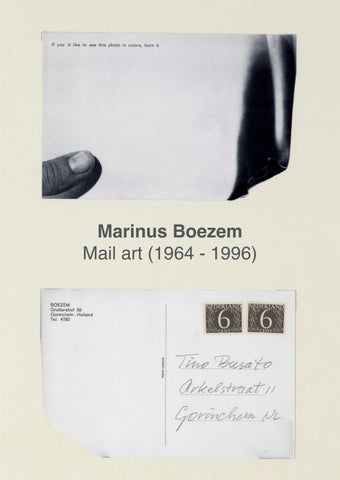
This work is a black and white picture postcard bearing the instruction: ‘If you’d like to see this photo in colors, burn it.’ Boezem’s thumb is pictured life-sized in the left corner, as if holding the card, while the right side depicts a curling sheet of paper going up in flames. In 1969 the card was sent by mail to 200 persons as an artwork. The recipient is involved as a co-actor in the creation of the intended artwork, by holding it in the spot where Boezem’s thumb is pictured and then lighting it on fire. By this intervention, the black and white photograph of the flames is temporarily transformed into the colour of real flames. At the same time, the realization of the artwork means its destruction.
If You’d Like to See This Photo in Colors, Burn It, 1967-’69
Ink, offset 10,8 x 16 cm
Set of 2 post cards, ink and offset print on paper, framed together


Weerkaart, donderdag 26
september (Weather map. thursday, september 26), 1968
On July 17, 1968, Boezem sent a written request to the KNMI to produce 500 copies of the official Weather Map for Thursday, September 26, 1968. The choice of date was deliberate; Boezem specifically selected a day with strong wind. Together with the Beaufort Wind Scale,Boezem mailed the map to art institutions and individuals in the Netherlands and abroad.
The intention was twofold: to introduce meteorology as an unexplored field into the visual arts, and to reawaken awareness of a daily phenomenon. The action offers a commentary on the dulling of experience brought about by the intensification of information and communication. By presenting an ordinary weather map as an artwork, Boezem invited recipients to look again at something they would normally overlook.
The September 26 Weather Map was later printed on the cover of the Op Losse Schroeven catalogue (1969), and meteorological imagery continued to recur throughout Boezem’s work in subsequent years.
Weerkaart, donderdag 26 september (Weather map. thursday, september 26), 1968 Paper, offset printed on both sides 33,4 x 24,4 cm


Windschaal (Wind scale), 1968
The Wind Scale is a slightly modified version of the official Beaufort Scale, the numerical wind speed system running from 0 (calm) to 12 (hurricane), taken from the Dutch version used by the KNMI at the time. It was sent as an enclosure with the Weather Map for September 26, 1968, to individuals and institutions in art circles, signed ‘Boezem Medium Ter Bevordering Van Hernieuwde Ervaringen’ (Boezem, Medium For The Furtherance of Renewed Experiences), 1968.The work was shown in several landmark exhibitions, including Arte Povera, Amalfi (1968), Op Losse Schroeven (1969), and When Attitudes Become Form, Bern (1969).
The artwork was shown at Stedelijk Museum Amsterdam in the shape of a lightbox, and was later acquired by the musuem and is now part of their collection.
Windschaal (Wind scale), 1968 Stencil 29,7 x 21 cm


Statement for the Catalogue 19-2-1969, 1969
‘I cordially hope the weather will be mild during the exhibition with wind-force 3m./sec., so there will be a moderate breeze: then leaves and twigs are in constant motion, small branches begin to move. Dust and paper begin to whirl round above the ground.’ This statement, addressed to legendary curator Harald Szeemann (1933 - 2005), was included as artist’s project in the catalogue Live in Your Head. When Attitudes Become Form, Bern, 1969.
Statement for the Catalogue 19-2-1969, 1969
26,5 x 19,5 cm
Original document

Sculpture
I Invite You To Make Love On February 11th 1978 At 22.00 Hours, 1978
Boezem’s request printed in black ink and signed “to make love on February 11th 1978, at 22:00 hours” was sent to about 350 people at home and abroad, working in the various sectors of the art world. The names of the addressees are listed in a text block on the invitation. The timing of the global action, which is to be understood as a sculpture, was carefully recorded by Boezem and authorised by his signature.
Sculpture I Invite You To Make Love On February 11th 1978 At 22.00 Hours, 1978 Paper, ink, pencil 29,7 x 21 cm

Sculpture, 1996
This work consists of a page of text (in Dutch) listing characterizations of artworks in public space, drawn from advertisements in the 1996 volume of BK Informatie, a bulletin in which municipalities and institutions call for submissions for public art commissions. The often cryptic or inflated formulations reveal how certain circles think about art in public space. Boezem finds this way of granting commissions hypocritical and offensive to artists who have committed themselves ideologically to new or alternative concepts of art.
The word ‘Sculpture’ at the top is set in old-fashioned nineteenthcentury italic type, printed on cream-coloured paper; deliberately evoking worn-out terminology. Around New Years the printed item was sent to persons on Bozem’s address file.
Sculpture, 1996 Ink, offset 29,7 x 21 cm


Sign the sky above the port of Amsterdam with an aeroplane, 1969
In the work Sign the sky above the port of Amsterdam with an aeroplane (1969) a skywriting airplane writes the word ‘Boezem’ with condensation trails in the cloudy sky above Amsterdam’s harbor. After some time the word begins to vanish and ultimately disappears behind a cloud bank. The happening can be conceived as signing the cosmos, but because the signature is sure to disappear, it appears the artist is distancing himself from this pretentious act.
This work is an original invitation card from 1969, featuring photographs by Frits Rotgans, used to announce the 6th Paris Biennale at the Musée d’Art Moderne, where the work was shown for the first time. The card has since become a collector’s item.
Sign the sky above the port of Amsterdam with an aeroplane, 1969
Framed invitation card from 1969
Work: 14,2 x 68,5 cm
Frame: appr. 20 x 75 cm