![]()


Sam Lavigne, Tega Brain, Dirk Paesmans, Eva and Franco Mattes, Silvia Dal Dosso, Jonas Lund, Minang Cho and Constant Dullaart
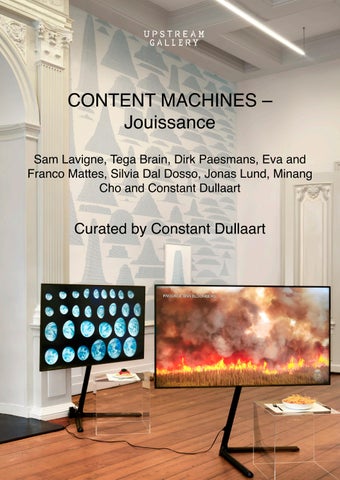
Upstream Gallery is proud to present the group exhibition CONTENT MACHINES – Jouissance, curated by Constant Dullaart.
CONTENT MACHINES – Jouissance excavates an ongoing confrontation with automated production, tracing a lineage from cybernetic experiments and automatic art through early network provocations, algorithmic feeds, to today’s generative AI slop. As McKenzie Wark observes, we now labor within “a mode of production based on information that has itself become a commodity.” Featuring works by Sam Lavigne, Tega Brain, Dirk Paesmans, Eva and Franco Mattes, Silvia Dal Dosso, Jonas Lund, Minang Cho and Constant Dullaart, the exhibition reveals how artists have consistently exposed the infrastructure of content machines, from early web absurdism to contemporary algorithmic critique and AI-generated detritus.
What Yanis Varoufakis terms “technofeudalism” finds aesthetic response here: artists as vassals learning to sabotage the lord’s machinery. The works scrape the repressed unconscious of prompt culture, feed art history back into generators that cannibalize it into new work, and compose algorithmically optimized affect for platforms that can’t tell the difference. Video essays rewrite themselves hourly, AI slop evolves from grotesque to seamless across sculptural iterations, and feeds jolt and flitch through infinite scroll as nervous system. Authorship dissolves into endless unique editions where algorithms dictate the conditions of their own making. Jouissance keeps the feed alive. Compulsive consumption of content you informed and a machine authored. These works don’t resist that machinery. They détourne it. We are content machines.


In AI image generators, users often rely on negative prompts: lists of things the system should avoid producing. These prompts include phrases such as “low quality” “no distortion,” or more explicit instructions used in the generation of online pornography, reveal the hidden grammar of machine imagination.
For this work, Sam Lavigne transforms these instructions into a large-scale wallpaper showing multiple portraits. Extracted from user prompts circulating online, the text becomes both pattern and content. The installation exposes the strange language humans develop to negotiate with generative systems, revealing a collective subconscious embedded in prompt culture.
Sam Lavigne is Assistant Professor of Synthetic Media and Algorithmic Justice and an artist whose work investigates machine learning, surveillance and the cultural implications of automated systems.

Sam Lavigne
Negative Prompts, 2026
Wallpaper
Dimensions variable

Sam Lavigne
Negative Prompts (dutch angle), 2026
Print on paper, framed
80 x 60 cm
*Any of the prompt portraits can be chosen to be printed and framed.


The Future Is Weird AF is a three-part video installation chronicling the turbulent years between 2023 and 2025, when generative AI and large language models entered everyday life at massive scale. Drawing on the visual language of the internet’s corecore movement and the documentary style of Adam Curtis, the films assemble a dense collage of found footage gathered from the endless stream of online media.
Through rapid editing, narration and a synthetic, Dal Dosso traces a reality where memes, geopolitics, and platform culture colapse into a single mediated flow. The trilogy becomes a time capsule of a moment when artificial images improved rapidly while reality itself seemed to grow increasingly strange.
For CONTENT MACHINES – Jouissance, Dal Dosso created three sculptures that trace the evolving stages of AI image generation. The works take the form of spaghetti sampuru, hyper-realistic food replicas, referencing the viral AI video of Will Smith eating spaghetti, an early and widely shared example of generative AI’s uncanny aesthetics.
Silvia Dal Dosso is an artist, writer and researcher whose work explores digital culture, web subcultures and the social impact of emerging technologies.


Silvia Dal Dosso, The Future Ahead Will Be Weird AF, 2023
The Future Ahead Will Be Weird AF (2023) tells the story of how popular culture, internet celebrities and politicians are now relentlessly devoured and repurposed by internet users, in an attempt to gain visibility, make money, or simply get a plain lol.
To do so, they are deploying genAI.
Text-to-video generation is a fresh novelty, it feels weird, it feels funny, but it may also bring something far more unexpected: a fundamental shift.
What internet creators where thinking in 2023? How the meme scene was using this new tools? Why food was so present? Is it over?
Silvia Dal Dosso
The Future Ahead Will Be Weird AF, 2023
Video - watch here 10 min. 36 sec.


Silvia Dal Dosso, The Future Is Going To Be Weird AF, 2024
The Future Is Going Be Weird AF (2024) tells the story of how digital reality has become a weird but scary place, while brands and propaganda, are now and since ever using our emotions to interfere with our choices.
To do so, they are now using AI.
Text-to-video generation still looks funny, but we are starting to wonder what purposes it might eventually serve. Behind this playful surface, we can already sense the other uses of AI, in recommendation algorithms and search engines.
Something keeps us glued to our screens and prevents us from organizing our top priority: survival.
Silvia Dal Dosso
The Future Is Going To Be Weird AF, 2024
Video - watch here
11 min. 36 sec.


Silvia Dal Dosso, The Future Is Now
Finally Weird AF, 2025
The Future Is Now Weird AF (2025) tells the story of how the oligarch class is attempting to replace workers with robots, while using war frontiers as R&D free zones to gather data in real life.
To do so, they are deploying AI.
The creative class feels obsolete, while the weird seems to have crawled straight out of internet threads to spill across a bleak sky. Nothing really matches. Influencers stand in the streets with their ring lights as AI agents flood social media with slop.
Something tells us the world is too complex to be managed by some confused oligarch with a machine, and that it’s time to get our shit together.
Silvia Dal Dosso
The Future Is Now Finally Weird AF, 2025
Video - watch here
13 min. 08 sec.
Edition of 3 plus 1 artist’s proof


An initial year of Instagram posting is treated as a continuous output where each upload is shaped by the platform’s conditions, timing, and feed logic. Over time the accumulation forms a stream that reflects the algorithmic conditions imposed by Instagram as a medium. This ‘user archive’ is then extracted from its original context and reorganized on a website into new sequences breaking the chronological and algorithmic order of the feed. On the website the reels are played back through randomized constellations, shifting scroll rhythms and repetition.
https://idacco.net
instagram.com/ig.oo_o
Dirk Paesmans is a member of JODI, who are known for their influential work in net art, often exploring systematic disruption, exaggeration, and glitch.
Dirk Paesmans @ID.ACCO V24.1, 2026
%20Website
Dimensions variable, duration infinite


Jonas Lund, Abstract Feed (Scroll Composition No. 1), 2025
Abstract Feed (Scroll Composition No. 1) dismantles the addictive scroll mechanics of social media feeds. The work maintains the familiar vertical interface of platforms such as TikTok, but replaces recognizable content with an endless sequence of generative abstract compositions.
The work is a deliberate shift from narrative content to visual arrangements of colours, forms and movement; hovering between digital artifact and conscious design. By preserving the hypnotic gesture of scrolling, Lund reveals the psychological architecture of the feed itself. What remains is the pure rhythm of consumption, an interface designed to keep the body scrolling, while transforming it into a contemplative experience.
Jonas Lund is an artist whose practice critically investigates the systems, algorithms and power structures shaping contemporary networked culture.
Jonas Lund
Abstract Feed (Scroll Composition No. 1), 2025
Video installation, custom software
Dimensions variable, duration infitinite


Eva & Franco Mattes, Re: Re: Re: Net Art, 2025
In a legendary project shown at the Venice Biennale in 2001, Eva and Franco Mattes released a computer virus and, to protect it from anti-virus companies, encased hundreds of ‘captive’ copies in hand-assembled computer sculptures that are never connected to the internet, trapped in an endless cycle of infection and disinfection.
In this work, created specially for this exhibition, they repurpose the form of computer-as-sculpture, but here the screen displays not viruses but a random sequence of 64 AI-generated “net art” works. Eva and Franco Mattes, themselves internet artists of the first hour, fed the algorithm with early internet artworks by peers such as JODI, Cory Arcangel, and Constant Dullaart himself. Connoisseurs will recognise elements of their works.
The piece can be read as an homage to net art, while simultaneously revealing how AI-generated content cannibalises art-historical movements.
Eva & Franco Mattes are known for their influential work in net art, often exploring the cultural and political dynamics of the internet.
Eva & Franco Mattes Re: Re: Re: Net Art, 2025
Custom-built computer, monitor, 64 AI-generated webpages, software, plexiglass 80 x 60 x 10 cm


Considered is a series of works on vinyl. Across a series of 64 LPs each unique song reflects on everything an artist must consider when making a work: form, colour, rhythm, composition, intention, etcetera. These criteria are in constant development during Dullaart’s decades of teaching and current position as professor of Networked Materialities at the Akademie der Bildenden Künste in Nürnberg. These considerations become the lyrical and sonic material of the record itself, turning the album into a selfanalytical machine.
The tracks recalibrate the parameters of authorship and decision-making, as if the artwork were thinking aloud about its own conditions of possibility. The work grows through programmed imperfections, added audio artefacts, vocal disfluencies, and errors reminiscent of an embroidery’s “god stitch”. On the B-side of each record, the tracks are reconsidered, returning to the same material from a slightly altered perspective. These AI-generated vocal disfluencies become a playground for apophenia. In an era where bots simulate flaws to appear human, Considered exposes imperfection itself as a cultural construct. The single edition of each record is in reference to Once Upon a Time in Shaolin.
Constant Dullaart is an artist, educator, curator and director of distant. gallery whose work critically examines neural, computer, and social networks and their infrastructures shaping contemporary digital culture.

Constant Dullaart
Consider, 2026
Considering, 2026
Considered, 2026
Consideration, 2026
Considerations, 2026
Considerable, 2026
LP with hand-stamped, signed cover and inlay artwork


With the release of large language models such as ChatGPT, the internet has become increasingly saturated with AI-generated text, images and video. In response, Slop Evader offers a simple solution: it only returns search results published before 30 November 2022, the day ChatGPT became publicly available.
Presented here as an installation, a safe pre-AI bubble, where an automated browsing bot uses the browser extension as a filter against algorithmic slop. The information may be slightly outdated, but the work proposes a different form of value: the reassurance that the content was produced by human hands rather than synthetic generators.
Tega Brain is Industry Associate Professor at Tandon School of Engineering at NYU and an artist and environmental engineer whose work examines digital infrastructures, automation, and the politics of technological systems.
Tega Brain Slop Evader, 2025 Browser extension download here (6554)
€ 6,000


Now Are You Sound Asleep? explores the hypnotic rhythms of contemporary screen life compared to driving. In the installation, AI-generated highway videosvideo’s created by a model trained on datasets of dashcam footage and trips around Nürnberg are swiped along two eye-likeeyelike smartphones by two metronomes as windscreen wipers. Recording time passed between memory and recording and distances traversed or not.
The work reflects on the bodily habits formed by endless scrolling. Before boredom even registers, the hand already reaches for the phone; the arm becomes a metronome keeping time with the steady pulse of the feed. Highways without exits mirror the logic of infinite digital circulation, where movement continues without a destination. Seated within the installation, the viewer enters this loop of repetition and drift, where attention softens and the boundary between alertness and sleep begins to blur.
Minang Cho is an artist working between Germany and South Korea whose installations examine the bodily and spatial experience of networked technologies and a recent alum of the Akademie der Bildenden Künste Nürnberg, Vernetzte Materialität.
Minang Cho
Now Are You Sound Asleep?, 2026
AI-generated video (trained on highway datasets), smartphones and chargers, metronomes, conductive thread, copper, plexiglass, bolts, and nuts, wood 50 x 33 x 23 cm


Constant Dullaart, The Mistake Is the Message, 2026
The Mistake Is the Message is part of an ongoing project exploring whether ‘brainrot’, the endless flow of algorithmic content online, can become artistic material. Developed through workshops with other artists, Dullaart built a machine that continuously produces video essays.
For this exhibition, a new video premieres every hour and is automatically uploaded to YouTube, slowly forming an everexpanding archive. Each essay revisits similar ideas about authorship, authenticity, and digital culture, but with subtle variations. The work stages the collapse of originality as a stylistic exercise: the same story retold endlessly, where repetition and small errors become the engine of meaning.
Constant Dullaart
The Mistake is the Message, 2026
Live generated video essay