![]()


Like the work of his digital native peers, Constant Dullaart’s often conceptual work manifests itself both online and off. Within his practice, he reflects on the broad cultural and social effects of communication and image processing technologies while critically engaging the power structures of mega corporations that dramatically influence our worldview through the internet. He examines the boundaries of manipulating Google, Facebook and Instagram and started his own tech company Dulltech™ with Kickstarter.
Constant Dullaart (NL, 1979) is a former resident of the Rijksakademie in Amsterdam, and lives and works in Berlin. His works were shown in MCA, Chicago, Whitechapel Gallery London, Kindl, Berlin Schirn Kunsthalle Frankfurt, Import Projects Berlin, Utah Museum of Contemporary Art, ZKM Karlsruhe, Victoria & Albert Museum London, and MAAT Lisbon. Dullaart has curated several exhibitions and lectured at universities and academies throughout Europe, most recently at Werkplaats Typografie, a post-graduate programme at ArtEZ, Arnhem. In 2015, he was awarded the Prix Net-Art, the international prize for internet art. Constant


What can we still recognize in the rapidly rising impenetrable structures of Artificial Intelligence surging amongst us? Stretching from 2016, when Dullaart sold a first oil painting created by AI during his first solo at Upstream Gallery, the clumsy mutations of just 7 years back are now poised to transform into perfection. The novelty of synthesized images has worn, and the naivety through which we grasp insight into opaque systems is a spell soon to strike midnight. On the brink but not quite, we find ourselves at an appropriate moment to salute that which is gawky and graceless to our human eyes.
Artwork Sunsetting Inconsistencies (2023) honors the ephemeral imperfections that are now still inherent to Artificial Intelligence.
A slide projector showcases deforming, morphed hands, harboring unusual paper clips feverishly held up against a setting horizon. These images were created using a text-to-image Artificial Intelligence model. Deliberately, the artist feeds the AI with a prompt containing the two subjects that still prove to be elusive to AI: paperclips and hands. As much as AI can generate hyperrealistic ima- ges, certain details, such as the precise amount of fingers that make up a human hand, are still amorphous to its technology. It’s just a matter of time before these imperfections will turn into “per- fection”, however, this risks yielding a uniform stream of clinical images that serve the expected, inscribed with our dominant norms and values into data, at the cost of losing innate fluidity.
Sunsetting Inconsistencies, 2023
Installation with slide projectors, slides, pedestals


The sculpture Accepting the job (2023) is a monument for AI’s infamous recurring fault, as seen in memes, deforming hands. An altar to the errors of AI, before they will be eliminated.
Shaking out of mid-air, these hands seem to be accepting the offer of the job that may soon be taken from us humans. It’s a life-like rendering of AI’s failure to understand fingers. It’s an alternative, both naive and unnecessarily complicated interpretation. A monument to the errors of AI before they are eradicated. The viewer is invited to have a look up-close, observing all its photorealistic angles, that turn magical in latent space.
Provided with a 3D digital sculpture by the artist, the Berlin-based company Twilight Creations took the model to physical production and handpainted it. The company specializes in silicone prosthetics and makeup and is known for its work on renowned movies such as The Matrix 4: Resurrection and more.
Accepting the job, 2023 Steel, wood, silicone, resin, paint 130 x 48 x 30 cm

Artworks from the ASCII (2023) series shift between the analog and the digital, saluting the charming inconsistencies of the handmade.
In the ASCII (2023) series Constant Dullaart misuses the EBS-260 Handjet® industrial handheld inkjet printer, to honor the charming flaws of creation by hand. Here, the artist reverses the former methodology and instead utilizes AI- generated images to create text (image-totext). ASCII stands for ‘American Standard Code for Information Interchange’, a standardized way to represent characters as binary code for

computers, ensuring that text can be understood and exchanged consistently across different systems and devices. Starting in the late 1970s, the same characters were utilized to create graphic images and designs.
By combining ASCII with a handheld inkjet printer, Dullaart is able to co-create AI-generated images by hand, built from individual characters. Rather than would have been the result of using much more efficient tools such as a common printer, these works turn into artifacts, preserving the inevitable imperfections of handicrafts.


Constant Dullaart in the show Behind the Screen at Kindl, Berlin (2019).


Never complain, never explain, 2019 Video, here displayed on 3 screens and 3 DullTech media players
Unique
Entrepreneurship turned out to be an important factor in Dullaart’s artistic endeavors, since it has given him the autonomy to engage with power structures of corporations on a global level. Dullaart’s first artistic-entrepreneurial project was DullTech™. In 2015, this startup raised enough money through a crowd-funding campaign to develop a media player. On a superficial level, the DullTech™ mediaplayer is just another commercial tech product. But in fact, DullTech™ gave Dullaart ample opportunity to research and comment upon the creative and productive sides of the tech industry.
With developing DullTech™, Dullaart became embedded in the production chain of electronic devices. By going to Shenzhen, South China, a region known as “The Silicon Valley of Hardware”, Dullaart got to see the geopolitical reality behind many of these electronic devices. dull. life™ evokes similar questions on the working conditions within and beyond the co-working space. While artists and entrepreneurs can work safely behind their computer, cheap laborers on the other side of the globe will build their product. The product created in the co-working space hides the physical labor and neglects the people behind this.
DullTech™ demonstrated that not only the factory worker in Shenzhen, but also the artist in the West got marginalized by the creative industry.
The explainer video Never complain, never explain shows the workings of a coworking space, while at the same time showing the limits and possibilities of Dullaart’s own product: the DullTech player.
Within the current Machine Learning Revolution, so-called convolutional networks (ConvNets) can now recognize objects within photographic images. This might seem like a trivial addition to already existing computer and online service capabilities, but it is a crucial step in how humans can interact with representation and depiction. The enhanced agency differentiating a cow from a horse, is rapidly developing into recognizing specific people and their moods, and interpreting behaviour.
If we all collectively imagine a candle, what would come out? Thousands, millions of images of candles are photographed and archived, representing so many aspects of our lives. Dinner conversations, social relationships, health, design, wealth, culture. Reverse engineering the so-called ‘neural networks’ that Facebook and Google use to recognize image content with, shows however what these networks understand of us so far: a cold machine-like interpretation of what we prefer to see and what we depict when representing a restaurant, fire, a refrigerator or a handkerchief. A collective visual consciousness learning to recognize the gradients, saliency, angles, curves and hues of every visual concept we can imagine. It shows what translates of our culture to machine understanding at this moment. Every day, new interpretation skills are outsourced to a neural network and every month shows us new applications of creative labour learned to a machine. Security cameras recording to the cloud are feeding the network to learn what evil is, based on statistics. We are outsourcing judgement and prejudice to facts interpreted by rules. It’s not our decision, it is the network’s decision based on learning from all the facts in the world.
In a way these synthesised images, based on photographic representation, show a mechanised version of the collective consciousness of Western societies. These current state-of-the-art, synthesised images look quite painterly, very surreal, copying human sense of documentation, and composition, rendering each visualised class a deadly but sympathetic rendering of the gestalt of the class in question. This mechanical depiction of a concept questions our understanding of depiction in general, especially when positioned within a timeframe of rapid development of these convolutional networks. The sheer amount of money, education, talent and computing power Facebook, Google, OpenAI and others are throwing at these developments, does not suggest anything else then a future in which these techniques will be utilised and rapidly developed beyond the current painterly, even beautifully naive level.
Selected to show the trivial banal technicalities of human life, and the Convolutional Networks vision of its own parts, Dullaart sent the slightly naive, yet cold and surreal depictions to paint factories in Dafen Village, Shenzhen, China and translated into oil paintings on canvas. Continuing the image automation process with outsourced human labour. The TNT express delivered canvases were treated with an automotive clear coat mixed with ghost pearls, normally used in car paint and product design, amplifying the mechanically attractive, adversarially authentic compositions.


Sliding Door, 2017 Neural network synthesised images class; Acrylic and clear coat on canvas
200 x 200 cm

Factory, 2016
Neural network synthesised images class; Oil and clear coat on canvas, 100 x 100 cm


In Dullaart’s durational performance The Possibility of an Army at Schirn Kunsthalle, he critically explored gained in importance through the daily use of social networks. Dullaart created a ‘fake’ army to stand up in revolution the false validation systems in journalism based on follower counts. The army was assembled which the artist used the names of the original Hessian mercenaries who were hired by the British to fight in The original army generated a new income to Landgraf Friedrich II of Hessen, which he used to build the the Fridericianum.
The fake profiles’ accounts were registered on phone numbers bought in bulk in multiple countries. The accompanying nies offering PVAs (Phone Verified Accounts) as a service to create multiple user accounts, acting as passports this project, the artist has created compositions out of the purchased SIM cards. Waging a war against Facebook SIM cards also act as the only physical remnants of the soldiers, as Facebook has now deleted 90% after Dullaart soldiers names. Purchased by kilo, the SIM cards are often recycled for their gold recovery, a process seen therefore stand as a placeholder for the inherent value of identity as a commodity, turned to profit by having Leaving a thin sliver of gold worth a few cents when recovered. These frozen choreographies featuring further standing armies in ongoing and future information wars fought with automated cultural output.

explored the concept of digital identity, which has strongly the war against the current American social media of thousands of artificial profiles on Facebook, for in the American Revolutionary Wars (1775–1783). first publicly accessible art museum in the world:
accompanying SIM cards are by-products of compapassports to new identities. As a physical extension of Facebook through the channels of mass media , the Dullaart released the historic source of the Hessian seen as contemporary or urban mining. The works having the new identity click, like, retweet and follow. physical remnants of artificial identities represent


Constant Dullaart has been exploring the internet as a medium since the early 2000s. With works such as Youtube as a Sculpture (2009) –a sculptural rendition of the ‘loading’ animation on Youtube, Dullaart explored the technical limits and possibilities of the digital medium. Similarly, he worked with the DVD screensaver in a webcam performance, by moving himself within the screen and acting the bouncing of the logo on each side. This video work, known to many as “This DVD Guy”, recently became a hit on the popular social media website Reddit. In dull.life™ you can watch the internet meme displayed on two LED Cubes.


2006 - Transformer, 2019
Aluminium, UV print
121 x 95,8 cm, framed
Unique
The dark infinite stream of clouds in the website dulldawn.io can also be seen in the the physical artworks 2006. These nostalgic works refer to a period in time when there were still high hopes about the the social and democratic benefits of the internet. In addition, it was the year in which the post-internet scene began to take shape.

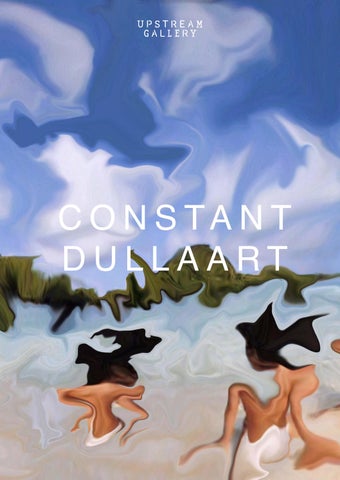
Dullaart’s ‘Jennifer in Paradise’ series (2013-present) redistributes the image of a woman reclining a beach in Bora Bora, originally taken in 1988 by John Knoll, the co-creator of Photoshop. This subsequently became used as the programme’s demonstration image and was therefore once world’s first and most Photoshopped photograph, as new users became acquainted with the product. The high-resolution version of the image is no longer available online, and so the artist has restored the image file pixel by pixel, before applying Photoshop’s generic filters to create a range of distortions.

Installation view of Jennifer in Paradise wallpaper and lenticular prints in the exhibition Electronic Superhighway (2016) at Whitechapel Gallery, London. reclining on image once the product. restored distortions.


in Paradise (Basrelief_BottomLeft_13.4), 2017
print, 79 x 119 cm
Dullaart explores how online activity can be manipulated to generate social capital. His interventions on social media have shown the impact these platforms have and how they influence us in our daily lives. Additionally, he critically investigates the concept of digital identity which has strongly gained in importance through the daily use of social networks.
With his Instagram follower works, Dullaart points to the implications of the attention economy, based on audience as the ultimate commodity. In 2014, he bought and distributed 2.5 million artificial followers to ‘follow’ a selection of active art-world Instagram accounts. With this action, he equalized the amount of followers on each account, and inherently removed the issue of quantified popularity from this part of the art scene. The Instagram profiles seen here are physical realizations of these fake follower profiles, quilted on flags of different countries, with a female and a male side. Dullaart shows how identities are capitalized and what worrying implications this has, for instance, when buying followers, an American male follower is worth more than an Iranian female.


‘Since the beginning, I was always interested in dogmas or clichés shaping the way we view the world. Google became a really big part of that. I wanted to animate that, to change that. It’s not objective, it’s subjective. I started animating the Google page. I thought of making thedisagreeinginternet.com, thedoubtinginternet.com and therevolvinginternet.com, where the page is shown in a revolving sequence, just as the world spins.’
therevolvinginternet.com, 2010 Website


Terms of Service (2012), part of a series of works dealing with the advertising arch box into a literal face which recites Google’s terms of service, created several internet services. Terms which one implicitly agrees to when using these but are always too long to read, and do not give any information about how New Museum (New York, 2012) Dullaart rewrote a standard TOS text to emphasize the New Museum and the City of New York as a performance. He also publicly in which the social networking site was influencing his life and social life.

Google Terms of Service English, 2012 Animated Google search page, reading the Terms of Service conditions out loud
advertising company’s search interface, is a work that transforms the Google seby Dullaart as a response to the continuously changing TOS conditions of these seemingly public and transparent information representation service, how the displayed information is selected. During his TOS performance at the emphasize the audience had an agreement with him as a performer and with publicly gave away his Facebook account password, as a reaction to the way


The Censored Internet (2014) is based on the official list that are accused of cyber censorship and restricting freedom flagpoles so as to invade the space, combined with LED as to make them almost indiscernible, questioning the filtering

The Censored Internet, 2014 Flags, lasers, domain name, custom vinyl wallpaper
628 x 520 cm
of the 19 countries named as enemies of the internet freedom of information. The countries’ flags are hung from spot lighting, which changes the colours of the flags so filtering of information via the Internet.

Kloveniersburgwal 95 1011 KB Amsterdam
t. +31 (0)20 4284284
e. info@upstreamgallery.nl