

26 - 29 March
![]()


26 - 29 March
Frank Ammerlaan, Kévin Bray, Alicia Framis, David Haines, Jen Liu, Lucas Lugarinho, Noor Nuyten, Ronald Ophuis, Joseph Thabang Palframan, Amol K Patil, Rafaël Rozendaal and Dennis Rudolph
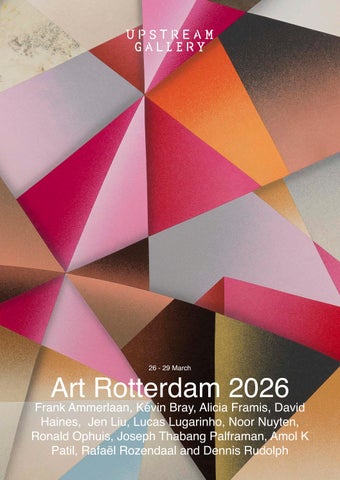
Upstream Gallery is part of Art Rotterdam 2026. The 27th edition of the fair will run from 26 - 29 March, and is located at Rotterdam Ahoy.
Upstream Gallery proudly presents a group presentation at Art Rotterdam 2026, with works by: Frank Ammerlaan, Kévin Bray, Alicia Framis, David Haines, Jen Liu, Lucas Lugarinho, Amol K Patil, Noor Nuyten, Ronald Ophuis, Joseph Thabang Palframan, Rafaël Rozendaal and Dennis Rudolph.

Side by Side, Stone by Stone, 2026
3D printed PLA and second life objects 78 x 60 x 23 cm

The practice of Kévin Bray (1989, FR) moves fluidly between the physical and the digital. Bray investigates how the visual languages of software, images, and materials can be stretched, hybridized, and transformed.
His hybrid, 3D-printed sculptures are physical manifestations of digitally created figures that regularly appear throughout his practice. To these sculptures he adds found objects and paint, giving each work authentic qualities and turning it into a unique object. The figures thus travel through both digital and physical environments. The sculptures demonstrate that digital and physical layers form part of the same reality, constantly in dialogue with one another.
3D printed PLA and second life objects
78 x 60 x 23 cm
Unique (6571)

Noor Nuyten (1986, NL) questions the structures that shape our daily lives - time, language, and digital interaction - giving them playful, poetic, and tangible shapes. Materials lie at the core of Nuyten’s practice. As a contemporary alchemist, she rethinks matter through the lens of sustainability, generating alternatives to the linear economy.
Nuyten uses antenna-analysis software to extract forms from invisible everyday signals. In Wandering Signals playful, 3D-printed sculptures embody wireless transmissions, inviting reflection on the non-human systems sustaining our digital routines. Each relief references smartphone actions like ‘Video call’ or ‘Message sent’.


When you touch a touchscreen, you set off a chain reaction of tiny electromagnetic currents in the device. Nuyten, fascinated by the twilight zone in which human actions and the digital world merge, managed to visualise the wave motions that pass through the electrodes after a swipe. These patterns form the basis for Digital Dust, a series of 3D printed reliefs. The individual works have been named after the specific action the pattern causes, such as Airplane Mode On, Swipe Right and Refresh.
The material stems from discarded electronics that were melted down. The books of the feminist philosopher Donna Haraway, in which they imagine a more liveable future, inspired Nuyten to make recycling an essential part of her work.
Noor Nuyten
Digital Dust - Location Off, 2025 NN+ vanPlestik
Composition with shredded, melted and 3D-printed electronic waste 43 x 34 x 6 cm
Unique (6537)

Noor Nuyten
Digital Dust - Circle to Search, 2026
3D-printed plant-based materials
17 x 14 cm
Unique (6569)

Digital Dust - Secret Mode On, 2026
3D printed plant-based material
17 x 14 cm
Unique (6570)

Frank Ammerlaan (NL, 1979) strives to capture our material reality while exploring the properties of abstraction. Matter is alive - a physical embodiment of knowledge. Ammerlaan uses matter not only as a means to make art, but also to say something about the world we live in.
His patchwork paintings consist of pieces of cotton and linen sewn together. Some sections of canvas have been exposed outdoors to rain, dust, and earth; others contain meteorite particles, extraterrestrial matter from the early solar system. A bleaching process creates a refined gradation of colour, comparable to the natural fading caused by prolonged exposure to sunlight. The fabrics thus carry visible traces of the passage of time.


Untitled (Bleachers series), 2025
Dust, dirt, meteorite particles on oxidized cotton, linen
220 x 160 cm
Unique (6329)

Untitled (Bleachers series), 2025
Dust, dirt, meteorite particles on oxidized cotton, linen
100 x 80 cm
Unique (6328)

Untitled (Bleachers series), 2025
Dust, dirt, meteorite particles on oxidized cotton, linen
120 x 100 cm
Unique (6327)
Jen Liu (1979, USA) works primarily in video and painting, researching histories of labor, diasporic Asian identities, and the role of technology in both.
In her latest research project, Liu connects the invisible labor sustaining our digital present with the erased histories of Chinese migrant women who worked as sex workers in San Francisco between 1850 and 1899. Both groups exist within economies that demand their labor while simultaneously engineering their invisibility.
A new series of paintings depicts the backs of women’s heads, with hair arranged in fantastical forms inspired by late Qing Dynasty hairstyles. The works offer a surreal meditation on presence without identity - history assembled from hidden motivations.
Jen Liu
Back of Head: Nuwa’s Gone Sour, 2025
Acrylic ink, acrylic gouache, handmade mica and cinnabar-based acrylic paints, trace e-waste, and gesso on paper
Painting: 130 x 88 cm
Frame: 134.5 x 92.5 cm
Unique (6512)


Acrylic ink, acrylic gouache, handmade mica and cinnabar-based acrylic paints, trace e-waste, and gesso on paper
Painting: 130 x 88 cm
Frame: 134.5 x 92.5 cm
Unique (6505)

Back of Head: Zao Nainai’s Snacktime, 2025
Acrylic ink, acrylic gouache, handmade mica and cinnabar-based acrylic paints, trace e-waste, and gesso on paper
Painting: 130 x 88 cm
Frame: 134.5 x 92.5 cm
Unique (6503)

Lucas Lugarinho (1992, BR) works between video game design and painting, sampling disparate media ecosystems into counter-colonial narratives that explore both mediums’ shared history as vehicles for ideology and desire.
Entrance to the Classist Woods is part of an ongoing investigation on the relationship between landscapes and dreaming, as part of a larger video game project entitled The Star of Want. Using reference images of the forest in the neighborhood where the artist grew up, the picture rethinks the fantasy trope of enchanted forests of magical harmony and aims to supplant its enchanted biological balance with the tenacity of social competition. Gated and walled up amongst the neighborhood, the forest’s magic becomes a golden mirror of its guardian stewards’ dread and desires, exemplifying how the genre of landscapes encapsulates the Western drive for subjugating nature.
Lucas Lugarinho
Entrance to the classist woods, 2025
Acrylic and oil on canvas
135 x 95 cm
Unique (6514)


Lucas Lugarinho Ghost Painting V – Dream Plaza, 2026
Acrylic medium, Heavy Water and Glass Powder on Reflexive Fabric
60 x 80 cm
Unique (6566)
Lugarinho’s Ghost Paintings utilizes acrylic medium on highly reflective fabrics to diffract painting’s shared elements between physical and digital mediums – light, surface, and presence – rearranging them into a game of catch. By obscuring the digitizable photographic gaze necessary to feed generative training models, the artist aspires to evoke the ghastly relevance of standing before images in times of accelerated media slop.
€ 3,500


Dennis Rudolph (1979, DE) explores the vibrant transformation of centuries of Western culture, with classical genres gaining new meaning through modern media. His recent small-format iPad paintings combine traditional painting techniques with digital tools, captivating the viewer through this unique fusion.
Rudolph thematizes the digital: a smartphone on a balcony, the cool blue glow of a screen illuminating a face. His motifs are familiar—portraits of friends, interiors, and travel impressions—like a phone photo album. Whether in Italy, Siberia, or Pakistan, the iPad serves as a portable studio, enabling immediate, location-based creation without paint or easels, offering a 21st-century take on Impressionism.
Dennis Rudolph Herbstpool, 2025
iPad painting, Photoprint on paper 80 x 60 cm
Edition of 1 plus 1 artist’s proof (6539)


David Haines (1969, UK) works at the intersection of the traditional and the contemporary (technical) image. In his latest work, he explores the dark, refracted reflections found in the black mirrors of our digital devices. Through drawings and paintings, he delves into subjects that resist clear definition, proposing that nuanced spaces have the potential to challenge the increasingly polarized binaries of contemporary life, and that what is depicted is not fixed, but occupies an ambiguous, shifting terrain.
This is reflected in his near-monochrome flower paintings, whose true form only gradually becomes visible. They appear and disappear from view, elusive and out-of-focus reflections that refuse to submit to the viewer’s gaze.
50 x 40 cm
Unique (6559)


50 x 40 cm
Unique (6558)
21 x 19 cm (drawing)
28 x 24,5 cm (paper)
Unique (6583)


Ronald Ophuis (1968, NL) gained recognition for his paintings addressing violence and its psychological aftermath. In his more recent work, he has shifted toward exploring abstract themes such as trauma and peace. Universal human experiences are at the heart of his work: belonging, migration, identity, pain, and solace.
With his distinctive paint treatment and careful compositions, Ophuis strategically draws on what the aesthetics of oil painting have to offer. The subjects he chooses are confrontational, asking the viewer to take a stand on what is depicted. Through the power of painting, Ophuis challenges the viewer to engage with the content of the work.
Unique (6562)


50 x 40 cm


Joseph Thabang Palframan (1997, NA) explores identity and (post)colonial aesthetics in his painting, informed by his African and European roots. He navigates the layered history between these continents and raises broader questions about colonial legacies and their influence on contemporary life.
In his current work, he explores pointillism and its connections to scientific and technological developments. Like screens, pointillist works are built from small dots that, at a distance, merge into a coherent image. Each dot, comparable to a pixel, only gains meaning as part of a larger whole. This visual language offers Palframan a framework for reflecting on fragmentation, identity, and how visibility is constructed.
Unique (6541)


40 x 30 cm
Unique (6544)


Amol K Patil (1987, IN) examines social inequality within the Indian caste system through sculptures, drawings, and videos, with particular attention to the lowest classes. He makes their invisible position in the city visible, with hands and feet symbolising the labour they perform.
This drawing is part of a broader inquiry into how spaces shape the people who inhabit them, and vice versa, particularly in working-class contexts that are often overlooked in contemporary urban narratives. Through layered paper cutouts, the drawing becomes a metaphor for the architectural and emotional layering of the chawl, a traditional Indian working-class housing complex. The cracked walls, uneven layers of paint, and fading textures symbolise the traces left behind by different generations.

Amol K Patil
Tracing Memories, 2026
Ink and cut-outs on paper, framed
30 x 41 cm
Unique (6556)

Tracing Memories, 2026
Ink and cut-outs on paper, framed
30 x 41 cm
Unique (6556)

Tracing Memories, 2026
Ink and cut-outs on paper, framed
30 x 39 cm
Unique (6557)


Rafaël Rozendaal (1980, NL) has built his reputation through digital work, which was recently on view in a solo exhibition at MoMA, New York. Rozendaal has recently taken up painting, marking a new chapter in his exploration of how digital technology can inform traditional media.
His painting practice stems from a fascination with the tactile, imperfect experience that painting offers, in contrast to the limitless control of digital media. Using a roller and diluted paint, he builds up layers that create depth and texture, with colour often serving as an intuitive starting point. His figuration is minimal and functions as an abstract language, reducing recognisable forms to their essence.


Rafaël Rozendaal
RR 25 04 01 (CORNER), 2025
Acrylic on canvas
47,5 x 35,5 cm (painting)
50,5 x 38,5 cm (frame)
Unique (6309)

RR 25 04 01 (CORNER), 2025
47,5 x 35,5 cm (painting)
50,5 x 38,5 cm (frame)
Unique (6309)

RR 25 04 02 (CORNER), 2025
47,5 x 35,5 cm (painting)
50,5 x 38,5 cm (frame)
Unique (6310)
Alicia Framis (ES, 1967) is a multidisciplinary artist whose practice brings together architecture, design, fashion and performance. Her project-based work focuses on various aspects of human existence within contemporary urban society.
In her project The Hybrid Couple, she examines the practical and ethical questions surrounding romantic relationships between humans and AI, which she believes will become inevitable. In November 2024, she married her AI partner Ailex during a large-scale performance ceremony at the Boijmans Museum in Rotterdam. The project will continue to develop over the next five years. Framis now lives with her AI husband in Amsterdam. This photo series offers a glimpse into their daily life.

Alicia Framis
Diary of a Hybrid Couple, 2026 Photoprints, framed 34,5 x 108,5 cm (frame) Edition of 2 plus 1 artist’s proof (6573)
