Lesson 10 Problem Set 3 4
NYS COMMON CORE MATHEMATICS CURRICULUM
Name 1.
Date
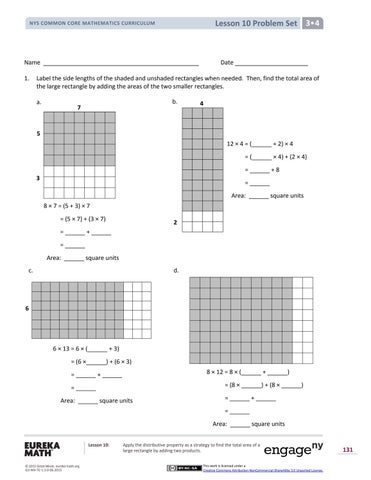
Label the side lengths of the shaded and unshaded rectangles when needed. Then, find the total area of the large rectangle by adding the areas of the two smaller rectangles. a.
b.
7
4
5 12 × 4 = (______ + 2) × 4 = (______ × 4) + (2 × 4) = ______ + 8
3
= ______ Area: ______ square units 8 × 7 = (5 + 3) × 7 = (5 × 7) + (3 × 7)
2
= ______ + ______ = ______ Area: ______ square units d.
c.
6
6 × 13 = 6 × (______ + 3) = (6 ×______) + (6 × 3) 8 × 12 = 8 × (______ + ______)
= ______ + ______
= (8 × ______) + (8 × ______)
= ______ Area: ______ square units
= ______ + ______ = ______ Area: ______ square units
Lesson 10:
© 2015 Great Minds. eureka-math.org G3-M4-TE-1.3.0-06.2015
Apply the distributive property as a strategy to find the total area of a large rectangle by adding two products. This work is licensed under a Creative Commons Attribution-NonCommercial-ShareAlike 3.0 Unported License.
131
NYS COMMON CORE MATHEMATICS CURRICULUM
Lesson 10 Problem Set 3 4
2.
Vince imagines 1 more row of eight to find the total area of a 9 × 8 rectangle. Explain how this could help him solve 9 × 8.
3.
Break the 15 × 5 rectangle into 2 rectangles by shading one smaller rectangle within it. Then, find the sum of the areas of the 2 smaller rectangles and show how it relates to the total area. Explain your thinking.
Lesson 10:
© 2015 Great Minds. eureka-math.org G3-M4-TE-1.3.0-06.2015
Apply the distributive property as a strategy to find the total area of a large rectangle by adding two products. This work is licensed under a Creative Commons Attribution-NonCommercial-ShareAlike 3.0 Unported License.
132
Lesson 10 Exit Ticket 3 4
NYS COMMON CORE MATHEMATICS CURRICULUM
Name
Date
Label the side lengths of the shaded and unshaded rectangles. Then, find the total area of the large rectangle by adding the areas of the 2 smaller rectangles. 2.
1.
8 × 7 = 8 × (______ + ______)
9 × 13 = 9 × (______+______)
= (8 ×______) + (8 ×______) = ______ + ______ = ______
= ______ + ______ = ______
Area: ______ square units
Lesson 10:
© 2015 Great Minds. eureka-math.org G3-M4-TE-1.3.0-06.2015
= (______ × ______) + (______×______)
Area: ______ square units
Apply the distributive property as a strategy to find the total area of a large rectangle by adding two products. This work is licensed under a Creative Commons Attribution-NonCommercial-ShareAlike 3.0 Unported License.
133
Lesson 10 Homework 3 4
NYS COMMON CORE MATHEMATICS CURRICULUM
Name 1.
Date
Label the side lengths of the shaded and unshaded rectangles. Then, find the total area of the large rectangle by adding the areas of the 2 smaller rectangles. a.
5
b.
8
5 12 × 5 = (______ + 2) × 5 = (______ × 5) + (2 × 5)
4
= ______ + 10 = ______ Area: ______ square units
9 × 8 = (5 + 4) × 8 = (5 × 8) + (4 × 8) 2
= ______ + ______ = ______ Area: ______ square units
d.
c.
7
7 × 13 = 7 × (______+ 3) = (7 × ______) + (7 × 3)
9 × 12 = 9 × (______ + ______)
= ______ + ______
= (9 × ______) + (9 × ______)
= ______
= ______ + ______
Area: ______ square units
= ______ Area: ______ square units
Lesson 10:
© 2015 Great Minds. eureka-math.org G3-M4-TE-1.3.0-06.2015
Apply the distributive property as a strategy to find the total area of a large rectangle by adding two products. This work is licensed under a Creative Commons Attribution-NonCommercial-ShareAlike 3.0 Unported License.
134
NYS COMMON CORE MATHEMATICS CURRICULUM
Lesson 10 Homework 3 4
2.
Finn imagines 1 more row of nine to find the total area of 9 × 9 rectangle. Explain how this could help him solve 9 × 9.
3.
Shade an area to break the 16 × 4 rectangle into 2 smaller rectangles. Then, find the sum of the areas of the 2 smaller rectangles to find the total area. Explain your thinking.
Lesson 10:
© 2015 Great Minds. eureka-math.org G3-M4-TE-1.3.0-06.2015
Apply the distributive property as a strategy to find the total area of a large rectangle by adding two products. This work is licensed under a Creative Commons Attribution-NonCommercial-ShareAlike 3.0 Unported License.
135
Lesson 11 Problem Set 3 4
NYS COMMON CORE MATHEMATICS CURRICULUM
Name 1.
Date
The rectangles below have the same area. Move the parentheses to find the unknown side lengths. Then, solve. a.
b.
6 cm
______ cm
1 cm 8 cm
Area: 1 × 48 = ______ Area: ______ sq cm
Area: 8 × ______ = ______ Area: ______ sq cm
Area: 8 × 6 = (2 × 4) × 6
c.
______cm
=2×4×6
2 cm d.
= ______ × ______
______ cm
= ______
4 cm
Area: ______ sq cm e.
______ cm
Area: 8 × 6 = (4 × 2) × 6 Area: 8 × 6 = 8 × (2 × 3)
=4×2×6 = ______ × ______ = ______ Area: ______ sq cm
______ cm
=8×2×3 = ______ × ______ = ______ Area: ______ sq cm
2.
Does Problem 1 show all the possible whole number side lengths for a rectangle with an area of 48 square centimeters? How do you know?
Lesson 11:
© 2015 Great Minds. eureka-math.org G3-M4-TE-1.3.0-06.2015
Demonstrate the possible whole number side lengths of rectangles with areas of 24, 36, 48, or 72 square units using the associative property. This work is licensed under a Creative Commons Attribution-NonCommercial-ShareAlike 3.0 Unported License.
142
NYS COMMON CORE MATHEMATICS CURRICULUM
Lesson 11 Problem Set 3 4
3.
In Problem 1, what happens to the shape of the rectangle as the difference between the side lengths gets smaller?
4.
a.
Find the area of the rectangle below. 8 cm
9 cm
b.
Julius says a 4 cm by 18 cm rectangle has the same area as the rectangle in Part (a). Place parentheses in the equation to find the related fact and solve. Is Julius correct? Why or why not? 4 × 18 = 4 × 2 × 9 =4×2×9 = ______ × ______ = ______ Area: _____ sq cm
c.
Use the expression 8 × 9 to find different side lengths for a rectangle that has the same area as the rectangle in Part (a). Show your equations using parentheses. Then, estimate to draw the rectangle and label the side lengths.
Lesson 11:
© 2015 Great Minds. eureka-math.org G3-M4-TE-1.3.0-06.2015
Demonstrate the possible whole number side lengths of rectangles with areas of 24, 36, 48, or 72 square units using the associative property. This work is licensed under a Creative Commons Attribution-NonCommercial-ShareAlike 3.0 Unported License.
143
NYS COMMON CORE MATHEMATICS CURRICULUM
Name 1.
Lesson 11 Exit Ticket 3 4
Date
Find the area of the rectangle. 8 cm 8 cm
2.
The rectangle below has the same area as the rectangle in Problem 1. Move the parentheses to find the unknown side lengths. Then, solve. ______ cm Area: 8 × 8 = (4 × 2) × 8
______ cm
=4×2×8 = ______ × ______ = ______ Area: ______ sq cm
Lesson 11:
© 2015 Great Minds. eureka-math.org G3-M4-TE-1.3.0-06.2015
Demonstrate the possible whole number side lengths of rectangles with areas of 24, 36, 48, or 72 square units using the associative property. This work is licensed under a Creative Commons Attribution-NonCommercial-ShareAlike 3.0 Unported License.
144
Lesson 11 Homework 3 4
NYS COMMON CORE MATHEMATICS CURRICULUM
Name
Date
1. The rectangles below have the same area. Move the parentheses to find the unknown side lengths. Then, solve. 36 cm 1 cm 9 cm
b. Area: 1 × 36 = ______
4 cm
a.
Area: ______ sq cm
Area: 4 × ______ = ______ Area: ______ sq cm
______ cm 2 cm c. Area: 4 × 9 = (2 × 2) × 9
______ cm
=2×2×9 = ______ × ______ ______ cm
= ______ Area: ______ sq cm
d.
Area: 4 × 9 = 4 × (3 × 3) =4×3×3
e. Area: 12 × 3 = (6 × 2) × 3
= ______ × ______
______ cm
= ______ Area: ______ sq cm
2.
=6×2×3 = ______ × ______ = ______
______ cm
Area: ______ sq cm
Does Problem 1 show all the possible whole number side lengths for a rectangle with an area of 36 square centimeters? How do you know?
Lesson 11:
© 2015 Great Minds. eureka-math.org G3-M4-TE-1.3.0-06.2015
Demonstrate the possible whole number side lengths of rectangles with areas of 24, 36, 48, or 72 square units using the associative property. This work is licensed under a Creative Commons Attribution-NonCommercial-ShareAlike 3.0 Unported License.
145
NYS COMMON CORE MATHEMATICS CURRICULUM
3.
Lesson 11 Homework 3 4
a. Find the area of the rectangle below. 6 cm 8 cm
b.
Hilda says a 4 cm by 12 cm rectangle has the same area as the rectangle in Part (a). Place parentheses in the equation to find the related fact and solve. Is Hilda correct? Why or why not? 4 × 12 = 4 × 2 × 6 =4×2×6 = ______ × ______ = ______ Area: ______ sq cm
c.
Use the expression 8 × 6 to find different side lengths for a rectangle that has the same area as the rectangle in Part (a). Show your equations using parentheses. Then, estimate to draw the rectangle and label the side lengths.
Lesson 11:
© 2015 Great Minds. eureka-math.org G3-M4-TE-1.3.0-06.2015
Demonstrate the possible whole number side lengths of rectangles with areas of 24, 36, 48, or 72 square units using the associative property. This work is licensed under a Creative Commons Attribution-NonCommercial-ShareAlike 3.0 Unported License.
146
Lesson 12 Problem Set 3 4
NYS COMMON CORE MATHEMATICS CURRICULUM
Name
Date
1.
Each side on a sticky note measures 9 centimeters. What is the area of the sticky note?
2.
Stacy tiles the rectangle below using her square pattern blocks.
a.
Find the area of Stacy’s rectangle in square units. Then, draw and label a different rectangle with whole number side lengths that has the same area.
b.
Can you draw another rectangle with different whole number side lengths and have the same area? Explain how you know.
Lesson 12:
© 2015 Great Minds. eureka-math.org G3-M4-TE-1.3.0-06.2015
Solve word problems involving area.
155 This work is licensed under a Creative Commons Attribution-NonCommercial-ShareAlike 3.0 Unported License.
Lesson 12 Problem Set 3 4
NYS COMMON CORE MATHEMATICS CURRICULUM
3.
An artist paints a 4 foot × 16 foot mural on a wall. What is the total area of the mural? Use the break apart and distribute strategy. 6 ft
10 ft 4 ft
4.
5.
Alana tiles the 3 figures below. She says, “I’m making a pattern!”
a.
Find the area of Alana’s 3 figures and explain her pattern.
b.
Draw the next 2 figures in Alana’s pattern and find their areas.
Jermaine glues 3 identical pieces of paper as shown below and makes a square. Find the unknown side length of 1 piece of paper. Then, find the total area of 2 pieces of paper. 9 cm ? cm 9 cm
Lesson 12:
© 2015 Great Minds. eureka-math.org G3-M4-TE-1.3.0-06.2015
Solve word problems involving area.
156 This work is licensed under a Creative Commons Attribution-NonCommercial-ShareAlike 3.0 Unported License.
NYS COMMON CORE MATHEMATICS CURRICULUM
Name 1.
Lesson 12 Exit Ticket 3 4
Date
A painting has an area of 63 square inches. One side length is 9 inches. What is the other side length? 9 inches
Area = 63 square inches
2.
Judy’s mini dollhouse has one floor and measures 4 inches by 16 inches. What is the total area of the dollhouse floor?
Lesson 12:
© 2015 Great Minds. eureka-math.org G3-M4-TE-1.3.0-06.2015
Solve word problems involving area.
157 This work is licensed under a Creative Commons Attribution-NonCommercial-ShareAlike 3.0 Unported License.
NYS COMMON CORE MATHEMATICS CURRICULUM
Name
Lesson 12 Homework 3 4
Date
1.
A square calendar has sides that are 9 inches long. What is the calendar's area?
2.
Each
is 1 square unit. Sienna uses the same square units to draw a 6 × 2 rectangle and says
that it has the same area as the rectangle below. Is she correct? Explain why or why not.
3.
The surface of an office desk has an area of 15 square feet. Its length is 5 feet. How wide is the office desk?
Lesson 12:
© 2015 Great Minds. eureka-math.org G3-M4-TE-1.3.0-06.2015
Solve word problems involving area.
158 This work is licensed under a Creative Commons Attribution-NonCommercial-ShareAlike 3.0 Unported License.
NYS COMMON CORE MATHEMATICS CURRICULUM
Lesson 12 Homework 3 4
4.
A rectangular garden has a total area of 48 square yards. Draw and label two possible rectangular gardens with different side lengths that have the same area.
5.
Lila makes the pattern below. Find and explain her pattern. Then, draw the fifth figure in her pattern.
Lesson 12:
© 2015 Great Minds. eureka-math.org G3-M4-TE-1.3.0-06.2015
Solve word problems involving area.
159 This work is licensed under a Creative Commons Attribution-NonCommercial-ShareAlike 3.0 Unported License.