YOUTH LEADERSHIP DEVELOPMENT

![]()


Through our supportive learning environment, cutting-edge facilities and best-in-Canada financial assistance program, UCC inspires students in grades JK to 12 to realize their potential and cause a positive and lasting e ect on their world.
Invite a prospective student to explore our community: causeane ect.ucc.on.ca

WHERE TRADITION, EXCELLENCE AND INNOVATION MEET.


3 Principal’s Message
4 From the Avenue Coxford Lecture launches at the College; Exciting destinations for the Class of 2025; Introducing Junior Kindergarten; and more.
8 Events
Highlights from community happenings.
14 Catching up with Alumni
From College Film to Hot Docs, Vladimir Chindea ’18 is making cinematic strides; Robin Cumine ’51 reflects on a life in law and paying it forward with a legacy gift to the school.
18 Hitting the Books
We asked six community members about recent reads that had them riveted.
20 Stu Lang’s Legacy in Motion
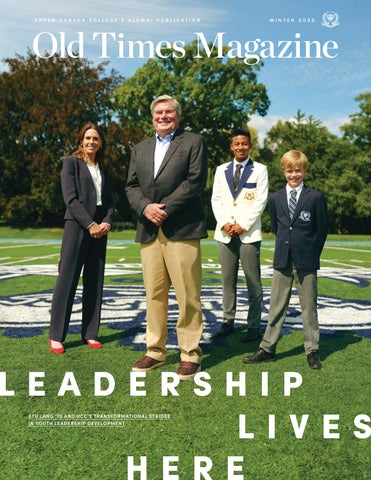
Philanthropist Stu Lang ’70 is redefining youth leadership in Canada — starting with UCC’s bold new vision.
28 A Gift That Keeps On Giving
Since 2002, the Connor Chair has been championing teachers at UCC — and beyond — in their quest to educate, challenge and inspire their students, generation after generation.
34 From the Archives
Celebrating 25 years of artistic excellence in the David Chu Theatre.
36 Common Ties
The Class of 2004’s Brooker Belcourt and Wai Choy collaborate across future-forward sectors in NYC; Taylor Harris ’09 and Kris Hinterseer ’89 discover similar trajectories two decades apart; Jeremy Bell ’17’s pickleball business booms with participation from UCC students and grads.
38 UCC Notes
In Memoriam: Scott Cowie, teacher and senior leader; Warm wishes for retirees David Bullock, David Holt, Gregory McDonald, Tom Sharpe and Jill Stewart; Q-and-A with poet and former faculty Wayne Tompkins.
42 Class Notes
72 Favourite Spaces
Head of the Upper School Andrew MacDougall in Laidlaw Hall.
Old Times Magazine
Executive Director, Marketing and Communications
MARNIE PETERS
Editor and Director, Content and Creative
JENNY PRIOR
Principal
SAM M C KINNEY
Head, Preparatory School
SARAH FLEMING
Head, Upper School
ANDREW MacDOUGALL


KATARINA BOJIC
Class Notes
Katarina Bojic is UCC’s community relations coordinator. She recently graduated from Queen’s University with a bachelor of arts (honours) in English, where she also immersed herself in creative extracurricular activities and fundraising for Canadian charities. Previously she worked at UCC Summer Camps as director of the creative arts camp.

COLIN FLEMING
Cover Story
Colin Fleming is a writer, marketer and communications strategist whose work has been published everywhere from Toronto Life to the Columbia Journalism Review. He is also the co-creator of the SickKids VS podcast and the author of the children’s book Phoebe & Dax
Art Direction and Design
ROSE PEREIRA
Contributors
JULIA DRAKE
BEE KHALEELI
NICKI MARSON
RAFAELA PIMENTA
KATE STEWART
UCC Board of Governors
Chair
BLAKE HUTCHESON ’80
Vice-Chairs
NINA ABDELMESSIH
JOSEPH WONG
Members at Large
JOEL FELDBERG
KAREN HACKER
IFEDAYO KUYE ’05
JOANNAH LAWSON
J.P. MACKAY ’02
DAVID MORGENSTERN ’90
CYNTHIA SCHYFF
RICHARD WILLOUGHBY ’80
Vice-Principal, Learning and Academic Innovation
JULIA KINNEAR
Vice-Principal, Administration and Innovation
PATTI MacNICOL
Vice-Principal, Operations
EVAN DONOHUE
Vice-Principal, Finance
FELIX MOSES
Vice-Principal, Advancement
BRENDAN DELLANDREA ’01
Vice-Principal, Enrolment Management
MELODY MIU
Vice-Principal, People and Culture
MARY MODESTE
Office of Advancement
Executive Director, Advancement Operations
ALICIA MURJI amurji@ucc.on.ca
Associate Director, Alumni Relations
SAMANTHA KERBEL skerbel@ucc.on.ca
Assistant to the VP, Advancement
FATIMA IBAY fibay@ucc.on.ca 416-488-1125, ext. 2228


KELLY JONES
Copy Editing
A meticulous copy editor and pithy writer with 30 years’ experience, Kelly wrangles words for book publishers such as Scholastic, Penguin Random House and Robert Rose, magazines like Maclean’s, Toronto Life and Canadian Business, and organizations such as Art Canada Institute, Tag and Edelman. She’s been working with UCC since 2022.
WRITE TO US! oldtimesmagazine@ucc.on.ca
Old Times is produced and published by Upper Canada College 200 Lonsdale Road, Toronto, Ontario, M4V 1W6 ucc.on.ca
©UCC 2025
FOLLOW US
Upper Canada College
@ucc_community
@ConnectwithUCC
https://www.linkedin.com/school/upper-canada-college/

“If we can align ourselves with our values, then we’re not going to go too far wrong when we find we have a chance to lead.”
When it comes to a definition, I believe that, in its simplest form, leadership is influence. It is a function of knowing yourself, appreciating how you can have an impact — and then undertaking to do so responsibly. I also believe that when it comes to guiding the changemakers of tomorrow, an emphasis on human-centred leadership is deeply important.
Leadership development has long been an area of focus at UCC. Students are called upon to lead at different times, in different ways. The sheer breadth of opportunity the College has to offer cultivates an inner confidence in our students, so that when there’s a chance to take that prominent step, they’re able to do so effectively — because they feel they can. We strive to teach them to lead in alignment with the school’s values, and with connection and community at the core of their approach.
With our 2029 bicentennial on the horizon, we’re expanding our leadership-building capacities through an incredible gift from Stu ’70 and Kim Lang. The Lang Leadership Lab’s many dimensions will include a fullfledged program for UCC students at every age and stage, a state-of-the-art physical hub that will enable both program delivery and research, and a Summer Institute for youth from across Canada. As you’ll learn in our cover story, the Langs’ enduring dedication to developing leaders is part of their long-standing commitment to supporting education and influencing a better future. We often talk about a transformational learning experience, and that’s what the Lang Leadership Lab will be thanks to visionary generosity. It realizes the values of our school and our mission to help students take on the responsibility of making a lasting, positive impact on their world.
Every day on campus there are moments of both individual and collective leadership that are wonderful to observe, from mentorship between senior and junior students across academics, athletics, service and well beyond, to club members sharing discoveries and inspiration as they pursue their passions, to assembly presenters speaking with conviction on themes like the importance of other-mindedness. If we can align ourselves with our values, then we’re not going to go too far wrong when we find we have a chance to lead. I personally feel immense gratitude for having the opportunity to lead at an institution that itself has led for so long in boys’ education, creating unparalleled pathways to launch future leaders that, thanks to our extraordinary community, only continue to grow.

Beginning September 2026, Upper Canada College will be introducing Junior Kindergarten as the new entry point to the Prep School.
Adding JK reflects our commitment to offering a strong start at UCC and creating a more welcoming beginning to the learning journey. It also supports families by circumventing the need to start their child in one school and then transfer to the College a year later.
We’re looking forward to welcoming our new students and planning is underway, including dedicated space, staffing, curriculum development and a clear admission process — all informed by research, best practices and feedback from faculty and staff.
The Coxford Lecture at UCC — already in play at Western University and U of T — had its official launch in April. Generously supported by past UCC governor Stephen Coxford and Katharine Coxford , parents of Peter ’15, Andrew ’17 and Thomas ’23, annual talks by distinguished Canadian guest lecturers will focus on civic engagement and public service. The series’ inaugural speaker was Kelly Meighen , a former UCC governor and past parent who currently serves as the
24 th chancellor of Western University. Her leadership and commitment to public service have profoundly impacted organizations locally and globally, including CAMH, Huron University College and the Royal Conservatory of Music.
Embedded into the College’s curriculum, the Coxford Lecture complements Year 11 coursework that encourages students to see themselves as world citizens who can make an impact. The talks will also help in the development of essential
skills such as critical thinking, reflection and other-mindedness.
“My hope is that our students feel both inspired and empowered to take meaningful action in their own communities,” says Dr. Katherine Maloney, English and Theory of Knowledge teacher. “And I hope that they come to see themselves as part of a larger story of service and responsibility.”
Inaugural Coxford Lecture speaker Kelly Meighen in conversation with Community Service Steward Jai Sandhu ’25, and addressing an attentive audience.


Year 10 art students had the opportunity to visit Light Years: The Phil Lind Gift exhibition at the AGO, where they received a guided tour from curator Adam Welch. The exhibition draws from Phil Lind ’61’s extraordinary collection of contemporary art. Perspective-expanding experiences like these — including trips to galleries much farther afi eld — are supported by the Lind Art Fund, an endowed fund established by Lind and his family to bolster UCC’s visual arts program.
Students viewed and learned about photography, painting, sculpture and multimedia, with attendee Christian Wong commenting afterwards on the role of visual art in expressing feelings and ideas, and how his own conception of what art is continues to change over time.
Phil’s son, Jed ’97, himself an artist, also attended. “Art has the unique ability to frame the world for us and enrich our lives,” he says. “My father felt an affi nity to artists and we hope that UCC will continue to build upon this legacy.”

“ When I started at UCC, I felt like my skills were unlocked, in the classroom and beyond. I’d been given an opportunity to dive in and succeed. I put a lot into my time here and, as a result, I got a lot out of it — including friendships that I cherish to this day. If I can play a part in making a UCC education available to future students through legacy giving, it’s my pleasure to do so.”
Adam
Freedman ’02
Light Years: The Phil Lind Gift ran at the Art Gallery of Ontario from October 30, 2024 to November 2, 2025.
Rodney Graham, Media Studies ‘77, 2016. Two painted aluminum lightboxes with transmounted chromogenic transparencies, Each panel: 232.2 x 182 x 17.8 cm.
Art Gallery of Ontario. Gift of the Estate of Philip B. Lind, 2024. © Estate of Rodney Graham, Courtesy Lisson Gallery. 2024/48

Now fully immersed in their postsecondary journeys, members of the Class of 2025 had a banner graduating year

Canadian offers include: Engineering programs at McGill
990
offers of admission from
135
postsecondary institutions in Canada and around the world

39%


International offers include:
McMaster University of Toronto
Waterloo

Science, applied science, health science and medical programs at
University of British Columbia
Queen’s
Waterloo
Western

in scholarships awarded, including:
$4.4M More than social sciences and humanities business engineering sciences and math
Morehead-Cain Scholarship (UNC)
Business, economics and management programs at Desautels

Johnson Scholarship (Washington and Lee)

Trinity International Bursary (Cambridge)
TD Scholarship for Community Leadership
Ivey Rotman Sauder
February 24
Founder’s Dinner
1/ Clockwise from top left: Blake Hutcheson ’80, Jennifer Tanenbaum, Ken Tanenbaum (John D. Stevenson Award winner), Principal Sam McKinney, President and COO of Cohere Martin Kon ’89 (keynote speaker), John Eaton ’57, Stu Lang ’70 (Old Boy of Distinction Award winner) and Kim Lang at Founder’s Dinner, our annual event celebrating UCC’s founding and the extraordinary contributions of our community.
2/
Members of the 2025 Founder’s Dinner planning committee Jamie Schwartz ’94, Shaila Schwartz, Celeste Ivers, Maki Morassutti, Stephanie Wu, Kathleen Polsinello and Ira Nishisato ’87.
Thank you to our Founder’s Dinner sponsors!


March 6
Victoria Branch Event
3/ Tom Radford ’64 and Brian Pollick ’64 reconnect at the beautiful University Club of Victoria.
March 7
Vancouver Branch Event
4/
Matthew Casey ’83, Chris Cottier ’70 and Michael Levenston ’70 mingle at the Terminal City Club.
March 10
Naples Branch Event
5/
Naples, Florida-based alumni and community members enjoy a brunch graciously hosted by Linc Caylor ’87 and Melissa Nixon.
March 11
Palm Beach Branch Event
6/ Ian McCluskey ’74, Laurie Evans, Jolyn Brunelle, Judy Bronfman Bernick, Howard Bernick ’70, Senior Admission Counsellor Rosey McKinney, Principal Sam McKinney, Simon Dermer ’90, Wayne Squibb, Jean-Guy Brunelle ’75, Alissa Lumsden and VP of Advancement Brendan Dellandrea ’01 gather at Le Bilboquet.
March 23
Norval Maple Madness
7/
Posing in the great outdoors at the Norval Outdoor School.
March 27
New York Branch Event
8/
Principal Sam McKinney, Matt Cumming ’95, Larry Grafstein ’78, Hussein Hirji ’99, Consul and Director of Foreign Policy and Diplomacy Service at the Consulate General of Canada in New York Nadia Scipio del Campo and VP of Advancement Brendan Dellandrea ’01 at the Canadian Consulate.
April 2
Singapore Branch Event
9/
VP of Advancement Brendan Dellandrea ’01, David Hoicka ’72, Conrad Cornelissen ’14, Sameer Jessa ’20, James Tugman ’14, Matt Irwin ’00, Marten Menke ’10, Raymond Hu ’24 and Matthew Campbell ’03 at the American Club.
April 4
Beijing Branch Event
10/
Raymond Gu, Cola Xia, Sisi Liu, Robin Liu, Eva Wang, Alissa Lumsden, VP of Advancement Brendan Dellandrea ’01, VP of Enrolment Management Melody Miu, Timothy Gu, Class of 2028, Daniel Han, Class of 2029, Bing Han, Jia Hao, Adam Sheikh ’02 and Ersu Na gather at the Four Seasons Hotel.
April 10
Hong Kong Branch Event
11/
Michael Cheng ’02, Charles Lee ’06, Andrew Woo, VP of Advancement Brendan Dellandrea ’01, Letty Wu, Clint Chow ’96, Alfred Leung ’91, Senior Admission Counsellor Rosey McKinney, Mary Chiu, Jerome Lui ’90, Principal Sam McKinney, Wesley Pang ’01, VP of Enrolment Management Melody Miu, Nicholaus Pang ’03, Trudy Pang, Alexander Jewkes ’15, Tiger Huang ’13, Alissa Lumsden, Victor Hsu ’99, Johnny Chung ’01 and Jerry Chow ’07 gather after dinner at the Ritz-Carlton.
Louise and Rodger Wright ‘70


Winterfest Alumni Hockey Game January 17
Founder’s Dinner February 19
Norval Maple Madness Open House March 22
April 24
Blue Ties Breakfast
12/
Students, parents, faculty and staff enjoy a morning of delicious pancakes and tie-swapping fun.
April 24
Speaking of:
13/
The engaging panel event included Teresa Resch, president of the Toronto Tempo; Fiona Marshall, director of the Lang Leadership Lab; Diana Matheson, founder of the Northern Super League; and Mark Cohon ’85, chair of the Northern Super League.
May 15
Gold Ties Dinner
14/
Alumni celebrating 50 years or more since their graduation gather at UCC for lively conversation and sharing memories.
May 25
Spring Sports Day
15/
Members of the varsity cricket team gather with Old Boys for the annual cricket match.
June 4
Volunteer Reception
16/
President of the UCC Association Council
Chan Sethi ’03 and Principal Sam McKinney flank newest inductees to the Harold A.D. Roberts Circle: Rodger Wright ’70, Ann Katrusiak, Michael Carmichael ’97, Mary-Lea Ruscetta, Matthew Casey ’83 and Nina Piatek.
Visit ucc.on.ca/events to learn more and to save the dates for upcoming branch events in Canada, the U.S. and Asia.
June 16
Brian Conacher ’61 Classic Golf Tournament
17/
Parent volunteers from the hockey community help make the day a great success.
18/
UCC hockey coaches Andrew Turner, Brent MacKay, Dan Noble, Brian Green and Kent Hutton.
19/ Jon Hill ’99, Jeff Hill ’98, Wayne Hill and Craig Hill ’02.
20/
Dan Noble, Pete Gordon ’07, Tom Lace ’06, Andrew Reburn ’06, Charlie Higgins ’24 and Brett MacLean.
September 18
Alumni Football Event
21/
Rob McLeese ’71, Rodger Wright ’70, Allen Meredith ’70, Scott Irwin ’70 and George McNeillie ’70 show their UCC spirit.
September 18
Boston Welcome Event
22/
Trying out some indoor rock climbing are Ryan Kukulowicz ’24 and Tre Ahn ’22, along with Boston Branch Committee members Charles Price ’23 and Alex Estey ’08.
September 25
Sir John Colborne Society Dinner
23/
Alec Pathy ’51 and daughter Barbara Pathy at the dinner reception held this year in the David Chu Theatre.
24/
Thank you to our Brian Conacher ’61 Classic Golf Tournament sponsor!

Principal Sam McKinney presents new inductees Jin Dai and Kinmon Low their Sir John Colborne Society pins alongside Community Steward Josh Golger, Class of 2026.
25/
Society members Brenda Feng and Reid Chen with student presenter Connor Zawarynski, Class of 2033.
September 27
Montreal Welcome Event
26/
Young alumni and those new to the city together at Mount Royal Chalet.


Cola Xia and Bin Wang
Zack ’02, Caitlin, Isla and the Class of 2036’s Parker Newton
Li Yang & The Family of Luke Yang IN KIND


September 27 A-Day
27/
VP of Learning and Academic Innovation Dr. Julia Kinnear, VP of People and Culture Mary Modeste, Head of the Prep Sarah Fleming, VP of Enrolment Management Melody Miu, President of the UCC Association Council Chan Sethi ’03, Head Steward Chris Jagdeo, Class of 2026, Principal Sam McKinney and Head of the Upper School Andrew MacDougall at the annual New Family Breakfast.
28/
Bonding before the parade up the Avenue to kick off a big day.
29/
Mary-Lea Ruscetta and Nicol Domingues from the Parents’ Organization.
30/
Students from the Prep bring the UCC Blues spirit.
31/ UCC Archivist Bee Khaleeli and Charles Wall ’53 with a book he generously donated to the archives.
32/ Students rush the Oval proudly waving the UCC Blues flag.
33/
Sharing memories at the Past Parent Reception in the lounge at the William P. Wilder ’40 Arena & Sports Complex.
September 27 Reunion
34/
Bob Medland ’65 and Andrew Medland ’95.
35/
Clockwise from top left: Matthew Leverty ’00, Doug Musgrave ’65, Michael Leverty ’65 and Charlie Musgrave ’00 connect during Reunion.
36/
“Never Walk Alone” performed by the Class of 2020.
37/
Assembly at Reunion included singing school hymns.
38/
The Class of 2010 celebrating their 15th Reunion.
September 27 25-Year Tie
39/
Old Boys from the Class of 2000 gather on the Weston Hall stage to commemorate their 25-Year Tie celebration.
September 27 50-Year Tie
40/
Old Boys from the Class of 1975 outside Laidlaw Hall after the 50-Year Tie reception.
Chindea combines his passions for filmmaking and community engagement in the short documentary Hommes-relais , which screened at Toronto’s Hot Docs Festival
Hommes-relais chronicles the efforts of Juan Manuel Zavala, a Mexican-born doctorturned-community-leader who, through Montrealbased CRIC (Intercultural Resource Centre), provides support to immigrant men facing challenges integrating into Quebec society.
Chindea, who moved to Montreal from Romania when he was two, had a previous connection to these men, having participated in CRIC’s Hommes-relais program (which, translated, means “relay men”), in which new and established immigrants swap stories.
“It’s geared at anyone interested in being a bridge between new immigrant communities and people who are already here, sharing resources and experiences,” Chindea explains.
The 10-minute film was pitched to Hot Docs for its Citizen Minutes series, which empowers emerging filmmakers to highlight “ordinary Canadians doing extraordinary things to better their communities.”
Previously focused on narrative film, Chindea looked to works by several doc filmmakers for inspiration: the oeuvre of activist Astra Taylor (What Is Democracy?); Will Prosper, whose film Kenbe la, Until We Win spotlights Haitian artist Alain Philoctète; and Maria Speth’s Mr. Bachmann and His Class, about the bond between a teacher and his multicultural students.
Already known at Hommes-relais, Chindea had the trust of the men in the program, who were comfortable speaking in front of his Sony FX6 cameras and opening their hearts about their sometimes painful journeys. (Louka Hogue was the cinematographer.)
In one touching scene, a young man named Job, having an imaginary conversation with his absent mother, describes Montreal as a cold and lonely place, and says he would even walk back to his home country if he could.
“It’s my first documentary, and my big takeaway is how films like this rest on the relationship between filmmaker and subject,” Chindea says. “Without that, the world that opens up would not be possible.”
In Montreal, Chindea attended the Collège JeanEudes secondary school, and started making films when he was 12 through a community organization called the Maison des jeunes MAGI.
“His narratives were always about somebody helping someone. So this documentary about a community of people helping a new community isn’t a surprise.”
— DAVID CRAWFORD UCC’S COORDINATOR OF DIGITAL MEDIA

“They had filmmaking workshops that provided cameras, equipment and editing software, a mentor who was a film professional, and a space to develop a project — from screenwriting to producing and editing — that would screen at a community event,” he explains.
As he got older, he started sending them to student film festivals, and met fellow budding Montreal filmmakers. Some became collaborators, and still are to this day. But at the time, he had to bid them au revoir, eager to immerse himself in a new environment; he came to UCC as a boarder in Year 11, joining Seaton’s House.
He joined the College Film club — heading it in his second year — and took the two-year IB Film course with David Crawford, coordinator of film and digital media.
“I fondly remember the relationships I built with other boarders, and the community and city events we all attended,” Chindea says. “I also fondly remember my relationship with David, who was not only my film teacher, but also my cross-country coach. At UCC we had access to such great role models, and the IB courses were very stimulating.”
Says Crawford, “Vladimir came in knowing what he wanted to do, and did beautiful work. His narratives

were always about somebody helping someone. So this documentary about a community of people helping a new community isn’t a surprise.”
It was art imitating life, as Chindea was always helping fellow students behind the scenes.
“They would come and say, ‘I want Vladimir to help me with something,’ and he could have spent 1,000 more hours helping everybody else, yet he still got a lot of work done,” Crawford says. “People saw his skills right away. He’s a great cinematographer, but I mostly remember his storytelling.”
Chindea’s capstone film project at UCC is titled Saudade, from the Portuguese term for a melancholic longing for someone or something absent.
“It’s the story of two lovers, one of whom had to leave because his family had to move, and they had to say goodbye, but didn’t know how,” Chindea explains.
After graduating from UCC, he diverged from the filmmaking path, instead getting his BA from UBC in international relations and philosophy. “I felt torn,” he reflects. “I had creative impulses and aspirations, but was not yet ready to devote myself to life as a filmmaker. I was afraid of jumping into that journey.”
Filming Hommes-relais with the program’s participants .
But, emboldened by Hommes-relais, he now identifies as a director and is pursuing an MFA in cinema arts at Concordia.
Hommes-relais premiered at Hot Docs, at Toronto’s hallowed TIFF Lightbox. It was then screened at the Ted Rogers Cinema, attended by Crawford, The Honourable Edith Dumont, Ontario’s lieutenant-governor, and high school students from across the GTA, who, Chindea says, asked thoughtful questions.
The doc was also presented in Montreal at the JanineSutto library, with its participants on hand, followed by a roundtable discussion. And more screenings have been planned for Ottawa and Montreal.
The film was recently broadcast on TVO and can be streamed on the TVO Docs YouTube channel, with future availability on Crave.
Meanwhile, Chindea is on track to graduate in 2027, and as for what’s next, he shares, “Filming the ‘real’ calls out to me. I’m interested in more experimental approaches to documentary and filmmaking in general. For the moment, I just want to enjoy the research process touching on different things, and then I’ll see what will come out.”
Cumine has made a generous bequest through UCC’s legacy giving program, which he says is about showing his thanks for the many benefits he enjoyed as a student
was awarded a scholarship to UCC,” recalls Cumine, who resides in Toronto. “I had four wonderful years there that were formative in my life.”
During that time, he took advantage of much of what the College had to offer. He played on the hockey, football and cricket teams, acted in principal roles in the Little Theatre, was editor of the College Times magazine, served as a steward in his last year and won a medal for debating, foreshadowing his future career as a lawyer.
Now he has set up a gift for the College to establish the Robin B. Cumine Memorial Scholarship, which will provide the same opportunities to many future students whose families otherwise couldn’t access a UCC education.
Originally, the decision for his attending UCC had much to do with proximity.
“I lived on Glengrove Avenue West near Avenue Road, which in those days was outside the city line,” he says. “My mother couldn’t talk the board of education into letting me go to nearby Lawrence Park Collegiate, so I went to Earl Haig Secondary School, which was 75 minutes’ travel each way, every day. So my mother said, ‘Go write the scholarship exam at UCC.’”
Cumine joined the school for Year 10 in 1947. Despite living only a half-hour walk away, the scholarship terms dictated he live in residence, and he joined Seaton’s House. “I made all my lifelong friends there,” he says.
His favourite teacher was physics master Jim Coulton. “He was the best teacher I ever had anywhere. He inspired a real love of learning,” Cumine says.
At that time, all UCC students participated in the Cadet Corps. Cumine continued that pursuit after graduating, attending the Royal Military College of Canada in Kingston and receiving a bachelor of science degree in 1955.
“My friends went to University of Toronto, but I wanted to do something different, plus Churchill had said ‘Stack your guns — you’re going to need them again,’” he explains. “We were at war in Korea. So I applied to RMC and got a scholarship there. It was a totally involving four years. We would get just four-and-a-half hours of sleep and only one week off, because summers were spent doing military training.”
Philanthropy is nothing new to him. He was a founder of the Second Harvest food rescue program, became a committee director and served on the board for 35 years.
That allowed for some once-in-a-lifetime opportunities, such as being stationed to an artillery regiment in West Germany shortly after Germany had been divided. Although, as he says, he “almost started World War Three.”
“We were moving the regiment up to the Baltic, and I was riding along picking up the route signs,” he recalls. “I was going east on the highway, looking for the next turn sign, when a voice on the radio came on saying, ‘Where are you?’ I told them, and they yelled, ‘Stop!’ I was one mile from entering the Soviet zone in a military vehicle!”
About half his RMC graduating class stayed on in the military. In a routine interview with an RMC psychologist, he was asked what he wanted to do after his education. He said he wanted to be a lawyer.
“Everybody else had said they wanted to be a pilot or a general or in the navy,” Cumine recalls. “He asked, ‘Why on earth do you want to be a lawyer?’ And I said, ‘If I’m going to do anything for the rest of my life, it’s got to be something I don’t consider work, and I don’t consider learning and arguing to be work.’ He said, ‘That’s the best answer I’ve ever heard.’”


His next stop was Osgoode Hall Law School, where he headed up the debating team and won a medal for debating. He graduated in 1959. He had begun articling at the firm that would later be known as McLean & Kerr, and served as an assistant lecturer in insurance law at U of T.
“Wilson McLean, the firm’s senior partner, was the professor,” Cumine says. “He got me involved in insurance law, and had me teach the automobile insurance part of the course.”
Cumine ended up staying at McLean & Kerr, which later merged with another firm — at which point he was joined by William Paterson ’51, who had been a steward at the same time. They eventually became the two senior partners. He practised at the firm in wide-ranging areas for 59 years, retiring in 2018. He was appointed Queen’s Counsel in 1975, and in 1988, was certified as a civil litigation specialist by the Law Society of Upper Canada, and then an expert in labour relations law.
Philanthropy is nothing new to him. He was a founder of the Second Harvest food rescue program, became a committee director and served on the board for 35 years. At one point, he acted as president. He also cleared a major roadblock for the organization.
Robin Cumine in 1951 and in 2006. As a UCC student, he made lifelong friends in Seaton’s House and took lasting inspiration from physics master Jim Coulton.
“We couldn’t get food from the major food chains and grocery stores,” he explains. Those companies were fearful of liability if somebody were to get ill from consuming items they had donated. Cumine put on his lawyer’s hat.
“I put together the Donation of Food Act, which states that if you donate food, you cannot be held liable unless someone can prove you knew it was bad and intended to hurt people,” he explains. The act became law in Ontario in 1994, and Cumine says that acts to the same effect passed in all other Canadian jurisdictions. The donation floodgates flew open.
He also served on the board of the Women’s Art Association of Canada, of which his wife, Lynn, was formerly president. They have two sons and a daughter. Son Robin Andrew ’80 is VP of operations and corporate development at hotel management company Aimbridge Hospitality in Calgary.
Meanwhile, the senior Cumine also served as year representative for the UCC Foundation, to which he is now generously donating. At 92, he’s still going strong, and reflects fondly on his UCC days. “I had a marvellous time,” he says, “and that’s what has inspired me to pass it on to the future.”


Michael Bible


Little Lazarus by Michael Bible is a brief, touching and whimsical book that traces the interwoven lives of two turtles as they bear witness to humanity’s anxiety and alienation over centuries. Their caretakers range from a billionaire seeking immortality, to a series of men who wore the same seersucker suit across generations, to a dog named Pony. The insight of the world’s oldest living mammal — a turtle from the Galapagos named Lazarus — is both funny and profound as we witness desperate dreamers from successive small towns make pilgrimage to the reptile for guidance. Generous in spirit, and an antidote to the world of shallow, fast-paced media, the novel shows how much more might be seen by slowing down and forgetting about the race.
Amit Bhalla ’05 is a screenwriter and filmmaker. He lives in New York.

by François-René de Chateaubriand
As do many, François-René de Chateaubriand found Niagara Falls to be an awe-inspiring wonder. Unlike most visitors, he was on the run from a bloody revolution. It was 1791. Niagara is but one of the sublime views recorded in Memoirs from Beyond the Grave. I’ve been in and out of the book for the past few months, the title of which is signifi cant: while the work’s assembly became an obsession in the latter stages of Chateaubriand’s life, he never intended the memoirs to be part of it at all. Originally designated to be published no less than 50 years after his death, in the end he needed money much sooner.
Chateaubriand had a specialseeming ability to have lived diff erent lives: as sailor, author, diplomat, explorer; he stood alongside an emperor, president and king (Napoleon, Washington, George IV). In coming to understand the signifi cance of his own life, his more
striking realization was understanding its insignifi cance as well. And this is the true subject of his work: his views of memory, eternity, oblivion, posterity, obscurity, the past and future. He is that ideal writer who does not necessarily wish to write, but is compelled to do so.
Harris Lechtzier ’15 is a rare book dealer based in London, U.K.
by Kenneth Rose

Superior Person by Kenneth Rose is a biography of the British politician Lord Curzon and his circle of intimates. Born in the mid-Victorian era, Curzon’s childhood was spent in the apogee of the British Empire. He was one of the most remarkable students Eton and Cambridge ever hosted, and there were high expectations for his career. He entered Parliament in his 20s and, with friends, formed a literary group called The Souls. Here the book is at its best, replete with anecdote: The Souls’ evenings were spent reciting belles-lettres or hosting philosophical debates. The book often reads like an immersive description of an alien culture. No one in Parliament today quotes Latin or ancient Greek. The book ends with fi n-de-si è cle decadence and doubt on the rise. As he grew older, Curzon’s industry and abilities remained robust, but his temperament ruined friendships and frustrated his ambition. He was named viceroy of India and foreign secretary, but failed to become prime minister. Winston Churchill, a rival, summed Curzon up: “The morning had been golden; the noontide was bronze; and the evening lead. But all were polished until it shone after its fashion.”
Charlie Hughes ’18 works in the venture capital industry and lives in Toronto.

Aurora
We asked six community members about recent reads that had them riveted
by Kim Stanley Robinson
Aurora by Kim Stanley Robinson is narrated by an artificial intelligence entity and depicts an interstellar voyage to a planetary system several hundred years from Earth. In the opening chapters, an engineer instructs the AI powering the spacecraft to keep an account of the voyage with one stipulation: the account must be in the form of a narrative. This throws the AI for a loop. How does a quantum computer tell a story? As the AI becomes a better storyteller, it develops a consciousness akin to that of a human. It experiences loss and grief, takes initiative and even begins to experience a sense of purpose. Despite the fact that the novel takes place in a far-fl ung intergalactic setting and its focal perspective is that of a machine, Aurora is a meditation on humanity. Robinson appears to suggest that storytelling is an essential part of what makes us human. It’s how we gather disparate experiences into a cohesive whole, bring order to the chaos and ward off the terrifying randomness of existence. In short, it’s how we give our lives meaning.
Andrew Musselman ’99 is a Toronto-based actor, writer and entrepreneur.

Edited by Neil Besner et al.
Readers of short fiction might be familiar with the writing of Mavis Gallant (1922–2014). Before perfecting the art of short fiction, Gallant worked as a journalist between 1944 and 1950. Montreal Standard Time: The Early Journalism of Mavis Gallant (edited by Neil Besner et al.) appeared in 2024. In the fi rst piece, titled simply “Meet Johnny,” there are already glimmers of the signature style soon to emerge in Gallant’s short fiction — a balance of brevity, wit and pathos. Johnny is a street-smart six-year-old. His father has been overseas for fi ve years, so the boy knows of him only as a photo on the mantelpiece. Johnny’s
main occupations are hustling and navigating neighbourhood gangs. In Gallant’s words, he is “[a] product of city living…cagey, acquisitive, very knowing. His chief burdens: women and discipline. Triumphs are in terms of nickels.” An accompanying photo shows Johnny apparently trying to poke out his eye. In “Freud or Double Talk” Gallant explores the way Canadians responded to new ideas from continental Europe. Her column “Why Are We Canadians So Dull?” is perhaps the most helpful in explaining her decision to leave Montreal at age 28 and move permanently to Paris, where she is buried in the Montparnasse Cemetery.
Heather Crawford has taught Language and Literature at the Upper School since 2011.

by Stefan Zweig
Several years ago, two former UCC classmates and I set up an informal reading group, meeting every three months. We have covered novellas and, perhaps foolishly, very long works such as War and Peace. In the former camp is Chess Story by Stefan Zweig, which we read this year (sometimes translated as The Royal Game, a more evocative title). In classic Zweig style, it is a story within a story: for those unfamiliar with his work, think The Grand Budapest Hotel, the 2014 fi lm by Wes Anderson, which took its cue from Zweig’s stories. Set aboard an ocean liner crossing the Atlantic, the tale is structured around a chess match between a grandmaster and a mysterious refugee fl eeing Austria for the New World. It reveals the psychological brutality of fascist regimes, something that prompted Zweig himself to leave Europe. The mental scars remain long after physical cruelty has ceased. The final lesson is that repression, which can in some cases provide perverse stimulus for an artistic genius, will ultimately break him through despair.
Alex Herman ’00 is director of the Institute of Art and Law. He lives in London, U.K.


Philanthropist Stu Lang ’70 is redefining youth leadership in Canada — starting with UCC’s bold new vision
BY COLIN FLEMING
PHOTOGRAPHY BY

As the College’s 2029 bicentennial approaches, incredible investments are driving progress on future-forward curriculum, facilities and financial assistance offerings, all in service of developing young leaders who make a positive and lasting impact. One such investment is the Lang Leadership Lab, funded by Stu ’70 and Kim Lang.
leadership development. And it will be the home of intensive programs for students across the country.
The first of those, the Summer Institute, launches in July 2026, with applications opening Dec. 15, 2025.
he lab will take a schoolwide approach to leadership, embedding training at every age and stage. It will be home to two stateof-the-art learning and gathering spaces in the planned Rogers Building — a 130,000-square-foot landmark connecting the Prep and Upper School supported by a profoundly generous lead gift from Edward ’88 and Suzanne Rogers. The Lang Leadership Lab will also be a centre for the research and practise of the latest evidence-based approaches to
“We’ve been in the business of student leadership development since our founding,” says VicePrincipal of Learning and Academic Innovation Dr. Julia Kinnear. “But to have funding and resourcing in place is going to allow us to take things to the next level.”
The job of getting to the next level falls to inaugural Lang Leadership Lab Director Fiona Marshall. And as she begins to sink her teeth in, there’s no doubt the program will evolve and grow. But to understand where the Lang Leadership Lab came from and where it’s going next, it’s helpful to start with the program’s primary benefactor and one of the great loves of his life: football.
THE BIRTH OF THE LANG SCHOLAR PROGRAM
Head coach Stu Lang had a message for the young men of the University of Guelph Gryphons football team: “There are two classrooms on this campus. One is in that building and the other is on this field. The classroom is theory.
The field is application.”
Lang, of course, was speaking from experience.
In addition to coaching football at the University of Guelph and UCC, he was a former CFL star who helped lead his team (now the Edmonton Elks) to five Grey Cup championships. He had also played at Queen’s University and UCC, where he learned many of life’s most valuable lessons.
“Whether it’s how to win, how to lose, how to overcome obstacles, how to play with pain, how to be a good teammate — all those things you learn on the field,” he says.
Even today, Lang still remembers the sting of a major loss to Trinity College School during his final year at UCC, when he was a team captain. After the football game, he was sobbing uncontrollably, with his father’s arm around him.
“It taught me how much I hated losing,” he says.
From 2010–15, Lang served as head football coach for the Gryphons, taking the team to new heights, winning the Yates Cup and placing second in the Ontario University Athletics Coach of the Year voting in 2012. Before that, Lang spent two years at his other alma mater, UCC, as the receivers coach for the football team.
It was during this time when Lang got to know David Shaw, now the director of legacy giving for the College, who invited him to coach and has since become one of Lang’s closest friends.
“I would drive in every day and help Dave,” Lang says. “And one day Dave said to me, ‘Stu, have you ever thought about creating the athletic version of the Rhodes Scholarship?’”


Lang was immediately taken with the idea. The first selection criterion would be athletics, naturally. But Lang and Shaw also wanted to reward boys of great character, students with good grades and a commitment to service. Then, when UCC became involved, the program was expanded to emphasize leadership, taking the concept “far beyond” what he had originally imagined.
But Lang wasn’t just a dreamer. He was a doer “blessed with resources” to make such a scholarship happen, thanks to the success of CCL Industries, the family business that had gone from manufacturing lamps to aerosols, before becoming the world’s largest label company. He was also a man of service, inspired by the quiet humility and generosity of his father and the boundless kindness of his mother, who ensured the family home was always open to friends and taught him “more about love than anyone else.”
Plus, by the time Shaw approached him, Lang had already made a name for himself as a philanthropist, starting two foundations: Angel Gabriel and Damascus Road.
“There’s no better investment than young people,” he explains. “Because they have a longer runway to change the world.”
So, in 2013, Stu Lang made a major gift to the College’s landmark Think Ahead Campaign — the largest single donation in Canadian
The first Lang Scholar cohort (left), from the 2013–14 academic year, and the latest.
independent school history. That same year, UCC launched the Lang Scholar Program, which would be a springboard for promising young men and the genesis of a leadership lab still many years in the future.
True to their namesake, Lang Scholars are all-rounders: students who excel both on the field and in the classroom. “They’re also just genuine people of character,” says Associate Director of Community Relations Leanne Gardner, manager of the Lang Scholar Program. “They care about their families, they care about their communities and they care about the things they get involved with.”
Each year approximately 15 students are enrolled in the program, which Gardner says is designed to help students with “big ambitions” become “really positive leaders in the world.” Then, in September, the new cohort participates in an offsite weekend retreat — their first opportunity to really bond as a group.
Brent Evans, director of UCC’s Norval Outdoor School, helps run the retreat and begins with a “little bit of team building,” which, in
the spirit of Stu Lang’s approach to education, is very experiential. “We want to cultivate real-world experiences that will develop leadership and then have the ability to reflect on those experiences,” says Evans. “That’s where Stu and I connect really, really well.”
Evans gives the example of teaching the Lang Scholars about flow state — that zone in which “time flies” and “everything’s working for you.” To do this, Evans has the Scholars assemble and disassemble toy cars until they’re so good at it they can do it in seconds. After, he makes them guess how long the activity lasted. Often, they underestimate by an hour — proof they were in a flow state. Once the Scholars understand the concept on a visceral level, they can learn how to apply it to their own lives.
After the September retreat, UCC supports the Lang Scholars in many ways, but the cornerstone of the program is mentorship. Each Lang Scholar is matched with a mentor from the UCC community to whom they can turn for guidance — someone who can teach them to turn theory into practice, to make good decisions under pressure, to lead.
“I’d like UCC to be known as the centre of excellence for leadership training at the youth level.”
— STU LANG

Another facet of the program is lunch-and-learns. At these events, prominent alumni and parents — many of whom have a tie to the sports world — are invited to meet with the Lang Scholars. “They talk to the Scholars about their path, what they experienced, things that went right, things that went wrong, what they learned,” says Gardner. “Our favourite part is the Q-and-A, where the Scholars can pepper the speaker with all questions they could possibly think of.” The speakers also give the Lang Scholars a book they have written or recommend — a growing collection that has become known as the “Lang Library.”
In keeping with Stu Lang’s philosophy of giving back, the Lang Scholars are also required to participate in service projects and are given $10,000 each year for charitable projects. Inspired by Barry Hill ’62
and UCC’s commitment to the Truth and Reconciliation Commission of Canada’s Calls to Action, these service projects have recently taken the form of partnerships with Indigenous communities.
One such partnership, now two years running, is with the Little Salmon Carmacks First Nation in central Yukon. Last year, after weeks of careful preparation and coaching training, the Lang Scholars travelled with Gardner, Evans, Andrew McDougall (then the assistant head, now the head of the Upper School) and Dave Brown (Upper School director of athletics) to the remote community. There, the students ran phys-ed classes all week for children from kindergarten to Grade 9, and led rugby lessons and learn-to-skate sessions. For Evans, the experience was nothing less than “magical,” a chance for the Lang Scholars to lead — and to learn.
Lang Leadership Lab Director Fiona Marshall believes it’s crucial to understand how students “come to their own understanding of their purpose as leaders.”
The Lang Scholar Program was so successful that, two years ago, Stu Lang funded a new addition to the program: the Lang National Scholarship. Open to all Grade 9 to 11 students outside the GTA in Canada, it’s a full scholarship, which includes boarding and a place in the Lang Scholar Program.
To qualify, students must be both exceptional athletes and strong leaders. Tapping into the extensive alumni network, the College sends out its coaches on recruitment missions to major sporting events like the Canada Summer Games in St. John’s, Nfld.
The scholarship is an extraordinary opportunity for young student-athletes, which gives them not just a world-class education, but the opportunity to really focus on their chosen sport. It’s also an opportunity to give back.
“They’re leaders the younger students look up to,” says VicePrincipal of Enrolment Management Melody Miu. Equally important, she says, is the diverse perspectives these students bring, which enriches the “entire boarding experience and classroom experience.”
Given the success of the Lang Scholar Program and the Lang National Scholarship, it would have been reasonable for Stu Lang to be content with his investment and to support UCC by continuing to show up at events, asking the Lang Scholars about their lives and passions
and ambitions. Yet where others might seek contentment, Lang sought opportunity.
In 2024, Lang, recognizing the dearth of women in leadership positions, made a major gift to establish the Lang Scholar Program at The Bishop Strachan School, Canada’s oldest independent all-girls’ school. Like its UCC counterpart, the Lang Scholar Program at BSS is designed to cultivate courageous leadership through a blend of mentorship, programming and service — all so young women are empowered to change the world.
“ Building on nearly two centuries of leadership development, the new Lang Leadership Lab will strengthen our ability to cultivate those skills in every student — preparing compassionate, globally minded leaders for tomorrow.”
— PRINCIPAL SAM McKINNEY

hile it was important for Lang to branch out, he was far from done with his alma mater.
“The 200th anniversary of UCC came up, with the idea of building this structure to connect the Prep and Upper School,” says Lang. This, of course, got him thinking. “I said, ‘Well, could you leave some space in there for a leadership facility?’”
Vice-Principal of Advancement Brendan Dellandrea ’01 was the right person to ask. Like Lang, Dellandrea has always believed in the promise of UCC to be home to the “best students regardless of financial ability” with a “commitment to engaging with the wider world,” learning in purposebuilt spaces that inspire students to think of their own potential to create positive change.
Dellandrea said yes. Better still, he had a name for the future space: the Lang Leadership Lab. “Stu loves alliteration — who doesn’t!” says Dellandrea. “But most importantly, the lab is where you try, test, learn and grow. The best leaders understand they are a perennial work in progress.”
Stu Lang was in. So, he and Kim gave another transformational gift to UCC, making them the most generous cumulative donors to an independent school in Canadian history.


While Fiona Marshall herself would never say it, everyone else seems to agree that hiring her as the inaugural Lang Leadership Lab director was a big deal.
“It marks a really exciting moment in our journey because of the experience she brings and her commitment to youth leadership,” says Dr. Kinnear.
Marshall’s experience includes a recent three-year stint at Havergal, where she served as the director of student leadership, creating a framework for an expansion of the school’s leadership programming. Before that, Marshall spent 12 years at UCC, four years of that as assistant head of the Upper School,
helping lay the foundation for values-driven leadership now at the heart of the program she leads.
Yet, what’s most striking about Marshall isn’t her experience — it’s her dedication. “To be young today is uniquely challenging, and I think a lot of people focus on what’s going wrong for kids,” she says. “But what is so inspiring for me, as someone fortunate enough to share my days with young people, is that they are more than capable of meeting this challenge. I think we underestimate them. To know them is to know their passion for making an impact, their creativity, their empathy. They really just need great role models and help with the mindsets and tools to be like them.”
Our featured student leaders on the meaning of leadership
I think a leader should be a courageous, strong and caring person who isn’t afraid to take significant setbacks head-on and figure out a decisive solution without procrastination.
A leader should not look down on people who aren’t as accomplished or as powerful as them, and should lead with respect and humility. They ought to be humble and funny, but serious when needed.
I think a leader should have a growth mindset and believe that they themselves should always learn and continuously improve.

Walker Babe, Class of 2032
UCC activities include cross-country running, choir, community service club and gardening club mentor

There are moments every single day to lead. Leadership is about consistently using your knowledge, your voice and your experience to help others — it’s not about how many people you impact.
Leaders are diverse. Some lead from the front through example, while others push their community forward with motivation. There’s really no set archetype for leadership.
Good leaders rarely reflect on what they've done; rather, they look forward to what is still to be achieved.
Leadership is setting an example. Some of the best leaders are educators, constantly modelling morals and behaviours to students.
Chris Jagdeo Head Steward for the Class of 2026

quipping students with those tools is what the Lang Leadership Lab is designed to do. But Marshall’s first order of business as director is to actually define what leadership means to UCC — an extensive consultation process with students, faculty and staff, and alumni.
“In order to build a program, you need to have something you’re building around,” she says. “We need to give something for young people to work towards, to learn.”
Next up for Marshall to tackle is the Lang Leadership Lab Summer Institute, an intensive two-week live-in program open to all students in Canada entering Grade 11 or 12, launching 2026. The curriculum includes everything from case studies on ethical and effective leadership to teamwork sessions at the Norval Outdoor School. And if students are unable to afford tuition, Stu Lang has ensured they’ll still be able to attend — one of many reasons Marshall calls him “just a remarkable human being.”
But Lang and Marshall’s plans for the Lang Leadership Lab don’t stop there. There’s the physical lab itself, which, once complete, will be the hub of all things leadership-related at UCC. Plus, Marshall is keen to use the newly built lab for research.
“There’s lots of leadership research done on adults, but very little on the age we’re focused on,” she says. “So, I’m really interested in partnering with some universities and using that space to do some good research that helps us understand how students learn leadership, what they respond to and how they come to their own understanding of their purpose as leaders.”
Within UCC, the Lang Leadership Lab will eventually reach every student, including the new junior kindergarteners. Self-understanding, self-management, courage, empathy — these are all essential parts of great leadership, Marshall explains. And by teaching children in kindergarten to roll with the punches if they’re unable to sit with their friend during snack time or to recognize how a classmate is feeling, UCC isn’t just developing future leaders — they’re shaping great people.
Back when he was coaching, Stu Lang always encouraged his players to find their North Star. “How are you going to live your life?” he says. “What would you sacrifice or die for?”
As a self-described “man of faith,” Lang’s North Star is service. “I often jokingly refer to myself as God’s banker,” he says. “God’s given and blessed me with so much, so I better make sure I do the right thing with what He’s given me.”
In Lang’s case, the right thing has meant not just multiple gifts to UCC, but major donations to the University of Guelph, Queen’s University, Lakehead University, Guelph Humane Society and others. Just this past summer, Stu and Kim Lang made a major donation to Campfire Circle, a charity that delivers year-round play-based programs to children with life-threatening illness.
While Lang is happy to talk about philanthropy, he’s less inclined to talk about his legacy. Instead, he’d rather talk about UCC’s.
“I’d like UCC to be known as the centre of excellence for leadership training at the youth level,” he says. “Not just the Lang Scholars — although, of course, that’s big — but all these amazing boys and girls across Canada who would never, ever dream of coming to the best school to learn about leadership. That would be a great legacy for me.”
Since 2002, the Connor Chair has been championing teachers at UCC — and beyond — in their quest to educate, challenge and inspire their students, generation after generation

“We had boys at Upper Canada College for more than 20 years,” says UCC parent, grandparent and donor Gerry Connor, referring to his sons Greg ’87, Trevor ’90 and Grant ’99, and grandsons Cam ’15 and Mac ’17. He’s seen first-hand the impact the school and the leadership of its teachers have had on his family. When a fundraising opportunity arose, Gerry wanted to leave a legacy that would have lasting value to education generally and faculty specifically, and would create professional development opportunities for the wider teaching community. “When I was growing up, teachers had the biggest impact on me,” he says. “I wanted to do something for them.”
In 2000, Gerry gifted the Connor Chair to UCC, a program that invites celebrated scholars to the College to share their expertise through on-site training and coaching with faculty and staff (and, quite often, students). It’s not a one-off guest appearance at a podium, but a strategic, formative relationship that often spans several years.
The first Connor Chair was renowned expert in experiential learning Dr. Cecilia Reynolds, who worked with faculty from 2002 to 2003 and helped create professional development processes. Since then, the Connor Chair has been held by a roster of national and international specialists in education, all tackling topics geared towards the school’s overarching goals and flagged by faculty as being of interest, from meeting the needs of diverse learners to implementing new technologies into the curriculum.
One thing that makes the Connor Chair initiative stand out is how intrinsically focused it is on teachers and helping them excel at what they do every day, says Vice-Principal of Learning and Academic Innovation Dr. Julia Kinnear. “The fact that, through the generosity of the Connors, we have the ability to call in experts to help us move forward and accelerate is pretty wonderful — and unique.” A core principle of the program includes sharing this expertise with other institutions, broadening its benefit. “It supports UCC’s commitment to being a private institution with a public purpose,” Kinnear says.
Over the years, past Connor Chairs, including Dr. Heidi Hayes Jacobs, author of many books including Bold Moves for Schools: How We Create Remarkable Learning Environments, have returned to the College to build


on the work accomplished during their tenure. “This program allows us to build deep, lasting relationships with people so that, when they’re no longer the chair, we can still connect with them,” Kinnear says. UCC’s Connor Chair from 2022 to 2024, Liz Kleinrock, is no exception. The U.S.based educator and author of Start Here, Start Now: A Guide to Antibias and Antiracist Work in Your School Community spent the last three years with the school and is continuing the relationship, returning this year as a visiting author to host writing workshops with students at the Prep.
In her time as chair, Kleinrock conducted a review of the College’s curriculum through an anti-bias lens. “Liz’s involvement as Connor Chair was crucial when we were rolling out a pluralism action plan to support and value different identities and create belonging in our community,” Kinnear says. Kleinrock also conducted pluralism workshops with other schools, supported teachers with one-on-one coaching, ran a session for families on the definition of pluralism and worked with student leaders to explore topics ranging from developing a positive culture to taking action on pluralism issues.
“Every teacher’s involvement went beyond the classroom, whether it was sports, theatre, art or music.”
“Liz was great about meeting with us and listening to our needs and the needs of the community,” says Director of Wellbeing and Pluralism Tina Jagdeo. “And she provided practical, age-appropriate strategies to make our value of pluralism come alive in the classroom.” Kleinrock helped ensure pluralism was integrated into the curriculum as opposed to being “tacked on,” Jagdeo adds, and she also shared approaches for how to teach students about “isms” in a meaningful way. “She suggested that instead of starting with anti-oppression conversations connected to a particular group, we focus on enhancing our continuum of learning around the history, culture and identity of that group.”
Jagdeo says that insight was a game changer, shifting conversations to focus on a strength versus a deficit lens. “I’m grateful to the Connors for creating this opportunity for us,” she says.
Greg Connor, who spent seven years as a UCC student in the ’80s, attended some of Kleinrock’s talks. “Looking around the audience of teachers, including many from other public schools, and seeing how interested and engaged they were, was super nice to see,” he says. Although he was always peripherally aware of his father’s gift to the school, Greg has become increasingly involved in the Connor Chair over the last decade, thanks to a similar desire to support the College.


“The learning we receive through these opportunities will lead to lasting change across the College.”
“It’s a way for me to stay involved in the school and to give back,” he says. There were many teachers who inspired him during his time as a student, among them football coach and geography teacher Dave Hadden ’71 (“He was a true motivator”), Richard Hood, who taught Mankind on Trial, a mix of history, politics and psychology (“His ability to listen and let us interpret was pivotal”) and Jack Koenka, his math teacher. “Mr. Koenka loved math, and that helped it sink in for me,” Greg says. “He always encouraged questions and participation and focused on true understanding versus just memorizing.”
Greg’s son Mac also hopes to play a role in the Connor Chair in the near future. Like his father and grandfather, he is inspired by his former teachers. “UCC was a one-of-a-kind experience for me,” he says. “Every teacher’s involvement went beyond the classroom, whether it was sports, theatre, art or music. The fact that my French teacher would teach me rugby after class had a huge impact. The principles and values I learned from the classroom to the sports field were invaluable, thanks to the teachers.”
The topics chosen for the Connor Chair have evolved in recent years to tackle broader issues that affect learning, not just best teaching practices, Gerry says. Fittingly, the current chair is Eric Hudson, an expert in establishing AI literacy in schools. Adds Greg, “It’s consistent with the multidisciplinary educational approach for teachers that fits with the Connor Chair goals. When it comes to AI, we not only need to figure out how to deal with it, we need to embrace it because it isn’t going away.”
Last year, the College decided to centre school-wide professional learning communities on generative AI, says Director of Academics Jordan Small. “The impacts of AI on education are wide-ranging and require a significant amount of attention.”
In his time as Connor Chair, Hudson will host all-faculty learning sessions on the ethical learner-centred use of generative AI, and will lead a smaller cohort in an “AI-aware design faculty working group” that will pursue dynamic, classroom-focused ideas on how to leverage the technology to support students. Small says that Hudson’s leadership and expertise will create systemic, integrative strategies for establishing an ethical, student-centred approach to understanding and implementing generative AI. “UCC is so fortunate to have the privilege to invite a thought leader like this into our community to guide our pursuit of best practices and innovative, responsive programming,” he says. “The learning we receive through these opportunities will lead to lasting change across the College.” There’s no better gift than that.


turn-of-the-millenium gift to the Creativity Centre from Dr. David S. Chu — innovative entrepreneur, parent of two Old Boys, and passionate supporter of educational institutions — paved the way for this incredible performance space at the Upper School. Theatrical works from all eras challenge and captivate in an environment that’s built to inspire, with spectacular sets and staging, and opportunities for student-directors to shine.
“The Dr. David Chu Theatre has now been a home for creativity and expression for the Upper Canada College and The Bishop Strachan School communities for a quarter of a century, and it’s a legacy we’re proud to see living on in such a vibrant way. Many schools can say they have a black box theatre, but few can say that they had one 25 years ago. The theatre was my father’s way of giving students a space to express themselves, to find their voice, and to discover the power of storytelling. We are so grateful and honoured to have been able to support the visionary leadership and development of UCC over the years, and to witness the multifaceted achievements of its pupils and alumni!”
Dr. Ken Chu ’93
Chairman and CEO, Mission Hills Group
“Theatre has a remarkable way of opening minds and building empathy. My father believed that the arts were essential to developing well-rounded individuals who can lead with understanding and compassion. To know that the Chu Theatre has been part of so many students’ journeys over the past quarter century is profoundly moving for us as a family. It’s a beautiful reminder of how one act of generosity can continue to create ripples of inspiration for generations.”
Tenniel
Chu ’95
Vice-Chairman, Mission Hills Group
Write to us at oldtimesmagazine@ucc.on.ca about how the Chu Theatre enriched your UCC experience, or set you on your future path!
Productionposter highlights from 25 years of artistic excellence.


7.
8.
9.
10.
11.


Across nations and generations, the UCC experience is building bonds — and creating shared success

The Old Boys
Brooker Belcourt ’04 and Wai Choy ’04
Almost 20 years ago, two members of the Class of 2004 found themselves at the same restaurant in New York City. Wai Choy had already lived there for years, having moved to the U.S. to attend New York University for undergrad, while Brooker Belcourt was a more recent transplant who’d relocated for a job in finance. Having been friends at UCC, they were happy to reconnect at the annual branch event for alumni living and working in New York.
At first, the duo just saw each other socially, but as they built their respective careers, they began to find opportunities to work together too. After university, Choy had spent some time in the film industry before pursuing a legal career, where he focused on the intersection of media and technology. For his part, Belcourt quickly transitioned from banking to hedge funds, where he honed in on leading technology, particularly cryptocurrencies and AI. They soon began calling on one another for insight or support, eventually working together on a cryptocurrency fund.
“New York is a tough place, so it’s really important to have someone you can trust,” Belcourt says. “I started investing in cryptocurrency in 2019, when it was like the Wild West. Wai helped us form an entity that would allow us to invest in new crypto tokens when regulatory clarity was limited.”
Choy agrees. “That trust and familiarity, which comes from knowing someone for many years, is the baseline that runs through everything,” he says. “I think that’s a really special thing that UCC has done a great job of — finding students who are of that character, and helping to keep that connection later on. I would do anything to help Brooker out.”
The Win
The trust between these two Old Boys has only grown since their early days working together, and it’s leading to even more professional success. Choy is now a partner at Proskauer Rose in its Technology, Media & Telecom group. Belcourt just completed a stint as GM of finance vertical

“ I think that’s a really special thing that UCC has done a great job of — finding students who are of that character, and helping to keep that connection later on.”
at AI company Perplexity, where the two were clients of each other. Now, Belcourt consults with investment firms on how to leverage AI, and they’ve continued to build a relationship between their two companies.
In fact, they recently held a joint information session about how AI is shaping the future of finance, biotech and law, aimed at business leaders in those sectors. It was a new type of collaboration, and one they both describe as “awesome.”
Says Belcourt, “Our class is very close in NYC and even globally, especially recently as one of the best members of our class, Hudson Sullivan, passed away in 2024. We miss him, so reconnecting with fellow classmates has been helpful.”


The Old Boys
Taylor Harris ’09 and Kris Hinterseer ’89
It’s not surprising that Taylor Harris and Kris Hinterseer hadn’t crossed paths before they both attended a UCC U.K. branch event — the pair graduated 20 years apart, after all. But when they did meet in November 2024, they were pleased to realize how much they had in common: they earned degrees in Canada before eventually making their way across the pond to study at Cambridge University, where they both pursued a law degree through the same college. Although their careers have diverged from there (Hinterseer currently doesn’t practise, having moved into investment management at a hedge fund, while Harris is a senior associate at the London office of American-British law fi rm Hogan Lovells), realizing how similar their journeys were made for a powerful moment. It also offered the duo a chance to share insight and advice.
Says Harris, “There’s something about the UCC connection — you’re automatically more likely to hear the full story, the ups and the downs. I think that’s a really nice experience to have.”
In fact, that’s how Harris feels about the College’s branch events in general. “They’re a real testament to having a conversation,” he says. “The great thing about these gatherings is that there’s the UCC commonality — but then what you start to realize is that the webs of everybody’s lives allow for all these other interconnections.”
Agrees Hinterseer, “You turn up expecting the usual polite chats about your work or the weather, but a few shared threads later — a story about the school, or another time and place — can unfold into a much deeper dialogue.”

The Community Members
Jeremy Bell ’17 and various students and new grads

It took only one game of pickleball at a then-brand-new Fairgrounds Public Racket Club at Yonge and Eglinton for Jeremy Bell to see a business opportunity. “I realized pickleball was going to absolutely blow up,” he says.
So, Bell started PicklePlayground, Toronto’s first afterschool pickleball program. Every spring and fall since 2023, Bell has run weekly programs after school and on weekends for children in JK to Grade 2, and in Grades 3 to 7. A fun combination of tennis and badminton, pickleball’s rules are easy to grasp, and the game is fastpaced and exciting, making it well-suited for youth. Even better, no one else was serving this market.
Bell’s programming has grown so popular that he needs a roster of instructors.
That’s where current UCC students and recent grads come in.
“I’m looking for people who are reliable and great with kids,” he says. “UCC boys have the qualities that I’m looking for. They’re super reliable. They come in with great energy. They pick up on everything really quickly, and they’re excellent instructors.”
Win
To Bell, relying on UCC students and alumni is an easy win on both sides. “I get amazing staff, run a successful business, and it’s been a full-circle moment to be able to go back to UCC and hire students from there,” he says. “And they get a great reference letter, a little bit of pocket money and they leave with some great leadership experience.”
Says graduating student Niko Rossolatos, “Working with Jeremy and PicklePlayground was an absolute pleasure. Jeremy’s dedication and creativity shine through in everything he does. He’s created a space where kids grow in confidence, teamwork and enjoyment of sport.”
Grow Who You Know
Join the Common Ties Alumni Network today to mentor, connect and stay involved with UCC. Visit uccalumninetwork.ca or email Samantha Kerbel at skerbel@ucc.on.ca

Upper Canada College mourns the passing of Scott Cowie, who was not only a dedicated educator, passionate coach and thoughtful adviser, but also a kind and loyal presence in our community. His genuine warmth and compassion impacted countless students, parents, colleagues and alumni. The College hosted a celebration of Scott’s life on Sunday, November 16.
Scott joined UCC in 1999 as a member of the English faculty, following teaching roles in the public system and at a boarding school in Kenya. He was faculty chair for two years before moving to a leadership position in the senior division in 2006.
As head of the senior division, Scott played an integral role in the coordination of student services and was instrumental in advancing the College’s Character Education and Global Leadership activities. He wrote the popular “Cowie’s Corner” blog, incorporating insightful commentary on both school happenings and topical issues. He also initiated the tradition of “I Believe” student speeches at assemblies — now an inspiring part of Upper School culture.
Scott served for many years as an associate house adviser in boarding, and coached varsity football (winning a number CISAA championships) and varsity rugby (again winning a number of CISAA championships and an OFSAA gold medal). In addition, he had several memorable vocal performances with the jazz band and was, at one time, the faculty adviser for College Film.
In 2018, Scott was appointed as the inaugural dean of student life and wellbeing. In this role, he oversaw the entirety of UCC’s co-curricular programming, including sports, drama, music, Norval, service and clubs. He also led the development of the College’s wellbeing strategy, introducing a research-based approach to student wellbeing, implementing the Casey Fellowship speaker series and strengthening student support in meaningful ways.
Although Scott officially retired in 2024, he remained a beloved presence on campus as a supply teacher in the Upper School until June 2025. While his contributions to the College were many, it was Scott’s humility, sincerity, generosity and care that endeared him to students and colleagues. His joy for life and optimism will be remembered, and he will be greatly missed.
We sat down with New Brunswick–based poet Wayne Tompkins to discover where the former UCC English teacher finds inspiration, how he shared his passion for poetry with his students and why poetry matters now more than ever
Wayne Tompkins has loved words for as long as he can remember. He was born in 1939 in a small town in New Brunswick and the first book he owned was a pocket edition of the Canadian Oxford Dictionary, a gift from his father, who worked as a station agent for the Canadian Pacific Railway. Tompkins memorized — and wrote — poems at an early age. He was one of 11 students in his high school graduation class (“I was valedictorian,” he says with a chuckle), and went on to study English and philosophy at Mount Allison University, followed by a master’s at U of T. He joined the English faculty at UCC in 1974, where he led students on magical journeys into the world of words for 30 years. In 2024, Tompkins published his second collection of poems, Lighting the Dark, and, at 86, he’s still writing poetry.
Q: Where does the inspiration for your poetry come from?
A: It often happens when I’m listening to music. I was a big fan of country and western when I was a kid; there’s something very ardent about it. I might be listening to a song by George Jones or Patsy Cline and it creates a certain mood, a certain intensity, in my consciousness. I know if I can just think of a line, the words will take me from there. The best part about being a poet is when you have that first line and you know it’s going to go somewhere — there’s nothing more exciting.
Q: UCC teacher and fellow poet Julian Bauld wrote a review of Lighting the Dark in which he said that your “sensibility does not overwhelm but invites the reader to participate in the poems.” What do you hope people experience with your poetry? If a poem doesn’t draw you in, it’s not worth anything. When I write, I have a feeling of the poem. If the poem pulls on me, I hope it’ll do the same for readers. And I hope that they’ll return to it. I think a good poem must be read again and again. You can sink and sink and you won’t find the bottom.

Q: How did you get your students interested in writing poetry?
A: I tried to get them to think about poems as “made” objects, as things that are made out of words. And I gave them prompts, like writing about imaginary places and creating maps to go with them. You can’t just give a poem to a class and say, “Write a poem like that.” You have to find ways of leading them into it. Once they got into it, most of them loved it.
Q: Why is poetry still important, maybe now more than ever?
A: I think it’s better to have something in your mind that enriches your soul, rather than some of the other stuff that you hear and read. Because everything has an influence. It’s going to shape you. Poetry enriches consciousness. When you’re sad or lonely, or just before you go to sleep, if you let your mind drift, it sometimes finds words of poetry at the bottom of your consciousness. I’ve memorized a lot of poems and, for me, that’s when poems return. I love to have these things in my memory, and in my soul.
BY SYDNEY LONEY

Wishing our retirees the very best


Gregory McDonald
“The truth is, I think I benefited from being here more than anyone,” said Gregory after well over three decades at UCC. Gregory took on leadership roles through important chapters in UCC history, becoming faculty chair of the English Department in 2007, overseeing the implementation of the new IB curriculum and establishing important alignment between the IB and the Ontario ministry. As the coordinator of Theory of Knowledge, he built meaningful connections across the Diploma Programme. He was head of Orr’s House, the Under 16 tennis coach, faculty adviser for the World Affairs Conference and an important part of the Military History Immersion Trip to Belgium and France. His passion for the arts was certainly apparent in his role as director of more than 15 school plays, including his personal favourite, Macbeth. Completely in character, Gregory is off to continue his relentless pursuit of learning as he aims to complete his ongoing doctorate at the University of Guelph.
— TRIBUTE BY JORDAN SMALL AND CHRISTIN MOHAMMED-KING
David Holt
After nearly two decades of dedicated service at UCC and more than 40 years of teaching, David Holt is now spending his time exploring his artistic practice, enjoying his family and travelling. David was a cornerstone of the College’s visual arts program, serving as visual arts coordinator and Orr’s House adviser. Beyond the classroom, he nurtured student interests by supervising clubs including fencing, art and architecture, digital arts, origami and Truth and Reconciliation. He also played an integral role in the UCC Council for Truth and Reconciliation and its working group. Many will fondly recall his engaging assembly presentations and dedication to fostering student involvement in school events.
— TRIBUTE BY TONY GOMES

Jill Stewart
Throughout her 29-year career at UCC, Jill consistently brought a selfless, thoughtful, insightful and humble approach to her work. She has been a valued member of the Prep faculty, always willing to lend a helping hand and share her expertise. Her positive impact on our students and school community will be long-lasting.
In Jill’s own words: “I arrived in 1996 as a part-time French monitrice after having taught for two years in a public school in Harriston, Ontario. From there, I moved on to teach French and eventually HLS to Years 3–7. I mentored boys as a form master and adviser, acted as head of primary for one year, created multiple community service initiatives, co-directed and acted in numerous musicals, taught drama and dance during the pandemic, and coached field hockey and ultimate frisbee. I learned a lot from my colleagues and the students, and grew as a teacher. As a lifelong learner, I’m ready to say adieu to this beautiful community so I can walk more, travel more, learn more, work differently, and spend more time with my family.”


Tom Sharpe
Tom joined UCC in 1996 as a Form 6–8 science teacher and has been an invaluable community member ever since. Key roles included coaching varsity field hockey, soccer, U12 softball, basketball and hockey, U14 softball and hockey, and alpine skiing. Outside the school, Tom was a Toronto Regional Science Fair Board member for 15 years. As head of science at the Prep from 1999 to 2007, Tom significantly shaped science programming, including planning, designing and reimagining the labs and Holmes Project Lab. Over the years, Tom and his colleagues supported more than 30 Prep students advancing to the prestigious Canada-Wide Science Fair, and significantly contributed to the development and implementation of the design program. He also participated in the Green School Committee and the Master Plan Advisory Committee.
He has enriched our community with his friendly spirit and willingness to connect with others. As Tom embarks on a new chapter, he looks forward to cooking slow meals, catching up on his reading list, exploring new sports, and dedicating time to volunteering.
David’s journey at UCC began in 1999 when he was hired to assist with the Prep’s skating program. This initial role paved the way for an impactful career as a physical education teacher. He coached Year 5, 6, and 7 hockey; Year 7 and 8 lacrosse; and U10, U11, and U12 soccer, leading his teams to numerous CISAA championships. As head of the physical education department, David introduced lacrosse to the Year 6 curriculum and was the Prep’s first SK PE teacher, shaping the physical literacy of our youngest learners. Other diverse roles included assistant athletic director, A-Day coordinator, assembly facilitator, Remembrance Day producer, Prep Games Day manager, and PYP and MYP project supervisor. He has also been an active member of the FSA and Social Committee, and brought joy to countless socials as the Prep’s Santa Claus. Beyond his many roles and accomplishments, David has always embodied the spirit of a true UCC Blue.
—
TRIBUTES BY SARAH FLEMING, DAVID GIRARD AND GARETH EVANS

To me, leadership is built on relationships. It’s about listening, and creating trust.
True leadership comes from connection and a shared vision — and a strong leader empowers people to find their voice, take risks, and learn from mistakes.
Laidlaw Hall is my favourite space at the College. At assemblies here, student expression and leadership are guiding principles. Students across all years at the Upper School collaborate and contribute courageously, making the time together meaningful and fulfilling.