April 2026

Page 1


ROSACEA AWARENESS MONTH

Redness doesn’t have to be permanent!

Manage symptoms with BroadBand Light Treatments . What is

BEFORE TREATMENT

AFTER 5 BBL TREATMENTS

Reduce redness and restore confidence. Schedule your consultation today.

Rosacea?

Rosacea is a chronic inflammatory skin condition that most commonly affects the cheeks, nose, chin, and forehead. Symptoms may include redness, flushing, visible capillaries, and acne-like bumps.

Common Triggers

Sun exposure

Heat

Alcohol

Spicy foods

Stress

Harsh skincare products

Treatment Options

BroadBand Light Treatment (BBL)

Medical-grade skincare

Prescription topicals

(530) 342-8295

rejuvene.com

FROM THE PUBLISHER

There’s a quiet truth about community that often goes unspoken: the most meaningful change doesn’t start on a grand stage—it starts at home.

It begins in the small, everyday choices we make—where we shop, who we support, and how we show up for one another. Over time, those choices ripple outward, shaping the kind of place we live in and the legacy we leave behind. Here in Butte County, that ripple effect is something you can feel in our neighborhoods, our downtowns, our farms, our classrooms—and in the people who choose, day after day, to invest in something bigger than themselves. This issue of Upgraded Living is a celebration of that spirit.

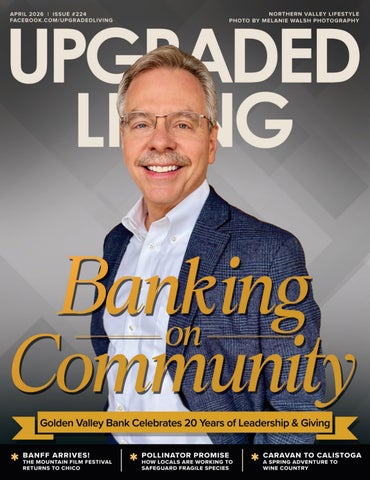
Our cover story honors Golden Valley Bank as it marks 20 years of community, leadership, and giving. What began as a bold idea—to build a bank rooted in relationships rather than transactions—has grown into something far greater. It’s a testament to what’s possible when a business commits not just to serving a community, but to being an active part of it. Two decades later, their impact can be seen not only in financial success but in the countless organizations supported, initiatives championed, and lives touched along the way.

That same sense of connection carries throughout this issue. From the incredible storytelling of the Banff Mountain Film Festival World Tour to the inspiring local efforts to protect the western monarch butterfly and restore vital pollinator habitats, each story reflects a shared understanding: we are all connected, and our actions matter.

What ties these stories together is a simple but powerful idea—community isn’t something we passively belong to. It’s something we actively build.

It’s built by business owners who choose to source locally and serve thoughtfully, by organizations and volunteers who give their time to causes that may never make headlines but change lives all the same, and by individuals who decide that even the smallest effort—a planted wildflower, a supported local shop, a shared story—can make a difference.

As you turn these pages, I invite you to see yourself in these stories, not just as a reader, but as a participant. The future of our community isn’t determined by a single moment or a single effort—it’s shaped by all of us, together, over time.

Thank you for continuing to show up for this community in ways both big and small. Here’s to building something meaningful— right where we are.

AVEED KHAKI Owner/Publisher

JASON CORONA Sales Director

MICHAELA GULBRANSEN Writer and Account Executive

SHELLY BRANDON Writer TIM MILHORN Writer

MELANIE WALSH PHOTOGRAPHY Cover Story Photographer

UPGRADED LIVING CONTRIBUTORS

DOUG LOVE Real Estate

DOLORES MITCHELL Art

ALISA LEROUX Gardening

KIM YOUNG Conservation

ALISHA FICKERT Burnout & Recovery

ERIK BROWN Cover Design

MAKE A DIFFERENCE

A strong community isn’t built through grand gestures alone—it’s shaped by small, consistent choices. Choosing a locally owned café, booking a service with a neighborhood provider, or attending a local event may seem simple, but those decisions carry weight. Every dollar spent locally helps sustain jobs, supports families, and keeps our economy rooted right here at home. Over time, those choices create vibrant downtowns, thriving small businesses, and a stronger sense of connection among neighbors. Supporting local isn’t about perfection—it’s about intention. And when enough of us make that small commitment, the collective impact becomes something truly powerful.

ADVERTISING INQUIRIES

Experience breathtaking adventure films, global storytelling, and community connection as the Banff Mountain Film Festival brings inspiration and wild beauty to Chico.

From humble beginnings to bold futures—real stories proving education transforms lives and fuels purpose-driven success

Bee the change—plant native, ditch chemicals, and help monarchs make a comeback, one blooming backyard at a time.

Coverage you can count on—local experts at Dayton Sayer Insurance simplify health insurance with heart, trust, and a legacy built on service.

Big change, bigger life—one couple sheds pounds, gains energy, and rewrites their future through bariatric transformation.

Running on empty? Learn to spot burnout, reset your pace, and reclaim success without sacrificing your sanity.

Thoughtful, driven, and grounded, Lowel Werblow III is redefining what it means to grow with purpose— balancing leadership, resilience, and authenticity along the way.

Bingo your way to better—small goals, big growth, and a fun, feel-good path to intentional living

From trending podcasts and mustwatch shows to habit-building reads and local spring events, discover fresh inspiration to reset, recharge, and stay connected this season.

A powerful reminder that even in the face of hardship, it’s community— neighbors helping neighbors—that rebuilds lives, restores hope, and brings people together

Thai one on—bold flavors, vibrant plates, and a fresh new west-side spot worth the hype

Burnout often hides behind success. Discover how to recognize the warning signs, shift your mindset, and rebuild a path toward happiness.

From coop to table—a bold leap into homesteading proves big results come from guts and grit.

From cross-country paths to local care, NPs Josh & Emily Schultz found purpose and community in Chico.

Soil mates—layer smart, grow strong, and build a thriving garden from the ground up with hugelkultur magic.

Taco ’bout tasty—crispy fried fish piled high with crema, avocado, and zingy toppings, perfect for spring bites

Sip happens—Calistoga pours on charm with hot springs, hidden gems, and a laid-back Napa escape worth repeating.

COVER STORY

Banking on community—Golden Valley Bank celebrates 20 years of local success. Their people-first banking model builds stronger businesses and brighter futures, allowing them to invest in nonprofits, fuel growth, and keep success local.

Reel Adventure Banff Brings the Wild to Chico

If you’re craving inspiration, breathtaking visuals, and stories that stir your sense of adventure, mark your calendar for April 10–11, when the globally acclaimed Banff Centre Mountain Film Festival World Tour comes to Laxson Auditorium in Chico. For two nights, audiences will experience films that celebrate outdoor adventure, culture, and our planet’s most dramatic landscapes.

Originating in the Canadian Rockies as the Banff Centre Mountain Film and Book Festival in 1976, this event has grown into one of the world's most respected showcases of adventure films. Filmmakers from around the globe submit hundreds of films exploring mountain culture, human endurance, environmental issues, and remote wilderness.

What began as a relatively intimate gathering of climbers, explorers, and storytellers has evolved into a global phenomenon, with the World Tour reaching hundreds of cities across

continents each year. Yet despite its growth, the festival has remained true to its roots—celebrating authentic storytelling and a deep respect for wild places. Many of today’s most celebrated adventure filmmakers got their start at Banff, and each year the festival continues to spotlight emerging voices alongside seasoned professionals.

The festival's legacy is also deeply tied to environmental stewardship. Over the decades, Banff has become a platform not only for showcasing adventure but also for raising awareness about conservation and the fragile ecosystems that make these stories possible. From climate change narratives to indigenous perspectives on land and culture, the films often go beyond adrenaline to explore the deeper connections between people and place.

There are countless reasons to come to this film festival. First, it’s a visual feast. Cinematography captures breathtaking

landscapes, from rugged mountain peaks to sweeping oceans. Second, it’s inspiring; you’ll witness stories of courage, resilience, and human connection with nature. And finally, it’s a shared experience; audiences of outdoor lovers, travelers, and families come together, creating a sense of community around the thrill of adventure.

That sense of community is palpable from the moment you arrive. There’s an energy in the air—a buzz of anticipation as conversations spark between strangers who quickly realize they share a love for the outdoors. Whether you’re an experienced adventurer or simply someone who appreciates a beautiful story, the festival has a way of drawing people in and making them feel like part of something bigger.

Each night features a different lineup of films, mixing short films and featurelength documentaries. Expect kayaking through rapids, climbing sheer cliffs,

and intimate portraits of people living harmoniously with the natural world. Beyond the films themselves, the festival includes pre-show live music, food trucks, and community engagement, giving it the feel of a true local celebration. The party starts at 6 pm. Doors open at 7:00 p.m., with screenings beginning at 7:30 p.m. on both April 10 and 11.

One of the standout curated selections this year is the Moraine Program, a collection of short films that capture both the intensity and joy of life lived outdoors. Audiences can look forward to a number of films, including The Hive Architect, which explores the fascinating intersection of nature, design, and human ingenuity, and Best Day Ever, a powerful story that follows adaptive mountain bikers Greg Durso and Allie Bianchi as they tackle disability with humor, finding friendship, support, and joy within their tight-knit rural Vermont riding community. There are six movies in this program, and together they offer a dynamic mix of heart-pounding action and meaningful storytelling.

Equally compelling is the Serac Program, which leans into creativity, artistry, and the unexpected. Films like Mandala and Flow Vision explore movement and mindfulness, blending athletic performance with a deeper sense of rhythm and connection. Meanwhile, Robson offers a breathtaking look at one of North America’s most iconic peaks, capturing both its beauty and its formidable challenges.

The Serac lineup continues with Emil & Karl: Little Wheels Big Mountains, a heartwarming and adventurous tale that proves big dreams can come in small packages. Lines delivers visually stunning sequences that push the boundaries of what’s possible in mountain sports, while Old Man Lightning brings humor, grit, and personality to the screen, reminding viewers that adventure has no age limit. Together, these films create a program that is as diverse in tone as it is in subject matter.

As the lights dim and each film begins, there’s a collective stillness that settles over the audience—followed by gasps, laughter, and moments of quiet reflection. It’s this emotional journey, shared with a room full of fellow viewers, that makes the Banff experience so memorable. You’re not just watching films; you’re traveling the world, feeling the cold spray of rapids, the thin air of high peaks, and the warmth of human connection.

Tickets are reasonably priced, available in advance online at www.chicoperformances.com, or at the door, and the event welcomes viewers of all ages, though younger audiences may want to note the intense, high-adrenaline content.

The Banff Centre Mountain Film Festival World Tour is more than just adventure footage; it’s an experience that lingers. Walking away, you’ll carry a sense of wonder, a renewed connection to the natural world, and maybe even a spark of wanderlust for your next outdoor adventure. The mix of heart-stopping action, environmental storytelling, and cultural insight makes it a festival that appeals not just to thrill-seekers but to anyone who appreciates thoughtful storytelling and cinematic artistry.

Save the Date

for the 4th Annual Big Time

On May 7, 2026 from 9:00 a.m. to 5:00 p.m.

Located at the Butte College Main Campus 3536 Butte Campus Drive

From village hardship to global impact

Alfred Koudougou Koala grew up in rural Burkina Faso, West Africa, in a farming community where survival depended entirely on the land. His village had no electricity, running water, or paved roads. As a child, he would go days without food, and clean drinking water wasn’t always guaranteed. Yet even in those conditions, he saw opportunity.

“Being alive today feels like a miracle,” he said. “Education became my path to changing those conditions.”

Alfred was 10 years old when the first elementary school was built three and a half miles from his village, which he walked to daily. After finishing elementary school, he ran nearly 12 miles each day to attend middle school in a neighboring village.

members alike,” Grothe said. “By dedicating himself to improving the lives of others—particularly those most in need—he continues to model the values of empathy, global citizenship, and social responsibility that Butte College seeks to instill in its students.”

It was through a class assignment at Butte College that Alfred got the idea to launch his nonprofit, Feeding Nations Through Education.

“Today we equip families with farming tools, fund clean water wells, provide microloans for women, and support more than 1,500 students from elementary school through university,” Alfred said. “Education changes everything.”

Alfred’s journey challenges the typical narrative of success. From a village without running water to leading a nonprofit that impacts hundreds of thousands, Alfred proves that scarcity can produce vision — and that vision, when paired with action, can transform nations.

“His journey from hardship to leadership serves as a profound source of inspiration for students, faculty, and community

“Anything is possible,” he said. “It doesn’t matter where you start. If I can learn English as a third language, earn degrees, and build a nonprofit impacting thousands, others can too.”

Leadership built through education

Born in Southern California and later raised in the small rural town of Alturas, Carlos Alcantar’s path to leadership started in childhood. He was one of nine children and raised by a hardworking immigrant mother.

Carlos remembers that, around the age of five, his mother bought a single bicycle for the family to share. One day while riding it, he was hit by a car, which landed on his arm. The Los Angeles Fire Department was called, and when they arrived, Carlos was inspired.

“They looked like superheroes,” he said. “I was crying and scared, and they took care of me. From that day on, I knew I wanted to help people.”

Years later, as he was preparing to take a ranch job after high school, he received a call offering him a seasonal firefighting position with the Bureau of Land Management. Carlos accepted and worked seasonal assignments while attending the fire academy at Butte College.

In 2000, he was hired by CAL FIRE and served in numerous roles until 2020, when he was encouraged to return to college to earn his associate degree and continue advancing in his career. At the time, Carlos was in his 40s. Returning to school wasn’t appealing, but with the help of Julie Scarpelli, the Director of Admissions and Records at the time, he returned to Butte College and earned an associate degree.

Julie, a close friend of Carlos’, has witnessed not only his dedication to education but also to his community.

“Beyond his professional duties, Carlos consistently goes out of his way to help others,” she said. “Whether it’s stopping to assist a stranded driver or lending a hand to someone in need, he embodies the spirit of service both on and off duty.”

Carlos now serves as assistant chief for the Santa Clara Unit of CAL FIRE, overseeing operations in Morgan Hill, California. Looking back, he recognizes that his decision to return to school for his associate degree changed his life.

“In my family, only my brother and I graduated from college,” he said. “We were once told in high school we wouldn’t amount to anything. That degree proved otherwise.”

Through all his hard work and determination, Carlos rose from a lifetime of challenges to a position of honor and influence. He hopes that others who are struggling will see his success and feel inspired.

“College can be accessible. Opportunities exist,” he said. “But most importantly, don’t let the negativity destroy you. Be kind and work hard. If I can do it, anybody can.”

Saving the Western Monarch Butterfly, One Meadow at a Time

The western monarch butterfly is uniquely tied to the landscapes of Northern California. Each year, these butterflies migrate to coastal groves— from Mendocino down through San Luis Obispo—where they cluster in eucalyptus, pine, and cypress trees to overwinter. Come spring, they disperse inland, pollinating wildflowers and crops along the way.

Beyond their beauty, monarchs play a meaningful ecological role as pollinators, supporting plant reproduction and contributing to the biodiversity that keeps ecosystems resilient. Their presence is an indicator of environmental health—when monarch populations decline, it signals broader challenges within our natural systems. Unfortunately, the western monarch butterfly species is in decline. Their population numbers are so low that we risk losing this iconic species altogether. If you are concerned, you are not alone; the situation is dire. As a monarch conservation specialist, I’m often asked, “How can I help?”

Many people know that milkweed is the host plant for monarch butterflies, but milkweed alone is not enough. Western monarchs are migratory and depend on shrinking overwintering habitats, often located on unprotected private land. On top of that, pesticides, increasingly dry summers, and habitat loss are taking a serious toll. These butterflies rely on the “super generation,” the final generation of the year that stores energy to survive cold, windy winters and carry the next generation forward.

We decided to take action at Garden Creek Farms and planted a multi-acre California native wildflower meadow designed to support monarch butterflies and much more. This meadow now contains 28 different native wildflowers in full bloom that provide nectar and pollen not just for monarchs, but for a wide variety of pollinators.

The benefits go even further. Native wildflowers also attract beneficial insects like lacewings, lady beetles, and dragonflies, which help naturally

control pests in gardens and crops. And supporting native bees is a huge bonus: bumblebees and other native species are often even more efficient pollinators than honeybees. Unfortunately, these native bees are also in decline, but planting wildflowers provides the food and habitat they need to thrive. Pollinated flowers produce seeds, reseed themselves, and continue the cycle of life year after year.

For those inspired to create their own meadow at home, the process can be scaled to fit any space—from a few raised beds to several acres. The first step is to choose a sunny location and prepare the soil by removing weeds and lightly disturbing the top layer. In Northern California, some of the most beneficial native wildflowers include California poppy, lupine, tidy tips, yarrow, baby blue eyes, clarkia, and phacelia. These species are especially valuable because they are adapted to the local climate and provide high-quality nectar and pollen for native bees, butterflies, and other beneficial insects.

Beyond supporting pollinators, native wildflowers also improve soil health. Their root systems help prevent erosion, increase water infiltration, and support beneficial microorganisms beneath the surface. Over time, these plants return organic matter to the soil, creating a self-sustaining cycle that reduces the need for fertilizers or heavy irrigation. A well-established meadow becomes not just a habitat, but a living system that strengthens the land it grows on.

Planting a wildflower meadow is simple. Wildflowers need little soil cover to germinate. They need sunlight, and many will reseed themselves for future growth. The impact is immediate and longlasting.

But we must also be mindful of our use of insecticides and herbicides. Western monarchs, like other beneficial insects, are highly sensitive to chemical sprays. Reducing or eliminating pesticides invites natural predators that control pests, helping gardens thrive without toxic chemicals. This is the beauty of biodiversity: every species from the insects in the soil to the bees in the flowers plays a role in keeping ecosystems balanced. Removing even one species can have ripple effects, disrupting the harmony of the environment.

Fortunately, there are effective, eco-friendly alternatives to traditional chemical treatments. Companion planting—such as pairing flowers like marigolds or herbs like basil with vegetables— can naturally deter pests. Neem oil, insecticidal soaps, and diatomaceous earth offer targeted solutions without harming beneficial insects when used properly. Encouraging birds, beneficial insects, and even bats in your garden creates a natural pest-control system that works with nature rather than against it.

Weeding practices can also shift toward more sustainable methods. Mulching with organic materials helps suppress weeds while retaining soil moisture. Hand weeding or using simple tools can be surprisingly effective, especially when done consistently. Over time, as native plants establish themselves, they naturally outcompete invasive species, reducing the need for intervention altogether.

Creating and maintaining pollinator habitats in your backyard doesn’t require a complete landscape overhaul. Even small changes—like planting a variety of flowers that bloom from early spring through late fall—can provide a continuous food source for pollinators. Including shallow water sources, leaving some areas undisturbed for nesting, and incorporating native shrubs or grasses all contribute to a more welcoming habitat.

Protecting these spaces is just as important as creating them. Avoiding excessive pruning, leaving seed heads through the winter, and allowing portions of your yard to remain a little “wild” can make a significant difference. These small acts create refuge for insects during colder months and help sustain populations year-round.

Every day, the choices we make in our gardens and landscapes can support biodiversity and help restore the balance needed for a healthy planet. By planting native wildflowers, creating pollinator habitats, and reducing chemical use, we can make a real difference not just for monarchs, but for the many species that sustain the ecosystems we depend on.

a legacy of care

James Green never expected his career would eventually lead him into the world of health insurance. Born and raised in San Diego, James began his professional life in technology before an unexpected opportunity steered him into the newspaper industry. In 1994, he was offered a role running the very technology he had come to sell. That moment launched a decades-long career in media, where James ultimately became President of the San Francisco Examiner. After retiring four years ago, he began looking for a way to stay active in work that truly mattered.

That desire eventually led him to Dayton Sayer Insurance in Chico, a firm founded in 1960 by the Sayer family and long known for helping North State residents navigate the often-confusing world of health coverage. As James began speaking with David Sayer, his previous agent and learning about the business, he was also introduced to Wendy Calderon, who had already become a key part of the agency’s future. Wendy joined Dayton Sayer Insurance in 2017 after working in the healthcare and legal fields, first as a medical biller and previously as a family

law paralegal for over a decade. Those roles gave her a rare perspective on both sides of the system.

“I’ve always been a fixer,” Wendy says. “I was helping providers, but I didn’t feel like I was helping patients.” Knowing David through youth hockey—where their children played together—Wendy eventually joined the agency when David realized her problem-solving instincts were exactly what the business needed. Nearly five years ago, she purchased Dayton’s partnership interest, and in 2024, James joined her in purchasing David’s partnership interest with both of them continuing the Sayer family’s nearly 66-year legacy.

For James and Wendy, honoring that legacy means preserving the philosophy that has always defined Dayton Sayer Insurance. As James often explains, the agency’s role goes far beyond selling policies. “David mentioned we aren’t in the insurance business—we’re in the customer service business,” he says. That mindset shapes everything the team does, from helping small businesses design employee benefit packages to

guiding individuals through Covered California options or selecting the right prescription drug plans. Unlike agencies that handle many types of coverage, Dayton Sayer Insurance focuses on health insurance—an area that requires deep expertise as regulations and plan options constantly evolve.

Few areas illustrate that complexity more than Medicare. With its many parts, supplemental policies, and ever-changing rules, the process can quickly become overwhelming for individuals trying to choose the right coverage. James and Wendy see their role as translators and advocates—people who can cut through the jargon and help clients understand exactly what they are signing up for.

“Medicare is a beast of its own,” James says. “Part D, Supplement plans, so many parts—it can be incredibly confusing. Our job is to stay on top of it so we can make things as easy as possible for the people we serve.”

For Wendy, that commitment to clarity and advocacy ultimately comes down to something simple: caring deeply about the people they serve. “The business is all about service,” she says. “We care deeply about our clients. We go far above and beyond what a typical insurance agent might.” That can mean spending hours on the phone with multiple family members to help a client with dementia understand their options, or visiting businesses in person so employees can have questions about their health plans answered. Whether the group includes two employees or 300, the goal remains the same—ensuring every client understands their coverage and feels confident in their choices. “Trust is imperative,” Wendy says. “You have to be able to trust your broker to work for you, whether it’s good for them or not.”

Together, James, Wendy, and their team are continuing a tradition that has served the North State for more than six decades—helping individuals, families, and businesses make sense of health insurance while ensuring they receive the guidance and support they deserve. Call them at (800) 432-9866 and see how they can help you get the most out of your health insurance.

A Boost of Confidence Bariatric Surgery Helps Couple Thrive

GLP-1 medications have become a popular weight-loss method in recent years. They can be effective for someone’s weight-loss goals when paired with diet and exercise. But sometimes, the method isn’t enough to maintain a healthy weight. One Chico couple can attest to that. They turned to Enloe Health Bariatric & Metabolic Services. The result? Their lives have forever changed—for the better.

“Bariatric surgery has given me my health back. I have more energy to chase my kids around and pursue my goals. I’m thankful for the opportunity to model healthy habits for my family,” said Autumn Avalos, a patient who lost 95 pounds since having surgery in 2022.

Bariatric Surgery Explained Bariatric surgery is a treatment for obesity that involves major changes to a person’s digestive system. There are multiple

types of bariatric surgery, but the most popular is sleeve gastrectomy, which removes about 85% of the stomach, said Erik Simchuk, M.D., Medical Director of Bariatrics at Enloe Health.

“In its native form, the stomach can hold about 2 ½ liters of food in a single sitting. With a sleeve gastrectomy, we’re converting it to about the size of your middle finger. It’s a drastic reduction in the amount of food someone can eat

Autumn and Nick Avalos have each lost nearly 100 pounds since having bariatric surgery.

in one sitting,” Dr. Simchuk said. “Our patients tell us that they feel full on just one-half to three-quarters of a cup of food.”

Bariatric surgery also reduces production of a hormone called ghrelin, which stimulates a person’s appetite. Similarly, GLP-1 agonists like Ozempic and Wegovy help people lose weight by increasing insulin production and leveling a person’s blood sugar. This helps suppress appetite and makes people feel fuller longer.

Autumn and Nick Avalos saw their lives change after they had bariatric surgery in 2022 and 2023, respectively. They have each lost nearly 100 pounds. Their weight-loss journeys began with GLP-1s.

After having quadruplets in 2021, the couple wanted to prioritize their health and lead an active lifestyle with their kids. GLP-1 medication helped them lose weight at first, but did not help them make the necessary lifestyle changes for long-term results.

“I thought the weight-loss medication was a good tool, but it wasn’t changing my practices when it came to food and nutrition,” Autumn Avalos said. “I wondered if I would gain the weight back when I stopped taking medication. That’s when I started looking more seriously into surgery.”

Dr. Simchuk describes GLP-1s as a complementary therapy to bariatric surgery. These medications can help people lose roughly 25 pounds. But bariatric surgery is still the most effective treatment for those with a body mass index (BMI) of 35 or higher, he said.

“The co-morbidities related to obesity really begin to stack up at a body mass of 30. If a person has a BMI of 34-35, our goal is to get them to a BMI of 27 and below. A GLP-1 agonist is not going to do that,” he said. “They can be effective for people with a BMI of 28-32, but patients still risk gaining back the weight. Bariatric surgery offers more sustainable results.”

Since having weight loss surgery, the couple have led an active lifestyle with renewed confidence. They now have more energy to take their five young children on family outings to parks and neighboring cities. Losing weight, Nick Avalos said, has helped the couple reconnect with their love of traveling as a family. Their jobs as medical professionals also keep them moving consistently throughout the day.

“I watched Autumn gain a lot of confidence, self-esteem, and energy. It was a good motivating factor for me to see her enjoy life,” he said. That encouraged him to take the leap, too, and seek out

surgery. “Bariatric surgery was the reset I needed to jumpstart a whole new life. It allowed me to have more freedom and has made a positive impact on my confidence,” Nick Avalos said.

“Before surgery, I would try to lose weight, get in a rut and lose confidence. This surgery made me realize that I can do hard things. It’s improved my confidence, my energy, and my health, which has made me a better wife and mother,” Autumn Avalos said.

According to Dr. Simchuk, practicing selfcare and implementing lifestyle changes are common hurdles for people who have bariatric surgery. But mindfulness, a healthy diet and exercise are crucial in maintaining results after surgery.

“Practicing self-care, understanding food as medicine and implementing exercise are all critical to a patient’s ongoing wellness,” Dr. Simchuk said. “I’m really proud of our patients and the hard work they put in. I’m also honored to help them in their journey to improved health.”

Visit www.enloe.org/weight to learn more about Enloe Health Bariatric & Metabolic Services.

Erik Simchuk, M.D., Medical Director of Bariatrics at Enloe Health.

Burnout isn't failure—it's a wake-up call.

Burnout doesn’t usually crash into your life. It sneaks in quietly. It hides behind productivity, ambition, and the constant push to do more. For high achievers, burnout often looks like success on the outside while feeling completely empty on the inside.

I know this because I lived it.

For years, I moved fast; I worked fast. I measured my worth by how much I could get done in a day. I loved being productive and efficient. I loved checking things off my list. As long as I kept moving forward, I told myself I was winning. And for a long time, that mindset worked, until it didn’t. The joy faded. My energy disappeared. My patience ran thin. I still loved my career, but I didn’t recognize myself anymore.

Burnout isn’t laziness or weakness—it’s information. It’s your body and mind telling you that the way you’re operating is no longer sustainable.

There are eight steps that can help guide someone out of burnout, but it doesn’t start with a dramatic life overhaul or quitting everything you’ve built. It starts with making yourself aware of

chronic exhaustion, irritability, emotional numbness, brain fog, and feeling disconnected from the people you love. These are warning signs, not character flaws. Burnout whispers long before it screams, but most of us ignore it because slowing down feels uncomfortable.

The next step is acceptance. Acceptance means admitting you’re burned out without shaming yourself. It means acknowledging that pushing harder isn’t the solution anymore. It means telling the truth about how you feel, even when your life looks “good” on paper. Acceptance doesn’t mean giving up your goals; it means being honest about the cost of how you’ve been living.

One of the biggest mistakes people make when trying to recover from burnout is feeling guilty for taking time for themselves. Without boundaries, rest feels unproductive, and they slip back into overcommitting, people-pleasing, and running on empty again.

This is where real change begins, but it’s not where the story ends.

Awareness and acceptance are only the beginning, but they open the door to

everything else.

One of the biggest lessons burnout taught me is that fulfillment doesn’t live at the finish line. It lives in how you experience the journey. Success that costs you your health, peace, or relationships isn’t success at all. If you’re always rushing to what’s next, you miss the life you’re building along the way.

Burnout doesn’t mean you chose the wrong path. It means the way you’re walking needs to be adjusted. You can still be driven. You can still want more. You just don’t have to sacrifice yourself to get there.

Burnout recovery isn’t about perfection. It’s about learning how to fuel yourself instead of constantly running on empty, and it starts sooner than you think.

If any part of this resonated with you, or if you would like to hear more about other steps, I send a weekly newsletter with personal stories, burnout warning signs, and simple ways to build success that doesn’t cost you your peace.

Email me at alisha@alishafickert.com, and I’ll add you.

Cool kid: lowell werblow III

If you meet 17-year-old Lowell Werblow III for the first time, you’ll probably walk away thinking, “Wow.” He’s thoughtful, steady, reflective, and intentional about the kind of man he wants to become. Lowell admits there’s a goofy side to him that surprises people; he loves to make people laugh.

Inspired by Henry David Thoreau, Lowell imagines unplugging from the world's noise to spend time in nature, writing, reading, or creating without pressure or judgment. Those moments of stillness help him feel grounded and clear on what actually matters.

To Lowell, being a gentleman means choosing the honorable path, treating women as equals, and extending respect to everyone by honoring both strengths and flaws. Born prematurely at just 1 pound, 10 ounces, he sees his life as a gift and doesn’t take it lightly. He doesn’t claim to have all the answers, but he moves forward with purpose and gratitude.

One of the places Lowell has found real confidence is at the climbing gym. Rock climbing has become something he’s genuinely excited about—equal parts challenging and grounding, it’s helped him learn to trust his body, stay focused under pressure, and keep going when things feel difficult. His advice to younger students is simple but heartfelt: “Don’t wait to join the climbing gym. If something sparks your interest, try it now. You don’t have to be good at it; you just have to start.”

To Lowell, resilience isn’t rigidity; it’s being grounded while staying open. He stands firm in his convictions yet listens deeply to people who think differently. That mindset served him well when he ran for student body president, an experience he considers one of the best decisions of his high school years and a key part of his growth as a leader. This year, he was also honored to participate in a mock trial his team practiced long and hard for, an experience that sharpened his confidence, collaboration, and ability to think under pressure.

Academically, Lowell gravitates toward English and philosophy because they explore how language and ideas shape people's understanding of the world. Those subjects have strengthened his critical thinking and communication. When pressure builds, music steadies him, especially songs from The Cardigans, a constant on his playlists since freshman year.

His friendships are built on authenticity. He respects people who are real and don’t pretend to be someone they’re not. While he isn’t big on emotional speeches, he shows he cares through action, helping solve problems and stepping in when something needs fixing.

Family shapes his direction. The values he was raised with—generosity, accountability, respect, and responsibility—guide his choices. As a big brother, he blends humor with reliability, always showing up for his little sister Ellie when it counts. Their bond is one of the most important parts of his life.

Looking ahead, Lowell feels both excited and a little nervous about life after high school. He wants to meet new people, take on bigger responsibilities, and grow beyond what’s familiar. That’s Lowell Werblow III—grounded, curious, and always climbing upward.

WRITTEN BY

Small squares, big shifts

Life Bingo is trending in 2026 and for good reason. In a world that’s loud, fast, and often overstimulating, people are craving intentional connection and micro-goals that feel attainable and personal. Enter Life Bingo: a creative, low-pressure way to dream, reflect, and track in a fun and unique way that doesn’t feel complicated.

As we step into the second quarter of 2026, it’s not too late to make a Life Bingo card or pull yours back out and review it. When done thoughtfully, a Life Bingo board is designed to last the entire year. It’s not about racing to fill squares; it’s about checking in, staying intentional, and holding yourself gently accountable to the micro-goals you set back in January—or resetting them if life has shifted.

Unlike traditional vision boards that can feel intimidating or overly polished, Life Bingo is refreshingly approachable. Most boards use a 25-square (5x5) or 36-square (6x6) grid, with each square filled with a realistic goal, habit, or experience. These can include items like running a 5K, writing a handwritten thank-you note, taking a solo day trip, hosting a dinner party, drinking more water, trying a new class, or having a difficult conversation. The beauty is that it can truly be anything that matters to you.

What’s fueling the Life Bingo phenomenon is how social and creative it’s become. Many people are turning it into an event, gathering friends or family, crafting together, and talking honestly about what they want more or less of in their lives. I hosted a Life Bingo night with friends, complete with homemade chicken enchilada soup, art supplies, and lots of conversation. We made our boards on thin canvas, colored them, collaged them, and crafted our way through the evening.

As we created, the conversations flowed easily. We talked about goals we’d avoided, small changes we wanted to make, and things we didn’t want to keep putting off. It felt grounding, encouraging, and deeply connective.

Life Bingo also invites a shift in how we define success. Instead of focusing on big, distant milestones, it celebrates the quiet wins—the phone call you finally made, the walk you took after a long day, the moment you chose presence over productivity. These small squares, when revisited, begin to tell a larger story about growth, balance, and intention.

Perhaps the most powerful part is that Life Bingo evolves with you. It’s flexible, forgiving, and deeply personal. Life changes, priorities shift, and your board can too. There’s no falling behind—only moving forward, one thoughtful square at a time, in a way that feels authentic to you.

A key part of Life Bingo is revisiting your board; monthly check-ins work beautifully. Reading your squares helps you stay motivated, and it’s quite fun to have a natural conversation starter with your friends. Are you doing the things you said you wanted to do? Do some squares need adjusting? Progress is celebrated square by square, whether you reach a true blackout or just a mere BINGO. Remember, sometimes the best way forward is one small square at a time.

MICHAELA

"Effie is by far the best real estate agent I have worked with. I have bought and sold homes with her. In all cases she gets the home sold expediently at a price far above what I have expected. I would not work with anyone else. We will be selling additional property soon with her in the Los Angeles area as well."

Storybook Charm Meets Modern Convenience in the Desirable Avenues! Welcome to this rare and enchanting property offering timeless character, flexible living, and a park-like garden retreat on approximately .40 acres. This special property features a charming vintage main home plus a separate private in-law residence. The adorable 1949 main home offers approximately 1,036 sq ft of light-filled living space, where large picture windows bathe the interior in natural sunlight. This warm and inviting residence features 3 bedrooms, 1 bath, beautiful wood flooring, and classic architectural charm. The garden-view breakfast nook provides the perfect setting to enjoy morning coffee while overlooking lush greenery and listening to birdsong. Modern comforts include central heat and air, whole house fan, new roof (2023), new range, EV charging port, and an attached one-car garage. Privately positioned at the rear of the property, the separate in-law unit built in 2004 enjoys its own alley access and oversized one-car garage, offering excellent privacy. This delightful residence includes 2 bedrooms, 1 bath, attractive flooring, and a charming kitchen with stove, oven, microwave, refrigerator and dishwasher, making it ideal place for extended family or guests. The rear unit also contains its own separate water meter as well as electric and gas meter. Step outside and discover a truly magical garden oasis with mature fruit trees, majestic shade trees, and stunning ornamental varieties.

Perfect location for this beautiful custom 3 bedroom plus office/den, 3 bath quality home w/ SHOP! Situated on nearly 2 acres in the exclusive Blue Oaks Terrace gated community. The home features a desirable split bedroom floor plan, lovely master bedroom and bath, featuring dual sinks, custom shower and separate garden bathtub. Kitchen offers dual ovens, lots of beautiful cabinetry, kitchen nook, center island, large formal dining room, formal living room and den, beautiful Tuscan-style 6-ft-wide hallways with arched openings, 10-ft-high ceilings, and more! This home offers two separate HVAC units, a huge detached 1500 SQ FT 30'x50' Garage/Shop wired with 220V, and equipped with 2 garage doors. Excellent private water supply and septic system.

Bed: 3.0 Bath: 3.0 SqFt: 3,026 Price: $1,245,000

Bed: 5 Bath: 2 SqFt: 1,816 Price: $598,000 Acreage: 0.40

This beautifully maintained, nearly new home built in July 2025 in Paradise, close to Chico, and only minutes from picturesque Billie Park. Step inside to an inviting open floorplan where the living room seamlessly flows into the dining area and kitchen. The kitchen features granite countertops, an eating bar, pantry, refrigerator, electric stove/oven, and dishwasher—perfect for both everyday living and entertaining. Both bathrooms also showcase matching granite countertops for a cohesive, upscale feel. This home is truly move-in ready, equipped with all-electric appliances, indoor laundry with washer and dryer included, and efficient mini-split systems for heating and cooling. Additional upgrades include fully-owned solar, fire sprinkler system, beautifully landscaped yard, 2-car garage and convenient RV parking.

Bed: 3 Bath: 2 SqFt: 1,368 Price: $389,900

Must Listen, must watch, must read, and must visits for spring!

Spring in Butte County always brings a renewed sense of energy. The grass turns brilliantly green, restaurant patios start filling again, and longer days invite us to slow down, reset routines, and try something new. Whether you’re walking through Bidwell Park or relaxing on the patio after a busy day of activities, a few thoughtful pop-culture picks can add inspiration to the season. Here are five lifestyle favorites that people everywhere are talking about right now.

Podcast for a Fresh Perspective

The podcast Huberman Lab has become one of the most talked-about shows in the wellness world. Hosted by neuroscientist Andrew Huberman, the podcast breaks down topics like sleep, stress, focus, and physical health in ways that are both science-based and practical. While some episodes dive deep into research, others offer simple habits that can improve daily life. It’s the perfect listen for a spring walk, a drive through the foothills, or even while tackling yard work.

A Show Everyone Is Talking About

If you’re looking for a cinematic series to dive into, the award-winning show Shōgun has become one of the most buzzed-about productions. Though it premiered in 2024, it’s receiving a muchdeserved resurgence in visibility thanks to the announcement of an upcoming second season. Set in feudal Japan, the series blends political intrigue, cultural drama, and stunning visuals to tell an epic story of power and survival. It’s the kind of beautifully produced show that makes a quiet evening feel like an event.

A Book That Keeps Trending

Few lifestyle books have had the staying power of Atomic Habits by James Clear. Years after its release, it continues to top bestseller lists and appear in book clubs and podcasts alike. Clear’s message is simple but powerful: small daily habits can lead to remarkable results over time. Spring is the perfect moment to revisit routines, and this book offers great ideas for creating changes that actually stick.

An App to Capture Everyday Moments

Sometimes the most meaningful moments of spring are the smallest ones: wildflowers on a hike, a backyard dinner with friends, or kids laughing after a soccer game. The journaling app Day One helps capture those memories effortlessly. With options to add photos, locations, and quick notes, it turns everyday moments into a digital time capsule you can look back on for years.

A Place to Revel in Spring

On April 4th, nature takes center stage at the Wildflower & Nature Festival in Oroville, a beloved community celebration held at scenic Riverbend Park along the Feather River. The free, family-friendly event invites visitors to explore the natural beauty of Butte County through a day filled with outdoor adventure and discovery. Guests can enjoy guided kayak tours on the river, educational exhibits from local environmental organizations, children’s nature crafts, live music, food trucks, and a lively beer garden. With wildflowers beginning to bloom and the river flowing strong, the festival offers the perfect opportunity to celebrate spring while connecting with the landscapes and wildlife that make our region so special. Visit www.frrpd.com for more information!

Spring has a way of reminding us that growth often starts small, with a new idea, a better habit, or simply taking the time to notice the moments that make everyday life meaningful. Whether you’re learning something new, getting lost in a great series, building better routines, or documenting the little joys of the season, these current pop culture favorites offer a simple way to stay curious, inspired, and connected as the year begins to bloom.

Sherry was spot on every step of the way in purchasing this home for my 81 year old mom. Extremely knowledgeable and professional at every turn. Would recommend her to anybody looking to purchase or sell their home in Butte County.

Luxury Creekside Living in a Gated Butte Creek Canyon Community! Experience elevated living in this stunning 4-bedroom, 3-bathroom custom home offering over 2,800+ sq ft on 3+ private acres in a gated community along Butte Creek. Designed to capture breathtaking 180-degree canyon and creek views, this home blends upscale finishes with peaceful, nature-filled surroundings. The main level welcomes you with walnut hardwood flooring, soaring vaulted ceilings with skylights, abundant natural light, and a cozy fireplace. Sliding doors lead to an expansive deck — ideal for entertaining, sunset watching, or simply soaking in the views. The chef’s kitchen features upgraded Café appliances (oven, microwave, refrigerator), quartz countertops, custom cabinetry, center island, and generous prep space. Adjacent dining and a spectacular all-seasons sunroom offer panoramic canyon views — the perfect place for morning coffee or rainy-day relaxation. The spacious primary suite is a private retreat with a walk-in closet, dual vanities, jetted soaking tub, and direct access to a redwood patio surrounded by nature. An additional bedroom and full bath are located on the main floor, along with a wellappointed laundry room with built-in cabinetry. Downstairs you’ll find two oversized bedrooms, a full bath with dual sinks, and a 400+ sq ft bonus/flex room with incredible views — perfect for a home office, gym, media room, playroom, or multigenerational living space. Set on over three acres, this property offers wrap-around porches, serene gardens with mature fruit trees, private swimming hole access on Butte Creek, and multiple outdoor living spaces designed to enjoy the canyon lifestyle. So much more to see. Schedule a showing today!

Located in the lovely Mission Ranch neighborhood, this inviting home offers space, privacy, and easy living. The well-designed split floor plan features three large bedrooms, with the primary suite set apart for added privacy and it's own access to the backyard pool. The primary suite is a true highlight and features a remodeled bathroom with a large walk-in shower plus a huge walk-in closet providing ample storage space. The soaring ceilings throughout the home create a bright, open feel, and there's even a spacious den. Outside, enjoy a nicely landscaped yard and sparkling swimming pool.

: 3.0 Bath: 2.0 SqFt: 1,917 Price: $559,000

Step into this beautifully maintained, light-filled home featuring formal living and dining rooms plus a spacious family room with a cozy fireplace. The expansive kitchen offers abundant storage, a pantry, and a dining nook that flows to the family room — perfect for everyday living and entertaining. Luxury vinyl flooring and soaring ceilings run throughout, complementing large, comfortable bedrooms. The primary suite includes a walk-in closet and direct access to the backyard. Outside, enjoy a serene waterfall with a koi pond, a generous patio, an extra storage shed, and plenty of room to add a pool. Solar panels provide energy savings and peace of mind. Bed:

Community

“We just need to help our own communities as much as we can,” said my sister, on a phone call with my wife and me last week.

Our conversation had drifted from family details to the world at large and the state of world events.

“We will never understand why so much world suffering goes on,” she said. “We can only try to help the people around us. Forget the differences between us—just work on our common needs.”

“Community,” said my wife.

Last night, for me, the word “community” came up several times at a gig—a 60th birthday party—my band played in Berry Creek, the beautiful little mountain town that burned down in the Bear Fire on September 8, 2020.

A member of our band, a Berry Creek fire victim, is friends with the birthday boy. He had recently completed the reconstruction of the shop building on his property, which burned in the Bear Fire, with the help of our friend and other Berry Creek residents. The birthday party was held in the new shop building, big enough for the band and lots of partiers.

During our band break, I met a woman who recently moved into her new place in Berry

Creek, after years of post-fire attempts at getting it done. “We’ve been living in an RV on our property since we lost our house in the fire,” she said. “We’ve spent the last five years attempting to rebuild.”

“We had plans drawn for a new house, submitted everything for permits, approvals, and a bank loan, but everything stalled over and over again.” She said she had just about given up. “But we were determined, and our neighbors and friends would not let us give up. This is the best little community of caring people in the world. We aren’t going anywhere!”

They are just now moving into their new place and hiring our band for the housewarming party in May. I asked her how the new home was finally approved.

“Habitat For Humanity,” she said. “Out of the blue, they stepped up and made it happen. I didn’t even know that was possible.”

She told me Habitat for Humanity was great to work with. “They made it easy. Everyone was so nice!” she said.

“Right here in our community.”

Doug Love is sales manager at Century 21 in Chico. Email dougwlove@gmail.com. Call or text 530-680-0817.

The Power of Community

Communities are built in countless small ways. They take shape in the businesses that open their doors each morning, the nonprofits that quietly provide essential services, and the individuals who choose to invest their time, energy, and resources into making the places they live stronger for everyone. A thriving community is never accidental. It is the product of people who believe that when neighbors support one another, remarkable things can happen.

One of the most powerful drivers of that kind of progress is access—access to resources, guidance, and financial support that allows good ideas to become meaningful action. This is especially true for organizations working on the front lines of some of a community’s most pressing challenges. Nonprofits providing housing support, youth mentorship, domestic violence services, food assistance, emergency rescue, and countless other forms of aid often operate with limited

funding and enormous demand. Their missions are critical, but their resources are not always guaranteed.

That is where strong community partnerships become essential. When businesses step forward not simply as service providers but as active participants in the well-being of their region, they help create a network of support that extends far beyond a single transaction. Community banking, in particular, plays a unique role

BY

PHOTO
MELANIE WALSH PHOTOGRAPHY

in this ecosystem. Unlike large institutions operating from a distance, community banks are rooted in the places they serve. Their success is intertwined with the health and vitality of the neighborhoods around them.

Community banking is about far more than managing accounts or approving loans. It is about relationships. It is about understanding the local businesses that fuel the economy, the families who call the area home, and the organizations working tirelessly to solve real challenges. By reinvesting locally and supporting initiatives that strengthen the fabric of a community, these institutions become catalysts for growth, stability, and opportunity.

The ripple effects of that support can be extraordinary. A small grant may help a nonprofit expand services to families in crisis. A partnership might allow a youth program to reach students who need mentorship and guidance. Financial backing for a local business can create jobs, foster innovation, and sustain economic momentum within the community. Each investment, no matter how modest it may seem in the moment, carries the potential to spark something much larger.

Positive change rarely arrives all at once. More often, it begins with a single act of belief—one person or one organization deciding that investing in their community is worth the effort. Over time, those

individual sparks begin to multiply, igniting collaboration, generosity, and a shared sense of purpose that spreads outward in ways no single effort could accomplish alone.

In Chico, one of those sparks took the form of a simple but powerful idea: that a bank could exist not just to serve customers but to strengthen the community itself. That belief helped shape the vision behind Golden Valley Bank, now celebrating its 20th anniversary serving Northern California. At the center of that vision—both then and now—stands one individual whose commitment to community continues to inspire the work being done today: Mark Francis.

The Roots of a Community Banker

Long before the idea of building a bank ever entered his mind, Mark was shaped by a story that began a generation before him—one defined by hardship, resilience, and the unwavering belief that hard work could create a better life. That story begins with his father.

As a boy growing up in the 1930s, Mark’s father had almost nothing. His early years were marked by instability and abject poverty so severe that it’s difficult to imagine today. His mother left the family when he was young, and the children were split up and placed in foster homes across Spokane, Washington. It was a time when survival often depended on the kindness—or determination—of others.

In an act that would change the course of their lives, Mark’s grandfather took matters into his own hands. He drove to Spokane, removed the children from the foster system, and brought them south to Northern California. Eventually settling in the small agricultural town of Willows, he attempted to build a life for the family with what little they had.

Even the simplest holidays reflected their circumstances. Christmas gifts were modest but given with love and ingenuity. Mark’s father would later remember one particular tradition: his grandfather would find an old sock, place a single orange in the toe, and stuff it with crumpled newspaper. It wasn’t much, but in those days, it was enough to make Christmas feel special.

From an early age, Mark’s father learned that if he wanted something, he would have to work for it. As a young boy, he caddied at the local golf course to earn money, taking whatever opportunities came his way. Those experiences—growing up with so little and working for everything—left a permanent mark on him.

When he eventually became a father himself, he carried those lessons forward with purpose. He was determined that his own children would never experience the instability he had known growing up, but he also believed deeply in the value of hard work. That belief shaped the way he raised his family in Chico.

Mark grew up in a household where effort and responsibility were simply part of daily life. His father went on to become a sixthgrade teacher in Chico, spending decades educating students at elementary schools like Citrus, Cohasset, Neal Dow, and Sierra View. Teaching was a calling, but it wasn’t the only way he provided for his family.

To make ends meet, he did whatever work he could find. He collected cans for recycling, picked black walnuts, graded peaches in Yuba City during the summer for the Peach Advisory Board, and even sold encyclopedias door-to-door. There was no job beneath him if it helped support his family. That relentless perseverence became one of the most powerful lessons Mark and his siblings ever received.

“I watched him do all of those things without expecting anything,” Mark would later reflect. “That work ethic transferred to me, my brother, and my sister.”

Like many kids in Chico during that era, Mark was encouraged to start working early. He delivered newspapers—both the Chico Enterprise-Record and the Sacramento Union—learning responsibility one early morning at a time.

While his father’s upbringing instilled resilience, Mark’s mother brought her own remarkable story to the family. She was the only member of her immediate family born in the United States; the rest had emigrated from Sweden. Raised on a farm in Nebraska, she eventually crossed paths with Mark’s father while both were attending teachers’ college during his time in the Army.

Their shared commitment to education brought them west, where they both graduated from California State University, Chico, and began teaching careers of their own. Together, they built a home grounded in education, responsibility, and opportunity.

For Mark, childhood in Chico was filled with the kind of freedom that defined small-town life in the 1960s and early 1970s. The city was far smaller then—he remembers the population sign reading just 12,000 as a child—and neighborhoods felt like extended families. His house sat close to the park, and life revolved around the outdoors.

“My mom, dad, and next-door neighbors

let us neighborhood kids run free,” Mark recalls. “The rule was simple: be home before the streetlights came on.”

There were no cell phones, no constant check-ins—just kids riding bikes, playing games, and learning independence. Sports quickly became central to Mark’s early life. He played Little League, CARD basketball, and CARD football, immersing himself in the camaraderie and competition that team sports provided.

His childhood hero was Willie Mays, whose exploits with the San Francisco Giants captivated Mark and countless other young fans across Northern California. On summer nights, he would sit in the family car with the radio on, listening to Giants games just to hear Mays play. In the neighborhood, imagination filled in the rest.

“My neighbor friend would pretend he was Willie McCovey, and I would pretend I was Willie Mays,” Mark says with a smile. “Those are some of my fondest memories.”

Yet some of the most influential experiences of his youth came through organizations that focused on leadership and service. Mark became deeply involved in the Boy Scouts, eventually earning the rank of Eagle Scout—an accomplishment that would help shape his character in lasting ways. Under

the mentorship of his scoutmaster, George Koch, Mark spent four summers working at a scout camp in Butte Meadows, beginning in 1972.

“The job didn’t pay much—five dollars per week plus room and board,” Mark recalls, “but the lessons were invaluable. Back then, they were teaching boys how to be adults and leaders,” Mark says. “It really made a difference in all of our lives.”

That early exposure to teamwork and responsibility revealed something else about Mark: leadership seemed to find him. By the time he reached Pleasant Valley High School, that instinct had become unmistakable. Mark was elected student body president for the school year 197475, and through it, had many experiences that helped cement the leadership skills he would carry with him for decades to come.

Looking back, it’s clear that the spark that would one day ignite a much larger vision had already begun to take shape. It was fueled by the lessons of a father who rose from poverty through perseverance, the guidance of mentors who taught him the value of leadership, and the sense of community that defined Chico during his childhood. All of it would help shape the path that lay ahead.

Discovering Life’s Work

By the time Mark arrived at CSU Chico, the lessons of his childhood—hard work, responsibility, and leadership—were already firmly rooted. Like many students, he was still exploring possibilities when a conversation in Chico State’s placement office quietly changed his trajectory. The advisor told him that if he entered banking, he would likely never have to search for another job. Mark had taken a few banking electives already, and the idea suddenly made sense. During those college years, another influence would eventually become deeply intertwined with Mark’s future. One of his economics professors was Muhammad Khaki, a teacher Mark describes as extraordinary. Years later, that teacher would go on to become one of the original shareholders in the bank Mark would help create.

In 1982, Mark interviewed with several banks recruiting on campus and soon began his career at Bank of America. The organization operated in a way that was highly structured and deeply policy driven. He remembers the Standard Procedures Manual as “the size of two sets of encyclopedias stacked together.” Every loan and decision followed strict guidelines designed for consistency. For a young banker eager to prove himself, it was a place where long hours, discipline, and attention to detail were essential.

One of the people who recognized Mark’s potential early on was Regional Vice President Don Wallrich. Don made

sure Mark had opportunities to grow and introduced him to the right people throughout the organization. When Don asked him to move from commercial banking into retail management, he accepted the challenge. Within two years, Mark had taken the division from the bottom of the rankings to the top and was named Retail Banking Manager of the Year. Just as important were the leadership lessons Don modeled—take care of your people, and they will take care of the customers.

"

manuals, bankers could start with a blank sheet of paper and build solutions around what businesses actually needed. That philosophy resonated deeply with Mark and changed how he thought about banking.

Tehama Bank was eventually acquired by another banking institution where Mark rose to become one of its highest-ranking executives. Yet, as the organization grew larger and more centralized, he began to feel something important slipping away. Decisions were moving farther from the communities they affected, and the ability to truly serve local customers was becoming more difficult. The entrepreneurial voice inside him grew louder with each passing year. “If community banking mattered this much, perhaps it was time to build something new,” Mark thought. He decided to do just that.

" I firmly believe that you can build a career and support your family with the concept of life’s work. If you chase work-life balance, something will have to be sacrificed. If you can incorporate the two and chase your life’s work, you’ll be much more successful all around. It’s something Jolene and I have both remained committed to throughout our lives and our careers. -Mark

Meanwhile, life outside the bank was evolving as well. Mark had known his future wife, Jolene, for years through her sister, whom he attended school with while growing up in Chico. Though they initially married other people, life eventually brought them together, and they married in 2001. Both shared a deep love for Chico and the community that had shaped them. Their parents lived here, their siblings lived nearby, and it was where they hoped to build their future. Over time, that commitment to community would become one of the defining themes of their lives.

In 1998, Bank of America was purchased by North Carolina National Bank, bringing major changes to the organization. Not long afterward, Mark received an offer from Tehama Bank, a move that would prove transformative. For the first time, he experienced community banking in its purest form—relationship driven and flexible enough to meet the needs of local customers. Instead of relying on rigid

Building a Better Bank

In March of 2004, Mark decided to take the first real step. For years he had watched the banking industry change as consolidation accelerated and decisions moved farther from the communities banks once served. Customer service—the foundation of relationship banking—was increasingly being replaced by efficiency and scale. Over lunch with his friend Brian Sweeney, Mark shared an idea that had been quietly growing in his mind: what if they built a bank designed to do the opposite—a bank focused on exceptional service, local relationships, and long-term trust rather than distant decision-making.

Brian immediately understood the vision. The two had known each other for years through community circles and even playing softball against one another, developing a friendship built on mutual respect. Mark admired Brian as a thoughtful, wellrespected financial advisor, and Brian had long respected Mark’s leadership and experience in banking. By the time the lunch ended, Brian was fully on board. What began as a conversation between friends quickly evolved into the beginnings of a plan built on a shared belief that banking could still be personal while benefiting its community.

As the idea gained momentum, another partner stepped forward in a crucial way—Mark’s wife, Jolene. While Mark was shaping the vision, Jolene took on the enormous task of helping turn the concept into reality. From organizing planning efforts to helping bring people together around the idea, she became instrumental in getting the bank off the ground. Mark often reflects on those early days with a simple acknowledgment: “Without Jolene, Golden Valley Bank would never have happened.”

At the heart of the concept was a philosophy built around four stakeholders—shareholders, customers, employees, and the community. In Mark’s view, a successful bank had to serve all four equally. Shareholders deserved a strong return, but many of those shareholders would also be customers and neighbors invested in the health of the region. Employees needed to feel valued and empowered, because they were the ones delivering the service that made the bank different. The idea closely mirrored the “service-profit chain,” a model developed by researchers at Harvard Business School, which demonstrates how employee satisfaction drives stronger service, deeper customer loyalty, and long-term financial success.

Turning that vision into reality required courage—and trust. The founding group included 28 original investors, many of whom were friends and colleagues who believed deeply in the mission. Leading shareholders invested as much as $500,000 each, while others committed $250,000 or more. Roughly 38 percent of the bank’s original shares were purchased by members of the Rotary Club of Chico, reinforcing how closely the bank would be tied to the community it served.

Banking on Community

In late 2005, Mark and the founding team opened a small office on East Avenue in Chico to begin turning their idea into reality. The vision was clear, but building a bank from the ground up would require both capital and the trust of the community they hoped to serve. By January of 2006, they scheduled a stock sale event at the Sierra Nevada Big Room. What happened next exceeded every expectation. In just 13 days leading up to the event, people began stopping by the office and slipping checks through the door simply to buy shares.

The response was overwhelming. Instead of the $11–14 million they had planned to raise, the founding group collected $22.7 million from community members eager to be part of the effort. Ultimately, the bank kept $15 million and returned the remaining

$7 million—particularly to investors from outside the area—because the goal had always been local ownership. When the dust settled, more than 600 founding shareholders had stepped forward to support the effort. It was a remarkable show of confidence in the vision Mark and his partners had shared with the community.

From the beginning, the ownership structure of Golden Valley Bank was intentionally different from most banks. Mark remained the largest shareholder, followed by other local business leaders including a real estate developer, a brewery owner, and a farmer-investor. There were no institutional investors and no distant corporate ownership groups guiding decisions from afar. Because the bank was owned locally, it could focus on long-term relationships and thoughtful lending rather than short-term pressure.

That philosophy also shaped how lending decisions were made. Instead of relying strictly on rigid formulas, the team approached each opportunity with a blank sheet of paper, listening carefully to what business owners needed and structuring loans around realistic paths to success. Having seen how careless lending could harm people, the goal was never simply to grow the loan portfolio—it was to help businesses thrive while protecting them from financial decisions that could ultimately do harm.

As the bank grew, so did the team responsible for carrying out its mission. Mark often points to the people around him as the true engine behind Golden Valley Bank’s success. Chief Banking Officer Laurie Kee, a longtime banking professional in Butte County, came to the bank in an unusual way—simply walking through the front door one day without an appointment to introduce herself. After she left, several employees stopped by Mark’s office excited about the possibility of working with her. The enthusiasm convinced Mark to bring her aboard, even before there was a specific role defined.

Only months later, the Camp Fire devastated the region. Laurie suddenly found herself managing one of the bank’s most important community responses—coordinating donations and support through the bank’s foundation. Under her leadership, the foundation helped raise more than $13 million to support recovery efforts, while the bank quietly worked to finance construction loans that helped families rebuild their homes in Paradise.

Other leaders soon joined the effort as the

organization expanded. Quinn Velasquez, a graduate of CSU Chico, brought experience from larger financial institutions before becoming the bank’s chief credit officer and a key leader in loan development. Barbara Crouse, a respected financial professional, eventually stepped into the role of chief financial officer after years of leadership within Golden Valley Bank. Together with many other dedicated employees, they helped create a culture focused on service, accountability, and long-term relationships.

Over time, that commitment fueled steady growth. The bank expanded beyond Chico, opening additional locations in Oroville and Redding, growing to 68 employees and bringing the same service-driven approach to new communities. Many customers in those cities had already been banking with the Chico office for years before branches opened there. They valued the accessibility of decision-makers and the ability to work directly with people who understood their businesses.

That accessibility is part of what makes community banking unique. At Golden Valley Bank, customers speak directly with people who live and work in the same communities they serve. Decisions are made locally by professionals who understand the region’s businesses, challenges, and opportunities. For entrepreneurs and small businesses especially, that relationship-driven approach can make all the difference in navigating growth and uncertainty.

The results of that philosophy can be seen throughout the North State. Golden Valley Bank has helped finance projects ranging from the construction of homes in the Sierra Moon subdivision to medical facilities like Chico Eye Center and Orthopedic Associates’ Surgery Center. The bank has supported development at Meriam Park and helped local dealerships such as Chico Nissan, Chico Hyundai, and Chico Volkswagen Mazda expand their facilities. During the Great Recession, when the City of Chico was quoted a costly fee for a standby line of credit from a large bank, Golden Valley Bank stepped forward and offered the same line with no fee—saving the city significant money.

Yet, many of the achievements Mark values most rarely make headlines. The bank has quietly supported nonprofit organizations across the region, often providing free banking services so that nonprofits can direct more of their resources toward their missions. Organizations like Catalyst Domestic Violence Services and the Boys & Girls Clubs of the North Valley receive ongoing support from the bank and its foundation. This year, Golden Valley Bank launched its 20 Years of Community, Leadership, & Giving Grant in celebration of its 20th anniversary. Through this grant initiative, the bank has also awarded $20,000 grants to organizations that often operate outside the spotlight, including Reading Pals, Raising Shasta, Oroville’s State Theater

Arts Guild, and Butte County Sheriff's Search & Rescue.

As Mark will frequently say, the employees at Golden Valley Bank are the heart and soul of the operation. Not only are they empowered to help customers but also to guide the bank’s philanthropic work, nominating organizations and raising funds throughout the year for causes they believe in. For Mark, that involvement reflects the broader philosophy behind the bank—that success should benefit the entire community. It’s also closely tied to something Mark often calls “life’s work,” a concept he believes is more realistic and fulfilling than the traditional idea of work-life balance.

“I firmly believe that you can build a career and support your family with the concept of life’s work,” Mark says. “If you chase work-life balance, something will have to be sacrificed. If you can incorporate the two and chase your life’s work, you’ll be much more successful all around. It’s something Jolene and I have both remained committed to throughout our lives and our careers.”

Now, 20 years after opening its doors, Golden Valley Bank stands as a testament to that philosophy. The bank has grown steadily while remaining locally owned and fiercely independent, with its board unanimously committed to maintaining that independence. Looking ahead, Mark sees continued growth within the communities the bank already serves, expanding services and opportunities while remaining focused on long-term relationships rather than rapid expansion.

Ultimately, Mark hopes that decades from now, the legacy of Golden Valley Bank will be measured not just in financial performance but in the lives it helped improve and the communities it made better.

“50 years from now, I hope people will recognize what we’ve done for the communities we’ve served, the people we’ve helped, how we’ve stimulated the economy, and how we kept it local while doing so,” Mark says, “I hope they know us as good corporate citizens and stewards of our communities.”

For Mark, it has already been an extraordinary journey. If he could write a letter to the younger version of himself just beginning the process in that small East Avenue office, the message would be simple: “Be prepared—it’s a remarkable ride, and you’re going to enjoy every minute of it.”

For those who believe in the power of strong local institutions, the invitation is simple. Banking with a community bank like Golden Valley Bank means investing in the very places we call home— supporting local businesses, strengthening nonprofits, and helping ensure that the prosperity created here continues to stay here. Golden Valley Bank continues to deliver on its promises and will undoubtedly be seen as Mark hopes it to be 50 years from now.

Visit Golden Valley Bank online at www.GoldenValley.bank, connect with one of their team directly by calling (530) 894-1000, or visit one of their branches in Chico, Oroville, or Redding and see what they can do for you and your business. MEMBER FDIC

PHOTOS

Raising the bar (and the birds)

In January of 2025, I placed an order for 125 Cornish Cross meat birds despite having personally processed fewer than five chickens in my entire life. The birds were scheduled to ship in early March, and by May, I intended to process each of them on our property.

From the outside, it may have looked like an impulsive leap. In reality, it was a calculated decision rooted in conviction and careful planning. I am a self-taught homesteader. I began pursuing this lifestyle more intentionally in my early thirties, approaching each new skill the same way: immerse fully, work toward competence, and continue refining until I reach a level of confidence that allows me to build the next layer.

Over time, that rhythm shaped our home life—gardening, food preservation, land management, clean household and bath products, and cooking from scratch. Piece by piece, our lifestyle began to reflect the values I held deeply. Yet, one area remained incomplete: meat.

For several years, we had raised kunekune pigs and filled our freezer with exceptional pork. But when it came to chicken, I was still buying it in large quantities from retail, and the difference in quality was undeniable.

When I came across a local meat and chicken processing class advertised on social media, I enrolled immediately. The class covered breed selection, equipment, care guidelines, and processing techniques, but more importantly, it replaced hesitation with clarity. I left not just informed, but committed.

There was, however, one significant obstacle. Processing day typically requires six to eight adults to operate efficiently, and I did not have that built-in labor force. So instead of scaling back, I designed a solution. Raising meat birds is an eight-week commitment. There are no vacations, no skipped mornings. The birds rely entirely on consistent daily care. While not everyone wants that responsibility, I knew several families who

valued nutrient-dense, ethically raised poultry as much as I did.

My husband, six close friends, and I purchased birds together. The chickens were raised on our property, and I assumed responsibility for their daily care and management. Feed costs were shared. In exchange for the eight weeks of labor, each participating family committed to a full day of processing at the end of the grow-out period.

It was not complicated, but it was intentional.

Since that first season, we have raised over 350 birds and have not purchased a single package of chicken. The quality is unmatched, and the confidence that comes from knowing exactly what went into our food is something I do not take lightly. The phrase “you are what you eat” carries real weight in our home.

Planning and executing a way to make something work is often the difference between it happening and not. I could have ordered 10 birds, struggled through a small processing day, and run out of chicken within weeks. Instead, I chose to think bigger, build a system, and commit fully.

Where there is a will, there truly is a way, but only when paired with intention and action.

So I will leave you with this:

What do you want to try?

What skill could provide something meaningful for you or your family?

Homesteading lessons can be taught, but they can also be adapted. Sometimes the difference between wishing and doing is simply the courage to begin. Dare to try.

For more information on homesteading, visit www.homestead.org and check out their beginner’s guide. It’s an excellent way to acquaint yourself with homesteading in general, and it offers an excellent step-by-step process on designing and operating the homesteading plan that’s right for you and your family.

Nurse Practitioners Planting Their Roots

There’s something about Chico’s college vibe and tight-knit community that draws in many new residents from around the U.S. Josh and Emily Schultz are vibrant examples of how quickly Chico can settle into becoming someone’s hometown, even if they’re not from here originally.

Emily and Josh first met as nursing students at Roseman University of Health Sciences in Utah and are now married and working as nurse practitioners at Mangrove Medical Group.

Emily grew up in Philadelphia, where her mom worked as a night shift X-ray technician. That was her first exposure to the medical field. Although she was a kid, she remembers thinking, “It was cool sleeping over at the hospital.” As an adult, she worked as a medical scribe in a children’s hospital emergency room with mid-level practitioners. She says, “That’s when I knew I wanted to be a nurse practitioner.”

Josh grew up with “one foot in California and one foot in Mississippi,” as he went back and forth between coasts. He explains that when he landed in Chico after finishing up his active duty time in the Air Force, it felt “like a mix between California living and a southern downhome feel.” He remained in the reserves while he took classes at Butte College and then transferred to Chico State to complete his first bachelor’s degree. Josh says he always knew he wanted to be a mid-level practitioner. His mom is a director of medical staff services, so he had many opportunities to shadow physicians, physician assistants, and nurse practitioners. He set out on a career path towards becoming a mid-level provider and worked as an EMT and a 911 dispatcher before entering nursing school.

After nursing school, both Emily and Josh specialized in cardiovascular ICU nursing at Enloe. Josh says his time in the ICU underscored the need for community and rural providers. He explains that this is what steered him towards becoming a family nurse practitioner focused on family practice. “I felt like I was treating the same problem over and over again, and I wanted to get to the source. I wanted to be in a place where I could help prevent my patients from getting to that point, to keep them from going to the hospital.”

Emily’s focus in dermatology as a nurse practitioner evolved from her personal experience growing up with eczema and acne. She says, “I grew up in dermatology offices, and with my family history of skin cancer, it just felt like it was my place. It’s a great fit for me.” She explains that Mangrove Medical Group has family care, dermatology, laboratory, and imaging services. Emily shares, “The affiliation is great for patients. We say it’s a one-stop shop.”

The Schultzs are happy to have Chico as their hometown and enjoy heading downtown with their kids on the weekends, enjoying the farmers markets, followed by park picnics or Saturday morning family walks to their local coffee shops. Josh says, “We’ve been here; we’re a part of the community, and we’re here to stay.” Emily agrees and says, “We’ve planted our roots.”

Both are welcoming new patients at Mangrove Medical Group. Give the clinic a call at (530) 345-0064 to schedule your appointment.

Hugelkultur:

How to Build Healthy Soil From the Ground Up That Will Last for Seasons to Come

Healthy, balanced soil is a living, breathing network. Beneficial bacteria, fungi, and decomposing organic matter make up a soil composition that earthworms thrive in, retain moisture, and in which plants grow successfully with very little maintenance.

Hugelkultur, translated as “mound culture,” is a style of mound building used to create this type of living soil for gardening. The general principle combines three main components before adding even a bucket of dirt. These components can be applied directly to the ground and built into a hill or mound to grow on, as traditionally

done. However, this method can also be applied in raised boxes by layering each component before adding your topsoil.

The first layer of hugelkultur is branches or sticks. These branches act as a waterabsorbent layer at the bottom and a slowrelease nutrient source that lasts for years as the wood breaks down, creating rich organic matter in the soil.

It’s important to note that branch selection has one key consideration. Black walnut, or other branches that contain juglone, should not be used. Juglone is a toxin found in black walnut roots and branches that inhibits the

growth of other plants and is therefore not a good choice as a base layer in hugelkultur.

The next component of hugelkultur is manure. Manure can come from a variety of animals, but is often best from chickens, horses, or cows. Because this layer will not be directly mixed with the topsoil, the standard waiting period for high-nitrogen manures like these does not apply, as it would if you were mixing manure directly into the soil. Manure helps speed the breakdown of denser materials and creates a nitrogen-rich environment for the decomposition process to unfold.

Last but not least, a hugelkultur mound or raised-bed layering method will include a mixture of grass, leaves, and/or straw. These materials are also nitrogen-rich, help fill in voids in the branch layer, and provide a rapid start to the decomposition of the larger materials below. This layer is also important to the soil microbiome and plays another role in the soil’s ability to retain moisture.

The only major warning I would give with this step is to make sure the grass clippings and leaves you use are free of weeds or seeds from unwanted plants. There’s nothing worse than spending the time and effort to build this incredible soil structure only to have something like Bermuda grass completely take it over in a single season.

Once your three long-term soil-building layers are complete, you can top everything with 12 inches or more of topsoil and forget it was ever there. Nature, along with the structures and nutrients you added, will do its job for seasons to come. If you’re doing this in a raised bed and adding bagged soil as your top layer, I would take one extra cherry-on-top step and purchase a few earthworms to add to your beds. By doing this, you’re essentially creating your own earthworm casting factory right underneath the top layer of your garden box.

At the end of the day, building soil like this is really just working with nature instead of against it. By layering natural materials the way they would break down on a forest floor, you’re creating a system that feeds itself, holds moisture, and supports life underground. A little effort up front can create years of rich, productive soil, and that’s one of the best investments you can make in any garden.

Tongue Thai'd

Two months ago, we did a feature on delicious Asian dishes. While exploring places to feature for variety, I saw that a new place would be opening in town just after we went to print. Likely by now, you’ve seen Chico Thai Cuisine, also known as the new Thai place on the west side. While we certainly have several great places to dine, you can’t have too much of a good thing, so after seeing some recent buzz, and a cute teddy bear ice cube resting inside a glass of milky tea, I knew I had to give it a try.

With plenty of parking, we easily got a spot, even though there was a decent crowd for Thursday lunch. We were quickly shown our table, and I began examining the spacious dining room and modest decor. Composed of a black-and-white interior with brown tables and chairs, it waits for its character to evolve, while its flavors are well-defined.

I came with one simple instruction: don’t order the pho. It’s like saying, “Don’t order the tamale from the Italian restaurant.” Sure, it might be good, but it’s not what they’re known for. So I went with the pad Thai, crab rangoons, and a Thai iced tea. As diverse as my palate, I guiltily admit, this was my first pad Thai.

Like a red dress at a black-and-white event, each plate's vibrancy brings life to the room. The iced tea is a caramel-flavored layered drink that contrasts sweetened condensed milk and rich black tea with an adorable, equally delicious, sculpted ice pet. The crab rangoon appetizers were tightly pinched and simply salted, made with filo dough, and brimming with a creamy crab filling. No air bubbles, no miles of over-crisped corners, just delightful filling.

Onto the main dish, and the trifecta of sweet, sour, and salty it is known for. The rice noodles glow from being cooked in tamarind paste, while fried egg, and golden tofu join lean strips of sauteed pork and bean sprouts. Cooked carrot and green onion in the dish, and purple cabbage on the side, adds a splash of color, while a cluster of chopped peanuts can be enjoyed as desired.

Spring has sprung. Just as the blossoms signify a renewal of life, your dining experience can be given new animation with a trip to Chico Thai Cuisine. Visit the new restaurant at 407 Walnut Street in Chico for lunch or dinner, and be sure to tell them we sent you!

Fried Barbacoa Street Tacos

April in Northern California is a season of transition—in the best way. The days are longer, the evenings are still comfortably cool, and meals begin to shift from hearty winter fare to something lighter, brighter, and meant to be shared outdoors. These street tacos capture that moment perfectly. With bold barbacoa and fresh, citrusy fish, this duo offers a balance of richness and vibrancy that mirrors the season itself.

1. Quick Pickled Red Onions Ingredients

• 1 large red onion, thinly sliced

• 1 cup white vinegar

• 1 cup water

• 2 tbsp sugar

• 1 tbsp salt

• Juice of 1 lime

Directions

1. Bring vinegar, water, sugar, and salt to a simmer.

2. Pour over sliced onions + lime juice in a mason jar.

3. Let sit at least 30 minutes.

Topped with tangy pickled onions, creamy avocado, and fresh cilantro, every bite feels layered yet refreshing. It’s the kind of meal that invites gathering—around a backyard table or a picnic blanket. In a place where local produce is always in abundance and outdoor living reigns supreme, these tacos deliver flavor, flexibility, and a true taste of spring turning into summer. Follow these steps to make your own!

2. Lime Crema Ingredients

• ½ cup sour cream or Mexican crema

• Juice of 1 lime

• Pinch of salt

• Splash of water (to thin)

Directions

1. Mix all ingredients until smooth.

3. Barbacoa Marinade Ingredients

• 2–3 chipotle peppers in adobo

• 1 tbsp adobo sauce

• 2 cloves garlic

• 1 tbsp apple cider vinegar

• Juice of 1 lime

• 1 tsp cumin

• 1 tsp oregano

• ½ tsp smoked paprika

Directions

1. Blend all ingredients until smooth.

2. Set aside.

4. Avocado & Cilantro Finish Ingredients

• 2–3 ripe avocados, sliced

• 1 cup fresh cilantro leaves

• Lime wedges

• Crumbled cotija (optional but recommended)

5. Fried Barbacoa Fish Ingredients

• 1.5 lbs white fish (cod, halibut, or mahi mahi), cut into strips

• 1 cup buttermilk

• 1 cup flour

• ½ cup cornstarch

• 1 tsp baking powder

• 1 tsp chili powder

• ½ tsp cumin

• Salt & pepper

• Oil for frying

Directions

1. Toss fish in barbacoa marinade and marinate 20–30 minutes.

2. Add buttermilk and coat well.

3. In a bowl, mix flour, cornstarch, baking powder, and spices.

4. Dredge fish in dry mixture.

5. Fry at 350°F for 3–4 minutes until golden and crispy.

6. Drain on paper towels and lightly salt.

7. Assemble tacos!

bring us home

Butte County has an inordinately high number of animals in need of adoption due to a number of factors including wildfires, floods, and irresponsible breeding. Please consider adoption as an option for increasing the love in your own household. These soon-to-be pets can be adopted by calling the Chico Animal Shelter at (530) 894-5630. You can also visit their website at www.chicoanimalshelter.org

SIP HAPPENS

Tucked at the very top of Napa Valley, the town of Calistoga feels like a secret that travelers are slowly rediscovering. While the rest of wine country can feel busy and expensive, Calistoga has managed to preserve something special: warm hospitality, relaxed tasting rooms, and a charming downtown you can easily explore by bike or on foot.

After visiting several times over the years, I’ve discovered the very best time to go isn’t during harvest season, but rather in late winter or early spring.

From late November through April, Calistoga celebrates its famous “Cabernet Season” with the beloved Winter in the Wineries Passport. For about $80, visitors receive a passport that unlocks complimentary tastings at more than 20 wineries, along with special deals at restaurants, hotels, and spas. The result is a wine country experience that feels intimate, relaxed, and incredibly fun.

We love staying at UpValley Inn & Hot Springs. They offer great packages, and the property itself captures everything people love about Calistoga.

Guests have access to mineral pools fed by Calistoga’s famous hot springs, along with a steam room and sauna that are perfect after a full day of wine tasting. Calistoga has been known for its geothermal mineral waters for more than a century, attracting travelers seeking wellness and relaxation.

One of our favorite features at the hotel is the complimentary bikes. Downtown Calistoga is incredibly walkable, but riding through town or cruising past vineyards on a bike adds another layer of charm to the experience.

Dining

One of the best meals we’ve ever had in wine country is at Lovina. This womanowned restaurant has created something truly special. Not only is the food outstanding, but the owner also creates the dishes it's served on, giving the entire experience a beautiful, handcrafted feel.

The Green Goddess salad is quite possibly the best I’ve ever had. The menu includes thoughtful gluten-free options, and brunch there with their fantastic Bloody Mary is absolutely worth planning your day around.

Lovina also operates as a gratuity-free restaurant, choosing instead to pay employees a fair living wage along with health benefits. Not surprisingly, the same staff tends to remain year after year. The sense of consistency and pride in the team shows in the service, which is warm, attentive, and genuinely welcoming.

For dinner, we visited The Palisades for its elevated California cuisine, and the Calistoga Inn Brewery for hearty meals and local beers, both perfect ways to end a day of wine tasting.

Wineries You Won’t Forget

One standout experience is Sterling Vineyards. Visitors ride a gondola up the hillside to reach the winery, making it one of the only aerial tram winery entrances in the world. The views are breathtaking, and once you arrive, the self-guided tasting experience allows you to wander the property while enjoying spectacular panoramas of Napa Valley.

Another incredible stop is Hans Fahden Vineyards, where guests can tour a beautiful wine cave carved into the hillside and stroll through peaceful

gardens that feel straight out of a storybook.

For something eclectic and fun, Tank Garage Winery is housed inside a restored vintage gas station and produces creative, limited-edition boutique wine blends.

Animal lovers will enjoy Tamber Bey Vineyards, where horses graze nearby while guests sip wine. The setting is beautiful, relaxed, and memorable. Unanimously, it was home to our favorite wine as well.

Another favorite is The Vault Wine + Artifacts, where wine tasting feels a bit like stepping into a museum, thanks to the fascinating artifacts displayed throughout the space.

One of the most interesting quirks of Downtown Calistoga is a zoning rule: tasting rooms within the city limits must include a retail component. They can’t simply operate as tasting bars.

This has led to a wonderfully eclectic collection of shops and tasting experiences. You might walk into a boutique that appears to sell art, gifts, or home goods, only to discover a hidden tasting lounge tucked in the back. It gives parts of the downtown a speakeasy feel and makes wandering through town an adventure.

Of course, many wineries just outside the city limits operate traditionally among the vineyards themselves, each offering something unique and special to the fabric of Calistoga. One stands out not just for its wines but what it brings from far across the sea.

No trip to Calistoga would be complete without visiting the remarkable Castello di Amorosa, a 13th-century–style Tuscan castle rising dramatically from the

vineyards just south of town. Built by vintner Dario Sattui, the massive stone structure took more than a decade to complete and was constructed using authentic medieval building techniques. The result is astonishingly detailed— complete with a drawbridge, defensive towers, a chapel, and even a torture chamber that adds a touch of theatrical history to the experience.

Visitors can explore the castle through guided tours that wind through candlelit halls, grand courtyards, and vaulted cellars deep beneath the structure. The lower levels house an extensive wine cave system where Castello di Amorosa produces its Italian-style wines, particularly its acclaimed Sangiovese and Cabernet Sauvignon. The tasting rooms themselves feel like stepping back in time, with stone walls, iron chandeliers, and heavy wooden tables that set the stage for a truly immersive wine experience.

Beyond the wine, the sheer craftsmanship of the castle is what leaves the greatest impression. Every brick, archway, and mural was thoughtfully designed to capture the spirit of medieval Italy, making the property feel less like a winery and more like a destination unto itself. It’s a place where history, architecture, and Napa Valley winemaking blend together in unforgettable fashion.

Sweet Treats and Local Favorites

After an afternoon of wine tasting, one of our favorite stops is Calistoga Creamery. The shop is known for its homemade organic ice cream and inventive flavors, often dreamed up by a retired ice cream maker who enjoys experimenting with fun combinations.

Right next door sits Cal Mart, a beloved local market packed with cheeses, meats, and gourmet treats. It’s the perfect place to pick up supplies for a picnic or

charcuterie board before heading back to the hotel.

Natural Wonder

Though Calistoga is home to plenty of wines and brews, you won’t want to miss Calistoga Petrified Forest. Formed by a volcanic eruption nearly 3.4 million years ago, the forest features massive petrified redwood trees that have literally turned to stone. Walking through the site feels like stepping into ancient history, adding an unexpected layer of wonder to a wine country getaway.

Another uniquely Calistoga attraction is the Old Faithful Geyser of California, one of only a handful of predictable geysers in the world. True to its name, the geyser erupts roughly every 30 minutes, sending a powerful plume of steam and hot water shooting nearly 60 feet into the air. The spectacle has been drawing visitors for more than a century and remains one of the region’s most fascinating natural wonders.

The geyser is fueled by the same geothermal forces that supply Calistoga’s famous mineral hot springs. As underground water is heated by volcanic activity beneath the valley floor, pressure builds until it is released in a dramatic burst from the geyser vent. Watching the eruption unfold against the quiet backdrop of vineyards and hillsides is both surprising and mesmerizing.

Beyond the geyser itself, the property offers peaceful walking paths, picnic areas, and a small geology museum that explains the volcanic forces shaping the Napa Valley landscape. A herd of friendly Tennessee fainting goats also roams the grounds, adding a bit of unexpected charm to the visit. It’s an easy and memorable stop that reminds visitors that Calistoga’s appeal extends far beyond wine—it’s a place where nature, science, and history come together in fascinating ways.

The magic of Calistoga is that it feels authentic. It’s friendlier, more relaxed, and often more affordable than other parts of Napa Valley. For travelers visiting from Northern California, it’s also incredibly accessible, just over three hours from Butte County.

From hot springs to boutique wineries and food that delights at every turn, Calistoga is a treasure you’ll keep returning to. You're sure to start planning your next visit the moment you leave.

Turn static files into dynamic content formats.

Create a flipbook
April 2026 by Upgraded Living - Issuu