
Letter from the Editors
This magazine is the result of shared effort, creative passion, and the belief that youth voices matter. It reflects the strength of a community of young voices who value creativity, expression, and activism. Youth from around the United States contributed to this edition, sharing the ways they have worked to better their communities by engaging in local activism and working to raise awareness to the issues that matter to them.
We are incredibly thankful to all of the youth who courageously submitted their work and shared their wonderful art. Your creativity and effort are what make this magazine possible! We would like to extend our deepest gratitude to UP for Learning and the dedicated community of adult partners who continue to support us. Your diligent mentorship and commitment to outreach has been the backbone of this entire project, providing the support, structure, and encouragement needed to bring student voices to life.
Thank you again to everyone who played a part. Your support empowers youth voices to make meaningful change within their communities!
– Trailblazers Editorial Staff
Olivia Scharnberg, Cale Ellingson, and Isis Bandele-Asante
TABLEOF CONTENTS
SPOTLIGHT LEARNERS
LilyGroft
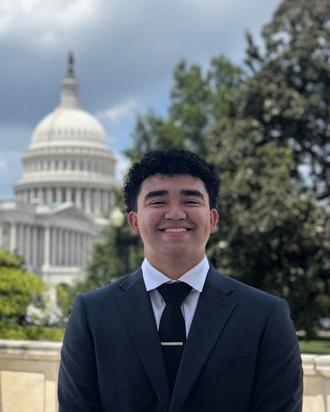
Kevin is passionate about civics and public humanities. He is actively campaigning for a seat on the Prince George’s County Democratic Central Committee; his focus would be on coalitionbuilding, voter outreach, and party education He is a native of Honduras
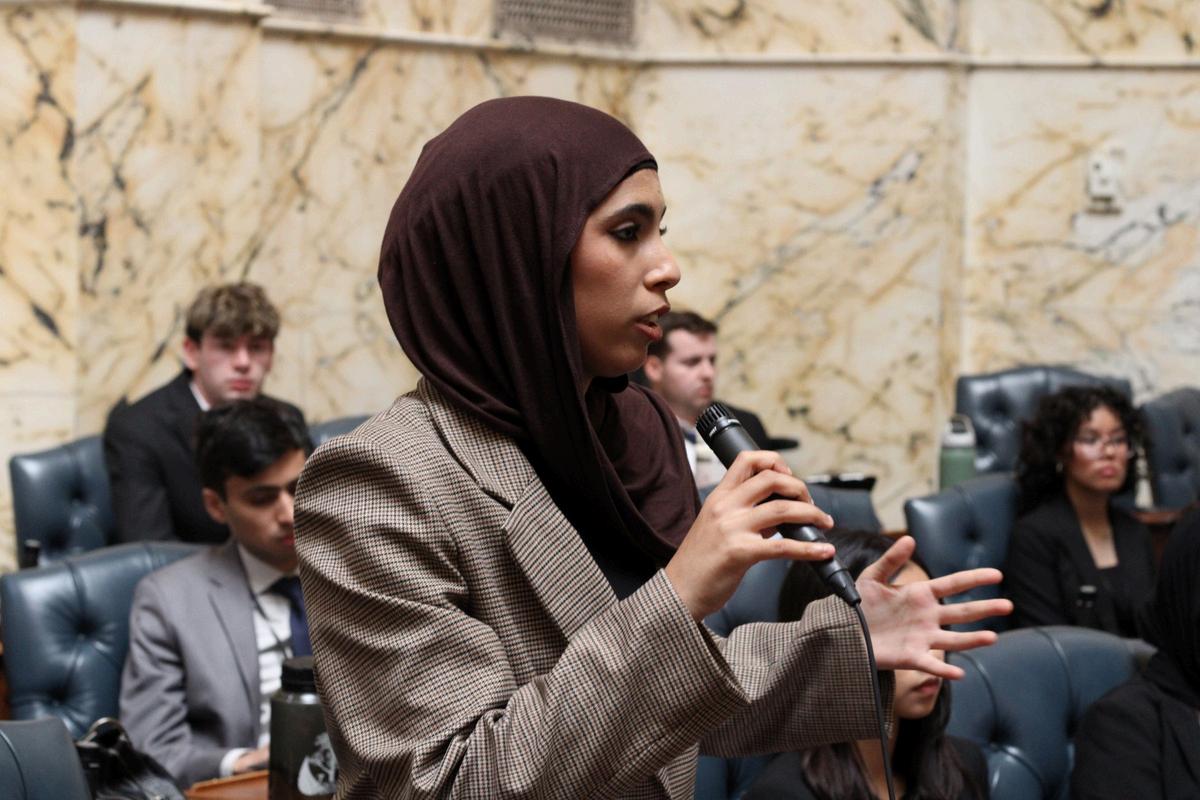
Mariam is a native of Egypt and was appointed to the Prince George’s County Democratic Central Committee in February of 2026, making her the youngest member of the body at 21 years old. She is the first Muslim woman on the committee and is focused on engaging young voters She is actively campaigning for a seat on the Democratic Central Committee
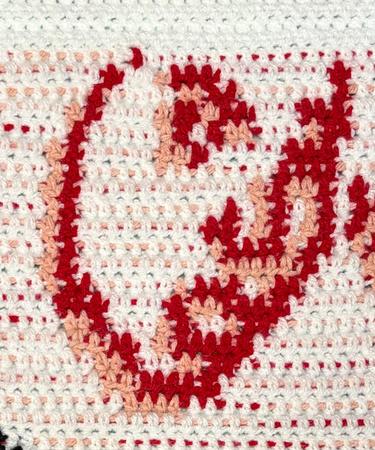
Lily is a senior at St. Johnsbury Academy, St. Johnsbury, VT. This paper is her AP Capstone, a diploma program based on two yearlong AP courses: AP Seminar and AP Research These courses develop students’ skills in research, analysis, and evidence-based arguments culminating in a paper and presentation selected to reflect individual interests and passions.
About Us
MEET THETEA
CScharnberg
Editor
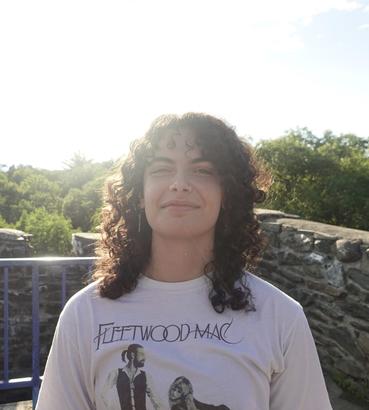
Cale is a junior at the University of Vermont studying Statistics. He spends most of his time playing ultimate frisbee and staying active. Lately, he has been getting into cooking and reading. Cale is super excited for the summer as it means I can go to the beach more!
Editor
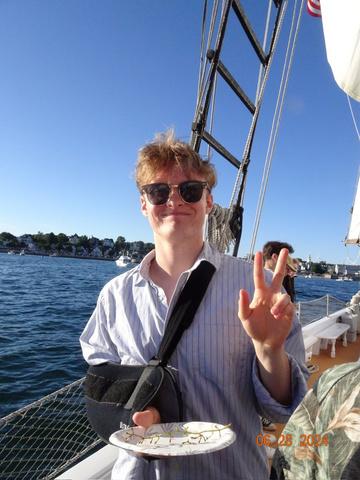
Olivia is a senior year at Montpelier High School In her freetime, she can be found playing music and jamming with her friends, sketching her surroundings, and spending time outdoors. Olivia has a deep love of learning new things, and collaborating with many different kinds of people. After graduation, she intends to study social sciences (and whatever else may interest her along the way).
Editor
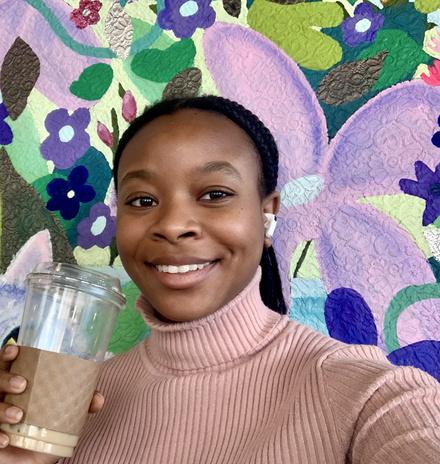
Isis is a senior at Bowie State University in Maryland majoring in Philosophy, Politics, & Economics. She is originally from Southeastern Connecticut and shares an avid love of cooking, reading, and exploring! She is a proud cat mom to Sage and enjoys decompressing with reality TV after a long day. After undergrad, Isis hopes to go on to graduate school to study International Political Economy.
Anonymous THEWARONPEACE
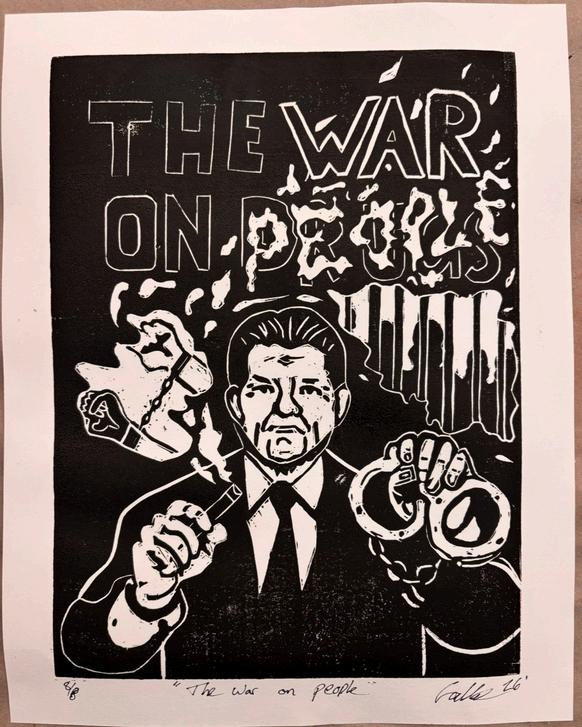
This linocut print critiques how the War on Drugs focused on punishing people rather than addressing addiction. I used bold, heavy lines and strong contrast in value to give the image a tense and restrictive feeling. The white space comes from the smoke rising from the cigarette, which creates movement as it travels across the composition and breaks into the dark negative space Within the smoke, vertical lines and silhouetted shapes suggest people being put behind bars as a result of these policies. The two arms in handcuffs one rendered in white and the other in black represent how criminalization affects different people while trapping them in the same system. The political figure’s angry expression and the handcuffs create emphasis on power and control. Unity and balance come from the mirrored arms, repeated smoke shapes, and consistent line quality throughout the print
YOUNGPEOPLEANDTHE REPAIRWORKOFPOLITICS
Young people are constantly told to get civically engaged and involved—to vote, volunteer, show up, speak up, attend meetings, and share our perspectives. We’re parroted by the older generations of civic leaders as the next pioneers. And of course, all of those matter but there’s a distinguishable difference between being welcomed into civic life, and being trusted with the responsibility inside of it.
A lot of public language about young people is complimentary but imprecise. We are called the future, the next generation, the fresh voices in the room. Fine. But after a while, that starts to feel a little overly convenient. Being called the future can become a way of being kept out of the present. What many young people want is not endless celebration. Rather, we want a clearer path into real work. Learning what politics and civics are happens at a young age, but the work of learning how to engage effectively and create tangible, real impact is delayed among the youth. Part of the problem is that politics is still unnecessarily difficult to understand from the outside. People are told that local engagement matters, but the structures themselves are often murky.
We are both candidates for our local Democratic Central Committee in Prince George’s County, Maryland. Mariam Kamel, 21, born in Egypt and moving to Prince George’s County in 2024, was appointed to be on the Democratic Central Committee in February 2026. Kevin Lopez Cruz, 20, born in Honduras, is running on a platform of openness and pioneering civic engagement structures being built for voters. So, let us say one thing clearly at the outset: this piece is a broader reflection on political and power culture, and on the way our systems often praise young people while keeping us just far enough from the machinery itself.
Committees, precinct systems, party organizations, advisory bodies, commissions. Many of these institutions matter a great deal, but they are not always explained in ways that feel plain, public, or easy to enter. Mariam Kamel recalls a time where she got a message from a colleague of hers, an extremely wellinformed and intelligent, ambitious young man, who was passionate about getting involved. Yet, despite this, he had reached out asking for help to find opportunities. “I’ve been looking, but things have been pretty nebulous on my end..” “...and stuff has been pretty nebulous on how it operates and how to get involved.”
If you did not grow up around them, they can feel like a hidden map everyone else received in advance. With the lack of effective outreach and youth integration, there should be no wonder why more people do not participate. Young people notice this quickly. We notice when civic information is scattered. We notice when important processes are described in language that assumes prior familiarity. We notice when opportunities are technically open but practically impossible to access. We notice when participation seems to depend less on public clarity than on insider knowledge.
That is part of why young people matter to politics. Not because youth automatically makes anyone right, or wiser, or more qualified by default. It does not. Young people matter because newer generations often arrive without the habit of accepting unnecessary confusion as normal. We ask questions that can sound basic, but are often important: What does this group actually do? By what means? How does someone how do I get involved? Those are not shallow questions. They are often the beginning of repair.
Politics is often marketed to young people as campaigns, election nights, and sweeping, decisive moments that feel almost staged, like something out of a Hollywood production, as if unseen hands are pulling every string. In reality, it is far less theatrical and far more human, shaped by patience, explanation, and the slow, ongoing work of making systems understandable and accountable to the people they are meant to serve. Young people can and should take the stage, but the stage isn’t where they primarily need to be.
Young people can contribute meaningfully to that work because we are often close enough to the public facing side of institutions to see where they stop making sense. We still remember what it feels like to encounter civic life without a decoder. That perspective is useful, and in many cases necessary, if political life is going to remain open, legible, and alive. This is not an argument for youth as decoration. It is not a call for symbolic inclusion so an institution can look modern and call it progress. It is a case for younger people as part of the ongoing work of updating public life.
Politics needs experience. It also needs renewal. It needs people who know how institutions work, and people willing to ask whether those institutions are still working well for the public. Young people are not the whole answer. But we are part of it. Not because we are young, exactly, but because every healthy democratic system needs people ready to enter, interpret, question, and improve the structures around them. The political apparatus does not need youth as a slogan. It needs younger generations as part of the repair work.
USINGTAPESTRYCROCHETTOCREATE FEMINISTARTPORTRAYINGWOMEN'S FIGHTFORREPRODUCTIVERIGHTS
Context
The controversy of abortion, contraception, and other reproductive rights has existed for centuries. While the views, legality, and punishments for these rights have changed, it has always been woven into our history. Recently, with the overturn of Roe v. Wade (1973) in 2022 through Dobbs v. Jackson Women’s Health Organization, these issues have risen once again. Roe v. Wade maintained that women had a “right to privacy…[that] extended to a woman ’ s decision to have an abortion” (Hawley, 2016). The emphasis was heavily placed on protecting women ’ s personal reproductive choices. However, Dobbs v. Jackson not only threatened this right, but also threatened “gestational limits, attacks on medication abortion, and subsequent restrictions on gender affirming care”(Patronas, 2024). While the government attempted to use these laws to control women ’ s reproductive rights, the results backfired. In fact, birth rates have greatly fallen, supporting that, when it comes to reproductive rights, “prohibition never works”(Abbott, 2025).
With these controversies came the rise of the Reproductive Justice Movement. This movement was set in place to represent feminism, women ’ s reproductive rights, and the belief that “childbearing bodies have the right not to have a child, the right to have a child, and the right to parent children in a safe and healthy environment” (Patronas, 2024). This movement stands to protect women and children from harm and give them both the possibility of a happy and healthy life.
This is what I will be attempting to portray with my project by making a political statement about women ’ s right to abortion using the medium of tapestry crochet. Some examples of using textile art to make a public political statement include “ yarn bombing” or “knit graffiti”. These can be large or small displays, all are created with the purpose of making public political statements, “enhancing communities”, and emphasizing the power of craft and art in the political world (Moore, 2019). Textile arts also have a deep connection to women ’ s history. Women’s relationship to crafts such as crochet, knitting, weaving, and embroidery have been a deeply rooted part of many generations of women. In many cultures and families, textile arts are passed on from woman to woman to tell stories and maintain memories of people and events (Fisk 2019). They do this by preserving images in textile form that spark memories of both celebratory, mournful, or historical events. Thus, with the combination of the images within the art as well as the medium, this project will be able to connect with women on a deeper level, telling stories about women ’ s fight for reproductive rights.
Research Question and Gap
Between women ’ s history with reproductive rights, public feminist art, and textile artistry within the context of political art, there is a gap in knowledge with not enough research or representation to establish a prominent discussion. This led me to question how can I incorporate artistic representation of women ' s fight for reproductive rights into a crochet tapestry? This question contains several deeper questions that need to be addressed to answer the question and complete the project. These include: What events regarding reproductive rights in history prompted large waves of political art? How does public art make a statement and contribute to larger political debates? What aspects of political art represent women ’ s reproductive rights?
History
To understand women ’ s current struggle with abortion, it is important to look at the historical legality and stigma of abortion. Throughout history, abortion has been common in many different communities regardless of the legality of it. For example, enslaved women would have abortions to not only protect themselves and their children from future harm and inequality, but also as a form of rebellion and regaining control over their lives. Abortion has always been ingrained in sex work. It functioned as protection and control over these women ’ s lives and enabled them to remain in the industry. (Abbott). With the Fourteenth Amendment, however, the “right to privacy…extended to a woman ’ s decision to have an abortion”. This represented progress for women ’ s rights and broadening freedom that brought with it relief of the “suffering and agony ” many women had to face (Hawley).
There were also several different forms of punishment and fearmongering imposed on women who had an abortion. In the 1800s and 1900s, women could be “tortured with scorching pincers, then drowned” if it was discovered that they had an abortion (Abbott). An example of this is Madam Restell, a midwife and strong advocate for abortion rights. Restell was frequently targeted by Anthony Comstock, a fervent antiabortion advocate. In 1847, Restell was imprisoned and ultimately committed suicide. This was not an isolated occurrence. Comstock boasted about causing over 15 suicides due to these laws (Hawley). Despite laws aiming to protect or limit women ’ s right to abortion, governmental attempts to control women ’ s reproductivity do not work.
The reasons for the consistent fight for reproductive rights throughout history includes both the governmental methods of taking these rights away and the non-stop determination of the women in this fight. After the Dobbs decision, the rate of abortions did not fall and birth rates did not rise. Instead, “the number of unwanted pregnancies soared...to an estimated one million abortions yearly” (Abbott), which led to more women being imprisoned, fired, and, in some cases, “sent away to maternity wards to secretly birth and give their children up for adoption” (Hawley). Dobbs functioned primarily as a power move against women ’ s freedom and choice. However, not all women were afraid. There were many who used this to fuel their activism and support for women ’ s rights.
Public Art
The second aspect of my research is the practice of feminist art and how the exhibition of this art can make social change. Cywiński & Parchimowicz (2025) define feminist art as “ a dynamic phenomenon in which women…employ diverse artistic strategies to negotiate their visibility and challenge male dominance”. This being said, there are certain standards and rules that art must follow to be included under this term. For example, it must connect to a “community of interest”, which functions as a wider group of intended viewers for the artwork to connect and inspire change (Mullin, 2003, p. 12).
Art has been a mode of communication since before spoken language. This implies that art can function as a universal language for all viewers. Both Mullin (2003) and Nys (2022) express that, because color and human figure is such a fundamental form of visualizing the surrounding world, it becomes a universal mode of communication and conversation. Additionally, this gives the power of the art piece to the viewer. Since art can be interpreted in so many different ways by each and every viewer, the impact of the piece prompts questions instead of imposing ideas or values (Mullin, 2003). This makes it so the viewer can connect to the piece on an “intimate level” (Sliwinska & Sliwinska, 2024), hopefully leading to more activism and action due to the personal connections the viewer may then feel toward the movement (Black & Burisch, 2020).
There are currently national debates about whether or not art can be an effective bridge between politics and culture. With one side arguing that public art can work to preserve human history as well as the present (Patronas, 2024). Furthermore, Mullin also argues that both politics and art are parts of human nature and since physical and emotional aspects of humans are portrayed through art, “it should be uncontroversial…that artworks may imaginatively explore moral and political ideas” (Mullin, 2003, p.10). This would also humanize politics and make it more accessible to a wider variety of people.
On the other side of the argument, there are several art critics and activists who believe that art is not an effective way of portraying political ideas. There are also several cases where people believe that, while art in general could be an effective way of activism, feminist art is not as productive due to its underrepresentation in the art world (Mullin, 2003). Others believe that political art is not effective at all and argue that it can lead to the “enhancement of self-esteem or the exertion of control through the devaluation of others” (Nys, 2022, p. 24). This perspective mainly focuses on the bias and personalization of art. However, due to art's universal nature, the bias originates from the viewer and their interpretation of the piece, rather than the artist.
Art Analysis
The third aspect of research that I will explore is the analysis of feminist art. This is vital because it is necessary to establish a baseline for how scholars analyze art to then build a system that will work for this project. In some cases, this is called “feminist art epistemologies (FAE’s)”, which functions as a “framework” for “enlightened modes of engaging with feminist art” (Brand, 2006, p. 166). The analysis draws attention to feminist art and, in this way, inherently creates “ a conception of history that puts women at the center” and “gives agency back to women ” , which is in and of itself an act against the patriarchal norms (Siler, 2017, p. 25-26).
Analyzing feminist art also makes the argument that there is importance in the artwork as well as influential perspectives that could contribute to the fight against the patriarchy. Feminist art often poses a “challenge to the well-known historical tradition of depictions of women by which male artists stereotype them as purely sexual, passive, and dependent” (Brand, 2006, p. 168). Thus, every image in a feminist artpiece can be a symbol, lesson, or story that can be discovered through the analysis. Siler (2017, p. 23) found that, in several older representations of women, their facial features appeared to be “ very minimalistic”, representing “ a generalized female form”. Similarly, Meagher (2011, p. 305) argues that feminist art that is represented in this vague manner “yields to fantasies and caricatures in ways that flatten out and obscure the voices and practices”, expressing the artist's bias and taking away from the overall objective. However, these nonspecific female figures may also cause the piece to connect and identify with a larger group of women.
Tapestry Crochet
The final aspect of my research will dive into tapestry crochet: how it connects with women ’ s history and how it can be an effective mode of political art. Women have a deep and complicated relationship with textile arts. It is connected to both women ’ s oppression and empowerment. Thus, women ’ s generational identities are often rooted in some way with textile arts (Johnson & Wilson, 2005). This also results in tapestry functioning as a generational “ process of mourning and commemoration” (Fisk, 2019, p. 2). This can also be applied to detrimental historical events related to women ’ s reproductive rights.
While this establishes the historical connection between women and crochet, there are also more modern applications of feminist tapestry crochet, specifically exemplified in street art (O’Mahony, 2016). Since tapestry is such a unique form of art with a very niche relationship with women ’ s history, it “establishes its own existence, its own language, its own special feel for colour”. This means that it is much less common within tapestry that stories, ideas, and images are simply copied from other artists or artworks. Instead it aims to “make a proper extension from the original work in tapestry terms”, creating an entirely new perspective (More et al., 1992, p. 705).
However, there are limitations of tapestry crochet as a medium of art, especially when done by only one person. More et al. (1992) argues that “tapestry is a slow process, ” limiting the reaction time to a political controversy. This could either make this medium a less effective form of political art, or give more nuance to the conversation, providing both the artist and the viewer to reflect on their political beliefs.
Choosing Artwork
The first step of the art analysis processes is choosing what art to analyze. I went into this process looking for a variety of artworks: some street art and some displayed in museums. This was primarily to find art with the largest audience. While museum art was very important to include, due to its greater impact and acclaim in the art community, street art is much more accessible to people in their everyday life. This can also lead to more authenticity in the art due to its low stakes and inherent political nature.
My criteria for art was simple, focusing only on pieces that showed a clear connection to the Reproductive Justice Movement. I expanded my time frame throughout this process, to include a broader scope in which I could find art as well as to support the statement that this issue has been deeply rooted in US history, not just in the past few years. The art pieces span from the 1980’s with one exception in 1932. I found 12 pieces of reproductive rights art and began analyzing.
For the art analysis, my goal was to draw out several aspects from the artwork and review how those pieces came together to give the work meaning. Hawley (2016, p. 33), demonstrates this with an analysis of a statue. It begins with a description of the image: “ a graphic rendering of a blindfolded, Venus-like statue, whose womb is emphasized while her armless, visionless state…” It then draws connections between the aspects of the statue to the pro-choice statement that it makes, stating that it “speaks to the helplessness she experiences” and argues that the “of-the-ancients quality” adds to the idea that this is an “age-old issue”.
Patronas (2024), also gives an example of an art analysis. This analysis depicts the poster almost exactly, stating the main text: “‘GUERRILLA
GIRLS DEMAND A RETURN TO TRADITIONAL VALUES ON ABORTION’”
and the subtext, “‘Before the mid-19th century, abortion in the first few months of pregnancy was legal. Even the Catholic Church did not forbid it until 1869’” (Fig. 1). Petronas then connects this to the “‘traditional values’” of the church and how this turns that rhetoric against itself and its hypocrisy.
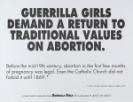
Fig. 1 (Guerrilla Girls, 1992)
Both of these analyses put first priority on describing and depicting the actual art, then drawing conclusions about the arguments they make. This lets the art analyzer draw attention to the art, make a statement about what they believe it represents and, most importantly, it lets the reader draw their own conclusions from the image. While these examples demonstrate the goal I wished to achieve with my analyses, I also integrated a more specific approach. I aimed to learn and use well known art elements and language to both describe the art and bring meaning to it. Thakur (2023), goes into detail, explaining several of these elements and how they create meaning in art by the emotions or thoughts that they provoke in the viewer. The key elements I chose to include were color, tone, form, space, and line.
Color
According to Thakur (2023, p. 290), color’s main function is to “represent our feeling”. It is one of the most important elements of art, also taking on the values of the other elements. For example, it can “construct line, form, and tonal value, impart texture, imply space, ideas, emotions and interpret feelings”. There are three main subcategories of color: hue, tone, and texture. While hue and texture are very important to an artwork, they are very reliant on the color itself. I chose to make tone its own category, because it can draw out an individual meaning from the artwork.
Tone
Thakur (2023, p. 292) defines tone as “the extent of lightness or darkness” throughout a painting. The meaning that tone brings to the art piece depends on how subtle the contrast and range of black and white show up. The more subtle it is, the wider range of emotions it has the ability to express.
Form
Form is defined by “the shape of volume or mass…which reveals its character” (Thakur, p.289). Some defining characteristics of form that I chose to focus on were the size, volume, shape, proportion, and organization. Developed or round forms “tend to please, meanwhile undeveloped or wrinkled, or jagged forms “tend to displease”. Both the shape and the object a form may represent can contribute to the emotions the viewer feels. This includes awe, strength, pride, and grandeur.
Space
Space is defined as “ a sense of gravity or depth”. In analyzing the space of an artwork, it is important to look at both the positive and negative space. Positive space is “occupied by the primary objects” and negative space is the “ area around the primary objects”. Another aspect of space I chose to focus on is balance. Balance can be symmetrical or asymmetrical, or “informal” (Thakur, p. 290).
Line
The lines that make up an artwork can represent “mood, attitude, or feeling”. The main descriptors I focused on were jagged, straight, wavy, thin, or thick. Thakur mentions how vertical and horizontal lines can also indicate the emotions of an artwork. Vertical lines are connected to “strength, courage, and authority” meanwhile horizontal lines convey calm and quiet settings (Thakur, p. 288).
Communication and Organization
Organization is one of the most essential aspects of art analysis. Patronas (p. 156) uses the term, “Knowledge Organization”, defined as the “relations between ideas and how they can be classified in a way that allows for effective retrieval”. For this purpose, I chose to organize all my observations and analyses in a table (Fig. 2). It was organized into columns, for each aspect I was observing: color, tone, form, space, line, and words, and rows for each art piece then compared the most common aspects of the art pieces to examine which elements were most popular in this art genre (Fig. 3). This helped me to decide which aspects would be most important to add into my own piece.
Creating a Pattern
The first step in creating my pattern was putting together an image I would crochet using the most common observations I pulled from the artwork as well as some of my own artistic choices. From these results, I chose to focus on white, black, and red, with a darker tone. I wanted to primarily stick to women ’ s faces with mostly undeveloped, thin, jagged lines. I then compiled these images into one sketch. This sketch included an image of a courthouse with a uterus at the top and faces surrounding it in the empty space. I used a digital software called “Stitch Fiddle” to transfer my sketch into a color block design, sometimes known as an alpha pattern. I decided to use “textual instructions” to communicate my pattern. Seitz et al. (2022) defines this as a “mixture of free form text and semi-formal representations of the actual pattern”. This included the color block pattern as well as written details about the yarn and the stitch. While there are some risks with this form of instruction, including room for error in the writing process, I decided it would be the best technique for my purpose as well as an easy way to make the pattern repeatable.
Crocheting
There were many important decisions that went into the crocheting process. These included what type of yarn I would use, what type of stitch, what hook, and how I would bring the yarn through the tapestry. In choosing what type of yarn I would use, I had to consider the yarn weight/ thickness and the gauge (“number of stitches per inch”). Brittain (2023) discusses how these aspects affect the final product, stating, “the thicker the yarn, the larger the stitches you'll be able to create”. For this reason, I chose to use a worsted acrylic yarn. I wanted thicker yarn to make a larger tapestry, however, I wanted to still be able to have delicate details to bring out the thin lines, which is why I did not choose a thicker yarn. Most yarn has a recommended hook size, so I used a 5mm hook, as the yarn recommended.
Next, I chose to use a half double crochet stitch throughout the entire tapestry to create an even and consistent piece. In my experience with crochet, a half-double stitch creates the closest shape to a square than any other stitch that I have used. Therefore I chose this to give my tapestry the desired proportions, staying as close to the grid pattern as I could. Lastly, I chose to pull the yarn through the stitches (Fig. 3) as I switched colors throughout the majority of the tapestry, only pulling the yarn around the back (Fig. 4) when there was a large gap in a certain color. Since the yarn was fairly thick, it would be able to effectively cover up the other colors of yarn as well as conceal them from the back to make a neater finished look.
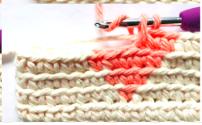
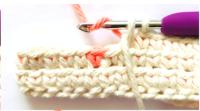
Fig. 3, 4 (Yang, 2021)
Results
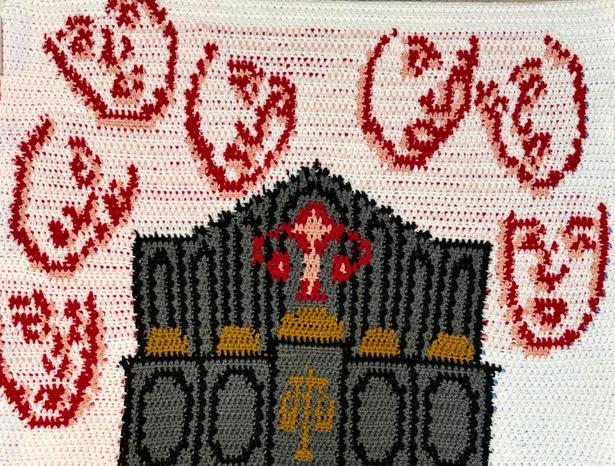
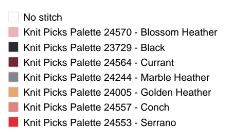
The digital pattern (fig. 5) includes a 65 x 100 square grid with my design represented by five of the “Knit Picks” color palette, which was provided on the website. Each square represented one stitch, which made it very easy to create the final tapestry (fig. 6) to a similar scale. Although I was prepared to space out the crocheting over a period of one month, the tapestry took me approximately two weeks to complete, ending with a 31” by 23” rectangle.
(Fig. 6)
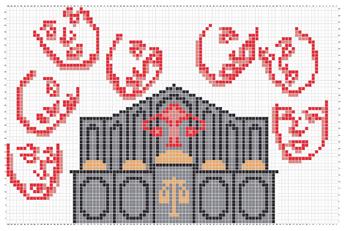
Fig. 5 (Stitch Fiddle, 2026)
Yarn: “Amigo XL”; 100% acrylic/ polyacryl
Stitch: Half-double crochet
Hook: 5 mm
Discussion
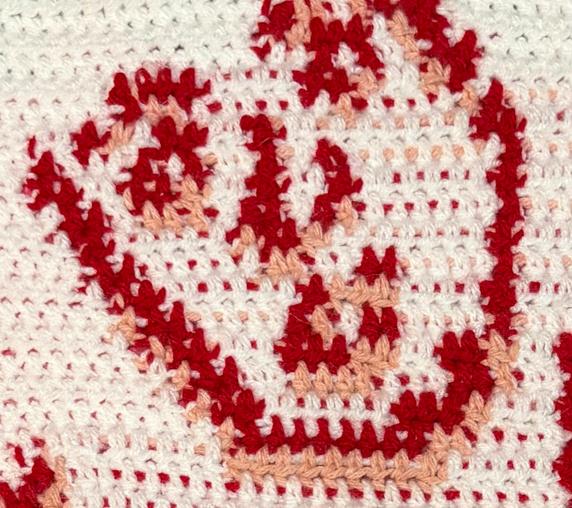
Every aspect of my final artwork contributed to the meaning of the piece. While not every decision aligned with the most common details of the analyzed artwork, every decision had a purpose. From the beginning, I knew I wanted to include faces in the piece; either an image of a woman or a face was included in nine out of the twelve art pieces. While, ideally these faces would have been in pain and anger, it ended up being very difficult to represent that in crochet. Instead, I chose to crochet the faces in red as color is deeply connected to emotion, specifically drawing attention and associated with anger (Thakur, 2023). The purpose of these faces (Fig. 7, 8) was to include women ’ s stories and the lives that they represented. This gave more humanity to the women within the conversation of reproductive rights and demonstrated how they are real people who will be affected by the laws implemented by the government.
(Fig. 7, 8)
The courthouse (Fig. 9) represented the government and the laws that impact women ’ s lives. I chose a courthouse because these are where the laws are enforced and implemented. I also included the Scales of Justice as an ironic symbol to further emphasize the representation of the court. It shows that, while the purpose of the court is to maintain balance and justice, women ’ s health and wellbeing is not often taken into equal account as men ’ s and, occasionally, fetuses. While the representation of the government, specifically government officials, only showed up in three of the twelve art pieces, I believed the courthouse would be a helpful symbol in the meaning of my piece. This would also allow my piece to create and explore more artwork with governmental representation. For this courthouse, I chose gray, black, and a dark yellow with solid, straight lines. This added a darker tone to the piece and would hopefully create a sense of dread and disgust toward the court (Thakur, 2023).
I then included a uterus at the center of the court (Fig. 10). This was meant to bring women ’ s health into the legal conversation. The image of the uterus was not common in my analyses either, however, I wanted to avoid any representation of a fetus to continue the centralization of women ’ s health and safety within this movement. I chose to use the same colors for the uterus as the faces to emphasize their connection. This represents the fact that it is both women ’ s health and women ’ s humanity that is put in jeopardy with Dobbs v. Jackson and many other laws that take reproductive choice away from women.
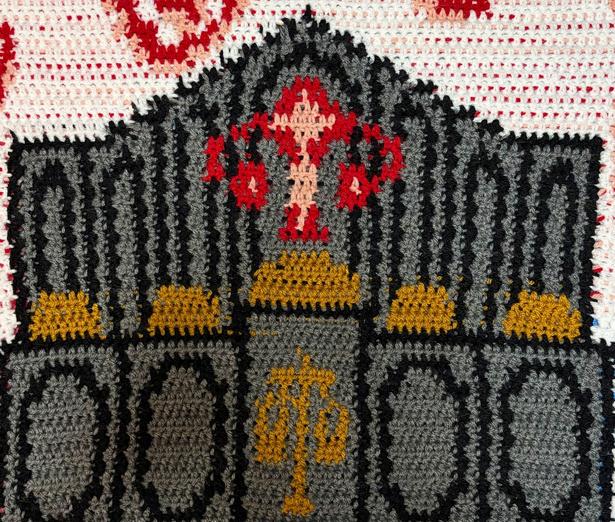
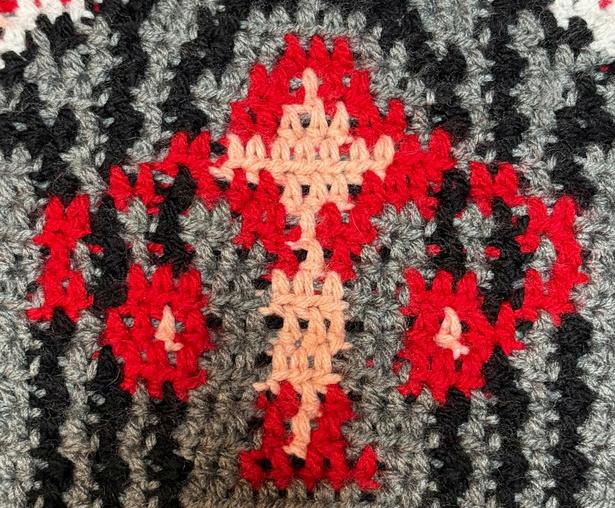
(Fig. 9, 10)
Limitations
There were several limitations within this process. One limitation was that we were not able to see how effective it truly was, or even to take anyone else’s opinions of the piece into account. The public aspect of political art is a very large part of what makes it effective and political. However I was not able to get it out into a public space due to the difficulty of accurately analyzing viewers’ opinions and thoughts on the piece. Another limitation to this piece is the cost of the yarn. I was only able to make a 31” by 23” tapestry, which is not quite as moving as a larger scale tapestry. This also makes crochet tapestry a less accessible form of art. The purpose of public political art is to provide an accessible way for activists to make an impact within the movement. However, crochet, especially at a larger scale such as a tapestry, demands a very particular skill set. This also limited my ability to include words within the tapestry. Although this was a part of the original plan, I decided the intricate lines of letters would be too difficult to include within this project.
Conclusion
Throughout the art analysis, pattern creation, and crochet process I was able to dive deeper into the meaning of political art. I found that every aspect of the artwork contributed to the purpose and there is always more to learn about a piece. I also found that the true meaning that the artist intended may not be fully represented by the artwork, especially when it is difficult to add intricate details. I also realized how courageous and vulnerable it can feel to put one ’ s political art in public, despite its activist purpose. This strengthened my respect for artists and activists who take the time to put their art into the public to make a change.
In future research, I would hope to put my own art out in public to see the impact and meaning it brings, focusing on some of the most common images and colors of political art. I would also want to learn more about the comparison in impact or how the public receives painting activism as opposed to crochet tapestry. Art has been an expression of activism for centuries and, especially when considering women ’ s history with having their voices heard within politics, it is incredibly important that it continues. Political art helps to amplify women ’ s and artist’s voices in an empowering and peaceful way.
References
Abbott, E. (2025). A right to choose: Efforts to prohibit abortion down the ages. TLS. Times Literary Supplement, (6383), 12+
Black, A , & Burisch, N (Eds ) (2020) The new politics of the handmade: craft, art and design. Bloomsbury Publishing.
Brand, P. (2006). Feminist art epistemologies: Understanding feminist art. Hypatia, 21(3), 166-189.
Brittain, S. (2023). Crochet Patterns For Dummies. John Wiley & Sons.
Brown, W E (2022) Abortion is Life [Photograph]
https://www theguardian com/artanddesign/2022/nov/07/abortion-billboards-us-roev-wa de-midterms-art
Conal, R. (2022). Supreme Injustices, [photo]
https://www.brooklynstreetart.com/2022/08/02/supreme-injustices-artist-robbie-conalske wers-scotus-in-new-poster/
Cywiński, A , & Parchimowicz, M (2025) What does street art in Florence, depicting women, aim to convey to its residents and tourists? Arts, 14(4) http://dx.doi.org/10.3390/arts14040070
Fisk, A. (2019). “Stitch for stitch, you are remembering”: knitting and crochet as material memorialization. Material Religion, 15(5), 553-576.
Gabriel, F., & Afolabi, T. (2025). Ar(c)tivism and policing: Unveiling the theatrics of justice and resistance in Nigeria’s Sọrọ-Sókè Movement Arts, 14(3)
http://dx doi org/10 3390/arts14030046
Garrett, D. (2022). Elephant in the Room [Mural]. https://athenaprojectarts.org/2025athena-art-for-reproductivejustice/
Garrett, D. (2025). Writing on the Wall [Mural]. https://athenaprojectarts.org/2025athena-art-for-reproductivejustice/
Guerrilla Girls (1992) Guerrilla Girls Demand a Return to Traditional Values on Abortion [poster] National Gallery of Art, Washington, D C , United States https://www.nga.gov/artworks/139862-guerrilla-girls-demand-return-traditional-valuesabortion
Hawley, E. S. (2016). Activist art and abortion rights in the post-Roe v. Wade United States: An analysis of the archival works of REPOhistory, Kerr+ Malley, and Andrea Bowers. Nierika, (10), 27-44
Hijack [Black and White Mural of government official holding up girl like a puppet] ([n d ]) (2022). [Mural]. Alabama, US/ https://streetartutopia.com/2022/06/26/street-art-onabortion-and-religion-by-hijack/ Johnson, J. S., & Wilson, L. E. (2005). “It says you really care ” : Motivational factors of contemporary female handcrafters. Clothing and Textiles Research Journal, 23(2), 115-130 Justia (2019) Roe v Wade, 410 U S 113 (1973) Justia Law https://supreme justia com/cases/federal/us/410/113/
Kahlo, F. (1932). Frida and the Miscarriage [Lithograph]. New York, U.S.
https://gagosian com/quarterly/2023/05/02/essay-american-artists-and-reproductivejustice/
Kruger, B. (1989). Untitled (Your body is a battleground) [Photographic silkscreen on vinyl]. The Broad, Los Angeles.
Martz, H. B. (2022).This is a state of emergency for abortion rights right now. [Photograph].
https://www theguardian com/artanddesign/2022/nov/07/abortion-billboards-us-roev-wa de-midterms-art
Meagher, M. (2011). Telling stories about feminist art. Feminist Theory, 12(3), 297-316.
Minter, M. (2020). CUNTROL [Dye-sublimation print on aluminum]. New York, U.S. https://www.artnews.com/art-news/news/artist-and-activist-marilyn-minter-on-roewade-supreme-court-leak-1234627748/
More, J , Fassett, K , McArthur, Christine, Rogoyska, M , & Wright, H (1992) Tapestry: Art, craft and collaboration RSA journal, 140(5433), 701-707.
Mullin, A. (2003). Feminist art and the political imagination. Hypatia, 18(4), 189–213.
http://www.jstor.org/stable/3810980
Nys, T. (2022). Contesting abortion stigma through contemporary visual art (Doctoral dissertation, Loughborough University).
O’Mahony, C (2016) Renaissance and resistance: Modern french tapestry and collective craft The Journal of Modern Craft, 9(3), 265-288
Patronas, E. (2024). Bans off our bodies: Categorizing and analyzing reproductive justice street art across the United States (June 2022 to June 2023). New Errands: The Undergraduate Journal of American Studies, 152-182.
Petchesky, R. P. (2021). Fetal images: The power of visual culture in the politics of reproduction In The medicalization of obstetrics (pp 361-390) Routledge
Raven, A , Langer, C , & Frueh, J (2018) Feminist art criticism: An anthology Routledge
Read, H. (2024). The meaning of art. Porirua Publishing.
Reckitt, H. (2022). The art of feminism. Chronicle Books.
Rego, P. (1998). Untitled No. 5 [Painting]. Museum of Modern Art/ Abortion Series, New York, U.S. https://athenaprojectarts.org/2025-athena-art-for-reproductivejustice/ Seitz, K , Rein, P , Lincke, J , & Hirschfeld, R (2022, November) Digital crochet: toward a visual language for pattern description In Proceedings of the 2022 ACM SIGPLAN International Symposium on New Ideas, New Paradigms, and Reflections on Programming and Software (pp. 48-62).
Shih, V. (2022). Roe vs. Wade [Political Illustration]. New York, U.S. https://www.vivshih.com/illustration/roevswade-y6f4d-na4c8
Siler, M (2017) The female body as a sacred symbol: An analysis of goddess theology and its relation to feminist archaeology and feminist art history.
Sliwinska, B., & Sliwinska, B. (2024). Transnational visual activism for women ’ s reproductive rights. Taylor & Francis.
Stitch Fiddle. (2026). Stitch Fiddle. https://www.stitchfiddle.com/en/c/sgkoqb-bc4db8? refresh=1772719983823
Supreme Court of The United States. (2022). Dobbs v. Jackson Women’s Health Organization. https://www.supremecourt.gov/opinions/21pdf/19-1392 6j37.pdf
Thakur, M. (2023). An analysis of the art elements utilized in a works of art. Williams, J. N. (2023). [Green, floral mural of Amber Nicole Thurman and Candi Miller] ([n.d.]) [Mural]. Atlanta, GA. https://www.freeandjust.us/press/062125-atlanta-muralgeorgia-women
Yang, A. (2021, April 15). How To Do Tapestry Crochet? - Haven Crochet Designs. Haven Crochet Designs. https://havencrochetdesigns.com/how-to-do-tapestry-crochet/ Zhu, D. T., Zhao, L., Alzoubi, T., Shenin, N., Baskaran, T., Tikhonov, J., & Wang, C. (2024). Public health and clinical implications of Dobbs v. Jackson for patients and healthcare providers: A scoping review. PLoS One, 19(3), e0288947.
Appendix: Art Analysis Chart
Artwork
Name of Artwork
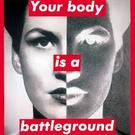
Untitled (Your body is a battleground) (Kruger, 1989)
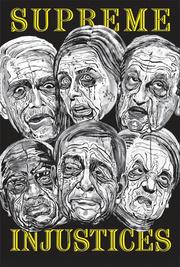
Supreme Injustices (Conal, 2022)
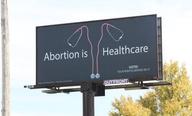
This is a state of emergency for abortion rights right now (Martz, 2022)
Color Black, white, gray, red Black, white, yellow Navy, white, pink
Tone
Deep contrast, no bright white, very deep black
Form
Space
Woman’s face, negative image, large face, smaller words, fully developed shape
Black background with white faces covering most of the foreground
Six old wrinkled, disheveled faces, large faces, feel like they are taking over, drooping, round, undeveloped
Majority dark
Two stethoscopes forming a uterus shape, small shapes in big space
Very balanced, even, mostly positive space
Line
Vertical line down the middle, solid lines around words, softer lines around face
Balanced and symmetrical, most positive space, negative space is empty Most negative space, very balanced
Jagged, wavy lines all around faces, droopy and dark
Wavy lines, solid words
Words “Your body is a battleground” “Supreme injustices” “Abortion is Healthcare”
Artwork

Name of Artwork
Abortion is Life (Brown, 2022)
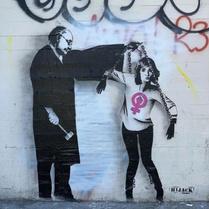
Untitled (Hijack, 2022)
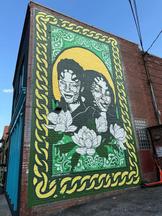
Untitled (Williams, 2023)
Color
Tone
Red, orange, yellow, green, blue, purple, pink, white
Majority dark with bright pops of light to make it stand out
Black, white, pink
Form
Space
Line
Leafy background with many colored flowers spelling out the words, even volume
Balanced, most negative space
Jagged wavy thick lines all around the flowers and leaves
Man wearing mostly black, woman wear both but eyes is drawn to white
Governmental official, most likely judge holding up a woman with strings like a puppet Woman has the gender symbol for women on her shirt, man much bigger than woman
Not balanced, more positive space on left
Straighter lines on man, wavier on woman
Black, white, green, yellow,
Pretty even amounts of white and black, black mainly just outlining white
Two women smiling, surrounded by flowers and a green background and broken chains around the edges, very large
Balanced most positive space
Thick chains, not straight, very wavy background
Words “Abortion is Life” -- --
Artwork
Name of Artwork
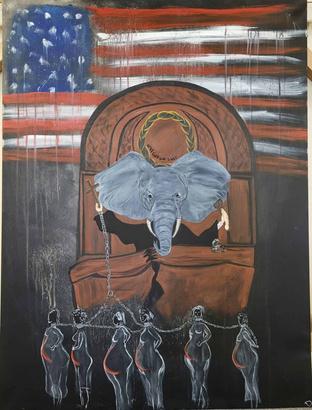
Elephant in the Room (Garrett 2022)
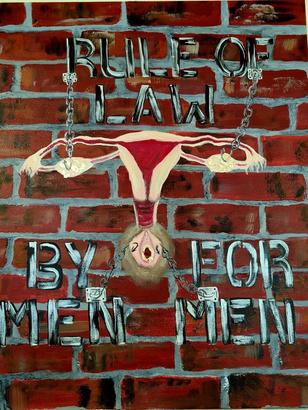
Writing on the Wall (Garrett, 2025)
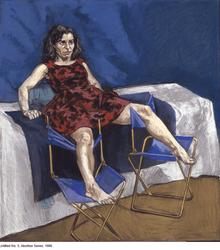
Untitled No 5 (Rego, 1998)
Color
Blue, white, gray, red, brown, black
Black, white, red, beige
Blue, white, brown, red, black, and beige
Tone
Form
Mostly dark, especially women, white in the flag
American flag in the background that looks disheveled and melted, a wood structure with the head of an elephant, pregnant women in chains carrying the large elephant
Uterus is light and standing out, words are white and black
Uterus developed shape, large - ish
Bed is white, mostly dark blue
Woman sitting on a white bed, leaning back with her legs up in two foldable chairs like stirrups, in distress, undeveloped shape, bed bigger than woman
Space
Line
Balanced, more negative space at the bottom
Wavy, incomplete lines on flag, solid lines on wood and elephant, light, thin lines on women
Words --
More negative space, balanced,
Thick, wavy lines
More negative space on right, main forms on left
Straight lines on bed and chairs, wavy lines and jagged lines on girl and dress
“Rule of law”, “by men ” , “for men ” --
Artwork
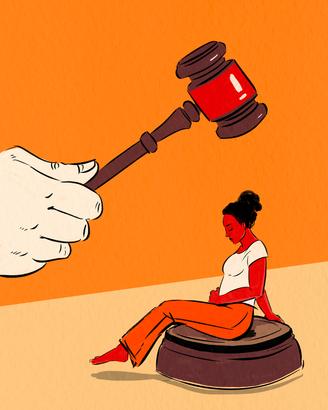
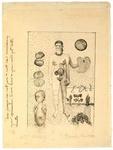
Name of Artwork Roe vs Wade (Shih, 2022) Frida and the Miscarriage (Khalo, 1932)
Color Orange, yellow, white, brown
Tone Very light, making gavel stand out
Form
Pregnant woman of color sitting on the wooden base of a gavel as a man ’ s hand brings the gavel down on her, woman very small, hand and gavel very big,
Black, beige
Light, shading, one leg is darker
Woman standing naked with fetus at her stomach and a string wrapped around her leg connecting the fetus to another image of the fetus below her, tears running down her leg leading to the roots of plants, a figure extending from her arm, 4 images of brain-like structures beside her, fetus is developed shape, woman is not, fetus bigger relative to woman
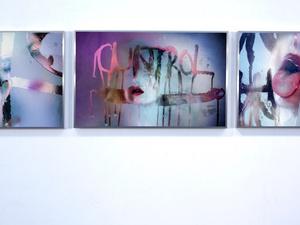
CUNTROL (Minter, 2020)
Pink, red, blue, purple, black, white
Dark tonne, light at the woman ’ s face
Space
Balanced, more negative space
Most negative space, fairly balanced
Woman in a foggy window, lines are undeveloped and melty, face is not fully clear
Line Thin lines, mostly straight
Thin lines, shading, thickest lines around fetus and plants
Mostly negative space, making positive space stand out more, mostly balanced
Round, wavy line, droopy and wrinkled edges
Words -- -- “CUNTROL”
THEELECTORALCOLLEGE: ANARCANEINSTITUTION
For much of human history, a democracy -- the idea that all members of a society should have equal say in what the collective good looked like -- has been seen as a radical, far-out idea. Only in the past few hundred years has it emerged as a popular form of government among the working classes. In 1788, when the US Constitution was ratified, the Founding Fathers were still unsure of the capabilities of the public to make decisions in the best interests of the country. “Political philosophers on both sides of the Atlantic at the time held that the best structure to fence in the dangers inherent in the human passions expressed politically was a mixed government, one that allowed democracy, aristocracy, and monarchy each to restrict the others” (Schmidt, 2002). Thus, the correlation between the American Electoral College and restricting the democratic process was born.
In 1788, no branch of government was truly democratic. In the legislative branch, the House of Representatives was the closest, with Congressmen elected directly by their constituents (democratically), while senators were elected by state legislatures (aristocratically). Because the House was to be a direct democracy, it was crafted to be responsive to the will of the people and “ serve as a forum for more pressing, everyday concerns ” (History.com, 2019); it holds elections biennially, introduces bills regarding revenue and spending, and can impeach federal officials. The judicial branch, while supposed to function independently, is nominated by the executive branch with the support of the legislature through presidential appointments and Senate confirmations. The executive branch is in a unique position. 48 out of 50 states have a winner-take all system, where whichever candidate has a majority of the vote wins the entire state and thus their electors. This leads to situations where a candidate can have a razor-thin majority yet receive all of a state’s electoral votes. The Electoral College has led to several candidates ‘winning’ presidential elections despite not having won a majority of the popular vote. This has led to multiple points in US history where the College has been a point of contention among the public.
The first was the election of 1800, when presidential candidate Thomas Jefferson and his running mate Aaron Burr each received 73 electoral votes, so the vote went to the House of Representatives, which had to vote 36 times to find a winner. In this case, the conflict was within the Democratic-Republican Party, with vice presidential candidate Burr being accused of trying to lobby votes against Jefferson. Although Jefferson ended up winning both the popular and electoral vote, the Electoral College resulted in unnecessary confusion that spurred a lack of faith in the government and the democratic process.
The only other time the House voted to break a tie was in 1824, where, despite receiving only 33% of the vote, John Quincy Adams won the presidential election. The winner of the popular vote, Andrew Jackson, won the most Electoral College and popular votes. But, because of the large pool of candidates, no one was able to receive a majority of the Electoral College. Both Adams and Jackson were members of the same political party, yet had very distinct visions for the future of the country at a pivotal time in the young nation's history. Adams’ victory over Jackson, who had the support of a majority of the electorate, led to Adams’ opponents claiming that Adams had made a ‘corrupt bargain’ with then Speaker of the House, Henry Clay, whom Adams named as his Secretary of State after Clay helped him secure congressional support.
In recent history, the election of 2000 caused the public to criticize not only the Electoral College, but also partisan politics and question the non-partisan nature of the Supreme Court. The Democratic candidate, incumbent Vice President Al Gore, won the popular vote by half a million votes against the thenGovernor of Texas, George W. Bush. But, the state of the election was uncertain after a recount of votes was requested in Florida, where the margin was so narrow it was required by state law. After a month-long Supreme Court case and recount in Florida, it was determined that Bush won Florida by just 537 votes (Federal Election Commission, 2000). Because of this small margin, Bush received all 30 of Florida’s electoral votes and won the presidency.
There were a number of issues raised with Bush’s Florida and subsequent presidential victories. To start, Bush came from a political dynasty with his brother, Jeb, being the governor of Florida at the time of the election. Only a handful of Florida counties were recounted, and there have been disputes among scholars over whether Gore would have won the state if there had been a full recount (National Constitution Center, 2023). Ultimately, the Supreme Court ruled in Bush’s favor, 5-4, along their political affiliations to halt a full state recount. Subsequently, this led to an outroar, with the public upset that, despite having a majority of the vote, Gore lost. Considering the political makeup of the Supreme Court, Bush’s brother serving as governor of the contested state, and his father having been president less than 10 years before the election, this created the perfect landscape for a manufactured Bush win.
Historically, the Electoral College has served as a means of limiting democracy and ensuring that the political elite stay in power. The College takes agency away from the American people and puts it in the hands of the aristocracy by prioritizing their desires over those of everyday people. The amount of votes a state has is determined through an archaic system that does not adequately reflect the US population or their beliefs. The distribution of votes is primarily determined by the number of representatives a state has in Congress, where “The U.S. House of Representatives has one voting member for every 747,000 or so Americans” (Pew Research Center, 2018). The last time the House of Representatives grew was in the mid 20th century when Alaska and Hawaii became states. The US began with an average of about one representative per 57,000 people to one representative per 747,000 people in the 2020s. It is impossible for 435 people to represent a country with a population of more than 330 million people (US Census). The only real way to ensure that the executive branch is truly democratic is to abolish the Electoral College and give Americans control over their futures.
References
Federal Election Commission. "2000 General Election Results." 2000. Web.
https://www.fec.gov/resources/cmscontent/documents/FederalElections2000 PresidentialGe neralElectionResultsbyState.pdf.
History.com. "House of Representatives." Jun 2017. Web. https://www.history.com/topics/us-government-andpolitics/history-of-the-house-of-representatives.
National Constitution Center. "On this day, Bush v. Gore settles 2000 presidential race. " Dec 2023. Web. https://constitutioncenter.org/blog/on-this-day-bush-vgore-anniversary.
Pew Research Center. "U.S. Population Keeps Growing, but House of Representatives is Same Size as in Taft Era." (2018) Web.
Philip R. Schmidt. "The Electoral College and Conflict in American History and Politics." (2002) Web.
US Census Bureau. "US and World Population Clock." Dec 2024. Web. https://www.census.gov/popclock/.