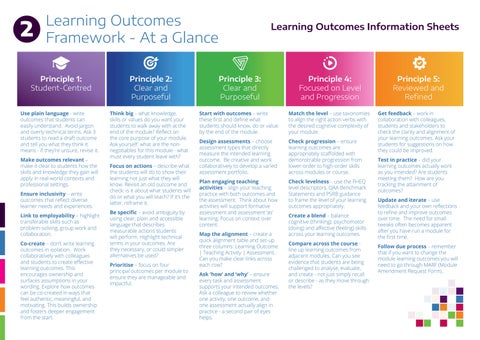
Learning Outcomes Framework - At a Glance
Learning Outcomes Information Sheets
Principle 1: Student-Centred
Principle 2: Clear and Purposeful
Principle 3: Clear and Purposeful
Principle 4: Focused on Level and Progression
Principle 5: Reviewed and Refined
Use plain language - write outcomes that students can easily understand. Avoid jargon and overly technical terms. Ask 3 students to read a draft outcome and tell you what they think it means - if they’re unsure, revise it.
Think big – what knowledge, skills or values do you want your students to walk away with at the end of the module? Reflect on the core purpose of your module. Ask yourself: what are the nonnegotiables for this module - what must every student leave with?
Start with outcomes – write these first and define what students should know, do or value by the end of the module.
Match the level – use taxonomies to align the right action verbs with the desired cognitive complexity of your module.
Design assessments – choose assessment types that directly measure the intended learning outcome. Be creative and work collaboratively to develop a varied assessment portfolio.
Check progression – ensure learning outcomes are appropriately scaffolded with demonstrable progression from lower-order to high-order skills across modules or course.
Get feedback – work in collaboration with colleagues, students and stakeholders to check the clarity and alignment of your learning outcomes. Ask your students for suggestions on how they could be improved.
Plan engaging teaching activities – align your teaching practice with both outcomes and the assessment. Think about how activities will support formative assessment and assessment ‘as’ learning. Focus on context over content.
Check levelness – use the FHEQ level descriptors, QAA Benchmark Statements and PSRB guidance to frame the level of your learning outcomes appropriately.
Make outcomes relevant – make it clear to students how the skills and knowledge they gain will apply in real-world contexts and professional settings. Ensure inclusivity – write outcomes that reflect diverse learner needs and experiences. Link to employability – highlight transferable skills such as problem-solving, group work and collaboration. Co-create – don’t write learning outcomes in isolation. Work collaboratively with colleagues and students to create effective learning outcomes. This encourages ownership and surfaces assumptions in your wording. Explore how outcomes can be co-created in ways that feel authentic, meaningful, and motivating. This builds ownership and fosters deeper engagement from the start.
Focus on actions – describe what the students will do to show their learning not just what they will know. Revisit an old outcome and check: is it about what students will do or what you will teach? If it’s the latter, reframe it. Be specific – avoid ambiguity by using clear, plain and accessible language that describes measurable actions students will perform. Highlight technical terms in your outcomes. Are they necessary, or could simpler alternatives be used? Prioritise – focus on four principal outcomes per module to ensure they are manageable and impactful.
Map the alignment – create a quick alignment table and set-up three columns: Learning Outcome | Teaching Activity | Assessment. Can you make clear links across each row? Ask ‘how’ and ‘why’ – ensure every task and assessment supports your intended outcomes. Ask a colleague to review whether one activity, one outcome, and one assessment actually align in practice - a second pair of eyes helps.
Create a blend – balance cognitive (thinking), psychomotor (doing) and affective (feeling) skills across your learning outcomes. Compare across the course line up learning outcomes from adjacent modules. Can you see evidence that students are being challenged to analyse, evaluate, and create - not just simply recall or describe - as they move through the levels?
Test in practice – did your learning outcomes actually work as you intended? Are students meeting them? How are you tracking the attainment of outcomes? Update and iterate – use feedback and your own reflections to refine and improve outcomes over time. The need for small tweaks often becomes apparent after you have run a module for the first time. Follow due process – remember that if you want to change the module learning outcomes you will need to go through MARF (Module Amendment Request Form)..