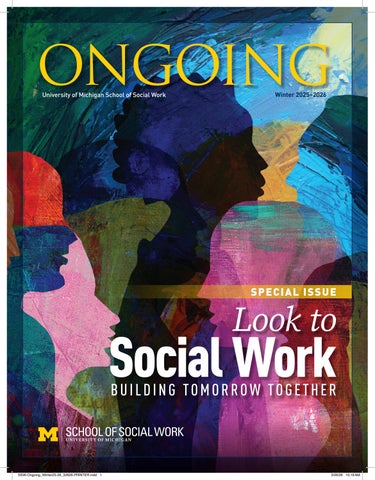
University of Michigan School of Social Work
Winter 2025–2026
S P E C IAL I SS UE
Look to
Social Work BUILDING TOMORROW TOGETHER
SSW-Ongoing_Winter25-26_32626-PRINTER.indd 1
3/26/26 10:16 AM
FEATURES
Winter 2025–26
2 8 20 22 24
2
Building Tomorrow Together
Building Tomorrow Together Look to Michigan Social Work Coming Together Through Conversation The Power of Supporting One Another Honoring a Deep Friendship with a Scholarship to Help Others 26 Authentic Connections 32 Making a World-Class Education More Affordable
STUDENTS 35 36 37 38
MSW Student Profile: Dominick Violetta CASC Student Profile: Sierra Schneidt PhD Student Profile: Yun Chen Dissertations Defended
ALUMNI & DEVELOPMENT
24
Honoring a Deep Friendship with a Scholarship to Help Others
39 Alumni Profile: Amy Good, MSW ‘80 – Creating Better Alternatives to Support Girls and Young Women 41 Class Notes 44 In Memoriam
HAPPENINGS 46 Homecoming 47 Jewish Communal Leadership Program Sukkot 48 Social Work Month 49 Colorism 49 CASC Day of Action 50 Congressional Day on the Hill
39
Creating Better Alternatives to Support Girls and Young Women
FACULTY 51 Faculty Awards, Grants & Honors 58 Faculty in the Media
FOLLOW US ON OUR SOCIAL MEDIA CHANNELS FACEBOOK INSTAGRAM facebook.com/ instagram.com/umich. universityofmichigan. schoolofsocialwork/ schoolofsocialwork/
linkedin.com/company/ university-of-michiganschool-of-social-work/
Mission Statement Advancing the social work profession’s vision and values, the University of Michigan School of Social Work seeks to develop a more equitable, caring, and socially just society. Such a society meets basic human needs, eliminates social and economic inequities, and empowers individuals, their communities, and institutions to reach their aspirations and potential. Drawing on an interdisciplinary faculty within a public university seated in a region of both need and promise, the School is dedicated to education, research, and service that fosters progressive change at local, national, and global levels.
SSW-Ongoing_Winter25-26_32626-PRINTER.indd 2
Published by: University of Michigan School of Social Work 1080 South University Ave. Ann Arbor MI 48109-1106 ssw.umich.edu DEAN, UNIVERSITY OF MICHIGAN SCHOOL OF SOCIAL WORK Beth Angell EDITOR Renee Tambeau WRITERS Jennifer DeBord Rebecca Fishkin Charlotte Hoppen Ariana González Peláez Shari Grogan-Kaylor David Pratt Renee Tambeau PHOTOGRAPHERS Anna Anderson Justin Hodge Michigan Photography Ariana González Peláez Nancy Riske Nicholas Williams DESIGN AND PRODUCTION Michigan Creative For information regarding this publication, class notes and address changes, contact the Office of Development and Alumni Relations, 734-763-6886 or ssw.development@ umich.edu 2026 ALUMNI BOARD Peggy Bodin, MSW ’98 - President Sadé Richardson, MSW ’18 - Vice President Joanne (Jo) Yaffe, MSW ’76 & PhD ’88 - Secretary Sherra Bennett, MSW ’17 Lindsay Bryan-Podvin, MSW ’11 William (Bill) Cabin, MSW ’04 Sabrina Clark, MSW ’10 Gabrielle (Gabby) D’Angelo, MSW ’11 Ann Easley, MSW ’80 Edward Egnatios, MSW ’75 Janice (Jan) Fisher, MSW ’75 Ashley Hails, MSW ’19 Yuri Hernández Osorio, MSW ’17 Gregory Hoffman, MSW ’13 Harry Hunter, MSW ’77 Elizabeth Kinney, MSW ’10 Deborah (Debby) Mitchell Covington, MSW ’88 Meagan Mitchell, MSW ’12 Orion Mowbray, MSW ’10 & PhD ’13 Kathleen (Kathy) Pottick, MSW ’74 & PhD ’82 Milton Rodriguez, MSW ’97 Kelly Taylor, MSW ’95 Kyra Weber, MSW ’16 Leah Wittenberg, MSW ’22 Rebecca Wong, MSW ’23 School of Social Work Representatives Dean Beth Angell, Ex-officio Halla Jomaa-Jouney, Executive Director SSW Development & Alumni Relations, Ex-officio
3/26/26 10:16 AM
FROM THE DEAN
WE ARE
THINKING BIG
AT MICHIGAN! In this special issue, we cover some of the new initiatives guiding our future, both at the School of Social Work and the greater university. Building Tomorrow Together is the School’s new strategic vision. Look to Michigan is the greater university’s campaign that sets our outreach and philanthropic priorities. The two campaigns are the result of deep conversations we at Michigan have had as part of a larger campuswide landscape of reflection and evaluation. Simply put: it is a time for big ideas. The School’s new vision is the result of a year of conversations, workshops and brainstorming activities with students, faculty, staff, alumni and community partners. Building Tomorrow Together reflects that collaboration and focuses on four themes: education, research, action and school culture. The vision is meant to be a compass rather than a detailed map, allowing us to incorporate what we’ve learned from the last five years, which includes the flexibility to respond to whatever unforeseen circumstances that may lie ahead. Our vision aligns with the Look to Michigan campaign. Look to Michigan is a rallying cry — a whole university effort to make an impact at a local, national and global level. The campaign catalogs our strengths, skills and accomplishments and helps us identify how to best use our resources to make a difference.
Thinking big begins by setting priorities, identifying problems and seeking their solutions. Thinking big begins by setting priorities, identifying problems and seeking their solutions. Looking to the future allows us to chart a path to create the world we want to see. As social workers, evaluating resources and discerning new ways forward is part of our stock and trade. While we can’t predict the future, that doesn’t mean it is out of our hands. It is easy to get discouraged in challenging times, but it is so important to remember that we have a whole range of possibilities in our future that go beyond doom and gloom. By prioritizing social justice and well-being for all, we can build a more just society for future generations. I invite you to read more in the pages ahead. Go Blue and Think Big! Beth Angell Dean and Phillip Fellin Collegiate Professor of Social Work
ONGOING · Winter 2025–26 · 1 SSW-Ongoing_Winter25-26_32626-PRINTER.indd 1
3/26/26 10:16 AM
BUILDING TOMORROW TOGETHER THE APPROACH As social workers, we are trained to develop solutions despite obstacles. As a society, we have learned that it is hard to predict the future and the best laid plans can be disrupted by a pandemic, upheavals in supply chains, unexpected world and weather events, or other tumultuous changes. The old approach of planning as if the future will remain the same no longer applies to our long-term goals. Creating the future we want to see requires intention, innovation, commitment and creativity. With this in mind, we have crafted a strategic vision rather than a strategic plan. Instead of a blueprint, we are creating a compass that centers our values, aligns our priorities and guides our actions, regardless of what the world throws at us.
Learn more in the following pages. Visit our website to read the full strategic vision.
2 · University of Michigan School of Social Work SSW-Ongoing_Winter25-26_32626-PRINTER.indd 2
3/26/26 10:16 AM
We looked beyond what was probable to imagine what was possible. FOCUSING ON THE VISION’S PRIORITIES As we pursue these priorities, we recognize we will be the most successful when we: • Commit to Social Justice • Foster Respect & Integrity • Promote Communication, Connection, Community, & Collaboration • Encourage Creativity & Solution-Focused Innovation • Take Action for the Public Good • Foster a Vibrant and Inclusive School Community
THE PROCESS We spent a year listening, imagining and discussing. We held meetings, workshops and conversations with every facet of our community— alumni, students, faculty, staff and community partners—to identify our strengths, goals and dreams. We looked beyond what was probable to imagine what was possible. Through these sessions, several themes emerged that we recognized as key to the essence of the School— these themes tie into our history and are the heart of who we are and who we want to be. They are represented in the priorities of the vision.
THE VISION The result of this work is “Building Tomorrow Together:” The School of Social Work’s commitment to shaping the future through our priorities—education, research, community action and a vibrant school culture. This work is ongoing. We can return to the vision again and again to remind ourselves of who we are, what we do and why we do it. It serves as a foundation to continuously build our future together.
Education
Research
Action
School Culture
ONGOING · Winter 2025–26 · 3 SSW-Ongoing_Winter25-26_32626-PRINTER.indd 3
3/26/26 10:16 AM
BUILDING T EDUCATION
Providing dynamic and life-changing education to prepare future social work and social justice leaders The School of Social Work fosters a creative and transformative approach to education that reimagines social work training for the complex challenges of our time. By developing innovative teaching methods and a forward-thinking curriculum, the School is committed to preparing leaders equipped with essential skills like empathy, critical thinking, and the ability to bridge diverse perspectives. This educational vision goes beyond traditional learning models, focusing on creating accessible, inclusive programs that not only teach social work principles but also empower students to drive meaningful social change across various professional landscapes. To achieve our vision, we will work together to: • Develop new educational programs and pedagogies to meet pressing needs • Expand cutting-edge, dynamic, and lifechanging educational opportunities • Make degree and non-degree programs more equitable, inclusive, and accessible
By developing innovative teaching methods and a forward-thinking curriculum, the School is committed to preparing leaders equipped with essential skills like empathy, critical thinking, and the ability to bridge diverse perspectives.
4 · University of Michigan School of Social Work SSW-Ongoing_Winter25-26_32626-PRINTER.indd 4
3/26/26 10:16 AM
RESEARCH
Promoting dynamic and innovative research to address complex social issues The School has long been a leader in research excellence that aims to address challenging social issues and create solutions to enhance the lives of people and the communities in which they live. Our faculty are leading ground-breaking research in communities locally and globally to tackle issues including poverty, mental health access, health equity, family well-being, and organizational and community change. Our faculty collaborate with community, agency, and policy partners to develop knowledge and drive new approaches. As we look to the future, we will build on this rich tradition and harness opportunities for pushing the limits of what social work research can achieve. We will continue to lead in dynamic, interdisciplinary and boundary-spanning research that tackles complex social issues. To achieve our vision, we will work together to: • Elevate key areas of expertise and push into new social work research frontiers • Deepen and expand interdisciplinary collaborations and research partnerships • Foster internal research synergy and connections
TOGETHER
G TOMORROW Our faculty are leading ground-breaking research in communities locally and globally to tackle issues including poverty, mental health access, health equity, family wellbeing, and organizational and community change.
ONGOING · Winter 2025–26 · 5 SSW-Ongoing_Winter25-26_32626-PRINTER.indd 5
3/26/26 10:16 AM
BUILDING
TOMORROW T
ACTION
Advancing and accelerating action for public good The School will be a leader in collaborating with communities to transform academic potential into tangible, real-world impact by actively working for social change. By strategically connecting teaching, research and service, the school will offer a dynamic ecosystem where students, staff, faculty and alumni can partner with the community to create powerful solutions to address pressing societal challenges. To achieve our vision, we will work together to: • Deepen community partnerships • Expand opportunities for community engagement and public good • Translate knowledge into action to create meaningful community change
6 · University of Michigan School of Social Work SSW-Ongoing_Winter25-26_32626-PRINTER.indd 6
3/26/26 10:16 AM
W TOGETHER
SCHOOL CULTURE
Fostering a vibrant and inclusive community Our culture is the environment through which all ideas will be nurtured. This vision seeks to build a true sense of belonging where every member—students, staff and faculty—can contribute authentically and feel genuinely supported in their professional and personal development. By prioritizing a culture of mutual respect and collaborative growth, the School will transform traditional academic environments into dynamic spaces where differences are actively appreciated as sources of innovation and understanding. To achieve our vision, we will work together to: • Value our people, foster authentic and meaningful relationships
Our vision seeks to build a true sense of belonging where every member—students, staff and faculty— can contribute authentically and feel genuinely supported in their professional and personal development.
• Embrace differences and unique perspectives • Build trust through transparency and open communication
ONGOING · Winter 2025–26 · 7 SSW-Ongoing_Winter25-26_32626-PRINTER.indd 7
3/26/26 10:16 AM
Look to
Michigan Social Work The University of Michigan’s Look to Michigan campaign seeks to redefine the power of higher education in service to humanity. It is the nation’s most ambitious fundraising campaign of any public academic institution. The School’s funding priorities are a part of the overall campaign where the university, the School and our donors can create bold ideas, transformative research, creative endeavors, and educate tomorrow’s social workers and leaders to better the public interest. As part of the Look to Michigan campaign, you can help create a brighter future for individuals, communities and society. Together, we can accomplish great things during this campaign and beyond. Together, we will:
Provide transformative educational experiences for our students. Establish a Hub for Community and Policy Impact to translate research into action and create meaningful community change. Pioneer solutions to urgent social issues through new approaches. Create a better future for children, families, and older adults. Transform mental health care and create hope for individuals and communities.
8 · University of Michigan School of Social Work SSW-Ongoing_Winter25-26_32626-PRINTER.indd 8
3/26/26 10:16 AM
ONGOING · Winter 2025–26 · 9 SSW-Ongoing_Winter25-26_32626-PRINTER.indd 9
3/26/26 10:16 AM
Life-Changing Education
Supporting the Next Generation of Social Workers The School has a long-standing commitment to making social work education more affordable and accessible to attract the best and brightest social work leaders of the future. As the cost of higher education rises, there is also a growing shortage of social workers — causing a crisis in many communities in key fields such as child welfare, juvenile justice, health, mental health, education and gerontology. MSW students are required to complete more than 900 hours as part of their field education, which makes it impossible for most students to hold a full-time job during the program, and hinders many aspiring social workers from pursuing an MSW degree.
10 · University of Michigan School of Social Work SSW-Ongoing_Winter25-26_32626-PRINTER.indd 10
3/26/26 10:16 AM
Together, we will support the next generation of social workers by developing a flourishing, diverse workforce prepared to respond to society’s pressing needs. By supporting students, you will: • Help us train social work leaders who will work to solve important crises facing our society. Your scholarship support will enable more students to attend and benefit from a Michigan education. • Offer field internship stipends, helping students cover the cost of basic needs at a time when holding a full-time job is not possible.
• Enrich our curriculum with life-changing learning opportunities, as well as national and global experiences. • Spark new innovations in graduate and undergraduate education rooted in social work values.
ONGOING · Winter 2025–26 · 11 SSW-Ongoing_Winter25-26_32626-PRINTER.indd 11
3/26/26 10:16 AM
Community and Policy Impact
Transforming Knowledge into Action At the School of Social Work, we transform knowledge into action with and for the communities we serve. Our vision is to create a Hub for Community and Policy Impact. The hub will offer funding to inspire new and innovative community engagement projects aimed at building capacity within the communities we serve. The hub will also provide comprehensive infrastructure support to faculty and a range of dissemination and communication tools, which will enable us to expand the impact of our research outcomes.
12 · University of Michigan School of Social Work SSW-Ongoing_Winter25-26_32626-PRINTER.indd 12
3/26/26 10:16 AM
You can help us put knowledge into action. By supporting the Hub for Community and Policy Impact, you will help us: • Pilot initiatives that bring faculty in collaboration with community organizations to adapt proven solutions to on-the-ground problems and issues, such as fostering intergroup dialogue, driving local capacity building, engaging high school students to support youth mental health, and supporting the adoption of mobile mental health treatment technology.
• Position the School to become the leading resource on critical social issues by bringing together faculty, community and academic colleagues in national convenings related to timely policy and practice issues.
• Boost the impact of our faculty’s research by supporting the dissemination of knowledge through resource toolkits, opinion pieces, policy briefs and various communication channels.
ONGOING · Winter 2025–26 · 13 SSW-Ongoing_Winter25-26_32626-PRINTER.indd 13
3/26/26 10:16 AM
Innovative Solutions to Complex Social Problems Social Workers Create Solutions
At the School of Social Work, we aim to redefine the boundaries of social work research. With your help, our faculty will be positioned to develop solutions to challenges such as the societal impact of climate change, the integration of artificial intelligence and technology in social work interventions, and harnessing the arts as a catalyst for social transformation. We initiate non-traditional partnerships, recognizing that diverse perspectives are vital for addressing complex social challenges.
14 · University of Michigan School of Social Work SSW-Ongoing_Winter25-26_32626-PRINTER.indd 14
3/26/26 10:16 AM
With your partnership, we will work toward solutions to the world’s most complex problems. Your support will help us: • Recruit experts who will pioneer innovative collaborations between the School and other units across campus to tackle some of the world’s most complex problems.
• Provide innovative grant funding to support research in new, unexplored and even unexpected spaces.
• Work with the subject matter experts across the university to explore societal problems through a social work perspective.
ONGOING · Winter 2025–26 · 15 SSW-Ongoing_Winter25-26_32626-PRINTER.indd 15
3/26/26 10:16 AM
A Better Future for Children, Families and Older Adults Building a World Where Individuals Can Live to Their Fullest Potential Over half of U.S. children will experience trauma before adulthood. At the School of Social Work, we know how important it is to reverse trauma’s devastating impacts on children and their families. We support children and families, from childhood through aging, to build resilience and lead prosperous lives. Our expert faculty develop innovative practice and policy solutions to reduce healthcare access barriers, address the aftermath
of trauma in schools, prevent violence across the lifespan, and promote healthy aging, all with the common goal of fostering resilience through a family’s life journey. As a national leader in the study of children and families, we train social workers with evidence-informed strategies to empower youth, build resilient families, support healthy aging, and prevent adverse outcomes.
16 · University of Michigan School of Social Work SSW-Ongoing_Winter25-26_32626-PRINTER.indd 16
3/26/26 10:16 AM
With your support, we can build a better world for children, families and older adults. By supporting the School, you can help us: • Develop a skilled workforce of social workers capable of engaging with children, families and older adults who need us most. • Enhance and expand our faculty’s leadership in child and family well-being. Supporting faculty recruitment and retention through professorships or research funding will help the School maintain its position as a national leader in developing children, youth, family and aging interventions.
• Strengthen research and programs to uplift underserved communities. By funding innovative research and programs, you will enable our faculty to develop and implement transformative interventions that address the unique challenges faced by families in these communities.
ONGOING · Winter 2025–26 · 17 SSW-Ongoing_Winter25-26_32626-PRINTER.indd 17
3/26/26 10:16 AM
Mental Health for All
Creating a Future Where Everyone Has Access to Quality Mental Health Care A critical shortage of mental health practitioners impacts half of the U.S. population. Social workers make up the largest group of professionally trained mental health providers in the country — making us well-positioned to lead the solution to this highly addressable challenge. Social workers also bring a unique understanding of community needs and gaps, particularly in underserved areas, and those with the fewest resources are at the greatest risk since untreated mental health conditions can lead to higher rates of suicide,
violence, and victimization. The demand has never been greater to build up the mental health workforce and develop effective, accessible interventions. Social work is essential to meeting this need. The School is dedicated to building a capable behavioral health workforce, with approximately 70 percent of students pursuing careers in interpersonal practice. Furthermore, our graduates are trained by faculty who are creating transformative mental health interventions and pioneering technology-based solutions.
18 · University of Michigan School of Social Work SSW-Ongoing_Winter25-26_32626-PRINTER.indd 18
3/26/26 10:16 AM
Together, we can tackle the mental health crisis and offer hope for a brighter future. Your support will: • Help build a pipeline of mental health practitioners who will provide culturally competent mental health services to individuals and communities. • Provide funding to conduct research and expand programs aimed at developing transformative mental health interventions.
• Enable us to recruit and retain top mental health experts who are pioneering transformative treatments for communities. Your support through professorships will enhance our expertise in mental health interventions and help us continue to attract, support and retain our top-tier faculty.
ONGOING · Winter 2025–26 · 19 SSW-Ongoing_Winter25-26_32626-PRINTER.indd 19
3/26/26 10:16 AM
Coming Together Through Conversation I
felt like I was carrying this heavy load and was not able to say anything out loud,” said Clinical Associate Professor of Social Work, and Flourish Program Director Daicia Price, “and then in that moment, in that conversation, I felt like I could talk. I felt people were hearing me and not judging me, just listening to me, and that felt really good, and that was healing.” “That moment” happened for Price during one of the School’s Community Conversations. The program was created in 2020 by Director of MSW Programs and Clinical Associate Professor Barb Hiltz and two students, Jamie Simmons and Joel Lucio. There are now 60 current facilitators (which include 14 staff and nine faculty) and 40 past facilitators
(mostly students who have graduated). The Community Conversations are hour-long gatherings of small groups of students, faculty, staff and others in the community, held in person at the School or online. The conversations help community members process difficult moments and hot-button issues or simply discuss issues on their minds. Facilitators are specially trained and brainstorm conversation topics, but anyone in the School may request a conversation. During 2025, the School held 45 conversations; topics included the ethics of AI, invisible disabilities, the intersection of faith and social justice, and health at every size. “Community conversations are a way that students can listen to each other and learn and also share their own opinions and experiences,” said Hiltz.
Conversations are guided by principles of intergroup dialogue — listening, sharing and understanding alternative points of view — and by restorative practices, which seek to repair harm and prevent future wrongdoing. The facilitators keep the talk on track with invitations for engagement adapted from the U-M’s Program on Intergroup Relations. These invitations are: be present and engaged; listen to learn, not to respond; be aware of intent and impact; and anticipate unfinished business and disagreement. The conversations were born in a charged environment at the start of the COVID-19 pandemic. Hiltz and her collaborators saw how people discussed difficult topics in emails and on social media. Things were getting heated. “It was easy just to snap back an opinion instead of thinking about the human being on the other end,” Hiltz said. “Subtleties were getting lost. Our students and I thought it would be
20 · University of Michigan School of Social Work SSW-Ongoing_Winter25-26_32626-PRINTER.indd 20
3/26/26 10:16 AM
CO M M U N I T Y CO N V E R S AT I O N S
useful to actually talk face-to-face about these topics. We chose to start small — with a few trained facilitators — then build and grow the idea.” Not that some conversations don’t nonetheless get “spicy,” as Hiltz puts it. In a way, that is the point — to share individual perspectives with the group in a respectful way, learning and growing from and with each other. Shani Horn, MSW ’24, who facilitated many conversations, remembers one particularly divisive talk where “somebody came to a conversation who truly felt differently from the majority. They sat outside of the circle. So I had to convey to that person, I’m going to listen to you and learn. I want you to express yourself authentically, and I’ve got you.”
Another conversation was held after an active shooter left eight dead or injured at Michigan State University and many shaken. Hiltz’s team scheduled two conversations, one in person and one online. “People found it healing,” Hiltz said, “to come together with others steeped in the same fears. It felt validating — like we were all part of something bigger.” The conversations also give students skills that are useful in field placements and in their careers. Horn, now a therapist in Ann Arbor, said, “I use the conversation agreements in my practice. Working with clients and families, I see how individual differences make the whole stronger.”
“The conversations have contributed so much to me professionally,” said Lady Funcke Muñoz, MSW ’24. “I can navigate difficult questions and know that I can have conversations with people who might not agree with me.” Thinking of her own feelings during her first conversation has made Price incorporate aspects into her own teaching practice. “Because of the conversations,” Price said, “I now start my classes with a community space agreement, taking time to develop a community so people can engage with each other and recognize differences.”
ONGOING · Winter 2025–26 · 21 SSW-Ongoing_Winter25-26_32626-PRINTER.indd 21
3/26/26 10:16 AM
The Power of Supporting One Another
“Social work pulls together all aspects of my personal life, my academic interests, and my desire to work toward making the world a better place,” says Joan Fisch. Her career as a clinical social worker grew out of her deep interest in how individuals are influenced by their experiences in their families and by social and political forces. As a child, she saw her parents receiving financial and emotional support from extended family and friends. As they were able, they provided similar support to others. She also heard about and observed their involvement in activities and organizations that promoted social justice.
22 · University of Michigan School of Social Work SSW-Ongoing_Winter25-26_32626-PRINTER.indd 22
3/26/26 10:16 AM
D O N O R P RO F I L E While this activism, connection and caring in her community laid the foundation for her to grow, a pivotal moment in Joan’s journey came when she first heard about the Holocaust at age twelve as she read The Diary of Anne Frank. She can still remember her earthshaking thought, “If I had lived there or the Germans had come here, that would have happened to me! That my father is not Jewish would have made no difference.” This awareness affected her deeply. She credits this emotionally powerful experience as a major influence in her finding her way into social work, a profession that shares a commitment to social justice with Jewish values of repairing the world. Fisch’s desire to create a scholarship fund grew out of her appreciation for the financial help she received in college and graduate school. As an undergraduate student, she received a tuition scholarship. Her parents paid for her room and board, and she worked in the library for spending money. Fisch attended Michigan State University for her undergraduate degree where she majored in sociology. She continued her studies as a doctoral student in sociology at the University of Michigan. Early in her first semester she realized that studying groups of people and doing quantitative research was not for her. The following semester, she enrolled in the social casework program at the School of Social Work and graduated with her Master of Social Work degree in 1967. The strong foundation she received at Michigan State and then at the University of Michigan has served her well in her work at social agencies, in private practice and in community service. During her time at the School, Joan received a National Institute of Health grant that paid her tuition and living expenses. In exchange she had an obligation to work for two years in the field of corrections. “I feel so fortunate to have had this support,” she says. “I wish that there were still programs like this so that more social work students could graduate without debt.” Joan and her husband Allan Fisch, BS ’65 made their first donation to the SSW Annual Fund in 1985. They have been donating regularly since then, increasing their contributions when they were able. In 2011 they supported the commission of the cantata by Bruce Adolphe, “Reach Out, Raise Hope, Change Society” in celebration of the School’s 90th anniversary. They had originally planned to have a scholarship fund established as part of a legacy gift, but they realized that they had the means to fund a scholarship during their lifetime. Establishing the Joan Fisch, MSW ’67 Scholarship now increases support for students and gives them the opportunity to enjoy seeing the benefits during their lifetime. They believe that all contributions — large or small — make a difference. They would like to see people encouraged to give what they are able and to have all contributions acknowledged without mention of the amount of the gift. “Many people who make smaller gifts are giving a larger percentage of their assets,” she notes. “That matters!”
“ Nothing is done on our own. There is no such thing as a self-made person.” JOAN FISCH
Fisch has a long history of seeing people support each other. She believes that caring for and being cared for by others is essential. She carries with her tremendous gratitude for all of those who have helped her along the way. “Nothing is done on our own,” she says. “There is no such thing as a self-made person.”
ONGOING · Winter 2025–26 · 23 SSW-Ongoing_Winter25-26_32626-PRINTER.indd 23
3/26/26 10:16 AM
THE MARLENE C. ARCHEY-CRIM (MSW ’75) AND JEAN M. ROBINSON (MSW ’57) ENDOWED SCHOLARSHIP
Honoring a Deep Friendship with a Scholarship to Help Others
24 · University of Michigan School of Social Work SSW-Ongoing_Winter25-26_32626-PRINTER.indd 24
3/26/26 10:16 AM
D O N O R P RO F I L E
I
just remember my mom always looking to Jean for life advice or friendship talk,” Kellea Woods said. “If she was going through a hard time, the first person she wanted to call was Jean.” Their special bond has led to the Marlene Archey-Crim, MSW ’75, and Jean Robinson, MSW ’57, Endowed Scholarship fund, which has been established by Dr. Courtney Crim and his two children, Kellea Woods and Damien Crim. The fund honors the legacy of his late wife, Marlene Archey-Crim, and her former mentor, field supervisor and friend Jean Robinson. Marlene and Jean shared a mentorship and close friendship that started during Marlene’s field placement at Michigan Medicine in ’73. That field placement produced more than one relationship — it was also during that time that Marlene met her soon-tobe spouse, Courtney Crim, who was working on his medical degree at the U-M Medical School. Crim remembers Robinson giving her stamp of approval when Marlene Archey was thinking about dating him. She remained such a close friend that when the Crims’ son, Damien, was born years later, they named Robinson as his godmother. “My whole family has known about Jean our entire lives,” Woods said. “She’s held such a big piece of the woman my mom came to be.” When Marlene Archey-Crim passed away in April of 2022, the Crim family knew they wanted to honor her memory. They decided to create a named endowed scholarship fund to honor both women and the special relationship they had. “By creating an endowed scholarship fund, Marlene’s name will live in perpetuity,” Courtney Crim said. “It was an easy decision because we both bleed maize and blue. It had to be Michigan. We decided to do it at the School of Social Work and include Jean as well because of the impact she played on our lives.” The Crim family worked with Nancy Riske, Associate Director of Development and Alumni Relations. In a twist of fate, it turns out that Riske had met Robinson just a few weeks prior. Riske hosted Robinson at the School of Social Work and surprised her with a reunion with the Crim family on Zoom. During that call, Robinson was told about the scholarship. “I wish for everyone this kind of joy,” Robinson said. “My life is filled with people who are loving, who value my relationships with them. They keep me going. Life really is about relationships. This is the fulfillment of a very special relationship. I’m at a point where you value time in a different way. This ending is such a personal joy. It’s amazing that something pertaining to us will support others. Not being
“What better way to come to the winter of your life than knowing part of your legacy will help other people.” – JEAN ROBINSON, MSW ’57
able to share this great experience with Marlene is part of missing her.” Woods was brought to tears when discussing the impact of the scholarship. She believes her mother would have been incredibly grateful for the inclusion of Robinson in the scholarship name, and especially happy to support students. “If I could want my mom to be remembered for anything, it would be that she was always willing to help someone,” Woods said. “Whether that be making you a meal, helping you through your problems, or giving you words of encouragement. She was an amazing woman and an amazing person.”
ONGOING · Winter 2025–26 · 25 SSW-Ongoing_Winter25-26_32626-PRINTER.indd 25
3/26/26 10:16 AM
AUTHENTIC CONNECTIONS
ITEMS THAT INSPIRE OUR ACADEMIC LEADERSHIP THE MEMBERS OF OUR ADMINISTRATIVE LEADERSHIP TEAM EACH BRING A WIDE VARIETY OF EXPERIENCE AND THEIR OWN PERSONAL APPROACH TO THEIR ROLE. WE ASKED THEM TO SHARE A MEANINGFUL ITEM THAT THEY KEEP IN THEIR OFFICE — AND TO TELL US THE STORY BEHIND IT. READ ON TO FIND OUT MORE — YOU WILL NOTICE SOME THEMES EMERGING: THE POWER OF MENTORSHIP, THE VALUE AND MOTIVATION OF GRATITUDE, AND THE IMPORTANCE OF KNOWING YOURSELF.
26 · University of Michigan School of Social Work SSW-Ongoing_Winter25-26_32626-PRINTER.indd 26
3/26/26 10:16 AM
LEADERSHIP
ABIGAIL EILER
DIRECTOR OF UNDERGRADUATE MINOR PROGRAMS CLINICAL ASSOCIATE PROFESSOR
“These gifts in my office were crafted by tribal elders and my cherished friend Jessica Kota, LCSW. Each of them embodies the spirit of Native traditions, generations of stories and my family’s clan. The Bear Clan is known for including warriors and healers, serving as the community’s keepers of good medicine, integrity and protection. When I look at these gifts, and I think of those who created them, I am reminded of who I am and what I bring into my role as an educator and social worker. These gifts honor the legacy of those who came before me and set an example for those who will come after me. They are symbols of the enduring strength of culture and its power and part of my story.” PREVIOUS EXPERIENCE
2004 BGS, English, Sociology & History at U-M 2006 MSW at U-M CLINICAL APPOINTMENTS
2007–2010 Youth and Family Therapist in Arizona 2012 Began American Indian Health and Family Services of Southeastern Michigan 2015 Began U-M Hospital and Health Systems AT U-M
2014 Joined faculty at SSW 2017 Joined U-M Athletics 2020 U-M Assistant Athletic Director, Director of Athletic Counseling
BARB HILTZ
DIRECTOR OF MSW PROGRAMS CLINICAL ASSOCIATE PROFESSOR
“These are thank you notes that I’ve received over the years from students. I get lots of thanks over email, but these handwritten notes are particularly special. Seeing them every day reminds me of the impact that a social work education has on our students. They also remind me of the impact of gratitude. I felt so appreciated when I received each note — and seeing them every day reminds me to pass that forward, and thank those to whom I am grateful.” PREVIOUS EXPERIENCE
1997 BSSW at University of North Dakota 1998 MSSW at University of Wisconsin 1998–2015 Direct practice and executive leadership in nonprofit and community support organizations 2015 Joined faculty at SSW 2017–2021 MSW Program Director 2020 MEd at University of Illinois 2022 Online Program Director
ONGOING · Winter 2025–26 · 27 SSW-Ongoing_Winter25-26_32626-PRINTER.indd 27
3/26/26 10:16 AM
ERIN KHANG
DIRECTOR OF FIELD EDUCATION CLINICAL ASSISTANT PROFESSOR
“This is a painting by my mother-in-law, Eunshin Khang, a Korean American artist living in the Midwest. It reminds me daily of the generational sacrifices and support that I continue to benefit from. As an adoptee, it reminds me of roots, of cross-cultural experiences and of family. It brings joy and gratitude to a space where I will have so many conversations and interactions with students, faculty and staff. I had so few Asian American role models and leaders throughout my life and career; it is humbling to have this opportunity to support field education and be a part of the School of Social Work community.” PREVIOUS EXPERIENCE
2001 BA, Psych & Sociology at Case Western University 2004 MSW at Case Western University 2004-2015 Clinical Social Worker 2015-2023 Program Manager, Director of Social Work Education at Social Work Department at Michigan Medicine
SHAWNA LEE
ASSOCIATE DEAN FOR FACULTY AFFAIRS PROFESSOR
“The object I selected is a vintage manual typewriter. The story behind it is that it was in Dr. Daphna Oyserman’s office for many years. She chaired my dissertation committee and was my primary social work mentor throughout my time as a doctoral student. When Daphna left U-M to go to the University of Southern California, I had just joined the faculty at U-M as an assistant professor after being at Wayne State University for five years. My new U-M office was across from her office on the fourth floor. I inherited the typewriter when she left. It is a daily reminder to me of her role as a mentor and advisor in my early years.” PREVIOUS EXPERIENCE
1997 2001 2002 2003 2005 2005-2006 2006-2007 2007-2012 2012 2019
BA, Psychology at U-M MSW at U-M MPP at U-M MS, Psychology at U-M Joint PhD in Social Work and Psychology at U-M Postdoc at Columbia University Faculty at the University of South Carolina Faculty at Wayne State University Joined faculty at SSW Faculty Director, Program Evaluation Group at SSW
28 · University of Michigan School of Social Work SSW-Ongoing_Winter25-26_32626-PRINTER.indd 28
3/26/26 10:16 AM
LEADERSHIP
ROBERT ORTEGA
ASSOCIATE DEAN FOR EDUCATIONAL PROGRAMS ASSOCIATE PROFESSOR
“I’m Latino, the fifth oldest of nineteen children, first generation graduate in higher education, and raised to believe in the value that education brings to family and community strength. I am holding the ‘Aztec Three Faces’ mask believed to be inspired by an original piece belonging to the Aztec, Teotihuacan culture. The mask features three layers revealing the innermost layer of birth and the development of youth, moving outward into the visage of a living, aged person, and the outermost layer represents the afterlife. It reflects the way I embrace my ancestral life and the creativity, courageous spirit and commitment to giving that has been passed on to me, to inspire, promote and educate toward improving and enriching our humanity. I believe that is my purpose, my goal in life, and with humility, how I hope to be remembered.” PREVIOUS EXPERIENCE
1977 1983 1987 1991 1991 2018–2023 2022–2023
AB, Psychology at U-M MSW at U-M AM, Psychology at U-M Joint PhD in Social Work and Psychology @ U-M Joined faculty at SSW U-M Faculty (Co) Ombuds MSW Program Director
DAICIA PRICE
FLOURISH PROGRAM MANAGER CLINICAL ASSOCIATE PROFESSOR
“The mug, a cherished gift from LaKeidra Bonner, one of my first students at the School of Social Work, brings forth instant memories of growth and determination. When empty, the mug is a constant reminder of the student’s relentless pursuit of knowledge and excellence. When full, the mug is a testament to how their inquisitive nature, evident since their early days in class, has blossomed and led them to a fulfilling career as a school social worker, deeply engaged in community service. The phrase ‘black coffee’ embodies resilience, echoing both the strength of character and the cultural identity shared between mentor and mentee.” PREVIOUS EXPERIENCE
2004 BSW at EMU 2005 MSW at EMU 2005–2010 Started private practice; working in community youth, family and health organizations 2010–2016 Faculty at EMU School of Social Work 2016 Joined faculty at U-M School of Social Work 2022 PhD at EMU
ONGOING · Winter 2025–26 · 29 SSW-Ongoing_Winter25-26_32626-PRINTER.indd 29
3/26/26 10:16 AM
LEADERSHIP
KATIE RICHARDS-SCHUSTER
ASSOCIATE DEAN FOR UNDERGRADUATE PROGRAMS AND STRATEGIC INITIATIVES ASSOCIATE PROFESSOR OF SOCIAL WORK
“One item that is very meaningful to me is a wooden box that was made for me in honor of my 10 years of being the faculty director of the CASC minor. The top of the box has a quote by Grace Lee Boggs, a preeminent Detroit grassroots community organizer. The quote speaks to the power of connections for community change. Her life and writings have been a guiding force for me since the beginning of CASC. Inside the box are letters and notes from students and colleagues that I have worked with over the years. To me, this represents the power of relationships and the ripple effects of our work. I always smile when I look at the box because it reminds me of so many memories and stories over the years!” PREVIOUS EXPERIENCE
1994 BA, Political Science at U-M 1997 MA (SSA) at University of Chicago 2005 Joint PhD in Social Work and Sociology 2005–2007 Postdoc at SSW 2007 Joined faculty at SSW 2009–2023 Founding Director of Community Action and Social Change Minor 2013–2023 Director of Undergraduate Minor Programs
MATTHEW SMITH
ASSOCIATE DEAN FOR RESEARCH PROFESSOR
“I bought the mask during a trip to Florence, Italy, as a PhD student in 2003. At the time, I was studying families of adults with schizophrenia. During my trip, I was standing in line for the Uffizi Galleries in Florence. The gentleman next to me in line was an attorney from Australia. We got to talking and it turns out his son had schizophrenia. He paid for my ticket to the gallery, and we spent the next several hours enjoying the art and talking about his son and family experience; I shared what I had been learning during my doctoral training. At the end of the day, I traveled halfway across the world to have a conversation with someone whose life experience was emerging as an area of my professional expertise. The mask was a souvenir from my visit and a reminder of how research needs to support the people being studied.” PREVIOUS EXPERIENCE
1998 BS, Psychology at University of Illinois 2000 MSW at University of Illinois 2006 PhD in Social Welfare at University of Wisconsin 2008 MPE at Washington University 2006-2008 Postdoc at Washington University and Northwestern University 2009–2017 Faculty at Northwestern University 2011 NIH Clinical Trial Fellow 2017 Joined faculty at SSW 2017 Founded the Level Up Lab
30 · University of Michigan School of Social Work SSW-Ongoing_Winter25-26_32626-PRINTER.indd 30
3/26/26 10:16 AM
APPLY TODAY! INTRODUCING THE NEW
Master of Arts in Social Impact Leadership A dynamic 30-credit, 2-semester program designed for changemakers working across nonprofit, public, and private sectors. WHAT SETS THIS PROGRAM APART: • C ommunity-based projects with industry mentorship • Grounded in social justice values • No GRE/GMAT required • Real-world application from day one WHO SHOULD APPLY: Whether you’re aspiring to lead a nonprofit, drive corporate social responsibility initiatives, or launch a social impact campaign with the tools and experience to succeed, this is your opportunity to build the skills, network, and real-world experience needed to create lasting change. Your impact starts here. Apply today! LEARN MORE AND APPLY: ssw.umich.edu/academic-programs/ma-socialimpact-leadership/apply
SSW-Ongoing_Winter25-26_32626-PRINTER.indd 31
3/26/26 10:17 AM
Making a
World-Class Education
More Affordable
As a nation, we are in the midst of conversations that question the role of higher education.
But at the School of Social Work, we’ve always known our value — and the value our graduates bring to society. We’ve been ranked the number one school of social work in the country for over a decade due to our ability to train generations of social workers, clinicians, researchers and educators. As part of the University of Michigan, we wholeheartedly subscribe to the century-old motto of providing “uncommon education for the common person.” And the value of a U-M degree is recognized globally as a symbol of academic achievement that provides lifelong benefits. To continue this legacy, we need to make sure that a Michigan Social Work education is affordable and accessible for every admitted student. This focus on affordability is not new, but right now it feels particularly urgent.
We’ve accomplished so much over the last several years to create options through our part-time, online, advancedstanding, and 4+1 programs. These new options provide flexibility, can save time and money, and can allow students to earn a Michigan MSW on an accelerated timeline and without relocating to Ann Arbor. We have collaborated with the university and both public and private partners to create innovative programs that offer financial support. Examples include: The university has recently launched the Graduate Guarantee specifically for MSW students. The program allows those who participated in the undergraduate Go Blue Guarantee to continue receiving financial support, which covers tuition, housing and fees. The School has spearheaded the state-wide Title IV-E Child Welfare Fellowship to recruit, retain and educate students to be leaders in the field of child welfare. The fellowship provides financial resources and additional support to students committed to working in the child welfare system, including Child Protective Services, foster care, licensing and adoption.
32 · University of Michigan School of Social Work SSW-Ongoing_Winter25-26_32626-PRINTER.indd 32
3/26/26 10:17 AM
Our development office has worked tirelessly in partnership with the dean and generous donors to support our students through fundraising. Funds include: • The SSW Field Fund provides stipends to students experiencing financial strain during their field placements, enabling them to fully dedicate themselves to their education. • The SSW Student Emergency Aid Fund provides crucial aid for unforeseen expenses such as medical services, housing, food insecurity, family emergencies, and transportation. • The Raise Hope Scholarship Fund extends need-based scholarships, empowering students to realize their aspirations of attaining an MSW. • The SSW Student Mental Health Fund provides support to MSW students who have exhausted on-campus mental health services and need financial support for ongoing care. In 2022, the Michigan state legislature created the Student Mental Health Apprenticeship Program for Retention and Training (SMART). The program provides paid work experience opportunities for students — including social work students — who are preparing to enter public school-based mental health professions. The SMART program was a direct result of the lobbying and advocacy of our students, the School and our partners throughout the state. This was not only a big win for social work education, but also serves as a reminder that we can work together to effect the changes we want to see in our communities and our profession. Similarly, the Michigan Earn, Learn, and Serve in Schools (Mi-ELSiS) program works to increase the number of mental health providers in high-needs schools in Michigan. The program provides a $20,000 stipend, which students use to pay for their tuition, transportation and other related expenses. In return, students commit to working for at least a year in highneeds schools after graduation. Educational opportunity is one of America’s deepest social inequities, and over the past two decades, every state has reduced higher education funding. The world needs social workers, and our commitment to training the best and brightest social work leaders means making sure that financial issues aren’t a barrier. As we look to our future, we look to new and innovative ways to make our world-class education affordable and possible.
During the U-M’s Look to Michigan campaign, our top priority is student support. The university has developed two new, convenient matching gift opportunities that will support students and increase your impact! New Recurring and Payroll Gift Matches
The university is matching all new recurring donations. This match is dollar-for-dollar (up to $100 each month), meaning donor impact is doubled through recurring donations during the match availability. This match opportunity also applies to all new and pre-existing payroll gifts. Gifts may be made to any fund, and must be a minimum of $5 each month. This match will last until June 30, 2026.
Student Support Matching Program
Donors making their first major gift of $50,000 or more are eligible to receive a matching contribution if the gift is designated toward an area of student support (i.e. scholarships, field funds, travel funds, emergency funds, etc.). To qualify, donors must be making their first major gift — defined as $50,000. This opportunity will last until matching funds are exhausted. To learn more about these limited-time matching opportunities — or to explore other ways you can provide financial support for our students — please reach out to our Office of Development and Alumni Relations at ssw.development@umich.edu or 734.763.6886. Our development team is here to help you make a donation that is meaningful to you!
The value of a U-M degree is recognized globally as a symbol of academic achievement that provides lifelong benefits. To continue this legacy, we need to make sure that a Michigan Social Work education is affordable and accessible for every admitted student.
ONGOING · Winter 2025–26 · 33 SSW-Ongoing_Winter25-26_32626-PRINTER.indd 33
3/26/26 10:17 AM
ANNOUNCING THE NEW
PhD in Social Work and Social Welfare The School of Social Work is thrilled to announce a new addition to our doctoral program. The PhD in Social Work and Social Welfare is designed for students who already have their MSW and are looking for a career focused on social justice, equity, and rigorous research. The PhD in Social Work and Social Welfare provides a transdisciplinary approach to identifying and studying societal problems for the purpose of proposing and developing solutions; this focus on societal interventions and solving problems is at the heart of this new PhD. The School of Social Work continues to offer the only joint PhD program in Social Work and Social Science in the United States. The Joint PhD Program has a long and illustrious history of producing extraordinary scholars.
FOR MORE INFORMATION OR TO APPLY, VISIT OUR WEBSITE:
ssw.umich.edu/offices/phd/phd-social-work-social-welfare
THE SCHOOL OF SOCIAL WORK’S
OFFICE OF CONTINUING EDUCATION offers professional development and lifelong learning
VIEW THE CATALOG OF COURSES OFFERED AND FIND OUT MORE
opportunities that prepare social workers and other professionals for inclusive, evidence-informed practice. Our programs allow social workers to stay current with emerging knowledge and needs in the field, maintain professional licensure, and advance and transition in their careers. Continuing education hours are offered through the Association of Social Work Board’s Approved Continuing Education (ASWB ACE) program.
https://ssw.umich.edu/ offices/continuing-education
34 · University of Michigan School of Social Work SSW-Ongoing_Winter25-26_32626-PRINTER.indd 34
3/26/26 10:17 AM
ST U D E N T S [ M S W ]
“…I thought help just happened — but that’s not how things work. My experience motivated me to provide help to students in similar situations.”
DOMINICK VIOLETTA: CONNECTING WITH STUDENTS
M
iddle school is rough — and in these post-COVID years of social media and tech addiction, tweens and teens feel acutely overwhelmed and isolated. So it’s a big deal when an adult at school remembers your birthday — and at Washtenaw International Middle Academy, that adult is Dominick Violetta. As he pursues his school social work certification, Violetta is immersed in his field placement at the middle school. On any given day, he might be teaching classes on social and emotional responses, counseling students, offering crisis support … and making kids feel seen by remembering their names and, yes, birthdays. It’s absolutely where this Michigander wants to be, but it’s not where he originally thought he was heading. After his undergrad education at Michigan State University, where he studied political theory and constitutional democracy, Violetta was on a PhD track — until the COVID lockdown sparked his desire to make a “tangible impact.” He’d always felt grateful to school social workers because of his experience in elementary school, when he almost failed kindergarten due to a dexterity condition. Thanks to strong parental advocacy, he received the intervention he needed. “In my first-grade head, I thought help just happened — but that’s not how things work,” said Violetta about the accommodations that changed his educational journey. “My experience motivated me to provide help to students in similar situations.” He applied to AmeriCorps and spent two years as a college advisor in a trade and technical school in Mason, Michigan. He loved every experience, from career counseling to chaperoning field trips. But when they started talking about making it a more permanent position, he knew he needed to continue his own education first.
“I helped a lot of students get money for college, a lot of students attend college, but a lot of the real issues that I couldn’t solve were structural issues — poverty, homelessness, lack of disability accommodations — issues that, by the time I’m helping them as seniors, it’s 12 years of social inequities building on top of each other,” he said. “That weighed heavily on me … I thought ‘there has to be a deeper structural solution.’” With his MSW in the Welfare of Children & Families pathway, Violetta intends to be part of the solution. He is mindful of where students are coming from — their backgrounds, economic stressors, societal pressures — as he teaches skills to compensate for the focus and communication struggles he sees in this age cohort. Violetta believes the kids respond to him because (beyond the birthday recall) he’s patient and methodical, skills that also serve him as a research assistant and in the Student Services Department, where he helps prospective students navigate the application process. It seems impossible that he has spare time, but he’s in three book clubs (no light reads here, think Plato’s Gorgias) and enjoys fine dining. (Ann Arbor’s food scene is “awesome, and I’m a snob.”) At the end of the day, Violetta is certain that his Washtenaw placement will be pivotal in his success as a school social worker. “It’s invaluable. Social work is a practical profession. Making sure you’re committed to your field placement — that’s really important to getting the most out of your education,” he said. “You only figure out what you’re doing a couple months, a year in, so this allows me to really understand the job.” Based on the positive connections he’s making with the students, Violetta will have a lot of birthday wishes to offer in the future.
ONGOING · Winter 2025–26 · 35 SSW-Ongoing_Winter25-26_32626-PRINTER.indd 35
3/26/26 10:17 AM
ST U D E N T S [ CO M M U N I T Y A CT I O N A N D S O C I A L C H A N G E ( CA S C )]
SIERRA SCHNEIDT: PUTTING PASSION INTO ACTION
S
ierra Schneidt is an undergraduate student pursuing a major in psychology and a minor in Community Action and Social Change (CASC). Her career path reflects her childhood, which was shaped by a close family member’s ongoing struggles with mental illness. During one particularly harrowing episode, her family member went missing for 24 hours. “I remember that I didn’t know if they were going to come home or be okay,” Schneidt recalled. “I felt like I had a pit in my stomach when I was waiting.” That feeling returned forcefully and unexpectedly when she was participating in a social media project for CASC. “I made an account about four missing children whose cases had gone cold, meaning they’re no longer being investigated,” she explained. “As I was giving the presentation, I was thinking about that pit I had in my stomach and how some people — not knowing where their loved ones have gone — carry that feeling for months, years, for the rest of their lives. That was why I was so emotional about this project: it was the first time I turned something meaningful to me into something tangible.” It was a defining moment in Schneidt’s academic career at Michigan, and one that helped her find her calling. Schneidt is a first-generation college student, the daughter of an immigrant and the only one of her siblings to “go away” to college. She received a full, four-year (HAIL) scholarship to U-M. But the transition from her hometown of Reed City, Michigan, was rough. “The scholarship has been a huge blessing. But when you go from a town of nearly 2,000 people to being in a school of nearly 50,000, it is a really difficult transition. It was hard to acclimate to the university, and I struggled with imposter syndrome and the feelings that maybe I was only able to succeed in Reed City because the pool was smaller. “Trying to make connections with people was difficult; I found it really overwhelming to get myself out there and become involved, and do the kind of volunteer and community work that I was doing in high school. I really started to struggle with my mental health.”
Then, in her freshman year, Schneidt got physically sick — a lingering cold that was eventually diagnosed as pneumonia — which just compounded her concerns of falling behind. Fortunately, Schneidt had a long-term therapist who provided essential support. Schneidt has generalized anxiety disorder and was diagnosed with ADHD the summer before starting college. “When I got the ADHD diagnosis, everything clicked. Last term, I was in a psychology lecture, and my professor said, ‘If you’re at the University of Michigan and you have ADHD, you’ve either received so much help throughout your life, or you have amazing compensatory behaviors.’ And I started tearing up a little bit because I was like, ‘Yeah, that’s me.’ I think I just really overcompensated for how difficult it was to sustain my attention.” Her college journey really began, she said, when she realized that she was neurodivergent and started receiving accommodations. She was then able to focus on whether her goal of becoming an immigration attorney really aligned with the work she wanted to do. “I had it in my mind that I was going to be a political science major, but I took one class and thought, ‘Oh, never mind, this is not it.’ I also realized that although I wanted an occupation that helps people, I really wanted to be working, hands-on, with people every day. Someone pointed out to me that as a lawyer I might be doing a little bit more paperwork than people work, and that just wasn’t for me.” Finding the CASC program was the game changer. When Schneidt enrolled in Social Work 305, Theories and Practices for Community Action and Social Change, she knew nothing about the CASC minor but immediately connected with both social work and the CASC community. “SW305 was such a great experience — we had a lot of projects that allowed me to turn my passions into action. And the program has taught me that service doesn’t always happen in the way that you would expect. I think that one of the most powerful things that you can do for people is build a connection. And I want to be connecting with people for the rest of my life.” The CASC program also provided Schneidt with not just a career path, but a community. “I was looking for a way to make change and make a difference. Finding a community like CASC helped me believe in myself and do a lot of things that I never thought I’d have the privilege to do.” Schneidt was accepted into the School’s MSW program and began her graduate studies in the fall of 2025.
The CASC program is a multidisciplinary 16-credit minor, which allows undergraduates to choose courses from a wide range of elective clusters and provides a framework for understanding and promoting community action and social change. Since its founding in 2010, over 900 students from colleges and schools across U-M have completed the program, making it the second most popular minor on campus.
36 · University of Michigan School of Social Work SSW-Ongoing_Winter25-26_32626-PRINTER.indd 36
3/26/26 10:17 AM
ST U D E N T S [ P H D ]
“Social work is significantly shaped by local conditions. I focus on Chinese social work evolving in a situated way, by examining its day-to-day practices on the ground.”
YUN CHEN: SOCIAL WORK POLICIES IN CHINA
C
ulturally speaking, what is social work? How does it travel and evolve?
PhD student Yun Chen was born and raised in Hefei, Anhui Province, in central eastern China. In 2008, she entered Xiamen University to study social work, which was at the time a new discipline in China. As a profession, it was first recognized in the 1980s when academic social work was imported wholesale from the West, with theories and methods translated from English. Professors and students struggled to align imported knowledge with local, day-to-day realities. Chen wanted to see how social work looked in its country of origin. She chose the University of Chicago’s Crown Family School of Social Work for her MSW. However, Chen found that an American MSW program, by its very nature, did not provide the theoretical and methodological tools she needed to examine the development of social work in China. “That drove me to pursue a PhD,” Chen said, “to understand how social work is constructed in the context of China. “My advisor at Xiamen [University, in Xiamen, China] had been an anthropologist,” Chen explained, “and that made U-M’s Joint PhD Program a perfect fit for me,” since she could use a sociocultural approach to study social work in a non-U.S. context. Chen’s dissertation examines social work policies in China under the current service contracting structure, run primarily by the government’s civil affairs sector. “I am curious how Western social work was introduced to China top-down,” she said, “and became integrated with existing social welfare infrastructure. How are newer Chinese social workers defining their roles? How will they reshape Chinese social welfare provision?”
“Drug addiction services in China are interprofessional,” she said, “so I observed Chinese social workers developing their unique ways of practice while coordinating with law enforcement and civil affairs officials.” Chen embedded herself at an urban social service organization in southeastern China, where both imported and locally developed social work practice innovations have been implemented, and she observed and conducted interviews for 18 months. “Some scholars and practitioners view Western social work as an established standard,” Chen said. “This needs to be challenged. Social work is significantly shaped by local conditions. I focus on Chinese social work evolving in a situated way, by examining its day-to-day practices on the ground.” Chen received the School’s 2024 Henry Meyer Scholarship. (Meyer was the first director of the School’s Joint PhD Program.) She cherishes the award’s recognition of interdisciplinary research. To be eligible for the award, Chen submitted a paper on peer service in China — an addiction intervention model imported from the West, adapted by Chinese practitioners. “I looked at what a peer mentoring model means in a regional context where abstinence or punishment still predominate,” Chen said, “and I looked at how peer practices are shaped by the Chinese state’s attempt to implement ‘service-oriented governance,’ with social work as a driver.” The article has been submitted to a journal. Yun Chen’s journey to understanding certainly brought her to the right place: A place that will now be a point of departure for her next adventure.
Chen is grounding these questions in the issue of illicit drug use. Her methodology, ethnography, requires the researcher’s longterm immersion in a study site, and views the world as living realities whose meanings are constructed by its inhabitants.
ONGOING · Winter 2025–26 · 37 SSW-Ongoing_Winter25-26_32626-PRINTER.indd 37
3/26/26 10:17 AM
ST U D E N T S [ P H D ] : D I S S E RTAT I O N S D E F E N D E D
Matthew Bakko
Kathryn Berringer
Anne Blumenthal
Yun Chen
Joonyoung Cho
Rita Hu
Vitalis Im
Andrea Mora
So’Phelia Morrow
Ronke Olawale
Brittani Symone Parham
Taha Rauf
Valerie Taing
Michelangelo Trujillo
Kevsner Pinar Üstel
Lauren White
Matthew Bakko PhD in Social Work and Sociology “Institutional Change in Municipal Public Safety and the Logics of Punishment and Care”
Vitalis Im PhD in Social Work and Anthropology “Struggling with Art: How Artmaking Practices Mediate the Relational Violences of Prisons”
Taha Rauf PhD in Social Work and Political Science “Political Economy Impacts of Muslim Religious Institutions: The Case of Sufi Khanagah in India”
Kathryn Berringer PhD in Social Work and Anthropology “Scales of Care: Reproducing LGBTQ+ Safety, Knowledge & Practice in Detroit”
Andrea Mora PhD in Social Work and Psychology “An Examination of Community Violence Exposure and Sexual Harassment Among Latino/a Adolescents”
Valerie Taing PhD in Social Work and Sociology “Logics of Caregiving in the Delegated Welfare State”
Anne Blumenthal PhD in Social Work and Sociology “Essays on Child Well-Being and Parenting During the COVID-19 Pandemic” Yun Chen PhD in Social Work and Anthropology “Governing through Social Work: Making Persons and the Public in China’s AntiDrug Work” Joonyoung Cho PhD in Social Work and Psychology “Aging in the Right Place: Effects from Relocation and Homebound Status” Rita Hu PhD in Social Work and Psychology “The Role of Social Relationships in the Development and Consequences of SelfPerceptions of Aging across the Lifespan”
So’Phelia Morrow PhD in Social Work and Sociology “Killing Us Softly: Intimate Partner Violence and The Forced Martyrdom of Black Women” Ronke Olawale PhD in Social Work and Anthropology “Ebola in Liberia: The Intersection of Culture, Care and Infectious Disease” Brittani Symone Parham PhD in Social Work and Psychology “Compounded Disadvantage: Exploring the Intersection of Race, Sex, and Child Welfare in Juvenile Justice”
Michelangelo Trujillo PhD in Social Work and Sociology “Identity-Based Processes and Clinical Social Work Education” Kevsner Pinar Üstel PhD in Social Work and Sociology “Diagnosis, Knowledge, and Selfhood in Coming Off Psychiatric Medications” Lauren White PhD in Social Work and Psychology “Participatory Implementation for Suicide Prevention with American Indian and Alaska Native Communities”
38 · University of Michigan School of Social Work SSW-Ongoing_Winter25-26_32626-PRINTER.indd 38
3/26/26 10:17 AM
A LU M N I P RO F I L E
Creating Better Alternatives to Support Girls and Young Women “When I graduated from Michigan Social Work, Dr. Rosemary Sarri said to me, ‘Do something hard. Do something that nobody else is doing.’” Amy Good, MSW ’80, followed this advice throughout her outstanding career as chief executive officer at Alternatives for Girls (AFG), a Detroit nonprofit that helps girls and young women experiencing homelessness, sex work and human trafficking. It is the only shelter in Detroit that houses unaccompanied minors. While AFG has grown exponentially, its roots are deep within the Detroit community. ONGOING · Winter 2025–26 · 39 SSW-Ongoing_Winter25-26_32626-PRINTER.indd 39
3/26/26 10:17 AM
“These conversations started happening in the neighborhood about what was going on with girls in southwest Detroit. It was a very classic, textbook, grassroots conversation that started among neighbors,” Good said. “We were seeing little girls not in school staying home to help take care of siblings. We were seeing more young women who were homeless. Some were pressed into sex work by their families for income. We just started talking to young girls and women, and these conversations just started to snowball.” Good and fellow community members began looking into what resources were available for girls and young women in southwest Detroit in 1985. They found there was a single community center for boys and young men, but nothing available to support girls. “There just weren’t services for girls,” Good said. “Girls approaching 18 often were not being taken care of. For those involved in sex work, there were no resources at all.” Good collaborated with local organizations to provide basic services to at-risk teenage girls. As the community continued to organize new projects, they began to call themselves Alternatives for Girls. In 1987, the community gathered and discussed what they had learned from working with the girls and young women over the past two years. They determined three priorities that needed to be addressed: (1) shelter for those too old for the foster care system, and too young for the adult shelters, (2) street outreach services for those involved in sex work and human trafficking, and (3) prevention programming to help girls stay in school and avoid violence. While working for Barat Human Services, Good had saved up $6,000, and knew she could live off her savings for a year. In June 1987, she quit her job, and began volunteering full-time to help launch AFG.
On a cold day in January of 1988, a 16-year-old girl came to the door of St. Peter’s Episcopal Church without anywhere to go. Good spent several hours with her, and decided the shelter services of AFG were going to open that day. “We decided there is no turning back,” Good said. “We’ll figure it out as we go. And if we have to close down next week because we can’t staff it or we don’t have money to feed people, then it will have been a good thing that we did this and learned something in the process.” Beyond their first year, AFG expanded and built their own shelter so they could take in young women with children. In 2022, they launched their early childhood education program, where newborns and young children who are living in the shelter can receive free daycare and education, and moms staying at the shelter can work within the classroom. Good said the connections she had with her lifelong mentor, Rosemary Sarri, and other School of Social Work professors were instrumental in advancing AFG’s mission. While Good’s leadership, along with her passionate approach, is renowned in the Detroit community, she is adamant that AFG’s founding was built on the collective efforts of the entire community. And that deep community support, she believes, has been fundamental to AFG’s success. “It’s always a team of the most amazing people,” Good said. “There are so many people that made this happen.” Good retired in the fall of 2024. When asked what her proudest accomplishment was, she said it would be persisting throughout the turbulent times AFG experienced. She plans to remain an active member in the community, and she shares the same piece of advice to current students that Sarri gave to her upon graduating: Do something hard, and do something nobody else is doing.
40 · University of Michigan School of Social Work SSW-Ongoing_Winter25-26_32626-PRINTER.indd 40
3/26/26 10:17 AM
C L A S S N OT E S JOHN PAUL TUANQUI ABENOJAR, MSW ’05, received the Society for Social Work Leadership in Health Care Award for Social Work Leadership in Clinical Practice. The award is inspired by Ida Cannon, an iconic figure in health social work leadership and recognizes those who have both demonstrated the qualities that made Cannon successful and made outstanding contributions to the leadership of social work in a health care setting. Abenojar’s career — dedicated to improving the lives of older adults in long-term care settings — has called attention to the critical importance of psychosocial care for both the patient and family. OVELL BARBEE, MSW ’90, published a book titled “The Big House: A HumanCentered & Progressive Approach to DEI and Positive Workforce Engagement.” The book is designed for leaders, practitioners and changemakers seeking real-world insights on how to make positive and human-centered impact meaningful and sustainable in today’s workplaces. SHERRA BENNETT, MSW ’17, was selected as a 2024 Presidential Leadership Scholar. PAMELA BLAIR, MSW ’69, published a novel “The Reluctant Womb.” The novel is a powerful story of friendship, choice and survival before Roe v. Wade, when a woman’s options could define her destiny. MATT BOUSE, MSW ’19, started a private therapy practice in January 2025. His practice, Bouse Therapy Services, is located in downtown Ann Arbor, and focuses on helping clients decrease anxiety, shame, low self-esteem and other attachment concerns. The practice primarily works with men between the ages of 19 and 39.
LINDSAY BRYAN-PODVIN, MSW ’11, shared expert insights on the emotional toll of financial scams in a recent appearance on CNN News Central with Brianna Keilar & Boris Sanchez. She highlighted the misconception that only seniors fall prey to scams and emphasized that anyone can be vulnerable. The discussion centered on a viral story about a personal finance journalist who was scammed out of a large sum of money, illustrating how scammers exploit personal information to induce fear and dysregulate the victim’s nervous system. Bryan-Podvin stressed the importance of empathy and compassion in combating financial exploitation.
Lindsay Bryan-Podvin
WILLIAM CABIN, MSW ’04, published “They Live in an Isolation Chamber: Medicare Fails the Depressed Homebound Elderly” and “What Were They Thinking?: The Exclusion of Medicare Home Health from Providing Supplemental Social Needs Benefits.” In addition, Cabin was re-appointed to the editorial board of the NASW peerreviewed journal, Health and Social Work. SUE CHANDLER, MSW ’98, joined the outstanding team at Rosie’s Place as Chief External Relations Officer after having served over 13 years as executive director of a nonprofit providing domestic violence response and prevention. In this new role, she will oversee development, communications, community engagement and public policy. JARED COLE, MSW ’15, joined the Ohio Department of Education and Workforce in 2023 as a Mental Health Consultant, one of only two in the state. He consults with districts and schools statewide to provide best practices and evidencebased implementation strategies in mental and behavioral health. Previously, he spent eight years in Michigan as an elementary school social worker, providing counseling services, facilitating small groups and teaching schoolwide SEL lessons. He has presented at national mental health conferences. “Advocating for students, student wellbeing, and mental health and wellness are passions of mine,” he writes. “I am forever thankful to be an SSW graduate! It’s great to be a Michigan Wolverine!”
Sue Chandler
Jared Cole
ONGOING · Winter 2025–26 · 41 SSW-Ongoing_Winter25-26_32626-PRINTER.indd 41
3/26/26 10:17 AM
C L A S S N OT E S
Lauren Davis
VIRGINIA COVER, MSW ’78, released a novel, “Supplemental Needs,” about a family coping with a prenatal diagnosis of Klinefelter syndrome, a disorder of sexual development resulting from an extra X chromosome in a male. Popular literature has not addressed the dilemma of prenatal diagnosis of developmental disabilities and rarely atypical development in a child. Previously, Cover published the widely read guide, “Living with Klinefelter Syndrome, Trisomy X and 47, XYY.” She used her experience as a social worker devoted to improving life for those with developmental disabilities and her personal experiences as a special needs parent to write both. LAUREN DAVIS, MSW ’07, was featured in the Michigan Daily, profiling her journey to pursuing diversity, equity and inclusion work at U-M.
Nancy Kusmaul
MICHELLE DUPREY, MSW ’95, launched a therapeutic stress coaching program called “Stress Rehab” under her LLC, IterVia Health. She has reimagined stress from a conventional perspective of “management” to one of determining and focusing on the root cause of three general areas of our wellness that impact our ability to cope with external stress. She helps clients create possibilities and the confidence to change these root causes, improving balance and homeostasis in their mind, body and connection energy. CAROLYN GIER, MSW ’98, is coauthor of “Fixing Broken Meetings: A Manual on Meeting Rotten-osity, Deleterious Decisions, and Ineffective Implementation.”
Sara Thane Milam
LAUREN GOURLEY, MSW ’04, recently published “Confluence: Navigating the Journey as Parent and Helping Professional.” The reflective workbook addresses an important and often neglected topic in professional training by exploring the interplay of identities as both parent and provider, first through research and clinical stories and later by offering reflective prompts for use individually or in reflective supervision. Gourley has a small private practice in western Wisconsin where she focuses on infant, early childhood and perinatal mental health, and offers reflective consultation to a wide array of professional helpers.
JUN SUNG HONG, MSW ’06, received a Fulbright Scholar Award in 2023 and was hosted by the University of Antwerp in Belgium to research cyberbullying. BRYAN JOYCE, MSW ’09, accepted a new role with the U.S. Department of Health and Human Services providing federal oversight of state and community-based programs after 11 years of federal service to the Department of Veterans Affairs. THERESA (TRAN) KOUO, MSW ’10, was promoted to Partner at Kinetic West, a social impact consulting firm based out of Seattle. NANCY KUSMAUL, MSW ’00, was recognized for her policy work with the 2024 Outstanding Individual in Academia Award from the Congressional Research Institute for Social Work and Policy (CRISP) on March 13, 2024. LISA YOUNG LARANCE, PhD ’21, released her book, “Broken: Women’s Stories of Intimate and Institutional Harm and Repair.” COURTNEY LONG, MSW ’04, gave a TEDx talk in Ireland titled “Money and S.e.x: The Surprising Connection.” The talk is sparking global conversations about these two taboo topics. LINDSAY MATTHEWS-NAUMANN, MSW ’12, recently completed a PhD in Clinical Sexology. As part of their doctoral work, they created a website to support LGBTQ+ folxs with their sexual health through education and introspection. SARA THANE MILAM, MSW ’18, opened her private therapy practice, Steadfast Living Therapy, LLC, in July 2023. Her practice provides individualized and actionable mental health therapy for adults in Nashville. She is an EMDRcertified therapist and specializes in trauma and grief therapy.
42 · University of Michigan School of Social Work SSW-Ongoing_Winter25-26_32626-PRINTER.indd 42
3/26/26 10:17 AM
ADRIANNE MUNTZ, MSW ’15, published “Understanding the Power of Affirmations.” In her book, she skillfully explores societal influences on beliefs, emphasizing affirmations as a means to reclaim personal narratives. Readers embark on a journey of self-awareness, crafting affirmations to overcome negativity and foster profound change. Her book stands out for its practicality, offering tangible steps for integrating affirmations into daily life. Each chapter empowers readers to cultivate resilience, confidence, and self-empowerment, leading to a purposeful and fulfilling life. Muntz’s work resonates with individuals of all backgrounds, providing a road map for navigating modern complexities with grace. ANN NGUYEN, MSW ’11 & PhD ’15, is the editor of the Aging Insights and Research Newsletter at Case Western Reserve University. She presented four research projects at the Society for Social Work and Research Conference in January 2025 and five projects at the Gerontological Society of America conference in November 2024. CHRISTOPHER OLSON, MSW ’92, worked for the State of Michigan during the 1990s as a clinical social worker serving mentally ill incarcerated individuals. In 1998, Olson graduated from the U-M Law School and began working on behalf of individuals and business organizations to enforce the Constitution against municipalities, states and the United States of America. That practice included civil rights cases representing owners of dogs that police officers shot under the color of state law. Several of the police dog shooting cases were featured in a British documentary film entitled “Dogs Are People Too.” The film debuted at the 2024 One World Film Festival in Prague and was featured at the Brooklyn Film Festival in 2024. It is currently streaming on Apple TV and other services. Meanwhile, Olson’s thriving private psychotherapy practice continues, serving adults in Michigan and Virginia. He is married with four children and lives outside Washington, D.C.
ERICA RIBA, MSW ’12, received her EdD in Community-Based Leadership from CUNY College of Staten Island and published her first solo article. SADE RICHARDSON, MSW ’18, was recognized as a Health Equity Champion in the CDC’s spring 2024 Health Equity Matters newsletter. She was also selected as an honoree for the de Beaumont Foundation’s 40 Under 40 in Public Health Class of 2023. This is an accomplished group of professionals striving to bring healthier solutions to communities across the nation.
Don Ryan
DON RYAN, MSW ’97, published “The Secret Struggle: Surviving the Suicide of a Loved One,” which couples personal experiences with his professional insights. DEANA SMITH, MSW ’00, transitioned to a new role and new aspect of her career, and is working in business development for her organization. She has been with her current employer for five years and started this role in January 2025. She leads cross-sector business development efforts by managing a pipeline of opportunities, overseeing proposal processes and supporting strategic planning to align initiatives with organizational and funder priorities.
Mike Trepper
MIKE TREPPER, MSW ’99, became the President/CEO of Pasco Kids First in February 2023. Pasco Kids First is a child advocacy center that works to prevent child abuse and neglect. The center provides medical assessments and forensic interviews when abuse occurs, as well as therapy and healing services for survivors.
ONGOING · Winter 2025–26 · 43 SSW-Ongoing_Winter25-26_32626-PRINTER.indd 43
3/26/26 10:17 AM
IN MEMORIAM Faculty Professor Emerita Rose C. Gibson | PhD ‘77, August 11, 2023 Emerita Faculty Sheila C. Feld | October 20, 2024 Alumni Phyllis J. Day | PhD ’76, July 6, 2023
Gloria M. Middleton | MSW ’64, January 21, 2024
Mary E. Garzelloni | MSW ’70, July 11, 2023
Susan P. Hauxwell | MSW ’86, January 23, 2024
Linda S. Scheiblich | MSW ’73, July 25, 2023
Laurie L. Tobin | MSW ’90, January 26, 2024
Iva J. Grasso | MSW ’04, July 28, 2023
Frederick L. Lawless | MSW ’64, January 26, 2024
Ruth A. McClendon | MSW ’67, August 1, 2023
Fred Groskind | PhD ’88, February 7, 2024
Bruce J. Bigelow | MSW ’68, August 4, 2023
Linda L. Brough | MSW ’88, February 15, 2024
Karl H. Gohlke | MSW ’71, August 4, 2023
Russel P. Breyfogle | MSW ’70, February 20, 2024
Susan H. Stevens | MSW ’75, August 4, 2023
Willard Doezema | MSW ’67, February 29, 2024
Natalie M. Ross | MSW ’67, August 16, 2023
Lucy E. Hershey | MSW ’96, March 1, 2024
Cathy L. Wolf | MSW ’76, August 19, 2023
Larry M. Blizzard | MSW ’72, March 7, 2024
Juan J. Arellano-Lopez | MSW ’79, August 21, 2023
William R. Postmus | MSW ’63, March 8 2024
Susan G. Bennett | MSW ’97, August 22, 2023
Timothy L. Germany | MSW ’68, March 13, 2024
Charles Banks | MSW ’17, September 5, 2023
Marvin G. Parnes | MSW ’75, March 13, 2024
Virginia J. Austin | MSW ’91, September 8, 2023
David C. Aroner | MSW ’67, March 18, 2024
Oliva V. Thomas | MSW ’53, September 10, 2023
Marion Mathes | MSW ’71, March 21, 2024
Heidi B. Zwyghuizen | MSW ’92, September 13, 2023
Martha J. Fitzhugh | MSW ’71, March 28, 2024
Shirley A. Watson | MSW ’74, September 25, 2023
Bunyan I. Bryant | PhD ’70, March 28, 2024
Pauline M. Collins | PhD ’90, October 3, 2023
Cindy L. Price | MSW ’90, March 31, 2024
Marlys E. Schutjer | MSW ’71, October 22, 2023
Helen D. Russell | MSW ’81, April 20, 2024
John P. Peter | MSW ’70, October 23, 2023
Jena L. Conner | MSW ’99, April 22, 2024
Scott A. Keillor | MSW ’80, October 27, 2023
Mary M. MacDonald | MSW ’91, April 27, 2024
Mary T. Martin | MSW ’80, November 5, 2023
Charles A. Rosenblatt | MSW ’67, May 1, 2024
Gail R. Weir | MSW ’68, November 6, 2023
Thomas B. Trese | MSW ’66, May 6, 2024
Thomas W. Nowak | MSW ’82, November 11, 2023
Mark D. Owen | MSW ’75, May 19, 2024
Diane F. Butkiewicz | MSW ’81, November 12, 2023
Don D. Roose | MSW ’66, May 21, 2024
Meribeth G. Pezda | MSW ’95, November 13, 2023
Mitchell D. Barlow | MSW ’89, May 21, 2024
Janice H. Wyma | MSW ’62, November 15, 2023
Donald C. Baacke | MSW ’66, May 23, 2024
Walter Jabzanka | MSW ’71, November 17, 2023
Esther R. Rubin | MSW ’70, May 25, 2024
Peggy M. Tomlinson | MSW ’84, November 18, 2023
Janice L. Carpenter | MSW ’95, May 31, 2024
Cheryl M. Little | MSW ’63, November 19, 2023
Alison M. Woodcock | MSW ’75, June 4, 2024
Leslie J. Thornton | MSW ’74, December 5, 2023
William F. Pickard | MSW ’65, June 12, 2024
Peter C. Conrad | MSW ’81, December 23, 2023
Karla J. Metzger | MSW ’96, July 1, 2024
Jody B. Slowins | MSW ’84, December 26, 2023
Jan L. Stanfield | MSW ’69, July 3, 2024
Alex D. Hawkins | MSW ’75, December 31, 2023
Penelope H. Johnson | MSW ’76, July 8, 2024
Sharon J. Wright | MSW ’02, January 1, 2024
Raymond J. Bates | MSW ’76, July 10, 2024
Marjorie E. Hanson | MSW ’78, January 1, 2024
Wesley E. Wilson | MSW ’66, July 10, 2024
Brenda S. Colby | MSW ’63, January 2, 2024
Jacquelyn K. Fairbanks | MSW ’78, July 21, 2024
Agnes H. Donati | MSW ’82, January 4, 2024
Martha E. Kersey | MSW ’60, July 23, 2024
Juliane S. Steedman | MSW ’86, January 5, 2024
Sara J. Semmelroth | MSW ’62, July 29, 2024
Joanne C. Reuss | MSW ’82, January 8, 2024
David R. Updegraff | MSW ’67, July 29, 2024
Richard A. Jackson | MSW ’91, January 19, 2024
Miriam S. Schaffer | MSW ’82, August 6, 2024
44 · University of Michigan School of Social Work SSW-Ongoing_Winter25-26_32626-PRINTER.indd 44
3/26/26 10:17 AM
Ann M. Jacobs | MSW ’69, August 12, 2024
Vicki S. Berry | MSW ’86, February 10, 2025
Barbara N. Nordman | MSW ‘91, August 17, 2024
Scott J. Virgo | MSW ’81, February 11, 2025
Darold Gholston | MSW ’19, August 20, 2024
Cheri H. Dickinson | MSW ’92, February 12, 2025
Keith C. Kellogg | MSW ’66, September 3, 2024
Kent B. Bernard | MSW ’70, February 19, 2025
Alan N. Connor | MSW ’61, September 7, 2024
Timothy C. Chu | MSW ’84, February 19, 2025
Amicia M. Bowman | MSW ’16, September 11, 2024
M. Phyllis Hill | MSW ’64, February 28, 2025
John Abdulla | MSW ’79, September 12, 2024
Mary Ann Daane | MSW ’79, March 12, 2025
Gregory Harden | MSW ’81, September 13, 2024
Indra D. Malani | MSW ’51, March 12, 2025
Cassie A. Slisher | MSW ’98, September 14, 2024
Martha A. Hanthorn | MSW ’87, March 22, 2025
Henry W. Haley | MSW ’72, September 17, 2024
Hugh Shirato | MSW ’71, March 31, 2025
Elizabeth W. McIntyre | MSW ’91, September 24, 2024
Early W. Bland | MSW ’65, April 1, 2025
Debra J. Wilson | MSW ’87, September 27, 2024
Nancy J. Amidei | MSW ’68, April 8, 2025
Marygrace G. Torres-Viramontez | MSW ’96, October 9, 2024
Katherine E. Fidler | MSW ’13, April 9, 2025
Edward J. Pawlak | PhD ’73, October 10, 2024
Patricia A. Halliburton | MSW ’86, April 13, 2025
Margaret A. Glatfelter | MSW ’75, October 11, 2024
Deloras Maas | MSW ’85, April 14, 2025
James E. Groesbeck | MSW ’69, October 15, 2024
Sandra L. Samons | MSW ’76, April 20, 2025
Dean Sullivan | MSW ’66, October 18, 2024
Robert E. Wollack | MSW ’78, April 20, 2025
Joel M. VanDyke | MSW ’68, October 18, 2024
John D. Moody | MSW ’74, April 29, 2025
Shannon L. Richards | MSW ’81, October 19, 2024
Mary K. Johnson | MSW ’87, May 1, 2025
Laverne A. McCombs | MSW ’81, October 22, 2024
Joseph M. Rainey | MSW ’77, May 3, 2025
Peggy Jensen | MSW ’78, October 26, 2024
Barbara A. Crawford | MSW ’92, May 8, 2025
Evelyn L. Dennerll | MSW ’80, October 28, 2024
Debbie Zlatin | MSW ’74, May 8, 2025
Ronald L. Hemmelgarn | MSW ’69, October 28, 2024
Raymond C. Daniels | MSW ’80, May 10, 2025
Andrea M. Ludwig | MSW ’96, October 29, 2024
Rochelle L. Cooke | MSW ’87, May 13, 2025
Bettie M. Jordan | MSW ’95, October 31, 2024
Lola M. Jones | MSW ’64, May 13, 2025
Charlotte A. Meyer | MSW ’77, November 6, 2024
Gertrude H. Warkentin | MSW ’69, May 19, 2025
Nancy Y. O’Brien | MSW ’72, November 20, 2024
Nancy L. Bozdogan | MSW ’71, May 20, 2025
Patricia A. Hoffman Eaton | MSW ’74, November 28, 2024
Jadrienne J. Horton | MSW ’23, May 23, 2025
Ramona E. Boyce | MSW ’84, November 30, 2024
Joseph H. Ryu | MSW ’70, May 25, 2025
Mary B. Linton | MSW ’71, December 4, 2024
Marsha S. VanHaecke | MSW ’84, June 4, 2025
Susan C. Ekstrom | MSW ’04, December 6, 2024
Constance Einstadter | MSW ’73, June 5, 2025
Elaine J. Rumman | MSW ’81, December 11, 2024
Conrad E. Egan | MSW ’67, June 9, 2025
John G. Straley | MSW ’77, December 14, 2024
Bailey I. SIlverman | MSW ’59, June 27, 2025
Janet M. Landwehr | MSW ’71, December 17, 2024
Dorothy M. Rose | MSW ’74, July 5, 2025
John C. Bearden | MSW ’69, December 22, 2024
Melissa C. Hartridge | MSW ’74, July 7, 2025
Jane Harbaugh | MSW ’66, December 24, 2024
Vernon J. Laninga | MSW ’61, July 17, 2025
Margaret L. Duncan | MSW ’81, December 26, 2024
John R. Williams | MSW ’81, July 19, 2025
Nancy K. Schultheis-Krebs | MSW ’85, December 30, 2024
Benjamin L. Helmke | MSW ’69, July 27, 2025
Patricia R. Levine | MSW ’63, January 17, 2025 Constance L. Stephenson | MSW ’72, January 18, 2025 Carolyn G. Pryor, PhD ’71 | February 9, 2025
Notices of death received between July 2023 and July 2025.
ONGOING ONGOING· ·Fall/Winter Winter 2025–26 2025 · 45 SSW-Ongoing_Winter25-26_32626-PRINTER.indd 45
3/26/26 10:17 AM
HAPPENINGS
HOMECOMING Our Homecoming celebration offers the chance for the entire community — alumni, faculty, students and staff — to gather as Michigan Wolverines who share a passion for social change! By welcoming our alumni “home” we enjoy the chance to build generational bridges; students can meet potential mentors and faculty can catch up with former students.
46 · University of Michigan School of Social Work SSW-Ongoing_Winter25-26_32626-PRINTER.indd 46
3/26/26 10:17 AM
JEWISH COMMUNAL LEADERSHIP PROGRAM SUKKOT Each fall, the Jewish Communal Leadership Program invites the community to their celebration of Sukkot in the SSW courtyard. The holiday centers around the sukkah, a temporary shelter where Jews would traditionally eat, sleep and gather during the annual harvest festival.
ONGOING · Winter 2025–26 · 47 SSW-Ongoing_Winter25-26_32626-PRINTER.indd 47
3/26/26 10:17 AM
SOCIAL WORK MONTH March is Social Work Month and each year, the School celebrates with a wide range of events that both bring the community together and highlights our profession’s dedication and hard work. “This is our month to shout out all the good work we do and to share this news both inside and outside the social work community,” said Dean Beth Angell.
48 · University of Michigan School of Social Work SSW-Ongoing_Winter25-26_32626-PRINTER.indd 48
3/26/26 10:17 AM
HAPPENINGS
COLORISM In early 2025, Professor Rogério Pinto presented the art exhibit, “Colorism,” at the James and Anne Duderstadt Center Gallery on U-M’s North Campus. The interactive installation examined reactions and responses to different skin tones through art and was designed to foster conversation.
CASC DAY OF ACTION In May of 2024, 50 CASC and MSW students participated in a day of action across Detroit including the Oakland Community Garden, Marathon Oil Refinery and Detroit People’s Food Co-op. The CASC Day of Action is focused on service. Students connect with local organizations to make a difference in communities and learn about history and current events while gaining valuable experiences. The CASC program is the School of Social Work’s multidisciplinary 16-credit minor, which allows undergraduates to choose courses from a wide range of elective clusters and provides a framework for understanding and promoting community action and social change. Established in 2010, it is the second most popular undergraduate minor at U-M.
ONGOING · Winter 2025–26 · 49 SSW-Ongoing_Winter25-26_32626-PRINTER.indd 49
3/26/26 10:17 AM
CONGRESSIONAL DAY ON THE HILL In March of 2024, Clinical Assistant Professor Justin Hodge and six MSW students — Lisa Cole, Matt Conahan, Maria Knott, Eunice Rocha, Mary So and Katelyn Velders — traveled to Washington, D.C., for Social Work Day on the Hill. Students participated in breakout sessions focused on voting and democracy, received advocacy training, and met with congressional staff to discuss the Freedom to Vote Act. Organized by the Congressional Research Institute for Social Work and Policy (CRISP), Social Work Day on the Hill provided students with the opportunity to see how social work can inform policy at the national level. The trip was supported by the SSW Student Experiential Learning Fund and made possible through generous donor support.
50 · University of Michigan School of Social Work SSW-Ongoing_Winter25-26_32626-PRINTER.indd 50
3/26/26 10:17 AM
FA C U LT Y [ A WA R D S , G R A N T S + H O N O R S ] Lecturer BROOKE BUYS was named the 2024 Student Union Teacher of the Year. Field Faculty ZAYNAB BOUSSI received the 2025 Distinguished Lecturer Award. Professor LINDA CHATTERS received the 2023 Distinguished Faculty Award. • Professor LINDA CHATTERS received the Distinguished Career Award from the Society for Social Work and Research at the 2025 SSWR Annual Conference in Seattle.
Brooke Buys
Linda Chatters
Ashley Cureton
Katrina Ellis
Terri Gilbert
Odessa Gonzalez Benson
Assistant Professor ASHLEY CURETON received the 2024 Lester Monts Award from the U-M Center for Educational Outreach. • Assistant Professor ASHLEY CURETON received the Elizabeth Butler Award from the University of Chicago Crown Family School of Social Work, Policy and Practice. This award honors those who have demonstrated extraordinary career success, advocacy for social welfare and exemplary leadership within ten years of graduating from the Crown Family School. • Assistant Professor ASHLEY CURETON was named a 2025 Emerging Scholar by Diverse: Issues in Higher Education magazine. The honorees represent the future of academia and serve as inspirations to students and faculty members. Associate Professor KATRINA ELLIS received the James S. Jackson Emerging Scholar Award from the Program for Research on Black Americans (PRBA) at the U-M’s Institute for Social Research. Clinical Assistant Professor AYESHA GHAZI EDWIN received the 2024 James T. Neubacher Award. The annual U-M award is presented to a student, alumni, faculty or staff member who has exhibited leadership and service in support of the disability community. Lecturer TERRI GILBERT received the Youth Justice Lifetime Achievement Award from the Michigan Center for Youth Justice. Associate Professor ODESSA GONZALEZ BENSON received the 2024 Doctoral Student Organization Faculty Award. Professor Emerita LORRAINE GUITÉRREZ received the inaugural Maria B. Cerdas Trailblazer Award at the Latino Social Workers Organization’s National Latinx Social Work Conference in 2024. • Professor Emerita LORRAINE GUITÉRREZ is a co-author of “The Role of Parent-Adolescent Communication Among Youth Exposed to Neighborhood Violence in Rural Mexico,” which received one of the 2024 Best Quantitative Articles Awards from Families in Society. Research Area Specialist Intermediate MEGHAN HARRINGTON received a 2025 Research Study Coordinator Award from U-M’s Office of the Vice President for Research. Professor JOSEPH HIMLE received the 2025 Distinguished Faculty Award.
ONGOING · Winter 2025–26 · 51 SSW-Ongoing_Winter25-26_32626-PRINTER.indd 51
3/26/26 10:17 AM
FAC U LT Y [ AWA R D S , G R A N T S + H O N O R S ] Associate Professor SHANNA KATTARI’s book “Exploring Sexuality and Disability: A Guide for Human Service Professionals” received the American Association of Sexuality Educators, Counselors and Therapists 2024 Book Award (Sexuality Professional Focus).
Shanna Kattari
Trina Shanks
Professor SHAWNA LEE received a 2025 Society for Social Work and Research (SSWR) Excellence in Research Award as a co-author on the paper, “Family stress processes underlying material hardship and parental detachment and warmth amongst racially diverse fathers and mothers with low income” in the Journal of Family Violence. Associate Professor KATHRYN MAGUIRE-JACK and Assistant Professor SUNGGEUN (ETHAN) PARK were named Society for Social Work and Research (SSWR) 2025 Fellows. Clinical Associate Professor DAICIA PRICE was named 2025 Teacher of the Year. Professor TRINA SHANKS received the 2024 Society for Social Work and Research (SSWR) Social Policy Award. Professor MATTHEW SMITH received the 2025 DSO Faculty Award.
Daphne Watkins
Laura Yakas
• Professor MATTHEW SMITH received the 2024 MICHR Distinguished Clinical and Translational Research Mentor Award. Professor DAPHNE WATKINS’ book “Secondary Data in Mixed Methods Research” won a 2024 Most Promising New Textbook Award from the Textbook & Academic Authors Association. • Professor DAPHNE WATKINS received the Pynn-Silvermann Lifetime Achievement Award. Lecturer LAURA YAKAS received the 2024 Distinguished Lecturer Award.
Anao Zhang
Associate Professor ANAO ZHANG received the 2024 Avery D. Weisman & J. William Worden Award for New Investigators from the American Psychosocial Oncology Society.
52 · University of Michigan School of Social Work SSW-Ongoing_Winter25-26_32626-PRINTER.indd 52
3/26/26 10:17 AM
Research is a vital and critical part of what we do at the School of Social Work and why we’ve been a leader in the field. Some in our community have had their funding withdrawn or put on hold in recent months based on current federal guidelines. We continue to recognize their innovative contributions to the field of social work and their efforts to create a better society for everyone. Lindsay Bornheimer
Fernanda Cross
Ashley Cureton
Lisa Fedina
Rich Tolman
Shawna Lee
Andy Grogan-Kaylor
Kathryn MaguireJack
Associate Professor LINDSAY BORNHEIMER received the Eisenberg Family Depression Center Impact Award for her project, Modifying and Testing an Intervention to Increase Use of the 988 National Suicide & Crisis Lifeline Among Community Mental Health Patients with Bipolar Disorder. Assistant Professor FERNANDA CROSS was named a 2023 AntiRacism Research & Community Impact Faculty Fellow. • Assistant Professor FERNANDA CROSS received a K01 Career Development grant from the National Institute of Minority Health and Health Disparities entitled “Enlace Familiar: Combating Mental Health Stigma, Improving Mental Health Literacy, Supporting Mental Health Discussions at Home, and Access to Care among Latinx Adolescents from Mixed Status Families.” Assistant Professor ASHLEY CURETON received a Humanities Grant through Michigan Humanities, funded in part by the National Endowment for the Humanities. Clinical Associate Professor ABIGAIL EILER, Associate Professor LISA FEDINA and Professor RICHARD TOLMAN were awarded an $8.5M grant from the University of Michigan’s provost’s office to develop, offer, and evaluate a mini course for undergraduate U-M students as a sexual misconduct prevention initiative. Professors SHAWNA LEE and ANDY GROGAN-KAYLOR were awarded a grant from the Eunice Kennedy Shriver National Institute of Child Health and Human Development for the Global Families project. Associate Professor of Social Work KATHRYN MAGUIRE-JACK has received a grant from the State of Michigan, which will enable the School to continue the Title IV-E Fellowship program and provide stipends to social work students who agree to work in child welfare in Michigan. On behalf of the School, Associate Dean ROBERT ORTEGA was awarded SMART (Student Mental Health and Retention Training) Program funding through the State School Aid Act. MSW student GWYNNETH VANLAVEN and Lecturer OSVALDO RIVERA received a 2025 Arts Initiative Support Grant for the Art and Social Change Weekend+.
ONGOING · Winter 2025–26 · 53 SSW-Ongoing_Winter25-26_32626-PRINTER.indd 53
3/26/26 10:17 AM
FAC U LT Y [ AWA R D S , G R A N T S + H O N O R S ] Associate Professor CAMILLE QUINN was awarded a National Institute of Minority Health and Health Disparities R21 research grant. Associate Professor KATIE SCHULTZ is a principal investigator on an R01 grant funded by the National Institute on Drug Abuse. Professor TRINA SHANKS was awarded a Faculty-Led Education Abroad Program grant from the Vice Provost for Engaged Learning’s Global Engagement Strategic Plan. Camille Quinn
Katie Schultz
Professor MATTHEW SMITH is the principal investigator on a $3.16 million award from the National Institute of Mental Health for his project “A Hybrid Effectiveness-Implementation RCT of Virtual Interview Training for Autistic Transition-Age Youth.” Professor DAPHNE WATKINS is the principal investigator of an R01 research grant from the National Heart, Lung, and Blood Institute titled “Addressing Structural Racism in Heart Failure Care and Outcomes: A Mixed Methods Evaluation of The Social Structure of Care Delivery.”
Trina Shanks
Matthew Smith
Professor LISA WEXLER was awarded an NIMH R01 grant for her project “Efficacy-Implementation Study for PC CARES in Rural Alaska” through the NIH Intervention Research to Improve Native American Health. Associate Professor XIAOLING XIANG is the principal investigator on an R01 grant from the National Institute of Mental Health will fund a five-year study focusing on the implementation and effectiveness of Empower@Home, the digital mental health intervention Xiang designed to address depression in homebound older adults. • Associate Professor XIAOLING XIANG is the principal investigator of a recently-funded federal grant from the Administration for Community Living’s National Institute on Disability, Independent Living, and Rehabilitation Research.
Daphne Watkins
Lisa Wexler
Associate Professor ANAO ZHANG was named to the 2023 cohort of the Sojourns Scholar Leadership Program and received a two-year, $180,000 grant for his project “Developing and implementing an inclusive and equitable framework to integrate palliative care services in adolescent and young adult (AYA) oncology programs.” • Associate Professor ANAO ZHANG and PhD student RACHEL BRANDON are part of a team that recently received a grant from the Children’s Cancer Research Fund. Their project evaluates the virtual delivery of a strength-based psychological treatment to young adults with cancer.
Xiaoling Xiang
Anao Zhang
54 · University of Michigan School of Social Work SSW-Ongoing_Winter25-26_32626-PRINTER.indd 54
3/26/26 10:17 AM
U-M’S ANTI-RACISM COLLABORATIVE 2024 ANTI-RACISM GRANTS: • Professor JOSEPH HIMLE and Associate Professor ADDIE WEAVER received an Anti-Racism Grant for their project “FARWell: The Formula for Anti-Racist Wellness and Therapy.” • Joint PhD Student IRENE ROUTTÉ has received an Anti-Racism Graduate Research Grant for her project “Landscapes of (Im) Mobility: Congolese Refugee Youth, the U.S. Resettlement System and Spatial Negotiations of Belonging.” • Associate Professor ODESSA GONZALEZ BENSON has received an Anti-Racist Digital Research Initiative Grant for her project “A Digital Collection as Narrative and Visualization of the Journey of Resettled Refugees.”
Joseph Himle
Addie Weaver
Irene Routté
Odessa Gonzalez Benson
Camille Quinn
Katie RichardsShuster
Rich Tolman
Abigail Eiler
ENGAGE 2023 SMALL GRANT RECIPIENTS • Associate Professor CAMILLE QUINN: “It’s not just me! Black young adults’ views of what it takes to live on the right side of the law: An intersectional-CBPR study” • Associate Professor KATIE RICHARDS-SHUSTER: “Neighborhood Initiatives Examining Organizational Impact: A Quality Team Project” • Lecturer MAUREEN OKASINSKI: “Community-led Storytelling in Detroit” • Professor RICH TOLMAN: “D-Boy Dads: Exploring Fatherhood in Detroit” ENGAGE 2024 SMALL GRANT RECIPIENTS • Clinical Associate Professor ABIGAIL EILER: “Empowering Detroit Together: Building Community Impact Partnerships” • Professor RICH TOLMAN and Associate Professor ADDIE WEAVER: “Black Ecclesiastical Intervention to Help Equip Affected Lives Enduring Mental Disorders (BE HEALED)”
ONGOING · Winter 2025–26 · 55 SSW-Ongoing_Winter25-26_32626-PRINTER.indd 55
3/26/26 10:17 AM
FAC U LT Y [ AWA R D S , G R A N T S + H O N O R S ] Assistant Professor ASHLEY CURETON was selected to be a fellow for the LEAD Global Training Program of Washington University in St. Louis. Professor WILLIAM ELLIOT III provided testimony as an expert witness at the United States Senate Committee on Finance hearing on child savings accounts and other tax-advantaged accounts benefiting American children. Ashley Cureton
William Elliot III
Associate Professor LISA FEDINA and Professor RICH TOLMAN were selected to participate in U-M’s Boost program for their interdisciplinary team project “Building Trustworthy Environments: Advancing Knowledge about Sexual and Gender-Based Violence in Universities, Healthcare, and Communities.” Professor TERRI FRIEDLINE has been appointed to the research advisory council of the Julian Bond Institute. Assistant Clinical Professor AYESHA GHAZI EDWIN was invited to serve on the Provost’s Advisory Committee on Disability Affairs, which focuses on the experiences and needs of faculty, staff and students in the disability community.
Lisa Fedina
Rich Tolman
Associate Professor ODESSA GONZALEZ BENSON was a Visiting Research Fellow at the University of Oxford’s Refugee Studies Centre for their 2025 summer term. • Associate Professor ODESSA GONZALEZ BENSON joined the editorial board of the journal Social Service Review. Associate Professor KATRINA ELLIS was selected to serve on the Rogel Cancer Center’s Emerging Leaders Council.
Odessa Gonzalez Benson
Katrina Ellis
Assistant Professor GREER HAMILTON was named to the 2023–24 cohort of the Health Equity Early Career Scholars Program, a collaborative effort of the Scholars Strategy Network and the Robert Wood Johnson Foundation. • Assistant Professor GREER HAMILTON was selected as an Agent of Change Fellow, sponsored by the Environmental Health News and Columbia University Mailman School of Public Health. Clinical Associate Professor BARB HILTZ was asked to serve on the CSWE task force on Social Work Education and Technology. Director of Field Education ERIN KHANG was named a Class of 2025 Distinguished Fellow of the National Academies of Practice.
Greer Hamilton
Shawna Lee
Professor SHAWNA LEE was appointed as a Co-Editor-in-Chief of the Children and Youth Services Review.
56 · University of Michigan School of Social Work SSW-Ongoing_Winter25-26_32626-PRINTER.indd 56
3/26/26 10:17 AM
Associate Professor ROBERT ORTEGA joined the editorial board of the journal Child Welfare. • Associate Professor ROBERT ORTEGA was appointed as a member of the Council on Social Work Education Board of Accreditation. Clinical Professor JULIE RIBAUDO was elected to a four-year term on the Executive Committee of the Board of Directors for the World Association for Infant Mental Health (WAIMH). ENGAGE Program Manager FATIMA SALMAN was appointed Vice President of the National Association of Social Workers (NASW). Previously, Salman was president of the NASW Michigan Chapter and chair of the NASW Council of Chapter Presidents.
Robert Ortega
Julie Ribaudo
Fatima Salman
Kristin Seefeldt
Lindsay Bornheimer
James Ellis
Shanna Kattari
Kathryn MaguireJack
• ENGAGE Program Manager FATIMA SALMAN was named to the Higher Education workgroup of the Growing Michigan Together Council. • ENGAGE Program Manager FATIMA SALMAN joined the Board of Directors at the Guidance Center, one of the state’s largest human service agencies. Associate Professor KRISTIN SEEFELDT was selected to participate in U-M’s Boost program as part of the interdisciplinary team studying “Community Tech Workers: Advancing a Sustainable Vision for Small Business Tech Support in Detroit.” Professor CONNIE SUNG was named as the inaugural Annmarie Hawkins Research Professor in Disability Justice. Professor DAPHNE WATKINS was appointed as the Letha A. Chadiha Collegiate Professor of Social Work. Associate Professor ANAO ZHANG was inducted into the Penn School of Social Policy & Practice Alumni Hall of Fame. THE FOLLOWING FACULTY MEMBERS WERE APPOINTED AS SOCIETY FOR SOCIAL WORK RESEARCH CONFERENCE CLUSTER CO-CHAIRS: Associate Professor LINDSAY BORNHEIMER — Mental Health cluster Assistant Professor JAMES ELLIS — Black and African Diaspora Focused-Research cluster Associate Professor ODESSA GONZALEZ BENSON — Race and Ethnicity cluster Associate Professor SHANNA KATTARI — Gender cluster Professor KATHRYN MAGUIRE-JACK — Inequality, Poverty, and Social Welfare Policy cluster Associate Professor CAMILLE QUINN — Black and African Diaspora Focused-Research cluster
ONGOING · Winter 2025–26 · 57 SSW-Ongoing_Winter25-26_32626-PRINTER.indd 57
3/26/26 10:17 AM
FAC U LT Y [ I N T H E M E D I A ]
Fernanda Cross
Ashley Cureton
William Elliott III
PAULA ALLEN-MEARES, Rogério Pinto and JEROME RORK spoke with Concentrate in a feature article about the School’s art collection, which includes works from Diane Arbus, Sam Gilliam, Keith Haring and Robert Rauschenberg. LEXX BROWN-JAMES, director of the School’s Sexual Health Certificate Program, spoke with SELF magazine for a series of three articles on improving your sex life. The article on verbal affirmations also ran in Vogue India. FERNANDA CROSS spoke with WXYZ Detroit about how her own experience as an immigrant inspired the creation of the Latinx Youth Empowerment Series, also known as YES, which connects immigrant students at Ypsilanti Community High School with mental health services. •F ERNANDA CROSS spoke with WEMU about the Latinx Teen Empowerment Group at Ypsilanti Community High School. Cross’ research focusing on Latinx immigrants in southeast Michigan led to the program, which provides small group therapy in Spanish to support mental health and create community. The digital news magazine Concentrate ran a companion story to the radio conversation. ASHLEY CURETON was quoted in the Boston Globe about the struggles of Ukrainian refugee families. The article explored how multiple school transfers can uproot vulnerable kids and compound the trauma and loss they’ve already experienced as refugees. •A SHLEY CURETON’s academic journey and her work with refugee communities were featured in Diverse Issues in Higher Education. The article gives a nod to her career mentors, Rogério Pinto and Trina Shanks. SEAN DE FOUR’s op-ed “How Philanthropy Can Help Nonprofits Meet the Moment,” was published in Bridge Michigan.
Karla Goldman
Justin Hodge
Shanna Kattari
KATIE EDWARDS spoke with CNN about the implications of NIH funding caps. •K ATIE EDWARDS spoke with The Atlantic about the termination of hundreds of research awards made by the NIH. •K ATIE EDWARDS wrote a heartfelt op-ed for HuffPost on the effects of the Trump Administration’s cuts to NIH funding. •K ATIE EDWARDS was featured on CNN’s “One Thing” to discuss the effects of federal cuts to health research. •K ATIE EDWARDS discussed why she is suing the National Institutes of Health (NIH) on the Science Friday podcast. WILLIAM ELLIOTT III joined St. Louis Public Radio in a spirited conversation about college savings accounts and their potential. The conversation was prompted by St. Louis Public Schools’ recent decision to pause its partnership in the College Kids Savings Account program. •W ILLIAM ELLIOTT III spoke with WalletHub about the ending of the student loan moratorium. •W ILLIAM ELLIOTT III spoke with Forbes about how San Francisco’s Kindergarten to College (K2C) program, which begins with just a $50 deposit in a college savings account can make a difference. •W ILLIAM ELLIOTT III had an in-depth discussion with CBS News Detroit about President Biden’s student loan forgiveness program. •W ILLIAM ELLIOTT III spoke with The Guardian about how student loan debt can affect and delay financial decisions such as owning a home, getting married and starting a family. •W ILLIAM ELLIOTT III spoke with San Francisco’s KQED about how children’s savings accounts can provide hope and change perspectives. •W ILLIAM ELLIOTT III spoke with the Washington Post for an article about the Brilliant Futures program, a child savings account program for two cohorts of students in Prince George’s County in Maryland.
58 · University of Michigan School of Social Work SSW-Ongoing_Winter25-26_32626-PRINTER.indd 58
3/26/26 10:17 AM
SHANNA KATTARI spoke with The San Diego Union-Tribune about sexuality and disability. • SHANNA KATTARI spoke with USA Today about polyamory, the changing attitudes towards monogamy and increased interest in different relationship styles. • SHANNA KATTARI spoke with NPR’s Marketplace about job discrimination and the role it plays in the higher rates of economic hardship that transgender people face in the U.S. Erin MartinezGillard
Daicia Price
Camille Quinn
TERRI FRIEDLINE’s research on how financial institution locations are influenced by a neighborhood’s racial composition was featured in DBusiness. AYESHA GHAZI EDWIN was featured in a PBS News story on the importance of voting to new U.S. citizens. •A YESHA GHAZI EDWIN spoke with MLive about the rise of homelessness in Washtenaw County and the upcoming event, “Beyond the Bridge: A Solution to Homelessness” — a special movie screening and panel discussion at the Michigan Theater in March of 2025. •A YESHA GHAZI EDWIN spoke with MLive about the effects federal cuts will have on Food Gatherers, the lead agency for hunger relief in Washtenaw County. •A YESHA GHAZI EDWIN spoke with CBS Detroit about a new “right to sit” ordinance she introduced in her role as Ann Arbor City Council Member. KARLA GOLDMAN wrote in The Conversation about the new memorial commemorating the 1911 Triangle Shirtwaist Factory fire victims, most of whom were Jewish and Italian young women and girls. One of the deadliest workplace disasters in U.S. history, the tragedy inspired worker protections and invigorated labor activism. •K ARLA GOLDMAN spoke with the Detroit Jewish News about the School’s Jewish Communal Leadership Program, which she directs. TODD HERRENKOHL, KATIE MAGUIRE-JACK and REBECCAH SOKOL published an article in The Conversation on how the current proposed cuts to the 2026 federal budget would slash vital services to an array of programs that support low-income families and keep children fed, housed and safe. JUSTIN HODGE spoke with CBS Detroit about health equity and the practices around the sale of flavored tobacco products across the state of Michigan.
• S HANNA KATTARI was interviewed on PBS NewsHour Weekend in a segment on the challenges of love and dating while living with disabilities. • S HANNA KATTARI spoke with Pride.com about the sexual role play of bratting — pushing boundaries in a playful or defiant way. SHAWNA LEE’s research on how fathers are connecting with their children — despite economic hardship and negative stereotypes — has been cited in an article on Tech Explorist. ERIN MARTINEZ-GILLARD spoke with Crazy Wisdom Journal about sexual health education and effective ways to talk about sex and relationships with young people. ROGÉRIO M. PINTO was featured on Academic Minute, a daily radio segment showcasing academic research on WAMC/ Northeast Public Radio. •R OGÉRIO M. PINTO spoke with Concentrate about his exhibition “Colorism,” currently on view at the Duderstadt Center Gallery on North Campus. •R OGÉRIO M. PINTO spoke with Michigan Public Radio’s “Stateside” about the recent executive order to cut federal funding to health care centers that provide genderaffirming care for minors. •R OGÉRIO M. PINTO spoke with Concentrate Media as part of a story about Washtenaw County’s drag scene and using drag as activism. DAICIA PRICE was quoted in a Crain’s Detroit Business article on the challenges in creating specialized units to respond to mental health emergency calls. •D AICIA PRICE spoke with Gray TV’s Local News Live about social media and loneliness. CAMILLE QUINN spoke with ABC-affiliate KVUE in Austin, Texas, about a new state law designed to keep at-risk youth out of the juvenile justice system.
ONGOING · Winter 2025–26 · 59 SSW-Ongoing_Winter25-26_32626-PRINTER.indd 59
3/26/26 10:17 AM
FAC U LT Y [ I N T H E M E D I A ]
Susan Radzilowski
Kristin Seefeldt
Trina Shanks
Rebeccah Sokol
Daphne Watkins
Jewel Woods
SUSAN RADZILOWSKI spoke with Michigan Radio about the importance of psychological support for transgender kids, young adults and their families.
ROBERT JOSEPH TAYLOR spoke with WEMU about how unmarried African Americans form family-like relationships with their close friends to fulfill each other’s needs.
•S USAN RADZILOWSKI spoke with WDET’s The Metro about the challenges as well as the services and supports available for transgender youth in Metro Detroit.
DAPHNE WATKINS spoke with Forbes about how a new series of in-depth conversations with celebrated athletes is helping to create new narratives about mental health, particularly among Black boys and men.
LAURA SANDERS and her husband, Ramiro Martinez, spoke with MLive about their immigrant rights work and about Martinez’ mistaken detainment by ICE officers outside a courthouse in Plymouth, Michigan, earlier this year. KRISTIN SEEFELDT spoke to the Detroit Free Press and Bridge Michigan about Ann Arbor joining the growing list of cities across the nation exploring a guaranteed basic income program. Seefeldt is overseeing the pilot program which will provide 100 income-eligible entrepreneurs with $525 a month for 24 months. TRINA SHANKS’ research on the long-term implications of the Homestead Act was cited by Justice Ketanji Brown Jackson in her dissent of the Supreme Court ruling striking down affirmative action in college admissions.
JEWEL WOODS spoke with Psychology Today on the connection between therapists and their clients and why increasing the representation of men, particularly Black men, in the behavioral health workforce is so important. •J EWEL WOODS wrote about the connection between Black History Month and Black men’s health in Psychology Today. “Strength isn’t about suppressing pain; it’s about having the courage to face it.” MICHELLE WOODS is a coauthor of “The Social Work Career Guidebook: How to Land Your Ideal Job and Build a Legacy.” The book encourages readers to take a long view of their career and provides tools and inspiration for every stage of their social work career journey.
REBECCAH SOKOL was quoted in The Detroit News on a new firearm storage requirement in Michigan. The new legislation requires gun owners to store their firearms in a locked box or unloaded with a locking device when there is a reasonable chance that a minor is or is likely to be on the premises. •R EBECCAH SOKOL wrote in The Conversation about both the increase in gun deaths among children and teens and the research-backed strategies and tools to reverse this trend. The editorial also ran in the San Francisco Chronicle and the Chicago Sun-Times. •R EBECCAH SOKOL spoke with multiple news outlets, including Detroit Free Press, Huron Daily Tribune and USA Today, about a recent study that showed teens who have been exposed to violence have a significantly higher rate of carrying firearms. •R EBECCAH SOKOL penned an op-ed in the Bridge Michigan advocating for the preservation of Pathways to Potential. •R EBECCAH SOKOL wrote an article in The Conversation about teens’ access to firearms at home.
REGENTS OF THE UNIVERSITY Jordan B. Acker, Michael J. Behm, Mark J. Bernstein, Paul W. Brown, Sarah Hubbard, Denise Ilitch, Carl J. Meyers, Katherine E. White, Domenico Grasso (ex officio) UNIVERSITY OF MICHIGAN NONDISCRIMINATION POLICY The University of Michigan, as an equal opportunity/affirmative action employer, complies with all applicable federal and state laws regarding nondiscrimination and affirmative action. The University of Michigan is committed to a policy of equal opportunity for all persons and does not discriminate on the basis of race, color, national origin, age, marital status, sex, sexual orientation, gender identity, gender expression, disability, religion, height, weight or veteran status in employment, educational programs and activities and admissions. Inquiries or complaints may be addressed to the Equity, Civil Rights and Title IX Office (ECRT), 2072 Administrative Services Building, Ann Arbor, Michigan 48109-1432, 734-763-0235, TTY 734-647-1388. ©2026 U-M Regents | MC 250053
60 · University of Michigan School of Social Work SSW-Ongoing_Winter25-26_32626-PRINTER.indd 60
3/26/26 10:17 AM
BECOME A FIELD INSTRUCTOR
The Office of Field Education needs new field instructors to mentor and train the next generation of social work professionals. Our online program has created an additional need for instructors and field education experiences across the nation. Field instructors consistently report that teaching students is one of the most rewarding aspects of their work. Students thrive when working with dedicated professionals. The School welcomes instructors who can provide learning opportunities for both our micro and macro pathways.
Please contact the Office of Field Education at ssw-fieldoffice@umich.edu to learn more.
SSW-Ongoing_Winter25-26_32626-PRINTER.indd 61
3/26/26 10:17 AM
1080 South University Avenue Ann Arbor, MI 48109-1106
EARN A SOCIAL WORK CERTIFICATE ONLINE The Social Work Essentials Certificate (SWEC) (formerly the MasterTrackTM certificate) program can help you advance your career and could also serve as the first step towards earning your MSW degree at the University of Michigan. FIND OUT MORE AT In this six-course program, you’ll build the skills and knowledge you’ll need to empower individuals, families, communities and organizations to meet their needs and create positive change. This is a great opportunity to explore the social work profession and learn ssw.umich.edu/programs/ from expert faculty. msw/mastertrack
SSW-Ongoing_Winter25-26_32626-PRINTER.indd 62
3/26/26 10:17 AM