PRIVATE LAW CAREERS GUIDE
UNSW LAW SOCIETY




The Guide is a critical resource as you plan your career. Read it, re with your peers as you start to consider the path that is right for you
PROFESSOR ANDREW LYNCH DEAN – FACULTY OF LAW & JUSTICE








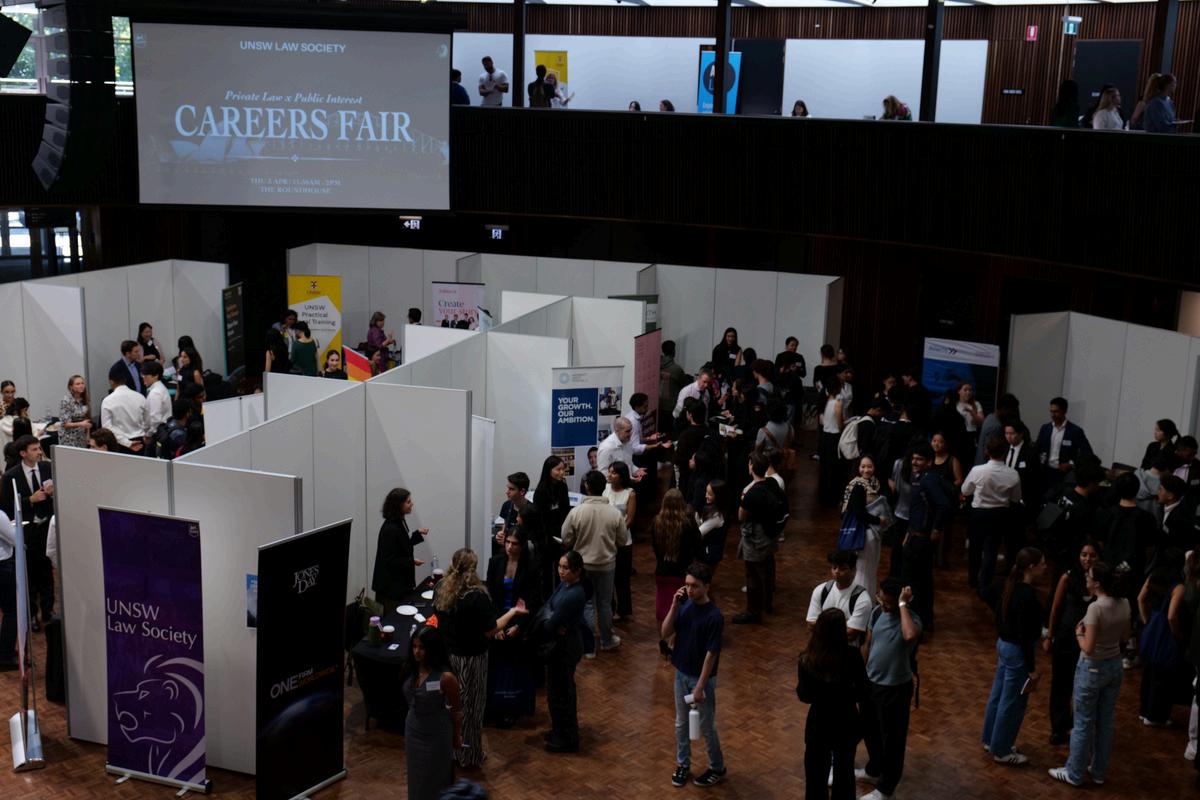
M&A lawyers are engaged throughout the transaction lifecycle. They negotiate commercial terms, conduct legal due diligence to uncover risks, draft transaction documents, and manage completion and post-deal integration. The work is highly collaborative and commercial in nature, often involving multiple jurisdictions and tight deadlines
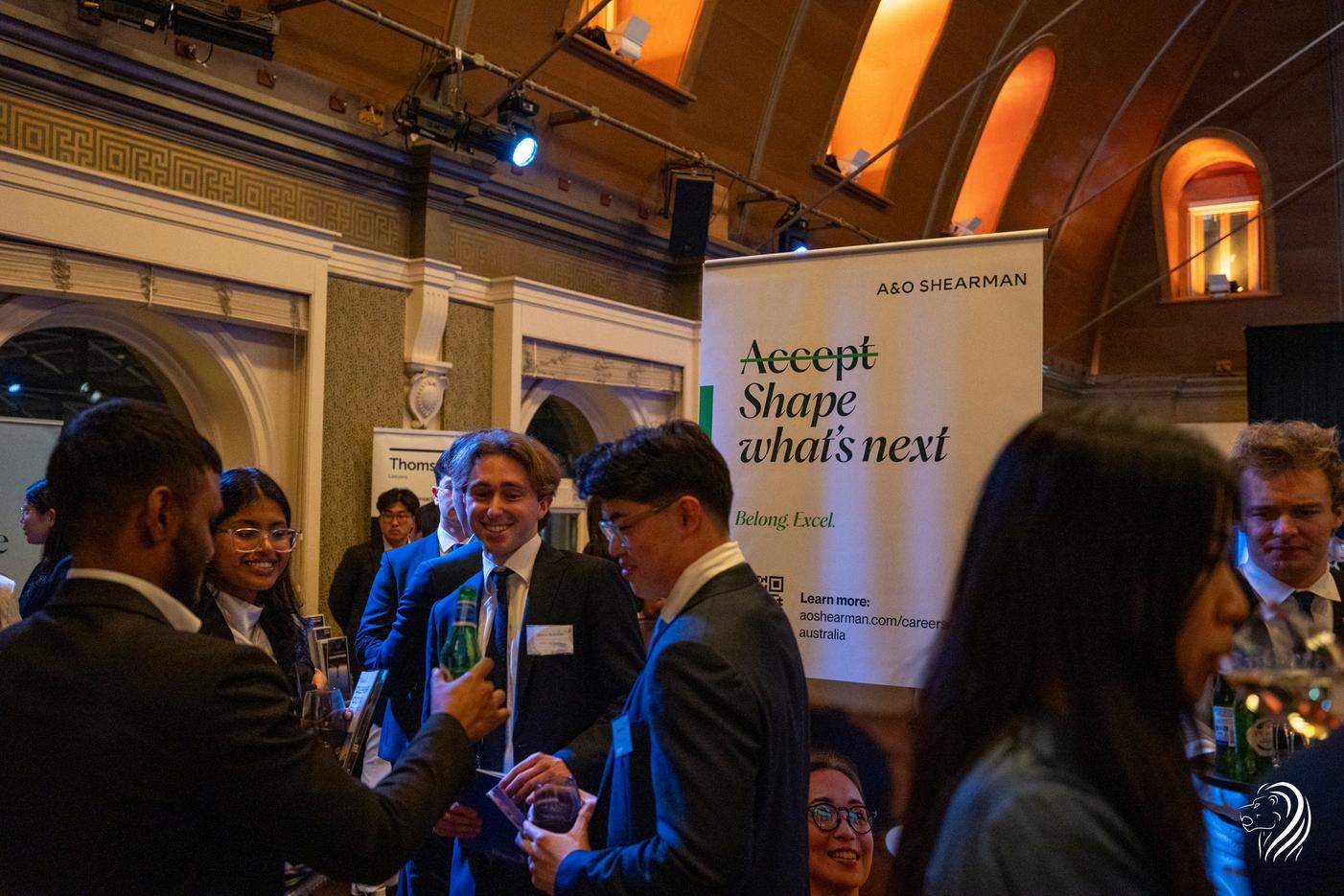

The cover letter is where you as a student can stand out to a prospective employer You should highlight your strengths, experiences, skills, and passions that make you the best fit for the working environment you are applying for. A well-written cover letter is just as important as a resume Where a resume lists experiences, a cover letter allows you to describe how those experiences make you a well-rounded, suitable candidate.
The best way to stand out from other applicants is to research the firm you are applying for To get started, have a look at their website. This should give you some insight into the values and strategy of the firm From there, consider news articles, LinkedIn posts, and media announcements It is really important to get a sense of the culture of the firm, so that you can consider why you are a good fit to be a part of that culture.
Once you have conducted some research into the firm, reflect on your skills and experiences and consider whether they are transferable to the position you are applying for Try not to just list your skills and experiences That is what your CV is for! Rather, reflect on how your experiences and achievements have shaped you as a person.
Although it may seem daunting, the best way to write a cover letter is to simply start drafting and reviewing from the perspective of a recruiter. Refer to the cover letter samples to get yourself started Try not to copy the language of the sample cover letters as the key objective is to be outstanding
Clarity of Expression
Make sure your writing is concise, clear, and flows logically Remember, this is a display of written communication skills.
You want to demonstrate a capacity to write persuasively and eloquently Think of your cover letter as if it was a university assignment, where the marker is the firm
Ensure that there are no spelling or grammatical errors Although this seems self-explanatory, many students fail this small step A single error can reduce your chances in this highly competitive process. Read it out loud to yourself to catch any potential errors or ask a friend to read over it Additionally, make sure the experiences and skills described in your cover letter correlate with your CV It is no use describing an experience in your cover letter if it is contradicted by your CV, or vice versa.
Cover letters should be one page maximum. Remember to include your full name, address, email, and phone number in the top right corner of the page Also, you should include the date on the top left hand corner of the page, followed by the name of your contact person, their position within the firm, the name of the firm, and the address of the firm. If confused, refer to the sample cover letter for guidance
Try to get hold of the contact information of the recruitment officer of the firm. This will personalise your cover letter It is ok to begin your cover letter and address your contact as “Dear Sir/ Madam” Try not to use the phrase “To whom it may concern”. Refer to the sample cover letter for guidance on formatting.
Your cover letter should be tailored to the firm you are applying for. You should not be able to swap the name of the firm out for another firm and have it still make sense Do your research and apply what you learn.
Don’t restrict your description of skills and experiences only to those relevant to the legal field. Non-legal experience and skills are very important and will differentiate you from other applicants
Show, don’t tell Steer clear from simply stating your skills Instead, explain how you gained these skills and how you have applied them at relevant moments in your life.
Don’t be afraid to briefly describe your interests and hobbies This can be a good interview icebreaker and will give the firm a good insight into who you are. Use alternative resources for tips and tricks on cover letters, CV’s, and interviews These resources can include UNSW Careers & Employment, LinkedIn articles, and even social media influencers.
Don’t be afraid to mention events where you met firm representatives, drawing on specific aspects of the firm you head or talked about. Don’t abbreviate terms, especially not the name of the firm
Proofread to ensure there are no spelling or grammatical errors . If possible, address the cover letter to the recruiter, which can usually be found on LinkedIn. Keep cover letter to one page

SAMPLE ONE
Donna Johnson
Talent Acquisition Consultant
Pearson, Spector & Litt
222 Smith Place, Sydney NSW 2000
15 April 2026
Re: Application for Pearson, Spector & Litt’s Summer Clerkship Program
Dear Ms Johnson
Mike Smith 0490 576 293
Mike Smith@unsw edu au
I write to express my interest in Pearson, Spector & Litt’s Summer Clerkship Program. I am a current 4th year Bachelor of Laws/Bachelor Commerce (Finance) student at the University of New South Wales (UNSW). I have a strong distinction average, which I achieved whilst working part-time as a paralegal at Rand, Kaldor & Zane, and actively participating in extracurriculars, including being Private Law Careers Director at the UNSW Law Society
My attraction to Pearson, Spector & Litt, began when I had the opportunity to meet firm representatives at the Private Law Carers Fair earlier this year As a finance major, I was able to appreciate your role in the merger between Hardman Pty Ltd and the Bruno Organisation This demonstrated the strength of your M&A department, which I am interested in and believe is extremely important considering there is currently a boom in M&A.
I have a keen interest in commercial law and specifically M&A, and I believe I would be a good fit for Pearson, Spector & Litt’s Summer Clerkship Program I am a highly motivated and dedicated individual as demonstrated through my excellent academic record, and I have developed a broad range of analytical and research skills through both of my degrees
As a paralegal with Rand, Kaldor & Zane, I enjoyed the dynamic nature of commercial law and assisted in preparing legal documents and researching issues of M&A I hope to further develop these skills at Pearson, Spector & Litt, especially as a leading firm in M&A law as seen in your Chambers’ bank 1 ranking
My personal values and interests suggest I would be an ideal cultural fit for Pearson, Spector & Litt. I actively participate in volunteer work with UNSW Arc Wellness Warriors and Shack Tutoring programs and would be keen to contribute to Pearson, Spector & Litt’s pro bono program. I share the social culture of Pearson, Spector & Litt as reflected through being a UNSW Law Society Private Law Careers Director in 2023 My drive for success and commitment to excellence is evidenced by having spent the 2022 winter break preparing for and ultimately winning the Intermediate Mooting Competition My extensive extracurricular involvements have afforded me excellent organisational skills, and the ability to meet tight deadlines under pressure.
I understand that you will receive many applications for this role, I do, however, believe that my work as a paralegal with Rand, Kaldor & Zane has equipped me with the necessary skills to excel as a Law Clerk with Pearson, Spector & Litt I would appreciate the opportunity to meet with you to discuss my application at an interview. Thank you in advance for your time and consideration.
Yours Sincerely
Mike Smith 24
Email: Elle.Wilson@unsw.edu.au
Emmett Richmond
Graduate Resourcing Manager
Callahan & Huntington
584 Main Street, Sydney NSW 2000
15 April 2025
RE: Application for Callahan & Huntington Summer Clerkship Program
Dear Mr Richmond
I am a penultimate year student undertaking a Bachelor of Arts / Bachelor of Laws at the University of New South Wales, with a major in Politics and International Relations For me, a position at Callahan & Huntington offers an unrivalled foundation to a rewarding career in commercial law In turn, I thoroughly believe that I represent a promising candidate as someone who wholeheartedly embodies the values at the core of this firm.
I am drawn to Callahan & Huntington for your expertise in Banking and Finance, as illustrated by advising Woods Enterprise in their recent IPO, and would love to be at the forefront of such projects My interest in Finance was developed through my experience as a law clerk in a boutique commercial law firm and further reflected in my attainment of a Distinction in Contracts and Business Associations. My dedication and passion in engaging with disruptive thinking align with Callahan & Huntington’s values of creative and innovative thinking, a point of conversation discussed with Banking and Finance lawyer, Vivian Kensington on the night of my firm visit
I believe my experiences have allowed me to develop skills highly transferable to the Summer Clerkship Program at Callahan & Huntington. As a Food and Beverage Attendant, I assisted with various customer service requests in a fast-paced, high-performing environment, which strengthened my ability to engage effectively with clients from all walks of life
Further, it allowed me to develop my verbal communication and teamwork skills In my capacity as Junior Mooting Director with UNSW Law Society, I am responsible for facilitating and organising junior level moots. This role requires me to work with the other Junior Mooting Director, thus providing me with strong leadership and teamwork skills.
Like Callahan & Huntington, I recognise the fundamentality of human relationships and the importance of client satisfaction I consider myself as someone who is easy to get along with while maintaining my professionalism. I have developed these interpersonal skills as LawPLUS mentor which required me to create a fun and supportive environment while I maintained a professional boundary between myself and my mentees. For this reason, I believe I would readily embrace the client-centric culture and would thrive in the friendly and open working environment that your firm promotes
I firmly believe that I would complement the successful culture of Callahan & Huntington and would greatly relish the opportunity to build a meaningful career at such a prestigious firm.
Thank you for considering my application
Kind regards
Elle Wilson
SAMPLE ONE
Lawrence Law
Email: lawrencelaw@student.unsw.edu.au | LinkedIn: lawrencelaw.linkedin.com | Mobile: 1234 567 890
Bachelor of Commerce (Management)/Bachelor of Laws , University of New South Wales (2019 – 2024)
Distinction Average: 79.73 WAM
Law Dean’s List 2021
North Sydney Boys High School (2013– 2018)
ATAR: 99 35
Distinguished Achiever (90+) in Five Courses.
Senior Prefect, Head of SRC, Executive Treasurer, Peer Mentor, State Chess
Paralegal, Law Firm LLP (2021 – Current)
Primarily responsible for drafting legal research memorandums and analysis Further administrative duties include document management, file archiving, and receptionist duty. Responsible for sending client and court correspondence.
Developed familiarity with court electronic filing and lodgement systems, as well as the EDiscovery software Relativity
Undertake drafting of court documents
Flagship Sales Consultant, Hugo Boss (2018 – 2020)
Provided exceptional customer service and styling expertise to clients in premium menswear
Maximised sales opportunities by developing a strong returning client base and exceeded average daily sales quotas of $4,000 during FY21
Volunteer, Redfern Legal Centre (2019 – 2020)
Assisted with preparing advice and letters for clients attending the centre
Met with clients and wrote file notes/minutes regarding the meeting for supervising lawyers. Gained experience in file management and experience in a wide range of legal matters, including employment law, housing regulations and discrimination law.
Audit & Assurance Summer Vacationer KPMG (Dec 2020 – Feb 2021)
Performed detailed audit procedures and audit tests to verify client financial statement compliance in accordance with Australian Accounting Standards Board (AASB) Accounting Standards
Prepared work papers and financial statements for FY20, in collaboration with corporate clients like Qantas, as well as KPMG partners, managers and senior accountants.
High School Tutor (2018 – 2021)
Teaching weekly classes of up to 6 students, each with differing academic skills and needs Constantly keeping up to date with ever-changing HSC course content as well as developing familiarity with a wide range of topic areas that I may not have studied myself in High School \ Taught general class content, as well as providing guidance and feedback on assessments. Greatly improved student results, with examples including from 50%-85%.
Provided weekly progress reports to parents
Law Competitions
UNSW Law Society Senior Mooting (2021)
King & Wood Mallesons Senior Witness Examination (2021)
Sydney University Law Society Multilateral Intervarsity Client Interviewing Competition (Grand Finalist) (External Competition);
Australian Law Students Association Mooting (External Competition);
UNSW Law Society Beginners Client Interviewing (Grand Finalist 2019)
UNSW Law Society Senior Mooting (2021) (Semi-Finalist)
King and Wood Mallesons Insight Program (2021): invited to participate in King and Wood Mallesons pre-penultimate program, designed to give students some insight into life at a top tier law firm in Australia. It also provided practical tips for preparing for employment, as well as applications for paralegal and graduate positions
Leadership
Senior’s Witness Examinations Director (2020) – Elected to run the Senior stream of the witness examination competition offered by the UNSW Law Society. Responsible for administrating, timetabling and judging the competition, as well as liaising weekly with external volunteer judges, including solicitors and barristers in the industry, as well as law firm representatives.
North Sydney Boys Prefect (2018)
Public Speaking (2015 – 2017): reached regional final in 2015, speaking on contentious cultural and political topics.
School Debating (2013 – 2017)
Mock Trial (2017): progressed to the second knockout round of over 60 schools, gained a basic understanding of legal advocacy and the processes of Court proceedings
St Vincent DePaul Op Shop (2016 – 2017): volunteer responsible for organising clothing and homeware item donations and communicating with senior volunteers to assist with the general operations of the donation store
University of NSW International Exchange Scholarship
Higher School Certificate
Sydney Girls High School
ATAR: 99.6
School Prefect and School Trophy for All-Round Excellence and Service
Duke of Edinburgh Gold Award
Negotiations, Australian Law Students Association National Competition (Melbourne), 2019
Best Delegate, UNSW Model UN (Thailand), 2019
Finalist, Senior Witness Examination Competition, 2018
Runner Up, Intermediate Negotiations Competition, 2018
Finalist, UNSW Law Hackathon, 2017
Summer Vacationer De Deloitte Consulting, Sydney
Assisted in the creation of a market overview analysing the key trends in the Australian ch worth $3.5bn
Researched and analysed the industry value chain, recent consolidation trends, market seg underlying drivers of demand for Australian cheese
Consulting Intern July 2019
Kanter Infrastructure and Utilities, Singapore
Led research and market analysis on the automotive industry in Thailand
Designed optimal sourcing for Kanter’s operating systems, including automobile manufac assembling facilities, ensuring effective financial budget management; devised a WACC m operation, estimating $21M USD net present value
Delivered a client facing report, business report and plan to the Independent Executive D board
Paralegal Jan
Australian Law Firm, Sydney
Conduct legal research into different commercial law areas
Document review using relativity for litigation
Music Director
UNSW Law Society
Overseeing a group of 4 students in order to ensure the cohesion and effectiveness of the society Liaising with Arc to source internal funding and to ensure compliance with university guidelines an Ensuring society meets re-affiliation requirements by preparing motions for general meetings, makin constitution and maintaining all documents and reports
Entertainment Coordinator
UNSW Arc (Yellow Shirts)
Organised and produced a major live entertainment line up across five nights for all first years on U O-Week
Sourced live acts, negotiation of entertainment contracts, promotion of events and overseeing techn requirements
Publications Director
UNSW Business Society
Worked in a team in order to prepare all publication materials for the society including the Marketi Publications
Prepared weekly email newsletters for all society members Managed and crafted text and visual content for society’s social media accounts
Interests: Pianist and Band Member, UNSW Law Society Law Band and Runner with UNSW Run Languages: Native Proficiency in English and Mandarin, Beginners in Spanish Recreational Interests: Kickboxing, archery, food and travelling
REFEREES
Lisa Wong
Senior Associate, Australian Law Firm
M: 0490 909 909
E: lisa gong@chambers com
Some firms may also ask online screening questions that are designed to evaluate candidates' qualifications, experience, skills, and suitability for the position.
These questions serve multiple purposes, including assessing candidates' prior expe-riences, motivations and suitability for the firm.
Additionally, screening questions aim to gauge candidates' communication skills, both written and oral, which are essential for the clerkship role.
Overall, these screening questions help identify candidates who possess the requisite knowledge, skills, and qualities to excel in the role
Keep answers succinct and clear. A clear structure is crucial for these shorts answers
Adhere to the word limit (if specified).
Answers should add onto your cover letter. This is an opportunity to bring your CV and cover letter to life
Tailor answers to the firm that you are applying to.

Many firms include psychometric testing as part of the clerkship application process These assessments may evaluate numerical reasoning, verbal reasoning, abstract logic, situational judgement, and even personality traits. While you can’t “study” for these tests in a traditional sense, you can improve your performance with preparation
Tips:
Familiarise Yourself with the Format: Practise using free resources online (e g. GradTests, Revelian, or Practice Aptitude Tests) to become comfortable with the structure and timing of common assessments
Practise Under Time Pressure: Most tests are time-limited; work on speed while maintaining accuracy The best way to achieve both is to practise, practise, practise!
Use Process of Elimination: For reasoning-based questions, narrow down your options quickly to avoid wasting time.
Don’t Overthink: Answer honestly and consistently. These tests are designed to measure behavioural preferences, not trick you.
Be Calm and Well-Rested: Mental clarity matters Set yourself up with a quiet space, a good night’s sleep, and limited distractions.
Firms are not seeking perfection, rather, they’re assessing problem-solving approaches and alignment

Using the selection criteria will help ensure you have met all of the employer's key requirements The selection criteria are a list of the essential and desirable skills, attributes, experiences, and education deemed necessary for a position.
Selection criteria are used to help select the most capable, suited, and qualified person for the job. Applicants must demonstrate and prove the ways in which they will be of value for the job and the organisation. Your application may not be shortlisted if it fails to establish how you meet any one of the criteria. Applicants who are able to successfully and competitively demonstrate that they meet each of the selection criteria will usually be offered an interview.
From the organisation's point of view, selection criteria can help standardise the recruitment process They serve as a guide for employees and recruiters to help look for essential and desirable requirements in applicants, which can help reduce personal and social bias in selection decisions, and to ensure that the most suitable candidate is selected
Selection criteria common to many graduate jobs include:
Organisational and planning skills; Accuracy and attention to detail; Written and oral communication skills; Ability to work independently and as part of a team; and Problem solving and data analysis
When holistically considering an individual's characteristics, law firms (and companies in the private sector as a whole) generally have a loose selection criteria they hire candidates based upon. However, they may not be as clear or rigidly followed as selection criteria in the Public Service. Selection criteria for jobs in the private sector may be available from the manager of a work unit or the recruitment consultant who is working to fill the position.
When addressing the selection criteria, it is important to be precise and explicit It is not enough to simply state that you meet the selection criteria; you need to tie your skills and experiences directly to the criteria at hand. A good way of addressing selection criteria is by using the STAR formula The STAR formula is structured as follows:
Situation: where, when and context of your example
Task: the task or problem to be solved
Action: how you solved the problem, achieved the goal, or handled the dispute
Result: the outcome achieved as a result of your act
Clarify the selection criteria by either requesting recruitment package, analysing the job advertise-ment, or speaking to the contact officer or recruitment consultant. Research the position and the organisation further. Alternatively, attend firm presentations and speak to firm representatives when they are on campus
An interview is the culmination of your research into the firm and your personal ‘sales effort’ represented by your cover letter and CV. Reaching the interview stage is an achievement, as partners are willing to give up time and high billable hours to meet and get to know you.
Interviews can vary significantly depending on the particular organisation. You can even experience very different styles of interview between particular interviewers at the same organisation. Given that you might not be able to predict what kind of interview situation you will be walking into, it is useful to be aware of the different varieties In the instance you do know something about how the interview will run, this is a great opportunity to practice what you might say
The first aspect of the interview which may vary is the number of interviewers. Depending on the number of interviewers, the manner in which you respond may differ Regardless of the situation ensure you give ample eye contact to everyone in the room to demonstrate that you are comfortable holding a conversation with multiple listeners. As an example, clerkship interviews often will consist of two interviewers who may be lawyers, human resources employees or both
The number of candidates in the room may also vary; you may be interviewing with other applicants for the job. In these interviews you have the opportunity to demonstrate that you are able to listen to others in the room, whilst clearly conveying your own responses. Bounce off the ideas of others in the room and try to help everyone feel included. Take initiative with your responses without being too authoritative
Remember that in this kind of situation it is important that the group achieve its assigned goal and that to stand out, one does not always have to be the leader of your group. Observers will assess your contribution to discussion, expression, reaction to others and contribution towards reaching group goals.
To perform successfully you should consider your position before contributing, listen to and support others, show courtesy and tact, remain composed and keep a focus on the goal and on time limits
Another variable in the interview process is the structure of the interview itself. Some have set questions to be answered, while other interviews have no structure and may take the form of a conversation. Remember this is a sliding scale and interviews may be a blend of the two, with some requisite questions asked with casual conversation in between A top tip is to do a quick search of people’s interview experiences at the organisation or similar organisations, so you can be prepared for the interview environment you will be heading in to.
If you are asked to answer behavioural questions (e g “tell me about a time when you demonstrated leadership”), use the STAR model (Situation, Task, Action, Result). This allows you to support your answer with concrete evidence. What action did you undertake and what was the result of the action?
Be yourself, be calm and try not to show your nervousness.
Small talk is good to break the ice before and after the formal part of the interview
Make sure you re-read your cover letter and resume before the interview to remind yourself of what you wrote
Know your CV and cover letter like the back of your hand! Your CV and cover letter have created a positive impression, so you now have an opportunity to reinforce this opinion. The interview should be seen as a twoway process: the firm will ask you to expand on elements of your cover letter and CV, and you will be expected to ask questions of the interviewer(s), which allows them to find out more about you and ensure you are the ideal candidate for the job.
As you did for the cover letter, you need to research the firm in more detail for the interview. Aside from preparing for likely interview questions, you will also be expected to have done some research into each law firm You should research:
The firm’s practice areas and particular strengths;
The organisational structure, rough number of partners/ lawyers/directors etc. (briefly);
The name(s) of key people in the organisation. Mention this only if you have something interesting to say (e.g. admire a Partner’s leadership style);
The firm/organisation’s culture, values, atmosphere (crucial and should be incorporated into your responses);
The organisation’s recent work, deals, cases or transactions;
Business affairs, such as a recent or intended merger;
Brief understanding of the firm’s reputation;
The structure, activities, number of rotations etc of the position you are applying for; and,
The current issues facing the legal industry, e.g. competition from overseas firms.
Don’t forget to revise any personal knowledge or familiarity with current employees of the firm/ organisation. You may have met them at the various cocktail evenings, or you may also know recent UNSW clerks or graduates. Research methods include:
The firm / organisation’s website, particularly pages such as ‘Our People’, ‘Our Culture’ and those dealing with the clerkship and graduate programme.
Media (Australian Financial Review (Friday legal affairs section); Lawyers Weekly)
Speaking with employees of the firm/organisation at various events held in the lead-up to the interview period.
In order to feel confident and well prepared you will want to take a copy of your CV, cover letter, and the official copy of your academic transcript available from Student Central
You have the firm’s attention, and they already value your skills and experience. The interview is your chance to continue to impress them You need to create a positive and professional impression to give yourself the competitive edge
Generally, formal business attire is most appropriate. However, dressing standards might differ depending on the firm or organisation. Choose styles and colours that do not distract others or yourself. They should fit well, be in good repair and be neatly pressed
Your relationship with the interviewers, especially your non-verbal communication is crucial in the success of the interview If you appear to be confident and enthusiastic from the outset, your answers are more likely to be reviewed positively
Starting the Interview Confidently
The impression you create will weigh upon the tone of voice you use Attempt to communicate positive emotions (interest, enthusiasm or confidence) rather than negative emotions (anxiety, uncertainty or boredom) Modulate your voice to maintain the attention of your interviewers and use hand gestures where appropriate to reinforce an image of confidence
Preparing an opening line may assist you to exude an air of confidence Use a simple phrase such as, ‘Good morning, pleased to meet you. I’m Isaac Dela Torre’. Choose something you feel comfortable saying and say it instinctively Smile and talk to, not at, the interviewer. Show the interviewer that you are glad to meet them, and you are enthusiastic about the job. Remember, you do not have to use this opening - another conversation may take place - but it can be reassuring to have a backup opening line
While having canned small talk on the weather or news may help ease initial nervousness, the most important aspect to building rapport is being genuine. Coming off as artificial can be just as damaging as a slight bit of awkwardness. During the interview take into account their language, body language, and consider their perspective to form your responses effectively
Maintain appropriate eye contact throughout the interview (do not stare or look away too much) Listen carefully to what the interview is telling you about the organisation and your likely role within it in order to ask informed questions in response Use appropriate listening cues such as nodding in order to look engaged at all times
Listen to the interviewer and clarify the question if you do not understand it to allow yourself to answer the question adequately The bucket approach (i.e. throwing everything that you know about the question) will not effectively answer the question Try to relate your answers to the requirements of the position and the organisations
There are many types of interview questions, and while the underlying intent of the interviewer may be self-evident with some, for others it’s important to understand what the interviewer is trying to find out about you. Regardless of the question asked, remain calm and confident in your answer
These questions are designed to find out a little bit more about you It is a chance for you to explain what you have done, your attitudes and values, and the choices you’ve made in your life It is often a good idea to address the question in a reverse chronological order and also to start with a brief synopsis Remember that you need to be informative without going into so much detail that you bore your interviewers Such questions may be as follows:
Tell me about yourself.
How would you describe yourself? What are your strengths and weaknesses? Is there an achievement of which you are particularly proud of? What is it and why is it significant?
With these questions, you need to demonstrate to the interviewer that you have thought about what it is that you want from working at the firm and what you hope to achieve At the same time you need to assure them that you are flexible and would be prepared to work in a range of areas
Some example questions include:
What are your long term and short term goals and objectives?
How are you preparing yourself to achieve them?
What do you see yourself doing five years from now?
To address these questions apply the STAR model and consider various scenarios, such as a time you were a good leader, resolved a problem, or adjusted to a last minute change. Questions:
‘Tell us about a time you resolved a conflict’
‘Give me an example in your career where you felt like giving up but managed to keep going.’
Employers are often keen to find out what your major areas of interest are so that they can better assess how well you will fit into their organisation, both now as well as your potential to develop within the organisation in the future
Questions:
Why do you want to become a corporate lawyer?
What kind of positions are you interested in?
Do you have a locational preference?
What is your understanding of the current legal climate here in Australia?
Are you willing to travel or relocate? Your Contribution to the Organisation
Why should we consider you for this position?
In what ways do you think you can make a contribution to our company?
What other skills would you like to develop in the future?
An employer is interested in how your values are aligned with their firms. This is one area where you will shine if you have done thorough research.
What do you know about our company?
How do you keep informed professionally?
Why did you decide to seek a position with this company?
With these questions, interviewers hope to gain more insight into your educational background. Most importantly, they are interested in the reasoning behind your decision to study the course you did and what you think you have attained from your studies. Follow-up questions include:
Why did you choose to study law?
What university subjects did you like the best and least? Why?
Do you plan to continue studying?
What part of your education do you see as being most relevant to this position?
Is your academic performance any indication of how you will do this job?
What do you like about your discipline of study?
Why did you fail/perform poorly in this subject?
As for this final question, it simply demands honesty: the firm is likely to be satisfied if you can cite extracurricular commitments, employment or something similar The benefit of such a response is that you are simultaneously outlining a strength, namely your involvement in activities outside university and your work experience.
At the end of the interview you will be given the opportunity to ask questions of your interviewer(s) This is not a mere formality, it is expected that you ask some questions, which at the very least will reflect your interest in the organisation or firm Be judicious in your choice of questions. Asking questions with an obvious answer would reflect inadequate thought and preparation. Always prepare a list of potential questions to ask in advance. Examples of such questions include:
Why did you choose to work here? What was the ‘clincher’ in your decision? What did you find unique about this firm?
How is a work/life balance encouraged in this firm? How do you achieve this balance? How often is feedback provided, both to summer clerks and to full-time lawyers?
What sort of induction and training do you normally offer?
What is the firm’s policy on taking leave for further study or associateships?
What long-term career opportunities are available at the firm?
What do you enjoy about your practice group? What led you to work in it?
What sort of work would I be doing in your practice group?
Are there any secondment opportunities for lawyers at this firm?
What ‘extracurricular’ activities are available for clerks?
Be sure to follow up and write a thank you letter to the HR from the firms you receive an offer from
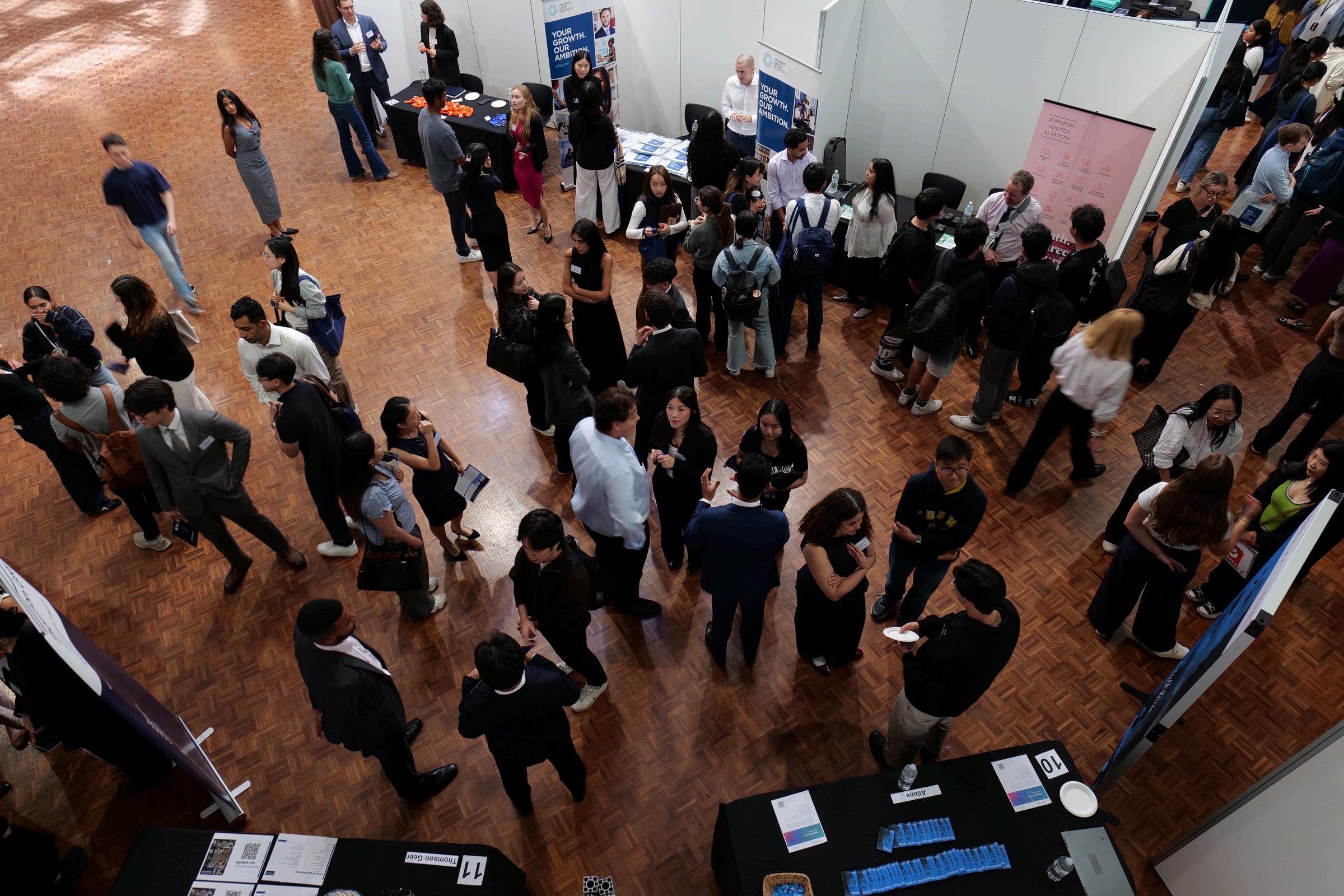
What is your usual retention rate between summer clerks and graduate lawyers? How many years of service does it tend to take for a lawyer to be promoted to a senior associate or partner? What other factors are relevant in such a promotion? How do the various practice groups communicate and collaborate with each other when a matter requires it?
Commercial awareness is staying frequently informed of the developments occurring in the business world. It encompasses considering the potential implications of an event and how it will affect the commercial space These events could include geopolitical developments, changes in economic policy, or even the current financial climate in which we live. Regularly seeking news on significant deals, transactions, and issues in the industry places you in a position to consider the interests of firms you apply for, and the clients they represent
The corporate workplace is highly competitive, and employees are expected to have awareness of the space they are operating in Having knowledge about matters affecting firms and the clients they work with is therefore crucial. Establishing meaningful relationships with clients and avoiding poor business decisions are therefore key benefits of possessing commercial awareness. Major law firms are deeply embedded into the commercial space and thus look for applicants that understand the realities of business and how financial news affects the legal and corporate industries
Having surface-level knowledge about the occurrence of an event is not sufficient. Having commercial awareness involves asking yourself key questions about an
Why has it happened?
Why do you consider it to be significant?
Who are the stakeholders, and what implications does this event have on them?
Do you agree with how stakeholders have managed the situation?
Does the event cause any challenges for the commercial or legal space that will be relevant to a firm's clients?
You also need to consider that commercial awareness takes time to develop; it cannot be developed overnight Building knowledge on events and news over time is crucial to developing comprehensive commercial awareness
Read the business pages from key news providers and follow the stories and trends they report over time - connect the dots
Keep an eye out for significant deals occurring in the commercial world, as these impact the industry and beyond in addition to the parties who are directly involved.
The monthly UNSW Law Society Private Law Careers
Commercial Awareness update is a good place to start!
If you do not understand something initially, display initiative and conduct further research.
Some interesting sources to keep a tab on include, but are not limited to:
Lawyers Weekly
Australian Lawyer
Australian Financial Review
The Economist
The New York Times
Bloomberg News
Financial Times
International Financial Law Review
The clerkship application period can be one of the most stressful times in a law student's time at law school But remember, clerkships are by no means the be-all and end-all. It is important to take care of yourself both physically and mentally during this time
If you have spent the day balancing university study, work and writing clerkship applications your brain is likely tired and fatigued This is a great time to take a break! Studies say that you should take a break from studying every one to two hours. A great way to ensure you are taking enough breaks is to schedule them. On these breaks, you could go for a walk and get some fresh air or catch up with friends.
Law school is hard. Work is hard. Clerkship applications are hard But that doesn't mean that you should compromise your health and wellbeing for the sake of furthering your ca-reer It's a good idea to just switch off once in a while and do something you enjoy Always make time for your family, friends, and most importantly, for yourself. Prioritise your health so that it does not start a negative feedback loop whereby every aspect of your life and career are impacted by poor health Ensure you are getting regular and sufficient sleep, maintain sleep hygiene, take supplements, eat a well-balanced and nutritious diet and relieve physical and mental stress through exercise or decompression activities such as recreational yoga This is important, as maintaining a healthy lifestyle will help tide you over and keep you going for the semester and/or your application period
It's no secret that law students suffer from higher levels of depression and anxiety. Add part or even full-time employment and a stressful application period into the mix & you may be left feeling seriously overextended. Don't be afraid to reach out to your support network! Your support network could include friends, family, your GP or a psychologist. When you are stressed out, reach out to friends and family for support, even if this is just to chat with them about what is going on If you are struggling, you can also reach out to UNSW Psychology and Wellbeing who can provide free counselling or contact your GP who can provide you with a mental health care plan and receive up to 10 free or subsidised psychologist
UNSW Psychology and Wellbeing: https://www.student.unsw.edu.au/counselling Beyond Blue: https://www beyondblue org au/ LifeLine Crisis hotline: 13 11 14
Contact your GP for a mental health care plan to receive up to 10 free or subsidised psychology sessions.
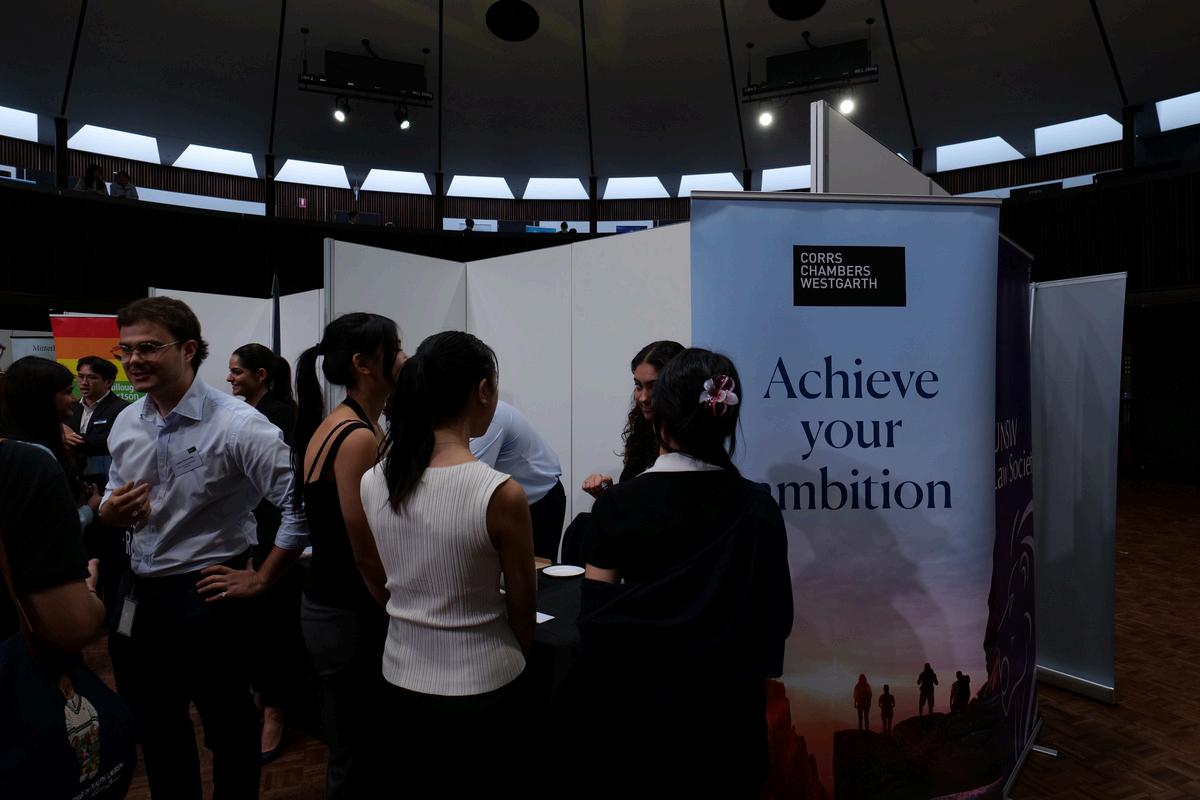
Under the UNSW3+ academic calendar, students now annually enrol in courses for each Term of the coming year from October.
Students are able to apply for a Summer Clerkship in T2 and will be notified of the outcome by early T3. Students apply for a Summer Clerkship from early June in T2 and will be notified of the outcome in week 1 of T3 by the firms. Students will have 24 hours to accept an offer from a firm
Students who do not receive an offer are advised that if they are enrolled in compatible clerkship courses in T3, it may be worth reconsidering whether to proceed with these courses or to change enrolment to other electives based on their interest or a wish to diversity assessment timelines across your T3 courses. Please make any changes to enrolment promptly, and ideally before the T3 census date!
Students who accept an offer but have NOT enrolled in clerkship compatible courses should enrol into a compatible course(s) immediately During Week 1 of T3, there is some movement as students adjust enrolment based on the outcome of the clerkships process, and students are advised to watch for places at frequent intervals.
The Law Faculty advises that any student who accepts an offer can seek assistance, if needed, to enrol in a clerkship compatible course Please contact the Faculty Careers Manager, Ms Brooke Johnson, brcoke.johnson@unsw edu au, providing your contact number on the day of acceptance. Proof of offer and current enrolment information must be provided NOTE - the faculty does not guarantee
CLERKSHIPS
To maximise compatibility with Clerkship programs, UNSW Law is offering a higher than usual number of electives to UG and JD students in T3 that do not feature a formal examination (or in which such assessment is optional) that would clash with the start of Clerkships.
Additionally, a number of these electives are taught intensively and will commence in Week 2 of T3. This will enable students who need to alter their enrolment after receiving an offer to change into a course without having missed the first week of classes. UNSW Law has reviewed current enrolment figures in T3 electives and noted that UG and JD places remain across the offerings Further places maybe opened up in some courses as required in Week 1, T3
Students who receive an offer will be assisted, as needed, to enrol in an elective compatible with undertaking a Clerkship However, choice of course is not guaranteed
Because students will be required to prepare applications for clerkships during Term 2 rather than in the semester break that existed under the former academic calendar, the faculty is committed to providing them with greater support so they may maintain focus on their study and still seek clerkship positions to the same extent as previously Students should attend one of the Law & Justice Careers Services established to help students' best position themselves to secure a rewarding job at the end of their studies



WHAT ARE THE KEY AREAS OF LAW THAT THE FIRM PRACTICES IN?
We focus on innovative and expert legal solutions across a broad range of areas We have four overarchingdepartments that include specialty practice groups:
Corporate includes M&A, Private Equity, Digital, Data, IP and Technology (DDIT), US Capital Markets ECM and DCM and Tax; Finance includes Global Financial Markets, Real Estate, Debt Finance, Financial Services Regulatory, Restructuring and Funds & Asset Management; Disputes includes Litigation & Investigations and Antitrust; and Energy Natural Resources and Infrastructure (ENRI).
DOES THE FIRM HAVE ANY PREPENULTIMATE ENGAGEMENT SCHEMES, IF SO, HOW DO STUDENTS GET INVOLVED?
We occasionally recruit casual paralegals If you would like to submit an application, please send your CV and transcript to australianrecruitment@aoshearman.com.
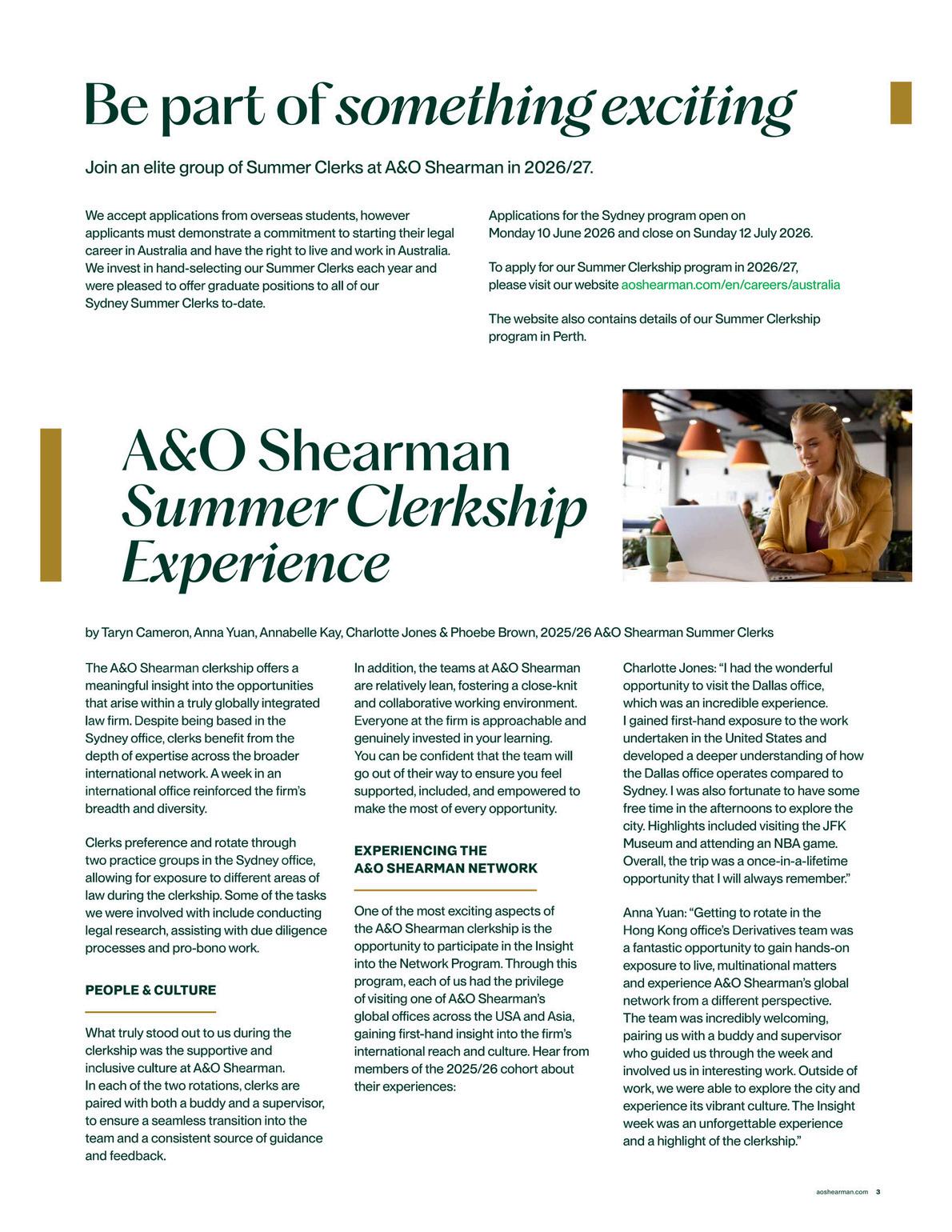
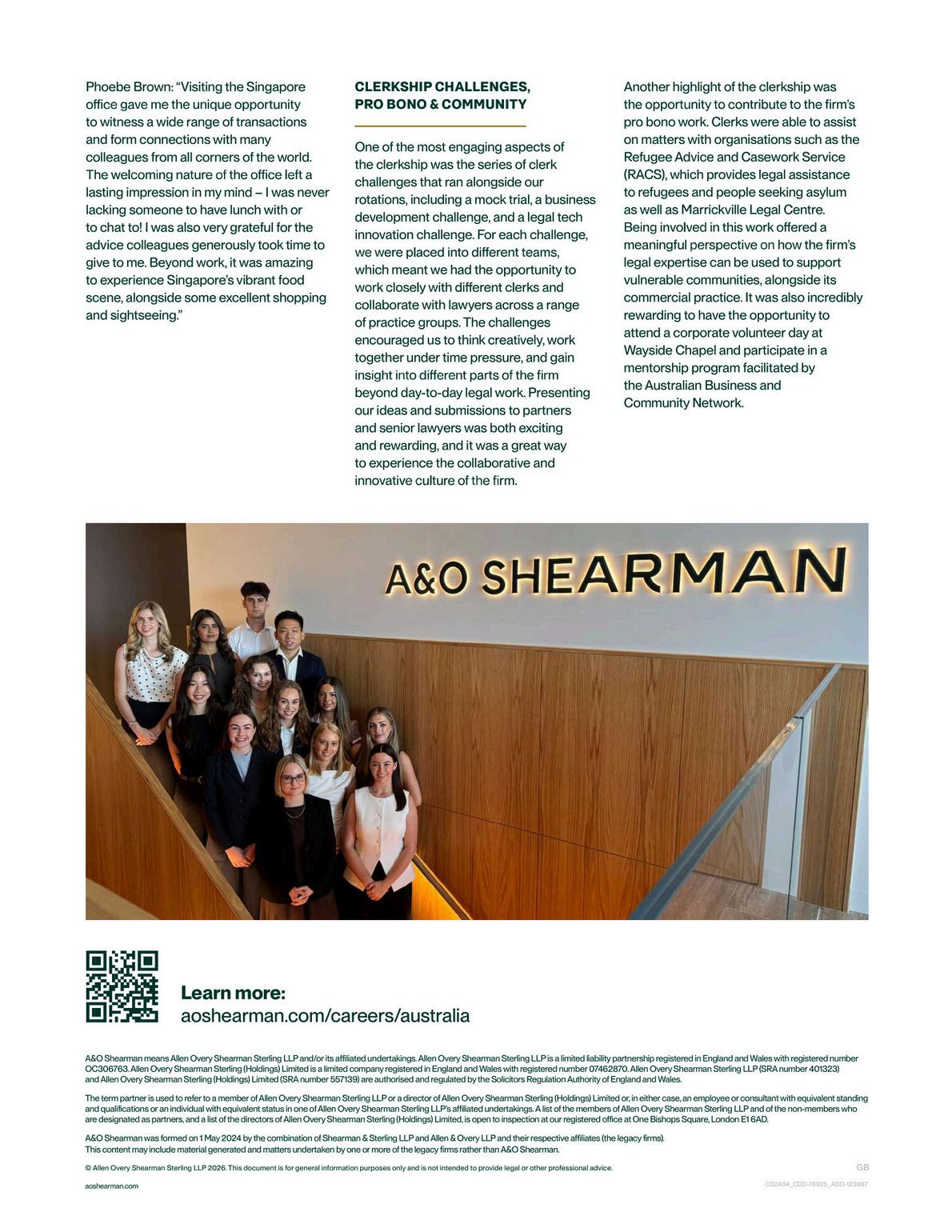
In May 2024, Allen & Overy and Shearman & Sterling merged to create A&O Shearman, a global law firm built to achieve unparalleled outcomes for the world’s leading businesses Building on the legacy of both firms and with some of the greatest legal talent around the world, A&O Shearman is the first fully integrated global industry-leading law firm
At A&O Shearman: We invest in you - you’ll constantly learn and grow with exceptional professional and personal development opportunities We invite you to bring your whole self to work You belong - Teamwork is essential, and you’ll achieve more together than you would alone. We’re building a workplace where progress is made by harnessing our differences We nurture a friendly, dynamic and stimulating atmosphere, where you’re valued for who you are, as much as you’re valued for what you do. You excel - With high expectations and high performance, this is an environment where you can truly excel, building enduring relationships with clients as you tackle challenging and rewarding assignments.
HOW MANY LAWYERS AND PARTNERS DOES THE FIRM HAVE?
In Australia, there are 29 partners and over 100 lawyers. Globally, there are almost 700 partners and over 3,000 lawyers
DOES THE FIRM OFFER A CLERKSHIP PROGRAM, IF SO, HOW DO STUDENTS APPLY?
We run a Summer Clerkship program for penultimate law students every year. Applications open on 10 June 2026 and will close on 12 July 2026 You can apply from our website:
https://www.aoshearman.com/en/careers/austra lia/students-and-graduates
DOES THE FIRM OFFER CLERKSHIPS TO STUDENTS OUTSIDE THEIR PENULTIMATE YEAR?
Our clerkship is aimed at penultimate law students to become our 2028 graduates, but final year students are welcome to apply
WHAT IS THE ANTICIPATED CLERKSHIP INTAKE THIS YEAR?
Between 10 and 15 Last year, we had 13 summer clerks
WHAT ARE THE QUALITIES THE FIRM LOOKS FOR IN CLERKS?
In addition to excellent academic results, we seek students who are team players, show resilience, are good communicators, have strength in planning and organisation, are adept at problem solving and have general commercial awareness with an overall ambition to build a career at A&O Shearman
DOES THE FIRM OFFER A GRADUATE PROGRAM, IF SO, HOW DO STUDENTS APPLY?
We aim to recruit our graduates through our summer clerkship program. Whether we hire additional graduates outside of the summer clerkship will be based on business need
DOES THE FIRM OFFER GRADUATE POSITIONS TO CLERKS?
To date, we have always offered all our Sydney Summer Clerks a graduate position.
WHAT RESPONSIBILITIES AND TASKS CAN A CLERK EXPECT TO TAKE ON?
Our summer clerkship program is a great way to experience firsthand our work and culture. During the program, you will gain real experience working alongside our lawyers on real deals and cases as well as specifically designed exercises that provide a valuable insight into the role of an A&O Shearman lawyer. Bespoke training will be provided by some of our leading lawyers in Australia and across our global network
DOES THE FIRM OFFER A CLERKSHIP PROGRAM, IF SO, HOW DO STUDENTS APPLY?
Only apply to firms where you actually want to work.
Paralegal/legal experience is not necessary. Think about the experiences that you’ve had that make you interested in/suitable for a career in commercial law Be relaxed, honest and yourself
WHAT IS THE PROGRESSION PATH OF A GRADUATE LAWYER AT THE FIRM?
Being a transformational global law firm requires continuous growth and you are key to this That’s why we invest in you – providing a career which is tailored to your skills and knowledge, and helping you achieve your goals We aim to bring you opportunities you wouldn’t find anywhere else, and we empower you to drive your own development by providing access to industry-leading training and development at every point in your career This investment will equip you with the knowledge, leadership, management, and business skills you need to reach your full potential

Allens has a culture defined by shared ownership, collaboration and a strong sense of responsibility to our clients and each other
We work in an environment where expectations are clear and feedback is part of everyday practice Our people are encouraged to think critically, take initiative and engage deeply with their work, while being supported through coaching and development at every stage of their career.
Our culture values different perspectives and constructive challenge. We believe the best outcomes come from bringing together people who are thoughtful, committed and willing to contribute to something bigger At Allens, shaping the future is reflected in how we work with purpose, care and a focus on continual improvement
We don’t work in silos our people collaborate across practice areas and disciplines to solve complex problems and deliver outcomes that matter to clients Through our alliance with Linklaters, our lawyers also gain access to international perspectives and secondment opportunities
We look for people who bring different perspectives and are motivated to contribute in an environment where expectations are clear and the work is complex and challenging
Ultimately, we’re looking for students who demonstrate curiosity, judgement and a genuine interest in how the law operates in complex, commercial contexts Academic results matter, but so does how you approach challenge, take responsibility for your development and apply what you’ve learned in practice
You’ll stand out if you can demonstrate a thoughtful understanding of our work, our clients and the way the legal profession is evolving We value experiences whether through study, work, volunteering or other commitments where you’ve shown initiative and adaptability.
We encourage applicants to be genuine and reflective Rather than trying to present a version of what you think we’re looking for, focus on explaining what motivates you, how you’ve responded to complexity or change, and why you’re interested in building your career at Allens
Applications for our 2026-2027 Clerkship program open on 10 June 2026 and close on 12 July 2026. To be eligible, you will need to be in your penultimate or final year of study.
Candidates are required to upload their CV, cover letter and their academic transcript. They will then receive an invite to complete an online assessment. Successful candidates are invited to attend first round of interview, followed by a second round of interview, if successful
Our clerkship intake is from mid-November to mid February
There’s no single ‘average day’. Our clerks undertake work similar to that of a junior lawyer This includes legal and market research, drafting memoranda, preparing advice, attending client meetings and court hearings, and supporting teams on active matters
Clerks work closely with partners and lawyers within their practice group and are expected to engage with the substance of the work, understand context, manage competing priorities and deliver work that is clear, well structured and technically sound You’ll be part of a team delivering advice on live matters, where accuracy, judgement and responsiveness matter
We support our clerks by assigning a dedicated performance coach and buddy, who help set expectations and provide regular feedback throughout the program

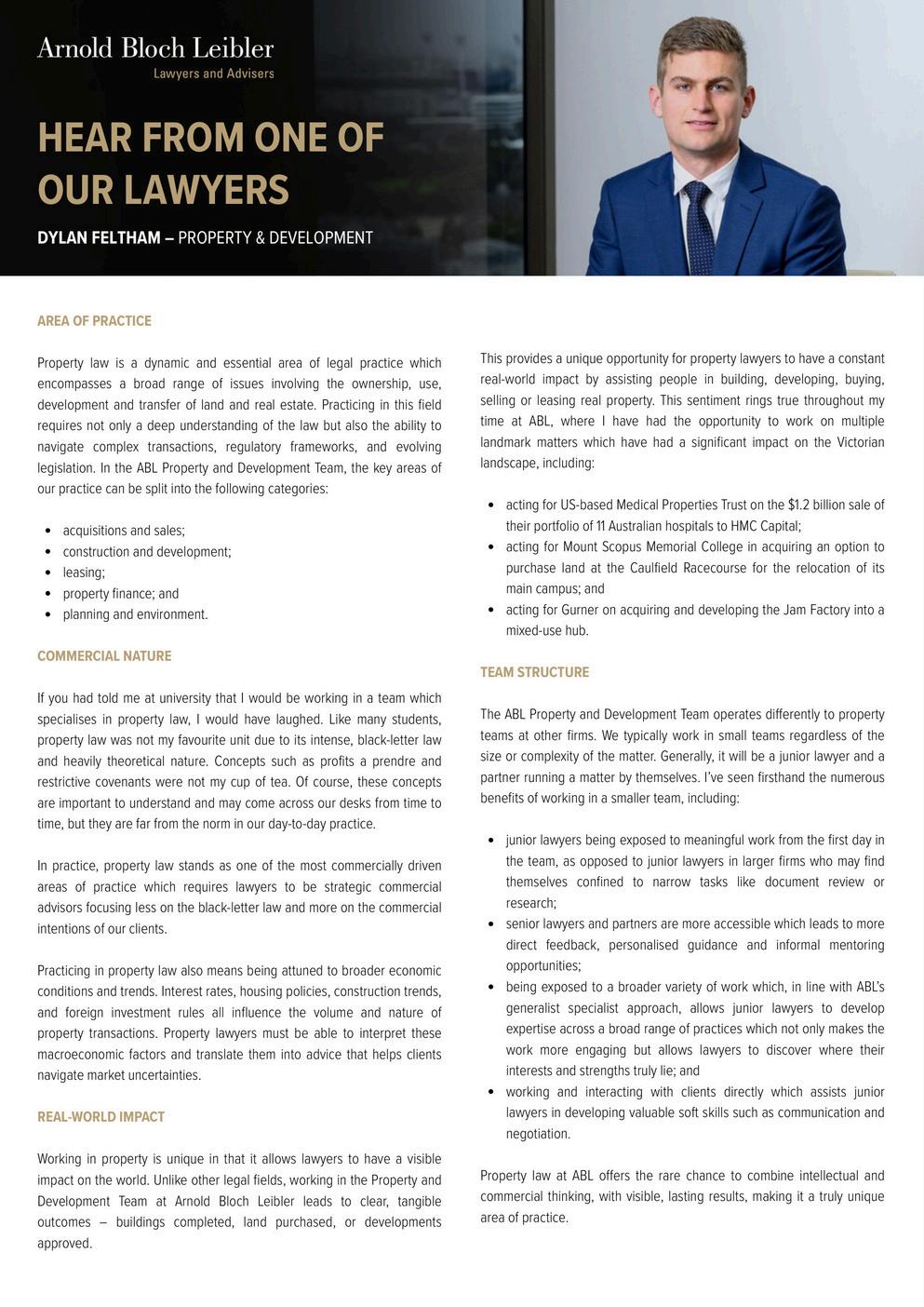
We organise our teams into practice groups and our lawyers collaborate daily across practices when advising on important transactions and disputes From the client perspective, our services cover: banking & finance; capital markets; competition; corporate & M&A; dispute resolution & litigation; intellectual property; native title & public interest law; property & development; private clients; reconstruction & insolvency; taxation; and workplace advisory.
When you join ABL as a clerk or graduate, you will immediately experience what sets our firm apart. ABL is renowned as the goto firm when it matters most We pride ourselves on delivering strategic advice and solving complex problems related to our clients’ commercial interests, legal standing, and reputations. As a result, our lawyers are exposed to challenging, high-impact work from the outset enabling them to develop their skills and realise their full potential.
DOES THE FIRM OFFER CLERKSHIPS TO STUDENTS OUTSIDE THEIR PENULTIMATE YEAR?
To ensure you are at a level that you can really get the most out of your clerkship, we typically consider students in their penultimate year of study, per the LIV guidelines set in Victoria.
MANY
AND PARTNERS DOES THE FIRM HAVE?
46 Partners 130 Lawyers DOES THE FIRM OFFER GRADUATE POSITIONS TO CLERKS?
Yes.
November/December, January/February, and June/July. The clerkship runs for four weekseachintakewitharound12-15clerks per intake, so you won’t get lost in the crowd and will have the chance to meaningfully contribute and connect with ourpeople.
We offer legal advice and support to a diverse range of clients, however we are best known for advising entrepreneurial businesses (ASXlisted, family owned and international) and for our work with private clients. We also work with international corporations with interests in Australia and enjoy long-standing relationships with a select group of other professional advisors including accountants, private equity firms, insolvency practitioners, private bankers and overseas based specialist law firms. While you will be placed in one team for your clerkship, our teams work together fluidly, and we work closely with our colleagues in our Sydney office. You'll also have the opportunity to try out working for other practice groups
DOES THE FIRM OFFER A GRADUATE PROGRAM, IF SO, HOW DO STUDENTS APPLY?
ln Melbourne, we initially use the "priority offer” system set out by the LlV in Melbourne to provide offers to candidates who have clerked with us. However, we also advertise market law graduate roles on our website which would be open to any final year student or recent law graduate to apply ln Sydney, we hire graduates directly from the market in addition to considering those that have come through the Melbourne clerkship program and are interested in Sydney.
A GRADUATE LAWYER AT THE FIRM?
Our internal structure is a little different to our competitors Our lawyers are trained to be ‘generalist specialists’ able to straddle a range of different legal matters, as opposed to only being specialised in a narrow field.
Working in a broad-based practice group this way, you’ll work across the full range of matters that the group deals with, and your development will be noticeably faster than your peers who undertake rotation programs.
This allows our lawyers to maintain a clientcentric focus which is at the core of what we do What’s the downside? Hard work and the ability to think differently You have to cover more ground and be attuned to a larger range of issues. The feedback from our lawyers is that, while it’s more challenging, the satisfaction that comes from achieving excellent outcomes for our clients is unique. In fact, they say it’s pretty incredible
DO YOU HAVE ANY ADVICE FOR STUDENTS APPLYING FOR A CLERK POSITION AT THE FIRM?
We look for exceptional people who are seeking, and can provide, something extraordinary. We value good grades and intelligence, as well as life experience, lateral thinking, imagination and a passion for the law. Work experience and extra-curricular activities show your ability to manage your time.We look for people who know how to use initiative and accept shared responsibility for their career development. The other personal qualities we consider are a willingness to learn, sense of humour and preparedness to assume responsibility. We also like to know why you’re interested in us, so please tailor your covering letter to explain why you’ve chosen to apply to ABL



Ashurst advises across a broad range of practice areas, including Banking & Finance, Capital Markets, Competition and Anti-Trust, Corporate and M&A, Digital Economy, Dispute Resolution, Employment, Financial Regulation, Infrastructure, Intellectual Property, Environment & Planning, Investment Funds, Projects & Energy Transition, Real Estate, Restructuring, Insolvency & Special Situations, and Tax
Globally, Ashurst has over 540 partners and more than 2,000 lawyers across its 32 international network of offices.
What sets Ashurst apart is our ambition to be the most progressive law firm in the market. As one of the few truly integrated global law firms with deep Australian roots, our lawyers work across the globe on complex crossborder transactions and disputes, giving access to international opportunities that many firms simply cannot offer.
The firm is widely recognised for its strength in major sectors such as energy and resources, infrastructure, and financial services and places a strong emphasis on innovation and technology, including through Ashurst Advance, its dedicated digital and legal technology division.
Beyond the work, Ashurst genuinely invests in its people from the outset, whether through hands-on experience, structured development, or exposure to market-leading matters across a range of practice areas Combined with a collaborative, down-to-earth culture where you are encouraged to bring your whole self to work, it is a place where early-career lawyers can really hit the ground running.
DOES THE FIRM HAVE ANY PREPENULTIMATE ENGAGEMENT SCHEMES, IF SO, HOW DO STUDENTS GET INVOLVED?
Yes, Ashurst runs a program called "Ahead at Ashurst" aimed at prepenultimate students. The event is designed to give students a deeper understanding of what life as a commercial lawyer is all about, offering insight into the firm's culture, practice areas, and the day-to-day work of its lawyers.
DOES THE FIRM OFFER A CLERKSHIP PROGRAM, IF SO, HOW DO STUDENTS APPLY?
Yes, Ashurst offers a structured clerkship program through each of its Australian offices The Sydney clerkship runs over the summer period in line with the NSW Law Society clerkship season Students can apply through our careers website during the designated application window, which in 2026 opens mid-June. Our first stage of the process requires candidates to submit a CV, academic transcript, and answer some short answer questions.
DOES THE FIRM OFFER CLERKSHIPS TO STUDENTS OUTSIDE THEIR PENULTIMATE YEAR?
Yes, Ashurst offers clerkship positions to final year students in addition to penultimate-year students.
DOES THE FIRM OFFER A GRADUATE PROGRAM, IF SO, HOW DO STUDENTS APPLY?
Yes, Ashurst offers a comprehensive graduate program As all graduate positions are filled through the clerkship program, there is no separate application process for graduate roles.
The graduate program involves rotations across three practice groups over a period of 12 months, allowing graduates to gain broad exposure before settling into a practice area that aligns with their interests and strengths.
Ashurst looks for well-rounded candidates who demonstrate genuine interest in our firm alongside commercial awareness and intellectual curiosity The firm values individuals who are collaborative, proactive, and eager to learn Strong written and verbal communication skills are essential, as is the ability to work effectively within a team. Ashurst also places importance on authenticity – the firm wants to see who candidates really are, including their interests and experiences outside of law A demonstrated interest in the firm's key practice areas and sectors, as well as an understanding of the broader commercial environment in which clients operate, will help candidates stand out.
Ashurst's Sydney office anticipates a clerkship intake of approximately 25 to 35 clerks this year.
Yes. All of Ashurst's graduate roles in Sydney are filled through the clerkship programme, making the clerkship a critical pathway to securing a graduate position at the firm.
Clerks at Ashurst are treated as integral members of the team from day one. Typical tasks include conducting legal research, drafting memoranda and correspondence, reviewing documents, and assisting with due diligence on transactions, preparing client briefing materials, and attending meetings and court proceedings alongside senior lawyers. Clerks are given exposure to real, substantive work across their allocated practice group, and the firm encourages clerks to take ownership of their work. Each clerk is assigned a buddy and a supervising partner or senior associate to provide guidance and support throughout the program
Following the graduate program, graduates transition to Lawyer (equivalent to a junior solicitor role)
From there, your career progression is yours to drive The traditional progression path is from Lawyer to Senior Associate, to Counsel, and ultimately to Partner. Ashurst is committed to the professional development of its lawyers at every stage, offering formal training programs, mentoring, secondment opportunities (both to clients and to international Ashurst offices), and regular performance feedback to support career advancement. The firm also encourages lawyers to develop expertise in specific sectors or practice areas as they progress.
Be authentic and do your research. Ashurst wants to understand what motivates you and why you are genuinely interested in a career in commercial law –and at Ashurst specifically. Tailor your application to reflect an understanding of the firm's practice areas, clients, and culture rather than submitting a generic cover letter. Demonstrating commercial awareness is important, so stay informed about current market developments and consider how they may affect the firm's clients During interviews, be prepared to discuss your experiences and interests thoughtfully, and do not be afraid to show your personality. Finally, attention to detail matters – ensure your application is well-written, carefully proofread, and free of errors


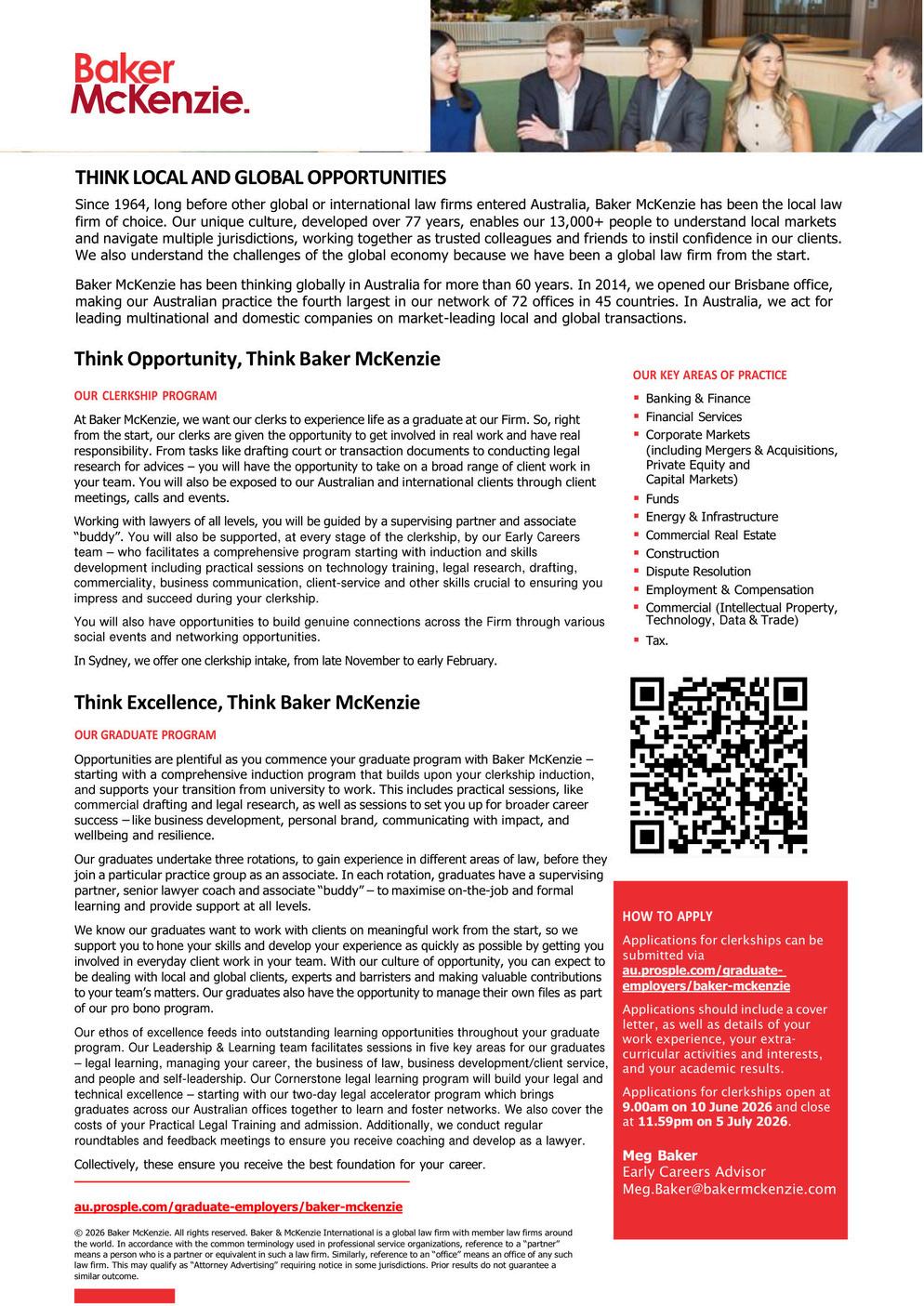
WHAT ARE THE KEY AREAS OF LAW THAT THE FIRM PRACTICES IN?
Key areas of practice:
Banking & Finance
Financial Services
Corporate Markets (including Mergers & Acquisitions, Private Equity and Capital Markets)
Funds
Energy & Infrastructure
Commercial Real Estate
Construction
Dispute Resolution
Employment & Compensation
Commercial (Intellectual Property, Technology, Data & Trade)
Tax
HOW MANY LAWYERS AND PARTNERS DOES THE FIRM HAVE?
Nationally, we currently have 66 Partners and 224 lawyers
WHAT IS UNIQUE ABOUT THE FIRM?
Think Global, Think Baker McKenzie!
Baker McKenzie invented the global law firm – so we’re different in the way we think, work and behave
Our story is one of imagination, determination and hard work. We have followed clients into new markets, establishing offices driven by local lawyers and talent. And our growth has been organic, giving us a strong, common culture that runs through our Firm.
Our unique culture, developed over 77 years, enables our 13,000+ people to understand local markets and navigate multiple jurisdictions, working together as trusted colleagues and friends to instil confidence in our clients. We also understand the challenges of the global economy, with our commitment to excellence underpinning our success
Finally, our ‘People Experience’, a key component of our global strategy, is about delivering the best employee experience to enable one high-performing, global team to serve our clients.
DOES THE FIRM HAVE ANY PREPENULTIMATE ENGAGEMENT SCHEMES, IF SO, HOW DO STUDENTS GET INVOLVED?
While we don’t have any pre-penultimate schemes, we welcome all students to attend our Bakers’ Dozen series For more information, visit our Prosple site.
DOES THE FIRM OFFER A CLERKSHIP PROGRAM, IF SO, HOW DO STUDENTS APPLY?
Yes. We encourage students to apply via our Prosple website once applications open on 10 June 2026.
DOES THE FIRM OFFER CLERKSHIPS TO STUDENTS OUTSIDE THEIR PENULTIMATE YEAR?
Yes We accept students in their penultimate or final year.
Approximately 15 in Sydney
Think Excellence, Think Baker McKenzie!
At Baker McKenzie, excellence underpins everything we do So, we look for people who have a similar mindset – towards their work, clients, development and communities. Specifically, we look for people who: are well-rounded, motivated, have a performance mindset and strive to be the best in whatever they do; are intellectually curious, think innovatively and have sound academics; display business acumen and are practical in their approach; have a global mindset and are passionately committed to service excellence; enjoy a challenge and seek new opportunities; constantly look for ways to achieve better results while learning and growing; take proactive ownership and responsibility for their careers; act with integrity, honesty and candor in their dealings, decisions and actions; express themselves confidently while staying open to new ideas; demonstrate adaptability and resilience; seek a friendly, inclusive and diverse culture;
take seriously our role in making a difference to our local and global communities.
Importantly, Baker McKenzie also looks for people who genuinely want to work with us and understand our unique offering and position in the market.
Think Opportunity, Think Baker McKenzie!
At Baker McKenzie, our summer clerks experience life as a junior lawyer at our Firm Right from the start, they are given the opportunity to undertake real work and have real responsibility – just like our graduates
The type of work our clerks get involved in includes drafting correspondence, preparing court/transactional documents, drafting advices/agreements, legal research, document review, attending client meetings, attending court/mediations, attending meetings with barristers/witnesses, attending settlements, and preparing client alerts
Our clerks also have the opportunity to participate in pro bono matters and community service initiatives (including pro bono legal clinics and “Eat Up Australia” sandwich-making sessions).
In addition, our clerks are able to participate in our ID&E (BakerWomen, BakerDNA, BakerBalance & Wellbeing, BakerPride & Allies, First Nations Circle) meetings/events and various Firm social events.
YOU HAVE ANY
STUDENTS APPLYING FOR A CLERK POSITION AT THE FIRM?
A few tips for the application process: Connect with us on Facebook and LinkedIn (we share application tips annually); Attend our clerkship skills workshops or ‘Bakers’ Dozen’ series; Research our Firm and tailor your cover letter (to learn more, attend the above events!);
Outline your education, work experience (including customer service roles) and extra-curriculars in your application, and demonstrate skills/experiences that would help you to succeed as a clerk; Demonstrate strong attention to detail
DOES THE FIRM OFFER GRADUATE POSITIONS TO CLERKS?
Yes We generally recruit our graduates from our summer clerk pool.
DOES THE FIRM OFFER A GRADUATE PROGRAM, IF SO HOW DO STUDENTS APPLY?
Yes We generally recruit our graduates from our summer clerk pool so applying for our summer clerkship is the best way to become a graduate with us
At Baker McKenzie Sydney, our graduates undertake an 18-month program, with 3 x 6 month rotations The rotation program is designed to offer graduates experience across different areas of legal practice before settling in a specific group.
Graduates typically begin their program having the title 'Graduate at Law', while undertaking their PLT After finishing their PLT and being admitted, their title changes to 'Junior Associate'. Upon completing two years with the Firm, they advance to the title of 'General Associate'.
Our global development roadmap, the Development Framework, clearly explains what success looks like at each career stage at Baker McKenzie. It shapes the way we develop, manage and promote our lawyers For you, it means always having a clear career roadmap, empowering you to plan and drive your development – formally and on-the-job – at every stage.
Promotions to Senior Associate, Special Counsel and Partner are considered on an annual basis In addition to the key performance areas of the Development Framework, the Firm is transparent in providing criteria for each level of promotion. The Firm also conducts tailored programs to support and develop our staff at each level.

WHAT ARE THE KEY AREAS OF LAW THAT THE FIRM PRACTICES IN?
Insurance & Health and Family Law, Wills & Estates.
HOW MANY LAWYERS AND PARTNERS DOES THE FIRM HAVE?
Just under 300 lawyers and 45 principals
WHAT IS UNIQUE ABOUT THE FIRM?
What sets our firm apart is not just what we do, but who we are: a team known for its collaborative spirit and commitment to excellence, inclusion, and innovation Our lawyers work closely together across teams and offices, creating an environment where people feel supported, trusted and encouraged to grow.
Barry Nilsson is an award winning national law firm and one of the few firms in Australia with a truly national Insurance & Health practice, operating across six states and all lines of insurance We have market‑leading expertise which positions us as trusted advisers and thought leaders in the insurance market Our lawyers work collaboratively with claims handlers, underwriters, brokers and clients to deliver clear, practical and commercially focused outcomes
Alongside this, our Family Law, Wills & Estates team is a dynamic and progressive practice, recognised for its empathetic and personalised approach. By combining technical expertise with genuine care, the team helps clients navigate complex matters and achieve long term outcomes.
Across the firm, we’re committed to empowering your career progression through structured mentorship, continuous professional development, and a top-notch work environment, ensuring you thrive and excel in what you do
DOES THE FIRM HAVE ANY PREPENULTIMATE ENGAGEMENT SCHEMES, IF SO, HOW DO STUDENTS GET INVOLVED?
We don’t offer any pre-penultimate engagement schemes, however from time to time we will have opportunities available for pre-penultimate year students so we encourage students to keep an eye on our Careers website
DOES THE FIRM OFFER A CLERKSHIP PROGRAM, IF SO, HOW DO STUDENTS APPLY?
Our vacation clerkships are held over the summer university break. Our programs give clerks the unique opportunity to gain experience and insight into our firm, practice areas and culture Working as a vacation clerk with us can often be the stepping stone to an ongoing position with the firm as a law clerk or graduate.
Apply via our Careers website https://bnlaw.csod.com/ux/ats/careersite/5/home ?c=bnlaw
Applications for a vacation clerkship positions should contain: a covering letter, your resume, a copy of your academic transcript and any further material you feel may be relevant.
DOES THE FIRM OFFER CLERKSHIPS TO STUDENTS OUTSIDE THEIR PENULTIMATE YEAR?
No, our Vacation Clerkship program is only available to students in their penultimate year
IS THE ANTICIPATED CLERKSHIP INTAKE THIS YEAR?
We anticipate hiring 8-10 Vacation Clerks for 2026/2027.
WHAT ARE THE QUALITIES THE FIRM LOOKS FOR IN CLERKS?
A keen interest in Insurance & Health, and/or previous legal or insurance experience is highly regarded
WHAT RESPONSIBILITIES AND TASKS CAN A CLERK EXPECT TO TAKE ON?
During our seasonal clerkship program, our clerks are involved in a wide range of practical, hands on legal work Tasks may include legal research, drafting correspondence and affidavits of documents, preparing chronologies and case or file notes, assisting with court documents and briefs, and supporting matters from commencement through to resolution. You may also have opportunities to attend mediations and court, providing valuable insight into how matters progress in practice.
An average day typically involves working closely with lawyers across the team, assisting on live matters, managing allocated tasks, and gaining insight into how files are run in practice There is a strong focus on learning through doing, supported by guidance from supervisors, buddies and mentors
You can stand out during the program by showing initiative, curiosity and a willingness to learn. Being organised, taking ownership of tasks, asking thoughtful questions, and responding positively to feedback are all highly valued A professional attitude and genuine interest in the work and the firm will help you make the most of their experience.
DO YOU HAVE ANY ADVICE FOR STUDENTS APPLYING FOR A CLERK POSITION AT THE FIRM?
Application Tips
Your cover letter is a great way to demonstrate your written communication skills.
List all of your working experience, even if it isn’t from a legal background There are always transferable skills!
Tell us about any extracurricular and leadership experience
We like to see a demonstrated understanding of our firm and what we do.
Interview Tips
Have a good understanding of your CV as we like to go through your experience and extracurriculars
Show us that you know a bit about the firm.
Do your best to keep your answers relevant to the question at a reasonable length.
We know it’s easier said than done – but be yourself! We encourage, support and celebrate our people being their true selves
DOES THE FIRM OFFER GRADUATE POSITIONS TO CLERKS?
Yes, working as a vacation clerk with us can often be the steppingstone to an ongoing position with the firm as a law clerk or graduate
DOES THE FIRM OFFER A GRADUATE PROGRAM, IF SO HOW DO STUDENTS APPLY?
Previous Vacation Clerks are required to email P&C with an updated resume and transcript.
WHAT IS THE PROGRESSION PATH OF A GRADUATE LAWYER AT THE FIRM?
Our graduates are our future leaders. With that in mind, we offer a robust graduate program to kick-start your career in law.
Barry Nilsson graduates receive the best training, support and mentorship to help shape the foundations for their future legal careers
Each year, our graduates take part in a National Graduate Development Program, which includes an extensive induction, bimonthly development sessions, structured mentoring and pro bono secondments This 12-month program is designed to provide our graduates with the skills and knowledge they need to begin their legal career and to succeed at the firm
Barry Nilsson will cover the costs of graduates in the program to complete their Practical Legal Training (PLT) in order to become admitted solicitors. Graduates will also be provided with study leave to support them in their PLT


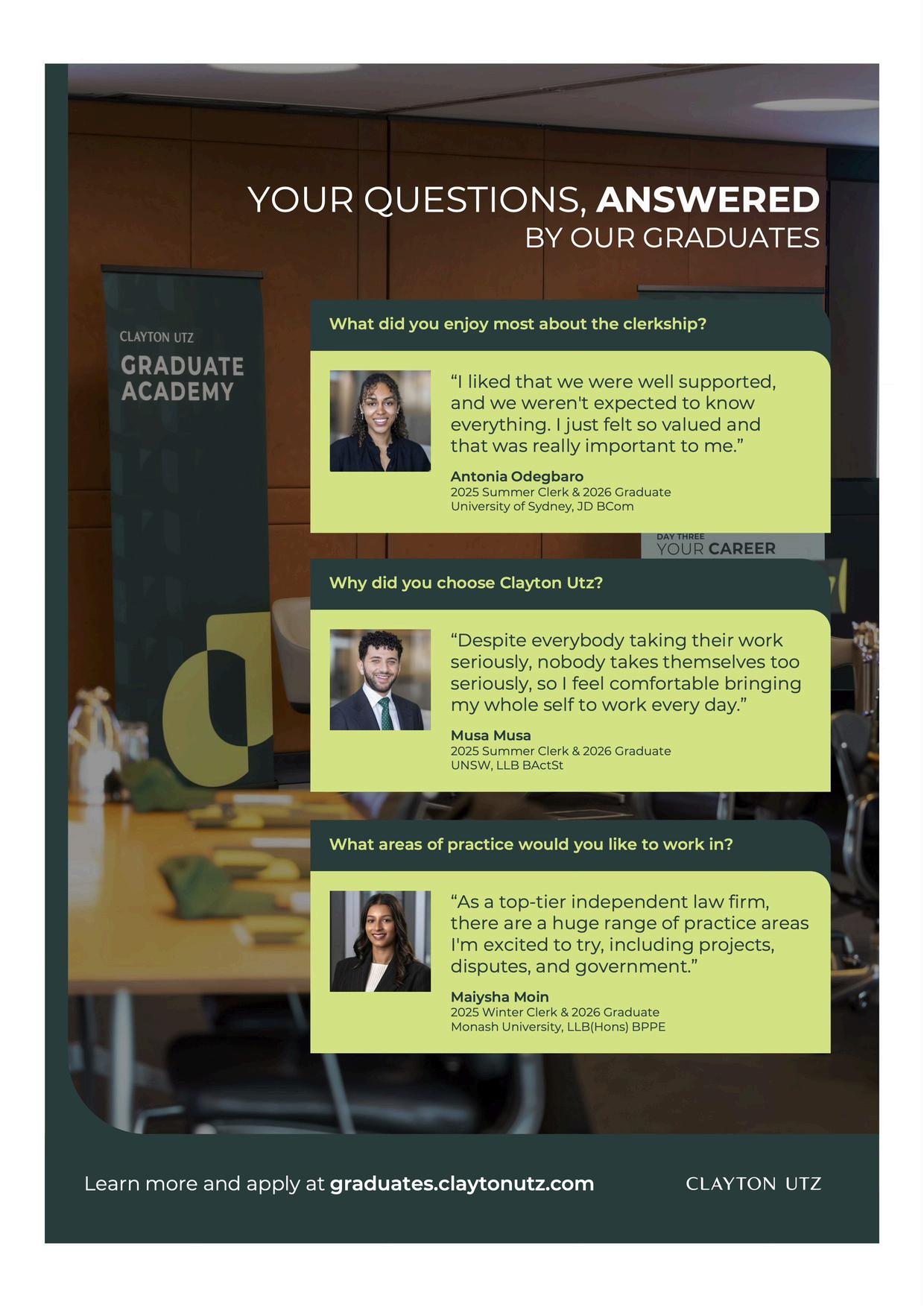
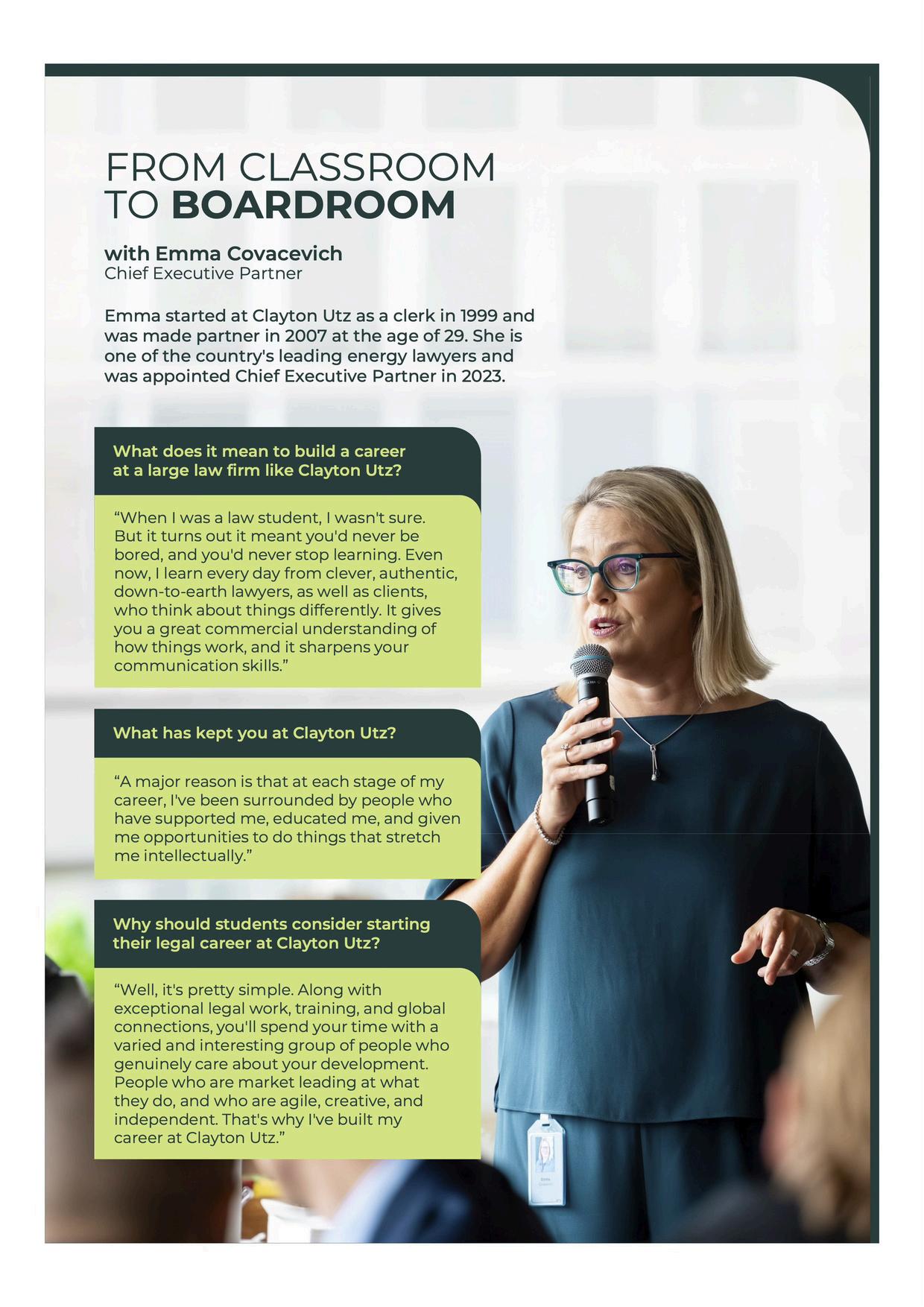
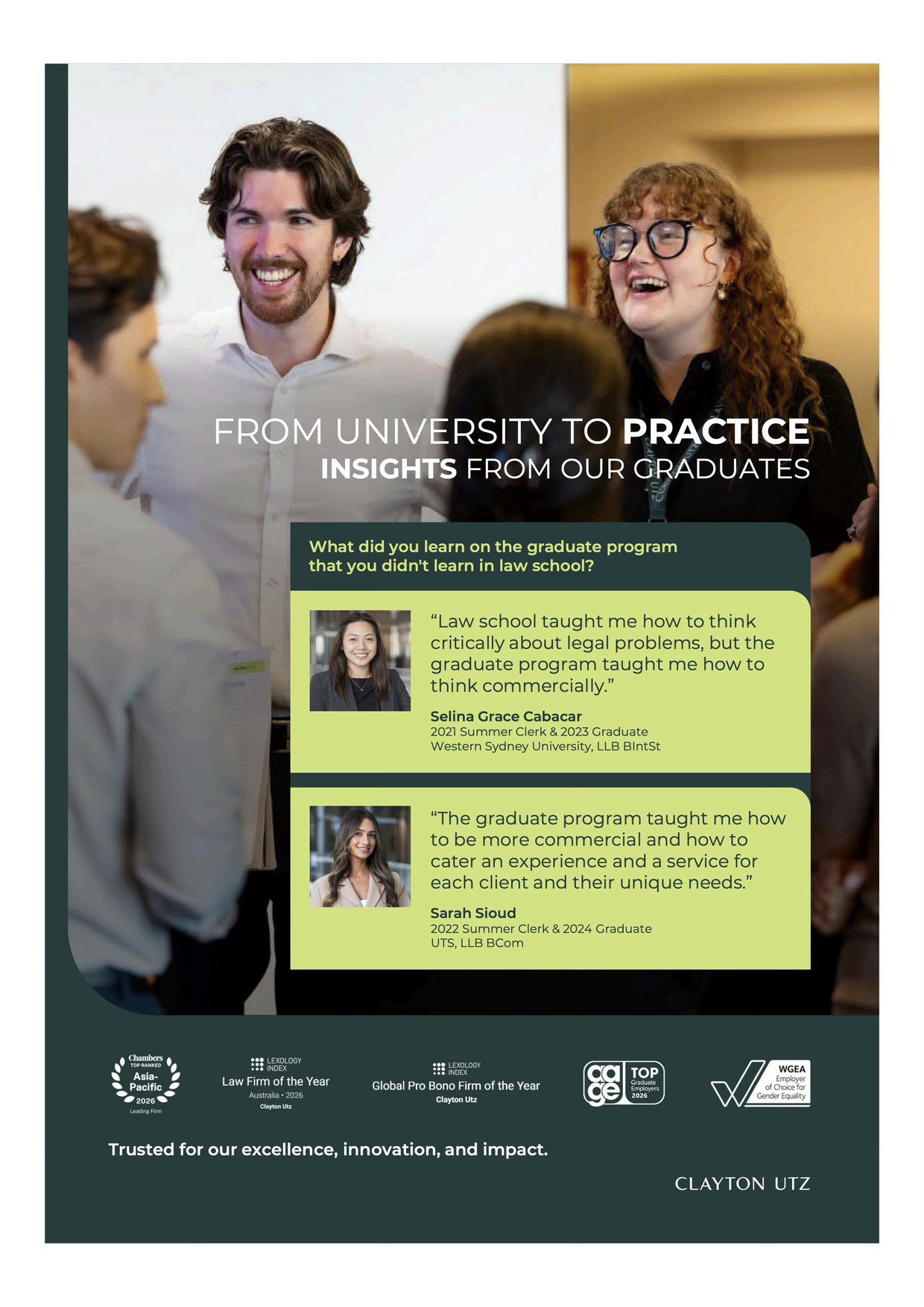
WHAT ARE THE KEY AREAS OF LAW THAT THE FIRM PRACTICES IN?
At Clayton Utz, we offer a comprehensive range of legal services catering to both large private sector companies and government entities We have four primary groups, Advisory, Risk & Regulation, Disputes, Projects and Transactions Under each group is our practice areas which include; Banking & Finance, Litigation & Class Actions, Competition, Corporate M&A & Capital Markets, Environment & Sustainable Development, IP, Major Projects, Construction, Public Sector, Real Estate, Restructuring & Insolvency, Tax, Technology, Workplace Relations Employment & Safety and Pro Bono.
HOW MANY LAWYERS AND PARTNERS DOES THE FIRM HAVE?
Nearly 200 partners nationally.
WHAT IS UNIQUE ABOUT THE FIRM?
Not only does Clayton Utz provide legal services to governments around the country and many ASX-listed companies across all sectors, we also advise some of the world's most recognisable brands. We're particularly proud of our globally renowned Pro Bono practice. In fact, our Pro Bono practice was the first to be established among Australian law firms, and in 2018 became one of only three law firms in the world with two dedicated Pro Bono partners. We have established diversity and inclusion programs that many of our people embrace, and we are proud to be the first law firm to create the role of National Mental Health Manager to better support our people.
DOES THE FIRM HAVE ANY PREPENULTIMATE ENGAGEMENT SCHEMES, IF SO, HOW DO STUDENTS GET INVOLVED?
Our CU Up Close Program is aimed at prepenultimate students (i.e., 1st, 2nd, 3rd year of study in undergraduate or 1st year of Juris Doctor). It gives an opportunity for law students to get an exclusive look into life at Clayton Utz! To keep up-to-date with Early Career opportunities, visit our websitegraduates claytonutz com
DOES THE FIRM OFFER A CLERKSHIP PROGRAM, IF SO, HOW DO STUDENTS APPLY?
Yes, we offer Summer Clerkships for the Sydney office, and seasonal clerkships nationally To learn more, visit our websitegraduates.claytonutz.com
DOES THE FIRM OFFER CLERKSHIPS TO STUDENTS OUTSIDE THEIR PENULTIMATE YEAR?
Yes, we accept final year students
WHAT ARE THE QUALITIES THE FIRM LOOKS FOR IN CLERKS?
At Clayton Utz, we are looking for clerks who are not only academically strong but also demonstrate a genuine passion for the law and a commitment to excellence. We value individuals who are proactive, adaptable, and eager to learn, with the ability to think critically and solve problems creatively. Strong communication and interpersonal skills are essential, as clerks will collaborate with colleagues and engage with clients.
We also seek team players who thrive in a collaborative environment, show initiative, and are willing to take on challenges. Above all, we look for clerks who are enthusiastic, curious, and ready to embrace the opportunities and experiences that come with working at a leading law firm
WHAT RESPONSIBILITIES AND TASKS CAN A CLERK EXPECT TO TAKE ON?
As a summer clerk at Clayton Utz, you'll be immersed in meaningful and diverse legal work from day one. You'll have the opportunity to conduct legal research, contribute to pro bono matters, and work on complex and high-profile cases. Your experience will also include drafting advices, conducting due diligence, sitting in on client meetings, and attending business development events Our tailored developmental training programs will help you sharpen your skills and build confidence in a supportive and collaborative environment.
DO YOU HAVE ANY ADVICE FOR STUDENTS APPLYING FOR A CLERK POSITION AT THE FIRM?
Take the time to research and get to know our firm. Understand what we do, who our clients are, and the types of matters we work on. Show us that you genuinely want to be part of our team, because that’s exactly who we’re looking for Putting in the effort to learn about us will show in your application – and that’s what will truly make an impact.
DOES THE FIRM OFFER GRADUATE POSITIONS TO CLERKS?
Yes DOES THE FIRM OFFER A GRADUATE PROGRAM, IF SO HOW DO STUDENTS APPLY?
Yes, however Graduate Program roles are generally offered to candidates who have participated in our Summer Clerkship Program.
WHAT IS THE PROGRESSION PATH OF A GRADUATE LAWYER AT THE FIRM?
Our graduates generally move from Graduate at Law to Lawyer once admitted. We have excellent learning programs to support lawyers in their career progression beyond the graduate program.

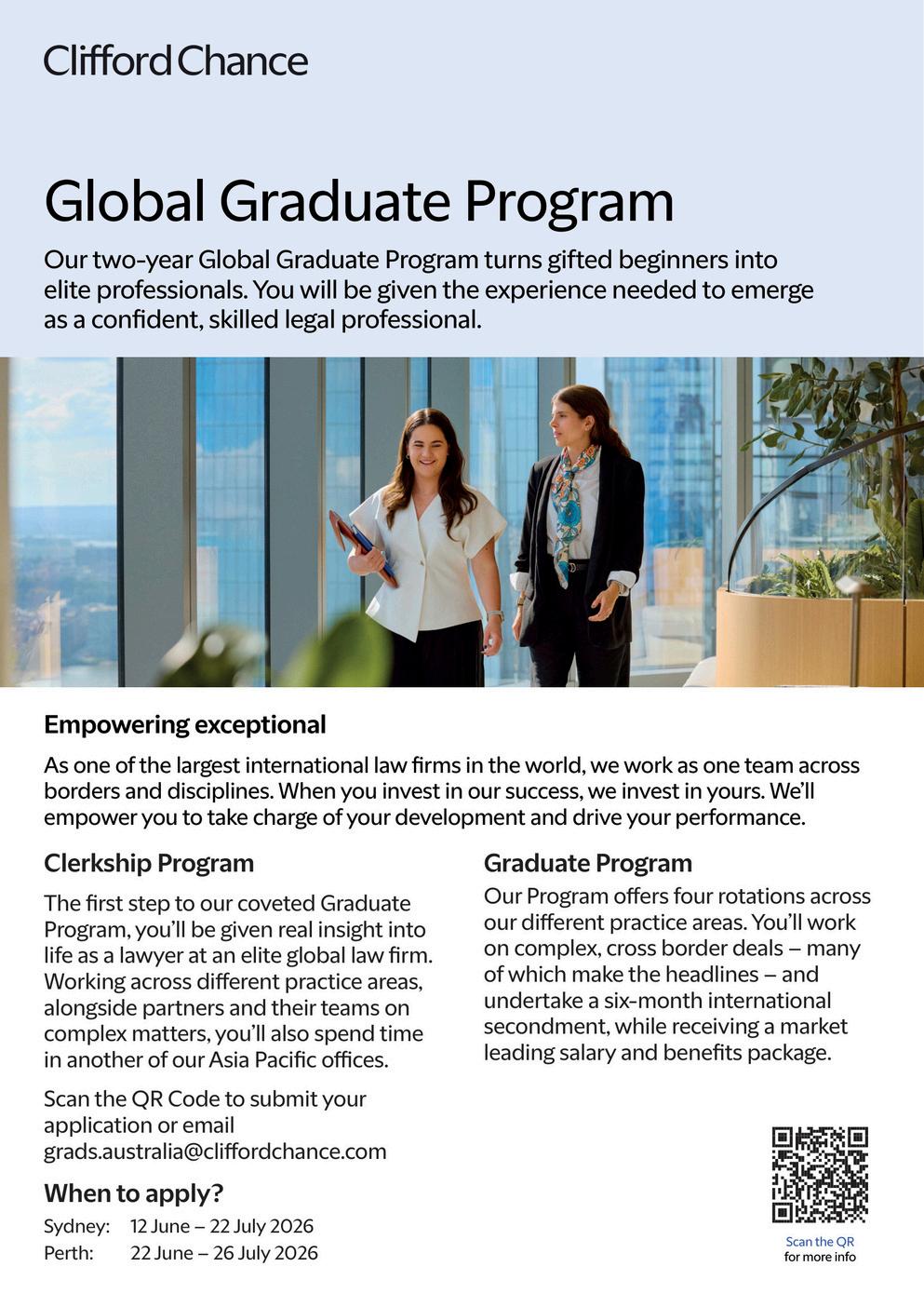
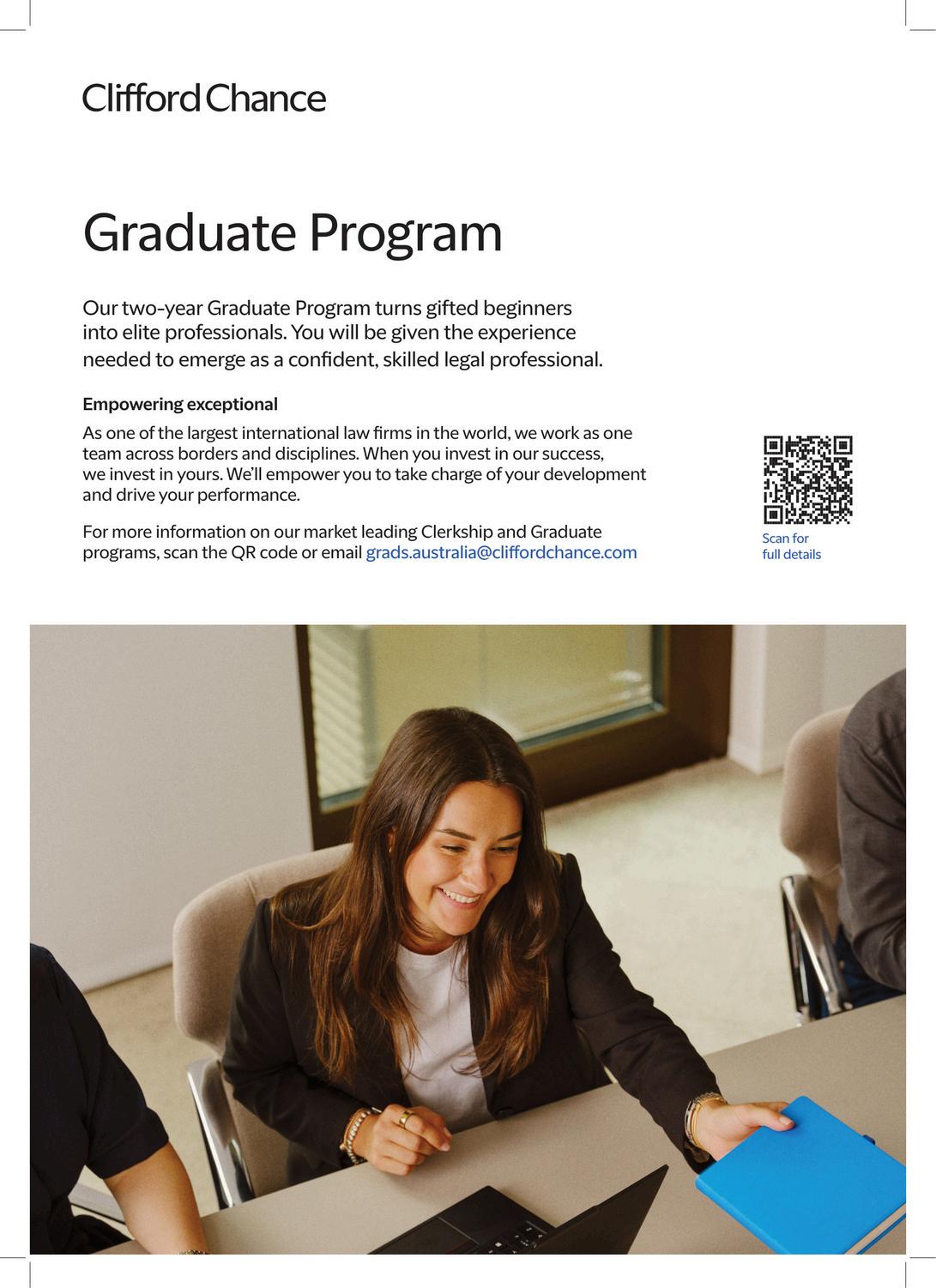
WHAT ARE THE KEY AREAS OF LAW THAT THE FIRM PRACTICES IN?
Litigation & Dispute Resolution, Global Financial Markets, Corporate and Antitrust & Competition, Funds and Real Estate.
HOW MANY LAWYERS AND PARTNERS DOES THE FIRM HAVE?
Globally we have more than 650 partners and nearly 7000 employees.
What makes Clifford Chance lawyers different? Firstly, our collaborative and adaptable culture. We work together across borders, languages and legal systems, sharing insights and expertise to achieve our clients’ commercial goals Secondly, we’re pioneers, working on many ‘first of a kind’ deals. Finally, it’s the nature of our people. Highly professional and selfassured, with an entrepreneurial streak, they embrace our culture of learning and are more than happy to share their expertise and knowledge.
We are one of the largest international law firms in the world, with over 30 offices across the globe We believe every career at Clifford Chance should be rewarding and stimulating –full of opportunities to learn, thrive and grow. That’s why we’re so proud of our inclusive, friendly and team-based approach to work
You’ll find our clients in commercial and industrial sectors, the private capital community, governments, regulators, trade bodies and not- for-profit organisations But no matter who they are or why they’ve reached out to us, we provide a world-class service every step of the way. And that’s possible thanks to the entrepreneurial spirit and conscientious approach to work that you’ll find across all our teams
Whichever area of the business you join, you’ll become an integral part of an innovative, diverse and ambitious team of people
DOES THE FIRM HAVE ANY PREPENULTIMATE ENGAGEMENT SCHEMES, IF SO, HOW DO STUDENTS GET INVOLVED?
We run Open Days in our Sydney and Perth offices which take place in May. Apply online via our website.
DOES THE FIRM OFFER A CLERKSHIP PROGRAM, IF SO, HOW DO STUDENTS APPLY?
You can apply for our four-week clerkship in Perth from November – December Alternatively in Sydney we run a 10-week clerkship across the summer from NovemberFebruary.
Apply online via our website
DOES THE FIRM OFFER CLERKSHIPS TO STUDENTS OUTSIDE THEIR PENULTIMATE YEAR?
To be eligible for the clerkship, you should be in your penultimate or final year of your law degree.
WHAT IS THE ANTICIPATED CLERKSHIP INTAKE THIS YEAR?
Approximately six to seven clerks in Sydney.
Approximately five clerks in Perth
WHAT ARE THE QUALITIES THE FIRM LOOKS FOR IN CLERKS?
We look for students with a strong interest in Commercial law, people who can work well in a team situation and communicate effectively We welcome and value your contribution We’ll encourage your creativity and diversity of thought in a learning culture where you can flourish With a wide range of development opportunities, you’ll benefit from both on-thejob learning and formal training to enable your journey from clerk to qualified lawyer.
DOES THE FIRM OFFER A GRADUATE PROGRAM, IF SO HOW DO STUDENTS APPLY?
Most of our graduate positions are filled through the clerkship program.
Depending on your rotations, you will work on complex, cross boarder deals – many of which make the headlines regularly The work can range from reviewing contracts and completing due diligence to progressing conditions precedent and legal research Beyond this, our graduates are encouraged to work on projects exploring how we can better incorporate AI into the workflow – an exciting chance to offer a fresh perspective on the role of technology in legal practice.
Outside of billable work, you can get involved in one of our four Affinity Networks –including REACH (Racial Equality and Celebrating Heritage Committee), ARCUS, Enable and Accelerate Getting involved with an affinity group is a great way to meet more people and contribute to the firm’s culture
WHAT IS THE PROGRESSION PATH OF A GRADUATE LAWYER AT THE FIRM?
You will be given the experience needed to emerge as a confident, skilled legal professional
We offer a two-year graduate program –including four six-month rotations, with one being in an overseas office across our network. Following this, you would settle into a permanent team as an Associate The next step would be becoming a Senior Associate, then Counsel, followed by Partner.
DO YOU HAVE ANY ADVICE FOR STUDENTS APPLYING FOR A CLERK POSITION AT THE FIRM?
Be curious and enthusiastic! Some top tips would be to actively seek out a wide variety of work from different members of the team Working on different tasks helps you build new skills, gain exposure to a range of matters and collaborate with people from graduate level through to partners As a junior, you are still figuring out your working style, and seeing how senior lawyers organise themselves and approach their work can be incredibly valuable. Finally, have a strong understanding of your own journey and why you think a clerkship with Clifford Chance is the best next step for you
DOES THE FIRM OFFER GRADUATE POSITIONS TO CLERKS?
Yes, our two-year graduate program turn gifted beginners into elite professionals.


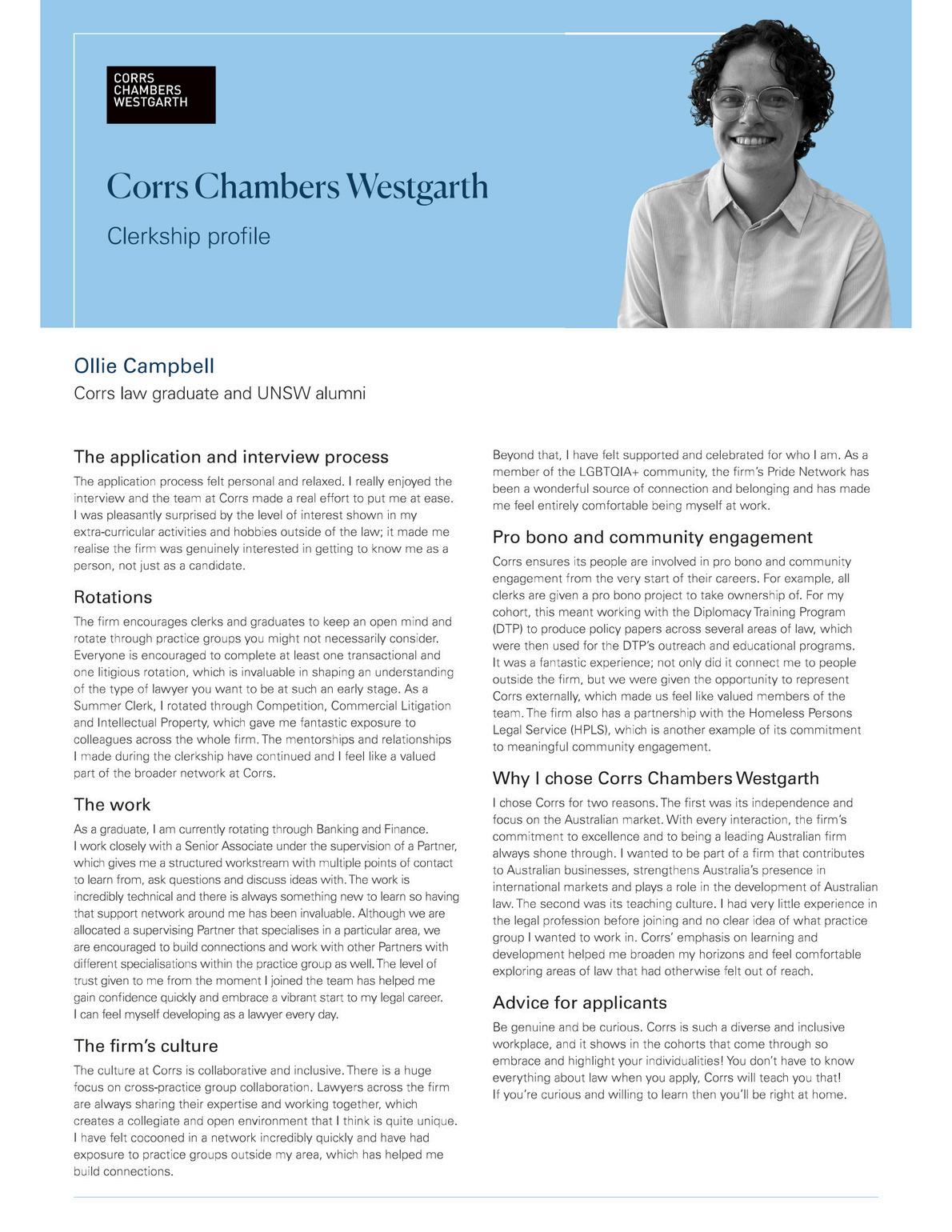
WHAT ARE THE KEY AREAS OF LAW THAT THE FIRM PRACTICES IN?
Arbitration
Banking and Finance
Class Actions
Commercial Litigation
Competition
Corporate
Employment, Labour & Safety
Energy and Natural Resources
Environment and Planning
Intellectual Property
Investigations and Inquiries
Projects
Real Estate
Responsible Business
Restructuring, Insolvency and Special Situations
Tax and Tax Controversy
Technology, Media & Telecommunications
WHAT IS UNIQUE ABOUT THE FIRM?
We are the only law firm in Australia that offers an International Study Scholarship that provides financial support for the completion of a master’s degree at the University of Oxford or the University of Cambridge (full time on campus). The Scholarship supports the continuing professional development of exceptional legal staff
DOES THE FIRM OFFER A CLERKSHIP PROGRAM, IF SO HOW DO STUDENTS APPLY?
Our Sydney office offers one three-month summer clerkship program each year. Applications for this year’s program open on Wednesday, 10 June 2026 Applications must be submitted online via our website https://www.corrs.com.au/graduates-andclerks/key-dates.
DOES THE FIRM OFFER CLERKSHIPS TO STUDENTS OUTSIDE THEIR PENULTIMATE YEAR?
While our seasonal clerk programs are designed for students in their penultimate year of study, pre- penultimate or final year students may be considered.
WHAT ARE THE QUALITIES THE FIRM LOOKS FOR IN CLERKS?
We look for clerks who can make a positive contribution to the firm and help us in delivering legal excellence and outstanding client service We want people who bring out the best in those around them, work well in a Team and take pride in their work and achievements. We assess against a broad criteria which considers business and commercial acumen, initiative, ethical behaviour, previous employment, legal excellence, a commitment to commercial law, energy and drive, involvement in community life and strong interpersonal skills. In exchange for your energy and commitment we’ll provide extraordinary learning and work opportunities
WHAT RESPONSIBILITIES AND TASKS CAN A CLERK EXPECT TO TAKE ON?
The majority of our graduates join us after experiencing a seasonal clerkship program Our clerkships give you the opportunity to connect with partners and lawyers across the firm, learn what a ‘day-in-the-life’ at Corrs is like, and experience the type of work we do and the clients we partner with
The Corrs seasonal clerkship program gives you the opportunity to work alongside some of Australia’s leading lawyers on high-profile work for major Australian and international clients
You’ll be exposed to a broad range of interesting matters and have the chance to complete tasks such as conducting research, reviewing and presenting documents, attending court hearings, mediations and settlements, as well as shadowing partners and lawyers in client meetings and business development activities.
DO YOU HAVE ANY ADVICE FOR STUDENTS APPLYING FOR A CLERK POSITION AT THE FIRM?
Be yourself! We look for candidates who can build rapport and articulate their experience so tell us why you applied to Corrs and what you know about our firm We want to get to know you as a person, so talk about your hobbies and interests outside of the law too.
DOES THE FIRM OFFER GRADUATE POSITIONS TO CLERKS?
The majority of our graduates join us after experiencing a seasonal clerkship program
DOES THE FIRM OFFER A CLERKSHIP PROGRAM, IF SO, HOW DO STUDENTS APPLY?
Our graduates are generally recruited through our seasonal clerkship program and the priority offer process.
We occasionally consider applications from the open market and when this happens, graduate offerings will be advertised via our website https://www.corrs.com.au/careers/ graduatesand-clerks
WHAT IS THE PROGRESSION PATH OF A GRADUATE LAWYER AT THE FIRM?
From your first day at Corrs, you will have the opportunity to accelerate your career in a highperforming and supportive environment
Our Lawyer Development Program is designed to support you in the formative stage of your career It aims to build the capabilities and relationships that will drive career progression and underpin future successes, as rapidly as possible.
In our structured 24-month program, you will complete one 12-month rotation, followed by two six-month rotations An extended placement for your first 12-months will allow you to build your capabilities through practical experience and to develop a strong relationship with your mentor partner and team
You will also undertake formal learning including our National Graduate Academy, local Graduate Orientation, practical legal training with the College of Law, practice group induction sessions and our national Legal Excellence program focused on core legal knowledge and skills.
In the second year, lawyers will complete two 6month roations in order to build broad capabilities and relationships across different groups

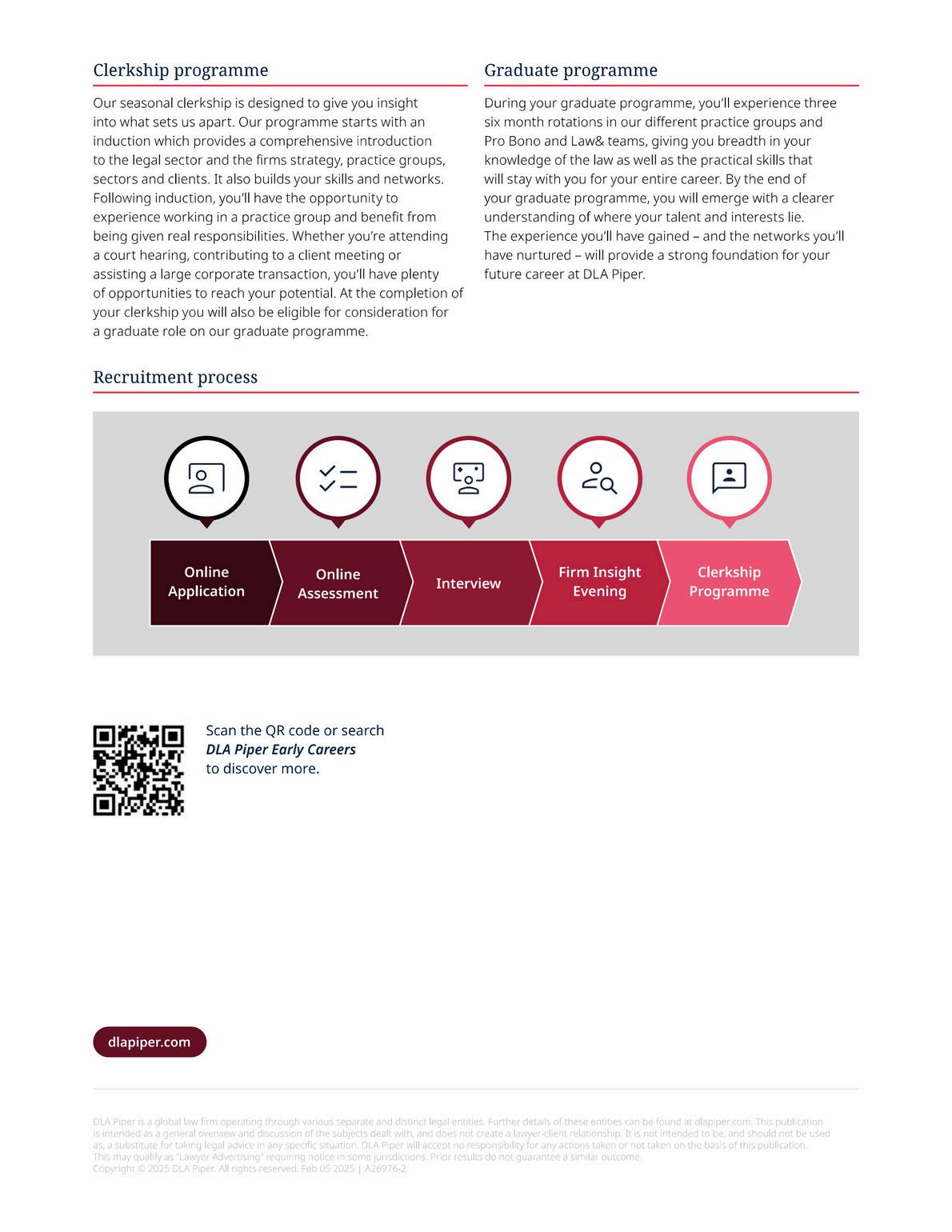
WHAT ARE THE KEY AREAS OF LAW THAT THE FIRM PRACTICES IN?
Litigation & Regulatory
Corporate
Intellectual Property & Technology
Finance
Employment
Real Estate
Tax
Pro Bono
HOW MANY LAWYERS AND PARTNERS DOES THE FIRM HAVE?
Lawyers nationally: 236
Partners nationally: 61
DLA Piper is a global business that’s redefining the expectations of a law firm We operate across more than 40 countries, but we’re still locally connected That’s because trusting, collaborative relationships with our clients and each other are at the heart of our success We’re creating exceptional experiences, outcomes and growth for our clients and people
We make this happen with a culture where you bring your passion and individuality to work every day. No two careers – or two people – are the same at DLA Piper We want our people to reach their full potential as part of a diverse, global team that thrives on collaboration, seizing opportunities and commercial edge. Here, personal growth goes hand in hand with professional development to shape your individual career journey.
DOES THE FIRM HAVE ANY PREPENULTIMATE ENGAGEMENT SCHEMES, IF SO, HOW DO STUDENTS GET INVOLVED?
Whilst we don't offer formal pre-penultimate engagement schemes, there are many opportunities to engage with us throughout your studies A couple of examples include: Virtual job simulations available on our website. This is a safe learning environment for students to build their knowledge and skills. Upon completing the job simulation, you'll receive a certificate, and you can add the experience to your CV We host an online information session in June, you can register via our website
DOES THE FIRM OFFER A CLERKSHIP PROGRAM, IF SO, HOW DO STUDENTS APPLY?
We offer an 8-week summer Clerkship Programme. You can apply via our website.
DOES THE FIRM OFFER CLERKSHIPS TO STUDENTS OUTSIDE THEIR PENULTIMATE YEAR?
We currently offer clerkships to penultimate and final year students
WHAT IS THE ANTICIPATED CLERKSHIP INTAKE THIS YEAR?
6-8 clerks in our Sydney office
ARE THE QUALITIES THE FIRM LOOKS FOR
We are seeking applicants that are passionate about a career in law and becoming a future graduate solicitor. We do not expect applicants to have had prior experience in law. When applying, we'd encourage you to think broadly about your experiences and achievements from your recent-past and ensure these are clearly articulated on your CV
RESPONSIBILITIES AND TASKS CAN A CLERK EXPECT TO TAKE ON?
Our clerkship programme starts with a national induction. This induction provides an in-depth introduction to the legal sector and the firms practice groups It also builds your professional skills and workplace capability Throughout the induction there will be opportunities to hear from and network with senior members of the firm.
Once you are inducted, you’ll have the opportunity to complete work placements in our different practice groups. You'll be given real responsibilities. Whether you're attending a court hearing, contributing to a client meeting, or assisting a large corporate transaction, you’ll have plenty of opportunities to reach your potential.
DOES THE FIRM OFFER GRADUATE POSITIONS TO CLERKS
Yes, we hire all of our graduates from our clerkship programme.
DOES THE FIRM OFFER A GRADUATE PROGRAM, IF SO HOW DO STUDENTS APPLY?
You must complete our clerkship programme in order to be eligible for our graduate programme. During the DLA Piper graduate programme our graduates experience three six-month rotations throughout our seven different practice groups, giving them breadth in their knowledge of the law as well as practical skills that will stay with them for their entire career.
By the end of the graduate programme, graduates emerge with a clearer understanding of where their talents and interests lie. The experience they’ll have gained and the networks they’ll have nurtured provide a strong foundation for their future careers at DLA Piper.

WHAT ARE THE KEY AREAS OF LAW THAT THE FIRM PRACTICES IN?
Banking and Finance
Corporate (including Tax Advisory)
Disputes and Investigations
Intellectual Property and Technology
Real Estate and Construction
Workplace Advisory and Disputes
HOW MANY LAWYERS AND PARTNERS DOES THE FIRM HAVE?
Gadens is a leading Australian law firm with over 100 partners and more than 600 staff across offices located in Adelaide, Brisbane, Canberra, Melbourne, Perth and Sydney.
WHAT IS UNIQUE ABOUT THE FIRM?
At Gadens, we know our strength comes from the individuality of our people. Your character, your capability and your ambition all help shape who we are as a firm.
We value energy, initiative and independent thinking Our culture is open and collegiate, grounded in honest communication, regular feedback and shared accountability We want you to grow with us and to bring your perspective, ideas and curiosity to the work we do
We look for talented, well-rounded people who are passionate about their development and who build strong relationships with clients and colleagues In return, we offer an environment that is both supportive and high-performing.
Gadens is a dynamic firm, known for decisive leadership, accessible partners and management, and the opportunity to make a real impact early in your career
DOES THE FIRM HAVE ANY PREPENULTIMATE ENGAGEMENT SCHEMES, IF SO, HOW DO STUDENTS GET INVOLVED?
No.
DOES THE FIRM OFFER A CLERKSHIP PROGRAM, IF SO, HOW DO STUDENTS APPLY?
To apply for our Clerks@Gadens, visit the Gadens website to upload your CV, cover letter, academic transcript and provide responses to short answer questions. You will not be required to complete any psychometric testing
DOES THE FIRM OFFER CLERKSHIPS TO STUDENTS OUTSIDE THEIR PENULTIMATE YEAR?
Suitable for students in their penultimate or final year of the LLB or JD, studying in Australia, we invite clerkship applications from students who are passionate about a career in the legal industry and want to make an impact
We do not accept applications from international students
Between 11-13
We value people who bring fresh perspectives, diverse life experiences and a genuine interest in commercial law. Students who thrive here are engaged, enthusiastic and curious people who want to challenge themselves and contribute to something bigger than their own work, while having fun along the way.
Our Clerks@Gadens program introduces you to life as a commercial lawyer at a leading independent Australian firm With a dedicated mentor and buddy supporting you throughout the program, you’ll work alongside partners and experienced lawyers on real client work, contribute to research and drafting and take part in learning sessions designed to build foundational skills with confidence.
Clerks are part of our firm from day one. You can expert a supportive, people-first and social culture grounded in inclusion, wellbeing and community impact.
Our clerkships are designed to stretch your thinking, build your confidence and give you a true sense of life at a leading independent Australian law firm.
With a dedicated mentor and buddy beside you, you’ll learn by doing: working on real matters, in real teams, with people who want to see you thrive
You’ll support client matters from start to finish, contributing to work such as:
Researching legal issues that shape our advice and strategy. Joining client meetings, court attendances or mediations, seeing how commercial decisions play out in practice
Drafting correspondence and concise advice, developing a clear, confident writing style
Helping prepare affidavits and court documents, understanding how matters are built and progressed.
Every experience helps you sharpen your judgment, grow your skillset and understand the role you want to play as a future lawyer. Your ideas, curiosity and perspective matter they help shape the work we do and the team you’ll be part of
We value people who bring fresh perspectives, diverse life experiences and a genuine interest in commercial law. Students who thrive here are engaged, enthusiastic and curious people who want to challenge themselves and contribute to something bigger than their own work, while having fun along the way.
DOES THE FIRM OFFER GRADUATE POSITIONS TO CLERKS?
Clerks@Gadens program participants are required to express written interest and submit an updated academic transcript to be considered for a priority offer in our Grads@Gadens program. Our Early Careers Partner will notify all seasonal clerks involved in the 2026/27 program prior to offer day to invite this information / applications
DOES THE FIRM OFFER A GRADUATE PROGRAM, IF SO HOW DO STUDENTS APPLY?
We prioritise students from our Clerks@Gadens program when making offers for our Grads@Gadens program. Should places remain after priority offers are finalised, we will then open market offers.
WHAT IS THE PROGRESSION PATH OF A GRADUATE LAWYER AT THE FIRM?
Your career at Gadens starts with structure, support and real opportunities to grow. Our 12 month Graduate Program is designed to give you broad exposure, hands on experience and the training you need to build confidence as a developing lawyer. At the end of the program, you move into a permanent Practice Group, where you deepen your skills, take on meaningful work and continue contributing to the firm as a lawyer. From there, our progression framework gives you clear steps – from Graduate to Lawyer, Associate, Senior Associate and beyond – supported by training programs tailored to each stage Throughout your journey, you’ll have access to learning and development, mentoring, and guidance from leaders who want you to succeed. It’s a pathway designed to helping you grow your career at Gadens, building capability with purpose.

We offer an informal and relaxed environment, approachable partners and lawyers,diverseteams,friendlypeoplewho care about the firm and the highperformance contribution they make irrespectiveoftheirrole.
G+T presents a unique opportunity for you to make a name for yourself through the matters and transactions you work on, with personal accountability yet supported by those around you.
DOES THE FIRM HAVE ANY PREPENULTIMATE ENGAGEMENT SCHEMES, IF SO HOW DO STUDENTS GET INVOLVED?
Not currently offered however we encourage students to apply for paralegal roles throughout the year via our website: https://www.gtlaw.com.au/careers.
DOES THE FIRM OFFER A CLERKSHIP PROGRAM, IF SO HOW DO STUDENTS APPLY?
Yes After completing an online application form, successful candidates will progress through the following selection stages: psychometric assessment; assessment centre (comprising of first round interview, group activity and an individual exercise); and second round interview.
DOES THE FIRM OFFER CLERKSHIPS TO STUDENTS OUTSIDE THEIR PENULTIMATE YEAR?
We accept applications from both penultimate and final year students.
There’s no ‘typical’ G+T clerk or graduate, or box you need to tick. Our culture is built on inclusivity and individuality, and we want you to feel like you can be yourself at work. Our people are ambitious, creative and entrepreneurial – they bring energy and a can-do mindset and are willing to challenge assumptions. If that sounds like you, you’ll feel like you belong here
You will work in one or two practice areas during your clerkship, based on your preferences and business needs. From your first day, you’ll have the opportunity to test your skills and interest You can expect to be involved in some challenging matters and your work will be presented to clients Often, you’ll work directly with a partner on a matter or as part of a bigger team on larger transactions
While every experience varies, you might be asked to draft documents and memos, carry out research, attend client meetings and court, and assist with preparing for hearings or negotiations.
While your most valuable learning will be the experience of working on real matters during your practice group rotations, you’ll also receive structured training – including sessions on the different practice areas, technology, how to create your personal brand, and business development.
DOES THE FIRM OFFER GRADUATE POSITIONS TO CLERKS?
All summer clerks have the opportunity to secure a graduate offer, based on performance.
DOES THE FIRM OFFER A GRADUATE PROGRAM, IF SO HOW DO STUDENTS APPLY?
Clerkships are the main entry point to graduate opportunities with G+T. However, we occasionally recruit graduates outside this process, Students are encouraged to register their interest throughout the year via our careers page
IS THE PROGRESSION PATH OF A GRADUATE LAWYER AT THE FIRM?
Our 18-month graduate program consists of two rotations available across all our practice groups, commencing in February of each year Following completion of the program, graduates settle into a permanent team as a junior lawyer
From there, they have access to a range of opportunities to further their career progression.
Many of our lawyers choose to undertake postgraduate study. G+T offers funding assistance and study leave for masters’ degrees and other postgraduate courses as part of our ongoing commitment to continuing education.
Each year we also award a number of scholarships of up to $10,000 to support our people to study at any educational institution in the world in a subject area of their choice, which aligns with the work that they are doing or a focus area for the firm Past scholarship winners have studied at prestigious institutions in the United Kingdom, United States and Hong Kong, including Oxford, Harvard and LSE, amongst others.
G+T also offers secondment opportunities across our offices, in-house with clients, as well as with leading firms overseas. We support our people in seeking opportunities to work abroad, to expand their commercial skills in a global setting.
We recognise everyone’s career aspirations are different. Working alongside the brightest legal minds in the country, on groundbreaking projects and matters whilst also having the chance to make a positive impact on the community, you’ll have the opportunity to go as far as you want.


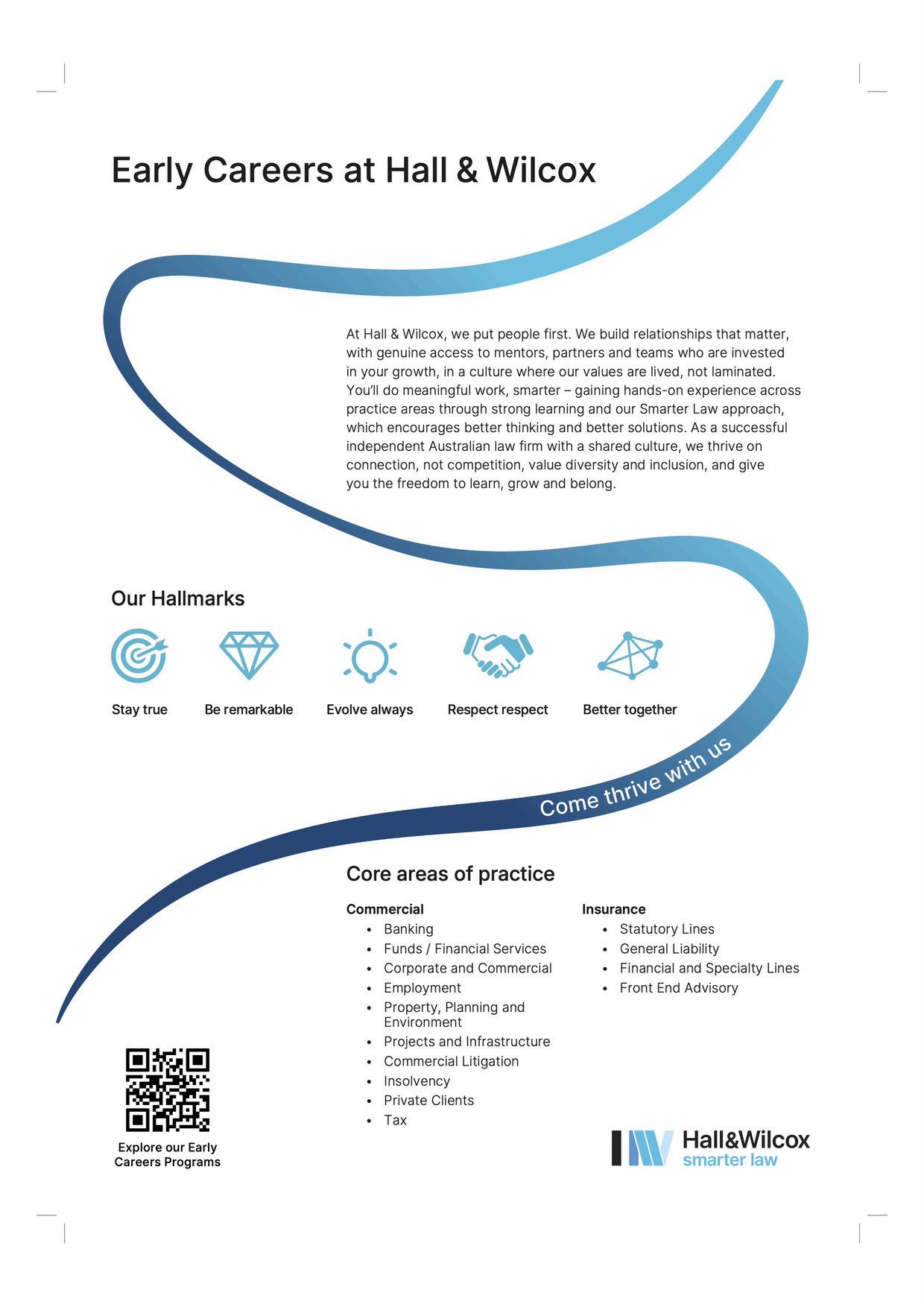
WHAT ARE THE KEY AREAS OF LAW THAT THE FIRM PRACTICES IN?
Banking & Financial Services
Corporate & Commercial
Dispute Resolution
Employment
General Insurance
Private Clients
Pro Bono & Community
Property and Projects
Statutory Insurance NSW/ACT Tax
HOW MANY LAWYERS AND PARTNERS DOES THE FIRM HAVE?
Over 600 nationally
WHAT IS UNIQUE ABOUT THE FIRM?
Clerks/graduates have opportunities to work closely with partners and senior lawyers
No psychometric testing or assessment centres
Open plan office, making it a flat structure. The ability to constantly learn and sit with different people
Just in time preferences based on business needs and clerk/grad preferences
We are invested in you from day one.
Our aim is to place all grads as first year lawyers. We only take on as many graduates as we intend to place.
Our billable hours as a grad are low because we recognise how important work life balance is and prioritise learning and growing in your first year.
DOES THE FIRM HAVE ANY PREPENULTIMATE ENGAGEMENT SCHEMES, IF SO HOW DO STUDENTS GET INVOLVED?
No.
DOES THE FIRM OFFER A CLERKSHIP PROGRAM, IF SO, HOW DO STUDENTS APPLY?
Yes, via our website.
DOES THE FIRM OFFER CLERKSHIPS TO STUDENTS OUTSIDE THEIR PENULTIMATE YEAR?
Yes, our clerkship program is open to penultimate and final year students.
WHAT ARE THE QUALITIES THE FIRM LOOKS FOR IN CLERKS?
There are no fixed skills or experience requirements that we look for At Hall &Wilcox, we value authenticity and encourage candidates to bring their best selves to work We do not seek a particular “type” of candidate.
We also conduct blind recruitment, which means candidate details, such as name, address, and gender remain anonymous during the assessment process. This approach helps reduce unconscious bias and supports a fair and equitable review of all applications.
Approximately 15
A CLERK EXPECT TO TAKE ON?
Seasonal clerks can be involved in a wide range of work, including research, drafting tasks, attending client meetings, and in some cases observing or appearing in court at the request of senior team members No two days are the same, as the workload can vary depending on the practice area a clerk is placed in and the matters the team is working on.
Clerks can stand out during the program by keeping an open mind, being curious, and taking every opportunity to learn Getting involved in the Hall &Wilcox culture, such as attending committee events or volunteering to support initiatives is also highly valued. From a technical perspective, attention to detail and clear communication are essential.
DO YOU HAVE ANY ADVICE FOR STUDENTS APPLYING FOR A CLERK POSITION AT THE FIRM?
While there is no magic formula to stand out, applicants should ensure their application is complete, clearly expresses their genuine interest in Hall &Wilcox, and allows their personality to shine through in their cover letter
DOES THE FIRM OFFER GRADUATE POSITIONS TO CLERKS?
Yes
DOES THE FIRM OFFER A GRADUATE PROGRAM, IF SO HOW DO STUDENTS APPLY?
Applying for a seasonal clerkship, completing the program, and then being offered a graduate position is the typical pathway to securing a graduate role at the firm
WHAT IS THE PROGRESSION PATH OF A GRADUATE LAWYER AT THE FIRM?
Law graduate ⟶ Lawyer ⟶ Associate ⟶ Senior Associate ⟶ Special Counsel ⟶ Partner

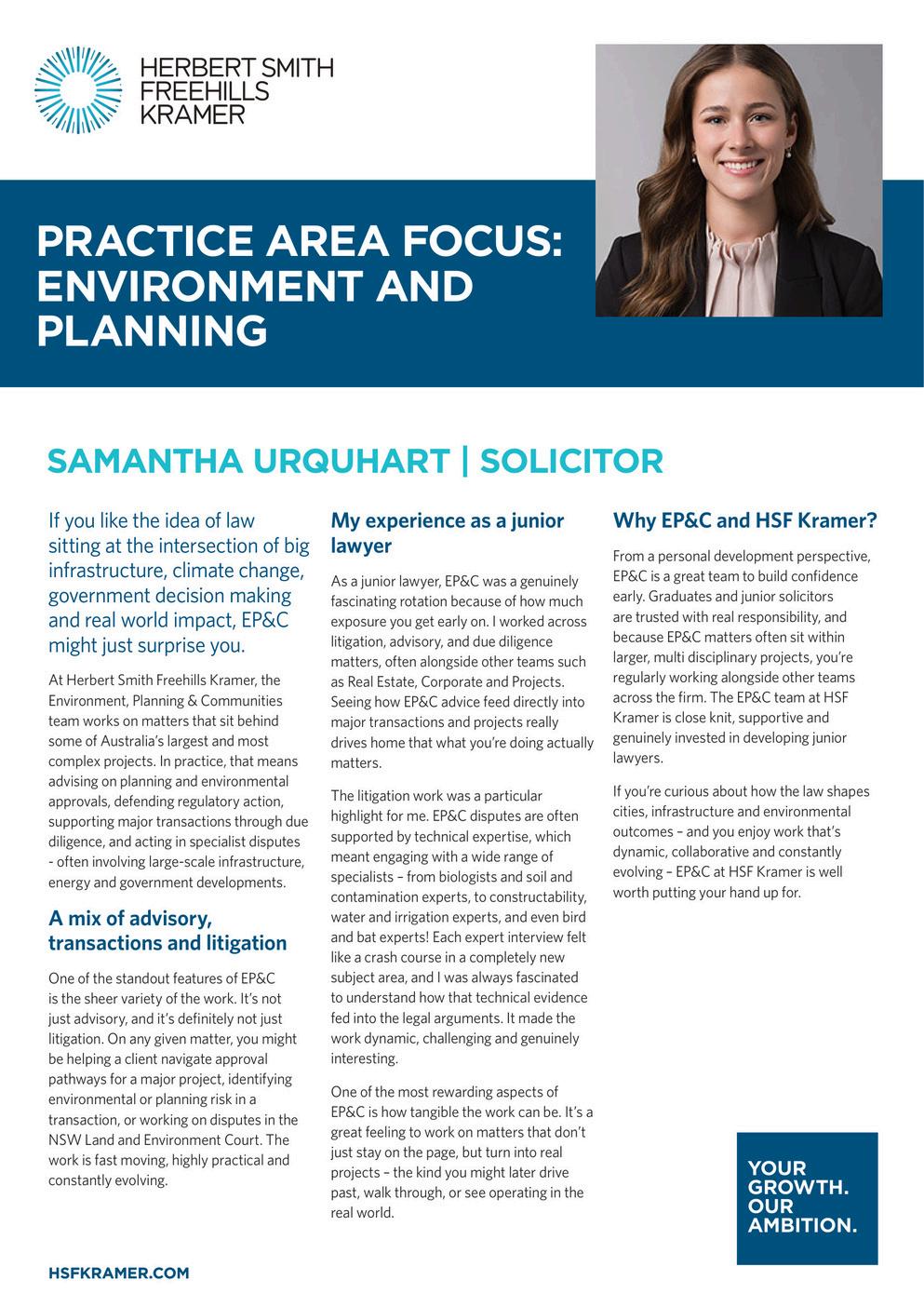
WHAT ARE THE KEY AREAS OF LAW THAT THE FIRM PRACTICES IN?
We are a large Commercial law Fim, with 7 main practice groups, which includes our pro bono practice Our practice groups are Disputes, Corporate, Competition Regulation Trade, Employment Industrial Relations and Safety, Finance, Real Estate, PEI.
HOW MANY LAWYERS AND PARTNERS DOES THE FIRM HAVE?
Globally, Herbert Smith Freehills Kramer has approximately 2,600 lawyers, including around 630 partners, and over 5,000 employees across more than 25 offices worldwide
WHAT IS UNIQUE ABOUT THE FIRM?
Herbert Smith Freehills Kramer is recognised for its market leading disputes practice and its ability to handle complex, high value matters across multiple jurisdictions The firm combines deep roots in the UK, Australia, Europe and Asia with a strong and growing presence in the United States following its merger with Kramer Levin in 2025 This truly global platform allows lawyers to work on cutting edge matters for leading international clients, supported by a strong culture of collaboration, innovation and pro bono engagement
DOES THE FIRM OFFER CLERKSHIPS TO STUDENTS OUTSIDE THEIR PENULTIMATE YEAR?
Applications are open to penultimate year and final year law students, provided they are able to live and work legally in Australia during the clerkship period.
DOES THE FIRM OFFER A CLERKSHIP PROGRAM, IF SO, HOW DO STUDENTS APPLY?
Yes The firm offers vacation clerkships across its Australian offices. Applications are made online through the Herbert Smith Freehills Kramer careers website during the relevant state recruitment periods Students apply to their preferred office and are assessed through an application and interview process
WHAT IS THE ANTICIPATED CLERKSHIP INTAKE THIS YEAR?
In Sydney the clerkship intakes vary by office For example, in Sydney the firm typically offers approximately 35–40 summer vacation clerkships each year
ARE THE QUALITIES THE FIRM LOOKS FOR IN CLERKS?
Herbert Smith Freehills Kramer looks for clerks who are curious, motivated and genuinely interested in the firm’s work, clients and global platform Strong clerks demonstrate a willingness to learn, take initiative and engage with new challenges, as well as the ability to think critically and communicate clearly The firm values collaboration and looks for students who work well in teams, show professionalism and bring a positive attitude to their work. Commercial awareness, attention to detail and an interest in contributing to the firm’s culture
WHAT ARE THE QUALITIES THE FIRM LOOKS FOR IN CLERKS?
Clerks are embedded within a practice group and undertake real legal work, including legal research, drafting, attending meetings and assisting on matters for clients. Clerks also contribute to the firm’s pro bono practice, attend training sessions and workshops, and are supported by partners, senior associates and graduates throughout the program.
DO YOU HAVE ANY ADVICE FOR STUDENTS APPLYING FOR A CLERK POSITION AT THE FIRM?
Students should take the time to understand the firm’s practice areas, culture and global platform, and reflect on why Herbert Smith Freehills Kramer is the right fit for them Demonstrating curiosity, commercial awareness and a willingness to learn. Be authentic in your application, this is key!
DOES THE FIRM OFFER GRADUATE POSITIONS TO CLERKS?
Yes. The majority of graduate roles are filled through the vacation clerkship program, with successful clerks offered graduate positions at the conclusion of their clerkship
DOES THE FIRM OFFER A GRADUATE PROGRAM, IF SO HOW DO STUDENTS APPLY?
Herbert Smith Freehills Kramer offers a structured 18 month graduate program in Australia. Applications are generally open to students who have completed a vacation clerkship with the firm
WHAT IS THE PROGRESSION PATH OF A GRADUATE LAWYER AT THE FIRM?
Graduates complete three six month rotations across different practice areas, supported by supervising partners, coaches and buddies During the program, graduates complete their Practical Legal Training and gain broad exposure to the firm’s work. At the end of the program, graduates select the practice group in which they wish to continue their career as a solicitor, with ongoing training and development opportunities available as they progress

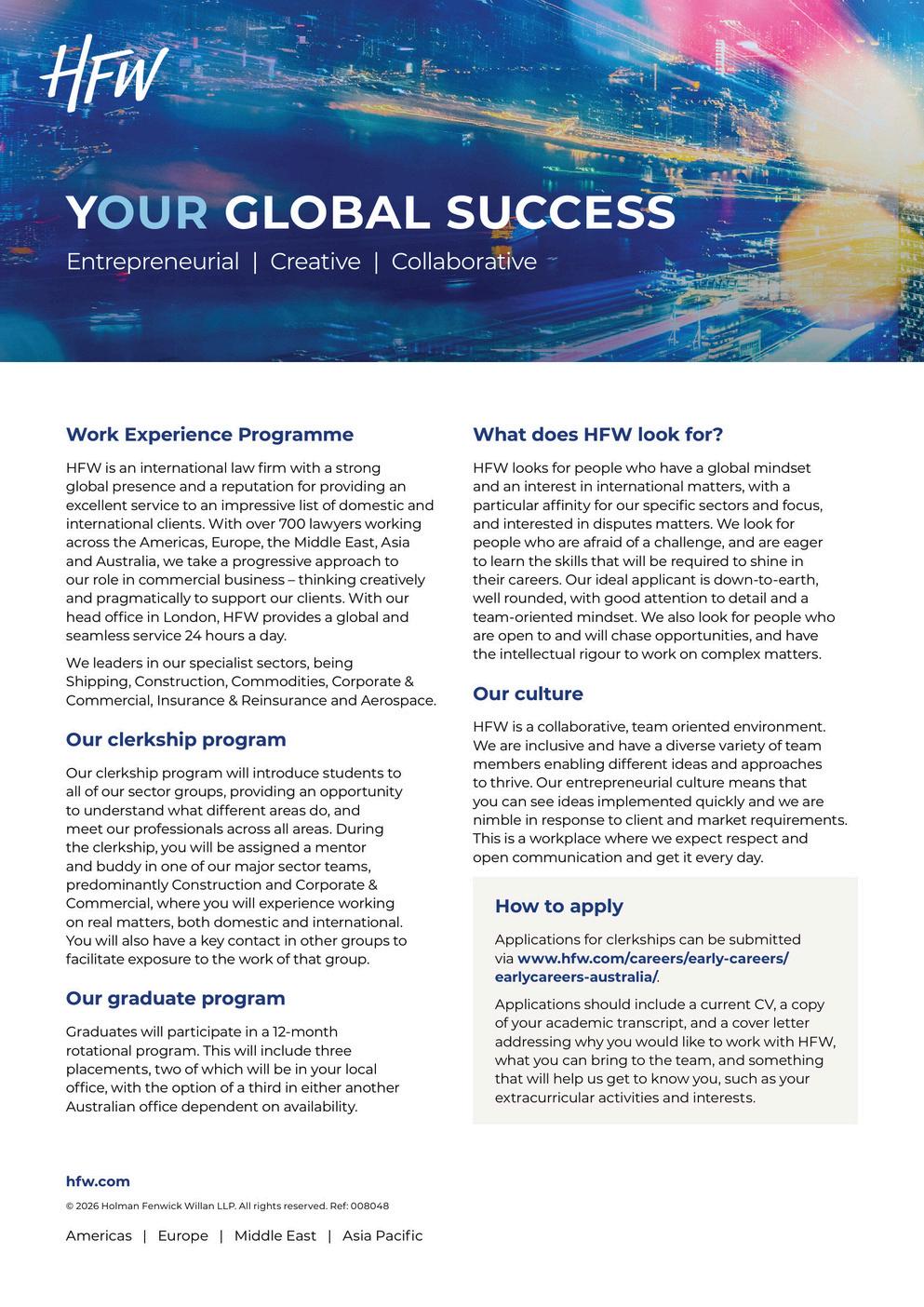
HFW practices in several key areas of law, including Corporate & Commercial, Construction, Commodities, and Employment These practice groups reflect the firm's commitment to providing specialized legal services across diverse sectors, ensuring that clients receive tailored and effective solutions to their legal challenges
MANY
The firm boasts a substantial presence with over 700 lawyers spread across 22 offices worldwide This extensive network allows HFW to operate seamlessly across borders, offering clients access to deep industry expertise and a global perspective The collaborative and teamoriented approach of HFW ensures that clients benefit from the collective knowledge and experience of the firm.
What sets HFW apart from other law firms is its truly global nature and sector-focused model. The firm concentrates on six core industries: Shipping, Construction, Commodities, Insurance & Reinsurance, Aerospace, and Corporate & Commercial This specialization enables HFW to deliver pragmatic solutions that address the specific challenges faced by clients in these industries.
Additionally, HFW's culture is unique, fostering an environment free of egos where mutual respect and teamwork are prioritised The firm's entrepreneurial spirit and innovative mindset further distinguish it, as HFW consistently seeks creative and practical solutions to complex legal and commercial issues
DOES THE FIRM HAVE ANY PREPENULTIMATE ENGAGEMENT SCHEMES, IF SO HOW DO STUDENTS GET INVOLVED
HFW does not have any pre-penultimate engagement schemes directly However, the firm offers clerkship and paralegal opportunities for students. Students can apply through the firm's job board or by connecting with HR representatives like Ghemma Beet on LinkedIn
DOES THE FIRM OFFER A CLERKSHIP PROGRAM, IF SO, HOW DO STUDENTS APPLY?
Yes, the firm offers a clerkship program Students can apply through the firm's job board or by connecting with HR representatives.
DOES THE FIRM OFFER CLERKSHIPS TO STUDENTS OUTSIDE THEIR PENULTIMATE YEAR?
The clerkship program is primarily designed for penultimate-year students, but applications from students in other stages of their studies may be considered in certain circumstances
DOES THE FIRM OFFER A GRADUATE PROGRAM, IF SO HOW DO STUDENTS APPLY?
HFW offers a graduate program, with students able to apply through the Clerkship Program or the Paralegal Pathway. Graduate offers are extended to three candidates after the clerkship program
WHAT IS THE ANTICIPATED CLERKSHIP INTAKE THIS YEAR?
HFW anticipates offering three positions
HFW attracts individuals with a global perspective and a keen interest in international matters, particularly those drawn to our specialised sectors and disputes-related work We value candidates who are unafraid of challenges and eager to develop the skills necessary to excel in their careers.
Our ideal applicant embodies authenticity, is well-rounded, self-motivated, and demonstrates strong attention to detail, coupled with a collaborative and team-oriented mindset. We seek those who actively pursue opportunities, embrace learning, and possess the intellectual rigor required to tackle complex legal matters At HFW, we encourage ambitious and driven individuals who aspire to make a meaningful impact in their field.
During their time at the firm, clerks can expect to undertake meaningful and challenging tasks that provide a genuine insight into the legal profession Responsibilities may include preparing memoranda of advice, conducting document discovery, reviewing pleadings, and preparing chronologies and indexes. Clerks are encouraged to engage with case materials and participate in office events, such as morning teas, to connect with colleagues and immerse themselves in the firm's culture
DO YOU HAVE ANY ADVICE FOR STUDENTS APPLYING FOR A CLERK POSITION AT THE FIRM?
To make a good impression, students should tailor their applications to the specific firm by researching its values, practice areas, and notable cases
Addressing applications correctly, proofreading for errors, and highlighting relevant experiences are crucial steps in the application process
The firm offers graduate positions to clerks, with the review process taking place at the end of the clerkship program. Clerks are considered for graduate roles based on their performance and expressed interest during the program
The progression path for a graduate lawyer at HFW typically begins with a one-year graduate program During this year, graduates undergo rotations in different practice areas within the firm's Australian offices, gaining valuable experience and exposure to various legal disciplines This foundational year is designed to equip graduates with the skills and knowledge necessary to excel in their legal careers. After completing the graduate program, lawyers at HFW typically advance to the role of Associate As Associates, they continue to develop their expertise by working on complex cases and collaborating with experienced lawyers across the firm's global network. HFW places a strong emphasis on professional development, offering opportunities for international secondments and cross-border collaboration These experiences not only broaden professional horizons but also provide invaluable exposure to diverse legal practices and cultures, enriching both personal and career development
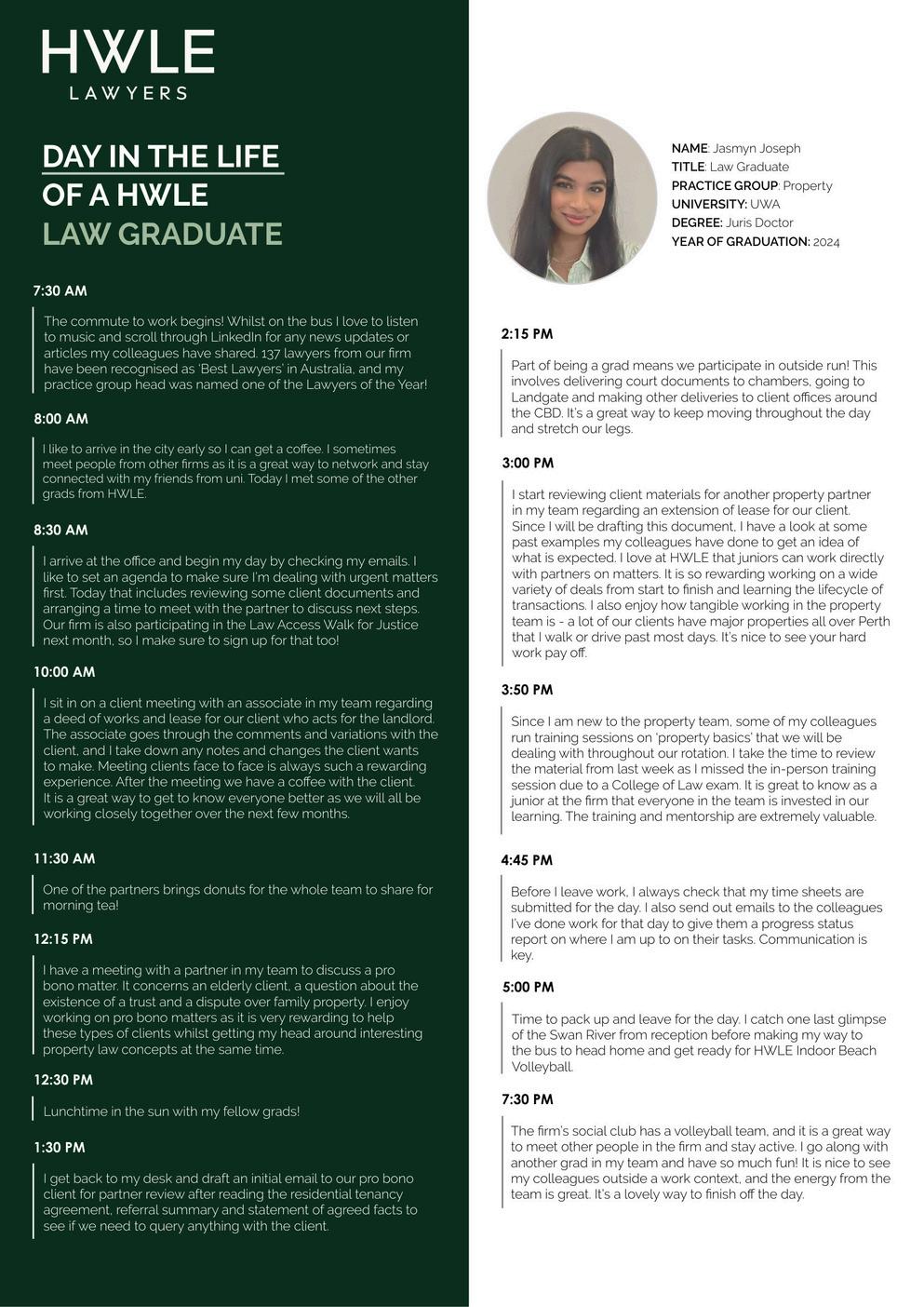
WHAT ARE THE KEY AREAS OF LAW THAT THE FIRM PRACTICES IN?
Banking & Finance
Commonwealth Government
Construction & Infrastructure
Corporate & Commercial
Environment & Planning
Health
Insurance (General)
Insurance (Statutory Classes)
Litigation
Pro Bono
Property Transport
Workplace Relations & Safety
HOW MANY LAWYERS AND PARTNERS DOES THE FIRM HAVE?
1700 lawyers and 280 Partners
We’re committed to giving you the opportunity and support you need to grow your career from day one You’ll always know the pathways available to you, and you’ll be trusted with meaningful work early, without hierarchy or rigid structures.
You’ll have genuine access to senior leaders who are approachable, collaborative and invested in your ideas. We believe the best work happens when people feel valued, included and able to contribute, no matter their level.
We also place real emphasis on being effective in life, so you can build a career you’re proud of and still participate in life outside the office.
We’re different for all the right reasons - and we’re excited for you to experience how this sets us apart
DOES THE FIRM HAVE ANY PREPENULTIMATE ENGAGEMENT SCHEMES, IF SO, HOW DO STUDENTS GET INVOLVED?
No.
DOES THE FIRM OFFER A CLERKSHIP PROGRAM, IF SO, HOW DO STUDENTS APPLY?
Candidates can visit our website at https://hwlebsworth com au/graduate-centre/
DOES THE FIRM OFFER CLERKSHIPS TO STUDENTS OUTSIDE THEIR PENULTIMATE YEAR?
Final-year students are eligible to apply for our Adelaide and Brisbane clerkship programs only
WHAT IS THE ANTICIPATED CLERKSHIP INTAKE THIS YEAR?
Sydney & Norwest: 30 National: 130.
WHAT ARE THE QUALITIES THE FIRM LOOKS FOR IN CLERKS?
We look for candidates that are proactive, have a curious and open mindset and a strong willingness to learn. We understand that students may not have gathered much work experience at this stage of their careers, and primarily focus on candidates’ interests, experiences and goals during the recruitment process.
DOES THE FIRM OFFER GRADUATE POSITIONS TO CLERKS?
Most of our graduate positions are filled through clerk conversions.
\WHAT RESPONSIBILITIES AND TASKS CAN A CLERK EXPECT TO TAKE ON?
HWLE’s Clerkship Program is designed to give you hands-on experience and practical training to build your legal skills and knowledge, while also providing opportunities to network with practitioners across the firm You’ll gain exposure to a diverse range of work within your allocated Practice Group(s), and we’ll take the time to get to know you - both professionally and personally.
At the start of your Clerkship, you’ll be paired with a Supervising Partner and a mentor who will guide and support you throughout your placement. They’ll help you develop your skills and provide detailed feedback at the end of your time with us You’ll also take part in a tailored induction program designed to familiarise you with our systems, people, and values, ensuring you feel welcomed as a valued member of our national teaam.
At HWLE, we encourage a way of working that helps our people deliver great outcomes, grow their careers, and enjoy life beyond the office. During your Clerkship, you will experience what it is like to be an employee of HWLE, and you will have the opportunity to attend a variety of social and networking events hosted by the firm
DOES THE FIRM OFFER A GRADUATE PROGRAM, IF SO HOW DO STUDENTS APPLY?
Candidates can visit our website at https://hwlebsworth.com.au/graduate-centre/.
DO YOU HAVE ANY ADVICE FOR STUDENTS APPLYING FOR A CLERK POSITION AT THE FIRM?
Firstly, show your research and understanding of HWLE, its values, and its work. I'd suggest looking through our website, speaking to staff at campus events, and even looking through recent updates on our LinkedIn It's also always a good idea to come prepared with a great set of questions that showcase both your curiosity and reaffirm your interest in the role. More than anything, we want to be able to imagine you in the team, so be your authentic self! We want to get to know you and understand your genuine passions and interests
WHAT IS THE PROGRESSION PATH OF A GRADUATE LAWYER AT THE FIRM?
Successful graduates can expect to receive a permanent solicitor offer following the Graduate Program. Solicitor offers are subject to performance displayed during the program.



WHAT ARE THE KEY AREAS OF LAW THAT THE FIRM PRACTICES IN?
Key practice areas: Corporate (Private Equity, M&A, Equity Capital Markets), Dispute Resolution, Energy & Resources, Board Advisory, Competition, Technology & IP, Foreign Direct Investment, Finance, Tax, Restructuring, Employment, Industrial Relations, Safety, Property and Projects
Key sectors: Technology, Defence, Emerging Energy, Technologies, Healthcare, Oil & Gas, Mining, Media & Communications, FMCG, Natural Capital
HOW MANY LAWYERS AND PARTNERS DOES THE FIRM HAVE?
Our firm has more than 500 people, including more than 80 partners across Sydney, Melbourne, Perth, Adelaide, Brisbane and Canberra.
JWS places a strong focus on quality client service, working on complex and high profile matters for leading organisations, including Google, Qantas, Rio Tinto, Unilever and Microsoft Clerks and graduates benefit from early responsibility and meaningful work exposure, supported by close engagement with partners and senior lawyers.
Our collaborative and supportive culture ensures individuals are well supported while developing practical skills and commercial insight.
DOES THE FIRM OFFER A CLERKSHIP PROGRAM, IF SO, HOW DO STUDENTS APPLY?
We offer a seasonal clerkship program to penultimate-year students pursuing a Bachelor of Laws or Juris Doctor degree Applications can be submitted through our firm’s website in line with the timelines set by the relevant state law society
Candidates are required to submit their CV, most recent academic transcript and respond to a few short application questions through the online application, which help us understand their interests and experiences We do not require candidates to complete any psychometric testing
IS THE ANTICIPATED CLERKSHIP INTAKE THIS YEAR?
For the 2026–27 program, we plan to hire about 16 to 18 seasonal clerks in our Sydney office.
We look for ambitious, adaptable and commercially minded law students who are keen to learn and contribute. Strong communication skills and the ability to work well in a collaborative team environment are essential. We value initiative and a proactive approach, as well as meaningful contributions to work and team outcomes While academic achievement is important, we also value a broad range of experiences including part‑time or casual work (legal or non legal), university involvement, leadership roles, volunteering, sport, or other extracurricular activities that demonstrate teamwork and initiative
Seasonal clerks at JWS work closely with our lawyers on a range of matters, gaining hands on experience across different clients, practice areas and industries. A typical day may include legal research, drafting documents such as memos or contracts, reviewing documents, assisting with due diligence, and supporting practitioners on active matters. Clerks may also observe meetings or court proceedings, contribute to pro bono work, and assist with file and matter management.
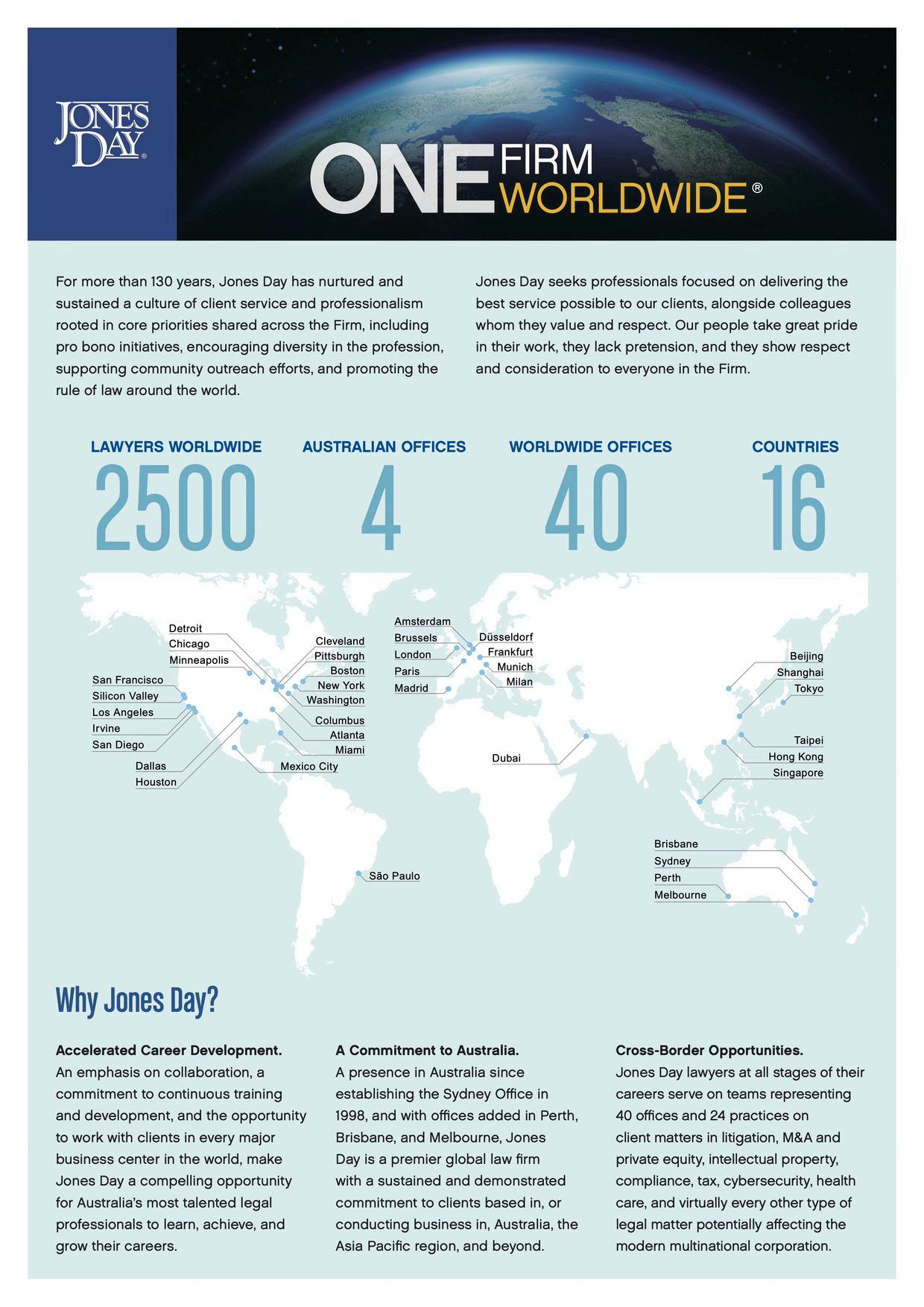
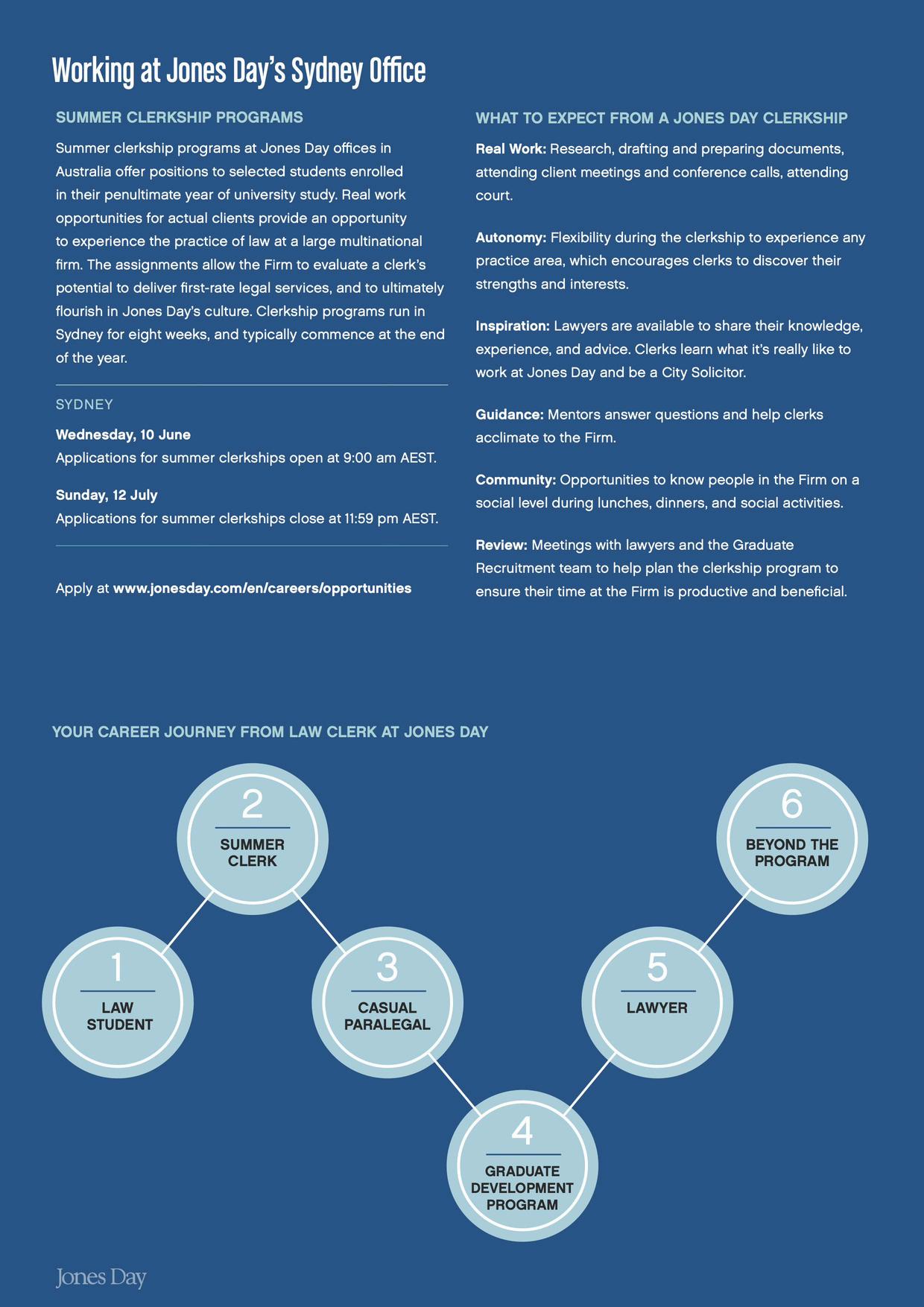
WHAT ARE THE KEY AREAS OF LAW THAT THE FIRM PRACTICES IN?
Corporate, Global Disputes, Energy, Real Estate, Employment, Intellectual Property, Financial Markets, Competition and AntiTrust and Tax
HOW MANY LAWYERS AND PARTNERS DOES THE FIRM HAVE?
About 2,500 worldwide, including 900 partners.
IS UNIQUE ABOUT THE FIRM?
Jones Day stands out from other law firms through its distinctive “One Firm Worldwide” approach, which means the firm operates as a single global partnership rather than a collection of separate offices. This structure encourages collaboration across jurisdictions and practice areas, allowing lawyers to draw on the firm’s global expertise to deliver the best outcomes for clients.
DOES THE FIRM HAVE ANY PREPENULTIMATE ENGAGEMENT SCHEMES, IF SO HOW DO STUDENTS GET INVOLVED?
Attending law fairs, networking events, and firm presentations hosted by universities
Connecting with lawyers via informational catch up or LinkedIn
Participating in open days or insight sessions when available Paralegal opportunities
DOES THE FIRM OFFER A CLERKSHIP PROGRAM, IF SO, HOW DO STUDENTS APPLY?
You can apply via the careers website. Our applications open in line with Law Society of New South Wales clerkship guidelines (around June–July)
The process usually includes:
Online application (CV, transcript, cover letter) along with interviews (often 1–2 rounds)
DOES THE FIRM OFFER CLERKSHIPS TO STUDENTS OUTSIDE THEIR PENULTIMATE YEAR?
Generally our clerkships are aimed at penultimate-year law students
WHAT IS THE ANTICIPATED CLERKSHIP INTAKE THIS YEAR?
Each year is different, however we typically take on 3-6 each year in Sydney.
WHAT ARE THE QUALITIES THE FIRM LOOKS FOR IN CLERKS?
Our Jones Day values
Strong academic performance
Commercial awareness and interest in business
Initiative and intellectual curiosity
Teamwork and collaboration, reflecting its “One Firm Worldwide” culture
A genuine interest in the firm, not just law generally
RESPONSIBILITIES AND TASKS CAN A CLERK EXPECT TO TAKE ON?
Clerks are given meaningful, hands-on work, such as:
Legal research and drafting
Assisting with client memos and advice
Reviewing documents and due diligence
Attending meetings, court hearings, or client calls
Working closely with lawyers and partners across different practice areas
Because of the firm’s structure, clerks may also experience cross-office or cross-practice collaboration.
DO YOU HAVE ANY ADVICE FOR STUDENTS APPLYING FOR A CLERK POSITION AT THE FIRM?
Tailor your application to Jones Day (highlight interest in its global model)
Show commercial awareness, not just legal knowledge
Be ready to explain why Jones Day vs other firms
Prepare thoroughly for interviews by understanding:
Understand the firm’s practice areas
Its “One Firm Worldwide” philosophy DOES THE FIRM OFFER A GRADUATE PROGRAM, IF SO HOW DO STUDENTS APPLY?
Yes Clerkships are the primary pathway to graduate roles at Jones Day.
Our clerks are often offered graduate positions at the end of the program They are also occasionally open externally throughout the year through our careers website.
WHAT IS THE PROGRESSION PATH OF A GRADUATE LAWYER AT THE FIRM?
At Jones Day in Sydney, the typical progression begins with a Summer Clerkship, which is the main pathway into the firm and often leads to a graduate offer Some students may also work as paralegals before starting full-time. Graduates then join as Graduate Lawyers
A standout feature of our graduate program is the opportunity to attend the Jones Day New Lawyers Group Academy in Washington, D C Within their first year, our graduates travel to the firm’s global headquarters to take part in this immersive program, connecting with graduates from across our international offices
The Academy offers a unique platform to build relationships, share experiences, and gain insight into the firm’s global practice, all while developing both professional and technical skills. It’s an invaluable experience that reflects our commitment to investing in our people from the very start of their careers.

WHAT ARE THE KEY AREAS OF LAW THAT THE FIRM PRACTICES IN?
Asset Management & Investment Funds
Corporate Energy, Infrastructure and Resources
Finance
Intellectual Property
Litigation & Dispute Resolution
Labour, Employment and Workplace
Safety
Policy & Regulatory
Real Estate
HOW MANY LAWYERS AND PARTNERS DOES THE FIRM HAVE?
874 Partners
1,275 Lawyers
WHAT IS UNIQUE ABOUT THE FIRM?
K&L Gates is unlike many other global legal firms. We operate as a fully integrated law firm, with one central financial system, a single IT network, and global practice groups and support teams In Australia, we have four established offices in Sydney, Melbourne, Brisbane and Perth. Our presence in key capital cities and the world’s commercial and financial centers combine our practice strength, global platform and focus on client service to provide a genuinely different legal experience.
We represent a broad array of Global 500, Fortune 100, FTSE 100 and ASX 100 corporations in nearly every major industry Our lawyers are leaders in legal issues relating to industries critical to the economies of the developed and developing worlds including fashion, retail, financial services, technology, manufacturing, transportation, food and beverage, energy, telecommunications, health care, life sciences, sustainable development, and infrastructure.
In Australia we have an established Innovation Committee that brings together people from across all areas of our firm We undertake reviews of best practice innovation globally and oversee pilots and roll-outs of new technology, regular training and testing new ideas as they are launched.
DOES THE FIRM HAVE ANY PREPENULTIMATE ENGAGEMENT SCHEMES, IF SO HOW DO STUDENTS GET INVOLVED?
Yes, we run a 10-week Summer Clerkship program in Sydney where we offer our clerks the opportunity to rotate through our various practice areas and experience life at K&L Gates Our clerkship program in Sydney is the primary source of our future graduate intake. This year's applications will open on 10 June 2026 and close on 12 July 2026. All details about prepenultimate programs can be found on our website.
DOES THE FIRM OFFER CLERKSHIPS TO STUDENTS OUTSIDE THEIR PENULTIMATE YEAR?
Typically, we recruit clerks on the basis that they will be able to commence a graduate program the following year
WHAT IS THE ANTICIPATED CLERKSHIP INTAKE THIS YEAR?
8-10 clerks
WHAT ARE THE QUALITIES THE FIRM LOOKS FOR IN CLERKS?
We are looking for smart, imaginative and hard-working people with diverse backgrounds, experiences and ideas to join us Perhaps our search for talented visionaries and your search for important and impactful work will lead to the same place
Our aim is to develop commercially orientated and entrepreneurial lawyers. Solid academic results are important but to be a future lawyer in our firm, you need to demonstrate talent and skill in a variety of areas
We look to recruit well-rounded, talented people, to provide opportunities and support for them to achieve their best. It sounds simple, and to us it is
WHAT RESPONSIBILITES AND TASKS CAN A CLERK EXPECT TO TAKE ON?
In conjunction with on-the-job experience, we provide formal training sessions On day one, you will receive an in-depth induction to the firm as well as training on relevant internal processes and systems, followed by other sessions over the course of the clerkship program These sessions are designed to develop your legal knowledge and business skills, as well as to give you a broader insight into the various areas of law in which we practice.
DO YOU HAVE ANY ADVICE FOR STUDENTS APPLYING FOR A CLERK POSITION AT THE FIRM?
Be open-minded and ready to dive into all new opportunities that come your way Simply, be ready and eager to learn!
DOES THE FIRM OFFER GRADUATE POSITIONS TO CLERKS?
Yes.
DOES THE FIRM OFFER A GRADUATE PROGRAM, IF SO, HOW DO STUDENTS APPLY?
Yes, all information about our programs can be found on our website.
WHAT IS THE PROGRESSION PATH OF A GRADUATE LAWYER AT THE FIRM?
The graduate program runs for 12 months, during which time you will complete three practice group rotations You will be embedded into the practice areas and be involved in real legal work right from the start, giving you indepth experience and providing a real insight into life as a commercial lawyer at K&L Gates.
You will be exposed to a variety of areas of commercial law in all your rotations while being supported by a buddy, supervisor and mentor. Your professional development program runs weekly, with sessions presented by partners, lawyers, external presenters and our professional development team
You will have many opportunities to be involved in an array of firm events and activities to match your interest, whether they be social, sporting, business or community focused We are more than about practicing law or making a living, and we hope to build something amazing and create a legacy for you, the firm, our clients and the communities we serve On successful completion of our graduate program, we look to offer first year placements.
WHAT ARE THE KEY AREAS OF LAW THAT THE FIRM PRACTICES IN?
Maddocks is a full service Australian law firm practicing across Commercial; Construction & Projects; Dispute Resolution & Litigation; Employment, Safety & People; Public Law; and Real Estate, with strong sector focus in government, healthcare, education, infrastructure and technology.
WHAT IS UNIQUE ABOUT THE FIRM?
The firm is known for being a modern, independent Australian law firm with a strong people‑first culture and long standing client relationships. It is consistently recognised for employee experience and inclusion
DOES THE FIRM HAVE ANY PREPENULTIMATE ENGAGEMENT SCHEMES, IF SO HOW DO STUDENTS GET INVOLVED?
Maddocks focuses primarily on penultimate‑year students but engages earlier year students through events, university partnerships and information evenings. These are promoted via university careers teams and the firm’s careers pages
DOES THE FIRM OFFER A CLERKSHIP PROGRAM
Yes, Maddocks offers a summer clerkship program in Sydney, Melbourne and Canberra. Students apply online with a CV, cover letter and academic transcript, followed by an online assessment and interview process. Sydney and Canberra applications open on the 10th of June.
DOES THE FIRM OFFER A CLERKSHIPS PROGRAM, IF SO HOW DO STUDENTS APPLY?
Yes, Maddocks offers a summer clerkship program in Sydney, Melbourne and Canberra. Students apply online with a CV, cover letter and academic transcript, followed by an online assessment and interview process. Sydney and Canberra applications open on the 10th of June.
DOES THE FIRM OFFER CLERKSHIPS TO STUDENTS OUTSIDE THEIR PENULTIMATE YEAR?
It is currently Penultimate year only for Sydney and Canberra. Melbourne accepts final year students in addition to penultimate
WHAT IS THE ANTICIPATED CLERKSHIP INTAKE THIS YEAR?
Intake varies by location and business needs.
ARE THE QUALITIES THE FIRM LOOKS FOR IN CLERKS?
Maddocks looks for clerks who are curious, collaborative, motivated and values‑aligned, with strong communication and a genuine interest in the firm’s work. Attention to detail and a willingness to learn are key
RESPONSIBILITIES AND TASKS CAN A CLERK EXPECT TO TAKE ON?
Clerks work on real client matters, including legal research, drafting and team projects They rotate through two practice groups and receive regular feedback and support The program is designed to be hand on, interesting and fun!
DO YOU HAVE ANY ADVICE FOR STUDENTS APPLYING FOR A CLERK POSITION AT THE FIRM?
Do your research on Maddocks, its practice areas, clients and values and be clear about why the firm interests you. Strong, tailored applications and attention to detail matter.
DOES THE FIRM OFFER GRADUATE POSITIONS TO CLERKS?
The clerkship program is the primary pathway into graduate roles at Maddocks. Graduate offers are typically made to high performing clerks
DOES THE FIRM OFFER A GRADUATE PROGRAM, IF SO HOW DO STUDENTS APPLY?
Maddocks offers a structured graduate program, with graduates recruited almost exclusively from the clerkship pool. However on occasion, we may advertise graduate roles on our careers page
IS THE PROGRESSION PATH OF A GRADUATE LAWYER AT THE FIRM?
Graduate lawyers at Maddocks begin with a national Signature Graduate Program, which includes an initial PLT phase followed by a three day National Graduate Induction bringing graduates from all offices together to build core legal, professional and firm wide capability Graduates then complete three practice team rotations across 12 months, supported by a buddy, coordinator and structured learning workshops aligned to real client work. On successful completion of the program, graduates progress into first year lawyer roles, with a clear pathway for ongoing development and advancement at the firm.
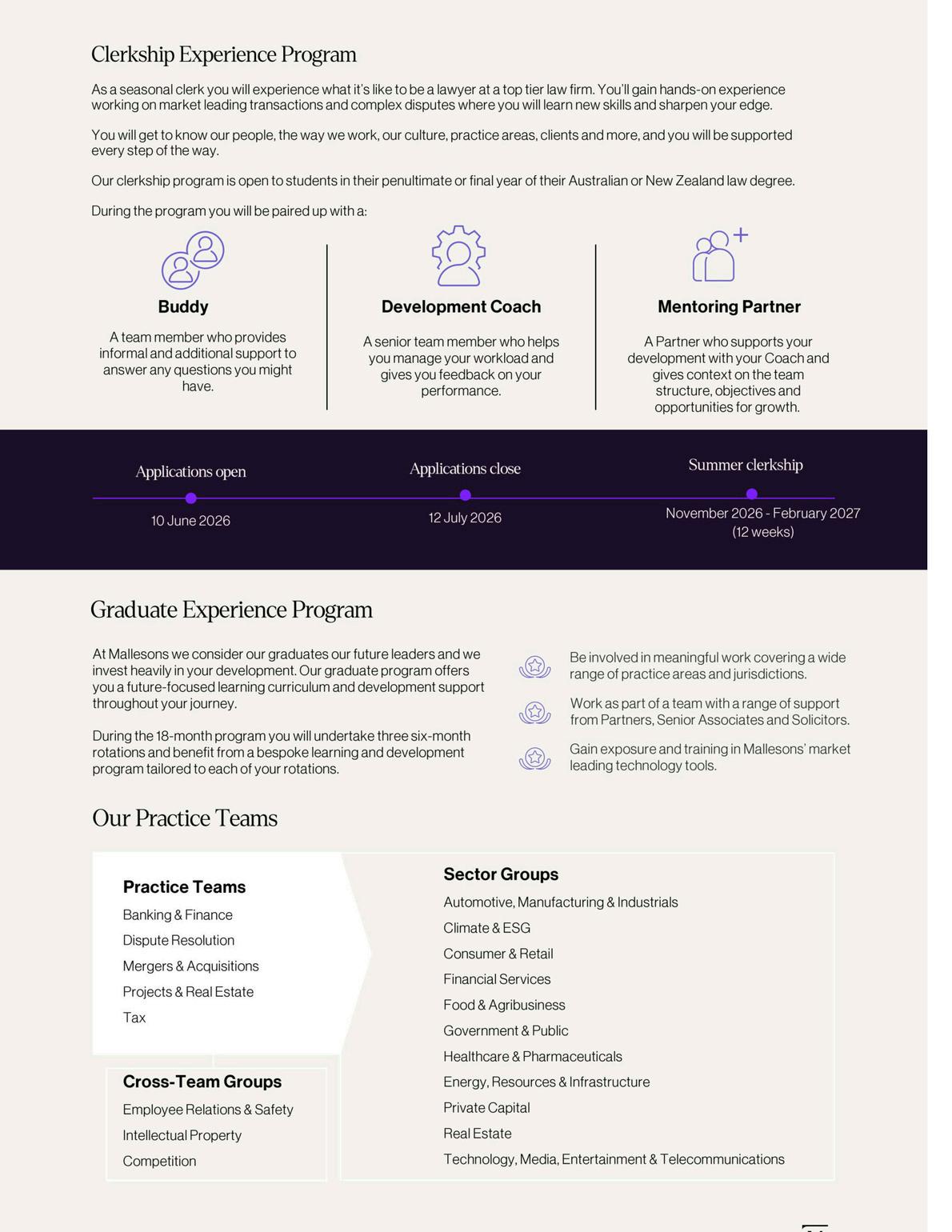
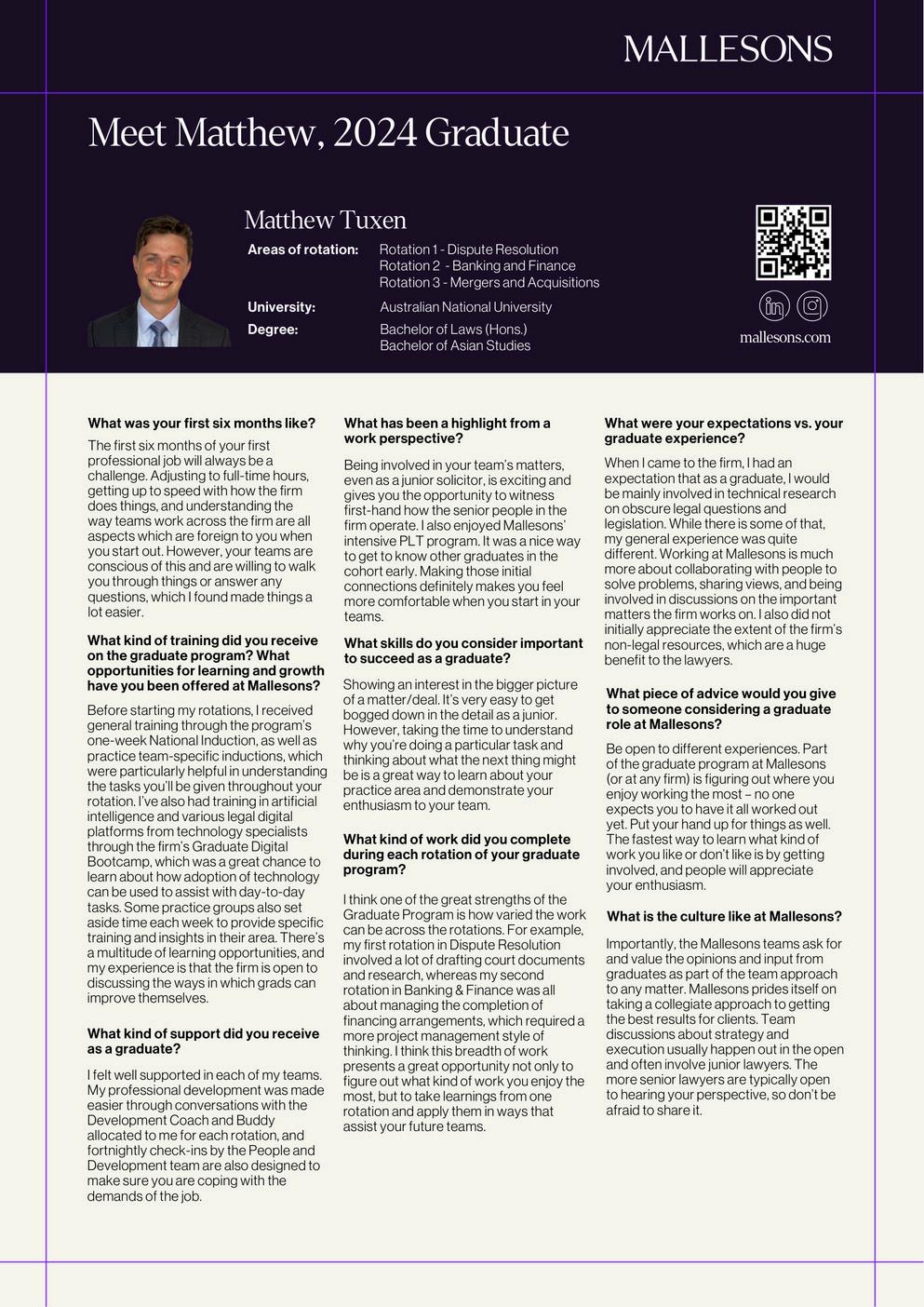
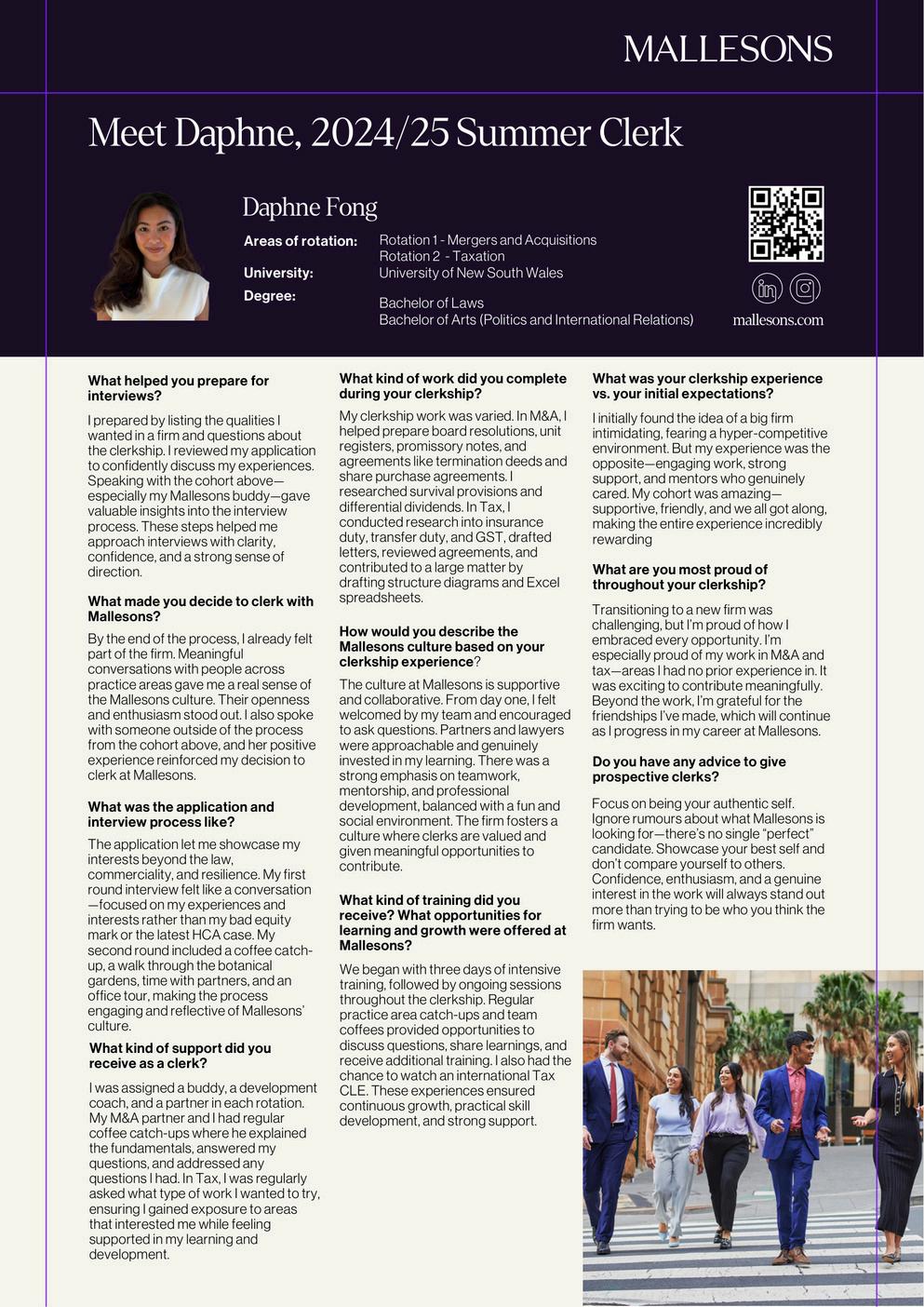
WHAT ARE THE KEY AREAS OF LAW THAT THE FIRM PRACTICES IN?
Banking & Finance
Dispute Resolution
Mergers & Acquisitions
Projects & Real Estate
Taxation
HOW MANY LAWYERS AND PARTNERS DOES THE FIRM HAVE?
Mallesons has 200 partners and over 1,200 lawyers who are locally qualified and globally experienced.
IS
ABOUT THE FIRM?
Our People Value Proposition (PVP), “Learn, Master, Lead” is what makes Mallesons a special place to work and build a career A place where you will nurture your skills through continual learning and development opportunities and where you will collaborate with exceptional colleagues and clients in the pursuit of legal mastery. Our PVP is about having a mindset of curiosity and an appetite for continuous learning; a commitment to excellence and mastering your craft. Mallesons is a firm where together we Learn, together we Master, together we Lead
DO YOU HAVE ANY ADVICE FOR STUDENTS APPLYING FOR A CLERK POSITION AT THE FIRM?
Don’t discount any of your experiences, and let your authentic self show during the recruitment process.
DOES THE FIRM HAVE ANY PREPENULTIMATE ENGAGEMENT SCHEMES, IF SO, HOW DO STUDENTS GET INVOLVED?
Through our Insight Program, prepenultimate year law students will gain an understanding of how Mallesons is structured, the areas of law we practice in, and the clients we work with. They will also gain exclusive insights into the clerkship recruitment process. Applications will open in October 2026
DOES THE FIRM OFFER A CLERKSHIP PROGRAM, IF SO, HOW DO STUDENTS APPLY?
Applications will be open from 10 June – 12 July 2026 Our Early Careers webpage will have a link to the application portal when they open.
DOES THE FIRM OFFER CLERKSHIPS TO STUDENTS OUTSIDE THEIR PENULTIMATE YEAR?
We accept clerkship applications from penultimate and final year law students
DOES THE FIRM OFFER GRADUATE POSITIONS TO CLERKS?
The majority of our graduates come from our seasonal clerkships. We do not typically recruit directly for the graduate program.
We value a range of skills and experiences in our employees and recognise that a diversity of strengths leads to best results
Intellectual curiosity - we want deep thinkers who seek out information and diverse views to reach a practical and efficient solution to business problems Client centricity – we work in our clients’ worlds and partner with them to achieve their business goals We need people who can stand in the shoes of the client and experience things from their perspective.
Learning agility – we need people who demonstrate personal flexibility and an openness to dealing with change. Growth mindset – we look for people who seek out learning opportunities and embrace challenges.

Teamwork - we operate as one firm working together and supporting each other across cultures We want people who build relationships and empathise with others.
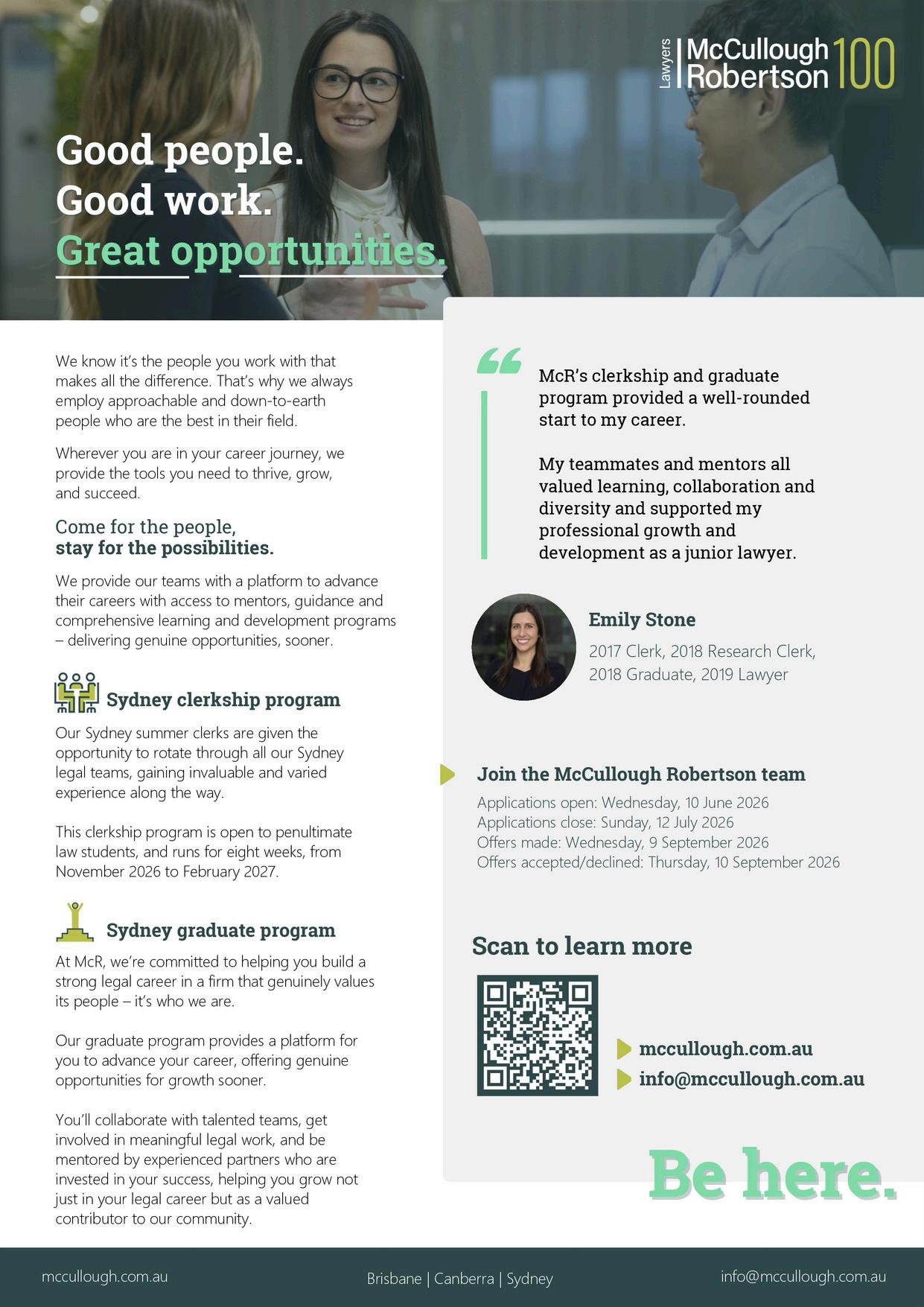
WHAT ARE THE KEY AREAS OF LAW THAT THE FIRM PRACTICES IN?
The firm offers comprehensive legal services across a wide range of practice areas including Construction and Infrastructure, Corporate Advisory, Digital and Intellectual Property, Employment Relations and Safety, Finance, Insurance and Corporate Risk (Brisbane), Planning and Environment, Project Approvals (Brisbane), Real Estate, Tax (Brisbane), Restructuring and Insolvency, and Wills and Estates
HOW MANY LAWYERS AND PARTNERS DOES THE FIRM HAVE?
59 Partners and 174 Lawyers across Sydney and Brisbane office locations
WHAT IS UNIQUE ABOUT THE FIRM?
McCullough Robertson is a commercially focused firm, working with high-calibre national and international clients We work on big matters but work in small teams, giving each of our employee’s hands-on experience and the ability to develop their own interests and areas of expertise Our goal is for each and every one of our employees to build a rewarding career which is full of opportunities, satisfying relationships and a sense of achievement.
We are guided by our values – being generous, commercial, committed and down to earth – in everything we do. We strive towards a diverse and inclusive environment that supports our values and creates a collaborative and innovative experience for our people, our clients, and our community partners
To achieve this, our Diversity and Inclusion strategy focusses on five key pillars including Gender Equality, Diverse Genders and Sexualities, Cultural Diversity, Disability and Access, and Working Families. We embed initiatives and outcomes which allows our people to bring their whole self to work, every day
It will be an exciting time to join the firm as we reach our 100-year milestone this year. With a strong focus on growing the Sydney office, there are great opportunities for those looking to build a dynamic and successful career
DOES THE FIRM HAVE ANY PREPENULTIMATE ENGAGEMENT SCHEMES, IF SO, HOW DO STUDENTS GET INVOLVED?
At this stage, we offer opportunities for prepenultimate students in our Brisbane office only However, in Sydney we employ law students in paralegal roles from time to time
DOES THE FIRM OFFER A CLERKSHIP PROGRAM, IF SO, HOW DO STUDENTS APPLY?
This clerkship program is open to penultimate law students, and runs for eight weeks, from November 2025 to February 2026. Applications are made through our website. Recruitment dates are in line with the NSW Law Society guidelines
DOES THE FIRM OFFER GRADUATE POSITIONS TO CLERKS?
Yes, many of our clerks will go on to join our graduate program
The anticipated clerkship intake this year for our Sydney office will be four to seven clerks
ARE
We are seeking well rounded candidates who have demonstrated the ability to successfully balance academics with work experience, extra curriculars and personal interests. We are also looking for individuals that embody our values of being generous, commercial, committed and down to earth
. WHAT RESPONSIBILITIES AND TASKS CAN A CLERK EXPECT TO TAKE ON?
Our structured clerkship program provides hands-on work experience, giving you the opportunity to participate in meaningful work within the firm, and alongside partners and clients Our Sydney summer clerks are given the opportunity to rotate through all our Sydney legal teams, gaining invaluable and varied experience along the way
In addition to practical legal experience, you will participate in curated training sessions delivered by our talented partners, lawyers and business services teams From briefings and case studies from across the firm, to the business of law, each session is designed to give you the tools you need to help you grow in your legal career.
DO YOU HAVE ANY ADVICE FOR STUDENTS APPLYING FOR A CLERK POSITION AT THE FIRM
Take the time to research McR We are keen to understand why you are interested in undertaking a clerkship at McR and how this aligns with your interests and long-term goals We want to know how your past experiences ( both legal and non legal) have shaped you so far and why you are passionate about pursuing a career in commercial law. There is no expectation that you had had any prior legal work experience. Our goal is to get to know you better during the recruitment process We encourage you to be genuine and bring your whole self.
DOES THE FIRM OFFER A GRADUATE PROGRAM, IF SO HOW DO STUDENTS APPLY?
We would typically populate our graduate program directly from our clerkship program.
The graduate program runs across eighteen months, consisting of two x nine month practice group rotations and structured training sessions Upon admission, the job title will formally change from Graduate to Lawyer. Following the completion of the graduate program, lawyers will settle into teams within a selected practice area

Banking and Finance
Financial Services & Funds
Mergers & Acquisitions
Competition & Regulatory
Dispute Resolution
Complex Liabilities, Insurance & Regulation
Technology, Digital & Data
Environment and Planning
Projects, Infrastructure & Construction
Real Estate Tax
Workplace HOW MANY LAWYERS AND PARTNERS DOES THE FIRM HAVE?
Total Employees: 2500+
Partners: 260+
Legal: 1400+
MinterEllison is one of Australia’s largest law firms, with nearly 200 years of business history We’re known for our legal and consulting expertise and for our inclusive culture and authentic character. We’ve changed to keep up with our client’s expectations We offer legal and consulting services under one roof. Clients rely on our expertise and insights to solve their most complex business challenges They value our responsive, commercial approach
DOES THE FIRM HAVE ANY PREPENULTIMATE ENGAGEMENT SCHEMES, IF SO, HOW DO STUDENTS GET INVOLVED?
Our Discover ME program is designed to provide pre-penultimate law students an opportunity to discover what it is like to work at MinterEllison. During the program you will be invited to attend three sessions at our offices in Sydney, where you will learn more about our practice groups, the way we work and our people, through attending panel events and participating in workshops
You will also be connected with one of our graduates or junior lawyers, who has recently made the transition from law school to law firm, with the goal to foster your professional development.
Applications typically open in March each year.
Meet ME is a two-part webinar series which is highly relevant to pre-penultimate and penultimate year students, but open to law students at any stage of their studies, across Australia.
Dial in to hear insights and career tips from our lawyers and early careers team, which will allow you to set yourself up for success in your future career in law, as well as learning more about life at MinterEllison.
Meet ME typically takes place in May/June each year
DOES THE FIRM OFFER A CLERKSHIP PROGRAM, IF SO HOW DO STUDENTS APPLY?
MinterEllison offers a Summer Clerkship Program in Sydney Our online application form will ask you to submit your resume and your most recent academic results Apply online at graduates minterellison com
DOES THE FIRM OFFER CLERKSHIPS TO STUDENTS OUTSIDE THEIR PENULTIMATE YEAR?
Our Clerkship Program is most suited to students in their penultimate or final year of their law degree.
IS THE ANTICIPATED CLERKSHIP INTAKE THIS YEAR?
We estimate that there will be 10 - 20 positions available this summer
WHAT ARE THE QUALITIES THE FIRM LOOKS FOR IN CLERKS?
At MinterEllison, we are not looking for people to fit a mould. Academics are just one piece of the puzzle and we recognise the strength that diversity can bring to a team. Work experience, extra-curricular activities, sporting participation, music and travel are all important criteria to us We want you to bring your whole self to work - individual strengths and diversity are what build our teams up to be the successes they are
DO YOU HAVE ANY ADVICE FOR STUDENTS APPLYING FOR A CLERK POSITION AT THE FIRM?
Tailor your application to MinterEllison Start preparing your application early to ensure you can submit it on time and proofread your application before you submit it! Be yourself! We want you to bring your whole self to work. We are interested in learning more about you; showcase your skills, experiences and achievements
DOES THE FIRM OFFER GRADUATE POSITIONS TO CLERKS?
The prospects of obtaining a graduate role at MinterEllison after completing a successful clerkship with us are very high. The majority of our Graduates come through our Clerkship Program
RESPONSIBILITIES AND TASKS CAN A CLERK EXPECT TO TAKE ON?
Our clerkship program offers meaningful work experience, strucured by a comprehensive orientation program and learning on the job to build both technical skills and commercial knowhow.
During our program you will: work closely with partners and lawyers on active matters to meet deadlines produce quality and meaningful work participate in tangible learning & development activities and attend social and networking events
DOES THE FIRM OFFER A GRADUATE PROGRAM, IF SO HOW DO STUDENTS APPLY?
We offer a Graduate Program which generally consists of three, six-month rotations in different practice areas of law We most often recruit our graduates from the clerkship program, but from time to time we do go to market for graduate roles If you are looking specifically for a graduate role, please keep an eye on our website.
After the Graduate Program, you'll settle into a practice group. Once admitted as a Lawyer, and after you've completed the Graduate Program, career progression opportunities can include Associate, Senior Associate, Special Counsel and Partner.

WHAT ARE THE KEY AREAS OF LAW THAT THE FIRM PRACTICES IN?
Antitrust and competition
Banking and finance
Commonwealth Government
Corporate, M&A and securities
Employment and labour
Environment and planning
Intellectual property
Litigation and disputes
Projects and construction
Pro Bono
Real estate
Restructuring
Risk advisory
Tax
HOW MANY LAWYERS AND PARTNERS DOES THE FIRM HAVE?
In Australia, 1,000+. Globally 7,000+
WHAT IS UNIQUE ABOUT THE FIRM?
Norton Rose Fulbright is a truly global law firm, providing a full business law service to household-name businesses and financial institutions We have more than 3000 lawyers and legal staff, based in 50+ cities across Europe, the United States, Canada, Latin America, Asia, Australia, and the Middle East. And in amongst that global network, you’ll find some of the finest minds in the legal sector – all ready to aid your development
Working in a global law firm means global opportunities – and that means getting the experience of working in our global offices After completing your first year of the graduate program, you will have the opportunity to apply for a six month secondment at one of our overseas offices.
We are committed to our graduates building connections with their peers overseas, build upon their legal knowledge in a different jurisdiction and experience life on the other side of the world so that when they return, they can play a pivotal role in our global connectivity and contribute to our success as a truly global law firm.
DOES THE FIRM HAVE ANY PREPENULTIMATE ENGAGEMENT SCHEMES, IF SO, HOW DO STUDENTS GET INVOLVED?
We encourage law students to join us as a Paralegal - whilst you may be early in your university career, it’s never too early to plan ahead. As a Paralegal and you’ll make your first progress towards a career to be proud of.
Paralegal opportunities become available throughout the year dependent on business needs If you are interested in working as a paralegal, please submit your application via our “expressions of interest paralegal role” on the career page.
DOES THE FIRM OFFER A CLERKSHIP PROGRAM, IF SO, HOW DO STUDENTS APPLY?
We recruit in line with the NSW law society guidelines. Students need to apply online through our website Your application will need to include a one page cover letter, CV and your most up to date academic transcript We only accept online applications.
DOES THE FIRM OFFER CLERKSHIPS TO STUDENTS OUTSIDE THEIR PENULTIMATE YEAR?
Yes, our Summer Clerkship program is available to final year students.
WHAT IS THE ANTICIPATED CLERKSHIP INTAKE THIS YEAR?
15
WHAT ARE THE QUALITIES THE FIRM LOOKS FOR IN CLERKS?
We look for candidates with strong commercial awareness, a global outlook, open mindedness and long term motivation for a career in the law Most importantly, we look for candidates who are curious, authentic and keen to give everything a go!
Strong academic results are important, but rest assured this is not the only criteria we assess our candidates against. Norton Rose Fulbright seeks well-rounded candidates who have strengths beyond academia including work experience and extracurricular interests
WHAT RESPONSIBILITIES AND TASKS CAN A CLERK EXPECT TO TAKE ON?
Our clerkship program offers a real taste of life as a Graduate, including: attending clients meetings and teleconferences, visits to court, research, preparation of court documents, drafting deeds/contracts, discovery and much more!
There will also be additional activities for you to take advantage of including:
Key skills training with our Learning and Development team; Q&A sessions with our leaders; Presentations about practice areas and deals; and Networking and social events.
Wherever you look, you’ll be throwing yourself into new things, all with the support of your supervisor, mentor, buddy and other team members.
At Norton Rose Fulbright we offer an 18 month program consisting of 3 x 6 month rotations We encourage you to complete both a contentious and a transactional rotation
You will complete your Practical Legal Training during the first few months and receive continuous training throughout the program You will be admitted to practice within your first 6 months.
Once you are a Lawyer, you can apply for an international rotation in one of our global offices
At the end of the 18 month program, you will be permanently placed in a team of preference as an Associate.


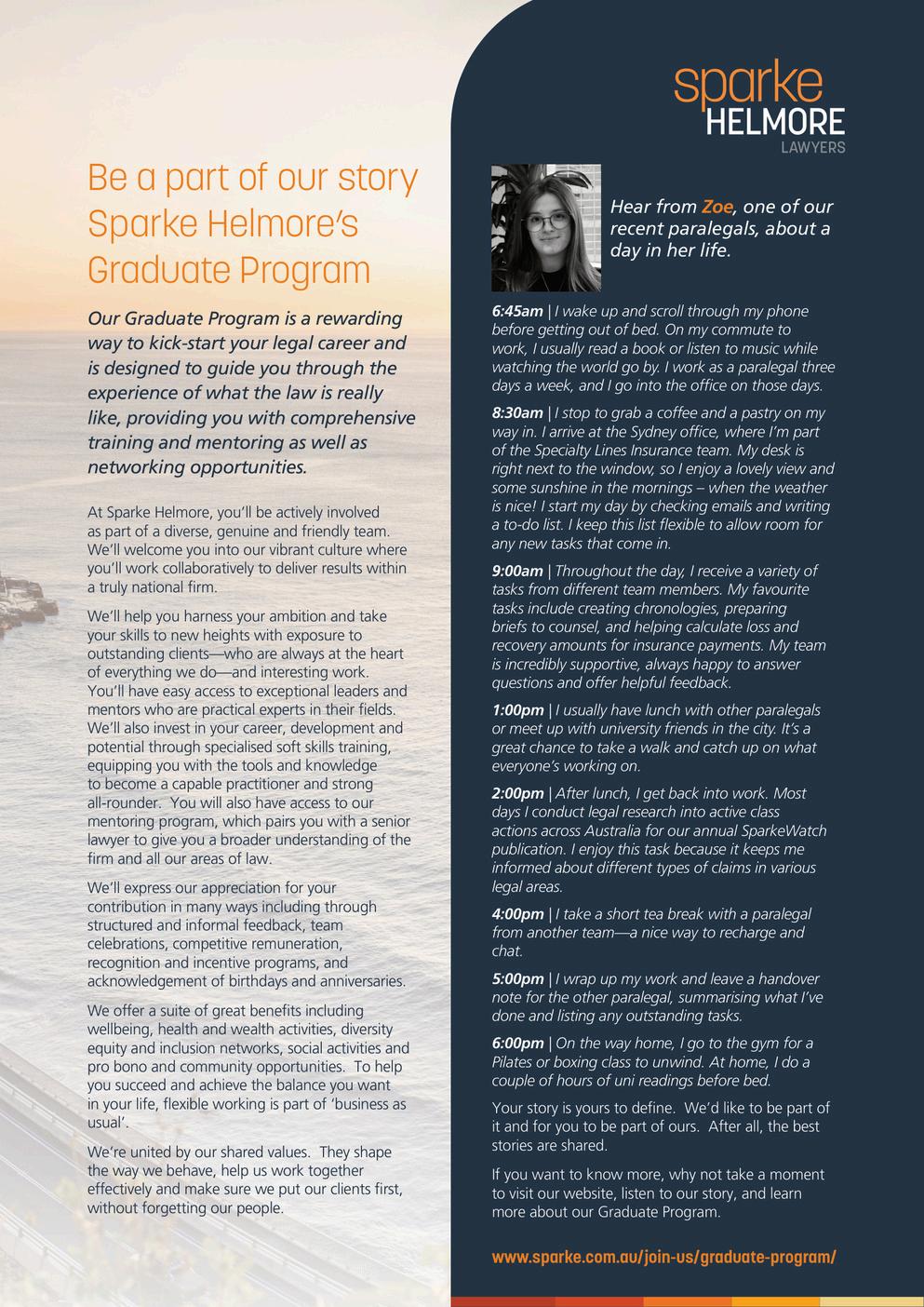
Commercial Insurance, Corporate & Commercial, Government, Statutory Lines Insurance, Property Environment & Finance, and Workplace
MANY LAWYERS AND PARTNERS DOES THE FIRM HAVE?
+1000 total employees, 121 Partners, +600 lawyers, across 10 offices
Since we opened our doors in the Hunter in 1882, we have evolved and expanded our capabilities and services to reflect the changing needs of our clients. However, some things have remained constant our ability to collaborate and deliver results Working together is at the heart of everything we do and achieve, whether it involves our clients, people, suppliers, or communities we serve.
Fostering a vibrant, socially conscious, and inclusive workplace creates infinite opportunities. Our values guide our actions at Sparke Helmore and drive our business forward by building cohesive and agile teams while strengthening relationships both within and outside the firm These values reflect our culture and are an essential ingredient to our future growth and success Our people often describe us as down to earth and approachable.
Our values
Client first – putting our clients at the heart of everything we do.
Honest – being authentic, ethical and behaving with integrity and respect. Respect and inspire people – enabling people to be their best
Agile – open to change adapting to challenges and uncertainty
Our strengths:
Great people – authentic, practical people who forge strong relationships. Right size – large enough to have sufficient scale and coverage but small enough to have an inclusive and friendly culture
Technology with purpose – capability in technology for productivity growth Investors – Partners who are prepared to invest in the future.
DOES THE FIRM HAVE ANY PREPENULTIMATE ENGAGEMENT SCHEMES, IF SO, HOW DO STUDENTS GET INVOLVED?
We offer paralegal opportunities to law students at any stage of their studies, including pre-penultimate students. Unlike traditional clerkships, our approach provides students with a deeper, more hands-on experience.
Students gain meaningful exposure to legal work, client matters, and team collaboration learning in a way that goes beyond what a short-term clerkship typically provides
Students can get involved by reaching out directly to the Early Careers team: Erin Tomicic & Lauren Fraser.
DOES THE FIRM OFFER GRADUATE POSITIONS TO CLERKS?
Yes. Our graduate application process is open to all law students nearing graduation, whether or not they have previously worked with Sparke Helmore We welcome applications from both internal candidates (such as current or former paralegals) and external applicants
Prior clerkship or paralegal experience with the firm is not required to be considered for a graduate role.
DOES THE FIRM OFFER A GRADUATE PROGRAM, IF SO HOW DO STUDENTS APPLY?
Yes We offer a graduate program, and applications can be submitted directly through our website Our graduate positions are open to all law students nearing graduation, regardless of whether they have previously worked with Sparke Helmore.
IS THE PROGRESSION PATH OF A GRADUATE
All of our graduate roles are permanent, full-time positions Once you obtain your practising certificate, your title transitions from Graduate to Lawyer.
Progression within the firm is transparent and based on merit We conduct annual performance reviews that consider both your performance and your alignment with the firm’s values This structured approach supports clear career development and provides graduates with a strong foundation for long-term growth.

WHAT ARE THE KEY AREAS OF LAW THAT THE FIRM PRACTICES IN?
Nationally we cover all areas of corporate and commercial law. In Sydney we have specialists in the following – Dispute Resolution & Litigation, Construction & Infrastructure, Corporate (M&A, ECM), Health, Intellectual Property & Information Technology, Media, Environment Planning & Climate Change, Real Estate & Development, Employment, Gaming Leisure & Hospitality, Tax, and Banking & Finance
HOW MANY LAWYERS AND PARTNERS DOES THE FIRM HAVE?
Partners - 151
Lawyers – 600
Staff - 925
WHAT IS UNIQUE ABOUT THE FIRM?
Thomsons is one of Australia’s largest independent corporate law firms Our team are known for delivering outstanding legal skills and service; achieving commercial goals for clients; and a commitment to the highest cultural and ethical standards.
DOES THE FIRM HAVE ANY PREPENULTIMATE ENGAGEMENT SCHEMES, IF SO, HOW DO STUDENTS GET INVOLVED?
Any opportunities that would suit prepenultimate students will be listed on our website in roles including part time or casual legal secretary, administration assistant or law clerk vacancies
Students are best set to apply directly for these. More to come in this space.
DOES THE FIRM OFFER A CLERKSHIP PROGRAM, IF SO, HOW DO STUDENTS APPLY?
Yes, students apply via the website during the clerkship application period For 2026 they open Wednesday 10 June and close Sunday 12 July
DOES THE FIRM OFFER CLERKSHIPS TO STUDENTS OUTSIDE THEIR PENULTIMATE YEAR?
Yes, in some cases.
WHAT IS THE ANTICIPATED CLERKSHIP INTAKE THIS YEAR?
8 - 10
WHAT ARE THE QUALITIES THE FIRM LOOKS FOR IN CLERKS?
We look for well rounded commercially aware, goal orientated, team players to join us. Some great qualities would include; polite, professional, demonstrated commercial acumen, ability to work in a team and autonomously, accountable and driven
DOES THE FIRM OFFER GRADUATE POSITIONS TO CLERKS?
Yes
WHAT RESPONSIBILITIES AND TASKS CAN A CLERK EXPECT TO TAKE ON?
Our clerks can do a great variety of work; they find themselves in meetings with clients, conducting due diligence, reviewing documents, drafting, research, and a variety of other tasks Our clerks attend a variety of training in their clerkship.
DO YOU HAVE ANY ADVICE FOR STUDENTS APPLYING FOR A CLERK POSITION AT THE FIRM?
Be authentic Talk about your experiences to date, remember this isn’t limited to work and university experience, it could be voluntary or sport or hobby related Show us what you know.
DOES THE FIRM OFFER A GRADUATE PROGRAM, IF SO HOW DO STUDENTS APPLY?
Yes – typically these roles are offered to clerks. We also may go to open market for graduate vacancies and this will be shared via our website, LinkedIn and Instagram
WHAT IS THE PROGRESSION PATH OF A GRADUATE LAWYER AT THE FIRM?
As a graduate lawyer with us you will do your PLT while on your graduate program which is fully funded and allows for study leave days.
Once your graduate program is completed and you have been admitted and have your Practising Certificate you will move into a Lawyer role within the firm. From there other pathways including Associate –Senior Associate become available.

Our Australia practices include antitrust/competition, corporate M&A and private equity, debt finance, disputes and international arbitration, environment and planning, financial restructuring and insolvency, project development, project finance, real estate and tax.
Partners: 46
Associates: 107
White & Case are a global law firm with longstanding offices in the markets that matter today Our on-the-ground experience, cross-border integration and globally qualified lawyers help our clients work with confidence in any one market or across many. Our innovative approaches create original solutions to our clients’ most complex domestic and multijurisdictional deals and disputes
Over the past 100 years, we’ve built an unrivalled network of 44 offices in 30 countries This investment is the foundation for White & Case’s client work across 6 continents. Most of our clients are multinational organisations, so almost everything our diverse team works on spans multiple jurisdictions. To help develop a taste for global thinking, we guarantee our graduates a six-month overseas seat in one of our offices across the Asia-Pacific region and wider network, such as Abu Dhabi, Hong Kong, Singapore and Tokyo
Graduates describe this overseas seat as “career changing”, as they gain valuable insight into the working practices of varied legal systems and jurisdictions, as well as growing professional networks that will have a long-lasting impact throughout their careers.
DOES THE FIRM OFFER A CLERKSHIP PROGRAM, IF SO, HOW DO STUDENTS APPLY?
Applications need to be submitted during the application window, directly via our careers website: www whitecase com/AUearlycareers
Initial application:
• Transcript
• Cover letter
• CV
• Followed by: Games-based assessment
Second stage:
• Self-recorded video interview
Final stage:
• 2x individual partner and/or counsel interviews
DOES THE FIRM OFFER CLERKSHIPS TO STUDENTS OUTSIDE THEIR PENULTIMATE YEAR?
Yes – penultimate and final-year students
WHAT IS THE ANTICIPATED CLERKSHIP INTAKE THIS YEAR?
8 - 10
There isn’t a typical White & Case graduate or clerk; rather, we seek out individuals with a variety of qualities to strengthen our teams In saying that, alongside academic excellence there are certain attributes that we know are proven for success
You have a global mindset: An interest in working globally and cross-cultural awareness is essential for the work we advise on, our clients, and our teams. You are driven to succeed: Like us, you’re not afraid of hard work and you’re dedicated to achieving great results. You have ambition to be a successful global lawyer
You’re a team player: We act as one Firm and one team and look to recruit graduates with the same collegial outlook
You take initiative: You ask meaningful questions and seek feedback on your work, with the intention of constant improvement.
You’re client-focused: Our graduates are exposed to clients from the very beginning They’ll come to depend on your focus on detail and simplifying the complex.
You have integrity: We have a global reputation for first-class legal work, and you’ll work towards building and maintaining trust with our clients and your colleagues
As a part of our four-week programs, you’ll be welcomed into our team, where you’ll undertake a number of meaningful and challenging tasks. Through your clerkship, you’ll have the opportunity to:
Do real client work: draft memorandums; write clients alert; research areas of the law; and attend meetings or court hearings
Engage on pro bono matters and work on community projects
Learn directly from our lawyers about the Firm and our practice areas in Australia and the wider Asia-Pacific region
Learn about our Graduate Program, including our overseas seat opportunities. Meet our Business Development team and gain insight into how commercial law works.
Have continual support and feedback from your allocated supervisor, mentor and buddy.
Join in social events, network and get to know our people
Wherever your career takes you, we guarantee that you’ll build skills and experience that will last
DOES THE FIRM OFFER GRADUATE POSITIONS TO CLERKS?
Yes. We recruit all graduates through our clerkship program
What we do:
As the largest and most influential legal membership association in Australia, the Law Society of NSW represents the interests of more than 43,000 law students and solicitors across NSW. Our dual role encompasses acting as the co-regulator of the NSW legal profession and serving our members throughout their legal careers by offering a range of comprehensive support and services.
Unite the profession: We help members across NSW stay in touch with legal developments and with fellow solicitors through publications, networking opportunities and regional law societies.
Support our members: We deliver professional development, wellbeing, networking and career-focused events and resources to support members throughout their personal and professional lives, no matter their age or stage of practice.
Connect the profession and the community: We help ensure the public has appropriate access to justice and can be connected to solicitors when legal advice is needed.
For law students, joining the Law Society of NSW as a student member offers a valuable first step towards a successful legal career. Student membership is complimentary and designed to help aspiring lawyers build essential skills, expand their networks, and gain practical insights into the legal profession and legal careers.
Publications and updates: Student members receive regular updates, newsletters, and access to the Law Society’s flagship LSJ publication, which covers legal developments, case studies, interviews, and important news affecting the legal community. Advocacy and wellbeing support: The Law Society advocates for the interests of law students and early career solicitors, providing a platform to raise concerns and contribute to discussions about the future of the legal profession. We also host and provide regular wellbeing events and information, including our Staying Well in the Law Series, and our student-focused Study Well series.
Exclusive offers: Members gain access to a number of exclusive offers and discounts across a range of services and providers.
For further information, and to stay up to date, review our website and follow us on social media: lawsociety.com.au/students | @lsnswstudentservices, @lawsocietynsw

Graduate with either a Bachelor of Laws (LLB) or Juris Doctor (JD) from an accredited university
Complete an approved PLT program, which includes coursework, work experience, and training in ethics and professional responsibility You must complete all components and obtain formal certification before applying for admission. This is offered at UNSW as the GDLPP, or via College of Law as a PLT. Many employers (particularly Big 6 and International private law firms) will pay for their graduate lawyers to undertake this training.
Before applying for admission, ensure you have:
Proof of PLT completion;
Certified academic transcripts;
At least two character references; and
Any additional documentation outlined in the Guide for Applicants for Admission.
Begin compiling your documentation at least five weeks before your intended admission date, to allow sufficient time for processing.
Admission is processed via the Legal Profession Admission Board (LPAB). Visit the LPAB website and download the Guide for Applicants for Admission. Carefully follow all instructions and checklists Ensure to submit your application at least five weeks before your desired ceremony date Ceremony bookings typically close 7 calendar days prior to the ceremony: also consider that you may need someone to formally move your admission in court. Many young lawyers reach out to meaningful employers or legal figures in their lives to do so.
After admission, apply for a practising certificate through either the Law Society of NSW or the NSW Bar Association, depending on your intended area of practice.
You must first complete the full solicitor pathway and be admitted to the Supreme Court of NSW as a Solicitor (or another Australian jurisdiction).
Achieve a mark of at least 75% in all three compulsory exams: Ethics for Barristers Aspects of Evidence Practice and Procedure for Barristers
Undertake the Bar Practice Course, run by the NSW Bar Association. The Bar Practice Course is approximately one month long. The Course focuses on advocacy and barristerspecific skills
A barrister reading program is a mandatory 12-month post-admission training period for new barristers, referred to as “readers”, ‘read’ for 12 months under the supervision of a barrister


In-house lawyers work inside a corporation, bank, government-owned business or NGOs, rather than in a private law practice. Their mandate is to protect the organisation’s legal and commercial interests across the full project life-cycle: structuring, contracting, approval/clearance, execution, post-launch support and dispute management. Because they sit “close to the business”, they are also expected to influence strategy, risk appetite and brand positioning.
The demand for in-house lawyers continues to grow as more organisations across a wide range of industries build internal legal teams. For students, this means that in-house roles are increasingly viable career options - either directly after graduation or later through lateral moves. According to the 2024 Annual Profile of Solicitors in NSW, 67% of practising solicitors work in private practice, while 21% are employed as in-house or 'corporate legal practitioners'
Working in-house offers the opportunity to develop industry-specific legal knowledge while also building strong commercial awareness. In-house lawyers must understand the business’ goals, obligations, risks, and assets, and apply their legal skills in a practical, solutions-focused way
In-house roles give you a front-row seat to how a business operates. You work directly with internal teams like marketing, finance, HR, or product development, which means your legal advice is often used immediately in real-world decisions You’re likely to be exposed to a wide variety of legal issues early on in your career, including but not limited to: contracts, privacy, compliance, and employment law Many students also value the more predictable hours and the sense of being a “trusted advisor” to one client: the business itself.
If you've worked as a paralegal in an in-house legal team, this can be a smooth path into a Junior Lawyer position after graduation or admission, especially if you've already built rapport with the team and understand the business’s needs
Law firms typically offer structured graduate programs with formal training, rotations across practice areas, and strong supervision, ideal for students who want to learn quickly and build technical skills You may work on high-profile deals or disputes for major clients, gaining exposure to specialised areas like mergers and acquisitions, litigation, or intellectual property.
Private practice also provides a clear progression path, often with faster promotions and broader networks. The variety of clients and matters can also help you decide what legal area you want to specialise in later
While many in-house counsel begin their careers in private practice, direct pathways to in-house are becoming increasingly viable for students, particularly in industries with strong legal operations or regulatory footprints, such as financial services, energy, technology, and pharmaceuticals. Some companies now recruit graduate lawyers directly into legal teams, especially where they offer structured legal rotations or general counsel-led development programs. A growing number of junior lawyers also transition internally after working as inhouse paralegals during their studies or immediately post-graduation
Junior lawyers entering in-house roles early often gain broad legal exposure, and work closely with business units from day one
Lateral movement into in-house positions is common at multiple career stages, particularly at the 3-10 PQE level Lawyers may transition from:
Commercial law firms, often seeking greater work-life balance, deeper client relationships, or industry specialisation;
Boutique or regulatory-focused practices, leveraging sector-specific knowledge in areas like competition, IP, or data privacy;
Government and public-sector roles, where experience in regulation or administrative law is transferable;
Other in-house teams, when changing industries or seeking larger legal departments with broader scope and progression pathways
Hiring managers increasingly value commercial acumen, stakeholder management, and adaptability over strict sector experience, especially where the candidate demonstrates strong foundational legal skills and sound judgment.
For many lawyers, in-house secondments are the first exposure to corporate legal work These placements, often arranged through law firms or legal resourcing agencies, allow practitioners to:
Work within a business context, responding directly to internal clients;
Learn to assess legal risk in commercial terms;
Observe cross-functional collaboration with finance, HR, procurement, and product teams
Secondments may last anywhere from a few months to over a year and frequently lead to permanent offers They are also a strong foundation for those considering future in-house roles, as they demonstrate practical, client-facing experience.
Retail & commercial banks
Investment / merchant banks
Financial Services & Banking
Card schemes & payment processors
Fintech & Buy Now, Pay Later (BNPL)
platforms
Asset / wealth
managers & stockbrokers
In-house Counsel monitor prudential and conduct-of-business rules such as Basel III and Anti-money laundering / counterterrorism financing, draft and negotiate lending and security documents, support derivatives trading and capital markets issuances, oversee consumer credit and sanctions compliance, lead major outsourcing and technology procurement projects, and coordinate any disputes that arise from lending or investment activity
Insurance & Reinsurance
Financial & Professional Services
Life and general insurers
Health insurer
Reinsurers & captives
Insurtech scale-ups
In-house Lawyers draft product wordings and distribution agreements, supervise claims and litigation strategy, prepare solvency and prudential returns, negotiate reinsurance treaties and broker arrangements, and advise the business on M&A transactions and regulatory change
Investment Management,
Private Equity & Venture
Capital
Venture Capital funds
PE funds
Sovereign wealth and pension funds
In-house Counsel set up fund structures and negotiate Limited Partnership Agreements (LPAs), execute acquisitions, prepare regulatory filings for ASIC, compile ESG and investor reports, draft carry and incentive arrangements, and manage exits through trade sale or IPO
Professional Services & Consulting
Accounting / audit
networks
Big Four & strategy
consultancies
Engineering & design firms
Lawyers craft partnership and risk management agreements, oversee client engagement terms and conflict management, comply with professionspecific regulations such as audit independence, and draft employment and secondment arrangements for staff.
Science, Technology, & Innovation
Technology & Telecommunications
Global software & cloud vendors
Software as a Service (SaaS) scale-ups & AI startups
Hardware / semiconductor manufacturers
Telecom carriers & data-centre operators
The In-House team manages IP portfolios and licensing, implements open-source governance, ensures data protection and wider privacy compliance, advises on cybersecurity and export control laws, deals with antitrust and online content issues, negotiates strategic partnerships, and supports large-scale procurement and outsourcing contracts.
Pharmaceuticals, Biotechnology & Medical Devices
Industrial, Energy & Infrastructure Energy, Mining & Renewables
Pharmaceutical companies
Biotech R&D ventures
Medical device & diagnostics manufacturers
In-House Lawyers coordinate regulatory submissions to the Therapeutic Goods Administration (TGA), negotiate clinical trial research agreements, devise patent and licensing strategies, run anti-bribery and healthcare compliance programmes, advise on pricing and market access, and mitigate product-liability exposure
Wind / solar / hydrogen project developers
Utilities operators
Metals & critical minerals miners
In-house Lawyers draft Engineering, Procurement, and Construction (EPC) contracts, Operating and Maintenance (O&M) Agreements and Power Purchase Agreements (PPA) They structure joint ventures, secure environmental and planning approvals, negotiate land access and native title agreements, manage carbon market and emissions reporting compliance, support commodity trading, oversee decommissioning obligations, and prepare climaterelated financial disclosures
Industrial, Energy & Infrastructure
Manufacturing & Industrial (including Automotive, Chemicals, Aerospace)
Automotive manufacturers & component suppliers
Chemicals & specialised materials producers
Aerospace / defence manufacturers
In-House teams negotiate global supply chain and distribution contracts, manage product safety and recall processes, advise on export control, monitor antitrust compliance, structure technology licensing and joint venture agreements, and oversee environmental, health and safety obligations across plants and facilities
Construction, Engineering & Infrastructure
Government, Defence & Public Utilities
Defence & Security / Aerospace
Construction contractors
Engineering firms
In-House Legal Counsel draft and negotiate construction contracts, structure PPP & concession agreements, ensure procurement and tender compliance They also engage in dispute resolution, arrange project insurance, and supervise workplace health and safety compliance
Prime defence contractors
Satellite & space-launch companies
Cyber-security vendors
In-house Lawyers prepare bids for government defence tenders and classified contracts, ensure compliance with export-control regimes, structure offsets and industrial participation commitments, negotiate technology licensing deals, safeguard intellectual property, and navigate secrecy and national security regulations.
Government-Owned
Corporations & Utilities
Postal services, power & water utilities
Public transport authorities
Broadcasting corporations
The In-House team manages public sector procurement and tender processes, ensures statutory and governance compliance, responds to Freedom of Information (FOI) requests, advises on competition policy, drafts contracts for major infrastructure projects, and supports the development of administrative law and regulatory policy
Media, Culture, & Communication
Media, Entertainment & Sports
Film, TV & streaming studios
Record labels & publishers
Sports leagues & clubs
Gaming & esports developers
In-House Counsel acquire and license content rights, negotiate talent, endorsement and sponsorship agreements, secure broadcast and streaming deals, manage defamation and brand protection matters, navigate gambling and gaming regulation, and advise on collective bargaining and industrial relations issues.


To become a practicing attorney in the People’s Republic of China (PRC) you must have: PRC, Taiwan, or Hong Kong/Macau citizenship; Completed an undergraduate degree in any field; Passed the National Judicial Examination; Completed a one-year internship in a law firm; and Proof of recruitment by a law firm.
Since 2004, the Mainland and Hong Kong Closer Economic Partnership Arrangement (CEPA), has allowed permanent residents of Hong Kong and Macau, with Chinese nationality, to take the National Judicial Examination and register to practice on the mainland The practice areas are limited to non-litigation issues and litigations in marriage and succession relating to Hong Kong and Macau.
The National Judicial Examination is administered by the Ministry of Justice. It is a unified legal examination and unlike judicial examinations of most other countries, candidates sit the 17 subjects at the same time Usually, the exam is scheduled for a weekend in September
The Examination is a closed book exam mainly designed to test the legal knowledge of the candidates and their suitability to join the legal profession. Questions are divided into four categories:

Since 2004, the Mainland and Hong Kong Close Economic Partnership Arrangement (CEPA), has allowed permanent residents of Hong Kong and Macau, with Chinese nationality, to take the National Judicial Examination and register to practice on the mainland. The practice areas are limited to nonlitigation issues and litigations in marriage and succession relating to Hong Kong and Macau. However, a Hong Kong or Macau permanent resident who is a practicing barrister or solicitor in their respective jurisdictions, can be hired as 'of counsel’ in a mainland law firm to provide legal advice relating to practice in Hong Kong, Macau or other foreign jurisdictions
Foreign lawyers cannot provide legal services in person in the PRC Foreign lawyers cannot represent clients in court unless they obtain LLM or other graduate degrees and pass the Chinese bar exam Likewise, Chinese lawyers may work in foreign firms operating in China, but may only work as assistants due to restrictions on foreign law firms.
Foreign law firms are able to establish representative offices and can:
Provide legal advice concerning the legislation in its admitted jurisdiction and the application of international treaties and practices; and Represent clients from their admitted jurisdiction in transnational cases. The chief representative, the representative and the resident foreign lawyers of the firm all need to register with the All China Lawyers Association (ACLA)

There are two avenues to qualifying as a solicitor in Hong Kong: as a trainee solicitor, or via the overseas lawyer route
This is the easiest pathway to qualification for university graduates To be admitted, prospective solicitors are required to complete the Bachelor of Laws (LLB) or a Juris Doctor (JD) from a common law jurisdiction, the Postgraduate Certificate in Laws (PCLL) in Hong Kong, and a two-year training contract with a law firm.
Students must complete a law degree, including the Priestly 11 units:
(a) Land Law
(b) Business Associations
(c) Commercial Law
(d) Criminal Law
(e) Criminal Procedure
(f) Equity
(g) Torts
(h) Civil Procedure
(i) Evidence
(j) Contract
The PCLL is a one-year full-time legal education programme provided by three universities: Hong Kong University, City University and the Chinese University of Hong Kong. Other than securing a training contract, the requirements for admission into the PCLL are the most challenging barriers to admission in Hong Kong.
These are:
Completion of your LLB/JD before PCLL commencement
Demonstration of competence in 11 core and 3 topup subjects
A score of at least 7 from the IELTS (International English Language Testing System) test
Moreover, competition for places in the PCLL programme is intense and usually based only on academic merit. A high credit or distinction average in your law degree is generally recommended.
Training contracts are special employment contracts with law firms During the two-year period, trainee solicitors are exposed to work from at least three practice areas. Many top-tier firms send their trainees to their overseas office as part of the training programme Internships are generally for penultimate year students and last between two weeks to a month. They are available in June, July, December, January and February, although not all firms run schemes in these months Please note that due to trimesters, some internship dates will run through the Term 2 and Term 3 study periods.
In order to complete mid-year internships running through June/ July, students will have to take Term 2 off. Interns at top-tier firms can be expected to be remunerated at the market rate and may even receive a living allowance For Australian students, interviews for internships in Hong Kong are conducted over the phone, Skype, Zoom, Google Meets, or through the firms’ Sydney or Melbourne offices

Practising solicitors in an overseas common law jurisdiction (including Australian States) with at least three years post-admissions experience can seek admission through this route. In order to be admitted, the solicitor must sit and pass five Overseas Lawyers Qualification Examinations (four written and one oral). There are also additional certain residency requirements that must be satisfied. An overseas lawyer, pending qualification, can also be registered as a foreign lawyer with the Law Society of Hong Kong. Experience gained as a registered foreign lawyer can count towards the three years post qualification experience requirement
However, registered foreign lawyers must work from within a law firm. The formal requirements are:
1.Have at least three years of post-admissions experience
2 Be a person of good standing in the jurisdiction of admission
3.Pass the Overseas Lawyers Qualifications
4.Examinations as well as either; Lived in Hong Kong for 3 months prior to application; or Be a resident of Hong Kong for at least 3 years; or Be in Hong Kong for at least 180 days in each of the last 7 years.
The pathways to admission as a barrister are largely similar to that of a solicitor. Prospective barristers in Hong Kong can either seek ad hoc admission, if they have been admitted overseas or general admission after completion of the PCLL. For those who elect to take the PCLL, certain electives must be taken within the PCLL programme and you should check with the relevant Hong Kong universities. Instead of a training contract, a pupillage is required.
General admission is also available to practising solicitors in Hong Kong or overseas

The Hong Kong Conversion Examinations are preparatory exams for non-Hong Kong students to meet requirements for admission to Postgraduate Certificate in Laws (PCLL) in Hong Kong Entry requirements for PCLL require demonstration of competence in 11 core subjects: Australian students with non-Hong Kong law qualifications must also demonstrate competence in three top-up subjects for the purpose of PCLL admission, namely:
1 Hong Kong Constitutional Law;
2 Hong Kong Legal System; and
3 Hong Kong Land Law
HOW DO I GET EXEMPTIONS FOR THE 11 CORE SUBJECTS THAT HAVE BEEN ALREADY COMPLETE OR WILL BE COMPLETED AT A UNIVERSITY OVERSEAS?
To apply for exemption from any Conversion Examination(s), students must submit an application for Evaluation to the Conversion Examinations Board
DO ANY OF MY UNSW COURSES EXEMPT ME FROM ANY OF THE PCLL EXAMS?
The UNSW LLB/JD programme, when completed, will exempt you from at least 10 of the 11 core subjects required for the PCLL conversion exams You will need to complete the 3 top up subjects and commercial law (you may be exempt from a part of the exam if you take commercial law as an elective) For more information, please visit wwwpca com hk
WHAT IF MY LAW DEGREE DOES NOT INVOLVE A COURSE LISTED ABOVE OR IF I DO NOT GET AN EXEMPTION?
You must satisfy all 14 subjects before you begin the PCLL programme, which is a necessary step to qualifying as a solicitor in Hong Kong If your law degree does not require you to complete certain subjects listed above or PCEA does not grant you an exemption, you must sit the Conversion examinations. These are administered by PCEA and obtaining a pass in these examinations demonstrates ‘competence’ in the relevant subject. Another way of demonstrating competence is to complete the relevant subjects as a visiting ‘internal’ student at either the University of Hong Kong, City University of Hong Kong, or the Chinese University of Hong Kong
Conversion exams are usually offered in January and in June/July. Students should check the PCLL Conversion Examination website www.pcea.com.hk for specific dates.
HOW LONG DOES THE PCLL COURSE TAKE?
The Postgraduate Certification in Laws (PCLL) can be completed in 1 year full time or 2 years part time study.
DO I NEED TO HAVE ANY CHINESE LANGUAGE SKILLS?
Having Chinese language skills is definitely an advantage Whether it is a requirement will depend on the firm itself If you do not have the prerequisite Chinese language skills, it is important that you are able to demonstrate that you are willing to learn as it is becoming a stronger focus.
If you have a law degree from an overseas institution, you can apply to the Solicitors’ Regulation Authority (SRA) for a Certificate of Academic Standing. This will qualify you to apply for entry into the Solicitors Qualifying Exam (SQE) (if you want to become a solicitor) or the Bar Professional Training Course (BPTC) (if you want to be a barrister).
You must be willing to undertake further training and study if you wish to become an accredited solicitor in the UK As a law graduate, training will take at least three years This includes studying for and passing further exams beyond law school.
The Solicitors Regulation Board oversees the requirements of becoming a solicitor, known in the UK as being admitted to the roll of solicitors. As a law graduate, there are four components to being admitted to the roll of solicitors in the UK:
A Law Degree (LLB or JD) – including successful completion of Contract, Restitution, Torts, Criminal Law, Equity and Trusts, Property Law, Public Law, Constitutional Law, and Administrative Law; Legal Practice Course (LPC) (1 year) – similar to Australia’s College of Law; Practice-based training contract incorporating Professional Skills Course (2 years full time); and Admission to the roll of solicitors.
As an overseas applicant, there is an alternative pathway to becoming an accredited solicitor that avoids the difficulties of using Australian University law courses to satisfy UK requirements (for example, European Union Law, one of the requirements, is not taught here at UNSW). This involves becoming accredited in Australia through the College of Law, applying for a Certificate of Eligibility from the UK’s Solicitors Regulation Authority, applying for the Qualified Lawyer Transfer Scheme, and thus becoming a qualified lawyer in England and Wales.

Overseas law degrees are not recognised by the SRA as qualifying law degrees (nor are most LLMs completed in the UK). If you have a law degree from an overseas institution, you can in some circumstances apply to the SRA for Equivalent Means, which can grant exemption from qualification and training requirements such as the LPC, Common Professional Examination (CPE) and Period of Recognised Training (PRT).
Bear in mind that from September 2021 everyone wishing to qualify as a solicitor in England and Wales, including overseas candidates, will be required to take the new SQE instead of the QLTS
You will need to show that your non-UK qualification is equivalent to either a UK degree or equivalent UK qualification through a UK NARIC Statement of Comparability, and complete the two-year period of qualifying work experience like all other domestic candidates who pursue the SQE route The work experience can be obtained in England and Wales or overseas
You must complete training with a law firm for two years Most training contracts are taken on a fulltime basis and last two years.
The first step to becoming a barrister in the UK is to satisfy the academic requirements. This mean a law degree (LLB or JD) followed by a Graduate Diploma in Law Questions of transfer eligibility of Australian degrees to satisfy LLB/ JD requirements should be directed to the Barrister Standards Board (BSB) While LLB/ JD and GDL are prerequisites for moving onto the vocational stage, it however does not guarantee admission.
The second stage of training to become a barrister is the vocational stage This takes the form of the Bar Professional Training Course (BPTC), which can either be taken over one-year full time or two years part time; the latter of which allows time for students to carry out paid work and gain useful legal experience. Prospective barristers must also pass the Bar Course Aptitude Test: https://www.barprofessionaltraining.org.uk/s4/oa/candidates/start.asp.
The final stage of training to become a barrister is a one-year pupillage. This is usually undertaken in a set of barristers’chambers, although it can also be undertaken with certain other organisations. Being a pupil is similar to being an apprentice where you will gain practical training under the supervision of an experienced barrister or barristers. At the end of the year you will be a fully qualified barrister
Pupillage is divided into two parts: the “first six”which is a non-practising six months and the “second six” which is a practising six months. During the first six, pupils generally shadow their pupil supervisor, do legal research, draft opinions and other court documents, read their pupil supervisor’s paperwork and observe him or her in conferences and in court During the second six, pupils can take on some work of their own, under supervision. For more information visit this website: http://wwwbarcouncil org uk/becoming-abarrister/
You must complete the Bar Professional Training Course in order to be admitted as a barrister. The full-time course lasts for a year, while the part-time option is spread over two.
Chambers Students UK
This website is for anyone considering a law career in the UK There are thousands of interviews with trainees, pupils and market sources, as well as interesting and informative articles There is also a newsletter which you can sign up to for free http://www.chambersstudent.co.uk/
The Law Society of the UK also offers support for those working towards becoming a qualified solicitor other legal professional in the United Kingdom http://www.lawsociety.org.uk/
To find out more about becoming a qualified solicitor in the United Kingdom, please contact the Solicitors Regulation Authority, which oversees the requirements for admissions http://www.sra.org.uk/

Whilst there is a large legal market in the US, to practice law in the US, all lawyers both foreign and domestic must be admitted to the bar association for the state they wish to practice in Each US state establishes its own rules for bar admission.
New York has traditionally been the most receptive state to lawyers who have qualified in Australia and is home to one of the nation’s most attractive legal markets. Unlike many other states, New York does not require a law degree from a school accredited by the American Bar Association.
To qualify to practice in New York:
1.Applicants must have a “qualifying” law degree that satisfies the educational requirements to practice law in a foreign country
2.The qualifying degree must be from a law school accredited by the government of the foreign country and must be deemed qualified and approved
3.The applicant must have successfully completed a legal program of equivalent length to the Juris Doctor legal education provided by the American Bar Association (ABA). Legal education in the US is traditionally a full time, three-year course of study - foreign lawyers accordingly need similar credentials.
4 Similarly, the program and course of study successfully completed by the applicant must be substantially equivalent to that of the Common Law education provided by an ABAapproved law school in the United States. New York is common for lawyers who practice in areas such as mergers and acquisitions, capital markets, and banking and finance

California is also quite a receptive state, but in a more narrow sense. Australian lawyers who move to California tend to practice in areas such as project financing, intellectual property, and technology If an applicant wants to practice law in California as a foreign-educated applicant not admitted to practice law in any United States jurisdiction they must:
1.(a) Obtain from a credential evaluation service approved by the Committee of Bar Examiners a certificate that the applicant’s first degree in law is substantially equivalent to a Juris Doctor degree awarded by a law school approved by the American Bar Association or accredited by the Committee or; (b) Obtain from a credential evaluation service approved by the committee a certificate that the applicant’s first degree in law meets the educational requirements for admission to practice law in the foreign state or country in which it was obtained.
2.They must also show that they have successfully completed a year of law study at an ABA approved law school or a law school accredited by the committee
Law students in this category seeking to qualify to take the California Bar Examination must provide the following to the State Bar’s Office of Admissions in Los Angeles:
1 A completed “Registration as a Foreign Educated General Applicant”form with the required registration fee of $119
2 An evaluated law degree equivalency report and a “Foreign Law Study Evaluation Summary”form, which must be completed by a credential evaluation agency approved by the Committee.
Washington DC is another possible location, but it is harder for Australian qualified lawyers to break into practice in this area because the Washington legal market has a significant US government focus Those interested in working here are advised to enter through New York and then move after gaining US experience and a US Bar qualification or Masters.
These are currently the only three US jurisdictions in which Australian lawyers can work This is because in the US, being admitted to a state Bar only permits the barrister to practice in one state - i e being admitted to the New York Bar only permits the individual to practice in the state of New York
Only these three Bars do not require certain units of study which can only be taken in the US. US firms do not usually recruit out of Australia at graduate level as they traditionally take their first year lawyers from the US university JD programs
It is important to note the practice areas within firms that are able to be translated across borders. The lateral hire move is usually around the two to four year level. Many Australian lawyers who move over to the US also practice Australian law for clients with a US presence.
Most US firms do not require Australian lawyers to already have US Bar qualifications However, they will require Australian lawyers to sit the Bar Exams within 12 months to become fully qualified US attorneysUS firms will generally provide assistance in the preparation for Bar Exams. This includes giving lawyers study leave as the pass mark is 75%.
Please note that the information provided above is by no means definitive, and is meant to merely provide general background information We advise students to do their own research on US admission requirements.
Below are a list of useful resources and links:
AMERICAN BAR ASSOCIATION http://www.americanbar.org/
AMERICAN SOCIETY OF INTERNATIONAL LAW http://www.asil.org/
CALIFORNIA BAR WEBSITE http://wwwcalbarca gov/
NEW YORK BAR WEBSITE https://wwwnysba org/
UNIVERSITY OF TEXAS http://www.utexas.edu/law/career/LLM Licensure.pdf/

Singapore is a common law jurisdiction but the legal profession is fused, meaning that lawyers can act as both a solicitor and a barrister To qualify as a lawyer in Singapore, one must fulfil the requirements of being a ‘qualified person’ and then sit the Singapore Bar Examinations, which is divided into Part A (for overseas graduates) and Part B (a five month practical course).
Applicants must:
Have attained the age of 21 years; Be of good character;
Have satisfactorily served the practice training period applicable to you; Have attended and satisfactorily completed such courses of instruction as the Board of Directors of the Singapore Institute of Legal Education (SILE) may prescribe; and
Have passed such examinations as the Board of Directors of the Institute SILE may prescribe
Under Rule 9(1) of the Legal Profession (Qualified Persons) Rules, you are a “qualified person” if you fulfil ALL the following requirements:
That person is a citizen or permanent resident of Singapore; That institution of higher learning is an institution of higher learning in Australia or New Zealand specified in the First Schedule;
That degree is a degree of Bachelor of Laws or degree of Doctor of Jurisprudence specified for that institution of higher learning in the First Schedule;
That person commenced reading on or after 1 January 1994 a course of study as a candidate for that degree, if that degree is a degree of Bachelor of Laws; or is conferred that degree on or after 1 December 2017, if that degree is a degree of Doctor of Jurisprudence
That person has been ranked by that institution of higher learning as being amongst: the highest 70%, in terms of academic performance, of the total number of graduates in the same batch who have been conferred the degree or degrees of Bachelor of Laws specified in the First Schedule in respect of that institution of higher learning; or the highest 70%, in terms of academic performance, of the total number of graduates in the same batch who have been conferred the degree of Doctor of Jurisprudence specified in the First Schedule in respect of that institution of higher learning that person has passed Part A of the Singapore Bar Examinations; and after that person has passed the final examination for that degree, for a period of not less than 6 months within a continuous period of 8 months, that person has received relevant legal training, has been engaged in relevant legal practice or work, or has received relevant legal training and been engaged in relevant legal practice or work
Practicing as a Foreign Lawyer Individuals who are admitted to practice in another jurisdiction can apply to the Attorney-General’s Chambers’Legal Profession (International Services) Secretariat to work as a ‘Foreign Lawyer’in Singapore under Part IXA of the Legal Profession Act Applicants will not need to take any courses or examinations.
The Singapore Institute of Legal Education (SILE) conducts the Foreign Practitioner Examinations (FPE) Lawyers admitted to practice in other jurisdictions who pass the FPE can apply for a Foreign Practitioner Certificate from the Attorney General. This certificate permits them to practice in limited areas of Singapore law.
Areas permitted include intellectual property law, banking and finance, and mergers and acquisitions. Foreign lawyers must have at least three years of relevant Legal experience (either in Singapore or overseas) before they can apply to sit for the FPE. For more information, please visit: http://www.sile.edu.sg/eligibility-to-register-to-sit-for-the-fpe.
Practicing as In-House Counsel Individuals may be able to practice as in-house counsel at an organisation in Singapore Please visit the Singapore Corporate Counsel Association website for more information: www.scca.org.sg.
PART A
Part A is a conversion examination for eligible overseas graduates from overseas universities These examinations are held in November each year and applicants are able to take Part A even if they have not fulfilled all the “qualified person”requirements graduates.
PART B
A compulsory 5-month practical law course and examination for both local and overseas graduates.



BOUCHRA CHEHIMY
Why did you choose your fi


I chose Allens because of its market-leading work and culture In addition, Allens stood out to me for its reputation in complex matters and its strategic alliance with Linklaters. I was drawn to the excellent culture of the firm, where the firm’s investment in training and development was evident.
What type of work did you do?
I rotated in the Tax and Competition, Consumer and Regulatory teams. I had the opportunity to work on complex legal matters through assisting with legal research, preparing client emails, attending client meetings, and preparing regulatory summaries. The work was varied, challenging, and intellectually stimulating.
The best part of your clerkship?
The best part of my clerkship was getting to know the lawyers and my clerk cohort There were plenty of social events which helped us meet new people across the firm. I also enjoyed participating in the firm committees such as the Cultural Awareness Network and the Women@Allens Committee
The most surprising part of your clerkship?
I was surprised by how much effort senior lawyers put into making sure we had a positive experience. Everyone took the time to explain complex matters and made sure that I understood the broader context of the work that I was doing
Advice to students?
Take some time to think about skills or experiences that will benefit your long-term career. Next, use the resources available to you so that you are able to make the most out of your time And finally, have fun! It is genuinely such a great time, so enjoy the process
Why did you choose your firm?
I chose King & Wood Mallesons because of its strong reputation across both domestic and international markets, and the opportunity to work on complex, high-impact matters After completing the KWM Insight Program, I was also drawn to the firm’s genuine commitment to learning and development, as well as its collaborative and inclusive culture Moreover, what really set the firm apart was the interview process, as it felt personal and thoughtful. For example, I had a coffee and walked through the botanical gardens, went on a floor tour, and was primarily asked questions regarding my interests and hobbies This left a lasting impression.
What type of work did you do?
I rotated through two practice areas, which gave me valuable exposure to different types of legal work In Tax, I focused on research, document review, Excel-based work, and drafting case summaries. In Public M&A, I worked on research, due diligence, drafted various documents, and attended an AGM I was fortunate to work directly with partners and correspond with clients, which made the experience particularly enriching.
The best part of your clerkship?
The people. KWM fosters a genuinely supportive and welcoming environment. I always felt like there was a strong network of solicitors and senior associates I could rely on I had regular check-ins, informal catch-ups, and fortnightly coffees with my supervising partner. The firm ensures clerks are never left adrift, even in such a large organisation. I also really enjoyed the social side of the clerkship, such as the M&A fashion show, clerk sports, and kayaking, which made it easy to build friendships across the cohort.
The most surprising part of your clerkship?
How much trust and responsibility is placed in clerks. From day one, I was given meaningful work and opportunities to engage directly with clients and partners It was both challenging and empowering to be treated as a valued team member rather than just an observer.
Advice to students?
Start your applications early and stay organised. I created a spreadsheet to track the firms I wanted to apply to, noting key information like deadlines, required cover letters, and ranking them by priority to manage my time effectively. My friends and I also shared a collaborative spreadsheet where we pooled information about different firms, which made the process less overwhelming and more efficient.
Beyond the logistics, be curious and proactive Don’t hesitate to ask questions or seek feedback, as people are genuinely willing to support your growth. Take the opportunity to explore a variety of practice areas, especially those you’re less familiar with And perhaps most importantly, invest in building relationships. The connections you form can be just as valuable and meaningful as the legal work you do.
Why did you choose your firm?
I chose my firm because of its strong reputation as both a leading Australian firm and a globally integrated international practice What particularly stood out to me was the firm’s distinctive culture – one that values collaboration, inclusivity, and a commitment to excellence During my interactions with people at the firm before and during the interview process, I consistently saw a team that was not only hardworking and driven but also genuinely supportive of one another. The firm’s strategy also resonated with me. Its clear focus on growth in areas such as energy transition, digital transformation, and private capital aligns with where the legal market and the broader global economy are heading. Being part of a top-tier Australian firm with such a clear international vision is incredibly appealing. The recent move into the new Sydney office is also a tangible symbol of Ashurst’s continued investment in innovation and collaboration, creating a modern environment where teams can do their best work. Ultimately, the firm offered the rare combination of high-calibre work, a global platform, and a people-first culture, making it a place where I feel I could meaningfully grow, contribute, and thrive
What type of work did you do?
During my clerkship, I was fortunate to gain hands-on experience across a range of meaningful tasks that deepened my understanding of commercial legal practice. I conducted extensive legal research to support complex advice and litigation strategy and drafted internal memos, external emails, and legal documents. I assisted with first reviews and crossreferencing of contracts, supported the execution of agreements, and contributed to the closing process on several large-scale transactions On the disputes side, I helped prepare materials for cross-examination and gained valuable insight by attending client meetings and expert interviews
The best part of your clerkship?
The best part of my clerkship was twofold Firstly, forming genuine connections with my fellow clerks and future graduate cohort was incredibly rewarding. There was a real sense of camaraderie and it was energising to be surrounded by peers who were equally driven, curious, and collaborative. Secondly, I had the opportunity to work closely with some of the most intelligent and experienced legal minds in the profession. What stood out was not only their technical brilliance but also their willingness to invest in my development offering mentorship, constructive feedback, and guidance that was always thoughtful and generous. That combination of community and mentorship made the experience both professionally enriching and personally meaningful.
The most surprising part of your clerkship?
One of the most surprising parts of my clerkship was how much ownership I was trusted with from the very beginning. I wasn’t just shadowing. I was actively contributing to meaningful work, whether it was assisting with transactions, reviewing contracts or supporting preparation for cross-examinations. The variety of legal work I was exposed to was also unexpected and each task gave me insight into different facets of commercial practice. Another standout surprise was seeing how junior lawyers were not only approachable but eager to help. There was a strong culture of paying it forward. Many of them shared that they had been supported in the same way when they first started and they now wanted to offer that same guidance. It reinforced the sense that the firm was a place where mentorship and learning are embedded in the firm’s DNA.
Advice to students?
My biggest piece of advice is to be yourself throughout the application process Firms are not just looking for the highest marks – they’re looking for well-rounded, authentic people who will thrive in their culture. Don’t try to fit a mould; instead, lean into what makes you unique. Take the time to speak to people who work at the firm or have been through the process
Understanding the culture firsthand can give you a real edge in tailoring your application and interview responses not just to impress, but to see if the firm is genuinely the right fit for you. The process is just as much about you finding a place where you’ll be supported and able to grow, as it is about the firm finding the right candidate. Also, try to find someone who has made it into your dream firm and shares similar characteristics or challenges For example, if


Although this guide is primarily tailored to support penultimate-year students preparing for Clerkship applications, this section responds to an equally important, and frequently raised, question: how can students begin building legal experience earlier in their degrees?
Increasingly, students in their first, second or third year of an LLB program are seeking meaningful ways to engage with the legal profession at an earlier stage in their degree. This reflects a shift in both student ambition and market dynamics: employers increasingly value Pre-Clerkship experience as a marker of initiative, professionalism, and practical readiness.
For that reason, this section functions as a complementary guide within the broader framework. It outlines realistic pathways to legal employment for pre-penultimate LLB students, recognising that while early legal work is not a strict prerequisite for Clerkships or Graduate roles, it is an increasingly important asset. Whether your goal is to gain exposure, develop interview capital, or build confidence, the strategies below are designed to help you take proactive, informed steps well before Clerkship season begins.
Exposure to practice before your penultimate year confers three principal benefits:
Bridging Theory and Practice: legal concepts gain real-world clarity when reinforced through exposure to documents, procedures, and client matters in a professional setting;
Developing Interview Capital: early work experience provides concrete examples that enhance responses in Clerkship and Graduate job interviews. These anecdotes not only demonstrate your practical skills but also signal a considered and sustained interest in legal practice
Building your Professional Reputation: demonstrated reliability and diligence in a legal environment can lead to references, mentoring, and future employment opportunities later in your degree

It is equally important to recognise market realities. Paid Paralegal roles for first-year students are uncommon, and even high-performing candidates frequently submit dozens of applications before receiving an affirmative response. Persistence, deliberate skill-building and reflective improvement are therefore essential
1st year
Roles are scarce and ordinarily filled through informal networks or sudden workload surges
Focus on academic achievement, campus involvement and work in areas which allow you acquire transferable skills (retail, hospitality, admin).
2nd year
Most entry-level advertisements commence; still highly competitive.
Start building legal-adjacent experience now; seek Administrative or Junior Assistant positions within legal organisations Reach out to recent alumni or junior staff on LinkedIn for insights, advice, or even a referral; networking is often what turns interest into access.
3rd year +
Prime recruitment window for commercial and top-tier firms, with many promoting existing paralegals into Clerkship roles.
At this stage, securing a Law Clerk or Paralegal role is essential Focus on roles that align with your areas of interest and build a clear narrative linking your experience to the competencies firms seek in Clerks and Graduates Reflect this trajectory in your CV, cover letters and interviews; demonstrate how your paralegal work has prepared you for the demands of commercial legal practice
Understanding this timeline helps set realistic goals: your focus in First year should be on discovering your interests, alongside building a strong foundation of experience and professional skills so that by the time mainstream recruiting begins, you’re a competitive and confident candidate.
Each of the pathways outlined below offers a distinct window into legal practice; taken together, they form a flexible toolkit for building the competencies that employers value in entry-level Paralegals Choose two or three avenues that align with your interests and timetable. Sustained commitment will yield tangible skills, credible referees and authentic interview anecdotes which will assist in securing Law Clerk / Paralegal roles
Community Legal Centres (CLCs)
Administrative or Receptionist roles in Law Firms
A regular half-day shift each week delivers front-of-house client contact, training in intake procedures, and proximity to practising solicitors who volunteer alongside you.
Submit expressions of interest to multiple CLCs; offer a regular half-day commitment. Applications are competitive.
Academic or Barristers’ Chambers Research Assistant roles
Many “Paralegal Wanted” advertisements ask for, ironically, prior paralegal experience. Getting your foot in the door via reception or administrative assistant roles is the classic workaround and can lead directly to a Paralegal role
Configure Seek or LinkedIn alerts for “Legal Receptionist” within commuting distance.
Acting as a Research Assistant, whether for a university academic or for Counsel in chambers, cultivates advanced legal research, statutory-interpretation and drafting skills while offering flexible hours that accommodate study commitments
Deliver a succinct CV in person to local offices; request a brief meeting It is a pure numbers game; visit ten offices, debrief, refine your pitch, and visit ten more.
Court or Tribunal Registry Employment
Working as a Registry or Tribunal Officer embeds you in the formal machinery of litigation You interact daily with court lists, filing systems, parties, practitioners and judicial officers, gaining first-hand familiarity with procedural rules, case-flow management and courtroom etiquette.
Create targeted alerts for ‘Registry Officer’ or “Tribunal Officer” positions on I Work for NSW, APS Jobs and Seek, and review the vacancy pages of the NSW Courts, the Fair Work Commission and the Administrative Review Tribunal at least once a week.
Academic or Barristers’ Chambers Research Assistant roles
Acting as a Research Assistant, whether for a university academic or for Counsel in chambers, cultivates advanced legal research, statutory-interpretation and drafting skills while offering flexible hours that accommodate study commitments.
Should you receive a High Distinction in a relevant subject, speak with the Lecturer about ongoing projects. Alternatively, keep an eye on UNSW myLaw and other legal job boards that appear as as “Research Assistant - [X] Chambers,” which occasionally advertise research roles within Barristers’ Chambers.
Structured Virtual Internships
Completing a self-paced virtual Internship demonstrates initiative, sector-specific curiosity and a working knowledge of common tasks in areas such as Commercial Disputes or M&A Although these programmes do not typically convert directly into employment, they provide credible talking points in interviews and allow you to signal interest in a particular firm or practice area.
Select a module aligned with the field you wish to pursue (e.g., the Linklaters or White & Case commercial-law simulations), finish the tasks to the suggested standard, and list the programme under “Professional Development” on your CV
Until substantive experience is acquired, academic results remain the principal objective metric available to employers.
Participation, and particularly placement in mooting, mediation and client-interview competitions evidences teamwork, research ability and public-speaking competence Involvement in student societies, especially in leadership, events or sponsorship roles, builds transferable skills valued in legal practice. Organising panels, managing logistics, and coordinating with stakeholders mirrors the teamwork and client-focus of legal work Where possible, quantify your contributions and draw on these experiences in applications and interviews to demonstrate initiative, organisation, and communication. Employers value candidates who bring something distinctive to the table, so don’t abandon hobbies like sport, music or creative pursuits in the name of full legal immersion. These activities not only make for strong interview talking points but also act as crucial circuit breakers in what can otherwise be an overwhelming cycle of studying, working, and engaging in law-related commitments
Customer service roles reflect strong interpersonal and client-facing skills; managing rosters or handling peak-hour demands demonstrates time management and reliability; coaching or tutoring highlights communication and mentoring ability Make these connections clear in your applications to show how your existing experience aligns with the demands of legal work.
UNSW Law Journal:
Involvement with the esteemed UNSW Law Journal is extremely well-regarded by employers as it signals strong research, editing, and attention-to-detail skills. Editor positions are especially valuable for students interested in Clerkships at firms with strong litigation or public law practices, and they can be powerful talking points in interviews when discussing precision and accountability under pressure.
Big 6 Pre-Penultimate Programs:
See the next section for further information on these.
UNSW LawSoc:
This guide is not an advertisement aimed to persuade you to join LawSoc, however, doing so certainly has numerous benefits. Joining LawSoc, whether as a Subcommittee Member, Director, or VP, helps you build your professional network early. Having friends in law is invaluable, not just for interview tips and career insights, but also as a support system while navigating assessments, Clerkships, and the broader demands of Law School. Notably, a vast majority of Big 8 UNSW Clerks in recent years have had some form of involvement with LawSoc, typically through executive positions.
A successful job search combines curated student resources, mainstream job boards, profession-specific platforms, proactive outreach, and strategic networking Paralegal roles, particularly those suitable for pre-penultimate students, are scarcely easily attainable, rather, are discovered through consistent effort across multiple channels. Below is a comprehensive approach grounded in what has proven effective for UNSW Law students
Begin your search with UNSWConnect and the Faculty’s myLaw portal. These platforms frequently advertise Paralegal and Legal assistant roles directed specifically at undergraduates. Many of these vacancies are never listed on public job sites and offer part-time hours compatible with academic schedules.
Activate job alerts on platforms like GradConnection, Glassdoor, Seek, Indeed, and Jora, using keywords such as “ Paralegal”, “Legal Assistant”, and “Law Clerk”. Narrow your search to part-time, casual, or contract roles within a reasonable commuting distance. Timing is crucial; many smaller firms shortlist candidates as soon as strong applications arrive Aim to apply within 24-48 hours of a listing going live.
For roles within Courts and Tribunals, regularly visit I Work for NSW, APS Jobs, and the career pages of the NSW Courts, Fair Work Commission, and Administrative Review Tribunal. Registry officer or listings Clerk positions at the APS 3-4 level are well-suited to Law students and provide early exposure to legal processes and courtroom etiquette.
LinkedIn is far more than a digital resume Use it to both discover roles and expand your network:
Turn on job alerts for relevant keywords; Engage with firm content to become visible to recruiters and legal professionals; Optimise your profile with a clear headline, a professional headshot, and bullet points under each experience entry outlining specific responsibilities or achievements
Critically, LinkedIn enables networking with UNSW Law alumni, Partners, Lawyers or Paralegals at firms of interest Send a brief, and most importantly polite message requesting a short Zoom or coffee chat to hear more about their career path and the realities of their role. Prepare two or three questions in advance (e g “What do you think made your application stand out?”), and respect the time offered. Even if a job opportunity doesn’t arise directly, these conversations often yield referrals, resume tips, or future openings.
Cold outreach remains a valid and often overlooked strategy, particularly for boutique firms, sole practitioners, and Barristers' Chambers. However, UNSW Law students have also achieved success using this approach with mid-tier and even top-tier firms, when executed thoughtfully. To maximise its effectiveness:
Build a list of firms whose work interests you;
Address your email to a specific Solicitor, Principal, or Talent Acquisition Coordinator, avoiding generic greetings;
Introduce yourself clearly State your year, degree, and interest in the firm’s recent work or practice area;
Attach a cover letter and resume;
Politely follow up once after 7-10 days if you haven’t received a response
While the success rate of cold emailing can be low, many students secure their first job through exactly this method. It also demonstrates initiative and professional maturity.
Use a spreadsheet to log each organisation, date applied, follow-up and outcome. This prevents duplication, prompts timely follow-ups and reveals which tactics generate interviews
Numerous UNSW students still secure Clerkships and Graduate Roles without ever working as Paralegals Early legal employment is therefore an advantage, not a prerequisite If you choose this route, start small, aim for steady progress, and treat every “no” as data, not defeat.
Above all, perseverance, professionalism, and reflective improvement are the hallmarks of candidates who ultimately secure early roles and translate them into successful Clerkship and
Pre-penultimate opportunities are programs run by leading law firms to introduce first, second, and third-year law students to commercial law before their penultimate year and ahead of clerkship season, which usually takes place in the summer.
Pre-penultimate opportunities typically include firm overviews, interactive workshops, networking sessions, and practical skills training. Most importantly, they offer a valuable head start and a ‘foot in the door’ in the legal industry, helping students build confidence, gain commercial awareness, and start forming connections with professionals in the field.
Below are some of the pre-penultimate opportunities offered by Australia’s leading law firms
Application Date: April 2026
Year of Study: First year JD or Second, Third year LLB

Dive In is an introductory program that gives you an opportunity to get a head start on developing some of the core skills and experiences that you will gain during a clerkship, internship or as a paralegal at Allens You will get a glimpse into a career in commercial law at a top tier firm. Additionally, you will gain insight into the type of work expected of you as a commercial lawyer at Allens, details about Allens’s business and areas of practice, plus practical tips for preparing for work in the early stages of your career.
Program Date: Early October 2026
Year of Study: First or Second year JD, Third year LLB
Ahead at Ashurst is an introductory program that provides you with the opportunity to explore a career in commercial law within one of Australia’s leading firms This program shows you the intricacies of the work at Ashurst, delves into Ashurt’s business operations and practice areas, and gives you practical advice to kickstart your career with confidence.

Application Date: March 2026
Year of Study: First year JD, First, Second, or Third year LLB
CU Up-Close gives you a behind the scenes look into life at one of Australia's leading law firms As a top-tier firm, Clayton Utz’s in-person program supports you in building practical skills and knowledge, while giving you insight into life at Clayton Utz and allowing you to learn from senior leaders and recent graduates and discover the many ways you can build your future legal career with Clayton Utz. Through engaging with this program, you hone valuable skills for a commercial law career.
Application Date: March 2026
Year of Study: Any stage of a JD or LLB
MinterEllison’s Discover ME program is designed to provide prepenultimate law students an opportunity to discover what it is like to work at MinterEllison During the program, you will be invited to attend three sessions at the MinterEllison offices, where you will learn more about their practice groups, the way they work, and their culture In attending panel events and participating in workshops, you will develop


Preparing to apply for a pre-penultimate program? We reached out to the early careers teams of leading commercial law firms to share their advice for students looking to make a strong impression. Here’s what they had to say:
Eleni Carkagis, Early Careers Consultant at MinterEllison, shares the following resume tips:
To apply for Discover ME, you'll need to submit a copy of your resume and most recent academic transcript. Below are our top tips for preparing a strong resume.
Be concise – Keep your resume to 2 pages
Provide a clear structure, e.g. Contact, Details, Education, Employment history, Extracurricular
Showcase all your experiences (not just legal roles) and list your experiences in reverse chronological order.
Proofread your application – attention to detail is an important skill
Make it yours – Showcase your singular talents and experience. Shine a light on the interesting things you have done in your life – charity work, sporting teams, awards etc
This will add some colour to your application and help you stand out.
Jessica Dale, Graduate Resourcing Consultant at Clayton Utz, offers the following advice:
What does the CU Up-Close application process look like?
The application process is simple and straightforward, we will ask you to complete an online application form and upload copies of your resume and a recent academic transcript. We will also ask you to complete a few application questions instead of submitting a cover letter This is a great way for us to get to know you better and understand your motivations for applying When answering these questions, it is important to read them carefully and take time to understand what is being asked of you.
Doing your research:
Make sure that you research our values, where we operate, key stakeholders, our client base, and any recent news about the firm Use this information to tell us why you are specifically interested in participating in the program and how it aligns with your own long-term career aspirations. This shows us that you are well-informed and have a genuine interest in learning more about the firm
Preparing a stand-out application:
As part of the application process, make sure that you include any relevant information which will help your application to stand out. This could include work experience (legal or non-legal), hobbies, volunteering experience, involvement in societies and competitions, or perhaps an international exchange program. Tell us about how these experiences have shaped your interest in law and any transferrable skills which you have gained.