PAPER PARENTS
Kiwi surrogacy laws failing families
STREET BEATS
The local drumming crew winning millions of fans
UNPLUGGED
Swapping screens for adventure

Kiwi surrogacy laws failing families
The local drumming crew winning millions of fans
UNPLUGGED
Swapping screens for adventure
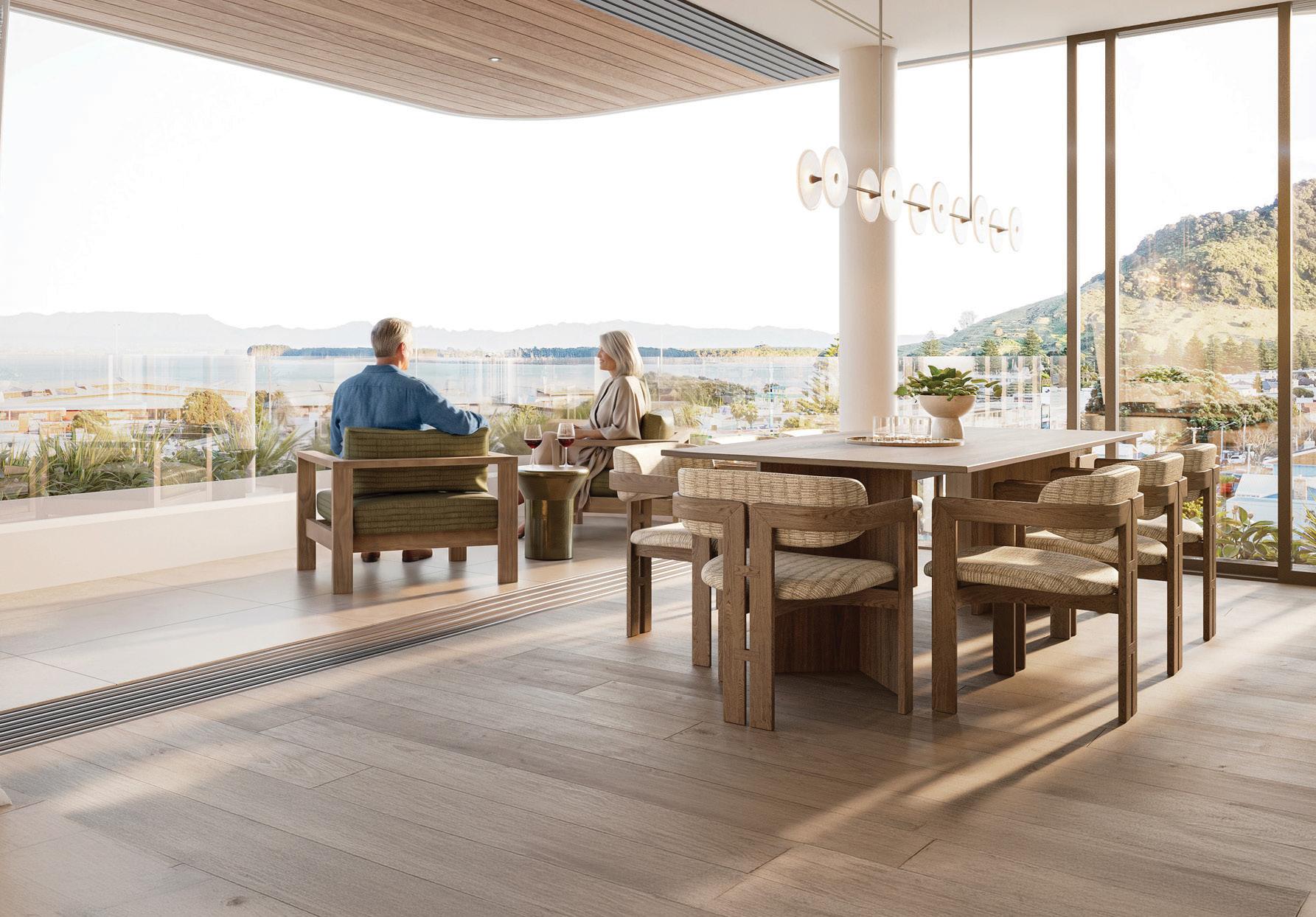
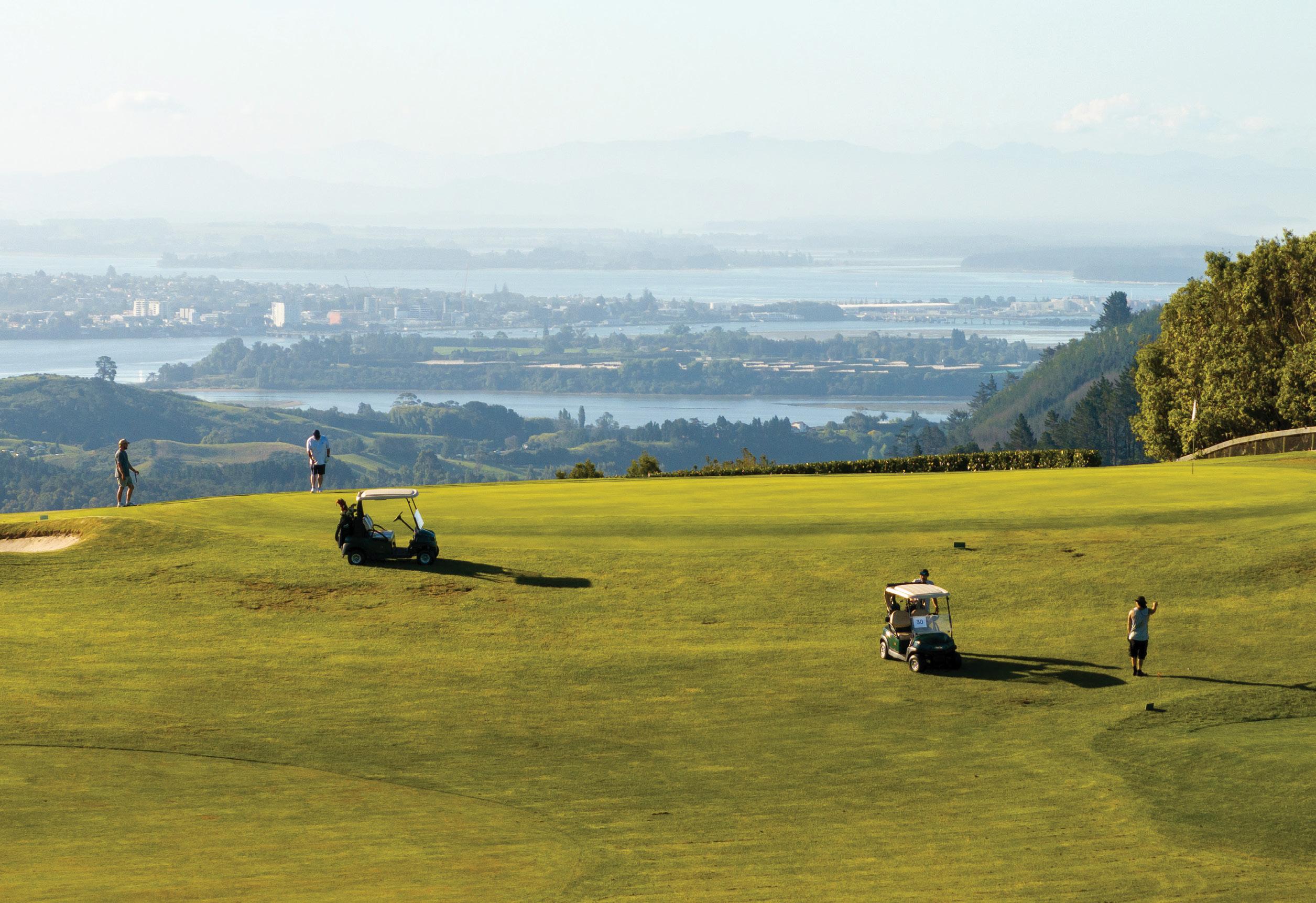
Experience stunning sea views and a friendly, welcoming atmosphere at Summerhill Estate Golf Course, perched atop the Papamoa Hills.
Play, relax and elevate your next golf experience.
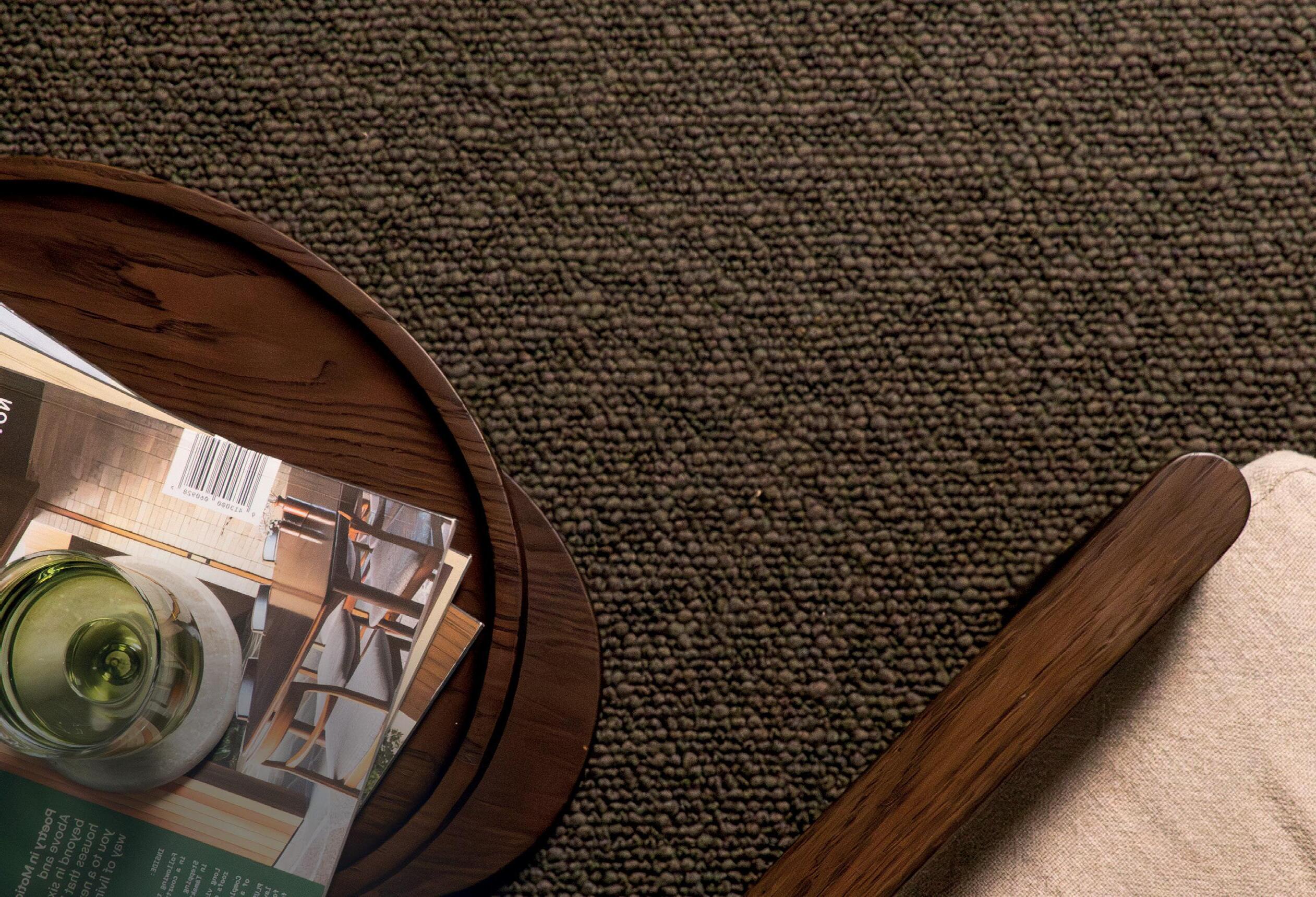


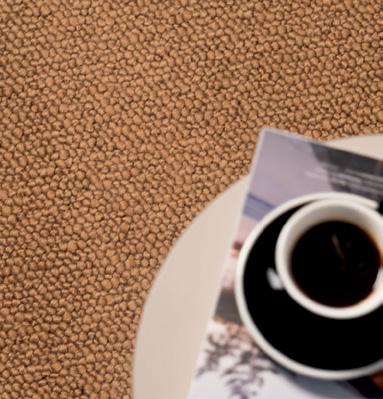
elevate your interior with
five new inspired
added to one of bremworth’s most loved ranges
available in store now






18 Get up to speed on Sam Ruthe
28 Teens moving to their own beat
30 The Grocer: Just “really good food”
34 Great recipes made uncomplicated
38 Get in the know with our foodie finds
39 Local eateries serving the feels
41 Hospitality – we all play a part
42 Tauranga Museum’s new coup
44 A city centre on the up and up
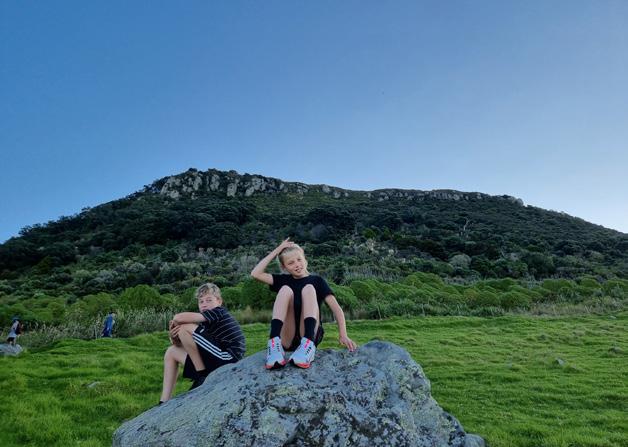
46 Kids ditch screens for the better
48 Books you’ll want to curl up with
49 Writing for fun gets serious results
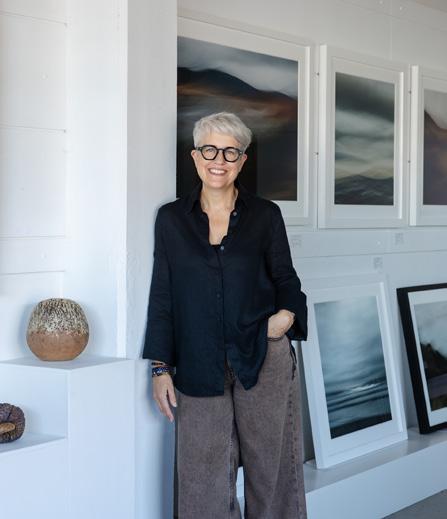
50 Tracy Stamatakos’s art blurs the lines
54 What’s cool in winter fashion
58 Ways to treat yourself beautifully
61 Salon Grange: More good hair days
62 Equilibrium: Depression solution
66 Babies born into legal limbo
71 Don’t let winter steal your sunshine
72 5th Ave Practice: Help from the heart
75 Cashmore Clinic: Why now’s the time
77 Bay Eyecare: What to watch out for
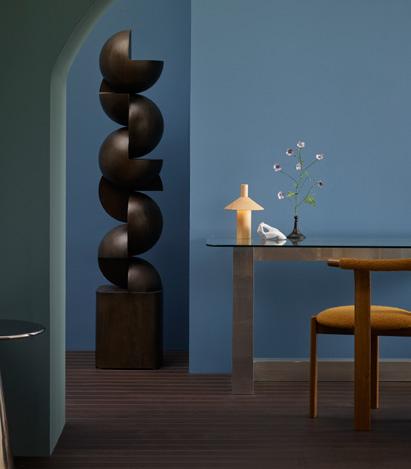
80 Could this iconic interior hue suit you?
84 Oliver Road: Live in the lap of luxury
88 Harwood Homes: A new must-visit
93 Arvida takes care to the next level
96 Cambridge’s new Te Awa Rise
100 Go tone on tone at home
104 Plan your way to financial freedom
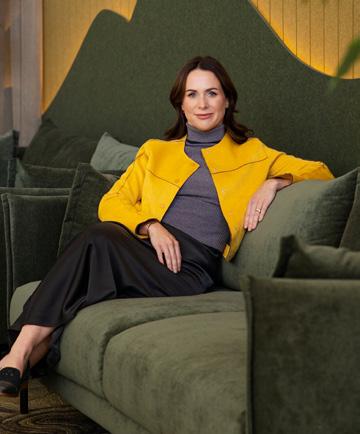
106 AI insights from a leading lady
108 Holland Beckett’s bright star
110 New series: Working in the Bay
111 Wasted Kate: Don’t dump it!
112 Radio host recounts studio shame
114 Deloitte’s in town
118 Cambridge weekend for the win
120 Whakatāne will win you over
122 A high-country walk to remember
124 The inside scoop on South Africa
126 Golfing in Vietnam? Yes!
130 We’re vibing this hot spot
At Da Vinci Clinic, we offer surgical options to address excess skin following significant weight loss, restoring comfort and contour where exercise alone may not be enough.
Restore comfort and function. After significant weight loss, you may experience excess skin that affects your comfort, mobility, and skin health. Body contouring can help reduce these challenges, supporting improved hygiene and ease of movement.
A considered surgical approach. Your procedure is planned with careful attention to safety, proportion, and your goals. Techniques are selected based on the areas treated, aiming for balanced, naturallooking results.

www.davinciclinic.co.nz
Tailored to your body. Our personalised approach considers skin quality, your areas of concern, and overall health to determine appropriate treatment. This may include contouring of the abdomen, arms, thighs, or other areas.
Thoughtful recovery and care. You will receive clear guidance, follow-up care, and support to help ensure a smooth, wellmanaged healing process.
Curious to find out more?
Book a consultation with one of our surgeons to discuss whether this procedure is right for you and what to expect from surgery to recovery.
DIRECTOR
Michele Griffin 021 183 4618 michele@unomagazine.co.nz
DIRECTOR
Rebecca Meyer 027 469 6177 rebecca@unomagazine.co.nz
EDITOR
Hayley Barnett hayley@unomagazine.co.nz
FASHION EDITOR
Nicky Adams nickyadams@xtra.co.nz
DESIGNER
Annabelle Rose
ASSISTANT DESIGNER
Hannah Mahon
SOCIAL MEDIA MANAGER
Amy McKenzie
Happy Hank Media
SUB-EDITOR
Philippa Prentice
CONTRIBUTORS
Amber Armitage
Jo-Marie Baker
Rae Baker
Erin Cave
Katie Cox
Pip Crombie
Liz French
Alan Gibson
Deborah de Graaf
Jess Easton
Jo Ferris
Salina Galvan
Kathrine McDonald
Desiree Osterman
Karl Puschmann
Jamie Troughton
SUBSCRIPTIONS unomagazine.co.nz/shop
PRINTER Webstar
DISTRIBUTOR Are Direct PUBLISHED BY SAO Media Limited
UNO is a quarterly publication: ISSN 2744-7901 © Copyright 2026. Articles and illustrations may not be reproduced in any form without the permission of the publisher. The opinions expressed are not necessarily those of, nor endorsed by, SAO Media Ltd, unless stated otherwise. While every effort has been made to ensure accuracy at the time of printing, the publisher shall not be held responsible for any actions taken as a consequence of information contained in this publication.
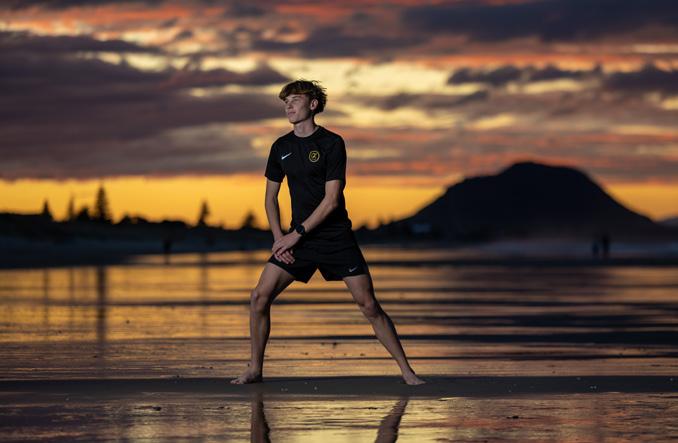
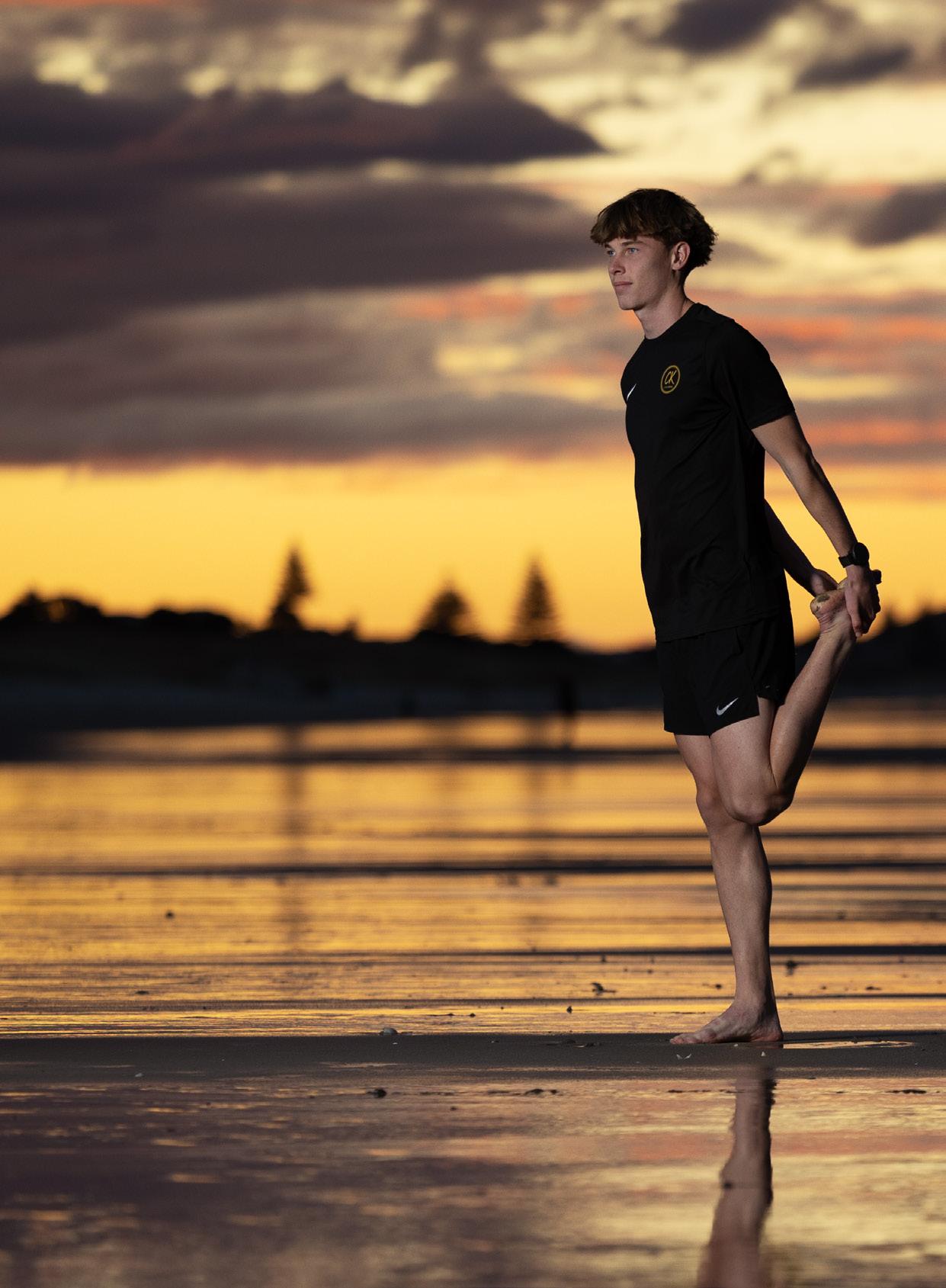
As a 16-year-old world record holder with the whole world at your feet, it’s a bit of a bugger having to take time out for your first serious injury.
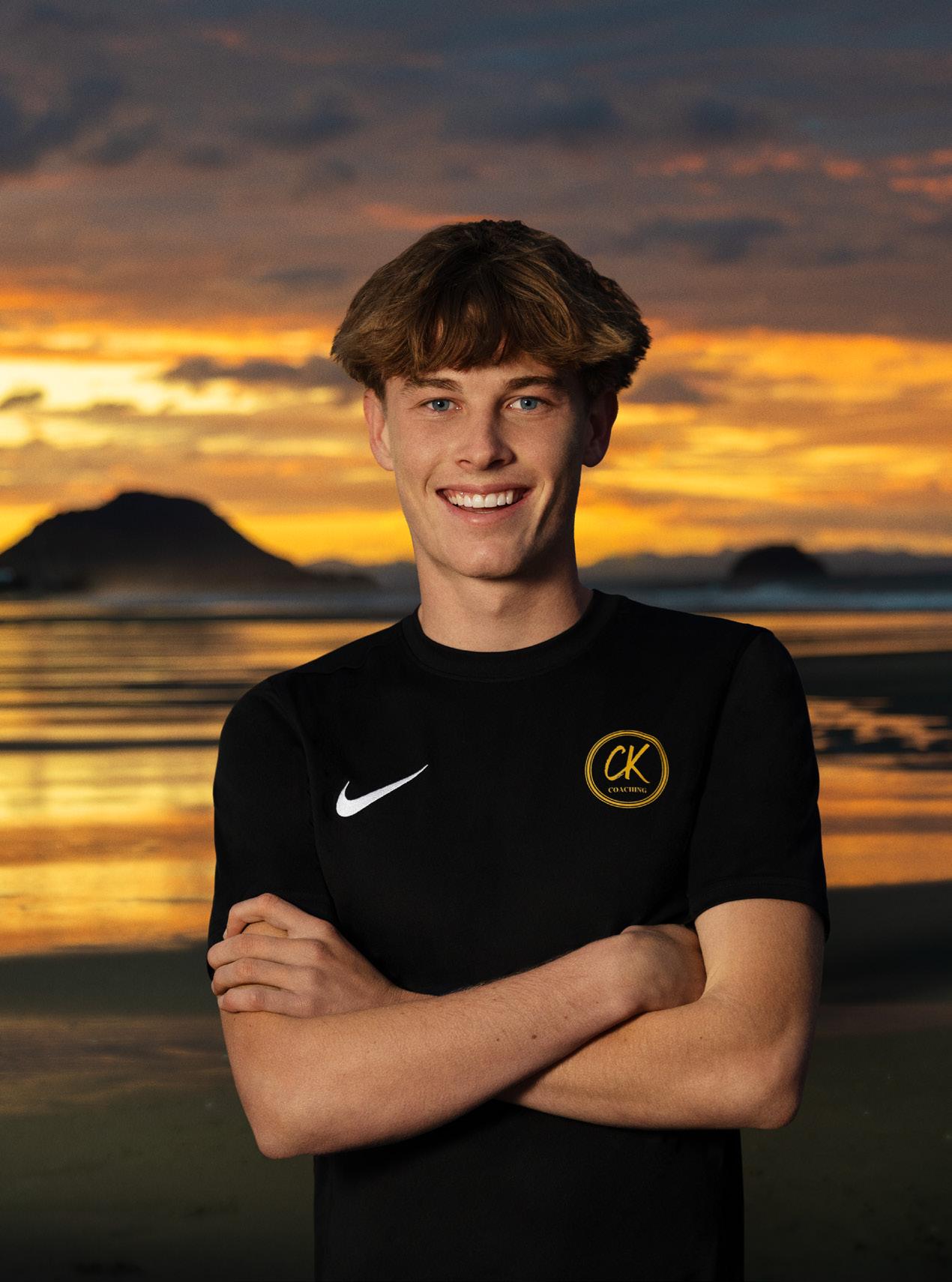
Our cover shoot with runner Sam Ruthe took place in a matter of minutes as the sun dipped behind the horizon on a chilly evening in Pāpāmoa. Sam’s dad, Ben, had managed to secure an appointment with one of the region’s top physios, but the only available slot clashed with our shoot time. Photographer Jamie Troughton certainly had his work cut out for him, or so we thought.
Despite nursing the injury, Sam was a trooper, limping across the sand to take his place in the last of the evening light. A few quick frames later, we had our cover shot.

Coming from a long line of running champions, it’s no surprise Sam found his first injury tough to process. It means he’ll miss the 2026 Commonwealth Games, but he’s taking it in stride. His focus is already fixed on even bigger goals, including the 2028 Summer Olympics in Los Angeles. Read about his incredible rise to international running glory on page 18.
And if you’re keen on expanding and improving your own world, check out our new columnists – life coach Cass Hogan on page 71, financial adviser Adam Stewart on page 104, and AI expert Amanda Jeffs on page 106.
Knowledge is power!
Hayley, editor



A colourful round-up of bits and bobs for your mind, body and soul.
Because there are now fewer than 50 Maui dolphins left on Earth, Lush has partnered with the Endangered Species Foundation on this limitededition soap, with 75 percent of sales going to conservation. Buy one, sign the petition and do your bit. RRP $12. LUSH.COM/NZ


Made from traceable New Zealand wool, every Norsewear Wool Blacks beanie sold puts money back into the game. Ten percent of sales is supplied to School Sport NZ, keeping grassroots sport alive from Kaitaia to Bluff. RRP $45. NORSEWEAR.CO.NZ

Aotearoa artist Simon Lewis Wards turns pick-and-mix nostalgia into luminous crystal glass and porcelain sculptures that are oversized and oddly moving. Childhood, but make it art. RRP from $29 0. SIMONLEWISWARDS.COM


Alex Wilkinson of Mystery Creek Ceramics hand-builds these rainbow-striped vases using nerikomi – an ancient technique that sees colour run through the clay itself. No two are alike, and at 22cm, they’re substantial enough to hold their own. RRP $165. ARTEHAUS.CO.NZ
Put together your masterpieces with the greatest of ease. The Portapuzzle Comfort Angled Puzzle Board’s adjustable, ergonomic, non-slip surface and handy sorting panels make it an excellent companion for the serious puzzlers among us. RRP $120. THEJIGSTORE.CO.NZ


Zoë & Morgan’s Song of the Sea collection is giving coastal cool a serious upgrade. How about this Cordelia necklace, inset with smoky quartz? RRP $519
ZOEANDMORGAN.COM


Blunt’s new Strawberry Matcha Latte capsule collection brings café-culture calm to rainy days. Choose from three Metro umbrellas in soft, pinstriped pink, green and beige. RRP from $139.
BLUNTUMBRELLAS.CO.NZ
Once the domain of athletes, creatine is punching its way to the top of the wellness shelf. Supporting mental clarity as much as workouts and recovery, Mitchells Nutrition’s Creavitalis® blends science-backed performance with everyday vitality. RRP $50. MITCHELLSNUTRITION.COM
Rose Kennedy of Rose’s Dining Table has turned her Hyperflora oil paintings into aprons, and they’re as extra as you’d hope. Ethically produced in heavy cotton canvas with a contrasting frill, these aprons are equal parts art and kitchen armour – from messy cooks for messy cooks. RRP $90. PADDINGTONSTORE.COM



Belgian maker Muller Van Severen’s Arc grinders for Hay are among that rare breed of kitchen tool that you’d actually want on display. Sculptural and adjustable, they’re worthy of a place at the table. RRP $169. PAPERPLANESTORE.COM
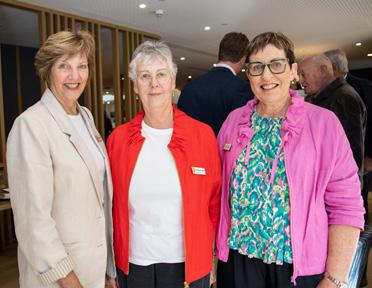


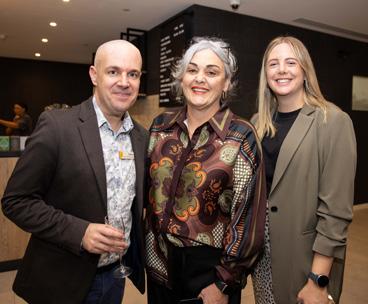
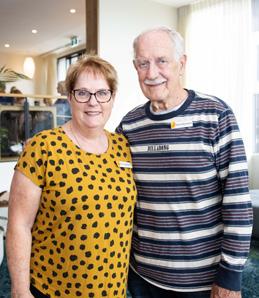

The official opening of its care centre and living well apartments elevated the already sought-after offering at this wellness-first retirement village. See what’s what on page 93.
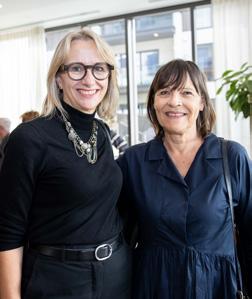
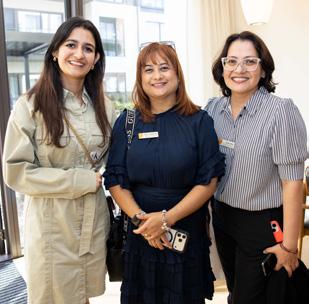
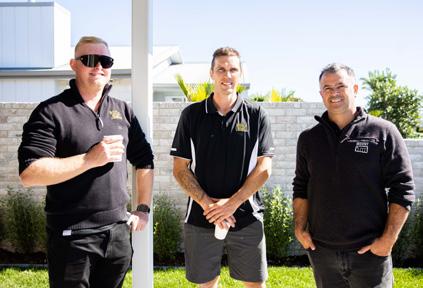
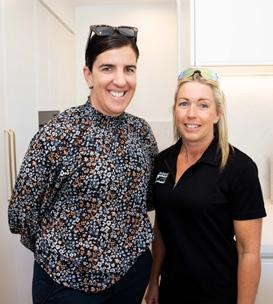
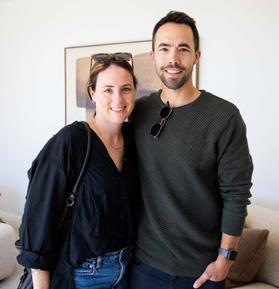
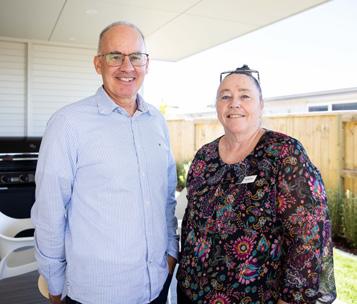
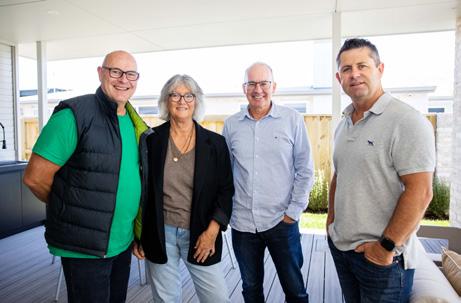
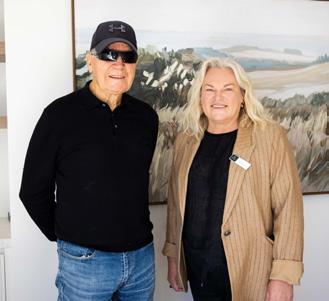
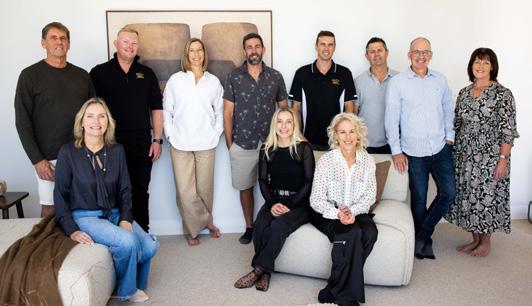
Harwood Homes recently unveiled a chic new showhome – the flagship dwelling in their Flexible Living Collection in Palm Springs, Pāpāmoa. Take the tour on page 88.


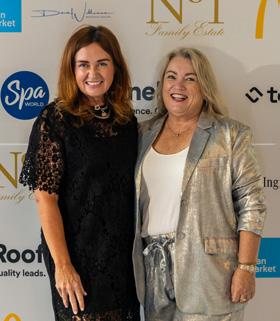


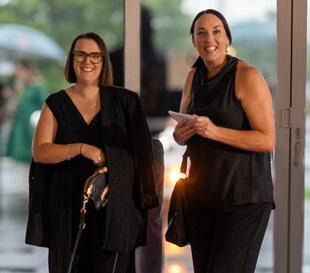


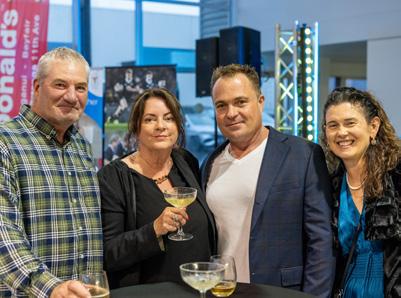


This effervescent evening provided an opportunity to indulge in new flavours while connecting with like-minded attendees, with all proceeds donated to Ronald McDonald House.
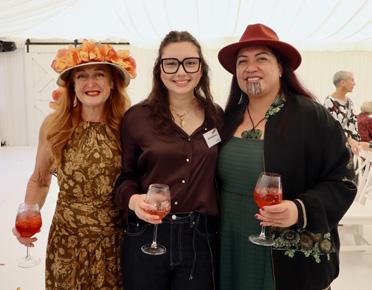
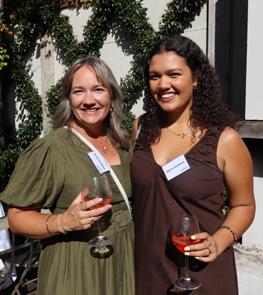
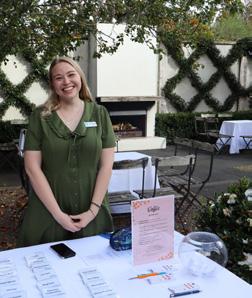
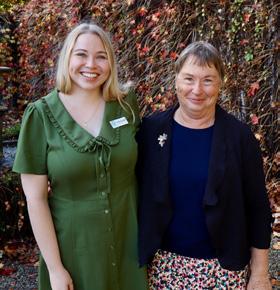
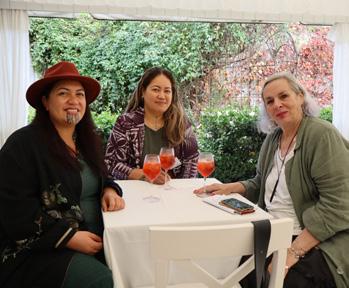
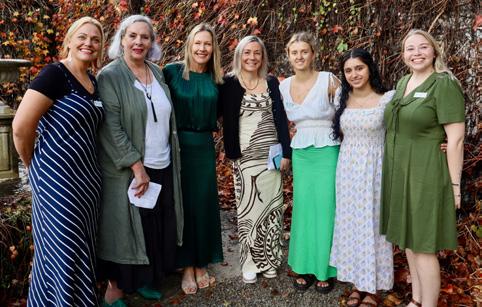
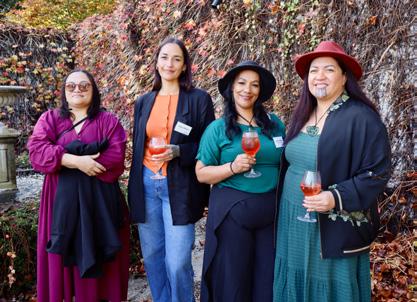
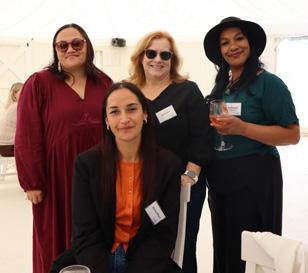
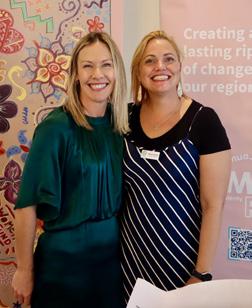
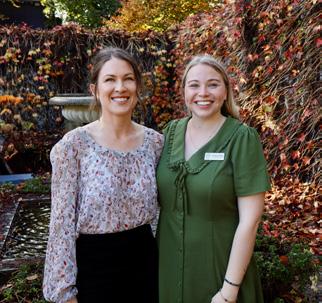
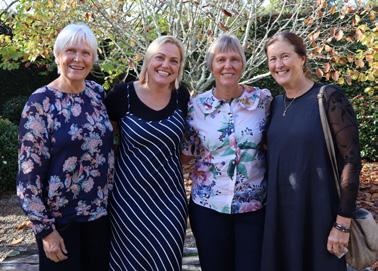
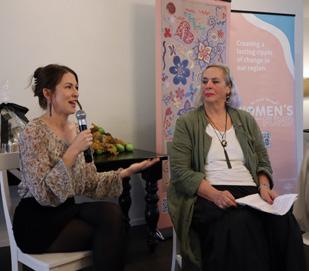
WBOP Women’s Fund toasted to their second anniversary, delved into the difference donations are making for women, girls and whānau throughout the region, and announced their recipient charities for 2026.
2.
The seeds of world record-holder Sam Ruthe’s success may have exploded into full bloom recently, but they were sown nearly eight decades ago. Jamie Troughton retraces the remarkable story of a family of runners, which could be culminating in the current generation.
WORDS + PHOTOS JAMIE TROUGHTON + SUPPLIED MAKE-UP DESIRÉE OSTERMAN
If you learn nothing else about Sam Ruthe, just know he’s the type of 17-year-old boy who treasures time with his grandparents.
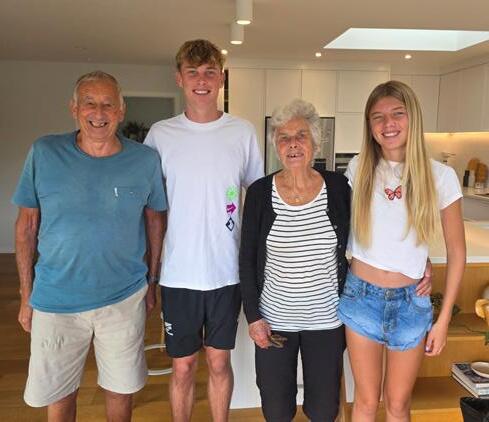
His ‘Poppa’ and ‘Nan’ are Trevor and Rosemary Wright, who moved to Tauranga 44 years ago. They left behind a life in England, as well as extraordinary athletic careers in their own right.
Sam often pops in during study breaks to see his grandparents at their house in Tauranga’s Avenues, or on his way home from Tauranga Boys’ College, where – almost incongruously – he’s a Year 12 student.
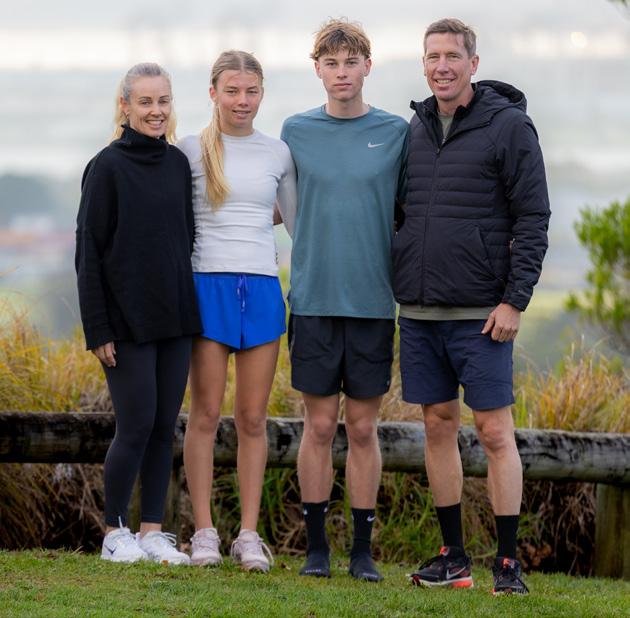
These days, into their late 70s, Trevor and Rosemary are still active. And recently, on a warm autumn day for the umpteenth time in their lives, they were perched on a park bench at Welcome Bay’s Waipuna Park watching cross country. On show was Sam’s younger sister Daisy, and she was putting on an absolute clinic. Not only did she demolish her age group to win the Western Bay under-16 girls title but she cleared home ahead of the entire field of boys, who started at the same time.
“I get more nervous watching the kids and grandkids run than when I used to run myself,” says Trevor. “When I was running, it was down to me and I knew what I was doing, but you can’t control how the kids run their race and you don’t want them to be disappointed.”
Disappointment, however, seems a rare commodity in this family these days.
In 1971, Trevor set the world record for the fastest debut marathon, and collected podium medals at the European championships, the New York City Marathon and the London Marathon. His best marathon time would have been enough to finish in the top 40 at the 2024 Paris Olympics.
But the former electrician relished the chance to move to New Zealand in 1982, with Rosemary,

four-year-old Emma and two-year-old Jess. Now, the girls have five kids of their own and the Wrights are frequently on the sidelines, offering gentle encouragement but a distinct absence of advice. Their once-powerful flame of ambition, which carried them both to achieve worldwide athletic feats, is now just a gentle warm joy for the next generation.
“They really don't talk about their running that much,” says Sam. “Nan's theory is that you don't really need to do too much to be good at running, and she views it as a simple thing you can get good at by doing quality over quantity. She tells me stories about how she used to hide around the corner and eat chocolate while others trained. It might not be a great tip, but it definitely makes running a lot more casual, having that perspective.”
It turns out that Rosemary grew up in Whakatāne – where she spent the first 14 years of her life – next door to the grandmother of one of Sam’s good mates and training partners, Ronin Dickens. That piece of trivia has absolutely no bearing on anything, other than to provide a comforting reminder that, in this country, we live in merely a large village.
Sam’s village is tight and trustworthy and nourishing; his family is his foundation. He may or may not become the greatest runner New Zealand has ever produced, but he will always know where his feet stand, and who has put him on his journey.
“That’s the really cool thing about having a family full of runners – everyone’s been there and done that, and things like records don’t interest them as much,” says Sam. “They understand everything that’s going on, they don’t see you as ‘a runner’, and it helps build your own identity within your family.”
Fifty-six years later, Rosemary can still hear the pulsing roar of 5000 Edinburgh throats, opening as one. Meadowbank Stadium, newly opened for the 1970 Commonwealth Games, shook on its foundations as the women’s 800m field leaned into the final curve.
Time has blurred out most other details for the longtime Tauranga teacher, clad that day in the white and St Andrews blue of her adopted Scotland. Intriguingly, she was also something of a prodigy. Then Rosemary Stirling and still just 22, she was at her second Commonwealth Games after a promising debut in Jamaica four years earlier, where she’d picked up a pair of fourths in the 400m and 800m.
Just eight years after moving back to the UK with her British-born parents, and having overcome injury in the lead-up, she was still only rated an outside chance in the 800m on the final day of the Games.
“I remember [England's] Sheila Carey falling over on the first lap and thinking, ‘That’s good’ because she was the favourite to win,” the now 78-year-old recalls of that 1970 final. “And I can just remember crowds. There were huge crowds shouting and bawling and just screaming. It definitely lifted me.”
After two compelling laps, it all came down to the final few desperate strides, when the Kiwi-born Scot lunged at the line to beat England’s Pat Lowe and Australia's Cheryl Peasley. It was the closest finish of the Games, and Scotland’s first-ever female track gold medal at Commonwealth level.
It’s given Rosemary an enduring legacy in Scotland. She made the Olympic final in Munich two years later, and her 800m national record stood in Scotland until 2002. She was invited back to help open the 1986 Games and received an honorary doctorate from the University of Glasgow in 2014.
These days, Rosemary downplays her own athletic feats to the point of irrelevance.

“It’s only running,” she says. Though dismissive, there’s a glimmer of steel in her tone, well known to the thousands of Tauranga Girls’ College students she’s taught over the years. And there’s also a deeper philosophy embedded in that short truth, one that has become something of a family mantra.
It’s only running. You can see that, later that same autumn day, when Sam starts rekindling his deep, abiding love affair with the sport.
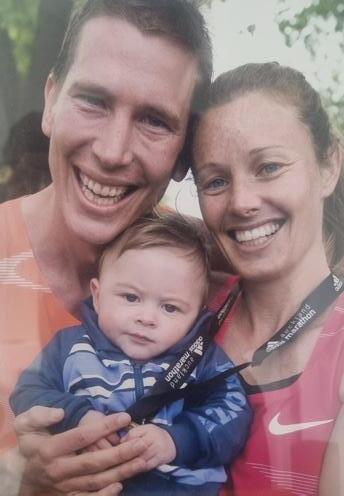
On Tauranga Domain’s busy synthetic track, he’s taking the first, slightly tentative steps from a fast walk to a light jog, six weeks after suffering a stress fracture in his fibula during a casual game of backyard football. At 17, it was his first major injury, which has since ruled him out of emulating his grandmother’s Commonwealth Games heroics – this year, at least.
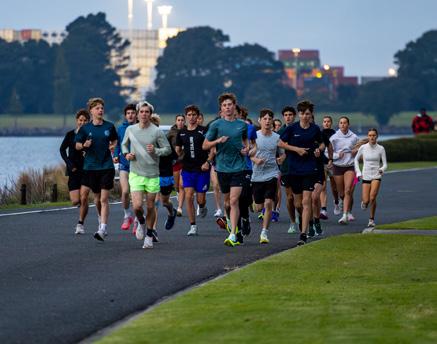
Around him, his village takes note and quietly celebrates. Coach Craig Kirkwood sends his burgeoning training squad on their way, pacing out meticulous laps, alongside Tauranga Boys’ College’s gun running posse, coached by Sam’s uncle, Gareth Hyett. All of them have had front-row seats in the past two years, as a young man in their midst – their buddy, protégé, training mate and schoolmate – burst onto the world stage in the most extraordinary manner.
Sam’s most recent piece of history came at the John Thomas Terrier Classic at Boston University in late January. The mile race featured three Olympians, a world champion, a junior world champion, a US champion and a two-time US college champion – and yet, striding past Belgian Olympian Pieter Sisk in the final 200m, came a

... not to mention

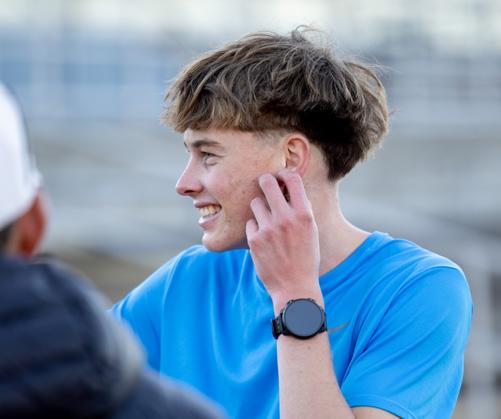
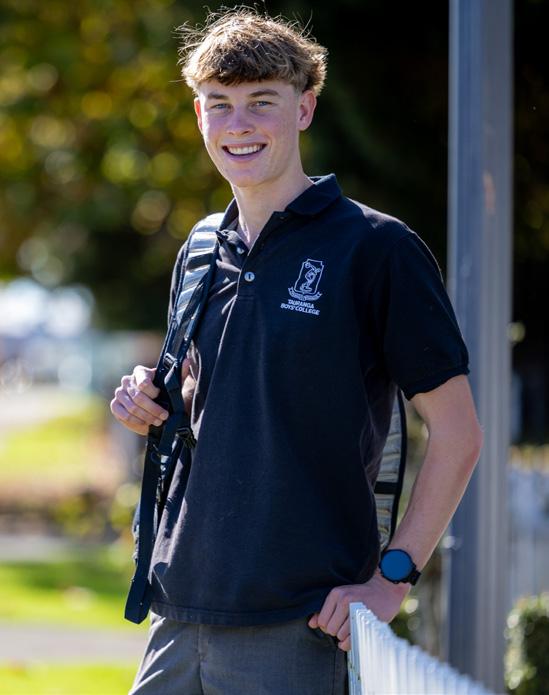
16-year-old from Tauranga, jaw clenched in the final straight, clocking a scarcely believable 3:48.88. Since New Zealand’s John Walker first broke the three minute 50 second barrier in 1975, only 63 men worldwide have managed it. None were under the age of 18.
As well as breaking the under-18 world mile record – and this is one for the stats lovers – it was also the fastest mile run during the month of January. Ever. But the greatest race of Sam Ruthe’s career – so far – was a curious moment for the Tauranga schoolboy.
“I didn’t really get any sense of satisfaction. Once I finished that race, I thought, ‘I definitely have more to give’. I was just off the plane and know I can definitely go a lot faster than that. At the time, I also didn't really realise how perfect the race went, how even the splits were, the atmosphere at the track and all the factors that played into it.
“But running’s a sport where you’re never satisfied and I don’t even really have goals, so it wasn’t as if it was even a goal for me to run the New Zealand record or the under-18 world record. I guess I was happy about it, but I wasn't satisfied.”
After all, it’s only running.
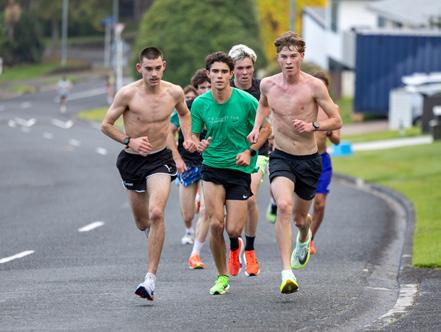
That Boston race was bittersweet for the other Kiwi in the field, who just happens to be another Tauranga prodigy, until recently also coached by Craig, two-time Olympian Sam Tanner. Of course, the 25-year-old has known for a while that his young training partner is something a little bit special. They notably shared the New Zealand 1500m title last year in an enthralling dead heat, and Tanner paced Ruthe on the way to his historic sub-four-minute mile as a 15-year-old weeks later.
Things were actually shaping up perfectly for Tanner in Boston, until disaster struck 400m in, with his young training partner tucked in behind.
“I told Sammy before the race, ‘Just turn your brain off and follow me, bro – you’ll be sweet’, and he turned his brain off and followed me. We got in a perfect position, and then the dude who chopped between us clipped my Achilles and I had to pull out. Sam ended up behind him, but then he just went around because that guy was falling off, and then he just followed Peter Sisk, which was perfect.”
Injured, Tanner watched the rest of the race unfold from the sideline, with mixed emotions.
“It's not very often that you get a perfect set-up like that for a 3:48 mile. I’ve been waiting five years and I thought it


was my chance; often the races that I’ve been part of have had a 3:45 pace or a 3:46 pace and I’m not quite there. You end up blowing up and run 3:50, or 3:49, like I’ve done a couple of times.”
Tanner’s also wise enough to know that a great running career is a thing to build brick by brick, and he piles credits onto Craig for his craftsmanship in that realm.
“Kirky’s just so good at seeing where an athlete’s at, making the best decision and trying to guide them, rather than just thrashing them. He lets the talent speak for itself and just cultivates that. And for Sammy, it just means that a little bit of work goes a really, really long way.
“Sammy and I just got lucky; we can both punish ourselves and enjoy the punishment for the sake of success. And when you've got parents who are good at goal-setting and you look up to them in that sense, it becomes a perfect storm.”
For his sake, young Sam has been exposed to the likes of Tanner, triathlete Hayden Wilde and top Tauranga runner Julian Oakley from the time he started running seriously at 14.
“It's pretty incredible when you can see someone in the training group and you’re like, ‘Oh, that’s the level I need to get to, to make this my career’,” says Sam. “It’s a cool feeling when you’re running with Tanner.
It’s not like, ‘I’m training with an Olympian’ – it’s the feeling of knowing exactly where you need to be to make it. The coolest thing was seeing how close I could get to him, every time I’d run with him, and that brought me to the level I am today.”
Sam has always been polite, quiet, even shy, says Sam’s father, Ben Ruthe. He has a good yarn about his young son at daycare, when a clown came in to make blow-up balloons. Swords, crowns and sausage dogs were being requested and handed out to the other kids, while Sam sat there quietly, as his parents had instructed.
“It wasn’t until right at the end that he went up and asked for a sword, and the clown had run out of balloons,” recalls Ben, clearly still a little mortified.
“I thought it might’ve been quite crippling – we'd taught him to be quiet and patient and polite and never demand or ask things, and he’d missed out. I think we spent the next 10 years trying to encourage him to vocalise what he needed!”
These days, Ben has his own semi-permanent air of bemusement about him. He knows a fair bit about running himself, having won the Auckland Marathon in 2008 and New Zealand titles in the 1500m and 5000m. Sam’s mum Jess, meanwhile, won the Auckland Marathon in 2009 and New Zealand titles in the 1500m,

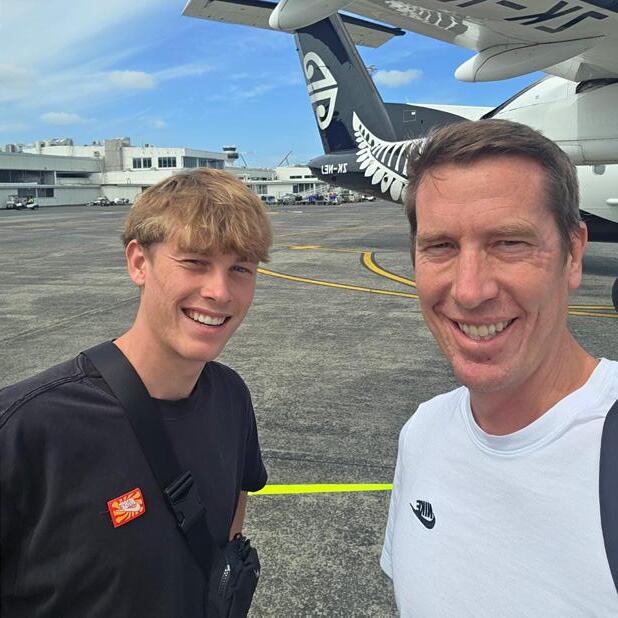
3000m, 5000m and the 10,000m (twice). Still, they’re amazed by what Sam has achieved so quickly – it’s been far more life-changing for them than their eldest child.
While the sub-four-minute mile was staggering, Ben had an inkling things were about to go up a level late last year. “There were signs in training in November that Sam was in really good shape,” he says. “He was training with Tanner, who couldn’t have been a better training partner, and all of a sudden, instead of a kid trying to keep up with an Olympian, it was, ‘Sam’s starting to hold on here’, and, ‘Sam’s taking his fair share of reps’.”
Sam’s memory is even clearer. He can pinpoint one typical early-Saturday session along Ōtūmoetai’s Beach Road in particular, when he realised he could genuinely foot it with international-class seniors.
“Tanner always makes us share the reps, and when Craig sets us a pace, sometimes I might push it a little bit faster than that, just to test things a bit. I remember one session when everyone else was dropping off and I was thinking, ‘How hard is Tanner puffing right now?’ and I got the feeling that I was nearing his level because he took over and dropped the pace down again. Little moments like that are really cool to look back on.”
Ben points out that Sam’s recent injury has also had the unintended benefit of encouraging him to ask for help,
but it also heaps more pressure on the parents of an athlete, when everyday decisions start carrying increasingly larger ramifications.
“We had a debate about suggesting he didn’t go out and play barefoot soccer with his mates. We weighed it up and decided, ‘Nah, we want him to enjoy the best of Kiwi youth’ – and that’s the day he picked up a fibula stress fracture!
“But if I went back in time, I’d still let him go out and play football, because you learn so much from something like this. His mindset now is around strength and conditioning, stretching, core work, cross training. He was a good runner, but now he’s got a much broader view of all of the ingredients he needs.”
Because of that inbuilt, humble mindset, Ben also has no fear that Sam’s international success will cause him to get cocky.
“We really haven't wrapped him up in cotton wool,” says Ben. “We’ve constantly put him in situations where he could test himself, and that comes with risk. He genuinely just enjoys the process and has never wanted fame. He just wants to work hard and work towards results, and any sort of fame is not a motivator for him.”






Looking for good vibes and seriously delicious desserts? Hi, we’re POPPYPEACH.
Whether you are catching up with friends, treating the family, or just craving something sweet, we’re all about creating feel good moments and sweet memories. Everything is handcrafted fresh in house by our talented bakers using the best of the best ingredients, including everyone’s fave Whittaker’s chocolate. From viral bakes, soft serve and froyo, to a 20+ topping bar where you can design your own. Build your dream dessert or just grab a classic, there’s delicious dairy free and gluten free options available too. We can’t wait to meet you.

Follow our socials for the latest @poppypeach.nz

When food, culture and creativity collide to make our region the place to be.

HOST WITH THE MOST ... but without the fuss
PAGE 34
Spend yours with these good books
PAGE 44
The filmmaking family showing kids a new world
PAGE 46
Tracy Stamatakos captures beauty in motion
PAGE 50
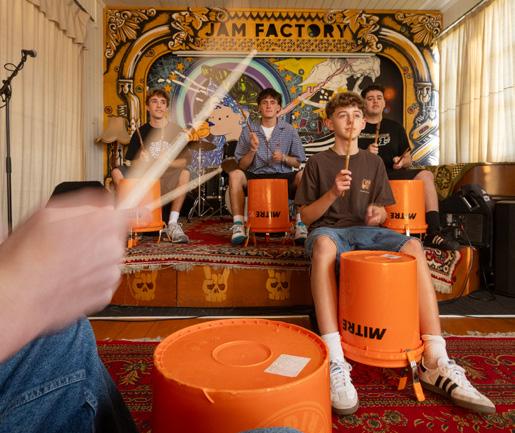
Armed with only buckets and drumsticks, a group of five local teens has become a global sensation. We caught up with the Beat Street Drummers to learn the secret of their success.
WORDS KARL PUSCHMANN / PHOTO ALAN GIBSON
The beat thunders through the Historic Village, its rhythmic pulse grooving and full of joy. Then, as suddenly as it started, it stops – a one-minute blat of head-nodding bounce and skilled exuberance.
The drums were booming out from the village’s iconic live venue, The Jam Factory, but when I enter, there’s not a drum kit, conga, bongo or percussion instrument to be seen. Instead, carefully positioned in two rows, are five bright-orange Mitre 10 buckets.
These humble buckets are the instruments of choice for Elliot (14), Tristan (15), Daniel (17), Lucas (18) and Noah (18), better known as the Beat Street Drummers.
“The buckets are a way for us all to play together at the same time,” explains Elliot.
“And they’re unique,” adds Tristan.
“People like that,” says Lucas. “Once we set up our social media page, it grew real quick.”
It certainly did. The group, who all met through school and drum courses, have been jamming together for just over four years, but only got more serious with the Beat Street name and Instagram page last year.
“We originally started at one of our houses, just jamming and playing along,” recalls Daniel. “Then we created the Beat Street social media accounts on TikTok and Instagram, and people just loved it.”
The young group quickly became a viral sensation thanks to their fun and impressive choreography –lots of stick twirls and big arm raises – their infectious, cacophonous rhythms played at mind-boggling speed, and their decision to play covers of popular chart hits, like 2014’s Changing by Sigma and Paloma Faith.
That video alone clocked up more than 1.4 million views, but it’s far from their only viral hit. Collectively, they have 22 million-plus views and a loyal fan base of more than 700,000 followers.
“It was our improvs that went viral at first,” says Lucas. “People liked the buckets, but it was the small things that caught their attention – the angles, location.”
“We did a video in a shed on a barnyard and there was a tractor in the background,” says Daniel. “It was quite Kiwi New Zealand.”
“Yeah, people just kept commenting things like, ‘I love that backdrop!’,” laughs Noah. “It’s the little things that make it.”
The secret, they reckon, behind their viral success is that they’re just having fun. The videos aren’t big, overthought affairs or calculated for maximum engagement. Instead, “something that shocked a lot of people was that our biggest video took us about 20 minutes to choreograph and film,” says Daniel. “Filming our videos is quite quick. I think that comes with the chemistry and the length of time we’ve been together. We have similar thought processes and ideas.”
Beat Street Drummers’ online success has now transferred into the real world, with the group starting to travel the country to perform at music festivals in front of thousands of fans. They’d wanted to play live since the beginning, but weren’t quite sure how to go about it.
“It was hard to think how we were going to get to play at bars or club nights or anything because we’re just drums,” says Daniel. “It seemed like a tough sell.”
Now, however, festivals are coming to them, asking them to play. It’s a dream result.
“ WE ALL LOVE MUSIC. WE'VE GROWN UP IN HOUSES WITH MUSIC, AND WE PLAY MUSIC. IT’S OUR PASSION. ”
When the quintet gets going, it’s a thoroughly unique experience, with the lads knocking out complex polyrhythms and beats at speed in perfect unison. It does beg the question, how many plastic buckets do they go through?
“We haven't broken any yet!” says Elliot. “We've had these since we started.”
“Yeah,” nods Noah. “It’s the sticks, though. They break a lot.”
Having played together for so long, they’re now relaxed and comfortable when they perform.
“Initially, we had to focus on what we were doing, but then as time went on, it was less about that focus and more like having fun,” says Lucas. “Naturally, we got better and better as we played, so it’s just turned into a fun thing that we look forward to doing.”

Noah grins and says, “We don't really put in as much practice and effort as we did in the beginning, because that work’s already been done.”
The group is enjoying the overnight success that has come after five years of work together, and is excited about what the future holds.
“We all love music,” says Daniel. “We’ve grown up in houses with music, and we play music. It’s our passion. And we're really tight friends as well.”
Then, he inadvertently reveals the true secret of their success.
“Lots of bands are just bands,” he says. “We’re friends and family first – then we’re a band after that.”
BEATSTREETDRUMMERS
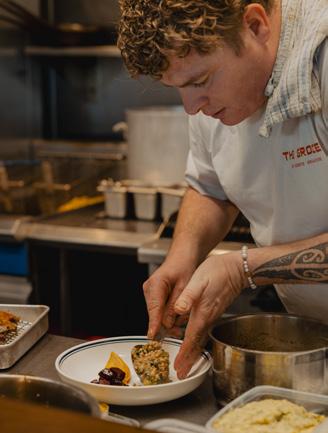
Ian Harrison’s rapt to have opened a restaurant all his own, and everyone’s invited. Just don’t call it fine dining though, okay?
WORDS HAYLEY BARNETT / PHOTOS ERIN CAVE
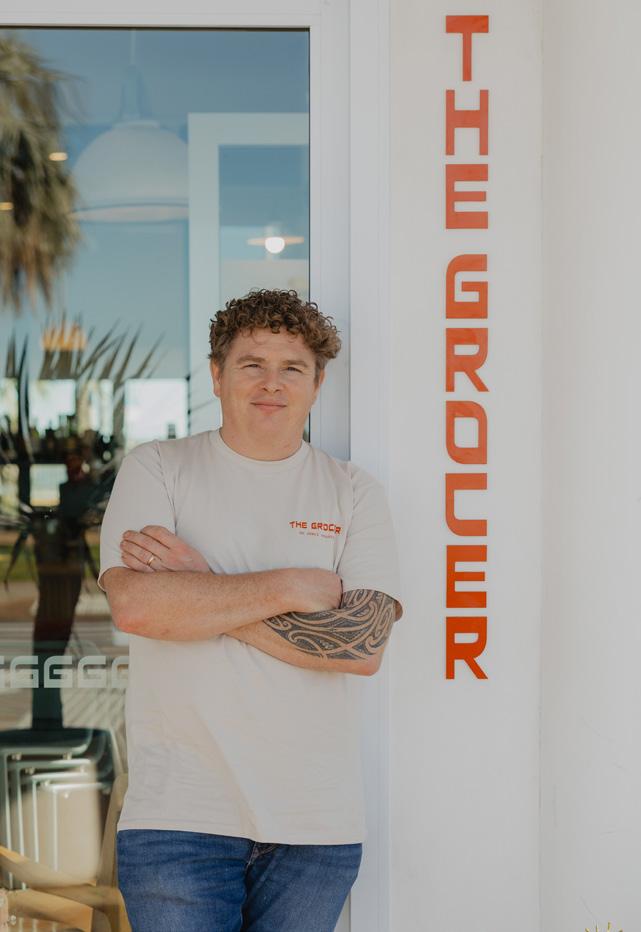
As I enter The Grocer through the kitchen, the first thing Ian Harrison does is apologise for swearing. The second thing he does is swear again.
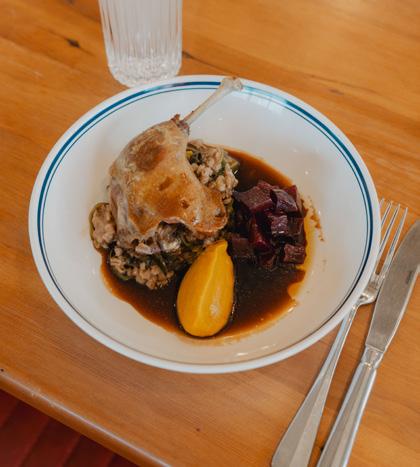
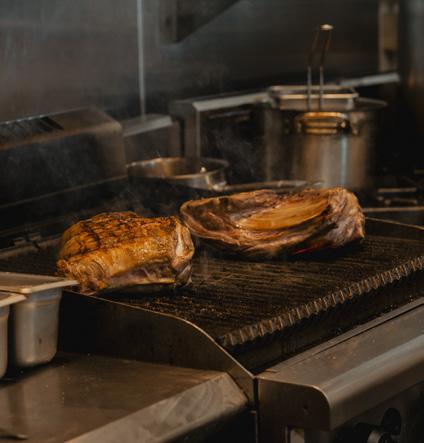
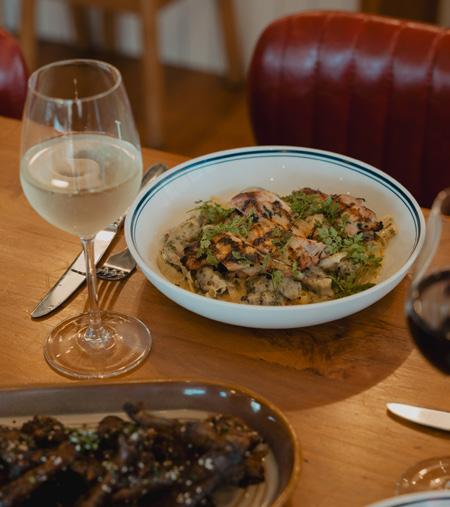
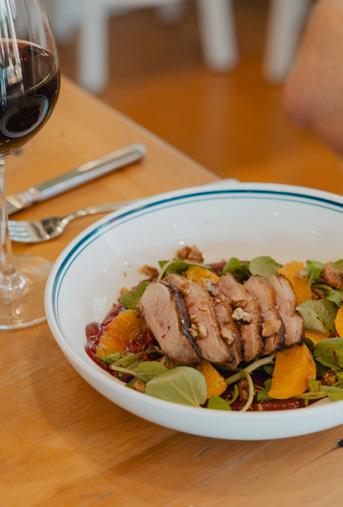
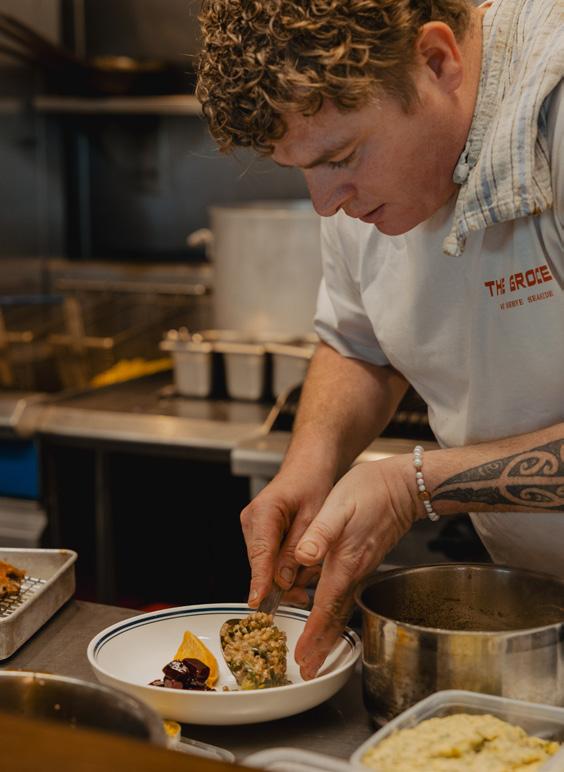
He’s standing in the middle of his new restaurant's kitchen on Tauranga’s Strand, talking about duck fat and why he hates the term ‘fine dining’. He’s also prepping plates of confit duck, mushroom gnocchi and crispy chicken, all updated versions of dishes from his revamped menu.
“This isn’t fine dining,” he says, gesturing toward a duck salad layered with beetroot, orange and walnuts.
“If it was fine dining, the orange would be a jelly, there’d be micro herbs everywhere and the sauce would be some over-reduced, complicated bullshit.”
He looks at me, warily.
“I just want to cook really good food.”
For people in Tauranga, Ian Harrison hardly needs an introduction. Over the past decade, he’s become one of the city’s defining hospitality figures. He’s helped shape restaurants including Sugo, Clarence, Alpino and Florence. Ask around local food circles and his name comes up quickly, usually alongside words like ‘perfectionist’, ‘obsessive’ and ‘brilliant’ – sometimes all three.
The Grocer is different because, for the first time, it’s entirely his. After years spent building other people’s visions, this is the place where he finally gets to cook exactly what he wants.
It’s only a few months old, yet Ian has already reworked the menu, tweaking dishes, refining portions and
adjusting it based on what people have responded to. Winter is pushing things further toward hearty British gastropub territory, with slow braises, rich sauces, duck fat potatoes, steak and Sunday roasts. Summer, he says, will pull everything back toward lighter seafood and vegetables.
“It’s probably more Pommie than anything,” he laughs. “But then there’s Asian influence, Kiwi influence, Māori influence. If I feel like putting a curry on later in the year, I’ll put a curry on.”
Ian talks about food the way some people talk about architecture or music. He doesn’t like trends, but he does like details.
“If we do eggs benedict here, I want it to be the best eggs benedict someone’s had,” he says. “Not because we’re trying to be fancy – just because we’ve thought about it more.”
Ian’s mentality was moulded long before he arrived in Tauranga. He grew up in England and spent years cooking his way through Europe. He worked in Michelin-starred kitchens where precision ruled everything. He cooked at three Australian Grand Prix without seeing much more than the inside of a kitchen. Eventually, exhausted by the intensity of hospitality, he decided he wanted out altogether.
He planned an enormous trip from Papua New Guinea to London, using boats and buses, working and diving along the way, but after arriving in Auckland in 2011, he stayed.
“I remember thinking, ‘I’m not doing those chef hours anymore’,” he says, “so I went front-of-house instead –because I’m good with people, I can talk.”
“ THE GROCER OCCUPIES A HISTORIC
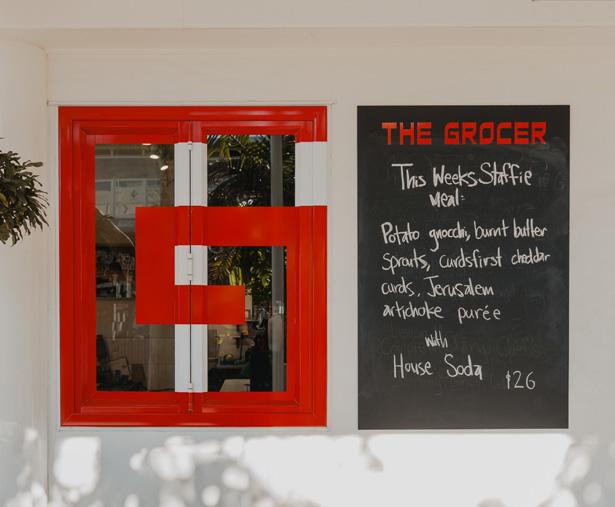
THE STRAND THAT ONCE HOUSED A GROCER'S STORE, AMONG OTHER THINGS, AND IAN LIKED THE IDEA IMMEDIATELY. ”
His talent earned him hospitality awards and briefly pulled him away from the kitchen entirely. Then he met Krystal, now his wife, and eventually followed life south to Tauranga. Now they have two daughters, Hine Ao Manawanui and Māia, who have become the centre of everything.
“I probably would have left hospitality completely if this place didn’t happen,” he admits. “It was kind of now or never.”
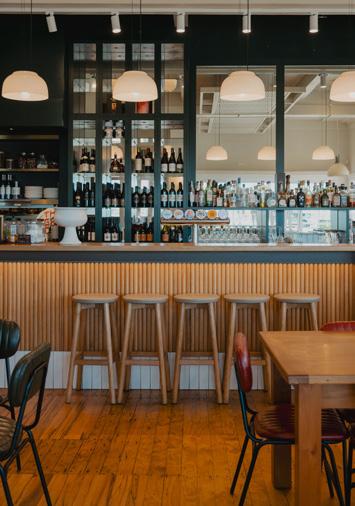
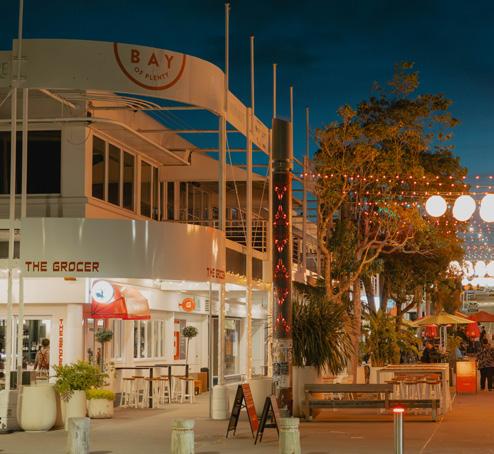
The Grocer occupies a historic building on The Strand that once housed a grocer’s store, among other things, and Ian liked the idea immediately. He wanted to recreate a neighbourhood place filled with essentials, like preserves, sauces, wine, good bread, conversation. He’s already begun bottling house-made condiments to sell, including tomato ketchup, duck fat and preserves made from ingredients used in the kitchen.
“I like the idea that people can take a little bit of the place home with them,” he says.
The restaurant itself feels warm. There are candles at night, heavy plates, proper portions and staff encouraged to read tables rather than recite scripts.
Ian talks as passionately about service as he does food.
“I wanted adults,” he says of his team. “People with personality. People who can actually read the room.”
He speaks openly about the realities of hospitality too, especially in Tauranga, where rising costs and cautious spending have made survival increasingly difficult for restaurants. He jokes about seeing himself less as a restaurateur and more as a “drug dealer”, trying to get customers hooked on the experience before they drift elsewhere. But behind the humour is very real pressure.
“This winter’s going to be rough for a lot of places,” he says. “You’ll see casualties.”
Ian remains optimistic, partly because he believes Tauranga’s dining culture is changing. He intentionally chose this location before major developments around the waterfront are completed, because he still believes people want genuine hospitality.
That’s also why he’s resisting labels like ‘fine dining’, despite his background. He says he doesn’t want hats or awards. “I don’t care about being a celebrity chef – I really don’t.”
Ironically, Tauranga already treats him like one. Customers regularly stop to talk to him. Diners specifically ask whether he’s cooking that night. His social media videos pull strong engagement, despite the fact he openly admits he hates spending time on his phone.
“I’d rather be home with my wife and kids, having a wine, than sitting on Instagram.”
That said, he understands modern hospitality requires visibility, and so he appears in videos; talks to media, like me; and promotes the restaurant, even if reluctantly.
“No one sells the place better than I do,” he says with a shrug.
Really, all The Grocer’s aiming for is good food, generous hospitality and enough warmth to make people want to stay awhile. And while Tauranga’s still figuring out exactly what its dining culture can become, that might be exactly the right recipe.
THEGROCERTGA.CO.NZ
“ I WANTED... PEOPLE WITH PERSONALITY. PEOPLE WHO CAN ACTUALLY READ THE ROOM. ”
These dishes from Home Foods by Elizabeth Hewson prove great cooking doesn’t need to be complicated. A few honest ingredients and you’re away.
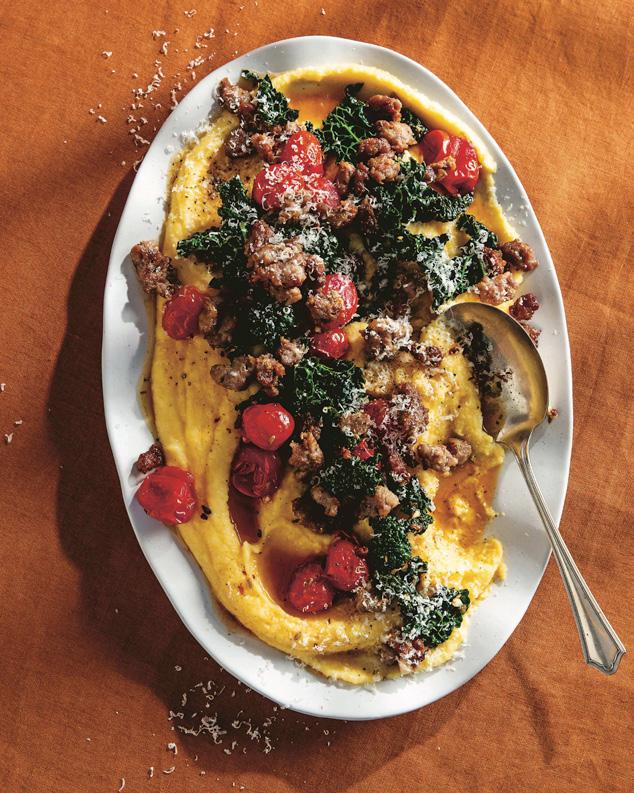
Heat a deep, heavy-based frying pan with a lid over medium-high heat. Once hot, pour in the olive oil. Cut the ends off the sausages and squeeze out nuggets of meat into the pan. Fry for 5 minutes, using a wooden spoon to break up the meat into small nuggets, until they're golden and crisp. Throw in the tomatoes and leave to cook undisturbed for 2 minutes, to get some colour on the tomatoes. Add the fennel seeds, chilli flakes, rosemary and garlic, and give everything a good toss. Cook for 30 seconds, then pour in the white wine to deglaze the pan. Using a wooden spoon,
This is a very ‘me’ bowl of food: garlic, chilli, lemon, greens, sweet, blistered cherry tomatoes and gnarly, crispy pork sausages, all piled onto a bed of buttery, cheesy polenta. I know purists may baulk at the idea of instant polenta, but for a midweek meal, cooked with plenty of butter and cheese, I’m all for it. If polenta isn’t your thing, toss this through pasta or stir in a can of drained beans when you add the greens.
SERVES 2
1 tbsp extra virgin olive oil, plus extra for drizzling
4 good-quality Italian pork and fennel sausages
200g cherry tomatoes
1 tsp fennel seeds
½ tsp chilli flakes
1 tsp rosemary leaves, finely chopped
3 garlic cloves, finely chopped
½ cup dry white wine
½ cup chicken stock
scrape all that sticky goodness off the base of the pan. Let the wine simmer for 2 minutes, then pour in the chicken stock and season with sea salt and freshly ground black pepper. Reduce the heat to low and simmer for another 5 minutes for the flavours to mingle.
Meanwhile, to prepare your polenta, bring the milk, stock and water to a simmer. Add the polenta in a steady stream, whisking as you go. Continue to whisk the polenta for 3–5 minutes, until thickened. Once it’s thick and oozy, stir in the butter and cheese. Season.
80g kale, leaves stripped and roughly chopped
1 lemon
Quick polenta
1 cup full-cream milk
450ml chicken stock or water (or a combination of both)
100g instant polenta
1 tbsp butter
½ cup Parmigiano Reggiano or Parmesan, grated, plus extra to serve
Now, back to your sausage. Add the chopped greens to the pan, toss through, then put on the lid. Give it a minute or two to wilt, then toss and turn off the heat. Zest the lemon over the top and add a squeeze of juice to brighten everything up. Spoon the sausage mixture over the creamy polenta with extra Parmigiano Reggiano showered over the top, and a little kiss of olive oil.
Leftovers: This will keep for 3 days, but it’s best to keep the polenta and sausage mixture separate.

INGREDIENTS
3 tbsp olive oil, plus extra for drizzling
4 garlic cloves, finely chopped
4 anchovy fillets
Pinch of dried chilli flakes (optional), plus extra to serve
⅓ cup dry white wine
1 × 400g can cherry tomatoes
200g whole cherry tomatoes
½ cup Italian black or green olives, pitted
2 tbsp capers in vinegar, drained
½ cup basil leaves, plus extra to serve
½ tsp caster sugar
4 × centre-cut fillets of firm white or pink-fleshed (trout or salmon) fish
1 lemon, for zesting
Garlic and chive bread
60g salted butter, at room temperature
4 garlic cloves, finely chopped
3 tbsp chives, finely chopped
1 small loaf ciabatta or baguette
Preheat the oven to 180°C (350˚F) fan-forced. In a large frying pan with a lid, heat 2 tablespoons of the olive oil over medium heat. Add the garlic, anchovies and chilli flakes, if using. Cook for 1-2 minutes, stirring to help the anchovies melt into the oil. Pour in the white wine and let it bubble, simmering for about 2 minutes until it starts to reduce. Add the canned cherry tomatoes, then rinse out the can with about ¼ cup water and pour that in too. Stir in the whole cherry tomatoes, olives, capers, half the basil, and the sugar. Taste, and add a pinch of salt if needed. Cover and let it simmer for 10 minutes, stirring occasionally, until the sauce thickens slightly.
Meanwhile, for the garlic and chive bread, mash the butter, garlic and chives together in a bowl. Slice into the baguette at 1 cm intervals, stopping just before the base so it stays intact. Using a teaspoon, smear the garlic butter between the slices. Wrap the
This is a one-pot fish dish with all the punchy, briny flavours of a puttanesca – anchovies, olives, capers, chilli and a good hit of garlic – only here, they’re wrapped around fillets of fish instead of pasta. Like puttanesca, which was famously thrown together from pantry staples, this comes together with little effort but delivers big on flavour. A side of garlic bread to mop up the sauce is non-negotiable for me.
SERVES 4
bread in foil and bake for 15 minutes, until the butter has melted. Open up the foil slightly so the top of the bread is exposed and cook for a further 5 minutes, until golden and toasted.
Once the sauce has had its 10 minutes, nestle in the fish. Season each piece with salt, pepper and a lick of the remaining olive oil, then lay the remaining basil leaves over the top. Reduce the heat to low, put the lid back on, and poach the fish gently for 6–8 minutes, until it’s opaque and flakes easily with a fork.
When the fish is ready, zest some lemon over the top and serve, spooning the sauce over the fish. Scatter with basil leaves, a pinch of dried chilli and a drizzle of olive oil. Serve with the warm garlic and chive bread to mop up every bit.
Leftovers: This will keep in the fridge for 2 days.
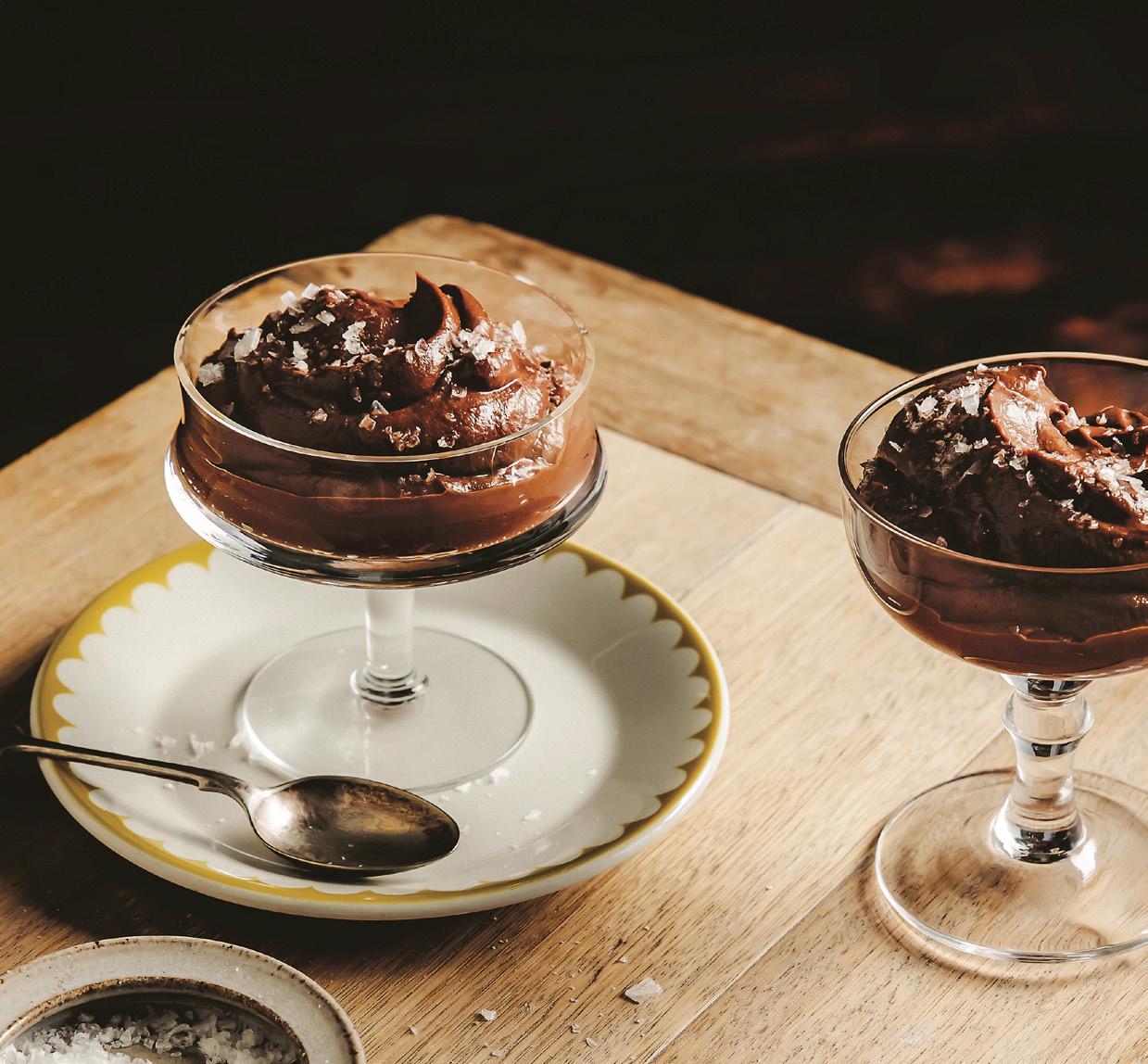
Although I mostly prefer to serve dessert in the centre of the table to allow guests to help themselves, I will admit there’s a certain elegance about individual servings. These billowy creams look beautiful in little glasses, but don’t let your eyes get the better of you – they’re rich, so a little goes a long way. They do need to be made in the moment and served straight away, but considering the effortlessness of them, this shouldn’t be cause for concern. Berries make the perfect partner, especially big, fat strawberries that can be dipped and twirled in the chocolate cream.
SERVES 4
120g dark chocolate (70%), roughly chopped
1 egg
250g mascarpone
1 tsp vanilla paste or extract
¼ cup full-cream milk
To serve
Salt flakes
Fruit of your choice, such as berries or cherries
Fill a medium-sized saucepan with roughly 4cm water. Place over medium heat and bring to a gentle simmer. Suspend a heatproof bowl on top of the pan, ensuring it fits snugly but doesn’t touch the water. Reduce the heat if needed to maintain the gentle simmer, then add the chocolate and slowly let it melt, giving it a stir to encourage it. Once
melted, take it off the heat and immediately whisk in the egg. The mixture will become very thick and shiny. Add the mascarpone and vanilla and continue to whisk until combined. Pour in the milk to loosen things up. You should have lovely, billowy cream. Spoon into small glasses or bowls and sprinkle with salt flakes, then serve immediately with the fruit.
This olive oil cake is hard to beat. Irresistibly moist with a golden crust, it’s rich, flavourful and achingly simple. In fact, it’s about as straightforward as a cake gets. It suits any occasion, equally happy served for morning tea or rolled out for dessert (with the help of a little cream). It’s a cake that takes me through the seasons, as I serve it with the best fruit of the moment. Sometimes I’ll poach the fruit, other times I’ll serve it fresh – always with a dollop of crème fraîche or thick Greek yoghurt.
SERVES 8
INGREDIENTS
2 cups plain flour
1½ tsp baking powder
½ tsp baking soda
1½ cups caster sugar
½ tsp salt flakes
3 eggs, whisked
1 cup full-cream milk
1 cup extra virgin olive oil, plus extra for drizzling
1 tsp vanilla bean paste
Zest of 1 lemon
¼ cup lemon juice
Lemon and thyme glaze
45ml lemon juice
115g caster sugar
Pinch of salt
2 tbsp fresh thyme leaves
To serve
Sliced peaches (or your favourite fruit)
Crème fraîche or Greek yoghurt (optional)

Preheat the oven to 170˚C fan-forced. Oil a 20cm round cake tin with high sides, then line the base and sides with baking paper. I like to have a 5-10cm overhang of baking paper to encourage the cake to rise evenly. In a large bowl, combine the flour, baking powder, baking soda, sugar and salt. In another large bowl, whisk together the eggs, milk, olive oil, vanilla paste, and lemon zest and juice. Add the dry ingredients to the wet ingredients and mix with a wooden spoon until combined. Pour the mixture into your prepared cake tin and bake for 1 hour, or until the top is a beautiful golden colour and a skewer comes out clean. The cake sides will also be coming away from the tin. Leave the cake in the tin for 10 minutes, then run a knife around the edge and turn it out onto a cooling rack. While the cake is cooling in the tin, mix the glaze together by combining all of the ingredients. Once you’ve turned the cake out, flip it right-side up onto a cooling rack and drizzle the glaze over the top. Leave to cool completely (for at least 1 hour) before slicing. Serve with fruit and crème fraîche or thick Greek yoghurt, drizzled with olive oil.
Leftovers: This cake will keep quite happily for 3 days in a sealed container at room temperature.
Discover the latest delicious treats, drinks and pantry must-haves.
Rethinking what belongs in the baby-food aisle, Odi Organic champions nutrient density over sugar-heavy convenience. Founded by clinical nutritionist Gina Urlich, the New Zealand brand creates organic baby and children’s food using wholefood ingredients, including organ blends, bone broth and algal DHA omega-3. Designed to support kids from six months through to their early teens, Odi’s range prioritises naturally occurring nutrients over synthetic fortification. RRP $4.50 per pouch.
ODINUTRITION.COM


For anyone looking to add a little extra buzz to breakfast, abeeco’s Bee Pollen Granules make an easy pantry upgrade. Sourced from raw New Zealand bee pollen, the golden granules are packed with protein, amino acids, vitamins and minerals, earning them the nickname “nature’s complete multivitamin”. Sprinkle over yoghurt, smoothie bowls or cereal for subtle floral sweetness and to start your day with an effortless wellness boost. RRP $82. ABEECO.COM

When Sobhna Odedra was told she was “too old” to work, she turned her lifelong passion for authentic Indian cooking into an award-winning Kiwi success story. Today, the 74-year-old super-gran shares her treasured family recipes through a range of premium curry pastes, spice blends and sauces. Handmade using traditionally roasted whole spices, Sobhna’s products are vegan, and free from gluten and artificial additives. Available online, and at Four Square, New World and Woolworths stores RRP $11.
SOBHNAS.CO.NZ

By breaking away from rum’s old stereotypes, Best Behaviour is crafting a distinctly local take on the spirit. Having recently won a Gold Award at the 2026 World Spirit Awards, this uniquely New Zealand rum is handcrafted in Mount Maunganui and aged in first-fill ex-bourbon barrels. The range includes Spiced, Mānuka Smoked and Native Botanical expressions, each layered with natural flavour. Expect notes of vanilla, cinnamon and burnt brown sugar in the signature Spiced Rum, while local ingredients such as mānuka honey, mānuka smoke, kawakawa and karamū add special Kiwi character. RRP from $85.
BESTBEHAVIOUR.CO.NZ

Tired of protein bars packed with fillers and ingredients you can’t pronounce? Chief’s Collagen Bars take a simple approach. Made with grass-fed bovine collagen, nut butters, MCT oil and natural sweeteners like monk fruit, these satisfying bars deliver protein, fibre and healthy fats without the junk. Low in sugar, gluten-free and keto-friendly, they’re designed to curb cravings via clean and recognisable ingredients , in indulgent flavours like Double Choc and Hazelnut Brownie. RRP $60 for a pack of 12.
WEARECHIEF.COM
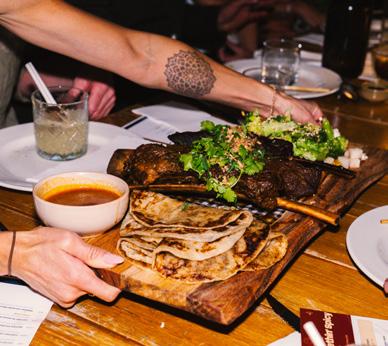
Diners might have traditionally come for the food and drinks, says new UNO columnist Rae Baker, but more so than ever, we’re staying for all the feels.
There was a time when dining out was simple. You chose a place, ordered a meal, and if the food was good, you’d come back. These days, something else is at play. We’re not just going out to eat, we’re going out to feel something.
I’ve spent much of my career working in events and experience design, and what’s happening in our food scene feels like a natural evolution. We’re living in what’s often called the ‘experience economy’, in which people place value not just on what we buy, but also on how it makes us feel. In hospitality, that means the lighting, the music, the story behind the dish, the welcome at the door and the company around the table matter just as much as what’s on the plate.
For operators, this creates both opportunity and pressure in an already demanding environment. It’s no longer enough to simply serve great food – the expectation now is a complete experience.
Diners want atmosphere, personality, connection and something that feels memorable enough to justify both their time and their money.
It’s exciting to see how this is taking shape in the Bay of Plenty. Pop-ups and collaborations are creating space for creativity to thrive without the commitment of a permanent venue, while established operators are reimagining their spaces through one-off takeovers and themed experiences. There’s a growing willingness to experiment and invite people to be part of something a little different. In doing so, communities are forming around food.
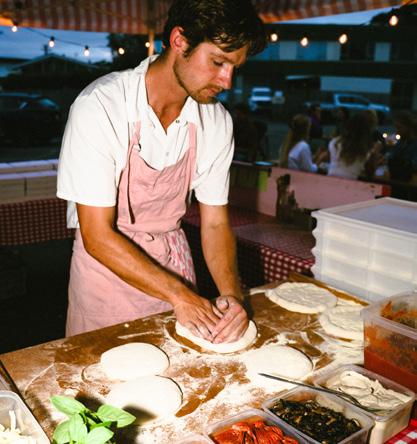
Take Leopard Boy Pizza, for example. Owner Andy Bowker started out working at Sal’s as a teenager, honed his craft and began exploring how making pizza could become not just a skill, but also a business. By leaning into the Bay’s grassroots hospitality scene and collaborating with the likes of Special Mention, Blondie, Benny and Brew, and most recently Best Behaviour Rum, Leopard Boy has built a pop-up model that feels distinctly local. Pizza is only the beginning – it’s about that unmistakable feeling of connection that defines genuine hospitality.
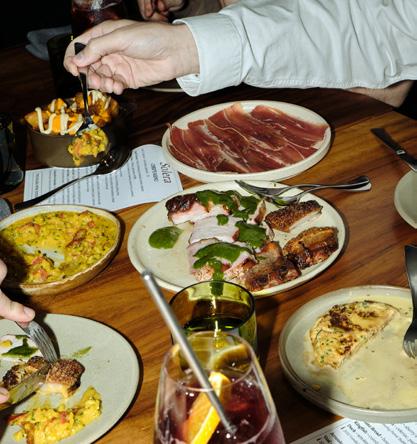
That same thinking is showing up in different ways across the region. Wine bar Solera recently wrapped a monthlong Spanish takeover, complete with Spanish wines by the glass, regionally inspired dishes woven through the menu, and lively Saturday pintxo afternoons built around sharing food and conversation.
Somethin’ Somethin’ has cultivated a Honey Club following by using the loyalty club to engage customers beyond their daily coffee ritual and fill seats across a growing calendar of themed events. Over the coming months, they’ll be hosting Latin-inspired evenings, Ragtag collaborations and a Beaujolais Nouveau celebration, all designed to turn casual customers into an engaged community.
Each of these examples points to the same underlying shift. We’re keener than ever to invest in experiences that feel thoughtful, immersive and worth talking about long after the table’s been cleared.
Perhaps that’s the real change. Forget simply consuming meals, we’re collecting moments. In a region rich with creativity, produce and passionate people, it’s a shift in thinking that opens up a world of possibility.






















































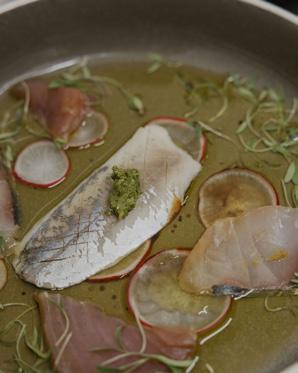
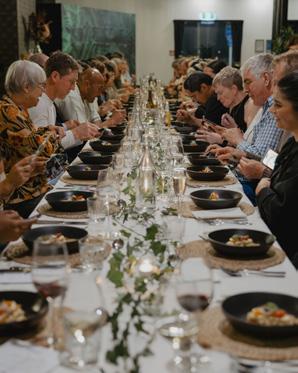
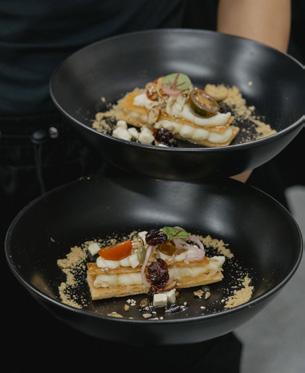
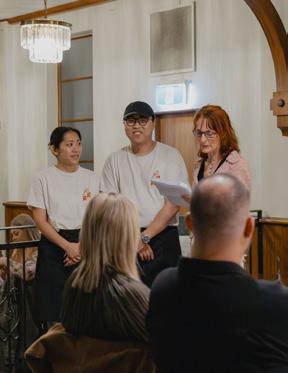
A vibrant and varied hospitality scene is one of the keys to a great city, argues UNO wine columnist Jess Easton, and every one of us can play a part in lifting Tauranga Moana’s.
PHOTOS ILK PHOTOGRAPHY
Hospitality, in case you haven’t heard, is doing it tough right now. Every now and then, though, something comes along that restores faith and lightens the gloom.
Five Go Wild With Food, my team at Kitchen Takeover’s offering at this year’s Flavours of Plenty festival held in April/May, hit that mark perfectly and left me reflecting on why I enjoy this festival, and the hospitality industry, so much. Proudly sponsored by Pyramid Valley Vineyards, the Five Go Wild With Food event featured five courses created by an international array of talent – Samoan/Māori chef Nancye Pirini (Te Kaahu), Japanese/Korean couple Rika Inagaki and Brian Kim (RikaRika), British whiz Ian Harrison (The Grocer), Italian Stefano Raimondi (Autentico) and Kiwi Dan Lockhart (Kitchen Takeover).
Although Nancye, a remarkable wahine, hails from the East Coast and is now based in Tāmaki Makaurau, the rest of the chefs are right here in Tauranga Moana. They’re far from alone. We have some amazingly creative chefs and restaurants in this city; I was also lucky enough to enjoy a couple of extraordinary, envelope-pushing meals at Mount Maunganui’s Solera during Flavours of Plenty, for example.
What I absolutely love is the collaboration and sense of community in this town. Most owners are
incredibly generous and helpful towards each other, chefs support one another, and talent is nurtured and shared. I’m really excited for one of our young chefs, Christian Schurink Gardner, who got to work with all the incredible talent at Five Go Wild and will hopefully pick up some gigs with them in future.
A quick word on Pyramid Valley, too. I spent an incredible afternoon with winemaker Huw Kinch at the North Canterbury vineyard a couple of years ago and came away dazzled by what they’re producing.
Huw is a craftsman extraordinaire and some of the single vintages – Lion’s Tooth Chardonnay and Snake’s Tongue Pinot Noir spring to mind – are mind-blowingly good. We were thrilled to be able to showcase Pyramid Valley’s Sauvignon+ at Five Goes Wild, and really appreciated their support.
Hospitality, when all boiled down, is all about heart. It's about those all-too-rare connections between people and palate.
Times are really tough at the moment, but we can take a leaf out of hospitality’s book and pull together by supporting our local eateries and venues as much as possible – because a city is only as vibrant as the people and places we each choose to support.
Jess Easton is a director and owner of Kitchen Takeover, a venture that complements her career as a Tauranga-based lawyer.
Claire Regnault is bringing big ambition and fresh energy to Tauranga Museum.
WORDS JO-MARIE BAKER
PHOTO YOAN JOLLY, TE PAPA
For a city that has waited decades for a museum, the appointment of Claire Regnault is a major coup.
A highly respected curator with more than 30 years’ experience, including 15 years as senior curator New Zealand Histories and Cultures at Te Papa, she will now shape one of the most visible parts of Tauranga’s new museum: its temporary exhibitions and public programmes.
She wasn’t actively looking for a new job, but one look at Tauranga Museum’s plans was all it took to lure her north
“It was exciting to see something that was ambitious and obviously had momentum. The buildings aren’t just pragmatic, they’re beautiful buildings designed with care and thought.”
For Regnault, it was that sense of pride and forward thinking that stood out. Public infrastructure projects can often feel constrained in New Zealand, but Tauranga’s willingness to invest in something culturally bold was compelling.
Beyond her curatorial work, Regnault is also one of New Zealand’s leading voices in fashion history. Her book Dressed: Fashionable Dress in Aotearoa New Zealand 1840 to 1910 won the illustrated non-fiction category at the 2022 Ockham New Zealand Book Awards. She plans to quietly work away on a new book while focusing on building an engaging museum programme that will appeal to visitors of all ages.


“The team have their dream list of projects that they would love to do – things from the collection, or ideas that they’ve been sitting on relating to Tauranga. So it’ll be a mix of exhibitions that we develop ourselves,
spectacular as the building itself, and people feel like they belong, take ownership, and are really stimulated and excited by what’s inside.”
LETSTALK.TAURANGA.GOVT.NZ/PROJECTS/ TAURANGA-MUSEUM


Downtown Tauranga had a rough few years, but even in the lean times, these three businesses didn’t leave. Now, as the city’s renaissance gathers pace, their belief is paying off. Turns out, that was the right call.
PHOTOS SALINA GALVAN
It’s no secret that Tauranga’s city centre has seen some challenging times. Shops closed and stayed empty, foot traffic dwindled, and many stores retreated to the malls. But despite it all, a group of true believers stayed put. They believed in the city centre and their businesses, knowing that what they offered was good enough to draw people into the city.
Walk downtown today, and people are returning to work, live and play. It’s getting closer to what Noel Cimadom saw when he looked at downtown Tauranga for the first time after arriving from Europe.
"I was always joking in the beginning, saying this can be Miami,” he laughs. “It just showed so much potential.”
With a background in hospitality in Munich, Noel and his wife, Kim Smythe, took the keys to The Old Tauranga Post Office heritage building on Willow Street in 2017, opened Clarence Bistro and Hotel in November 2018, then watched as the city centre grew very quiet indeed. Instead of retreating, the pair doubled down, opening the acclaimed restaurants Picnika and Stassano in quick succession, built on their faith in the city's bones and Noel’s Miami dream.
“I am a believer," he admits. “There aren’t many cities on the oceanfront that can do what Tauranga could

potentially become. I see it as the next future city. There’s no doubt about it. There’s a lot of opportunity here to become something very, very outstanding if we all pull together. I’ve got big hopes for it, for sure.”
They’ve seen and felt the recent change. The vibe is there, the tables are booked, and people are stopping in for after-work drinks, something that hasn’t happened for a long while.
“It’s still early days,” he says, “but it’s coming.”
Down the road, Julie Hammon is preparing to celebrate 40 years of business on the same city centre site. Hammon Diamond Jewellery arrived on Grey Street in 1986, and has remained ever since. The family jewellery business is also now approaching its 80th birthday.
“It’s amazing,” she smiles. “It's been such a fabulous journey.”
That journey has not been without turbulence. The stock market crash of 1987 hit just a year after she and her late husband opened. Later, the malls began luring customers away, and then the pandemic kept them away.
Through it all, Julie stayed put, even when shopping centre operators dangled attractive offers in front of her to relocate. She sent them on their way.


“I’ve always loved the city centre," she says, "and for us, being in the city is the right place to be."
“We’re a family business, people know where to find us, and they trust us,” she says. “These relationships have gone on for years and years and years. They’re intergenerational. We now have younger members of the same families coming in to use our services. It’s quite incredible.”
Her read on the city’s future is optimistic. “I’m very hopeful that we’re on that incline up,” she says. “For any city to be healthy and vibrant and have a fantastic future, you need a city centre that reflects that. The waterfront has been magnificently enhanced, there are events on downtown, and there are the new apartment blocks. The city centre is a very attractive and exciting place to be.”
Up the street, on the main drag of Devonport Road, Jason Dovey has been dressing Tauranga’s stylishly inclined men for more than 30 years. Bond & Co, his boutique menswear store, is a destination in the truest sense. People drive in specifically because there’s nowhere else quite like it.
“I’ve definitely seen the city centre at its lowest, as low as you can go,” he sighs. “But with the rebuild of buildings and facilities and more people living and working back in the city I reckon we’re on
the other side, and going up continually."
Even at the city’s quietest point, Jason didn’t think about leaving.
“I never want to go to a suburb and would definitely never go to a mall. We’re a boutique business. The city’s where we want to be. We don't want to be in suburbia.”
Jason says that even within the last year, the change has been notable.
“It’s sort of like the old days,” he says, saying that now, along with the destination shoppers, the increase in foot traffic has people popping in as they walk by.
He agrees that the city centre’s much-needed developments have made a huge difference to business. He’s seeing people bringing their kids or grandkids to the new playground, then stopping for lunch at a café, before dropping in to see him at the store.
“It’s not about going to a cupboard shopping mall. It’s about the other attractions and things to do in the city centre. When the museum, the new library and those other facilities are all open, along with the caf é s, restaurants and hospitality, it will be inviting for people to come back to the city centre.”
“There’s an atmosphere,” he smiles, then adds, “and that’ll only get stronger.”
DOWNTOWNTAURANGA.CO.NZ
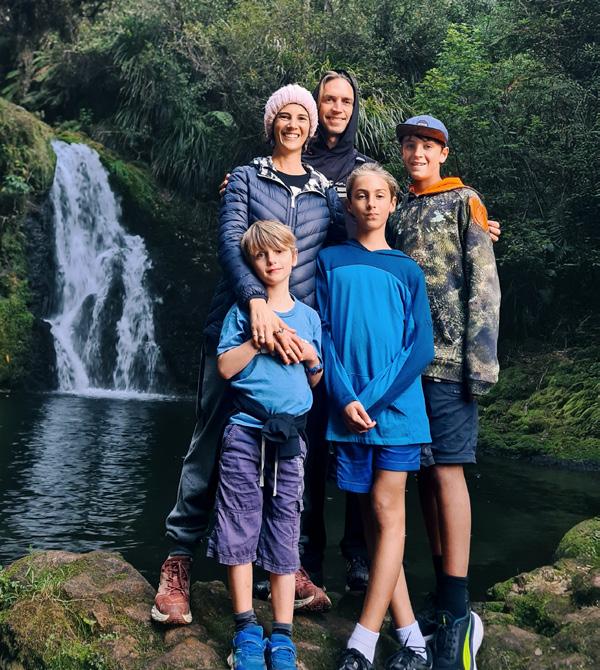
Through their new online series, Kids Unplugged , a local family of filmmakers is encouraging young ones to turn away from their screens.
WORDS KARL PUSCHMANN
The question of how much screentime is too much screentime is one many parents wrestle with. Thanks to the rise of streaming services and devices like iPads and smartphones, kids could have access to virtually any TV show or movie they want, whenever they want. It’s a problem previous generations of parents haven’t had to face, so it’s no wonder that when it comes to screen time, many parents feel the genie has escaped its bottle.
It was while reading social psychologist Jonathan Hyatt's book, The Anxious Generation, that producer Kylie Dellabarca Steel realised something needed to be done to encourage kids to unplug.
“There are a lot of devastating statistics in that book,” she sighs. “The addictions, anxiety, depression, sleep deprivation… all that negative stuff that comes with too much screen time. No parent wants their kids to resemble the statistics in that book. It’s sad and depressing reading.”
Kylie gave the book to her husband, director Anton Steel, who felt the same. They began thinking about how they could “use the tools in our hands” to make a positive change.
The eureka moment came, as these things often do, unexpectedly. “It just popped into my head when I was in the shower,” laughs Kylie.
The idea was Kids Unplugged, an online series of 10-minute episodes that show children how much
fun there is to be had when they unplug, and profiles inspiring locals who’ve found joy, fulfilment, health, purpose and human connection after switching off their screens.
The clever part is that the show isn’t doom and gloom, nor does it try to scare kids off their screens. Instead, the couple’s three children, Malachi (15), Judah (12) and Ezra (7), present it, making it hugely relatable to its intended audience and ensuring it stays light and fun, and doesn’t become preachy.
The goal was to make kids want to unplug, rather than being told to.
“In mountain biking, there’s a saying, ‘Where you look is where you hit’,” says Anton. “What that means is if you look at the trees, you’ll hit the trees, but if you look at the trail, you’ll focus on that and go where you want to go. If we just talked about all the negatives of screen time, we’d actually lean towards them, but if we tell the story of the positives of unplugging, all the health and wellbeing benefits, that’s where people will go.”
Having crowd-funded several other independent productions, the filmmakers followed the same steps to fund Kids Unplugged. It was a topic that resonated, and people were quick to support the project.
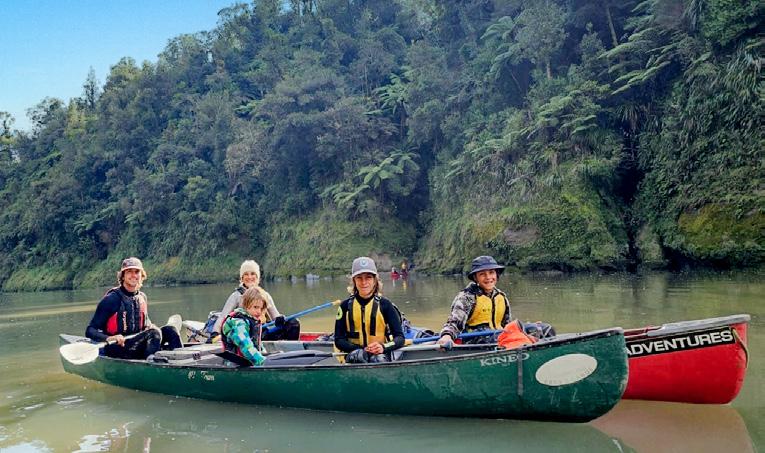
The six-episode series heads off on outdoorsy adventures like hiking, snorkelling, horseriding and skiing, while showing the unplugging journey other kids have made. For example, it features a 15-year-old former videogame addict who gave up screens and found a new calling as a political activist, cycling to
Wellington to present a case for the continuation of Māori wards in his hometown of Whakatāne.
“Jack's a good example of someone who was overweight, sleep-deprived and addicted,” says Anton.
“He had played 3000 hours in the video game Runescape,” Kylie says, almost in disbelief. “He went from a complete screen addict to a child who’s full of life. He’s thriving, happy and healthy, and gives so much to his community.”
“He really turned his life around,” says Anton.
All up, the show took a year to make, from idea to funding, filming to production, to now streaming for free on RNZ’s website and YouTube. It’s been quite a journey, but the family’s keen to get to work on season two.
“We filmed the series in the Bay of Plenty for budget reasons, and because it’s the fantastic place we live in, but we’d love to take it nationwide,” says Kylie.
Anton nods: “The dream would be a family road trip to find amazing kids all around New Zealand.”
As for Judah, he was initially a little wary of the project, having grown up watching the amount of work mum and dad put into their productions.
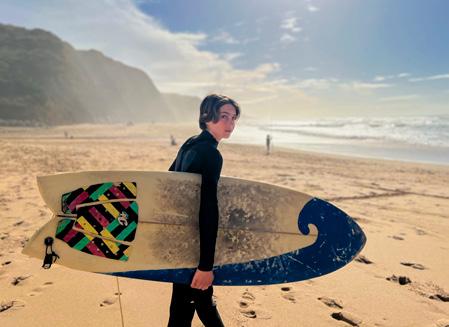
“I knew it would be a lot of time and effort,” he says, “but it was quite fun. I enjoyed making it because I got to meet other people who live unplugged and I got to do fun activities with them.”
“
1. “It can be as simple as making a cushion hut in the lounge or going for a walk. Instead of hopping straight onto screens straight after school, just get yourself outside. Start with small steps like that.”
– Judah
2. “Don’t be too hard on yourself to begin with. Ease into it. It’s tricky for parents, but be intentional and recognise that you're your kids’ role model. There’s no point preaching unplugging to them if you don't practice it yourself. We try to be those role models and not use screens recreationally ourselves.” – Kylie
3. “Aim for balance. We want to eat healthy, we want to exercise for healthy bodies, and we want to think healthy too, so try to encourage balance in your kids’ lives. If they’re going to spend some time on a screen, then think about what they can do to balance that time.” – Anton
THECOMMONUNITYLENS.COM/ KIDS-UNPLUGGED-FAMILY-TOOLKIT
Make a well-deserved date with one of the latest page-turners to hit our shelves.

Anne Cleary, Allen & Unwin
Winner of the 2025 Allen & Unwin
Aotearoa NZ Fiction Prize, Anne Cleary’s debut novel explores the razor-thin line between love and obsession. When three-year-old Oliver vanishes from a remote beach carpark, suspicion and desperation ripple through everyone left behind. As the search for Oliver intensifies, another woman clings to the impossible belief she’s been handed a second chance at motherhood. Tense and impossible to put down, The Nowhere Boy is a haunting must-read for fans of psychological drama.
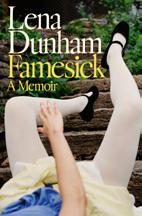
Lena Dunham, HarperCollins
Part memoir, part reckoning, Famesick sees Lena Dunham reflecting on the dizzying highs and brutal fallout of fame. Charting the years after TV show Girls turned her into a cultural lightning rod, Lena writes candidly about chronic illness, addiction, ambition and the cost of living publicly while privately falling apart. The book peels back the glossy veneer of celebrity to reveal a woman trying to reclaim herself beyond fame.
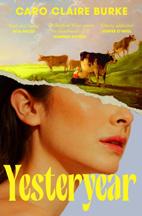
Caro Claire Burke, 4th Estate
This unsettling and addictive debut novel takes a sharp swipe at influencer culture. Natalie Heller Mills has built an empire selling the fantasy of wholesome pioneer living to millions online, with polished sourdough loaves, a cowboy husband, perfect children and all. Then she wakes to find herself trapped in the brutal realities of the 1800s she’s been romanticising. Darkly funny, Caro Claire Burke peels back the performance of modern femininity and asks what’s left underneath.

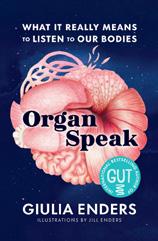
Giulia Enders, Harper Collins
More than a decade after Gut, Giulia Enders is back with a wider look at the body’s inner workings. Organ Speak explores what our organs can teach us about stress, healing, safety and connection. Enders has a knack for making science feel surprisingly intimate, by swapping dry medical jargon for sharp storytelling and everyday insight. This is the kind of book that makes you pay closer attention to yourself.
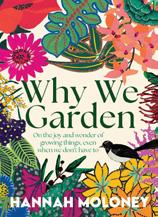
Hannah Moloney, Simon & Schuster
In Why We Garden, Australian gardening guru and Gardening Australia presenter Hannah Moloney digs beneath the soil to uncover what really draws us to growing things. Page by page, she weaves together stories from gardeners, artists, activists and everyday people to reveal how gardening nourishes far more than our backyards. Hannah makes a compelling case for gardening as an act of hope and care in an increasingly disconnected world.

Jamison R Firestone, HarperCollins This political thriller plunges readers into the chaos of postSoviet Russia through the eyes of an American lawyer caught in the middle of corruption and rising authoritarianism. From mafia threats to exposing state corruption alongside Sergei Magnitsky and
Alexei Navalny, Firestone’s real-life story unfolds with the pace of a spy novel. Rule of Lies is an eye-opening account of power and survival under Putin’s Russia.
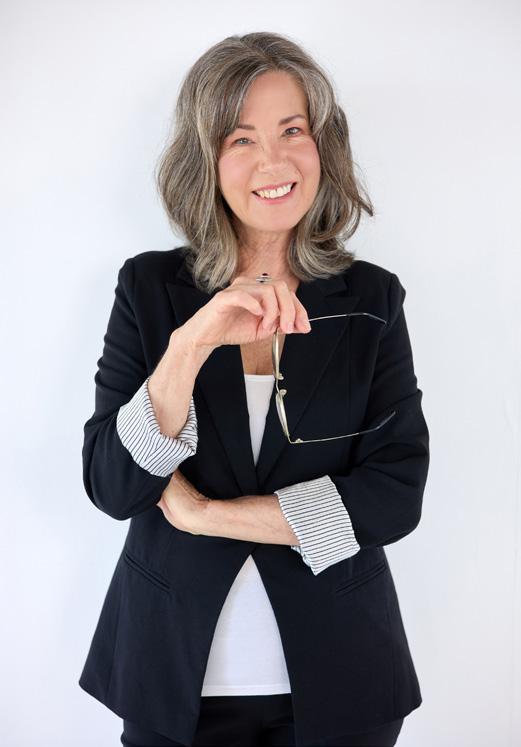
Anne Cleary didn’t set out to become a prize-winning novelist. Always a hobby, and a way to take the edge off life, writing has simply been slotted between jobs and family life.
“I’ve always just been a recreational writer,” she says. “People often ask why I didn’t pursue it as a career, but I’ve never wanted writing to become a job.”
Her pastime has now culminated in a major literary win. At the beginning of the year, her novel The Nowhere Boy won the Allen & Unwin Aotearoa New Zealand 2025 Fiction Prize, but the path to publication was far from easy.
Anne has worked a string of jobs, from cleaner and Salvation Army store worker, to caregiver and photo lab assistant, alongside raising her children.
“You just grab the time when you’ve got it, and ideas come when you’re not sitting there forcing them,” she explains.
A mentorship that began through a library writing group stretched over years and shaped her understanding of the craft, pushing her work toward
One-time cleaner now award-winning writer Anne Cleary’s lifetime of storytelling is finally paying off.
WORDS HAYLEY BARNETT
PHOTOS GISELLE BROSNAHAN
publication standard. Anne credits that long-term support with helping her find her footing as a novelist.
It wasn’t until later in life, after her children were grown and she moved from West Auckland to Tauranga, that writing became something she felt she could seriously develop. The Tauranga Writers’ group proved pivotal by offering feedback and, more importantly, belief.
“There’s a real focus there on getting people published,” she says. “That made a huge difference.”
Though the award may have brought recognition, and a nice monetary prize, it has also highlighted the industry’s unpredictable nature.
“It’s important not to think about money,” Anne advises novice writers. “There’s not a lot in it. You do it because you love it. If you’re writing for the market, you lose something essential.”
The Nowhere Boy began with some real-life inspiration passed to Anne through a friend, who told her about a memory of child who briefly went missing in the US in the 1960s. From
that seed, Anne built a novel that's driven by character rather than plot, and explores the emotional fallout from the disappearance.
“I just wrote a short story from what she told me, then it kept expanding,” she explains.
Winning the prize came at an unexpectedly emotional time. Anne had been caring for her father in his final months, and he died just weeks before the announcement. The phone call from Allen & Unwin arrived the day before she left New Zealand on a long-planned overseas trip.
“I just sat there thinking, ‘What? I’ve won?’" she says. “And then I was just sad that he wouldn’t know.”
The loss, and the win, only provide more motivation to keep writing.
“I have more in the works,” hints Anne, “something I’ve been working on for a long time.”
While more prizes might be on the horizon, for the meantime, she'll continue writing for fun, between everything else.
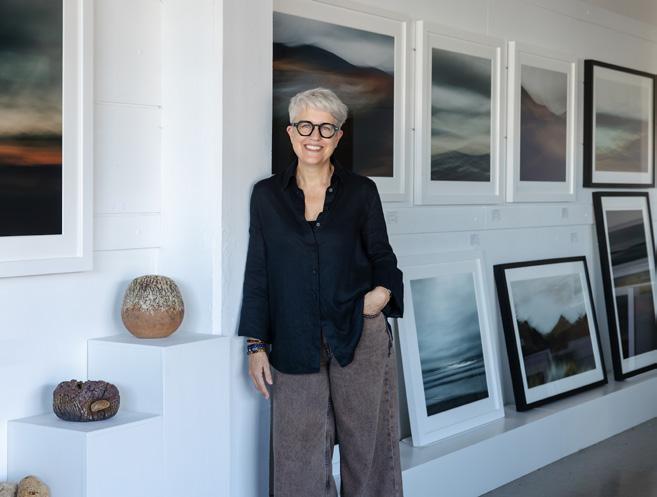
For Tauranga artist Tracy Stamatakos, the Bay of Plenty is a constant source of inspiration. Her photography transforms local land and seascapes into atmospheric works that invite viewers to pause and look again.
PHOTOS DEBORAH DE GRAAF
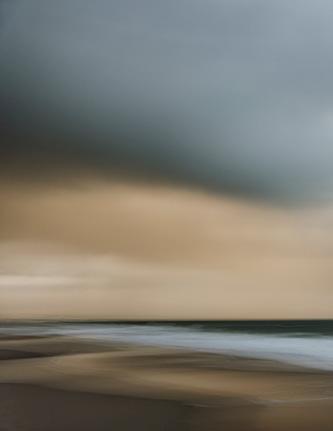
UNO : For people who might be seeing your work for the first time, how do you describe what you do? Tracy: Sometimes there’s confusion at first glance. What is it – a drawing or a painting? It’s photography, but not in the literal sense. I use single-capture long-exposure techniques to record light, colour and shape, moving the camera while the shutter is open to achieve the desired result. I also create new lines and shapes by recording the movement of objects or specular highlights.
I believe art can act as a transfer of energy from the unseen into the physical world. My images are imprinted with my energy, the energy of movement and the grounded energy of a place. My hope is that the viewer feels this too.
You talk about “painting with light”. What does that actually look like when you're out shooting? I’m sure it looks really odd! Sometimes it’s fluid movements, other times it’s following shapes. It feels meditative to photograph this way.
I love remote locations where I can be fully present and recharge at the same time. In contrast, trains can be fun to shoot from – scenes approaching and disappearing just as fast. I can spend six to eight hours in an outside carriage, and love the challenge of having to react quickly with no way to refine the scene. The funniest response I’ve had was on
the Northern Explorer. A woman who had watched me for hours finally said to her husband, “I don’t know what she’s doing, but her photos aren’t going to be sharp.” I just smiled.
What is it about the Bay of Plenty that inspires you? There’s beauty everywhere, but I tend to find it between the sun and the rain, where the pressure builds and the light breaks through. We’re blessed to have the ocean, rivers, hills and mountains on our doorstep, changing minute by minute. It’s a spectacular show.
Do you tend to head out with a clear idea of the image you want, or is it more about responding to the moment? “Responding to the moment” is a perfect description. Most of the time, I leave it up to the universe to present me with options. Sometimes there are certain images that make my heart race, or I can see the opportunity to develop an idea. In that case, I’ll make a clear plan to capture a series. That might include returning to a certain location, choosing another one with more potential, planning to shoot at the optimum time of day, or waiting for the weather gods to sprinkle some magic.





I’ve learnt that booking 10 days in the South Island in the middle of winter doesn’t guarantee moody weather. Full sun is not my friend, but I’ve accepted the challenge on many occasions. I guess that’s how you move forward. You've been working in photography for decades now. What’s changed the most in how you see things? This industry is all I’ve ever known. My first job was with Bob Tulloch at No 1 The Strand in the early ’90s. I hadn’t set out to be a wedding photographer. I fell into that quite by accident, but quickly realised it’s some of the best training you could ever have. Twenty years of constant pivoting, catching curveballs, working under time restraints, learning to breathe under extreme pressure… but somewhere in all the madness, you create magic and you keep going.
Photography was a love, and then it became a job. It’s also highly technical, with lots of components to control and briefs to stick to, especially commercially, so it began to feel clinical and suffocating. I found the love again by shooting for myself, by throwing


out all those rules in 2006 and creating emotionally charged imagery, which is dark, moody, soft and serene.
With age, I think you become more aware of self. There’s also an element of knowing we’re all on borrowed time – although I’m putting it out there that I’ve only reached the halfway mark and am keen for another 50 years. You start wearing your heart on your sleeve and caring less about what other people think, not worrying so much about mistakes because you understand that’s how growth happens.
Making art connections outside the photographic industry was also key for me. Being able to bounce ideas around with people working in different mediums was refreshing.
What’s it like being based in Tauranga and running your own gallery space?
I took over the 9th Ave space 11 years ago, when my business switched to focusing on commercial work. The signage on the window has always read “studio + gallery”, but it’s only been in the past 18 months that the gallery has
had regular hours. I have to thank my talented ceramic artist friend Lynn Ross for backing me and sharing the gallery hours to make this possible. We’ve always had an appreciation for each other’s work and visitors enjoy the way it intersects. It’s delighted us recently to have people waiting for the doors to open. That sure makes up for the quiet days, but that’s the nature of retail.
When someone stands in front of one of your pieces, what do you hope they feel? A moment of pause, and space for their own memories and interpretations to surface. It’s also a direct transfer of energy. For example, I have one image that has been purchased four times as a remembrance piece, and it was photographed in that spirit. That makes me smile, to know my visual communication is working.
I think it’s very important to connect emotionally with a piece for longevity. Will it still mean something to me when my surroundings change? Art can create future memories too. An image you live with becomes a backdrop to everyday life.
TRACYSTAMATAKOS.CO.NZ


Skin Checks
Skin Cancer Surgery
Mole Removal
Medical Dermatology
Mohs Surgery
Fraxel® Laser
CO² Resurfacing Laser
Liposculpture
Blepharoplasty
Scarless Breast Enlargement
Scarless Breast Reduction
Chemical Peels
Appearance Medicine
Beauty Therapy Treatments
Specialist Skin Care Range
Laser Hair Reduction
Facelift with minimal incision
Help restore a more energetic and youthful appearance!
The loose skin over your eyes and the fat bags under them make you look more tired and older than you feel inside.
Eyelid surgery or Blepharoplasty can not only correct sagging eyelids, remove fatty pouches beneath the eyes and remove excess skin from the upper eyelids but it can also correct eyelid problems that may be interfering with your vision.
In about 1 hour the excess skin around your eyes can be removed making you look alive and refreshed. The results are stunning and the recovery period is short.
Look and feel the best version of yourself.
WINTER TREND WATCH
What’s new, what’s you PAGE 54
NOTHING TO SEE HERE?
Silent eye conditions PAGE 77
HAIR HELP
From a pro in the know PAGE 61
Kate Malone on a magnetic treatment for depression PAGE 62
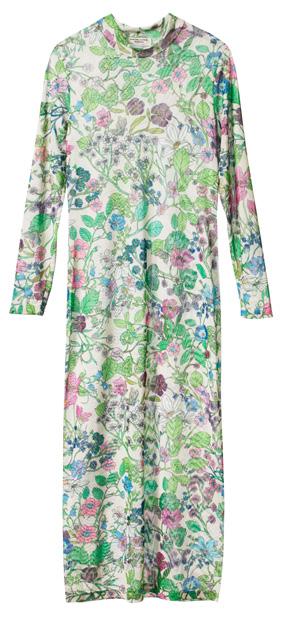
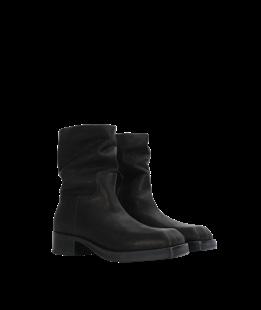
Find
WORDS NICKY ADAMS
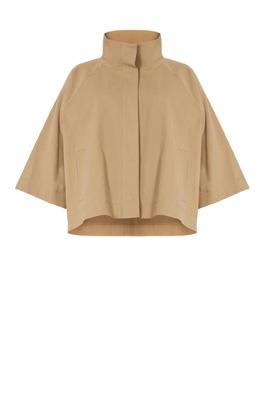




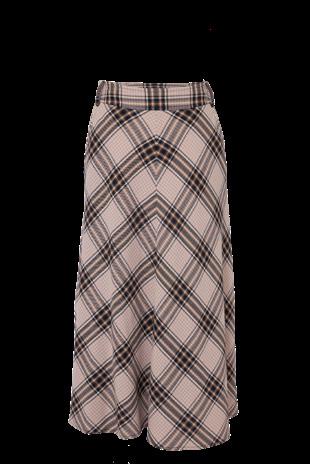
Colour features strongly this season, and a great way to banish the gloom is by zhushing up your neutrals with splashes of it. Although florals will always say “spring”, some designers haven’t been able to wait and have turned blooms transeasonal by showing them paired with heavy boots and a coat. The quarterzip knit is another favourite look, and one that works just as well for men as women; thanks to its minimalist appeal, it’s a top-tier staple. Sweaters take the average turtleneck up a notch, with this season championing ultra-cosy funnel-necks. In fact, the high-collar aesthetic is a huge breakout trend right now, as are balloon pants. Billowy with a tapered hem, for many fashion fans, these pants sartorially divisive, but like it or lump it, they’ve quickly become the silhouette of the season.



1. HEREAFTER DRESS, $440, TWENTYSEVENNAMES.CO.NZ
2. ODIN BOOTS, $849, DEADLYPONIES.CO.NZ
3. OVAL LINK AND CHRYSOPRASE EARRINGS, $97, SIMPLYITALIAN.CO.NZ
4. INTENT JACKET, $470; RECEDE PANTS, $350, MOOCHI.CO.NZ
Plaid just keeps coming from every direction, and there’s a reason for this: its versatility is as fabulous as its timelessness. From outerwear to statement dresses, often crafted from fabric in a heavier weave, it’s a look that leans into the practical as much as the visually pleasing. Styling has taken a maximalist slant; head-to-toe is the go – an approach New Zealand designers are excelling at. Given our mild winter climate, Bay dwellers have the advantage of being able to dip our toes into cold-weather looks without having to completely ‘winterise’ our wardrobes, and for this, layering is key. Mid-weight pieces topped with a statement coat enables the outerwear to be the entire look. Go for faux fur and shearling or ethically sourced feather, and add new depth to the most basic of outfits.
5. SUPERSTAR II SHOES, $190, ADIDAS.CO.NZ 1. HIGHLAND SHIRT, $279; HIGHLAND SKIRT, $279, SYLVESTERPG.COM
CUVÉE ROSE COAT, $728, UNREALFUR.COM.AU

Most-wanted this winter.
WORDS NICKY ADAMS

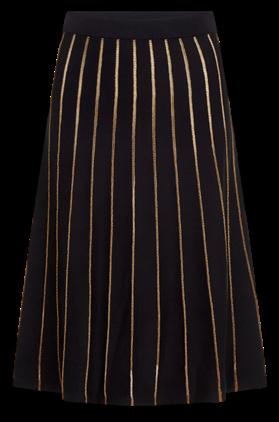



Overall, this winter’s trends couldn’t get more low maintenance, with designers encouraging fashion lovers to selectively add a few main players, then consider ways to creatively rethink what we already own. For 2026, pay attention to your knitwear and knee-highs. The former has been elevated via woollen dresses, skirts with matching cardigans, and wrap tops and matching pants, all considered high-fashion pieces. A trend has also emerged in the form of pre-layered knits. Last year, we saw sweaters and coats with scarf details; this year, it’s knits over knits. If that’s not your thing, look to the trending play on texture – silk or satin paired with merino or cashmere shows an appreciation of quality as well as classic style.


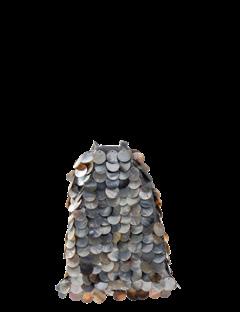
Although transeasonal pieces are imperative wardrobe fillers, find me someone who doesn’t love a winter coat or jacket. At this time of year, in some form or other, leather (or faux) can’t be beaten. Versatility is a star quality that can just as easily read retro or polished and can’t be beaten for longevity. A beautiful long-line piece of tailoring will never date, and if you’re looking for an on-trend jacket, a funnel-neck or bomber should be your pick. None of this season’s trends feel too set in stone, but a ’20s-style dropped or elongated waist is a highlight, and generally a flattering one. Sheer lace and corsets are as dramatic as they are current, with a gothic vibe simmering away in the background.


Get on board with stylish looks as you set out to sea.
WORDS NICKY ADAMS
Part of the joy of preparing for a cruise is knowing that once you step on board, despite visiting multiple destinations, you’ve arrived. Your cabin becomes your castle for the duration of the trip. Unlike other holidays, there’s no need to live out of a suitcase; instead, you can settle in and fully enjoy your holiday wardrobe.
Of course, alongside the excitement comes the question of whether you’ve packed appropriately. From the Captain’s Dinner to shore excursions, there’s plenty to consider. Style aside, cruise lines often have dress codes, so it’s worth checking these before you leave.
Your first consideration should be your destination. Onshore excursions are where practical dressing matters most.
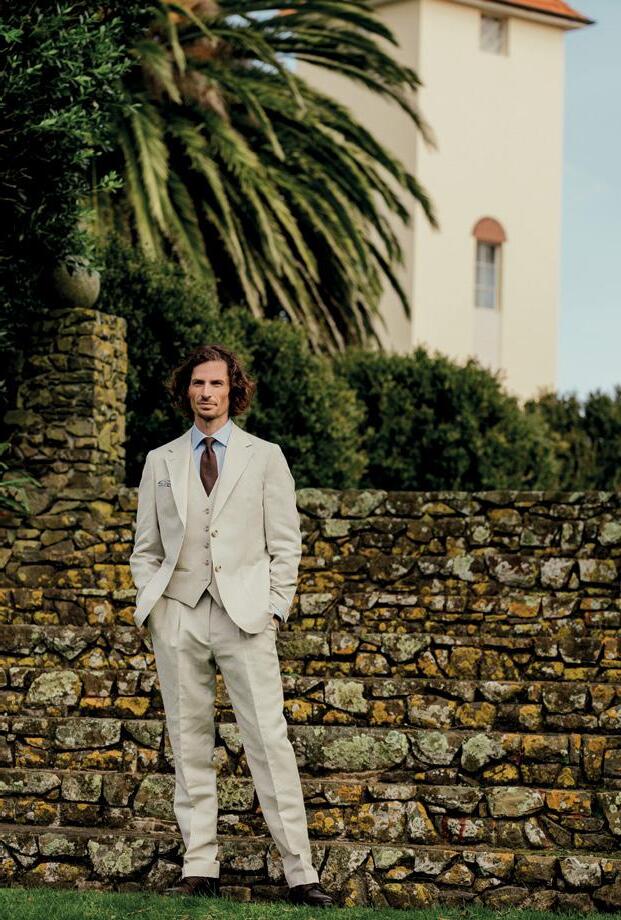
If you’re heading to warmer climates, bright colours and resort wear are ideal. Think comfortable, easy-care pieces that don’t require ironing. If your itinerary includes conservative countries or places of religious significance, pack a light shawl or blouse to cover your shoulders, along with skirts or shorts that fall below the knee.
For men, tailored shorts, smart T-shirts and casual shirts offer versatile options. When cooler weather is on the agenda, pack chunky knits, long trousers and waterproof outerwear. Weather can vary dramatically across regions, particularly in Europe, so layering is often the smartest approach.
Footwear should be comfortable enough for hours of sightseeing. If sandals won’t suffice, trainers may be essential. For beach destinations, espadrilles are a stylish and lightweight option for both men and women.
Once your off-ship wardrobe is sorted, it’s time to think about life onboard. While some guests embrace the opportunity to dress up, others prefer relaxed comfort. Most cruise lines now recommend ‘smart casual’ attire for evening dining – basically the sort of outfit you’d wear to a good restaurant.
For women, this could mean a maxi dress, tailored trousers or elegant resort wear. Men can opt for trousers with polo or collared shirts, smart dark jeans and loafers. Singlets, hoodies, jandals and slides are generally best avoided.
Many cruises also feature formal or themed evenings, so a little research pays off. Men may need a jacket and tie, women an elegant dress.
Above all, favour crease-resistant pieces that work for multiple occasions. After all, when you’re sailing into the sunset, your wardrobe should be as carefree as you are.



The importance of function along with form is hitting the fashion world hard. We’ve all seen the ugly/practical shoe trends (Birkenstocks and Crocs sit alongside the likes of gardening clogs and split-toe sneakers), but when it comes to apparel there is utility dressing to step into the breach. Look to cargo, pockets and a military feel to everything.

Bright, bold and beautiful – red is one of the main shades for spring and summer – but what’s really trending is head-to-toe block red worn with black accessories. From footwear to sunglasses, bags to opera gloves, these two contrasting colours are being styled together for maximum impact.


Soft power dressing has been slightly reimagined for spring, with loose silhouettes crafted from light, wafty, layered fabric combinations that drape to perfection. Silk, of course, sheers and handkerchief hemlines –just as some of the most sought-after designer bags bear no logo, mastering the art of the layered luxe dress code whispers opulence.
The buzz phrase for spring might well be ‘fashion with feeling’. As designers move to be sustainable, unique and simultaneously elevate their brands, they are drawing on a stream of new materials to achieve this. Craft and texture are key; tactile fabrics that incorporated visual trickery were seen on catwalks, and this will filter down to the Highstreet. Watch for fresh, maximalist silhouettes.


Yes, you do deserve a mid-season pick-me-up. We’ve found a few new things that will do nicely.
Its sole ingredient is literally far fetched (from the Tibetan Plateau), but the brand is pure Aotearoa, and we’re true believers in Saltd’s Magnesium Oil. Being ethically sourced from a spot that guarantees its quality gives it the power to genuinely improve adults’ and kids’ mental and physical health. RRP $44. SALTDMAGNESIUM.COM
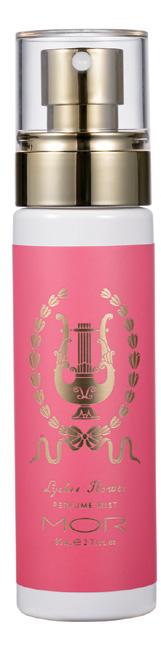
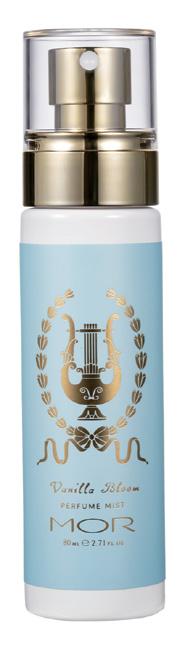

What do we think of MOR’s new, u ltra-feminine and hydrating perfume mists, Lychee Flower, Vanilla Bloom and Marshmallow? Sign us up! With vitamin E and aloe vera, spritzing gives you a subtle glow while you waft around smelling divine. The travel-friendly size lets you do so with impunity. RRP $25. BEAUTYGARAGE.CO.NZ


The brand formerly known as Raaie has become Raeso, yet is delivering the same innovative approach from founder Katey Mandy and her science that aligns with the skin’s natural 24-hour rhythm. New now is the Lunar Veil Chrono-Active Sleep Mask, a luxe overnight smoother and plumper you apply during the skin’s ‘power hours’ – 8-10pm. RRP $159.
RAESOSKIN.COM

Melatonin can be taken orally to help you get your zzzs; Tailor Restore Nurturing Night Balm formulates it with New Zealand red seaweed to create beauty sleep in a jar. Slather it on to stimulate your skin’s regenerative processes while you snooze. RRP $70. FARMERS.CO.NZ


More than just a cleanser, Emma Lewisham Supernatural Crème Cleanser is a treatment too. Borrowing from serums and moisturisers, in addition to cleansing, it offers more bang for your buck via barrier strengthening, inflammation reduction and microbiome support, alongside rinseresistant hydrators. Winning! RRP $84.
EMMALEWISHAM.COM


The radiant result of one woman (Ellen Casey)’s search for a gentle everyday SPF, Avocado Zinc is a 100 percent natural zinc sunscreen that wears well under make-up, doesn’t leave that annoying white cast and gives skin a dewy glow. Also on our wishlist are the bronzer and lip and cheek tint in this range. RRP from $43. PAPERPLANESTORE.COM
Peptides and niacinamide are both big names in the biz. In Medik8 Niacinamide Peptides, they combine in one potent product. Uneven tone, visible pores, redness, excess oil and congestion are among the niggles it targets through smooth, clinically proven moves, all while feeling feather-light. RRP $120. MEDIK8.CO.NZ
We’d all like a brighter smile, but at what cost? Thanks to 7th Heaven, a pro-grade option is now available that’s affordable and kind to teeth and gums. The whitening serum, pen and strips in the Teeth Bright V34 PAP collection aim to make your gnashers up to three shades whiter in seven days. RRP from $40.
BEAUTYGARAGE.CO.NZ

Bid adieu to the winter ‘blah’ by applying Linden Leaves’ Rose Radiance Oil to your lovely face – and don’t forget your décolletage. The family-owned Kiwi co has created a must-have in this light yet nourishing pleasure that promises an array of beautifying benefits to brighten both your skin and your day. RRP $125. LINDENLEAVES.COM



Set amongst tranquil park-like grounds and private lakes, Pacific Lakes Village o ers spacious modern villas and terrace houses designed for a vibrant, active and independent lifestyle.
The Pavilion is now open – the village’s impressive community centre features an eatery, lounge bar, library, art studio, beauty salon, wellness suite and extensive recreational facilities.
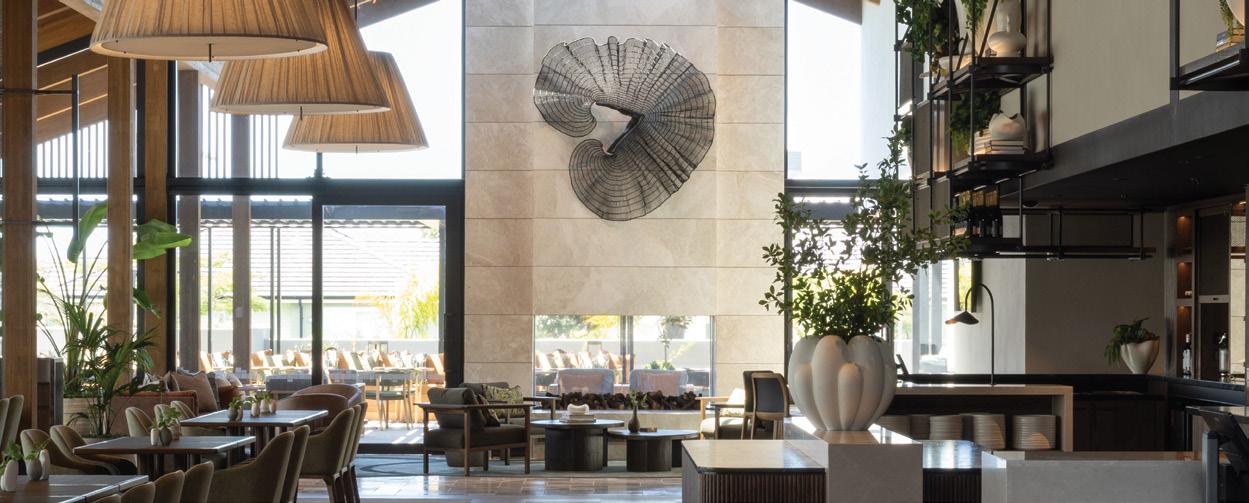
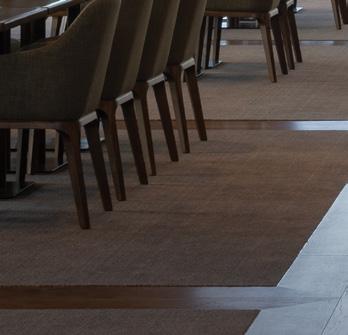
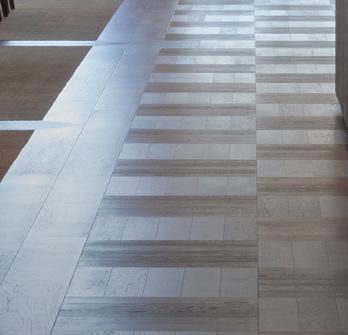
Show villa available to view by appointment. 242 Grenada Street, Mount Maunganui
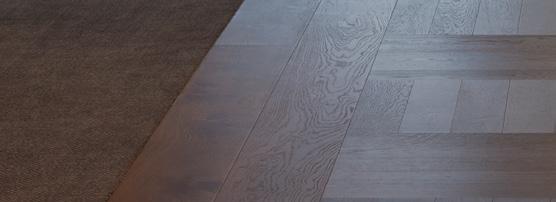
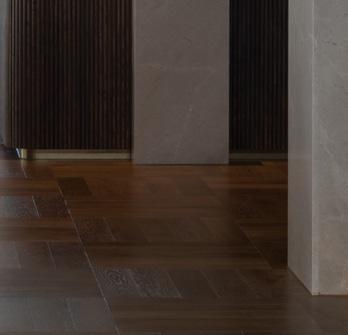



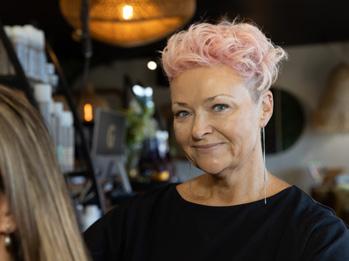

Shelley Pullar of Salon G reveals this season’s top hair trends, as well as the challenges her clients are up against this winter.
PHOTOS KATIE COX + SUPPLIED
Winter always brings about a change, not just in the weather, but in how people want to feel. Lately, I’ve noticed a real move toward looks that feel intentional yet effortless.
Short hair is having a moment. I’ve had a run of pixie cuts that are soft, textured and full of personality. Think longer layers, feathered edges and movement that doesn’t feel too “done”. It’s a natural fit for winter, when collars come up and scarves go on. These cuts hold their shape but still feel touchable, which is key.
For those keeping their length, I’ve seen a change in styling. Clients with classic straight bobs are asking for a subtle directional flick – something that gives the hair a bit of attitude without committing to a full restyle. It’s the kind of look that works just as well the next day. It’s a little looser and a little more lived-in. Colour-wise, warmer tones are leading the way. Rich coppers, ambers and deep cherry shades have been especially popular – bold colours that aren’t too overpowering. At the same time, blondes are leaning softer. The focus is on blended, “lived-in” colour, like buttercream, beige and soft gold tones that melt
seamlessly from root to end. Nothing harsh or stripy, just beautifully diffused colour that grows out gracefully.
One of the most rewarding parts of my job, though, has been working with first-time curly clients. Many arrive a little hesitant, often after past experiences that didn’t go well. Curl trauma is real, and it usually comes down to misunderstanding how curls behave, especially with shrinkage.
For me, these appointments are about building trust. I take the time to really listen and understand their hair history, what’s worked, what hasn’t, and what they’ve disliked most. From there, it becomes a collaborative process. Nothing is rushed, and nothing happens without them feeling comfortable.
Education plays a huge part. I talk them through each step as we go, including how much moisture the hair needs, how to encourage a more even curl pattern, and the difference between air drying and diffusing. The goal is for them to leave not just with great hair, but with the confidence to recreate it at home.
When your hair feels right, everything else falls into place.

One Mount Maunganui clinic is bringing cutting-edge mental healthcare closer to home, with a groundbreaking treatment offering new hope for depression.
WORDS NICKY ADAMS | PHOTOS DEBORAH DE GRAAF
There are few who would argue with the saying “your health is your wealth”, but when UNO sits down to talk to psychiatrist Dr Darren Malone and his wife, psychiatric nurse Kate Malone, of Equilibrium Assessment and Treatment Clinic, Darren zeroes in on this even further, pointing out that in reality, “the cornerstone of your health is your mental health”.
With the World Health Organisation confirming in 2017 that depression had become the leading cause of ill health and disability (statistics showing an 18 percent increase between 2005 and 2015), it’s probably fair to say that it’s an illness that resonates with most of us. To call it ‘common’ feels reductive, because depression is so hugely impactful both to those suffering and to close whānau and friends. When you consider that up to 7 to 10 percent of adults experience depression annually, its prevalence begins to hit home.
Medication and cognitive behavioural therapy are often the first port of call; however, 30 percent of people with depression are treatment resistant. These people include those who have not achieved an adequate response to medical treatment and those who are unable to tolerate medication side effects. Worldwide research efforts have focused on everyone in this group.
One specific treatment option has gained huge ground globally: Transcranial Magnetic Stimulation. TMS has been internationally approved and FDA-cleared since 2008, and is approximately twice as effective
as antidepressant medication. The outpatient procedure is already widely supported in the US, the UK and Australia, where it’s used as a proven plan for treating resistant depression. In Australia, TMS costs are covered by Medicare.
Darren and Kate have practiced in the public and private systems in New Zealand and the UK for more than three decades. Latterly, Darren was clinical director of Mental Health Services for Lakes DHB, before moving to Mount Maunganui and setting up Equilibrium.
The clinic is light and bright, and the atmosphere is relaxed. Darren and Kate are warm and welcoming; it’s hard not to feel at ease. They focus specifically on working within the field of depression and treatment via TMS, which works using magnetic pulses. They’re passionate about and heavily invested in providing a pathway for patients for whom medication simply doesn’t work, or for those who want to explore a treatment hitherto largely unavailable in New Zealand. The fact we have access to this private facility and level of expertise locally – and without heinous waiting lists – is remarkable.
The route to a treatment plan involving TMS is as stringent as you’d expect. Kate says most patients will be referred to Equilibrium by their GP or psychologist, who will likely have extensive notes to share. The next step will then be a comprehensive assessment with Darren. As he says, “the most important thing about TMS is that you have to confirm that the patient has depression. Then it’s about working together to try to help We don’t want to give people medication or TMS if it’s not going to be the solution.”
“ ONE OF
WITH DEPRESSION. ”
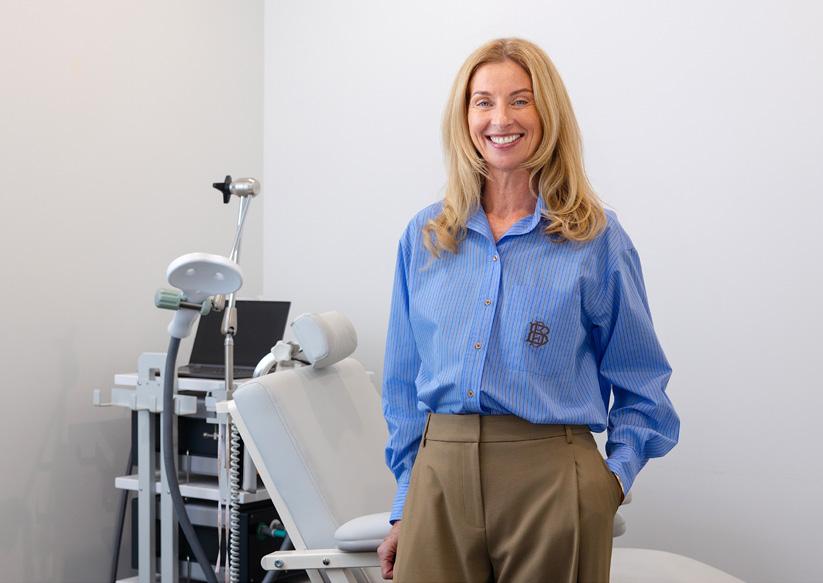
Crucially, Darren continues, “you want the patient to engage in a treatment that will help them get better. You’ve got to understand their preferences and goals. If you can establish the way they want to work, you’re going to get the best outcomes, so you’ve got to adapt.”
The patient groups that really benefit are not only people with treatment-resistant depression, but also those who can’t tolerate medication, pregnant or breastfeeding mothers, and older people who are already on multiple medications. If it’s conclusive that TMS could indeed be positive, a treatment plan is put in place.
Having read about the benefits of TMS, I’m curious as to what the process actually involves. Darren explains, “People will tell us when they’re depressed that their brain doesn’t work properly. It’s been discovered that the primary depression area in your brain is your left side dorsolateral prefrontal cortex, which has been shown to be under-functioning in people with depression. We’re able to stimulate this area with the magnetic coil, and the pulse passes through your skull and into the cortex. It’s a kind of non-invasive brain stimulation.”
And the feeling while you’re having the treatment? As the practitioner who gives the treatment, Kate immediately reassures, “It's a very safe, well-tolerated treatment, with minimal or mild side effects, such as mild fatigue and mild scalp discomfort. The delivery of rapid, brief magnetic pulses through the skull into the brain results in a tapping sensation on the skull.”
Although I realise there’s no ‘one-size-fits-all’ plan, I’m interested in how many sessions are required and how often. Typically, Darren says, “the original TMS protocols consisted of a 20 to 30-minute treatment, once a day, five times a week, for four to six weeks.”
That said, both Darren and Kate are hugely excited by global progress, particularly in the US, where extensive use and research shows that accelerated TMS protocols can be even more effective. What this means is that “we’re able to offer a full course of TMS over two weeks, which is far more feasible for people to fit into their lives”. Clinical response to TMS is monitored regularly.
Ultimately, the joy of the process for Darren and Kate is being able to offer a potential solution to a problem patients may have battled for years. “Often the people we see will tell us that they’ve tried medication and cognitive behavioural therapy, as well as diet and exercise,” says Darren. “These people are invested in their mental health and have done really well, but over time, those things have become less effective in treating their depression. They get to the stage where they can become quite desperate because they’ve tried everything. We feel quite hopeful with TMS that it’s something people can try. TMS is tolerable, proven and highly effective.”
TMS.NET.NZ



New Zealand’s surrogacy laws belong to another era. Decades on from being written, the families caught up in them are paying an enormous price.
WORDS HAYLEY BARNETT

Imagine spending years trying to have a child, enduring miscarriages and failed fertility treatments. Maybe biology just isn't on your side and you spend forever searching for someone to carry your baby to full term. When you finally find a surrogate willing to do so, everyone in the room knows exactly who the parents are. Except the law.
Under New Zealand’s current framework, the intended parents – as in the people who created that embryo, who have longed for that child and will take them home
and raise them – are legal strangers to their own baby at birth. The surrogate and her partner are the legal parents, and until a lengthy, costly adoption process plays out over months or years, that’s how it stays.
This is the reality for thousands of New Zealanders who build their families through surrogacy, but according to the experts working alongside them, it doesn't have to be this way.
“Nobody gets to surrogacy easily,” says Stewart Dalley, a family lawyer who has spent years working on such cases. He was part of the first same-sex de facto couple in New Zealand to jointly adopt their children.
“THE
’
“For a gay couple, you don’t really have any other option than surrogacy because ordinary adoptions are rare as hen’s teeth. But for a heterosexual couple, you’ve probably gone through multiple years of infertility, unexplained infertility, multiple miscarriages, all of those things, which place a massive emotional drain on you. When you get to the point where surrogacy is your only option, then begins the long, bureaucratic road to becoming the parents.”
Under New Zealand law, the woman who gives birth to a child is automatically recognised as its legal mother, regardless of whether she has any genetic connection to that child. Her partner, whether male or female, is recognised as the other legal parent. Legally, the people who may have created the embryo and will raise it from birth don’t have any such status.
“What the law treats mum and dad as is sperm donor and egg donor,” explains Stewart. “Nobody intended this to be the situation. I think it was just short-sighted. The law hasn't kept pace with technology and reality.”
The practical consequence is that intended parents must go through a formal adoption process to be legally recognised as the parents of their own child. It’s a process that Caren August, a counsellor at Fertility Associates, says typically runs for around twoand-a-half years from first appointment to completed adoption. But the absurdities don’t stop there.
Christchurch influencer Rebecca Keil became a surrogate in 2019 for Wellington couple Tess Dunford and Dan Stemp after seeing Tess’s plea for a surrogate on Instagram. Tess had suffered a postpartum haemorrhage during the birth of their first child that required an emergency hysterectomy. Although it was devastating, her ovaries were intact, meaning IVF and surrogacy were possible. For Rebecca, the decision to help was straightforward, however, the legal reality that followed was anything but.

“We don’t have surrogacy laws,” she says. “We have ancient adoption laws, which make the process a whole lot harder.”
Because Rebecca was married, her husband Jared was automatically presumed to be the baby’s legal father, despite having no biological connection whatsoever to the child. His name, and his ethnicity, went on the birth certificate.
“He’s a whole-ass fruit salad,” jokes Rebecca. “On this child’s birth certificate, it says his father is Māori and Samoan, and he’s a Pākehā child. It’s so crazy and misogynistic.”
Caren recognises the reaction immediately. “I can’t tell you how many times I’ve had the partner of a surrogate say, ‘But why? I’m not contributing eggs, I’m not contributing sperm, I’m certainly not carrying the pregnancy.’”
Beyond the bureaucratic frustration is genuine fear. Until the legal process is complete, the surrogate and her partner are the child’s legal parents. The intended parents are not. For everyone involved, that ambiguity can be a source of dread.

“The worry of the surrogate is that the intended parents are going to ditch her and she’s going to be stuck with this baby,” says Stewart. “The worry of the intended parents is, what if the surrogate decides to keep the baby?”
Caren sees this play out throughout her counselling sessions. “Even when you know each other really well and have a deep sense of trust, there can still be that thought that comes up occasionally. What if they change their mind? What if I do something that upsets them and they decide to keep the baby?”
She describes it as “a common undercurrent alongside times of excitement and hope”.
Legally, that fear isn’t entirely unfounded. “Surrogacy is not legally enforceable in New Zealand,” explains Caren. “The surrogate or the intending parents could withdraw from it, even once there's a pregnancy.”
Rebecca says the fear never took hold for her personally, because she trusted Tess and Dan completely, and felt no grief at handing their son Ziggy over, but she understands why others might feel differently. “If I was in a scenario where it had maybe gone south, and I knew there were no legalities and nothing to protect me, that definitely would have felt a bit different.”
What she does remember vividly is the chaos of the immediate aftermath. Ziggy was born on a Sunday in the early hours of the morning. Rebecca, who had complications during the birth, found herself sending emails from her hospital bed at 5am to relinquish legal rights.
“ IT WAS JUST A WILDLY INSANE SCENARIO. I GIVE BIRTH TO SOMEONE’S BIOLOGICAL CHILD AND THEY HAVE TO ADOPT IT OFF ME. ”
“Because it was a Sunday, there were issues around getting things sorted,” she says. “There was a point where they weren’t going to let Tess and Dan leave the hospital with the baby, and that came down to the timing of it. If it had been midweek, it probably would have been way easier.”
When the adoption order is finally granted, which is often months later, in a courtroom, Stewart says it’s often profoundly emotional. “I’ve seen judges crying happy tears. It’s a lovely ceremony, but the parents are crying not only because it’s a lovely moment. It’s also, ‘Thank God it’s finally over’. There’s the exhaustion of the whole process, the cost, the emotional drain. That order being granted at the end is just the final, final step.”
For Rebecca, the court appearance came around six months after Ziggy’s birth. “It was just a wildly insane scenario,” she says. “I give birth to someone’s biological child and they have to adopt it off me.”
New Zealand’s surrogacy laws have been overdue for reform for decades. A Member’s Bill incorporating Law Commission recommendations is now sitting before Parliament awaiting its second and third reading, but progress has been glacial.
“It’s Parliament time, basically,” says Stewart, who was one of the expert legal advisors to the review. “Whether it’s going to happen in this term, or roll over into a new political cycle, I honestly don’t know.”
It was former MP Tāmati Coffey, himself a father through surrogacy, who came closest to making it happen. He drafted the original Member’s Bill alongside Louisa Wall and gathered cross-party support, but it stalled on timetabling and, he believes, the cost of implementation. He left Parliament before seeing it over the line.
“I’m sad that we’re still kicking the can down the road. It shouldn’t have taken this long,” he says.
He also points to a glaring inequity where every professional in the process gets paid, except the surrogate.
“As it stands, women who do this need to do it for the love in their heart. But every other professional is clipping the ticket, and clipping big.”
Rebecca echoes this. Surrogates cannot be paid beyond tightly prescribed medical expenses, and costs like physiotherapy and dietary changes aren’t covered.
“Things like your diet changes, your body changes and legally they’re not allowed to reimburse you for any of it.”
It’s a barrier, she says, that deepens New Zealand’s already scarce surrogate pool.
“The law shouldn’t discriminate against children and
impose hurdles and barriers because of the accident of their birth,” says Stewart. “Why push people through a court process just to be recognised as the parents of the child? It seems absurd.”
Tāmati wants the issue on party manifestos before the next election. His vision for what better looks like is simple.
“When you’ve got willing parties, the law just needs to fall into line.”
For Rebecca, her mission is to keep talking.
“I would never talk about surrogacy without telling one more person why it’s so messed up,” she says.
For the people who arrive at surrogacy after years of loss and heartbreak, she says it must be the worst of the worst.
“And then you've got this. Just another thing.”
“ WHEN YOU’VE GOT WILLING PARTIES, THE LAW JUST NEEDS TO FALL INTO LINE. ”


At Fertility Associates, we understand the joy babies bring as well as the dif culties faced by many who struggle to conceive.
We also believe that providing exceptional care goes beyond just medical expertise. Our team of compassionate and highly experienced professionals – with over 31,000 babies so far – is here to support you every step of the way, ensuring that you feel safe, heard, and valued.
Seeking fertility advice can be overwhelming. At Fertility Associates, you can be sure that you will receive the guidance and information you need to make informed decisions. You can make an appointment at any time – you don’t need a GP referral.
If you feel that you’re not quite ready to book a doctor’s appointment, you can book a Free Nurse Consult service, a free 20 minute chat with one of our qualified fertility nurses. They can answer your questions, talk about your unique situation, and map out some possible options.
Get in touch, and start your journey to parenthood today.

There’s a particular feeling that settles in around now. The mornings are darker, the harbour is grey, the calendar is suddenly less crowded, and something in us pulls inward. We sleep a little later. We say no to things we'd usually say yes to. The text we meant to send sits idle for three days.
If that’s where you find yourself this winter, I want to start by saying it’s not a failure. The natural world slows down in winter for a reason, and we’re part of the natural world. The pull toward quiet is real, and it can be a beautiful thing if we move with it intentionally, rather than letting it carry us somewhere we didn't choose to go.
In my coaching practice, I see this distinction every winter. There’s intentional retreat, which might mean slower mornings, deeper conversations and early nights. Then there’s unintentional withdrawal, like motivation that disappears, relief sought through cancelled plans, a slow drift away from the people and practices that keep us well. The first restores us; the second costs us.
The tricky part is that they can look identical from the outside, and even from the inside for a while. The question I find most useful during the cooler months is a gentle one: Am I choosing this or am I hiding in it?
Along with the cold, winter can bring loneliness, low motivation and social withdrawal. Cass Hogan of Fontein Coaching offers advice on how to support yourself through it.
PHOTO CASEY VAN LIEFDE
If the honest answer is the latter, you don’t need a five-step plan or a burst of new-year energy, you need anchors that look like small, consistent points of contact that keep you from drifting. Here are three I come back to again and again with my clients.
Light, every day. Even 10 minutes of natural light in the morning can help your sleep, your mood and your sense of being awake to your own life. Coffee on the deck counts. A walk to the letterbox counts.
One real conversation a week. Not a “We should catch up” text – an actual coffee, an actual phone call, an actual “How are you, really?”. Connection isn’t a luxury we earn when we feel better; it’s often what helps us feel better.
One small thing that's just yours. A book, a class, a Sunday ritual, a project underway. Winter has a way of shrinking our worlds down to work and obligation.
A small claim on your own joy is an act of self-respect.
Winter will do what winter does. The grey will come and go, but you get to decide whether this is a season you move through asleep, or one you move through with your eyes open, with purpose.
That’s the difference, and it’s a difference worth choosing.
FONTEINCOACHING.CO.NZ
“ ... THE QUESTION I FIND MOST USEFUL: AM I CHOOSING THIS OR AM I HIDING IN IT? ”
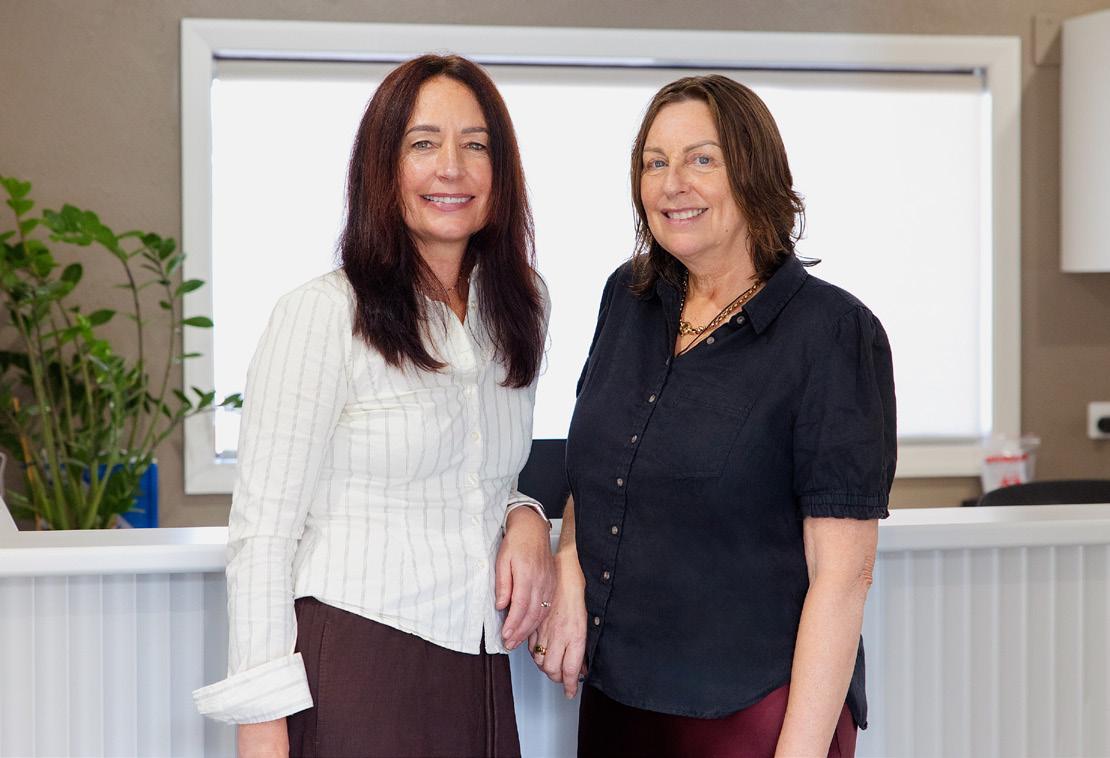
Where weight loss and appearance medicine are concerned, you want your goals to be deeply considered. This time, at these clinics, it’s personal.
PHOTOS DEBORAH DE GRAAF
Towards the end of UNO’s interview with Brenda Newman and Julia Perry, who run the Weight Loss Clinic at Fifth Ave Family Practice, I ask Brenda if there’s anything she says to her clients that really resonates.
“I tell them, ‘It’s not your fault – it’s not a lack of willpower.’” Does this strike a chord, I wonder? “It’s a very emotive topic,” she replies.
Weight – and losing it – is a topic very much in the public eye. Excitement around drugs such as Wegovy/ Mounjaro (the GLP-1 drugs available in New Zealand) creeps into conversations, and for those with healthimpacting weight issues, their use is being heralded
as a game-changer. The great thing is that although the GLP-1s are an option offered at this private clinic, it’s far from the only solution. Expertise and wrap-around support is an important component of the service.
The Weight Loss Clinic was established last year because of the impact obesity has on health. Brenda and Julia are both nurse practitioners with a background in the management of long-term conditions, SCOPE (Strategic Centre for Obesity Professional Education) certified by the World Obesity Federation, unflappable, non-judgemental and reassuring. Their service is built on the understanding that a desire to lose weight should be addressed without shame or stigma.


There are a multitude of factors at play when it comes to weight gain or obesity, whether genetic or circumstantial. Having expert guidance and support on what may be a lifelong journey is invaluable.
Brenda’s quick to point out that weight-loss drugs such as Wegovy and Mounjaro have exploded in popularity because they’re a hot topic in the media, but there are criteria and costs attached. There are also several other medications available; some act as appetite suppressants, others are targeted towards reducing cravings.
“A lot of people walk in with preconceived ideas, and that’s when we say, ‘Okay, that’s cool, let’s talk about all the medications that are out there, but let’s also talk about lifestyle.’ There are so many ways to assist,” says Brenda.
“We want to be able to talk about all the options –bariatric surgery, exercise, meal supplements, healthy eating,” adds Julia. “It’s important to be well informed.”
People can self-refer to the clinic whether patients of the practice or not. A thorough questionnaire followed by an appointment then helps to establish an action plan.
What’s essential to recognise, says Julia, is that “obesity is a long-term, complex, chronic condition that’s relapsing”. Ultimately, this sits at the very core of the clinic’s value: because the battle’s not won when the weight is lost, establishing a lifelong shift in mindset is critical. The ability Brenda and Julie have to provide ongoing support as they watch their clients recover their health, improve their self-image and gain confidence is exactly why this clinic was set up.
Contributing to Fifth Ave Family Practice’s holistic approach to health and wellbeing is its Cosmetic Medicine Clinic, run by Dr Kiran Singh and Dr Sam Mahesh. Kiran established the clinic (which he runs alongside his GP work) eight years ago, and Sam joined him last year. Both are heavily invested in the ethical practice around appearance medicine, and we discuss how standards have become less stringent as aesthetic treatments have become more mainstream.
As Kiran points out, “You can potentially be in the hands of someone who has trained through a YouTube video and set up a clinic. Our core business is in medicine. We’re grounded in safe practice and good clinical judgement, as well as cosmetic outcomes.”
Treatments such as Botox are ever more easily accessible, but it’s still important that the practitioner you choose is highly skilled. Says Sam, “Because the substances worked with have become so normalised, people have forgotten how powerful they are.”
As well as their medical qualifications, Kiran holds a Diploma in Cosmetic Medicine from NZSCM, completed, as Kiran puts it “for service excellence, really, and ensuring you’re the best in what you do”. Sam is currently working towards the same diploma.
Sam’s mantra is “enhance, don’t alter”. Kiran asserts that for the very best results, restraint is key. “It’s our job not just to provide the treatment, but to ask, ‘Is this required and reasonable?’.”
Both Kiran and Sam love the symbiotic relationship between the science of medicine and the art of aesthetics. Says Sam, “When you look at the way mental wellbeing can be tied in with physical appearance, it explains why helping improve people’s confidence is a real privilege.”
FIFTHAVENUE.CO.NZ
“ HELPING IMPROVE PEOPLE’S CONFIDENCE IS A REAL PRIVILEGE.”

Crafting timeless jewellery that celebrates love, legacy, and life’s special moments.
Our Mount Maunganui workshop and showroom bring together bespoke design, expert manufacture, repairs, gold buying and insurance services all under one roof.
With a full onsite manufacturing and repair workshop and qualified jeweller with over 34 years’ experience, your treasured pieces are always in skilled hands.
Ourdifferenceispersonal.
You deal directly with the jeweller who is creating or repairing your precious items, ensuring a level of trust, craftsmanship and attention that’s hard to find elsewhere.
Browse our retail showroom of rings, earrings, necklaces, bracelets and bangles, or begin a custom piece of your own.
Mon-Fri 8.30-5.00 | Sat-Sun closed Unit 18A Lambert Industrial Park, 23 Tukorako Drive, Mount Maunganui 07 5723434 | 0274 875106 | info@quantumjewellers.co.nz
quantumjewellers.co.nz

Registered nurse and director of Cashmore Clinic, Leanne Cashmore , says taking a seasonal approach to caring for your skin can make a significant difference to how it looks and feels year-round.
PHOTO SALINA GALVAN
If you ask me, winter presents the perfect opportunity to reset and repair your skin. Whereas summer is often focused on protection and maintenance, this time of year is all about nourishment, restoration and correction.
During the cooler months, humidity reduces, and cold air outside combined with indoor heating can leave skin feeling tight, dehydrated, flaky and more sensitive than usual. Many people notice increased redness, irritation or dullness, because the skin barrier – the outer layer responsible for retaining moisture and protecting against environmental stress – has become compromised.
In the skin industry, winter is widely considered to be ‘treatment season’. Reduced sun exposure and heat mean you’re able to recover more comfortably and effectively from advanced treatments, plus many professional
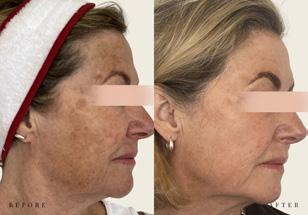
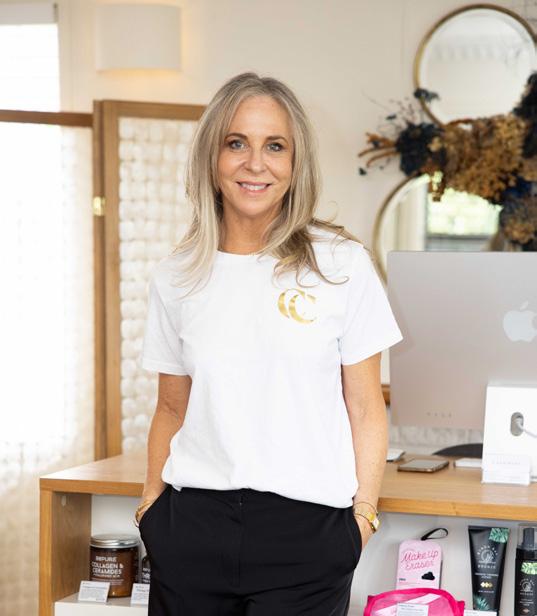
treatments increase sun sensitivity, making winter the safest time to achieve optimal results.
Resurfacing treatments are one of the most popular winter options. They work by exfoliating the skin, encouraging cell turnover, and targeting concerns such as pigmentation, congestion, uneven texture, acne and fine lines. Having such treatments in winter reduces the risk of post-inflammatory pigmentation. For safety and best results, laser treatments targeting pigmentation, redness, acne scarring, rejuvenation and overall skin correction are also best performed when sun exposure is lower. Laser technology works by creating controlled stimulation within the skin to encourage collagen production and improve imperfections.
The less-sweaty season is an effective time for microneedling too. By creating tiny micro-injuries within the skin, it stimulates collagen and elastin
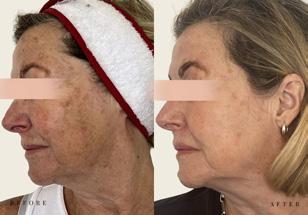
production to improve scarring, texture, enlarged pores and signs of ageing.
You have much to gain from even just a quick reassessment of your skincare routine. Avoid over-exfoliating and, ideally, use active ingredients under the supervision or guidance of a professional. For home care, look for ingredients such as hyaluronic acid, ceramides, glycerin and essential fatty acids that will boost hydration and support a stronger, healthier skin barrier. And remember, SPF is still non-negotiable. UV exposure remains one of the leading causes of premature ageing and pigmentation, whatever the weather.
A thoughtful reset can create longterm improvements that are difficult to achieve during sunnier seasons. Rather than viewing winter as a challenging time for your skin, I say see it as an opportunity.
CASHMORECLINIC.CO.NZ
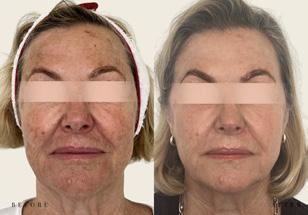
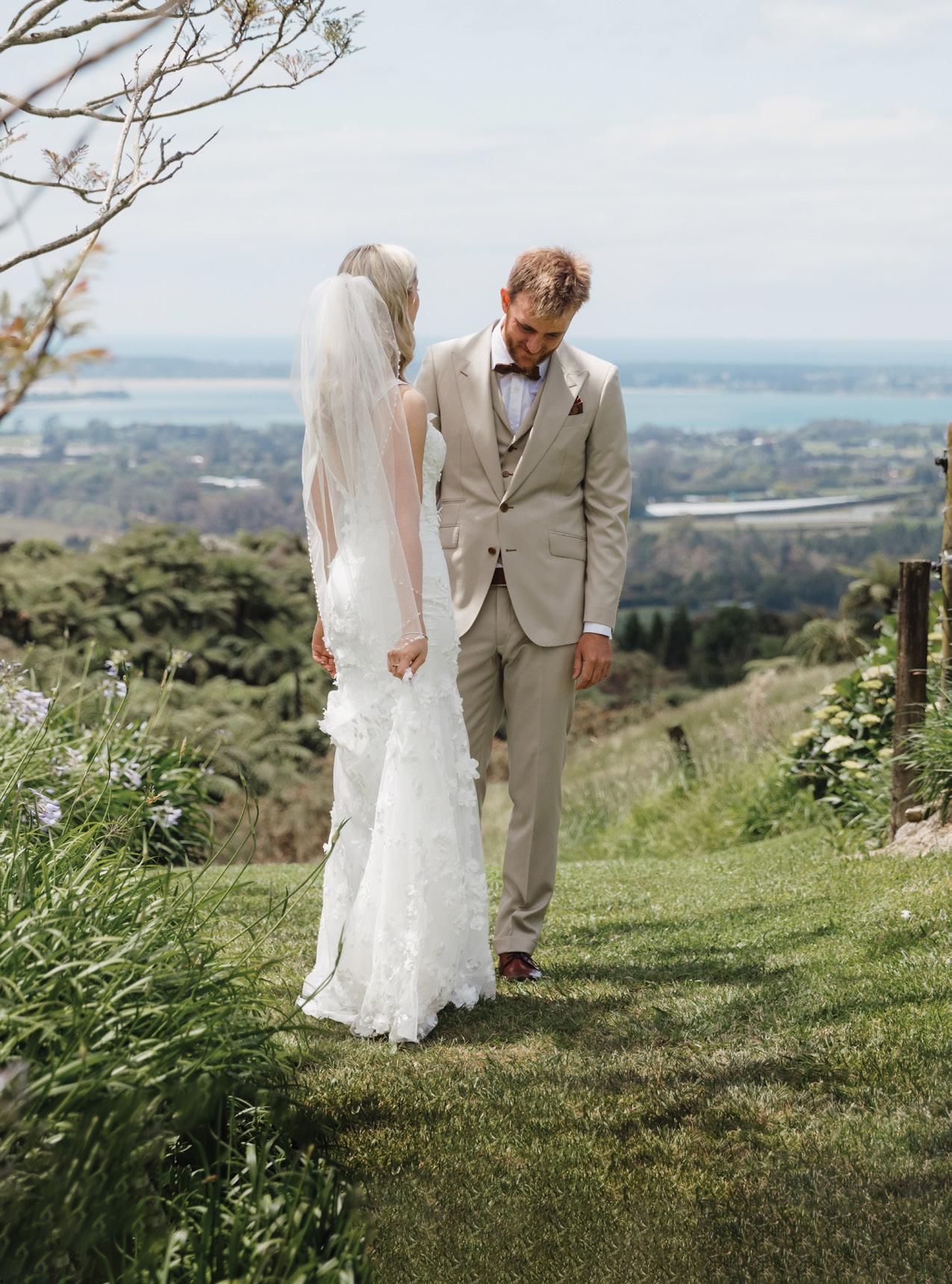
Hindsight may be 20/20, but you’d be better off having an accurate picture of your eye health sooner rather than later. Optometrist Mariam Baissy from Bay Eye Care explains why silent eye diseases often go unnoticed.
PHOTO SALINA GALVAN
As we age and our eyes change, serious conditions can develop long before we notice anything’s wrong. Helpfully, optometrist Mariam Baissy of Bay Eye Care is here to explain why some eye diseases can go unnoticed and how early detection and preventative measures can protect your vision.
UNO: Mariam, why do eye conditions such as these often go unnoticed until it’s too late? Mariam: Many eye conditions develop gradually and often without obvious symptoms. For example, glaucoma slowly damages the optic nerve, and macular degeneration affects central vision subtly at first. Because early changes are painless and vision loss can be gradual, people may not notice anything until the condition is advanced. If you have a family history, your risk is higher, making regular eye checks especially important, as they can detect these conditions early before noticeable vision loss occurs.
What exactly is glaucoma? Glaucoma is a group of eye conditions that damage the optic nerve, usually due to increased pressure inside the eye. It’s called the ‘silent thief of sight’ because it often develops slowly with no early symptoms. Peripheral vision is affected first, so many people don’t realise they have glaucoma until significant vision loss has occurred.

How does ageing increase our risk of conditions like this? As we age, the tissues and structures of the eye naturally change, which can increase susceptibility to disease. For glaucoma, the drainage system of the eye may become less efficient, raising eye pressure. In macular degeneration, cumulative damage to the light-sensitive cells in the macula –responsible for sharp, fine-detail vision – affects central vision. Genetics and lifestyle factors such as smoking and high blood pressure also contribute, but ageing remains a major driver.
What are the early warning signs of macular degeneration? Macular degeneration primarily affects central
vision, so early signs can include blurry or distorted sight, difficulty reading or straight lines appearing wavy. Glaucoma can advance silently, whereas macular changes, especially central distortion, may stand out more to the person experiencing them.
How much do lifestyle choices really influence the risk of eye disease? Lifestyle habits do matter for eye health. Diets rich in leafy greens, colourful vegetables and omega-3 fatty acids support retinal health. Smoking is a major modifiable risk factor for macular degeneration, and high blood pressure and obesity also increase risk. Even though genetics and age still play a major role, protecting eyes from UV light, staying active, and managing overall health can help slow visionthreatening changes.
What can be done for someone who’s diagnosed with glaucoma or macular degeneration? Early diagnosis is key. Glaucoma can be managed with prescription eye drops, laser treatment or surgery to reduce eye pressure and protect vision. For macular degeneration, lifestyle changes, nutritional supplements and in some cases injections or laser therapy can slow progression. For those with a strong family history, genetic testing, such as that offered at Bay Eye Care, can help assess risk and guide monitoring. Although these conditions can’t always be fully reversed, treatment can preserve remaining vision and maintain quality of life
BAYEYECARE.CO.NZ
INTERIOR DESIGN CONSULTANCY & PROCUREMENT
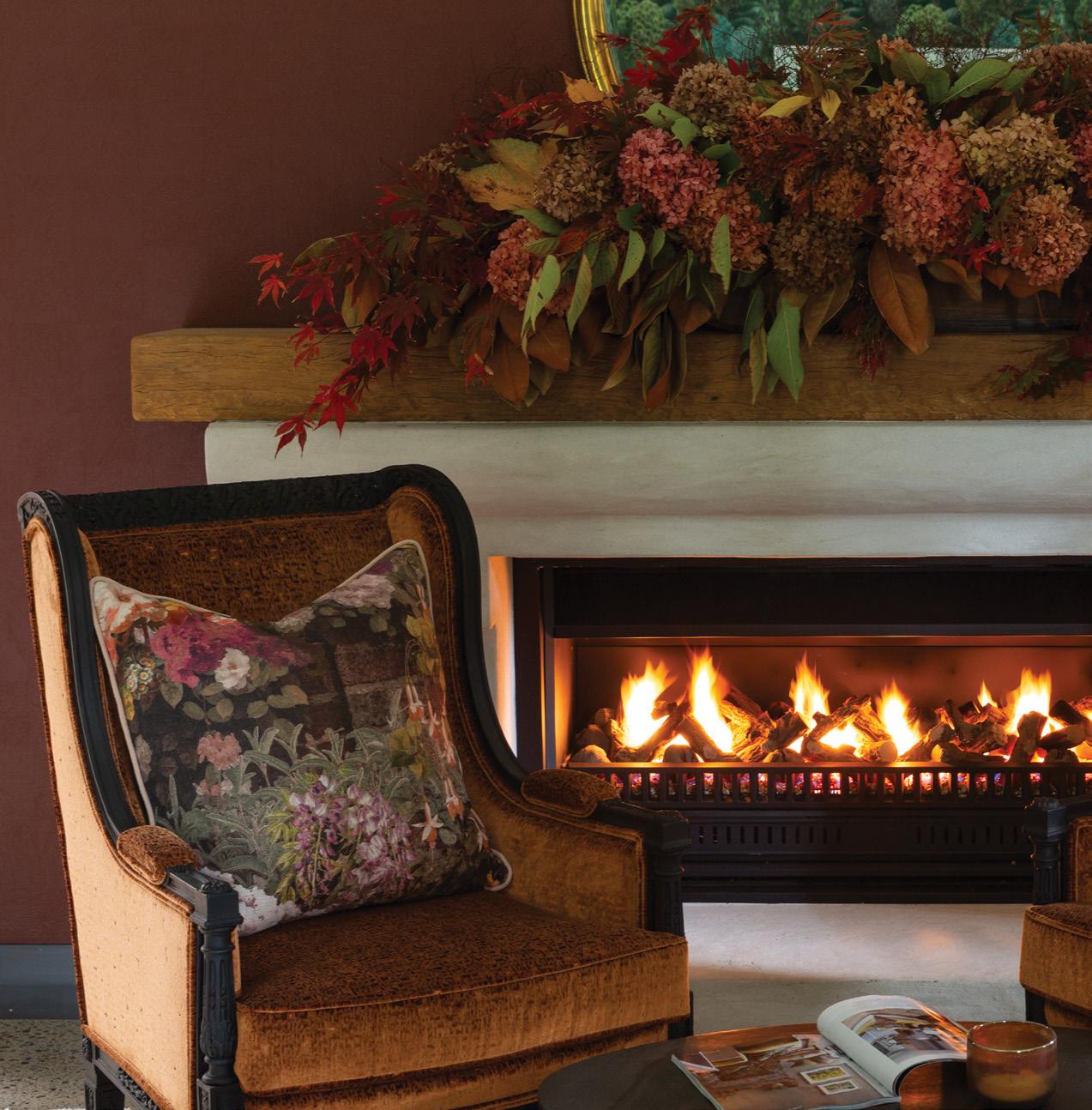
From beloved armchairs to timeless heirloom pieces, give your treasured pieces a new life with our bespoke reupholstery service with a carefully curated fabric selection. Visit our showroom and reimagine your furniture. Phone for an appointment at the showroom or your home.
24a James Road Te Puna, Tauranga Ph 027 2718568, info@designonjames.co.nz www.designonjames.co.nz Transform your pre-loved furniture with us
Celebrating the places and spaces we call home.
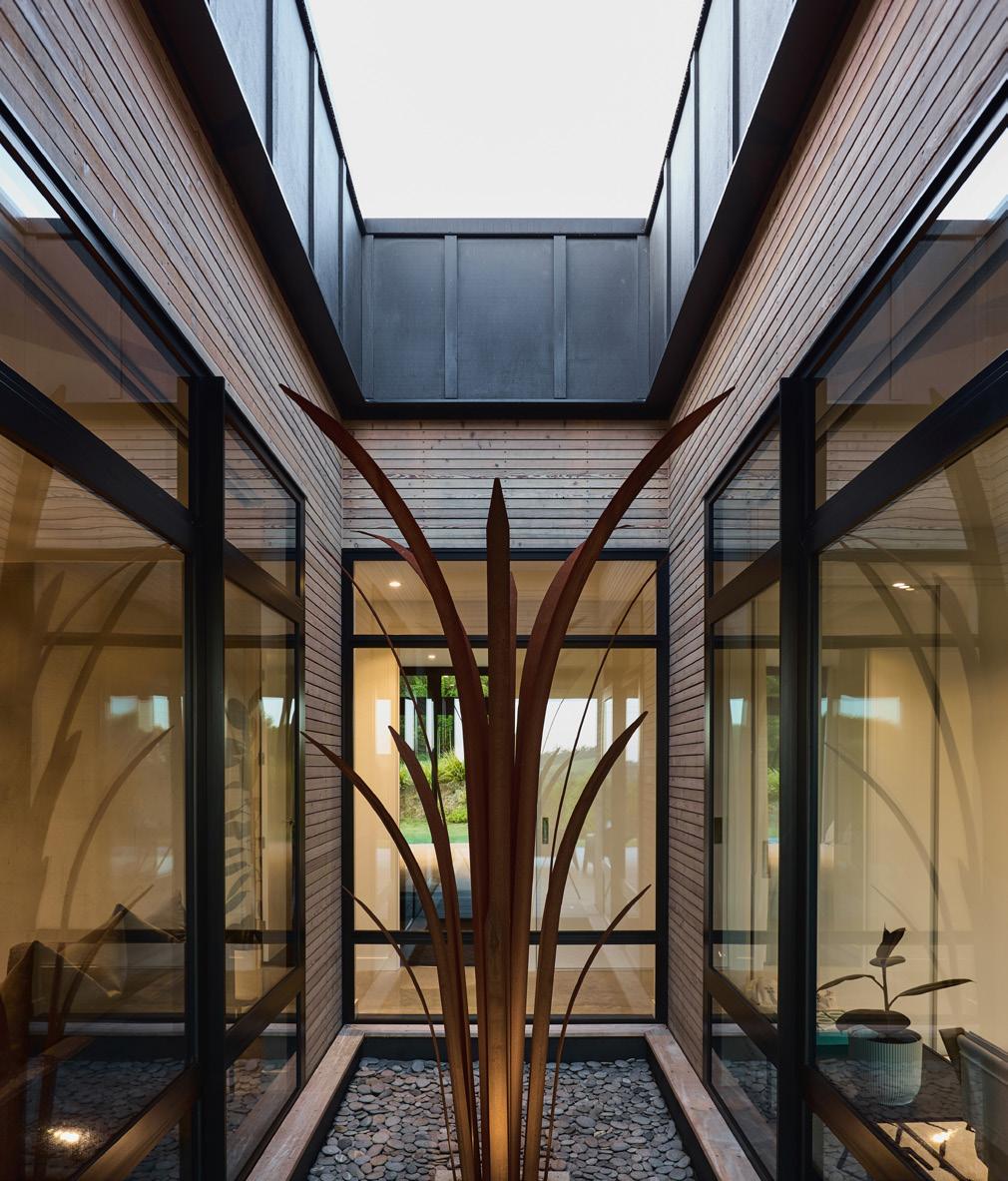
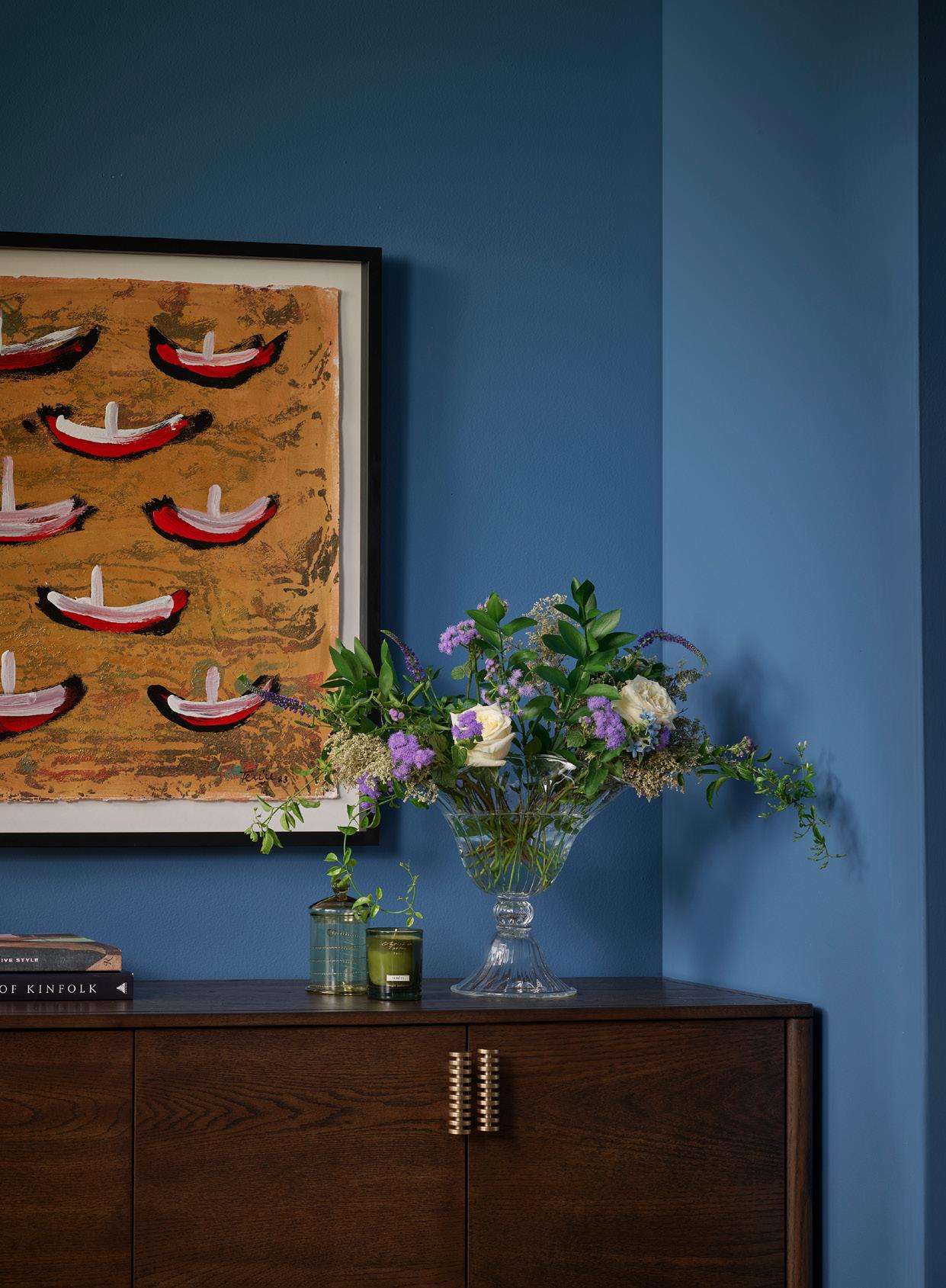
Reclaim the romanticism of eras past by blending a vintage aesthetic and timeless colour palette with clean lines and a modern twist.
STYLING AMBER ARMITAGE @ MARIGOLD
PHOTOS MELANIE JENKINS @ FLASH STUDIOS WALL COLOURS RESENE PAINTS
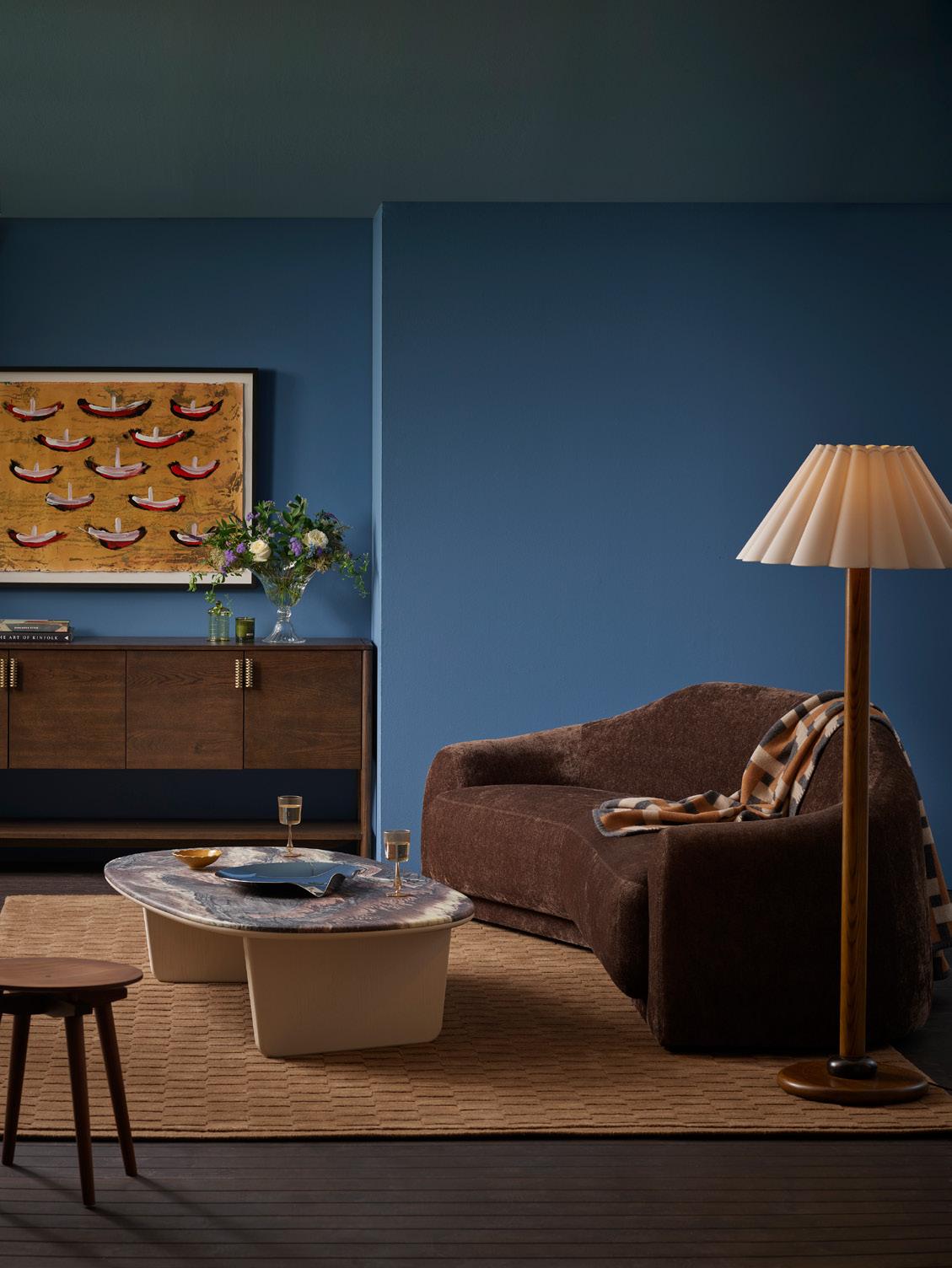
WEDGEWOOD BLUE IS AN ICONIC HUE DEVELOPED BY JOSIAH WEDGWOOD IN THE 1770S FOR HIS FAMOUS UNGLAZED STONEWARE. TODAY, IT REMAINS INTERNATIONALLY CELEBRATED. PAIR IT WITH DARK WOOD TONES AND RICH CHOCOLATES FOR AN ENDURINGLY ELEGANT LOOK.
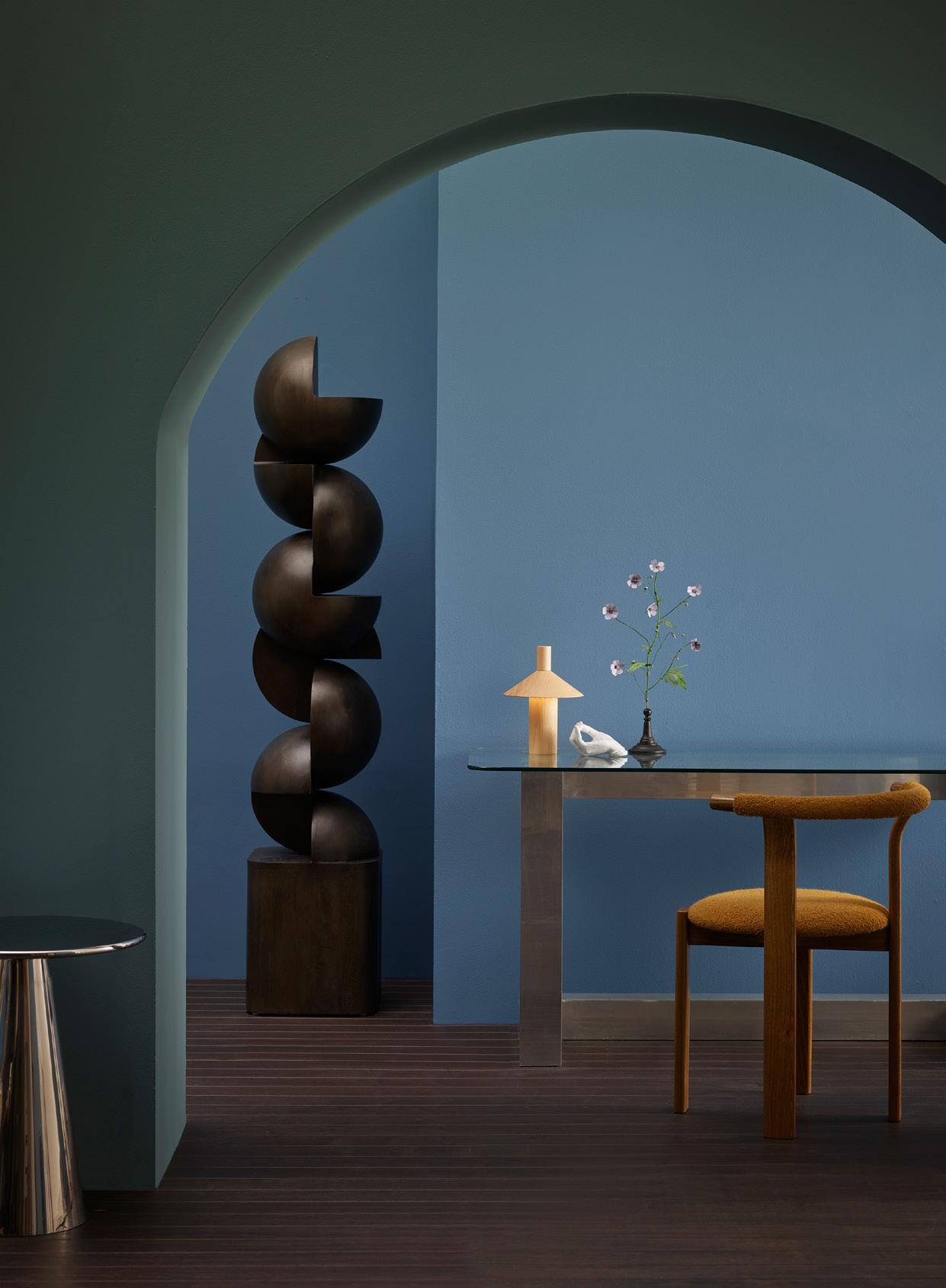
THE DARK CHOCOLATE TONES IN THIS PALETTE ANCHOR THE SPACE, WHILE THE POWDERY BLUE SOFTENS THE MOOD AND ADDS A REFINED CONTRAST.
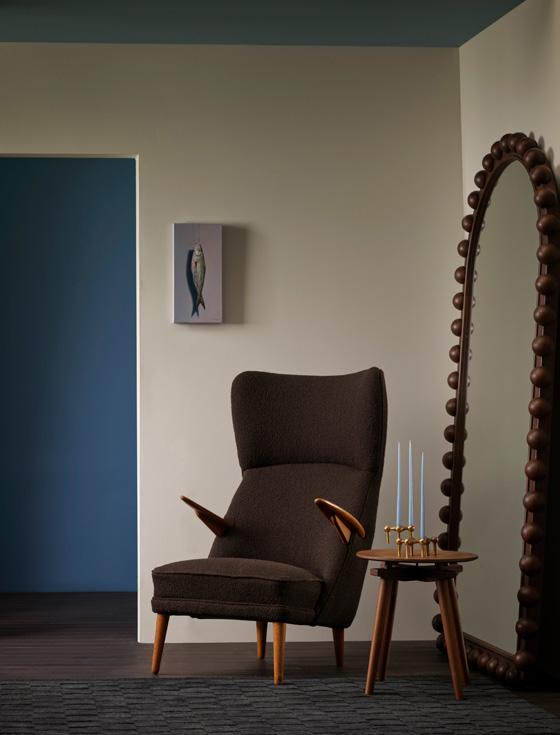
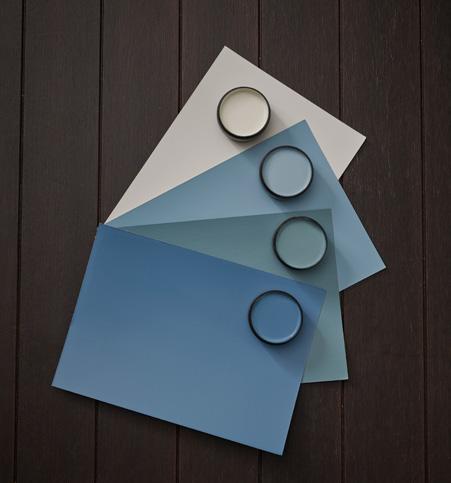
ABOVE: Background in Resene Colorwood in Resene Crowshead. A4 drawdown paint swatches and testpots in (from top) Resene White Pointer, Resene Blue Moon, Resene Blue Bayoux and Resene Wedgewood.
LEFT: Walls in Resene SpaceCote Flat in Resene Wedgewood and Resene White Pointer, floor in Resene Colorwood in Resene Crowshead. Hugo rug from Baya Kahawai by Helen Kerridge from Parnell Gallery Handsome Mid-Century Danish armchair from Mr Bigglesworthy CC stool by Rex Kralj and Nagel candle holders by Stoff Nagel from Good Form . Emilia mirror by Soho Home from Obery

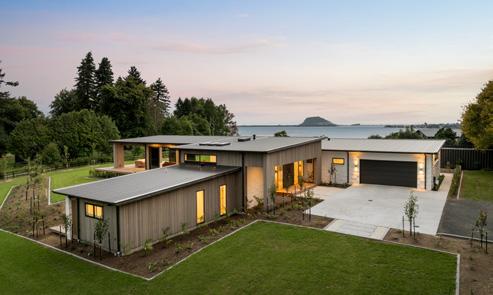
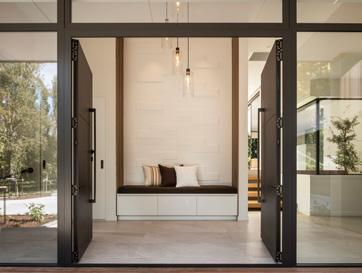
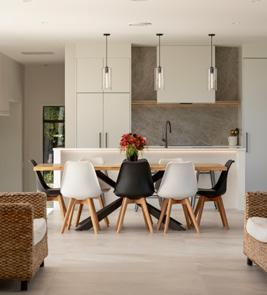
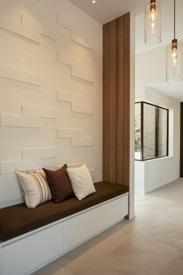
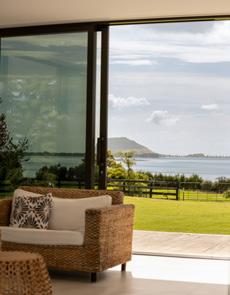
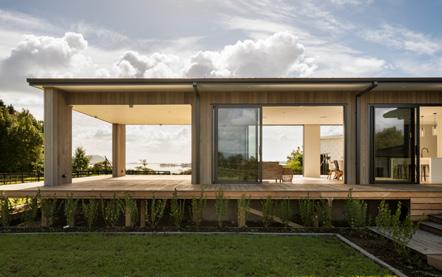
Options abound at this flexible, forward-thinking address, providing all kinds of opportunities to configure a lifestyle most can only dream of.
WORDS JO FERRIS
Located on a quiet country road, this property may seem to be as elusive as its setting – unless you’re familiar with Te Puna’s Cider Factorie Restaurant & Cellar Door, just down the road.
Although the restaurant offers a handy destination for dining out, it might prove hard to leave this haven set on impressive grounds. Lawns studded with young avocado trees and citrus, and gardens abundant with camellia surround two dwellings and a large shed that also doubles as accommodation.
Gated entry sees only the shed visible from the road. The main home is the jewel of the crown. Sitting atop the ridge, the prowess of Stufkens + Chambers Architects captures gorgeous scenery. To the north-east, views stretch across Tauranga Harbour to the Mount; to the west, the Kaimais.
The raised-pavilion approach to the design places floor-to-ceiling glazing and stacker doors on three sides, allowing the sun to be followed from morning till night. Wrap-around decking includes space for seating that greets the sunrise on the horizon, and an outdoor pavilion in which to listen to the birds in the redwoods next door and enjoy the sunsets in the west. Tucked into one corner here, a BBQ snug offers shelter and bar-style serving from the scullery.
Separate wings on either side of the main pavilion support individual downtime. Two bedrooms in one wing share a luxury bathroom and garden, whereas the primary wing is characterised by a desire for privacy. Its sleep space is attached to a sanctuary-like bathroom, adjoins a studio that promises to be a musician’s
idea of nirvana and extends into an enclosed garden courtyard. A media room in this wing creates a place in which the whole family can gather.
The boutique appeal of this property’s separate, two-bedroom minor dwelling is enhanced by a swimming pool and cabana. Bathing here is also an indulgence outside the norm. As well as an indoor bathroom, a sunken bath is tucked into a screened corner of the deck, in which you can raise a toast to the stars. Meanwhile, mezzanine storage in the high-stud shed increases options for its use.
Individually, each building provides genuine versatility. Combined, they provide extensive opportunities. Still in its infancy, this property will undoubtedly come to deliver a rich legacy.
32 Oikimoke Road, Te Puna OLIVERROADBAYOFPLENTY.COM
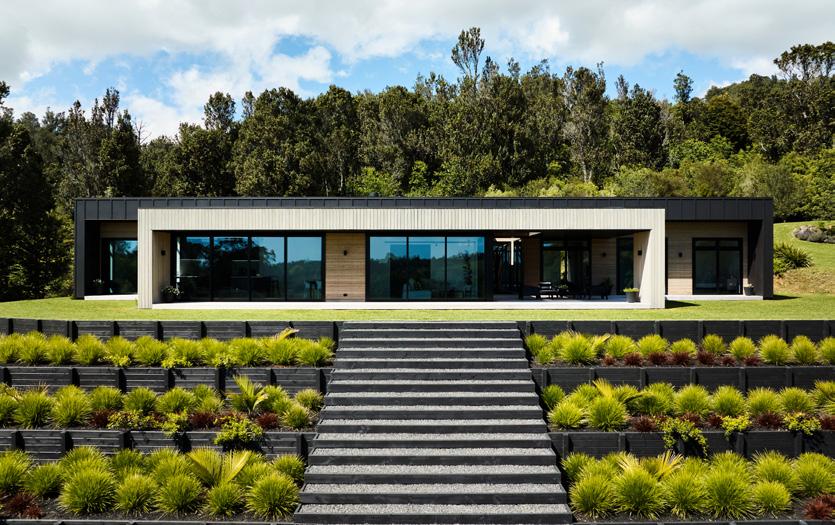
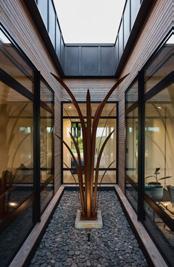
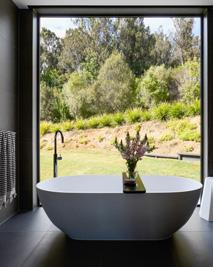
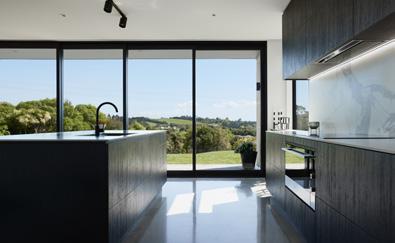
Perched amid nature, this peaceful property showcases refined minimalism and breathtaking rural vistas.
WORDS JO FERRIS
The serenity of rural seclusion is absolute in this hidden pocket in the Western Bay. Nestled at the end of a private lane, this home’s elevated position above a vast lawn makes an immediate impression. It presents the advantage of views, while the backdrop of towering trees suggests prolific birdlife.
Given the home’s young age, there’s ample potential to develop the grounds for playground pastimes. The owners have planted numerous fruit trees and sown banks with wildflowers, herbs and lavender. Tiered gardens in front of the house complement its clean lines, while hinting at the style behind its vision.
Mindful of melting into nature, not dominating it, the home’s designers have mastered the art of restraint, but the simplicity of minimalism hides the intricacy behind it. It’s not easy
maintaining that concept, but this home achieves it with respectful appreciation.
It begins with the formal welcome at the massive pivot front door. The connection between outdoor elements and rooms inside – while unobtrusive – are evident throughout. The horizontal thread of the larch exterior cladding continues on feature walls inside. Full-height glazing ensures nature and views are always in sight, while recessed, motorised blinds maintain the clean look of minimalism.
The heart of the home revels in sun and a country outlook. Devoid of any clutter, it adheres to the restrained philosophy with extraordinary skill. The kitchen showcases bold, dark-toned, textured cabinetry, negative detail and integrated appliances, while the hidden scullery enjoys the appeal of open shelving.
Banks of stacker doors instil a seamless link with outdoor relaxation. Polished concrete flooring is finished with
a salt-and-pepper tone, putting a new slant on concrete’s functional appeal and capacity to harness solar warmth. Zoned underfloor heating is there if required, though, including in all three bathrooms. The media room has the mood of a flame, brought by its cosy gas fire.
The owner's privacy is assured in one wing, which includes an office for work; while an ensuite guest room and remaining bedrooms offer options in the far wing. Every bathroom is fully tiled and similarly designed with dark allure and a no-fuss approach, except for the main bathroom, where the white oval bath is the star in front of a fullheight window for a garden outlook.
Complex simplicity underpins this extraordinary home. Its promise of privacy at one with nature cannot be emphasised enough.
6H Ainsworth Road, Minden OLIVERROADBAYOFPLENTY.COM
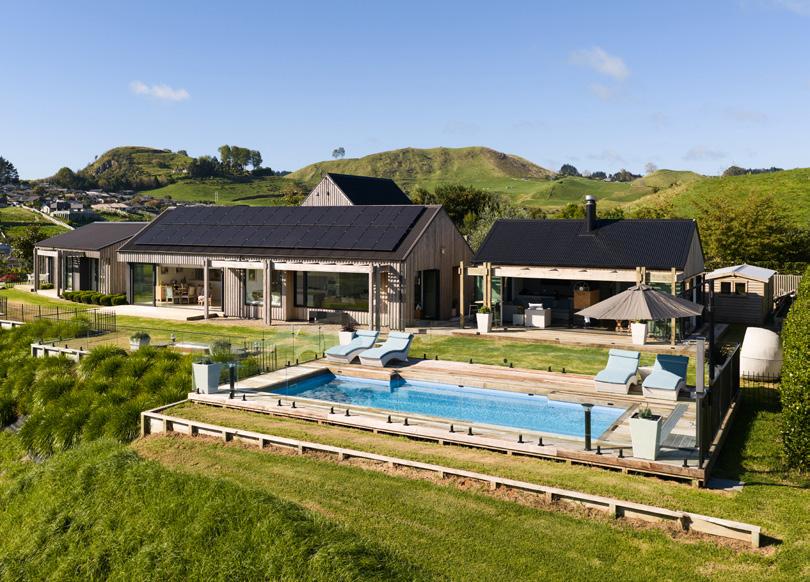
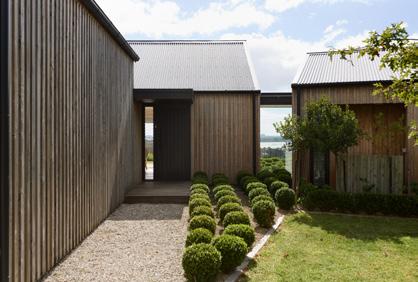
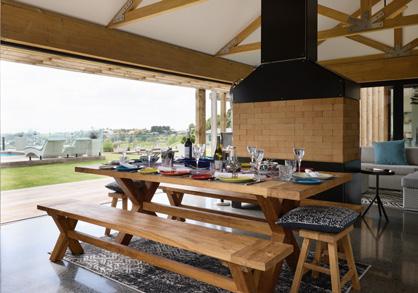
Step into a world in which it’s Mana by name and a sense of mana by nature.
WORDS JO FERRIS
In the exclusive enclave of Mana Ridge, Welcome Bay, this home marries the charm of a country house with the finesse of skilful contemporary architecture. The site occupies the pinnacle of this private estate, which is home to just 13 residences.
Designed by Adam Taylor of ATA, the house is clad with Lawson cypress board and batten, and is slowly achieving Adam’s goal for it to develop a gentle patina over time. The result lends it the comfort and familiarity of a farmhouse that belies the modernity and up-to-the-minute thinking within. Three gabled wings play to the property’s strengths. Built to capture the panoramic views, they provide a sweeping outlook that embraces the city, the harbour and Mauao, as well as the western outlook towards the Kaimai Range. The wings
have different perspectives, but share common ground in their dawn-todusk brilliance.
Among the trio of bedrooms in the eastern wing is a sound-proofed main suite with a glass-corridor entry that provides both separation and connection. A fourth sleep space with its own ensuite sits above the garage.
Soaring ceilings and thoughtful design in the heart of the home guarantee the sun, views and garden support every aspect of family life. Courtesy of a generous window with an inviting built-in seat, Mauao is the star of the kitchen. On either side, the dining and lounge areas have their own special links with the scenery. So pivotal is the outdoors to the lifestyle here that there’s even an alfresco ‘restaurant’. A recent addition, it stands alone as an entertainment destination, yet remains in harmony with the rest of the home. Divided into living and dining
areas, this substantial space is anchored by an impressive Argentinian barbecue. Large glass sliders open onto expansive decking designed to enhance the party.
To the rear of the house, a taste of Tuscany emerges in a sheltered courtyard in which olive trees evoke the Italian influence. This is another fabulous entertaining space and assures safety for children and pets; it comes complete with a playhouse. The final high-end elements in this area are a sunken gas fire pit and a heated, saltwater swimming pool.
Underfloor and ducted heating, solar panels and a Tesla battery are a few of the other fantastic features to write home about at this landscaped beauty, and help to bring some thoughtful sustainability into the property’s powerfully prestigious picture.
23 Te Auhi Way, Mana Ridge, Welcome Bay OLIVERROADBAYOFPLENTY.COM
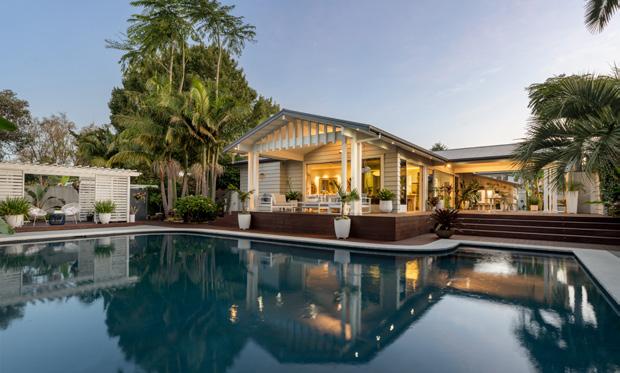
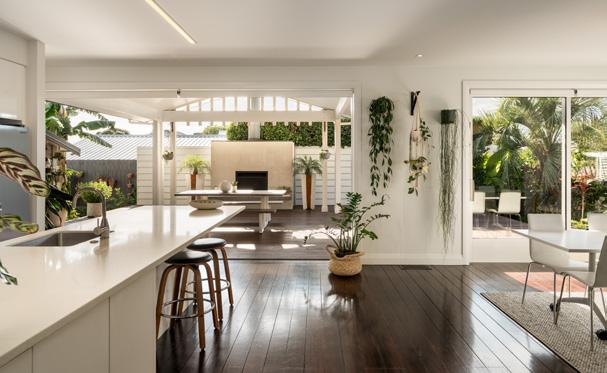
The best of the past has been woven into the update of this stately abode, where all the mod cons combine with beautiful bones to usher in a very bright future.
WORDS JO FERRIS
Acertain level of grandeur and grace often requires the infusion only time can bestow. This property, in a prominent position on an elevated corner amid Tauranga’s mid-city avenues, is home to all the distinction that yesterday brings to today.
When commissioned to design a major renovation that capitalised on the existing dwelling’s link to the swimming pool and outdoor entertaining area, Tauranga architect Brendon Gordon brought with him his own distinctive style.
Outside, towering, tropical greenery forms the framework for the resort-like feel he’s leaned into at this address. Its soothing, relaxing energy, which can be enhanced when the mood strikes by an in-built sound system, can’t be emphasised enough when describing the home’s presence.
The pool’s tropical ambience is integral to this. A warm-water bore allows yearround use, and upgrades to the pool and
pumphouse equipment ensure it will need only standard maintenance for years to come.
The resort vibes provided by the pool underscore the updated living area. Additional to this main living space, a separate snug provides a private retreat for family members of all ages to enjoy their own entertainment, and is linked to the outdoor, fire-warmed loggia.
The kitchen and scullery’s timeless ambience is elevated by the richness of dark-stained rimu flooring, which contrasts impeccably with the rest of the décor’s neutral palette. The contemporary tone of these spaces means this family hub will be able to adapt to any future change of taste in furnishings, artwork and plants.
Upstairs, in a very spacious zone, with a dressing area, study and balcony attached, the main bedroom champions privacy. A second bedroom on this level could double as a private lounge or lend itself to the development of an ensuite. Two bedrooms sit separately in another
wing, offering the flexibility to accommodate extended family, friends, or paying guests, perhaps? The inclusion of a lounge, kitchenette, bathroom and private entry deliver options aplenty.
As with many of Tauranga’s most distinguished homes, each chapter of this house’s life has brought with it different ideas and changing ways, but here, time has been extraordinarily kind. The house has evolved into a residence of substance and elegance, its significant space throughout and substantial outdoor areas a rare find on a quarter-acre section.
Handy to all of Tauranga’s inner-city drawcards, there’s one particular attraction Oliver Road’s Jason Eves and Ben Hawan say they must mention. Just down the road, Fourteenth Avenue Fish ’n’ Chips is known by locals to offer some of the best takeaways in town. “Everyone on Grace Road knows Eddie.”
Like the prospect of this exceptional home, it’s a tempting thought.
73 Grace Road, Avenues OLIVERROADBAYOFPLENTY.COM
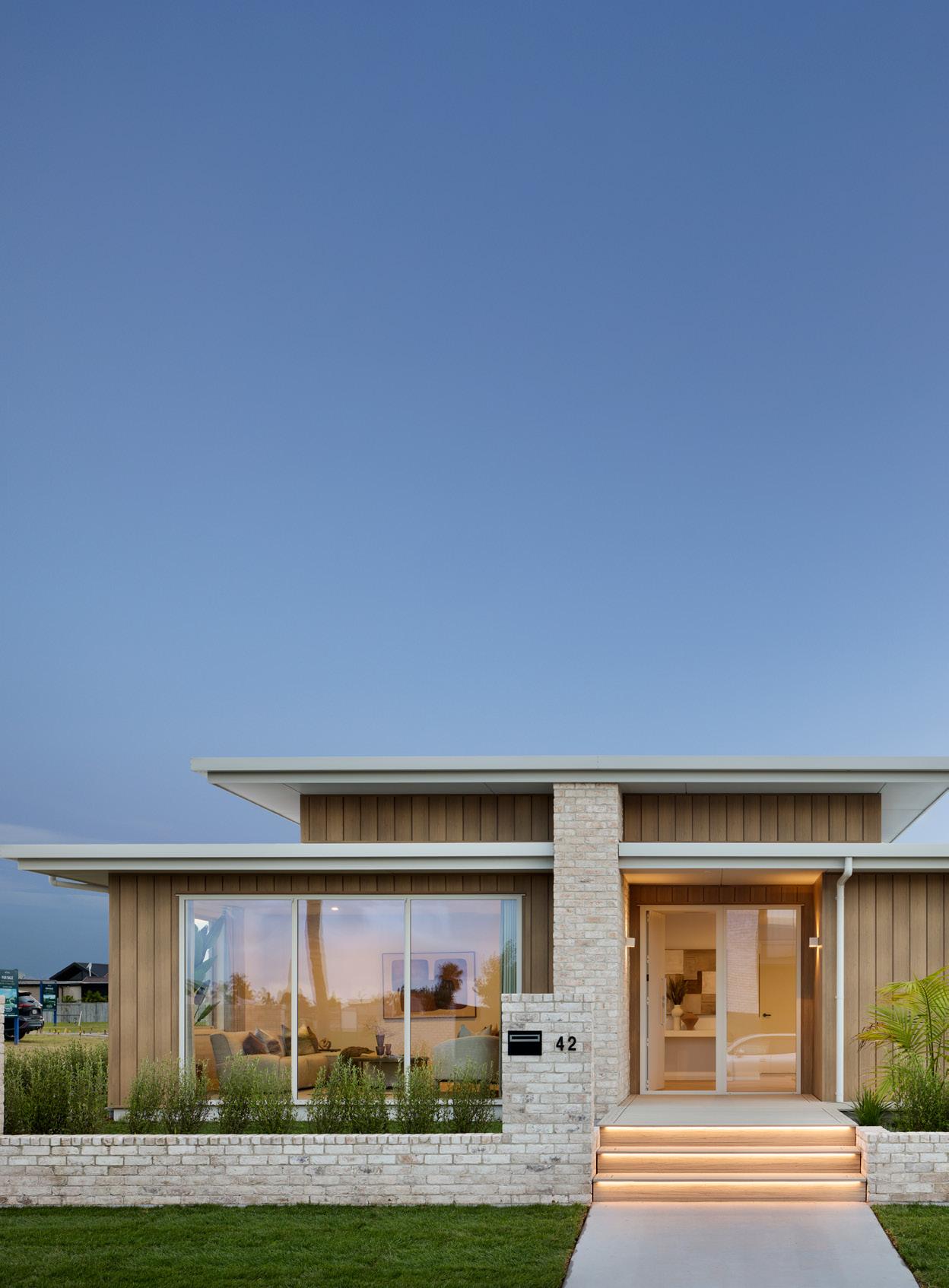
Welcome to a chic new Harwood Homes showhome that’s all but unrivalled for the adaptability and opportunity it’s been meticulously designed to provide.

The value of a showhome to a home buyer cannot be overstated. Eliminating the need to imagine how a house might look and feel based on plans or an online description, it’s all laid out in front of you, with an open invitation to come on in.
The pros at Harwood Homes know this well. Worth its weight in gold for all involved, one of the latest and greatest embodiments of enviable architecture is their new Palm Vista showhome. Impeccably designed for all kinds, but perhaps especially those who seek to invest once and invest well by catering for their every age and stage, it exemplifies the innovative thinking the company is known for, bringing together fresh ideas, evolving trends and modern ways of living.
In Pāpāmoa East’s upmarket Palm Springs subdivision, Palm Vista is positioned in a cul-de-sac near the Wairakei Reserve, and is one of 11 Harwood Homes planned for this neighbourhood. All reflect Harwood’s focus on thoughtful, distinctive design that achieves a subtle cohesion across the streetscape while imbuing each dwelling with its own character.
Palm Vista is the flagship property among Harwood Homes’ Flexible Living Collection, and is guided by the Flexible Living philosophy centred on flexibility, futureproofing and the creation of homes that move to the rhythm of modern life. It reflects the belief that a home should evolve as you do – supporting changing family structures, working patterns and life stages in spaces designed to respond to your individual needs.
A key source of inspiration for Palm Vista came from an unexpected source. While developing the concept, Harwood’s general manager Trish Hoit drew parallels after observing at New Zealand Fashion Week the way clothing is designed to move with the wearer, adjust to their lifestyle and remain relevant long term. Her insights naturally translated – after all, if fashion can evolve with people, why can’t homes do the same?
First impressions of the possibility-filled showhome reveal a spacious, elegant dwelling, with expansive windows harnessing every opportunity to draw in natural light. The arrival experience is welcoming, ushering you inside as the four-bedroom home reveals itself through a series of carefully considered spaces and layered design elements. As they unfold, the true wealth of possibility becomes apparent.
At the centre is a living hub that reflects the talents of Harwood’s team of suppliers and contractors, whose work helps to define the expert craftsmanship and quality execution Harwood Homes is known for. An entertainer’s dream, the open-plan kitchen brings
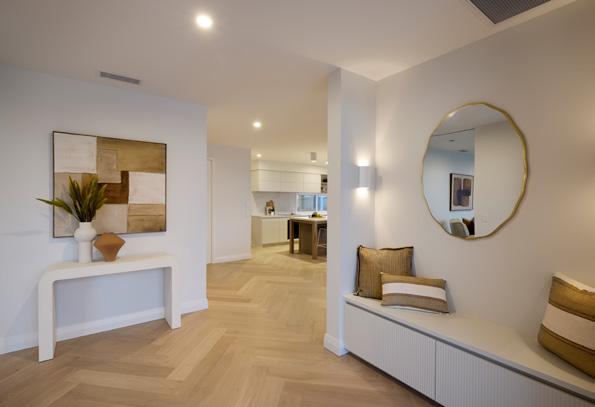
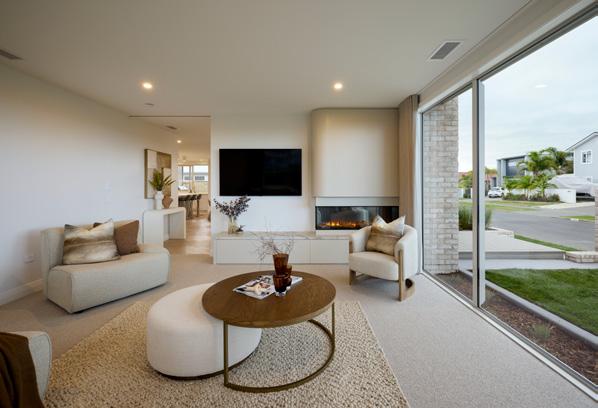
everything and everyone together. Flanking the central gathering point – the clean, contemporary island with a subtle ‘chain’ pattern inset behind the bar seating – complementary cabinetry leads towards the scullery. Full-height units, floating shelves and integrated lighting add depth and refinement, all with a high-end finish.
From here, you can spread out into the indoor living spaces or outside to the barbecue kitchen, where the showhome’s indoor–outdoor connection comes into its own. Covered for year-round versatility, this external living area expands the entertaining spaces with a barbecue, drinks fridge, sink station, and wood fire that catches the eye with its feature column that echoes the Italian-inspired brick detailing repeated cohesively throughout the house.
Inside, engineered European oak flooring and other oak elements in a soft grey stain and are integral to the material palette, with the flooring’s classic
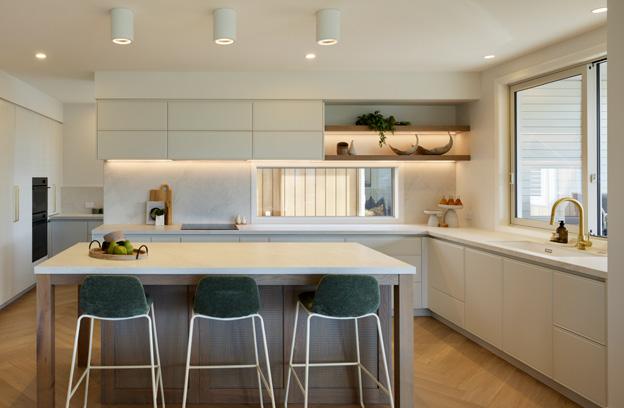
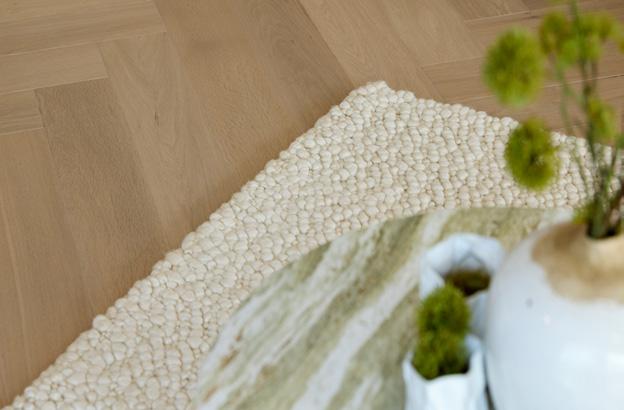
herringbone pattern adding gorgeous visual texture. At night, when the floor-to-ceiling linen drapes are drawn, the atmosphere softens to become intimate and restful. The window coverings’ tone-on-tone colour scheme is designed to blend into the neutral décor, while an inset ceiling track keeps the finish chic and uninterrupted.
Making bedtime more of a luxury than ever, at one end of the home, the master suite anchors a quiet, private zone complete with an ensuite, and a walk-in wardrobe defined by oak cabinetry and bespoke lighting. At the opposite end of the house, two bedrooms live in a separate wing, teamed with a bathroom that can comfortably serve family members or guests.
In another nod to this home’s versatility, an independent guest bedroom demonstrates its flexibility via its own lockable external entry, teaand-coffee-making facilities, integrated wardrobe storage and bathroom. It’s designed to perform beyond the average bedroom by facilitating a range
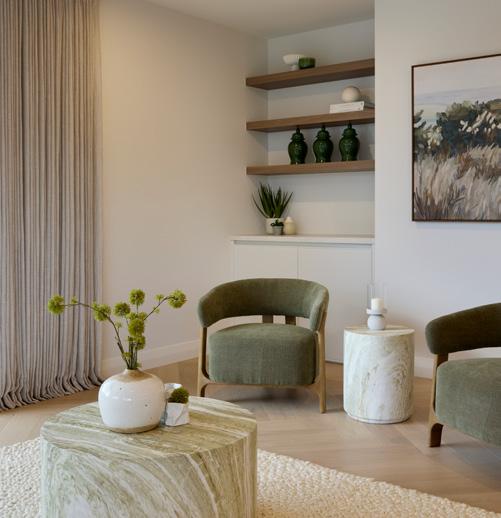
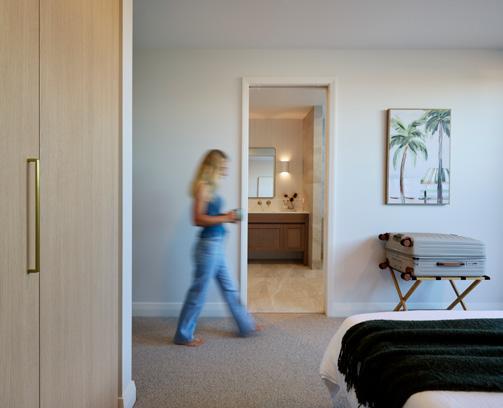
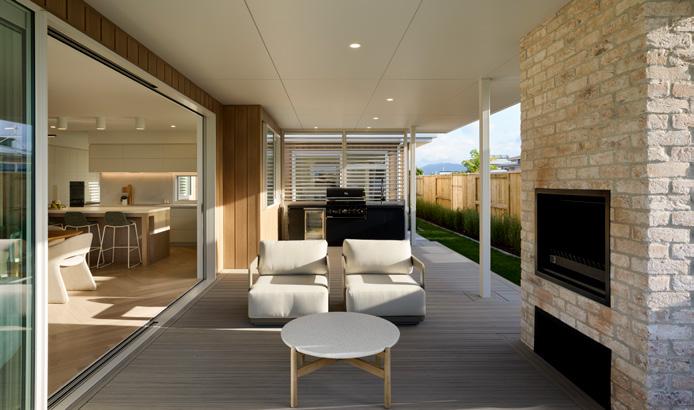
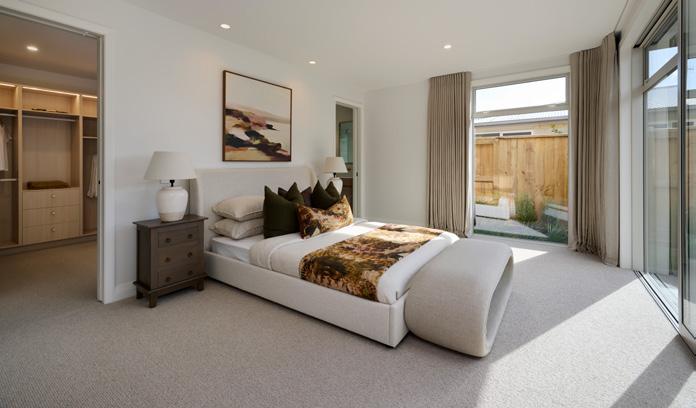
of scenarios – transforming into a private workspace, shared intergenerational living, a guest suite for family and friends, or a B&B arrangement.
Completing this wing’s layout, a dedicated office sits nearby. The showhome’s well-appointed laundry is inserted between the hallway and garage, optimising the practicality of this utility space by offering easy access for everyday use, without interrupting any of the goings-on in the main living areas.
It’s all part of family-owned Harwood Homes’ vision for the future of housing. In keeping with their longterm thinking, this entire abode is primed to adapt to your needs. Wider passages, generous doorways and level-access showers support ease of movement, and along with the income potential enables the home to remain relevant through every stage of life.
When every dollar counts, you want to be sure your hard-earned money is being spent on a home that’s
the perfect fit. The lifestyle-led Palm Vista showhome opens the door to a 3D version of the plans you can try on for size – and the brand’s design and build service throughout the Bay of Plenty means these plans can be adapted to suit sites and requirements region-wide.
Recognised nearly every year in the Master Builders House of the Year awards, Harwood Homes has built a long-standing reputation for quality, innovation and consistency. What began as a small local builder has grown into a dedicated team of architectural and interior designers, builders, suppliers and contractors, yet the philosophy remains unchanged: to work alongside the best in their field. The Palm Vista showhome reflects this collaborative approach, while signalling the direction of future projects.
Visit the showhome at 42 Forstera Way, Palm Springs, Pāpāmoa, Thursday to Monday, 11am to 4pm.
HARWOODHOMES.CO.NZ


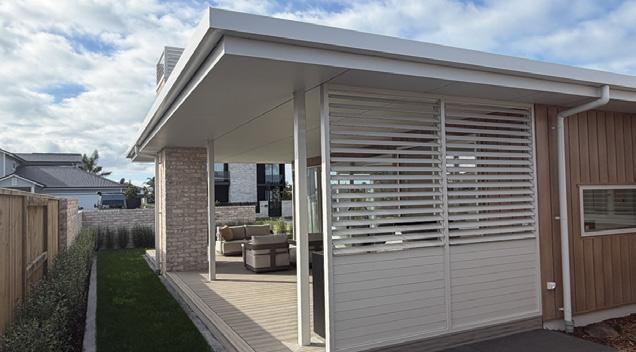
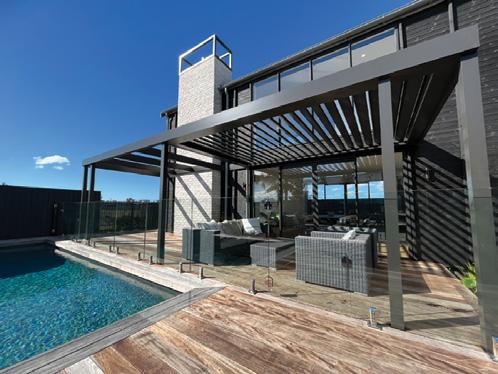
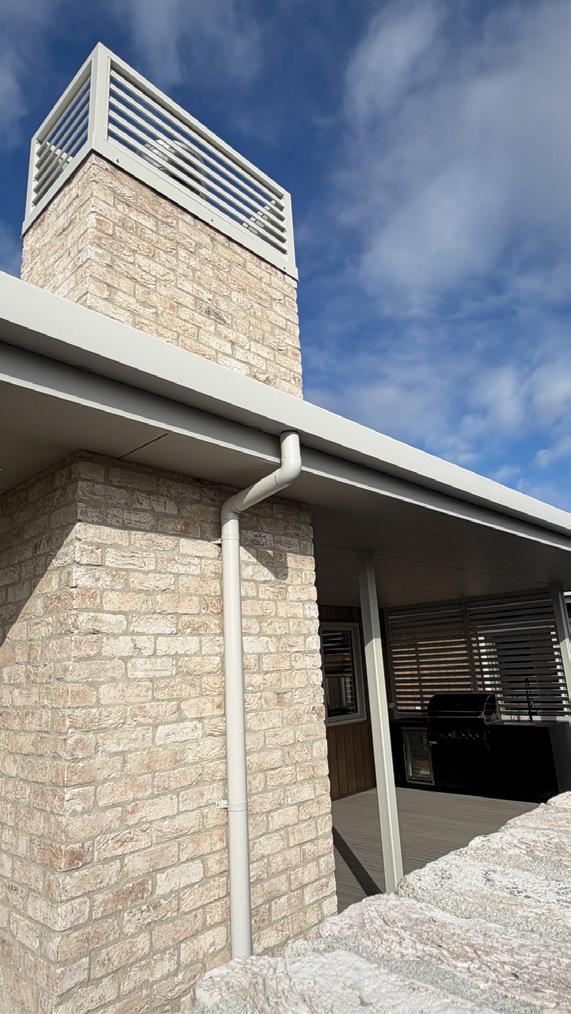
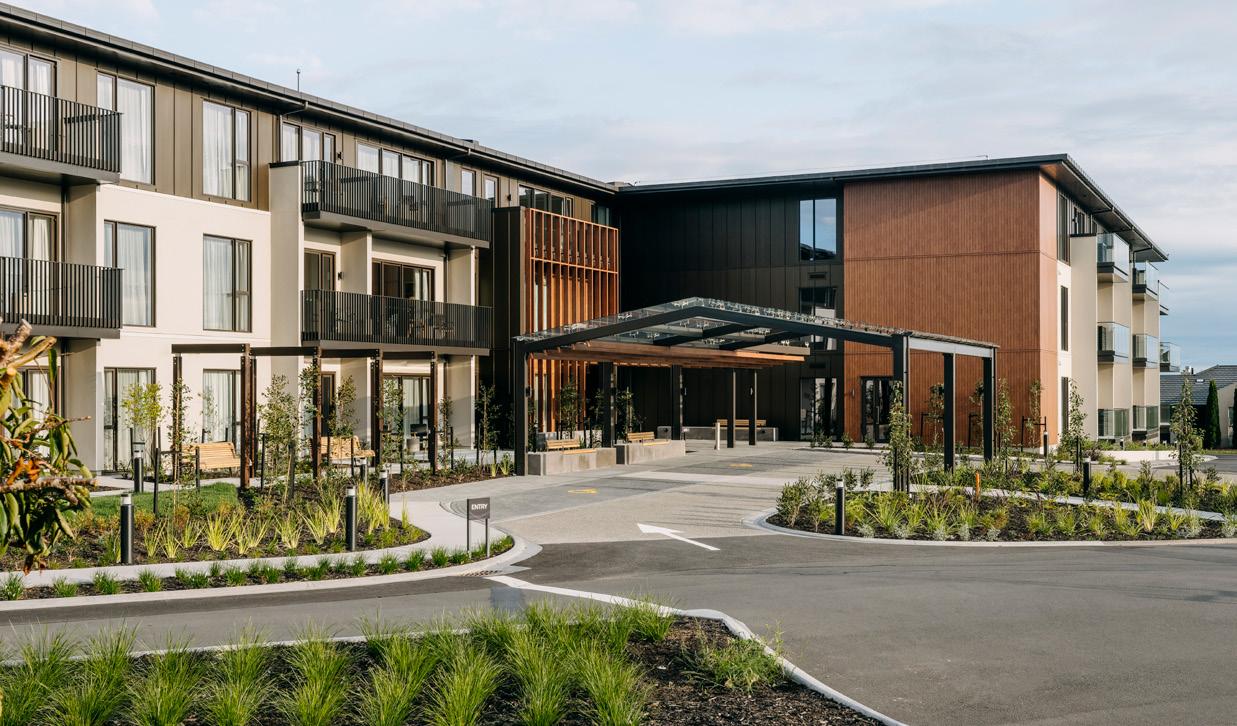
Luxury retirement village Bethlehem Shores has been gradually but purposefully evolving into a resident-led community designed to meet every contemporary need. A $100 million expansion has taken it there.
PHOTOS SUPPLIED
These days, age is more of a mindset than a number. We’re living longer and keeping active and social for many more years than previous generations. In response, retirement living is undergoing a huge evolution. The old-school institutionalstyle facilities are disappearing, as villages adapt to match the more modern lifestyle focus desired by the modern 60-something.
This is becoming more and more evident at Bethlehem Shores. The release of 53 apartments marks the final stage in the expansion of the established retirement
community in Bethlehem. While Bethlehem Shores has long offered villa living, the apartments introduce a different lifestyle option within the community, reflecting a broader shift in how retirement living is evolving.
Apartments offer an alternative to standalone homes, with a focus on low-maintenance living. For some residents, this can mean fewer day-to-day responsibilities and more flexibility in how they spend their time, while still maintaining independence and privacy. Apartments come in one-, two- and threebedroom layouts. Open-plan living areas and large windows have been used to bring in natural light
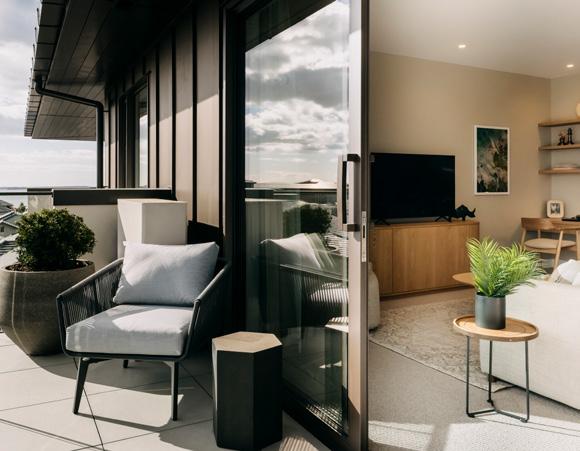
and make the most of the surrounding views. There’s also an emphasis on amenity, accessibility and ease of movement throughout the spaces.
Increasingly, people are looking for housing that feels manageable, adaptable, and aligned with how they want to live day to day.
Village manager Brian Bark describes the apartments as an important step in the retirement community’s development.
“This is the last major stage of development at Bethlehem Shores and we’re very proud to be able to offer more choice to residents in the form of apartment living,” he says.
The apartments sit within the existing village environment, meaning residents remain connected to established amenities and services. Shared spaces include spacious lounges, activity rooms, a café, a hair salon and a range of outdoor areas. These provide opportunities for both social interaction and quieter day-to-day use, depending on individual preferences.
The layout of the apartments also considers the balance between privacy and proximity. Although each home is self-contained, they’re located within easy reach of the communal areas, for social get togethers, events or visits from family and friends.
The apartments are also close to Bethlehem Shores’ established clubhouse, which continues to play a central role in village life. The impressive space includes a range of shared amenities and areas for socialising, activities and gatherings, and is already
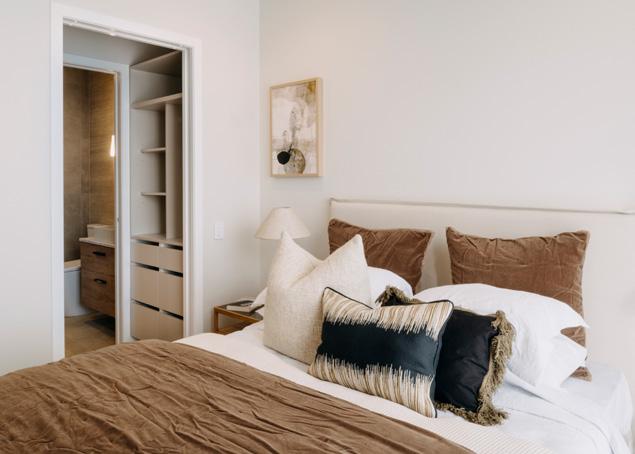
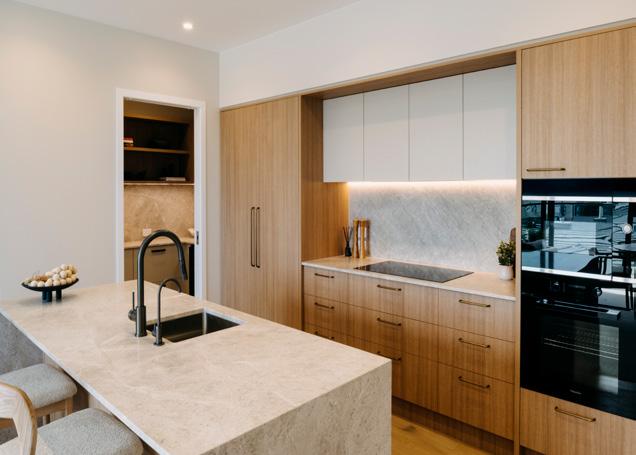
a well-used part of the existing community. Apartment residents will have full access, adding another layer of connection to the wider Tauranga retirement community.
Alongside the brand-new apartments, a new care centre has been built within the community. It includes care suites that offer rest home, hospital and dementia-levels of care to residents.
“For those living at Bethlehem Shores, it provides added reassurance that if their needs change over time, they can remain within the same community and receive the right level of support, without the disruption of moving elsewhere,” says Brian.
A key part of village life in Arvida’s retirement communities is the focus on resident-led activities. Rather than a set programme, many of the social groups, events and day-to-day activities are organised and driven by residents themselves. This can include anything from yoga classes and walking groups to
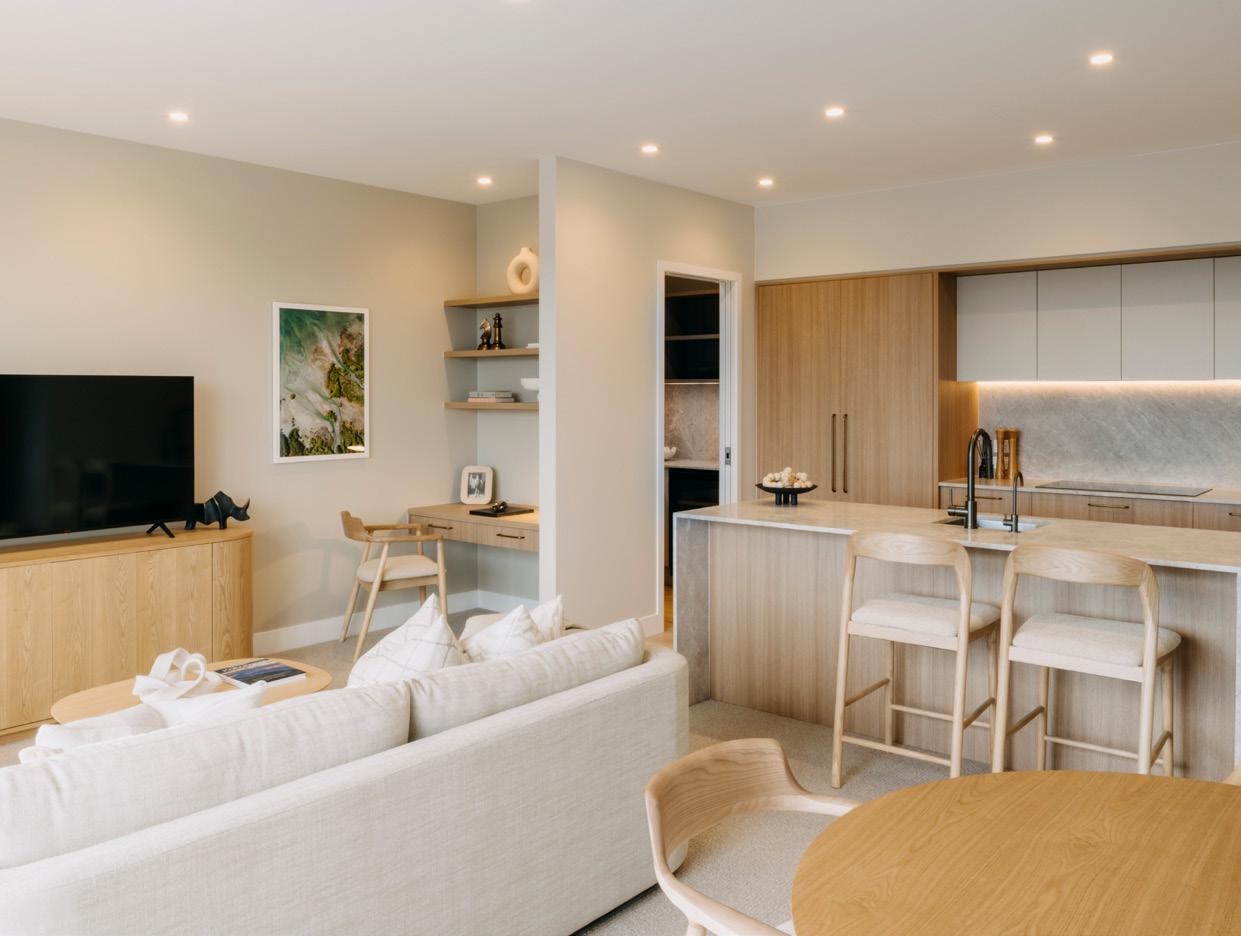
“ INCREASINGLY, PEOPLE ARE LOOKING FOR HOUSING THAT FEELS MANAGEABLE, ADAPTABLE AND ALIGNED WITH HOW THEY WANT TO LIVE DAY TO DAY. ”
craft sessions, card groups and e-bike outings. The approach has residents shaping how they spend their time and contribute to the community in ways that suit their own interests and routines.
Rather than a one-size-fits-all approach, Arvida’s 33 Living Well Communities across New Zealand offer a range of lifestyle options to suit different preferences and stages. Interest in apartment-style living has grown in recent years, particularly in well-located communities. Factors such as reduced maintenance, accessibility, and the ability to remain part of a larger community all contribute to that interest.
As retirement living continues to evolve, Arvida Bethlehem Shores retirement community illustrates how villages are adapting to changing expectations. The focus is increasingly on flexibility, choice and supporting different ways of living in later life.
ARVIDA.CO.NZ
Pip Crombie explores Te Awa Rise, Cambridge’s newest residential subdivision offering elevated living with connected greenways, native landscapes and effortless access to Waikato’s Golden Triangle.
Considering a move? I could be. I recently spent a morning strolling around one of Cambridge’s newest prime residential subdivisions, Te Awa Rise. Situated just minutes from the distinctive charm of the iconic Waikato town, it’s a carefully developed neighbourhood bringing elevated living to those ready to engage.
The unique early morning light the Waikato/Waipā District is known for hangs about the green open spaces, landscaped reserves, natural waterways and distant view to Mount Pirongia, providing exceptional appeal. Spending the morning with CEO of the Sanderson Group, Jared Boronian, and sales manager for the project, Anthony Merrington, afforded me a rare view into their passion for this slice of Godzone, the careful planning that has gone into the 54 lot development, and what it has to offer new residents of all walks of life, ages and stages.
Te Awa Rise sits at the intersection of Cambridge's rapid growth and the Waipā District Council’s ambitions for a more connected, less car-dependent town. The council has been explicit about sustainability in their development plans. New neighbourhoods must provide open spaces and connect new developments through a network of ‘green’ pedestrian and cycleways, while also preserving existing natural areas like river terraces and waterways. Te Awa Rise’s built-in cycle paths and walkways align well with the Waipā 2050 strategy’s vision.
The Sanderson Group worked closely with the council’s principal engineer, Tony Coutts, who was impressed with the developer’s communication, shared vision and commitment to achieving the 2050 regional goals. “Kudos to them for working so closely with us to progress and work to make this cost effective and timely. From the land-acquisition stage through to planning and providing road networks, and the bridge that spans the natural waterway – it’s been a fun and interesting project.”
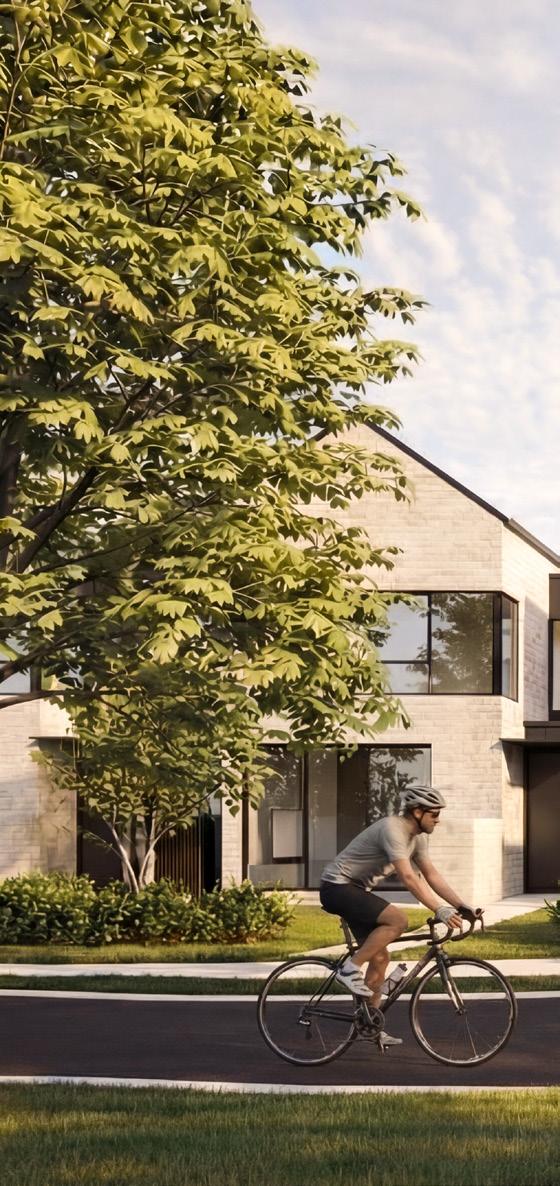
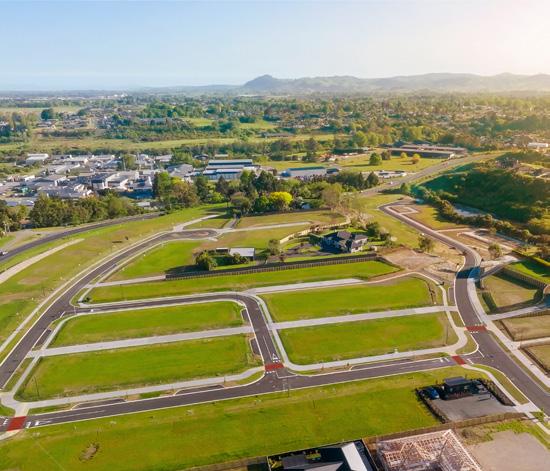

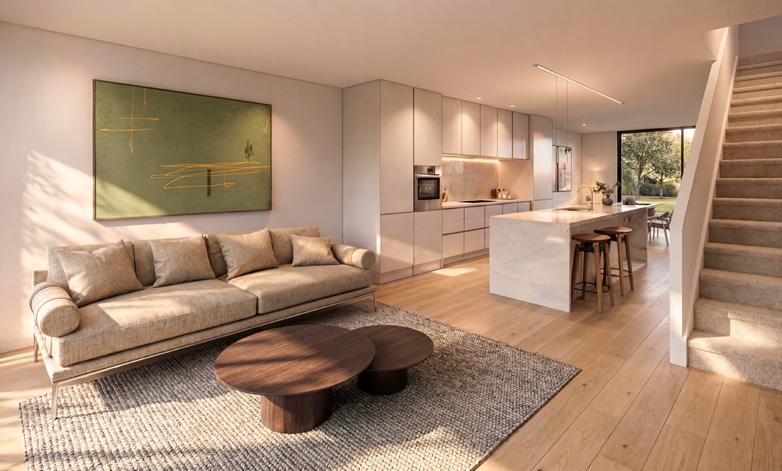
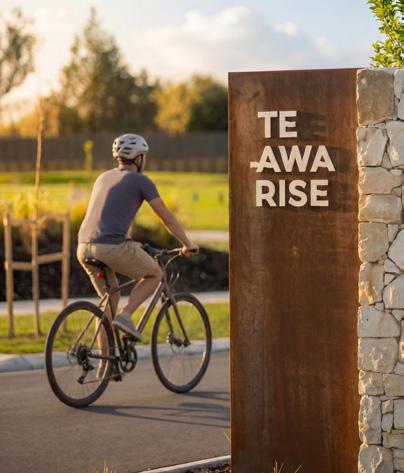
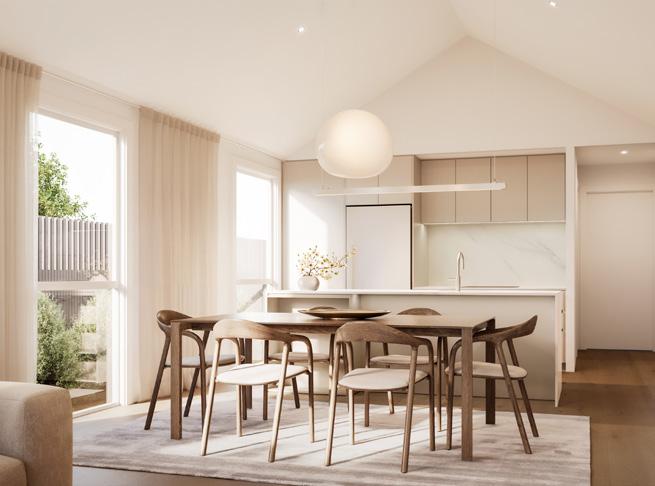
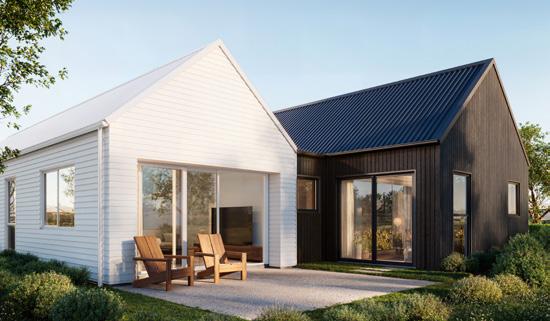
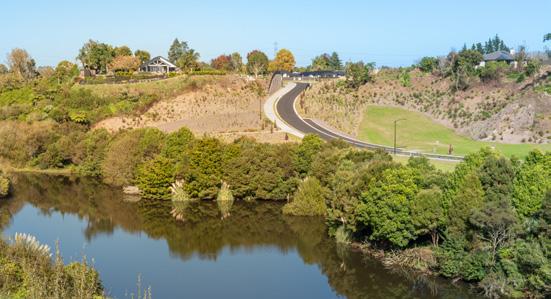
Perhaps you’re already one of the many people in on the secret of what the Waipā District has on offer. The designated area the district encompasses is in the heart of the Waikato region, south and south-east of Hamilton city. It includes the key towns of Cambridge, Te Awamutu, Pirongia, Ōhaupō and Kihikihi. The fertile land, nurtured by the mighty Waikato River that flows through the region, supports a wide variety of agriculture and outdoor activity, and in recent times has attracted a veritable boom in residents.
The strong rural-urban mix of the Waipā District and a council working closely on developing the region with critical infrastructure is evident. Arterial roads, bridges, amenities, and a key focus on strengthening the Hamilton-Waipā corridor for better transport and economic outcomes, including a 9.8 million-dollar extension at Hamilton Airport, means this area is not only a beautiful location to live in, but also provides streamlined transport systems within the ‘Golden Triangle’ (Auckland-Hamilton-Tauranga).
Just minutes from the delightful town of Cambridge and seamlessly connected to the wider Waikato, Te Awa Rise is a north-facing community offering elevated views across treetops and native bush. The clever design of the Sanderson Group’s latest development address affords new residents an enviable lifestyle, as described by Jared.
“The nearly 10-hectare development has been layered across two terraces. This adds incredible character to the ‘aspect’ of most of the properties on offer, the two elevations and the way the individual sections have been sized and arranged. It means they’re north-facing with east-west perspective, open and private. The four original homes add character, as does the historic pā site that will remain, various green spaces and top-notch landscaping.”
The lower level includes a reserve and natural waterway that’s home to a variety of native birds and will be accessible to residents. Significant attention has been paid to landscaping – whole areas planted in native plants already attracting native birds, feature specimen trees that when fully grown will create privacy. Paths are extra wide; envisage yourself (as I did), walking or biking them, doing your daily laps, or connecting to the adjacent neighbourhoods and Cambridge township itself.
“The bridge at the bottom of Te Awa Rise is the perfect example of the outcome of engaging with one of the most progressive councils we’ve worked with,” explains Jared. This pre-built bridge – that was ‘dropped in’ by crane to span the waterway – is now a critical link through the subdivision for both residents and others to connect on to the Te Awa River Ride Cycle Network, touted as
“ TE AWA RISE IS A NORTH-FACING COMMUNITY OFFERING ELEVATED VIEWS ACROSS TREETOPS AND NATIVE BUSH. ”
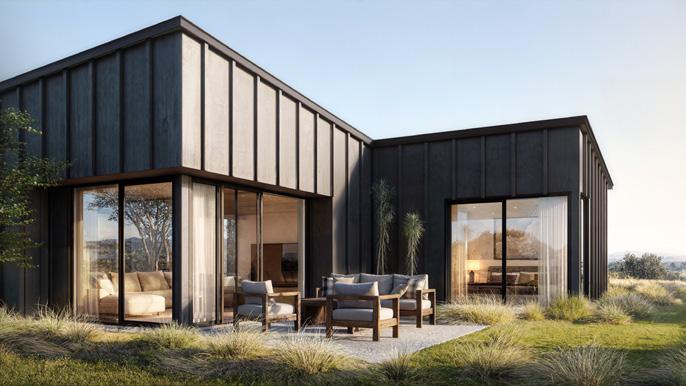
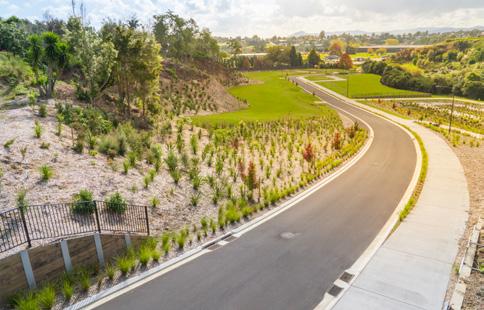
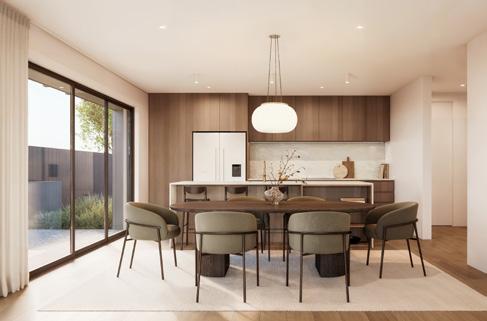
65km of one of the most accessible and scenic cycling and walking trails in New Zealand.
Sarah Ulmer, trail manager at Te Awa River Ride Charitable Trust says: “It’s so awesome to see Te Awa Rise and Waipā District Council teaming up to make it easier and safer for people to get around town without needing a car. A key walking and cycling link is now complete at Te Awa Rise, meaning you can get safely from Kaipaki all the way up to Cambridge Park.”
So, back to you and your new home – what can you look forward to? With a number of builds underway from the 11 design-and-build options on offer, you can see the calibre of the neighbourhood unfolding. Should you wish to engage your own architect and builder, you can, but with respect to the design guidelines in place. “Our own house and land packages offer architectural perspective – roomy contemporary houses (around 180m2 plus), four-bedroom or three plus an office or workspace, and double garaging,” says Anthony. “In order to protect the value of the buyer’s investment, independent designs need to be in keeping with the overall standard of the quality materials we’ve used.”
The homes in the house-and-land packages feature modern but natural materials inside and out, optimal positioning of large, north-facing windows and seamless linking from interior living to private outdoor patios and gardens. Contemporary kitchen and bathroom finishes promise easy living, and there’s a tangible luxury to the designs on offer. Should multi-generational living or earning a separate rental income be what you’re looking
for, take a moment to explore 6 Awarua Crescent, the three-bedroom option (220m2) with a detached, private flat, plus two-car garaging and a generous section size of 523m2. With a range of other sites available, up to 1,000m2, there really is an option for all. The lots themselves are well considered from an urban design perspective, with a focus on ‘liveable design’.
“We engaged a top-tier urban designer, who has produced a neighbourhood that’s so well connected by the interior roads and pathways to the adjoining arterial roads, landscaping and reserves,” Jared tells me. “Each of the lots is a regular shape, to make sure buyers don’t have wasted space, and do have privacy, light and aspect.”
There are also a number of four-bedroom townhouses being built. Each is designed to be as low maintenance as possible, so you'll spend more time enjoying your home and life. Dual entry provides privacy for shared living, as do the two outdoor living areas.
“Although six properties have already sold or are under contract, there’s still a good range of properties available,” adds Jared. “You just need to get in quick to secure one of the best remaining sites.”
If you’re wondering who you might be living next to, current sales suggest a cross-section of residents, from empty-nesters to young families looking for proximity to schools, as well as professionals enjoying the quick commute to Hamilton, the airport (15 minutes), Waikato Expressway (8 minutes) and Karāpiro (10 minutes). You might even see me.
TEAWARISE.CO.NZ
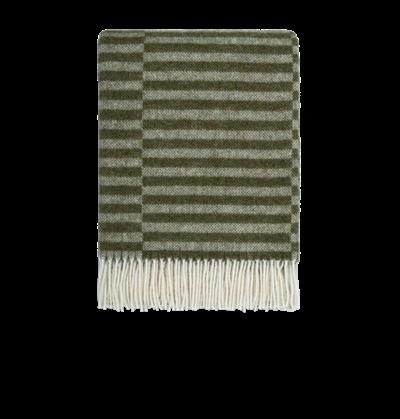

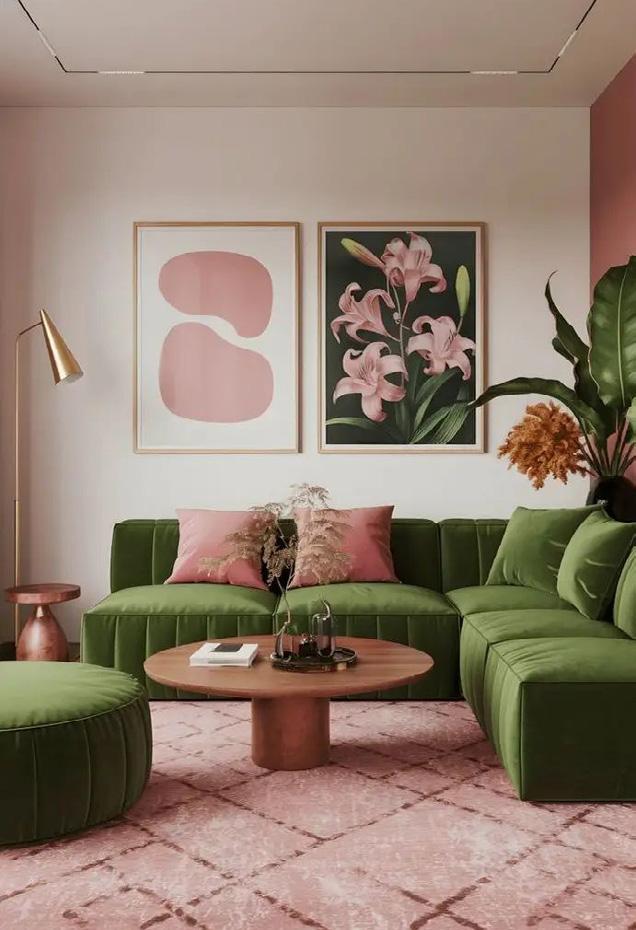



Ultra-appealing to the eye, introducing a monochrome colour scheme could get your space in the best shape of its life.


1. Bimini ottoman by Cocohills, $379, greensladesfurniture.co.nz 2. Crescendo acoustic pendant light, $2600, inlite.co.nz 3. Noah throw, $245, 4. Twill counter chair by Gibson Karlo, $1155, designbythem.com 5. Together No. 03 by Ibi Meier-Oruitemeka, $170, designstuff.com.au 6. Green Smoking Cat sculpture by Mark Rayner, $340, parnellgallery.co.nz. 7. Cone floor lamp by Warm Nordic, $1695, goodform.co.nz 8. Jade Velvet lumbar cushion, $295, threaddesign.co.nz 9. Estella swivel chair, $2395, interiorsbyforma.co.nz 10. Linen bolster cushion, $175, thefoxesden.co.nz 11. Vannfall jug by Nedre Foss, $295, goodform.co.nz 12. Blæhr vase by New Works, $544, designstuff.com.au 1 3. Lulu stool, $350, specialstudio.co 14. Rink bench by Ferm Living, $1451, designstuff.com.au 15. Verdancia Palm Leaf fabric by Mokum, POA, jamesdunloptextiles.com

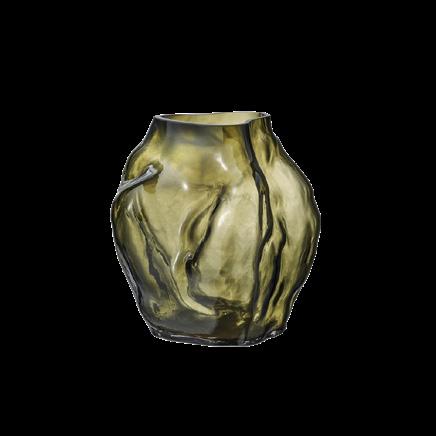
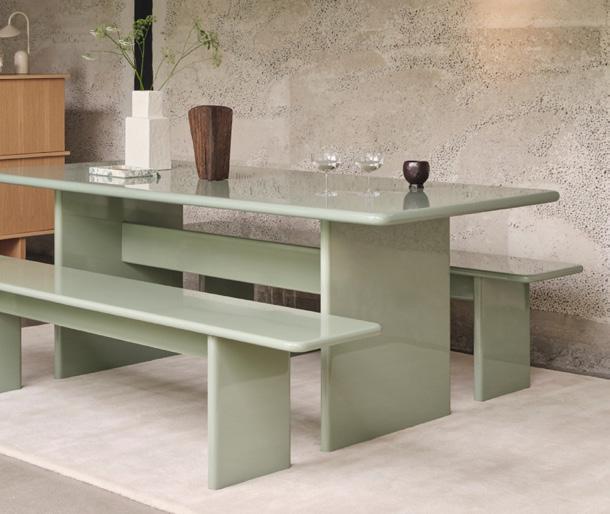


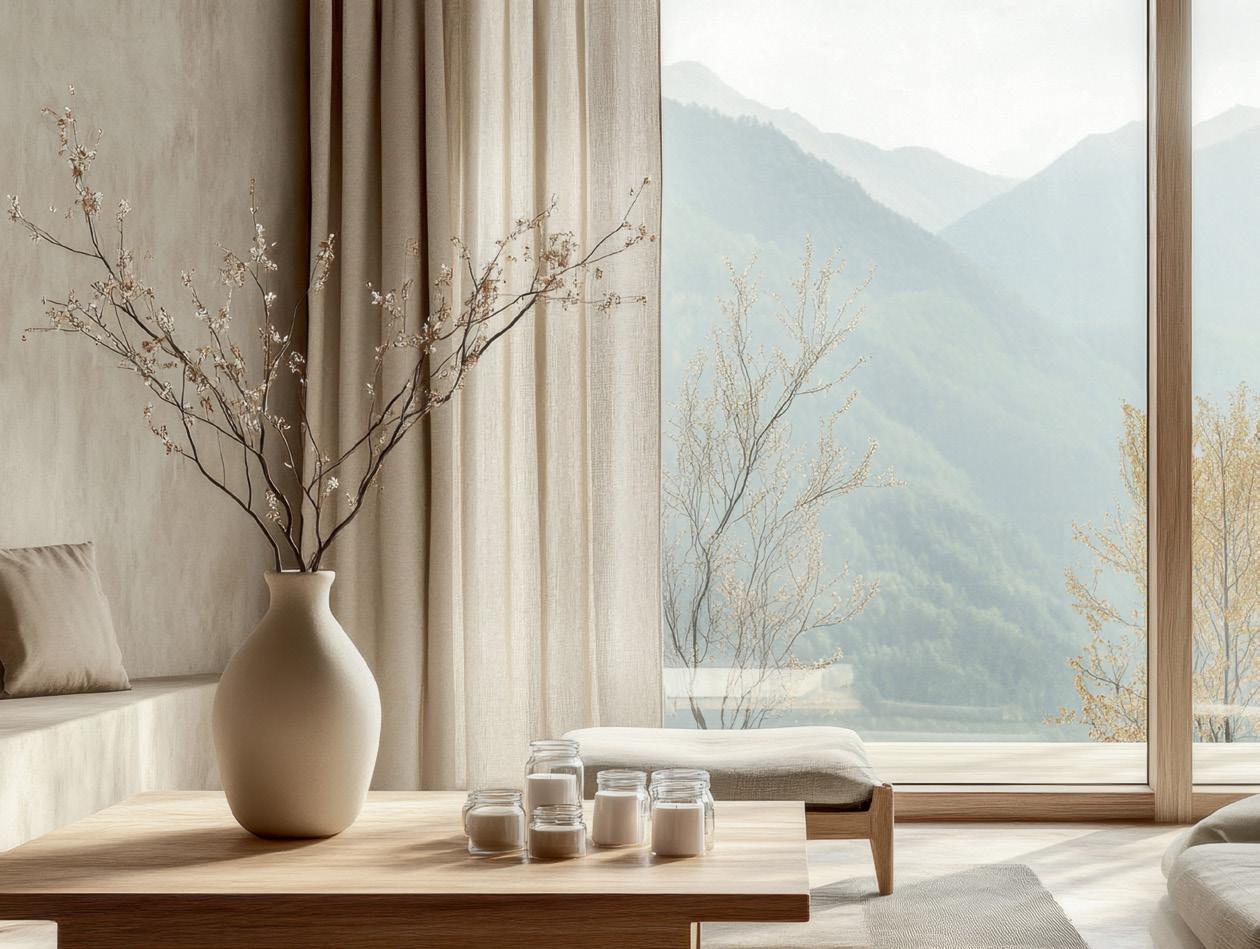

Monochrome is often considered to mean black and white. In fact, a monochrome scheme can be composed of a single colour or different shades of it. This type of tonal layering can create a home that feels considered and impactful. The key is variation. Introduce your chosen colour across different materials and scales to build depth and avoid a flat look. Be sure to mix textures too, to bring warmth, softness and personality while creating a cohesive, grounded and effortlessly sophisticated interior.
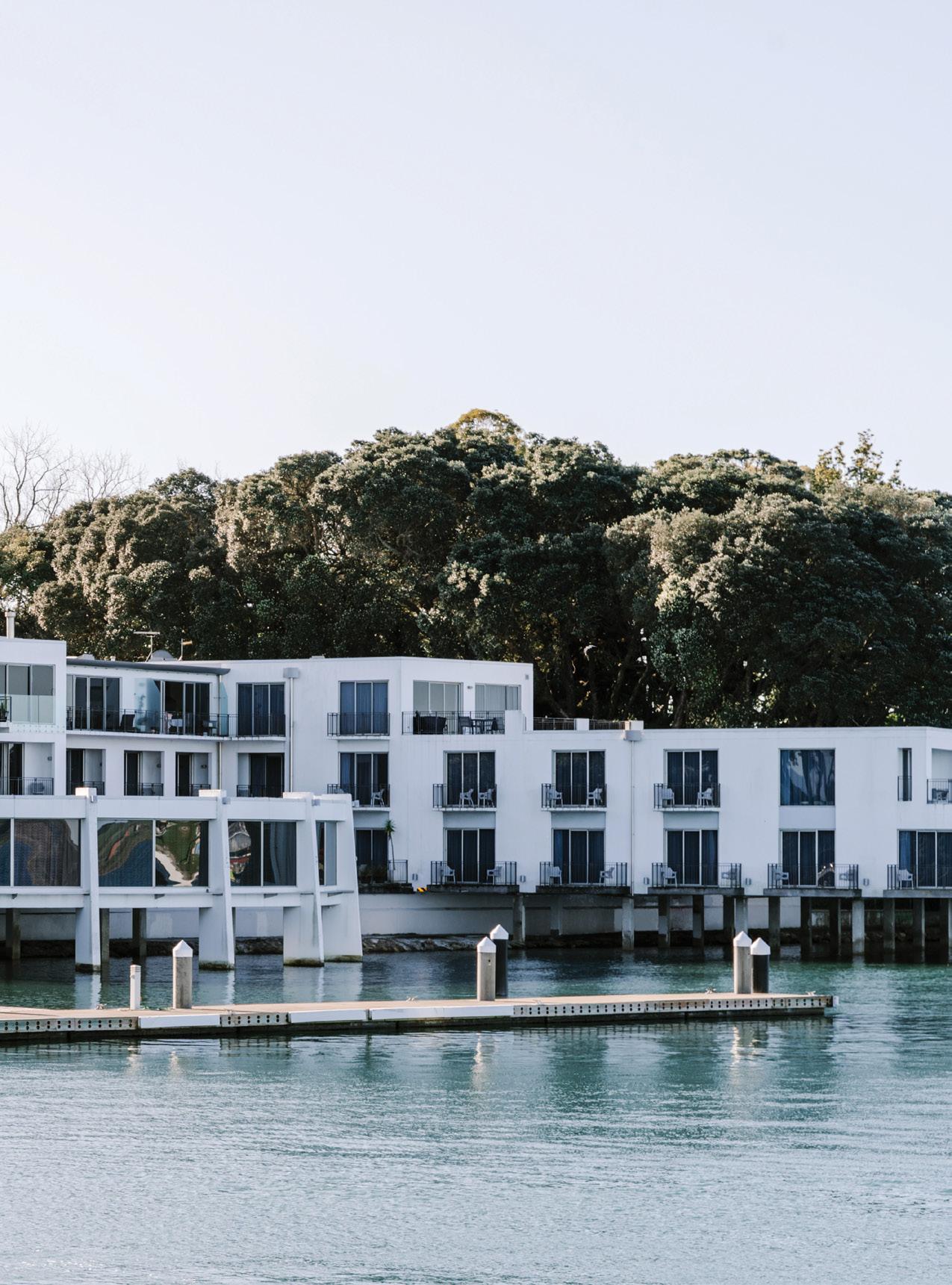

Stories about the everyday passions that drive us.

It’s the secret to building wealth
PAGE 104
AI, AI, AI
Let’s get to grips with it together
PAGE 106
SUCCESSION SUCCESS
Rebecca Steens is here to share her knowledge
PAGE 108
YOU’VE GOTTA LAUGH
The truth behind the mic PAGE 112
UNO’s new columnist, Mount financial adviser Adam Stewart, shares his grounded, practical approach to investing, retirement and financial freedom.
At 32, Compound Wealth founder Adam Stewart has already spent more than a decade immersed in the world of investing, KiwiSaver and financial planning. But despite managing more than $170 million in funds under advice and working with clients across New Zealand, his approach to wealth remains surprisingly grounded.
Raised on a dairy farm in Ashburton, Adam says growing up in a hardworking farming family shaped

much of how he thinks about money and long-term security. “There’s no such thing as days off on a farm,” he says. “The cows still need milking on Christmas Day.”
His parents’ work ethic left a lasting impression. So too did the realities of farm ownership, with debt, weather dependence and the relentless pressure that can come with running a business tied so closely to the land.
“I saw a lot of toil from my parents,” he says. “I think that got me thinking about how I could do things in a smarter way.”
That curiosity eventually led him to study finance and commercial law at Victoria University in Wellington, where he landed a part-time role at a financial planning firm while still in his teens. It was there, while working on matters related to the relatively new KiwiSaver, that something clicked. “I got really passionate about KiwiSaver because I understood the power of compound interest.”
Like many people who eventually end up in finance, Adam says he was also drawn to the idea of independence. Reading Rich Dad, Poor Dad at a young age sparked an interest in financial freedom and business ownership, concepts that would later become central to both his career and personal philosophy.
After university, Adam worked for a governmentappointed default KiwiSaver provider, eventually moving into a role in which he travelled the country advising financial advisers on investment products and KiwiSaver strategies. The experience exposed him to a huge range of financial businesses – the good, the bad and everything in between.
But it was conversations outside the office that inspired him to launch Compound Wealth. “I’d be at the rugby club or out socially and people would ask me what KiwiSaver fund they should be in,” he says. “I just assumed most people knew what they were doing financially, but they didn’t.”
What shocked him most was not a lack of intelligence, but a lack of guidance. “I was meeting CEOs, lawyers, accountants and people with two or three hundred thousand dollars sitting in the wrong fund.”
At just 24, Adam started Compound Wealth with the simple goal of helping ordinary New Zealanders make better long-term financial decisions. Initially, much of that work centred around KiwiSaver and moving clients into funds that better matched their goals and risk tolerance.
Over time, however, the business evolved into retirement planning, investment strategy and helping clients create lives that feel financially secure.
Today, Adam’s typical client is approaching retirement or already retired, often with more than $1 million in investments, property or KiwiSaver assets. “A lot of people have worked extremely hard for decades, but they don’t actually know how to spend their money confidently,” he says.
It is a surprisingly common problem. Adam says many retirees remain overly conservative with their investments, worried they’ll run out of money. Others hold onto wealth purely out of fear.
“Too many people think they need to die with exactly the right amount left over,” he says. “But often they could afford to enjoy life a lot more.”
Instead of simply focusing on investment returns, Adam says much of his work now revolves around helping clients align their money with the lives they actually want to live. That might mean helping someone structure their finances so they can travel more in their 60s and 70s, give money to their children earlier, or feel comfortable spending what they’ve spent decades building.
“If you want to take the family to Fiji and pay for everyone because you can afford to do it, great,” he says. “If you want to help your kids get ahead while you’re still around to see the benefit of it, great.”
Adam’s philosophy around investing itself is notably measured. Rather than chasing hot stock tips or market timing, he advocates for low-cost diversified investing and long-term thinking.
“We’re not trying to pick the needle in the haystack,” he says. “We own the haystack.”
It’s advice he applies to his own life. Adam started Compound Wealth in his mid-20s, while living rent-free back in Ashburton and playing Heartland rugby. The early years were difficult. He admits earning trust as a young adviser came with “a lot of hard knocks”.
“People would think, ‘Who’s this 24-year-old advising me on my finances?’” he laughs.
Still, he kept showing up. Over time, the business grew steadily, helped in part by the digital shift brought on by COVID-19, which accelerated online financial advice across New Zealand.
Now based in Mount Maunganui with his wife and young family, Adam has built both the lifestyle and the business he once imagined for himself. He sponsors local rugby and tennis clubs, and works from a modern Mount office. He says maintaining balance remains important.
“I don’t want to build some huge corporate monster. I enjoy my lifestyle. I try to live the way I teach my clients to live.”
That may be the core philosophy underpinning both Adam Stewart and Compound Wealth. Financial planning is not really about money at all.
“Financial freedom,” he says, “is having the ability to do what you want, when you want, with the people you care about.”
As AI is adopted worldwide, UNO ’s new columnist Amanda Jeffs wants women to be leading the conversation.
PHOTO DEBORAH DE GRAAF
These days, when the words “artificial intelligence” pop up, they often come with a sense of panic. We’re constantly hearing warnings about jobs disappearing and workplaces changing faster than anyone can keep up with, but according to She Is AI founder Amanda Jeffs, that fear misses the bigger picture.
Amanda believes the future won’t belong to robots taking human jobs, but to people who learn how to use AI well.
“People think AI is coming for all of our jobs, but what we’re actually seeing is a change in the workforce. Businesses still need people. AI's not a replacement for humanity.”
It’s a conversation she’s particularly passionate about having with women, many of whom report feeling intimidated by the speed at which AI has entered our lives.
Amanda’s background covers communications, marketing, digital strategy and tech, through roles in government, startups, agencies and consulting in New Zealand, Asia and the UK.
Rather than seeing herself as purely “tech”, she describes her role as translating between people and technology.
“I understand how computers think, but I also understand people and psychology,” she says. “I’ve naturally always sat somewhere in the middle.”
Her mix of skills became unexpectedly useful in 2022, when AI tools suddenly exploded into the mainstream. At the time, Amanda was on maternity leave with her daughter after losing her job in a company restructure. While navigating newborn life on very little sleep, she started diving headfirst into AI.

What stood out to her in those early days was the number of women trying to figure it out on their own. “There were all these women learning AI in isolation,” she says. “They were saying, ‘This is huge, but where are my people?’”
Eventually, she came up with She Is AI, which first launched as a digital magazine that showcased women working in the AI space, before growing into a global education and consulting platform operating across more than 28 countries. Today, the organisation runs workshops, training programmes and events focused on helping women and businesses adopt AI in practical ways.
Amanda says the more we can rethink AI as a support tool that can remove repetitive admin, the more we can free people up to focus on bigger-picture thinking. At the moment, though, she believes many workplaces are getting AI wrong, by either resisting it completely or trying to replace people without understanding its limitations.
“We’re in this weird stage where companies think AI can run everything on its own, but it’s not there yet,” she says. “In the future, we’ll see businesses realise they still need those people and hire them back.”
As AI adoption grows, Amanda hopes fear will gradually become curiosity. “We’ve been through huge technology shifts before. This is just the next one.”
Amanda’s joining UNO as a new columnist, to share practical insights into AI, the future of work and how you can use emerging technology in ways that feel useful rather than overwhelming. Watch this space!
SHEISAI.AI
Karl Puschmann tries out the latest and greatest gadgets.
Keyboard enthusiasts (yes, they absolutely exist) have long been forced to choose between mechanical switches for that satisfying, clacky typing feel or analog switches for gaming precision. Logitech's flagship keyboard simply says, ‘why not both?’. The G512X 98 is the first keyboard to offer Dual Swap technology, allowing gamers to easily swap between the two different key types. It comes with nine analog keys to swap in, as well as five alternative keys for further customisation. These are cleverly stored in a compartment on the back of the keyboard itself, ensuring you’ll never lose one. Another incredibly smart touch is that the two supplied keycap pullers double as the keyboard’s tilt legs, so you’ll always know exactly where to find them as well. The keyboard oozes premium, with a pleasant ‘clack’ to its keys, and a hefty, solid build quality. The only drawback is that it’s wired-only. A compromise to hit its lightning-quick response speeds, but there’s no question that losing Bluetooth’s multi-device support is limiting to all but dedicated gamers. With its stylish black and purple, cyberpunk colour scheme and flashy RGB keys and front lightbar, the keyboard is a statement addition to any desk. The RGB colours and key functions can also be customised to your personal preferences. Competitive gamers will salivate over its 8k polling rate, near-instant 0.125ms response time and customisable actuation points, while everyone else will simply enjoy typing on it.
Widely available from RRP $399.


Everybody’s favourite video game icon helps kids master analog time-telling with a fun, intuitive design. Each hand is clearly labelled for easy recognition, while an outer ring breaks down the five-minute intervals to make reading the clock simpler and more approachable.
RRP $49.99.
FUNKYGIFTS.CO.NZ
It may look like a glass bowl wearing a cowboy hat, but this is a genuinely clever bit of kit that points to the future of air fryers. It’s uncluttered and so seamless to operate that even a kitchen novice like myself whipped up a batch of crispy golden chips minutes after unboxing the review unit. With six different modes on offer (Air Fry, Max Crisp, Bake/Prove, Roast, ReCrisp and Dehydrate), the Crispi Pro is far more than just a glorified chip maker. Powered by a hefty 2050W power pod, it can cook almost anything. Sunday roasts, scones and even homemade dried fruit. The glass cooking dish is the real star of the show, and happily it comes with a 2.3L for small bites, and a larger 5.7L dish for family sized meals. When your meal’s cooked, the heat resistant feet mean you can slide it out and serve it straight to the table. Lids are also supplied, so any leftovers can go straight to the fridge. A nice little touch. The glass allows you to keep an eye on your food as it cooks, unlike drawer models where it’s anyone’s guess what’s going on, and there’s no concerns over micro-plastics, as glass is non-toxic. These dishes are also microwave, freezer, and dishwasher safe which, frankly, should be mandatory of all kitchen appliances. Widely available, RRP $549.99.

Skipping into the future, this smart rope tracks jump count, calories burned and interval training through its companion app. But the standout feature is its 23 LED lights, which flash your stats mid-air as you jump.
RRP $150.
TECHOUTLET.CO.NZ
Colour finally comes to the humble eReader. Its crisp, vibrant 6-inch display brings comics, covers and illustrations to life, while colour highlighting adds a new layer of functionality for keen readers. Waterproof, compact and boasting weeks of battery life on a single charge, it’s everything a modern eReader should be.
RRP $259.99. PBTECH.CO.NZ

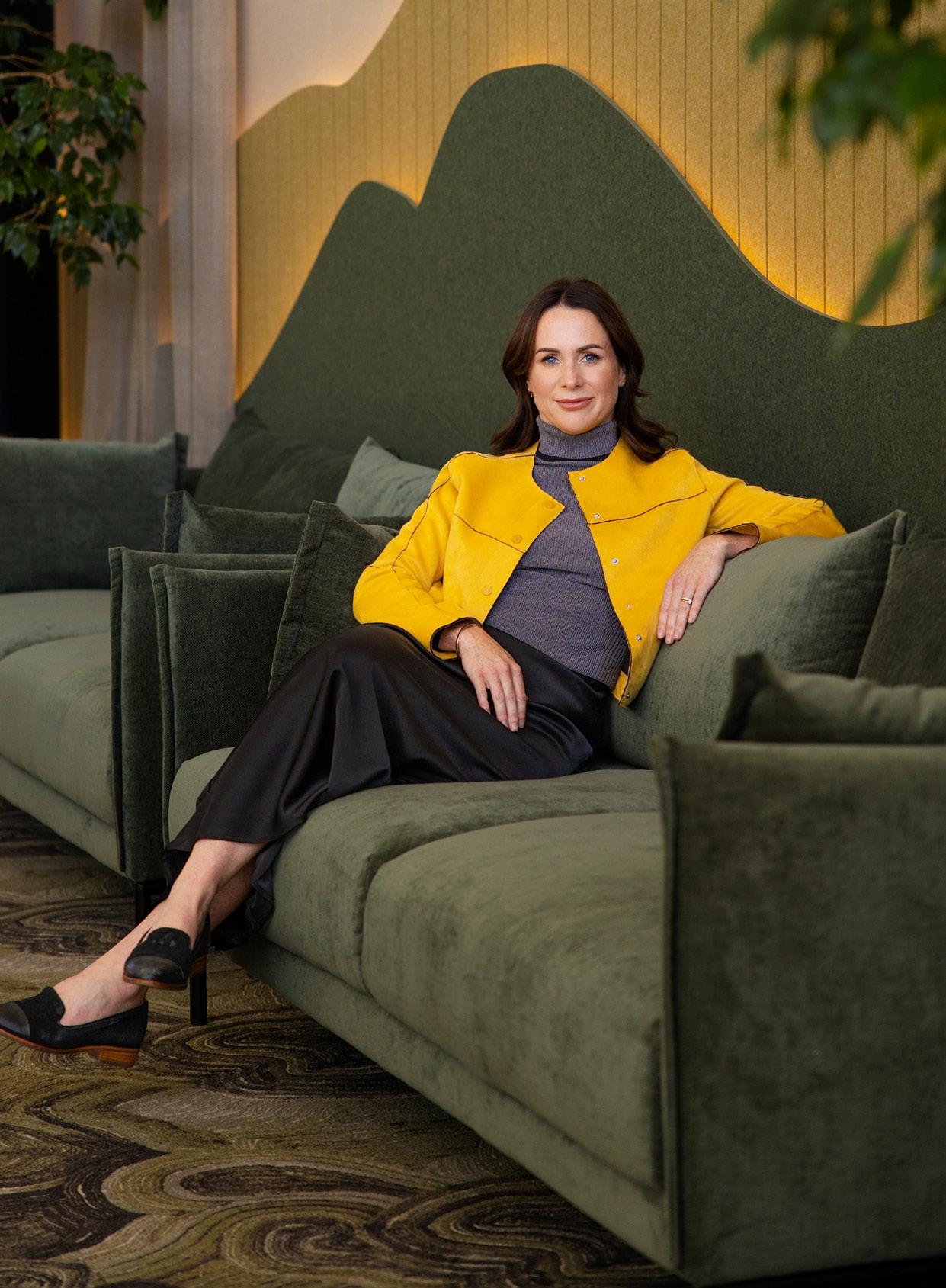
A global legal career meets a pull back home, as Rebecca Steens brings international expertise to Tauranga’s ever-changing wealth and succession landscape.
There’s no place like home, or so the adage goes. It certainly proved true for the most recent female partner to join Holland Beckett, Rebecca Steens. She and her husband, Michael, were feeling quite settled after four years in Jersey, the largest of the Channel Islands. The active, outdoorsy lifestyle they enjoyed on the self-governing British Crown Dependency, located around 20km off the French coast, was offset by the rich mix of French and British history and culture on offer. Rebecca loved her rewarding role specialising in trust litigation within an international context, but New Zealand and family tugged them home in late 2019, only a few months before COVID-19 unleashed lockdowns and other restrictions.
“While it was the close of a wonderful part of our lives, the draw of home and all that offers was the right decision in the end,” explains Rebecca.
Nearly seven years on, as a highly regarded succession and estate planning lawyer with more than 12 years’ experience advising clients on trusts, estates, succession planning and asset protection, Rebecca says her life and background have brought focus to her practice.
“My life so far – the diverse travel, living and working overseas, being a daughter, wife, mother, first home buyer, working parent… all have brought a different perspective to me as an estate planning lawyer, and a partner at Holland Beckett.”
Rebecca's husband Michael runs an engineering business specialising in marine welding, giving her an appreciation of the day-to-day workings and challenges faced by small, industry-specific businesses. That said, she feels at ease with a diverse range of locals and large business owners, having grown up during the burgeoning Bay of Plenty growth phase, in an economy driven by orcharding, ocean industries, port expansion and extensive property development. Like others at Holland Beckett, her significant international experience contributes to the comprehensive legal services on offer by the firm.
In late 2019, Rebecca joined Holland Beckett as a senior solicitor in the firm’s litigation team. She transitioned into the Succession, Trusts and Estates team in 2021, where her leadership has been instrumental in shaping its growth and reputation. “We’re living in a time of the
biggest intergenerational shift of wealth from the Baby Boomer generation,” she says. “The recipients of the trusts set up by that ageing generation do not always live in New Zealand. There are tax implications, the division of wealth is not as straightforward as people may believe – many don’t even know where their money will go if they don’t have a will. There’s often an assumption it goes to their wife or husband, but this is being challenged in real life as the Administration Act 1969 [which deals with rules on intestacy] is not consistent with the way we live now.”
Rebecca feels driven to ensure her clients have a clear understanding about the value and division of their wealth, no matter what size it is. She says the increase in blended families, relationship disputes, dependents living with disabilities needing life-long care, those with terminal health diagnoses – all manner of life situations – deserve transparency and guidance in ensuring their wishes are met, and not open to dispute by those left behind.
Joining the now 17-strong partnership at one of Bay of Plenty’s largest legal firms felt right to Rebecca. She describes a law partnership as a relationship and in the way of any relationship, had a clear understanding of what she could bring to it.
Rebecca’s happy to report it has been a completely positive move. “It has enriched my life. The support I’ve had from the partnership and my team to get where I am has been so valued. I navigated the added responsibilities through parental leave and two very young children. Having such a strong female presence in the partnership [seven of the 17 partners are women] is something I appreciate, as is the depth and breadth of experience in our partnership.”
Holland Beckett prides itself on its community involvement, with one of its initiatives being free Wills Month in September. Sponsorship of various awards, a diverse range of charities, pro bono work… the firm is engaged in doing its bit. With 50 staff in 2012, the growth to over 160 by 2025 has seen the need to move to larger premises. Rebecca joins the partnership at the start of this exciting next chapter for the firm, now based in a purpose-built, modern space on The Strand in Tauranga – future looking, with room to expand.
Now that Rebecca and Michael’s children are three and four, they’re looking forward to returning to adventurous outdoor activities – cycling, hiking and water pursuits – and hopefully as time allows, travelling intrepidly with their young family.
HOBEC.CO.NZ


In the first of an ongoing series, UNO chats to people who are choosing to build their lives and careers in the Bay of Plenty. Our first subject has been rapt to find a welcoming creative community ready to step right into.
WORDS HAYLEY BARNETT
Maxwell Hutton had perfectly practical reasons for leaving Auckland. His partner had a job offer and he had family already settled in Pā p ā moa. The 25-yearold choreographer wasn’t chasing a scene, but Tauranga had one waiting for him anyway.
“I didn’t move down for choreography per se,” he explains. “The discovery that there was a huge creative community here was a surprising bonus.”
When Maxwell's partner Matt Cornere secured a role as a dance teacher at Mount Maunganui College, the decision to move became a no-brainer. “We already had roots here, so it made it an easy choice.”
What the couple found was a creative scene that exceeded their expectations. Having taken up a full-time position as an office assistant at a Tauranga law firm, Maxwell’s been immersing himself in the local theatre world, choreographing,
performing and building relationships. “The theatre community here is so generous and friendly,” he says. “It’s something I can always rely on wherever I go, and here, it feels especially strong.”
Coming from Auckland, where the theatre network can feel fragmented across the sprawling city, Maxwell was struck by how connected the Bay’s theatre scene is. “Only once I was part of it did I realise how big and engaged it is,” he says, recalling a recent 80th celebration event that drew well over 100 attendees. “There’s a real sense that people care and want to be involved.”
Perhaps, he muses, it’s not the size of the community that counts, but the quality. “Things are happening here that even Auckland could learn from,” says Maxwell. “In terms of community involvement, Tauranga’s doing really well.”
Maxwell recently appeared in Tauranga Musical Theatre’s April–May production of Come From Away at Baycourt, before stepping in to choreograph the Dolly Parton-fuelled 9 to 5 The Musical, which
opens on July 25 and runs until August 1. It was a quick turnaround that speaks to both his experience and the opportunities on offer.
Having choreographed around 10 shows in recent years, he’d arrived hopeful but realistic about how long it might take to find his feet. Instead, doors opened quickly. He acknowledges the challenges, with young creatives heading overseas among them, but sees momentum building. “It’s about attracting new people in,” he says.
For Maxwell and Matthew, any question marks over the move have dissolved. “We did say, worst case, we could move back,” he admits. “But now we can definitely see ourselves here long-term.” Turns out the worst case never came close.
As our region changes from being known for retirees and summer holidaymakers, stories like Maxwell’s prove something is changing. Creativity, opportunity and a sense of community are taking up a lot more space.
Waste warrior Kate Fenwick spotlights the growing cost of the rubbish we leave behind – and how we can all be part of the solution.

Iwas driving past a beautiful stretch of coastline recently when I saw it. A couch. Not near a house and not outside a shop, just sitting there in the long grass as if it had decided to retire early.
It would have been almost funny if it wasn’t so bleak. Illegal dumping has a way of sneaking up on us.
A mattress on a roadside, a pile of renovation waste tucked into a reserve, bags of rubbish stacked beside an overflowing charity bin. It becomes part of the scenery, until one day you realise it’s not scenery at all. It’s neglect.
Every year, throughout New Zealand, councils spend millions of dollars cleaning up illegally dumped waste. That money comes from rates; from the same budgets that fund playgrounds, libraries, footpaths and community programmes. Every dumped couch quietly diverts money away from something that could have improved a neighbourhood.
Then there’s the environmental impact. Dumped waste can contaminate soil and waterways, especially when building materials, tyres and hazardous substances are involved. It creates safety risks, attracts pests, harms wildlife, and once a pile appears, others often follow. A single act of dumping can quickly create a hotspot.
Councils are trying to keep up. The problem is that dumping often happens at night, in quiet places, and without witnesses. Fines exist, but they rely on being able to identify who did it. If no one can be identified, the clean-up still has to happen.
What fascinates me most is the mindset behind it. Illegal dumping is often justified as a response to cost. Disposal fees feel high. Life feels expensive. It can be tempting to see public space as an easy option.
But it’s not free, it’s simply paid for differently. When someone leaves waste in a reserve, they’re shifting their inconvenience onto the entire community – onto the person who walks their dog there, onto the family who swims at that beach, onto every ratepayer who funds the clean-up.
Most of us would never dump a couch in a ditch, but we all have a role in shaping what’s normal. Plan ahead before a big clean out, check local transfer station options, use bulky-item collections when available, report dumping early before it grows. These are not dramatic actions – they’re small acts of stewardship.
Public spaces reflect how much we value where we live, and when waste ends up in a place it doesn’t belong, the cost is more than financial. It’s about pride, responsibility and the decision to leave a place better than we found it.
WASTEDWITHKATE | WASTEDKATE.CO.NZ

Live radio isn’t for the faint of heart, as Hayley Bath so eloquently demonstrates through her most embarrassing yet hilarious moments at work.
Most people will, at some point in their career, make mistakes at work. I have the rare gift of having any mistakes I make happen in public, while broadcasting live on nationwide radio. It’s a great way to keep any fragile ego in check.
I’ve been the day-show radio announcer on The Hits for nearly nine years. I love radio, and I’m good at what I do, but I’ve still never met a sentence I can’t ruin with confidence.
Picture this: I have 10 seconds until the song finishes. I can see the countdown on one of four screens in front of me before I go live. The mic is ready, the red light is on. I go to speak and, mid-sentence, my mind goes blank. What was I going to talk about again?
The dreaded brain freeze hits.
There’s no backspace in radio, no TV editing. It’s just me, a mic and the dawning realisation that I’ve made a mistake I now have to commit to publicly.
Over the years, I’ve mispronounced words I invented only seconds earlier. I’ve had callers go rogue live on air, ranting and swearing. One day, I was reading the weather when a spider crawled across my forehead. I had no choice but to scream, recover, then casually mention the incoming storm warnings. I still don’t have any idea how the spider got inside a double-walled, acoustic-lined studio.
I was humbled early in this line of work. As an intern on my first shift, I nervously came out of the song White Flag by Dido, stumbled over my words, and said it was sung by “Dildo”. I’d like to say the rest of the shift improved, but that same day I also managed to accidentally broadcast a Donald Trump speech over a Backstreet Boys song. I was sure my career would end as soon as it started.
Every workday, I sit in front of 184 radio buttons and audio controls (I counted them for the purpose of this article), not to mention all the screens in my studio. It’s multitasking at its best – technical pressure, talking, timing, reading, listening and reacting all at once.

When the mic turns on, it’s sink or swim. It’s what makes this job fun and terrifying all in the same breath. There are people in the radio industry who keep a dreaded folder of on-air mishaps made by announcers over the years. You don’t want to be the one whose audio is blasted out through the speakers at the end of the work party.
Sometimes, the chaos isn’t even contained to your own studio. We share a building with Newstalk ZB, and during a stint in temporary studios while new ones were being built, I clumsily knocked out what looked like some fairly critical wires. I held my breath, then relaxed when The Hits stayed on air. Crisis averted – or so I thought. Seconds later, a producer burst out of the studio next door, shouting, “WE’VE GONE OFF AIR! GET THE TECHS IN! ZB IS OFF AIR!” Three people sprinted past my window as I quietly sank out of sight behind my mic. Oops. Radio’s addictive because it’s about real connection and what’s happening in the moment. There’s a certain intimacy to it, too. People listen in cars and kitchens, on night shifts, at workplaces; they invite you into their space every time they turn on the radio. This week, a caller told me I was the first person they’d spoken to out loud all week. They live alone, work from home, and mostly communicate through emails and texts. It’s not uncommon for a lot of people.
Radio is an unfiltered, real-time exchange between people, something carefully edited social media video reels can’t rival. The weird and wonderful texts and calls that come in daily create a sense of community you can’t fake, and in a world that often feels chaotic, I try to create a positive place people can come to for good music, connection, and a moment to breathe and have fun. It’s very hard to feel bad when music from S Club 7 and Coolio is pumping on a Friday.
Like I said, there’s no backspace in radio. When the mic turns on, anything can happen. It’s not about getting every word right – instead, it’s sometimes messy, unpredictable and completely human. That’s the magic of it.
Catch Hayley on The Hits 95FM, weekdays 9am till 3pm.
“ WHEN THE MIC TURNS ON, ANYTHING CAN HAPPEN. IT’S SOMETIMES MESSY, UNPREDICTABLE AND COMPLETELY HUMAN. THAT’S THE MAGIC OF IT. ”
Two newly appointed leaders are bringing a distinctly Bay of Plenty perspective to one of the globe’s biggest firms, and making sure it earns its place in our community.
PHOTO SALINA GALVAN
There’s a version of this story where a global firm sees Tauranga’s rapid growth, follows the cranes, and sets up shop to capture the opportunity. But Deloitte’s story in the Bay of Plenty is more considered than that.
As the region continues to grow and diversify, so too does the complexity facing local businesses. From expansion and succession to technology transformation, regulatory change and shifting market conditions, organisations are being asked to make important decisions at pace. For Deloitte’s Tauranga team, that creates both responsibility and opportunity.
The appointment of Alexis Tapsell to partner and Cam Burrow as director reflects a broader story about Deloitte’s investment in leadership across New Zealand. Nationally, the firm has continued to grow its leadership bench, appointing new partners and directors to support clients through disruption and ongoing change. In Tauranga, that investment is also about building a strong regional team for the future, one that makes sure local businesses have access to the same depth of advice and specialist support as organisations in the country’s largest centres.
Alexis joins existing partners, Paul Shallard and Andrea Scatchard, while Cam joins director Brad Garner, making for a strong leadership team in the Tauranga office. Together, they bring local relationships, national capability and the scale of a global firm to support businesses through growth and complexity. And it wouldn’t be happening if both hadn’t chosen to come here.
For Alexis, it was a return home. The former Black Fern, who represented New Zealand at the 2013 Rugby World Cup Sevens in Russia, lived in the Bay before heading to Auckland and making the move back in 2024.
“I’ve got three young kids and I wanted them to grow up in the Bay of Plenty, around family and everything like that,” she says. “This role was part of it, but mainly it was for my family.”
A specialist in tax and business advisory services, Alexis brings a skillset that’s genuinely in demand locally. Her client portfolio is deliberately broad and includes corporates, private and high-growth businesses, alongside the iwi and Māori sector. But her approach is the same across all of it.
“It's about being authentic, building trust, and working alongside clients in a way that feels genuine.”
Cam arrived from a different direction. A “born and bred southerner”, he relocated from Dunedin to Tauranga earlier this year after Deloitte approached him about helping grow the firm’s presence in the market.
“In a place like Tauranga, there’s a feeling of home,” he says. “You can still do your hobbies. You can be surfing before work in the morning, go to the office, and then be playing golf after work.”
He moved up in late April and has quickly become part of the community, refereeing rugby and getting involved in surf lifesaving. His role at Deloitte is deeper than his business card might suggest. He works across accounting, financial reporting, disruption and climate events, and internal audit.
“A lot of what I do is connecting the issues on the ground to the broader Deloitte network,” he explains. “We’re not selling services, we’re going to solve problems people are having for them, or with them. By doing that, we create clients for life.
“We want clients to feel like they have a local team that understands them, but also the backing of a much larger organisation. If a client is dealing with a complex challenge, we can bring in the right people and the right thinking. That might be someone here in Tauranga, elsewhere in New Zealand, or from across the Deloitte network.”
For Alexis, it's about striking the right balance between scale and connection. “We don’t just want to be this big firm coming into the community. We really want to focus on what the Bay of Plenty is all about and we really want to be locally connected advisors helping Bay of Plenty businesses navigate change.”
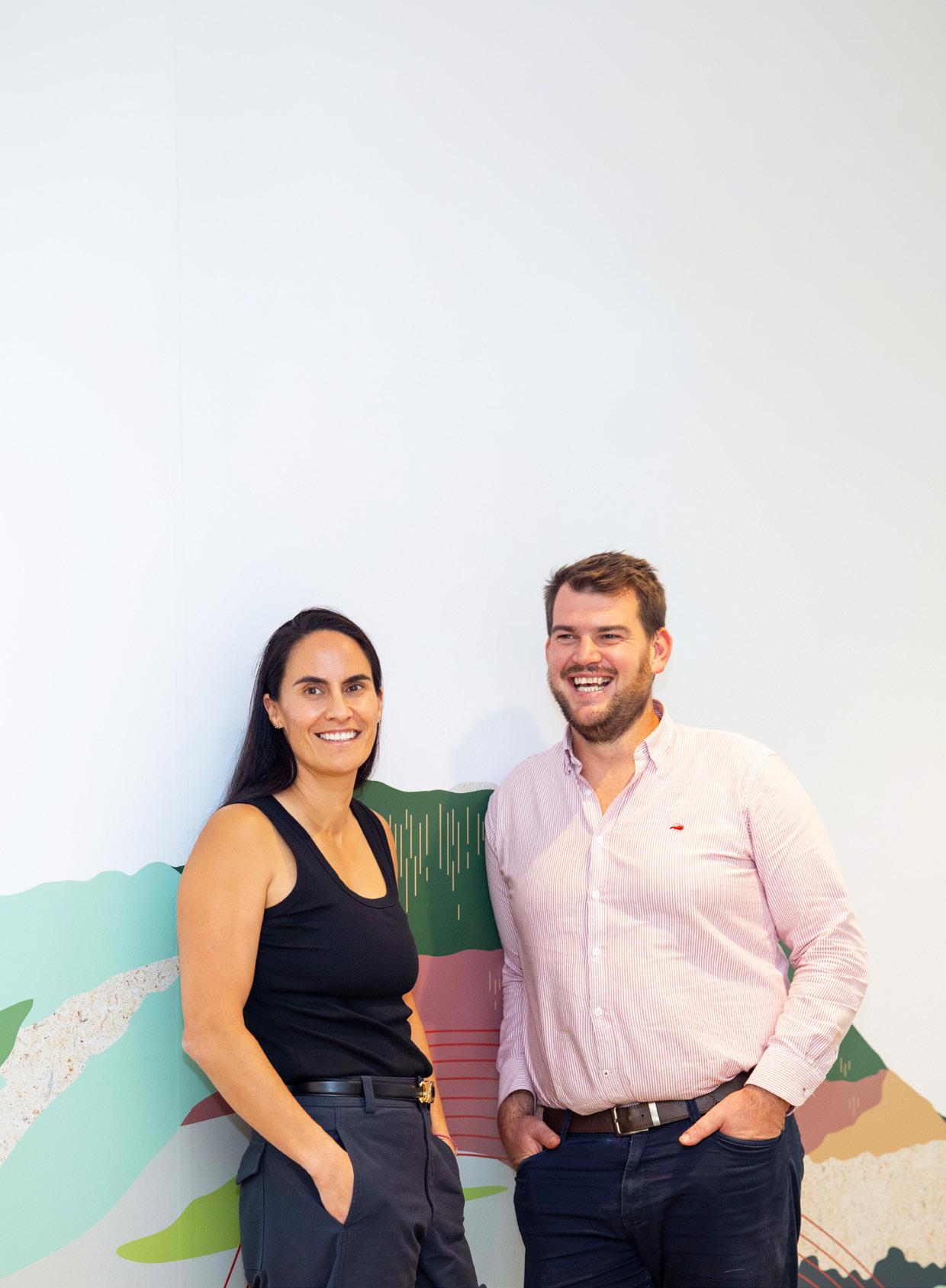
“Important conversations aren’t just happening in the boardroom, they’re also happening on the side of a rugby field, on the beach, when you bump into someone in the street,” Cam says. “And that’s where we want to be.”
Both see this strong sense of connection as one of the region's greatest strengths. “There’s a real willingness here for people to support each other and for the region as a whole to succeed,” Alexis says. “There’s an optimism and collaboration that’s pretty unique.”
“We want to be embedded into that growth story,” Cam says. “Deloitte’s ambition is to be part of the momentum, supporting businesses as they grow, adapt and thrive. We’re not here for the short term, we’re here for the long term.”
“We want to essentially play our role in helping build a stronger regional economy,” Alexis adds, “and supporting local organisations to thrive.”




Hit the road and explore our surrounding treasures.

Whakatāne turns it on for the holidays
PAGE 120
Walk, feast, rest, repeat, with a sense of ease
PAGE 122
Two travel consultants put South Africa to the test
PAGE 124
UNO editor Hayley Barnett and her right-hand man tootle over the hill to get a fresh perspective on a little town with a lot going for it. This is an accessible getaway if ever there was one.
Though it might have a reputation as the “town of trees and champions”, over the past decade Cambridge has become a destination known more for its polished hospitality and thriving shopping scene.
Over one fun-filled weekend, the quaint equestrian town proved itself to be a surprisingly perfect pick for a romantic getaway.
One Friday afternoon, my husband and I drove over from Tauranga, stopping at the Sculpture Park at Waitakaruru Arboretum on our way in. This is a place I’ve been dying to visit, but on our many drives to Auckland, it has never seemed like the right time. Built in a former quarry and now spanning hectares of regenerated
landscape, the park weaves more than 100 sculptures through a 2km walking trail of ponds, cliffs and thousands of trees. It’s basically an art gallery in nature, and makes for a great hike before the beginning of an indulgent weekend ahead.
From there, we headed into a different vibe entirely. Cambridge’s centre is compact and refined, with independent boutiques, cafés and galleries lining the streets.
We checked into The Clements Hotel, a new concept in an old heritage building right in the middle of town. Having been given a contemporary polish of late, the rooms are modern yet also traditional, consistent with the building’s historic character. Its central location makes it an ideal base for a weekend away. Cambridge is known for being walkable, and staying here meant most of our weekend unfolded on foot.

Dinner was easy. We simply went downstairs to the hotel’s light-filled, gallery-style restaurant that leans into seasonal New Zealand produce. In keeping with its understated nod to tradition, the offering veers confidently towards the classics – beef tartare, slow-cooked pork belly, glazed duck breast, confit chicken. Nothing feels overly complicated or intimidating, yet the execution is exceptional.
Canning our vague plans to hit the town after dessert – black forest chocolate brûlée, no less – we admitted defeat and agreed a movie might be more appealing. The charming Tivoli Cinema is just around the corner, offering intimate viewing spaces and the option to enjoy a glass of wine.
The next morning started at the local markets, where the region’s produce and small-scale makers are on full display.
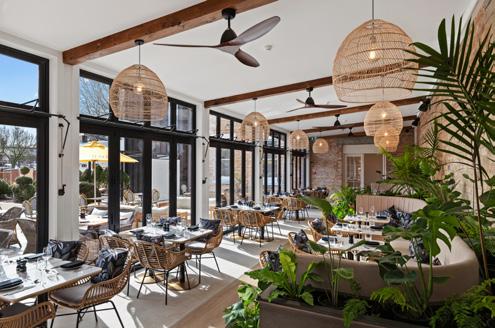
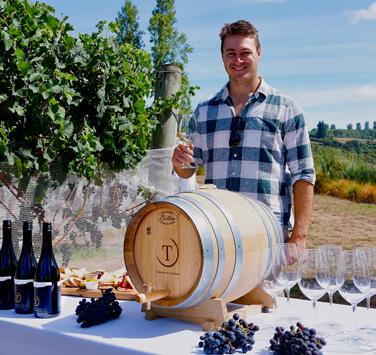
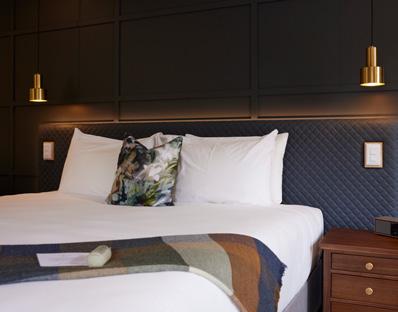
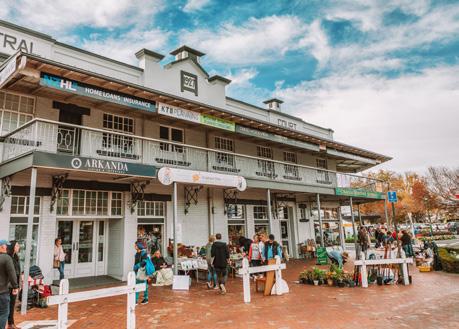
Cambridge is known for its quality food and artisan goods, and the weekly market is a great way to experience everything it has to offer. Fresh baking, locally made products… It’s a relaxed, unhurried way to begin the day.
Later, we made our way to the Cambridge Distillery Co, a small operation owned by two couples who joined forces during lockdown to create a business that reflects the wider craft movement in the region. Tastings offer a glimpse into the area’s growing food and drink scene without feeling overly commercial.
A short drive out of town took us to Takapoto Estate winery, near Lake Karāpiro, which combines a vineyard and show-jumping event grounds. Sitting outside with a glass, looking out over the
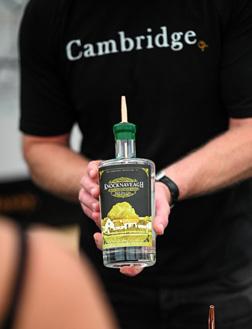

landscape, it’s easy to see why the cellar door is packed with weekend tasters. We settled in with a cheese platter and watched the entertainment unfold between a couple of hen’s parties, proving it’s also a popular spot for celebrations too.
On Sunday, we decided to get a little more active. With Riverside Adventures, we set out on an e-bike ride along the Waikato River, starting at Avantidrome, New Zealand’s national cycling hub. The route follows part of the Te Awa River Ride, a mostly flat, well-maintained trail that connects Cambridge with the wider region. Even for casual cyclists, the e-bikes make it an easy, enjoyable ride.
The path winds along the river, through farmland and native bush, before opening out towards Lake Karāpiro, known for
its calm waters and scenic setting. The journey itself is a chance to move through the town and outskirts at a pace that still allows you to take it all in, and being picked up and returned to town makes the whole trip feel seamless.
Back in Cambridge, the afternoon slipped easily into more wandering, with a few last stops at boutiques, a coffee and yet another visit to the Cambridge Distillery.
The combination of experiences in art, food, cycling and shopping, all within close reach, makes Cambridge an easy trip for anyone who loves culture, adventure and food. For couples in particular, that balance is hard to beat. There’s enough to fill a weekend, but also plenty of space to do very little at all. And it’s surprisingly hard to leave.

The memories we make during our school holidays can last an entire lifetime – a worthy investment, if you think about it. Some are of simple pleasures and rituals experienced at home, while in other instances, travelling even a short distance can provide something new and novel that captures the imagination long after the trip is over.
As the winter term break approaches, so too is Trust Horizon Light Up Whakatāne, an eye-opening experience right here in our regional neighbourhood. Whether you have holidaying kids in tow or not, it presents a vibrant – and free – antidote to winter’s darker days. From 6pm to 9pm from July 11 to 18, Whakatāne’s town centre and riverfront will be aglow and abuzz with art installations (many interactive), sculptures and digital displays, music and dance.
While you’re planning your trip in this neck of the woods, check out some of the best places to eat, play and stay.
It’s tempting to hunker down and hibernate, but let’s not allow the chilly season to pass us by without some memorable moments to show for it. A trip to Whakatāne has all the ingredients to make it a bright spot on your calendar.

When you’ve been a local institution since 1894, you must be doing something right. Seven days a week, in a thoughtfully preserved heritage building, The Comm offers a stacked menu complete with kids’ meals, and drinks including beer and cider from Good George Brewing on tap.
Like its twin eatery in Pāpāmoa, the claim to fame of The Wagon in Whakat ā ne is gourmet burgers. Those who wish to eat vegan or gluten-free will be pleased to hear the menu does not leave you out in the cold.
For a more elevated experience, put on your going-out top to dine at Olive Branch. It’s run by two brothers, whose Mediterranean DNA is woven throughout, a delicious international influence that’s balanced by their focus on local ingredients and suppliers.
Due to its close proximity to the bush, kiwi can be heard from the CBD and have been spotted in backyards, earning Whakatāne a name as the Kiwi Capital of the World. Providing cute, free, low-key fun, 10 life-size kiwi statues are dotted on a one-hour (1.6km) trail around town for visitors to spot. Download the guide before you go or pick one up at the i-site or Te Kōputu a Te Whanga a Toi Library and Exhibition Centre.
There are bike trails and more bike trails around these parts. Challenge yourself to ticking off some or all of the Motu Trails Cycleway, one of the 22 great rides that make up Ngā Haerenga, the New Zealand Cycle Trail. You might make biking your reason to drive over the hill to roll along the nice, flat, 2.9km Ōhope Harbourside Trail on two wheels, or go further afield to kick into gear at the Onepū Mountain Bike Park, which caters to all ages and abilities.


What will you see if you lace up your sneaks for the hour-long Fairbrother Loop Walk? As well as sensational scenery, the downloadable map lists the birds and insects to keep an eye out for. For those in need of a dappled nervous-system reset, the Mokorua Bush Scenic Reserve walk (1-1.5 hours) is a similarly tranquil experience that sees you strolling beneath the canopy of native trees amid tinkling birdsong.
Occupying prime waterfront real estate, these upmarket apartments are fully self-contained (including kitchen and laundry) but serviced with linen and towels. Undercover parking, a heated outdoor swimming pool, a fitness room and a BBQ area might see all the boxes ticked for you.
Go even more high-end here, where you can opt for accommodation that has views of the ocean on one side or the harbour on the other. Choose from two- or four-bedroom apartments, or if you’re feeling a bit swanky, book into a penthouse. All guests gain access to swimming, spa and lap pools, plus a tennis court, gym, sauna, games room and conservatory.
A drawcard of this motel for anyone with waterbabies is that it’s within walking distance of the Aquatic & Fitness Centre and its kid’s beach pool, spas and hydroslide. It’s also 10 minutes’ walk from The Strand, home to those eateries we mentioned. If it sounds like a bit of you, you’ll be even happier to hear you’ll end your stay well-rested, courtesy of the one- or two-bedroom units’ super-king beds, flexible layouts and well-appointed bathrooms, some with big spa baths WHAKATĀ NE.COM






A new Canterbury high-country walk with big views, great food and luxurious stays provides just the right amount of challenge for UNO editor Hayley Barnett
Multi-day walks have become somewhat of a thing for 30and 40-somethings lately. You can barely take a whiff of wine without being hassled to join some hodgepodge friend group’s lofty goal of hiking 100km in four days. It’s the new multi-day winery tour, only much better for your waistline.
When the opportunity arose to walk a brand new 31km hike just outside of Christchurch, I jumped at it, eager to regale friends with my ambitious yet achievable adventure – one that surely no one had even heard of, let alone completed. But it seems the two families who set up and manage the two-day walk are particularly good at marketing, since the first person I told has already booked in a group for later in the year.

RockRidge is an all-inclusive walk located in the Windwhistle area of Canterbury, about 45 minutes’ drive from Christchurch, and takes in a multitude of terrain, including mountain peaks, farmland, valleys, rocks and riverbeds.
Rumbling up the driveway, our view of the Birchview Homestead is the first sign my husband, Karl, and I are in for something special. Henry McElrea greets us at the door and gives us a brief introduction to the huge, stone building with five bathrooms and five bedrooms that sleep up to 10 people.
Originally built in 1928 and extended in the 1980s, the homestead sits among established gardens, native bush and a meandering stream. It’s part of Birchview Farm, a property with farming roots stretching back to 1913. Today, it remains closely tied to the McElrea family, who are among the driving forces behind RockRidge.
Henry, raised at Birchview, and his wife Megan have helped change the property into a place that somehow feels traditional and modern all at once. It’s a classic rural home, with formal dining spaces, log fires and upstairs rooms looking out over the surrounding high-
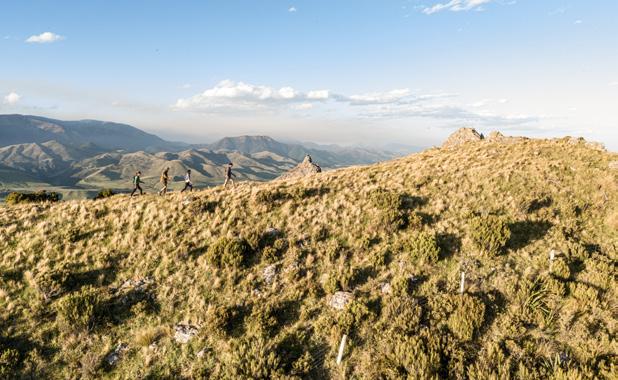
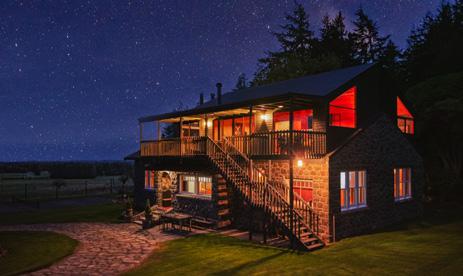
country landscape. It’s also an elegant and welcoming beginning to our journey.
As Henry heads off, he leaves instructions for dinner, which awaits us in the fridge –55-day-aged Angus beef with roasted vegetables and salad, matched with a beautiful local red wine. Dessert is a chocolate torte with berry coulis. All the food is prepared by Fable Terrace Downs, a golf resort down the road, renowned for its cuisine. From the first night, it’s clear this trip will be worth it for the food alone.
The next morning, after breakfast and a leisurely start, the walk begins in earnest.
Day one runs from Birchview Homestead to Quartz Hill Quarters: 13 km, six to seven hours with breaks, and roughly 1000m of climbing. It sounds intimidating, but in reality the route unfolds in chapters and includes waterfalls, springfed creeks and ancient cave systems said to date back some 80 million years.
The ascent to Snowy Peak and High Peak Summit is the headline act. We have morning tea at altitude, which feels deserved. Canterbury spreads below –plains, braided rivers, lakes and distant ranges surrounding us on every side. Later comes the 300m climb to Cooks Cliff, with a shortcut available. We ignore that and go the long way, before descending toward Copper Creek Watering Hole, where a dip in a man-made watering hole awaits.
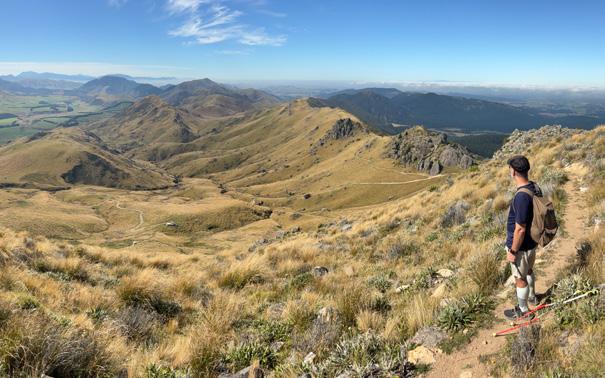
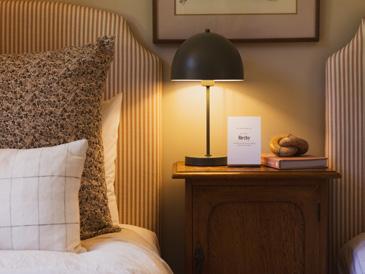

Here, we’re collected by a four-wheel buggy, and driven 5km down to Quartz Hill Quarters.
By the time we arrive, our legs are humming, our cheeks are wind-burnished and, thankfully, the second night’s accommodation feels glorious. We head directly for the hot tub and sauna, which are situated right on the edge of where the sheep are grazing. It’s a surreal experience to be surrounded by your upcoming dinner, but, if you’re not vegetarian, it also makes you appreciate the farm-to-plate ethos on a whole other level.
Food, as I mentioned, is central to the entire concept. Georgie and Dan Harper are the owners of Quartz Hill Station, a third-generation farm with deer, Angus cattle and sheep, and all of the food is built around locally sourced produce. Slow-cooked Lumina lamb is the star of the show, and the berry crumble and ice cream pushes me pleasantly over the edge.
Day two offers another welcome fork in the trail: a shorter 10km half-day option, or a fuller 18km route for those still feeling ambitious. If you choose the longer walk, you’re rewarded with some of the most memorable geology of the trip – formations named The Brothers, The Mole, Periscope Rock and Hanging Falls – before descending through
native bush of kōwhai, black beech and honeydew.
Unfortunately for us, fog has descended on the entire Windwhistle area, and so we choose the shortcut, which slices off a good chunk of the overall distance. Eventually, the track joins the original Washpen Falls adventure walk, where there’s a waterfall to linger beside, and where heritage hydroelectric features add to all the grandeur.
The finale feels strangely civilised: afternoon tea back at Birchview Homestead, with the option of a hot shower before departure. We wash off the day’s mud, take advantage of the giant jar of what might be the best biscotti I’ve ever tasted, and sit in front of the fire as we await our shuttle back to Christchurch.
RockRidge’s genius seems to lie in understanding that many travellers want wilderness without the hardship. The McElreas and Harpers haven’t diluted the high-country experience, but they have framed it beautifully. You still earn the views and feel the miles, but the best part, for me at least – besides the stunning views and lush accommodation – is that someone has already thought about dinner.
ROCKRIDGE.NZ
From Big Five encounters to Cape Winelands and Cape Town’s coast, YOU Travel & Cruise Bethlehem explores South Africa’s extraordinary richness firsthand.
WORDS LIZ FRENCH
Most travellers to South Africa have wildlife top of mind, then discover so much more in a country of remarkable depth and diversity.
YOU Travel & Cruise Bethlehem’s Brenda Stephen and Lydia Haydon each visited this big, beautiful country recently. Both returned raving, and not just about their safaris. From vibrant cities to untamed wilderness and world-class wine regions, they got a tantalising taste of the best of South Africa.
Getting to South Africa involves just two international flights. Brenda and Lydia agree that any uneasiness you may anticipate is completely allayed by the hosts of the tours they can organise for you, ensuring you’re wrapped in an exhilarating bubble from the minute you step off the plane.
Between them, Brenda and Lydia experienced three private game reserves and that being a guest confers pertinent privileges. Thrill at wildlife sightings from the comfort of a purpose built jeep with guides who have an intuitive (aided by technology!) ability to get you up close and personal with elusive and unforgettable beasts in their natural habitat. Game

drives typically start before sunrise, with golden light spilling across the savannah, and are repeated from late afternoon for entrancing evening encounters.
Brenda stayed at the Lion Sands River Lodge in the prestigious Sabi Sand Game Reserve. It borders Kruger National Park, a public reserve often congested with traffic. Add the luxury of a suite above the river where wildlife wanders past your deck, and the benefits of a private reserve richly reward your investment.
The luxury continued at Ngala Private Game Reserve with extraordinary encounters with rhino and elephants, and wild dogs on the hunt. The Ngala Treehouse experience where guests spend a night open air under a star spangled sky was described by Brenda as the perfect honeymoon or once in a lifetime stay.
Lydia arrived by air at Phinda Private Game Reserve in the KwaZulu Natal region, an equally amazing private reserve with six luxury lodges spread out over varied habitats and safaris into areas where the ‘big five’ (lion, leopard, rhino, elephant and buffalo) roam freely. The abundance of wildlife and the proximity of unsoiled coastline and spectacular reefs make Phinda the perfect bush and beach adventure.


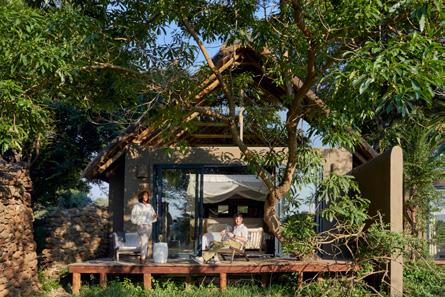

South Africa is much more than the big five. Brenda found Johannesburg (Joburg to the locals) far beyond expectations. Learning of the country’s journey to democracy on a visit to Constitution Hill proved a “poignant eye-opener”, and an inspection of the legendary Rovos Rail (The Pride of Africa Train) encouraged her to recommend this luxury rail journey.
Of all the most lauded hotels Brenda stayed in on her tour, the waterfront Cape Grace Hotel in Cape Town was a favourite, perfect for exploring one of the world’s most beautiful coastal cities, where style, culture and cuisine is ever framed by the silhouette of Table Mountain. Excursions to Chapman’s Peak (cited as the most scenic drive in the world), to windswept Cape Point, and to see the penguins at Boulders Beach were among many highlights.
Lydia relaxed and imbibed happily in the Cape Winelands, staying at the utterly gorgeous Franschhoek Country House and Villas, where vineyard covered valleys meet Cape Dutch architecture. A day trip from Cape Town to the wine country gave Brenda a taste of its charm and vintages.
In just under two weeks, these YOU Travel & Cruise consultants experienced the wonder of wildlife in superior private reserves, cultural richness, scenic

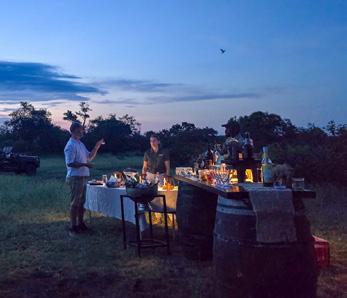

beauty and historical significance in the cities, renowned wine regions and culinary experiences – all enhanced by luxury accommodation, each exuding unique character. What’s not to love? Lydia’s well qualified to name South Africa, “one of my top three travel destinations”.
Brenda’s and Lydia’s trips were aimed at achieving a lot more than having a wonderful holiday. Like many others taken by the YOU Travel & Cruise team, their South Africa journeys were all about gaining personal experience they can share with their clients. YOU Travel & Cruise believes that by investing in knowledge, they add genuine value as travel advisors and facilitators, and enhance the enjoyment and satisfaction travel provides – not to mention the peace of mind of having a professional on the job as you plan and embark on much-anticipated adventures worldwide.
If South Africa is on your radar, the experts at YOU Travel & Cruise in the Bethlehem Town Centre would love to share their first-hand knowledge of what makes this country an extraordinary destination, and to curate an unforgettable holiday for you.
Pip Crombie discovers a unique golfing destination with a dash of culture on the side.
PHOTOS PIP CROMBIE

St Andrews may be the centuries-old home of modern golf, but the game –protocols intact – has not only survived, but thrived globally, becoming a powerful drawcard for international travellers. Serious golfers and social hackers alike find an exquisite anticipation in packing clubs into a bag sturdy enough for the cargo hold, plotting which courses to conquer and how best to enjoy après-golf. A half day on the greens, balanced with time spent exploring local culture and cuisine makes for the perfect mix – even when non-golfers are along for the ride.
You might be surprised by which countries deliver exceptional golf experiences. Having played in several
overseas locations, a standout for me is the Central Coast region of Vietnam. The major hub of Da Nang is an easy gateway (with Air New Zealand codesharing with Singapore Airlines), and offers access to more than a dozen courses. Expect diverse terrain, from mountain-top championship layouts to links-style seaside experiences, with scenic backdrops featuring lush vegetation and striking elevation changes, or dramatic ocean views and coastal winds. Fair warning: it can all be wonderfully distracting – and a convenient excuse for the state of your game.
Although some courses are attached to larger resorts, basing yourself in Da Nang or the historic town of Hoi An offers a more authentic Vietnamese experience. Most courses are within about an hour’s drive and feature excellent warm-up areas, well-stocked pro shops, quality amenities and solid dining options.


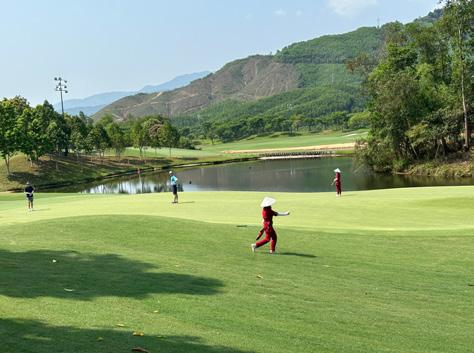


Fairways and greens are immaculately maintained, with well-spaced tee times and good on-course facilities.
If time allows, aim for a varied line-up of courses. For me, two rise to the top. The mountain championship layout at Bà Nà Hills Golf Club sits at the foothills of the famed Bà Nà Hills, just 25 minutes from the city. Set among some of the region’s most impressive ranges, this lush, green course was designed by Luke Donald and feels distinctly Vietnam. If you’re tempted to squeeze in two rounds in a day, a stateof-the-art floodlighting system illuminates all 18 holes after dark.
My second pick is Hoiana Shores Golf Club, a traditional links course by Robert Trent Jones Jr, who’s known for integrating layouts seamlessly into natural landscapes. Here, you’ll contend with firm, sandy turf on a scenic
coastal routing, seasonal (but warm) winds, and classic links bunkering – a mix of wasteland and pot bunkers that demand strategy as much as skill.
Closer to Da Nang, our group also enjoyed the Legend Danang Golf Resort (formerly BRG Danang Golf Club), a 36-hole complex featuring two distinct championship courses. The links-style layout by Greg Norman delivers sweeping coastal views, while the parkland course by Jack Nicklaus offers wide fairways, river vistas and strategic bunkering. Golfers of all levels can take on these courses, choosing tees that suit their game and appetite for challenge.
Caddies are compulsory in Vietnam, with one assigned per player. Typically local Vietnamese women, they perch on the back of the golf buggy as you move between shots. Most are highly intuitive, quickly
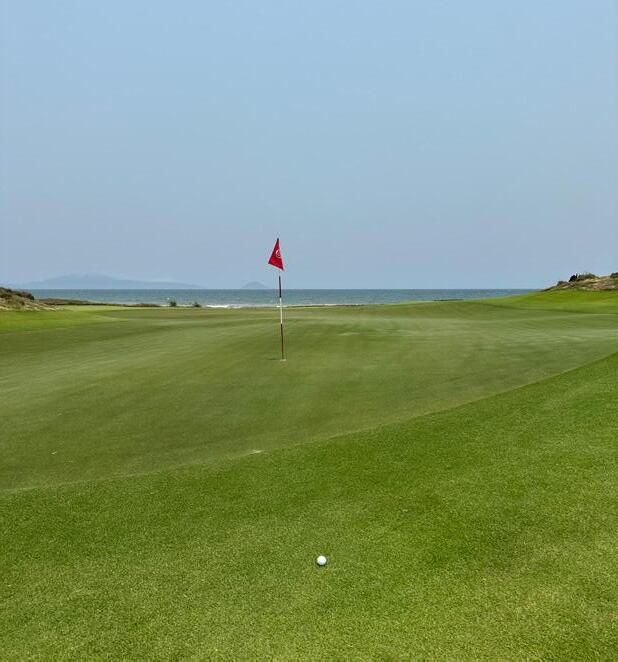
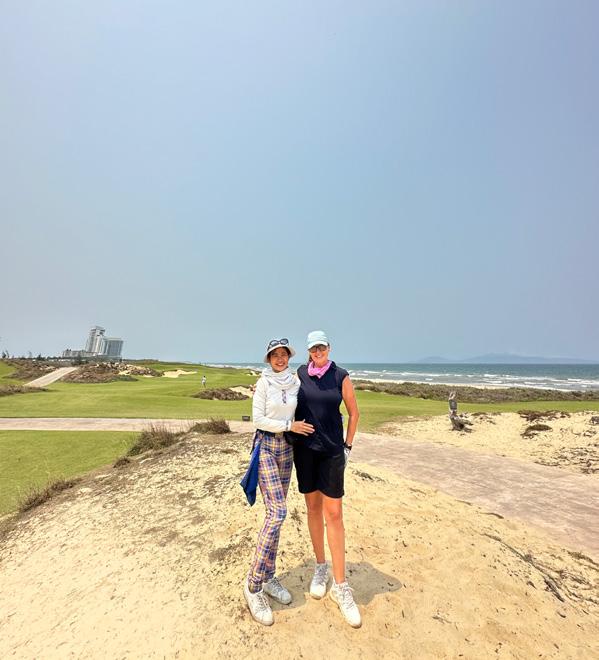
you really click with your
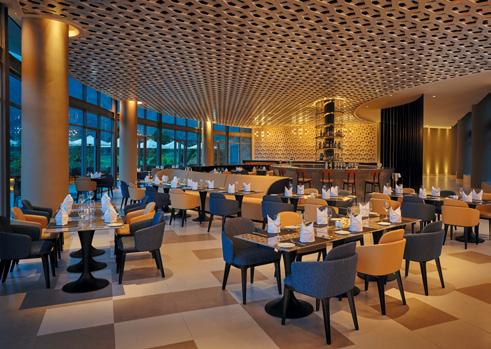
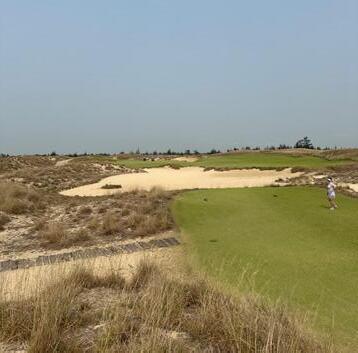
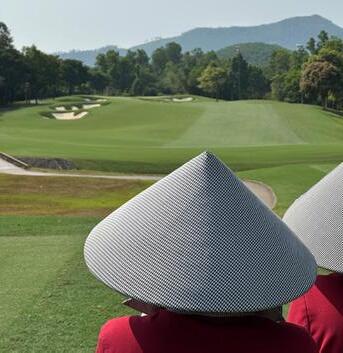
assessing your ability and reading greens with impressive accuracy – the rest, of course, is up to you. Expect to pay around NZ$40 per round, although a good day on the course may loosen the purse strings.
Golf in Vietnam isn’t exactly cheap. As part of a casino complex, Hoiana Shores sits at the top end of Central Coast pricing, at around NZ$500 per round. However, accommodation, dining, shopping and transport are all relatively affordable, which helps to balance your overall spend. If you’re flying domestically, local airlines will often carry a second (golf) bag free of charge. What’s not to love? Time to swing into action.
Best time to go: March–April (warm but not overly hot or wet). August can be extremely hot, while October–November often brings heavy rain and flooding.
How to book: Booking direct via golf club websites is possible, although you may be asked to provide copies of credit cards and passports. Language barriers can occasionally complicate things, but many clubs communicate via WhatsApp. Golf booking agents can simplify the process by arranging tee times and transport, though they often quote in US dollars, take a margin on exchange rates and require upfront payment. Always check cancellation policies carefully.
Where to stay: Da Nang offers a wide range of accommodation, from beachside resorts to quaint, authentic boutique hotels.
Other tips: Bring US dollars for tipping, use a Wise card or similar for payments, and download Bing, widely used in Asia for ride-hailing services.
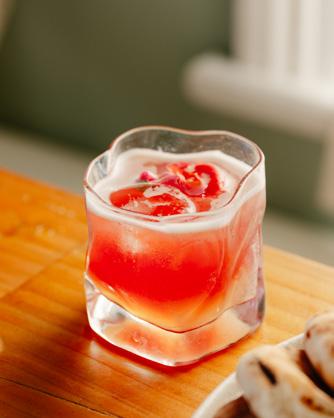
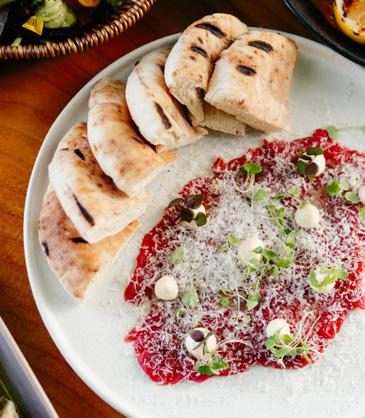
UNO editor Hayley Barnett drops in on Med Lounge and Garden, where live beats and culinary genius are stealing the Village spotlight.
If experiences are the latest craze in the epicurean world, then Med Lounge and Garden is right on trend.
Sitting in the middle of the Historic Village, the restaurant, bar and event space has become one of Tauranga’s most interesting hospitality hybrids.
It’s partly a neighbourhood eatery and partly a live-events hub. But make no mistake – it’s very serious about food.
For co-owner Jose Lavin, the vision was to create a place where the food feels fun and fresh, and the vibe social. That’s easily achieved when you combine two of the best events guys in the biz.
Med is the brainchild of co-owner Mitch Lowe from Audiology Touring, one of New Zealand’s leading DJ touring businesses. Knowing Jose’s extensive background in hospitality and events, Mitch brought him on to manage things. Jose runs Euphoria, another festival business, and now Med, where he shaped its recent menu revamp.
“I think everything has a little bit of personality,” Jose says of the menu. “A lot of colours, fresh, healthy.”
That philosophy shines through when the dishes arrive. Halloumi salad, falafel and house-made pita bread have already become favourites on the lunch menu. The bread is baked fresh each morning through a collaboration with the team behind Tauranga’s well-known Falafel Metro, whose Middle Eastern roots helped inspire Med’s original direction.
Since taking over the food offering earlier this year, Chilean-born Jose has recently designed the new dinner menu to become something broader and more exploratory, mixing Mediterranean influences with Spanish, Italian and South American touches.
“We’re trying to create a menu that gives an experience,” he says.
That means retaining signature elements for the new dinner menu, such as hummus, labneh and romesco, while introducing shareable plates, like cheese and prosciutto cigars, octopus toast and Basque lamb.
Jose says the goal is to give regular diners a reason to return. “If you like a place, you want to go and probably have something new that isn’t on every other menu in town.”