

Combatting Maritime Environmental Crimes
Response
Community Based Crime Prevention / Youth Empowerment
Cyber Threats at Sea
Detection
Gender Roles in Tackling Maritime Crime
TIPSOM
Legal Frameworks, Prosecution and Adjudication
Maritime Counter Terrorism

UN Volunteers and Maritime Crime
Technology and Innovation
This briefing package is interactive. From the main index, you can click on any section to go directly to it.
You can also jump to any other section by clicking on the section titles in the header. If you want to learn more about our work, follow us on our YouTube channel UNODC Crime Programmes.
For updates and additional resources, visit www.unodc.org/piracy. Or follow us on X at @UNODC_MCP.
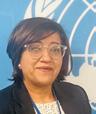
Toral Vadgama Acting Head Global Maritime Crime Programme UNODC
Welcome to the UNODC Global Maritime Crime Programme (GMCP) 2025 Briefing Package. This report marks another successful year of supporting our Member States in addressing the threats and challenges posed by maritime crime.
In 2025, GMCP provided technical assistance to Member States to enhance the detection, investigation, prosecution, and adjudication of maritime crime. The Programme engaged with 109 countries across the Atlantic, Pacific, and Indian Oceans, as well as the Caribbean, Mediterranean, Red, and Black Seas. GMCP supported Member States to address maritime crime challenges such as piracy, trafficking in illicit goods, crimes in the fisheries sector, and pollution crimes in the marine environment. Throughout, GMCP delivered tailored, sustainable initiatives that emphasized regional cooperation and practical skills development.
Over 8,380 maritime law enforcement and criminal justice officers received training contributing to improved surveillance, monitoring, detection, interdiction, and operational responsiveness at sea. Capacity-building also supported judicial systems by providing training and mentoring to judges and prosecutors, including simulated trials and reviews of legal frameworks. By doing so, GMCP strengthened the legal finish required to effectively prosecute maritime crimes.
Throughout, GMCP has focused on both strengthening and expanding our programming as well as exploring new opportunities in technology and innovation.
We hope you will find this briefing package to be a captivating read. Thank you for your continued support.
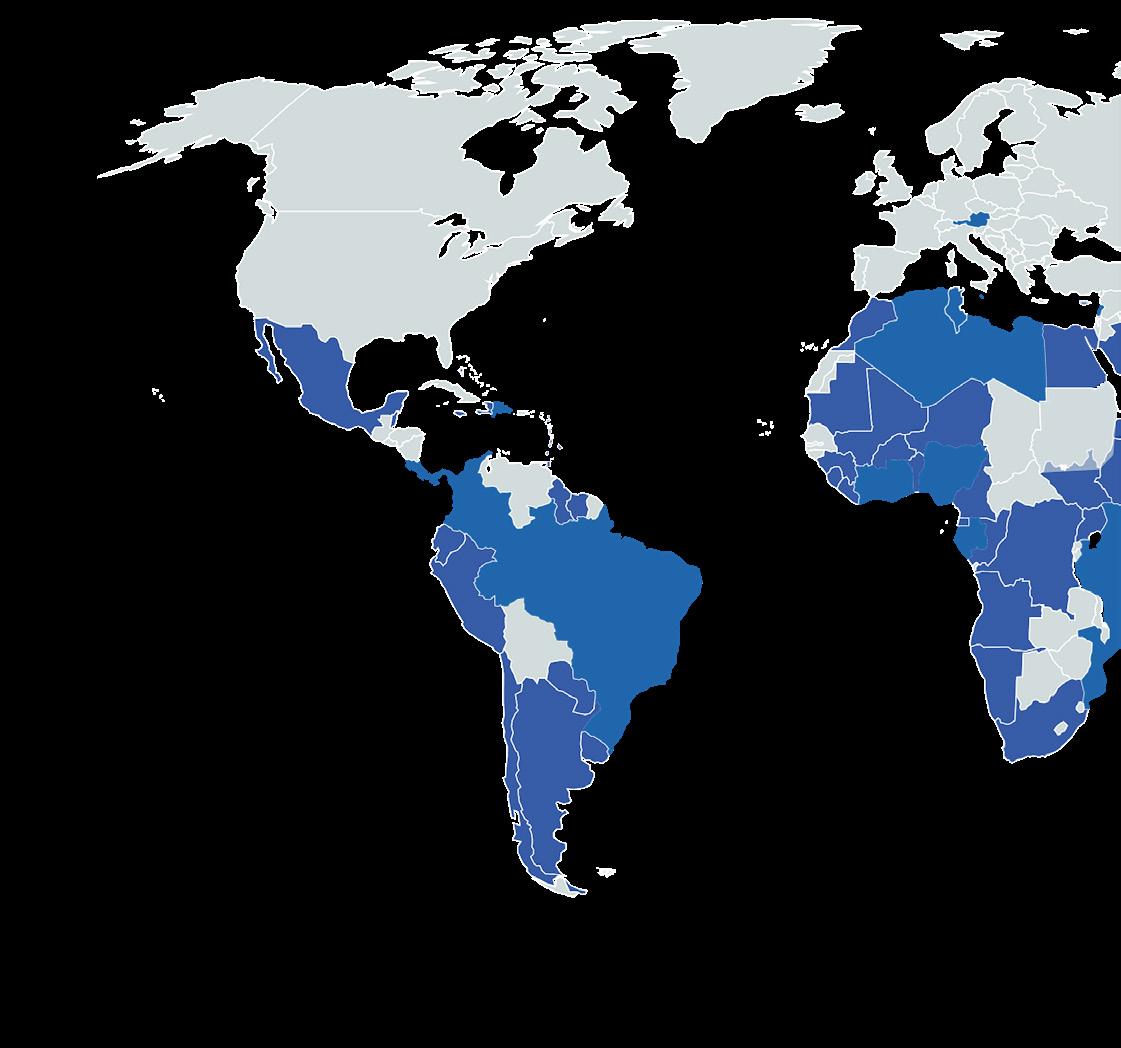
109 Total
64
59


123
1,915
8,380



D Australia
D Canada
D Denmark
D European Union
D France
D Indonesia
D Italy
D Japan
D Multi-Partner Trust Fund (MPTF)
D Netherlands
D Norway
D Portugal
D Russian Federation
D UN Trust Fund for Human Security
D United Kingdom
D USA
C Strengthening global programme governance through standardised planning and reporting.
C Navigating challenges and quality-assurance frameworks to ensure coherence and accountability across all GMCP regions.
C Advancing a harmonised criminal-justice approach to maritime crime by developing global legal tools, guidance notes and updates to the GMCP Maritime Crime Manual covering detection, interdiction, investigation, prosecution, and detention.
C Enhancing cross-regional integration by coordinating joint workplans, shared operational models and consolidated thematic approaches on piracy, drug trafficking, maritime environmental crime, sanctions enforcement and criminal-justice chain support.
C Deepening donor engagement by aligning technical priorities with strategic expectations, strengthening reporting and supporting new and supplementary budget proposals.
C Positioning GMCP in global policy processes, including Security Council deliberations, Biodiversity Beyond National Jurisdiction (BBNJ) negotiations, UN80 follow-up and regional maritime governance platforms, ensuring UNODC’s technical voice shapes international maritime security discussions.
C Ensuring gender equality, environmental sustainability, and human-rights safeguards were consistently mainstreamed across the entire programme.
C Strengthened global oversight of GMCP through improved coordination, enhanced monitoring systems, reinforced risk-mitigation, and compliance measures to ensure continuous and accountable delivery across all regions.
C Development and dissemination of global guidance products including legal issue papers, thematic briefs, and revised modules of the GMCP Maritime Crime Manual, providing Member States with harmonised technical standards.
C Improved cross-regional operational coherence through facilitated collaboration on maritime drug interdiction, piracy responses, environmental crime investigations, sanctions enforcement, and judicial follow-up processes.
C Successful mobilisation and stewardship of donor resources alongside strengthened visibility and donor compliance reporting.
C Expanded GMCP’s contribution to global policy forums by providing technical inputs to Security Council processes, BBNJ negotiations, UN80 follow-ups, EU coordination mechanisms, and regional maritime security dialogues.
C Systematic integration of gender equality, environmental considerations, and human-rights compliance into guidance and qualityassurance processes, resulting in more consistent application across the global GMCP portfolio.







Water-Borne Improvised Explosive Devices (WBIEDs) explosives