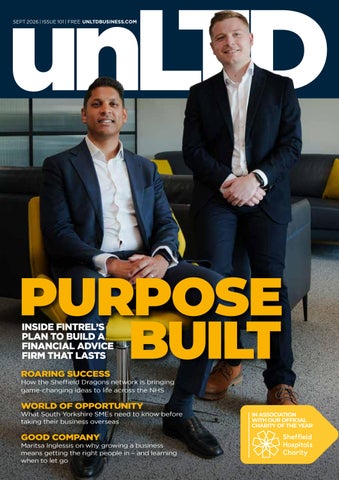
SEPT 2026 | ISSUE 101 | FREE UNLTDBUSINESS.COM
INSIDE FINTREL’S PLAN TO BUILD A FINANCIAL ADVICE FIRM THAT LASTS ROARING SUCCESS How the Sheffield Dragons network is bringing game-changing ideas to life across the NHS
WORLD OF OPPORTUNITY What South Yorkshire SMEs need to know before taking their business overseas
GOOD COMPANY Maritsa Inglessis on why growing a business means getting the right people in – and learning when to let go
IN ASSOCIATION WITH OUR OFFICIAL CHARITY OF THE YEAR
AVAILABLE IN THE RESTAURANT & BAR
SC AN TO BOOK
STE A K COCKTA IL
£25 FROM
INCLUDES A
£5 BET
*
SUNDAY - THURSDAY BR ADFORD | HULL | LEEDS | M ANCHES TER | SHEFFIELD * Ts and Cs apply. Full terms and conditions available on our website.
Here’s what our customers say “ Simoda have been brilliant for us. They’re not like the usual IT support companies - really approachable, easy to talk to, and their support is never a hassle to use. Everything just feels smoother with them. Would happily recommend to anyone.”
Data Loss can Cause Severe Financial Consequences So prevent it before it strikes! Jibba’s Managed Cloud Services offer secure, flexible and cost-effective data storage — so your files are always safe.
>Ethical >Secure >Future jibbajabba.co.uk Contact to find out how we can help Tel: 0114 303 7130 Email: sales@jibbajabba.co.uk
ISO Certificate No: 454872024
Contents Hello, and welcome to this month’s unLTD Business Magazine – our first issue of autumn. So, what have we been up to this month? Well, rather than settling into cosy season with pumpkin-spiced brews and the office heating cranked up, we’ve been sticking the big coats on and getting out and about across the region. That’s meant chatting to local entrepreneurs, office visits aplenty and hosting events of our own for the South Yorkshire business community. For your long read this month, I spent a morning with the Fintrel team, who told me all about their mission to build a modern financial planning firm founded on decidedly traditional values. There was plenty of food for thought, particularly around running a business for the right reasons and staying true to what motivated you in the first place. That’s our cover story this month, and you can find it on page 26. Elsewhere, you’ll find news of charitable work bringing life-changing innovation to the NHS frontline, some important arrivals on the business scene and advice on everything from responding to a cyber-attack to taking the plunge into exporting. PS: it’s officially last orders if you want to get your hands on either an exhibition stand or a free visitor pass for the unLTD Business Expo. I’ll be there, interviewing a range of people doing interesting things, but don’t let that put you off. Turn the page, where our MD Phil explains what we’ve got in store for you. That’s all from me – catch you next month! Joseph Food, Magazine Editor
CONTENTS 26: PURPOSE BUILT For this month’s deep dive into a local company, unLTD headed to meet some new kids on the financial planning block. Fintrel’s co-founders Luke Worthy and Ketan Patel settled down for a chat about building their perfect firm – one led by independence, traditional values and employee ownership.
36: THE PEOPLE PERSON As businesses grow, people problems can quickly become growth problems. The People Keeper founder Maritsa Inglessis explains why founders need to get out of their own way, how better people management can give them back their freedom and why staff retention is rarely just about money.
@UNLTDBUSINESS UNLTD BUSINESS UNLTDBUSINESS
EDITORIAL EDITOR Joe Food Joe@unltdbusiness.com
ONLINE EDITOR Ash Birch
Ash@unltdbusiness.com
DESIGN Marc Barker ADVERTISING Phil Turner phil@unltdbusiness.com 07979 498 034
Nick Hallam nick@exposedmagazine. co.uk 07843 483536
FINANCE Lis Ellis accounts@ exposedmagazine.co.uk CONTRIBUTORS Dan Bumby Jill White Ruby Deakin Isabel Butler
44: ENTER THE DRAGONS Sheffield Dragons is bringing businesses closer to the frontline of healthcare innovation, backing NHS staff to turn bold ideas into reality. We heard from Sheffield Hospitals Charity’s Greg Van Heeswijk and Rosie Memory about an exciting new network and the role local businesses can play in driving change.
56: GOING GLOBAL With the South Yorkshire International Trade Conference returning to Sheffield this month, we explore the world of exporting for local SMEs: the benefits to reap when done well, common stumbling blocks and what support is out there to help businesses reach overseas markets.
unLTD is published monthly by Blind Mice Media Ltd Unit 1B Rialto, 2 Kelham Island Sq., Kelham Riverside, Sheffield S3 8SD The views contained herein are not necessarily those of Blind Mice Media Ltd and while every effort is made to ensure information throughout unLTD is correct, changes prior to distribution may take place which can affect the accuracy of copy, therefore Blind Mice Media Ltd cannot take responsibility for contributors’ views or specific listings.
unLTDBUSINESS.COM
5
Agenda
The unLTD Business Expo returns to Magna on Wednesday 14 October – and this year, there’s more to see, do and experience than ever before. We shouted across the office to our head honcho Phil Turner to find out what’s in store… We know you've been busy, Phil. What can people expect from this year’s unLTD Business Expo? The main thing is there’s going to be much more happening on the day. Our exhibitors remain at the heart of the expo, with more than 75 businesses expected this year, but we’ve also focused on giving visitors more reasons to stay and have fun. There’ll be talks, workshops, speed networking and interactive experiences across the floor. One exhibitor is bringing a go-kart down, Yard Ball will have a pop-up football game and our headline sponsor, Wildfire Events, is bringing its Pressure Chamber challenge. We want it to be a productive day out of the office – but also good fun.
Tell us more about some of the new features. The Pressure Chamber is inspired by The Cube, challenging people to put their teamwork, quick thinking and ability to stay calm to the test. We’re also introducing the unLTD TV Studio, where we’ll interview founders, exhibitors and business leaders throughout the day. Our official media partner, LensGo, is helping us deliver the Confidence Booth, inviting visitors to share their experiences, challenges and ambitions on camera. There’s also Andy Hanselman’s Pitching Clinic, offering bookable one-toone feedback on business ideas, products, campaigns and sales propositions. That should be a good one for sharing ideas. What’s happening on the talks stage? We’ve tried to make the programme practical, honest and entertaining. Richard Askew from Askew Brook will explore what actually works when it comes to AI, while The F**k Up Club will share candid stories about business mistakes and lessons learned. Other sessions will cover selling a business, employee ownership and improving your marketing, while
6
unLTDBUSINESS.COM
our technology edition of Dragons’ Den will give businesses the chance to pitch live. We’ll finish with an interactive fizz tasting hosted by Andrew Lofthouse AKA the Northern Wine Guy. What networking opportunities will there be? Networking runs throughout the event, whether that’s at exhibition stands, during activities or over a coffee. We’re also bringing back three structured speed networking sessions, giving visitors a quick and easy way to meet new contacts. Before it all opens, Andy Hanselman will host a special 3D Connect breakfast featuring South Yorkshire business leaders who have achieved success outside the region.
Finally, why should people book a visitor pass? It’s completely free and there should be something worthwhile for everyone – whether you want to find suppliers, generate leads, learn something new or simply meet more people from South Yorkshire’s business community. We’re hugely grateful for the support of Wildfire Events, LensGo and our official travel partner, TravelMaster, in helping us make this year’s expo bigger, better and more engaging. The unLTD Business Expo takes place at Magna Science Adventure Centre on Wednesday 14 October, from 9.30am–3pm. Exhibition stands and free visitor passes are available at expo.unltdbusiness.com.
Global Shipping, Zero Stress. GlobalCustoms. Shipping, ZeroWorldwide. Stress. Documentation. Delivery. We handle it all, so you can run your business. Importing / Exporting
UK-based freight forwarders. Reliable, One reliable partner transparent, and careful with every shipment,Total wherever it's heading. peace of mind
01709 610 000 / intfreight.co.uk
We make websites that work for your business Your website is always there for your customers.
But how does it perform? Scan to t find ou
Agenda
A PARTNERSHIP WITH PURPOSE
We’re delighted to announce that Sheffield Hospitals Charity is joining unLTD as our official Charity of the Year, kicking off a 12-month partnership designed to bring the charity closer to South Yorkshire’s business community. Over the coming year, you’ll be seeing plenty more of Sheffield Hospitals Charity across unLTD – in the magazine, online, at our events and, importantly, out meeting businesses from across the region. The partnership will give the charity a regular platform to talk about the work it does across Sheffield’s hospitals, as well as the many different ways local businesses can get involved – whether that’s through fundraising, volunteering, corporate partnerships or simply helping to spread the word. Sheffield Hospitals Charity will also become the official Charity Partner of the 2027 unLTD Business Awards and will have a major presence at the unLTD Business Expo, alongside a series of features and campaigns throughout the year. Phil Turner, unLTD Business, said: “We’ve always wanted unLTD to be about more than simply reporting on the South Yorkshire business community. If we can use the platform we have to help connect businesses with organisations doing genuinely important work in our city, that feels like a really good use of it. “Sheffield Hospitals Charity is obviously a name everyone in the city knows, but I’m not sure every business realises just how much work it does, or how many ways there are to get involved. Hopefully over the next 12 months we can help change that. “The important thing for us is that
this isn’t just about putting a logo on the front of the magazine. We want Sheffield Hospitals Charity to become a real part of the unLTD community, meeting businesses, telling its stories and creating opportunities for people to get involved.” Sam Earnshaw, Director of Brand and Communications, Sheffield Hospitals Charity (SHC) said: “We know that businesses across South Yorkshire want to make a positive difference in their communities, and there is a huge opportunity to harness that ambition to support our NHS. Our partnership with unLTD gives us a fantastic platform to start more conversations, build new relationships and explore what we
WE WANT SHEFFIELD HOSPITALS CHARITY TO BECOME A REAL PART OF THE UNLTD COMMUNITY, MEETING BUSINESSES, TELLING ITS STORIES AND CREATING OPPORTUNITIES FOR PEOPLE TO GET INVOLVED.” 8
unLTDBUSINESS.COM
can achieve together. “Over the next year, we want businesses to see Sheffield Hospitals Charity not simply as a charity to support, but as a partner they can work with in different ways. Being part of the unLTD community gives us a fantastic opportunity to tell more people about the impact of SHC, showcase the incredible work happening across our NHS and, most importantly, bring businesses closer to the causes and people they can help. We’re excited to see where the new connections we make can take us.” The partnership begins this month, with Sheffield Hospitals Charity’s Sheffield Dragons campaign among the first initiatives we’ll be shining a spotlight on. Keep an eye on unLTD over the coming weeks and months for much more – and plenty of opportunities to get involved.
SHEFFIELD POCKETS CRUCIBLE DEAL The future of the World Snooker Championship’s home in Sheffield has been officially confirmed, securing its location at the Crucible Theatre until at least 2045. The agreement follows unanimous approval by Sheffield Council’s strategy and resources committee and provides long-term certainty for a tournament that has attracted more than 12,000 snooker fans from around the world to the city every year since 1977. After the announcement earlier this year that the championship would remain at the Crucible, the signing of the contract completes the final stage of the agreement. The contract confirms that the sport’s biggest event will remain in its spiritual home for at least another 15 years, with the ability to extend by a further five. Kate Josephs, chief
executive of Sheffield City Council, said: “Today marks a hugely important moment for Sheffield and for snooker. The Crucible and the World Snooker Championship have become inseparable over the past five decades, and I am absolutely delighted that we have now officially signed this agreement. “The World Snooker Championship brings visitors from across the globe, showcases our city to millions of viewers and
delivers significant benefits to local businesses, jobs and the visitor economy. This is fantastic news for Sheffield and a deal that will leave a lasting legacy for generations to come.” The tournament will mark its 50th year at the Crucible in 2027, with the new agreement securing the next chapter of its long-standing relationship with the Steel City. Steve Dawson, chairman of World Snooker Tour,
added: “We have an incredible history with the Crucible and the city of Sheffield, and we can now look forward to many more chapters in that story over the next 20 years and beyond. “When we announced this year that the World Championship was staying at the Crucible, there was an outpouring of celebration among fans, players and everyone connected with our sport, and that underlined the emotional attachments that we all feel towards this iconic location. We look forward to working with Sheffield City Council on making this event bigger and better for many years to come.” unLTDBUSINESS.COM
9
Office interiors that inspire. Your vision, our everyday. With over 50 years of industry experience, The DL Company specialises in commercial office furniture, fit outs and refurbishments. Whatever your individual specifications, our talented design team will work closely with you to ensure all your needs are met.
@thedlcompany
0114 244 0202 sales@thedlcompany.com thedlcompany.com
Agenda MAKING THE GRADE Ten student and graduate entrepreneurs from the University of Sheffield have collectively secured £1.4 million in investment over the past three years. Supported by the university’s Emerge: Be Enterprising programme, which offers practical masterclasses, mentoring and connections to local businesses, the students and graduates have secured funding through grants, competitions, awards, venture capital and angel investors. The investment has supported a wide range of new ventures, from railway inspection technology firm Rivelin Rail to a system helping breweries turn organic waste into clean energy.
Many of the businesses are based in Sheffield, with the potential to create highly skilled jobs and contribute to economic growth across the city as they develop. Matt Charlton, enterprise manager at the University of Sheffield, said: “Since launching Emerge in 2023, we’ve built a vibrant community of entrepreneurs on campus and beyond, many of whom we have no doubt will become the leaders of tomorrow. This is thanks in no small part to our many partners in the local business community and University alumni network, who are always willing to share their expertise and offer mentorship.” The success of the Emerge programme also
earned it a place on the shortlist for the Enterprise Catalyst Award at the 2026 National Enterprise Educator Awards, which recognise excellence in enterprise and entrepreneurship education across UK higher and further education. Ben White, University of Sheffield graduate and cofounder of Rivelin Rail, added: “As an engineer, I don't come from a business background. But when we decided to start Rivelin Rail, we soon realised there was a huge
support network right on our doorstep. “One of the first programmes I attended was run by Emerge. It taught me the fundamentals of starting a business, and the team connected us directly with the local business community. Coming from outside that world, that support was immensely helpful to us. “To any aspiring entrepreneurs, my advice would be to engage with that support network and make the most of the mentorship as early as possible in your journey. Use it as a sounding board and don't be afraid of changing direction to achieve your goals.” To find out more visit sheffield.ac.uk/ entrepreneurship.
You built your business for more freedom, so why can’t you step away from it? I help businesses like yours by transforming the way you find, keep and get the best from your people, so your business can keep moving without relying on you.
thepeoplekeeper.com 07532 771822 maritsa@thepeoplekeeper.com
IF YOU’RE PEOPLESTUCK, SCAN THE QR CODE AND LET’S TALK.
Agenda
A PISTE OF THE ACTION First-look images have revealed how Sheffield’s former Ski Village could be transformed into a major outdoor adventure destination, with plans including a downhill luge, scenic chairlift and longerterm ambitions to bring skiing back to Parkwood Springs. Plans to transform the former Ski Village site into a new outdoor adventure and leisure destination were unveiled this month, with a three-week public consultation now under way. New Zealand-based adventure tourism company Skyline Enterprises has put forward proposals for the Parkwood Springs site, with a planning application for the masterplan expected later this year. The first phase would include
Skyline Luge – a gravity-fed downhill karting attraction – alongside a scenic chairlift, indoor educational attraction, café and terrace overlooking the city centre, free outdoor plaza, family playground and customer car park. Later phases could bring a zipline and surf wave experience to the site, while longer-term ambitions include the return of dry ski slopes in a nod to its former use. Existing walking and mountain bike trails would be retained or relocated where necessary as part of the proposals. The public consultation runs until Sunday 20 September. To view the plans and provide feedback, visit skylinesheffieldproject.co.uk/haveyour-say.
HOME STRETCH
Almost two decades after plans were agreed to transform Sheffield’s Park Hill, the landmark estate’s long-running regeneration is approaching its final stages. Sheffield City Council signed a development agreement with Urban Splash in 2007, beginning an ambitious and, at times, controversial project to breathe new life into one of the city’s most recognisable buildings. Now, the penultimate phase is nearing completion, adding another 125 homes to the Grade II*-listed estate. The first homes from the latest release will go on sale on Saturday 12 September, with prices starting from £187,000. The latest phase follows a £6.4 million investment from government housing agency Homes England earlier this year. Designed by architect Mikhail Riches and delivered by GMI Construction, the homes range from two to four bedrooms, with private balconies and communal gardens. The development also includes new green space, EV charging and bike storage. Guy Ackernley, managing director of development and residential at Urban Splash, said: “As we work through Park Hill’s final chapters, this 12 unLTDBUSINESS.COM
is an opportunity to own a piece of architectural history. There aren’t many chances left to move here and the interest we’ve seen over the summer is strong.” Attention will then turn to the fifth and final phase, for which planning permission was secured in September 2024. Focusing on the Talbot Street block, it is set to add a further 105 homes alongside new commercial space for independent businesses. Previous phases have transformed large parts of the former council estate, introducing new homes, businesses and student accommodation including Béton House. With the final phase now in motion, Park Hill is moving closer to the conclusion of a regeneration project that has reshaped one of Sheffield’s most famous – and debated – landmarks. For more information on the Park Hill development, visit urbansplash.co.uk.
Built between 1957 and 1961, Park Hill replaced an area of back-to-back housing and became famous for its ‘streets in the sky’. Designed by architects Jack Lynn and Ivor Smith, its distinctive stepped form follows Sheffield’s hilly landscape. In 1998, it became Grade II* listed, making it one of Europe’s largest listed buildings.
ADVICE: MARKETING
THE BIG PICTURE Dan Bale of Open House Pictures explains why effective corporate video starts with understanding your audience – and shares his advice on creating content that delivers results... In general, when discussing video with businesses, I always ask one key question: "What is it that you really want to accomplish?" This seems like a pretty straightforward starting place. However, most businesses get bogged down in the actual creation of the video (i.e. equipment, location, interview subjects, etc.), as well as the final look and quality of the finished product, before even considering their target audience and what they want the video to achieve. Based on my experience, a strong corporate video should start with the audience, not the business itself. Here’s a few more tips on you can cut through the noise.
TARGET AUDIENCE This sounds counterintuitive to most businesses, as they want to focus on their history, products/services and overall experience. But customers only care whether you can solve their problems. How can you help me with my current dilemma? What am I getting wrong? What will motivate me to take the next step and trust you? And this is crucial to a video actually performing. For instance, a lawn/ gardening company isn't just selling mowing/lawn maintenance. They're providing someone with their time back, while taking away the burden of a task they don't want to perform themselves. The primary product/service is the garden/maintenance; however, the true value of the service is what drives consumers.
NARROW DOWN YOUR MESSAGING Once we've identified our target audience, I’d then recommend narrowing down your messaging. One of the most common mistakes with video is when businesses attempt to include way too much information in a single film/video. Having a core set of main points is fine, but if you start trying to cram loads of key details, then your audience won’t fixate on any of them. It’s far better to have them focus on one or two main points rather than six vague ones they don’t even remember anyway.
TRACKING METRICS Finally, measuring success is important. Views are easily tracked; therefore, businesses frequently concentrate solely on views. However, for B2B organisations, relevance is far more important than reach. I would prefer 100 qualified prospective customers to view my video versus 100,000 unqualified individuals who had no intention of purchasing from my business. You can track this almost immediately by adding a ‘how did you hear about us?’ question to your contact us form and bringing it up in the first discovery meeting. Ultimately, effective corporate video enables your business to be easier to understand, easier to build trust with and easier to purchase from. If it achieves that with the proper audience, then it's doing its job. Open House Pictures is a Sheffield-based video production company creating affordable, high-quality content for businesses across the UK. Head to openhousepictures.co.uk for more.
unLTDBUSINESS.COM 13
Agenda
IN THE ZONE
With work under way on the £6 million Templeborough Business Zone, HBC Construction managing director Lee Powell talks regeneration, regional pride and the ambition to create a new hub for South Yorkshire businesses. Can you tell us about HBC's involvement in the Templeborough Business Zone development? HBC Construction Ltd has been appointed as the lead construction contractor by Rotherham Metropolitan Borough Council and Magna to deliver the £6 million Templeborough
14 unLTDBUSINESS.COM
Business Zone development. Construction work began in early June and will transform the site into a new hub for business growth and community activity. What attracted you to this project? We won this contract through a competitive tender process. There have been a few challenges to overcome to get the project to site, but we’re excited that it is now underway. While the business is expanding, with a new office in Leeds and projects increasingly further afield, South Yorkshire will
always be close to our heart. We’re based on the edge of Sheffield and have previously delivered major South Yorkshire projects in Heart of the City in Sheffield and The Glass Works in Barnsley. We are currently working on Rotherham Markets, and this project allows us to continue building on our relationship with Rotherham Council. We’re proud to deliver a high-quality and collaborative public/ private scheme alongside Magna, creating meaningful business regeneration and contributing to economic growth in the region.
What will HBC be delivering as part of the scheme? We are delivering eight new flexible business units totalling almost 10,000 sq. ft., including six commercial workspaces and two food-and-beverage units. Alongside these buildings, the scheme includes landscaped public areas, outdoor seating, improved pedestrian routes and parking facilities. This will create an attractive and accessible environment for businesses and visitors too. How is the project progressing so far? Work began in early June and things are progressing well. We're pleased to have construction underway, and we're working closely with RMBC and Magna to keep up momentum as we move through the delivery programme. The project is currently aiming for completion in Q2 2027.
What are you most looking forward to seeing once the development is complete? The project combines Templeborough's industrial heritage – represented through its name ‘Steelos Business Park’ – with exciting opportunities for future growth. I'm looking forward to seeing the business units occupied and thriving, bringing new energy and activity to the area. It'll be especially rewarding to watch businesses make use of the new facilities and public spaces. What do you hope this development will bring to Templeborough and the wider area? With its connection to the new Magna tram-train station and wider transport links, the scheme has the potential to significantly strengthen Templeborough's role as a hub for business
growth. With that, we hope the development will attract and support small and medium-sized businesses, encouraging investment in the area. At the heart of the Don Valley Corridor, creating the environment for businesses to thrive in Templeborough will create more high-quality jobs in the area too, building on the new and upcoming transport links and developing a burgeoning business community for the region.
THE SCHEME HAS THE POTENTIAL TO SIGNIFICANTLY STRENGTHEN TEMPLEBOROUGH'S ROLE AS A HUB FOR BUSINESS GROWTH.”
With Jill White of Andy Hanselman Consulting
BACK TO SCHOOL Summer social memories are starting to fade just like the summer tans, although we did have a great one at Pennine Five, where Campus Manager Christina Staniforth and the team pulled out all the stops. Fantastic food, flowing wine and great company made it a night to remember. If you've not yet checked out 'Scran at The Scrannery', we suggest you do! Speaking of flowing wine, have you heard of a 'Wine Waddle?' Another brainwave from the Northern Wine Guy, Andrew Lofthouse, almost 30 of us started at the Gillmont on Ecclesall Road before waddling back into town to Watt Bar and Kitchen, then finishing at the newly relocated Barks Wine in Leah's Yard. August was quieter on the networking scene, but things hotted up in early September with a 'Three in one Friday!' I was a 'lightweight' and could only manage two, but Andy Hanselman got the hat-trick. The Forge Social kicked things off at The Victoria, before the Botanical Gardens' annual Art in the Park event. A beautiful evening made the perfect backdrop for a super exhibition of work. Huge thanks to law firm Graysons, once again the main sponsors. Then it was a quick dash to the Crucible Theatre for the opening night of King Lear, with friends, supporters and sponsorts there to celebrate another ST triumph. Special shout-out to the one and only Adam Battey who, via daily LinkedIn posts, took us through each of the five Acts. Customer service at its finest – and certainly a big help to me. Maybe I should go back to school... Speaking of which, that's our theme for our next 3D Connect session at Sheffield College. But more of that next time!
Follow Jill at uk.linkedin.com/in/jilltywhite or find Andy Hanselman Consulting at andyhanselman.com. unLTDBUSINESS.COM 15
MEETINGS
@@ KENWOOD HALL DAY DELEGATE OFFER £25.95 PER PERSON INCLUDES: ROOM HIRE PROJECTOR & SCREEN DELEGATE STATIONARY MINERAL WATER SWEETS UNLIMITED TEA/COFFEE FROM OUR CONFERENCE CAFE SANDWICH BUFFET LUNCH WITH FRIES & SALAD T&C’s: New bookings only confirmed before 30th September 2026 Booking must take place between 1st September 2026 - 30th November 2026 Available on day delegate packages only Minimum number of delegates - 10
0114 250 5600 SALES@KENWOODHALL.CO.UK KENWOOD HALL HOTEL & SPA, KENWOOD RD, NETHER EDGE, SHEFFIELD S7 1NQ
www.kenwoodhall.co.uk
MEETINGS
@@ KENWOOD HALL 24 HOUR RATE OFFER £125.95 PER PERSON INCLUDES: BED & BREAKFAST ROOM HIRE PROJECTOR & SCREEN DELEGATE STATIONARY MINERAL WATER SWEETS UNLIMITED TEA/COFFEE FROM OUR CONFERENCE CAFE SANDWICH BUFFET LUNCH WITH FRIES & SALAD MORNING & AFTERNOON SNACK *TO ADD A 3-COURSE MEAL + £35 PP* T&C’s: New bookings only confirmed before 30th September 2026 Booking must take place between 1st September 2026 - 30th November 2026 Available on day delegate packages only Minimum number of delegates - 10
0114 250 5600 SALES@KENWOODHALL.CO.UK KENWOOD HALL HOTEL & SPA, KENWOOD RD, NETHER EDGE, SHEFFIELD S7 1NQ
www.kenwoodhall.co.uk
Agenda
London-based managed service provider WW Computer Systems (WWCS) has opened a new office in Sheffield, with ambitions to build ‘the biggest tech team in the region’ and capitalise on growing opportunities across South Yorkshire. Driving the expansion is local businessman Chris Muscroft, who joined WWCS in a non-executive role after leaving Highlander following its acquisition by Fluid One in 2023. He had previously got to know the business while serving on the council of Ingram Micro’s global partner alliance Trust X. WWCS is a family business founded in 1983 and has enjoyed huge success driven by current CEO Marc Lester, who has worked at the company for 25 years and has run it since 2009. Based in north London, it employs around 40 people, has an
18 unLTDBUSINESS.COM
annual turnover of approximately £4 million and supports around 120 clients, of which around 75 per cent are SMEs and 25 per cent are enterprise and public sector organisations. Chris initially joined to provide guidance on strategy, but his role quickly expanded. “Much to my surprise, I started getting involved more in the day-to-day operations of the company rather than just offering strategic guidance,” Chris tells unLTD. “I took over as Chairman three years ago, and as Group MD in November last year, with a view to stabilising and growing
what we’ve got in London, before at some point going back to a ‘proper’ Chairman's role.” Alongside Marc Lester and a strengthened non-executive board, Chris has spent the past year preparing the company for growth, improving its structures and processes, recruiting staff and developing its service offering. That work is already bearing fruit, with WWCS reporting a trebling of year-on-year profit in the last 12 months, enabling it to fund its Sheffield operation entirely from within the business. The Sheffield office opened on 1 September, with Chris’s former commercial director Ryan Connolly taking over as Sheffield branch managing director. WWCS is also strengthening its London leadership team as it prepares for growth across both locations. Chris plans to run Sheffield as a mirror image of WWCS’s London operation, taking advantage of his contacts and connections in the north and the wider economic opportunities emerging across South Yorkshire. “I have a vision for how our technical offering should look in Sheffield, built on the successes of what we’ve been able to achieve in London,” he says. “We've got our
first technical recruits starting in Sheffield in September and we’ll continue to build over the coming months.” The company’s ultimate ambition is to build the biggest tech team in the Sheffield area, with recruitment increasing alongside its regional client base. As Chris explains: “The faster we grow Sheffield, the faster we’re going to be able to invest in people and skills there.” He calls the move “an unmissable opportunity for WWCS”, citing the region’s regeneration, inward investment and collaboration across South Yorkshire as key factors. “There are a lot of good things in and around Sheffield, but the region’s not been well backed by good tech teams, and that's what we're trying to do. We're trying to grow the biggest tech team in the region to support those clients – to support their growth alongside what will hopefully be successful growth for us.” He points towards recruitment – namely getting the right people in at the right time – as one of the biggest challenges while the operation here develops. “I want people that are ambitious and prepared to learn.
WE'RE TRYING TO GROW THE BIGGEST TECH TEAM IN THE REGION” I grew up with engineers back in the ‘90s who would build Exchange servers in their bedroom for fun. I want those sorts of people.” He adds: “I could not be more excited about what we're doing here. I'm not trying to stomp all over somebody else's territory; I just want to make sure we're providing the best service to our clients.” The Sheffield investment comes against a backdrop of strong growth for WWCS in London, where the company is seeing continued demand for support contracts alongside increasing interest in cyber security, data management and artificial intelligence. For many businesses, Chris explains that a key part of the challenge is understanding how this newer technology can be introduced securely while protecting sensitive company information.
“Where we are having a lot of conversations, certainly from a data governance and security point of view, is talking people through how they can achieve Cyber Essentials, Cyber Essentials Plus and ISO 27001 whilst embracing AI technologies.” Alongside those newer areas of demand, Chris says that more traditional technology investment remains a significant part of the market. “People will always need laptops and tablets and mobiles and network infrastructures. We're seeing that massively. If you look at our hardware and software growth over the last 12 months, the growth curves are almost vertical.” The Sheffield office marks the second phase of WWCS’s five-year growth plan, with the third set to involve establishing a European base. While international expansion remains part of the company’s longer-term ambitions, Chris stresses that the immediate focus is firmly on Sheffield – growing its client base, recruiting locally and building an operation capable of supporting businesses across South Yorkshire. wwcs.co.uk unLTDBUSINESS.COM 19
The Inside Track: Marc Broadhurst REAL INSIGHTS FROM THOSE WHO MAKE THINGS HAPPEN
For the latest Inside Track, Russ Thompson sits down with MB Wills & Estates founder Marc Broadhurst to find out how an unlikely route into estate planning became a business he genuinely cares about, and why there’s far more to writing a will than getting the paperwork right.
MARC BROADHURST FOUNDER OF MB WILLS & ESTATES INTERVIEW: RUSSELL THOMPSON PHOTOGRAPHY: MARC BARKER
If you had told Marc Broadhurst’s teachers at High Storrs School that, 35 years later, he would be running his own estate planning business, sitting down with families to discuss some of the most important decisions they will ever make, he suspects the news might have raised a few eyebrows. “I think there’d have been some funny looks and some giggles,” he says. “I wasn’t a scholar at all. I found school very difficult. I couldn’t concentrate, I was the class clown, a bit of a joker. I had no aims really for what I was going to do when I left school.” He left with one GCSE and, by his own admission, was simply glad to be out. There was no carefully mapped career plan or longheld ambition to become an entrepreneur, and certainly no teenage fascination with wills and estate planning. What followed instead was a working life that has taken in food production, driving instruction, lingerie retail in Spain and, perhaps most memorably, a spell travelling the country selling sausage skins. It is not the obvious
20 unLTDBUSINESS.COM
route into estate planning, but very little about his career has followed the obvious route. “I never knew what I wanted to do until probably the past eight or 10 years. Now I’m finally happy with what I’m doing.” Today, as founder of MB Wills & Estates, he helps people plan for death, illness and later life, subjects that most of us would rather push towards the bottom of the to-do list. His route to the business has been varied, but spend time talking to him and a connecting thread begins to appear. Much of his working life has involved sitting down with people, gaining their trust and learning what is really going on beneath the surface. His first move after school was into the food industry, following something of a family tradition. His grandfather and greatgrandfather had both worked in the trade, with his great-grandfather once owning three shops in Sheffield. “I literally didn’t know what else I wanted to do. I just thought, well, I’ve got to do something.” He worked his way into management but soon
realised it was not for him. What the experience did clarify was that he wanted more control over his own working life. That led him to retrain as a driving instructor. “I think that was when I first realised I wanted to work for myself. I wanted the autonomy.” He ran his own driving school for around five years and thoroughly enjoyed it, but looking back he can also see that the role taught him skills he still uses today. “You’re sat with somebody for an hour or two hours, week after week, and you pretty much become friends. You learn a lot about the people you’re teaching and they learn a lot about you. Quite often they open up about what’s happening in their lives as well.” Learning to drive can be stressful, so part of the job was about creating an environment in which people could relax and build confidence. Somewhere between manoeuvres and roundabouts, the conversation would often become surprisingly personal. “In a way, you become a confidant. Some of the driving lessons felt almost like therapy sessions.”
WE DON’T TALK ENOUGH IN THIS COUNTRY ABOUT DEATH AND DYING … WHEN PEOPLE DO GET AN OPPORTUNITY TO TALK ABOUT IT, I THINK THERE IS A RELEASE THERE.”
There is a connection with the work he does now. Estate planning can be uncomfortable and emotional, and while learning to drive is hardly comparable in subject matter, both situations place him alongside somebody who may be nervous or uncertain and needs reassurance as well as technical guidance. “Different people deal with things in different ways. You’ve got to be able to adapt to the person in front of you.” The next major change came when he and his wife acted on something they had talked about for years: living abroad. Their eldest son was around 18 months old and they felt the opportunity would narrow once he started school, so they sold up and moved to Spain. “I’m very much one that, if you’re going to do something, get on and do it,” he says. “Don’t settle for the sake of it. If there’s an itch that needs scratching, go and do it. What’s the worst that can happen?” They arrived without jobs or much of a business plan. When an opportunity arose to take on a lingerie shop, they decided to give it a go. “We basically ended up selling bras and knickers to expats,” Marc laughs. “When I think back now, it just sounds ridiculous but it was a way to earn a living.” Life in Spain was not quite the endless sunshine fantasy sometimes attached to moving abroad. They were a young family building a new life without an established support network, in a country where they did not speak the language fluently, while learning how to run a business as they went along. “It was difficult, I’m not going to lie. We literally went to nothing. We didn’t have jobs when we went and we didn’t know what we were
unLTDBUSINESS.COM 21
Offering a full range of Commercial Property services from the heart of Sheffield. Property Sales & Purchases
Land Acquisition & Sales
Commercial Leases
Property Development
Commercial Landlord & Tenant Dispute
Re-financing
We know... your time matters. That’s why we are here for you however you need us. Flexible fee options available. Phone
Face to Face
Video Call
Call our friendly team of experts on 0333 200 2301 or email info@bannerjones.co.uk
The Inside Track: Marc Broadhurst
going to do.” The local expat community helped, and they soon found other young families facing similar challenges. “You tend to seek each other out. It happens naturally. Quite quickly we got a good network of friends and people who were in the same situation as us, young families trying to make ends meet. You learn off each other.” Spain also reinforced something that has cropped up throughout his working life: he is not particularly interested in staying somewhere simply because it feels familiar. “I don’t like to sit still,” he says. “I get bored. You can probably tell that from my employment journey. If I’m doing something and I don’t like it, it’s not right and it’s not working, why carry on?” After two years, the family returned to Sheffield. As an only child, he wanted his son to spend more time with his grandparents, while the family support network had become increasingly important. Their son had also experienced difficulties at school in Spain which would later take on greater significance. There were less profound reasons too. “I was a little bit homesick,” Marc admits. “I missed going to the pub on a Sunday afternoon. Sunday dinners. We’d done it, we’d ticked that box, and it was time to come back and get on with the next part of life.” Back in the UK, he returned to the food
industry, initially with a previous employer and later in sales. It was during this period that he landed one of the more unusual entries on his CV. “I was an account manager for a sausage skin company. I travelled the country selling sausage skins to factories and farm shops. Not many people can say they’ve done that role.” The biggest turning point in his working life, however, came through family circumstances. His eldest son was diagnosed as autistic at the age of seven.
Before the diagnosis, he and his wife were receiving near-daily calls from school because something had happened and one of them needed to leave work. “It doesn’t matter how understanding your employer is, you can only leave work early for so long,” he says. “It became almost inevitable that I’d have to become self-employed so I could be there to support my son, drop what I was doing and go and pick him up if I needed to.” Having already worked
I TRAVELLED THE COUNTRY SELLING SAUSAGE SKINS TO FACTORIES AND FARM SHOPS. NOT MANY PEOPLE CAN SAY THEY’VE DONE THAT ROLE!”
for himself as a driving instructor, self-employment was not entirely unfamiliar, although this time the decision was driven by necessity. A friend who worked as an independent financial adviser was training people to become life insurance advisers, so Marc retrained and began working on a self-employed basis in 2014. From there, the move into will writing and estate planning happened naturally. What began as a practical way to create flexibility around family life became the career he had spent years unknowingly looking for. “I’ve kind of fallen into it. I never intended to be an estate planner. But I’m here and I absolutely love it. It almost feels like I was meant to be.” For somebody whose business deals so closely with death and loss, “love” may sound like a strange choice of word, and he is well aware of the contradiction. “It’s not a sexy job. But it’s such an important job.” The satisfaction comes from knowing that a conversation held today could make life easier for a family many years in the future. “When I’ve finished with a client and produced those documents and they’re all signed off, I know it could be 20 or 30 years before that document comes out again. But I know that, at that point, it’s going to make that family’s life that little bit better at a very difficult time.” His own experiences have inevitably shaped the way he approaches the job. Marc lost his father to cancer 13 years ago, while his mother later developed dementia, giving him first-hand knowledge of the pressures families can face. “I’ve been through it. I know what these things bring. Everybody deals with it differently, but I can use some of those
unLTDBUSINESS.COM 23
The Inside Track: Marc Broadhurst
experiences when I’m talking to clients.” That empathy matters because estate planning conversations can move quickly into areas people rarely discuss, even with those closest to them. “One of the first questions I ask people is, ‘Why do you want to write a will? Why am I here today?’ Usually they’ll say they’ve been meaning to do it for ages. But normally something has triggered that call. Maybe they’ve had a family incident, somebody close to them has died or they’ve had a diagnosis.” He believes the reluctance to talk openly about death and later life is one reason these conversations can carry so much weight once they finally happen. “We don’t talk enough in this country about death and dying, or becoming ill in old age. When people do get an opportunity to talk about it, I think there is a release there.” What clients often feel afterwards, he says, is relief. “The thing I hear most is, ‘I’m really pleased we’ve done that.’ They get peace of mind.” Despite running his own company, Marc still does not particularly identify with the classic image of the entrepreneur. “I’m not a natural business owner. I’ve stumbled into it over time.” That makes the community around his business particularly important. He is a regular at networking events and is part of Sheffield Business Runners, while sport provides a useful counterbalance to the emotional weight of his work. “Life is stressful and business is stressful. Doing stuff for myself is massively important. Anything that takes me away from the stresses of life, lets me recharge and reset, is important.” The network matters professionally too. Like many sole traders, 24 unLTDBUSINESS.COM
WHAT IS INSIDE TRACK?
In an age of curated success and quiet comparison, Inside Track is about flipping the script. These conversations focus on honesty over hype, and people who turn setbacks into stepping stones. The aim is simple – to source inspiration, not envy.
To find out more about Russ’s work and how you can join the conversation, visit director-on-demand. co.uk
he may run a one-person company, but he does not see himself as operating alone. “I’ve built up a trusted team of people around me who I can bounce ideas off and chat to about business. Sometimes it’s good to speak to people outside your business as well, just to get a different perspective.” After a career marked by change, MB Wills & Estates is different. This is the role he intends to stick with, even if his wider attitude to change remains as open as ever. “Change is inevitable,” he says. “It’s always going to happen in life and in business. If you don’t change, you’re standing still. You might not always like it, but I think it’s important to adapt to it.” At the end of every Inside Track interview, it’s the same closing question: if you could create one law or rule that everybody had to live by, what would it be?
Marc asks if he can have two, both of which he has passed on to his children. The first is characteristically straightforward: “Don’t be a knobhead.” The second is rather more practical: “When you leave the house, always make sure you smell nice.” There wasn’t much of a career plan when Marc left school 35 years ago, and the years since have brought more than their fair share of changes in direction. But the different jobs, businesses and personal experiences have all helped shape the way he works today. In MB Wills & Estates, he has landed on something that makes good use of the skills he has picked up along the way – particularly his ability to listen and put people at ease – while doing work that can make a genuine difference to families when it matters. mbwills.co.uk
Connect your systems. Take back your time. Kershaw Consulting is a Data & Process Consultancy which helps your business bridge the gaps between your data, and your day-to-day. Connect your systems, automate the boring bits, and get a clear view on how to grow your business to the next level. Scan the QR to learn more and get in touch.
After building their careers within some of the sector’s larger organisations, Fintrel co-founders Luke Worthy and Ketan Patel had a clear idea of the kind of financial planning firm they wanted to work for. So they built it. Last month, unLTD visited the company’s Sheffield headquarters to find out why independence, employee ownership and old-fashioned relationships sit at the heart of a distinctly modern business. WORDS: JOSEPH FOOD
Happily, there’s a coffee menu waiting for unLTD on arrival at Fintrel’s impressive Sheffield HQ. And it’s not a stick-the-kettle-on Kenco job, either, but the kind of selection that means, if you’re gagging for a pre-meeting latte macchiato, this is a financial planning firm that has you covered. Beyond reception, their large, modern offices at Broadfield Business Park continue in much the same vein. There are glass-fronted meeting rooms, privacy pods, breakout stations and open-plan spaces designed to give the firm’s growing team somewhere they want to work – and, just as importantly, a place where clients will be happy to visit. It all feels quite contemporary. Which makes it interesting that, when co-founders Luke Worthy and Ketan Patel join and start explaining the story behind Fintrel, they keep coming back to something altogether more old-fashioned. Because while they have created a distinctly modern financial planning business, neither is particularly interested in presenting themselves as quirky disruptors of their industry. In fact, strip away the tech, infrastructure and sleek surroundings
26 unLTDBUSINESS.COM
and their ambition is proudly traditional. “I don’t know whether I’d call it disruption,” Ketan says. “In some ways we’re trying to get back to something quite traditional: know your clients exceptionally well, give them genuinely independent advice, charge them fairly and look after them for decades.” That philosophy is at the centre of the business Ketan, Luke and fellow co-founder and chairman Charlie
Gillespie have created. All three are chartered financial planners, and the firm is built around a trio of principles that emerged from their combined experience in the sector: independence, employee ownership and long-term client relationships. These “non-negotiables”, as Luke calls them, are the product of people who spent years learning their trades inside established financial organisations, saw the considerable strengths of those businesses but also developed their own ideas about how they wanted to work in the process. “We started it because we had a very clear idea of the financial planning firm we wanted to work for, and the firm we’d want our own families to be clients of,” Luke says. “We wanted genuinely independent advice, we wanted greater control over pricing, we wanted advisers closer to the decisions that affect their clients, and we wanted the people creating the value in the business to participate in that value.” Luke came into financial planning from a legal background, having completed an LLB in Law at the University of Sheffield. He had secured a training contract, but as financial services entered a period of significant change, he saw an opportunity to take a different path. The Retail Distribution Review was driving higher professional standards across financial advice, while Luke was also attracted by the opportunity to build long-term relationships with clients and have a more direct impact on their lives. He has since completed an MBA at the University of Cambridge. “The sector has taken these huge leaps forward over the last two decades,” he says. “People inside the sector now see the service
COVER: FINTREL
WE BUILT THE FIRM WE WISHED EXISTED.”
unLTDBUSINESS.COM 27
COVER: FINTREL
IF YOU CREATE BUSINESS OWNERS IN A BUSINESS, IT TURNS OUT EVERYONE CARES A BIT MORE ABOUT WHAT THEY DO. IT’S HUMAN NATURE.” alongside accountancy and legal advice. It’s right up there in terms of professionalism, service standards and regulation.” Ketan, who holds a BSc in Economics from UCL and an MSc in Finance and Financial Law from the University of London, joined Lloyds Bank’s graduate programme before moving into private banking, where he spent around five and a half years. From there he joined international multi-family office Stonehage Fleming in London, advising wealthy families and becoming increasingly involved in complex and intergenerational financial planning. He later spent around five years with a national IFA. Across banking, the family office environment and a national financial advice business, he was able to see different versions of the profession from the inside.“I’ve only done this,” Ketan says. “It’s the only thing I’ve ever done for the last 13 years. I think it was about taking the expertise, training and experience of working for those firms to shape what we wanted going forward for clients.” Integral to that was the type of model they wanted to spend the next phase of their careers working within. As consolidation has accelerated
28 unLTDBUSINESS.COM
across financial services, the pair felt increasingly drawn towards a structure in which advisers could remain close to both clients and the decisions affecting them. In their minds, that can only be properly achieved with independence. Without getting too technical, financial advice firms can broadly operate on either an independent or restricted basis. In a restricted model, advisers may have limits on the providers or products they can recommend. In larger integrated organisations, different elements of the financial services chain, from advice to investment management and platforms, can also sit under the same ownership. “Independence isn’t just a badge,” Luke states. “It’s the freedom to start every decision with one question: what is right for this client and this
client’s situation? We didn’t want the answer to that client’s question to be constrained by our ownership structure or our commercial priorities.” He describes the different elements of Fintrel’s proposition as “interchangeable parts”. If circumstances change or one provider is no longer the right fit, the firm has the freedom to consider alternatives rather than being tied to an in-house proposition. Ketan explains the key principle is a straightforward one: “There’s no conflict of interest.” The second cornerstone of Fintrel’s structure is perhaps less immediately visible to a client walking through the door, but the founders believe it could prove just as important over the coming decades. The firm is employee-owned through an Enterprise Management Incentive scheme, with members of the team holding ordinary shares in the business and benefiting directly from the value they help to create. Luke succinctly refers to it as “the antidote to short-termism”. “We advise clients to think in decades,” he adds. “Sometimes we sit with families and plan out their financial plan for many years into the
Austin Fletcher is a multi-disciplinary construction consultancy, supporting businesses and organisations across the UK
Project Delivery
Health, Safety & Compliance
Estate Services
Visit our website or call us to find out more
www.austinfletcher.co.uk 0114 213 8305 info@austinfletcher.co.uk
maintenance
Don’t wait for your air conditioning to let you down. Planned servicing and maintenance keeps your systems running efficiently, helping to prevent breakdowns, reduce disruption and extend equipment life.
for all your energy-efficient heating, cooling and mechanical services
Retail • Manufacturing Pharmaceutical • Hotels • Hospitals • Logistics & Distribution Facilities • Offices • Schools & Universities Student Accommodation
www.airmaster.uk.com 0114 288 9911 • team@airmaster.uk.com
ISO 45001 CERTIFIED
9963
625417
COVER: FINTREL future, so we thought we needed an ownership structure that also thinks in decades. “Staff have ordinary shares and they’ll directly benefit from the growth that they help to create. There are no daft hurdles or targets. If the business grows in value, they rightly benefit from it. “The whole point really is that the incentive to focus entirely on client care is aligned with the whole business.” An emphasis on the long term carries through to the day-to-day running of the business. “When we make decisions, we’re not making them based on what might affect the P&L next year,” Ketan says. “We’re thinking, actually, this might be the right decision because we’re going to have this office for however many years. “We’re generally thinking: what’s the best thing for the business long term?” That ownership model feeds directly into how they approach the workplace culture at Fintrel. Luke describes the business as deliberately “management light”. Rather than building layers of hierarchy, the intention is to recruit confident, experienced people, give them the infrastructure and support they need, then trust them to do their jobs. “If you get the right people in, and as long as people know that they’ve got the support structure in place, they know where they need to go for help and they’ve got the toolkit they need, it’s very much a culture of personal responsibility,” he says. “Work from where you want to work from, as long as the job gets done.” There is also a sound commercial logic behind handing employees a stake in the company. “If you create business owners in a business, it turns out everyone cares a bit more about what they do. It’s kind of human nature and common sense, really.” The proposition appears to have struck a chord. Fintrel began trading around November last year, after the founders spent months putting the company’s infrastructure and
regulatory foundations in place, and has since grown to a team of 34. But Luke is keen to reverse the usual language around that expansion, claiming that an increased headcount is not the main story and “growth has been the evidence rather than the objective.” Ketan says some of the most satisfying early feedback has come from colleagues already talking about Fintrel as somewhere they can imagine spending the remainder of their careers. “And that’s a really nice thing to aim for,” he adds. “Our jobs and responsibilities are obviously to make sure that happens.” The founders are clearly learning too. Both are happy to admit that moving from financial planning into building and running a growing company has brought a new set of challenges. That learning is helped by constant feedback from a team containing considerable experience of its own.
IN SOME WAYS WE’RE TRYING TO GET BACK TO SOMETHING QUITE TRADITIONAL: KNOW YOUR CLIENTS EXCEPTIONALLY WELL, GIVE THEM GENUINELY INDEPENDENT ADVICE, CHARGE THEM FAIRLY AND LOOK AFTER THEM FOR DECADES.”
Many employees have spent decades in financial services, while Charlie Gillespie brings another perspective as chairman and mentor to his fellow founders. Luke is keen to stress that they’re not running an autocracy. “It’s not a top-down management structure. We like to think it’s very democratic. We learn from them and we make decisions with them.” “If we realise something’s not working, or we’ve done something wrong, we’ll just change it,” Ketan says. “There’s no waiting for a committee or a decision-making process.” Technology inevitably forms part of that modern infrastructure. Fintrel is enthusiastic about the efficiencies AI can create in areas such as administration and data analysis, but the founders are much less convinced that technology changes the fundamental human proposition of financial planning. For all the talk about algorithms transforming professional services, Ketan keeps returning to the image of two people sitting across a table. “At the end of the day, clients just want to sit across the table from you, have a cup of tea and talk things through.” It brings us back to the
unLTDBUSINESS.COM 31
COVER: FINTREL straightforward ideals at the heart of it all. Money is personal. Decisions can affect not only an individual but their children and grandchildren. As such, trust is difficult to automate. The ambition is therefore to combine the capability of large financial organisation with the types of relationships more often associated with a smaller, independent practice. Luke recalls an early conversation with Charlie about the level of attention traditionally available to the wealthiest private banking clients. “The direction of travel is: how do we give everyone that level of service?” he says. “How do we get the level of service that you’d expect to receive as a £5m client in a private bank to a working family who have kids and are saving for their retirement? If we can bring that client care and service model to that family, then we’ve won.” That breadth is already reflected in the firm’s work. Luke says its infrastructure allows Fintrel to advise clients ranging from first-time buyers to entrepreneurs dealing with the proceeds of substantial business sales. There is a significant business-tobusiness proposition too, particularly relevant to South Yorkshire’s SME community. Fintrel has specialist employee benefits consultants advising companies on areas including workplace pensions, private medical insurance, income protection and death-in-service cover. The founders believe many employers underestimate how accessible a comprehensive benefits package can be, particularly at a time when attracting and retaining good people remains a challenge. “One of the first things we did when we set this firm up was look at our staff,” Ketan says. “We’ve obviously got the shares and the ownership, but death in service, pensions, private medical, income protection – it’s a full suite of benefits for our staff. So we can obviously offer that to business owners across the region, and we do.”
32 unLTDBUSINESS.COM
“We think we’re quite specialist in the business-owner space,” he continues. “Whether it’s retention, tax planning, sitting with their solicitors and accountants, and then when they eventually sell, helping out with that whole process.” Talk turns to the local business scene and, although Fintrel sees itself firmly as a national business, with satellite offices in Derby, Lincoln and Kent and ambitions to expand its presence elsewhere, they stress that Sheffield will remain its headquarters. Ketan says becoming part of that ecosystem matters. “If you’re a business owner in Sheffield, we want to get to a point where they know who we are and we’re the first people they go to see.” The freedom of being independent has also allowed the founders to choose the professional relationships and suppliers they want around them. They talk enthusiastically about developing connections with Sheffield businesses and advisers, while even some of the smaller
details around the office, from coffee to branded merch, have been sourced locally. It is another small but meaningful reflection of the wider philosophy. With no distant parent company or external owner shaping those decisions, Luke and Ketan can simply ask what they think is right for the business, its people and its clients, then act on it. And while much about Fintrel feels new, the principles underpinning it would be familiar to generations of financial advisers: know your clients, earn their trust, charge fairly, give good advice and be there for the long haul. It feels particularly fitting for two financial planners who spend a good chunk of their working lives asking clients to think in decades. When the opportunity came to build their own company, they decided the same idea should apply to themselves. “If you’ve got something to drive you other than economic success, then you’re probably more likely to do better out of it,” Luke says. “For us, money isn’t what’s driving us. It’s all the other stuff we’ve talked about today.” The closing question is the standard one. Where would you like to be in five or 10 years’ time? For all the early growth, both are clear that size alone will not determine whether they have built the business they set out to create. What matters is whether the principles they started with remain intact. “If in 10 years we’re still independent, still employee-owned, still attracting exceptional people and clients are still recommending us to their friends and families, I’ll regard that as success,” Luke says. “Scale is useful, but only if it strengthens those things rather than dilutes them.” fintrel.co.uk
OPINION: ANNA MAHER RECRUITMENT
WHAT DOES RECRUITMENT SUCCESS LOOK LIKE IN 2026? Is recruitment’s obsession with numbers missing the point? Anna Maher, director of Anna Maher Recruitment, thinks it might well be.
For years, recruitment had a fairly simple definition of success. Join a firm, bill more than everyone else, become the top billing recruitment consultant in your office, success obtained. The formula appeared simple. Our industry has celebrated the ‘big biller’ model for decades, placing its high earning potential on a pedestal for us all to aspire to. And we can see why. Successful recruiters drive revenue, build strong client relationships, and create opportunities for candidates. It is unquestioned that commercial performance will always play its part in any industry, and recruitment is no different. However, we can’t deny that recruitment has transformed dramatically in the last decade, and it might be time to consider - is top billing recruitment still the only measure of success in 2026? As the world has changed around us, it is becoming clearer that a successful recruitment career can be a lot more complex, and job satisfaction can look different for different people.
WHAT IS THE BIG BILLER MODEL? Traditionally, recruitment agencies were built around a simple guideline. The consultants generating the highest fees were seen as the most successful. Promotion opportunities, incentives, recognition, and career progression often followed billing performance above all else. For many, this system aligns perfectly with their motivations and needs from a role. Afterall, many recruiters genuinely thrive in competitive environments where targets, rankings, and financial rewards provide daily motivation. But, for some people, becoming a top billing recruitment consultant is not the 34 unLTDBUSINESS.COM
SUCCESSFUL RECRUITERS ARE OFTEN THOSE WHO HAVE FOUND AN ENVIRONMENT THAT SUPPORTS THEIR OWN DEFINITION OF SUCCESS.” only form of success they are looking for. And for those motivated by other forms of success, it is important to remember that there are lots of other versions of success available.
THE RECRUITMENT INDUSTRY HAS EVOLVED Today, recruitment is a multi-billionpound industry in the UK, and thousands of recruiters are looking for more from their careers than monthly targets and quarterly financial goals. Across the industry, we are seeing increasing demand for: • Greater flexibility • Better work-life balance • Stronger leadership and mentoring • Meaningful progression opportunities • Collaborative cultures • Personal development • Specialisation and expertise • A sense of purpose and achievement The best recruitment firms in the country have recognised that not every high performer is motivated by the same things, and to retain high performers in their role, they need to consider a different view of success. Today, successful recruitment consultants come in all forms, from the traditional top billers to market specialists, key relationship builders, exceptional managers and everything in between. Each of these groups contribute significantly to the long-term success of a recruitment business. Without them, sustainable growth becomes much harder to achieve, and this is why we find the most successful recruiters are often those who have found an environment that supports their own definition of success.
WHY DO RECRUITERS LEAVE GOOD JOBS? One of the most common conversations we have with experienced recruiters is surprisingly consistent. • They are performing well… • They are earning good money… • They are respected within their business… Yet something still feels missing. Often, the issue is not the role itself. It is that their career has become onedimensional. When every conversation centres around monthly numbers, recruiters can begin to feel disconnected from the reasons they joined the industry in the first place. The recruitment industry attracts people who feel they have something unique to offer. They enjoy building relationships, helping businesses grow, supporting candidates, solving problems, and creating opportunities. When a role begins to neglect these motivations, job satisfaction can start to decline.
WHAT MODERN RECRUITMENT CONSULTANCIES CAN OFFER The strongest recruitment businesses in 2026 understand that retaining great people requires more than competitive commission schemes. Today's recruiters are increasingly looking for: • Genuine Career Progression: Not every consultant wants to become a manager, but clear career pathways create motivation and long-term engagement. • Flexibility and Trust: Flexible working is no longer viewed as a perk. For
many recruiters, it has become an expectation and some of the most attractive employers focus on outcomes rather than presenteeism. • Personal Development: Training, coaching, leadership development, and mentoring all help recruiters continue growing throughout their careers. • Strong Leadership: People rarely solely leave businesses. More often, they leave poor leadership. Supportive leadership can have a significant impact on both performance and wellbeing. • Purpose: High-performing recruiters still want to achieve commercial success. But, this is also balanced with an understanding of their impact for clients, candidates, colleagues, and the wider business.
WHAT DOES SUCCESS LOOK LIKE FOR YOU? If you are currently working in recruitment and questioning what success means for your own career, you are not alone. At Anna Maher Recruitment, we work with recruitment professionals at every stage of their careers, from ambitious consultants through to senior leaders and directors. If you are ready to explore your own version of a successful recruitment career, we'd love to have a confidential conversation. Because success is not always about becoming the biggest biller in the room. Sometimes it is about finding the environment where you can do your best work, achieve your ambitions, and genuinely enjoy the role. To find out more, contact the team on 07715 454545 or visit amrl.co.uk
unLTDBUSINESS.COM 35
INTERVIEW
MARITSA INGLESSIS
Growing a business usually means adding people. But without the right thought behind who those people are, how they are managed and what keeps them engaged, growth can quickly become another problem for an already stretched founder. The People Keeper founder Maritsa Inglessis talks to unLTD about escaping the founder bottleneck, why retention is rarely just about money and what businesses can learn from a part-time jungle DJ. WORDS:JOE FOOD PHOTOGRAPHY: MARC BARKER
For many founders, the business they end up running bears surprisingly little resemblance to the one they imagined starting. The freedom that came with being their own boss gradually disappears, working hours creep upwards and recruitment becomes something done hurriedly between client meetings and deadlines. Somewhere along the way, weekend activities with loved ones becomes another opportunity to mentally run through Monday morning’s problems. It is a pattern Maritsa Inglessis has encountered repeatedly through The People Keeper, the people operations consultancy she founded in December 2023. “I’ve had people say to me, ‘Look, I get to spend time with my family on a Sunday, but I’m not really there. I’m in the business,’” she tells unLTD over a Teams call. Her clients are typically owner-led 36 unLTDBUSINESS.COM
businesses with anything from no employees at all to teams of around 50. What links them is less their sector or size than the feeling that something is preventing them from getting where they want to go. “They’re trying to grow, but they don’t know what that growth looks like,” she explains. “They’ll have a revenue target in their mind, but when it comes to who they’ll need and the team they’ll need to build to deliver that revenue target, they don’t know.” The result can be a founder wearing so many hats they are no longer entirely sure which ones they should be wearing. When demand increases, the obvious response is to recruit, but Maritsa says that urgency can take precedence over considering exactly what the business needs. “You just bring people in because you need the numbers, but then it’s done without thought. What
you end up with is a team that isn’t really cohesive and isn’t working towards the same goal.” Other businesses arrive at The People Keeper with a different symptom: the revolving door. People join, stay for a while and leave, forcing the business to spend time and money replacing them, only for the cycle to begin again. At the other end of the scale are founders preparing to employ somebody for the first time, or those who have successfully built teams but have never had much support in learning how to manage them. Maritsa knows the latter situation particularly well after a career spent in HR, including interim roles and experience inside large corporate organisations. She has seen technically gifted people progress into management without necessarily being given the tools to deal with the very different demands of leading a team. “Owners and founders often come from a corporate environment, and what happens in those is that people are promoted on technical skill because they’re really technically competent. What tends to fall by the wayside is the support on how to manage and lead people. “When they have to move from that role of founder, where they’re the technical expert and they’ve done everything, into leading a team, they sometimes don’t know how to make that shift.” Despite that background, Maritsa avoids describing herself as an HR consultant, partly because of the baggage she feels has become attached to the profession. HR, she argues, is too often associated with compliance, disciplinary procedures and what she calls the “stick approach”, when looking after employees and running a commercially successful business need not be opposing objectives. “You can do the right thing by your employees and get commercial value from that. It’s the age-old thing: if you look after your people, they’ll look after you. “When your people are enjoying themselves, they’re skipping into work on a Monday and they haven’t got the Sunday scaries, that’s actually a really positive thing for you as an owner.” Contracts, policies and compliant
recruitment processes are still part of the picture, particularly for young businesses taking on employees for the first time. Depending on the client, The People Keeper can put those foundations in place, create recruitment processes, train managers and provide coaching, but the starting point is understanding what the founder is actually trying to achieve and then working backwards to establish the team needed to make it possible. Maritsa is not a recruiter and does not source candidates. Her role is to help the business work out who it actually needs before the vacancy goes anywhere near a jobs board. Rather than beginning with “I think I need an administrator”, she asks why the founder has reached that conclusion: “What needs doing? How should the job be done? What behaviours does the role require? Does somebody need to work independently from home, deal confidently with customers or influence colleagues across a team?” Once those questions have been answered, the job description and advert can be built around something more substantial than a vague sense that the business needs another pair of hands. Maritsa then helps employers think through the interview itself, including what they need to ask, how answers will be assessed and whether a practical task would give a better indication of somebody’s ability to do the job. The intention is to retain room for human judgement while giving employers something more objective than “they seemed OK” on which to base the decision. The same thinking extends into retention. One of the assumptions Maritsa is particularly keen to challenge is that people primarily leave jobs because another employer has offered them more money. “One of the myths I like debunking about staff retention is that it’s not about money. A lot of people come to me and say, ‘They left for a better offer.’ I help them be that better offer, so they don’t even need to start looking in the first place. “A lot of it is around that feeling of uncertainty – not knowing how I contribute, not knowing if I’m doing a good enough job, not knowing
unLTDBUSINESS.COM 37
INTERVIEW
MARITSA INGLESSIS what else is available for me. The money thing doesn’t even come into it, really.” Creating an environment where people can have open conversations and trust that what they say will be heard is therefore an important part of her work. When a business has developed a revolving door, she will look for the cause rather than immediately reaching for another perk or pay rise. Staff data might reveal that the problem is concentrated in one department, around a particular role or within a certain management structure; workshops and one-to-one conversations can then help uncover what is happening behind the numbers. One business Maritsa worked with around two and a half years ago provides a particularly stark example of how those people problems can feed directly into the finances. The company had two directors and four employees but had experienced four resignations during the previous year. “I did some numbers and it was basically costing them between £50,000 and £75,000 in a year, just through that revolving door.” The People Keeper worked with the company for three months and, as far as she is aware, nobody has left in the two and a half years since. “So I’ve saved them about £150,000 at least. The ROI is well over 1,000 per cent.” The work also helped address the issue that had initially prompted one of the directors to contact her: he wanted to step back from the company but could not see how to do it. With some of the underlying issues resolved, he has since been able to become less involved in its day-to-day running, something that ties into another recurring problem among the founders Maritsa meets. As a business develops organically, its owner has usually been responsible for almost everything at some stage. Even after marketing, delivery, finance or administration have been handed to other people, letting go can prove surprisingly difficult, particularly when the founder has spent years being the person with the final say. “Because it’s their baby, they might feel that they know better or struggle to let go. If they do let go, sometimes they don’t do it very well and they still keep checking.” 38 unLTDBUSINESS.COM
IF YOU RUN A BUSINESS AND YOU KNOW WHERE YOU WANT TO TAKE IT, BUT YOU DON’T HAVE THE TEAM YOU NEED TO GET THERE, COME AND TALK TO ME.” Delegation in those circumstances become about more than distributing a list of jobs. Maritsa encourages founders to examine what they are reluctant to hand over, what they fear might happen if they do and how those risks could be managed. Often, the owner has never been taught how to delegate or manage effectively in the first place, even though the business has reached a stage where its ability to grow depends on them doing both. None of this, she stresses, requires a growing SME to turn itself into a miniature corporate bureaucracy. Her years working within large organisations have shown her useful examples of management training, communication and established good practice, but they have also given her a healthy dislike of doing things simply because a process says they should be done. “Growth doesn’t necessarily mean turning into a corporate. It just means doing some things that will help you and your team work better, do better work and have fun while doing it.” Some of the habits of bigger businesses can still translate well into smaller organisations, particularly around management
training and communication. Maritsa recounts how she has seen large companies do a good job of helping employees understand how their individual work connects with the wider organisation, whether through something as practical as clearly explaining a commission scheme or by recognising successes and reporting back after asking employees for their views. “Some of the bigger corporates I’ve been at do the communication piece quite well. It’s about making people feel part of something bigger.” For a smaller company, the challenge is to take what works and strip away what does not, rather than importing corporate structures wholesale. Maritsa’s own route to establishing The People Keeper has involved a fair amount of adaptation too, with a career and personal life that have taken her between the UK and Greece before eventually bringing her to this part of the country. The People Keeper initially focused heavily on retention, an area Maritsa saw as presenting a significant and often underestimated cost to employers, before its remit evolved to encompass the wider people challenges that tend to accompany
WHERE BUSINESS, NOVATION & COMMUNITY COME TOGETHER
OFFICE SPACE IN THE HEART OF THE SOUTH YORKSHIRE INVESTMENT ZONE
SCAN HERE FOR MORE INFO:
A prime central location in the heart of Sheffield, Pennine Five is just minutes from the city’s best amenities and transport connections, and benefits from over 390 secure car parking spaces. Comprising five distinctive blocks arranged around a unique central plaza, Pennine Five offers highly flexible accommodation ranging from 3,229 sq ft (300 sq m) to over 100,000 sq ft (9,290 sq m). With flexible leases and versatile floor plates, Pennine Five is designed to adapt to your business. Speak to our team to find the right solution for you.
TENTER STREET | SHEFFIELD | S1 2DD
Let’s chat about a space for you! Christina Staniforth Business Development & Campus Manager T: 07837 569776 E: christina@rbhproperties.co.uk
PENNINEFIVE.COM
Successful businesses are built by great employees... Access HR expertise now at a fraction of the cost of employing your own specialist. Follow the QR link to choose the right option for you...
blackkat-hr.com
Half page advert 164x113mm.indd 1
26/05/2025 17:02
INTERVIEW
MARITSA INGLESSIS growth. The idea of keeping good people, however, has remained central to the business. After five and a half years in Greece, Maritsa and her husband began thinking seriously about returning to the UK. A Christmas spent missing the friends and relatives they could have had around the table brought the distance home, and after selling an investment property they began looking for somewhere they could buy without taking on a mortgage. With much of the south-east too expensive, their search eventually brought them to Bolsover. It was not an area either had
IT’S THE AGE-OLD THING: IF YOU LOOK AFTER YOUR PEOPLE, THEY’LL LOOK AFTER YOU.”
lived in before, but the move has proved an unexpectedly natural fit. “We feel very lucky. We’ve both moved around the UK quite a bit prior to moving to Greece, but we feel most at home here, which is weird because we’ve never lived in the area.” Her life outside work also sits some distance from the conventional image of HR. You might find her DJing a jungle set at the weekends, with musical tastes that run from classical and jazz through to drum and bass and hardcore. Asked whether any of that informs her approach to business, Maritsa returns to the
problem of founders trying to do everything themselves. “You need to be a conductor and not try and play every instrument yourself in that orchestra.” The DJing analogy goes a little further. Putting together a set means creating a journey for the people listening, knowing how to build it and thinking about the experience as a whole rather than treating every track in isolation. There’s a parallel with the experience she wants to create for her clients and, in turn, the experience their employees have inside the business. Maritsa takes a similarly measured approach to her own ambitions for The People Keeper. Despite advising ambitious companies on growth, she has no desire to build a large consultancy simply for the sake of it. She expects there may come a point when she needs support, but the direct relationship she has with founders and their teams is something she wants to retain. Many founders go into business looking for greater freedom, whether that means control over their time, their finances or both. By the time they speak to Maritsa, they can find themselves with less freedom than they had when they were employed. “I started my business because I wanted more freedom. For some founders that’s more control over their time, for others it’s financial freedom, often it’s both. “But by the time they come to me, the business they built to give them that freedom has actually started taking it away. They’re working more, carrying too much themselves and can’t step away. “My job is to help them get that enjoyment and freedom back through their people.” Ultimately, that means making sure the ambitions of the business and the people required to deliver them are considered together, rather than waiting until growth has already created problems. “If you run a business and you know where you want to take it, but you don’t have the team you need to get there, come and talk to me.” www.linkedin.com/in/maritsai/ thepeoplekeeper.com maritsa@thepeoplekeeper.com (+44) 07532 771822
unLTDBUSINESS.COM 41
TECH ADVICE
BY ASHLEY HARRIS, JIBBA JABBA what somebody could potentially do with it. For businesses, the lesson isn’t that every cyber incident will look like MAG’s. It is that you need to be prepared for your own version of one.
With major cyber attacks making headlines and becoming an increasingly serious business risk, Jibba Jabba founder Ash Harris explains why every organisation should have a clear incident response plan in place before the worst happens.
A key question businesses need to ask themselves about cyber security is changing. It’s no longer simply: What are we doing to prevent an attack? Increasingly, it also needs to be: What are we going to do if one happens? That distinction is important because there is no such thing as perfect cyber security. You can invest in good technology, train your staff and put sensible protections in place, but every organisation still carries an element of risk. What matters is whether, if you wake up tomorrow morning to discover you’ve suffered a cyber incident, everybody knows what happens next. IE, do you have a Cyber Incident Response Plan in place? The National Cyber Security Centre recommends organisations have a response plan setting out how an incident will be managed. It should establish who takes responsibility, who needs to be contacted and how the business will contain, remediate and recover from an attack. The recent cyber attack affecting
Manchester Airports Group (MAG), which operates Manchester, London Stansted and East Midlands airports, is a very high-profile reminder of why this matters. The breach involved customer information connected with services including car parking, airport lounges, FastTrack and airport Wi-Fi registrations. Information affected included email addresses, telephone numbers, postcodes and vehicle registration numbers. No bank or payment details were held within the compromised system. What particularly stood out to me was that the compromised information included details associated with future bookings. If somebody has access to information about future travel arrangements alongside names, contact information, postcodes and vehicle details, you have to think about the ways that data could potentially be combined and exploited. With AI making it increasingly quick to analyse large quantities of information, organisations need to consider not only what data has been taken, but
THE RECENT CYBER ATTACK AFFECTING MANCHESTER AIRPORTS GROUP IS A VERY HIGH-PROFILE REMINDER OF WHY THIS MATTERS.” 42 unLTDBUSINESS.COM
SO, WHAT SHOULD YOUR PLAN CONTAIN? Start with preparation and responsibilities. Somebody senior needs to take ownership of the response, whether that is a director, IT manager or another nominated person. You should also maintain an up-to-date list of key contacts, including your IT provider, cyber insurer and legal adviser. All of that information needs to be accessible if your usual IT systems aren’t. There isn’t much point having your emergency response plan sitting on a server you suddenly can’t access. Backups are another essential consideration. Critical business information should be regularly backed up, with appropriate offline or immutable cloud backups separated from the production environment. The next stage is detection and assessment. Staff need to know that suspected incidents, unusual activity, phishing, compromised accounts and security alerts should be reported immediately. Once something has happened, you need to establish what has been affected, when it started and whether the incident is still ongoing. Evidence also matters. Logs, emails, security alerts and screenshots can all be important when establishing what happened, so businesses should avoid immediately wiping compromised equipment before appropriate evidence has been preserved. Then comes containment and remediation. That could involve isolating affected devices, securing compromised accounts, revoking sessions and tokens, removing malware or malicious access, patching vulnerabilities and correcting configuration problems. But recovery isn’t simply about getting everything switched back on. You need to be confident that the vulnerability has been addressed and that any data being restored comes from a clean backup. There are regulatory
responsibilities to consider too. Where a personal data breach is likely to result in a risk to people’s rights and freedoms, organisations must assess whether it needs reporting to the Information Commissioner’s Office. Qualifying breaches must be reported, where feasible, within 72 hours of becoming aware of them. Depending on the incident, you may also need to notify affected individuals, insurers, customers, suppliers, regulators or law enforcement. Finally, once the immediate crisis is over, document what happened and learn from it. Record the decisions made, actions taken, identify the root cause and update the response plan accordingly.
A PERSONAL NOTE This is an area where my own job has changed massively. IT used to be something that largely happened in the server room, but cyber is now very much a boardroom issue. In fact, I’d now estimate 80 to 90 per cent of my time with clients is focused on compliance, governance and demonstrating that appropriate controls are actually in place. We’re seeing those expectations coming from regulators, insurers, customers and supply chains. It isn’t enough anymore to say, “Yes, we do that.” Businesses increasingly need documentation showing what they do, when it was reviewed and evidence that the required actions have actually taken
place. That can mean maintaining version-controlled policies, recording regular reviews and retaining evidence of checks being completed. A Cyber Incident Response Plan shouldn’t therefore be a document somebody writes once and forgets about. It needs to be accessible, understood, reviewed and tested. Because the worst possible time to decide who is responsible, who needs calling and what you should do next is after the attack has already happened. Need expert IT & cyber security support? Call 0114 303 7130 or head to jibbajabba.co.uk for more information on keeping your business protected.
unLTDBUSINESS.COM 43
SPOTLIGHT ON
SHEFFIELD HOSPITALS CHARITY
Sheffield Hospitals Charity is inviting businesses and individuals to get closer to healthcare innovation through Sheffield Dragons, a new membership network supporting the charity’s Dragons’ Den Innovation Fund. unLTD spoke to Greg Van Heeswijk, Director of Fundraising, and Rosie Memory, Philanthropy and Partnerships Manager, about creating a community around innovation, giving NHS staff the freedom to test new ideas and how Sheffield’s business community can be part of the journey. INTERVIEW:JOE FOOD PHOTOGRAPHY: MARC BARKER
For anyone hearing about Sheffield Dragons for the first time, what is it? Greg: Sheffield Dragons is a membership network we’re setting up to engage Sheffield businesses and connect them with innovation in healthcare within the city. It has grown out of the Dragons’ Den Innovation Fund, which we’ve been running with Sheffield Teaching Hospitals for several years and which has been really successful. It was created to give people working within the hospitals an opportunity to develop ideas in an environment where innovation and testing might not otherwise get that chance. We’ve seen some amazing successes through the fund and we’ve reached a point where we want to give it a sustainable, long-term funding base. Sheffield Dragons allows us to connect businesses in the city with that work and enable them to see the impact their contribution can have. You describe Sheffield Dragons as a partnership rather than simply a way to donate. What does that mean in practice? Rosie: For us, it’s about developing a longerterm partnership and making people feel part of the whole journey. That could begin when projects first apply for funding and continue through to seeing them funded and then demonstrating their impact further down the line. Businesses and individuals can become involved at three different levels – Bronze, Silver 44 unLTDBUSINESS.COM
and Gold – but the principle behind all of them is that closer relationship. We want members to understand the projects and see what their involvement is helping to make possible. Greg: There are membership levels and benefits set out in the brochure, but we don’t want it to feel like an off-the-shelf package. We want to work with individual members to understand what would make that partnership valuable for them. If, for example, an organisation sees an opportunity to provide mentoring and there is a mutually beneficial way of doing that with the hospital, that is something we can explore. How does the Dragons’ Den Innovation Fund itself work? Greg: NHS staff from Sheffield Teaching Hospitals (STH) are invited to pitch their innovative ideas to a panel of experts from the senior leadership team at STH as well as senior leaders from the charity. They are judged on what impact their ideas could have for patients, families or staff, and what different outcomes could be delivered for the Trust. We generally receive far more applications than we can take forward. This year there will be £150,000 available to support successful applicants with their projects. One of the important things about the fund is that it provides an opportunity to test an idea. Within an environment such as the NHS, there’s a base level of care that has to be provided and a budget available to deliver it. That means
WHEN BUSINESSES INVEST IN BETTER HEALTHCARE IN SHEFFIELD, THEY’RE POTENTIALLY INVESTING IN SOMETHING THAT COULD BENEFIT THEIR OWN STAFF, COLLEAGUES AND FAMILIES.”
unLTDBUSINESS.COM 45
SPOTLIGHT ON
SHEFFIELD HOSPITALS CHARITY people aren’t necessarily going to have the time, money or opportunity to test something new, even when they can see that it might make a difference. The fund creates that opportunity. Where do those ideas come from? Greg: They come from people within Sheffield Teaching Hospitals who are seeing these challenges every day. They live and breathe their work and care deeply about it, so what better place is there for an idea to originate? It’s only right that people have an opportunity to influence the environment they’re working in and some of the processes they have to work with. There isn’t a narrow limitation on the type of innovation we can support, either. The projects can be very different. Of course, we want as many successful ideas as possible to progress and potentially be rolled out more widely, but testing is valuable in itself. Not every idea necessarily has to become something that is implemented on a huge scale for that process to have been worthwhile. Can you give us an example of an idea that has already received support? Rosie: One of my favourites is a woundmanagement app. A patient can download the app and, if they have a chronic wound, take a video of it while they’re at home. That creates a 3D image which allows their healthcare team to monitor its progress remotely. It means patients don’t necessarily have to come into hospital as frequently and clinicians can track how the wound is progressing more effectively. Around 2.2 million people across the UK live with chronic wounds, so innovations like that potentially have a much wider relevance. What I particularly like is that it came from somebody within the hospital having an idea and applying for the funding to develop it. Greg: The example I always come back to is Snore Safe because it’s really impressive while also being fairly straightforward. Some people undergoing an operation may have sleep apnoea, which can create complications that need to be considered. Previously, somebody who might be at risk could require further assessment, face a long wait for a test or need to stay in critical care following their operation. Snore Safe uses relatively inexpensive wearable technology to monitor oxygen levels and heart rate overnight. That can help identify whether sleep apnoea is an issue so the clinical team can make an informed decision about the treatment and monitoring that person needs. What I find so powerful about that example is the relationship between the relatively small initial investment and the potential saving. The grant we made through the Innovation Fund was around £7,000, but in the first seven months, the project has saved roughly £130,000 through the critical care bed capacity it has freed up. It’s around 12 to 14 critical care 46 unLTDBUSINESS.COM
beds every month. When you consider the wider pressures on the NHS and the need to reduce waiting lists, you can see how an idea like that has an impact beyond an individual patient. That broader benefit is something we’re interested in when considering projects. So are you looking for innovations that could ultimately have an impact beyond Sheffield? Greg: We’d obviously love to take as many of these ideas forward as possible, and there are examples where we’re looking at ways they might have relevance to other hospitals. But I think we have to retain that willingness to test ideas. You don’t always get the opportunity to do that within the NHS because the immediate priority has to be delivering care. Some projects may become something much bigger. Others might demonstrate through testing that there are limitations. What matters is creating a space in which people are able to explore those ideas properly. You’re preparing to launch Sheffield Dragons. What can prospective members expect? Rosie: Members can expect our first launch event to take inspiration from TV's Dragons' Den, in an industrial style location in Sheffield. At the event, we want to look back at some of the things the Innovation Fund has supported previously, but also look forward to what could emerge from this year’s applications. Members will get to hear from senior staff at STH and have the opportunity to connect with like-minded people passionate about supporting health innovation in our region. How important is Sheffield’s wider business community to what you’re trying to achieve? Rosie: It’s really important. We want Sheffield Dragons to feel as though it belongs to the business community and to people across the region. It’s about showing that businesses and individuals are willing to invest in healthcare
FROM IDEA TO IMPACT
Projects supported through the Dragons’ Den Innovation Fund include: ⚫ Point-of-care ultrasound to provide faster assessment and diagnosis of cancer at Weston Park. ⚫ Portable medicalgrade ECG monitors to help frail older people receive diagnosis and treatment closer to home. ⚫ Blue plates and crockery designed to help people living with dementia better engage with food and support healthy eating. ⚫ Handheld toepressure machines helping community teams identify poor blood flow and begin treatment sooner. ⚫ Woundmanagement technology allowing wounds to be monitored remotely, reducing hospital visits and admissions.
SHEFFIELD’S HIGHEST RATED WITH 2700+ REVIEWS WHY YOU SHOULD CHOOSE US! If you live in South Yorkshire, Global Windows in Sheffield is your trusted installer of windows, doors and conservatories. We’re an award-winning company, recognised for the quality of our installations and customer care. With a 10-year insurance-backed guarantee and an excellent rating from 98% of customers, you can enjoy complete peace of mind. Visit our indoor showroom to explore our quality products and experience our outstanding service firsthand. Contact us today for your home improvement needs!
Global House
Orgreave Drive, Handsworth Sheffield, S13 9NR Tel: 0114 288 95 95 sales@global-windows.co.uk www.global-windows.co.uk
4.9 5
OUT OF
4.9 5
OUT OF
4.9 5
OUT OF
L
L LL L
L
L
L
K
K
L TA PAS
L&
R E STAU R A N T
z
CUBAN
BAR
L
K
CHRISTMAS PARTY K
&& C U BC AUNB A BN A RB A R
T TAAP P AA S SR E R SETSATUARUARNAT N T
LL
L
L LL
LATINO STYLE! TA PAS
K
R E STAU R A N T
DELICIOUS TAPAS SET MENUS + FANTASTIC COCKTAILS AND WINES FROM AROUND THE WORLD + AMAZING RUM SELECTION
L
& CUBAN BAR
> BUFFET IN THE BAR
WARM & FRIENDLY SERVICE AND...THE BEST IN LIVE MUSIC, LATIN DJ’S, AND A BUZZING DANCE FLOOR
K
BOOK YOUR 2026 CHRISTMAS PARTY NOW! L CALL 0114 2760475
L
Christmas Parties run from Tuesday 1 December to Wednesday 30 December 2026
CUBANATAPASBAR.CO.UK
SPOTLIGHT ON
SHEFFIELD HOSPITALS CHARITY innovation here. There’s also a circularity to it. When businesses invest in better healthcare in Sheffield, they’re potentially investing in something that could benefit their own staff, colleagues and families. Better healthcare is something everybody in the city can ultimately benefit from. Greg: We were very conscious when we started designing Sheffield Dragons that we didn’t want to create it in isolation and then simply present it to businesses. We spoke to a number of businesses across the city and asked for their input about what would work for them. We had some really positive feedback, and that has helped shape what we’re developing. Rosie: Richard Stubbs, chief executive of Health Innovation Yorkshire & Humber, is also involved as our ambassador. He’s a real pioneer of health innovation and brings a huge amount of knowledge and credibility. Richard was one of the first people to emphasise that this should be seen as a partnership, not a donation. That has become really important to us because we want members to be involved and genuinely feel part of what’s happening. Is Sheffield Dragons primarily aimed at businesses? Greg: Businesses are naturally a major audience for us and we tend to talk about Sheffield Dragons from that perspective, but it certainly doesn’t have to stop there. There will be people who have had extremely positive experiences within Sheffield’s hospitals and want to find a meaningful way to support them. Sheffield Dragons could offer that. It could be a philanthropist, an investor or somebody with an angel-investor mindset who is particularly interested in innovation. Anybody who identifies with that should get in touch. It isn’t exclusively about organisations. What would success look like for Sheffield Dragons? Greg: For me, it’s about creating a genuine sense of community and bringing together a group of people who are committed to and passionate about healthcare in Sheffield. We’re not looking for a huge number of members. I’d rather see us create a relatively small, engaged community of people who are genuinely interested in the idea and want to be involved. Obviously, successfully funding the programme is important. But if we can build that community around it as well, that would represent real success for me. Where would you like Sheffield Dragons and the Innovation Fund to be in five years' time? Greg: It might sound ambitious, but I’d love us to double the fund. In the future, if we could commit £300,000 each year to the Dragons'
Den Innovation Fund, that would be amazing. That would give us the ability to support more ideas and create more opportunities for innovation within the hospitals. Rosie: That would be the dream. We know there is an appetite for innovation and there are always more ideas than it is possible to support. We’d also like Sheffield Dragons itself to build momentum year on year. As those relationships develop, there are other things we’d love to introduce, such as mentoring and different ways for members to contribute their expertise as well as their financial support. Finally, if a business or individual likes the idea, how easy is it to become a Sheffield Dragon? Rosie: Really easy. The starting point is simply to get in touch with me. We'll have a conversation about what level of involvement is right for them and what aligns with their own objectives. We can share more stories about projects that have received funding in the past and explain what their involvement would actually look like. It doesn’t need to begin with somebody knowing exactly what they want. The important thing is starting that conversation. Greg: Ultimately, we want each partnership to work for the member as well as for the charity and the hospitals. The membership structure gives us a starting point, but there’s scope to develop relationships beyond that. If we can bring together people from across the region who want to invest in the ideas coming directly from those working in our hospitals, we can give those ideas an opportunity to flourish. That’s what Sheffield Dragons is really about. For more information on Sheffield Dragons and how to sign up, head to sheffieldhospitalscharity.org.uk/sheffielddragons.
COULD YOU BE A DRAGON? There are three levels of Sheffield Dragons membership:
BRONZE – £1,000 Access to the Sheffield Dragons launch, regular project updates and recognition as a supporter during Dragons' Week and across programme materials.
SILVER – £3,000 All Bronze benefits, plus opportunities for closer engagement with the programme, including dedicated sessions offering greater insight into healthcare innovation.
GOLD – £10,000 The highest level of involvement, including opportunities to meet senior Sheffield Teaching Hospitals and charity leaders, hear directly from Dragons’ Den winners and receive more prominent recognition. Membership is open to businesses and individual supporters, with all Dragons getting closer to the people, ideas and projects shaping healthcare innovation in Sheffield.
unLTDBUSINESS.COM 49
TECHNOLOGY SHOULD CREATE SPACE IN YOUR BUSINESS, NOT MAKE YOUR LIFE MORE COMPLICATED.” 50 unLTDBUSINESS.COM
TECH
SEVEN HILLS CREATIVE
For many business owners, finding more hours in the day can feel like an impossible task. But what if the answer lies in making the systems you already use work harder? We spoke to Mark Rawson, founder of Seven Hills Creative, about how simple automations can cut admin, improve processes and give business owners valuable time back – without the need for huge budgets or daunting technology. For me, the biggest benefit of better systems and automation is simple: time. Particularly in a smaller business, where owners and their teams are often juggling countless different jobs, even small improvements can make a significant difference. And you don’t need to know anything about AI, automation or the technology behind it to get started. I’d rather begin by talking about your business and the things that frustrate you. First of all, let’s start with the jobs you hate doing When I speak to business owners about automation, I don’t expect them to understand the technology. That’s my job. Instead, I’ll ask: what are the jobs you come in every morning and dread seeing on your list? What takes up more time than it should? What are you still working on late at night because you couldn’t get to it during the day? It could be something incredibly simple. An enquiry arrives through your website and somebody manually copies those details into your CRM. We can automate that. Perhaps you regularly research prospective customers before deciding whether they’re a good fit. Technology and, where appropriate, AI can do much of that groundwork before presenting the information for you to check. We recently created a system where an online enquiry automatically enters a CRM before an AI agent researches the company, assesses its requirements against the services our client provides and produces a report. The client still checks and verifies the output, but something that could have taken two or three hours can now take five or ten minutes. Small savings become big savings People sometimes look at an automation and say: “But that only saves me five minutes.”
The important thing is how often you save those five minutes. Save five minutes on five tasks each day and you’ve gained around 25 minutes. Across a month, that can equate to roughly a working day. Multiply that across several members of staff and suddenly those little improvements become significant. That’s the compound effect of automation. More importantly, think about what you can do with that time. You could concentrate on customers, develop the business, pursue new opportunities or simply get through the working day without taking another pile of admin home. Technology should create space in your business, not make your life more complicated.
It doesn’t have to be AI There’s a tendency at the moment to lump automation and AI together. They’re not the same thing. I’m a big advocate for AI when it’s used properly, but plenty of the systems we create don’t need it at all. Sometimes you simply need two pieces of software to communicate with each other, removing a repetitive manual task in between. Where AI is useful, it can take on some of the dull, time-consuming work such as research and data analysis. Businesses shouldn’t be looking at the things they enjoy doing and asking how AI can replace them. Start with the things you don’t want to do. There are legitimate concerns too, particularly around data. You shouldn’t simply put confidential customer or company information into an AI platform without understanding what happens to it. Part of our role is helping businesses understand what technology to use, where AI is appropriate and how to introduce it responsibly. You don’t need a huge budget Another misconception is that improving your systems means commissioning an enormous bespoke IT project. Sometimes a business does want transformational change and we’ll work with them over a number of months. But another company might only need us for a day or two to identify and implement a few straightforward improvements. Where good existing software does the job, we’ll use it. There’s no point building an expensive bespoke system simply for the sake of it. Our first step is usually an audit. I’ll come into the business, understand how you
currently work and identify where time and money could be saved. It isn’t about judging the way you do things. Often, businesses have been doing something the same way for years because nobody has had the time to stop and ask whether there’s an easier option. You don’t have to bring the business to a halt either. I can sit alongside your team, watch how you work, ask questions when I need to and then go away and develop recommendations. Build a business that works without you Better systems can also make a business more resilient. If every process exists only in the business owner’s head, what happens when they’re unavailable? Putting proper systems and processes in place means the business can continue to function without relying so heavily on individuals. It can even make the company more attractive if you eventually want to sell it. There’s a big difference between telling a buyer, “This is how I personally run everything” and being able to hand them clear processes they can pick up and follow. Ultimately, you don’t have to revolutionise your business overnight. In many cases, small, manageable improvements are better. If we sit down for a coffee and I can find a few changes that save you several hours every month, that’s worthwhile. At the other end of the scale, we might uncover opportunities that fundamentally change the way your business operates. Either way, the aim is the same: make technology work for you, give you back some time and let you concentrate on the parts of running your business that actually matter. Contact Seven Hills Creative at sevenhillscreative.co.uk to arrange an exploratory chat about your current systems, processes and opportunities for automation.
unLTDBUSINESS.COM 51
ADVICE
PEAKPACT
From everyday judgement calls to make-or-break moments, better business outcomes start with better decisions. Peakpact founder Barry Carney shares a practical framework for making them with greater clarity and confidence… We make hundreds of decisions every day. Business leaders make high-pressure decisions where the impacts can be significant. It’s the early-stage founder with a sprawling to-do list, competing priorities and a hat for every department, deciding how to give the business its best chance of surviving its first 18 months. It’s the experienced senior leader responding to an unexpected situation while balancing conflicting demands. Or it’s the SME exec team at a fork in the road, deciding how to evolve, sustain momentum and protect the people who built the company. Because decisions are never made for the sake of deciding. We decide for the outcome. Decisions are about directing our efforts towards something specific. Decision-making is the journey from uncertainty to clarity, hesitation to commitment and, ultimately, action. Want better outcomes? Make better decisions. Better decisions emerge when you improve the conditions for decisionmaking. Pay attention to what affects your decision-making and how – things like time constraints, alternative perspectives, emotional support, feedback and even the physical environment. Understanding these influences can help you create the 52 unLTDBUSINESS.COM
right conditions when an important decision needs to be made. Whatever those conditions look like, the constant should be that you trust your values and judgement. Great decisions are the ones you’re confident in – the ones where a good night’s sleep follows. Confident decisions emerge from having strong values. When the circumstances are complex, nuanced or multifaceted, with conflicting or competing needs, it’s often our values that cast the deciding vote. We strengthen those values by living them – saying them aloud, acting on them and testing them against real choices, again and again. Of course, the pressures beneath decisions can build quietly in the background before escalating suddenly. At Peakpact, we have a response target specifically for these moments, ensuring we’ll be on a call talking it through together within six hours of you sounding the alarm. Avoiding those intense situations in the first place is always preferable, so here’s our framework for making better decisions and keeping pressure in check. It comes down to three questions: What am I deciding for? Where am I deciding from? And what’s missing? 1) What am I deciding for? Before making a decision, you need to understand its purpose. What’s the desired outcome?Try completing this sentence: “Making this decision will…” What will be achieved, realised, clarified, enabled, stopped, started, avoided, changed or improved? Business decisions are rarely isolated. More often, they’re one of many in a stack of decisions, all involving trade-offs, competing priorities and a web of interdependencies. Staying abreast of that broader context is important. When faced with a decision, you need to be able to hold adjacent facts while remaining focused on the ultimate purpose. When several people share responsibility, does everyone understand the decision in the same way? Different decisions also require different approaches. Sometimes consensus is appropriate; sometimes it isn’t. Some decisions concern specific details, while others operate at a higher strategic level. Some are immediate and high-impact; others
are quieter, ongoing and more subtle. This is where external support can add calm and clarity to the process. Peakpact sessions help define the type of problem being solved, structure priorities, identify the sequence of decisions based on dependencies, draw the ‘enough information to go’ line and clarify the North Star mission that the decision ultimately serves. 2) Where am I deciding from? What does your decision-making landscape look like? What’s the context and system dynamics – where a change here causes changes there? It’s essential to understand where you’re setting off from and what’s needed to reach a decision. Planning and preparation are part of that action – an investment in making better decisions. Understandably, business leaders can be eager to get moving. But in many cases, the best way to move quickly and cover significant ground towards a goal is first to slow down and pay close attention to the here and now. Too often, hasty decisions usurp quality ones. Businesses skip vital planning and preparation because they mistake them for delays to action. In truth, decision-making can be hard and uncomfortable, which can make shortcuts appear enticing. Peakpact is here to say: hard is OK. Hard is where we learn, build strength, deepen relationships, establish trust and earn respect. Facing the necessary hard bits clears the way for robust, well-informed choices. Writing down all the barriers and challenges will help make sense of the realities around your decision, focus your efforts on what matters, and empower you to keep moving forwards. We need good reasons to lean into challenges when they arise – our values and a sense of responsibility for the people and places around us provide them. At Peakpact, we help clients understand the terrain they’re facing, protect space for deep thought and calibrate decision-making against their core values. 3) What’s missing? What are the skills gaps? Are there stakeholders who should be
unLTDBUSINESS.COM 53
ADVICE
PEAKPACT included? Who or what is at risk of being negatively affected by the decision, and how can that be avoided, mitigated or managed? What are the known unknowns – the information or data you know you’re missing – and do you actually need to know them? What about the unknown unknowns – genuinely unforeseeable factors or unattainable details – and do you need to factor those in speculatively? Or perhaps you can confirm that you’re not missing anything. In which case, you’re good to go. A crucial part of the decisionmaking journey is recognising when you’re suitably prepared and have a plan that stacks up. Sometimes 40% of the available information is enough to make the call; sometimes you need close to 100%. The skill lies in recognising when you know enough. There comes a point where returns diminish and resources are wasted seeking yet more information. This is where we often see analysis paralysis: leaders getting stuck not because the decision is unusually difficult or impossible to make, but because they’re seeking perfection and carrying doubts. There are plenty of tools and methodologies available to support decision-making, and the right approach depends on the context and objective. Decisions around a potential product launch, for example, could use an innovation framework focused on the feasibility, viability and desirability of the product; or a unique strategic decision might benefit from a custom matrix combined with a series of guided ideation and creative problem-solving workshops at Peakpact, our approaches are designed around the individual and the situation. We’ll often draw on aspects of several different methods to find the right fit. What we’ve found is that even experienced business leaders tend to make sharper, better decisions once they’ve talked them through with someone who sits slightly outside the situation. Articulating a problem changes how it’s processed. Being heard and having your thinking reflected back allows both your decision and the rationale behind it to stand up to your own scrutiny. 54 unLTDBUSINESS.COM
FOR SOME DECISIONS, EXPERIENCE TRUMPS KNOWLEDGE. FOR OTHERS, KNOWLEDGE TRUMPS INSTINCT. AND SOMETIMES EMOTIONS CAN DEFY LOGIC AND RESULT IN YOU MAKING THE BEST DECISIONS OF YOUR LIFE. Inviting challenge, embracing different perspectives and giving yourself permission to explore what the best decision looks like can have hugely positive impacts. Another component often missing from good decision-making is permission to feel. Emotion, instinct, the gut call, the heart-led response – these are the things that, when acknowledged, can make your shoulders relax and that knot in your stomach disappear. Don’t dismiss that nagging sense. Give it your attention. Alongside hard data and information, emotional responses can provide valuable insight. Great decisions balance evidence, experience, instinct and the realities of the situation. Making better decisions For better decisions, start with strong values. Add relevant information, supportive conditions and strategic clarity. Ask what you’re deciding for, where you’re deciding from and what’s missing. Perhaps most importantly,
remember that decision-making is a skill. It can be practised, tested and improved. Different situations will demand different things. For some decisions, experience trumps knowledge. For others, knowledge trumps instinct. And sometimes emotions can defy logic and result in you making the best decisions of your life. Becoming more deliberate about how you make those decisions gives you a better chance of achieving the outcome you set out to achieve. Decisions to make? Problems to solve? Peakpact’s one-to-one sessions provide dedicated time to talk through complex situations, clarify what’s really at stake and make your next move with confidence. Sessions typically last 90 minutes, providing space to explain your unique situation, work through the details together and bring greater clarity to the decisions you’re facing.
Book a no-obligation conversation at peakpact.co.uk to find out more.
Legal advice that supports and protects you and your business. For you. For life. 0114 218 4000 tayloremmet.co.uk
INSIGHT
EXPORTING FOR SMES
NICK PATRICK
DIRECTOR, INTERNATIONAL TRADE CENTRE Why should South Yorkshire businesses export?
GOING GLOBAL FOR MANY SOUTH YORKSHIRE BUSINESSES, GROWTH STARTS CLOSE TO HOME. BUT WHAT IF THE NEXT STAGE LIES FURTHER AFIELD?
Exporting can open up new customers, markets and revenue streams, while making businesses less reliant on demand at home. Yet for an SME that has never traded internationally, it can feel daunting. Where do you start, which markets do you target and, once you’ve secured an overseas customer, how do you get your products there? Those questions will be on the agenda when the South Yorkshire International Trade Conference returns to Sheffield’s Millennium Gallery on 22 September. Ahead of the event, unLTD explores what taking that first step really involves. Sheffield International Trade Centre’s Nick Patrick explains where the opportunities lie, Meze Publishing shares its experience of expanding into the US and Sheffield-based International Freight Solutions demystifies the practicalities of getting goods from South Yorkshire to customers around the world.
56 unLTDBUSINESS.COM
South Yorkshire is becoming more internationally traded, but the composition is changing. Services and non-EU trade are growing faster, while traditional goods exports remain important but face a more difficult environment. Imports are larger than exports, so our region has a net trade deficit. This matters because exports bring new income into the region from outside the UK. When a South Yorkshire business sells a product or service overseas, it brings external income into the local economy, creating new wealth and supporting highervalue economic activity. If we want to create more wealth in South Yorkshire, we need to help more local businesses develop and expand their international trade. For a business, exporting expands the available market significantly. The UK has around 1% of the world’s population, so why not show
your products or services to the other 99%? It also reduces dependence on the domestic market, spreads risk and can create economies of scale. Exporting can increase brand recognition, open up opportunities for growth and expose businesses to new customers and international trends. Seeing what your global competitors are doing can also encourage development and innovation, improve product quality and efficiency, and potentially generate greater profits. And it is fun!
What does the evidence tell us about businesses that export? Statistics collected over decades show that businesses that export have significant advantages over those that restrict themselves to the UK market. ONS figures have shown that UK firms exporting goods or services were 28.5% more productive than non-exporters. Firms that both import and export had
productivity levels more than 50% higher than non-traders. In 2025, 24% of goods exporters reported that their export volumes had increased over the previous year, while 26% of service exporters reported an increase. UK government research has also estimated that exports support nearly 6.5 million UK jobs, with export-supported jobs having median wages around 7% higher than the national median. Exporting can improve the long-term survival of a business because it provides access to a wider range of customers and reduces dependence on domestic demand. Evidence from the UK Longitudinal Small Business Survey showed that 73% of SME exporters that had exported for at least two years had made overseas sales every year since they began exporting.
Where does South Yorkshire sit today? One of the more interesting findings is that South Yorkshire’s total international trade increased substantially between 2019 and 2023. One analysis based on regional trade data puts total international trade at £11.7bn in 2019 and £14.4bn in 2023 – an increase of £2.65bn, or 22.6%.
Manufacturing has traditionally been the backbone of South
Yorkshire’s exports. Is that changing? Manufactured exports are still the backbone, and South Yorkshire has a very strong physical export base in advanced manufacturing, steel and metals, engineering, machinery, specialist manufactured products, aerospace and defencerelated manufacturing, food and drink, rail-related manufacturing and specialist technologies. Historically, the area has had a particularly strong export relationship with Europe. South Yorkshire economic analysis found that four of its five largest goods export markets were EU countries – Germany, Sweden, Ireland and France – with the US the fifth. South Yorkshire’s economy is moving away from one where international trade is primarily physical manufacturing towards one where knowledge, professional, technical and business services contribute much more. Financial and business services have increased their international reach, medium and high-knowledge manufacturing remains
“STATISTICS SHOW THAT BUSINESSES THAT EXPORT HAVE SIGNIFICANT ADVANTAGES OVER THOSE THAT RESTRICT THEMSELVES TO THE UK MARKET.”
internationally important, and metals have developed stronger exports to the rest of the world. Services don’t necessarily require the same physical infrastructure as goods exports. A Sheffield engineering company exporting £10m of machinery and a South Yorkshire software or engineering consultancy exporting £2m of services are very different activities, but the latter can grow much faster and with fewer logistics and regulatory constraints. Where do you see the biggest opportunities over the next five to 10 years? The South Yorkshire industries most likely to experience significant export growth include advanced manufacturing, defence and aerospace, clean energy, engineering, digital and technology, and professional services. India, the US and European markets are among the most promising, but we should also add South America, Asia and the Far East to that mix.
If a business wants to start exporting, what practical support is available? The three South Yorkshire chambers covering Doncaster, Barnsley and Rotherham, and Sheffield all have international trade departments with experienced staff who can assist companies wanting to sell products or services in
global markets. Sheffield International Trade Centre, which is part of Sheffield Chamber of Commerce, offers additional international trade assistance, including overseas business development using British chamber senior executives on the ground in more than 75 markets. We can assist with all aspects of trade, including importing, exporting, crossborder customs, duty and VAT payments and special customs authorisations. Whether you are based in Doncaster, Barnsley, Rotherham or Sheffield, contact your local chamber and they will assist or refer you to the international trade centre. We also work closely with the South Yorkshire Mayoral Combined Authority and local government to provide practical, hands-on assistance throughout the journey.
What can businesses expect from the South Yorkshire International Trade Conference on 22 September? This is the fourth South Yorkshire International Trade Conference. This year our focus is on finding new markets overseas and helping companies navigate the routes to reach those markets. Businesses can come along to the Millennium Gallery in Sheffield and meet the trade teams from their local chambers to find out more.
unLTDBUSINESS.COM 57
INSIGHT
EXPORTING FOR SMES
PAUL JOHNSON
Director, International Freight Solutions How complicated is international shipping for a business doing it for the first time? It can feel overwhelming, but once you’ve arranged your first shipment, it gets easier. The challenges are well defined and largely avoidable with the right preparation and support, allowing most UK companies to move into regular exporting with minimal disruption. What information does IFS need from a business before it can advise on the best solution? The more information you can give us at the outset, the better. We need to understand what you’re shipping, how much of it there is and where it needs to go. That includes things like the number and size of the packages or pallets, their weight and the value of the goods. We’ll also need to know where we’re collecting from and where the shipment is going, when it will be ready and when it needs to arrive. Then there are any particular requirements to consider – for example, if the goods are fragile, hazardous, temperature-controlled or oversized, or if there are licences, certificates or specific insurance requirements involved. If Incoterms have already been agreed with the customer, we’ll need those too. Once we have that information, we can look at the different options and advise on the most appropriate and cost-effective way to get the goods where they need to be. What are the most common mistakes first-time exporters make with shipping? One is failing to understand the true landed cost. The freight rate is only part of the overall cost, with handling, clearance, duties, insurance, storage and demurrage potentially adding
58 unLTDBUSINESS.COM
significantly to the final bill. Small errors or missing details in export documentation are also common causes of delays and cargo being held. How do businesses decide between air, sea, road and courier? There are a few things we look at, but it really comes down to what you’re sending, where it’s going, how quickly it needs to get there and what makes sense commercially. If you’re working to a tight deadline, air freight or a courier service might be the best option, particularly for smaller, lighter shipments. For larger or heavier loads where time isn’t as critical, sea freight is usually more economical, especially if you’re sending enough to fill a container. Destination obviously plays a big part too. Road freight works well for many European shipments, while longerdistance deliveries will generally go by sea or air, sometimes with a road journey at either end. Then you have to consider the goods themselves. Perishable, high-value or time-sensitive products might justify the extra cost of air freight, whereas lower-value bulk goods are generally better suited to sea. If something is hazardous, fragile or temperaturecontrolled, that can narrow down the options as well.
“WITH CLEAR INFORMATION AND EARLY SUPPORT, THE PROCESS BECOMES STRUCTURED RATHER THAN RUSHED.”
EMMA TOOGOOD Ultimately, there isn’t one method that’s right for every shipment. It’s about looking at all those factors together and finding the best balance between cost, speed and practicality. Are there particular countries or markets that are easier places for a first-time exporter to start? Yes, some markets are easier to get started with than others. Ireland is often a practical first step because it’s close, there’s no language barrier and road and short-sea services are readily available. Nearby European markets such as the Netherlands, Belgium, Germany and France are also relatively accessible, with short transit times and wellestablished trade routes, although there are post-Brexit formalities to consider. Further afield, Canada, Australia and New Zealand benefit from a shared language and familiar business practices, but the distances obviously increase costs and transit times. The US is a huge market for UK exporters, but the additional distance and complexity can make it one to consider once you’ve built up some experience closer to home. If I’ve just landed my first overseas order, at what point should I speak to a freight forwarder? Contact a freight forwarder as soon as the order is confirmed so any issues around classification, licences, costs and timings can be resolved while your options remain open. Much of the operational work can then be handled for you, freeing you to focus on the customer and preparing the goods. With clear information and early support, the process becomes structured rather than rushed. How would IFS describe its role in the process? Our role is to source the most appropriate freight solution for each customer’s requirements. We can arrange import and export shipments ranging from documents and parcels through to pallets, trailers and full container loads, helping customers manage the process from collection through to delivery. International Freight Solutions (IFS) is a Sheffield-based freight forwarding company providing worldwide import and export services, including air, sea, road, rail and courier freight. To find out more, visit intfreight.co.uk.
Retail & Publishing Manager, Meze Publishing What made you decide to look at distributing beyond the UK? The UK cookbook market is absolutely flooded at the moment, with incredible chefs publishing books across the country. However, from attending different events, we noticed there was growing interest in UK books overseas. In the US alone, sales of UK books had grown by 41%, and we thought this was something we needed to expand into. We were already doing it to some extent and had people distributing for us in America, but we weren’t handling it primarily ourselves. We realised we could get more from the market by bringing more of the process in-house and setting up with a different distributor over there. What did you underestimate about the process? I completely underestimated how difficult it is to get your products to another country, even when you’re working with a really big business. We were working with a major publisher in America that also handles distribution, so I thought it would be a piece of cake. They do this day in, day out. But sorting out the logistics was still difficult, from getting pallets out of our warehouse in Sheffield and on to a boat, to keeping track of them and then getting everything through customs. There are so many different pieces of paperwork to fill out and nobody really sits you down and says: ‘This is how it goes from A to Z.’ You just have to learn by doing. What do you know now that you wish you’d known before you started? I wish I’d known the full process from start to finish, particularly what is expected and what’s needed at each stage. It’s so easy for a shipment to get held up somewhere. If you can’t get a piece of paperwork completed or an invoice sent at the right time, before you know it you’ve been pushed to the back of the queue when it comes to devanning or getting your shipment where it needs to be in the warehouse. For the last few shipments, we’ve been working with IFS. You send them all the paperwork at the beginning, they talk you through exactly what needs to
be done and when, and they effectively project-manage the entire process from start to finish, with regular updates. It makes things so much simpler. We’ve also found them really competitive, not only for exporting but for importing our printed books, so we now use them for both services. The door-to-door process is much simpler, and they’re a local firm too. We always want to work locally when we can and put that money back into the local economy. What has exporting done for the business? It’s been brilliant. We now export to America and work with a wonderful distributor over there, Simon & Schuster, which is huge. Our books are now available on Amazon.com, in Barnes & Noble and Anthropologie, as well as lots of independent bookshops across the US. For our authors, it means we’re now much more of a one-stop platform when it comes to publishing. Their books can be available worldwide because of the new distribution channels we’ve been able to build. How has it changed the way you think about the company’s growth potential? It’s meant we can now reach out to American authors because we feel confident that we can get their books into their local shops, in the same way that I feel confident we can get books from UK authors into Waterstones or an independent bookshop down the street. Finally, what advice would you give another South Yorkshire SME considering taking its first step into exporting? There are a lot of things to consider, particularly tariffs, customs charges and the wider logistics. But if you want to grow your business, it’s definitely worth exploring and taking that step. It makes you much more commercially viable when your products are available on different platforms and across the globe. I’d recommend using a company that offers a door-to-door service, like IFS. As a small business, it has freed up so much of my time because I’m no longer having to constantly chase things and keep track of every stage myself.
Meze Publishing is an independent Sheffield-based publisher specialising in cookbooks. To find out more about its books, authors and publishing services, visit mezepublishing.co.uk.
unLTDBUSINESS.COM 59
Built on trust. Focused on outcomes. We help ambitious businesses make the hires that change everything.
ShillitoGroup.com EXECUTIVE
COMMERCIAL
ENGINEERING
HUMAN RESOURCES
EVENTS
KENWOOD HALL
AI may be changing how businesses work, but strong leadership, clear thinking and a distinctly human touch remain as important as ever – as unLTD discovered during its latest Working Lunch at Kenwood Hall. Set within 12 acres of picturesque grounds, Kenwood Hall provided an impressive backdrop for the latest unLTD Working Lunch on Wednesday 9 September. The historic hotel has become a regular host of unLTD events, and this latest session was another insightful and delicious lunchtime. Following half an hour of networking, guests settled in for an hour-long panel discussion, hosted by unLTD’s Phil Turner, before enjoying a two-course lunch and continuing conversations into the afternoon. The theme was AI and Leadership: Revolution or Overreliance?, with David Wing of Indicium, Leeroy Powell of MarGen and Gary Neville of Startwell Ventures exploring how artificial intelligence is changing leadership, decision-making and the day-to-day running of businesses. The conversation began with a question many organisations are currently wrestling with – are they adopting AI strategically or simply acting through FOMO? David, who works with large enterprise organisations, said plenty had rushed into significant investments before properly establishing what they wanted to achieve. “We’re definitely seeing a bit of a ‘fools rush in’ mentality,” he said. “Organisations are spending this money and then stopping 62 unLTDBUSINESS.COM
and saying, ‘How are we going to use this? How are we going to really deliver value from it?’” The message from the panel was clear – start with the problem rather than the technology. For Gary, that means identifying repetitive, tedious or mentally draining tasks that take people away from more valuable work. He shared the example of a plant manager spending three-quarters of her day forwarding emails – a relatively straightforward process to automate, but one that could make a material difference to her working life. “The question most people should be asking is: what’s the tedious, repetitive or mentally dangerous task within my business that I can replace tomorrow?” he said. David added that AI will not always be the simplest, cheapest or most effective answer. “As leaders, we need to be conscious of not directing
everybody to use AI for everything,” he said. “You have a toolbox as a leader – pick the right tool for the right job.” While much of the public conversation around AI has focused on job losses, the panel suggested the more immediate change could be the broadening of existing roles, with communication, creativity and empathy becoming increasingly valuable as routine tasks are automated. “I don’t think AI can replace the human mind, the way we communicate, the way we empathise or the way we can be creative around problems,” said Gary. “If anything, I think it’s going to enhance that.” For leaders, introducing new technology also means taking responsibility for the people using it. Employees are already experimenting with AI, whether their organisations have formally embraced it or not, making clear policies and sensible guardrails increasingly important. David described the challenge as cultural rather than purely technical, recalling a recent conversation with the chief of staff at Octopus Energy, where the introduction of AI across thousands of employees was viewed as “90 per cent a change management challenge and 10 per cent a technology one”. Leeroy agreed that the businesses most likely to benefit will be those that already manage, train and support their teams effectively. “AI is basically an extension of someone’s ability,” he said. “From a leadership point of view, it’s going to be a reflection of how well you manage your teams overall. The ones giving people the tools and resources to do their jobs better are the ones that are going to excel.” The discussion was lively, honest and, crucially, accessible, with audience questions bringing new perspectives into the room. Its relaxed format also allowed conversations to continue over lunch and into the networking that followed. That combination of expert insight, good food and space to make useful connections is exactly what the unLTD Working
Lunch series is intended to provide. It also offered a fitting showcase for Kenwood Hall’s corporate events offering. Once the home of Sheffield’s Chief Cutler, George Wostenholm, the 19th-century property combines period features with the facilities required for a modern business event. It has nine conference suites, 114 bedrooms, complimentary on-site parking and spaces capable of accommodating everything from a small board meeting to an away day for 200 people. Kenwood Hall’s corporate offering includes Day Delegate and 24-hour residential packages, alongside bespoke options for team-building
days, private dinners, drinks receptions, product launches, awards ceremonies, networking events and Christmas parties. Its extensive grounds also provide space for outdoor events and activities, with team-building experiences tailored to individual groups. Catering can be adapted to suit the occasion, from formal seated dinners to buffets, canapés and drinks receptions. Our own menu featured a pork dish or mushroom risotto, but it was an unplanned moment that perhaps demonstrated the venue’s hospitality best. I had only been confirmed to attend the previous day, so no meal had been ordered for me.
As a vegan, I was perfectly happy to sit to one side and catch up on work while everyone else ate. However, the Kenwood Hall team noticed, checked my dietary requirements and made sure I was looked after, preparing a vegan risotto and even providing a vegan cheesecake especially. It was a small gesture, but one that spoke volumes. From the setting and facilities to the food and attentive service, Kenwood Hall ensured both the event and its guests were in very good hands. To find out more about hosting your next meeting, conference or corporate event at Kenwood Hall, visit kenwoodhall.co.uk.
unLTDBUSINESS.COM 63
S I MO DA
HOW NETWORK SERVICES HELP SCHOOLS PREPARE FOR THE NEW ACADEMIC YEAR BY HARRY THOMAS, DIGITAL MARKETING EXECUTIVE
A successful new school year depends on more than lesson plans and timetables. Behind the scenes, schools need reliable networks and technology ready to support staff and pupils from their first day back. That’s why Simoda’s Network Services team spent the summer holidays completing installations, upgrades and maintenance across school environments. With classrooms, corridors and communal spaces easier to access, our engineers could carry out work that would have been more disruptive during term time. Structured cabling is one of the foundations of a dependable school network. Ageing or inadequate cabling can restrict performance and make it harder to introduce more connected technology. During the holidays, our engineers can install new data points, upgrade network cabinets or replace legacy cabling with modern CAT6, CAT6A or fibre infrastructure. The result is a stronger foundation for technology across classrooms, offices and shared spaces, better equipped to support new devices, digital learning platforms and future improvements. Wireless connectivity is another important part of the modern school environment. Teachers and pupils need to move between classrooms and communal areas without slow connections, weak signals or Wi-Fi dead zones, while older networks may struggle with the growing number of devices used across a school site. 64 unLTDBUSINESS.COM
By reviewing existing coverage and installing additional wireless access points where required, Simoda can help create more consistent connectivity across school buildings. This becomes even more important as schools introduce additional laptops, tablets and interactive teaching technology. A network that previously supported a limited number of computers may now need to accommodate devices used by pupils, teachers, administrative teams and visitors. Planning for these changing requirements can help avoid repeated shortterm fixes. Our work in schools can also include CCTV installations and upgrades. Existing cameras may no longer provide sufficient coverage, while changes to buildings or surrounding sites can create new areas that need monitoring. The summer holidays offer an opportunity to assess camera locations, improve coverage and install new equipment with less disruption, providing better visibility across important areas of the site. Access control provides another way for schools to strengthen physical security. Rather than relying entirely on traditional keys, access control systems can help manage entry to selected buildings, rooms and restricted areas. Simoda installs and supports access control technology, including Paxton systems, as part of wider network projects, giving
schools greater control over who can enter specific areas. Vape detection is another solution schools can introduce as part of their connected infrastructure. Simoda can install Power over Ethernet sensors providing real-time vape detection, air quality monitoring and instant alerts. These sensors can be particularly useful in areas such as school toilets, where vaping may otherwise be difficult to identify. They provide quicker awareness when an incident is detected, allowing authorised staff to respond in line with school policies, while also providing greater visibility of air quality. Audio-visual solutions can also form part of summer works.
Interactive displays and other classroom technology have become an important part of lesson delivery, but the experience can quickly become frustrating if equipment is outdated or the surrounding infrastructure cannot support it. Installing or upgrading equipment while classrooms are empty allows schools to prepare teaching spaces
before staff and pupils return, giving teachers technology that supports rather than hinders lesson delivery. Considering these solutions as part of one coordinated project can be particularly valuable. Structured cabling, wireless connectivity, CCTV, access control and audio-visual technology often rely on the same underlying infrastructure. Planning them together can reduce complexity and create a more joined-up approach across the site. Simoda’s Network Services team can support schools throughout the process, from initial site audits and network design to installation, maintenance and ongoing support. Our in-
house engineers work across each of these areas, allowing schools to coordinate multiple improvements through one technology partner. One project demonstrating this approach was a full network installation for a school in Nottingham. Rather than treating connectivity, security and classroom technology as separate requirements, Simoda delivered one comprehensive project designed to support modern learning, site security and performance at scale. The installation included 100 CAT6A data points, 300 CAT6 installations and 45 wireless access points, creating the infrastructure needed to connect technology across the school. It also included 85 CCTV cameras and 10 Paxtoncontrolled doors, bringing network connectivity and physical security together across the site. Twelve interactive teaching walls were installed to support classroom learning, while fire
suppression systems in the network racks and two 6kVA uninterruptible power supplies helped protect the supporting infrastructure and improve resilience. Together, these elements created a connected environment built around how the site would be used, combining everyday connectivity with technology supporting classroom delivery, site visibility and controlled access. Once pupils arrived back earlier this month, much of the technology supporting their school day will have gone unnoticed. Wireless connectivity should be dependable, classroom equipment should work as expected, and staff should be able to focus on teaching rather than troubleshooting infrastructure. That is the value of carrying out the right preparation during the summer. By using the quieter period to audit, improve and modernise their environments, schools can begin the academic year with greater confidence in the technology around them. While education is an important area of our work, Simoda’s Network Services team supports organisations across many sectors. Quieter periods can provide an opportunity to complete essential infrastructure work, whether preparing a new workspace, improving an existing site or supporting an expansion. If your organisation has ageing cabling, unreliable Wi-Fi, security blind spots or plans for a wider site upgrade, book a free site visit with Simoda’s Network Services team to discuss your next project. If you'd like to strengthen your cyber defences and better protect your business from modern threats, speak to the team at Simoda to learn how SentinelOne and our managed cybersecurity services can help.
simoda.co.uk unLTDBUSINESS.COM 65
SPENDING AT SCALE It’s that time of year again. September sees Sheffield’s student population swell as around 57,000 students flock back to the city’s two universities – bringing with them some serious economic clout. Jerry Cheung, Managing Director at New Era Living and President of Sheffield Chamber of Commerce and Industry, draws on his day-to-day experience to explain why students are far more than a seasonal presence – they’re one of Sheffield’s most valuable long-term assets WORDS: JERRY CHEUNG
It’s easy to think of student spending as just pocket change circulating through corner shops, takeaways and bars, but the reality is that student spending extends far wider. A study done by the University of Sheffield last year shows that they alone have generated more than £4.82 billion for the UK economy, which equates to a £6.40 return for every £1 invested into the university. More than half of that regional impact lands in Yorkshire and the Humber, with over 80% of it staying right here in South Yorkshire. International students add another significant layer, with recent analysis valuing their benefit to the city at £770 million. That's money being contributed to the Sheffield economy through rent paid, meals bought, and transport used across the city.
taxpayers, contributing to our communities in the long term.
MORE THAN MONEY What is crucial to the economic picture here in Sheffield is that more University of Sheffield graduates stay in Yorkshire and the Humber after finishing their degrees than graduates from any other higher education institution in the region. When you think about how our students are supporting our regional economy, it’s not just about the three years they are studying here; instead, it’s the bigger picture of how many students stay in the city, becoming employees, founders, and 66 unLTDBUSINESS.COM
WHERE HOUSING COMES IN Good student housing isn't just about beds, but rather it's infrastructure that determines whether a city can compete for students in the first place, and whether those students want to put down roots once they graduate. Purposebuilt accommodation like our offering at New Era Living supports a wide supply chain of local trades, hospitality, and services, and it shapes the first impression students form of Sheffield as a place worth staying in. If we want to keep
capturing the kind of retention numbers our universities are already achieving, the city needs to keep investing in the quality and availability of student housing and not treat it as an afterthought to the wider growth story.
THE BUSINESS CASE IS ALREADY MADE As Chamber president, I hear from SMEs, retailers, and hospitality businesses across the city who feel this impact directly, even if they've never seen the underlying figures. A resident student population means footfall in quieter months, a flexible labour pool for businesses that need it, and a pipeline of future employees who
already know the city. The debate about students nationally can get tangled up in politics and pressure on housing stock, but locally, the picture is much simpler. Sheffield's students are already delivering billions in economic value, tens of thousands of volunteer hours, and a growing share of the graduates who choose to build their futures here. The smartest thing this city can do is keep investing in the conditions students need to thrive, from housing to transport and business links. Students aren't a cost Sheffield bears. They're a return the city has already started collecting.
Creative. Digital. Marketing. Web Development Content Writing Photography
PPC
Creative Design
Marketing Strategy
Social Media Management
Videography
call us 0114 218 0626
Email Marketing
Paid Search Ads Custom Web Apps
email us hello@fenti.co.uk
www.fenti.co.uk
SEO
68 unLTDBUSINESS.COM