IDENTITY UNIFIED: Defining the Tiger Spirit

IDENTITY UNIFIED: Defining the Tiger Spirit
Read the latest news from the UofM.
The University of Memphis unified its brand under the iconic logo. Learn about our new brand’s past, present and future.
Read how a Bachelor of Fine Arts graduate created the legendary Leaping Tiger Mark.
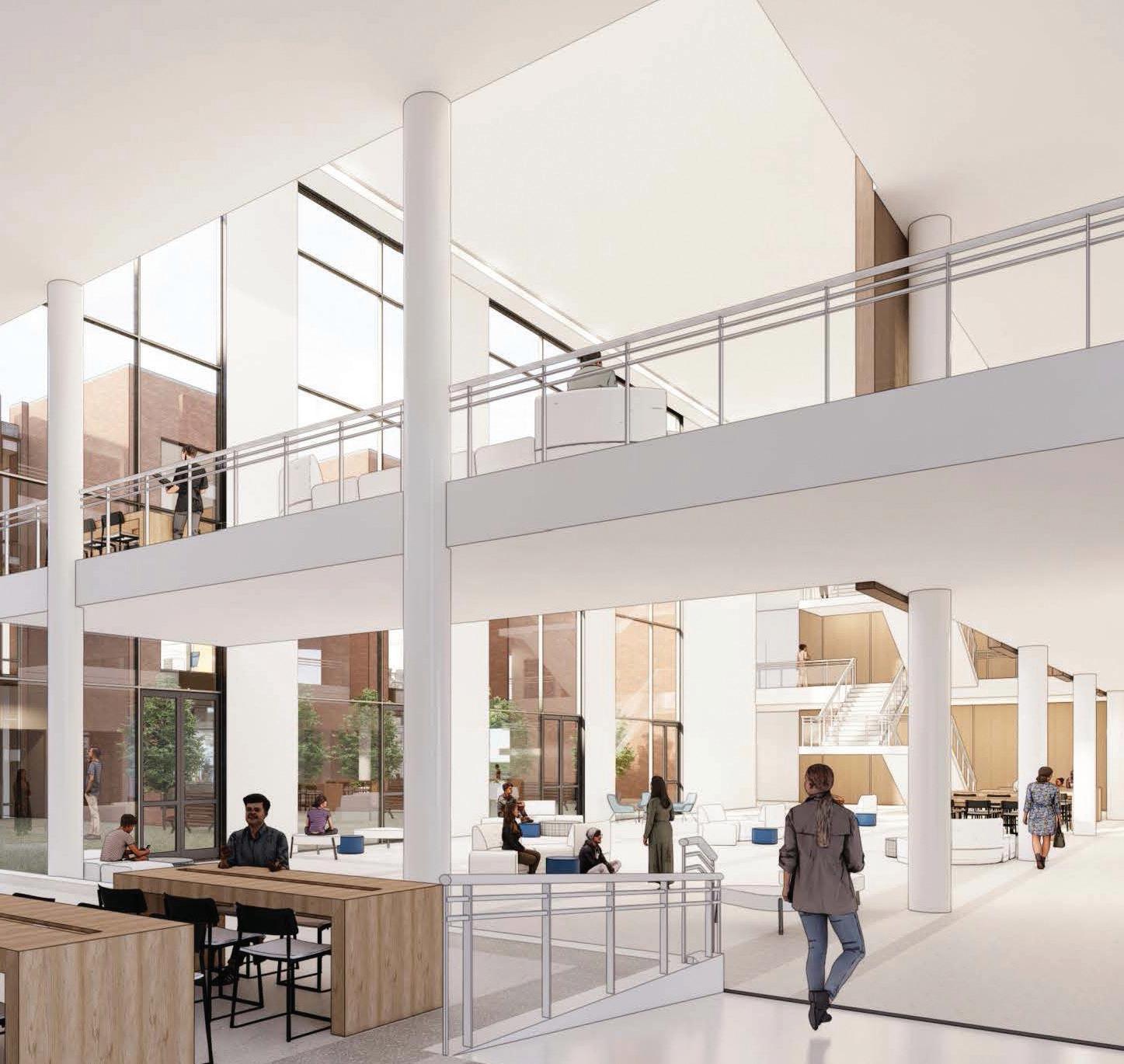
Closed for more than a decade, Mynders Hall is being transformed into a first-class research facility.
Two UofM initiatives are stepping in with place-based strategies designed to strengthen the well-being of communities across Tennessee.
Two alumni share the impact of the Crews Center for Entrepreneurship. Back
UofM team rediscover greater chestnut weevil. Independent
Antimicrobial properties of specimens found in University of Memphis Herbarium lead to collaborative research between local high school student and UofM researchers.
Some families pass through a university. Others grow within it. For the Bailey family, Memphis is not simply where degrees were earned — it is where a legacy of love, leadership and lifelong connection took root.
Recap of highlights throughout the year.
PRESIDENT Bill Hardgrave
SENIOR VICE PRESIDENT AND CHIEF
MARKETING AND COMMUNICATIONS OFFICER
Michele Ehrhart
EDITORS
Trent Shadid
Jackie Wright masscomm@memphis.edu
CONTRIBUTING WRITERS
Heather Hampton
Parker King
Leanne Kleinmann
Nia Rincon
Sam Shoemaker
PHOTOGRAPHY
Wendy Adams
Matthew Smith
ART DIRECTION AND DESIGN
Leonel Tiffer-Flores
Jonel Turner
MISSION
The University of Memphis is a comprehensive, internationally recognized, urban public research university preparing students for success in a diverse, innovative, global environment. Classified as Carnegie R1, the UofM is home to nationally designated centers of excellence in cybersecurity research and education, transportation workforce development, mobile health data as well as five Tennessee centers of research excellence.
The University of Memphis is governed by a 10-member Board of Trustees. The Board consists of eight members appointed by the governor of Tennessee, a faculty trustee elected by the faculty and a non-voting student trustee selected by students and appointed by the Board.
The University of Memphis’ name, seal, logos and Tigers are registered marks of the University of Memphis and use in any manner is prohibited unless prior written approval is obtained from the University of Memphis. The University of Memphis Magazine (USPS-662-550) is published once a year by the Division of Marketing and Communications of the University of Memphis.
POSTMASTER: Send address changes to Alumni and Development Office, The University of Memphis, 120 Alumni Center, Memphis, TN 38152-3760.



Ayear ago, we established a campuswide commitment to create a successful outcome for every student. I am proud of the progress we have made as our Tiger community has continued to rally behind this lofty goal. We’ve seen successful outcomes in multiple ways across campus.
Through fundraising, the University has broken its all-time record for philanthropic commitments. For the 2025 fiscal year, overall commitments totaled $64.9M, surpassing the previous record of $52.2M in 2022, creating lasting impact for current and future Tigers. As president, I want to thank all of our donors for their generosity in making a difference in our student’s academic journeys.
I am proud to say that our freshman enrollment numbers increased for the Fall 2025 semester, with 2,044 students, a 4.3% increase compared to last year. This new class also had an average GPA of 3.63 — another institutional record — and a 90% retention rate from fall to spring. Many of our freshmen benefitted from taking dual enrollment courses — 26% from the entering class — and I’m pleased to share our University is the largest dual enrollment provider in the state. As we continue to expand our dual enrollment opportunities, I encourage all high school students to explore taking advantage of this chance to begin earning college credit prior to high school graduation.
We cut the ribbon to two new facilities this year — Campus School Kimball, which
expands the educational opportunities available for the community through our Innovative School District, and the newly renovated J.R. Hyde Hall on the Lambuth Campus, which will soon house the University’s new Doctor of Physical Therapy (DPT) program. I’m also thrilled that progress toward the renovation of Mynders Hall continues and will add muchneeded research space for our Carnegie R1 research institution once completed. You’ll see this highlighted in this current issue.
Our most recent economic impact report brings to focus the role our University plays in growing our city and state. Over the last five years, our operations alone have contributed $4.3B to the state economy and more than twothirds of our graduates continue to live in Memphis long after graduation.
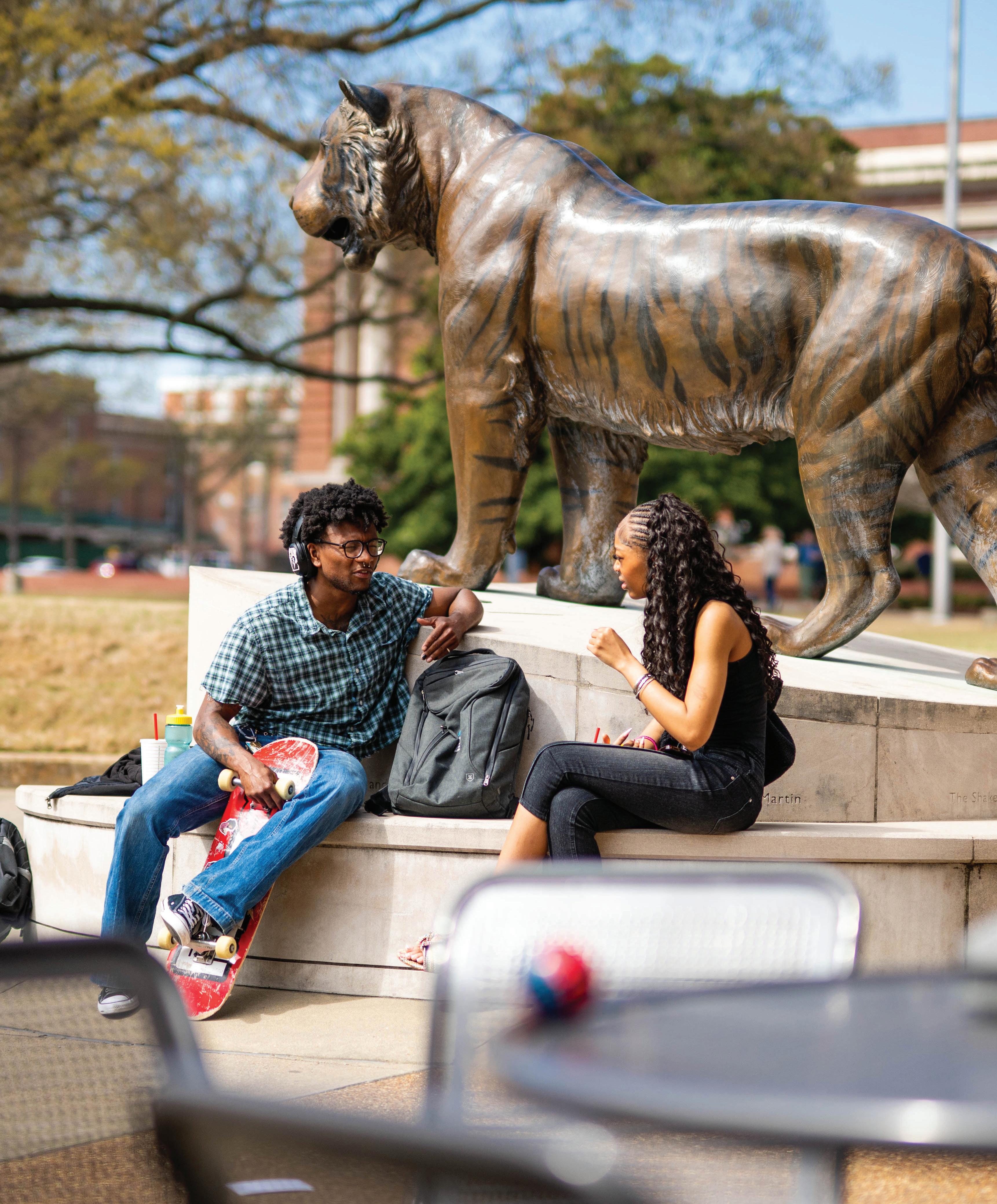
The University also ambitiously launched a rebrand and a new modernization of our website this past year. As we strive to be a nationally recognized brand, we’ve officially embarked on unifying under the Leaping Tiger logo across all of campus and within our community. This issue dives deeper into our brand pillars and attributes — all of which define us as Tigers.
I encourage you to continue to empower, inspire and connect.
Bill Hardgrave
President
The University of Memphis has broken its all-time record for philanthropic commitments and academic priority fundraising. For the 2025 fiscal year, overall commitments totaled $64.9M, surpassing the previous record of $52.2M in 2022.
With record-breaking support for athletics, the largest investments ever in academic facilities, and an all-time high in new commitments over $50,000, the University of Memphis is poised to provide unprecedented support to the many students, faculty and staff who define the Tiger family.
This support will strengthen a broad range of University priorities — from student scholarships and faculty endowments to expanded research opportunities and state-of-the-art facility improvements — all aimed at delivering a world-class educational experience.
“Every contribution creates a meaningful and lasting impact,” said University President Bill Hardgrave. “As a Carnegie R1 institution, this growing wave of philanthropic support will enhance our national standing and help draw top talent from across the country to teach, learn, work and innovate in Memphis. This support underscores our commitment to a successful outcome for every student.”
The University of Memphis announced Dr. Jennifer Miles as the new Executive Director for the University of Memphis Lambuth.
“I am very excited to be joining the University of Memphis Lambuth Campus,” said Miles. “This is an exciting time for the Lambuth Campus, and I am thrilled to serve as Executive Director.”
Miles brings 30 years of experience providing vision and leadership to higher education institutions.
“We are excited to welcome Dr. Miles to the University of Memphis community,” said UofM Provost Dr. David Russomanno. “Her experience as a leader in higher education will greatly benefit our Lambuth Campus, where we will continue creating successful outcomes for students and developing the future workforce in West Tennessee.”

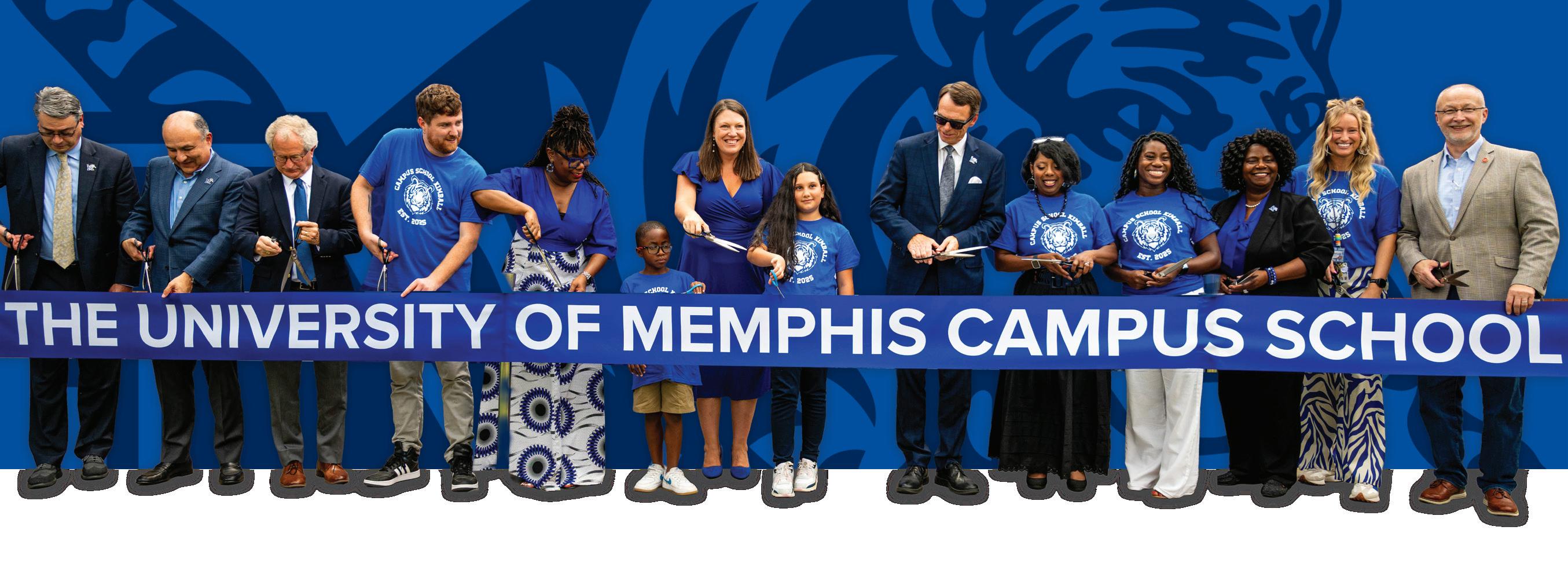
Leaders of University Schools and the University of Memphis held a ceremonial ribbon cutting for Campus School Kimball, the first new elementary school to launch under the University’s umbrella since Campus School opened its doors in 1912.
“When we became a school district, we made a commitment to serve more students in Memphis,” said Sally Parish, vice provost and director of Schools.
“The opening of Campus School Kimball allows us to do just that, and it is exciting to see this vision become a reality for our students and families.”
Campus School Kimball marks a significant step forward for the University of Memphis Innovative School District — now entering its second academic year as a local education agency (LEA) under the Innovative School District Act, continues to build on its legacy of academic excellence.
The University of Memphis has completed its official enrollment census for the Fall 2025 semester, reporting encouraging gains in several key areas. Freshman enrollment numbered 2,044, a 4.3% increase compared to last year. Overall enrollment stabilized at 19,652 students. Growth was driven by a 5% increase in new Tennessee students, a 31% increase in new Law students, and a 5% increase in dual-enrollment students, with over 26% of the freshmen class having taken a dual-enrollment class at the University before enrolling.
“We were delighted to see first-time freshmen numbers increase this fall. The UofM’s accomplishments over the past year through continued investment in scholarship and student success initiatives are gaining momentum and having positive impacts on our enrollment profile,” said Dr. Brian Meredith, vice president of Enrollment Management at the University of Memphis. “I am pleased to see the increases in GPA of our first-year students, which will positively impact retention of our students long term. We are moving into the fall hopeful and poised for continued growth, not only in enrollment but in retention success.”
The incoming freshman class also represents a strong academic profile. The Fall 2025 class boasts an average GPA of 3.63 — the highest since the University began tracking this data in 2004.
This comes on the heels of a standout inaugural year for University Schools, whose students posted the second highest TCAP scores in the state
With this expansion, University Schools now offers a seamless education journey from early childhood through graduation, with the



The University of Memphis is more than an academic powerhouse; it’s a billion-dollar economic engine for the city, region and state. A new economic impact report from Applied Analysis shows that UofM fuels the Mid-South through — including but not limited to — its day-to-day operations, nationally recognized athletics and groundbreaking research.
The study also highlights the University’s role in building Memphis’ workforce. More than two-thirds of UofM graduates remain in the Memphis metro a decade after graduation. Statewide, 74.4% of UofM’s class of 2024 graduates chose to stay in Tennessee.
“This report confirms what we see every day at the University of Memphis — our institution is a driving force of innovation and economic output, creating jobs and strengthening our workforce,” said University of Memphis President Dr. Bill Hardgrave. “Our impact extends well beyond our campus, and we are proud to serve as a flagship institution in Tennessee and the entire Mid-South region.”
The University of Memphis is one of the state’s strongest economic multipliers. For every $1 spent on operations, nearly $1.75 flows back into Tennessee’s economy. Research generates an even greater return, with every $1 spent producing just over $2 in statewide economic activity. Taken together, these impacts are about more than numbers. They reflect a university that is fueling the workforce, attracting visitors, driving innovation and strengthening the community, a source of pride and progress for Memphis and Tennessee.

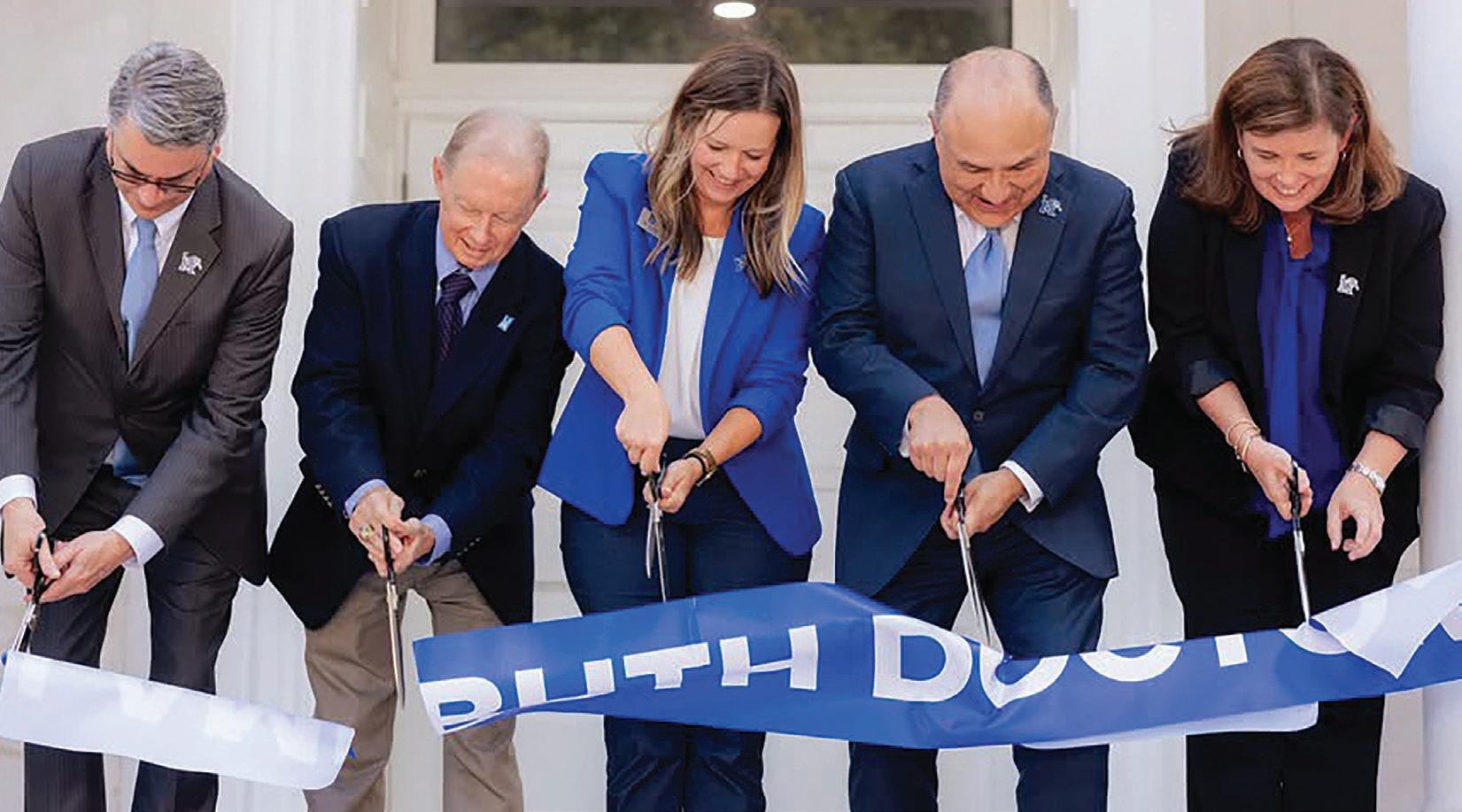
Leaders from the University of Memphis cut the ribbon for the newly renovated J.R. Hyde Hall on the Lambuth Campus, which will soon house the University’s new Doctor of Physical Therapy (DPT) program.
“The ribbon-cutting ceremony marks a historic milestone for the DPT program, reflecting continued growth in enrollment and healthcare education on the Lambuth Campus,” said DPT Program Director Dr. Jacque Bradford. “This program is designed to address the critical need for physical therapists in the Jackson community and across rural West Tennessee.” program complements West Tennessee’s only other physical therapy program at the University of Tennessee Health Science Center in Memphis, providing an additional access point for students in the Memphis and Jackson areas. Aspiring physical therapy students in the Mid-South can continue their educational journey without having to leave West Tennessee, thanks to articulation agreements given to qualifying students from UofM, LeMoyne Owen College, Lane College and Union University.
Dual enrollment, where students can begin earning college credit in high school, has been gaining more attention, funding and credibility in Tennessee over the last decade, most apparent at the University of Memphis. Currently, the University’s Dual Enrollment (DE) program touts the largest number of students in the state, at 3,074 as of Fall 2025.
The University partners with nearly 100 high schools, public, private and charter, throughout the state on the program, most of which are located in Shelby County. Through DE, high school students can earn college credit while fulfilling their high school requirements for graduation. What’s more is 95% of DE students pay zero dollars out of pocket for tuition thanks to grants and scholarships.
• Admission into the UofM upon successful completion of the program
• 96.5% average success rate (students earn a “C” or higher)
• 18 academic department liaisons work with high school instructors to offer 34 subject areas
• Grant eligible students can take up to 10 courses for $0 tuition out-of-pocket
• DE does not impact students’ eligibility for freshman scholarships
• Most credits are transferrable across higher educational institutions in the state

UofM’s Dual Enrollment office can be reached at 901.675.5218 or dualenrollment@memphis.edu.
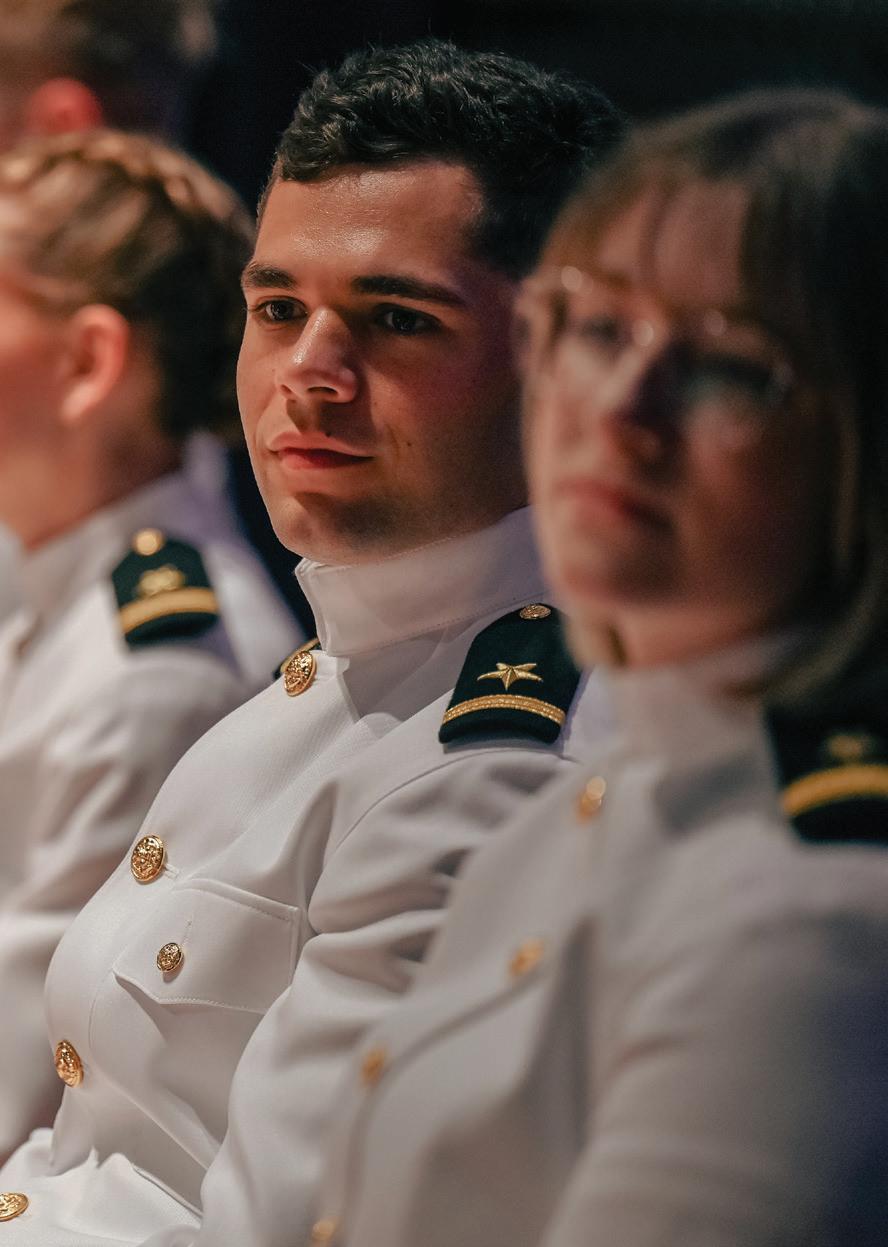
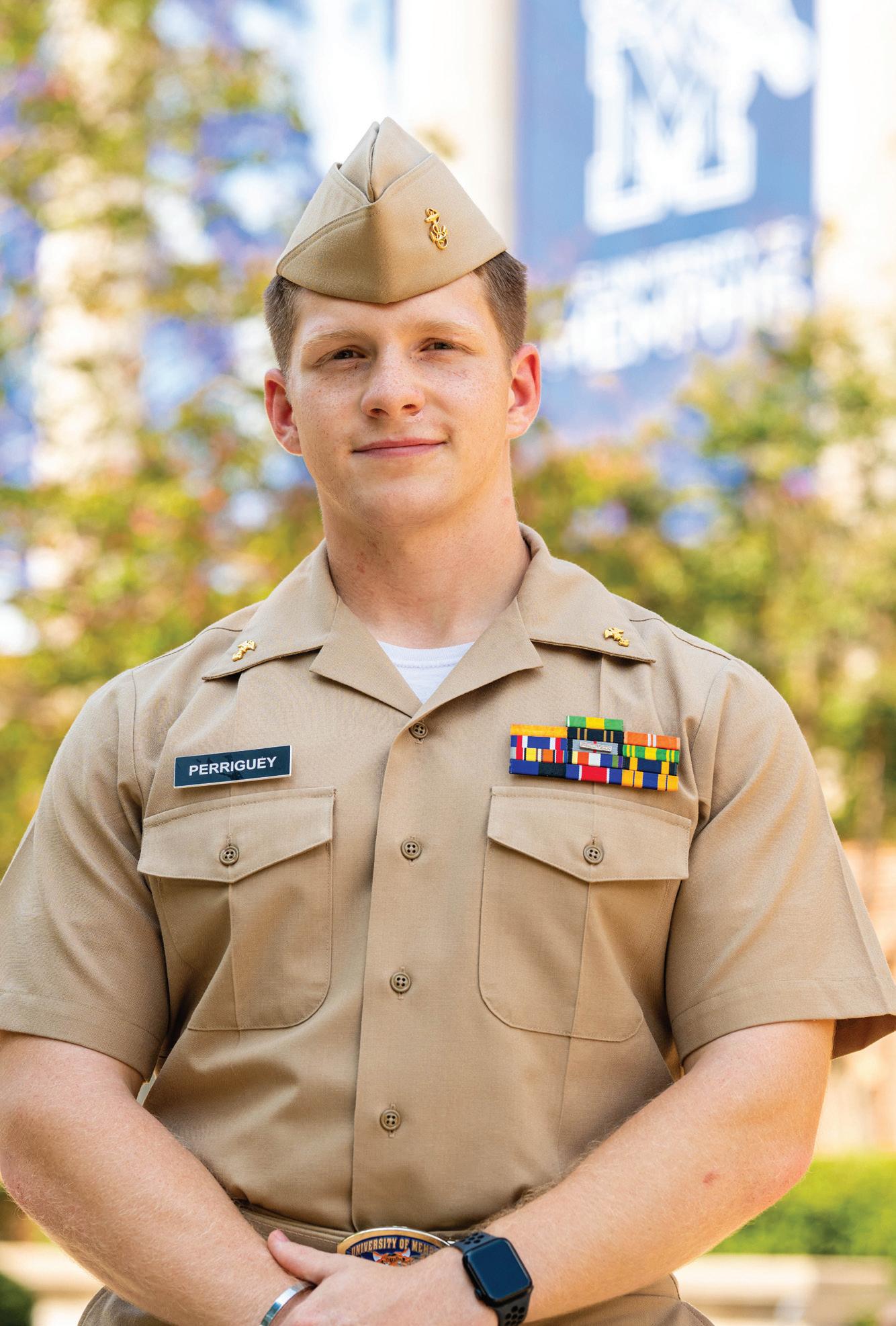
The University of Memphis has once again been recognized as a top institution for military-connected students, earning the Military Friendly Gold designation and also, for the first time, the Military Friendly Spouse School designation. Military Friendly is regarded as the benchmark for evaluating how higher education institutions, employers and organizations serve the military community.
“Achieving Military Friendly Gold and, for the first time, the Military Friendly Spouse designation reflects the intentional work we’ve done to build a culture of belonging, provide robust resources and ensure military-affiliated students can thrive,” said Chris Bourque, former director of Veterans and Military Student Support. “This recognition affirms that the UofM is one of the best places in the nation for militaryconnected students to pursue their education and achieve their goals.”
The “Gold” designation places UofM among the most military-friendly institutions in the nation. The status is awarded to those who not only meet but also exceed national standards in categories such as academic policies, student support, retention, financial aid, culture, commitment and career services. It reflects that the University provides exceptional support for military-affiliated students in areas that directly impact student success and belonging.
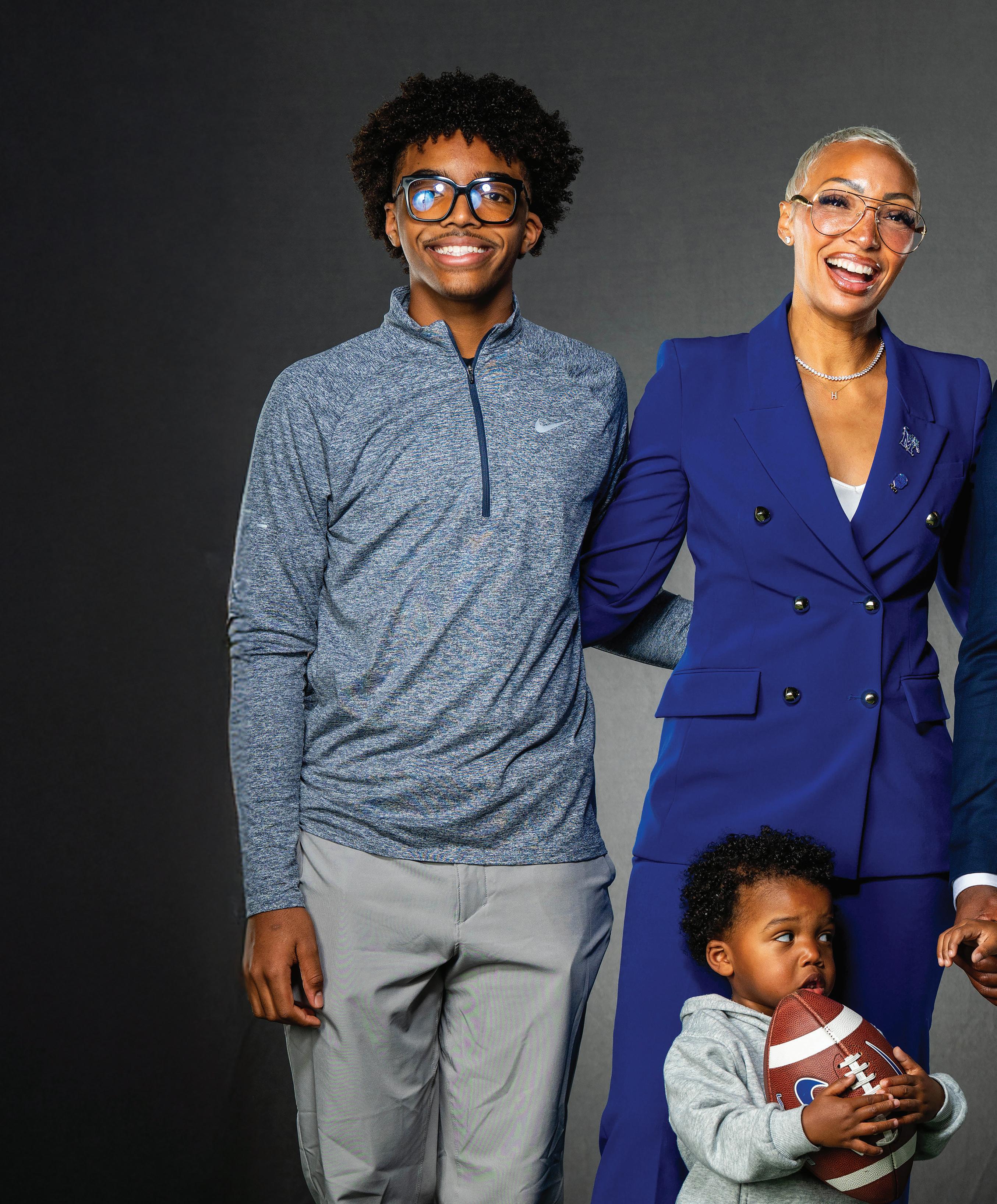
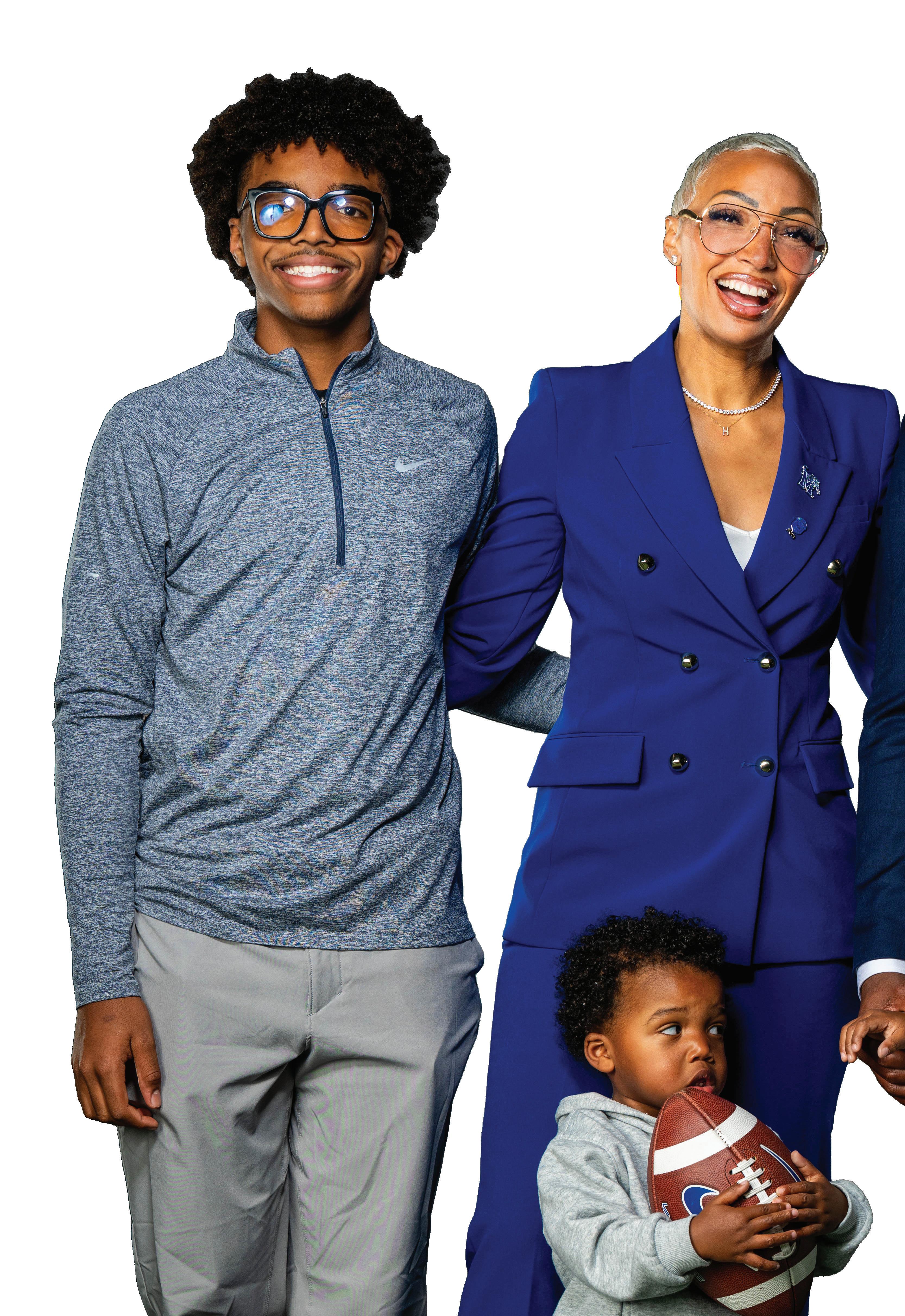
Tiger fans welcomed new head football coach, Charles Huff, at the Billy J. Murphy Athletic Complex on Dec. 10.
Huff was named the 26th head coach in Memphis football history. Coach Huff, a well-known figure in both collegiate and professional football, spent the 201920 season as College Football Hall of Fame coach Nick Saban’s associate head coach and worked with NFL superstars Najee Harris and Saquon Barkley.
He brings over 20 years of coaching experience with stops at Marshall (2021-24), Alabama (2019-20), Mississippi State (2018), Penn State (2014-17), Western Michigan (2013), the Buffalo Bills (2012), Vanderbilt (2011), Hampton (2010), Maryland (2009) and Tennessee State (2006-08).

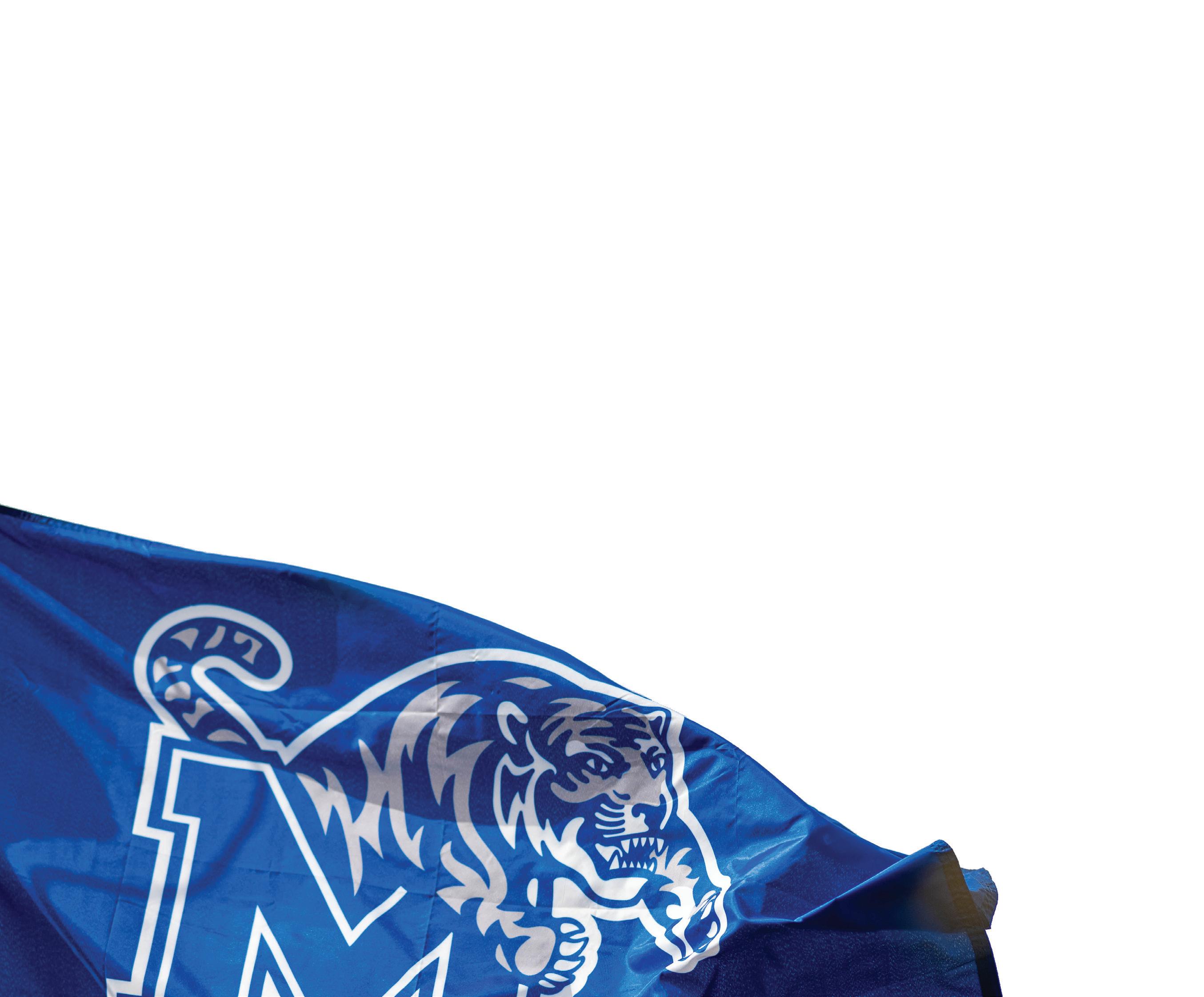

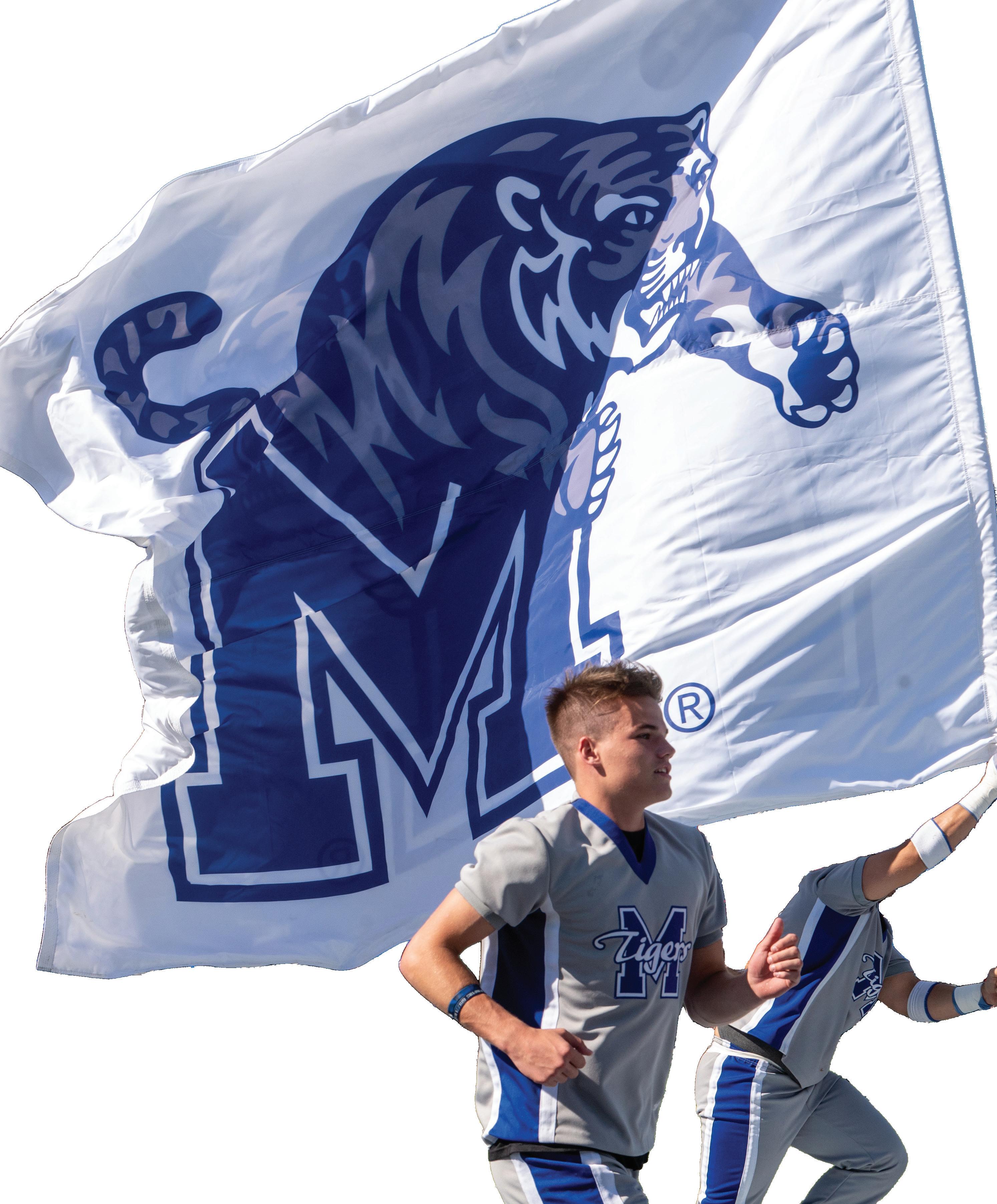
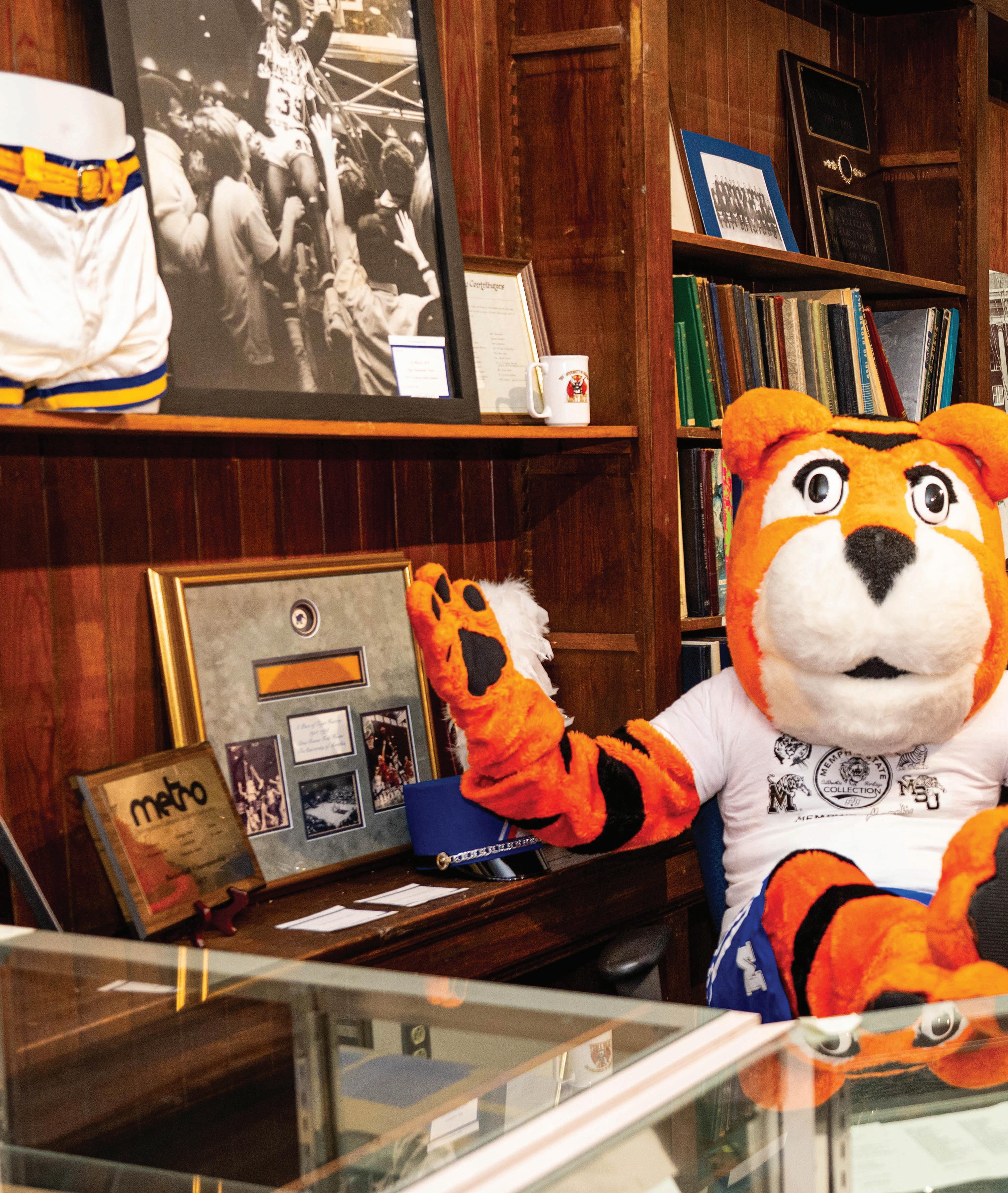
The Heritage Room in Brister Hall is the campus museum that celebrates all things University of Memphis. Developed in 2003, it houses memorabilia and displays that are comprised of donations from alumni and former University employees. To request access to the Heritage Room, email the University Libraries’ Special Collections department at specialcollections@memphis.edu
BY JACKIE WRIGHT
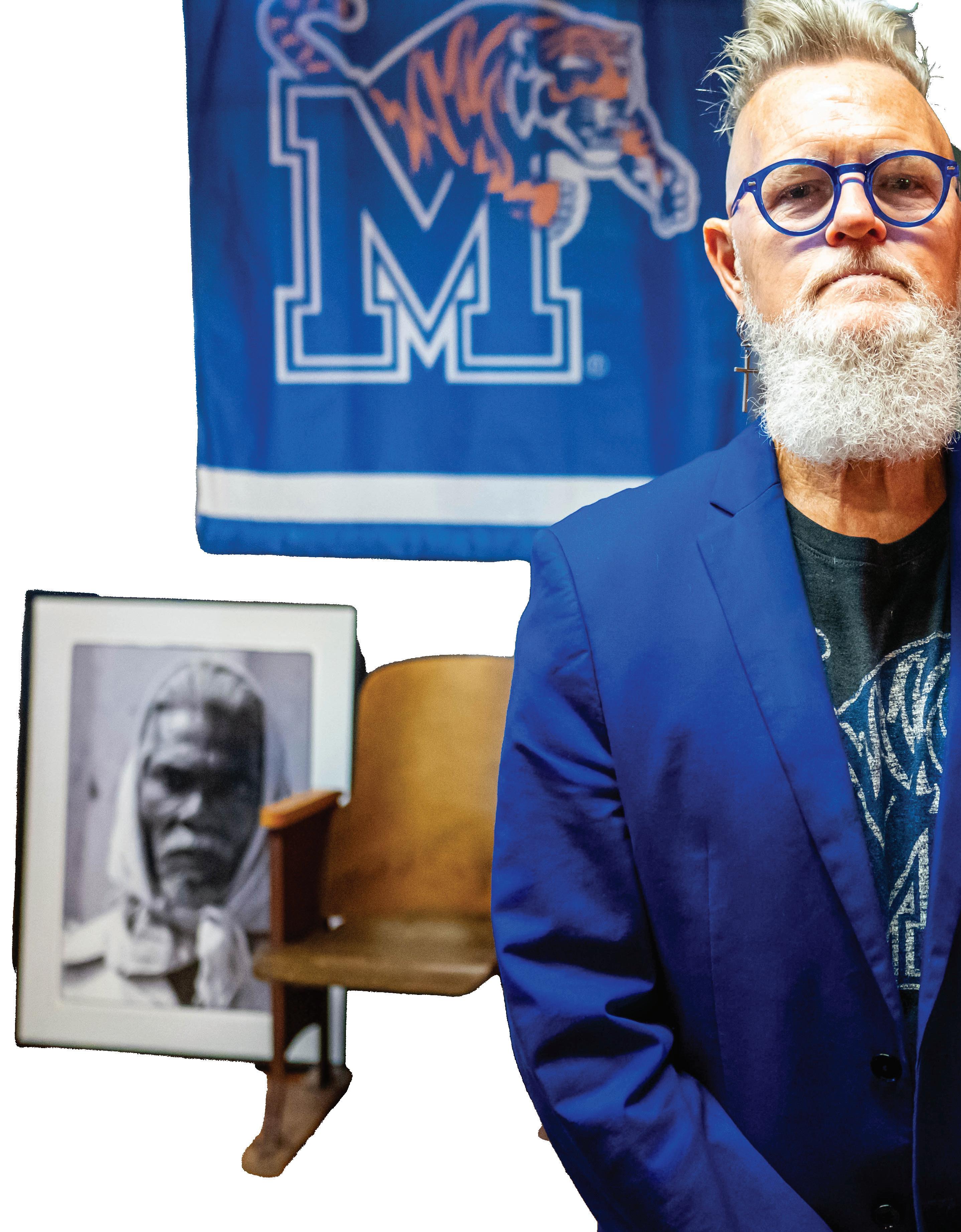
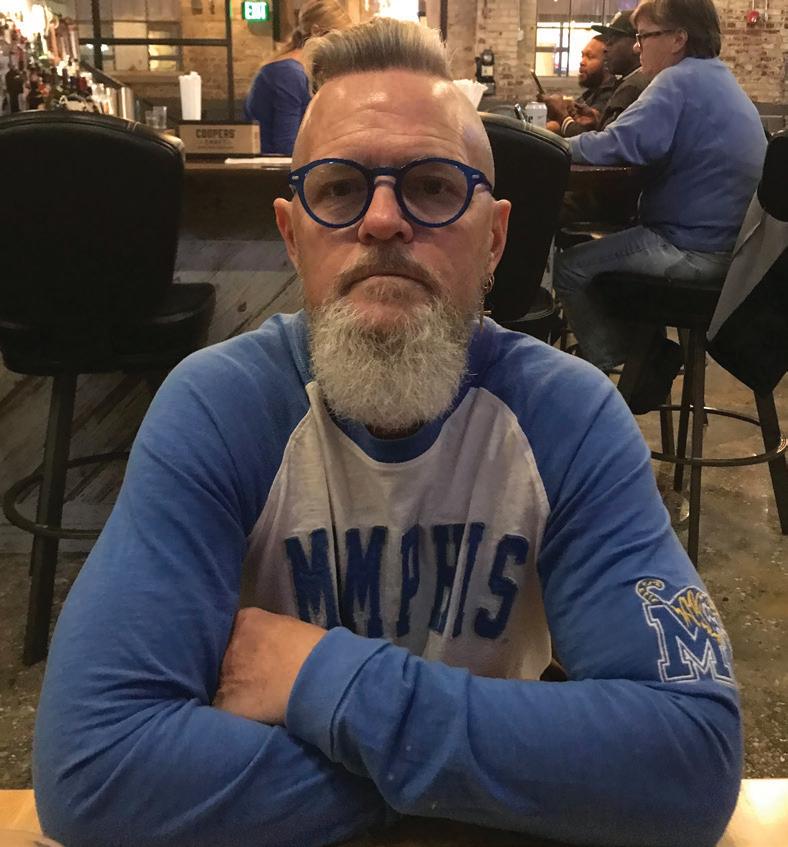
It was the early eighties. Rock and metal music dominated FM radio. Dana Kirk was head coach of the Memphis Tigers men’s basketball team, and Craig Thompson (BFA ’83) was trying to figure out how he could score free tickets to see the Tigers play at the sold-out Mid-South Coliseum.
At the time, Keith Lee was on the Tigers men’s basketball team. In his four seasons, the Tigers went 104-24 and reached the 1985 Final Four.
“Basketball was huge. The waiting list to get season tickets was about 20,000 people,” Thompson said. “Somebody had to die or bequeath you tickets in order for you to go see a basketball game.”
Thompson spent his youth going to games with his family and even him and his wife’s first date was at a Tigers men’s basketball game. So, for Thompson going to the games was just second nature.
“Our biggest concern once we graduated and got married was how are we going to see the Tigers basketball games,” he said.
Thompson had seen some of the promotional materials for upcoming games, which he thought were lacking, and knew the team could use his creative talents to rebrand.
“I went to the Athletics office and found out who to talk to and wound up getting a meeting with Bob Winn (longtime Memphis Athletics administrator) and Lee Fowler (then assistant basketball coach). I said to them, ‘Look these things are awful, I’m a graduate from here. Let me do your posters, and you give me tickets.’ They said, ‘Deal.’”
A partnership was born, and Thompson went to work. He started with a redesign of the basketball poster campaign, before moving over to football. “They really liked them, and they became really popular. People started collecting them,” he said.
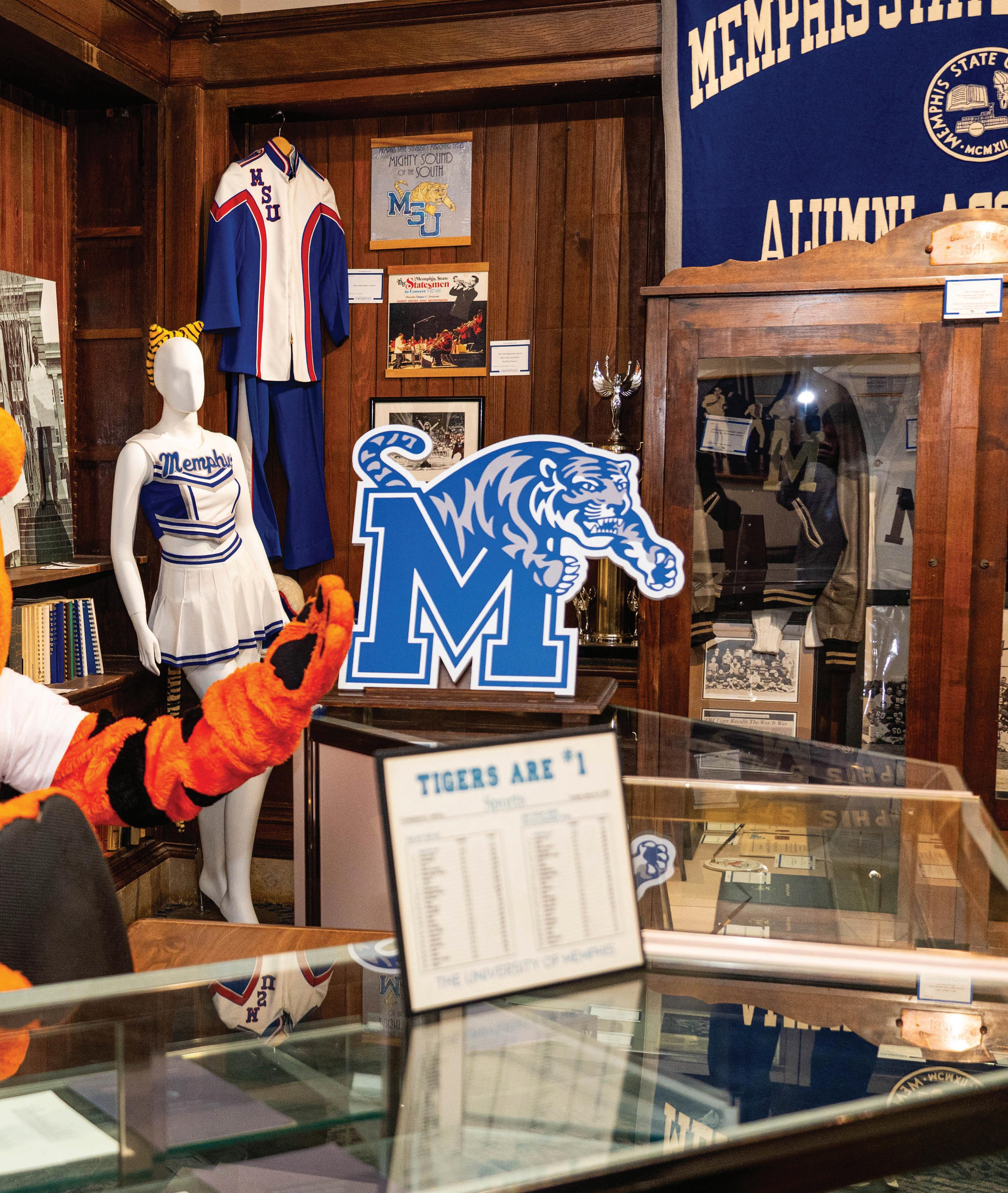
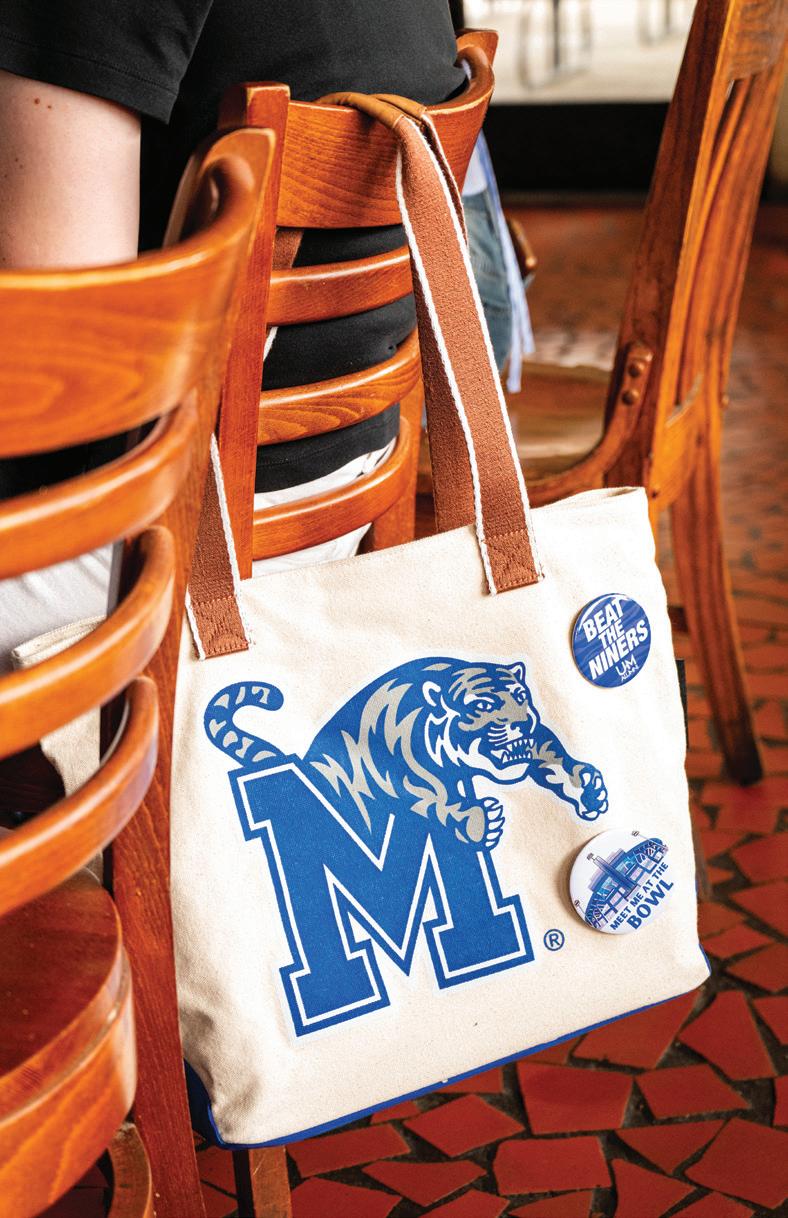
That laid the foundation for the creation of the famous Leaping Tiger logo Memphians know and love today.
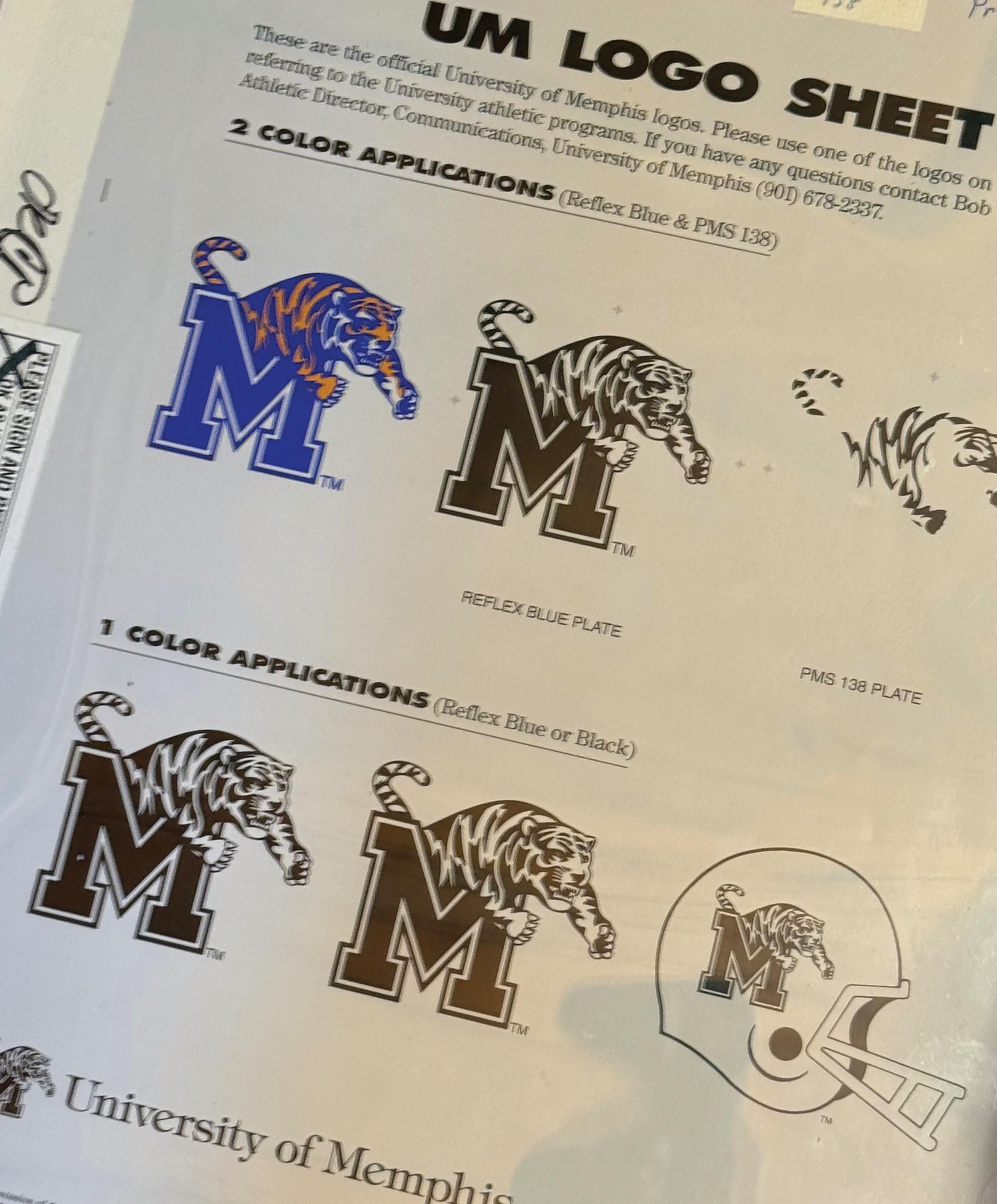
“I told them, ‘These are awful. Let me do your posters, and you give me tickets.’”
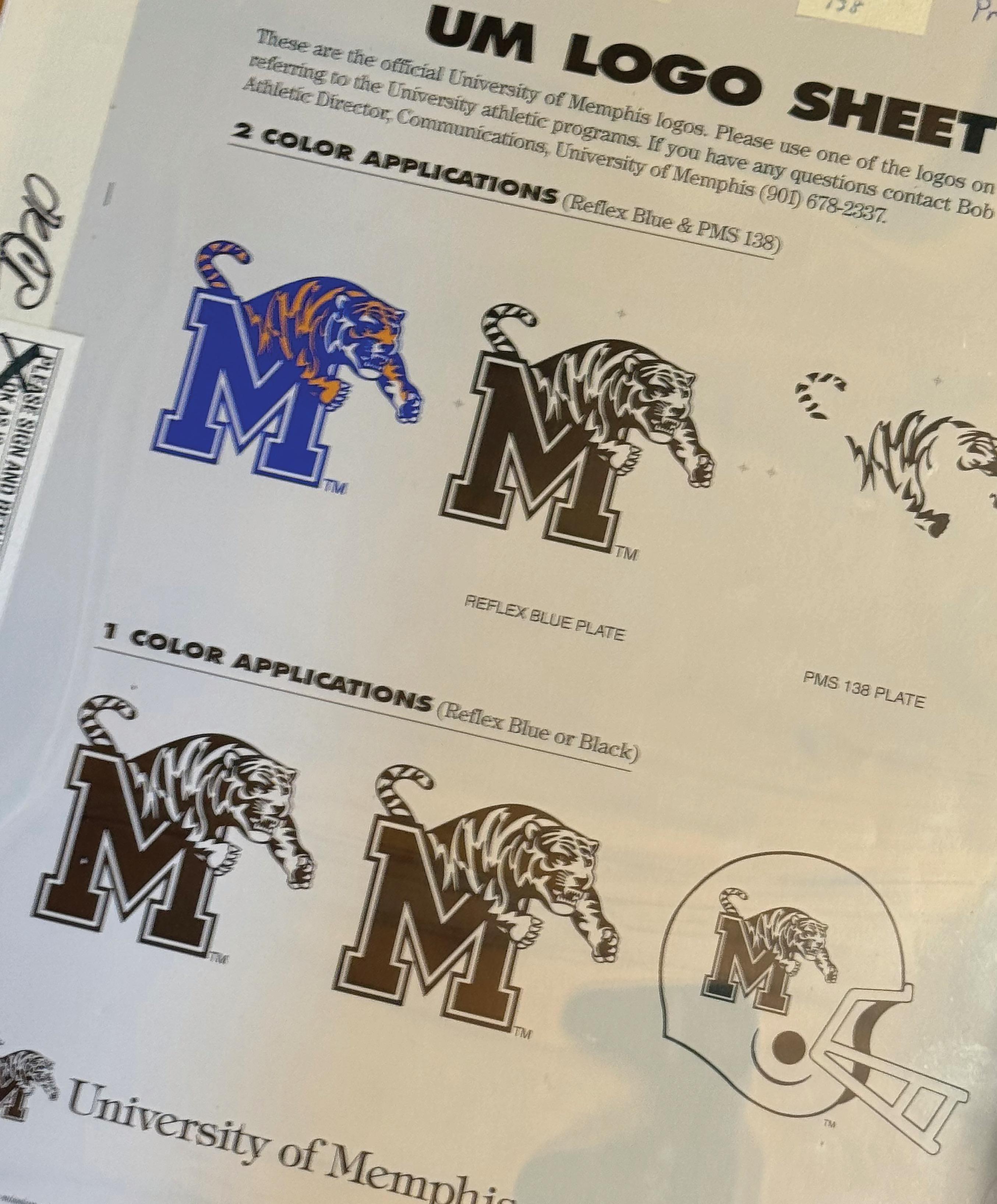
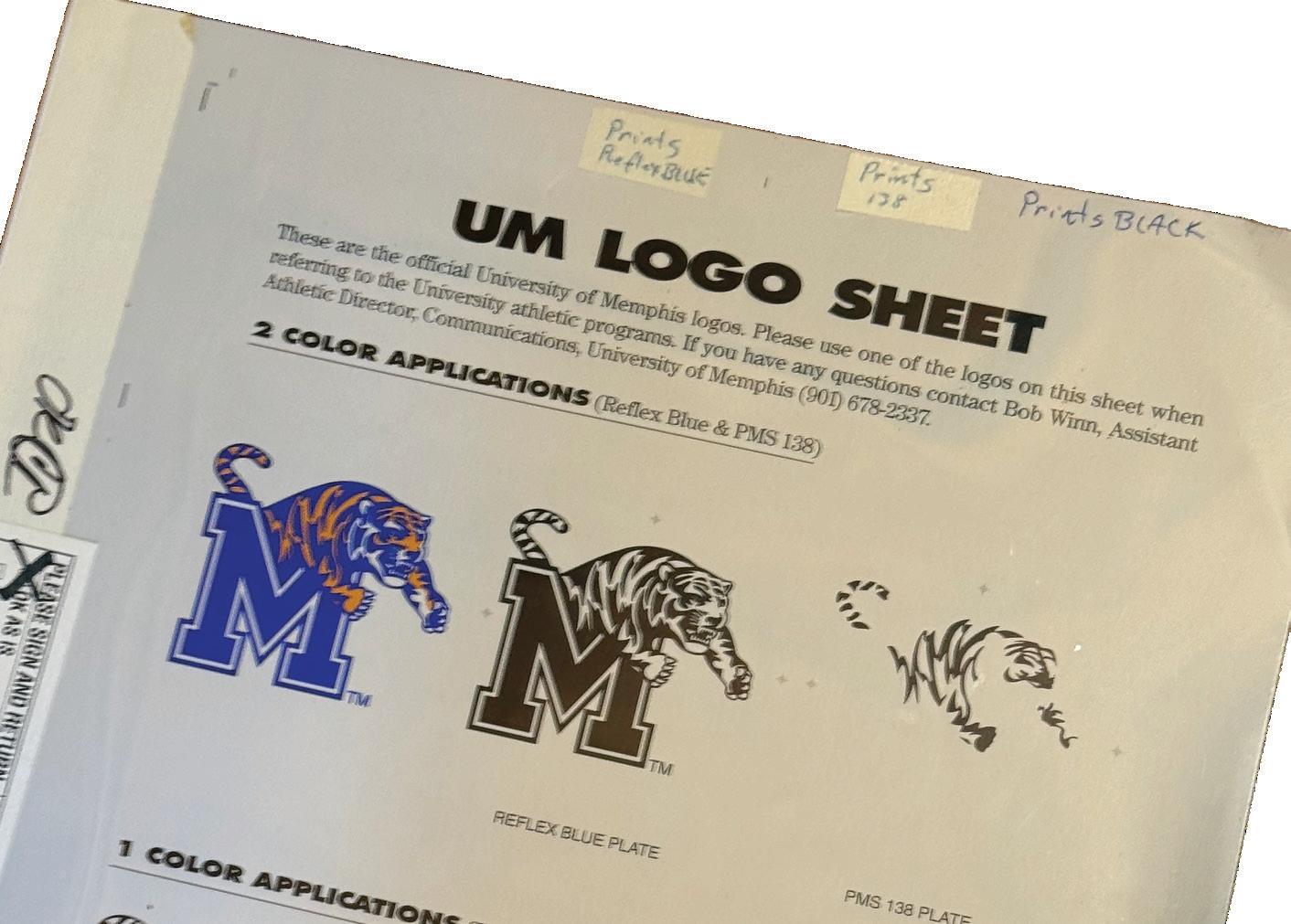
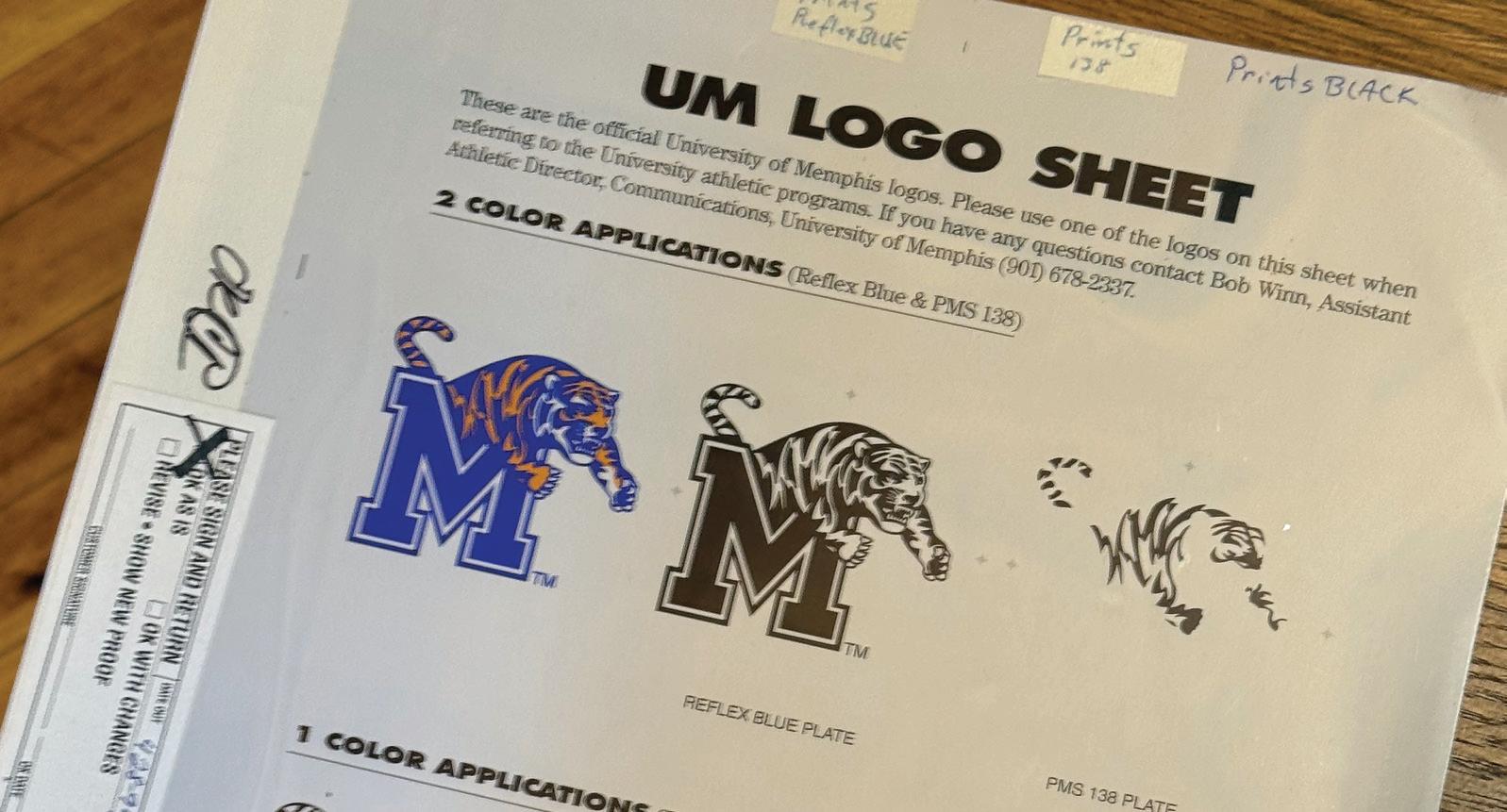
It was around 1993 when Winn told Thompson that the University needed a new athletic logo because its name was changing from Memphis State University to the University of Memphis, which became official in 1994. “They really wanted to evolve the old MSU logo into something a little more modern.”
Thompson started doing sketches and the Leaping Tiger mark with the “M” was born. “That was so far back, I did that ink on the board and then cut an overlay for the color. Everything was done by hand. There were no computers back then.”
It was distributed to the NCAA to get approval. Once approved, it became used widely in athletics.
“The funny part is, I argued for the logo to originally be gray as it is
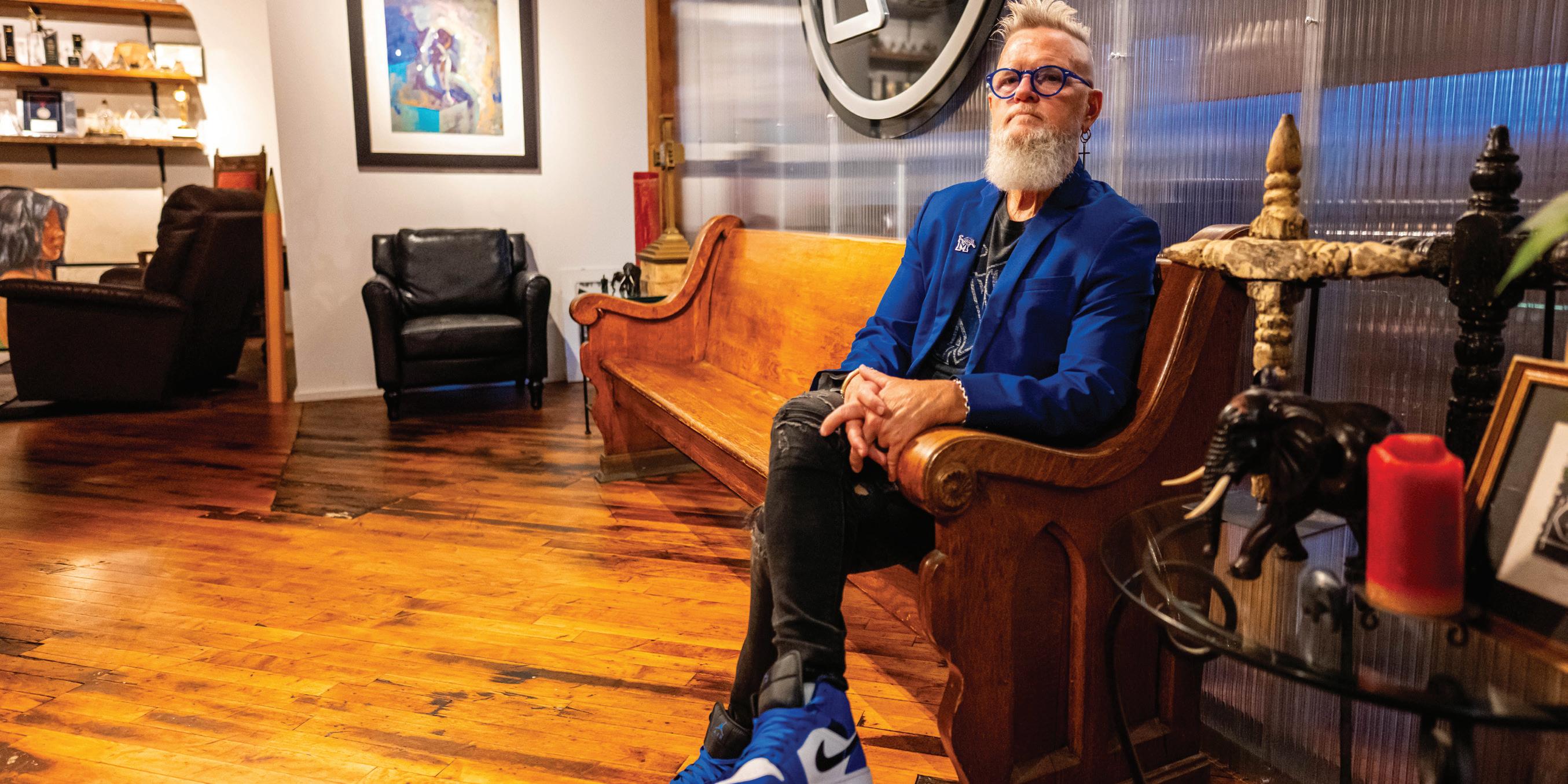
When he was in high school at Briarcrest Christian School, an art teacher said, “Hey, you know you could do this for a living.”
Thompson said he was sold and began taking graphic design classes his senior year.
now, and not orange,” Thompson said. He said out of all the thousands of logos he’s done in his 40-year career — none are as recognizable as the Leaping Tiger.
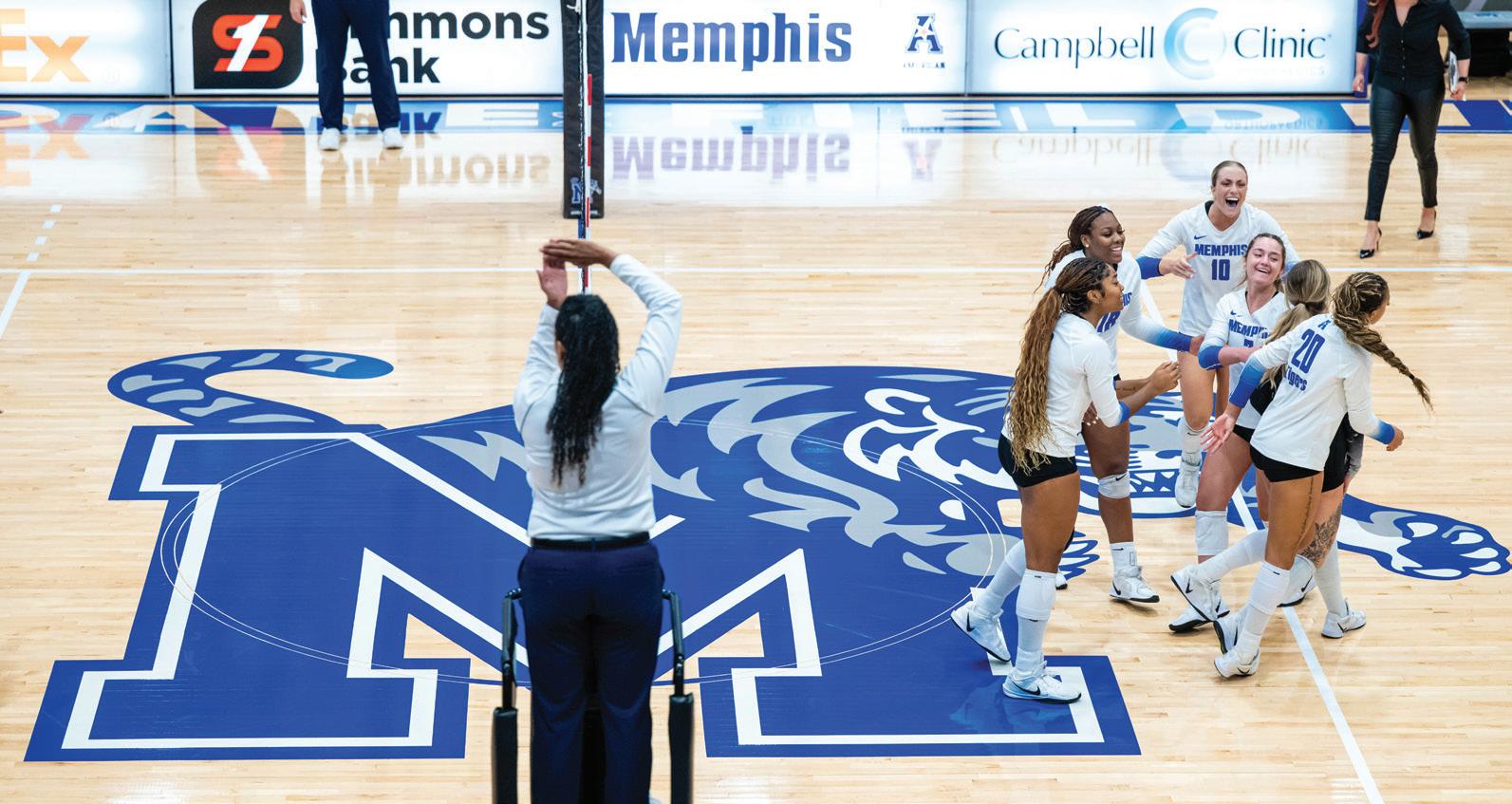
“When I went to the 2008 championship in San Antonio, that was pretty amazing to see the logo everywhere,” Thompson said. “It was all over ESPN, the scoreboards, billboards, on fans. It’s always been a joy to see the logo out and about. It’s a source of joy to be able to work on something like that and give back to the University for the education that I got.”
A lifelong Memphian, Thompson was destined for the creative field. “When I was a kid, I got in trouble in school for drawing on my notebooks. Instead of writing letters, I would always be drawing — I have always drawn.”
Having lived in Memphis his entire life, Thompson set his sights on going to an art school out of state. But the University of Memphis had a really strong graphic design program too; with faculty including Calvin Foster, professor emeritus who served as faculty member for 40 years, and illustrator John Robinette who had an impressive clientele list of national magazines.
Thompson said the roster of talent at the UofM and the level of education at the cost compared to moving out of state ultimately made him stay in his hometown.
“I’m very glad it worked out that way. I was very challenged.”
Today, Thompson is president and creative director of Disciple Design, a company he founded in
1991. Their goal is to give nonprofits the tools they need to accomplish their mission whether it’s a logo, a new website or a video to help tell their story. He is also a talented chalk artist, creating works which have appeared in murals around the city and the Memphis Brooks Museum of Art.
He also still partners with Athletics and created the branding for Liza’s Light — the UofM soccer and track stadium fund which has a goal to raise $7 million to provide top-notch amenities for student athletes. The initiative honors the legacy of Liza Wellford Fletcher by building a world-class stadium at the UofM, creating a lasting impact on the community.
“People are so passionate about the logo. There’s so much emotional connection to it. It has a lot to do with tradition and the fact that it’s been with us for such a long time, it has so many memories that are tied to it. As a designer, it makes me happy that it’s going to hang around.”
“They said, ‘Deal.’”
“It’s always been a joy to see the logo out and about. It’s a source of joy to be able to work on something like that and give back to the University for the education that I got.”
CRAIG THOMPSON


BY LEANNE KLEINMANN


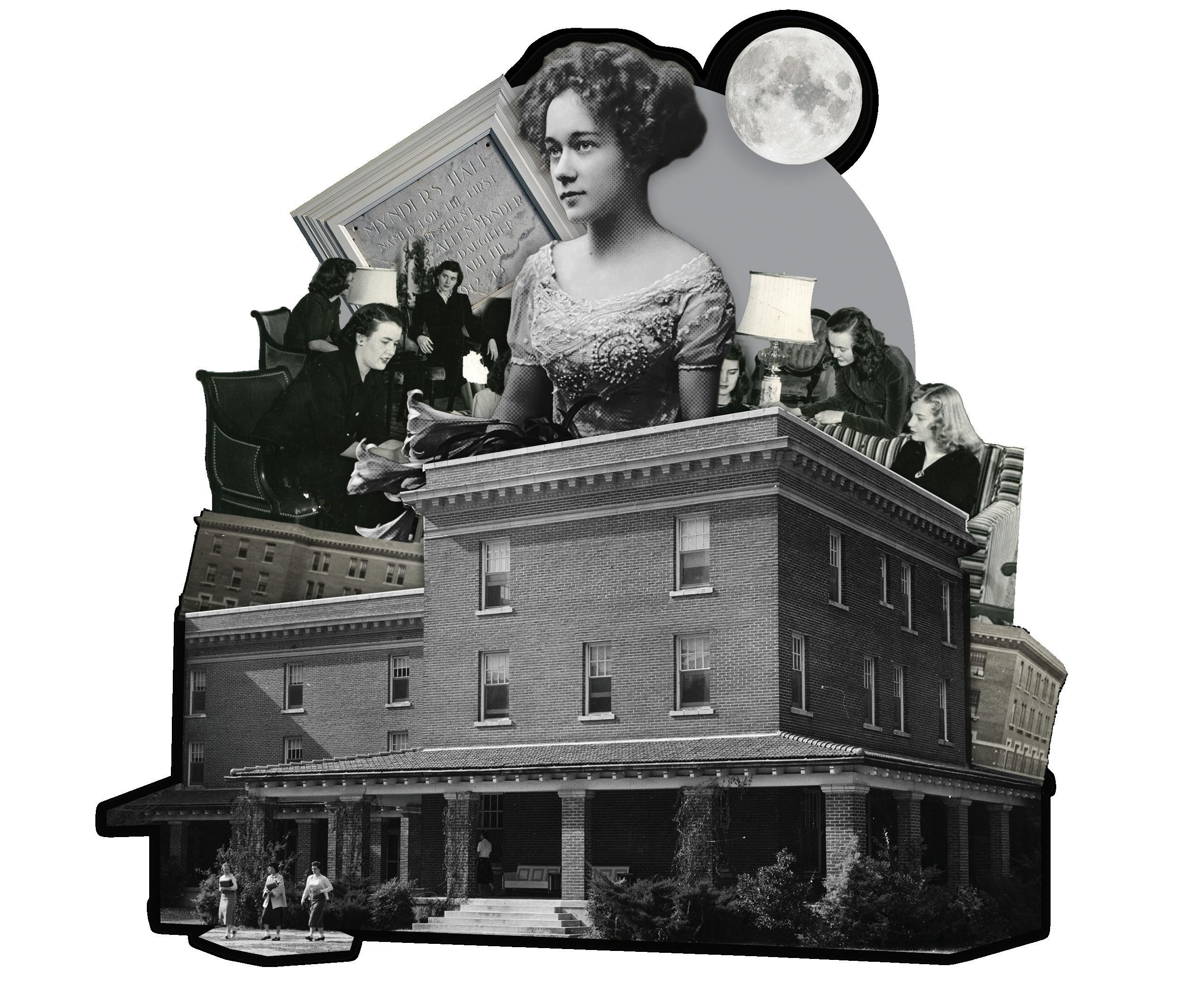
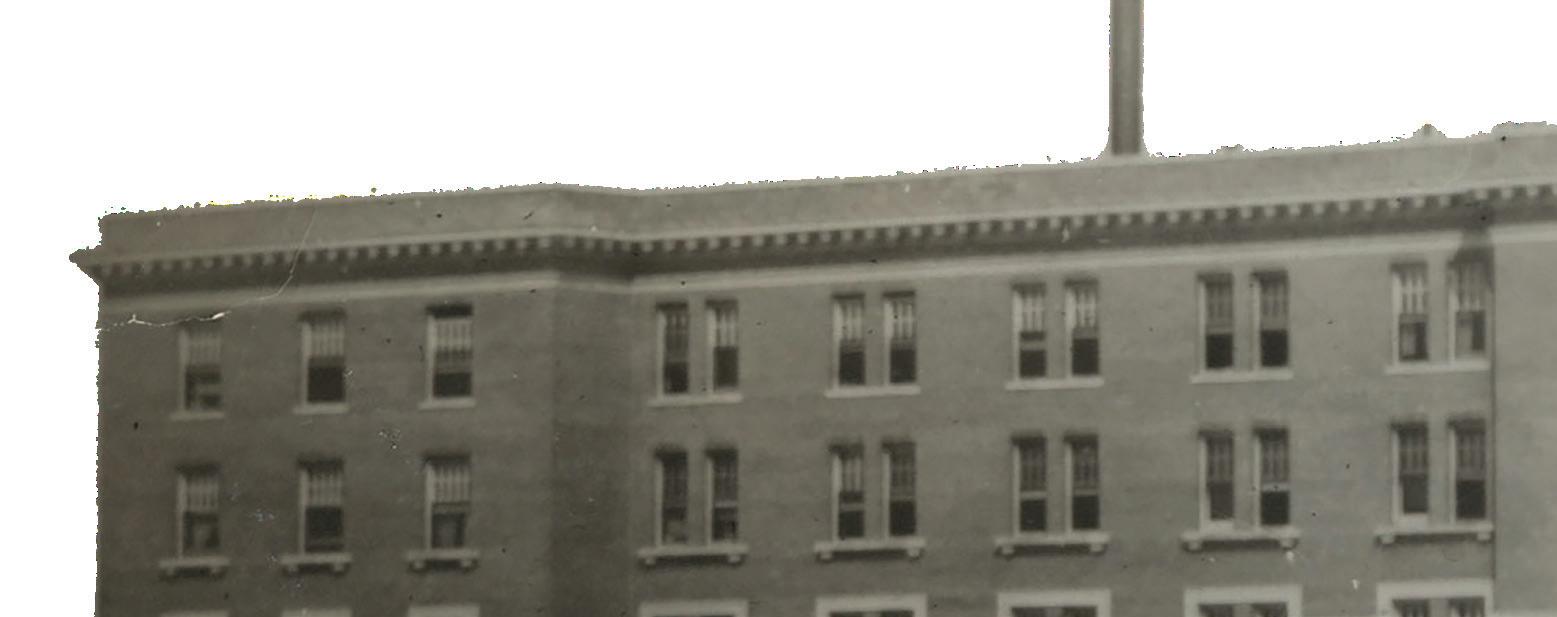
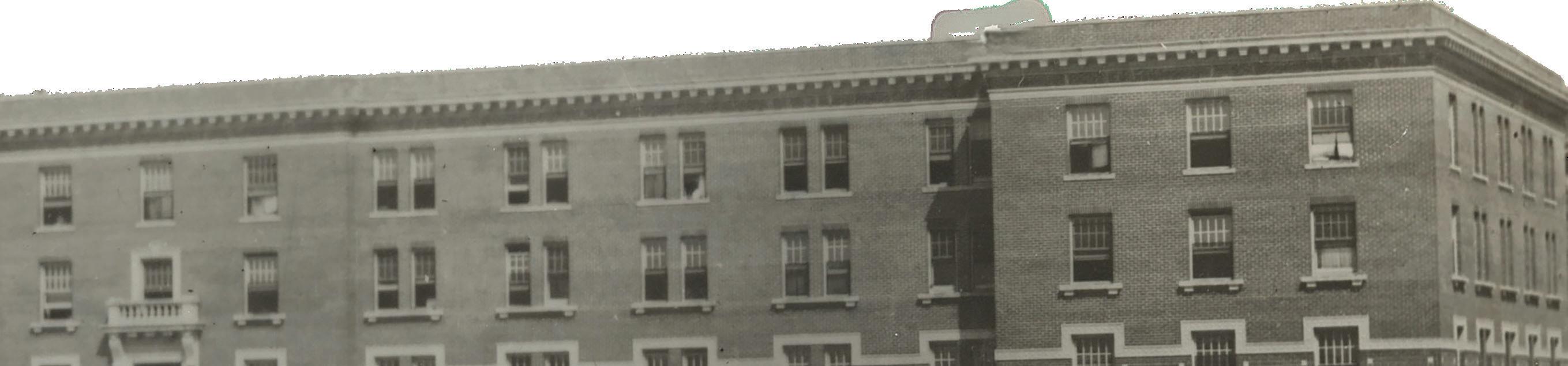
The building has been closed for more than a decade, so you’d be forgiven for not remembering exactly where Mynders Hall is located on the University of Memphis campus. Yet the sturdy threestory, red-brick building just west of the Administration Building couldn’t be more important, both historically and to the present and future of the University.
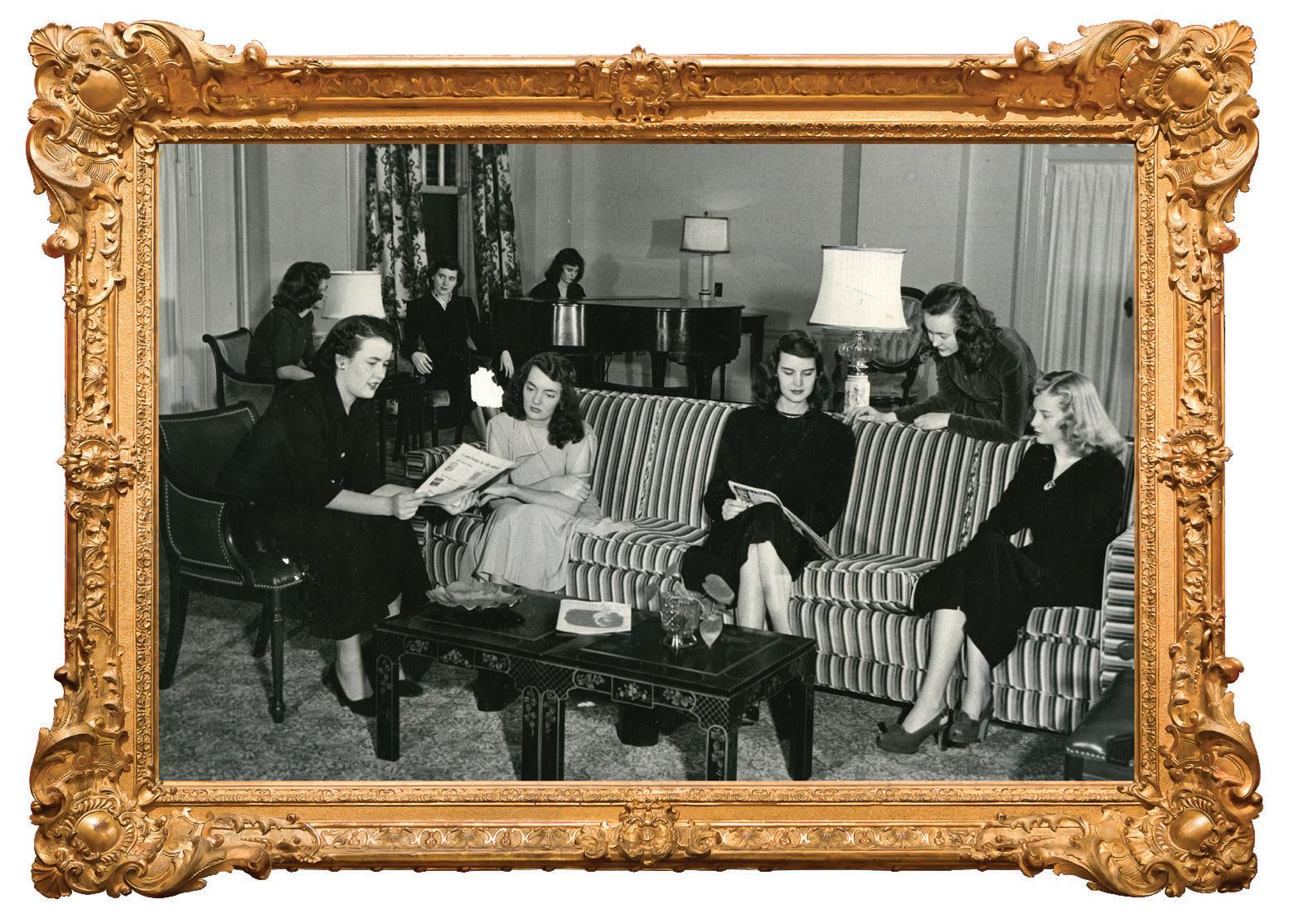
Opened in 1912, Mynders Hall was one of three original campus buildings and the first-ever residence hall at what was then the West Tennessee Normal College. By spring of 2027, though, Mynders will have been transformed into a flexible, first-class research facility that reflects the power of the prestigious R1 designation the University of Memphis achieved in 2021.
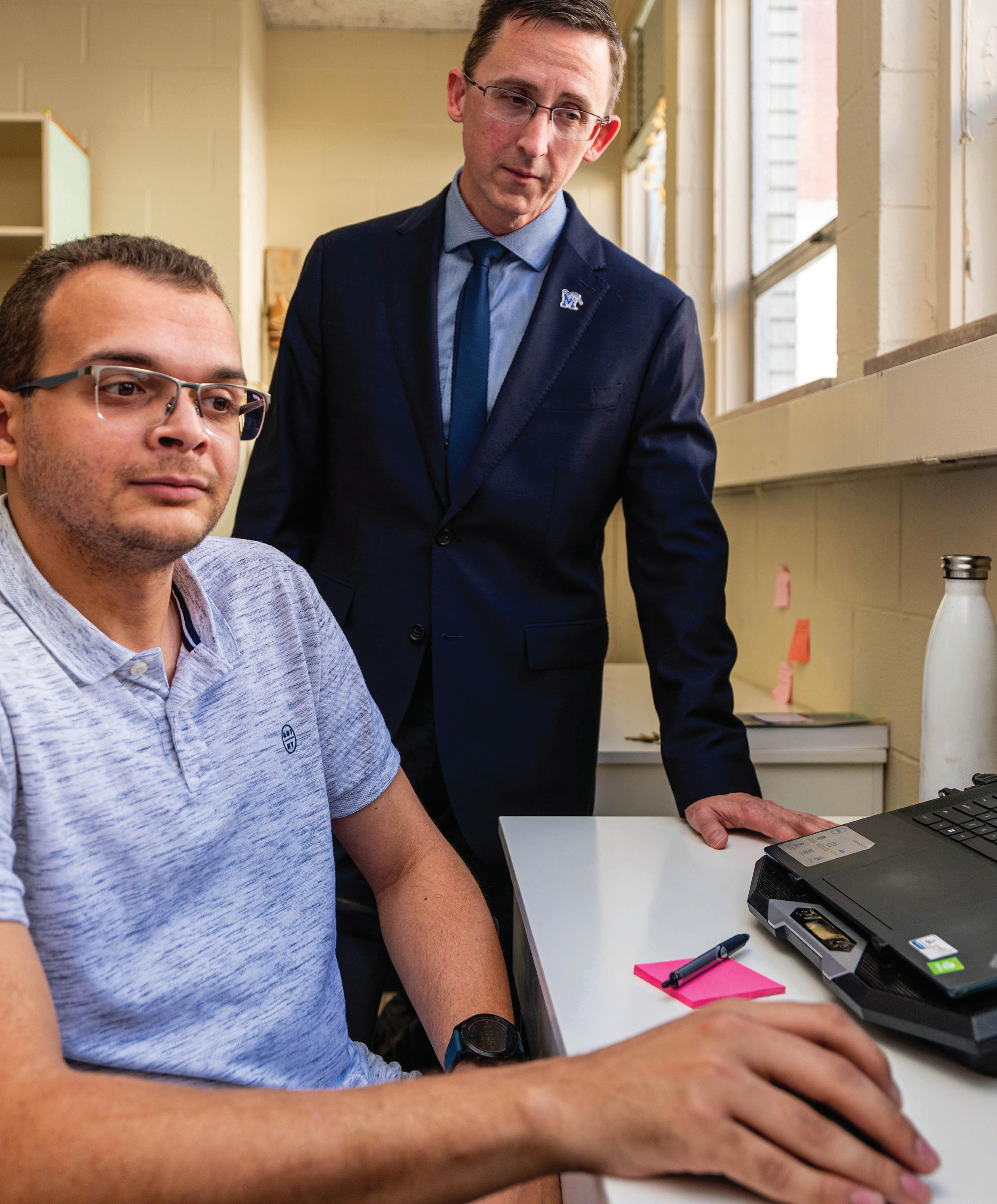
“Every great research university has facilities reflective of the importance of research,” said Dr. Jasbir Dhaliwal, executive vice president of Research and Innovation.
“Both the location and renewal of Mynders Hall capture the essence of our R1 status. The research agenda of the University constantly shifts with changes in national priorities, technology advancement and the needs of the local community. Flexible space for research grantees that Mynders will provide will help in this on-going transition.”
“The R1 designation is definitely driving this project,” said Tony Poteet, recently retired chief university planning officer.
“The space in this facility will be totally used for computational research and graduate programs. Being able to improve, convert, reuse and revitalize the space for the great mission of our research University is very satisfying.”

Turns out that converting a century-old dorm into a flexible and modern research hub is both a challenge and an opportunity.
“The biggest challenge with a project like this is finding things you didn’t expect,” said Jonathan Smith, senior associate at LRK and the project architect for the Mynders Hall work. Walking through the building, he points out additions with floors that don’t quite line up (the building has been updated several times over its lifetime), holes where they’re no longer needed (as a dorm, each room had a bathroom), staircases that are no longer code compliant and dropped ceilings that hide beautiful woodwork, especially in the first-floor common room, a focal point of the renovation.
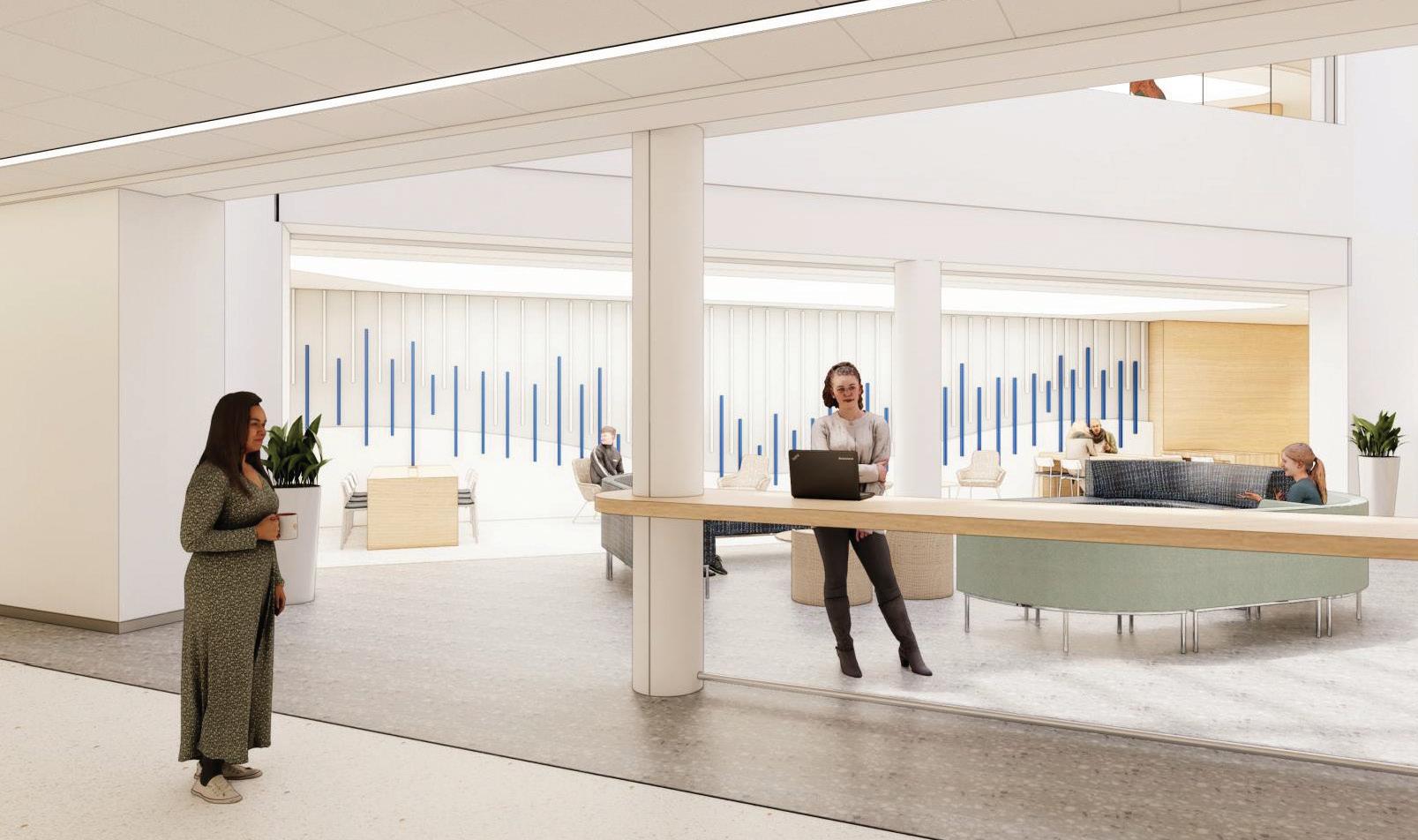
“The common room will be multifunctional,” said Smith, “Used for presentations and meetings.” It’ll have the latest technology, and the design will incorporate the historic fireplace and preserve as much of the wood molding as possible. Along with the first-floor corridor, the common room will become the main public space in the new Mynders Hall.
LRK is partnered with project construction manager and general contractor Montgomery Martin and Project Executive Peter Palazola; the teams make decisions together as the renovation progresses.
To preserve as much of the historic building as possible while updating the space for graduate research and collaboration.

That involves both changes visitors won’t be able to see — structural stiffening, updated mechanical systems, electrical power and plumbing — as well as those that will be obvious, including preserving the historic painted concrete floor tiles throughout the building and the beautiful natural light that streams in through 269 windows.
“Because Mynders was a dorm, it has lots of windows, so the interior of the building will have lots of daylight,” said Smith. “The windows will all be new, but the wood finishes will echo their historic character.”
Also, when Mynders reopens it will be air-conditioned for the first time. It will also now have elevators, and the four existing staircases, including two original steel structures from 1912, will be updated.
“The building itself is a sight to see,” said Jaemi Kurtzman (BFA ’19), who was an architecture student studying late in Jones Hall across the street from Mynders as an undergraduate. Now she is part of the LRK team that designed the interior spaces, finishes and furniture for the renovation. “Working on this project is a nice full-circle moment for me,” she said. “It didn’t take much to bring her back to what she was.”
The only permanent tenant for the new Mynders Hall so far is the Center for Applied Earth Science and Engineering Research (CAESER), a multidisciplinary research center that focuses on water resources, particularly groundwater and has mapping, drones and transportation logistics groups as well.
“We’re pretty excited,” said Dr. Brian Waldron, a civil engineering professor who is the director of CAESER, as he looks forward to consolidating various CAESER researchers,
Every great research university has facilities reflective of the importance of research … the renewal of Mynders Hall captures the essence of our R1 status.”
— DR. JASBIR DHALIWAL EVP of Research and Innovation
now spread all over campus. “The building is beautiful, but I really like the fact that people will be able to walk to Mynders and see what all the graduate students we support are working on. In addition, student projects will integrate with each other, which strengthens research.”
The workstations in the renovated Mynders Hall echo what CAESER uses now, he said. When the University went to Nashville to pitch the Mynders project, “They took pictures of our space to show because of how we engage students in research,” said Waldron. “We write on desks, we write on walls — it’s really meant to be about sharing information.”
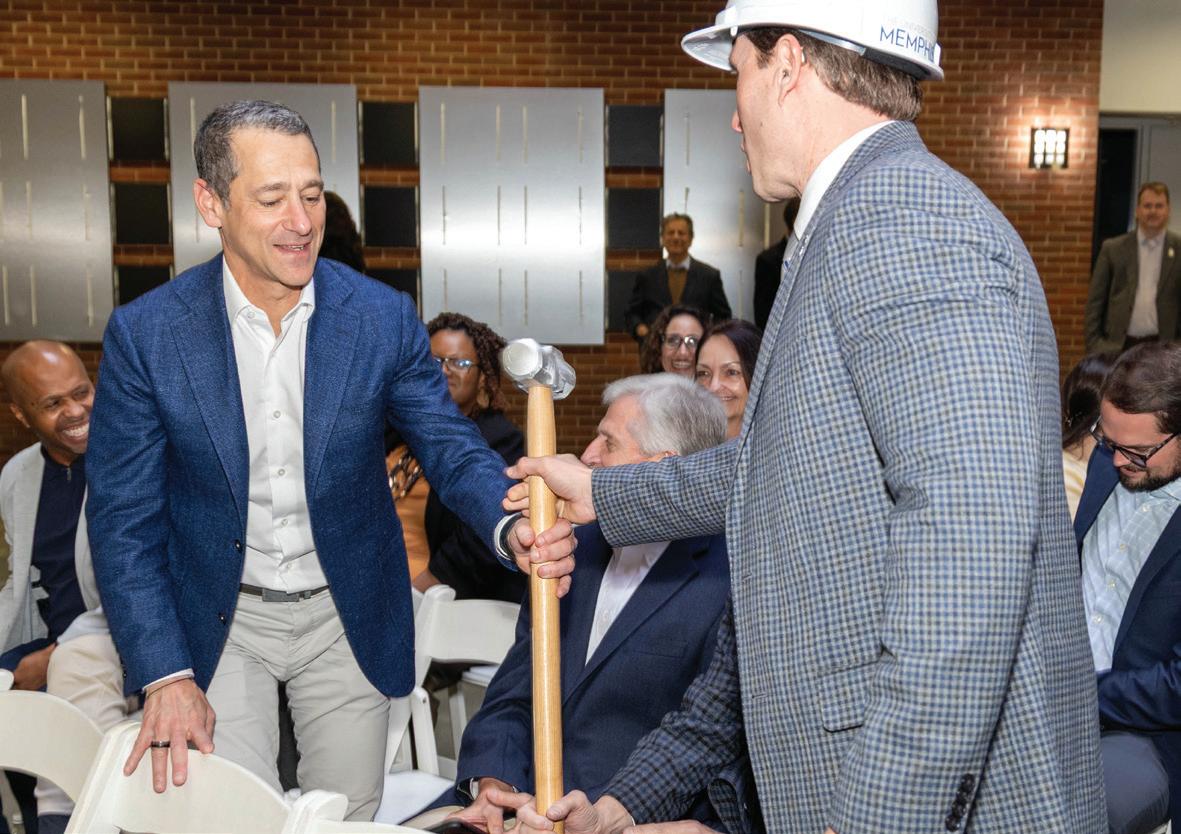
The Mynders renovation will cost $25 million, with $20 million coming from the State of Tennessee and the rest raised by the University of Memphis.
Everyone has their favorite story about the ongoing renovation of Mynders Hall, but Dhaliwal’s might be the most forward-looking.
“My favorite aspect of the renovation project is the constant feedback I am getting from faculty and research students who have waited a long time for renovations to start. Their excitement and positive energy signals to me that we can absolutely expect significant research growth at the UofM in the future.”
• Mynders Hall was built in the shape of an E to honor Elizabeth Mynders, the daughter of the first president of the school and the building’s namesake. She died in 1912, the year the building opened.
• Although Elizabeth never visited the hall named for her while she was alive, a ghost is said to haunt the Mynders hallways. According to Brigitte Billeaudeaux, head of Special Collections at the University of Memphis Libraries, former residents of Mynders Hall have reported finding books open when they hadn’t been before and feeling cool drafts where none should be.
• Mynders Hall was one of three original campus buildings, but only two remain. The other original is the Administration Building.
• Entrances to the new Mynders Hall will be on both the west and east sides of the building, and the entrance on the east side off the porch echoes an original doorway from 1912.
• The colorful historic floor tiles still inside Mynders Hall would cost $800 each to replace today.


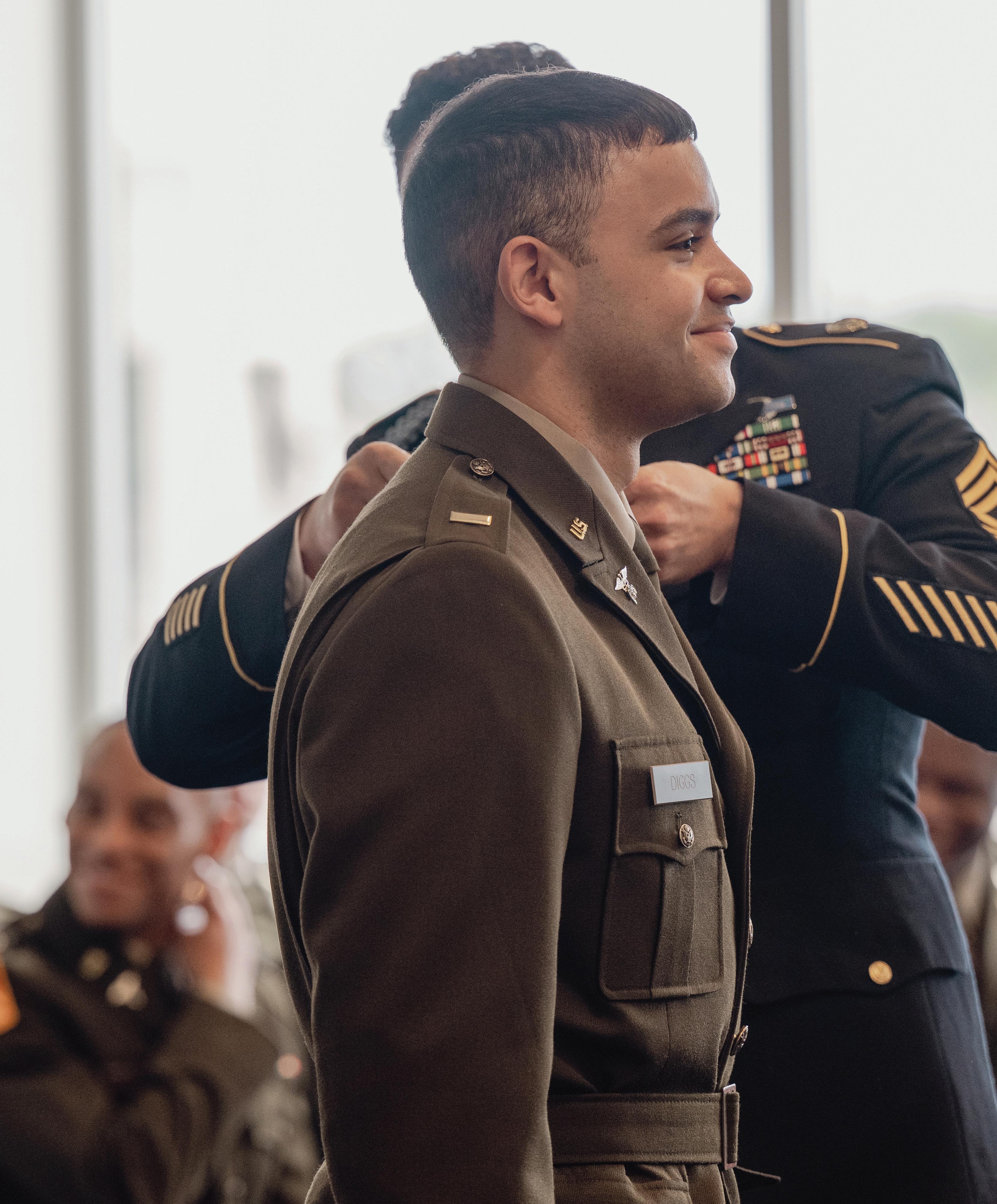
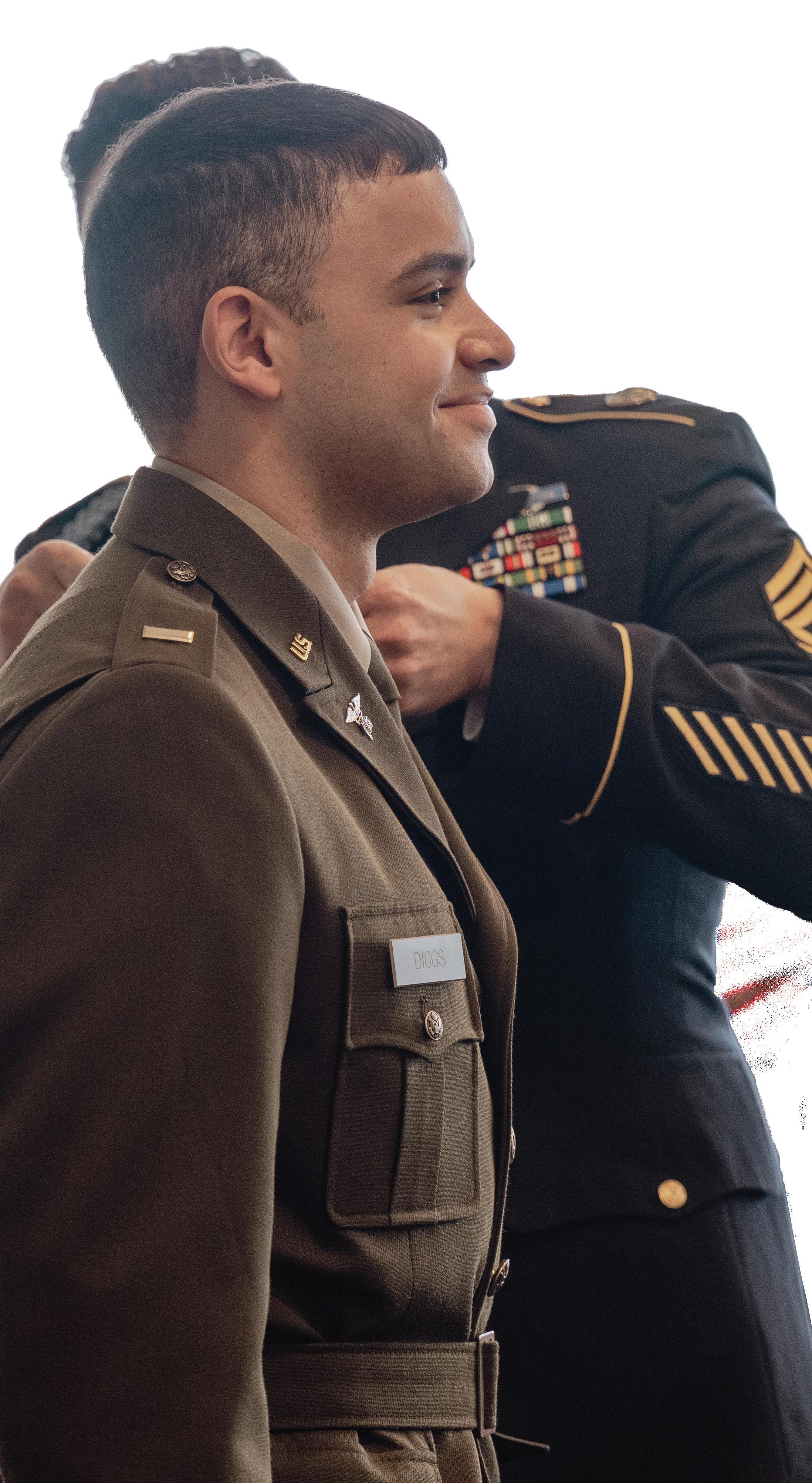
After years of routine, structure and shared purpose come to an end, many veterans find themselves in a world that feels familiar, yet foreign.
College classrooms replace training fields. Professors replace commanding officers.
Without the clear sense of duty that once defined every day, civilian life can suddenly feel chaotic.
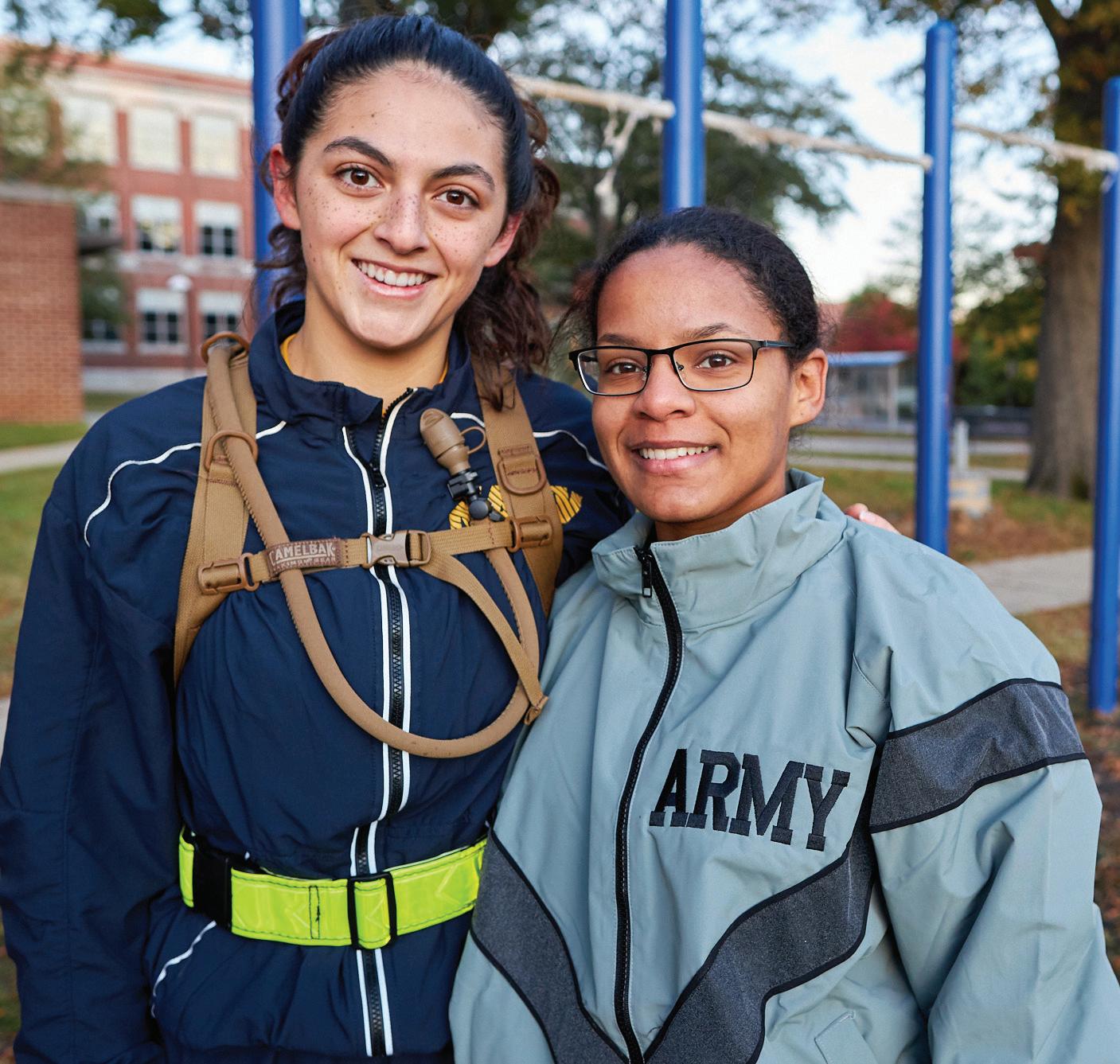
The University of Memphis is working to make that transition easier.
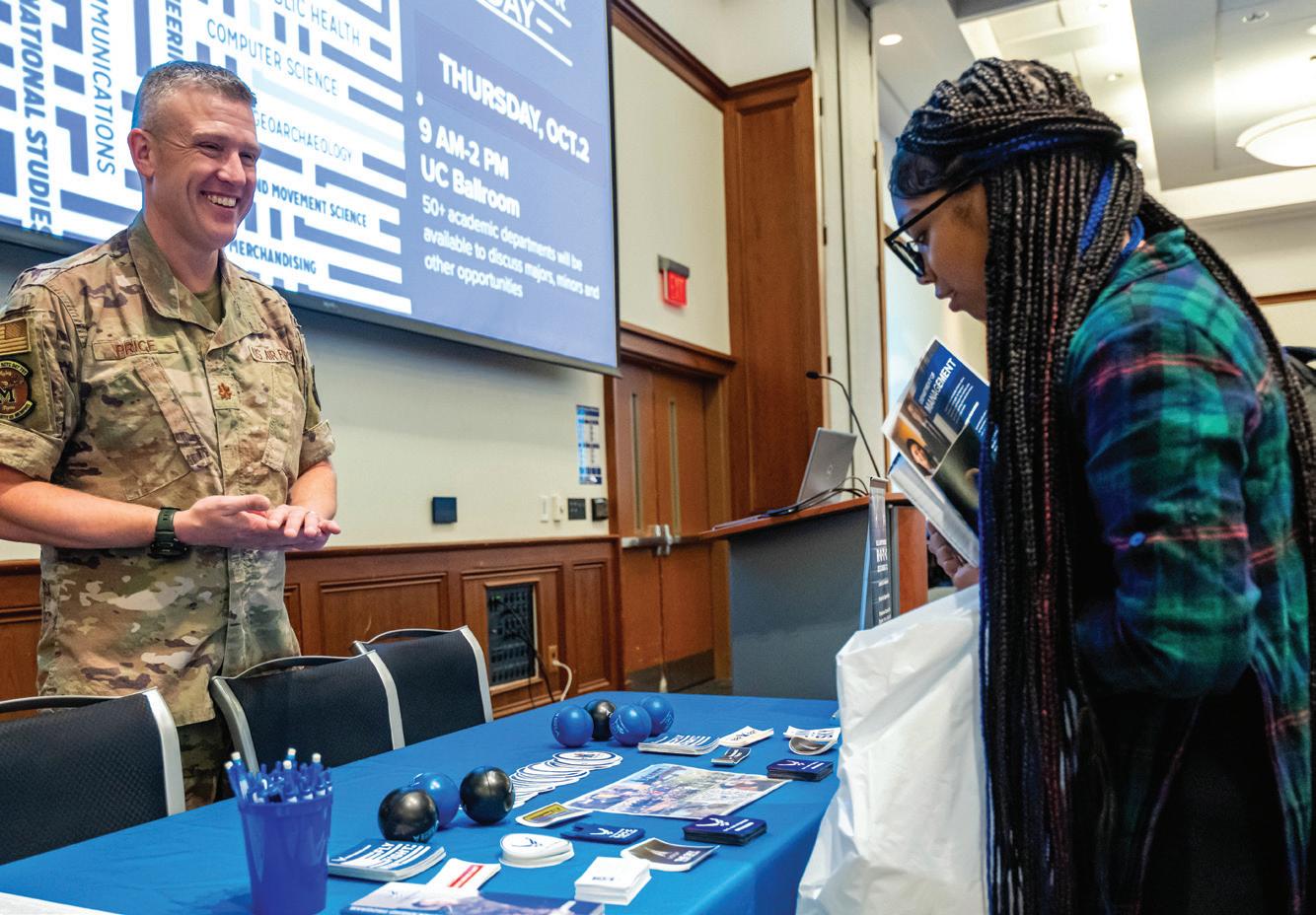
“The shift from military to civilian life can bring doubts, uncertainty, and can lead to students not necessarily believing in themselves or feeling out of place,” said Chris Bourque, former director of the University of Memphis Veteran and Military Student Services Office (VMSS). “That’s why we’re here. We’re creating a space and opportunity for military-affiliated students to feel normal and understand that they have all the skills and abilities to be extremely successful.”
Inside the VMSS suite, that intention becomes tangible.
A large wooden table sits in the center of the office surrounded by comfy chairs. A small kitchen is stocked full of coffee and snacks. Flags and regalia representing each branch of the U.S. military are carefully displayed in the front entrance. The space hums with the ease of conversations of people who understand one another’s unique experiences, whether spoken or unspoken.
“Having a physical space where people can gather is important. We have a long table in there and a lot of chairs. That’s not because we’re having a big board meeting. It’s like a kitchen table ... we’ve literally had potlucks out there and done study days out there. It’s like a family in a lot of ways,” said Eric Daniels, a Marine Corps veteran and current graduate assistant in the VMSS Office.
His experience as an alumnus proves to be invaluable for others going through the same transition from active duty to new student.
Bourque knows the experience well. Having served in the Army National Guard for 17 years, he understands the abruptness of stepping out of a life shaped by service and into one filled with new choices and unknowns.
The VMSS Office’s mission is to ensure that those following a similar path find a sense of community and a clear direction toward their professional aspirations.
“Our goal is that as soon as a military-affiliated student is admitted, they’re going to get information on how to use their GI Bill, about this office, what we do, and that we can support them right from the very beginning,” he explained. “We’re bringing that community camaraderie back and letting the vets and service members and even their dependents and spouses have a space where they can come and things feel normal to them.”
Creating that sense of belonging is only the beginning. The VMSS team helps students navigate academic advising, financial support, career planning and community connections. They guide them through the GI Bill, help them understand graduation pathways and introduce them to resources across campus. Many veterans arrive feeling unsure of where to begin. The office ensures they never have to take those first steps alone.
“We want to provide a successful outcome for every student. Even if it’s the end of the day and they’re walking in at 4:25, we’re going to stay and have those conversations and help that student out,” Bourque explained.
The real results of their dedication are already being seen.


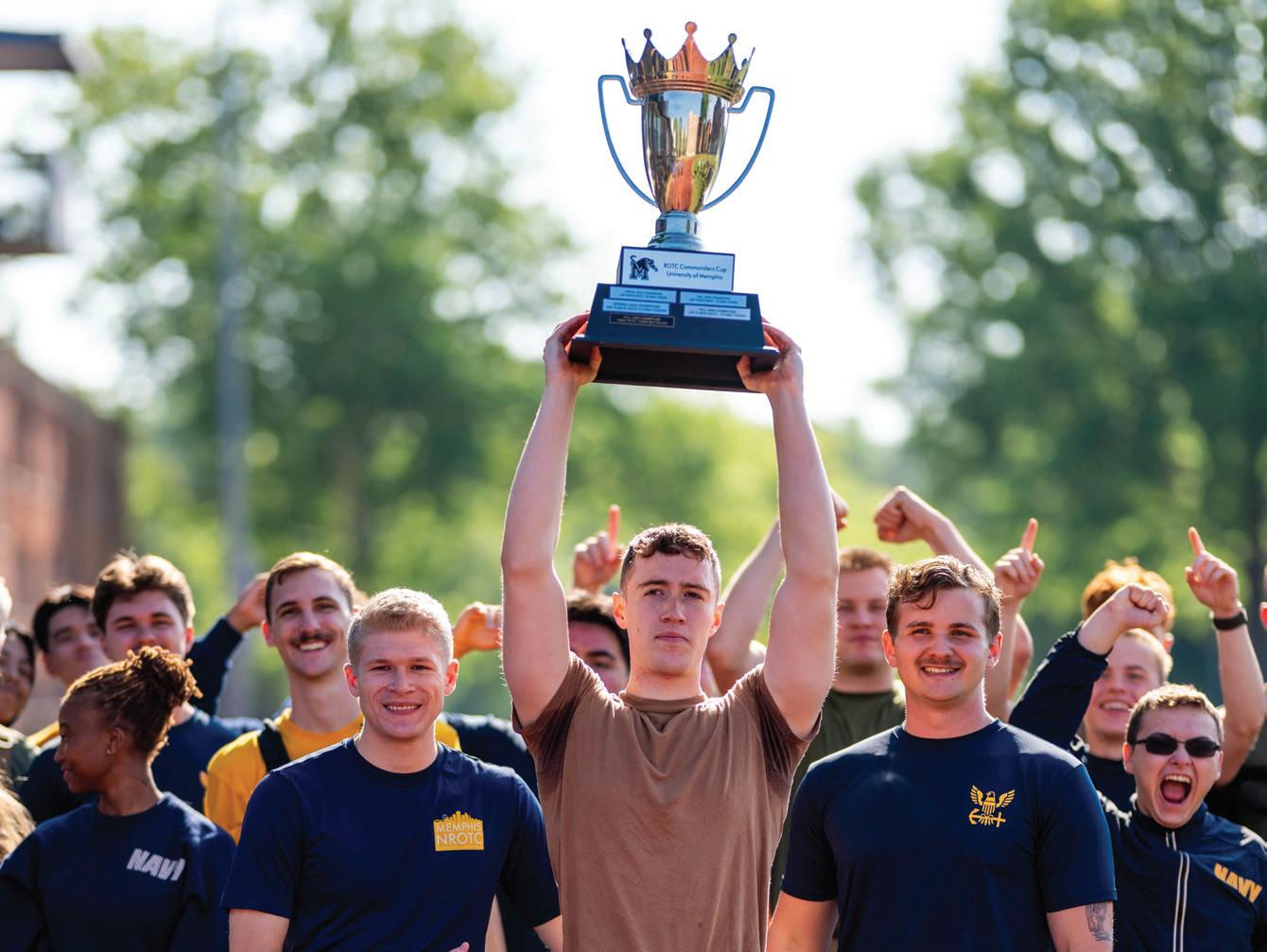
The VMSS team, most of whom are veterans or active service members themselves, has helped make the University of Memphis one of the top institutions in the nation for military-connected students. The UofM earned the Military Friendly Gold Spouse School designation, marking the first time the University has received both honors.
The Gold recognition places the University of Memphis among the nation’s top institutions for militaryconnected students — those that go beyond meeting expectations to actively remove barriers to success. It reflects what VMSS has built: a true lifeline that guides service members, veterans and their families from the classroom to meaningful careers. On top of this distinction, the UofM’s online bachelor’s program is ranked No. 1 in Tennessee for veterans, and No. 28 nationally, thanks to the VMSS’ efforts.
Together, these honors affirm that when veterans and their families come to Memphis, they find more than academic opportunity. They find a network of people dedicated to helping them build strong, fulfilling futures beyond service.
For many, that future is truly life-changing.
“The military has provided an opportunity I would have never been able to have. My parents could never have afforded college. I definitely did not make the grades to afford it,” Daniels shared. “But now I’m able to accomplish more in my life and lift my own family out of poverty.”
According to the Tennessee Department of Veterans Services, Shelby County is home to the largest veteran population in the state. That makes the University’s mission even more vital. When veterans succeed, their success carries ripple effects across communities and generations.
Daniels sees it clearly. “Every time a service member can make that transition, that’s a generational change,” he said. “Those who can be successful in the military, get
out and get a degree have the best opportunity to permanently change the trajectory of their life.”
The VMSS team knows that meaningful transformation takes partnership. They continue building relationships across campus and throughout the Memphis community to expand completion scholarships, mentorship networks, camaraderie events and family support resources. Their goal is simple: to ensure that every veteran and military-affiliated student at the University of Memphis has the tools, the confidence and the community they need to succeed. These efforts also open doors for further engagement. Alumni veterans return to speak with students. Local organizations offer internships and job opportunities. Supporters lend their time and expertise to strengthen programs that lift military families and build the community.
Some of those supporters are pushing the momentum even further.
Donors like Tina Santi Flaherty and former University of Memphis President M. David Rudd have made huge strides in establishing programs that both recognize the bravery of active-duty military students and provide the desperately needed mental health resources for when they return home.
Flaherty is an active alumna of the UofM, an accomplished author and a successful corporate executive. She established the Clement Santi Courage Scholarship Award in 2023 to support veteran students in achieving their academic and career goals. The award was created in honor of Flaherty’s father, Clement Santi, a World War I veteran and entrepreneur, and recognizes students who have displayed honor, courage and commitment during their service.
Rudd established the Rudd Institute for Veteran and Military Suicide Prevention in 2022. As a veteran himself, Rudd is dedicated to expanding access and availability of resources and research for improving mental health for active-duty military and veterans. These efforts

illustrate the kind of impact a single person can make on the lives of the students and community they care about.
When the University invests in veterans, it invites the entire community, military-affiliated or not, to join in shaping futures that honor service with opportunity.
“The University of Memphis is committed to supporting our military civilian students, and the city as a whole has a rich history in supporting our military-affiliated population,” Bourque added.
“These are benefits that have been earned, and there are sacrifices that these people have made that almost no one else has done or experienced. We owe it to them as a University and city to fulfill those obligations and support them as best we can.”
Duty does not end when the uniform comes off. At the University of Memphis, it continues in classrooms, in communities and in every Tiger who helps those who protect our nation find success beyond service.

By NIA RINCON
In a physical therapy clinic in rural West Tennessee, a handwritten schedule hangs on a clipboard. Appointment times have been carefully arranged to make use of every available provider, yet the week still has long stretches where rooms sit unused.
The reason — there are not enough clinicians to fill them.
Some job openings remain unfilled for months — often going weeks without a single application.
On top of this, the community continues to age. The need grows, but the workforce does not.
A few hours away in Memphis, another barrier to care takes form.
An older man is struggling with hearing loss. Even if he could find a nearby clinic, he has no way to get there and is unsure if the specialist could actually help him.
In many urban neighborhoods, the path to routine hearing care has never been simple.
Specialized clinics are few and far between and daily realities make them out of reach. Many families juggle tight budgets, jobs without sick leave and long commutes on limited transportation, leaving little room for preventive appointments. Others have gone years without seeing a provider because past experiences have made the healthcare system feel uncertain or unwelcoming.
Layer by layer, these circumstances create a landscape where early screening is rare, and hearing issues often go unnoticed until they become urgent. For many Memphians, emergency rooms have become the default entry point to care, a place that cannot offer long-term support.
These moments reveal a shared truth.
Access to healthcare is not a single challenge but it is one that shifts with geography, resources and connection.
At the University of Memphis, two initiatives are stepping into these gaps with place-based strategies designed to strengthen the wellbeing of communities across Tennessee.
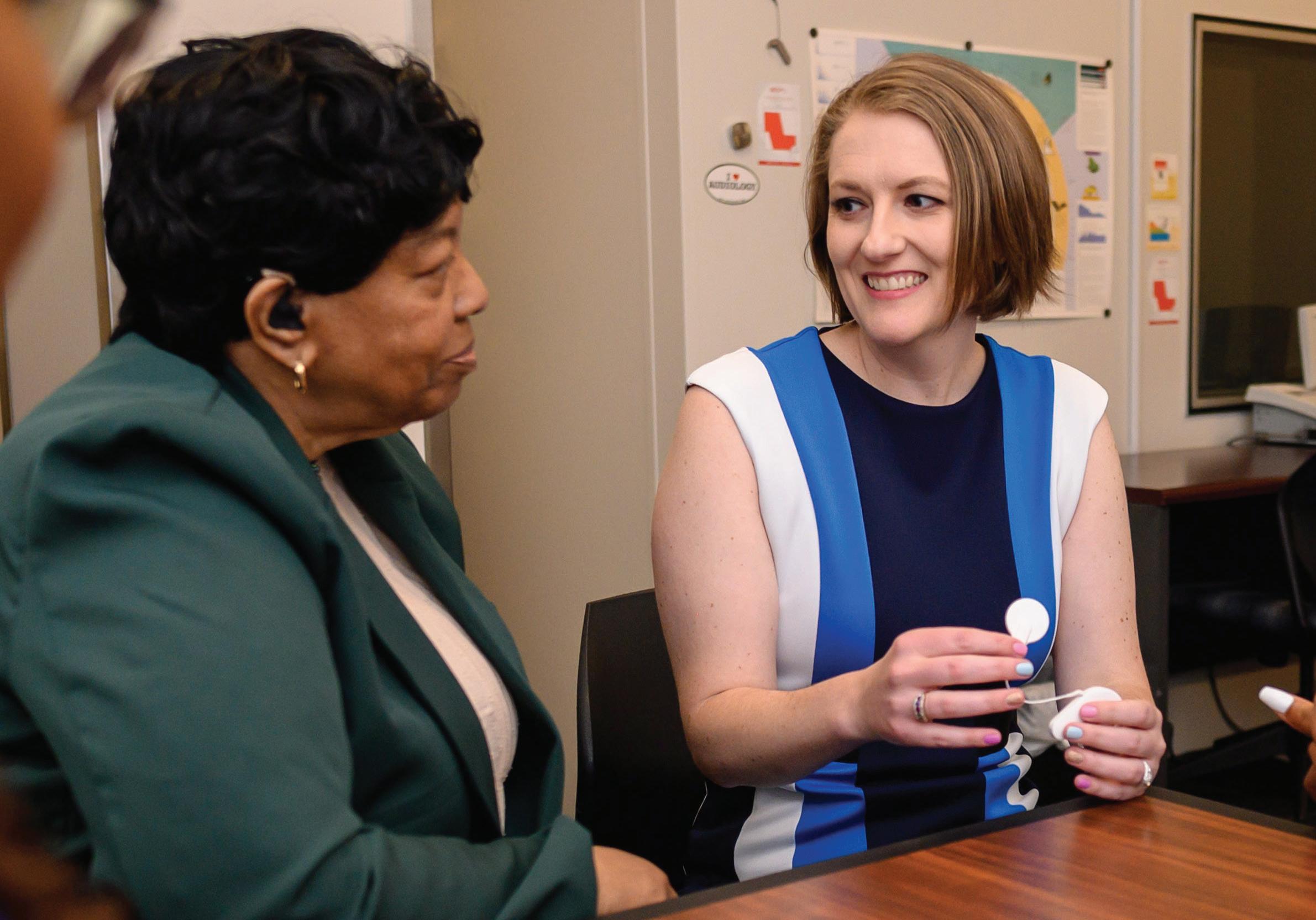
The first strategy is the new Doctor of Physical Therapy program at the Lambuth campus. The other is the Memphis SOUND Project (Serving Our Underrepresented Neighbors who are Deaf or Hard of Hearing), a communityengaged hearing health initiative through the Cochlear Implant Research Lab (CIRL).
CIRL views communication as a fundamental part of the human experience.
“When people have a breakdown in their communication, they experience a breakdown in the way they can fully participate in their communities,” says Dr. Sarah Warren, team lead of the Memphis SOUND Project.
Supported by external and internal research grants — including funding from the American Speech-Language-Hearing Association, the UofM Division of Research and Innovation, and a pending application to the National Institute on Deafness and Other Communication Disorders (NIDCD) at NIH — the Memphis SOUND Project is able to work with the community to generate evidence that will shape programming and education, leading to improvements for individuals with hearing loss.
Together, both CIRL and the SOUND Project reflect what access can look like when a University and its supporters recognize a need, respond directly and commit to serving its region with intention.
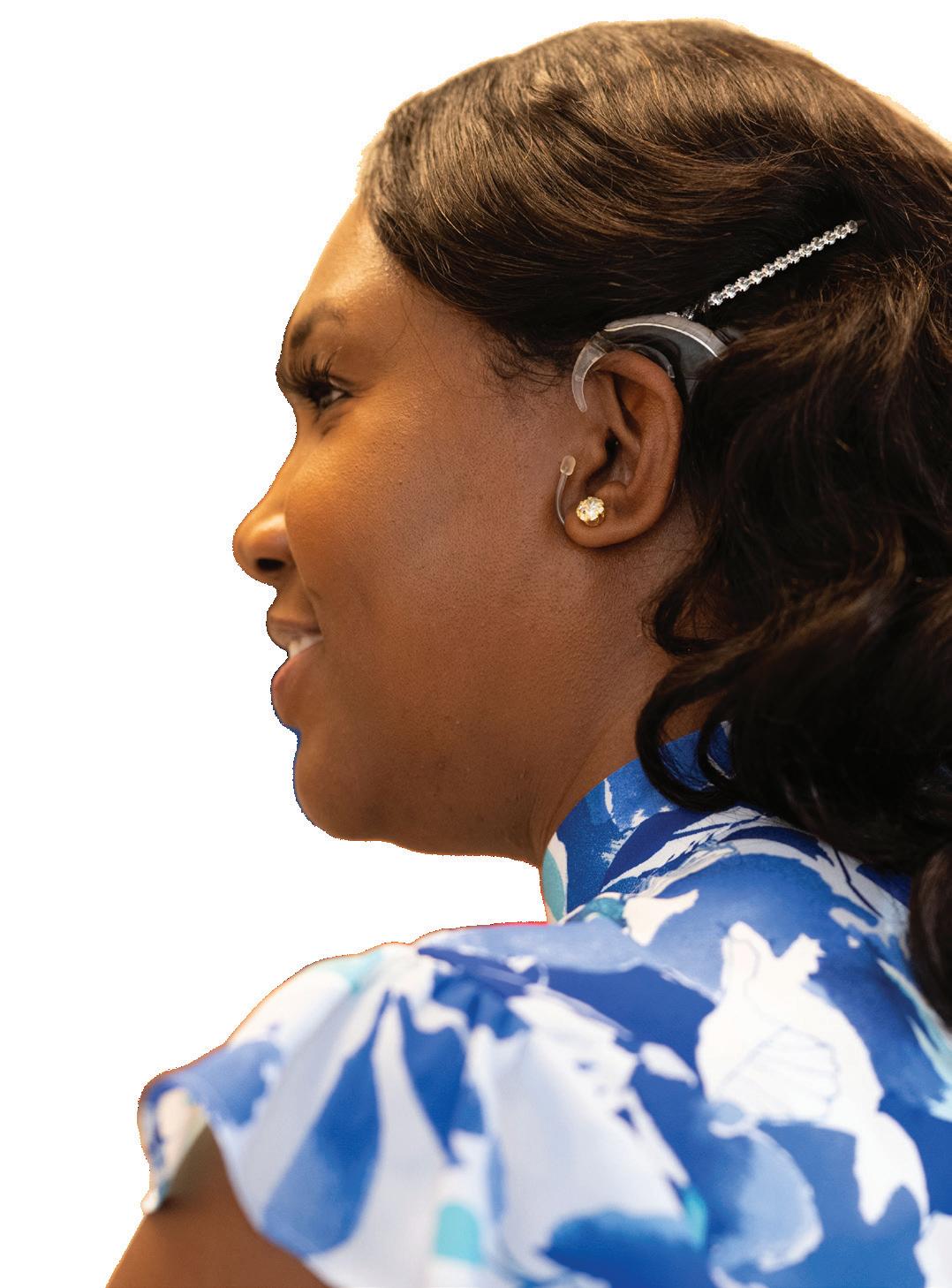
While rural challenges are primarily shaped by distance and lack of providers, the barriers in Memphis stem from mistrust and a lack of opportunity. The Memphis SOUND Project focuses on hearing health among primarily older adults who are often underserved by traditional healthcare systems.
Rather than expecting people to enter unfamiliar clinical environments, the SOUND project brings care to trusted places.
“The project was co-developed with community partners and is building on longterm relationships with local faith-based organizations, which serve as trusted spaces for outreach education and on-site hearing screenings” says Warren.
“A core principle of the project is shared leadership,” Warren explained. She also credits community partner Iris Allen as being central to that work. “I work closely with Iris Allen, a community partner who helped found and shape the project from the beginning and plays a central role in engagement, trustbuilding and implementation.”
As Warren explains, “Community voices guide both what we study and how the work is carried out.”
Recent research highlights the urgency.
“In the past couple of years, new research has found that hearing loss is the largest modifiable risk factor for cognitive decline and dementia, yet most people don’t know about that connection,” she said.
Many individuals have never encountered this information.
“It simply hasn’t reached them, even though early identification and intervention could meaningfully change long-term health outcomes,” she said. “We see it as a responsibility to share that knowledge broadly and especially with communities who have historically had the least access to preventive health information.”
Awareness, however, is only part of the challenge.
“The barriers these individuals face go far beyond awareness,” Warren explained. “They include limited access points for care, structural hurdles within healthcare systems and longstanding mistrust rooted in prior experiences.”
Memphis SOUND is working toward expanding access by first doing the foundational work necessary to get it right and by generating the community-informed evidence needed to design interventions that will actually work.
Collaboration across campus strengthens the work.
Warren said, “From the University side, Memphis SOUND brings together collaborators across multiple schools, including the School of Communication Sciences and Disorders, the School of Public Health and the School of Social
Work alongside community partners.”
Warren also noted that it reflects a broader commitment to interdisciplinary and community-centered impact right here in Memphis.
Looking forward, she sees significant potential.
“Our vision is for Memphis SOUND to serve as a prototype for similar communityengaged hearing health initiatives in other urban areas facing comparable inequities.”
As a Memphian, she finds the work deeply meaningful.
“I have found our community to be enthusiastic about opportunities to improve our city and the lives of people who live here,” she said.
In West Tennessee, just 75 miles from Memphis at the Lambuth campus, the mission is the same.
Dr. Jacque Bradford, director of the new DPT program at Lambuth, has spent years watching clinics struggle to hire enough physical therapists to meet the demand.
“They have open PT positions but graduates from DPT programs in more urban cities tend to stay in the urban city or go out elsewhere,” Bradford said. “My colleagues who work, lead and have developed and established clinics in West Tennessee are unable to serve their patient population because they don’t have the staffing they need.”
Delayed care creates a downstream impact for families.
Bradford explains, “Distance is part of it too, but if you have a clinic and you’re not even able to get the clinic staffed, that’s another whole layer to it. It’s a big layer.”
Rural labor often involves physically demanding work, and the risk of injury is high.
“If you think about rural communities, what kind of jobs do you think of? Sometimes you think of the farming industry, you think of blue-collar labor. And when you think of those jobs, the incidence of injury is higher,” Bradford said.
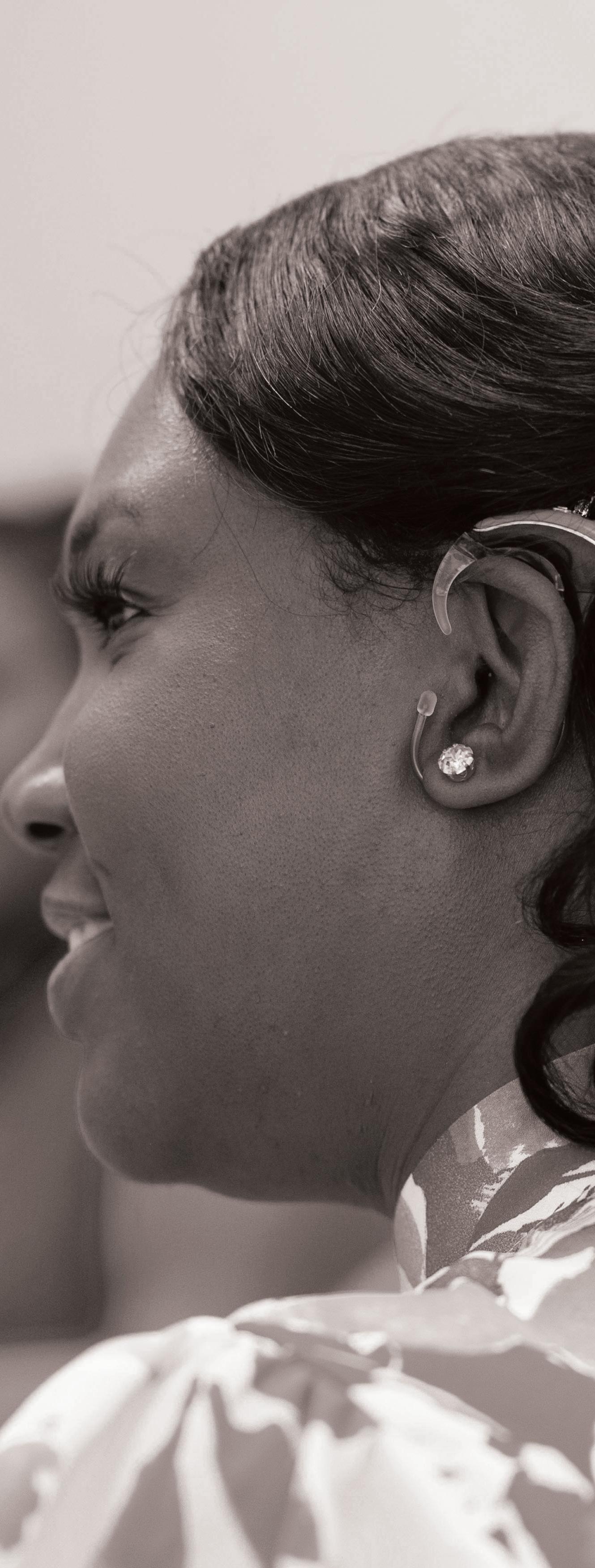
Rather than expecting people to enter unfamiliar clinical environments, the SOUND project brings care to trusted places.
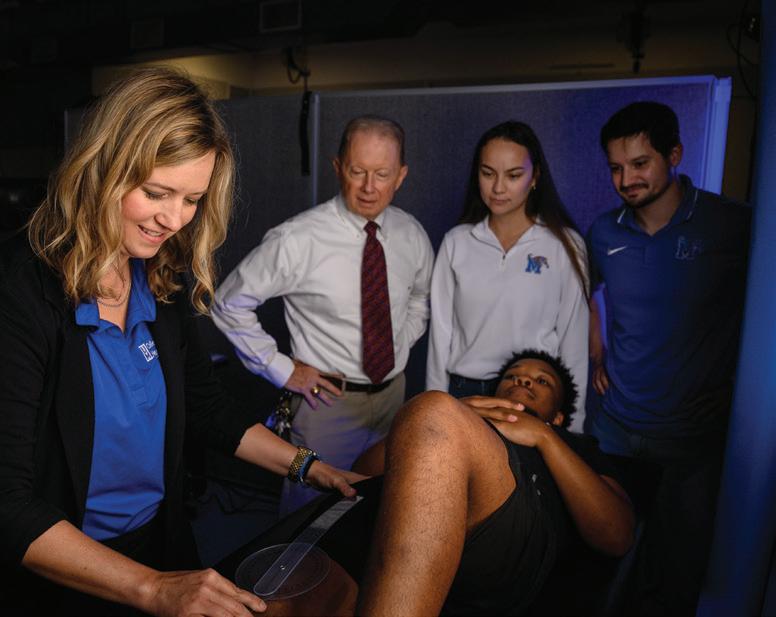
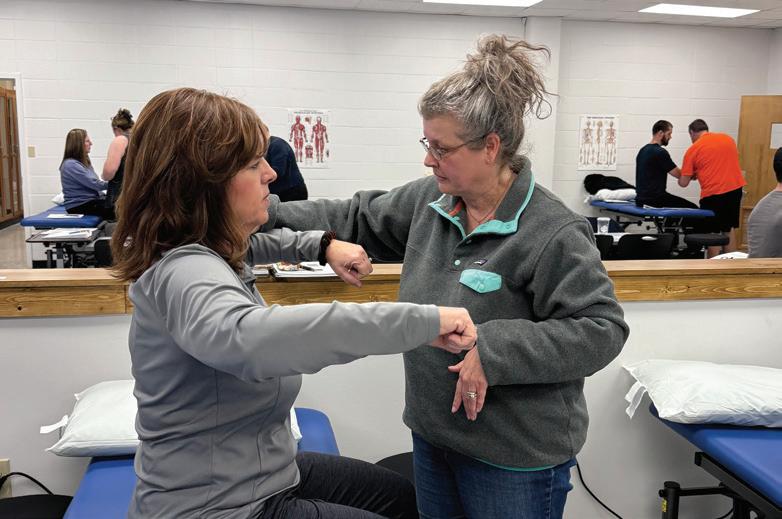
Effective physical therapy not only restores mobility but reduces reliance on pain medication. “This program also helps reduce the need for opioids and it keeps our community safer and healthier in the long run,” she said.
Jackson is a natural home for a program like this.
As Bradford shares, “Jackson, Tenn is known as Hub City, and Hub City is really the hub of West Tennessee.”
The Lambuth campus is close to Jackson Madison County General Hospital and near clinics that serve both urban and rural patients. “This campus is a hub for healthcare education.”
That sense of purpose guides the program.
“Our mission emphasizes rural healthcare … ensuring that every decision we make as we continue to develop this program is reflecting back on our mission,” Bradford said.
The program relies on strong partnerships throughout West Tennessee to achieve this mission.
“First and foremost, we would not be a program without these partnerships,” Bradford said.
Clinics provide training environments where students gain direct experience.
In return, the University offers shared resources and continuing education. Community therapists help with simulation activities and serve as mentors.
“We need clinical sites … they need our graduates, they need to educate their team … in a nutshell, it’s a pipeline,” she said.
Bradford hopes this pipeline leads to a workforce rooted in the region. “I hope they will be practitioners who will want to work in West Tennessee or rural communities.”
She also wants graduates who embody empathy and patient-centered care.
“I want them to be patient first providers and very goal-oriented in the sense of meeting the patient’s needs over their own as a physical therapist. I would hope that they would all be empathetic,” Bradford said.
These UofM programs share a common philosophy: Bring care closer. Build trust. Honor the communities being served.
Warren said, “The comparison between the two programs highlights how expanding medical services can look different but can be equally impactful across urban and rural settings.”
These initiatives also demonstrate the impact of the University’s investment in regional wellbeing. When new programs take root in West Tennessee and communityengaged research grows in Memphis, the University strengthens its role as a partner
— DR. JACQUE BRADFORD Director of DPT program at Lambuth
in the health of its state. Alumni, donors and community supporters help fuel this work by believing in its purpose and by trusting the University to lead with care.
In both places, the University of Memphis continues to expand its presence as a neighbor, a partner and a source of steady support.
This is access reimagined through commitment and connection made possible by a University that believes in meeting people where they are, and helping them move forward with confidence and care

When Venki Mandapati (MBA ’20) arrived in Memphis in 2015, he had never been outside of India. He stepped onto campus as an international student with a suitcase full of ambition, a scholarship from the Fogelman College of Business and Economics (FCBE), but no clear vision of entrepreneurship in his future.
Around the same time, Taylor Herndon (BS ’16) was earning a degree in biology, planning a career rooted in science and nature. She never once imagined herself as a business owner.
Today, the lives of these two alumni look very different from what either of them expected.
Mandapati co-founded UpSquad, a technology platform used by universities and nonprofit organizations across the country to support seamless learning and collaboration. Herndon founded Board to Beers, a beloved community-centered board game bar in Memphis designed to bring people together through play, conversation and connection.
Their paths could not have looked more different, yet both alumni are builders of something meaningful that was shaped not by a single defining moment, but by a mindset that evolved over time.
Mandapati calls himself a tinkerer, someone who enjoyed experimenting with ideas and watching people’s lives become easier because of what he created. Growing up, entrepreneurship was not part of his family narrative. Success meant earning a degree and a stable job.
Mandapati returned to the UofM for an MBA and during this time, he became involved with the Crews Center for Entrepreneurship, housed within FCBE.
Found in 2013 by alumnus entrepreneur Hilliard Crews, and his wife, Harriett, through the Crews Foundation, the Crews Center serves as the University’s hub for entrepreneurial education, innovation and startup development. From Fall 2024 through Summer 2025, the Crews Center engaged with over 2,300 students and faculty; drawing participation from 11 colleges and represented 12 business sectors. And a total of 85% of students attended events and 73% of graduate students participated in programming.
Since its founding, the Crews Center has supported hundreds of students and alumni through coursework, mentorship, competitions and startup resources, effectively helping launch businesses, nonprofit initiatives and innovative projects. Mandapati’s introduction to the Crews Center was during a weekend hackathon event. He attended out of curiosity, unsure of what to expect. By the end of the weekend, he had won the competition. This experience helped him see that ideas can start small and grow with the support of a network. People were willing to listen and willing to help.
“I thought to myself, ‘Wow. There are people out there who would just listen to your ideas, no matter how big or small,’” Mandapati recalled. “There is always so much you could do with a little bit of encouragement.”
That realization deepened. Mandapati continued participating in pitch competitions, like Tiger Tank, and began representing the University at entrepreneurial competitions. Each experience reinforced
the same lesson: uncertainty was not a weakness — it was part of the process. At the Crews Center, Mandapati learned to break ideas into solvable problems, identify customer needs and test assumptions before building products. Just as importantly, he realized that risk could be managed.
“There were always people I could go to,” he said. “Even if they didn’t have the answer, they helped me find someone who did.”
For an international student navigating questions of funding, company formation and long-term viability, that guidance mattered.
UpSquad did not follow a straight line. Early funding ran out. The team pivoted repeatedly. When the pandemic hit, they were forced to rethink their entire model almost overnight.
“For the initial steps, we had no clue what we were doing,” Mandapati admitted. “We took it step by step and did whatever we could with our limited resources.”
Those pivots eventually led to a scalable technology platform now used by universities and nonprofit organizations across the country, including programs at the UofM.
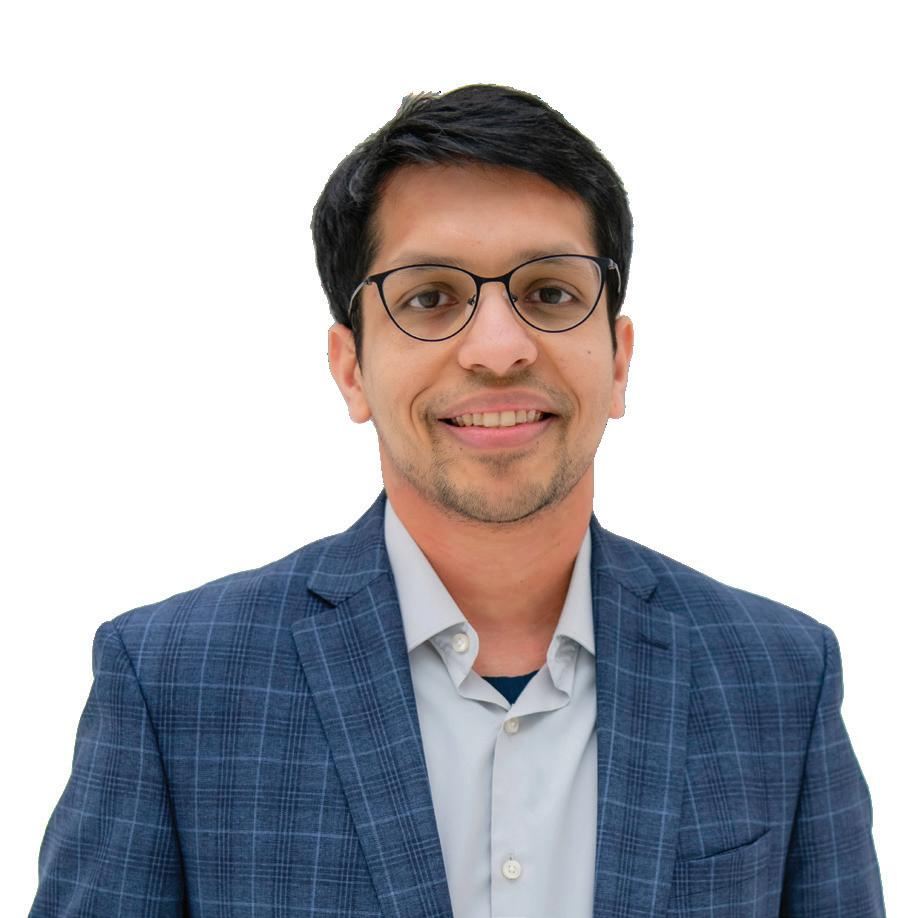
BY NIA RINCON


Herndon’s journey into entrepreneurship followed a very different course.
As a biology major with minors in art and sociology, she envisioned a future working with animals. After graduating, she spent more than a decade at the Memphis Botanic Garden, working in education and outreach by building programs and serving the community.
“I never imagined that I would own a business,” she said. Herndon began her studies at the UofM before the Crews Center was established, meaning her entrepreneurial education would take shape later and largely outside the classroom.
In 2015, her father passed away unexpectedly from cancer. The loss brought clarity and urgency, forcing her to reconsider how she wanted to spend her time and energy. She and her husband turned their shared love of board games into something more than a hobby. It became a way to bring people together.
“You never know how much time you have on this earth,” Herndon said. “So, it made me make a complete career change.”
Herndon didn’t have formal business training, startup capital or a safety net, but she had a community willing to support her vision and who rallied to fully crowdfund her initial startup costs.
“It’s a really interesting option if you want to go into business and don’t have the funds,” she said. “If there’s a need in your community, crowdfunding can be a great option, but it requires a lot of marketing and learning the ins and outs as you go.”
She taught herself the mechanics of running a company through online resources, networking and a healthy amount of trial and error.
Before their expanded brick-and-mortar location at Poplar Plaza, Board to Beers operated out of a smaller space and even from a mobile board game trailer as a traveling, physical space designed to create connection. Step-by-step, Herndon’s vision became a reality.
Herndon opened Board to Beers in August 2020, during the global pandemic. In five years, the business has never operated in the green. She has faced rising costs, delays and constant uncertainty. And yet, she considers herself successful.
For her, success is not measured in profit margins. It is measured in people. “Board to Beers is meant to be that third space,” she said. “We are a safe place. We don’t turn anyone away.” Over time, both alumni have redefined what success means to them.
For Mandapati, success now means helping others navigate the uncertainty he once faced. “The biggest lesson I learned is that no one is self-made,” he said. “You need people to be able to get where you want to go.”
Herdon tells the story of a customer who came in every day during the pandemic after moving to Memphis alone. Years later, he returned with his wife and child, proud to show them the place that once served as his community. “That’s what we’re here for,” Herndon said.
“
Board to Beers is meant to be that third space. We are a safe place. We don’t turn anyone away.”
TAYLOR HERNDON Owner, Board to Beers
Today, both alumni give back in ways that close the loop between education and impact through mentorship, training programs, sharing real-world perspectives and guiding students and teams as they take their first steps into entrepreneurship. Entrepreneurship, as these alumni show, is not a moment. It’s not a major or a title. It’s a way of engaging with the world one question, one connection and one brave step at a time.
BY JACKIE WRIGHT BY JACKIE WRIGHT
University of Memphis President Dr. Bill Hardgrave presented at the inaugural AI Tennessee Summit in Nashville at the historic Country Music Hall of Fame.
The summit was hosted by the University of Tennessee, Knoxville, in collaboration with the UofM, Tennessee AI Advisory Council, SCORE, Vanderbilt University, the Oak Ridge National Lab, and the Tennessee Board of Regents.
His presentation titled, “Tennessee’s AI University: Advancing the Frontier of AI in Tennessee for Over 30 Years,” delved into the University’s history leading AI through education past, present and future.
“University of Memphis faculty have been driving leading-edge research in the area of data science and intelligent systems for more than 30 years,” Hardgrave noted. “Across our faculty alone, the University of Memphis has been cited over 134,000 times in research for AI and Machine Learning.”
This accounts to roughly 15% of faculty at the UofM who are engaged in AI and machine learning research.
This is evidenced through work that began in the 1970s, with the late Dr. Stan Franklin in the Department of Mathematical Sciences, who developed models simulating how the human mind works psychologically. Franklin along with Dr. Art Graesser established the Institute for Intelligent Systems in 1985. Today the center serves its mission as a collaboration hub advancing research, education and innovation in language, learning and AI through impactful partnerships.



“THIS story was designed in collaboration with artificial intelligence

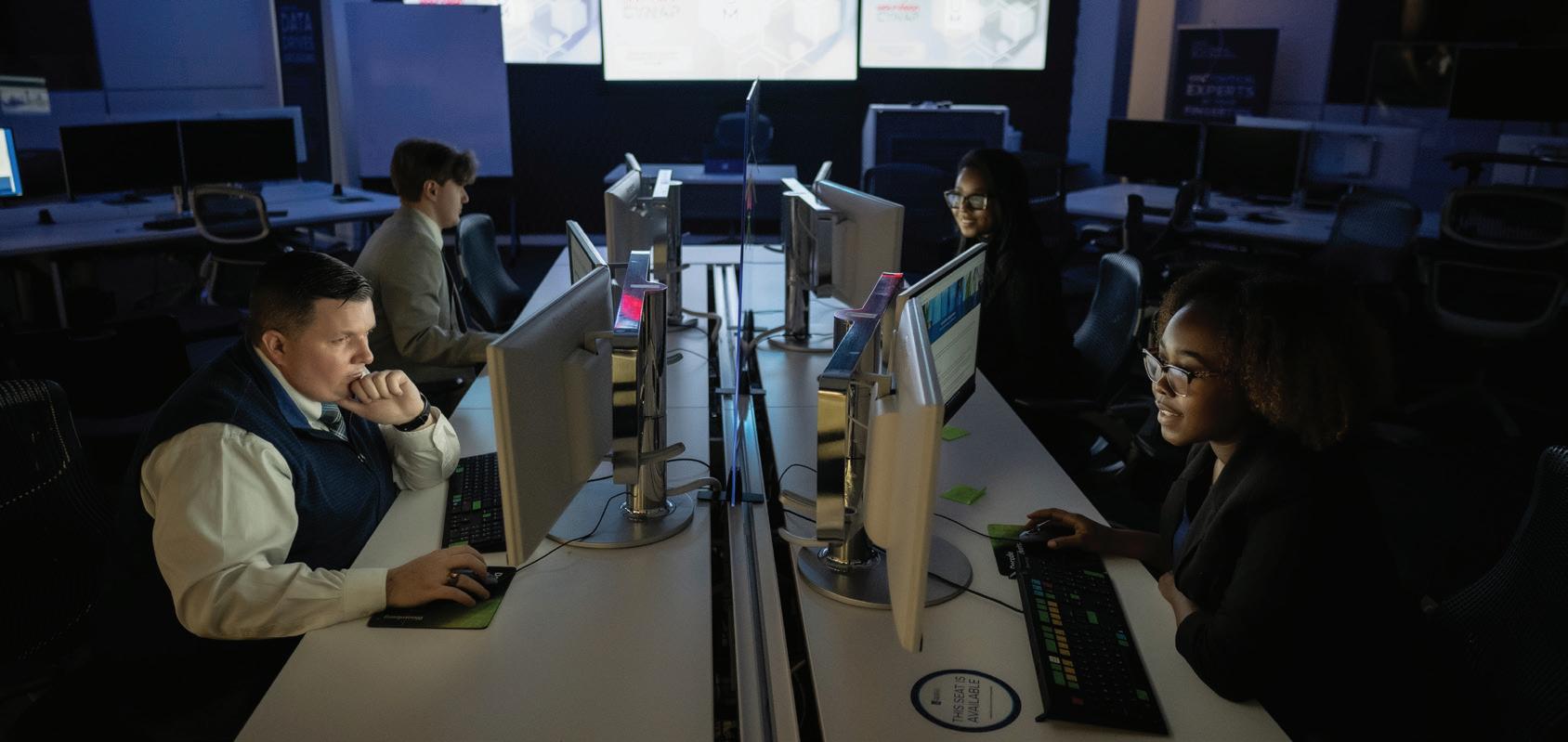
UNIVERSITY OF MEMPHIS FACULTY HAVE BEEN DRIVING LEADING-EDGE RESEARCH IN THE AREA OF DATA SCIENCE AND INTELLIGENT SYSTEMS FOR MORE THAN 30 YEARS.”
Other notable centers at the University include the Center for Information Assurance (CfIA) — a designated Center of Academic Excellence in Cyber Defense Education and Research — led by Hill Professor in Cybersecurity and Director Dr. Dipankar Dasgupta. The newly formed Center for Emerging Technologies in Artificial Intelligence (CERTAIN) which is addressing how to reduce obstacles to implementation of AI in education, industry and government; with a particular focus on manufacturing, logistics, healthcare and software development. In addition, the AI for Health Research (AIHR) Lab will allow the University to further invest in advancing AI in health outcomes with a focus on substance use disorders.
Hardgrave noted that the University’s location on the western side of the state as part of the “Digital Delta” is seeing accelerated growth for AI data centers and this makes it even more imperative that the University continues to accelerate innovation and investment toward AI research in teaching.
Last year, the University launched a new academic unit, The Polytechnic@UofM, to address this need. The Polytechnic@ UofM will expand the University’s applied technology degree portfolio and reduce barriers to entry toward attaining a bachelor’s
degree through electives that can be used toward transfer credit or credit for experiences outside of the classroom.
Last Fall semester, the University launched the AI for All Minor which is equipping students — regardless of their chosen majors — skills and knowledge to be able to successfully integrate AI into their field of study and future careers. And in Fall 2026 the new Bachelor of Applied Science (BAS) will be available with concentrations in manufacturing supervision, construction leadership and information technology.
Most recently, the University of Memphis joined the University of Arkansas, the University of Mississippi, and the University of Tennessee Health Science Center in signing a memorandum of understanding to establish a strategic collaboration on the development of a Mid-South AI Research Consortium.
The consortium will focus on five critical pillars of research and development: rural and precision health; supply chain and logistics; energy and data centers; agriculture and food security; and national defense. Advancing artificial intelligence research, workforce development and regional innovation across the broader Mississippi River Delta region.
BY JACKIE WRIGHT
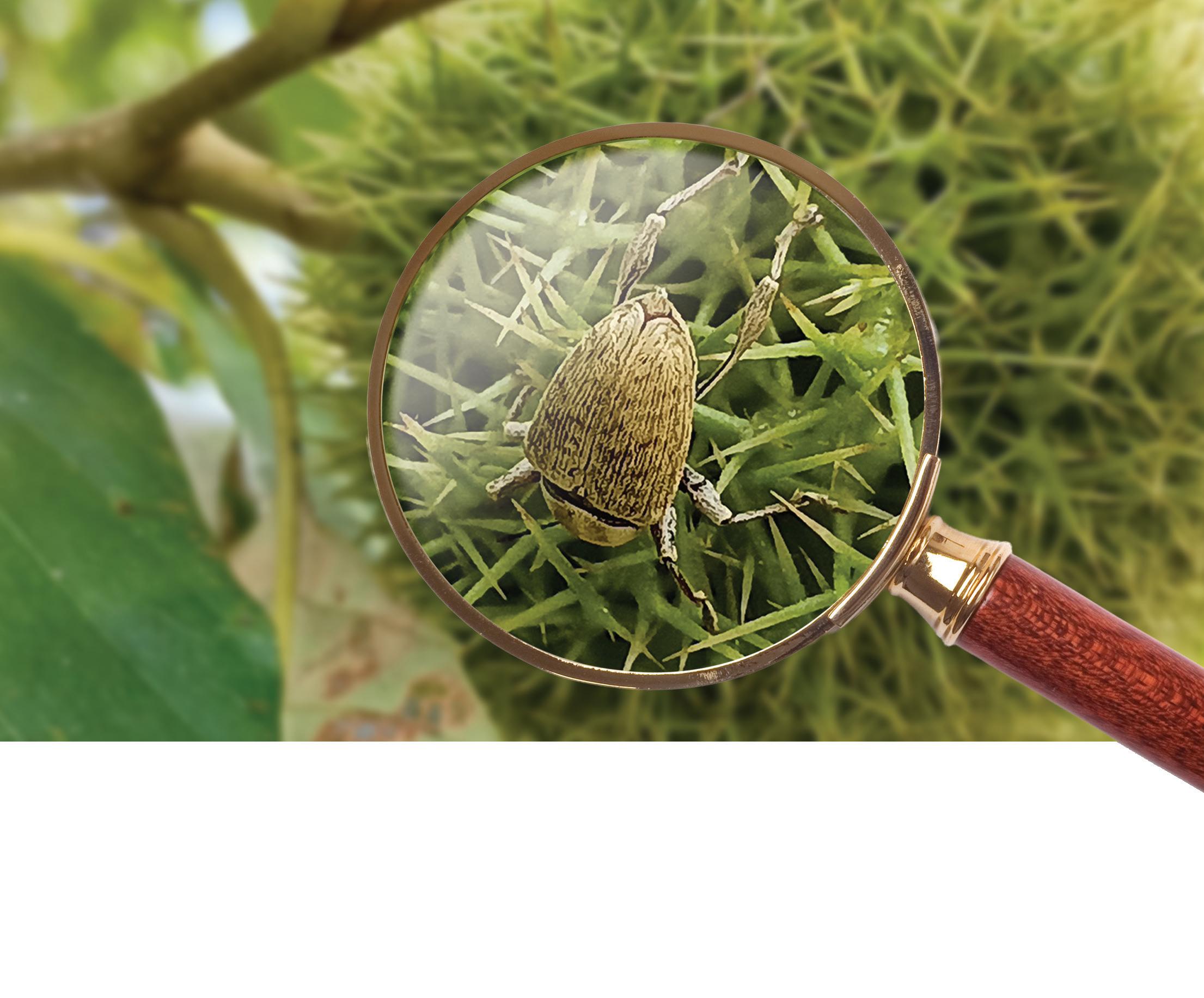
University of Memphis PhD candidate Michael Charles originally wanted to become a veterinarian. Little did he know that switching to the field of biology and entomology would lead him to rediscovering the greater chestnut weevil, a species of beetle that was believed to have gone extinct with the near extinction of the American chestnut tree due to introduced plant pathogens in the early 20th century. According to Charles, the last known chestnut weevil had not been seen since 1997.
“When I was looking into veterinary school, I was unaware that they wanted you to have 1,000 hours of shadowing. I knew I was not going to be able to do that without being paid. My brother at the time was doing his PhD in the Chemistry Department at the UofM, so I thought I could do that,” Charles said. “I’d always been interested in biology and evolution, and I knew I wanted to do something with phylogenetic trees.”
Phylogenetic trees are visual representation often using diagrams that show the evolutionary relationship between organisms. A key component in the integrated studies of insect systematics, genomics, evolution and diversity in the McKenna Lab, led by Dr. Duane McKenna, professor in the Department of Biological Sciences and director of the University of Memphis Center for Biodiversity Research (CBio).

Aprofessor introduced him to McKenna as an undergraduate, and Charles began working in the lab in 2016. McKenna later became his advisor, and he’s been in the lab conducting research ever since.
“During my undergrad, I worked on DNA extractions, specimen imaging, and specimen organization, which is everything I do now for my research as a doctoral student, and I enjoyed it. And to be honest, I was good at it,” Charles said. This gave him the confidence that a career in this field was the right choice.
Charles said what fascinates him the most about the field is the sheer biodiversity of all the insects in the world. “The genus I study alone has potentially 500 species, the family of weevils has an estimated 60,00 species, with many more that have yet to be described. There’s no shortage of things to do.”
After cataloging different specimens, Charles’ attention to detail of the many distinctions of weevil species grew over the years. McKenna and Charles were prompted to conduct research on the greater chestnut weevil after they noticed a few photos on iNaturalist — an online platform where anyone can post photos of plants and animals. The image they found closely resembled the greater chestnut weevil which has extraordinarily long mouthparts — longer than its body — which are used to drill into chestnuts for feeding and egg-laying and a distinct second antennal segment much longer than the first.
“Based off the photos, I ran down to Dr. McKenna’s office and showed him. We both looked at it, scrutinized it and couldn’t really find anything to tell us that that wasn’t it.”
Charles then contacted the person who posted the photo to learn more about the location.
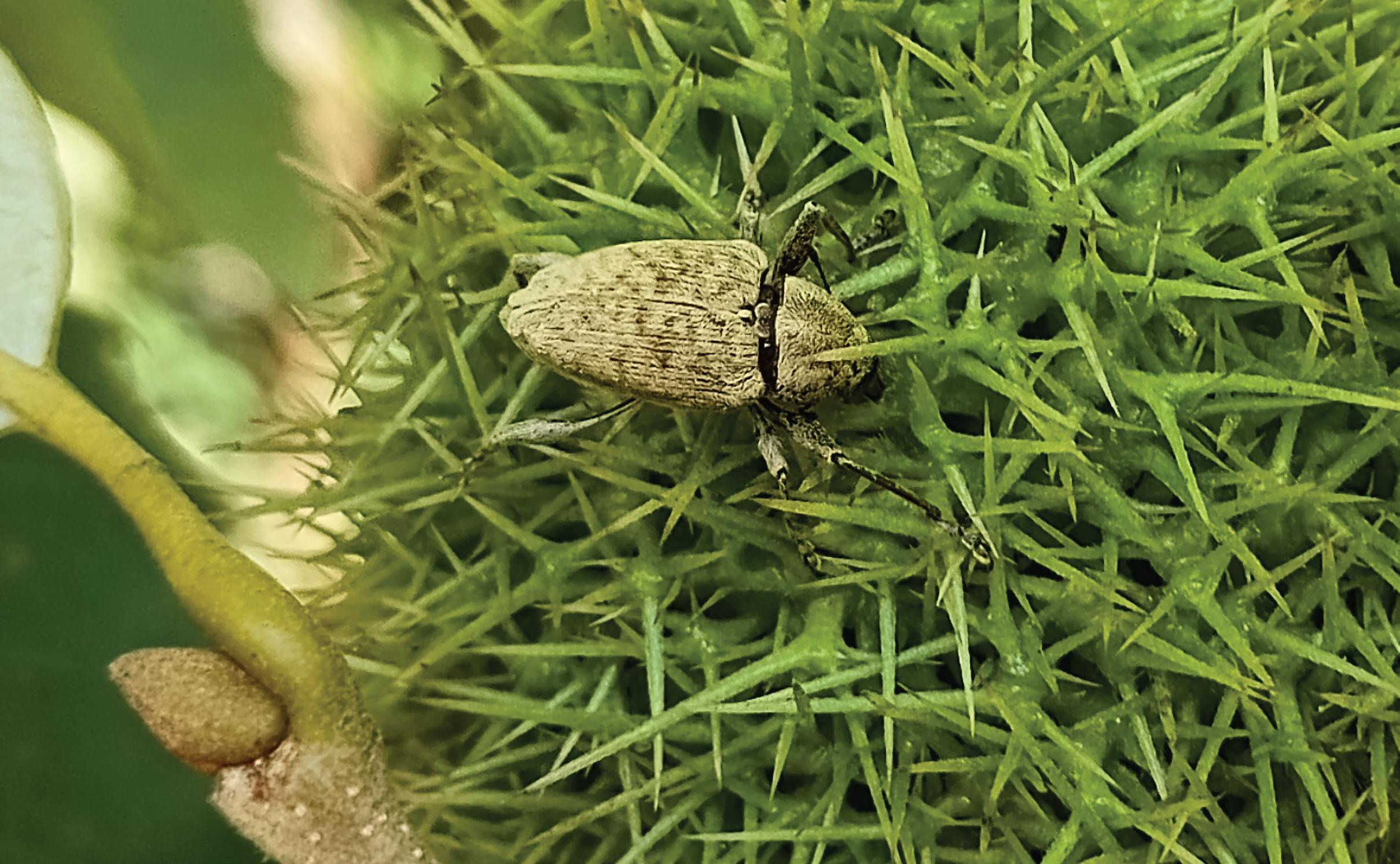


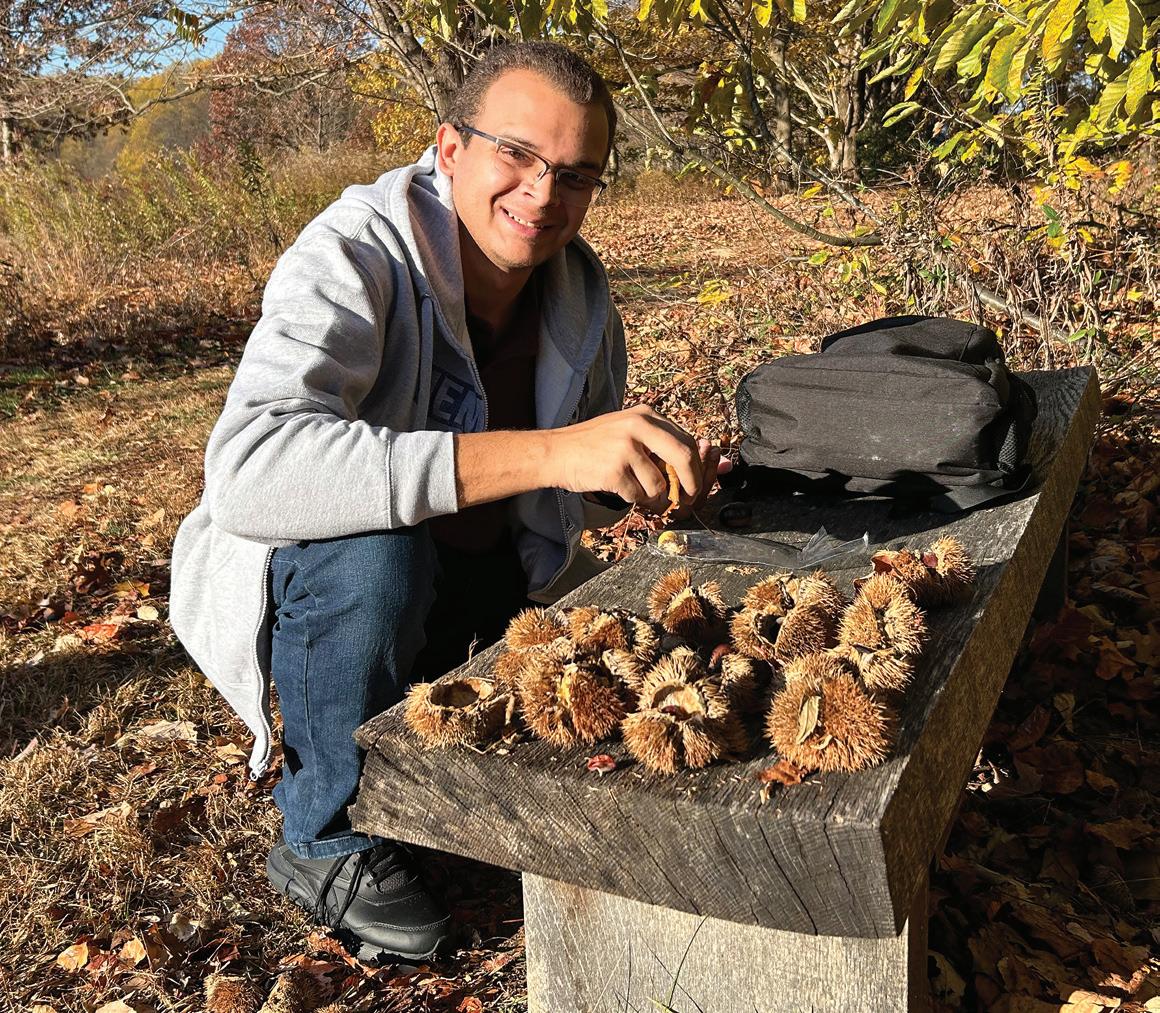
He would later conduct fieldwork in Virginia and Pennsylvania, where he collected weevil larvae he found exiting chestnuts he collected. He brought the samples back to the McKenna Lab where they sequenced the DNA for comparison to historical museum specimens from the Florida State Collection of Arthropods and North Carolina State of the long-lost species. He and McKenna later used these and other data to confirm that the beetle was, in fact, not extinct.
With technology on his side, Charles looked online for more images of the possible chestnut weevil and found another image on Facebook posted by the American Chestnut Foundation’s Meadowview Research Farm in Meadowview, Va. After contacting them, Charles was on his way to Virginia.
“I was on this cherry picker, and something just told me to move this one particular leaf and right there, right behind it was the weevil,” Chares said. “I just kind of stared at it for a couple of seconds, like just awestruck. And then I realized, I need to grab this and put it into a vial.”
With permission from the research farm, Charles brought live specimens back to Memphis.
Not everyone was thrilled when he returned home. Charles joked saying, “My parents looked at me like I was crazy, because growing up, I wasn’t the kid that was outside playing in the dirt, they were dumbfounded and were like, ‘Why are you bringing insects into the house? We’re asking you to get them out and you brought them inside, what are you doing?’” He said his brother who holds a PhD told him, “This is easily better than anything I ever did.”

Charles, McKenna and others have reported the rediscovery and associated research in Current Biology, a leading life sciences journal. The project highlights the University of Memphis’s expanding strengths in biodiversity science and genomics. Support from the Center for Biodiversity Research and the Department of Biological Sciences made the fieldwork and graduate training possible, with additional National Science Foundation funding to McKenna enabling the genomic analyses.
“For decades, the greater chestnut weevil was considered a classic example of coextinction — the loss of dependent species due to the decline of their hosts,” said McKenna. “Its rediscovery is a rare piece of good news in the broader biodiversity crisis, and a reminder that we have only a brief window to find and protect species that are quietly slipping toward extinction. What made this rediscovery especially exciting is that it combined old-fashioned fieldwork with modern tools, including genetic data that helped confirm the weevil’s identity.”
“I just kind of stared at it for a couple of seconds, like just awestruck. And then I realized, I need to grab this and put it into a vial.”
Michael Charles University of Memphis PhD Candidate
Charles noted that the discovery owed its success to broad scientific collaboration.
“This rediscovery wouldn’t have been possible without the observations of volunteers and the digital tools that connect their data to scientists,” Charles said. “I’ve been working on finding this weevil for a while, but without the other people and citizen community scientists that post these images and everything, it really is a group effort. It’s really community science, if you will.”
Charles hopes to continue his research on the greater chestnut weevil with plans to graduate December 2026.
BY JACKIE WRIGHT
Last summer, Lucy Roberts (St. Mary’s ‘26) had a unique opportunity to gain hands-on research at the Institute for Agricultural and Conservation Research and Education (ACRE) through St. Mary’s Honors Independent Research Study (HIRS) program.
“St. Mary’s students who participate in HIRS benefit from working alongside faculty and students (undergraduate and graduate) in a way that allows them to experience how research is actually conducted at the collegiate level,” said Anna Bess Sorin, PhD, director of St. Mary’s HIRS program. “They learn, often surprisingly, how much time and effort it takes to plan and conduct research; to deal with the unknowns that arise and impact findings, the frustrations when things don’t work out, but also the excitement of discovery, especially when there are significant results.”
Roberts partnered with researchers including mentor Jennifer Mandel, PhD, ACRE director, on a project which began as a conversation to explore the intersection of biological sciences and public health.
“You never know what a casual conversation with another scientist who’s doing something very different from you could turn into; that’s why interdisciplinary research and collaboration is so important,” Mandel said.
That conversation involved Fanta Gutema, PhD, assistant professor of research in the School of Public Health and how the labs could explore plants and how they could be impactful in preventing infectious diseases.
Mandel and Roberts set out to answer that question and this spurred the idea to explore the antimicrobial properties of plants.
Thanks to the University of Memphis Herbarium, a natural history collection consisting of nearly 20,000 plant specimens from scientific collections from around the world, the pair had a multitude of plant specimens they could test at their fingertips.
“It’s hard for people to understand what the value of an herbarium is if they’re not into plants or in the sciences because it’s a room full of dried plant tissue,” Mandel said. “I always remind people that we get DNA out of that plant tissue now and those plants were collected before we even knew what DNA was. It’s unimaginable what you may be able to do with this resource in 100 years.”
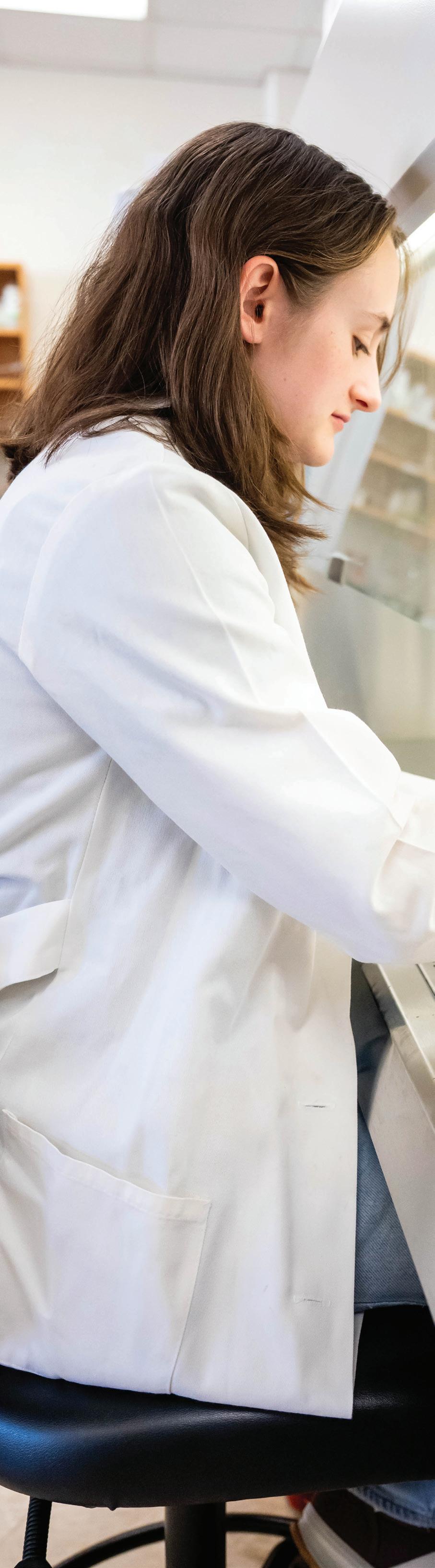
Roberts and Judy Bowen, MS, a microbiologist in the Mandel lab, spent three to four days a week in the lab together sorting through herbarium samples, which Mandel said can be very tedious. “We didn’t give her a playbook; we didn’t stand over her. She figured out how to do it,” Mandel said. “She discovered how to do things since you don’t really figure out the scientific method until you are actually practicing it.”
“Students are impressed by the trust placed in them to carry out their work independently, once they have been trained, and how they are treated as meaningful contributors to the projects,” Sorin said. “The whole experience helps build their confidence while also exposing them to the high levels of research being conducted at UofM.”
One day Mandel said the serendipitous nature of science took place. Plant tissue collected by a former student researcher from Brazil for the purpose of DNA work more than 10 years ago tested positive for antimicrobial properties for a Bacillus species of bacteria.
Carolina Siniscalchi, PhD, was that student researcher who was at the UofM at the time for a one-year fellowship. She later completed postdoctoral research at the UofM from 2018-19. Today, Siniscalchi is an assistant professor and data science coordinator at Mississippi State University.
“I chose UofM because in 2014 Dr. Mandel published a paper about the application of a new DNA sequencing technique in the sunflower family that I was very interested in using in my own research questions,” Siniscalchi said. “I was introduced to Dr. Mandel through a researcher from the National Museum of Natural History, in D.C., Dr. Vicki Funk. Dr. Mandel and I soon established a great collaboration, that is still ongoing. In the first year I spent at her lab, I learned so much about DNA sequencing and data analysis. I was one of the first researchers in Brazil to use target-capture DNA sequencing techniques, and all thanks to the time I spent at UofM.”
Siniscalchi said it makes her happy to know that plant samples she took more than a decade ago are having an impact today and finding new life.
“It’s important to highlight that these millions of specimens distributed across the world are not easy to maintain. They need controlled temperature and humidity, special cabinets and people to curate and care for them. All this requires funds, which are usually scarce, as natural history collections are not usually seen as ‘modern’ science. I hope that with studies like this, we can show the value of preserving and caring for natural history collections,” Siniscalchi said.
Their next step is to partner with another lab in the UofM Chemistry department led by Drs. Timothy Brewster, associate professor, and Mike Brown, assistant professor, using chemical analytic methods available in their labs which separate out all chemicals to better examine the plant profiles and their chemical make-up.
The Department of Biological Sciences has mentored high school students over the years from University Schools, Collierville High School, White Station High School, Lausanne Collegiate Schools and Hutchison School.
Sorin said she hopes to expand the HIRS program with more local colleges and universities. “If students are aware of the opportunities that can be found in Memphis, ideally, more of our bright, talented students will remain and contribute to building a more vibrant community.”
“I see a lot of myself in these students,” Mandel said. “I was always interested in science and plants at a very young age, and I had a lot of great mentors. I wouldn’t be here without the background of having those mentors who helped me along the way.”
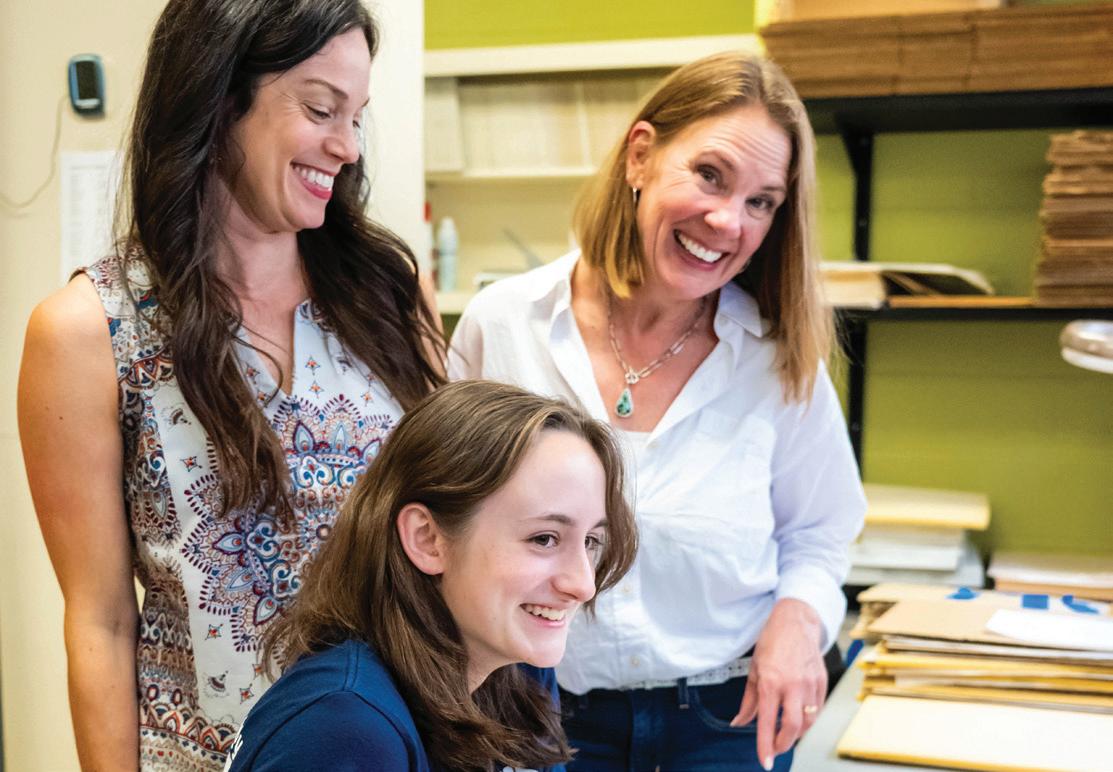
Q: What do you think you learned from this experience?
A: It was very independent. In the beginning, obviously, they were guiding me through the process and the procedure. But once I figured out how to do the actual experiment itself, I was very much on my own, which is cool. They weren’t checking up on me. And all the time I was in the lab by myself, it’s up to me to actually get the things done. I’m the one doing the experiment. No one’s going to penalize me for not going so it’s definitely beneficial to know I’m doing this for myself, not for a grade. And I definitely like that. I like that I had to motivate myself, just because I found it interesting.
Q: Is this research something you’re interested in pursuing in the future?
A: I definitely think so. Dr Mandel was talking to other people at the University of Memphis to see if we could figure out what chemicals were in the plants and then try to recreate them and isolate them, which would definitely be cool to get to experiment with the other types of sciences. Because I know I want to pursue research, especially after doing this. At least in college. I like chemistry too. I’ve done chemistry in class, obviously, but it would be really cool to get to experience it in chemistry labs.
Q: How has HIRS and this experience helped you explore something new that you hadn’t tried before?
A: I had never done any kind of actual lab research, so it was definitely a very new experience for me. I definitely really liked that it was hands on — learning and experience — just that idea that a lot of the world is just unknown. Most of the stuff we just don’t know and it’s like out there to be learned. Because I feel like in school, you’re always being taught stuff, and it can feel like, oh, everything’s already been figured out. And it was definitely cool to have that experience where I learned that there’s more stuff out there.




from freshman year to forever...
BY SAM SHOEMAKER
After the two were set up on a date party by siblings — who also attended Memphis and were involved in Greek life — they became inseparable. First, as friends.
“It took me, like, three months to ask her,” Pearson said. “But I was like, yeah, I think she’s the one.”
“Everything just fell into my lap,” he added. “Gosh, this is so easy. College is so awesome. Everything’s just happening.”

n a campus where thousands of students pass through the University Center each day, Pearson Harris’s future walked in without either of them realizing it.
He was a freshman in his first week on campus and eager to get involved. She was a sophomore already plugged into Greek life and campus leadership.
“I remember sitting in the UC,” she said. “I just thought he was, like, really cute.”
That Pi Phi member was Kathryn Todd.
She is now Kathryn Harris.
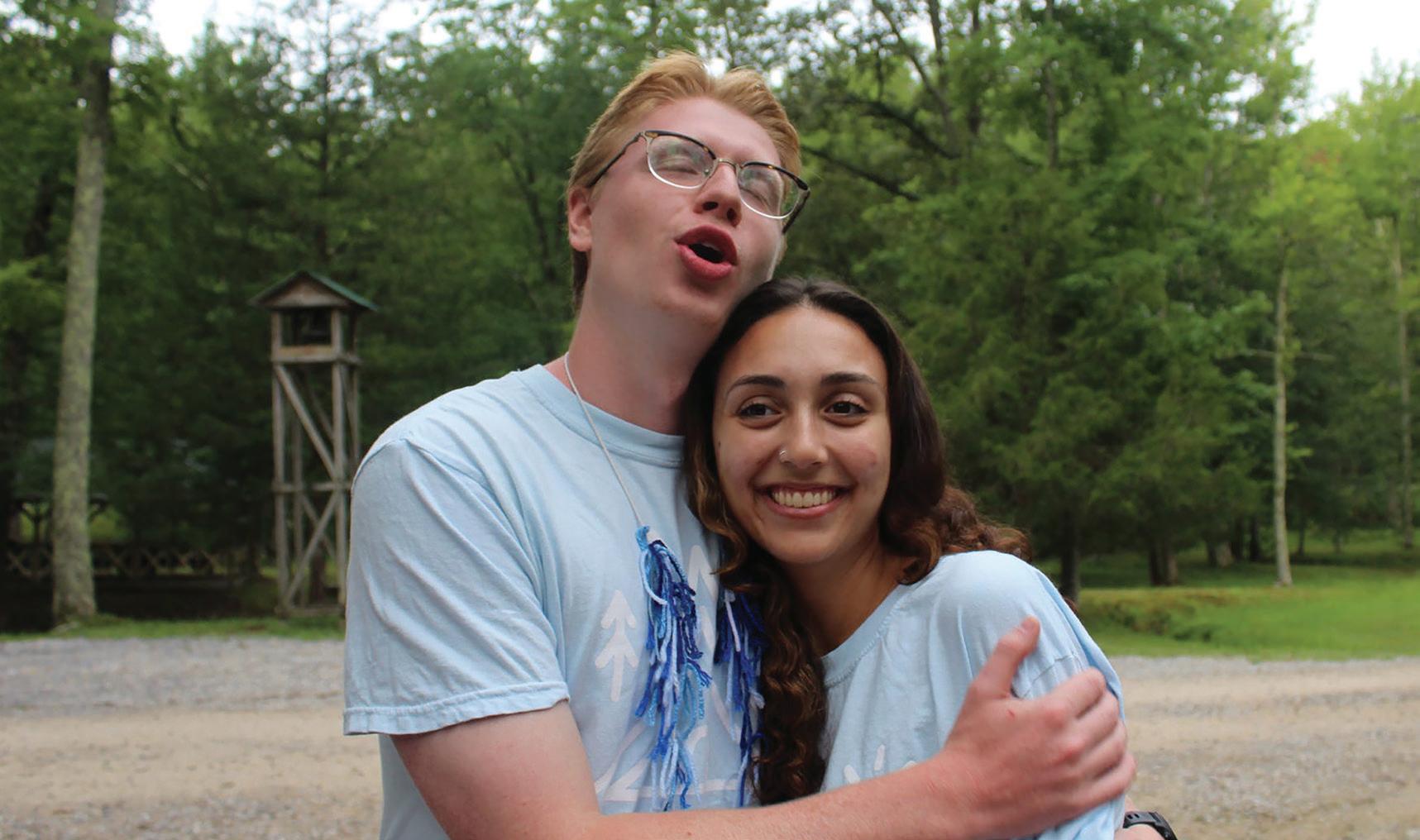
Pearson became the president of his fraternity as Kathryn dove deeper into campus involvement. Beyond their UC Tech Hub dates — where she did school and he “goofed around” — the two found a way to lead on campus together through Frosh Camp.
As campers, the two remembered the immediate sense of belonging and Tiger pride. Counselors guided conversations and pushed students to get outside of their comfort zones, showing the Harrises what leadership looks like.
Later, as counselors at the four-day orientation program held at Camp NaCoMe, the responsibility shifted.
“You’ve got 18-year-olds staring at you,” Kathryn said. “You’re having to go with the flow and pivot … and keep a calm face because you’re the leader.”
For Pearson, leadership at camp meant organizing more than 200 students and navigating the unpredictability of summer.
Sleep-deprived and at times overwhelmed, there was little room for performance.
“Anything that I witnessed about your character at camp made me love you more,” Kathryn said.
There was one camp where Kathryn struggled through a long day.
“I couldn’t stop crying,” she said, laughing now at the memory.
In the moment, it felt enormous. Looking back, it was a small but defining moment.
“Just having the opportunity to be there for her and support her,” Pearson said. “It was good for our relationship.”
In between carrying bags up hills and guiding freshmen through awkward introductions, he was quietly learning how to lead — and how to love.
If Frosh Camp tested their patience, it also clarified something else: neither of them wanted to navigate life alone.
While many see their early 20s as a time to experiment, Kathryn and Pearson saw it as a season to build.
“Your 20s are so much more fun when you have a consistent partner that you can just go through the different phases of life with,” Kathryn said. Those phases came quickly.
Internships to secure. Interviews to prepare for. And the uncertainty of senior year job applications. Kathryn routinely pushed Pearson academically and prepared him for interviews.
“I’m not a studier in class,” he admitted. “If I didn’t have Kathy to help me study and get prepared … I probably would have failed it miserably.”
“We were always in the same phase of life without realizing it.”
- KATHRYN HARRIS
When graduation approached — May 2024 for Kathryn, December of the same year for Pearson — the decision was easy. Pearson proposed in February, just months after commencement.
“We were always in the same phase of life without realizing it,” Kathryn said.
For the Harrises, marriage wasn’t a chapter closing. It felt like continuing one.
“It was only like three years ago that we would talk about Roth IRAs just casually, and I’d be like, I don’t even know what that is,” Kathryn said. “We transitioned from, ‘Hey, you’re in college,’ to ‘now you’re working full-time — what does it look like to set up your 401k?’”
The shift from late-night study sessions to adulthood came quickly. Conversations moved from Canvas deadlines to benefits packages, savings plans and building a future together. That continuation extended beyond their relationship. The same campus that introduced them to each other had also been preparing them for life after graduation.
The University of Memphis became more than the backdrop to their love story. It became the foundation of their careers.
Both Memphis natives and Fogelman College of Business and Economics FCBE graduates, Kathryn and Pearson met during their early semesters at the University of Memphis through Greek life. Years later, they returned to campus not as wide-eyed freshmen, but as employers searching for the next class of students ready to step into adulthood. “We were there with our jobs. We were
employers recruiting, and that was hilarious,” Pearson said of the full-circle moment.
After interning with Cintas, Pearson turned the opportunity into a full-time role following graduation. Kathryn, the former “Ms. Fogelman,” now works at First Horizon Bank.
“I love how connected the UofM is with big employers in Memphis. It’s a huge hub,” Pearson said.
Reflecting on how their careers — and their relationship — unfolded, the couple describes themselves as “extremely lucky” and “super blessed.”
Kathryn credits much of her professional growth to the faculty of the FCBE, including Dr. Kathy Tuberville, associate professor of Teaching in the Department of Management, who encouraged her to pursue leadership roles while on campus.
Tuberville said the couple’s growth was evident long before their wedding day.
“Their wedding was a testimony to their joy in life, their faith and the way they are so loved by their Tiger friends,” Tuberville said. “A beautiful and joyous occasion.”
For two students who once met in the UC in the middle of campus, the University of Memphis became more than just a campus — it became a central part of their story.
It became the place where everything started.
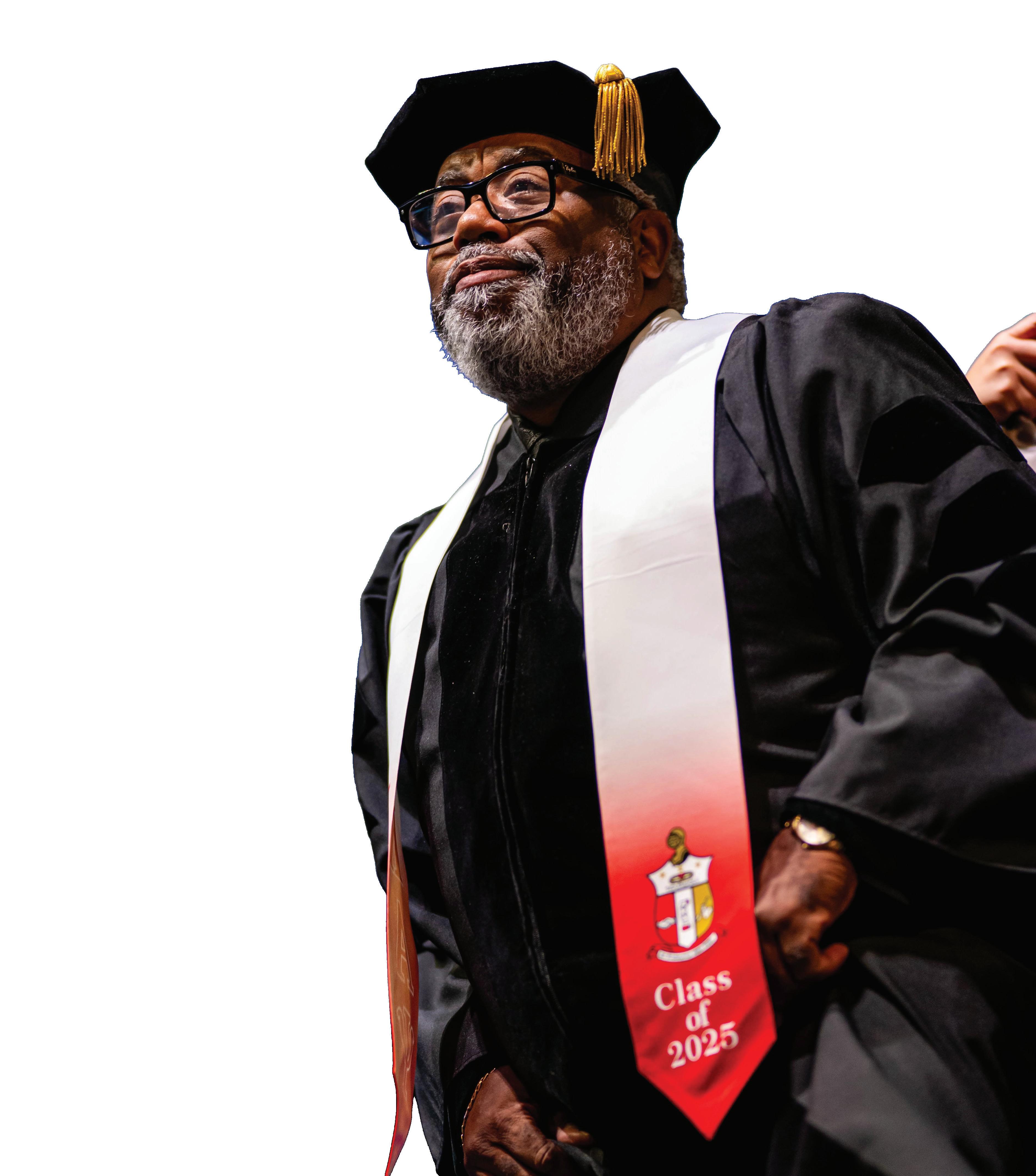


y the time you read this, I’ll have “Dr.” in front of my name. That still feels a little surreal to say.
Earning my EdD in Leadership and Policy Studies from the University of Memphis is something I dreamed about for a long time. But if I’m honest, that dream didn’t always feel like a beautiful, peaceful thing.
I don’t mean that in some dramatic, external way. It was me versus the lesser version of myself — the one that procrastinates, that gets overwhelmed, that tells me, “You can do it
To finish this degree, I had to confront that version of me every single week. I had to find balance.
When we dream, we usually picture the success: the cap, the gown, the handshake, the title. We don’t always picture the nights of doubt, the internal arguments, the moments we want to walk away. For me, this doctorate is all of that wrapped into one. And realizing — I made it through.
And yet, I don’t feel like this is a final destination.
They call it a “terminal degree,” but to me, this is not the end. It’s the end of chapter five and the beginning of chapter six. I wrote five chapters for
Now it’s time to write the chapter that lives out what I learned through how I lead, how I fight for equity and how I serve children and families in
I grew up in North Memphis, in a community called New Chicago. As a kid in the late ’70s and ’80s, I didn’t know we were poor. That realization came later.
Back then, what I knew was this: I never missed a meal, and I knew exactly where my mama was going to be every night. One of my earliest memories is from Sunday mornings before church. I’d be in the bedroom with my mom, Sonja Hall Barber (later Sanes), surrounded by purses spread out on the floor.
To me, it felt like a game: “Mom, I found a quarter!” “Look, I found a dollar!”
What we were really doing was searching for enough money for Sunday school and the offering plate. As a child, I just thought we were playing. As an adult, I realized my mother was doing the best she could as a single parent, modeling excellence even when resources were scarce.
My grandmother was the one obsessed with the house being spotless and beds being made. My mother had a different focus: learning. I didn’t have to make my bed every morning, but I did have to make sure my homework was done. My mom was a CLUE (Creative Learning in a Unique Environment) English teacher for gifted kids, and from fifth through ninth grade, I basically did CLUE English at home whether I wanted to or not.
That’s where my love of words and performance began.
I always loved music, and in seventh grade I formally joined the band. That led me to Overton High School. I played trombone and piano and I learned how to perform — things like how to stand in front of people, how to communicate and how to move an audience.
I didn’t know it at the time, but those years were training me for the proverbial classroom stage I stand on now at a middle school in Frayser.

“It was me versus the lesser version of myself — the one that procrastinates, that gets overwhelmed, that tells me, ‘You can do it tomorrow.’” GRAD SPOTLIGHT
If you had met me in 1987, you wouldn’t have heard me say, “I want to be a principal.”
That was the era of the Buppy — the Black yuppie. I wanted the briefcase, the suit, the $50,000-a-year job right out of college, which was serious money in ’87.
I went into business administration and into a program called Inroads and landed an internship with Kroger. Minimum wage was $3.35 an hour, but I was making $8.50, 40 hours a week in the summer, and that wage went up each year. For a young man from New Chicago, I felt like I had arrived.
The problem was, I didn’t love it. It wasn’t my purpose. It wasn’t filling my cup.
I bounced around some. I went to University of Tennessee, Martin, and back to Memphis State, and found myself overwhelmed walking into economics lectures with 300 students at 8 a.m. I was not ready.
I did one semester as a business major at LeMoyne-Owen, and then that quiet internal voice started talking: “Deartis, what job are you really preparing for? Is this really you?”
I took a practicum course in education that sent me into an elementary school. I got to interact with children. The teacher let me do a little mini-lesson. And just like that, I was hooked.
I was back on stage. I was constructing words and activities that captured students’ attention; that made them laugh, think and learn. They thought they were just playing, but I knew they were learning. My brain lit up with dopamine at the realization: I can get paid to do this.
That’s how I found my calling as an educator.
Today, I’m a servant leader. I don’t see my work as something I have to do. I see it as something I get to do. I get to serve children well and as principal, I get to influence how other adults serve children, too.
Even the parents who struggle want the best for their children. My role is to stand in the gap for their desires, for their child’s present learning and future life. The three years my students spend in middle school help set up the next four years of high school, and those seven years together help shape the next 40 of their lives.
That’s the weight of this work. That’s why I lean into it.
When I agreed to become principal at Grandview Heights Middle School in Frayser, a lot of people thought I’d lost my mind.
At the time, Grandview was the lowest-performing middle school in Tennessee. My mentor, Dr. Sharon Griffin — the principal who first gave me a chance as an assistant principal — was leading a cadre of schools called the iZone, and Grandview was one of them. She said, “Deartis, I need you to go to Grandview.”
She let me bring a team of people I’d worked with at multiple schools over more than a decade. Folks still joke that I should be a car salesman because of how I recruit people to come with me. To me, I wasn’t selling a lemon; I was promoting a possibility.
The line that hooked me was simple: “No school in Frayser has been turned around yet.”
That’s all I needed to hear. Challenge accepted.
Those first months at Grandview were tough. We eventually earned a Level 5 designation from the state. Some wondered why I didn’t leave, why I didn’t cash in that success and go somewhere easier.
The answer is simple: if I understand the assignment and commit to the mission, then I’m a soldier. I don’t leave just because the first good report comes in. I stay until we either truly reach the destination or I’m relieved of duty.
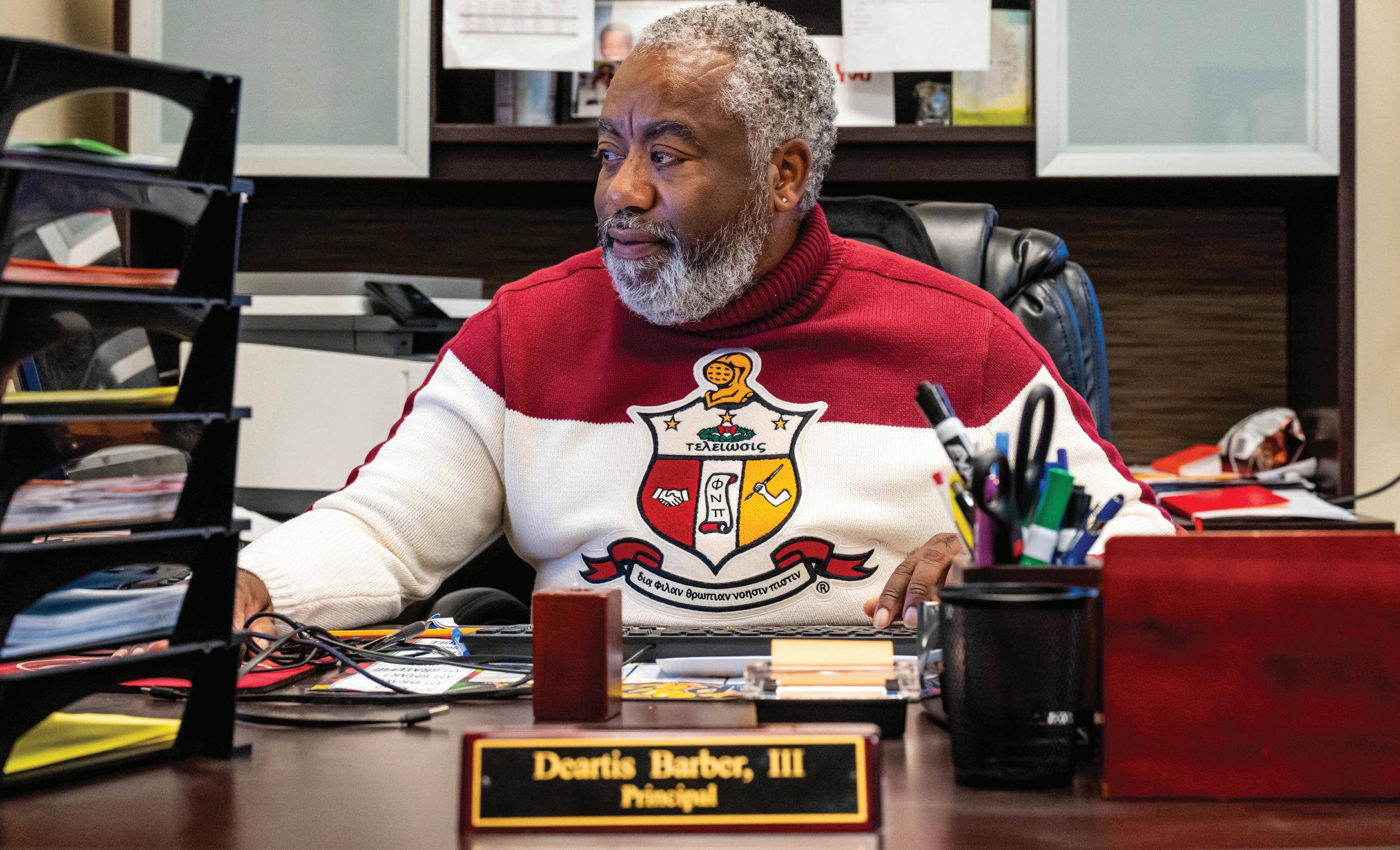
When Grandview came off the priority list, that was us getting off the exit and turning around. It didn’t mean we were at our destination. It just meant now we were finally heading the right way.
Along the way, there’ve been moments that remind me why I do this and why my dissertation had to confront the injustice of an accountability system “blind to inequities.”
I think about the mother during COVID who stopped her car to tell me her daughter had tested positive but her younger son was inside eating breakfast. I advised her (based on the guidance we had) to take him home too, just to be safe. A week later, that mother passed from COVID. The next week, both of those children were back in school.
I think about great-grandmothers trying to raise three children on their own. I think about teachers burning out from the weight of students arriving two, three, four grade levels behind. And I think about the way we “punish” schools in poor Black and brown communities while rewarding boutique schools that only accept students already in the 90th percentile.
Those realities shaped my dissertation: “The Interrogation of an Accountability System Blind to Inequities.” It lets me take the work I live every day and use data and scholarship to speak truth to systems that rarely account for zip codes and opportunity gaps. This journey has also reshaped me as a father. I had three sons by
the time I was twenty. I was still a kid myself, trying to work, trying to go to school, trying to grow up. I provided what the court said I needed to provide, but fatherhood is more than a payment.
Years later, when my youngest son, Dylan, was born, I was more stable, more mature and more present. With him, I’ve had the chance to be a better dad, and I thank God for that second opportunity.
When I talk to my students, I often use a time machine exercise: “Ten years from now, what would your 24-year-old self tell your 14-year-old self?”
If I could go back and talk to my younger self in New Chicago, here’s what I’d say:
Every morning the Lord wakes you up, you’re given two gifts — a choice and a chance.
The choice to be better than you were yesterday. The chance to make that choice real.
Be the best version of yourself today. Make the most of it.
One day you’ll wake up and realize you’ve not only changed your own life, but you’ve also helped change the lives of thousands of other people, too.
BY JACKIE WRIGHT
Keli Loveland didn’t intend to graduate college with her daughter, Shelby. But she wouldn’t have had it any other way. On Saturday, Dec. 13, the mother and daughter duo both crossed the stage cum laude earning their Bachelor of Arts degrees at the FedExForum, becoming Tiger alumnae together.
Although they are both graduated with honors, their collegiate journeys didn’t begin that way.
Before coming to the University of Memphis, Keli served in the Army, then became a stay-at-home mom turned graphic designer. She decided to pursue a bachelor’s degree in strategic media and first enrolled with UofM Global in February 2020, taking advantage of the Credit for Prior Learning which offers adult and non-traditional students the unique opportunity to petition for college credit for the training and skills they received during their careers.
“We all know what happened in 2020, so our entire household was on lockdown and in school, we were all in some form of school during that time together,” Keli said. “We didn’t start out on this journey to graduate together because we had our own path that we were on … it just so happens that we came back together during this time.”
A broken foot led Keli to a different trajectory and to her current role as an administrative associate for the UofM Department of Journalism and Strategic Media.
“After taking classes online, I told my academic advisor that I wanted to take a class on campus. I wanted to see what all the hype was about,” Keli said. “And that conversation led to me getting the job in the department. I came to campus and fell in love with the people, the atmosphere — everything about it. And it was so nice to see Shelby pop into my office a couple of days a week and to see her across campus.”
Shelby’s journey began at Southwest Tennessee Community College, and she was able to transfer to the UofM after earning her associate’s degree. Working full time as an adult services librarian at the Memphis Public Library and juggling three majors (Psychology, German, and Criminal Justice) — Shelby was the only German major graduate in the winter commencement — kept Shelby busy.
She liked that she could easily walk over from Jones Hall to visit and chat with her mom.
“She’s always been there for me,” Shelby said. “She’s always been pushing for me, just teaching me along the way, little things and even things that’s never shaped as a lesson, but there’s always a lesson in it. Gosh, I just really like her. She’s pretty cool and someone I’ve always looked up to as far as like power and strength and taking care of yourself and selfsustainability.”
Keli echoes those same sentiments. “We are each other’s biggest cheerleaders,” Keli said. “I think she’s always felt that I’ve been her biggest cheerleader and that’s all I wanted out of life is to have my kids know that I love them and want them happy.”
Shelby said she enjoyed having the opportunity to study together and to see the relationship her mom has built with her college community, which is a lot alike to their family at home.
“She has a different relationship with the members of her college than she does with me and my siblings, but it’s also the same,” Shelby said. “She is still goofing off and messing around, poking fun … she does that with us too.”
Keli said she’s kind of the mom of the department.
“All the students come to me and talk to me and ask me stuff and we talk and we share,” she said. “And it’s nice to sort of be that role for them, especially for those whose moms aren’t here. Shelby knows, I’ve always taken care of everybody else first.”
The mother-daughter-duo also had a kismet moment — both getting to travel to Germany as part of study abroad. Shelby traveled through the Department of World Languages and Literatures to Eichstätt, Germany, and received the Kendra Carter scholarship for her trip, and Keli through the Journalism and Strategic Media partnership with Johannes Gutenberg University in Mainz.
When asked how they planned to celebrate, Shelby said, “My friends kept asking me, ‘So is the graduation party at your house or your mom’s?’”
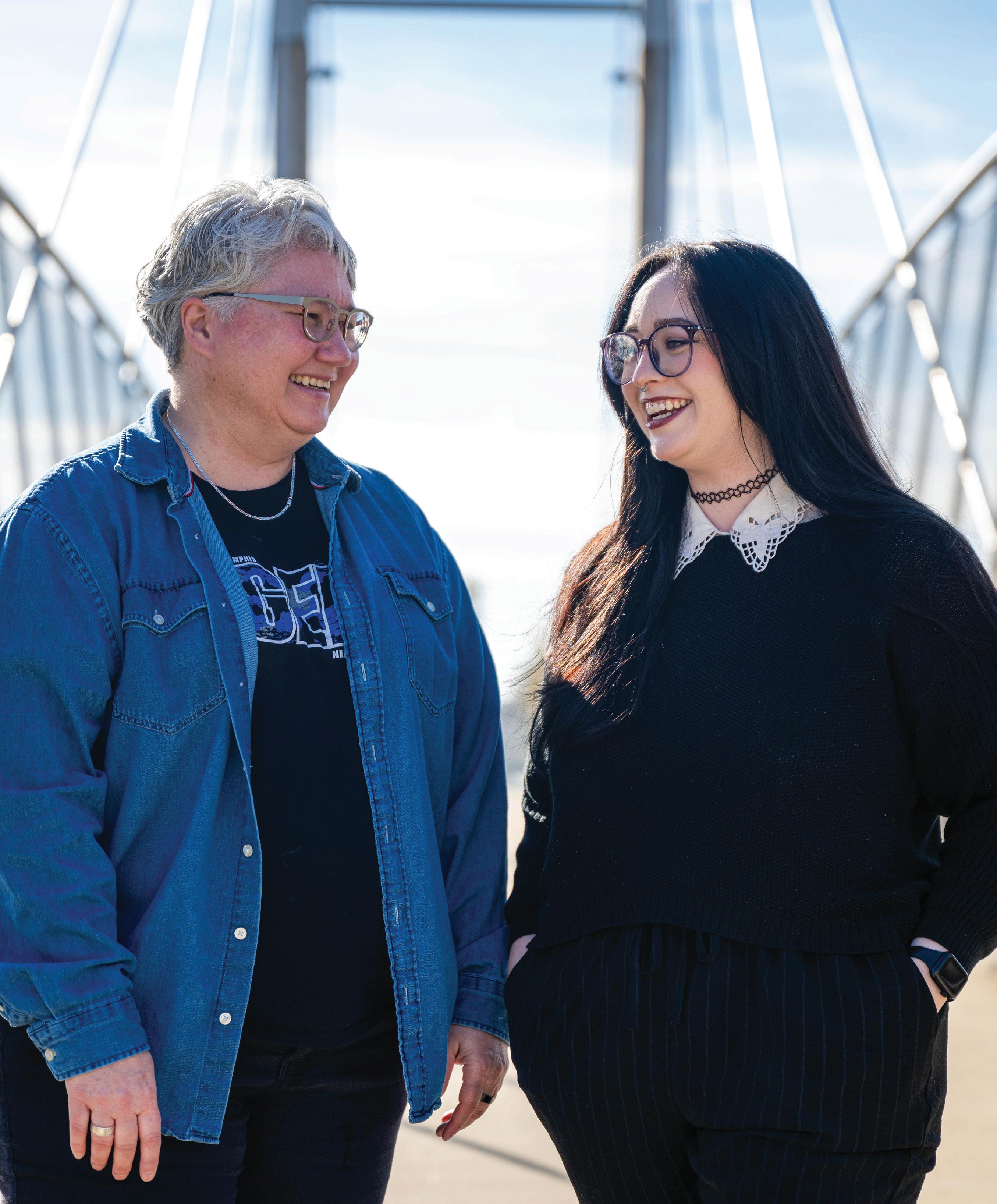
How UofM alumna Sheila Darcey is reshaping healing through art, compassion and community.
OBY NIA RINCON
n a blank sheet of paper, a single mark appears. Then another. Lines gather, loosen, stretch and fold back into themselves. There is nothing polished or planned about them. They are simply an honest, unfiltered pulse of emotion making its way into the world. It is in this space, in the quiet rhythm of sketching, that Sheila Darcey (’97) first began to find her way back to herself.
Today, Darcey is an internationally recognized artist, facilitator and founder of Living Canvas Foundation, a nonprofit dedicated to helping people of all ages heal through creativity. Her work did not begin as a polished practice, but as survival.
Darcey’s story spans continents. She was born in the Philippines, raised in Australia and eventually found her way to Memphis as a teenager. Those early years were marked by upheaval and a deep sense of instability.
“Pretty much my entire life I’ve had traumatic or challenging experiences,” she shared. “But as a kid, I remembered that I used to draw to disconnect. What I thought I was disconnected from was myself. But knowing now in reflection, I was connecting to myself.”
At the UofM, she initially declared a computer science major. The expectation to have a traditional career weighed heavily on her. It came to a head one day while walking across campus; she saw other students carrying art boxes full of paints and supplies and felt something ache inside her. It was, she said, “like the ghost of me walking by.”
In one of her earliest brave decisions, she told her mother she wanted to switch her major to art. “I thought she was going to kill me,” Darcey said. But her mother surprised her with a simple, grounding sentence: If that’s what makes you happy.
Sheila completed her BFA in graphic design and worked seven days a week throughout college to support herself. After graduation, she entered the corporate world under the expectation of stability and success. Years later, she would pay a steep price for that detour.
Twenty years into a career in digital strategy and executive leadership, Darcey hit a breaking point.

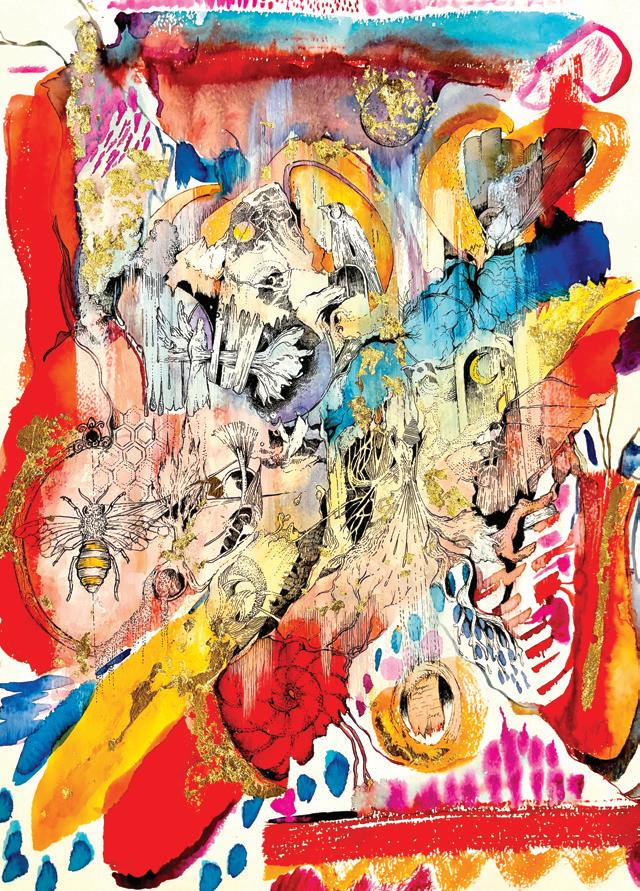
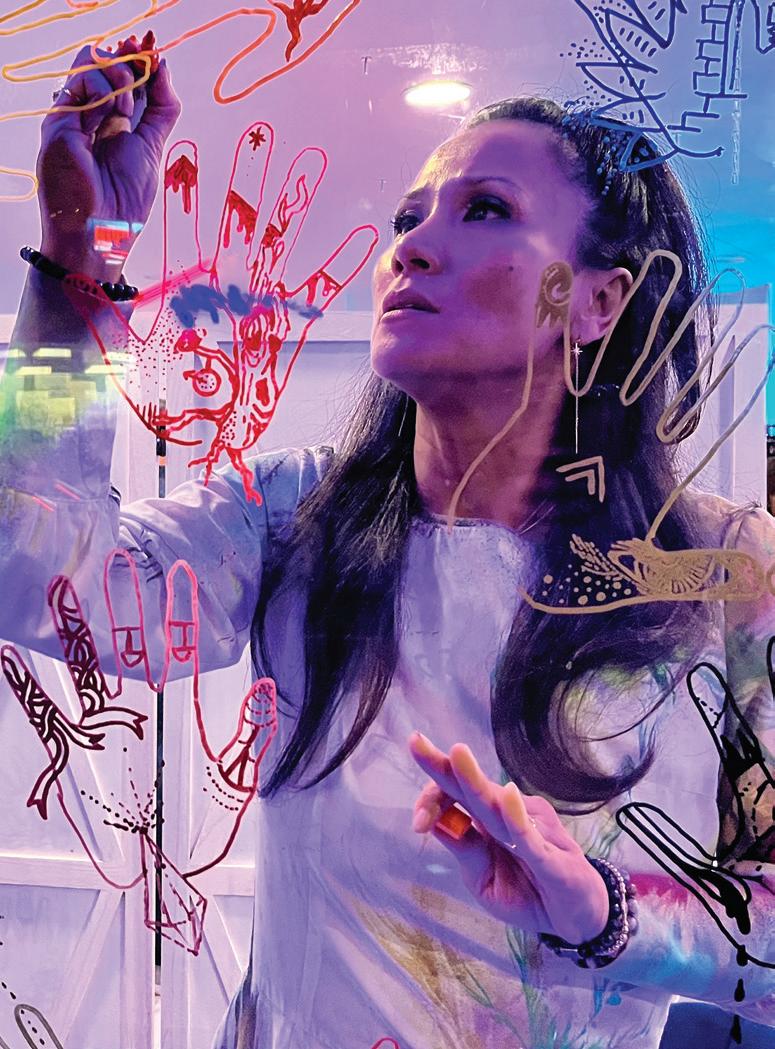
“I was completely burnt out mentally, emotionally, physically,” she said. What she believed was simple exhaustion, revealed itself in therapy to be a full mental health crisis.
Darcey learned that she needed a way to express the things. Her therapist asked if she had “a healthy way to express” these pent-up feelings. She remembered sketching as a child. “I remember walking out of that first therapy session and I went, that’s it.”
She began sketching every morning before work. Not to make art, but just to let things out.
“It was genuinely to get it out of me,” she said. “And I remember six weeks into it … I thought, oh my God, I must help people find their way to this tool.”
Her daily practice would grow into SketchPoetic, an online community and movement centered around creativity.
Later, she would gather these sketches and experiences into a book, “Sketch by Sketch – A Creative Path to Emotional Healing & Transformation.” It became her foundation for leading workshops around the world and grew into her nonprofit, Living Canvas Foundation.
The turning point came when Darcey realized how many others were seeking what she had sought. People who wanted to create but felt intimidated, people who longed for transformation but didn’t have the tools or language for it and people who believed in their core that creativity was indulgent rather than necessary.
Living Canvas was born to support two groups: those who offer healing through art and those who have never believed art could heal them.
“There’s this perception of art that it’s a privilege, that it’s an extracurricular thing you do,” she said. “But it is vital. It is vital to our well-being to tap into our creativity because it involves play, it involves imagination and it involves curiosity.”
Her workshops guide participants through breathwork, mark-making, visualization and reflection. They are gentle and structured, grounding creativity in both emotion and neuroscience. And at the heart of it is connection, both to others and to oneself.
“Healing is not about fixing,” Darcey says. “We’re not broken. It’s about remembering and listening and reconnecting to a part of ourselves that we may have suppressed.”
Darcey’s approach is rooted in lived experience, and her reflections are both disarming and profoundly human. Her work with youth, with caregivers, with people facing trauma or transition, all stems from the truth that everyone deserves a place to feel safe within themselves.
“I do what I do because I never felt safe. Ever,” she shared. “Until the day I started picking up that pen… it was the most healing thing.”
In her workshops, she uses the phrase “inner children,” explaining that each moment of disconnection throughout life creates another version of ourselves in need of compassion. Her teachings encourage people to approach themselves with softness rather than self-judgment.
“What feels uniquely personal is actually quite universal,” she said. “Your lived experience is not a liability. If anything, it’s your superpower.”
Though Darcey has lived in Los Angeles for many years, Memphis remains a formative chapter in her story. It is where
she found her artistic voice, where she confronted parts of herself for the first time, and where she began shaping the vision that would guide her life’s work.
“The future of Memphis … looks more like reciprocity, community, co-creation, collaboration,” she said. “Memphis is the heart of the arts. It is everything that the arts are about — community.”
Her partnership with Dr. Michael Schmidt, associate dean of research at the UofM College of Communication and Fine Arts, on emerging studies for the power of creativity reflects her continued connection to the University and her belief in supporting future generations of creators.
She also highlights individuals in the Memphis community to carry on the vision. Aaron Williams runs the Living Canvas social media and also practices healing through embodied creativity locally.
Stories like Darcey’s illuminate an oftenoverlooked truth.
The arts are not a luxury, but a lifeline.
At the UofM, creative disciplines give students the space to discover their voice, confront their experiences and develop the empathy needed to build stronger communities.
By supporting the arts at the University of Memphis, donors and alumni help cultivate that transformation. They make room for students who will become innovators, healers and storytellers. They help sustain the kind of work that reminds people everywhere that creativity is not ornamental — it is essential for a thriving, happy community.
When asked what she would tell a young graduate stepping into the world unsure of who they are or what comes next, Darcey offered this: “You don’t have to choose one identity. Your lived experience is not a liability … and what feels deeply personal is often really universal.”
And perhaps the most powerful reminder of all: “The thing that regulates you might become the thing that serves the world.”
BY JACKIE WRIGHT
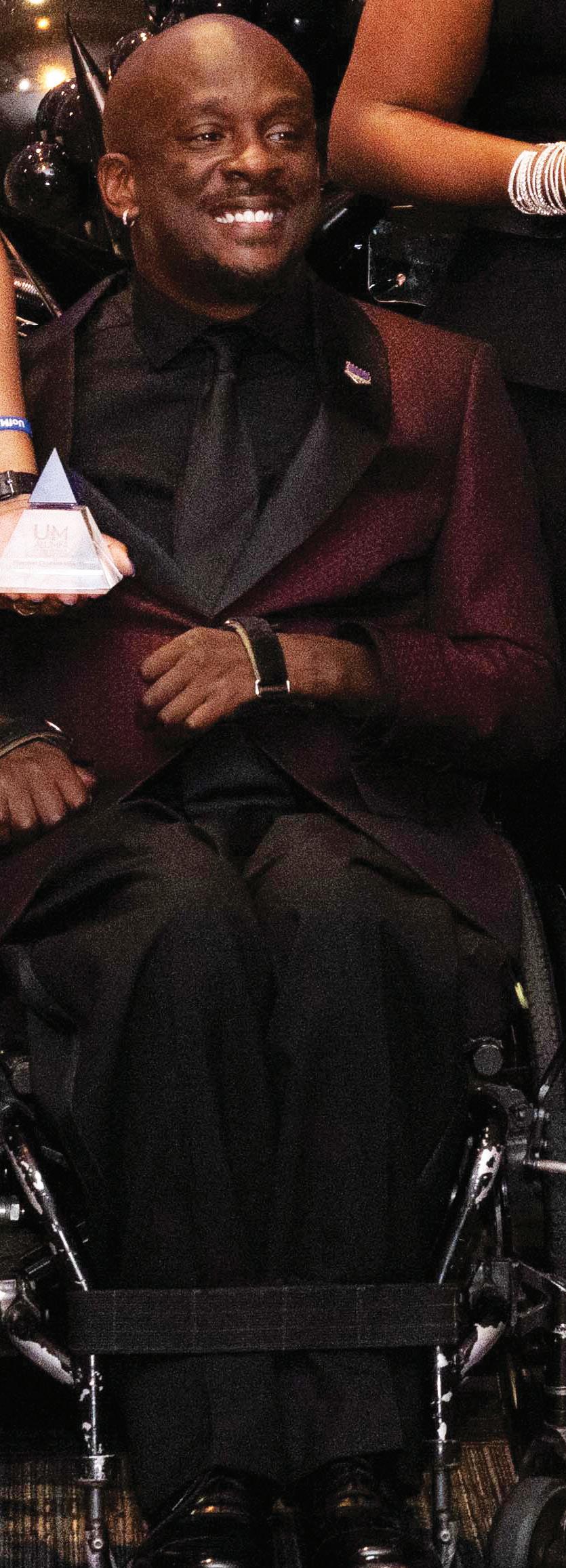
Being a quadriplegic is not slowing Fletcher Cleaves (BS ’15) down.
As Cleaves says, “Where there is a wheel, there is a way.”
His outlook on life and perseverance was recognized Oct. 23 during Homecoming at the Black Alumni Chapter Gala, when Cleaves was presented the Ralph Prater Award, named after Ralph Prater, one of the members of the Memphis State Eight.
“Receiving the Ralph Prater Award from the University of Memphis is deeply personal to me,” Cleaves said. “Ralph Prater walked these same grounds when it was Memphis State and he went on to help lead one of the most important movements for dignity and justice in our City’s history. My great-grandfather marched in the 1968 Sanitation Strike, standing behind the words ‘I Am a Man.’ To be recognized in that legacy reminds me that purpose doesn’t end with one generation, it’s carried forward.”
Hosts for the event were Greg (BA ’07) and Tanita (BA ’05) Hilliard and the keynote speaker for the evening was Elliot Perry (BA ’91), who spent nine years playing in the NBA.
Perry presented the award to Cleaves saying, “I have a great deal of respect and admiration for Fletcher, not because he’s my cousin but because he has shown himself to be someone who has the ‘IT’ factor and that ‘IT’ is perseverance, passion and patience. Now he’s receiving the payoff.”
The University of Memphis Computer Science alumnus’ journey is one of overcoming tragedy and turning that into triumph. Today he is known as the “Wheelchair Nomad” and motivational speaker and leadership coach.
Among his triumphs is being a voice and an advocate of the hazards of distracted driving. It was due to a distracted driver that caused Cleaves’ life to forever change in 2009.
A tragic car accident left Cleaves paralyzed from the chest down.
At the time, Cleaves — a native Memphian who was a star athlete and football player from Cordova High School — just started his journey as a freshman collegiate athlete at then Lambuth University on scholarship.
After the accident, Cleaves’ life was turned upside down. He went from being a normal college student to needing full-time care. His father and mother moved with him to Atlanta so he could begin the process of rehabilitation at the Shepherd Center, among the top spinal cord and brain injury rehabilitation centers in the country. He became a resident of Georgia, living there for a year and a half.
“My parents and my supporters are definitely the reason why I’m as accessible as I am today,” Cleaves said. “They never allowed me to have a disability.”
He remembers vividly the first time he was able to sit up on his own in the hospital bed. “It’s crazy to think back and I couldn’t even sit up by myself and now I’m living by myself, now I’m driving and now I’m traveling the world,” he said.
After rehabilitation, Cleaves moved back to Memphis and decided to enroll at the University of Memphis to get his degree in Computer Science.
“I never wanted to leave anything unfinished,” he said. “I always thought of myself as a college graduate, so I didn’t want my wheelchair to stop me from accomplishing that goal, so even though my physical abilities changed, I still have my mental capabilities.”
His parent’s drove him back and forth to attend classes, and he gained a community on campus joining Omega Psi Phi Fraternity, Inc. “My friends were always like, ‘Hey do you want to go to that party on campus? Do you want to go to the Yard Show?’”
Cleaves graduated in 2015. Shortly after he interned at St. Jude Children’s Research Hospital and worked in corporate for eight years at Auto Zone, before he decided to become an entrepreneur and full-time motivational speaker. “God just ordained my steps,” he said.
Cleaves began speaking at high schools across Memphis and his speaking engagements just grew from there.
Now he is using his journey to bring his advocacy to the center stage through his organization, The Sky is NOT the Limit, speaking on the importance of resilience and community support, along with raising awareness on the dangers of distracted driving and the importance of accessibility. His advocacy has allowed him to appear on Outside the Lines with Bob Ley, the National Transportation Safety Board in D.C., on College Game Day, Sports Center and ESPN — which Cleaves said was always a dream of his growing up as an athlete.
In 2023, Cleaves was invited to take the stage at a TEDx Talk, in which he presented on “The Dangers of the World’s Smallest Slot Machine” — a cell phone, which he compares to an addiction like gambling. A gamble from someone that caused him to forever use a wheelchair.
“I want to be remembered as a person that just never gave up on their hopes and their dreams and to inspire others to do the same,” Cleaves said.
“Life is going to throw us a curve ball one day, so it’s making sure that understanding that no matter what life throws at you, that you have the opportunity to make a better tomorrow than you did today.”
He is also highlighting his adventures traveling on his blog “The Wheelchair Nomad.”
The project spurred out of the outpouring of questions and comments Cleaves received from others with mobility and health issues after sharing a traveling experience he had to Jamaica. He wanted it to be a resource for others that traveling is indeed possible and to not let limitations stop you.
So far, Cleaves has gone sky diving, scuba diving with sharks and even ridden the world’s fastest roller coaster in Abu Dhabi.
Looking toward the future, Cleaves hopes to also get into acting. He is a firm believer that it’s not what happens to you that defines you, but how you respond.
“You may be going through an up or down, going through trials and tribulations at the moment, but understand that there’s always something to be thankful for.”
To follow Fletcher Cleaves’ journey visit: fletchercleaves.com
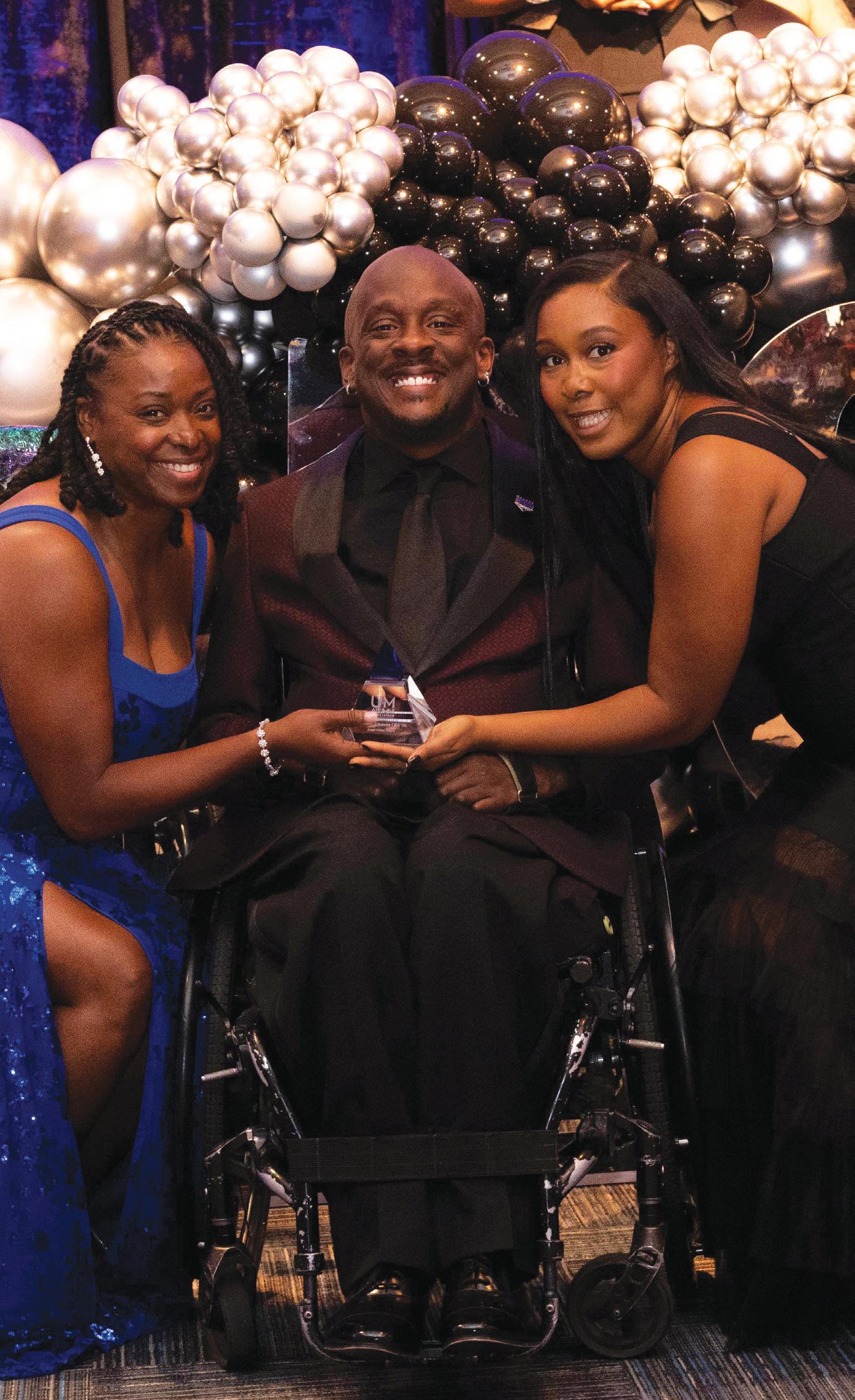
“I always thought of myself as a college graduate, so I didn’t want my wheelchair to stop me from accomplishing that goal, so even though my physical abilities changed, I still have my mental capabilities.”
Fletcher Cleaves BS ’15
• Marvis Kneeland Award: Harold Collins (BA ’88)
• Sammie Burnertt (Johnson) Award: Latrell Armstrong (BA ’04)
• Eleanor Gandy Award: Brandee Evans (BA ’03)
• John Simpson Award: Kevin Woods (BSET ’00, MS ’02)
• Luther C. McClellan Award: Roberto Young (BSEE ’02, BSCE ’03)
• Rose Blakney (Love) Award: LaDawna Cole (BBA ’02)
• Bertha Mae Rogers (Looney) Award: Venita Doggett (BA ’98, MPA ’01)
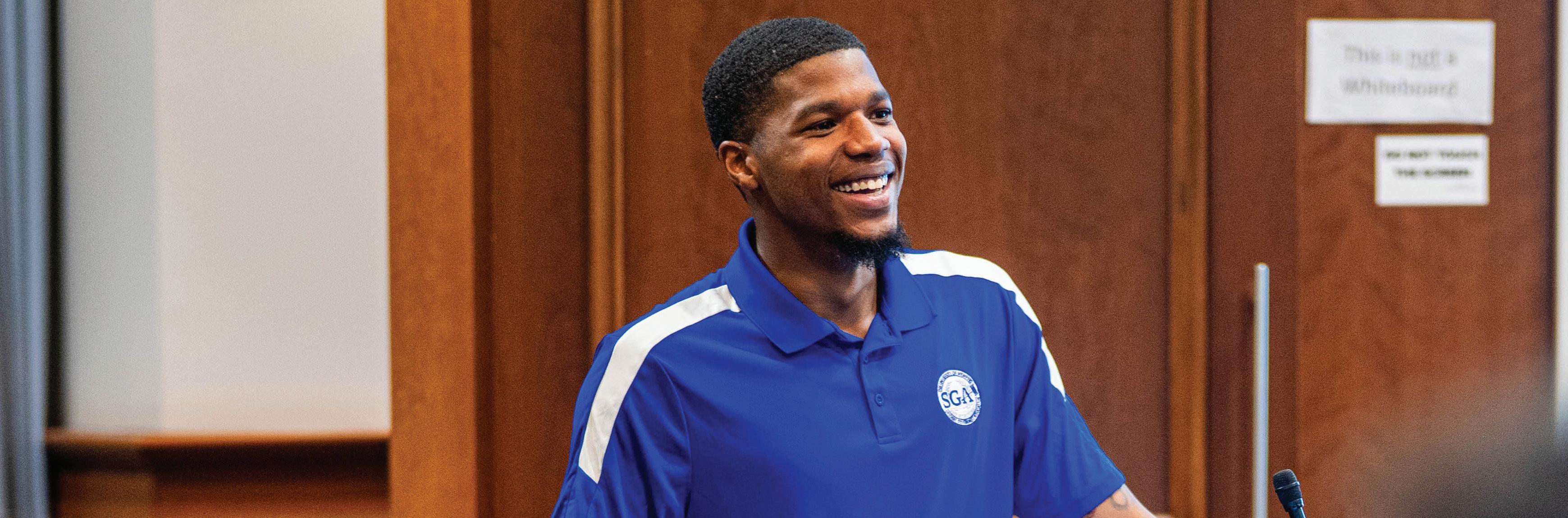
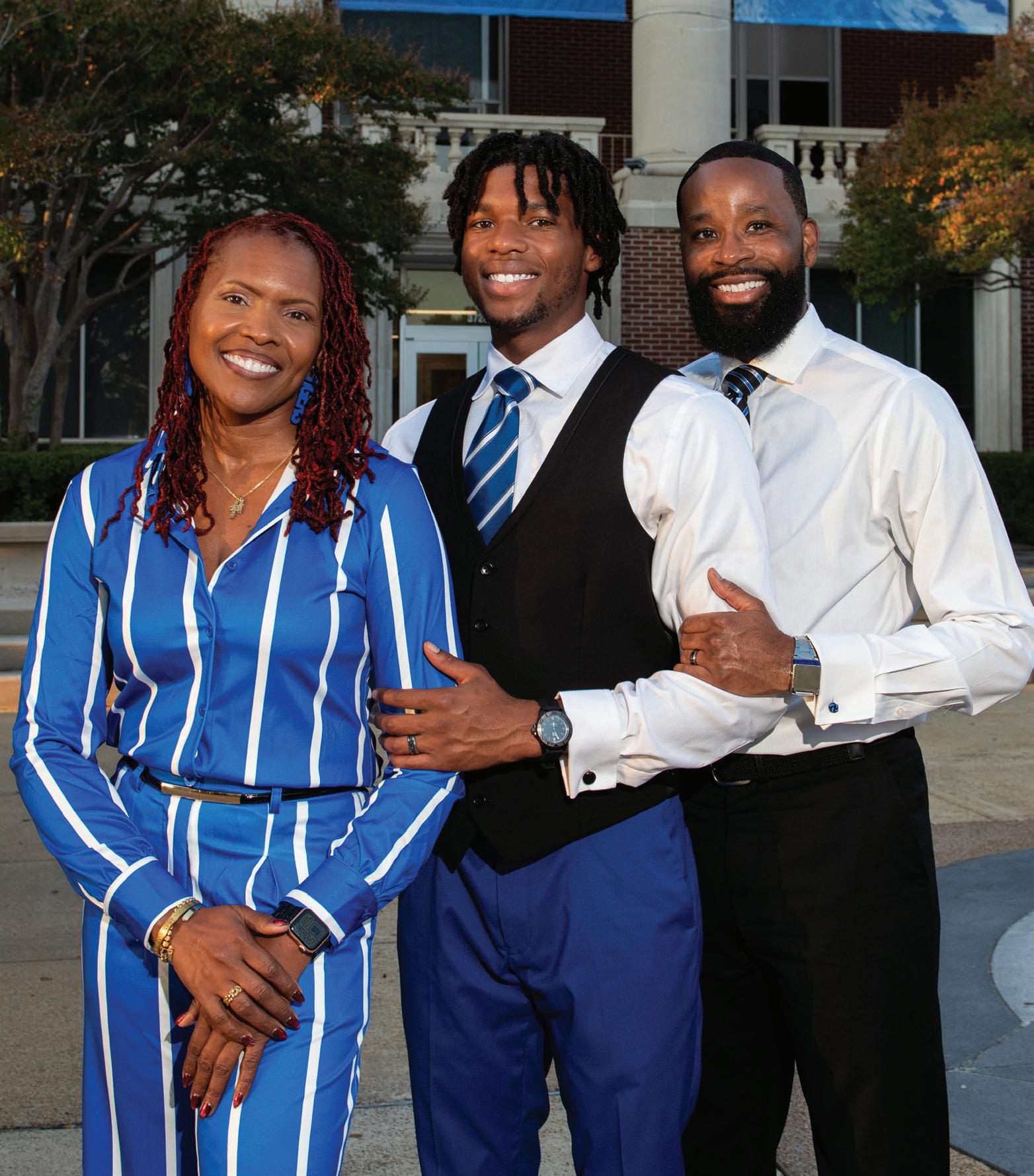
SBY HEATHER HAMPTON
ome families pass through a university. Others grow within it. For the Bradley–Bailey family, Memphis is not simply where degrees were earned — it is where a legacy of love, leadership and lifelong connection took root. Generations strong, their story is a reminder that the Tiger Family is not something you leave behind; it is something you carry with you, always.
Melody Bradley’s (BS ’02) path to the University of Memphis began elsewhere. After initially enrolling at another university across the state, she found herself homesick and transferred to UofM the following year as a sociology major.
“I quickly found myself making lifelong friends,” Melody recalled, reflecting on her time living in the residence halls, performing as a member of the Mighty Sound of the South marching band and joining Zeta Phi Beta Sorority, Inc.
Andrew Bailey’s (BBA ’00, EMBA ’05) Memphis story followed a different but equally rooted path.
Raised in Memphis, the first-generation student chose to stay close to home so that he could help his grandmother support their family. Along the way, Andrew was faced with hardships that led him to step away from school. But a strong community would not allow his journey to end there, stepping up to encourage him to restart his degree-pursuit, and helping him with practical needs like housing.
“My community is what saved me.” Andrew adds.
With a renewed sense of energy and purpose, he quickly weaved himself into the fabric of campus life, serving in several organizations, including the Student Activities Council and the Student Ambassador Board.
While their journeys began differently, both he and Melody found the same sense of community and belonging that would shape their lives then and long after graduation.
Their son, Chris Bailey, was not immediately convinced that Memphis would be part of his own story. A competitive swimmer, he set his sights on earning a scholarship — until a devastating Achilles injury abruptly changed his plans. Angry, discouraged and uncertain about his future, Chris struggled to imagine a new path forward.
That moment of uncertainty became a turning point for his parents. All they needed was a seed, and they found that in Frosh Camp, an immersive extended orientation experience for incoming freshman students.
Melody laughed as she recalls what came next.
“Chris was adamant about not going,” she remembers. “There was no convincing him — but like any good parents, we signed him up anyway.”
As fate would have it, Frosh Camp proved transformative.
“The Chris Bailey I dropped off was not the same person I picked up,” Melody says. “It was like a fire had been ignited in him.”
He returned energized, talking nonstop about the friends he had made and excitedly counting down the days until the fall semester began.
While the change surprised them, Melody and Andrew were not entirely shocked. They had experienced it themselves. The same roots that once anchored them to Memphis were now taking hold in their son.
At the University of Memphis, tradition lives not only in buildings and banners, but in the families who carry its spirit forward. Chris would go on to do exactly that — building upon his parents’ legacy in ways both meaningful and historic.
In spring 2024, he became a member of Alpha Phi Alpha Fraternity, Inc., joining his father in their beloved brotherhood. This academic year, Chris serves as student body president, leading the 76th General Assembly of the UofM Student Government Association and advocating for more than 20,000 Memphis students. The moment carries special significance. Andrew once held that same role in 1999, serving as student body president of the 49th General Assembly.
For the first time in University of Memphis history, a parent and child have both held the University’s highest student office — a testament to a legacy of leadership that spans generations. Andrew adds, “To see him lead with purpose, heart and vision at the same university that helped shape each of us is a fullcircle moment we’ll treasure forever.”
Beyond his formal roles, Chris credits his parents’ steady guidance and unwavering belief for every success. That gratitude inspired him to nominate them for the 2025 UofM Family of the Year. In his essay, Chris detailed the countless ways his parents showed up — pushing him forward when he wanted to quit and building a “village” of mentors, staff and administrators who supported him along the way.
When Melody and Andrew learned they had been selected, the honor took them by surprise.
Andrew states, “The feeling was overwhelming appreciation from a child who wanted to show his parents the gratefulness of investments and sacrifices made for him to walk his path and determine his own way in life.” Melody echoes “It’s an honor to support Chris and other students at the University of Memphis. Being named Family of the Year was truly humbling.”
The family was recognized during Homecoming and Parent and Family Weekend, a day made even more meaningful as Chris was also presented as a member of the 2025 Homecoming Court.
That spirit of service extends well beyond their own family. Andrew continues to give back through the UofM Alumni Association, mentoring emerging leaders and strengthening connections across generations. Melody mirrors that commitment through her sorority and as a Parent Ambassador with Parent and Family Services.
“Serving has always been a passion for our family,” Melody says. “So, seeing Chris serve — it makes me incredibly proud. I’m overjoyed that he found his own way at the University of Memphis and blazed his own path.” One of Melody’s favorite ways to serve is on New Student Orientation family panels, where she helps new Tiger families navigate the emotions of transition and begin planting their own roots at the UofM.
During a recent session, she posed a simple question: “How many of you have Life360 on your student’s phone?” Hands slowly raise across the room. With a knowing smile, she gently — and humorously — encourages parents to loosen their grip, joking about the anxiety of “following the blue dot” as it wanders across campus and fuels unnecessary worry. Nervous laughter filled the room, followed by nods of recognition. In that shared moment, families feel seen. Her advice is practical, compassionate and grounded in lived experience. Even after the panel concluded, families linger — hoping to ask one more question or absorb one more piece of wisdom. They left reassured, more confident and ready to trust both their students and the journey ahead.
For Melody, being “rooted in blue” is more than a phrase — it is a foundation shaped by transformation. The University of Memphis gave her confidence, community and a sense of preparedness that followed her beyond graduation, offering a lifelong connection she could return to for support, service and celebration.
For Andrew, that foundation is grounded in family, faith and trust in the process of growth. He believes college is not just an academic experience, but a continuation of the work families begin long before move-in day — work that teaches resilience, responsibility and purpose. Within the Tiger community, he sees students anchored by values that prepare them not only for careers, but for lives of contribution.
Together, their story reflects what happens when roots are nurtured across generations — when a University becomes home, leadership becomes legacy and love binds it all together. Built by Memphis and bound by love, the Bradley–Bailey family will always be rooted in blue.

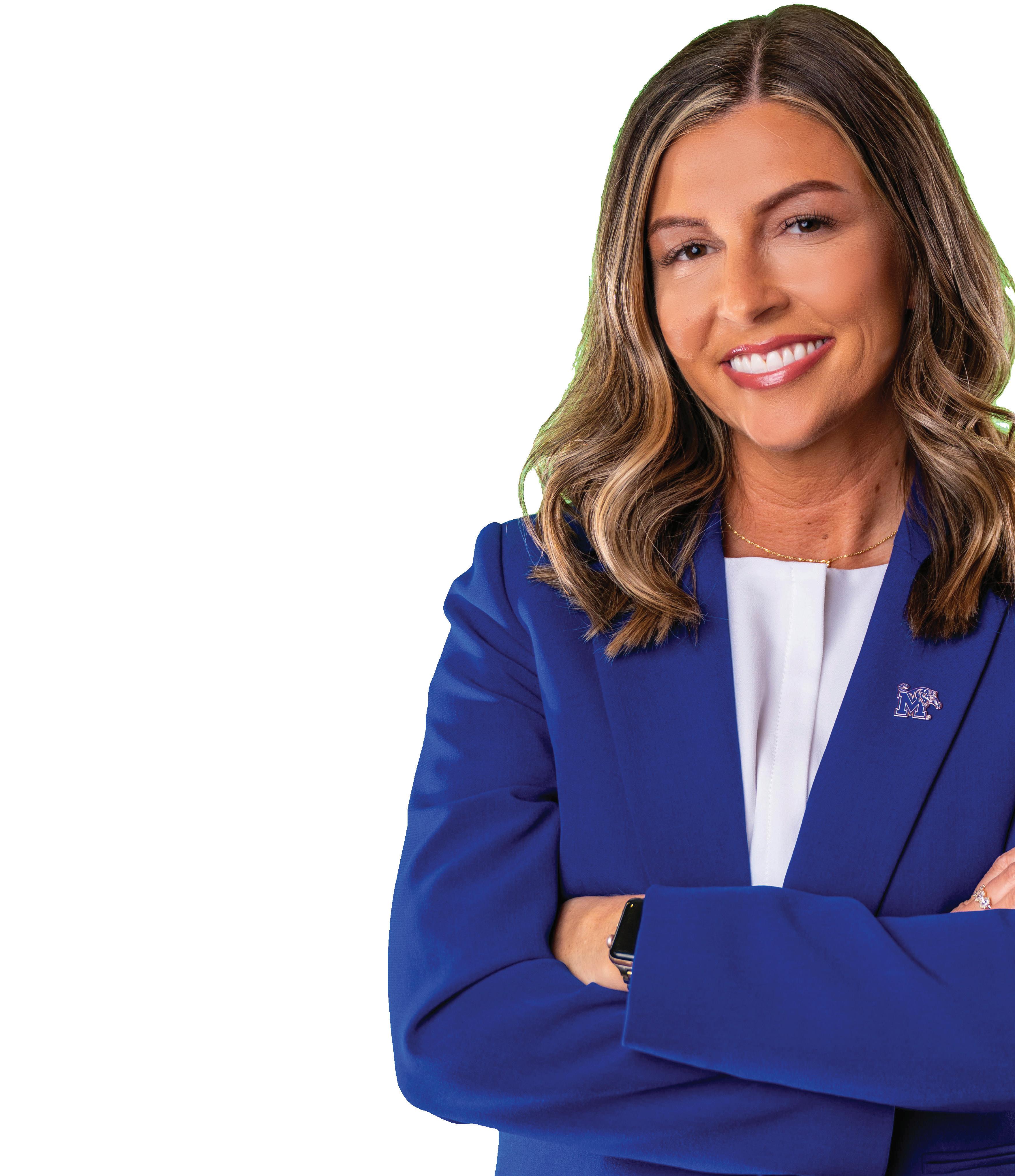





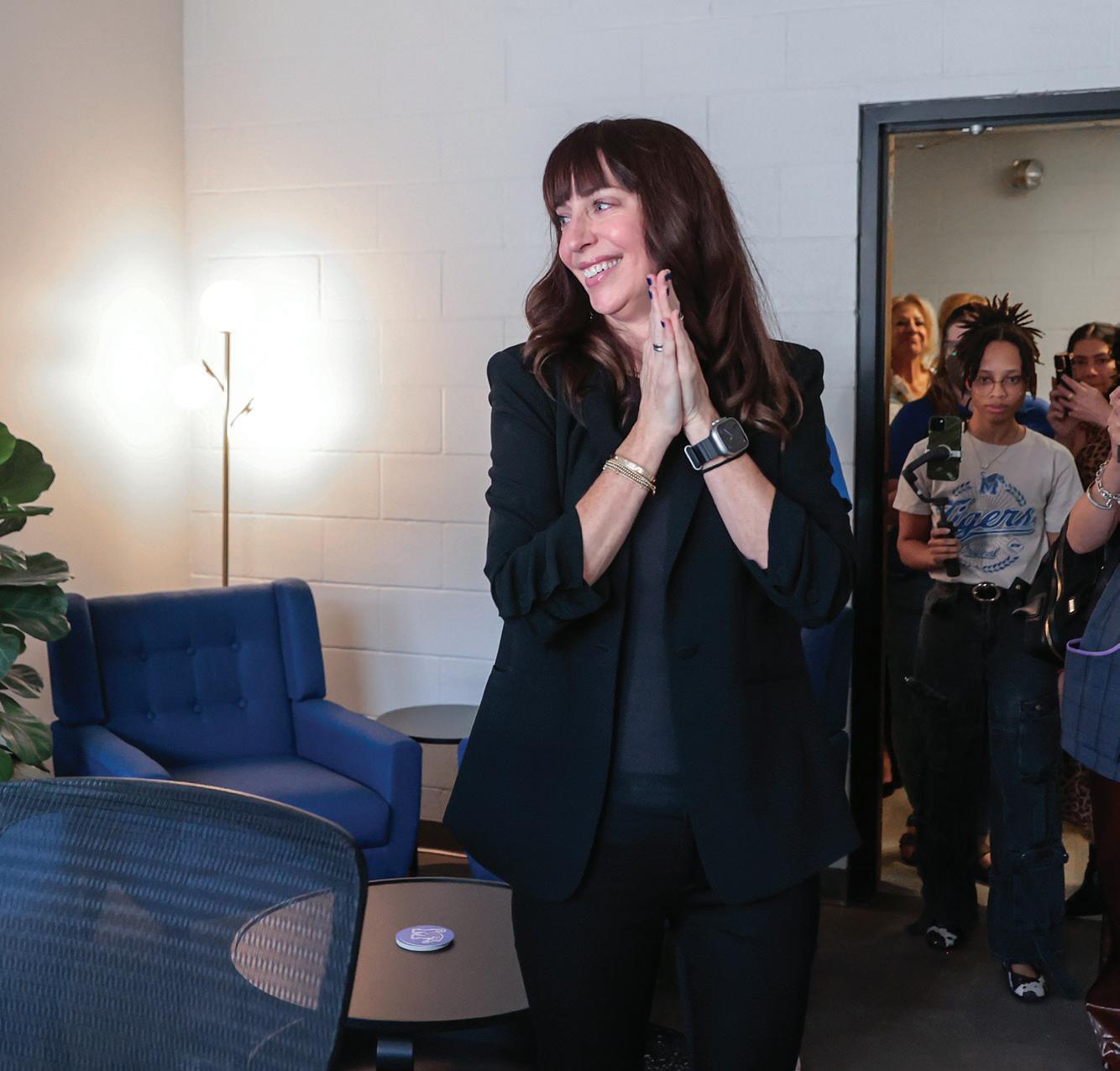
The Department of Journalism and Strategic Media held a ribbon-cutting for the Wilson PR Student Engagement Zone. The space, funded by a gift from JRSM alumna Beth Wilson BA ’04, MBA ’14 and her company, Wilson PR, will serve as a dedicated meeting area for student organizations.
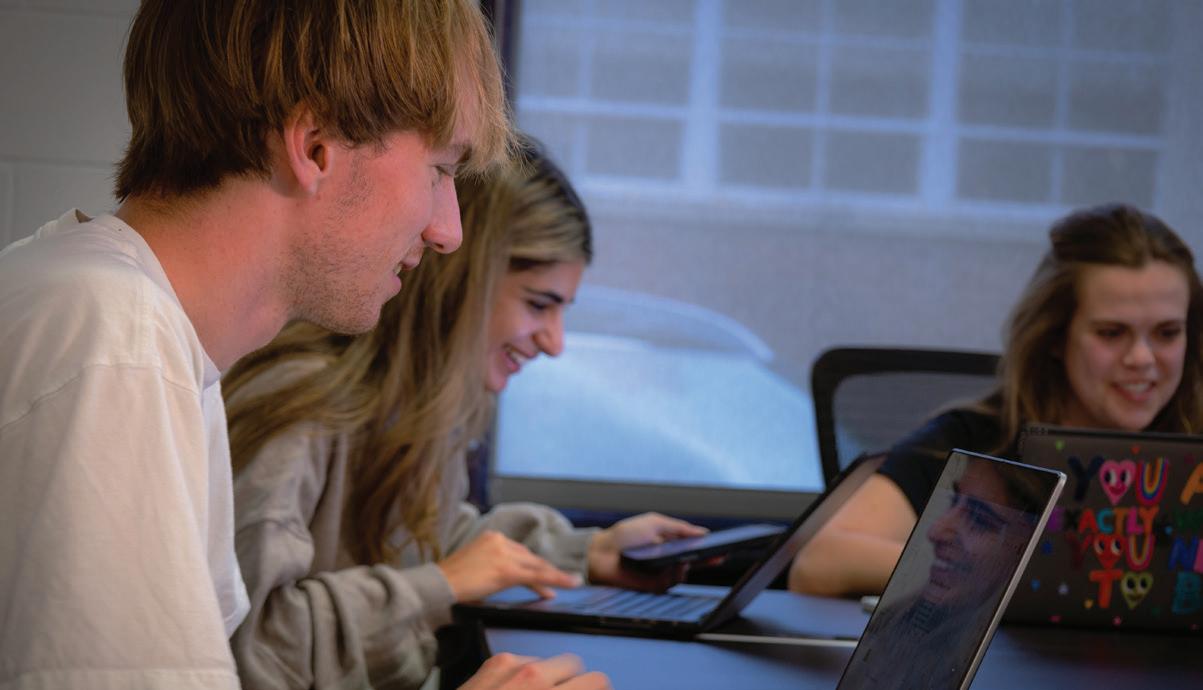
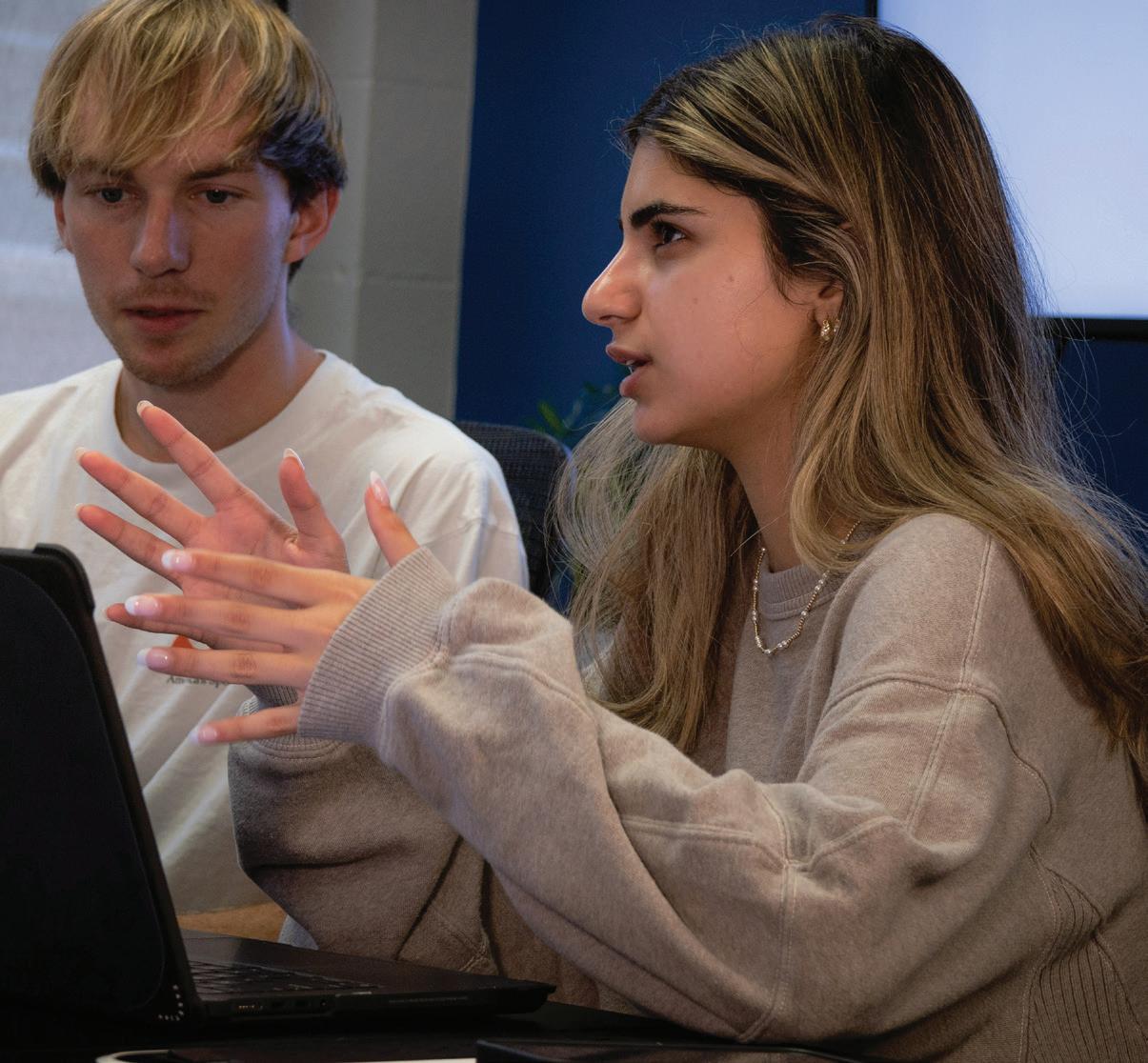
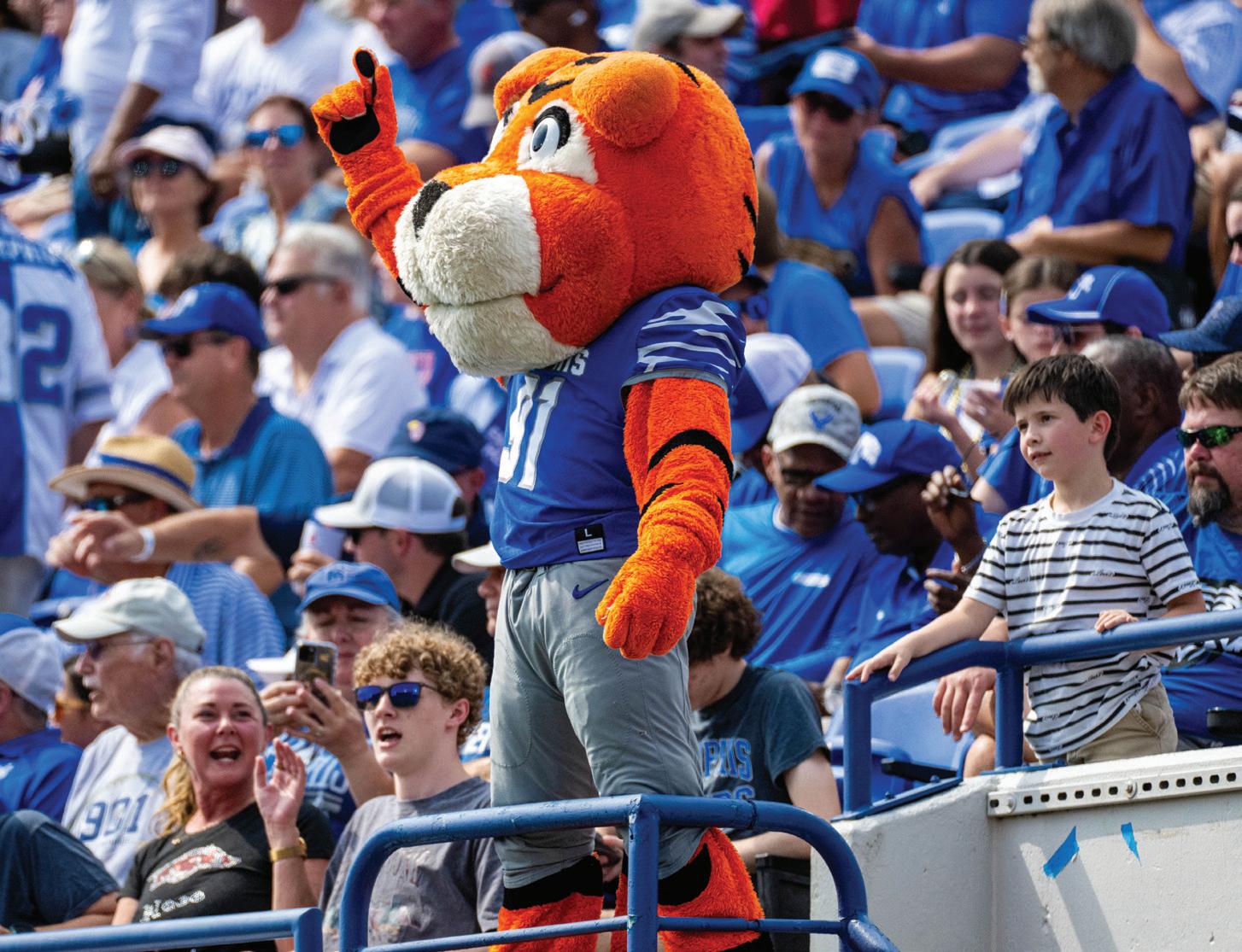
SEPT. 20: Tigers Overcome 18-Point Deficit to Topple Razorbacks, 32-31
Trailing by 18 points midway through the second quarter, Memphis looked like it might be headed for its first setback of the season. Instead, in front of a capacity crowd of 39,861 — the program’s first sellout since Nov. 2, 2019 against SMU — the Tigers roared back to deliver a 32-31 upset over Arkansas at Simmons Bank Liberty Stadium.
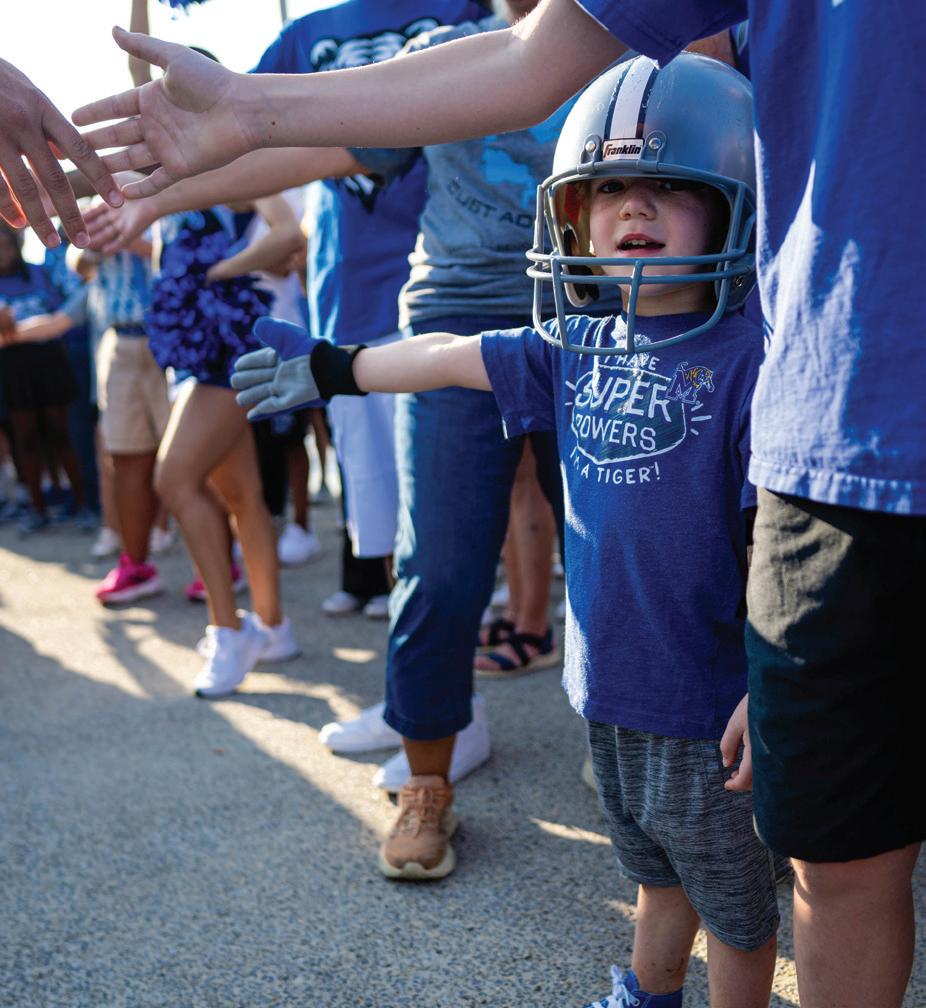
Mr. Monopoly visited Pouncer during the launch of the Memphis Edition of Monopoly, which featured local landmarks across the city including the University of Memphis.


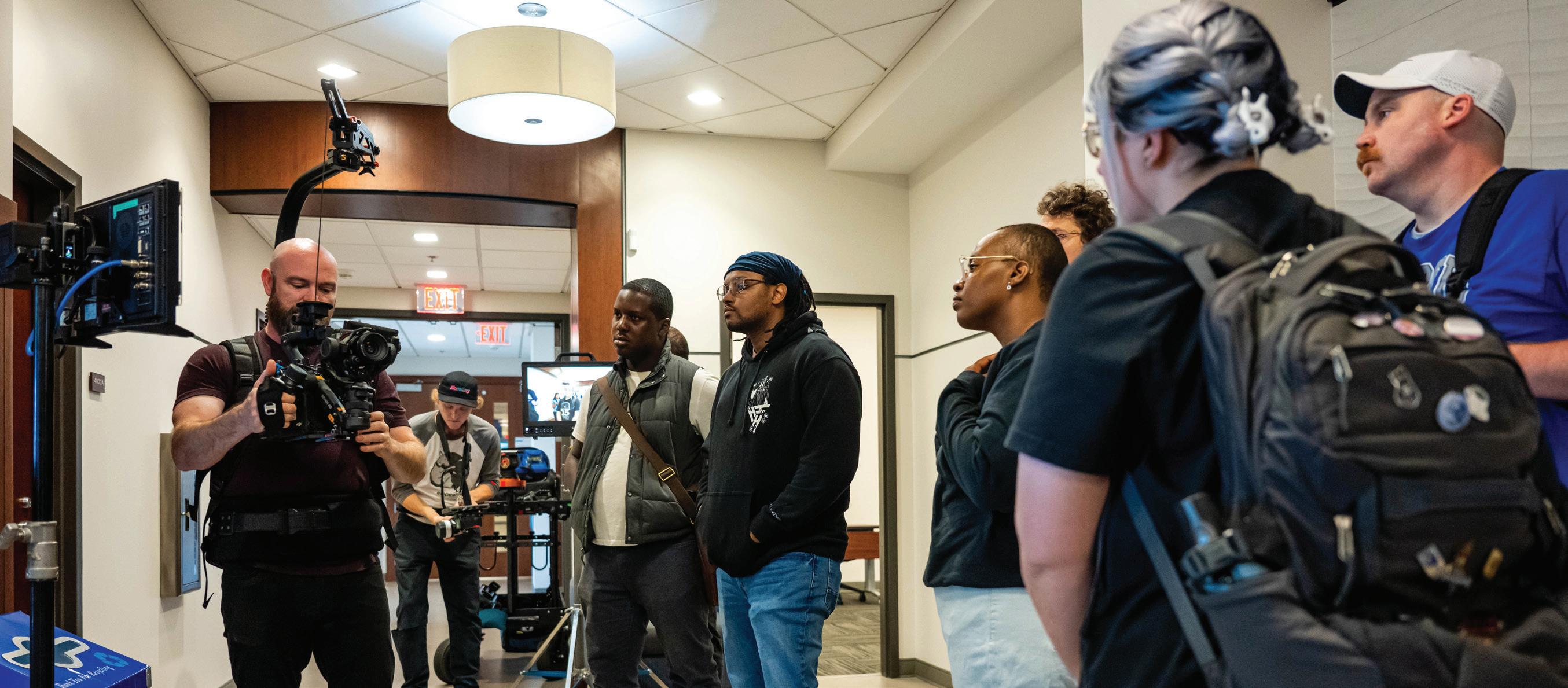
Graduate students in the Department of Communication and Film had a unique opportunity to support the production of the University’s “Memphis Is...” video, thanks to Agency., a creative and communications firm founded by UofM alumni.
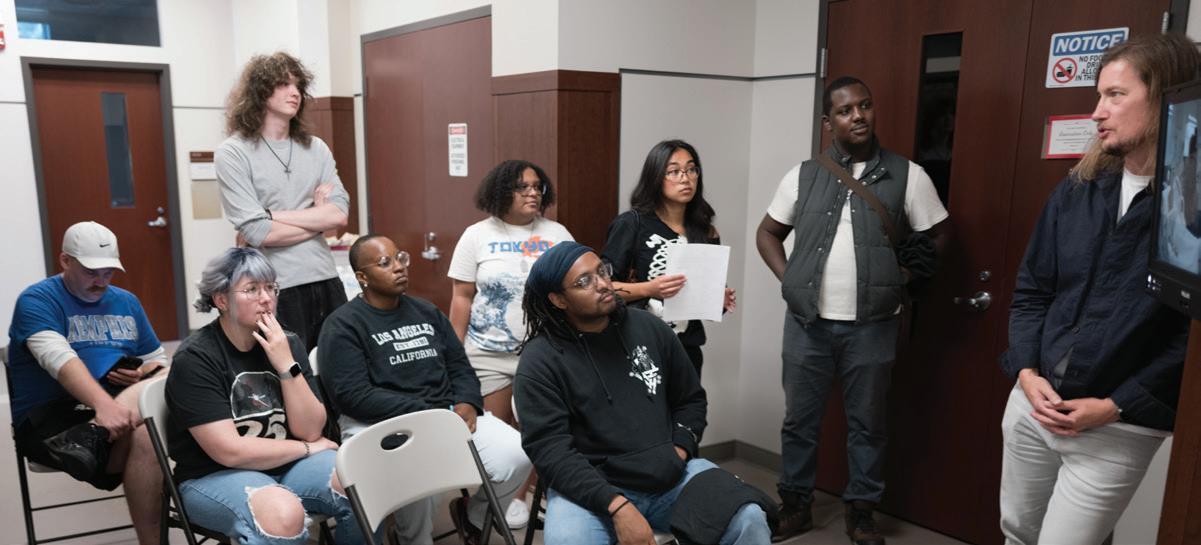
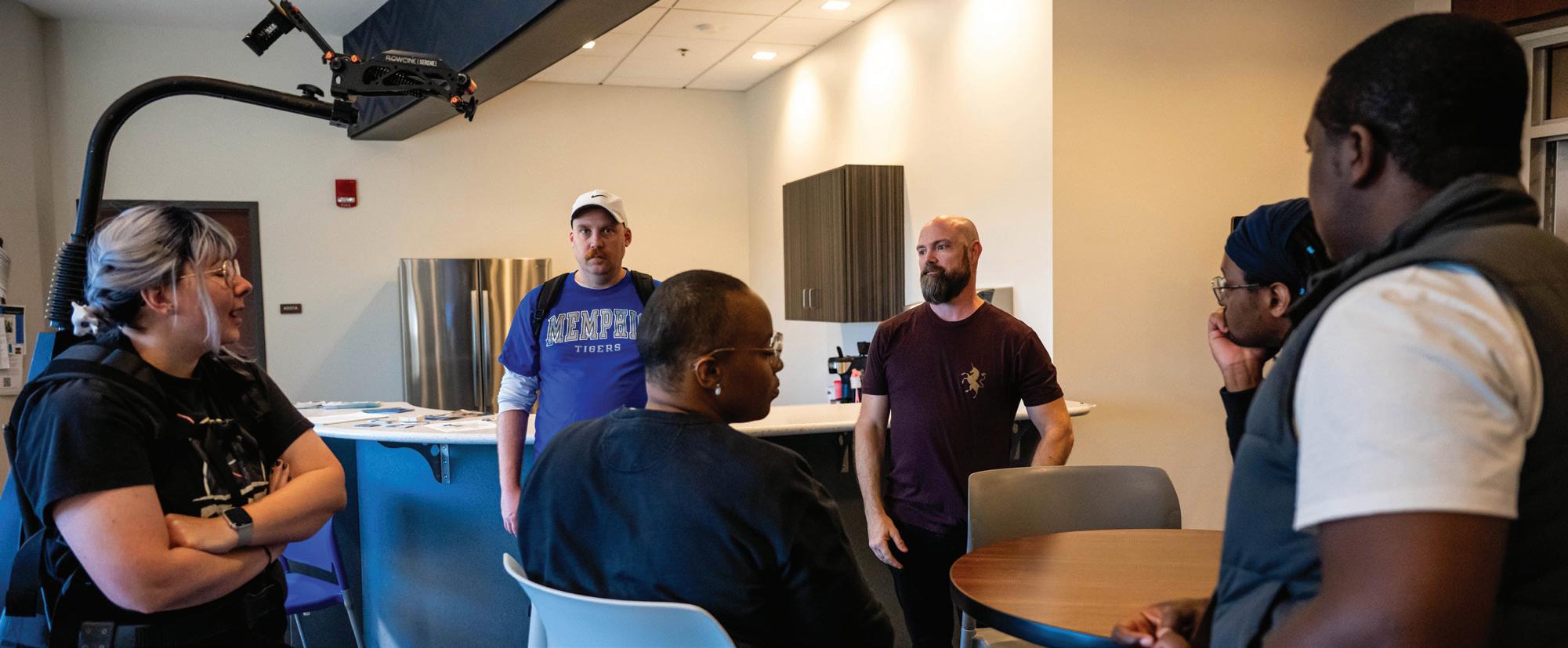






Memphis Men’s and Women’s Basketball brought the party downtown during Memphis Madness Ballin’ on Beale celebration.
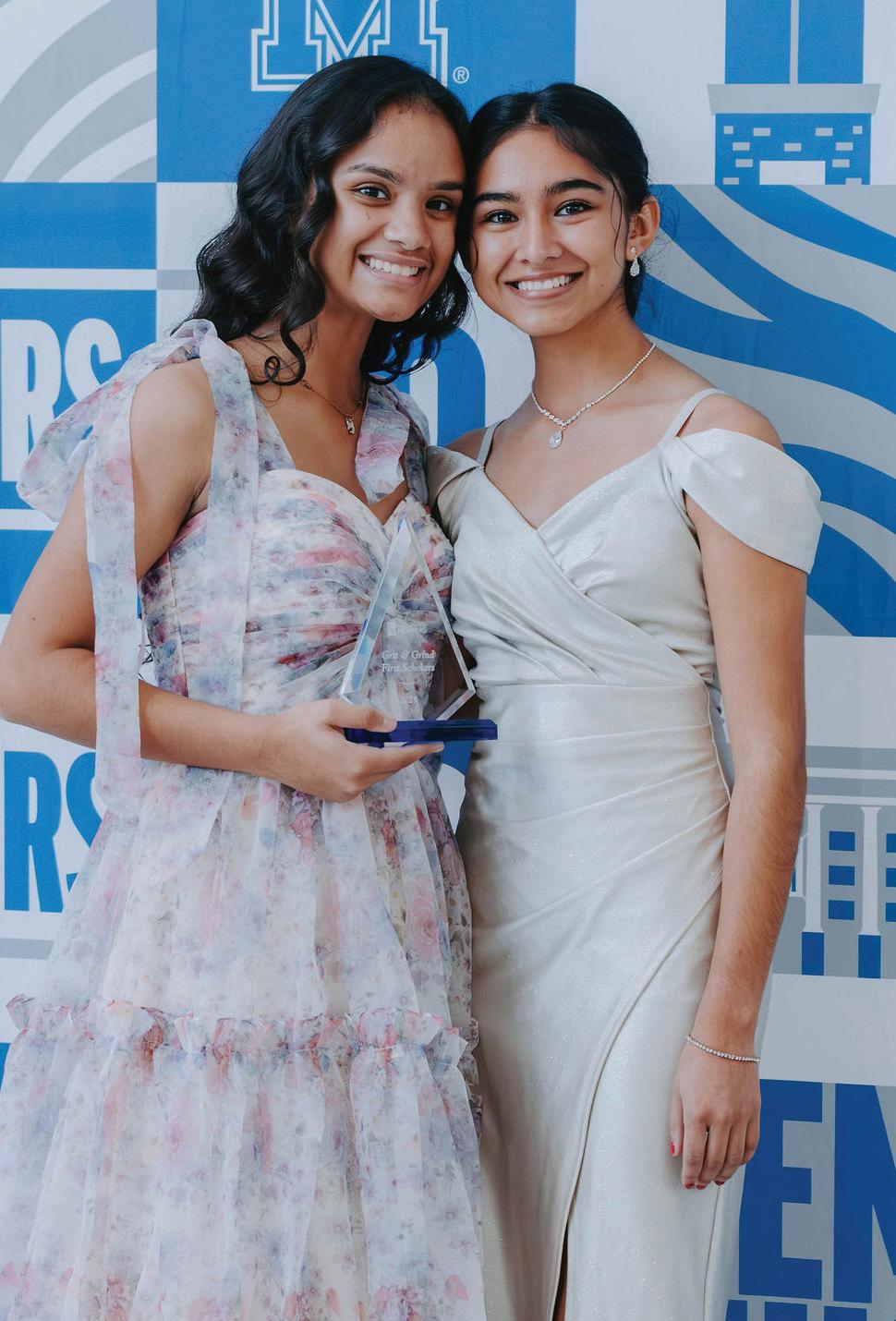
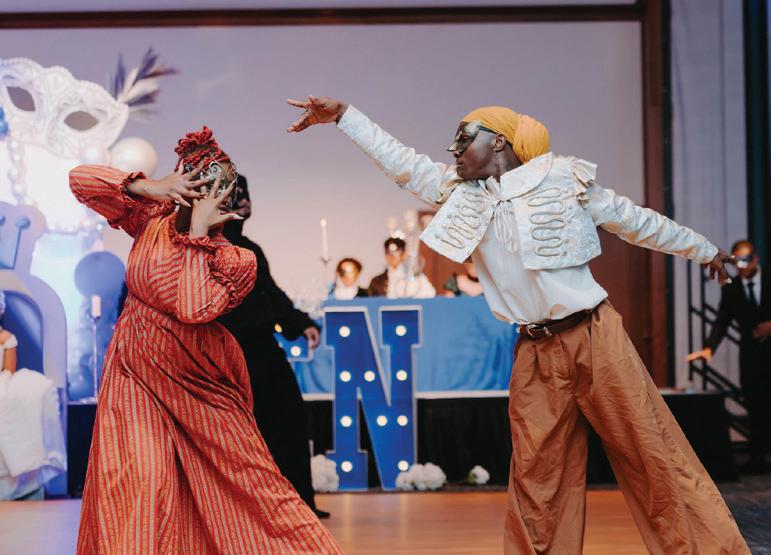
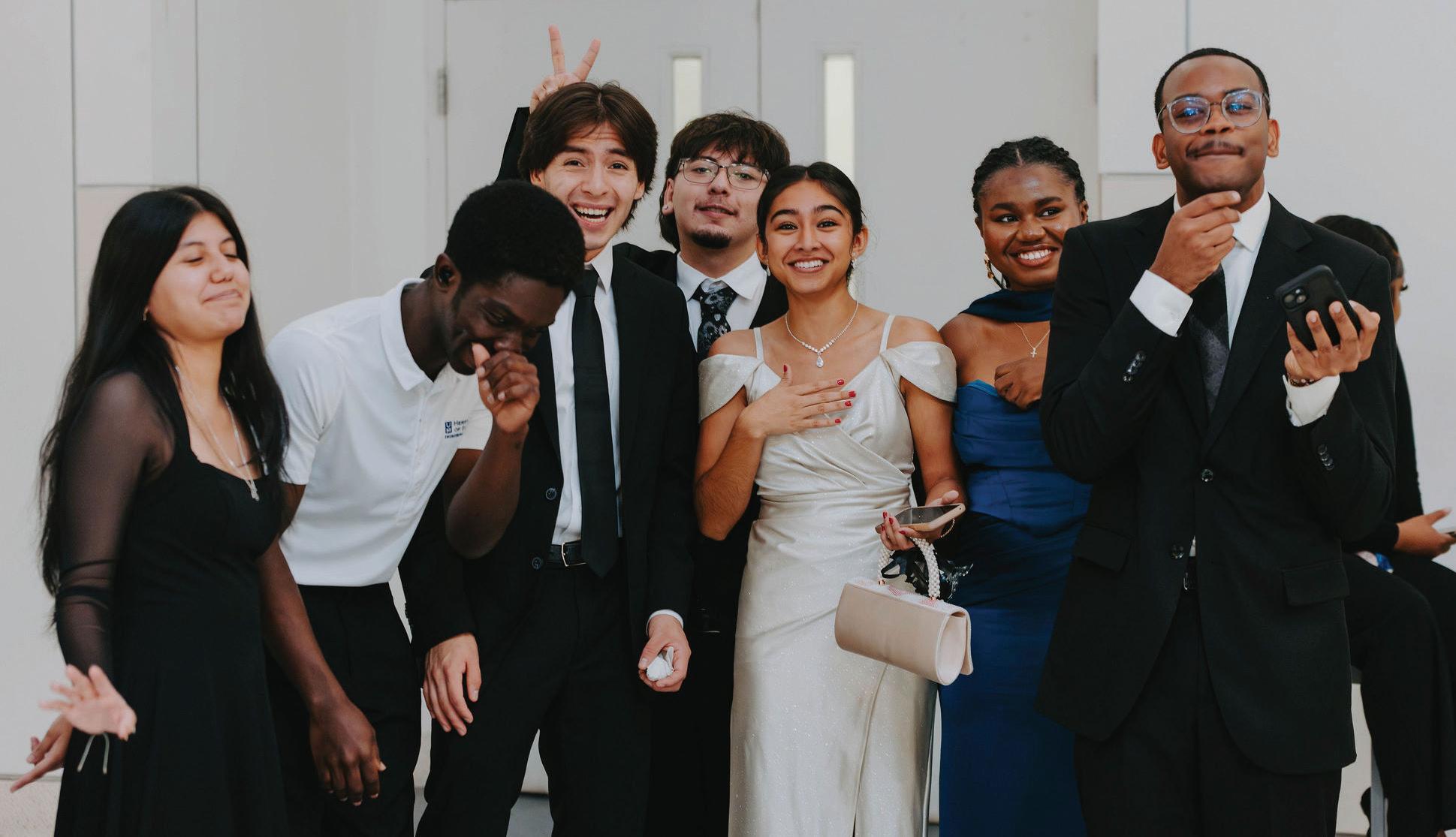
6:
The Office of First-Generation Student Success hosted First-Gen Week, which culminated with the highly anticipated Sapphire Masquerade Ball. The “Bridgerton” themed ball featured live performances from the College of Communication and Fine Arts.
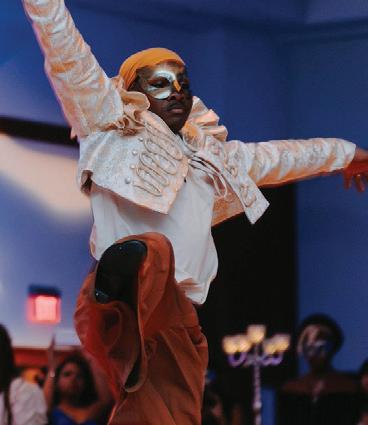
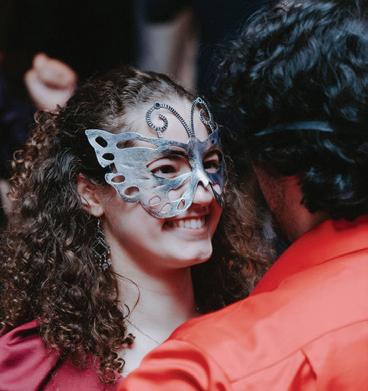

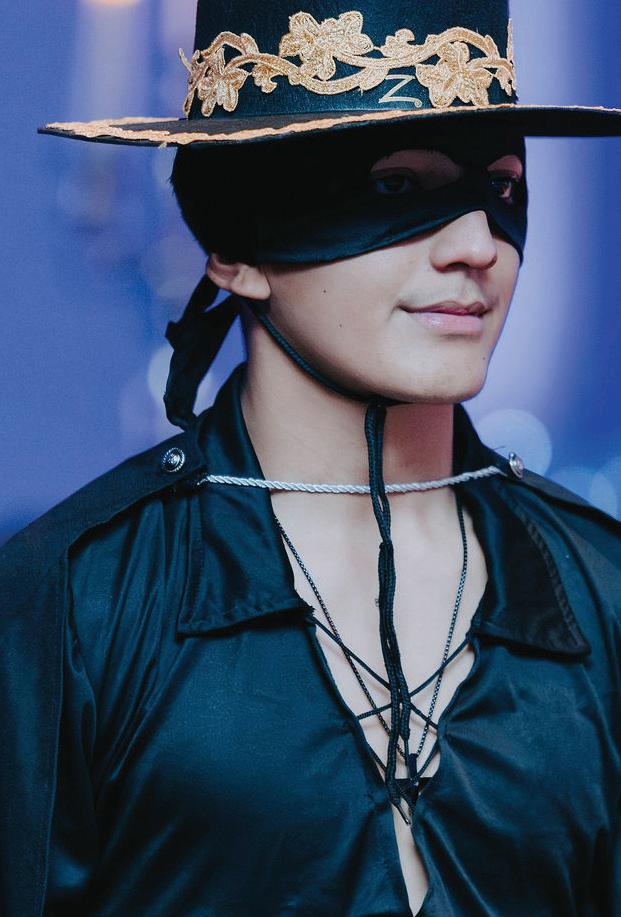
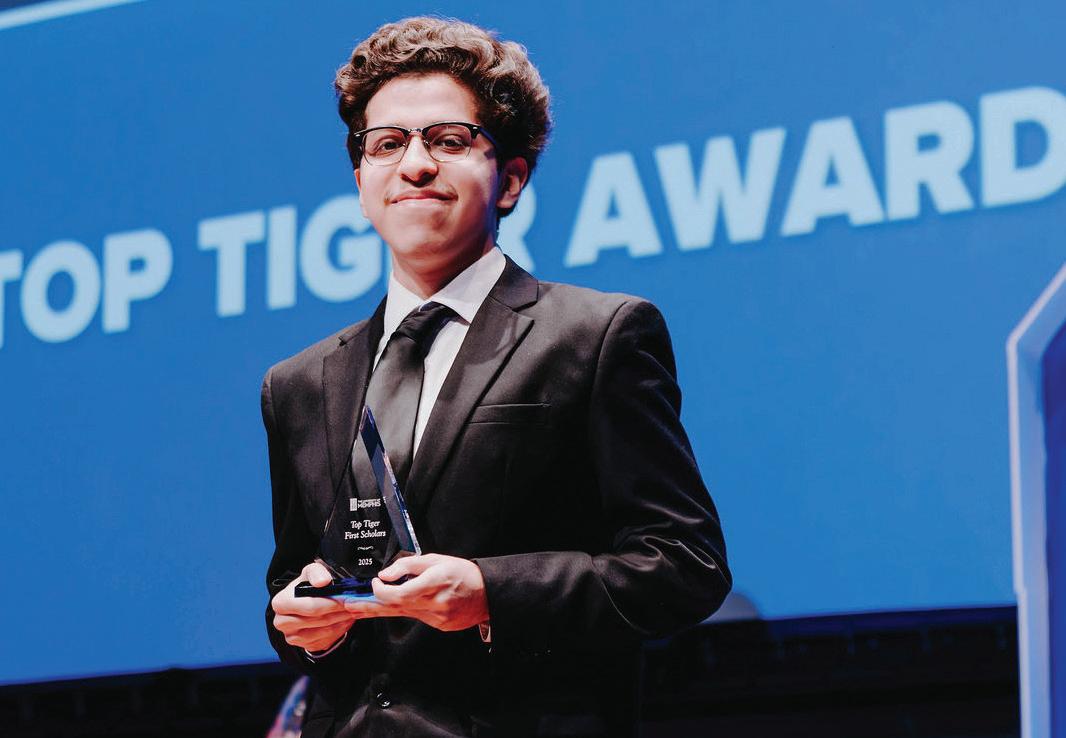
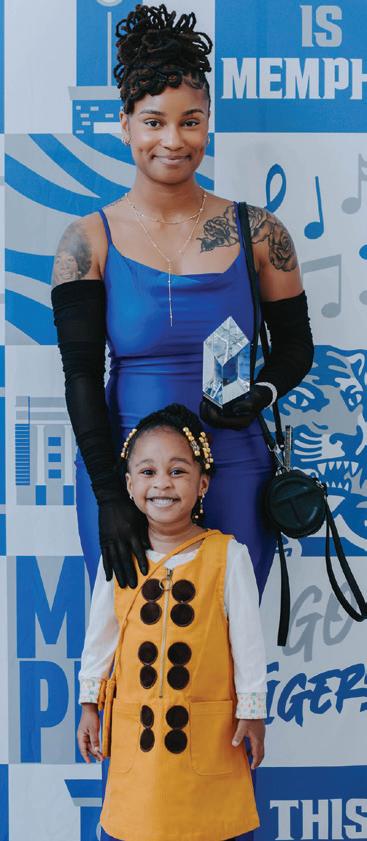
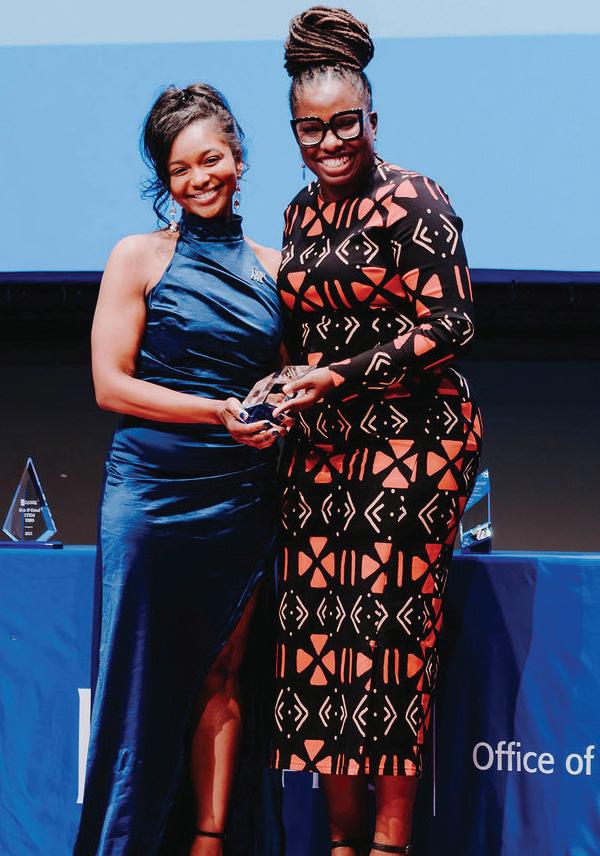

ROAR Fest is the UofM’s signature Homecoming event reimagined as a high-energy, city-connected block party that reflects the spirit, culture and pride of Memphis.
Join us Homecoming weekend, Oct. 29–31, 2026.


The University received recertification as an Arboretum Level 3, recognizing the beauty of its 150 acres, which features a diverse collection of more than 100 species of trees. The certification allows the public to access a map with locations of the trees around campus.
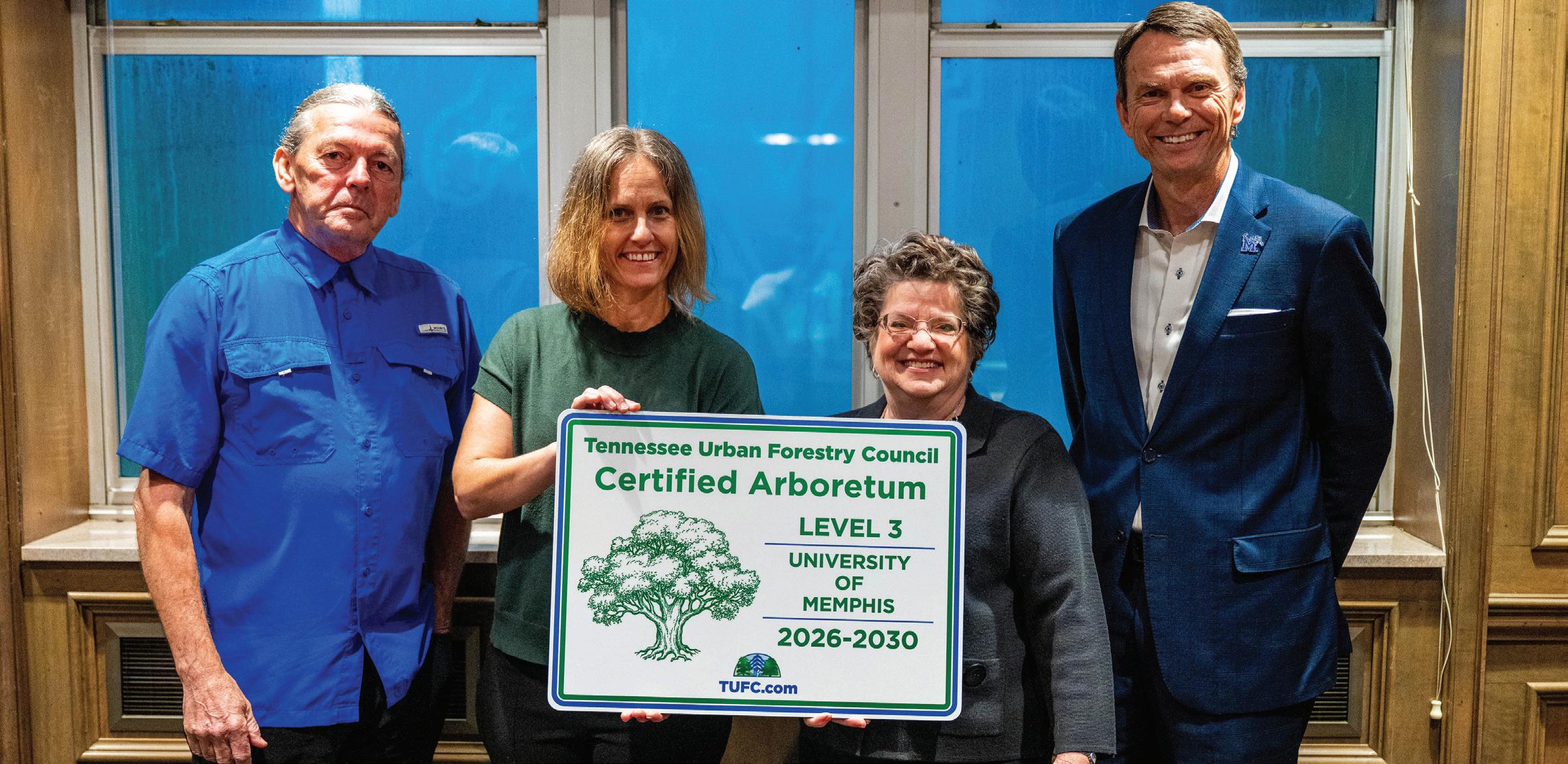

The Student Government Association led efforts to create the new Student Lounge as a community space for students to gather, collaborate and spend time together in the Maxine A. Smith University Center.

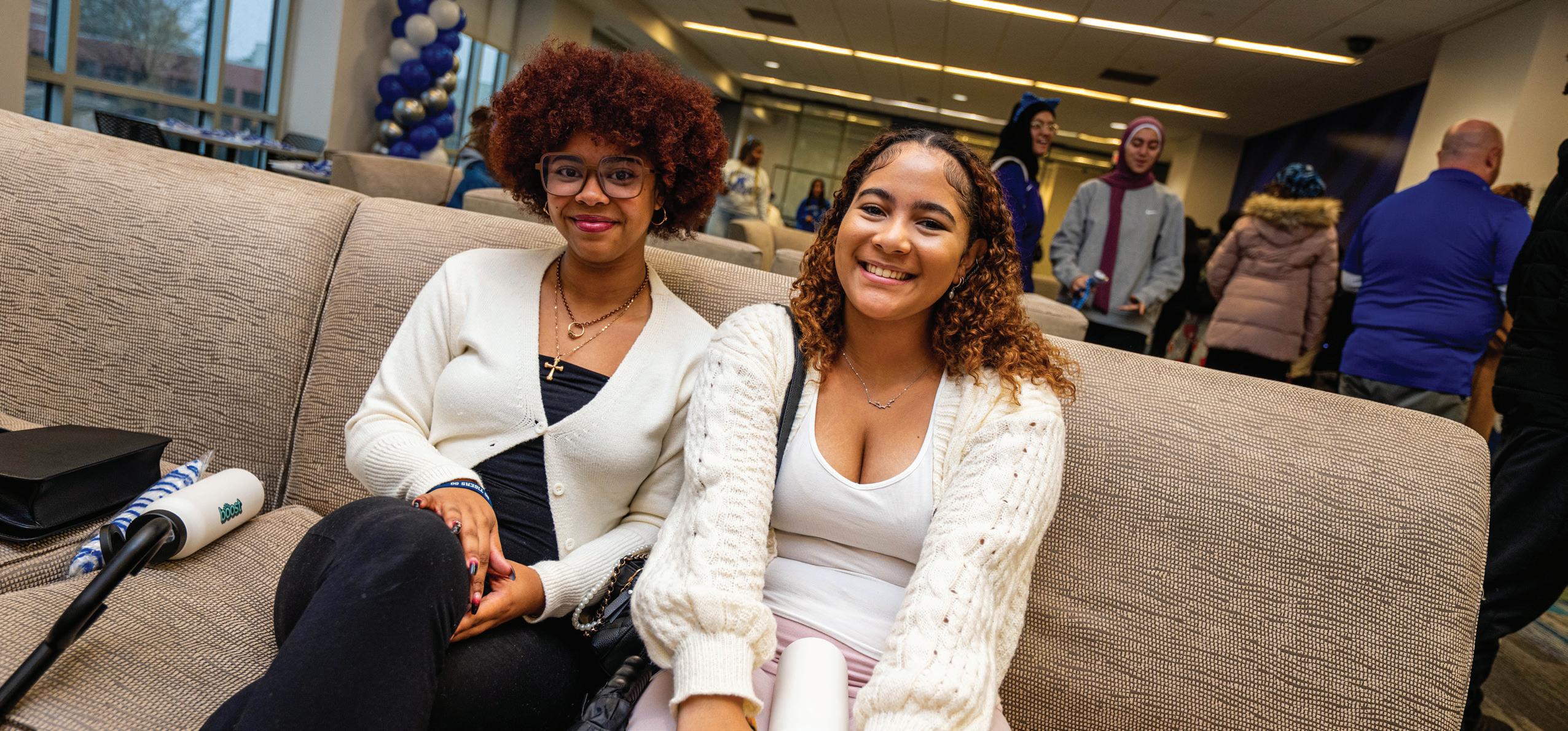
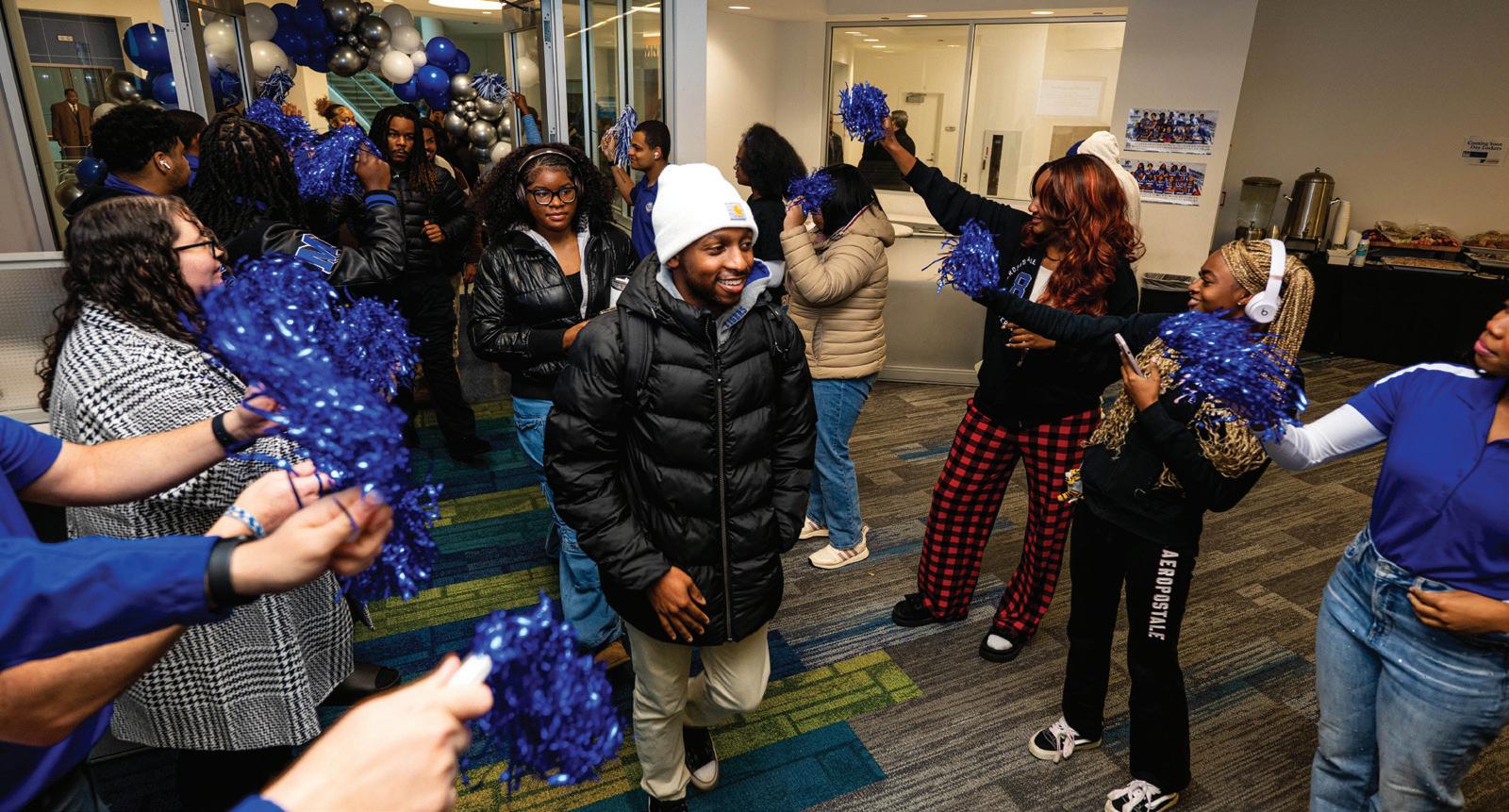

JAN. 8: MEMPHIS CHEER
The Tigers took home the Small Coed Division IA Title at UCA College Nationals with the top score of 89.3.
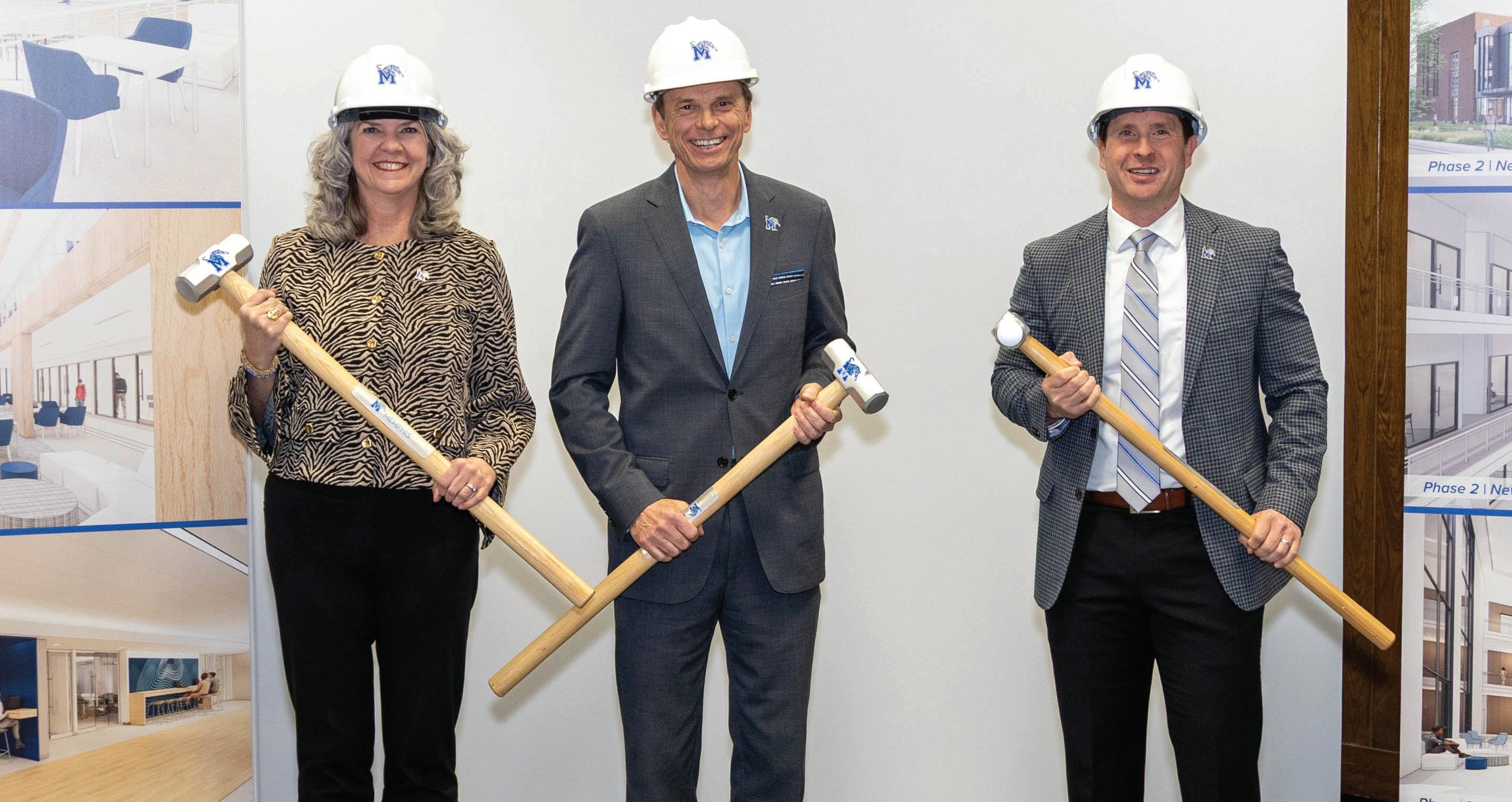
The Fogelman College of Business and Economics began an exciting new chapter for the college during a wall smashing ceremony celebrating the beginning of renovations of their building.