ML – Issue 17 Winter 2025 President
Bill Hardgrave
Senior Vice President and Chief Marketing and Communications Officer Michele Ehrhart
Dean
Jim Strickland
Executive Editor Ryan Jones
Contributing Writers Ryan Jones
Photography
Wendy Adams Justin Fox Burks Brandon Dill Ryan Jones Matt Smith
Art Direction and Design Jonel Turner
Published by
The University of Memphis Cecil C. Humphreys School of Law 1 North Front Street Memphis, TN 38103 901.678.2421 memphis.edu/law To submit story ideas, letters to the editor, alumni updates or for other ML-related inquiries, please contact executive editor Ryan Jones at rjones1@memphis.edu.
Cecil C. Humphreys School of Law The University of Memphis does not discriminate against students, employees, or applicants for admission or employment based on any protected category or any other legally protected class with respect to all employment, programs and activities sponsored by the University of Memphis. The Office for Civil Rights Compliance and Title IX has been designated to handle inquiries regarding non-discrimination policies. The following position has been designated to handle inquiries regarding non-discrimination and anti-harassment policies: Director for Institutional Equity/Title VI Coordinator, oie@memphis.edu, 156 Administration Building, 901.678.2713. UOM238-FY2526. Paulsen Printing
ML
8
M EM P HIS LAW MAGA Z IN E 2
From the Dean
3
News + Events
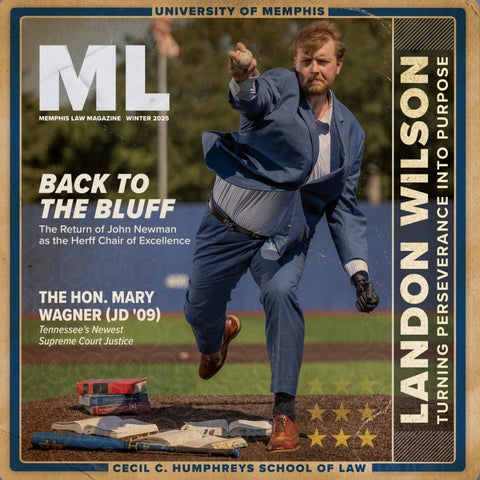
8 Turning Perseverance Into Purpose By Ryan Jones Photography by Justin Fox Burks
When Memphis Law 3L Landon Wilson suffered a devastating series of injuries, including the amputation of his left arm, he had to change his life plans. But he did not let the accident define him or hold him back, opting instead to face the challenge head-on and persevere through the painful recovery and new reality ahead of him. This is the story of how he used his circumstances as inspiration to achieve his new dreams and where they’ll take him after law school.
16 Back to the Bluff – The Return of John Newman as the Herff Chair of Excellence By Ryan Jones Photography by Justin Fox Burks
Professor John Newman was one of the most popular professors at Memphis Law during his time here from 2014-18. His journey took him away from Memphis for a number of years, with stops in Miami and with the FTC along the way, but in 2025 he made a celebrated return to the University of Memphis School of Law as the new Herff Chair of Excellence.
24 U.S. Senator Cory Booker Addresses Memphis Law Grads By Ryan Jones Photography by Brandon Dill
Service. Humility. Patience. Responsibility. These were the overarching themes that attendees of the Class of 2025 commencement ceremony heard throughout the day from their peers, professors, friends and a United States Senator serving as the day’s honored speaker.
30 Alumni Spotlight Justice Mary Wagner (JD ’09) Photography by Wendy Adams
Tennessee Supreme Court Justice Mary Wagner may be the youngest member of the State’s highest Court, but her place on the bench came as no surprise to anyone familiar with her drive, dedication and expertise.
34 Alumni Notes 38 Faculty Spotlight Professor Jennifer Brobst: A Professor for the People
16
By Ryan Jones Photography by Matt Smith
Professor Jennifer Brobst has a nontraditional academic background when it comes to attorneys, but it has led her to have an extremely unique outlook on how the law itself relates to people and their state of well-being. Whether it is helping people in need of representation or uncovering ways the law has overlooked a subset of individuals, her goal remains the same: to help people however she can and understand the human element behind it all.
46 Faculty Accomplishments
30
MEMPHIS L AW | WINTER 2025
1
FROM THE DEAN
I
t has been close to a year and a half since I began my time as Dean of the University of Memphis Cecil C. Humphreys School of Law. As someone who has always been extremely proud to call myself a Memphis Law alumnus, it has come as no surprise to me to see the outstanding way this law school operates and prepares its students for the real-world practice of law. But I have learned a few things along the way that I think are worth sharing with a broader audience, and a little more than a year into this role seems like the perfect time to look back with some perspective on what has been a wonderful beginning to my time as Dean. We have some of the most impressive law students I have ever come across. I always knew that Memphis Law students were well-prepared for life after law school and that they excelled in countless areas, but I have been truly blown away by the number of inspiring and impressive students I have gotten the chance to know during my first year here. We have students who served in the military, worked professionally as nurses or healthcare professionals, spent time at various departments in state and federal government, played sports at the collegiate level, are published authors, and many who are managing to juggle life as a law student while raising children simultaneously. I did not realize how inspirational it would be to be surrounded by students on a day-today basis, and it has been a real treat to get to know so many of them. It really makes it easier to fight to get things done for the law school when I can see the direct beneficiaries of the work every day.
2
UNIVERSIT Y OF MEMPHIS
And I have learned that this work never really stops. This fall, we welcomed the highest academically credentialed class in at least 20 years. It was an astonishing 31% increase in class size over the previous year as well. But no sooner had we wrapped up orientation for this new class, than we had to turn the page toward what was next. How would we not only follow up this success, but surpass it? I had never fully understood the intricacies and innerworkings of the recruitment and enrollment of prospective law students, nor did I know the incredibly competitive environment we are facing as a law school today. There are more law schools in Tennessee and the South in general, compared to when I was in law school, and that means we are working non-stop to get the best and brightest students enrolled at Memphis Law, no matter what time of year it may be or where we have to go. But that also means scholarship funding is more important than ever, which is where we’ve sometimes found ourselves at a disadvantage. Soon after I began as Dean, I started a new Dean’s Annual Fund effort in order to immediately ramp up our scholarship funding and increase not only our class size, but improve the academic makeup of the newest class as well. I’m happy to say that our initial goals were greatly exceeded for this year, but now we have to keep that momentum (and funding) going in order to maintain this level of success.
No matter where I went throughout the region, Memphis Law alumni were excited, engaged and interested in all things to do with the law school. I was incredibly impressed by the willingness of this wide-ranging network to fund our new scholarship initiative so quickly and be so giving of their time, talents and money. And it is why I am so optimistic about expanding upon our scholarship fundraising efforts across the board, both for immediate awards and for long-term endowments and gifts. I’ve seen first-hand the deep level of understanding from our alums when it comes to the need to elevate our law school and student-body to where we all know it can be. And if I’ve learned anything in this first year, it is that I know we will get there together. Please reach out to me directly if you would like to learn more about giving to the law school, or just visit supportum.memphis.edu/AscendLaw to give today. Best,
Which leads me to my final observation from my first year in office. Our alumni community is the best of any law school in Tennessee.
Jim
NEWS + EVENTS “You Might Be Right” Podcast with Governors Haslam and Bredesen at Memphis Law The law school, in partnership with the Howard H. Baker, Jr. School of Public Policy and Public Affairs at the University of Tennessee, Knoxville; hosted a live taping of the "You Might Be Right” podcast, co-hosted by former Tennessee Governors Bill Haslam and Phil Bredesen, titled "Who Judges the Judges?” The episode featured our own alumna, Tennessee Supreme Court Chief Justice Holly Kirby (JD '82), alongside former Tennessee Supreme Court Justice Sharon Lee and former U.S. Attorney General and White House Counsel Alberto Gonzales.
Judge Valerie Smith Investiture The law school hosted the investiture ceremony for Judge Valerie Smith (JD ’97) earlier this year. Tennessee Governor Bill Lee presided over the proceedings, with our Historic Courtroom packed full of Judge Smith’s family, legal community members, friends, former colleagues, and law school faculty and staff. Judge Smith was confirmed to the Court of Appeals, Western Division of Tennessee. She previously served as a Circuit Court Judge for the 30th Judicial District (Shelby County) from 2016-25.
University of Memphis Law Review Annual Symposium — Save the Date The “University of Memphis Law Review” will host its annual symposium on Friday, Feb. 27, 2026. This year’s event is titled, “America’s 250th Birthday — Will Due Process Be At The Party?” As the United States looks forward to its 250th birthday next summer, this volumes's symposium reflects on a cornerstone of the American legal system: due process. It will explore issues related to the history and evolution of due process and analyze what the future holds for this ever-evolving right.
MEMPHIS L AW | WINTER 2025
3
NEWS + EVENTS
SIXTH CIRCUIT JUDGES SPEAK AT MEMPHIS LAW The law school hosted the “Understanding Judicial Decision-Making & Practice on Appeal” panel earlier this Fall. The event, hosted by the law school, the Federal Bar Association and the student chapter of the Federalist Society, featured Sixth Circuit Court of Appeals judges, the Hon. Chad Readler, the Hon. Stephanie Davis, and the Hon. Whitney Hermandorfer.
LAW SCHOOL WAR MEMORIAL RESTORED The law school is proud to share that the monument and memorial located in the front of our historic building and dedicated to the service of WWII and Korean War veterans has been restored and is once again proudly on full display in front of the law school. The school would like to thank all of those who played a part in its restoration, including Dean Strickland, UofM CFO Rene Bustamante, the UofM Physical Plant team and Tony Poteet, Maria Furhmann, and Landmark Construction. Previous Dean Kate Schaffzin and many dedicated alumni and downtown residents also expressed concern and worked with us along the way.
4
UNIVERSIT Y OF MEMPHIS
News + Events PILLARS OF EXCELLENCE 2025 The Cecil C. Humphreys School of Law Alumni Chapter recently hosted yet another amazing event at the Pillars of Excellence Award Dinner. This year, the chapter honored seven distinguished members of the legal community as “Pillars of Excellence,” and one individual as the “Friend of the Law School,” for exemplary support and dedication to the law school’s mission and community.
The 2025 Pillars of Excellence honorees were: •
Ben C. Adams, Jr., Chairman Emeritus | Baker Donelson
•
Stevan L. Black, Founding Member | Black McLaren Jones Ryland & Griffee, P.C.
•
The Honorable Deborah Means Henderson (JD ’83), Judge | General Sessions Court, Shelby County, Tennessee, Civil Division IV
•
The Honorable Holly M. Kirby (JD ’82), Chief Justice | Tennessee Supreme Court
•
Russell E. (Rusty) Reviere (JD ’80), Attorney at Law | Rainey Kizer Reviere & Bell PLC
•
Gary K. Smith (JD ’73), Attorney at Law | Gary K. Smith Law, PLLC
•
John A. Stemmler, Retired Member | Bass, Berry & Sims PLC
•
Terrence O. Reed (JD ’00), Managing Director of Employment and ERISA Litigation at FedEx Corporation, was named the 2025 Friend of the Law School.
Professor Lynda Black received the 2025 Outstanding Faculty Member of the Year Award from the Law Alumni Association at the event as well.
NEW ASSISTANT DEAN FOR ADMISSIONS The law school’s new Assistant Dean of Admissions, Recruitment, and Scholarships is Justin Aromas-Janosik. He began his time at Memphis Law over the summer, replacing recently retired Memphis Law admissions Dean Sue Ann McClellan.
UNIVERSITY OF MEMPHIS SCHOOL OF LAW LISTED ON PRELAW MAGAZINE HONOR ROLLS The law school was listed on PreLaw Magazine’s Honor Rolls for Tax Law and Health Law, in the Back to School and Fall 2025 issues, respectively.
INCOMING CLASS BOASTS STRONGEST ACADEMIC CREDENTIALS IN 20 YEARS This Fall semester, Memphis Law welcomed its strongest academically credentialed class in the last 20 years. This class also includes a 31% increase in class size from the previous year! In addition, 73% of this firstyear class received a scholarship and 23% are first-generation college graduates. The class represents 46 different undergraduate institutions from 11 different states. MEMPHIS L AW | WINTER 2025
5
NEWS + EVENTS SEASON THREE OF SHOW CAUSE PODCAST The law school launched season three of the Show Cause Podcast this fall. All episodes are available on Spotify and Apple Podcasts.
EPISODE TWO: Finding Common Ground – The LGBTQ Rights Movement with Shannon Minter
EPISODE ONE: Big Tech’s Antitrust Endgame with Professor John Newman
This episode featured Shannon Minter, the Vice President and Legal Director of the National Center for LGBTQ Rights, to discuss his involvement in an event at Memphis Law examining an upcoming Supreme Court case regarding trans athletes and school sports teams and also talk with him about the history of the LGBTQ rights movement, it's history, it's future, and his role in all of it over the years.
Herff Chair of Excellence John Newman detailed several highprofile antitrust cases pertaining to Google, Apple and Epic Games and explained their relevance to consumers and how they change the way Big Tech operates.
EPISODE THREE: AI and the Law – Generating the Future A new student organization at the law school, AI & the Law, has been actively advancing AI-related topics amongst faculty and students. Memphis Law 2L Jeffrey Engle and AI & the Law member, joined the podcast to explain how the use of AI in both law school and the legal profession should be viewed through a different lens, and how he hopes this new student organization can help his fellow students, as well as law school faculty.
TENNESSEE TRIAL COURT VACANCY COMMISSION AT LAW SCHOOL The law school was honored to host the Tennessee Trial Court Vacancy Commission earlier this year, as they met in our historic courtroom for public hearings for the vacancies in the 30th judicial district for a circuit court judge and a criminal court judge, following the elevation of Memphis Law alumnae Judge Valerie Smith to the appellate bench and the retirement of Judge Paula Skahan. The Hon. Chris Frulla (JD ’12) and the Hon. Ray Lepone (JD ’99) were chosen to fill the vacancies and were subsequently appointed by Governor Bill Lee.
6
UNIVERSIT Y OF MEMPHIS
NEWS + EVENTS LAW SCHOOL MULTI-CLASS REUNION This fall, the University of Memphis Cecil C. Humphreys School of Law Alumni Chapter hosted a special evening at the law school devoted to reunions for the Law Classes of 1975, 1985, 1995, 2005, 2010, 2015 and 2020.
PRACTICE PERSPECTIVES PANELS Our Career Services Office, in partnership with several student organizations this semester, has hosted several “Practice Perspectives” panels, which allow students to hear about life on the front lines of the law in various practice areas from real-world practitioners. The most recent panel focused on criminal law and featured Paul Hagerman (Shelby Co. District Attorney's Office), Vincent Ores (Shelby Co. PDs Office), Judge David Pool (Criminal Court Div. VI), Marques Young (U.S. Attorney's Office), and Mary Jermann-Robinson (Federal Defender's Office). Additionally, a Federal Practice panel featured Hon. Jennie Latta (Chief Judge Tennessee Western District Bankruptcy Court), Joe Murphy (United States Attorney for the Western District), Julia Kavanagh (Partner at Hall, Booth, Smith, PC), and William Bateman (Assistant U.S. Attorney, U.S. Attorney’s Office for the Western District of Tennessee).
MEMPHIS L AW | WINTER 2025
7
8
UNIVERSIT Y OF MEMPHIS
e c n a r e v e s Per TURNING
INTO PURPOS E By Ryan Jones
I
n high school, current Memphis Law 3L Landon Wilson’s life was defined by baseball. He was a pitcher at Haywood High School in Brownsville, Tenn. with plans to take his game to the next level in college.
PHOTOG R APHY BY JUSTIN FOX BURKS
He was playing 60 games throughout spring and summer with close to 80 more throughout the end of summer leading into fall. Baseball was all he knew.
He wrapped up his shortened jog and started back home. His next memories of the day stand out in sharp detail. “I remember getting about 400 yards from my driveway and noticing the sunset being particularly beautiful that day, so I stopped and took a picture,” Landon said.
But in October 2017, just one week after his 18th birthday, something happened that changed the course of his life forever. And it's ultimately what led him to the University of Memphis Cecil C. Humphreys School of Law.
“As I approached the last hill before my neighbor’s driveway I heard a car through my headphones, so I turned around and did not see anything. I figured it was coming from the other side of the hill, so I went to swap sides of the road to avoid it.
"I went to school just like any other day,” Landon recalled. “I remember that afternoon at baseball practice we had to run extra laps. Then I got home and took a nap, but I overslept and woke up around 5:15 p.m.”
I suppose I just didn’t see it when I turned around to look, but a truck pulling a lawnmower trailer was coming up directly behind me and I had just run right in front of it,” he recalled of the seconds before the impact.
Normally, Landon would take an afternoon jog before it got too close to evening. Two miles from his house in the country into town, then a mile around the walking track and two miles back home. But on that particular day, he was a bit rushed, so he cut his run short to try and beat the sunset after sleeping in a little too late.
“It struck me from behind. My leg got struck by the front right wheel of the truck and my arm was caught in the trailer. When the driver slammed on the brakes, it snapped my left arm off,” he said.
“As I hurried out of the house that day, I met my dad as I ran down the driveway as he was just getting home from work. He told me I shouldn’t be running down the road with it starting to get dark and he made me go back in the house to get some reflectors from my mom to put on my legs.”
His journey of recovery and perseverance led him to places he never knew he’d find himself, mentally and physically.
“I remember lying on the ground and looking at the inside of my arm and thinking, ‘Yup, I’m definitely in trouble.’”
MEMPHIS L AW | WINTER 2025
9
Recovery
THE ROAD TO RECOVERY
THE ROAD TO
A
medical helicopter transported Landon to Regional One Medical Center in Memphis, where he would end up staying for the next 45 days while undergoing ten different surgeries, including the amputation of his left arm.
According to his team at Regional One, immediately upon arriving at the hospital he requested that they “Just leave enough arm for me to hold a glove.” All in all, Landon had a broken left ankle and knee, a fractured right knee, with his right tibia and fibula bones being completely severed, as well as most of his lower right leg. Additionally, his left arm was nearly severed, except where it was just held together with the skin (which led to it ultimately being amputated). Two titanium rods were inserted into his right leg, a plate and three screws in his left ankle, two screws in his right knee, three screws in his right foot. Four of the surgeries were just to clean out grass, glass and gravel. Amazingly, he did not have a single internal injury.
He also never seemed to let the situation get him down — a lot of which was due to his friends, family and the Brownsville community. “The community I grew up in may be small, but it’s a town with a big heart, and our community helped me recover from the accident in every way possible,” he said.
UNIVERSIT Y OF MEMPHIS
Regional One staff had to move Landon to a bigger room on two separate occasions, with multiple fundraisers being held in Brownsville on his behalf. A Brownsville resident who owned a rental property in Memphis even allowed his parents to stay there for free during Landon’s recovery. Even upon their arrival back home in Brownsville, he and his family discovered that some area residents had built a brandnew wheelchair ramp for their front entryway of their house, completely unbeknownst to them.
“I can only hope that one day, under better circumstances, I can show all of those people how much they mean to me.”
His mother didn’t leave the hospital at all for the first 21
10
days of his stay. But she wasn’t the only Brownsville resident spending time in his hospital room.
There wasn’t a day that went by during his hospital stay where he did not see or hear from one of his high school friends. And he is well-aware of the sacrifice his parents made to put their own lives on hold to help deal with his recovery. It’s not something he takes for granted.
“These are all reasons why I think so fondly of that town and community,” he said. “When I was in a time of need, what seemed like the entire town stepped up and pitched in to help me recover. I think that Brownsville would have done that for anyone, and to me, is what makes it one of the most special places on Earth.” “Times like that are when you get to see how much you meant to people, and I can only hope that one day, obviously under better circumstances, I can show all of those people how much they mean to me,” Landon emphasized.
“JUST LEAVE ENOUGH ARM FOR ME TO HOLD A GLOVE.”
MEMPHIS L AW | WINTER 2025
11
Mound BACK ON THE
M
y doctors originally told me that I’d never play baseball again,” said Landon. “But I knew that I could make it back on the mound if I set my mind to it. At that time, baseball was all I knew.” He’d already lost his arm. He knew he couldn’t lose baseball as well. “As soon as I could stand, I started working on getting back atop that mound,” Landon stressed. “Rehab, practice…some people aim for climbing Mount Everest. I was just trying to get back on a pitcher’s mound.” At this point, a return to his senior (and final) season of baseball and the progress of his rehab were in a race against time. And even if he did complete his rehab program in time to come back to the mound, would he still have what it takes to actually pitch in a game? It turns out baseball was just the motivation he needed to achieve what many would have said was impossible. “I don’t think there are a lot of ball players that learned to play one-armed in just a few months,” Landon said. “I’m kind of proud of that though. It was very much a race against time.” And it didn’t take long for his coach to need him. “Only a couple of months after my accident, I had probably only been walking without a walker for a week or two,” he recalled. “But my coach approached me on the team bus and asked if I’d brought my baseball pants that day. I said I had and that I was ready to go if needed.” And he definitely needed to be ready. Immediately. “He told me that I was going to start that very game. I threw with my glove tucked under my nub
12
UNIVERSIT Y OF MEMPHIS
“My doctors originally told me I’d never play baseball again. But I knew I could make it back on the mound if I set my mind to it.” and would put my hand in the glove after I threw to catch the ball, then I would take off the glove with my armpit and grab the ball so I could throw my next pitch,” Landon explained. Understandably, that alone would be an incredible achievement and an emotional one as well. But it has an even better ending than that. “I threw for two innings with no runs allowed and it was a really emotional experience,” Landon recalled. “I remember coming off of the mound and tearing up as I got a standing ovation, not only from my team and our fans, but from the opposing team and their fans too.” “It was one of the greatest days in my life. I was only about four to five months from being told that I’d never play again, so to not only be able to play ball, but still play well…was incredible.” Landon had to let his game evolve a bit as a result of the accident, though. He’d lost about 10 mph off his fast ball, so he had to really adjust from relying on blowing it past a hitter to homing in more on painting the corners and throwing off-speed. He ended up pitching around five more games that season and had a sub-3 ERA and even made the West Tennessee AllStar Team, where he pitched one scoreless inning.
BACK ON THE MOUND
MEMPHIS L AW | WINTER 2025
13
A New Goal A NEW SEASON
A NEW GOAL
A
fter his senior year ended, it was always Landon’s plan to play college baseball.
But ultimately, he decided it was best to alter course, so he decided to stay somewhat close to home and attend Mississippi State University. And while he was not playing on the baseball team itself, his time there did allow him to witness some amazing baseball firsthand, including being able to watch the Bulldogs win their first National Championship in school history during his junior year. It was also during his time at MSU that Landon started to piece together the next steps in his journey. He’d always appreciated the written word, having grown up with a father who was a high school English teacher and former journalist. Additionally, he had always been a fan of John Grisham, who was not only a Mississippi State alum, but also gave the commencement address at Landon’s freshman convocation. “I wanted to follow in my father’s footsteps and become a journalist out of college,” Landon noted. “And I felt that I was a decent writer who had ideas that I hoped would resonate with people.” Another piece to his future plans came in the form of the influence of a close family friend and Memphis Law alumni, Michael Banks, as well as the importance of community that he learned about firsthand through his accident and recovery. “Ultimately, I dreamed of giving back to the community that helped me in my time of need,” Landon said.
14
UNIVERSIT Y OF MEMPHIS
“Growing up in a small town, I was able to see what an influence attorneys like Michael can have on the community. Being able to see attorneys like him make such a huge impact in such a small town inspired me to pursue a similar path and help those in need of legal services.”
"Being able to see attorneys make such a huge impact in such a small town inspired me to pursue a similar path and help those in need of legal services." Ultimately, Landon knew he wanted to give back to the community that helped him in his time of need, and he’d seen first-hand how providing a scarce resource in a time of need can change people’s lives in a positive way. He knew that law school was where he needed to go in order to achieve that dream. But he also knew that he wanted to be close to home after being several hours away
from Haywood County during his time at Mississippi State for four years. “I was lucky enough to be given the opportunity to participate in the Tennessee Institute for PreLaw (TIP) program at the University of Memphis School of Law, so I jumped at the opportunity to attend my dream school and stay close to home,” Landon said. “The facilities at Cecil C. were (and are) at a completely different level than any of the other schools I toured. I fell in love with the building but also the location and the entire City of Memphis. Both of my parents also graduated from the University of Memphis, so I loved the idea of earning a degree from there as well.” So, in 2023 Landon started the next part of his journey at the University of Memphis Cecil C. Humphreys School of Law. And he wasted no time in taking full advantage of the realworld opportunities afforded to students at Memphis Law. In his first summer in law school he participated in the summer externship program and worked in the legal department at Methodist Le Bonheur Healthcare InHouse. And he’s also already finished up another externship with the Shelby County District Attorney’s Office in their DUI Unit. Now in his 3L year, he’s back in the healthcare arena with a spot in the law school’s MedicalLegal Partnership Clinic, which allows Memphis Law students to represent lowincome patients at Le Bonheur and their families and is part of a larger partnership with the law school, Memphis Area Legal Services, and Le Bonheur to address the legal and social issues that impact child and family
health through direct legal services, education and systemic advocacy. As any student or alumni can tell you though, law school comes with its own sets of challenges and hardships. However, Landon continues to draw inspiration from his accident and uses it as something that drives him to succeed in all aspects of life. “I have always been a person driven to strive in whatever particular subject that I am involved in,” Landon said. “But after the accident, that drive to prove myself to be just as capable as others multiplied. I have this inner ambition now to show others that just because I may have a disability, I can still excel at whatever I am tasked with.” Law school’s obstacles don’t seem as insurmountable when you can look back on something as traumatic as his accident and know that you not only made it through but came out stronger than before. “I feel like now I know that if I were faced with a significant challenge, I have a confidence earned through experience,” he points out. “I face those
challenges knowing there is a light at the end of the tunnel and know that I have my family and friends there to support me and help me through any adversity.” And as he finishes up his 3L year, Landon has come to realize that those obstacles sometimes happen for a reason. “What so many might label tragic, really wasn’t as much so for me,” he reflected. “Because of the accident, I was able to end up where I am today. Without it, I would not have gone to Mississippi State and made priceless friends. I wouldn’t have moved to Memphis and made all the memories and friends that I’ve made through law school. I likely would not have even been in law school without it.” “I feel that being given the opportunity to attend the University of Memphis School of Law will give me the chance to help impact others in a positive way and honestly, if I am able to assist others through what I’ve learned while in law school, then that in itself makes all I went through worth it.”
MEMPHIS L AW | WINTER 2025
15
BACK TO THE BLUFF JOH N N E WM AN RETU RN S A S H E RFF CHAI R OF E XCE LLE NCE
By Ryan Jones
16
UNIVERSIT Y OF MEMPHIS
E
arlier this summer, visitors to Memphis Law might have seen a tall young man wearing jeans and a crisp white T-shirt riding a skateboard right up to the front steps of the law school. If they happened to be around closer to the beginning of the semester, they may have seen this same individual bedecked in a well-tailored, slim navy suit with a pocket square, wearing designer glasses and an elegant but understated wristwatch. And if one were to delve a bit deeper and visit a classroom, they may discover this same young man expertly explaining the complicated and nuanced topics surrounding market forces, antitrust issues, and the economics and regulation of digital markets.
PH OTO G R A PH Y BY J U S TI N F OX B U R K S
But this same professor that has written and spoken extensively about social media, digital markets and regulation, and antitrust matters involving some of the world’s most advanced technology companies, also still uses a flip phone. Put simply, Professor and recently named Herff Chair of Excellence John Newman, the nationally known antitrust scholar and expert, has a monopoly on duality and eclecticism at Memphis Law.
MEMPHIS L AW | WINTER 2025
17
18
UNIVERSIT Y OF MEMPHIS
THE WINDING ROAD LEADS BACK TO MEMPHIS
M
aybe it should not be surprising to discover that Professor Newman has such a wide-ranging and varied persona, both in and outside of the classroom.
He grew up in small town Iowa, though it might be more accurate to say he grew up “small town-adjacent,” since his family’s farm sits outside of the local village and is the personification of rural. Newman raised and sold chickens on this farm for spare money. And while his father eventually became an attorney in his late-40s and opened his own practice, he was perhaps an early influence in showing a young John Newman how many various interests and careers one could find themselves in along the way, having been a farmer, auctioneer and high school physics teacher before practicing law himself.
Heading into college at Iowa State University, Newman wanted to be an English professor. His love for grammar and wording would eventually lead him to the law, however. “I actually got pretty close to being an English professor,” he said. “But then I found out that English professors don’t actually teach usage, so I switched to law, where word usage is still extremely important.” So, after receiving his Bachelor of Arts in Political Science and English from Iowa State, he went right into law school at the University of Iowa College of Law, where he would begin to forge his future relationships with antitrust law and digital markets.
"I really fell in love with antitrust during law school," Newman said. "I had an amazing professor who was able to explain why it matters so much, even though it can seem somewhat dry or technical. Antitrust is all about how we allocate power in society." He went on to become a research assistant to that influential professor, Herbert Hovenkamp, and it would be hard to have picked a more well-suited mentor for antitrust matters.
MEMPHIS L AW | WINTER 2025
19
N
ow the James G. Dinan University Professor at the University of Pennsylvania Law School and the Wharton School of the University of Pennsylvania, Professor Hovenkamp was called “the Dean of American antitrust law” by the New York Times in 2011, and received the John Sherman Award from the Antitrust Division of the Department of Justice in 2008, which is awarded a few times a decade for “outstanding achievement in antitrust law, contributing to the protection of American consumers and to the preservation of economic liberty.” It is then unsurprising to learn that Newman soon went on to fully immerse himself in the world of antitrust law, writing his first paper about antitrust and digital markets in 2011, a time when hardly anyone at all was thinking about what kind of power might be held by the plethora of new tech companies like Apple, Facebook and Google.
After just over three years at the DOJ handling matters in cases such as, United States v. American Express Co., United States v. ConAgra, Inc., United States v. US Airways Grp., United States v. AT&T Inc., he decided it was time for a change. “It was the honor of a lifetime to represent the United States in the Antitrust Division, but I kept encountering fundamental questions that weren't answered — and couldn't be answered — via casework,” Newman said. “Joining academia offered the chance to research and write broadly and deeply on topics of your own choosing.”
“IT WAS THE HONOR OF A LIFETIME TO REPRESENT THE UNITED STATES IN THE ANTITRUST DIVISION, But the topics have not dwindled in popularity or relevance since then. Quite the opposite, BUT I KEPT ENCOUNTERING really. Candidates for president often bring it up FUNDAMENTAL on the campaign trail, national and local media outlets regularly devote countless words and airtime to the topics every day, and the general QUESTIONS THAT WEREN'T public has become increasingly comfortable ANSWERED — AND discussing it around the dinner table. COULDN'T BE ANSWERED "It's great to see," said Newman. "There are so many new voices being heard. There's never — VIA CASEWORK.” been a more exciting time to get involved in these issues, whether that's as an attorney, lawmaker or just a concerned citizen." It is therefore not surprising that soon after graduating with highest distinction from law school, that Newman moved to Washington, D.C., where he was an Honors Program Trial Attorney with the U.S. Department of Justice (DOJ) – Antitrust Division. While there, his primary focus involved civil antitrust litigation, analyzing the competitive effects of mergers and acquisitions, and investigating potential antitrust conduct violations.
20
UNIVERSIT Y OF MEMPHIS
Further expanding his geographic residency repertoire, Newman landed in Memphis in 2014, first as a visiting professor and then as an assistant professor at the University of Memphis Cecil C. Humphreys School of Law, and quickly became both a student and law school community favorite. He immediately began cementing his status as a national antitrust scholar, seeing his work published in the Florida State University Law Review, Maryland Law Review, the Vanderbilt Law Review, University of Pennsylvania Law Review, and the Washington University Law Review, all within a few years out of law school and the DOJ.
He quickly began to garner recognition amongst the law school community and faculty, receiving the 2016 Faculty Scholarship Award and the 2017 SEALS Annual Conference Call-For-Papers Award. It did not take long for Memphis Law students to appreciate his blend of expertise and accessibility either. In 2017, he was selected by the law school’s students to receive the school’s Professor of the Year Award, making him the youngest professor to ever receive the award. While teaching at Memphis, Professor Newman continued to be a prolific speaker and presenter about antitrust matters, both in the U.S. and internationally. He quickly expanded upon his research regarding the digital marketplace and its influence on our online lives, as well as antitrust’s growing role in the online economy. He took his expertise to conferences and appearances to audiences across five continents numerous countries and all across the United States, including a TEDx Talk to a packed house at the Halloran Center in downtown Memphis in 2018. But all scholars seek to expand their research and impact, and after five impactful years at Memphis Law, Professor Newman moved south to the sunshine dappled shores of Miami for a new role at the University of Miami School of Law. As one would expect, he continued to shine in his new surroundings. During his six years at Miami Law, he became known as one of the foremost experts on antitrust and competition law, with a primary focus on the economics and regulation of digital markets, taking on roles on the advisory board for the Institute for Consumer Antitrust Studies and as a fellow with the Thurman Arnold Project at Yale University. He also assumed a role on the advisory board of the American Antitrust Institute.
Additionally, in a return to his time working for a government antitrust agency, Professor Newman was a deputy director at the Federal Trade Commission in the Bureau of Competition while he was also on the faculty at Miami Law. He even found time to co-author an antitrust law casebook, “Antitrust Law in the Online Economy: Selected Cases and Materials,” which he wrote alongside Mark R. Patterson and Nicolo Zingales. But even amidst the Florida sunshine, critical and academic acclaim and recognition, and high degrees of respect and admiration from both his Miami faculty peers and students; it turns out that there was still something in higher education that could tempt John Newman with a new challenge. The University of Memphis School of Law’s Herff Chair of Excellence became available. And who better to assume the law school’s most prestigious chair than a previous Memphis Law all-star professor? After a thorough national search, Professor Newman came “back home” to the University of Memphis Cecil C. Humphreys School of Law as the newest Herff Chair of Excellence in Law in the Fall 2025 semester.
MEMPHIS L AW | WINTER 2025
21
“IT TOOK A LOT TO PRY ME OUT OF TROPICAL PARADISE IN MIAMI, BUT THIS IS THE ROLE OF A LIFETIME.”
A
s the most prestigious endowed Chair at the law school, the responsibilities of the Herff Chair can be daunting. It requires not only the normal faculty workload of teaching and scholarship, but also to provide leadership for integrative research activities and significant engagement with academic and professional organizations to support the scholarly activities of the law faculty; and to provide programmatic leadership, including developing and administering symposia. The chair is expected to engage with students, lawyers, judges and other academic professionals. In short, it’s a combination of high levels of engagement with both internal and external audiences, from someone who has the capacity to enhance the law school’s reputation at both the local and national levels with their work and ambition. “To me, the vision for this position is right there in the name: excellence in all aspects of the job,” said Newman. “That means excellence in externalfacing engagement, excellence in service to the institution and to my colleagues, and — above all — excellence in working with our UofM students.”
22
UNIVERSIT Y OF MEMPHIS
“The Herff Chair should be regularly engaging with national and international conversations about law and policy,” he noted. And just like his father back in Iowa when he was growing up, Professor Newman’s vast range of experiences and varied career avenues help to make him ideally suited to lead in this position. “Since starting my professorial career here in Memphis more than a decade ago, I’ve been fortunate to experience both a very different University and a very different position,” Newman said. “Spending time at the “other” UofM helped to hone my skills as a scholar. It also helped broaden my cultural literacy, given its role as a hemispheric university. I was also tapped to serve as a deputy director with the Federal Trade Commission in D.C., an entirely different role that involved managing large teams of people and navigating a complex agency. My time with the FTC afforded unique insights into how law enforcement and policymaking occur in practice — insights that I’ve been able to bring with me into the classroom and into my research.”
Herff Chair of Excellence, and also of Professor Newman himself. The convergence of the Herff Chair’s purpose of convening wideranging topics and experts, along with a professor in Newman who brings an incredibly wide-ranging background of experience and international recognition could not be more aligned. “The Herff Chair offers the ability to act as a convenor: to bring people together from not just academia, but also government and private practice, to discuss the issues that are affecting Americans on a day-to-day basis,” Newman said. “My primary field, antitrust, is at an unprecedented moment. New ideas and voices are emerging constantly. Being able to facilitate conversations and connections at a time like this is a unique opportunity.” “It took a lot to pry me out of tropical paradise in Miami, but this is the role of a lifetime.”
The Herff Chair has an excellent history of bringing in different viewpoints and ranges of experiences to help elevate the discourse here at the law school. For years, the Chair was held by Emeritus Professor of Law Andrew J. McClurg, a nationally recognized teacher, author and scholar specializing in the areas of firearms law and policy, privacy law, torts, wrongful death, elder financial exploitation and more. After Professor McClurg’s retirement in 2021, the Herff Chair made an innovative evolution into a series of “visiting” chairs, allowing an incredibly wide array of viewpoints and nationally renowned scholars to bring their expertise to Memphis Law. The visiting chairs and their topics of expertise included Professor Dr. Darrell Jackson, who focused his work here on Critical Race Theory in an immersive academic environment; Professor Adam Feibelman, who examined financial and bankruptcy matters in his work; Professor Demetria Frank, who undertook research pertaining to teaching bias, cultural competency and racism in law schools, as part of her Herff efforts; and Professor Stephen Galoob, who conducted work and put together a symposium focused on new voices in the realm of criminal law, presenting cutting-edge research regarding the legal system and criminal law. And now, Memphis Law is excited to see the return of both the excellence and innovation brought forth by the MEMPHIS L AW | WINTER 2025
23
PHOTOS BY BRANDON DILL
CLASS OF 2025 Service. Humility. Patience. Responsibility. COMMEMORATES COMMENCEMENT ALONGSIDE U.S. SENATOR CORY BOOKER By Ryan Jones
24
UNIVERSIT Y OF MEMPHIS
These were the overarching themes that attendees of the Class of 2025 commencement ceremony heard throughout the day from their peers, professors, friends and a United States Senator serving as the day’s honored speaker.
throughout the event, with both the day’s commencement speaker, U.S. Senator Cory Booker and Class of 2025 class speaker, Peter Bouck, touching on the subject in a number of ways.
The legal profession is unique in that attorneys have a particularly specialized station in life that allows them to help people understand and utilize the laws that their elected representatives have created to govern their lives and communities. This connection between education and civic duty was highlighted
“Each one of you is more powerful than you know,” said Senator Booker. “You have the capacity and ability beyond your imagination as a law student. And the greatest calling we have is summed up by the question asked to me as a 1L in law school: ‘Will what you are doing help other people? Will you help other people?’”
That message regarding the importance of an attorney’s service to their community is one of the reasons this graduating class chose to invite the Senator to Memphis in the first place. “We chose Senator Booker as our commencement speaker because of his ability to inspire, his unwavering commitment to service and the values he represents — values that align with those of our graduating class,” said Class of 2025 Student Bar Association President Crystal Golden. “We wanted someone who could offer a broad perspective, to challenge us to think beyond our immediate surroundings and encourage us to step into CRYSTAL GOLDEN leadership with boldness.” Class of 2025 Graduate and Student Bar
"His words provided a powerful and motivating send-off, reminding us that success is measured not only by personal achievement but by the impact we have on others."
Association President
“The Senator’s remarks reinforced the idea that service is fundamental — not just in public office, but in all professions, including the legal field. As future attorneys and
leaders, we are called to advocate, to lead and to serve. His words provided a powerful and motivating send-off, reminding us that success is measured not only by personal achievement but by the impact we have on others,” Golden remarked. Senator Booker, though an elected politician himself, was purposeful in keeping his remarks above political partisanship, and instead urged graduates to view politics as something to be expanded upon to include active service and community involvement. He particularly noted the risks associated with disengagement from voting and clearly expressed the importance of individuals using their voices to participate in government and helping to shape their communities according to their own values and principles. “You may think your life isn’t touched by politics. But it touches you every single day. Democracies decline because of the indifference of populations,” Booker said. “And we have to start becoming more engaged and aware and helping to shape our government and our priorities in government.”
MEMPHIS L AW | WINTER 2025
25
C
lass of 2025 speaker Peter Bouck echoed many of these same sentiments in his message to his classmates. He focused on three specific elements in his effort to summarize the important duty that lay ahead of his fellow graduates.
Listening, curiosity and humility. “For better or worse, your JD singles you out for leadership,” Bouck said. “As future attorneys, listening to our clients, not speaking over them, will elevate our practice from a mere job into a life of service.”
26
UNIVERSIT Y OF MEMPHIS
“In 2025, in a fractured civil moment, mere humble attention to others is an antidote to blind pride and tribalism,” he noted. Bouck’s words closely aligned with the intentions of the SBA when deciding who to invite to speak at the ceremony. Memphis Law, as well as the City of Memphis, has always been known for its authenticity, resilience and community. Which is why SBA president Golden and her peers wanted to choose a speaker that could reinforce those ideas to attendees and their classmates. “Senator Booker’s speech reinforced the very values that defined our class: resilience, leadership and the responsibility to uplift others,” Golden said. “His words resonated deeply with us as we prepared to step
into the next chapter of our lives. He spoke about resilience, purpose, and the responsibility we all have to uplift others — a message that transcends politics and speaks to the core of human dignity and collective progress. His presence reinforced the idea that leadership is about service, an essential truth not just in public life, but in every profession, especially the legal field. As future attorneys, advocates and leaders, we are called to serve — whether through justice, civic engagement, or simply showing up for those in need. It was an unforgettable experience to have him there, reminding us that service is a universal calling and that dedication to uplifting others is the foundation of a better future.” In his remarks, the Senator tied
together that dedication to fighting to uplift others with a relatable story to any student that has ever taken part in one of the law school’s legal clinics. Recalling a moment from his own time in law school, Booker shared with the audience a story about the legacy and impression imparted upon him by his very first legal client in his first ever legal clinic in law school as a 1L. “I was in a landlord tenant clinic, and I had an elder African American woman who was being evicted from public housing because her grandson, who visited and stayed with her often, was caught with a significant amount of illegal drugs,” Booker recalled. “And she was presented with a settlement which said that she could stay in public housing only
MEMPHIS L AW | WINTER 2025
27
if her grandson was never allowed to visit her again, and if he did, he would be immediately arrested.” Booker went on to note that he found this settlement offer incredibly offensive, sharing with the audience that he was “so full of vim and vigor” to fight the case and make a point. But it was his legal clinic supervising attorney that brought him back to reality by reminding him that if he fought and lost the case, his client would not have a home to go home to.
her grandson could no longer visit her,” Booker said. “I told her it would only be about a 10 percent chance of winning.” “And she asked me this question I will never forget, she said ‘If I decide to fight this case, will it help other people?’”
But it was the client herself that really inspired him and taught him a lesson that still drives him.
Booker recalled that he again reiterated their slim chances of success in fighting the case, but his elderly client brushed that 10 percent warning aside. And as he curled his own fingers into a fist to illustrate this woman’s passionate response, the lesson hit home to those in the audience.
“I kept explaining to her that if she signed this document, while she could stay in public housing,
“She looked at me hard, took a deep breath, and curled those fingers into a fist and slammed
“True greatness will always be defined by how you live your life in service to others.” - SENATOR CORY BOOKER
28
UNIVERSIT Y OF MEMPHIS
it onto the table. She pointed her finger at me and said, ‘10 percent is enough for me. If it will help other people, we will fight,’” Booker passionately shared. “That’s when I began to learn from some of the humblest people in my life, the power of what greatness is,” he said. “It doesn’t lie with position or wealth. True greatness will always be defined by how you live your life in service to others.” To be sure, this year’s commencement speaker will be hard to top. But bringing in a high-profile guest was more than just a big sendoff or over-the-top final gesture by SBA and the Class of 2025.
“Securing Senator Cory Booker wasn’t about prestige; it was about ensuring that our send-off was shaped by wisdom, encouragement and a powerful call to service. His presence wasn’t just symbolic — it validated our journey, reminding us that the work we’ve done and the paths we’re about to take matter on a larger scale,” said Golden. “His speech reinforced the very values that defined our class: resilience, leadership, and the responsibility to uplift others.”
MEMPHIS L AW | WINTER 2025
29
MARY WAGNER (JD ’09)
30
PH OTO G R A PH Y BY W E N DY A DA M S
Justice
J
J
Justice Mary Wagner (JD ’09) may be the youngest member of the Tennessee Supreme Court, but no one in the legal community was surprised when Tennessee Governor Bill Lee selected her to fill the vacancy created by the retirement of Justice Roger Page in 2024. "I had the good fortune to work with Justice Wagner at the very beginning of her legal career when she clerked in my chambers following her graduation from law school,” said Court of Appeals Judge Steven Stafford at the time of her appointment. “Fifteen years later, her career has led her to a very deserved appointment to the Tennessee Supreme Court. Whereas any great lawyer should view an appointment to her state’s highest court as the culmination of an exceptional legal career, I have no doubt that we have yet to see where Justice Wagner’s intelligence, work ethic and wisdom will take her over the rest of her career. I am very confident she will be a valued member of the Tennessee Supreme Court, and I look forward to seeing her impact on Tennessee law.” That is a sentiment echoed by one of her peers (and another Memphis Law alumna) on the Supreme Court bench, Chief Justice Holly Kirby, who spoke with a number of Memphis legal community members after Justice Wagner’s appointment and consistently heard comments praising her work ethic and abilities. “The consistent comment that I heard from lawyers of all stripes, over and over, was that she was never perceived as a plaintiff’s judge or a defendant’s judge,” Justice Kirby said. “These lawyers stressed that she approached each case impartially, looked objectively at the facts, did her best to discern the law, and then applied it to reach the result the law required. As a judge, there can be no higher praise than that.”
But even before becoming a judge, or even a practicing attorney, Justice Wagner was familiar with the legal community from an early age. And that gave her some unique insight into being an attorney and the responsibilities that entailed. “In many ways, I was raised in a law office and at the courthouse,” she said. “I was taught from a young age to respect the judicial process and those who are a part of it, from judges to clerks and other lawyers. I watched my grandfather be a fierce advocate and opponent, but still genuine friends with opposing counsel. I saw the law as what my family used every day to help people and solve problems.”
me to become an attorney and also an advocate for our legal system.” Real-world experiences continued to be great learning opportunities when she was enrolled at the University of Memphis Cecil C. Humphreys School of Law as well. During her time here, she was able to further her understanding of the various legal sectors and concentrations in the real world, helping her have a thorough understanding of many things that would be helpful further along in her career. “I was blessed to have many great opportunities while I was at the University of Memphis, and I think those have only increased for students since I graduated,” Justice Wagner recalled. “Law school is a lot about learning how to think like a lawyer — using core foundations to spot issues, perform research and write analyses. While that is rightfully the focus, experiential learning provided the chance to apply those skills in the actual practice of law.” Her first summer externship while in law school gave her a glimpse into criminal law, while her time clerking for retired Judge Butch Childers in Circuit Court during her 3L year offered her a glimpse into what the future held for her (though she may not have known it at the time).
That early exposure to the legal system gave her a unique perspective as well. “Being around lawyers so much, I took for granted my familiarity with the law and its operation,” Justice Wagner said. “I realized later that non-lawyers often see and understand things quite differently. My family and my experiences inspired
“The externship with the U.S. Attorney’s Office was my first experience in a law office outside my family’s firm, and my first exposure to criminal law,” Justice Wagner said. “Then my time with Judge Childers was my first view of the court from the judge’s perspective.” “Both of those opportunities also allowed me to network and learn from local attorneys — many of whom are still friends and connections today. To be a part of the Memphis legal community while still a law student was a wonderful bonus.”
MEMPHIS L AW | WINTER 2025
31
B But it was her clerkship with Judge Childers when she really started to consider a role in the judiciary.
Upon graduating from law school in 2009, she took that consideration a step further, with a formal clerkship with Judge Steven Stafford on the Tennessee Court of Appeals Western Section, where she remained until 2011. However, though she’d begun to have an idea of ending up as a member of the judiciary, it would be some years still before she made her way to the bench herself. After some time as an attorney with a regional insurance defense firm, Justice Wagner joined the firm of Rice, Amundsen & Caperton PLLC, where she spent the bulk of her prejudiciary career, and had a successful general civil litigation practice for a number of years. It was while she was also at Rice, Amundsen & Caperton that Justice Wagner was drawn back to the law school. For several years, she taught at Memphis Law as a beloved and respected adjunct professor, teaching second-year law students advanced skills in legal writing and oral advocacy and first-year students legal writing, research and analysis.
32
UNIVERSIT Y OF MEMPHIS
“I decided to teach, as I really enjoy writing and working with students,” Justice Wagner said. “Unexpectedly, teaching also helped me further improve my own writing. Preparing for class, explaining the writing process and reviewing student work was an enriching review. The details and mechanics of highlevel editing can easily get lost or forgotten in the demands of everyday practice. It was very rewarding to see students grow and even come to love writing. I still see several of my students around the legal community today and it is so fun to see what they have accomplished, then remember back to when I knew them as they were just getting started.” But it wasn’t too long before her early interest in the judiciary came calling again. In 2016, then Tennessee Governor Bill Haslam appointed Justice (Judge, at the time) Wagner as Circuit Court Judge for Division VII of the 30th Judicial District after the retirement of Judge Donna Fields. It was evident that her transition from private practice to the bench was going well, as she would be re-elected to this judgeship in 2018 and again in 2022. “It was a wonderful transition,” she said. “I enjoyed private practice and certainly missed my clients and that sense of service. But I truly enjoy being an advocate for the
legal system as opposed to the individual client. It is such a gift to be able to give back in this way while also being able to study and work in so many areas of law. As a trial court judge, I tried to always remember what it was like practicing while juggling the office, cases and clients with your own personal life. I would also recall the things about the legal system or particular courts that would frustrate me. These considerations then informed my decisions on how to handle business in Division VII.” After eight years on the Circuit Court bench, another Governor would make another appointment pertaining to her that would elevate her yet again.
In 2024, after the retirement of Tennessee Supreme Court Justice Roger Page, Governor Bill Lee selected her to fill the vacancy. After she was confirmed, she was officially the youngest member of the Tennessee Supreme Court, a trend she was familiar with after being a relatively young jurist at the time of her Circuit Court appointment as well. “To me, age is a number and every day I am working to get older,” said Justice Wagner. “As my grandfather used to say, ‘it sure beats the alternative.’”
Not everyone is prepared to see someone her age upon entering the courtroom though. “It is amusing to see people’s surprise sometimes when they later learn my title,” she noted. “My first day in the courthouse as a trial judge, a lawyer asked me if I was the new law clerk.” And while most attorneys may not make that mistake, she still enjoys seeing those closer to her own age succeed. “It is fun to be a younger judge and cheer along others who are thinking about careers in the law or even the judiciary,” she reflected. “I find it is really encouraging to see someone closer to your age in these roles.” She can also still appreciate the newness of things and the situations she finds herself in. “I still feel in many ways that I am still in this transition — just having passed the one-year mark,” Justice Wagner said. “It has been a great, busy, fun and challenging year. I feel lucky to have the opportunity to do this work. Certainly, the pace and schedule have changed. Instead of being in a court room daily, I am there once or twice a
month on average. I do miss the regular interaction with the local bar. On the other hand, I enjoy having the time now to dig deep into the law, consider some difficult questions and then write about them.” But despite her relatively young age as a judge, Justice Wagner knows that she not only has an obligation to the current court and legal landscape, but also to the future. “Luckily, from hard work and the help of mentors who have guided me along the way, I serve today in a job that I love at a younger age than many might expect,” she noted. “What comes with that is a duty to listen and learn from those who may have longer experiences, but also to have the fortitude to ask questions and bring new ideas to the table.”
“LAW SCHOOL IS A LOT ABOUT LEARNING HOW TO THINK LIKE A LAWYER — USING CORE FOUNDATIONS TO SPOT ISSUES, PERFORM RESEARCH AND WRITE ANALYSES.”
“
And that balance of respectfulness for experience, combined with a knack for being open to new ideas, is what will likely continue to bring her even more success in her own future.
MEMPHIS L AW | WINTER 2025
33
ALUMNI NEWS ’87 Harold “Buddy” Speer recently published his first book entitled “The Reunion” in March 2025.
’72 Judge Jim Todd was recently appointed by Tennessee Governor Bill Lee to the 20th Judicial District Criminal Court, covering Davidson County, Tenn.
Speer
’88
'76
Van Hook
Joseph H. Van Hook has proudly practiced law for 48 years. He has served as the Oliver Springs City Judge since 1985. He is also a member of the Tennessee Municipal Judges Association and the Tennessee General Sessions Judges Association. He is also the Recorder for the town of Oliver Springs, Tenn., and the official custodian of books and records for the town.
Weaver
’97
’77
The law firm of Allen, Summers & Gresham, PLLC is pleased to announce that Partner Kirk Caraway has been selected by his peers as one of the Best Lawyers in America in the fields of Employment Law-Management and Personal Injury LitigationDefendants for 2024. This is the ninth straight year that he has been selected for this award.
R. Hunter Humphreys of Glankler Brown PLLC was listed as a leading U.S. attorney in the area of real estate and secured lending in the Chambers USA 2025 guide.
Scott Delius was appointed as the Secretary of War Representative in Europe and as the Defense Advisor (DEFAD) for the U.S. Mission to NATO in May 2025.
Randall L. Kinnard has achieved recertification in civil trial law with the National Board of Trial Advocacy, making him a civil trial advocate through the organization.
Caraway
Humphreys
Karl Schledwitz, CEO & Co-Founder of Monogram Foods, recently received the 2025 Distinguished Citizens Award from the Boy Scouts of America - Chickasaw Council.
Delius
Schledwitz
’79 Pauline Weaver was recently reelected to the American Bar Association Board of Governors for a term ending in August 2027.
Greer
Thomas Greer is the founding attorney of Greer Injury Lawyers, PLLC, which was formerly known as Bailey & Greer, PLLC. Mr. Greer and the firm proudly launched their new name and entered a new era that is more dynamic, focused and effective than ever. The firm includes eight attorneys and twelve staff members.
’99
Randall B. Womack of Glankler Brown, PLLC was recently listed in the Chambers USA 2025 guide as a leading U.S. attorney in environmental law.
Ray Lepone was recently appointed as Criminal Court Judge, 30th Judicial District TN. Lepone
UNIVERSIT Y OF MEMPHIS
Mr. Delius is the senior civilian representative of the Secretary of War in Europe.
Valerie Smith was recently confirmed to the Tennessee Court of Appeals, Western Division.
’80
34
James Weaver, partner at Holland & Knight, recently received the United Way Tocqueville Society Award from the United Way of Greater Nashville for his outstanding and inspiring leadership and longterm commitment to serving the community.
’03
’13
Ginny Bozeman, a governmental attorney at Pope Flynn in Columbia, recently received her mediation certification.
William Terrell was selected as a 2025 Fellow of the Memphis Bar Foundation.
Bozeman
Terrell
Judge Kathryn Olita was recently elected as President of the Tennessee Trial Judges Association (TTJA), becoming the first ever woman to serve in this role.
’04
'14
Marcy Ingram was recently appointed as Judge of the General Session Court, Division 2, in Shelby County, Tenn.
’09
Terrell
Kathryn DeRossitt has recently written and published her first non-fiction book entitled, “Wild River.” The book covers 366 shocking true events in early Memphis history, with very few occurring past 1930 and with many of the stories involving extensive analysis of courtroom showdowns as well as judicial decisions.
Chris Tutor was recently named as Chief of Staff to Tennessee Attorney General Jonathan Skrmetti.
Nicholas “Nic” Vescovo was recently named as Executive Advisor to the CEO at Youth Villages. In his new role, he will work closely with the CEO and the organization’s leaders, offering strategic counsel on initiatives and operations. He will also lead special projects and continue to apply his extensive legal experience to support the mission and growth of Youth Villages nationwide.
'15 Jerrick Murrell was elected shareholder in Baker Donelson’s Health Care Litigation Group in Spring 2025.
'16
’12 Chris Frulla was recently appointed as Circuit Court Judge, 30th Judicial District TN.
Rebekka Freeman Terrell was accepted into the Tennessee Bar Association Leadership Law (TBALL) Class of 2025. Members of the 2025 TBALL class voted Freeman Terrell as the 2025 winner of the annual Larry Dean Wilks Leadership Award. The award is given to the class member who exemplifies exceptional leadership qualities and enhances the education of other class members. Rebekka has been invited to join the Leo Bearman, Sr. American Inn of Court.
’11
Vescovo
Zachary D. Jones recently combined his practice to form the new law firm of Martin & Jones, where he is managing partner. The new firm has five lawyers between its offices in Knoxville and Fayetteville, Tenn, and will serve clients in Tennessee, Alabama and Kentucky.
Battle
Preston Battle was elected shareholder in Baker Donelson’s Financial Services Litigation Practice Group in Spring 2025.
Frulla
MEMPHIS L AW | WINTER 2025
35
ALUMNI NEWS
'21
Brandon Boykin recently joined the Charlotte, N.C. office of Burr & Forman as counsel. He was previously an Assistant U.S. Attorney in the Western District of North Carolina.
Ben Blackmon was recently named Chief Counsel for United States Senator Marsha Blackburn.
'22
Boykin
Glankler Brown, PLLC is pleased to announce that Sara K. McKinney has joined the firm as an Associate.
Kevin Johnson, Chief of Staff to the Tennessee Speaker of the House, was recently named the 2025-26 Chair of CHIEFS 15X. McKinney Johnson
McKinney concentrates her practice in the areas of commercial and business litigation and medical malpractice.
Sarah Stuart was promoted to Equity Member at Burch Porter & Johnson, PLLC.
'24 Stuart
Greg Wagner was recently promoted to the rank of Lieutenant Colonel in the United States Marine Corps. Lt. Col Wagner is an Assistant U.S. Attorney in the Western District of Tennessee and serves on the Local Rules Committee.
Cox
'20
Beasley
36
UNIVERSIT Y OF MEMPHIS
Dakota Beasley, of Glankler Brown, PLLC, has been named to the Memphis Bar Association Leadership Forum. Additionally, she was named to the Executive Board of the Association for Women Attorneys.
Hilton
Olivia Cox joined the law firm of Bass, Berry, & Sims, where she provides healthcare regulatory and transactional counsel as it relates to mergers, acquisitions, compliance and operational matters. Christopher C. Hilton recently graduated from the U.S. Army Judge Advocate General’s Legal Center and School (Class 227). He has been accepted into active duty with the United States Army, where he will serve as a Special Trial Counsel with the Office of Special Trial Counsel (OSTC).
MEMPHIS L AW | WINTER 2025
37
PROFESSOR JENNIFER BROBST
A PROFESSOR FOR THE PEOPLE BY RYAN JONES
38
UNIVERSIT Y OF MEMPHIS
MEMPHIS L AW | WINTER 2025
39
PHOTOS BY MATT SMITH 40
UNIVERSIT Y OF MEMPHIS
“I AM NOT THE PERSON WHO ALWAYS WANTED TO BE A LAWYER.” This is not what you’d expect to hear from your law professor, but once you know a bit about Jennifer Brobst, associate professor at the University of Memphis School of Law, it should come as no surprise. She did not take the traditional routes to legal practice or the academic world, but knowing where she came from explains a good deal about who she is and how she views the legal landscape. Merriam-Webster’s dictionary describes Anthropology as the science of human beings. More specifically, it defines it as the study of human beings and their ancestors through time and space and in relation to physical character, environmental and social relations, and culture. Going a bit deeper into the related sub-genres, the field of Archaeology is often
referred to as the “Anthropology of the Past,” particularly in North America and Asia. Professor Brobst just so happens to have specialized in Social Anthropology and Archaeology at the University of Cape Town in the Republic of South Africa, where she obtained her Bachelor of Arts degree. Her desire to study the human aspects of the law and how the law affects the overall well-being of people took root from this background and has blossomed in her academic work over the years. Throughout all of her presentations, papers, workshops, classroom work, advising and legal work over the years, one element continues to shine through. People.
MEMPHIS L AW | WINTER 2025
41
T
here is a scientific bent toward what it is to be human that runs through all of my work,” said Professor Brobst.
became a public interest attorney! But to be honest, by doing public interest work and litigation, I think I had a louder voice than I would have had at a firm,” she reflected.
Her path toward helping people and giving voice to matters that may not have mainstream awareness started early in her legal trajectory.
“However, I also wanted some clout, and as a young woman, even as a litigator, I was often the only woman in the room. So, I also wanted a job where people had to actually hear me, and for that it worked instantly.”
“In law school, I had three internships all tied to domestic violence in one way or another,” she noted. “I worked for an expert witness who was a psychiatrist who would testify to the cultural defense and violence cases. Then I did one with a domestic violence clinic where I conducted client interviews and finally a summer study abroad session in London where I worked for the Crown prosecution, where they gave me all of the violence cases.”
That desire to be heard, and to help other underrepresented people be heard as well, became a foundational aspect of her work.
These early experiences also built upon her desire to help with matters of women’s rights, which she would continue to advocate for throughout her career. “You could not grow up in the era that I grew up in without facing those issues,” Professor Brobst stated. “And I always felt strongly that I needed to help bring attention to those voices and concerns.” But a large part of getting to a place where you can help the most people first requires that you be heard. And before Professor Brobst could help other voices be heard, she first had to get to a place where her own voice was being recognized in the room. And, though she thought becoming an attorney would perhaps mean more money, she quickly found that she had gravitated to matters that were increasingly people-focused. “I wanted to make more money initially,” said Professor Brobst. “But it didn’t work because I
42
UNIVERSIT Y OF MEMPHIS
It is something she strives to teach her students and can be a more real-world, people-centric approach to the law than other professors might adopt. “I have been testing the edges of my student’s views,” she said. “I want them to learn how to speak up as attorneys and how to have difficult conversations with one another and their future clients.” The focus she places on personal interactions and understanding other viewpoints is something she stresses in class, as well as to the students in the law school’s student chapter of the Federalist Society, of which she is the faculty advisor, though she’s not an actual member of the organization. It is important to her to help her students see different perspectives and encourage them to have hard conversations. “I want them to learn on behalf of a client and really be heard,” Professor Brobst said. “I have told them to really pull back and restrain themselves, to lower their voice, slow down and admit the weaknesses in their arguments, so that it invites real conversation and dialogue. I want them to use the law school classroom as a practice lab to notice their peers and to keep trying new things.”
“I WANT MY STUDENTS TO LEARN HOW TO SPEAK UP AS ATTORNEYS AND HOW TO HAVE DIFFICULT CONVERSATIONS WITH ONE ANOTHER AND THEIR FUTURE CLIENTS.”
MEMPHIS L AW | WINTER 2025
43
“NO MATTER HOW TECHNOLOGICALLY ADVANCED SOMETHING BECOMES, WE CANNOT OVERLOOK THE HUMAN CONNECTION.”
D
ue to her background in science and anthropology, there is an understandable bent in her scholarly work — even when it seems like the legal focus area might have nothing whatsoever to do with people and the human element. Whether it is mental health, space law or artificial intelligence; Professor Brobst finds ways to always showcase the intricate and often unexpected relationships that people have with these topics, rather than focusing strictly on the more obvious legal minutiae. “I mostly look for neglect in the law and for instances where the courts have disregarded aspects of what it means to be human, which they should have never disregarded in the first place,” Professor Brobst explained. Take, for example, her article, “The Metal Eye: Ethical Regulation of the State’s Use of Surveillance Technology and Artificial Intelligence to Observe Humans in Confinement.” In the piece, Professor Brobst notes that,“ As inventors continue to design technology to supplant human interaction or constantly monitor human behavior, the role of the state in protecting individual rights to autonomy in navigating privacy and social interaction requires a close examination.” She goes on in that article to give some specific examples of the disconnect between this incorporation of technology in settings like mental health facilities, prisons and nursing homes; and the law’s inability to catch up in a timely manner. “So, many of these facilities replaced human beings with AI to monitor people’s safety,” she explained. “And they could make all of these extremely vulnerable groups physically safe, but mentally they would be falling apart because of the lack of human interaction. This showed me that the law was not recognizing these important aspects of human connection, mental health and the idea of what we are mentally.”
44
UNIVERSIT Y OF MEMPHIS
She has become an expert at weaving together topics like this (privacy, surveillance and artificial intelligence in this instance) and putting them through the lens of how they all relate to an individual’s mental health and well-being, as well as the re-evaluation of how society and the court system grapple with matters like solitary confinement and the constitutional protections of the autonomy rights of those in confinement. “What will the law regulate to keep us well? That question is very interesting to me,” Professor Brobst replied when asked about what interests her about topics like this. That idea of technology as seen through the lens of how it affects people is also evident in her work related to Space Law, for which she’s become internationally known. In much of her related work, she talks about crime in space, aggression in space and public health issues in space, but the throughline amongst all these matters is that she’s really just talking about people, but in weird settings. Once again, all things circle back to her background in anthropology and the study of people. It is perhaps what makes her views on the legal profession at large different from many of her peers. “I have presented a lot over the years at so many places, and the number one word people would come up to me afterwards and say is always ‘provocative,’ ” Professor Brobst said. “They always say, ‘That was so provocative,’ and I never see it that way. I see that as what a lawyer is supposed to do.” That same sense of duty is evident in the way she encourages students to directly confront different views in class or have conversations that may be difficult but could result in new ideas. Her desire to help people and understand their unique needs or how they may be overlooked in the eyes of the law will continue to be prevalent in her work.
“I would have made a very good bouncer,” Professor Brobst joked. “I’m quite happy to stand in front and fight.” Her unique combination of expertise in anthropology and archaeology, combined with her legal training, will keep her busy looking for ways to help give a voice to the many people whose sides might not be so easily heard, but also in making sure that no matter how technologically advanced something may be, that we also understand the human connection underlying all of these matters. “I want to be helpful,” she explained. “And I am very interested in that piece of why we are the way we are and how we can be good.” As her scientific background would suggest, Professor Brobst will continue to search for ways to illustrate the connections between people and the complex legal issues of the day, while also helping give a voice to individuals and groups that need a staunch advocate. In more ways than one, she is truly the Professor for the People. MEMPHIS L AW | WINTER 2025
45
FACULTY
ACCOMPLISHMENTS
Professor Lynda Black received the 2025 Outstanding Faculty Award from the Cecil C. Humphreys School of Law Alumni Chapter, which was presented at the 2025 Pillars of Excellence Awards Dinner. Additionally, Professor Black received the Dan and Patricia Murrell Ethics and Professionalism Award. Professor Black also served as a panelist and presenter at a Memphis Bar Association CLE focused on the legal aspects of NIL and its impact on the recruitment and retention of players and a similar CLE at the Memphis Bar Association’s Bench Bar conference in October. Earlier this Spring, she was a guest lecturer for the Sports Law Class at Stanford Law School, where she spoke on the current legal landscape of college athletics. Soon after that she led an NIL Summit for the University of Memphis, where she focused on NIL basics and how to read a contract.
Professor Ralph Brashier’s book, “Mastering Elder Law,” had its most recent edition published in early 2025.
Professor Jennifer Brobst’s article, “The Inherently Political Nature of Women’s Bar Associations in the South,” was recently published in Memphis Lawyer, the Memphis Bar Association’s magazine. Additionally, she served as moderator or a presenter at a number of events in the last few months, including the following: •
Presenter, "Rideshares, Common Carriers, and Respondeat Superior: Holding Companies Civilly Liable for Sexual Violence," 23rd Annual Conference, Tennessee Coalition to End Domestic & Sexual Violence
•
Moderator, "HIPAA in Litigation and Research," MBA YLD CLE, Cecil C. Humphreys School of Law
•
Presenter, "Let the Student Beware," AALS Technology, Law and Legal Education Section Summer Webinar Series (addressing AI in the classroom)
•
Presenter, "The Importance of Social Theory in Regulating Technology for the Benefit of Humanity," Governance of Emerging Technologies and Science (GETS) 12th Annual Conference, Sandra Day O'Connor College of Law Center for Law, Science and Innovation (ASU)
•
Moderator, National Law Day of Action, Cecil C. Humphreys School of Law (online discussion on the rule of law)
•
Moderator and Presenter, "A Natural Law Lens on Toxic Tort Litigation," Lightning Talk Panel on Faculty Scholarship, Cecil C. Humphreys School of Law
•
Presenter, "International Comparative Trends in Human Subject Research Ethics: Legal Consideration," A Meeting of Methodologies Workshop in Psychology, the Behavioural, and Social Sciences, Simon Frasier University, British Columbia, Canada (online)
Her book, “Admissibility of Evidence in North Carolina,” had a new 2025-26 edition published in print and digitally. Additionally, Professor Brobst contributed a chapter entitled, “From Wagon Trains to Rocket Ships: Frontier Mentalities and Natural Law in Outer Space,” to the book “The Future of Outer Space Law,” which was published in 2025. She also served as a competition judge for the American Mock Trial Association Competition at Rhodes College in the Spring, and the in-school Mock Trial Competition, and ABA Appellate Competition, both held at Memphis Law in February. Her article, “The Social Worker as Interrogator: The NASW Code of Ethics and the Duty to Warn,” was accepted for publication in the University of Maryland’s Francis King Carey School of Law’s online issue of the Journal of Health Care Law & Policy (2026). 46
UNIVERSIT Y OF MEMPHIS
Professor Carina Fung presented a session at the 2025 Association of Academic Support Educators’ (AASE) Annual Conference in Boston in Spring 2025 titled, “Retooling Academic Support for FirstGeneration Minority Law Students,” which explored meaningful, practice-informed strategies for building more equitable and inclusive academic success programs.
Professor Regina Hillman's article, “Deviant to Dignified: Lavender Scare to Lawfully Married,” was published in the 2025 Symposium edition of Northern Kentucky Law Review. She also recently published an essay, which was solicited by the National Center for LGBT Rights in celebration of the tenth anniversary of Obergefell v. Hodges. The essay, titled “Experiencing Obergefell: Memories of My Experience as a Lawyer on the Tennessee Tanco v. Haslam/ Obergefell v. Hodges Legal Team,” included the backstory of the case formation, putting the legal team together, outcomes at the federal district and circuit courts, the path to the Supreme Court, and how the case impacted her life. Additionally, Professor Hillman presented a draft of her paper, “Collective Queer Resistance,” at the 2025 Scholarship Conference of the Central States Law Schools Association, held at the University of Kansas School of Law in October. She also presented “Court Updates & Recent Legal Developments,” at the Memphis Bar Associations’ LGBTQ + Ally CLE: Legislative Updates on the State & Federal Levels, in June. Finally, she co-presented the Tennessee Bar Association’s CLE, “Lessons from LGBT History for Today’s Legal Environment,” recounting the history of the movement for LGBT rights and offering lessons on how this history informs current and future social and legal action and strategy in September.
Professor D.R. Jones presented her paper “What’s the Plan? Evolving Law Library Collection Development and Management,” at the Association of American Law Schools (AALS) Meeting in San Francisco. Also, Professor Jones recently became President of the Mid-America Law Library Consortium (MALLCO) which has 28 academic law libraries in 12 states. In August 2025, Professor Jones presented her work on Libraries, Contract, and Copyright at the Intellectual Property Scholars Conference (IPSC) in Chicago.
Professor Daniel Kiel was recently appointed by Memphis Mayor Paul Young to the Integrity Policing Initiative Task Force chaired by Judge Bernice Donald and tasked with advising the City's response to the investigation into policing practices undertaken in the wake of the murder of Tyre Nichols. He also presented at the 2025 University of Memphis Law Review Symposium detailing his article, "Good For This Day and This Day Only," which compiles data from a multi-year project measuring the impact of judicial transitions on the Supreme Court and how those transitions impact precedent and judicial legitimacy. Professor Kiel was a panelist at the Sixth Circuit Court of Appeals Annual Judicial Conference in September, where he discussed the history of civil rights in Memphis. He also presented at the 25th anniversary celebration of the UCLA School of Law’s Critical Race Studies program in October. Additionally, he co-chaired the Pillars of Progress celebration of champions for social change, hosted by the University of Memphis Benjamin Hooks Institute for Social Change in Spring 2025. Finally, his book “The Transition – Interpreting Justice from Thurgood Marshall to Clarence Thomas,” was published and released in paperback in September 2025.
Professor Barbara Kritchevsky gave a presentation in August 2025 on Selecting, Pairing, and Uniting Moot Court teams at the Training Advocates Conference in Philadelphia, Pa.
Professor Katy Ramsey Mason was a panelist at the 2025 Constitution Day event at Memphis Theological Seminary. The event, “Immigration: Moral Responses to Policy Changes,” was a conversation about how the faith community responds to evolving immigration policies with compassion, justice and leadership. Professor Ramsey Mason was also recently named as the Director of Experiential Learning at the law school.
MEMPHIS L AW | WINTER 2025
47
Professor and Herff Chair of Excellence John Newman has extensive updates to share. Professor Newman co-authored and published the book, “Antitrust in the Online Economy: Competition Cases, Statutes, and Questions” with Mark R. Patterson and Nicolo Zingales. His article, “The Forgotten AntiMonopoly Law: The Second Half of the Clayton Act Section 7” was published in the University of Texas Law Review. Additionally, Professor Newman composed or commented on several Amicus Briefs in 2025, including: Comment to California Law Review Commission on Study B-750 and Mergers That “May Tend to Create a Monopoly” (with Robert H. Lande & Commissioner Rebecca Kelly Slaughter); Brief of Y Combinator, LLC as Amicus Curiae in Support of Plaintiffs, United States v. Google LLC, No. 1:20-cv-03010-APM (D.D.C. May 9, 2025) (lead drafter); and Brief of Amici Curiae Professors of Law and Economics and the American Antitrust Institute in Support of Appellee Epic Games, Inc., Epic Games, Inc. v. Google LLC, Nos. 24-6256 & 24-6274 (9th Cir. 2025) (lead drafter).
Professor David Romantz was named the law school’s Associate Dean for Academic Affairs recently. Additionally, his article “Good Intentions: Cue-taking, Committee Reports, & Congress” was published in the University of Houston Law Review.
Professor Andre Smith has recently joined the law school faculty as an Assistant Professor of Law. He currently teaches Torts and Income Tax.
Professor Newman also served as a panelist or gave presentations at the following events in 2025: •
Academic Society for Competition Law, where he presented “Out-of-Market Effects in Monopolization Cases” at Annual Conference
•
GW Competition & Innovation Lab, where he sat on a panel on “Interoperability: U.S. and European Perspectives Compared.”
•
The George Washington University Competition Law Center and Crowell & Moring, Sixth Annual Antitrust and Tech Conference, panel on “Will Section 2 Enforcement Effectively Address Tech Monopolization?”
•
American Bar Association, Antitrust Law Section & Intellectual Property Section, Panel on “IP and Digital Platform Remedies.”
•
U.S. Department of Justice Antitrust Division, Roundtable with Assistant Attorney General on Unfair Labor Market Practices
•
Harvard Law School Antitrust Association, Q&A on “The Recent Past and Future of Antitrust Enforcement.”
•
University of Southern California Gould School of Law & Brigham Young University Law School, Winter Antitrust Conference, Panel on “Are Tech Mergers Different? Implications for the Startup Ecosystem.”
•
New York University School of Law & Hausfeld, Microsoft @ 25: Impact, Influence, and Legacy, Panel on “The Development of Monopolization Law.”
•
Global Competition Review Live, Law Leaders Global 2025, Panel on “Trend Towards Consolidation and Serial Acquisitions: When Are Many Acquisitions Too Many?”
•
O’Melveny & Myers, Fireside Chat with Antitrust Group
Finally, Professor Newman was elected to serve as a board member of the Academic Society for Competition Law, as well as selected for a competitively awarded grant from the Washington Center for Equitable Growth to research generative AI contracting practices.
48
UNIVERSIT Y OF MEMPHIS
Professor Kevin Smith’s article, “Artificial Minds, Alien Experiences: Navigating the Uncharted Territory of AI Phenomenology,” was recently published in the University of Memphis Law Review.
Professor Anna Vescovo has taken on the additional duties of serving as our Externship Program Director, as well as being a coordinator of Legal Methods, an area she has taught in for several years at the law school. Professor Vescovo was also named a member of the Tennessee Bar Association AI Task Force and inaugural organizer of AI and the Law conference.
Professor Brigid Welsh was recently named as a Visiting Assistant Professor of Clinical Law and Director of the law school’s Neighborhood Preservation Clinic, where she previously served as a staff attorney.
Cecil C. Humphreys School of Law 1 North Front Street Memphis, TN 38103-2189
PRESORTED Non-Profit Org
U.S. POSTAGE PAID MEMPHIS, TN PERMIT NO. 207