Eve McGann speaks to a VDP’s Street Outreach programme about narratives of homelessness.
analyses
Freja Goldman analyses Trinity’s QS Sustainability ranking.
Senator Aubrey McCarthy discuss on the ground experience and campaigning with Molly Wetsch.

Eve McGann speaks to a VDP’s Street Outreach programme about narratives of homelessness.
analyses
Freja Goldman analyses Trinity’s QS Sustainability ranking.
Senator Aubrey McCarthy discuss on the ground experience and campaigning with Molly Wetsch.
Polls, interviews, and news covering all things Student Union Sabbatical elections in the annual election supplement.
Clara Potts sits down with Catherine Fay to discuss the Abbey Theatre’s Emma and the show’s innovative costume design.
Eliora Abramson speaks to Dublin based DJ and Trinity student Sahana about her influences, dealing with mental health and goals for the future.
Lotta Scheffel examines how Trinity and the wider Dublin community celebrates the Lunar New Year Harper Alderson explores the world of the pick-up artists and the way they play ‘the Game’.
Trinity has long been celebrated as a bastion of academic excellence and historical significance. However, beneath its reputation lies a troubling reality: its campus remains deeply inaccessible to many disabled students, staff, and visitors. Despite ongoing promises of improvement, Trinity’s built environment often fails to meet the needs of those with disabilities, leaving them excluded from full participation in college life.
Students repeatedly complain to Estates and Facilities and the Disability Service about issues of inaccessibility across campus, but little is done to address these concerns or improve conditions. Despite ongoing feedback highlighting barriers related to physical access, signage, and the usability of key facilities, meaningful progress remains elusive. The following examples were stark; Printing House Square (PHS) “Though designed as a modern and inclusive space, Printing House Square has significant accessibility flaws,” says Chioma, a wheelchair user. “The outdoor lift is my biggest issue. It’s dysfunctional 90% of the time I use it, and Estates & Facilities has known about this since September 2023 without resolution.” Chioma adds that reliance on alternative routes, coupled with limited building access outside specific hours, causes delays and additional challenges. “We’re often told, ‘The maintenance workers say it’s fine,’ but it’s not. Disabled users need to be consulted
to address these ongoing barriers.” Similarly, Glen, another wheelchair user who recently moved into the brand-new accommodation at Printing House Square, shares his frustrations. While the front entrance of the building was accessible, he found that almost all internal doors were not. ‘When I finally got to my apartment on the top floor, I discovered that the entrance door was inaccessible, although my room itself was designed to accommodate wheelchair users,’ Glen explains. “Why would someone design a building like this?”
He also highlights difficulties with

Molly Wetsch
In a contested TCDSU sabbatical race, one group is trying to ensure none of the three candidates for Trinity College Dublin Students’ Union (TCDSU) President are elected to the office next week.
RON on Pres, an anonymous group which encourages students to place Re-Open Nominations (RON) as their number one vote for TCDSU President, has placed posters around campus and was offered a formal candidacy by the Electoral Commission last Thursday–which they did not accept. The group posted a statement to their Instagram indicating that they did not choose to accept candidacy due to the need to instate a campaign manager, therefore requiring the group to provide member names. They also said the restrictions on campaign periods would not give the group enough time to create a campaign video and post it to the TCDSU Instagram account. The group disclosed that they are “decentralised” with seven students involved directly, and twenty students showing interest in being involved. The group relayed their main concerns with the presidential candidates’ campaigns via Instagram to The University Times. The group said each manifesto was “lacking in individual ways that raise concerns about the continuing function of the Union, both as a service provider and as a campaigning body.” They also highlighted issues with two of the candidates’ party affiliations – Patrick Keegan with Sinn Féin and Seán Thim O’Leary with the Social Democrats.
RON on Pres stated that they were concerned that the candidates were “notably lacking” in public speaking skills, which they say are “essential” to a successful candidate.
RON on Pres said Keegan’s failure to provide a plain text manifesto and his use of inaccessible Instagram graphics “essentially discounts a cohort of students” and expressed concern about his “hyper focus on direct action,”
saying he “does not suggest any new routes beyond the lobbying already pushed by numerous school convenors and officers in the Union.”
In a statement to the newspaper, Keegan said his plain text manifesto was available on the Students’ Union website. Upon hearing of the RON on Pres campaign’s critique of Keegan’s materials, the candidate says he has since added a plain text manifesto as well as plain text versions of Instagram posts to his campaign’s Linktree.
Keegan said regarding his party affiliation that “I am an activist first and foremost … I view my national political involvement as a separate, disconnected channel in which I can fight for change.” In regards to concerns about his “hyper focus on direct action,” he said that ”to effect change, we must be radical. We must be willing to take actions to seriously challenge the status quo. Direct action is how we do this.” He indicated that pursuing routes the Union has already taken does not constitute a lack of action, saying “It’s not always about reinventing the wheel, it’s sometimes about taking tired and tested methods for activism and applying it to different situations to enact change.”
O’Leary’s “over-focusing” on lobbying was called “a significant step back from the effective actions taken by recent presidents” by the group. RON on Pres also criticised their “lack of ambition and general focus” as a move towards “complacency on student matters that cannot be delayed,” and noted a “complete non-mention of Palestine” in their manifesto.
In a statement to The University Times, O’Leary said that they “have no intentions on rolling back on direct action. Lobbying is merely step one in a process of escalated action.” They said they were confused by indications that Palestine is not a priority for them, stating: “I am unapologetically pro-Palestinian, and I have continually and regularly sought to applaud the achievements of TCD BDS.” In regard to their affiliation with the Social Democrats, they said “I am
not a party candidate, nor have I ever done anything remotely partisan in my engagement with the SU, nor have I run on this basis. I’m running for President of TCDSU, not President of people who agree with me.”
Ron on Pres cited candidate Giovanni Li’s proposal to integrate transgender mentorship through the DisAbility Service as “inefficient” and echoing a conservative narrative on trans identity.
They also said his initiative to have students work as cleaners for their peers’ accommodation “without levels of exploitation, judgment, and exacerbated class stratification” is “impossible.”
His push to introduce sleeping pods on campus was called a “welfare issue” and “not a viable alternative for a robust housing campaign.”
In a statement to The University Times, Li defended his policies: In regards to trans inclusion in the DisAbility service, Li said that discussion with trans individuals revealed that trans students are “often placed with the DisAbility Service”.
He said that criticisms of the student cleaning service were unfounded, saying that “having a part-time job is in no way shameful or elitist” and this mentality takes “away the right of the students to avail of opportunities that could really help them in their struggles.” Li also said that “the idea of the sleeping pods is not a fix for lack of accommodation” and “[he’s] seen students trying to sleep on couches, on floors and in the most unhealthy places so that they can get 5 minutes of shut-eye.”
All three presidential candidates have confirmed that they have received no communication from the RON group regarding their campaigns.
“I disagree with the R.O.N. campaign’s evaluation of my candidacy as relayed to me, but it is certainly their right to be concerned. However, I’ve received no direct communication from them or anyone on these concerns, and I’d genuinely welcome the chance to engage with them if they want to talk to me and try to clear things up,” O’Leary said in their statement.
accessing the wardrobes, describing them as poorly designed and impractical. “It’s such bad design,” he adds, underscoring the ongoing challenges posed by a lack of thoughtful, inclusive planning.
Trinity Sports Centre Melanie, a Paralympian and wheelchair user, shared her frustrations with the ongoing dysfunction of the Trinity Sports Centre lift. “I’ve stopped trying to use the facility because the lift is always broken,” she said. This failure impacts her ability to train and balance her athletic and academic commitments.
Since the start of the academic year, the lift has
worked only 5% of the time, forcing Melanie to rely on a service lift that requires waiting 10-20 minutes per trip. “This delay not only disrupts my training but makes me late for tutorials and lectures,” she explained. “It’s unfair to compromise my education and sport because a basic accessibility feature isn’t functioning.” Beyond the delays, the process undermines her independence. “I need staff to operate the service lift, which feels demeaning. No one else asks for permission to access different floors.”
As a high-performance athlete on a Trinity scholarship, Melanie emphasizes the lift issue limits her ability to train effectively and discourages her from practicing independently in the sports hall. “Your ‘outstanding facility’ is inaccessible to wheelchair users like me, and it’s affecting my ability to succeed in sport and academics. This needs immediate resolution.”
The Long Room Hub & Arts Building lift Students and staff alike frequently report issues with broken lifts and poorly maintained pathways. When lifts fail, alternative routes are either non-existent or impractical, leaving disabled individuals stranded or forced to navigate lengthy detours. These examples illustrate only a fraction of the day-to-day struggles faced by members of Trinity’s community with disabilities. The audit results reveal that the majority of buildings fail to
Last night’s Students’ Union Council saw the approval of the allocation of €5,000 from the HEA (Higher Education Authority) Fund to support the further development of a new JCR Café in Trinity Halls and another €35,000 to the SU Café for the next five years. Ten people from the Junior Common Room (JCR) attended the Council to present the motion to secure investment to support the development of a new café in Trinity Hall. JCR president Aibhe McBride introduced the motion, pointing out the lack of welcoming student spaces available in Trinity Hall. She further explained how the founding of the café would create opportunities for student employment. The motion was passed amid loud applause and cheers.
Speaking to The University Times, McBride explains how she

and her flatmates “saw a gap in the market” for “an accessible, welcoming and comfortable student space” living in Trinity Hall last year. They decided to enter a Dragon’s Den event organised by the JCR and TES (Trinity Entrepreneurial Society) among others, with their idea to found a café, winning the competition and receiving €500. Currently, students in Trinity Hall have access to Oldham House. However, McBride notes how “it’s completely inaccessible” and that there is “rarely any initiative for people to even come and just hang out there.”
This year, the JCR brought the idea to the Trinity Hall Warden and the Director of Student Services to make it a reality. Having worked to set up the café for the past few weeks, they are ready to open, having “Halls employees hired and ready to go.” The JCR
Eve McGann: Trinity VDP Street Outreach Member shares his experience working with those living in adverse conditions.

plans to add couches and a pool table to make it a welcoming place. The additional €5,000 allocated to the café “will obviously elevate the whole space and kind of give it that longer lasting infrastructure”. McBride notes how, in creating more student spaces, the JCR is working “in parallel” with the Students’ Union, who have “done a fantastic job of securing an actual student centre in Trinity”, referring to the planned refurbishment of the Science Gallery announced late last year. “Hopefully it will make a big difference”.
In addition to the new JCR Café, the HEA allocated another €35,000 to the SU Café. President Jenny Maguire noted the need for affordable food options on campus amid the rising cost of living and that the money will go to training staff, upkeep of the café, and reducing prices.
Eliora Abramson: One in twenty students have been exposed to sex-forrent offers, one report says.

from front page

calendar, with one of the objectives being to call attention towards the inaccessibility of multiple buildings across the main campus. This involved placing placards that read ‘Where is my accessibility’ and ‘This building is not accessible’, with stickers accompanying the campaign. These activations highlighted only some of the physical issues, and we support the disAbility Service in pushing college to improve its campuses.”
The Central Societies Committee (CSC) were also asked for a comment saying that ‘the CSC acknowledges the significant challenges posed by inaccessibility on campus and stands in solidarity with students and staff advocating for meaningful change. Societies play a vital role in fostering inclusion, connection, and a sense of belonging within the Trinity community. However, the inaccessibility of campus spaces often limits the participation of disabled students and undermines the values of equity and diversity we strive to uphold.
Deena Redmond
is deeply personal. Students like Chioma and Melanie are not just inconvenienced; they are excluded from vital aspects of university life. The impact extends beyond these individual experiences
and sends a clear and damaging message to visitors, prospective students, and staff: Trinity is not a place for you. This exclusion directly undermines the college’s commitments to diversity, equity, and inclusion, while also harming its reputation, as accessibility becomes a priority for those choosing where to study and work. The issues are not limited to PHS or the Sports Centre. Awkward outdoor lifts, like those accessing Kinsella Hall, frequently break down. Indoor lifts, such as those in the Library Complex and Arts Block, require users to pull heavy glass doors while operating mobility aids — another example of poor design that disregards disabled users’ needs. Even Trinity College Dublin Student’s Union (TCDSU) Teach 6, home to student representatives, is not wheelchair accessible, preventing students from raising their concerns in person. SafeZone does provide lift notifications, but many users report difficulties accessing them. Worse still, the lack of meaningful dialogue or action compounds the frustration.
“I’ve logged all Ability Co_op members’ communications with Estates & Facilities,” added one student. “It shows a consistent lack of response or action.” Inaccessibility at Trinity has excluded students socially and academically, and even in their activism.
As Chioma sums up: “Accessibility issues affect every part of my life here — socially, academically, and as an advocate for change. It’s exhausting to constantly navigate barriers that shouldn’t exist.”
TCDSU were asked to comment on inaccessibility and Hamza the Welfare and equality officer stated “TCDSU/AMLCT completely supports the work of TCDSense and the DisAbility Service. Since July 2024, we have engaged in multiple collaborative campaigns across our campuses, to include work on the TCDSense Map. Despite these efforts, the Union continuously recognises the accessibility issues posed by the campus onto our students and researchers.”
“In Michaelmas Term 2024, the Union ran ‘Access to Education Week’ as part of our campaigns
We call on the College to prioritise accessibility in all future planning and maintenance, ensuring that all students, regardless of ability, can fully engage with campus life. This includes addressing the longstanding issues highlighted by the student-led audits, such as broken lifts, inadequate signage, and inaccessible facilities, all of which create unnecessary barriers. In our role, the CSC is committed to supporting societies in making their events and activities as inclusive as possible. However, without adequate infrastructure and a coordinated approach to campus accessibility, these efforts are hindered. We urge College leadership to adopt a proactive, systematic strategy to ensure accessibility becomes a non-negotiable standard across all spaces. The CSC is proud of accessibility related upgrades done in recent years and stands ready to work with College, societies, and students to champion and support far more much needed renovations and improvements, ensuring a campus environment where all members of our community can thrive.”
Trinity College Dublin, a beacon of education and history, has long faced criticism over its accessibility shortcomings. The Provost is writing a new strategic plan the one she will be judged upon. So what will she do to ensure we stop making excuses, to ensure an inclusive and equitable experience for all students, staff, and visitors, the university must adopt a proactive, centralised approach to accessibility. Here are four key steps us student want. Trinity must take to address these persistent issues effectively: The first step is for Trinity to develop and publicly commit to a detailed accessibility plan in its next strategic plan. This plan must outline clear timelines, actionable
goals, and accountability measures. By setting measurable targets and ensuring transparency, the university can build trust and demonstrate its commitment to making the campus more inclusive. This plan should address both short-term fixes and long-term systemic changes to ensure accessibility becomes a foundational principle. Accessibility issues on campus often go unreported or unresolved due to the lack of a cohesive system for addressing them. A centralised reporting system would allow students, staff, and visitors to log accessibility concerns easily. Such a system must ensure transparency, with updates on the progress and resolution of each issue. A centralised approach would also enable Trinity to track patterns and prioritise recurring problems, ensuring resources are allocated effectively. To embed accessibility into the university’s fabric, Trinity must mandate universal design training for all staff and decision-makers. This training would empower those in leadership and operational roles to prioritise universal design principles in all new projects, renovations, and policies. By fostering a culture of awareness and proactivity, Trinity can prevent accessibility issues before they arise. Lastly, regular and independent audits of campus accessibility are crucial. These audits would serve as a means to measure progress, identify ongoing challenges, and hold the institution accountable. The results of these audits should be publicly shared to maintain transparency and demonstrate the university’s commitment to continuous improvement.
Trinity’s historic campus and modern facilities must reflect a commitment to inclusion and equity. Addressing accessibility cannot remain a reactive process but must instead become a cornerstone of the university’s ethos. By adopting these four key measures, Trinity has the opportunity to lead the way in accessibility reform and set a standard for institutions across Ireland and beyond. The challenges faced by disabled students, staff, and visitors at Trinity are not insurmountable. However, they require leadership, commitment, and a willingness to prioritise accessibility over excuses. As one of Ireland’s leading institutions, Trinity has a responsibility to set the standard for inclusion and equity. The question is no longer whether change is needed but when — and whether the college’s leadership is willing to act. Until meaningful steps are taken, the inaccessibility of Trinity’s campus will remain a glaring stain on its legacy, leaving disabled members of its community asking: when will we truly belong?
Trinity College is considered to be the highest rated university in Ireland and ranks as the 134th university world-wide - according to The Times Higher Education World University rankings Despite this high rating, an analysis into the lack of representation of women in its English Studies course suggests its lack of gender diversity is failing to keep up with modern standards. Trinity’s English Studies course offers at least 45 places per academic year, the majority of which go to female students. Despite this students are regularly learning about the same over taught male authors when even the most famous female authors are under-represented. There are eight modules in the course that solely focus on a male author’s collected work, including the political writer George Orwell and “Sherlock Holmes” creator Arthur Conan Doyle. There are four modules on the work of Shakespeare and two on Yeats. There are an additional five modules that focus on a close reading of an author’s singular work, all of which are male. And yet there fails to be a single module focusing on the work of a single female author or close reading of a text written by a female author. There was a module offered in the 2023-24 academic year, Early Modern Women, but this has since been discontinued.
There is a large gender gap in authors taught with most modules focusing on far more male authored primary and secondary sources than female. In the Genres module which is mandatory for all students taking an English Studies major sixteen primary sources are on the syllabus - only four of these are women. In the Noise and Power module no female authors are taught whereas eighteen male authors are. In A Tour of American Short Story module eleven authors are taught with only two being female. Few of the modules have equal representation of male and female authors and just a couple feature more female authors than men on the modules.
Upon further analysis the modules that have adequate representation of women are often coordinated by female module coordinators. Only 35% of the English Studies Professors are women, the fact that the modules being taught are coordinated by mostly male professors could
indicate a reason behind a lack of representation of female authors.
Lack of representation of women in poetry is a recurring theme. as the poetry of those such as Yeats, Pound, and Heaney are regularly taught throughout the course whereas few renowned female poets feature at all. A module taught last year that has since been discontinued; US Poetry from Whitman to Modernism, focused on ten poets with only two of them being women. Meanwhile, The Poetry in Practice module teaches sevenpoets with only two of this lineup featuring female poets Secondary sources on the primary reading are critical to understanding the course material, however most of the secondary sources provided throughout the course are written by men. The Literary Theory module offers a broad reading list of primary and secondary sources in relation to the theories studied. Interestingly of the 24 reading sources provided in the reading list, only two are written by women and these are studied in the week regarding gender studies. The Genres module provides eighteen secondary sources on the reading list with only three of them being written by women. The modernism module provides 26 secondary sources with only six being written by women. As expressed by K Harris, A Croston, T Hutti, & A Eyler “Emerging evidence demonstrates that female authored publications are not well represented in course readings in some fields, resulting in a syllabi gender gap. Lack of representation may decrease student awareness of opportunities in professional fields and disadvantage career success of female academics”. Further lack of representation can be acknowledged in other areas of the course too with few representation of authors of other ethnicities, and very limited representation of people within the LGBTQI community. Often female authors and authors of colour are only featured in relation to racism or sexism. It is a regular occurrence that one week within a module will focus on race as written by black authors or sexism and gender violence as written by women. However, female authors and writers of colour should not only feature in relation to the issues


Tthe survey reminds us of the urgent need for more affordable rental housing options and greater tenancy protections not less. Threshold’s work to advise tenants of their rights is needed more now than ever.”
NWC’s violence against women coordinator, Ivanna Youtchak, commented that the ICOS’ report
“puts a spotlight on the impact of the housing crisis on international students. In particular, we welcome the focus on sex-forrent exploitation which particularly affects women who are international students. Sex-forrent exploitation is damaging, degrading, and dehumanising for women. In its extreme form, it forces women to make a choice between homelessness and sexual exploitation. It primarily affects women who are renting a room in a house, as opposed to own-door accommodation, so they enter a situation of living with their predator. These renters do not
Saskia McDonogh Mooney
Tstudents she shared various pieces of advice with the students – including the necessity of being in the right place at the right time for news. Wednesday featured workshops on Social Media and Opinion writing. Aoife Bennet, the Social Media editor, gave a presentation on sharing news online. The students were then asked to try to make their own reels, with many students choosing to give reports on the Oscars. Afterwards, Ella Chepak, the Opinion Editor, gave a presentation on how to write an opinion piece. Chepak had the students read and analyse Dr. Reverend Martin Luther King Jr.’s “Letter from Birmingham Jail”. Then the students were asked to respond to generic statements which fostered an opportunity to construct and respond to opinions. Thursday, the students took a field trip to the Irish Times where they had talks from Features writers Patrick Freyne and Rebecca Daly, Consumer Affairs Correspondent
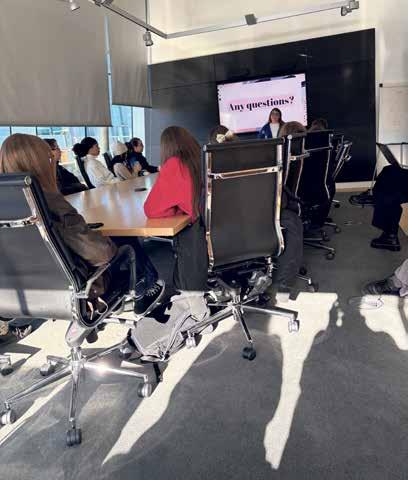
Conor Pope, and writer Conor Capplis. It was facilitated by Zara Kearney, who is a Human Resources graduate for the Irish Times. During the talks, students asked the journalists repeatedly who the most famous person they had interviewed, as well as the typical salary. Friday was the final day where two workshops were held back at the TAP offices. Eoin Connolly, the Politics Editor, discussed how one should go about interviewing politicians. Connolly’s presentation included the importance of knowing your interviewee, having a plan going into the interview, and foresight about the article being constructed; the students were then able to practice how they would conduct a politics interview. To round off the day and the program,
The University Times’ Editor gave a workshop on how to write a news article, ensuring the TAP students would walk away knowing the principles of news writing, and journalism in general. Each day saw writers and editors from The University Times engaging with the students and helping them work through any questions or issues. To end each day the students had pizza, and as the days went on the ease of working with each other and the editors grew, along with their confidence in pursuing journalism. The University Times looks forward to hosting the transition year students from the partner schools of the Trinity Access Program in the future.

from
and UCD who placed 49th. What lies behind Trinity’s consistently low scores? The answer is seemingly simple: a lack of data. In an email exchange with The University Times, Vice President of of Biodiversity and Climate Action, Jane Stout, revealed that the College so far “have not submitted sustainability metrics from Trinity”. Stout wrote that her priority in leading Trinity Sustainability over the past couple of years “has been to gather baseline data and information, develop the Sustainability Strategy and Action Plan, and focus on sustainability across a large number of educational, research, operational, community and governance issues across the whole of the university, with a huge range of students and staff colleagues”. Stout further elaborated that the team has prioritized their “obligations to report to the Irish government on Climate Action and on Education for Sustainable Development”. Elaborating specifically on University Rankings as a concept, Stout expressed that “Although the rankings are commonly used by people to compare universities, they are not necessarily a true reflection of what’s going on”. Stout continued to question the consistency of rankings in

general, highlighting how ‘different agencies can produce conflicting outcomes’. Norah Campbell, who helped develop, and now teaches, the mandatory first year business module ‘Enacting Education for Sustainable Development’, echoes Stout’s criticism of university rankings in general. Focusing on the QS Sustainability Rankings, Campbell highlighted how the rankings never count what an institution is “doing less of’, thereby furthering the idea of growth as the only measure for suc-
cess - a notion that seems paradoxical in a sustainability ranking. She also emphasized how the rankings are, first and foremost, a business, and that the sustainability rankings are not driven by a desire to make universities more accountable, but rather to create another subcategory of measurement for them to own. Trinity’s prioritization, however, seems to work against the very nature of how rankings are received and interpreted. While reasonable doubt can be, and has been, cast on the quality and intentions of
university rankings, their position as cultural institutions of signification is hard to deny. In a New York Times article, Alan Blinder highlights that rankings have become a central part of how families evaluate schools. Interviewing Jonathan Henry, vice president at the University of Maine at Augusta, Blinder writes that “The Amazonification of how we judge a product’s quality,’ he [Henry] said, has infiltrated higher education, as consumers and prospective students alike seek order from chaos”. In an information chaos where one source seems just as qualified or unqualified as any else, rankings provide condensed signposts that are just as meaningful as they are commercialized. “You can’t ignore the leviathan that they [rankings]
biases within their grading systems, the fact that they are provided and maintained by for-profit corporations, or even minor corruption scandals. Trinity is an example of an institution, that despite its consistently successful student-body, has fallen victim to overgeneralised metrication.
Trinity is one of the seven “ancient universities” of the world, the sister college to Cambridge and Oxford, and has cemented itself in history for having fostered great minds including Jonathan Swift, Ernest Walton, Oscar Wilde, and more recently the likes of William Cam-
pella. Trinity has been in the inner circle of prestigious academia for centuries and has thrived under this reputation. This is not least reflected in visits by global leaders such as Joe Biden and Angela Merkel and events such as the annual Ambassadors’ Ball. Trinity is a household name. Unfortunately, today it seems as though this image is deteriorating. In this day and age, academic prestige has been reduced to oversimplified, forcefully quantified statistics; a system that unfairly undermines Trinity’s rich legacy of sophistication and academic excellence. QS and Times heavily emphasise “research impact,” often measured through citation counts and publication frequency, which is not necessarily one of Trinity’s strengths. This system disproportionately favours larger institutions with extensive resources focusing on high-output research disciplines and typically specialising in math and science. Trinity’s research, while impactful, might not match the sheer output of larger universities with more funding and emphasis on publishing, even if they achieve exceptional results per euro spent. Research impact is a large factor in the ranking methodologies of
both QS and Times. This rates an institution’s research capabilities by combining various factors, including papers per faculty, citations per paper and research funds. While Trinity produces valuable research, including, for example, a recent breakthrough in gene therapy for eye disease, it is unfavorable to compare its approach to those of institutions backed by large corporations. The extent of corporate backing differs at Trinity, as, unlike its American counterparts, financial success is not its core mission. Ranking systems fail to take these nuanced differences into account. As a result, research rankings have become a disproportionate comparison of funding, posing the question whether universities should be rewarded for being run like businesses. In addition to “research impact,” both QS and Times ranking methodologies include employer reputation surveys. These surveys are often more favorable to
clinical rooms were courtrooms, the exam table covered in its crinkly white paper, my witness stand. Before I could fully explain my symptoms, the unspoken verdicts—‘hypochondriac’ or ‘liar’—had already been written in the clinician’s gaze. There were many moments when it all became too overwhelming. Once, after being interrupted and curtly dismissed by my doctor, broke down in the examination room when he left. Hearing me, several junior doctors came into the room. I pleaded with them, “Something clearly is happening to my body. Someone, please help me…” One of them leaned in and said quietly to me, “I shouldn’t be telling you this, but Dr. — has no idea what to do with your case. He is being unkind to you because he hasn’t seen anything like your symptoms before.”
Diagnosis:
nutritionists—searching for answers. I tried numerous medications for the various symptoms, some with dire side effects. My life seemed to narrow to waiting rooms and pharmacy lines. Eventually, my symptoms forced me to drop out of graduate school. Appointment fees and medication costs erased my savings and made my financial situation extremely precarious. was afraid of losing my job because of missing so much time for appointments and recurrent illness. Many of the doctors appointments had felt like trials. The cold,
So, this gray November morning, had low expectations for this visit. Though had fought to see this rheumatologist—spending hours waiting on hospital phone lines and getting scores of blood and genetic tests done in advance—I fully expected to be dismissed again. But today was different. This doctor was kind and calm and listened to my list of symptoms without interruption. I could see how seriously she was taking my case. When I finished, she began asking questions. “Have you ever…? When did… start? Do you experience…?”
could see the wheels turning in her head. After listening carefully to my responses and reviewing my file, she turned to me and said the words that have changed my life:
“It is most likely that you have something called Behçet’s Disease.”
Behçet’s Disease: Behçet’s disease is a rare, chronic autoimmune disorder that causes inflammation in blood vessels throughout the body. It commonly presents with symptoms such as painful ulcers, eye inflammation (uveitis), and skin lesions, but it can also affect joints, the nervous system, and major organs. Its most serious manifestations can result in blindness, stroke, or even death. The exact cause is unknown, but it’s believed to involve abnormal immune responses, possibly brought about by genetic and environmental factors. Though exact figures are difficult to determine because of misdiagnosis and regional differences, Behçet’s Disease affects approximately in 100,000 people worldwide.
Life Now:
So now, a little over a year from receiving a diagnosis, I am a Masters student here at Trinity studying International Peace Studies. am married to a wonderful man from Newbridge, Co. Kildare who met while living in Boston. Since moving to Ireland, I have been lucky to receive wonderful medical care from the Rheumatology Department at The Mater Misericordiae Hospital here in Dublin. agonized over my capacity to return to school and finish my graduate studies. However, I decided that wasn’t going to let my illness prevent me from pursuing my goals.
Though medication helps moderate some of the symptoms, there currently is no cure for Behçet’s Disease. Some days are very hard
and continue to navigate the unpredictable nature of the condition.
I am particularly afraid of losing my sight. On days where that fear overwhelms me, turn to meditation or exercise to find calm.
Accepting the need for help and extra time on assignments has been a challenge, but I’ve worked hard to untangle my self-worth from productivity. On difficult days, remind myself that simply making it through is enough. Since starting my degree, Trinity has been very supportive. The disAbility Service has been a wonderful resource and the options they provide, including on-campus respite rooms and deadline flexibility, have been instrumental in allowing me to still function academically.
My professors and friends in my program have been a wonderful support. Music is also a comfort and I joined the Trinity College Singers in September.
Rare Disease Awareness: wanted to share my story because there is a dire need for Rare Disease Awareness. When was first diagnosed, reading the stories of others helped me understand that I wasn’t alone. Others were managing rare conditions, as well. Over 300 million people live with a rare disease worldwide. Around 6,000 different Rare Diseases have been identified, affecting 3.5% – 5.9% of the global population. Some estimates say there could be as many as 280,000 people living with these conditions in Ireland.
Living with a Rare Disease is a unique challenge. It often means navigating a medical maze of misdiagnoses, skepticism, and a lack
of clear treatment options. Because of the small number of patients affected by each condition, attracting research funds for Rare Diseases is exceedingly difficult. The invisible nature of many of these conditions can make it difficult for others to understand how life-altering they can be. Rare diseases don’t just affect the body—they alter relationships, careers, and mental well-being. Their unique challenges, variable and ever-changing, often leave patients with a sense of profound isolation. Now, having been to several Behçet’s conferences and spoken to others with the condition, I know there is clearly an urgent need within medicine for adjustment. Healthcare needs to be more inclusive of difference and more patient-centered. Every patient should be listened to. No one suffering should ever face the silencing or skepticism that so many of us with rare conditions have. assure you, we can put into words—better than anyone else— what we are experiencing in our own bodies. Our symptoms are real and we deserve to be heard. A little kindness:

I remember hospital staff were putting up a Christmas tree in the lobby when I called my husband to tell him the news. was shaking and unsteady on my feet, but was able to tell him how kind my doctor had been. She had been so gentle and reassuring and said, “I can only imagine how much you’ve been through to get to this appointment today. Now, you know what’s been happening all these years. Its not going to be easy, but you can move on from everything that has happened in the past. It all starts over now.” Her kindness and consideration changed my life. She listened to me. She believed me. Rare Disease Day is observed on the last day of February each year.
Molly Wetsch
For Aubrey McCarthy, most problems to be solved by the government should start with housing.
This was certainly the focus of the conversation when McCarthy, winner of one of three Trinity seats in the upcoming Seanad Éireann election, spoke with the University Times ahead of the vote.
McCarthy, who is from Kildare, attended Trinity first to receive a Bachelor of Science in Management, then later for a Masters in Business Administration and Management. McCarthy founded Tiglin in 2008, a charity which works with those struggling with addiction and homelessness, among other issues. McCarthy says his experience on the ground with disadvantaged people has given him a practical approach to government which he’d bring to the Seanad.
“The idea behind setting up Tiglin was to try and make a difference,” McCarthy said. “I have always been very practical– that if an older woman falls across the road, you don’t look for policies or procedures or campaigns in order to pick her up. You go over and you pick her up.”
How McCarthy’s run Tiglin for the past 15 years has extended to how he ran his Seanad campaign, McCarthy said. Many of the influential people behind his campaign began as patrons of Tiglin.
“If you look at my campaign today, even the people that are printing the leaflets, the people that are looking after my website, they’re all people that I met on the streets. They’re all people that would’ve helped out and now they’re the ones that are telling me what to do,” McCarthy
said. “So if anything, I’m a great talent spotter. I can spot people that have hidden potential.” McCarthy also discussed the recent

hIad
Cad é a Ról i Saol na Gaeilge ar an gCampas?
Rannóg an Aistriúcháin
AMLCT: cé hiad agus cad é a ról i saol na Gaeilge ar an gcampas Labhraíonn an tOifigeach Gaeilge (Pádraig Mac Brádaigh) agus Abigail Ní Mhuircheartaigh (ball den choiste, iníon léinn leann na hEorpa) faoin fochoiste nua, Rannóg an Aistriúcháin.
Ar an 5ú lá de mhí Nollaig 2024 d’oscail Aontas na Mac Léinn (AML) iarratais d’aistritheoirí le haghaidh Rannóg an Aistriúcháin (RA). De réir an fógra, roghnófar cúigear mac léinn bunaithe ar na scileanna seo a leanas: ardchaighdeán Gaeilge scríofa, tuiscint maith ar conas foclóir eagsúla a úsáid agus más coimthéacs néamfhoirmeálta nó fhoirméalta i
gceist, agus cumas spriocdhátaí a bhaint amach. Ina theannta sin, post íoctha atá gceist le cúig cent in aghaidh an fhocail leis na haisthreoirí. Oibríonn an RA go dlúth leis an tOifigeach Gaeilge, cosúil leis an Coiste Gaeilge AML a bhí ag feidhmiú an bhliain seo chaite. Is mar chuid den straitéis chumarsáide dátheangach mar a luaitear bhforógra an tOifigeach tofa. Cuireadh tús leis an obair aistriúcháin mbliana ar an 13ú lá de mhí Eanair. Thuairiscigh Abigail an obair atá déanta acu go dtí seo ná ag aistriú rudaí a bhaineann leis an Reifreann a bhí ar siúil an tseachtain seo chaite. Déanann Pádraig aistriúchán ar an ríomhphost seachtainiúil.
Chomh maith le seo, beidh an fhoireann ag aistriú forógraí na n-iarrthóirí ag druidim dtreo an toghcháin sabóideach. De réir Sceideal 3:9*, tá béim cúrtha ar fheachtais dátheangaigh agus tá seirbhísí aistriúcháin ar fháil más gá. Chun tuiscint níos fearr a fháil ar an Rannóg an Aistriúcháin, labhair mé le Pádraig agus Abigail agus chuir mé na ceisteanna seo orthu: Cén fáth ar cruthaíodh an Rannóg an Aistriúchán? Dúirt Pádraig go gcruthaíodh é “le dul i ngleic le líon ollmhór na gcáipéisí a chaithfidh a bheith ar fáil nGaeilge de bharr na rialachán Sceideal 11 den Bhunreacht agus de bharr 1.4 sa Bhunreacht a mhaíonn go gcaithfear
caitheamh leis an dá theanga go hiomlán mar an gcéanna.” Áfach, bhí fáth pearsanta ann do Phádraig freisin, “níl an t-am ag Oifigeach na Gaeilge gach rud a aistriú agus níor chóir dó ach an oiread le gur féidir leis a chuid ama a chaitheamh ar bheartas an Aontais agus na hollscoile leith na teanga. Tá níos mó ama agam anois bualadh leis an lucht riaracháin agus Rannóg an Aistriúcháin ar an bhfód.” Athdhearbhaigh Abigail tábhacht an ról chun an ualach a roinnt, “tá níos lú brú ar Phádraig agus níos mó ama aige a chur isteach ar an gcolaiste & ionadú don Ghaeilge.” “Léiríonn an Rannóg an Aistriúchán go bhfuil an aontas ag fáil tacaíocht agus ag éirí níos láidire ó thaobh na Gaeilge de.” An aontaíonn
Felice Basbøll
Last week, after the legal case brought to the Residential Tenancy Board by former TCDSU President László Molnárfi was upheld on appeal, Trinity’s needlessly bureaucratic and fundamentally anti-fun overnight guest policy was finally amended. Rejoice! – students can now sign in last-minute guests past midnight in College-run accommodation. Not only does this leave residents free to enjoy their one-night-stands in peace instead of having to un-sexily resign themselves to the childhood bedrooms of their alien lovers; this case leaves a legal precedent for students to fight back against overbearing accommodation providers. This is a victory for sexual freedom for students across the country, but the paternalistic rot that underpins it runs deep. The battle for sexual freedom on campus has a long history. Ever since women were finally permitted to enter universities, sexual tensions –now no longer only experienced by the homosexually inclined – have been a reliable feature of academic life. Famous and sometimes complicated flings between intellectual giants like Arendt and Heidegger speak to the longstanding erotic passions of those who pursue their scholarly vocation. The 28 boxes worth of documents and correspondence in the Trinity Women Graduate Archive hold stories from our own past – perhaps including a few notes slipped across aisles in lecture theatres or some signs of broken curfew rules. Universities, however, have generally been prudish and restrictive, mostly to the detriment of more sexually liberal women. In Trinity, women were barred from College accommodation and had to leave the grounds by 6 pm – apparently, even mixed dinners were too much for the male Trinity dons to handle. But sexual self-determination was never going to be given up without a fight. In this respect, the 60s was the decade of women’s freedom. On campuses across the West, women campaigned against the curfews that kept them in their dorms while their male counterparts enjoyed the promiscuous, drug-infused, and morally dubious nightlife that also characterised the decade. Students fundamentally rejected the “in loco parentis” ethos of the university, which still fancied itself a benevolent patriarchal figure, protecting its college community from the frightening world beyond its ancient walls. Students who had embraced their youthful penchant for risk and caught a liking for that
or
big bad world fought for their freedom – and were largely victorious. However, by the 90s, things were slowly changing. The 60s student activists of the Boomer generation had grown up and embraced the comfortably middle-class lifestyles that we know them for now. Gen X were not so politically inclined, and over the course of the later decade, the anti-paternalistic ethos of the likes of Katie Roiphe and Camille Paglia in the US was –after a glorious culture war – overwhelmingly stamped out within the universities. These writers recognised the return of sexual repression in the expanding consumerist bureaucracy which couched its expansive infringements on the private lives of students in protective concern. Now, however, we are left with only their polemical writings as a memorable, and ultimately tragic, premonition of a road not taken.
This sad reality is reflected in the ever-expanding list of policy documents that now populate the websites of any supposedly self-respecting institution, even when the professed pseudo-Victorian virtues scarcely match the inclinations of their student bodies. Of course Trinity’s gender-neutral, anti-promiscuity curfew was more “politically correct”, but it springs from the same well-meaning concern of the middle-aged bureaucrat who has seemingly forgotten the pure pleasure (and sometimes pain) of their own student dalliances. Of course, these policies are rarely enforced. But their mere existence reveals the hidden arbitrary power which has no regard for the
of its


