
Clear Leaders In All But Two Races
The most contested races, Welfare & Equality and Comms & Marketing, are set for a close finish on Thursday.Alex Payne ASSISTANT EDITOR
The University Times Sabbatical Elections 2024 poll was conducted over a five-day period from Tuesday 20th to Saturday 24th February. Receiving 274 responses, representative of approximately 1.3 per cent of the student population or approximately 10 per cent of the average turnout per year in the sabbatical elections, The University Times poll reveals that all but two of the six races polled are likely to be decided on the first count.
The election is run by the single transferable vote system, meaning that, in the event of a tight race on the first count, candidates not reaching the quota for a potential win will be eliminated and their votes will be redistributed to the candidate who was voted next in preference on each ballot. This process will continue until a winner is found. The calculation used to define the quota often determines that, on the first count, a candidate needs to secure just over 50 per cent of first-preference votes to win.
On the first count, the poll suggests that next year’s Trinity
“The two most contested races with three
candidates in each,
are the most likely to require at
least one candidate to be eliminated for a winner to be declared.
College Dublin Students’ Union (TCDSU) President will be Jenny Maguire, the Education Officer will be Eoghan Gilroy, the Ents Officer will be Peadar Walsh and The University Times (UT) Editor will be Charlie Hastings. Out of these, the race for UT Editor is most likely to go to a second round of counting, with Charlie Hastings securing 53 per cent of first-preference votes.
The races for Welfare and Equality and Comms and Marketing Officers, the two most contested races with three candidates in each, are the most likely to require at least one candidate to be eliminated for a winner to be declared.
In the race for Welfare & Equality Officer, Hamza Bana received 49 per cent of first-preference votes. They will likely win following the distribution of eliminated candidates’ votes, due a strong second-preference vote for Bana amongst those who voted to Reopen nominations (RON) and, if needed, Nathan Harrington as first-preference.
The race for Comms and Marketing Officer is likely to require more vote redistribution than the race for Welfare & Equality, with Beth Strahan receiving the most first-preference votes with 42 per cent, followed by Connor Dempsey with 31 per cent. With the RON vote accounting for five per cent of all votes, it is unlikely to have any effect upon redistribution, meaning the redistribution of Murnane’s 22 per cent of first-preference votes will decide the race.
Out of Murnane’s first-preference votes, Dempsey receives more second-preference votes than Beth Strahan, indicating this may be the closest race of the TCDSU 2024 Sabbatical Elections.
If the race for UT Editor needs RON to be eliminated for a winner to be called, the votes for Hastings as second-preference amongst the redistributed votes of RON indicates he will win the election.
Voter Demographics: Junior Fresh Vote Carries Potential to Change Election Outcomes
The University Times poll asked respondents their academic year, faculty association, gender, if they were an international student, if they were a mature student and whether they had ever held a position within the TCDSU.
The poll reveals that 97 per cent of respondents are undergraduates. The greatest proportion are Senior Sophister students at 37 per cent. The proportion decreases in order of academic year, with Junior Freshman making up 11 per cent of respondents. However, postgraduates and 5th year students have the smallest proportions, with three per cent and two per cent respectively.
Due to drop-out rates and fail-
ures to progress, there are generally more Junior Fresh students than Senior Sophister. Amongst Junior Fresh students there is a stronger preference for Sé Ó hEidhin as Education Officer, Hannah McAuley as Welfare and Equality Officer, Sarah Murnane as Comms and Marketing Officer and Brídín Ní Fhearraigh-Joyce as University Times Editor than any other candidate.
Unlikely, however, to affect the Education and Comms and Marketing Officer races, if Junior Fresh students turn out to vote in more representative numbers McAuley for Welfare and Equality and Ní FhearraighJoyce for UT Editor may receive a much needed boost in
support needed to threaten Bana and Hastings respectively.
75 per cent of respondents are from the Faculty of Arts, Humanities and Social Sciences (AHSS), 19 per cent are from the Faculty of Engineering, Maths and Science (EMS) and 6 per cent are from the Faculty of Health Sciences (HS). This distribution is somewhat unrepresentative of the undergraduate student body. In the year 2021/22, out of 13,565 undergraduate students, 46 per cent were AHSS, 37 per cent EMS and 17 per cent HS students. If voter turnout is more representative in terms of Faculty as-
Monday 26 February, 2024
CONTINUED ON PAGE 3 »
PHOTO
BY BRIDGET MCBRUISER FOR THE UNIVERSITY TIMES
Presidential Hopeful Ralph Balfe Promotes “Very Serious” Policies in Ambitious Campaign
Alex Payne ASSISTANT EDITORStep up Ralph (pronounced ‘Rafe’) Balfe, running to be the next President of the Trinity College Dublin Students’ Union (TCDSU). The Psychoanalytic Studies M.Phil. student, described by his mum as “rather handsome” (see manifesto), is running his campaign with the tagline: “Education, Education, Ban the Tourists.” Who is he? What does he stand for? Is there any sincerity to the motivation behind a campaign that promises to replace the Campanile with a 1:1 replica of the Burj Khalifa?
A quick search on Instagram pre-interview and one finds an account named @ralph.balfe with six posts and 112 followers. Most of the posts show Ralph performing stand-up comedy. One advertises a TrinityFM show on Wednesday nights talking about comedy. Another shows Balfe delivering his new year’s resolution in a menacing Scottish accent: “My new year’s resolution is to get seagulls to do my bidding through hypnosis…I’m hoping I can get them to shit all over my ex-girlfriend’s new boyfriend Craig. I fucking hate Craig.”
His intended use of seagulls is perhaps best not encouraged, but some control over the campus seabird population is surely a missed manifesto pledge that would have resonated with students who have suffered at the hands, or beaks, of the ever-hungry airborne nuisances.
With a self-professed “humble desire” to go down as “the greatest student to have ever graced” Trinity’s halls, he has produced a manifesto that covers a vast range of enterprising pledges that reveal a willingness to go the extra mile in his aim to “radically alter the course of the future of this college”.
Not to mention enlisting the Dubai Royal Family to sponsor building the replica of the world’s tallest building, Balfe also promises to construct a Book of Kells World theme park, comprising a Resurrection Rollercoaster which lasts for three days, a Hagiography Hotel with a Mother Theresa day
care centre and a Conor McGregor go-kart track. His dismissive attitude to the current promotion of the Book of Kells on campus can be seen on his manifesto where he displays a double middle-fingered salute to the new Book of Kells Experience.
If he is elected, expect to find corporate sponsorships aplenty on campus. Notable mentions include the Coca-Cola Old Library, the Cadbury’s Chapel – “because there’s a glass-and-a-half full of Christ’s velvety blood in everyone” – the Nestlé School of Midwifery and twelve giant sequoias on the cricket pitch, costing an expected €700 million – “but we can all chip in with the digging”, adding to the Burj Khalifa-shaped shadow cast over the cobblestones and brickwork.
Critics may argue that Balfe is overreaching, but who are we, students after radical change in our experience of College, to temper ambition?
Beneath his aspirations lies a mind keen to the issues Trinity faces in its provision of a fulfilling and productive experience to students: “What is university really about? Is it about education, or is it about tourism and profit? I think it should be about education.”
Balfe describes Trinity’s courses as currently “pretty mediocre”, explaining through a familial anec-
“
I think having watched, you know, ‘big-boy’ politics for a while now, I’ve learnt that there is no contradiction between accepting unquestioned donations and sponsorships and outwardly holding policy positions and stances that conflict with those donations.

dote that if you were to place yourself as the parents of this college you might “not be that worried about their exams… but are they going to win a Nobel Peace Prize? Are they going to grow up and win an Oscar? Are they going to grow up and be happy? I’d have some worries”.
Self-described in his manifesto as “aware of what is going on most of the time”, Balfe sought to highlight his concerns over student life, namely high rents and living conditions, and elucidated the motivation behind his “flagship policy” of banning tourists.
“Let me paint you a picture”, he began. “I wait 15 minutes to enter Front Gate because there’s a continuous stream of school kids from all over Europe… this is silly.” He decided to “barge through” the throngs only to find himself unable to see the “beautiful” campus through the cloud of selfie sticks in the air. “This doesn’t really feel like a quiet, calm place of learning so far”, he observed.
Balfe then proceeded to wait in the queue for an hour at the Perch café “behind a Japanese man fumbling for change”. Coffee-in-hand he then comes across some “English lads bumbling along” and delivers a stinging impression of the well-known obnoxious British lad: “Oh, mate, mate, how you doing man? Oh, I’ve heard there’s a pub on campus… where’s the fucking pub night?”
This inspired the thought that “something has got to change” as Balfe, confronted by the aforementioned array of tourist-related obstacles, found himself “struggling to concentrate on any thoughts even bordering on academic here”.
This year the TCDSU has twice
notebook to remember. Despite this lack of awareness of the democratic arm of the Students’ Union, he was quick to highlight what he perceived as the “potentially intimidating” and “cliquey” nature of student politics. He criticised the TCDSU for “shooting themselves in the foot” in the proposed rewording of the constitution to make the Union “explicitly political”.
blockaded the Book of Kells exhibition, a popular Dublin tourist destination on campus, to highlight a perceived prioritisation of profit over students and, in conjunction with the Boycott, Divestment and Sanctions (BDS) group, has staged multiple protests against College’s corporate sponsorships and stance on the Israel-Gaza conflict.
Asked about his opinion on activism and, as per his manifesto, “welcoming corporate funding and unquestioned corporate sponsorship” – an opinion seemingly at odds with student movements this year – Balfe said: “I think having watched, you know, ‘big-boy’ politics for a while now, I’ve learnt that there is no contradiction between accepting unquestioned donations and sponsorships and outwardly holding policy positions and stances that conflict with those donations.”
“I say ‘give us all the money’, we don’t care where it comes from”. Asked whether this represented a stance of realism that students needed to adopt, he replied: “Call it what you want.”
This seemingly nonchalant attitude to public perception prompted a discussion about how he saw his own campaign and himself in relation to his opponent in the presidential race, Jenny Maguire.
A democratic function of the TCDSU President’s role is to partake closely in the activities of council, the representative body of students that vote on motions intended to change student life and encourage College governance to support the wishes of the student body.
Balfe admitted that the term ‘student council’ was “new” to him and had to write it down in his
He does however agree with what he sees as current TCDSU President László Molnárfi’s stance of Marxism, but he wants to take this “even further” in adopting “Marxist Leninist Maoism”. “If you have a real understanding of what it is all about, which I don’t, you know that it is an incredibly broad church, which basically is just a label meaning ‘good vibes’,” he said.
This desire for ‘broad-church’ inclusivity is seen in his vision for future meetings of student Ccouncil. He envisages engaging students in politics through meetings in pubs and nightclubs, though “not to promote a drinking culture”, so would also encourage group walks up the Wicklow Mountains.
The ‘good vibes’ to his tenure would be marked by a fervent celebration should he win: “I would hold a huge blowout party on campus. And then I would host the first of my weekly Chem-sex raves in the Provost’s house – but not Linda Doyle’s personal home, that would be hugely inappropriate.”
Balfe also wanted to highlight his experience as a postgraduate and his empathy towards the plights of postgraduate workers. He pointed to the now-defunct GSU’s previous cash troubles when they were, according to Balfe, “apparently giving out money willy nilly”. “I’d bring that back”, he said.
For “basically any reason” he’d happily “chuck anyone €50”, and would be able to do so through generating an “income stream of, I expect, several billion euros in year one” due to his manifesto pledges of encouraging corporate sponsorship and ticket sales from the Book of Kells World theme park.
At the end of his interview he also had one final, previously unannounced manifesto pledge - to set up a paywall for access to The University Times, “because that’s what happens with the best journalism”.
2 TCDSU ELECTIONS 2024 THE UNIVERSITY TIMES MONDAY 26 FEBRUARY, 2024
PHOTO BY BRIDGET MCBRUISER FOR THE UNIVERSITY TIMES
VOTER DEMOGRAPHICS I
«
sociation, Hannah McAuley for Welfare & Equality may receive a boost in support from EMS and HS students, but candidate preference is roughly the same across all faculties or any differences in preference are not in races that are indicated to be tight.
Respondents’ answers to the questions of gender, international status and mature student status are approximately representative of the student body. Therefore, if voter turnout is representative of the student body according to these metrics no significant change is expected.
Jenny Maguire for President, Hamza Bana for Welfare & Equality, Connor Dempsey for Comms & Marketing and Brídín Ni Fhearraigh-Joyce all receive strong support from respondents that identify as either non-binary or would prefer not to say their gender.
Nathan Harrington’s most popular preference by female respondents was fourth (after RON), and Jenny Maguire received almost the entire female vote. Charlie Hastings received most of male first-preference votes in the race for UT Editor, with the female vote more evenly split. In the other races the gender of voters is less statistically significant, if at all.
Within the 24 per cent of respondents who said they had, at some point, held a position within the TCDSU, there is a strong preference for Maguire, Gilroy and Hastings in their respective races. There is a more equal distribution of votes from current or former TCDSU position holders between Bana and McAuley in the Welfare & Equality race and between Dempsey and Strahan in the Comms & Marketing Race.
n The University Times Poll, Jenny Maguire has received 82 per cent of first-preference votes, Ralph Balfe 15 per cent and RON 3 per cent. Assured of her win, Maguire is set for a lap of victory in her last week of campaigning. Although a Maguire win was never really going to be in doubt, especially in running against the irreverent Balfe, nothing should be taken away from her campaign and the sentiment behind it, well-founded in both on- and off-campus activity.
The English Studies student has consistently been at the forefront of student politics during her four years at Trinity, and has used this experience to bring a wealth of knowledge to her campaign “to make college work”. The poll indicates there are no sections of the college community in which she lacks support and she may even gain support as students realise there is no hope for Balfe come voting time.
As this has been considered by many to be a walkover from the beginning, the real anticipation of the campaign has been the potential of chuckle-inducing exchanges between the co-runner of Trinity’s Improv comedy group, Improv She Wrote, and her stand-up comedian opponent Ralph (pronounced ‘Rafe’) Balfe.
Preceding any interchanges, however, election-watchers knew they were in for a spectacle with Balfe upon release of his manifesto and interviews with both The University Times and Trinity News. His manifesto, somewhat toned down compared to his interviews, includes pledges to replace the Campanile with a 1:1 replica of the Burj Khalifa, ban all tourists on campus and build a Book of Kells World theme park in North Dublin where tourists can “fuck off” to.
In his interview with Trinity News, Balfe disclosed that, if he wins, he plans to take Trinity’s Provost Linda Doyle out for dinner to foster an “amicable relationship”. He went one further in his interview with The University Times, promising to hold “the first of my weekly chemsex raves in the Provost’s house” upon his wished-for crowning as TCDSU President.
Balfe also plans to hire a personal entourage to solve the post-
President: Maguire set for landslide victory
15%
Ralph Balfe
3% Re-open nominations

82% Jenny Maguire
graduate workers’ crisis, should he win, including a team of secretaries – “hot blondes preferable”. In reference to his opponent, he exalted the benefits of expected losers forcing an expected winner to keep the eye on the ball during any election race, saying he was “glad” that Maguire was going “to perform that role for me”.
Come the Dining Hall Hustings, their comedic rapport was quickly established. Having previously described Maguire’s Improv career as “lame” in his campaign video, Balfe doubled down and labelled it “incredibly cringey” in front of an expectant crowd. Maguire, however, matching Balfe’s irreverence in a self-effacing manner, exclaimed upon taking the microphone from
After a controversial campaign and following a protest by Empower the Voice, Nathan Harrington has almost no support from female voters.
her competitor: “He’s got my vote!”
As they took to the stage at the Equality and Council Hustings, both seemed eager to have their opinions heard. One of Balfe’s manifesto pledges is to institute all of his opponent’s pledges, so he was asked which of them he preferred most. He began by calling Maguire’s manifesto “brilliant… perhaps the best I have ever seen”, before saying: “Then I looked at my own, and remembered, mine is.” This was met by a round of applause from Maguire and a shout from the crowd: “Let him cook!”
The candidates’ camaraderie was most evident at the Piranha Hustings where they wore each other’s campaign T-shirts. At one point, Balfe also held the microphone for Maguire whilst she answered questions from Trinity’s satirical magazine. Maguire then defended Balfe from a heckler, UT Editor candidate Brídín Ní Fhearraigh-Joyce, who branded him “boring”. Maguire rebuked her by implying that her own performance wasn’t exactly scintillating.
In spite of Balfe’s intentions to bring some comedy to the race for TCDSU President, Maguire more than held her own when it came to giving the audience something to laugh about. She consistently used her opponents own comedic attempts to her favour whilst delivering impassioned rhetoric concerning the finer details of her campaign centred around representation and student engagement.
Jenny Maguire will rightly be elected as the next student to lead the TCDSU against some of the most significant challenges student communities have faced in recent times, including a worsening cost-of-living crisis and a College that is under severe financial pressure.
TCDSU ELECTIONS 2024 3 THE UNIVERSITY TIMES MONDAY 26 FEBRUARY, 2024
Balfe should also be celebrated for his jovial and in-good-faith approach to student election campaigning. If anything, he has proved to those who see student politics as unapproachable and overly sincere, that it’s okay to have a bit of fun. CONTINUED FROM PAGE 1
“My Existence is Political”: Jenny Maguire on Raising her Voice for Change
Sáoirse Goes
DEPUTY EDITORPresidential candidate Jenny Maguire is no stranger to activism. Co-organiser of Trans and Intersex Pride Dublin, previous TCDSU LGBTQ+ Rights Officer and Gender Equality Officer, Maguire has established herself as a forerunner of the student movement over the four years she has spent in Trinity. It is on this basis that the 22-year-old English Studies student from Artane is running to be the next TCDSU President. In an interview with The University Times, Maguire reflects on her campaign, the state of the Union and her plans to change it.
Maguire believes that she brings “a very unique perspective” to the Union. Having had to take a year out and repeat another year of her degree, all while working and medically transitioning, Maguire says: “College hasn’t really worked for me, but I want to make it work for as many people as I can, and I think I’m the best person for it.”
Citing her experience campaigning, she notes, “I not only bring perspective, but I also bring the experience to go with it”.
Recalling her personal experience in the second year of her course, Maguire remembers “I suffered a major mental health difficulty”. Resorting to college counselling, she was told that they could not help her, suggesting she seek “long-term help”. She notes that this is not a unique experience, “we hear these stories all the time”, she says. She intends to use this experience to make her voice “front and centre and unignorable”, explaining that “it’s very easy to ignore statistics or quotes off a page, but when I’m standing right in front of you, that experience is invaluable”.
Maguire considers herself a socialist, and “unapologetically left-wing”. “I’m not an ideologue”, she says, “I’m someone that has lived”. She describes attending a DEIS school, growing up in a single-parent household and having briefly experienced homelessness as a child, asserting “I bring that grounded perspective that I think
is often missing, not just on the Union, but in broader leftist spaces”. She stresses the importance of honing these experiences in the fight for housing and for workers’ rights on campus, for both students and staff.
Maguire’s manifesto is based around the three priorities of student workers, housing and postgraduates. In terms of workers’ rights, she cites the 2023 Housing Survey, which showed that 40 per cent of students work, and 49 per cent students work to pay their rent. In light of this high figure, Maguire criticises College’s response of refusing “to even acknowledge that students need to work and they’re being punished because they have a job”. Maguire plans to introduce a “radical” working students’ policy, explaining that “it’s quite a big undertaking… it’s never really been done before”.
In terms of housing, Maguire plans to create a representative structure in private accommodations and accommodations owned by Trinity. These models would provide, according to Maguire, “an extra voice for students”. She continues, asserting that “I think having an actual voice to advocate for you is beyond useful”. She believes that this will be an easy initiative to set up, but anticipates the challenge lying ahead in maintaining it. She stresses, “I really want to commit to that”. In terms of housing policy, Maguire acknowledges that “It’s very hard coming up against a government that doesn’t respect or value the rights to housing that everyone”. Nevertheless, she plans on growing the Renters’ Solidarity Network and training “on-theground grassroots housing activists through CATU”, having already contacted the organisation along with the Radical Housing League to enact change on a national level.
Although she admits that “I don’t know anyone in my life, from my world experience, that is a postgrad”, Maguire has met with the president of the Postgraduate Workers’ Organisation Ireland (PWO Ireland) and the chair of PWO Trinity in preparation for her campaign. Though she considers herself “quite a radical candidate”, Maguire recognises “the importance of an institution

and the good that institutions can bring, as well as the grassroots”. She believes that “it’s about finding the balance” between the two, and therefore intends to prioritise “creating a working relationship between the PWO as well as any other representative structure that may show itself”, while “integrating postgrads within the current union structure”.
Maguire strongly believes in a working relationship between the TCDSU and the PWO and intends to establish a grievances policy between the two organisations. She also acknowledges the PWO’s limitations: “It doesn’t represent all postgrads, specifically taught postcards are really left behind”. Maguire plans on establishing “a medium-term plan that ensures that taught postgrads and postgrads are represented within the union”. Maguire is hyper-aware of the fact that she represents postgraduate students and that a “onesize-fits-all approach” may not be effective. She therefore proposes to see “what can work already” and “what we can improve on going forward”.
Maguire praises the union’s progress this year, saying, “I think the union has touched more students than it probably ever has in recent memory”. “It’s achieved very actionable things”, she says, through its radical approach. Touching on László Molnárfi’s term as TCDSU President, Maguire hopes to emulate “his boldness”. “I think it’s important, especially for marginalised groups or students that are being punished”, she says, “It’s a choice to be silent”. However, building on Molnárfi’s momentum, Maguire hopes to bring more creativity to the union, noting,
“I’ve always said that the left needs a stage manager”. On the other hand, she says “some grievances were displayed on a public forum that should have been solved internally”. Although she recognises that disputes in such a public fashion are sometimes inevitable, Maguire posits that these contributed to a rise of “factionalism” within the union. Maguire firmly believes that her experience in organisational roles, “whether that be (DU) Players or Trans and Intersex Pride”, affords her the “perspective in order to help resolve these things”.
When asked how she would work to ensure that dignity, respect and student welfare were prioritised within the union, amid Molnárfi’s past criticism of a culture of ‘dogpiling’ at Council, Maguire agreed with the outgoing president but acknowledged that “it’s a tricky balance” to have paid and part-time officers. She says, “I think having the responsibility and duty of care of the team is something that I will push for to help limit that dogpiling and infighting”. Maguire nevertheless stresses the importance of the social aspect of Council: “I did my first year of Council on Zoom and, oh my God, that was vicious. And then, the first Council in person, I thought, this is completely different because you go for a pint afterward.” Maguire intends to lead from a welfare-oriented and organised point of view, to “ensure that voices are nurtured and protected, instead of just an open forum for shouting at each other”.
When asked about the wait times within the college counselling service, Maguire replied, “it’s a disgrace. It’s simply unacceptable”.
In terms of the service’s lack of counsellors of colour, Maguire says “I think we should be pushing for it, even if two people go because that is a service that should exist, and it must exist because it assumes that whiteness is some sort of neutral thing”. She relates this to her own experience as a queer person: “I wish my bus driver was queer. I wish every lecturer I had was queer, because I can relate to them more and there’s a shared understanding.” This prompted her commitment to securing long-term funding for college counselling services. Maguire also proposed a short-term option in the interim of hiring counsellors. Taking inspiration from University College Dublin (UCD), who “have deals with private practices and send people there”, she suggests that this “could be a good shortterm solution” to combat “the current horrific wait times”.
Maguire plans to be “unavoidable” as President: “I want to take a table and chair from my office and sit in the Arts Block and the Hamilton and open an office in James’s.” She elaborates, “we do it during the campaign week to engage students on the ground and I want to be there as President for people to come to me with their issues”. Maguire stresses, “I want to create a face for the union that isn’t just an idea or a poster you saw”, highlighting the importance of students seeing her “actually stressed out or maybe writing some emails”.
When asked whether she thinks the union should strive to be seen as apolitical, Maguire was firm in voicing her disagreement. “My existence is political”, she says, “it’s politicised by people who would rather have me not exist, and that is a weapon”. “To politicise someone’s identity makes it taboo, it makes people uncomfortable”, she continues, “but I still have to go into every room”. Although Maguire stresses the need to “adapt to the current political climate, we shouldn’t shut up”, she says “we should even be a little louder”. “The union has always been political”, she reiterates, “how it could even be apolitical, I’m unsure… to be in an apolitical union is to just be a club of people who want to run events”.
4 TCDSU ELECTIONS 2024 THE UNIVERSITY TIMES MONDAY 26 FEBRUARY, 2024
PHOTO BY BRIDGET MCBRUISER FOR THE UNIVERSITY TIMES
Education Candidate Eoghan Gilroy Wants Communication, Clarity and Engagement
Elly Christopher JUNIOR EDITOR“Engagement, communication”, are the key words in Eoghan Gilroy’s campaign for Education Officer. He is a final year Law and Political Science student, as well as an access student, which set the scene for his first engagement with the union. In his second year, he ran for access officer, a role which he describes as “sparking his love for student politics”. After that, he moved to more education focused roles, and for the last two years served as the Arts, Humanities and Social Sciences (AHSS) Faculty Convenor. Additionally, he served as the student representative for the Undergraduate Studies Committee during the last year. Through both positions, he saw firsthand how the university has let students down, which has in turn led him to run for Education Officer.
The first point in his manifesto highlights casework. As he describes it, the primary role of the Education Officer is to get back to students. There have been countless stories about students reaching out to the union with situations that have happened to them, and not getting a response back, or not getting a response in a timely manner. For students and members of the SU it has been difficult and oftentimes frustrating to get responses back. Gilroy promises a one business day response time to emails, describing it as the “bare minimum”. The role of Education Officer is large and incredibly busy,
“
It is important to give students agency in the way their own union is run.
but that is why he is making communication and engagement the centre of his campaign. Casework “hasn’t been a priority in the past,” he explained, but “ setting a dedicated time to it will make it occur”.
Altering Trinity’s attitude towards generative AI is another pillar of Gilroy’s campaign, as he describes the college’s current attitude as “incredibly detrimental to students”. Increasingly, it has become clear that AI will be the next big thing affecting education in technology. However, for the last two years, students have been penalised for using generative AI, but there is no real school policy governing its use. Gilroy plans to work with the college to see what more can be done in pushing the school to develop policies that are more forward-thinking. “AI is an incredibly biased system”, he explained, and over the last few years lecturers talk about how AI is plagiarism, but they do not consider the other issues or benefits of it. It’s not a black and white issue, and Gilroy states that the college’s efforts need to be about teaching students how to detect issues with it, as well as how to use it properly.
The next point in his manifesto is “the big E-word”, engagement. It has been an issue within the union year in and year out. “It seems that the union’s response to [the issue of engagement] has always been, ‘oh, we’ll send out a survey and hope they get back to us’”, Gilroy describes, but this is not enough. Furthermore, although the Engagement Officer has been established, which is a step in the right direction, this push needs to be continued. Previous Education Officers that Gilroy has talked to have described the most meaningful part of the job as going out to Trinity’s different campuses and simply talking to students. Gilroy believes that this needs to be done more. “It is important to give students agency in the way their own union is run”, he explains. This, combined with increased career talks and different debates on college policies organised by the SU will get students in the door and get them engaged.
Communication is also important to improve the accountability of the Union. “Oftentimes”, Gilroy explains, “sabbats are elected and

they disappear for a year and you do not hear much about the work they are doing”. Last year he put forward a motion to call for every member of Union Forum to submit a report to council to highlight the work they were doing. He would continue to push for this, as it holds everyone accountable, especially sabbatical officers, and it also encourages more questions to be asked to the officials. “It’s about getting out of House 6 and getting out of that bubble”, he emphasised. With transparency, there becomes the opportunity for better engagement.
Another point on his manifesto involves class representatives. There has been difficulty in ensuring that each faculty is adequately represented. As AHSS Convenor, he has seen this firsthand. Largely this comes from difficulty in securing class representatives, and in poor training of these representatives. Students aren’t running in part because they don’t know about it. Freshers’ Fair is one of the only opportunities the Union has to reach out on a large scale, and because of that first year representation is relatively good, but there is a struggle to get participation from upper year students. For those representatives that do run and get elected, the training is disastrous. Gilroy proposes returning to the way training used to be: occurring
off campus, paid for, and resulting in students receiving the training to provide the support required of them.
To continue work on the Trinity Inclusive Curriculum project, Gilroy plans to meet with them on a constant basis to hear about their plans and what the Education Officer can do to best support them. “It’s an incredibly important part of Trinity and Trinity education”, he emphasised, and “has been massively helpful for Trinity and for students”.
In addition, to support students with disabilities, Gilroy states that “it’s about ensuring that supports that are meant to be there to support students actually work”. Alternative methods of lessons are often hard to get, and Blackboard is meant to be used to adapt to hidden disabilities, but often this slips through the cracks. To respond to this, Gilroy plans to meet with the Disability representatives to ensure that all issues are heard. Oftentimes, students do not want to bother professors to get the resources they need, and in fact are already supposed to have. In addition, House Six is still not an accessible place, and as Education Officer Gilroy would support the President in their efforts to make it more accessible. It is incredibly important to make the Union accessible to all students. Tying it back
to engagement, Gilroy believes that to be truly engaged, the Union needs to invite all students to council, and currently, all students can’t go. He would move Council out of the Stanley Quek, and to a more accessible venue, such as the Edmund Burke.
To him, it would mean a great deal to be elected Education Officer and be granted the opportunity for students to put their trust in what he’s been saying. “I would be honoured to be afforded this opportunity,” he stressed, “especially coming from the background that I come from, to be afforded this by my peers”.
It seems that the union’s response to [the issue of engagement] has always been, ‘oh, we’ll send out a survey and hope they get back to us’.
TCDSU ELECTIONS 2024 5 THE UNIVERSITY TIMES MONDAY 26 FEBRUARY, 2024
PHOTO BY BRIDGET MCBRUISER FOR THE UNIVERSITY TIMES
“
In The University Times poll, Eoghan Gilroy has received 60 per cent of first-preference votes, Sé Ó hEidhin 33 per cent and RON 7 per cent. Gilroy looks assured of a win, perhaps due to the broader appeal of a campaign better focused on the role’s demands concerning the education of students as opposed to Ó hEidhin’s ambitions to “abolish SU Council”.
This difference of approach was most evident during the Media Hustings, when asked how they would balance any political actions of the Union with the more directly education-related demands of the role. Ó hEidhin seemed confident that they would be able to balance both however Gilroy was keen to stress that he would “put students first and ensure that students’ voices are heard”.
As well as being elected Education Officer, the winner of this race also assumes the role of Vice President of the TCDSU. As a result, their opinions on the overall direction of the Union are important, but should not take precedence over representing the educational needs of students. Gilroy seems to have formed a campaign better suited to such an interpretation, whereas Ó hEidhin’s focus on “getting the Union to touch grass”, coupled with specific criticisms of the Union’s inner-workings, has not resonated so much with voters.
Ó hEidhin has included student-specific pledges such as creating a Working Student Status and increasing the availability of lec-
ture recordings, as well as an ambitious plan “to do a full audit of all course materials”, but these pale in comparison to the proportion of Gilroy’s campaign material that details how he plans to change student life at Trinity and engagement with the Union.
Gilroy describes Trinity’s entire assessment style as “archaic” and, not just mentioning lecture recordings, also wants to reform the accommodations given to students with respect to timetables, coursework and exams. He also wants to advocate for more continuous assessments and try to make them more tailored to respective courses.
A unique pledge of Gilroy’s manifesto is to encourage the College to face up to and develop policies concerning generative AI. He also wants to work towards making modules available through the Irish language as “Trinity needs to rectify its own colonial legacy in the suppression of the Irish language”.
At the Equality Hustings Ó hEidhin revealed his aspirations for education to be delivered in the Irish language, saying “every aspect of our lives needs to be conducted through Irish” and expressing a desire that future lawyers and doctors trained at Trinity should be able to do so through Irish.
At all Hustings, both candidates’ union experience has shone through with their awareness of how any proposed change needs to be emphasised at the various committees and subcommittees that they would partake in as Education Officer. Nevertheless, Gilroy’s attention to detail in putting forward how exactly he intends to do this has delivered stronger performances.
Education: Gilroy wins in first-count landslide
33% Sé Ó hEidhin
7% Re-open nominations

60% Eoghan Gilroy
Gilroy’s message has overall been one of positivity, centred around students’ educational needs, whereas Ó hEidhin has taken a negative stance of throwing staunch criticism towards the TCDSU.
Gilroy’s message has overall been one of positivity, centred around students’ educational needs, whereas Ó hEidhin has taken a negative stance of throwing staunch criticism towards the TCDSU alongside expressing ambitious plans for overall reform over the Education Officer’s role.
This stance has seen Ó hEidhin garner little support amongst the 24 per cent of respondents who said they had ever held a position within the TCDSU. In line with other races, those that have criticised the Union or taken a Union-heavy approach to their campaigns, namely Connor Dempsey for Comms & Marketing and Hannah McAuley for Welfare & Equality, have fallen behind their competitors that have more student-centric approaches with clearer goals and broader appeal.

Gilroy’s wide-ranging message of hope looks set to champion Ó hEidhin’s blinkered criticism of TCDSU’s functionality.
6 TCDSU ELECTIONS 2024 THE UNIVERSITY TIMES MONDAY 26 FEBRUARY, 2024
“
PHOTO BY BRIDGET MCBRUISER FOR THE UNIVERSITY TIMES
Sé Ó hEidhin Will “Burn the Entire Union Down” in Order to Fix It
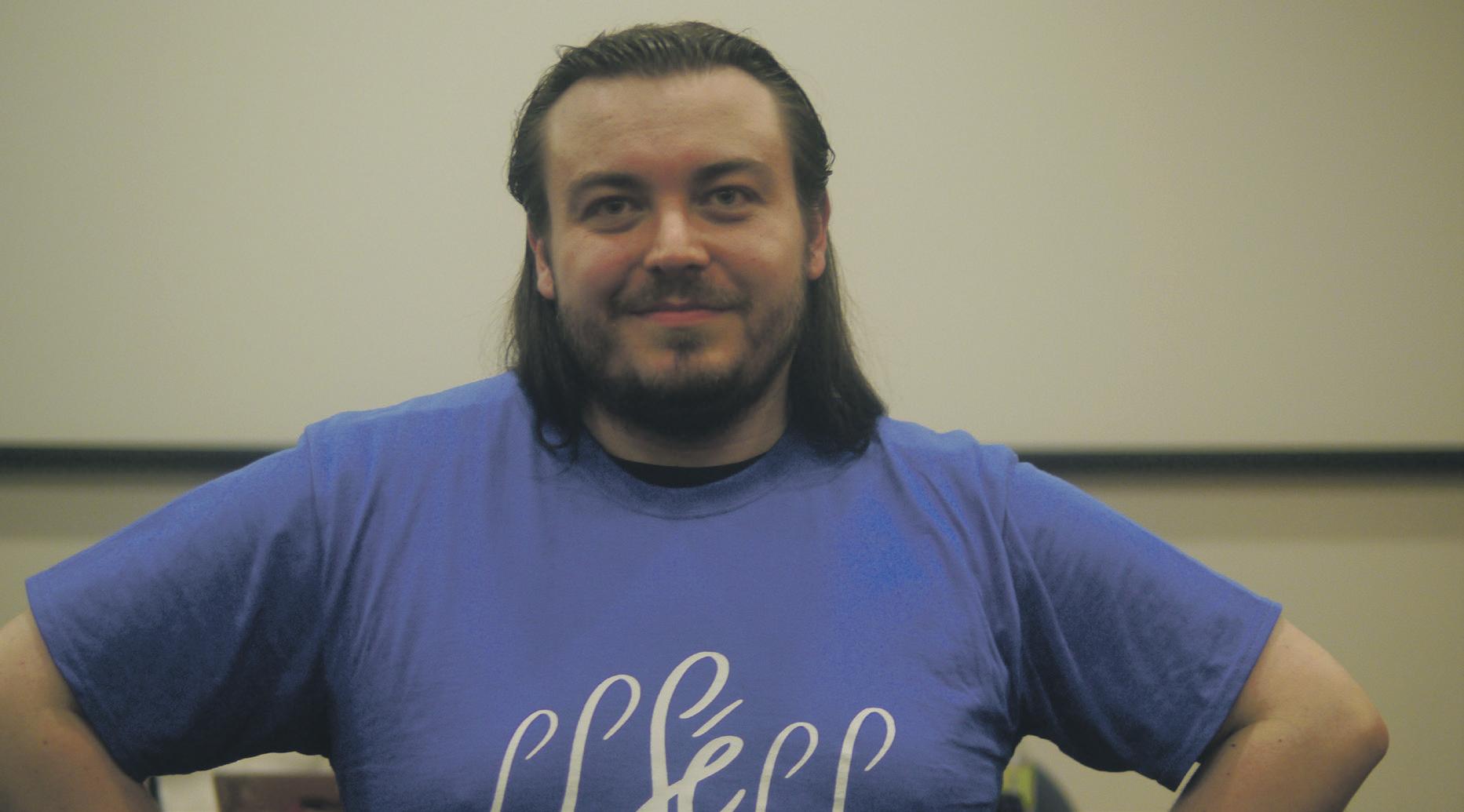
Amélie McGowan JUNIOR EDITOR“It’s a really tough, thankless role”, Sé Ó hEidhin, candidate for the Education Officer position in Trinity’s Student Union declared. “I truly believe that the role of the education officer is to be the serious grounding point of the Union.”
Ó hEidhin, who has been active on campus for years, including time as Ethnic Minorities Officer, Treasurer of QSoc, Secretary of LitSoc, and most recently Deputy STEM Convenor and Chair of Diversity in STEM, is running in the 2024/25 elections.
Ó hEidhin has a plethora of ideas when it comes to the role as Education Officer, but they emphasise the need for Student Union transparency, and grounding the Union in reality. “As Education Officer, I want to get us back to Earth,” Ó hEidhin stated. Their eight-page manifesto details the need for the Union to ‘Touch Grass’; a method of tackling the opaqueness and difficult navigating system of the Students’ Union.
“The SU is the most opaque organisation”, Ó Heidhin continues, “and our whole job is to make Trinity easier to navigate and we’re impossible to navigate ourselves. It’s nonsense”. Each year, according to Ó hEidhin, the Students’ Union attempts to increase engagement with the student body, but fails. “All of these metrics fail to address the core issues”, Ó Heidhin writes in their manifesto.
It isn’t a matter of failure on behalf of the students, in fact, “I think every goal that the SU has strived to accomplish this year has been amazing. I totally agree,” however, Ó hEidhin has one issue: “Method-wise I have some disagreements.”
For Ó hEidhin, form is function when it comes to organisations. The students aren’t failing the system, the system is failing the students. Which is why Ó Heidhin’s first manifesto point is for a ‘Total SU Restructure’, involving bringing in an academic senate, a welfare senate, and a legislature. Additionally, creating three faculty assemblies with the ability to pass their
“
Education is the easiest role for you to become just a figurehead
own legislation.
“I think that the reason why stuff doesn’t work is because it’s not set up in a way that allows it to work”, Ó Heidhin adds. “Why are reps not allowed to do things? The answer is: we don’t train them well enough. We don’t tell them how to de-escalate problems, so they end up with problems above their pay grade.”
Prepared to help students, Ó hEidhin suggests adding to the TDCSU Instagram page, outlining the role of each member, where to find help, and who to ask. Additionally, Ó hEidhin proposed an AI-chatbot. “I don’t think we use AI enough”, Ó hEidhin says. Accessible online services prevent students from going to the wrong person for their problems, according to Ó hEidhin.
When it comes to inclusivity, Ó hEidhin is on board. ‘Bare Necessities’ are next on the manifesto. That involves getting lecture recordings in, integrating the postgraduate community, implementing Irish more aggressively, working with the new Irish language officer, even getting an SU archivist.
While the Trinity Inclusive Cur-
riculum is part of this next step, Ó hEdhin is “already looking towards the next thing”. Changing the curriculum is “a long road”, according to Ó hEidhin. “We need to have as many as possible changes to courses to make their courses more inclusive”, adds Ó hEidhin, but as someone interested in restructuring, “challenging the actual framework and basis of what we’re being taught in college” is the longer, yet more effective route.
When asked about disability inclusion, “I want to engage with disability advocacy at all levels, all the time. I’m a student with disabilities myself”, Ó Heidhin states. In-house assessments and a focus on getting students who are not diagnosed, diagnosed, is a priority. “We have an amazing disability community in Trinity. I want more resources put into diagnosis.”
For Erasmus students, Ó hEidhin is determined to keep open Zoom office hours to reach the Welfare, President, or Education officer with the click of the ‘join’ button. Creating a list of universities Trinity sends students to that have adequate disability support, is the “open access to information”, Ó hEidhin states, to “fix Erasmus. Make it so it’s an ideal scenario. Every time.”
Representation is not a matter of equality, but equity. What Ó hEidhin proposes is a multi-faculty approach. “You’re never going to have the same amount of reps for each”, Ó hEidhin says, “Acknowledge the differences, then come back to ‘every Trinity student is
fer”, Ó hEidhin says. The two are not separate; when politics gets involved, education does too.
Ó hEidhin notes a key difference from this year; making the Education Officer front-facing. “Education is the easiest role for you to become just a figurehead”, Ó hEidhin notes. Rather than remain behind the scenes, Ó Heidhin proposes staying halfway between background and foreground work.
Ó hEidhin wants their work to be publicly accessible to improve the relationship between Officer and student, and prevent students from failing purely because of the SU’s difficult navigation.
valid.’”
On top of representative engagement, Ó hEidhin is intent on paper voting to increase voter turnout. “I am pro-paper voting,” Ó hEidhin asserts. Electronic voting, while more convenient, brings down the number of people who vote.
Ó hEidhin finishes the manifesto with their last point; making Education Officer a campaign role. For the Education Officer to become political, Ó hEidhin must not only focus on handling barriers to education, but define the role itself. Barriers such as rent, cost of living, and commuting all require the Education Officer to get involved in government – lobbying for fairer accommodation and cost of living.
“Every time a political problem is applied to college, students suf-
I don’t care what bridges I burn with staff. I’m not going to be shaking hands and kissing babies. I’m going to tell them exactly what needs to change.
“I really believe that every student, when they’re in their hardest time, just needs a helping hand”, Ó hEidhin says. “We allow too many students to fall through the cracks and end up drowning.”
When it comes to integrating the Irish language community, “I would be advocating for Irish at every step of the way. In every meeting I’m in I would be advocating for the Irish. Every time.” Additionally for Ó hEidhin, including the Irish ethnic minorities at Trinity into the Irish language efforts is a pivotal point.
“I think my manifesto is a great example of what someone who cares about the Union and is very concerned with structures, would do if you gave them the power to change everything; they would burn the entire Union down in order to fix the Union.”
Ó hEidhin was initially going to make a palatable manifesto, but stopped. “I don’t want to be that person”, they say, “I want to be the person that’s like ‘abolish council’”.
For them, being an Education Officer is, at the end of the day, “a job.” “I have the institutional knowledge and the backing to change things, but if the year doesn’t go well and I don’t accomplish anything, I’m a scientist. This isn’t my career.”
This can be used to their advantage, however, as the disconnect allows for bolder, more undaunted decisions. “I don’t care what bridges I burn with staff,” Ó hEidhin concludes, “I’m not going to be shaking hands and kissing babies. I’m going to tell them exactly what needs to change.”
TCDSU ELECTIONS 2024 7 THE UNIVERSITY TIMES MONDAY 26 FEBRUARY, 2024
PHOTO BY BRIDGET MCBRUISER FOR THE UNIVERSITY TIMES
“
Hamza Bana: “Students are the Backbone of the University”
Leah Downey DEPUTY NEWS EDITORHamza Bana’s campaign to be the next Welfare and Equality Officer is founded on his lived experience. He is one of three candidates running for Welfare Officer in the 2024/25 Trinity College Dublin Student Union (TCDSU) Sabbatical Elections.
The third-year Computer Science and Business student is currently serving as the Ethnic Minority officer for TCDSU, a part-time position within the union that is responsible for enforcing mandates related to racial justice and ensuring ethnic minority rights are enforced. This position has given Bana valuable experience dealing with casework regarding issues of racial and ethnic discrimination.
Bana is no stranger to issues of accessibility and welfare, first coming to Trinity College through the High Education Access Route (HEAR) scheme in 2021. They have been an ambassador for the Trinity Access Programme (TAP) since February 2023 and were previously an S2S mentor for the academic year 2022/23.
According to Bana, through these positions, he noticed that
there were a “lot of issues” on campus “that have not been addressed”. Through his role as Ethnic Minority Officer and as a black person, Bana noted that there “hasn’t been much of a fight for ethnic minorities on campus”. If elected Welfare Officer, they believe they “will be able to use [his] knowledge as a black person to combat the issues I see on campus”, adding they will also have the ability “to look after all other students on campus”.
Issues of equality are a primary tenet Bana is running his campaign on. Their first manifesto point is the decolonisation of the Trinity campus, beginning with the goal of having Diversity and Sensitivity Training a compulsory undertaking for teaching staff.
Bana wants Trinity to be “for all the students – students with disabilities, students from different minority backgrounds, students with different sexual orientation – any students that are not white, cis males”. Bana continued, stating that his goal is “trying to make sure Trinity is catered towards everyone, not just the few, fortunate people”.
Another aspect of this goal, overlapping with both concerns regarding welfare and equality, is the Ethnic Minority Support Group Bana spearheaded the formation of.
Another element Bana is keen to emphasise is continuing to put pressure on Trinity for the provision of free menstrual products across campus, citing the University of Galway, University of Limerick and University College Cork as examples of universities that have adopted this already. Current Welfare Officer Aoife Bennett has campaigned for free period products following the work done by Chloe Staunton who achieved funding of €7,000 from the TCD Association and Trust for the provision of hygiene products. He plans to “push Trinity for free period products across campus, not just the main campus but also in the James’ campus”.
Bana plans to advocate for better mental and physical support across campus for all students and “not just cis white males” by continuing sex education workshops with Q-Soc and pushing for better housing rights, critiquing the current status of campus residents as “licensees” and promising to work on this issue alongside the elected president.
When it comes to Trinity’s rising rents, Bana points towards the success of direct action undertaken by the TCDSU over the year, calling it a “great success”. Following on from the rent freeze achieved through
the blockade of the Book of Kells, Bana plans to combat Trinity increasing fees next year. “I want to basically push and say, ‘Hey, you can’t do that.’” They believe that “students are the backbone of the university and Trinity should treat us as students that are coming from different backgrounds that aren’t able to afford these rising prices”. When asked what policies they could undertake, Bana proposes that TCDSU should “combat this” by pushing Trinity to cap rents so that they amount to “a third of the living wage monthly”.
In terms of sexual well-being, Bana plans to “increase visibility for the First Responder Training for Sexual Violence”, a course they have received a training qualification in. At present, information on this course is “only circulated through the Trinity communication emails and not many people actually read those”. He plans to increase visibility through adding it as an essential part of campaign weeks dedicated to welfare, such as “sex-education week or consent week”. Student mental health support has been an ongoing issue, one that Bana has had success with already this year. They note that in the last five months, they have “worked towards securing a POC
person within the counselling service”, a point of representation that did not previously exist within student counselling services. Bana deems it “problematic” for POC students entering the service who want a therapist that “reflects their background because they have that lived experience”. During their term as Ethnic Minority Officer, Bana has “outsourced a black therapist who comes onto campus and runs a support group for ethnic minorities” that will be beginning from March 4th.
“Not only will there be another therapist available, it will be a therapist tailored towards ethnic minority groups”. One of Bana’s central aims is to “continue hiring more POC therapists so there is less of a strain on the general support groups”, which will both create more openings within the general groups whilst simultaneously providing POC with the counselling they originally sought out.
Ultimately, Bana believes that the possibility of him being elected would “mean more towards the students” than it would for him.
“Having a Welfare Officer that is POC is quite enormous. If you’re a POC, you would rather have a POC therapist to go to. If you’re a woman, you’d rather have a woman therapist to go to”.
Nathan Harrington Offers Scant Explanation on Campaign Controversies
Alex Payne ASSISTANT EDITORRelying on a supposed message of happiness, Nathan Harrington, running to be next year’s Welfare & Equality Officer of the Trinity College Dublin Students’ Union (TCDSU), sat down with The University Times to discuss his singular approach to what has turned into a controversial campaign.
“I’m running for Welfare & Equality Officer to make everyone in Trinity a little bit happier”, Harrington began. “If, actually when, I get elected”, he would bring his experience as a Scout Leader, a sports club coach and a volunteer with Trinity’s S2S mentoring scheme, as well as the training the incoming Welfare & Equality Officer receives,
to the role in dealing with the “dayto-day casework stuff”.
On a more personal note, Harrington said: “I feel, and I’ve heard, that people aren’t as happy as they could be… and so I think that has really spurred me on to try and do something about that.”
From his manifesto, in which he claims he is “seriously committed to bettering the welfare of Trinity students”, it is difficult to see how Harrington plans to be successful in his race for the role of Welfare and Equality Officer given that it is a position concerned with respect, dignity and inclusivity.
He makes various pledges, from using his entire salary to buy sweets and chocolate for students to bringing religious groups in to talk about welfare — “to incite arguments”. He also promises to create priority fire escapes for “disableds” and install shower curtains
in mens’ changing rooms “so we don’t all have to see each others’ willies”.
Since launching his campaign, the TCDSU Electoral Commission have asked him to remove the term “disableds”, the phrase “to incite arguments” and the exclamation “fuck ‘em”, which was referring to students off-campus. He didn’t see them voting for him as he is running against the current TCDSU Off-Campus Officer, Hannah MacAuley, but admitted: “I’d appreciate it if they [off-campus students] did, however.”
This seeming hypocrisy was evident when asked about the recent TCDSU campaign to fund period products on campus. Harrington said, “obviously it’s not as important to me as it is to other people”, presumably pointing out the fact that he does not use period products, and others do. Harrington
went on to concede that if it is important to the student body “then it would be of the utmost importance to me, I would constantly be on top of that”.
Established by former Welfare and Equality Officer, Chloe Staunton, and further proposed to College Board by current incumbent Aoife Bennett, TCDSU’s free period product scheme was described by Harrington as having “fizzled out”. He believes it has “lost a lot of traction” but that he would put a lot of energy into “reinvigorating” it.
In praise of Staunton and Bennett, he thinks that they have been “pretty good” at being Welfare and Equality Officer, but seemed to criticise them in engaging in activities he perceived as outside the role’s remit: “If I was put in the role I wouldn’t worry too much about other things that could distract me… the role of the Welfare and
Equality Officer is, primarily, welfare and equality.”
Asked to define welfare, he said: “There’s a lot of work, casework, students accessing services for their physical and mental health.” He says “the role comes down to tying the two aspects together”, defining equality as “a whole different world of representation and supports”.
His idea of support for people with disabilities became evident when asked about why he saw a slip ‘n’ slide as a suitable activity for “disableds” in his campaign video: “It’s very hard to not enjoy a slip ‘n’ slide.”
“I’m not saying I’m going to take people in wheelchairs and throw them down a rubber mat. Unless, well, I might if they wanted me to. I have no issue with that…
8 TCDSU ELECTIONS 2024 THE UNIVERSITY TIMES MONDAY 26 FEBRUARY, 2024
CONTINUED ON PAGE 10 »
Hamza Bana received 49 per cent of first-preference votes in our poll, in comparison to Hannah McAuley’s 32 per cent, Nathan Harrington’s 15 per cent and RON’s 4 per cent. With Bana so close to the just over 50 per cent needed for the win at first count, and as any poll comes with a small margin of error, they are likely to win the Welfare & Equality race at first count.
However, if he does not, Bana is almost certain to take home the position upon redistribution of votes from eliminated candidates, as they are a popular enough choice for second preference amongst RON and Nathan Harrington’s first-preference voters.
Bana, a third-year computer science and business student, has run a campaign bolstered by their extensive Union experience as this year’s TCDSU Ethnic Minorities Officer. Through this position they have collaborated with the Student Counselling Service to re-establish an Ethnic Minorities Support group. He has powerfully called on his own lived experiences throughout the campaign, saying at the Dining Hall hustings that they wanted to use their “diverse experience” to ensure “every student feels represented and supported through a supportive and inclusive campus environment”.
Some of his performances at hustings have been unimpressive in terms of delivering succinct and clear ideas, but Bana’s reputation may be enough to secure their place amongst the sabbatical team next year.
Not just a familiar face around House 6, however, they have appeared at the front of numerous protests around campus including the Book of Kells blockade and
“
pro-Palestine actions organised by Trinity’s Boycott, Divestment and Sanctions group. Their public popularity, coupled with clear and achievable goals against a track record of instituting change around College, has seen Bana take what seems to be an insurmountable lead into the final week of campaigning.
Senior Sophister Radiation Therapy student Hannah McAuley still attracts around a third of first-preference votes, but her well-thoughtout campaign has stuttered when it came to the hustings. Their manifesto exhibits a thorough understanding of the role and includes what looks like a long series of achievable pledges. However, at the various hustings, their promises to work hard and be committed to the role did not do much to further explain how she hopes to achieve her ambitious plans.
She has extensive union experience as a Senior Fresh Radiation Therapy Class Rep, a Therapies Convenor and Off-Campus Officer for two years. But, in line with the outcomes of the poll in other races, knowledge and reliance on experience within the Union has proved to matter little when it comes to garnering enough support for a win.
Nathan Harrington, the most controversial candidate in any race this year, has still managed to attract 15 per cent of first-preference votes. As a Junior Sophister Geography and Sociology student, most of his support is coming from Junior and Senior Sophister Arts, Humanities and Social Sciences (AHSS) male students, but with these years and the AHSS faculty already over-represented in the poll, he is not expected to gain further support should voter turnout be more representative of the student body.
His now-altered manifesto initially included the term “disableds” when referring to people with disabilities and said “fuck ‘em” to off-campus students. At Dining Hall hustings he said he wanted to institute a #FreetheNipple campaign week during his tenure “to make everyone more happy” and at Council hustings repeated his manifesto pledge to donate his salary in order “to buy sweets and chocolate” for students, claiming that this would “go further” than donating the same amount to a food bank.
Welfare and Equality: Bana’s Popularity Proving Critical and Insurmountable to Opponents
15%
Nathan Harrington
4% Re-open nominations

32% Hannah McCauley
49% Hamza Bana
Hamza Bana looks to be assured of a win in the Welfare & Equality race due to his wellestablished popularity as this year’s Ethnic Minorities Officer Due to Bana’s seemingly unassailable 17-point lead, even if voter turnout is more representative McAuley seems unlikely to challenge him for the role.
He later admitted that this was “a joke” in his interview with The University Times, in which he also said when asked about why he had linked what he terms “disableds” with a slip ‘n’ slide on a proposed
college sports day: “I’m not saying I’m going to take people in wheelchairs and throw them down a rubber mat. Unless, well, I might if they wanted me to. I have no issue with that…[but] it wouldn’t be the only disabled-friendly thing I would put in.”
Harrington also said of what he perceived as “little groups” on campus: “It’s important to not have, you know, the women’s society and then all the women go and hang out with other women… it’s important to bring people together.” The poll indicates his support amongst
female voters is particularly poor, with most women voting him as their fourth-preference for Welfare & Equality, behind RON.
The only mention of the LGBTQ+ community on his manifesto includes a pledge to put on “queer sex” demonstrations. When asked why, in his interview, he said: “That’s not to say the only interesting thing about gay people is that they have gay sex.”
Currently “under investigation”, according to the Electoral Commission (EC), it remains to be seen whether Harrington’s share of
first-preference votes will increase, or decrease, or if he will even be struck from the ballot, following his controversial comments. Bana is all but assured of the win. McAuley has stronger support amongst earlier academic years and from students in the Engineering, Maths and Science and Health Sciences faculties who are all under-represented in the poll. However, due to Bana’s seemingly unassailable 17-point lead, even if voter turnout is more representative McAuley seems unlikely to challenge him for the role.
TCDSU ELECTIONS 2024 9 THE UNIVERSITY TIMES MONDAY 26 FEBRUARY, 2024
« CONTINUED FROM PAGE 8
[but] it wouldn’t be the only disabled-friendly thing I would put in.”
Asked why he used the term “disableds” in his campaign material, Harrington explained: “When I originally wrote my manifesto I was working with my big campaign team and within that group there are disabled people, people with disabilities, disableds, whatever you want to call them.”
“We decided on ‘adjective-first’ language, so not people with disabilities but disabled people, because that is how they felt most represented… disableds was shorthand for that.” In being asked to change the term “disableds” to “people with disabilities”, he said: “Obviously some people feel one way and some people feel very strongly another way”.
Speaking more broadly about representation for minorities and groups of people with protected characteristics on campus, Harrington said he would “give them a home”. He added: “I think there is a space for lots of different little groups. I think that they can find themselves within that group or within that space very easily.”
Using an unspecified “women’s society” as an example, he said he wants the Students’ Union to help these “little groups” work together more and be more inclusive: “It’s important to not have, you know, the women’s society and then all the women go and hang out with other women… it’s important to bring people together.”
There is no “women’s society” at Trinity, but one possible interpretation of his the European branch of The Women’s Network at Trinity College Dublin, which India
O’Donohoe, the current chairperson, has previously described as “a space where women and gender minorities are able to network with each other and achieve a more equal foundation when it comes to entering the workforce”.
His manifesto also pledges to establish “LGBTQIA+ lectures to teach people how to have queer sex”, with “demonstrations and practice sessions to be made available”.
Asked how he defines “queer sex”, Harrington said: “I could consider all sex to be queer sex… It’s not just about the people involved or the activities you’re doing, it is about both at once.”
He explained the idea of “demonstrations” by saying: “I think that I would try to include and incorporate as many different types and forms of sex as possible to educate people the most about everything.”
It was put to Harrington that with no other mention of the LGBTQIA+ community in his manifesto, his mention of “queer sex” risked characterising this group by sexual acts, a technique which has been used to stigmatise and discriminate the LGBTQIA+ community.
In response, he said that “for queer people, it doesn’t really exist before you go to College”, also saying that “in Ireland there isn’t any queer sex on the curriculum”. “That’s not necessarily to say that the only interesting thing about gay people is that they have gay sex”, he concluded.
Harrington was also asked to remove the phrase “incite arguments” from his manifesto, in reference to the reason why he wanted to bring “religious groups onto campus to discuss welfare”. He explained: “Arguments are designed
to find what people agree on.”
If religious groups came to discuss welfare, Harrington believes they would “boil down” discussions to such agreements as “a bit of mindful meditation is good for everyone”, arguing “a lot of people find solace in spirituality”.
At the first hustings of the campaign he made a comment claiming that using his Sabbatical Officer salary to buy sweets and chocolate for students would go further than donating it to a food bank drew gasps from the crowd. In explanation, he said: “There was a certain demographic in the room who understood that that was quite a tongue in cheek comment… and definitely a demographic that didn’t and who thought that was completely serious… I’d like to know what is going on in the head of someone who thinks that I actually think that.”
Welfare Candidate Hannah McAuley on Championing Change
Sajal Singh SENIOR EDITORAmong the candidates vying for the role of the Welfare and Equality Officer in the Trinity College Students’ Union (TCDSU) Sabbatical Elections stands Hannah McAuley, a final-year Radiation Therapy student, whose passion for advocating student welfare and equality echoes loudly through her candidature.
McAuley’s dedication to serving the student body, having already made her mark as the TCDSU Off-Campus Officer for the past two years, is unmissable. Reflecting on her journey, they note, “I came to college to help people with my degree and became involved in the SU during my second year and found contentment in helping other students as well”.
Her experience in the SU, which began with the position of class representative, serves as the foundation for her candidature. Undeterred by the challenges posed by the pandemic, McAuley actively participated in Zoom councils, showcasing her resilience and adaptability. Before their current position, they served as the Therapies Convenor, illustrating her commitment to fostering a supportive community within College.
When questioned about her motivations for running for Welfare Officer, McAuley’s response is un-
equivocal. “Because, after closely working with the Students’ Union, I realise the impact it can make on students”, she asserts. Their resolve to continue the legacy of her predecessors while implementing their own vision is evident, emphasising their desire to build upon the groundwork laid by previous officers. She adds, “I want to keep the doors of the welfare and equality office in house six always open. Anybody at any time should feel free to come and have a chat”.
Addressing critical issues such as financial hardship and accommodation challenges, McAuley outlines her proactive approach:
“I will ensure that we team up with the renters union in halls to help freshmen find affordable accommodation for next year”. Moreover, she advocates for an increase in the SU welfare loan, recognising the pressing need for tangible support mechanisms for students facing financial constraints while continuing to put pressure on College authorities and the government to provide affordable student housing.
McAuley’s commitment to inclusivity and accessibility extends to addressing period poverty on campus and promoting comprehensive sex education. She pledges to make free period products available across all university washrooms and advocates for ongoing consent training and the provision of sexual health resources.
Recognising the shortcomings of mental health services on cam-

pus, McAuley is resolute in her determination to effect change. “To improve this state, I would ensure that students who need immediate help have access to resources that guide them on what to do in times of urgent need,” they affirm. Additionally, McAuley plans to collaborate with mental health professionals to expand college counselling services and implement mental health awareness campaigns. She also aims to create a supportive environment where students feel comfortable seeking help and implement suicide awareness training for all PTOs and Sabbatical officers.
Central to her platform is the assurance of reaching out to marginalised groups and ensuring their voices are heard. As a member of the LGBTQ+ community, McAuley emphasises the importance of creating a campus environment that
is inclusive and welcoming to all. Their advocacy for responsible drug use is grounded in their personal experiences, showcasing their compassion and comprehension of the intricacies involved in this matter. McAuley anticipates programmes and campaigns that will help students who are struggling with substance misuse by bringing attention to the issue and offering support, with an emphasis on reducing stigma, increasing awareness, and promoting access to resources.
Throughout McAuley’s campaign, a separate emphasis can be seen on the St. James’s community. She says, ‘‘It’s time Trinity recognised the state of health sciences students and provided better facilities to students who are off campus. This includes not only a SU café and better seating but also adequate financial support for stu-
dents on placement and the creation of a second school of medicine welfare support counsellor.’’
In response to concerns about the magnitude of the responsibilities accompanying the role, McAuley remains undaunted, drawing parallels with her experiences working with cancer patients. “To be honest, I am not too overwhelmed,” they assert. “I just have the zeal to help people, and I am very excited to have the opportunity to do that.”
For McAuley, being elected as Welfare and Equality Officer would be more than a title – it would be a fulfilment of a longstanding commitment to serving her peers and fostering a campus environment characterised by empathy, inclusivity, and support. McAuley’s dedication to helping others is evident in her willingness to take on challenging roles and her passion for making a positive impact. They believe that their background in working with cancer patients has prepared them well for the responsibilities of the Welfare and Equality Officer position.
As the countdown to the elections has already begun, Hannah McAuley’s candidature stands as a testament to the unwavering dedication and passion that she brings to the table. With her vision for a more equitable and compassionate university community, she emerges as a candidate poised to champion the welfare and equality conditions in the college.
10 TCDSU ELECTIONS 2024 THE UNIVERSITY TIMES MONDAY 26 FEBRUARY, 2024
PHOTO BY BRIDGET MCBRUISER FOR THE UNIVERSITY TIMES
Connor Dempsey on “Sensing the Pulse” of the Union
Molly Wetsch JUNIOR EDITORFinal-year Politics and Economics (PPES) student Connor Dempsey is running for Communications (Comms) and Marketing Officer in the Trinity College Students’ Union (TCDSU) Sabbatical Elections. His campaign is grounded on the heels of a breadth of experience, most recently his tenure as TCDSU Engagement Officer as well as his former role of TCDSU Citizenship Officer.
Dempsey says his experience as Engagement Officer, a role he both proposed and created, has given him insight into the workings of the Union and an understanding of issues that the student body is facing. He describes the role as both an “ombudsman” and “reformer” of engagement issues.
“I’ve been through the wringer. [As Engagement Officer] I’ve sat in meetings time and time again explaining engagement issues,” Dempsey said. “But of course, the role of engaging the student body is still with the Comms and Marketing Officer. I’ve done a lot of the groundwork, and I’d like to go further and actually be able to implement it fully if I were to have the privilege of being elected”.
Dempsey says one of his primary
priorities during his campaign is elevating the marketing responsibilities of the role to ensure students have access to necessities, especially in the wake of the recent separation from Domino’s, which was TCDSU’s largest partnership before the split.
“I think marketing should be a student service,” Dempsey said. “We should prioritise making essentials more affordable, like healthcare. Our current deal with Merrion Square Dental [is] genius. We should be doing much more.”
He also says that by centralising student deals on the Union’s website, students will be able to access partnerships when it makes sense to them “rather than at the whim of the weekly email.” This is supplemented by his pledge to modernise the SU website and “completely refresh” it to streamline student use.
As for ensuring TCDSU engages with mature students and postgraduates as well as traditional undergraduates, Dempsey says it’s important to maintain a dynamic and well-rounded approach to communications. He mentions that expanding to platforms like Facebook or Discord could function as easy methods of communicating with a previously unreached group of students, citing conversations with societies that have experimented on the platforms in the past and been successful.
“There’s no perfect way to interact with the student body,” Dempsey said. “We can go where people are. If students are mobilising and organising, it’s just a process of asking people where they are. I think the Union should be a platform for students to organise themselves…it’s about demonstrating that the Union isn’t distinct from that organising”.
Dempsey says that he’d like to continue several of the Union’s current strategies regarding the weekly email and social media communication while also experimenting with new methods of engagement. He posits the use of paper flyers and other physical postings around College to reach an audience that social media may not currently touch.
“What I’d like to work on is continuing the work [of current TCDSU Comms and Marketing Officer Aiesha Wong] to make the weekly email more legible,” Dempsey said. “But I also want to bring us more in person. I think we need to recognize that when you’re putting things on social media, it doesn’t always feel real because you can scroll and it disappears. Whereas if every lecture you go into, on the side of the door there’s a sign that says ‘here’s something your union’s doing,’ then that feels real, that feels concrete.”
One major point of Dempsey’s campaign is maintaining an
in-person presence “outside the bubble” of House Six to other areas of College like the Hamilton and St. James’ Hospital. He proposes that, as Comms and Marketing Officer, he would work one day a week from alternative locations in order to engage with the student body and ensure that even those not physically on campus feel represented by the Union.
“We need to bring that energy and that physical presence of having someone work one day a week from [the Hamilton or St. James’]. I truly know that that will have an impact on how people perceive the Union,” Dempsey said. “If there are places that you can bring up your opinions that makes it feel real, that puts faces to it, then that lowers the barrier to engagement. Because then if you’re going to council for the first time, and you’ve only interacted with the Union through email and social media, you don’t know any faces, that’s scary for anyone”.
Regarding issues of transparency within the union and communication with students, Dempsey proposes stronger follow-up from the Union about issues and initiatives that take priority within the student body. He prioritises a clearer demonstration of results that are being achieved through the work of the Union and what that work looks like behind-the-scenes.
“I think we need to sew a thread
through our communications...I believe that the obligation is with the Union to make the full case for why we’re doing what we’re doing,” Dempsey said. “There is a lot of thought behind-the-scenes. We just need to show that to people… Students should be able to see that when you go to Council, real people are having real impacts”.
Dempsey advocates for the equality of President and Comms and Marketing Officer as “primary spokesperson” for the Union, claiming that open conversations within the Sabbatical Team would allow for clarity and further understanding when it comes to communicating issues with the student body.
“We are a united front, we have to make sure we’re putting up that united front,” Dempsey said. “We stand and advocate on behalf of students on serious issues. We should absolutely be having internal debate, but it’s about civil discourse and coming to constructive conclusions and consensus at the end of it”.
“Comms and marketing work really well together because you’re in connection with the student body and sensing the pulse,” Dempsey said. “You’re making the argument for what the Union should be, and you’re also doing what you can to respond to the needs that people are telling you about”.
Sarah Murnane Plans to Inject Fun into Union Politics
Ella Sexton SENIOR EDITORFinal-year History and Politics student Sarah Murnane is one of three candidates running for Comms and Marketing Officer in this year’s sabbatical elections.
Murnane has been vaguely involved in the Union for a couple of years as class representative and through been on a campaigns committee and is hoping to bring this experience forward with her into her (hopeful) new role, along with incorporating some fun new ideas to ensure the job is done well, and encompasses students outside of the Union whilst bringing in more engagement from social media. As mentioned by Murnane, current

Comms and Marketing Officer
Aiesha Wong has the role as “the glue between all the other officers that binds everything together and keeps the whole year working” which conveys the importance this position has within the Trinity Col-
lege Dublin Students’ Union (TCDSU). Even though the Comms and Marketing Officer is technically a sort of PR person for the Union, “there’s a very delicate balance of what the Union thinks, and what the Union is going to say. Honestly,
that’s just teamwork and figuring out what you want. It’s push and pull, you don’t always get what you want”, but Murnane is very much willing to give it her best shot.
Although she expresses that her manifesto points are not “wild-
ly different”, if elected Murnane wants to place her emphasis on engagement, sponsorship, transparency and accessibility. “For engagement, my big thing is social media, I think the Union doesn’t use it as much as they should”, she says. Her hope is that through the expansion of various social media platforms, the Union can gain their funding through sponsorships in a way that is natural. Through having “local, student-oriented” sponsors, members of the college community can benefit in tangible ways as much as the Union itself, an uplifting thought that aligns with the Trinity values. This would mean it would feel like a much more ethical procedure than a money-grab. Her approach is one of hardwork and dedication,
TCDSU ELECTIONS 2024 11 THE UNIVERSITY TIMES MONDAY 26 FEBRUARY, 2024
CONTINUED ON PAGE 13 »
PHOTO BY BRIDGET MCBRUISER FOR THE UNIVERSITY TIMES
Beth Strahan received 42 per cent of first-preference votes, Connor Dempsey 31 per cent, Sarah Murnane 22 per cent and RON 5 per cent. This indicates the need for a redistribution of votes from eliminated candidates, certainly RON and most likely also Murnane, for a winner to be found. However, Dempsey has some serious catching up to do if he is to challenge Strahan for the position of Comms & Marketing Officer.
For a position which requires skills in the dissemination of information and therefore clarity of thought, it is perhaps no surprise that Beth Strahan is in the lead. She has led a campaign of forceful and pointed rhetoric in comparison to Dempsey and Murnane, who have at times floundered or, in Dempsey’s case, relied on union-insider knowledge, in promoting their campaigns.
Strahan, a Senior Sophister Theatre and Drama Studies student, has sought to encourage voters to her side with a campaign entitled “An SU For All”, asking students: “Do you feel ignored?” Her initial manifesto plug delivered mass appeal, drawing attention to her aims of highlighting “real world” issues that may have direct impacts on equality within the SU, collaborating closely with the new Irish Language Officer but also increasing linguistic access for international students, engaging with the JCR and S2S Mentors associated with Junior Fresh students and bringing more visual content in association with TCDSense.
In contrast, Connor Dempsey, a Senior Sophister Politics and Sociology student, sought to appeal to voters through his experience with union bureaucracy, with a promise to “burst the SU’s bubble”. As this year’s TCDSU Engagement Officer,
“
If, as the poll indicates, Murnane’s votes need to be redistributed to find a winner between Strahan and Dempsey, the race could be a tight one
a role he created, Dempsey may have a wealth of union experience, but his overly technical attempt to focus on what is currently wrong with how the Union’s engagement operates, rather than provide a clear and pronounced set of pledges like Strahan, has seen him struggle to garner more widespread support.
Sarah Murnane, the candidate most likely to have their votes redistributed to find a winner between Strahan and Dempsey, with a campaign tagline “You Want to Make Her Comm” (pun presumably intended), has led a campaign dominated by some “big social media expansion”. Her manifesto is certainly full, seeking to highlight a “variety of student issues”, making use of “new mediums” and increasing content related to “the inner workings of the Union”. It is, however, this lack of specificity that has perhaps caused voters to disengage with her ideas. The poll indicates most of her support is coming from earlier-year students, perhaps due to her “Comm” pun, ‘fun’ 3rd-person campaign launch video and another video in which she answered an interviewer’s questions whilst eating spicy chicken wings, a viral trend.
At the Dining Hall, Equality and Council hustings events, Strahan took the opportunity to stake her place as the most effective communicator of the three candidates, an aspect of her persona which has perhaps led her to take the lead in the Welfare & Equality race.
At the Dining Hall hustings, she delivered a powerful tricolon of manifesto tenets: “Transparency, critical accountability and diverse engagement.” Her abilities in front of a crowd, drawn from her experience in theatre, were not only evident from how she spoke, but she also explicitly highlighted that experience as one she could transfer to the Comms & Marketing role and the Union as a whole: “[I can] create a public-facing product that can sell tickets, that can cater to the interest of the majority.”
Murnane, meanwhile, struggled to deliver such a clear proposition for increasing the Union’s visibility, despite founding her campaign on such a matter. At the Equality and Council Hustings, she mentioned an ambitious, but seemingly vague, “social media expansion” no less than three times, and repeated other vague phrasing such as “that’s really important”, “I’d really work on that” and “more needs to be done” numerous times. In specific contrast to Strahan on environmental issues, Murnane said she was “on board with
Comms and Marketing: Strahan’s Powerful Rhetoric Creates Strong Lead as Union Outsider
22%
Sarah Murnane
10%
Re-open nominations

31%
Connor Dempsey
42%
Beth Strahan
In an unexpected but understandable turn of events, Belfast-born Strahan comes out on top against Union insider Dempsey
anything to do with sustainability really”, whereas Strahan strove to highlight the specifics of Collegewide energy and water usage as issues she would seek to address.
At all the hustings, Dempsey, whilst delivering answers that would have sounded sweet to those tired of union bureaucracy, may not have done enough to garner support outside union circles. At the Equality and Council Hustings he mentioned “collaboration” and “consultation” with other
sabbatical and part-time Union officers multiple times, showing he understood how the Union works but failed to deliver bite-sized and take home quotes that would stick in the memory of the audience.
If, as the poll indicates, Sarah Murnane’s votes need to be redistributed to find a winner between Strahan and Dempsey, the race could be a tight one. Most of the respondents who placed Murnane as first preference then placed Dempsey as second
preference. However, with an 11-point lead over her competitor, Strahan will likely find enough votes to get herself over the line before Dempsey.
Of course, polls should not be taken as strictly indicative of any result, but if Strahan concludes her campaign with more forceful rhetoric and Dempsey does not change tack from his inward campaign, the evidence suggests Strahan will find herself sitting in House 6 very soon.
12 TCDSU ELECTIONS 2024 THE UNIVERSITY TIMES MONDAY 26 FEBRUARY, 2024
« CONTINUED FROM PAGE 11
consistently calling and emailing everyone who seems to ‘fit’ with the Union’s goals and bringing ideas to them instead of taking a backseat and waiting for brands to contact her. Apart from this, Murnane aspires to include people who do not necessarily have a role within the SU to become more involved by having spaces on campus which are open to all where casual chats about all things SU can be held. “In terms of people on campus getting engaged and getting into Council, I want to get more volunteering, maybe more in weekly events” which would hopefully bring up the attendance and interest in peo-
ple going to Council which tends to drop throughout the year.
In terms of more creative endeavours, Murnane is working towards having a bi-annual college newsletter that grabs people’s attention and feeds them snippets of information about what’s going on in the college sphere without having to leaf through the weekly emails that are “useful in a way if you’re willing to read it, but the problem is that it’s always going to be too long… that’s where social media comes in where you have multiple channels where people can access information in a shorter form”. Something that may prove even more exciting is her idea of hosting a podcast where people can come on, have a chat, and
talk about their roles within the Union or within college in order to demystify the ins-and-outs of these people’s jobs, which appears to be a big problem — the lack of understanding and transparency of what is actually going on within meetings. That way, the answers to queries people have and any information can just be broadcasted on a larger scale.
With this idea of accessibility becoming a more important issue recently, Murnane wants to ensure that other language options are prioritised so that the SU messages can be read and understood by more people. There will be a lot of collaboration with the Irish Officer and with promising ideas of a refurbished website, the informa-
tion on there will also be uploaded in a plethora of languages. When bringing up the subject, Murnane says, “I think it’s about being organised, having a team. Everything follows a line before it goes out to see if it goes out to see if it’s accessible, readable, in Irish, if it can be translated into any other languages, where it’s going… it’s pure organisation.” There have been moments in the past where the SU may not have diversified itself enough to different demographics, such as those whose native language is not English or to postgraduate students, on their Instagram or when trying to publicise certain issues within the college. Murnane wants to start from these issues first and see how they can be improved
in an effective way, whilst implementing new systems and forms of media for the SU.
Of course, none of this can happen without people’s votes, and as drilled home by Sarah Murnane — our engagement is needed more than ever to encourage change within the Union. It may have been neglected for some time, meaning it will take a bit longer for everyone to be on board with taking a stance, but without it the votes each year are going to drop lower and lower. Murnane states, “In Gabi Fullam’s year [of being SU president], 2,200 people voted, last year only 1,800 people voted. So, I think engagement is more important because sponsorship falls from engagement”.
Beth Strahan Vows to Find the Voices being Ignored
Ellen
Duggan and Clara RocheWhen assessing the three candidates for the position of Comms and Marketing Officer, prospective voters may initially view final-year Drama and Theatre Studies student Beth Strahan’s lack of prior experience in the Trinity College Dublin Students’ Union (TCDSU) as detrimental to her campaign. Strahan believes, however, that this external vantage point grants her a unique perspective from which to reform the Students’ Union and “find the voices on campus that are currently being ignored”.
Strahan confesses: “When I was thinking about the application process, I really was questioning why I have gone three-and-a-half years in Trinity and not engaged with student politics at all. It’s not because I’m not interested — I don’t feel that I have been reached.”
Although prior Union experience is absent from her candidate profile, Strahan believes that her theatre background translates well in the competition she hopes to contend. “My job is to create a public-facing front”, she explains, citing her experience of managing casts and crews and building audiences as “very, very similar to the SU”. “My experience of theatre marketing means I know how to gauge my demographic”, she says of her time as Director of the Trinity Musical Theatre (TMT) mu-

sical. “Even if I have a product, like a musical theatre show, that does not appeal to the rugby lads, I can get them to come and I have gotten them to come.”
The core concept of her campaign boils down to three words: “Where are you?” She says: “I cater my theatre to the masses, and that is how I would cater my communications.” To this end, she mentions improving transparency, accessibility and multilingual communications.
While Strahan reserves high praise for her predecessors, in particular Aiesha Wong’s performance on social media, she hopes to build upon this by expanding the range of platforms the Students’ Union uses and improving accessibility within them. While Facebook may
be dead and gone to Dubliners, Strahan takes an unusual line in advocating for its revival. “It may not get as much engagement, but at least we can say that we have it there for the people who use the platforms”, such as international students, she says.
She wants to make the Instagram account more accessible through improvements to the alt text and the inclusion of “audio files of all council meetings” to make the inner workings of the Union “digestible and engaging” to the students it represents.
On this trend of transparency, Strahan says: “With the rise of misinformation that we’re seeing, it’s so important that the SU are held critically responsible for where they get their information.”
While she acknowledges that the President serves as the face of the Union, she says “there are so many chefs in the kitchen” and she wants to make the decision-making processes of the Union more explicit.
She describes the increased focus on the Irish language within the Students’ Union as “exciting”. As a Catholic in Belfast in a non-denominational school she was “never offered, on a familial level nor on a curricular level, the chance to learn the Irish language”, but since coming to Trinity she has “fallen in love” with it.
She is eager to collaborate with the JCR “to encourage that engagement with the Irish language”. As the JCR is not mandated by the results of Students’ Union referenda, she recognises her responsibility
to ensure equal priority is given to the Irish language in Halls. In Halls, she says, she has seen “people holding Irish language events” and “people speaking Irish in their flats”, and she wants to “open a channel of communication”.
In the infamous weekly email, Strahan believes reform is needed. She references Wong’s recent inclusion of the phrase “if you’ve made it to the end of this email” as indicative of a problem. While she “love[s] a personal touch”, she says the use of the weekly email as a platform to spotlight societies and resources should not be underutilised. “All the candidates of this campaign are going to say that”, she acknowledges. “It’s just [about] who is actually going to change it.” She also wants to collaborate with postgraduate students to better platform their activities. “They are a step above us undergraduates in terms of knowledge”, she says, and she wants to better promote their events through regular conversation with postgraduate representatives.
Towards the marketing half of the title she hopes to claim, Strahan says she wants to keep sponsorships “dynamic and consistent”, and points to the partnerships societies have established with restaurants near campus as inspirational.
Commenting on the loss of Domino’s as one of the Union’s main sponsors, Strahan says that while “you cannot dispute the success of that sponsorship”, she will prioritise securing partnerships that align with students’ “core values”.
TCDSU ELECTIONS 2024 13 THE UNIVERSITY TIMES MONDAY 26 FEBRUARY, 2024
PHOTO BY BRIDGET MCBRUISER FOR THE UNIVERSITY TIMES
Peadar Walsh on Collaboration and Community
Valentina Milne SENIOR EDITORPeadar Walsh, current JCR Ents officer, is primed for the running of Ents Officer this year. In the lead up to voting, Paedar has been carefully refining an impressive manifesto with exciting and necessary changes that will be implemented next year to enhance the already vibrant community of Trinity College Dublin.
In an interview with The University Times, Peadar reflected on how his ample past experience in running events is one of the many reasons as to why he’s best suited for this role. ‘I’ve always gained the greatest satisfaction from running events”, Peadar claimed as he told The University Times that since the age of 15 he has been setting up and running events, particularly from his home town in County Mayo. Now in Dublin and running his successful organization TKP Nights, Walsh is well-connected, experienced and passionate about entertaining his community.
When asked how his experience as a JCR Ents officer has been, Peadar said with a smile how glad he has been to create memorable events that, for many, have been unique opportunities to spark friendships that form their college experience. “Having a committee and learning from them as to what the students need has been a real learning curve”, Walsh reflected when asked how the transition has been from running individual events to events for a wider cohort of students. “It’s important to listen to the community and have an ‘ear to the ground’ so that we can fine tune our ideas to find out what people really want.” The skills he has cultivated over time as JCR Ents officer appear to position him exceptionally well for a more senior role as Trinity Ents officer.
After a hugely successful year in the role, the current Ents Officer Olivia Orr has certainly left some big shoes to fill. While expressing high praise for her work, Peadar is also eager to implement certain changes to ensure that Trinity Ents events can be optimised for the Trinity community. “I would like to move away from Ents-only, monthly club nights and instead, encourage more cross-society collaboration”, Walsh stated. As Ents Officer he wants to improve the
resources available to societies so that they can worry less about the event itself and more about cultivating the atmosphere of their society they wish to convey. As a primary goal for next year, Peadar aims to establish a weekly schedule for society events, minimising conflict between societies. This approach enables cross-society collaboration and overall student involvement
As Ents Officer, it is important to cater to the whole Trinity community by providing a wide variety of opportunities for students to get stuck in. When asked how he might effectively strike a balance between day and night events as well as alcohol and alcohol-free occasions Peadar stressed that the utilisation of the whole committee is needed. “I’m open to collaboration with all societies and the welfare team to ensure that all preferences are catered for”, and so ensuring a happy and heard community.
The Pav is at the heart of the College, and ‘Pav Fridays’ are something of a core tradition in the lives of Trinity students. Peadar, aware of their popularity, notes of the opportunity to spotlight different genres of music, both to the enjoyment of musicians and ‘pav-goer’ alike. “Next year, I am keen to have different bands on Fridays and showcase their talent where before we’ve had just DJs.” This would give more variety to the vast array of talent that Trinity students possess and perfectly encapsulate the true nature of inclusivity and enriched entertainment that ripples through the college. Furthermore, Peadar noted his intention to improve Pav Fridays by proposing a second bar thus, reducing queue times. “I want to transform the Pav into more of a pub atmosphere by adding traditional games such as darts.” Walsh is passionate about this regeneration of the Pav and a chance to improve the variety, efficiency and general student enjoyment on the famous Fridays that signal a student’s weekend.
Finally, the famous Trinity Ball was brought to attention, the event of the year that boasts an impressive line up, iconic setting and sets the scene for an unforgettable night in the Trinity community. However, with such a large-scale event comes huge responsibility for the Ents officer and intricate planning to ensure the night runs seamlessly. When asked what his goals for Trinity
17% Re-open nominations

31% Peadar Walsh
Ball were, Peadar noted first on his priority to implement proper crowd control around campus.
“In the past years it has been just too dangerous. People get hurt and unnecessary trampling must be managed immediately.” And crowd control is not the only safety measure Peadar is planning to implement. In order to manage student drug use and promote safety in this area, Walsh is keen to first educate on the safety issues of drug taking but additionally set up testing stations in medical tents
around Trinity Ball so that any drug usage can be mitigated and ensure a safer environment. Walsh notes, “Obviously workshops and campaigns to reduce drug use are necessary but it is an unavoidable fact that some students will attempt to take drugs and so it is better to ensure that this is as safe as possible to reduce risk”. Alongside the Welfare team, Peadar is keen to tackle student drug usage front on and reduce the stigma attached which historically has led to dangerous consequences.
Unusually this year, Peadar Walsh is running uncontested for Ents officer. However, the lack of opposition does not diminish his passion for ensuring the best of campaigns. It was evident in discussion with The University Times that Walsh is determined and committed to taking on the important role of Ents officer, notably through his emphasis on safety. Following in the footsteps of Olivia Orr, next year’s assortment of entertainment looks exciting indeed.
PHOTO BY BRIDGET MCBRUISER FOR THE UNIVERSITY TIMES
14 TCDSU ELECTIONS 2024 THE UNIVERSITY TIMES MONDAY 26 FEBRUARY, 2024
Charlie Hastings on Bringing UT to New Heights
Eliora Abramson JUNIOR EDITOROne of the two candidates for Editor of The University Times, Charlie Hastings, and I sat down for an interview about his manifesto, goals and visions for the newspaper. Hastings, a current third-year student in English with a minor in Italian, has been working with The University Times since his second semester of first year. He began as Music Editor and then Assistant Editor. Hastings is currently Chair of the Editorial Board, after having been away for the first semester of this year.
Hastings begins by sharing why he’s running for UT Editor explaining the three points of his manifesto are accessibility, visibility, and communication. He says, “the main part is to recruit more writers and to promote more welfare and accessibility programs for those writers”. Hastings hopes to work closely with the Trinity Ability Co_op and the Trinity access programme, as well as implementing office hours, Letters to the Editor, greatly increasing The University Times’ usage of social media and adding an Irish Language Editor.
Throughout our conversation, Hastings return to the idea of supporting his writers, saying: “I want
student mental health to be the number one precedent. It’s about learning how to be a voice in your community. It’s learning how to foster a sense of empathy with the people that you write for. It’s not supposed to kill you with stress.” He plans to address this with welfare meetings at the beginning of each semester where he would tell his writers: “I am here for you. You guys are a part of my team… you guys are my family. I feel like I have an obligation to take care of you… I enjoy doing that.”
Hastings would also work to ensure that issues of a hierarchy are “addressed head-on and expunged completely from the newspaper”. This is an issue he has had personal experience with, having been with UT last year during the “flight of the writers” as he describes it. He explains: “I was fired from The University Times along with the rest of the senior masthead. I was completely disgusted with the concept of hierarchy.” He admits that while a certain degree of hierarchy is required with a publication the size of UT, he feels it both possible and necessary to surmount this by “establishing lines of communication with everybody”. He feels the office hours he would establish would additionally help to support this.
Hastings praises the work of current UT Editor saying: “I think Clara has done such amazing work and I think having the privilege to build
on what she’s built.” He points to the Radius and Magazine sections as some particular successes, as well as her work to ensure good working environments for her staff. He also hopes to continue UT’s positive relationship with the Students’ Union, though he would hope to change the clause of the constitution that does not allow for the impeachment of an Editor saying he is uncomfortable with the idea of absolute power. As well, he plans on continuing UT’s tradition of being the only broadsheet format on campus.
Social media is a large point for Hastings as he feels it is currently being underutilized by The University Times. Hastings explains with the amount of time Gen Z spends on their phones, it’s important to reach people where they already are. Instagram for example.
Hastings says “We’re not reaching enough people… We don’t post about the right things, and I think we can do a better job. News roundups in Instagram reels, like, every week, we could do a digital broadsheet, links in a Linktree so people can read a broadsheet on their laptop or on their phone”.
Along with increasing engagement through social media content, Hastings would like to see The University Times appeal to more than just Arts students. He states: “We need to be proactive and encourage people from STEM
to write, whether that means campaigning physically in those areas or reaching out to professors”, something he sees going hand in hand with his goal of visibility. He asserts that a diverse set of writers brings a diverse set of perspectives to the paper, citing plans to reach out to individual societies, such as Fem Soc, Q-Soc and the Afro-Caribbean Society.
Hastings would also establish an additional Editor who would specifically cover underrepresented groups and communities on campus, including ethnic minorities, gender minorities, LGBTQ+, and people with disabilities. He points out that this is extremely important as “campus is a really big place and simultaneously a really small place. I want to work towards making it a small space by showing how big of a space it is”. He additionally feels very strongly about the inclusion of an Irish Language Editor, a priority for his potential tenure, saying the lack of inclusion of the Irish language on UT’s part is a massive shame. To this point, Hastings would also work to improve advertising saying “there’s plenty of people who want to do marketing on this campus… it would be so easy to get money to do things like get articles professionally translated to Irish”. I ask Hastings what experience makes him an ideal candidate.
Hastings replies that the key word
would be experience. He explains, “I think I have a unique perspective because not only have I been writing for UT for such a long time, I’ve also seen a lot happen. It’s taught me a lot about what not to do. I think that’s key towards being in an editor role, because I know what has to be done, because I’ve seen what happens when it’s not”. Hasting feels that this experience with UT gives him an edge as he’s had “more of an opportunity to write, to understand the style guide of the paper… the editorial process of the paper…how we recruit writers”. Hastings adds, “I’ve seen the paper from all angles”, a factor he believes sets him apart the most from his competitor.
Hastings’s main desire for UT can be summed up in his hopes to be a part of “a dynasty of a nice, healthy, civil work environment”. He explains, “I want to be part of that journey for people. Nobody was really part of it for me. I don’t want people to have the same doubts about this industry that I did because they didn’t get the resources they needed”. He states that being editor would “mean everything”, saying that “the paper will be better, people will read us, people will feel more heard, people will be more inclined to write for us, the writers we already have will feel better about writing for the paper, we’ll be less stressed, we’ll do better work”.
Brídín Ní Fhearraigh-Joyce Treads Carefully on Policy to Terrain Contentious Campaign
Maisie Greener SENIOR EDITORBrídín Ní Fhearraigh-Joyce’s manifesto names “better coverage, new voices and more equality” as tenets of her campaign to be the next editor of The University Times. Certainly, conversation with the sabbat hopeful confirmed these core intentions while emphasising and expanding on other areas of her manifesto. Although far from half-baked, Brídín’s extensive manifesto would perhaps invite doubts to its viability. Creation of more newspaper sections, intro-
duction of ethics and defamation training along with organisation of ‘UT Talks’ forums are just a few of Ní Fhearraigh-Joyce’s proposals. However, speaking with confidence and certainty, her ambition is sure to resonate with students’ aspirations for the paper.
As a previous Editor-in-Chief of TN2, current Deputy News Editor of The University Times and the Head Copy Editor of Evergreen, Ní Fhearraigh-Joyce’s qualifications for the job are tangible and indisputable. In the past year, she claims to have written 300 articles and edited over 100. In addition to having a huge volume of editorial, managerial and writing experience
under her belt, Ní Fhearraigh-Joyce cites her “friendly, approachable and kind” personality as a potential asset to the job. “I really want to bring that energy to the newspaper”, she says – clearly valuing both the personal and the professional aspects of the role.
When describing the role of University Times Editor-in-Chief, Ní Fhearraigh-Joyce outlines the position in relation to others, saying: “I hope to encourage, mentor and empower other writers more than I want to amplify my own work”. Her definition of student journalism leadership is an altruistic one. Recognising an obligation both to the University Times’ staff
and the student population as a whole, she says that “a large part of being the editor is setting up the systems that allow you to serve the students”. This includes making the paper a legible, accessible and trustworthy source of information. Her campaign suggests that a vote for Ní Fhearraigh-Joyce is a vote to serve students.
Ní Fhearraigh-Joyce views her extensive experience as matching the breadth and depth of the paper. Having liaised with multimedia teams, coordinated social media efforts, met deadlines and facilitated workshops, there are seemingly few future duties that she would be intimidated by. Conceiving of
the paper as a “multi-dimensional apparatus”, she anticipates involvement in all areas. It is this vast experience that she claims also differentiates her from her competitor. Particularly owing to her work with anonymous sources, Ní Fhearraigh-Joyce says she has her ear to the ground of campus goings-on.
The University Times’ relationship with the Students’ Union is a topic often fraught with confusion and complexity, however, Ní Fhearraigh-Joyce is resolute when she insists on the importance of maintaining the paper’s independence from the Students’ Union. “The
TCDSU ELECTIONS 2024 15 THE UNIVERSITY TIMES MONDAY 26 FEBRUARY, 2024
CONTINUED ON PAGE 16 »
Charlie Hastings received 53 per cent of first-preference votes, Brídín Ní Fhearraigh-Joyce 38 per cent and RON 9 per cent. Of those who voted RON as first preference, most voted Hastings as second preference.
For a position concerned with transparency, professionalism and representation within The University Times, Hastings’ manifesto pledges and answers at hustings seem to have persuaded voters that he is the best person to take the helm of the newspaper that has most often suffered with lack of continuity and controversy.
Hastings, a Junior Sophister English and Italian student, in a nod to the recent don’t-watch-it-withyour-parents film Saltburn, kicked off his campaign with a video showing him dancing around College to ‘Murder on the Dancefloor’ by Sophie Ellis-Bextor. In it, he promoted his campaign tenets of visibility, accessibility and community, a message he has carried across
“
Hastings’ manifesto pledges and answers at hustings seem to have persuaded voters that he is the best person to take the helm of the newspaper.
« CONTINUED FROM PAGE 11
University Times can and does criticise the Union”. She argues that the paper’s focus can fixate on the Student Union and neglect other subjects, reasoning that “of course the Students’ Union is a focal part of many students’ experiences in College, but it is not the only part”. Always measured and considered in her responses, Ní Fhearraigh-Joyce reflected on the features of Clara Roche’s tenure that she should like to continue, and those she should like to change. “I think Clara has done a really good job in building the staff”, she says, and this is a momentum she hopes to build on. She sees increasing size and therefore diversity as in-
into his hustings appearances.
The Senior Sophister English student Ní Fhearraigh-Joyce has, meanwhile, come under scrutiny during her campaign for her ability to take criticism. In her interview with Trinity News she was deemed “resistant to scrutiny” because she repeated the interviewer’s questions back to them, who threatened to end the interview as a result. Her performance in this interview also came up at the Media Hustings, with Ní Fhearraigh-Joyce explaining that she was “not used to being interviewed”.
Despite also running a campaign with a focus on accessibility – “A vote for me is a vote for accessibility” – Ní Fhearraigh-Joyce’s manifesto is certainly dense and complex in relation to Hastings’ concise and simple pledges. She details intended changes for almost all aspects of the paper, with her key tenets of “more equality, new voices and better coverage” perhaps getting lost amongst the swathes of technical information she includes that may be lost on voters not so in tune with the finer details of newspaper management.
In contrast, Hastings’ pledges are neatly surmised. He wants to introduce welfare meetings more of the Irish language for accessibility, increase visibility through the new Visibility Editor and increase social media presence to heighten a sense of community. Despite this potentially being viewed as lacking with respect to his competitor, the poll results lend weight to the argument that simple messaging cuts through.
A key point where the candidates have differed during their campaigns is their opinion on whether The University Times (UT)
strumental to bettering the paper. Clarifying her push for diversity, Ní Fhearraigh-Joyce envisions more involvement from STEM students and an active stance against the white, middle class bias that often pervades journalism. Promising real solutions to real problems, Ní Fhearraigh-Joyce intends to reinstate the UT journalism school.
Already in talks with the Trinity Access Programme and the Access Officer, she is fleshing out the feasibility of bringing it back to benefit future student journalists.
A key point in her manifesto is the promotion of the Irish language within The University Times
As Irish has the same status as English in the country’s constitution, Brídín believes that Irish-speaking students are entitled to media ca-
Editor of The University Times: Simple Messaging and Accountability See Hastings Command 15-Point Lead
38%
Brídín Ní Fhearraigh-Joyce

53% Charlie Hastings
Editor should be impeachable, like the other TCDSU sabbatical officers. They were asked questions concerning this at both the Council and Media hustings events, with Ní Fhearraigh-Joyce arguing that impeachment proceedings “should only come up at a crisis point”, proposing instead that “open town halls” were a better way to ensure accountability. She also referenced that she had never seen another sabbatical officer
tered to them: “I am seeking to hire numerous Irish editors, and I will write pieces in Irish myself. I want to have someone writing articles in Irish on the news team. I will also ensure that every editorial is translated into Irish”. She also vows to include Irish language content in every issue and in social media content. Ní Fhearraigh-Joyce’s investment in integrating the Irish language into the paper’s makeup is palpable as she expresses “I want to really cement The University Times as being an important source of information through Irish, as it is through English”.
Neither does Ní Fhearraigh-Joyce neglect the paper’s Radius and Magazine components. Praising the arts and culture supplement’s current work, she hopes to have more
9% Re-open nominations
impeached, supposedly adding to her argument of seeing it as unnecessary.
In contrast, Hastings said the UT Editor should “absolutely” be impeachable. He was, however, also keen to argue that it wasn’t his top priority because his experience of trying to bring impeachment proceedings against Ailbhe Noonan, the 2022/23 UT Editor, had given him the insight that his efforts were better put into
free and on-campus events advertised in Radius to accommodate students on a tight budget. As for the magazine, “I think I would like more contributors with the magazine is my big thing”, she says. In terms of The University Times’ social media activity, Ní Fhearraigh-Joyce values the paper’s digital presence as much as its print one. Managed by a team of delegated social media editors, Ní Fhearraigh-Joyce would like content promoted every day and a posting schedule to compensate for quieter news days. She sees an appealing visual culture as essential in connecting writers’ work with more readers, cautious that if the paper’s online presence is overlooked then its contents will be, too.
At times, Ní Fhearraigh-Joyce’s
ensuring the situation wouldn’t occur. He cited his proposed welfare meetings for staff as a reason to achieve this.
Ní Fhearraigh-Joyce is marginally more popular amongst the earlier academic years, but her reliance on experience, resistance to criticism and lack of commitment to making the UT Editor impeachable are obstacles that may be difficult to overcome, even if more Junior and Senior Fresh students turn out.
attitude towards the interview felt cagey. She questioned UT’s decision not to share the questions with her beforehand, despite this being a stance applied to all candidates. Ní Fhearraigh-Joyce also asked to check her manifesto several times during the interview which, while a testimony to her efforts at clarity, gave some of her answers a somewhat rehearsed and recited feel.
“I would see myself as responsible to the entire staff as well as to the student body”, encapsulates Ní Fhearraigh-Joyce’s attitude towards her candidacy. Her promise to make “news that is relevant, important, concise, clear and informative” is emblematic of her vision of the Editor-in-Chief role as one of service.
16 TCDSU ELECTIONS 2024 THE UNIVERSITY TIMES MONDAY 26 FEBRUARY, 2024