Eoin Connolly interviews former TCDSU president and current senator
Berkeley’s Legacy
Following the renaming of the library, UT reexamines the controversial figure.
Issy Walsh advises readers where to find Dublin’s
pint. Saskia
argues for the importance of art installations on campus.
Berkeley Library Renamed as Eavan Boland Library
Isabella Roussel, Molly Wetsch NEWS EDITOR AND DEPUTY EDITOR
Following a University Board meeting, the former Berkeley library, also referred to as the X Library and “the library complex”, has been renamed as the Eavan Boland library on October 9th. The decision comes following the nominations of 850 name submissions by the public. Of the hundreds of names submitted, 50 individuals recommended the library be named as the Eavan Boland Library.
Boland was an Irish poet and alumna of Trinity College Dublin, famous for her writing on feminism and motherhood as well as Irish mythology and politics – she was the daughter of a diplomat, Frederick Boland, and a painter, Frances Kelly. She published eleven poetry collections during her life, including In a Time of Violence, which was shortlisted for the TS Eliot Prize, and The Historians, which was published after her death in 2020.
Boland was one of the first preeminent Irish female poets, writing about life as an Irish woman and mother with a strong critical streak
of Irish history’s masculine lens.
“Few writers had done more to insert the female experience into the modern Irish poetic tradition,” journalist Fintan O’Toole said of Boland. Boland was a tenured Professor of English at Stanford University for over 20 years and had previously taught at Trinity as a junior lecturer. She also served as a Writer Fellow in the School of English’s Arts Council Residency. In 2004, Boland received an honorary degree from Trinity to mark 100 years since women were first allowed into the college.
“[Eavan Boland] was an irreplaceable figure in contemporary poetry; our future is lit by
Ainm Eavan Boland Bronnta ar Iar-Leabharlann Berkeley
AISTRÍTHE AG SEATHRÚN
Indiaidh cruinniú de Bord na hOllscoile, d’athríodh ainm na hiar-Leabharlainne Berkeley, ar a dtugtaí an t-ainm “an Leabharlann X” nó “an coimpléasc leabharlainne” uirthi tráth, go Leabharlann Eavan Boland. Tagann an cinneadh seo i ndiaidh níos mó ná 850 moltaí ainm ón bpobal i gcoitinne. As na céadta aighneachtaí ar cuireadh isteach iad, mhol 50 ceann acu ainm Leabharlann Eavan Boland a bhronnadh air. File Éireannach agus alumna de chuid Coláiste na Tríonóide ab ea Boland, bean a raibh clú agus cáil uirthi de bharr a cuid scríbhneoireachta ar feimineachas, ar máithreachas, ar miotaseolaíocht na hÉirinn, agus ar an bpolaitíocht. Iníon taidhleora, Frederick Boland, agus péintéir, Frances Kelly a bhí inti. D’fhoilsigh sí aon bhailiúchán filíochta déag le linn a saol, ina n-airítear In a Time of Violence, a bhí curtha ar ghearrliosta dhuais TS Eliot, agus The Historians, a foilsíodh tar éis a bás sa bhliain 2020. Bhí sí ar duine de na céad bhanfhilí mór le rá in Éirinn. Scríobh sí ar a saol mar bhean Éireannach agus mar mháthair le tréith láidir criticiúil ann ar an radharc fearúil atá
Isabella Roussel Ezzeldeen Alswerky, a Palestinian researcher hired by Trinity, finally gets his
ar stair na hÉireann. “Is annamh an scríbhneoirí a bhfuil tuilleadh déanta acu ná atá déanta aici chun eispéireas na mban a chur isteach i dtraidisiúin poiblí na hÉirinn”, a dúirt an t-iriseoir Fintan O’Toole agus é ag caint ar Boland. Bhí sin ina hOllamh Béarla le tionacht ag Ollscoil Stanford le níos mó ná 20 bliana, agus caith sí seal ag an Tríonóid mar léachtóir sóisearach roimhe sin chomh maith. Thairis sin, d’oibrigh sí mar Chomhalta Scríbhneoireachta i scéim Cónaitheachta na Comhairle Ealaíne de chuid an Scoil Bhéarla. Sa bhliain 2004, fuair Boland céim onórach ón Tríonóide chun comóradh a dhéanamh ar 100 bliain ó ceadaíodh do mhná freastal ar an gcoláiste. “Duine thar a bheith tábhachtach i bhfilíocht ár linne a bhí inti; sí a hoidhreacht ár solas bealaigh” a dúirt alumni amháin de chuid na Tríonóide. Rinneach ainm Berkeley a bhaint ón leabharlann ar 26 Aibreán 2023 tar éis vóta de chuid Bord na hOllscoile. Toisc gur cheannaigh George Berkeley ceathrar sclábhaí, a bhaist sé mar Philip, Anthony, Edward agus Agnes Berkeley, chun obair
ar a eastát i Rhode Island idir 1730 agus 1731. I bhfianaise taifeadtaí stairiúla, mhol sé sclábhaíocht in ar a laghad seanmóir amháin.
Is gníomh amháin é an leabharlann a dhí-ainmniú atá mar chuid de iarracht na Tríonóide gcúiteamh ar an rannpháirt a bhí ag an Tríonóid i coilíneachas, i measc fadhbanna eile. I measc gníomhartha cúitimh eile atá filleadh cráiniamaí go Inis Bó Finne i nGaillimh a bhí goidte le linn na 19ú haois. Sa bhliain 2022, bhunaigh Linda Doyle an Trinity Legacies Review Working Group chun dul i ngleic le stair na Tríonóide agus chun í a cheartú, go háirithe i bhfianaise a rinne an coláiste le linn na tréimhse coilíneachta.
Ar a suíomh atá áit inar féidir le daoine ceisteanna a ardú faoi thaisí daonna nó smaointe a roinnt maidir le hath-ainmnú na leabharlainne.
“Chuireamar an Trinity Legacies Review Working Group le chéile, agus chaitheamar seal ag smaoineamh ar cén próiseas go díreach ar ceart a chur isteach chun meas cuí a léiriú ar cheisteanna den sórt seo” a deir an Propast i bhfíseán ar a suíomh idirlín.
her legacy,” one Trinity Alumni said.
The library was denamed on April 26th 2023, following a University board-wide vote.
This renunciation was because of George Berkeley’s purchase of four enslaved people, who he baptised as Philip, Anthony, Edward and Agnes Berkeley to work on his Rhode Island estate from 1730-31. Philosopher Berkeley is recorded as advocating for enslavement in at least one sermon.
The renaming of the library is the latest in a series of attempts at reparations for Trinity’s
participation in colonialism and other legacy issues. It has included initiatives such as the return of stolen crania to Inishbofin in Galway taken in the 19th century.
In 2022, the Trinity Legacies Review Working Group was founded by Linda Doyle in an effort to address and rectify Trinity’s history, particularly their actions during the colonial period. Their website includes a section where people may submit concerns relating to Trinity’s acquisition and position of certain human remains, or ideas pertaining to the renaming of the library.
“We’ve put together the Trinity Legacies Review Working Group and spent time thinking about what would be the exact right kind of process to have that would give these kinds of questions the proper respect they were due, that would allow different voices to be heard” the Provost claims in a video on her website. Additional reporting contributed by Brídín Ní Fhearraigh-Joyce.
Students with Disabilities Speak Out on Inadequate Accommodations
Saluck DEPUTY NEWS EDITOR
Several students with lived experience of disability have spoken to The University Times and have relayed that, despite its ranking, Trinity is not as accommodating as it seems Trinity is ranked the best college in Ireland for disability services. According to the 20232024 Trinity Disability Service’s annual report, “11.6 % of the total student population is registered with the disability service on campus”. Students with disabilities particularly focused on their experiences in receiving accommodations that meet their needs.
On their website, the Disability Service states that students must provide sufficient proof of disability to be considered for an accommodation offer. However, even when sufficient information is provided, room allocation is not guaranteed because of insufficient room availability. For example, there are seven fully wheelchair-accessible rooms in Trinity Halls and 36 on campus, which the website shares has “varying degrees of accessibility”. This makes entry into essential housing competitive and adds another stress on students. A now on-campus resident shares their difficulty receiving accommodation, “It took me three months, a doctor’s note, and a development of new severe symptoms to be considered for accommodation. Trinity prides themselves on supporting students, but in my experiences, it has felt like an uphill battle every time I need help. Trinity should be working with students, not against them.”
Students with physical disabilities have experienced several difficulties with Trinity’s accessibility. Ciara O’Brien, the Liaison officer of Ability Coop (a group of students with disabilities working towards inclusion in Trinity) shares that “the lifts break down in a shocking amount of time.” For instance, Chioma lloduba, a second-year student who has lived experience of physical and non-physical disabilities, faced several difficulties with accessibility on campus in her first year at Trinity.
“The lift in the 24 hour library gets turned off outside of “working hours”, broken automatic accessible doors, locked disabled bathrooms, emergency red cords in disabled bathrooms being tied up or cut com-
pletely, lack of advertising of accessibility measures at events,” Iloduba said.
“I never got a Personal Evacuation Plan to prepare for the possibility of an evacuation in my wheelchair,” Iloduba said. She expressed the frustration that “the meeting to discuss this constantly got pushed back and cancelled”. After reflecting on her experience as a student at Trinity she shared that “this year I have been made to feel like I don’t deserve a seat at the table at Trinity because of my disability, but from now on, I’ll pull up my own: my wheelchair”.
Accessibility concerns extend to the classroom environment. A second-year student studying Political Science raises concerns about Trinity’s lecture halls noting that “some lectures are conducted in lecture halls where there aren’t enough seats for the number of students,” which she says “forces students to either sit on the floor or tables in the back which is harmful to disabled students’ learning”. Similarly, a second-year PPES student shares the challenges he faced during exams. The student, who is registered with Disability Services due to a chronic illness, was advised by the exam invigilators that he could reschedule the exam within the same week. However, later he discovered that rescheduling was not an option and was forced to go off books. He emphasises that “Trinity’s Disability Services have been helpful in registering my needs; however, the follow-through with exam accommodations and alternative solutions was unclear”, adding that “the policies around rescheduling exams or handling medical emergencies during exams are extremely rigid, leaving little room for flexibility when immediate health concerns arise.”
Similarly, lloduba also faced struggles receiving class accommodations for her disability sharing that professors “refused to provide specific accommodations (namely, lecture slides – which would accommodate my auditory processing disorder), and did not provide alternative solutions or compromises.” Ian Jackson, another student, shares that “SF [senior fresher] Biomed students could have between five and seven lectures in a row on a Friday depending on their choices,” which he notes as “profoundly unfair on students with disabilities who find it difficult to sustain attention
over long periods”. When he reached out to the course office to address the issue he said that he found them “incredibly unresponsive,” and said he felt their response was essentially, “that sucks for you but nothing can be done.” After asking if specific courses could be recorded for attention purposes he states “the course office shut us down.” Both lloduba and Jackson described how Trinity has dismissed students’ requests for accommodations. Rather than supporting students, Jackson describes the accommodations from college as an “attempt to vaguely patch up a system with innate faults through a couple of gimmicky assistive technologies.”
Despite the issues that students have faced with Trinity’s provision of accommodations, students also shared positive examples of Trinity’s treatment towards students with disabilities. O’Brien expresses that Trinity has added a new service for students with disabilities which includes a social worker in the disability service, which is intended to help students complete tasks such as doing taxes or trying to deal with revenue. Additionally, she mentions that Trinity has a new program with Trinity Sport “focusing on mind and wellness, making sport very accessible to disabled students”. Iloduba appreciates Trinity’s disability service stating, “They advocated for me, supported and encouraged me, and provided me with the tools and coping mechanisms I needed to push through the barriers I faced”.
Students have suggested possible recommendations for Trinity to improve its services for disabled students. Iloduba recommends making Trinity more accessible for wheelchair users.
“Trinity should consider increasing the number of fully wheelchair-accessible rooms available on campus to ensure that all students have a place to live that meets their needs,” Iloduba said. “Physical access around campus is tough when lifts and automatic doors are constantly out of service, but if Trinity just stayed on top of maintenance, this wouldn’t be as much of an issue.”
Paula Meehan: The legendary poet discusses her friendship with Eavan Boland.
McDonogh-Mooney
Isabella Roussel, Molly Wetsch
SARDINIA
Lynn Ruane
Nicole
The University Times has requested information about the number of undergraduate and postgraduate students who have formally withdrawn from Trinity College Dublin (TCD) between the 2020-21 and 2023-24 academic years. Figures provided by College show that withdrawal rates for postgraduate masters students have significantly decreased over the past four academic years, while rates fluctuate for postgraduate doctorate students and undergraduate students.
The undergraduate data includes only degree programs, excluding foundation, validated, visiting, certificate and diploma courses. For postgraduates, only traditional and taught frameworks are included, excluding Years one and two. Research master’s programs are included, while validated and visiting postgraduate data are excluded.
Undergraduate Students In 2020-21, 263 of the 14,290 undergraduate students at TCD formally withdrew from their academic programmes. The withdrawal rate doubled the following year, with 423 withdrawing in 2021-22. It then went down slightly in 2022-23 at 413 and again in 2023-24 at 365. The majority of these students were multi-school in the Faculty of Engineering, Mathematics and Science (EMS) and students who were multi-faculty and multi-school across the college during all four school years. The highest withdrawal rate for multi-faculty and multi-school students occurred in 2022-23, with 104 of those students withdrawing that year, including 87 students from EMS. None of the undergraduate students who withdrew during those years were part of the Faculty of Arts,
Trinity Withdrawal Rates Decrease Having Peaked Post-pandemic Demonstrators Call for Enact-
In 2020-21, 263 of the 14,290 undergraduate students at TCD formally withdrew from their academic programme
Humanities and Social Sciences, unless they were enrolled in more than one programme in different schools, for which the number peaked at 41 in 2021-22, or studied English, for which the total rate was 10. No one withdrew from the Dental Science programme in the Faculty of the Health Sciences during those years.
The Higher Education Authority (HEA) found that the number of first-year students in Ireland who did not progress into the following year increased by three percentage points from 2020-21 to 2021-22 at 15%. While TCD data also shows an increase between those years, the data we received from the College provides figures for any students who registered and subsequently withdrew in the given academic year, not just first years.
The 2021-22 figure represents a sharp increase from an all-time low during 2019-2020 at 9% during the COVID-19 pandemic when Irish colleges and universities transitioned to online lectures and coursework during the second semester.
Postgraduate Students
While more than half of the students who withdrew from their academic programmes in 2020-21 were postgraduate masters students, the number decreased over the past four years. In 2020-21, 341 masters students of 6,054 total postgraduate students withdrew. The number dropped to 183 in 2021-22 and then not much further in 2022-23 at 181. Last year, 154
masters students left their academic programmes.
Postgraduate doctorate programmes saw 42 students withdraw in 2020-21.
Like masters, the difference between the two following years are close at 54 and 53. The rate decreased by more than half in 2023-24 at only 19 students.
Non-progression rates are highest amongst disadvantaged students, at 23%, and the lowest amongst affluent students at 12%, according to HEA.
Students withdraw from their programmes for various reasons, including mental health challenges, accommodation costs, long commutes, and the effects of the pandemic.
Last year, TD Richard Boyd Barrett asked Simon Harris, the Minister for Further and Higher Education, Research, Innovation and Science his plans to address the non-progression rate increase. Harris responded that he sought to support students in Budget 2024 by reducing fees, increasing grants, extending the rental tax credit and securing an additional €60 million in core funding for universities.
“This means more academic tutors, guidance, medical assistance, mental health supports and counselling and other support services that could be vital to many students.”
However, as Barrett notes, the Government admitted to a shortfall of €307 million in core funding for higher education that was not addressed in Budget 2024 nor the Budget 2025.
ment of Occupied Territories Bill
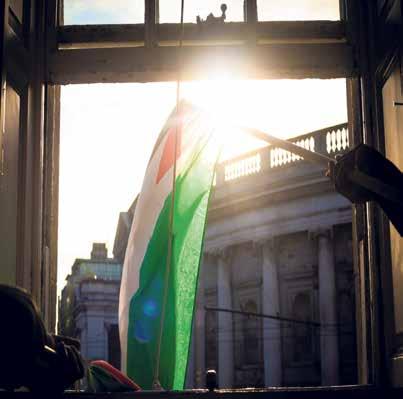
Molesworth Street was temporarily closed for a demonstration urging the government to enact the Occupied Territories Bill on September 24th, . The bill aims to criminalise the importation or sale of goods produced in illegal settlements in occupied territories, including Israel’s settlements in Palestine. The Palestinian Boycott, Divestment and Sanctions National Committee (BDS) organised the demonstration, which drew participation from various solidarity groups and members of the public. Among attendees were members of the Trinity BDS group, the Trinity College Dublin Students’ Union (TCDSU) and other students. People lined the street as the South Kerry Friends of Palestine concluded their 10-day Walk for Peace in Palestine by arriving at the Houses of the Oireachtas at Leinster House, where they presented a petition with over 40,000 signatures supporting the bill.
Quinn Katz-Zogby, the chair of the Trinity BDS group, said: “The failure of the government to pass the Occupied Territories Bill represents the hypocrisy that’s the core of Irish conservative support for Palestine. I think there’s a lot of people in Ireland that claim that they support Palestine, which is fantastic. And I think their role in the movement is still important, but a lot of that is based more on humanism than actual understanding of problems that Palestinian people face.” Katz-Zogby added that the bill presents an opportunity for Ireland to “do something real” for the people of Palestine by stopping the importation of
goods from the occupied West Bank and acknowledging the occupation. He called for a “more broad push from the Irish government to do more material things and stop just saying words. Because, ultimately, words are nice, but they don’t actually change people’s lives.”
Some of the Trinity students at the demonstration waved Palestinian flags and joined a crowd of fellow flag and sign holders, chanting “Enact the Occupied Territories Bill” as the beat of drums echoed in the background. Signs displayed a range of messaging, from “Scorn our complicity” to “Grandfathers say stop the slaughter of innocents in Gaza”. Jenny Maguire, TCDSU President, said: “[Student] participation is recognition that, though we do fantastic actions with Trinity, we are a part of a much broader movement — broader than Dublin, broader than Ireland — an international movement of people united with the simple cause of humanity, of demanding better of a world that is made that is made that is made to oppress Palestinians.”
“I support Palestinian people and my heart is always with them.”
Hamza Bana, TCDSU Welfare Officer, recalled how students have been in the forefront of social movements over the years, like how Trinity students successfully fought for abortion rights in Ireland during the 1980s.
Palestinian Research Assistant Ezzeldeen Alswerky Has Approval for his Irish Visa
Isabella Roussel NEWS EDITOR
Ezzeldeen Alswerky, a Palestinian researcher hired by Trinity to work alongside Professor Amir Khan in the Biochemistry and Immunology department, has finally had his visa approved by the Irish Embassy in Israel. This new development is the first step in a bureaucratic process entangled with the complications of war and the general difficulties of immigration that he will have to face before reaching Ireland.
One of the biggest factors preventing Palestinians from fleeing the Gaza strip is the closure of the border between Gaza and Egypt located in Rafah, which was seized by Israel in a military operation on May 7th. No civilians have been allowed to cross since. This has limited access to
outside aid, and contributed to catastrophic hunger levels in the region. These conditions have placed an additional physical and emotional burden on the shoulders of Palestinians hoping to complete the perilous path out of Gaza.
“I need the government to put more pressure on Israel to open borders and let citizens leave” he stated in an email to The University Times.
While Alswerky’s visa has been approved, he won’t be able to obtain a printed copy without crossing into Egypt.
Should the border re-open, Alswerky’s next obstacle would be the cost of travel and immigration. Having lost a family business to the war, he will require additional aid to fund his stay in Egypt long enough to re-
cover and collect his visa, which he estimates could amount to €730. He will also need time to replace his lost possessions and reconnect with relatives and friends who relocated to Egypt. Aside from support he has received from Amir Khan in obtaining his visa, Alswerky has not been contacted by Trinity. Once he arrives in Ireland, he will further be confronted with the cost of living and rent, and will require assistance to pay these costs. He hopes that with financial and emotional aid from College he will find space to heal from the traumas he has endured since the outbreak of the war.
Trinity Retains its Place in the Top 150 Universities Worldwide
Alannah Wrynn DEPUTY NEWS EDITOR
TFor Kristen Abrahams, a postgraduate student from South Africa, her participation in the demonstration is an extension of the activism against apartheid, and underscores the importance of solidarity among movements.
Bana said: “Fighting for causes like this, it shows that you actually care about something. That you’re not just here just to get your degree, to get your money afterwards…That’s not what life is about. Life is about community. Life is about love and prosperity for everyone. So fighting for these causes shows that you’re actually a good person that cares about your community.”
he Times Higher Education (THE) World University Rankings 2025 have been announced, with Trinity maintaining its spot among the top 150 universities worldwide. Trinity’s ranking has dropped slightly from 134th in the 2024 rankings to 139th in 2025. THE Rankings use five different categories of performance measures including Teaching, Research Environment, Research Quality, International Outlook and Industry. While Trinity performs well in international outlook (based on numbers of international students, staff and research collaborations) a lower score can be found in areas such as teach-
ing (based on a reputation survey, staff-to-student ratio, and doctorates awarded to academic staff ratio among other factors).
While Trinity performs well in subject areas such as Law (ranking 72nd globally) and Arts and Humanities (ranking 87th globally), in disciples such as Physical Sciences, Engineering and Computer Science, Trinity ranks somewhat lower (within the 176-200th bracket). THE also carries out what they term impact rankings which identify universities’ performance in helping to achieve the United Nations Sustainable Development Goals (SDGs). Impact rankings from 2024 show
Trinity ranking higher in SDGs such as Sustainable Cities and Communities (77th) but lower in areas such as Reduced Inequalities (301-400th) Five Irish institutions have dropped in the 2025 rankings, with Dublin City University being the only university to see a rise in its position. University College Dublin appears within the 201-250th bracket and RCSI University of Medicine and Health Sciences in the 251-300th bracket, while University College Cork, the University of Galway, and Dublin City University all place in the 351-400th bracket.
PHOTO BY SOPHIE QUINN
Mercedes Hamilton DEPUTY NEWS EDITOR
Mercedes Hamilton DEPUTY NEWS EDITOR
Protestors Occupy Department of Health to Demand Trans Healthcare
Mia Craven CONTRIBUTING WRITER
Protestors gathered outside Leinster House on Septemher 25th, to rally for equitable access to gender-affirming healthcare for transgender people.
The protest was organised by Transgress the NGS (National Gender Service), a coalition group demanding self-determined trans healthcare in Ireland.
The department building was occupied by eleven activists for over two hours. Helen Moynihan from Transgress the NGS stated that staff “ran us around in circles for two hours” as they tried to confirm a meeting with Minister for Health, Stephen Donnelly.
The group marched to the Department of Health, chanting “Our bodies, our lives, our right to decide”, “Trans rights are under attack – Stand up, fight back”, and “Stephen Donnelly in your ivory tower, this is called people power” as they went.
Outside the Department of Health, demonstrators held a sign reading “Informed Consent Now” and a banner reading “Trans Healthcare Now”.
The department building was occupied by eleven activists for over two hours. Helen Moynihan from Transgress the NGS stated that staff “ran us around in circles for two hours” as they tried to confirm a meeting with Minister for Health, Stephen Donnelly.
The activists eventually met with Minister Donnelly’s secretary who said he would pass both the open letter and the meeting request onto Donnelly. The secretary said they will hear back within a month about whether they will get a meeting with the Minister.
Protestors were then threatened with arrest for occupying the build-
ing. Moynihan stated at one point there were “more Guards than activists in the building”. Moynihan further commented that the whole ordeal is “really frustrating” and that Minister Donnelly and the NGS “consistently don’t follow through” with promised meetings. Moynihan stated it is clear that Transgress the NGS has a “popular mandate from the trans community in Ireland”, as evidenced by their open letter addressed to Minister Donnelly that has received over 1400 signatures since its release in May.
Fiadh Tubridy, a spokesperson for Transgress the NGS, remarked that the protest was organised because the group has “been consistently ignored by the Department of Health, HSE and others” and so they “have to find other ways to make our voices heard.”
Ambassador Theatre Reopens as Music and Comedy Venue
Eliora Abramson ASSISTANT EDITOR
Located on Parnell Street, Dublin’s Ambassador Theatre has reopened as a music and comedy venue. The theatre, whose building dates back to 1764, opened as a cinema on the 5th of June in 1913. The Ambassador Theatre acted as a cinema until 1999 before becoming a concert venue from 2001 to 2008. During this period artists such as Amy Winehouse, Def Leppard, and Queens of The Stone Age performed at the venue. Since 2008, the venue has been used largely as a space for exhibitions. According to The Journal, The Ambassador Theatre, which is operated by concert promoters Denis Desmond and Car-
oline Downey Desmond went before An Bord Pleanála for planning permission for a “rebranding” but were ultimately refused. The pair also own Millenium Theatre Company, the Olympa Theatre, and the Gaiety Theatre. An Bord Pleanála refused a plan for 1.7 metre high steel railings around the building as they stated it would negatively impact the “special character, setting and appearance” of the theatre as well as set an “undesirable precedent for similar development in the O’Connell Street Architectural Conservation Area.” The railings were proposed to offset what the Desmonds claimed to be damage from vandalism and bodily
functions. An Bord Pleanála also refused large digital signage above the main entrance door, citing that the sign would “ have an adverse and injurious visual impact on the dignity, architectural character and setting of this nationally significant Protected Structure.”
Comedian Paddy McDonnell was the first live event since the reopening to perform on the 10th of October with many more on the docket. While many of those set to perform are comedy shows, musicians including Evan Dando, Ron Sexsmith and Playback will also play.
The National Gender Service (NGS) aims to support people seeking gender-affirming healthcare. It is composed of a multidisciplinary team of healthcare specialists. However, Transgress the NGS argues that the NGS is gatekeeping this healthcare through their policy of advising GPs not to provide gender-affirming healthcare outside of the NGS’s remit. Transgress the NGS plan to alert GPs to the fact that they are legally allowed to prescribe hormone replacement therapy, to provide blood tests, and to monitor blood hormone levels to self-medicating patients. Transgress the NGS is seeking the attention of Minister for Health, Stephen Donnelly so that he can intervene by directing the NGS to stop inhibiting GPs providing gender-affirming care and by launching a campaign to inform GPs of their rights.
According to Jenny Maguire, Trinity College Dublin Student Union president, the rally was “another effort in desperation by the trans community to have the state treat them with dignity”. She remarked that “transgender people are forced to beg for the basics and be given even less”. She commended the “unbelievable work” that Transgress is doing for the community.
“We Will Not Be Patient As the World Burns”: Report from Intersectional Climate Strike
Isabel Norman CLIMATE
Approximately 100 protestors marched from the Garden of Remembrance to Leinster House on Friday the 20th of September, calling on the Irish government to endorse the Fossil Fuel Non-Proliferation Treaty and equitably phase out the use of fossil fuels.
The protestors marched across the Liffey, through the city centre, and by Trinity’s gates as the Gardaí stopped traffic to facilitate their route. They chanted, “Simon Harris, shut your gob, sign the treaty, do your job” and “No more coal, no more oil, keep that carbon in the soil”.
At Leinster House, sixteen-yearold Flossie Donnelly was the first of six speakers and spoke defiantly and at times, mournfully, about coming of age in a time of climate crisis. In 2019, it struck her that she had “no
power, no voice”. Five years later, she feels like little has changed: Ireland currently has no phase out date for the use of oil and gas, even as climate crisis effects like rising energy costs and flooding have already damaged the country.
The speakers ranged across age, nationality, and topic, from Maxwell Atuhura, a Ugandan climate activist fighting the East African Crude Oil Pipeline, to Eddie Mitchell, a Leitrim councillor who called for banning fracking and the Shannon liquified natural gas receiving terminal in Ireland. Speaker Jessica Dunne spoke about the intersectionality of climate justice and Palestinian solidarity, leading chants of “From the river to the sea, Palestine will be free”. The speakers spoke passionately about the responsibility of the global North to reduce their emissions as well as the ties between imperialism, capitalism, and fossil fuels.
As explained in part by speaker Dearbhla Richardson, the fossil fuel non-proliferation treaty is backed by thirteen nation-states, including Fiji, Colombia, and Timor-Leste, as well as the World Health Organization and the European Parliament. 118 cities and subnational governments have also endorsed the treaty, including Ireland’s very own councils of Cork City, Dún Laoghaire-Rathdown, Fingal County, and South Dublin County. The treaty seeks to accelerate the global transition to renewable energy, as
governments worldwide continually overshoot the carbon emission limit required to fulfil the 2016 Paris Agreement’s goal of staying under 1.5 degrees celsius of warming.
At a protest that has often focused on galvanising youth, the crowd consisted of all ages, from university students to grandparents.
The final speaker was Saoi O’Connor, the prominent youth climate activist from Skibbereen who began the Fridays for Future strikes in Cork in 2019. They called for governmental transparency and action after years of failed promises. “Let me tell you what I’ve learned in the last five years”, O’Connor cried, ‘every commitment, every target, every net-zero strategy, is a lie. It is a scam to make us shut up… But we will not accept it. We will make the ground shake under their feet. We will make them agree to our terms and our treaties, by the people and for the people. We say no more coal, no more oil’. Despite taking place right outside Trinity’s campus, student turnout was low. In a short interview after the protest with The University Times, O’Connor had a message for them: “So many social movements throughout history, especially radical social movements… have been led by students and young people. That’s what we should be doing here. We should be organising ourselves to build stronger movements on the streets, in our communities, and building resistance to fossil fuels, to imperialism, to the U.S. military in Shannon. We must recognize the interconnectedness of those issues.”
PAID FOR BY THE IRISH TIMES
PHOTO BY TAYA POWER-THORNTON
NEWS
USI Launch Student Manifesto: Higher-Level Students “No Better Off” After Budget 2025
Molly Wetsch, Isabella Roussel
DEPUTY EDITOR AND NEWS EDITOR
The Union of Students in Ireland (USI) held a press conference on Monday 15th to launch their Student Manifesto, which outlines nearly 50 demands for the government on behalf of students. The manifesto covers what USI President Chris Clifford called the “most pressing issues” for students in 2024. Clifford condemned the lack of student supports brought forth in Budget 2025, saying it demonstrates the “pure lack of interest it [the government] has for supporting the future of this country.” The manifesto comes ahead of a predicted call for a general election.
“If TDs and general election candidates don’t support students and support this manifesto, we definitely will not be supporting them in the ballot box,” Clifford said.
Accommodation
Clifford called accommodation one of two “serious crises” the union is hoping to see addressed by the government. USI Vice President for Campaigns Nathan Murphy said that after looking through eight previous years of USI manifestos“nothing has changed” in regard to the government’s approach to the student accommodation crisis. He called for rights on behalf of digs tenants, referring to digs as a “bandaid” for permanent accommodation and a “precarious situation” for students who live in them.
Murphy also spoke of conversations held between USI and the Minister for Higher Education Patrick O’Donovan, in which the minister indicated that construction of sufficient new beds for students would take five years “even if [he] had all the money.”
The union’s manifesto also demands a rise in the vacant property tax, referencing “160,000 vacant and derelict buildings on the island” as well as a strategic plan for purpose-built student accommodation. The union has asked for a rent cap for student accommodation, calling the current
situation “excessively expensive.”
The union’s manifesto calls for an establishment of a minimum stipend for PhD students, citing their “crucial role in advancing Ireland’s research output.” Clifford urged the government to increase the stipend to be consistent with minimum wage, with a minimum stipend of €28,000 for all PhD students. The union also demanded an increase in supports for international PhD students in regard to visas and Irish Residency Permits (IRPs), requesting that the next government cover costs of IRPs and “provide further support in the visa application process.”
Drug Decriminalisation Murphy also called for the decriminalisation of drugs. “The current prohibition is outdated, criminalising thousands each year for minor possession while burdening our justice system”, the student manifesto states. The union calls instead for a health-led approach, providing support for people struggling with drug abuse rather than incarcerating them. References were made to the drug policies of Portugal and some U.S. states as possible models for Ireland.
Irish Language Courses Faye Ní Dhomhnaill, the Students Union President of the University of Galway, called for the government to provide increased courses available through the Irish language in higher education institutes (HEIs). Ní Dhomhnaill stated that the government is “aiming for 20% of the public sector to be able to work through Irish by 2030 but they’re not creating any provisions to provide for that”. When asked which courses should be taught through Irish Ní Dhomhnaill stated that “medicine through Irish, engineering through Irish, science” should be the courses provided for through Irish first.
Ní Dhomhnaill also called for Irish to protect the Irish language from hate speech within the new hate speech bill and to promote the use of spoken Irish in the Dáil.
Budget 2025 Student Measures
DEPUTY NEWS EDITOR AND POLITICS EDITOR
Minister for Finance Jack Chambers presented his first budget to the Dáil today since taking the position this June.
The Government have announced a temporary reduction of €1,000 in the student contribution charge for third-level education, as they have done in the two previous budgets. The apprentice contribution will also be decreased by 33%. The state fee contribution for eligible postgraduates will rise by €1,000 to €2,000. A € 4.5 billion budget for the Department of Further Education, Research, Innovation and Science has also been announced.
The minimum wage will increase from € 12.70 to € 13.50. (full minimum wage only applies for 20 and older). The threshold for paying the initial 3% rate of the Universal Social Charge (USC) will increase to € 27,000, meaning someone working 39 hours a week on minimum wage can expect an approximately € 1,424 increase in net annual take-home pay.
€ 336 million of increased funding has been announced for disability services. Additionally, Hormone Replacement Therapy (HRT) will be provided free of charge for women in 2025. Excise duty for cigarettes will increase by € 1, while the cost of E-cigarette liquid will rise at a rate of 50 cents per millilitre.
Free Public Transport Murphy said that some commuting students spend “up to 600 euro a month on transport alone” and called for free public transport for all students. He cited the transport costs as a knock-on effect of the accommodation crisis, indicating that some commuting students are forced to commute to Dublin from as far as Donegal and Cork due to lack of affordable accommodation in the city. The manifesto also requests an increase in 24-hour bus routes to prevent students from becoming “stranded with no way of getting
home.” In conjunction with the increase of 24-hour routes, USI are demanding a “dedicated police force” to maintain student safety and prevent anti-social behaviour. Murphy further called for a voter reform which would lower the voting age to 16 and make voter registration automatic. With less than 50 percent of those registered in Ireland participating in local elections, the USI hopes that lowering the voting age will make voting more accessible. “If they have that sense of voting from 16, where it’s a family affair, you’re going out with your family, you’re voting together, then it be-
University Groups Call for Investment in Higher Education Ahead of Election
Mercedes Hamilton DEPUTY NEWS EDITOR
The Union of Students in Ireland (USI), Irish Universities Association (IUA), Technological Higher Education Association (THEA), Royal Irish Academy (RIA) and the British Irish Chamber of Commerce have made a joint call on all political parties to prioritise investment in higher education and research.
The group issued this call ahead of elections, with Irish higher education facing significant challenges. Ireland’s student-staff ratios are among the worst at 23:1, in comparison to a European norm of 15:1.
“Investing in higher education is absolutely critical for the future of the country. We must fund higher education and research for our young people and for our future economic and societal health. Both domestic and multi-national companies cite the sustainability of educated, highskills talent as crucial to Ireland’s competitiveness. We are at risk of falling behind our key competitors across the globe if the investment, pledged by government under Funding the Future, is not delivered”, the group stated in their joint release.
Ireland saw significant cuts to higher education funding after the 2008 financial crisis, never returning to the pre-crisis peak of €1.85 billion.
This funding gap has resulted in fewer resources and larger class sizes, which negatively impacts the quality of higher education. It also impacts the amount of financial support available to students.
Funding the Future identified a
comes that thing ingrained in your mind”, Murphy stated. This policy was inspired by those in Austria and Scotland, who changed their voting age to 16. The manifesto argues that people at sixteen have a right to participate in political processes that affect them, namely education, housing, and climate change.
Murphy spoke of the union’s call for “total Seanad reform,” which includes a removal of the 11 Taoiseach nominees and a removal of the requirements for voting in the Seanad. He called the requirement to vote for the six University members of the Seanad, which was recently
reformed to include graduates of any Designated Institution of Higher Education, “classist” and demanded all citizens be allowed to vote in the Seanad. Murphy stated that “nothing has improved the past eight years”, despite two student manifestos being published. A student walkout was organised by USI over the lack of measures in Budget 2025, which was referenced by Vice President of Trinity Orla Sheils in a College wide email. Additional reporting contributed by Brídín Ní Fhearraigh-Joyce.
Union of Students in Ireland Denounces Budget 2025
€307 million annual shortfall in core funding needed in higher education, as well as additional costs to support students and for national pay awards. However, only €105.7 million has been allocated this year, covering just over one-third of that shortfall.
Launched in 2022, Funding the Future aims to increase funding for institutions, reduce education costs and explore measures to alleviate financial burden for students, including adjustments to the Student Grant Scheme.
The maintenance grant portion helps students with their living costs, while the fee grant can pay tuition fees for students who do not qualify for the Free Fees Scheme or cover the Student Contribution and the cost of essential field trips.
The 2023 Irish Survey of Student Experience found that 8.5% of firstyear undergraduate students, 9.5% of final-year undergraduate students and 10.4% of postgraduate students seriously considered withdrawing from their degree programme for financial reasons. Additionally, the ongoing housing
crisis exacerbates student difficulties. A housing survey conducted by the Trinity College Dublin Students’ Union (TCDSU) in 2023 found that 632 of 857 respondents reported paying rent. Almost two-thirds of these students reported financial difficulties due to the cost of their rent. Just under half of these students work to help them to pay rent, with 71.86% reporting that it negatively impacts their education.
“It is essential that the next government, whatever its make-up, makes the necessary investment to both support the cost of higher education for students and the necessary funds for universities to deliver a quality, internationally competitive education”, the five groups wrote in the release. “Our students and young people are the renewable resource for Ireland’s future. Government has identified what’s needed, and this now needs to be delivered.”
The Union of Students in Ireland (USI) has denounced Budget 2025 due to the lack of financial support for third-level students.
This year, €235 million has been allocated to the tertiary sector as one-off current funding.
The Government announced a once-off reduction of €1,000 in the student contribution charge for the third year in a row and a 33% reduction in apprentice fees. The postgraduate fee contribution grant was increased by €1,000, bringing it to a total of €5,000.
Additionally, the minimum wage will increase from €12.70 to €13.50 and the threshold for paying the initial 3% rate of the Universal Social Charge (USC) will increase to €27,000. This means that someone who makes minimum wage and works 39 hours a week can expect about a €1,424 increase in net annual take-home pay.
“They talked about wanting to make Ireland the best place in the world to be a child, but between the cost of going to college, the lack of student accommodation and no mention of specific supports for students, it seems like they want to hand young people a plane ticket along with their Leaving Cert. results.” USI President, Chris Clifford said in a press release.
The USI said the only measure that will help some students is the increase in the renters’ tax credit which will bring the total credit to
€1,000. However, the organisation called it “a drop in the ocean” in comparison to the current cost of student accommodation in their press release.
USI sent a pre-budget submission to every Teachta Dála (TD) ahead of Budget 2025, in which the main requests were to fund the building of the 30,000-bed shortfall in student accommodation, reduce fees by €1,500, to introduce a plan to abolish tuition fees over the next few years, and for the government to provide free public transport for all students.
The USI press release said:
“While we welcome the repeat of the €1,000 Student Contribution Charge and the 33 per cent reduction in apprenticeship fees and the slight increase in the minimum wage, there has been no move that will fundamentally do anything to relieve the huge burden students currently face. After this so-called ‘giveaway’ Budget, students will be no better off next year than they are now.” This year, €105.7 million was allocated to higher education — just over one-third of a €307 million annual shortfall in core funding needed in higher education identified by Funding the Future.
Natalia Kamendy, Eoin Connolly
Mercedes Hamilton DEPUTY NEWS EDITOR
Trinity Professors Share Diverse Views and Approaches to Gen AI as Students Await College-Wide Policy
Mercedes Hamilton DEPUTY NEWS EDITOR
Two years after the emergence of ChatGPT, Trinity College Dublin’s (TCD) policies on the use of generative Artificial Intelligence (Gen AI) in teaching, learning, and assessment are still under development, with an official statement expected to be issued in the coming weeks.
The Centre for Academic Practice at Trinity Teaching & Learning published a resource guide on Generative Artificial Intelligence and Academic Integrity. In an effort to avoid different policies across the college, College has asked schools not to create their own policies on the matter. Instead, they are to use the college’s statement as a foundation for local practice and adapt the handbooks for specific approaches.
In the School of Medicine, students' Yearly Study Guides include "Academic Integrity and Referencing Guidance," with an excerpt from the Calendar Statement of Academic In-
tegrity. AI use is addressed under "Academic Misconduct," which states that plagiarism includes “submitting work which has been created using artificial intelligence tools, where this has not been expressly permitted.”
Similarly, the School of Histories and Humanities has stated that it will treat the presence of AI-generated work as a breach of TCD’s guidelines on academic integrity. “Any use of AI-generated material in an essay or exam answer will render that work inadmissible for assessment and will be subject to the sanctions outlined in the College Calendar.”
Eoghan Gilroy, the Education Officer of Trinity College Dublin Student Union (TCDSU), finds the lack of guidance from the college on Generative AI policies “abysmal”.
“This statement provides little to no guidance for students who are very often put in a difficult position when deciding whether or not they can or should use Gen AI,” he said. With pros and cons varying by academic subject and diverse opinions
on Generative AI softwares across the board, many faculties and professors have taken measures to mitigate and control its use such as shifting the way exams are delivered and asking students to be transparent about usage.
For example, the School of Psychology and the School of Business have created systems where students self-report AI use in an academic integrity declaration. According to Clare Kelly, an associate professor in the School of Psychology and Department of Psychiatry at the School of Medicine and a principal investigator at Trinity College Institute of Neuroscience, few students have declared use. However, she noted surveys suggest that there is substantial use.
“It's not clear to us whether our students are an exception or whether the use has not been declared, which may reflect uncertainty on behalf of students about the impact of that declaration,” Clare said.
Gilroy explained that the lack of policies in school have generated fear among students about using AI: “There is a welcomed push for greater harmonisation within Faculties, as this previous laissez faire attitude has led to significant inconsistencies in how Schools have handled AI, causing confusion and unfair punishments, as outlined.”
A Study.com student survey found that 89% of respondents used ChatGPT to help with a homework assignment, 48% admitted to using it for an athome test or quiz, 53% had it write an essay and 22% had it write an outline for a paper.
Kevin Kelly, an associate professor of mechanical, manufac-
turing and biomedical engineering, said the use of Gen AI is widespread in his modules. “If I'm sitting with a student and they have a laptop opener and walking around a lab and people are working on computers, it's pretty rare there isn't a tab open somewhere in the computer that has Gen AI others in some shape or form.”
However, Khurshid Ahmad, a professor of computer science, said he trusts his students without reservation. “In 54 years of teaching, learning and research at university level my experience of students is that they are honest, keen to learn, and have helped me to learn a great deal. Like in any walk of life, a few might take short cuts, even cheat sometimes, that does not mean the whole lot is to be blamed and monitored.”
Kevin considers Gen AI to be a “disruptive technology” in both positive and negative ways. On one hand, he sees it as an impressive productivity tool for tasks like answering questions that may require shuffling through several PDFs and writing code. On the other hand, he sees this technology putting the validation of capability at risk.
“I am training somebody to perform a particular role…Would you be comfortable flying in a plane that had been designed by an engineer who had used Gen AI to pass their way through university? These are the challenges we have in terms of the consequences of certified people with a skill that they may not actually have,” he explained.
Clare has “enormous ethical concerns” about Gen AI that span beyond education and lead her to never use the software, like how tools such as ChatGPT are “trained on data scrape from the internet, proprietary data, copyrighted data, data that was not given with permission”. Gen AI also presents environmental concerns as data centres in Ireland now consume almost over a fifth of the European Union’s electricity, according to Barron’s. This demand is increasing as Gen AI proliferates.
“I feel that what is required is a much more critical conversation about these tools — about their ethical implications, about their climate and environmental implications, about their justice implications, than we have had to date,” she explained.
Raidió Teilifís Éireann surveyed 450 Gen Z students and found that “tech-savvy Irish students who recognise the power of generative AI may know these tools are unethical but use them anyway.”
Gilroy believes there are several ways students can use Gen AI creatively, while still being within the guidelines of academic integrity. Examples include helping develop ideas for assignments, providing an outline to a topic, summarising articles to help students better understand what is being discussed and helping students with syntax and grammar.
“Use of such tools, with due care and attention, can only improve the student experience in a classroom. Students engage with programs differently – showing scepticism as they should, and compare and contrast with materials like lecture notes and textbooks,” Ahmad said.
While it can be difficult at times to detect AI usage in assignments, Kevin believes educators have a big responsibility to ensure students are not
Budget 2025: What Did Students Want?
Alannah Wrynn DEPUTY NEWS EDITOR
Housing, transport, PhD workers’ rights, hidden costs of university, nature protections and community investment are all issues students are thinking about as Budget 2025 is released. The University Times has interviewed five Trinity students on what they’re looking out for in this week’s Budget.
Reflected across all conversations was a need for government to listen to the voices of students and a belief that many student concerns have been
neglected. “I’m a little bit sick of having this conversation about the budget because we bring up the same things every year and nothing ever changes”, Síofra Delaney, a second-year History and Politics student commented.
While students receiving financial support through SUSI grants and the Trinity Access Program felt grateful for that support, most felt that college was not receiving enough funding from government to adequately respond to their needs.
Charlie Beudelot - Second year Hu man Nutrition and Dietetics. In our conversation transport and housing are issues that immediately come up. “For the first three months of my course I was commuting five hours a day from Offaly. My classes started at 9 am and finished at 7 pm so I missed multiple lectures. I couldn’t find affordable housing and I couldn’t get housing beforehand because I didn’t know what course I was going to get.” Charlie is looking to see tax breaks for landlords for bringing students into their homes and increased investment in affordable student specific accommodation. After finally getting accommodation Charlie began working in a nightclub, coming back from class only to face a four to eight hour shift. “I worked four different jobs over summer to save… education should not be limited to those who can pay for it.” Increases to student grants and granting students under the age of twenty the full minimum wage are policies Charlie is looking to see implemented.
Seathrún Sardina - Computer Science PhD. Seathrún is looking to see a living wage for Postgraduate researchers (PGRs) being guaranteed in Budget 2025. While Trinity and many other universities continue to regard PGRs as students as opposed to employees, many PGRs earn below the minimum wage whilst working full time for the university. Describing how wages for PGRs can vary Seathrún describes that PGRs can go entirely unpaid or they could be earning ‘anywhere from €6,000 to €20,000 per year. Without funding from government, universities like Trinity don’t have the capacity to
grant workers rights to PGRs. “We are workers, we are hired to perform a university’s research and are routinely evaluated on the quantity and quality of said research, just as you would be in any other job. We have working obligations at Trinity - but no contracts or right to minimum wage, sick leave, or parental leave.”
Anabel O’Hora - First-year European studies. Anabel says she will be focussing on what is included in the Budget in terms of nature protections. “It’s of special interest to me because last year I was at the economic dialogue with the National Youth Assembly of Ireland, so I felt part of that conversation.” Anabel has a background in environmental advocacy spanning back to when she joined her local Comhairle na nÓg (Youth Council) as a secondary school student. She is looking to see an increase in funding for education on sustainability. She speaks passionately about the need for the government to listen to the voices of students and young people. “It’s important to listen to people of all different ages because they bring something different to the table.”
Anabel is looking to see increased funding for local community action groups and would like to see students given a chance to work with the local community and people of different age groups.
Síofra Delaney - Second-year History and Politics. In our interview, Síofra talks about the hidden costs of attending university which go largely unsupported. “Laptops are really expensive, and I know they have computers in the library but they’re always busy or when you’re trying to write an essay and the library only has two copies of the
book you need. So then people have to go out and buy the book, because you’re on a waiting list of like twelve people, for a book that’s required for your course.” For Síofra, the €1,000 reduction in student fees in last year’s budget made a big difference, but more is needed. Transport is another issue that Síofra feels strongly about. “When I go out my night bus only runs on Fridays and Saturdays so I have to pay for a taxi if I want to go out, on the student night out which is on Thursdays. I can’t afford to get a taxi.” Reductions in transport costs and improvement in services is something Síofra hopes to see in Budget 2025.
Heaven Curpen
Third-year Sociology and Politics. “I really care about grassroots projects, taking care of the community, taking care of people on the ground level.There’s a lot of children and a lot of young adults who just don’t have things to do or engage with.” Heaven would like to see more youth spaces built where people like her
using AI in ways that taint academic integrity. Though engineering isn’t a discipline that would generally be assessed by essay type questions, some of his exams are delivered online and monitored in campus computer labs computers are locked down to prevent students from accessing tools. He has also noticed a shift back to traditional handwritten exams and oral examinations. Clare’s department states that oral exams can be added to any module if it is felt necessary.
Gilroy cited University College Dublin’s (UCD) College of Arts and Humanities traffic light system, which marks individual assignments as red, amber or green to “provide clear guidelines to students about whether or not they are permitted to use generative AI in their work.”
“This is so important for students to know, and I would love to see this approach brought in to some schools in Trinity to help students become more aware of the benefits of Gen AI, but also how damaging and exploitative of a technology it is, particularly in terms of the environment and on countries in the Global South respectively,” Gilroy said.
younger sister can go to hang out. “I’m from the northside, my family didn’t really have that much growing up, I know what it’s like to not have much but really wanting community and wanting a space to be a kid but not really having that.” Heaven explains that she sees
First Council: Three Procedural Motions, Several Committees Elected, a Runtime of 2
Hours 45 Minutes
Alannah Wrynn, Freja Goldman SENIOR EDITORS
Chair of Council Daniel Walsh began the first council of the 2024/25 academic year warning students that the “first council is notorious for the sheer quantities of elections held”. A queue of students stood outside the Dargan Lecture Theatre in order to register before the Council began. Education Officer Eoghan Gilroy opened the Council with a procedural motion A to skip the agenda item, Matters Arising. Queues remained outside the Dargan Lecture Theatre to register as Council began with the reading of Officer Reports. The motion was passed and Sabbatical Officer reports and questions proceeded. Trinity College Dublin Students’ Union (TCDSU) President Jenny Maguire kicked off the sabbatical report stating that it has been a “crazy start to the year for the Union, we’ve abolished every metric that we’ve had in the past, [and] we are consistently achieving previous metrics of previous unions.” The president was followed by Education Officer Eoghan Gilroy who largely spoke about his work over the Summer concerning the integration of postgraduate students into the Union. Gilroy notably mentioned the large number of Class Representative (class rep) nominations this year, with 710 people being nominated for class rep positions.
The meeting continued with Welfare and Equality Officer Hamza Bana who discussed his efforts to combat racism, including the establishment of a Union of Students Ireland mandate for the creation of ethnic minority support groups on campuses. Communications and Marketing Officer Beth Strahan followed and discussed successful marketing campaigns, as well as a more than 100% increase in revenue this Freshers’ week and the physical rebranding of the union.
Oifigeach na Gaeilge, Pádraig Mac Brádaigh then delivered his report in Irish, reporting that it’s no exaggeration that he did a huge amount of translation over the summer. Mac Brádraigh further commented on his plans to develop an Irish language constitution for the union so that all union services are available in Irish. He said he hopes to see more Irish on campus and in the union.
Ents Officer Peadar Walsh concluded the Sabbatical Officer reports, with discussion of the organisation of postgraduate events, a sold-out club night, five late-night events and Pav Fest, for which Walsh said 1,000 tickets were sold in one day. Lastly, he mentioned exciting upcoming events such as a big Pav night event this Friday and the ‘Ravetacht’.
Elections began with the election of the LGBTQ+ Officer and then moved on to representatives for the Education Committee. After a number of speeches had been given by the nominees for Mature Student Representative, the Chair of Council and members of the Oversight Commission and Electoral Commission realised that “we missed a nomination on Zoom” for the role of Access Representative, which initially went uncontested.
Technical issues ensued, including problems with broadcasting a nominee’s speech over Zoom causing elections to be further delayed. Council, with an original 6:30 pm start time, had already experienced a fifteen-minute delay in start time due to slow registration. At 8 pm, Chair of Council Daniel Walsh announced that council would have a 9 pm finish time, despite Education being the only committee election completed, with seven further committee elections remaining. Education Committee Elections Last Over an Hour.
Not Here Not Anywhere Community Group Calls on Government to Pass the LNG Free Bill
The climate activist group Not Here Not Anywhere (NHNA) called on the government to urgently pass the Liquefied Natural Gas (LNG) Free Bill before the Dáil Éireann dissolves, after it was drawn to move forward to the second stage.
Launched in February 2022 by the Green Party Teachta Dála (TD) Neasa Hourigan and climate activist group Not Here Not Anywhere (NHNA), the bill would halt the granting of planning permission for LNG terminals in Ireland and prevent the importation of fracked gas through LNG.
The bill would also protect the public from the security and safety risks of LNG terminals, which require “large, disruptive and dangerous infrastructure” and pose safety risks for local communities like vapour release, flash and jet fires.
NHNA and more than 30 environmental and social justice groups have emphasised the pressing need for this bill for the climate, local communities and for the country’s energy security. Furthermore, over 45 Irish and international organisations have urged the government to evaluate the risk these terminals pose to the safety and security of Irish communities. LNG terminals emit ozone and carbon monoxide through the loading and unloading of tankers, which contributes to severe respiratory problems, according to a press release from NHNA.
“The Green Party must take a stand and fast-track the LNG Free Bill that was introduced by their party colleague, Neasa Hourigan TD, in February of 2022,” Dylan Murphy from NHNA said in the release.
NHNA said this comes at a “crucial time,” when American energy company New Fortress Energy has just won its appeal against An Bord Pleanala’s decision to deny planning permission for the proposed Shannon LNG terminal in County Kerry due to the absence of a legislative ban. Additionally, the government is also pushing to expedite LNG projects through the new Planning Act.
The advancement of the LNG Free Bill provides an opportunity for the Green Party to fulfil their Programme for Government promise, which emphasises the importance of lowering emissions and building a sustainable energy future.
The Programme for Government, published in 2020 reads that “As Ireland moves towards carbon neutrality, we do not believe that it make sense to develop LNG gas import terminals importing fracked gas. Accordingly, we shall withdraw the Shannon LNG terminal from the EU Projects of Common Interest list in 2021. We do not support the importation of fracked gas and shall develop a policy statement to establish that approach”.
Gilroy submitted a procedural emergency motion D to increase the number of OCMs on his committee from two to ten members due to the Officer’s goal to create increased College-wide academic policies for AI. There were ten people nominated for the Education Committee OCM position. All nominees were deemed elected.
Speech time was cut from 45 to 30 seconds for first-year representatives on the welfare and equality committees and all further committee speeches onwards at approximately 8.15 pm. Repeatedly, elections flitted from one committee to another without all committees being fully elected. The Student Representative studying the Dual BA programme winner was not announced until a person in the crowd asked for the information, interrupting another ongoing election.
Speeding through the agenda, Bana paused the election for Trinity Joint Honours (TJH) committee OCM to request a motion to approve the Student Parent/Carer Fund Terms of Reference (TOR). This motion was passed. The motion aims to adopt the TOR of the Student Parent/Carer fund so student parents and caregivers can be reimbursed for costs related with childminding
during the mid-term break.
Just before the 9 pm cut-off time, Gilroy proposed a procedural motion with a request to extend the cut-off time by “10 to 15 minutes” in order to get all of the committee members elected. At this time there were five committees left for election. The motion was passed under the condition of 15 extra minutes allocated beyond the original 9 pm cut-off. Nonetheless, the meeting still ran six minutes over the additional 15 allocation, with elections results left to be announced. Nominations for biennial member and oversight commission in the electoral commission were called, but the election remained to be called.
Despite delays caused by technical difficulties, the meeting was cut off at 9.21 pm, leaving out a motion for technical officer and discussions about postgraduate common room cleanliness and student resources at the Trinity Translational Medicine Institute (TTMI), amongst other business indicated on the agenda.
Additional reporting contributed by Natalia Kamendy, Isabella Roussel, Aoife Bennett. Molly Wetsch, and Brídín Ní Fhearraigh-Joyce.
Vietnamese President Visits Trinity
r Tô Lâm, General Secretary of the Communist Party of Vietnam and President of the Socialist Republic of Vietnam visited Trinity on Wednesday, October 2nd as part of his state visit to Ireland. Mr. Lâm was welcomed to Trinity by Vice Provost Prof. Orla Sheils and Patrick O’Donovan, Minister for Further and Higher Education, Research, Innovation and Science and visited the Book
of Further and Higher Education, Research, Innovation and Science. A memorandum of understanding has also been signed between the Vietnam National University and leading Irish universities. Meanwhile, College is introducing a management and economics training programme in partnership with Vietnam National University building on existing partnerships with Vietnamese universities.
Mr Lâm previously drew criticism from Western governments, notably the U.S., for welcoming Russian President Vladimir Putin to Vietnam in June
of Kells exhibition.
Following the experience of Typhoon Yagi in early September, Vietnam has been hit with catastrophic human and economic losses.
Delivering an address on ‘A Vision for a New Era of Vietnam – Ireland Partnership for Peace, Cooperation and International Development,’ in Trinity’s Public Theatre, Mr. Lâm drew links between Ireland and Vietnam’s struggle for independence, praised Ireland’s economic success story and thanked the Irish government for the support granted to Vietnam in areas such as poverty reduction, post-war recovery, and assistance for vulnerable groups for the past three decades. The Irish government has established a strategic partnership on higher education between the Vietnamese Ministry of Education and Training and the Irish Department
Mr Lâm previously drew criticism from Western governments, notably the U.S., for welcoming Russian President Vladimir Putin to Vietnam in June and for Vietnamese foreign policy which generally involves maintaining friendly relations with all major powers including Russia and China.
This visit marks the first visit of any Vietnamese president to Ireland with President Higgins and his wife Sabina hosting a state dinner in honour of Mr Lâm. During his time in Ireland Mr Lâm also visited the Garden of Remembrance, the National Institute for Bioprocessing Research and Government Buildings where he met Taoiseach Simon Harris. Further strengthening ties, the state visit announced the opening of a Vietnamese Embassy in Dublin.
Eating Disorders Association of Ireland Finds Increased Need for Support
Natalia Kamendy DEPUTY NEWS EDITOR
BodyWhys, the Eating Disorders Association of Ireland, has released an annual report, showing that the use of their listening, information and support services increased by 19.5%.
Compared to their 2022 data, they have found an increase of 4,800 more service users in 2023.
BodyWhys is a voluntary organisation that offers support for people affected by eating disorders and their families in Ireland. An estimated 188,895 people in Ireland will experience an eating disorder at some point in their lives, and the increase in support service usage found by BodyWhys only further highlights the need for eating disorder support and awareness.
In a press release, Ellen Jennings, Communications Officer with Bodywhys, said “In 2023, we observed a significant rise in demand for our core support services across the helpline, email support and online support groups. Our helpline received 1,292 calls, reflecting an increase of 35%, compared to 2022. Over a quarter (27%) of queries to Bodywhys came by phone in 2023. Our email support service dealt with 2,346 queries, reflecting almost half (49%) of all queries responded to by our volunteers. Binge eating disorder arose as a key
concern for many of our service users, particularly within our adult online support groups, virtual support groups and email support.” Harriet Parsons, the Training and Development Manager at BodyWhys further commented on the number of young women and men attending the Association’s PiLaR programme, saying, “From a carer’s perspective, we continued to deliver our Family Support Package, through our free evidence-based PiLaR programme, accessed by 637 people in 2023. Over three quarters of people who attended PiLaR were supporting their daughter, whilst 10% were supporting their son. Almost a fifth (19.64%) were supporting a person experiencing avoidant/restrictive food intake disorder (ARFID). Additional family services included the provision of 20 Post-PiLaR support groups, New Maudsley Carer Skills (NMCS) workshops and 13 NMCS podcast episodes for those supporting a family member.''
BodyWhys has several support services for both people affected by eating disorders and their families on their website as well as a helpline number and email support.
Jaws na hÉireann?
cuma ar an scéal go bhfuil ainmhí nua tagtha go hUiscí na hÉireann
Ruairí Goodwin AOISCRÍBHNEOIR
Ag tús na míosa seo chaite, thug grúpa eolaithe as Éireann agus na Stáit Aontaithe faoi suirbhé mara corraitheach. Bhí siad ag lorg an céad fianaise riamh do shiorc bán mór, cáiliúil dar ndóigh ón scannán Jaws, in uiscí na hÉireann. Ar an drochuair, nó ar an dea-uair, ag brath ar do dhearcadh, níor tháinig siad ar aon fhianaise de na siorcanna an uair seo. Mhínigh an príomh-eolaí ó thaobh na hÉireannaigh, an Dochtúir Nicholas Payne as Roinn Zú-Eolaíochta Coláiste na Tríonóide gur chuir droch-aimsir bac orthu is iad ag lorg na siorcanna; “Rinne gaoth seasta aduaidh é deacair orainn bogadh ón t-aon áit amháin cosainte sin, rud a chiall nach raibh muid in ann cuardach ró-leathan a dhéanamh”. In ainneoin an droch-toradh a bhí ar an tóraíocht seo, tá dóchas fós ar an bhfoireann eolaithe, dúirt sé gur “Thug an cuardach neart spreagadh dúinn a thuilleadh iarrachta a chur isteach sa gcuardach thar an céad bliain nó dhó eile amach anseo, go háirithe i gcúpla áiteanna eile thuas cósta iarthar na hÉireann”. Mar sain-eolaí siorca le breis is deich mbliana, tá taithí ag an Dochtúir Payne speiceas nua a aimsiú in Éirinn. I Mí Aibreán na bliana seo, d’aithin sé conablach siorc a bhí caite suas ar thrá i gContae Loch Garman mar siorc tíograch gainnimh. Mar aon leis an siorc bán mór, ní raibh trácht ar an speiceas seo in Éirinn riamh roimh an eachtra seo. Bíonn cónaí ar an dá speiceas seo in uiscí níos teo cosúil leis an Meánmhuir de ghnáth. Leis an téamh atá ag teacht ar an bhfarraige de bharr athrú aeráide, tá roinnt speiceas mara ag bogadh ó thuaidh ag lorg uisce níos
fuaire. Tá seans maith gur seo a chúisigh leis an siorc tíograch gainnimh a bheith in Éirinn, agus tá féidireacht ann comh maith go gcúiseoidh sé leis an siorc bán mór teacht go hÉireann amach anseo, muna bhfuil sé linn cheana féin. Ach, an baol é dúinn go mbeadh na siorcanna seo go luath inár measc agus muid ag snámh timpeall cósta na hÉireann? Le fírinne, ní hea. Is ar éigin a ndéanann siorcanna ionsaí ar dhaoine, fiú in áiteanna ina bhfuil daonra mór de shiorcanna ann, agus duine, ag roinnt an t-uisce céanna. Sa gceantar Cape Cod sna Stáit Aontaithe, mar shampla, níor tharla ach eachtra mharfach amháin idir siorc bán mór agus duine i dtréimhse cúig bliana. Tá seo in ainneoin go bhfuil b’fhéidir a dlús is airde ar domhan de shiorcanna bána móra sa gceantar, comh maith leis a bheith mar cheann de na príomh-ceantracha turasóireachta ar chósta oirthear na Stáit Aontaithe. In áit a bheith mar baol don turasóireacht áfach, creidtear go gcruthaíonn siorcanna deiseanna nua éiceathurasóireachta, saghas turasóireacht atá dírithe ar an t-imshaol, a fhorbairt i bpobail cois farraige na hÉireann. Tá forbairt an earnáil seo mar cheann de na phríomh-thionscnaimh atá á reachtáil ag foireann Payne sa Roinn Zú-eolaíochta, in éineacht le Foras na Mara agus Iascach na hÉireann. An aidhm atá ag an comhghuaillíocht seo na rannpháirtíocht níos forleathana a chruthú in éiceathurasóireacht siorcanna in Éirinn, rud a mbeadh buntáisteach don phobail mara agus na siorcanna araon.
Mercedes Hamilton DEPUTY NEWS EDITOR
Alannah Wrynn DEPUTY NEWS EDITOR
Parent Company of UN Blacklisted Firm Participated at Trinity Careers Fair
ENí Fhearraigh-Joyce
gis engineering, the parent company of United Nations (UN) blacklisted firm Egis Rail hosted a stall at a recruitment fair organised by Trinity Careers Service. The fair was held in the Sports Hall and aimed at engineering students.
A subsidiary of Egis, Egis Rail is on the UN blacklist for “The provision of services and utilities supporting the maintenance and existence of settlements, including transport” in Occupied Palestine, according to the UN Human Rights Office of the High Commissioner.
The University Times has seen email correspondence between the Careers Service to Trinity College Dublin Student Union (TCDSU) President Jenny Maguire stating that the Careers Service “carry out a series of checks on all companies that sign up to engage with us on graduate recruitment through our Careers Portal. This includes verifying that they are not on the UN Blacklist.”
The UN Blacklist was established to identify companies working in Israeli settlements. It seeks to promote transparency and assist business enterprise in complying with international law.
The list was updated in 2023 and serves to promote clarity and transparency and assist both Member States and business enterprises in complying with respective obligations and responsibilities applicable under international law.
The United Nations Human Rights Council first drafted the list in 2020 after a resolution was passed to investigate the implications of the Israeli settlements on the civil, political, economic, social and cultural rights of the Palestinian people throughout the Occupied Palestinian Territory, and has since been updated to reflect companies that have removed their operations from the Israeli Settlements.
An email that was sent course wide to Engineering students in each year of
study by Internship Coordinator and Industry Liaison Officer from the School of Engineering, said of the Careers Fair “These events are a brilliant opportunity for you to connect with potential employers, learn about graduate programs, and gather tips for the application process”.
A College Spokesperson responded to The University Times’ request for comment on Egis’ attendance at the Trinity Careers Fair, stating “This was a genuine error. The company registered for the Careers Fair under its former name.”
The company that was to attend the Careers Service Fair was called J.B. Barry and Partners, who have since been bought by Egis. However, the stall was
solely branded by Egis.
According to their website, “Egis has operated in Ireland since 1994. We design and operate roads, railway, bus and active travel systems, water and energy infrastructure, buildings and structures.” The firm also has an office domiciled in Israel, as well as 100 other offices worldwide.
Following the update of the UN Blacklist in 2023, Egis Rail is one of 122 companies listed. 15 companies were removed in 2023 from the list due to no longer having involvement in Israeli settlements.
Egis have not responded to a request for a comment.
University Council Approves BDS Task Force Terms
The University Times has seen documents outlining the terms of who will sit on Trinity College Dublin’s (TCD) task force, as approved by University Council. The establishment of the task force was part of the agreement that brought an end to the five-day Trinity’s Boycott, Divestment and Sanctions (BDS) and Trinity College Dublin Student Union (TCDSU) encampment last spring. This is part of the agreement to end the five-day encampments on 8 May, 2024 after “successful talks between the university’s senior management and the protesters.” The agreement reads: “Trinity will complete a divestment from investments in Israeli companies that have activities in the Occupied Palestinian Territory and appear on the UN Blacklist in this regard.” After a review, TCD has confirmed there is currently only one Israeli company on its supplier list that will remain until March 2025 due to a contract. In its statement, TCD outlined the formation of a task force within the College’s governance structures, consisting of 26 members, including students, staff, and an external chair. The task force will address issues of divestment, academic exchanges and concerns raised by recent protests, with recommendations to be presented to principal committees.
While the identity of the chair is yet to be confirmed, the secretariat will include the Senior Dean and the Secretary to the College/Director of Governance or their nominee. Student representatives will include three
Trinity Accommodation Worker Expresses Discontent With Working Conditions Over the Summer
During the summer holidays, Trinity offers its student accommodation to tourists as a cheaper and centrally located alternative to hotels. Aside from tourists, Trinity-employed accommodation workers also stay and work at the student accommodation. There have been a number of reports about the working conditions these workers face concerning hourly pay, long on-call working hours or a tense toxic environment. As well as that, accommodation workers were prompted to unionise for better working conditions, however, they shut down the request themselves, citing a fear of contract termination. The University Times spoke with previous accommo-
dation worker, Alessandra Aspromonte about her time working at college accommodation. When asked about her overall experience Aspromonte stated, “In general, I’ve been very lucky to end up with mostly sound coworkers and housemates each time. Unfortunately, the excitement faded quite fast this year as I had to deal with a pretty tense work environment from the very start.”
She further detailed the tense working environment, indicating that management were regularly aggressive towards staff workers.
“I don’t think I’ve ever been unnecessarily yelled at as much as I did this year (for the record, I always did my job correctly). In general, there
was always the impression that management could not be nice to all of us at the same time: there always had to be a scapegoat. This mostly affected us supervisors, as we were dealing with upper management more than the rest and were expected to act as mediators,” Aspromonte explained.
Going into further detail Aspromonte recalled a specific instance of upper management reprimanding a coworker inappropriately stating:
“Front desk staff was not exempt from the unfairness. One of my friends got reprimanded quite aggressively due to a negative review, with the management team not being willing to listen to their version of the story or to ask the rest of us what actually happened. We were all subjected to the mood of our superiors, as some of them did not seem capable of regulating their own emotions before coming down on us.”
The University Times reached out to the Accommodation Office regarding these allegations. A College spokesperson stated that “Employees should raise any grievance about work conditions with their line manager in the first instance, and, failing that, with the senior management. We encourage them to do so.”
Aspromonte also addressed long on-call periods for staff workers and the unnecessary duties placed on accommodation workers where security workers could have been capable of resolving resident issues.
“Security are the ones that call us when they feel like they cannot deal with an emergency,” Aspromonte said. “This mostly includes issues with bookings or nighttime checkins. Most of the time the accommodation staff gets called at night, it is an issue that security could deal with themselves. However, the security staff are not properly trained (to the point that we have had to head to Front Gate at 3am to remake some-
one’s key). With big emergencies, we were expected to deal with them too. Having long-term security staff would probably fix half of these issues. When an external contractor is sending in new staff every week, it is difficult to train them in unfamiliar policies and software.”
Aspromonte stated that there was not a specific requirement to be oncall, but that there was an unspoken rule of always being available to help, even during breaks and days off,
“Our contracts did not explicitly require being on call at night like the other front desk staff members (they did not receive any extra pay for this, and I never received compensation for being on call last year). However, in a supervisor position, there is the unspoken expectation to be always available ‘to support the team’. This included being reachable during breaks and on days off, as well as during the night in case an emergency arose that could not be dealt with by the on-call staff. I also worked overtime after my contract ended, as management decided to close the office two days early for the season, despite still having guests on campus.”
The University Times was provided a blank contract by the Accommodation Office, which states that the worker will work 37.5 hours per week, which can be subject to change due to rostering arrangements. The contract does not mention anything about longer on-call times.
While the Accommodation Office could not disclose the hourly rate for workers because of privacy issues, Aspromonte detailed that front desk workers were paid exactly minimum wage, while she and the other supervisors were probably being paid a few cents more.
In my opinion, this is not quite enough for the level of responsibility our role requires.”
members of TCDSU to be elected by their president, two members of the Central Societies Committee (CSC) to be elected by their chair and four nominated members of the Group of Unions. Staff voices will include the Vice-Provost & Chief Academic Officer, Chief Operating Officer, Vice-President for Global Engagement, Associate Vice-Provost for Equality, Diversity and Inclusion and the deans of TCD’s three faculties, among others. Staff members can nominate a substitute if they choose.
In addition to divesting and endeavouring to set up a task force, the College has also acknowledged the genocide in Gaza as a driving force behind the encampments. In an official statement, TCD expressed “solidarity with the students in our horror at what is happening in Gaza,” and reaffirmed its support for those affected by the conflict. TCD has also partnered with local and international organisations, such as We Are Not Numbers (WANN), to offer scholarships and accommodations to eight students from Gaza seeking to continue their education, waiving all fees and placing them in various academic programs throughout the College.
While it is known that college accommodation workers receive free accommodation as part of their contract, accommodation workers receive no other benefits. When asked about the accommodation and benefits offered, Aspromonte stated that “Other benefits would have been nice, but no. Free accommodation is the only perk of this job and the main reason anyone ever applies for it. For the accommodation provided, I think €30/week was deducted from our salary.”
This is confirmed by the blank contract provided by the Accommodation Office in which it stands that 30 euros per week is the value of the
Accommodation included. The contract also states that a 20% premium will be paid to employees who work on Sundays. Finally, Aspromonte reflected on her working experience overall stating, “This year, the work environment was incredibly tense. I would not go back again, and I’m in a position where I don’t think I will have to. I can’t say the same for my coworkers: the housing crisis seems to be very advantageous for the Commercial Revenue Unit in TCD.”
Brídín
EDITOR-IN-CHIEF
Mercedes Hamilton DEPUTY NEWS EDITOR
Natalia Kamendy DEPUTY NEWS EDITOR
Students Respond to the Eavan Boland Library Announcement
Brídín Ní Fhearraigh-Joyce and Eliora Abramson EDITOR IN CHIEF AND ASSISTANT EDITOR
Following the announcement of the former Berkeley Library being renamed Eavan Boland Library, The University Times spoke with several students about their reactions to the library’s new name.
Maria Rymaszewska, first year Physical Sciences student
For Maria Rymaszewska the lack of women’s names on Trinity’s building “goes against Trinity’s ethos of just generally being equal and inclusive”. Rymaszewska further added that they “thought there would have been a bigger gender balance between names overall so I think it’s a good step in the right direction. I’m really happy with the new name, I think it ties in well with the theme of literature as she was a poet as well.”
When asked about what they thought of the initial denaming of the Library, Rymaszewka stated “Of course if there’s a poor history behind the person and if that’s offensive to a lot of people, of course that will be the right move to just take it to a better person. But then obviously not everyone is perfect. So it is a really nuanced topic, and genuinely should be taken
on a case by case basis.”
Rymaszewka also stated that they spent time looking at the list of names that numbered over 850 submissions from the public. “I was looking at the suggestions. A lot of them were quite jokey which upset me a bit.” They further added, “The comments under the people who suggested to just keep it the old name were not the nicest to read.
It is worth noting that George Berkeley was recommended as a name by 35 members of the public. Some of the more surprising submissions that were made to the list included the “Andrew John Hozier-Byrne”, “Jesus Christ”, and the “Woke Mc Woke Face” library.
Saskia McDonogh Mooney, second year student Saskia McDonogh Mooney stated her excitement over the renaming saying it “just so cool” particularly as, “they spent so long trying to decide that I kind of assumed that it would be bad”. Her excitement over the name comes with a sense of upset and disappointment in the college that
The Eavan Boland Library will be the first building at Trinity named after a woman.
On the subject of renaming, McDonogh Mooney shared “I think it’s very important. I think it shows a level of progressiveness which is really important on college campuses because they’re places of growth, change, and learning. And so I think that renaming, especially when it’s warranted, can show the growth of the college and say what college is about.”
Jenny Maguire, Trinity College Dublin Student Union President Fresh out of the Board meeting which decided the decision, TCDSU President Jenny Maguire told The University Times her thoughts on the decision. “I think it’s a fantastic move. Of course, this has come out of years of grassroots activism and then started off as a petition that the Union then supported, and then the Union denamed it in our correspondence to the X Library. And it’s great to see college come on board with this and recognize that having a building named after a slave owner is not a neutral
stance, and it is an active harm to welfare of all of our students.”
When Maguire was asked about the denaming of buildings in general, she stated “I think it’s important. The world is very different than how it was 50 years ago, 100 years ago, 200 years ago. That is not a sacred, untouchable thing. It should be something that is consistently in conversation with, if people if 50 years ago wanted to rename it again and again, I don’t see why not. I think it’s important that this college all who work and live within it. And so I’m delighted to see the name changed and finally a building named after a woman.”
As an English student, she is even happier about the decision, stating“I think it’s fantastic. Her contributions to poetry are fantastic as an English Studies student. And for educators and professors in Trinity, it makes the most sense. And of course, alongside this, as discussed by the committee that we submitted to boards, a policy be created for reviewing all names on campus, to better reflect all of Trinity today.
Natalia Kamendy, second year student
Second year student Natalia Kamendy shared with UT that she read online that the new name “was supposed to be a feminist statement, because the poet is a woman” which she believes is a good step as she is “not aware of any libraries that we have here that are named actually after women, despite many women going to Trinity, and excelling at Trinity”.
Despite this, Kamendy believes that the renaming comes “kind of late”. She stated “I’m a second year now, and when I started last year the library didn’t have a name. So it’s been, I think, even more than a year long process. So I just think by now, everybody just kind of either still calls it the Berkeley or just calls it the library. And I’m not sure, like, how fast this name will catch on, even though it’s a nice gesture”.
When The University Times asked Kamendy about the acts of renaming and denaming, she shared “I would say in general, I would be for it if there’s a reasonable enough reason for that”. For the case of the Berkeley with George Berkeley’s status as a slave owner, she thinks it was the right choice. She questions however, how it impacts other buildings on campus saying, “when you think about the Leckey library, he was a Provost who was not, to my knowledge, welcoming to women. But no one’s renaming that. So it gets kind of murky”. She acknowledged, “Yes, it’s tradition. But then again, new traditions can be created. And I feel like important buildings should carry names of people that, they don’t have to be perfect by any means, but they maybe shouldn’t be racist.”
Speaking to
stated, “It’s nice to have a building named after a woman, and it’s great that it’s also a more contemporary name. The times are changing and it’s great to see campus reflecting that.” Whaley concluded, “It’s not good to memorialise someone who did bad things. He [Berkeley] was a slave owner…it’s important to remember that and that’s why I think it’s a great thing to dename”. Though it comes with a sense of surprise and disappointment that the Eavan Boland Library is the first building at Trinity to be named after a woman, overall the mood of students was resoundingly positive following the announcement of the library’s new name
The Eavan Boland Legacy – Discussing the Poet’s Life and Work with Paula Meehan
Gavin Jennings SENIOR EDITOR
“The news is so joyous” was the first thing that poet Paula Meehan said when I sat down to speak with her, a week on from Trinity’s announcement of the decision to rename the Berkeley Library as The Eavan Boland Library. Over the course of two hours, we discussed Boland’s life and work in the context of this commemoration. I wanted to get to the bottom of why the decision had been made, and what the decision may mean for Trinity, for Dublin, and for Irish life. First, we discussed history. The history department’s library will be housed in ‘The Boland’, fittingly, as Boland’s work is haunted by history. Boland saw herself as being ‘outside history’, meaning that, as a women, she could take no active role in the story of the nation that was still desperate to settle on a solid basis of cultural identity distinct from that of The UK. Boland identified women as only being ‘subjects’ in Irish poetry and history, rather than direct participants. Their lives, their
struggles, their joys and their stories were not considered worthy of the sacred tradition of poetry. Instead, they were symbols that poets could project meaning on to. Women in Irish poetry were spéirmhná, goddesses who appeared in dreams to deliver messages to brave Irish men motivating them to fight and die for their nation. Their nation, too, was a woman. The Shan Van Vocht. The Bog Queen. Leda. Cathleen Ni Houlihan. Dark Rosaleen. These images gave little room for women to find a role in the reborn Ireland. In the face of this, Boland, with her own complicated ‘Irishness’, confronted it in her writing, and made Irish women and their issues active elements in the story of the nation. Boland’s grappling with history, especially the Irish Famine, saw her develop a poetry that was similar to a social history. She placed the real, lived stories of people at the centre, as the beating heart, of her art. Poems like ‘Quarantine’ and ‘Making Money’ bring the struggles of people in the past to the reader. The
reader is confronted by these truths. Boland forces the reader to altar and reconsider their understanding of and place in history. As Meehan told me; ‘[Boland] knows that history tells us what happened in the past, poetry tells us how it felt to live that past. She distinguished between history and the past. History is the meaning that accumulates around the past’.
Boland’s womanhood provided a much needed shake-up of Irish writing in the twentieth century. Meehan says; ‘she really redefined what it meant to be an Irish poet – as she said it herself, “the stereotypical Irish poet would be male, and his subject was more likely to be a gun than a baby”. Boland wrote about her children, her everyday household activities, and the ordinary objects that she interacted with day after day. She elevated the common and banal things in her life to being worthy of poetry and art. She follows on from Partick Kavanagh in this sense, she understands that ‘naming these things is the love-act and its pledge’. Meehan talked about how Boland blazed a trail by writing
about washing machines and the suburban house in the shadow of the Dublin Mountains, how she wrestles with ‘the revelations of motherhood and the sustaining stories of the suburbs. By paying absolute attention to the life she was living, she was determined to bring that into the Irish poem, and by doing that, she opened up new territory’.
Meehan and Boland’s paths first crossed when Meehan was studying in the US, and Boland was asked to be the outside scrutineer of her creative thesis. Meehan recounted receiving Boland’s one-page response; ‘She put her finger exactly on the fracture between a working-class, demotic English of Dublin, my native tongue, and the strictures of an education. Those two energies were at war in my work. That was the area of promise.’ This sensitivity and astuteness is to be found all throughout Boland’s poetry, and in her work to bring attention to voices on the edges. Meehan said that Boland taught ‘listening as much as speaking and writing… to listen especially to the voices that you are discouraged from hearing be-
cause they’re often the voices that are going to shake up and feed the moment’. Meehan was herself one of these voices that Boland helped to platform. She had a deep compassion for, and a special kind of endorsement of those who were coming in from the edges into what was quite a coded and hermetic practice. Meehan relates this to Boland’s strong will; ‘when [Boland] was on the Arts Council, she banged the table, asking “why are we giving all the grants to men, there are loads of women applying for grants”, she was used to hearing the old trope: “you write like a man”.
In A Poet’s Dublin, Meehan sees ‘the new Irish’ as those who were following her through the door that Boland had opened; ‘with this huge inward migration, people don’t arrive just as themselves – they carry their ghosts, they carry their languages, they carry also the received ideas around what a poem is, no more than we do. This creates new traditions.’
There is immense complexity to the act of naming, and this specific act of naming is no different. We cannot know what ‘The Eavan Boland
Library’ will mean to students of Trinity in the future, if it means anything at all. I asked Meehan about how, in her famous poem ‘Them Ducks Died for Ireland’, her view of ‘the gesture of / commemorating heroes in broze or stone’ is as ‘fragile as a breathmark on the windowpane’. In many ways, Meehan says, this act of commemoration is just as fragile; ‘she’s very vivid and alive to me, but in five or six generations she will be history – the fragility of the lived life - the fragility of memory’. However, there are many things we can take from it now. One thing that Meehan saw as a positive was that, in renaming the library, ‘Trinity, which naturally, as an institution, tends towards conservatism, has chosen one of the great radicals of our time’. Right now, the celebration of such a radical voice could be seen, if in aspiration at least, as an endorsement of ‘the students who stood against slavery and stand up for divestment, for justice in the world they live in. It’s not about back-correcting, because we don’t undo that past, but we can change the future of that past’. Yes, this is the first building on campus named after a woman, but this is not a building after a woman, this is a building named after Eavan Boland. Boland herself recognised this in her poem ‘Anna Liffey’;
‘In the end
It will not matter That I was a woman… In the end
Everything that burdened and distinguished me Will be lost in this: I was a voice.’
Buster Whaley, Final Year PPES
The University Times, Buster Whaley
Hang Announced as Winner of the 2024 Nobel Prize for Literature
Natalia Kamendy DEPUTY NEWS EDITOR
The Swedish Academy, organiser of the Nobel Prize, awarded South Korean writer Han Kang with the Nobel Prize for Literature on the 10th of October.
Han’s name now joins the list that features world-famous Irish writers such as W.B. Yeats, Samuel Beckett or Seamus Heaney. Han has previously won the Man Booker International Prize in 2016 for her novel The Vegetarian.
Mats Malm, the permanent secretary of the Academy stated that Han received the Prize “for her intense poetic prose that confronts historical traumas and exposes the fragility of human life.”
Anders Olsson, chair of the Nobel committee which presents the nominations to the Academy, said that Han’s writing “has a unique awareness of the connections between body and soul, the living and the dead, and in her poetic and experimental style has become an innovator in contemporary prose.”
The Prize will be awarded in Stockholm in December, with the laureate receiving about 1 million euros or 11 million Swedish krona.
Han is the first South Korean writer to have received the Nobel Prize and is the 18th woman to join the laureates’ list. She is also one of the youngest writers ever to receive the award.
Han was chosen from an initial long list of 15-20 writers and consequently from a short list of 5 writers. Han’s win comes as a surprise as Can Xue, a Chinese avant-garde writer, was the predicted winner.
It is notable that both favourites this year are of East Asian descent. As the New York Times reports, the Academy has tried to increase the diversity of its selected authors in recent years, as it faced criticism for a low number of female or non-Western laureates.
As reported by Reuters, Han stated that she was “so surprised and ... absolutely I’m honoured”. When asked about her celebrations she remarked that she would be celebrat-
ing with her family, “After this phone call I’d like to have tea with - I don’t drink so - I’m going to have tea with my son and I’ll celebrate it quietly tonight.”
Though no Irish writer was featured on the lists of predicted winners this year, Edna O’Brien has been a long-time favourite among potential Nobel Prize laureates, her recent passing, however, has ended the speculations. John Banville and Anne Enright have also been potential contenders in past years.
Han has published The Vegetarian, Greek Lessons, The White Book and Human Acts: A Novel with her next novel, We Do Not Part set to come out in 2025.
TCDSU Secures €44,000 to Combat Period Poverty on Trinity
Mercedes Hamilton DEPUTY NEWS EDITOR
The Trinity College Dublin Student Union (TCDSU) President Jenny Maguire and Welfare and Equality Officer Hamza Bana have successfully pressured the Provost to double the funding allocated by the Higher Education Authority (HEA) to tackling period poverty at Trinity College Dublin. Funding has increased to €44,000 as of October 24th after the College initially refused to provide additional funding above the €22,000 allocated by the HEA in 2024. In 2023, TCDSU and Estates & Facilities launched a free period product scheme funded by the Trinity Trust. Period product dispensers were stocked on a daily basis with products from Riley, an Irish-owned brand that makes biodegradable products with zero bleach, toxins or harmful chemicals. This came after Trinity was excluded from the Irish Government’s roll-out of free period products in further education and the training sector in 2022. The funding provided for the free period product scheme ran out after two months and the TCDSU President and Welfare & Equality Officer have been lobbying for sustained and increased funding since. There is also a petition titled Free Period Products in All Higher-Education Institutions linked on the TCDSU website that currently has 3,322 signatures of the 4,000 signature goal. The petition says that “by tackling period dignity head-on, we can directly tackle stigma and shame around periods for students and staff, thus making our campuses more inclusive places for members of our academic community from all backgrounds. Quality of learning and teaching is affected by menstruation -
and we do not want anyone to get caught out by not having adequate products in those moments.”
A report, which was drafted by the Period Poverty Sub-Committee of the National Strategy for Women and Girls Strategy Committees and published by the Irish Government, found that between 53,000 and 85,000 women are at risk of period poverty in Ireland, with those experiencing homelessness or addiction particularly at risk. In TCDSU’s 2023/24 Housing Survey Report, sixteen students reported that they are either currently homeless or in temporary accommodation. Additional risk factors include being in a financially controlling or abusive relationship, belonging to certain disadvantaged minority
Library Renaming : Who Was George Berkeley?
After several months of research, analysis and public consultation, Trinity decided that “the continued use of the Berkeley name on its library was inconsistent with the University’s core values of human dignity, freedom, inclusivity, and equality”. George Berkeley, as well as being a philosopher, was Church of Ireland Bishop of Cloyne. He was born in 1685 to an English father and Irish mother and grew up in Dysart Castle, Thomastown, Kilkenny. Berkeley went on to attend Trinity College where he was elected as a scholar in 1702. Following graduation Berkeley then remained in Trinity taking on numerous roles including working as a Greek lecturer.
Academically he is most well known for his work on immaterialism, now more commonly referred to as idealism. Publishing his first work in 1709 (An Essay Towards a New Theory of Vision), Berkeley proposed that visual objects only exist as a product of the mind.
He went on to publish A Treatise
Concerning the Principles of Human Knowledge (1710) and Three Dialogues Between Hylas and Philonous (1713) where he expands on his philosophy arguing that objects do not exist until they are observed and furthermore that we have no reason to believe in the existence of mind-independent objects.
Controversy stems from the fact that George Berkley enslaved between three to five people between 1728 and 1731, to work on his Rhode Island plantation, according to Yale University. In 1725 Berkeley had begun working on a plan to establish a college in Bermuda for the sons of British colonists and for Native Americans. He termed this plan ‘Proposal for the Better Supplying of Churches in our Foreign Plantations and for Converting the Savage Americans to Christianity’. This was a proposal closely tied to Trinity as at least three (William Thompson, Jonathan Rogers and James King) of the
nine fellows proposed to oversee the foundation of the new college were Trinity fellows.
Berkeley went so far as to propose that Native Americans could even be kidnapped to be educated at the college. Westminster parliament pledged to support his plan with £20,000 and Berkeley arrived in Rhode Island in 1729. While waiting for the delivery of funds he purchased 96 acres of land which he named Whitehall.
It is from 1730 that Deeds of Sale owned by the British Library (as referenced by the Working Paper on Berkeley’s Legacies at Trinity) can be found of Berkeley purchasing a boy of around 14 years of age named Philip for £76 and a man of around 20 years named Edward for £80. There are records from Trinity Church, Newport of Berkeley baptising his slaves Anthony, Agnes and Philip. Within the Trinity Church records Anthony, Agnes and Philip are referred to as some of his slaves, indicating that even though there exist records of Berkeley enslaving four people, he may have had far more people unrecorded, forced to work on his estate.
Trinity researchers Dr. Mobeen Hussain, Dr. Ciaran O’Neill and Dr. Patrick Walsh also advocated for the decision to rename the library, pointing to documents where Berkeley described Native Americans as “inhumane and barbarous.” In the documents, he also advocated for owning and educating Native Americans and converting them to evangelical Christianity. By 1732 his plan for a college in Bermuda had failed and he sold his Whitehall property. Berkeley argued strongly in favour of the religious conversion of slaves and that “the gospel liberty consists with temporal servitude, and that their slaves would only become better slaves by being Christian”. Berkeley also possessed clear discriminatory attitudes towards the Irish peasantry, who he described as “a lazy destitute race”.
Berkeley’s time in the U.S. heavily influenced his thoughts on the Irish economy. On his return to Ireland, after living in London for a period, Berkeley wrote reflecting on the benefits of slavery in The Querist (Berkeley’s philosophical treatise on Irish socio-economics) stating it was a question “Whether all sturdy beg-
gars should not be seized and made slaves to the public for a period of ten years”. After over a year of discussion and submissions, the library was renamed after renowned poet and trailblazer in Irish literature and first woman to have a Trinity College building named in her honour,
Eavan Boland. The renaming marks a significant shift for Trinity, which previously banned women from partaking in higher education. It is said that George Salmon, the former provost who is commemorated by a statue next to the Campanile, said, “Women will enter Trinity College over my dead body”. Isabel Marion
groups or being a member of a one-parent family.
The 2020 report includes a framework to address this issue, citing Scotland’s £5.2m scheme to pledge free sanitary products to students at schools and universities nationwide in 2017, making it the first nation to do so. The Union of Students in Ireland (USI) said some students’ unions provide period products leading to and during exam week, while others provide products from their office(s) year-round, on request. As of 2017, the cost of those schemes has ranged from €200 - €400 per year, which was described in the government report as “very reasonable.”
Weir Johnston was registered in TCD as the first woman student in January 1904 — more than 300 years after the College was established.
Boland attended university at TCD, when she published her first collection, 23 Poems in 1962. Her work reflects themes of feminism, history, myth, love and the rural Irish landscape. 50 of 855 submissions made by the public suggested that the library should be renamed after Boland. Other women were also submitted, including esteemed Irish American queer feminist scholar, Donna Haraway. Mark Cullen, Gillian Lawler and Eve Woods called Haraway “the most important contemporary thinker produced by the Irish diaspora”. Another submission made in the public consultation was by Sarah Mead who said, “It’s 2023, let’s not honour slave owners yeah? What’s about the Greta Library?”
Berkeley continues to have both a city and prestigious university in California named after him, and debate continues as to how Berkeley should be remembered. Berkeley also continues to be memorialised here at Trinity through the Berkeley memorial window in the College Capel, a philosophy prize awarded by College and portraits of Berkeley that remain in the College Art Collection.
Some disagreed with the decision to rename the library, instead of submitting names. “Please do not - at the whim of a non-representative selection of students - rewrite history, thus eradicating from it important figures and their achievements. Do not rename our Berkeley library,” Aisling Roth submitted. Someone else argued renaming the library is a symbolic gesture that detracts from more pressing issues. “Renaming the library does nothing to advance the liberal cause,” Cormac-Fitzpatrick said.
Alannah Wrynn and Mercedes Hamilton DEPUTY NEWS EDITORS
PHOTO COURTESY OF WIKICOMMONS
Eispéireas Europa: An tAontas Eorpach i gCroílár Bhaile Átha Cliath
Abí
Tá láithreacht na hEorpa le braith go láidir i mBaile Átha Cliath le hoscailt an Eispéiris Eorpa le linn mhí Dheireadh Fómhair. Tá Éire ina bhall den Aontas Eorpach le breis is tríocha bliain anois, agus tugann an ionad seo deis do ghnáthdaoine na tíre buail isteach chun foghlaim faoi áit na hÉireann san Eoraip.
Tá an t-Eispéireas Europa suite in Áras na hEorpa, i gcroílár phríomhchathrach na hÉireann. Le cúig urlár, tá an áit beo le gluaiseacht. Is fuadar oibre é an t-Áras d’ionadí Parlaiminte na hEorpa agus don Coimisiún Eorpach. Tá Oifig Idirchaidrimh Parlaiminte na hEorpa suite san fhoirgneamh chomh maith. Tá an taispéantas idirghníomhach ar oscailt don phobal, leis an gcúigiú urlár ar fáil do thurais grúpaí le haghaidh rólimeartha faoi fheidhmiúcháin na Parlaiminte agus na Comhairle. Tá fáilte roimh dhreamanna ó bhunscoileanna, ó mhéanscoileanna, agus ó ollscoileanna teacht i dteagmháil chun turas cuimsitheach a eagrú chuig an ionad.
Is í an aidhm ag an ionad seo ná tuiscint níos doimhne a chothú ag muintir na hÉireann ar fheidhmiúcháin na hEorpa. Is féidir le cuairteoirí foghlaim faoi na cinntí á dhéanamh ag institiúidí na hEorpa, cinntí a dtéann i bhfeidhm orainn ar fad mar shaoránaigh na hEorpa. Tugann suíomh lárnach an ionaid deis so-aimsithe do dhaoine eolas cruinn, ceart a fháil faoi imeachtaí
na hEorpa. Tagann an Eoraip níos gaire dá saoránaigh le hoscailt an ionaid seo. Is cuairt féin-treoraithe atá i gceist leis an ionad, le treoraithe ar fáil an t-am ar fad chun breis eolais a thabhairt nó chun dreas cainte a bheith acu leis na cuairteoirí. Tá fáilte roimh chuairteoirí úsáid a bhaint as na scáileáin idirghníomhach ionas gur féidir leo foghlaim faoin Aontas Eorpach. Tá an taispeántas ar fad ar fáil trí ghach teanga oifigiúil na hEorpa ar bhealach cóir cothrom. Chomh maith leis sin, tá pictiúrlann 360° ann. Cuirtear físeán faoi thábhacht na hEorpa ar fáil le fotheidil ann
chomh maith. Ar bharr é seo, bíonn taispeántas ealaíne ar siúl san ionad. “Eoraip i gCroí na hÉireann” an t-ainm atá ar an taispeántas reatha. Déanann an taispeántas seo céiliúradh de shaothar a léiríonn saibhreas cultúrtha na hÉireann agus ár n-áit thábhachtach san Aontas. Aithríonn an taispeántas ar bhonn rialta, le saothar le teacht ón gColáiste Náisiúnta Ealaíne is Deartha agus ó Ghailearaí Ealaíne Crawford i gCorcaigh. Is fiú é a rá go bhfuil an treoir ar fáil go hiomlán as Gaeilge. Mar theanga oifigiúil na hEorpa, agus dar ndóigh an stáit, tá áit na Gaeilge socraithe go daingean maidir le cúr-
TCDSU Student Worker Survey Shows Dissatisfaction with College Working Conditions
This week Trinity College Dublin Students’ Union (TCDSU) published a Student Workers Report in which it detailed the experiences of students employed on campus. Overall 12 students responded to the survey and gave their personal experiences of working at Trinity. The SU stated that the survey originally concerned only Trinity Trails workers, however, it now includes workers from The Pavilion Bar, The Samuel Beckett Theatre, the cleaning and accommodation service and social media interns. TCDSU called for Trinity to further investigate the environment their students are working in and to standardise good and fair working conditions. Among the four main issues were no or inconsistent contracts, no break spaces, and low pay and support for students who have jobs. Students allege that there oftentimes are no break spaces or set break times at their on campus jobs. Complaints of misleading contracts, large gaps between payments and pay that has not been adjusted for inflation were also made.
The report includes direct quotes from surveyed students’ responses with most workers reporting a pay below or right on the living wage margin. Trinity Trails workers alleged that management was “hot and cold” with them and stated that they had submitted a request for a 3% pay increase this June but were denied. It was also alleged that Trinity Trails workers are paid based on “qualification” with older staff getting paid 16 euros per hour in-
stead of 14, which was regarded as unfair in many of the responses.
Trinity cleaning and Trinity accommodation workers both raise concerns about the amount they were paid with one Trinity accommodation worker stating that they were paid less than minimum wage. The same worker also stated that their contract was misleading regarding housing, which ended up not being included with the job.
Trinity Social Media Interns stated that the team expanded from about 8-12 employees to 30 this year which “removed the aspect of it being a job for people and made it extremely little work and difficult to do it since there’s now so many people kind of like competing for the same work which only takes 2-3 people per piece of content”. The workers also stated that the decision to take on more employees was not communicated to them before the beginning of this year.
Further, an employee of The
Samuel Beckett Theatre said that they are only given working hours the day of without any notice and stated a lack of support with ordering systems from the college. Lastly, workers of The Pav stated that they were misled by contracts promising to keep them on long term after their original 6-week contract expired. However, this never occurred and the student was told that they would only be needed for seasonal work. Among other issues raised, was a lack of access to a work timetable disclosed with the employee stating that they had to find out their working times through a friend who also worked at The Pav.
TCDSU President Jenny Maguire has since stated she has presented this report to the Provost. The Pav and Trinity have not responded to The University Times’ request for comment at the time of print.
Trinity Launches New Mandatory Sustainable Development Module
Almost 600 Trinity Business students gathered to attend the first mandatory climate module in the university’s history this September. “Enacting Education for Sustainable Development” has been developed within the past year by the Fellows in Education for Sustainable Development, as well as student interns, and is mandatory for all first year business students.
lenges to sustainability and is structured to help students approach these as problems and develop solutions.
The interdisciplinary approach is also important as it allows for the module to be easily integrated into the structure of various undergraduate courses or taught as a Trinity Elective in the future years.
saí Eorpacha. Tá Gaeilge ag roinnt de na treoraithe ag obair ann agus tugtar misneach do chuairteoirí a nGaeilge a úsáid agus iad i mbun an cuairte. Fiú muna bhfuil Gaeilge líofa agat, tá spás ann duit chun do chúpla focail a úsáid. Is cuairt saor in aisce í agus tá fáilte roimh ghach duine buail isteach. Bíonn an ionad ar oscailt ar 11 Sráid Chatham gach lá, an Luan go dtí an Aoine ó 9:30 - 17:00, agus dé Sathairn agus dé Domhnaigh idir 12:00 - 18:00. Is féidir leat lean ar @ ep_ireland ar Instagram chun an eolas is déanaí a fháil faoi chúrsaí na hEorpa in Éirinn.
The module, taught by Associate Professor Norah Campbell, of the School of Business, was designed to be interdisciplinary with an understanding that the knowledge and ability to employ multiple disciplines is necessary to create a balanced and sustainable strategy for business. It recognises that in the 21st century, the conditions of business development are due to change drastically due to the increasingly stressed ecological environment.
The course, consisting of lectures and problem-based workshops, will, according to the module page, provide ‘the language and frameworks to understand the relationships between the economic, environmental, social and personal world.’ It focuses on the complex, intertwined network of global chal-
The module is a hallmark of Trinity’s ESD (Education for Sustainable Development) initiative. In May 2023, Trinity Teaching and Learning (TT&L), in collaboration with Trinity Sustainability appointed 5 ESD fellows, with sustainability-related backgrounds in their chosen disciplines. The initiative aims to develop and implement an ESD strategy for Trinity, recognising relevant competencies for sustainability and the pedagogical approaches which support their development. Further ESD curriculums are due to be implemented in other departments, with fellows working closely with members from various faculties, such as STEM, Health Sciences, Arts, Humanities and Social Sciences.
Trinity Ents Take Over the Pav with Almost 2,000 Students in Attendance
Freja Goldman SENIOR EDITOR
When Peadar woke up the morning of October 18th, the weather seemed to have different plans than he did.
“It was sheeting down rain,” he told The University Times, but when the Ents committee started setting up, the sky cleared, and the rain stopped. With the sun setting on the Pav, Peadar, Trinity College Dublin Students Union Ents Officer, nearly started crying when he saw it all coming together. The event was a smash. A thousand six hundred tickets were sold through Fixr, with a thousand seven hundred and fifty people in total in attendance. Ents had set up two bars, fenced off the area in front of the Pav, and, working together with Reboot, managed to set up a stage.
A team of twenty security people and nineteen from the Ents committee worked to make sure everything ran smoothly on the night. It was the biggest Pav event ever held at Trinity; and the biggest event of its kind hosted by any university in Ireland.
“Selling out 1600 tickets in a little over a day was a level of satisfaction I have never experienced before - from this job, and from last year in JCR. I was over the moon,” stated Peadar.
With security concerns raised in the wake of past Pav events, the Ents team asked participants to bring their T-cards to gain entrance. Although some people were turned away because they failed to bring their T-cards, Peadar expressed that the security measures helped ensure a successful event: “By having that kind of strict system in place, it made sure we didn’t have any issues during the night”. Additionally, the fences were raised to discourage people from
sneaking in, and extra security was put in place around the bars to prevent any “borrowing” of alcohol from the bars.
Although the event was sold out, and tickets were set at ten euros a piece, Peadar emphasised that the event operated at a seven to eight grand loss.
He expressed that a lot of the costs were first-time costs related to scaling and permits, but that the loss was outweighed by the success of the event: “I think myself and the Student Union, we’re willing to get behind it, even if it does mean we’re going to lose some money on it, for the enjoyment, the satisfaction that it gives to the student body, and also because it’s not been done in any other college in Ireland”.
While he and the entire Ents team have ambitions of making the next Pav event even bigger, Peadar said he was content with keeping the format as it is for the rest of his tenure. For the next big Pav event in April, however, he hopes to expand the event even further with up to 2000 attendees, another bar, and an international headliner. Moral of the story: next time, get yourself a ticket - and remember to bring your T-card.
Ní Mhuircheartaigh
EAGARTHÓIR GAEILGE
Anna Domownik SENIOR EDITOR
Natalia Kamendy DEPUTY NEWS EDITOR
PHOTO COURTESY OF TRINITY ENTS
USI Organises Nationwide Walkout Against Budget 2025
Nicole Saluck DEPUTY NEWS EDITOR
TA USI leader urged students to vote against the far right to change policies which are outlined by the SU in their email including: “introducing protection for those entering Digs, Building affordable student accommodation, Abolishment of the Student Contribution Charge, Funding for the Higher Education Institute sector €307m, ensuring
he Union of Students of Ireland (USI) organised a nationwide walkout to protest budget 2025. Trinity College Dublin Students Union sent a college-wide email to Trinity students urging them to participate. The email stated that this would “show the force of the student movement” and that “Business as usual cannot continue, as there is simply nothing usual about it.” They voiced several concerns with Budget 2025, particularly the Student Contribution Charge and the housing crisis. They suggested that the minister is “burying his head in the sand” and criticised the government for taking temporary measures to fix a crisis that “is not temporary.” At 11:30 a.m. on Thursday, several students at Trinity walked out shouting various phrases such as “Too many landlords in the Dáil, That’s why rents will never fall,” suggesting that the government is not changing policies because they are benefiting from higher rent prices. The crowd also chanted, “Student rights are under attack,” alongside “Workers rights are under attack,” stressing the concern of underpaid faculty. For instance, a PhD researcher spoke out about the insufficient compensation they received for grading papers.
BDS Call for Israel’s Suspension From the United Nations
Isabella Roussel NEWS EDITOR
The Boycott, Divestment and Sanctions movement (BDS) have called for Israel’s suspension from the United Nations (UN) in an Instagram post.
The movement to suspend Israel from the UN is supported by the Palestinian Civil Society and follows the International Court of Justice’s (ICJ) decision that Israel’s presence in Gaza is illegal and they must remove themselves “immediately.”
Non-profit news organisation
PassBlue compared this strategy to that used in South Africa in 1974, where the General Assembly voted to suspend South Africa’s participation due to its racial policies. The effect was to isolate the apartheid regime, eventually contributing to its collapse. It also established a precedent which could be used to sanction Israel.
In the Instagram post, BDS cited attacks against the UN, includ-
“Budget
Eve McGann
SENIOR EDITOR
Hundreds took part in a protest in Dublin city centre today calling for Government action to protect Ireland’s small businesses. Small business owners and workers from across hospitality, tourism, retail and childcare sectors came together to demand lower tax rates on small businesses. Almost 700 restaurants, cafes and other food-led businesses across the country have had to shut their doors since September 2023, when the Covid VAT rate of 9% reverted to 13.5%. Many small business owners say they were left ‘genuinely shocked’ by Budget 2025, with the government doing little to address this issue and to ease the financial pressures that small businesses currently face.
ing an incident where the Israel Defence Forces (IDF) crossed into a UN base in Lebanon and injured 15 peacekeepers with white phosphorus.
They also noted Israel’s commitment to the right of return of Palestinian refugees as a condition to their admission into the UN in the first place and claimed that this promise contradicts their current practice of ethnic cleansing.
“Today, 9.17 million Palestinians, 64% of the entire Palestinian people, are refugees or displaced from their homes while Israel denies them their right of return and reparations” they stated in the caption. “For all this and much more, Israel must be kicked out of the UN.”
the minimum wage matches living wages (inclusive of postgraduate stipends), Providing funding to cover hidden fees, Funding to increase counsellor to student ratio, and ending precarious contracts and to call an election now. Ultimately, with the walkout the USI urges government officials to change legislation that they believe fail to address the issues faced by students and faculty.
Dáil Passes Hate Crime Bill
Alannah Wrynn
DEPUTY NEWS EDITOR
The Criminal Justice (Hate Offences) Bill passed through the Dáil this Thursday, 24 October, by a majority of 78 to 52.
The Bill attracted intense controversy from when it was first proposed in April 2023, as questions were raised on what limitations the new legislation would place on freedom of speech. In September 2024 the government announced that they would not be proceeding with the inclusion of incitement to violence or hatred (hate speech) within the Bill, due to a lack of consensus. This is one of the various amendments introduced to the Hate Crime Bill passed in the Seanad last week. The three government parties (Fine Gael, Fianna Fáil and the Greens) along with Labour and the Social Democrats voted in favour of the newly amended Bill, while Sinn Féin, Aontú, Independent Ireland, People Before Profit along with a number of Independents opposed.
Beach2Beach: Iaracht an Choláiste chun Bithéagsúlacht a Chaomhnú leis an Scéim ReFarm
Abí Ní Mhuircheartaigh
EAGARTHÓIR GAEILGE
Tá Coláiste na Tríonóide i mbun tionscadail le réimse gnólachtaí éagsúla le méadú bithéagsúlachta mar phríomhaidhm acu.
Beidh Coláiste ag cur le chéile an togra ReFarm thar tréimhse cúig bliana, in éineacht le Burrenbeo Trust agus comhlachtaí ar nós CIE Tours, BiOrbic, agus RWE Ireland. Céard go díreach atá ar siúl leis an bhfeachtas seo? Cuirfear airgead ar fáil ionas go bhféadfaí cruthaigh agus bainistigh locháin fiadhúlra, fálta sceacha, agus coillearnach ar thalamh feirme ar fud na tíre.
Beidh an coláiste ag déanamh taighde faoin lóistíocht ag baint le maoiniú fad-téarmach do ghnóthaí atá ag iarraidh infheistíocht a dhéanamh i ngníomhartha dearfacha ó thaobh an nádúir de ar fheirmeacha in Éirinn. Baineann sé seo le dlíthe nua de chuid an Aontais Eorpaigh. D’éirigh leis an dlí athchóirithe dúlra i mí Feabhra seo chaite, agus mar sin tá dualgas ar ghach stát san Aontas Eorpach iarracht i bhfad níos mó a dhéanamh an dúlra a chosaint.
Dar leis an nDochtúir Brendan Dunford, bunaitheoir BurrenBeo Trust, tá neart suime nochta ag feirmeoirí agus comhlachtaí araon sa ghníomh. Dúirt sé go gcreideann siad go bhfuil an dóthan feirmeoirí agus aoinitheoirí ann ag iarraidh a bheith gníomhach chun bithéagsúlacht na dtailte feirme a fheabhsú. Tagann an pobal feirmeoireachta níos cóngaraí leis an ngluaiseacht glas á bhuí leis an bhfeachtas seo. In Éirinn, uaireanta bíonn tuairim ann nach bhfuil an gluaiseacht glas agus an feirmeoireacht comhoiriúnach. Is minic a chuirtear an locht ar an bpobal feirmeoireachta don ghéarchéim aeráide agus mar sin bíonn bearna de shaghas ann idir an dhá thaobh. Ní hé sin a rá nach bhféidir a bheith tógtha leis an timpeallacht agus an feirmeoireacht araon, ach is cinnte go bhfuil sé ag éirí níos éasca a bheith páirteach sa dhá thaobh. Is gníomh dearfach é seo ag Coláiste in aghaidh na géirchéime aeráide. Ach ar an mórgóir, an mbeidh fíor-thionchar ag an
gníomh seo ? Dar le huachtarán reatha Cumainn Timpeallachta an choláiste, Ellen Duggan, “Ní féidir linn géarchéim éiceolaíoch a mhaisiú le locháin fiadhúlra. Tá níos mó ag teastáil ag an bpointe seo. Is deas an smaoineamh é, tá locháin iontach ar fad, ach ní hé seo an gníomh is éifeachtaí go bhféadfá a dhéanamh”. Is cinnte gur céim bheag í seo sa treo ceart, ach is fada an bóthair é chuig neodracht aeráide. An bhfuil an coláiste ag déanamh an dóthain ? Chuir Coláiste Seachtain Gnímh Bithéagsúlachta is Aeráide ar siúl i lár mhí Dheireadh Fómhair, ach is beag trácht a chualadar uirthi. Cloistear go mionminic gur chóir don Choláiste bearta ionraice a chur i bhfeidhm, in ionad na gníomhanna gan dealramh a mbíonn daoine ag gearán faoi. Cinnte, is féidir leis an gColáiste i bhfad níos mó a dhéanamh sa troid ar son na timpeallachta. Is maith an scéalaí an aimsir, agus ní gá a rá go neosfaidh an aimsir an rath nó an theip ár n-iarrachtaí maidir leis an timpeallacht.
General Election to be Called for the 34th Dáil
Mercedes Hamilton DEPUTY NEWS EDITOR
On 21 October, the leaders of Ireland’s three parties agreed that a general election will be held for the 34th Dáil before the term ends in March 2025. This election, Irish or British citizens aged 18 or over will choose who will represent them in Dáil Éireann, the lower house of the Oireachtas, and which political party or parties will form the government.
A date has not yet been announced, but Taoiseach Simon Harris confirmed it would be before the end of the year. Tánaiste Micheál Martin declined to give his preferred election date. “It could be the end of November or it could be the beginning of December. It is no big deal but that is where it could end up,” he told the Irish Examiner. Green Party leader Roderic O’Gorman last week said the election should be held on 29 November.
Many cite the 13.5% VAT rate as a contributing factor to the high level of small business closures. Increases in energy costs, rent, wages and the number of paid sick days are additional factors small businesses are struggling to contend with. Beginning at 1:00 pm near Merrion Square, protestors marched to Leinster House where a rally was led by leaders of the Restaurants Association of Ireland (RAI) and Vintners’ Federation of Ireland (VFI). The crowd chanted “keep Ireland open”. Slogans on posters included: “Budget wins votes, destroys business!,” “270,000 Hospitality livelihoods under threat,” “Budget ignored small business,” and “Government policy is killing family pubs”.
Sinn Féin while supporting the Hate Crime Bill when it was initially proposed in April 2023 have since argued that the Bill is ‘not fit for purpose,’ and criticised the Bill’s lack of definitions for both “hate” and “gender.” Matt Carthy TD has described the Hate Speach Bill as ‘a vehicle to censor.’ and commented that “We in Sinn Féin know what it is like to be censored and we oppose disproportionate and overreaching powers that could be used to impede the fundamental right to freedom of expression or to protest.”
Ireland is one of the last countries in Europe to introduce hate crime legislation, and as increases in anti-immigration protests and attacks on direct-provision centres increase, Minister for Justice Helen McEntee described the legislation as “much needed.”
Practical implications of the Hate Crime Bill include higher prison sentences for crimes where hatred is a proven motivating factor with those targeted by crime due to personal characteristics such as race, nationality, religion, gender, sexual orientation or disability given additional protections.
A general election is called after the President dissolves the Dáil, after which the Clerk instructs returning officers in each constituency to organise an election. The polling date must be set within 30 days of the dissolution by the Minister for Housing, Planning, and Local Government.
The Dáil cannot serve for more than five years under Irish law. According to the Constitution, there should be one Teachta Dála (TD) for every 20,000 to 30,000 residents. The current Dáil, which has 160 TDs serving 39 constituencies, held its first sitting on 20 February 2020. After a review of Ireland’s electoral constituencies in 2023, the Electoral Commission decided that the number of TDs will increase to 174 and constituencies to 43. TDs serve both national and local roles, representing constituents by raising issues in the Dáil, holding clinics for direct engagement, proposing and debating legislation, and sitting on specialised committees to advise on a range of legislative, social, and financial matters. TDs appoint the Taoiseach and the government following a general election. The government is often formed by the party having the most TDs. There may be an agreement to support a government even though it does not have a majority of TDs, or a smaller party
may join with a larger party to form a coalition government after a general election if no party has enough elected TDs to form a government. Anyone wanting to run as a candidate must be an Irish citizen over 21 years of age. The aspiring candidate would have to go through the party’s selection procedure or present a nomination paper to the returning officer in the constituency where you want to stand if running as an independent candidate. They must also be able to give the returning officer a certificate of party affiliation, a statutory declaration signed by 30 constituents or a deposit of €500. Nomination papers must be submitted by noon on the seventh day after the Clerk of the Dáil has issued a writ directing that an election be held.
Harris, Martin and O’Gorman have all agreed that the Finance Bill, which implements measures announced in the budget, must be passed before the election. It will go to the committee stage on 5 November. The Irish Examiner reported that Martin cited issues including the cost of living, housing, healthcare, safe, clean and crimefree cities and towns and a sustainable environment as significant factors in this election.
At the meeting on 24 October, many TDs raised additional concerns of unfinished business in the wake of this imminent election.
For example, Deputy Violet-Anne Wynne asked about the special needs school bus escorts, with the Minister for Education, Deputy Norma Foley, promising a review of the pay rates by the end of 2024. Foley and Deputy Neasa Hourigan also questioned the formal ratifica-
tion of the optional protocol of the United Nations Convention on the Rights of Persons with Disabilities (UNCRPD) in Ireland. Additional concerns were raised about child care, with Deputy Roderic O’Gorman stating he will discuss the lack of a clear pension contribution for foster care services in his general election campaign and questions from Deputy Paul Murphy about when funding for the Child Law Project will restart.
To vote in a general election, you must go to a polling station on the day of the election. If you are on the Register of Electors, a polling card with your elector number and polling locations will be sent to your home before the date of the general election. The country allows for postal voting in limited circumstances, and you must be registered on either the postal voters list or the special voters list in advance of the election. Those who are homeless or have no address can still register to vote by stating that you have “no fixed address.” Information on registering to vote can be found here. A ballot may be spoiled if it was left blank, the voter marked their preferred candidate(s) rather than numbering them, the writing is illegible, there is no “1” or “one” next to any candidate, the ballot was not stamped by the returning officer, the voter wrote their name or otherwise identified themselves, the order of preference is unclear or the voter deliberately spoiled the paper as a protest.
PHOTO BY SOPHIE QUINN
A Defence of Polarisation in Light of Harsher EU Immigration Laws
Felice Basbøll CONTRIBUTING WRITER
Over the past few months
there has been a distinct change in many European Union [EU] countries in their approach to immigration. From new admissions rules and harsher clampdowns on illegal immigration to Sweden increasing its repatriation payments, the mood around immigration policy is shifting. Since the EU Migration Pact was finalised in the spring, more and more countries are looking for ways to opt out of the pact to impose stricter measures. And as the EU consensus shifts, recent elections show a continent divided, with more voters being drawn towards the extremes. In any of those nice conversational political podcasts you will find public enemy number one and the cause of all our woes: polarisation.
These moves are happening only months after the European elections where Left and centre-left groups
pledged that they would not work with the far-right in the parliament despite projected electoral gains. For the past few years, anti-immigration sentiment has been on the rise, largely chalked up to run-away populism and online misinformation. The reaction against it has been similarly passionate, from the protests after the early victories of Le Pen’s Rassemblement National to clampdowns on online speech.
But curiously, it seems the changes in policy are happening in spite, not because of the heated debates around immigration. Denmark set the tone – going harder on immigration is advertised not as a vision but a necessary measure to keep out the far-right. This keeps the cosy middle class centrist base happy on the assurance that it is almost against their will, as if to say “you may not like what we’re doing, but trust us, it could be way worse”, while it appeals to what
is increasingly becoming popular policy. After years of hand wringing about the far-right, the more sanitised style of Italy’s Giorgia Meloni and Denmark’s Mette Frederiksen seem to have broken the cordon sanitaire, making stricter immigration policies possible within the EU line. The plebs remain uneducated and not to be trusted, even as hard-line immigration stances are reimagined as the sensible centre.
In a political climate where every issue is a crisis, from climate change to Covid and now immigration, enter the new and improved way of doing politics, where the goal is not winning over the public at the ballot box, but depoliticising the issue as crisis management. The effort pays off – the rhetoric shifts what could be a political battle over priorities, morals, and culture to a purely administrative problem, of a sort that the EU was built to accommodate. Any sight
Trump is Upping the
Religious Ante – and it’s Sticking
Alexa Berman
DEPUTY POLITICS EDITOR
nce raucous and me-
Oandering brawls, angry tirades, and mass witch hunts, Trump rallies have taken an eerie turn in his third presidential election campaign.
Calmer, messianic, and even cultish, rallies are more on par with a religious worship service. As he preaches to his supporters, audience members, suited in MAGA memorabilia, close their eyes and wave their hands in the air. Reverent and calm, they praise the former president as not only their politician but their priest. So, what’s changed?
The far right weaponization of religion is not a new concept, and certainly not unique to America, Christianity, or Trump. Religious undertones have undoubtedly been embedded in the Trump campaign since 2016, leveraged not as a faith but an ethno-cultural-national identity defined by the inferiority of other groups. Key policies, colleagues, and even his trademark slogan, ‘Make America Great Again,’ nostalgic for outdated society, overlap with the Christian nationalist call to return power to white Christian America. However, in his third presidential campaign, the rhetoric has intensified drastically. Trump no longer talks about religion as adjacent to his political campaign but as something deeply intertwined. What's more, Trump has positioned himself as the divine leader in this movement, fashioning himself as specifically chosen by God and effectively “transforming the Republican Party into a kind of Church of Trump,” Michael C. Bender of the New York Times writes. “He has put himself in the place as somebody playing not just the role of a politician, but as a cosmic savior to a Christian mission,” says Bradley Onishi, a professor of religion at the University of San Francisco, in an interview with NPR.
In January 2024, the Trump campaign published a video called “God Made Trump” saying, “God looked down on his planned paradise and said ‘I need a caretaker,’ so God gave us Trump,” essentially appointing himself as the Evangelical hero to guide the nation. Further solidifying the “Church of Trump,” the campaign went so far as to create its own bible for supporters, mingling god and patriotism
into one unstoppable force. For just $60, users can find canonical books of scripture alongside non-Christian texts such as the US Constitution, the Declaration of Independence, the pledge of Allegiance, and the chorus of Lee Greenwood’s, ‘God Bless the USA.’ While some find this pseudo-religion disgraceful, others identify with the work as a sort of Christian nationalist manifestation. Yet, to the naked eye, Trump and Faith seem borderline antithetical.
Married three times, involved in four criminal court cases, facing 88 felony charges, a widely known sexual predator, and evidently unfamiliar with the Bible itself (infamously unable to name a favorite verse during his early 2016 campaign), Trump seems to be the perfect anti-Christian. However, for many supporters, his legal and political turmoil is nothing short of biblical.
In this campaign, Trump is a champion of second chances and repentance– a testament to God’s power to guide sinners into virtue. He is often compared to Old Testament figures like Cyrus or David as a flawed individual saved and ordained to lead common-people to justice. Some have even gone so far as to directly compare him to Jesus as articles (endorsed by Trump) surface on social media with titles such as, “The Crucifixion of Donald Trump.” Though he isn’t a church-goer, many voters are willing to excuse his shortcomings on the grounds that he will lead as
an example of Christian faith and supremacy.
Trump’s criminal indictments coupled with two attempted assassinations only further this messianic narrative, effectively spinning prosecution into persecution and reckless gun use into martyrdom.
At rallies, Trump relays stories of divine intervention and inspires chants among supporters to “fight” against this supposed siege against the Christian people. At a National Religious Broadcasters meeting in February, he told the crowd, “I’ve been very busy fighting and, you know, taking the, the bullets, taking the arrows. I’m taking ‘em for you. And I’m so honored to take ‘em. You have no idea. I'm being indicted for you.”
This narrative is especially resonant in the face of waning Christianity and growing diversity in the US.
Onishi points out that Christian nationalist voters are ready for “somebody who will act as the brutalizing barbarian needed to take the country back.”
Trump is not sinless, but “he promises to punish those who have caused this country to go the wrong way.”
Like biblical heroes, supporters aren’t concerned with his past, but where he is fervently leading the country.
of heated ideological battles in the public square are swept away with references to the dangers of polarisation, and in swoop the experts to solve all our problems. The chummy consensus of Northern Europe was maintained when the EU line was focused on human rights and the climate crisis, but what happens now as the managerial focus slowly shifts towards closing off the borders?
The bureaucratic turn not only renders politics dull, but marks the victory of those who maintain that the biggest problem we face in modern politics is this vague threat of polarisation, as if nothing real lurks behind the perceived political differences between Left and Right. Fundamentally, the most contentious issues are the ones that people really care about. When the temperature of the debate becomes the main problem, the result is a depoliticisation of the issues that really matter, with free rein to
pursue policy as you please – as long as you use the right language. From Palestine to climate change and immigration, decrying polarisation is often just an attempt at maintaining the status quo, or worse, redefining what would be seen as radical policy five minutes ago as common sense. Because what is covered up by the dull EU bureaucracy is the fundamental truth that these issues are political and that they should be, even if that recognition makes the public square more rowdy. Perhaps polarisation is not just caused by rhetorical flourishes, but by the fact that we are living through a time of real political upheaval, that can’t all be boiled down to bad language and the serious overuse of the terms ‘Marxist’ and ‘Fascist’.
The population is actually divided – and perhaps instead of fearing or denying it we should recognise it as the state of the game. When every
Tá an Géarchéim
issue is a crisis, the only solution is competent, technocratic administration, where power is best kept out of the hands of the public; God forbid we believe anything radical, that our votes could actually change the world we live in for the better. But perhaps we should be a bit more sceptical of this framing, and not shun polarisation just because it's not sufficiently cuddly. When we recognise things as political questions, we bring some agency back into politics.
Tithíochta ag Ídiú na
Gaelteachtaí
Cé go bhfuil géarchéim tithíochta go náisiúnta faoi láthair, tá an fhadhb sna ceantair Gaeltachta ag éirí níos dona lá i ndiaidh lae. Tá easpa lóistín ann le fada an lae agus de bharr seo tá na daoine óga ag fágáil na Gaeltachtaí.Ach cé atá an milleán orthu?
Is léir ó na staisticí gurb é Airbnb an fhadhb ba mhó atá ag cur leis an ngéarchéim seo. Rinne Údarás na Gaeltachta taighde ar thionchar Airbnb ar thithíocht sa Ghaeltacht agus fuaradar amach go bhfuil aon chúigiú de tithe na nGaeltachtaí ar fáil mar lóistín gearr-théarmach ar Airbnb. Ar bharr ar seo, léirigh Kevin Magee go raibh 1000 Airbnb le fáil sna Gaeltachtaí difriúla sa tír i gcompráid lena 10 dteach a bhí ar chíos go fad-téarmach. Cuireann sé seo iin iúl dúinn gur fhadhb
phráinneach íseo do mhuintir na nGaeltachtaí agus go bhfuil an fhadhb mar cheann dona cloiche is mó ar phaidrín an muintir. Is léir go gcaithfidh an rialtas stop a chur le Airbnb chun cabhrú le daoine óga lonnú sa Ghaeltacht arís. Is fadhb mhór í muna bhfuil daoine óga na nGaeltachtaí in ann teach a cheannacht ina n-áit dhúchais. Mar gheall ar an bhfadhb seo, éireoidh an ceantar lom agus ní bheadh an teanga in úsáid má fágann na daoine óga. Ar barr ar seo, tiocfaidh meirg ar an gcultúr sa Ghaeltacht muna bhfuil na daoine óga in ann cónaí ann. Seo an fáth gur bhunaíodh an grúpa Banú. Is grúpa é seo a fheachtasaíonn do cheartaí tithíochta do mhuintir na nGaeltachtaí. De réir The Journal, d’imlínigh siad trí riachtanais a bhí ag teastáil uathu ón rialtas. Tá siad ag iarraidh go bhfoilsítear an draocht dena treoirlínte pleanála don Ghaeltacht, go mbeadh guth ag Údarás na Gaeltachta i gcúrsaí titíochta na Gaeltachtaí agus go
Global Spotlight
ment outlines specific conditions
láidrítear an Bille Forbartha agus Pleanála. Caithfidh an rialtas dul i ngleic le seo go pras mar de réir na staisticí tá titim cheana féin tagtha ar dhaonra na nGaeltachtaí a bhíonn ag maireachtáil tríd meán na Gaeilge. Ní amháin go léiríonn sé seo go gcaithfear infheistíocht a dhéanamh ó thaobh na tithíochta de, ach léiríonn sé chomh maith go gcaithfear infheistíocht a dhéanamh ó thaobh na seirbhisí de chun daoine a mhealladh ar ais go dtí na Gaeltachtaí. Ar bharr ar seo, caithfidh an rialtas fadhb an Airbnb a réitiú. De bharr Airbnb, níl daoine dúchais na Gaeltachta in ann fanacht sa cheantar toisc go bhfuil siad ag brath ar an turasóireacht gearr-théarmach agus de bharr seo tá an teanga ag fulaingt. Ní féidir a shéanadh go bhfuil sé ríthábhachacht go leighisfear an fhadhb seo trí éisteacht le Banú, mar gan fluirseacht na nGaeltachaí tiocfaidh ídiú ar ár dteanga dhúchais.
Israel, Palestine, and Lebanon
Israel has escalated their activity in Palestine and Lebanon in recent weeks. They have launched more attacks in Lebanon, killing senior figures in Hezbollah, and hundreds of civilians. Tensions have also been rising with UN peacekeepers in south Lebanon, many of whom are Irish. Israel’s requests for them to withdraw was denied, and several peacekeepers have been wounded by Israel firing on their positions and several walls and cameras have been destroyed.
On Thursday, October 17th, Israel confirmed the death of Yahya Sinwar, Hamas’ leader (who replaced his predecessor, Ismail Haniyeh, after he was killed by Israel), and a key orchestrator of the October 7th attack. While these killings are political wins for Netanyahu, what this means for the hope for a ceasefire and return of hostages is still uncertain.
On October 13th, the Biden administration sent a cautionary letter to Israel to take steps to improve the humanitarian situation in Gaza within 30 days to avoid restrictions on U.S. military aid. The announce-
Israel must follow such as enabling a minimum of 350 trucks into Gaza per day as well as frequent pauses in conflict to allow for aid delivery and evacuation for civilians. However, in many ways the U.S. still shows unwaning military support as they are believed to have sent advanced THAAD anti-missile batteries to Israel as well as 100 American troops to operate it. Though this warning is slightly stronger, the administration has made previous threats, and over 42,000 people have been killed. It’s no mystery where the weapons came from.
China As China grapples with slowed consumer spending and persistent property sector shortcomings, their economy is suffering its slowest growth in 18 months. According to China’s National Bureau of Statistics, GDP only rose by 4.6% in the three months to the end of September, making this the second quarter in a row that China’s official measure of economic growth has fallen below the 5% forecast. In order to alleviate this financial decline, Beijing has recently established measures to enforce growth in the form of calls on banks to boost lending and a sizable stimulus package with large cuts to interest and mortgage rates.
Even so, the slowed financial recovery since the pandemic raises doubts about the efficiency of the autocratic state, which stakes its legitimacy on its performance, as the government struggles to deal with the issues at hand.
Sudan Sudan’s civil war, beginning in April 2023, has only escalated since September with conflict intensifying, civilians displaced en masse, and famine approaching. Fighting has taken place primarily in the Darfur region as the paramilitary force, Rapid Support Forces (RSF) overruns the city with violent plans to rule the country and kill members of the Masalit tribe and other non-arabs. While many civilians are fleeing to displacement camps, the death toll is rapidly expanding. Satellite images show disturbances in the earth consistent with mass burials with data displaying an increase in surface area by five times between August and September. The nearing possibility of famine and war spreading beyond the country’s borders have sparked international concern for the well-being of Sudan and political stability within the region.
Saoirse Bhreathnach ARD-EAGARTHÓIR
Eoin Connolly POLITICS EDITOR
PHOTO COURTESY OF WIKICOMMONS
Making Change: In Conversation with Senator Lynn Ruane
When you’re used to only seeing your politicians on the news or speaking at events, there can be a sense of surreal distance between you, that any interaction with them would be abnormal. All that disappears within five seconds of my answering the phone to Senator Lynn Ruane. She’s making her way into work after a late start, I’ve just managed to make it to the office in time, and assignments loom over me. I think we were both “in between being absolutely hyper and exhausted” as she described herself.
Hailing from Tallaght, Ruane struggled with drug use at a young age, but used her experience to help others, volunteering and developing programmes to assist those struggling with addiction. Coming to Trinity through the Trinity Access Programme (TAP), Ruane served as Student Parent Officer at Trinity College Dublin Students Union (TCDSU) before becoming TCDSU President in 2015. The confidence to do so wasn’t always there: “I wouldn’t have felt that I knew anything about being a student union president. I wasn’t overly involved in student politics. I had helped develop the role of the student parent officer, but that would have been the extent, I suppose, of my involvement at the time.”
Ruane was encouraged by a previous TCDSU President who drew a parallel between her work as a community activist and the work the TCDSU did “And I think that helped me, I suppose, understand that and frame it in my head in a different way, which kind of allowed me to feel a little bit more I suppose confident in going for the SU presidency.”
Encouraged by others to run for the Seanad in 2016, she thought “why not?”. Now this isn’t to say the difficulty of winning was lost on her; quite the opposite. “Nobody else had unseated an incumbent since David Norris […] you very quickly kind of go ‘oh okay’...But I also really felt that the campaign trail itself, or being part of hustings, or having to come up with some literature, would at least help shape the debate.” Ruane would beat those odds, narrowly unseating incumbent Sean Barrett to win the third seat. Ruane has been in the Seanad ever since, running again in 2020 with new confidence from her experience and wanting to “push that ship a little bit further… create some of the changes that I had instigated in the first term”. Ruane intends to run
again in the coming Seanad Election, but doesn’t take the decision lightly: “you want to make sure that you will be the best representative that you could possibly be andhave a good analysis of your energy level. So I did take a few months to kind of really make sure that my intentions and my energy and my goals were firmly going in a particular direction, and now I felt that I could continue to make an impact.”
She isn’t immune to cynicism, it’s hard not to be drawn into it after eight years in the Oireachtas. She herself admits she could answer a question on it differently on different days: “It really depends what’s pulling you in what direction at the time. Because, you know, it is easy to get cynical. It is easy to go, you know, is the institution and power of politics so big that you’re only ever going to create, you know, cosmetic changes or isolated changes, rather than being societal changes. And it’s about obviously being able to be proud and celebrate those small wins where they do have positive impact on people’s lives or particular issues…I think my ability to still know that you can make change in politics is mainly because I continue to make sure that I spend several times a month working with community reminding self, where I’m from, what I got into for how important a voice is on particular issues that maybe not everyone’s talking about”.
Ruane is proud of her work, shifting national debate on issues like NDAs (With the government set to amend the Equality Employment act to prevent employers entering NDAs with employees that have made allegations of discrimination, harassment, or sexual harassment, following proposals she made) and drug policy (pushing for decriminalisation and health-led approaches).
On October 10th (a few days before this interview took place), the Oireachtas Joint Committee on Drug Use was suspended for five minutes when a row broke out between Senator Ruane and Ruairí Ó Murchú, after Ruane took issue with the Sinn Féin TDs repeated referral to the drug trade during a hearing entitled “Engagement on a health-led approach”, accusing Sinn Fein of “speaking out of two sides of [their] mouth” on the issue of drug decriminalisation.
“All parties have moved [their stance on this issue], including Sinn Fein […] it’s not really the appropriate space or time to start looking at the very top levels of the drug trade, because that’s never going to be ac-
tually solved by the services. And it’s unhelpful to the people who are struggling every day with addiction or have been left with criminal convictions and can’t get on with their lives if we conflate the ideas. So for me, it’s making sure that people understand that we’re at a very, very important and exciting juncture for policy in Ireland, and it’s just making sure that we stay on that path, and we make sure that we create a safer society whereby drug users are not criminalised, but that also we address all the other issues. Ireland has one of the highest overdose rates [in the EU], and I just think that these are the people that we should be focusing on in that committee, and I think for the most part, people have, I just obviously had, you know, quite a negative responses to speaking about issues that would probably be best placed within a justice committee or focus on policing.”
While Ruane will be facing the same electorate in the next election, in 2030 things will change. Currently, three senators (including Ruane) are elected by Irish Trinity graduates, and another three by Irish graduates of the National University of Ireland (Encompassing UCD, UCC, UoG, and NUIM). In subsequent elections these panels are set to be reformed into one six seat panel elected by all higher education graduates after the Supreme Court found the continuation of these panels in violation of a 1979 amendment to the constitution which was meant to allow their expansion. These are just six of the 60 seats in the Seanad; 43 are elected to various panels by current councillors and senators and new TDs, and eleven are appointed by the Taoiseach. Currently no changes are on the cards for these other Seanad seats, despite promises for reform after a referendum to abolish the Seanad narrowly failed in 2013.
Senator Ruane thinks this isn’t enough.
“Obviously it’s a positive step to widen out the franchise in any shape or form, and it really, I suppose, also equalises education in a way […and] I think the Seanad does huge important work, there’s lots of hardworking senators in there, and I don’t think the public fully feels like they have access to that, or understand that,
or can feed into that. So to widen the franchise to other universities is a positive step but it shouldn’t be the final step, and we should be ensuring that we can fully involve the country at large in the decision making around to represent them within the Seanad and I think that that can only ever be a positive thing for democracy and for the importance of having an upper house in the first place. I think it’s hugely important that the franchise on the other panels, on the vocational panels, are widened out, and that everybody has a vote on them, and that in and of itself will hopefully move us towards a more independent house.”
While this reform of the university panels may indicate some more equal treatment of third level education, Ruane thinks we still have much more to do to treat education with the importance it deserves.
“We have seen rises in literacy across the board, you know, across all social classes and constituencies. But what we do not see is a lessening of the gaps between those who have education and wealth and those who don’t. We’ll only really be able to measure [success of further investment and reform] if we see that people are not living at risk of poverty in the way that they are today, if they’re finishing school, if they have the choice to go on to third level education. If there’s any sort of poverty indicators in your community, any sort of low level educational attainment, that choice is not the same for you. If your mind is so stressed about where you live, your quality of housing, you know, where you’re going to have to move to next week because your landlord is throwing you out again, education is going to be something that becomes extremely unattainable because your own environment is stressed and unsafe.”
Do you think historically neglected communities are being listened to more in the time since you got into politics?
While the presence of people like Ruane does spark hope for representation of neglected communities in Irish politics, she thinks we still have far to go.
“I definitely think there’s more awareness, there’s more talk about poverty, there’s more talk about trauma […] and I think even though my voice within politics definitely keeps their agendas and experi-
ences on the table, I don’t know if it has […] helped whole communities. I think politics and power need to radically change for that to happen”
With the recent rise of the far right and anti-immigration protests, particularly taking place in more neglected communities, I wanted to get Senator Ruane’s perspective as someone who grew up in an underserved community and had experience in working to better the lives of its members.
“When people are struggling with stress and in stressed environments, it becomes difficult, I suppose, to be able to feel that society is behind you and that the state is behind you and that the state is gone. So in reality, I would imagine that people who are actually far right from these communities is very small number. I think the majority of people just actually need to have a strong societal and state response to the issues that have persisted in Ireland for all these years, especially in relation to housing. I think if you have a society that feels protected by its state, by its democracy, it becomes harder, I suppose, to use any sort of politics of division to create an unsteady environment.”
Another of Ruane’s recent legislative pushes has been to get the Irish government to take more concrete action against Israel, previously sponsoring the Occupied Territories Bill in the Seanad alongside others in 2018, and the Arms Embargo Bill of May this year. While the Irish government’s rhetoric and symbolic action has been significantly critical of the Israeli government, especially relative to other EU member states, they have not yet taken prohibitive measures against the Israeli government.
“When we brought the arms embargo Bill, you know, we had Minister Eaman Ryan, kind of look at us as if we were making stuff up in saying that there was a potential that there was arms flying over Ireland, and he wasn’t doing enough inspections… a few weeks later it becomes very obvious that that was the case…there’s a political dissonance amongst politicians themselves, where they potentially either are purposely misleading, or else they else they are completely so in belief of their own thoughts and agendas that they don’t ever ask enough questions of their own mindset.”
“I think it’s spineless, actually, to not introduce [the bills]. And I do believe that the rhetoric of the Irish government… has had an impact
internationally in terms of not allowing, what was the status quo in Europe... So I do think that that fight was important… but that voice only holds weight for so long, because now everybody is on board… yet, the government hasn’t moved on from speech alone… I think that that’s reflective of the government’s politics in a lot of ways, when it comes to a lot of issues… you don’t create change by just saying things alone. And I think the Irish government is in a really good position to really, really have a national and global impact that fulfils things for the people of Palestine. And I think if we don’t do it, it’s going to be a massive kind of moment in history where we look at people that could have made a really big decision and decided not to and decided that speech along with us.”
The government has previously explained the holdup of the Occupied Territories bill on the basis of advice from the attorney general, though more recently have been indicating that recent ICJ rulings may change the advice.
With an election taking place within the next few months, Senator Ruane isn’t wholly satisfied with the options voters have on the table, but that doesn’t mean we shouldn’t engage.
“Even though there’s people within spaces that are driving good initiatives, if the power structures remain the same, then the experiences within society at large will most likely remain the same…It’s a lack of ambition. It’s a staleness among the state and institutions… But I don’t think that that means that we should become complacent and think that we can’t also massively influence and challenge that power and hold it accountable.”
She also expressed her support for lowering the voting age to 16. In a political climate where a growing number of people are frustrated with our leaders and feeling their voices aren’t heard, it is a comfort to have people like Lynn Ruane around. I hung up the phone, and left her to continue her work.
Answers in this interview have been condensed and edited for clarity.
Eoin Connolly POLITICS EDITOR
Ní Phribhléid
é Lóistín an Choláiste, ach Pionós
Tá fadhbanna ag baint le lóistín an champais cloiste ag daltaí an Choláiste le fada an lae.
Ní fhéadfaí a shéanadh nach bhfuil foirgnimh an champais go hálainn, nó nach bhfuil an suíomh áisiúil ar fad, go háirithe do mhic léinn na bliana deireanaí, a bhaineann an leas is mó ó na seomraí agus na harasáin ar fáil. É sin ráite, is cinnte go n-íocfar go daor as na buntáistí see, agus ní bhaineann an costas amháin leis an airgead.
Bíonn costas idir €170 agus €276 in aghaidh na seachtaine d’aon seomra amháin, é mar sheomra singil nó in arásan comhroinnte, le táillí fóntais eile ar leith, ag braith ar an bhfoirgneamh. Tugtar “ríchostasach” ar na táillí seo agus is mór an chúis machnaimh í céard, i ndáiríre, atá daltaí ag íoc as. Cuireann Lámhleabhar Cónaitheoirí na Tríonóide, atá ar ghach dalta ina gcónaí ar champas léamh, in iúl treoir shábháilte agus slándáil an Choláiste. Chomh maith leis sin, cuirtear eolas ar fáil faoin faoi pholasaí cuairteora thar oíche an Choláiste. Luaitear go bhfuil cead ag na conaitheoirí aon chuairteoir thar oíche amháin a bheith acu. Áfach, ní mór don chuairteoir thar oíche a bheith sínithe isteach roimh mheán-oíche trí fhoirm iarratais leictreonach líon-
ta ag an gcónaitheoir. Ina theannta sin, dá mbeadh an cónaitheoir ag iarriadh go bhfanfadh a gcuairtoir ar feadh níos mó ná ceithre óiche i ndiaidh a chéile, ní mór dóibh cead speisialta a fháil ón Deán Sóisearach. Ní stopann na srianta ansin. Níl cead ag cónaitheoirí cuairteoirí a bheith acu le linn tréimhse na Nollag agus na hAthbliana, nó ar oíche Báil na Tríonóide. Chomh maith leis sin, ní cheadaítear cuairteoirí i rith na dtréimhsí scrúduithe, tugtar na ‘Tréimhsí Srianta’ arseo ag Foireann Lóistíne an Champais. Níos measa ná sin, tar éis éisteachta a bhí ar siúl ar an 9ú lá d’Iúil 2024, d’fhógair an Bord um Thionóntachtaí Cónaithe (BTC) go bhfuil polasaí an Choláiste maidir le cuairteoirí thar oíche mar shárú cearta tionóntaí, ag rá go bhfuil sé “do-infheidhmithe”. Ina dhiaidh sin, dheimhnigh urlabhraí an Choláiste go mbeadh an Coláiste ag déanamh achomhairc i gcoinne an chinnidh. Cloíann an coláiste leis an dearcadh go gcaithfí rialacha éagsúla a chur i bhfeidhm ar lóistín an champais ionas go mbeadh timpeallacht shéimh, shlachtmhar ann do na cónaitheoirí a bhfuil ag díriú isteach ar a gcuid staidéir. Is fiú é a rá go dtugtar “ceadúnaí”
ar dhaltaí ina gcónaí i lóistin an choláiste, ní tionóntaí iad, agus mar sin ní bhaineann siad aon leas as an gcosaint a thugtar do thionontaí, maidir leis an Acht Tionóntachtaí Cónaithe 2004. Bíonn daltaí soghonta pé scéal é mar gheall ar a ngá do lóistín agus iad ag braith ar an gcoláiste é a chur ar fáil. Fágtar iad gan chearta, agus ní feidir leo aon fhaoiseamh reachtúil a fháil i gcomhair aon eachtraí a tharlaíonn le linn a dtréímhsí ceadúnas. Is cúis mhór imní í seo, nuair a chuimhnítear go raibh ar dhaltaí cónaigh i ndálaí maireachtála míchompordach sna blianta beaga anuas. I measc na dálaí seo ná easpa uisce reatha ó am go ham, seiceálacha cunóracha gan choinne, agus aoi clúmhach anois is arís. Go ginearálta, léiríonn na polaisí lóistin seo díograis an Choláiste i leith a bheith ag casadh a mac léinn ar nós páistí. Tá an casadh mórchúiseach i leith daonra na ndaltaí, a dhéantar trí fhorfheidhmiú na polasaí tiarnúla seo achrannach, neamhriachtanach, agus i ndeireadh na dála, dímheasúil.
On Campus Accommodation is a Punishment
Not a Privilege
Year after year, on campus accommodation remains less than satisfactory for students.
There is no denying the beauty of the buildings on-campus, nor the convenience of their location, particularly for final year students, who benefit the most from the rooms and apartments. However, on the other hand, it cannot be contested that these benefits come with a high price, and it’s not only about the financial cost. Rooms on campus, either single or as part of a shared apartment, range from €170 to €276 a week, with separate fixed utility charges based on the building. These fees have been labelled as “extortionate” and have frequently raised questions about what exactly students are paying for.
The Trinity Residents’ Handbook, mandatory reading for all students housed on campus, not only outlines safety and security guidelines but also provides information on College’s overnight guest policy. It states that residents are permitted one overnight guest. However, this overnight guest must be signed in electronically via the completion of an online request form by the resident before midnight. Fur-
thermore, if a resident wishes for their guest to stay for more than four consecutive nights, they need to email the Junior Dean in order to obtain special permission. The constraints do not end there. Residents are not permitted to have guests during the Christmas and New Year period, or on the night of Trinity Ball. This is in addition to the annual exam periods, aptly referred to by the Campus Accommodation Team as the Restricted Periods. Worse still, following a hearing held on July 9th 2024, the Residential and Tenancies Board (RTB) found that College’s overnight guest policy was in breach of tenant rights, deeming it “unenforceable”. Subsequently, a spokesperson for College confirmed that Trinity would be appealing the ruling “in an effort to obtain clarity on the matter.” College further maintains that on campus accommodation requires different rules in order to maintain a quiet, orderly environment for residents who need to concentrate on their studies.
It is worth highlighting here that students living in any Col-
Seagulls, Space, and Stolen Croissants: The Battle for Trinity’s Campus
Ella Chepak OPINION EDITOR
It’s a Friday morning, and I’ve just found my croissant stolen, leaving me hungry and humiliated. Croissant and other pastry theft is a common issue amongst Trinity students, especially those who frequent the Arts Block. At this point, you may be wondering how I found myself in this croissant-less position, and as always, with Arts Block food theft, it starts with seagulls.
Trinity seagulls: larger, meaner, and scarier than your average city bird. Every student has felt the fear in their stomach as one approaches. When it takes flight, the hairs on the back of your neck stand up, as if bracing for impact. And while braving the seagulls might be worth it for a few precious seconds of sunlight or a smoke in the infamous non-smoking area outside the Arts Block, should it come at the cost of an overpriced pastry?
The seagulls, in their brazen confidence, have made it clear: the outdoor spaces belong to them. They’ve become the unofficial landlords of Trinity’s limited outdoor seating. Students, meanwhile, are left negotiating with these winged overlords for mere crumbs of peace. If we can’t win back our croissants, how can we possibly win back our campus?
And herein lies the bigger issue: the lack of adequate student spaces on campus. We’ve all felt it. Lunchtime hits, and every available seat in the Buttery, the Arts Block, or the Hamilton is claimed, not by a seagull, but by desperate students in search of a spot to eat or study. It’s not just the seagulls that make outdoor seating impossible
but also the influx of tourists who flock to Trinity College, often taking over the very spots students desperately need. As tourists roam the campus, blocking the route to lectures while they pose for photos or line up in front of the Book of Kells, the student body is left competing for every available seat.
With tour groups crowding the main square, students are not prioritised in the space they come to for education, where one should feel the most comfortable, constantly battling for space to study or relax between classes. This dynamic creates an atmosphere where students are pushed further out, struggling to carve out their own territory amid the crowds.
Despite the designated zones Mac Léinn—areas specifically intended for students—the reality is that there simply aren’t enough to accommodate the student population. These zones quickly fill up, and the lack of enforcement means that tourists and non-students often end up in these areas, further exacerbating the problem. The frustration is palpable as students navigate their way through the chaos, watching helplessly as their designated spaces are overtaken by those who don’t have a stake in the community.
The overcrowding problem is more than an inconvenience; it impacts student well-being, study habits, and overall campus experience. Students are often left with no choice but to cram themselves into tight spaces or find makeshift study spots on the floor.
The few remaining chairs are constantly occupied, making it impossible to find a quiet place to recharge.
This issue of space scarcity on campus reflects a growing concern within the university itself. Trinity has seen an increase in enrollment in recent years, but the infrastructure hasn’t kept pace. Lecture halls see more students than seats, leading to students squatting in the stairway. If you dare leave to run to the bathroom, a precious seat in the library is being taken. The result is a campus that feels increasingly congested, where students struggle to find their own space amid the bustle of their peers and visitors. While obnoxious, seagulls are a fitting example of this battle over space. They’re aggressive, omnipresent, and show no signs of letting up. As students navigate their days, they must also contend with these winged invaders, perpetually on guard against surprise attacks.
Beyond simply increasing seating, the Trinity administration needs to focus on creating designated areas that are genuinely off-limits to tourists. This could involve better signage, more clear enforcement of student zones, and even policies that restrict non-students from occupying certain areas during peak hours. The goal is to reclaim the campus for the students who are the backbone of Trinity College. Until that day, I’ll be bracing for my next confrontation with Dublin’s most feared bird, croissant in hand, hoping that maybe one day I’ll be able to enjoy my overpriced pastry in peace.
An Cheist de Nua-Ghaeilgele Coiste na bhFocal Nua
Tlege accommodation are deemed licensees, as distinguished from tenants, and do not benefit from the same protections afforded to tenants, under the Residential Tenancies Act 2004. Students, already in a more vulnerable position due to their need for accommodation and their dependence on College to provide it, lack any and all tenant rights, and cannot seek statutory relief for incidents that may arise during their licence period. This is particularly concerning given that, in the past few years, there have been numerous reports regarding students being subjected to uncomfortable living conditions, including enduring intermittent shortages of running water, unannounced and intrusive room checks, and the occasional extra furry guest. Overall, these accommodation policies are indicative of College’s dedication to treating its students like children. The constant infantilization of the student population through the enforcement of overly-paternalistic policies is problematic, unnecessary, and ultimately disrespectful.
á athbheochan cultúrtha faoi lán seoil ar fud na tíre. Is léir go bhfuil borradh nua faoin nGaeilge mar theanga a bhfeictear trí rath an ghrúpa rap Kneecap agus an scannán Gaeilge, an Cáilín Ciúin. Mar chuid de seo, tá daoine ag déanamh iarrachta an stiogma a bhaineann leis an nGaeilge a bhriseadh. Deirtear, “Is fearr Gaeilge bhriste ná Béarla cliste” chun daoine a spreagadh í a úsáid. Ach, bíonn conspóid ann: le nua-Ghaeilge ag fás i measc na ngaelscoileanna, an pobal ar líne, cainteoirí neamhdhúcasacha, agus an meon laissez-faire ag baint leis an tseanfhocal, tá amhras ann, go dbhféadfadh an saghas Gaeilge seo a bheith mar chontúirteach do fhéiniúlacht agus do chaighdeán na teanga. Tá ceangal idir Gaeilge thraidisiúnta agus cultúr. Sampla maith de seo ná RTÉ Radió na Gaeltachta. D’éisigh siad cláraithe a thug tosaíocht do cainteoirí tradisiúnta. Is léir go raibh bearna idir na cainteoirí dúcasacha agus neamhdhúchasacha dá bharr. Anois sna ceantair uirbeacha, go háirithe i mBaile Átha Cliath, tá réim nua de Ghaeilgeoirí tar éis teacht chun chinn. Glaotar new speakers (nua-cainteoirí) orthu. Ní tógadh iad le linn a n-óige leis an nGaeilge mar theanga phríomh-soisialiú agus ní labhraítí Gaeilge ansin san am atá thart ach tá iarracht ann í a labhairt. Tá tionchar galldaithe ann nuair a labhraítear í mar is le Béarla a thógadh na nua-cainteoirí seo. Bíonn níos mó aistriúcháin díreach ann idir an Béarla agus an Ghaeilge -glaotar Béarlachas ar seo. Mar shampla, ag cuir na hiarmhíre -áil le hainmfhocal chun é a athrú go briathar - cosúil le tóináil timpeall chun arseing around a rá.
Chomh maith, úsáidtear níos mó focal iasachta cosúil le cócó / coco, concréit / concrete. De thairbhe faichill na nGaeilgeoirí (agus easpa cainteoirí b’fhéidir) bhí am ann ina raibh an theanga theoranta ó thaobh foclóirí de. Áfach, de réir a chéile cuireadh saibhreas leis an nGaeilge le focail nua - ach conas a chumtar iad? Bíonn Coiste Téarmaíochta i gceannas ar chaighdéan oifigiúil na Gaeilge. Bíonn sé seo á réachtáil ag daoine ó chúlraí éagsúla; teangeolaí, iriseoirí, agus cainteoirí dúchasacha a bhuaileann le chéile gach mí. Cruthaítear thart ar trí mhíle focal nua gach bliain agus thart ar trí chéad focal focal in aon mhí amháin. Is tábhacht an rud é focal le leath-chuma Béarla air a sheachaint sa phróiseas agus blas Gaeilge a chur air. Mar shampla, tá aistriúchán pass the parcel mar chur thart an beart, nó earworm mar éistphéist. Agus mura bhfuil aistriúchán Gaeilge ann, is féidir iarratas a dhéanamh ar tearma.ie. chun focal nua a fháil. Ar an lámh eile, tá spás ionchuimsitheach ag fás do Ghaeilgeoirí ar líne agus sa saol laethúil.Tógaimís mar shampla Coiste na bhFocal Nua. Céard é? “Ar dtús ama, joke a bhí ann agus díreach a thastaigh rudaí greamara”, a dúirt ionadaí an choiste, “agus anois is arís cumann muid focal nua”. An aidhm ag an gcoiste ná focail nua-aimseartha (agus uaireanta focail dána) a scaipeadh ar líne agus amuigh sa domhan féin. Is dá bhfeachtas #GuerillaGaeilge a bhfeictear iad is minice. Céard is Guerilla Gaeilge ann? Comhráite dá-theangacha a phléann ábhair a sheachnaítear uaireanta agus an Ghaeilge á múineadh. Nó, i dtearmaí simplí an leagan Gaeilge de Urban Dictionary atá ann. Tugann Coiste na
bhFocal Nua léargas ar na spásanna agus acmhainní nua atá againn mar Ghaelgeoirí. De réir le Coiste na bhFocal Nua, is ceist spéisiúil í an nua-Gaeilge. Bhí sé suimiúil mar, uaireanta, bíonn míthuiscint ar dhaoine a bhíonn ag iarraidh focail le cuma leath-Béarla a sheachaint. Tugtar sampla: “ba fhearr leo (cainteoirí dúchasacha) an focal ‘gluaisteán’ a úsáid in ionad ‘carr’, ach is seanfhocal ceilteach é ‘carr’ agus ‘gluaisteán’ ba focal sáchnua é.” Ar an taobh eile den scéal, “tá sé tábhachtacht go bhfuil na focail nua ag teacht ó mheon nó leis an aigne Gaelach”. Caithfear a bheith curamach, ag glacadh le focail áirithe toisc go bhfuil an Béarla “ag dul i bhfeidhm ar ghach gné den teanga”. Ní bhaineann sé le stórfocal amháin ach leis an mbealachsmaointeoireacht, agus fuaimniú.. Ag an am céanna, molann an Coiste go gcaithfimid tuiscint go “(g)cuireann sé leis an nGaeilge. Bhí tréimhse fada ann nach raibh an Ghaeilge glacadh le mórán focal ó theangacha iasachta agus cé gur mheán an-mhaith é chun ealaín agus chun spraoi agus a leithead a bheith agat, caitheadh saghas éagsúlacht a bheith inti.”
Ar an ndrochuair, is cosúil gur feiniméan comónta é an galldú. I ndeireadh na ndála, ní hamháin an Ghaeilge a bhfuil Béarla tar éis dul i bhfeidhm ar. Áfach, tá stair ar leith ag Éirinn leis an mBreatain, cé gur chuir siad an teanga dhúchas agus cultúr na tíre faoi chois. Chun ár bhféiniúlacht agus oidhreacht a fháil ar ais, níl ach mion-ceist í an Nua-Gaeilge. Caithfear glac leis, agus ag deireadh an lae, tá sé riachtanach go úsáidtear an Ghaeilge go laethúil, i ngach gné den saol.
AOISCRÍOBHNEOIR Hannah Joung
This Is Not Us, Or Is It? Rethinking Drinking Culture at Trinity
Amy Wei DEPUTY OPINION EDITOR
To tackle negative stereotypes of the Irish people, EPIC The Irish Immigration Museum launched the campaign “This is Not Us” in 2022. Data taken from Google’s Search Autocomplete is used to create the imaginary CGI character Paddy McFlaherty, often spotted on Dublin buses, who embodies the misconceptions of the Irish people. The most suggested term when one searches for attributes relating to the Irish was, according to EPIC — Drinking. The result was certainly foreseeable, given the alcohol exports constitute an indispensable share of the Irish economy, yet its implications extend far beyond trade and production. From James Joyce to Brendan Behan, it appears as though Irish literary talents have historically taken booze for muse, which is reflected by the ubiquity of themes of alcoholism in Irish literature. Drinking culture in Ireland has always been inseparable from its people, for instance, beer was consumed in large quantities by 16th century Irish workers for its high caloric value as uncovered by Dr Susan Flavin. Alcohol has accompanied the Irish people weathering through the storms for many seasons. Not only did drinking habits con-
tinue to flourish in Irish society, its impacts encompass university landscapes as well. Alcoholism at Trinity is nothing new, in fact, one may argue that it is deeply entrenched in college life. In the 1920s when Samuel Beckett attended Trinity, the renowned Irish author is documented to have become a compulsive drinker due to psychological troubles. Almost a century later, in a peculiar 2011 BBC news article titled ‘Jessie J shocked by drinking at Trinity College ball,’ the pop singer was reportedly concerned by the plastered students down stage during her show. The national stereotype of the drinking Irishmen may also be applicable to Trinity students in this regard as drinking is so socially normalised by our culture. However, it must be noted that the issue of alcoholism has always existed within the realms of higher education, evident by the archaic drinking societies at institutions such as Oxbridge. Many of such societies are founded on the premise of elitism, spewing anecdotes of debauchery and indecency. Dr. Phil Withington, while studying the wealthy young men attending university in the 1630s U.K., stated that ‘These classically-educated students emulated the carousing drinking camaraderie of Ancient Greek and Roman culture. Socialising became intrinsically linked with intoxication and drinking establishments and it became OK to be very, very drunk in public - attitudes we have inherited.’ While the claim that
the practice of binge-drinking originated in higher education is rather dubious, we must admit that the establishment of these societies and their normalisation of alcohol indulgence most definitely consolidate the universities’ overly tolerant stance on drinking, which has largely remained unchanged.
Undoubtedly, drinking culture at Trinity is far from the Dionysian Mysteries. Sensible drinking is generally practised and advised by the school’s alcohol policies. Moreover, reports made by The Drink Industry Group of Ireland indicate that alcohol consumption is on a steady decline in Ireland, as the average per adult alcohol consumption has decreased by 31% since 2001. Although it is impossible to pinpoint the exact causes for this change, we may reasonably surmise that it is prompted by various factors that include increasing health-consciousness, more options for non-alcoholic alternatives, and higher work/school commitments. The average Irishman, despite the sustained belief that they are heavy drinkers, seems to be turning towards abstinence and sobriety. In light of the downward trend, it’s natural to arrive at the question of why we drink in the first place. If 16th century Irish workers drank for caloric intake, why are 21st century college students drinking when sustenance is no longer a concern? Most would concur with the obvious reasons: enjoyment, stress management, and
Tionchar na hImirce ar Theanga agus Chultúr na hÉireann I
mirce – níl rud níos Éireannaí ann! B’fhéidir gur toisc go maireann muid ar oileán nó de réir cúise stairiúila, pé scéal é, táimid an-tógtha le bogadh thar lear. Sa bhliain 2023 amháin, bhí thart fá 64,000 daoine a rinne eisimirce ó hÉirinn. Cloisimid fúithi go minic chomh maith; is beag lá nach bhfoghlaimímid faoi na sluaite atá ag fágáil ár n-oileáin ghlaas, ag fágáil Éireann. Is cinnte nár choincheap nua dúinn é an eisimirce ach an oiread. Ó bhlianta an Ghorta Mhóir, bhí daoine ag taistil thar lear sa tóir ar shaol nua. Is beag go bhfuil sé anois dhá chéad bliain ina dhiaidh agus tá cuid mhór den daonra fós ag féachaint thar lear do dheiseanna nua. Is léir nach bhfuil an uimhir seo ag laghdú agus más rud ar bith, tá sé ag méadú. Ó bhliain go bliain, tá níos mó daoine ag iarraidh bogadhthar sáile sa lá atá inniu ann. Is dócha go dtarraingíonn sé ceist thábhachtach anuas: Cén saghas tionchar a bhfuil ag an eisimirce ar neart na Gaeilge agus an cultúr Gaelach in Éirinn agus cén éifeacht a mbeidh aici ar stádas na Gaeilge agus ar ár gcultúr thar farraige? Ní féidir a shéanadh go bhfuil nósanna agus traidisiúin láidre ag seandaoine agus ag daoine óga na hÉireann araon. Má tá sé bainte le hamhránaíocht an tsean-nóis, ár spórt bríomhar uathúil nó tagairt ghreannmhar do ghearrscannán ‘Cáca Milis’, tá cultúr thar a bheith saibhir againn, in ainneoin ár ndaonra bídeach. Le sin ráite, tá ár gcultúr spleách ar ár ndaoine agus nuair a fhágann ár ndaoine, d’fhéadfadh le meath a theacht ar neart ár gcultúr. Ó thaobh imirce de, is féidir a rá gurb é formhór na ndaoine a thréigeann a seanbhaile ná daoine óga. Ní iontach an rud é
sin d’oidhreacht na hÉireann toisc go bhfuil sé deacair cultúr agus teanga a chaomhnú nuair atá na daoine óga ag fágáil. Tá sé seo go háirithe fíor i gcomhair áiteanna iarghúlta, cuirim i gcás, na Gaeltachtaí. Chomh maith le sin, is féidir a áiteamh gur freagracht na hóige é chun cultúr na tíre a choimeád beo. Nuair a fhágann daoine óga an pobal, fágann beatha na muintire leo. Ó thaobh na teanga de, tá cuid mhór de na daoine seo ag bogadh go tíortha a labhraíonn Béarla mar phríomhtheanga agus, mar sin, teipeann siad go minic a chuid leanaí a thógáil trí mheán na Gaeilge. Níl sé sin ach slí amháin a chailltearár gcultúr thar lear. Ach tá dhá insint ar ghach aon scéal. Ní mór scaipeadh an chultúr Ghaelach a lua mar bhuntáiste d’eisimirce ar son chultúr agus ar shon teanga na hÉireann. Níl aon rud chomh cinnte ná go dtógann an t-Éireannach a chultúr leis thar lear. Smaoinigh air. Tá tithe tábhairne Éireannacha le fáil i mbeagnach gach cathair shuntasach a rachfá ann, áiteanna nach raibh aon duine ag súil leis – Tokyo san áireamh. Tá ceiliúradh Lá Fhéile Pádraig, fiú i Meiriceá nó san Astráil, beagnach chomh tábhachtach leis an gceiliúradh sa bhaile. Is amhlaidh gur cuid lárnach d’eisimirce na hÉireann ná an amhránaíocht, an damhsa, agus na scéalta á n-iompar leo, rud a choinníonn an cultúr beo. Ní haon ionadh go mbíonn grá ag daoine thar lear don chultúr Gaelach toisc go dtógann Éireannaigh é leo chuig gach cúinne den domhan. Ag an am céanna, tá feabhas ag teacht ar chaomhnú na Gaeilge thar lear. Le forbairtí teicneolaíochta cosúil le ranganna ar líne, podchraoltaí Gaeilge, agus an po-
bal domhanda ar na meáin shóisialta, tá daoine ar fud na cruinne ag iarraidh Gaeilge a fhoghlaim. Fiú más rud é narbh iad an chéad ghlúin a rinne imirce ó hÉirinn a choinnigh an teanga beo, tá glúin nua Éireannach ann anois a bhfuil dúil acu i bhfoghlaim na Gaeilge, is cuma cá bhfuil siad lonnaithe. Cé go mbíonn tionchar diúltach ag eisimirce ar an nGaeilge agus ar chultúr na hÉireann, go háirithe maidir le líon na ndaoine óga a fhágann an tír, tá buntáistí ag baint léi freisin. Tá na hÉireannaigh thar lear fós bródúil as a n-oidhreacht, agus tugann siad a gcultúr leo gach áit a dtéann siad. Ciallaíonn sé seo go bhfuil na traidisiúin Éireannacha, cosúil le ceol, damhsa, agus fiú an teanga í féin, á scaipeadh go domhanda. B’fhéidir go bhfuil cuid dár gcultúr ag lagú sa bhaile, ach tá sé á athbheochán i mbealaí nua. Leis an méadú ar úsáideoirí teanga agus caomhnóirí cultúir ag glacadh páirte thar lear, tá dóchas ann go leanfaidh an Ghaeilge agus an cultúr Gaelach ar aghaidh ag dul i neart, i nGaillimh agus i Nua Eabhrac araon!
socialisation. Surely we could all sympathise with these incentives. At the end of the day, nobody hates fun and we could all use a little stress-relief, but the socialising aspect presents more critical problems. Is drinking really necessary, or even beneficial, for socialising? There have been many accounts over the years from the non-drinking minority at Trinity on various platforms, each delineating the distress students have experienced from choosing not to drink. Not to mention religious beliefs and health conditions hindering one’s alcohol involvement, the decision of whether or not to drink should be a personal one. It is somewhat disconcerting upon examining the social events of the societies here at Trinity that an institution that stresses inclusion as much as our student body still has an overwhelming amount of social events centred around drinking. Pub nights, pub crawls, pub quizzes. Disregarding the complaints made by non-drinkers in the past, pubs remain to be the hubs of student activity and social life. It would be presumptuous to rebuke these harmless night-outs and gatherings altogether, but we must recognize that they are, more or less, excluding a part of our student community and reflecting student values. In a research conducted on university drinking behaviours, Sian Supski writes that ‘the meanings of drinking practice are sometimes contradictory, involving the sociality
of drinking with others and belonging, but also social exclusion and pressure to drink are invoked if friends choose to abstain.’ Research on the subject has shown numerous reports of non-drinking students facing teasing and bullying because of their abstinence, disrupting social life and producing peer pressure. After all, it’s difficult to say if alcohol does more harm or good for social purposes at large. One thing that we may all affirm is that it is clearly doing harm to our bank accounts, considering that the average price for a pint in Dublin is now six euros. There are many interventions the school could undertake to remove the centrality of alcohol in university social life, especially during orientation week, including ‘removing free alcohol from events (either charging for alcohol or making the event alcohol free), which could encourage other modes of belonging which are not alcohol dependent’ as Supski
suggested. Student leaders should also take the issue into consideration when organising community-bonding events to create a comfortable and affordable social environment for all students. The dismantling of the stereotypes associated with the Irish people and the pervasive drinking culture at Trinity both require a collective reflection on our current attitudes towards alcohol, and most importantly, if our actions endorse these attitudes.
Emily Nic Giolla Íosa
PHOTO BY RACHEL CONWAY
Ireland’s Higher Education Funding Crisis
Ella Chepak OPINION EDITOR
In 2008, millions watched as the market crashed and the world changed overnight. This time was one of the hardest in recent economic history, and we still feel its effects today. The main downturn of Ireland’s economy came in what is known as the post-2008 Irish economic downturn. This was triggered by the global financial crisis, which caused Ireland's banking system to collapse, leading to massive unemployment, a housing market crash and government debt.
While this was a dark time, there was hope for Ireland’s economy, and the European Union and International Monetary Funds came to help. On December 16, 2010, the IMF approved a three-year Extended Fund Facility, essentially a financing agreement and package, for Ireland. This package included €45 billion from European lenders and Irish authorities contributing €17.5 billion from the cash reserves and liquid assets. At this point, you might be wondering what all this economic jargon has to do with Trinity and university funding. It essentially boils down to the fact that post-2008, the higher education budget was never fully restored. Examples of this are rampant
in students' everyday lives, such as the inability to build 358 new beds at Trinity Hall after a lack of promised government funding left the project €40 million short. With the effects of today’s accommodation crisis leaving students from universities across the country homeless, shouldn’t the Irish government be doing all it can to rectify the crisis?
In recent years, the financial pressures facing Ireland’s higher education system have become increasingly unsustainable. While incremental funding increases have been made, they have been quickly outpaced by inflation: simple things like the cost of a pint have increased over 34% from 2015. These challenges have left universities struggling to maintain the high standards they are known for, and as a result, the cracks in the system are beginning to show.
Infrastructure is another area where the shortfall in funding is felt keenly. Universities are put in a position to accept more students to increase the amount of money received but do not have appropriate places to house them, leading to more displaced students. It also leads schools like Trinity to rely on tourists for income, which can disrupt student life.
Furthermore, these funding shortfalls compromise the ability to win competitive international research grants. In an increasingly com-
petitive global marketplace, other countries are investing heavily in their universities to gain an edge in innovation and research. Proper investment in research capabilities is essential for Ireland to remain relevant in fields that require high levels of expertise and innovation.
The effects of underfunding are not only felt within the academic sphere but also ripple out into the wider economy. Universities are key players in driving economic growth, particularly through research and innovation. When universities are underfunded, their ability to contribute to economic development is curtailed. Research from higher education institutions often leads to new technologies and industries, which in turn create jobs and drive economic progress. Failing to invest in this sector could slow Ireland's overall economic growth and reduce its competitiveness on the global stage.
Beyond the economic implications, universities also serve as cultural and social hubs within their communities. They are spaces for critical thinking, creative exploration and the development of new ideas. When the resources of these institutions are stretched thin, it becomes more difficult to foster the kind of creative and free-thinking environment that President Michael D. Higgins described as a “vital resource for the future.”
The cultural and social contributions of universities cannot be understated. They play an essential role in producing graduates who are not only equipped with technical skills but also capable of critical thought and innovation. These graduates contribute to society in countless ways, whether through entrepreneurship, public service or other professional roles. Undermining the ability of universities to properly educate and support students ultimately weakens the cultural fabric of the country.
The budget, released on October 1st, represented a crucial opportunity for Ireland to address these issues. The budget for 2025 shows hope for the future with a “€650m core funding package for Higher Education,” according to the Minister of Higher Education. While there are promises of a reduction in student contribution and an increase in the grant for postgraduate students, these were one-offs, and there are no promises of these in the future. The same can be said for the additional funding of €10 million for the Student Assistance Fund. This effort will not be enough to reverse decades of underfunding.
that we can best support our students.” Incremental increases may provide short-term relief, but they are insufficient to address the structural problems facing the sector. A comprehensive, long-term funding model that reflects the growing demands placed on higher education is essential for ensuring the future success of Ireland’s universities.
As Provost Linda Doyle’s letter to the college community emphasises, “we urgently need a real increase in core funding for our sector so
A Streetcar Named Desire: The Impact of Dublin’s Public Transportation on College Students
Carlos Suarez Cabrera CONTRIBUTING WRITER
n the Pulitzer Prize-winning drama
IA Streetcar Named Desire, Tennessee Williams introduces the infamous character of Blanche DuBois, a former Southern belle who, after a series of personal losses, is forced to move into a rundown apartment on the outskirts of New Orleans in search of a fresh start. While Williams’ story is set in a dilapidated New Orleans, we—over 120,000 university students across Dublin— might find some parallels with Blanche. Many of us have left our hometowns in search of new opportunities and brighter futures, and Dublin, with its vibrant cultural scene and renowned universities, has become a beacon of hope for many. However, unlike Blanche, we face a different set of challenges. The rising cost of living and a well-documented housing shortage in Dublin have left many of us increasingly dependent on the city’s public transportation system. Unfortunately, this system has become unreliable and is now directly affecting our lives. The inconsistency and unpredictability of bus schedules, along with overcrowded DART and LUAS services, have become persistent issues for students and other passengers who rely on the Transport for Ireland (TFI) system. While no public transportation system
is perfect, Dublin’s over-reliance on buses for connectivity is proving to be inadequate. To address this issue, politicians and citizens must acknowledge that buses alone can no longer solve the city’s connectivity problems. According to the Department of Transport, the economic cost of congestion in the greater Dublin area is projected to soar from an estimated €363 million to €1.5 billion by 2040. This increase will likely be passed on to consumers, meaning higher transport costs for years to come.
Another significant issue for students is the financial strain caused by the unreliable transportation system. Rising rents have forced students to live farther from campus, and with public transport being unpredictable, the cost of frequent trips quickly adds up. Alarmingly, Greenpeace recently ranked Dublin as having the worst public transport system in Europe, citing concerns like affordability and the complicated process of purchasing tickets.
To illustrate the frustration many students experience with Dublin’s flawed transportation system, consider the following scenarios: First, the quality of life for students could significantly decline as long commutes, often lasting over an hour, take away precious time from studying, working or simply resting. For those living farther from campus due to rising rents, this daily struggle leaves them exhausted, reducing the time and energy they can devote to ac-
ademic and personal pursuits. Second, the unreliability of the public transport network leads to missed classes, appointments, or work shifts, adding to the anxiety and stress that students already face. Imagine relying on a bus that doesn’t show up on time, or a DART service too crowded to board, making it impossible to arrive on time. Finally, the financial burden of needing to use alternative transport methods—such as taxis or ride-sharing services—when buses or trains fail to operate reliably adds up, pushing students deeper into financial strain. These scenarios highlight just how critical reliable, efficient transportation is for maintaining the quality of student life in Dublin.
So, what can Trinity College do to (spoiler alert) prevent a fate as tragic as Blanche DuBois’ in A Streetcar Named Desire? As students of a prestigious institution like Trinity, we should encourage our representatives to advocate for the development of improved public transport policies. These policies should focus on better communication and collaboration between Dublin City Council and national transport authorities. Only through this collective effort can we hope to see meaningful changes in Dublin’s public transportation system.
Furthermore, students could urge Trinity College to take an active role in lobbying for transportation improvements. By leveraging its respected position in the Dublin community, Trinity could push for reform, ensuring that the concerns of students are heard at both city and national levels. Trinity’s leadership could advocate in conjunction with the student union for a more efficient and affordable public transport system, ultimately reducing the economic and logistical burdens students face. Through a coordinated effort, Trinity could be a powerful advocate for change, pressing the Dublin City Council and transport authorities to prioritize the needs of students and other commuters who depend on public transport daily.
The stakes are high. A failure to act now could result in a prolonged period of decline for the higher education sector, one that may take years—if not decades—to reverse. However, with proper investment, Ireland has the opportunity to not only sustain its universities but also help them thrive. A thriving university system can play a central role in the country’s cultural, social and
economic progress, driving innovation, fostering creativity and producing the next generation of leaders and thinkers. The issues facing Irish higher education are not isolated; they are deeply interconnected with the broader health and prosperity of the nation. The upcoming budget represents a pivotal moment. Will the government rise to the challenge and provide the necessary funding to ensure that Irish universities can continue to offer world-class education and research? Or will the system continue to deteriorate, with long-term consequences for the country’s future? The answer to these questions lies in the choices made by policymakers in the coming weeks.
Na “Syngers” ina Ghaelgeoirí - Nach Deas an Scéal é!
Tá ré úr-nua tagtha don Ghaeilge i gcathair Báile Átha Cliath, áit a bhfuil gaelcholáiste nua le hoscailt i bhFómhar na bliana 2026. Beidh Synge Street CBS, scoil lánbuachaillí, ag cur fáilte roimh buachaillí, cailíní agus oideachas lán-Ghaeilge araon don chéad uair, mar freagra ar mheath suntasach a tháinig ar chlárú sa scoil le blianta anuas. Ar an tsráid céanna ná Bunscoil Synge, a d’iompaigh ina ghaelscoil i 2017, agus atá tar éis ardú 63% a bhraith ar líon chlarúcháin ó shin. Tagann an nuacht mhór seo tar éis dian-fheachtasaíocht ó thuismitheoirí, múinteoirí agus dhaltaí áitiúla, chomh maith leis an ngrúpa Gaelcholáiste 2,4,6,8, a mhaígh le tamall an géarghá a bhí i ngaelcholáiste a bheith a bhfreastalóidh ar dhaonra 200,000 duine idir Baile Átha Cliath 2, 4, 6 agus 8. Tá cúig gaelscoil sa cheantar seo i ndeisceart na cathrach, agus gan aon rogha áitiúil acu chun leanúint leis an ngaeloideachas sa mheánscoil. Cé nach gcuirfear tús leis an aistriú go hoideachas lán-Ghaeilge go ceann dhá bhliain uainn, is féidir le muintir deiscirt na cathrach bheith ar a shuaimhneas go bhfuil gaelcholáiste geallta chucu, ar deireadh báire. Chuir Julian de Spáinn, cathaoirleach Gaelcholáiste 2,4,6,8, fáilte roimh an nuacht - “Tá ana-chuid faoiseamh ann [sa cheantar]”, a ndúirt sé, “Tá tuismitheoirí ana-shásta mar gur féidir leo anois slí chun cinn a fheiscint in oideachas a bpaistí, trí mheán na Gaeilge”. Is léir nach bhfuil gach éinne sásta leis an gcinneadh chun Synge Street CBS a iompú ina ghaelcholáiste, áfach. Dar le RTÉ, tá roinnt de bhall foirne na scoile
buartha go mbeidh míbhuntaiste caite anuas ar na chlainnte inimirceach agus ísealaicmeach go fhreastalaíonn an scoil orthu de dheasca an chinnidh iompú. Caithfear a rá nach bhfuil fianaise ann go bhfuil drogall ag na clainnte seo freastal ar ghaelcholáiste, agus is cinnte gur aithris í an argóint seo ar an seana-mhiotas gur theanga meánaicmeach amháin í an Ghaeilge. Arís, ní fíor an tuarim seo ach an oiread, dar le Emma Ní Chearúil, a luann go bhfuil os cionn leath de ghaelscoileanna cathracha Bhéal Feirste agus Baile Átha Cliath ag freastal ar dhaltaí i gceantair lucht oibre. Níl amhras ar bith go bhfuil na
scoileanna seo ag freastal ar chlainnte na háite seo. Beidh gaelcholáiste nua ag Sráid Synge agus ag deisceart chathair Baile Átha Cliath go luath, a dtabharfaidh deis do leanaí na ceantair seo leanúint lena gcuid gaelscolaíocht go háitiúl. Beidh an gaelcholáiste nua seo mar chuid de 71 ceann atá in Éirinn cheana féin, agus is mór an tábhacht a mbeidh bainte lena oscailt sa bhliain 2026.
Fachtna Mac Chongail EAGARTHÓIR GAEGILE
PHOTO BY ISABELLA WOOD
PHOTO BY SOPHIE QUINN
Physics for Poets: Why We Can’t Separate the Arts and Sciences
Deniz Ertem SCIENCE AND TECHNOLOGY EDITOR
Lately, I’ve been longing for the theatre. I was involved in it a lot growing up, and I miss it. I miss the regular rehearsals, the creative new line readings, the way I'd wait in the wings to make sure I went onstage at the perfect time. It was like my brain was a radio, and acting was turning the dial to a different frequency than usual. It let me hone skills such as teamwork, even if I was the only person in a scene at that moment, there was an entire spiderweb of people involved in the production. It let me be creative in a new way. I would always leave an acting class (whether in school or extracurricular) happier. I haven't acted since I was sixteen years old, and I've longed to do more of it since then.
This longing might belie my background in science: a bachelor’s in biology (though with a minor in English), an almost-finished M.Sc. from Trinity, the intention to start working in the field upon graduation. I’ve had a love for science from my early childhood–but that love has been coupled with a parallel love for the arts. On top of acting, I also dabbled in other creative pursuits. I was in the choir in high school, college and at Trinity. I attended a creative writing extracurricular from ages thirteen to eighteen. I was also on the math competition team, took honors biology classes and eagerly volunteered at my high school’s STEM fair in my final year.
Generally, there’s a perception that arts and sciences are inherently different. It is often thought that there can be no overlap, that
the skills useful in, for example, a comparative literature degree are not transferable to a biology one.
To some extent, this is true–English professors usually don’t run PCR tests as part of their daily workload and biologists don’t tend to discuss literary symbolism with their colleagues. But there are other skills gained from these courses of study that are useful, necessary and transferable.
My English classes helped me improve my writing abilities even more, and I used those to write a grant proposal to join an ecology lab. The same classes taught me how to make a convincing argument with evidence, or to state a conclusion arising from the information you have–what is a scientific paper if not an application of this skill?
Finally, they also taught me how to read critically. They taught me to take a deep look at the claims being made, and see if they match what is “between the lines.” All of these abilities are ones I acquired as a result of interdisciplinarity. All of these abili-
ties are essential.
To those who know me, what I'm going to do next is very predictable: I’m going to quote Shakespeare. Early on in A Midsummer Night’s Dream, Helena describes her relationship with her best friend Hermia: “So we grew together / Like to a double cherry, seeming parted, / But yet in union in partition, / Two lovely berries molded on one stem; / So with two seeming bodies but one heart.” We can’t separate the arts and the sciences. We shouldn’t. The same way there is good art, there is also good science (the reverse also applies). They are “two lovely berries molded on one stem” and are “in union in partition.” Both of them have the same “heart”: a desire to understand the world we live in, and a desire to explain it. Both the arts and science have always been inspired by the society around them. They have also inspired each other. Both disciplines have a myth of greatness being the result of a solitary figure. Perhaps we imagine a scientific break-
through happening in a lab after hours, as a lonely, misunderstood genius holds up a test tube and yells some variation of “Eureka!” Perhaps we visualize a world-changing novel being written at night in a dusty attic by an author hunched over a typewriter, scribbled pages scattered all around. But this is highly unusual. It’s more like a game of poker: I see your discussions of vitalism, and I raise you Frankenstein. It has been such a privilege to be able to be involved with both of these disciplines. Each has given me skills I use regularly and experiences I will never forget. They have also given me a realization of how insular these fields can be, and how much antagonism can exist between them. In my involvement with creative fields, I’ve seen people think scientists ruin the beauty and the wonder of the world and are condescending and uncreative. On the other hand, I’ve seen scientists deride those in the arts field for perhaps choosing to take “physics for poets” classes to meet a course requirement instead of slaving over quantum mechanics for the sheer love of it. We have to stop this. Someone who can run a flawless ELISA assay is not automatically better than someone who can scan a Shakespeare monologue perfectly. Someone who can paint breathtaking masterpieces is not inherently superior to someone who’s writing code for Google. Many issues in society, it is argued,
could be mitigated if people just got to see the other side or hear other perspectives. While the efficacy of such an approach may be in doubt, maybe this is the solution for this problem as well. Many universities have a School of Arts and Sciences. This is the way to go. We cannot separate chemists and composers, physicists and poets. My undergraduate institution required everyone to take social sciences and humanities courses, as well as STEM ones, to graduate, and I’m very grateful for this. For one of my social sciences classes, I chose an anthropology class which aligned closely with my research interests. It ended up being one of the most influential courses I’ve ever taken–I still think about the topics we studied regularly, and that was in the autumn 2021 semester–but I also wish I’d been able to take even more classes outside of my areas of study. I wish I’d taken the seminar about witches, the African history lecture and the introductory Old English class. Physics for poets classes are vital, but we also need poetry for physicists. Ray Bradbury, in Fahrenheit 451, describes a society where people can have screens the size of walls broadcasting all day, use devices that fit into their ears and stream music directly, and wage a war with weapons that could cause unbelievable destruction. As a result of these technologies, the protagonist’s wife is disconnected from him, dependent on watching her shows all day. She cannot sleep without her “seashells” piping music into her ears. The novel is from 1953, yet it could be set right now. The advances in science that Bradbury described have happened. So have some of the consequences. Being able to analyze those conse-
Navigating Conversations About the Climate Crisis
Freja Goldman
Imagine yourself at the dinner table on Christmas Eve: to your right sits your uncle, a man in his fifties, going off about something you stopped listening to a long time ago; on your left, your teen sister is anxiously picking apart her tofurkey. In front of you, your mom is setting up the last bits on the table, while your brother is tapping away on his phone, optimizing share-holder value or whatever it is finance bros do. Imagine that awkward moment when, against your better judgment, you make a slightly pointed comment about the apocalyptic state of the world, and these four horsemen of the climate crisis all look towards you. Climate change is on the table—how do you talk about it?
The Environmental Protection Agency (EPA) of Ireland conducted a study to analyse how climate change is perceived by the Irish public. What they discovered were four categories: The tofurkey sister - the alarmed; the zealous mother - the concerned; the 6 ‘5, blue-eyed brother - the cautious; and the controversial uncle - the doubtful. The alarmed make up 34% of the Irish population, and find themselves worrying the future of their planet to a greater extent than most. Due to their great concern about the climate crisis, they are prone to develop what has been dubbed as “climate anxiety.” It is not a diagnosable disorder, yet that doesn’t mean it lacks validity. People across the globe experience climate anxiety, especially those who live in areas more likely to be impacted by climate change. So maybe instead of disregarding your sister’s anxieties, it is time to figure out how to effectively communicate with her—because tofurkey and all, she is concerned about a very relevant and
vital topic regarding life on Earth. Psychologists and psychiatrists have studied and used different coping mechanisms to assist their patients with this practical anxiety. Meaning-focused coping has been shown to be the most effective, drawing on one’s beliefs and values in order to bring about positive feelings, while not eliminating negative emotions. This means instead of trying to create a sense of denial (sometimes used in emotion-focused coping), you’re emphasising efficacy, the worth of her beliefs, and the impact of her actions. In addition, employing emotional regulation techniques, emotion management and encouraging direct action (involvement in community projects etc.) can help when speaking to the alarmed.
The vast majority of Irish citizens represented in the study (43%) fell into the category of the concerned.
Those who fall within this category share a concern for the climate crisis and are educated about the circumstances of the crisis but have a more passive way to deal with the issue than the alarmed. If you, your friends—or for the sake of the metaphor, your mom–fall into this category, it might be worth considering how you can motivate yourself or each other to respond actively to the climate crisis. One way to do this could be by hosting plant-based dinner parties with your friends to explore new ways of cooking and eating. You could do clothes swaps between each other to freshen up your wardrobes without buying more clothes. Another tip would be to look over your closet and identify the pieces that you miss in order to optimise usage of the clothes you already own and invest in durable, sustainably produced items that you
can keep for a long time. Additionally, you and your friends could participate in urban green-ing and blue-ing initiatives such as the Trinity Urban Garden, beach/park cleanups or attend events hosted by Trinity and the Irish Wildlife Trust. People who fall under the category of the cautious represent around 12% of the Irish population. They believe that climate change is happening but are less sure of the causes and think that climate change is less likely to affect them personally. When asked, nearly half believe that climate change is caused equally by human activities and natural changes, and although they support climate-related policies, they are less willing to take direct actions themselves. So, imagine trying to have a conversation about climate with your brother, who has unfortunately and without careful consideration,
chosen finance for his future career. He is more concerned about the stock market and his upcoming internships and has never really been engaged with the topic of climate change, while also not denying that it is happening. You need to turn his skepticism into belief. The best thing to start, would be to talk about it!
Bring up the topic in casual conversations and try to discuss the ways in which the both of you interact with the climate on a daily basis. Communicating the urgency of climate change impacts is incredibly important and doing might just be the best way to initiate action against climate change.
Even though only 4% of the Irish population are in the doubtful category, somehow we all have that uncle at the dinner table who believes that climate science “just doesn’t have all the data yet.” It may be frustrating.
quences, along with how they occurred, is essential. And what’s even more amazing is the fact that we can do that with fiction! Often, it is said that history must be learned from in order to prevent it repeating. The events we should learn from, often tragedies, are ones that happened to real people and had very real, tangible consequences that continue to affect our world. But being able to pick up a book about fictional people in a fictional world, and realize what mistakes we might be making is such an advantage. If we didn’t treat STEM and the arts as being entirely different, maybe–I know this may sound too hopeful–-we’d have realized how harmful technology dependence can be earlier by reading Bradbury’s novel.
To end, I’ll refer back to A Midsummer Night’s Dream. Very soon after the lines I quoted above–in fact, in the same monologue–Helena asks Hermia, “And will you rent our ancient love asunder / To join with men in scorning your poor friend?” There is an “ancient love” between science and the arts. Creativity is at the heart of much notable science (a clever experimental technique, a new application for an existing technology), and many notable works of art deal with scientific debates. Science and the arts build on each other, and themselves, intertwined like the complex plotlines in a novel, or like mycorrhizae and roots in the soil. Neither is done in a vacuum – so why do we relegate them to one?
After all, we’re not lacking in data, we’re lacking effective action—but your uncle probably has not had the same opportunities to educate himself on the subject as you, so let us cut him some slack. It is not effective to berate him or bombard him with IPCC reports. Instead, try to appeal to things you know he cares about, or something that he identifies with—that has proven to be a better approach. Maybe he is a father who likes to go fishing with his son; you could try going with “it is becoming harder for everyday people to go fishing, we need to rein in industrial production and pollution in order to preserve our lake and ocean life.” Maybe he is a proud nationalist, and he is worried about Ireland’s place in the world if we scale back emissions too much. In this case, try emphasising the appeal of green industries and say something like “we should be walking in the footsteps of James Connolly, who recognized the importance of stable, safe, future-proof and well paid union jobs.” While these are only a few stylized examples of how to tackle the climate crisis in your social circle, one thing is for sure: It never hurts to talk about it.
Here’s what you can do on campus!
- Join the Climate and Nature Book Club (hosted by the Library and Prof. Clare Kelly).
- Enroll in climate change oriented modules.
- Join the Environmental Society and Trinity Urban Garden.
- Participate in climate protests and community projects.
- Talk to your friends!
Additional reporting contributed by Amelia Sarmiento, Charlotte Lai and Marcus Scheel Fjording
IN FOCUS
Balancing Dreams and Responsibilities: The Struggles of Student Parents and Caregivers
Sajal Singh FEATURES EDITOR
Ever since I became aware of the world around me, I watched both my parents leave the house at 8 a.m., returning only in the evening after long, tiring workdays. Despite their exhaustion, they always made time for us, juggling their parental duties and household chores with their professional commitments. Looking back, I never considered whether they had time for themselves or even for each other. As children, we often take for granted the immense responsibility that parents shoulder. Today, as a college student, still living without such obligations, I realise how little we think about the challenges parents face to provide the best for their children. Now imagine being a college student and a parent at the same time. For many, this is a reality—one that is often overlooked.
Being a student parent or carer is a delicate balancing act between academic responsibilities and caregiving duties. These students are pursuing a better future, not just for themselves, but for their children or dependents. Yet, they are often met with institutional barriers, financial challenges and a lack of understanding from peers and faculty.
Recently, I had the opportunity to meet several student parents and carers, and I was deeply inspired by how they manage the enormous weight of their responsibilities. Their stories shed light on the challenges they face, and the resilience they demonstrate is nothing short of remarkable. Despite the uphill battle, they maintain their focus on provid-
ing a better future for their children while pursuing their own dreams of higher education. This community of student parents and carers exemplifies strength and determination. In recent years, colleges and universities have started to recognize the unique struggles faced by student parents and carers. Cristina, an undergraduate support officer at the Senior Tutor’s Office, is one of the driving forces behind this change.
“Trinity has recently reviewed its policy for student parents,” Cristina explained. “We’ve extended our policy to include carers, and we’ve implemented student parent support groups. It’s not just about the policies in place; it’s about making sure that students know what’s available and feel supported.”
Despite the introduction of policies that offer reasonable accommodations—such as bursaries from higher education authorities and financial aid—many students are unaware of these resources. Trinity is working tirelessly to ensure that both students and professors are familiar with the new policies.
Katelyn, the Student Union’s student parent support officer, has also played a significant role in providing aid to this community. The college has introduced a grant of up to €200 each semester to cover childcare costs during the primary school midterm break. Additionally, coffee mornings held every two weeks give student parents and carers the opportunity to connect. A breastfeeding group on campus further enhances the network of support
available to student parents. Despite these positive developments, the reality of being both a student and a parent remains challenging. Aisling, a clinical speech therapy student and mother to four-year-old Noah, shared her struggles with me. After working in childcare for years, Aisling returned to college in the hope of creating a better future for herself and her son. But the path has not been easy. “I wish the lectures didn’t run so late, and that there weren’t so many gaps in the schedule,” she admitted. Her comments highlight a common problem—class schedules often conflict with caregiving responsibilities, making it difficult for student parents to balance their academic and personal lives. Aisling, like many other student parents, receives financial assistance through the CC grant, the 1916 bursary and other student grants. However, navigating the financial aid process while managing coursework and caring for her son is still
An Cheist de Nua-Ghaeilge le Coiste na bhFocal Nua
Hannah Joung
AOISCRÍOBHNEOIR
Tá athbheochan cultúrtha faoi lán seoil ar fud na tíre. Is léir go bhfuil borradh nua faoin nGaeilge mar theanga a bhfeictear trí rath an ghrúpa rap Kneecap agus an scannán Gaeilge, an Cáilín Ciúin. Mar chuid de seo, tá daoine ag déanamh iarrachta an stiogma a bhaineann leis an nGaeilge a bhriseadh. Deirtear, “Is fearr Gaeilge bhriste ná Béarla cliste” chun daoine a spreagadh í a úsáid. Ach, bíonn conspóid ann: le nua-Ghaeilge ag fás i measc na ngaelscoileanna, an pobal ar líne, cainteoirí neamhdhúcasacha, agus an meon laissez-faire ag baint leis an tseanfhocal, tá amhras ann, go dbhféadfadh an saghas Gaeilge seo a bheith mar chontúirteach do fhéiniúlacht agus do chaighdeán na teanga. Tá ceangal idir Gaeilge thraidisiúnta agus cultúr. Sampla maith de seo ná RTÉ Radió na Gaeltachta. D’éisigh siad cláraithe a thug tosaíocht do cainteoirí tradisiúnta. Is léir go raibh bearna idir na cainteoirí dúcasacha agus neamhdhúchasacha dá bharr.
Anois sna ceantair uirbeacha, go háirithe i mBaile Átha Cliath, tá réim nua de Ghaeilgeoirí tar éis teacht chun chinn. Glaotar new speakers (nua-cainteoirí) orthu. Ní tógadh iad le linn a n-óige leis an nGaeilge mar theanga phríomh-soisialiú agus ní labhraítí Gaeilge ansin san am atá thart ach tá iarracht ann í a labhairt. Tá tionchar galldaithe ann nuair a labhraítear í mar is le Béarla a thógadh na nua-cainteoirí seo. Bíonn níos mó aistriúcháin díreach ann idir an Béarla agus an Ghaeilge -glaotar Béarlachas ar seo. Mar shampla, ag cuir na hiarmhíre -áil le hainmfhocal chun é a athrú go briathar - cosúil le tóináil timpeall chun arseing around a rá. Chomh maith, úsáidtear níos mó focal iasachta cosúil le cócó / coco, concréit
/ concrete. De thairbhe faichill na nGaeilgeoirí (agus easpa cainteoirí b’fhéidir) bhí am ann ina raibh an theanga theoranta ó thaobh foclóirí de. Áfach, de réir a chéile cuireadh saibhreas leis an nGaeilge le focail nua - ach conas a chumtar iad? Bíonn Coiste Téarmaíochta i gceannas ar chaighdéan oifigiúil na Gaeilge. Bíonn sé seo á réachtáil ag daoine ó chúlraí éagsúla; teangeolaí, iriseoirí, agus cainteoirí dúchasacha a bhuaileann le chéile gach mí. Cruthaítear thart ar trí mhíle focal nua gach bliain agus thart ar trí chéad focal focal in aon mhí amháin. Is tábhacht an rud é focal le leath-chuma Béarla air a sheachaint sa phróiseas agus blas Gaeilge a chur air. Mar shampla, tá aistriúchán pass the parcel mar chur thart an beart, nó earworm mar éistphéist. Agus mura bhfuil aistriúchán Gaeilge ann, is féidir iarratas a dhéanamh ar tearma.ie. chun focal nua a fháil. Ar an lámh eile, tá spás ionchuimsitheach ag fás do Ghaeilgeoirí ar líne agus sa saol laethúil. Tógaimís mar shampla Coiste na bhFocal Nua. Céard é? “Ar dtús ama, joke a bhí ann agus díreach a thastaigh rudaí greamara”, a dúirt ionadaí an choiste, “agus anois is arís cumann muid focal nua”. An aidhm ag an gcoiste ná focail nua-aimseartha (agus uaireanta focail dána) a scaipeadh ar líne agus amuigh sa domhan féin. Is dá bhfeachtas #GuerillaGaeilge a bhfeictear iad is minice. Céard is Guerilla Gaeilge ann? Comhráite dá-theangacha a phléann ábhair a sheachnaítear uaireanta agus an Ghaeilge á múineadh. Nó, i dtearmaí simplí an leagan Gaeilge de Urban Dictionary atá ann. Tugann Coiste na bhFocal Nua léargas ar na spásanna agus acmhain-
ní nua atá againn mar Ghaelgeoirí. De réir le Coiste na bhFocal Nua, is ceist spéisiúil í an nuaGaeilge. Bhí sé suimiúil mar, uaireanta, bíonn míthuiscint ar dhaoine a bhíonn ag iarraidh focail le cuma leath-Béarla a sheachaint. Tugtar sampla: “ba fhearr leo (cainteoirí dúchasacha) an focal ‘gluaisteán’ a úsáid in ionad ‘carr’, ach is seanfhocal ceilteach é ‘carr’ agus ‘gluaisteán’ ba focal sáchnua é.” Ar an taobh eile den scéal, “tá sé tábhachtacht go bhfuil na focail nua ag teacht ó mheon nó leis an aigne Gaelach”. Caithfear a bheith curamach, ag glacadh le focail áirithe toisc go bhfuil an Béarla “ag dul i bhfeidhm ar ghach gné den teanga”. Ní bhaineann sé le stórfocal amháin ach leis an mbealachsmaointeoireacht, agus fuaimniú.. Ag an am céanna, molann an Coiste go gcaithfimid tuiscint go “(g)cuireann sé leis an nGaeilge. Bhí tréimhse fada ann nach raibh an Ghaeilge glacadh le mórán focal ó theangacha iasachta agus cé gur mheán an-mhaith é chun ealaín agus chun spraoi agus a leithead a bheith agat, caitheadh saghas éagsúlacht a bheith inti.” Ar an ndrochuair, is cosúil gur feiniméan comónta é an galldú. I ndeireadh na ndála, ní hamháin an Ghaeilge a bhfuil Béarla tar éis dul i bhfeidhm ar. Áfach, tá stair ar leith ag Éirinn leis an mBreatain, cé gur chuir siad an teanga dhúchas agus cultúr na tíre faoi chois. Chun ár bhféiniúlacht agus oidhreacht a fháil ar ais, níl ach mion-ceist í an Nua-Gaeilge. Caithfear glac leis, agus ag deireadh an lae, tá sé riachtanach go úsáidtear an Ghaeilge go laethúil, i ngach gné den saol.
overwhelming. “Applying for grants, keeping up with coursework and making sure Noah is taken care of— it’s a lot to handle,” she said. Debora, another student parent I spoke with, is pursuing a degree in psychology while raising her twelveyear-old daughter. Her situation is even more precarious—she is on the verge of homelessness due to the lack of suitable accommodation for student parents. “People with children can’t live in campus accommodation, and the city council doesn’t know where to send me next—maybe a hotel or a bed and breakfast,” Debora explained, her voice tinged with frustration. Debora waited until her daughter was older before returning to college to avoid paying for infant care. However, the pressure of balancing her academic workload with the challenges of unstable housing and childcare is immense. “It was my dream to study and be financially independent,” she said, “but the reality has been so much harder than
I thought.”
Although some departments are more accommodating than others, there’s still a long way to go in making higher education more accessible for student parents. One major issue is the lack of flexibility in lecture times, as well as the reluctance of some professors to record lectures—something that became more common during the pandemic. Cristina is a strong advocate for change in this area. “Lecturers should allow people to access recorded lectures, especially for parents and carers who need that flexibility,” she said. Additionally, the college nursery only accepts children under the age of four, which leaves many parents, like Debora, struggling to find childcare options for older children. While the nursery and other childcare services, such as sports camps and creches, exist, they are often expensive and inaccessible for some.
The student assistance fund helps cover some of these costs, but it’s not enough for everyone. Recognizing this gap, the Student Union is working on new initiatives, including partnering with counselling services to provide better mental health support for student parents who are under significant pressure. Efforts to build a supportive community for student parents and carers have been met with some success. Events like the Provost’s Parent’s Day lunch and the bi-weekly coffee mornings give student parents a chance to connect with one another. But the turnout for these events is often inconsistent due to the busy schedules
that many student parents face. The need for community is clear. Many student parents feel isolated, navigating their academic responsibilities and caregiving roles without much external support. “For the moment, the policy is very comprehensive, but we need to make sure everyone is familiar with it,” Cristina said. This sentiment is echoed by Aisling, who believes that more could be done to help student parents connect and share their experiences. “We need more events, but it’s difficult because turnout is always low.” Being a student parent or carer is an immense challenge, but with a stronger support system, increased flexibility in academic schedules and a united community, these students can achieve their goals without having to sacrifice their caregiving responsibilities. The strength and determination of the student parents and carers I met is nothing short of inspiring. They are not just pursuing a better life for themselves—they are doing it for their children and dependents. As a community, we must do more to support them. Whether it’s through increasing awareness of the resources available, advocating for more flexible policies or simply offering understanding and encouragement, we all have a role to play. By coming together, we can ensure that these students have the opportunity to succeed in both their academic and personal lives.
Sports Opportunities on Your Year Abroad
As a Trinity student from England, one of the great pleasures is the ability to study abroad so easily during our time here, with over 200 locations worldwide ready to host us. Whether it’s closer to home in Edinburgh, Paris or Bologna, or further afield in South Africa, Australia or Hong Kong, Trinity offers a diverse range of exchange opportunities. The international experience highlights a few key differences between the sporting scene at Trinity and abroad. Trinity fosters a distinct sporting culture. Unlike other universities, we do not rally behind one major sport so much, with little campus-wide support, instead encouraging a variety of personal goals; you would struggle to find a large crowd chanting beside College Green on a regular basis. Instead, sports like climbing, squash and sailing have been perfected by Trinity students. We have also recently witnessed a growing interest in women’s football, who we are excitedly watching as they enter their first full season with a coach—a promising step forward. As eager recruitment of new members at the Freshers fair takes place, space constraints, among other more pressing issues, means teams often struggle to accommodate new players. Hockey recruits, for example, soon discover the far-flung Santry, seemingly miles from campus, and a sure hindrance to participation. To access the gym, courts and first team pitches, you must head through campus, reflecting its city centre location. Rugby takes pride of place, with football, cricket, running, ultimate frisbee and all important pickle ball tournaments taking place next door in front of the Pavilion Bar. To better understand the nuances of sporting culture here, we have spoken to a few of Trinity’s own athletes who are currently abroad for the term. Rebekah Watson, a keen hockey and tennis player, is thriving on exchange at Stellenbosch University in South Africa. Nestled among the vineyards outside Cape town, sport plays a key role in her new international life. Rebekah quickly became involved in the women’s football team after trials, and though games are not frequent, they’re well organised with trips, inter university events and socials planned.
Tennis sessions are more regular, with a WhatsApp sign up system for weekly matches, open to all who after the twice weekly training. Hockey is taken very seriously, with high attendance and regular practice—a contrast to Trinity who have lost a few players to local city teams. She enjoys Thursday run club, a social evening open to all levels but made clear that of course the biggest sport at Stellenbosch is rugby, drawing large and loyal crowds to support the Maties, perhaps especially due to the allure of the famous hot dog stand on the side-lines. Hugo Nicholls, a former Trinity rugby player, is studying at UC San Diego this term. There, the most popular sports are basketball and soccer, apparently with basketball courts at every corner of campus and over 300 students turning up for soccer trials! A highly effective use of Instagram to advertise when and where matches will take place, with team contact information, encourages high levels of participation for both social and serious athletes. Maybe the most stark comparison is the iconic American game atmosphere, highlighted clearly by Hugo: “I went to the women’s soccer game and the attendance was huge… and often an event will be attached to the game, for example free pizza for international students” — a tactic Trinity could consider! Unlike Trinity, San Diego’s campus is covered with state-of-the-art facilities. These include a professional gym reserved for D1 athletes, track and field, another central gym and multi-use games area, three different grass complexes for rugby, and a baseball pitch, not to mention both an outdoor and indoor swimming pool! San Diego’s larger crowds hold off until the beginning of the baseball season, however Hugo will be heading to a long-awaited game nearby, as the UCLA Bruins take on Penn State Nittany Lions, and expect crowds of 20 to 30,000. Many of Trinity’s own head to Columbia for the dual BA, where Benji (third year) is thriving with the best facilities he’s ever used. ‘You get free busses everywhere, fit is fresh, quality coaches.. other notable features are the free gyms—saunas, showers’ and more. Of course, he comments, this does not exactly come free, with a substantial increase in fees compares to Ireland.
Potentially most interestingly he commented on the difference in management: the board members consist of a mixture of junior and senior students, who decide the wages of team coaches. Other responsibilities include budgeting for transport, kit, training as well as fundraising. Coupled with this, the alumni play a critic role in raising funds, without whom standards would be abysmal. Trinity student in Canada, Wilson Williams, raves about his new found love for ice hockey—an iconically Canadian sport and one that I doubt TCD will be competing in any time soon! However, if you are a student heading to McGill or Toronto you are soon to become avid supporters of the Maples Leafs of Montreal Canadians. The main differences between Trinity and these universities are the sheer scale and investment in sports. The larger campuses have more facilities, which naturally lead to greater opportunities for student engagement. This in turn creates a culture where attending matches is not reserved for the select crew of elite athletes and die-hard fans, instead fostering a sporting community that is hard to match at Trinity, where sports is more decentralised. Nevertheless, times are changing with Trinity Sports. Initiatives like the recent Women in Sport Panel and the Healthy Trinity Movement signal a new era of participation for students. While we may not have the glamour of our international compatriots, efforts to build a more inclusive environment are underway. Above all, as students we are incredibly fortunate to be able to sample these international experiences during our time in Dublin. In the end, while sports differ around the globe, Trinity’s exchange program has clearly enriched the overall university, and sporting experience of its pupils.
SPORTS EDITOR Flossy Whittow
PHOTO COURTESY OF TCDSU STUDENT PARENTS OFFICER
Dealing with Climate Anxiety as International Students
Freja Goldman CLIMATE CRISIS EDITOR
If you have ever dared to stroll across campus without Chappell Roan blasting in your airpods, you would have noticed the multitude of languages blending into the always-violent Irish wind. Being ranked as the 31st most international university in the world by the 2024 QS World Ranking, your ears do not deceive you, this place is truly bustling with international students. However, the life and vibrancy these students bring to College comes at a cost that many of them have a hard time dealing with. I sat down with Kamila, a second-year sociology student from Poland, Kaja, a Polish visiting student from Science’s Po studying law, and Deniz, from Maryland, who just finished her Master’s degree in Biodiversity and Conservation, to hear how they cope with climate anxiety as international students who fly to and from Ireland for college.
At a small cafe on Nassau St, I asked Deniz whether worrying about her climate footprint had any impact on her decision to go.
“I had this moment of thinking it’s a little ironic to be studying biodiversity and conservation but to have to cross the ocean to do it. But then I was primarily excited about getting in,” she said. There was a pause before she admitted, “since I’ve come here I’ve started thinking about it a
lot more.”
Kaja told me that she mainly focused on what was right for her education but also noted that “for a lot of international students, like me and my friends, there is this sense of guilt.” When I asked her to elaborate on the guilt she felt, and how she tried to mitigate it, she told me that at Science’s Po she would take the train or bus as often as possible.
“From France I went to Poland by bus multiple times. I do try to make those conscious choices. But here (Ireland) it’s just impossible,” Kaja said. “There is also pressure to make those choices.”
Her comment hung in the air and it seemed to me that she had struck a chord within all of us. “At the same time,” Kamila started, “even if you’re so conscious about every single choice that you make, and I’m not trying to be pessimistic, but it is not going to change a lot. The problem is big companies and conglomerates and people who make these decisions for us.” I couldn’t help but to follow up on her statement with the obvious question: do you feel pessimistic?
Always straight to the point, Kamila answered with one word: “Yes. I just feel very hopeless. I don’t know if pessimistic is the right word,” Kaja added. We sat in silence for a moment until Kamila broke it.
“To be fair, I feel very pessimistic, because I’m very aware of the fact that for something to change, it has
to be on a policy level and not only that, it has to be on an international policy level—and the thing is, it’s just more profitable for everyone to continue what we are doing.”
Deniz, Kaja, and Kamia all expressed feelings of exhaustion, emotionally drained by trying to weigh leading a normal life with a crisis they were all too aware of.
“I think a lot of us are exhausted,” Deniz noted. “Just by being a student and all that entails but also with climate change. I also want to see my family without feeling like a horrible person.”
Especially around Christmas, Kaja emphasised, there are deadlines, tickets are expensive and in the end, you only have so much time. “I try to balance the choices that I actually have with comfort,” she said.
As full-time students who work for hours every day to keep up with school, work and life in general, balancing budgets, schedules, physical comfort and climate anxiety, seems daunting, if not impossible. Deniz made a comment that hits the nail right on the head.
“I think a really big thing when you’re discussing carbon footprint and personal effects on climate change is the systems that already exist and how working outside of those systems is very, very difficult and requires a great deal of time, money and privilege, which the vast majority of us don’t have.”
Working within the existing sys-
tems is a reality everybody must face—the idea that however hard we want the world to be different, it simply is not. They all agreed that they would love to take the train, sail, live somewhere that was walkable, where biking to and from appointments does not send you straight to the hospital. Whether it be bad infrastructure or simply the fact that our world operates under a capitalistic rule, every person on this earth has to work within the systems provided for them—and, as everyone I interviewed agreed, breaking out seems almost impossible.
Unfortunately, these systems are the very same that allow celebrities, politicians, the top one percent, to jet around the globe at their leisure. Kamila put the conflict into words.
“The difficult thing is, there isn’t really any one person to blame,” she said, to which Kaja jokingly interjected, “There are actually about 10 billionaires to blame.” The big carbon emitting elephant in the room had once again been mentioned.
Leaving off on such a dismal tone didn’t seem like a very entertaining conclusion, so I ventured to hear whether anybody had discovered the secret to dealing with their climate anxiety. I asked Kamila and Kaja how they reconciled those emotions of climate dread with their own carbon consumption. There was a moment of silence before Kamila succinctly admitted, “I don’t,” in the wake of which we all broke into a laughter,
I now can not help but think of as hauntingly illustrious of the topic itself.
I found a little more hope with Deniz. “The way I reconcile that (studying abroad while trying to lead a sustainable lifestyle) is by thinking, hopefully, at the end of this, I’ll be doing something that will be impactful in the long term,” she said.
It seemed that, in the course of our conversation, Kamila had charged a little of that pessimism into a spurt of motivation as well.
“We cannot be inactive, and go ‘yeah fuck it, not my problem’ be-
cause it is our problem,” she said, and evoking a creative interpretation of something Jenny Maguire (God bless her) had said in a guest lecture added, “You should do the best you can within your capabilities.”
This reminded me of something Deniz had said days prior, “Caring about climate is a privilege,” to which she had playfully recalled the revered Spider-Man: “with great power comes great responsibility.”
PHOTO COURTESY OF WIKICOMMONS
Crisis of Faith: Students’ Religious Beliefs in a Changing Climate
Elfriede Fallon CONTRIBUTING WRITER
In Western climate action spaces, religion is often overlooked, despite its significant role in shaping perspectives on the environment. A PRRI survey suggests that, in the U.S., individuals who prioritise religion are less likely to believe in human-caused climate change, reflecting a broader tension between faith and science. For many, the climate crisis intensifies this friction, fueling spiritual conflict and uncertainty. To explore this complexity, I interviewed three students of faith to understand how their religious beliefs intersect with their experiences of climate anxiety, hope and activism. Their stories reveal a nuanced relationship between faith and the climate crisis.
A common thread throughout the interviews was that students’ concern for the climate was not spurred by faith, but supported by the morals their belief systems fostered. A recent graduate from Maynooth University, Hope Omoregie, claims that her interest in the climate is a recent development, coming from her interactions with others in the social justice space. To her, addressing the climate crisis is paramount due to its interconnectedness with the struggles of marginalised communities, a cause she cares deeply about. In her words, “there is no way you could read the bible without justice and love,” and that climate justice as a form of social justice is a part of her “contribution to the body of Christ.”
Another student interviewed reflected similar sentiments, citing that “the Jewish principle of Tikkun Olam, or repairing the world, supports and compels me to do everything I can to support marginalised communities, because, ultimately, the climate crisis is a human issue. Our planet will bounce back, our ecosystems will restructure themselves like they always have, but you can’t undo the pain and suffering people will incur from the man-made natural disasters we’re barrelling towards.”
This student, who wishes to remain anonymous, says they were aware of climate change far before they had a
meaningful relationship with faith, claiming that concern for political issues “emotionally replaced faith” as a teenager, but that they’ve grown into a religious belief that “supports and nourishes a need to create a kinder world and a better sense of self”.
Annika Leistensnider, a fourthyear linguistics student, attests that their experience has been more complex. Their academic interest, curiosity, and healthy scepticism drew them to religion as a young teen, and that, as she got older, faith leaders discouraged these traits. As his political and social awareness grew in his late teens, she began to apply the same principles and questioning in his religious life, saying their “more complex political beliefs introduced a more interrogation-centred approach to all aspects of [their] life” and that “nuance in [their] climate beliefs meant nuance in [their] religious beliefs”. For her, this new nuance created distance between them and their Catholic community and a de-prioritisation of organised religion in her life. The distance between faith communities and the changemakers within them was also a universal sentiment. “[The congregation] is controversy-averse; they weren’t as initially supportive of my activism as I wanted them to be”, Hope recalled, later saying that her community warmed up to her work and continue to encourage her successes. This sentiment was mirrored in both other interviews, with one interviewee writing that “the Jewish community is incredibly small here in Dublin, and I’ve faced backlash from my peers for publicly associating my political beliefs with my Jewish ethics. Even if I wanted to speak out about how climate change is a religious issue, I worry I’d be ostracised”. This tension between personal activism and community acceptance highlights the complex relationship between faith-based values and modern social justice efforts, where initial resistance can give way to support but remains tempered by fear of
alienation.
There is strong historic precedent for religious institutions as drivers of social and political change, with Latin American Catholic churches pioneering liberation theology in the 1960s and African-American churches like Rev. Dr. King’s serving as the social and financial backbone of the American Civil Rights movement. In the interview, Hope expressed her surprise at learning that Rev. Dr. Martin Luther King Jr. was a Baptist minister: “... he was a preacher, a man of God, and he drove the civil rights movement in America. He preached justice, and yet we never discuss that part of his life”. Both named interviewees felt that Christian institutions did not do enough to further climate action, particularly given their position as moral authorities over their congregants. “I was impressed by Pope Francis’s letter on climate change [Laudato si`] when it came out.”, Annika expressed. “But I felt like everyone nodded and moved on. Even when the Pope tells you to make change, the structure of the [Catholic] Church is not conducive to intrinsic motivation, so no one can build the momentum for any kind of change”. It could be argued that, despite this sentiment, many modern movements are built on the backs of religion. Notably, these movements are largely right-wing, such as the Christian anti-abortion movement and Hindu nationalism.
The intersection between religion and politics does not inherently create conservative movements, but the current prevalence of the religious right as the opposition to climate activism traps activists of faith between two causes. For progressive and left-wing students of faith, pushing back against the dominant narrative, both within their religious communities and institutions and within a society that increasingly associates faith with regressive beliefs is a struggle. Some, like Annika, move further away from organised religion as a result, and others continue to hold their faith close while moving through activism spaces. Regardless, their beliefs drive their moral obligation towards climate action, but the aversion of their religious communities towards ‘controversial’ topics hinders their ability to take collective action.
STUDENT BUDGET
“We’re
On the Frontlines of Inflation”: The Rise of Closures in Ireland’s Food Industry
Anyone who has undertaken a long car journey across the South of Ireland will be familiar with a certain US president-themed petrol station on the side of the M7 motorway: Obama Plaza. Beside two grinning, life size bronze statues of Barack and Michelle Obama, a carsick man can be seen hurling on the pavement and a family of five march back to their car, fillet rolls in hand. The Obamas are thrilled by this honour. When my friends and I stopped there on our way back from a certain ‘surf trip’ on the dunes of Inch earlier this month, in an extreme state of fragility I paid €15 for a 10’ Papa John’s pizza. My friends splurged in similar ways at Supermacs and Spar. US presidents aside, I would hate for this to become a normal dining experience.
According to the Restaurants Association of Ireland (RAI), over 600 restaurants, cafes, and other food businesses have had to shut their doors since September 2023, when the Covid VAT rate of 9% reverted to 13.5%. This is an unheard-of figure. In January 2023, just 18 businesses in the food industry closed, whereas 101 closures were recorded during the same month this year. The VAT increase is just one of many challenges facing businesses in the Irish food industry. Soon after budget 2025 was released, I sat down with Dairíne McCafferty, director of the family-run, vegetarian restaurant Cornucopia on Wicklow St, to discuss the current challenges facing independent businesses in the industry, and which threaten to diminish the vibrancy of Ireland’s food scene.
VAT increase: It’s noon on a Friday and the bright upstairs of Cornucopia is already bustling with customers. The wooden floors and Georgian style wallpaper give it a cosy, almost other-worldly feel. Under
the sound of clinking cutlery and the aroma of fresh food, Dairíne and I talk about VAT. “We’re under the same VAT umbrella as hotels,” she tells me. The difference is that “just like Ticketmaster has done with tickets, [hotels] can raise their prices to make their margins at certain times during demand, but we can’t do that.
“People aren’t willing to pay for food at inflated prices. You’re on the frontline of inflation. Eating is something so inherent to people and then when it becomes something unattainable to them they become upset. When people are hungry they’re emotional. It’s an emotive time.” In some countries, customers can see how much of what they pay is going to the government because the VAT is added to the price of an item at check-out. In Ireland however, VAT is already included in the price. “People just see that things have gotten more expensive. Customers don’t see that it’s the government charging you more money. The expectation is that we should absorb that cost rather than put it onto the customer, which puts businesses under more pressure.”
High utilities:
The VAT increase is just one hurdle amongst many. “Before the war in Ukraine, our electricity bill was €6,000 for two months. It then jumped to €20,000. Now it’s at €12,000 for two months. All the energy credits that were there [during Covid] are gone.” For small independent businesses, especially those starting out, this cost is just not feasible.
Less people in the city, higher rent and rates:
Also, with so many people now working from home, the “footfall in the city centre has fallen by 20%.” Yet rent has increased as well as the rates for businesses located in Dublin’s inner city. “In
Paris, the local authorities didn’t want the city to just become loads of chains on the mainstreet, so the government bought buildings and rented them back to independent businesses at reduced rates, so that there wouldn’t just be a H&M and Starbucks on every corner,” Dairine tells me. “That is not what’s happening in Dublin because it’s all market rent.”
Higher wages: With the minimum wage increase in the budget, staff wages are also higher which “you never want to resent,” but staffing is a unique challenge of the industry. “Other jobs people can leave and then just have more work to do when they return but for food businesses the work cannot be paused because a staff member is sick or away, you have to roster to be busy. The goal as a business owner is to have less staff paid better but the reality is that you have to have more staff on minimum wage,” to account for when it is busy.
2025 Budget: I asked Dairíne what she thought of the 2025 budget. “I was shocked. Shocked.” The narrative before the budget was that things would change, clips of Simon Harris circulating about how shocked he was by the closure of small businesses, popular places. “But they just didn’t budge.” Many businesses had been holding out, waiting to hear what relief the budget would bring. As we head out of the busy summer months and into quieter months for the industry, undoubtedly there will be further closures.
“But no one is going to come to the rescue. They keep layering the costs on and it’s completely up to you to find ways of saving money. It’s harder and harder to keep finding ways of cutting down costs and creating new avenues to make money, but no one’s going
to rescue you…Capitalism takes no prisoners.”
Advice to other independent businesses starting out in the industry:
Dairíne stressed the importance of being willing to take risks. This job is not like any normal 9 to 5. You don’t go into the business for stability. “The only guarantee in business is that things are going to change, you have to change with it.” You must constantly adapt.
“You have to really like people and really enjoy feeding people and having that kind of hostess mentality. Soft skills are undervalued, but you can get far in life with soft skills.” She sees the minimum wage increase as important for placing an added value on soft skills.
Resilience is essential too. “A lot of restaurants and businesses are running paycheck to paycheck, week to week. Next week is paying for last week. You don’t have this big reserve of money.” You have to be aware of “how much risk you want to take and how much you are going to be able to handle the stress. You have to make a choice of what feeds your soul.”
False narratives:
“I think restaurants, because they’re on the frontline of inflation in terms of putting their prices up, there’s a lot of anger and a narrative about price gouging and ripping you off. I always think restaurants are funny because the staff feel underpaid, the customers feel ripped off, and you as a business owner aren’t making any money so you’re just in a business where everyone feels hard done by.”
A positive of price inflation: Consumer habits are starting to change. “The plastic bottle schemes, the rise of Depop…everything has value now. We’ve grown up in this consumerist era
but as we use up resources things will get more expensive and harder to come by. It’ll be an interesting thing to see how the world has to adapt.”
The effect of closures on the economy: Independent businesses are the fabric of Ireland’s food scene.
According to a recent RAI report, every time such a business closes, the State loses out on a total of up to €1.36m in value each year and 22 people lose their jobs on average. I spent so much on a takeaway pizza at Obama Plaza earlier this month because at the side of a motorway in Tipperary, they’re not exactly faced with competition. We can’t let such places become our primary dining options (even if there is an Obama museum inside). The current economy caters for the existence of such chains over smaller businesses with real life and character. The government needs to act now to protect local food businesses and to fight this closure epidemic.
Concerns for the future: I asked Dairíne if she is worried by the growing number of closures. “Yes, hugely. What makes Grafton street interesting is its independent businesses. Why would I go to Dublin to just go to H&M and Zara - look, those things are cheap and there’s definitely an avenue for both - but what is
Struggling to Compete: The Impact of Underfunding the Trinity Sports Union
The underfunding of the Trinity Sports Union has become an increasingly pressing issue, hindering the potential of great athletes and even pushing some to transfer to rival universities. While our iconic city-centre location poses inherent space challenges, on a site built for a student body half the size; inadequate funding exacerbates the problems, affecting students, teams, and facilities across the university. There are several crucial questions that need to be addressed, among the most pressing is, is the current situation really sustainable? The budget for each club is allocated based on a set of criteria: coaching costs, external facilities hire, affiliation/competition fees, competition travel, number of active users and accessibility for beginners. Once decided a set sum is offered to cover minimum essentials for the club to function. However, ‘the Union was only able to fund 40% of Clubs budget requests’, said TSU. Previously, there was bank of Ireland funding, and the Pavillion bar (a sub committee of the TSU) was set up as a source of income. However, since Covid, the sponsorship has been lost, and Pav has not been able to support the union due to ’rising costs such as staffing and an ageing facility, as well as closures such as the Summer series.’ Clubs cannot operate effectively, players are turning away – both due to choice and capacity - and there are not enough coaches to meet the demand, evident in the rowing clubs. Insurance has skyrocketed and it seems
facilities, performance and support are in parallel decline. Potentially Trinity’s most renowned team, the DUFC (Dublin University Football Club – Rugby) is feeling the strain as they struggle to retain players. Competition from nearby clubs, who manage to offer their players a far more competitive draw, such as team housing (for example at Terenure College RFC), is impossible to go up against in our current state. The underfunding of benefits such as sports scholarships limits competitiveness and causes talent to look elsewhere. Looking at Trinity’s rivals puts a harsh spotlight on our lack of resources. Of course offering team housing is out of the question, and comparison to the likes of the professional side Clontarf, is neither fair nor productive. However, teams such as UCD, also have to deal with the yearly graduation of their most experienced players, and yet Trinity faced relegation, while UCD sit comfortably at number 9 in the league. The state of Trinity Sports facilities highlights the problem even more. While College Green is meticulously looked after, overuse means only 1st, 2nd and under 20 As can use it. Most teams were forced to find their way to Santry, where poor pitch conditions caused numerous match cancellations last term. One of these cancellations, which took place after the players had arrived for the game, and fell during the December exam season when spare time is precious, prompted a few fed up players to quit altogether. In 2017, Trinity purchased Iveagh Grounds from the Guinness Cooperation for nearly €2 million, this included rugby, tennis, hockey and GAA pitches. They are some of the largest sports facilities near Trin-
ity. The acquisition looked like an exciting signal starting the revamping of our sports facilities. However, a lack of upkeep has left them in disrepair, with pitches visible slanting and unusable. (forcing students to look elsewhere to quit altogether) Overstretched resources: The crux of the issue is the extreme underfunding of the Trinity Sports Union. With only €185,640 shared to over 150 clubs, resources are understandably stretched far too thin. No club receives the funding it truly needs, and there is little clear direction for the future with no short term solutions available. Students are left fighting for time slots, with deserving teams such as the women’s football having to train in highly unsociable hours, inevitably discouraging new recruits. The issues are also affecting our more extreme sports, like sailing, Trinity boats are in dire condition, requiring an estimated €30,000 in repairs – a miracle sum. Insurance spikes, caused by a plethora of issues, including an accident have made matters worse, increasing costs and limiting coverage. The boats are now only insured for Trinity students, meaning UCD can no longer train with them, and boats must be rented for every race – surely this is not a feasible solution long term. This got so bad that all watersports events were cancelled in the first semester of last year. Moreover, sailors must often pay upwards of €100 per race, which does not include transport to the event, food, or accommodation. Costs of the rugby sub – now at a whopping €145, which provides minimal kit, and apparently only a club tie when a trophy is won, are similarly disparaging. (According to a player who has since quit to local Dublin club, where
the sub of €90 covers a training top, shorts, socks, a club tie and often a contact top too.) A telling sign of the sailing club’s financial troubles is the cancellation of the long standing ‘Year of Grace’, which allowed alumni to return to club events within a year of graduation, now stopped by insurance. Climbing has been no luckier to escape these issues. Unable to cover the costs themselves, the Union has had to advise adventure sports students to get their own licence for events, but the process is not cheap and can often take years to complete. As one Trinity climber put it, “It would definitely be helpful for committees to have the opportunity to be RCI trained but that’s realistically not on the cards with the budget we’re given.” Growing Participation Gap: The concentration of the limited resources on the upper teams is not a sustainable way to support the sports culture. With fewer opportunities for new and social teams, a wider issue of participation, as well as underfunding, is festering. Matches are being lost, not due to a lack of skill, but because we are increasingly being overwhelmed by better-funded, better supported opponents. These issues all point back to the fundamental problem of resources. However, they also nod to a deeper cultural shift away from sports as being integral to university life. There is little campus-wide enthusiasm, no iconic matches that the study body waits all term for, and a declining intake of high class athletes, as they leave to our better funded rivals. To answer our own question, this situation cannot be sustainable. Better funding is critical to allow the Sports Union to offer opportunities for all students;
sence of the city? Siopaella, Georges Street Arcade, it’s the independent businesses. If something isn’t done by Dublin city council and the government to support local businesses they’ll become a thing of the past. Just the way that Spar has a monopoly…there’s no local grocers anymore. Everyone goes to Tesco or Lidl, people go there because it’s cheaper and it’s hard to compete with those prices as an independent seller. It’s becoming harder and harder to survive. Everyday, everyday places are closing. People would be shocked to see how little profits these businesses make.”
A legacy to continue:
Established in 1986 by Dairíne’s mother Deirdre O’Mara and her late father Neil McCafferty, originally as a health food store and cafe, Dairine assures me that Cornucopia is not going anywhere. They would sooner sell the family home. “I refuse to let Cornucopia be reduced to an instagram post. I will never. That would be my biggest motivation is to just not to have to reduce Cornucopia’s legacy to a [goodbye] post. Absolutely not. I have another good 35 years of work left in me. We’ll have to survive.”
elite athletes as well as those simply looking to stay healthy, an aim supported by TCDSU, TSU, and acknowledged by the university too. A new budget group is working towards a ‘simplified and objective criteria’ for the plan ahead. We hope to enjoy to a year of development if we are to preserve our sporting legacy. With chair and vice chair Marcus Boggan and Ciara Mulligan, their team, as well as 8 club reps, we are in safe hands for the future. This is not to undermine the grit of our students, and is certainly not an attack of the players we do have. For generations, Trinity has produced athletes who have competed for national and international teams, and our students today do not mark the end of this trajectory. But in order
to maintain this tradition, to encourage growth, and to continue fostering sporting excellence, significant changes to funding, management, and maintenance are urgently needed. Marcus is keen to encourage all readers to join a club, regardless of experience or ability, and of course to keep on funding those Pavilion pints!
Flossy Whittow SPORTS EDITOR
Eve McGann FOOD AND DRINK EDITOR
PHOTO COURTESY OF TRINITY SPORTS UNION
PHOTO BY ISABELLA WOOD
A Student’s Guide to Investment
Maximillian Garely
hen it comes to mak-
Wing money work for you, your options are endless. At times, it can feel overwhelming. Fortunately, we’re here to demystify the world of investing with a rundown of some of the most common investment vehicles that you will come across in your investing journey.
Stocks Stocks, also known as equities, represent ownership in a company. As a shareholder, you own a part of a company. Some companies (but not all) will issue a dividend–essentially a share of the profits that the company earns. Generally, investors make money when the value of their shares increases–this is called a capital gain. Do note that while stocks do present potential for higher returns, they are also associated with amplified risk.
Bonds Bonds are essentially an ‘IOU’ that a corporation, government, or other entity may issue in order to raise money. By purchasing a bond, the investor is lending the issuer funds. Typically, a bond’s issuer will pay the bond holder regular interest payments (called a coupon) and repay the principal on a set date referred to as the maturity. The coupon paid will typically depend on the issuer’s financial health. Bonds are a fixed income investment, which will typically carry lower risk than equity investments–while also generally having lower returns.
ETPs Exchange traded products (known as ETPs) are a broader range of investment products. Exchange-Traded Funds, Exchange-Traded Notes, and Exchange-Traded Commodities all fall under the ETP umbrella.
Exchange Traded Funds (ETFs) hold a basket of underlying assets, such as equities, bonds, or commodities, and they can track indices (a theoretical basket of securities that follow a particular market segment). They can also hold commodities (such as gold, silver, corn, and oil), and other as-
sets (such as bonds and cryptocurrency).
While Exchange Traded Notes (ETNs) also track indices, commodities, and other assets, an ETNs issuer does not own or manage the underlying securities like the issuer of an ETF would. Instead, when you invest in an ETN, the investor is lending money to the issuer in exchange for a return based on the performance of the index or assets that the ETN is tracking. ETNs tend to be riskier than ETFs because they carry credit risk–if an issuer goes bankrupt, investors can lose their investment, even if the underlying assets performed favorably.
Exchange Traded Commodities (ETCs) behave like ETFs, but generally focus exclusively on commodities (precious metals, oil, livestock). ETCs will typically either own underlying securities, or use derivatives (a technical term for a financial contract) to track their prices.
Mutual funds Mutual funds function similarly to ETFs, but there are key differences. While both utilize a pool of capital from many investors to purchase a portfolio of assets, there are variances in structure, trading, and fees. Mutual funds are often actively managed (where fund managers will actively trade assets in an attempt to beat the market), whereas ETFs mostly seek to track an index, rather than outperform it. This style of management can lead to a higher expense ratio (the fee that funds charge investors for administrative purposes). Mutual funds are also exclusively traded outside of market hours, while ETFs are traded like stocks, and can be exchanged at any point throughout the trading day. Some mutual funds also impose minimum investment amounts and fees when buying and selling, unlike
ETFs, which typically do not have a barrier to entry beyond the cost of a single share.
Certificates of Deposit
Certificates of Deposit (also known as CDs) are low risk, temporary savings products, typically offered by banks or other financial institutions. When an investor decides to invest in a CD, they agree to deposit a certain amount of money for a fixed amount of time (ranging from a few months to a few years), and in exchange, the issuing institution provides a guaranteed rate of return, which is ordinarily higher than that of a normal savings account.
Understanding basic investment tools can empower you to make informed financial decisions. Each option presents varying levels of risk, allowing you to choose products that align with your financial goals and risk tolerance. Whether you’re looking for the stability of a CD, or growth associated with the equities markets, understanding these key terms is a good first step towards financial independence.
A Worthy Addiction? The Rising Prices of Coffee in Ireland
I’m never fully awake until I’ve had my first cup of coffee, but it’s that moment at the counter, tapping my card for a large cappuccino, that truly jolts me awake. Let me put this into perspective: when I treat myself to a coffee frappé at Starbucks, a grande sets me back—brace yourself - 6.5 Euro! I could get a foot long sandwich at Subway for that price, but I’m not willing to make that trade off, because I need my coffee. Similarly, I know plenty of you coffee addicts reading this are feeling the pain of getting absolutely fleeced for your daily caffeine fix. Therefore, as a student journalist and economics student, it is clearly my highest responsibility to analyse this modern-day travesty. After all, who better to unpack the economic toll of our collective coffee dependency?
Let’s first take a walk back to the source of the coffee supply chain and observe how the prices of coffee beans have changed. The two main coffee beans in circulation are Arabica and Robusta. While the price of the first has been trading at its high-
est since 2011, the latter has doubled in just the last 12 months, largely due to climate change’s effect on weather patterns which disrupt production. Additionally, between March 2020 and 2024, Ireland faced an inflation of 18%, which inevitably raised overall prices. But over these four years, a large americano or cappuccino in a mainstream cafe like Costa has risen by over 23%! Our unwavering loyalty to these coffee chains, despite the sharp rise in prices, are driving projections of a 10.7% annual growth rate for the coffee industry over the next five years. By the end of 2024, the industry is expected to rake in $63 million from bar and restaurant sales alone, which will undoubtedly have a lasting impact on our finances, further adding to the rising cost of living in Ireland. At the same time, it is important to note that independent cafes, though charging a relatively higher price than before, do not stand to make a profit on par with other large companies. Now, let’s break down the cost of a cup of coffee and get to the real ques-
How to Go on a Painless Shopping Spree in Dublin
As the new academic year begins and we return to our college routines, we are yet again tasked with the ever-fickle practice of budgeting for university life. For many students, the start of a new term comes with the daunting challenge of balancing a myriad of expenses that quickly turn checking your BOI or AIB account into a stress-inducing experience. However, with some smart planning and these insider tips, you can stretch your budget without sacrificing your lifestyle. If you want to reduce your financial worry and save money while still indulging in your well-deserved retail therapy, this guide for the cheapest shopping around Dublin is for you.
Groceries
Grocery shopping accounts for a large portion of the average student’s budget, but luckily, there are plenty of ways to save some cash on food shopping while in school. The first decision you have to make is where you shop. Lidl and Aldi are by far the most budget-friendly options of the grocery store pickings in Dublin and would be my top recommendation if you want to see significant savings in your food shopping budget. Because of their attractively low prices, Lidl and Aldi locations in city centre frequently sell out of various items by the end of the day, but if you try and get your visit in during daylight hours this isn’t typically a problem you’ll encounter. If I can’t squeeze in a visit earlier in the day, a method I frequently employ is to swing by Lidl first, see what I can get there, and buy everything else at Dunnes or a similarly reliable shop where items selling out isn’t typically an issue. Buying just a few of your
groceries at a more wallet-friendly spot makes a huge difference as expenses pile up throughout the year. For those who don’t live within a reasonable distance from a Lidl or Aldi, Club Cards are another excellent method for saving money on food shopping. Most of the major chains in Dublin have their own form of membership card, and getting your hands on one is often as simple as downloading their respective app and making an account on your phone. Tesco, Dunnes, and M&S are all examples of shops that offer discounts to members. At Dunnes’ Stephen’s Green Shopping Centre and Point Square locations, special offers of €5 off any €25 purchase or €10 off any €50 purchase are available for all members.
Clothes Following a student budget shouldn’t mean having to sacrifice nonessential purchases because you might think it’s a waste of money. While it’s important to prioritise the necessities, following a well-rounded budget means allocating some of your funds toward things that make you happy. My number one tip is to take advantage of the numerous student discounts available to you as a Trinity student, namely by using UNiDAYS or similar discount-finding services designed specifically for college students. UNiDAYS offers permanent discounts on brands like Nike, Urban Outfitters, ASOS, and Adidas, as well as limited-time offers on additional brands that come and go periodically. All it requires is an online sign-up to their service using your Trinity email address. Even without UNiDAYS, many brands of-
fer a range of student discounts that can be easily found on their website or in-store advertisements. Dundrum Town Centre lists limited-time offers for students on their website which is updated frequently with new deals. Doing a little research before heading out on your shopping spree is usually quite rewarding and extremely helpful for saving a bit of cash. Pharmaceuticals Getting sick while at school is no new experience to any of us, so it’s
quite useful to know where you can score a few discounts when the inevitable freshers’ flu hits. Several pharmacies around Trinity’s campus offer student discounts, including the Lombard Pharmacy, Trinity Pharmacy, and Prices Medical Hall, all located on the streets around the East end of campus, as well as Hickey’s
counted cold medicine, vitamins and other overthe-counter cures when you’re under the weather. Make sure to ask a cashier for an Advantage card next time you visit a Boots location, and download their app for easy access to your student discounts at any time. For pharmacies further outside the city centre, Rathmines Pharmacy in Rathmines and Leonards Corner Pharmacy in Portobello also offer 10% discounts for students. Self Care Maintaining a healthy balance of school work and leisurely activities is important to stay energised and motivated throughout the school year. To begin with, Cineworld Cinemas offers discounted student tickets for all movies regardless of day or time, while Omniplex Cinemas offers a 50% discount on Tuesdays for tickets booked online. Next, stu-
tion: how on Earth are they charging so much for what’s basically caffeinated milk? Firstly, the largest deductions from the sale of a cup of coffee include a 12.5% corporation tax and a 13.5% VAT or Value Added Tax which is essentially a consumption tax on products levied at each state of production, that is finally passed down to the consumer. As a result of these deductibles, on a €3.50 cup, the seller’s profit is a mere 26.25 cents while the government pockets a hefty 81.25 cents. These charges are imposed on small businesses and corporate coffee giants alike. As Una Mullaly from the Irish Times rightly reports, independent operators have effectively become “VAT collectors for the government”. While large coffee chains can absorb these various price increases as a result of customer loyalty, brand identity and high profits, smaller businesses cannot possibly continue to sustain these changes. This brought a fresh wave of sympathy to my already tear-filled eyes just after splurging on my second cup of coffee for the day. Who knew caffeine could be such a guilt trip? In caffeinated conclusion (I’m very proud of this alliteration), while I doubt either of us would willingly cut back on our coffee intake, I hope you’ll join me in shifting our consumption habits and begin to support independent cafés instead. Therefore, to help you out, here are some of my top picks for unique spots that serve excellent coffee at a reasonable price: Mimi’s cafe in Westmoreland (my favourite), Doppio Zero on Abbey Street Upper and Heartbreak Social on Drury Street! Now you can really enjoy your coffee without being too guilty about your dwindling funds.
dents who want to explore Dublin’s multitude of fitness class offerings can check out ClassPass, a useful resource for finding gyms, yoga studios, and more – what’s even better is that your first month using ClassPass is completely free. This trial month allows you to explore
Aditi Pradeep STUDENT FINANCE EDITOR
Scarlett Ferry CONTRIBUTING WRITER
PHOTO BY RACHEL CONWAY
PHOTO COURTESY OF UNSPLASH
PHOTO BY RACHEL CONWAY
Celebrating 300 Years at the School of Physics
This year marked the tercentenary of the Erasmus’ Smith
Professorship of Natural and Experimental Philosophy, now recognised as the School of Physics. The celebration not only honoured the department’s rich history but also highlighted its ongoing contributions to global science. The event reflected the department’s commitment to inclusivity and innovation.
The tercentenary celebrations featured diverse events to engage alumni, students, and the public.
Event chair Professor Louise Bradley acknowledged the challenges of organising such a large-scale occasion, emphasising the need for inclusivity.
“I wanted it to include different aspects and age groups,” she explained.
Key events included masterclasses in research and communication for students and gatherings celebrating alumni achievements. A particular highlight was the involvement of the Trinity Walton Club, which connects the department with secondary school students interested in STEM.
The unveiling of a commemorative medal designed by Christopher Smith, a member of the technical staff, was a significant moment. The medal features Trinity’s notable physicists and the Latin inscription, Fax Viva Scientiae, meaning “A Living Beacon of Knowledge”.
One of the key features of the ter-
centenary celebration was the series of public lectures and panel discussions. These events brought together some of the brightest minds in physics from around the world, including prominent Trinity alumni who have made significant contributions to both academic research and industry. Speakers discussed topics from the future of quantum technologies to the role of physics in tackling global challenges like climate change and energy sustainability.
Bradley described the celebrations as an “opportunity to collect our legacy”. She noted that, unlike other countries, there is a cultural gap in understanding our science and scientific history. “Trinity’s scientific history is our national legacy; it’s our national story”, she stated. She went on to describe the alumni as the lifeblood as the school. A key speaker of the celebrations was Jean Hollingshead, who graduated in 1956. Bradley described her speech as “the most inspiring seven minutes… you could have heard a pin drop”.
Throughout the celebrations, the department also unveiled newly commissioned plaques for its famous physicists, such as George Stoney and Robert Ball. These plaques, now placed beside their portraits, serve as a lasting tribute to their contributions to physics. The department also revamped its exhibitions in the Fitzgerald Library, with historical items
like the accelerator being cleaned and displayed effectively. “When they see it all lit up, people go, ‘Oh, what’s that?’ It draws them in”, Bradley noted. In line with its commitment to public engagement, the School of Physics, in collaboration with AMBER, created the National Pitch Tar Experiment, a long-term project for secondary schools across Ireland. Launching November 12th, each county will receive miniature pitch drop towers, designed by technical staff James McLoughlin and Pat Mur-
phy, to observe the phenomenon over several months. Students will monitor their towers and input data into a national database, sparking interest in physics. “It’s designed to drop within three to six months,” Bradley explained, thus ensuring each class can experience a drop during the school year. This interactive experiment allows students to engage in real scientific data collection and contribute to a national effort.
In addition to these public-facing initiatives, the department used the tercentenary to highlight the depart-
ment’s achievements. “The department is massively research-active”, Bradley said. “Everyone is working on cutting-edge problems or new science, and I think that’s what’s going to make the department go from strength to strength in the future.”
The department has made significant strides in quantum science, establishing itself as a leader in quantum technologies over the past five to six years. The MSc in Quantum Science is gaining international acclaim, with faculty engaged in both theoretical and experimental
research, including material science applications.
In response to global challenges like climate change, staff are involved in projects aimed at reducing environmental impact, such as Stephen Dooley’s research on sustainable aviation fuels. The department is also committed to sustainability, with Bradley’s own lab achieving “green lab” certification by improving practices like reducing water consumption and using less toxic solvents, remarking that “we have a moral obligation to do science in a green way.” Despite the celebrations and successes, Bradley acknowledged the ongoing challenge of securing funding for future projects. “Science is expensive,” she said. “A lot of our infrastructure is getting aged, and if we don’t start to renew it, we’ll struggle to remain competitive.”
The Trinity School of Physics’ tercentenary celebrated its rich history and research excellence while highlighting its ongoing impact. Initiatives like the Pitch Drop Experiment and a focus on addressing global challenges underscore the department’s commitment to innovation. With these efforts, it is poised for another 300 years of discovery.
Climate Education Could Save Higher Education From the Fossil Fuel Industry
Elizabeth Rymut
By definition, education is not only the transfer of knowledge but also values and skills such as ethical decision making. Its institutions offer the opportunity to discover meaningful solutions for complex challenges and serve as an influential beacon in our communities.
However, the virtuous reputation of higher education is “at risk” because of fossil fuel industry influence, as revealed in an international research study published through Wiley Interdisciplinary Reviews (WIREs Climate), which focused on higher education in the US, UK, Canada and Australia.
Published this year, the study is revolutionary – being the first extensive study analysing the relationship between the fossil fuel industry and higher education. Its findings determined the industry’s behaviour is a conflict of interest and an act of climate obstruction (the deliberate prevention of global climate action).
The fossil fuel industry, or “Big Oil,” has consistently denied climate change impacts, despite receiving information about expected planetary damages since at least the 1950s.
For even longer – dating to the 1920s – Big Oil has and continues to penetrate higher education, with records showing the industry fueling funding for research, scholarships, employment, endowments and more, according to the recent study.
Big Oil is no stranger to paradox, as an oil CEO was not only the head of the UN-COP28, but also announced during the conference with climate activists, refugees, and scientists present there is “no science” behind the industries’ influence on global temperatures.
One of the studies’ co-authors, Jennie Stephens (she/her), a climate justice professor at Maynooth University, said the study findings are a warning to Irish universities.
“Irish universities are mostly public funded, but they’re underfunded. There’s a risk in Ireland of too much corporate partnership as well,” said Stephens. “[The study] wasn’t explicitly about Ireland but the parallels are a warning to be very cautious about too much private sector influence and partnership in higher education.”
Stephens said higher education is an institution where solutions to address climate change can happen.
“The [fossil fuel industry] has recognised how powerful [higher education] is… their approach to climate change is to actually slow down transformative action and enable continued fossil fuel production around the world,” Stephens said.
Through distraction and delay, and pushing selective solutions, Stephens said the fossil fuel industry is subtly guiding higher education.
“[The industry] is promoting certain kinds of thinking about how we respond to the climate crisis, most of the ways [being] through technological fixes like carbon capture storage,” Stephens said.
She said this behaviour is sometimes referred to as “academic capture,” and especially for students, this has an impact on what possibilities are taught.
“Instead, they’re getting a quite narrow perspective on climate change about thinking about it, like ‘is there a technological fix?”, Stephens said. “[Higher education is] supposed to be… teaching students about what’s possible … and the range of options for how we address the biggest challenge facing humanity.”
As a result, Stephen said these investments allow for the industry to continue to expand, extract and profit, regardless of scientific research urgently calling for phasing out fossil fuels.
Ultimately, she said focusing on
private companies’ interests rather than the public good is dangerous for society and undermines the legitimacy of higher education.
“Our universities should be committed to the public good, and they need more public funding so that they can be,” Stephens said.
Climate education
For Johnny Dabrowski, education is the most important solution to addressing climate change.
“We all take responsibility for our actions and for our impact on the [planet’s surface] … everyone should be educated, especially in higher education,” said Dabrowski, a consultant and coordinator of the Climate Education Coalition (CEC) for EarthDay.ORG.
If global climate education is not prioritized, Dabrowski said climate change will not be solved.
“Fundamentally, climate change is a crisis that impacts all of us, and that all countries have to solve together,” Dabrowski said. “If we don’t [educate everyone], then all our goals embedded in the Paris Agreement, the EU Green Deal… they’re going to collapse because people will not have the skills.”
Government-implemented education programmes in Ireland upskill people with green skills, said Dabrowski. At Trinity College Dublin, he said a new compulsory sustainability module was introduced.
However, a climate change curriculum is not mandatory across the State of Ireland.
“If every Irish student left secondary school with basic knowledge about climate change, then society will be more immune to greenwashing and misinformation,” Dabrowski said. “Every citizen should be able to see this.”
Solutions For the 55th anniversary of Earth
Day in 2025, the Climate Education Coalition (CEC) is bringing attention to renewable energy through the chosen theme, “Renewable Energy Now.”
Dabrowski said CEC has a fantastic toolkit for ideas on how people can get involved and participate. He said he wants countries to invest in renewable energy because 2025 also marks the 10th anniversary of the Paris Agreement.
“Progress has been made but we need much more to happen,” Dabrowski said.
Stephens is a member of the Climate Justice Universities Union (CJUU), a collective of individuals
working together who are all adamant about promoting climate justice and resisting private sector influences
Aoibheann Kearns SCIENCE AND TECHNOLOGY EDITOR
SCIENCE & TECHNOLOGY
Is There Something Bigger than the Universe?
This riveting question has been bugging scientists since the birth of the human brain. Many prodigious philosophers have meditated over this for centuries, seemingly coming nowhere near the answer. It may sound insane; the universe is the biggest entity confining all matter, energy, and forces that we know of and to question it is to question the very limits of our human intelligence. What we see, hear, smell, touch, and taste is a part of the universe. It holds stars, planets, galaxies and even time, but what if there was something more, something larger than the universe?
The Big Bang To answer this question, we must first start at the journey back to the beginning. The Big Bang is the model used to describe the origin of the universe. Imagine a singularity - an infinitely hot, dense point - containing all the energy and forces, which then rapidly expanded and stretched to come to what we call the universe today. The first 10 seconds of the universe were the critical moments when all the fundamental forces separated from the unified force. Matter as we know - subatomic particles, electrons, protons, and neutrons were created in these very seconds. The universe expanded faster than the speed of light, which smoothened into a uniform cosmos. It is not known what existed before that and how the initial singularity came to be. Obeying the laws of phys-
ics, we encounter one main problemenergy must be conserved, meaning that this dense point cannot have just existed out of ‘nowhere,’ essentially predicting an existence of space before the universe. There is a theory which says that there was a ‘blanket’ of unstable energy which compressed together to become the initial singularity which birthed the universe. What if the universe we know is not all that exists? This completely changes our perspective on the origin.
Something bigger than the universe Firstly, it suggests that the gargantuan universe is not the only thing to exist. The ‘blanket of energy’ must have contained as much energy as the exponentially expanding universe. It may sound outrageous to any scientist with many pointing out the technical problems with this, but it is one of those seemingly preposterous concepts that demand consideration. Could this blanket of energy be real? And if so, does it mean there was something larger than the universe itself? If we take the universe to be finite, then this theory seems to stick, but if we consider the universe to be infinite, that would mean that the blanket must be bigger than infinity. For us to grasp this concept let’s look at infinity.
What is infinity?
Remember as a kid when you would wonder what is the biggest
number ever? At the time even a billion seemed enormous! Now we know that the biggest ‘number’ isn’t a number at all, rather a concept. Infinity never ends, it defies our comprehension because to understand it we would need infinite time to process it. At first glance it seems useless, imagine walking in a line and it never ends, that’s infinity. It doesn’t grow - its fully formed. If infinity is endless, how can there be anything
beyond it? Yet, if there is something greater, does that mean infinity has limits? Suddenly, the concept that was supposed to represent boundlessness seems to trap us in a loop of contradictions. Something is bigger than infinity, then infinity must be finite, but infinity is endless. Finally, we have reached the limits of the magnitude that the human brain can apprehend. This paradox is just here to challenge your thoughts and
views on the universe. None of us truly know what it is, what it means and what are its effects. Understanding infinity could solve every single problem in maths and physics or it could just make us sit in a pool of existential crisis.
Multiverse
Before you leave, I wanted to challenge you even further with the idea of a multiverse. What if we aren’t
alone, there is something bigger than the universe, something outside it, something that surrounds and encompasses it. The idea of being the only universe is growing unlikely, what if beyond the edges of our universe lies millions of more universes, being created and destroyed at the same time. Where in this scenario, the lifespan of our universe might seem like just a fleeting second in the grander cosmic timeline. Where billions of other life forms could be emerging and evolving in and around the destruction. These could be multiverses, and our universe is a part of this.
The possibility of our universe being alone seems small. Studying the first second can give us many answers to how subatomic particles came to be. Deciphering what happened previous to the Big Bang can give us so many answers. Elucidating infinity might bring us answers. Finding a multiverse could hold the answers to some of the biggest questions we face today. All these questions hold the power to bring us closer to an interstellar civilisation. Are we alone? How did it all begin? What lies beyond the universe we know? One thing is certain—the universe is vast, and we may never figure out what is beyond it. However, we can only imagine if there is something larger and beyond our universe.
How Luke Casserly Learned to Stop
Worrying and Love the Bog
Deniz Ertem SCIENCE AND TECHNOLOGY EDITOR
The first time I met Luke Casserly, he was pretending to be a bog. There were about twenty of us watching him in total, sitting around a large circular table topped with Irish peat. This was surprising, as we were in a suburb of Washington, DC. At one point he held the peat in his hand and spoke in character as it. This was an experience of Casserly’s Distillation, a show centered around Irish peat bogs. In partnership with the Abbey Theatre and the DC-based Irish arts company Solas Nua, Casserly had brought his show to the area. The performance was on the short side, but intensive and educational. I loved it.
Casserly, a Trinity alum, describes himself as “a multidisciplinary performance maker… whose work weaves together ecology, autobiography, sound art, and site as a way of carving out space for new possibilities to emerge between live performance and physical landscape.” As such, Distillation isn’t exactly a play. It’s more of a communal experience–“a performative journey which takes you to the Irish bog landscape through scent”–with audience interaction being a central, necessary part of it. Casserly engages audience members to assume the role of his father in a dialogue, shares a cup of tea with a volunteer, and asks for their impressions of a tiny vial of perfume whose scent is inspired by the bog. When asked why he was drawn to scent in particular, Casserly brought up neuroscience. “That came from the ability of scent to kind of bypass certain elements of the brain,” and instead head directly for the olfactory bulb. This part of the brain fascinated him due to “its ability to access emotions and moods and behaviors.” Casserly was asking himself “why is it that we don’t, sometimes, feel the same sense of empathy to-
wards a place as we do with a person? And how do I somehow create an experience which does have that sense of empathy?” Given the neuroscience of smelling, “scent felt like the most interesting way to approach that.” He noted that it was also novel: “I hadn’t ever experienced a performance which had incorporated scent in that way.” The scent element of this performance included the aforementioned perfume bottles, created by perfumier Joan Woods. She and Casserly carefully investigated the scents of the bog (as well as, once, the taste, which he “would not recommend”).
Casserly also mentioned the impacts of the pandemic on creating Distillation. He noted that, back home in Longford during the 2020 lockdowns, he started thinking about the bog more. Being at home,
he said, gave him the opportunity “to be able to just spend time in nature and really reflect, I suppose, and have that time to think in a way that I hadn’t before,” and it was this which rekindled his interest in the environment around him. “I suppose it was through spending time there [at home and in the bog] that I really began to become really interested in the landscape,” he said. He also noted that the Bord na Móna prohibition on peat cutting went into effect that same year, describing the various reactions he witnessed as “experiencing…two sides of an argument.” The “two sides” he discussed were that of conservationists and environmental scientists, who had “a lot of optimism for the peatlands being repaired and rewilded and being left alone,” and the community he’d grown up in. Here, he noted,
“there was a huge amount of people talking about how awful it was because of the socioeconomic impacts to the people in that community. And even my own parents and stuff, and people within my close community were anything but positive or anything but optimistic for the next phase because there was so much uncertainty and there was so much questions around what is going to happen next.” Witnessing those two divergent lines of thinking was a trigger point for him: “I suppose that was maybe, for me, a moment where I went, ‘Well, I want to make a project which encapsulates both sides of that argument and looking at, I suppose, the environment and the climate crisis more broadly as a very complex thing.’” The pandemic also had an impact on other parts of the show. The bottles of perfume were originally meant to go to only one audience member, but after lockdowns, Casserly said he “became much less interested in solitary experiences and was much more interested in creating a communal experience with an audience.” That communal experience extended to the technical aspects of the performance as well. Woods contributed the perfume, Ger Clancy sculpted the table around which the audience sits, Síofra Caherty of the company Jump the Hedges designed the costume, and Robert Higgins of Harp Media worked on the video that plays during part of the show. Casserly also commented on the intersectional nature of the climate crisis, and how one’s reactions to it
can be affected by other identities and roles they hold. “Sometimes I think it’s a conversation about class…Some people don’t have the privilege to think about recycling, you know? If you’re a carer and you have a terminally ill relative…and you have very little income, the last thing on your mind is separating plastics every week.” He also emphasized that art, almost inherently, is limited to the point of view of the person creating it. Different artists will likely have different opinions and interpretations of the same situation, and Casserly acknowledges this easily: “As artists we’re always trying to make the world intelligible through our own eyes somehow to share how we see the world in some
way. And that’s really all I’m trying to do is offer one perspective. But of course there’s many ways to talk about everything.” Distillation is a creative take on Irish bogs. Not sticking to one viewpoint or another–incorporating both of the “two sides” Casserly mentions–it presents a well-rounded summary of the history, ecology, and social dimensions of bogs. Perhaps most innovatively, it lets the audience interact with him and with each other, and get hands-on, digging through the bog for bottles of perfume. Being able to take a part of the bog home with you in a non-invasive way–that is a lesson that sticks.
Ishna Tripathi
PHOTO COURTESY OF UNSPLASH
Tá úinéirí nua ag Club Peile Dhún Dealgan, ach an leor an t-athrú sin?
Leo Ó Nualláin
AOISCRÍBHNEOIR
Sna blianta beaga anuas, bhí sraith fadhbanna ag Club Peile
Dhún Dealgan. Bhí caillteanas airgid acu i 2022 agus i 2023, agus murar chealaigh a sean-úinéirí PEAK6 an iasacht a thug siad dóibh, bheadh caillteanas airgid ag an gclub i 2021 freisin. Tá siad ag dul in olcas lena gcuid peile, freisin. Tá siad i mbun a roinne, le dícháilithe rompu. Tá 34 cluiche imeartha acu sa séasúr seo, agus níl ach cúig buaite acu. Sa séasúr seo, d’athraigh siad a mbainisteoir faoi dhó. Mar gheall ar fhadhbanna airgeadais an chlub bhí ar an sean-úinéir, Brian Ainscough, an club a dhíol i Meán Fómhair, cé gur bhfuil sé ina úinéir ón Nollaig seo caite. Céard is foinse na bhfadhbanna seo?
Cosúil le go leor clubanna peile eile, bhí úinéirí éagsúla ag Club Peile Dhún Dealgan sna 121 bliana óna dtús. I 2018, cheannaigh comhlacht infheistíochta Meiriceánach, PEAK6, an club. Ní raibh easpa taithí le hin-
fheistíocht sa spórt ag PEAK6, ach seans go bhfuil an milleán ar an bhfad eatarthu. Ar aon nós, sna ceithre bliana ina raibh an club ag PEAK6, níor rinne an club glanbhrabús ach i mbliain amháin. Cé gur bhuaigh siad Sraith na hÉireann i 2019, bhí caillteannas airgid níos mó ná milliún euro ag an gclub sa bhliain sin. Chaill PEAK6 €2,624,760 ar Dhún Dealgan, agus dhíol siad ag deireadh 2021 é. Threoiraigh Andy Connolly, a bhí mar pháirt-úinéir sular díoladh an club go PEAK6, grúpá infheisteoirí áitiúla chun an club a cheannach ar ais uathu. Nuair a cheannaigh siad é, dúirt siad gur cheart don chlub a bheith i lámha áitiúla. Níorbh fhéidir leo brabús a dhéanamh, agus d’éirigh fadhbanna airgeadais an chlub níos measa. Níorbh fhéidir leo infheisteoirí nua a fháil, freisin. Chas siad go Brian Ainscough, agus cheannaigh sé an club uathu i Samhain 2023. Ní raibh sé in ann na fadhbanna sin a dheisiú ach an oiread, agus i Meán
Fómhair dhíol sé an club go grúpa infheisteoirí áitiúla treoiraithe ag an abhcóide John Temple. D’athraigh úinéireacht an chlub ceithre huaire sna sé bliana ó 2018, agus rinne sé brabús i mbliain amháin díobh. Admhaíonn Cumann Peile na hÉireann (CPÉ) nach ndearna siad na seiceanna cearta airgeadais nuair
a cheannaigh Ainscough an club. Rinneadh athnuachan cheadúnais an chlub i mí na Shamhna, agus cheannaigh Ainscough é i mí na Nollaig. Mar gheall ar sin ní dhearna an CPÉ na gnáthseiceanna ag am an cheannacháin. Chomh maith le sin, ní dhearna siad seiceanna úinéireachta ar Ainscough roimh an
Art and Design Editors Saskia McDonogh-Mooney & Bruna Ciulli
Film Editor Eve Smith
Deputy Film Editor Helena Thiel
Music Editor: Erin Keenan
Food and Drink Editor
McGann
O’Neill
gceannacháin. Bhí tástáil úinéireachta eile déanta air nuair a bhí sé ina pháirtúinéir ar Chlub Peile Ciarraí. Nuair a dhíol sé a chuid, ní dhearnadh arís na tástála sin. Dúirt an CPÉ go mbeidh orthu a gcóras ceadúnais a fheabhsú, chun cásanna cosúil le sin a sheachaint. Nuair a cheannaigh an grúpa infheisteoirí nua an club, dúirt John Temple, ceannaire an ghrúpa, nach raibh siad as baol fós. Tá siad i bhfiacha le haghaidh níos mó ná milliún euro agus cosnaíonn a párolla €120,000 gach uile mí. Tá siad anghar don ísliú céime, agus dá dtitfidís ón bpríomhroinn, laghdódh a dtuilleamh. Ag féachaint ar an séasúr peile a bhí acu ar fad, agus a sraith cailliúntí ina gcluichí is déanaí, is dócha go dtitfidh siad. Tabharfaidh an tAire Spóirt €500,000 dóibh chun na tuilsoilse agus an astroturf in Oriel Park, staid an chlub, a fheabhsú. Deir na húinéirí nua go mbeidh an fhoireann
Content Editor Marina Nicolaidis
Web Designers Alexander Rybak & James Doyle
Photography Editor Sophie Quinn & Taya Power-Thornton
57. ___’s Library, located next to St. Patrick’s Cathedral
60. Series of films featuring Bing Crosby and Bob Hope, or path leading toward 62. Culinary expert 65. Othello villain
67. Relating to ancient Greek lyric poetry
68. Twice repeated in Beatles song title “_-_-Di, _-_-Da”
69. TCDSU Party Commission
70. Common Scandinavian name
71. Monopoly card “__ __ Jail”
72. Red Wine or Champagne Super
73. Botany __, or a clue to 20, 27, 35, 49, and 57 across
in ann an séasúr peile a chríochnú, agus ina dhiaidh, go mbeidh orthu inmharthanacht an chlub agus a saoráidí a scrúdú. An leor an t-athrú sin? An mbeidh na húinéirí nua an club a tharraingt amach óna phátrún