NEWS RULING ON DEFENDANT’S MENTAL HEALTH RESOURCES PAGE 2
OPINION
LIFE & ARTS
TEXAS STATE FALLS IN COLLEGE FREE SPEECH RANKING
EDITOR’S TOP SIX FAVORITE RESTAURANTS IN SAN MARCOS
PAGE 4
PAGE 7
TUESDAY
September 15, 2026 VOLUME 115 ISSUE 37
FOOTBALL
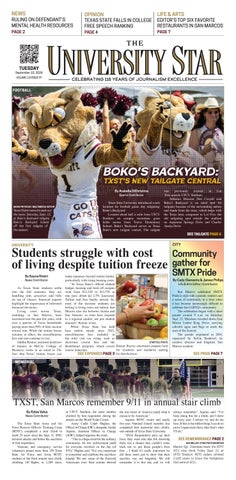
boko’s backyard:
TXST’s New tailgate central By Arabella DiChristina Sports Contributor
AIDEN FRITSCHE | MULTIMEDIA EDITOR
Texas State mascots walk out the team, Saturday, Sept. 12, at Boko’s Backyard tailgate. Boko’s Backyard kicked off the first tailgate of the season.
Texas State University introduced a new location for football game day tailgating: Boko’s Backyard. Located about half a mile from UFCU Stadium on campus recreation grass fields across from Travis Elementary School, Boko’s Backyard serves as Texas State’s new tailgate central. The tailgate
was previously located in Lot Five outside UFCU Stadium. Athletics Director Don Coryell said Boko’s Backyard is an ideal spot for tailgates because of the surrounding nature and shade from the trees, which helps with the Texas heat, compared to Lot Five, the old tailgating spot outside the stadium on Aquarena Springs Drive and Charles Austin Drive.
SEE TAILGATE PAGE 6
Students struggle with cost Community of living despite tuition freeze gather for CITY
UNIVERSITY
By Kayna Khatri News Contributor
As Texas State students settle into the fall semester, they are handling rent, groceries and bills on top of classes; financial experts highlight the importance of informed financial decisions. Living costs across Texas, including in San Marcos, have increased over the past few years, with over a quarter of Texas households paying more than 50% of their income toward rent. While the tuition freeze remains in effect, the miscellaneous fees and rent continue to rise. Ishitha Kumar, assistant professor of finance at McCoy College of Business, wrote in an email to The Star that Texas’ tuition freeze can
make expenses beyond tuition harder, particularly with rising housing costs. “In Texas State’s official student budget, housing and food off campus went from $13,230 to $13,570 in one year, about [a] 2.5% [increase]. Tuition and fees barely moved. So, most of the increase students are feeling is living costs, not tuition. San Marcos also sits between Austin and San Antonio, so rents here respond to a regional market, not just student demand,” Kumar wrote. While Texas State has held base tuition steady since 2021, miscellaneous fees included in the total cost are rising, such as STAR FILE PHOTO electronic course fees and the BookSmart program, which covers Bobcat Bounty volunteers prepare food for students and residents waiting course materials.
SEE EXPENSES PAGE 3 for distributions.
SMTX Pride
By Cady Clements & James Philips Life & Arts Editor | Contributor
San Marcos celebrated SMTX Pride in style with a parade, vendors and a sense of community in a time when it has become increasingly difficult to celebrate the LGBTQ+ community. The celebration began with a short parade around 9 a.m. on Saturday, Sept. 12. Marchers traveled down East Martin Luther King Drive, carrying colorful signs and flags to mark the start of the festival. The parade originated in 2014, organized by Sylvia Sandoval, its creative director and longtime San Marcos resident.
SEE PRIDE PAGE 7
MEMORIAL
TXST, San Marcos remember 9/11 in annual stair climb By Rylee Valva News Contributor
The Texas State Army and Air Force Reserve Officers’ Training Corps (ROTC) completed a stair climb to mark 25 years since the Sept. 11, 2001, terrorist attacks and honor the sacrifices of first responders. Veterans and emergency service volunteers joined more than 130 Texas State Air Force and Army ROTC students at the third annual stair climb, climbing 110 flights, or 2,200 stairs,
at UFCU Stadium, the same number climbed by first responders during the attacks on the World Trade Center. Army Cadet Caleb Hughes, the Officer in Charge (OIC), alongside Analia Aquino, Assistant Officer in Charge (AOIC), helped organize the event. “This is a huge event for the military community, for law enforcement [and] for everyone involved on the day [of 9/11],” Hughes said. “It is very important to remember and celebrate the sacrifices [made]. We saw some of the [bravest] Americans ever; their actions showed
the true heart of America [and] what it means to be American.” Aquino, ROTC senior and nearly five-year National Guard member, has completed four memorial stair climbs, one outside of Texas State University. “[First Responders] gave up their lives; they went into that fire knowing there was a chance they couldn’t come back out, to put those people’s lives first ... I think it’s really important we did these stairs just to show that their sacrifice was not forgotten. We still remember it to this day, and we will
always remember,” Aquino said. “I’ve been doing this for a while, and I show up every year. I always try and do my best. If this is the littlest thing I can do to prove I appreciate them, then that’s what I’ll do.’’
SEE REMEMBRANCE PAGE 2 AVA MILLER | STAR PHOTOGRAPHER
Master Sgt. Crawsbee leads the ROTC 9/11 stair climb, Friday, Sept. 11, at UFCU Stadium. ROTC cadets climbed 2,100 stairs to honor the firefighters that were at 9/11.
NEWS
2
Arabella DiChristina | News Editor | starnews@txstate.edu
Tuesday, September 15, 2026
Judge requires faster mental health resources for defendants By Arabella DiChristina News Editor
Hays County officials stated that their approach to mental restoration, getting defendants ready to stand trial, seems to be effective. If an individual is legally deemed mentally incompetent, meaning a judge has found the defendant lacks a rational understanding of the trial proceedings or the ability to assist their defense attorney, the individual has to undergo mental health treatment. To see if the individual’s competency can be restored, they must undergo treatment at a state psychiatric hospital or at a program within the county jail they are located in. U.S. District Judge David Ezra ruled that the Texas Health and Human Services Commission has four years to cut wait times to 21 days for a state hospital bed, for individuals who are mentally incompetent to stand trial; however, state attorneys have since appealed the ruling. Within Hays County, individuals can participate in the voluntary JailBased Competency Restoration Program (JBCR), which is designed to address the mental health crisis in the criminal justice system. If individuals do go through the JBCR program, then they must wait for an available forensic bed at a state psychiatric hospital, meaning that those beds are for those who are criminally detained. Landon Campbell, division chief at the Hays County criminal district attorney’s office, said that the general wait time for Austin State Hospital is still upwards of 300 days; however, for the JBCR program, the wait times are closer to three to four weeks. Campbell said the turnaround time of the JBCR program is around
60 to 90 days with a 100% restoration rate among those who have completed the program, but is concerned about what the state legislature might come up with if the ruling stands. “What I am [particularly] worried about is that rather than putting additional resources to meet the 21 days, that state legislature just throttles back [a different] classification of defendants that are able to go to the state hospitals, and then the local counties are going to have to figure out how to provide competency restoration services ... ” Campbell said. Howard Williams, associate professor of instruction for the school of criminal justice and criminology, said he agrees with the ruling’s concept around jails holding mentally incompetent individuals for a prolonged time, but that it doesn’t solve the problem of where to send them. Williams said Texas doesn’t have nearly enough facilities that are trained to handle someone who is still under arrest. “For the sake of argument, say they were charged with a class B misdemeanor. [The] most time they could spend in jail if they were convicted is six months, and we were holding them close to a year before we could get a bed to send them off for treatment,” Williams said. The litigation stems from a lawsuit filed by Disability Rights Texas in 2016; in the ruling, Ezra states that it is unconstitutional to make incompetent defendants wait in jail for treatment. “Plaintiffs have demonstrated that they are likely to suffer irreparable harm in the absence of injunctive relief,” Ezra said in the ruling. Within Hays County, as of January 2026, a little over 20 people were
waiting for competency restoration treatment in Hays County Jail. As of 2025 in Texas, 1,769 individuals were waiting for a state hospital bed. According to Williams, the answer to the mental health crisis in the criminal justice system has to be a medical solution. “The state legislature is going to have to come up with a lot of money to fund solutions to this problem, so that there are sufficient numbers of beds ... when you’re talking about the government building facilities ... it takes a long time to get through all the rules and regulations.” Williams said. Williams said that four years isn’t going to be long enough to let Texas address the mental health issue at hand, saying at least 12 years are
needed to train new nurses. “This is going to bind up the sheriff’s departments if the state of Texas doesn’t give them the proper facilities within that four-year period; I don’t know what [the] sheriff’s offices are going to have to do,” Williams said. With the ruling, Campbell said it’s an opportunity to surge resources into mental health and the state hospital systems. In a previous interview with Hays County Judge Ruben Becerra, he stated that he hopes to build a 16-bed mental health facility to help people before individuals even get to jail. Campbell said Hays County is trying to create local solutions because “we know that we can’t really rely on the state hospital system for all our needs.”
KAI DRAGOMIR | STAR ILLUSTRATOR
FROM FRONT REMEMBRANCE Participants gathered on the field for a group prayer and commemorative words before dispersing to their assigned sections. The climb began at approximately 6:20 a.m. and lasted around 30 minutes. The event ended at approximately 7:20 a.m., concluding with final remarks from the ROTC leaders. As the participants began their laps, Texas State students served as medics to assist them during the climb. Isabel Avalos, a nursing senior, kept participants hydrated and safe as they completed their laps. “Today we were lending a helping hand and making sure everyone was staying hydrated,” Avalos said. “We were informed that they were divided into four groups based on [whether they were] Army, Air Force, [and] things like that, so we kind of just dispersed ourselves to be anywhere that they would need [us] to be.” Ethan Colunga, Cadet Captain, was overcome with emotion after completing his climb, reflecting on the dedication and sacrifice the first responders who helped that day made. “It wasn’t enough. All the firefighters and all the service members who were there that day, they did more than I think I would ever be able to do here,” Colunga said. “It’s really solemn knowing that I’m trying to put in my best, but that they put in their everything.” Alongside the Cadets, members of the San Marcos community joined the stair climb to honor the victims of the attacks. Among them was Paul Atalig, San Marcos Army Recruiter. “I remember when I was pretty much [in the] 1st grade, the solemn moment watching it on TV, and seeing my parents react in shock and awe,” Atalig said. “I’m there, confused, but you could
feel the tension in the air. It’s very important that we came out here today. We were pretty honored to commemorate the fallen service members, fallen civilians and the first responders who were part of that. I’m really happy to be out here and honor those members.” Lt. Col. Jason Castleberry, director of staff of the Air Force ROTC, said it’s even more important to remember 9/11 as its 25th anniversary passes. “[After 9/11], everything changed. It was a unifying event for this country,” Castleberry said. “It brought Americans together, whether you were a different race or religion, whether you were high income or low income, it didn’t matter. It brought everyone together in a unifying action to support each other, which is something we didn’t have up to that point. 25 years is a long time, and memories tend to fade. I think events like this are really important to help us remember those [who] gave their lives on 9/11.”
AVA MILLER | STAR PHOTOGRAPHER
AVA MILLER | STAR PHOTOGRAPHER
Master Sgt. Crawsbee holds the American flag, Friday, Sept. 11, at UFCU Stadium. Crawsbee bows his head in prayer before leading the stair climb.
ROTC cadets climb up stairs, Friday, Sept. 11, at UFCU Stadium. ROTC cadets climbed 2,100 steps to honor firefighters at 9/11.
Editorial Staff
History:
Trinity Building 203 Pleasant St. San Marcos, TX 78666 (512) 245 - 3487
The University Star is the student newspaper of Texas State University and is published every Tuesday of the spring and fall and once a month in the summer semesters. It is distributed on campus and throughout San Marcos at 8 a.m. on publication days with a distribution of 3,000. Printing is by the New Braunfels Herald-Zeitung.
Publication Info
Editor-in-Chief: Andrew Bencivengo
Multimedia Editor: Aiden Fritsche
stareditor@txstate.edu
starmultimedia@txstate.edu
Managing Editor: Meg Boles
Engagement Editor: Tatum Pou
starmanagingeditor@txstate.edu
starengagement@txstate.edu
News Editor: Arabella DiChristina
PIR Director: Keely Florez
starnews@txstate.edu
Life & Arts Editor: Cady Clements starlifeandarts@txstate.edu
Opinions Editor: Regina Orozco Lopez Forment staropinion@txstate.edu
Design Editor: Jen Nguyen stardesign@txstate.edu
starpr@txstate.edu
Creative Service Director: Sophia Gerke starcreative@txstate.edu
TV News Director: James Phillips startvnews@txstate.edu
Web Editor: Nico San Esteban starweb@txstate.edu
Sports Editor: Ayden Oredson starsports@txstate.edu Check out Star News Network for broadcast news!
Director: Laura Krantz, laurakrantz@txstate.edu
Copyright: Copyright Tuesday, September 15, 2026. All copy, photographs and graphics appearing in The University Star are the exclusive property of The University Star and may not be reproduced without the expressed written consent of the editor-in-chief. Corrections Policy: Errors appearing in the pages of The University Star and brought to our attention will be corrected as soon as possible.
Advertising Inquiries Contact at: 512-245-3487 advertising@universitystar.com
NEWS
3
Arabella DiChristina | News Editor | starnews@txstate.edu
Tuesday, September 15, 2026
FROM FRONT EXPENSES Spiral Notebo
ok tebo l No Spira
ART
S- M
140
Scho
at H s e i l p p u ol S
$ 994 $ -
T REN DUE
Pe nc il s
P IZ Z A
ok
In Fall 2023, opting in for the BookSmart program cost $249 per semester, while in Fall 2026 it costs $295 per semester, a $46 increase. Kumar wrote in the email, that students should determine what they can afford before committing off-campus housing. “Start with the money you have. Add up real monthly income from work, aid, and family help. A reasonable target is to keep rent plus utilities under about a third of that [to afford spending on housing],” Kumar wrote. Apartment listings in San Marcos ranged from $499 to $1,400 per month as of September 2026, according to Apartments.com. Utilities, including electricity and water, cost $100 to $150 per month depending on usage. Kumar wrote in the email that high housing costs can force students to make cuts elsewhere in their budgets. “Rent is fixed, and everything else is flexible, so when rent is too high, the burden is high. Students rarely cut rent. They cut groceries, skip a doctor’s visit, or add work hours. Once rent passes about a third of income, the emergency fund basically stops existing, and then any surprise goes on a credit card,” Kumar wrote. Irfan Sarwar Pranjol, mechanical engineering sophomore, said adjusting to expenses helped him learn to manage his budget. “When I first came here, I was getting used to how much I could spend to set my budget, so now usually my expenses are a little less,” Pranjol said. As an international student, Pranjol said his scholarship helps manage his expenses but it has limits on how much he can work, which affect his ability to save. “University services such as the
0
$150 0 0 1 $ rking a p d n a s $100 Utilitie B E es at H Spiral No i r e c tebook o r G B - $60 T REN
: neous a l l e c Mis
-E-
REN T DUE
$100
. X . . XX X X X . XX X X . XX X X X X . X XX X X X .
X XX
XX
X
KYLIN ANDERSON | STAR ILLUSTRATOR
shuttle system, BookSmart and the Student Recreation Center help reduce some of my expenses, including transportation and course materials,” Pranjol said. Natalie Arevalo, psychology
sophomore, said groceries were her most surprising monthly expense. “I primarily support my own living expenses, occasionally receiving financial assistance from my mother and grandfather when needed.
Sometimes I exceed my monthly budget and turn to my family for assistance,” Arevalo said. To attend Texas State, the average annual cost for in-state students is $16,805, according to the Department of Education. Additionally, groceries for a one-person household make up $644 per month, according to Apartments.com. Isa Orinion, leasing team member at The Pointe San Marcos, said paying bills on time helps students build credit. Some apartment complexes provide a third-party platform where students can pay rent every two weeks instead of every four weeks to help with budgeting, according to Orinion. Tyler Barstow, senior coordinator for Off-Campus Living in Housing and Residential Life, wrote in an email to The Star that students often combine financial aid with employment to cover housing costs. “An individually leased apartment costs an average of $850,” Barstow wrote. “A lot of students will use their financial aid refund to help with their housing, and work parttime jobs on or off campus to help supplement costs.” Barstow wrote that the Dean of Students’ CARE Team provides emergency funding for students experiencing financial difficulties, while the Off-Campus Marketplace, in LBJ Student Center, can help students compare housing options near Texas State shuttle routes. Kumar wrote in the email that students with high housing costs can have less money available for unexpected expenses. “Once rent passes about a third of income, the emergency fund basically stops existing, and then any surprise goes on a credit card,” Kumar wrote.
OPINION
4
Regina Orozco Lopez Forment | Opinion Editor | staropinion@txstate.edu
Tuesday, September 15, 2026
Opinions in The University Star are not necessarily those of our entire publication, Texas State University’s administration, Board of Regents, School of Journalism and Mass Communication or Student Publications Board.
TXST cannot thrive without free speech The Main Point is an opinion written by The University Star’s Editorial Board. Opinions expressed are not necessarily those of our entire publication. By Editorial Board
College free speech remains under threat nationwide, but no university fell further in the Foundation for Individual Rights and Expression (FIRE)’s latest rankings than Texas State. It is unconstitutional and unacceptable for a university, one focused on supporting the exchange of ideas, to restrict freedom of speech. Out of 261 colleges, FIRE released the 2027 College Free Speech Rankings, with Texas State ranking 259, the third-lowest for free speech. Over the past year, Texas State has had four major speech controversies on campus involving professors and students alike. The first incident revolved around the termination of tenured history professor Thomas Alter, after videos of him speaking at an online socialism convention were posted across social media platforms. Later, the withdrawal of student Devion Canty Jr. after a video of him mocking the assassination of Charlie Kirk during a campus vigil circulated online, resulting in Gov. Greg Abbott posting online that Texas State should expel him immediately. Additionally, physics professor Saeed Moshfeeg is still considering legal action over the non-renewal of his contract, alleging censorship. Lastly, Idris Robinson filed a lawsuit
against the university due to being placed on leave and failing to have his contract renewed after an Instagram account accused Robinson of “encouraging terrorism.” Texas State fell 147 places from last year in the FIRE report, with a current overall score of 47.8, an 11.3 decrease from 2025 and an F speech climate grade. This ranking not only reflects the administration’s comfort conforming to censorship but student’s experiences with their freedom of expression. College campuses are spaces where ideas should be shared, when that is taken away, we lose a unique exchange of ideas. According to the highlights in Texas State’s College Free Speech Rankings, 42% of students say they have self-censored on campus at least once or twice a month, 73% of students say shouting down a speaker to prevent them from speaking on campus is acceptable, at least in rare cases and 41% of students say using violence to stop someone from speaking on campus is acceptable, at least in rare cases. The overall score is made up of 12 parts: six measure how students feel about free speech on campus, three look at the school’s speech policy, and the last three look at how people on campus respond during speech controversies. A higher score reflects a better speech climate.
In addition to the four major controversies, points were also docked because of FIRE’s campus deplatforming database. In 2025, the university invited Khalid El-Hakim to display his Black History 101 Mobile Museum on campus. However, despite coordinating for weeks, the university abruptly canceled the event via email, claiming it was due to the political climate of the state and citing Senate Bill 17, which banned diversity, equity and inclusion at public universities. Texas State lands in the bottom 25 for “disruptive conduct,” signaling that students accept non-peaceful forms of protest, and fell from its ranking in the top 25 last year for “administrative support,” indicating that students doubt officials will defend free speech, according to the FIRE College Free Speech Rankings. Texas State has maintained a “yellow light” spotlight rating, which reflects regulations on student expression based on the extent to which they restrict free speech. With a student demand for the adoption of the Chicago Statement at Texas State, stated in a protest on April 23, it is clear that students want to exercise their First Amendment rights and recognize censorship at the university. Following the passage of Senate Bill 2972, Texas State adopted new policies that outlined when, where and
how free expression on campus can be conducted, requiring non-campusaffiliated individuals to participate in expressive activities exclusively at Bobcat Trail. The policy also outlined the hours during which individuals can participate in expressive activities and limiting activities during the last two weeks of a semester. Limiting students’ expression hinders their ability to use their voices. Students deserve to be heard and should feel comfortable coming together to articulate their opinions. Their right to exercise their First Amendment liberties should not be overlooked; it should be encouraged and fought for. It is imperative for students to make their voices heard. Texas State should encourage healthy, enriching communication, as well as create a space where every member of the university, whether it be students or faculty, feel safe to disagree without silencing others’ voices in the process. It should act as a conduit to differing opinions all while encouraging an open debate.
THC ban harms community’s safety and economy By Mark Gabrielides Opinion Columnist
The Texas THC ban restricts access to certain regulated hemp-derived THC products. However, the reversal likely won’t curb consumption; it will simply make it less regulated and more stigmatized. In May, the Texas Supreme Court reversed a temporary injunction that put a hold on the Texas Department of State Health Services (DSHS) from reclassifying several hemp-derived THC products. Texas will now reinstate reclassifications of some synthetic hemp-derived THC cannabis products to Schedule 1 controlled substances, which are drugs with no currently accepted medical use. This includes those containing delta-8 and delta-10 THC variants, while lower-concentration delta-9 THC remains legal. Possession of less than 1 gram of a group of substances, including THC products, is considered a state jail felony, carrying a 180-day to 2-year prison sentence and up to $10,000 in fines. A 2025 study from Ced Clinic revealed that 35% of college-age students reported trying delta-8 THC. According to a nationwide survey published in Addictive Behaviors, 26.1% of adults reported Delta-8 use due to the legal status of Delta-8 THC. Nicole Cosper, San Marcos local and former cannabis industry member, said that the THC ban may also
negatively impact those working in the cannabis industry. “There are over 50,000 people in this industry, within the state of Texas ... If a total THC ban went through, I was going to be out of a job,” Cosper said. While some qualifying delta-9 products with a dry weight of less than 0.3% remain legal, industry advocates predict that 60 to 90% of previously legal THC products will be wiped from shelves. This significantly diminishes inventory for local stores, potentially harming their revenues. Beyond the cost to local businesses, some community members feel the restrictions will also harm consumers by pushing them to purchase from unreliable sellers. With no other option, those who wish to purchase these products may resort to unsafe drug deals, consuming substances that are not as regulated as typical smoke shop products. “I think to take [hemp-derived THC products] away from society and to take it away from people that are utilizing it now would increase the supply on the black market … You don’t really know what you’re getting,” Cosper said. “Outside of [the Texas THC ban] being a business killer, it’s a job killer, and it’s going to hurt the individual as well.” By limiting access to regulated products that have become increasingly sought out in recent years, college students and consumers alike will have to find it elsewhere. Banning these substances does not significantly decrease usage rates.
Letters to the Editor Policy The University Star welcomes letters from our readers. Letters must be 300 words or fewer to be considered for publication. Writers must include their full name, mailing address, major and academic year designation (for students), phone number and e-mail address when submitting a letter. Submissions that do not include this information cannot be published. This information is seen only by the editors and is used to verify the identify of the
CARMEN KEEN | STAR ILLUSTRATOR
If consumers are left with no safe options, that puts them at risk both physically and emotionally. Reclassification of these products also further demonizes hempderived THC products, creating more stigma around those who may use it recreationally. Social stigma and stereotypes, especially regarding THC can create isolation, reduced confidence and increased social withdrawal. As the Texas THC ban’s consequences begin to be felt in the community, it is important to voice demand for harm-reduction resources. It is crucial that members of the community stand with local businesses and those who utilize THC to leverage legal delta-9 products.
With THC legislation changing, it is imperative that individuals who use these products understand the risks that the ban puts into place. Due to the fact that a portion of THC users are college students, awareness is needed now more than ever. The use of THC will not be eliminated but will become increasingly unsafe. As members of a community, seeing the ways in which the THC ban impacts both businesses and the health of students, should be a cause for concern. A community thrives when all sides do; thus, protecting both consumers and stores, ultimately ensures safety. -Mark Gabrielides is an English and education sophomore
letter writer. It is not used for any commercial purpose. Letters become the property of The Star and may be republished in any format. The letter may be edited for length and clarity. An editor will contact the letter writer if their letter is a candidate for publication. The Star will not run letters that are potentially libelous, discriminatory, obscene, threatening or promotional in nature. Letters can be submitted to staropinion@txstate.edu or by mail to Attn: Opinion Editor, The University Star, 601 University Drive, San Marcos, TX, 78666.
Word Scramble (1) ANT, (2) GRUB, (3) SQUIRM, (4) LEAVES, (5) STINGER, (6) CATERPILLAR Crossword (1) EXOSKELETON, (2) SCARAB, (3) WINGS, (4) CRICKET, (5) WASP, (6) EXTERMINATOR
7 6 3 1 8 2 5 4 9
9 2 1 4 5 6 8 3 7
4 8 5 9 7 3 2 6 1
6 7 2 8 9 4 3 1 5
1 5 9 2 3 7 4 8 6
3 4 8 5 6 1 7 9 2
8 9 7 3 1 5 6 2 4
5 3 4 6 2 9 1 7 8
2 1 6 7 4 8 9 5 3
Tuesday, Sept 15, 2026
GAMES
Sophia Gerke & Milla Deur | Creative Services | starcreative@txstate.edu
5
SPORTS
6
Ayden Oredson | Sports Editor | starsports@txstate.edu
Tuesday, September 15, 2026 FROM FRONT TAILGATE
“I think the main reason [is] we wanted to get tailgating off of hot asphalt and concrete parking lots, like this is so much nicer on the grass here in our opinion and it’s cooler,” Coryell said. “That also freed up parking for us, and with the crowds that we’re anticipating this year, we needed more parking.” Coryell said along with the new location for tailgates, there are also goals to move away from the mass distribution of alcohol for those aged 21 and older. “We tried to cut back on mass serving, but if you’re a student you want to come out here with a six-pack of beer and get a tent and do your stuff, you can still bring your own drinks,” Coryell said. “We’re just really trying to get away from that mass serving, where you’re setting up big bars, you’re serving to anybody who comes
AIDEN FRITSCHE | MULTIMEDIA EDITOR
Texas State students hold up a sign for Brad Jackson, Saturday, Sept. 12, at Boko’s Backyard. Boko’s Backyard kicked off the first tailgate of the year.
up, so it’s a little bit more about like personal consumption now.” Texas State Athletics also has a contract with Travis Elementary to utilize their parking lot for tailgates. “[Travis Elementary] is actually benefiting from this as well because they’re getting a little income coming in from parking. You can still park at Lot Five, which instead of a two-minute walk from the stadium, it’s about a five-minute walk; then you could park at Bobcat Village, so we think we’re pretty convenient for parking,” Coryell said. While most game days won’t interfere with regular hours for Travis Elementary, Coryell said that for the Thursday, Oct. 15 game against the Colorado State Rams, the tailgate will occur long after traffic pickup at Travis Elementary. Though there may be some
positives about the new tailgate location, some have concerns compared to past spots. Brianna Gonzalez, accounting senior, said the tailgates at the parking lots were more fun than Boko’s Backyard. “[It felt like] you could have literally [hopped in] at any tent, [I] want to say it was more exclusive for students,” Brianna Gonzalez said. “There were some family tailgates, but it was more for students to enjoy and to be able to celebrate their school. I feel like now it turns into a family thing where you have to be like more chill, settle, can’t celebrate as well.” Brianna Gonzalez said Boko’s Backyard has everything more separated and feels like it doesn’t seem as inclusive as the old location. “I think it just like kills a little bit of the fun,” Brianna Gonzalez said. Sergio Gonzalez, civil engineering
junior and member of Delta Sigma Phi, said Boko’s Backyard is close enough to the stadium, but the old location allowed for more focus on the tailgates. “The tailgate does bring a lot of attention [to our fraternities], but I feel like right now it’s just for [the move to the] Pac-12 and they’re changing a lot of stuff ... but for the fraternities that are out here, we’re going to have fun,” Sergio Gonzalez said. Sergio Gonzalez said even with the change of location for the tailgate, it still encourages a lot of people to attend the football games. Boko’s Backyard will open six hours prior to kickoff for most games throughout the season.
LIFE & ARTS
Cady Clements | Life & Arts Editor | starlifeandarts@txstate.edu
7
Tuesday, September 15, 2026
FROM FRONT PRIDE
JAMES PHILLIPS | STAR PHOTOGRAPHER
Applied sociology junior Maia Clinkscales (left) and Urban regional planning junior Amber Torres (right) wave Pride flags for San Marcos’ annual Pride celebration, Saturday, Sept. 12, at Industry.
Sandoval has been involved in San Marcos’ LGBTQ+ community for more than a decade. In 2009, she helped create the Rainbow Night bar takeover events on The Square after a downtown bar kicked her and several family members out because of their identity. She said much has changed in the roughly decade and a half since the first Rainbow Night event. “I’ve worked really hard to open doors and show [the town] that we’re not here to cause harm or ill or bad publicity or anything,” Sandoval said. “I’ve been kicked out of [bars]. I’ve been boycotted out of bringing my drag shows. We’ve protested in front of Nephews several times. We’ve done it all. So now that I know that when I walk away, I know bars that will say yes so we can walk in and be ourselves.” Texas has been a national center of legislation targeting the LGBTQ+ community. In recent years, state leaders have passed a flurry of laws restricting how LGBTQ+ pride can be expressed in public life. Zach Denny, executive director of the San Marcos Queer Council, which had a booth at the festival, said the climate of fear around the LGBTQ+ community makes opportunities for political engagement within the community all the more important.
“It’s a really scary time to be an openly queer person, especially in such a deeply red state,” Denny said, “And so the fact that we get so many people turning out, showing up and supporting us ... coming by honking and waving even, I think that’s huge.” Texas has passed numerous laws that work against the LGBTQ+ community, including House Bill 3842 which prohibits government buildings, such as schools and city buildings, from displaying pride flags. San Marcos Mayor Jane Hughson said she does what she can to make San Marcos a safe space through mayoral proclamations in June for Pride Month and September for San Marcos’ Pride celebration. “[The Pride celebrations] waits until college is back in session so that students can come to the event,” Hughson said. “This is to make sure that those students who may still be a little unsure about how accepting San Marcos might be will see that acceptance.” For some, college is one of the places where they can discover a safe space for the LGBTQ+ community. Denny said one of the real joys of the festival is seeing college students come in for the first time and experience the LGBTQ+ community. “I’ve met probably every person in the family
around here; it’s like you turn a rock and there’s a bunch more,” Denny said. “It also helps that we do have the university. We’ve got a ton of students that come in every single year that are from these small Texas towns that probably have never met a queer person that is not themselves ... It’s a very large, vibrant community of queer people here.” Sandoval said in a town like San Marcos, the community needs to pave the way for more LGBTQ+-friendly spaces to be made. “We don’t need one spot. We need multiple spots,” Sandoval said. “I get really discouraged when people are like, ‘We need our own space.’ We create those safe spaces ... We need to walk in and create our safe spaces.” This year’s festival will be Sandoval’s last as its creative director, but she said she’s not worried about the future of San Marcos’ LGBTQ+ community. “You bring out the best of the people by bringing the best of yourself,” Sandoval said. “You are the reflection of what you want. That’s why I’m not worried. Everything’s going to be okay, and if anything breaks down, I’ll open another space … That will be my mission for the rest of my life.”
SNAPS
8
Aiden Fritsche | Multimedia Editor | starmultimedia@txstate.edu
Tuesday, September 15, 2026
LIBBY ALLEN | STAR PHOTOGRAPHER
Texas State exercise and sports science freshman Kathryn Sasse (left), and exercise and sports science sophomores Miguel Duran (center) and Malcolm LaCoste (right) cheer, Saturday, Sep. 12, at UFCU Stadium. The Bobcats lost to UTSA 26-31. Texas State Phi Kappa Sigma member plays a yard game, Saturday, Sept. 12, at Boko’s Backyard. This event kicked off the first tailgate of the year.
Texas State accounting senior Liberty Aniol studies at the library, Wednesday, Sept. 9, at Alkek Library. SANTIAGO RIVERO | STAR PHOTOGRAPHER
Texas State freshman Jakson Furlotte (93) lines up a shot on Friday, Sep. 11, at Northwoods Ice and Golf in San Antonio. The Bobcats won 4-3. overtime against UTSA.
AIDEN FRITSCHE | MULTIMEDIA EDITOR
Texas State management freshman Dylan Garcia jumps into the river with his friends, Friday, Sept. 11, at Sewell Park. Students use Sewell Park to escape the heat.
RAE KNIGHT | STAR PHOTOGRAPHER
Texas State sophomore quarterback Brad Jackson (8) scores a touchdown against UTSA, Saturday, Sept. 12, at UFCU Stadium. Jackson rushed for 39 yards against UTSA. SANTIAGO RIVERO | STAR PHOTOGRAPHER
SANTIAGO RIVERO | STAR PHOTOGRAPHER
Texas State Cheer shows off their skills, Saturday, Sept. 12, at UFCU Stadium. Texas State lost to UTSA at home for the first time since 2020.
Scan the qr code to view the full Gallery LIBBY ALLEN | STAR PHOTOGRAPHER