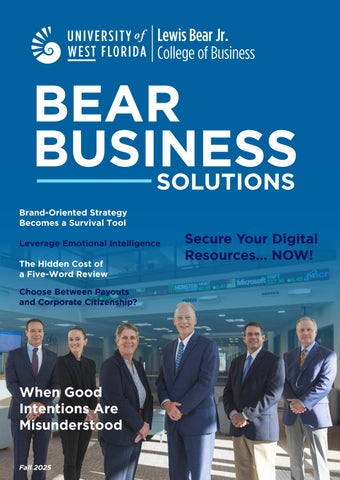
Bear Business Solutions Fall 2025

Page 1


Brand-Oriented Strategy Becomes a Survival Tool

Leverage Emotional Intelligence

The Hidden Cost of a Five-Word Review Choose Between Payouts and Corporate Citizenship?

When Good Intentions Are Misunderstood

WE HAVE THE DEGREE FOR YOU!

UNDERGRADUATE DEGREES

Accounting

Economics

Finance

Hospitality

Human Resources

Information Systems

Management

Marketing

Sport Managment

BEAR BUSINESS SOLUTIONS

3. The Hidden Cost of a Five-Word Review

L. Jean Harrison-Walker

James A. Mead

11. Leverage Emotional Intelligence: Where People and Technology Intersect

Scott B. Keller

Peter M. Ralston

Stephen A. LeMay

19. When Good Intentions Are Misunderstood: Why Managers Must Get Motives Right for Employees

Timothy R. McIlveene

Maggie M. Davis

Sonia White

Editors in Chief: Maggie M. Davis and Stephen A. LeMay

Copy Editor: Tom St. Myer

Design Director: Emma Confusione

Designer: Brooke Romero

FRONT COVER PHOTO

24. How a Brand-Oriented Strategy Becomes a Survival Tool for New Ventures

John H. Batchelor

Maggie M. Davis

Timothy R. McIlveene

Robert D. Perkins

29. Must firms choose between payouts and corporate citizenship?

Kevin Krieger

Nathan Mauck

33. Secure Your Digital Resources... NOW! Before It’s Too Late

Stephen A. LeMay

S. Lane Lambert

Bruce I. Davidson

(L-R): John Batchelor, Ph.D., Chair, Department of Business Administration; Maggie Davis, Ph.D., Associate Dean; Melissa Brode, Ed.S., Associate Dean; Scott Keller, Ph.D., Dean; James Mead, Ph.D., Chair, Department of Commerce; Gregory Prescott, Ph.D., Chair, Department of Accounting and Finance

The Hidden Cost of a Five-Word Review

Our research reveals that when one party invests significant effort into a review and receives a minimal one in return, it triggers a powerful psychological reaction.

The Hidden Cost of a Five-Word Review

Minimal-effort feedback on platforms like Airbnb creates a ripple effect of negative consequences that hurt your customers, your reputation, and your bottom line.

In the booming peerto-peer service economy, reputation is everything. Platforms like Airbnb, Uber, and Upwork have built empires on a foundation of trust, and that trust is manufactured through a simple, yet powerful tool: the two-sided review. After a transaction—a stay, a ride, a completed project— both parties are prompted to rate each other, creating a public ledger of reliability and quality. This system is designed to be a virtuous cycle, reducing risk and helping users

make better decisions.

But what happens when this cycle is broken? Not by a negative review, but by a positive one that is dismissive, brief, or clearly low-effort. Imagine you are an Airbnb host. You’ve spent hours preparing your property, communicating with your guest, and ensuring they had a fantastic stay. After they leave, you write a detailed, thoughtful review highlighting what a wonderful guest they were. You post it, and a few days later, you see their review of you: “Great stay.

Thanks.”

While positive on the surface, this kind of interaction creates an imbalance—what we term an unequal review effort exchange. Our research reveals that when one party invests significant effort into a review and receives a minimal one in return, it triggers a powerful psychological reaction. This feeling of inequity leads to what psychologists call cognitive dissonance—a state of mental discomfort. And to resolve that discomfort, customers take actions that have

The Hidden Cost of a Five-Word Review

BEAR BRIEF

THE PROBLEM

Low-effort reviews can negatively affect your customers, your reputation, and your bottom line.

THE ROOT CAUSE

When one party invests significant effort into a review and receives a minimal review in return, it triggers a powerful psychological reaction. This feeling of inequity leads to mental discomfort and prompts the party that feels slighted to take corrective action.

THE SOLUTION

Take steps to foster an equitable and robust review process, such as structuring the feedback to include a minimum word count, standardized questions, and checklists. Other solutions include educating users on the value of reviews and allowing users to upvote or downvote reviews based on helpfulness.

direct, negative consequences for both the other user and the platform itself.

They become less likely to do business with you again. They are more likely to disengage from the platform entirely, choosing a traditional hotel for their next trip. And they may even start putting less effort into their own future reviews, degrading the very system that platforms rely on. This isn’t just about hurt feelings; it’s a hidden drag on customer retention, engagement, and the overall health of the marketplace. The five-word review is not a harmless shortcut; it’s a quiet threat that ser-

vice platform managers and individual providers can no longer afford to overlook.

THE SECOND, HIDDEN TRANSACTION

Every interaction on a home-sharing platform involves two exchanges. The first is economic: money for lodging. This is the primary transaction that everyone focuses on. However, a second, also important social exchange occurs after the stay is over: the exchange of reviews.

Unlike one-sided platforms like Yelp or TripAdvisor, the symmetrical review systems used by Airbnb create a unique

dynamic. Each party holds power over the other’s future success. A guest’s glowing review helps a host attract more bookings. A host’s positive feedback helps a guest secure desirable rentals in the future, especially if they are new to the platform.

This social exchange is governed by what sociologist Alvin Gouldner identified in 1960 as the “norm of reciprocity”—a fundamental social rule that says we should return favors and acts of kindness. When a host or guest writes an effortful, detailed review, they are not just providing feedback; they are offering a valuable social resource. The reasonable expectation, as Gouldner explained, is that the other party will respond in kind, with both partners perceiving the exchange as equally valuable.

The problem is that on platforms like Airbnb, reviews are blind. You cannot see what the other person wrote until you have submitted your own review. You are, in effect, trading something of known value (your thoughtful review) for the unknown contents of a mystery box. When you open that box and find a barebones, low-effort

Manufacturing leaders face a strategic choice: continue accepting data integrity risks in traditional ERP systems or invest in emerging blockchain technologies that provide stronger security and audit capabilities.

response, the norm of reciprocity is violated. This violation is the root cause of the problem. It creates a perceived inequity that the brain scrambles to resolve.

THE PSYCHOLOGY OF FEELING SHORT-CHANGED

When a user experiences this unequal review effort, it sets off a predictable psychological chain reaction.

1. Perceived Inequity:

The first feeling is one of unfairness. The user’s mental calculus is simple: “I put in more effort than I got back.” This isn’t about the star rating; both reviews can be five stars. It’s about the imbalance in the social exchange. This feeling of being on the short end of the deal was first formally described in 1963 by psychologist J. Stacy Adams in his equity theory, which posits that people are motivated to maintain fair relationships. An unequal review exchange throws this relationship out of balance.

fort we feel when our beliefs clash with reality. In this case, the belief is, “My effort should be met with equal effort.” The reality is, “It wasn’t.” This inconsistency is uncomfortable, and as Festinger’s work established, we are highly motivated to eliminate it. Because the review is often unchangeable, the user can’t fix the original problem. Instead, as researchers Elaine Walster Hatfield, Ellen Berscheid, and G. William Walster later noted, they seek to restore their psychological balance by taking some form of action.

university students and a general market panel, showed that users who received a low-effort review in response to their own high-effort one took their frustrations out in several damaging ways.

2. Cognitive Dissonance:

This perceived inequity creates mental stress, or cognitive dissonance. First identified by social psychologist Leon Festinger in 1957, this is the discom-

THE BUSINESS IMPACT: A RIPPLE OF NEGATIVE OUTCOMES

The drive to reduce cognitive dissonance is not a passive process. Our studies, involving both

• They Won’t Come Back: The most direct impact is on repeat business. Guests who experienced an unequal exchange were significantly less likely to stay with the same host again. This aligns with research from Young K. Kim, which found that cognitive dissonance negatively affects repatronage intentions, even when customers are otherwise satisfied. The sour taste of the review exchange was enough to sever the relationship.

• They Blame the Platform and Spread the Word: This discomfort often manifests as complaining behavior, a link established by researchers Thomas Salzberger and Monika Koller. Our moderated mediation analysis showed a clear path from cognitive dissonance to negative word-ofmouth (NWOM) about the platform. They feel the platform’s system facilitated the unfair exchange. The discomfort created by one user’s laziness is externalized as a flaw in the platform’s design, leading to brand damage.

• They Leave the Ecosystem: Perhaps most alarming for platform managers, users who felt slighted were significantly more likely to say they would choose a hotel over an Airbnb for their next trip. They chose to disengage from the sharing economy altogether, at least temporarily. This is customer churn driven not by a bad service experience, but by a flawed social interaction after the service was complete

The Hidden Cost of a Five-Word Review

• They Lower Their Own Standards: The inequity also teaches users a new, more cynical behavior. Our second study found that the experience led them to intend to spend less time and effort on their own reviews in the future. In essence, the platform’s “bad citizen” is teaching other users to behave the same way. This can lead to a downward spiral in the quality and usefulness of reviews across the entire platform, eroding the very trust mechanism that makes the business model work.

NOT ALL USERS REACT THE SAME

A fascinating aspect of our research was the role of a personality trait known as trait reciprocity. Based on a framework developed by researchers in 2003, this concept describes people who have a stronger innate belief that favors should be returned and that exchanges should be equitable. These are individuals who live by the golden rule. Our findings show that these individuals are disproportionately affected by an unequal review effort exchange. When they received a minimal

review, their sense of inequity was significantly higher than that of the average user. Consequently, all the negative outcomes—from avoiding the host to abandoning the platform—were more pronounced for this group.

From a business perspective, this is a dangerous situation. Your most conscientious and fair-minded users, the very people who are likely to be the best hosts and guests, are the ones most likely to be alienated by the low-effort behavior of others. Failing to manage the review exchange process means you risk losing your best customers.

Interestingly, we did find a difference between hosts and guests. While hosts experienced the same feelings of inequity and cognitive dissonance when they received a low-effort review from a guest, their intention to host that same guest again remained high. We surmise this is due to a simple economic motivation: a host’s primary goal is to keep their property booked. They are willing to swallow the psychological discomfort for the sake of revenue. Guests, however, have no such economic incentive. With countless other options available, they are free to

The discomfort created by one user’s laziness is externalized as a flaw in the platform’s design, leading to brand damage.

act on their negative feelings and take their business elsewhere.

AN ACTION PLAN FOR PLATFORMS AND PROVIDERS

The hidden costs of unequal reviews are significant, but they are not unavoidable. Both platform managers and individual service providers can take concrete steps to foster a more equitable and robust review culture. Our research included asking participants for their own solutions, which provided a clear roadmap for improvement.

For Platform Managers:

The core task is to redesign the review process to guide users toward more equitable contributions.

1) Structure the Feedback:

The most common suggestion was to move away from a single open-ended text box. Implement a structured review process that includes:

• Minimum (and Maximum) Word Counts: This sets a clear expectation of effort.

• Standardized Questions and Checklists: Prompt users with specific questions about key aspects of the experience (e.g., for hosts: “Was the guest communica-

tive?” “Did they leave the space tidy?”). This ensures a baseline of detailed information and makes it easier for users to provide a comprehensive review.

• Rating Scales for Specific Attributes: Go beyond a single star rating to include ratings for cleanliness, communication, accuracy, etc.

2) Educate Users on the “Why:” Don’t just ask for a review; explain its value Use tooltips, emails, and in-app messages to remind both parties how detailed reviews help them and the community. Frame it as a crucial contribution to the ecosystem’s health. For example: “Your detailed feedback helps Patricia secure future bookings and helps other guests make informed decisions.”

3) Provide Post-Publication Tools: Cognitive dissonance arises partly because the review feels final and irrevocable. Giving users more control can alleviate this.

• Allow Review Edits/ Addendums: Give users a window of time (e.g., 48 hours) to add more detail to their re-

view after seeing what the other party wrote.

• Facilitate Private Communication: A user who feels slighted may want to simply ask, “Is there anything I could have done better?” Providing a simple, private messaging channel post-review could resolve feelings of inequity before they lead to negative action.

• Implement “Review Value” Metrics: Allow users to upvote or downvote reviews for their helpfulness, similar to systems on Amazon or Reddit. This adds another layer of social accountability and encourages higher-quality feedback.

FOR

HOSTS AND SERVICE PROVIDERS: Individual providers are not helpless; they can proactively manage the exchange.

1) Set Expectations Early and Gently: Don’t wait until after the stay. In your welcome letter, guest book, or a checkout message, you can set the stage for a thoughtful review exchange. For example: “We truly value detailed feedback in our reviews, as it helps us improve and helps future

The Hidden Cost of a Five-Word Review

guests understand the experience. We always make a point to do the same for our guests.”

2) Model the Behavior You Want to See: Consistently write the kind of detailed, helpful reviews you hope to receive. Over time, this builds a reputation not just as a great host, but as a fair and engaged member of the community.

3) Use Proactive Communication: If a guest’s stay was fantastic, mentioning it in a departure message can prime them for a more engaged review. “It was a pleasure hosting you, Patricia! We particularly appreciated how communicative you were. We’re looking forward to leaving you a great review and hope you had a 5-star experience as well.”

The sharing economy was built on the idea of community and mutual benefit. Yet, by overlooking the subtle social dynamics of the review process, platforms and providers risk fostering a culture of low-effort exchanges that slowly poisons the well of trust. A review is more than just a rating; it’s the final touchpoint in the customer experience and a vital social contract. Treating it with the importance it deserves is no longer just good manners—it’s a business imperative.

This work is adapted from the journal article “The overlooked and hidden consequences of inequitable reviews in home-sharing services” by L. Jean Harrison-Walker and James A. Mead, published in the Journal of Services Marketing (2025). Google Gemini was used as an assistive tool in the creation of this adaptation. See references on page 38.

James A. Mead is Chair of the Department of Commerce in the Lewis Bear Jr. College of Business and a Professor at the University of West Florida. He earned his Ph.D. from the University of Kentucky. His research centers on consumer emotion and memory. He teaches marketing, and his work appears in leading business and marketing journals. His industry experience includes serving as a senior market research analyst, specializing in product development, advertising, branding, and customer experience.

Leverage Emotional Intelligence: Where People and Technology Intersect

Leverage Emotional Intelligence:

Where People and Technology Intersect

Smitty, a seasoned manager at a bustling regional distribution center, started his morning as usual—walking the aisles, checking inventory dashboards, and greeting his team as they prepped for a day of picking, packing, and shipping orders. The center was a hub of activity, with goods flowing in from suppliers and out to retailers and customers. But lately, Smitty sensed a change: turnover was creeping up, order errors were more frequent, and the team’s energy felt flat. He’d tried the new autom-

ation tools, stricter checklists, and even team lunches, but nothing seemed to stick. Smitty realized the missing piece wasn’t another process or technology—it was the human element: emotional intelligence (EI).

THE SCIENCE BEHIND SMITTY’S APPROACH

Smitty’s journey was inspired by research showing that EI is a critical driver of operational success, especially in environments where people and technology intersect. Gone are the days

when supervisors could succeed solely through command and control. As we argue, it’s the managers who recognize, understand, and guide emotions that create productive workplaces where employees choose to stay—reducing costly mistakes and improving service outcomes. It is not softness; it’s about using emotions for better decision-making and stronger teams.

Frontline supply chain management is experiencing a profound evolu tion, not just in its tools

and processes but in the very nature of leadership. Thanks to breakthroughs in automation, analytics, and advanced manufacturing, supply chain operations have never been more efficient—yet, as research and real-world experiences reveal, employees remain central to success. Emotional Intelligence (EI) emerges as the single most powerful differentiator, shifting supervisors from task managers to relationship leaders. This article summarizes our study of 155 supply chain managers and highlights practical strategies grounded in the science of EI. We found that managers with strong EI— especially skill at helping employees process stress and setbacks—created workplaces with notably higher job satisfaction, reduced error rates, and lower turnover. Drawing from the John D. Mayer and Peter Salovey (1997) Four-Branch Model of EI, we detail the psychological components behind emotionally intelligent leadership and showcase real-world examples to guide managers looking to make EI a cornerstone of their management style.

Leverage Emotional Intelligence: Where People and Technology Intersect

THE SCIENCE OF EMOTIONAL INTELLIGENCE

Mayer and Salovey identify EI as an ability-based competency, broken into four major areas:

• Perceiving Emotions: Recognizing emotional cues in self and others, such as facial expressions or tone. For managers, this might mean noticing when a customer service rep’s patience is wearing thin before conflict erupts.

• Using Emotions to Facilitate Thought: Harnessing feelings to support problem-solving or creativity. For example, channeling collective frustration into brainstorming sessions that yield operational improvements.

• Understanding Emotions: Comprehending how emotions change, and why. If tension in a shift seems to escalate, an emotionally intelligent supervisor can anticipate behavioral shifts from frustration to anger, acting before situations escalate.

• Managing Emotions: Effectively regulating one’s own emotions and helping others do the same—perhaps

by diffusing a heated exchange between two different department employees or supporting an employee through personal stress.

Research across industries indicates these EI capacities are developmental managers. They master the basics and progress to advanced regulation of complex workplace emotions, yielding operational and strategic benefits.

FROM THE FRONTLINE

A manager at a busy transportation hub noticed rising tension and equipment damage, reflecting a history of assigning difficult routes to already frustrated drivers. By following the EI branch of perceiving emotions, he tuned into subtle mood signals—slumped shoulders, curt responses, signs of distraction—and broke the pattern. He started conversations about personal stressors and rotated challenging assignments based on real-time emotional data. The result? Arguments decreased, and delivery stats rapidly improved.

In a customer service office setting, an employee’s repeated mistakes and lack of consistency drew scrutiny. Rather than

Frontline leaders see the greatest gains because their daily interactions with employees shape the emotional climate— and thus the performance—of the entire operation.

jumping to discipline, the supervisor applied emotional understanding and management skills, discovering the root was stress over a long-term pet illness and offered the employee flexible work time to see to his pet’s needs. As the pet recovered, the employee recovered, reporting zero errors for two months and eventually began coaching his peers when similar situations arose. Our research included asking participants for their own solutions, which provided a clear roadmap for improvement.

Another case in medical distribution: An employee facing inventory challenges was perceived as uncaring and underperforming. Instead of reprimanding, the supervisor shared his own early errors (reframing mistakes) and gave structured, positive feedback and coaching. The supervisor realized that employees don’t do what they’re supposed to do for varying reasons. In this case, the employee thought their way was better and the supervisor explained why the standard process was in place. The worker was encouraged to share good ideas with the supervisor in the future so that they can work together to continuously improve processes collaboratively. The worker

developed into a top performer, showing the value of adaptive and supportive emotional management.

STRATEGIC TAKEAWAYS

As automation and data analytics reshape logistics, people remain the decisive factor in performance. EI—grounded in science, validated by research, and demanded by competitive supply chains—is the axis of leadership that retains talent, drives quality, and strengthens service outcomes. A manager’s capacity for perceiving, using, understanding, and managing emotions is not just a soft skill but a daily operational necessity. The evidence shows that training in EI is not optional. Managers with targeted supervisory development are better equipped to foster positive work environments, and even a modest investment in EI skills pays off in reduced turnover and errors.

Frontline leaders see the greatest gains because their daily interactions with employees shape the emotional climate—and thus the performance—of the entire operation.

BUILDING YOUR EI ROADMAP

Companies should:

• Implement structured EI assessment and training for frontline managers.

• Encourage mentorship and peer learning around emotional management.

• Regularly evaluate leadership effectiveness in both technical and emotional domains.

• Reward exemplary EI behaviors with recognition and advancement opportunities.

Here are specific steps supply chain managers can implement right now to embed emotional intelligence into daily practice, along with three practical exhibits modeled after the original research, and an updated summary that includes the importance of social desirability as a valued trait.

FIVE IMMEDIATE ACTION STEPS FOR MANAGERS

1) Start Each Day with Emotional Check-Ins

Spend the first five minutes of shift meetings asking team members about their current stressors or mood. Practice “perceiving emotions” by reading both what is said and unsaid in facial expressions and tone.

2) Reframe Mistakes as Learning Moments

When errors occur, openly share similar mistakes from your own past and what you learned, modeling vulnerability while lowering fear. Highlight growth, not blame.

3) Give Feedback with Empathy and Clarity

Structure feedback to be immediate, specific, and encouraging. Acknowledge the effort—even if the result is not perfect. Draw a clear line from the employee’s actions to business results.

4) Adjust Assignments

B ased on Team Energy

Watch for signs of fatigue

Perceive

Leverage Emotional Intelligence: Where People and Technology Intersect

or frustration, and reallocate tasks to avoid compounding stress. Rotate roles and deadlines when you sense tension rising, supporting both the group and individual well-being.

5) Model Calm and Social Desirability

Remain steady, respectful, and supportive during high-pressure situations. Displaying socially desirable behaviors—like fairness, optimism, and patience—not only sets a cultural tone but signals to the team that these traits are valued and worthy of emulation.

Frontline managers who received EI-focused

training reported higher scores in building positive work environments and retaining talent. Even small investments in development had measurable impacts. These are proven—not theoretical—habits for supply chain supervisors to build a resilient and high-performing team.

Notices employee’s quietness and withdrawn look Initiates private check-in

Understand Connects drop in performance to outside stress Offers flexible scheduling

Use Channels team’s frustration into team brainstorming Identifies efficiency upgrade

Manage

Maintains composure after a failed delivery Reduces team anxiety and errors

Frontline managers who received EI-focused training reported higher scores in building positive work environments and retaining talent.

OUTCOMES OF EMOTIONALLY INTELLIGENT SUPERVISION

Practice

Emotional Check-Ins

Empathetic Feedback

Flexible Assignments

Increased openness Higher retention

Reduced errors

Lowered absenteeism

EI QUESTIONS FOR MANAGERS

Perceiving Emotions

• How well do I recognize when a team member is stressed or disengaged?

• Can I identify subtle changes in mood or energy during daily operations?

Using Emotions to Facilitate Thought

• Do I leverage emotional cues to guide my decision-making and problem-solving?

• How often do I turn team frustration or excitement into productive solutions?

Understanding Emotions

• Can I pinpoint the root causes of emotional shifts before they impact performance?

• Do I understand how stress or disappointment might evolve over time?

Greater engagement

Improved morale

Managing Emotions

• How do I respond to my own frustration or anxiety at work? Do I model calm and control?

• Do I help my team members talk through and manage their emotions during high-pressure moments?

Social Desirability

• Are patience, empathy, and optimism visible and valued in my leadership style?

• Do I encourage and reward socially desirable behaviors in my team?

Leverage Emotional Intelligence: Where People and Technology Intersect

This work is adapted from the journal article “Quality Output, Workplace Environment, and Employee Retention: The Positive Influence of Emotionally Intelligent Supply Chain Managers” by Scott B. Keller, Peter M. Ralston, and Stephen A. LeMay, published in the Journal of Business Logistics 2020, 41(4): 337-355 (2020). ChatGPT was used as an assistive tool in the creation of this adaptation. See references on page 38.

Scott B. Keller is Dean of the Lewis Bear Jr. College of Business and Professor at the University of West Florida. He received his Ph.D. from the University of Arkansas. Dr. Keller’s research interests include managerial leadership and customer orientation in logistics operations. Along with his brother, he co-authored The Definitive Guide to Warehousing. He is Associate Editor for the Journal of Business Logistics and former editor of the International Journal of Logistics Management.

Stephen A. LeMay is a Professor at the University of West Florida. He earned his Ph.D. from the University of Tennessee. Dr. LeMay has a deep background in transportation and logistics and has authored two books, a textbook and a research book on logistics and transportation topics. LeMay has examined supply chain design, truck driver job satisfaction, supply chain security, computer literacy among undergraduate business students, and other logistics and marketing topics.

“How do I respond to my own frustration or anxiety at work? Do I model calm and control?”

When Good Intentions Are Misunderstood

Why Managers must get motives right

When Good Intentions Are Misunderstood:

Why Managers Must Get Motives Right for Employees

In every workplace, employees often step up in ways that aren’t technically part of their job description. A team member might stay late to help a colleague meet a deadline, cover an unexpected shift, or suggest a new way to make a process run more smoothly. These extra efforts—what researchers call going above and beyond—are not formally required, but they’re the glue that keeps organizations running well. They help teams build trust, create stronger cultures, and drive succ

ess. Now, imagine this scenario: you help a coworker finish a critical project, only to have your manager question your motives. Instead of recognizing your effort as genuine, they assume you did it to look good. How would that make you feel about helping again?

That simple moment— how a supervisor interprets why someone goes the extra mile—can have powerful ripple effects. Our research examined this dynamic closely and found something important: When leaders mis-

read employees’ motives, it can discourage the very behaviors that organizations rely on to thrive.

WHAT WE STUDIED

We sought to understand how supervisors’ assumptions about employee behavior influence whether employees continue to help in the future. To achieve this, we conducted two studies involving over 700 working professionals from diverse industries.

Participants were asked to imagine themselves in realistic

When Good Intentions Are Misunderstood

Why Managers must get motives right

BEAR BRIEF

Supervisors misread employees’ motives and discourage the very behaviors that organizations rely on to thrive.

Supervisors assume employees who give extra effort are seeking self-promotion rather than genuine concern.

THE PROBLEM THE ROOT CAUSE THE SOLUTION

Supervisors should acknowledge and value extra effort, don’t assume employee motives, build attrition awareness into training, pay attention to highly open employees, and create a culture of trust and fairness.

workplace situations where they helped someone or took on an extra responsibility. Then, we varied the supervisor’s reaction: In some cases, the supervisor viewed the behavior as genuine; in others, the supervisor dismissed it as self-serving (i.e., performed just to impress or to gain attention).

We also looked at whether personality traits mattered, specifically individuals’ openness to experience. Individuals who are high in openness tend to be curious, creative, and eager to explore new ideas. We wanted to know: Do these employees react differently when

their motives are misunderstood?

WHAT WE FOUND

Misjudging motives reduces future helping: When supervisors assumed an employee’s extra effort was about self-promotion rather than genuine concern, employees reported being significantly less likely to go above and beyond in the future. In other words, if you believe your boss doesn’t trust your intentions, you stop putting in the extra effort.

Openness

makes employees more senstive: Employees who

were especially open and creative felt the sting of misjudgment more strongly. When their motives were questioned, they pulled back from contributing discretionary effort at higher rates than others. Ironically, these are often the employees who bring fresh ideas and innovative solutions—the very people organizations can least afford to discourage.

The type of helping matters: Interestingly, we found that misjudgment mainly reduced behaviors aimed at supporting the organization as a whole, such as volunteering for projects or initiatives. Employees were more likely to keep helping individual coworkers even when their supervisor misread their motives. This suggests that questioning motives can damage the broader sense of commitment to the organization, rather than personal relationships with peers.

WHY IT MATTERS FOR LEADERS

At first glance, it may seem harmless if a manager occasionally misinterprets why someone helps out. But our findings suggest these moments can reshape how employees view the workplace.

When supervisors assumed an employee’s extra effort was about self-promotion rather than genuine concern, employees reported being significantly less likely to go above

and beyond in the

future.

When employees feel their motives are doubted, the relationship with their supervisor—and by extension, the organization—shifts. Instead of seeing work as a partnership built on trust and mutual respect, employees start to treat it like a simple transaction: “I’ll do exactly what’s in my job description, nothing more.”

This shift carries real costs. When fewer employees go above and beyond:

• Morale can drop, since discretionary effort often sets the tone for a positive culture.

• Collaboration can weaken, with employees less likely to step in and help.

• Onboarding slows down, as new employees receive less informal support.

• Overall performance suffers because those extra, often invisible, contributions add up to measurable organizational success.

The bottom line: leaders’ assumptions about motives matter more than they might think.

WHAT LEADERS CAN DO

The good news is that leaders can take clear steps to avoid falling into

the misattribution trap:

1) Acknowledge and value extra effort.

Employees want to feel that their contributions are recognized and valued. Simple recognition, such as thanking someone for staying late or acknowledging their creative contributions, reinforces that their efforts are valued and appreciated.

2) Don’t assume motives. If you’re unsure why an employee did something, ask. A quick conversation is better than jumping to the conclusion that they were seeking attention.

3) Build attribution awareness into training. Leadership development programs should teach managers to recognize the impact of their own inter pretations of motives. This small awareness shift can prevent major engagement problems down the line.

4) Pay attention to highly open employees. Employees who are curious and creative may be particularly discouraged when they are misunderstood. Leaders should foster environments where openness is celebrated, not questioned.

5) Create a culture of trust and fairness.

Employees who are curious are seen as representatives of the organization. If managers show skepticism or unfairness, employees may perceive that the organization is skeptical and unfair as well. By contrast, consistent trust and fairness encourage employees to stay engaged and committed.

FOR MANAGERS AND LEADERS AT EVERY LEVEL

Think back to the best leader you ever worked for. Chances are, that person made you feel seen—not just for what you did, but for why you did it. They recognized your intentions as well as your actions, which made you want to give your best again and again.

That’s not an accident. Our research indicates that when leaders accurately recognize employees’ motives, employees are more likely to continue stepping up. On the other hand, when motives are misread or dismissed, employees withdraw, and the organization loses out on the energy and creativity that discretionary effort provides.

When Good Intentions Are Misunderstood Why Managers must get motives right

The lesson for leaders is straightforward: resist the urge to second-guess intentions. Instead, assume goodwill, acknowledge effort, and communicate appreciation.

In times when organizations face complex challenges and need every ounce of employee engagement, small moments of misunderstanding can have outsized consequences. Misattributing genuine efforts as self-serving doesn’t just discourage employees—it erodes trust, reduces collaboration, and weakens the culture that allows organizations to succeed.

The lesson for leaders is straightforward: resist the urge to second-guess intentions. Instead, assume goodwill, acknowledge effort, and communicate appreciation. Doing so not only encourages employees to keep giving their best—it strengthens trust, builds engagement, and fosters a healthier organizational culture. By paying attention to these seemingly small moments, leaders can create workplaces where employees feel understood, valued, and motivated to continue going above and beyond. And in the long run, that’s what drives lasting success.

This work is adapted from the journal article “How Could You Think That? Supervisor Misattribution Leads to Reduced Subsequent Employee Organizational Citizenship Behavior” by Timothy R. McIlveene, Maggie M.Davis, and Sonia White, published in the European Journal of Management Studies 2024, 29(3): 321-337. The authors acknowledge that ChatGPT was used as an assistive tool in the creation of this adaptation. See references on page 38.

Maggie M. Davis is an Associate Dean of the Lewis Bear Jr. College of Business and Assistant Professor at the University of West Florida. She received her Ph.D. from the University of South Alabama. Dr. Davis’ research interests include organizational behavior, personality and individual differences, health psychology, and ethics. Her industry experience includes serving as a Licensed Clinical Social Worker, specializing in program development and consulting, within the healthcare and social services industry.

Timothy R. McIlveene is an Assistant Professor at the University of West Florida. He earned his Ph.D. from the University of South Alabama. Dr. McIlveene’s research interests include corporate social responsibility, environmental, social, and governance (ESG), organizational citizenship behavior, and the ethical implications of artificial intelligence and private large language models. He explores ESG practices, strategic management, and institutional theory, with a specific focus on how these factors influence organizational behavior and decision-making.

How a Brand-Oriented Strategy Becomes a Survival Tool for New Ventures

How a Brand-Oriented Strategy Becomes a

Survival Tool for New Ventures

On a quiet street, two CrossFit gyms opened within months of each other. Both had passionate founders, new equipment, and identical prices. Yet, within two years, one was thriving—its logo recognizable across town—while the other quietly shut its doors. The difference was not the product or the price; it was branding. This story highlights a broader truth: Startups that treat branding as an afterthought often fail to secure a foothold in the marketplace. New research and actionable insights can guide founders in building effective, integrated brands that enhance growth and survival.

Startups that treat branding as an afterthought often fail to secure a foothold in the marketplace.

NEW VENTURE INSIGHTS: BRAND BIG FROM THE BEGINNING

The Hidden Risk in New Ventures

Founders frequently assume that branding is a task for later, something to be tackled once the business is stable. However, research demonstrates that early branding is a critical survival strategy. New ventures face a “liability of newness,” meaning they lack the established reputation and trust that older firms possess. Without a strong brand to signal credibility, even the most innovative products may struggle to gain legitimacy with potential customers and investors.

This challenge is magnified because the creation process for a new venture takes time—often one to seven years—during which the firm is vulnerable. The branding approaches used by large corporations often do not translate effectively to the small business context, leaving founders without relevant guidance. Despite a rise in university entrepreneurship programs, the high failure rate of new ventures remains relatively unchanged, partly because many founders neglect early branding efforts.

CORPORATE BRANDING AS THE DIFFERENTIATOR

Branding is more than advertising; it is about clarifying who you are and why you exist. A corporate brand expresses a firm’s unique purpose, characteristics, and character. For a new venture, this is not just a marketing tactic but a powerful engine for growth. For example, one pediatrician’s office differentiated itself from competitors who focused on “curing illnesses.” Instead, their brand statement was, “We create confidence in parents that together we can maximize their child’s growth and health”. This unique focus guided every customer interaction and set them apart.

A brand-oriented strategy has more impact on the growth of small firms than other strategies. As ventures progress, legitimacy and growth become mutually dependent; organizations that fail to achieve legitimacy are more likely to fail, while those that do tend to grow.

THE PATH FORWARD

Brands are increasingly viewed as a critical point of differentiation and a sustainable form of competitive advantage. Despite evidence that a

BEAR BRIEF

THE PROBLEM

New ventures face a “liability of newness,” lacking the reputation and trust needed to survive. They often fail to gain a foothold in the marketplace because they are untested and unproven.

THE ROOT CAUSE

THE SOLUTION

Founders often postpone branding, viewing it as a luxury for later instead of an immediate necessity. They are often guided by branding literature that focuses almost exclusively on large, established firms, which is inappropriate for their context. New ventures should adopt a brand-oriented strategy from day one. A strong corporate brand builds an attractive image, signals legitimacy to stakeholders, creates a competitive advantage, and ultimately enhances the firm’s growth and survival.

brand-oriented strategy creates a competitive advantage, many firms resist placing the brand at the center of their strategy. Founders often lack confidence in their ability to get a return from branding investments and instead focus on product or technology. However, the lesson is clear: To overcome the “liability of newness” and thrive, new ventures must brand big from the very beginning. The evidence overwhelmingly suggests that a well-defined brand enhances the growth of new ventures by providing the

How a Brand-Oriented Strategy Becomes a Survival Tool for New Ventures

legitimacy required for success.

KEY TAKEAWAYS FOR FOUNDERS

• Branding is a survival tool, not a luxury. Early branding is a critical first step to overcoming the “liability of newness.”

• Start with your values. Clearly articulate what your company stands for and ensure every action reflects those values.

• Signal legitimacy early. A professional logo, consistent mess-

saging, and a well-defined identity buildtrust with customers and stakeholders.

• Stay scrappy. Effective branding does not require a large budget. It can be achieved through authentic engagement and community involvement.

• Balance consistency with flexibility. While a clear brand identity is crucial, it must be able to evolve as the company grows.

The lesson is clear: To overcome the “liability of newness” and thrive, new ventures must brand big from the very beginning.

QUICK COMPARISON: STARTUP STRATEGIES

Strategy Element

Traditional Product-First Approach

Brand-Oriented Approach

Primary Focus The product, service, or technology The company’s core values, identity, and purpose.

Branding Timing

Main Goal

Stakeholder Signa

Addressed “later” in the business life cycle.

Secure immediate sales and market entry.

A strategic tool from the initial growth stages.

Build legitimacy, trust, and a sustainable competitive advantage.

“We have a great product.” “We are a trustworthy and credible organization.”

This work is adapted from the journal article “Is It a Mistake for a New Venture to Think Like a Small Business?” by John H. Batchelor, Maggie M. Davis, Timothy R. McIlveene, Dennis Barber III, and Robert D. Perkins, published in the Journal of Brand Strategy 2025, 14(1): 72-91. Google Gemini was used as an assistive tool in the creation of this adaptation. See references on page 38.

John H. Batchelor is Chair of the Department of Business Administration in the Lewis Bear Jr. College of Business and a Professor at the University of West Florida. He earned his Ph.D. from Virginia Commonwealth University. His research examines entrepreneurship, leadership, methods, and organizational behavior as well as ethics, motivation, and opportunity recognition. He examines aspects of creativity, emotional intelligence, likelihood of success, and emotional labor. His study of organizational behavior considers implicit theories of work, motivation, and communication.

Maggie M. Davis is an Associate Dean of the Lewis Bear Jr. College of Business and Assistant Professor at the University of West Florida. She received her Ph.D. from the University of South Alabama. Dr. Davis’ research interests include organizational behavior, personality and individual differences, health psychology, and ethics. Her industry experience includes serving as a Licensed Clinical Social Worker, specializing in program development and consulting, within the healthcare and social services industry.

Timothy R. McIlveene is an Assistant Professor at the University of West Florida. He earned his Ph.D. from the University of South Alabama. Dr. McIlveene’s research interests include corporate social responsibility, environmental, social, and governance (ESG), organizational citizenship behavior, and the ethical implications of artificial intelligence and private large language models. He explores ESG practices, strategic management, and institutional theory, with a specific focus on how these factors influence organizational behavior and decision-making.

Robert D. Perkins is a retired Assistant Professor at the University of West Florida. He earned his Ph.D. from Colorado State University. Dr. Perkins’ research investigates the growth of start-up firms, behavioral perspectives on fraud, leadership at different organizational stages, entrepreneurial branding, organizational change, and leadership. His teaching relies heavily on learning through action, as he often incorporates local business scenarios into his curriculum.

Must firms choose between payouts and corporate citizenship?

Analyzing a large panel of U.S. firms reveals the answer

Must firms choose between payouts and corporate citizenship?

Analyzing a large panel of U.S. firms reveals the answer

In today’s boardrooms, one debate looms large: Should companies prioritize sustainability initiatives or reward shareholders with dividends? Critics often frame environmental, social, and governance (ESG) spending as a costly trade-off — money that could otherwise be returned to investors. Proponents counter that ESG strengthens long-term performance, attracting capital and enhancing resilience.

To cut through the rhetoric, we examined

the data. Our study looked at whether firms that invest more heavily in ESG initiatives are less likely to distribute dividends — or whether, in fact, the two can reinforce each other.

The answer may surprise managers and investors alike: companies that commit to ESG don’t have to shortchange their shareholders. In fact, they’re more likely to sustain healthy dividend payouts.

WHAT WE STUDIED

We analyzed a large panel of U.S. firms from 2002 to

2016, covering shifting investor sentiment and regulatory change. The dataset combined financial fundamentals (profitability, cash flows, leverage, firm size) with ESG performance ratings across environmental, social, and governance dimensions.

• We tracked how changes in ESG performance related to a firm’s likelihood and size of dividend payouts.

• We controlled for the usual suspects — profitability, growth

opportunities, cash holdings, debt, and past dividends.

• We then tested whether the ESG–dividend link held up across different measures, time periods, and firm characteristics.

Think of it as stress-testing a simple question: When a firm gets greener, fairer, or better governed, does it still write dividend checks?

WHAT WE FOUND

The results were remarkably consistent:

1) ESG performance boosts dividends. Firms with stronger ESG scores were not only more likely to pay dividends, but also tended to pay more.

2) Profitability strengthens the link. Among profitable firms, ESG and dividends went hand in hand.

3) The relationship is robust. Whether we measured dividends as a yes/ no decision, payout ratio, or dividend yield, the positive ESG effect held.

4) ESG subcomponents matter. Environmental and social initiatives both showed positive associations with dividend

Must firms choose between payouts and corporate citizenship?

Analyzing a large panel of U.S. firms reveals the answer

payouts. Governance quality provided an additional boost.

In short, ESG and dividends aren’t competitors for scarce resources. They appear to reinforce each other.

WHY IT MATTERS

The implications of this finding stretch far beyond academic debate.

• For executives: ESG investments don’t have to come at the expense of shareholder value. In fact, communicating ESG commitments alongside steady dividends can strengthen investor trust and corporate reputation.

• For boards: Dividend policy can serve as a credibility signal. Companies that align ESG with consistent payouts demonstrate financial health and long-term vision.

• For investors: ESG should no longer be viewed solely as a cost or a niche priority. Firms that integrate sustainability with shareholder returns may represent lower-risk, higher-trust investments.

A REAL-WORLD LENS

Consider Microsoft. The company has steadily increased its dividend over the past decade while ramping up investments in sustainability — from committing to carbon negativity by 2030 to championing social responsibility in its supply chain. Far from crowding each other out, these parallel commitments reinforce Microsoft’s image as both financially disciplined and forward-looking.

Contrast that with firms in heavy industries that lag on ESG. Investors increasingly discount companies that fail to address climate or governance risks, often reflected in lower valuations and weaker payout credibility. The data show that when firms ignore ESG, they risk both reputational harm and reduced financial

In short, ESG and dividends aren’t competitors for scarce resources. They appear to reinforce each other. appreciation.

MANAGER’S CHECKLIST: BALANCING ESG AND DIVIDENDS

Our findings suggest a simple but powerful conclusion: managers don’t have to choose between doing well and doing good. To put this into practice:

• Integrate ESG into capital allocation. Treat sustainability as a core investment, not an afterthought.

• Signal confidence with dividends. Pair ESG initiatives with consistent or rising payouts to reassure investors.

• Monitor profitability. ESG and dividends reinforce each other most strongly in profitable firms.

• Communicate strategically. Use reporting, investor calls, and sustainability reports to highlight how ESG efforts and dividend policy fit into one narrative.

THE BOTTOM LINE

In recent years, ESG and dividends have been cast as potentially competing priorities. Our research shows they can be complementary: firms that invest in sustainability are not only doing right by society — they’re also in a stronger position to reward shareholders.

The message for executives is clear: ESG commitment and financial discipline aren’t mutually exclusive. They might actually be mutually reinforcing.

This work is adapted from the journal article “Sustainability and Dividends: Complements or Substitutes?,” co-authored by Dr. Kevin Krieger and Dr. Nathan Mauck. The original publication may be found in Sustainability (2024, Volume 16). Google Gemini was used as an assistive tool in the creation of this adaptation. See references on page 38.

BEAR BRIEF

THE QUESTION

Should companies prioritize sustainability initiatives or reward shareholders with dividends?

THE ANSWER THE IMPACT

Companies that commit to environmental, social, and governance (ESG) spending are more likely to sustain healthy dividend payouts.

Investors increasingly discount companies that fail to address climate or governance risks, often reflected in lower valuations and weaker payout credibility. Data show that when firms ignore ESG, they risk reputational harm and reduced financial flexibility.

Kevin Krieger is a Professor at the University of West Florida. He earned his Ph.D. from Florida State University. Dr. Krieger’s research examines ways in which financial markets are efficient and inefficient at incorporating information. Some areas of interest include sports betting, investment pricing anomalies, derivative pricing and volatility, the relationship between stock and option markets, dividend policy, corporate social responsibility, and finance pedagogy.

Secure Your Digital Resources... NOW!

Before It’s Too Late

How Blockchain Technology Can Protect Critical Production Data

Manufacturing companies face a growing challenge: protecting the integrity of critical production data while enabling collaboration across complex supply chains. Manufacturing Bills of Materials (MBOMs)—the detailed blueprints that define what components go into every product—represent some of the most valuable and vulnerable data in enterprise systems. New blockchain technologies offer promising solutions, but implementation requires careful strategic planning.

THE HIDDEN RISK IN MANUFACTURING DATA

Every manufactured product, from smartphones to aircraft, relies on MBOMs that specify exactly which parts are needed, in what quantities, and how they connect. These documents drive everything from procurement to quality control to cost accounting. Yet most manufacturers store MBOMs in traditional enterprise resource planning (ERP) systems with significant vulnerabilities.

Current ERP systems allow any authorized user to modify critical data without requiring approval from other stakeholders. An engineer making a well-intentioned update could inadvertently introduce errors that cascade through the entire production process. Traditional databases also lack continuous tamper detection—companies must actively check for unauthorized changes rather than being automatically alerted.

The ERP market, valued at $43.72 billion in 2020, is expected to reach $117.09 billion by 2030, with manufacturers comprising 47 percent of allorganizations planning to purchase ERP software. As these systems grow

Secure Your Digital Resources... NOW! Before It’s Too Late

more central to operations, the risks of data integrity failures multiply.

LEADERSHIP ACTIONS

Assess Your MBOM Risk Profile

• Evaluate the complexity and sensitivity of your product structures

• Identify potential financial and operational impacts of data corruption

• Map all stakeholders who need access to MBOM data across your supply chain

Pilot Before You Scale

• Start with a single product line or less complex MBOMs

• Test blockchain integration with existing ERP workflows

• Measure performance impacts on transaction processing times

FIVE BLOCKCHAIN SOLUTIONS FOR MANUFACTURING

Research reveals five distinct approaches to securing MBOM data using blockchain technologies, each with different tradeoffs between security, performance, and implementation complexity.

Oracle Blockchain Table

Oracle’s newest offering creates database tables with blockchain-like properties—each row contains cryptographic hashes linking it to previous entries, making unauthorized changes immediately detectable. This approach requires no distributed network, enabling faster processing than traditional blockchain while maintaining tamper evidence.

Best For: Organizations already using Oracle databases who want blockchain benefits without network complexity.

Oracle Blockchain Platform Enterprise Edition

Built on Hyperledger Fabric, this solution creates permissioned blockchain networks that can span multiple organizations. All participants must reach consensus before processing changes, preventing individual users from making unauthorized modifications.

Best For: manufacturing consortiums requiring multi-party validation of design changes.

Microsoft Azure SQL Database Ledger

Microsoft’s approach combines traditional up-

The ERP market, valued at $43.72 billion in 2020, is expected to reach $117.09 billion by 2030, with manufacturers comprising 47 percent of allorganizations planning to purchase ERP software.

datable database tables with append-only history tables that cryptographically preserve all changes. Organizations can generate periodic digests (cryptographic summaries) to verify data integrity without continuous blockchain processing.

Best For: Companies wanting blockchain security benefits while maintaining familiar database operations.

SAP HANA Blockchain Ledgers SAP’s solution connects existing blockchain platforms to SAP ERP systems, creating synchronized representations of blockchain data within the database. Changes flow

database. Changes flow both ways—updates to the ERP can modify the blockchain, and blockchain changes update the ERP.

Best for: SAP S/4HANA users seeking integration with external blockchain networks.

IBM Blockchain Platform IBM’s Hyperledger Fabric-based platform focuses on permissioned networks with strong privacy controls. It supports multiple smart contracts and enablesprivate data channels for sensitive manufacturing information

Best For: organizations prioritizing privacy and regulatory compliance in blockchain networks.

THE CLOUD ALTERNATIVE

Not every organization needs blockchain technology. Companies with simpler product structures and fewer external partners might achieve adequate security using cloud-based ERP systems with enhanced controls:

• Digital signatures to track who makes changes

• Cryptographic hashing to detect unauthorized modifications

• Enhanced access controls restricting modification privileges

• Comprehensive audittrails documenting all data changes

QUICK COMPARISON: BLOCKCHAIN OPTIONS CHART

Cloud computing offers agility and cost savings, but rapid transitions have raised privacy, confidentiality, cybersecurity, and data integrity concerns. Manufacturing companies’ ERP systems often store MBOMs containing confidential, competitive-sensitive product data.

The key is matching security investments to actual risks. A defense contractor manufacturing complex military systems faces different threats than a company producing consumer goods with straightforward supply chains.

STRATEGIC IMPLEMENTATION FRAMEWORK

1) Risk Assessment

Analyze your MBOM landscape using COSO framework. Consider product complexity, supply chain partners, regulatory requirements, competitive sensitivity, and financial impact of failures.

2) Technology Selection

Match blockchain solutions to specific needs. Choose Oracle Blockchain Table for tamper detection, distributed platforms for multi-party consensus, or enhanced cloud ERP for lower-risk scenarios.

Secure Your Digital Resources... NOW! Before It’s Too Late

3) Pilot Implementation

Start with controlled test: select one product line, implement alongside existing systems, measure performance impacts, train users, and document lessons learned.

4) Gradual Expansion

Scale successful pilots: prioritize high-value products, integrate with ERP workflows, establish governance procedures, and develop backup/recovery procedures.

KEY TAKEAWAYS

The Problem Is Real Traditional ERP systems lack adequate controls for protecting critical manufacturing data from unauthorized changes and lack continuous tamper detection.

Solutions Exist Today

Five blockchain-enabled technologies from major vendors can address MBOM data integrity challenges, each with different capabilities and trade-offs.

Match Technology to Risk Organizations with simple products and few external partners may achieve adequate security through enhanced cloud ERP controls rather than blockchain.

Start Small, Scale Smart

Successful blockchain implementation requires careful piloting, user training, and gradual expansion rather than enterprise-wide deployment. traditional blockchain while maintaining tamper evidence.

THE PATH FORWARD

Manufacturing leaders face a strategic choice: continue accepting data integrity risks in traditional ERP systems or invest in emerging blockchain technologies that provide stronger security and audit capabilities.

The decision framework is straightforward but requires honest assessment. Organizations with complex products, extensive supply chains, and high-stakes manufacturing operations will likely benefit from blockchain implementation. Companies with simpler operations might achieve adequate protection through enhanced traditional database security.

The window for competitive advantage is narrowing. Early adopters of blockchain technology for manufacturing data protection will establish stronger supply chain partnerships, demonstrate superior audit capabilities

Manufacturing leaders face a strategic choice: continue accepting data integrity risks in traditional ERP systems or invest in emerging blockchain technologies that provide stronger security and audit capabilities.

to regulators and customers, and build more resilient operations.

The technology exists. The vendors are ready. The only remaining variable is leadership commit ment to protecting one of manufacturing’s most critical assets: the data that defines what you make and how you make it.

This work is adapted from the journal article “Survey of emerging blockchain technologies for improving the data integrity and auditability of manufacturing bills of materials in enterprise resource planning” by S. Lane Lambert, Bruce I. Davidson, and Stephen A. LeMay, published in the Journal of emerging technologies in accounting, 20(2), 119-134 (2023).

Stephen A. LeMay is a Professor at the University of West Florida. He earned his Ph.D. from the University of Tennessee. Dr. LeMay has a deep background in transportation and logistics and has authored two books, a textbook and a research book on logistics and transportation topics. LeMay has examined supply chain design, truck driver job satisfaction, supply chain security, computer literacy among undergraduate business students, and other logistics and marketing topics.

S. Lane Lambert is a Professor at the University of West Florida. He earned his Ph.D. from the University of Texas in Arlington. Dr. Lambert is a CPA whose research includes accounting system education, accounting information systems, financial accounting and reporting, and financial analysis. Prior to UWF, he served as a senior manager at Deloitte & Touche and led a financial interface team at Lockheed-Martin.

Bruce I. Davidson is a retired Associate Professor at the University of West Florida. He earned his Ph.D. from Florida State University. Dr. Davidson is a CPA whose research includes judgment and decision-making in accounting and auditing. He has taught courses in Cost/Managerial Accounting and Financial Statement Analysis.

References

The Hidden Cost of a Five-Word Review

• Adams, J.S. (1963), “Toward an understanding of inequity”, Journal of Abnormal and Social Psychology, Vol. 67 No. 5, pp. 422-436.

• Festinger, L. (1957), “A Theory of Cognitive Dissonance,” Stanford University Press, Stanford, CA.

• Gouldner, A.W. (1960), “The norm of reciprocity: a preliminary statement”, American Sociological Review, Vol. 25 No. 2, pp. 161-178.

• Kim, Y. (2011), “Application of cognitive dissonance theory to the service industry”, Services Marketing Quarterly, Vol. 32 No. 2, pp. 96-112.

• Perugini, M., Gallucci, M., Presaghi, F. and Ercolani, A.P. (2003), “The personal norm of reciprocity,” European Journal of Personality, Vol. 17 No. 4, pp. 251-283.

• Salzberger, T. and Koller, M. (2010), “Investigating the impact of cognitive dissonance and customer satisfaction on loyalty and complaint behaviour,” Revista Brasileira de Marketing, Vol. 9 No. 1, pp. 5-16.

• Walster, E., Berscheid, E. and Walster, G.W. (1973), “New directions in equity research,” Journal of Personality and Social Psychology, Vol. 25 No. 2, pp. 151-176.

Leverage Emotional Intelligence: Where People and Technology Intersect

• Mayer, J., and Salovey, P. 1997. “What is Emotional Intelligence.” In Emotional Development and Emotional Intelligence: Educational Implications, edited by Salovey P. and D. Sluyter. New York: Harper Collins Publishers.

When Good Intentions are Misunderstood: Why Managers Must Get Motives Right for Employees

• Blau, P. (2017). “Exchange and power in social life.” Routledge.

• Cheung, M., Z. Peng, K., & Wong, C. S. (2014). “Supervisor attribution of subordinates’ organizational citizenship behavior motives.” Journal of Managerial Psychology, 29(8), 922-937.

• Cropanzano, R., & Mitchell, M. S. (2005). “Social exchange theory: An interdisciplinary review.” Journal of Management, 31(6), 874-900.

• Organ, D. W., Podsakoff, P. M., & MacKenzie, S. B. (2005). “Organizational citizenship behavior: Its nature, antecedents, and consequences.” Sage Publications.

• Williams, S., Pitre, R., & Zainuba, M. (2002). “Justice and organizational citizenship behavior intentions: Fair rewards versus fair treatment.” The Journal of Social Psychology, 142(1), 33-44.

How a Brand-Oriented Strategy Becomes a Survival Tool for New Ventures

• Anees-ur-Rehman, M., Wong, H. Y., Sultan, P., & Merrilees, B. (2018). “How brand-oriented strategy affects the financial performance of B2B SMEs.” Journal of Business & Industrial Marketing, 13(3), 303–315.

• Batchelor, J. H., & Burch, G. F. (2011). “Predicting entrepreneurial performance: Can legitimacy help?” Small Business Institute Journal, 7(2), 30–45.

• Baum, R., Locke, E., & Kirkpatrick, S. (1998). “A longitudinal study of the relation of vision and vision communication to venture growth in entrepreneurial firms.” Journal of Applied Psychology, 98(83), 43–54.

• Fisher, G., Kotha, S., & Lahiri, A. (2016). “Changing with the times: An integrated view of identity legitimacy and new venture life cycles.” Academy of Management Review, 41(3), 383–409.

• Gartner, W. B. (1985). “A conceptual framework for describing the phenomenon of new venture creation.” Academy of Management Review, 10(4), 696–706.

• Gilmore, A. (2011). “Entrepreneurial and SME marketing.” Journal of Research in Marketing and Entrepreneurship, 13(2), 137–183.

• Gruber, M. (2004). “Marketing in new ventures: Theory and empirical evidence.” Schmalenbach Business Review, 56, 164–199.

• Gruber, M., & Henkel, J. (2005). “New venture based on open innovation—an empirical analysis of start-up firms in embedded Linus.” International Journal of Technology Management, 33(4), 356–372.

• Hirvonen, S., & Laukkanen, T. (2014). “Brand orientation in small firms: An empirical test of the impact on brand performance.” Journal of Strategic Marketing, 22(1), 41–58.

• Juntunen, M., Saraniemi, S., Halttu, M., & Tahtinen, J. (2010). “Corporate brand building in different stages of small business growth.” Journal of Brand Management, 18, 115–133.

• Keller, K., & Lehmann, D. R. (2006). “Brands and branding: Research findings and future priorities.” Marketing Science, 25(6), 740–759.

• Merrilees, B. (2007). “A theory of brand-led SME new venture development.” Quantitative Marketing Research, 10(4), 403–415.

• Perkins, R. D. (2019). “The practice of corporate brand strategy in small business.” Journal of Management Policy and Practice, 20(4), 83–91.

• Reijonen, H., Hiroven, S., Nagy, G., Laukkanen, T., & Gabrielsson, M. (2015). “The impact of entrepreneurial orientation on B2B branding and business growth in emerging markets.” Industrial Marketing Management, 51, 35–46.

• Rus, M., Ruzzier, M. K., & Ruzzier, M. (2018). “Startup branding: Empirical evidence among Slovenian startups.” Managing Global Transitions, 16(1), 79–94.

• Soto-Simeone, A., Sirén, C., & Antretter, T. (2020). “New venture survival: A review and extension.” International Journal of Management Review, 22(4), 378–407.

• Stinchcombe, A. (1965). “Social structures and organizations.” In J. March (Ed.), Handbook of Organizations (pp. 153–193). Routledge Library Editions.

• Suchman, M. C. (1995). “Managing legitimacy: Strategic and institutional approaches.” Academy of Management Review, 20, 571–610.

• Tost, L. P. (2011). “An integrative model of legitimacy judgments.” Academy of Management Review, 36, 686–710.

• Urde, M., Baumgarth, C., & Merrilees, B. (2011). “Brand orientation and marketing orientation: From alternatives to synergy.” Journal of Business Research, 15(1), 1–19.

• Weick, K. E. (1979). “The social psychology of organizing (2nd ed.).” Addison-Wesley.

• Wong, H. Y., & Merrilees, B. (2008). “The importance of brand orientation in SMEs: An empirical study.” Journal of Brand Management, 15(5), 280–292.

• Zimmerman, M. A., & Zeitz, G. J. (2002). “Beyond survival: Achieving new venture growth by building legitimacy.” Academy of Management Review, 27, 414–431.

Must frms choose between payouts and corporate citizenship?

• Mishra, S.; Modi, S.B. “Positive and Negative Corporate Social Responsibility, Financial Leverage, and Idiosyncratic Risk.” J. Bus. Ethics 2013, 117, 431–448.

• Borghesi, R.; Houston, J.F.; Naranjo, “A. Corporate socially responsible investments: CEO altruism, reputation, and shareholder interests.” J. Corp. Financ. 2014, 26, 164–181.

• Goss, A.; Di Giuli, A.; Kostovetsky, L. “Are red or blue companies more likely to go green? Politics and corporate social responsibility.” J. Financ. Econ. 2014, 111, 158–180.

• Becchetti, L.; Ciciretti, R.; Giovannelli, “A. Corporate social responsibility and earnings forecasting unbiasedness.” J. Bank. Financ. 2013, 37, 3654–3668.

• Rakotomavo, M.T.J. “Corporate investment in social responsibility versus dividends?” Soc. Responsib. J. 2012, 8, 199–207.

• Benlemlih, M. “Corporate social responsibility and dividend policy.” Res. Int. Buisness Financ. 2019, 47, 114–138.

• Samet, M.; Jarboui, “A. Corporate social responsibility and payout decisions.” Manag. Financ. 2017, 43, 982–998.

• Cheung, A.; Hu, M.; Schwiebert, J. “Corporate social responsibility and dividend policy.” Account. Financ. 2016, 58, 787–816.

• Denis, D.J.; Denis, D.K.; Sarin, A. “The information content of dividend changes: Cash flow signaling, overinvestment, and dividend clienteles.” J. Financ. Quant. Anal. 1994, 29, 567–587.

• Clement ARobinot, E.; Trespeuch, L. “Improving ESG Scores with Sustainability Concepts.” Sustainability 2022, 14, 13154.

• Hong, H.; Kacperczyk, M. “The price of sin: The effects of social norms on markets.” J. Financ. Econ. 2009, 93, 15–36. 29. Wu, M.-W.; Shen, C.-H. 3529–3547.

• Modigliani, F.; Miller, M.H. “Dividend policy, growth, and the valuation of shares.” J. Bus. 1961, 34, 411–433.

We are accredited by AACSB International - The Association to Advance Collegiate Schools of Business. AACSB accredits the best business schools in the world and unites the brightest minds in business education for societal impact.

Only 6% of business schools worldwide have earned this symbol of the highest standard in management education. As an AACSB-accredited school, we have passed rigorous standards for quality. We have better programs, better faculty, better students with higher overall GPAs, more international students, more employers who recruit them and graduates who receive better salaries.

AREAS OF EMPHASIS

Turn static files into dynamic content formats.

Create a flipbook
Bear Business Solutions Fall 2025 by University of West Florida - Issuu