CATALYST DEPARTMENT OF CHEMISTRY S c i e n ce. At I t s S o urce.
Biannual Newsletter | Spring 2013 |
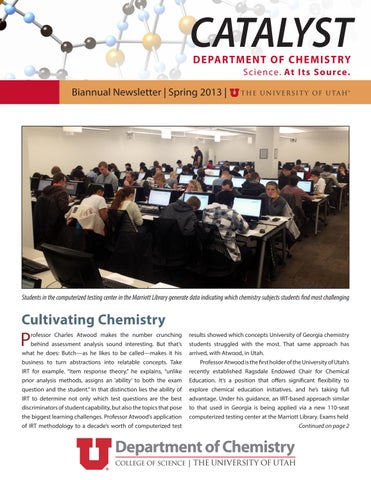
Students in the computerized testing center in the Marriott Library generate data indicating which chemistry subjects students find most challenging
Cultivating Chemistry
P
rofessor Charles Atwood makes the number crunching behind assessment analysis sound interesting. But that’s what he does: Butch—as he likes to be called—makes it his business to turn abstractions into relatable concepts. Take IRT for example. “Item response theory,” he explains, “unlike prior analysis methods, assigns an ‘ability’ to both the exam question and the student.” In that distinction lies the ability of IRT to determine not only which test questions are the best discriminators of student capability, but also the topics that pose the biggest learning challenges. Professor Atwood’s application of IRT methodology to a decade’s worth of computerized test
results showed which concepts University of Georgia chemistry students struggled with the most. That same approach has arrived, with Atwood, in Utah. Professor Atwood is the first holder of the University of Utah’s recently established Ragsdale Endowed Chair for Chemical Education. It’s a position that offers significant flexibility to explore chemical education initiatives, and he’s taking full advantage. Under his guidance, an IRT-based approach similar to that used in Georgia is being applied via a new 110-seat computerized testing center at the Marriott Library. Exams held Continued on page 2