CLIMATE ACTION PLAN
FISCAL YEAR 2025 PROGRESS UPDATE

University of Utah Climate Action Plan
1.0 Introduction
This Fiscal Year 2025 (July 1, 2024, to June 30, 2025) Climate Action Plan (CAP) Annual Update report communicates progress made in the past year, reflects on opportunities for growth, and outlines priorities and modifications to CAP strategies and key actions so ongoing work is based on the most recent information and resources available
The 2023 Climate Action Plan was informed by extensive community input, and identified four Core Areas of Action, each with a unique set of goals, targets, strategies, and actions to meet the urgency and scale required to address the changing climate and environmental stewardship at the U and beyond:
RESEARCH
GOAL
Generate climate related research that supports those most impacted and drives solutions in Utah and beyond
EDUCATION MITIGATION RESILIENCE
GOAL
Graduate students with knowledge and skills to address climate-related challenges and opportunities
GOAL
Take urgent action to reduce greenhouse gas emissions
GOAL
Increase university and community resilience to the current and future impacts of climate change
2.0
Institutional Background
The University has grown significantly since the first time the President’s Climate Leadership Commitment was signed in 2008 . The University tracks its progress in reducing emissions relative to its growth in square footage and population . This information may be used to normalize reporting data and to review each year’s progress relative to the targets
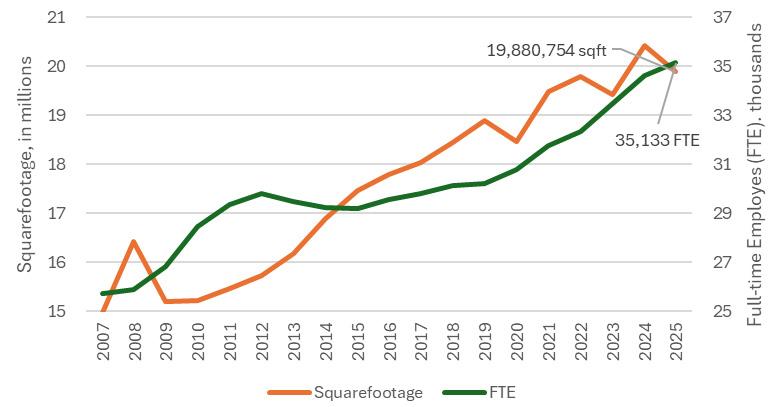
As of 2025, the University has achieved
• 34% reduction in Scope 1 and 2 emissions from 2007 baseline
• 43% reduction in total emissions per full-time equivalent students, faculty, and staff since 2007
• 42% decrease in total emissions per square foot since 2007
• 65% of the U’s purchased electricity is from renewable sources.
Note: Additional properties such as satellite campuses, field stations, data centers, and student housing in Utah, Colorado, Idaho, Montana, Nevada, Wyoming, and South Korea are not included in the institutional boundary for reporting because these facilities are not wholly controlled by the University of Utah.
Carbon Footprint
The University’s carbon footprint includes Scope 1 and Scope 2 emissions and some Scope 3 emissions (commuting and air travel) as required by the Presidents’ Climate Leadership Commitments .
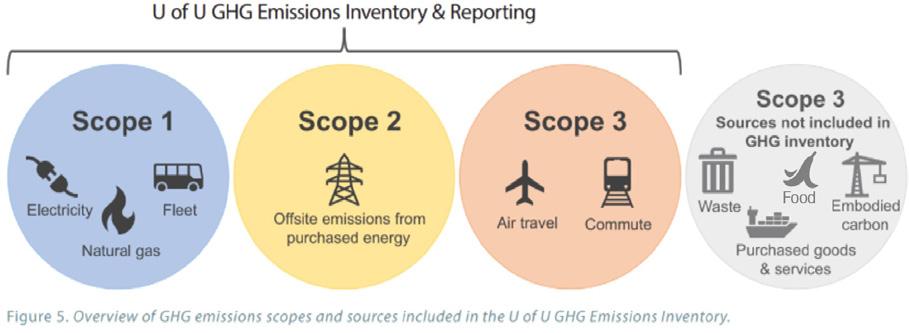
The University accelerated its carbon neutral goal to 2040 for Scope 1 and 2 emissions . As of FY25, Scope 3 or total emissions will be tracked separately with a target carbon neutral date of 2050
FY25 Emissions
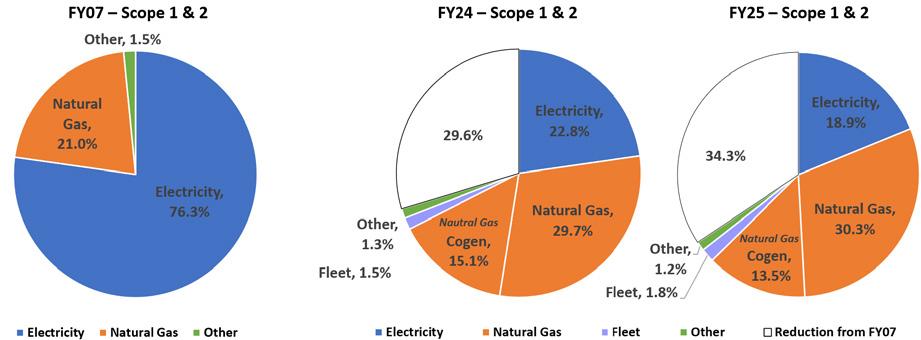
Public emissions data for the University of Utah, including Scope 3 emissions, is available through the SIMAP Public Reporting portal: https://unhsimap org/public/institution/2364/0-597-598-769
FY25 SUMMARY | AT A GLANCE
Research
• 163% increase in faculty profiles reporting climate research since FY25 .
• 73 undergraduate student research projects mentored through the Wilkes Scholars Program (WSP) .
• Vice President for Research (VPR) Office launched the Winter Olympics Sustainability Research Alliance .
Education
• 62% of academic departments offered courses with the sustainability (SUST) attribute .
• 139 sustainability education events attended by 4,287 students .
• 22 Sustainable Campus Initiative Fund (SCIF) grants awarded totaling $127,435 .
Mitigation
• 34% decrease in Scope 1 and 2 greenhouse gas emissions since 2007 despite a 33% increase in square footage
• Began sizing Power Purchase Agreement to procure additional renewable electricity to reduce operating costs in partnership with Operational Excellence .
• The Parking Roadway and TDM Study was accepted by the Board of Trustees, which allows the development of specific projects to address parking and transportation on-campus .
Resilience
• ‘Resilience Through Community ’ Earth Month engaged 700 people through 15 events .
• Drafted new Tree Protection and Preservation Policy to protect and preserve on-campus tree ecosystems .
• The Edible Campus Gardens program provided 986 lbs of free, fresh produce to the campus community through the Feed U Pantry .

Research
Goal 1.0 Generate climate-related research that supports the needs of those most impacted and drives solutions in Utah and beyond .
2022 Status 2025 Status Update By 2030 By 2040
41 faculty self-identified in FAR as having climaterelated publications and/or grants
142 faculty
(+246% since 2022) self-identified in profiles .faculty utah . edu
+50%
faculty producing research related to changing climate and its impacts
+100%
faculty producing research related to changing climate and its impacts
“My research as an undergraduate serves to push for more sustainable agriculture, and I hope that by questioning and continually progressing towards more environmentally friendly solutions in every field and in one’s personal life we will learn to truly live with the land and make it a better place.”
Undergraduate student, College of Science
Modifications
• Transition of faculty profile tracking from FAR to profiles .faculty .utah edu
FY25 Updates
• 142 faculty can now be found by searching climate at profiles .faculty utah .edu .
• A total of $203,657 in climate-focused faculty seed grants was awarded by the Wilkes Center for Climate Science & Policy in FY25—part of a combined $851,390 from the Wilkes Center and the Vice President for Research (VPR) Office since FY23 .
• 10 clinicians or researchers report climate-related publications or clinical/academic interests on healthcare .utah .edu profiles .
• VPR Office launched the Winter Olympics Sustainability Research Alliance
• 73 undergraduates were mentored by faculty across the U through the Wikes Scholars Program (WSP) .
• 87 undergraduates conducted climate-focused research through the Science Research Initiative (SRI) .
FY26 Priorities
• Establish new 2030 and 2040 targets
Opportunities for Growth
• Changing priorities, restructurings, and staff reductions at federal agencies may impact the timeline of climate research awards and the total amount of funds available nationwide .
• Encouraging the use of climate change-related tags on profiles .faculty .utah edu (51 faculty used these tags in FY25) and the voluntary inclusion of climate-related publications on healthcare . utah .edu present opportunities to improve climate research searchability .
Education
Goal 2.0 Graduate students with knowledge and skills to address climaterelated challenges and opportunities .
2022 Status 2024 Status Update By 2030 By 2040
Curriculum, 33 . 35/40 STARS points earned Campus Engagement, 14 .76/21 STARS points earned
No Change
Next STARS report submission 2026
+5 STARS points in curriculum and engagement categories combined
+10 STARS points in curriculum and engagement categories combined
“It is important to enter our careers with sustainability in mind. I want to be able to apply the things I learned to the real world and encourage sustainable change.”
Undergraduate Student, Engineering
FY25 Updates
• The University offered 154 SUST attribute courses, reaching 8,972 students .
• 8 faculty attended the Sustainability Teaching Workshop, leading to 7 new SUST attribute courses .
• Promoted a sense of connection and belonging by reaching 4,287 participants at 139 unique events in partnership with 14 departments and student groups
• The Edible Campus Gardens program facilitated 925 student hours through 63 class sessions involving 14 academic departments
• 149 individuals contributed 455 volunteer hours in the gardens, generating $16k in economic impact
• The Sustainable Campus Initiative Fund (SCIF) distributed a total of $127,435 green grant dollars, supporting 22 student-led sustainability projects .
• Partnered with U Career Success to host a series of sustainability career talks and sponsored the Social and Environmental Impact Expo .
• Improved tracking of SUST attribute courses through access to CourseDog .
• Created a centralized tracking system for curricular and co-curricular activities in coordination with University Analytics and Institutional Reporting .
FY26 Priorities
• Formalize and fund sustainability projects with living-learning communities and strengthen reporting mechanisms with departments tracking student success metrics .
• Develop a sustainability literacy assessment in consultation with faculty .
• Identify opportunities to integrate a sustainability literacy assessment into student survey(s) to measure student knowledge and interaction with climate action opportunities .
• Advocate for reinstatement of SCIF funding mechanism
• Develop faculty workshop(s) to expand SUST course offerings with the Martha Bradley Center for Teaching Excellence
• Update SUST course application to align with university attribute standards . Faculty feedback is provided by the Sustainability Education Advisory Committee (SEAC) .
• Work with student career advisors to track sustainability-related graduate career paths
Opportunities for Growth
• Explore use of current student experience technologies to better track informal groups and events providing sustainability education and opportunities for climate action .
• Expand the reach of sustainability education through collaboration with Undergraduate Studies .
• Utilize 2026 STARS report submission to drive sustainability education improvements and modify CAP targets .
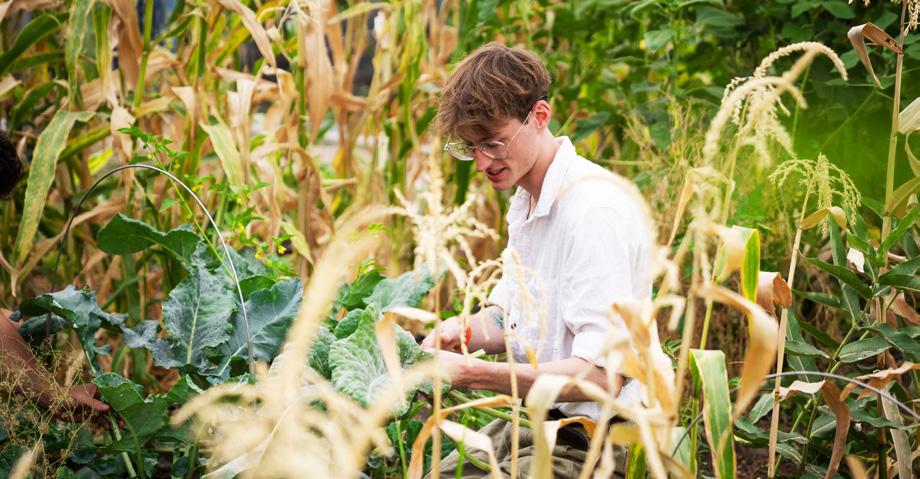
“As a future teacher, I want to teach my students to build a sustainable future and think about what consequences their actions have on others and their environment.”
Undergraduate Student, College of Education
Mitigation
FY25 ANNUAL UPDATE
Goal 3.0 Take urgent action to reduce greenhouse gas emissions . Primary Target
of buildings are net zero carbon ready
Transportation Emissions include fleet, commute, and air travel compared to 2007 baseline.
Commuting emissions is based on biannual survey for mode
Procurement & Waste
Not including U of U Health, portions of Research Park, and third-party contracts, and construction/ demolition debris.
5,935 tons to landfill for main campus
*Scope 3 emissions to be net zero by 2050
4,494 tons to landfill for main campus in FY25—next calculated in FY26
50% decrease in waste sent to landfill
Maintain 50% decrease in waste sent to landfill
“Sustainability is important not only for our current environment we live in and see the impact of waste firsthand, but also that of future generations. Do we want to the world to be a better place in the future? I do.”
Undergraduate Student, College of Social and Behavioral Sciences
Modifications
As of FY25, Scope 3 or total emissions will be tracked separately with a target carbon neutral date of 2050 . Scope 1 & 2 maintain the carbon neutral target of 2040 .
FY25 Updates
Buildings & Infrastructure
• Increased automated meters on campus to 786 working site meters to improve data availability and building performance tracking .
• Completed energy efficiency projects on campus to address operations, including
à Full-building operational tune up in three buildings to kick-off Retrocommissioning program
à Optimization projects in Acute Care Complex and Critical Care Pavilion
à Continuous monitoring of HVAC equipment to save more than $135k in utilities
à Received nearly $400,000 from Rocky Mountain Power’s utility incentive program
• Recognized by American Society for Healthcare Engineering for energy efficiency at Farmington Health Center, Sugarhouse Health Center, Orthopaedic Center, Madsen Clinic, and Moran Eye Center
• Began sizing new Power Purchase Agreement (PPA) to issue request for proposals to increase campus renewable electricity purchases
• Continued work on the Campus Emissions Reduction Plan (CERP) to transition away from natural-gas-based campus heating Preliminary findings and the Physical Development Plan prompted a dedicated analysis of decommissioning the campus Combined Heat and Power (cogeneration) plant, which accounts for about a third of total natural gas usage .
Transportation
• Executed 100 Electric Vehicle partnership with Rocky Mountain Power to upgrade/add 100 charging stations in four garages and at buildings across campus .
• Completed Transportation Baseline Study to better understand existing traffic patterns and the Parking Roadway and TDM Study to find solutions that maintain access to campus, parking availability and parking demand . The Board of Trustees accepted the results of the study and authorized the University to propose specific projects to achieve the study’s recommendations
• Installed a parking occupancy system launching Fall 2025 that will provide live parking lot availability information to our campus community while providing detailed usage data for improved planning and management .
• Installed bicycle, pedestrian, and scooter Eco-Counters to provide active transportation data and inform transportation access and prioritize facility development .
• Continued providing low-cost bicycle services through Campus Bike Shop, increasing service from 331 customers in FY24 to 500 customers in FY25 .
• Replaced 15 gas-powered fleet vehicles with hybrid vehicles .
• Analyzed UTA service levels to identify gaps in direct service to campus
• Continued offering subsidized UTA passes to all students, faculty, and staff .
Procurement & Waste
• Launched recycling pilot project in Area E of main hospital to understand opportunities and pain points of the program .
• Kicked off Sustainable Materials Management Center Feasibility Study to better understand current waste streams and identify opportunities to improve operations .
Research Impacts
• Launched My Green Lab certification to improve energy efficiency improvements in laboratory operations .
FY26 Priorities
Buildings & Infrastructure
• Issue RFP for Power Purchase Agreement to procure additional renewable electricity at prices that reduce operating costs .
• Continue CERP analysis to evaluate decommissioning the University’s Combined Heat and Power (cogeneration) plant to reduce local emissions .
• Continue Retrocommissioning program and Monitoring-Based Commissioning to maximize energy efficiency of existing buildings and reduce operating costs .
• Improve collection of energy efficiency incentives to fund future projects
Transportation
• Develop a priority, implementation, and funding strategy to decrease single occupancy vehicle use based on recommendations from the Parking Roadway and TDM Study.
• Assess locations/need for future Electric Vehicle Supply Equipment
• Develop and recommend centralized secure bicycle parking strategy .
Procurement & Waste
• Complete Sustainable Materials Management Center Feasibility Study and present options to leadership for planning current and future waste management infrastructure .
• Integrate waste reduction goals into procurement and RFP process
Research Impacts
• Work with campus leadership to establish structures and policies to address emissions associated with research, such as expanding Green Lab Certification across campus
Opportunities for Growth
Building & Infrastructure
• Implement net zero carbon goals into new construction and major retrofits project requirements needs to be coordinated and widely approved across Real Estate, Planning, and Construction Management to ensure campus-wide adoption with funding sources allocated .
Transportation
• Identify designated funding source for active transportation infrastructure .
• Increase number of sensors to provide comprehensive data about active transportation access
• Identify designated funding source available to support proactive coordination with Utah Transit Authority (UTA) to expand transit route frequency and infrastructure improvements .
• Explore opportunities to replace heavy-duty fleet vehicles with electric vehicle alternatives
Procurement & Waste
• Establish clear U policy or directive to implement sustainable procurement standards .
• Explore the feasibility of centralizing campus waste management Without a single coordinating authority, waste services are managed by different departments and contractors, making it harder to improve efficiency and measure progress in reducing landfill waste .
Research Impacts
• Establish clear U policy or directive to implement sustainable operations or procurement standards related to energy efficient lab equipment .
“We all have a role to play, however large or small, in helping ensure our planet is sustainable for future generations.”
Graduate Student, College of Law
Resilience
Goal 4.0 Increase university and community resilience to the current and future impacts of changing climate .
2022 Status 2025 Status Update By 2030 By 2040
U of U Resilience Assessment
Modifications
Resilience Assessment metrics being refined, no percent update available +50% U of U
Resilience Assessment metrics improved +75% U of U
Resilience assessment metrics will be updated in FY26 .
FY25 Updates
Resilience Assessment metrics improved
• Collaborated beyond campus with UNP Bridgewest Environmental Health Coalition, and UHEART .
• Earth Month themed “Resilience through Community ” drew 700 participants across 15 events
• Raised awareness with 44 sustainability articles in @theU, reaching 15,600 views .
• Converted 50,760 sq ft of turf to low-water landscaping; reduced irrigation by 5% in key areas
• Developed GIS web viewer to track ecosystem services for the Landscape Master Plan
• Drafted Tree Protection Policy to preserve campus tree ecosystems
• Partnered with Salt Lake City to grow 10,000 native plants for FY26 campus planting .
• Retired 2,900 sq ft from Edible Campus Gardens program (Sill Center location); remaining gardens produced 986 lbs of free produce for Feed U Pantry .
• Enrolled in RMP’s Demand Response program to support grid resilience and reduce demand charges .
FY26 Priorities
• Publish updated Hazard Mitigation Plan with climate hazards .
• Publish drafted Tree Protection Policy
• Integrate climate-related risks into Safety Administration (SAM) hazard framework .
• Increase production yield of growing space in the Edible Campus Gardens .
• Advance water conservation with new meters and smart irrigation controllers .
• Enhance landscape resilience and biodiversity by planting native species grown in partnership with Salt Lake City .
• Create Landscape Zones and Plant Typology Guide .
• Continue turf replacement with low-water blends and water-wise landscaping .
• Assess climate risks and update emergency plans with resilience actions; develop framework to streamline planning efforts .
Opportunities for Growth
• Integrate into the Physical Development Plan
“Climate
change is a pressing issue and humanity cannot survive let alone thrive, without a stable climate and stable ecosystems.”
Undergraduate Student, College of Science
Contributors
The implementation of the CAP would not be possible without the significant contributions of many staff, faculty, students, and community members The following contributors to the FY25 Progress report are listed by each Core Area but do not by any means capture everyone who works to make the U a unique place that strives for excellence .
Academic Affairs
Jim Agutter: Senior Associate Dean, Faculty/ Innovation, Undergraduate Studies
Emerson Andrews: SCIF Program Manager, Office for Sustainability Education
Ginger Cannon: Director, Office for Sustainability Education
Anne Dibble: Communications Director, Undergraduate Studies
Paul Brooks: Professor Geology and Geophysics
Gabrielle James: Gardens Program Coordinator, Office for Sustainability Education
Thomas Chase Hagood: Vice-Provost for Student Success
Lori McDonald: Vice President for Student Affairs
Masood Parvania: Assoc Professor Electrical and Computer Engineering, WIRED
Laura Rupert: Program Manager, Science Research Initiative
Health Sciences
Alexis Lee: Director Environmental & Social Sustainability, Hospitals & Clinics
Dustin Banks: Associate Executive Director Facilities Management, Hospitals & Clinics
Ischa Jensen: Associate Executive Director System Planning, Hospitals & Clinics
Kimberley Shoaf: Professor, Division of Public Health
Phil Chaffee: Associate Executive Director of Emergency Management, Hospitals & Clinics
Chief Operating Officer (COO) / Operations
Ali McKelvy: Construction Project Manager, U Facilities
Andrew Schottel: Senior Energy Engineer, Sustainability & Energy
Clifton Grindstaff: Associate Director, Surplus and Salvage
Dana Holmes: Program Manager Energy & Sustainability, U Facilities
Fred Monette: Executive Director Environmental Health and Safety
Jack Kay: Project Manager Energy & Sustainability
Jeremy Ferguson: Assoc Dir Real Estate Management
John Close: Construction Project Manager, U Facilities
John Walker: Supervisor Grounds and Landscape, U Facilities
Joshua James: Program Manager, Waste & Recycling
Lissa Larson: Assoc Director, Sustainability & Energy
Marian Lynn Rice: Associate Director Peak Water Sustainability Engine
Max Seawright: Associate Director of Research Development, Wilkes Center for Climate Science & Policy
Lisa Thompson: Associate Director of Editorial and Media, NHMU
Jennifer Watt: Faculty Director, Office for Sustainability Education
Kyla Welch: Program Manager, Wilkes Center for Climate Science & Policy
Kevin Whitty: Assoc Dean for Research, College of Engineering
Members of the Sustainability Education Advisory Committee (SEAC)
Robert Armstrong: Energy and Sustainability Coordinator, Hospitals & Clinics
RyLee Curtis: Director Community Engagement, Hospitals & Clinics
Sijana Omerovic: Senior Manager Emergency Management, Hospitals and Clinics
Smitha Warrier: Medical Director Environmental & Social Sustainability, Hospitals & Clinics
Steve Panish: Assistant VP Health Sciences Capital Projects, OSVPHS
Matt Yurick: Director of Operations and Logistics, Space Planning and Management
Amit Nair: Associate Director of Environmental Health and Safety
Mike Smith: Director of Purchasing and Supply Chain
Sean Nielson: Manager Engineering and Architecture, Sustainability & Energy
Solomon Brumbaugh: Travel Demand Management Manager, Commuter Services
Steffanie Brown: Senior Energy, U Facilities
Stuart Moffatt: Director of Emergency Management, Public Safety
Sue Pope: Open Space Manager, U Facilities
Members of the University Landscaping and Ecosystem Committee (ULEC)