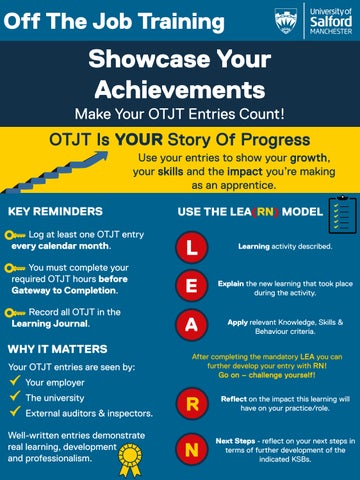
Off The Job Training Showcase Your Achievements
Make Your OTJT Entries Count!
OTJT Is YOUR Story Of Progress
Use your entries to show your growth , your skills and the impact you’re making as an apprentice.
KEY REMINDERS
Log at least one OTJT entry every calendar month.
You must complete your required OTJT hours before Gateway to Completion.
Record all OTJT in the Learning Journal.
WHY IT MATTERS
USE THE LEA(RN)
MODEL
Learning activity described.
Explain the new learning that took place during the activity. Apply relevant Knowledge, Skills & Behaviour criteria.
Your OTJT entries are seen by: Your employer The university External auditors & inspectors.
Well-written entries demonstrate real learning, development and professionalism.
L E A R N
After completing the mandatory LEA you can further develop your entry with RN! Go on – challenge yourself!
Reflect on the impact this learning will have on your practice/role. Next Steps - reflect on your next steps in terms of further development of the indicated KSBs.
USE THE LEA(RN) MODEL
The L.E.A.R.N. Framework for High-Quality Off-the-Job Training (OTJT) Entries
Use the L.E.A.R.N. model to ensure every OTJT entry meets funding and Ofsted expectations Minimum expectations for a GOOD entry: LEA Stretch and Challenge for a GOLD standard entry: LEARN
Learning activity described.
Explain the new learning that took place during the activity.
• Briefly outline what you did.
• Be specific enough that someone unfamiliar with your role can understand the activity.
Examples -
“Idid…”
“Iattended…”
“Iread…”
“Iwatched…”
Apply relevant Knowledge, Skills & Behaviour criteria.
• Identify what you learned that was new.
• Focus on Knowledge, Skills & Behaviours (KSBs) developed.
After completing the mandatory LEA you can further develop your entry with RN!
Go on – challenge yourself!
Reflect on the impact this learning will have on your practice/role.
• From the criteria button in OneFile Learning Journal select the key KSBs that were developed.
• Also, when describing your learning make it clear where the KSBs you have selected are covered.
Example“Ilearntthat…”
Next Steps - reflect on your next steps in terms of further development of the indicated KSBs.
• Briefly explain how this new learning has influenced your practice.
• Consider confidence, competence, efficiency or improved understanding.
We recommend you link the explanation of new learning with the KSBs in brackets.
Example -
“IlearnthowtoapplythenecessitycriteriaunderSection24 ofPACEwhenmakinganarrest(K4). Ipractisedassessing proportionalityandensuringthatanyuseofpolicepowerswas lawful,justifiedandrecordedaccuratelyinmypocket notebook(S2)”.
• Identify what you will do next to build on this learning.
• This could include further practise, shadowing, reading or applying the learning in a different context.
Examples“InmyroleInowapproachsituationsdifferentlyby…” “InmyroleIhavebecomemoreconfidentin…”
“ThishaschangedthewayIworkbyhelpingmeto…”
Examples“Tobuildonthis I will…” “TofurtherdevelopIneedto…”
“Mynextstepswillbeto…”