The Acute Effects of Foam Rolling the Rectus Femoris on Force Production Asymmetry During a Double-Leg Squat Hiro Boyas Homma, Lily James, Sami Abdul Majid, Dr. Kendra Nelson Department of Kinesiology, University of Redlands, Redlands, CA 92373 Contact Info: kendra_nelson@redlands.edu
Data Collection
Background Can foam rolling prevent injury? Myofascia is a network of connective tissue surrounding the musculoskeletal system. Restrictions in this tissue can cause asymmetries in movement and increase the risk of injury.1 Foam rolling is a widely accepted technique used to reduce restrictions and improve mobility; however, existing literature fails to investigate the possible benefits of foam rolling on performance. In addition, the literature fails to provide quantitative data and reproducible methods.2 This study aims to provide a standardized protocol and obtain quantitative data to analyze the effects of foam rolling the rectus femoris on asymmetry. The double-leg squat has served as a baseline functional movement in previous literature and provides an accessible way to analyze changes in force production.3 VALD ForceDecks track unilateral force production in both eccentric and concentric movements. These metrics allow within-subject comparisons before and after a standardized foam rolling intervention targeted at decreasing myofascial restrictions.
Methods Methods
Concentric (up phase)
Eccentric (down phase)
• While weight was identified as a covariate, there were varying effects between the subgroups.
Figure 1: Asymmetries between legs were computed using VALD ForceDecks.
Time (s) (s) Time
Figure 2: The Force-Time Curve of a Double-Leg Squat. Bilateral and unilateral force production during a single squat.
Table 1. Description of Data Collection.
• Concentric asymmetry improvement in both the experimental and control groups may be due to neural priming rather than foam rolling. • The rectus femoris may be more active in the eccentric phase than concentric, explaining why foam rolling improved asymmetry solely in the eccentric experimental group.
Both Legs
Sample: 21 University of Redlands Students
Discussion
• A notable limitation of this study is its small sample size and that participants presented low asymmetries prior to intervention.
Figure 3: Asymmetry Chart of a Double-Leg Squat. Percentage of force production asymmetry for each repetition. Figure 6:Linear LinearCorrelation Correlation of Weight Eccentric Asymmetry. Differences in direction of correlation Figure 6: of Weight and and Eccentric Asymmetry. Differences in direction of correlation (positive or (positive or negative) groups are shown. negative) among groupsamong are shown.
Results
Conclusions • Foam rolling the rectus femoris may acutely improve lowerextremity asymmetries during the eccentric phase of squatting, particularly in individuals with higher body mass. Future Work: • Increasing squat trials to 5 repetitions per participant may reduce the effects of intra-subject variability.
Experimental Setup: (3reps)
• To better understand the activation of the rectus femoris concentrically and eccentrically, a dynamometer could be used to isolate and verify its force production during movement.
(3reps)
References Figure 4: Force Production Asymmetry in Eccentric and Concentric Phases.
Standardization: Scripted protocols were given throughout the study, including an instructional video on foam rolling.
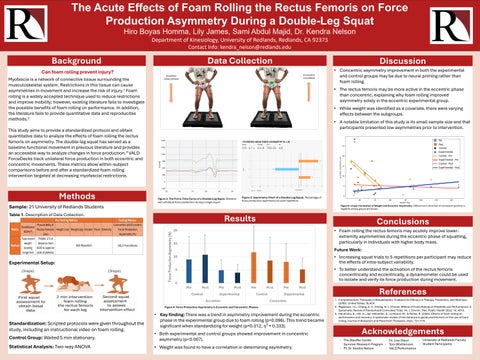
• Key finding: There was a trend in asymmetry improvement during the eccentric phase in the experimental group due to foam rolling (p=0.096). This trend became significant when standardizing for weight (p=0.012, η² = 0.333).
Control Group: Waited 5 min stationary.
• Both experimental and control groups showed improvement in concentric asymmetry (p<0.007).
Statistical Analysis: Two-way ANOVA
• Weight was found to have a correlation in determining asymmetry.
1. Complementary Therapies in Rehabilitation: Evidence for Efficacy in Therapy, Prevention, and Wellness. (2009). United States: SLACK. 2. Pagaduan, J.C.; Chang, S.-Y.; Chang, N.-J. Chronic Effects of Foam Rolling on Flexibility and Performance: A Systematic Review of Randomized Controlled Trials. Int. J. Environ. Res. Public Health 2022, 19, 4315. 3. Hendricks, S., Hill, H., den Hollander, S., Lombard, W., & Parker, R. (2020). Effects of foam rolling on performance and recovery: A systematic review of the literature to guide practitioners on the use of foam rolling. Journal of Bodywork and Movement Therapies, 24(2), 151–174.
Acknowledgements - University of Redlands Faculty - The Stauffer Center - Dr. Lisa Olson - Student Participants Summer Research Program - Tom Whittemore - PI: Dr. Kendra Nelson - VALD Performance