
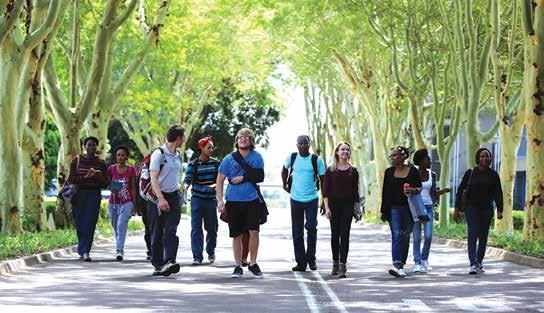


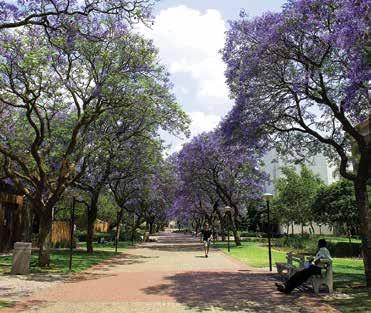


The University of Pretoria (UP) is a diverse and dynamic university community comprising students from all over the world. It has nine faculties (Education; Humanities; Economic and Management Sciences; Engineering, Built Environment and Information Technology; Law; Natural and Agricultural Sciences; Theology; Veterinary Science and Health Sciences) and the Gordon Institute of Business Science (GIBS). The University of Pretoria’s degrees are internationally recognised and are structured similarly to those of the world’s best universities. A number of support departments at the University help ensure that all staff and student activities, spread over six campuses, are executed with the necessary quality, relevance, diversity and sustainability.
Location
University of Pretoria cnr Lynnwood Road and Roper Street Hatfield South Africa
University of Pretoria Private Bag X20 Hatfield 0028 South Africa
Tel +27 (0)12 420 3111 Email ssc@up.ac.za Website www.up.ac.za
University bank accounts
Account holder University of Pretoria University of Pretoria Bank ABSA Standard Bank Branch Hatfield (Branch code: 632005) Hatfield (Branch code: 011545)
Swift code ABSAZAJJCPT SBZAZAJJ
Account number 2140 000 038 012 602 604
Deposit reference Initials and surname Initials and surname
Minimum admission requirements
To be able to register, National Senior Certificate (NSC)/IEB*/Cambridge candidates must comply with the minimum requirements for degree studies, as well as with the minimum requirements for the relevant programme. The calculation of an Admission Point Score (APS) is based on a candidate’s achievement in any SIX recognised NSC 20-credit subjects (including subjects from the non-designated subject list, eg CAT, Tourism, Hospitality Studies and Civil, Electrical & Mechanical Technology, etc), by using the NSC seven-point rating scale. Life Orientation is a 10-credit subject and may not be used for calculating the APS. Life Orientation is also not a faculty-specific subject requirement.
*Independent Examination Board (IEB)
National Senior Certificate (NSC) seven-point rating scale
A full or foreign conditional exemption certificate is a prerequisite and applicable to non-South African citizens and to students who do not have a South African National Senior Certificate (NSC) qualification or Independent Examination Board (IEB) qualification and who want to enrol for undergraduate studies at the University of Pretoria. This certificate can only be obtained from Universities South Africa.
Contact information
Tel +27 (0)12 591 4401/2
Email admin@usaf.ac.za
Website www.universitiessa.ac.za
Admission Point Score (APS) conversion table
The following tables can be used to convert your marks/symbols into an Admission Point Score (APS) when applying for studies at the University of Pretoria.
* APS conversion for Grade 11 equivalent qualifications only and for conditional admission and selection purposes
** APS conversion for Grade 12 equivalent qualifications – not for final admission and must be taken together with Advanced Subsidiary Level and Advanced Level for exemption purposes
Admission Point Score (APS) conversion table only for Cambridge Advanced Level and IB Higher Level
Non-South African citizens will have to submit proof of legal status in South Africa, as well as proof of adequate medical aid cover at the International Students Division before they will be able to register.
Contact information
Tel +27 (0)12 420 3111
Email ssc@up.ac.za
Website www.up.ac.za/ISD
Please read through all the steps below to determine which actions are relevant for your application to study at the University of Pretoria in 2018. Non-South African citizens should also take note of the steps below with specific reference to the important information on page 1.
Read about all undergraduate programmes offered at UP from page 5 in this brochure.
� It is important to indicate a first- as well as a second-choice programme on your Online Application. The Application only makes provision for two study choices. If you want to add a third choice, or if you want to change your study choice after you have already submitted your online application, please forward your request to ssc@up.ac.za.
� Your second-choice programme will automatically be considered should your application for your first-choice programme be unsuccessful or if your first-choice is a selection programme.
� Ensure that your first- and second-choice programmes meet the minimum admission requirements as well as the faculty’s selection guidelines.
� Please note that certain programmes will not be considered if indicated as your second-choice. Refer to the faculty tables from page 5.
� For study advice, make an appointment with a Student Advisor via Ms Carol Bosch at +27 (0)12 420 5144 or carol.bosch@up.ac.za. More information is available at www.up.ac.za > Study at UP > What to Study.
For more information on tuition and residence fees, go to www.up.ac.za/fees-and-funding.
� Fee estimator: Please go to http://estimate.up.ac.za to get an estimation of the study fees for the programme/s that you are interested in.
� Family discount: When two or more dependent children of the same family are registered simultaneously at the University of Pretoria, they may apply for a rebate on tuition fees.
� The 2.5% discount: If the student account is paid in full (ie 100%) by 30 April, a 2.5% discount is applicable.
� Registration fee: This fee is not an additional amount payable, but forms part of the tuition fees and is an initial payment towards the tuition fees.
� Residence reservation fee: This fee will be payable within 30 days after placement in a UP residence. For residence room fees, go to www.up.ac.za/accommodation.
� Fees paid by bursaries: Students must submit written proof from the sponsor of the bursary awarded to them prior to registration, otherwise the registration fee will be payable by the student. The final decision regarding the acceptance of a bursary letter rests with the University.
� How and where to pay: Cashiers are available on all our campuses from Mondays to Fridays from 08:00 to 16:00. For EFT and credit card payments, please allow at least 5 working days for payment to reflect on your student account.
� UP banking details: See page 1.
Apply ONLINE at www.up.ac.za/apply from 1 March in the year preceding studies.
� Before you start to complete the Online Application, please watch a video on “How to complete the online Application” at www.up.ac.za. Click on “See all YouTube videos.”
� Ensure that the email address that you indicate on your Online Application is correct as your temporary password and T number will be sent to this email address.
� Ensure that you apply before the closing dates of both your firstand second-choice programmes. The closing dates are indicated in the faculty tables; see page 5 in this brochure or go to www.up.ac.za/closingdates.
� Certain programmes will not be considered if indicated as your second-choice.
� You will receive your student number within 10 working days after you have submitted your Online Application.
� On receipt of your student number, you will be able to track your admission status on the UP Student Portal. Refer to Step 7 for instructions on how to gain access to your Student Portal.
The Online Application has a section to be completed if you are interested in residence placement.
� Residence placement is based on academic merit and date of application.
� The demand for accommodation by far exceeds the available spaces –apply as soon as possible from 1 March.
� Preference is given to students with an academic average of 75% and above.
More information is available at www.up.ac.za/accommodation.
� Applications must be submitted via the UP Student Portal or www.up.ac.za/ fees-and-funding. Closing date for applications: 31 October in the year preceding studies. No late applications will be accepted.
� UP sports bursaries: www.up.ac.za/sport (Closing date: 30 September)
National Student Financial Aid Scheme (NSFAS)
� For applications and comprehensive information, visit www.nsfas.org.za.
� Closing date for applications: 30 November in the year preceding studies.
� To qualify for guaranteed placement in a UP residence, the prospective student must:
- apply before 1 May in the year preceding studies; - have obtained a minimum average of 85% in the examination with which the student applies to study at UP; and - be provisionally admitted to a programme.
As a registered credit provider, Eduloan covers a wide range of studentrelated necessities such as books, accessories, laptops, university and private accommodation, as well as study tuition with a fixed monthly instalment. Anyone can apply for a loan (students, parents or guardians), provided that the applicant is in full-time employment or has a registered business. Contact lizettevr@eduloan.co.za or +27 (0)12 420 2161/5175.
Other bursary options
� Bursaries according to field of study: www.gostudy.mobi
� The Bursary Register: Contact rlevin@mweb.co.za or +27 (0)11 672 6559
The National Benchmark Test is not compulsory for all programmes.
� Register to write the NBT at www.nbt.ac.za.
� The NBT results support, but do not replace or duplicate final school examination results.
� It is indicated at the programmes in the faculty tables from page 5 whether or not the NBT is required.
� The tests are confidential.
� There are no previous test papers available.
How to access the UP Student Portal Go to www.up.ac.za and click on MyTUKS Login.
NOTE: A T number is a temporary number and NOT a student number. This T number is issued to the applicant at the beginning of the Online Application process. An applicant will receive a UP student number within 10 working days after his/her application has been submitted successfully.
Applicants will only be able to access the UP Student Portal once they have received a UP student number, eg u18123456.
Click on the “New user” link below the Login tab.
� Type in your Username (u followed by your student number) and your National ID or Passport number. Click the “Proceed” button.
� Set up your new password and confirm the password in the second block. Click the “Proceed” button.
� The NBT consists of two components:
(1) AQL: Academic Literacy and Quantitative Literacy (which are combined). Quantitative Literacy is similar to Mathematical Literacy. The AQL test has also been translated into Braille.
(2) MAT: Mathematics.
� A complete schedule with all the test centres can be found at www.nbt.ac.za.
� A message is displayed to inform the user that the password was set successfully. Click the “OK” button.
� A list of challenge questions appears and you may select to answer any 3 of these.
� Select any three challenge questions and then click on the “Submit” button.
� Enter your answer on each challenge question. Click the “Save” button.
� A message will be displayed to inform you that your challenge questions have been set up. Click the “OK” button.
� You are now ready to access the UP Student Portal.
� Sign in again with your username and password.
The Value-added Questionnaire is only required for applications in the Faculties of Health Sciences and Veterinary Science.
� The Online Value-added Questionnaire will be made available on the UP Student Portal, only for prospective students in the abovementioned faculties who meet the minimum admission requirements. Visit your Student Portal regularly for notices in this regard.
� Be sure to complete and submit the online Value-added Questionnaire before the due date. The faculty will communicate the due date to applicants on the UP Student Portal under ‘Communications’. Enquiries may be directed to ssc@up.ac.za.
Before a student will be able to register, a contract needs to be concluded between the student and the University of Pretoria
� Students must access the contract online on the UP Student Portal at www.up.ac.za > MyTUKS Login.
� The contract should be completed online, and then printed and signed.
� The Orientation Programme will be available on www.up.ac.za by the end of December 2017.
� The completed and signed original contract must be handed in at the Student Service Centre or posted to the Student Service Centre, University of Pretoria, Private Bag X20, Hatfield, 0028. The University of Pretoria does not accept faxed, scanned or emailed contracts.
� Watch a video on “How to complete the UP Student Contract” at www.up.ac.za, click on “See all YouTube videos”
� Registration of first-year students takes place during Orientation Week. Dates will be communicated by the end of December 2017.
The Special offer to new first-year students is based on the academic average percentage obtained in the final school-year end examination. (See next page for further information).
The special offer includes:
� Guaranteed achievement awards to students who qualify.
� Guaranteed admission to first- or second-choice non-selection programmes for prospective students with an academic average percentage of between 75% and 100%, if the application is received no later than 1 May of the year preceding commencement of studies.
� Guaranteed placement in a UP residence to prospective students with an academic average percentage of between 85% and 100% if: - your application is received no later than 1 May of the year preceding commencement of studies; and - you have been provisionally admitted to a programme. More information is available at www.up.ac.za/fees-and-funding.
(Award values are for 2017 and will be adjusted for 2018) ADMISSION
(based on the examination results with which you apply)
(based on the final school-year examination results)
(based on the examination results with which you
to your first or secondchoice non-selection programme (not applicable to selection programmes) if your application is received not later than 1 May of the year preceding commencement of studies.
DUX LEARNER AWARD
(based on the final school-year examination results)
Dux learner award to the value of R7 500 to the top academic achiever in Grade 12 of a specific school (one learner per school)
PLEASE NOTE: The University of Pretoria reserves the right to amend award values without prior notice. Award values will be adjusted for 2018.
� Undergraduate achievement awards are based on the average percentage obtained (not on the number of distinctions).
� The average percentage is not rounded off.
� Undergraduate achievement awards are made automatically to newly-registered undergraduate students who meet the award criteria. Students do not apply for these awards.
� First-year students who register for studies at UP directly after Grade 12 (their final school-year), or who took a gap year(s) after their final school-year, who meet the award criteria, will be considered.
� Students who have previously registered at a tertiary educational institution prior to registering at UP, will not be considered for an achievement award. Students who registered at UP in previous years, are also not considered.
� Qualifying students must be South African citizens or permanent residents in South Africa, or be citizens of a SADC country.
� The average percentage for award purposes is the average of the actual percentages obtained for all recognised NSC/IEB/Cambridge subjects taken, in their final schoolyear end examination, based on the calculations done by the University of Pretoria.
in a UP residence if your application is received not later than 1 May of the year preceding commencement of studies and once you are provisionally admitted to a programme.
� Certain subjects are excluded in the calculation of average percentages:
– Life Orientation
– Mathematics Paper 3
– Additional Mathematics
– Practical Music Grade 4 and 5 (Note: Practical Music Grades 6, 7 and 8 are considered for inclusion in the calculation of the average percentage. If your music report is not part of your NSC report, please submit your official music report to your faculty’s student administration office before end January for consideration).
� The awards are finalised on the basis of the final marks that the University receives from the Department of Basic Education for the final school-year. Results obtained for papers that have been re-marked are not taken into account for award purposes.
� Awards are fully repayable if students discontinue or terminate their studies in the relevant programme for whatever reason during the year in which the award is made.
� If students change their programmes during the year in which the award is made, the award value allocated or awarded will not be cancelled or adjusted upward/ downward to align it with the consecutive programmes enrolled for.
Be sure to read about all the various funding opportunities on www.up.ac.za/fees-and-funding.

In the faculty tables on the following pages, suggested second-choice programmes are indicated in a line directly below the programme it pertains to, where such a second-choice programme/s may be applicable.
� The Online Application makes provision for two study choices.
� The demand for admission into programmes at the University of Pretoria by far exceeds the availability of study spaces. It is therefore sensible to add a secondchoice programme on the Online Application.
� Prospective students’ preferred programme should be indicated as their first study choice.
� Applicants whose applications for their first study choice are unsuccessful, will automatically be considered for admission into their second study choice programme.
Important information on undergraduate programmes for 2018
� The following persons will be considered for admission: a candidate who is in possession of a certificate that is deemed by the University to be equivalent to the required Grade 12 certificate with university endorsement; a candidate who is a graduate from another tertiary institution or has been granted the status of a graduate of such an institution; and a candidate who is a graduate of another faculty at the University of Pretoria.
� Life Orientation is excluded in the calculation of the APS.
� Grade 11 final examination results, the NBT results as well as a Value-added Questionnaire will be used for the provisional admission of prospective students.
� Admission to Health Sciences programmes is subject to a selection process.
� The applications of international candidates who come from countries that have medical schools will not be considered for placement in the MBChB programme except where intergovernmental agreements are in place.
� For selection purposes the sum of the results in six subjects, including English, Mathematics and Physical Science, is calculated.
� Candidates, please note that your APS may not drop with more than two points in your final school examination results in order to maintain your provisional admission.
� PLEASE NOTE that compliance with the minimum admission requirements does not necessarily guarantee admission to any programme in this Faculty.
� Selection queries may be directed to healthapplications@up.ac.za.
University of Pretoria website www.up.ac.za/health
National Benchmark Test website www.nbt.ac.za
� For suggested second-choice programmes that may provide a chance for reconsideration for the applicant’s first study choice during the first year of study, refer to the faculty tables.
� The second choices are merely suggestions and must not be seen as compulsory second choices.
� Remember that admission to your second-choice programme does not guarantee later admission to your first choice of programme.
Closing dates are indicated by means of a footer number that is beside the name of the programme, unless indicated at the specific programme. Refer to the dates at the bottom of each page.
For
Careers: Radiographers, academics and researchers
School of Medicine
BCMP –
For advice on a second-choice programme, please
Selection is based on Grade 11 results and the Biographical Information Form.
Physical Science and Life Sciences are not compulsory subjects, but will be an advantage for selection purposes.
Careers: Clinical associates, academics and researchers
MBChB –Bachelor of Medicine and Surgery 1 [6 years]
Suggested second-choice programme for MBChB is BSc (Biological Sciences). A limited number of spaces are available for selection after the first semester.
Selection is based on Grade 11 results, the NBT and the Value-added Questionnaire.
Careers: General medical practitioners, specialists (after postgraduate training)
BSportSci –Bachelor of Sports Science 1 [3 years]
For advice on a second-choice programme, please consult a Student
Selection is based on Grade 11 results, the NBT and the Value-added Questionnaire.
Careers: Prepare students to work competently in the health, wellness and sporting environment. It is a prerequisite to apply for the BSc Honours programme in Sports Science or Biokinetics.
Higher Certificate in Sports Science HCert (Sports Science) 4 Focus areas (choose one): � Sports Coaching � Education [1 year]
For advice on a second-choice programme, please consult a Student
Selection to this programme is restricted to students endorsed by TuksSport only. Please note that the Higher Certificate is not a bridging programme for entry into the BSportSci programme. Students must comply with the admission and selection requirements for the degree programme.
Careers: Sports coaching, sports and exercise industry
Important information on undergraduate programmes for 2018
� The following persons will be considered for admission: a candidate who is in possession of a certificate that is deemed by the University to be equivalent to the required Grade 12 certificate with university endorsement; a candidate who is a graduate from another tertiary institution or has been granted the status of a graduate of such an institution; and a candidate who is a graduate of another faculty at the University of Pretoria.
� Life Orientation is excluded when calculating the APS.
� Grade 11 results are used in the provisional admission of prospective students.
� A valid qualification with admission to degree studies is required.
� Minimum subject and achievement requirements, as set out below, are required. On first-year level a student has a choice between Afrikaans and English as language medium. In certain cases, tuition may be presented in English only, for example in electives, where the lecturer may not speak Afrikaans or in cases where it is not economically or practically viable.
� Provisional admission to the four-year programmes in the School of Engineering is only guaranteed if a prospective student complies with ALL the requirements below. Note: Candidates who do not comply with the minimum requirements, set out above, but who have obtained a minimum APS of 30, an achievement level of 5 for English or Afrikaans, 6 for Mathematics and 5 for Physical Science, will be considered for provisional admission to either the four-year programme or the ENGAGE programme based on the results of the NBT.
� Admission to ENGAGE in the School of Engineering will be determined by the results of the NBT, NSC results, an achievement level of 5 in Mathematics and 4 in Physical Science, as well as an achievement level of 4 in Afrikaans or English, together with an APS of 25.
� Students may apply directly to be considered for the ENGAGE programme.
University of Pretoria website www.up.ac.za/ebit
National Benchmark Test website www.nbt.ac.za
Suggested second-choice programmes for BEng (Industrial Engineering) are BSc (Chemistry), BSc (Mathematics) and BSc (Physics)
Careers: Industrial engineers design, test, implement and manage a wide range of man/machine systems for the delivery of production and services. Organisational matters that require optimisation include site selection and layout of facilities, manufacturing, inventory control, materials handling, supply chain management, quality management, cost control, financial services, maintenance, reliability, computer simulation, information systems, human resources and business law.
BEng (Chemical Engineering) 3 [4 years]
Suggested second-choice programmes for BEng (Chemical Engineering) are BSc (Chemistry), BSc (Mathematics) and BSc (Physics)
Careers: Chemical engineers are involved in industrial processes that convert raw materials into products with a higher economic value. This is achieved by means of physical, thermal, chemical, biochemical and mechanical changes and processes. Chemical engineers apply their specialised knowledge in the petroleum, food, minerals processing, power generation, and the paper and pulp industries, water and effluent treatment, as well as environmental engineering activities, including air pollution control. Like other engineering disciplines, chemical engineers are involved in research and development, techno-economic evaluation, equipment and plant design, process control and optimisation, construction, commissioning, operation and management as well as marketing and distribution of final products.
BEng (Civil Engineering) 3 [4 years]
3
Suggested second-choice programmes for BEng (Civil Engineering) are BSc (Chemistry), BSc (Mathematics) and BSc (Physics)
Careers: Civil engineers design, build and maintain constructions such as tower blocks and skyscrapers, dams, canals and pipelines, roads, bridges, tunnels, railways, airports, power stations, television towers, water works and outfall installations. They are involved in financial modelling, feasibility studies and the management and rehabilitation of large asset portfolios.

Suggested second-choice programmes for BEng (Electrical Engineering) are BSc (Chemistry), BSc (Mathematics) and BSc (Physics)
Careers: Electrical engineers are active in the generation, storage, transmission, distribution and utilisation of electrical energy. There is a brilliant future in renewable energy. Electrical engineers design, supervise the construction, oversee the optimal operation and assure perfect and timely maintenance of all electrical installations for municipalities, residential areas, commercial buildings, factories, mines and industries. Rail transport, water pumping, electrical grids, telecommunications, energy management and smart lighting are all fields of application of electrical engineering.
BEng
(Electronic Engineering) 3 [4 years]
Suggested second-choice programmes for BEng (Electronic Engineering) are BSc (Chemistry), BSc (Mathematics) and BSc (Physics)
Careers: Electronic engineers are active in various fields, such as telecommunications (fixed networks, wireless, satellite, television, radar and radio frequency networks), entertainment and medical (magnetic resonance imaging, X-rays, cardiopulmonary resuscitation, infrared tomography, electroencephalograms (EEG), electrocardiograms (ECG), rehabilitation engineering and biokinetics), integrated circuit design, bioengineering, military (vehicle electronics, smart bombs, night vision, laser systems), transport (e-tags, speed measuring, railway signalling, global positioning system (GPS) and mapping), “smart” dust, safety and security systems (face and speech recognition), banking (ATMs), commerce, robotics, education, environmental management, tourism and many more.
BEng
(Mechanical Engineering) 3 [4 years]
Suggested second-choice programmes for BEng (Mechanical Engineering) are BSc (Chemistry), BSc (Mathematics) and BSc (Physics)
Careers: Mechanical and aeronautical engineers are concerned with power-generating machines and systems such as vehicles, ships, air-conditioners, pebble bed nuclear reactors, aeroplanes, engines and turbines, robots and biomedical systems. Areas of specialisation include product design and manufacturing (such as design, testing and improvement of mechanical, electrical, pneumatic and hydraulic systems), marine engineering and naval architecture, biomedical engineering, air-conditioning and refrigeration, aerospace systems and aircraft/ missile engineering, vehicle engineering, maintenance engineering and energy management (gas and steam turbines, nuclear power reactors, petrol engines, cooling towers and renewable energy systems).
BEng
(Metallurgical Engineering) 3 [4 years]
Suggested second-choice programmes for BEng (Metallurgical Engineering) are BSc (Chemistry), BSc (Mathematics) and BSc (Physics)
Only presented in English from second year
Careers: Metallurgical engineers unlock the riches of deposits of metal ores, coal and diamonds and optimise the manufacture of metal components. They work in plants where valuable minerals are recovered from ore, where metals are produced out of the minerals and where the metals are converted into useful materials – such as steel or aluminium. Careers include production engineers, plant managers, consultants and researchers. BEng (Mining Engineering) 3 [4 years]
Suggested second-choice programmes for BEng (Mining Engineering) are BSc (Chemistry), BSc (Mathematics) and BSc (Physics)
Only presented in English
Careers: Mining engineers have a wide range of opportunities, namely mining (mine management, technical management of ventilation, rock mechanics, rock breaking, mineral resources), financial evaluation and management (mine design, mine financial evaluation, mine feasibility studies, mine environmental impact studies), mining and drilling contracting (mining, tunnelling, shaft sinking, mine development, ore evaluation), mining research, mining equipment design and manufacture, mining marketing and mining administration at national, provincial or international level.
BEng (Computer Engineering) 3 [4 years]
Suggested second-choice programmes for BEng (Computer Engineering) are BSc (Chemistry), BSc (Mathematics) and BSc (Physics)
Careers: Computer engineers are active in all fields of the information superhighway and the information and communication technology (ICT) world, which include computer systems, software engineering, computer and communications networks, wireless sensor networks, embedded software, electronics, smart control systems and automation, data security, e-commerce, pattern recognition (face and speech recognition), and artificial intelligence. They specialise in combining hardware, software and communication technologies to optimise system performance.
Engineering Augmented Degree Programme (ENGAGE) [5 years]
For advice on a second-choice programme, please consult
Candidates who do not comply with the minimum requirements mentioned above, but who do comply with these requirements, must

(26–29
Suggested second-choice programmes for BIS (Multimedia) are BIS (Information Science), BIS (Publishing), BSc (Information and Knowledge Systems) and BCom (Informatics)
Should a candidate obtain an APS of 26 to 29, consideration for admission will be based on the results of the NBT, provided the quotas regarding student numbers have not been reached.
Careers: Programmers, web designers, animation specialists, video editors, electronic artists. The programme prepares candidates for positions at any of the following content producers: paper publications, television, radio, phone technologies and the web. Graduates can become coders and work for programming companies. They can develop skills in their particular areas of interest, such as digital music or video, programming; graphic, games or web development.
BSc (Information and Knowledge Systems) 3
Suggested second-choice programme for BSc (Information and Knowledge Systems) is BSc (Computer Science)
Should a candidate obtain an APS of 26 to 29, consideration for admission will be based on the results of the NBT, provided the quotas regarding student numbers have not been reached.
Careers: Graduates will differentiate themselves in an application environment by choosing one of the following options: Applied Mathematics, Genetics, Geographical Information Systems, IT and Enterprises, IT and Law, IT and Music, Operational Research, Philosophy, Psychology or Software Development.
Suggested second-choice programmes for BIS (Information Science) are BIS (Publishing), BCom (Informatics) and BA
Should a candidate obtain an APS of 25 to 27, consideration for admission will be based on the results of the NBT, provided the quotas regarding student numbers have not been reached. If informatics is selected at firstyear level, an achievement level of 5 is required in Mathematics.
Careers: Information and knowledge managers (manage information and knowledge resources), information or e-commerce specialists (organise, retrieve and add value to information), consultants on information products (services and systems), information brokers (act as infopreneurs and buy and sell information products and services), and system specialists/analysts/technologists (develop information systems).
BIS (Publishing) 3 [3 years]
Selection programme
Careers:
Research Council (HSRC), non-governmental organisations, community-based organisations, major financial institutions and property development groups. The qualification will enable graduates to register as professional town and regional planners with the South African Council for Planners.
3 C C -
(25–27 admission based on the NBT)
Suggested second-choice programmes for BIS (Publishing) are BIS (Information Science), BA (Languages) and BA
Should a candidate obtain an APS of 25 to 27, consideration for admission will be based on the results of the NBT, provided the quotas regarding student numbers have not been reached.
Careers: Entry-level job opportunities include assisting specific role-players in the publishing value chain (such as MDs of publishing houses, commissioning editors, editors, and production or marketing managers), market or picture research, copyright negotiations, copy-editing and proofreading, marketing and promotion, distribution and delivery.
BCom (Informatics) 3 [3 years]
3 C C 4 3 D D 30
This programme is administered by the Faculty of Economic and Management Sciences.
Important information on undergraduate programmes for 2018
� The following persons will be considered for admission: a candidate who is in possession of a certificate that is deemed by the University to be equivalent to the required Grade 12 certificate with university endorsement; a candidate who is a graduate from another tertiary institution or has been granted the status of a graduate of such an institution; and a candidate who is a graduate of another faculty at the University of Pretoria.
� Life Orientation is excluded in the calculation of the APS.
University of Pretoria website www.up.ac.za/theology
National Benchmark Test website www.nbt.ac.za Programmes
BDiv – Bachelor of Divinity 3 (for admission to MDiv studies) [4 years]
Suggested second-choice programmes for BDiv – Bachelor of Divinity are BTh – Bachelor of Theology and DipTh – Diploma in Theology
Careers: Ministers, pastors, priests, preachers in certain denominations, missionaries and youth counsellors. Other possibilities include ethics consultants to businesses. Theological studies can be enriching for people in various other vocations. If prospective students are interested in
(Computer Science) are BSc (Information and Knowledge Systems) and BCom (Informatics)
Should a candidate obtain an APS of 26 to 29, consideration for admission will be based on the results of the NBT, provided the quotas regarding student numbers have not been reached. Careers: Programmers, systems analysts, systems architects, consultants, database administrators, network analysts and researchers.
Careers: Ministers, pastors, priests, preachers in certain denominations, missionaries and youth counsellors. Other possibilities include ethics consultants to businesses. Theological studies can be enriching for people in various other vocations. If prospective students are interested in ordained ministry, this should also be discussed with their church leadership. This programme is presented in separate groups in only one language (English or Afrikaans).
DipTh – Diploma in Theology 3 [3 years]
(English only)
For advice on a second-choice programme, please consult a Student Advisor at +27
Careers: Ministers, pastors, priests, lay preachers in certain denominations, missionaries and youth counsellors. Candidates should consult their church leadership on which would suit their aims best. The Diploma in Theology is intended for candidates who have completed Grade 12 (or its equivalent), but without the required university admission. This programme is only presented in English.
Important information on undergraduate programmes for 2018
� Candidates are advised to apply early, due to limited space availability in all programmes. As soon as a programme reaches its full capacity, applications of the specific programme will be closed before the official closing date.
� The following persons will be considered for admission: a candidate who is in possession of a certificate that is deemed by the University to be equivalent to the required Grade 12 certificate with university endorsement; a candidate who is a graduate from another recognised tertiary institution or has been granted the status of a graduate of such an institution; and a candidate who is a graduate of another faculty at the University of Pretoria.
� Candidates who comply with the minimum subject requirements and achievement levels as well as the APS requirements of these programmes will be granted placement in the programmes, subject to the availability of space. The abovementioned is not applicable to selection programmes.
� To retain admission, learners will be expected to obtain an APS of at least 28 in Grade 12, except BA (Speech-Language Pathology), BA (Audiology) and BSocSci (Philosophy, Politics and Economics). The required APS for these three programmes is 32 in order to retain admission. Prospective students who have already been granted provisional admission in these programmes, but obtained at least an APS of 26 or 27 in Grade 12, will be considered by the Admissions Committee should space be available. The Admissions Committee of the Faculty of Humanities will consider these students once the results of the National Benchmark Test (NBT) are available and depending on the availability of space. The NBT is not applicable to selection programmes. Candidates who apply for selection programmes or BA (Law) are required to meet the minimum admission requirements.
� Applicants who meet the minimum APS requirement, but who do not comply with the subject requirements must write the NBT.
� The Faculty will assess satisfactory performance in the NBT in the light of its commitment to ensure that an appropriate proportion of the applicants will be drawn from the disadvantaged category of the population.
� Life Orientation is excluded when calculating the APS.
Foundation Programme in Social Sciences and Humanities
The Faculty is considering the introduction of a four-year Foundation programme in Social Sciences and Humanities for applicants who have achieved an APS of 26 to 29 in Grade 11; who have met the minimum requirements of the National Benchmark Test (NBT); and have been selected into the programme by the Admissions Committee of the Faculty of Humanities.
University of Pretoria website www.up.ac.za/faculty-of-humanities
National Benchmark Test website www.nbt.ac.za
For advice on a second-choice programme, please consult a Student Advisor at +27 (0)12 420 5144. Candidates will be expected to achieve an APS of at least 28 in Grade 12 to retain admission.
Careers: Students who complete the BA have access to a wide range of careers. Many of the careers indicated under other programmes can be recommended to students who choose the BA, because it is often possible to choose the same majors and elective modules in this programme as one can in the more structured programmes. Students should approach the academics in the Faculty for advice. Please note that students, who wish to follow a career as a psychologist after completion of the BA degree, should complete a BA degree with psychology as a major as well as the BSocSciHons (Psychology) and the MA (Clinical or Counselling Psychology).
Careers: Clinical, counselling (sport and community) and research psychologist, registered counsellor or registered psychometrist.
Programmes
Minimum requirements for 2018 Achievement
SPEECH-LANGUAGE PATHOLOGY AND AUDIOLOGY Any two languages of which Afrikaans or English should be one
HIGCSE
BA (Speech-Language Pathology) 2 [4 years]
Suggested second-choice programme for BA (Speech-Language Pathology) is BA Departmental selection is based on academic achievement. To retain admission, candidates will be expected to achieve an APS of at least 32 in Grade 12. Only 50 students are admitted. The provisional selection process commences in July of the year preceding the first year of studies. More information can be obtained from the programme coordinator. The first study year of Audiology and Speech-Language Pathology is the same. The choice of Life Sciences is strongly recommended. The NBT is not applicable to this programme.
PLEASE NOTE: Only students who indicated this programme as their first choice on the Online Application, will be considered.
Careers as a speech-language therapist: Work in education and special education, hospitals, clinics, rural communities or in private practices
BA (Audiology) 2 [4 years]
5 3 C C 4 3 D D 32
Suggested second-choice programme for BA (Audiology) is BA Departmental selection is based on academic achievement. To retain admission, candidates will be expected to achieve an APS of at least 32 in Grade 12. Only 50 students are admitted. The provisional selection process commences in July in the year preceding the first year of studies. More information can be obtained from the programme coordinator. The first study year of Audiology and Speech-Language Pathology is the same. The choice of Life Sciences is strongly recommended. The NBT is not applicable to this programme.
PLEASE NOTE: Only students who indicated this programme as their first choice on the Online Application, will be considered.
Careers as an audiologist: Diagnostic and rehabilitative audiology, audiometry and hearing therapy, work in education, special education, hospitals, clinics, private practice, government, military and academic institutions (teaching, research)
SOCIAL WORK
BSW – Bachelor of Social Work 3 [4 years]
Suggested second-choice programme for BSW – Bachelor of Social Work is BA
Candidates will be expected to achieve an APS of at least 28 in Grade 12 to retain admission. Departmental selection takes place at the end of the first year and is based on academic merit, psychometric tests and an interview.
Career: Social worker
(Law) 3 [3 years]
Suggested second-choice programmes for BA (Law) are LLB, BCom (Law) and BA
Candidates will be expected to achieve an APS of at least 28 in Grade 12 to retain admission. The NBT is not applicable to this programme.
Career: Lawyer (BA (Law) degree plus the LLB degree required)
SPECIALISED PROGRAMMES
Programmes
Suggested second-choice programme for BA (Languages) is BA
Candidates will be expected to achieve an APS of at least 28 in Grade 12 to retain admission.
Careers: Advertising, media and communication, copywriting, creative writing, text and document design, editing, language planning, language teaching and training, lexicography (compilation of dictionaries), technical writing, public relations, text design, translation, publishing, diplomatic sector, tourism. It is recommended that in order to follow these career paths (as language practitioners) and to specialise in these fields, students continue with a BAHons (Translation and Professional Writing) or a BAHons (Applied Language Studies) on completion of the BA (Languages). By continuing with a Postgraduate Certificate in Education, students are equipped to enter the teaching profession.
or English
INDUSTRIAL SOCIOLOGY AND LABOUR STUDIES, HERITAGE AND CULTURAL TOURISM
BSocSci (Industrial Sociology and Labour Studies) 3 [3 years]
Suggested second-choice programme for BSocSci (Industrial Sociology and Labour Studies) is BA Candidates will be expected to achieve an APS of at least 28 in Grade 12 to retain admission.
Careers: Labour relations practice, arbitration, conflict management and resolution, labour administration and research, gender issues and dismissals, work for government institutions, parastatals, private sector and trade union organisations
BSocSci (Heritage and Cultural Tourism) 3 [3 years]
Suggested second-choice programme for BSocSci (Heritage and Cultural Tourism) is BA
Careers: Archivists, consultants, museum experts (curators, managers), researchers, teachers, tour leaders, tour operators, tour entrepreneurs and heritage resource managers
PHILOSOPHY, POLITICS AND ECONOMICS
[PPE]
BSocSci (Philosophy, Politics and Economics)
[PPE] 3 [3 years]
Suggested second-choice programmes for BSocSci (Philosophy, Politics and Economics) are BPolSci (International Studies) and BPolSci (Political Studies)
Candidates will be expected to achieve an APS of at least 32 in Grade 12 to retain admission. The NBT is not applicable to this programme.
Careers: Gives students entrance into a variety of careers related to economic or political policy making, from journalism to careers in the diplomatic service
FINE ARTS, INFORMATION DESIGN AND VISUAL STUDIES Afrikaans or
BA (Fine Arts) 2 [4 years]
Suggested second-choice programme for BA (Fine Arts) is BA (Visual Studies)
Departmental selection for this programme involves a merit selection process and a final selection process, as well as the submission of a questionnaire and a portfolio of at least 20 recent works, which must be submitted to the Department of Visual Arts by 30 June. Detailed information about the selection process and the portfolio requirements can be obtained at www.up.ac.za/visualarts. Based on the questionnaire and the portfolio, you will be notified whether you qualify to continue with the final selection process. If your merit selection was successful, you will be invited to attend the final selection process, which consists of visualisation tests, practical tests and an interview. The final selection process takes place during July/August. You will be notified by midAugust of the result of the final selection tests. Approximately 100 applicants will be invited to take part in the final selection process. Should you be selected, you will be expected to achieve an APS of at least 28 in Grade 12 to retain admission. The NBT is not applicable to this programme.
Careers: Gallery managers, arts facilitators, art consultants/advisors, art educators, artists in the fine arts, artists in new media, artists in applied arts
BA (Information Design) 2 [4 years] 5 3 C C 30
Suggested second-choice programme for BA (Information Design) is BA (Visual Studies) Departmental selection for this programme involves a merit selection process and a final selection process, as well as the submission of a questionnaire and a portfolio of at least 20 recent works, which must be submitted to the Department of Visual Arts by 30 June. Detailed information about the selection process and the portfolio requirements can be obtained at www.up.ac.za/visualarts. Based on the questionnaire and the portfolio, you will be notified whether you qualify to continue with the final selection process. If your merit selection was successful, you will be invited to attend the final selection process, which consists of visualisation tests, practical tests and an interview. The final selection process takes place during July/August. You will be notified by midAugust of the result of the final selection tests. Approximately 100 applicants will be invited to take part in the final selection process. Should you be selected, you will be expected to achieve an APS of at least 28 in Grade 12 to retain admission. The NBT is not applicable to this programme.
Careers: Animators, graphic designers, illustrators, interaction designers, communication designers, art directors, media production managers, design managers, designers of animation and motion graphics, design educators, media designers, typographers for advertising and branding agencies; publishing industries; web design companies; broadcast and animation studios; in-house design for large companies, state and parastatal organisations, research and educational institutions; public relations and marketing companies; design consultants; printers and production houses; owners of private studios, or as freelance designers
BA (Visual Studies) 3 [3 years]
5 3 C C 30
Suggested second-choice programme for BA (Visual Studies) is BA Candidates will be expected to achieve an APS of at least 28 in Grade 12 to retain admission.
Careers: Art and film critics, visual culture specialists, arts and culture educators, academics, art historians, curators, visual analysts, visual consultants, media and communication analysts, social media coordinators, gallery managers
MUSIC AND DRAMA
BMus 2
[4 years]
or English
5 3 C C 30
Suggested second-choice programme for BMus is BA Departmental selection is based on a practical singing or instrument performance of 15 minutes, as well as a theoretical test. Required subjects: Music with at least a 4 (50-59%) as Grade 12 subject, or Grade VII Practical and Grade V Theory (Unisa/Royal Schools/Trinity), as well as knowledge of music notation. Students who have been provisionally selected for BMus must undergo another practical selection test. The date of this selection will take place in consultation with the programme coordinator. Should you be selected, you will be expected to achieve an APS of at least 28 in Grade 12 to retain admission. The NBT is not applicable to this programme.
Careers: Music teachers, music technicians, solo and/or chamber music performers and orchestral musicians BDram – Bachelor of Drama 2
[3 years]
5 3 C C 30
Suggested second-choice programme for BDram is BA Departmental selection is based on an audition in August of the year preceding students’ first year of study. Should you be selected, you will be expected to achieve an APS of at least 28 in Grade 12 to retain admission. The NBT is not applicable to this programme.
Careers: Actors (theatre, film, television and radio), physical theatre artists, theatre critics, radio and television presenters, directors, educational theatre practitioners and educators, community theatre artists and educators, light and sound operators, voice artists, stage and production managers, programme facilitators and managers, performing arts administrators, camera operators, documentary film-makers, digital and new media editors, playwrights, scriptwriters, play devisors, film and theatre researchers
or
POLITICAL SCIENCES
BPolSci (International Studies) 3 [3 years]
Suggested second-choice programmes for BPolSci (International Studies) are BPolSci (Political Studies) and BA Candidates will be expected to achieve an APS of at least 28 in Grade 12 to retain admission.
Careers: International relations, diplomatic service, political consultation, conflict resolution, policy analysis, strategic intelligence, governance, international political economics and risk analysis BPolSci (Political Studies) 3 [3 years]
Suggested second-choice programmes for BPolSci (Political Studies) are BPolSci (International Studies) and BA Candidates will be expected to achieve an APS of at least 28 in Grade 12 to retain admission.
Careers: Policy analysis and consultation, political analysis and communication, governance, conflict resolution, strategic intelligence, political development and mobilisation and risk analysis
Important information on undergraduate programmes for 2018
� In order to register for degree programmes, NSC/IEB/Cambridge candidates must comply with the minimum requirements for degree studies as well as the minimum requirements for the relevant programme.
� Life Orientation is excluded when calculating the Admission Point Score (APS).
� The following persons may also be considered for admission: a candidate who is in possession of a certificate that is deemed by the University to be equivalent to the required Grade 12 certificate with university endorsement; a candidate who is a graduate from another tertiary institution or has been granted the status of a graduate of such an institution; and a candidate who is a graduate of another faculty at the University of Pretoria.
� Candidates who obtained a BA (Law) or BCom (Law) degree at UP will not be subjected to a selection process and will automatically be admitted to register for the LLB degree.
� International applicants with foreign qualifications
– Applicants have to apply to the Matriculation Board of Universities South Africa (www.universitiessa.ac.za/matriculation-board) for a certificate of complete exemption, which must be submitted together with their application forms.
– A conditional exemption certificate does not grant admission to LLB studies.
– A minimum achievement level of 5 for English Grammar and a minimum APS of 32, calculated according to the UP conversion table.
– Applicants have to submit the results of a SAT1 and/or TOEFL test, if required by the Dean.
– A conditional exemption certificate is not accepted for admission to LLB studies.
� LLB is a full-time four-year programme. Students are not permitted to obtain fulltime employment while registered for LLB.
� Only applicants who comply with all the above-mentioned admission requirements will be considered for admission.
University of Pretoria website www.up.ac.za/law
Suggested second-choice programmes for LLB are BA (Law) and BCom (Law) Faculty selection: A limited number of students are admitted.
*Candidates with an APS of 32 or higher will, on receipt of their applications, be accepted on a continuous basis until 30 September or until all available places have been taken. Candidates with an APS of 38 or higher will be accepted on a continuous basis until registration in January of the next academic year, irrespective of the number of candidates already accepted. Careers: Advocates, attorneys, prosecutors, magistrates, legal advisors and academics.
Important information on undergraduate programmes for 2018
� The following persons will be considered for admission: a candidate who is in possession of a certificate that is deemed by the University to be equivalent to the required Grade 12 certificate with university endorsement; a candidate who is a graduate from another tertiary institution or has been granted the status of a graduate of such an institution; and a candidate who is a graduate of another faculty at the University of Pretoria.
� Life Orientation is excluded when calculating the APS.
� Prospective students with an APS of 26-29 must write the National Benchmark Test (NBT). Final admission is determined by the Admissions Committee of the Faculty and is based on the results of the NBT.
� As soon as candidates are admitted to the BEd degree, they will be informed that they must register at the University in January of the following year. It is in the interest of prospective students to apply as soon as possible, particularly in respect of financial support and/or residence placement.
University of Pretoria website www.up.ac.za/education National Benchmark Test website www.nbt.ac.za
Programmes
Suggested second-choice programmes for BEd (Foundation Phase Teaching) – Pre-primary to
other BEd programme
Careers: Teachers and training officials in pre-primary or primary schools
BEd (Intermediate Phase Teaching) – Grades 4 to 6 3 [4 years]
Suggested second-choice programmes for BEd (Intermediate Phase Teaching) – Grades 4 to 6 are any other BEd programme
Careers: Teachers and training officials in primary schools
BEd (Senior Phase and Further Education and Training Teaching) – Grades 7 to 12 3 [4 years]
An additional subject requirement for elective modules in economic and management sciences is Mathematics, passed with an achievement level of 4 (50%–59%) in Grade 12.
Additional subject requirements for elective modules in natural sciences are Physical Science, passed with an achievement level of 5 (60%–69%), and Mathematics passed with an achievement level of 5 (60%–69%) in Grade 12.
4 3 D D 30 (26–29 admission based on the NBT)
Suggested second-choice programmes for BEd (Senior Phase and Further Education and Training Teaching) –Grades 7 to 12 are any other BEd programme
Careers: Teachers and training officials in primary or secondary schools



Important information on undergraduate programmes for 2018
� The following persons will be considered for admission: a candidate who is in possession of a certificate that is deemed by the University to be equivalent to the required Grade 12 certificate with university endorsement, a candidate who is a graduate from another tertiary institution or has been granted the status of a graduate of such an institution, and a candidate who is a graduate of another faculty at the University of Pretoria.
� Life Orientation is excluded in the calculation of the Admission Point Score (APS).
� Grade 11 results are used for the provisional admission of prospective students. Final admission is based on the Grade 12 results.
University of Pretoria website www.up.ac.za/nas National Benchmark Test website www.nbt.ac.za
BSc (Biochemistry) 3 [3 years]
The suggested second-choice programmes for BSc (Biochemistry) are BSc (Biological Sciences) and BSc (Chemistry)
Careers: Biochemistry offers many opportunities for exciting and challenging careers in the food and pharmaceutical, fine chemicals and waste processing industries. Careers at research councils, such as the Medical Research Council (MRC), the Agricultural Research Council (ARC), the Cancer Association of South Africa (CANSA) and the Water Research Commission (WRC) are possibilities, as are academic institutions, the Council for Scientific and Industrial Research (CSIR), and forensic and pathology laboratories. Career opportunities include those of researcher, teacher, lecturer and medical representative. Graduates are comfortable in work environments such as universities, research institutes, pharmaceutical companies, biotechnology companies and related industries.
BSc (Biological Sciences) 3 5 3 C C 5 3 C C 5 3 C C 30
The suggested second-choice programme for BSc (Biological Sciences) is BEd (Senior Phase and Further Education and Training Teaching) – Grades 7 to 12 (with elective modules in natural sciences). This is a generic first-year programme in Biological Sciences. Students who are not sure which specialisation degree programme to choose may apply for this programme. Students who intend to apply for admission to MBChB or BChD in the second semester when places become available in those programmes may register for BSc (Biological Sciences) modules in the first semester, replacing Mathematics (WTW 134) with Science and World Views (FIL 155), People and their Environment (MGW 112) and Medical Terminology (MTL 180), with the provision that these students, should they not be selected and should they wish to continue with one of the Biological Sciences programmes, must complete Mathematics (WTW 134) in the second semester of their first year. Please note: The minimum admission requirement for MGW 112 is an APS score of 34 and a minimum of 70% for Grade 12 Mathematics.
BSc (Biotechnology) 3 [3 years]
5 3 C C 5 3 C C 5 3 C C 30
The suggested second-choice programme for BSc (Biotechnology) is BSc (Biological Sciences)
Careers: Graduates find work mostly as laboratory-based researchers or bio-entrepreneurs using medical, animal, plant or microbe-based technologies to develop products and services. If students combine biotechnology with additional qualifications such as law, they will be equipped for success in careers such as patent law, pharmaceutical sales and marketing, project management, computer programming (natural computation) and science journalism. Please note that the level of training and qualification plays an important role in determining what type of work a qualified biotechnologist can become involved in.
BSc (Ecology) 3 [3 years]
5 3 C C 5 3 C C 5 3 C C 30
The suggested second-choice programmes for BSc (Ecology) are BSc (Biological Sciences) and BSc (Zoology)
Careers: Graduates find work in environmentally based statutory and private conservation organisations, organisations involved in the direct or indirect use of natural resources, and academic and training institutions.
BSc (Zoology) 3 [3 years] 5 3 C C 5 3 C C 5 3 C C 30
The suggested second-choice programmes for BSc (Zoology) are BSc (Biological Sciences) and BSc (Ecology)
Careers: Graduates can look forward to a range of exciting career prospects. They could be employed at nature conservancies, environmental consultancies, and conservation planning agencies, medical and veterinary research institutions, in biochemical and biotechnology industries, at educational institutions, in IT-related fields and in the corporate sector. Career opportunities include all the potential activities involved in modern research, development and training. These range from full-time involvement in the field or laboratory to full-time training activities, and usually include a stimulating combination of analytical work, fieldwork and human resourcesrelated work.
BSc (Entomology) 3 [3 years] 5 3 C C 5 3 C C 5 3 C C 30
The suggested second-choice programmes for BSc (Entomology) are BSc (Biological Sciences) and BSc (Zoology)
Careers: Graduates could be employed at nature reserves, environmental consultancies, conservation planning agencies, medical and veterinary research institutions, educational institutions and museums, pest management, quarantine and inspection services, in biochemical and biotechnology industries, in IT-related fields and in the corporate sector. Graduates with expertise in entomology are particularly highly sought after in the agricultural sector as insect management specialists or researchers.
BSc (Genetics) 3
BSc (Human Genetics) 3 [3 years]
The suggested second-choice programme for BSc (Genetics) and BSc (Human Genetics) is BSc (Biological Sciences)
Careers: Graduates generally choose to work as molecular biologists, medical or clinical geneticists, cytogeneticists, biotechnologists, agricultural scientists, molecular ecologists, forensic scientists, genetic counsellors, bioinformaticists and computational analysts, veterinary scientists, teachers or lecturers at various institutions and in bioscience-related industries. If students combine genetics with additional qualifications such as law, they will be equipped for success in careers such as patent law, pharmaceutical sales and marketing, project management, computer programming (natural computation) and science journalism. Please note that the level of training and qualification plays an important role in determining what type of work a qualified geneticist can become involved in.
BSc (Human Physiology) 3
BSc (Human Physiology, Genetics and Psychology) 3 [3 years]
The suggested second-choice programme for BSc (Human Physiology) is BSc (Biological Sciences) and for BSc (Human Physiology, Genetics and Psychology) are BSc (Biological Sciences) and BSc (Genetics)
Careers: Research is performed in cooperation with medical teams in private and government research laboratories (such as the CSIR and the MRC), the South African Bureau of Standards (SABS), pharmaceutical firms, universities, veterinary and industrial institutions and state departments (for example, the Department of Health). Physiologists are also found in various other fields, such as education (teachers, lecturers and instructors), sport physiology, biostatistics, bioengineering, industrial hygiene, journalism, medical technology and in the industry as representatives of pharmaceutical firms. Graduates with genetics and psychology as subjects also have access to postgraduate programmes offered by the departments of Genetics and Psychology (in the Faculty of Humanities).
BSc (Medical Sciences) 3 [3 years]
The suggested second-choice programme for BSc (Medical Sciences) is BSc (Biological Sciences)
Careers: Postgraduate studies are highly recommended. Honours, master’s and doctoral degrees can be obtained in any of the sub disciplines of anatomy: neuro-anatomy, clinical anatomy, cell biology, physical and forensic anthropology, histology and embryology. Students who obtain this degree can also continue with postgraduate studies in Physiology, Genetics and Pharmacology. Career opportunities include research in any of the anatomy sub disciplines, in academia, in forensic sciences and in the health science industry. Other careers that can be considered are in the sport sciences, virology, chemical pathology, immunology, health administration or ergonomics. Technical careers, for example, in the Anatomy or Physiology departments of universities, are also possible. There are only 72 places in the first year of BSc (Medical Sciences). Students who apply for BSc (Medical Sciences) as their first choice before 30 September and who meet the minimum entrance requirements will be admitted until all the places are full.
BSc (Microbiology) 3 [3 years]
The suggested second-choice programme for BSc (Microbiology) is BSc (Biological Sciences)
Careers: Microbiologists can pursue a variety of careers from practical applications to basic research. Career opportunities are available in the food, dairy, beer, wine and baker’s yeast industries, in the fermentation industry, and at mines working with corrosion control. Graduates can also follow careers as medical or veterinary microbiologists, as researchers at organisations such as the CSIR, MRC or ARC, or as lecturers and researchers at various academic institutions.
BSc (Plant Science) 3 [3 years]
The suggested second-choice programmes for BSc (Plant Science) are BSc (Biological Sciences), BSc (Ecology), BScAgric (Plant Pathology) and BScAgric (Applied Plant and Soil Sciences)
Careers: Careers range from working in a laboratory to studying plants in their natural environment. Employment could be at biotechnology and pharmaceutical firms, South African National Parks, private ecological companies, and research institutions such as the CSIR, ARC and South African National Biodiversity Institute (SANBI).
Candidates who do not comply with the minimum admission requirements for the abovementioned Biological Sciences programmes may be considered for admission to the BSc – Extended programme for the Biological and Agricultural Sciences. This programme takes a year longer than the normal programmes to complete.
BSc – Extended programme for the Biological and Agricultural Sciences
The suggested second-choice programme for the BSc – Extended programme for the Biological and Agricultural Sciences is the BEd (Senior Phase and Further Education and Training Teaching) – Grades 7 to 12 (with elective modules in natural sciences).
BSc (Culinary Science)* 3 [4 years]
*Replaces BSc (Food Management) from 2017
The suggested second-choice programmes for BSc (Culinary Science) are BConSci (Hospitality Management) and BSc (Biological Sciences)
Careers: Graduates can be employed as culinary scientists, culinologists, sensory analysts, food researchers, food product developers, food safety and quality assurance managers, and food service managers.
BSc (Food Science) 3 [3 years]
The suggested second-choice programmes for BSc (Food Science) are the BEd (Senior Phase and Further Education and Training Teaching) – Grades 7 to 12 (with elective modules in natural sciences) and BSc (Biological Sciences)
Careers: Food scientists with highly marketable training and professional skills work as food risk investigators, quality and safety assurance managers, food chemists, food microbiologists and biotechnologists, packaging and shelf life specialists, safety auditors, product and process development managers, technical sales and marketing advisors, sensory scientists, food bio scientists (brew masters, flavourists) in the food, agro processing and related industries. The work environment of food scientists includes laboratories, food production sites and business premises, training areas, retail, government institutions and research organisations. Food scientists also work in industries and companies that manufacture and supply materials (packaging and food additives, such as colourants and flavourants) for the food industry or that have secondary involvement in food production and sales.
BSc (Nutrition) 3 [4 years]
The suggested second-choice programme for BSc (Nutrition) is BSc (Biological Sciences)
Careers: The need for graduates with training in nutrition is driven by the worldwide recognition that food does not only meet basic nutritional needs, but also plays a key role in the promotion and maintenance of longterm good health. Career opportunities include working in food or related industries (such as pharmaceutical companies), government departments, international organisations (such as the United Nations Food and Agricultural Organisation (FAO) and the World Health Organisation (WHO)) or research organisations, and as account managers and advisors in the food, health and consumer sectors.
BScAgric (Agricultural Economics and Agribusiness Management) 3 [4 years]
The suggested second-choice programme for BScAgric (Agricultural Economics and Agribusiness Management) is BCom (Agribusiness Management)
Careers: Agricultural economists are involved in many different areas of the economy. Some are involved in analysing and understanding consumers’ behaviour in terms of their wants, needs and willingness to pay for food and clothing. Others are involved in environmental management and assisting government and businesses to ensure the sustainable use of scarce resources such as water and arable land. Some agricultural economists are traders on global financial markets and work at the Johannesburg Stock Exchange (JSE) in Sandton or at Wall Street in New York. Others work for banks and in finance, at food processors such as bakers and brewers, or as advisors to farmers and input suppliers. Some agricultural economists work for the government, advising them on how to ensure that there is enough food for all the people in the country, while others work in commercial banks, advising clients and managers how to manage finance, risk and commodity markets. Agricultural economists also play a vital part in research and development in the agricultural sector. They travel a lot, both locally and to other parts of the world, such as Africa, Australia, China, Europe, South America and the USA, and meet many interesting people. They travel to buy the best inputs to produce food and clothing, but also to identify and understand markets for products. Therefore, an agricultural economist is somebody who is interested in people and their cultures, in nature, but also in business and management. An agricultural economist must be able to interact with people, but must also be able to use statistics and mathematics to understand the interaction between people, nature and the economy.
BScAgric (Animal Science) 3
BScAgric (Animal and Pasture Science) 3 [4 years]
The suggested second-choice programme for BScAgric (Animal Science) and BScAgric (Animal and Pasture Science) is BSc (Biological Sciences)
Careers: Animal science is a career that makes an important contribution to agriculture in South Africa. This career is focused on the application of the scientific aspects of animal production and the quality control of products to ensure consumer satisfaction. Two degrees are presented: BScAgric (Animal Science) and BScAgric (Animal and Pasture Science). It is a field of science, subject to the most recent research and needs of both animals and humans, that focuses on the whole animal and wildlife production value chain, from conception to consumption. There are numerous career opportunities for animal and wildlife scientists in research, commercial farming and the public sector, and for professionals in the animal science industry. Animal scientists can work on different levels in these sectors, from researchers to animal nutrition or breeding consultants, technical representatives, managers of intensive and extensive animal production systems, game managers and policy makers. The BScAgric (Animal Science) degree is acknowledged as a professional qualification by SACNSP in terms of Act 106 of 1993, and is recognised internationally, which means that graduates can register as professional animal scientists.
BScAgric (Plant Pathology) 3 [4 years]
The suggested second-choice programmes for BScAgric (Plant Pathology) are BSc (Biological Sciences) and BSc (Plant Science)
Careers: Graduates could be employed as seed cultivators, farmers, researchers, lecturers or consultants. BScAgric (Applied Plant and Soil Sciences) 3 [4 years] 5 3 C C 5 3 C C 5 3 C C 30
The suggested second-choice programmes for BScAgric (Applied Plant and Soil Sciences) are BSc (Biological Sciences) BScAgric (Plant Pathology) and BSc (Plant Science)
Careers: Graduates could be employed as teachers and lecturers at schools and academic institutions, as well as researchers and managers at various public and private institutions:
� Public sector: The ARC, Department of Water and Sanitation, Department of Environmental Affairs, Department of Tourism, Department of Agriculture, Forestry and Fisheries, Department of Mineral Resources, Department of Energy, the CSIR, provincial agriculture and nature conservation departments, SANBI, municipalities, South African National Parks, national farming and food production agencies. Private sector: Companies involved in seed, fertilizer and plant protection research and development, environmental planning and management, nurseries, vegetable, fruit and ornamental cut-flower production and irrigation.
� Extension services involving knowledge transfer: Nature conservation, national and provincial departments of agriculture and the environment, environmental management and rehabilitation, nurseries, crop, turf grass and weed management, and private companies servicing field crops, vegetables, medicinal and aromatic plants, fruit, ornamental and cut-flower production.
� Entrepreneurial: Consultants in crop, pasture, vegetable, medicinal and aromatic plants, ornamental and cut flower production systems and landscaping enterprises, managing own farms and nurseries for extensive (field) or intensive (tunnel/greenhouse) production systems involving various crops, and managing companies specialising in irrigation, reclamation and soil conservation.
Candidates who do not comply with the minimum admission requirements for the abovementioned Agricultural and Food Sciences programmes may be considered for admission to the BSc – Extended programme for the Biological and Agricultural Sciences. This programme takes a year longer than the normal programmes to complete.
BSc – Extended programme for the Biological and Agricultural Sciences 4 3 D D
BConSci (Clothing Retail Management) 3 [4 years]
The suggested second-choice programme for BConSci (Clothing Retail Management) is BConSci (Food Retail Management)
Careers: Graduates can be employed in retail management as brand managers, clothing buyers and planners, fashion designers, fashion marketers, fashion product developers, quality controllers and assurance managers, store managers, image consultants, textile technologists, visual merchandisers, pattern technologists and entrepreneurs.
BConSci (Food Retail Management) 3 [4 years]
3 C C 4 3 D D 28
The suggested second-choice programme for BConSci (Food Retail Management) is BConSci (Hospitality Management)
Careers: Graduates can be employed as brand managers, sales managers or store managers, food and beverage buyers and planners, food stylists, food journalists, food product marketers, visual merchandisers, consumer consultants and entrepreneurs.
BConSci (Hospitality Management) 3 [4 years]
The suggested second-choice programme for BConSci (Hospitality Management) is BConSci (Food Retail Management)
Careers: Graduates can be employed as food and beverage managers, food service managers, culinary specialists, event coordinators, entrepreneurs, food product and menu developers, food journalists, food safety and quality assurance managers and food stylists.

BSc (Chemistry) 3 [3 years]
The suggested second-choice programmes for BSc (Chemistry) are BSc (Biochemistry) and the BEd (Senior Phase and Further Education and Training Teaching) – Grades 7 to 12 (with elective modules in natural sciences).
Careers: Graduates are employed in most technology-based institutions and work in a laboratory environment as part of an industrial, research or academic institution. A chemist must be able to participate in teamwork in a multidisciplinary environment in a wide variety of enterprises in both the private and public sectors. It is important to note that the type of work available to a graduate in chemistry depends on the level of the qualification obtained. Advanced qualifications will eventually lead to positions in research and/or production management and require management skills and financial planning. Many career opportunities are found in the sectors of education, research, journalism, environmental protection, food and beverages, energy, water, health, sport, pharmaceutics and cosmetics, geology, mining and law enforcement. These include the wellknown professions of synthetic chemist, materials scientist, chemical pathologist, forensic chemist, analytical chemist, drug analyst, patent lawyer, environmental chemist, geochemist, food chemist, polymer chemist and soil chemist.
BSc (Physics) 3 [3 years]
The suggested second-choice programmes for BSc (Physics) are BSc (Mathematics) and BEd (Senior Phase and Further Education and Training Teaching) – Grades 7 to 12 (with elective modules in natural sciences).
Careers: Graduates could be employed as university academics, whose duties include lecturing, research and the supervision of postgraduate students, researchers in national laboratories such as the Nuclear Energy Corporation of South Africa (NECSA), the South African Astronomical Observatory or iThemba LABS (Laboratory for Accelerator-based Sciences), researchers in industry such as at the CSIR or Element Six, science advisors for non-governmental organisations, industry or government, radiation scientists, medical scientists and biophysicists, atmospheric scientists and climatologists, developers of renewable energy sources, geophysicists, innovators and entrepreneurs, and computational scientists. International collaboration also takes place with experts from abroad.
BSc (Geography) 3 [3 years] 5 3 C C 5 3 C C 5 3 C C 32
The suggested second-choice programmes for BSc (Geography) are BSc (Environmental Sciences) and BSc (Meteorology)
Careers: There are three main career fields in geography: teaching, research and the application of geographical knowledge and skills in practice. Geographers can focus on environmental management, urban issues such as squatting, regional and rural development, or environmental issues, including pollution and the destruction of ecosystems through activities such as mining, agriculture and tourism. Geographers in the private sector are generally employed by real estate, planning, architecture and engineering firms, banks, tourism organisations, environmental conservation bodies and industry. Government departments involved in forestry, water and land affairs, the environment, tourism and education employ Geography graduates. Parastatal organisations such as the SABS and the CSIR offer career opportunities in the various specialised fields related to the earth and environmental sciences. Many geographers are self-employed. They are mainly involved in areas such as marketing, planning, development, tourism, cartography, geographic information systems (GIS), remote sensing, environmental analysis and environmental auditing. Graduates can also pursue academic careers.
BSc (Geoinformatics) 3 [3
The suggested second-choice programme for BSc (Geoinformatics) is BSc (Geography)
Careers: Graduates are employed, among others, in agriculture, mineral exploration, engineering, forestry, water resource management, weather forecasting, environmental impact assessment (EIA), land-use planning, land development, rural community development, transport planning, tourism, market research, crime prevention, vehicle tracking, cartography, GIS technology, environmental planning and analysis, and disaster and environmental management. Graduates can apply for professional registration as GIS technologists with the South African Council for Professional and Technical Surveyors (PLATO).
BSc (Geology) 3
[3 years]
The suggested second-choice programmes for BSc (Geology) are BSc (Engineering and Environmental Geology) BSc (Physics) and BScAgric (Applied Plant and Soil Sciences)
Careers: Large international mining companies are major employers of geologists and other geoscientists in research, exploration and mining projects. However, employment is increasingly to be found in smaller, entrepreneurial firms (‘juniors’). Interesting careers are also offered by the Council for Geosciences, the CSIR, and the Council for Mineral Technology (MINTEK), the Department of Water and Sanitation, and at museums, engineering firms and consulting companies. Graduates may even operate as self-employed consultants in their own firms. Laboratory specialists like mineralogists identify and examine minerals using sophisticated instruments and analytical equipment. Environmental and engineering geologists study the interaction between human activities and the geological environment, such as the pollution of soil and groundwater. They investigate geological structures and soil, and rock properties at construction sites, for example, dams, tunnels and mines, in order to provide valuable information prior to construction. They also locate and evaluate suitable construction materials. The task of the hydrogeologist is to look for groundwater and monitor the responsible exploitation of that water.
BSc (Meteorology) 3 [3 years] 5 3 C C 5 3
The suggested second-choice programme for BSc (Meteorology) is BSc (Geography)
C C 32
Careers: Meteorologists are employed by institutions involved in the study, interpretation and prediction of weather and phenomena relating to the climate. The South African Weather Service (SAWS), the CSIR, some universities, agricultural institutions and general industries employ meteorologists who mainly practise as specialists in the following areas:
� Researchers: They research all aspects of the weather and climate in order to improve understanding of atmospheric phenomena. Atmospheric modellers use supercomputers to solve complex flow dynamic equations of the atmosphere. The monitoring of air quality and the modelling of the impact of air pollution on society are two important aspects that need to be addressed. Research into climate change is receiving increasing attention.
Weather forecasters: It is the duty of the forecaster to analyse data and predict the weather by using models that are run on supercomputers. Weather forecasts are issued on different time scales, from very short-range forecasting to forecasts that are valid for months ahead, as well as seasonal forecasts. There are also some private weather forecasting positions, such as presenting the weather on television.
� Climatologists: They manage important data sets that contain large volumes of information gathered by the SAWS and other organisations.
� Consultants: Some meteorologists who work as consultants in the private sector and at universities provide specialised research services.
Lecturers: A few academic positions are available for meteorologists and climatologists at South African universities. They ensure that the training of meteorologists meets international standards.
BSc (Environmental Sciences) 3 [3 years] 5 3 C C
The suggested second-choice programme for BSc (Environmental Sciences) is BSc (Geography)
Careers: Graduates could be employed as environmental consultants, air quality managers, environmental impact analysts, environmental protection agents, hazardous materials specialists, public health educators, researchers, water quality specialists, natural resource managers, risk managers, environmental educators, wetlands scientists, wildlife conservationists, environmental planners and analysts, wastewater treatment experts, programme and project managers, natural resources experts and researchers.
BSc (Engineering and Environmental Geology) 3 [3 years]
The suggested second-choice programme for BSc (Engineering and Environmental Geology) is BSc (Geology)
Careers: Graduates could be employed as geologists, mineralogists, extraction metallurgists, economic geologists, geochemists, environmental and engineering geologists, geohydrologists, laboratory specialists and consultants.
Candidates, who do not comply with the minimum admission requirements for the abovementioned Physical Sciences programmes, may be considered for admission to the BSc – Extended programme for the Physical Sciences. This programme takes a year longer than the normal programmes to complete.
BSc – Extended programme for the Physical Sciences
The suggested second-choice programmes for the BSc – Extended programme for the Physical Sciences are the BSc – Extended programme for the Mathematical Sciences and the BEd (Senior Phase and Further Education and Training Teaching) – Grades 7 to 12 (with elective modules in natural sciences).
Important information on undergraduate programmes for 2018
� All programmes in this Faculty include selection procedures, which are based on academic merit and a Value-added questionnaire.
� Applicants, who indicate BVSc – Bachelor of Veterinary Science or the Diploma in Veterinary Nursing as their first choice, will be given preference. In order to retain provisional admission candidates should comply with the minimum subject and Admission Point Score (APS) requirements based on their final school-year examination results.
� The following persons will be considered for admission: a candidate who is in possession of a certificate that is deemed by the University to be equivalent to the required Grade 12 certificate with university endorsement; a candidate who is a graduate from another tertiary institution or has been granted the status of a graduate of such an institution; and a candidate who is a graduate of another faculty at the University of Pretoria.
� Life Orientation is excluded when calculating the APS.
University of Pretoria website www.veterinary.up.ac.za
National Benchmark Test website www.nbt.ac.za
BSc (Actuarial and Financial Mathematics) 3 [3 years]
The suggested second-choice programme for BSc (Actuarial and Financial Mathematics) is BSc (Mathematical Statistics)
Careers: Actuarial and financial mathematics is a popular field, with career opportunities in the business market and at investment institutions like banks and insurance companies. The skills of mathematicians are essential in portfolio management and the modelling of financial risk. This programme prepares students for professional careers as actuaries or financial engineers. For actuaries or actuarial technicians, activities include long-term capital projects, designing the benefits of medical schemes, the management of pension funds, the determination of contributions and financial management on a sound long-term basis, the evaluation of investments in shares, property and other transactions, and the determination of the premiums and reserves for outstanding claims of insurers. Financial engineers can be employed by banks and financial institutions, brokerage firms and investment institutions. The mathematical skills of financial engineers are essential in portfolio and risk management. Activities include asset management (trading in bonds, futures and derivative instruments such as options), designing new financial products and devising strategies to control credit risk.
BSc (Mathematics) 3
BSc (Applied Mathematics) 3
[3 years]
The suggested second-choice programme for BSc (Mathematics) is BSc (Physics) and for BSc (Applied Mathematics) are BSc (Mathematics) and the BEd (Senior Phase and Further Education and Training Teaching) – Grades 7 to 12 (with elective modules in natural sciences).
Careers: Graduates in mathematics and applied mathematics are employed by research institutions, educational bodies (universities and schools), the public sector (government, medical institutions, etc.) and the private sector (engineering companies, financial institutions, the computer industry, etc.). These graduates’ training in abstract, analytical and computational thinking provides them with the background to easily adjust to changing circumstances in the professional environment and to construct mathematical models of natural, technological and financial phenomena. Mathematicians and applied mathematicians apply, evaluate and adapt existing problem-solving techniques or develop new techniques to solve problems.
BSc (Mathematical Statistics) 3
[3 years] 5 3 C C 6 2 B B 32
The suggested second-choice programmes for BSc (Mathematical Statistics) are BSc (Physics) and the BEd (Senior Phase and Further Education and Training Teaching) – Grades 7 to 12 (with elective modules in natural sciences).
Careers:
� Financial institutions: Statisticians specialising in economic applications of statistics (econometrics) deal with aspects such as national production and expenditure, international economic relations, employment, public finance and related issues. In the insurance business, statisticians are employed in areas such as actuarial work, marketing, share investments and property investments. Market research organisations play an indispensable role in the gathering of information that is used to improve the quality of decision making in various industries.
Industry: Statisticians are increasingly employed in industries such as mining and production, and government corporations, such as Eskom, Sasol, African Explosives and Chemical Industries (AECI) and the pharmaceutical industry in general. Organised agriculture is another vitally important industry where sophisticated statistical techniques are used to meet the growing demand for food and services.
� Research councils: Research councils and educational institutions are well-known large employers of scientists of diverse disciplines and employ statisticians to ensure scientifically founded research outputs. These include the MRC, CSIR, ARC and the Human Sciences Research Council (HSRC). Statisticians are also involved in the training of students at universities. The challenges of modern education and good research are of great relevance, especially in South Africa.
The public sector: The government employs statistically proficient people in many of its departments, the most prominent being Statistics South Africa. This department is responsible for the five-yearly population census and the calculation of well-known economic indicators like the inflation rate.
Candidates, who do not comply with the minimum admission requirements for the abovementioned Mathematical Sciences programmes, may be considered for admission to the BSc – Extended programme for the Mathematical Sciences. This programme takes a year longer than the normal programmes to complete.
BSc – Extended programme for the Mathematical Sciences 4 3 D D 5 3 C C 26
The suggested second-choice programmes for the BSc – Extended programme for the Mathematical Sciences are the BSc – Extended programme for the Physical Sciences and the BEd (Senior Phase and Further Education and Training Teaching) – Grades 7 to 12 (with elective modules in natural sciences).
BSc (Actuarial and Financial Mathematics)
Transfers from the BSc – Extended programme to the BSc (Actuarial and Financial Mathematics) programme will only be considered if students have passed all their first-year modules with an average percentage of at least 60%, as well as a minimum percentage of 60% for WTW 143 and WTW 153.
Suggested second-choice programmes for BVSc – Bachelor of Veterinary Science are BSc (Biological Sciences), BSc (Zoology) and BScAgric (Animal and Pasture Science)
The NBT is no longer a compulsory component of the selection process of the BVSc degree, but the Valueadded questionnaire remains a compulsory component of the selection process.
Careers: Veterinarians in private practice, research, academia or state veterinary services. Veterinarians can also work in the following fields: diagnostic laboratories, veterinary public health (milk and meat hygiene, control of transfer of disease), technical services, research and product development in pharmaceutical and food industries, consultancy, laboratory animal management, wildlife management, poultry and pig production and animal welfare.
Diploma in Veterinary Nursing 1 [2 years]
For advice on a second-choice programme, please consult a Student Advisor at +27 (0)12
5144. The NBT and the Value-added questionnaire are compulsory components of the selection process of the Diploma in Veterinary Nursing.
Careers: Veterinary nurses can be employed by the following institutions: private veterinary practices, veterinary academic hospitals, the pharmaceutical industry, the animal food industry, animal welfare societies, zoological gardens, game parks, laboratory animal units, rehabilitation centres, research centres, animal boarding establishments, organised agriculture, dairies and farming operations.
Please note: The University plans to offer a three-year Veterinary Nursing degree, which may be introduced in 2018 (pending CHE accreditation).
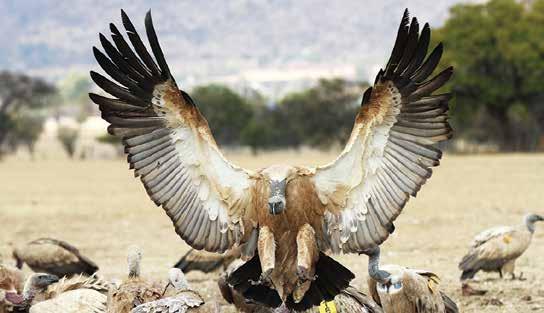
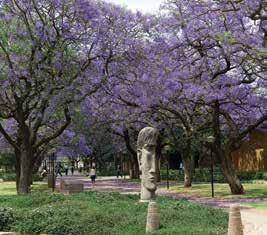
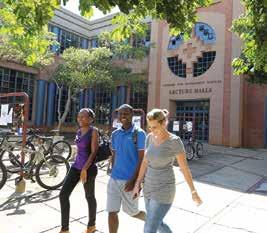
Important information on undergraduate programmes for 2018
� The following persons will be considered for admission: a candidate who is in possession of a certificate that is deemed by the University to be equivalent to the required Grade 12 certificate with university endorsement; a candidate who is a graduate from another tertiary institution or has been granted the status of a graduate of such an institution; and a candidate who is a graduate of another faculty at the University of Pretoria.
� Life Orientation is excluded when calculating the APS.
University of Pretoria website www.up.ac.za/ems National Benchmark Test website www.nbt.ac.za
Suggested second-choice programme for BCom (Financial Sciences) is BCom
Careers: Specialisation in financial management: Management accountants, management consultants, performance managers, quality managers, financial advisors, strategy analysts, cost accountants, financial managers, financial planners and business analysts
Specialisation in taxation: Tax advisors, tax auditors in public practice, tax policy designers, tax practitioners, tax compliance managers, SARS auditors and tax risk managers
Specialisation in internal auditing: Internal auditors, risk officers, forensic auditors, IT auditors, financial auditors, performance auditors, environmental auditors, compliance officers, government auditors and governance auditors
BCom (Econometrics) 3 [3 years] 5 3 C C 6 2 B B 32
Suggested second-choice programmes for BCom (Econometrics) are BCom, BCom (Statistics) and BCom (Economics)
Careers: Econometricians are employed by government, the central bank, private and commercial banks, leading stockbrokers and consultancies, both locally and internationally. Positions include analysts, consultants, researchers, traders or brokers, and academics. The work mostly entails statistical analysis (forecasting, structural and policy analysis) of economic and financial markets and interrelationships.
BCom (Economics) 3 [3 years] 5 3 C C 5 3 C C 32
Suggested second-choice programmes for BCom (Economics) are BCom and BCom (Statistics)
Careers: Economists may specialise in banking, public finance, international trade and investment or economic development. Economists are employed by government, the central bank, private and commercial banks, stock brokerage firms and consultancies, both locally and internationally. Positions include analysts, consultants, researchers, traders and academics.
BCom (Law) 3 [3 years] 5 3
Suggested second-choice programmes for BCom (Law) are BA (Law) and LLB
Careers: First step towards becoming attorneys, legal advisors, advocates, prosecutors, presiding officers (magistrate or judge) and law academics
BCom (Statistics) 3 [3 years]
5 3 C C 5 3 C C 32
Suggested second-choice programme for BCom (Statistics) is BCom
Careers: Data scientists, statistical analysts in several industries, researchers, consultants and lecturers
BCom (Informatics) 3 Focus area: Information Systems
[3 years]
Suggested second-choice programme for BCom (Informatics) is BCom
Careers: Manager in information technology environment, computer software or hardware supporter, computer systems analyst, financial information systems analyst, business analyst, information facilitator, IT training, systems developer, business systems analyst BCom (Agribusiness Management) 3 [3 years]
Suggested second-choice programme for BCom (Agribusiness Management) is BCom
Careers: Agricultural economist and agribusiness managers at commercial banks, agribusinesses and other agricultural and food-orientated institutions, as commodity trader on future markets on derivatives, producer organisations, consultants, valuers, researchers, policy makers. As managers and project managers in the
Careers:
Careers:
BCom (Entrepreneurship) and BCom (Business Management)
Careers: The purpose of this
strategy. BCom (Marketing Management) 3 [3 years]
BCom (Business Management)
Careers:
research management and promotions management BCom (Human Resource Management) 3 [3 years]
Suggested second-choice programmes for BCom (Human Resource Management) are BCom and BCom (Business Management)
Careers: Human resource practitioners, human resource consultants, mediators, labour relations specialists, human resource managers, personnel managers, training officers, liaison officers, psychometrists and industrial psychologists. In their capacity as human resource practitioners, graduates will be responsible for matters such as developing human resource strategies and policies, human resource planning, recruitment and selection of employees, training and development
Careers:
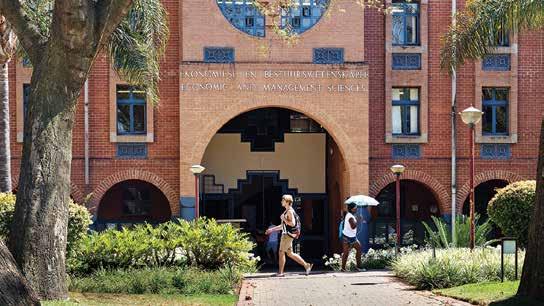

University of Pretoria | Universiteit van Pretoria | Yunibesithi ya Pretoria
Private Bag/Privaatsak/Mokotla wa Poso X20
Hatfield 0028, South Africa/Suid-Afrika/Afrika Borwa
Tel +27 (0)12 420 4111, Fax/Faks/Fekse +27 (0)12 420 4555
www.up.ac.za