Stepping into the future: Virtual reality skills training in the Faculty of Health Sciences
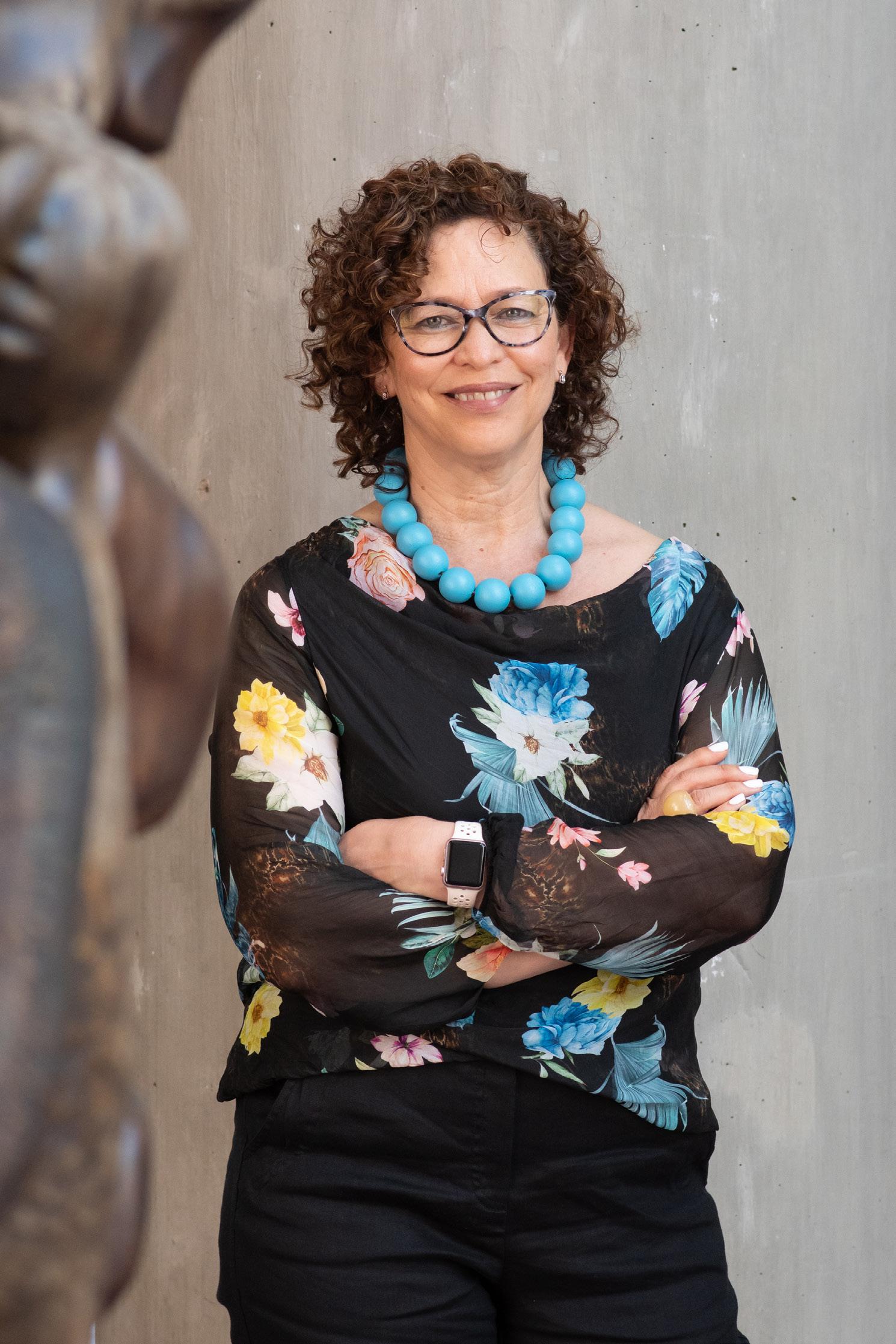
Prof Vanessa Steenkamp
Methods of automatic question generation benefit both lecturers and students
Warren du Plessis
Revolutionising teaching and learning with clickUP Ultra
“Future morality”? Theology students
THEME 2
THEME
THEME 5
INTRODUCTION
I am proud to introduce the inaugural edition of Teaching Matters , a biannual publication showcasing the University of Pretoria (UP)'s efforts in teaching and learning. This publication highlights th e innovative work being done by our staff in this field.
The title 'Teaching Matters' emphasises that teaching and learning truly ‘matter’ at the University of Pretoria. This is evident in the dedication and commitment of our academic and professional staff, as demonstrated by the innovative teaching reflected in the contributions to this edition and, ultimately, in the academic success of our students. Additionally, the title indicates that this publication serves as a platform for dialogue about teaching and learning, providing an opportunity to share knowledge and best practices among our staff. It aims to showcase the teaching and learning initiatives at UP, and to encourage collaboration and the exchange of ideas on teaching ‘matters’, thereby enhancing the quality of teaching and learning at our institution.
This first edition features contributions from both academics and education consultants across various faculties, as well as from our Pre-university Academy (PUA). The topics covered are diverse, including innovative teaching practices, entrepreneurship in teaching, curricular community engagement, transdisciplinarity and curriculum transformation.
I believe that Teaching Matters will play a crucial role in promoting innovative teaching practices and supporting professional development at UP. By highlighting best practices, success stories, and pedagogical insights, this publication will inspire academic staff to continually refine their teaching methods and respond to the evolving needs of students.
Thank you to everyone who contributed to this first edition. We look forward to showcasing more of our outstanding teaching and learning activities in future editions.
Prof Loretta Feris Vice-Principal: Academic
Stepping into the future: Virtual reality skills training in the Faculty of Health Sciences
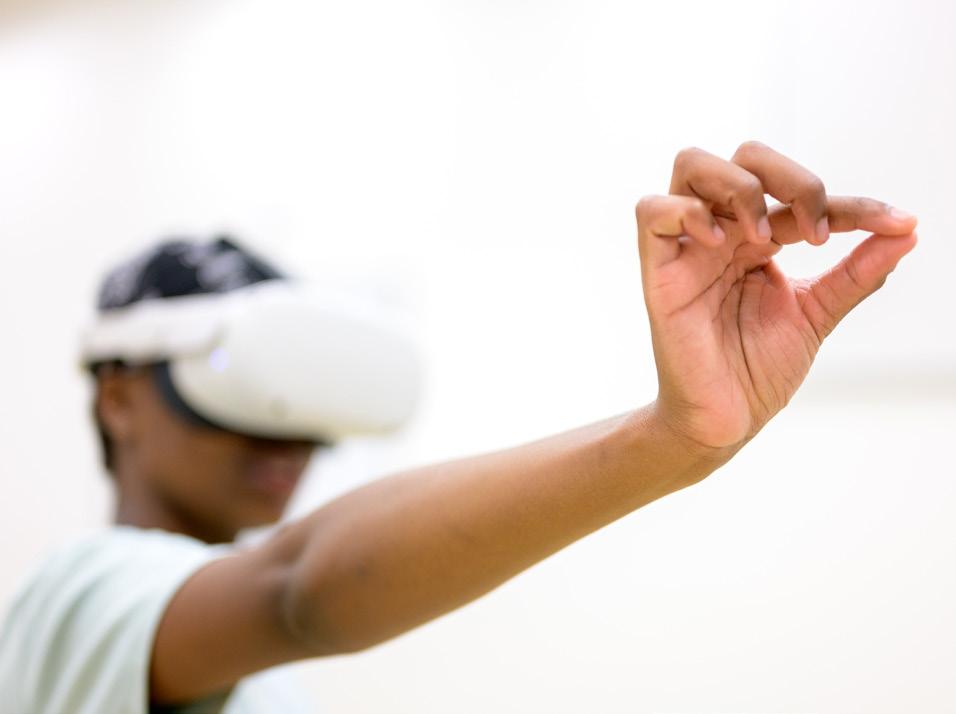
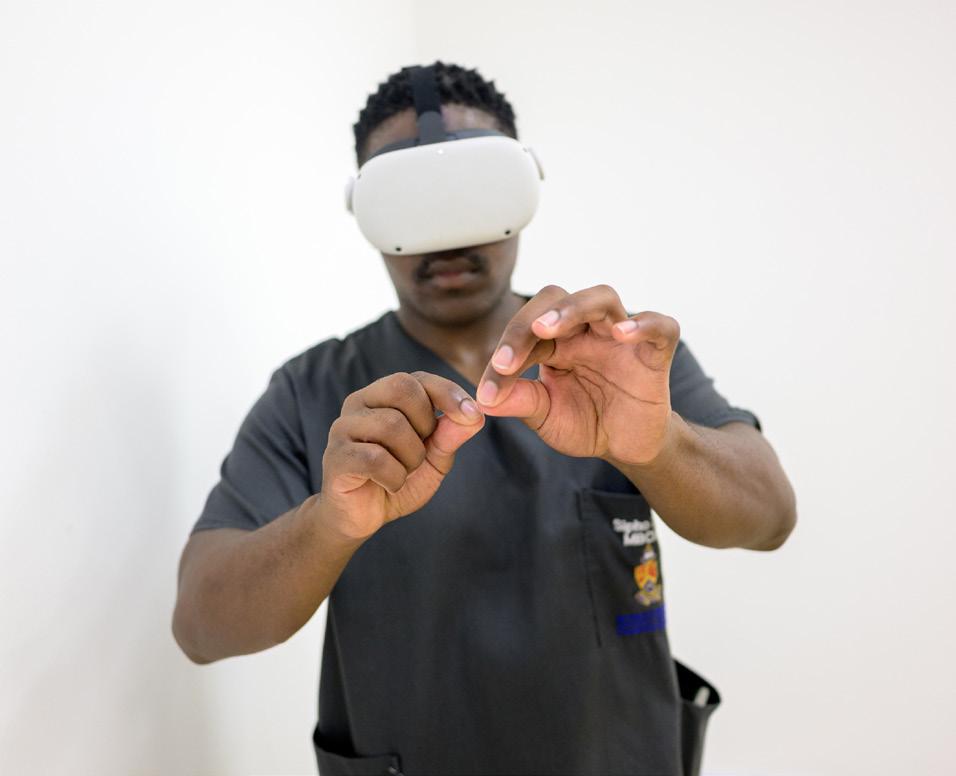
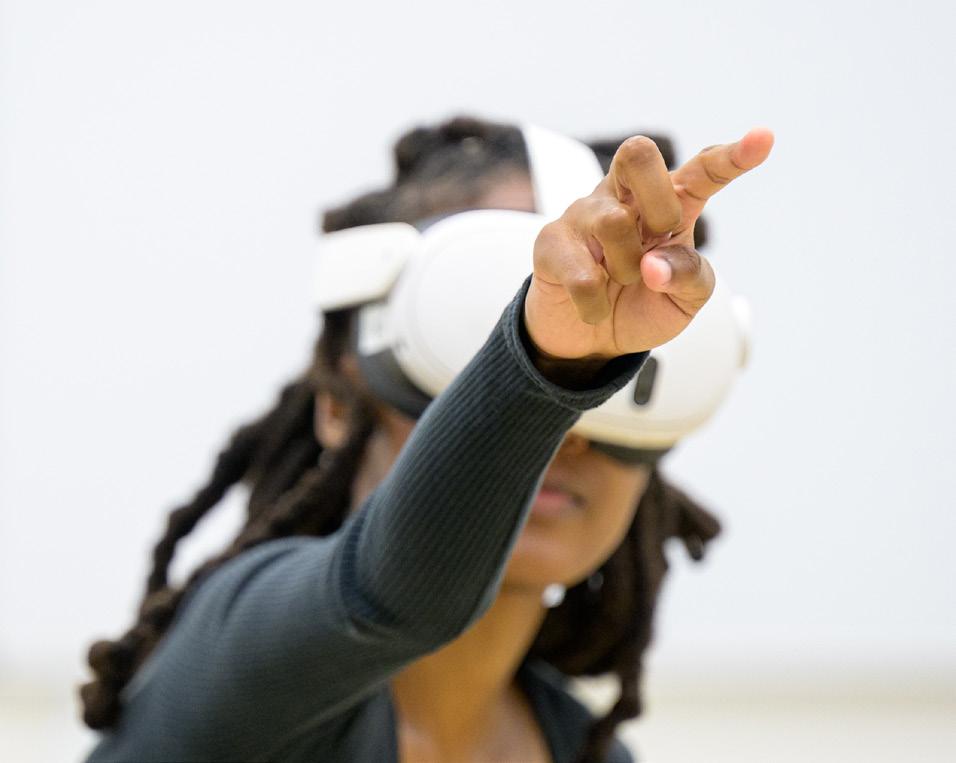
The new high-technology reality, in the form of extended reality (XR), is transforming how procedural skills are taught and learnt within the Faculty of Health Sciences. It is bridging the gap between learning and innovation by providing the virtual technology for students to reach their full potential.
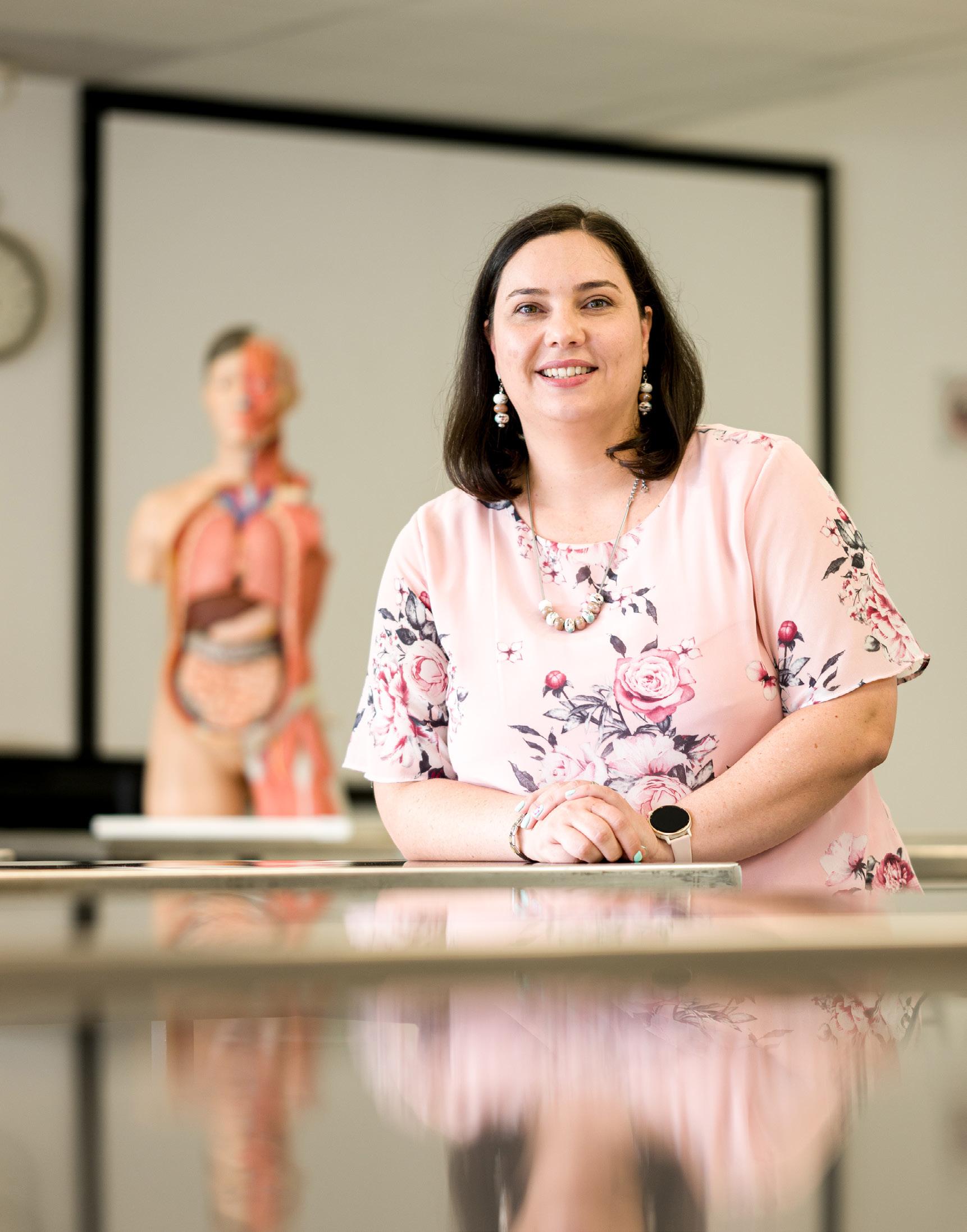
Prof Vanessa Steenkamp, the Faculty’s Deputy Dean: Teaching and Learning, explains that, in recent years, the Faculty has been making use of immersive technology (virtual reality (VR), augmented reality (AR) and mixed reality (MR)) to provide students with hands-on learning experiences that are both innovative and immersive. She confirms that this is part of the Faculty’s overarching teaching and learning vision for the education of future health care professionals.
PROF VANESSA STEENKAMP
FACULTY OF HEALTH SCIENCES
CUTTING-EDGE DIGITAL TEACHING AND LEARNING INFRASTRUCTURE
“We are focused on promoting and facilitating simulation-based teaching for all our students in a dynamic and controlled teaching space, using cutting-edge technology, with the ultimate goals of developing interviewing skills, physical examination techniques, diagnostic reasoning, professionalism and the collegiate relationships needed for the safe and effective practice of health care in South Africa, as well as clinical and procedural skills,” she says.
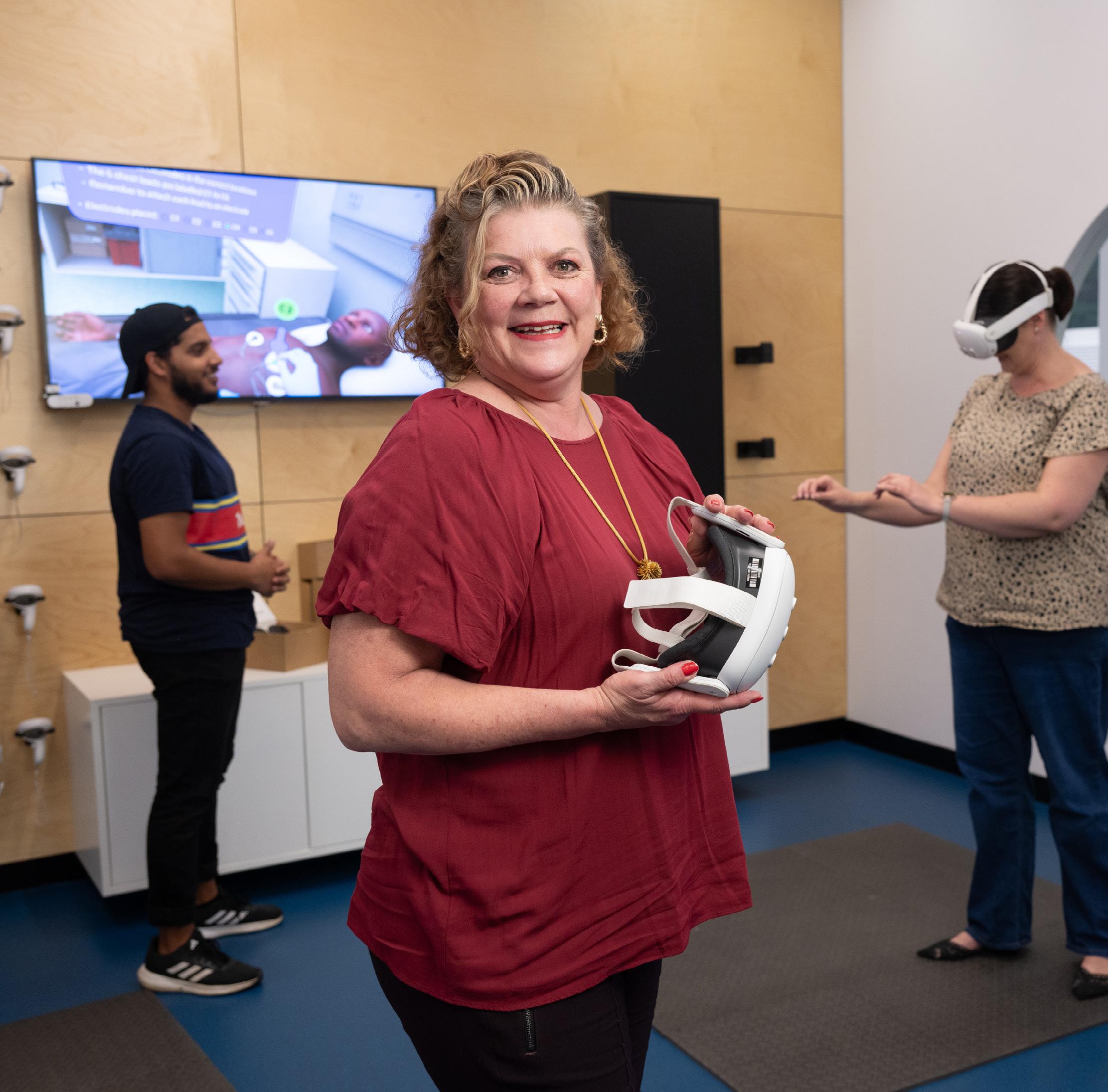
The Faculty’s flagship facility for immersive technology using state-ofthe-art, interactive XR technology is the XR Toybox, located in the library of the Faculty’s HW Snyman North Building. Launched in April 2023, it is equipped with the latest cuttingedge, and commercially available technology, including Pico VR and Meta Quest 2 and 3 headsets. The software used by the students for training was developed and customised specifically to meet the Faculty’s needs by XRi Solutions, a company that specialises in immersive learning experiences. “The VR training experience is available to all students in the Faculty,” says Prof Steenkamp, “further expanding their access to cutting-edge learning tools.”
By providing a dedicated space in the library for this facility, the Faculty has created a hub for XR exposure, which is accessible to all students, where they can experiment with the new technology, and enhance their education. This is where students in the health sciences can experiment with the technology using games or educational content in a safe, controlled, play-learning environment in their own time. The freedom to play and experiment expands to the learning content as well, where students can repeat the available procedures on a virtual patient in their free time until they have mastered it.
Students who have used the VR training tools have noted that the experience is significantly more engaging and interactive than traditional learning methods. The hands-on nature of VR enables them to actively participate in their education. Many have also reported that it has helped boost their confidence, making them more prepared and less anxious when dealing with real-life medical situations.
“This is, however, not just an academic space,” Samir Mangrey, the facility’s administrator, explains. “Students are welcome to come and play with the
technology when they need to take their minds off their studies.” The advantage of using the technology for relaxation purposes is that it enables them to familiarise themselves with it, so that when they need to use it to practice actual procedures, they already know how the technology works, and can get going right away, without the need for prior training.
Dr Marlize Cochrane-Boeyens, the manager of the Faculty’s Health Professions Education Office in the Office of the Deputy Dean: Teaching and Learning, explains that the benefit of this technology is that it provides students with the opportunity to engage in a specific procedural skill. “The size and mobility of the equipment is such that the headsets and screens can be moved to different locations, such as a classroom or other physical space, where they can be used to teach students practical applications within specific modules, such as General Procedural Skills, a core module in the Faculty’s third-year curriculum for the MBChB degree.” It is particularly useful to practice the exact placement of the equipment needed to perform certain skills that require precision, such as the placement of a 12-lead electrocardiogram (ECG).
DIGITAL TEACHING AND LEARNING INFRASTRUCTURE
APPLICATION OF VR IN THE SIMULATION AND INNOVATION CENTRE
The Faculty of Health Sciences Simulation and Innovation Centre also makes use of the equipment of the XR Toybox to provide an authentic experience for students in the academic modules presented in the Faculty. This centre evolved from the Faculty’s Skills Lab, established in 1996 to provide students with practical experience of certain procedural skills. It forms an essential part of students’ learning experience, by providing the opportunity for them to practice on high- and low-fidelity manikins and virtual models before they encounter a patient in a clinical setting.
According to Liesel Smit and Wanda van der Merwe, lecturers in the Simulation and Innovation Centre, the Faculty has been working closely with XRi Solutions to develop a platform to integrate VR into the General Procedural Skills module for medical students. They explain that it has enabled the Centre’s staff to save time when training such a large cohort of students.
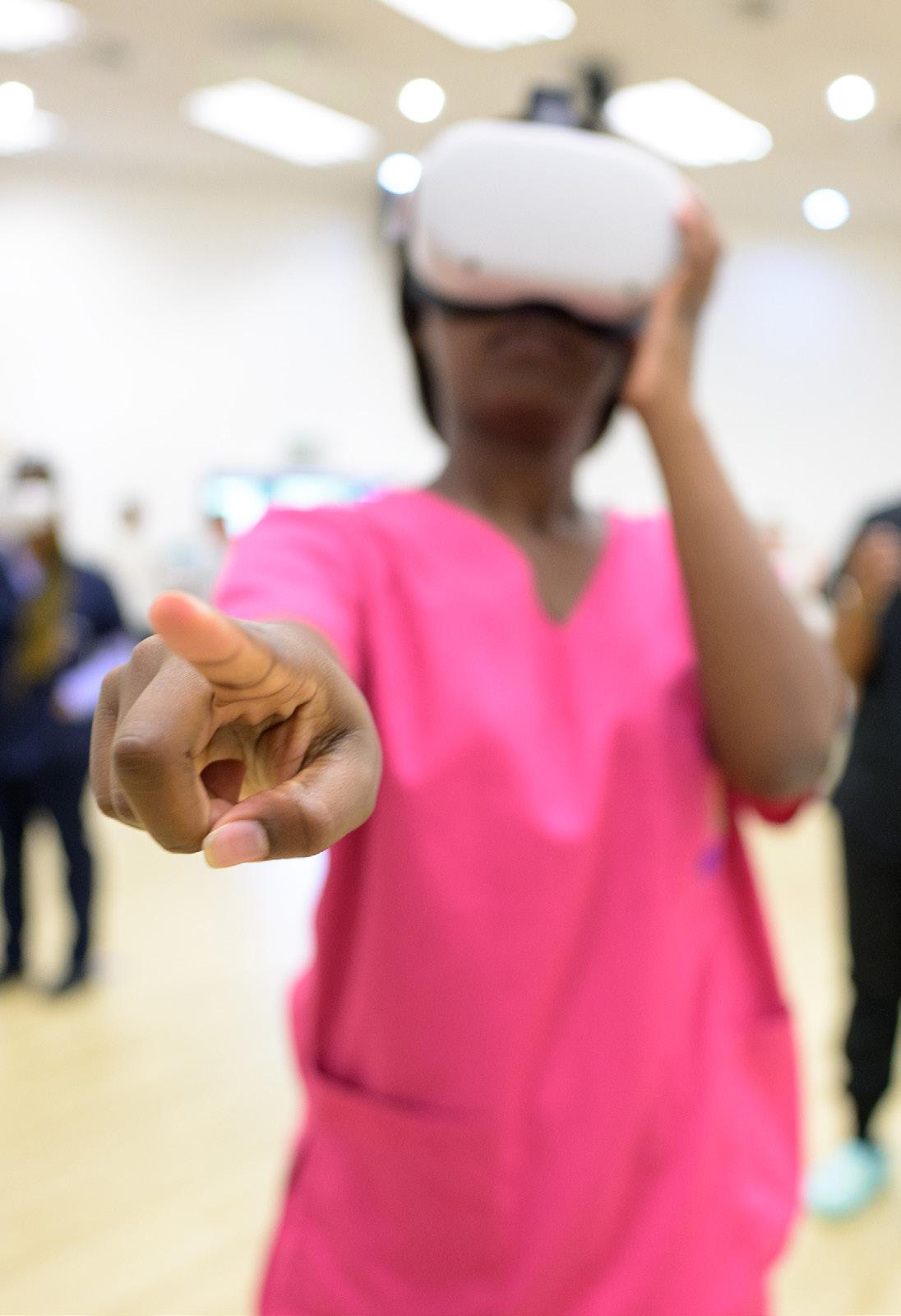
Following the inclusion of skills training on the VR simulator in 2024, the first VR-based, large-scale training session, designed to enhance students’ procedural skills, was held in January 2025. “It allowed the medical students to engage with a simulated environment, providing them with an invaluable opportunity to practice time-consuming complex procedures in a lifelike setting,” says Ms Smit.
After careful consideration of the procedural skills to practice using VR, the team selected obtaining a 12-lead ECG with a VR simulator. This vital procedure is taught to many students early on in their clinical skills journey and is very often one of the first skills they get to do on the clinical training platform.
“For many students, this was their first experience of this procedure,” she explains. “It was set up to simulate an actual ECG procedure and allowed them to familiarise themselves with the process before interacting with real patients.”
Ms Van der Merwe explains that the transformative, innovative shift in procedural skills training opens the opportunity for collaboration and expansion to facilitate the move into the future of skills training.
“It has revitalised the traditional way of teaching procedures that focus on refining their motor skills, such as the ECG, to large groups of students.”
The General Procedural Skills module is presented in a hybrid manner and the skill was portrayed in a VR setting that simulated a hospital room.
Ms Smit explains how the module was developed in collaboration with Koos de Beer, the University’s XR specialist.
“The students were first provided with preliminary training in the form of a video of how the equipment and VR headsets work.” Only a small percentage of the class had had no previous exposure to virtual reality. The procedure was then performed in groups of 20 students at a time using the immersive technology.
Prof Steenkamp concludes that, as technology continues to evolve, the Faculty of Health Sciences will remain at the forefront of innovation, constantly exploring new ways to integrate VR and other immersive technologies into health sciences education. “This is only the beginning of what is sure to be an exciting and transformative shift in how clinical skills training is delivered, as it can be applied in the teaching of any module.”
Immersive technologies such as VR, AR and MR are giving students the opportunity to practice, learn and refine their skills in ways that were previously unimaginable. “The future of health science education is here,” says Prof Steenkamp, “and it is taking place one headset at a time.”
Methods of automatic question generation benefit both lecturers and students
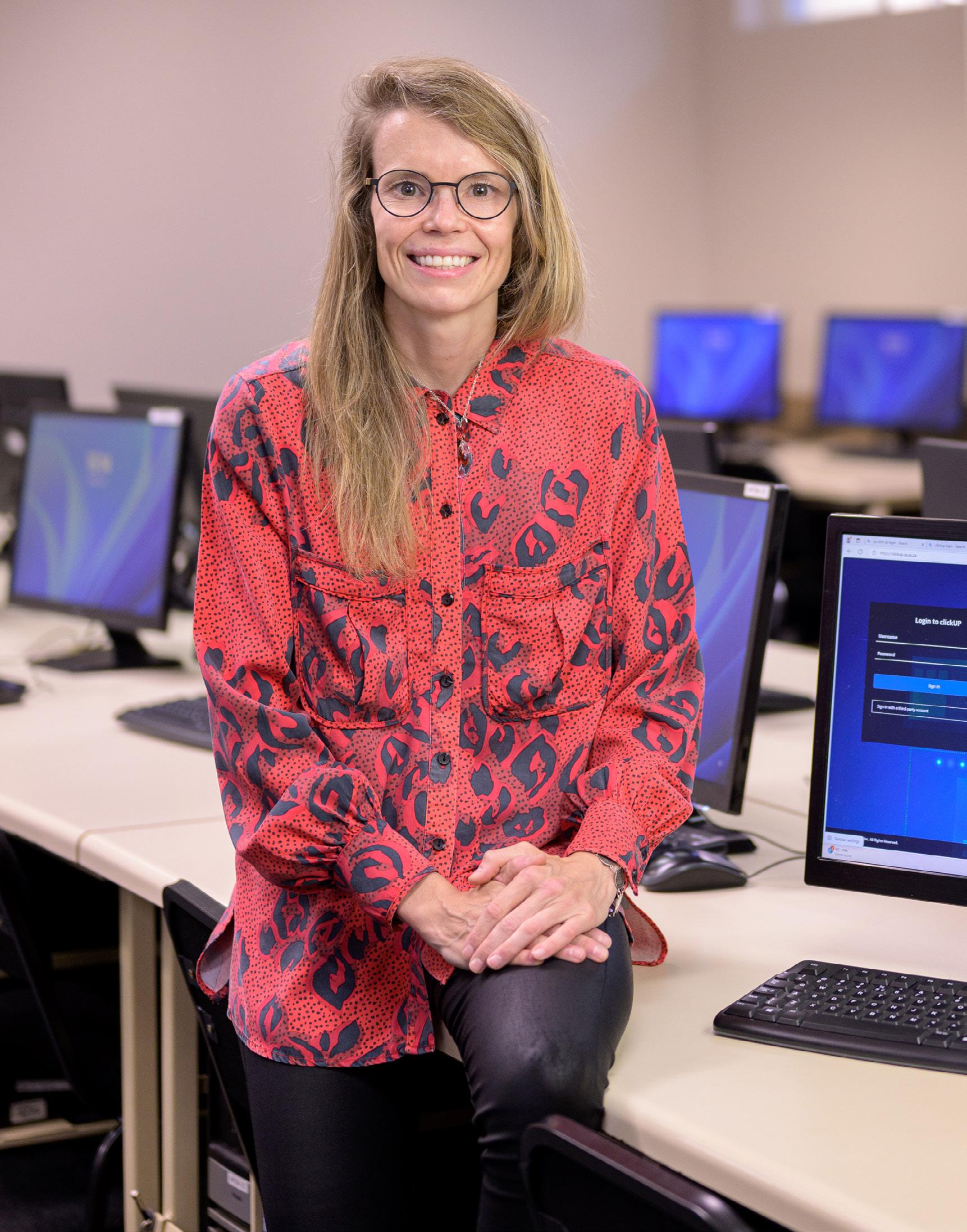
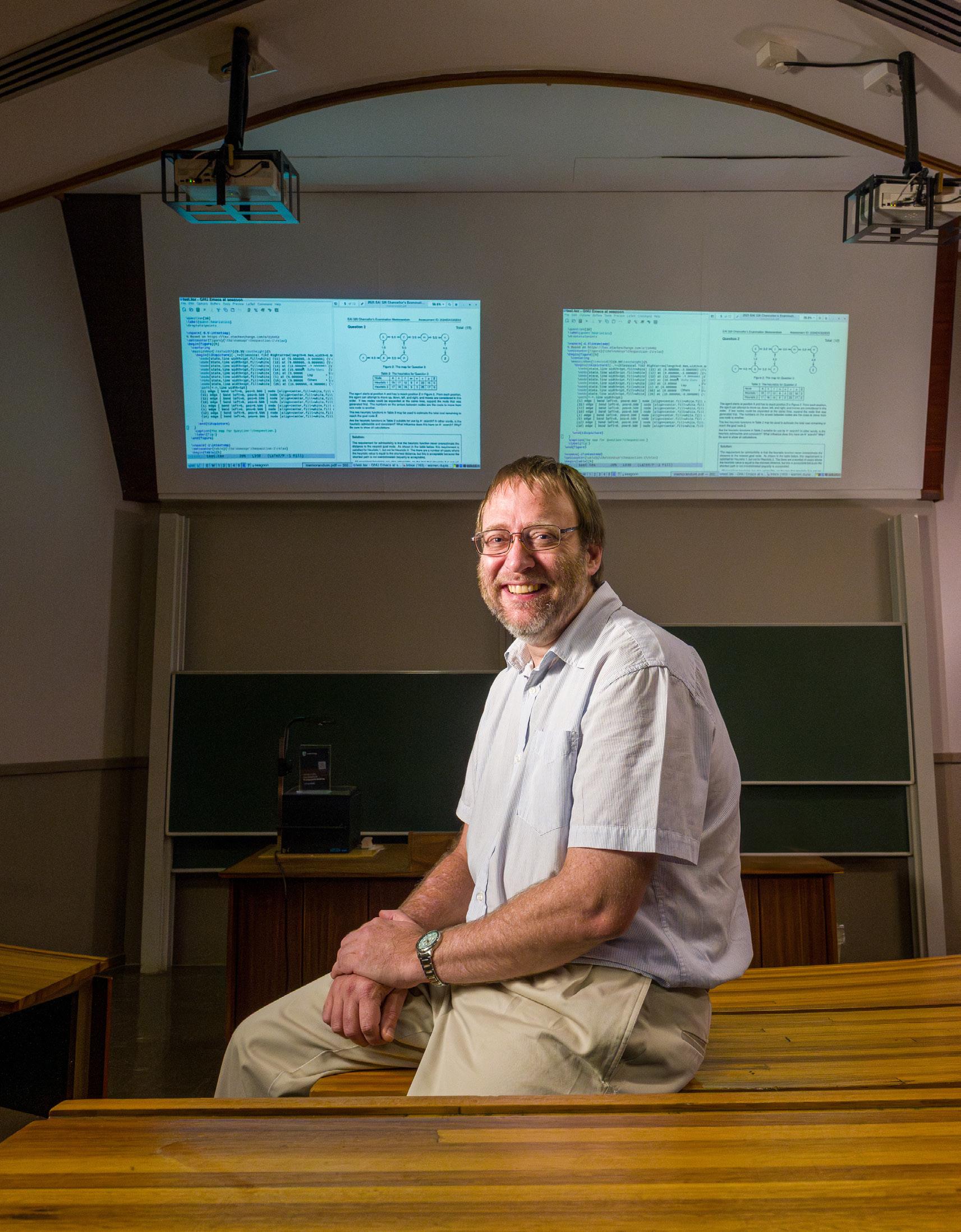
Many lecturers experience the setting of test and examination papers as a notoriously difficult, timeconsuming task. Prof Warren du Plessis, a lecturer in the Department of Electrical, Electronic and Computer Engineering in the Faculty of Engineering, Built Environment and Information Technology, decided to develop an approach to help reduce this challenge.
He explains that this perception is confirmed by the titles of chapters on assessment in the pedagogical literature. “Titles like ‘The challenge of assessment’ and ‘Walking the assessment tightrope’ are not unusual,” he says. He notes that this challenge arises from the conflicting requirements placed on tests, including time limits, the coverage of course material, testing a range of skills, and the time required for marking. “As a result, research has shown that tests set by lecturers tend to place too great an emphasis on recall, rather than developing the higher-level skills required from university graduates.”
Prof du Plessis notes that research has shown that students’ approaches to courses are strongly influenced by the way they are evaluated, making it important to provide previously unseen questions that require the correct application of relevant high-level skills. He explains that this can be extremely challenging for a variety of reasons.
OF ENGINEERING, BUILT ENVIRONMENT AND INFORMATION TECHNOLOGY
FACULTY
PROF WARREN DU PLESSIS
CUTTING-EDGE DIGITAL TEACHING AND LEARNING INFRASTRUCTURE
“Setting test questions and determining their solutions is tremendously time-consuming. In addition, many problems have significant special cases that address important concepts, making it necessary for these special cases to be included in test questions.” However, the very nature of special cases is that their occurrence is rare, implying significant effort to include them in a test or examination.
Furthermore, he indicates that feedback on assessments is tremendously important, to the point that some scholars have called it the "lifeblood of learning". “Providing students with solutions to questions the moment a test finishes can be a valuable aid to learning,” he explains. With this in mind, he believes that generating solutions along with questions simplifies the problem of striking a suitable balance between the considerations noted above because many of these considerations depend on the solution.
As a result of these considerations, he decided to investigate the concept of automatic question generation. “This has been the subject of extensive research, with two recent review papers each citing over 140 publications.”
However, while research on automatic question generation has advanced substantially, the impact of these advances on day-to-day educational activities is unclear.
Prof du Plessis explains that he has been developing and using automatic question generation systems in the third-year engineering courses he teaches since 2017. These courses include the Intelligent Systems first-semester module for Computer Engineering students, and the second-semester Stochastic Communication Systems module for Electronic Engineering students.
He describes an automatic question generation system as one that generates test questions and their solutions, and produces its results in a high-quality format. “Unlike some education innovations, automatic question generation has a number of benefits for both the lecturer and the student.”
LECTURER BENEFITS
“The rapid generation of large numbers of questions and their solutions is one of the biggest benefits of such a system, as it greatly facilitates the lecturer’s
task of striking a suitable balance between considerations like the difficulty of a question and the time required to answer that question.”
The lecturer can therefore focus on generating questions that best address the test’s particular objective, while ensuring that all relevant concepts are covered. A question that will take too long to solve can readily be discarded because a new, more suitable problem can easily be generated. This is in contrast to the manual generation of questions, where discarding a problem that has taken a lot of effort to generate is often impossible. “In this way, the focus moves from generating any test question to producing the most suitable test question.”
Furthermore, the questions and solutions that are generated include all relevant special cases. “This would be almost impossible through manual question generation, as these special cases are rare, and even small changes to a question can radically change the solution.”
He explains that automatic question generation largely removes errors, the consequences of which can be significant. “For example, a minor error can change a test question
from simple to almost impossible.” The generation of high-quality typeset text, mathematics, figures and tables significantly reduces the effort of creating a question paper and its memorandum. By comparison, manually generating even a single comparable figure can take an hour or even longer.
He has also found that he can increase the quality of test questions by making use of this method of question generation as the material can be more completely evaluated. Importantly, the risk associated with implementing this approach is negligible as the lecturer is always involved in setting the questions, and the students would probably not even have noticed any change.
STUDENT BENEFITS
The primary benefit to students is that they actually learn the course material rather than memorising solutions to previous tests. They are encouraged to study the course material in more detail, and are supported in doing so by the availability of previous tests. With this system, there is no need to reuse test questions because new questions are easily generated.
CUTTING-EDGE DIGITAL TEACHING AND LEARNING INFRASTRUCTURE
Students are therefore provided with an ever-expanding library of worked examples that they can use to test their understanding, with the high-quality typeset solutions serving as a study aid.
“While learning all the material requires more effort, it means that the students are able to better master the course material, which has significant longterm benefits.” He has also noted that some of the question types considered have changed from being regarded by students as extremely challenging to being considered relatively simple. The students also know what to expect, which is surprisingly important given the stress associated with tests and examinations.
Feedback from students has included the suggestion that fill-in templates be provided for tests because the students were already writing their answers in the same format as the automated system. He was therefore able to modify the system to generate templates that were unique to each question, and to provide these as part of the test. “This approach allows students to focus on answering test questions rather than redrawing and rewriting information that has been provided.” The use of such templates is also beneficial to the lecturer, as they speed up the marking process by removing the need to determine how answers are formatted.
REFLECTION
Prof du Plessis has found that, overall, students have mastered the course material better, with marks remaining the same or even increasing, despite the test questions actually becoming more challenging. “I believe the fact that material published on automatic question generation systems has few – if any – examples of the adoption of these systems in day-to-day teaching makes this work all the more significant.”
He has already presented his work on automatic question generation at several conferences, including the International Federation of Engineering Education Societies’ World Engineering Education Forum of the Global Engineering Deans Council in 2020, and the South African Society for Engineering Education in 2023. He is often asked if this process of automating questions is a form of artificial intelligence (AI). While he concedes that this may be a reasonable interpretation, he prefers to call it "natural intelligence (NI)" as the lecturer can customise it according to the specific needs of a test or examination.
Revolutionising teaching and learning with clickUP Ultra
The University of Pretoria (UP) is at the forefront of digital transformation in higher education. It embraces cuttingedge technology to enhance teaching and learning. As part of this commitment, the Department for Education Innovation’s E-Education Group is introducing Anthology's innovative new learning management system (LMS), branded as clickUP Ultra, at UP. The transition to the new system reaffirms the Department’s vision of delivering world-class, technology-enhanced education, and empowering students and educators with the tools they need to succeed in a rapidly evolving digital landscape.
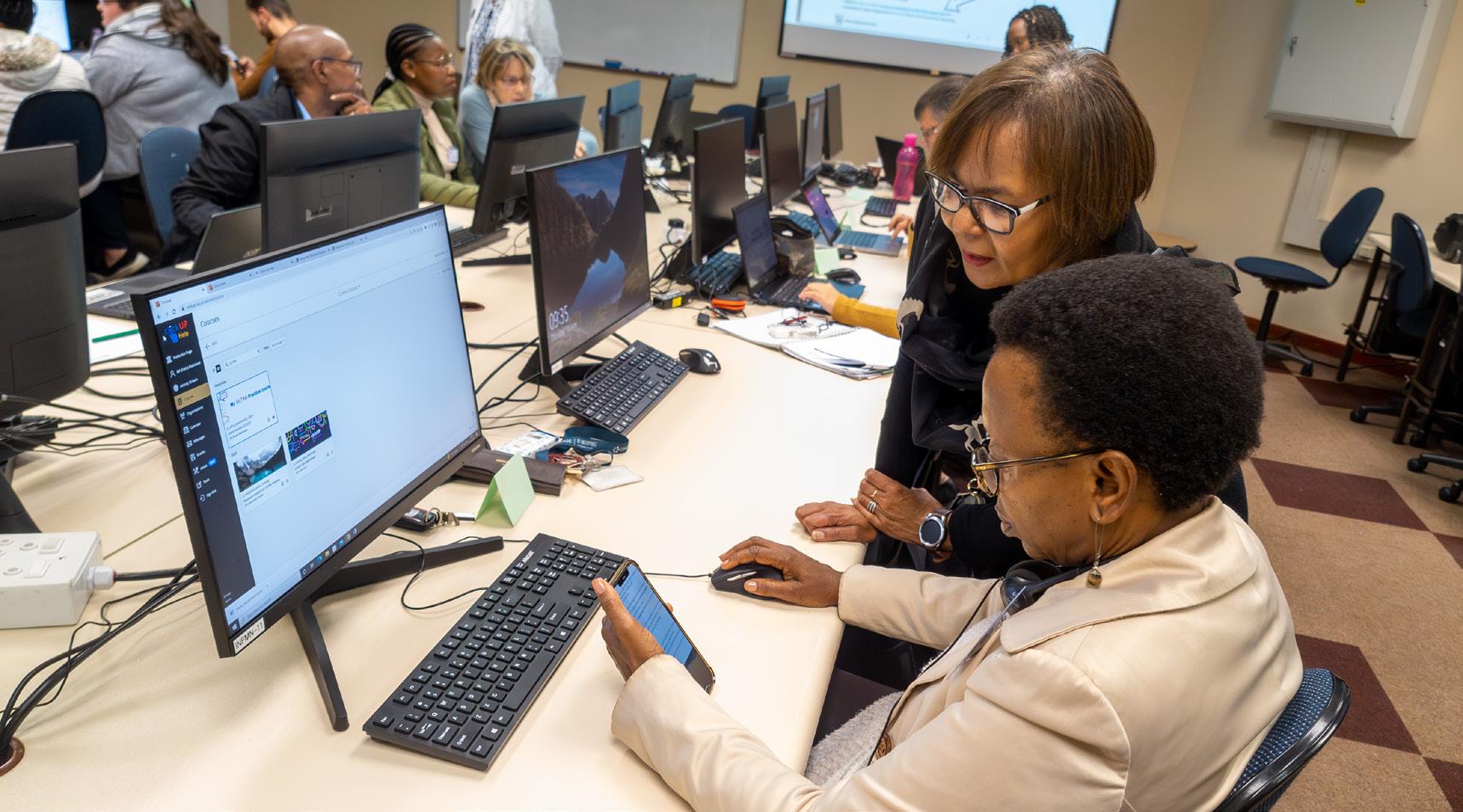
Ms Detken Scheepers, who heads e-learning in the Department, explained that the new system responds to international changes in the LMS environment. It creates a more seamless, engaging and data-driven learning experience. The data is visible to lecturers and students, enabling a more productive learning experience. “It introduces a modern, intuitive interface with simplified navigation, mobile-friendly access and universal design principles, ensuring a more accessible and user-friendly experience.”
Dr Dolf Jordaan, Deputy Director of the Department for Education Innovation, explains that the E-Education Group’s decision to integrate clickUP Ultra into its existing ecosystem relates to institutional teaching, learning and student success strategies. clickUP Ultra is a product of Anthology, a leading global Edtech provider supporting over 150 million users across 80 countries in more than 1 500 higher education institutions. Since 1998, the University of Pretoria has benefitted from its valuable partnership with Anthology.
“We have always kept up to date with the latest developments in the e-learning environment. Particularly following the shift to remote teaching and learning during the COVID-19 pandemic, we evaluated the new clickUP Ultra LMS to determine whether it aligns with the University’s e-learning adoption maturity level and objectives.” The University has successfully used the current version of clickUP for the past 13 years with great success, but has recognised that the system no longer meets the evolving teaching and learning environment.
CUTTING-EDGE DIGITAL TEACHING AND LEARNING INFRASTRUCTURE
However, since clickUP is already integrated into the University’s Student Information System (SIS), and staff and students are accustomed to using it, the upgraded version can be integrated smoothly and without additional cost. It also allows both systems to operate concurrently during the phased transition to clickUP Ultra.
Dr Jordaan explains that the merger of Anthology and Blackboard brought numerous benefits, including developing an integrated LMS, which enhanced the user experience. Through a new staff development portfolio, the E-Education team aims to improve online teaching and learning quality. Another advantage is that it meets international standards and allows for integrating other products such as Anthology Adopt to facilitate change management. “The new system meets the University’s teaching and learning requirements and incorporates change management principles by alleviating the instructor's workload through efficient and newly enhanced workflows, a modern and consistent interface, and improved personalisation. Integrated actionable data insights support the University’s student success strategies and enable lecturers to intervene in good time with at-risk students.”
clickUP Ultra is hosted by Amazon Web Services (AWS) in Europe, ensuring excellent service delivery, as the system experiences no downtime.
A consideration of the E-Education team when deciding to adopt this new system was to develop innovative pedagogical training courses and utilise recognised educational theories and evidence-based practices, assisting lecturers in reimagining their course and learning design. The E-Education Group also played a significant role in customising the new clickUP Ultra platform by contributing to the Anthology idea exchange platform, where they requested changes to the system to benefit staff and students.
Another benefit of the new system is its alignment with the latest developments in artificial intelligence (AI) through Generative AI (GAI) integration. Anthology’s partnership with Microsoft has solidified its position as the global leader in utilising GAI capabilities within clickUP Ultra. The company also aligns with Microsoft’s commitment to responsible AI by design, working closely with its customers to develop the trustworthy AI approach. Included in clickUP Ultra are numerous innovative AI tools that enhance both course design and student engagement through the
AI design Assistant. Blackboard Learn Ultra (clickUP Ultra) is the first major LMS to use GAI for course creation, assessments and rubric development, while the AI Conversation Tool allows lecturers to create dynamic debate scenarios with AI personas, fostering critical thinking and deeper student engagement.
These innovations streamline tasks for lecturers, making it easier to create high-quality, interactive content, while supporting students in developing critical academic skills. Additionally, it encourages the ethically responsible use of AI.
IMPLEMENTATION OF clickUP ULTRA
The implementation of the new LMS followed a multi-phased approach to ensure a smooth transition. The training programme began in July 2023 with an initial pilot group of 14 lecturers. The next phase involved transitioning all first-year courses to clickUP Ultra.
This included training first-year lecturers and other staff members through 79 clickUP Ultra workshops presented from September 2023 to March 2025. Additionally, this resulted in the development of extra online clickUP Ultra courses, effectively bridging the adoption gap for UP. The transition is expected to be completed by 2026 when it will encompass all undergraduate and postgraduate modules.
CUTTING-EDGE DIGITAL TEACHING AND LEARNING INFRASTRUCTURE
Reflecting on the five-day training course, one staff member said: “This training was incredible. It was fantastic to see such a cohesive team of trainers who support each other so effectively. I learnt a great deal about the new clickUP and had the opportunity to reflect on my own practices.”
Ms Scheepers views the successful rollout of clickUP Ultra as a reflection of both UP’s preparedness and the resilience of its academic community.
“Although the unexpected campus closure in January 2024 due to staff strikes posed a major challenge, the University was able to transition all first-year teaching and learning activities to remote delivery in under 12 hours. This remarkable achievement was made possible through thorough preparation and outstanding support from the E-Education team — but above all, it was the adaptability and dedication of our lecturers that ensured teaching continued without interruption.” This ensured uninterrupted learning for students and demonstrated the reliability of clickUP Ultra. This approach also led to higher adoption rates than anticipated, as well as improved student experience and instructor engagement.
Furthermore, the University has introduced self-paced online training courses for teaching assistants and tutors, enhancing their ability to support students effectively. “Courses such as Smart Marking Part 2 and e-Tutoring in clickUP Ultra provided targeted guidance, empowering teaching assistants and tutors to maximise their impact.” Ms Scheepers explains that these self-paced courses, which have been designed for maximum flexibility, allow users to access learning materials anytime, eliminating the need for facilitators and freeing up valuable instructional design resources.
Dr Jordaan, in turn, reflects that the E-Education training team will continue analysing feedback from UP lecturers to identify areas for improvement and explore innovation opportunities. “We are engaging with Anthology’s community and participating in online sessions to enhance our adoption of the system.” Despite the significant effort required to manage regular monthly changes and updates, the team is excited about the new developments and improvements to the system. Regular communication also supports users as the system is upgraded.
The successful implementation of clickUP Ultra has national strategic importance, as other universities could benefit from UP’s implementation of the system. In this regard, the Department also provides support to other universities. Dr Jordaan reveals that the institution has recently conducted successful training sessions at Vaal University of Technology. The feedback from staff at this institution was consistent with the positive responses from UP’s academic staff.
Dr Jordaan and Ms Scheepers are excited about the Department’s future plans to support teaching and learning. One strategy involves integrating micro-credentials for non-credit-bearing purposes to help students certify and showcase their skills and achievements through stackable digital badges and credentials. Another plan involves re-evaluating the synchronous software currently used to provide online lecturing support.
GLOBAL RECOGNITION FOR EXCELLENCE IN DIGITAL LEARNING
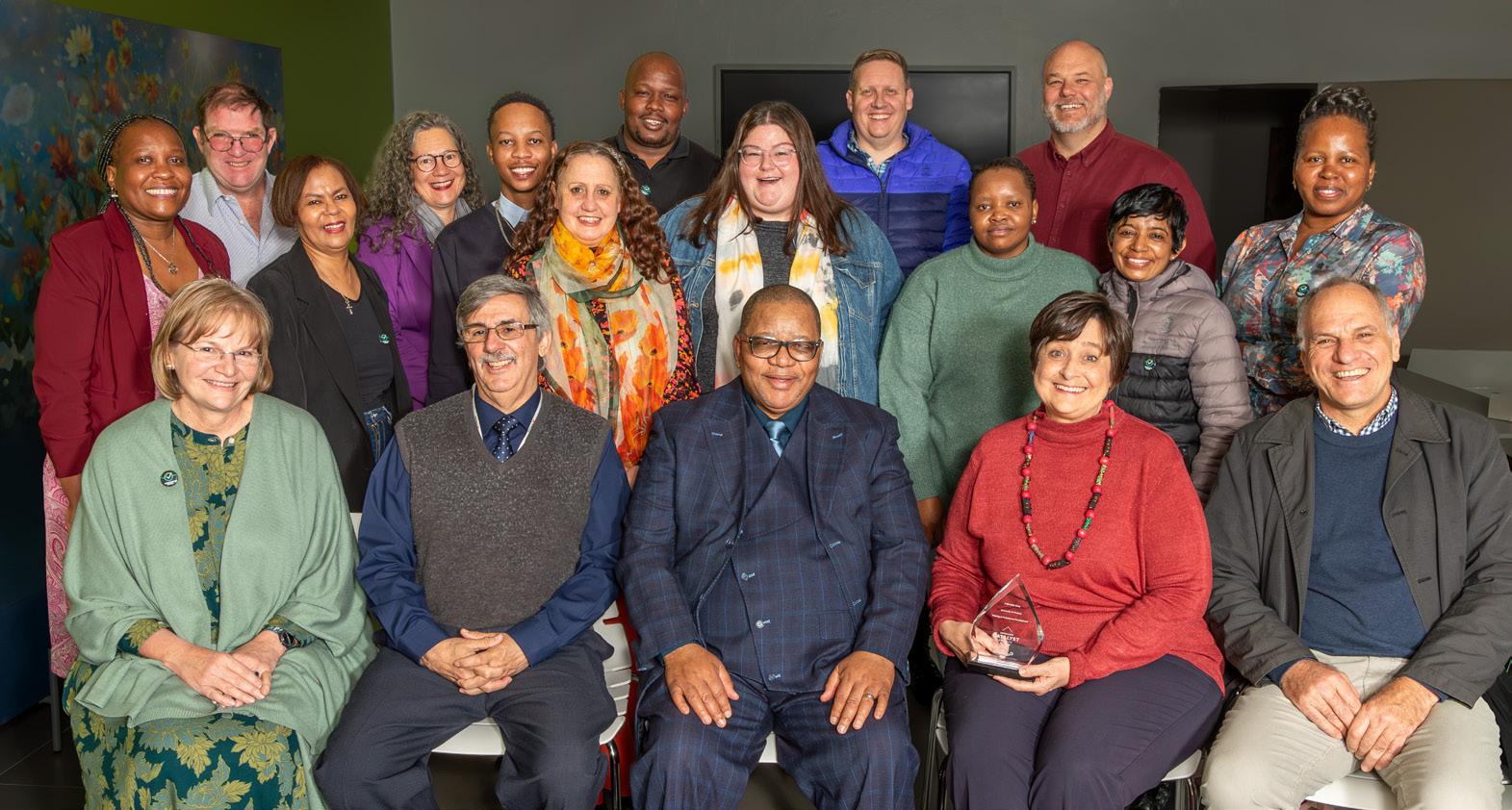
In recognition of its exceptional educational contributions, UP received a major international excellence award for training and professional development in Orlando, Florida, USA, in July 2024. This achievement took the form of the prestigious Anthology Catalyst Award, highlighting 27 years of hybrid learning innovation.
“This accolade underscores UP’s leadership in leveraging technology to enhance education, setting a benchmark for institutions worldwide,” says Dr Jordaan.
The international Catalyst Awards celebrate excellence and innovation, recognising institutions that demonstrate a commitment to innovative training and development programmes for educators and staff. Dr Jordaan notes that this award highlights the E-Education Group’s successful alignment of UP’s goals with the phased implementation of clickUP Ultra.
Prof Gerrit Stols, Director of Education Innovation, reflects that this recognition serves as evidence of the hard work and dedication of the entire E-Education Group. “It reinforces our commitment to excellence and innovation in e-education and professional development. Quality teaching, which includes online facilitation, is vital for student success.” He believes it emphasises the Department’s mission of fostering teaching excellence and supporting the pedagogical development of staff to create innovative educational environments that enhance student learning. This is achieved by conducting workshops across the institution and prioritising courses that advance hybrid teaching, learning and assessment approaches. In particular, this initiative is made possible by the E-Education Group’s focus on change management, professional development and innovative leadership to build capacity for implementing a hybrid approach.
Adding value to the Financial Management curriculum for Actuarial Science students
The Department of Financial Management in the Faculty of Economic and Management Sciences presents the firstyear module in Financial Management as a service module to students enrolled in the BSc programme in Actuarial and Financial Management. It introduces them to the key principles of financial management, which is essential for them to progress to the next level of the programme.
This module is presented by Beverley Wingfield, who seized the opportunity to incorporate hybrid teaching into the module using clickUP Ultra to ensure that the large group of students could work through manageable pieces of the course content on their own before coming to class with specific questions, so that they could spend their time in class working on case studies that applied the knowledge they would by then already have acquired online.
Ms Wingfield had obtained personal experience of a platform similar to clickUP Ultra when she completed a BSc in Computer Science (Data Science) through the University of London in 2024. This programme was offered on a purely online basis using the Coursera learning management system. She therefore considered herself to be well positioned to implement this innovative teaching methodology with her group of 300 students.
BEVERLEY WINGFIELD
CUTTING-EDGE DIGITAL TEACHING AND LEARNING INFRASTRUCTURE
She explains that her personal experience, combined with the skills gained from a five-day course on clickUP Ultra presented by the Department for Education Innovation, allowed her to transform the learning experience for her students. She describes the course as a game-changer in her approach to hybrid teaching.
“It mirrored my positive and structured experience with Coursera, which I had found to be highly organised, interactive and student friendly.” Inspired by the effectiveness of this model she decided to replicate its success in her first-year Financial Management module using clickUP Ultra.
STRUCTURED LEARNING
One of the aspects of her Courserabased degree that stood out for Ms Wingfield was the clarity and organisation of the workload from the outset. “Each semester was structured into 21 or 22 weeks, with each week represented by a dedicated learning folder.”
These folders contained all the necessary learning material (lecture videos, coursework and practical exercises), which enabled students to follow at their own pace.
“This structured design created a sense of order and predictability, which helped me, as a student, to manage my time effectively.” There were weekly formative assessments, such as quizzes and reinforced learning, while summative assessments, in the form of closed-book examinations and project-based tests, were delivered on the official testing platforms. “clickUP Ultra has similar functionalities.”
SETTING UP A HYBRID LEARNING ENVIRONMENT WITH clickUP ULTRA
Encouraged by her positive experience with Coursera, Ms Wingfield adopted a similar approach in her first-year Financial Management module using clickUP Ultra. She explains that the transition from the original static clickUP to the more dynamic and interactive Ultra platform brings about a significant improvement in student engagement and learning flexibility.
“I could structure my module around a main General Information folder, which included essential administrative documents such as my consultation hours (set up using Google Calendar), the study guide and work programme, as well as my contact details and those of the tutor for the module.”
Following the general module, Ms Wingfield created individual learning modules that she could align with each learning area. “These modules are organised sequentially, separated by four main class quizzes to reinforce learning at key milestones.” Each learning module includes slides and coursework, a quiz to reinforce learning, a discussion forum for student interaction and deeper thinking, and additional content such as relevant videos and extra practice material.
She also uploaded a folder that represents the semester test in its appropriate position in the sequence of activities to ensure a clear learning flow. “This helps the students to see how each topic builds towards the final assessment.”
She adds that this approach eliminates the tendency of students to ‘cram’ before an assessment. It therefore promotes steady and meaningful engagement with the material.
In addition to the learning unit quizzes, the module includes traditional assessments such as two semester tests and a final examination. Both evaluation opportunities are closed-book assessments and are written on campus. However, a key innovation was the introduction of continuous assessment through class tests administered online.
“These class tests contribute 10% to the final grade and consist of four quizzes spaced evenly throughout the semester.”
This approach of continuous assessment encourages students to develop regular study habits and provides them with frequent feedback on their understanding of the course material.
CUTTING-EDGE DIGITAL TEACHING AND LEARNING INFRASTRUCTURE
INTEGRATING AI AND INTERACTIVE LEARNING
Ms Wingfield finds one of the most exciting features of clickUP Ultra to be its artificial intelligence (AI) integration to create quizzes and tests. “This platform allows me to generate a pool of potential questions directly from the uploaded slides and coursework. This means that I can create a quick quiz of five to ten questions for each learning area with minimal effort.” However, she admits that, as with any AI-generated content, lecturer discretion remains crucial, and questions and solutions must be carefully reviewed to maintain accuracy and relevance.
The integration of technology allowed Ms Wingfield to focus lecture time on practical application and problem solving, rather than simply reviewing slides. “This shift added value to in-person interactions, as students came to class prepared and ready to engage with complex questions and real-world scenarios.”
She adds that AI-driven discussion prompts also help students engage more deeply with the content. “By generating thoughtful, topic-specific questions, I am able to encourage my students to think critically and apply their theoretical knowledge to a practical case study.”
THE FUTURE OF HYBRID TEACHING
clickUP Ultra represents a shift towards more effective hybrid teaching. It blends the benefits of face-to-face interaction with the flexibility and accessibility of online learning. Ms Wingfield’s experience is that it enables students to engage with the content at their own pace, while the structured approach ensures that they stay on track throughout the semester.
She found that the AI-enhanced assessment tools and dynamic discussion forums improved student engagement and equipped students with the skills and confidence to tackle complex financial management challenges. “As higher education continues to evolve, platforms like clickUP Ultra will play an essential role in enhancing students’ learning experience and prepare them for success in an increasingly digital world,” she says.
“By combining structured, clear workloads with interactive and AIenhanced tools, we can foster deeper student engagement and better academic outcomes, making the learning experience more meaningful and effective for the next generation of students.” This approach highlights the potential of technology-enhanced teaching to create meaningful educational experiences. “By shifting the role of the lecturer from content delivery to value addition, we can better equip students with the skills and knowledge they need to excel in their academic and professional journeys,” she concludes.
THE WAY FORWARD
Upon conclusion of the module, Ms Wingfield will be able to evaluate the data collected through the students’ participation and feedback, which will enable her to improve the course for its continued implementation next year. This will also enable her to share her insights into online course participation with colleagues who are interested in making use of this form of content presentation.
Enhancing engagement in large classes by gamifying learning
Teaching large classes often presents challenges to lecturers. This is also the case in the modules
Dr Evangeline Nortje from the Faculty of Health Sciences presents to third-year students of Human Physiology in the Faculty of Natural and Agricultural Sciences. She decided to investigate the option of integrating a gamified approach to enhance student engagement, collaboration and knowledge retention.
Dr Nortje explains that the challenge associated with teaching Physiology to large classes relates to the limited personalised interaction that takes place, inconsistent attendance and reduced active participation. “These challenges are particularly pronounced in the Applied Pathophysiology and Integrative Physiology module, where students must synthesise knowledge across multiple physiological systems.”
However, she succeeded in mitigating these barriers to learning by extending the learning experience beyond traditional teaching strategies. In the process, she also managed to foster an interactive and collaborative learning environment.
FACULTY OF
She did this by developing a diverse range of activities for the module that integrate gamification elements such as team quizzes and collaborative problem solving, a point-based leaderboard, the creation of infographics and participation in team challenges.
The team quizzes and collaborative problem-solving activities encouraged discussion and strengthened conceptual understanding. The point-based leaderboard was then used to track group performance. Points were awarded for engagement, attendance and the successful completion of activities. “This created a competitive, yet supportive learning environment.” Groups that consistently engaged in activities earned a higher number of points, reinforcing motivation and accountability. The teams also worked together to visually represent key physiological concepts in the form of an infographic or other group challenge, which promoted knowledge co-creation and deeper understanding. She emphasised the fact that a team is only as strong as its weakest link.
PURPOSE AND STRUCTURE
At the start of the semester, Dr Nortje introduced the students to key employability skills, which are aligned with the University’s graduate attributes. In this way, she could emphasise the relevance of the module’s content and structure to their future careers. The approach of gamifying learning that she took was designed to maximise active participation. Her rationale for using team-based learning with gamified elements was aimed at making learning more interactive and engaging for the students.
She explains that the class was divided into self-selected groups of five to seven students each. Each team chose a unique and creative name that they kept for the entire semester. “The gamified approach was seamlessly embedded within a prepare-engage-consolidate structure, which formed the foundation of the teaching style for the sections of the module I taught.” This structure ensured a systematic approach to engagement.
In the first phase (prepare), the students completed pre-lecture activities that reinforced prior knowledge and prepared them for complex concepts. The groups could earn bonus points if all their members completed the pre-lecture tasks successfully.
In the second phase (engage), the lectures incorporated interactive, application-based activities, including team-based quizzes, co-creation activities and gamified problemsolving exercises that encouraged peer learning and collaboration. Groups that participated actively in the activity, volunteered to present their work or demonstrated engagement in class discussions were also rewarded with bonus points.
In the third phase (consolidate), the focus was on reinforcing and deepening students’ understanding through structured review activities. “I used ChatGPT to generate graphs and case-based scenarios that challenged students to interpret data and apply their knowledge in a meaningful way.” These exercises were aligned with formative assessments, ensuring that students were well prepared for their summative evaluations.
BENEFITS AND STUDENT FEEDBACK
Dr Nortje found that the structured gamified approach significantly improved student engagement and participation. Informal feedback from students highlighted important key benefits. The competitive element encouraged students to stay engaged throughout the semester, thereby increasing motivation. Working in groups fostered collaboration and knowledge-sharing. This promoted stronger teamwork and peer learning.
The interactive, game-based elements reinforced understanding and the application of physiological concepts. This improved content retention. The leaderboard and reward system encouraged students to actively contribute to discussions and group activities. This led to enhanced participation in the lectures.
“The semester culminated in a small awards ceremony,” says Dr Nortje, “where the top-performing group members received prizes in recognition of their teamwork and dedication.”
INNOVATIVE LEARNING ENVIRONMENT
This reinforced camaraderie and celebrated academic achievement. She remarks that it is important to note that, while some activities contributed to formal assessments, most were incorporated as motivational tools rather than gradedependent incentives, encouraging participation without any added pressure.
She says that, by embedding gamification into the ‘Teach and Learn the UP Way’ framework, this initiative transformed a traditionally lecture-based module into an engaging, student-centred experience. “The structured combination of team-based learning, interactive challenges and motivational incentives fostered active participation and a deeper understanding of complex physiological concepts, demonstrating how gamified teaching strategies can enhance student engagement and create a more dynamic learning environment in large-class settings,” she concludes.
Gail Barry, one of the University’s educational consultants in the Department for Education Innovation, observed one of the sessions, and had the following to say:
Dr Nortje began the session by sharing results from a previous exercise and displaying a leaderboard that generated considerable excitement among the students. This gamified feedback resonated well with the class, and fostered a positive and competitive spirit. The students were highly engaged. She then transitioned to instructions for the main activity − creating an infographic. Importantly, the session objectives were shared with the students, which is excellent practice as it sets clear expectations. Dr Nortje emphasised the importance of active learning by explaining that ‘doing’ leads to more effective learning than passive listening, which reinforced the value of the activity.
Furthermore, she mentioned that detailed rubrics and briefs were available on clickUP, providing the students with a comprehensive understanding of what was expected. Her encouragement for students to present and engage with the material, with the added incentive of bonus marks, seemed to be well received and heightened their enthusiasm. The idea of each pathology having a single winning infographic uploaded also contributed to the competitive, engaging environment.
I found her session to be engaging and dynamic, creating a positive learning environment where students were clearly motivated and actively involved. Her use of active learning strategies and the way she explained their value to the students were particularly commendable, and it was evident that these approaches resonated well with the class.
The use of a hand-analogy system to teach the physiology of the nervous system
The study of the nervous system, neurophysiology and neurology poses challenges for many students, often hindering their ability to understand and apply key concepts. This was the experience of Prof Priyesh Bipath, a lecturer in the Faculty of Health Sciences’ Department of Physiology. He subsequently developed a unique system to teach these concepts to first- and second-year students enrolled for a compulsory module in Physiology in the BSc programmes in Medical Sciences and Human Physiology, as well as students enrolled in the Bachelor’s programme in Biokinetics and Sports Science.
Despite the broad scope of topics related to physiology, the fundamental modules he teaches (Introductory and Nervous System, Introductory and Neurophysiology, and Neuroanatomy) focus only on the nervous system.
“The difficulty students experience is particularly evident when they face assessments related to their understanding of the nervous system, which encompasses the brain, spinal cord and peripheral nerves. They also struggle to understand the mechanisms through which neurons transmit nerve impulses.”
FACULTY OF HEALTH
He explains that these modules emphasise the critical role that central and peripheral nervous systems play in coordinating and integrating various physiological systems within the body, thus establishing their relevance for subsequent Physiology modules. “The challenge, however, lies in the fact that certain topics, such as the functional role of neurons as the building blocks of the nervous system, can appear overly intricate and overwhelming, which leads to diminished student motivation and engagement.” He therefore had to develop engaging and interactive teaching strategies to effectively communicate complex concepts to a large cohort of students.
Prof Bipath recognised the fact that effective communication is paramount in teaching and learning. He notes that verbal instruction is sometimes complemented by non-verbal communication techniques such as hand gestures. “I therefore considered the possibility of leveraging these gestures to enhance understanding.”
He uses sign language as an example to highlight the power of hand gestures to convey meaning. “In response to the challenge of presenting the intricate physiology of neurons, the brain and the spinal cord in a manner that is both engaging and accessible, I devised a novel pedagogical strategy: the hand analogy system.”
Prof Bipath explains: “This system provides an interactive means for both me and my students to engage with the material during lectures.” By using the hands as a metaphorical tool to represent components of the nervous system, students can connect abstract concepts to a physical and familiar object. For example, the fingertips represent the dendrites (receptors), the palm indicates the cell body, and the wrist indicates the axon hillock. The elbow represents the presynaptic terminal, while outstretched hands interacting with each other represent the synapses. Furthermore, the brain and spinal cord can be portrayed by closing the palm to symbolise the folds and grooves of the brain, while an extended arm can symbolise the spinal cord.
He found this system to be effective in reinforcing students’ understanding of the material by providing them with a simple, yet powerful reference point during lectures, and consistently incorporated this analogy into class discussions. “When addressing specific components during class, students were able to reference their hands, which facilitated the retention of knowledge and comprehension of concepts from their perspective.” They could also use their hands as reference points to ask questions, which enhanced their understanding of the concepts.
Prof Bipath has spent three years perfecting this method. Its development was trial-based, and was improved on each year based on feedback received from his students. Initially conceived as a way to engage with a large audience, such as the big BSc first- and second-year classes with up to 400 students each, it is equally effective with a smaller group, such as the Biokinetics class, which has between 60 and 80 students. “What made this method particularly effective with the Biokinetics and Sports Science students is that their field of specialisation is movement sciences, so the hand analogy enabled them to understand the physiology of the nervous system using something tangible that is in their frame of reference.”
With this method, students always have a point of reference to visualise the components of the nervous system in a tangible way. It also enables them to be actively engaged in class. In the process, they feel more involved in the learning process. “Its success was reflected in the improvement I observed in their marks, so I will certainly be continuing with its use.” The students’ feedback indicated that most found this teaching method to be helpful for a better understanding of the lecture content. The study units could therefore be effectively scaffolded, and the content was easily transferrable.
Enhancing student engagement and the co-creation of physiology content related to the digestive system
Effectively teaching the physiology of the digestive system to second-year dentistry students requires innovative approaches to enhance student engagement and facilitate a deeper understanding of complex physiological processes. This was the conclusion arrived at by Prof Janette Bester, a lecturer in the Faculty of Health Sciences’ Department of Physiology.
The module she teaches is a foundation module in the Faculty’s Dentistry programme, and is these students’ only exposure to this element of physiology, explains Prof Bester. “The learning outcomes for the study unit on the digestive system necessitate a comprehensive understanding of digestion and absorption throughout the digestive system.” However, she explains that students often struggle to integrate the three phases of digestion (the cephalic phase, the gastric phase and the intestinal phase), as each phase is traditionally taught as a separate section.
This challenge prompted her to implement an interactive, team-based activity designed to encourage student participation and content cocreation.
FACULTY OF HEALTH
INNOVATIVE TEACHING STRATEGY
To achieve this, she introduced a collaborative, interactive team challenge that was aimed at reinforcing the integration of the phases of the digestion process into a single, cohesive concept. “This activity required the students to actively engage in content creation, thereby improving their conceptual understanding and teamwork skills,” she explains.
In preparation for the team challenge, Prof Bester provided the students with a concise summary of the phase discussed in class after each lecture to reinforce their learning. “These summaries served as foundational references, helping students synthesise information in preparation for the team challenge.”
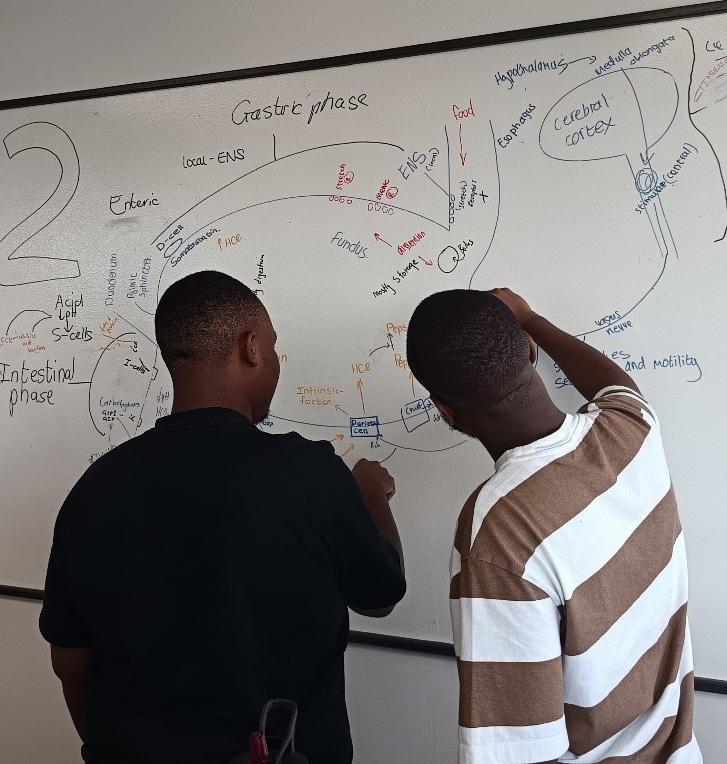
At the start of the last lecture on the digestive system (a series of 10 lectures that ran over approximately two weeks), the class of 38 students was divided into two teams. Each team selected a leader, who was responsible for managing their team’s roles, facilitating discussions
and ensuring progress. The objective of the challenge was for each team to create a comprehensive mind map, integrating all three phases of digestion into a single conceptual framework.
The students were not allowed to use notes or external resources, and had to rely solely on their collective knowledge and discussions. The team members collaborated to contribute key information to the mind map, reinforcing peer learning and knowledge integration. Each team was given 25 minutes to complete their mind map. At the end of the activity, each group’s team leader assessed the opposing team’s mind map under the guidance of Prof Bester. Team leaders could seek input from their team members during the evaluation. Missing or incorrect information was identified and annotated on the mind maps, ensuring constructive feedback and further reinforcing learning.
Prof Bester believes that this approach proved to be highly effective in engaging students and fostering a deeper understanding of the digestive process. “By actively participating in content creation
and peer assessment, the students developed a more integrated and holistic understanding of digestion.” In addition, the exercise strengthened their critical thinking, collaboration and communication skills, which are essential in their professional development as future dentists.
“Moving forward, this interactive approach can be adapted to other complex physiological topics, further enhancing student learning and engagement in an active, studentcentred classroom environment,” she remarks.
Reflecting on the stages followed to complete this activity, she comments that the students were able to use their acquired knowledge to compile a mind map and combine the three phases of digestion. This enabled them to engage with the content in an active way through a process of co-creation to illustrate how the different phases of the digestive process are integrated. They were also able to learn from each other by working in a team. “When they were given the opportunity to evaluate their mind maps, they engaged in peer evaluation.
An advantage of this step was that they could identify any incorrect or missing information, see where they could make improvements, and learn from their mistakes.”
Consolidating the phases of the digestive process was presented as a fun activity, which required the students to apply their insight into the content. This assisted them to understand a complex physiological process. They could now view the entire process as a single concept, something they had previously struggled to grasp. The success of this innovative teaching strategy has prompted Prof Bester to continue with its use, and to perhaps improve on it in the future.
Empowering voices: Advocacy and creative expression in occupational therapy education
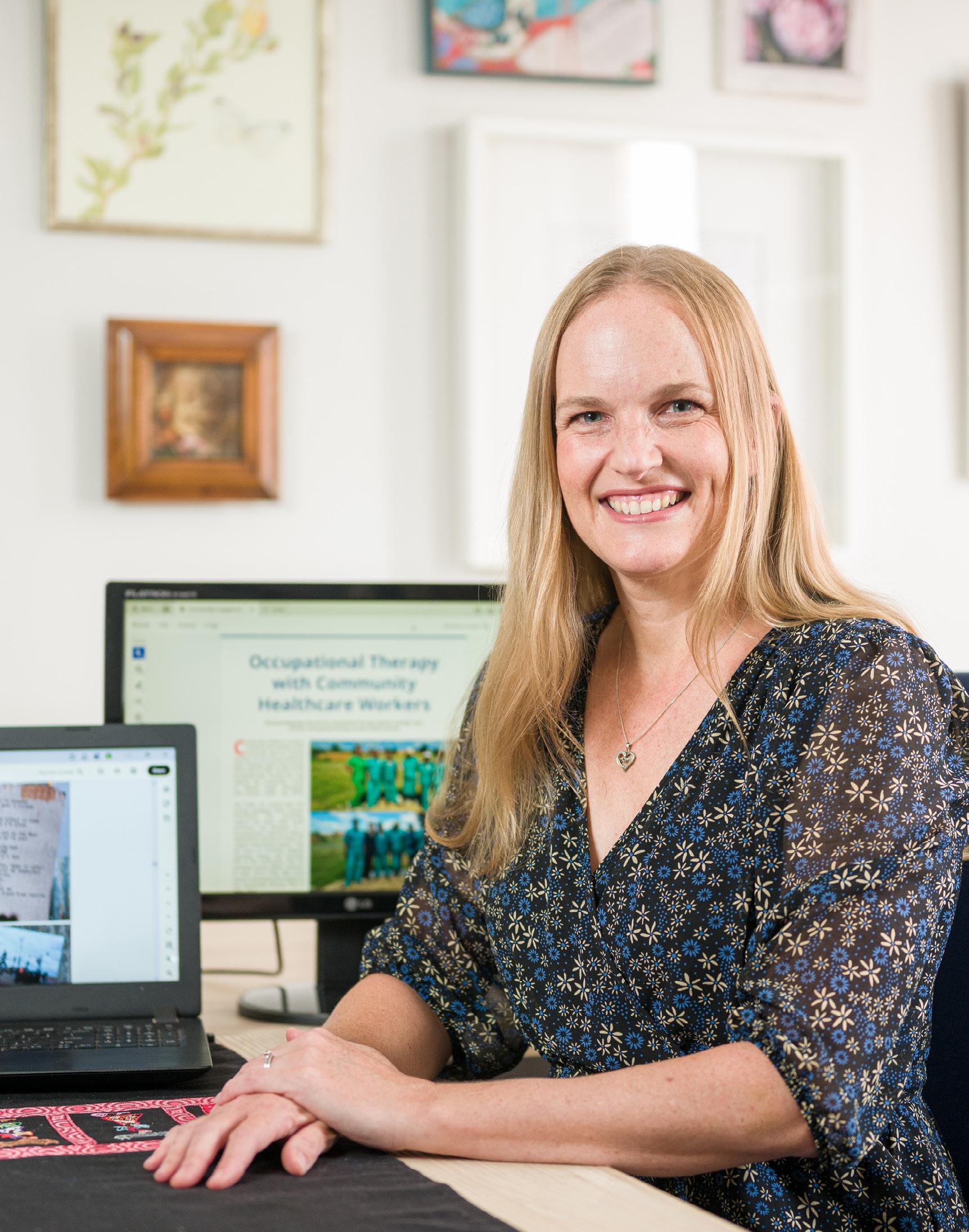
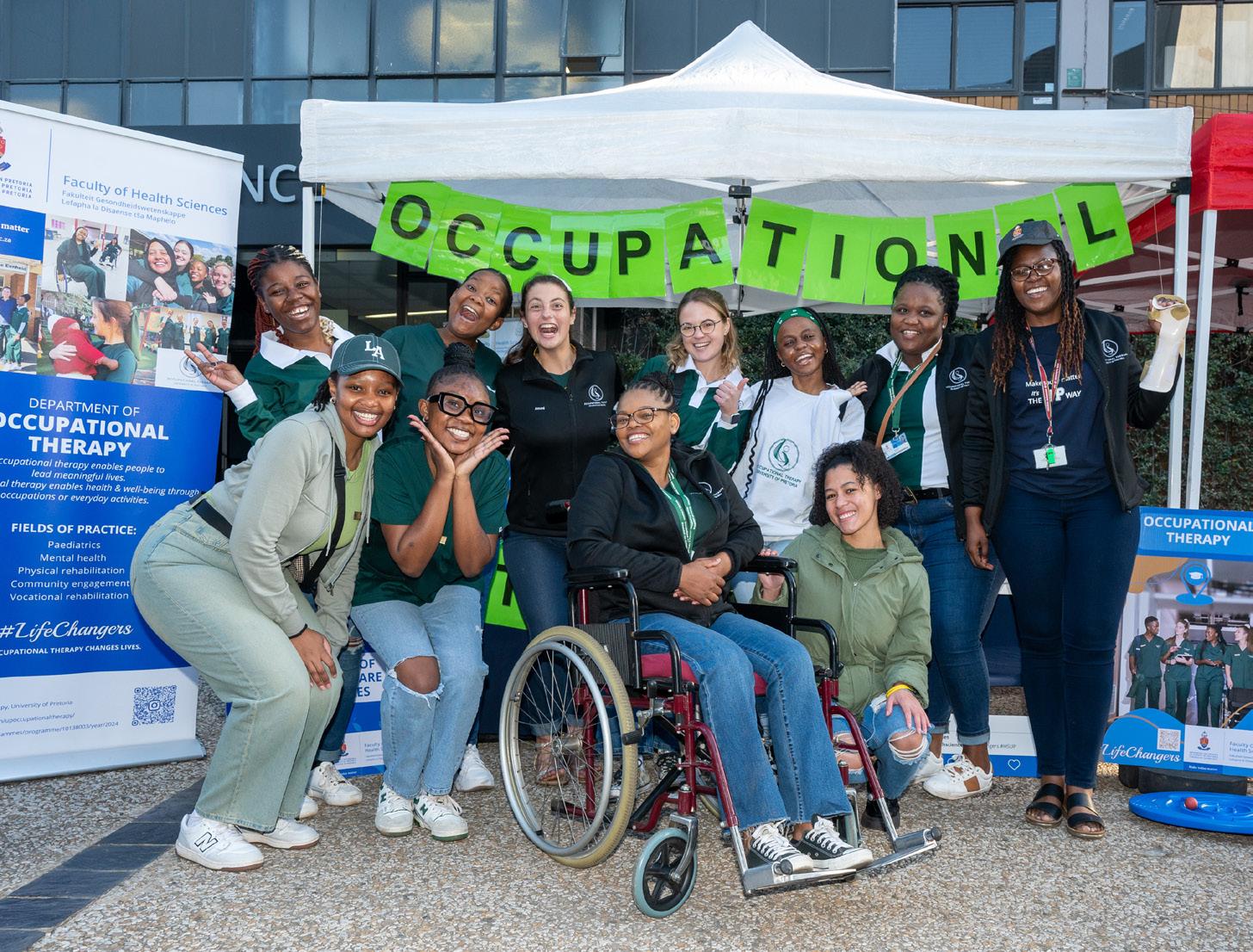
An activity initiated by Dr Helga Lister, a lecturer in the Faculty of Health Sciences’ Department of Occupational Therapy, in the School of Health Care Sciences, is providing students with hands-on experience in practical advocacy related to community engagement. This initiative served to integrate creative writing in health education by requiring fourth-year Occupational Therapy students to write an article or poem for publication in a newsletter or other platform as part of their communitysituated, work-integrated-learning module.
Dr Lister explains that this initiative allows students to reflect on their experiences or share significant events or observations related to their fieldwork. “The topics chosen by students usually focus on areas of concern or notable accomplishments they have witnessed or actively participated in while working in the community.” She says that these pieces serve as a platform for students to share their insights, raise awareness and foster discussions on pertinent issues affecting the communities they serve. This initiative, she says, aims to develop students’ ability to critically analyse their clients within the context they are living in, and to communicate effectively in a written format.
FACULTY OF HEALTH SCIENCES
DR HELGA LISTER
“One of its unique features is the integration of artistic expression, such as poetry, alongside traditional article writing.” Other articles may require the students to include a review of literature to substantiate their statements.
Students therefore have the opportunity to use their strengths to contribute meaningfully to the professional community by highlighting real-world issues in a form they feel best addresses the issue. “This is a supplementary learning activity,” explains Dr Lister, “and does not replace the research articles that are written more formally using evidence-based practice.”
Although Dr Lister started experimenting with the activity on an ad-hoc basis in 2019, it has only formed part of the students’ formal evaluation since 2021. Over this time, more than 70 of the students’ creative outputs have been published, with several more scheduled for publication in the future. This includes articles in various newsletters and online platforms. “The hope is that it will bridge the gap between lived experiences and policy development.”
Two newsletters that have featured the students’ articles are the University of Pretoria’s community engagement newsletter, Lentšu la Sechaba, and the JuniorTukkie publication for prospective students. These articles provided an awareness of occupational therapy in the University’s Faculty of Health Sciences among a wider audience. “The articles intended for publication are written with the platform’s specific target audience in mind, and are also linked (where possible) to the Department’s website.”
Before Dr Lister started submitting the students’ articles for publication, there was not a wide understanding of what occupational therapists do. These articles served to promote the profession, as well as raise an awareness of the value of the work they do. “We try not to just focus on problems, but also on successes that have been achieved.”
Contributions have also been published in the Focus, the newsletter of the Occupational Therapy Association of South Africa (OTASA). The newsletter’s editor, Sylvia Birkhead, has expressed her appreciation to the Department for making use of this platform to give students the opportunity to write articles that can enable occupational therapists in practice to see how the training of these specialists has evolved.
Dr Lister explains that not all the poems and articles are published, and that they often include the input of the students’ supervisors. “The initiative started out as a group activity in 2021, but over the past three years, the students have submitted individual submissions. We have, however, decided to change the format from 2025 so that the students can work in pairs.” She anticipates that this will enhance the quality of the outputs. The evaluation of the students’ work does not follow a specific rubric, but is evaluated according to how it meets a need in the community, and encourages advocacy. This is included in their clinical performance.
She says that, at the end of 2024, three student poems were shared during both the University’s Community-oriented Substance Use Programme (COSUP) management meetings and in meetings with the City of Tshwane. “These poems depict the struggles and lived experiences of individuals within COSUP and those facing homelessness, who the Occupational Therapy students interact with during their work-integrated-learning module.
Extracts from these poems indicate the extent of the students’ experience of the communities with which they interacted.
Karabelo Pheko’s poem asked: ‘How can you be homeless, but yet employed’:
Employment is a word that sounds great but can be deceiving
Because the effort I give is 90% more than what I am receiving.
We leave home and come to the city known as an economic harbour
Because we do not want our loved ones to experience the atrocious feeling called hunger.
Kaydin Fischat’s poem was titled: ‘The battle towards freedom: the links between thoughts and addiction’: Melandri Claassen called her poem: ‘Meaningful engagement: The harm reduction way’:
Thoughts
Tumulting, tumbling, twisting, threatening to take it all away from me
Torturous
All my progress, All my growth, Everything I’ve learnt seems not to be enough
Everything I’ve gained seems to be weak
Insignificant in the face of my desires
It started with a smoke, A smoke that left me broke.
Then came the needle,
As my tolerance began to grow.
The hustle for the next fix, The scars from the needles, The diseases from the unclean
All this just to stop the withdrawal.
“The inclusion of poetry in such meetings provided a unique and powerful way to humanise the issues at hand, making them more tangible and emotionally resonant for key stakeholders.” These creative works serve as a compelling advocacy tool, highlighting the voices of the most vulnerable populations, and emphasising the urgent need for policy changes and improved support systems.
An example of the importance of the students’ work took place when they started working at a care centre for children with special needs in 2025, and noticed that, although the centre had many augmentative and alternative communication (AAC) devices available for individuals with communication disabilities, these devices were not being used. The students have thus written an article on this topic, aiming to create awareness among occupational therapists when working at potentially similar centres, not to assume when the devices are there, that they are being used by the children – and to work together with management and child minders to address existing beliefs and rather encourage their use.
Ultimately, the Occupational Therapy community-situated work-integrated-learning module provides students with a meaningful opportunity to engage with communities, document their experiences, and contribute to the broader discourse on social justice and health care. Through their writings and artistic expressions, they help shape a more inclusive and compassionate society, advocating for those who may otherwise remain unheard.
Tourism honours students gain industry exposure while exploring hidden gems
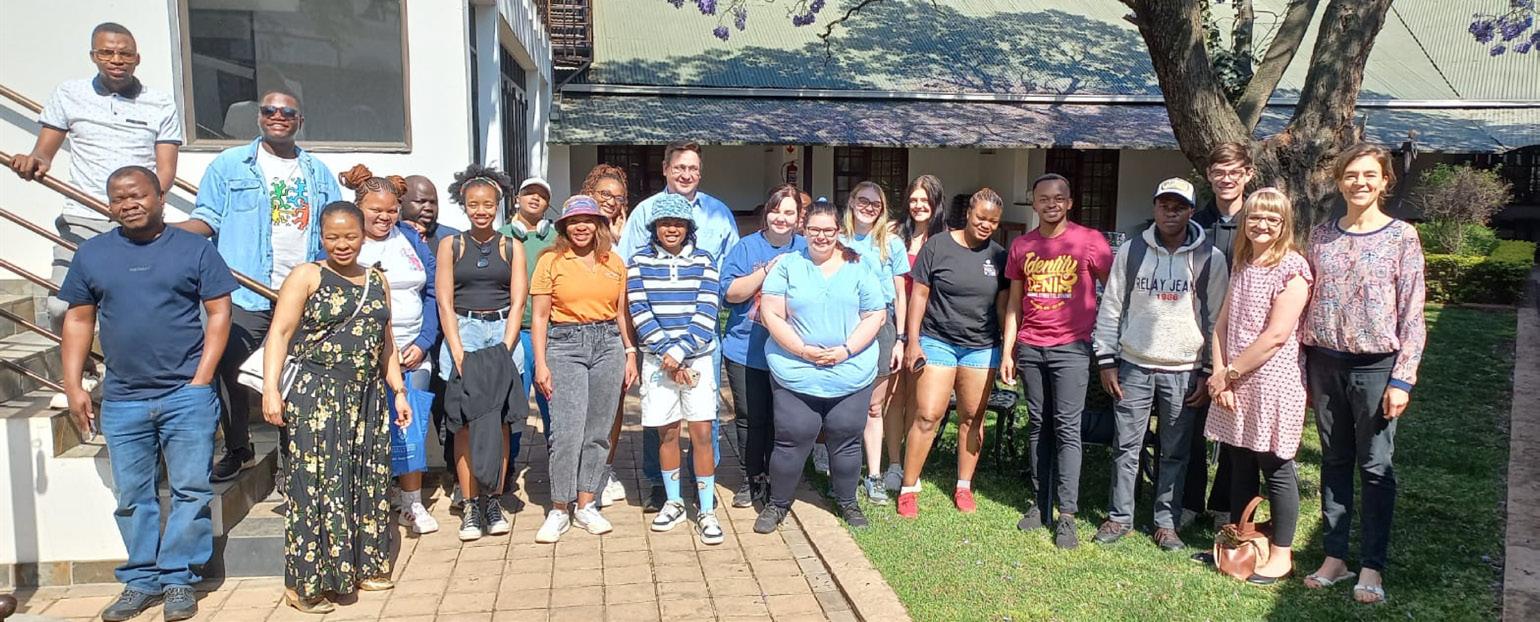
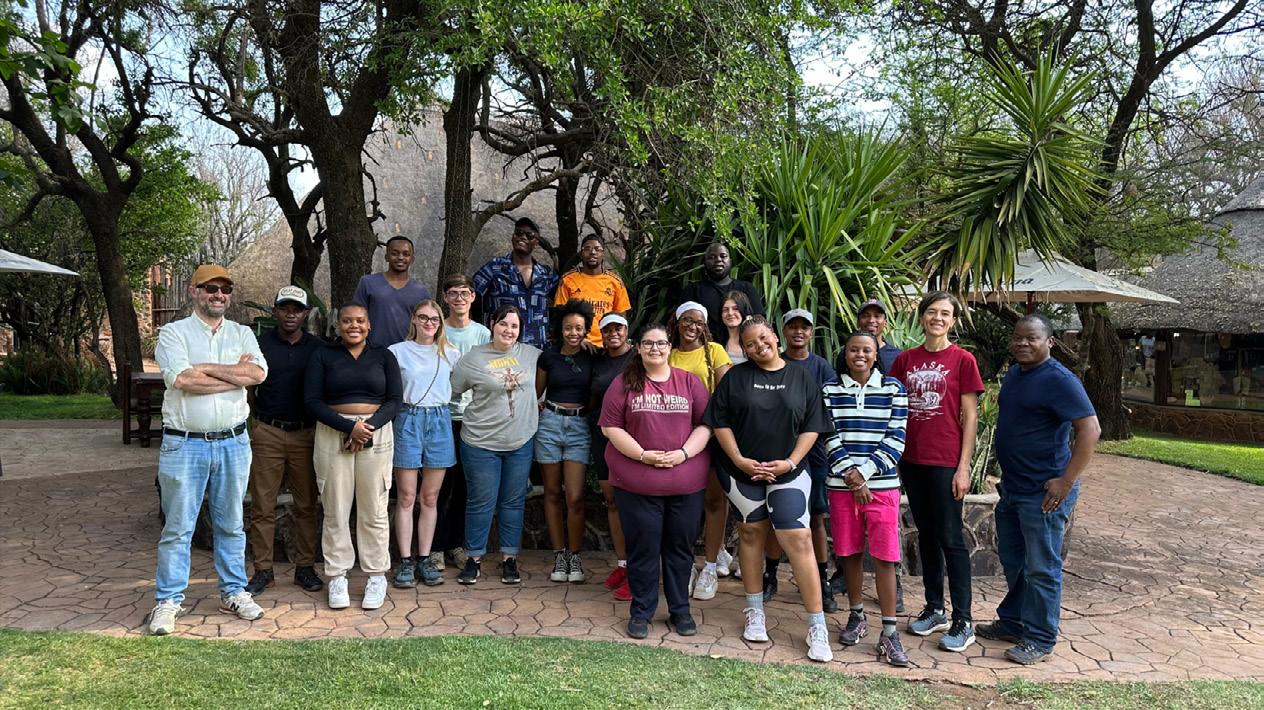
Honours students in the Faculty of Economic and Management Sciences’ Department of Marketing Management, specialising in Tourism Management, as well as their peers in the Faculty of Humanities’ Department of History, Heritage and Tourism (formerly Historical and Heritage Studies), specialising in Heritage and Cultural Tourism, gain practical exposure to the tourism industry through an annual research field trip.
This activity, coordinated by Prof Elizabeth Ann du Preez from the Department of Marketing Management’s Tourism Management Division, provides students with an immersive experience that enhances their academic understanding of theoretical concepts. It also gives them practical exposure to the tourism industry, while fostering critical skills and professional development.
Prof Du Preez explains that the tourism industry requires students to understand the practical nature of the industry, making it crucial for students to apply theoretical knowledge to analyse business strategies critically. “Apart from allowing the students to acquire intra- and inter-personal skills through collaborative learning, the field trip contributes to the development of those attributes UP graduates need to acquire before they enter industry.”
FACULTY
PROF ELIZABETH ANN DU PREEZ
This is especially the case for students who have never benefitted from the experience of being a tourist themselves.
In the BComHons Tourism Management and BSocSciHons Heritage and Cultural Tourism programmes, the Destination Management module, colloquially known by students as TBE 719, facilitates a process whereby students come to grips with the complex structure and multiple stakeholders involved in establishing a competitive tourism destination.
Prof Du Preez explains that, throughout the module, students study the various components of a destination marketing strategy. “This includes branding, product and market development, the co-creation of experiences, digital marketing strategies, environmental sustainability and resilience.”
Exposure to these components of a destination marketing strategy throughout the field trip allows students to grasp the interdependency and integration of the concepts. “The students are expected to critically evaluate
various destination products from a tourist perspective and engage with stakeholders to understand the complexities involved in creating viable, sustainable destination experiences.”
Prof Du Preez explains that these excursions form part of the module’s final exam project, where students are required to analyse specific destinations to develop proposed strategies and interventions.
“The Tourism Management Division has been conducting these field trips for several years, focusing on a different destination each year.” Stakeholder engagement forms an important part of the activity, and is key to developing successful realworld learning opportunities for the students.
The field trip also exposes students to the elements of responsible tourism management. Through engagement with local communities within the destination, students are provided with first-hand, practical information on community involvement in tourism and conservation.
LEARNING ENVIRONMENT
The students’ destination for 2024 was quite close to home, but enabled them to experience ‘Africa in a day’. The region they visited was one of the key priorities of the Gauteng Department of Economic Development, which comprises four hubs: Dinokeng Game Reserve, Dinokeng Central, Roodeplaat Dam and Cullinan.
The field trip took place from 7 to 11 October 2024, and included a diverse range of tourist activities sponsored by various industry partners. “It soon became evident to the students that the region has a wealth of potential tourism offerings that could be earmarked for further development,” says Prof Du Preez.
After their safe arrival at Kwalata Game Lodge, the establishment’s Chief Executive Officer (CEO), Charl Pretorius, briefed the students on its operations within the larger Dinokeng Game Reserve. The students obtained information on the various community engagement initiatives of both Kwalata and the more expansive Dinokeng Game Reserve, as well as the wildlife conservation initiatives within the reserve. Students were then taken on a sunset game drive, which was a first for many of the students. This was followed by an evening meal around a bonfire.
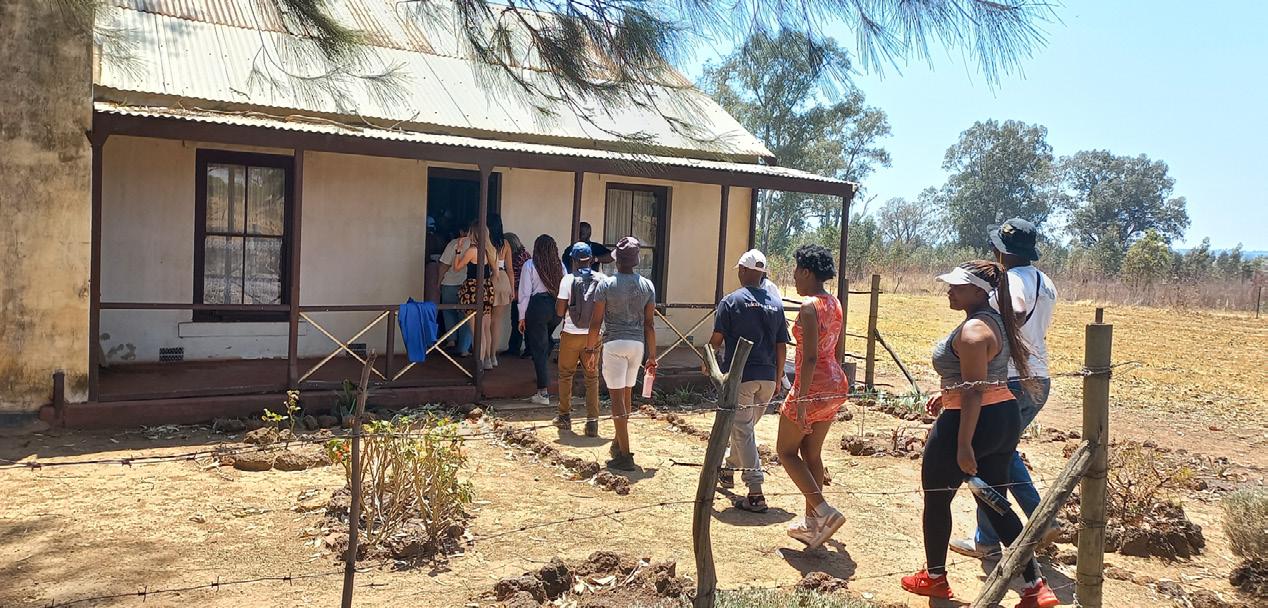
The following morning, the students started the day bright and early with a cheetah bush walk, following a collared female and her cubs. The group also stopped at Kwalata Adventure Camp, which hosts youth leadership and environmental education programmes. In the afternoon, they visited Hammanskraal and stopped at several facilities within the community. These included Dinokasi Bees and Honey, Dinokasi Crafters, TLC Old Age Home and Giants Gym. In the evening, they enjoyed dinner at a local restaurant and practiced traditional dancing.
Prof Du Preez explains that these smaller-scale initiatives, if creatively designed and maintained, stand to gain from a mutually advantageous relationship with tourism stakeholders. “While they benefit from income generation through tourism, they simultaneously serve as offerings that collectively contribute to authentic tourism experiences.”
Having experienced the wildlife and cultural richness of Dinokeng’s western border, the students had the opportunity to view life ‘behind the scenes’ at a few other lodges in the reserve, such as Tshikwalo, Mongena and Ritsako.
Their last stop before leaving the reserve was Arlington Brewery, where they stopped for lunch. They then made their way east towards Cullinan.
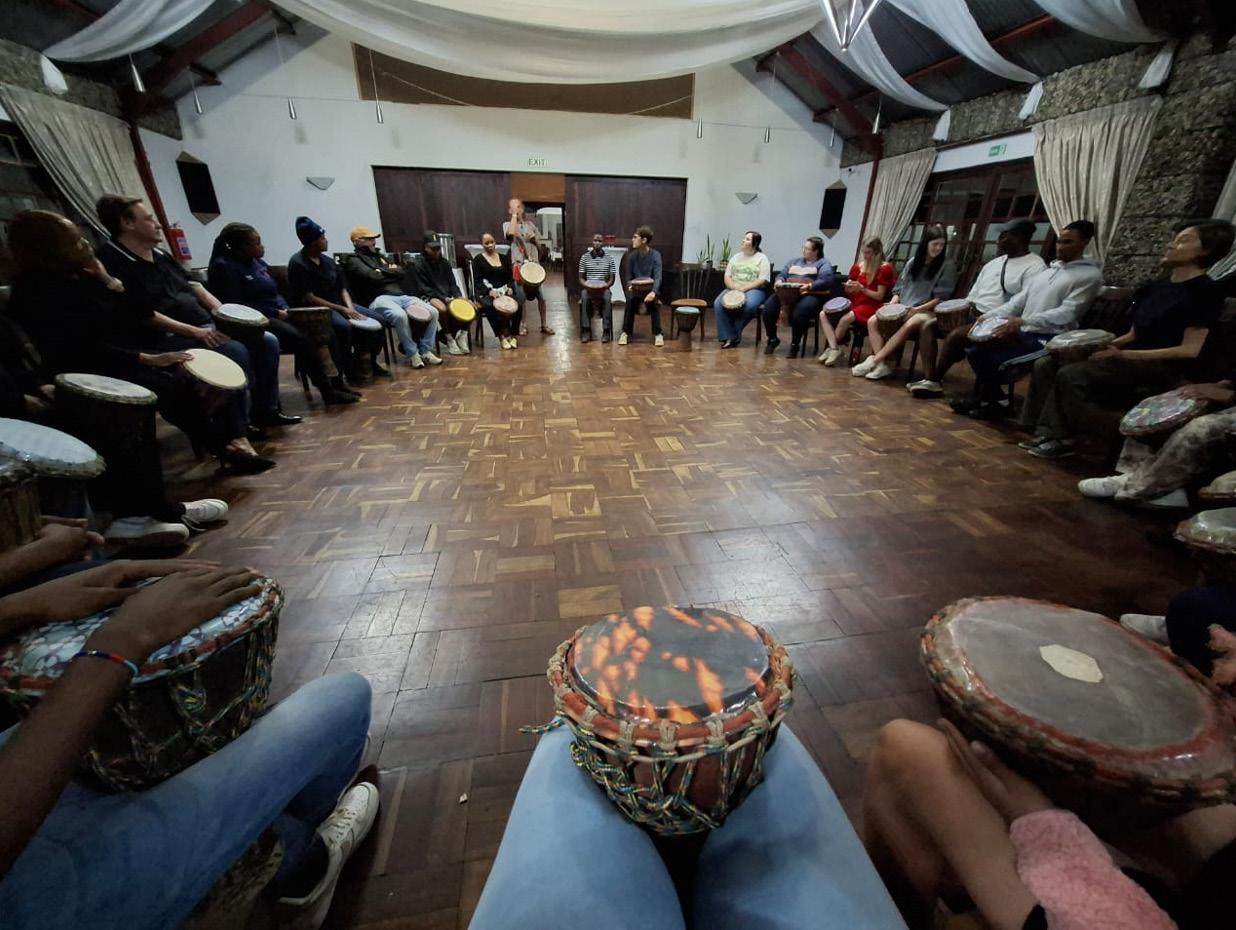
Upon their arrival at the four-star Cullinan Diamond Lodge, the students’ energy levels received a boost with a fun, interactive drumming session.
LEARNING ENVIRONMENT
The following morning, they engaged with the Chairman of the Cullinan Tourism Association, Gordon Webb, who briefed them on Cullinan’s product offering and future development as part of the Dinokeng Master Plan, executed by the Dinokeng Projects Division within the Gauteng Department of Economic Development.
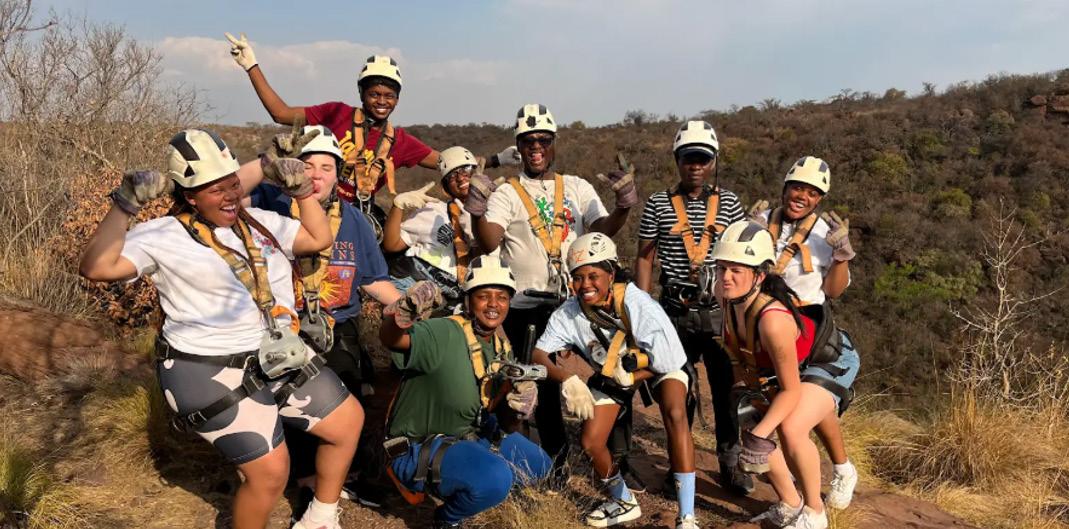
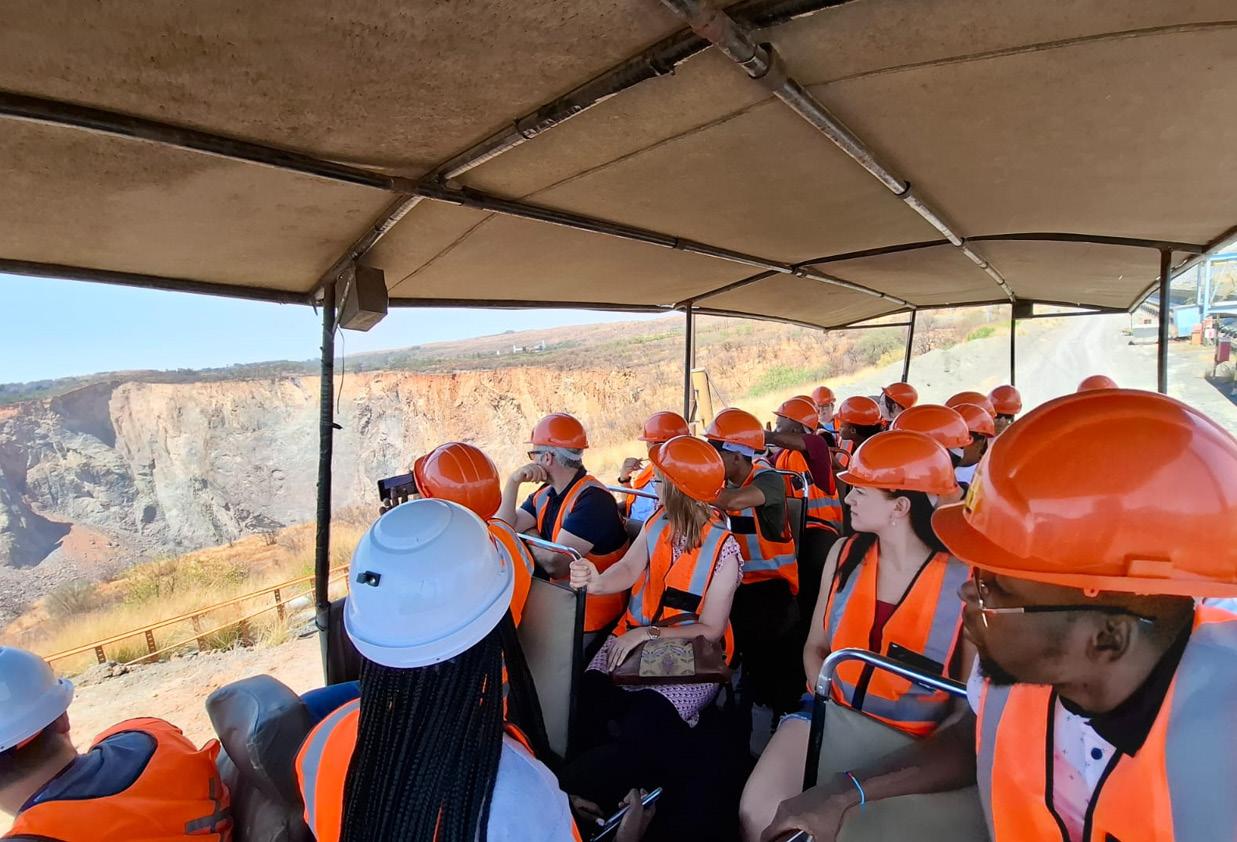
Next was a ground tour of the worldfamous Cullinan Mine, history room and McHardy House. They spent the afternoon on probably the most exhilarating activity on the tour: a 1.5 km zipline crossing the Muningi Gorge at the Cullinan Adventure Zone.
Following an action-packed itinerary, the students ended the week at a much slower pace to appreciate the historical Willem Prinsloo Agricultural Museum and Sammy Marks Museum on the route back to Pretoria. “The students left Dinokeng with a new appreciation of the complex dynamics of a tourism destination,” says Prof Du Preez. She believes the value of this immersive experience to be beyond comparison.
“As an outcome of their visit, the students had to evaluate the extent to which these offerings align with current global trends in experience design.” This is a fully fledged research project, which requires them to collect information throughout
the semester, and determine how the establishments they visited respond to global trends.
As part of their final examination, they had to make novel proposals for new tourism experiences or marketing strategies to elevate the region’s competitiveness. Their exposure to the responsible tourism elements in this specific excursion also allowed them to report on the sustainability of tourism development in the area, focusing on local community involvement in tourism and biodiversity conservation. Their proposals illustrated their creativity, and included ideas such as a youth travel route, a gamified travel app, an influencer challenge for social media content creation, a fundraising event for a community hall, and an LGBTQIA+ festival in Pride Month.
Their recommendations were shared with all the key stakeholders involved in the projects.
“In the past,” says Prof Du Preez, “these recommendations have assisted tourism partners to improve sustainable tourism and enhance local community participation to promote local development.” These field trips therefore have a societal impact and create value for the University of Pretoria, the Faculty of Economic and Management Sciences, the Faculty of Humanities and the postgraduate tourism students who can take these industry lessons forward.
Stories about statistics: When fiction drives innovation in a numbers world
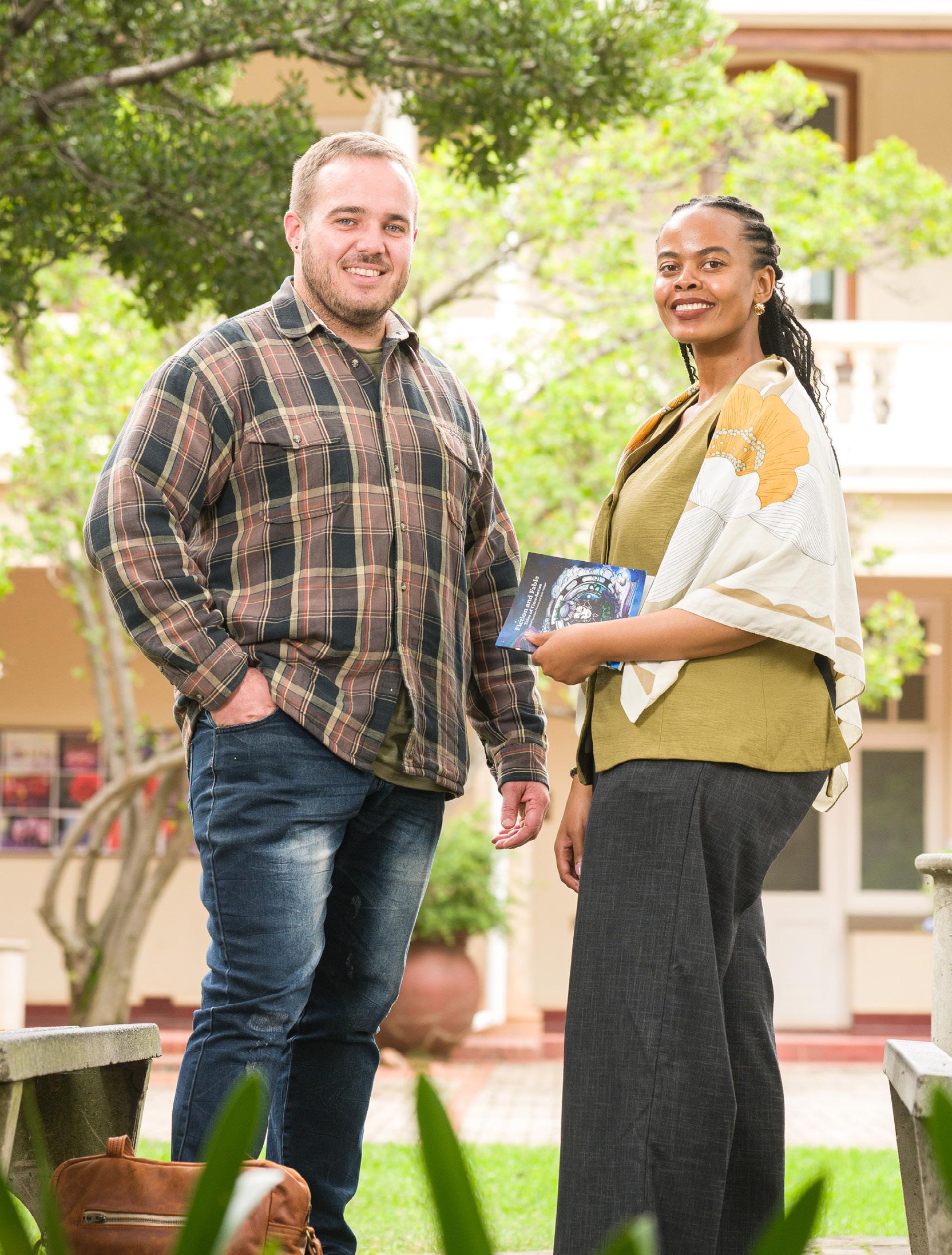
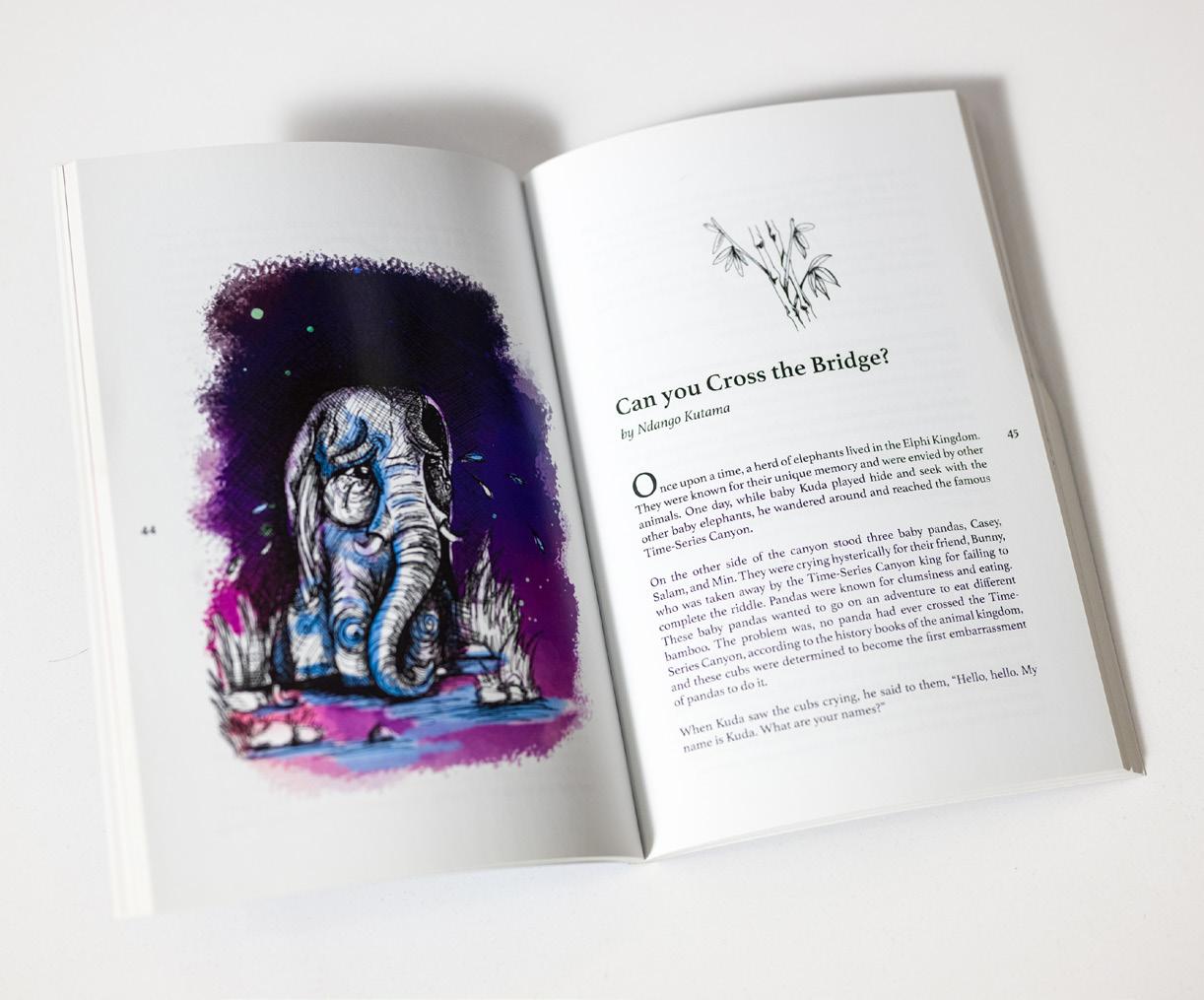
The University of Pretoria is taking traditional teaching and learning methods to new heights through an innovative book of statistics-based fictional fables written by undergraduate students in Statistics. Fiction and fable: Tales of time-series was spearheaded by Prof Johan Ferreira, a former lecturer in the Faculty of Natural and Agricultural Sciences’ Department of Statistics, who is now situated at the University of the Witwatersrand. It was edited by Prof Ferreira and his colleague, Dr Seite Makgai, who still lectures in the Department.
The book has an added layer of creativity through artwork by renowned illustrator Michelle Pinto. The students’ contributions, explored through short stories, promote storytelling as an effective teaching and learning tool within analytical sciences. In addition to stimulating peer learning, it offers an alternative and less stressful approach to teaching and learning. “What started out as an attempt to keep third-year Statistics students engaged during the COVID-19 pandemic resulted in a collection of short stories capturing ideas and concepts taught in a time-series analysis class through creative writing,” declares Prof Ferreira.
FACULTY OF NATURAL AND AGRICULTURAL
He wanted to keep his students interested and focused while they were restricted to online learning during the lockdown period that characterised the pandemic. “Everybody had been glued to their screens, and I sensed that students were exhausted from maintaining interest and focus across a wide range of continuing academic expectations,” he says. “The book can therefore be described as an unintended, yet positive outcome of the pandemic.”
What initiated the idea of using creative writing as a teaching and learning tool? Prof Ferreira explains that his lightbulb moment came while in conversation with his botanist partner, who told him a story of plant characters. “That triggered the thought: What if I can get my students to do the same? This might spark a different train of thought regarding statistical thinking. To be honest, I think many academics were feeling the same way,” he explains.
He then presented his concept to a thirdyear mainstream Statistics group comprising 300 students. Since the storytelling exercise was optional, he was elated to receive over 30 submissions. “Reception of the concept is two-fold,” he explains. “There are the students who contributed stories, and then there are those who are currently enrolled in the course and are reading the stories to understand the course content as an additional reference and learning resource.” Students learning about statistical concepts for the first time can also refer to the experiences of former students.
Prof Ferreira explains that common statistics teaching approaches and interventions mainly focus on explaining the theory and applying introductory statistical concepts. “Few focus on enriching the concepts covered in an advanced undergraduate course.” The students’ brief was to base their characters on key timeseries analysis concepts. “They received a nonrestrictive, non-stringent guideline on writing a short story, with the purpose of stimulating previously unconsidered cognitive centres that might supplement other such centres in the brain to accelerate learning and decrease the perceived anxiety surrounding time-series analysis,” he explains. This assisted him in strengthening teaching, as well as research capacity, in a module that students typically find challenging.
He therefore succeeded in encompassing formal learning in an informal peer learning way with an initiative that supported creative, project-based and cross-disciplinary learning.
Commenting on the characters that were developed in the stories, he believes that “in the same way as one can imagine a unicorn, one can imagine an autoregressive process as a character without impeding the enjoyment and alternative writing style of short stories such as these”.
The book was officially launched at an event on the University’s Hatfield Campus in April 2024.
Prof Delia North, former Dean of Science at the University of KwaZuluNatal and a stalwart in statistics education in South Africa had the following to say: “This book comes at the precise moment in time when academic statisticians are challenged to think of new and novel ways to advocate for their discipline. I have no knowledge of any similar statistics storybook being written – the editors should be considered true visionaries in the field of statistics education.”
Prof Ferreira explains that the publication of a book was never the initial goal. “It was a product of the organic development of the overarching project, which is now yielding incredible intellectual fruits.” He has come to realise that it is easier for students to understand the course content of third-year Statistics through this previously unconsidered creative approach. “It stimulates transdisciplinary experiences within the analytical sciences, while promoting memory capture as an alternative option for deep learning.”
He says that once he realised the book’s potential, there was no stopping him. “It took a few months to edit the submitted works. After that, we submitted the entire collection for peer review by experts in the field of statistical pedagogy and creative writing. We then approached an illustrator to create a unique illustration to accompany each story.” The intention was to include a diversity of student voices, and to include something that everyone could relate to. The authors of all the stories included in the book consented to have their stories published.
By this time, Prof Ferreira had started to develop a clear idea of what he hoped to achieve with the book. “I believe it is essential to continuously reassess and reinvent different learning strategies and experiences for an evolving student body. Our main aim was, therefore, to improve and supplement student learning with a newly developed teaching resource.”
He also saw the collection as a means of enouraging students to take creative ownership of their learning and consider how their educational experience could be supported through informal and project-based peer learning.
The response to the book has been so positive that Prof Ferreira and Dr Makgai are busy raising funding for its translation into Afrikaans, Tswana and Sepedi. “This will be of immeasurable value to statistics students at the primary, secondary and tertiary level.” Although there are modulebased concepts in the stories, the editors consider it to have value as a supplementary academic resource. “We are not selling the book for a profit. It is available as a free online resource that can be accessed by anyone who is curious about statistics.” Prof Ferreira is also entertaining interest from the University’s Department of Drama and Sci-Enza, the University’s science centre for primary and high school learners, and members of the community, to discuss their potential involvement.
A highlight for Prof Ferreira and Dr Makgai was being awarded the Cluster Teaching Award in Mathematical Science in the Faculty of Natural and Agricultural Sciences in November 2024 for this initiative education product.
Virtual collaboration between South African and German History Education students
The teaching of controversial issues in a country’s history is a challenge shared by History Education lecturers in both South Africa and Germany. These two countries each have their own unique, yet shared history of oppression and violence. In South Africa, it took the form of apartheid, while in Germany, it took the form of national socialism. A collaborative project that embraced the idea of internationalisation sought to find a solution to this challenge.
Prof Johan Wassermann, Head of the Department of Humanities Education in the University of Pretoria’s Faculty of Education, reflects that the concept of internationalisation is often focused on research involving academics and postgraduate students. “However, internationalisation should transcend such narrow boundaries and include teaching and learning at the undergraduate level as well, especially when preparing students for a profession such as teaching.”
He believes it is essential to create opportunities for pre-service teachers to engage with their peers on shared controversial global issues.
FACULTY OF EDUCATION
PROF JOHAN WASSERMANN AND DR PRANITHA BHARATH
This was the rationale behind an initiative that saw the Faculty’s History Education students engage with their peers from the University of Leipzig and the University of Gӧttingen in Germany to engage on ways to teach the controversial issues that formed part of the history of these two countries.”
Prof Wassermann explains that this initiative originated through early conversations between the academics of the different universities. The academics who were involved in this project were Prof Wassermann and his colleague, Dr Pranitha Bharath, from the Department of Humanities Education, and Prof Kathrin Klausmeier, a lecturer in History Didactics at the University of Gӧttingen in Germany.
Prof Klausmeier had previously reached out to Prof Wassermann to discuss collaboration regarding the teaching of controversial issues in a fast-changing German context.
From this initial contact, a collaborative project emerged involving undergraduate History Education students, who needed to participate in work-integrated learning (WIL) in different school
contexts as part of their curricula.
Prof Wassermann explains that historical events related to apartheid in South Africa and national socialism in Germany have left an enduring local and global historical footprint.
“Against this historical backdrop, we embarked on a collaborative journey to understand how each country engages with these and other controversial topics in their respective history curricula, and how students can approach the teaching of these topics.”
The project was initiated by considering how the lecturers could share their common values of teaching in diverse contexts, while engaging their students in the critical thinking process. In particular, they contemplated the extent to which the school culture and socio-political environment affected the way the students could embark on such a project. Ultimately, they decided to present two online conferences in which the students could participate.
The lecturers provided an outline of the project, and designed six guiding questions to help the preservice teachers analyse their teaching experiences, report on their pedagogical challenges, and write reflections on teaching history in different contexts.
The following questions provided a foundation for the students’ discussions and reflections:
• How do teachers deal with controversial topics as they teach them?
• What topics are controversial in the school curriculum, and why?
• How do practical school experiences illustrate controversial topics?
• How does a student teacher’s knowledge (or lack of knowledge) of history affect their ability to teach controversial topics?
• To what extent does institutional culture contribute to controversial issues?
• How does the socio-political environment of a school affect the teaching of controversial issues?
A student caucus of 50 registered participants (25 from each country) was then divided into six teams. Each team had to answer one of the six questions. “We expected students to engage responsibly in discussions, draw from their practical and personal teaching experiences, and demonstrate their understanding of the guiding questions related to controversial issues,” says Dr Bharath.
The teams were encouraged to communicate, collaborate and plan through their preferred online platform to introduce themselves and address their questions. A leader was elected for each team to help organise the participants of the six discussion groups. Each group was tasked with tackling online conversations on their predetermined question. Following the students’ discussions, at negotiated times, each group was required to prepare a PowerPoint presentation summarising their collective insights. The team leaders presented the outcomes of their team’s efforts.
The first online conference, comprising students from the University of Pretoria and the University of Leipzig, took place in 2023. However, the project moved to the University of Gӧttingen in 2024 when Prof Klausmeier changed institutions.
Reflecting on the initiative, Dr Bharath explains that the pedagogy of internationalisation was seen as a way in which the History Education section of the Department of Humanities Education could establish a global classroom of international students. “Through this project, the students could exchange ideas on history, culture and pedagogy in different contexts across space in standard time.” It provided the perfect opportunity to internationalise undergraduate teaching and learning in a studentcentred, inquiry-based, self-directed manner, explains Prof Wassermann.
“The students found the concept of sharing ideas and conversations of learning in different countries through this type of collaboration particularly appealing.”
The extension of the project to the University of Gӧttingen in 2024 involved a new cohort of undergraduate History Education students from the two countries.
Reflecting on the experience, Prof Wasserman explains that it was not without its challenges. “The biggest challenge related to the time zone differences, which impacted the scheduling of meetings and discussions.” The project involved flexibility, coordination and commitment from all involved, including the academics who had to balance their time and workloads. “Then there were trepidations about the language barrier, as English was the language of communication,” he continues. “Both the German and the South African students had to express their ideas and knowledge via a common language.” Furthermore, the number of students participating in the second iteration was reduced due to the coinciding exam sessions for both universities. “It proved challenging to get participation from final-year students as they were involved with lectures and completing assignments for their other subjects.” The 2024 conference was therefore planned during regular lecture hours so that the students from the two countries could participate in it.
Dr Bharath obtained permission from the relevant lecturers to utilise History Education students at the designated time so that they could participate in the conference. “What emerged from the students’ presentations,” says Prof Wassermann, “was the resilience of students from both countries, particularly South Africa, in teaching controversial issues.”
He explains that the students learnt different approaches from theory, reading and assignments as part of their routine teacher training. “These approaches ranged from avoiding controversial issues partially to teaching them with neutrality.” Some students argued that history textbook content or historical sources should serve as a frame for their lessons. Others suggested teaching with a stated commitment as a possible strategy, or embracing strategies to provoke discussion and debate through a ‘devil’s advocate’ approach.
Prof Wassermann and Prof Klausmeier
“Through this intervention,” explains Dr Bharath, “the students came to understand how interpretations and approaches to the same historical event varied, how Eurocentric narratives were still prevalent, and how sharing ideas could offer novel ways of teaching history.” The online collaboration also created pathways for international cooperation without the need for financial support. She further clarifies that, as a pedagogical model, it was built in a dialogical rather than a monological space. “The dialogicality rests on the meanings co-constructed in the Zone of Proximal Development, established by the developmental psychologist, Lev Vygotsky, in 1986.” It enabled participants to obtain shared meanings of concepts, events and ideas through dialogue, making knowledge less decontextualised.
Evaluating the project outcomes, Prof Wassermann concludes that the students were excellent at cooperation, opening dialogue and taking responsibility for their tasks, while contributing to the documents shared online. Their digital proficiency was enhanced, and their presentations displayed teamwork, understanding common goals, communication skills and respect for multiple perspectives.
“These are all essential ingredients for their professional development as educators.” They deepened their social and cultural awareness and improved their capacity to teach sensitive topics.
He remarks that the academics from the two universities intend to sustain both the learning and the partnerships they have established. “There is space for new possibilities and growth in further collaboration.” The benefit of global learning through an online teaching and learning initiative, without the need to fund such projects, constitutes essential community development. Time, availability, Wi-Fi connectivity and interest were among the resources that the students required to participate in this initiative. The opportunity benefitted the students’ professional development as well. These platforms can also be used by academics to further their international teaching, research and collaboration.
Finally, the project provided an opportunity for students from the Global North and the Global South to initiate courageous conversations about the complex histories of their past, with essential takeaways from the various sessions. “Teaching history exposes us to differences of opinion as we teach controversial topics and engage with the interpretation of sources and different narratives,” explains Prof Wassermann.
These differences can spill over into classrooms of divergent learner populations and affect different understandings. “However, this collaboration allowed our pre-service teachers to teach these controversial issues with confidence and integrity,” he concludes.
Does Generative AI reduce critical thinking?
The last two years have seen an amplification in the debates about the appropriate use of Generative AI (GAI). Dr Heather Goode, who has recently been promoted to Head: Education Consultancy in the University of Pretoria (UP)’s Department for Education Innovation, remarks that when OpenAI released ChatGPT 3.5 at the end of 2002, some authors saw it as an extension of Fourth Industrial Revolution (4IR) technology convergences and lauded the idea of GAI being applied as an efficiency tool to streamline processes, reduce costs and save knowledge workers from increasing workloads.
Dr Goode observes that lecturers have started experimenting with GAI to save time on mundane tasks, adding to their repertoire of digital tools like grammar checkers. As an education consultant, she considers an important part of her role to be the exploration of issues related to the appropriate use of artificial intelligence (AI) in higher education. “This is a priority for the Department, and has been a topic of discussion in several Teaching and Learning Committee meetings and other forums.”
She identifies two areas that concern teaching staff, in particular: the integrity of assessment and cognitive offloading, which may short-circuit learning.
“For those of us in education, we must ask, does the use of GAI come at a cognitive cost?” In an attempt to answer this question, she considered the findings of a recent report published by Microsoft on the impact of Generative AI on critical thinking (Lee et al., 2024). “Despite its shortcomings, this research provides valuable insights into the effect of GAI use by knowledge workers.” It evaluated the findings from a survey of knowledge workers who were asked to reflect on their perceptions that using GAI reduces their cognitive effort and confidence effects.
She found it interesting that the researchers of this study viewed the experiences of knowledge workers through the lens of Bloom’s taxonomy. “Quantitatively, the authors found that higher confidence in GAI is associated with less critical thinking.” She found this observation to align
with other reports where high trust has resulted in problems with AI hallucinations, as high trust in GAI can lead workers to accept outputs without verification (Athaluri et al., 2023; Bhattacharyya et al., 2023; Magesh et al., 2024). These authors found this trend to be aggravated when GAI presents incorrect information plausibly and confidently. She was therefore not surprised to see participants in the Microsoft study reporting that using GAI shifts them towards information verification. Furthermore, participants reported changing the nature of their critical thinking towards response integration and task stewardship (Lee et al., 2024).
In response to this paper, she has observed a series of attentionseeking headlines. She considers this to be an over-reaction to this research, which misses several nuances in the literature and in the wider research. “Alarmist headlines and misquotes in various magazines and newspapers amplified the belief that GAI reduces critical thinking. Some of these platforms reported that “AI reduces users’ critical thinking” efforts (Potkalitsky & Law, 2024) and asked the question: “Is AI really making us dumb?”.
Dr Goode considers the researchers involved in the Microsoft report to have been specific in their definitions of GAI and to have contextualised their approaches in a longer tradition of evaluating technologies with respect to their impact on the quality of human thought, from writing to calculators and the internet. An interesting finding she extracted from the report is the confirmation that knowledge workers (this includes both academic staff and students) are changing how they approach tasks by delegating more routine or repetitive tasks to GAI, while spending more time verifying and evaluating AI-generated content. This aligns with the ‘human-in-the-loop’ recommendations of other researchers, while simultaneously addressing concerns of cognitive offloading (Francis et al., 2025; Wahn et al., 2023).
She has come across several critiques of the Microsoft paper; both in terms of the methodology and the research design (for example, Underwood, 2025). “Self-reported data is potentially problematic and selective,” she says. Potkalitsky and Law (2024), for example, challenge the assertions that using GAI “shifts cognitive effort from problem-solving or data-analysis to oversight,” which the researchers in the Microsoft study suggest is less demanding. “Yet, Bloom’s taxonomy positions evaluation higher than applying or understanding knowledge.” Potkalitsky and Law (2024) further argue that critical thinking includes aspects of strategy and how to approach problems, and that while we may use GAI to automate routine cognitive tasks, this action enables us to think about different parts of a problem or project. Dr Goode therefore wonders if GAI is not rather enabling us to spend more time on higher-order thinking.
37 INNOVATIVE LEARNING ENVIRONMENT
Underwood (2025) points out that the Microsoft researchers (Lee et al., 2024) draw on self-reported instances of on-the-job tasks, which require participants to draw on metacognitive applications. In several theories, metacognition is a competency of critical thinking (Goode, 2024) and requires the application of competencies across Bloom’s taxonomy, from knowledge retrieval to analysis, selection and synthesis. Each of these categories represents a range and types of knowledge a student could be expected to acquire or construct during learning. In the revised Bloom’s taxonomy (Anderson & Krathwohl, 2001), the knowledge dimension is expanded to include ‘metacognitive knowledge’ as a fourth category. This type of knowledge requires reflection, self-regulation and the application of several critical thinking competencies.
“In education and working contexts,” says Dr Goode, “critical thinking is both a process and a strategy, a set of competencies and a disposition.”
The United Nations Educational, Scientific and Cultural Organisation (UNESCO) has developed a useful definition of critical thinking. This definition describes critical thinking as a process of “asking appropriate
questions, gathering and creatively sorting through relevant information, relating new information to existing knowledge, re-examining beliefs and assumptions, reasoning logically, and drawing reliable and trustworthy conclusions” (UNESCO, 2013:15).
Applying this definition may assist in understanding higher order thinking. Furthermore, UNESCO’s definition implies dispositional aspects when it contends that “critical thinking calls for persistent effort to apply theoretical constructs to understanding the problem, consider evidence, and evaluate methods or techniques for forming a judgement” (UNESCO, 2013:15). This aligns well with what is often required of students and other knowledge workers in higher education. Furthermore, critical thinking is supported by attributes such as contextual knowledge, curiosity and a questioning attitude (Goode, 2024).
While the Microsoft report is interesting, Dr Goode believes it to be by no means definitive. “The literature confirms that what we do with GAI and how we use GAI determines whether critical thinking is developed further or not.”
As educators at UP, she considers it appropriate to align with organisations like UNESCO, which calls for an ethical
and ‘human-centred approach’ to the use of AI in higher education (UNESCO, 2024).
From the perspective of the Department for Education Innovation, Dr Goode encourages the informed, discerning use of GAI. This may mean developing academic, information and AI literacies, while requiring critical thinking: teaching our students and ourselves to use GAI appropriately and ethically. “Using GAI to automate some tasks retains the opportunity to apply our critical thinking elsewhere, like evaluating the hype and evidence around GAI in higher education,” she concludes. “The thoughtful, selective use of technology has always led to better educational outcomes than reactions.”
FURTHER READING
Anderson, L.W. & Krathwohl, D.R. (2001). A taxonomy for learning, teaching, and assessing: A revision of Bloom’s taxonomy of educational objectives: Complete edition. Addison Wesley Longman, Inc.
Bhattacharyya, M., Miller, V.M., Bhattacharyya, D. & Miller, L.E. (2023). High rates of fabricated and inaccurate references in ChatGPTgenerated medical content. Cureus 15(5), e39238. Available from https://doi.org/10.7759/ cureus.39238.
Christensen, C., Raynor, M.E. & McDonald, R. (2013). Disruptive innovation. Harvard Business Review Brighton, Massachusetts, USA.
Francis, N.J., Jones, S. & Smith, D.P. (2025). Generative AI in higher education: Balancing
innovation and integrity [Review]. British Journal of Biomedical Science 81. Available from https:// doi.org/10.3389/bjbs.2024.14048.
Goode, H.A. (2024). Critical thinking skills for students: Curriculum and practice in South African higher education. Pretoria: Unisa Press. Lee, H., Sarkar, A., Tankelevitch, L., Drosos, I., Rintel, A., Banks, R. & Wilson, N. (2024, January 2025). The impact of Generative AI on critical thinking: Self-reported reductions in cognitive effort and confidence effects from a survey of knowledge workers. Proceedings of the ACM CHI Conference on Human Factors in Computing Systems, April 2025, Japan. Magesh, V., Surani, F., Dahl, M., Suzgun, M., Manning, C.D. & Ho, D.E. (2024). Hallucinationfree? Assessing the reliability of leading AI legal research tools. Preprint. Under review., June 6, 2024. Available from https://dho.stanford.edu/ wp-content/uploads/Legal_RAG_Hallucinations. pdf.
Potkalitsky, N. & Law, J.B. (2024, 24 February 2024). Does AI kill critical thinking? Maybe not if we use it right. Educating AI. Available from https:// nickpotkalitsky.substack.com/p/does-ai-killcritical-thinking-maybe.
Underwood, T. (2025, 16 February 2025). A critical analysis: Microsoft’s January, 2025, Study of critical thinking and knowledge workers. Learning to read, reading to learn. Available from https://terryu.substack.com/p/a-criticalanalysis-microsofts-january.
United Nations Educational, Scientific and Cultural Organisation (UNESCO) (2013). UNESCO International Bureau of Education Glossary of Curriculum Terminology. Available from https://unesdoc.unesco.org/ark:/48223/ pf0000223059/PDF/223059eng.pdf.multi.
UNESCO (2024). Artificial intelligence in education. UNESCO. Available from https:// www.unesco.org/en/digital-education/artificialintelligence.
Wahn, B., Schmitz, L., Gerster, F.N. & Weiss, M. (2023). Offloading under cognitive load: Humans are willing to offload parts of an attentionally demanding task to an algorithm. PLOS One 18(5), e0286102.
“Future morality”? Theology students grapple with using AI to make ethical decisions
Just over two decades ago, the former Archbishop of Canterbury, Rowan Williams, asked: What is it like to make a choice? Was the choice yours alone to make, and were there clear alternatives to choose from? Did you know what you were actually making a choice about? Prof Tanya van Wyk, Head of the Department of Systematic and Historical Theology in the University of Pretoria (UP)’s Faculty of Theology and Religion, reflects on these words, remarking that Williams’s statement implies that humanity sometimes approaches ethical dilemmas as if these choices were ‘consumer choices’.
She observes that his questions introduce the way humanity contemplates its ability or duty to make choices. “This is particularly true for students of theology,” she remarks, “because, for them, ‘making choices’ is a religious and a spiritual matter.”
Following advancements in artificial intelligence (AI), particularly the popular use of Generative AI platforms such as Chat GPT for academic and research purposes, these questions may just have become more complicated.
PROF TANYA VAN WYK
LEARNING ENVIRONMENT
“One is now not just faced with the scope of AI, but also with designing a clear strategy on incorporating it to make decisions,” she says. The question is, as David Edmonds alludes to in his book, Future morality, to what extent will we ask AI to help us make decisions, when we are already turning to it with a plethora of questions.
“Ethical decision making is exactly the issue confronting my third-year students in the Living as Christians module,” explains Prof Van Wyk. While many consider this matter from a theoretical or hypothetical point of view, they do not realise that they need to make ethical decisions in their own lives as well, such as whether to use AI when completing assignments, and acknowledging that they have done so.
She believes that, as a university that emphasises transdisciplinary collaboration, teaching and research, UP is no stranger to the notion of complexity. She therefore designed an assignment in which her students could consider the ethical use of AI in decision making. Utilising the questions posed by Williams, students embarked on a teaching and learning journey that encouraged them to contemplate and give an account of how they ultimately make ethical decisions.
The importance of such an assignment is grounded in Prof Van Wyk’s belief that the religious leaders of the future will not be exempt from the effects of AI in their religious spaces. “They will have to find their way in a complex world.” Students of theology therefore need to grapple with if, or indeed, how, AI features in their ethical decision-making processes.
“This assignment will not only help students develop the necessary skills to tackle this challenge, but will encourage them to think about whether AI should be utilised in theological-ethical decision making, and whether they can incorporate AI in doing so.
How does this take shape in the classroom? The assignment took the form of an experiment comprising two steps. In the first step, the students were required to consider a scenario that required ethical decision making, and to analyse their decision-making process. In the second step, they had to make use of AI to answer a question, and to analyse whether the result was an ethical response.
During the first step, the students were challenged to take ownership and responsibility when formulating their ethical decisions. This also made them realise that their own conduct in a classroom setting should be governed by ethical decision making.
The scenarios that were selected are typical examples that have a direct bearing on their lives as students on the campus of a contact university. These scenarios enabled them to consider whether their response illustrated an ethical decision-making process.
These scenarios included the following:
• I am late for class. The lecturer should …
• I submitted my assignment late. The lecturer should …
• I did not attend lectures. The lecturer should…
In considering these scenarios, the students were required to formulate a response and motive, and to record their decision-making process.
Grappling with these scenarios, the students were required to design a map that could illustrate an ethical decision-making process they could use to achieve an ethical response to a situation in their own lived realities within their undergraduate student teaching and learning environment. “This entailed also thinking about their own conduct as students in a classroom setting. It was an exercise in formulating a process to make a decision.”
During the second step, the students were required to contemplate how their decision-making process related to AI. “The debate about the use of technology to present lectures, or attend remotely, or incorporate technology and AI to do assessments entered into the conversation when students discussed their responses to these scenarios.” This was followed by an assessment, in which the students had to incorporate AI into their responses.
This required them to collaborate with AI to evaluate whether this technology should be utilised in an ethical decision-making process. They had to identify an AI platform of their choice, and copy the following prompt onto the platform:
“How do I make an ethical decision, and can I ask AI to help me make it?”
The students copied the response generated by AI into their assignment, and evaluated the response, utilising approaches and instruments from theological ethics. This included referring to concepts such as ‘values’, ‘virtues’ and ‘norms’. “Within this process, the students were challenged to consider how they would make use of AI in their religious spaces when they become religious leaders, and when they are approached by members of their religious communities to provide ‘ethical leadership’.”
Due to the rapid development of AI and technology, explains Prof Van Wyk, the future will present us with moral problems and challenges for which we do not even have a framework yet. “That is why it is important to develop a consistent process to make ethical decisions that is not ‘context’-specific, and that will enable students to contemplate complex challenges.”
Prof Van Wyk observes that since a tried and tested process for ethical decision making does not yet exist in the literature, it is important for the students to decide for themselves whether a specific action recommended by AI is ethical or not. She realises that this is something that needs to be included in the curriculum as an essential skill, so that students can appreciate which decisions can be made through AI, and which cannot.
This process becomes paramount as religious leaders are turning to AI for creative assistance to develop religious messages and interactive communication for future generations who will read ancient religious texts in a futuristic world. “As we cross the bridge from the past into the future, it is important for theology students to know when they can use AI to formulate an opinion about those aspects that are regarded as ‘moral’.”
Marketing honours students give hope to entrepreneurs in Mamelodi
Preparing students for industry entails more than just exposing them to the practices of large, established corporations. Assisting small entrepreneurs to get their businesses off the ground can be just as beneficial. This objective provided students in the BCom Honours degree specialising in Marketing Management the opportunity to experience the advantages of an effective marketing strategy first-hand and to develop a marketing solution for small businesses.
Collaborating with the Mamelodi Business Hub (MBH), the Marketing in Practice module of the Faculty of Economic and Management Sciences’ BCom Honours degree specialising in Marketing Management, presented by Dr Jade Verbeek, gained an important community engagement element in 2024. “This project provided the ideal opportunity to combine the practical application of marketing management theory with community engagement,” she explained.
The University of Pretoria had established the MBH on its Mamelodi Campus in 2011 as a beacon of hope and support for the community of small business owners and aspiring entrepreneurs in Mamelodi.
FACULTY
It is dedicated to fostering innovation, growth and success within the local business community by providing a range of free resources, support services and inspirational content to empower entrepreneurs and small business owners.
As part of the module’s practical element, the students had the opportunity to work on a challenge identified by the staff of the MBH over the course of two to three weeks. “Their brief was to develop a digital marketing plan for some of the small business owners who are part of the MBH initiative,” explains Dr Verbeek. “The goal was to help these businesses establish and/or grow their digital presence on social media. The students also recommended tools the business owners could use to help them grow their businesses.”
The businesses involved in the initiative represented a range of industries, from a building supply and hardware store, to a photography and videography enterprise, a catering business, a business consultancy, a marketing consultancy, a retailer of denim clothing, a bakery, a hotdog café, and a business that sells scented candles and linen spray.
Transportation was arranged for the students from the University’s Hatfield Campus to the MBH. They worked in teams of four to five, each group being allocated to a particular small business, which served as their ‘client’. Dr Verbeek explains that the first activity in the project was a ‘discovery session’. The aim of this session was to determine their clients’ biggest challenges when it comes to social media marketing. The students, therefore, spent the first afternoon meeting their new clients and gaining an understanding of their businesses and their social media marketing needs.
During the weeks that followed, the students planned, brainstormed and collaborated with their clients. The ultimate purpose of these activities was to develop a strategic plan that could help their clients establish and grow an online presence, particularly on social media.
The students’ first task was to summarise the insights they had gained during the discovery session. This included an overview of their client’s business, an overview of their client’s biggest competitors, a description of their client’s current customers, a brief overview of
their client’s current marketing efforts (traditional and digital) and an identification of the biggest challenges their client was currently facing in terms of social media marketing.
With this information at their disposal, they could proceed to develop a social media marketing plan for their clients. In this plan, they could propose solutions to address the challenges they had identified during the discovery session. This included up to three objectives for the proposed marketing plan, a description of their client’s target market, and the identification of two social media platforms on which their client should focus. They were also required to develop strategic solutions for their clients’ marketing challenges, and to provide examples to showcase how they could go about implementing the solutions on the suggested platforms. “The students had to ensure alignment among the business, the objectives set and the target market,” clarifies Dr Verbeek. They also had to suggest two simplistic metrics that their client could use to determine the success of the solutions once they had been implemented.
At the end of the intervention, the students had to present their ideas inperson to both their clients and their peers. “The audience was amazed by the work, effort and creativity the students had put in. Their creative output included mock websites, content calendars, reels, brand identity elements, and even a ‘how-to’ social media guide to help their clients implement and embark on the journey of digital marketing.
Dr Verbeek admits that this project brief differed from that to which the students were accustomed at a postgraduate level. “Typical honours projects focus on big brands with abundant resources.” This was the first time that the MBH had been used as a project case study for this module. “It was selected to provide the students with insight into the challenges faced by many small businesses, where time and resources are often limited. Entrepreneurs in the community are hungry for knowledge, and this was identified as a need that the Marketing Management students could address.” It proved to be beneficial for the students as well, as it forced them to transform the typical marketing management question into: “How can we make the biggest impact with what you have?”
“Despite a challenging brief,” exclaims Dr Verbeek, “the students delivered, and their clients were incredibly appreciative of all the hard work and dedication the students had invested in their businesses.”
One of the small business owners, Patrick Takunda Chirumei from Randfrika Filming and Photography, stated:
I’d truly like to thank Dr Jade Verbeek (Marketing Management), as well as Debbie Mdlongwa and Robyn Goss (MBH), for putting together such an elevating and amazing workshop. It helped us quite a lot. The students of the Picture Perfect Team upped their game and went all out in creating effective marketing strategies for my company. They even brought professionally printed and laminated boards to guide us through the process of rebranding, upgrading our social media platforms and infusing their marketing strategies. To this day, we implement most of the ideas step by step, and I am proud to say I can see the changes in our clientele and the enquiries we have received ever since. It would be such an amazing honour to have more of these workshops coming our way. On behalf of my team, I am deeply grateful.
Similarly, Debbie Mdlongwa, the owner of Dee’s Kitchen and one of the coordinators at MBH, echoed these sentiments on behalf of the group:
We would like to thank you from the bottom of our hearts for the marketing sessions you held for us. The impact and feedback we receive are greatly appreciated. On behalf of the entrepreneurs. Thank you!
Upon conclusion of the project, the students had to provide a personal reflection of the experience. This indicated that they had found the project to be just as rewarding and fulfilling as it had been for the business owners. “Many of them expressed how much they enjoyed getting to know their clients, hearing their stories, and applying the marketing skills they had gained, thus helping these business owners, albeit in a small way.”
Dr Verbeek is grateful for the assistance provided by Debbie Mdlongwa and Robyn Goss from the MBH in coordinating this project. She also expresses her appreciation to the University’s Community Engagement Unit for the guidance it provided to make this community engagement project possible.
The UP-Pre-university Academy: Advancing responsiveness and responsibility
The University of Pretoria (UP)’s flagship initiative to support the basic education sector by strengthening the teaching of science, technology, engineering and mathematics (STEM)-related subjects among learners from Grade 8 to 12, the UP-Pre-University Academy (UP-PUA), is going from strength to strength.
Launched on the Mamelodi Campus in 2018, it was established to provide learners who would not otherwise have gained access to university the support they need to improve their academic performance, particularly in Mathematics, Physical Science and English. This initiative was moved to the University’s Groenkloof Campus in 2022, and has expanded to support even more school learners.
The Director of the UP-PUA, Dr Moneoang Leshota, explains that the success of the Academy in Mamelodi prompted the University to expand the programme to all schools in Pretoria. The objective was to enhance access to higher education to more learners with the potential to achieve the required marks to secure a place at a higher education institution. This was made possible through additional academic guidance and tuition. Admission is granted to a maximum of 40 learners per class. Learners must have obtained a minimum of 50% for Mathematics, Natural or Physical Science and English. Successful applicants are required to write a baseline test.
UP-PRE-UNIVERSITY ACADEMY
DR MONEOANG LESHOTA
She explains that, initially, the programme was implemented in collaboration with the Department of Basic Education’s Tshwane South District, and was focused on learners from Quintiles 1–3, known as non-fee-paying schools (those schools that serve the poorer sector of the economy). The schools in Mamelodi fell under this target group. This intervention included the institution of a Saturday School for learners with potential, in which they received extra classes on the Mamelodi Campus to improve their preparedness for tertiary education.
Following the success of this programme, discussions were instituted with the Department of Basic Education to open the initiative up to schools in the rest of Pretoria (including the Tshwane North and West districts), as well as schools in Quintiles 4–5 (the fee-paying schools, formerly known as Model C schools).
Learners from Grade 8 to 10 continue to attend face-to-face classes on the Mamelodi Campus on a Saturday morning. In addition to Mathematics and Natural Science, they also receive classes in creative writing, computer literacy, academic readiness and support, and
examination preparation. Learners in Grade 11 and 12 attend classes on the Groenkloof Campus. They enrol for classes in Mathematics, Physics, Chemistry, Natural Science, Language and Literacy, Advanced Computer Literacy, and Academic Readiness and Support. Transport is provided to all pupils attending classes on both the Mamelodi and the Groenkloof Campus.
Dr Leshota reports that the UP-PUA has expanded its enrolment to provide admission to 500 learners in Grades 9 to 12 for the 2025 academic year. “This significant demand within the Tshwane education districts underscores the relevance of perspectives on curriculum transformation that emphasise the need to redress historical inequalities, repair systemic damage from the past, and reform the curriculum to enhance accessibility for all South Africans,” she says.
She says that, although the programme is available to all schools in Pretoria, 90% of the UP-PUA’s learners currently come from schools in the lower quintiles. “Their primary objective for enrolling in the Saturday School is to improve their performance in Mathematics
and Science.” By strengthening their proficiency in these subjects, she says, they aim to enhance their eligibility for STEM degree programmes at UP and other tertiary institutions – opportunities that would otherwise be out of their reach due to systemic barriers affecting both their schools and individual educational trajectories.
“For UP, the PUA represents both a commitment to responsiveness and a responsibility to ensure that learners from disadvantaged communities gain access to higher education,” she explains.
She identifies the key drivers of teaching and learning at the Academy to be conceptual understanding and a group strategy. “We seek to bridge the gap between school and university by employing instructional strategies that cultivate deep conceptual understanding.”
The goal is for learners to develop a strong foundation in each subject, rather than simply preparing for examinations. “While effective examination preparation is part of the programme, the primary focus of the Academy is to foster deep learning.”
Among learners, the question “Why?” has become synonymous with the UP-PUA experience. The following learner testimonials illustrate the impact of this approach:
The UP-PUA goes into the depths of why we do something… At school, we are just taught to do this or that –there is no ‘why’, no explanation. You just memorise and learn. But here, you engage with further meaning and understanding. Now you are no longer just using formulae to solve problems. You have to explain them. You don’t just apply them – you have to ask: “Why? Why, why, why?”
At school, they’ll say that any number to the power of zero is 1. Here, it was, ‘Why is x to the power of zero equal to 1?’… That just broadened every aspect of my thinking.
Here (at UP-PUA), the assessments are much harder. They test whether I understand the concepts. At school, they test whether I know a certain part of the syllabus. I can recognise the answer and say A, B or C, and then I pass. But here, I have to explain why it is A, why A comes before B… These assessments allow me to truly understand.”
A former UP-PUA learner, now registered in the Faculty of Natural and Agricultural Sciences at UP in 2025, shared similar reflections with parents of current Grade 12 learners:
University is very, very different from high school – I can tell you that now. It is a very big challenge. In my opinion, the UP-PUA helps a lot. For example, with the quadratic formula: At school, they didn’t tell us why we use it, how to use it, or where it came from. They just said, “Take it and use it.” Now, at university, they give us formulae and ask, “Why do you use it? Why this formula and not another one for this situation?” It is a challenge if you did not attend the UP-PUA, because at UP-PUA, they taught us how to handle these concepts – they taught us why we do things a certain way and not another.
Dr Leshota confirms that the UP-PUA embraces collaborative learning, where learners develop a conceptual understanding through discussion. “Each learner is placed in a small group of four to five peers, where they work through carefully designed questions and activities.” The sessions are facilitated by teachers and tutors, and ensure active participation and productive group dynamics.
During a 2024 survey of the UP-PUA, learners ranked the grouping strategy as the third most beneficial aspect of the programme (15%), following teachers (28%) and computer labs (18%), based on 159 responses from 224 learners.
Among the cohort of learners who started the programme in Grade 10 in 2022, the first learners entered university in 2025. This group comprised 140 learners, of which 55 obtained their National Senior Certificate in 2024. Of these, 50 learners qualified with university admission. Thirty of these learners were accepted to study at the University of Pretoria.
Dr Leshota explains that the UP-PUA also focuses on ensuring a seamless transition from secondary school to university.
She explains that the effectiveness of its teaching and learning philosophy is still being evaluated. “However, the majority of the inaugural cohort of UP-PUA learners, who entered tertiary education in 2025, enrolled in UP’s faculties of Engineering, Built Environment and Information Technology, and Natural and Agricultural Sciences.
“Whether they will transition smoothly through their first year remains to be seen. What is certain, though, is that the UP-PUA continues to uphold UP’s commitment to responsiveness and responsibility, ensuring that learners from resource-limited backgrounds are better prepared for the challenges of higher education,” she concludes.
Prominent electronic engineer is appointed as a distinguished lecturer
Prof Warren du Plessis, a lecturer in the Department of Electrical, Electronic and Computer Engineering, has been appointed as a distinguished lecturer of the Institute of Electrical and Electronic Engineering (IEEE)’s Aerospace and Electronic Systems Society (AESS) for 2025 and 2026. He considers this a great privilege and an opportunity to share his knowledge on electronic warfare (EW) and other related systems in which he specialises.
With this appointment, he joins a cohort of only 40 IEEE AESS distinguished lecturers. This recognition adds him to a list of distinguished speakers, who are experts in the technical fields of the IEEE AESS. He considers this to be one of the major societies of the premier professional association in his field. The IEEE currently has over 460 000 members from more than 190 countries, with more than 6 275 of them being IEEE AESS members.
With his appointment as distinguished lecturer, Prof du Plessis joins the ranks of some legendary figures in the field of aerospace and electronic systems, such as the Italian electronic engineer and former industry manager Alfonso Farina, who has an H-index of 72.
PROF WARREN DU PLESSIS
Prof du Plessis remarks: “I had never considered myself to even be in the same category as the other esteemed members who have been afforded this honour, so I was astonished to hear that my application was successful.” Among the benefits this honour holds is that it gives him a chance to share what he has been doing on the international stage. He also gains access to funding that allows him to travel to international events.
Prof du Plessis has vast industry experience, and expertise over a broad range of topics. He started working in EW in 2008 when a colleague suggested he take a "quick look" at cross-eye jamming, a method where angular errors are induced in a radar. His theoretical and experimental work resulted in several new conclusions that led him to propose a new approach to cross-eye jamming. Other topics that form part of his research interests include specific emitter identification (SEI), EW mission planning, facility location, time-interleaved jamming, infrared (IR) missile jamming, cross-polarisation jamming, the relationship between EW and cyber warfare, and compressive sensing antenna arrays.
The web page for the IEEE AESS notes that “The IEEE encourages all chapters of the AESS and sections of the IEEE to take advantage of the AESS distinguished lecturers for their regular or special meetings. This gives them the opportunity to select from an outstanding list of truly distinguished speakers, who are experts in the technical fields of the society.” The AESS has approved three topics that he can present as part of the AESS distinguished lecture series.
During a recent trip to Kenya, Prof du Plessis had the opportunity to present the first two of these lectures. The first lecture was on EW in academia, in which he considered whether it was a logical fallacy or selfevident. The second lecture was on his field of specialisation, cross-eye jamming. The first of these lectures formed part of the official launch of the first Kenyan IEEE AESS Chapter. The lectures were held at Kenyatta University in Nairobi on 12 March 2025 and at the South Eastern Kenya University in Kitui on 13 March 2025.
His first lecture responded to the question whether EW is a suitable topic for an academic to focus on.
“I explained why I not only believe EW to be a suitable topic for an academic to consider, but why it is actually better than many other specialist fields.” His second lecture provided some clarity on cross-eye jamming. “This is a widely known, but often poorly understood jamming technique,” he explains. Much of his research, including his PhD, was conducted on this topic. This places him in a good position to discuss the topic.
The other topic that was approved for presentation considers cognitive EW as a training aid. It explores the ways in which artificial intelligence (AI) systems can be used to support the training of EW personnel.
He believes that his appointment was a result of the role he has played as Associate Editor (Electronic Warfare Systems) for the IEEE Transactions on Aerospace and Electronic Systems since 2019. “I believe that the IEEE’s Transactions journals are the premier journals in their fields, so I consider being an Associate Editor on one of these journals to be a tremendous honour.”
Prof Warren Du Plessis joins a cohort of only 40 IEEE AESS distinguished lecturers. This recognition adds him to a list of distinguished speakers, who are experts in the technical fields of the IEEE AESS.
He has also presented 14 webinars as part of the Association of Old Crows (AOC)'s Virtual Series. This is a series of webinars that explores many topics related to EW.
The President of the AOC declared that one of his webinars provided “insightful analysis and assessments of cross-eye jamming techniques, applications and foundational mathematical principles,” which “ignited an unprecedented wave of enthusiasm for additional information.”
The University of Pretoria recognises the role Prof du Plessis is playing to not only raise the profile of the institution and his faculty, but the country at large. “I feel that my success builds on the foundation laid by other South Africans, especially the many colleagues who have taken the time to help me learn and grow,” he says, adding, “I am proud to be South African, and to be a member of our amazing scientific community, and emphasise this wherever I go.”
Geology honours students impress their future employers at business plan challenge
In today’s world, it is not enough for geologists starting out in industry to only be specialists in exploration and mining. They also need to be well-rounded professionals who are up to date with the latest technologies, competent in matters related to finance and economics, and knowledgeable about issues such as sustainable exploration, mining and recovery plans.
By entrenching these competencies in its honours students, a geologist graduating from the University of Pretoria’s Department of Geology is well equipped to address a mining operation’s goals of lowering its environmental and financial footprints in the quest for a low-carbon economy. With this in mind, Prof Lorenzo Milani, who coordinates the Department’s Economic Geology module in the BSc Honours programme, has established an industry challenge, which forms part of the collaboration initiatives between industry and the Department.
The aim of the ‘Challenge’ is to broaden students’ understanding of the context in which geologists operate in the business of commodities, and challenging their thinking on applicable decision making through a specific business case.
FACULTY OF NATURAL AND AGRICULTURAL SCIENCES
PROF LORENZO MILANI
For three weeks, the project challenges the students’ thinking and decisionmaking skills, while applying their geological knowledge. “The challenge entails the development of a business plan, dealing with a different topic each year, The topic is determined by what is relevant in the mining industry at that particular point in time.”
The Department has established collaborations with industry specialists working in mining and exploration, but also with mining engineers, lawyers, actuarial consultants and investors, whose daily work is to propose and evaluate the feasibility of exploration and mining projects. These professionals are invited for talks and assist the students with the final output of the ‘Challenge’.
“Such collaboration represents the perfect training ground to understand the mining industry, as well as the requirements of the job market,” explains Prof Milani. It exposes students to the essential skills that will put them ahead of the pack when they enter the world of work. The challenge also provides students with contacts in the industry, which will be to their benefit when they start applying for a professional appointment.
Thanks to the collaboration with Exxaro, who sponsors the initiative, the industry challenge includes a three-day field trip to a mine in the western limb of the Bushveld, where the students can follow the main mining operations. This includes a visit to the core yard, a drilling rig and a concentration plant, as well as an underground tour of the mine. Following the field trip, the students work on a business case in teams of three to four, which is then presented to a panel of investors, mine managers and legal experts, sourced from the Department’s industry sponsors and other private companies.
The students spend at least two weeks preparing for the ‘Challenge’. This entails preparing a detailed business plan involving topics like mineral exploration, mining expansion, recovery, rights acquisitions and the merging of existing operations. They also need to incorporate the application of new technologies used in mining and geophysics.
Prof Milani explains that the ‘Challenge’ was established in 2019, and has improved each year to provide students with the real-
world experience they need. “The idea came about after the suggestion of Tim Raymond, CEO of Raymex Limited, who regularly delivers guest lectures and talks to the students about the mining industry in preparation for the ‘Challenge’.
With his expertise in exploration, mining and finance, Mr Raymond provides the students with training on the principles of mineral economics, strategies and business trends, opening their minds to local and international markets. Contextual factors are also incorporated, such as establishing a sustainable value chain, from exploration to production, and including the political, economic, social, technological, environmental and legal (PESTEL) aspects that drive a business plan. He placed a special focus on the environmental, social, and governance (ESG) criteria that provide a balance between the environment, equity and the economy.
In 2024, other specialists included Morrison Smit, CEO of The Makings Limited, Annali Van Vollenhoven, an attorney at AUO, Jacques Louw, Director of Ecomin Mining, and Leon Sithole, Director of Xalati Resources. They met the students when they gave lectures on a variety of topics, including the legal, financial, ethical and technical aspects of mine management.
The ‘Challenge’ represents the final output of this activity, and also forms part of the module’s final examination, explains Prof Milani. The students’ final presentations were held at the Exhibition Centre in the Engineering I Building on the Hatfield Campus at the end of August 2024.
Each team was assigned 15 minutes to present their project to the module lecturers (Lorenzo Milani and Zakhele Nkosi) and to a panel of real investors, who evaluated their outputs. Each presentation was followed by a 20-minute question-and-answer session. The Dean of the Faculty of Natural and Agricultural Sciences, Prof Barend Erasmus, and representatives of the mining industry were in the audience, together with the Department’s undergraduate and postgraduate students.
Four projects were assessed according to business feasibility, technology innovation, cost control, diversification, competition, supply and demand. The panel agreed that all the presentations reflected a high standard. After much deliberation, the group of Tebogo Khazamula, Leso Mabude, Dieketseng Boshomane and Tumelo Nkhodi were announced as the winners.
Their project entailed a business plan for a hypothetical copper mining company called Izinkentshane Copper and Zinc Mining. Each of the team members took on a role in the company. Tebogo was the CEO and Chief Financial Officer, Leso was the Chief Geologist, Dieketseng was the Human Resources Officer and Tumelo was the Chief
Operational Officer. In their business plan, they provided an overview of their company’s location, origin, mission and vision, as well as its shareholders and market share in the economy. They envisaged it focusing on mining copper and zinc concentrates. They also provided an estimation of their company’s annual income based on the projects they proposed the company implementing, as well as its equity financing.
Prof Milani explains that the ‘Challenge’ represents a unique opportunity for the students to get in touch with the reality of the world of mineral economics. It provides the students with a chance to interact with people from industry, and to envision their future careers as geologists from a new perspective. “It is an example of an innovative teaching strategy, where the students are forced to leave their comfort zones and develop future-focused skills, which involve interdisciplinary learning.” Other transferable skills embedded in this project include cyber skills, scientific processes, creative thinking, communication, teamwork, personal resilience, business thinking, leadership and open-mindedness.
Feedback from the students involved in the challenge is always extremely positive in terms of the opportunity to showcase their projects in the presence of potential employers. “The initiative has also been seen to facilitate a successful outcome when it comes to job applications,” he concludes.
Improving Pharmacology education by establishing an Academic Excellence Office
The Department of Pharmacology in the Faculty of Health Sciences’ School of Medicine is taking the lead in fostering academic excellence by tackling a problem that is encountered in many departments in the Faculty. While many academics are experts in their fields, they lack formal training in educational practice and administrative tasks, which are essential to their roles.
In response to this challenge, Prof Natalie Schellack (Head of the Department of Pharmacology), Prof Werner Cordier (an Associate Professor in the Department) and Ms Cara de Moura-Cunningham (a Teaching Assistant, Nurturing Emerging Scholars Programme candidate and MSc candidate supervised by Prof Cordier) investigated the possibility of establishing an Academic Excellence Office in the Department of Pharmacology. It was anticipated that this would improve efficiency in teaching and assessment, and also improve graduate outcomes.
Prof Cordier explains that this gap between medical expertise and educational acumen has led to overburdened faculty members who spend valuable time on administrative responsibilities that could otherwise have been spent on research or quality teaching practices.
CARA DE MOURA-CUNNINGHAM AND PROF WERNER CORDIER
Ms De Moura-Cunningham posited that “limited integration between departments impedes effective collaboration on teaching matters, particularly where departments provide an educational service to larger programmes. The result is curriculum misalignment, redundancy and poor record-keeping, all of which increase academic staff members’ administrative burden.”
This led the team to consider the following questions: What if the administrative load could be reduced? What if the Faculty of Health Sciences could be known, not only for its expert health care professionals, but also for its streamlined, innovative educational practices? The outcome of the team's contemplation of a solution to this dilemma was the establishment of an Academic Excellence Office in the Department of Pharmacology.
WHY AN ACADEMIC EXCELLENCE OFFICE?
Ms De Moura-Cunningham explains the rationale behind the establishment of an Academic Excellence Office. “The purpose of such an office is to alleviate
the pressures on academic staff by bolstering effective systems within the Department, thus promoting efficiency, enhancing collaboration, facilitating greater accountability through improved audit trails, ensuring that monitoring and evaluation occurs, and that there is a constructive alignment of teaching, assessment and graduate outcomes in the curricula.”
Ultimately, it would ensure that students graduate as competent health care professionals.
The idea originated when Ms De Moura-Cunningham was working as a teaching assistant in two third-year undergraduate Pharmacology modules for Prof Cordier in 2023. She explains that, within these modules, high-level monitoring and evaluation processes were implemented to facilitate streamlined administration and support data-driven decision making.
“The data collected and the academic freedom it afforded were groundbreaking,” she explains. Under the leadership of Prof Schellack, a decision was taken to expand these findings into an academic excellence strategy that could be implemented across the Department in 2025.
SCALING THE ACADEMIC EXCELLENCE OFFICE
To extend the reach of the Academic Excellence Office, a situational analysis was conducted late in 2024 to assess the Department’s administrative needs. This process identified gaps, including alterations to lecture schedules due to staff turnover and overburdened lecturers, as well as areas of improvement for monitoring and evaluation.
To facilitate the Academic Excellence Office’s operations in 2025, postgraduate interns were included in its daily operations to provide more hands-on support as part of their internship.
The interns all underwent hands-on training on the processes involved in the Academic Excellence Office, as well as an education masterclass presented by Prof Cordier. Their training included a comprehensive training guide and the use of Microsoft Planner by Ms De MouraCunningham, which supports a more automated and accountable format for task assignment.
Ms De Moura-Cunningham explains that, although the Academic Excellence Office is still developing, various modules have already been identified for inclusion. These tasks include the following:
• Capturing lecture and tutorial attendance via the Facilitator application built using PowerApps
• Tracking medical certificates through Microsoft Forms
• Compiling standard operating procedures to provide clear guidelines to request additional support and manage tasks efficiently
• Centralised resource storage: The storage of all teaching materials, study guides, assessments and question banks on Microsoft Teams for easy access
• Improved monitoring and evaluation of all attendance and summative assessments
• Greater communication between students, staff and departments that are serviced regarding assessments, student progress and general information
• The processing of concession and medical absenteeism letters
• Supporting greater statistical processing of student outcomes
• Facilitating education-related research within modules
The team is confident that this will streamline administrative processes, enabling academics to focus on teaching and research.
UNIQUE FEATURES OF THE ACADEMIC EXCELLENCE OFFICE
Ms De Moura-Cunningham describes the unique features of the Academic Excellence Office. “It provides a unique opportunity for collaboration between staff and postgraduate interns, reducing the academic burden, while allowing students to develop lateral skills. Interns not only assist with administrative tasks, but also gain hands-on experience in managing complex academic processes, thus enhancing their own skill sets.”
Her personal experience supports this:
I am currently finalising my master’s degree in Pharmacology, with research focused on improving an existing chemotherapeutic agent by identifying factors affecting its permeation through triplenegative breast carcinomas. Over the course of my MSc, I have gained valuable insights into my strengths and weaknesses, both through selfreflection and with the guidance of Prof Cordier. I have learnt to leverage my administrative skills and detail-oriented mindset to mould my career. My involvement in the Academic Excellence Office has already influenced my future PhD aspirations, shifting my focus from pre-clinical research to a systems-thinking approach in the field of pharmacological education.
FUTURE PROSPECTS
Reflecting on the Academic Excellence Office’s future prospects, the team is confident that it will continue to evolve as the year progresses, learning from what it does well, while improving on areas that may not yet be resolved. The following future goals have been identified:
• Task automation: In collaboration with Bonza Majozi and his team from the Department of Student Affairs, various automation tools, such as PowerAutomate, will be investigated to streamline administrative processes.
• The application of artificial intelligence (AI)-driven reporting and efficiency: Various platforms, including PowerBI, PowerApps and even Generative AI, will be investigated to generate detailed reports and enhance the Department’s ability to manage higher volumes of administrative work with greater precision and efficiency.
• Curriculum mapping and development: Curricula will be mapped using Learning, Opportunities, Objectives and Outcomes Platform (LOOOP), an online curriculum mapping platform, to ensure stronger constructive alignment and a living accreditation document.
• Question bank generation and analysis: The repository of questions for future use will be expanded. This includes a bolstered internal review process by postgraduate interns to support educational underpinning, develop a robust question bank system, and facilitate stronger analyses of question validity and reliability.
• Student feedback collection: Feedback on teaching will be gathered to improve educational outcomes through longitudinal processes.
• Quality assurance processes: Robust processes will be developed to assess all aspects of modules and promote the attainment of educational objectives
Ms De Moura-Cunningham believes that these initiatives will foster better communication between departments and enhance the educational experience for both students and staff as the Academic Excellence Office is designed to nurture innovation.
“By addressing challenges, streamlining processes and fostering collaboration, the Academic Excellence Office is paving the way for a more innovative educational environment, and is equipping future health care professionals to perform their tasks with greater efficiency.” The team hopes that the Academic Excellence Office will also serve as a model for other departments in the Faculty to expand their quality assurance processes.
The future graduate: Scholarship of teaching and learning to guide educational reform
The South African higher education system has been marred by several detriments in the past few years, including protests, loss of institutional and student funding, and a pandemic, which have invariably impacted graduates’ achievement of competence.
Two of the Faculty of Health Sciences’ specialists in educational practice have engaged in various endeavours to explore and emphasise the scholarship of teaching and learning in the Faculty. Dr Marlize Cochrane-Boeyens is a senior lecturer and Manager of the Faculty’s Health Professions Education Office, while Prof Werner Cordier is an Associate Professor in the Department of Pharmacology. Dr Cochrane-Boeyens is the first formal appointment in the Faculty to promote health professions education as a discipline in its own right, while Prof Cordier has just completed his PhD in Curriculum and Instructional Design and Development with a focus on aligning pharmacology education with health care practitioner workplace competencies. Given their experiences, they emphasise the importance of embracing the scholarship of teaching and learning to drive educational reform, a topic that is being discussed by other educationalists in the University of Pretoria as well.
They explain that they have seen pockets of excellence develop under the current conditions that characterise the external environment.
PROF WERNER CORDIER AND DR MARLIZE COCHRANE-BOEYENS
FACULTY OF HEALTH SCIENCES
These are interventions that aim to promote educational innovations, such as bolstered blended and hybrid learning platforms, community initiatives and alterations to student funding structures. “Our institution still stands,” says Prof Cordier, “and we will continue to provide high-quality education.” However, they have learnt some lessons during this time, which they plan to take forward for the benefit of the institution.
“Within various disciplines, if not all, subject matter experts aim to provide the best possible education that they can facilitate based on their time, experience and abilities,” says Prof Cordier. “Invariably, this is complicated, given the multiple hats we wear, especially considering that research is a focal point of performance management, even if our teaching takes a prominent chunk of our available time.”
He explains that, downstream, we must acknowledge that something will suffer. “My fear is that, given the circumstances, the educational component, although it likely takes the largest bulk of our time, may not necessarily be approached with the scholarship needed to ensure the most appropriate and authentic competency development for our students’ outcomes.”
He admits that this is not to say that academics do not try to do this. He believes, at its core, that many will go the extra mile to their own detriment to ensure that their students get the best attention and education they can. However, he questions whether this is approached with the best educational practice in mind for the academics’ various disciplines, or what is available at that stage.
“Don’t get me wrong,” he states, “not every academic can, should or wants to be immersed in educational scholarship. As with any field, it takes a lot of time and sacrifice to become an expert, and even more to execute it between all one’s other responsibilities. But, are we capacitated enough to work strategically within best practice to get the job done appropriately?”
He believes that initiatives such as centres of disciplinary education, the Scholarship of Teaching and Learning Grant, the multitude of faculty development programmes, and the University’s Teaching Matters channel allow many to bolster their practice, but investment in terms of time remains a challenge.
“Those who work as joint-appointees in the clinical sector, for example, spend much of their time serving the community as health care practitioners, while others may be engaged with high-impact, timeconsuming research at a global level, or serve as scholarly advisors at national or international level.” He therefore asks: So, what can we do in response to the complex environment that we find ourselves in?
Dr Cochrane-Boeyens and Prof Cordier offer the following suggestions:
• Supporting the development or capacitation of more faculty-based entities of educational excellence allows for disciplinary-specific expertise to synergise alongside the Department for Education Innovation. In doing so, we acknowledge not only that education, itself, is a science that is not necessarily intuitive or within everyone’s grasp, but also that the application, nuances and trends often require greater insight into the field of practice to ensure appropriate contextualisation to occur.
• Affording more developmental structures for educationalists as a primary field of practice further promotes dedicated focus and support to bolster educational programmes, curriculum design efforts and instructional design. This often lands in the hands of those inexperienced, overwhelmed or split between multiple roles. Thus, the process itself becomes more complicated and likely to suffer from redundancies, delays or change management concerns.
• Acknowledging that the scholarship of teaching and learning, within the context of one’s discipline, allows academics to maintain the balanced role of being an educator and a researcher. They may therefore still contribute to the scientific field through a lens of education, which drives transformative processes within the tutelage of their disciplines.
• By promoting scholarship of teaching and learning, particularly with the inclusion of modern trends in education, technology and future graduate outcomes, strategic investments can be made to leverage all the resources available to obtain a high-quality product, while minimising potential redundancy, stopgaps and administration-heavy processes.
• Recognising such expertise via professionalisation channels or scarce skills stipends further incentivises academics to develop themselves professionally in the field of education, promoting the scholarship of teaching and learning within their discipline as a feasible developmental train towards career progression and their research rating by the National Research Foundation (NRF).
In support of this view, he cites Prof Mashudu Davhana-Maselesele, the Deputy Vice-Chancellor: Teaching and Learning at the University of Mpumalanga, who, during the Council on Higher Education Conference, held from 26 to 28 February 2025, highlighted the importance of developing the disciplinary scholarship of teaching and learning, professionalising higher educationalists and promoting discourse on the need to keep the quality of teaching and learning at its highest potential.
He admits that he certainly does not expect this to be easy. “Any structural reform is difficult, and I am sure there are already many discussions taking place about preparing our graduates for the next revolution, or creating educational reform. However, this takes time, change management and bolstering support structures.”
During the recent University of Pretoria Senate Conference, he says that emphasis was placed on exposing students to research earlier in their academic careers to facilitate their development as researchers. “This is a great move forward. But, to facilitate this seamlessly, curricula will need to adapt to avoid overload, while maintaining alignment to graduate competencies.”
This will necessitate much time and expertise. “This is something that those who understand the complexity and science of curricular design may be able to approach without upsetting the balance of their responsibilities.”
It is his opinion that, with a team of educationalists who are trained to approach modern-day educational challenges and innovations, a scholarship of teaching and learning can be promoted, with potentially a greater balance in individuals’ focus on their core responsibilities, research and passions, while stimulating research that has tangible
of Pretoria
outcomes on students’ attainment of the graduate outcomes they will need when they enter the world of work.
They conclude that quality teaching and learning requires a greater cadre of educationalists with an underpinning of scholarship of teaching and learning. Furthermore, professionalisation structures are required that support a greater development of knowledgeable and skilled educationalists, as well as recognition systems that support greater interest in developing a disciplinary scholarship of teaching and learning.
Contextual legal education: An AI intervention for Practical Law students
The Council for Higher Education mandates universities to prepare LLB graduates for professional training, postgraduate studies or professional practice in a wide range of careers. Ms Samantha Getsos, a lecturer in the University of Pretoria (UP)’s Faculty of Law and Attorney of the High Court of South Africa, explains that the standard requires students to apply substantive and procedural law in practice.
Within this context, the Dean of the Faculty of Law advocates for contextual legal education that equips students with the necessary skills and competencies to enter the legal profession. This echoes the call from UP’s Law House for increased undergraduate practical experience. Ms Getsos explains that UP’s LLB curriculum currently covers extensive theoretical knowledge in various fields of the legal profession. The fourth-year module, Practical Law, in particular, bridges the practical application of theoretical study through clinical legal education at the University of Pretoria Law Clinic (UPLC).
The UPLC plays an important role in providing students with practical experience. As an integral part of the Faculty of Law, it operates as an attorney’s office by offering legal aid services to indigent members of the community, thereby increasing their access to justice.
FACULTY OF LAW
SAMANTHA GETSOS
The duties of final-year law students at the UPLC entail, among other things, simulated and liveclient consultations, managing case files, conducting legal research, providing legal opinions, and drafting correspondence, pleadings and other court documents. These duties are performed under the direct supervision of a practicing attorney, and gives them the opportunity to obtain the practical skills that are characteristic of the LLB qualification standard, explains Ms Getsos.
The challenge, however, is that Practical Law is an elective module for final-year law students registered at UP. In 2024, it was taken by approximately 79 finalyear law students under the supervision of two practicing attorneys. Practical Law students are divided into 'firms' of seven to ten students. The ‘firms’ attend firm meeting times, with students performing their duties in their firms. Ms Getsos explains that firm consultations or discussions are the norm. However, the pace at which this can take place is hampered by the limited availability of qualified supervisors.
Contextual Legal Education is part of UP Law's curriculum transformation agenda and, as such, considerations are underway to include this module in the degree's core curriculum. An intervention was therefore required to diversity Practical Law's pedagogy. Since simulated consultations could be done offcampus, Ms Getsos considered the introduction of a chat bot to respond to students’ questions. It also boosted the opportunity for one-on-one training.
This project was launched in March 2024 in collaboration with the Department for Education Innovation, which also funded the project. It entailed the use of artificial intelligence (AI) for final-year Practical Law students.
In the pilot project, an AI chat bot, named Milly Price, was used as a case study. Milly was developed using natural language processing via ChatGPT to understand and respond to the students’ questions. The purpose of the pilot was firstly to upscale and upskill clinical legal education by incorporating AI, and to transform clinical legal education pedagogy.
Ms Getsos explains that the pilot would pioneer fit-forpurpose clinical legal education for Practical Law students. It was presented at UP’s 2024 Flexible Futures Conference, at the South African Law Teachers Colloquium, hosted by UP Law, and on recommendation at UP’s 4th Annual Fully Online Distance Learning Symposium (FODES). “It served as a case study to explore the uptake of skills and competencies through transformative clinical legal education incorporating AI.”
The first formative assessment, in 2024, was a consultation in which Milly (the chat bot) approached the UPLC for legal advice to institute divorce proceedings. The fact matrix mirrored a UPLC live-client consultation, which required the students’ practical application of the course material. Milly was designed to prepare Practical Law students for the annual Practical Law workshop. Drama students from UP’s School of the Arts portrayed a client seeking legal advice at the workshop. This provided a successful interdisciplinary exchange opportunity. Following the workshop, students consulted with live clients at the UPLC.
Ms Getsos observed the students’ uptake and interest in this AI training initiative to far exceeded the number of tokens available. The students received feedback on the submission of their transcript(s) to further refine their skills and competencies prior to the Practical Law workshop. Transcripts were copied from the platform’s interface and pasted in a Word document for Ms Getsos to review. The students also found the AI chat bot to be a useful learning tool. “It helped refine their consultation skills, improved their question phrasing and built their confidence.” Furthermore, she found that the chat bot closely simulated real-life client interactions, enhancing individual learning experience(s).
The chat bot was developed in collaboration with instructional designer, Dennis Kriel. He explains that there are three main elements to the chat bot: the hosting platform, the language model (in this case, ChatGPT 4.0) and the prompting system that defines the chat bot’s persona. The hosting platform automatically generates a vector database, reducing development time and costs.” Ms Getsos wrote the content for the chat bot’s main prompt.
The chat bot is transformative in teaching and assessment, and has the potential to scope several scenarios to further knowledge and development in a practical manner.
Mr Kriel and Ms Getsos believe that using an AI chat bot would pioneer transferrable skills for every student in the various LLB module(s) at UP. It can therefore be expanded to other modules as well. “In this way,” says Ms Getsos, “we are cementing contextual legal education in the foremost Faculty of Law on the African continent.”
The experience of Mr Kriel and Ms Getsos was that Milly Price was adaptive, effective and efficient in answering questions. She had the ability to field several questions accurately and characteristically. “What we did not expect was for the conversations to mirror human-like qualities akin to inperson simulations and live-client consultations.” The chat bot’s answers provided the requisite emotion and information required to simulate the experience. “It is further fascinating that the chat bot was able to form an impression of its experience during the consultation.”
In this way, the pilot’s effectiveness proved to be three-fold: application
of theory in practice, self-evaluation and client evaluation.
Their observation of the chat bot is that it is transformative in teaching, transformative in assessment and has the potential to scope several scenarios to further knowledge and development, practically. Ms Getsos is confident that the AI chat bot will make legal practice accessible and responsive to UP’s LLB students via clickUP. “It is a low-risk, high-reward teaching and learning initiative, coordinated through formative assessments.”
Mr Kriel makes some noteworthy considerations for the future application of AI in higher education.
“AI chat bots can provide consistent, high-quality training to large numbers of students simultaneously, ensuring uniformity in education and global accessibility, regardless of location or class size.” He explains that AI chat bots offer a safe environment for students to practice skills repeatedly, allowing them to refine their approaches, build confidence
and achieve mastery through adaptive learning and continuous improvement.
Since AI chat bots record every student interaction, they enable detailed feedback, performance tracking and process-oriented assessment, which can be used to enhance educational outcomes and support research in learning methodologies. He concurs with other scholars that the impact of AI on the acceptance of knowledge, as well as teaching and learning, is an important component of transformative legal education. “It is therefore poignant to consider the call to action through curriculum transformation,” says Ms Getsos.
She concludes that, in future, an AI chat bot case study could be scaled up to involve more students across different LLB modules, transforming how legal education is delivered at the University, focusing on practical, contextual learning that prepares students for the legal profession.
Breaking barriers: Fostering transdisciplinary collaboration for accessibility
Collaboration between lecturers in the University of Pretoria (UP)’s Department of Public Law in the Faculty of Law, and the Department of Town and Regional Planning in the Faculty of Engineering, Built Environment and Information Technology has led to a unique transdisciplinary teaching experience. It enables students in two different programmes to approach the needs of people with disabilities from a new perspective when they commence their professional careers.
The initiative was spearheaded by Prof Ilze Grobbelaar-du Plessis, a lecturer in the Department of Public Law, and Prof Karina Landman, Head of the Department of Town and Regional Planning. It took the form of an innovative approach to disability rights education. This learning opportunity involved final-year LLB students in the Department of Public Law’s elective Disability Rights module and final-year students in the Department of Town and Regional Planning’s Planning Interventions: Urban Areas module.
Prof Grobbelaar-du Plessis explains that this initiative, launched in October 2024, provided students with a first-hand experience of the environmental barriers that people with disabilities encounter daily.
PROF KARINA LANDMAN
INCLUSIVE TEACHING AND LEARNING CULTURE
“The activity aimed to challenge perceptions and enhance social awareness around disability rights.” She says that transdisciplinary approaches to teaching offer the opportunity to consider an issue, such as disability rights in this case, from a different perspective.
The initiative emanated from a Memorandum of Understanding that was entered into between the University of Pretoria and the South African Guide Dogs Association for the Blind to establish a transdisciplinary framework for cooperation. The objective of the partnership was to achieve mutually beneficial outcomes that could change the perception of social investment partnerships in South Africa, with the aim of ensuring that inclusion and diversity form an integral part of the institution’s value system.
Prof Grobbelaar-du Plessis and Prof Landman agree that inclusion and diversity are important concepts in both their faculties. Following a call by the Dean of the Faculty of Engineering, Built Environment and Information Technology, Prof Wynand Steyn, to identify ways in which they could work collaboratively with civil society across disciplines, the representatives of the two faculties applied their minds to potential projects that could build a bridge between their departments. In the process, they focused on ways to avoid working in silos, while providing a solution to the problem of environmental accessibility experienced by individuals living with a disability.
The partnership with the South African Guide Dogs Association for the Blind not only underscores the legal perspectives on protecting the rights of persons with a disability, especially their right to accessibility, but also the broader importance of inclusive urban design and accessibility in creating barrierfree environments. Prof Landman says that partnering with the South African Guide Dogs Association for the Blind enabled an inter- and transdisciplinary approach to teaching.
“Interdisciplinary projects focus on collective and collaborative actions with actors that are not part of higher education,” explains Prof Landman, “while transdisciplinary education focuses on challenges across disciplines.” To foster transdisciplinary teaching and learning, and encourage diverse perspectives, students from two different disciplines were intentionally grouped to engage with and reflect on the differing approaches of law and urban design in addressing disability rights. The project involved 50 students in Public Law, and 34 students from Town and Regional Planning, who were organised into eight groups.
The primary objectives of the activity were twofold: to raise awareness of the environmental and attitudinal barriers that individuals with disabilities encounter in exercising their right to access; and to emphasise the role of innovative and inclusive design in creating accessible urban environments.
Through immersive, hands-on experiences, students were encouraged to critically engage with the lived realities of persons with disabilities, moving beyond theoretical knowledge to practical application. This transdisciplinary approach not only deepened students’ understanding of disability rights and inclusive urban planning, but also fostered empathy, promoting a culture of inclusivity, and prepared them to advocate for accessible and equitable urban environments as future legal practitioners and urban planners.
The collaboration allowed the students to engage with and reflect on the different methodologies used by law and planning/urban design professionals to address accessibility challenges in society. Each group was assigned a guide dog (or ‘puppy in training’), a wheelchair and earmuffs with earplugs to simulate hearing impairment.
Under the expert guidance of a trainer from the South African Guide Dogs Association for the Blind, the students participated in a blindfolded walk, navigated spaces using a wheelchair, and experienced the impact of hearing impairment. “This experiential learning activity not only enhanced students’ understanding of the lived realities of persons with disabilities, but reinforced the critical role of accessibility in both legal protections and inclusive urban design,” explains Prof Grobbelaar-du Plessis.
AND LEARNING CULTURE
By immersing students in realworld challenges, the initiative highlighted the necessity of transdisciplinary collaboration in creating environments that uphold the right to accessibility and promote inclusive spatial planning and design.
The scenario around which the project revolved entailed an attorney, representing a group of persons with disabilities, who had submitted a complaint to the management of a campus, alleging that the environment was not accessible to people with disabilities. The challenge for the law students was to work with professionals from another discipline (urban planners) when drafting a legal opinion, and to incorporate their perspectives on the planning and design of accessible open areas that would ensure that the rights of people with disabilities are met. The planning students, on the other hand, had to evaluate the planning and design of open areas to ensure that these areas met certain accessibility criteria, including function, form and flow. The intention was to identify barriers to accessibility and recommendations on improvements in the built environment.
The students navigated different routes on campus, while actively experiencing various forms of disability. They not only gained personal insights, but raised awareness among their peers. This visible, experiential learning activity on campus fostered meaningful discussions about accessibility and inclusion, reinforcing the broader impact of transdisciplinary collaboration in addressing disability rights within the university setting. The university community’s response to the campus walk was overwhelmingly supportive, sparking curiosity and engagement with the transdisciplinary initiative.
The benefit of this exercise was that the students were able to personally experience the challenges experienced by people with disabilities when navigating the route. This provided them with a real-life experience, and a better understanding of the barriers experienced by people with these challenges. The law students benefitted from consulting with professionals in another field, conveying the challenges experienced by their ‘client’ and resolving the issue, while the urban planning students realised the necessity of inclusive urban design. “By integrating legal and spatial planning perspectives, this experiential
learning initiative highlighted the complexities of accessibility from both a rights-based and a design-oriented approach,” says Prof Landman.
While the collaboration between the two departments formed the foundation of the initiative, each module maintained its own distinct set of educational activities. The transdisciplinary engagement was further reinforced through a structured collaborative component, where law students, as part of their assignment, consulted with town and regional planning students to explore practical solutions for implementing more inclusive and accessible urban designs. This transdisciplinary exchange enriched students’ learning experiences, equipping them with the skills to approach accessibility challenges through both legal frameworks and innovative design solutions. It also taught students to work with ‘professionals’ from other disciplines.
“This collaboration between the Department of Public Law and the Department of Town and Regional Planning represents a step in the right direction towards advancing disability rights, inclusion and the critical role of accessible urban design and universal access,” says Prof Landman.
The integration of transdisciplinary, experiential learning, engagement of students in practical activities, and partnership with the South African Guide Dogs Association not only enhanced student learning, but also fostered a deeper commitment to accessibility and inclusive urban planning.
The success of these efforts lays the foundation for future transdisciplinary collaborations that can drive meaningful, lasting change in creating more inclusive environments for persons with disabilities. “Initiatives such as these underscore the importance of academic commitment, through teaching and learning, to foster a more inclusive academic community and - ultimatelya more accessible and equitable society,” concludes Prof Grobbelaar-du Plessis.
Heritage and Museum Studies is not just about institutional structures and operations
Heritage and Museum Studies provide students with so much more than just an idea of who does what in museums or heritage institutions. Teaching and learning through a heritage framework allow students to be self-reflexive, learn about marginalised histories, asymmetrical power structures and geopolitics, and familiarise themselves with cutting-edge interdisciplinary research on issues such as poverty and inequality.
Prof Siona O’Connell, Programme Coordinator for Interdisciplinary and Museum Studies at the University of Pretoria’s School of the Arts, believes that it fosters a necessary curiosity about indigenous knowledge systems and language. Her approach of applying academic content to relevant research in the social sciences compels students to think about the impact of broader social concerns such as food insecurity, childhood literacy, maternal health in rural communities and displacement.
This approach makes use of case studies from her work that combine community engagement, collaborative international and local online learning, social justice and interdisciplinary approaches with relevant course content. It also allows her to tackle a different topic each year.
PROF
SIONA O’CONNELL
This enables her to expand the community engagement element of her teaching with each subsequent student group.
She made use of two case studies for this purpose. The first focused on a community in the Cederberg region of the Western Cape that had been affected by historical displacement, while the second focused on the indigenous knowledge practices of traditional midwives in the Richtersveld in the Northern Cape. The use of these case studies to teach concepts related to heritage and museum studies enabled Prof O’Connell to ensure that her students were encouraged to work alongside others to impact the lives of local communities positively.
ELANDSKLOOF COMMUNITY
The Elandskloof community, just outside Citrusdal, had been forcibly and violently removed from this area in 1962 after the institution of the Group Areas Act of 1950. Although they had returned to their original land following South Africa’s first successful land restitution case, this was not the end of their struggles.
Prof O’Connell explains that the initial dispossession of the community’s land had created an economic and social vacuum that entrenched a repeating cycle of poverty and attendant ills. “The newly returned community members could not go back to farming their traditional crops due to legislation and failed interventions as access to water and pathways had been curtailed.”
The community’s story culminated in a documentary, Uitgesmyt, directed by Prof O’Connell. It explores the challenges, failures and opportunities of the land restitution programme, as well as the role of restorative justice in postapartheid South Africa. She believes that Elandskloof provides an important lesson about the cycles of violence enacted by centuries of racial oppression, and is a call to freedom, to which South Africans should respond.
Her involvement in the community is part of a long-term project, in which her students are exposed, via their academic content, to the complex historical threads of displacement in South Africa. She uses this case study with her Bachelor in Social Sciences Honours in Heritage and Cultural Sciences students. In this way, she encourages them to respond to social issues faced by the community using an innovative teaching approach.
Through their exposure to the community, students gain an understanding of the multi-faceted reach and impact of displacement on inequality and poverty in South Africa. “By drawing together virtual guest lecturers, who lead their fields across the globe, students gain a broader understanding of the nexus between history, heritage and the multiple crises that affect the most vulnerable, including climate change and at-risk knowledge,” explains Prof O’Connell.
“Through creative lenses, they seek to understand what kind of interventions are possible to foster societal and communal change.” A practical example is a sustainable vegetable garden that was established with the Elandskloof community. It saw UP students working alongside and interacting with community members. “This exposed them to the hard face of inequality and intergenerational ruptures, and forced them to confront uncomfortable questions. They were able to leave their mark in tangible ways that signal a positive shift.”
AND LEARNING CULTURE
Prof O’ Connell confirms that the students’ inputs are valued by the communities affected by the teaching outcomes. Particularly following the students’ establishment of the sustainable vegetable garden, the community members expressed that the University of Pretoria is the only institution to return to the community after conducting research or other activities in the area, and confirmed that this enables them to “see hope” for the future.
INDIGENOUS KNOWLEDGE
PRACTICES
Prof O'Connell uses the second case study with her Masters in Social Sciences in Heritage and Museum Studies students. The case study illustrates the practices of a community of traditional midwives in the Richtersveld in the Northern Cape. This was the topic of a research project co-conducted by Prof Loretta Feris, UP’s VicePrincipal: Academic, which resulted in the documentary directed by Prof O’ Connell in 2024, Vroedvrou.
The inspiration behind Prof Feris’s research came from the Nama community in Namaqualand, who expressed concern over the fading knowledge of their ageing midwives. Driven by the community’s plea to preserve this invaluable knowledge, Prof Feris and Prof O’Connell embarked on the process of documenting their stories. The resulting documentary highlights the practices of these traditional midwives. Prof O’Connell explains that, in a world that is swiftly embracing Western medical practices, the expertise of traditional midwives is silently diminishing. “This documentary sheds light on this issue.”
By using this documentary as a case study, Prof O’Connell allows her students to understand the significance of ‘other’ knowledge systems and to apply their research interests more broadly. “As a testament to the resilience and wisdom of traditional midwives, the documentary has the potential to be used as teaching material across various academic disciplines by demanding the re-evaluation of accepted modern knowledge and health care systems.” It becomes a transformative exploration of the human experience.
The community’s response to the students’ involvement is reflected in their opinion that it has succeeded in bringing the community together by encouraging them to think about their heritage.
A further outcome of this documentary, which involved the input of the MSocSci Heritage and Museum Studies students, was a children’s book in Nama on the traditional midwives of the Richtersveld, Ti !Nona||î Aumas (‘My third ouma’). “This project exposed the students to the multiple challenges of translation, design and conveying a story that is not their own, while responding to a need in early childhood learning and mother-tongue instruction.”
STUDENT FEEDBACK
Participants in the honours and master’s programmes believe that they have benefitted from the inclusion of the case studies in their curricula. Christi Bleeker, a master’s candidate in Heritage and Museum Sciences, specialising in heritage conservation, says:
As an honours student, the Elandskloof project fundamentally changed my perspective on heritage and opened my eyes to the world of intangible heritage. We found a community divided and with little hope for the future. The garden project gave them a glimmer of hope that real change is possible. We saw hope in their food heritage and indigenous knowledge systems, passed down from mother to daughter. This knowledge was mirrored in the Vroedvrou project.
Nina du Preez, a master’s candidate in Heritage and Museum Sciences, specialising in intangible and cultural heritage preservation, had the following to say:
The Elandskloof project altered the trajectory of my career. My plan was to seek out employment in the museum industry after graduating, but partnering with the residents of Elandskloof to restore something that had been lost to the injustices of the past and to build something life-giving alongside them set my heart aflame. I discovered that I am at my best when serving South African communities - building with them, learning from them, and working towards sustainable futures together.