Address: GU Journal, University of Gothenburg, Box 100, 405 30, Gothenburg, Sweden
e-mail: gujournalen@gu.se
Circulation: 4 000
ISSN: 14029626
Translation: Språkservice
Reconstructing old instruments.
Discussing new findings.
Contents
News 04–07
04 Difficult for Ukrainian researchers.
05 SAR-Sweden turns 10 and continues its support.
06 How to get published in wellrenowned journals.
07 The university is criticized for lack of security protection.
Profile 08–12
08 Gabrielle J. Stockmann became geologist on Greenland.
People 13–18
13 Through the layors of time on Sicily.
16 New instruments in new ways.
18 The moment with Herbert Blomstedt.
Staying the Course in Complicated Times
he most recent weeks have involved plenty of trips to Stockholm. First of all a trip to discuss with the department about security protection following the administrative fine imposed on the university, subsequently to contribute to the government inquiry into how to strengthen the academic freedom for teachers and researchers. At the same time, the university received criticism from the Parliamentary Ombudsman, and I prepared an introductory speech when Scholars at Risk Sweden – for which we coordinate the work – celebrated their tenth anniversary here in Gothenburg.
During such a week, it becomes very clear how the university operates in a tricky area between different types of logic, expectations and regulations. Academic freedom, transparency and international partnerships are fundamental values for us. At the same time, we live in a world characterised by war, geopolitical tension and increasing security demands. This will sometimes involve conflicting objectives, where principles such as transparency and trust need to be weighed against legitimate requirements concerning security and protection.
For this reason, it is vital that we actively protect the values on which this university rests. The inquiry into individual academic freedom aims to analyse whether the regulatory framework provides sufficient protection for teachers’ and researchers’ possibility of freely choosing research
topics, methods and forms of publication. These are core issues for the credibility and quality of the entire academic system.
At the same time, the Scholars at Risk anniversary was also a reminder that academic freedom is an international issue. The network was founded in order to support researchers who had been force to leave their universities due to threats, persecution or war. Over the past ten years, around 60 researchers at risk have been placed at Swedish universities. Each one of them a researcher, a colleague, who was given an opportunity to continue their work in safety.
I frequently remind myself that research may well be the largest and longest running global collaborative project in the history of humanity.
It is based on openness, curiosity and trust between individual researchers –across borders, languages, cultures and political systems. Long before our departments started signing formal agreements, researchers were exchanging ideas, reviewed each other’s results and built knowledge together.
In times of geopolitical tension one of the most important tasks of universities is therefore to safeguard the conditions that make it possible for such partnerships to continue. We need to protect our researchers’ opportunities to continue their international collaborations, openly sharing knowledge and making research and education available for the benefit of all people. Regardless of the regime, president or government that happens to be in power at the moment.
At the same time, this requires us to be able to navigate complex regulations and sometimes contradictory requirements. As vice-chancellor, I am constantly trying to learn to understand, balance and navigate this landscape. Fortunately, I do so together with many skilled and committed colleagues at our university, who contribute every day to our staying on course.
The importance of academic freedom
cholars at Risk Sweden is celebrating its 10th anniversary. It is an organization that, in the words of Malin Broberg, is well worth celebrating – while at the same time it is regrettable that it needs to exist. Over the past decade, the network has supported around sixty at-risk scholars. However, the world is becoming increasingly undemocratic and authoritarian, as shown, for example, by the V-Dem Institute, which is likely to increase the need to provide threatened researchers with a safe haven.
In order to host a scholar, however, that person must be able to leave their country. This is not possible for academics in Gaza, explained Helena Lindholm during the celebration. She pointed to the need for different forms of support for at-risk researchers.
Lauren Berntsen, Senior Protection Advisor at the Students’ and Academics’ International Assistance Fund, emphasized that not only researchers but also students may need support.
This issue also features an article on research in Sicily, where archaeologists are literally digging their way down through the centuries. We also report on a project that involves building replicas of historical instruments – about creating knowledge with the whole body, not just the intellect.
The profile in this issue is Gabrielle J. Stockmann. Among other things, she is involved in a project that may help address carbon emissions. She also has fascinating experiences from her upbringing in Greenland.
Enjoy the reading,
The editorial team
ViceChancellor MALIN BROBERG
Difficult for researchers in Kyiv
Two years ago, the Department of Physics accepted a Scholars at Risk researcher from Afghanistan. A year ago, the department was host to three Erasmus students from Ukraine and this year it will host three more. And last autumn the department welcomed yet another SAR researcher.
– We prefer to say yes, explains Head of Department Alexander Friemann Dmitriev.
THE TARAS SHEVCHENKO
NATIONAL UNIVERSITY in Kyiv is a university with which the University of Gothenburg has several partnerships, not only
with the Faculty of Science and Technology.
A year ago, for example, the Department of Physics was host to three Erasmus students and a senior lecturer from Kyiv. The senior lecturer’s name is Iryna Doroshenko and since September last year she is back, this time as a Scholars at Risk researcher.
– I have actually been in Sweden before as well, she tells us. I have had several collaborations with Lund University, as well as a twoyear experimental project with Stockholm University. And now I will be part of a research team here at the University of Gothenburg for one year. Then we will see what will happen, but I am
of course hoping the war will end soon.
Being a researcher in wartorn Kyiv is difficult, almost impossible.
– Each night there are missiles exploding, so you try to sleep in bomb shelters. You are constantly tired and cold and we have perpetual problems with electricity. Conducting experiments that require a constant humidity and temperature when it is five below zero is impossible. And now spring is arriving, which means that it is colder inside than outside.
TEACHING IS DONE remotely, Iryna Doroshenko explains. – I have two children who accompanied me to Gothen-
burg. My daughter is studying at the university in Kyiv and my son is in secondary school. Both of them study online of course.
In Kyiv, Iryna Doroshenko did research into how molecules affect each other in liquids with a certain structured order.
– At the University of Gothenburg I focus on small groups of chiral molecules, which I examine in gas phase using advanced laser spectroscopy.
THE PURPOSE OF THE SAR network is to support vulnerable researchers around the world, such as by affording them protection at a host university. The person who
Iryna Doroshenko is a researcher who has received support from Scholars at Risk Sweden. She has been working at the University of Gothenburg since last autumn.
has been most involved in the visits from Ukraine is Vitali Zhaunerchyk, Professor of Physics.
– The SAR network invests a lot of time in finding as perfect a match as possible between the researcher at risk and the receiving university. The researcher will be part of a team and participate in daily operations, just like any other colleague.
When the war is over, we will again be able to conduct research in Ukraine, says Vitali Zhaunerchyk.
– Collaborating with Ukrainian students and researchers is therefore about building for the future.
THE FEMALE AFGHAN researcher who came here two years ago was referred through a contact with EPFL in Lausanne. According to Alexander Friemann Dmitriev, administrative processes and financing issues led to some delays before the placement was finalised.
– But eventually it turned out well, and the Afghan researcher is currently a doctoral student at Attohallen, one of the department’s foremost experimental facilities, which is something we are very happy about. Physics is an international subject, and at the University of Gothenburg and in our department we conduct world-leading research. Global collaboration and openness to the world are part of this department’s DNA.
Text: Eva Lundgren
Johan Wingborg
10 years of support for academic freedom
Scholars at Risk Sweden turns ten years old. This was celebrated on March 9 with panel discussions and speeches, like by Vice-Chancellor Malin Broberg.
– I open this anniversary with ambivalent feelings: One the one hand, SAR Sweden is truly worth celebrating, and on the other it is sad that an organisation supporting threatened researchers should even need to exist.
THE KEYNOTE SPEAKER was Frank Geary, who heads the European branch of the SAR network. He pointed out that academic freedom is as fundamental in a democracy as a free press and an independent judiciary.
– Academic freedom is threatened by conflict and authoritarian regimes, but also by the commercialisation of our society. When researchers suffer violence, imprisonment or are prevented from travel, the world must react and assiduously remind everyone about the oppression. One such example is the doctor in disaster medicine Ahmadreza Djalaliwho has been in an Iranian prison since 2016.
OVER THE PAST few years, attacks on higher education have been growing in number. One appalling example is Afghanistan where women and ethnic minorities are prevented from getting an education. But there are also other examples, such as Serbia, where time allocated to research has been reduced, and of course U.S.A. where it has become ever more difficult for researchers and students to work.
International collaboration has therefore become more important, Frank Geary argued.
– In ten years, the number of researchers applying for protection has risen by 300 percent. We need to intensify our efforts, accept more threatened researchers, and also work to get the public to understand the importance of academic freedom.
THE PROGRAMME INCLUDED two panel discussions as well.
In one of them, Steven Wilson, head of the V-Dem Institute, said that all statistics indicate that global democracy has receded.
– Many claim that democracy is about to die but this is something that people have always said. We must refuse to be dispirited, we must put our disagreements to one side and fight together against authoritarian regimes.
SULF chairwoman Sanna Wolk reminded us that in Sweden there used to be an unspoken agreement between those in power and the universities to safeguard academic freedom.
– We are now seeing that freedom being threatened, both by political interference and by the economy.
In the second panel, Helena Lindholm, Professor of Peace and Development Research, explained the term scholasticide, the intentional eradication of an entire education system, which is happening through Israel’s attacks on the Palestinian education system.
– In Gaza all universities and libraries have been completely or partially destroyed, and many teachers and students killed. At the same time, the Palestinian institutes of learning are showing resilience, and students are being
taught using WhatsApp and other digital platforms.
Offering a safe haven to researchers who are prevented from leaving their countries is of course impossible, Helena Lindholm pointed out.
– What happens to us when the opportunities for colleagues and students to work are being shattered, and how can we show solidarity? European universities could become more actively involved in supporting Palestinian colleagues, such as by providing tutorials online and by insisting that universities must never be targets in armed conflicts.
The afternoon ended with some reflections. Martin Bergö, Pro-Vice-Chancellor at Karolinska Institute, pointed out that international collaboration is difficult in times of geopolitical tension but that academic freedom must always be defended. With freedom comes responsibility, Vice-Chancellor Malin Broberg reminded us.
– If we will not defend colleagues under threat, then who will?
Text: Eva Lundgren
→ Facts: On March 9 the network Scholars at Risk Sweden (SAR-Sweden) celebrated its tenth anniversary in the university’s main building, Vasaparken. Participants: Malin Broberg, University of Gothenburg; Frank Geary, SAR Europe; Steven Wilson, V-Dem Institute; Lauren Berntsen, Norwegian Students’ and Academics’ International Assistance Fund, Norway; Sanna Wolk, SULF; Anders Fällström, Mid Sweden University; Helena Lindholm, University of Gothenburg; Eleanor Kristoffersson and Yuri Orzikh, University of Örebro; Claudia Tazreiter, Linköping University, and Karolina Catoni, Coordinator for SAR Sweden, University of Gothenburg.
Photo:
Alexander Friemann Dmitriev.
Confident language brings success New study on high-prestige journals
Language is power, even within the hard sciences. A phrase that could summarize a study made by Ezra Alexander, senior lecturer at the Department of Languages and Literatures.
Contrary to what you might think, good academic English is not sufficient to get published in high-impact journals, not even when it concerns studies built on figures and objective facts.
THE PROJECT INVOLVES four complementary analyses of a corpus encompassing 2.3 million words from 320 research articles within the fields of biochemistry, cell biology and genetics, published from 2014–2019. The corpus was divided into two equal parts: one comprising high-impact journals and one with less prestigious journals. The most frequent keywords and two-word sequences in the material has been selected and compared in terms of how often they appear, and in what context, in the high and low impact journals respectively.
Several interesting differences appeared, says Ezra Alexander.
– The high-impact journals are characterised by a self-confident, varied and technically more complex language, which conveys authority and comprehensive knowledge of the subject. The most common tense is the present, such as “re-
»The most common tense is the present, such as “results show”, which makes it sound as if the results are universal truths«
Ezra Alexander
sults show”, which makes it sound as if the results are universal truths. Other words that convey self-confidence are “can, will, must”. The sentence structure is complex with passive constructions being woven into subordinate clauses.
THE LANGUAGE in the low-impact journals is more cautious and narrative in nature.
The often use the past tense “results showed” and verbs such as “could, may”, which gives an impression of less certainty. Also, more common words such as “used” and “observed” are used and sentence structure is often simpler and explanatory, going step by step, Ezra Alexander tells us.
– The fact that high-impact journals favour a more self-confident tone may be due to the norms of the editors and peer-reviewers when it comes to accepting a certain text. But it could also be that the researchers adapt their language to the articles they read in journals; someone who reads high-impact journals learn that this is how you should write.
Ezra Alexander's study focused on the language of scientific journals. The results show large differences between high- and lowranked publications.
»Language
is never neutral:
it shapes how facts are perceived, even within the hard sciences«
So anyone who believes that language is of importance mainly in the humanities and social sciences, while it matters less in natural science, will have to reconsider.
– In the humanities and social sciences, people tend to reason more around their arguments, which of course makes language an important tool. Pieces about natural sciences tend to be shorter and use less of a reasoning approach, but language still matters. Thus the notion that there is a uniform, impartial academic English within these disciplines is not true: language is never neutral: it shapes how facts are perceived, even within the hard sciences.
EZRA ALEXANDER’S STUDY
could be interpreted as researchers with a different native language than English being disadvantaged.
– I have not looked into the authors’ language backgrounds, so my project says nothing directly about that aspect. But other research shows that people with a different mother tongue than English tend to use more common words and phrases, and express themselves more cautiously. This may lead to vicious circle: A person who is uncertain of their level of English risks internalising a lower register and getting stuck there, which may of course lead to inequality in publishing; this could in turn be negative to their academic
career. But people whose first language is English but who have not been trained well in academic English can also encounter problems.
So what advice would you give to researchers who wish to be published in high-impact journals?
– It is a good thing to sound as self-confident and convincing as possible, but only if your results justify a more self-confident language; you should never present an incorrect picture of your research. Feel free to use the support available at the university, such as ASK, or maybe ask an English-speaking colleague. It is not about cheating the system; it is about matching the extant expectations in order to increase the chances of being published.
Text: Eva Lundgren
Photo: Johan Wingborg
→ Facts: The study Linguistic stratification in academic publishing: A corpus-based analysis of lexicogrammatical variation across journal tiers was conducted by Ezra Alexander, Senior Lecturer at the Department of Languages and Literatures. The study is based on a corpus encompassing 2.3 million words from research articles within the fields of biochemistry, cell biology and genetics, published from 2014–2019.
The corpus was divided into two equal parts: high-impact journals (Q1 according to SCImago Journal Rank) and low-impact journals (below Q2 according to JCImago Journal Rank). The AntConc programme was used to select common two-word phrases that were found to be statistically different between the two groups. Then it examined how the words were used in context in order to understand differences in e.g. passive voice, tenses and modal verbs.
The study shows significant differences in language between high and low-impact journals. Anyone who needs support to develop their academic language, either in Swedish or English, can turn to the university’s Unit for Academic Language (ASK).
Administrative Fine of SEK 8 Million
The University of Gothenburg has been levied an administrative fine of eight million krona following criticism by the County Administrative Board regarding the university’s shortcomings in its security operations. The criticism concerns procedures, assignment of responsibilities and a more systematic approach in our security efforts. University Director Johan Johansson states that remedial steps have already been taken.
Why is it that the university has to pay an administrative fine of 8 million krona for short-comings in our security operations, particularly in light of the fact that the County Administrative Board previously already identified short-comings?
– They criticised us for tardiness and we do agree that we have been unable to remedy the situation as speedily as we would have wished. The criticism is not due to any actual damage incurred but about short-comings relating to adopting procedures, allocation of responsibilities and simply having a clear and systematic approach to security, and they want us to remedy this. We have taken the criticism from the inspection to heart, and have already taken certain steps. We have made clearer the managerial responsibility for security issues, we have ongoing plans concerning our security analysis and security plan.
How come the fine is so high?
– The County Administrative Board determines the amount.
We note that there is severe criticism and short-comings that we are responsible for rectifying.
Why has there been such a lack of expertise within this field at a university as large as the University of Gothenburg?
– It is important to keep in mind that the criticism is not levelled at our general security approach. The Protective Security Act is a very specific piece of legislation that impacts a very small part of our overall operations. We have seen a high level of staff turnover over the past few years among the experts within this field and many organisations are currently demanding this specific expertise at the moment. But there is intensive work ongoing right now.
Will the university appeal the decision?
– We have not yet made a final decision regarding the appeal. At the moment, we are focussing on continuing the remedial work.
Searching for ikaite in Greenland
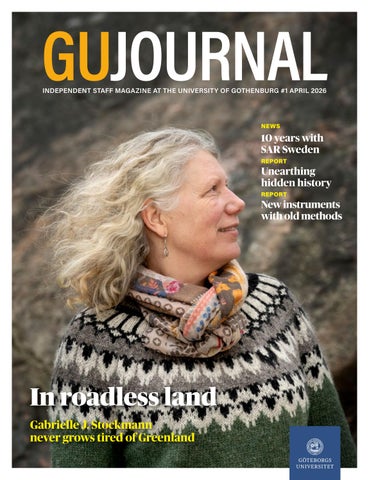
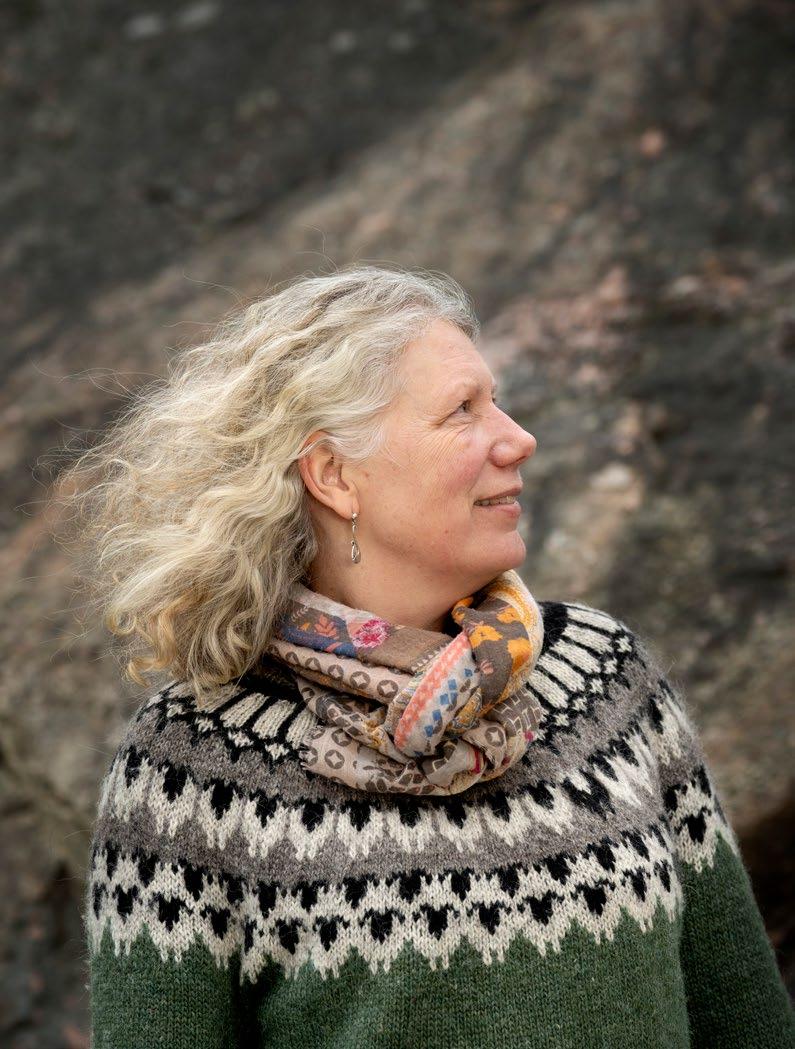
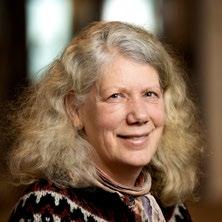
From the bottom of the Ikka Fjord in south-west Greenland around one thousand strange columns reach up through the water in formations that look like the ruins of ancient monuments. These unique structures are up to 20 meters in height and about 8 meters wide, comprising a very rare mineral called ikaite. – Plants and animals thrive among the columns. There are also bacteria that cannot be found anywhere else on Earth, says geologist and geochemist Gabrielle J. Stockmann. →
Text: Eva Lundgren Photo: Johan Wingborg
er doing her research on Greenland is no coincidence.
– I was born in Denmark but lived in Nuuk between the ages of nine and twelve. My mother is a nurse and was encouraged to work there at the end of the seventies as the wages were high and taxes were low. Occasionally she would work on a ship transporting patients that sailed to and from Nuuk, up and down the west coast of the island; and I got to accompany her. The years on Greenland were the happiest in my life and have affected my entire life. The schooling was in Danish, but I also studied Greenlandic and English. And because there were so many American troops there, all children spoke some kind of mix between all three languages.
On Greenland there are no roads between towns. Instead you travel by plane, helicopter, boat or dog team, which led to constant adventures, Gabrielle J. Stockmann explains.
– When I was eight I read a children’s book about the heroic sled dogs who in January 1925 travelled through snowstorms in Alaska to deliver medicine to the diphtheria-ridden town of Nome. Eventually the animated film Balto was made about one of those dogs. But it was the children’s book that made me get my first Siberian Husky when I was fourteen.
Her passion for dogs has been a constant part of Gabrielle J. Stockmann’s life. In 1984, she and her mother founded the Siberian Husky Kennel, where they bred sled dogs that they also competed with.
»The years on Greenland were the happiest in my life and have affected my entire life.«
GABRIELLE J. STOCKMANN
– Over the course of 22 years I had around sixty Siberian Huskies, often 12–18 dogs at a time. Donald Trump made jokes a while ago about Greenlandic patrol dogs not being very useful, but the fact is that dog teams work considerably better on Greenland than snowmobiles; they do not break down, if some dogs are lost, the rest can continue, and if you were to go through a hole in the ice they can pull you out. And in extremely rough conditions you can also eat the dogs.
Greenland has a special relationship with the United States. Much of the infrastructure that is still in operation were built during the American occupation in World War II. For example, enormous resources were invested in building air bases. Kangerlussuaq is still used by the military while Narsarsuaq has become an airport for civil aviation. Three additional civil aviation airports are being built on the west coast.
– Nuuk International Airport is already completed but is so far not working very well. It is located in an area that is frequently surrounded by fog, which constantly leads to flights being cancelled.
But the United States has been behind less beneficial interventions on Greenland as well. In 1968 for example, when a B-52 crashed outside the Thule Air Base. It carried four hydrogen bombs on board.
American troops as well as Danish and Greenlandic workers were deployed in the search, says Gabrielle J. Stockmann.
– And as Denmark does not allow atomic weapons on its territory the workers were not told what they were looking for. When it was later revealed, it lead to a political crisis. The four bombs were eventually found, but it is still unclear whether there may be some parts left on the sea floor.
But the U.S. Is interested in Greenland for other reasons than military ones. As early as in the late 1800s they bought cryolite from the island.
– Cryolite was used as an electrolyte in aluminium production. It was used to reduce the high melting point of aluminium hydroxide so it could be used for industrial production. Today, this is done synthetically making cryolite less in demand. Instead there are other rare earth metals, battery mineral and uranium that interest the Americans. But the harsh climate and the lack of infrastructure and labour make mining extremely difficult.
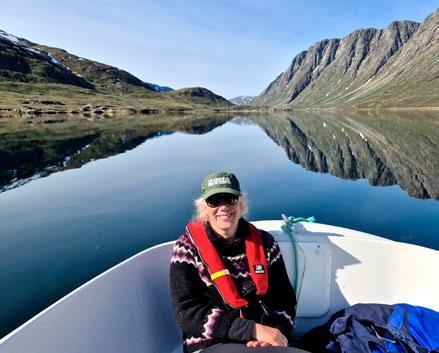
Gabrielle J. Stockman has studied the Ikkafjord and its ikaite pillars for 30 years.
In 2009 Greenland was granted increased autonomy, which means that the country retains control of its natural resources, environment, industry, judiciary and economy. But Denmark is still in charge of foreign policy and defence, and the currency is the Danish krona, says Gabrielle J. Stockmann.
– Greenlandic is the official language and the language used in primary school. This leads to a few problems: The island has around 56,000 inhabitants and the dialects are so different that they could be considered separate languages. Anyone who wants a higher education has to travel abroad, usually to Denmark, so they have to learn the language anyway. And the often remain in the new country, which is of course not ideal for Greenland’s development.
Nuuk is covered in snow from September to May and winters are long but not dark. The snow and the magical northern lights provides light and temperatures rarely fall below 10 degrees below zero. Leaving a wintry climate for rainy Copenhagen was difficult for twelve-year-old Gabrielle.
– It was awful going from a life in the open outdoors to living in a claustrophobic city. But I decided to return; so I trained as a geologist, because what else do you do if you have lived in a country with some of the oldest rocks on earth?
In 1988 Gabrielle J. Stockmann started her studies in chemistry and in 1992 in geology at the University of Copenhagen and ended them with a Master’s Degree in 1998. In between, she had time to do occasional work at the Thule Air Base and was there to celebrate their national day on June 21.
– The American military had invited local Greenlanders but knew nothing about their traditions. When they heard that I had lived on Greenland they brought me along as an expert on the local culture, a somewhat different assignment for a geologist. We got to experience local games, such as tug-o-war and drum dancing, and to sample the Greenlandic dish, kiviaq. This speciality is prepared at least six months in advance by capturing hundreds of birds. They are stuffed, feathers and all, into the stomach of a seal, after first having removed its innards. The seal is sewn back up and everything
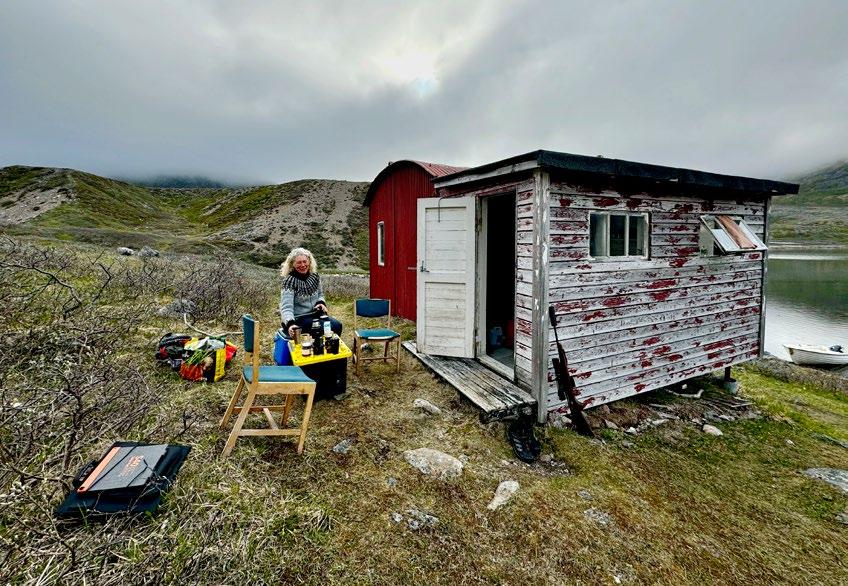
Previously, researchers could live in simple tents, but now proper cabins and weapons are required. This is because the area is increasingly visited by polar bears on drifting ice blocks.
Photo: Erik Trampe
ferments underground under some rocks. Eating those fermented birds during the celebration was a special experience, for me as well as for the American and Danish guests.
Gabrielle J. Stockmann has also worked at the Danish “Dansk Polarcenter”, she was a doctoral student in Reykjavik and Toulouse and also conducted research at Stockholm University and the University of Iceland. She frequently works side by side with her husband, Erik Sturkell, Professor of Geophysics at the University of Gothenburg.
In partnership with the Icelandic company, Carbfix, she has done research into a method for capturing CO2 emissions from industrial emissions. It involves adding water to the CO2 and subsequently injecting the solution into basaltic rock below ground. The CO2 then transforms into a mineral through a chemical reaction, Gabrielle J. Stockmann explains.
– It uses a lot of ground water so the method is not suitable everywhere. In our new experiments we are trying sea water instead; the method could contribute to solving one of the greatest environmental problems of our time.
One of the most interesting things Gabrielle J. Stockmann is working on is research into a field that she first heard about during her time on the geology programme at the University of Copenhagen.
– My teacher explained in his first lecture that if we were lucky we would be able to go to Greenland in three years. And he was right. In year three he asked me specifically if I wanted to join a research expedition to the Ikka Fjord. On the sea floor of the fjord, there are massive, growing pillars of ikaite which contain a unique ecosystem with a highly varied biodiversity. But I didn’t settle for just one trip there, it is now something that I have studied for 30 years within the IKKA Project, together with Erik among others. The project is a partnership between the universities in Gothenburg, Aarhus, Copenhagen, Stockholm, Reykjavik and Imperial College London.
Climate change is noticeable there in a very tangible manner.
– Previously the researchers could stay in simple tents, but now we require proper cabins and guns. This is due to the area being more frequently visited by polar bears on drifting ice floes that have broken off because of the heat.
By making use of the special devices available at Natrium the researchers are able to investigate how the ikaite pillars are affected by warmer water, Gabrielle J. Stockmann explains.
– Ikaite can only exist in sea water that is colder than around 6 degrees. In 2019 the water temperature in the fjord exceeded this critical limit and life on the pillars seemed to be in danger. But in the summer of 2024 the water had turned colder again. So we are hoping that this unique underwater world can be preserved, despite changes to the climate and the environment.
GABRIELLE JARVIK STOCKMANN
Jobbar som: Är Profession: Geochemist and geologist, affiliated researchers at the University of Gothenburg. Involved in the IKKA Project.
Family: Husband Erik Sturkell, Professor of Geophysics at the University of Gothenburg, and two Smooth Collies. Lives in: Landala Egnahem.
Latest book: Snöhild by Anne-Marie Vedsø Olesen.
Latest film: Superman with the dog
Krypto.
Hobbies: Sled and sheep dogs, hiking, visiting sites with interesting geology, nature and culture (most recently Scotland and Ireland), science communication …
New light on ancient Sicily
Nineyearold Kristian Göransson forced his parents to stop at every single ancient monument on the island of Öland, even though the rest of the family really only wanted to get to the beach. This passion about what archaeological finds can tell us about life thousands of years ago is still burning just as brightly. Today, the 53yearold is heading his own dig site on Sicily, a partnership between the University of Gothenburg and the Swedish Institute in Rome.
– Kristian leads the excavations in previously unexplored terrain
We are driving in a 4WD from Giardini Naxos on the east coast of Sicily to the mountains. This speed and convenience is far from what was possible for the Greeks during Antiquity, 2,500 years ago, when they started colonizing the Sicilian inland.
– We believe that it took a couple of hundred years from the foundation of Naxos on the coast around 735 BCE until they had built the city that is now hidden under the town of Francavilla, says Kristian Göransson.
By the small mountain town of Francavilla di Sicilia we park outside the 18th century palace Palazzo Cagnone, which now is home to the town’s archaeological museum. In the museum’s garden, we find the ongoing Swedish research project which is shedding new light on Sicily’s ancient history. The idea is to eventually turn the dig site into an archaeological park.
Kristian points to a steep cliff with some ruins at the top. It was built by the Normands.
– Our Sicilian colleagues find it funny that us Northmen are digging here, in the shadow of ruins left behind by the descendants of Vikings.
So what is it that Kristian and his colleagues have found? Could it be Callipolis, which is mentioned in the sources as a sub colony of Naxos, but which nobody really knows where it was located? Socrates spoke of “the beautiful city” – Callipolis – a utopian city in Plato’s Republic. But it was not only a utopian, philosophical concept, it was also the name of an actual city. There have been many places named Callipolis or similarly in the Greek world, such as Gallipoli in Italy. Having Swedish archaeologists unearthing a Sicilian Callipolis is a tempting
hypothesis, but like Kristian Göransson observes:
– We must stay strictly scientific in terms of what we are actually able to determine.
So what have they learnt so far?
Francavilla was built by Normands during the Middle Ages.
– But in 1979 a startling find was discovered at a construction site. Two cult buildings and a large number of votive offerings from the 5th century BCE. The most interesting ones were terracotta reliefs depicting the Greek fertility goddess Demeter and her daughter Persephone.
The fact that there was a temple to the fertility goddess in the mountains but no corresponding temple down in Naxos indicates that the mountain town was important to the people of Naxos.
It is seen as a clear link between the ruins now being excavated in Francavilla and the coastal city of Naxos, the first Greek colony on Sicily.
Kristian himself can be considered a link between the University of Gothenburg and the Swedish Institute in Rome, SIR.
– It was during my time as the head of SIR that the idea of a new excavation project was first discussed. The head of the archaeological park in Naxos, Maria Costanza Lentini, invited me to dig in Francavilla.
While Naxos has been systematically explored, Francavilla has long been only fragmentarily explored.
– That is precisely why it is so interesting. Each new investigation has the potential to give us a lot of new knowledge, Kristian Göransson argues.
The project followed him back to the university when he left SIR and became a senior lecturer at the Department of Historical Studies.
But the project very nearly did not get off the ground. Because the three Swedish Mediterranean institutes were threatened by closure in 2014 – and Kristian himself risked losing the job he had just started. But after massive protests, the government backed down and decided to keep the institutes.
– The archaeology course would have been impacted if wouldn’t have a base in
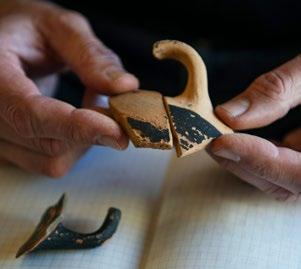
Kristian examines pottery shards at the field office.
Folk Rome. Now teaching is provided during ten weeks by the scientific staff in Rome and the same is true for Athens, where a corresponding course is taught by Stockholm University. The universities in Sweden would not be able to afford to hold such courses if they did not have local staff here. This is also true for other subjects such as art history and architecture, which is provided by other universities.
The project commenced in 2016 with geophysical surveys, after signing a partnership agreement between the Swedish Institute in Rome, the antiquarian authorities through the archaeological park in Naxos and the municipality of Francavilla. Besides Kristian, his colleagues Monica Nilsson and Henrik Boman, were there from the start. Both have doctorates from the University of Gothenburg, and the three of them are experienced field archaeologists who have worked together before, Monica and Henrik worked at Pompeii for example.
On site we also find doctoral student Ellen Siljedahl, Umeå University, and Irene Selsvold postdoc at the Norwegian Institute in Rome, professional excavator Giuseppe Scuderi and his assistant Vittorio Trovato, both of them Sicilians.
Excavating during the winter is a gamble, but summers in Sicily are extremely hot and the number of tourists during high season makes logistics expensive and difficult.
– We had a storm in the first week, but it has dried out now and we can keep working, says Kristian while showing us around.
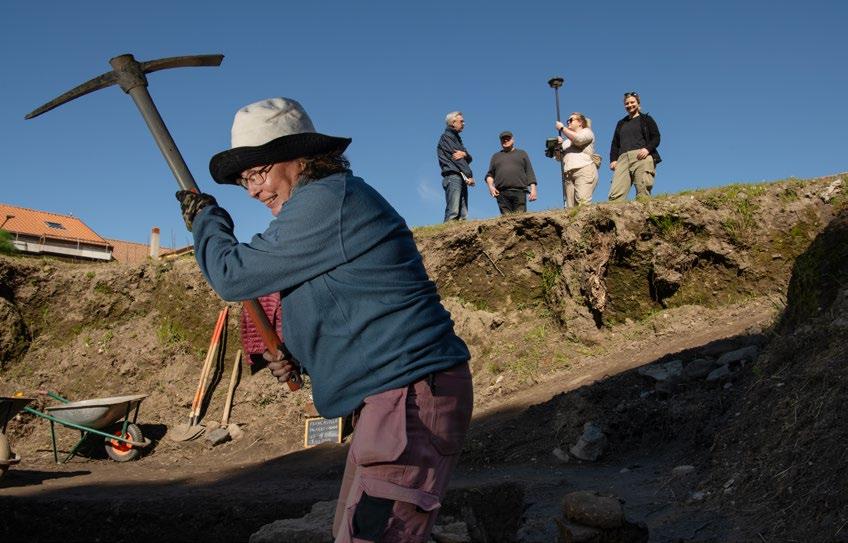
The area of excavation is around 50 square meters in size with a depth of two meters. Birds entertain us with a much varied concert while the team is busy with their tasks. Giuseppe uses a hoe, a shovel and a brush to carefully expose the soil, layer by layer in accordance with a strict grid pattern. The method of stratigraphic excavation was designed in the early days of archaeology in the 19th century and involves excavating the site from the most recent layer down to the oldest one.
Monica is cleaning the pottery and Kristian has found a particularly interesting shard. The volcano Etna is visible in the background.
KRISTIAN GÖRANSSON:
Profession:
Associate Professor and Senior Lecturer in Classical Archaeology and Ancient History, at the Department of Historical Studies.
Precious career: 2013–2019 Head of the Swedish Institute in Rome. Age: 53. Lives in: Gothenburg.
Current project: Excavations on Sicily.
Family: Partner, mother and brother with family.
Interests: Literature, music, art, wine and general history.
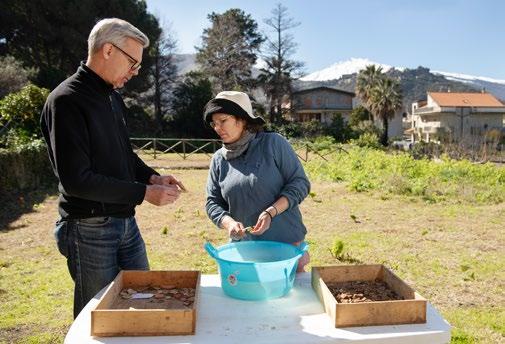
All the shards and other findings from one layer are placed in a box. When one layer is exposed, Irene will measure and document it using GPS. Some walls are already very distinct and for each layer laid bare, more of them become visible. Each so-called context – a wall, a floor, a filling layer – are meticulously documented. Slowly, traces of a residential building become visible.
– We often think of monumental temples and theatres when we think of Classical Antiquity. This is about residential architecture, showing us how people lived their lives day to day, says Henrik Boman, normally lecturer at the same department as Kristian.
The researchers work together to wash, dry, sort and register all the material. Monica is standing by a basin in the sun, carefully cleaning ceramic shards using a toothbrush.
– You must be careful not to use too much force as the ceramic material can then dissolve, she says.
Ceramics are the main source of knowledge. Organic material degrades, but the shards remain. By analysing shapes, clay and proportions the archaeologists are able to say something about everyday life, consumption and contacts.
– We are finding pieces of copper, plates, pots and amphorae. Most of it is local in origin, but we also see imports from the Aegean Islands and from Southern Italy. This shows that the site was integrated into a larger trading network, says Kristian.
Each layer is quantified. How many shards are from finer tableware, what are cooking utensils, pots, amphorae and other objects? It is very much about trying to piece things together.
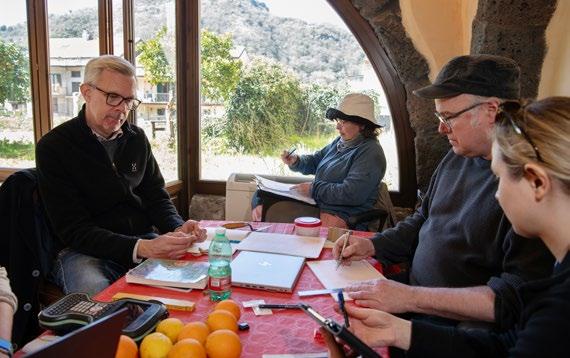
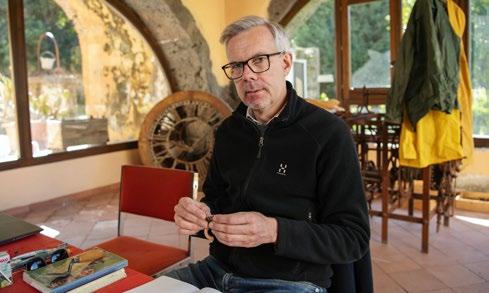
– It is important to try to piece together any shards that will fit, says Kristian who just found a couple of pieces that seem to fit together neatly. For example, if one place contains plenty of amphorae it may indicate that that room was a storage area. If there are lots of cooking utensils, it is probably a kitchen. Connected to the palace is a room with arched windows facing the garden. It houses a long table with chairs. Next to it is a gigantic rusted clockface with all its mechanics, as a sign of the time ticking on. This space is the researchers’ field office. On the table we find laptops, books on Antiquity and archaeology, sun-ripened oranges from the garden and a couple of boxes with ceramics. Kristian takes out his field diary. – Monica and myself take turns logging diary entries with text, sketches and photos of everything we do here.
Francavilla is strategically located by the Alcantara river, one of few on Sicily that never completely dries up, in a region of fertile volcanic soil. It had excellent conditions for agriculture and full control over the roads inland.
The excavations have confirmed that the site was settled from the 5th to the 3rd century BCE. The
»We often think of monumental temples and theatres when we think of Classical Antiquity. This is about residential architecture, showing us how people lived their lives day to day«
KRISTIAN GÖRANSSON
team recently found a coin from the third century BCE, minted in Syracuse.
– This is the most recent object that we can date with any certainty. Around that time, it appears the town was abandoned, says Kristian Göransson, who suspects the Punic wars may have played a part.
These wars between Rome and Carthage were a turning point. When Sicily became a Roman province the Greeks lost their position.
Has you view of the Greek presence changed?
– It has become more profound.
Perhaps the most important realisation is that the Greeks not only settled along the coast, which was believed for a long time, but also established strategic bases inland.
And the work will continue. Layer by layer, we get a better picture of the people who lived here 2,500 years ago.
The Swedish Institute in Rome and the archaeology course celebrating their 100th anniversary highlights a long tradition of Swedish humanities research in the Mediterranean. To Kristian, the link is clear: without the institutes in Rome and Athens there would be no continuity, no infrastructure and no field courses.
– Those of us who have no Greek or Roman ruins in our own countries are dependent on partnerships. Thanks to these institutes, Sweden maintains a strong position in classical archaeology. Without them , we would not be able to conduct this type of teaching or field work.
His experience as the head of the institute in Rome has also influenced Kristian’s work as a researcher and lecturer at the University of Gothenburg.
– I learned how to lead an operation, build international partnerships and represent Swedish research abroad. I still benefit from that today.
At the university he teaches courses in Classical Archaeology and Ancient History and conducts research about the Greek presence on Sicily and in North-Africa. He is also Director of Studies and Director of the university’s Museum of Antiquities.
Combining university work with field archaeology requires planning. The excavations take place only during a few focussed weeks per year. The rest of the time is spent on analysis, publication and, of course, teaching.
One century after the first Swedish archaeology students travelled south, their presence is still very much felt. And the
future is looking bright for Mediterranean archaeology, Kristian finds, although he takes nothing for granted. There is so much more to explore and to understand. And unlike his childhood vacations on Öland it now happens that Dottore Goransson also enjoys the occasional swim in the sea.
Text and photo: Anna Rehnberg
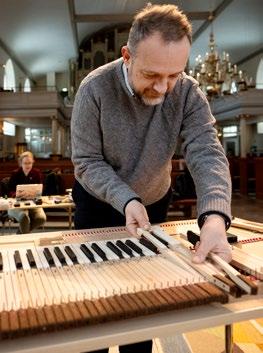
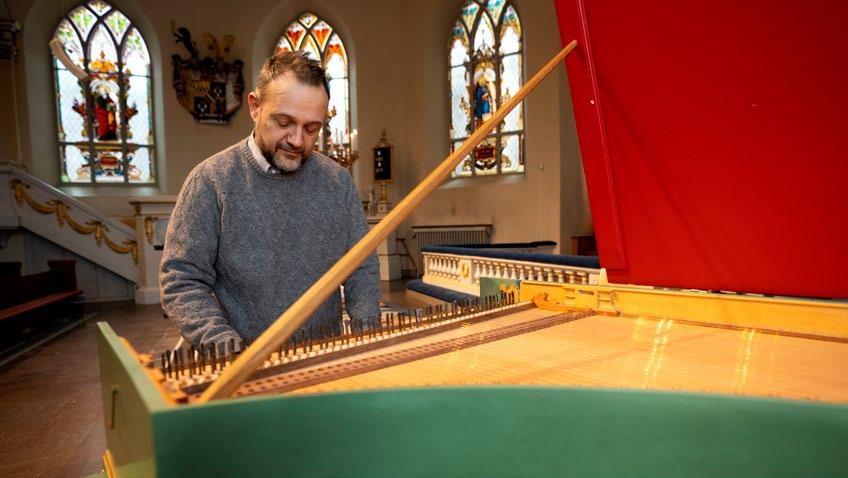
Massimiliano Guido testing the keyboard.
Recreates unique piano instruments
Accurate replicas of four musical instruments from the Renaissance to the Romantic period, this is what the pioneering Remke project will be building.
Among other things, they will be building a claviorgan. Anyone who does not know what that is can visit the German Church which houses a newly created copy in its chancel.
– Combination instruments were not uncommon during the Renaissance and Baroque periods. They were prevalent at several royal courts as well as in monasteries and churches, says Joel Speerstra, Senior Lecturer at the Academy of Music and Drama. He will be heading up the research project, in collaboration with Massimiliano Guido, Università di Pavia, and Andrea Schiavio, University of York.
– A claviorgan is a combination of a harpsichord and an organ. The strings are like those of a harpsichord, and it has pipes and bellows like an organ. You can either only play the harpsichord part or the organ part, or both at the same time.
The claviorgan in the German Church was built for the Göteborg Baroque Ensemble and was completed in 2019. It was part of the research project "Gamla" instrument med ny affordans (‘Old’ Instruments with New Affordance), Joel Speerstra explains.
– Within the scope of the newly formed REM@KE we plan to build yet another claviorgan. This time it will be a replica of an instrument constructed in 1781 in Augsburg by the prominent keyboard instrument maker Johann Andreas Stein (1728–1792). It was none other than Patrick Alströmer, Director of the Swedish East India Company,
founder of the Royal Swedish Academy of Music as well as a member of the Swedish Academy of Sciences, who some time at the end of the 1700s imported the instrument, which was later purchased by the wealthy Hall family.
Today, this claviorgan resides in the Museum of Gothenburg, which is a partner in the project, says Eleanor Smith-Guido, Assistant Researcher at the Academy of Music and Drama.
– The instrument is quite special, partly because it has several tones per octave, and partly because the organ part can be placed behind the musicians, which projects the music toward the audience. Stein was a creative instrument maker who made significant developments to the fortepiano, making it more expressive, and contributed to what would eventually become our modern piano. We know that Mozart visited Stein’s workshop, so he probably also played his instruments, even though this has not been corroborated. As far as we know, there are only three Stein combination instruments left: the claviorgan here in Gothenburg, as well as two harpsichord-piano combinations in Naples and Verona.
But no music written specifically for claviorgans has been preserved. In all probability, the musician would improvise the music or rearrange known pieces for the instrument, says Eleanor Smith-Guido.
Facts: REM@KE — Reconstructing Embodied Musical Knowledge at the Keyboard was officially launched on November 20–21, 2025.
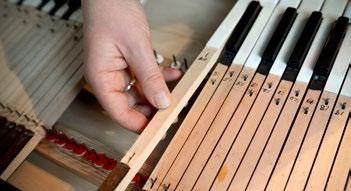
The unique project will build replicas of four historical keyboard instruments: a claviorgan, a spinet, a harpsichord and a pianino.
It is not only about recreating the objects themselves but also about understanding how the instruments interact with everyone, from instrument maker and musician to teachers and listeners. The sixyear project brings together expertise within organology, musicology, cognitive science, artistic research, restoration, applied cultural heritage, computer science, digital humanities and acoustics.
The project is a partnership between the Academy of Music and Drama (lead researcher Joel Speerstra), Università di Pavia (lead researcher and project coordinator Massimiliano Guido) and the University of York (lead researcher Andrea Schiavio).
The European Research Council provides over 8 million euro in funding.
– In partnership with the Museum of Gothenburg and the Gothenburg Research Infrastructure in Digital Humanities (GRIDH) I will develop a sociogram, i.e. a map detailing where in the city the instrument has resided and who has played on it. And I will also try to solve the mystery of what music was performed on it.
One important aspect of REM@KE is to build replicas of instruments that have not been copied before, which will lead to entirely new types of knowledge, Eleanor Smith-Guido explains.
– For example, we will investigate the meaning of embodied knowledge, where you learn how an instrument operates by working with the material, figuring out different solutions and personally experience what is easy or difficult, instead of just reading the literature. The same goes for the audience who will of course have a completely different experience when they listen to music played on an actual instrument, which they are also able to touch and feel, instead of merely seeing it in a museum. What happens in the mind, both with builders, musicians and audiences, is something that cognition scientist Andrea Schiavio, University of York, will be studying in depth.
In addition to the claviorgan, the project also includes a pianino built by the Parisian piano company, Pleyel.
– These instruments were known throughout the 1800s for their subtle
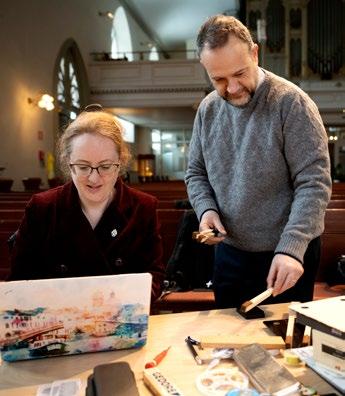
Massimiliano Guido and Eleanor Smith-Guido (above) are part of the unique project Remake, which is about recreating historical instruments.
dynamics and excellent sound. For example, Chopin complained in a letter about his Pleyel piano being delayed: “I dream of music but am unable to make any”.
The project also includes an Italian spinet, with its typical curved side and built by prominent keyboard instrument maker Girolamo Zenti (circa 1609–1666), says Joel Speerstra.
– The instrument is often associated with Bach. We will be making two copies to examine how having different instrument makers can affect the end product. The fourth instrument is a harpsichord, build by the German master Christian Zell (circa 1683–1763).
The project has several parts to it, such as a gender aspect, says Eleanor Smith-Guido.
– These types of expensive instruments were often played in the opulent lounges of the well-to-do classes, often by the wives or daughters of wealthy landowners or merchants. So there are probably many interesting stories to unearth.
Text: Eva Lundgren
Photo: Johan Wingborg
What? Who? When?
• The Academy of Music and Drama, University of Gothenburg.
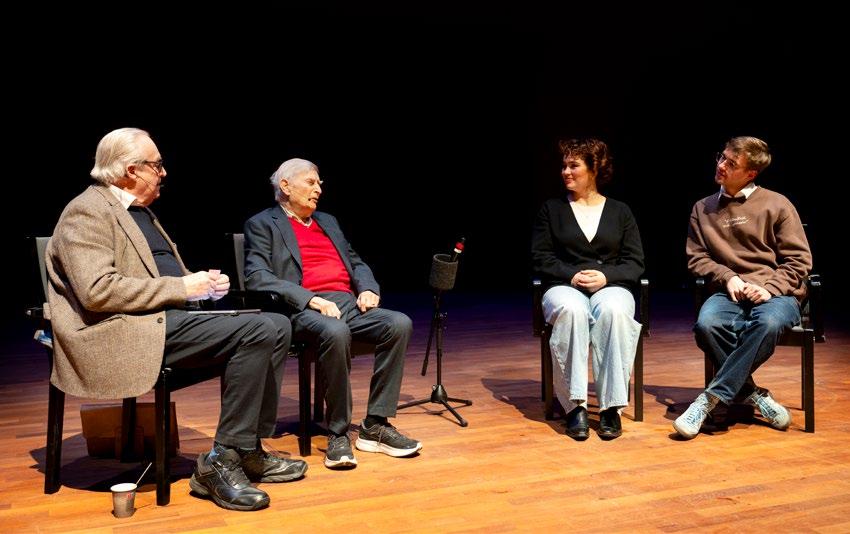
• The legendary conductor Herbert Blomstedt, born in 1927, who in 1999 became the first honorary doctor of the Faculty of Fine, Applied and Performing Arts; Sture Carlsson, former director of the Gothenburg Concert Hall; as well as the faculty’s most recent honorary doctor, and the students Tea De Maria and Pepijn Bessemans.
• 18 February 2026.
Short description
– Learn from the masters you admire, but do not imitate them—develop your own way of playing.
That was the advice Herbert Blomstedt gave during a conversation with Sture Carlsson at the Academy of Music and Drama. Blomstedt has served as chief conductor of, among others, the Sächsische Staatskapelle Dresden, the Swedish Radio Symphony Orchestra, the San Francisco Symphony, and the Gewandhaus Orchestra Leipzig.
– But it was during my youth in Gothenburg that I learned to love music, and all the musicians of the Gothenburg Symphony Orchestra were my idols, he said. In 1954, he received his first appointment as chief conductor, with
the Norrköping Symphony Orchestra, and he returned there in 2012 to take part in the orchestra’s 100th anniversary celebrations.
– Today’s orchestral musicians are far better than when I began, while competition has become extremely tough.
The conversation also included viola student Tea De Maria and trombone student Pepijn Bessemans, and students in the audience contributed questions.
– It is when you have completed your education that your studies truly begin. A good musician takes every opportunity to learn throughout life, Herbert Blomstedt concluded.