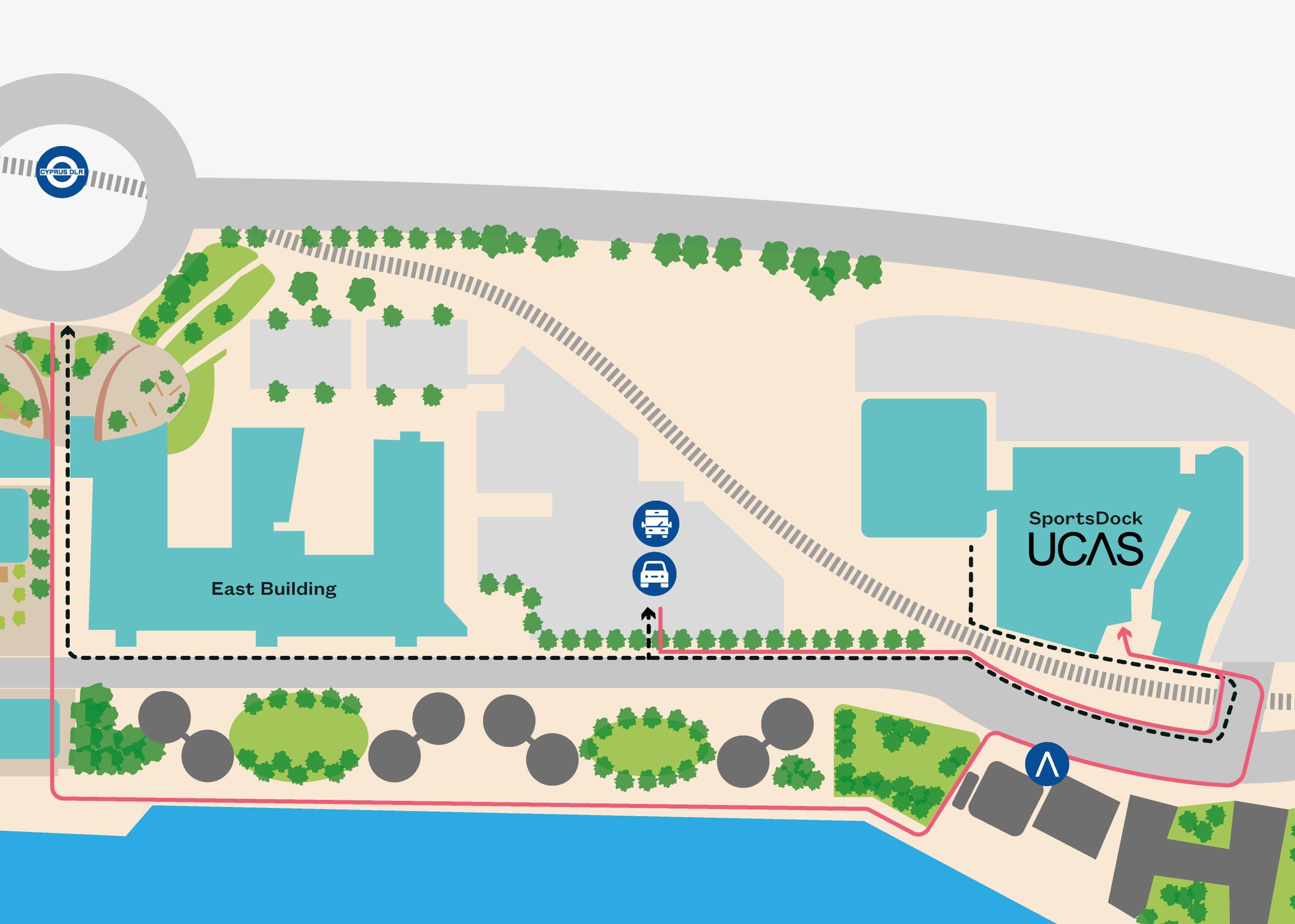
EVENT LOCATION INFORMATION
Location specific information for East London



Location specific information for East London
EVENT: East London
DATE: 3rd and 4th June 2026
OPENING TIMES: 9.30am –
2.30pm
VENUE: University of East London
Docklands Campus
SportsDock Arenas University Way London
E16 2RD
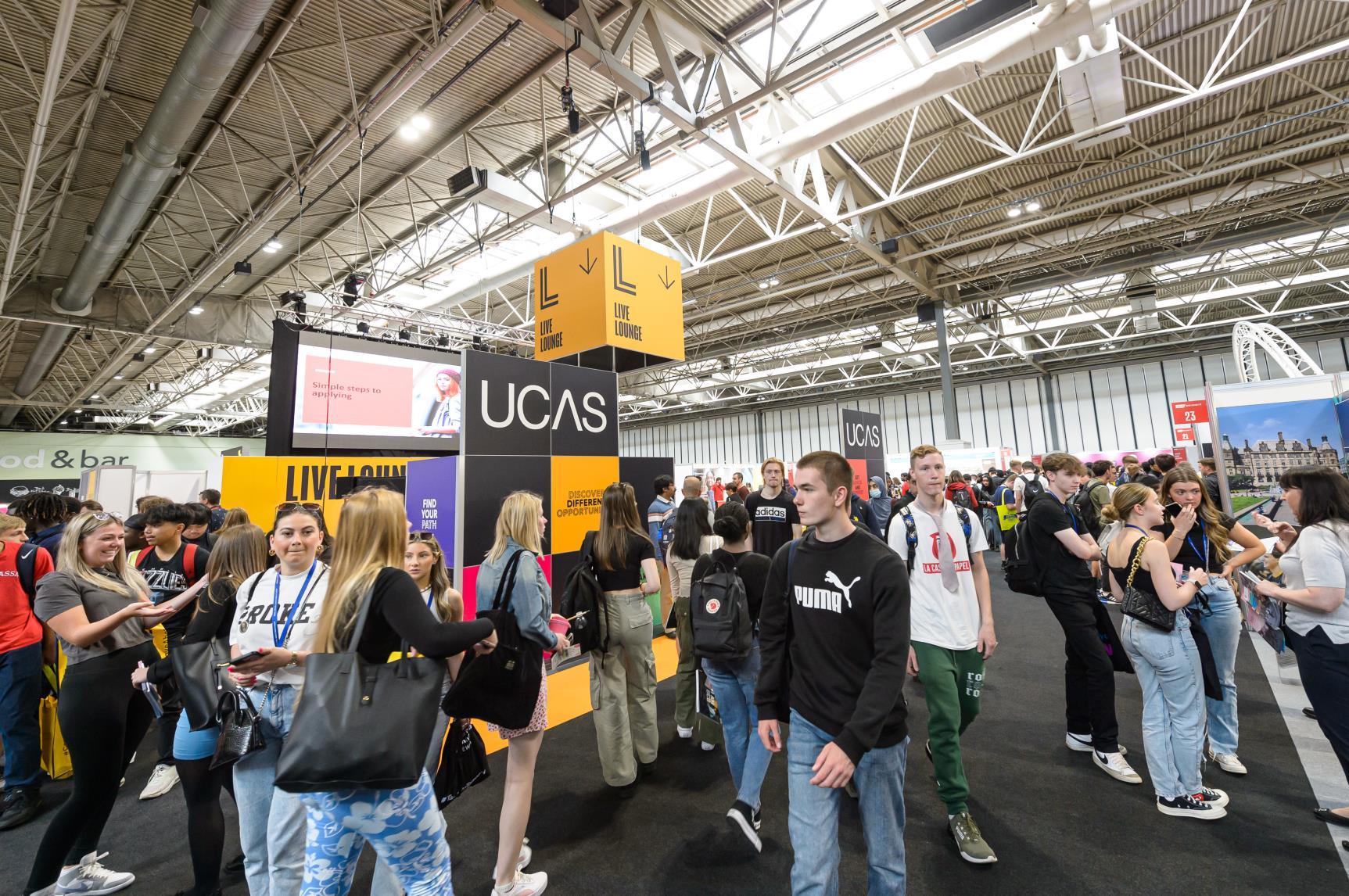
Please visit our website for our all our accessibility information.
Please find below details of hotels in the vicinity of the venue:
Hotel Novotel London Excel
Premier Inn London Docklands Excel
Hotel ibis London Excel Docklands
Please note that these hotels are just a guide for exhibitors and are not recommended by UCAS.
Parking for exhibitors will be available on campus, in the Residential car park (first left after the barriers), on a first-come, first-served basis.
You will need to print the exhibitor parking permit, and display this on your dashboard.
There will be no charge for parking, However, parking will be limited, and on a first-come, first-served basis. Parking is not guaranteed.
There are a few car parks nearby accessible by public transport:
Gallions Reach Shopping Park (Free) - E6 7ER
Asda Beckton Superstore (Free) - E6 5JP
Complimentary tea, coffee, and water will be provided for exhibitors in the exhibitor lounge, and food will be available to purchase from one of the marked catering points inside the SportsDock.
Designated first aid staff will be on hand at the venue for the duration of the event. If a first aider is required, please alert an event staff, security officer, or SportsDock reception.
Free Wi-Fi is available across the campus via The Cloud.
To take advantage of lead scanning at this event, you need to download the Smartlead UCAS and have purchased scanning for the UCAS/Discovery events. You will need a license code per device per event which are assigned to you when you purchase the scanning. Make sure your staff at the event have been provided with the license codes.
You will find a guide to setting up your device and how to manage your data in the Exhibitor zone [link] along with a Scanning Instructions document that you can share with your staff attending the event. Hard copies are also provided on your stand.
A member of the UCAS team will be on hand at the exhibitor/scanner help desk [not sure what this is called] to support you at the event or you can call 01242 544808 or email events@ucas.ac.uk.
All exhibitors need to provide a risk assessment for your stand build and any activities that will be happening on your stand. Please send this through to Emily Bibby e.bibby@ucas.ac.uk least 4 weeks before the exhibition date. The event organiser has completed a risk assessment for the event.
SCHEDULE:
BUILD DAY: Tuesday 2nd June 2026
08:00 – 15:00 Event set up
15:00 – 18:00 Exhibitor/contractor access.
EVENT DAY: Wednesday 3rd June 2026
08:00 – 09:15 Exhibitor access.
09:30 – 14:30 Exhibition open – trolleys will not be allowed on the exhibition floor once the exhibition has opened to the public.
14:30 – 15:30 Stand replenishment.
EVENT DAY 2 Thursday 4th June 2026
08:00 – 09:15 Exhibitor access.
09:30 – 14:30 Exhibition open – trolleys will not be allowed on the exhibition floor once the exhibition has opened to the public.
14:30 – 16:30 Exhibitor/contractor breakdown.
16:30 event breakdown
On arrival, please make your way to the SportsDock. Event staff will be able to guide you around the campus throughout the day.
To gain entry to the venue, exhibitor lanyards must be worn at all times. Your lanyard will be ready to collect when you arrive, from registration desk in Sports Dock Foyer.
To gain entry to the venue, you must register details of who will be attending before the event, through your ENet account – instructions on how to do this will be emailed to the lead booker.
Build-up times:
Tuesday 2nd June, 15.00 – 18.00
Wednesday 3rd June, 08.00 – 09.15
Exhibitors can drop off materials on Tuesday 3rd June at the entrance to sports arena 2. The postcode for the SportsDock is E16 2RD, and upon arrival you will be
directed to the drop off area. Once you have dropped off your items you must move your car to the main car park.
Breakdown time: Thursday 4th June, 14.30 – 16.30
Please note, trolleys are not provided, and will not be allowed on the hall floor once the exhibition has opened.
Exhibitors must remain on their stands, and not start dismantling them until the exhibition is clear of visitors. We anticipate this to be 5 to 10 minutes after the exhibition closes, at 14:30 on 4th June. To help facilitate this, and ensure health and safety is maintained, the loading doors will stay closed until the venue is clear of visitors.
Exhibitor name
Stand number
East London UCAS
University of East London
SportsDock
Docklands Campus
University Way London E16 2RD
Deliveries can be made from Tuesday 2nd June between 15:00-18:00. Any deliveries made before this time will not be accepted by the venue and returned to the sender. They should be sent to the University of East London’ SportsDock, and be clearly labelled with your organisations full name, your stand number, and venue address
If you are expecting goods to be delivered by courier, please make sure they are aware of the dates of the event, and venue opening times. All deliveries not clearly addressed, or those which arrive prior to the stated time, are likely to be lost or returned to the sender.
The organisers and event staff can be found at the exhibitor helpdesk located in arena 1.
If you need to contact us prior to the event please contact Kazi Yunaisa Ehsan, k.ehsan@uel.ac.uk
Storage will be provided in arena 2. Items left in this area will be at your own risk and we can’t take responsibility to lost or damaged items.
Trolleys are not provided at the venue, so please bring your own if you need one to deliver goods to your stand.
Trolleys are only permitted on the exhibition floor outside event opening hours, for the safety of visitors.
UCAS Events Team
E: events@ucas.ac.uk
T: 01242 544 808
Onsite general enquiries:
Look out for event ambassadors wearing coloured t-shirts, they can offer advice and answer any questions.
Please familiarise yourself with the onsite organisers office at each event for any questions you have or help you need



School/Institute/
Directorate/ External Client: External Relations
Name of Assessor: Laura Parker
Event Name/Type:
UCAS Discovery East London 3-4 June 2026
Date of Assessment 27/03/26
Location of Activity/Event: SportsDock, Docklands Campus
Reference/Title:
Review Date: 27/03/27
Overview of activity/event: please describe the activity/event in as much detail as possible (include date/time of activity, nature of activity, estimated number of participants, etc). If the activity to be assessed is part of a fieldtrip or event, please add an overview of this in the space below:
The University of East London will be hosting the UCAS Discovery East London Exhibition on 3-4 June 2026 in SportsDock. This exhibition is one of numerous exhibitions hosted across the country and its purpose is to connect prospective students with HE institutions and organisations. There are currently 131 exhibitors booked to attend however bookings are still open. We currently have 6,988 visitors pre-booked to attend the event across the two days. This number is likely to rise to 7,000 as there is capacity for more individual bookings.
Most bookings are group bookings from schools and colleges. Visitors will be arriving via train or coach. We have been made aware of which groups are arriving by coach and at what time. This information is passed to security, and they provide an officer to monitor the car park.
Visitors will be able to visit the exhibition stands in the arenas, attend seminar sessions on the first floor, and enjoy food and drink from our catering outlets in the loading area. Visitors have been booked in to arrive at the event in hourly sessions, from 09:30 until 12:30 and will stay on site for two hours. The event will be open from 9.30am-2.30pm.
UEL will also be exhibiting within the exhibition hall, speaking to prospective students, promoting our upcoming Open Day and Summer Festival, and collecting lead data.
We will be setting up for the event on Tuesday 2 June. Facilities and SportsDock staff will assist us with our setup and a small group of ambassadors will also be supporting us. Most exhibitors will be using an external courier company to deliver their materials and setup their stands. Arrival of the
couriers will be monitored by security and the Events Team. Risk Assessments for each exhibitor will be submitted directly to UCAS who will assess the risks. If required they will forward the risk assessments to me.
Expected number of people at one time in SportsDock (using 11am on 3 June as an example) spread across two arenas, two classrooms on the first floor and the outside catering area.
- Visitors - 1800 booked (conversion usually 65-70%)
- Exhibitors – 300
- Student Ambassadors – 25
- Staff helpers – 15
- Security - 15
Total attendees in 2025 = 4710 (67% conversion)
Description of Hazard
(only include significant hazards inherent within the task or the activity)
Person(s) at risk
e.g. staff, students, visitors, new & expectant mothers, children, unexpecte d persons, etc.
Overcrowding of event hall / stand
Public and exhibitors
Current control measures in place
(What are you already doing?)
▪ The floor plan has been designed to maximise aisle widths (a minimum of 2.5 meters wide) to avoid overcrowding.
▪ Suitable space around the stands and feature areas, which will be monitored, by floor managers and organisers.
▪ Exhibitors to ensure that staff manning the stands keep within their stand to avoid bottle necking in aisles.
▪ Organisers to reinforce this with any exhibitor deemed to be carrying out interactions away
Current risk rating
Further control measures required and by whom and when (usually only necessary where the risk rating is either high or medium)
from their allocated stand space.
▪ Organisers to schedule arrivals in line with venue capacities, and monitor arrivals with help from the venue, to prevent overcrowding. Coach arrival schedule also to be used if appropriate
▪ Appropriate staffing to be put in place by organisers, to manage the flow of visitors through the venue. All staff to be visibly identifiable.
▪ Organisers to monitor the exhibition area.
▪ Exhibitors to notify organisers should their stand, or the immediate locality of their stand, become overcrowded.
▪ All to obey instructions given by the organiser, venue staff or subcontractor used, to help control traffic and pedestrian flows.
▪ Organisers will share the traffic-flow plan and security will ensure it is
adhered to throughout the event.
▪ Maximum room capacities will not be exceeded and will be monitored by security and organisers.
▪ A dedicated security team will oversee the event and the team leader will keep in regularly contact with the organisers via radio.
Fire Exhibitors, contractor s, visitors, venue staff, organiser staff, student helpers
• Fire exits to be kept clear of obstructions.
• Fire extinguishers to be available in the venue.
• Ensure all waste is collected and stored correctly.
• A skip has been booked to dispose of the additional waste created by this event.
• A team of cleaners will be dedicated to this event and will ensure bins are emptied regularly.
• Exhibitors to ensure all waste and flammable
External food trucks will notified of our fire safety arrangements, risk assessments will be collected from them and they will be asked to dispose of rubbish immediately in the skip provided.
Evacuation Exhibitors, contractor s, visitors, venue staff, organiser staff, student helpers
waste material is removed from stand area.
• Exhibitors will use designated smoking areas.
• All staff and Student Ambassadors will be made aware of the Fire Notice informing them of what to do in the event of a fire and where to assemble following an evacuation., in addition, how to raise an alarm and use of break glasses/ fire extinguishers where practicable.
• Additional Security Officers will be booked to oversee monitor and control crowds.
▪ Venue to ensure fire prevention detection and alarm systems are adequate for the venue and have been checked and maintained in efficient working order.
▪ Organisers and venue to ensure the current number of exits from the venue are adequate.
▪ Floor plan submitted to venue in advance of the event for approval.
▪ Evacuation plan to be known by organisers and communicated to student helpers, exhibitors and contractors.
▪ Organisers to provide contractors, exhibitors and visitors with relevant evacuation procedure documentation, including fire assembly point.
▪ Exhibitors should ensure they are aware of the nearest emergency exit and keep all exits clear of obstructions at all times.
▪ Contractors, exhibitors and visitors to ensure they are aware of evacuation procedures, read all relevant documentation
provided, and follow all instructions given if needed to evacuate.
▪ Ensure all gangways and emergency exits are kept clear.
▪ All emergency exits maintained and kept clear for the duration of the event.
▪ Exhibitors should not block aisles or public areas, including during build-up and breakdown periods, and ensure that stand displays are kept within the allocated stand space.
▪ Organisers to ensure PA system can be heard clearly in all public areas, where possible.
▪ If any evacuation announcements cannot be heard over the atmospheric noise, then security staff are to go into the halls to evacuate people.
staff, organiser staff, student helpers stacked within the allocated stand space.
▪ Venue to provide adequate storage space for exhibitors to use during the event.
▪ UCAS to remind exhibitors via email of the Exhibitor Terms and Conditions, highlighting that exhibitors should keep their displays within their allocated stand.
▪ Organisers to check all exhibitor stands are appropriate and do not pose a trip hazard, before the event opens.
▪ Exhibitors should request that all empty, flat-packed, and broken boxes are removed from their stand by the event staff.
▪ Organisers and exhibitors to ensure empty boxes are cleared from stand, with assistance from student helpers.
▪ Organisers and exhibitors to ensure no
placed on hard floor and not the carpeted area to avoid slips. The noncarpeted area will be kept clean and any spillages will be immediately cleaned and dried.
Working at height Exhibitors, contractor s, venue and UCAS staff
trailing cables in stand area, or in adjoining pedestrian walkways.
▪ Maximum height build of 4m.
▪ All work to be carried out from a stable support – either ladder or scaffold – with suitable warning signs and barriers as necessary.
▪ Exhibitors to ensure all staff required to work at height are suitably trained and a separate risk assessment has been submitted.
▪ If Risk Assessments haven’t been submitted stand builds will be suspended.
▪ Suitable personal protective equipment (PPE) clothing and footwear to be worn.
Stands falling over Public and exhibitors
▪ All exhibitors to ensure their stands are safe and secure, and report any problems to the organiser.
▪ Any exhibitors with complex stands to submit their own risk
Special structure: platforms/marquee s etc.
Exhibitors and venue staff
assessment to UCAS Events.
▪ Organisers will ask any stand deemed unsafe to be removed or will work with the exhibitor to secure the stand.
▪ Special structure plans submitted and checked by the venue six weeks in advance of the event.
▪ Maximum height build of 4m.
Lifting equipment (FLTs, cranes etc.)
Power tools and heat sources
Contractor s
▪ Only the appointed qualified contractor supplied by venue or organiser to use lifting equipment.
▪ Power tools used by contractors have the minimum length of trailing leads and protection mechanically and visually from any damage. Such equipment is never to be left unattended with the power supply switched on.
▪ Appropriate signage and warning lights used, where necessary.
Catering facilities (mobile & static)
Variety of contractors and exhibitors on-site
Exhibitors, contractor s, visitors, venue staff, organiser staff, student helpers
▪ All catering facilities and staffing provided by venue, and therefore at the control of venue.
▪ Reputable and known concessions units only.
▪ Hygiene regulations to be followed rigidly.
▪ Catering company to employ suitable and trained staff.
▪ Catering staff to ensure all spills are cleaned immediately.
▪ External food suppliers will be asked to provide Risk Assessments, Food Hygiene certificates and Insurance documents.
▪ Allergen signage will be visible in all refreshment areas. Aramark staff will also be on hand to answer more detailed questions relating to allergens.
Contractor s and exhibitors
▪ Exhibitors to agree to a risk assessment as part of their booking and supply additional information where appropriate.
▪ Only experienced, reliable and approved contractors used.
▪ Organiser to be informed of any particular hazards arising prior to, and during the exhibition.
▪ Basic checks made on contractor and exhibitor risk assessments.
▪ Contractors are the specific responsibility of the hiring company, i.e. the exhibitor.
▪ Exhibitors are responsible to ensure that their contractors use appropriate equipment and are competent to do so.
▪ Estimated staffing number of contractors is two.
▪ All exhibitors and contractors wishing to work late must request permission from the organiser prior to the event, to enable security, first aid, electricity and lighting to be arranged for the
Electricity: connections, and power to stands etc.
Exhibitors
halls or particular stands.
▪ Each contracting firm must have a qualified first aider on their staff, covering crew staying late. The contractor must also supply the name of the person in charge and a contact number.
▪ No helium balloons allowed in the venue.
▪ Exhibitors to only use electrical supplies/sockets supplied by the event organisers, or those that have been supplied by subcontractors appointed by the organiser.
▪ The organiser’s appointed contractor will install power supplies on all stands, where needed. Exhibitors are not allowed to do their own wiring, due to potential sub-standard and dangerous installations being energised.
▪ Exhibitors to ensure equipment is used
safely and for the purpose for which it was designed.
▪ Exhibitors should ensure no sockets or connections are overloaded in their stand area, and, if in doubt, should seek approval from the event organiser.
▪ All electronic portable appliances brought to site by exhibitors should bear a valid PAT test certificate.
▪ Ensure all electrical risks are controlled, and a member of staff from the electrical contractor is onsite at all times.
▪ Only experienced, reliable and approved contractors used.
▪ All orders for electricity must be placed before the deadline, where applicable.
▪ UEL Maintenance will support the event. Floor plans and power requirements will be shared and discussed pre-event.
Manual Handling Venue staff, organiser staff, student helpers
▪ Maintenance will be responsible for the install and removal of all air coolers placed in both arenas.
▪ Use of equipment provided to reduce manual handling risks such as trolley/sack barrow.
▪ Employees are Trained in manual handling techniques.
▪ Assess a load before it is moved and evaluate the requirements of lifting.
▪ Storage areas are arranged so that heavy items are easily accessible and are stored at waist height.
▪ Breakdown large/bulky items to ensure they are light enough to handle safely
▪ Trolleys will be provided for use during
Exhibitors, contractor s, visitors, venue staff, organiser staff, student helpers
setup and pack down of the event.
▪ All security staff are first aid trained and their contact details will be shared with the organisers and UCAS.
▪ All requests for first aid or to highlight a medical emergency the Organisers, UCAS and Security will be notified
FREC 3 and 4 trained staff will be available for the duration of the event and provided by an external contractor.
Noise
Exhibitors, contractor s, visitors, venue staff, organiser staff, student helpers
▪ Music volume from the DJ will be kept a reasonably level throughout the event and will not exceed the agreed level.
▪ Consideration will be made for people with additional needs –For people who are overly sensitive to noise/loud spaces
Sporting Equipment (Badminton Courts, Table Tennis and Batak Machine)
Visitors and student helpers
– a quiet room will be made available for all events.
▪ Plasma screens will be muted to avoid unnecessary noise.
▪ Non-carpeted areas on Arena 2 will be used for the sporting equipment. The floors will be clean, dry, and free of obstructions.
▪ Visitors wearing inappropriate footwear will not be allowed to participate e.g. high heels.
▪ Participants will be limited to two per court at one time.
▪ First-aiders will be available in the event of an incident.
▪ Student Ambassadors will be supervising the
FREC 3 and 4 trained staff will be available for the duration of the event and provided by an external contractor.
Author- (Person writing the risk assessment and carrying out or managing/supervising the activity)
Authoriser- (Client, Line Manager or Supervisor responsible for the event/activity, others involved in the decisionmaking process, others advising on the activity e.g. Health & Safety Champions)
Laura Parker
sporting equipment at all times ensuring proper use of the equipment.
Laura Parker
Senior Events and Experiential Manager l.parker@uel.ac.uk
Senior Events and Experiential Manager
Health and Safety Adesola Adetoba
Declaration
I confirm that I have read the Risk Assessment, I understand the hazards, and risks involved and will follow all the control measures stated. If I have any queries or concerns, I will contact the above. Name Organisation
Laura Parker University of East London Staff
Risk assessment is the process of assessing an activity or area to identify the hazards involved and the degree of risk arising from those hazards. For every identified hazard, you will need to ask the following question:
‘Is the level of risk, taking into account and are the existing control measures or precautions, acceptable?’
If the answer is NO, then more controls will be required. If the answer is YES, then you must ensure that the identified controls are implemented and monitored to ensure they remain in place and are working.
Any risk assessment should be reviewed regularly – Once per annum or: At any point of significant change in working environment, in response to an accident or any changes in legislation or changes to best practice.
Hazards, risk ratings, control measures and responsible person(s) may vary. The example hazards and control measures are not an exhaustive list.
Risk rating = Likelihood x Severity
Likelihood: How probable/likely it is for this risk to occur (use the X-axis of the matrix below to determine the level and figure to assign to the risk). Example if it is almost certain that the risk will occur, the figure will be “5” as seen in the example provided in the table above.
Severity: The impact or consequence that the hazard identified (use the X-axis of the matrix below to determine the level and figure). Example, if the hazard occurs will result in a minor injury, severity will be “2” as seen in the example provided in the table above.
A stated above, to calculate the risk rating, you will then multiply the Likelihood by Severity; in this example 5 multiplied by 2 which will give you a risk rating of 10.
Colour-coding is essential for a risk assessment matrix to represent the combination level of probability and severity of the identified risks. It is expected that you fill in the box to reflect the risk rating (high risks must be in red, moderate risks in amber, and low risks in green.)
Risk Categories: Risk score = Likelihood of the hazard to cause harm x Severity which is impact created High: Rating 15 or more Medium: Rating 9-12 Low: Rating 1-8
Immediate action is required to control and/or lower the level of risk. Exposure to the identified hazard is prohibited or
Urgent review of University H&S arrangements with the aim of lowering the risk to the next level.
Usually, no further action will be required except for monitoring to ensure the risk does not change. However, if it is possible to reduce the risk levels still further, by using controls that are “reasonably
severely restricted, where necessary. practicable”, then this should be done.