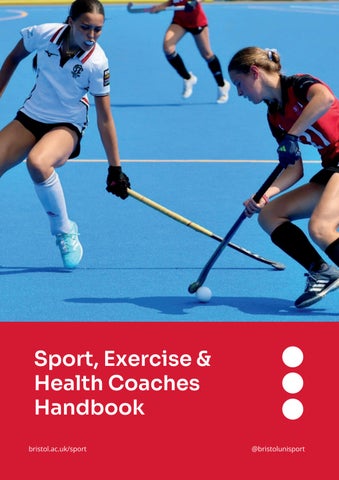
Sport, Exercise & Health Coaches Handbook bristol.ac.uk/sport
@bristolunisport
Introduction Hello to all Coaches and Leaders, I would like to welcome you all to the third edition of the University of Bristol Coaches Handbook. Inside these pages you will find all the information you will need to support your role with us, and help to make your coaching experience at the University a very positive one. We pride ourselves on a student-led approach in our sports clubs, and this allows huge development to take place amongst our student body, as they take pride in the offer that they give to their members. I believe this then gives you the coaches, a great opportunity to provide the guidance, the direction, and of course the technical knowledge to help the clubs achieve. The importance of a coach is bigger now than it has ever been, and the way to work with athletes and young people as they continue on their journeys makes the roles very special and unique for this age group. The impact that you can have on a student’s experience, can change lives, and instill life long memories that maybe talked about for years to come.
Matt Birch Director of Sport, Exercise and Health
The potential of students as they walk through the door is immense and we must all work hard to harness that drive, energy and potential into the right pathway for the student athlete. For some, success may mean an Olympic Medal or a representative shirt, and for others it may mean the opportunity to play in BUCS for the University at the highest level they can. Both are success stories and we need to be able to adapt, nurture and communicate well to help those chosen journeys. Supporting and developing athletes to their potential, as well as creating better people along the way, is vital in how we coach. We offer direction to students, many of who are on a Dual Career pathway with the academic course. It is always vital to remember why they are here, and how we can support both elements of their chosen passion. We have a great year in front of us, and I wish all of you the best in the up and coming season in your sports and on your programmes, We are looking forward to push forward in partnership with the clubs and the Sport Exercise and Health division. The Coaches handbook provides you a greater insight into all the support that is available for you as a coach, and also for the members of your clubs. Achieving great success stories is a team effort and being equipped with all the tools you need. What legacy will you leave behind this year in your student clubs? Best wishes, Matt Paine & Matt Birch
Matt Paine Performance Sport Manager
4
Sport, Exercise and Health Strategic Priorities Student sports clubs are a critical part of the division’s offer to students. It is therefore important that the process we adopt to allocate resource to clubs is in line with the division’s strategic priorities: 1. Improving Health and Wellbeing Increase the physical activity levels of our university community, driven by a focus on health and wellbeing. Work with internal and external partners to ensure the benefits of physical activity are part of a ‘joined up’ approach to student and staff health. 2. Supporting our Community to Thrive Provide an inspirational and inclusive sport and physical activity service that allows everyone across our community to thrive and reach their potential. 3. Developing Communities and Sense of Belonging Use the power of sport and physical activity to enable our community to meet like minded people, develop lifelong friendships and build connections with the university.
Contents Code of Practice
p 78
Strength and Conditioning
p 16-19
Payment Claiming Information
p9
BUCS Competition
p 20-23
Preseason
p 10-11
Game Changers
p 24
Student Wellbeing Services
p 12
Bristol Red Awards
p 25-26
Concussion Toolkit
p 13-15
Facilities and Bookings Information
p 27-36
Facility Matrix Timeline
p 16
Sport, Exercise and Health - Staff Management Team
Business Development Team
Sport & Physical Activity Team
Matt Birch - Director of Sport Exercise & Health matt.birch@bristol.ac.uk
Zaneta Nedza - Deputy Business Development Manager ka19711@bristol.ac.uk
Joe Leaver - Development Officer (Inclusion) joe.leaver@bristol.ac.uk
John Wilford - Sport & Health Manager john.wilford@bristol.ac.uk Gordon Aitken - Facilities & Operations Manager gordon.aitken@bristol.ac.uk Andy Trott - Director of Tennis andy.trott@bristol.ac.uk James Rowntree - Group Health & Fitness Manager james.rowntree@bristol.ac.uk Matt Paine - Performance Sport Manager matt.paine@bristol.ac.uk Jo Blackett - Business Development Manager jo.blackett@bristol.ac.uk
Vicky Dickson - Business Development Officer vicky.dickson@bristol.ac.uk William Horsley - Sports Administrator (BUCS CoOrdinator) performance-sport@bristol.ac.uk Kirsty Tomlinson Events Manager kirsty.tomlinson@bristol.ac.uk S.E.H Marketing & Communications Team SEH-comms@bristol.ac.uk
Molly Poulter Williams Development Officer (Wellbeing) molly.williams@bristol.ac.uk Lorna Hatch - Development Officer (Health) lorna.hatch@bristol.ac.uk Laura McCaffery - Development Officer (Sport) jx23090@bristol.ac.uk Operations Team Caitlin Crawford - Aquatics Manager Stefano Ronchi - Centre Manager, Indoor Sports Centre Jacob Garrett - Centre Manager, Coombe Dingle Sports Complex
Sport, Exercise and Health - Staff Coaches Strength & Conditioning (S&C)
Boat
Will Ruscombe-King – Lead Strength & Conditioning Coach Ethan Preddy – Strength & Conditioning Coach Gareth Pepperell – Strength & Conditioning Coach
Ed Bloomfield – Head Coach Freddie Bryce - Senior Coach
Rugby Olly Slym – Head of Rugby Mitch Eadie - Head Coach Men Amber Reed – Head Coach Women Holly Phillips – Assistant Women’s Coach Olly Robinson – Assistant Men’s Coach Steven Luatua - Assistant Men’s Coach Andrew Bell - Assistant Men’s First Team Tennis Andy Trott – Director of Tennis Ali Blackett – Head Coach Performance Olly Bendall – Tennis Co-Ordinator Jason Boon – Community Tennis Manager Hockey Chris White – Head Coach Men’s and Ladies Nic Suller – Performance Coach
Football Alan Tyers – Men’s Football Bill Meehan – Women’s Football Netball Chani Wopara – Netball Badminton Raj Popat – Badminton Polo Adam Smith – Women’s Water Polo Simon Halstead – Men’s Water Polo Cricket Chris Bolton – Cricket Volleyball Matthew Pollock – Volleyball Men’s Connor Robins – Volleyball Women’s Futsal Jono Tyrell - Futsal coach
Code Of Practice, Relationships and Responsibilities Your Responsibilities:
Your Behaviours: When coaching / leading or delivering for the University, you must showcase a series of behaviors that holds you accountable for your actions. Using your position to change and shape the lives of your participants,
1. Create an environment where everyone has the opportunity to participate in their chosen sport / activity at the appropriate level, 2. Maintain an environment free of fear and harassment,
Respect all participants at all times, and build relationships that can thrive, challenge and develop as athletes and as people.
3. Recognise the rights of all participants to be treated as an individual, 4. All participants have the right to seek
Use appropriate language at all times in sessions.
advice and guidance from coaches / experts and staff,
Do not allow any form of discrimination to go unchallenged.
5. Promote the concept of a balanced lifestyle, which support wellbeing of the participants in
Do not publicly use criticism or engage in the use of demeaning comments to others.
sport, and out of it. 6. Provide a space that all participants can
Communicate with, and provide feedback to participants in a way that shows respect, care and clarity of message.
attend, and feel supported, respected, and included in all parts of the session, 7. Use feedback to reflect on your sessions
Support for you as Coaches:
and participation satisfaction. Did you agree aims of the session and are they achieved?
Bristol SU – Code of Conduct
8. Make sure that all participants have
Sport, Exercise and Health Values and Behaviours
enjoyed the session, and want to come back again next week.
Student Health Service – University of Bristol Wellbeing Service – University of Bristol Concussion Toolkit
8
Allow time for your claim to be approved by the deadline – SEH must receive your claim by the 3rd of the month to ensure payment is made in that month. Any later and payment won’t be made until the following month. Submit your final month's claim before your end date. You won't have access to the system after this date.
Payment Claiming Info Hourly Paid Teachers & Training Support Roles As an hourly paid teacher (HPT) you claim your fees using MyERP. Payment is made on the 26th of the month, for work done in the previous month. You'll need to know: the department that will be paying each fee claim. your position ID
To view all your submitted claims 1. Go to Reports > My Reports > My HPT Claims. 2. All your claims are listed. Status D means the claim is a draft and has not been submitted Status N means the claim is active and has been submitted and is in workflow Status C means the claim has been closed and is no longer in workflow.
How do I find this information? 1. Log into MyERP using your normal UoB login and password (link opens in new window). 2. From the left-hand menu, go to My Details > My Personal Details 3. Select the Employment Details (HPT) tab.
3. You can Export the list for your own records if you want: Select Export at the bottom of the screen. Select any of the.xlsx options.
Entering your claim 1. Log into MyERP using your normal UoB login and password (link opens in new window). 2. From the left-hand menu, go to Forms > HPT Claim. 3. Press [Tab] to move to the Form description box. 4. Enter a general description of the claim, for example "Coaching claim – Oct 21". 5. Under the claim details, pick your Position ID from the drop-down list (see introductory paragraph for where to find this) and press [Tab]. 6. Applicant ID, Department and Role should get filled in automatically. 7. Enter the claim date range - date claimed from and date claimed to (inclusive). 8. Enter the number of hours you are claiming for. 9. In the Comments section, break down the number of hours you are claiming by date and number worked on that date. 10. Select Submit form.
To open/amend a draft or unapproved claim 1. Go to Forms > HPT Claim. 2. Select the Form ID box. 3. Press [Space]. Any incomplete claims (draft/unapproved) appear. 4. Select the claim to open it for editing and submission. Rejected HPT claims You'll receive a task if one of your claims is rejected. 1. Log into MyERP using your normal UoB login and password (link opens in new window). 2. Click on the Task icon (tick with an orange number next to it) in the top right of the screen. 3. Select the rejected claim task. 4. Look at the Workflow log section near the top of the form. 5. At this point, either: Make the required changes and click Resubmit, or Click Discard Any queries or questions regarding the above, please contact: Penny.Rowe@bristol.ac.uk
The form will go to Matt Paine to approve. As an hourly paid teacher, you must submit each claim at the start of the month, for work done in the previous month.
9
Pre-Season - August What is Pre-Season?
What do we offer HPT Coached sports clubs and all other clubs?
Our pre-season has developed into a leading pre-season structure within the UK university sector.
Term time slots can be requested to commence the first in September for preseason training ahead of the start of the academic year.
Simply put; it is the most important time of year to prepare for BUCS and your competitive season. We complete more training in preseason than any other block of the year - so that’s more training in 4 weeks of pre-season than the 12 weeks of term 1. With no academic pressure, this is the perfect time to improve performance, develop physically and technically, whilst having fun and making memories with your friends. When does it start? Pre-season will start in August for Head Coach and Coordinator sports, with all other sports starting in early September. What do we offer Head Coach and Coordinator Sports Clubs? 2 Technical sessions per day (Morning and Afternoon / Evening) = 8 per week 1 S&C session per day in the OWL = 4 per week Wednesdays and weekends off to recover and enjoy with friends 2 Home pre-season friendlies MDT Education Sessions - Sports Psyche, Nutrition, Physio and Lifestyle Catered breakfast and lunch for those returning in August (charges apply)
10
How do we attend? An expression of interest form will be sent to all eligible clubs – Summer
Turn up in August or September, ready to go with your club and team mates
All clubs who are eligible and expressed an interest in taking part in pre-season will be sent email confirmation and update on information/training slots
Term Time programme To streamline your week, S&C sessions run where possible in conjunction with your technical training - i.e. S&C preceding technical training.
Complete your summer programmes as set by the S&C team to best prepare for pre-season. Due to the importance of pre-season and the opportunity we get to coach, educate and explain our processes, all those who attend S&C sessions in term are expected to attend all of their club’s pre-season
Pre-Season - January Pre-season in January is an opportunity to return following the winter break to prepare for the 2nd half of the season.
When does it start?
Sign up via SEH form prior to attending your club’s first day pre-season, the link to preseason tickets will be sent to your club after you have expressed an interest in the Summer
Facility bookings resume from Monday 4 January 2027.
Contact Matt Paine (Performance Sport Manager) - matt.paine@bristol.ac.uk Facilities Team - seh-bookings@bristol.ac.uk
11
3
Mental health and wellbeing services
Residential Life Residential Life offers a support network for students living in university accommodation.
Our wellbeing services are free and open to all undergraduate, postgraduate taught and postgraduate research students.
Each village has a Residential Life team of full-time trained support staff. They are there to provide expert help, support and advice 24 hours a day, seven days a week.
Student Wellbeing The Student Wellbeing Service offers help and guidance if students are experiencing challenges, or want some extra support. Advisers will listen and help plan and problem-solve with students.
The team includes chief and senior residents who live in the residences. They provide approachable and familiar faces and will listen to individuals and offer support for whatever concerns or worries they may have.
They will also connect students with specialist services if they need specific support.
The contact details for the support centres in student villages: North, West and East Residential Support Centres.
Request wellbeing support
Sexual Violence Liaison Officers Our team of male and female Sexual Violence Liaison Officers (SVLOs) are specially trained to support any students who have experienced any form of sexual violence.
Student Counselling Student Counselling offers short-term individual counselling with experienced counsellors. They also offer therapeutic groups where individuals can discuss their issues with peers, led by a trained counsellor. These include:
Find out more about the support the SVLOs can offer.
bereavement group cognitive behavioural group Mandarin speaking group postgrad support trans group women's group Students cannot book directly. When students request support from student wellbeing, they will connect them to the best support or service. Disability Services Disability Services support students with a range of disabilities, learning difficulties and other health and mental health conditions. Find out which students are supported. Mental health advisory service The team work with students who have been referred with complex mental health difficulties. If students are referred, a mental health advisor will create a care plan for them which will focus on their strengths and help them find the right support at University and in the wider community.
12
UOB COACHES GUIDE
CONCUSSION What is it and what to do? Concussions are a form of brain injury caused by twisting or bouncing motions of the brain in the skull. Research suggests that ~1/2 of athletes would return to sport experiencing concussion even when symptoms! Prompt symptom disclosure enables faster recovery and return-to- play (RTP) and prevents the impact risk of which second syndrome, can result in very serious, potentially fatal, brain swelling.
Women often report higher symptomology and severity postconcussion, calling for a greater need for women to follow the RTP/RTL guidelines to ensure speedy recovery.
Anyone with a suspected concussion MUST BE REMOVED FROM PLAY IMMEDIATELY
Medic on-site: listen to and follow the medics advice. They will direct you based on symptoms you have.
No medic on site: send athletes to Student Health Service (SHS) or call 111 (NHS). If you notice any of the red flags at the bottom, the athlete requires urgent medical attention
They must not return to activity that day and until an appropriate Healthcare Professional has excluded concussion or they have completed a return to learn and sport programme. Do your best to ensure they are supervised in a safe manner for the next 24 hours.
Direct students to our Concussion Toolkit to follow our recovery advice and 6-stage returnto-play (RTP) and return-to-learn (RTL) guidelines.
Direct students to our Concussion Toolkit 13
WATCH OUT! Concussion symptoms may be delayed following a head injury so keep an eye out!
UOB COACHES GUIDE
Red Flags! Don't ignore these red flags, athletes should seek immediate medical advice from Student Health Services (SHS) or A&E if they are experiencing any of these. This toolkit is not to be used as a replacement for advice from a qualified practitioner.
Symptoms
Physical Signs
What the athlete tells you / what you should ask about: Headaches Ringing in ears Nausea Vomiting Fatigue Visual problems Confusion and mental fogginess Amnesia Dizziness Sensitivity to light or sound
What you might see / what you should look for: Loss of consciousness Slurred speech Delayed question responses Dazed appearance Forgetfulness - e.g., asking the same thing multiple times Lying motionless on ground/slow to get up Vomiting Grabbing/clutching of head
Use this tool for baseline testing, symptom tracking and head injury assessments!
Baseline Testing Encourage your athletes to baseline test at least once before the season starts!
Baseline testing is important for all athletes, so that symptoms after a suspected head injury can be compared to pre-injury levels. If they are significantly different, the athlete may have sustained a concussion and should go to their GP/SHS (or call 111) for a formal diagnosis and then follow our six-stage return-to-play (RTP) and return-to-learn (RTL) guidelines. Baseline testing is especially important for women! Their baseline symptoms are likely to be different at each stage of their menstrual cycle. So, tracking and understanding these will help you to differentiate between true concussion symptoms and menstrual cycle symptoms.
14
UOB COACHES GUIDE
Encourage symptom tracking if athletes are concussed Symptom tracking is important for... Tracking recovery - check they are getting better, not worse! Noticing if levels of exercise in a particular stage are worsening symptoms - recovery process is being rushed! Identifying delayed symptoms of concussion - signs for concussion are not always obvious at first, they can take 24-48 hours - If so, direct athletes to seek medical advice! It is especially important for women, who should compare their symptom tracking tests to their baseline tests from a similar stage of their menstrual cycle to see whether any exacerbated symptoms are a result of their cycle rather than recovery relapse.
Being a Supportive Coach Direct them to our Concussion Toolkit - this provides guides on coping mechanisms, maintaining a positive mindset and reaching out to social support networks. Understand the Return to Learn and Return to Play protocol. Sorry coaches, return to learn comes first! Athletes should only be back at full (contact) training after 14 days symptomfree at rest. Whilst the athlete is unable to train, help keep them involved by giving them coaching responsibilities - helping you run and plan training sessions or managing the team on game days. Check in on them - maybe their unsure of where to get help or just need a cup of tea and some motivation! Assign the concussed athlete a recovery buddy who helps them to stay accountable to their injury. Understand that women may take longer to recover, may have different symptoms or higher symptom severity.
Other Useful / Sport-Specific Resources NHS - Head Injury and Concussion UK Concussion Guidelines for Non-Elite (Grassroots) Sport Headway
The FA - Football Concussion Guidelines RFU - Headcase GRAS Programme England Netball Concussion Policy England Hockey - Concussion Guidelines for Parents & Coaches 15
Facility Allocation Timeline for 2027
October 2026 Launch of new platform for submitting evidence against criteria for 2027 scoring process
3 May Deadline for the second round of matrix request form from clubs
8 March Deadline for completion of matrix scoring submissions
w/c 8 March SEH Facilities Team review submitted scores
w/c 26 April Initial club allocation published and requests for round 2 applications opens
w/c 17 May Issue Second round of facility allocations. Swap period begins
15 March Round 1 of facility allocation requests opens - in priority order. Form circulated to Club Captains
w/c 19 April SEH Facilities Team allocate first round of facilities
30 May Any feedback / swaps to be submitted to Facilities Team
11 April Deadline for the first round of facility allocation requests
By 11 June All letters / financial commitments confirmed with clubs and final timetable published
16 COACHES GUIDE
14
Strength and Conditioning (S&C) What is Strength and Conditioning?
Staffing Structure
We offer a leading strength and conditioning programme within the UK university sector to improve the performance of our sports teams. Our philosophy is based on our long-term athlete development model: Prevent, Prepare, Perform.
Head Coach
Our first stage is to develop physical qualities to prevent injury so you can train with your coaches, then prepare the underpinning physical ability for performance to these key physical abilities in line with priority fixtures or times of the season.
Coordinator
S&C support 2- sessions p/wk, with resource allocated in collaboration with Head Coach 2- sessions p/wk, with resource allocated in collaboration with the club’s Coordinator
HPT Coach
Fundamental Values of S&C: Turn Up, Work Hard, Have Fun.
2 p/wk in line with technic al training where possible
What do clubs need to do to be considered for S&C?
Whilst the outcome of S&C is to improve performance, we don’t care who is the strongest, fittest, or fastest. All we care about is the process of this. This is embodied by our core values.
Clubs who are interested in S&C need to contact our S&C Team to discuss your club's options.
Turn up, Work Hard, Have Fun. The outcome of this process is attendance. We have an expectation that individuals will attend a minimum of 85% of sessions. Due to the capacity of the gym, and to ensure this is a safe and effective space, S&C squads will be capped relative to the sport size and timetable. The total capacity of the gym is 40. Whilst we may use training or physical data from time to time to make sure we are maximising your physical development and provide training direction, the only metric which individuals and clubs are accountable to is attendance. Simply put, we can only do our job if you turn up to sessions. S.E.H reserves the right to withdraw S&C support from clubs who aren’t achieving attendance expectations.
Contact • Matt Paine (Performance Sport Manager) - matt.paine@bristol.ac.uk • Will Ruscombe-King (Lead Strength & Conditioning Coach) - will.ruscombe-king@bristol.ac.uk
17
S&C Programme -Term 1 Head Coaches & S&C Team 17 Aug to 11 Sept
26 Oct to 31 Oct
26 Nov to 11 Dec
HC - Squad selection (deadline 4 Sept)
HC - Confirm schedule
S&C - Individual attendance
S&C - Full profile completed deadline
S&C - S&C attendance
tracked to last S&C session;
11 Sept; S&C Data following profiling;
and squad reviewed
Attendance feedback given
21 Dec to 1 Jan
Total attendance numbers Term 1 to Consolidation Week
Consolidation Week Week +3
End of Nov to end of BUCS
Consolidation Week
Preseason
Exam period Winter vacation
11 Sept to 23 Oct
2 Nov to 24 Nov
14 Dec to 18 Dec
S&C - Standards & expectations
S&C - Termtime profiling
Exam period - programme
presentation to S&C squads;
completed; S&C data
finished for term
Individual attendance tracked
feedback following profiling
fromm confirmation of S&C squad
S&C Programme -Term 2 Head Coaches & S&C Team 22 Feb to 26 Feb
4 Jan to 8 Jan
1 Mar to 19 Mar
22 Mar to 14 Apr
HC - End of term 2 “window” agreed
HC - Reset for winter sports -
S&C - Profiling completed -
update S&C Squads prior to
individual programme to follow;
Term 3 for non-summer sports (deadline 8/4); Term 3
S&C data feedback following profiling
integrated plans completed Consolidation Week to end of Term
Preseason to Consolidation Week
Consolidation Week
Preseason
11 Jan to 19 Feb
End of Term Spring vacation
Cup Run
1 Mar to 19 Mar
19 Mar S&C - Aerobic capacity profile
S&C - Individual
(where appropriate);
attendance data tracked
Attendance daeta feedback feed into updated S&C Squad
S&C Programme - Term 3 Head Coaches & S&C Team 12 Apr to 3 May
24 May to 28 May
31 May to 13 Aug
HC - Updated S&C Squads (if applicable) in prep for next year
summe engagement -
S&C - Term 3 & summer prog. -
sports specific solutions
individualise from profiling data; Athlete
S&C - Mid summer
profiling feedback & work-ons; indiviudal attendance records until end of Term 3
16 Aug - 10 Sept
HC - Coaches to drive
End of Term
Exam period
Term 3 5 May to 21 May S&C - Individual attendance tracked for interest but not accountable to this during the exam block
Post exams Week
profiling
End of Term
Summer vacation 31 May
18
Preseason 1 Jun - 13 Aug HC - Preseaon preparation S&C - Preseason preparation
S&C Programme -Term 1 Athletes 17 Aug to 11 Sept
26 Oct to 31 Oct
26 Nov to 11 Dec
21 Dec to 1 Jan
Graft during the best
Off where possible
Move to 1 required, 1
Completed Christmas
time of the year
depending on
optional S&C session
programme
Athlete’s opportunity to
competition structure
(two weeks prior to
Athlete’s opportunity to
demonstrate their
(we will give you as much
exams)
reset for Term 2, taking
inclusion in the
time off as possible)
Term 1 to Consolidation Week
performance suqad
Consolidation Week +3
advantage to recover and prepare for Term 2
End of Nov to end of BUCS
Consolidation Week
Preseason
Exam period
11 Sept to 23 Oct
Winter vacation
2 Nov to 24 Nov
14 Dec to 18 Dec
Full training schedule - start the year as
3 weeks to “go again”
Exam period -
you mean to go on
following Reading Week
programme finished for
Top-up conditioning for those who need it
term
Athletes accountable for attendance data from selection of S&C Squad
S&C Programme -Term 2 Head Coaches & S&C Team 22 Feb to 26 Feb
4 Jan to 8 Jan
1 Mar to 19 Mar
22 Mar to 14 Apr
Dial into performing
Full attendance to
Play-offs
prepare for the business
Camps (where
end of the season
appropriate)
Athletes accountable to attendance data from day 1 of January preseason
Consolidation Week to end of Term
Preseason to Consolidation Week
Consolidation Week
Preseason
11 Jan to 19 Feb
End of Term Spring vacation
Cup Run
1 Mar to 19 Mar
19 Mar
Business time! Full schedule
S&C Programme - Term 3 Head Coaches & S&C Team 24 May to 28 May
12 Apr to 3 May Summer competitions (if
31 May to 13 Aug
16 Aug - 10 Sept
Summer competitions (were applicable)
applicable)
Everyone else: Win Wednesdays now -
Term 3 profiling - all
huge opportunity to physically develop
returners must complete
ahead of next season
End of Term
Exam period
Post exams Week
Term 3
5 May to 21 May Use S&C to improve your academic work Develop physical qualities as much as possible in line with academics
End of Term Summer vacation
31 May
Preseason
1 Jun - 13 Aug
BUCS Competition “What is BUCS?”
S.E.H BUCS League Responsibilities:
BUCS (British Universities and Colleges Sport) is the National Governing Body for competitive, performance-level inter-university sport.
• Communicate with BUCS • Schedule fixtures • Allocate facilities • Book & schedule coaches (for teams of over 8 people)
The University of Bristol is a BUCS Member Institution, and we can enter representative teams in BUCS-run Leagues and Events to earn our institution BUCS points.
• Communicate with other institutions
Club BUCS League Responsibilities:
BUCS is a fantastic opportunity for you and your club-mates to play high-level, competitive sport and represent your university in fixtures against other institutions.
• Sign up to BUCS Play • Enter team sheets for league fixtures • Enter scores for league fixtures
“Who participates in BUCS Competitions?”
• Fulfil your fixture
Clubs who are affiliated with Bristol SU are eligible to compete in BUCS by evidencing continued, sustainably high member numbers (30+), strong club development practices (such as engagement in the Bristol SU Group Accreditation system) and participation in nonBUCS leagues and events in their discipline. BUCS Competition suits student-athletes looking to engage in high-level competitive sport alongside their studies.
My club is participating in BUCS Leagues next season – what do I need to know?” If your club will be competing in BUCS competition next season, specifically in a league format, we would like you to be familiar with the details of BUCS competition, BUCS regulations and how S.E.H will administrate and support your club’s campaign. BUCS participation comes with associate financial costs. S.E.H finances entries to BUCS competitions, and affiliation to BUCS for competing clubs.
“Who facilitates BUCS Competition at the University of Bristol?”
S.E.H also allocate funding for transport and accommodation. The total figure allocated to each club will be confirmed in August each year. Details of your club’s expenditure will be available via the S.E.H BUCS Club Spend Tracker. Clubs will be contacted to with updates of their spend in January and the invoices for overspend will be issued in April.
Our BUCS Programme is managed by the Sport, Exercise and Health (S.E.H) Division of the University of Bristol. Each Member Institution will have at least one BUCS Institute Administrator (IA) (Sports Administrator (BUCS & Competitions) - William Horsley) that administrates representative teams’ fixtures. Institute Administrators and Club Captains will both use the BUCS Play app, developed by BUCS, to jointly administer BUCS competitions.
20
S.E.H BUCS Event Responsibilities:
S.E.H will organise coach transport for teams of over eight athletes, with smaller teams driving / taking public transport to fixtures and claiming back fuel costs. Cost of transport/claim is deducted from the allocated funding support for the club and can be tracked on the S.E.H BUCS Spend Tracker. Clubs can opt-out of S.E.H organised transport.
• Communicate with BUCS • Communicate with other institutions • Approve entries
Club BUCS Event Responsibilities: • Contact Institute Administrator expressing interest
BUCS League Timeline Team Entry Review
• Sign up to BUCS Play
April
• Enter your event
Team Entered May
• Book transport
Season Calendar and Leagues Announced
• Book accommodation
June/July Fixtures Announced
“My club is participating in BUCS Events next season – what do I need to know?”
July Welcome Back & Pre-Season
If your club will be competing in BUCS competition next season, specifically in BUCS events, we would like you to be familiar with the details of BUCS competition, BUCS regulations and how S.E.H will administrate and suppor t your club’s events.
August BUCS Team Training August BUCS Team Training
S.E.H finance agreed entries to BUCS competition,
August
and affiliation to BUCS for competing clubs. S.E.H will also provide financial support for transport
BUCS Leagues Start September
and accommodation costs – your club will be provided with their funding amount in July prior to the beginning of the season. Individual athletes must register for BUCS events
Winter Break Starts Mid-December BUCS Leagues Recommence
on BUCS Play – these athletes can then be approved and entered by our Institute Administrator.
Mid-January BUCS Premier Tier Playoffs March/April
“My club is interested in joining BUCS competition in the future – what do I need to know?”
BUCS leagues begin in late-September, and run through to April, with a winter break between mid-December and mid-January. Predominantly, fixtures take place on a Wednesday, however teams will occasionally be required to compete on other weekdays or weekends. Club and team captains have a range of
BUCS Competition takes the form of leagues with regular fixtures, or one-off events. You can find out the format of your sport on the BUCS sports webpage:h ttps://www.bucs.org.uk/compete/sports.html.
administrative responsibilities to conduct before and after league fixtures. These will be conducted v ia the BUCS Play app, and include uploading team sheets and entering scores on the BUCS Play App.
21
Walkovers
Clubs wishing to enter our BUCS programme need to have a member base of 30+ and evidence of competing in non-BUCS national or local leagues or competitions.
By entering into BUCS all your clubs’ teams are expected to fulfil all of their fixtures. Conceding walkovers has financial as well as performance implications through fines and loss of BUCS points. Therefore, any club that concedes a walkover will receive a £100 reduction in S.E.H BUCS Funding for the subsequent season. I.e. a club that concedes one walkover in the 2026/27 season will have £100 taken away from their S.E.H BUCS Matrix Allocation for the 2027/28 season.
Once an expression of interest is received, we would meet with the club to discuss the demands of BUCS competition – the commitment e.g. long days, administrative responsibilities, financial costs, and the requirement to fulfil every single scheduled fixture. The Team Review process begins in April, with team entries finalised in May. If your club is interested in joining our BUCS programme and competing in BUCS Leagues or Events, please contact performance-sport@bristol.ac.uk before the Team Review process begins.
Consolidation Weeks On consolidation (reading) weeks (26th - 30th October 2026 and 22nd – 26th February 2027) clubs will need to fulfil their fixture. Clubs entering into BUCS are committing to playing a full season and this includes fixtures on these weeks. Do not expect there to be any less of a fixture schedule on these weeks (league or cup).
Fixture Changes Fixtures are scheduled and released by BUCS in July. Our internal teams then begin work coordinating facilities, medical, travel, and other servic es for these fixtures. Fixtures will not be moved following the 1st October unless there is an issue with one of the following: weather, facilities or national health guidelines.
Training and Playing Kit
The ordering process:
Surridge Sport are the Sport, Exercise and Health Division’s kit partner. Surridge Sport are able to provide a range of training and playing kit at competitive prices. Surridge should be consulted to provide a quote before the purchase of any training or playing kit. The University works with Surridge to provide competitive quotes and bulk purchase discounts for our student clubs and this should be the first enquiry point for new purchases. SEH understand that Surridge Sport may not always be able to meet all your requirements but we strongly recommend that you contact them when considering a new purchase.
a. Contact our Account Manager to discuss your needs (Danny Villa - danny@surridgesport.com). Requests should include any embellishments you would like on your training or playing kit (for example sponsors prints, names, initials, committee positions). b. Discuss how you would like to purchase your products (either in bulk or through your club’s own webshop on the Surridge Sport website) c. Place an order! https://university-bristol.surridgesport.com/en
Contact • Matt Paine (Performance Sport Manager) - matt.paine@bristol.ac.uk • Will Horsley (Sports Administrator - BUCS & Competitions) - performance-sport@bristol.ac.uk
22
BUCS Checklist Registering for BUCS Play – all your members must be registered by the star t of the season.
BUCS Playoffs Clubs who reach the BUCS playoffs will be provided with 2 x 90 minutes of training time during the Easter vacation period to assist with preparation for the events. These sessions will be specifically for the team who have reached the playoffs and therefore there may be an adjustment to the normal facility allocated as part of the Facility Matrix process (e.g. half a 3G rather than the whole pitch).
Allocate Team Captains – please do this on BUCS Play ahead of your first games in October. Attend a BUCS Catch Up Meeting – if you are competing in BUCS, you will be contacted by S.E.H during Pre-Season with meeting details. Re-affiliate – please reaffiliate your club with your sport’s National Governing Body (where applicable). View your Fixture on BUCS Play – League fixtures will be available from July. Sports with stand-alone events, this calendar will be released in October. Check your Funding – you will be provided
EUSA Competitions Clubs who successfully qualify and choose to participate in EUSA Competitions will be provided with 2 x 90 minutes of training time for an additional four weeks following the end of the allocated facilities through the SEH Facility Matrix process to assist with preparation for the events. These sessions will be specifically for the team who are participating in the EUSA Competition and therefore there may be an adjustment to the normal facility allocated as part of the Facility Matrix process (e.g. half a 3G rather than the whole pitch). Teams will also be allocated S&C support during this period.
access to the S.E.H BUCS Spend Tracker in your ‘Welcome Back!’ email. Print Playing Under Protest forms – these are available on the BUCS website Print two copies of your Paper Team Sheets – these are available on the BUCS website. Read the Regs – please familiarise yourself with the BUCS regulations for the season ahead. Please use the following address to access the comprehensive collection of regulations bucs.org.uk/rules-and-regulations.html
Sex, Gender and Trans Participation: BUCS, NGBs and the Equality Act. The University of Bristol are committed to ensuring that all activity is delivered in line with the Equality Act 2010, including protections for sex and gender reassignment, and the provisions for single sex sport where this is a proportionate means of achieving fairness or safety. The 2026 Draft Code of Practice clarifies how organisations should apply these provisions. In line with this, all decisions relating to eligibility for competitive sport will follow the rules of the relevant National Governing Body (NGB) and BUCS. This ensures consistency, fairness, and legal compliance across all student sport.
23
Game Changers Volunteering, Leadership & Skill Development
Game Changers is the University of Bristol’s volunteering, leadership and skill development programme that utilises sport and physical activity to support students to build their skills profile. With opportunities to volunteer within local communities, gain new qualifications, and broaden your sport and physical activity knowledge, Game Changers is open to all students no matter your level of experience.
How to take part?
Sign up either by selecting to take part in community volunteering or through our coach & officials support fund. All we ask is that you commit to a minimum of 10 volunteering hours in your chosen area or across multiple events. Game Changers runs continuously throughout the year to fit flexibly around your studies, allowing you to sign up at a time that works best for you.
1
Sign up via Career Service selecting the Game Changes pathway
2
Select how you are going to take part Enter your secured volunteering opportunity Enter your coaching or officiating course for approval
3
Complete your 10 hours volunteering
4
Log your volunteering hours and submit the necessary documents
5
Receive your certificate
Looking to gain a coaching qualification? Visit: www.bristol.ac.uk/sport/participate/game-changers/
How Game Changers can support your club Community Volunteering Do you have an event coming up? Are you looking for volunteers to support its delivery? Share the event details with the Game Changers team and we can promote your volunteering opportunity with all our Game Changers participants and hopefully find some new volunteers for you. All opportunities are welcome, whether you are looking for one-off support or something longer term. Once you have your event details confirmed, either complete our volunteering request form or email the Game Changers team. The team will then review the request and once approved share it with all our Game Changers participants. All we ask if that you update the Game Changers team afterwards with who supported the event delivery.
Coach & official support fund: If you are interested in upskilling your club workforce, then Game Changers can help! We will cover 75% of the cost of a coaching or officiating course and travel up to £250. The remaining cost needs to be covered by the club or individual. This is a fantastic opportunity to empower your members to learn, lead, and support the club's growth! Whether you have one or a group of members you want to enroll in a coaching or officiating course, get in touch with the Game Changers team to start the process. The Game Changers team needs to approve your support request before you can book onto a course so get in touch with the team as soon as possible.
24
Reds Awards
A Bristol Red and Director’s Award are the most prestigious sporting awards conferred by the University. Eligible students will have produced exceptional performances on and off the pitch in their respective sports. Their achievement and commitment places them at the absolute pinnacle of university sport. In addition we have the #WeAreBristol Inclusivity and Wellbeing Awards. These categories allow us to celebrate the outstanding achievements of clubs and students who have developed new initiatives and best practice in these critical areas.
Criteria for Awards: When applying / nominating for any of the awards please make it explicit in your application if this is for a team, individual, or a whole sports club.
Contact • Events Team - sports-events@bristol.ac.uk • Performance Sport Team - performance-sport@bristol.ac.uk
25
1. Red Award: • Outstanding performance in BUCS Competition over a consistent period • Performing in representative sport (student and junior international level upwards) • Demonstration of ability at high level sporting competition (beyond BUCS) • Three years significant contribution above and beyond club level
2. Director’s Award: • Students who have made a significant contributio n to their clubs on and off field • Played at a consistently high level within their club • Supported a change in culture within the club that has brought about different results
3. #WeAreBristol Inclusivity Award: • A club initiative that has allowed a more inclusive environment and encouraged more members to participate, especially from underrepresented groups. This could be in terms of competition, training, or your club’s social engagement.
Amber Reed winning ‘Coach Of The Year’ Award
4. #WeAreBristol Wellbeing Award: • A club initiative or fundraising project, with a clear well-being focus and strategy. • The project or idea must have clear aims at improving the mental health and wellbeing of club members and the #WeAreBristol community at Bristol. • This initiative should provide an environment that
Students and Staff enjoying the key note speaker
has enabled and actively promoted health and wellbeing.
26
Head Coach / Co-Ordinator Skill sessions
Training Facilities for training are allocated via the annual facility matrix process (see student clubs guide for more detail).
The skill sessions are provided by the Sport, Exercise and Health team to help develop talent in your clubs. The hours provided are for specific skills and development sessions for your scholars, maroons, and top keen performance players (it is not an extra training slot/session). Coaching hours are to be booked in advance ahead of each term and are dependent on availability following the completion of the Facility Matrix Allocation process - usually completed at the end of August.
Clubs will need to submit annual risk assessments to cover all health and safety aspects of matches and training. These will be submitted to Bristol SU and these will be shared and authorised by Sport, Exercise and Health before the commencement of bookings on Sport, Exercise and Health facilities. For every hour of allocation there is an inbuilt 5 minutes at start/end of session to allow for changeover times between clubs and/or activities.
Allocation of hours for skills sessions:
If a training session is to be used as a match and or external guests invited to training session, we require that an e-mail is sent to sehbookings@bristol.ac.uk so we can ensure that we have changing rooms and/or access to scoreboards, matchday equipment ready etc.
Head Coaches – 6 hours per week Co-Ordinators – 3.5 hours per week The maximum facility provision provided will mirror the allocation provided under the Matrix process (e.g., 4 tennis courts for Tennis). These sessions are aimed at small groups so numbers will also be considered.
Additional booking requests
Please only request the facility space that you require for skills sessions (e.g. the full sports hall this will limit availability, equally two coaches could share the 3G from different sports).
Additional booking requests for student clubs must be submitted by the club itself, as clubs are responsible for any associated facility charges. It is important that student clubs are involved in the booking process from start to finish and fully understand the financial implications of their requests. This may include charges for additional facility staffing and/or hospitality provision, which would need to be arranged separately by the club.
Head Coaches and Co-ordinators sessions will be booked in for term one in August. These sessions will be reviewed with the Head Coaches and Coordinators in December and bookings secured for term 2. In March the Facilities Team will review skills sessions for Term 3 in line with competition periods.
This requirement also applies to requests for meeting rooms and physio/treatment room bookings. Please note that the costs associated with these bookings are already heavily subsidised for student clubs. For internal staff requests, please complete the online enquiry form and ensure you select the "Facilities - SEH Staff Only" menu option.
Please complete the online enquiry form to request bookings. You will be required to submit the names and email addresses of all players utilising these sessions as these will be added to an Interest Group to support data collection and analysis.
28
Facilities Information Weekend fixtures We aim to provide 2 changing rooms per match for the UOB Men's 1sts and Women's 1sts Hockey Teams. For all other hockey teams North Block 6 is available for female changing and North Block 5 for male changing.
The local rules of use for each facility are available by following the links below: Coombe Dingle Sports Complex University of Bristol Swimming Pool Indoor Sports Centre
Football / Rugby - S.E.H Facilities will pre-allocate lockable changing rooms for all league fixtures.
In addition to the local rules of use please note the following key facility information. Please ensure the playing area is not entered until the start of your allocated training period. If you are the first booking of the day we will endeavour to unlock gates to allow access 5 minutes before the start of your booking.
Adverse weather: Cancellation policy
Coombe is a mixed use site with many of our customers being under 18. It is also surrounded by residential properties. Please give this due consideration. Amplified music is not permitted without prior authorisation from SEH Bookings.
Astro pitches - Upper & Lower Temperatures of 2 degrees and falling will result in the booking being cancelled. Temperatures of 2 degrees and rising the pitch will result in the pitches being playable with care. However this is at the discretion of the hirer.
Any event requests (events are consider where there will be over 100 in attendance) need to include additional First Aid and security requirements.
The expectation is that the club make their own decision about whether your booking is safe to go ahead (due to the varying start times of matches) and advise accordingly - cancellations made due to adverse weather fall outside of the minimum notification of cancellation period. S.E.H will credit accounts (either hire fee or work with the club to schedule a rearrangement) where pitches are deemed to be unsafe for play. This includes if you have had to make an earlier call due to travel of the opposition and/or the forecast indicates that there is freezing weather.
Event planning information S.E.H approved providers are: Armasec Security Bristol Ambulance Changing rooms – Coombe Dingle Each changing room that is signed out will require a key deposit of £10 to be made by card. The deposit will be refunded to the card holder when they personally return the key back in.
Astro pitches - 3G The 3G pitch is not affected by low temperatures, but snow can remain on the pitch longer than grass. SEH will decide on when bookings are safe to restart after a snow event.
BUCS Wednesdays Due to the remarkably busy nature of BUCS on a Wednesday S.E.H Facilities Team pre-allocate lockable changing rooms to ensure every team gets a changing room for the prescribed amount of time.
Grass pitches & outdoor courts S.E.H will e-mail advanced notifications before the weekend where a decision is taken to close a pitch. This will be undertaken on a Friday, at approx. midday following a grounds inspection.
The changing rooms are scheduled in team priority order, considering all the fixtures on site.
29
S.E.H do not automatically provide notification to clubs of the cancelling pitches where there is a chance that matches can be played, especially if it is in the middle of the day.
Please ensure that you also send confirmation of the cancellation to seh-bookings@bristol.ac.uk ahead of the following Monday to ensure your cancellation is registered for Invoicing purposes.
Please e-mail seh-bookings@bristol.ac.uk to notify S.E.H of your request to cancel. Ensure that you list timings of the match/booked slot and reason so that we can adjust invoices. Please ensure that our S.E.H Operations team are informed of your decision to cancel you booking due to the weather by calling Coombe Dingle (tel: (+44) 0117 394 0281).
30
Facilities & Bookings Indoor Sports Centre Please find below essential information regarding bookings taking place at the University of Bristol’s Indoor Sports Centre. Check in - Everyone must check in upon arrival at the reception area and then proceed directly to the booked activity. All staff/students and those with cards/member cards are required to bring these for checking in to activity. At all times, there will be two members of staff on site. For any queries/questions during the booking, please initially ask the reception staff member. Studios - The three studios are different sizes and capacity varies depending on the activity involved. Please check with seh-bookings@bristol.ac.uk to ensure your activity is taking place in the correct studio. First aid - There is a first aid kit located at the main reception and at the gym reception. There is a defibrillator located in the office behind reception. Fire alarm procedure – If the fire alarm goes off, please walk immediately to the meeting point which is at the end of Tyndall Avenue, by the Arts and Social Sciences building. There is a weekly fire alarm test on Tuesdays at 8:30 am. Changing rooms - For the sports hall and studios, changing rooms are located on the first floor for women and on the second floor for men. Gender neutral changing facilities are on the ground floor. Disabled changing rooms are located on the ground floor and first floor. Lockers - Available in the changing rooms. Please bring a padlock to secure your belongings or one can be purchased at reception. All users of the changing room and lockers are to remain on site when using a locker. When you leave the building, you must take your belongings with you. Water machines - Located on the ground and first floor. Please bring your own water bottle to refill or you can purchase a bottle at reception. Equipment - Can be hired from reception for a £5 refundable deposit per item. Payment must be made by card. Shuttlecocks and table tennis balls can be purchased at reception. Spectators - All spectators of the sports hall must watch from the balcony on the third floor. Food and drink - Alcohol cannot be bought into the Indoor Sports Centre at any time. No food and only water is allowed in the sports hall and studios.
31 Contact number - 0117 4283 200 Directions - University precinct map or what3words smile.racks.hungry
Coombe Dingle Sports Complex Please find below essential information regarding bookings taking place at the University of Bristol's Coombe Dingle Sports Complex. Check in - Everyone must check in at reception before their booking and pay any outstanding booking fees before play. At all times, there will be two members of staff on site. For any queries/questions during the booking, please initially ask the reception staff member. First aid - All duty staff are first aid qualified and there is a first aid kit located at reception and in the first aid room. University of Bristol security staff are available and can be called if needed. The defibrillator is located at the main reception. Fire alarm procedure – If the fire alarm goes off, please walk immediately to the meeting point which is in the main carpark, where the coaches park. Changing rooms - If you would like to use the changing rooms, please ask at reception for a key. There will be a £10 deposit, charged on a card, and when the key is returned at the end of your booking, the £10 charge will be returned onto the card. There is a disabled changing room in the Indoor tennis Centre, and another located in the North block. There are disabled toilet facilities on site. Equipment - Tennis rackets can be hired from reception for a £5 refundable deposit. Various sport items are sold at reception. Parking - Please ensure you park according to the markings in the car park. If the car park is full, please park off site. Lighting - Site floodlights are on a timer system and cannot be overridden by staff on site. Litter – Please leave the site as you found it. There are several litter bins across the site but if they are full, please speak to one of the staff members who will be happy to help dispose of the litter. Dogs - No dogs permitted on site except for assistance dogs.
Food and drink - No food or drink, apart from water, is permitted on the pitches or courts. There is a water machine in reception so please bring your own bottle to refill or you can purchase a reusable bottle. There is also a drink and snack vending machine at reception and in the pavilion. Alcohol cannot be brought onto site at any time. The bar in the pavilion is currently open on Wednesdays, Saturdays and Sundays but can also be open on request, subject to a minimum spend. Footwear - Please wear appropriate footwear for the relevant sport.
32
Room capacities - If you wish to hire out a room at Coombe Dingle, please note the following capacities; Main pavilion: 100 Meeting room in the pavilion: 20 3G stand upstairs: 20 3G stand downstairs: 20 Contact number - 0117 394 0281 Directions - University precinct map, Coombe Dingle Sports Complex - Google Maps or what3words shelf.awards.voting
33
Synthetic pitch manual handling guidelines SAFE GOAL MOVEMENT (WHEELED, COUNTERBALANCED GOALS ONLY - NO LIFTING REQUIRED).
All goals must be moved using wheels only. DO NOT lift, drag or tilt at any time. IMPORTANT SAFETY RULES
WHO CAN MOVE GOALS:
Minimum 2-4 trained adults No children or players One person leads and gives instructions BEFORE MOVING:
DO NOT pull, unless specified DO NOT move in high winds Keep hands and feet away from wheels (pinch points)
ON SYNTHETIC PITCHES: ✔ Check route is clear of people & obstacles Avoid sharp turns or pivoting ✔ Ensure wheels are working and clean Do not force movement if resistance is felt ✔ Release anchors, brakes, or locks Stop if wheels catch, sink, or snag ✔ Check goal is stable and undamaged DURING MOVEMENT: HOW TO MOVE THE GOAL: Keep others well clear of the path ➡️ Push from the uprights only Stop immediately if control is lost ➡️ Use slow, controlled movement ➡️ Keep communication clear: “Move / Stop / Turn” ➡️ Move in straight lines, where possible. ✔ Apply wheel brakes ✔ Re-anchor or secure immediately ✔ Check goal is stable before use REMEMBER:
→
→
→
→
CHECK RELEASE PUSH CONTROL LOCK. Unsafe movement of goals can cause serious injury. If unsure, STOP and seek guidance.
34
35
With Thanks To Our Partners & Sponsors