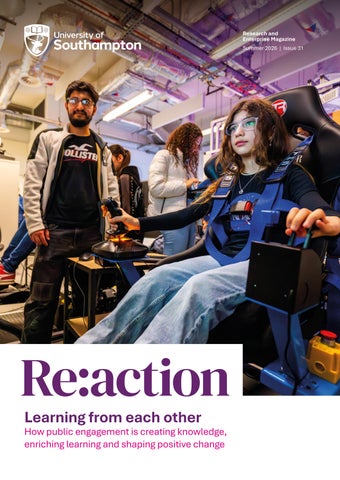
Research and Enterprise Magazine Summer 2026 | Issue 31
Re:action Learning from each other
How public engagement is creating knowledge, enriching learning and shaping positive change
Welcome to Re:action Public engagement has never been more important. The public, as taxpayers, support much of the research and education we provide. We understand that to address local and global challenges, we need to work closely with those most directly affected by them. We live at a time when information is more accessible than ever, but its interpretation is brokered by influencers and algorithms. All these factors, and many others, have increased the imperative for us to engage with as wide a representation of society as possible. The University of Southampton has a long and proud tradition in public engagement, much of it with a strong local civic element. Many Southampton families have enjoyed attending our Science and Engineering, and Arts and Humanities Festivals, or engaged with our unique young people’s health education programme, LifeLab. We have recently been recognised with a Silver Watermark from the National Coordinating Centre for Public Engagement. This edition of Re:action highlights work from across the University, from Kiki Messiou’s research putting pupil voice at the centre of inclusion in
Southampton’s primary schools to Jenny Baverstock and Dianna Smith’s work with the Southampton Food Partnership. We are also very excited to be hosting the British Science Festival from 16th to 20th September 2026. This promises to be an amazing opportunity to explore the very best in public engagement with science from across the UK. We are also delighted that our very own Professor Dame Wendy Hall has just been announced as the President of the British Science Association for the coming year. Do plan on attending some of the events, being held across Southampton. As always, we would welcome feedback on this edition and the subjects that it covers. Best wishes Professor Jane Falkingham (Vice-President Engagement and International) and Professor Mark Spearing (Vice-President Research and Enterprise).
Please send us your feedback We are keen to receive your feedback about Re:action. If you have any ideas, comments or suggestions, please send them to riscomms@soton.ac.uk 2
This edition of Re:action was created by Kate Williams, Research and Innovation Services
Contents Public Engagement Grounding the University in society
4–7
‘Sharing the joy of discovery’ The British Science Festival comes to town
8 – 11
Listening differently Pupil’s voices shaping education research
12 – 15
Building a fairer food system How research is helping transform Southampton’s approach to food
16 – 19
The art of bringing physics to life A creative approach to inclusive science communication
20 – 23
Shifting the dial The University’s partnership with Southampton Voluntary Services
24 – 27
Inspire, connect, enable Introducing the Public Engagement with Research unit
28 – 31
Sharing knowledge, shaping research Public engagement in the faculties
32 – 37
Research award highlights
38 – 42
3
Public engagement Grounding the University in society With the British Science Festival coming to Southampton in 2026 and the University recently awarded a Silver Engage Watermark by the National Co-ordinating Centre for Public Engagement (NCCPE), public engagement is firmly in the spotlight. But what exactly is it, and why does it matter?
The NCCPE defines public engagement as sharing the activities and benefits of higher education and research with the public through a two-way process of interaction and listening for mutual benefit. For Ben Littlefield, Head of the University’s Public Engagement with Research unit (PERu) in Research and Innovation Services, “it’s about people from all backgrounds connecting to generate inclusive knowledge that benefits society.” An evolving field Public engagement emerged in its current form in the early 2000s, shaped by controversies such as genetically modified (GM) crops and Bovine Spongiform Encephalopathy (BSE), which exposed the limitations of the ‘deficit model’ – the assumption that simply educating the public would change attitudes. Today, rather than seeing the public as passive recipients of knowledge, researchers increasingly recognise them as partners whose experiences can drive better research, education and outcomes for society. Continued on page 6 → 4
5
PUBLIC ENGAGEMENT navigate this space and develop the skills, partnerships and culture needed to work with the public effectively.
Public engagement is the lifeblood of Southampton, underpinning our values and strategic priorities.”
“Our role is to enable, connect and inspire beneficial engagement with society,” said Ben. PERu offers training, networking, funding and advice, while events create opportunities for dialogue with the public. Partnership working is central to the team’s approach and close relationships with key community and voluntary sector organisations help connect University and external partners around shared interests.
Ben Littlefield
“Public engagement equips our staff and students with the skills to meet our civic partners’ needs and creates the environment in which projects with local partners can flourish,” said Ben. You can read more about the support available from PERU on pages 28 – 31. Commitment to the future In April 2026, Southampton was awarded the NCCPE Silver Engage Watermark, in recognition of the University’s “strong leadership and highly developed culture of support for public engagement.” Continued from page 4 “The public bring their own expertise, lived and living experience and often have the solutions to society’s problems. This needs to be recognised and valued,” said Ben. Better research starts with better conversations Whether working with patients to improve healthcare research, collaborating with local organisations or partnering with communities to shape new projects, meaningful engagement helps researchers better understand the needs of the people their work is intended to benefit. Engaging with the public is an important form of knowledge exchange. Participatory approaches enable underrepresented groups to shape or lead innovations, making research more inclusive and often saving time and money by identifying issues early. Community-engaged approaches also strengthen education, helping students develop transferable skills and connect academic study with real-world challenges. 6
Increasingly, public engagement is integral to higher education and research. It is often required in funding applications, supports performance in the Knowledge Exchange Framework and Research Excellence Framework, attracts partners, staff and students, and enhances the University’s reputation. At Southampton, engagement is vibrant and varied – from festivals and focus groups to school visits and co-designed projects. For Ben, it is the “golden thread” that runs through the Triple Helix approach and underpins Southampton’s identity as a Civic University. Reflecting on the Triple Helix’s core – people – he said: “Public engagement brings people together across disciplines and roles, and across the boundaries between university and society, fostering a sense of community and belonging. Just as importantly it can be incredibly motivating and joyful.” Enabling, inspiring and connecting Southampton recognised the importance of public engagement early, establishing the Public Engagement with Research unit (PERU) almost 20 years ago. Today, the team helps staff and students
Ben sees it as a reflection of the University’s strengths and a commitment to further development. “We applied for a Silver award because there are pockets of exceptional engagement, but we know there are areas we can work on,” he said. The University has pledged to strengthen eight key areas over the next three to four years, including reward and recognition, definitions, distributed leadership, resourcing, and embedding partner voice in governance, while addressing barriers around ethics, ownership of coproduced research, and fair involvement of young or vulnerable co-researchers. For Ben the goal is clear: to become a fully Engaged University, with the culture and processes that enable and support purposeful, responsible engagement. “Public engagement is the lifeblood of Southampton, underpinning our values and strategic priorities. Across the University there are countless examples of exceptional engagement, built through years of care, dedication and trust by colleagues and students alike. Our responsibility is to support, value and recognise those people, because public engagement is central to our mission, not an optional extra.”
Finding the right approach Public engagement at Southampton can be thought of as a spectrum of methodologies defined by how much power is shared with the public, explained Ben. Whatever the approach, it should have a clear purpose, suit the context and be carried out responsibly. At one end of the spectrum, illustrated below, are activities that communicate knowledge, such as talks, media interviews and social media. Though often one way, they can be made more meaningful and appropriate by co-creating content with intended audiences to understand their needs. Dialogue comes next, through public debates, festivals and exhibitions,
where conversations with audiences can reshape researchers’ thinking or direction. Consultations, focus groups, surveys, and citizen science bring in diverse perspectives, grounding research in lived and living experiences. Further along the spectrum, collaboration enables the public to contribute expertise through communities of interest, advisory groups, patient panels and research partnerships, increasingly sharing decision-making. Co-production allows for even greater involvement, giving people most affected by innovations the opportunity to shape
their direction. At Southampton, this includes partnerships with young people, local organisations and community groups. Approaches such as deliberative democracy and citizen juries, place researchers and the public as equal partners, working together to define projects from the outset. At the far end of the spectrum, publicled research sees communities driving studies themselves while universities provide expertise, training and support. Ben expects this area to grow: “Universities will increasingly become enablers of solutions to society’s problems,” he said.
THE PUBLIC ENGAGEMENT SPECTRUM
Subject talks
User-led resources PUBLIC-LED Participatory research
Consultations
Exhibitions
Books
Committees
Advisory/user board
Focus groups
Education programmes
Traditional media
MAKING DECISIONS
COLLABORATION
UNDERSTANDING THINKING
STIMULATING DEBATE
SHARING INFORMATION
Citizen juries
Co-applicant
Opinion polls
Public debates
Broadcast social media
Festival stands
Websites
CO-PRODUCTION CITIZEN SCIENCE
Deeper impact/sharing power
Wider reach
The Public Engagement Spectrum, by B Littlefield, adapted from Wellcome Trust’s ‘Onion’ and Edinburgh University’s Beltain models.
7
8
‘Sharing the joy of discovery’ The British Science Festival comes to town Theatrical performances about AI; a pop-up skate park exploring the mathematics of skateboarding; cocktailmaking classes inspired by the Southern Ocean; science comedy, live music, lectures, giant murals, food trucks, and more than 15,000 visitors arriving in Southampton can only mean one thing: the British Science Festival (BSF) is coming to the city.
With a history stretching back to the 1800s, the BSF is one of the world’s longest running and most prestigious science and engineering festivals. Run by the British Science Association (BSA), the festival moves to a different host university and city each year, attracting thousands of visitors to engage with cutting-edge scientific research.
From 16–20 September 2026, it is Southampton’s turn, with hundreds of students and staff from the University and partner organisations – along with participants from other UK institutions – sparking imaginations through sharing their work. Continued on page 10 →
9
‘SHARING THE JOY OF DISCOVERY’
We want to showcase that science is for everyone.” James Brown British Science Festival
Continued from page 9 Showcasing Southampton Southampton’s bid to become the UK City of Culture 2025 was unsuccessful, but out of the partnerships it created came an exciting new idea. “Hosting the BSF felt like a powerful way of building on that momentum,” explained Ben Littlefield, Head of Public Engagement. “We wanted to highlight that Southampton and the wider region have so much to offer the UK in terms of research and innovation.” With backing from the Engaged University Steering Group, and sponsorship from Vice President Research and Enterprise, Professor Mark Spearing, a bid was submitted to the BSA’s highly competitive host selection process in March 2023. In June of the same year, Southampton was selected as the host for 2026. “Ordinarily the host university has a year to prepare but we took a different approach because we wanted to centre partner voice at the heart of the festival from the outset,” continued Ben. Partner voices The Public Engagement with Research unit and colleagues have spent the last few years consulting and collaborating with civic and community partners, including a panel of local young people (with support from the University’s Life Lab), to find out what they wanted from the festival. “Straight away, they told us they would never go to a science festival, which was a bit of a shock!” recalled Ben. “So we worked with them to identify themes they’re interested in – health and wellbeing, food, biodiversity, nature, social justice. They had direct decisionmaking power over the selection of festival content – a first at such an early stage in planning for the BSA. “And we asked them where they spend their time – places like the city centre 10
or West Quay – and that’s where we’ll be taking festival activities, rather than expecting people to come to Highfield Campus. The most important thing is to go to where people are.” Southampton City Council, involved as a partner from the beginning, also contributed perspectives. And director of Turner Sims Louise Coysh led conversations with local arts and culture organisations. “Our partners kept saying, the festival needs to be centred on culture and creativity, offering creative opportunities for people to contribute their own lived and living experiences,” said Ben. “This became central to our vision.” Taking science to people Ben highlighted the “crucial contributions” of colleagues across the University and the BSA, where executive control for the festival sits. A joint steering group was supported by subgroups focused on programming, operations, marketing, communications, and sponsorship.
For James Brown, Director of the BSF, moving to a new host city each year is both the festival’s trickiest challenge and greatest opportunity. “Every time we start from scratch with new venues, partners, and collaborators, but every year, the festival feels like it’s got a fresh identity, reflecting the local character.” With research showing that 51 per cent of the UK population is disengaged from science, and 25 per cent actively uninterested, James said that the festival’s core mission and audience remain constant. “We’re setting out to reach adults aged 16–35, where there’s a gap in engagement. We want to showcase that science is for everyone. “The festival takes science to places where people are pursuing existing interests – like community spaces, shopping centres, theatres, bars and galleries – to show how science intersects with those interests. We think hard about how festival events can break down barriers, particularly for people who are underrepresented in science or who may feel excluded.”
Building on strengths This approach resonates with Southampton’s identity as “an egalitarian university at its core, dedicated to sharing power,” said Ben. He sees the festival bringing multiple benefits to both its audience and the University. “Hosting the BSF is a catalyst for building on the strengths of our existing culture of engagement. It has opened new opportunities to deepen our commitment to inclusive practice; embed the arts and creative methodologies in our engagement; and expand our capabilities as a civic institution through closer relationships with local and regional partners.” The festival will attract national and international media, showcasing the city and building Southampton’s reputation as a world-class university. Beyond the festival itself, the event will help demonstrate the relevance of the University’s activities, boost research impact, build trust, strengthen partnerships and widen opportunities
in science, engineering and creativity, leaving a lasting legacy for the region. Diverse perspectives “We hope this Festival provides visitors with a connection to science in a way that is relevant and meaningful and delivers incredible moments of positive, welcoming, and celebratory interactions,” said Ben. “Although a one-off event, it will hopefully foster a relationship with science and discovery that lasts and evolves.” Events like the BSF can help create spaces where people can bring their own life experience to conversations around topics like vaccine hesitancy and AI’s impact on employment, he reflected. “It’s about listening and ensuring that diverse perspectives inform and shape research, while building a relationship with society that gives people the resources and agency to make changes in their own lives and share the joy of discovery and experimentation.”
Images from the British Science Festival hosted by the University of Liverpool and Liverpool John Moores University, September 2025
Find out more: https://britishsciencefestival.org
Photography by Gavin Trafford and Gareth Jones, via British Science Association 11
Listening differently Pupils’ voices shaping education research What happens when school pupils are given the opportunity not just to share their views, but to become researchers themselves?
12
For children involved in the School Voices Research-Practice Partnership, the experience can be transformative. Equipped with research questions developed by their schools, pupils investigate their own and their classmates’ experiences, using their findings to shape change in their schools and inform education research. For Professor Kyriaki (Kiki) Messiou (Southampton Education School), the partnership builds on a “longstanding preoccupation” with how students can offer a different perspective on what happens in schools. A former primary school teacher, Kiki has spent much of her research career exploring inclusion and marginalisation in schools.
“When I talk about inclusion, I’m not just focusing on those children defined as having special educational needs,” she said. “For me, it’s about any child that may be on the margins for whatever reason. It’s about how we can enable all children to participate in school, do well and be happy.” Her research has included leading major European Union-funded projects exploring how engaging with student voices can help schools respond to diversity. One, involving 30 primary schools across five countries, including schools in Southampton, examined how dialogue between students and teachers could help children who may otherwise be marginalised.
This work laid the foundations for a Southampton pilot involving five primary schools during 2022–23. Using a collaborative action research approach, schools worked with researchers to explore how every child’s voice could be heard and contribute to more inclusive learning. Participatory methods including visual activities, drama and posters, enabled pupils to take an active role, with some becoming student researchers themselves. Following the pilot, the School Voices Research-Practice Partnership was established, bringing together the University and a growing group of local schools. Continued on page 14 → 13
LISTENING DIFFERENTLY Continued from page 13 “We’re not talking about a project any longer,” said Kiki. “We are talking about a long-term commitment to use research to transform what is happening in an educational context, by actively involving participants, including young people, and changing power relations.” Research questions shaped by schools Rather than researchers arriving with a fixed research question, each school identifies its own research focus. Questions must connect to the Partnership’s overarching theme of inclusion and be explored through student voice, but the schools decide what they want to investigate. Researchers support teachers to develop their questions and introduce a range of participatory methods, including interviews, visual activities such as drawing and photo elicitation, Diamond 9 ranking (involving students ranking nine ideas), sticky notes and lesson observations. Schools select a team of student researchers – often children who are less confident or less engaged with learning, explained Kiki. This helps them to develop skills in observation, interviewing, presenting and gathering evidence. Questions explored by schools include how to make maths more relatable, what motivates reading for pleasure, and how historical figures can inspire learning for all children, reflecting the project’s focus on inclusion. The impact can be immediate. At one school, boys who struggled with writing became student researchers, gathering their classmates’ views on what might help children with similar challenges. Their findings prompted the school to rethink how writing lessons were structured, benefitting all children.
Rather than researchers arriving with a fixed research question, each school identifies its own research focus. Right: Professor Kiki Messiou 14
“Some research questions may look quite straightforward, but interestingly, it was only when they listened carefully to their own students that the school was prepared to try things differently,” said Kiki. Lesson observations have proved particularly powerful. “Children go into classes with clipboards and notebooks, take notes, then discuss their observations with teachers,” said Kiki. In one primary school, the process led to a major redesign of the PE curriculum. Student researchers observed PE lessons and spoke to other pupils before working with teachers to develop a new series of seven lessons. “That’s quite powerful in terms of transformation in the school,” said Kiki. When pupils become researchers The benefits are not limited to the changes pupils help bring about. For the young researchers, taking on the role can completely transform their way of thinking about school and how they see themselves as learners, explained Kiki. As one student put it, “Becoming a student researcher made me more confident and brave speaking to people.” Another reflected: “I learnt that not just the teacher can contribute or do everything. We pupils have a major role too.” Teachers and schools also benefit. “They’ve given us specific things that we can do in our practice that are going to help all children. It’s changed my mindset about student voice,” commented one teacher. Alongside the schools’ research, Kiki and her team are studying the Partnership itself. “As schools implement these processes, we monitor progress and analyse the implications of the research for schools, teachers and students,” said Kiki.
Becoming a student researcher made me more confident and brave speaking to people.” School Voices student researcher
The team gathers data, conducts interviews and focus groups, and monitors changes over time, with findings contributing to academic research and international collaboration. The work is shared at academic conferences and through the World Education Research Association’s International Research Network ‘Student Voice for Promoting Equity and Inclusion in Schools’, co-led by Kiki and a colleague from Stanford University. It is also informing emerging School Voices partnerships in Italy and Portugal. Building a partnership for the long term The collaboration has been made possible through a range of funding. Research England’s Participatory Research Fund enabled the five-school pilot, while the Higher Education Innovation Fund
(HEIF) and University matched funding supported the establishment and evaluation of the Partnership. More recently, HEIF has funded events for pupils and teachers at the University. For schools, visiting the University has become an important part of the Partnership. Having enjoyed attending workshops and network meetings, teachers wanted children to have the same opportunity to meet and exchange ideas with student researchers from other schools. Last year, around 55 student researchers from nine schools met at the University and worked together to co-design a guide for future student researchers. Some later used it to help train the next cohort of researchers in their schools.
This year, the event took on the feel of an academic conference. Around 50 student researchers presented their work to fellow student researchers and the University’s trainee teachers. They used posters created in advance with support from University researchers, before answering questions from the audience. They also worked together to create short films about their experiences. “The children who come here absolutely love it,” said Kiki. The long-term ambition is to sustain and grow the Partnership, bringing more schools – including secondary schools – into the network.
creating a lasting relationship between research and practice, where children are not simply the subjects of research or consulted about decisions made by adults. They are researchers in their own right – asking questions, gathering evidence, engaging in dialogue with their classmates and teachers, and helping shape the schools where they learn. Find out more: https://schoolvoices.soton.ac.uk
But expansion is only part of the vision. At its heart, School Voices is about 15
Building a fairer food system How research is helping transform Southampton’s approach to food Southampton faces a complex food challenge. More than 40 per cent of the city’s Year 6 children are overweight or obese (compared with 36.6 per cent across England), while 41 per cent of respondents to Southampton City Council’s 2023 Cost of Living Survey reported experiencing food insecurity. These seemingly contradictory statistics highlight a deeper issue: creating a healthier city is not simply about changing individual behaviour but about improving the wider food system.
Continued on page 18 →
16
17
BUILDING A FAIRER FOOD SYSTEM Continued from page 16 This is the ambition behind a new partnership between the University of Southampton, Southampton City Council, voluntary organisations, businesses and community groups. Through research, collaboration and community engagement, the Southampton Food Partnership (SFP) is working to create a healthier, fairer and more sustainable future for the city. Understanding the food environment The Partnership grew out of longstanding collaboration between Dr Jenny Baverstock (formerly of Biological Sciences and now an Honorary Fellow at the University of Bristol) and Professor Dianna Smith (Geography and Environmental Science), and Southampton City Council’s Public Health team, including Becky Wilkinson and Dr Ravita Taheem. Jenny is an expert in food systems, food security, and public engagement and health, while Dianna’s research focuses on food insecurity, and health inequalities. Both had worked closely with the Council and other community partners long before the Partnership was established. For Dianna, that is exactly the role a Civic University should play. “We should be using our skills to support the wider community around research and making decisions that are beneficial for local policy,” she said. The catalyst for a food partnership came when a City Council scrutiny inquiry into
It became clear that if we wanted to improve health outcomes, we needed to look beyond individual choices and understand the wider food system.” Dr Ravita Taheem Southampton City Council
18
childhood healthy weight and reducing health inequalities concluded that Southampton needed a coordinated food partnership and a better understanding of its food environment. “It became clear that if we wanted to improve health outcomes, we needed to look beyond individual choices and understand the wider food system,” explained Ravita. In response, Jenny led the Mapping Southampton’s Food System project, funded through the Centre for the South’s New Things Fund. The research examined access to healthy food, procurement, education, local businesses, and food insecurity. It found that over a quarter of the city’s homes were more than 16-minutes’ walk from a healthy food outlet, with most of those households in areas of high deprivation. “It’s about enabling people to make choices,” said Jenny. “People need access to healthy food, decent local shops and opportunities to develop their skills to improve their own food environment.” The project showed that many organisations were already doing valuable work around food but could achieve more by working collaboratively. It brought together the Council, food aid organisations, community groups, retailers and public services, laying the foundations for a formal partnership. “We live in an obesogenic environment,” said Ravita. “It’s about understanding what we can do as a collective to create a healthier food environment.”
People need access to healthy food, decent local shops and opportunities to develop their skills to improve their own food environment.” Dr Jenny Baverstock
Powering change The city of Southampton joined the Sustainable Food Places network and launched the Southampton Food Partnership in 2024. Today, the Partnership brings together more than 90 members. Guided by a steering group of the University, Southampton City Council and Southampton Voluntary Services, it connects research, policy and community expertise to coordinate action across the city. Ravita – an alumna and visiting academic at the University – believes the close relationship between research and practice is one of the Partnership’s greatest strengths. “The University has been an absolute powerhouse and driving force behind the Southampton Food Partnership,” she said. “Its research identifies gaps in the local food environment and creates reasons for people to come together.” As Dianna explained, the Partnership is focused on understanding and building on the existing strengths within Southampton’s food system by bringing together businesses, community organisations, and anchor institutions like the University and the hospital. Aligned with the NHS 10-Year Health Plan, the 2025 Food Strategy for England and the Sustainable Food Places framework, it works closely with national and regional food networks to contribute to policy and national conversations around food. Space for collaboration The Partnership creates opportunities for organisations to share knowledge and work towards common goals through regular meetings, workshops and newsletters.
We should be using our skills to support the wider community around research and making decisions that are beneficial for local policy.” Professor Dianna Smith
prompted Barnardo’s to choose the city for a new project developing community food champions among refugee children and young people. Barnardo’s now participates in Partnership meetings, and the work is expected to inform Partnership priorities and Council policy. As it works towards a Sustainable Food Places Bronze Award, the Partnership continues to develop its action plan, exploring possibilities including a directory of local food businesses, a Southampton Marque, expanded community growing and better use of surplus food. A newly appointed Food Partnership Coordinator will help drive this next phase.
The first Southampton Food Summit, organised by Jenny and hosted at the University in May 2026, brought together more than 40 organisations to identify priorities, strengthen collaboration and shape the Partnership’s action plan. It also attracted businesses that the Council had previously found difficult to engage. “Business is vital for delivering healthy, sustainable food and making food more secure,” said Jenny. “It’s about creating different spaces and places for people to come together,” Ravita added. FAIR-food Research remains central to delivering the Partnership’s Action Plan. Dianna now leads Food Aid Inequality Rectified (‘FAIR-food’), a major Biotechnology and Biological Sciences Research Council-
funded project that is generating evidence for Southampton’s first Sustainable Food Places Award. Working with local authorities across the region, the project is training community researchers through the NxtGen Researcher Training Programme, developed by the University’s LifeLab, to investigate how food pantries can better meet local needs and how surplus food can provide healthier options for people using the food aid system. “It’s important to have people in the communities driving the research questions,” Dianna said. Early impact and growing ambition The Partnership is already influencing policy. The 2025 Working Towards Better Food for Southampton policy brief, which stemmed from Jenny’s mapping project,
“We’ve not even been up and running for two years,” said Dianna. “But the most tangible outcome so far is greater cohesion between different partners in Southampton’s food system.” “People are really starting to think about the food they provide,” added Jenny, “from its carbon footprint to where there might be gaps in healthy food provision.” By combining research, public engagement and collaboration, the Southampton Food Partnership is helping the city build a coordinated, evidenceinformed approach to creating a healthier, fairer and more sustainable food system. The Southampton Food Partnership has received funding from the University’s Public Engagement Development Fund and Innovation Fund.
19
The art of bringing physics to life “Do you want to see a rainbow?” It’s an unexpected question on a winter evening at the Light Up Trails art experience at Sir Harold Hillier Gardens. But for Dr Pearl John and her team of researchers and students from the University’s School of Physics and Astronomy and the Optoelectronics Research Centre (ORC), it’s the perfect conversation starter.
Hand visitors a strip of diffraction grating – a transparent, grooved material that separates light into wavelengths – encourage them to look through it. Suddenly, the white light installations burst into brilliant bands of colour. Curiosity takes over and soon visitors of all ages are talking about light, lasers, and photonics – technologies that depend on light. Pearl calls it ‘photonics busking’: taking physics to people and using colour, light, holograms and creative activities to bring complex ideas to life. 20
These encounters may be fun, but they have a serious purpose. Physics and photonics underpin everything from fibre-optic communications and medical technologies to AI computing, yet few people know the term ‘photonics’ or understand its importance. Making its role more visible, while inspiring the next generation to pursue careers in industries facing critical skills shortages, makes effective public engagement more important than ever. Continued on page 22 →
21
THE ART OF BRINGING PHYSICS TO LIFE
Continued from page 20 Pearl is a holographic artist and leads public engagement for Physics and Astronomy and Cornerstone C-PiC, the silicon photonics prototyping centre co-hosted by Southampton. Her artistic practice shapes how she designs public engagement, combining visual spectacle, experimentation and participation to invite discovery and make science less intimidating.
After her PhD, Pearl completed artist’s residencies in UK secondary schools, combining physics and creativity through holography projects. Presenting this work at a conference led to an invitation to teach in Missouri, where she helped develop the world’s first three-year high-school photonics programme. Supported by 3M, which needed more laser technicians, the course combined theory and safety with activities including holography, light shows and laser manufacturing.
This belief has shaped a career uniting two seemingly different worlds. A Fine Art and English graduate who later studied holography at the Royal College of Art, Pearl quickly discovered that showing someone a hologram usually prompted the question: how did you make that?
Pearl returned to the UK in 2003, to coordinate the University of Southampton’s Light Express Roadshow. Created by Physics and Astronomy and the ORC to share their research and encourage pupils to study physics, the travelling laser show has introduced tens of thousands of people to the science of light. Pearl has also taken holography, photonics and STEAM (Science, Technology, Engineering, Arts and Maths) workshops into schools and community settings, trained teachers across Europe to integrate photonics into science lessons and brought creative photonics activities into makerspaces.
“You have to develop your 20-second, three-minute or three-hour pitch, depending on their interest!” she said.
“When I started in outreach there weren’t enough physics students and departments were under threat,” Pearl recalled. Although
Art and science can have the same emotional impact, Pearl argues. “Wonder, intrigue, enjoyment – those are things that stay with people.” That spark encourages people to explore the science behind what they have seen.
22
numbers have recovered, inspiring young people to pursue physics and photonics remains central to her public engagement role. She works alongside Dr Sadie Jones, lecturer and Astronomy public engagement lead, and Emily Crawshaw of Cornerstone C-PiC, who also deliver creative workshops on subjects ranging from the aurora and space weather to silicon chip manufacturing. Bias and stereotyping mean girls, disabled, and LGBTQIA+ young people, and those from disadvantaged and some ethnic minority backgrounds remain underrepresented in physics, despite demand for talent. “Culturally, we’re preventing lots of people from getting involved,” said Pearl. “Southampton has an important role in ensuring everyone can access relevant knowledge and career opportunities.” A determination to make physics more inclusive has driven Pearl’s career, but an encounter at the Light Up Poole festival prompted her to rethink inclusive science communication. Her team had transformed a vacant shop into ‘The Photon Shop,’ offering light and laser demonstrations. One day she noticed a
young boy watching through the window, fascinated but reluctant to enter. His mother explained that the noise, lights and crowd were overwhelming for her autistic son and suggested neurodiversity training. Pearl realised some members of her own team also found bright, noisy environments exhausting, while traditional expectations of an outgoing science communicator did not always reflect the strengths of neurodivergent staff, students, or those who communicated differently.
Wonder, intrigue, enjoyment – those are things that stay with people.” Dr Pearl John
Today, those lessons shape everything from event design to researcher training. Rather than expecting everyone to engage in the same way, Pearl encourages her team to find approaches that feel authentic while creating more welcoming experiences for all visitors. Back at the Light Up Trails, visitors who stop to admire a rainbow soon find themselves learning how silicon photonics could help address major technological challenges, including the unsustainable energy demands of AI data centres. For Pearl, these conversations are about more than inspiring future physicists and
photonics workers. They help ensure that future technologies are developed with public understanding and support, while showing more people they belong in science. Whether making holograms, touring laser light shows or asking visitors if they would like to see a rainbow, Pearl shows that powerful science communication does more than explain. It creates moments of wonder that invite everyone to see themselves as part of the story. The Physics and Astronomy and Cornerstone C-PiC public engagement teams can be seen at: Duality: Listen to Light at the British Science Festival https://cornerstone.sotonfab.co.uk/ british-science-festival-26-duality-listento-light The Light-up Trails, December 2026 www.lightuptrails.com More information on Cornerstone C-PiC: https://cornerstone.sotonfab.co.uk/ about-us/public-engagement 23
24
Shifting the dial As universities rethink how they engage with society, public engagement is becoming less about sharing knowledge and more about creating it together. At the University of Southampton, an innovative partnership with Southampton Voluntary Services (SVS) is bringing community expertise into the heart of research and helping ensure knowledge flows in both directions.
Rather than delivering frontline services, SVS helps strengthen Southampton’s voluntary, community and social enterprise (VCSE) sector by supporting organisations to build capacity, collaborate, influence policy and recruit volunteers. Now in its fifth year, the In-Residence partnership places an SVS Community Development Worker within the University’s Public Engagement with Research Unit (PERu), creating an effective bridge between researchers and the sector.
That changed when Professor Mark E Smith became Vice-Chancellor in 2020. His vision of Southampton as a ‘Civic University’ – rooted in and contributing to the city’s social, economic, and cultural development while addressing local needs – was evident when he attended SVS’s monthly VCSE sector meeting.
For Rob Kurn, Chief Executive of SVS, this partnership has been more than two decades in the making.
For Ronda Gowland-Pryde, Senior Civic, Community and Public Engagement Manager in PERu, partnering with SVS offered a practical way to connect research with community expertise. Inspired by the idea of an artist residency, she developed the In-Residence model, to embed that knowledge within the University.
Early in his career, while managing a project providing drug harm reduction advice to young people, Rob wanted to work with University social psychologists to improve how the project communicated with its audience. Despite several approaches, he never found a way in.
“That sent a really strong message that the University wanted to work with us,” said Rob.
Continued on page 26 →
25
SHIFTING THE DIAL
That sent a really strong message that the University wanted to work with us,” Rob Kurn Southampton Voluntary Services (pictured right)
“We’re not community development workers,” explained Ronda. “Having somebody with those skills and expertise working alongside us is hugely important.”
That shared understanding has led to collaborations ranging from new research partnerships and funding bids, to creating opportunities for local people to influence research before studies are fully formed.
Working across both organisations, the In-Residence Community Development Worker builds relationships, identifies shared priorities and helps researchers and VCSE bodies navigate each other’s very different worlds.
One project, developed through SVS’s Green Network, brought together four grassroots environmental organisations and University researcher Marty Climenhaga to explore how the benefits of green prescribing could be measured.
Trust has become the partnership’s greatest strength. Instead of researchers approaching community organisations only as a project gets underway, the partnership creates ongoing conversations between academics and communities, shaping research around local priorities from the outset while giving the sector easier access to University knowledge and funding opportunities.
Each organisation co-developed its own evaluation tool, combining academic evidence with practical experience. The project led to the launch of a Green Social Prescribing Digital Toolkit in 2025, showcasing four community initiatives and different approaches to measuring impact.
Continued from page 25
“One of the biggest lessons,” said Rob, “has been understanding what each partner wants from the relationship and finding that sweet spot where those priorities overlap.”
26
For Rob, the project demonstrated the value of making research accessible beyond academia. “Having somebody that can translate that knowledge and work with you to coproduce something that’s really beneficial was amazing,” he said.
We’re not community development workers. Having somebody with those skills and expertise working alongside us is hugely important.” Ronda Gowland-Pryde (pictured above)
In-Residence has really supercharged the work that we do.” Ronda Gowland-Pryde
The partnership’s impact is evident in the research it is helping to shape. By bringing researchers and communities together earlier, projects are tackling issues identified by local people and producing evidence with direct value for communities. In another collaboration, ‘Teenage Girls in Parks,’ the University’s Professors Lucy Green and Matt Ryan worked with community partners, and young people. Together they explored how public parks could better meet the needs of teenage girls, generating first-hand evidence about the barriers that make public spaces feel unwelcoming. The findings have informed a policy paper and discussions with Southampton City Council, influencing local decisionmaking. Beyond individual projects, the model has helped establish Community Research Cafés, bringing together researchers, residents, and the VCSE sector to explore shared interests. It is also supporting the development of a Community Participatory Action Research network and community of practice, enabling
communities to play a greater role in generating research. The partnership’s influence extends to wider University activity too. It has strengthened community engagement through PERu’s existing Public Engagement Hubs, connected community groups with researchers to apply for the University’s Public Engagement Development Fund, extended co-operation with regional VCSE infrastructure bodies, and helped create and curate the Community Zone at Science and Engineering Day. The collaborative approach embodied by In-Residence played an important role in the University’s successful Silver Watermark Award from the NCCPE in April 2026, with assessors recognising its “commitment to openness and partnership.” The initiative has also enabled SVS and its partners to contribute to programmes such as the £5m NIHR-funded Health Determinants Research Collaboration, which supports community-led evidencebased approaches to reducing health inequalities across Southampton.
Ronda believes the partnership has transformed PERu’s ability to work alongside communities, boosting relationships within Southampton’s VCSE sector and enhancing the University’s role as a trusted civic partner. “In-Residence has really supercharged the work that we do,” she said. Looking ahead, Rob hopes that the partnership will continue to unlock access to the University’s expertise and resources, while creating opportunities for communities and VCSE organisations to work with institutions to generate new knowledge together. Those ambitions capture the purpose at the heart of this partnership. By shifting public engagement from engaging communities in research to shaping research with communities, In-Residence demonstrates how universities and the public can work together to tackle shared challenges and deliver research with lasting public value.
27
Inspire, connect, enable Introducing the Public Engagement with Research unit “Research and innovation have the greatest potential for impact when they are shaped by and shared with the public,” said Ben Littlefield, Head of the Public Engagement with Research unit (PERu). Whether you’re building partnerships, exploring funding or developing your engagement practice, the PERu team in Research and Innovation Services helps staff and students involve the public with their work in ways that benefit everyone involved. 28
TRAINING
Building public engagement skills PERu’s training programme supports people at every career stage to develop the skills and confidence to plan, deliver and evaluate high-quality public engagement. Deputy Head of Public Engagement Lisa Hanley explained that the programme grew from research identifying gaps in training and barriers faced by researchers, including limited time, funding, support and resources. Developed with colleagues across the University, including the Centre for Higher Education Practice, AI at Southampton, and faculty specialists, the programme offers bite-size sessions. These cover everything from introductions to public engagement and evaluation, to coproduction, safeguarding, facilitating sensitive conversations and inclusive engagement. Content is refined in response to participant feedback, University priorities and developments across the sector. In 2025, PERu co-delivered with the Faculty of Medicine the University’s – and one of the UK’s – first Master’s modules
dedicated to public engagement with plans to expand it across the University. Creative approaches are increasingly woven into PERu’s training, helping researchers develop fresh ways to share their work, while encouraging public participants to draw on their own experiences. Now in its fifth year, the Poetic Science programme pairs researchers, postgraduate students and communitybased scientists with writer Dr Helen Eastman to explore creative writing, poetry and live performance as tools for research communication. Developed with the John Hansard Gallery, the initiative also gives participants the chance to “connect with their research in new ways, and reflect on the often very personal reasons they chose their field,” said Ronda Gowland-Pryde, Senior Civic, Community and Public Engagement Manager. One participant described the programme as “an extremely fun and refreshing experience,” inspiring them to use poetry in their own public engagement.
Above: Lisa Hanley CONNECTING
Creative approaches are increasingly woven into PERu’s training, helping researchers develop fresh ways of sharing their work.
Developing partnerships Successful engagement depends on finding the right people to work with. One of the University’s longest-running engagement initiatives, the Public Engagement Network (PEN), connects researchers, including postgraduates, and professional services colleagues through events and an online community. For Lisa, its value lies in breaking down boundaries: “It brings people across the University together, transcending job descriptions and faculties, to share ideas, opportunities and good practice.”
With more than 500 members, the network is also a valuable starting point for anyone new to public engagement. Beyond the University, the Public and Community Engagement (PCE) Hubs connect researchers with Voluntary, Community and Social Enterprise (VCSE) organisations across four themes: Health and Wellbeing, Nature and Biodiversity, Future Cities, and AI and Society. Numbering more than 480 members, the Hubs offer networking events, themed discussions, and newsletters, helping generate research collaborations, internships, and civic partnerships.
29
INSPIRE, CONNECT, ENABLE COLLABORATING
Working with communities Increasingly, those connections go beyond traditional collaboration, with communities leading and shaping research itself. Community Participatory Action Research (CPAR) supports people to investigate issues affecting their own lives alongside University researchers. Through the In-Residence partnership, PERu is collaborating with Southampton Voluntary Services (SVS) and colleagues already using CPAR approaches to develop a network. Meanwhile Community Research Cafés provide opportunities to
explore community-led research, build connections and share learning (read more on page 27). The PERu team also works with other VCSE organisations including Action Hampshire and One Community to connect them with the University around shared priorities and opportunities. At the University’s festivals and Bringing Research to Life Roadshow, Community Zones give partner organisations a platform to showcase their work while encouraging new collaborations and knowledge exchange.
CREATING
Creativity as a catalyst Creativity opens new ways for the University to work with communities to shape places together. At the One Horton Heath residential development, photographer Simon Bray is artist-in-residence through a partnership with Eastleigh Borough Council, the John Hansard Gallery and Winchester School of Art. As part of a PhD studentship, he is working with residents to explore community connections through photography as the development progresses, helping to shape its future identity.
Working with colleagues across the University and other creative partners, PERu is also contributing to the University’s Public Art Strategy for the Highfield campus North-East Quadrant development. Workshops involving local schools, residents, community groups, students, staff and artists are informing new public art commissions, strengthening connections between the University, residents and wider communities in the city.
FUNDING
Turn ideas into action The annual Public Engagement Development Fund distributes some of Southampton’s Higher Education Innovation Fund (HEIF) allocation to support collaborative projects that benefit both research and society. Around 10 projects are funded each year across themes aligned with University and UK government priorities.
30
Now in its tenth year, the fund has supported projects spanning sustainability, inclusive arts education, healthy ageing and future energy. “Projects have influenced policy, contributed to REF impact case studies and helped underpin larger funding bids,” said Lisa.
ENABLING
A chance to connect From the Bringing Research to Life Roadshow to the University’s Science and Engineering and Arts and Humanities festivals, PERu’s events programme reaches more than 9,000 people each year, enabling over 1,500 staff and students to engage directly with the public. Beyond showcasing research, these events create opportunities to listen, build relationships and involve people in shaping research. “When we talk about public engagement, one of the first questions we ask is, ‘Who do you want to talk to and why?’” said Senior Public Engagement Manager Silvia Lanati. That approach is reflected in the University’s longstanding involvement with Southampton Pride, with the University now one of the festival’s largest sponsors. Since 2019, the Bringing Research to Life Roadshow has also featured at Pride, creating opportunities for researchers and students to share relevant work with LGBTQIA+ communities while hearing their perspectives, informing future research. “I found the crowds so engaging and generous with their time,” said Elise Harbord, who attended Southampton Pride with the University’s Clinical Trials Unit. “It was so rewarding, both personally and in shaping my ongoing work.” The University’s presence also provides a sense of belonging for staff, students and alumni who attend. “They are very happy to see their university there,” said Silvia. Pride is just one stop for the Roadshow. Originally designed for national events, it now takes research directly into
communities at smaller, free events across the region, connecting with people who might not otherwise engage with the University. “The idea is to bring your research to life where people are, giving them a flavour of the University,” said Silvia. The annual Southampton Science and Engineering Festival (SOTSEF) and Arts and Humanities Festival offer a different experience: large-scale celebrations of research that transform campuses and cultural spaces into places of discovery through live shows, talks, workshops, laboratory tours and hands-on activities. SOTSEF culminates in Science and Engineering Day, which typically attracts more than 5,000 visitors. Meanwhile, Arts and Humanities Day, the family-friendly centrepiece of the Southampton Arts and Humanities Festival, is held across the city’s Cultural Quarter. Thanks to the creativity and enthusiasm of everyone involved, the festivals inspire curiosity, connect people with research and encourage visitors to explore future careers. For staff and students, they also provide a supportive environment to experiment with new formats and build confidence in public engagement. “There is a sense of community and pride among the people who take part,” said Silvia. But the benefits go much further. “By talking about their work and designing activities, researchers start to see their work differently. Some even refine their research projects after interaction with the public.”
Above: Silvia Lanati Top: Public Engagement with Research unit
The festivals offer large-scale celebrations of research that transform campuses and cultural spaces into places of discovery.
Towards an engaged University Together, the initiatives described here reflect a wider shift. Public engagement is increasingly becoming central to how the University creates and shares knowledge. It enriches research, education, and the University’s wider contribution to society – from informing policy to supporting innovation and economic growth.
By creating opportunities for people to contribute to, engage with, and benefit from the University’s activities, PERu is helping to build trust, and ensure research remains relevant and connected to the communities and places it serves.
For more information about any of these activities, please visit: www.southampton.ac.uk/per https://sotonac.sharepoint.com/teams/ PublicEngagementwithResearchunit (INTERNAL ONLY) Or contact peru@soton.ac.uk 31
Sharing knowledge, shaping research Re:action asked Faculty public engagement leads to share some of the innovative ways researchers are working with communities and the public to co-create knowledge and deliver meaningful impact.
32
Medicine: a vital part of our approach Public engagement ensures that our work reflects the needs, priorities, and values of the people who benefit from our research. The Engaged Medicine Steering Group guides our engagement and involvement work and brings together colleagues from across Medicine to share best practice, celebrate inspiring examples, and provide support and training.
to have meaningful conversations that influence research design and improve outcomes. Through our nationally acclaimed Public Contributor Recognition Scheme we have celebrated more than 150 public contributors for their valuable role in shaping research and education.
Public and patient involvement and engagement (PPIE) is embedded across our undergraduate and postgraduate education, equipping future doctors and researchers with the skills and confidence to deliver benefits that matter to people. This includes a sectorleading Master’s module, ‘Engaging and involving the public with your science.’
Our internationally recognised LifeLab programme improves young people’s science-based understanding of health and wellbeing, while Youth Panels and the NxtGen researcher training scheme for 13 to19-year-olds, give them a voice in shaping conversations about healthier futures. Our researchers also inspire young people through school outreach activities such as NeuroKids, and work experience opportunities.
We are proud of our progress in working alongside patients and members of the public as partners in research. Our Listening Café creates space for researchers and community members
We take our research to people through events including the annual Southampton Science and Engineering Festival and the New Forest Show. At the British Science Festival 2026 in
Southampton, the public can engage with our research – including into respiratory health and air quality, early development science, medical technology, and educating future doctors – in creative and surprising ways.
Public and patient involvement is embedded across our undergraduate and postgraduate education, equipping future doctors and researchers to deliver benefits that matter to people. 33
SHARING KNOWLEDGE, SHAPING RESEARCH
Credit: In-Press Photography via Centre for Ageing Better
Environmental and Life Sciences: from local communities to global conversations Our researchers work alongside communities to tackle some of the most pressing challenges facing our region and our world. Together, they are creating solutions that deliver impact locally while influencing practice and policy nationally and beyond.
inclusive educational resources and creative workshops with artists to tackle inequalities in musculoskeletal health. On the Isle of Wight, Will King is investigating how stormwater and sewage overflows affect water quality and antimicrobial resistance, helping support safer recreational water use.
An important strand of our work with local communities is tackling health challenges and inequalities. In Southampton, Jessica Teeling leads BOOM! (Brain health in Black African cOmmunities in sOuthaMpton), codesigning a healthy lifestyle intervention to help address dementia risk factors. Nick Maguire has brought together Southampton City Council, service providers, and people with lived experience to identify what works to reduce homelessness across the city.
Creating more inclusive communities is central to our work. The Autism Community Research Network, codirected by Hanna Kovshoff and Sarah Parsons, brings autistic young people, families and partners together to shape research, advocacy and practice.
Across Hampshire, where adult musculoskeletal conditions are common, Claire Clarkin co-produces 34
Environmental and Life Sciences researchers also inspire curiosity and engagement with scientific discovery. Neil Gostling’s ‘Hidden in Stone’ exhibition welcomed almost 5,000 visitors to Southampton’s God’s House Tower to discover more about the last 200 million years of life in the region. He and his team also met over 4000 people
The Autism Community Research Network brings autistic young people, families and partners together to shape research, advocacy and practice.
at the Lyme Regis Fossil Festival, while his schools’ outreach inspires children to explore dinosaurs and evolution. Franklin Nobrega’s international Phage Collection Project engaged contributors across 18 countries to inform clinical trial design. Mark Chapman is helping young people explore climate resilience through hands-on investigations of climate-resilient crops, connecting schools across Southampton and the UK to efforts to address global climate change.
Social Sciences: partnerships for a fairer, more sustainable future Public engagement addresses the societal challenges our Social Sciences disciplines speak to, working with communities from children to businesses, locally, nationally and internationally to imagine and create more just, sustainable futures. In March 2026, Sian Campbell (Southampton Business School) and Beth Bray (Southampton City Council) hosted the first RSA Equitable Futures Forum in Southampton. The group brings together business, government and community organisations to build connections that support equitable opportunities in skills, employment and wellbeing for young people. The relationship between people and the environment is a recurring theme. Denise Baden’s (Southampton Business School) project, A Jigsaw to Save the World, uses a co-creation approach, running events with business leaders, school students, and academics to explore
their vision for a flourishing, sustainable future. Andri Christodoulou and Neta Shaby (Education School) partnered with Wonderseekers, Leigh Park Library and local families through the Biodiversity Action Champions initiative, empowering communities to act for nature through hands-on learning and participation.
Research, storytelling and public dialogue combine to amplify community perspectives on climate justice.
Internationally, Dina Lupin (Law) works alongside activists, scientists, community organisations and civil society groups across Africa through the Home in Crisis project, building knowledge and supporting participation in climate change proceedings before the African Court on Human and Peoples’ Rights. In March 2026, Dina also worked with South African activist theatre company Empatheatre to develop and present ‘Isitha Sabantu’ at Johannesburg’s Market Theatre. The production explored themes including participation, home, and justice, and brought together research, storytelling and public dialogue to amplify community perspectives on climate justice. 35
THE ENGAGEMENT BRINGING RESEARCH TO LIFE
Arts and Humanities: where our research comes alive In Arts and Humanities, public engagement is a natural expression of what our disciplines are about: fostering creativity and imagination, encouraging critical thinking, developing empathy, and deepening our understanding of the human experience. Across eleven departments and research centres we work with communities, cultural organisations, schools, policymakers, museums, creative industries, and the wider public to explore the issues that shape our lives and societies. In 2024–25 alone, we collaborated with more than 400 external partners and delivered hundreds of public lectures, exhibitions, performances, workshops, festivals, and media contributions. Our public engagement activity has both global reach and local impact. The University’s Arts and Humanities Festival and Hands-on Humanities Day brings thousands of people together in
36
Hampshire to explore research through interactive activities, performances, talks, and creative experiences. On the international stage, the ‘Following the Fish’ project (Winchester School of Art) shown at the Venice Architecture Biennale, used creative practice to engage audiences in discussions about migration, identity and belonging. Meanwhile Archaeology researchers have reached global audiences through media engagement and community-led heritage projects. These empower young people and local communities to shape their futures through research and storytelling. “Public engagement is where Arts and Humanities research comes alive,” said Professor Helen Spurling, Associate Dean for Research, Knowledge Exchange and Enterprise. “It connects scholarship with society, creating opportunities for people to think differently, imagine new possibilities, and better understand one another and the world around them.”
Public engagement connects scholarship with society, creating opportunities for people to think differently, imagine new possibilities, and better understand one another and the world around them.” Professor Helen Spurling
Engineering and Physical Sciences: shared joy and discovery In Engineering and Physical Sciences, public engagement is in our DNA. For many years colleagues and students have inspired curiosity, built connections and shared stories of innovation through science communication and schools’ outreach. The Southampton Science and Engineering Festival, established by Gill Reid (Chemistry) and colleagues over 20 years ago, is one of the best-known examples. Now welcoming more than 5000 visitors every year, it provides a platform for shared joy and discovery. Colleagues across the faculty are finding new ways to engage people in unexpected settings, from science busking at the Light up Trails at the Sir Harold Hillier Gardens (see page 20) to Reena Pau’s work addressing barriers to participation, helping make our engagement more equitable and representative of the communities we serve.
We are also learning how to involve people earlier and more meaningfully in research. Colleagues such as Alex Dickinson and Tinashe Munyebvu are showing how embedding public engagement into biomechanical computational engineering research can improve outcomes while uncovering new innovations. Across the Faculty, momentum is building to embed engagement more deeply, with coordinated cross-school and enterprise unit initiatives in both Electronics and Computer Sciences and Chemistry and Chemical Engineering. This reflects years of commitment from colleagues who have given their time, creativity and enthusiasm to engagement work.
The Faculty is making public engagement a strategic priority; building on our strengths to create deeper, more inclusive and impactful relationships with society.
Now, the Faculty is making public engagement a strategic priority; building on our strengths to create deeper, more inclusive and impactful relationships with society and to recognise the people who do this work.
37
Research award highlights This list encompasses a selection of awards logged with University of Southampton Finance from January to April 2026 that are not considered commercially sensitive.
FACULTY OF ARTS AND HUMANITIES
FACULTY OF ENGINEERING AND PHYSICAL SCIENCES
Prof Fraser Sturt; School of Humanities RICHeS staff funding AHRC; £480,134 over 60 months
Prof Stephen Beeby; School of Electronics and Computer Science HORIZON EUROPE – E-FLOWER – Transformational E-Textiles: Materials and Processes for Comfortable, Durable and Sustainable Wearable Electronics European Commission; £500,266 over 48 months
Prof Marianne O’Doherty; School of Humanities and Dr Drew Crawford, School of Humanities Strange Geographies: Spatial Imaginaries of Medieval Britain AHRC; £936,884 over 36 months Dr Amy Williamson; School of Humanities Networks of Preservation and Transformation: The Afterlives of Medieval Music Manuscripts in Post-Reformation England British Academy; £1,852 over 12 months Dr Giulia Felappi; School of Humanities The reappearance of Margaret Macdonald’s ink British Academy; £128,348 over 11 months Prof Joanne Turney; Winchester School of Art Beyond Heritage University of Bergen; £11,421 over 39 months
Prof Simon Coles; School of Chemistry Physical Sciences Data Infrastructure Phase 1b – Supplement EPSRC; £1,899,764 over 12 months Prof Nicholas Evans; School of Physics and Astronomy University of Southampton Particle Physics Theory Consolidated Grants 2025 Science And Technology Facilities Council; £1,658,958 over 48 months Dr Collin Sones; Optoelectronics Research Centre Building towards rapid diagnosis of a Cytokine Storm EPSRC; £415,747 over 36 months Prof Geoff Merrett; School of Electronics and Computer Science MegaSoC EPSRC, UoS in kind contribution, UoS cash contribution; £2,998,464 over 36 months Prof Senthil Murugan Ganapathy; Optoelectronics Research Centre Capacity Building in Sub-Saharan Africa via Core Physics (Spectroscopy) for Women’s Health Equity Science And Technology Facilities Council; £515,749 over 24 months Prof Paolo Rapisarda; School of Electronics and Computer Science HORIZON EUROPE (MSCA PF 2025 Guanru Pan) – SIGREEN – SIGnal-based control for Resilient, Energy-Efficient, Net-zero systems European Commission; £212,452 over 24 months
38
Prof Paolo Rapisarda; School of Electronics and Computer Science Horizon Europe – MSCA-DN – KONEST – Kernel-based Methods in Control and Estimation UoS in kind contribution, European Commission; £268,260 over 48 months
Prof Manda Banerji-Wright; School of Physics and Astronomy Host Galaxies of Dwarf AGN with Rubin Legacy Survey of Space Time and Euclid UoS in kind contribution, Science and Technology Facilities Council; £444,046 over 36 months
Prof Radan Slavik; Optoelectronics Research Centre Hollow Core Fibre Frequency Reference Royal Society; £192,961 over 18 months
Prof Manda Banerji-Wright; School of Physics and Astronomy Navigating Reasonable Adjustments: Empowering Neurodivergent PGRs through transparency and co-design EPSRC; £2,384 over 12 months
Prof Otto Muskens; School of Physics and Astronomy The cold universe as a renewable energy resource: developing smart radiative control coating technologies in South Africa Science And Technology Facilities Council; £467,335 over 24 months
Dr Benjamin Cerfontaine; School of Engineering HORIZON EUROPE (MSCA PF 2025 Aoxi Zhang) – UPCareWind – Unlocking Pile Anchors Capacity and Resilience for Floating Wind Energy European Commission; £192,850 over 24 months
Prof Pasquale Di Bari; School of Physics and Astronomy Ultra-high-energy neutrinos as probes of the cosmic neutrino background and new neutrino interactions Royal Society; £3,550 over 12 months
Dr Benjamin Cerfontaine; School of Engineering HORIZON EUROPE (MSCA PF 2025 Luc Simonin) – VExOP – Vibratory Extraction of Offshore monoPiles European Commission; £204,584 over 24 months
Dr Marcus Newton; School of Physics and Astronomy REsilience through Synchrotron Techniques for African Research & Technology (RESTART) Science And Technology Facilities Council; £340,388 over 24 months
Dr William Wu; School of Engineering 3D Sound Propagation Modelling in Complex Underwater Environments EPSRC; £29,250 over 6 months
Prof Diego Altamirano; School of Physics and Astronomy and Dr. Mehtap Ozbey Arabaci; School of Electronics and Computer Science CiliaScope – Transforming Respiratory Diagnostics With AI UoS in kind contribution, MRC; £211,524 over 12 months Prof Blair Thornton; School of Engineering Horizon Europe – BlueOcean – Novel photonics instruments for AI-assisted characterization and monitoring of marine ecosystems European Commission; £268,260 over 48 months Dr Philip Wiseman; School of Physics and Astronomy TRANSCEND: Cosmology and astrophysics from a census of the transient Universe Science And Technology Facilities Council; £905,002 over 60 months Dr Abhinav Kumar Singh; School of Electronics and Computer Science Horizon Europe – MSCA-DN – AI4Power – Artificial Intelligence for low carbon Power systems UoS in kind contribution, European Commission; £536,520 over 48 months Dr Firman Simanjuntak; School of Electronics and Computer Science Linking UK–Malaysia in Neuromorphic AI-accelerator Royal Society; £12,000 over 24 months
Dr Rafael Mestre Castillo; School of Electronics and Computer Science RENKEI Collaboration Grant 2025: Multimodal Machine Learning for Ageing Pathways (MAP) British Council; £6,000 over 12 months Dr Chris Duckworth; School of Electronics and Computer Science AI-assisted Collective Choice for Equitable Support with type-1 diabetes technology EPSRC; £49,998 over 12 months Dr Chengchen Zhang; School of Electronics and Computer Science Gallium nanodroplets enabled liquid artificial enzymes NanoGaLEs EPSRC, UoS in kind contribution; £533,434 over 36 months Prof Gill Reid; School of Chemistry EXPRESS – EXploiting single source PRecursors for the Electrochemical growth of functional 1D and 2D metal dichalcogenide SemiconductorS EPSRC; £10,375,407 over 60 months Dr Hugo Putuhena; School of Engineering Decision Support Tools for Spatial Planning and Cumulative Effects Assessment of Offshore Wind in the Greater North Sea Velux Fonden; £946,238 over 48 months
39
RESEARCH AWARD HIGHLIGHTS FACULTY OF ENVIRONMENTAL AND LIFE SCIENCES Prof Damon Teagle; School of Ocean and Earth Science Natural Hydrogen (Nat-H2) Natural Environment Research Council (NERC); £774,055 over 36 months Prof Pete Worsley; School of Health Sciences Algorithms for Smart Seating Solutions EPSRC; £66,021 over 12 months Dr Ben Ainsworth; School of Psychology NEbulisers For Breathlessness In COPD – A Double-blinded Randomised Trial – NEBCOPD c2 National Institute for Health and Care Research; £124,889 over 45 months Dr Becks Spake; School of Geography and Environmental Science Precision Ecology For A Changing World Natural Environment Research Council (NERC: Pushing the Frontiers Award); £795,607 over 30 months Prof Andrew Tatem; School of Geography and Environmental Science Improving urban population estimation and mapping using novel geospatial datasets The Patrick J. McGovern Foundation; £330,426 over 12 months Dr Miguel Ramirez-Moreno; School of Biological Sciences Accelerating the discovery of overlooked disease mechanisms in dementia Alzheimer’s Society; £352,868 over 48 months Dr Alessandro Silvano; School of Ocean and Earth Science Horizon Europe – SYNCHRONY – Synchronous Southern Ocean Observatory European Commission; £98,865 over 48 months Dr Nuno Koch Esteves; School of Health Sciences CARE-HEAT (Climate Ageing Resilience and Equity in HEAT) Vivensa Foundation; £349,334 over 36 months Dr Nic Bury; School of Ocean and Earth Science Network for Cross-disciplinary assessment of Endocrine Disrupting compounds: training the next generation of toxicologists European Commission; £188,456 over 36 months
40
Dr Nic Bury; School of Ocean and Earth Science Defining species sensitivity to endocrine disrupting chemicals Natural Environment Research Council (NERC); £376,399 over 30 months Dr Luis Yanez Guerra; School of Biological Sciences Tracing the Evolutionary History of Sensory Perception via TRP Channels International Human Frontier Science Program Organization; £614,074 over 36 months Dr Triana Amen; School of Biological Sciences Horizon Europe – MSCA-DN – VirION – Inter-organelle crosstalk in viral infections: identifying peroxisome-related targets for novel broad-spectrum antiviral strategies UoS in kind contribution, European Commission; £268,260 over 60 months Dr Nela Nikolic; School of Biological Sciences Developing phage-based therapies against biofilm-associated bacterial infections The Academy of Medical Sciences; £125,000 over 24 months Dr Masashi Watanabe; School of Ocean and Earth Science Reconstruction of tsunami recurrence intervals in southwest England Royal Geographical Society (with IBG); £3,500 over 9 months Dr Jessica Espey; School of Geography and Environmental Science Horizon Europe – REIGN-MP – Resilient and Effective International Governance and Networks for monitoring gases relevant to the Montreal Protocol European Commission; £147,678 over 48 months Dr Jonas House; School of Geography and Environmental Science REPLACE: Meat replacement and systems of edibility in Asia and beyond The Research Council of Norway; £95,305 over 48 months Dr Liba Sheeran; School of Health Sciences BACK-on-TRACK Pilot Trial: A pilot randomised controlled trial of personalised digital support for low back pain in the rail sector National Institute for Health and Care Research; £706,756 over 24 months
FACULTY OF MEDICINE Prof Philip Calder; Human Development and Health The Economic Impact of Malnutrition in the UK British Association for Parenteral and Enteral Nutrition; £98,304 over 12 months
Dr Kinda Ibrahim; Primary Care, Population Sciences and Medical Education Pharmacogenomics Research for Individualised Medicine in Older people National Institute for Health and Care Research; £2,736,002 over 60 months
Prof Sarah Ennis; Human Development and Health Research Fellow in Translational Genomic Informatics Wessex Secure Data Environment (led by Southampton University Hospitals NHS Trust); £96,427 over 60 months
Dr Andrew Cumpstey; Clinical and Experimental Sciences Perioperative oxygenation during major surgery (PERI-Ox) – NIHR HTA application National Institute for Health and Care Research; £3,067,170 over 60 months
Mrs Yun Jung Kim; Clinical and Experimental Sciences RISK-HCC | Risk prediction of hepatocellular carcinoma using machine learning in viral hepatitis National Institute for Health and Care Research; £677,405 over 45 months
Prof Sam Chamberlain; Clinical and Experimental Sciences LONGitudinal STRuctural drivers of gambling-related harms: building partnerships to IDentify risk factors and build Evidence at Scale (LONG-STRIDES) UK Research and Innovation; £127,759 over 12 months
Dr Emma Reeves; Cancer Sciences Modulating MHC class I expression and peptide repertoire to enhance anti-tumour CD8+ T cell responses in gastrointestinal stromal tumours Sarcoma UK; £200,000 over 30 months Dr Kinda Ibrahim; Primary Care, Population Sciences and Medical Education The co-development of a medication optimisation intervention for people with dementia (OPTI-MED) National Institute for Health and Care Research; £45,989 over 18 months
Prof Michael Hornberger; Clinical and Experimental Sciences Spatial Navigation – Australia National Health and Medical Research Council (NHMRC); £12,141 over 48 months Prof Michael Hornberger; Clinical and Experimental Sciences Introduction of an oNline cognitive battery for fitness to Drive In mild Cognitive impAirmenT and dEmentia Road Safety Trust; £86,859 over 21 months
41
RESEARCH AWARD HIGHLIGHTS FACULTY OF SOCIAL SCIENCES Prof Christine Currie; School of Mathematical Sciences AI for Science: KE Hub Extension EPSRC; £5,546 over 6 months Prof Leor Barack; School of Mathematical Sciences HORIZON EUROPE (MSCA PF 2025 – Jezreel Castillo) – GWhyb – Hybrid models for precision gravitational-wave astronomy European Commission; £200,268 over 24 months Dr Charlie Walker; School of Economic, Social and Political Sciences Changing infrastructures of care in post-Soviet Eurasia: social resilience and looked-after children in Kyrgyzstan ESRC; £14,000 over 12 months Prof Brienna Perelli-Harris; School of Economic, Social and Political Sciences and Prof Olga Maslovskaya; School of Economic, Social and Political Sciences Horizon Europe – GGP-ACE European Commission; £64,366 over 24 months Prof Christian Bokhove; Southampton Education School and Dr Keji Fan; Southampton Education School Exploring “Business-as-Usual” Variation to Improve Understanding of What Works Across EEF Trials The Education Endowment Foundation; £103,483 over 12 months Dr Kamil Zwolski; School of Economic, Social and Political Sciences The National History Trauma: Adaptive Conservatism in Poland’s Grand Strategy Leverhulme Trust; £50,072 over 12 months
42
Dr Rebecca Taylor; School of Economic, Social and Political Sciences FortranFuture: a Network for Sustainable Fortran-based Science EPSRC; £133,590 over 36 months Dr Hanh (Blue) Nguyen; University of Southampton Business School (USBS) Generative AI Adoption and Its Impact on Decision-Making in Vietnamese Firms British Academy; £9,995 over 12 months Dr Joao Da Silva Varandas Ferreira; School of Economic, Social and Political Sciences Knowing Your Place: How Priority Ranking Transparency Shapes School Choice Outcomes British Academy; £9,566 over 21 months Dr Achala Gupta; Southampton Education School Transformational coaching for employment: Identity formation among Indian youth Leverhulme Trust; £250,189 over 36 months Dr Jay De Los Reyes; Southampton Education School Imagining Inclusive Migration for Children through Student Voice Leverhulme Trust; £69,925 over 15 months Dr Gregory Ashton; School of Mathematical Sciences INTIME: Inferring the timing properties of neutron stars with hierarchical profile-domain timing Science And Technology Facilities Council; £447,534 over 30 months
Photograph by Gavin Trafford and Gareth Jones, via British Science Association Image from the British Science Festival hosted by the University of Liverpool and Liverpool John Moores University, September 2025
43
Find out more: www.southampton.ac.uk/ris riscomms@soton.ac.uk +44 (0)23 8052 3095
Research and Innovation Services (RIS) facilitates academic collaborations, research funding bids, industrial interactions and knowledge exchange activities, including commercialisation and business acceleration. RIS also supports research ethics and integrity, research contracting and the REF.
Please recycle this publication when you have finished with it.