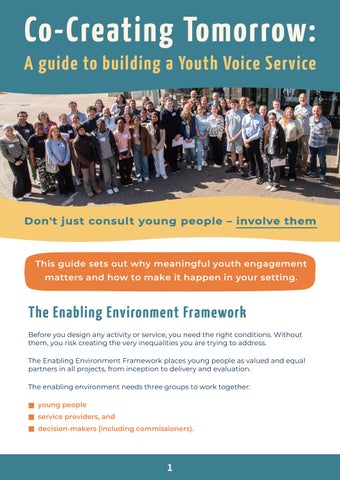
Co-Creating Tomorrow: A guide to building a Youth Voice Service
Don't just consul t young people – involve them
This guide sets out why meaningful youth engagement matters and how to make it happen in your setting.
The Enabling Environment Framework Before you design any activity or service, you need the right conditions. Without them, you risk creating the very inequalities you are trying to address. The Enabling Environment Framework places young people as valued and equal partners in all projects, from inception to delivery and evaluation. The enabling environment needs three groups to work together: young people service providers, and decision-makers (including commissioners).
1
Why it matters Engaging with young people and including them in the design and delivery of services that affect them makes the services more relevant and more likely to be taken up by the young people who need them. Involving young people in this kind of decision-making improves their wellbeing and education, but also creates enhanced social cohesion, more equal communities and young people who are better equipped to deal with the adult world. Meaningful participation is therefore more than a democratic right. It is a practical way for improving life outcomes and addressing structural inequities. However, many local authorities and service providers feel ill-equipped to successfully embed young people into their decision-making processes. This guide sets out how that might be changed.
“Young people must be involved in defining and assessing success, as co-evaluators rather than simply subjects of evaluation.”
Background
WHO WAS INVOLVED:
Southampton City Council and the Southampton Place Partnership (SPP) commissioned the University of Southampton, in partnership with Southampton Health Determinants Research Collaboration (HDRC), Southampton Voluntary Services and Young Southampton, to work with young people to co-produce a set of recommendations for establishing a Southampton Youth Voice Service that places youth voice at its centre.
young people academic researchers commissioners service providers youth sector practitioners policy-makers
The result is a tested, evidence-based model, co-created with young people that any organisation can apply to their projects.
2
The 3 Underlying Principles Organisational commitment: Leadership must commit ideologically and with resourcing to youth voice, which has to add measurable value to all parts of the organisation. Open processes: shared expectations and transparent decision-making. Equal power: young people must be given a genuine voice, access and ownership; they must be equal partners.
“Without these principals, youth engagement risks reproducing the same structural inequalities it seeks to challenge, offering young people a voice but not the conditions necessary to create meaningful change.”
Eight steps to success: 1. Planning
8. Reflection
Involve young people from the outset. Secure early commitment from decision-makers to implement change, allocate budgets, and build in realistic timelines with review points.
Build regular, structured reflection by young people, facilitators and system partners into all stages of delivery.
7. Evaluation 2. Recruitment
Embed an evaluation framework capturing individual outcomes and system-level changes.
Use community-based, youth-led recruitment strategies that reach beyond traditional education settings.
6. Dissemination Share young people’s outputs through creative, visual and digital formats. Develop ways for young people to remain involved beyond individual projects.
3. Onboarding Create safe, welcoming spaces. Clarify expectations, payment, communication channels and access to support from the start.
5. Deliberation
4. Activation
Bring young people and decision-makers together to co-create priorities. Establish formal accountability mechanisms to ensure recommendations are delivered.
Provide diverse, flexible opportunities that enable young people to engage at different levels, building skills in advocacy, research and facilitation.
3
Is it successful? Measuring success requires looking beyond simple participation. Use the following checklist to track progress:
For young people, does it:
Is the programme:
boost confidence, skills and wellbeing over time?
genuinely inclusive, reaching underrepresented groups?
allow young people to be heard, valued and equipped to advocate for change?
offering flexible, meaningful ways to get involved?
connect their contributions to the decisions that affect them?
Regularly attended, showing active participation?
For the system, have you: formally taken up young people’s recommendations? included their recommendations in governance structures? changed policy, services and budget allocation?
Now it’s your turn... Meaningful youth engagement is more than just words. It is city-wide (or organisation-wide) action and commitment to making young people valued and equal partners in shaping the decisions and services that affect them. It requires long-term investment in capacity and infrastructure, coordination and partnership.
This guide gives you the framework, the steps, and the evidence to get started. If you would like to read the full report, please visit the following: https://bit.ly/3HSCow8
For more information about how the University of Southampton works with young people, including the NxtGen Researcher Training Programme contact lifelab@soton.ac.uk We would like to thank the organisations and partners whose support has contributed to this work: